<?xml version="1.0" encoding="ISO-8859-1"?><article xmlns:mml="http://www.w3.org/1998/Math/MathML" xmlns:xlink="http://www.w3.org/1999/xlink" xmlns:xsi="http://www.w3.org/2001/XMLSchema-instance">
<front>
<journal-meta>
<journal-id>1646-5830</journal-id>
<journal-title><![CDATA[Acta Obstétrica e Ginecológica Portuguesa]]></journal-title>
<abbrev-journal-title><![CDATA[Acta Obstet Ginecol Port]]></abbrev-journal-title>
<issn>1646-5830</issn>
<publisher>
<publisher-name><![CDATA[Euromédice, Edições Médicas Lda.]]></publisher-name>
</publisher>
</journal-meta>
<article-meta>
<article-id>S1646-58302020000200009</article-id>
<title-group>
<article-title xml:lang="en"><![CDATA[Secondary postpartum haemorrhage: when subinvolution of the placental site is suspected]]></article-title>
<article-title xml:lang="pt"><![CDATA[Hemorragia pós-parto tardia: suspeita de subinvolução do leito placentar]]></article-title>
</title-group>
<contrib-group>
<contrib contrib-type="author">
<name>
<surname><![CDATA[Dagge]]></surname>
<given-names><![CDATA[Ana]]></given-names>
</name>
<xref ref-type="aff" rid="A1"/>
</contrib>
<contrib contrib-type="author">
<name>
<surname><![CDATA[Vargas]]></surname>
<given-names><![CDATA[Sara]]></given-names>
</name>
<xref ref-type="aff" rid="A1"/>
</contrib>
<contrib contrib-type="author">
<name>
<surname><![CDATA[Clode]]></surname>
<given-names><![CDATA[Nuno]]></given-names>
</name>
<xref ref-type="aff" rid="A1"/>
</contrib>
</contrib-group>
<aff id="AA1">
<institution><![CDATA[,Centro Hospitalar Universitário Lisboa Norte Departamento de Ginecologia, Obstetrícia e Medicina da Reprodução ]]></institution>
<addr-line><![CDATA[Lisboa ]]></addr-line>
</aff>
<pub-date pub-type="pub">
<day>00</day>
<month>06</month>
<year>2020</year>
</pub-date>
<pub-date pub-type="epub">
<day>00</day>
<month>06</month>
<year>2020</year>
</pub-date>
<volume>14</volume>
<numero>2</numero>
<fpage>104</fpage>
<lpage>105</lpage>
<copyright-statement/>
<copyright-year/>
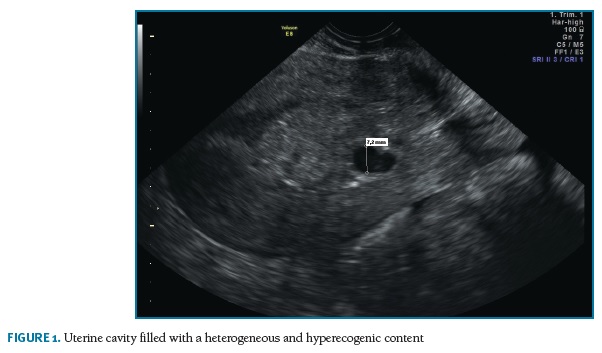
<self-uri xlink:href="http://scielo.pt/scielo.php?script=sci_arttext&amp;pid=S1646-58302020000200009&amp;lng=en&amp;nrm=iso"></self-uri><self-uri xlink:href="http://scielo.pt/scielo.php?script=sci_abstract&amp;pid=S1646-58302020000200009&amp;lng=en&amp;nrm=iso"></self-uri><self-uri xlink:href="http://scielo.pt/scielo.php?script=sci_pdf&amp;pid=S1646-58302020000200009&amp;lng=en&amp;nrm=iso"></self-uri><abstract abstract-type="short" xml:lang="en"><p><![CDATA[presented to our emergency department with a sudden late postpartum haemorrhage 30 days after a caesarean section. The transvaginal ultrasound examination revealed a pulsatile and tortuous vessel in the inner third of the posterior uterine wall with an increased peak systolic velocity and a low-resistance waveform. The diagnosis of subinvolution of the placental site was suspected and a Foley catheter with 40cc of normal saline was used as uterine tamponade. After the tamponade, the bleeding subsided. The Foley catheter was removed after 48 hours. Revaluation with ultrasound showed no evidence of abnormal vessels in the myometrium.]]></p></abstract>
<kwd-group>
<kwd lng="en"><![CDATA[Secondary postpartum haemorrhage]]></kwd>
<kwd lng="en"><![CDATA[Subinvolution of the placental site]]></kwd>
</kwd-group>
</article-meta>
</front><body><![CDATA[ <p align="right"><font size="2"><b>ISSUE IMAGE/</b>IMAGEM DO TRIMESTRE</font></p>     <p><font size="4"><b>Secondary postpartum haemorrhage: when subinvolution of the placental site is suspected</b></font></p>     <p><font size="3"><b>Hemorragia pós-parto tardia: suspeita de subinvolução do leito placentar</b></font></p>     <p><b>Ana Dagge<sup>1</sup>, Sara Vargas<sup>2</sup>, Nuno Clode<sup>3</sup></b></p>     <p>Centro Hospitalar Universitário Lisboa Norte - Departamento de Ginecologia, Obstetrícia e Medicina da Reprodução</p>     <p><sup>1</sup> Interna de Formação Especializada em Ginecologia/Obstetrícia </p>     <p><sup>2</sup> Interna de Ginecologia/Obstetrícia</p>     <p><sup>3</sup> Assistente Hospitalar Senior de Obstetricia e Ginecologia</p>     <p><a href="#c0">Endere&ccedil;o para correspond&ecirc;ncia</a> | <a href="#c0">Direcci&oacute;n para correspondencia</a> | <a href="#c0">Correspondence</a><a name="topc0"></a></p> <hr/>     <p>&nbsp;</p>     ]]></body>
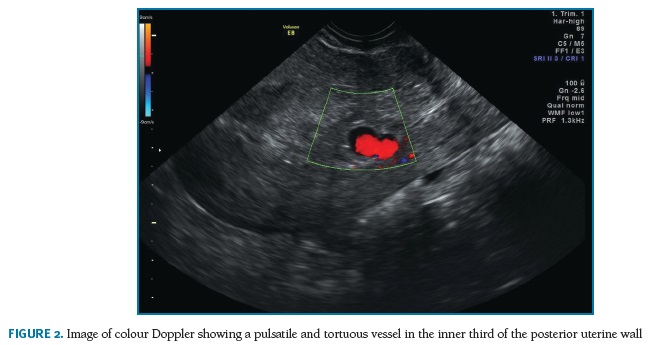
<body><![CDATA[<p><b>ABSTRACT</b></p> presented to our emergency department with a sudden late postpartum haemorrhage 30 days after a caesarean section. The transvaginal ultrasound examination revealed a pulsatile and tortuous vessel in the inner third of the posterior uterine wall with an increased peak systolic velocity and a low-resistance waveform. The diagnosis of subinvolution of the placental site was suspected and a Foley catheter with 40cc of normal saline was used as uterine tamponade. After the tamponade, the bleeding subsided. The Foley catheter was removed after 48 hours. Revaluation with ultrasound showed no evidence of abnormal vessels in the myometrium.</p>     <p><b>Keywords:</b> Secondary postpartum haemorrhage; Subinvolution of the placental site.</p> <hr/>     <p>&nbsp;</p>     <p>A 32-year-old woman, 1 gravida 1 para (twin pregnancy following <i>in vitro</i> fertilization), presented to our emergency department with a sudden and profuse late postpartum haemorrhage. The patient had been submitted to an uncomplicated caesarean section 30 days before (labour dystocia at 36 weeks), and until that moment her puerperium was unremarkable. The transvaginal ultrasound examination revealed an uterine cavity filled with an heterogeneous and hyperecogenic content (<a href="/img/revistas/aogp/v14n2/14n2a09f1.jpg" target="_blank">Figure 1</a>) and a pulsatile and tortuous vessel in the inner third of the posterior uterine wall (<a href="/img/revistas/aogp/v14n2/14n2a09f2.jpg" target="_blank">Figure 2</a>) with an increased peak systolic velocity and a low-resistance waveform. A diagnosis of subinvolution of the placental site was then suspected. </p>     
<p>&nbsp;</p>    <p align="center"><a href="/img/revistas/aogp/v14n2/14n2a09f1.jpg" target="_blank"><img src="/img/revistas/aogp/v14n2/14n2a09f1.jpg" width="300" height="167"/><br />(clique para ampliar ! click to enlarge)</a></p>    
<p>&nbsp;</p>    <p align="center"><a href="/img/revistas/aogp/v14n2/14n2a09f2.jpg" target="_blank"><img src="/img/revistas/aogp/v14n2/14n2a09f2.jpg" width="300" height="167"/><br />(clique para ampliar ! click to enlarge)</a></p>    
<p>&nbsp;</p>     <p>In order to control the bleeding and to preserve her fertility, stabilization with fluids was initiated and a Foley catheter filled with 40cc of normal saline was used for uterine tamponade. Prophylactic intravenous antibiotic therapy was also performed (2 grams of cefoxitin). After the tamponade, the bleeding subsided. One unit of packed red blood cells and 2 grams of fibrinogen were administered 24 hours later (haemoglobin of 7.3 g/dL and fibrinogen of 224 mg/dL). Since there were no signs of active bleeding the Foley catheter was removed after 48 hours. Revaluation with ultrasound showed no evidence of abnormal vessels in the myometrium and the patient was discharged four days after admission. Up to date this report was written, there hadn&#8217;t been any readmissions of the patient due to new episodes of haemorrhage. </p>      ]]></body>
<body><![CDATA[<p>Although rare, subinvolution of the placental site is one of the main causes of late postpartum haemorrhage. Its management depends on the severity of the bleeding. In hemodynamically unstable women, stabilization (fluids, transfusion of blood products) and avoidance of further bleeding are the priorities<sup>1</sup>. Uterine balloon tamponade has demonstrated a high success rate for the treatment of postpartum haemorrhage<sup>2,3</sup>, but its role in late postpartum haemorrhage and specifically in the management of subinvolution of placental site is less well defined. Since the uterine cavity may be too small to accommodate a balloon tamponade device, a standard Foley catheter may be used instead.</p>      <p>This case highlights the importance of conservative management in the setting of a hemodynamically unstable patient in order to try to preserve a patient&#8217;s fertility. Furthermore, it also emphasises the successful use of a widely available and simple device such as a Foley catheter, which can be useful in both resourced and under resourced settings.</p>     <p>&nbsp;</p>     <p><b>REFERENCES</b></p>      <!-- ref --><p>1. Petrovitch I. Subinvolution of the Placental Site. JUM 2009;8:1638.    &nbsp;&nbsp;&nbsp;&nbsp;&nbsp;&nbsp;&nbsp;&nbsp;[&#160;<a href="javascript:void(0);" onclick="javascript: window.open('/scielo.php?script=sci_nlinks&ref=1880785&pid=S1646-5830202000020000900001&lng=','','width=640,height=500,resizable=yes,scrollbars=1,menubar=yes,');">Links</a>&#160;]<!-- end-ref --></p>      <!-- ref --><p>2. Kavalar R. Subinvolution of placental bed vessels: case report and review of the literature. Wien Klin Wochenschr 2012;124:725.    &nbsp;&nbsp;&nbsp;&nbsp;&nbsp;&nbsp;&nbsp;&nbsp;[&#160;<a href="javascript:void(0);" onclick="javascript: window.open('/scielo.php?script=sci_nlinks&ref=1880787&pid=S1646-5830202000020000900002&lng=','','width=640,height=500,resizable=yes,scrollbars=1,menubar=yes,');">Links</a>&#160;]<!-- end-ref --></p>      <!-- ref --><p>3. Suarez S. Uterine Balloon Tamponade for the Treatment of Postpartum Hemorrhage: a Systematic Review and Meta-Analysis. AJOG 2020;222(4):293.e1-293.e52&nbsp;&nbsp;&nbsp;&nbsp;&nbsp;&nbsp;&nbsp;&nbsp;[&#160;<a href="javascript:void(0);" onclick="javascript: window.open('/scielo.php?script=sci_nlinks&ref=1880789&pid=S1646-5830202000020000900003&lng=','','width=640,height=500,resizable=yes,scrollbars=1,menubar=yes,');">Links</a>&#160;]<!-- end-ref --><p>&nbsp;</p>     ]]></body>
<body><![CDATA[<p><a href="#topc0">Endere&ccedil;o para correspond&ecirc;ncia</a> | <a href="#topc0">Direcci&oacute;n para correspondencia</a> | <a href="#topc0">Correspondence</a><a name="c0"></a></p>     <p>Ana Dagge</p>     <p>E-mail: <a href="mailto:anapdagge@gmail.com">anapdagge@gmail.com</a></p>     <p>&nbsp;</p>     <p>The   authors obtained an informed consent from the patient before the submission of   this clinical case. International ethical standards have been followed.</p>     <p>The   authors have no conflict of interest to declare.</p>     <p>&nbsp;</p>     <p>Recebido em: 26/03/2020. Aceite para publica&ccedil;&atilde;o: 16/05/2020</p>      ]]></body><back>
<ref-list>
<ref id="B1">
<label>1</label><nlm-citation citation-type="journal">
<person-group person-group-type="author">
<name>
<surname><![CDATA[Petrovitch]]></surname>
<given-names><![CDATA[I]]></given-names>
</name>
</person-group>
<article-title xml:lang="en"><![CDATA[Subinvolution of the Placental Site]]></article-title>
<source><![CDATA[JUM]]></source>
<year>2009</year>
<volume>8</volume>
<page-range>1638</page-range></nlm-citation>
</ref>
<ref id="B2">
<label>2</label><nlm-citation citation-type="journal">
<person-group person-group-type="author">
<name>
<surname><![CDATA[Kavalar]]></surname>
<given-names><![CDATA[R]]></given-names>
</name>
</person-group>
<article-title xml:lang="en"><![CDATA[Subinvolution of placental bed vessels: case report and review of the literature]]></article-title>
<source><![CDATA[Wien Klin Wochenschr]]></source>
<year>2012</year>
<volume>124</volume>
<page-range>725</page-range></nlm-citation>
</ref>
<ref id="B3">
<label>3</label><nlm-citation citation-type="journal">
<person-group person-group-type="author">
<name>
<surname><![CDATA[Suarez]]></surname>
<given-names><![CDATA[S]]></given-names>
</name>
</person-group>
<article-title xml:lang="en"><![CDATA[Uterine Balloon Tamponade for the Treatment of Postpartum Hemorrhage: a Systematic Review and Meta-Analysis]]></article-title>
<source><![CDATA[AJOG]]></source>
<year>2020</year>
<volume>222</volume>
<numero>4</numero>
<issue>4</issue>
<page-range>293.e1-293.e52</page-range></nlm-citation>
</ref>
</ref-list>
</back>
</article>