Kajsa Falasca*
*Mid Sweden University, Sweden
ABSTRACT
Traditional media effect theories as agenda-setting theory have recently been questioned due to the development of the media environment with media fragmentation and individualized media consumption. Other scholars disagree and suggest that a distinction has to be made between actual media effects and the ease with which they can be measured. Given this scholarly discussion the purpose of this study is to investigate and compare the agenda-setting effects of different media consumption measures on individual issue salience. The study is based on a panel survey that includes different measures of consumption: (1) general news media attention, (2) exposure to different media types such as traditional news media, online news media, and political social media. Overall, the findings suggest that general news media attention might be a more significant measure for consumption in a high-choice media environment. In essence, this study suggests that agenda-setting effects are not becoming non-significant but rather difficult to measure.
Keywords: media effects, agenda-setting, panel data, media attention, media exposure.
Introduction
]]> One of the most important and widely used mass communication theories is agenda-setting theory and a large number of studies across different countries and issues over the last decades have shown that the media can exert significant influence on what issues the public consider to be important (McCombs, 2004; McCombs & Shaw, 1972; McCombs et al., 2011). However, changes in media markets combined with developments of key communication technologies have resulted in an ever-increasing number of media outlets and channels competing for audiences, as well as increasingly individualized media exposure (Blumler, 2001; Metzger, 2009; Semetko & Scammell, 2012; Ragas, Tran, & Martin, 2014). This transformation from low choice to high choice media environments has raised new questions about the impact of traditional mass media on public opinion (Chaffee & Metzger, 2001; Neuman, Guggenheim, Mo Jang, & Bae, 2014; Takeshita, 2006).In essence, contemporary media environments are quite dissimilar to the mass media environment that dominated the world when the basic agenda-setting hypothesis originated, and some scholars thus argue that mass media effects as we know them might become weaker or even reduced to non-significance (Bennett & Iyengar, 2008). Other scholars disagree. However, Shehata and Strömbäck (2013) instead suggest that a distinction has to be made between actual agenda-setting effects and the ease with which they can be measured (Fishbein & Hornik, 2008; Shehata & Strömbäck, 2013; Valkenburg & Peter, 2013). Nevertheless, most observers appear to agree that contemporary media environments accentuate three challenges for media effect studies. First, media consumption and, by extension, media effects have become increasingly difficult to measure. Second, individual traits among news consumers might increasingly mediate or reinforce media effects. Third, it cannot be assumed that people are exposed to or pay attention to issues dominating media content.
The third challenge is particularly problematic for agenda-setting studies investigating the correlation between aggregate media agendas and aggregate public agendas, known as content-based agenda-setting studies. An alternative approach is so-called attention-based agenda-setting studies, that investigate the linkage between media exposure or media attention and what issues the public (on the aggregate or individual level) consider salient (Strömbäck & Kiousis, 2010). Thus this differs from traditional agenda-setting research design but all the same focuses on transfer of salience from one agenda to another. A benefit of that approach is that it allows for investigating agenda-setting effects at the individual level and for testing alternative measures of media exposure and attention, and the linkages with issue salience.
Against this background, the purpose of this study is to investigate and compare the agenda-setting effects of different media consumption measures on individual issue salience in the context of the 2010 Swedish election campaign. Empirically, the study is based on a four-wave panel survey carried out before, during, and after the national election. By using panel data, we will not only be able to compare different measures of media consumption in terms of their contributions to issue salience, but also to examine multiple variables simultaneously rather than just the impact from a general media agenda. Panel data also enables us to make causal inferences about agenda-setting effects at the individual level.
This article is organized as follows. First, we will discuss agenda-setting effects in the contemporary media environment and secondly, the challenges for agenda-setting effect studies. Thirdly, the research design as well as the empirical case of the 2010 Swedish election will be presented. The fourth section will discuss the methodology and results. Finally, the implications of the findings will be discussed.
Agenda-setting in the contemporary media environment
The general and basic idea of agenda-setting is that mass media have influence over which issues citizens perceive as important in society. The temporal sequence of agenda-setting assumes that the media can make certain issues more accessible; news coverage influences what people rank as important issues in society, and there is a transfer of issue salience from one agenda to another (McCombs & Shaw, 1972; McCombs, 2004; Scheufele & Tewksbury, 2007). This core proposition has received extensive empirical support in research and in hundreds of published studies of political communication (Shah, 2009). The theoretical model has been refined by multiple studies but has retained its causal relationship between media use and issue perception throughout the years (Wanta & Ghanem, 2007).
However, neither the media environment nor media consumption in today’s society can be equated with the media environment of the time when the foundations for agenda-setting theory were set. As communication preconditions continue to change, media theories as agenda-setting effects on public opinion should be revisited and empirically studied in current social and media contexts, and most importantly, with contemporary methods complementing traditional methods in the field (Neuman & Guggenheim, 2011). Two important communication preconditions for agenda-setting effects are individual demand for and media environmental factors or supply of news and information. Let us turn to the individual level factor first and, secondly, to media environmental or contextual factors before discussing different methodological approaches.
In the contemporary media environment there has been an exceptional increase in the supply of information and news, and thus a transformation from historically low choice to high choice media environments (Bennett & Iyengar, 2008; Holbert, Garrett, & Gleason, 2010). Today, individual media consumers in most western democracies can exercise substantial choice over both media sources and content. Individual preferences can guide selection of certain information over others but also allows people to avoid information of no interest to them ( Prior, 2007; Aalberg, Blekesaune, & Elvestad, 2013). A recent study on news consumption in Sweden found that ‘political interest has become a more important determinant of news consumption in today’s high-choice media environment’ ( Strömbäck, Djerf-Pierre, & Shehata, 2012, p. 414). Furthermore, citizens with high political interest are more likely to use multiple online news sources that are readily available in an evolving Swedish media environment (Shehata & Strömbäck, 2013; Dimitrova, Shehata, Strömbäck, & Nord, 2014 ). In other words, when people can choose what media and content to be exposed to, their preferences can be important for explaining media consumption. Media consumption could, thus, be increasingly dependent on individual motivation and predispositions, such as interest in politics or specific issues rather than the existence of an inadvertent mass audience as in the old media environment.
]]> The development from the concept of a homogenous mass audience to an increasingly individualised media audience thus entails that media effects on public opinion should be investigated on an individual level. It is also important to note that the agenda-setting process on an individual level can occur with little effort among some people or be more intended and deliberate for others (Bulkow, Urban, & Schweiger, 2013). Thus, the question is, do people get cues from media on issue importance, or do they seek out information on issues of importance to them? The contemporary media environment allows individuals both to be cued and to reinforce predispositions, since media users can ‘range widely across media outlets’ looking for news and information that are either salient in society or of personal interest (Webster & Ksiazek, 2012, p. 52). Webster and Ksiazek (2012) furthermore suggest that the idea of selective perception might be overstated since media users are exposed to a wide variety of channels. A high choice media environment can thus entail deliberate attention but also incidental exposure to political news for members of the public. For that reason, individual attention to specific media and individual predispositions are important—but so far often ignored—factors in the agenda-setting process. This study addresses these limitations by including both general attention to news media and exposure to specific media types as well as individual predispositions, such as perception of salience of different political issues, in the analysis of agenda-setting effects.The media environment is significant in general for how citizens can obtain information and news of important issues in society, and in particular, during elections. It has been well documented in political communication research that most people turn to the media for political news in western democracies, and that news media constitutes the most important source of political information in elections (see for example Aalberg & Curran, 2012; Shehata & Strömbäck, 2014). Furthermore, it is well documented that the media landscape has changed dramatically due to technological developments and changes on the media market contributing to a proliferation of media channels with regard to both traditional and online news channels (Bennett & Iyengar, 2008; Holbert et al., 2010). The Swedish media environment is no exception and is characterized by fast digital development of different media platforms such as web-TV and online newspapers (Carlsson, 2012). This ‘new’ media environment at the time of elections includes diverse news and information outlets, varying from traditional news media and online news, to political social media such as blogs, campaign websites, and political content on social media like Facebook, Twitter, You Tube, etc. (Dimitrova et al., 2014; Metzger, 2009), thus challenging the idea of one uniform mass media influencing people’s opinions. Hence, the diverse and decentralised characteristics of the contemporary media landscape raise questions of importance to agenda-setting. In sum, many researchers argue that the idea of a unified media agenda influencing a common issue agenda among citizens has become less reasonable in a modern high choice media environment.
However, digital and online media are regarded by others as complementary to traditional media since traditional news media still dominate the media landscape in terms of news consumption and agenda-setting power (Karlsen, 2011; Shehata & Strömbäck, 2013). So, despite an increasingly fragmented media landscape there exists a substantial overlap between different media and their issue agendas (McCombs, 2014; Vargo et al, 2014). This creates a collective news communication gestalt that still influences the public as in the early agenda-setting studies according to McCombs (2014). Certainly, the emergence and growth of digital media has changed the media environment that people are faced with, offering more and more choices for news and information consumption. During an election, the internet alone provides citizens with an abundance of information and news about politics and society. It is important, though, to underline that both changing media consumption and media environment are processes of development that take place alongside the traditional media and consumption. Thus, these processes vary over time and across communities and countries and should be regarded as empirical questions requiring empirical research.
Measuring agenda-setting effects
As noted before, scholars disagree concerning the weakening of media effects due to the new media environment. Some argue that agenda-setting effects have been reduced to non-significance (Bennett & Iyengar, 2008). Others argue that fragmentation of the public agenda is probable but not inevitable (Takeshita, 2006) and some recent research undermines the fragmentation thesis (Karlsen, 2011; Shehata & Strömbäck, 2013). However, many observers appear to agree that the challenge for media effects studies is the ease with which they can be measured (Fishbein & Hornik, 2008; Valkenburg & Peter, 2013). Valkenburg and Peter (2013) argue that small and inconsistent effects are not unique to media effects research and can be due to methodological weaknesses that can lead to the attenuation of effects. There are three important and crucial challenges for agenda-setting effect studies in the contemporary media environment. First, media consumption and media effects have become increasingly difficult to measure. Second, individual traits among news consumers might increasingly mediate or reinforce media effects. Third, it cannot be assumed that people are exposed to or pay attention to issues dominating media content.
Thus, in media effects research there exists the challenge to measure media consumption reliably and validly. Many agenda-setting studies have been based on three different approaches to measure media use with different limitations and merits. When using experiments, exposure can be assured (Iyengar & Kinder, 1987) but the unnatural setting can affect results since experiments often represent a low choice media environment. Using media content and variations in media coverage (McCombs et al., 2011) focuses on aggregate rather than individual levels of consumption and can be problematic since it assumes respondents’ exposure and attention to content. Measuring consumption based on survey self reports is related to problems of variations between actual and reported consumption but has the merit of individual level measurements. Turning to the second challenge, the inclusion of individual differences variables as well as media use is crucial for media effects research since it is well documented that susceptibility to media effects varies between individuals (Neuman & Guggenheim, 2011). Furthermore, individual non-media variables can work as both predictors and moderators of responsiveness to media (Valkenburg & Peter, 2013). The third challenge is closely related to research design and problematic for most content-based agenda-setting studies that focus on the correlation between aggregate media and public agendas (Strömbäck & Kiousis, 2010). The merit of content-based studies is that they measure what media focuses on but, as mentioned before, might be out of place in a high-choice environment since exposure and attention is assumed rather than measured. Alternative, attention-based studies focus on linkages between media exposure or attention and perceived issue importance among the public. They also allow us to explore stricter multivariate analyses on an individual level (McCombs et al., 2011). In addition, this approach can also address the issue of different media consumption measures and their contribution to issue salience (Valkenburg & Peter, 2013). This study contributes to the literature focusing on a number of these challenges by using panel data to include multiple variables simultaneously and we will be able to compare different measures of media consumption in terms of their contribution to issue salience at an individual level.
Purpose and research design
Empirically, this study is based on a representative panel study carried out during the 2010 Swedish national elections. The rationale for choosing Sweden is that Sweden is a post-industrial democracy with a changing media market combined with highly developed communication technology. This has resulted in a high-choice media environment with an abundance of media.
]]> From a media system perspective, Sweden is considered a democratic corporatist country with strong journalistic professionalism, high levels of newspaper circulation, and strong public service broadcasting institutions that attract large audiences from broad segments of the population (Hallin & Mancini, 2004; Shehata & Strömbäck, 2011). Furthermore, the Swedish broadcasting system provides extensive political information opportunities, as it is shaped by two public service channels (SVT1 and SVT2) and one commercial channel (TV4), through news and current affairs programmes at prime time (Aalberg & Curran, 2012). Since newspaper reading and a large audience for news broadcasts distinguish media consumption, the news should still exert agenda-setting effects. However, media habits are changing in Sweden with the rapid development of internet access; internet penetration at the time of this study is among the highest in the world and 87% of the population uses the internet regularly (Carlsson, 2012). Media development is characterized by fast digital development of different media platforms such as web-TV and online newspapers. However, it is an oversimplification to state that new media replaces old media, but the media landscape is definitely becoming more diverse. Furthermore, political social media is established and continuously expanding, as different political actors are present and active on the web, especially during election campaigns (Karlsson, Clerwall, & Buskqvist, 2013). Consequently, the existence of political social media such as blogs, parties’ websites, politicians’ Facebook, Twitter, or You Tube channels, is noticeable. Hence, Swedish contemporary media with multiple channels gives people the prerequisites to engage in a high-choice environment for news consumption. This diverse and evolving media environment makes the Swedish case especially interesting to study in terms of agenda-setting effects of different media consumption measures on issue salience.Previous research has suggested that media attention rather than media exposure is a better indicator for estimating media effects since it measures general attention rather than specific exposure and, thus, is less likely to be associated with methodological weaknesses (Strömbäck & Kiousis, 2010). People tend to use a wide variety of news media that can be correlated (Karlsen, 2011) and due to intermedia agenda-setting news diversity might not have decreased. Thus, if the media agenda is uniform it is difficult to detect agenda-setting effects of specific media. Therefore, the comparison between different measures in the same study can inform the discussion on whether agenda-setting effects are becoming non-significant or just difficult to measure. In this study, we will compare the media consumption measures of general attention to political news and exposure to the three following media types: traditional news media, online news media, and political social media.
Traditional news media
Traditional mass media has been regarded as strongly conductive for news media effects such as agenda-setting on public opinion (McCombs, 2004; Shah, 2009). The presentation of news content with front-page news or the top story of the night in broadcast news programmes that indicate issue importance, are factors of great importance to agenda-setting effects of news media. Research has continued to explain aspects of the agenda-setting theory in the context of traditional news and election campaigns confirming the original concept (McCombs et al., 2011). Even though a lot of research has focused on an aggregate level of public opinion, media agenda-setting effects should also be visible at the individual level that is the focus of this study. Individual exposure to traditional media, as in press and broadcast should, therefore, still be conductive for media effects in the contemporary media landscape.
Online news media
Developments of media technologies have resulted in the presence of multiple news channels online. Even though research has shown that online content is rather similar to traditional news content, online exposure might be important for agenda-setting effects since the presentation and organization of content is quite different (Tewksbury & Althaus, 2000; Lee, 2007). Online newspapers, for example, are usually organized in a way that the top stories receive the same amount of space on the page, stories are ranked according to which ones are the most recent and receive the most interest, rather than journalistic decisions about importance; and finally, online newspapers are constantly updated, and thus, change in presentation (Eveland, Marton, & Seo, 2004; Schönbach, de Waal, & Lauf, 2005). The online environment gives the consumer increased control over channel and story selection, which can have consequences for exposure to and knowledge of political and social issues ( Tewksbury & Althaus, 2000; Althaus & Tewksbury, 2002). The online media environment allows us to self-select not only the medium, but also which headline we click on and what content we are exposed to, without the classical cues of importance such as the front page story in newspapers or the main story on TV news programmes. The agenda-setting effects of online media might be weaker than the effects of traditional media and previous issue importance might be more important for contribution to issue salience.
Political social media
In today’s internet-saturated media environment, individuals have ample possibilities to make an active choice to consume and select whatever content they want to interact with during elections (Ku, Kaid, & Pfau, 2003; Foot & Schneider, 2006; Trent & Friedenberg, 2008). Political social media such as blogs, parties’ websites, politicians’ Facebook, Twitter, or You Tube channels, generate optimal opportunities for selective exposure of media content (Dimitrova et al., 2014). Thus, social media consumers can act as their own gatekeepers. Furthermore, politics and elections contexts can be more likely to inspire selective exposure when citizens actively look for political information (Stroud, 2008). The massive increase in internet access and usage has also opened up the opportunity for politicians, parties, organizations, and other actors interested in politics to communicate directly with citizens (Bimber & Davis, 2003). This direct communication with citizens certainly opens up the opportunity for political actors to define their agenda and perception of issue importance in elections. Furthermore, it allows responsive communication that increasingly takes an audience’s interests into account (Enli & Moe, 2013). These rapid changes during the last decade make the assessment of social media consumption and its impact on opinion in elections a precarious undertaking. Consequently, people’s exposure to political social media is important to investigate since the possibility of a selective nature of consumption might substantially weaken agenda-setting effects and rather reinforce predispositions.
To reiterate, the purpose of this study is to empirically investigate and compare the agenda-setting effects of different media consumption measures on individual issue salience. Against this background, and based on the literature review, the first two hypotheses are straightforward and expect that agenda-setting theory still holds true:
Hypothesis 1: General political news attention will contribute to increased issue salience on an individual level.
]]> Hypothesis 2: Traditional news media exposure will contribute to increased issue salience on an individual level.However, the measurement of attention to general political news could be expected to contribute more to issue salience than media exposure measurements:
Hypothesis 3: General political news attention will contribute more to increased issue salience on an individual level than traditional news media exposure.
Expecting that exposure to media types might involve increasingly selective media consumption and, therefore, will not contribute to issue salience, finally we expect:
Hypothesis 4: Online news media exposure will not contribute to increased issue salience on an individual level when controlling for prior individual issue importance.
Hypothesis 5: Political social media exposure will not contribute to increased issue salience on an individual level when controlling for prior individual issue importance.
Data and method
This study investigates and compares the agenda-setting effects of different media consumption measures on individual issue salience in a new media landscape, controlling for several key political and socio-demographic background characteristics. To test the posed hypotheses, this study uses a four-wave panel survey conducted during the Swedish election campaign in 2010. The most important strength of the panel survey is the ability to analyze the agenda-setting effects of different media consumption at the individual level. Basically, the panel data opens the opportunity to study changes in opinions and attitudes, as well as behaviour at the individual level over time ( Finkel, 1995; Eveland Jr & Morey, 2010). Furthermore, different measures of media consumption were included in the survey allowing us to compare these different measures in terms of their contribution to issue salience. The panel survey was conducted by xxxxxxx, in cooperation with the polling institute xxxxxx. The sample for the survey was drawn using stratified probability sampling from a database of approximately 28,000 citizens from xxxx pool of Web-survey participants. The participants included in this pool are recruited continuously using both random digit dialling and mail surveys, based on random probability samples. Approximately, 5% of those who are initially contacted and invited agree to be part of this pool of respondents.
The panel survey is based on a stratified probability sample of 4,760 respondents from this pool aged 18 to 74 years, stratified by gender, age, county size, political interest, and internet use, so as to be as representative as possible of the Swedish population aged 18 to 74 years. Respondents were asked to complete a Web survey four times during a period of approximately five months leading up to the election. Wave 1 of the panel took place in May (May 3–20), Wave 2 in mid-June (June 14–23), Wave 3 in mid-August (August 16–23), and Wave 4 immediately after Election Day (September 20–27). The regression models are based on respondents who completed the Wave 3 and Wave 4 questionnaires, resulting in a cooperation rate of 35% (COOP2, AAPOR).
]]>Measures
Perceived issue importance
The dependent variable in this study is perceived issue salience. The measure of issue importance is based on the respondents’ evaluation of the importance of a series of political issues based on the question, ‘How important do you consider the following political issues?’ The list contained ten issues, including unemployment, health care, education, environment, taxes, health insurance, crime, and immigration. Respondents rated their importance on a scale ranging from 1 (not at all important) to 7 (very important). The three most important issues at the end of the election campaign were selected for analysis: unemployment, health insurance, and immigration.
Attention to news media
The survey questionnaire included two items regarding general news attention and respondents were asked how much attention they would give in general to political news on TV or in newspapers. The response alternatives ranged from 1 (very little attention) to 5 (very great attention), creating an index ranging from 0 to 10.
Traditional news media exposure
The measures for traditional news media exposure were based on a number of survey questions concerning each respondent’s frequency of consumption of several news media outlets during the campaign. Respondents were asked how often they had read or watched several leading newspapers or news television programmes during the past week, ranging from 1 (never) to 6 (daily). The different measures for traditional news media were then grouped into four categories as follows. The first measure captured exposure to five TV news programmes (Rapport, Aktuellt, SVT regional, TV4 national and regional) forming an index from 0 to 30. The second measure captured exposure to two leading national newspapers (Dagens Nyheter and Svenska Dagbladet) forming an index from 0 to 12. The third measure captured exposure to two daily tabloids (Aftonbladet and Expressen), forming an index from 0 to 12. Finally, the fourth measure captured respondents’ exposure to a local newspaper.
Online news media exposure
The consumption of online news was measured based on a set of survey questions concerning exposure to news media on the internet. Respondents were asked how often they had read or watched several leading newspapers or news television programmes online during the past week, ranging from 1 (never) to 6 (daily). Seven online news outlets were grouped into three categories. The first measure tapped the exposure to three online national television news programmes summed to form an index ranging from 0 to 18. The second measure tapped exposure to two leading online national newspapers (DN and SVD), forming an index ranging from 0 to 12. Finally, the third measure tapped exposure to two online daily tabloids (Aftonbladet and Expressen) creating an index ranging from 0 to 12.
]]> Political social media exposureThe consumption of political social media was measured using six survey items. Respondents were asked how often they had engaged in a number of political social media activities during the last month, ranging from 1 (never) to 5 (daily). The activities included: visiting a political party website; following a politician or political party on Facebook, You Tube, or Twitter; commenting on or discussing current affairs issues or politics on the internet; and reading a blog about current affairs or politics. These six activities were summed to form an index ranging from 0 to 30.
Control variables
Each of the models included a number of key control variables such as gender, age, and education. Furthermore, political interest is a potentially important factor related to media use during the election campaign. Political interest is based on two items measured in the third wave of the panel, tapping the respondents’ level of interest in politics as well as in the election campaign, measured by two four-level variables ranging from 1 (not interested at all) to 4 (very interested), forming an index from 1 to 8 (Cronbach’s alpha = .85). By including this lagged independent variable from the third wave, we can control for political interest at the start of the election campaign.
The news media agenda
A quantitative content analysis was conducted to investigate the news media agenda. The time period for the content analysis of three weeks before the National Election Day matched the time period between the third and the fourth wave of the panel survey. Traditional news media, same as in the panel survey, was included in the content analysis and the unit of analysis was entire news stories. The content analysis included 1 158 news stories distributed as follows: Aftonbladet (258), Expressen (272), Dagens Nyheter (169), Svenska Dagbladet (161), Rapport (106), Aktuellt (94), and TV4 Nyheterna (98). The variable for this study asked about the main issue of the news story and out of a list of 31 issues the three most salient issues on the news agenda were identified. Two coders did all the coding and the test of 118 news stories showed an intercoder reliability of .77 (Holsti). A higher reliability would have been desirable but the variable included 31 values and therefore this result is considered satisfactory.
Results
The investigation and comparison of agenda-setting effects of different media consumption measurements in terms of their contribution to issue salience will be presented as follows. First we focus on the three issues that people perceived as the most important political issues facing the country during the 2010 Swedish national elections. Secondly, we address the hypotheses and discuss the contributions of different media consumption measures on individual issue perception.
The results presented in Table 1 show aggregate-data of both news media agenda and public agenda during the Swedish National election campaign. The three top issues from a list of 31 on the news media agenda was (1) unemployment, (2) health insurance, (3) immigration. Table 1 also displays the three most important issues on the public’s agenda in wave 3 and 4 of the panel survey, evaluated on seven-point scales from 1 (not at all important) to 7 (very important). The top three issues, unemployment, health insurance, and immigration are thus the three issues that are perceived as more important at the end of the campaign (wave four) than at the beginning of the election campaign (wave three). All the changes in issue perception of unemployment, health insurance and immigration are statistically significant. Furthermore, the public agenda closely follow the top issues on the news media agenda revealing agenda setting on the aggregate level.
]]>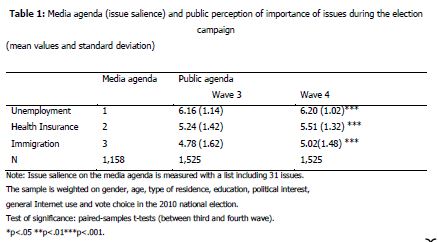
Given that the perception of importance for these three issues increased between waves three and four, this indicates that there is a clear change in evaluation of issue importance during the intense three-week election campaign leading up to Election Day.
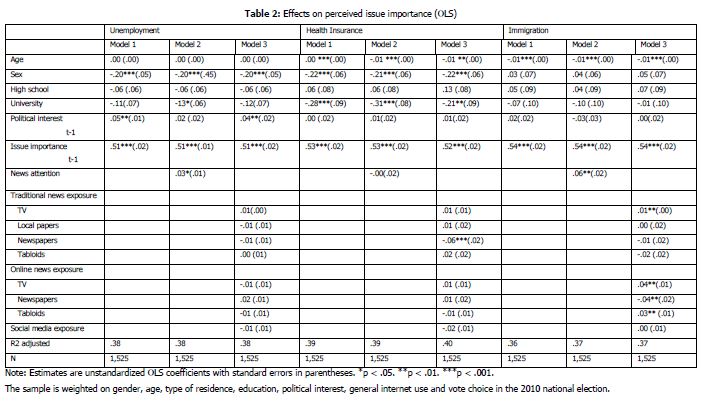
Next we turn to the main focus of this study - the investigation and comparison of agenda-setting effects of different media consumption measurements in terms of their contribution to issue salience. The agenda-setting effects are tested in a series of regression models for each issue predicting changes in perceived importance at the individual level, presented in Table 2.
The sample is weighted on gender, age, type of residence, education, political interest, general internet use and vote choice in the 2010 national election.
Before discussing the results of the present study it is crucial to note two things in this panel data study. First of all, the inclusion of the lagged dependent variable (for each issue) in the autoregressive panel models gives us the opportunity to estimate how individual level factors are related to changes in the perceived issue importance (Eveland Jr & Morey, 2010). So, by including the lagged variable of perceived issue importance from the third panel wave, the effect of individual predispositions prior to the intense election campaign of the last three weeks before Election Day is included in the models. As argued before, this feature of panel data allows a stronger test for individual level effects than cross-sectional data (Finkel, 1995).
The first regression model, for each issue, is a baseline model including the control variables of the study, but no media attention or exposure variables. The control variables in Model 1 show that gender has a statistically significant effect on the unemployment issue and the health insurance issue and women’s perception of the issues salience increases. Model 1 also reveals that higher education (university) decreases the importance of the health insurance issue on the individual level. Political interest has a small but significant effect on the perception of unemployment; higher political interest leads to individuals attaching more importance to this issue. Finally, and most important, the lagged dependent variable in the model has a positive and statistically significant effect on the three issues. Previous perception of issue salience is thus a strong predictor for future issue salience.
The second regression model includes all the control variables from the baseline model and the news consumption measurement of general political news attention. The data presented in Model 2 largely support Hypothesis 1 that expected general political news attention to contribute to increased issue salience on the individual level. As predicted, general political news attention has significant effects on perceived issue importance of unemployment and immigration issues. However, general news attention is unimportant in contributing to increased salience of the health insurance issue at the individual level. Overall, the effect of general news attention does not increase the amount of explained variance when compared with the baseline model that accounts for 37-39 percentage points.
Hypothesis 2 predicted the contribution of traditional news exposure on perceived issue importance. This hypothesis is only partially supported by the results in Model 3 for each issue. Individual exposure to traditional news media, such as TV news programmes, has positive and statistically significant effect on perception of immigration as an important issue, whereas newspaper reading has a negative and statistically significant effect on the health insurance issue. However, exposure to tabloids and local newspapers show no discernible impact or any significant effect on the individual level. The differential effects of different measures of traditional news exposure on perceived issue importance also support Hypothesis 3, which predicted that general news attention would contribute more to the dependent variable. In terms of measuring agenda-setting effects, general attention to political news appears to be a more significant measurement for capturing contribution to individual issue importance in line with expectations.
Finally, when investigating and exploring the media types that might involve increasingly selective media consumption, and therefore have no significant contribution to issue salience, there are some disparate results in Model 3. Hypothesis 4 predicted no contribution of online news media when controlling for prior individual issue importance and there are no significant effects of online news exposure on the perception of unemployment and health insurance. However, the statistically significant results of the regression models are mixed concerning immigration and online TV and tabloids have a positive effect whereas online newspapers have a negative effect. Thus, there is no consistency across different issues. Finally, political social media exposure in Model 3 has no statistically significant impact whatsoever on perceptions of any of the three issues. In other words, attention to social media does not contribute to increased issue salience at the individual level and the prediction of Hypothesis 5 is supported.
]]> In sum, the results point to the existence of agenda-setting effects in terms of contribution of general political news media attention to issue salience on the individual level. The increase in issue salience for unemployment and immigration on the individual level presented in Table 2 are also in line with the significant increases on an aggregate level displayed in Table 1. The disparate and differential results concerning the significant contributions of specific measurements of media exposure, on the other hand, point to the difficulty of measuring agenda-setting effects due to the use of different media consumption measurements.
Conclusions
Traditional media effect theories are questioned due to the development of the contemporary media environment with media fragmentation and individualized media consumption (Chaffee & Metzger, 2001; Takeshita, 2006; Bennett & Iyengar, 2008). Other scholars disagree and suggest that a distinction has to be made between actual agenda-setting effects and the ease with which they can be measured (Fishbein & Hornik, 2008; Strömbäck & Kiousis, 2010; Shehata & Strömbäck, 2013; Valkenburg & Peter, 2013). Given this scholarly discussion the purpose of this study was to investigate and compare the agenda-setting effects of different media consumption measures on individual issue salience. The basic idea of agenda-setting as transfer from a media agenda to a public agenda also implies that agenda-setting effects should be visible on an individual level. By using a panel data design, this study tests causal agenda-setting effects at the individual level by controlling for changes in individual predispositions of issue salience (i.e., the lagged dependent variable), which provide a much stronger test of individual-level agenda setting effects than cross-sectional data (Finkel, 1995). Furthermore, the study is attention-based and investigates the linkages between self-reported media consumption and the issues that the public regard as important. The analysis is thus built on rigorous tests and controls for multiple variables simultaneously.
The results do reveal significant media effects in line with agenda-setting theory since issues at the top of the aggregate news media agenda were perceived as more important at the end of the election campaign than at the beginning by the public. There was also a correspondence between opinion dynamics at the aggregate and the individual level as changes in issue salience at the aggregate level mirrored individual level effects of media consumption. Political news attention contributed significantly to the perception of unemployment and immigration as important issues, results in line with the general perception of issue importance by the public over the same time period. However, it is important to note some differential results of consequence for this study as well. Even though general attention to political news increased issue salience, the results were mixed regarding different media exposure and their influence on issue salience. When measuring media consumption with specific media exposure there was no consistency in findings across different media types. However, there is one issue though that stands out. Immigration is perceived as increasingly important by people exposing themselves to online TV and tabloids. The inconsistency does not mean that these specific media types are unimportant for media effects but it does suggest that agenda-setting effects can be difficult to detect and measure depending on methodological approach and research design. These findings are in line with the scholarly discussion concerning challenges of measuring media effects in the contemporary media environment (Fishbein & Hornik, 2008; Shehata & Strömbäck, 2013; Valkenburg & Peter, 2013).
In summary, the findings of this study confirm the proposed challenges for media effect studies. Media consumption and thus media effects are difficult to measure in a high-choice media environment. Individual traits can reinforce and mediate media effects and it is thus important to include individual media as well as non-media variables in research design (Valkenburg & Peter, 2013). It cannot be assumed that people are exposed to the same issues that dominate media content but neither can it be assumed that people avoid dominating issues by selectively consuming specific media (Karlsen, 2011). Outside of an experimental setting people’s exposure to different issues is difficult to measure (Strömbäck & Kiousis, 2010), not perhaps because of selectivity and fragmentation but due to an ever-increasing number of media outlets and channels that are hard to measure. Or as McCombs (2014) suggest, that the collective impact of news content with a common gestalt has an effect on the public despite seldom or even non-consumption of specific news. These agenda-effects could thus be a result of overlapping media content due to inter-media agenda setting. Furthermore and as a recent study reveal (Webster and Ksiazek, 2014), selective individual media consumption can still entail ranging across a multitude of different media outlets and thus weaken the selective perception argument. Thus, the findings of this study are important since they suggest that general news attention might be a more significant measure for media consumption in a high-choice media environment when investigating media effects. In essence, this study suggests that media effects such as agenda-setting are not becoming non-significant but rather difficult to measure in the contemporary media environment.
However, the autoregressive models in this study also indicate the importance of individual predispositions during the election campaign for perception of issue importance. The panel data clearly revealed that unemployment, health insurance, and immigration were perceived as important issues in the third panel wave before the intense election campaign coverage. Naturally, different things that exist before attention is directed to media in the election campaign influence peoples’ perceptions of important issues in the election. The reinforcement of predisposition or strengthening of attitudes concerning issue salience during the election campaign rather than attitude conversion displayed in this study, supports the proposal that it is crucial to consider what people do with media rather than just to ask what the media does to people (Chaffee & Metzger, 2001). In this study we find agenda-setting effects and that the media agenda precedes the publics agenda due to the panel design of the study but we can also argue that media consumers might be increasingly selective and consume news in line with their predispositions and issue interests. The development of the contemporary media landscape is ongoing (Bimber, 2003; Metzger, 2009) and its implications are therefore open to question, which calls for more research that can complement and expand traditional media effects research.
Naturally, there are limitations to this study as a single country case study, with consequences for selected research design, as well as methodological problems encountered when using panel data. First of all, the Swedish case might stand out due to a particular media system with strong public service broadcasting that attract a large segment of media consumers and a high newspaper circulation in comparison to the US. But Sweden might on the other hand be a typical case with respect to other western countries. Only further research can answer the question regarding the extent to which these findings are valid in other contexts. Finally, the use of the same measures of the same individuals can increase the risk of sensitizing participants to the survey questions. Sensitizing participants to questions is a common concern but it is also unavoidable when conducting panel surveys since it is part and parcel of the methodological design. Despite these problems, the importance of this study is the test of a classical political communication theory that might serve to refine how we formulate our research designs in a contemporary environment.
References
]]>Aalberg, T., Blekesaune, A., & Elvestad, E. (2013). 'Media Choice and Informed Democracy Toward Increasing News Consumption Gaps in Europe?' The International Journal of Press/Politics, 18(3), 281-303. [ Links ]
Aalberg, T., & Curran, J. (Eds.). (2012). How media inform democracy: A comparative approach. New York: Routledge. [ Links ]
Althaus, S. L., & Tewksbury, D. (2002). 'Agenda setting and the “new” news patterns of issue importance among readers of the paper and online versions of the New York Times.' Communication Research, 29(2), 180-207.
Bennett, W. L., & Iyengar, S. (2008). 'A new era of minimal effects? The changing foundations of political communication.' Journal of Communication, 58(4), 707-731. [ Links ]
Bimber, B. A. (2003). Information and American democracy: Technology in the evolution of political power: Cambridge University Press. [ Links ]
Bimber, B. A., & Davis, R. (2003). Campaigning online: The Internet in US elections: Oxford University Press. [ Links ]
Blumler, J. G. (2001). 'The third age of political communication.' Journal of Public Affairs, 1(3), 201-209. [ Links ]
Bulkow, K., Urban, J., & Schweiger, W. (2013). 'The duality of agenda-setting: The role of information processing.' International Journal of Public Opinion Research, 25(1), 43-63. [ Links ]
Carlsson, U. (2012). Nordicom-Sveriges Mediebarometer 2011: Nordicom. [ Links ]
Chaffee, S. H., & Metzger, M. J. (2001). 'The end of mass communication?' Mass Communication & Society, 4(4), 365-379. [ Links ]
Dimitrova, D. V., Shehata, A., Strömbäck, J., & Nord, L. W. (2014). 'The Effects of Digital Media on Political Knowledge and Participation in Election Campaigns Evidence From Panel Data.' Communication Research, 41(1), 95-118. [ Links ]
Enli, G., & Moe, H. (2013). 'Introduction to special issue: Social media and election campaigns–key tendencies and ways forward.' Information, Communication & Society, 16(5), 637-645.
Eveland Jr, W. P., & Morey, A. C. (2010). Challenges and opportunities of panel designs. Sourcebook for Political Communication Research: Methods, Measures, and Analytical Techniques, 19. [ Links ]
Eveland, W. P., Marton, K., & Seo, M. (2004). 'Moving beyond “just the facts” the influence of online news on the content and structure of public affairs Knowledge.' Communication Research, 31(1), 82-108.
Finkel, S. E. (1995). Causal analysis with panel data. Thousand Oaks: Sage. [ Links ]
Fishbein, M., & Hornik, R. (2008). 'Measuring media exposure: An introduction to the special issue.' Communication Methods and Measures, 2(1-2), 1-5. [ Links ]
Foot, K. A., & Schneider, S. M. (2006). Web campaigning: MIT press Cambridge, MA. [ Links ]
Hallin, D. C., & Mancini, P. (2004). Comparing media systems : three models of media and politics. New York, NY: Cambridge University Press.
Holbert, R. L., Garrett, R. K., & Gleason, L. S. (2010). 'A new era of minimal effects? A response to Bennett and Iyengar.' Journal of Communication, 60(1), 15-34. [ Links ]
Iyengar, S., & Kinder, D. R. (1987). News that matters: Television and American opinion: University of Chicago Press. [ Links ]
Karlsen, R. (2011). 'Still broadcasting the campaign: On the Internet and the fragmentation of political communication with evidence from Norwegian electoral politics.' Journal of Information Technology & Politics, 8(2), 146-162. [ Links ]
Karlsson, M., Clerwall, C., & Buskqvist, U. (2013). Digitala medier, public relations och strategisk politisk kommunikation’. In J. Strömbäck & L. W. Nord (Eds.) Kampen om opinionen. Stockholm: SNS Förlag.
Ku, G., Kaid, L. L., & Pfau, M. (2003). 'The impact of web site campaigning on traditional news media and public information processing.' Journalism & Mass Communication Quarterly, 80(3), 528-547. [ Links ]
Lee, J. K. (2007). 'The effect of the Internet on homogeneity of the media agenda: A test of the fragmentation thesis.' Journalism & Mass Communication Quarterly, 84(4), 745-760. [ Links ]
McCombs, M. E. (2004). Setting the agenda: The mass media and public opinion. Cambridge: Polity Press. [ Links ]
McCombs, M. E. (2013). Setting the agenda: The mass media and public opinion. John Wiley & Sons. [ Links ]
McCombs, M. E., Ghanem, S., Lennon, F. R., Blood, R. W., Chen, Y., & Ban, H. (2011). International applications of agenda-setting theory’s Acapulco typology. The sourcebook for political communication research: Methods, measures, and analytical techniques, 383-394.
McCombs, M. E., & Shaw, D. L. (1972). 'The agenda-setting function of mass media.' Public Opinion Quarterly, 36(2), 176-187. [ Links ]
]]>Metzger, M. J. (2009). The study of media effects in the era of internet communication. In L. R. Nabi & M. B. Oliver (Eds.), The Sage Handbook of Media Processes and Effects (pp. 561-576). Thousand Oaks: Sage. [ Links ]
Neuman, W. R., & Guggenheim, L. (2011). 'The Evolution of Media Effects Theory: A Six-Stage Model of Cumulative Research.' Communication Theory, 21(2), 169-196. [ Links ]
Neuman, W. R., Guggenheim, L., Mo Jang, S., & Bae, S. Y. (2014). 'The Dynamics of Public Attention: Agenda-Setting Theory Meets Big Data.' Journal of Communication, 64(2), 193-214. [ Links ]
Prior, M. (2007). Post-broadcast democracy: How media choice increases inequality in political involvement and polarizes elections. New York: Cambridge University Press. [ Links ]
Ragas, M. W., Tran, H. L., & Martin, J. A. (2014). 'Media-induced or search-driven? A study of online agenda-setting effects during the BP oil disaster.' Journalism Studies, 15(1), 48-63. [ Links ]
]]>Scheufele, D. A., & Tewksbury, D. (2007). 'Framing, agenda setting, and priming: The evolution of three media effects models.' Journal of Communication, 57(1), 9-20. [ Links ]
Schönbach, K., de Waal, E., & Lauf, E. (2005). 'Research Note: Online and Print Newspapers Their Impact on the Extent of the Perceived Public Agenda.' European Journal of Communication, 20(2), 245-258. [ Links ]
Semetko, H. A., & Scammell, M. (2012). Introduction: The Expanding Field of Political Communication in the Era of Continuous Connectivity. In H. A. Semetko & M. Scammell (Eds.), The SAGE Handbook of Political Communication. Thousand Oaks: SAGE. [ Links ]
Shah, D. V., McLeod, D. M., Gotleib, M. R. & Lee, N (2009). Framing and Agenda Setting. In R. L. N. o. M. B. Oliver (Ed.), The Sage Handbook of Media Processes and Effects. Thousand Oaks: Sage Publications. [ Links ]
Shehata, A., & Strömbäck, J. (2011). 'A matter of context: A comparative study of media environments and news consumption gaps in Europe.' Political Communication, 28(1), 110-134. [ Links ]
]]>Shehata, A., & Strömbäck, J. (2013). 'Not (Yet) a New Era of Minimal Effects: A Study of Agenda Setting at the Aggregate and Individual Levels.' The International Journal of Press/Politics. [ Links ]
Shehata, A., & Strömbäck, J. (2014). Mediation of Political Realities: Media as Crucial Sources of Information. In F. Esser & J. Strömbäck (Eds.), Mediatization of Politics: Understanding the Transformation of Western Democracies (pp. 93). New York: Palgrave Macmillan. [ Links ]
Stroud, N. J. (2008). 'Media use and political predispositions: Revisiting the concept of selective exposure.' Political Behavior, 30(3), 341-366. [ Links ]
Strömbäck, J., Djerf-Pierre, M., & Shehata, A. (2012). 'The dynamics of political interest and news media consumption: A longitudinal perspective.' International Journal of Public Opinion Research, 25(4). [ Links ]
Strömbäck, J., & Kiousis, S. (2010). 'A New Look at Agenda-Setting Effects—Comparing the Predictive Power of Overall Political News Consumption and Specific News Media Consumption Across Different Media Channels and Media Types.' Journal of Communication, 60(2), 271-292.
Takeshita, T. (2006). 'Current critical problems in agenda-setting research.' International Journal of Public Opinion Research, 18(3), 275-296. [ Links ]
Tewksbury, D., & Althaus, S. L. (2000). 'Differences in knowledge acquisition among readers of the paper and online versions of a national newspaper.' Journalism & Mass Communication Quarterly, 77(3), 457-479. [ Links ]
Trent, J. S., & Friedenberg, R. V. (2008). Political campaign communication: Principles and practices: Rowman & Littlefield. [ Links ]
Valkenburg, P. M., & Peter, J. (2013). 'The differential susceptibility to media effects model.' Journal of Communication, 63(2), 221-243. [ Links ]
Vargo, C. J., Guo, L., McCombs, M.E., & Shaw, D. L. (2014). Network issue agendas on Twitter during the 2012 US presidential election. Journal of Communication, 64(2), 296-316. [ Links ]
Wanta, W., & Ghanem, S. (2007). Effects of agenda setting. In R. Preiss, B. Gayle, & N. Burrell (Eds.), Mass media effects research: Advances through meta-analysis (pp. 37-51). New York: Routledge. [ Links ]
Webster, J. G., & Ksiazek, T. B. (2012). 'The dynamics of audience fragmentation: Public attention in an age of digital media.' Journal of Communication, 62(1), 39-56. [ Links ]
]]>