<?xml version="1.0" encoding="ISO-8859-1"?><article xmlns:mml="http://www.w3.org/1998/Math/MathML" xmlns:xlink="http://www.w3.org/1999/xlink" xmlns:xsi="http://www.w3.org/2001/XMLSchema-instance">
<front>
<journal-meta>
<journal-id>1646-5954</journal-id>
<journal-title><![CDATA[Observatorio (OBS*)]]></journal-title>
<abbrev-journal-title><![CDATA[OBS*]]></abbrev-journal-title>
<issn>1646-5954</issn>
<publisher>
<publisher-name><![CDATA[OberCom]]></publisher-name>
</publisher>
</journal-meta>
<article-meta>
<article-id>S1646-59542018000300004</article-id>
<title-group>
<article-title xml:lang="en"><![CDATA[Contributions of academic articles to the practice of journalism and data management]]></article-title>
</title-group>
<contrib-group>
<contrib contrib-type="author">
<name>
<surname><![CDATA[Portilla]]></surname>
<given-names><![CDATA[Idoia]]></given-names>
</name>
<xref ref-type="aff" rid="A1"/>
</contrib>
</contrib-group>
<aff id="AA1">
<institution><![CDATA[,Universidad de Navarra  ]]></institution>
<addr-line><![CDATA[ ]]></addr-line>
<country>Spain</country>
</aff>
<pub-date pub-type="pub">
<day>00</day>
<month>09</month>
<year>2018</year>
</pub-date>
<pub-date pub-type="epub">
<day>00</day>
<month>09</month>
<year>2018</year>
</pub-date>
<volume>12</volume>
<numero>3</numero>
<fpage>66</fpage>
<lpage>82</lpage>
<copyright-statement/>
<copyright-year/>
<self-uri xlink:href="http://scielo.pt/scielo.php?script=sci_arttext&amp;pid=S1646-59542018000300004&amp;lng=en&amp;nrm=iso"></self-uri><self-uri xlink:href="http://scielo.pt/scielo.php?script=sci_abstract&amp;pid=S1646-59542018000300004&amp;lng=en&amp;nrm=iso"></self-uri><self-uri xlink:href="http://scielo.pt/scielo.php?script=sci_pdf&amp;pid=S1646-59542018000300004&amp;lng=en&amp;nrm=iso"></self-uri><abstract abstract-type="short" xml:lang="en"><p><![CDATA[The increasing number of open data resources and the arrival of big data have boosted the data available as a source of news. Journalists need new skills for collecting the data and creating the news. In addition, all this data can also be used to provide new media services and to take media business decisions, and journalists need new skills related to data for these tasks. Taking into account these areas of knowledge required by journalists for the use of data, we perform a structured literature review (SLR) followed by a content analysis. The results confirm the relevance of data management in journalistic practice, requiring skills in statistics, data visualization, technology, but also in ethics, marketing or audience monitoring.]]></p></abstract>
<kwd-group>
<kwd lng="en"><![CDATA[skills]]></kwd>
<kwd lng="en"><![CDATA[big data]]></kwd>
<kwd lng="en"><![CDATA[management]]></kwd>
<kwd lng="en"><![CDATA[content analysis]]></kwd>
<kwd lng="en"><![CDATA[visualization]]></kwd>
</kwd-group>
</article-meta>
</front><body><![CDATA[ <p><b>Contributions of academic articles to the practice of journalism and data    management</b></p>     <p>&nbsp;</p>     <p><b>Idoia Portilla*</b></p>     <p>* Universidad de Navarra, Spain</p>     <p>&nbsp;</p>     <p><b>ABSTRACT</b></p>     <p>The increasing number of open data resources and the arrival of big data have    boosted the data available as a source of news. Journalists need new skills    for collecting the data and creating the news. In addition, all this data can    also be used to provide new media services and to take media business decisions,    and journalists need new skills related to data for these tasks. Taking into    account these areas of knowledge required by journalists for the use of data,    we perform a structured literature review (SLR) followed by a content analysis.    The results confirm the relevance of data management in journalistic practice,    requiring skills in statistics, data visualization, technology, but also in    ethics, marketing or audience monitoring.</p>     <p><b>Keywords:</b> skills, big data, management, content analysis, visualization.</p>     <p>&nbsp;</p>     <p><b>Introduction</b></p>     ]]></body>
<body><![CDATA[<p>The relevance of acquiring skills for data management in journalism practice    has been boosted by the increasing number of open data resources and the arrival    of big data (El&iacute;as-P&eacute;rez, 2015; Parasie, 2015). At the same time,    the media capable of working with data can generate databases that can be sold    or used to offer extra services (Gray, Bounegru, and Chambers, 2012). This is    the case, for example, of <i>ProPublica</i> (<a href="http://www.propublica.org/datastore/" target="_blank">www.propublica.org/datastore/</a>)    or <i>Bloomberg for enterprise</i> (<a href="http://www.bloomberg.com/enterprise/" target="_blank">www.bloomberg.com/enterprise/</a>).</p>     <p>But data is not only a product or service for the media. Nowadays, all digital    business generates a great amount of data, and the proper use of this big data    can improve company results (Mayer-Scho¨nberger and Cukier, 2013; Lewis and    Westlund, 2015). It is the era of big data: high-volume of data in high-variety    information assets, that is generated at high-velocity and requires being analysed    also very quickly to gain valuable insights. As other media companies with big    data, media companies should learn how to monetize the data generated by the    digitalization of their content, taking advantage of information such as the    visits to their webs, the fans of their brand or the searches made in their    cross-platform content services.</p>     <p>In response to these realities, journalists should gain new competencies related    to the management of data. In this paper, we review the milestones linking data    with journalism practice. The first step is obtaining the main areas of knowledge    required by journalists in order to use data. The second step is performing    a quantitative literature review of research contributions published in the    main academic journals. The results of this review, complemented by a content    analysis, will provide a list of areas of knowledge and skills that are becoming    important requirements for the journalist in this era of big data.</p>     <p>&nbsp;</p>     <p><b>Milestones related to data and journalism</b></p>     <p>Journalists have been using data in economic or sports news since the origins    of media. The first periodical publication in the eighteenth century, <i>The    Lloyd's List</i>, was a weekly journal of general commercial news and included    price lists and details of ships arriving at English and Irish ports (Arrese,    2002). According to <i>The Guardian</i>, their first data journalism content    was published in 1821 with a list of schools in Manchester and Salford, how    many pupils attended each one and their average annual spending (Datablog, 2011).</p>     <p>Data continued being source and content of news in the following decades, but    the arrival of computers provided a great step forward. In 1952, the US television    network CBS used a computer to predict election results (Hewett, 2013; Uskali    and Kuutti, 2015). In 1967, the coverage of the 1967 Detroit race riots by Phillip    Meyer won the Pulitzer Prize (Meyer, 2001; Uskali and Kuutti, 2015). This last    journalist is considered the first American journalist to have used computers    to conduct investigative journalism (Parasie and Dagiral, 2013), and many authors    reference his work in the history of data journalism (Hughes, 2013; Bradshaw,    2014; El&iacute;as-P&eacute;rez, 2015).</p>     <p>However, many journalists were not capable of analysing and reporting data,    so they needed training. Meyer himself was the author of the handbook <i>Precision    journalism</i> published in the 70's (Meyer, 2001; Coddington, 2015). In his    book, he tried to show media professionals how to deal with data and surveys    in their reports (Meyer, 2001). In the following years, we can find other handbooks    about computer reporting (Houston, 1996; DeFleur, 1997; Garrison, 1998; Houston,    Bruzzese, and Weinberg, 2002), showing the relevance of the issue. The set-up    of the National Institute for Computer-Assisted Reporting in the United States    in 1989 (Hughes, 2013; Parasie and Dagiral, 2013) and the Centre for Investigative    Journalism (CIT) in 2003 in the UK (Hewett, 2013) also helped train journalists    in data management.</p>     <p>From the mid-1990s, the number of data-oriented projects increased thanks to    the growing availability of computerized data and the world wide web (Parasie,    2015). In 2010, <i>The Guardian</i> in the UK and the <i>New York Times</i>    and the Chicago Tribune in the United States developed their own data journalism    teams and started publishing news with the data they elaborated (Uskali and    Kuutti, 2015). In 2012 the Global Editors Network presented the first Data Journalism    awards (Uskali and Kuutti, 2015).</p>     <p>The educational resources teaching how to use data as a source, to collect    it, to analyse it and to report it, have been included under several terms:    precision journalism, Computer Assisted Reporting (CAR) or investigative journalism    (Meyer, 2001; Coddington, 2015; Uskali and Kuutti, 2015). The term &ldquo;data    journalism&rdquo; has generally been used since the mid-2000s (Royal and Blasingame,    2015). However, it is still difficult to define (Ferreras-Rodr&iacute;guez,    2012; Beleaga, 2013; Coddington, 2015; Royal and Blasingame, 2015). Professionals    and scholars sometimes separate data journalism from other practices such as    computational journalism, programmer journalism or open-source journalism (Coddington,    2015).</p>     ]]></body>
<body><![CDATA[<p>If we consider any kind of journalism that uses data as a source for its news    and that publishes stories using data, we can divide its practice into three    steps: access to the data, its analysis and the publication of the story (Ferreras-Rodr&iacute;guez,    2012; Teruel and Blanco, 2015). If we consider the analysis as a skill necessary    for reporting, two relevant areas of knowledge stand out over the rest: data    as a source of news and the use of data in the content of news.</p> <h4>&nbsp;</h4> <h4>Open data and software</h4>     <p>Other milestones related to data and journalism are the Open Systems Movement    in the late 1970s (Holtgrewe and Werle, 2001), the open source principle born    in the late 1990s (Coddington, 2015) and the open data policies (Hughes, 2013).    These open movements have facilitated the access to data and the software for    its analysis (Ferreras-Rodr&iacute;guez, 2012).</p>     <p>The passing of the Freedom of Information Act in the United States was in 1966    (Bradshaw, 2014), and it gave people the right to access information from the    government. However, the release of databases by government authorities, the    actual open data policies, started in the 1980s (Parasie and Dagiral, 2013).    In the UK, the Freedom of Information Act received royal assent in 2000; it    came fully into force in 2005 (Davies, 2010; Hewett, 2013; Bradshaw, 2014) and,    in 2010, the government open data website <i>data.gov.uk</i> was launched (Davies,    2010; Hewett, 2013), a few years after <i>The Guardian</i> journalists&acute;    campaign called Free Our Data (Davies, 2010; Hewett, 2013; Bradshaw, 2014).    In the European Union, regulation 1049/2001 is the transparency law, although    other countries have already tried to regulate it: Sweden, in 1776, Finland    in 1951, and Spain in 1992 (La-Rosa and Sandoval-Mart&iacute;n, 2016).</p>     <p>The Open Government Partnership was launched in 2011 (Bradshaw, 2014). At that    time, governments began to become members so as to demonstrate their compromise    with transparency and the empowerment of citizens (Open Government Partnership,    2016). Regulators, consumer groups, charities, scientific institutions and businesses    also began releasing newsworthy data (Bradshaw, 2010), making the analysis of    data among journalists more common.</p>     <p>But the use of government data for developing news content has been seen as    the beginning of a new kind of data journalism, mainly due to Wikileaks. This    release of war logs from Iran and Afghanistan in 2010 is considered a significant    event for data journalism (Hewett, 2016), and even the starting point for contemporary    data journalism activities (Uskali and Kuutti, 2015). In 2013, when Edward Snowden    revealed that intelligence agencies were engaging in secret global surveillance,    the debate about privacy moved to the foreground (McStay, 2017; Lewis and Westlund,    2015). Thus, the 2010s are relevant dates for data and journalism practice.</p>     <p>In brief, these open data and open source movements helped journalists in the    accessing of data and its analysis for reporting a story, again bringing these    two areas to the forefront, now together with the privacy debate.</p> <h4>&nbsp;</h4> <h4>Portals and services based in data</h4>     <p>Besides data as a source, the open data movement provided portals and services    based on data. In 1998 the UK&rsquo;s <i>mySociety</i> developed <i>Up My Street</i>,    a website with information of local areas (Bradshaw, 2014). In 2004, Washington    DC launched its data portal (Parasie and Dagiral, 2013). These portals facilitated    access to data for news, but also the development of new media services mainly    as public services for their audiences.</p>     <p>Since 2005, journalists have been hired to design web applications, with the    purpose of strengthening government accountability and citizen participation    (Parasie and Dagiral, 2013). In 2007, the Knight Foundation awarded the project    <i>EveryBlock</i>, a website with information about neighbourhoods. The project    <i>PolitiFact</i>, a fact-checking website that rates the accuracy of claims    by US politics, received a Pulitzer award for its journalist content based on    data and analytics (Ferreras-Rodr&iacute;guez, 2012).</p>     <p>Some data services, such as the BBC budget and fuel calculator, have helped    UK citizens to control their expenses (Hurrel and Walton, 2013). Others, such    as mashups and web applications, make data transparent to the audience and can    be used as decision-making tools, for example, to decide where to live, knowing    whether the neighbourhood is a secure area (Parasie and Dagiral, 2013). So,    online data services are seen as an entrepreneur model of data journalism activities    in the newsroom, according to Uskali and Kuutti (2015), with stories that incorporate    user participation (Royal and Blasingame, 2015), and look to help people to    become more powerful.</p>     <p>As we have seen in the introduction, some media, such as <i>ProPublica</i>    or <i>Bloomberg</i> generate databases to be sold (Gray, Bounegru, and Chambers,    2012). There are also news organizations that employ data analytics as their    niche, such as Nate Silver`s <i>FiveThrityEight</i> (<a href="http://fivethirtyeight.com/" target="_blank">http://fivethirtyeight.com/</a>)    in the United States (Royal and Blasingame, 2015), or <i>Fundaci&oacute;n Civio</i>    (<a href="http://www.civio.es" target="_blank">www.civio.es</a>) and <i>Porcentual</i>    (<a href="http://www.porcentual.es" target="_blank">www.porcentual.es</a>) in    Spain.</p>     ]]></body>
<body><![CDATA[<p>Nowadays, the increasing number and use of mobile phones has forced media to    offer their services via apps. News applications can personalize data to the    user offering information about traffic or sports (Westlund, 2013; Howard, 2014;    Silva, L&oacute;pez, Westlund and Ulloa, 2016).</p>     <p>According to all these examples, apart from data as a source of news and as    content of them, a third area to be considered is the use of data to offer media    services, which can provide new revenue resources for media companies so journalists    should be aware of it.</p> <h4>&nbsp;</h4> <h4>The era of Big Data</h4>     <p>The development of big data is the last milestone we highlight. This term was    coined in the 2000s by sciences such as astronomy and genomic, and it migrated    to all areas about ten years later (Mayer-Scho¨nberger and Cukier, 2013).</p>     <p>Big data can be defined as the data generated through the use of digital technologies    (Margetts, 2014) and since 2001 it has been described by three Vs: volume, velocity,    and variety (Laney, 2001). It can also refer to the processes surrounding this    great volume of data, which is too large for standard computer memory and software    (Lewis and Westlund, 2015; Parasie, 2015).</p>     <p>Due to the increase in digital information which led to the big data era, data-driven    journalism has become more prominent (Coddington, 2015). According to El&iacute;as-P&eacute;rez    (2015), the computer experts know how to manage data, but the journalists are    the ones who know what questions should be asked to tell the story. Therefore,    big data affects data journalism in sources used and in reporting. Now it is    easier to find the data, but the journalist needs to select, analyse and compare    it and finally publish the news (Ferreras-Rodr&iacute;guez, 2012).</p>     <p>Furthermore, big data relates to business. Digitalization has given media companies    computer data that includes information about the user (Manovich, 2001; Napoli,    2016) and can drive the online business of the media (Aguado and Mart&iacute;nez,    2009; Lewis and Westlund, 2015; Royal and Blasingame, 2015). The most used methods    of capturing data are online tracking cookies and website pathing (Forbes Insights,    2014) but also mobile apps can provide useful information (Howard, 2014). Data    can be used to customize automatically the media composition, personalizing    the offer (Evens and Van Damme, 2016). It offers great opportunities to the    communication market (Marks, 2013; Pap&iacute;-G&aacute;lvez, 2014). The media    can implement big data strategies for a better understanding and targeting of    customers (Napoli, 2016).</p>     <p>In brief, the big data era means that the management of data is essential for    journalists because the data available is increasing and news stories should    take this into account. However, media companies have also gained big data related    to their business, so journalists should learn how to manage it for decision-making.</p>     <p>&nbsp;</p> <h4>From the milestones to areas linking data and journalism</h4>     <p>Taking into account the development of data journalism and the aforementioned    milestones related to data and journalism practice, we will consider four areas    that linked journalism and data:</p> <ol>       <li>Data as a source of news.</li>     ]]></body>
<body><![CDATA[</ol>     <p>Data has been the source of news since the origin of the media but journalists    received real training in the collection of data with the Meyer&rsquo;s precision    journalism book and the development of Computer Assisted Reporting (CAR). With    the open data movements, access to data became easier, and nowadays, in the    era of big data, journalists can find more and more data that sometimes require    computational knowledge in order to retrieve them.</p> <ol start="2">       <li>Data in the content of news (reporting).</li>     </ol>     <p>Once journalists have the data, they need to analyse it and write the story.    The educational resources under the names of precision journalism, investigative    journalism, computer-assisted reporting or data journalism have tried to teach    how to do this. In addition, the open software movement has helped by facilitating    access to analytics and visualization software. In the era of big data, journalists    have data to complement many of their news stories.&nbsp;</p> <ol start="3">       <li>Data for providing new media services.</li>     </ol>     <p>The open data movement gave access to government data and media have used it    to develop sites, portals and apps based on this information. With these innovative    services, media have tried to facilitate access to data for citizens and obtain    new revenues. The big data available can help to increase the number of these    services.</p> <ol start="4">       <li>Data in the media business.</li>     </ol>     ]]></body>
<body><![CDATA[<p>Digitalization has provided big data for online media. Journalists and managers    of the media have to use data to improve their products - by providing personalized    news, for example. Like other companies with digital data, the media should    try implementing big data strategies to increase their revenues.</p>     <p>Once we have identified the areas that link data with journalism and journalists,    the next step is to analyse whether these issues and milestones appear in academic    publications, when and related to which skills or other issues. As open data    and big data have boosted the volume of data available, the period considered    in our research will include these two milestones.</p>     <p>&nbsp;</p>     <p><b>Method</b></p>     <p>The methodology applied in this work is a structured literature review (SLR)    followed by a content analysis with first, a priori coding and, in a second    step, an emergent coding. The result is the combination of methods used in health    and the social sciences.</p>     <p>According to Dawidowicz (2010, 5), &ldquo;a literature review is an examination    of scholarly information and research-based information on a specific topic&rdquo;.    When it uses rigid rules is called a structured literature review (SLR) (Massaro,    Dumay, and Guthrie, 2016). The use of rules offers less bias, more transparency,    and the possibility of replication of the review (Massaro, Dumay, and Guthrie,    2016; Tranfield, Denyer, and Smart, 2003).</p>     <p>The SLR is frequently applied to develop insights and future research paths    or review methodologies applied (Moher et al., 2009; L&oacute;pez-Cantos, 2015;    Massaro, Dumay, and Guthrie, 2016; Ausserhofer et al., 2017). However, in this    case the objective is translating areas of research into skills related to journalism    practice.</p>     <p>The process for the selection of contributions will be drawn using the flow    diagram proposed by the PRISMA (Preferred Reporting Items for Systematic Reviews    and Meta-analysis) from the field of health (Liberati et al., 2009; Moher et    al., 2009). This diagram helps in explaining the process of the identification    of records, the screening, the eligibility and the final records included (Moher    et al., 2009).</p>     <p>After the selection of cases, the data will be coded to develop insights (Massaro,    Dumay, and Guthrie, 2016). This codification follows the process of a content    analysis (Wimmer and Dominick, 2011), registering items for each article (which    constitute the unit of analysis). The content categories will be established    using a priori coding for those that can be listed before the analysis. In a    second step, the categories will come from an emergent coding, establishing    categories after the examination of the articles (Wimmer and Dominick, 2011).</p>     <p>&nbsp;</p>     ]]></body>
<body><![CDATA[<p><b><i>Research questions</i></b></p>     <p>The final purpose of this article is to know what can be learnt about skills    related to the use of data in journalism from the contributions of researches    published in academic journals. There have been previous literature reviews    for identifying influential publications and gaps in the research of data journalism    (Ausserhofer et al., 2017), for identifying methodologies (L&oacute;pez-Cantos,    2015) or opportunities for innovation in computational journalism (Diakopoulos,    2012). However, this paper differs from these previous contributions in the    method used for the selection of the contributions and the research questions    made. Firstly, it extends the interest to any article that relates data and    journalism/journalists. Secondly, the questions refer to the issues discussed    by academia with the focus on the skills and knowledge needed in the practice    of journalism.</p>     <p>The research questions are:</p> <ul>       <li>Which attention do the issues of (1) data as a source of news, (2) data      in the content of news, (3) data for providing new services and (4) data in      the media business receive in the academic contributions?</li>       <li>Are any of the milestones &ldquo;open data&rdquo; and &ldquo;big data&rdquo;      cited in the academic contributions?</li>       <li>What journalistic skills related to data can be derived out of these academic      contributions?</li>       <li>Are there other relevant issues related to data and journalism/journalists      in these academic contributions?</li>     </ul> <h2>&nbsp;</h2>     <p><b><i>Universe of study and final sample</i></b></p>     <p>The unit of analysis will be the academic contributions connected with data    and journalism or journalist published from January 2006 to December 2016. This    period includes the years of the development of open data and big data, the    two milestones of interest. The key criterion for the selection of academic    contributions is that they should include the terms &ldquo;data&rdquo; and &ldquo;journalism&rdquo;    or &ldquo;journalist&rdquo; in their abstracts.</p>     ]]></body>
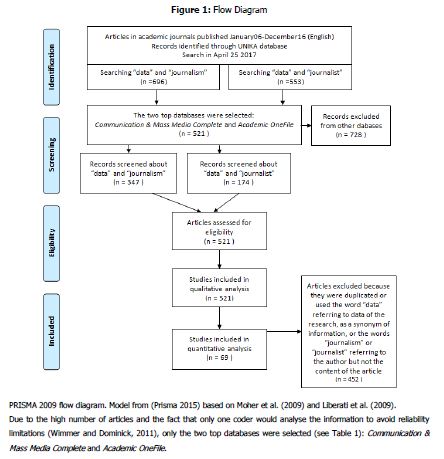
<body><![CDATA[<p>The selection is made using the tool Unika, from the library of the Universidad    de Navarra (<a href="http://www.unav.edu/en/web/biblioteca" target="_blank">www.unav.edu/en/web/biblioteca</a>).    This search tool has been in operation since September 2011 (<a href="http://www.unav.edu/web/vida-universitaria/detalle-noticia-pestana/2011/09/28/unika:-nuevo-buscador-unificado-de-la-biblioteca-de-la-universidad-de-navarra?articleId=302098" target="_blank">www.unav.edu/web/vida-universitaria/detalle-noticia-pestana/2011/09/28/unika:-nuevo-buscador-unificado-de-la-biblioteca-de-la-universidad-de-navarra?articleId=302098</a>).    It provides access to several academic journal databases. In 2017 this tool    included more than 350 providers such as Academic OneFile, BASE, Biography in    Context, Business Insights (Essentials), Business Source Ultimate, Expanded    Academic ASAP, General OneFile, General Reference Center Gold, InfoTrac Computer    Database, InfoTrac Newsstand, InfoTrac Student Edition, NewsBank and Scopus.</p>     <p>The Unika search tool provides information on the contribution including the    title of the article, the authors, the journal, volume, issue and pages, the    keywords (from the authors or by the database) and, in many cases, the abstract.    The search took place on April 25 2017. The date is relevant because the journals    included in each database can vary, and also the contract between the library    and the providers can change over time.</p>     <p>Unika permits an advanced search and the criteria considered were:</p> <ul>       <li>Articles in academic journals (no news, magazines, books or professional      publications).</li>       <li>Published from January 2006 to December 2016.</li>       <li>Language: English.</li>     </ul>     <p>In a first search, the fourth criterion was that the abstract should include    the terms &ldquo;data&rdquo; and &ldquo;journalism&rdquo;. As a result, we found    696 articles. In a second search, the articles should include the terms &ldquo;data&rdquo;    and &ldquo;journalist&rdquo; in the abstract, replicating the other criteria,    and we found 553 articles. The final number was 1,249 articles (see <a href="#f1">Figure    1</a>).</p>     <p>&nbsp;</p> <a name="f1"></a> <img src="/img/revistas/obs/v12n3/12n3a04f1.jpg">      
<p>&nbsp;</p>     ]]></body>
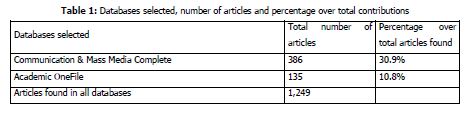
<body><![CDATA[<p>Due to the high number of articles and the fact that only one coder would analyse    the information to avoid reliability limitations (Wimmer and Dominick, 2011),    only the two top databases were selected (see <a href="#t1">Table 1</a>): <i>Communication    &amp; Mass Media Complete</i> and <i>Academic OneFile</i>.</p>     <p>&nbsp;</p> <a name="t1"></a> <img src="/img/revistas/obs/v12n3/12n3a04t1.jpg">      
<p>&nbsp;</p>     <p>The databases selected included 521 articles of the 1,249, 41.7% of the total    (see <a href="#t1">Table 1</a>). The <i>Communication &amp; Mass Media Complete</i>    website (EBSCO, 2017) includes full text for more than 440 journals, abstracts    for more than 670 journals and selected coverage of nearly 180 journals. <i>Academic    OneFile</i> provides access to articles from over 17,000 scholarly journals    and other authoritative sources such as <i>Nature</i>, <i>The Economist</i>    or <i>The New York Times</i> (Gale, 2017). This last resource covers several    subjects, such as physical and social sciences, technology, medicine, engineering    or literature, unlike <i>Communication &amp; Mass Media Complete, w</i>hich    only covers communication.</p>     <p>After reading the titles, keywords and abstracts of the 521 articles selected    from these two databases, some articles did not refer to data, journalism and    journalist issues although they included the terms. Some articles used the word    &ldquo;data&rdquo; referring to the data used for the research (a survey, for    example) or as a synonym of information. Other articles used the words &ldquo;journalism&rdquo;    or &ldquo;journalist&rdquo; referring to the author but not the content of the    article. Furthermore, some articles were duplicates. After excluding all these    cases, the final sample related to the use of data in journalism and journalistic    practice comprised 69 articles (see <a href="#f1">Figure 1</a>).</p>     <p>These 69 articles were included in an Excel database. For each article, the    registered variables were title, authors, name of journal, year, other information    about the article (issue, volume, pages), a relevant sentence from the abstract,    and the keywords indicated in the search tool (from the authors or the database).    In addition, we gave them a category that identified an area relating data to    journalism/journalist, taking into account the ones previously highlighted and    listed below:</p> <ul>       <li>Source of news</li>       <li>Reporting</li>       <li>Services related to data</li>       <li>Media business</li>     ]]></body>
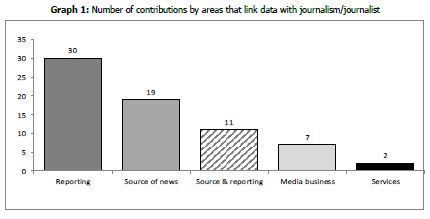
<body><![CDATA[</ul>     <p>If an article could be included in two of these areas, we associated it with    both of them, including a code with the two categories.</p>     <p>As the purpose was highlighting skills related to data management and journalistic    work, we conducted a more exhaustive analysis introducing two extra thematic    categories for each article. These emergent codings took into account the title,    keywords and abstract of the paper. This is the most subjective process of the    analysis, but it can provide more insights into the skills and knowledge required    for the management of data in journalism practice.</p>     <p>&nbsp;</p>     <p><b>Results</b></p>     <p>The four selected areas that link data with journalism have an impact on the    academic contributions, but with a relevant prevalence of data as a source of    news and as content of news (see <a href="#g1">Graph 1</a>). The category of    data as content of the news (reporting) supersedes the other, but these two    categories overlap in 11 articles that talked about using data either as a source    or as a part of the news. Adding this overlap, 33 articles dealt with data reporting    and 27 with the use of data as a source for news, so 60 of the 69 articles (87%)    were about these two areas. Only seven cases were about data in the media business    and two about services related to data (see <a href="#g1">Graph 1</a>).</p>     <p>&nbsp;</p> <a name="g1"></a> <img src="/img/revistas/obs/v12n3/12n3a04g1.jpg">      
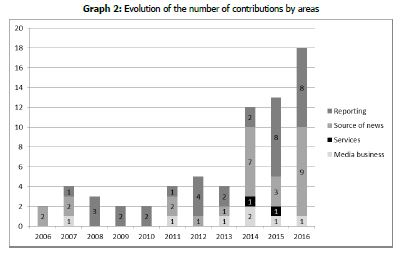
<p>&nbsp;</p>     <p>Over the 69 contributions, 43 (62%) were published in the last three years,    2014 to 2016 (see <a href="#g2">Graph 2</a>). These are the years after Wikileaks    and of the development of big data. In this final three-year period, six articles    talked about big data and another six about open data, the two milestones highlighted    in this research. These 12 cases constitute 28% of the 43 contributions published    in those years, which confirms the relevance of these two issues today.</p>     <p>&nbsp;</p> <a name="g2"></a> <img src="/img/revistas/obs/v12n3/12n3a04g2.jpg">      
]]></body>
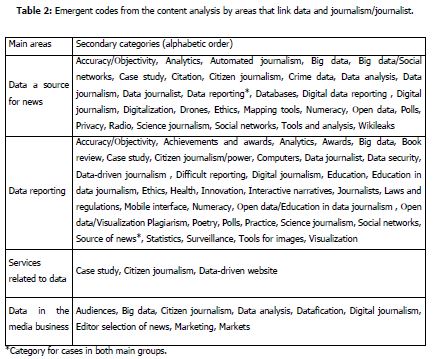
<body><![CDATA[<p>&nbsp;</p>     <p>Besides the four general categories, we assigned 56 different ones as two extra    thematic categories for each article. The most used one was &ldquo;case study&rdquo;,    including eight articles dealing with reports about a particular media brand    or geographical region. Big data and open data were also relevant ones, as we    have seen. Ethics, citizen journalism and social networks also had six or more    contributions.</p>     <p>All these emergent categories were not in a previous list, and we will analyse    them crossing them with the four main categories to gain insights (see <a href="#t2">Table    2</a>).</p>     <p>&nbsp;</p> <a name="t2"></a> <img src="/img/revistas/obs/v12n3/12n3a04t2.jpg">      
<p>&nbsp;</p>     <p>In the area of data as a source of news, there are several emergent categories    related to the task of &ldquo;Documentation&rdquo;: Big data, Big data/Social    networks, Crime data, Databases, Open data, Polls, Social networks.</p>     <p>We find also several emergent categories in the two main areas (data as a source    and reporting data) related with the use of &ldquo;Technology&rdquo;: Computers,    Digitalization, Drones, Innovation or Mobile interface. Big data, Big data/Social    networks. Social networks could also be in &ldquo;Technology&rdquo; due to its    relation to it, and not only in &ldquo;Documentation&rdquo;.</p>     <p>Many terms associated with the use of data as a source and data reporting are    the same and can be associated directly to &ldquo;Statistics&rdquo; and &ldquo;Visualization&rdquo;.    Analytics, Data analysis, Numeracy, Statistics Tools and analysis link with    &ldquo;Statistics&rdquo;. &ldquo;Visualization&rdquo; relates to Mapping tools,    Open data/Visualization, Tools for images and Visualization</p>     <p>There are also many categories related to different types of specialized journalism.    The most relevant specialized journalism is &ldquo;Data journalism&rdquo;. Nine    contributions included &ldquo;data journalism&rdquo; or &ldquo;data-driven journalism&rdquo;    in their keywords and there are many emergent categories related with this kind    of journalism: Achievements and awards, Awards, Book review, Case study, Data    journalist, Data-driven journalism, Difficult reporting, Education, Education    in data journalism, Journalists, Open data/Education in data journalism, Poetry    or Practice. Specifically related to education there are only seven articles,    four of them published in 2015-2016, which confirms the idea that &ldquo;data    journalism education has attracted little attention in the literature until    very recently&rdquo; (Hewett 2016, 120).</p>     <p>Other specialized journalisms cited in the articles are &ldquo;Digital journalism&rdquo;    (Digital data reporting, Digital journalism, Computers, Interactive narratives    or Mobile interface) and &ldquo;Science journalism&rdquo;. In addition, there    are case studies related to the areas of &ldquo;Crime&rdquo;, &ldquo;Health&rdquo;,    politics or public opinion (linked with &ldquo;Polls&rdquo;) and even with the    media &ldquo;Radio&rdquo;. There is also one contribution that cited &ldquo;Automated    journalism&rdquo; (Splendore, 2016). This emergent data-centric practice use    algorithms that convert data into narrative news texts with limited to no human    intervention (Carlson 2015).</p>     ]]></body>
<body><![CDATA[<p>     <blockquote>Citizen journalism&rdquo; is a special category because is related    to three of the main areas: data as a source, reporting data and services related    to data. This type of journalism is related to Power, Data-driven websites and    also Big data and Social Networks.</blockquote>     <p></p>     <p>If we come back to the use of data as a source and reporting data, the categories    that are not mentioned in the previous paragraphs are: Accuracy/Objectivity,    Citation, Data security, Ethics, Laws and regulations, Plagiarism, Privacy,    Surveillance and Wikileaks. The issues related with Accuracy/Objectivity, Citation    or Plagiarism link with ethics in the practice of journalism. Furthermore, journalism    is an important media field concerned with privacy (McStay, 2017). Balancing    the right to privacy with a free press, acting in the public interest or protecting    sources are relevant issues for any journalist. Data security, Ethics, Laws    and regulations, Privacy, Surveillance and Wikileaks relate to ethics in data    management, especially big data. The journalists must fulfil specific ethical    standards when using data as a source or reporting it.</p>     <p>Finally, in the area of data for business, the articles talked about Audiences,    Big data, Data analysis, Datafication, Markets and Marketing, but also about    Citizen journalism, Digital journalism, and the Editor selection of news. These    contributions talked about tracking the audience in digital journalism, the    metrics and the participation of the audience in online media. Therefore, the    digitalization of media links with the management of data and big data by the    media business. Journalists should learn about audience metrics and marketing,    and the relevance of data to decision-making in media companies.</p>     <p>&nbsp;</p>     <p><b>Limitations of the study and future research</b></p>     <p>Although the selection of the two main academic databases<i>, Communication    &amp; Mass Media Complete</i> and <i>Academic OneFile</i>, gave us a sample    of 69 cases, the intervention of the researcher in choosing the body of literature    to be reviewed generates a bias, as in all literature reviews (Massaro, Dumay,    and Guthrie, 2016).</p>     <p>As we said before, the search tool used to select the contributions can vary    the documents found depending on the date. Therefore, the process followed in    this research is not completely replicable. Moreover, although one criterion    for the advanced search was that the language of the articles should be English,    some articles only used this language in the abstract.</p>     <p>The replication of this study is also difficult because the delimitation of    the emergent categories followed an inductive process. This means that it was    not an objective process, although it helped to gain better insights.</p>     ]]></body>
<body><![CDATA[<p>&nbsp;</p>     <p><b>Conclusions</b></p>     <p>The development of the open data and big data is changing the journalism profession.    There is more information available than ever, and journalists need new skills    to manage it. The purpose of this work is to see what academics have talked    about regarding data and journalism from 2006 to 2016.</p>     <p>Applying a structured literature review (SLR) and a content analysis with a    priori and an emergent coding, 69 academic contributions about data and journalism    or journalist are analysed. In the study year by year, we confirm that big data    and open data are two relevant issues in journalism, but mainly after Wikileaks,    in 2014.</p>     <p>Data can relate with journalism in different areas. In this paper, we consider    four priori categories and, according to the results of the analysis, two of    them are the most relevant in the academic contributions studied: data as a    source for news and reporting data. The other two categories are services related    to data and data for media business, and both appear in the academic papers    although with less frequency.</p>     <p>Developing emergent categories in the content analysis, we can highlight several    issues that relate data to the journalism practice. The most obvious relation    is the practice of data-driven journalism. Those journalists that work with    data need to have skills in statistics and visualization. The use of technology    is also important as a part of documentation and for data-processing (Parasie,    2015). An adequate use of data is also required in science journalism, and for    politics, public opinion, crime or health news.</p>     <p>Data is also key in digital journalism. The generalized use of computers and    mobile phones or tablets for surfing the net implies that the media have to    adapt their content to these devices, their audience and how they use them.    Journalists need to manage new types of practices (such as automated journalism)    and interactive narratives, both linked with the use of data in their application    or the measurement of their success. The relation of data and interaction is    so relevant that <i>the Financial Times</i> uses the name &ldquo;Interactive    news team&rdquo; for the people that work in data journalism projects (Uskali    and Kuutti, 2015).</p>     <p>The management of data is also necessary for the development of citizen journalism,    in order to follow the participation of the audience and to offer them data    services for their empowerment. Some data journalism projects have even asked    citizens to feed the databases to improve reporting (Reisner, 1995).</p>     <p>The ethical issues in the practice of journalism have always been a relevant    issue in journalism. Now, accuracy and objectivity are even more relevant to    avoid misunderstandings when data are included in news. Besides, the management    of data requires fulfilling laws and standards related to data security and    privacy that journalist should know about.</p>     <p>Finally, the data are nowadays essential for decision-making in any company,    including digital media. Journalists should learn about metrics and marketing,    managing the data properly for the selection of news or their location in the    media content.</p>     ]]></body>
<body><![CDATA[<p>In conclusion, the increase of the data available due to the open data movement    and the development of big data requires new skills in journalism practice.    Statistics, visualization and the use of technology have become more important,    especially for the collection of data and reporting it. Furthermore, an adequate    use of data is necessary for knowing the audience, developing data services    and taking adequate media decisions.</p>     <p>&nbsp;</p>     <p><b>References</b></p>     <p>Aguado, J.M. and Mart&iacute;nez, I. J (2009). Mobile Media Implicit Cultures:    Towards a Characterization of Mobile Entertainment and Advertising in Digital    Convergence Landscape. <i>Observatorio (OBS*) Journal</i>, 3 (1), 336-352. <a href="http://obs.obercom.pt/index.php/obs/article/view/253" target="_blank">http://obs.obercom.pt/index.php/obs/article/view/253</a></p>     <p>Arrese, &Aacute;. (2002). <i>Prensa econ&oacute;mica. De La Lloyd&rsquo;s List    al Wsl.com</i>. Pamplona: Eunsa.</p>     <!-- ref --><p>Ausserhofer, J. et al (2017). The datafication of data journalism scholarship:    focal points, methods, and research propositions for the investigation of data-intensive    newswork. <i>Journalism</i>, April. doi: 10.1177/1464884917700667.    &nbsp;&nbsp;&nbsp;&nbsp;&nbsp;&nbsp;&nbsp;&nbsp;[&#160;<a href="javascript:void(0);" onclick="javascript: window.open('/scielo.php?script=sci_nlinks&ref=951514&pid=S1646-5954201800030000400003&lng=','','width=640,height=500,resizable=yes,scrollbars=1,menubar=yes,');">Links</a>&#160;]<!-- end-ref --></p>     <p>Beleaga, T. (2013). In a decade or less, could not all reporters requiere to    be data literate? In <i>Data Journalism: Mapping the Future</i>, edited by John    Mair and Richard Lance Keeble, 26&ndash;33. Suffolk, UK: Abramis Academic Publishing.</p>     <!-- ref --><p>Bradshaw, P. (2010). How to be a data journalist. <i>The Guardian. October    1st.</i> <a href="https://www.theguardian.com/news/datablog/2010/oct/01/data-journalism-how-to-guide" target="_blank">https://www.theguardian.com/news/datablog/2010/oct/01/data-journalism-how-to-guide</a>.    &nbsp;&nbsp;&nbsp;&nbsp;&nbsp;&nbsp;&nbsp;&nbsp;[&#160;<a href="javascript:void(0);" onclick="javascript: window.open('/scielo.php?script=sci_nlinks&ref=951517&pid=S1646-5954201800030000400005&lng=','','width=640,height=500,resizable=yes,scrollbars=1,menubar=yes,');">Links</a>&#160;]<!-- end-ref --></p>     ]]></body>
<body><![CDATA[<p>Bradshaw, P. (2014). The transparency opportunity: Holding power to account    - or making power accountable? In <i>Transparency in Politics and the Media:    Accountability and Open Government</i>, edited by Nigel Bowles, James T. Hamilton,    and David A. L. Levy, 141&ndash;65. New York. I. B. Tauris &amp; Co. Ltd., in    association with the Reuters Institute for the Study of Journalism, University    of Oxford.</p>     <p>Carlson, M. (2015). The robotic reporter. Automated journalism and the redefinition    of labor, compositional forms, and journalistic authority. <i>Digital Journalism</i>    3 (3). 416&ndash;31. doi: 10.1080/21670811.2014.976412.</p>     <p>Coddington, M. (2015). Clarifying journalism&rsquo;s quantitative turn. A typology    for evaluating data journalism, computational journalism, and computer-assisted    reporting. <i>Digital Journalism</i> 3 (3). 331&ndash;48. doi: 10.1080/21670811.2014.976400.</p>     <p>Datablog (2011). The first guardian data journalism. <i>The Guardian.</i>,    May 5 <a href="https://www.theguardian.com/news/datablog/2011/sep/26/data-journalism-guardian" target="_blank">https://www.theguardian.com/news/datablog/2011/sep/26/data-journalism-guardian</a>.</p>     <p>Davies, T. (2010). A timeline of open government data. <i>Open Data Impacts.    The Research Blog of @timdavies</i>. <a href="http://www.opendataimpacts.net/2010/06/a-timeline-of-open-government-data/" target="_blank">http://www.opendataimpacts.net/2010/06/a-timeline-of-open-government-data/</a>.</p>     <p>Dawidowicz, P. (2010). <i>Literature reviews made easy?: a quick guide to success</i>.    Charlotte, NC: Information Age Publishing.</p>     <!-- ref --><p>DeFleur, M. H. (1997). <i>Computer-assisted investigative reporting: Development    and methodology</i>. Erlbaum.    &nbsp;&nbsp;&nbsp;&nbsp;&nbsp;&nbsp;&nbsp;&nbsp;[&#160;<a href="javascript:void(0);" onclick="javascript: window.open('/scielo.php?script=sci_nlinks&ref=951525&pid=S1646-5954201800030000400010&lng=','','width=640,height=500,resizable=yes,scrollbars=1,menubar=yes,');">Links</a>&#160;]<!-- end-ref --></p>     <p>Diakopoulos, N. (2012). <i>Cultivating the landscape of innovation in computational    journalism</i>. <a href="http://www.nickdiakopoulos.com/wp-content/uploads/2012/05/diakopoulos_whitepaper_systematicinnovation.pdf" target="_blank">http://www.nickdiakopoulos.com/wp-content/uploads/2012/05/diakopoulos_whitepaper_systematicinnovation.pdf</a></p>     <p>EBSCO (2017). <i>Communication &amp; Mass Media Complete</i>. Accessed May    25. <a href="https://www.ebscohost.com/academic/communication-mass-media-complete" target="_blank">https://www.ebscohost.com/academic/communication-mass-media-complete</a>.</p>     ]]></body>
<body><![CDATA[<!-- ref --><p>El&iacute;as-P&eacute;rez, C. (2015). <i>Big data y periodismo en la sociedad    red</i>. Madrid: S&iacute;ntesis.    &nbsp;&nbsp;&nbsp;&nbsp;&nbsp;&nbsp;&nbsp;&nbsp;[&#160;<a href="javascript:void(0);" onclick="javascript: window.open('/scielo.php?script=sci_nlinks&ref=951529&pid=S1646-5954201800030000400011&lng=','','width=640,height=500,resizable=yes,scrollbars=1,menubar=yes,');">Links</a>&#160;]<!-- end-ref --></p>     <p>Evens, T. and K. Van Damme (2016). Consumers&rsquo; willingness to share personal    data: Implications for newspapers&rsquo; business models. <i>International Journal    on Media Management </i>1277 (April). 1&ndash;17. doi: 10.1080/14241277.2016.1166429.</p>     <p>Ferreras-Rodr&iacute;guez, E. M. (2012). Nuevos perfiles profesionales: El    periodista de datos. In <i>Actas &ndash; IV Congreso Internacional Latina de    Comunicaci&oacute;n Social &ndash; IV CILCS</i> &ndash; Universidad de La Laguna,    Diciembre 2012, 1&ndash;19.</p>     <p>Forbes Insights (2014). <i>The promise of privacy: Respecting consumers&rsquo;    limits while realizing the marketing benefits of Big Data.</i> <a href="https://images.forbes.com/forbesinsights/StudyPDFs/turn_promise_of_privacy_report.pdf" target="_blank">https://images.forbes.com/forbesinsights/StudyPDFs/turn_promise_of_privacy_report.pdf</a></p>     <p>Gale (2017). <i>Academic OneFile</i>. Accessed May 25. <a href="http://www.cengage.com/search/productOverview.do?Ntt=academic+onefile%7C%7C129663692219470930731132330063644714198&amp;N=197&amp;Ntk=APG%7C%7CP_EPI&amp;Ntx=mode+matchallpartial" target="_blank">http://www.cengage.com/search/productOverview.do?Ntt=academic+onefile%7C%7C129663692219470930731132330063644714198&amp;N=197&amp;Ntk=APG%7C%7CP_EPI&amp;Ntx=mode+matchallpartial</a>.</p>     <!-- ref --><p>Garrison, B. (1998). <i>Computer-Assisted Reporting</i>. L. Erlbaum Associates.    &nbsp;&nbsp;&nbsp;&nbsp;&nbsp;&nbsp;&nbsp;&nbsp;[&#160;<a href="javascript:void(0);" onclick="javascript: window.open('/scielo.php?script=sci_nlinks&ref=951535&pid=S1646-5954201800030000400014&lng=','','width=640,height=500,resizable=yes,scrollbars=1,menubar=yes,');">Links</a>&#160;]<!-- end-ref --></p>     <p>Gray, J., L. Bounegru and L. Chambers (2012). <i>The data journalism handbook:    How journalists can use data to improve news</i>. Edited by Jonathan Gray, Liliana    Bounegru, and Lucy Chambers. Sebastopol (CA): O&rsquo;Reilly Media.</p>     <p>Hewett, J. (2013). Learning in progress: From computer-assisted reporting to    data journalism, via freedom of information, open data and more. In <i>Data    Journalism: Mapping the Future</i>, edited by John Mair and Richard Lance Keeble,    3&ndash;14. Suffolk, UK: Abramis Academic Publishing.</p>     ]]></body>
<body><![CDATA[<p>Hewett, J. (2016). Learning to teach data journalism: Innovation, influence    and constraints. <i>Journalism</i> 17 (1). 119&ndash;37. doi: 10.1177/1464884915612681.</p>     <p>Holtgrewe, U. and R. Werle (2001). De-commodifying software??: Open source    software between business strategy. <i>Science Studies</i> 14 (2). 43&ndash;65.</p>     <p>Houston, B. (1996). <i>Computer-assisted reporting: a practical guide</i>.    New York. St Martin&rsquo;s Press.</p>     <p>Houston, B., L. Bruzzese, and S. Weinberg (2002). <i>The investigative reporter&rsquo;s    handbook: a guide to documents, databases, and techniques</i>. New York. Bedford/St.    Martin&rsquo;s Press.</p>     <!-- ref --><p>Howard, A. B. (2014). <i>The art and science of data-driven journalism.</i>    New York: Tow center for digital journalism, Columbia Journalism School.    &nbsp;&nbsp;&nbsp;&nbsp;&nbsp;&nbsp;&nbsp;&nbsp;[&#160;<a href="javascript:void(0);" onclick="javascript: window.open('/scielo.php?script=sci_nlinks&ref=951543&pid=S1646-5954201800030000400021&lng=','','width=640,height=500,resizable=yes,scrollbars=1,menubar=yes,');">Links</a>&#160;]<!-- end-ref --></p>     <p>Hughes, N. (2013). A beginner&rsquo;s guide to data journalism and data mining/scraping.    In <i>Data Journalism: Mapping the Future</i>, edited by John Mair and Richard    Lance Keeble, 43&ndash;50. Suffolk, UK: Abramis Academic Publishing.</p>     <p>Hurrel, B. and J. Walton (2013). How does that affect me? Making data personally    relevant for your audience. <i>In Data Journalism: Mapping the Future</i>, edited    by John Mair and Richard Lance Keeble, 19&ndash;25. Suffolk, UK: Abramis Academic    Publishing.</p>     <p>La-Rosa, L. and T. Sandoval-Mart&iacute;n (2016). La insuficiencia de la ley    de transparencia para el ejercicio del periodismo de datos en Espa&ntilde;a.    <i>Revista Revista Latina de Comunicaci&oacute;n Social</i> 71. 1208&ndash;29.    doi: 10.4185/RLCS-2016-1142.</p>     <p>Laney, D. (2001). 3D Data management: controlling data volume, velocity, and    variety | BibSonomy. <i>Gartner Blog.</i> <a href="https://www.bibsonomy.org/bibtex/263868097d6e1998de3d88fcbb7670ca6/sb3000" target="_blank">https://www.bibsonomy.org/bibtex/263868097d6e1998de3d88fcbb7670ca6/sb3000</a>.</p>     ]]></body>
<body><![CDATA[<p>Lewis, S. C. and O. Westlund (2015). Big data and journalism. Epistemology,    expertise, economics, and ethics. <i>Digital Journalism</i> 3 (3): 447&ndash;66.    doi: 10.1080/21670811.2014.976418.</p>     <!-- ref --><p>Liberati, A. Det al (2009). The PRISMA statement for reporting systematic reviews    and meta-analyses of studies that evaluate health care interventions: explanation    and elaboration. <i>PLoS Medicine</i> 6 (7). doi: 10.1371/journal.pmed.1000100.    &nbsp;&nbsp;&nbsp;&nbsp;&nbsp;&nbsp;&nbsp;&nbsp;[&#160;<a href="javascript:void(0);" onclick="javascript: window.open('/scielo.php?script=sci_nlinks&ref=951550&pid=S1646-5954201800030000400026&lng=','','width=640,height=500,resizable=yes,scrollbars=1,menubar=yes,');">Links</a>&#160;]<!-- end-ref --></p>     <p>L&oacute;pez-Cantos, F. J. (2015). La investigaci&oacute;n en comunicaci&oacute;n    con metodolog&iacute;a big data. <i>Revista Latina de Comunicaci&oacute;n Social</i>    70: 878&ndash;90. doi: 10.4185/RLCS-2015-1076.</p>     <!-- ref --><p>Manovich, L. (2001). <i>The language of new media</i>. Edited by MIT Press.    Cambridge (Massachusetts)?. London (England): MIT Press.    &nbsp;&nbsp;&nbsp;&nbsp;&nbsp;&nbsp;&nbsp;&nbsp;[&#160;<a href="javascript:void(0);" onclick="javascript: window.open('/scielo.php?script=sci_nlinks&ref=951553&pid=S1646-5954201800030000400028&lng=','','width=640,height=500,resizable=yes,scrollbars=1,menubar=yes,');">Links</a>&#160;]<!-- end-ref --></p>     <p>Margetts, H. (2014). Data, data everywhere: Open data versus Big Data in the    quest for transparency. In <i>Transparency in Politics and the Media: Accountability    and Open Government</i>, edited by Nigel Bowles, James T. Hamilton, and David    A. L. Levy, 167&ndash;78. New York: I. B. Tauris &amp; Co. Ltd., in association    with the Reuters Institute for the Study of Journalism, University of Oxford.</p>     <!-- ref --><p>Marks, R. (2013). <i>The big opportunity: audience research meets big data    A report for the IPA</i>. London. <a href="http://www.rajar.co.uk/docs/news/IPABIGOPPORTUNITY.pdf" target="_blank">http://www.rajar.co.uk/docs/news/IPABIGOPPORTUNITY.pdf</a>&nbsp;&nbsp;&nbsp;&nbsp;&nbsp;&nbsp;&nbsp;&nbsp;[&#160;<a href="javascript:void(0);" onclick="javascript: window.open('/scielo.php?script=sci_nlinks&ref=951556&pid=S1646-5954201800030000400030&lng=','','width=640,height=500,resizable=yes,scrollbars=1,menubar=yes,');">Links</a>&#160;]<!-- end-ref --><p>Massaro, M., J. Dumay, and J. Guthrie (2016). On the shoulders of giants: undertaking    a structured literature review in accounting. <i>Accounting, Auditing &amp;    Accountability Journal</i> 29 (5). Emerald Group Publishing Limited: 767&ndash;801.    doi: 10.1108/AAAJ-01-2015-1939.</p>     <p>Mayer-Scho¨nberger, V. and K. Cukier (2013). <i>Big Data: A revolution that    will transform how we live, work, and think</i>. Boston: Houghton Mifflin Harcourt.</p>     ]]></body>
<body><![CDATA[<!-- ref --><p>McStay, A. (2017). <i>Privacy and the media</i>. Los &Aacute;ngeles (etc.):    Sage.    &nbsp;&nbsp;&nbsp;&nbsp;&nbsp;&nbsp;&nbsp;&nbsp;[&#160;<a href="javascript:void(0);" onclick="javascript: window.open('/scielo.php?script=sci_nlinks&ref=951559&pid=S1646-5954201800030000400033&lng=','','width=640,height=500,resizable=yes,scrollbars=1,menubar=yes,');">Links</a>&#160;]<!-- end-ref --></p>     <p>Meyer, P. (2001). <i>The new precision journalism</i>. Lanham, MD: Rowman and    Littlefield.</p>     <!-- ref --><p>Moher, D. et al (2009). Preferred reporting items for systematic reviews and    meta-analyses: The PRISMA Statement. <i>PLoS Medicine</i> 6 (7). doi: 10.1371/journal.pmed.1000097.    &nbsp;&nbsp;&nbsp;&nbsp;&nbsp;&nbsp;&nbsp;&nbsp;[&#160;<a href="javascript:void(0);" onclick="javascript: window.open('/scielo.php?script=sci_nlinks&ref=951562&pid=S1646-5954201800030000400035&lng=','','width=640,height=500,resizable=yes,scrollbars=1,menubar=yes,');">Links</a>&#160;]<!-- end-ref --></p>     <p>Napoli, P. M. (2016). Special issue introduction: Big data and media management.    <i>International Journal on Media Management</i> 18 (1). 1&ndash;7. doi: 10.1080/14241277.2016.1185888.</p>     <!-- ref --><p>Open Government Partnership (2016). <i>Open Government Partnership. Open by    Default, Policy by the People, Accountability for Results</i>. Washington: UGD.    &nbsp;&nbsp;&nbsp;&nbsp;&nbsp;&nbsp;&nbsp;&nbsp;[&#160;<a href="javascript:void(0);" onclick="javascript: window.open('/scielo.php?script=sci_nlinks&ref=951565&pid=S1646-5954201800030000400037&lng=','','width=640,height=500,resizable=yes,scrollbars=1,menubar=yes,');">Links</a>&#160;]<!-- end-ref --></p>     <p>Pap&iacute;-G&aacute;lvez, N. (2014). Los medios online y la &iquest;crisis?    De la planificaci&oacute;n de medios publicitarios. <i>adComunica</i> (7). 29&ndash;48.    doi:10.6035/166.</p>     <p>Parasie, S. (2015). Data-driven revelation? Epistemological tensions in investigative    journalism in the age of &ldquo;big data&rdquo;. <i>Digital Journalism</i> 3    (3). 364&ndash;80.</p>     ]]></body>
<body><![CDATA[<p>Parasie, S. and Eric Dagiral (2013). Data-driven journalism and the public    good: &ldquo;Computer-assisted-reporters&rdquo; and &ldquo;programmer-journalists&rdquo;    in Chicago. <i>New Media &amp; Society </i>15 (6). 853&ndash;71. doi: 10.1177/1461444812463345.</p>     <!-- ref --><p>Prisma (2015). <i>PRISMA. Transparent reporting of systematic reviews and Meta-analyses</i>.    Ottawa Hospital Research Institute and University of Oxford.    &nbsp;&nbsp;&nbsp;&nbsp;&nbsp;&nbsp;&nbsp;&nbsp;[&#160;<a href="javascript:void(0);" onclick="javascript: window.open('/scielo.php?script=sci_nlinks&ref=951570&pid=S1646-5954201800030000400041&lng=','','width=640,height=500,resizable=yes,scrollbars=1,menubar=yes,');">Links</a>&#160;]<!-- end-ref --></p>     <p>Reisner, N. H. (1995). On the beat: Computer-assisted reporting isn&rsquo;t    just for projects anymore. American Journalism Review, 17(2), 44&ndash;47.</p>     <p>Royal, C. and D. Blasingame (2015). Data journalism: An explication. <i>International    Symposium in Online Journalism</i> 5 (1). 24&ndash;46.</p>     <!-- ref --><p>Silva, A., X. L&oacute;pez, O. Westlund. and N.G. Ulloa (2016). Iniciativas    en la comunicaci&oacute;n m&oacute;vil: Mapeo de los canales, el contenido,    la conversaci&oacute;n y el comercio en Europa y los EE.UU. <i>Observatorio    (OBS*) Journal</i>, 10(1), 201-217. <a href="http://obs.obercom.pt/index.php/obs/article/view/889" target="_blank">http://obs.obercom.pt/index.php/obs/article/view/889</a>&nbsp;&nbsp;&nbsp;&nbsp;&nbsp;&nbsp;&nbsp;&nbsp;[&#160;<a href="javascript:void(0);" onclick="javascript: window.open('/scielo.php?script=sci_nlinks&ref=951574&pid=S1646-5954201800030000400044&lng=','','width=640,height=500,resizable=yes,scrollbars=1,menubar=yes,');">Links</a>&#160;]<!-- end-ref --><p>Splendore, S. (2016). Quantitatively oriented forms of journalism and their    epistemology. <i>Sociology Compass</i> 10 (5). 343&ndash;52. doi: 10.1111/soc4.12366.</p>     <p>Teruel, L. and E. Blanco (2015). La incipiente apuesta por el periodismo de    datos en el an&aacute;lisis pol&iacute;tico y electoral espa&ntilde;ol: Las    Elecciones catalanas de 2015. In <i>La Pantalla Insomne</i>, 1107&ndash;28.    Universidad de la Laguna. doi: 10.4185/cac90.</p>     <p>Tranfield, D., D. Denyer, and P. Smart (2003). Towards a methodology for developing    evidence-informed management knowledge by means of systematic review. <i>British    Journal of Management</i> 14: 207&ndash;22.</p>     <p>Uskali, T. and H. Kuutti (2015). Models and streams of data journalism. <i>The    Journal of Media Innovations</i> 2 (1). 77&ndash;88.</p>     ]]></body>
<body><![CDATA[<p>Westlund, O. (2013). Mobile news. A review and model of journalism in an age    of mobile media. <i>Digital Journalism</i> 1 (1). Routledge: 6&ndash;26. doi:    10.1080/21670811.2012.740273.</p>     <p>Wimmer, R. D. and J. R. Dominick (2011). <i>Mass media research: an introduction</i>.    Cengage- Wadsworth.</p>      ]]></body><back>
<ref-list>
<ref id="B1">
<nlm-citation citation-type="journal">
<person-group person-group-type="author">
<name>
<surname><![CDATA[Aguado]]></surname>
<given-names><![CDATA[J.M.]]></given-names>
</name>
<name>
<surname><![CDATA[Martínez]]></surname>
<given-names><![CDATA[I. J]]></given-names>
</name>
</person-group>
<article-title xml:lang="en"><![CDATA[Mobile Media Implicit Cultures: Towards a Characterization of Mobile Entertainment and Advertising in Digital Convergence Landscape]]></article-title>
<source><![CDATA[Observatorio (OBS*) Journal]]></source>
<year>2009</year>
<volume>3</volume>
<numero>1</numero>
<issue>1</issue>
<page-range>336-352</page-range></nlm-citation>
</ref>
<ref id="B2">
<nlm-citation citation-type="book">
<person-group person-group-type="author">
<name>
<surname><![CDATA[Arrese]]></surname>
<given-names><![CDATA[Á.]]></given-names>
</name>
</person-group>
<source><![CDATA[Prensa económica. De La Lloyd’s List al Wsl.com]]></source>
<year>2002</year>
<publisher-loc><![CDATA[Pamplona ]]></publisher-loc>
<publisher-name><![CDATA[Eunsa]]></publisher-name>
</nlm-citation>
</ref>
<ref id="B3">
<nlm-citation citation-type="journal">
<person-group person-group-type="author">
<name>
<surname><![CDATA[Ausserhofer]]></surname>
<given-names><![CDATA[J.]]></given-names>
</name>
</person-group>
<article-title xml:lang="en"><![CDATA[The datafication of data journalism scholarship: focal points, methods, and research propositions for the investigation of data-intensive newswork]]></article-title>
<source><![CDATA[Journalism]]></source>
<year>2017</year>
</nlm-citation>
</ref>
<ref id="B4">
<nlm-citation citation-type="book">
<person-group person-group-type="author">
<name>
<surname><![CDATA[Beleaga]]></surname>
<given-names><![CDATA[T.]]></given-names>
</name>
</person-group>
<article-title xml:lang="en"><![CDATA[In a decade or less, could not all reporters requiere to be data literate?]]></article-title>
<person-group person-group-type="editor">
<name>
<surname><![CDATA[Mair]]></surname>
<given-names><![CDATA[John]]></given-names>
</name>
<name>
<surname><![CDATA[Keeble]]></surname>
<given-names><![CDATA[Richard Lance]]></given-names>
</name>
</person-group>
<source><![CDATA[Data Journalism: Mapping the Future]]></source>
<year>2013</year>
<page-range>26-33</page-range><publisher-loc><![CDATA[Suffolk ]]></publisher-loc>
<publisher-name><![CDATA[Abramis Academic Publishing]]></publisher-name>
</nlm-citation>
</ref>
<ref id="B5">
<nlm-citation citation-type="journal">
<person-group person-group-type="author">
<name>
<surname><![CDATA[Bradshaw]]></surname>
<given-names><![CDATA[P.]]></given-names>
</name>
</person-group>
<article-title xml:lang="en"><![CDATA[How to be a data journalist]]></article-title>
<source><![CDATA[The Guardian]]></source>
<year>2010</year>
</nlm-citation>
</ref>
<ref id="B6">
<nlm-citation citation-type="book">
<person-group person-group-type="author">
<name>
<surname><![CDATA[Bradshaw]]></surname>
<given-names><![CDATA[P.]]></given-names>
</name>
</person-group>
<article-title xml:lang="en"><![CDATA[The transparency opportunity: Holding power to account - or making power accountable?]]></article-title>
<person-group person-group-type="editor">
<name>
<surname><![CDATA[Bowles]]></surname>
<given-names><![CDATA[Nigel]]></given-names>
</name>
<name>
<surname><![CDATA[Hamilton]]></surname>
<given-names><![CDATA[James T.]]></given-names>
</name>
<name>
<surname><![CDATA[Levy]]></surname>
<given-names><![CDATA[David A. L.]]></given-names>
</name>
</person-group>
<source><![CDATA[Transparency in Politics and the Media: Accountability and Open Government]]></source>
<year>2014</year>
<page-range>141-65</page-range><publisher-loc><![CDATA[New York ]]></publisher-loc>
<publisher-name><![CDATA[. B. Tauris & Co. Ltd., in association with the Reuters Institute for the Study of Journalism, University of Oxford]]></publisher-name>
</nlm-citation>
</ref>
<ref id="B7">
<nlm-citation citation-type="journal">
<person-group person-group-type="author">
<name>
<surname><![CDATA[Carlson]]></surname>
<given-names><![CDATA[M.]]></given-names>
</name>
</person-group>
<article-title xml:lang="en"><![CDATA[The robotic reporter Automated journalism and the redefinition of labor, compositional forms, and journalistic authority]]></article-title>
<source><![CDATA[Digital Journalism]]></source>
<year>2015</year>
<volume>3</volume>
<numero>3</numero>
<issue>3</issue>
<page-range>416-31</page-range></nlm-citation>
</ref>
<ref id="B8">
<nlm-citation citation-type="journal">
<person-group person-group-type="author">
<name>
<surname><![CDATA[Coddington]]></surname>
<given-names><![CDATA[M.]]></given-names>
</name>
</person-group>
<article-title xml:lang="en"><![CDATA[Clarifying journalism’s quantitative turn A typology for evaluating data journalism, computational journalism, and computer-assisted reporting]]></article-title>
<source><![CDATA[Digital Journalism]]></source>
<year>2015</year>
<volume>3</volume>
<numero>3</numero>
<issue>3</issue>
<page-range>331-48</page-range></nlm-citation>
</ref>
<ref id="B9">
<nlm-citation citation-type="book">
<person-group person-group-type="author">
<name>
<surname><![CDATA[Dawidowicz]]></surname>
<given-names><![CDATA[P.]]></given-names>
</name>
</person-group>
<source><![CDATA[Literature reviews made easy?: a quick guide to success]]></source>
<year>2010</year>
<publisher-loc><![CDATA[Charlotte ]]></publisher-loc>
<publisher-name><![CDATA[Information Age Publishing]]></publisher-name>
</nlm-citation>
</ref>
<ref id="B10">
<nlm-citation citation-type="book">
<person-group person-group-type="author">
<name>
<surname><![CDATA[DeFleur]]></surname>
<given-names><![CDATA[M. H.]]></given-names>
</name>
</person-group>
<source><![CDATA[Computer-assisted investigative reporting: Development and methodology]]></source>
<year>1997</year>
<publisher-name><![CDATA[Erlbaum]]></publisher-name>
</nlm-citation>
</ref>
<ref id="B11">
<nlm-citation citation-type="book">
<person-group person-group-type="author">
<name>
<surname><![CDATA[Elías-Pérez]]></surname>
<given-names><![CDATA[C.]]></given-names>
</name>
</person-group>
<source><![CDATA[Big data y periodismo en la sociedad red]]></source>
<year>2015</year>
<publisher-loc><![CDATA[Madrid ]]></publisher-loc>
<publisher-name><![CDATA[Síntesis]]></publisher-name>
</nlm-citation>
</ref>
<ref id="B12">
<nlm-citation citation-type="journal">
<person-group person-group-type="author">
<name>
<surname><![CDATA[Evens]]></surname>
<given-names><![CDATA[T.]]></given-names>
</name>
<name>
<surname><![CDATA[Van Damme]]></surname>
<given-names><![CDATA[K.]]></given-names>
</name>
</person-group>
<article-title xml:lang="en"><![CDATA[Consumers’ willingness to share personal data: Implications for newspapers’ business models]]></article-title>
<source><![CDATA[International Journal on Media Management]]></source>
<year>2016</year>
<volume>1277 (April)</volume>
<page-range>1-17</page-range></nlm-citation>
</ref>
<ref id="B13">
<nlm-citation citation-type="book">
<person-group person-group-type="author">
<name>
<surname><![CDATA[Ferreras-Rodríguez]]></surname>
<given-names><![CDATA[E. M.]]></given-names>
</name>
</person-group>
<article-title xml:lang="es"><![CDATA[Nuevos perfiles profesionales: El periodista de datos]]></article-title>
<source><![CDATA[Actas - IV Congreso Internacional Latina de Comunicación Social - IV CILCS]]></source>
<year>2012</year>
<month>Di</month>
<day>ci</day>
<page-range>1-19</page-range><publisher-name><![CDATA[Universidad de La Laguna]]></publisher-name>
</nlm-citation>
</ref>
<ref id="B14">
<nlm-citation citation-type="book">
<person-group person-group-type="author">
<name>
<surname><![CDATA[Garrison]]></surname>
<given-names><![CDATA[B.]]></given-names>
</name>
</person-group>
<source><![CDATA[Computer-Assisted Reporting]]></source>
<year>1998</year>
<publisher-name><![CDATA[L. Erlbaum Associates]]></publisher-name>
</nlm-citation>
</ref>
<ref id="B15">
<nlm-citation citation-type="book">
<person-group person-group-type="author">
<name>
<surname><![CDATA[Gray]]></surname>
<given-names><![CDATA[J.]]></given-names>
</name>
<name>
<surname><![CDATA[Bounegru]]></surname>
<given-names><![CDATA[L.]]></given-names>
</name>
<name>
<surname><![CDATA[Chambers]]></surname>
<given-names><![CDATA[L.]]></given-names>
</name>
<name>
<surname><![CDATA[Gray]]></surname>
<given-names><![CDATA[Jonathan]]></given-names>
</name>
<name>
<surname><![CDATA[Bounegru]]></surname>
<given-names><![CDATA[Liliana]]></given-names>
</name>
<name>
<surname><![CDATA[Chambers]]></surname>
<given-names><![CDATA[Lucy]]></given-names>
</name>
</person-group>
<source><![CDATA[The data journalism handbook: How journalists can use data to improve news]]></source>
<year>2012</year>
<publisher-loc><![CDATA[Sebastopol ]]></publisher-loc>
<publisher-name><![CDATA[O’Reilly Media]]></publisher-name>
</nlm-citation>
</ref>
<ref id="B16">
<nlm-citation citation-type="book">
<person-group person-group-type="author">
<name>
<surname><![CDATA[Hewett]]></surname>
<given-names><![CDATA[J.]]></given-names>
</name>
</person-group>
<article-title xml:lang="en"><![CDATA[Learning in progress: From computer-assisted reporting to data journalism, via freedom of information, open data and more]]></article-title>
<person-group person-group-type="editor">
<name>
<surname><![CDATA[Mair]]></surname>
<given-names><![CDATA[John]]></given-names>
</name>
<name>
<surname><![CDATA[Keeble]]></surname>
<given-names><![CDATA[Richard Lance]]></given-names>
</name>
</person-group>
<source><![CDATA[Data Journalism: Mapping the Future]]></source>
<year>2013</year>
<page-range>3-14</page-range><publisher-loc><![CDATA[Suffolk ]]></publisher-loc>
<publisher-name><![CDATA[Abramis Academic Publishing]]></publisher-name>
</nlm-citation>
</ref>
<ref id="B17">
<nlm-citation citation-type="journal">
<person-group person-group-type="author">
<name>
<surname><![CDATA[Hewett]]></surname>
<given-names><![CDATA[J.]]></given-names>
</name>
</person-group>
<article-title xml:lang="en"><![CDATA[Learning to teach data journalism: Innovation, influence and constraints]]></article-title>
<source><![CDATA[Journalism]]></source>
<year>2016</year>
<volume>17</volume>
<numero>1</numero>
<issue>1</issue>
<page-range>119-37</page-range></nlm-citation>
</ref>
<ref id="B18">
<nlm-citation citation-type="journal">
<person-group person-group-type="author">
<name>
<surname><![CDATA[Holtgrewe]]></surname>
<given-names><![CDATA[U]]></given-names>
</name>
<name>
<surname><![CDATA[Werle]]></surname>
<given-names><![CDATA[R.]]></given-names>
</name>
</person-group>
<article-title xml:lang="en"><![CDATA[De-commodifying software??: Open source software between business strategy]]></article-title>
<source><![CDATA[Science Studies]]></source>
<year>2001</year>
<volume>14</volume>
<numero>2</numero>
<issue>2</issue>
<page-range>43-65</page-range></nlm-citation>
</ref>
<ref id="B19">
<nlm-citation citation-type="book">
<person-group person-group-type="author">
<name>
<surname><![CDATA[Houston]]></surname>
<given-names><![CDATA[B.]]></given-names>
</name>
</person-group>
<source><![CDATA[Computer-assisted reporting: a practical guide]]></source>
<year>1996</year>
<publisher-loc><![CDATA[New York ]]></publisher-loc>
<publisher-name><![CDATA[St Martin’s Press]]></publisher-name>
</nlm-citation>
</ref>
<ref id="B20">
<nlm-citation citation-type="book">
<person-group person-group-type="author">
<name>
<surname><![CDATA[Houston]]></surname>
<given-names><![CDATA[B.]]></given-names>
</name>
<name>
<surname><![CDATA[Bruzzese]]></surname>
<given-names><![CDATA[L.]]></given-names>
</name>
<name>
<surname><![CDATA[Weinberg]]></surname>
<given-names><![CDATA[S.]]></given-names>
</name>
</person-group>
<source><![CDATA[The investigative reporter’s handbook: a guide to documents, databases, and techniques]]></source>
<year>2002</year>
<publisher-loc><![CDATA[New York ]]></publisher-loc>
<publisher-name><![CDATA[Bedford/St. Martin’s Press]]></publisher-name>
</nlm-citation>
</ref>
<ref id="B21">
<nlm-citation citation-type="book">
<person-group person-group-type="author">
<name>
<surname><![CDATA[Howard]]></surname>
<given-names><![CDATA[A. B.]]></given-names>
</name>
</person-group>
<source><![CDATA[The art and science of data-driven journalism]]></source>
<year>2014</year>
<publisher-loc><![CDATA[New York ]]></publisher-loc>
<publisher-name><![CDATA[Tow center for digital journalism, Columbia Journalism School]]></publisher-name>
</nlm-citation>
</ref>
<ref id="B22">
<nlm-citation citation-type="book">
<person-group person-group-type="author">
<name>
<surname><![CDATA[Hughes]]></surname>
<given-names><![CDATA[N.]]></given-names>
</name>
</person-group>
<article-title xml:lang="en"><![CDATA[A beginner’s guide to data journalism and data mining/scraping]]></article-title>
<person-group person-group-type="editor">
<name>
<surname><![CDATA[Mair]]></surname>
<given-names><![CDATA[John]]></given-names>
</name>
<name>
<surname><![CDATA[Keeble]]></surname>
<given-names><![CDATA[Richard Lance]]></given-names>
</name>
</person-group>
<source><![CDATA[Data Journalism: Mapping the Future]]></source>
<year>2013</year>
<page-range>43-50</page-range><publisher-loc><![CDATA[Suffolk ]]></publisher-loc>
<publisher-name><![CDATA[Abramis Academic Publishing]]></publisher-name>
</nlm-citation>
</ref>
<ref id="B23">
<nlm-citation citation-type="book">
<person-group person-group-type="author">
<name>
<surname><![CDATA[Hurrel]]></surname>
<given-names><![CDATA[B.]]></given-names>
</name>
<name>
<surname><![CDATA[Walton]]></surname>
<given-names><![CDATA[J.]]></given-names>
</name>
</person-group>
<article-title xml:lang="en"><![CDATA[How does that affect me? Making data personally relevant for your audience]]></article-title>
<person-group person-group-type="editor">
<name>
<surname><![CDATA[Mair]]></surname>
<given-names><![CDATA[John]]></given-names>
</name>
<name>
<surname><![CDATA[Keeble]]></surname>
<given-names><![CDATA[Richard Lance]]></given-names>
</name>
</person-group>
<source><![CDATA[Data Journalism: Mapping the Future]]></source>
<year>2013</year>
<page-range>19-25</page-range><publisher-loc><![CDATA[Suffolk ]]></publisher-loc>
<publisher-name><![CDATA[Abramis Academic Publishing]]></publisher-name>
</nlm-citation>
</ref>
<ref id="B24">
<nlm-citation citation-type="journal">
<person-group person-group-type="author">
<name>
<surname><![CDATA[La-Rosa]]></surname>
<given-names><![CDATA[L.]]></given-names>
</name>
<name>
<surname><![CDATA[Sandoval-Martín]]></surname>
<given-names><![CDATA[T.]]></given-names>
</name>
</person-group>
<article-title xml:lang="es"><![CDATA[La insuficiencia de la ley de transparencia para el ejercicio del periodismo de datos en España]]></article-title>
<source><![CDATA[Revista Revista Latina de Comunicación Social]]></source>
<year>2016</year>
<volume>71</volume>
<page-range>1208-29</page-range></nlm-citation>
</ref>
<ref id="B25">
<nlm-citation citation-type="journal">
<person-group person-group-type="author">
<name>
<surname><![CDATA[Lewis]]></surname>
<given-names><![CDATA[S. C.]]></given-names>
</name>
<name>
<surname><![CDATA[Westlund]]></surname>
<given-names><![CDATA[O.]]></given-names>
</name>
</person-group>
<article-title xml:lang="en"><![CDATA[Big data and journalism Epistemology, expertise, economics, and ethics]]></article-title>
<source><![CDATA[Digital Journalism]]></source>
<year>2015</year>
<volume>3</volume>
<numero>3</numero>
<issue>3</issue>
<page-range>447-66</page-range></nlm-citation>
</ref>
<ref id="B26">
<nlm-citation citation-type="journal">
<person-group person-group-type="author">
<name>
<surname><![CDATA[Liberati]]></surname>
<given-names><![CDATA[A. Det]]></given-names>
</name>
</person-group>
<article-title xml:lang="en"><![CDATA[The PRISMA statement for reporting systematic reviews and meta-analyses of studies that evaluate health care interventions: explanation and elaboration]]></article-title>
<source><![CDATA[PLoS Medicine]]></source>
<year>2009</year>
<volume>6</volume>
<numero>7</numero>
<issue>7</issue>
</nlm-citation>
</ref>
<ref id="B27">
<nlm-citation citation-type="journal">
<person-group person-group-type="author">
<name>
<surname><![CDATA[López-Cantos]]></surname>
<given-names><![CDATA[F. J.]]></given-names>
</name>
</person-group>
<article-title xml:lang="es"><![CDATA[La investigación en comunicación con metodología big data]]></article-title>
<source><![CDATA[Revista Latina de Comunicación Social]]></source>
<year>2015</year>
<volume>70</volume>
<page-range>878-90</page-range></nlm-citation>
</ref>
<ref id="B28">
<nlm-citation citation-type="book">
<person-group person-group-type="author">
<name>
<surname><![CDATA[Manovich]]></surname>
<given-names><![CDATA[L.]]></given-names>
</name>
</person-group>
<source><![CDATA[The language of new media Edited by MIT Press]]></source>
<year>2001</year>
<publisher-loc><![CDATA[Cambridge (Massachusetts)? London (England) ]]></publisher-loc>
<publisher-name><![CDATA[MIT Press]]></publisher-name>
</nlm-citation>
</ref>
<ref id="B29">
<nlm-citation citation-type="book">
<person-group person-group-type="author">
<name>
<surname><![CDATA[Margetts]]></surname>
<given-names><![CDATA[H.]]></given-names>
</name>
</person-group>
<article-title xml:lang="en"><![CDATA[Data, data everywhere: Open data versus Big Data in the quest for transparency]]></article-title>
<person-group person-group-type="editor">
<name>
<surname><![CDATA[Bowles]]></surname>
<given-names><![CDATA[Nigel]]></given-names>
</name>
<name>
<surname><![CDATA[Hamilton]]></surname>
<given-names><![CDATA[James T.]]></given-names>
</name>
<name>
<surname><![CDATA[Levy]]></surname>
<given-names><![CDATA[David A. L.]]></given-names>
</name>
</person-group>
<source><![CDATA[Transparency in Politics and the Media: Accountability and Open Government]]></source>
<year>2014</year>
<page-range>167-78</page-range><publisher-loc><![CDATA[New York ]]></publisher-loc>
<publisher-name><![CDATA[I. B. Tauris & Co. Ltd., in association with the Reuters Institute for the Study of Journalism, University of Oxford]]></publisher-name>
</nlm-citation>
</ref>
<ref id="B30">
<nlm-citation citation-type="">
<person-group person-group-type="author">
<name>
<surname><![CDATA[Marks]]></surname>
<given-names><![CDATA[R.]]></given-names>
</name>
</person-group>
<source><![CDATA[The big opportunity: audience research meets big data A report for the IPA]]></source>
<year>2013</year>
<publisher-loc><![CDATA[London ]]></publisher-loc>
</nlm-citation>
</ref>
<ref id="B31">
<nlm-citation citation-type="journal">
<person-group person-group-type="author">
<name>
<surname><![CDATA[Massaro]]></surname>
<given-names><![CDATA[M.]]></given-names>
</name>
<name>
<surname><![CDATA[Dumay]]></surname>
<given-names><![CDATA[J.]]></given-names>
</name>
<name>
<surname><![CDATA[Guthrie]]></surname>
<given-names><![CDATA[J.]]></given-names>
</name>
</person-group>
<article-title xml:lang="en"><![CDATA[On the shoulders of giants: undertaking a structured literature review in accounting]]></article-title>
<source><![CDATA[Accounting, Auditing & Accountability Journal]]></source>
<year>2016</year>
<volume>29</volume>
<numero>5</numero>
<issue>5</issue>
<page-range>767-801</page-range></nlm-citation>
</ref>
<ref id="B32">
<nlm-citation citation-type="book">
<person-group person-group-type="author">
<name>
<surname><![CDATA[Mayer-Scho¨nberger]]></surname>
<given-names><![CDATA[V.]]></given-names>
</name>
<name>
<surname><![CDATA[Cukier]]></surname>
<given-names><![CDATA[K.]]></given-names>
</name>
</person-group>
<source><![CDATA[Big Data: A revolution that will transform how we live, work, and think]]></source>
<year>2013</year>
<publisher-loc><![CDATA[Boston ]]></publisher-loc>
<publisher-name><![CDATA[Houghton Mifflin Harcourt]]></publisher-name>
</nlm-citation>
</ref>
<ref id="B33">
<nlm-citation citation-type="book">
<person-group person-group-type="author">
<name>
<surname><![CDATA[McStay]]></surname>
<given-names><![CDATA[A.]]></given-names>
</name>
</person-group>
<source><![CDATA[Privacy and the media]]></source>
<year>2017</year>
<publisher-loc><![CDATA[Los Ángeles (etc) ]]></publisher-loc>
<publisher-name><![CDATA[Sage]]></publisher-name>
</nlm-citation>
</ref>
<ref id="B34">
<nlm-citation citation-type="book">
<person-group person-group-type="author">
<name>
<surname><![CDATA[Meyer]]></surname>
<given-names><![CDATA[P.]]></given-names>
</name>
</person-group>
<source><![CDATA[The new precision journalism]]></source>
<year>2001</year>
<publisher-loc><![CDATA[Lanham ]]></publisher-loc>
<publisher-name><![CDATA[Rowman and Littlefield]]></publisher-name>
</nlm-citation>
</ref>
<ref id="B35">
<nlm-citation citation-type="journal">
<person-group person-group-type="author">
<name>
<surname><![CDATA[Moher]]></surname>
<given-names><![CDATA[D.]]></given-names>
</name>
</person-group>
<article-title xml:lang="en"><![CDATA[Preferred reporting items for systematic reviews and meta-analyses: The PRISMA Statement]]></article-title>
<source><![CDATA[PLoS Medicine]]></source>
<year>2009</year>
<volume>6</volume>
<numero>7</numero>
<issue>7</issue>
</nlm-citation>
</ref>
<ref id="B36">
<nlm-citation citation-type="journal">
<person-group person-group-type="author">
<name>
<surname><![CDATA[Napoli]]></surname>
<given-names><![CDATA[P. M.]]></given-names>
</name>
</person-group>
<article-title xml:lang="en"><![CDATA[Special issue introduction: Big data and media management]]></article-title>
<source><![CDATA[International Journal on Media Management]]></source>
<year>2016</year>
<volume>18</volume>
<numero>1</numero>
<issue>1</issue>
<page-range>1-7</page-range></nlm-citation>
</ref>
<ref id="B37">
<nlm-citation citation-type="book">
<collab>Open Government Partnership</collab>
<source><![CDATA[Open Government Partnership Open by Default, Policy by the People, Accountability for Results]]></source>
<year>2016</year>
<publisher-loc><![CDATA[Washington ]]></publisher-loc>
<publisher-name><![CDATA[UGD]]></publisher-name>
</nlm-citation>
</ref>
<ref id="B38">
<nlm-citation citation-type="journal">
<person-group person-group-type="author">
<name>
<surname><![CDATA[Papí-Gálvez]]></surname>
<given-names><![CDATA[N.]]></given-names>
</name>
</person-group>
<article-title xml:lang="es"><![CDATA[Los medios online y la ¿crisis? De la planificación de medios publicitarios]]></article-title>
<source><![CDATA[adComunica]]></source>
<year>2014</year>
<volume>7</volume>
<page-range>29-48</page-range></nlm-citation>
</ref>
<ref id="B39">
<nlm-citation citation-type="journal">
<person-group person-group-type="author">
<name>
<surname><![CDATA[Parasie]]></surname>
<given-names><![CDATA[S.]]></given-names>
</name>
</person-group>
<article-title xml:lang="en"><![CDATA[Data-driven revelation? Epistemological tensions in investigative journalism in the age of “big data”]]></article-title>
<source><![CDATA[Digital Journalism]]></source>
<year>2015</year>
<volume>3</volume>
<numero>3</numero>
<issue>3</issue>
<page-range>364-80</page-range></nlm-citation>
</ref>
<ref id="B40">
<nlm-citation citation-type="journal">
<person-group person-group-type="author">
<name>
<surname><![CDATA[Parasie]]></surname>
<given-names><![CDATA[S.]]></given-names>
</name>
<name>
<surname><![CDATA[Eric]]></surname>
<given-names><![CDATA[Dagiral]]></given-names>
</name>
</person-group>
<article-title xml:lang="en"><![CDATA[Data-driven journalism and the public good: “Computer-assisted-reporters” and “programmer-journalists” in Chicago]]></article-title>
<source><![CDATA[New Media & Society]]></source>
<year>2013</year>
<volume>15</volume>
<numero>6</numero>
<issue>6</issue>
<page-range>853-71</page-range></nlm-citation>
</ref>
<ref id="B41">
<nlm-citation citation-type="book">
<collab>Prisma</collab>
<source><![CDATA[PRISMA Transparent reporting of systematic reviews and Meta-analyses]]></source>
<year>2015</year>
<publisher-name><![CDATA[Ottawa Hospital Research Institute and University of Oxford]]></publisher-name>
</nlm-citation>
</ref>
<ref id="B42">
<nlm-citation citation-type="journal">
<person-group person-group-type="author">
<name>
<surname><![CDATA[Reisner]]></surname>
<given-names><![CDATA[N. H.]]></given-names>
</name>
</person-group>
<article-title xml:lang="en"><![CDATA[On the beat: Computer-assisted reporting isn’t just for projects anymore]]></article-title>
<source><![CDATA[American Journalism Review]]></source>
<year>1995</year>
<volume>17</volume>
<numero>2</numero>
<issue>2</issue>
<page-range>44-47</page-range></nlm-citation>
</ref>
<ref id="B43">
<nlm-citation citation-type="journal">
<person-group person-group-type="author">
<name>
<surname><![CDATA[Royal]]></surname>
<given-names><![CDATA[C.]]></given-names>
</name>
<name>
<surname><![CDATA[Blasingame]]></surname>
<given-names><![CDATA[D.]]></given-names>
</name>
</person-group>
<article-title xml:lang="en"><![CDATA[Data journalism: An explication]]></article-title>
<source><![CDATA[International Symposium in Online Journalism]]></source>
<year>2015</year>
<volume>5</volume>
<numero>1</numero>
<issue>1</issue>
<page-range>24-46</page-range></nlm-citation>
</ref>
<ref id="B44">
<nlm-citation citation-type="journal">
<person-group person-group-type="author">
<name>
<surname><![CDATA[Silva]]></surname>
<given-names><![CDATA[A.]]></given-names>
</name>
<name>
<surname><![CDATA[López]]></surname>
<given-names><![CDATA[X.]]></given-names>
</name>
<name>
<surname><![CDATA[Westlund]]></surname>
<given-names><![CDATA[O.]]></given-names>
</name>
<name>
<surname><![CDATA[Ulloa]]></surname>
<given-names><![CDATA[N.G.]]></given-names>
</name>
</person-group>
<article-title xml:lang="es"><![CDATA[Iniciativas en la comunicación móvil: Mapeo de los canales, el contenido, la conversación y el comercio en Europa y los EEUU]]></article-title>
<source><![CDATA[Observatorio (OBS*) Journal]]></source>
<year>2016</year>
<volume>10</volume>
<numero>1</numero>
<issue>1</issue>
<page-range>201-217</page-range></nlm-citation>
</ref>
<ref id="B45">
<nlm-citation citation-type="journal">
<person-group person-group-type="author">
<name>
<surname><![CDATA[Splendore]]></surname>
<given-names><![CDATA[S.]]></given-names>
</name>
</person-group>
<article-title xml:lang="en"><![CDATA[Quantitatively oriented forms of journalism and their epistemology]]></article-title>
<source><![CDATA[Sociology Compass]]></source>
<year>2016</year>
<volume>10</volume>
<numero>5</numero>
<issue>5</issue>
<page-range>343-52</page-range></nlm-citation>
</ref>
<ref id="B46">
<nlm-citation citation-type="journal">
<person-group person-group-type="author">
<name>
<surname><![CDATA[Teruel]]></surname>
<given-names><![CDATA[L.]]></given-names>
</name>
<name>
<surname><![CDATA[Blanco]]></surname>
<given-names><![CDATA[E.]]></given-names>
</name>
</person-group>
<article-title xml:lang="es"><![CDATA[La incipiente apuesta por el periodismo de datos en el análisis político y electoral español: Las Elecciones catalanas de 2015]]></article-title>
<source><![CDATA[La Pantalla Insomne]]></source>
<year>2015</year>
<page-range>1107-28</page-range></nlm-citation>
</ref>
<ref id="B47">
<nlm-citation citation-type="journal">
<person-group person-group-type="author">
<name>
<surname><![CDATA[Tranfield]]></surname>
<given-names><![CDATA[D.]]></given-names>
</name>
<name>
<surname><![CDATA[Denyer]]></surname>
<given-names><![CDATA[D.]]></given-names>
</name>
<name>
<surname><![CDATA[Smart]]></surname>
<given-names><![CDATA[P.]]></given-names>
</name>
</person-group>
<article-title xml:lang="en"><![CDATA[Towards a methodology for developing evidence-informed management knowledge by means of systematic review]]></article-title>
<source><![CDATA[British Journal of Management]]></source>
<year>2003</year>
<volume>14</volume>
<page-range>207-22</page-range></nlm-citation>
</ref>
<ref id="B48">
<nlm-citation citation-type="journal">
<person-group person-group-type="author">
<name>
<surname><![CDATA[Uskali]]></surname>
<given-names><![CDATA[T.]]></given-names>
</name>
<name>
<surname><![CDATA[Kuutti]]></surname>
<given-names><![CDATA[H.]]></given-names>
</name>
</person-group>
<article-title xml:lang="en"><![CDATA[Models and streams of data journalism]]></article-title>
<source><![CDATA[The Journal of Media Innovations]]></source>
<year>2015</year>
<volume>2</volume>
<numero>1</numero>
<issue>1</issue>
<page-range>77-88</page-range></nlm-citation>
</ref>
<ref id="B49">
<nlm-citation citation-type="journal">
<person-group person-group-type="author">
<name>
<surname><![CDATA[Westlund]]></surname>
<given-names><![CDATA[O.]]></given-names>
</name>
</person-group>
<article-title xml:lang="en"><![CDATA[Mobile news A review and model of journalism in an age of mobile media]]></article-title>
<source><![CDATA[Digital Journalism]]></source>
<year>2013</year>
<volume>1</volume>
<numero>1</numero>
<issue>1</issue>
<page-range>22</page-range><page-range>6-26</page-range></nlm-citation>
</ref>
<ref id="B50">
<nlm-citation citation-type="book">
<person-group person-group-type="author">
<name>
<surname><![CDATA[Wimmer]]></surname>
<given-names><![CDATA[R. D.]]></given-names>
</name>
<name>
<surname><![CDATA[Dominick]]></surname>
<given-names><![CDATA[J. R.]]></given-names>
</name>
</person-group>
<source><![CDATA[Mass media research: an introduction]]></source>
<year>2011</year>
<publisher-loc><![CDATA[Cengage ]]></publisher-loc>
<publisher-name><![CDATA[Wadsworth]]></publisher-name>
</nlm-citation>
</ref>
</ref-list>
</back>
</article>