<?xml version="1.0" encoding="ISO-8859-1"?><article xmlns:mml="http://www.w3.org/1998/Math/MathML" xmlns:xlink="http://www.w3.org/1999/xlink" xmlns:xsi="http://www.w3.org/2001/XMLSchema-instance">
<front>
<journal-meta>
<journal-id>1646-706X</journal-id>
<journal-title><![CDATA[Angiologia e Cirurgia Vascular]]></journal-title>
<abbrev-journal-title><![CDATA[Angiol Cir Vasc]]></abbrev-journal-title>
<issn>1646-706X</issn>
<publisher>
<publisher-name><![CDATA[Sociedade Portuguesa de Angiologia e Cirurgia Vascular]]></publisher-name>
</publisher>
</journal-meta>
<article-meta>
<article-id>S1646-706X2012000200001</article-id>
<title-group>
<article-title xml:lang="pt"><![CDATA[Angiogénese e Arteriogénese na Doença Arterial Periférica]]></article-title>
<article-title xml:lang="en"><![CDATA[Angiogenesis and Arteriogenesis in Peripheral Arterial Disease]]></article-title>
</title-group>
<contrib-group>
<contrib contrib-type="author">
<name>
<surname><![CDATA[Brandão]]></surname>
<given-names><![CDATA[Daniel]]></given-names>
</name>
<xref ref-type="aff" rid="A01"/>
<xref ref-type="aff" rid="A02"/>
</contrib>
<contrib contrib-type="author">
<name>
<surname><![CDATA[Costa]]></surname>
<given-names><![CDATA[Carla]]></given-names>
</name>
<xref ref-type="aff" rid="A02"/>
<xref ref-type="aff" rid="A03"/>
<xref ref-type="aff" rid="A04"/>
</contrib>
<contrib contrib-type="author">
<name>
<surname><![CDATA[Mansilha]]></surname>
<given-names><![CDATA[Armando]]></given-names>
</name>
<xref ref-type="aff" rid="A05"/>
<xref ref-type="aff" rid="A06"/>
</contrib>
</contrib-group>
<aff id="A01">
<institution><![CDATA[,Centro Hospitalar de Vila Nova de Gaia/Espinho Serviço de Angiologia e Cirurgia Vascular ]]></institution>
<addr-line><![CDATA[ ]]></addr-line>
</aff>
<aff id="A02">
<institution><![CDATA[,Universidade do Porto Faculdade de Medicina Departamento de Bioquímica]]></institution>
<addr-line><![CDATA[ ]]></addr-line>
</aff>
<aff id="A03">
<institution><![CDATA[,Universidade do Porto Instituto de Biologia Celular e Molecular ]]></institution>
<addr-line><![CDATA[ ]]></addr-line>
</aff>
<aff id="A04">
<institution><![CDATA[,Association for the Advanced Study of Human Sexuality  ]]></institution>
<addr-line><![CDATA[Lisboa ]]></addr-line>
<country>Portugal</country>
</aff>
<aff id="A05">
<institution><![CDATA[,Hospital de São João Serviço de Angiologia e Cirurgia Vascular ]]></institution>
<addr-line><![CDATA[Porto ]]></addr-line>
</aff>
<aff id="A06">
<institution><![CDATA[,Universidade do Porto Faculdade de Medicina ]]></institution>
<addr-line><![CDATA[ ]]></addr-line>
</aff>
<pub-date pub-type="pub">
<day>00</day>
<month>06</month>
<year>2012</year>
</pub-date>
<pub-date pub-type="epub">
<day>00</day>
<month>06</month>
<year>2012</year>
</pub-date>
<volume>8</volume>
<numero>2</numero>
<fpage>53</fpage>
<lpage>59</lpage>
<copyright-statement/>
<copyright-year/>
<self-uri xlink:href="http://scielo.pt/scielo.php?script=sci_arttext&amp;pid=S1646-706X2012000200001&amp;lng=en&amp;nrm=iso"></self-uri><self-uri xlink:href="http://scielo.pt/scielo.php?script=sci_abstract&amp;pid=S1646-706X2012000200001&amp;lng=en&amp;nrm=iso"></self-uri><self-uri xlink:href="http://scielo.pt/scielo.php?script=sci_pdf&amp;pid=S1646-706X2012000200001&amp;lng=en&amp;nrm=iso"></self-uri><abstract abstract-type="short" xml:lang="pt"><p><![CDATA[Em adaptação à obstrução da árvore arterial e consequente isquemia, os organismos induzem os processos arteriogénico e angiogénico no sentido de melhorar o aporte sanguíneo aos tecidos. Contudo, 25% dos doentes com doença arterial periférica (DAP) vão sofrer agravamento da sua condição isquémica aos cinco anos, sugerindo insuficiência dos processos adaptativos. Estes mecanismos são extremamente complexos e resultam da interacção adequadamente coordenada de múltiplas moléculas com células específicas. O estudo da variabilidade interindividual nas moléculas envolvidas nos mecanismos vasculares de adaptação à isquemia poderá provavelmente possibilitar a identificação de biomarcadores com capacidade prognóstica não só em relação à evolução da doença, mas também à resposta às terapêuticas instituídas.]]></p></abstract>
<abstract abstract-type="short" xml:lang="en"><p><![CDATA[In adaptation to arterial obstruction and consequent ischemia, organisms induce the arteriogenic and angiogenic mechanisms in order to improve blood supply to tissues. However, 25% of the patients with peripheral arterial disease will have a deterioration of their condition, suggesting failure of the adaptative processes. These mechanisms are extremely complex, resulting from the interaction of multiple molecules suitably coordinated with specific cells. The study of interindividual variability in the molecules involved in the vascular adaptive mechanisms to ischemia could probably enable the identification of prognostic biomarkers not only for the disease evolution, but also for the response to therapeutic approaches.]]></p></abstract>
<kwd-group>
<kwd lng="pt"><![CDATA[doença arterial periférica]]></kwd>
<kwd lng="pt"><![CDATA[arteriogénese]]></kwd>
<kwd lng="pt"><![CDATA[angiogénese]]></kwd>
<kwd lng="en"><![CDATA[Peripheral arterial disease]]></kwd>
<kwd lng="en"><![CDATA[arteriogenesis]]></kwd>
<kwd lng="en"><![CDATA[angiogenesis]]></kwd>
<kwd lng="en"><![CDATA[biomarkers]]></kwd>
</kwd-group>
</article-meta>
</front><body><![CDATA[ 
	    <p><b>Angiog&eacute;nese e Arteriog&eacute;nese na Doen&ccedil;a Arterial Perif&eacute;rica</b></p>
	    <p>&nbsp;</p>
	    <p><b>Daniel Brand&atilde;o*, **; Carla Costa**, ***, ****; Armando Mansilha*****</b></p>

    <p>* Servi&ccedil;o de Angiologia e Cirurgia Vascular, Centro Hospitalar de Vila Nova de Gaia/Espinho.</p>

    <p>** Departamento de Bioqu&iacute;mica da Faculdade de Medicina da Universidade do Porto.</p>

	    <p>*** Instituto de Biologia Celular e Molecular da Universidade do Porto (IBMC).</p>

	    <p>**** Association for the Advanced Study of Human Sexuality (iSEX), Lisboa, Portugal.</p>

	    <p>***** Servi&ccedil;o de Angiologia e Cirurgia Vascular, Hospital de S&atilde;o Jo&atilde;o (Porto) e Faculdade de Medicina da Universidade do Porto.</p>
	    <p>&nbsp;</p>
    ]]></body>
<body><![CDATA[<p><a name="top1"></a><a href="#1">Contactos</a></p>
	    <p>&nbsp;</p>
    <p><b>|RESUMO|</b></p>
	    <p>Em adapta&ccedil;&atilde;o &agrave; obstru&ccedil;&atilde;o da &aacute;rvore arterial e consequente isquemia, os organismos induzem os processos arteriog&eacute;nico e angiog&eacute;nico no sentido de melhorar o aporte sangu&iacute;neo aos tecidos. Contudo, 25% dos doentes com doen&ccedil;a arterial perif&eacute;rica (DAP) v&atilde;o sofrer agravamento da sua condi&ccedil;&atilde;o isqu&eacute;mica aos cinco anos, sugerindo insufici&ecirc;ncia dos processos adaptativos. Estes mecanismos s&atilde;o extremamente complexos e resultam da interac&ccedil;&atilde;o adequadamente coordenada de m&uacute;ltiplas mol&eacute;culas com c&eacute;lulas espec&iacute;ficas. O estudo da variabilidade interindividual nas mol&eacute;culas envolvidas nos mecanismos vasculares de adapta&ccedil;&atilde;o &agrave; isquemia poder&aacute; provavelmente possibilitar a identifica&ccedil;&atilde;o de biomarcadores com capacidade progn&oacute;stica n&atilde;o s&oacute; em rela&ccedil;&atilde;o &agrave; evolu&ccedil;&atilde;o da doen&ccedil;a, mas tamb&eacute;m &agrave; resposta &agrave;s terap&ecirc;uticas institu&iacute;das.</p>
       <p><b>Palavras&#45;chave:</b> doen&ccedil;a arterial perif&eacute;rica, arteriog&eacute;nese, angiog&eacute;nese</p>
       <p>&nbsp;</p>
    <p><b>Angiogenesis and Arteriogenesis in Peripheral Arterial Disease</b></p>
    <p><b>|ABSTRACT</b>|</p>

	    <p>In adaptation to arterial obstruction and consequent ischemia, organisms induce the arteriogenic and angiogenic mechanisms in order to improve blood supply to tissues. However, 25% of the patients with peripheral arterial disease will have a deterioration of their condition, suggesting failure of the adaptative processes. These mechanisms are extremely complex, resulting from the interaction of multiple molecules suitably coordinated with specific cells. The study of interindividual variability in the molecules involved in the vascular adaptive mechanisms to ischemia could probably enable the identification of prognostic biomarkers not only for the disease evolution, but also for the response to therapeutic approaches.</p>

       <p><b>Key words:</b> Peripheral arterial disease, arteriogenesis, angiogenesis, biomarkers</p>
	    ]]></body>
<body><![CDATA[<p>&nbsp;</p>
    <p><b>I. DOEN&Ccedil;A ARTERIAL PERIF&Eacute;RICA</b></p>

	    <p>&Agrave; semelhan&ccedil;a das doen&ccedil;as coron&aacute;ria e cerebrovascular, a doen&ccedil;a arterial perif&eacute;rica (DAP) &eacute; consequ&ecirc;ncia da aterosclerose. Deste modo, a obstru&ccedil;&atilde;o da &aacute;rvore arterial dos membros inferiores resulta numa diminui&ccedil;&atilde;o do aporte sangu&iacute;neo necess&aacute;rio aos tecidos durante o exerc&iacute;cio ou mesmo em repouso. A gravidade dos sintomas encontra&#45;se dependente da extens&atilde;o do processo obstrutivo, mas tamb&eacute;m da circula&ccedil;&atilde;o colateral existente.</p>

	    <p>Juntamente com as restantes patologias consequentes da aterosclerose, a DAP tem demonstrado um padr&atilde;o epid&eacute;mico alarmante nas popula&ccedil;&otilde;es ocidentais. &Eacute; de facto uma condi&ccedil;&atilde;o grandemente prevalente (3 a 10% na popula&ccedil;&atilde;o em geral e 15 a 20% nos indiv&iacute;duos com idade superior a 70 anos)&#91;1&#93;. Partilha com as restantes doen&ccedil;as ateroscler&oacute;ticas os mesmos factores de risco vascular, assumindo&#45;se a diabetes mellitus, o tabaco e a idade como os factores com maior relev&acirc;ncia<sup>&#91;1&#93;</sup>.</p>

	    <p>A evolu&ccedil;&atilde;o natural da DAP encontra&#45;se actualmente claramente definida. Deste modo, ap&oacute;s cinco anos de seguimento, 25% dos doentes com claudica&ccedil;&atilde;o intermitente v&atilde;o ter agravamento da sua condi&ccedil;&atilde;o isqu&eacute;mica com 5 a 10% a evolu&iacute;rem para isquemia cr&iacute;tica (1). Neste contexto, a maioria dos casos com evolu&ccedil;&atilde;o desfavor&aacute;vel ocorre no primeiro ano ap&oacute;s o diagn&oacute;stico<sup>&#91;2&#93;</sup>. Por outro lado, a mortalidade aos cinco anos &eacute; nestes doentes de 10 a 15% (75% casos de origem cardiovascular), sendo que 20% adicionais ir&atilde;o desenvolver um evento cardiovascular n&atilde;o&#45;fatal&#91;2&#93;. Neste &acirc;mbito, a DAP tem sido consistentemente associada a um aumento significativo do risco de eventos e de morte cardiovasculares, estando este aumento estimado em seis vezes aos dez anos<sup>&#91;3,4&#93;</sup>. O progn&oacute;stico dos doentes em isquemia cr&iacute;tica &eacute; francamente mais sombrio: um ano ap&oacute;s o diagn&oacute;stico e apesar das medidas terap&ecirc;uticas institu&iacute;das, 30% ter&aacute; sido submetido a uma amputa&ccedil;&atilde;o major, 25% ter&aacute; falecido e apenas 25% se encontrar&aacute; sem isquemia cr&iacute;tica.</p>

    <p>Tem havido uma evid&ecirc;ncia crescente de que o exerc&iacute;cio realizado sob supervis&atilde;o poder&aacute; permitir a melhoria sintom&aacute;tica destes doentes, quando comparado com o aconselhamento usual de caminhar com regularidade efectuado em regime de consulta<sup>&#91;5&#93;</sup>. Este benef&iacute;cio parece decorrer de diversas adapta&ccedil;&otilde;es &agrave; condi&ccedil;&atilde;o isqu&eacute;mica estimuladas pelo exerc&iacute;cio, nomeadamente ao n&iacute;vel da microcircula&ccedil;&atilde;o e da macrocircula&ccedil;&atilde;o<sup>&#91;6&#93;</sup>. No entanto, existe uma importante heterogeneidade entre os diversos estudos efectuados no que respeita ao tipo de exerc&iacute;cio a realizar, mas tamb&eacute;m &agrave; dura&ccedil;&atilde;o e frequ&ecirc;ncia do mesmo<sup>&#91;7,8&#93;</sup>. Neste contexto, Nicolai e colaboradores recentemente apontaram para uma poss&iacute;vel maior efic&aacute;cia de um esquema de exerc&iacute;cio superior a 30 minutos por sess&atilde;o, duas vezes por semana<sup>&#91;9&#93;</sup>.</p>
    <p>&nbsp;</p>
    <p><b>II. NEOVASCULARIZA&Ccedil;&Atilde;O</b></p>

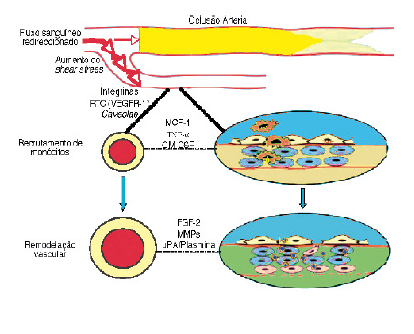
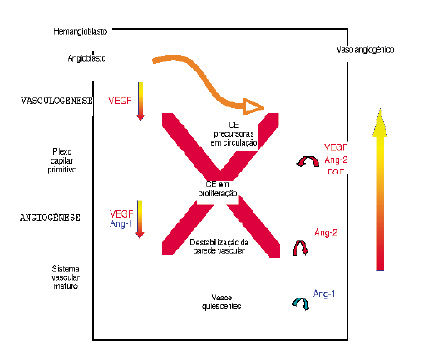
	    <p>O organismo possui diversos mecanismos de adapta&ccedil;&atilde;o que permitem melhorar o aporte sangu&iacute;neo aos tecidos em situa&ccedil;&otilde;es de isquemia. Os mecanismos accionados nessas circunst&acirc;ncias s&atilde;o classicamente divididos em tr&ecirc;s: angiog&eacute;nese, vasculog&eacute;nese e arteriog&eacute;nese | figuras 1 e 2 |<sup>&#91;10&#93;</sup>.
	Na realidade, estes processos possuem uma significativa interac&ccedil;&atilde;o, partilhando numerosos acontecimentos celulares e moleculares.</p>
	    <p>&nbsp;</p>
    ]]></body>
<body><![CDATA[<p><b>| FIGURA 1 |</b>Vasculog&eacute;nese e angiog&eacute;nese. CE, C&eacute;lulas Endoteliais; Ang&#45;1, Angiopoietina&#45;1; Ang&#45;2, Angiopoietina&#45;2 (adaptado de Brand&atilde;o D et al)<sup>&#91;10&#93;</sup></p>
    <p><img src="/img/revistas/ang/v8n2/8n2a01f1.jpg" width="424" height="350"></p>
    
<p>&nbsp;</p>
	    <p><b>| FIGURA 2 | </b>Arteriog&eacute;nese. RTC, Receptor Tirosina&#45;Cinase (adaptado de Brand&atilde;o D et al)<sup>&#91;10&#93;</sup></p>

	    <p><img src="/img/revistas/ang/v8n2/8n2a01f2.jpg" width="414" height="334"></p>
    
<p>&nbsp;</p>
    <p><b>A. Vasculog&eacute;nese</b></p>
    <p>A vasculog&eacute;nese consiste na forma&ccedil;&atilde;o de novos vasos a partir de c&eacute;lulas precursoras das c&eacute;lulas endoteliais (EPCs) derivadas da medula &oacute;ssea ou angioblastos. Embora inicialmente se pensasse que a vasculog&eacute;nese ocorreria apenas durante o per&iacute;odo embrion&aacute;rio, sabe&#45;se hoje que as EPCs colonizam os locais angiog&eacute;nicos, integrando&#45;se funcionalmente nos vasos em forma&ccedil;&atilde;o<sup>&#91;11&#93;</sup>.</p>
    <p>&nbsp;</p>
    <p><b>B. Angiog&eacute;nese</b></p>

	    ]]></body>
<body><![CDATA[<p>A angiog&eacute;nese consiste na forma&ccedil;&atilde;o de novos vasos a partir de vasos pr&eacute;&#45;existentes. Ap&oacute;s um est&iacute;mulo inicial, as c&eacute;lulas endoteliais separam&#45;se das c&eacute;lulas vizinhas bem como das c&eacute;lulas de suporte perivascular, come&ccedil;ando a proliferar e a migrar. Organizam&#45;se posteriormente em cord&otilde;es que subsequentemente adquirem l&uacute;men, dando assim origem a novos vasos.</p>
	    <p>&nbsp;</p>
    <p><b>1. VEGF</b></p>

	    <p>No processo angiog&eacute;nico interv&ecirc;m in&uacute;meros factores, de entre os quais importa salientar o VEGF e respectivos receptores. A c&eacute;lula endotelial constitui o alvo prim&aacute;rio da ac&ccedil;&atilde;o do VEGF. Est&aacute; claramente demonstrado, in vitro e in vivo, que o VEGF induz a prolifera&ccedil;&atilde;o e migra&ccedil;&atilde;o das c&eacute;lulas endoteliais e inibe a apoptose das mesmas<sup>&#91;12&#93;</sup>.</p>

    <p>A ac&ccedil;&atilde;o do VEGF decorre da sua liga&ccedil;&atilde;o a dois receptores tirosina&#45;cinase: o VEGFR&#45;1, tamb&eacute;m designado por Flt&#45;1 (fms&#45;like tyrosine kinase receptor 1) e o VEGFR&#45;2, igualmente descrito como Flk&#45;1 (fetal liver kinase 1) no ratinho, ou KDR (Kinase insert Domain Receptor) no ser humano<sup>&#91;13&#93;</sup>. O VEGFR&#45;2 constitui o mediador mais importante dos efeitos mitog&eacute;nicos e angiog&eacute;nicos do VEGF<sup>&#91;12&#93;</sup>. Em oposi&ccedil;&atilde;o ao VEGFR&#45;2, o papel do VEGFR&#45;1 na angiog&eacute;nese n&atilde;o se encontra t&atilde;o claramente definido. De facto, foram j&aacute; descritas ac&ccedil;&otilde;es contradit&oacute;rias, o que poder&aacute; resultar de uma sinaliza&ccedil;&atilde;o intracelular diversa consoante a fase de desenvolvimento ou o tipo celular em quest&atilde;o. Deste modo, embora o VEGFR&#45;1 assuma um papel positivo importante na vasculog&eacute;nese e angiog&eacute;nese esse receptor tirosina&#45;cinase surge como um potencial regulador negativo da ac&ccedil;&atilde;o do VEGF a n&iacute;vel das c&eacute;lulas endoteliais no adulto<sup>&#91;14&#93;</sup>.</p>
    <p>&nbsp;</p>
    <p><b>2. Exerc&iacute;cio e angiog&eacute;nese</b></p>

	    <p>O provimento de nutrientes &agrave;s fibras musculares est&aacute; dependente da difus&atilde;o a partir dos capilares circundantes. Est&aacute; demonstrado que a um maior n&uacute;mero de capilares existentes &agrave; periferia das fibras musculares se associa uma maior capacidade de difus&atilde;o<sup>&#91;15&#93;</sup>. Embora exista alguma discord&acirc;ncia entre os estudos publicados em torno dos processos de adapta&ccedil;&atilde;o nos m&uacute;sculos dos indiv&iacute;duos com claudica&ccedil;&atilde;o intermitente, poder&aacute; haver um aumento da densidade capilar a n&iacute;vel muscular nessa circunst&acirc;ncia<sup>&#91;16&#45;19&#93;</sup>. Por outro lado, constatou&#45;se que o exerc&iacute;cio leva a um incremento da densidade capilar e da capacidade de difus&atilde;o a n&iacute;vel muscular, em consequ&ecirc;ncia da activa&ccedil;&atilde;o do processo angiog&eacute;nico, mesmo em circunst&acirc;ncias em que se verifica obstru&ccedil;&atilde;o do fluxo sangu&iacute;neo a montante<sup>&#91;17, 20, 21&#93;</sup>. Este mecanismo adaptativo poder&aacute; em parte explicar o benef&iacute;cio verificado nos indiv&iacute;duos claudicantes submetidos a exerc&iacute;cio sob supervis&atilde;o.</p>
    <p>&nbsp;</p>
    <p><b>C. Arteriog&eacute;nese</b></p>

	    ]]></body>
<body><![CDATA[<p>Em situa&ccedil;&otilde;es de estenose ou oclus&atilde;o de uma art&eacute;ria, os vasos colaterais pr&eacute;&#45;existentes aumentam de di&acirc;metro de modo a tornarem&#45;se efectivos no fornecimento de sangue a jusante. Este fen&oacute;meno &eacute; conhecido como arteriog&eacute;nese. Quando uma estenose arterial se torna hemodinamicamente significativa, a corrente sangu&iacute;nea &eacute; dirigida para os leitos arteriolares vizinhos pr&eacute;&#45;existentes. Em consequ&ecirc;ncia ocorre um aumento significativo do shear stress a n&iacute;vel das paredes desses vasos levando &agrave; activa&ccedil;&atilde;o das c&eacute;lulas endoteliais. Essa activa&ccedil;&atilde;o &eacute; mediada &agrave; superf&iacute;cie celular por numerosas vias, salientando&#45;se diversos receptores tirosina&#45;cinase (nomeadamente o VEGFR&#45;1), mol&eacute;culas de ades&atilde;o celular (PECAM&#45;1, integrinas), canais i&oacute;nicos, prote&iacute;nas G, caveolae, dupla camada lip&iacute;dica da membrana celular ou ainda proteoglicanos<sup>&#91;22&#93;</sup>. As c&eacute;lulas endoteliais activadas v&atilde;o promover a transcri&ccedil;&atilde;o de m&uacute;ltiplos genes. Em resultado decorre a s&iacute;ntese de numerosas citocinas (embora o MCP&#45;1 assuma maior relevo, s&atilde;o igualmente importantes mol&eacute;culas como o GM&#45;CSF &#150; granulocyte&#45;macrophage colony&#45;stimulating factor, G&#45;CSF &#150; granulocyte&#45;macrophage colony&#45;stimulating factor &#150; ou ainda o TNF&#45;&#945;), mol&eacute;culas de ades&atilde;o intercellular (ICAM&#45;1 &#150; intercellular adhesion molecule&#45;1, ICAM&#45;2 e VCAM&#45;1 &#150; vascular adhesion molecule&#45;1) e ainda da eNOS <sup>&#91;23&#45;25&#93;</sup>. Atra&iacute;dos pelo aumento circunscrito da concentra&ccedil;&atilde;o de MCP&#45;1 e auxiliados pelas mol&eacute;culas de ades&atilde;o celular, os mon&oacute;citos circulantes v&atilde;o localmente aderir ao endot&eacute;lio e invadir a parede vascular, transformando&#45;se em macr&oacute;fagos <sup>&#91;23&#93;</sup>. Os macr&oacute;fagos, cuja fun&ccedil;&atilde;o &eacute; favorecida pelo GM&#45;CSF circundante, v&atilde;o sintetizar, entre outros, proteases como as MMPs (matrix metalloproteinases) e o uPA (urinary plasminogen activator) e numerosos factores de crescimento vascular, com relevo para o FGF&#45;2 (fibroblastic growth factor&#45;2) <sup>&#91;26&#93;</sup>. Por um lado, a destrutura&ccedil;&atilde;o promovida pelas proteases da matriz, das l&acirc;minas el&aacute;sticas interna e externa e da advent&iacute;cia, permite originar espa&ccedil;o para a multiplica&ccedil;&atilde;o e migra&ccedil;&atilde;o das c&eacute;lulas que comp&otilde;em a parede arterial; por outro lado, os fragmentos resultantes da degrada&ccedil;&atilde;o dos componentes da matriz, como por exemplo da elastina, v&atilde;o, em conjunto com o FGF&#45;2, induzir a activa&ccedil;&atilde;o das c&eacute;lulas musculares lisas (CML)<sup>&#91;23,26,27&#93;</sup>. As CML activadas v&atilde;o proliferar e sofrer uma desdiferencia&ccedil;&atilde;o de um fen&oacute;tipo contr&aacute;ctil para um fen&oacute;tipo de s&iacute;ntese<sup>&#91;28&#93;</sup>. Entretanto, as c&eacute;lulas endoteliais inicialmente activadas pelas altera&ccedil;&otilde;es hemodin&acirc;micas e posteriormente estimuladas pelos factores de crescimento libertados pelos macr&oacute;fagos em resultado da disrup&ccedil;&atilde;o da barreira constitu&iacute;da pela l&acirc;mina el&aacute;stica interna, v&atilde;o igualmente proliferar<sup>&#91;29&#93;</sup>. Posteriormente assiste&#45;se &agrave; matura&ccedil;&atilde;o da parede arterial com a disposi&ccedil;&atilde;o ordenada das CML em camadas circulares, com o estabelecimento de liga&ccedil;&otilde;es intercelulares e ainda com a s&iacute;ntese de colag&eacute;nio e de elastina, possibilitando assim a estrutura necess&aacute;ria para um vaso de calibre superior<sup>&#91;28&#93;</sup>.</p>
	    <p>&nbsp;</p>
    <p><b>1. VEGF e receptores na arteriog&eacute;nese</b></p>

	    <p>O papel preponderante do VEGF verificado na angiog&eacute;nese n&atilde;o &eacute; t&atilde;o evidente na arteriog&eacute;nese. De facto, a express&atilde;o do VEGF &eacute; no essencial mediada pelo factor de transcri&ccedil;&atilde;o HIF&#45;1&#945; (hypoxia&#45;inducible factor&#45;1&#945;), que apenas &eacute; expresso em situa&ccedil;&otilde;es de hip&oacute;xia, condi&ccedil;&atilde;o que n&atilde;o se verifica nos locais onde decorre o processo arteriog&eacute;nico. Contudo, a express&atilde;o do VEGF e do VEGFR&#45;2 pelas c&eacute;lulas endoteliais encontra&#45;se aumentada ao longo do processo arteriog&eacute;nico<sup>&#91;30&#93;</sup>. Por outro lado, a arteriog&eacute;nese induzida pelo exerc&iacute;cio &eacute; inibida por um antagonista do VEGF<sup>&#91;31&#93;</sup>. Foi ainda demonstrado em modelo animal que CML transduzidas com VEGF associadas a c&eacute;lulas endoteliais transduzidas com Angiopoietina&#45;1 (factor de grande relev&acirc;ncia na matura&ccedil;&atilde;o e estabiliza&ccedil;&atilde;o dos vasos rec&eacute;m&#45;formados por promover a interac&ccedil;&atilde;o entre o endot&eacute;lio e as c&eacute;lulas de suporte perivascular) reproduzem o fen&oacute;meno arteriog&eacute;nico<sup>&#91;32&#93;</sup>.</p>

    <p>O mecanismo sugerido atrav&eacute;s do qual o VEGF parece ser capaz de induzir a arteriog&eacute;nese poder&aacute; ser o seguinte: o aumento de express&atilde;o de eNOS despoletada pelo incremento do shear stress promove a liberta&ccedil;&atilde;o de VEGF; na sequ&ecirc;ncia, o VEGF induz as CML a sintetizarem MCP&#45;1, levando &agrave; atrac&ccedil;&atilde;o dos mon&oacute;citos, dando assim in&iacute;cio ao processo arteriog&eacute;nico<sup>&#91;28&#93;</sup>. Adicionalmente, foi demonstrado que o VEGF &eacute; capaz de promover directamente a atrac&ccedil;&atilde;o e migra&ccedil;&atilde;o dos mon&oacute;citos, sendo esta ac&ccedil;&atilde;o de atrac&ccedil;&atilde;o do VEGF mediada pelo VEGFR&#45;1<sup>&#91;33&#45;35&#93;</sup>. Por outro lado, verificou&#45;se que o PlGF (placental growth factor), membro da fam&iacute;lia VEGF e ligando do VEGFR&#45;1, promove a arteriog&eacute;nese em modelos de isquemia mioc&aacute;rdica e dos membros inferiores<sup>&#91;36&#93;</sup>.</p>

    <p>O VEGFR&#45;1 poder&aacute; ainda ter um papel adicional em todo o processo arteriog&eacute;nico. Assim, o VEGFR&#45;1 pode, por splicing alternativo, ser expresso sob uma forma sol&uacute;vel que, ao ligar&#45;se ao VEGF, impossibilita este de exercer a sua ac&ccedil;&atilde;o junto das c&eacute;lulas&#45;alvo, podendo limitar desta forma os processos angiog&eacute;nico e arteriog&eacute;nico<sup>&#91;37&#93;</sup>.</p>
    <p>&nbsp;</p>
    <p><b>2. Exerc&iacute;cio e arteriog&eacute;nese</b></p>

	    <p>Mesmo na aus&ecirc;ncia de suplementa&ccedil;&atilde;o com factores pr&oacute;&#45;angiog&eacute;nicos e pr&oacute;&#45;arteriog&eacute;nicos, a participa&ccedil;&atilde;o num programa de exerc&iacute;cio regular associa&#45;se a um aumento do fluxo sangu&iacute;neo dependente da colateraliza&ccedil;&atilde;o <sup>&#91;38&#93;</sup>. Nesse &acirc;mbito, foi recentemente demonstrado em modelo animal que, ap&oacute;s a laquea&ccedil;&atilde;o da art&eacute;ria femoral, o fluxo sangu&iacute;neo pelas colaterais para os m&uacute;sculos da perna &eacute; inicialmente de 2 a 3 vezes o fluxo necess&aacute;rio para manter a massa muscular vi&aacute;vel em repouso, progredindo com o tempo para 5 a 6 vezes nos ratos sedent&aacute;rios e para 10 vezes nos ratos sob exerc&iacute;cio&#91;39&#93;. Esta adapta&ccedil;&atilde;o progressiva, mais expressiva nos animais sob treino, resulta em grande medida do aumento do di&acirc;metro das colaterais pr&eacute;&#45;existentes, isto &eacute;, do est&iacute;mulo arteriog&eacute;nico resultante do incremento do shear stress <sup>&#91;6&#93;</sup>. Dos agentes intervenientes nesse processo de adapta&ccedil;&atilde;o, a eNOS tem sido apontada como uma mol&eacute;cula cr&iacute;tica.
	O aumento da express&atilde;o da eNOS &eacute; t&iacute;pico dos vasos respons&aacute;veis pelo fornecimento de sangue aos grupos musculares que suportam um determinado exerc&iacute;cio, em resultado do seu importante papel no controlo vascular local<sup>&#91;6&#93;</sup>. Contudo, na circunst&acirc;ncia do remodeling vascular associado &agrave; arteriog&eacute;nese o seu papel &eacute; ainda de maior relev&acirc;ncia na medida em que a express&atilde;o de eNOS &eacute; crucial para o aumento do di&acirc;metro arterial<sup>&#91;40,41&#93;</sup>. De facto, a inibi&ccedil;&atilde;o da produ&ccedil;&atilde;o de NO suprime o aumento de fluxo ao n&iacute;vel das colaterais induzido peloexerc&iacute;cio<sup>&#91;42&#93;</sup>.</p>
	    <p>&nbsp;</p>
    ]]></body>
<body><![CDATA[<p><b>3. Arteriog&eacute;nese e doen&ccedil;a coron&aacute;ria</b></p>

	    <p>Nesse &acirc;mbito, importa relevar que foram recentemente publicados dois estudos que relacionam uma menor capacidade de colateraliza&ccedil;&atilde;o a n&iacute;vel coron&aacute;rio com um maior risco de eventos card&iacute;acos agudos<sup>&#91;43,44&#93;</sup>.</p>
	    <p>&nbsp;</p>
    <p><b>II. CONCLUS&Otilde;ES</b></p>

	    <p>Embora, como mencionado anteriormente,
a evolu&ccedil;&atilde;o dos doentes com DAP se encontre claramente definida, os factores preditivos do agravamento cl&iacute;nico dos doentes s&atilde;o ainda escassos e pouco precisos (1, 45). Neste contexto, o estudo da variabilidade interindividual das diferentes mol&eacute;culas envolvidas nos mecanismos vasculares de adapta&ccedil;&atilde;o &agrave; isquemia poder&aacute; possibilitar a identifica&ccedil;&atilde;o de biomarcadores com capacidade progn&oacute;stica, quer em rela&ccedil;&atilde;o &agrave; evolu&ccedil;&atilde;o da doen&ccedil;a, quer &agrave; resposta &agrave;s terap&ecirc;uticas institu&iacute;das, nomeadamente ao exerc&iacute;cio sob supervis&atilde;o.</p>
    <p>&nbsp;</p>
	    <p><b>BIBLIOGRAFIA</b></p>
	    <!-- ref --><p><sup>&#91;1&#93;</sup> NORGREN L, HIATT WR, DORMANDY JA, NEHLER MR, HARRIS KA, FOWKES FG, et al. <i>Inter&#45;Society Consensus for the Management of Peripheral Arterial Disease (TASC II)</i>. Eur J Vasc Endovasc Surg. 2007;33 Suppl 1:S1&#45;75. Epub 2006/12/05.    &nbsp;&nbsp;&nbsp;&nbsp;&nbsp;&nbsp;&nbsp;&nbsp;[&#160;<a href="javascript:void(0);" onclick="javascript: window.open('/scielo.php?script=sci_nlinks&ref=000070&pid=S1646-706X201200020000100001&lng=','','width=640,height=500,resizable=yes,scrollbars=1,menubar=yes,');">Links</a>&#160;]<!-- end-ref --></p>

    <!-- ref --><p><sup>&#91;2&#93;</sup> NASCHITZ JE, AMBROSIO DA, CHANG JB.<i> Intermittent claudication: predictors and outcome.</i> Angiology. 1988;39(1 Pt 1):16&#45;22. Epub 1988/01/01.    &nbsp;&nbsp;&nbsp;&nbsp;&nbsp;&nbsp;&nbsp;&nbsp;[&#160;<a href="javascript:void(0);" onclick="javascript: window.open('/scielo.php?script=sci_nlinks&ref=000072&pid=S1646-706X201200020000100002&lng=','','width=640,height=500,resizable=yes,scrollbars=1,menubar=yes,');">Links</a>&#160;]<!-- end-ref --></p>

    <!-- ref --><p><sup>&#91;3&#93;</sup> FOWKES FG, MURRAY GD, BUTCHER I, HEALD CL, LEE RJ, CHAMBLESS LE, et al. <i>Ankle brachial index combined with Framingham Risk Score to predict cardiovascular events and mortality: a meta&#45;analysis.</i> JAMA. 2008;300(2):197&#45;208. Epub 2008/07/10.    &nbsp;&nbsp;&nbsp;&nbsp;&nbsp;&nbsp;&nbsp;&nbsp;[&#160;<a href="javascript:void(0);" onclick="javascript: window.open('/scielo.php?script=sci_nlinks&ref=000074&pid=S1646-706X201200020000100003&lng=','','width=640,height=500,resizable=yes,scrollbars=1,menubar=yes,');">Links</a>&#160;]<!-- end-ref --></p>

    <!-- ref --><p><sup>&#91;4&#93;</sup> CRIQUI MH, LANGER RD, FRONEK A, FEIGELSON HS, KLAUBER MR, MCCANN TJ, et al. <i>Mortality over a period of 10 years in patients with peripheral arterial disease.</i> N Engl J Med. 1992;326(6):381&#45;6. Epub 1992/02/06.    &nbsp;&nbsp;&nbsp;&nbsp;&nbsp;&nbsp;&nbsp;&nbsp;[&#160;<a href="javascript:void(0);" onclick="javascript: window.open('/scielo.php?script=sci_nlinks&ref=000076&pid=S1646-706X201200020000100004&lng=','','width=640,height=500,resizable=yes,scrollbars=1,menubar=yes,');">Links</a>&#160;]<!-- end-ref --></p>

    <!-- ref --><p><sup>&#91;5&#93;</sup> WATSON L, ELLIS B, LENG GC. <i>Exercise for intermittent claudication.</i> Cochrane Database Syst Rev. 2008(4):CD000990. Epub 2008/10/10.    &nbsp;&nbsp;&nbsp;&nbsp;&nbsp;&nbsp;&nbsp;&nbsp;[&#160;<a href="javascript:void(0);" onclick="javascript: window.open('/scielo.php?script=sci_nlinks&ref=000078&pid=S1646-706X201200020000100005&lng=','','width=640,height=500,resizable=yes,scrollbars=1,menubar=yes,');">Links</a>&#160;]<!-- end-ref --></p>

    <!-- ref --><p><sup>&#91;6&#93;</sup> YANG HT, PRIOR BM, LLOYD PG, TAYLOR JC, LI Z, LAUGHLIN MH, et al. <i>Training&#45;induced vascular adaptations to ischemic muscle.</i> J Physiol Pharmacol. 2008;59 Suppl 7:57&#45;70. Epub 2009/03/11.    &nbsp;&nbsp;&nbsp;&nbsp;&nbsp;&nbsp;&nbsp;&nbsp;[&#160;<a href="javascript:void(0);" onclick="javascript: window.open('/scielo.php?script=sci_nlinks&ref=000080&pid=S1646-706X201200020000100006&lng=','','width=640,height=500,resizable=yes,scrollbars=1,menubar=yes,');">Links</a>&#160;]<!-- end-ref --></p>

    <!-- ref --><p><sup>&#91;7&#93; </sup>CHEETHAM DR, BURGESS L, ELLIS M, WILLIAMS A, GREENHALGH RM, DAVIES AH. <i>Does supervised exercise offer adjuvant benefit over exercise advice alone for the treatment of intermittent claudication? A randomised trial.</i> Eur J Vasc Endovasc Surg. 2004;27(1):17&#45;23. Epub 2003/12/04.    &nbsp;&nbsp;&nbsp;&nbsp;&nbsp;&nbsp;&nbsp;&nbsp;[&#160;<a href="javascript:void(0);" onclick="javascript: window.open('/scielo.php?script=sci_nlinks&ref=000082&pid=S1646-706X201200020000100007&lng=','','width=640,height=500,resizable=yes,scrollbars=1,menubar=yes,');">Links</a>&#160;]<!-- end-ref --></p>

    <!-- ref --><p><sup>&#91;8&#93;</sup> PATTERSON RB, PINTO B, MARCUS B, COLUCCI A, BRAUN T, ROBERTS M. <i>Value of a supervised exercise program for the therapy of arterial claudication.</i> J Vasc Surg. 1997;25(2):312&#45;8; discussion 8&#45;9. Epub 1997/02/01.    &nbsp;&nbsp;&nbsp;&nbsp;&nbsp;&nbsp;&nbsp;&nbsp;[&#160;<a href="javascript:void(0);" onclick="javascript: window.open('/scielo.php?script=sci_nlinks&ref=000084&pid=S1646-706X201200020000100008&lng=','','width=640,height=500,resizable=yes,scrollbars=1,menubar=yes,');">Links</a>&#160;]<!-- end-ref --></p>

    <!-- ref --><p><sup>&#91;9&#93;</sup> NICOLAI SP, HENDRIKS EJ, PRINS MH, TEIJINK JA. <i>Optimizing supervised exercise therapy for patients with intermittent claudication.</i> J Vasc Surg. 2010;52(5):1226&#45;33. Epub 2010/08/10.    &nbsp;&nbsp;&nbsp;&nbsp;&nbsp;&nbsp;&nbsp;&nbsp;[&#160;<a href="javascript:void(0);" onclick="javascript: window.open('/scielo.php?script=sci_nlinks&ref=000086&pid=S1646-706X201200020000100009&lng=','','width=640,height=500,resizable=yes,scrollbars=1,menubar=yes,');">Links</a>&#160;]<!-- end-ref --></p>

    <!-- ref --><p><sup>&#91;10&#93;</sup> BRAND&Atilde;O D PD, COSTA C, CANEDO A, GUEDES VAZ A. <i>Artigo de revis&atilde;o: Angiog&eacute;nese Terap&ecirc;utica: o in&iacute;cio de uma nova era?</i> Angiologia e Cirurgia Vascular. 2008;4:127&#45;39.    &nbsp;&nbsp;&nbsp;&nbsp;&nbsp;&nbsp;&nbsp;&nbsp;[&#160;<a href="javascript:void(0);" onclick="javascript: window.open('/scielo.php?script=sci_nlinks&ref=000088&pid=S1646-706X201200020000100010&lng=','','width=640,height=500,resizable=yes,scrollbars=1,menubar=yes,');">Links</a>&#160;]<!-- end-ref --></p>

    <!-- ref --><p><sup>&#91;11&#93;</sup> CARMELIET P. <i>Mechanisms of Angiogenesis and Arteriogenesis.</i> Nat Med. 2000;6(4):389&#45;95. Epub 2000/03/31.    &nbsp;&nbsp;&nbsp;&nbsp;&nbsp;&nbsp;&nbsp;&nbsp;[&#160;<a href="javascript:void(0);" onclick="javascript: window.open('/scielo.php?script=sci_nlinks&ref=000090&pid=S1646-706X201200020000100011&lng=','','width=640,height=500,resizable=yes,scrollbars=1,menubar=yes,');">Links</a>&#160;]<!-- end-ref --></p>

    <!-- ref --><p><sup>&#91;12&#93;</sup> FERRARA N. <i>Vascular endothelial growth factor: basic science and clinical progress.</i> Endocr Rev. 2004;25(4):581&#45;611. Epub 2004/08/06.    &nbsp;&nbsp;&nbsp;&nbsp;&nbsp;&nbsp;&nbsp;&nbsp;[&#160;<a href="javascript:void(0);" onclick="javascript: window.open('/scielo.php?script=sci_nlinks&ref=000092&pid=S1646-706X201200020000100012&lng=','','width=640,height=500,resizable=yes,scrollbars=1,menubar=yes,');">Links</a>&#160;]<!-- end-ref --></p>

    <!-- ref --><p><sup>&#91;13&#93;</sup> TERMAN BI, CARRION ME, KOVACS E, RASMUSSEN BA, EDDY RL, SHOWS TB. <i>Identification of a new endothelial cell growth factor receptor tyrosine kinase.</i> Oncogene. 1991;6(9):1677&#45;83. Epub 1991/09/01.    &nbsp;&nbsp;&nbsp;&nbsp;&nbsp;&nbsp;&nbsp;&nbsp;[&#160;<a href="javascript:void(0);" onclick="javascript: window.open('/scielo.php?script=sci_nlinks&ref=000094&pid=S1646-706X201200020000100013&lng=','','width=640,height=500,resizable=yes,scrollbars=1,menubar=yes,');">Links</a>&#160;]<!-- end-ref --></p>

    <!-- ref --><p><sup>&#91;14&#93;</sup> FONG GH, ROSSANT J, GERTSENSTEIN M, BREITMAN ML. <i>Role of the Flt&#45;1 receptor tyrosine kinase in regulating the assembly of vascular endothelium.</i> Nature. 1995;376(6535):66&#45;70. Epub 1995/07/06.    &nbsp;&nbsp;&nbsp;&nbsp;&nbsp;&nbsp;&nbsp;&nbsp;[&#160;<a href="javascript:void(0);" onclick="javascript: window.open('/scielo.php?script=sci_nlinks&ref=000096&pid=S1646-706X201200020000100014&lng=','','width=640,height=500,resizable=yes,scrollbars=1,menubar=yes,');">Links</a>&#160;]<!-- end-ref --></p>

    <!-- ref --><p><sup>&#91;15&#93;</sup> RICHARDSON RS, GRASSI B, GAVIN TP, HASELER LJ, TAGORE K, ROCA J, et al. <i>Evidence of O2 supply&#45;dependent VO2 max in the exercise&#45;trained human quadriceps.</i> J Appl Physiol. 1999;86(3):1048&#45;53. Epub 1999/03/06.    &nbsp;&nbsp;&nbsp;&nbsp;&nbsp;&nbsp;&nbsp;&nbsp;[&#160;<a href="javascript:void(0);" onclick="javascript: window.open('/scielo.php?script=sci_nlinks&ref=000098&pid=S1646-706X201200020000100015&lng=','','width=640,height=500,resizable=yes,scrollbars=1,menubar=yes,');">Links</a>&#160;]<!-- end-ref --></p>

    <!-- ref --><p><sup>&#91;16&#93;</sup> HAMMARSTEN J, BYLUND&#45;FELLENIUS AC, HOLM J, SCHERSTEN T, KROTKIEWSKI M. <i>Capillary supply and muscle fibre types in patients with intermittent claudication: relationships between morphology and metabolism.</i> Eur J Clin Invest. 1980;10(4):301&#45;5. Epub 1980/08/01.    &nbsp;&nbsp;&nbsp;&nbsp;&nbsp;&nbsp;&nbsp;&nbsp;[&#160;<a href="javascript:void(0);" onclick="javascript: window.open('/scielo.php?script=sci_nlinks&ref=000100&pid=S1646-706X201200020000100016&lng=','','width=640,height=500,resizable=yes,scrollbars=1,menubar=yes,');">Links</a>&#160;]<!-- end-ref --></p>

    <!-- ref --><p><sup><sup>&#91;17</sup>&#93;</sup> MCGUIGAN MR, BRONKS R, NEWTON RU, SHARMAN MJ, GRAHAM JC, CODY DV, et al. <i>Muscle fiber characteristics in patients with peripheral arterial disease.</i> Med Sci Sports Exerc. 2001;33(12):2016&#45;21. Epub 2001/12/12.    &nbsp;&nbsp;&nbsp;&nbsp;&nbsp;&nbsp;&nbsp;&nbsp;[&#160;<a href="javascript:void(0);" onclick="javascript: window.open('/scielo.php?script=sci_nlinks&ref=000102&pid=S1646-706X201200020000100017&lng=','','width=640,height=500,resizable=yes,scrollbars=1,menubar=yes,');">Links</a>&#160;]<!-- end-ref --></p>

    <!-- ref --><p><sup>&#91;18&#93;</sup> ASKEW CD, GREEN S, WALKER PJ, KERR GK, GREEN AA, WILLIAMS AD, et al. <i>Skeletal muscle phenotype is associated with exercise tolerance in patients with peripheral arterial disease.</i> J Vasc Surg. 2005;41(5):802&#45;7. Epub 2005/05/12.    &nbsp;&nbsp;&nbsp;&nbsp;&nbsp;&nbsp;&nbsp;&nbsp;[&#160;<a href="javascript:void(0);" onclick="javascript: window.open('/scielo.php?script=sci_nlinks&ref=000104&pid=S1646-706X201200020000100018&lng=','','width=640,height=500,resizable=yes,scrollbars=1,menubar=yes,');">Links</a>&#160;]<!-- end-ref --></p>

    <!-- ref --><p><sup>&#91;19&#93;</sup> DUSCHA BD, ROBBINS JL, JONES WS, KRAUS WE, LYE RJ, SANDERS JM, et al. <i>Angiogenesis in skeletal muscle precede improvements in peak oxygen uptake in peripheral artery disease patients.</i> Arterioscler Thromb Vasc Biol. 2011;31(11):2742&#45;8. Epub 2011/08/27.    &nbsp;&nbsp;&nbsp;&nbsp;&nbsp;&nbsp;&nbsp;&nbsp;[&#160;<a href="javascript:void(0);" onclick="javascript: window.open('/scielo.php?script=sci_nlinks&ref=000106&pid=S1646-706X201200020000100019&lng=','','width=640,height=500,resizable=yes,scrollbars=1,menubar=yes,');">Links</a>&#160;]<!-- end-ref --></p>

    <!-- ref --><p><sup>&#91;20&#93;</sup> WOOD RE, SANDERSON BE, ASKEW CD, WALKER PJ, GREEN S, STEWART IB. <i>Effect of training on the response of plasma vascular endothelial growth factor to exercise in patients with peripheral arterial disease.</i> Clin Sci (Lond). 2006;111(6):401&#45;9. Epub 2006/08/25.    &nbsp;&nbsp;&nbsp;&nbsp;&nbsp;&nbsp;&nbsp;&nbsp;[&#160;<a href="javascript:void(0);" onclick="javascript: window.open('/scielo.php?script=sci_nlinks&ref=000108&pid=S1646-706X201200020000100020&lng=','','width=640,height=500,resizable=yes,scrollbars=1,menubar=yes,');">Links</a>&#160;]<!-- end-ref --></p>

    <!-- ref --><p><sup>&#91;21&#93;</sup> ESBJORNSSON M, JANSSON E, SUNDBERG CJ, SYLVEN C, EIKEN O, NYGREN A, et al. <i>Muscle fibre types and enzyme activities after training with local leg ischaemia in man.</i> Acta Physiol Scand. 1993;148(3):233&#45;41. Epub 1993/07/01.    &nbsp;&nbsp;&nbsp;&nbsp;&nbsp;&nbsp;&nbsp;&nbsp;[&#160;<a href="javascript:void(0);" onclick="javascript: window.open('/scielo.php?script=sci_nlinks&ref=000110&pid=S1646-706X201200020000100021&lng=','','width=640,height=500,resizable=yes,scrollbars=1,menubar=yes,');">Links</a>&#160;]<!-- end-ref --></p>

    <!-- ref --><p><sup>&#91;22&#93;</sup> CHATZIZISIS YS, COSKUN AU, JONAS M, EDELMAN ER, FELDMAN CL, STONE PH. <i>Role of endothelial shear stress in the natural history of coronary atherosclerosis and vascular remodeling: molecular, cellular, and vascular behavior.</i> J Am Coll Cardiol. 2007;49(25):2379&#45;93. Epub 2007/06/30.    &nbsp;&nbsp;&nbsp;&nbsp;&nbsp;&nbsp;&nbsp;&nbsp;[&#160;<a href="javascript:void(0);" onclick="javascript: window.open('/scielo.php?script=sci_nlinks&ref=000112&pid=S1646-706X201200020000100022&lng=','','width=640,height=500,resizable=yes,scrollbars=1,menubar=yes,');">Links</a>&#160;]<!-- end-ref --></p>

    <!-- ref --><p><sup>&#91;23&#93;</sup> WAHLBERG E. <i>Angiogenesis and arteriogenesis in limb ischemia.</i> J Vasc Surg. 2003;38(1):198&#45;203. Epub 2003/07/05.    &nbsp;&nbsp;&nbsp;&nbsp;&nbsp;&nbsp;&nbsp;&nbsp;[&#160;<a href="javascript:void(0);" onclick="javascript: window.open('/scielo.php?script=sci_nlinks&ref=000114&pid=S1646-706X201200020000100023&lng=','','width=640,height=500,resizable=yes,scrollbars=1,menubar=yes,');">Links</a>&#160;]<!-- end-ref --></p>

    <!-- ref --><p><sup>&#91;24&#93;</sup> SCHIRMER SH, VAN NOOIJEN FC, PIEK JJ, VAN ROYEN N. <i>Stimulation of collateral artery growth: travelling further down the road to clinical application.</i> Heart. 2009;95(3):191&#45;7. Epub 2009/01/16.    &nbsp;&nbsp;&nbsp;&nbsp;&nbsp;&nbsp;&nbsp;&nbsp;[&#160;<a href="javascript:void(0);" onclick="javascript: window.open('/scielo.php?script=sci_nlinks&ref=000116&pid=S1646-706X201200020000100024&lng=','','width=640,height=500,resizable=yes,scrollbars=1,menubar=yes,');">Links</a>&#160;]<!-- end-ref --></p>

    <!-- ref --><p><sup>&#91;25&#93;</sup> SCHOLZ D, ITO W, FLEMING I, DEINDL E, SAUER A, WIESNET M, et al. <i>Ultrastructure and molecular histology of rabbit hind&#45;limb collateral artery growth (arteriogenesis).</i> Virchows Arch. 2000;436(3):257&#45;70. Epub 2000/04/27.    &nbsp;&nbsp;&nbsp;&nbsp;&nbsp;&nbsp;&nbsp;&nbsp;[&#160;<a href="javascript:void(0);" onclick="javascript: window.open('/scielo.php?script=sci_nlinks&ref=000118&pid=S1646-706X201200020000100025&lng=','','width=640,height=500,resizable=yes,scrollbars=1,menubar=yes,');">Links</a>&#160;]<!-- end-ref --></p>

    <!-- ref --><p><sup>&#91;26&#93;</sup> HEIL M, EITENMULLER I, SCHMITZ&#45;RIXEN T, SCHAPER W. <i>Arteriogenesis versus angiogenesis: similarities and differences.</i> J Cell Mol Med. 2006;10(1):45&#45;55. Epub 2006/03/28.    &nbsp;&nbsp;&nbsp;&nbsp;&nbsp;&nbsp;&nbsp;&nbsp;[&#160;<a href="javascript:void(0);" onclick="javascript: window.open('/scielo.php?script=sci_nlinks&ref=000120&pid=S1646-706X201200020000100026&lng=','','width=640,height=500,resizable=yes,scrollbars=1,menubar=yes,');">Links</a>&#160;]<!-- end-ref --></p>

    <!-- ref --><p><sup>&#91;27&#93;</sup> ARRAS M, ITO WD, SCHOLZ D, WINKLER B, SCHAPER J, SCHAPER W. <i>Monocyte activation in angiogenesis and collateral growth in the rabbit hindlimb.</i> J Clin Invest. 1998;101(1):40&#45;50. Epub 1998/02/14.    &nbsp;&nbsp;&nbsp;&nbsp;&nbsp;&nbsp;&nbsp;&nbsp;[&#160;<a href="javascript:void(0);" onclick="javascript: window.open('/scielo.php?script=sci_nlinks&ref=000122&pid=S1646-706X201200020000100027&lng=','','width=640,height=500,resizable=yes,scrollbars=1,menubar=yes,');">Links</a>&#160;]<!-- end-ref --></p>

    <!-- ref --><p><sup>&#91;28&#93;</sup> SCHAPER W. <i>Collateral circulation: past and present.</i> Basic Res Cardiol. 2009;104(1):5&#45;21. Epub 2008/12/23.    &nbsp;&nbsp;&nbsp;&nbsp;&nbsp;&nbsp;&nbsp;&nbsp;[&#160;<a href="javascript:void(0);" onclick="javascript: window.open('/scielo.php?script=sci_nlinks&ref=000124&pid=S1646-706X201200020000100028&lng=','','width=640,height=500,resizable=yes,scrollbars=1,menubar=yes,');">Links</a>&#160;]<!-- end-ref --></p>

    <!-- ref --><p><sup>&#91;29&#93;</sup> HEIL M, SCHAPER W. <i>Influence of mechanical, cellular, and molecular factors on collateral artery growth (arteriogenesis)</i>. Circ Res. 2004;95(5):449&#45;58. Epub 2004/09/04.    &nbsp;&nbsp;&nbsp;&nbsp;&nbsp;&nbsp;&nbsp;&nbsp;[&#160;<a href="javascript:void(0);" onclick="javascript: window.open('/scielo.php?script=sci_nlinks&ref=000126&pid=S1646-706X201200020000100029&lng=','','width=640,height=500,resizable=yes,scrollbars=1,menubar=yes,');">Links</a>&#160;]<!-- end-ref --></p>

    <p><sup>&#91;30&#93;</sup> WU S, WU X, ZHU W, CAI W&#45;J, SCHAPER J, SCHAPER W. <i>Immunohistochemical study of the growth factors, aFGF, bFGF, PDGF&#45;AB, VEGF&#45;A and its receptor (Flk&#45;1) during arteriogenesis.</i> Molecular and Cellular Biochemistry. 2010;343(1):223&#45;9.</p>

    <!-- ref --><p><sup>&#91;31&#93;</sup> LLOYD PG, PRIOR BM, LI H, YANG HT, TERJUNG RL. <i>VEGF receptor antagonism blocks arteriogenesis, but only partially inhibits angiogenesis, in skeletal muscle of exercise&#45;trained rats.</i> Am J Physiol Heart Circ Physiol. 2005;288(2):H759&#45;68. Epub 2004/10/09.    &nbsp;&nbsp;&nbsp;&nbsp;&nbsp;&nbsp;&nbsp;&nbsp;[&#160;<a href="javascript:void(0);" onclick="javascript: window.open('/scielo.php?script=sci_nlinks&ref=000129&pid=S1646-706X201200020000100031&lng=','','width=640,height=500,resizable=yes,scrollbars=1,menubar=yes,');">Links</a>&#160;]<!-- end-ref --></p>

    <!-- ref --><p><sup>&#91;32&#93;</sup> GLUZMAN Z, KOREN B, PREIS M, COHEN T, TSABA A, COSSET FL, et al. <i>Endothelial cells are activated by angiopoeitin&#45;1 gene transfer and produce coordinated sprouting in vitro and arteriogenesis in vivo.</i> Biochem Biophys Res Commun. 2007;359(2):263&#45;8. Epub 2007/06/05.    &nbsp;&nbsp;&nbsp;&nbsp;&nbsp;&nbsp;&nbsp;&nbsp;[&#160;<a href="javascript:void(0);" onclick="javascript: window.open('/scielo.php?script=sci_nlinks&ref=000131&pid=S1646-706X201200020000100032&lng=','','width=640,height=500,resizable=yes,scrollbars=1,menubar=yes,');">Links</a>&#160;]<!-- end-ref --></p>

    ]]></body>
<body><![CDATA[<!-- ref --><p><sup>&#91;33&#93;</sup> HEIL M, CLAUSS M, SUZUKI K, BUSCHMANN IR, WILLUWEIT A, FISCHER S, et al. <i>Vascular endothelial growth factor (VEGF) stimulates monocyte migration through endothelial monolayers via increased integrin expression.</i> European Journal of Cell Biology. 2000;79(11):850&#45;7.    &nbsp;&nbsp;&nbsp;&nbsp;&nbsp;&nbsp;&nbsp;&nbsp;[&#160;<a href="javascript:void(0);" onclick="javascript: window.open('/scielo.php?script=sci_nlinks&ref=000133&pid=S1646-706X201200020000100033&lng=','','width=640,height=500,resizable=yes,scrollbars=1,menubar=yes,');">Links</a>&#160;]<!-- end-ref --></p>

    <!-- ref --><p><sup>&#91;34&#93;</sup> TCHAIKOVSKI V, FELLBRICH G, WALTENBERGER J. <i>The Molecular Basis of VEGFR&#45;1 Signal Transduction Pathways in Primary Human Monocytes.</i> Arterioscler Thromb Vasc Biol. 2008;28(2):322&#45;8.    &nbsp;&nbsp;&nbsp;&nbsp;&nbsp;&nbsp;&nbsp;&nbsp;[&#160;<a href="javascript:void(0);" onclick="javascript: window.open('/scielo.php?script=sci_nlinks&ref=000135&pid=S1646-706X201200020000100034&lng=','','width=640,height=500,resizable=yes,scrollbars=1,menubar=yes,');">Links</a>&#160;]<!-- end-ref --></p>

    <!-- ref --><p><sup>&#91;35&#93; </sup>BARLEON B, SOZZANI S, ZHOU D, WEICH HA, MANTOVANI A, MARME D. <i>Migration of human monocytes in response to vascular endothelial growth factor (VEGF) is mediated via the VEGF receptor flt&#45;1</i>. Blood. 1996;87(8):3336&#45;43. Epub 1996/04/15.    &nbsp;&nbsp;&nbsp;&nbsp;&nbsp;&nbsp;&nbsp;&nbsp;[&#160;<a href="javascript:void(0);" onclick="javascript: window.open('/scielo.php?script=sci_nlinks&ref=000137&pid=S1646-706X201200020000100035&lng=','','width=640,height=500,resizable=yes,scrollbars=1,menubar=yes,');">Links</a>&#160;]<!-- end-ref --></p>

    <!-- ref --><p><sup>&#91;36&#93;</sup> PIPP F, HEIL M, ISSBRUCKER K, ZIEGELHOEFFER T, MARTIN S, VAN DEN HEUVEL J, et al. <i>VEGFR&#45;1&#45;selective VEGF homologue PlGF is arteriogenic: evidence for a monocyte&#45;mediated mechanism.</i> Circ Res. 2003;92(4):378&#45;85. Epub 2003/02/26.    &nbsp;&nbsp;&nbsp;&nbsp;&nbsp;&nbsp;&nbsp;&nbsp;[&#160;<a href="javascript:void(0);" onclick="javascript: window.open('/scielo.php?script=sci_nlinks&ref=000139&pid=S1646-706X201200020000100036&lng=','','width=640,height=500,resizable=yes,scrollbars=1,menubar=yes,');">Links</a>&#160;]<!-- end-ref --></p>

    <!-- ref --><p><sup>&#91;37&#93;</sup> KENDALL RL, THOMAS KA. <i>Inhibition of vascular endothelial cell growth factor activity by an endogenously encoded soluble receptor.</i> Proc Natl Acad Sci U S A. 1993;90(22):10705&#45;9. Epub 1993/11/15.    &nbsp;&nbsp;&nbsp;&nbsp;&nbsp;&nbsp;&nbsp;&nbsp;[&#160;<a href="javascript:void(0);" onclick="javascript: window.open('/scielo.php?script=sci_nlinks&ref=000141&pid=S1646-706X201200020000100037&lng=','','width=640,height=500,resizable=yes,scrollbars=1,menubar=yes,');">Links</a>&#160;]<!-- end-ref --></p>

    ]]></body>
<body><![CDATA[<!-- ref --><p><sup>&#91;38&#93; </sup>PRIOR BM, LLOYD PG, REN J, LI H, YANG HT, LAUGHLIN MH, et al. <i>Time course of changes in collateral blood flow and isolated vessel size and gene expression after femoral artery occlusion in rats.</i> Am J Physiol Heart Circ Physiol. 2004;287(6):H2434&#45;47. Epub 2004/07/24.    &nbsp;&nbsp;&nbsp;&nbsp;&nbsp;&nbsp;&nbsp;&nbsp;[&#160;<a href="javascript:void(0);" onclick="javascript: window.open('/scielo.php?script=sci_nlinks&ref=000143&pid=S1646-706X201200020000100038&lng=','','width=640,height=500,resizable=yes,scrollbars=1,menubar=yes,');">Links</a>&#160;]<!-- end-ref --></p>

    <!-- ref --><p><sup>&#91;39&#93;</sup> TAYLOR JC, YANG HT, LAUGHLIN MH, TERJUNG RL. <i>Alpha&#45;adrenergic and neuropeptide Y Y1 receptor control of collateral circuit conductance: influence of exercise training.</i> J Physiol. 2008;586(Pt 24):5983&#45;98. Epub 2008/11/05.    &nbsp;&nbsp;&nbsp;&nbsp;&nbsp;&nbsp;&nbsp;&nbsp;[&#160;<a href="javascript:void(0);" onclick="javascript: window.open('/scielo.php?script=sci_nlinks&ref=000145&pid=S1646-706X201200020000100039&lng=','','width=640,height=500,resizable=yes,scrollbars=1,menubar=yes,');">Links</a>&#160;]<!-- end-ref --></p>

    <!-- ref --><p><sup>&#91;40&#93;</sup> TRONC F, WASSEF M, ESPOSITO B, HENRION D, GLAGOV S, TEDGUI A. <i>Role of NO in flow&#45;induced remodeling of the rabbit common carotid artery.</i> Arterioscler Thromb Vasc Biol. 1996;16(10):1256&#45;62. Epub 1996/10/01.    &nbsp;&nbsp;&nbsp;&nbsp;&nbsp;&nbsp;&nbsp;&nbsp;[&#160;<a href="javascript:void(0);" onclick="javascript: window.open('/scielo.php?script=sci_nlinks&ref=000147&pid=S1646-706X201200020000100040&lng=','','width=640,height=500,resizable=yes,scrollbars=1,menubar=yes,');">Links</a>&#160;]<!-- end-ref --></p>

    <!-- ref --><p><sup>&#91;41&#93;</sup> YANG HT, YAN Z, ABRAHAM JA, TERJUNG RL. <i>VEGF(121)&#45; and bFGF&#45;induced increase in collateral blood flow requires normal nitric oxide production.</i> Am J Physiol Heart Circ Physiol. 2001;280(3):H1097&#45;104. Epub 2001/02/17.    &nbsp;&nbsp;&nbsp;&nbsp;&nbsp;&nbsp;&nbsp;&nbsp;[&#160;<a href="javascript:void(0);" onclick="javascript: window.open('/scielo.php?script=sci_nlinks&ref=000149&pid=S1646-706X201200020000100041&lng=','','width=640,height=500,resizable=yes,scrollbars=1,menubar=yes,');">Links</a>&#160;]<!-- end-ref --></p>

    <!-- ref --><p><sup>&#91;<sup>42&#93;</sup></sup> LLOYD PG, YANG HT, TERJUNG RL. <i>Arteriogenesis and angiogenesis in rat ischemic hindlimb: role of nitric oxide.</i> Am J Physiol Heart Circ Physiol. 2001;281(6):H2528&#45;38. Epub 2001/11/16.    &nbsp;&nbsp;&nbsp;&nbsp;&nbsp;&nbsp;&nbsp;&nbsp;[&#160;<a href="javascript:void(0);" onclick="javascript: window.open('/scielo.php?script=sci_nlinks&ref=000151&pid=S1646-706X201200020000100042&lng=','','width=640,height=500,resizable=yes,scrollbars=1,menubar=yes,');">Links</a>&#160;]<!-- end-ref --></p>

    ]]></body>
<body><![CDATA[<!-- ref --><p><sup>&#91;43&#93;</sup> CHITTENDEN TW, SHERMAN JA, XIONG F, HALL AE, LANAHAN AA, TAYLOR JM, et al. <i>Transcriptional profiling in coronary artery disease: indications for novel markers of coronary collateralization.</i> Circulation. 2006;114(17):1811&#45;20. Epub 2006/10/18.    &nbsp;&nbsp;&nbsp;&nbsp;&nbsp;&nbsp;&nbsp;&nbsp;[&#160;<a href="javascript:void(0);" onclick="javascript: window.open('/scielo.php?script=sci_nlinks&ref=000153&pid=S1646-706X201200020000100043&lng=','','width=640,height=500,resizable=yes,scrollbars=1,menubar=yes,');">Links</a>&#160;]<!-- end-ref --></p>

    <!-- ref --><p><sup>&#91;44&#93;</sup> MEIER P, ANTONOV J, ZBINDEN R, KUHN A, ZBINDEN S, GLOEKLER S, et al. <i>Non&#45;invasive gene&#45;expression&#45;based detection of well&#45;developed collateral function in individuals with and without coronary artery disease.</i> Heart. 2009;95(11):900&#45;8. Epub 2008/08/30.    &nbsp;&nbsp;&nbsp;&nbsp;&nbsp;&nbsp;&nbsp;&nbsp;[&#160;<a href="javascript:void(0);" onclick="javascript: window.open('/scielo.php?script=sci_nlinks&ref=000155&pid=S1646-706X201200020000100044&lng=','','width=640,height=500,resizable=yes,scrollbars=1,menubar=yes,');">Links</a>&#160;]<!-- end-ref --></p>

    <!-- ref --><p><sup>&#91;45&#93;</sup> KNOWLES JW, ASSIMES TL, LI J, QUERTERMOUS T, COOKE JP. <i>Genetic susceptibility to peripheral arterial disease: a dark corner in vascular biology.</i> Arterioscler Thromb Vasc Biol. 2007;27(10):2068&#45;78. Epub 2007/07/28.    &nbsp;&nbsp;&nbsp;&nbsp;&nbsp;&nbsp;&nbsp;&nbsp;[&#160;<a href="javascript:void(0);" onclick="javascript: window.open('/scielo.php?script=sci_nlinks&ref=000157&pid=S1646-706X201200020000100045&lng=','','width=640,height=500,resizable=yes,scrollbars=1,menubar=yes,');">Links</a>&#160;]<!-- end-ref --></p>

    <p>&nbsp;</p>

	    <p><a name="1" id="1"></a><a href="#top1">Contactos</a></p>

    <p><b>Autor Correspondente:</b></p>
    <p>Daniel Brand&atilde;o</p>
        ]]></body>
<body><![CDATA[<p>Servi&ccedil;o de Angiologia e Cirurgia Vascular</p>
        <p>Centro Hospitalar de Vila Nova de Gaia/Espinho</p>
        <p>Rua Concei&ccedil;&atilde;o Fernandes</p>
        <p>4434&#45;502 Vila Nova de Gaia</p>
        <p>+351 91 322 12 20</p>
        <p><a href="mailto:jdanielbrandao@gmail.com">jdanielbrandao@gmail.com</a></p>
     ]]></body><back>
<ref-list>
<ref id="B1">
<label>1</label><nlm-citation citation-type="journal">
<person-group person-group-type="author">
<name>
<surname><![CDATA[NORGREN]]></surname>
<given-names><![CDATA[L]]></given-names>
</name>
<name>
<surname><![CDATA[HIATT]]></surname>
<given-names><![CDATA[WR]]></given-names>
</name>
<name>
<surname><![CDATA[DORMANDY]]></surname>
<given-names><![CDATA[JA]]></given-names>
</name>
<name>
<surname><![CDATA[NEHLER]]></surname>
<given-names><![CDATA[MR]]></given-names>
</name>
<name>
<surname><![CDATA[HARRIS]]></surname>
<given-names><![CDATA[KA]]></given-names>
</name>
<name>
<surname><![CDATA[FOWKES]]></surname>
<given-names><![CDATA[FG]]></given-names>
</name>
</person-group>
<article-title xml:lang="en"><![CDATA[Inter-Society Consensus for the Management of Peripheral Arterial Disease (TASC II)]]></article-title>
<source><![CDATA[Eur J Vasc Endovasc Surg]]></source>
<year>2007</year>
<volume>33</volume>
<numero>^s1</numero>
<issue>^s1</issue>
<supplement>1</supplement>
<page-range>S1-75</page-range></nlm-citation>
</ref>
<ref id="B2">
<label>2</label><nlm-citation citation-type="journal">
<person-group person-group-type="author">
<name>
<surname><![CDATA[NASCHITZ]]></surname>
<given-names><![CDATA[JE]]></given-names>
</name>
<name>
<surname><![CDATA[AMBROSIO]]></surname>
<given-names><![CDATA[DA]]></given-names>
</name>
<name>
<surname><![CDATA[CHANG]]></surname>
<given-names><![CDATA[JB]]></given-names>
</name>
</person-group>
<article-title xml:lang="en"><![CDATA[Intermittent claudication: predictors and outcome]]></article-title>
<source><![CDATA[Angiology]]></source>
<year>1988</year>
<volume>39</volume>
<page-range>16-22</page-range></nlm-citation>
</ref>
<ref id="B3">
<label>3</label><nlm-citation citation-type="journal">
<person-group person-group-type="author">
<name>
<surname><![CDATA[FOWKES]]></surname>
<given-names><![CDATA[FG]]></given-names>
</name>
<name>
<surname><![CDATA[MURRAY]]></surname>
<given-names><![CDATA[GD]]></given-names>
</name>
<name>
<surname><![CDATA[BUTCHER]]></surname>
<given-names><![CDATA[I]]></given-names>
</name>
<name>
<surname><![CDATA[HEALD]]></surname>
<given-names><![CDATA[CL]]></given-names>
</name>
<name>
<surname><![CDATA[LEE]]></surname>
<given-names><![CDATA[RJ]]></given-names>
</name>
<name>
<surname><![CDATA[CHAMBLESS]]></surname>
<given-names><![CDATA[LE]]></given-names>
</name>
</person-group>
<article-title xml:lang="en"><![CDATA[Ankle brachial index combined with Framingham Risk Score to predict cardiovascular events and mortality: a meta-analysis]]></article-title>
<source><![CDATA[JAMA]]></source>
<year>2008</year>
<volume>300</volume>
<numero>2</numero>
<issue>2</issue>
<page-range>197-208</page-range></nlm-citation>
</ref>
<ref id="B4">
<label>4</label><nlm-citation citation-type="journal">
<person-group person-group-type="author">
<name>
<surname><![CDATA[CRIQUI]]></surname>
<given-names><![CDATA[MH]]></given-names>
</name>
<name>
<surname><![CDATA[LANGER]]></surname>
<given-names><![CDATA[RD]]></given-names>
</name>
<name>
<surname><![CDATA[FRONEK]]></surname>
<given-names><![CDATA[A]]></given-names>
</name>
<name>
<surname><![CDATA[FEIGELSON]]></surname>
<given-names><![CDATA[HS]]></given-names>
</name>
<name>
<surname><![CDATA[KLAUBER]]></surname>
<given-names><![CDATA[MR]]></given-names>
</name>
<name>
<surname><![CDATA[MCCANN]]></surname>
<given-names><![CDATA[TJ]]></given-names>
</name>
</person-group>
<article-title xml:lang="en"><![CDATA[Mortality over a period of 10 years in patients with peripheral arterial disease]]></article-title>
<source><![CDATA[N Engl J Med]]></source>
<year>1992</year>
<volume>326</volume>
<numero>6</numero>
<issue>6</issue>
<page-range>381-6</page-range></nlm-citation>
</ref>
<ref id="B5">
<label>5</label><nlm-citation citation-type="journal">
<person-group person-group-type="author">
<name>
<surname><![CDATA[WATSON]]></surname>
<given-names><![CDATA[L]]></given-names>
</name>
<name>
<surname><![CDATA[ELLIS]]></surname>
<given-names><![CDATA[B]]></given-names>
</name>
<name>
<surname><![CDATA[LENG]]></surname>
<given-names><![CDATA[GC]]></given-names>
</name>
</person-group>
<article-title xml:lang="en"><![CDATA[Exercise for intermittent claudication]]></article-title>
<source><![CDATA[Cochrane Database Syst Rev]]></source>
<year>2008</year>
<numero>4</numero>
<issue>4</issue>
</nlm-citation>
</ref>
<ref id="B6">
<label>6</label><nlm-citation citation-type="journal">
<person-group person-group-type="author">
<name>
<surname><![CDATA[YANG]]></surname>
<given-names><![CDATA[HT]]></given-names>
</name>
<name>
<surname><![CDATA[PRIOR]]></surname>
<given-names><![CDATA[BM]]></given-names>
</name>
<name>
<surname><![CDATA[LLOYD]]></surname>
<given-names><![CDATA[PG]]></given-names>
</name>
<name>
<surname><![CDATA[TAYLOR]]></surname>
<given-names><![CDATA[JC]]></given-names>
</name>
<name>
<surname><![CDATA[LI]]></surname>
<given-names><![CDATA[Z]]></given-names>
</name>
<name>
<surname><![CDATA[LAUGHLIN]]></surname>
<given-names><![CDATA[MH]]></given-names>
</name>
</person-group>
<article-title xml:lang="en"><![CDATA[Training-induced vascular adaptations to ischemic muscle]]></article-title>
<source><![CDATA[J Physiol Pharmacol]]></source>
<year>2008</year>
<volume>59</volume>
<numero>^s7</numero>
<issue>^s7</issue>
<supplement>7</supplement>
<page-range>57-70</page-range></nlm-citation>
</ref>
<ref id="B7">
<label>7</label><nlm-citation citation-type="journal">
<person-group person-group-type="author">
<name>
<surname><![CDATA[CHEETHAM]]></surname>
<given-names><![CDATA[DR]]></given-names>
</name>
<name>
<surname><![CDATA[BURGESS]]></surname>
<given-names><![CDATA[L]]></given-names>
</name>
<name>
<surname><![CDATA[ELLIS]]></surname>
<given-names><![CDATA[M]]></given-names>
</name>
<name>
<surname><![CDATA[WILLIAMS]]></surname>
<given-names><![CDATA[A]]></given-names>
</name>
<name>
<surname><![CDATA[GREENHALGH]]></surname>
<given-names><![CDATA[RM]]></given-names>
</name>
<name>
<surname><![CDATA[DAVIES]]></surname>
<given-names><![CDATA[AH]]></given-names>
</name>
</person-group>
<article-title xml:lang="en"><![CDATA[Does supervised exercise offer adjuvant benefit over exercise advice alone for the treatment of intermittent claudication?: A randomised trial]]></article-title>
<source><![CDATA[Eur J Vasc Endovasc Surg]]></source>
<year>2004</year>
<volume>27</volume>
<numero>1</numero>
<issue>1</issue>
<page-range>17-23</page-range></nlm-citation>
</ref>
<ref id="B8">
<label>8</label><nlm-citation citation-type="journal">
<person-group person-group-type="author">
<name>
<surname><![CDATA[PATTERSON]]></surname>
<given-names><![CDATA[RB]]></given-names>
</name>
<name>
<surname><![CDATA[PINTO]]></surname>
<given-names><![CDATA[B]]></given-names>
</name>
<name>
<surname><![CDATA[MARCUS]]></surname>
<given-names><![CDATA[B]]></given-names>
</name>
<name>
<surname><![CDATA[COLUCCI]]></surname>
<given-names><![CDATA[A]]></given-names>
</name>
<name>
<surname><![CDATA[BRAUN]]></surname>
<given-names><![CDATA[T]]></given-names>
</name>
<name>
<surname><![CDATA[ROBERTS]]></surname>
<given-names><![CDATA[M]]></given-names>
</name>
</person-group>
<article-title xml:lang="en"><![CDATA[Value of a supervised exercise program for the therapy of arterial claudication]]></article-title>
<source><![CDATA[J Vasc Surg]]></source>
<year>1997</year>
<volume>25</volume>
<numero>2</numero>
<issue>2</issue>
<page-range>312-8</page-range></nlm-citation>
</ref>
<ref id="B9">
<label>9</label><nlm-citation citation-type="journal">
<person-group person-group-type="author">
<name>
<surname><![CDATA[NICOLAI]]></surname>
<given-names><![CDATA[SP]]></given-names>
</name>
<name>
<surname><![CDATA[HENDRIKS]]></surname>
<given-names><![CDATA[EJ]]></given-names>
</name>
<name>
<surname><![CDATA[PRINS]]></surname>
<given-names><![CDATA[MH]]></given-names>
</name>
<name>
<surname><![CDATA[TEIJINK]]></surname>
<given-names><![CDATA[JA]]></given-names>
</name>
</person-group>
<article-title xml:lang="en"><![CDATA[Optimizing supervised exercise therapy for patients with intermittent claudication]]></article-title>
<source><![CDATA[J Vasc Surg]]></source>
<year>2010</year>
<volume>52</volume>
<numero>5</numero>
<issue>5</issue>
<page-range>1226-33</page-range></nlm-citation>
</ref>
<ref id="B10">
<label>10</label><nlm-citation citation-type="journal">
<person-group person-group-type="author">
<name>
<surname><![CDATA[BRANDÃO]]></surname>
<given-names><![CDATA[D PD]]></given-names>
</name>
<name>
<surname><![CDATA[COSTA]]></surname>
<given-names><![CDATA[C]]></given-names>
</name>
<name>
<surname><![CDATA[CANEDO]]></surname>
<given-names><![CDATA[A]]></given-names>
</name>
<name>
<surname><![CDATA[GUEDES VAZ]]></surname>
<given-names><![CDATA[A]]></given-names>
</name>
</person-group>
<article-title xml:lang="pt"><![CDATA[Artigo de revisão: Angiogénese Terapêutica: o início de uma nova era?]]></article-title>
<source><![CDATA[Angiologia e Cirurgia Vascular]]></source>
<year>2008</year>
<volume>4</volume>
<page-range>127-39</page-range></nlm-citation>
</ref>
<ref id="B11">
<label>11</label><nlm-citation citation-type="journal">
<person-group person-group-type="author">
<name>
<surname><![CDATA[CARMELIET]]></surname>
<given-names><![CDATA[P]]></given-names>
</name>
</person-group>
<article-title xml:lang="en"><![CDATA[Mechanisms of Angiogenesis and Arteriogenesis]]></article-title>
<source><![CDATA[Nat Med]]></source>
<year>2000</year>
<volume>6</volume>
<numero>4</numero>
<issue>4</issue>
<page-range>389-95</page-range></nlm-citation>
</ref>
<ref id="B12">
<label>12</label><nlm-citation citation-type="journal">
<person-group person-group-type="author">
<name>
<surname><![CDATA[FERRARA]]></surname>
<given-names><![CDATA[N]]></given-names>
</name>
</person-group>
<article-title xml:lang="en"><![CDATA[Vascular endothelial growth factor: basic science and clinical progress]]></article-title>
<source><![CDATA[Endocr Rev]]></source>
<year>2004</year>
<volume>25</volume>
<numero>4</numero>
<issue>4</issue>
<page-range>581-611</page-range></nlm-citation>
</ref>
<ref id="B13">
<label>13</label><nlm-citation citation-type="journal">
<person-group person-group-type="author">
<name>
<surname><![CDATA[TERMAN]]></surname>
<given-names><![CDATA[BI]]></given-names>
</name>
<name>
<surname><![CDATA[CARRION]]></surname>
<given-names><![CDATA[ME]]></given-names>
</name>
<name>
<surname><![CDATA[KOVACS]]></surname>
<given-names><![CDATA[E]]></given-names>
</name>
<name>
<surname><![CDATA[RASMUSSEN]]></surname>
<given-names><![CDATA[BA]]></given-names>
</name>
<name>
<surname><![CDATA[EDDY]]></surname>
<given-names><![CDATA[RL]]></given-names>
</name>
<name>
<surname><![CDATA[SHOWS]]></surname>
<given-names><![CDATA[TB]]></given-names>
</name>
</person-group>
<article-title xml:lang="en"><![CDATA[Identification of a new endothelial cell growth factor receptor tyrosine kinase]]></article-title>
<source><![CDATA[Oncogene]]></source>
<year>1991</year>
<volume>6</volume>
<numero>9</numero>
<issue>9</issue>
<page-range>1677-83</page-range></nlm-citation>
</ref>
<ref id="B14">
<label>14</label><nlm-citation citation-type="journal">
<person-group person-group-type="author">
<name>
<surname><![CDATA[FONG]]></surname>
<given-names><![CDATA[GH]]></given-names>
</name>
<name>
<surname><![CDATA[ROSSANT]]></surname>
<given-names><![CDATA[J]]></given-names>
</name>
<name>
<surname><![CDATA[GERTSENSTEIN]]></surname>
<given-names><![CDATA[M]]></given-names>
</name>
<name>
<surname><![CDATA[BREITMAN]]></surname>
<given-names><![CDATA[ML]]></given-names>
</name>
</person-group>
<article-title xml:lang="en"><![CDATA[Role of the Flt-1 receptor tyrosine kinase in regulating the assembly of vascular endothelium]]></article-title>
<source><![CDATA[Nature]]></source>
<year>1995</year>
<volume>376</volume>
<numero>6535</numero>
<issue>6535</issue>
<page-range>66-70</page-range></nlm-citation>
</ref>
<ref id="B15">
<label>15</label><nlm-citation citation-type="journal">
<person-group person-group-type="author">
<name>
<surname><![CDATA[RICHARDSON]]></surname>
<given-names><![CDATA[RS]]></given-names>
</name>
<name>
<surname><![CDATA[GRASSI]]></surname>
<given-names><![CDATA[B]]></given-names>
</name>
<name>
<surname><![CDATA[GAVIN]]></surname>
<given-names><![CDATA[TP]]></given-names>
</name>
<name>
<surname><![CDATA[HASELER]]></surname>
<given-names><![CDATA[LJ]]></given-names>
</name>
<name>
<surname><![CDATA[TAGORE]]></surname>
<given-names><![CDATA[K]]></given-names>
</name>
<name>
<surname><![CDATA[ROCA]]></surname>
<given-names><![CDATA[J]]></given-names>
</name>
</person-group>
<article-title xml:lang="en"><![CDATA[Evidence of O2 supply-dependent VO2 max in the exercise-trained human quadriceps]]></article-title>
<source><![CDATA[J Appl Physiol]]></source>
<year>1999</year>
<volume>86</volume>
<numero>3</numero>
<issue>3</issue>
<page-range>1048-53</page-range></nlm-citation>
</ref>
<ref id="B16">
<label>16</label><nlm-citation citation-type="journal">
<person-group person-group-type="author">
<name>
<surname><![CDATA[HAMMARSTEN]]></surname>
<given-names><![CDATA[J]]></given-names>
</name>
<name>
<surname><![CDATA[BYLUND-FELLENIUS]]></surname>
<given-names><![CDATA[AC]]></given-names>
</name>
<name>
<surname><![CDATA[HOLM]]></surname>
<given-names><![CDATA[J]]></given-names>
</name>
<name>
<surname><![CDATA[SCHERSTEN]]></surname>
<given-names><![CDATA[T]]></given-names>
</name>
<name>
<surname><![CDATA[KROTKIEWSKI]]></surname>
<given-names><![CDATA[M]]></given-names>
</name>
</person-group>
<article-title xml:lang="en"><![CDATA[Capillary supply and muscle fibre types in patients with intermittent claudication: relationships between morphology and metabolism]]></article-title>
<source><![CDATA[Eur J Clin Invest]]></source>
<year>1980</year>
<volume>10</volume>
<numero>4</numero>
<issue>4</issue>
<page-range>301-5</page-range></nlm-citation>
</ref>
<ref id="B17">
<label>17</label><nlm-citation citation-type="journal">
<person-group person-group-type="author">
<name>
<surname><![CDATA[MCGUIGAN]]></surname>
<given-names><![CDATA[MR]]></given-names>
</name>
<name>
<surname><![CDATA[BRONKS]]></surname>
<given-names><![CDATA[R]]></given-names>
</name>
<name>
<surname><![CDATA[NEWTON]]></surname>
<given-names><![CDATA[RU]]></given-names>
</name>
<name>
<surname><![CDATA[SHARMAN]]></surname>
<given-names><![CDATA[MJ]]></given-names>
</name>
<name>
<surname><![CDATA[GRAHAM]]></surname>
<given-names><![CDATA[JC]]></given-names>
</name>
<name>
<surname><![CDATA[CODY]]></surname>
<given-names><![CDATA[DV]]></given-names>
</name>
</person-group>
<article-title xml:lang="en"><![CDATA[Muscle fiber characteristics in patients with peripheral arterial disease]]></article-title>
<source><![CDATA[Med Sci Sports Exerc]]></source>
<year>2001</year>
<volume>33</volume>
<numero>12</numero>
<issue>12</issue>
<page-range>2016-21</page-range></nlm-citation>
</ref>
<ref id="B18">
<label>18</label><nlm-citation citation-type="journal">
<person-group person-group-type="author">
<name>
<surname><![CDATA[ASKEW]]></surname>
<given-names><![CDATA[CD]]></given-names>
</name>
<name>
<surname><![CDATA[GREEN]]></surname>
<given-names><![CDATA[S]]></given-names>
</name>
<name>
<surname><![CDATA[WALKER]]></surname>
<given-names><![CDATA[PJ]]></given-names>
</name>
<name>
<surname><![CDATA[KERR]]></surname>
<given-names><![CDATA[GK]]></given-names>
</name>
<name>
<surname><![CDATA[GREEN]]></surname>
<given-names><![CDATA[AA]]></given-names>
</name>
<name>
<surname><![CDATA[WILLIAMS]]></surname>
<given-names><![CDATA[AD]]></given-names>
</name>
</person-group>
<article-title xml:lang="en"><![CDATA[Skeletal muscle phenotype is associated with exercise tolerance in patients with peripheral arterial disease]]></article-title>
<source><![CDATA[J Vasc Surg]]></source>
<year>2005</year>
<volume>41</volume>
<numero>5</numero>
<issue>5</issue>
<page-range>802-7</page-range></nlm-citation>
</ref>
<ref id="B19">
<label>19</label><nlm-citation citation-type="journal">
<person-group person-group-type="author">
<name>
<surname><![CDATA[DUSCHA]]></surname>
<given-names><![CDATA[BD]]></given-names>
</name>
<name>
<surname><![CDATA[ROBBINS]]></surname>
<given-names><![CDATA[JL]]></given-names>
</name>
<name>
<surname><![CDATA[JONES]]></surname>
<given-names><![CDATA[WS]]></given-names>
</name>
<name>
<surname><![CDATA[KRAUS]]></surname>
<given-names><![CDATA[WE]]></given-names>
</name>
<name>
<surname><![CDATA[LYE]]></surname>
<given-names><![CDATA[RJ]]></given-names>
</name>
<name>
<surname><![CDATA[SANDERS]]></surname>
<given-names><![CDATA[JM]]></given-names>
</name>
</person-group>
<article-title xml:lang="en"><![CDATA[Angiogenesis in skeletal muscle precede improvements in peak oxygen uptake in peripheral artery disease patients]]></article-title>
<source><![CDATA[Arterioscler Thromb Vasc Biol]]></source>
<year>2011</year>
<volume>31</volume>
<numero>11</numero>
<issue>11</issue>
<page-range>2742-8</page-range></nlm-citation>
</ref>
<ref id="B20">
<label>20</label><nlm-citation citation-type="journal">
<person-group person-group-type="author">
<name>
<surname><![CDATA[WOOD]]></surname>
<given-names><![CDATA[RE]]></given-names>
</name>
<name>
<surname><![CDATA[SANDERSON]]></surname>
<given-names><![CDATA[BE]]></given-names>
</name>
<name>
<surname><![CDATA[ASKEW]]></surname>
<given-names><![CDATA[CD]]></given-names>
</name>
<name>
<surname><![CDATA[WALKER]]></surname>
<given-names><![CDATA[PJ]]></given-names>
</name>
<name>
<surname><![CDATA[GREEN]]></surname>
<given-names><![CDATA[S]]></given-names>
</name>
<name>
<surname><![CDATA[STEWART]]></surname>
<given-names><![CDATA[IB]]></given-names>
</name>
</person-group>
<article-title xml:lang="en"><![CDATA[Effect of training on the response of plasma vascular endothelial growth factor to exercise in patients with peripheral arterial disease]]></article-title>
<source><![CDATA[Clin Sci (Lond)]]></source>
<year>2006</year>
<volume>111</volume>
<numero>6</numero>
<issue>6</issue>
<page-range>401-9</page-range></nlm-citation>
</ref>
<ref id="B21">
<label>21</label><nlm-citation citation-type="journal">
<person-group person-group-type="author">
<name>
<surname><![CDATA[ESBJORNSSON]]></surname>
<given-names><![CDATA[M]]></given-names>
</name>
<name>
<surname><![CDATA[JANSSON]]></surname>
<given-names><![CDATA[E]]></given-names>
</name>
<name>
<surname><![CDATA[SUNDBERG]]></surname>
<given-names><![CDATA[CJ]]></given-names>
</name>
<name>
<surname><![CDATA[SYLVEN]]></surname>
<given-names><![CDATA[C]]></given-names>
</name>
<name>
<surname><![CDATA[EIKEN]]></surname>
<given-names><![CDATA[O]]></given-names>
</name>
<name>
<surname><![CDATA[NYGREN]]></surname>
<given-names><![CDATA[A]]></given-names>
</name>
</person-group>
<article-title xml:lang="en"><![CDATA[Muscle fibre types and enzyme activities after training with local leg ischaemia in man]]></article-title>
<source><![CDATA[Acta Physiol Scand]]></source>
<year>1993</year>
<volume>148</volume>
<numero>3</numero>
<issue>3</issue>
<page-range>233-41</page-range></nlm-citation>
</ref>
<ref id="B22">
<label>22</label><nlm-citation citation-type="journal">
<person-group person-group-type="author">
<name>
<surname><![CDATA[CHATZIZISIS]]></surname>
<given-names><![CDATA[YS]]></given-names>
</name>
<name>
<surname><![CDATA[COSKUN]]></surname>
<given-names><![CDATA[AU]]></given-names>
</name>
<name>
<surname><![CDATA[JONAS]]></surname>
<given-names><![CDATA[M]]></given-names>
</name>
<name>
<surname><![CDATA[EDELMAN]]></surname>
<given-names><![CDATA[ER]]></given-names>
</name>
<name>
<surname><![CDATA[FELDMAN]]></surname>
<given-names><![CDATA[CL]]></given-names>
</name>
<name>
<surname><![CDATA[STONE]]></surname>
<given-names><![CDATA[PH]]></given-names>
</name>
</person-group>
<article-title xml:lang="en"><![CDATA[Role of endothelial shear stress in the natural history of coronary atherosclerosis and vascular remodeling: molecular, cellular, and vascular behavior]]></article-title>
<source><![CDATA[J Am Coll Cardiol]]></source>
<year>2007</year>
<volume>49</volume>
<numero>25</numero>
<issue>25</issue>
<page-range>2379-93</page-range></nlm-citation>
</ref>
<ref id="B23">
<label>23</label><nlm-citation citation-type="journal">
<person-group person-group-type="author">
<name>
<surname><![CDATA[WAHLBERG]]></surname>
<given-names><![CDATA[E]]></given-names>
</name>
</person-group>
<article-title xml:lang="en"><![CDATA[Angiogenesis and arteriogenesis in limb ischemia]]></article-title>
<source><![CDATA[J Vasc Surg]]></source>
<year>2003</year>
<volume>38</volume>
<numero>1</numero>
<issue>1</issue>
<page-range>198-203</page-range></nlm-citation>
</ref>
<ref id="B24">
<label>24</label><nlm-citation citation-type="journal">
<person-group person-group-type="author">
<name>
<surname><![CDATA[SCHIRMER]]></surname>
<given-names><![CDATA[SH]]></given-names>
</name>
<name>
<surname><![CDATA[VAN NOOIJEN]]></surname>
<given-names><![CDATA[FC]]></given-names>
</name>
<name>
<surname><![CDATA[PIEK]]></surname>
<given-names><![CDATA[JJ]]></given-names>
</name>
<name>
<surname><![CDATA[VAN ROYEN]]></surname>
<given-names><![CDATA[N]]></given-names>
</name>
</person-group>
<article-title xml:lang="en"><![CDATA[Stimulation of collateral artery growth: travelling further down the road to clinical application]]></article-title>
<source><![CDATA[Heart]]></source>
<year>2009</year>
<volume>95</volume>
<numero>3</numero>
<issue>3</issue>
<page-range>191-7</page-range></nlm-citation>
</ref>
<ref id="B25">
<label>25</label><nlm-citation citation-type="journal">
<person-group person-group-type="author">
<name>
<surname><![CDATA[SCHOLZ]]></surname>
<given-names><![CDATA[D]]></given-names>
</name>
<name>
<surname><![CDATA[ITO]]></surname>
<given-names><![CDATA[W]]></given-names>
</name>
<name>
<surname><![CDATA[FLEMING]]></surname>
<given-names><![CDATA[I]]></given-names>
</name>
<name>
<surname><![CDATA[DEINDL]]></surname>
<given-names><![CDATA[E]]></given-names>
</name>
<name>
<surname><![CDATA[SAUER]]></surname>
<given-names><![CDATA[A]]></given-names>
</name>
<name>
<surname><![CDATA[WIESNET]]></surname>
<given-names><![CDATA[M]]></given-names>
</name>
</person-group>
<article-title xml:lang="en"><![CDATA[Ultrastructure and molecular histology of rabbit hind-limb collateral artery growth (arteriogenesis)]]></article-title>
<source><![CDATA[Virchows Arch]]></source>
<year>2000</year>
<volume>436</volume>
<numero>3</numero>
<issue>3</issue>
<page-range>257-70</page-range></nlm-citation>
</ref>
<ref id="B26">
<label>26</label><nlm-citation citation-type="journal">
<person-group person-group-type="author">
<name>
<surname><![CDATA[HEIL]]></surname>
<given-names><![CDATA[M]]></given-names>
</name>
<name>
<surname><![CDATA[EITENMULLER]]></surname>
<given-names><![CDATA[I]]></given-names>
</name>
<name>
<surname><![CDATA[SCHMITZ-RIXEN]]></surname>
<given-names><![CDATA[T]]></given-names>
</name>
<name>
<surname><![CDATA[SCHAPER]]></surname>
<given-names><![CDATA[W]]></given-names>
</name>
</person-group>
<article-title xml:lang="en"><![CDATA[Arteriogenesis versus angiogenesis: similarities and differences]]></article-title>
<source><![CDATA[J Cell Mol Med]]></source>
<year>2006</year>
<volume>10</volume>
<numero>1</numero>
<issue>1</issue>
<page-range>45-55</page-range></nlm-citation>
</ref>
<ref id="B27">
<label>27</label><nlm-citation citation-type="journal">
<person-group person-group-type="author">
<name>
<surname><![CDATA[ARRAS]]></surname>
<given-names><![CDATA[M]]></given-names>
</name>
<name>
<surname><![CDATA[ITO]]></surname>
<given-names><![CDATA[WD]]></given-names>
</name>
<name>
<surname><![CDATA[SCHOLZ]]></surname>
<given-names><![CDATA[D]]></given-names>
</name>
<name>
<surname><![CDATA[WINKLER]]></surname>
<given-names><![CDATA[B]]></given-names>
</name>
<name>
<surname><![CDATA[SCHAPER]]></surname>
<given-names><![CDATA[J]]></given-names>
</name>
<name>
<surname><![CDATA[SCHAPER]]></surname>
<given-names><![CDATA[W]]></given-names>
</name>
</person-group>
<article-title xml:lang="en"><![CDATA[Monocyte activation in angiogenesis and collateral growth in the rabbit hindlimb]]></article-title>
<source><![CDATA[J Clin Invest]]></source>
<year>1998</year>
<volume>101</volume>
<numero>1</numero>
<issue>1</issue>
<page-range>40-50</page-range></nlm-citation>
</ref>
<ref id="B28">
<label>28</label><nlm-citation citation-type="journal">
<person-group person-group-type="author">
<name>
<surname><![CDATA[SCHAPER]]></surname>
<given-names><![CDATA[W]]></given-names>
</name>
</person-group>
<article-title xml:lang="en"><![CDATA[Collateral circulation: past and present]]></article-title>
<source><![CDATA[Basic Res Cardiol]]></source>
<year>2009</year>
<volume>104</volume>
<numero>1</numero>
<issue>1</issue>
<page-range>5-21</page-range></nlm-citation>
</ref>
<ref id="B29">
<label>29</label><nlm-citation citation-type="journal">
<person-group person-group-type="author">
<name>
<surname><![CDATA[HEIL]]></surname>
<given-names><![CDATA[M]]></given-names>
</name>
<name>
<surname><![CDATA[SCHAPER]]></surname>
<given-names><![CDATA[W]]></given-names>
</name>
</person-group>
<article-title xml:lang="en"><![CDATA[Influence of mechanical, cellular, and molecular factors on collateral artery growth (arteriogenesis)]]></article-title>
<source><![CDATA[Circ Res]]></source>
<year>2004</year>
<volume>95</volume>
<numero>5</numero>
<issue>5</issue>
<page-range>449-58</page-range></nlm-citation>
</ref>
<ref id="B30">
<label>30</label><nlm-citation citation-type="">
<person-group person-group-type="author">
<name>
<surname><![CDATA[WU]]></surname>
<given-names><![CDATA[S]]></given-names>
</name>
<name>
<surname><![CDATA[WU]]></surname>
<given-names><![CDATA[X]]></given-names>
</name>
<name>
<surname><![CDATA[ZHU]]></surname>
<given-names><![CDATA[W]]></given-names>
</name>
<name>
<surname><![CDATA[CAI]]></surname>
<given-names><![CDATA[W-J]]></given-names>
</name>
<name>
<surname><![CDATA[SCHAPER]]></surname>
<given-names><![CDATA[J]]></given-names>
</name>
<name>
<surname><![CDATA[SCHAPER]]></surname>
<given-names><![CDATA[W.]]></given-names>
</name>
</person-group>
<source><![CDATA[Immunohistochemical study of the growth factors, aFGF, bFGF, PDGF-AB, VEGF-A and its receptor (Flk-1) during arteriogenesis. I.]]></source>
<year></year>
</nlm-citation>
</ref>
<ref id="B31">
<label>31</label><nlm-citation citation-type="journal">
<person-group person-group-type="author">
<name>
<surname><![CDATA[LLOYD]]></surname>
<given-names><![CDATA[PG]]></given-names>
</name>
<name>
<surname><![CDATA[PRIOR]]></surname>
<given-names><![CDATA[BM]]></given-names>
</name>
<name>
<surname><![CDATA[LI]]></surname>
<given-names><![CDATA[H]]></given-names>
</name>
<name>
<surname><![CDATA[YANG]]></surname>
<given-names><![CDATA[HT]]></given-names>
</name>
<name>
<surname><![CDATA[TERJUNG]]></surname>
<given-names><![CDATA[RL]]></given-names>
</name>
</person-group>
<article-title xml:lang="en"><![CDATA[VEGF receptor antagonism blocks arteriogenesis, but only partially inhibits angiogenesis, in skeletal muscle of exercise-trained rats]]></article-title>
<source><![CDATA[Am J Physiol Heart Circ Physiol]]></source>
<year>2005</year>
<volume>288</volume>
<numero>2</numero>
<issue>2</issue>
<page-range>H759-68</page-range></nlm-citation>
</ref>
<ref id="B32">
<label>32</label><nlm-citation citation-type="journal">
<person-group person-group-type="author">
<name>
<surname><![CDATA[GLUZMAN]]></surname>
<given-names><![CDATA[Z]]></given-names>
</name>
<name>
<surname><![CDATA[KOREN]]></surname>
<given-names><![CDATA[B]]></given-names>
</name>
<name>
<surname><![CDATA[PREIS]]></surname>
<given-names><![CDATA[M]]></given-names>
</name>
<name>
<surname><![CDATA[COHEN]]></surname>
<given-names><![CDATA[T]]></given-names>
</name>
<name>
<surname><![CDATA[TSABA]]></surname>
<given-names><![CDATA[A]]></given-names>
</name>
<name>
<surname><![CDATA[COSSET]]></surname>
<given-names><![CDATA[FL]]></given-names>
</name>
</person-group>
<article-title xml:lang="en"><![CDATA[Endothelial cells are activated by angiopoeitin-1 gene transfer and produce coordinated sprouting in vitro and arteriogenesis in vivo]]></article-title>
<source><![CDATA[Biochem Biophys Res Commun]]></source>
<year>2007</year>
<volume>359</volume>
<numero>2</numero>
<issue>2</issue>
<page-range>263-8</page-range></nlm-citation>
</ref>
<ref id="B33">
<label>33</label><nlm-citation citation-type="journal">
<person-group person-group-type="author">
<name>
<surname><![CDATA[HEIL]]></surname>
<given-names><![CDATA[M]]></given-names>
</name>
<name>
<surname><![CDATA[CLAUSS]]></surname>
<given-names><![CDATA[M]]></given-names>
</name>
<name>
<surname><![CDATA[SUZUKI]]></surname>
<given-names><![CDATA[K]]></given-names>
</name>
<name>
<surname><![CDATA[BUSCHMANN]]></surname>
<given-names><![CDATA[IR]]></given-names>
</name>
<name>
<surname><![CDATA[WILLUWEIT]]></surname>
<given-names><![CDATA[A]]></given-names>
</name>
<name>
<surname><![CDATA[FISCHER]]></surname>
<given-names><![CDATA[S]]></given-names>
</name>
</person-group>
<article-title xml:lang="en"><![CDATA[Vascular endothelial growth factor (VEGF) stimulates monocyte migration through endothelial monolayers via increased integrin expression]]></article-title>
<source><![CDATA[European Journal of Cell Biology]]></source>
<year>2000</year>
<volume>79</volume>
<numero>11</numero>
<issue>11</issue>
<page-range>850-7</page-range></nlm-citation>
</ref>
<ref id="B34">
<label>34</label><nlm-citation citation-type="journal">
<person-group person-group-type="author">
<name>
<surname><![CDATA[TCHAIKOVSKI]]></surname>
<given-names><![CDATA[V]]></given-names>
</name>
<name>
<surname><![CDATA[FELLBRICH]]></surname>
<given-names><![CDATA[G]]></given-names>
</name>
<name>
<surname><![CDATA[WALTENBERGER]]></surname>
<given-names><![CDATA[J]]></given-names>
</name>
</person-group>
<article-title xml:lang="en"><![CDATA[The Molecular Basis of VEGFR-1 Signal Transduction Pathways in Primary Human Monocytes]]></article-title>
<source><![CDATA[Arterioscler Thromb Vasc Biol]]></source>
<year>2008</year>
<volume>28</volume>
<numero>2</numero>
<issue>2</issue>
<page-range>322-8</page-range></nlm-citation>
</ref>
<ref id="B35">
<label>35</label><nlm-citation citation-type="journal">
<person-group person-group-type="author">
<name>
<surname><![CDATA[BARLEON]]></surname>
<given-names><![CDATA[B]]></given-names>
</name>
<name>
<surname><![CDATA[SOZZANI]]></surname>
<given-names><![CDATA[S]]></given-names>
</name>
<name>
<surname><![CDATA[ZHOU]]></surname>
<given-names><![CDATA[D]]></given-names>
</name>
<name>
<surname><![CDATA[WEICH]]></surname>
<given-names><![CDATA[HA]]></given-names>
</name>
<name>
<surname><![CDATA[MANTOVANI]]></surname>
<given-names><![CDATA[A]]></given-names>
</name>
<name>
<surname><![CDATA[MARME]]></surname>
<given-names><![CDATA[D]]></given-names>
</name>
</person-group>
<article-title xml:lang="en"><![CDATA[Migration of human monocytes in response to vascular endothelial growth factor (VEGF) is mediated via the VEGF receptor flt-1]]></article-title>
<source><![CDATA[Blood]]></source>
<year>1996</year>
<volume>87</volume>
<numero>8</numero>
<issue>8</issue>
<page-range>3336-43</page-range></nlm-citation>
</ref>
<ref id="B36">
<label>36</label><nlm-citation citation-type="journal">
<person-group person-group-type="author">
<name>
<surname><![CDATA[PIPP]]></surname>
<given-names><![CDATA[F]]></given-names>
</name>
<name>
<surname><![CDATA[HEIL]]></surname>
<given-names><![CDATA[M]]></given-names>
</name>
<name>
<surname><![CDATA[ISSBRUCKER]]></surname>
<given-names><![CDATA[K]]></given-names>
</name>
<name>
<surname><![CDATA[ZIEGELHOEFFER]]></surname>
<given-names><![CDATA[T]]></given-names>
</name>
<name>
<surname><![CDATA[MARTIN]]></surname>
<given-names><![CDATA[S]]></given-names>
</name>
<name>
<surname><![CDATA[VAN DEN HEUVEL]]></surname>
<given-names><![CDATA[J]]></given-names>
</name>
</person-group>
<article-title xml:lang="en"><![CDATA[VEGFR-1-selective VEGF homologue PlGF is arteriogenic: evidence for a monocyte-mediated mechanism]]></article-title>
<source><![CDATA[Circ Res]]></source>
<year>2003</year>
<volume>92</volume>
<numero>4</numero>
<issue>4</issue>
<page-range>378-85</page-range></nlm-citation>
</ref>
<ref id="B37">
<label>37</label><nlm-citation citation-type="journal">
<person-group person-group-type="author">
<name>
<surname><![CDATA[KENDALL]]></surname>
<given-names><![CDATA[RL]]></given-names>
</name>
<name>
<surname><![CDATA[THOMAS]]></surname>
<given-names><![CDATA[KA]]></given-names>
</name>
</person-group>
<article-title xml:lang="en"><![CDATA[Inhibition of vascular endothelial cell growth factor activity by an endogenously encoded soluble receptor]]></article-title>
<source><![CDATA[Proc Natl Acad Sci U S A]]></source>
<year>1993</year>
<volume>90</volume>
<numero>22</numero>
<issue>22</issue>
<page-range>10705-9</page-range></nlm-citation>
</ref>
<ref id="B38">
<label>38</label><nlm-citation citation-type="journal">
<person-group person-group-type="author">
<name>
<surname><![CDATA[PRIOR]]></surname>
<given-names><![CDATA[BM]]></given-names>
</name>
<name>
<surname><![CDATA[LLOYD]]></surname>
<given-names><![CDATA[PG]]></given-names>
</name>
<name>
<surname><![CDATA[REN]]></surname>
<given-names><![CDATA[J]]></given-names>
</name>
<name>
<surname><![CDATA[LI]]></surname>
<given-names><![CDATA[H]]></given-names>
</name>
<name>
<surname><![CDATA[YANG]]></surname>
<given-names><![CDATA[HT]]></given-names>
</name>
<name>
<surname><![CDATA[LAUGHLIN]]></surname>
<given-names><![CDATA[MH]]></given-names>
</name>
</person-group>
<article-title xml:lang="en"><![CDATA[Time course of changes in collateral blood flow and isolated vessel size and gene expression after femoral artery occlusion in rats]]></article-title>
<source><![CDATA[Am J Physiol Heart Circ Physiol]]></source>
<year>2004</year>
<volume>287</volume>
<numero>6</numero>
<issue>6</issue>
<page-range>H2434-47</page-range></nlm-citation>
</ref>
<ref id="B39">
<label>39</label><nlm-citation citation-type="journal">
<person-group person-group-type="author">
<name>
<surname><![CDATA[TAYLOR]]></surname>
<given-names><![CDATA[JC]]></given-names>
</name>
<name>
<surname><![CDATA[YANG]]></surname>
<given-names><![CDATA[HT]]></given-names>
</name>
<name>
<surname><![CDATA[LAUGHLIN]]></surname>
<given-names><![CDATA[MH]]></given-names>
</name>
<name>
<surname><![CDATA[TERJUNG]]></surname>
<given-names><![CDATA[RL]]></given-names>
</name>
</person-group>
<article-title xml:lang="en"><![CDATA[Alpha-adrenergic and neuropeptide Y Y1 receptor control of collateral circuit conductance: influence of exercise training]]></article-title>
<source><![CDATA[J Physiol]]></source>
<year>2008</year>
<volume>586</volume>
<page-range>5983-98</page-range></nlm-citation>
</ref>
<ref id="B40">
<label>40</label><nlm-citation citation-type="journal">
<person-group person-group-type="author">
<name>
<surname><![CDATA[TRONC]]></surname>
<given-names><![CDATA[F]]></given-names>
</name>
<name>
<surname><![CDATA[WASSEF]]></surname>
<given-names><![CDATA[M]]></given-names>
</name>
<name>
<surname><![CDATA[ESPOSITO]]></surname>
<given-names><![CDATA[B]]></given-names>
</name>
<name>
<surname><![CDATA[HENRION]]></surname>
<given-names><![CDATA[D]]></given-names>
</name>
<name>
<surname><![CDATA[GLAGOV]]></surname>
<given-names><![CDATA[S]]></given-names>
</name>
<name>
<surname><![CDATA[TEDGUI]]></surname>
<given-names><![CDATA[A]]></given-names>
</name>
</person-group>
<article-title xml:lang="en"><![CDATA[Role of NO in flow-induced remodeling of the rabbit common carotid artery]]></article-title>
<source><![CDATA[Arterioscler Thromb Vasc Biol]]></source>
<year>1996</year>
<volume>16</volume>
<numero>10</numero>
<issue>10</issue>
<page-range>1256-62</page-range></nlm-citation>
</ref>
<ref id="B41">
<label>41</label><nlm-citation citation-type="journal">
<person-group person-group-type="author">
<name>
<surname><![CDATA[YANG]]></surname>
<given-names><![CDATA[HT]]></given-names>
</name>
<name>
<surname><![CDATA[YAN]]></surname>
<given-names><![CDATA[Z]]></given-names>
</name>
<name>
<surname><![CDATA[ABRAHAM]]></surname>
<given-names><![CDATA[JA]]></given-names>
</name>
<name>
<surname><![CDATA[TERJUNG]]></surname>
<given-names><![CDATA[RL]]></given-names>
</name>
</person-group>
<article-title xml:lang="en"><![CDATA[VEGF(121)- and bFGF-induced increase in collateral blood flow requires normal nitric oxide production]]></article-title>
<source><![CDATA[Am J Physiol Heart Circ Physiol]]></source>
<year>2001</year>
<volume>280</volume>
<numero>3</numero>
<issue>3</issue>
<page-range>H1097-104</page-range></nlm-citation>
</ref>
<ref id="B42">
<label>42</label><nlm-citation citation-type="journal">
<person-group person-group-type="author">
<name>
<surname><![CDATA[LLOYD]]></surname>
<given-names><![CDATA[PG]]></given-names>
</name>
<name>
<surname><![CDATA[YANG]]></surname>
<given-names><![CDATA[HT]]></given-names>
</name>
<name>
<surname><![CDATA[TERJUNG]]></surname>
<given-names><![CDATA[RL]]></given-names>
</name>
</person-group>
<article-title xml:lang="en"><![CDATA[Arteriogenesis and angiogenesis in rat ischemic hindlimb: role of nitric oxide]]></article-title>
<source><![CDATA[Am J Physiol Heart Circ Physiol]]></source>
<year>2001</year>
<volume>281</volume>
<numero>6</numero>
<issue>6</issue>
<page-range>H2528-38</page-range></nlm-citation>
</ref>
<ref id="B43">
<label>43</label><nlm-citation citation-type="journal">
<person-group person-group-type="author">
<name>
<surname><![CDATA[CHITTENDEN]]></surname>
<given-names><![CDATA[TW]]></given-names>
</name>
<name>
<surname><![CDATA[SHERMAN]]></surname>
<given-names><![CDATA[JA]]></given-names>
</name>
<name>
<surname><![CDATA[XIONG]]></surname>
<given-names><![CDATA[F]]></given-names>
</name>
<name>
<surname><![CDATA[HALL]]></surname>
<given-names><![CDATA[AE]]></given-names>
</name>
<name>
<surname><![CDATA[LANAHAN]]></surname>
<given-names><![CDATA[AA]]></given-names>
</name>
<name>
<surname><![CDATA[TAYLOR]]></surname>
<given-names><![CDATA[JM]]></given-names>
</name>
</person-group>
<article-title xml:lang="en"><![CDATA[Transcriptional profiling in coronary artery disease: indications for novel markers of coronary collateralization]]></article-title>
<source><![CDATA[Circulation]]></source>
<year>2006</year>
<volume>114</volume>
<numero>17</numero>
<issue>17</issue>
<page-range>1811-20</page-range></nlm-citation>
</ref>
<ref id="B44">
<label>44</label><nlm-citation citation-type="journal">
<person-group person-group-type="author">
<name>
<surname><![CDATA[MEIER]]></surname>
<given-names><![CDATA[P]]></given-names>
</name>
<name>
<surname><![CDATA[ANTONOV]]></surname>
<given-names><![CDATA[J]]></given-names>
</name>
<name>
<surname><![CDATA[ZBINDEN]]></surname>
<given-names><![CDATA[R]]></given-names>
</name>
<name>
<surname><![CDATA[KUHN]]></surname>
<given-names><![CDATA[A]]></given-names>
</name>
<name>
<surname><![CDATA[ZBINDEN]]></surname>
<given-names><![CDATA[S]]></given-names>
</name>
<name>
<surname><![CDATA[GLOEKLER]]></surname>
<given-names><![CDATA[S]]></given-names>
</name>
</person-group>
<article-title xml:lang="en"><![CDATA[Non-invasive gene-expression-based detection of well-developed collateral function in individuals with and without coronary artery disease]]></article-title>
<source><![CDATA[Heart]]></source>
<year>2009</year>
<volume>95</volume>
<numero>11</numero>
<issue>11</issue>
<page-range>900-8</page-range></nlm-citation>
</ref>
<ref id="B45">
<label>45</label><nlm-citation citation-type="journal">
<person-group person-group-type="author">
<name>
<surname><![CDATA[KNOWLES]]></surname>
<given-names><![CDATA[JW]]></given-names>
</name>
<name>
<surname><![CDATA[ASSIMES]]></surname>
<given-names><![CDATA[TL]]></given-names>
</name>
<name>
<surname><![CDATA[LI]]></surname>
<given-names><![CDATA[J]]></given-names>
</name>
<name>
<surname><![CDATA[QUERTERMOUS]]></surname>
<given-names><![CDATA[T]]></given-names>
</name>
<name>
<surname><![CDATA[COOKE]]></surname>
<given-names><![CDATA[JP]]></given-names>
</name>
</person-group>
<article-title xml:lang="en"><![CDATA[Genetic susceptibility to peripheral arterial disease: a dark corner in vascular biology]]></article-title>
<source><![CDATA[Arterioscler Thromb Vasc Biol]]></source>
<year>2007</year>
<volume>27</volume>
<numero>10</numero>
<issue>10</issue>
<page-range>2068-78</page-range></nlm-citation>
</ref>
</ref-list>
</back>
</article>