<?xml version="1.0" encoding="ISO-8859-1"?><article xmlns:mml="http://www.w3.org/1998/Math/MathML" xmlns:xlink="http://www.w3.org/1999/xlink" xmlns:xsi="http://www.w3.org/2001/XMLSchema-instance">
<front>
<journal-meta>
<journal-id>1646-706X</journal-id>
<journal-title><![CDATA[Angiologia e Cirurgia Vascular]]></journal-title>
<abbrev-journal-title><![CDATA[Angiol Cir Vasc]]></abbrev-journal-title>
<issn>1646-706X</issn>
<publisher>
<publisher-name><![CDATA[Sociedade Portuguesa de Angiologia e Cirurgia Vascular]]></publisher-name>
</publisher>
</journal-meta>
<article-meta>
<article-id>S1646-706X2017000300012</article-id>
<title-group>
<article-title xml:lang="en"><![CDATA[Bilateral persistent sciatic artery: a case report of a rare variant with clinical implications]]></article-title>
<article-title xml:lang="pt"><![CDATA[Artéria ciática persistente bilateral: variante rara clinicamente significativa]]></article-title>
</title-group>
<contrib-group>
<contrib contrib-type="author">
<name>
<surname><![CDATA[Rodrigues]]></surname>
<given-names><![CDATA[Tiago André Moura]]></given-names>
</name>
<xref ref-type="aff" rid="A01"/>
</contrib>
<contrib contrib-type="author">
<name>
<surname><![CDATA[Ramalho]]></surname>
<given-names><![CDATA[Madalena]]></given-names>
</name>
<xref ref-type="aff" rid="A01"/>
</contrib>
<contrib contrib-type="author">
<name>
<surname><![CDATA[Ferreira]]></surname>
<given-names><![CDATA[Tiago]]></given-names>
</name>
<xref ref-type="aff" rid="A02"/>
</contrib>
<contrib contrib-type="author">
<name>
<surname><![CDATA[Ministro]]></surname>
<given-names><![CDATA[Augusto]]></given-names>
</name>
<xref ref-type="aff" rid="A02"/>
</contrib>
<contrib contrib-type="author">
<name>
<surname><![CDATA[Leitão]]></surname>
<given-names><![CDATA[João]]></given-names>
</name>
<xref ref-type="aff" rid="A01"/>
</contrib>
</contrib-group>
<aff id="A01">
<institution><![CDATA[,Hospital de Santa Maria Department of Radiology ]]></institution>
<addr-line><![CDATA[Lisbon ]]></addr-line>
</aff>
<aff id="A02">
<institution><![CDATA[,Hospital de Santa Maria Department of Angiology and Vascular Surgery ]]></institution>
<addr-line><![CDATA[Lisbon ]]></addr-line>
</aff>
<pub-date pub-type="pub">
<day>00</day>
<month>12</month>
<year>2017</year>
</pub-date>
<pub-date pub-type="epub">
<day>00</day>
<month>12</month>
<year>2017</year>
</pub-date>
<volume>13</volume>
<numero>3</numero>
<fpage>56</fpage>
<lpage>58</lpage>
<copyright-statement/>
<copyright-year/>
<self-uri xlink:href="http://scielo.pt/scielo.php?script=sci_arttext&amp;pid=S1646-706X2017000300012&amp;lng=en&amp;nrm=iso"></self-uri><self-uri xlink:href="http://scielo.pt/scielo.php?script=sci_abstract&amp;pid=S1646-706X2017000300012&amp;lng=en&amp;nrm=iso"></self-uri><self-uri xlink:href="http://scielo.pt/scielo.php?script=sci_pdf&amp;pid=S1646-706X2017000300012&amp;lng=en&amp;nrm=iso"></self-uri><abstract abstract-type="short" xml:lang="en"><p><![CDATA[Although rare, the persistence of a sciatic artery is a clinically significant vascular variant, since it is often associated with complications such as aneurysm formation, thrombosis and ischaemia. We present the case of a patient with signs of subacute ischaemia on the right lower limb and a pulsatile mass in the right inferior gluteal region. CT angiography revealed a bilateral persistent sciatic artery (PSA) complicated by aneurysm formation and embolization of distal popli­teal artery. Treatment included a femoro-popliteal bypass, ligation of the popliteal artery above the anastomosis and embolization of the aneurysmal lesion.]]></p></abstract>
<abstract abstract-type="short" xml:lang="pt"><p><![CDATA[Embora rara, a persistência da artéria ciática é uma variante anatómica com significado clínico, uma vez que está frequen­temente associada a complicações como formação de aneurismas, trombose e isquemia distal. Apresentamos o caso de um doente com sinais de isquemia subaguda do membro inferior direito e uma massa pulsátil na vertente inferior da região glútea homolateral. A angiografia por tomografia computorizada demonstrou a existência de uma artéria ciática persistente bilateral, à direita complicada por aneurisma parcialmente trombosado e embolização distal para a artéria poplítea. O tratamento cirúrgico incluiu a realização de um bypass femoro-poplíteu, a laqueação da artéria poplítea acima da anastomose e a embolização da lesão aneurismática.]]></p></abstract>
<kwd-group>
<kwd lng="en"><![CDATA[Persistent sciatic artery]]></kwd>
<kwd lng="en"><![CDATA[anatomic variants]]></kwd>
<kwd lng="en"><![CDATA[aneurysm]]></kwd>
<kwd lng="en"><![CDATA[lower extremity]]></kwd>
<kwd lng="en"><![CDATA[CT-Angiography]]></kwd>
<kwd lng="pt"><![CDATA[Artéria ciática persistente]]></kwd>
<kwd lng="pt"><![CDATA[variante anatómica]]></kwd>
<kwd lng="pt"><![CDATA[aneurisma]]></kwd>
<kwd lng="pt"><![CDATA[membro inferior]]></kwd>
<kwd lng="pt"><![CDATA[Angio-TC]]></kwd>
</kwd-group>
</article-meta>
</front><body><![CDATA[ <p style="text-align: right;"><b>CASO CLÍNICO</b></p>     <p><b>Bilateral persistent sciatic artery: a case report of a rare variant with clinical implications</b></p>     <p><b>Artéria ciática persistente bilateral: variante rara clinicamente significativa</b></p>     <p><b>Tiago André Moura Rodrigues<sup>1</sup>, Madalena Ramalho<sup>1</sup>, Tiago Ferreira<sup>2</sup>, Augusto Ministro<sup>2</sup>, João Leitão<sup>1</sup></b></p>     <p>&nbsp;</p>     <p><sup>1</sup>Department of Radiology, Hospital de Santa Maria, Lisbon</p>     <p><sup>2</sup>Department of Angiology and Vascular Surgery, Hospital de Santa Maria, Lisbon</p>     <p>&nbsp;</p> <a href="#c0">Autor para correspondência</a><a name="topc0"></a>     <p>&nbsp;</p>     <p><b>ABSTRACT</b></p>     ]]></body>
<body><![CDATA[<p>Although rare, the persistence of a sciatic artery is a clinically significant vascular variant, since it is often associated with complications such as aneurysm formation, thrombosis and ischaemia. We present the case of a patient with signs of subacute ischaemia on the right lower limb and a pulsatile mass in the right inferior gluteal region. CT angiography revealed a bilateral persistent sciatic artery (PSA) complicated by aneurysm formation and embolization of distal popli­teal artery. Treatment included a femoro-popliteal bypass, ligation of the popliteal artery above the anastomosis and embolization of the aneurysmal lesion.</p>     <p><b>Keywords: </b>Persistent sciatic artery, anatomic variants, aneurysm, lower extremity, CT-Angiography</p> .     <p>&nbsp;</p>     <p><b>RESUMO</b></p>     <p>Embora rara, a persistência da artéria ciática é uma variante anatómica com significado clínico, uma vez que está frequen­temente associada a complicações como formação de aneurismas, trombose e isquemia distal. Apresentamos o caso de um doente com sinais de isquemia subaguda do membro inferior direito e uma massa pulsátil na vertente inferior da região glútea homolateral. A angiografia por tomografia computorizada demonstrou a existência de uma artéria ciática persistente bilateral, à direita complicada por aneurisma parcialmente trombosado e embolização distal para a artéria poplítea. O tratamento cirúrgico incluiu a realização de um <i>bypass </i>femoro-poplíteu, a laqueação da artéria poplítea acima da anastomose e a embolização da lesão aneurismática.</p>     <p><b>Palavras-chave: </b>Artéria ciática persistente, variante anatómica, aneurisma, membro inferior, Angio-TC</p>     <p>&nbsp;</p>     <p>INTRODUCTION</p>     <p>During early embryonic life, sciatic arteries are the major arterial structures providing blood to lower limb buds. Normally, they progressively regress and their function is completely replaced by femoral arteries at around the 3rd month of gestation(1). However, in an estimated 0,05% of population(2), the sciatic artery does not completely invo­lute, and therefore becomes persistent. The persistent sciatic artery can be complete or incomplete, unilateral or bilateral and co-exist with a fully or underdeveloped superficial femoral artery(3). Despite its rarity, identifica­tion of PSA has clinical importance, because it is frequently associated with complications such as aneurysmal lesions, thrombosis and variable degrees of distal ischaemia(4). Failure to identify a PSA can also lead to poor surgical plan­ning and management.</p>     <p>&nbsp;</p>     ]]></body>
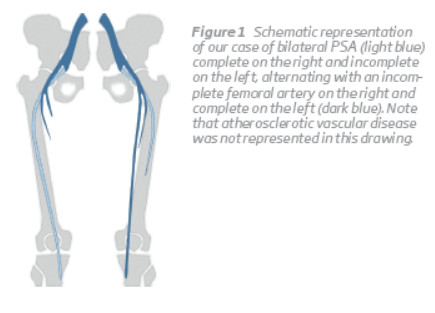
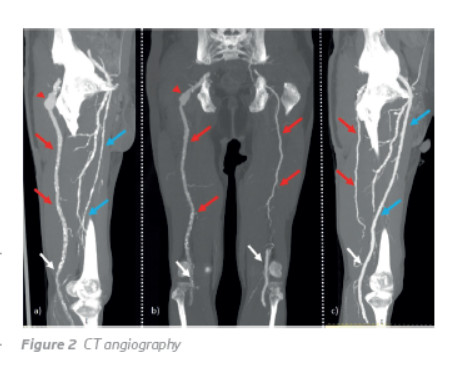
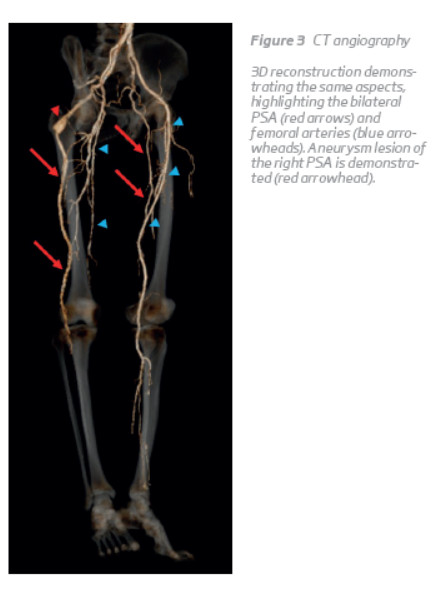
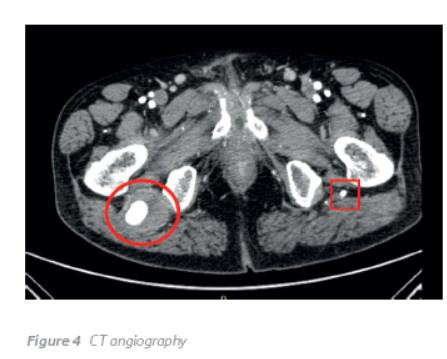
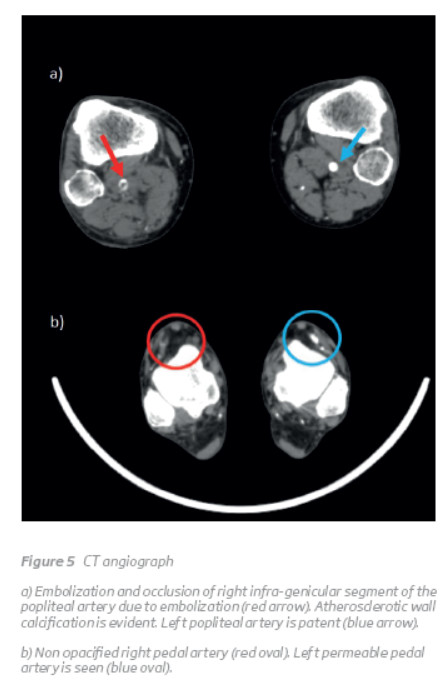
<body><![CDATA[<p>REPORT</p>     <p>We present the case of a 76 year-old man with chronic right lower limb claudication, which had progressed to rest pain during the previous 2 weeks. No episode of trauma and no history of smoking, hypertension or diabetes were noted.</p>     <p>Physical examination was remarkable for a pulsatile mass at the right inferior gluteal region. The right extremity was cold, with slow capillary refill time. Both femoral and popli­teal pulses were palpable, but pedal and posterior tibial pulses were absent.</p>     <p>The left extremity showed signs of chronic vascular disea­se, but was asymptomatic.</p>     <p>CT angiography of the abdominal aorta and lower limbs revealed a bilateral persistent sciatic artery, with comple­te persistence on the right side and incomplete on the left. As opposed to PSAs, the superficial femoral artery was incomplete on the right side and complete on the left (<a href="#f1">Figure 1</a>, <a href="#f2">2</a> and <a href="#f3">3</a>). Furthermore, a 4.3-cm partially thrombosed saccular aneurysm was identified in the retroischiatic segment of the right PSA (<a href="#f4">Figure 4</a>), and an occluded segment due to embolization was demonstrated in the infragenicu­lar popliteal artery (<a href="#f5">Figure 5</a>). No pedal flow was seen and only a faint opacification of the distal segments of the peroneal artery was present.</p>     <p>&nbsp;</p> <a name="f1"></a> <img src="/img/revistas/ang/v13n3/13n3a12f1.jpg">     
<p></p>     <p>&nbsp;</p>     <p>&nbsp;</p> <a name="f2"></a> <img src="/img/revistas/ang/v13n3/13n3a12f2.jpg">     
<p></p>     ]]></body>
<body><![CDATA[<p>&nbsp;</p>     <p>&nbsp;</p> <a name="f3"></a> <img src="/img/revistas/ang/v13n3/13n3a12f3.jpg">     
<p></p>     <p>&nbsp;</p>     <p>&nbsp;</p> <a name="f4"></a> <img src="/img/revistas/ang/v13n3/13n3a12f4.jpg">     
<p></p>     <p>&nbsp;</p>     <p>&nbsp;</p> <a name="f5"></a> <img src="/img/revistas/ang/v13n3/13n3a12f5.jpg">     
<p></p>     <p>&nbsp;</p>     ]]></body>
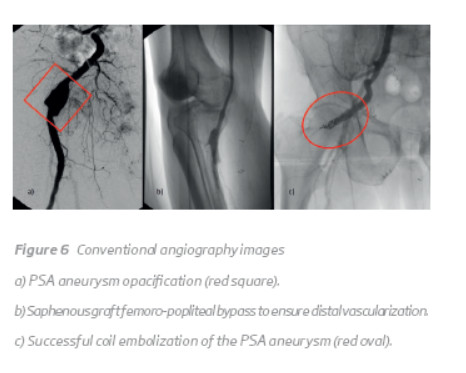
<body><![CDATA[<p>The patient underwent a femoro-popliteal <i>bypass </i>with great saphenous vein graft along with proximal ligation of the popliteal artery above the anastomosis. Coil embo­lization of the PSA aneurysm was performed on a second surgical procedure (<a href="#f6">Figure 6</a>). The patient had no post-ope­rative complications and vascularization to right leg and foot was re-established.</p>     <p>&nbsp;</p> <a name="f6"></a> <img src="/img/revistas/ang/v13n3/13n3a12f6.jpg">     
<p></p>     <p>&nbsp;</p>     <p>DISCUSSION</p>     <p>We presented a rare case of bilateral and asymmetric PSA (complete on the right and incomplete on the left). Interestin­gly, femoral and PSA arteries development alternated in an inverse manner, as they establish dominant blood flow to the extremities. According to the classification of PSA by Pillet et al.(5), this would represent a type 2a persistence on the right and a type 3 persistence on the left. To our knowledge, this is the fifth case of combined-type PSA (complete on the right and incomplete on the left) published in literature(1).</p>     <p>Diagnosis of PSA and related complications is made on clinical grounds and imaging findings. We would like to point out that in our particular case, Cowie's sign (dimi­nished or absence of femoral pulse in combination with palpable popliteal pulse) was absent, since there was still an incompletely developed femoral artery on the right. Doppler ultrasound can provide valuable initial informa­tion about the extent and severity of peripheral vascular disease, although CT angiography is usually necessary to confirm the diagnosis of PSA, evaluate possible complica­tions and plan surgical approach.</p>     <p>Although not fully understood, some authors suggest that the high rate of aneurysm formation in PSA is due to its anatomic location, which favours overstretching during flexion of the hip joint and repeated trauma against the sacrospinal ligament, piriform muscle and hip(2,6).</p>     <p>There are different therapeutic options, but embolization of PSA aneurysm is often preferred over exclusion, since the latter is associated with sciatic nerve injuries. Another factor to take into consideration is the type of PSA present, because an additional <i>bypass </i>may be needed in the scenario of an incompletely developed femoral artery, as in our case.</p>     <p>&nbsp;</p>     ]]></body>
<body><![CDATA[<p>REFERENCES</p>     <!-- ref --><p> M. van Hooft, C. J. Zeebregts, S. M. M. van Sterkenburg, W. R. de Vries, and M. M. P. J. Reijnen, &#8220;The Persistent Sciatic Artery,&#8221; Eur. J. Vasc. Endovasc. Surg., vol. 37, no. 5, pp. 585&#8211;591, 2009.    &nbsp;&nbsp;&nbsp;&nbsp;&nbsp;&nbsp;&nbsp;&nbsp;[&#160;<a href="javascript:void(0);" onclick="javascript: window.open('/scielo.php?script=sci_nlinks&ref=892713&pid=S1646-706X201700030001200001&lng=','','width=640,height=500,resizable=yes,scrollbars=1,menubar=yes,');">Links</a>&#160;]<!-- end-ref --></p>     <!-- ref --><p> Cavallo Marincola, A. Napoli, M. Anzidei, E. Marotta, F. Boni, G. Cartocci, L. Bertaccini, V. Noce, M. Antonietta Pacilé, and C. Cata­lano, &#8220;Persistence of the sciatic artery: a case report of a combi­ned (complete and incomplete) type causing leg ischemia.,&#8221; Case Rep. Vasc. Med., vol. 2012, p. 196798, 2012.    &nbsp;&nbsp;&nbsp;&nbsp;&nbsp;&nbsp;&nbsp;&nbsp;[&#160;<a href="javascript:void(0);" onclick="javascript: window.open('/scielo.php?script=sci_nlinks&ref=892715&pid=S1646-706X201700030001200002&lng=','','width=640,height=500,resizable=yes,scrollbars=1,menubar=yes,');">Links</a>&#160;]<!-- end-ref --></p>     <!-- ref --><p>Gauffre, P. Lasjaunias, and M. Zerah, &#8220;Sciatic artery: a case, review of literature and attempt of systemization,&#8221; Surg. Radiol. Anat., vol. 16, no. 1, pp. 105&#8211;109, 1994.    &nbsp;&nbsp;&nbsp;&nbsp;&nbsp;&nbsp;&nbsp;&nbsp;[&#160;<a href="javascript:void(0);" onclick="javascript: window.open('/scielo.php?script=sci_nlinks&ref=892717&pid=S1646-706X201700030001200003&lng=','','width=640,height=500,resizable=yes,scrollbars=1,menubar=yes,');">Links</a>&#160;]<!-- end-ref --></p>     <!-- ref --><p> Graf, B. Keyashian, A. Brown, S. M. Tutton, and C. J. Lee, &#8220;A hybrid approach for the treatment of persistent sciatic artery aneurys­ms,&#8221; J. Vasc. Surg. Cases Innov. Tech., vol. 2, no. 4, pp. 174&#8211;177, 2016.    &nbsp;&nbsp;&nbsp;&nbsp;&nbsp;&nbsp;&nbsp;&nbsp;[&#160;<a href="javascript:void(0);" onclick="javascript: window.open('/scielo.php?script=sci_nlinks&ref=892719&pid=S1646-706X201700030001200004&lng=','','width=640,height=500,resizable=yes,scrollbars=1,menubar=yes,');">Links</a>&#160;]<!-- end-ref --></p>     <!-- ref --><p>J. Pillet J, Cronier P, Mercier Ph, &#8220;The ischio popliteal arterial trunk: a report of two cases.,&#8221; Anat Clin, vol. 3, p. 329e31, 1982.    &nbsp;&nbsp;&nbsp;&nbsp;&nbsp;&nbsp;&nbsp;&nbsp;[&#160;<a href="javascript:void(0);" onclick="javascript: window.open('/scielo.php?script=sci_nlinks&ref=892721&pid=S1646-706X201700030001200005&lng=','','width=640,height=500,resizable=yes,scrollbars=1,menubar=yes,');">Links</a>&#160;]<!-- end-ref --></p>     <!-- ref --><p> K. Brantley, E. E. Rigdon, and S. Raju, &#8220;Persistent sciatic artery: Embryology, pathology, and treatment,&#8221; J. Vasc. Surg., vol. 18, no. 2, pp. 242&#8211;248, 1993.    &nbsp;&nbsp;&nbsp;&nbsp;&nbsp;&nbsp;&nbsp;&nbsp;[&#160;<a href="javascript:void(0);" onclick="javascript: window.open('/scielo.php?script=sci_nlinks&ref=892723&pid=S1646-706X201700030001200006&lng=','','width=640,height=500,resizable=yes,scrollbars=1,menubar=yes,');">Links</a>&#160;]<!-- end-ref --></p>     <p>&nbsp;</p>     <p><sup>*</sup><a href="#topc0">Autor para correspondência</a><a name="c0"></a></p>     <p><i>Correio eletrónico: </i><a href="mailto:tiagomourarodrigues@gmail.com">tiagomourarodrigues@gmail.com</a> (T. Rodrigues).</p>     <p>&nbsp;</p>     <p>Recebido a 2017-03-11;</p>     <p>Aceite a 25-10-2017;</p>      ]]></body><back>
<ref-list>
<ref id="B1">
<nlm-citation citation-type="journal">
<person-group person-group-type="author">
<name>
<surname><![CDATA[Hooft]]></surname>
<given-names><![CDATA[M. van]]></given-names>
</name>
<name>
<surname><![CDATA[Zeebregts]]></surname>
<given-names><![CDATA[C. J.]]></given-names>
</name>
<name>
<surname><![CDATA[Sterkenburg]]></surname>
<given-names><![CDATA[S. M. M. van]]></given-names>
</name>
<name>
<surname><![CDATA[Vries]]></surname>
<given-names><![CDATA[W. R. de]]></given-names>
</name>
<name>
<surname><![CDATA[Reijnen]]></surname>
<given-names><![CDATA[M. M. P. J.]]></given-names>
</name>
</person-group>
<article-title xml:lang="en"><![CDATA[&#8220;The Persistent Sciatic Artery]]></article-title>
<source><![CDATA[Eur. J. Vasc. Endovasc. Surg]]></source>
<year>2009</year>
<volume>37</volume>
<numero>5</numero>
<issue>5</issue>
<page-range>585-591</page-range></nlm-citation>
</ref>
<ref id="B2">
<nlm-citation citation-type="journal">
<person-group person-group-type="author">
<name>
<surname><![CDATA[Cavallo Marincola]]></surname>
<given-names><![CDATA[A.]]></given-names>
</name>
<name>
<surname><![CDATA[Napoli]]></surname>
<given-names><![CDATA[M.]]></given-names>
</name>
<name>
<surname><![CDATA[Anzidei]]></surname>
<given-names><![CDATA[E.]]></given-names>
</name>
<name>
<surname><![CDATA[Marotta]]></surname>
<given-names><![CDATA[F.]]></given-names>
</name>
<name>
<surname><![CDATA[Boni]]></surname>
<given-names><![CDATA[G.]]></given-names>
</name>
<name>
<surname><![CDATA[Cartocci]]></surname>
<given-names><![CDATA[L.]]></given-names>
</name>
<name>
<surname><![CDATA[Bertaccini]]></surname>
<given-names><![CDATA[V.]]></given-names>
</name>
<name>
<surname><![CDATA[Noce]]></surname>
<given-names><![CDATA[M.]]></given-names>
</name>
<name>
<surname><![CDATA[Pacilé]]></surname>
<given-names><![CDATA[Antonietta]]></given-names>
</name>
<name>
<surname><![CDATA[Cata­lano]]></surname>
<given-names><![CDATA[C.]]></given-names>
</name>
</person-group>
<article-title xml:lang="en"><![CDATA[&#8220;Persistence of the sciatic artery: a case report of a combi­ned (complete and incomplete) type causing leg ischemia.]]></article-title>
<source><![CDATA[Case Rep. Vasc. Med]]></source>
<year>2012</year>
<volume>2012</volume>
<page-range>196798</page-range></nlm-citation>
</ref>
<ref id="B3">
<nlm-citation citation-type="journal">
<person-group person-group-type="author">
<name>
<surname><![CDATA[Gauffre]]></surname>
<given-names><![CDATA[P. Lasjaunias]]></given-names>
</name>
<name>
<surname><![CDATA[Zerah]]></surname>
<given-names><![CDATA[M.]]></given-names>
</name>
</person-group>
<article-title xml:lang="en"><![CDATA[&#8220;Sciatic artery: a case, review of literature and attempt of systemization]]></article-title>
<source><![CDATA[Surg. Radiol. Anat.]]></source>
<year>1994</year>
<volume>16</volume>
<numero>1</numero>
<issue>1</issue>
<page-range>105-109</page-range></nlm-citation>
</ref>
<ref id="B4">
<nlm-citation citation-type="journal">
<person-group person-group-type="author">
<name>
<surname><![CDATA[Graf]]></surname>
<given-names><![CDATA[B.]]></given-names>
</name>
<name>
<surname><![CDATA[Keyashian]]></surname>
<given-names><![CDATA[A. Brown]]></given-names>
</name>
<name>
<surname><![CDATA[Tutton]]></surname>
<given-names><![CDATA[S. M.]]></given-names>
</name>
<name>
<surname><![CDATA[Lee]]></surname>
<given-names><![CDATA[C. J.]]></given-names>
</name>
</person-group>
<article-title xml:lang="en"><![CDATA[A hybrid approach for the treatment of persistent sciatic artery aneurys­ms]]></article-title>
<source><![CDATA[J. Vasc. Surg. Cases Innov. Tech]]></source>
<year>2016</year>
<volume>2</volume>
<numero>4</numero>
<issue>4</issue>
<page-range>174-177</page-range></nlm-citation>
</ref>
<ref id="B5">
<nlm-citation citation-type="journal">
<person-group person-group-type="author">
<name>
<surname><![CDATA[Pillet J]]></surname>
<given-names><![CDATA[J.]]></given-names>
</name>
<name>
<surname><![CDATA[Cronier]]></surname>
<given-names><![CDATA[P]]></given-names>
</name>
<name>
<surname><![CDATA[Ph]]></surname>
<given-names><![CDATA[Mercier]]></given-names>
</name>
</person-group>
<article-title xml:lang="en"><![CDATA[&#8220;The ischio popliteal arterial trunk: a report of two cases.]]></article-title>
<source><![CDATA[Anat Clin]]></source>
<year>1982</year>
<volume>3</volume>
<page-range>329e31</page-range></nlm-citation>
</ref>
<ref id="B6">
<nlm-citation citation-type="journal">
<person-group person-group-type="author">
<name>
<surname><![CDATA[Brantley]]></surname>
<given-names><![CDATA[K.]]></given-names>
</name>
<name>
<surname><![CDATA[Rigdon]]></surname>
<given-names><![CDATA[E. E.]]></given-names>
</name>
<name>
<surname><![CDATA[Raju]]></surname>
<given-names><![CDATA[S.]]></given-names>
</name>
</person-group>
<article-title xml:lang="en"><![CDATA[&#8220;Persistent sciatic artery: Embryology, pathology, and treatment,&#8221;]]></article-title>
<source><![CDATA[J. Vasc. Surg.]]></source>
<year>1993</year>
<volume>18</volume>
<numero>2</numero>
<issue>2</issue>
<page-range>242-248</page-range></nlm-citation>
</ref>
</ref-list>
</back>
</article>