<?xml version="1.0" encoding="ISO-8859-1"?><article xmlns:mml="http://www.w3.org/1998/Math/MathML" xmlns:xlink="http://www.w3.org/1999/xlink" xmlns:xsi="http://www.w3.org/2001/XMLSchema-instance">
<front>
<journal-meta>
<journal-id>1646-706X</journal-id>
<journal-title><![CDATA[Angiologia e Cirurgia Vascular]]></journal-title>
<abbrev-journal-title><![CDATA[Angiol Cir Vasc]]></abbrev-journal-title>
<issn>1646-706X</issn>
<publisher>
<publisher-name><![CDATA[Sociedade Portuguesa de Angiologia e Cirurgia Vascular]]></publisher-name>
</publisher>
</journal-meta>
<article-meta>
<article-id>S1646-706X2018000300006</article-id>
<title-group>
<article-title xml:lang="en"><![CDATA[Entrapment syndrome in a non-athletic patient]]></article-title>
<article-title xml:lang="pt"><![CDATA[Síndrome do Entrapment Popliteu em doente não atleta]]></article-title>
</title-group>
<contrib-group>
<contrib contrib-type="author">
<name>
<surname><![CDATA[Soares]]></surname>
<given-names><![CDATA[Tony R.]]></given-names>
</name>
<xref ref-type="aff" rid="A1 "/>
</contrib>
<contrib contrib-type="author">
<name>
<surname><![CDATA[Tiago]]></surname>
<given-names><![CDATA[José]]></given-names>
</name>
<xref ref-type="aff" rid="A1 "/>
</contrib>
<contrib contrib-type="author">
<name>
<surname><![CDATA[Manuel]]></surname>
<given-names><![CDATA[Viviana]]></given-names>
</name>
<xref ref-type="aff" rid="A1 "/>
</contrib>
<contrib contrib-type="author">
<name>
<surname><![CDATA[Martins]]></surname>
<given-names><![CDATA[Carlos]]></given-names>
</name>
<xref ref-type="aff" rid="A1 "/>
</contrib>
<contrib contrib-type="author">
<name>
<surname><![CDATA[Amorim]]></surname>
<given-names><![CDATA[Pedro]]></given-names>
</name>
<xref ref-type="aff" rid="A1 "/>
<xref ref-type="aff" rid="A A"/>
</contrib>
<contrib contrib-type="author">
<name>
<surname><![CDATA[Pedro]]></surname>
<given-names><![CDATA[Luís Mendes]]></given-names>
</name>
<xref ref-type="aff" rid="A1 "/>
<xref ref-type="aff" rid="A A"/>
</contrib>
</contrib-group>
<aff id="AA1">
<institution><![CDATA[,Hospital Santa Maria Department of Vascular Surgery ]]></institution>
<addr-line><![CDATA[Lisbon ]]></addr-line>
<country>Portugal</country>
</aff>
<aff id="AA2">
<institution><![CDATA[,University of Lisbon  ]]></institution>
<addr-line><![CDATA[Lisbon ]]></addr-line>
<country>Portugal</country>
</aff>
<aff id="AA3">
<institution><![CDATA[,Lisbon Academic Medical Centre  ]]></institution>
<addr-line><![CDATA[Lisbon ]]></addr-line>
<country>Portugal</country>
</aff>
<pub-date pub-type="pub">
<day>00</day>
<month>09</month>
<year>2018</year>
</pub-date>
<pub-date pub-type="epub">
<day>00</day>
<month>09</month>
<year>2018</year>
</pub-date>
<volume>14</volume>
<numero>3</numero>
<fpage>196</fpage>
<lpage>199</lpage>
<copyright-statement/>
<copyright-year/>
<self-uri xlink:href="http://scielo.pt/scielo.php?script=sci_arttext&amp;pid=S1646-706X2018000300006&amp;lng=en&amp;nrm=iso"></self-uri><self-uri xlink:href="http://scielo.pt/scielo.php?script=sci_abstract&amp;pid=S1646-706X2018000300006&amp;lng=en&amp;nrm=iso"></self-uri><self-uri xlink:href="http://scielo.pt/scielo.php?script=sci_pdf&amp;pid=S1646-706X2018000300006&amp;lng=en&amp;nrm=iso"></self-uri><abstract abstract-type="short" xml:lang="en"><p><![CDATA[The popliteal artery entrapment syndrome (PAES) is a major cause of claudication and acute ischemia of lower limb in young athletes without risk factors for atherosclerosis. We present a 39 years-old female patient with no relevant past history and no sport activity, admitted to our emergency department with acute disabling claudication in the right lower limb caused by retrogeniculate popliteal artery occlusion. Computed tomography scan confirmed a type II popliteal entrapment syndrome with popliteal artery occlusion. The patient was submitted to surgery that consisted in myotomy of the medial head of the gastrocnemius muscle, division of the anomalous fibrous band, resection of the diseased popliteal artery and interposition of a reverse ipsilateral saphenous vein graft. The patient recovered distal pulse on the right foot. Previously considered as a rare disease, the growing number of publications about PAES in the medical literature show the opposite. However, little is known about the prevalence of this syndrome and some studies report a prevalence of 0.165-3.5%. PAES is more common in males and in almost 60% is bilateral. The best treatment results are obtained with replacement of the popliteal artery with graft interposition, preferably venous. Currently, this approach is advocated in all patients with entrapment with the exception of early stages with arterial disease confined to the adventitia. PAES is not as rare as previously admitted and therefore it is important to maintain a high index of suspicion in these age group.]]></p></abstract>
<abstract abstract-type="short" xml:lang="pt"><p><![CDATA[A síndrome do entrapment da artéria popliteia (PAES) é uma causa importante de claudicação e isquemia aguda do membro inferior em jovens atletas sem fatores de risco para aterosclerose. Apresentamos o caso de uma doente de 39 anos de idade, sem antecedentes pessoais relevantes e sem hábitos para a prática desportiva, que recorre ao serviço de urgência com queixas de claudicação incapacitante no membro inferior direito que se revelou consequente a uma oclusão da artéria popliteia. A análise da angio-TC confirma a suspeita diagnóstica da síndrome do entrapment popliteu do tipo II. A doente é submetida a miotomia da cabeça medial do gémeo, secção de uma banda fibrosa anómala, ressecção do segmento de artéria doente e interposição de veia safena interna ipsilateral e invertida. A doente recuperou pulsos distais no membro inferior direito. A PAES é uma entidade patológica mais frequente do que previamente descrito, contudo, com uma taxa de prevalência ainda não bem definida. Alguns estudos reportam uma prevalência entre os 0.165% e 3.5%, sendo mais comum no sexo masculino e bilateral em quase 60% dos casos. O tratamento de escolha passa pela substituição da artéria popliteia com interposição de enxerto venoso. Atualmente, esta abordagem é defendida para todos os doentes com PAES, à exceção de estádios da doença mais precoces, com doença arterial confinada à sua adventícia. Em conclusão, a PAES é uma síndrome mais prevalente que previamente reportado, sendo essencial um alto índice de suspeição para o seu diagnóstico em doentes jovens.]]></p></abstract>
<kwd-group>
<kwd lng="en"><![CDATA[Entrapment]]></kwd>
<kwd lng="en"><![CDATA[popliteu]]></kwd>
<kwd lng="en"><![CDATA[poplíteo]]></kwd>
<kwd lng="en"><![CDATA[isquemia do membro inferior]]></kwd>
<kwd lng="en"><![CDATA[PAES]]></kwd>
<kwd lng="pt"><![CDATA[Entrapment]]></kwd>
<kwd lng="pt"><![CDATA[popliteu]]></kwd>
<kwd lng="pt"><![CDATA[poplíteo]]></kwd>
<kwd lng="pt"><![CDATA[isquemia do membro inferior]]></kwd>
<kwd lng="pt"><![CDATA[PAES]]></kwd>
</kwd-group>
</article-meta>
</front><body><![CDATA[ <p align="right"><font size="2"><b>CASOS CLÍNICOS</b></font></p>     <p><font size="4"><b>Entrapment syndrome in a non-athletic patient</b></font></p>     <p><font size="3"><b>Síndrome do Entrapment Popliteu em doente não atleta</b></font></p>     <p><b>Tony R. Soares<sup>1,3</sup>, José Tiago<sup>1,3</sup>, Viviana Manuel<sup>1,3</sup>,    Carlos Martins<sup>1,3</sup>, Pedro Amorim<sup>1,2,3</sup>, Luís Mendes Pedro<sup>1,2,3</sup></b></p>     <p>1. Department of Vascular Surgery, Hospital Santa Maria, Lisbon, Portugal</p>     <p>2. University of Lisbon, Lisbon, Portugal</p>     <p>3. Lisbon Academic Medical Centre, Lisbon, Portugal</p>     <p><a href="#c0">Endere&ccedil;o para correspond&ecirc;ncia</a> | <a href="#c0">Direcci&oacute;n    para correspondencia</a> | <a href="#c0">Correspondence</a><a name="topc0"></a></p> <hr/>     <p>&nbsp;</p>     <p><b>ABSTRACT</b></p>     ]]></body>
<body><![CDATA[<p>The popliteal artery entrapment syndrome (PAES) is a major cause of claudication    and acute ischemia of lower limb in young athletes without risk factors for    atherosclerosis.</p>     <p>We present a 39 years-old female patient with no relevant past history and    no sport activity, admitted to our emergency department with acute disabling    claudication in the right lower limb caused by retrogeniculate popliteal artery    occlusion. Computed tomography scan confirmed a type II popliteal entrapment    syndrome with popliteal artery occlusion. The patient was submitted to surgery    that consisted in myotomy of the medial head of the gastrocnemius muscle, division    of the anomalous fibrous band, resection of the diseased popliteal artery and    interposition of a reverse ipsilateral saphenous vein graft. The patient recovered    distal pulse on the right foot. </p>     <p>Previously considered as a rare disease, the growing number of publications    about PAES in the medical literature show the opposite. However, little is known    about the prevalence of this syndrome and some studies report a prevalence of    0.165-3.5%. PAES is more common in males and in almost 60% is bilateral. The    best treatment results are obtained with replacement of the popliteal artery    with graft interposition, preferably venous. Currently, this approach is advocated    in all patients with entrapment with the exception of early stages with arterial    disease confined to the adventitia.</p>     <p>PAES is not as rare as previously admitted and therefore it is important to    maintain a high index of suspicion in these age group.</p>     <p><b>Keywords:</b> Entrapment; popliteu; poplíteo; isquemia do membro inferior;    PAES; </p> <hr/>     <p>&nbsp;</p>     <p><b>RESUMO</b></p>     <p>A síndrome do entrapment da artéria popliteia (PAES) é uma causa importante    de claudicação e isquemia aguda do membro inferior em jovens atletas sem fatores    de risco para aterosclerose.</p>     <p>Apresentamos o caso de uma doente de 39 anos de idade, sem antecedentes pessoais    relevantes e sem hábitos para a prática desportiva, que recorre ao serviço de    urgência com queixas de claudicação incapacitante no membro inferior direito    que se revelou consequente a uma oclusão da artéria popliteia. A análise da    angio-TC confirma a suspeita diagnóstica da síndrome do entrapment popliteu    do tipo II. A doente é submetida a miotomia da cabeça medial do gémeo, secção    de uma banda fibrosa anómala, ressecção do segmento de artéria doente e interposição    de veia safena interna ipsilateral e invertida. A doente recuperou pulsos distais    no membro inferior direito. </p>     <p>A PAES é uma entidade patológica mais frequente do que previamente descrito,    contudo, com uma taxa de prevalência ainda não bem definida. Alguns estudos    reportam uma prevalência entre os 0.165% e 3.5%, sendo mais comum no sexo masculino    e bilateral em quase 60% dos casos. O tratamento de escolha passa pela substituição    da artéria popliteia com interposição de enxerto venoso. Atualmente, esta abordagem    é defendida para todos os doentes com PAES, à exceção de estádios da doença    mais precoces, com doença arterial confinada à sua adventícia. </p>     ]]></body>
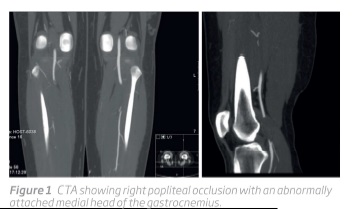
<body><![CDATA[<p>Em conclusão, a PAES é uma síndrome mais prevalente que previamente reportado,    sendo essencial um alto índice de suspeição para o seu diagnóstico em doentes    jovens. </p>     <p><b>Palavras-chave:</b> Entrapment; popliteu; poplíteo; isquemia do membro inferior;    PAES;</p> <hr/>     <p>&nbsp;</p>     <p><b>Introduction</b></p>     <p>The popliteal artery entrapment syndrome (PAES) is a major cause of claudication    and acute ischemia of the lower limbs in the younger population(1). This syndrome    is often observed in athletes, with muscular hypertrophy, and without risk factors    for atherosclerosis(1).</p>     <p>The present paper reports the case of a woman with popliteal entrapment syndrome    observed primarily in the emergency setting.</p>     <p><b>Clinical Case</b></p>     <p>A previously healthy 39-years-old female was referred to our emergency department    with a thirty-day history of disabling claudication and paresthesia of the right    foot. At clinical examination, a decreased temperature of the foot with no motor    compromise was observed. The right femoral pulse was normal with no palpable    popliteal, tibialis and dorsalis pedis pulses. All contralateral pulses were    normal. Duplex ultrasound revealed a retrogeniculate popliteal artery occlusion    with monophasic flow in the infragenicular popliteal artery and leg arteries.</p>     <p>Given the complaints of the patient and the findings on clinical examination    and duplex ultrasound, the patient was diagnosed with sub-acute ischemia of    the right limb caused by popliteal artery thrombosis. Due to the absence of    risk factors for atherosclerosis, a computed tomography angiography (CTA) was    performed confirming a type II popliteal entrapment syndrome (<a href="#f1">Figure    1</a>). </p>     <p>&nbsp;</p>     ]]></body>
<body><![CDATA[<p align="center"><a name="f1"></a><img src="/img/revistas/ang/v14n3/14n3a06f1.jpg"/></p>     
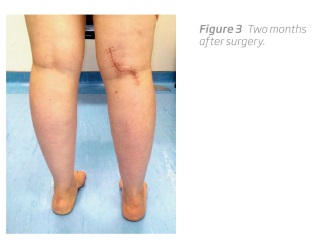
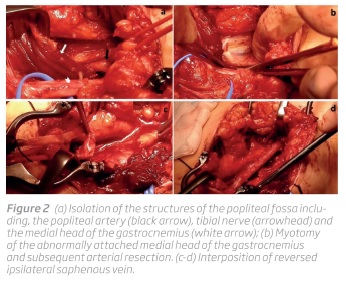
<p>&nbsp;</p>     <p>The patient was submitted to surgery, through a posterior approach, that consisted    in myotomy of the medial head of the gastrocnemius muscle, division of the anomalous    fibrous band, resection of the diseased popliteal artery and interposition of    reverse ipsilateral saphenous vein (<a href="#f2">Figure 2</a> e <a href="#f3">3</a>).    The procedure was uneventful, distal pulses were recovered on the right foot    with no evidence of peripheral nerve damage.</p>     <p>&nbsp;</p>     <p align="center"><a name="f2"></a><img src="/img/revistas/ang/v14n3/14n3a06f2.jpg"/></p>     
<p>&nbsp;</p>     <p align="center"><a name="f3"></a><img src="/img/revistas/ang/v14n3/14n3a06f3.jpg"/></p>     
<p>&nbsp;</p>     <p><b>Discussion</b></p>     <p>Popliteal artery entrapment was first described in 1879 by Anderson Stuart,    a medical student in Edinburgh, after dissection of a popliteal aneurysm in    an amputated limb for gangrene(2). However, that was not until 1959 that Hamming    firstly reported the popliteal artery entrapment syndrome(3).</p>     ]]></body>
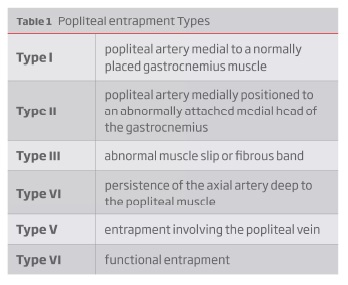
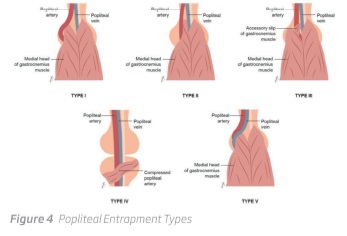
<body><![CDATA[<p>Previously considered as a rare disease, the growing number of publications    in medical literature show that it is not so uncommon(1,4). Little is known    about the prevalence of PAES(5). Some studies in the decades of 1970s and 1980s    reported a prevalence between 0.165 and 3.5 percent(6,7).      <p>A recent systematic review revealed a predominance of this condition in males    with a median of 83% (22-100%) and a median age of 32 years (20.7-41 years)(8).    Di Marzo et al reported that almost 60% of patients have bilateral popliteal    entrapment(9). </p>     <p>The popliteal entrapment is a complex pathological entity with multiple syndrome    classification systems dispersed in the literature(10,11). Currently, the best    accepted one is based on the embryological development of the popliteal region    and, with some adaptations from the original classification, we can categorize    PAES in 6 types (<a href="#t1">Table 1</a> and <a href="#f4">Figure 4</a>)(12).</p>     <p>&nbsp;</p>     <p align="center"><a name="t1"></a><img src="/img/revistas/ang/v14n3/14n3a06t1.jpg"/></p>     
<p>&nbsp;</p>     <p align="center"><a name="f4"></a><img src="/img/revistas/ang/v14n3/14n3a06f4.jpg"/></p>     
<p>&nbsp;</p>     <p>Popliteal entrapment classically manifests with intermittent claudication in    young patients without risk factors for atherosclerosis(5). The presentation    also includes symptoms such as leg cramps and tingling and decreased feet temperature(5).    Usually, the patients are athletes, with muscular hypertrophy, being symptomatic    after intense physical effort. A large pulse at rest and diminished or absent    during the passive dorsiflexion or active plantar flexion of the foot is typical    of this condition(5). Duplex ultrasound with dynamic maneuvers seems to be the    commonest used initial exam, however with an unacceptable high false-positive    rate (72%)(13). Although CT scan and MRI has been particularly useful to investigate    popliteal entrapment (i.e., to study anatomic relationship of the artery with    adjacent tissue, especially when the artery is occluded), angiography remains    the mainstay test at many centers(12,14). </p>     <p>The pathophysiological process of the popliteal entrapment is different from    atherosclerosis. The arterial wall injury processes in a centripetal way with    fibrosis and collagen healing scar evolving from the adventitia (Stage I), subsequently    the media (Stage II) and finally the intima (Stage III)(15). This explains why    arterial thrombosis in these patients have poor prognosis with thrombolysis,    angioplasty or thromboendarterectomy with patching(1,12,14). When the popliteal    artery is occluded, the arterial wall is already so diseased that it should    be replaced by a graft, preferably venous, instead of local reconstruction techniques.(1,12,14)    Currently, this approach is advocated in all patients with entrapment and popliteal    arterial wall disease(1,14). In early stages with minor arterial disease, confined    to adventitia (i.e. Stage I), a more conservative approach is advised and simple    muscular division is enough to correct the entrapment mechanism(1,14). This    procedure usually involves the medial head of the gastrocnemius and/or the resection    of abnormal muscle slips or tendinous bands. Stages II and III shall be managed    not only by a surgical resolution of the entrapment mechanism, but also by the    replacement of the diseased popliteal arterial segment(1,14).</p>     ]]></body>
<body><![CDATA[<p>In the clinical case discussed herein, although young, the patient is a female    without sport or significant physical activity, that presented with sub-acute    symptoms of intermittent claudication and a stage III of PAES with arterial    thrombosis. The patient was managed through correction of the muscular defect    and vein graft replacement of the popliteal artery via a posterior approach.  </p>     <p>Levien et al described a success rate of 100% in 15 lower limbs subjected to    replacement of the occluded segment with reversed saphenous vein with a median    follow-up of 4.2 years (range 1 to 10)(1). The dichotomy between medial and    posterior surgical approach has also been widely discussed in the literature(5,14,16)    with the first being advocated by many as less invasive, enabling rapid recovery    for patients usually young and athletics who value a fast return to full activity(5,14,16).    Furthermore, this approach is more suitable for longer reconstruction segments.    Posterior approach enable the exposure of all structures in the popliteal region,    turning the procedure faster(5,14,16. It also allows the placement of shorter    vein segments in an anatomic position and may allow a simpler, less extensive    and more anatomic correction of the entrapment. One significant limitation of    the posterior approach is a limited access to the distal popliteal artery and    its branches what may be a problem in acute cases, with thrombosis and where    an adequate thrombectomy is warranted.</p>     <p><b>Conclusion</b></p>     <p>The popliteal entrapment syndrome is not as rare as previously admitted among    the medical community. PAES is a major cause of claudication and acute ischemia    of the lower limbs in young people. Therefore, it is important to maintain a    high index of suspicion in these age group to avoid to treat PAES as an atherosclerotic    occlusive disease or an embolic acute ischemia of the lower limb.</p>     <p>&nbsp;</p>     <p><b>REFERENCES</b></p>     <!-- ref --><p>1. Levien LJ, Veller MG. Popliteal artery entrapment syndrome: More common    than previously recognized. J Vasc Surg. 1999;30(4):587-598. DOI: <a href="https://dx.doi.org/10.1016/S0741-5214(99)70098-4" target="_blank">10.1016/S0741-5214(99)70098-4</a>.    &nbsp;&nbsp;&nbsp;&nbsp;&nbsp;&nbsp;&nbsp;&nbsp;[&#160;<a href="javascript:void(0);" onclick="javascript: window.open('/scielo.php?script=sci_nlinks&ref=898067&pid=S1646-706X201800030000600001&lng=','','width=640,height=500,resizable=yes,scrollbars=1,menubar=yes,');">Links</a>&#160;]<!-- end-ref --></p>     <!-- ref --><p>2. Stuart TP. Note on a Variation in the Course of the Popliteal Artery. J    Anat Physiol. 1879;13(Pt 2):162.    &nbsp;&nbsp;&nbsp;&nbsp;&nbsp;&nbsp;&nbsp;&nbsp;[&#160;<a href="javascript:void(0);" onclick="javascript: window.open('/scielo.php?script=sci_nlinks&ref=898069&pid=S1646-706X201800030000600002&lng=','','width=640,height=500,resizable=yes,scrollbars=1,menubar=yes,');">Links</a>&#160;]<!-- end-ref --></p>     ]]></body>
<body><![CDATA[<!-- ref --><p>3. Hamming JJ. Intermittent claudication at an early age, due to an anomalous    course of the popliteal artery. Angiology. 1959;10:369-371. DOI: <a href="https://dx.doi.org/10.1177/000331975901000505" target="_blank">10.1177/000331975901000505</a>.    &nbsp;&nbsp;&nbsp;&nbsp;&nbsp;&nbsp;&nbsp;&nbsp;[&#160;<a href="javascript:void(0);" onclick="javascript: window.open('/scielo.php?script=sci_nlinks&ref=898071&pid=S1646-706X201800030000600003&lng=','','width=640,height=500,resizable=yes,scrollbars=1,menubar=yes,');">Links</a>&#160;]<!-- end-ref --></p>     <!-- ref --><p>4. Di Marzo L, Cavallaro A, Sciacca V, Mingoli A, Stipa S. Natural history    of entrapment of the popliteal artery. J Am Coll Surg. 1994;178(6):553-556.    &nbsp;&nbsp;&nbsp;&nbsp;&nbsp;&nbsp;&nbsp;&nbsp;[&#160;<a href="javascript:void(0);" onclick="javascript: window.open('/scielo.php?script=sci_nlinks&ref=898073&pid=S1646-706X201800030000600004&lng=','','width=640,height=500,resizable=yes,scrollbars=1,menubar=yes,');">Links</a>&#160;]<!-- end-ref --></p>     <!-- ref --><p>5. Levien L. Popliteal artery entrapment syndrome. Semin Vasc Surg. 2003;16(3):223-231.<a href="http://www.sciencedirect.com/science/article/pii/S0895796703000280" target="_blank">http://www.sciencedirect.com/science/article/pii/S0895796703000280</a>.    &nbsp;&nbsp;&nbsp;&nbsp;&nbsp;&nbsp;&nbsp;&nbsp;[&#160;<a href="javascript:void(0);" onclick="javascript: window.open('/scielo.php?script=sci_nlinks&ref=898075&pid=S1646-706X201800030000600005&lng=','','width=640,height=500,resizable=yes,scrollbars=1,menubar=yes,');">Links</a>&#160;]<!-- end-ref --></p>     <!-- ref --><p>6. Gibson M, Mills J, Johnson G, Downs A. Popliteal Entrapment Syndrome. Ann    Surg. 1977;185(3):341-348.    &nbsp;&nbsp;&nbsp;&nbsp;&nbsp;&nbsp;&nbsp;&nbsp;[&#160;<a href="javascript:void(0);" onclick="javascript: window.open('/scielo.php?script=sci_nlinks&ref=898077&pid=S1646-706X201800030000600006&lng=','','width=640,height=500,resizable=yes,scrollbars=1,menubar=yes,');">Links</a>&#160;]<!-- end-ref --></p>     <!-- ref --><p>7. Bouhoutsos J, Daskalakis E. Muscular abnormalities affecting the popliteal    vessels. Br J Surg. 1981;68(7):501-506. DOI: <a href="https://dx.doi.org/10.1002/bjs.1800680720" target="_blank">10.1002/bjs.1800680720</a>.    &nbsp;&nbsp;&nbsp;&nbsp;&nbsp;&nbsp;&nbsp;&nbsp;[&#160;<a href="javascript:void(0);" onclick="javascript: window.open('/scielo.php?script=sci_nlinks&ref=898079&pid=S1646-706X201800030000600007&lng=','','width=640,height=500,resizable=yes,scrollbars=1,menubar=yes,');">Links</a>&#160;]<!-- end-ref --></p>     ]]></body>
<body><![CDATA[<!-- ref --><p>8. Sinha S, Houghton J, Holt PJ, Thompson MM, Loftus IM, Hinchliffe RJ. Popliteal    entrapment syndrome. J Vasc Surg. 2012;55(1):252-262.e30. DOI: <a href="https://dx.doi.org/10.1016/j.jvs.2011.08.050" target="_blank">10.1016/j.jvs.2011.08.050</a>.    &nbsp;&nbsp;&nbsp;&nbsp;&nbsp;&nbsp;&nbsp;&nbsp;[&#160;<a href="javascript:void(0);" onclick="javascript: window.open('/scielo.php?script=sci_nlinks&ref=898081&pid=S1646-706X201800030000600008&lng=','','width=640,height=500,resizable=yes,scrollbars=1,menubar=yes,');">Links</a>&#160;]<!-- end-ref --></p>     <!-- ref --><p>9. Di Marzo L, Cavallaro A. Popliteal vascular entrapment. World J Surg. 2005;29(SUPPL.    1):43-45. DOI: <a href="https://dx.doi.org/10.1007/s00268-004-2058-y" target="_blank">10.1007/s00268-004-2058-y</a>.    &nbsp;&nbsp;&nbsp;&nbsp;&nbsp;&nbsp;&nbsp;&nbsp;[&#160;<a href="javascript:void(0);" onclick="javascript: window.open('/scielo.php?script=sci_nlinks&ref=898083&pid=S1646-706X201800030000600009&lng=','','width=640,height=500,resizable=yes,scrollbars=1,menubar=yes,');">Links</a>&#160;]<!-- end-ref --></p>     <!-- ref --><p>10. Kim HK, Shin MJ, Kim SM, Lee SH, Hong HJ. Popliteal artery entrapment syndrome:    Morphological classification utilizing MR imaging. Skeletal Radiol. 2006;35(9):648-658.    DOI: <a href="https://dx.doi.org/10.1007/s00256-006-0158-5" target="_blank">10.1007/s00256-006-0158-5</a>.    &nbsp;&nbsp;&nbsp;&nbsp;&nbsp;&nbsp;&nbsp;&nbsp;[&#160;<a href="javascript:void(0);" onclick="javascript: window.open('/scielo.php?script=sci_nlinks&ref=898085&pid=S1646-706X201800030000600010&lng=','','width=640,height=500,resizable=yes,scrollbars=1,menubar=yes,');">Links</a>&#160;]<!-- end-ref --></p>     <!-- ref --><p>11. Hai Z, Guangrui S, Yuan Z, et al. CT angiography and MRI in patients with    popliteal artery entrapment syndrome. Am J Roentgenol. 2008;191(6):1760-1766.    DOI: <a href="https://dx.doi.org/10.2214/AJR.07.4012" target="_blank">10.2214/AJR.07.4012</a>.    &nbsp;&nbsp;&nbsp;&nbsp;&nbsp;&nbsp;&nbsp;&nbsp;[&#160;<a href="javascript:void(0);" onclick="javascript: window.open('/scielo.php?script=sci_nlinks&ref=898087&pid=S1646-706X201800030000600011&lng=','','width=640,height=500,resizable=yes,scrollbars=1,menubar=yes,');">Links</a>&#160;]<!-- end-ref --></p>     <!-- ref --><p>12. Cronenwett JL, Johnston KW. Rutherford’s Vascular Surgery. 8th ed. Philadelphia:    Saunders Elsevier; 2014.    &nbsp;&nbsp;&nbsp;&nbsp;&nbsp;&nbsp;&nbsp;&nbsp;[&#160;<a href="javascript:void(0);" onclick="javascript: window.open('/scielo.php?script=sci_nlinks&ref=898089&pid=S1646-706X201800030000600012&lng=','','width=640,height=500,resizable=yes,scrollbars=1,menubar=yes,');">Links</a>&#160;]<!-- end-ref --></p>     ]]></body>
<body><![CDATA[<!-- ref --><p>13. Akkersdijk WL, de Ruyter JW, Lapham R, Mali W, Eikelboom BC. Colour duplex    ultrasonographic imaging and provocation of popliteal artery compression. Eur    J Vasc Endovasc Surg. 1995;10(3):342-345. DOI: <a href="https://dx.doi.org/10.1016/S1078-5884(05)80054-1" target="_blank">10.1016/S1078-5884(05)80054-1</a>.    &nbsp;&nbsp;&nbsp;&nbsp;&nbsp;&nbsp;&nbsp;&nbsp;[&#160;<a href="javascript:void(0);" onclick="javascript: window.open('/scielo.php?script=sci_nlinks&ref=898091&pid=S1646-706X201800030000600013&lng=','','width=640,height=500,resizable=yes,scrollbars=1,menubar=yes,');">Links</a>&#160;]<!-- end-ref --></p>     <!-- ref --><p>14. Henry MF, Wilkins DC, Lambert AW. Popliteal artery entrapment syndrome.    Curr Treat Options Cardiovasc Med. 2004;6(2):113-120. DOI: <a href="https://dx.doi.org/10.1007/s11936-004-0039-y" target="_blank">10.1007/s11936-004-0039-y</a>.    &nbsp;&nbsp;&nbsp;&nbsp;&nbsp;&nbsp;&nbsp;&nbsp;[&#160;<a href="javascript:void(0);" onclick="javascript: window.open('/scielo.php?script=sci_nlinks&ref=898093&pid=S1646-706X201800030000600014&lng=','','width=640,height=500,resizable=yes,scrollbars=1,menubar=yes,');">Links</a>&#160;]<!-- end-ref --></p>     <!-- ref --><p>15. Levien L. Popliteal artery thrombosis caused by popliteal entrapment syndrome.    In: Greenhalgh R, Powell J, eds. Inflammatory and Thrombotic Problems in Vascular    Surgery. London: W. B. Saunders Co Ltd; 1997:159-168.    &nbsp;&nbsp;&nbsp;&nbsp;&nbsp;&nbsp;&nbsp;&nbsp;[&#160;<a href="javascript:void(0);" onclick="javascript: window.open('/scielo.php?script=sci_nlinks&ref=898095&pid=S1646-706X201800030000600015&lng=','','width=640,height=500,resizable=yes,scrollbars=1,menubar=yes,');">Links</a>&#160;]<!-- end-ref --></p>     <!-- ref --><p>16. Hoelting T, Schuermann G, Allenberg JR. Entrapment of the popliteal artery    and its surgical management in a 20-year period. Br J Surg. 1997;84(3):338-341.    DOI: <a href="https://dx.doi.org/10.1002/bjs.1800840321" target="_blank">10.1002/bjs.1800840321</a>.    &nbsp;&nbsp;&nbsp;&nbsp;&nbsp;&nbsp;&nbsp;&nbsp;[&#160;<a href="javascript:void(0);" onclick="javascript: window.open('/scielo.php?script=sci_nlinks&ref=898097&pid=S1646-706X201800030000600016&lng=','','width=640,height=500,resizable=yes,scrollbars=1,menubar=yes,');">Links</a>&#160;]<!-- end-ref --></p>     <p>&nbsp;</p>     <p><a href="#topc0">Endere&ccedil;o para correspond&ecirc;ncia</a> | <a href="#topc0">Direcci&oacute;n    para correspondencia</a> | <a href="#topc0">Correspondence</a><a name="c0"></a></p>     ]]></body>
<body><![CDATA[<p>Correio eletrónico: <a href="mailto:tony.ramos.soares@gmail.com">tony.ramos.soares@gmail.com</a>    (T. Soares).</p>     <p>&nbsp;</p>     <p><b>Acknowledgments</b></p>     <p>The authors thank designer Lucy Soares for the illustrations.</p>     <p>&nbsp;</p>     <p><b>Ethical disclousures</b></p>     <p><b>Conflicts of interest:</b> The authors declare that there is no conflict    of interest regarding the publication of this article.</p>     <p><b>Protection of human and animal subjects:</b> The authors declare that no    experiments were performed on humans and animals for this study. </p>     <p><b>Confidentiality of data:</b> The authors declare that no patient data appear    in this article.</p>     <p><b>Right to privacy and informed consent:</b> The authors declare that no patient    data appear in this article.</p>     ]]></body>
<body><![CDATA[<p>&nbsp;</p>     <p>Recebido a 28 de maio de 2017 </p>     <p>Aceite a 15 de julho de 2018</p>      ]]></body><back>
<ref-list>
<ref id="B1">
<label>1</label><nlm-citation citation-type="journal">
<person-group person-group-type="author">
<name>
<surname><![CDATA[Levien]]></surname>
<given-names><![CDATA[LJ]]></given-names>
</name>
<name>
<surname><![CDATA[Veller]]></surname>
<given-names><![CDATA[MG]]></given-names>
</name>
</person-group>
<article-title xml:lang="en"><![CDATA[Popliteal artery entrapment syndrome: More common than previously recognized]]></article-title>
<source><![CDATA[J Vasc Surg]]></source>
<year>1999</year>
<volume>30</volume>
<numero>4</numero>
<issue>4</issue>
<page-range>587-598</page-range></nlm-citation>
</ref>
<ref id="B2">
<label>2</label><nlm-citation citation-type="journal">
<person-group person-group-type="author">
<name>
<surname><![CDATA[Stuart]]></surname>
<given-names><![CDATA[TP]]></given-names>
</name>
</person-group>
<article-title xml:lang="en"><![CDATA[Note on a Variation in the Course of the Popliteal Artery]]></article-title>
<source><![CDATA[J Anat Physiol]]></source>
<year>1879</year>
<volume>13</volume>
<numero>Pt 2</numero>
<issue>Pt 2</issue>
<page-range>162</page-range></nlm-citation>
</ref>
<ref id="B3">
<label>3</label><nlm-citation citation-type="journal">
<person-group person-group-type="author">
<name>
<surname><![CDATA[Hamming]]></surname>
<given-names><![CDATA[JJ]]></given-names>
</name>
</person-group>
<article-title xml:lang="en"><![CDATA[Intermittent claudication at an early age, due to an anomalous course of the popliteal artery]]></article-title>
<source><![CDATA[Angiology]]></source>
<year>1959</year>
<volume>10</volume>
<page-range>369-371</page-range></nlm-citation>
</ref>
<ref id="B4">
<label>4</label><nlm-citation citation-type="journal">
<person-group person-group-type="author">
<name>
<surname><![CDATA[Di Marzo]]></surname>
<given-names><![CDATA[L]]></given-names>
</name>
<name>
<surname><![CDATA[Cavallaro]]></surname>
<given-names><![CDATA[A]]></given-names>
</name>
<name>
<surname><![CDATA[Sciacca]]></surname>
<given-names><![CDATA[V]]></given-names>
</name>
<name>
<surname><![CDATA[Mingoli]]></surname>
<given-names><![CDATA[A]]></given-names>
</name>
<name>
<surname><![CDATA[Stipa]]></surname>
<given-names><![CDATA[S]]></given-names>
</name>
</person-group>
<article-title xml:lang="en"><![CDATA[Natural history of entrapment of the popliteal artery]]></article-title>
<source><![CDATA[J Am Coll Surg]]></source>
<year>1994</year>
<volume>178</volume>
<numero>6</numero>
<issue>6</issue>
<page-range>553-556</page-range></nlm-citation>
</ref>
<ref id="B5">
<label>5</label><nlm-citation citation-type="journal">
<person-group person-group-type="author">
<name>
<surname><![CDATA[Levien]]></surname>
<given-names><![CDATA[L]]></given-names>
</name>
</person-group>
<article-title xml:lang="en"><![CDATA[Popliteal artery entrapment syndrome]]></article-title>
<source><![CDATA[Semin Vasc Surg]]></source>
<year>2003</year>
<volume>16</volume>
<numero>3</numero>
<issue>3</issue>
<page-range>223-231</page-range></nlm-citation>
</ref>
<ref id="B6">
<label>6</label><nlm-citation citation-type="journal">
<person-group person-group-type="author">
<name>
<surname><![CDATA[Gibson]]></surname>
<given-names><![CDATA[M]]></given-names>
</name>
<name>
<surname><![CDATA[Mills]]></surname>
<given-names><![CDATA[J]]></given-names>
</name>
<name>
<surname><![CDATA[Johnson]]></surname>
<given-names><![CDATA[G]]></given-names>
</name>
<name>
<surname><![CDATA[Downs]]></surname>
<given-names><![CDATA[A]]></given-names>
</name>
</person-group>
<article-title xml:lang="en"><![CDATA[Popliteal Entrapment Syndrome]]></article-title>
<source><![CDATA[Ann Surg]]></source>
<year>1977</year>
<volume>185</volume>
<numero>3</numero>
<issue>3</issue>
<page-range>341-348</page-range></nlm-citation>
</ref>
<ref id="B7">
<label>7</label><nlm-citation citation-type="journal">
<person-group person-group-type="author">
<name>
<surname><![CDATA[Bouhoutsos]]></surname>
<given-names><![CDATA[J]]></given-names>
</name>
<name>
<surname><![CDATA[Daskalakis]]></surname>
<given-names><![CDATA[E]]></given-names>
</name>
</person-group>
<article-title xml:lang="en"><![CDATA[Muscular abnormalities affecting the popliteal vessels]]></article-title>
<source><![CDATA[Br J Surg]]></source>
<year>1981</year>
<volume>68</volume>
<numero>7</numero>
<issue>7</issue>
<page-range>501-506</page-range></nlm-citation>
</ref>
<ref id="B8">
<label>8</label><nlm-citation citation-type="journal">
<person-group person-group-type="author">
<name>
<surname><![CDATA[Sinha]]></surname>
<given-names><![CDATA[S]]></given-names>
</name>
<name>
<surname><![CDATA[Houghton]]></surname>
<given-names><![CDATA[J]]></given-names>
</name>
<name>
<surname><![CDATA[Holt]]></surname>
<given-names><![CDATA[PJ]]></given-names>
</name>
<name>
<surname><![CDATA[Thompson]]></surname>
<given-names><![CDATA[MM]]></given-names>
</name>
<name>
<surname><![CDATA[Loftus]]></surname>
<given-names><![CDATA[IM]]></given-names>
</name>
<name>
<surname><![CDATA[Hinchliffe]]></surname>
<given-names><![CDATA[RJ]]></given-names>
</name>
</person-group>
<article-title xml:lang="en"><![CDATA[Popliteal entrapment syndrome]]></article-title>
<source><![CDATA[J Vasc Surg]]></source>
<year>2012</year>
<volume>55</volume>
<numero>1</numero>
<issue>1</issue>
<page-range>252-262.e30</page-range></nlm-citation>
</ref>
<ref id="B9">
<label>9</label><nlm-citation citation-type="journal">
<person-group person-group-type="author">
<name>
<surname><![CDATA[Di Marzo]]></surname>
<given-names><![CDATA[L]]></given-names>
</name>
<name>
<surname><![CDATA[Cavallaro]]></surname>
<given-names><![CDATA[A]]></given-names>
</name>
</person-group>
<article-title xml:lang="en"><![CDATA[Popliteal vascular entrapment]]></article-title>
<source><![CDATA[World J Surg]]></source>
<year>2005</year>
<volume>29</volume>
<numero>^sSUPPL. 1</numero>
<issue>^sSUPPL. 1</issue>
<supplement>SUPPL. 1</supplement>
<page-range>43-45</page-range></nlm-citation>
</ref>
<ref id="B10">
<label>10</label><nlm-citation citation-type="journal">
<person-group person-group-type="author">
<name>
<surname><![CDATA[Kim]]></surname>
<given-names><![CDATA[HK]]></given-names>
</name>
<name>
<surname><![CDATA[Shin]]></surname>
<given-names><![CDATA[MJ]]></given-names>
</name>
<name>
<surname><![CDATA[Kim]]></surname>
<given-names><![CDATA[SM]]></given-names>
</name>
<name>
<surname><![CDATA[Lee]]></surname>
<given-names><![CDATA[SH]]></given-names>
</name>
<name>
<surname><![CDATA[Hong]]></surname>
<given-names><![CDATA[HJ]]></given-names>
</name>
</person-group>
<article-title xml:lang="en"><![CDATA[Popliteal artery entrapment syndrome: Morphological classification utilizing MR imaging]]></article-title>
<source><![CDATA[Skeletal Radiol]]></source>
<year>2006</year>
<volume>35</volume>
<numero>9</numero>
<issue>9</issue>
<page-range>648-658</page-range></nlm-citation>
</ref>
<ref id="B11">
<label>11</label><nlm-citation citation-type="journal">
<person-group person-group-type="author">
<name>
<surname><![CDATA[Hai]]></surname>
<given-names><![CDATA[Z]]></given-names>
</name>
<name>
<surname><![CDATA[Guangrui]]></surname>
<given-names><![CDATA[S]]></given-names>
</name>
<name>
<surname><![CDATA[Yuan]]></surname>
<given-names><![CDATA[Z]]></given-names>
</name>
</person-group>
<article-title xml:lang="en"><![CDATA[CT angiography and MRI in patients with popliteal artery entrapment syndrome]]></article-title>
<source><![CDATA[Am J Roentgenol]]></source>
<year>2008</year>
<volume>191</volume>
<numero>6</numero>
<issue>6</issue>
<page-range>1760-1766</page-range></nlm-citation>
</ref>
<ref id="B12">
<label>12</label><nlm-citation citation-type="book">
<person-group person-group-type="author">
<name>
<surname><![CDATA[Cronenwett]]></surname>
<given-names><![CDATA[JL]]></given-names>
</name>
<name>
<surname><![CDATA[Johnston]]></surname>
<given-names><![CDATA[KW]]></given-names>
</name>
</person-group>
<source><![CDATA[Rutherford’s Vascular Surgery]]></source>
<year>2014</year>
<edition>8</edition>
<publisher-loc><![CDATA[Philadelphia ]]></publisher-loc>
<publisher-name><![CDATA[Saunders Elsevier]]></publisher-name>
</nlm-citation>
</ref>
<ref id="B13">
<label>13</label><nlm-citation citation-type="journal">
<person-group person-group-type="author">
<name>
<surname><![CDATA[Akkersdijk]]></surname>
<given-names><![CDATA[WL]]></given-names>
</name>
<name>
<surname><![CDATA[de Ruyter]]></surname>
<given-names><![CDATA[JW]]></given-names>
</name>
<name>
<surname><![CDATA[Lapham]]></surname>
<given-names><![CDATA[R]]></given-names>
</name>
<name>
<surname><![CDATA[Mali]]></surname>
<given-names><![CDATA[W]]></given-names>
</name>
<name>
<surname><![CDATA[Eikelboom]]></surname>
<given-names><![CDATA[BC]]></given-names>
</name>
</person-group>
<article-title xml:lang="en"><![CDATA[Colour duplex ultrasonographic imaging and provocation of popliteal artery compression]]></article-title>
<source><![CDATA[Eur J Vasc Endovasc Surg]]></source>
<year>1995</year>
<volume>10</volume>
<numero>3</numero>
<issue>3</issue>
<page-range>342-345</page-range></nlm-citation>
</ref>
<ref id="B14">
<label>14</label><nlm-citation citation-type="journal">
<person-group person-group-type="author">
<name>
<surname><![CDATA[Henry]]></surname>
<given-names><![CDATA[MF]]></given-names>
</name>
<name>
<surname><![CDATA[Wilkins]]></surname>
<given-names><![CDATA[DC]]></given-names>
</name>
<name>
<surname><![CDATA[Lambert]]></surname>
<given-names><![CDATA[AW]]></given-names>
</name>
</person-group>
<article-title xml:lang="en"><![CDATA[Popliteal artery entrapment syndrome]]></article-title>
<source><![CDATA[Curr Treat Options Cardiovasc Med]]></source>
<year>2004</year>
<volume>6</volume>
<numero>2</numero>
<issue>2</issue>
<page-range>113-120</page-range></nlm-citation>
</ref>
<ref id="B15">
<label>15</label><nlm-citation citation-type="book">
<person-group person-group-type="author">
<name>
<surname><![CDATA[Levien]]></surname>
<given-names><![CDATA[L]]></given-names>
</name>
</person-group>
<article-title xml:lang="en"><![CDATA[Popliteal artery thrombosis caused by popliteal entrapment syndrome]]></article-title>
<person-group person-group-type="editor">
<name>
<surname><![CDATA[Greenhalgh]]></surname>
<given-names><![CDATA[R]]></given-names>
</name>
<name>
<surname><![CDATA[Powell]]></surname>
<given-names><![CDATA[J]]></given-names>
</name>
</person-group>
<source><![CDATA[Inflammatory and Thrombotic Problems in Vascular Surgery]]></source>
<year>1997</year>
<page-range>159-168</page-range><publisher-loc><![CDATA[London ]]></publisher-loc>
<publisher-name><![CDATA[W. B. Saunders Co Ltd]]></publisher-name>
</nlm-citation>
</ref>
<ref id="B16">
<label>16</label><nlm-citation citation-type="journal">
<person-group person-group-type="author">
<name>
<surname><![CDATA[Hoelting]]></surname>
<given-names><![CDATA[T]]></given-names>
</name>
<name>
<surname><![CDATA[Schuermann]]></surname>
<given-names><![CDATA[G]]></given-names>
</name>
<name>
<surname><![CDATA[Allenberg]]></surname>
<given-names><![CDATA[JR]]></given-names>
</name>
</person-group>
<article-title xml:lang="en"><![CDATA[Entrapment of the popliteal artery and its surgical management in a 20-year period]]></article-title>
<source><![CDATA[Br J Surg]]></source>
<year>1997</year>
<volume>84</volume>
<numero>3</numero>
<issue>3</issue>
<page-range>338-341</page-range></nlm-citation>
</ref>
</ref-list>
</back>
</article>