<?xml version="1.0" encoding="ISO-8859-1"?><article xmlns:mml="http://www.w3.org/1998/Math/MathML" xmlns:xlink="http://www.w3.org/1999/xlink" xmlns:xsi="http://www.w3.org/2001/XMLSchema-instance">
<front>
<journal-meta>
<journal-id>1646-706X</journal-id>
<journal-title><![CDATA[Angiologia e Cirurgia Vascular]]></journal-title>
<abbrev-journal-title><![CDATA[Angiol Cir Vasc]]></abbrev-journal-title>
<issn>1646-706X</issn>
<publisher>
<publisher-name><![CDATA[Sociedade Portuguesa de Angiologia e Cirurgia Vascular]]></publisher-name>
</publisher>
</journal-meta>
<article-meta>
<article-id>S1646-706X2018000400003</article-id>
<title-group>
<article-title xml:lang="en"><![CDATA[Intraoperative anticoagulation monitorization in vascular surgery - Does a blind dosis fits all?]]></article-title>
<article-title xml:lang="pt"><![CDATA[Monitorização intraoperatória da anticoagulação em cirurgia vascular - Uma dose cega serve para todos?]]></article-title>
</title-group>
<contrib-group>
<contrib contrib-type="author">
<name>
<surname><![CDATA[Coelho]]></surname>
<given-names><![CDATA[Nuno Henriques]]></given-names>
</name>
<xref ref-type="aff" rid="A1"/>
</contrib>
<contrib contrib-type="author">
<name>
<surname><![CDATA[Pontes]]></surname>
<given-names><![CDATA[Raquel Laranja]]></given-names>
</name>
<xref ref-type="aff" rid="A2"/>
</contrib>
<contrib contrib-type="author">
<name>
<surname><![CDATA[Silva]]></surname>
<given-names><![CDATA[Rita]]></given-names>
</name>
<xref ref-type="aff" rid="A2"/>
</contrib>
<contrib contrib-type="author">
<name>
<surname><![CDATA[Martins]]></surname>
<given-names><![CDATA[Victor]]></given-names>
</name>
<xref ref-type="aff" rid="A1"/>
</contrib>
<contrib contrib-type="author">
<name>
<surname><![CDATA[Oliveira]]></surname>
<given-names><![CDATA[Cármen]]></given-names>
</name>
<xref ref-type="aff" rid="A2"/>
</contrib>
<contrib contrib-type="author">
<name>
<surname><![CDATA[Campos]]></surname>
<given-names><![CDATA[Jacinta]]></given-names>
</name>
<xref ref-type="aff" rid="A1"/>
</contrib>
<contrib contrib-type="author">
<name>
<surname><![CDATA[Sousa]]></surname>
<given-names><![CDATA[Pedro]]></given-names>
</name>
<xref ref-type="aff" rid="A1"/>
</contrib>
<contrib contrib-type="author">
<name>
<surname><![CDATA[Coelho]]></surname>
<given-names><![CDATA[Andreia]]></given-names>
</name>
<xref ref-type="aff" rid="A1"/>
</contrib>
<contrib contrib-type="author">
<name>
<surname><![CDATA[Augusto]]></surname>
<given-names><![CDATA[Rita]]></given-names>
</name>
<xref ref-type="aff" rid="A1"/>
</contrib>
<contrib contrib-type="author">
<name>
<surname><![CDATA[Semião]]></surname>
<given-names><![CDATA[Carolina]]></given-names>
</name>
<xref ref-type="aff" rid="A1"/>
</contrib>
<contrib contrib-type="author">
<name>
<surname><![CDATA[Pinto]]></surname>
<given-names><![CDATA[Evelise]]></given-names>
</name>
<xref ref-type="aff" rid="A1"/>
</contrib>
<contrib contrib-type="author">
<name>
<surname><![CDATA[Ribeiro]]></surname>
<given-names><![CDATA[João]]></given-names>
</name>
<xref ref-type="aff" rid="A1"/>
</contrib>
<contrib contrib-type="author">
<name>
<surname><![CDATA[Canedo]]></surname>
<given-names><![CDATA[Alexandra]]></given-names>
</name>
<xref ref-type="aff" rid="A1"/>
</contrib>
<contrib contrib-type="author">
<name>
<surname><![CDATA[Bentes]]></surname>
<given-names><![CDATA[Carla]]></given-names>
</name>
<xref ref-type="aff" rid="A2"/>
</contrib>
</contrib-group>
<aff id="AA1">
<institution><![CDATA[,Centro Hospitalar Vila Nova de Gaia/Espinho Serviço de Angiologia e Cirurgia Vascular ]]></institution>
<addr-line><![CDATA[Vila Nova de Gaia ]]></addr-line>
</aff>
<aff id="AA2">
<institution><![CDATA[,Centro Hospitalar Vila Nova de Gaia/Espinho Serviço de Anestesiologia ]]></institution>
<addr-line><![CDATA[ ]]></addr-line>
</aff>
<pub-date pub-type="pub">
<day>00</day>
<month>12</month>
<year>2018</year>
</pub-date>
<pub-date pub-type="epub">
<day>00</day>
<month>12</month>
<year>2018</year>
</pub-date>
<volume>14</volume>
<numero>4</numero>
<fpage>301</fpage>
<lpage>306</lpage>
<copyright-statement/>
<copyright-year/>
<self-uri xlink:href="http://scielo.pt/scielo.php?script=sci_arttext&amp;pid=S1646-706X2018000400003&amp;lng=en&amp;nrm=iso"></self-uri><self-uri xlink:href="http://scielo.pt/scielo.php?script=sci_abstract&amp;pid=S1646-706X2018000400003&amp;lng=en&amp;nrm=iso"></self-uri><self-uri xlink:href="http://scielo.pt/scielo.php?script=sci_pdf&amp;pid=S1646-706X2018000400003&amp;lng=en&amp;nrm=iso"></self-uri><abstract abstract-type="short" xml:lang="en"><p><![CDATA[Introduction: Unfractionated heparin (UFH) has been used for decades to prevent thrombotic events during vascular surgery. Although it is known that UFH has a complex and nonlinear pharmacokinetics, with great individual variability, anticoagulation monitorization in vascular surgery is not routine and a standard empirical dose is often used. Activated clotting time (ACT) has been shown to be a simple, reliable and inexpensive way to monitor UFH anticoagulant effect, being routinely used during cardiac surgery. However, heparinisation remains a dilemma in vascular surgery and few studies emphasized the role of anticoagulation monitoring in this setting. Objectives: To investigate whether a fixed heparin dose of 5000 IU in arterial vascular surgery results in adequate and homogeneous heparinisation in all patients. Secondary endpoints: to identify preoperative factors for heparin response, intraoperative events and outcomes. Methods: This observational prospective pilot study included 30 consecutive patients undergoing arterial vascular surgery. ACT monitoring was performed before clamping and at 3, 30 and 60 minutes after 5000 IU UFH bolus. Preoperative and intraoperative data were also accessed. A target ACT of = 200 s was set, taking in account of the lowest ACT value admitted by vascular surgery recommendations. Results: The average ACT value increased to 210.20 ± 28.82 s (1.61 ± 0.25 times vs baseline) 3 minutes after bolus, then declined to 191.60 ± 21.86 s and 173.4 ± 21.37 s after 30 and 60 minutes, respectively. Three minutes after UFH bolus, 53% patients had ACT = 200 s, decreasing to one third and 7% at 30 and 60 minutes, respectively. Even when weight-based, a correlation between heparin dose per kilogram and ACT change was not found (r = 0.187; p = 0.322). There was also no correlation between ACT values and preoperative hemoglobin, platelet count, creatinine clearance or INR. There was a positive correlation between preoperative aPTT and intraoperative ACT measurements (r = 0.432; p = 0.017). There was no difference between ACT values and previous antithrombotic/anticoagulant therapy and between intraoperative ACT and intraoperative blood loss. Conclusions: This study confirms that administrating a fixed or even a weight-based heparinisation is insufficient to provide consistent anticoagulation levels in all patients. Perioperative anticoagulation should be monitored and ACT-based. Larger clinical RCT&apos;s are warranted.]]></p></abstract>
<abstract abstract-type="short" xml:lang="pt"><p><![CDATA[Introdução: A heparina não fracionada (HNF) tem sido usada há décadas na Cirurgia Vascular como medida para prevenção de fenómenos tromboembólicos. A sua farmacocinética complexa e não linear, associada a grande variabilidade individual, está amplamente documentada. Contudo, a monitorização da anticoagulação não é realizada por rotina em Cirurgia Vascular e uma dose standard é muitas vezes utilizada. O activated clotting time (ACT) tem mostrado ser uma forma simples, confiável e económica de monitorizar o efeito da HNF, sendo usado por rotina durante a cirurgia cardíaca. Contudo, a monitorização da heparinização mantém-se um dilema em Cirurgia Vascular sendo escassos os estudos que enfatizam a importância da monitorização. Objetivos: analisar se uma dose fixa de HNF (5000 UI) usada durante cirurgia arterial resulta numa heparinização adequada e homogénea em todos os doentes. Objetivos secundários: identificar fatores pré-operatórios, eventos intraoperatórios e outcomes que se correlacionem com o valor de ACT obtido. Métodos: Este estudo piloto observacional e prospetivo incluiu 30 doentes consecutivos sujeitos a cirurgia arterial. A monitorização do efeito da HNF foi realizada através de medições seriadas do ACT (antes da clampagem e 3, 30 e 60 minutos após o bólus de heparina). Dados pré-, intra- e pós-operatórios foram também analisados. Dada a inexistência de guidelines ou recomendações concordantes quanto ao valor de ACT adequado para cirurgia arterial, foi tido em conta o menor valor referido nas diversas recomendações analisadas (ACT = 200 s). Resultados: Aos 3 minutos constatou-se um ACT médio de 210.20 ± 28.82 s (1.61 ± 0.25 vezes o ACT basal). Após esta medição verificou-se um declínio para os 191.60 ± 21.86 s e 173.4 ± 21.37 s após 30 e 60 minutos, respetivamente. Três minutos após o bólus de heparina, apenas 53% dos doentes atingiram o ACT alvo, diminuindo esta percentagem para um terço aos 30 minutos e apenas 7% aos 60 minutos. Mesmo quando ajustada ao peso, não se verificou uma correlação estatisticamente significativa entre a dose de heparina (UI/Kg) e o ACT medido após o bólus (r = 0.187; p = 0.322). Também não se constatou uma correlação entre os valores de ACT obtidos e os valores pré-operatórios de hemoglobina, plaquetas, clearance de creatinina e INR. Verificou-se uma correlação positiva entre o valor de aPTT pré-intervenção e os valores de ACT (r = 0.432; p = 0.017). Não foi constatada diferença entre os valores de ACT obtidos e a toma prévia de antiagregantes e anticoagulantes, bem como não houve diferença entre os valores de ACT alcançados e as perdas sanguíneas intraoperatórias. Conclusão: Este estudo vem demonstrar que, quer um regime de heparinização baseado numa dose fixa quer baseado no peso do doente, são insuficientes para proporcionar uma anticoagulação adequada sugerindo que a heparinização intraoperatória deve ser monitorizada e guiada pelos valores de ACT obtidos. São necessários mais estudos para definir as reais implicações desta monitorização, os seus benefícios e as ações necessárias perante um determinado valor de ACT obtido.]]></p></abstract>
<kwd-group>
<kwd lng="en"><![CDATA[Unfractionated heparin]]></kwd>
<kwd lng="en"><![CDATA[Heparinization monitoring]]></kwd>
<kwd lng="en"><![CDATA[Activated clotting time]]></kwd>
<kwd lng="en"><![CDATA[Anticoagulation monitorization]]></kwd>
<kwd lng="en"><![CDATA[Vascular surgery]]></kwd>
<kwd lng="pt"><![CDATA[Heparina não fracionada]]></kwd>
<kwd lng="pt"><![CDATA[Monitorização intraoperatória da anticoagulação]]></kwd>
<kwd lng="pt"><![CDATA[Activated clotting time]]></kwd>
<kwd lng="pt"><![CDATA[Cirurgia vascular]]></kwd>
</kwd-group>
</article-meta>
</front><body><![CDATA[ <p align="right"><font size="2"><b>ARTIGO ORIGINAL</b></font></p>     <p><font size="4"><b>Intraoperative anticoagulation monitorization in vascular    surgery - Does a blind dosis fits all?</b></font></p>     <p><font size="3"><b>Monitorização intraoperatória da anticoagulação em cirurgia    vascular - Uma dose cega serve para todos?</b></font></p>     <p><b>Nuno Henriques Coelho<sup>1</sup>, Raquel Laranja Pontes<sup>2</sup>, Rita    Silva<sup>2</sup>, Victor Martins<sup>1</sup>, Cármen Oliveira<sup>2</sup>,    Jacinta Campos<sup>1</sup>, Pedro Sousa<sup>1</sup>, Andreia Coelho<sup>1</sup>,    Rita Augusto<sup>1</sup>, Carolina Semião<sup>1</sup>, Evelise Pinto<sup>1</sup>,    João Ribeiro<sup>1</sup>, Alexandra Canedo<sup>1</sup>, Carla Bentes<sup>2</sup></b></p>     <p><sup>1</sup>Serviço de Angiologia e Cirurgia Vascular, Centro Hospitalar Vila    Nova de Gaia/Espinho</p>     <p><sup>2</sup>Serviço de Anestesiologia, Centro Hospitalar Vila Nova de Gaia/Espinho</p>     <p><a href="#c0">Endere&ccedil;o para correspond&ecirc;ncia</a> | <a href="#c0">Direcci&oacute;n    para correspondencia</a> | <a href="#c0">Correspondence</a><a name="topc0"></a></p> <hr/>     <p>&nbsp;</p>     <p><b>ABSTRACT</b></p>     <p><b>Introduction:</b> Unfractionated heparin (UFH) has been used for decades    to prevent thrombotic events during vascular surgery. Although it is known that    UFH has a complex and nonlinear pharmacokinetics, with great individual variability,    anticoagulation monitorization in vascular surgery is not routine and a standard    empirical dose is often used. Activated clotting time (ACT) has been shown to    be a simple, reliable and inexpensive way to monitor UFH anticoagulant effect,    being routinely used during cardiac surgery. However, heparinisation remains    a dilemma in vascular surgery and few studies emphasized the role of anticoagulation    monitoring in this setting.</p>     ]]></body>
<body><![CDATA[<p><b>Objectives:</b> To investigate whether a fixed heparin dose of 5000 IU in    arterial vascular surgery results in adequate and homogeneous heparinisation    in all patients. Secondary endpoints: to identify preoperative factors for heparin    response, intraoperative events and outcomes.</p>     <p><b>Methods:</b> This observational prospective pilot study included 30 consecutive    patients undergoing arterial vascular surgery. ACT monitoring was performed    before clamping and at 3, 30 and 60 minutes after 5000 IU UFH bolus. Preoperative    and intraoperative data were also accessed. A target ACT of = 200 s was set,    taking in account of the lowest ACT value admitted by vascular surgery recommendations.</p>     <p><b>Results:</b> The average ACT value increased to 210.20 ± 28.82 s (1.61 ±    0.25 times vs baseline) 3 minutes after bolus, then declined to 191.60 ± 21.86    s and 173.4 ± 21.37 s after 30 and 60 minutes, respectively. Three minutes after    UFH bolus, 53% patients had ACT = 200 s, decreasing to one third and 7% at 30    and 60 minutes, respectively. Even when weight-based, a correlation between    heparin dose per kilogram and ACT change was not found (r = 0.187; p = 0.322).    There was also no correlation between ACT values and preoperative hemoglobin,    platelet count, creatinine clearance or INR. There was a positive correlation    between preoperative aPTT and intraoperative ACT measurements (r = 0.432; p    = 0.017). There was no difference between ACT values and previous antithrombotic/anticoagulant    therapy and between intraoperative ACT and intraoperative blood loss. </p>     <p><b>Conclusions:</b> This study confirms that administrating a fixed or even    a weight-based heparinisation is insufficient to provide consistent anticoagulation    levels in all patients. Perioperative anticoagulation should be monitored and    ACT-based. Larger clinical RCT&apos;s are warranted.</p>     <p><b>Keywords:</b> Unfractionated heparin, Heparinization monitoring, Activated    clotting time, Anticoagulation monitorization, Vascular surgery </p> <hr/>     <p>&nbsp;</p>     <p><b>RESUMO</b></p>     <p><b>Introdução:</b> A heparina não fracionada (HNF) tem sido usada há décadas    na Cirurgia Vascular como medida para prevenção de fenómenos tromboembólicos.    A sua farmacocinética complexa e não linear, associada a grande variabilidade    individual, está amplamente documentada. Contudo, a monitorização da anticoagulação    não é realizada por rotina em Cirurgia Vascular e uma dose standard é muitas    vezes utilizada. O activated clotting time (ACT) tem mostrado ser uma forma    simples, confiável e económica de monitorizar o efeito da HNF, sendo usado por    rotina durante a cirurgia cardíaca. Contudo, a monitorização da heparinização    mantém-se um dilema em Cirurgia Vascular sendo escassos os estudos que enfatizam    a importância da monitorização. </p>     <p><b>Objetivos:</b> analisar se uma dose fixa de HNF (5000 UI) usada durante    cirurgia arterial resulta numa heparinização adequada e homogénea em todos os    doentes. Objetivos secundários: identificar fatores pré-operatórios, eventos    intraoperatórios e outcomes que se correlacionem com o valor de ACT obtido.</p>     <p><b>Métodos:</b> Este estudo piloto observacional e prospetivo incluiu 30 doentes    consecutivos sujeitos a cirurgia arterial. A monitorização do efeito da HNF    foi realizada através de medições seriadas do ACT (antes da clampagem e 3, 30    e 60 minutos após o bólus de heparina). Dados pré-, intra- e pós-operatórios    foram também analisados. Dada a inexistência de guidelines ou recomendações    concordantes quanto ao valor de ACT adequado para cirurgia arterial, foi tido    em conta o menor valor referido nas diversas recomendações analisadas (ACT =    200 s). </p>     ]]></body>
<body><![CDATA[<p><b>Resultados:</b> Aos 3 minutos constatou-se um ACT médio de 210.20 ± 28.82    s (1.61 ± 0.25 vezes o ACT basal). Após esta medição verificou-se um declínio    para os 191.60 ± 21.86 s e 173.4 ± 21.37 s após 30 e 60 minutos, respetivamente.    Três minutos após o bólus de heparina, apenas 53% dos doentes atingiram o ACT    alvo, diminuindo esta percentagem para um terço aos 30 minutos e apenas 7% aos    60 minutos. Mesmo quando ajustada ao peso, não se verificou uma correlação estatisticamente    significativa entre a dose de heparina (UI/Kg) e o ACT medido após o bólus (r    = 0.187; p = 0.322). Também não se constatou uma correlação entre os valores    de ACT obtidos e os valores pré-operatórios de hemoglobina, plaquetas, clearance    de creatinina e INR. Verificou-se uma correlação positiva entre o valor de aPTT    pré-intervenção e os valores de ACT (r = 0.432; p = 0.017). Não foi constatada    diferença entre os valores de ACT obtidos e a toma prévia de antiagregantes    e anticoagulantes, bem como não houve diferença entre os valores de ACT alcançados    e as perdas sanguíneas intraoperatórias.</p>     <p><b>Conclusão:</b> Este estudo vem demonstrar que, quer um regime de heparinização    baseado numa dose fixa quer baseado no peso do doente, são insuficientes para    proporcionar uma anticoagulação adequada sugerindo que a heparinização intraoperatória    deve ser monitorizada e guiada pelos valores de ACT obtidos. São necessários    mais estudos para definir as reais implicações desta monitorização, os seus    benefícios e as ações necessárias perante um determinado valor de ACT obtido.</p>     <p><b>Palavras-chave: </b>Heparina não fracionada, Monitorização intraoperatória    da anticoagulação, Activated clotting time, Cirurgia vascular</p> <hr/>     <p>&nbsp;</p>     <p><b>Introduction</b></p>     <p>Since Murray first used heparin for arterial reconstruction in 1940(1), unfractionated    heparin (UFH) has been the anticoagulant of choice to prevent thromboembolic    events during open and endhovascular arterial sugery(2). It is known that UFH    is a heterogeneous molecule, with low volume distribution, having a complex    and unpredictable pharmacokinetics, with wide individual dose-response and elimination    variability(3). UFH response is even more unpredictable in patients with already    deregulated coagulation cascade, as it is the case of the vascular surgery patients    (often operated under antiaggregation and/or anticoagulation). This individual    variability can either lead to bleeding or thrombotic events increasing operation    time, blood loss, transfusion requirements and re-interventions, enhancing infectious    complications and morbimortality. Despite of that, anticoagulation monitorization    in non-cardiac vascular interventions is not routine and frequently a standardized    bolus of 5000 U UFH is used(4). Activated clotting time (ACT) has been shown    to be a simple, reliable and inexpensive way to monitor UFH anticoagulant effect,    with no need for special training. ACT based UFH monitoring is routine during    cardiac interventions and has well defined targets. However, heparinisation    remains a dilemma in non-cardiac vascular surgery, with different heparin dosing    algorithms (fixed dose, weight-based, redosing schedules, protamine reversal),    frequently without any monitorization and with no optimal ACT target defined(2,4,6-8).    Therefore, the objective of this pilot study was to investigate if a fixed heparin    dosing regimen resulted in adequate and homogeneous anticoagulation in all patients.    Potential pre-operative factors for heparin response were also studied as well    as intra-operative events and outcomes with relation to ACT values. </p>     <p><b>Methods</b></p>     <p>Study population and design</p>     <p>This observational prospective pilot study resulted from a multidisciplinary    cooperation between Vascular Surgery and Anesthetic Department of our institution    and the protocol was approved by the Local Institution Ethics Committee. Patients    older than 18 years, able to sign or delegate a representative, undergoing open    arterial procedure requiring heparinization were eligible. Patients with history    of coagulation disorders, glomerular filtration rate &lt; 30 ml/min and emergency    or early re-operations were excluded. All eligible patients provided written    informed consent and patient inclusion started in December 2017, ending in March    2018. Patient&apos;s demographics, preoperative laboratory data, surgical events    and clinical outcomes were accessed. Intraoperative blood samples for ACT measurements    were collected from an arterial line, after rejecting heparinized saline solution    from the system. All samples were handled by the same operator and processed    in the same device (I-STAT, Abbott Laboratories, Illinois, US). Basal ACT (ACT-0)    was measured after anesthesia induction. Then all patients received a fixed    intravenous bolus of 5000 IU UFH. Another three ACT measurements were performed    thereafter: at 3, 30 and 60 minutes (ACT-3, ACT-30 and ACT-60, respectively).    ACT elevation was expressed both as actual ACT value and ACT ratio. As there    is no optimal ACT value defined for non-cardiac vascular interventions, a target    value of 200 s was selected, considering the scarce data that show that a minimum    of 200 s or a two-fold extension of baseline ACT could be safe in preventing    thromboembolic events(9,4). </p>     <p>Statistical analysis</p>     ]]></body>
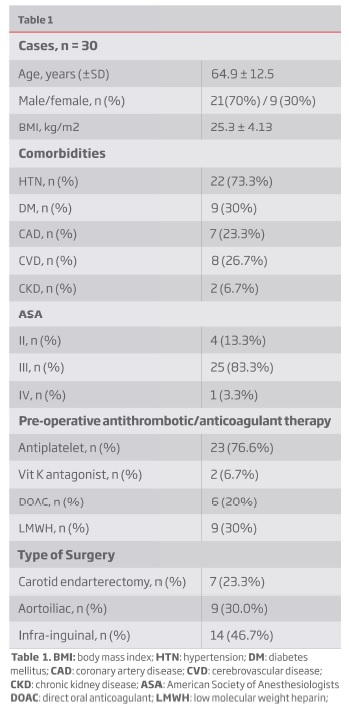
<body><![CDATA[<p>Statistical analysis was performed using the SPSS statistical software package    23.0 (IBM, New York, NY, USA). Continuous, normally distributed variables were    expressed as mean ± standard deviation and analyzed using a t-test. Skewed and    ordinal data were shown as median with interquartile range (IQR) and analyzed    using Mann-Whitney test. Categorical variables were expressed as frequencies    and analyzed using the chi-square test or the Fisher&apos;s exact test, as appropriate.    Correlations between continuous variables were accessed using the Spearman correlation    coefficient. A p value of 0.05 was considered to be statistically significant.  </p>     <p><b>Results</b></p>     <p>Patient characteristics </p>     <p>Thirty patients undergoing open arterial non-cardiac vascular surgery (carotid    n=7; aortoiliac n=9; infra-inguinal n=14) were included. The demographic characteristics    of the study group are summarized in <a href="#t1">Table 1</a>. The average    age was 64.9 ± 12.5 years, with 70% males and a high prevalence of hypertension    (73.3%), diabetes (30%), coronary artery disease and cerebrovascular disease    (23.3% and 26.7%, respectively). The periprocedural use of one or more antiplatelet    agents was also remarkable.</p>     <p>&nbsp;</p>     <p align="center"><a name="t1"></a><img src="/img/revistas/ang/v14n4/14n4a03t1.jpg"/></p>     
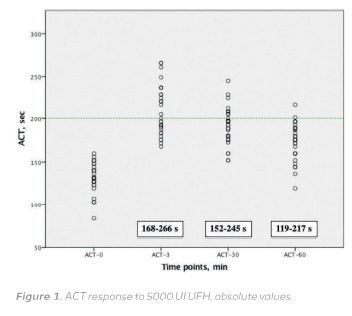
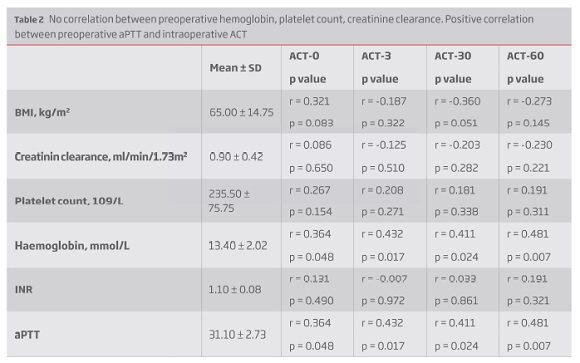
<p>&nbsp;</p>     <p>Anticoagulation monitoring</p>     <p>The baseline ACT values were 131.90 ± 17.30 (range, 83-160 s). Three minutes    after 5000 U UFH bolus the average ACT increased to 210.20 ± 28.82 s (range,    168-266 s) corresponding to a 1.61 ± 0.25 times baseline increase (range, 1.23-2.36    times baseline). After 30 minutes ACT declined to 191.60 ± 21.86 s (range, 152-245    s) and to 173.40 ± 21.37 s (range, 119-217 s), after 60 minutes (<a href="#f1">Figure    1</a> and <a href="#f2">2</a>).</p>     <p>&nbsp;</p>     ]]></body>
<body><![CDATA[<p align="center"><a name="f1"></a><img src="/img/revistas/ang/v14n4/14n4a03f1.jpg"/></p>     
<p>&nbsp;</p>     <p align="center"><a name="f2"></a><img src="/img/revistas/ang/v14n4/14n4a03f2.jpg"/></p>     
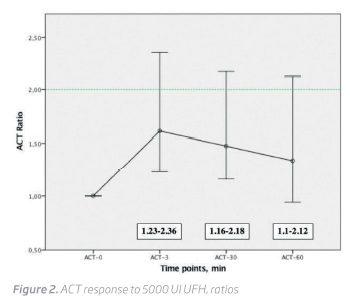
<p>&nbsp;</p>     <p>Although all patients received 5000 UI UFH, the dose received per kilogram    varied between 49.02 and 102.04 U/kg (mean 73.70 ± 12.44 U/kg). However, even    when weight-adjusted, a correlation between heparin dose per kilogram and ACT    change was not found at all measurement points (r = 0.19, p = 0.322, at 3 minutes;    r = 0.36, p = 0.062, at 30 minutes and r = 0.27, p = 0.145, at 60 minutes) (<a href="#f3">Figure    3</a>). </p>     <p>&nbsp;</p>     <p align="center"><a name="f3"></a><img src="/img/revistas/ang/v14n4/14n4a03f3.jpg"/></p>     
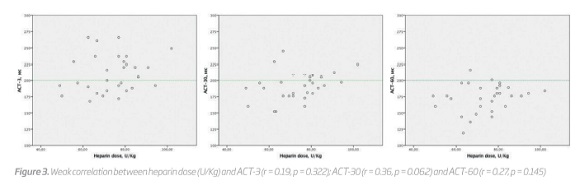
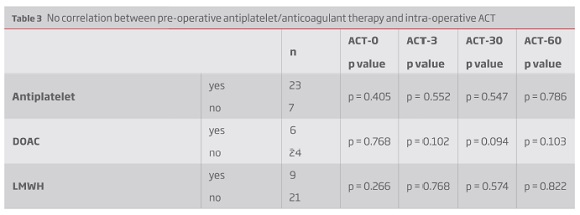
<p>&nbsp;</p>     <p>There was also no correlation between preoperative hemoglobin, platelet count,    creatinine clearance and ACT values neither between ACT measurements and intraoperative    blood loss. There was however a positive correlation between preoperative aPTT    and intraoperative ACT measurements (<a href="#t2">Table 2</a>). There was no    difference between preoperative antithrombotic/anticoagulant therapy and ACT    values (<a href="#t3">Table 3</a>).</p>     <p>&nbsp;</p>     ]]></body>
<body><![CDATA[<p align="center"><a name="t2"></a><img src="/img/revistas/ang/v14n4/14n4a03t2.jpg"/></p>     
<p>&nbsp;</p>     <p align="center"><a name="t3"></a><img src="/img/revistas/ang/v14n4/14n4a03t3.jpg"/></p>     
<p>&nbsp;</p>     <p>Peri-and post-operative complications </p>     <p>After carotid endarterectomy, a patient developed a cervical hematoma requiring    immediate surgical re-exploration (perioperatively: ATC-0 = 144 s; ACT-3 = 266    s; ACT-30 = 222 s and ACT-60 = 217 s). </p>     <p><b>Discussion</b></p>     <p>UFH is extensively advised and used in all types of vascular procedures (open    and endovascular) as periprocedural antithrombotic prophylaxis, despite its    known variable response. In contrast with cardiac interventions, the measurement    of actual anticoagulation has not been widely incorporated as standard of care    during non-cardiac vascular interventions. Recent reports state that only a    minority of vascular surgeons requests intraoperative monitoring(2). Most procedures    undergo without monitorization, with potential arm to the patient. Vascular    surgery patients are a high-risk cohort with multiple comorbidities. Therefore,    it is important to minimize bleeding risk and, at the same time, to maintain    adequate anticoagulation level. The present study demonstrates a wide variation    in the response to heparin and suggests that neither a fixed or a weight-based    regimen provide adequate and homogeneous anticoagulation and this may influence    patient&apos;s surgical risk. In our population, as previously described, 3    minutes after heparin bolus nearly only half of the patients had an adequate    ACT value, decreasing to one third after 30 minutes. After 60 minutes, we found    only two patients with an ACT &gt; 200 s. These results are in agreement with    the current literature (like the MANCO study) and suggest that a significant    percentage of vascular interventions undergo without appropriate anticoagulation.    The multifactorial origin of surgical complications, along with the small sample    size, makes impossible to take statistically significant conclusions about intraoperative    ACT monitorization and adverse events. However, it is worthy to note that the    patient who developed a cervical hematoma after carotid endarterectomy presented    with an ACT value of 217 s, one hour after heparin bolus (around the time of    closure). Recent studies, state that the use of protamine at the time of closure    of a carotid endarterectomy is associated with a reduction of the incidence    of cervical hematomas without increasing major thrombotic outcomes(10,11). Additionally,    regular ACT monitoring is suggested as a guide to selectively evaluate the need    of heparin reversion with protamine in the same type of intervention(12-;14).    Extensive research has been performed in interventional and cardiac surgery    about perioperative anticoagulation. However, different hemodynamics, distinct    target vessels and different procedures demand specific answers. Larger clinical    studies are warranted to further define what should be the optimal ACT range    in vascular surgery procedures, to understand its consequences and what actions    should be taken when faced with different ACT values.</p>     <p><b>Conclusion</b></p>     <p>There is a multifactorial nature for surgical complications, however the non-uniform    response to heparin may be one factor to take in account. This pilot study intends    to be a starting point for a larger study population in our institution, already    in progress. These initial results (in accordance with recent publications)    reinforce that empiric heparinization, even when weight-based, is insufficient    to provide consistent anticoagulation levels in all patients, suggesting that    it should be monitored and ACT-based. </p>     ]]></body>
<body><![CDATA[<p>&nbsp;</p>     <p><b>REFERENCES</b></p>     <!-- ref --><p>1. Murray, g. Heparin in surgical treatment of blood vessels. Arch. Surg. 40,    307 (1940).    &nbsp;&nbsp;&nbsp;&nbsp;&nbsp;&nbsp;&nbsp;&nbsp;[&#160;<a href="javascript:void(0);" onclick="javascript: window.open('/scielo.php?script=sci_nlinks&ref=898922&pid=S1646-706X201800040000300001&lng=','','width=640,height=500,resizable=yes,scrollbars=1,menubar=yes,');">Links</a>&#160;]<!-- end-ref --></p>     <!-- ref --><p>2. Wiersema, A. M. et al. Periprocedural prophylactic antithrombotic strategies    in interventional radiology: Current practice in the netherlands and comparison    with the United Kingdom. Cardiovasc. Intervent. Radiol. 36, 1477-1492 (2013).    &nbsp;&nbsp;&nbsp;&nbsp;&nbsp;&nbsp;&nbsp;&nbsp;[&#160;<a href="javascript:void(0);" onclick="javascript: window.open('/scielo.php?script=sci_nlinks&ref=898924&pid=S1646-706X201800040000300002&lng=','','width=640,height=500,resizable=yes,scrollbars=1,menubar=yes,');">Links</a>&#160;]<!-- end-ref --></p>     <!-- ref --><p>3. de Swart, C. A., Nijmeyer, B., Roelofs, J. M. &amp; Sixma, J. J. Kinetics    of intravenously administered heparin in normal humans. Blood 60, 1251-8 (1982).    &nbsp;&nbsp;&nbsp;&nbsp;&nbsp;&nbsp;&nbsp;&nbsp;[&#160;<a href="javascript:void(0);" onclick="javascript: window.open('/scielo.php?script=sci_nlinks&ref=898926&pid=S1646-706X201800040000300003&lng=','','width=640,height=500,resizable=yes,scrollbars=1,menubar=yes,');">Links</a>&#160;]<!-- end-ref --></p>     <!-- ref --><p>4. Veerhoek, D. et al. Individual Differences in Heparin Sensitivity and Their    Effect on Heparin Anticoagulation During Arterial Vascular Surgery. Eur. J.    Vasc. Endovasc. Surg. 54, 534-541 (2017).    &nbsp;&nbsp;&nbsp;&nbsp;&nbsp;&nbsp;&nbsp;&nbsp;[&#160;<a href="javascript:void(0);" onclick="javascript: window.open('/scielo.php?script=sci_nlinks&ref=898928&pid=S1646-706X201800040000300004&lng=','','width=640,height=500,resizable=yes,scrollbars=1,menubar=yes,');">Links</a>&#160;]<!-- end-ref --></p>     ]]></body>
<body><![CDATA[<!-- ref --><p>5. Wiersema, A. M. et al. The Use of Heparin during Endovascular Peripheral    Arterial Interventions: A Synopsis. Scientifica (Cairo). 2016, (2016).    &nbsp;&nbsp;&nbsp;&nbsp;&nbsp;&nbsp;&nbsp;&nbsp;[&#160;<a href="javascript:void(0);" onclick="javascript: window.open('/scielo.php?script=sci_nlinks&ref=898930&pid=S1646-706X201800040000300005&lng=','','width=640,height=500,resizable=yes,scrollbars=1,menubar=yes,');">Links</a>&#160;]<!-- end-ref --></p>     <!-- ref --><p>6. Kasapis, C. et al. Defining the Optimal Degree of Heparin Anticoagulation    for Peripheral Vascular Interventions: Insight From a Large, Regional, Multicenter    Registry. Circ. Cardiovasc. Interv. 3, 593-601 (2010).    &nbsp;&nbsp;&nbsp;&nbsp;&nbsp;&nbsp;&nbsp;&nbsp;[&#160;<a href="javascript:void(0);" onclick="javascript: window.open('/scielo.php?script=sci_nlinks&ref=898932&pid=S1646-706X201800040000300006&lng=','','width=640,height=500,resizable=yes,scrollbars=1,menubar=yes,');">Links</a>&#160;]<!-- end-ref --></p>     <!-- ref --><p>7. Assadian, A. et al. Antithrombotic strategies in vascular surgery: Evidence    and practice. Eur. J. Vasc. Endovasc. Surg. 29, 516-521 (2005).    &nbsp;&nbsp;&nbsp;&nbsp;&nbsp;&nbsp;&nbsp;&nbsp;[&#160;<a href="javascript:void(0);" onclick="javascript: window.open('/scielo.php?script=sci_nlinks&ref=898934&pid=S1646-706X201800040000300007&lng=','','width=640,height=500,resizable=yes,scrollbars=1,menubar=yes,');">Links</a>&#160;]<!-- end-ref --></p>     <!-- ref --><p>8. Moussa, O., Jonker, L. &amp; Joseph, T. Marked Variation in Venous Thromboprophylaxis    Management for Abdominal Aortic Aneurysm Repair; Results of Survey Amongst Vascular    Surgeons in the United Kingdom. Eur. J. Vasc. Endovasc. Surg. 42, 591-595 (2011).    &nbsp;&nbsp;&nbsp;&nbsp;&nbsp;&nbsp;&nbsp;&nbsp;[&#160;<a href="javascript:void(0);" onclick="javascript: window.open('/scielo.php?script=sci_nlinks&ref=898936&pid=S1646-706X201800040000300008&lng=','','width=640,height=500,resizable=yes,scrollbars=1,menubar=yes,');">Links</a>&#160;]<!-- end-ref --></p>     <!-- ref --><p>9. Goldhammer, J. E. &amp; Zimmerman, D. Author ’ s Accepted Manuscript. (2017).    doi:<a href="https://dx.doi.org/10.1053/j.jvca.2017.04.047" target="_blank">10.1053/j.jvca.2017.04.047</a>  &nbsp;&nbsp;&nbsp;&nbsp;&nbsp;&nbsp;&nbsp;&nbsp;[&#160;<a href="javascript:void(0);" onclick="javascript: window.open('/scielo.php?script=sci_nlinks&ref=898938&pid=S1646-706X201800040000300009&lng=','','width=640,height=500,resizable=yes,scrollbars=1,menubar=yes,');">Links</a>&#160;]<!-- end-ref --><!-- ref --><p>10. Baracchini, C. &amp; Ballotta, E. The Benefit of Heparin Reversal With    Protamine During Carotid Endarterectomy. JAMA Surg. 151, 255 (2016).    &nbsp;&nbsp;&nbsp;&nbsp;&nbsp;&nbsp;&nbsp;&nbsp;[&#160;<a href="javascript:void(0);" onclick="javascript: window.open('/scielo.php?script=sci_nlinks&ref=898939&pid=S1646-706X201800040000300010&lng=','','width=640,height=500,resizable=yes,scrollbars=1,menubar=yes,');">Links</a>&#160;]<!-- end-ref --></p>     <!-- ref --><p>11. Newhall, K. A., Saunders, E. C., Larson, R. J., Stone, D. H. &amp; Goodney,    P. P. Use of Protamine for Anticoagulation During Carotid Endarterectomy. JAMA    Surg. 151, 247 (2016).    &nbsp;&nbsp;&nbsp;&nbsp;&nbsp;&nbsp;&nbsp;&nbsp;[&#160;<a href="javascript:void(0);" onclick="javascript: window.open('/scielo.php?script=sci_nlinks&ref=898941&pid=S1646-706X201800040000300011&lng=','','width=640,height=500,resizable=yes,scrollbars=1,menubar=yes,');">Links</a>&#160;]<!-- end-ref --></p>     <!-- ref --><p>12. Poisik, A. et al. Safety and efficacy of fixed-dose heparin in carotid    endarterectomy. Neurosurgery 45, 434-41; discussion 441-2 (1999).    &nbsp;&nbsp;&nbsp;&nbsp;&nbsp;&nbsp;&nbsp;&nbsp;[&#160;<a href="javascript:void(0);" onclick="javascript: window.open('/scielo.php?script=sci_nlinks&ref=898943&pid=S1646-706X201800040000300012&lng=','','width=640,height=500,resizable=yes,scrollbars=1,menubar=yes,');">Links</a>&#160;]<!-- end-ref --></p>     <!-- ref --><p>13. Kakisis, J. D. et al. Protamine Reduces Bleeding Complications without    Increasing the Risk of Stroke after Carotid Endarterectomy: A Meta-analysis.    Eur. J. Vasc. Endovasc. Surg. 52, 296-307 (2016).    &nbsp;&nbsp;&nbsp;&nbsp;&nbsp;&nbsp;&nbsp;&nbsp;[&#160;<a href="javascript:void(0);" onclick="javascript: window.open('/scielo.php?script=sci_nlinks&ref=898945&pid=S1646-706X201800040000300013&lng=','','width=640,height=500,resizable=yes,scrollbars=1,menubar=yes,');">Links</a>&#160;]<!-- end-ref --></p>     <!-- ref --><p>14. De Sousa, A. A., Dellaretti, M. A., Faglioni, W. &amp; Carvalho, G. T.    C. Monitoring of activated coagulation time in carotid endarterectomy. Surg.    Neurol. 64, 7-10 (2005).    &nbsp;&nbsp;&nbsp;&nbsp;&nbsp;&nbsp;&nbsp;&nbsp;[&#160;<a href="javascript:void(0);" onclick="javascript: window.open('/scielo.php?script=sci_nlinks&ref=898947&pid=S1646-706X201800040000300014&lng=','','width=640,height=500,resizable=yes,scrollbars=1,menubar=yes,');">Links</a>&#160;]<!-- end-ref --></p>     <p>&nbsp;</p>     ]]></body>
<body><![CDATA[<p><a href="#topc0">Endere&ccedil;o para correspond&ecirc;ncia</a> | <a href="#topc0">Direcci&oacute;n    para correspondencia</a> | <a href="#topc0">Correspondence</a><a name="c0"></a></p>     <p>Correio eletrónico: <a href="mailto:nunoc.90@gmail.com">nunoc.90@gmail.com</a>    (N. Coelho).</p>     <p>&nbsp;</p>     <p><b>Ethical responsabilities</b></p>     <p><b>Protection of patients and animals:</b> The authors state that for this    investigation no experiments were performed on humans and / or animals.</p>     <p><b>Confidentiality of the data:</b> The authors state that they have followed    the centre ´s established protocols on the publication of patient data.</p>     <p><b>Right to privacy and informed consent:</b> The authors declare that no patient    data is available in this article. </p>     <p><b>Conflict of interest:</b> The authors declare no potential confict of interest.</p>     <p>&nbsp;</p>     <p>Recebido a 02 de julho de 2018</p>     ]]></body>
<body><![CDATA[<p>Aceite a 14 de janeiro de 2019</p>      ]]></body><back>
<ref-list>
<ref id="B1">
<label>1</label><nlm-citation citation-type="journal">
<person-group person-group-type="author">
<name>
<surname><![CDATA[Murray]]></surname>
<given-names><![CDATA[G.]]></given-names>
</name>
</person-group>
<article-title xml:lang="en"><![CDATA[Heparin in surgical treatment of blood vessels]]></article-title>
<source><![CDATA[Arch. Surg]]></source>
<year>1940</year>
<volume>40</volume>
<page-range>307</page-range></nlm-citation>
</ref>
<ref id="B2">
<label>2</label><nlm-citation citation-type="journal">
<person-group person-group-type="author">
<name>
<surname><![CDATA[Wiersema]]></surname>
<given-names><![CDATA[A. M.]]></given-names>
</name>
</person-group>
<article-title xml:lang="en"><![CDATA[Periprocedural prophylactic antithrombotic strategies in interventional radiology: Current practice in the netherlands and comparison with the United Kingdom]]></article-title>
<source><![CDATA[Cardiovasc. Intervent. Radiol.]]></source>
<year>2013</year>
<volume>36</volume>
<page-range>1477-1492</page-range></nlm-citation>
</ref>
<ref id="B3">
<label>3</label><nlm-citation citation-type="journal">
<person-group person-group-type="author">
<name>
<surname><![CDATA[de Swart]]></surname>
<given-names><![CDATA[C. A.]]></given-names>
</name>
<name>
<surname><![CDATA[Nijmeyer]]></surname>
<given-names><![CDATA[B.]]></given-names>
</name>
<name>
<surname><![CDATA[Roelofs]]></surname>
<given-names><![CDATA[J. M.]]></given-names>
</name>
<name>
<surname><![CDATA[Sixma]]></surname>
<given-names><![CDATA[J. J.]]></given-names>
</name>
</person-group>
<article-title xml:lang="en"><![CDATA[Kinetics of intravenously administered heparin in normal humans]]></article-title>
<source><![CDATA[Blood]]></source>
<year>1982</year>
<volume>60</volume>
<page-range>1251-8</page-range></nlm-citation>
</ref>
<ref id="B4">
<label>4</label><nlm-citation citation-type="journal">
<person-group person-group-type="author">
<name>
<surname><![CDATA[Veerhoek]]></surname>
<given-names><![CDATA[D.]]></given-names>
</name>
</person-group>
<article-title xml:lang="en"><![CDATA[Individual Differences in Heparin Sensitivity and Their Effect on Heparin Anticoagulation During Arterial Vascular Surgery]]></article-title>
<source><![CDATA[Eur. J. Vasc. Endovasc. Surg]]></source>
<year>2017</year>
<volume>54</volume>
<page-range>534-541</page-range></nlm-citation>
</ref>
<ref id="B5">
<label>5</label><nlm-citation citation-type="journal">
<person-group person-group-type="author">
<name>
<surname><![CDATA[Wiersema]]></surname>
<given-names><![CDATA[A. M.]]></given-names>
</name>
</person-group>
<article-title xml:lang="en"><![CDATA[The Use of Heparin during Endovascular Peripheral Arterial Interventions: A Synopsis]]></article-title>
<source><![CDATA[Scientifica]]></source>
<year>2016</year>
</nlm-citation>
</ref>
<ref id="B6">
<label>6</label><nlm-citation citation-type="journal">
<person-group person-group-type="author">
<name>
<surname><![CDATA[Kasapis]]></surname>
<given-names><![CDATA[C.]]></given-names>
</name>
</person-group>
<article-title xml:lang="en"><![CDATA[Defining the Optimal Degree of Heparin Anticoagulation for Peripheral Vascular Interventions: Insight From a Large, Regional, Multicenter Registry]]></article-title>
<source><![CDATA[Circ. Cardiovasc. Interv]]></source>
<year>2010</year>
<volume>3</volume>
<page-range>593-601</page-range></nlm-citation>
</ref>
<ref id="B7">
<label>7</label><nlm-citation citation-type="journal">
<person-group person-group-type="author">
<name>
<surname><![CDATA[Assadian]]></surname>
<given-names><![CDATA[A.]]></given-names>
</name>
</person-group>
<article-title xml:lang="en"><![CDATA[Antithrombotic strategies in vascular surgery: Evidence and practice]]></article-title>
<source><![CDATA[Eur. J. Vasc. Endovasc. Surg]]></source>
<year>2005</year>
<volume>29</volume>
<page-range>516-521</page-range></nlm-citation>
</ref>
<ref id="B8">
<label>8</label><nlm-citation citation-type="journal">
<person-group person-group-type="author">
<name>
<surname><![CDATA[Moussa]]></surname>
<given-names><![CDATA[O.]]></given-names>
</name>
<name>
<surname><![CDATA[Jonker]]></surname>
<given-names><![CDATA[L.]]></given-names>
</name>
<name>
<surname><![CDATA[Joseph]]></surname>
<given-names><![CDATA[T.]]></given-names>
</name>
</person-group>
<article-title xml:lang="en"><![CDATA[Marked Variation in Venous Thromboprophylaxis Management for Abdominal Aortic Aneurysm Repair: Results of Survey Amongst Vascular Surgeons in the United Kingdom]]></article-title>
<source><![CDATA[Eur. J. Vasc. Endovasc. Surg]]></source>
<year>2011</year>
<volume>42</volume>
<page-range>591-595</page-range></nlm-citation>
</ref>
<ref id="B9">
<label>9</label><nlm-citation citation-type="">
<person-group person-group-type="author">
<name>
<surname><![CDATA[Goldhammer]]></surname>
<given-names><![CDATA[J. E.]]></given-names>
</name>
<name>
<surname><![CDATA[Zimmerman]]></surname>
<given-names><![CDATA[D.]]></given-names>
</name>
</person-group>
<source><![CDATA[Author ’ s Accepted Manuscript]]></source>
<year>2017</year>
</nlm-citation>
</ref>
<ref id="B10">
<label>10</label><nlm-citation citation-type="journal">
<person-group person-group-type="author">
<name>
<surname><![CDATA[Baracchini]]></surname>
<given-names><![CDATA[C.]]></given-names>
</name>
<name>
<surname><![CDATA[Ballotta]]></surname>
<given-names><![CDATA[E.]]></given-names>
</name>
</person-group>
<article-title xml:lang="en"><![CDATA[The Benefit of Heparin Reversal With Protamine During Carotid Endarterectomy]]></article-title>
<source><![CDATA[JAMA Surg]]></source>
<year>2016</year>
<volume>151</volume>
<page-range>255</page-range></nlm-citation>
</ref>
<ref id="B11">
<label>11</label><nlm-citation citation-type="journal">
<person-group person-group-type="author">
<name>
<surname><![CDATA[Newhall]]></surname>
<given-names><![CDATA[K. A.]]></given-names>
</name>
<name>
<surname><![CDATA[Saunders]]></surname>
<given-names><![CDATA[E. C.]]></given-names>
</name>
<name>
<surname><![CDATA[Larson]]></surname>
<given-names><![CDATA[R. J.]]></given-names>
</name>
<name>
<surname><![CDATA[Stone]]></surname>
<given-names><![CDATA[D. H.]]></given-names>
</name>
<name>
<surname><![CDATA[Goodney]]></surname>
<given-names><![CDATA[P. P.]]></given-names>
</name>
</person-group>
<article-title xml:lang="en"><![CDATA[Use of Protamine for Anticoagulation During Carotid Endarterectomy]]></article-title>
<source><![CDATA[JAMA Surg]]></source>
<year>2016</year>
<volume>151</volume>
<page-range>247</page-range></nlm-citation>
</ref>
<ref id="B12">
<label>12</label><nlm-citation citation-type="journal">
<person-group person-group-type="author">
<name>
<surname><![CDATA[Poisik]]></surname>
<given-names><![CDATA[A.]]></given-names>
</name>
</person-group>
<article-title xml:lang="en"><![CDATA[Safety and efficacy of fixed-dose heparin in carotid endarterectomy]]></article-title>
<source><![CDATA[Neurosurgery]]></source>
<year>1999</year>
<volume>45</volume>
<page-range>434-41</page-range></nlm-citation>
</ref>
<ref id="B13">
<label>13</label><nlm-citation citation-type="journal">
<person-group person-group-type="author">
<name>
<surname><![CDATA[Kakisis]]></surname>
<given-names><![CDATA[J. D.]]></given-names>
</name>
</person-group>
<article-title xml:lang="en"><![CDATA[Protamine Reduces Bleeding Complications without Increasing the Risk of Stroke after Carotid Endarterectomy: A Meta-analysis]]></article-title>
<source><![CDATA[Eur. J. Vasc. Endovasc. Surg]]></source>
<year>2016</year>
<volume>52</volume>
<page-range>296-307</page-range></nlm-citation>
</ref>
<ref id="B14">
<label>14</label><nlm-citation citation-type="journal">
<person-group person-group-type="author">
<name>
<surname><![CDATA[De Sousa]]></surname>
<given-names><![CDATA[A. A.]]></given-names>
</name>
<name>
<surname><![CDATA[Dellaretti]]></surname>
<given-names><![CDATA[M. A.]]></given-names>
</name>
<name>
<surname><![CDATA[Faglioni]]></surname>
<given-names><![CDATA[W.]]></given-names>
</name>
<name>
<surname><![CDATA[Carvalho]]></surname>
<given-names><![CDATA[G. T. C.]]></given-names>
</name>
</person-group>
<article-title xml:lang="en"><![CDATA[Monitoring of activated coagulation time in carotid endarterectomy]]></article-title>
<source><![CDATA[Surg. Neurol]]></source>
<year>2005</year>
<volume>64</volume>
<page-range>7-10</page-range></nlm-citation>
</ref>
</ref-list>
</back>
</article>