<?xml version="1.0" encoding="ISO-8859-1"?><article xmlns:mml="http://www.w3.org/1998/Math/MathML" xmlns:xlink="http://www.w3.org/1999/xlink" xmlns:xsi="http://www.w3.org/2001/XMLSchema-instance">
<front>
<journal-meta>
<journal-id>1646-706X</journal-id>
<journal-title><![CDATA[Angiologia e Cirurgia Vascular]]></journal-title>
<abbrev-journal-title><![CDATA[Angiol Cir Vasc]]></abbrev-journal-title>
<issn>1646-706X</issn>
<publisher>
<publisher-name><![CDATA[Sociedade Portuguesa de Angiologia e Cirurgia Vascular]]></publisher-name>
</publisher>
</journal-meta>
<article-meta>
<article-id>S1646-706X2020000100012</article-id>
<title-group>
<article-title xml:lang="en"><![CDATA[Emergency arterial embolization for acute renal hemorrhage]]></article-title>
<article-title xml:lang="pt"><![CDATA[Embolização arterial emergente em contexto de hemorragia renal aguda]]></article-title>
</title-group>
<contrib-group>
<contrib contrib-type="author">
<name>
<surname><![CDATA[Augusto]]></surname>
<given-names><![CDATA[Rita]]></given-names>
</name>
<xref ref-type="aff" rid="A1 "/>
</contrib>
<contrib contrib-type="author">
<name>
<surname><![CDATA[Campos]]></surname>
<given-names><![CDATA[Jacinta]]></given-names>
</name>
<xref ref-type="aff" rid="A1 "/>
</contrib>
<contrib contrib-type="author">
<name>
<surname><![CDATA[Coelho]]></surname>
<given-names><![CDATA[Andreia]]></given-names>
</name>
<xref ref-type="aff" rid="A1 "/>
</contrib>
<contrib contrib-type="author">
<name>
<surname><![CDATA[Coelho]]></surname>
<given-names><![CDATA[Nuno]]></given-names>
</name>
<xref ref-type="aff" rid="A1 "/>
</contrib>
<contrib contrib-type="author">
<name>
<surname><![CDATA[Pinto]]></surname>
<given-names><![CDATA[Evelise]]></given-names>
</name>
<xref ref-type="aff" rid="A1"/>
</contrib>
<contrib contrib-type="author">
<name>
<surname><![CDATA[Semião]]></surname>
<given-names><![CDATA[Ana]]></given-names>
</name>
<xref ref-type="aff" rid="A1"/>
</contrib>
<contrib contrib-type="author">
<name>
<surname><![CDATA[Ribeiro]]></surname>
<given-names><![CDATA[João]]></given-names>
</name>
<xref ref-type="aff" rid="A1"/>
</contrib>
<contrib contrib-type="author">
<name>
<surname><![CDATA[Peixoto]]></surname>
<given-names><![CDATA[João]]></given-names>
</name>
<xref ref-type="aff" rid="A1"/>
</contrib>
<contrib contrib-type="author">
<name>
<surname><![CDATA[Brandão]]></surname>
<given-names><![CDATA[Daniel]]></given-names>
</name>
<xref ref-type="aff" rid="A1 "/>
</contrib>
<contrib contrib-type="author">
<name>
<surname><![CDATA[Canedo]]></surname>
<given-names><![CDATA[Alexandra]]></given-names>
</name>
<xref ref-type="aff" rid="A1 "/>
</contrib>
</contrib-group>
<aff id="AA1">
<institution><![CDATA[,Centro Hospitalar de Vila Nova de Gaia/Espinho Serviço de Angiologia e Cirurgia Vascular ]]></institution>
<addr-line><![CDATA[Vila Nova de Gaia ]]></addr-line>
<country>Portugal</country>
</aff>
<aff id="AA2">
<institution><![CDATA[,Universidade do Porto Faculdade de Medicina Serviço de Angiologia e Cirurgia Vascular]]></institution>
<addr-line><![CDATA[Porto ]]></addr-line>
<country>Portugal</country>
</aff>
<pub-date pub-type="pub">
<day>00</day>
<month>03</month>
<year>2020</year>
</pub-date>
<pub-date pub-type="epub">
<day>00</day>
<month>03</month>
<year>2020</year>
</pub-date>
<volume>16</volume>
<numero>1</numero>
<fpage>59</fpage>
<lpage>60</lpage>
<copyright-statement/>
<copyright-year/>
<self-uri xlink:href="http://scielo.pt/scielo.php?script=sci_arttext&amp;pid=S1646-706X2020000100012&amp;lng=en&amp;nrm=iso"></self-uri><self-uri xlink:href="http://scielo.pt/scielo.php?script=sci_abstract&amp;pid=S1646-706X2020000100012&amp;lng=en&amp;nrm=iso"></self-uri><self-uri xlink:href="http://scielo.pt/scielo.php?script=sci_pdf&amp;pid=S1646-706X2020000100012&amp;lng=en&amp;nrm=iso"></self-uri></article-meta>
</front><body><![CDATA[ <p align="right"><font size="2"><b>IMAGEM VASCULAR</b></font></p>     <p><font size="4"><b> Emergency arterial embolization for acute renal hemorrhage</b></font></p>     <p><font size="3"><b>Embolização arterial emergente em contexto de hemorragia renal aguda</b></font></p>     <p><b>Rita Augusto<sup>1,2</sup>, Jacinta Campos<sup>1,2</sup>, Andreia Coelho<sup>1,2</sup>, Nuno Coelho<sup>1,2</sup>, Evelise Pinto<sup>1</sup>, Ana Semião<sup>1</sup>, João Ribeiro<sup>1</sup>, João Peixoto<sup>1</sup>, Daniel Brandão<sup>1,2</sup>, Alexandra Canedo<sup>1,2</sup></b></p>     <p><sup>1</sup> Serviço de Angiologia e Cirurgia Vascular, Centro Hospitalar de Vila Nova de Gaia/Espinho, Vila Nova de Gaia, Portugal </p>     <p><sup>2</sup> Unidade de Angiologia e Cirurgia Vascular da Faculdade de Medicina da Universidade do Porto, Porto, Portugal</p>     <p><a href="#c0">Endere&ccedil;o para correspond&ecirc;ncia</a> | <a href="#c0">Direcci&oacute;n para correspondencia</a> | <a href="#c0">Correspondence</a><a name="topc0"></a></p> <hr/>     <p>&nbsp;</p>     <p><b>Keywords:</b> Percutaneous renal biopsy; Retroperiotenal hematoma; Renal artery embolization</p>     <p><b>Palavras-chave:</b> Biópsia renal percutânea; Hematoma retroperiotenal; Embolização da artéria renal</p>     ]]></body>
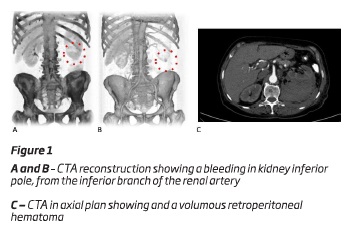
<body><![CDATA[<p><b>Clinical case</b></p>     <p>A 79 year-old woman was admitted to our institution to be submitted to an elective percutaneous renal biopsy (PRB), assisted by ultrasound, of the left kidney in the context of the study of a chronic renal disease. She had a prior medical history of auricular fibrillation - taking rivaroxaban, which had previously suspended -, diabetes, hypertension, dyslipidemia and thyroid pathology. </p>     <p>The procedure was apparently uneventful, but six hours after, the patient started with hypotension (90/60 mmHg), tachycardia (110 bpm) and left lumbar pain. The gasometry revealed hemoglobin of 7.3 g/dL. Subsequently, a computed tomography angiography (CTA) was performed, revealing active bleeding and a volumous retroperitoneal hematoma (<a href="#f1">Figure 1</a>). </p>     <p>&nbsp;</p>    <p align="center"><a name="f1"></a><img src="/img/revistas/ang/v16n1/16n1a12f1.jpg"/></p>    
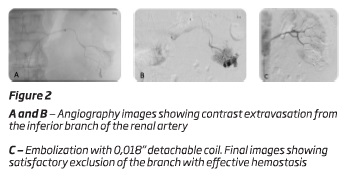
<p>&nbsp;</p>     <p>The patient was immediately transported to our angio-suite. An ultrasound guided right femoral artery access was obtained, a 6 Fr sheath was placed and after the catheterization of the left renal artery, an angiogram confirmed contrast extravasation from the inferior branch of the renal artery. After catheterizing the branch, a 2,7 Fr microcatheter was placed and the artery was embolized with a 0,018&quot; detachable coil (<a href="#f2">Figure 2</a>). Final angiography showed a satisfactory exclusion of the branch with effective hemostasis. The patient maintained stability of her seric creatinine and the postoperative course was uneventful.</p>     <p>&nbsp;</p>    <p align="center"><a name="f2"></a><img src="/img/revistas/ang/v16n1/16n1a12f2.jpg"/></p>    
<p>&nbsp;</p>     ]]></body>
<body><![CDATA[<p><b>Discussion</b></p>     <p>Percutaneous renal biopsy is an effective technique that allows for diagnostic, prognostic and therapeutic information in a patient with a renal disease. </p>     <p>Despite development of new technique and skills, post-biopsy bleedings are still unable to be completely avoided and are common due to the vascularity of the kidney and inability to compress the biopsy location due to a deep retroperitoneal location. </p>     <p>Lees et al retrospective review,(1) included a total of 2,563 percutaneous renal biopsies, performed over 15 years. The rate of major bleeding was 2.2%, with 1.8% of patients requiring transfusion. Angiographic intervention was required in 0.4% of cases, and 0.04% of patients died. </p>     <p>Haochen et al(2) described their experience concerning the superselective renal artery embolization for bleeding complications after PRB, in one of the large series published, with 43 patients. They achieved successful embolization in all patients, using a microcoil only or combined with a gelatin sponge. The mean creatinine value was not different at 1 day and 1 week after embolization compared with before embolization. </p>     <p>To conclude, as the authors showed in their clinical case, the embolization of the arterial branch with coils appears to be a minimally invasive, safe and effective procedure that is an organ-sparing treatment that maintains renal function.</p>     <p>&nbsp;</p>     <p><b>REFERENCES</b></p>     <!-- ref --><p>1. Lees JS, McQuarrie EP, Mordi N, Geddes CC, Fox JG, Mackinnon B. Risk factors for bleeding complications after nephrologist performed native renal biopsy. Clin Kidney J 2017;10(04):573-577 &nbsp;&nbsp;&nbsp;&nbsp;&nbsp;&nbsp;&nbsp;&nbsp;[&#160;<a href="javascript:void(0);" onclick="javascript: window.open('/scielo.php?script=sci_nlinks&ref=908531&pid=S1646-706X202000010001200001&lng=','','width=640,height=500,resizable=yes,scrollbars=1,menubar=yes,');">Links</a>&#160;]<!-- end-ref --><!-- ref --><p>2. Haochen W, Jian W, Li S, Tianshi L, Xiaoqiang T, Yinghua Z. Superselective renal artery embolization for bleeding complications after percutaneous renal biopsy: a single-center experience. Journal of International Medical Research 2019, Vol. 47(4) 1649-1659&nbsp;&nbsp;&nbsp;&nbsp;&nbsp;&nbsp;&nbsp;&nbsp;[&#160;<a href="javascript:void(0);" onclick="javascript: window.open('/scielo.php?script=sci_nlinks&ref=908532&pid=S1646-706X202000010001200002&lng=','','width=640,height=500,resizable=yes,scrollbars=1,menubar=yes,');">Links</a>&#160;]<!-- end-ref --><p>&nbsp;</p>     <p><a href="#topc0">Endere&ccedil;o para correspond&ecirc;ncia</a> | <a href="#topc0">Direcci&oacute;n para correspondencia</a> | <a href="#topc0">Correspondence</a><a name="c0"></a></p>     <p>Correio eletrónico: <a href="mailto:rita.augusto1988@gmail.com">rita.augusto1988@gmail.com</a> (R. Augusto).</p>     <p>&nbsp;</p>     <p>Recebido a 17 de novembro de 2019</p>     <p>Aceite a 10 de mar&ccedil;o de 2020</p>      ]]></body><back>
<ref-list>
<ref id="B1">
<label>1</label><nlm-citation citation-type="journal">
<person-group person-group-type="author">
<name>
<surname><![CDATA[Lees]]></surname>
<given-names><![CDATA[JS]]></given-names>
</name>
<name>
<surname><![CDATA[McQuarrie]]></surname>
<given-names><![CDATA[EP]]></given-names>
</name>
<name>
<surname><![CDATA[Mordi]]></surname>
<given-names><![CDATA[N]]></given-names>
</name>
<name>
<surname><![CDATA[Geddes]]></surname>
<given-names><![CDATA[CC]]></given-names>
</name>
<name>
<surname><![CDATA[Fox]]></surname>
<given-names><![CDATA[JG]]></given-names>
</name>
<name>
<surname><![CDATA[Mackinnon]]></surname>
<given-names><![CDATA[B]]></given-names>
</name>
</person-group>
<article-title xml:lang="en"><![CDATA[Risk factors for bleeding complications after nephrologist performed native renal biopsy]]></article-title>
<source><![CDATA[Clin Kidney J]]></source>
<year>2017</year>
<volume>10</volume>
<numero>04</numero>
<issue>04</issue>
<page-range>573-577</page-range></nlm-citation>
</ref>
<ref id="B2">
<label>2</label><nlm-citation citation-type="journal">
<person-group person-group-type="author">
<name>
<surname><![CDATA[Haochen]]></surname>
<given-names><![CDATA[W]]></given-names>
</name>
<name>
<surname><![CDATA[Jian]]></surname>
<given-names><![CDATA[W]]></given-names>
</name>
<name>
<surname><![CDATA[Li]]></surname>
<given-names><![CDATA[S]]></given-names>
</name>
<name>
<surname><![CDATA[Tianshi]]></surname>
<given-names><![CDATA[L]]></given-names>
</name>
<name>
<surname><![CDATA[Xiaoqiang]]></surname>
<given-names><![CDATA[T]]></given-names>
</name>
<name>
<surname><![CDATA[Yinghua]]></surname>
<given-names><![CDATA[Z]]></given-names>
</name>
</person-group>
<article-title xml:lang="en"><![CDATA[Superselective renal artery embolization for bleeding complications after percutaneous renal biopsy: a single-center experience]]></article-title>
<source><![CDATA[Journal of International Medical Research]]></source>
<year>2019</year>
<volume>47</volume>
<numero>4</numero>
<issue>4</issue>
<page-range>1649-1659</page-range></nlm-citation>
</ref>
</ref-list>
</back>
</article>