<?xml version="1.0" encoding="ISO-8859-1"?><article xmlns:mml="http://www.w3.org/1998/Math/MathML" xmlns:xlink="http://www.w3.org/1999/xlink" xmlns:xsi="http://www.w3.org/2001/XMLSchema-instance">
<front>
<journal-meta>
<journal-id>1646-740X</journal-id>
<journal-title><![CDATA[Medievalista]]></journal-title>
<abbrev-journal-title><![CDATA[Med_on]]></abbrev-journal-title>
<issn>1646-740X</issn>
<publisher>
<publisher-name><![CDATA[Instituto de Estudos Medievais, Faculdade de Ciências Sociais e Humanas da Universidade Nova de Lisboa]]></publisher-name>
</publisher>
</journal-meta>
<article-meta>
<article-id>S1646-740X2016000200005</article-id>
<title-group>
<article-title xml:lang="en"><![CDATA[The bequest of Pedro Domingues, 1335: the foundation of a chapel in honour of Dona Branca, princess of Portugal, in the church of Santa Justa of Coimbra]]></article-title>
<article-title xml:lang="pt"><![CDATA[O testamento de Pedro Domingues, 1335: a fundação de uma capela em honra de D. Branca, infanta de Portugal, na igreja de Santa Justa de Coimbra]]></article-title>
</title-group>
<contrib-group>
<contrib contrib-type="author">
<name>
<surname><![CDATA[Campos]]></surname>
<given-names><![CDATA[Maria Amélia Álvaro de]]></given-names>
</name>
<xref ref-type="aff" rid="A1"/>
</contrib>
</contrib-group>
<aff id="AA1">
<institution><![CDATA[,Universidade de Coimbra Centro de História da Sociedade e da Cultura ]]></institution>
<addr-line><![CDATA[Coimbra ]]></addr-line>
<country>Portugal</country>
</aff>
<pub-date pub-type="pub">
<day>00</day>
<month>12</month>
<year>2016</year>
</pub-date>
<pub-date pub-type="epub">
<day>00</day>
<month>12</month>
<year>2016</year>
</pub-date>
<numero>20</numero>
<fpage>1</fpage>
<lpage>28</lpage>
<copyright-statement/>
<copyright-year/>
<self-uri xlink:href="http://scielo.pt/scielo.php?script=sci_arttext&amp;pid=S1646-740X2016000200005&amp;lng=en&amp;nrm=iso"></self-uri><self-uri xlink:href="http://scielo.pt/scielo.php?script=sci_abstract&amp;pid=S1646-740X2016000200005&amp;lng=en&amp;nrm=iso"></self-uri><self-uri xlink:href="http://scielo.pt/scielo.php?script=sci_pdf&amp;pid=S1646-740X2016000200005&amp;lng=en&amp;nrm=iso"></self-uri><abstract abstract-type="short" xml:lang="en"><p><![CDATA[In 1335, Pedro Domingues, who identified himself as servant and squire of Dona Branca, princess of Portugal, made his will in which founded one chapel to celebrate his soul, the soul of his family and the soul of the princess Dona Branca. This paper presents a case study and it publishes the palaeographic transcription of the original testamentary will. More than the analysis of the behaviour of medieval society towards the dead, we want to question the function of this chapel in the social mobility of one family from the urban oligarchy. For this purpose we will specially question the particularity of the association of the name of the princess to the chapel in analysis]]></p></abstract>
<abstract abstract-type="short" xml:lang="pt"><p><![CDATA[Em 1335, Pero Domingues, que se identifica como criado e escudeiro da Infanta D. Branca, faz o seu testamento, no qual funda uma capela para celebrar a sua alma, a alma dos seus familiares e a alma da infanta D. Branca de Portugal. Este artigo apresenta um estudo de caso e publica o referido testamento. Mais do que a análise da atitude do Homem medieval perante a morte, pretende-se problematizar a função desta capela na projecção social de uma família da aristocracia urbana. Para tal, problematizaremos especialmente a singularidade da associação do nome da infanta portuguesa à celebração da referida capela]]></p></abstract>
<kwd-group>
<kwd lng="en"><![CDATA[Portuguese medieval society]]></kwd>
<kwd lng="en"><![CDATA[urban parish]]></kwd>
<kwd lng="en"><![CDATA[medieval testamentary will]]></kwd>
<kwd lng="en"><![CDATA[Portuguese royal family]]></kwd>
<kwd lng="pt"><![CDATA[Sociedade medieval portuguesa]]></kwd>
<kwd lng="pt"><![CDATA[paróquia urbana]]></kwd>
<kwd lng="pt"><![CDATA[testamento medieval]]></kwd>
<kwd lng="pt"><![CDATA[família real portuguesa]]></kwd>
</kwd-group>
</article-meta>
</front><body><![CDATA[ <p align="right"><font size="2"><b>ARTIGO</b></font></p>     <p><font size="4"><b>The bequest of Pedro Domingues, 1335: the foundation of a chapel in honour of Dona Branca, princess of Portugal, in the church of Santa Justa of Coimbra</b></font></p>     <p><font size="3"><b>O testamento de Pedro Domingues, 1335: a funda&ccedil;&atilde;o de uma capela em honra de D. Branca, infanta de Portugal, na igreja de Santa Justa de Coimbra</b></font></p>     <p><b>Maria Am&eacute;lia &Aacute;lvaro de Campos<sup>*</sup></b></p>     <p><sup>*</sup> Universidade de Coimbra / Universidade de &Eacute;vora, Centro de Hist&oacute;ria da Sociedade e da Cultura / Centro Interdisciplinar de Hist&oacute;ria, Culturas e Sociedades, 3030-482 Coimbra, Portugal. <i>E-mail:</i> <a href="mailto:jpmolenat@free.fr">melicampos@gmail.com</a></p> <hr/>     <p>&nbsp;</p>     <p><b>ABSTRACT</b></p>     <p>In 1335, Pedro Domingues, who identified himself as servant and squire of Dona Branca, princess of Portugal, made his will in which founded one chapel to celebrate his soul, the soul of his family and the soul of the princess Dona Branca. This paper presents a case study and it publishes the palaeographic transcription of the original testamentary will. More than the analysis of the behaviour of medieval society towards the dead, we want to question the function of this chapel in the social mobility of one family from the urban oligarchy. For this purpose we will specially question the particularity of the association of the name of the princess to the chapel in analysis.</p>     <p><b>Keywords:</b> Portuguese medieval society, urban parish, medieval testamentary will, Portuguese royal family</p> <hr/>    <p>&nbsp;</p>     ]]></body>
<body><![CDATA[<p><b>RESUMO</b></p>     <p>Em 1335, Pero Domingues, que se identifica como criado e escudeiro da Infanta D. Branca, faz o seu testamento, no qual funda uma capela para celebrar a sua alma, a alma dos seus familiares e a alma da infanta D. Branca de Portugal. Este artigo apresenta um estudo de caso e publica o referido testamento. Mais do que a an&aacute;lise da atitude do Homem medieval perante a morte, pretende-se problematizar a fun&ccedil;&atilde;o desta capela na projec&ccedil;&atilde;o social de uma fam&iacute;lia da aristocracia urbana. Para tal, problematizaremos especialmente a singularidade da associa&ccedil;&atilde;o do nome da infanta portuguesa &agrave; celebra&ccedil;&atilde;o da referida capela.</p>     <p><b>Palavras-chave:</b> Sociedade medieval portuguesa, par&oacute;quia urbana, testamento medieval, fam&iacute;lia real portuguesa</p> <hr/>     <p>&nbsp;</p>     <p>This paper will explore how, in the second quarter of the 14th century, a chapel was founded, for the soul of a Portuguese <i>infanta</i> (princess), in an urban parochial church characterized by a very tenuous relationship with the nobility - a social group appearing very rarely among its parishioners and benefactors<a name="top1"></a><sup><a href="#1">1</a></sup>. This work is part of a wider research project, the theme of my doctoral dissertation on the parochial church of Santa Justa of Coimbra, focusing both on its pastoral functions and on the commemoration of the dead<a name="top2"></a><sup><a href="#2">2</a></sup>.</p>     <p>The first part of this paper introduces the church of Santa Justa of Coimbra (12th-15th century) and the social character of its clerics and lay parishioners; the testament of Pedro Domingues, who identifies himself as squire and servant of the princess Dona Branca; and the life and family relationships of the Princess. The second part discusses this information in detail with the aim of defining the social origins of the testator, questioning and refining the implications of the title &quot;squire&quot; and exploring the meaning behind his invocation of the Princess when writing his will and funding his family chapel. A paleographic transcription of the will of Pedro Domingues is added as appendix. Beyond its evident relevance to this study and to the typology of chantry chapels such as this, the full publication of medieval testaments is useful for the wealth of information found in them and particularly for the patron-client relationships they invoke.</p>     <p>&nbsp;</p>     <p align="center"><b>I</b></p>     <p><b>The church and the parish of Santa Justa of Coimbra</b></p>     <p>Study and contextualization of the act of foundation must begin by introducing the parochial church in which it took place, set in the wider framework of Coimbra's parochial network<a name="top3"></a><sup><a href="#3">3</a></sup>. The church of Santa Justa de Coimbra is mentioned in the city's documents from as early as 1098. In the year 1101/1102, it was donated to the Cluniac priory of <i>Sante Marie de la Charit&eacute; sur Loire</i> with the obligation to pay a yearly tribute in perpetuity to the structures of that order. This tribute was to be delivered, once a year, to the Monastery of S. Pedro de Rates (in the diocese of Braga)<a name="top4"></a><sup><a href="#4">4</a></sup>.</p>     ]]></body>
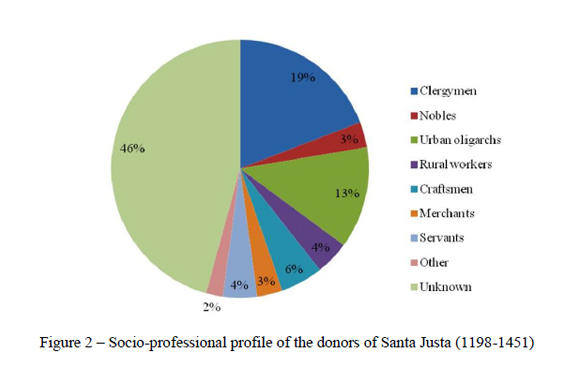
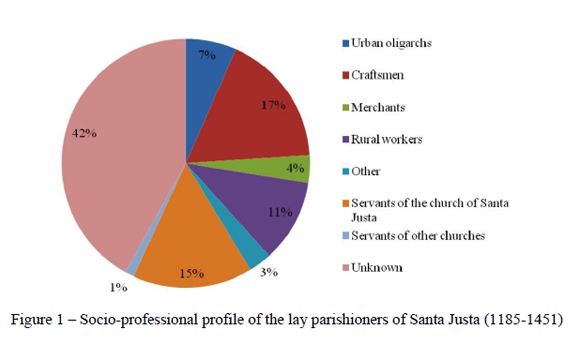
<body><![CDATA[<p>It is known that, in 1139, this church was already playing a parochial role, functioning as the parish seat of the northernmost district of the city - a territory marking the transition between the urban centre and the surrounding countryside<a name="top5"></a><sup><a href="#5">5</a></sup>. As early as the first quarter of the 13th century, we observe in this district the constitution of a chapter of <i>beneficiados</i> - recipients of benefices - gathered around the figure of the prior. The prior was head and representative of the chapter, was charged with supervising and managing economic issues which concerned the church, and was required to ensure that its pastoral and spiritual duties were carried out properly. From that time on, until the 19th century, Santa Justa de Coimbra functioned as a collegiate church, with a chapter composed of slightly more than ten <i>beneficiados</i>. It was one of seven collegiate churches in the city<a name="top6"></a><sup><a href="#6">6</a></sup>. Together with the cathedral church<a name="top7"></a><sup><a href="#7">7</a></sup> (<i>S&eacute;</i>) and the church of S. Jo&atilde;o dependent on the Monastery of Santa Cruz<a name="top8"></a><sup><a href="#8">8</a></sup>, they handled the parochial issues of Coimbra's nine parishes.</p>     <p>Analyzing the social origin of this church's <i>beneficiados</i> during the late Middle Ages<a name="top9"></a><sup><a href="#9">9</a></sup>, we see that they came mostly from within the diocese of Coimbra. With the exception of the odd element descending from urban noble families<a name="top10"></a><sup><a href="#10">10</a></sup>, the vast majority of these clerics in fact came from underprivileged groups in the Portuguese social pyramid. In their activities and social relationships, both within and outside the ecclesiastical structure to which they belonged, they were not very different from the lay community of parishioners<a name="top11"></a><sup><a href="#11">11</a></sup>.</p>     <p>Turning briefly to the origins of this larger group, this community of parishioners and donors based in Santa Justa de Coimbra - men and women, lay and ecclesiastical, who bequeathed their estates in exchange for perpetual memorial ceremonies, entrusting to the church their hopes for the salvation of their souls, requesting intercession with God in exchange for the donation of a large portion of their possessions - analysis shows that scarcely any parishioners or donors were members of the nobility. Lay parishioners in the late Middle Ages were for the most part craftsmen - potters, for example - agricultural workers and servants, some of them in the service of clergymen in this and other churches in the city (<a href="#f1">Figure 1</a>). Taking those who were specifically donors we can identify a significant set of donations coming from the urban oligarchy, including municipal officials and local representatives of the king (<a href="#f2">Figure 2</a>). Taking parishioners and donors together, however, we have to conclude that the connection between Santa Justa and the nobility is practically nonexistent<a name="top12"></a><sup><a href="#12">12</a></sup>.</p>     <p>&nbsp;</p>     <p align="center"><a name="f1"></a><img src="/img/revistas/med/n20/n20a05f1.jpg"></p>     
<p>&nbsp;</p>      <p align="center"><a name="f2"></a><img src="/img/revistas/med/n20/n20a05f2.jpg"></p>     
<p>&nbsp;</p>      <p><b>The will of Pedro Domingues (1335)</b></p>     <p>Against this background of a parochial church run by a chapter originating in an urban, labouring society, and attracting donations from a lay and ecclesiastical community with similar characteristics, the will of Pedro Domingues <i>Corpo Santo</i>, dated June 8th, 1335, is unusual<a name="top13"></a><sup><a href="#13">13</a></sup>. Under its terms was founded the Chapel of <i>Corpo Santo</i>, where daily prayers were to be said for the soul of its founder and his wife and for the soul of Dona Branca.</p>     ]]></body>
<body><![CDATA[<p>Until the day on which he signed his will the name of Pedro Domingues is completely absent from the corpus of records of those connected with the church and parish of Santa Justa. In this document, however, he prescribes that his tomb is to be located near that of his brother, whom he describes as a former cleric of the church. This was Jo&atilde;o Domingues, already known from a document of 1322<a name="top14"></a><sup><a href="#14">14</a></sup>. Pedro&rsquo;s link with the collegiate church thus seems to be his family relationship with one of its clerics.</p>     <p>The possessions he leaves to Santa Justa were located mostly in Aveiro, residence of his nephew and executor Afonso Peres <i>Cagal&atilde;o,</i> and Coimbra, probable residence of his servant Ildo Mendes, to whom he left an olive grove in the city. Given his extensive property in Aveiro one can infer that he was born there or, at least, that his ancestors had lived there. By his will, Santa Justa gains several urban properties in Aveiro, located on Rua Direita, in the Ribeira<a name="top15"></a><sup><a href="#15">15</a></sup> and adjacent to the churchyard of the church of S. Miguel de Aveiro, as well as a saltworks and a tannery on the city's outskirts. Santa Justa also gains two houses on the Rua de Quatro Cantos in Coimbra<a name="top16"></a><sup><a href="#16">16</a></sup>. These houses were on the northern edge of the parish of Santa Justa, close to the city boundary.</p>     <p>The ceremonies stipulated by Pedro Domingues for the benefit of his soul are typical of his times<a name="top17"></a><sup><a href="#17">17</a></sup>. The accumulation of memorial services particularly evident from the 15th century onwards, which multiplied chantry duties of this type, was still in the future<a name="top18"></a><sup><a href="#18">18</a></sup>. At this earlier period the usual stipulations were that memorial services should be repeated in perpetuity and should follow monthly and yearly cycles<a name="top19"></a><sup><a href="#19">19</a></sup>. The religious underpinning for the establishment of chantries, in both periods, was as a set of ceremonies intended to save the soul of the departed through intercession with the deity<a name="top20"></a><sup><a href="#20">20</a></sup>. It is nevertheless important to stress that these ceremonies were also intended to perpetuate the memory of the deceased and prevent his relegation, and possibly that of his family, to oblivion.</p>     <p>Pedro Domingues follows precisely the commonest pattern for memorial services in the Portuguese testaments of his time<a name="top21"></a><sup><a href="#21">21</a></sup>. He begins by choosing the location of his burial, which is to take place inside the church precisely where the prior and chapter of Santa Justa held celebrations for of the souls of those who were not buried in the cemetery<a name="top22"></a><sup><a href="#22">22</a></sup>. The implication is that a tomb was already reserved in the selected location, facing that of his brother, who had been a <i>beneficiado</i> of this church. Thus his choice of resting place depends primarily on proximity to his brother, emphasizing the relevance of family relations beyond death<a name="top23"></a><sup><a href="#23">23</a></sup>; yet the recognition of a spatial hierarchy inside the church is equally noteworthy, since he chooses a space where prayers will be greater in number and more individualized<a name="top24"></a><sup><a href="#24">24</a></sup>.</p>     <p>He then determines details of his funeral. He stipulates a monetary fund to accompany his body, that is, to be paid to those in charge of his body and its burial. He also prescribes an amount for the <i>pittance</i> meal to be served to those who attend his funeral service. He stipulates the presence of ecclesiastics from the Cathedral of Coimbra in the church of Santa Justa for the celebration of a mass on the day of his funeral. Still following the commonly adopted ceremonies for the salvation of the soul in 14th century Portugal, Pedro Domingues prescribes thirty masses in the first month following his death, a monthly mass until the first anniversary of his death and, subsequently, the celebration of an annual mass for the salvation of his soul<a name="top25"></a><sup><a href="#25">25</a></sup>. After stipulating these cyclically repeating ceremonies for the salvation of his soul he specifies donations to ecclesiastical institutions to which he was devoted. Despite having partly lived in Aveiro, it is interesting to note that Pedro Domingues directs his generosity exclusively to the monasteries of Coimbra. Among them, the primary recipients are the mendicant orders<a name="top26"></a><sup><a href="#26">26</a></sup> - the monasteries of Saint Francis and of Saint Dominic -, at that time believed throughout Western Europe, and particularly among city-dwellers, to be the best spiritual intercessors<a name="top27"></a><sup><a href="#27">27</a></sup>. He also favours the monasteries of Santa Cruz das Donas, Celas da Ponte and S&atilde;o Jorge<a name="top28"></a><sup><a href="#28">28</a></sup> - three monasteries belonging to the order of the Canons Regular of Saint Augustine - as well as the monastery of Celas of Guimar&atilde;es (a district in Coimbra), of the Cistercian Order<a name="top29"></a><sup><a href="#29">29</a></sup>. Apart from the mendicant orders he designates female convents only, both as recipients of his monetary legacy and as intercessors with God for the salvation of his soul. It is interesting to note that, within this donation logic, he did not contemplate the Monastery of Santa Cruz, which was, undoubtedly, the most powerful monastery in the city. Still more difficult to understand is the absence of the Monastery of Santa Clara<a name="top30"></a><sup><a href="#30">30</a></sup>, as this was a mendicant and female monastery.</p>     <p>Pedro Domingues stipulates very clearly that a chapel be founded for his soul<a name="top31"></a><sup><a href="#31">31</a></sup>, the soul of his late wife and that of the princess Dona Branca. The choice of the Santa Justa church as the location both for his burial and for the foundation of this chapel suggest that Pedro Domingues lived and would die in Coimbra, where he also made his will. At any rate he appears to have lived in more than one city in the course of his life. His chapel, known in later documents<a name="top32"></a><sup><a href="#32">32</a></sup> as the Capela do <i>Corpo Santo</i> - thus immortalizing the particular and pious by-name of its founder - is characterized by a certain liturgical complexity. Among all the documents relating to the foundation of chapels in the 14th and 15th centuries<a name="top33"></a><sup><a href="#33">33</a></sup>, this one is remarkable in the detail with which, from the outset, its liturgy is established. Pedro Domingues stipulates that the church shall appoint a suitable resident chaplain who will, every day, say a first prayer - <i>Quaesumus Domine</i> - for the soul of Dona Branca; a second prayer - <i>Omnipotens sempiterne Deus</i> - for the souls of Pedro Domingues and his wife; a third prayer - <i>Deus qui nos Patrem</i> - for his parents' souls; and, lastly, the prayers <i>Deus cujus miseratione </i>and <i>Filium Deus</i>. Finally he stipulates that this chaplain should be present at all the canonical hours for offices in the church, and assist the prior in the <i>cura animarum</i> of the parishioners if so requested. Well aware that the administration of a chapel, and of its supporting estate, would require the production and storage of numerous documents, Pedro Domingues also bequeathed a French <i>ucha</i> (ark), with two locks, to store the chapel's property and documentation.</p>     <p>The level of detail employed in the foundation of this chapel, in choosing and identifying the prayers to be said for each soul's salvation, is, as we have seen, something unique in the general run of donations for this purpose by Santa Justa's parishioners and benefactors. This can be seen as reflecting this founder's more intense spiritual life, but also a certain sophistication relating to the posts that he held and the social relationships that he built in the course of his life. With this we want to emphasize the fact that he was connected to the Portuguese Royal Court, as well as the fact that he had a clergyman as a brother.</p>     <p>His will alone, unfortunately, is not enough for us to understand his career fully. In this document Pedro Domingues calls himself a servant<a name="top34"></a><sup><a href="#34">34</a></sup> and squire<a name="top35"></a><sup><a href="#35">35</a></sup> of the princess Dona Branca. Simply defined, the term squire suggests a servant or page who carries the shield of a knight or escorts a lady, on horseback or on foot: a high-ranking servant<a name="top36"></a><sup><a href="#36">36</a></sup>. The implications will have changed in the course of centuries, slowly evolving towards the designation of a member of lower-ranking nobility, whose social distinction was based precisely on service to representatives of the highest families of the kingdom. Moreover, Pedro Domingues informs us that the Infanta granted him favours<a name="top37"></a><sup><a href="#37">37</a></sup> and raised him. Such information may mean that he was part of the court of the Infanta D. Branca, during his childhood, as was frequently the case in the Portuguese Royal Court between the 14th and the 15th centuries<a name="top38"></a><sup><a href="#38">38</a></sup>. As these young people reached puberty they were usually granted squire status and when they married they received a dowry (also called <i>merc&ecirc;</i>) from their patron. As a squire he belonged to a lower rank of the nobility, having probably attained his status as a result of his service, but he served a member of the highest families in the Iberian Peninsula and the kingdoms of Western Europe - Dona Branca de Portugal.</p>     <p>&nbsp;</p>     <p><b>The princess Dona Branca</b></p>     ]]></body>
<body><![CDATA[<p>She was the daughter of the Portuguese king Dom Afonso III<a name="top39"></a><sup><a href="#39">39</a></sup> and Dona Beatriz Afonso<a name="top40"></a><sup><a href="#40">40</a></sup>, maternal granddaughter of king Alfonso X &lsquo;the Wise&rsquo; of Castile, great-niece of Branca de Castela, second cousin of king Lou&iacute;s IX of France. In addition she was the elder sister of the Portuguese king Dom Dinis and the niece of Sancho IV, king of Castile. Dona Branca<a name="top41"></a><sup><a href="#41">41</a></sup>, firstborn child of the king and queen of Portugal, is thought to have been born in Santar&eacute;m towards the end of February 1259. At the age of two she received, by her father's royal gift, the castle of Montemor-o-Velho<a name="top42"></a><sup><a href="#42">42</a></sup>, which she had inherited from her great-aunt Dona Teresa, daughter of Dom Sancho I<a name="top43"></a><sup><a href="#43">43</a></sup>. When she was 18 her father granted her, at her request, the right of patronage over the church of Santa Maria<a name="top44"></a><sup><a href="#44">44</a></sup>in the same town. We know that, around that time, the princess did in fact assert her rights in Montemor-o-Velho, since her father was compelled to respond favourably to certain claims by privileged groups from whom her officials had improperly demanded taxes<a name="top45"></a><sup><a href="#45">45</a></sup>. Around the same time, in 1277, she was received as the lady of the Lorv&atilde;o convent, one of the most powerful in the Coimbra area, a title previously held by her great-aunt Dona Teresa<a name="top46"></a><sup><a href="#46">46</a></sup>.</p>     <p>Following the death of Dom Afonso III, in 1279, Dona Branca took to staying for long periods, in the company of her mother, in the kingdom of Castile. One reason for their long sojourns in the neighbouring kingdom was to show solidarity with Alfonso X who, at that time, was in conflict with his son and heir, but among Dona Beatriz&rsquo;s main concerns in this period was to retain in her possession the very rich estates she had inherited in 1279. Dona Branca and her mother thus spent several years in Castile (where, in 1284, they witnessed Alfonso X's will). At that point it seems that while Dona Branca remained in Castile to manage the estate, her mother returned to Portugal. At the start of the 14th century, however, we find Dona Branca once again close to her mother, whose last days were spent in Portugal in her palace at Torres Vedras. Thus ended the apparently very close relationship between the queen and her firstborn, who was her most assiduous companion.</p>     <p>Dona Branca had been Lady of Cifuentes since 1285 and Lady and patron of the powerful monastery of <i>Las Huelgas</i> de Burgos since 1295. Her mother had been the main reason that brought her to Portugal from time to time, so after the queen&rsquo;s death we note the total absence of any mention of Dona Branca in Portuguese documents. She lived her last decades in Castile, as Lady of Las Huelgas, where she died on April 17th 1321, two days after the writing of her will<a name="top47"></a><sup><a href="#47">47</a></sup>. This outline of the princess's biography shows that her life was divided between the two peninsular kingdoms, and that she spent her last decades in Castile. In her will the princess favoured a large group of relatives, including her nieces, and a long list of servants and clerics who belonged to the network of relationships of the last years of her life. Absent from the kingdom of Portugal for many years, she mentioned neither Pedro Domingues <i>Corpo Santo </i>nor any other Portuguese servant in her will.</p>     <p>Pedro Domingues, too,probably had a life marked by geographical mobility, but nothing indicates that he lived in Castile. Possibly, then, this squire to the princess was in her service in the 1270s; perhaps he was one of her young servants in the royal court or he was part of the group of officials who managed her possessions around Montemor-o-Velho. But to propose any firm link between the two, based on currently available information, would be mere speculation and would in no way assist the progress of studies on European royal houses.</p>     <p>&nbsp;</p>     <p align="center"><b>II</b></p>     <p>This case study focuses on a squire and servant to a princess of Portugal. We know that around the royal family was woven a web of relationships of service and clientele which we can hardly hope to reconstruct in full. But the study of Pedro Domingues&rsquo; will allows us to identify one of the agents in those relationships, to characterize him in social terms, and to understand his attitude towards death.</p>     <p>Despite being extremely difficult to define in social terms, these squires seem to have belonged to a group, especially in an urban context, commonly identified by historians as &quot;notables&quot; or the &quot;elite&quot;<a name="top48"></a><sup><a href="#48">48</a></sup> and who, in the 19th century, would come to be known as the bourgeoisie<a name="top49"></a><sup><a href="#49">49</a></sup>. Indeed, the testament of Pedro Domingues expresses a certain reverence, fidelity and obedience towards his princess. The long period over which this link endured in memory is noteworthy, if we consider that he wrote his will in 1335, fourteen years after her death and more than three decades after she moved to Castile. This suggests that the position of servant to the princess Dona Branca was the most prestigious that he ever held.</p>     <p>Presenting himself as squire to the princess, even though he must have been so several decades earlier, elevated him to a higher social position and no doubt conferred prestige on him personally. By founding his chapel with the stipulation that it be for the soul of a royal princess, for his own and his wife&rsquo;s soul, Pedro Domingues strengthened his loyalty to that lady and paid her the most enduring tribute that he could. In so doing he certainly wished to see his and his family's names forever remembered in conjunction with hers. In this way, his memory and the memory of his relatives would be invoked, in the church of Santa Justa de Coimbra, alongside the name of one of the noblest ladies in the kingdoms of Portugal and Castile. Portuguese and European historiography has emphasized how these elites founded chantries and memorial services similar to those of the high nobility as a form of social mimicry<a name="top50"></a><sup><a href="#50">50</a></sup>. This particular example appears to show a similar attitude.</p>     <p>&nbsp;</p>     ]]></body>
<body><![CDATA[<p><b>Concluding remarks</b></p>     <p>The present study demonstrates once more the relevance of testaments to questions surrounding the mindset and the religious beliefs of medieval people within the contexts of death and of the social and family structures to which they belonged. We have highlighted a squire&rsquo;s relationships of service and obedience to the memory of a member of the Portuguese royal family and the form in which that relationship was expressed.</p>     <p>It is not easy to define and characterise the social position of a squire, to be placed, we believe, in the &quot;urban aristocracy&quot;. The development of case studies such as this should allow in the future for a more global and integrated analysis of the squire&rsquo;s profile and collective behaviour. For this purpose the analysis of communities surrounding urban parish churches will be more fundamental than that of the great cathedrals and main monasteries of a city. We can hope to recognize in these churches, and on the part of such notable urban individuals, behaviour that is similar, though on a different scale, to what in the main religious centres of a city is shown by great secular and ecclesiastical figures - though the ceremonies stipulated by the latter would incur higher monetary costs and result in relatively greater social prestige.</p>     <p>&nbsp;</p>     <p><b>REFER&Ecirc;NCIAS BIBLIOGR&Aacute;FICAS</b></p>     <p><b>Fontes</b></p>     <!-- ref --><p>GARRIDO, Araceli Castro - <i>Documentaci&oacute;n del Monasterio de las Huelgas de Burgos (1307-1321). Fuentes Medievales castellano-leonesas</i>, n. 34. Burgos: J.M. Garrido Garrido, 1987.    &nbsp;&nbsp;&nbsp;&nbsp;&nbsp;&nbsp;&nbsp;&nbsp;[&#160;<a href="javascript:void(0);" onclick="javascript: window.open('/scielo.php?script=sci_nlinks&ref=1486462&pid=S1646-740X201600020000500001&lng=','','width=640,height=500,resizable=yes,scrollbars=1,menubar=yes,');">Links</a>&#160;]<!-- end-ref --></p>     <!-- ref --><p>PAIVA, Jos&eacute; Pedro (ed.) - <i>Portugaliae Monumenta Misericordiarum</i>. Vol. 2. Lisboa: Uni&atilde;o das Miseric&oacute;rdias Portuguesas, 2002.    &nbsp;&nbsp;&nbsp;&nbsp;&nbsp;&nbsp;&nbsp;&nbsp;[&#160;<a href="javascript:void(0);" onclick="javascript: window.open('/scielo.php?script=sci_nlinks&ref=1486464&pid=S1646-740X201600020000500002&lng=','','width=640,height=500,resizable=yes,scrollbars=1,menubar=yes,');">Links</a>&#160;]<!-- end-ref --></p>     ]]></body>
<body><![CDATA[<!-- ref --><p>VENTURA, Leontina - <i>Chancelaria de Afonso III.</i> Coimbra: Imprensa da Universidade, 2006.    &nbsp;&nbsp;&nbsp;&nbsp;&nbsp;&nbsp;&nbsp;&nbsp;[&#160;<a href="javascript:void(0);" onclick="javascript: window.open('/scielo.php?script=sci_nlinks&ref=1486466&pid=S1646-740X201600020000500003&lng=','','width=640,height=500,resizable=yes,scrollbars=1,menubar=yes,');">Links</a>&#160;]<!-- end-ref --></p>     <p>&nbsp;</p>     <p><b>Estudos</b></p>     <!-- ref --><p>ARI&Eacute;S, Philippe - <i>O Homem perante a morte</i>. Lisboa: Europa-Am&eacute;rica, 1988.    &nbsp;&nbsp;&nbsp;&nbsp;&nbsp;&nbsp;&nbsp;&nbsp;[&#160;<a href="javascript:void(0);" onclick="javascript: window.open('/scielo.php?script=sci_nlinks&ref=1486470&pid=S1646-740X201600020000500004&lng=','','width=640,height=500,resizable=yes,scrollbars=1,menubar=yes,');">Links</a>&#160;]<!-- end-ref --></p>     <!-- ref --><p>BALDAC&Oacute; ALCOZ, Julia; GARC&Iacute;A DE LA BORBOLLA, &Aacute;ngeles; PAV&Oacute;N BENITO, Julia - &quot;Registrar la muerte (1371-1512). Un an&aacute;lisis de testamentos y mandas p&iacute;as contenidos en los protocolos notariales navarros&quot;<i>. Hisp&acirc;nia</i>, LXV/1, n. 219 (2005), pp. 15-226.    &nbsp;&nbsp;&nbsp;&nbsp;&nbsp;&nbsp;&nbsp;&nbsp;[&#160;<a href="javascript:void(0);" onclick="javascript: window.open('/scielo.php?script=sci_nlinks&ref=1486472&pid=S1646-740X201600020000500005&lng=','','width=640,height=500,resizable=yes,scrollbars=1,menubar=yes,');">Links</a>&#160;]<!-- end-ref --></p>     <!-- ref --><p>BARATA, Filipe Themudo (ed.) - <i>Elites e redes clientelares na Idade M&eacute;dia: problemas metodol&oacute;gicos: actas do col&oacute;quio</i>. Lisboa / &Eacute;vora: Edi&ccedil;&otilde;es Colibri / Centro Interdisciplinar de Hist&oacute;ria, Culturas e Sociedades da Universidade de &Eacute;vora, 2001.    &nbsp;&nbsp;&nbsp;&nbsp;&nbsp;&nbsp;&nbsp;&nbsp;[&#160;<a href="javascript:void(0);" onclick="javascript: window.open('/scielo.php?script=sci_nlinks&ref=1486474&pid=S1646-740X201600020000500006&lng=','','width=640,height=500,resizable=yes,scrollbars=1,menubar=yes,');">Links</a>&#160;]<!-- end-ref --></p>     ]]></body>
<body><![CDATA[<!-- ref --><p>BASTOS, Maria do Ros&aacute;rio - &quot;Prescri&ccedil;&otilde;es sinodais sobre o culto dos mortos nos s&eacute;culos XII a XVI&quot;. in MATTOSO, Jos&eacute; (dir.) - <i>O reino dos mortos na Idade M&eacute;dia peninsular</i>. Lisboa: Edi&ccedil;&otilde;es Jo&atilde;o S&aacute; da Costa, 1996, pp. 109-124.    &nbsp;&nbsp;&nbsp;&nbsp;&nbsp;&nbsp;&nbsp;&nbsp;[&#160;<a href="javascript:void(0);" onclick="javascript: window.open('/scielo.php?script=sci_nlinks&ref=1486476&pid=S1646-740X201600020000500007&lng=','','width=640,height=500,resizable=yes,scrollbars=1,menubar=yes,');">Links</a>&#160;]<!-- end-ref --></p>     <!-- ref --><p>BEIRANTE, &Acirc;ngela - &quot;Os diferentes tipos de solidariedade na Cidade Medieval. O exemplo de &Eacute;vora&quot;. in <i>Arqueologia do Estado: Ias Jornadas sobre formas de organiza&ccedil;&atilde;o e exerc&iacute;cio dos poderes na Europa do Sul, s&eacute;culos XIII-XVIII: comunica&ccedil;&otilde;es</i>. Vol.1. Lisboa: Hist&oacute;ria &amp; Cr&iacute;tica, 1988, pp. 48-51.    &nbsp;&nbsp;&nbsp;&nbsp;&nbsp;&nbsp;&nbsp;&nbsp;[&#160;<a href="javascript:void(0);" onclick="javascript: window.open('/scielo.php?script=sci_nlinks&ref=1486478&pid=S1646-740X201600020000500008&lng=','','width=640,height=500,resizable=yes,scrollbars=1,menubar=yes,');">Links</a>&#160;]<!-- end-ref --></p>     <!-- ref --><p>BERNARDINO, Sandra Virg&iacute;nia Pereira Gon&ccedil;alves - <i>Sancius Secundus Rex Portugalensis: a chancelaria de D. Sancho II (1223-1248).</i> Coimbra: Faculdade de Letras, 2003. Masters Dissertation.    &nbsp;&nbsp;&nbsp;&nbsp;&nbsp;&nbsp;&nbsp;&nbsp;[&#160;<a href="javascript:void(0);" onclick="javascript: window.open('/scielo.php?script=sci_nlinks&ref=1486480&pid=S1646-740X201600020000500009&lng=','','width=640,height=500,resizable=yes,scrollbars=1,menubar=yes,');">Links</a>&#160;]<!-- end-ref --></p>     <!-- ref --><p>BISHKO, Charles Julian - &quot;The Cluniac Priories of Galicia and Portugal: their adquisition and administration&quot;. <i>Studia Monastica</i>, VII/2 (1965), pp. 305-356.    &nbsp;&nbsp;&nbsp;&nbsp;&nbsp;&nbsp;&nbsp;&nbsp;[&#160;<a href="javascript:void(0);" onclick="javascript: window.open('/scielo.php?script=sci_nlinks&ref=1486482&pid=S1646-740X201600020000500010&lng=','','width=640,height=500,resizable=yes,scrollbars=1,menubar=yes,');">Links</a>&#160;]<!-- end-ref --></p>     <!-- ref --><p>BLUTEAU, Raphael - <i>Vocabulario Portuguez &amp; Latino, aulico, anatomico, architectonico...</i> [Online]. Coimbra: Collegio das artes da Companhia de Jesus, 1728, sv. [Last consulted 13 May 2016]. Available at <a href="http://purl.pt/13969/3/l-2772-a/l-2772-a_item3/index.html#/824" target="_blank">http://purl.pt/13969/3/l-2772-a/l-2772-a_item3/index.html#/824</a>&nbsp;&nbsp;&nbsp;&nbsp;&nbsp;&nbsp;&nbsp;&nbsp;[&#160;<a href="javascript:void(0);" onclick="javascript: window.open('/scielo.php?script=sci_nlinks&ref=1486484&pid=S1646-740X201600020000500011&lng=','','width=640,height=500,resizable=yes,scrollbars=1,menubar=yes,');">Links</a>&#160;]<!-- end-ref --><!-- ref --><p>BRANCO, Maria Jo&atilde;o - <i>Aveiro Medieval</i>. Aveiro: C&acirc;mara Municipal, 1997.    &nbsp;&nbsp;&nbsp;&nbsp;&nbsp;&nbsp;&nbsp;&nbsp;[&#160;<a href="javascript:void(0);" onclick="javascript: window.open('/scielo.php?script=sci_nlinks&ref=1486485&pid=S1646-740X201600020000500012&lng=','','width=640,height=500,resizable=yes,scrollbars=1,menubar=yes,');">Links</a>&#160;]<!-- end-ref --></p>     <!-- ref --><p>BRANCO, Maria Jo&atilde;o - &quot;Aveiro&quot;. in MARQUES, A.H. de Oliveira, GON&Ccedil;ALVES, Iria and ANDRADE, Am&eacute;lia Aguiar (coord.) - <i>Atlas de cidades medievais portuguesas: s&eacute;culos XII-XV</i>. Lisboa: Centro de Estudos Hist&oacute;ricos da Universidade Nova e INIC, 1990.    &nbsp;&nbsp;&nbsp;&nbsp;&nbsp;&nbsp;&nbsp;&nbsp;[&#160;<a href="javascript:void(0);" onclick="javascript: window.open('/scielo.php?script=sci_nlinks&ref=1486487&pid=S1646-740X201600020000500013&lng=','','width=640,height=500,resizable=yes,scrollbars=1,menubar=yes,');">Links</a>&#160;]<!-- end-ref --></p>     <p>BURGESS, Clive - &quot;Chantries in the Parish, or &lsquo;Through the Looking-Glass&rsquo;&quot;. <i>Journal of the British Archaeological Association</i>, Vol. 164, n. 1 (September 2011), pp. 100-129.</p>     <!-- ref --><p>CAMPOS, Maria Am&eacute;lia &Aacute;lvaro de - &quot;O rural e o urbano nas freguesias de Coimbra nos s&eacute;culos XIII e XIV&quot;. <i>Revista Portuguesa de Hist&oacute;ria</i>, LXI (2010), pp. 157-174.    &nbsp;&nbsp;&nbsp;&nbsp;&nbsp;&nbsp;&nbsp;&nbsp;[&#160;<a href="javascript:void(0);" onclick="javascript: window.open('/scielo.php?script=sci_nlinks&ref=1486490&pid=S1646-740X201600020000500015&lng=','','width=640,height=500,resizable=yes,scrollbars=1,menubar=yes,');">Links</a>&#160;]<!-- end-ref --></p>     <!-- ref --><p>- <i>Santa Justa de Coimbra na Idade M&eacute;dia: o espa&ccedil;o urbano, religioso e socio-econ&oacute;mico</i>. Coimbra: Faculdade de Letras, 2012. Doctoral dissertation.    &nbsp;&nbsp;&nbsp;&nbsp;&nbsp;&nbsp;&nbsp;&nbsp;[&#160;<a href="javascript:void(0);" onclick="javascript: window.open('/scielo.php?script=sci_nlinks&ref=1486492&pid=S1646-740X201600020000500016&lng=','','width=640,height=500,resizable=yes,scrollbars=1,menubar=yes,');">Links</a>&#160;]<!-- end-ref --></p>     <!-- ref --><p>- &quot;Popula&ccedil;&atilde;o e fam&iacute;lia na freguesia de Santa Justa de Coimbra nos s&eacute;culos XIII a XV&quot;. in <i>Actas do I Congresso Hist&oacute;rico Internacional as Cidades na Hist&oacute;ria: Popula&ccedil;&atilde;o, 24 a 26 de outubro de 2012, Cidade Medieval</i>. Guimar&atilde;es: C&acirc;mara Municipal, 2012, pp. 227-252.    &nbsp;&nbsp;&nbsp;&nbsp;&nbsp;&nbsp;&nbsp;&nbsp;[&#160;<a href="javascript:void(0);" onclick="javascript: window.open('/scielo.php?script=sci_nlinks&ref=1486494&pid=S1646-740X201600020000500017&lng=','','width=640,height=500,resizable=yes,scrollbars=1,menubar=yes,');">Links</a>&#160;]<!-- end-ref --></p>     ]]></body>
<body><![CDATA[<!-- ref --><p>- &quot;Marcos de refer&ecirc;ncia e top&oacute;nimos da cidade medieval portuguesa: o exemplo de Coimbra nos s&eacute;culos XIV e XV&quot;. <i>Revista de Hist&oacute;ria da Sociedade e da Cultura</i>, n. 13 (2013), pp. 157-176.    &nbsp;&nbsp;&nbsp;&nbsp;&nbsp;&nbsp;&nbsp;&nbsp;[&#160;<a href="javascript:void(0);" onclick="javascript: window.open('/scielo.php?script=sci_nlinks&ref=1486496&pid=S1646-740X201600020000500018&lng=','','width=640,height=500,resizable=yes,scrollbars=1,menubar=yes,');">Links</a>&#160;]<!-- end-ref --></p>     <!-- ref --><p>- &quot;Coimbra's parochial network: aspects of its definition in the 12th century&quot;. in <i>The Ecclesiastics and the Political State Building of Iberian Monarchies, 13th-15th centuries</i>, e-book. &Eacute;vora: CIDHEUS, in press.    &nbsp;&nbsp;&nbsp;&nbsp;&nbsp;&nbsp;&nbsp;&nbsp;[&#160;<a href="javascript:void(0);" onclick="javascript: window.open('/scielo.php?script=sci_nlinks&ref=1486498&pid=S1646-740X201600020000500019&lng=','','width=640,height=500,resizable=yes,scrollbars=1,menubar=yes,');">Links</a>&#160;]<!-- end-ref --></p>     <!-- ref --><p>COELHO, Maria Helena da Cruz - &quot;Um testamento redigido em Coimbra no tempo da Peste Negra&quot;. <i>Revista Portuguesa de Hist&oacute;ria</i>, XVIII (1980), pp. 312-331.    &nbsp;&nbsp;&nbsp;&nbsp;&nbsp;&nbsp;&nbsp;&nbsp;[&#160;<a href="javascript:void(0);" onclick="javascript: window.open('/scielo.php?script=sci_nlinks&ref=1486500&pid=S1646-740X201600020000500020&lng=','','width=640,height=500,resizable=yes,scrollbars=1,menubar=yes,');">Links</a>&#160;]<!-- end-ref --></p>     <!-- ref --><p>- &quot;Coimbra Medieval: Uma cidade em matura&ccedil;&atilde;o&quot;. in ALARC&Atilde;O, Ad&iacute;lia (coord.) - <i>Invent&aacute;rio do Museu Nacional Machado Castro. Colec&ccedil;&atilde;o de Ourivesaria</i> <i>Medieval. S&eacute;culos XII-XIV</i>. Lisboa: Instituto Portugu&ecirc;s de Museus, 2008, pp. 29-47.    &nbsp;&nbsp;&nbsp;&nbsp;&nbsp;&nbsp;&nbsp;&nbsp;[&#160;<a href="javascript:void(0);" onclick="javascript: window.open('/scielo.php?script=sci_nlinks&ref=1486502&pid=S1646-740X201600020000500021&lng=','','width=640,height=500,resizable=yes,scrollbars=1,menubar=yes,');">Links</a>&#160;]<!-- end-ref --></p>     <!-- ref --><p>COELHO, Maria Helena da Cruz and MORUJ&Atilde;O, Maria do Ros&aacute;rio - &quot;Les testaments du clerg&eacute; de Coimbra: des individus aux r&eacute;seaux sociaux&quot;. in <i>Carreiras eclesi&aacute;sticas no ocidente crist&atilde;o (s&eacute;culos XII-XIV)</i>. Lisboa: CEHR/UCP, 2007, pp. 123-140.    &nbsp;&nbsp;&nbsp;&nbsp;&nbsp;&nbsp;&nbsp;&nbsp;[&#160;<a href="javascript:void(0);" onclick="javascript: window.open('/scielo.php?script=sci_nlinks&ref=1486504&pid=S1646-740X201600020000500022&lng=','','width=640,height=500,resizable=yes,scrollbars=1,menubar=yes,');">Links</a>&#160;]<!-- end-ref --></p>     ]]></body>
<body><![CDATA[<!-- ref --><p>COSTA, Adelaide Pereira Mill&aacute;n da - <i>Projec&ccedil;&atilde;o Espacial de Dom&iacute;nios. Das Rela&ccedil;&otilde;es de Poder Ao Burgo Portuense (1385-1502)</i>. Lisboa: Universidade Aberta, 1999. Doctoral Dissertation. [Online]. [Last consulted 17 May 2016]. Available at <a href="http://repositorioaberto.uab.pt/handle/10400.2/2426" target="_blank">http://repositorioaberto.uab.pt/handle/10400.2/2426</a>&nbsp;&nbsp;&nbsp;&nbsp;&nbsp;&nbsp;&nbsp;&nbsp;[&#160;<a href="javascript:void(0);" onclick="javascript: window.open('/scielo.php?script=sci_nlinks&ref=1486506&pid=S1646-740X201600020000500023&lng=','','width=640,height=500,resizable=yes,scrollbars=1,menubar=yes,');">Links</a>&#160;]<!-- end-ref --><!-- ref --><p>- &quot;O espa&ccedil;o dos vivos e o espa&ccedil;o dos mortos nas cidades da Baixa Idade M&eacute;dia&quot;. MATTOSO, Jos&eacute; (dir.) - <i>O Reino dos Mortos na Idade M&eacute;dia peninsular</i>. Lisboa: Jo&atilde;o S&aacute; da Costa, 1996, pp. 177-185.    &nbsp;&nbsp;&nbsp;&nbsp;&nbsp;&nbsp;&nbsp;&nbsp;[&#160;<a href="javascript:void(0);" onclick="javascript: window.open('/scielo.php?script=sci_nlinks&ref=1486507&pid=S1646-740X201600020000500024&lng=','','width=640,height=500,resizable=yes,scrollbars=1,menubar=yes,');">Links</a>&#160;]<!-- end-ref --></p>     <!-- ref --><p>COSTA, Avelino de Jesus da - <i>A Ordem de Cluny em Portugal</i>. Braga: Cen&aacute;culo, 1948.    &nbsp;&nbsp;&nbsp;&nbsp;&nbsp;&nbsp;&nbsp;&nbsp;[&#160;<a href="javascript:void(0);" onclick="javascript: window.open('/scielo.php?script=sci_nlinks&ref=1486509&pid=S1646-740X201600020000500025&lng=','','width=640,height=500,resizable=yes,scrollbars=1,menubar=yes,');">Links</a>&#160;]<!-- end-ref --></p>     <!-- ref --><p>- <i>Normas gerais de transcri&ccedil;&atilde;o e publica&ccedil;&atilde;o de documentos e textos medievais e modernos</i>. Coimbra: Universidade, Instituto de Paleografia e Diplom&aacute;tica, 1993.    &nbsp;&nbsp;&nbsp;&nbsp;&nbsp;&nbsp;&nbsp;&nbsp;[&#160;<a href="javascript:void(0);" onclick="javascript: window.open('/scielo.php?script=sci_nlinks&ref=1486511&pid=S1646-740X201600020000500026&lng=','','width=640,height=500,resizable=yes,scrollbars=1,menubar=yes,');">Links</a>&#160;]<!-- end-ref --></p>     <!-- ref --><p>DOBSON, R. B. - &quot;The foundation of perpetual chantries by the citizens of medieval York&quot;. in <i>Church and Society in the Medieval North of England</i>. London: Hambledon Press, 1996, pp. 253-266.    &nbsp;&nbsp;&nbsp;&nbsp;&nbsp;&nbsp;&nbsp;&nbsp;[&#160;<a href="javascript:void(0);" onclick="javascript: window.open('/scielo.php?script=sci_nlinks&ref=1486513&pid=S1646-740X201600020000500027&lng=','','width=640,height=500,resizable=yes,scrollbars=1,menubar=yes,');">Links</a>&#160;]<!-- end-ref --></p>     <!-- ref --><p>DUARTE, Lu&iacute;s Miguel - &quot;Os melhores da terra (um question&aacute;rio para o caso portugu&ecirc;s)&quot;. in BARATA, Filipe Themudo (ed.) - <i>Elites e redes clientelares na Idade M&eacute;dia: problemas metodol&oacute;gicos: actas do col&oacute;quio</i>. Lisboa / &Eacute;vora: Edi&ccedil;&otilde;es Colibri / Centro Interdisciplinar de Hist&oacute;ria, Culturas e Sociedades da Universidade de &Eacute;vora, 2001, pp. 104-106.    &nbsp;&nbsp;&nbsp;&nbsp;&nbsp;&nbsp;&nbsp;&nbsp;[&#160;<a href="javascript:void(0);" onclick="javascript: window.open('/scielo.php?script=sci_nlinks&ref=1486515&pid=S1646-740X201600020000500028&lng=','','width=640,height=500,resizable=yes,scrollbars=1,menubar=yes,');">Links</a>&#160;]<!-- end-ref --></p>     <p>FERNANDES, Carla Varela; MORUJ&Atilde;O, Maria do Ros&aacute;rio and SARAIVA, An&iacute;sio - &quot;M&eacute;moire au-del&agrave; de la mort: les &eacute;v&ecirc;ques portugais et leurs monuments tumulaires au Moyen &Acirc;ge&quot;. in BOCK, Nicolas, FOLETTI, Ivan and TOMASI, Michele (Ed.) - <i>L&rsquo;&eacute;v&ecirc;que, l&rsquo;image et la mort: identit&eacute; et m&eacute;moire au Moyen &Acirc;ge</i>. Roma: Viella, 2014, pp. 141-189.</p>     <!-- ref --><p>GOMES, Rita Costa - <i>A corte dos reis de Portugal no final da Idade M&eacute;dia</i>. Lisboa: Difel, 1995.    &nbsp;&nbsp;&nbsp;&nbsp;&nbsp;&nbsp;&nbsp;&nbsp;[&#160;<a href="javascript:void(0);" onclick="javascript: window.open('/scielo.php?script=sci_nlinks&ref=1486518&pid=S1646-740X201600020000500030&lng=','','width=640,height=500,resizable=yes,scrollbars=1,menubar=yes,');">Links</a>&#160;]<!-- end-ref --></p>     <!-- ref --><p>GOMES, Saul - &quot;As ordens mendicantes na Coimbra medieval: notas e documentos&quot;. <i>Lusitania Sacra</i>, 2&ordf; s&eacute;rie, n. 10 (1998), pp. 149-215.    &nbsp;&nbsp;&nbsp;&nbsp;&nbsp;&nbsp;&nbsp;&nbsp;[&#160;<a href="javascript:void(0);" onclick="javascript: window.open('/scielo.php?script=sci_nlinks&ref=1486520&pid=S1646-740X201600020000500031&lng=','','width=640,height=500,resizable=yes,scrollbars=1,menubar=yes,');">Links</a>&#160;]<!-- end-ref --></p>     <!-- ref --><p>- &quot;Coimbra: Aspectos da Sua Paisagem Urbana em Tempos Medievos&quot;. <i>Biblos</i>, IV (2006), pp. 125-163.    &nbsp;&nbsp;&nbsp;&nbsp;&nbsp;&nbsp;&nbsp;&nbsp;[&#160;<a href="javascript:void(0);" onclick="javascript: window.open('/scielo.php?script=sci_nlinks&ref=1486522&pid=S1646-740X201600020000500032&lng=','','width=640,height=500,resizable=yes,scrollbars=1,menubar=yes,');">Links</a>&#160;]<!-- end-ref --></p>     <!-- ref --><p>- In limine conscriptionis<i>: documentos, chancelaria e cultura no Mosteiro de Santa Cruz de Coimbra: s&eacute;culos XII a XIV</i>. Viseu: Palimage Editores: CHSC, 2007.    &nbsp;&nbsp;&nbsp;&nbsp;&nbsp;&nbsp;&nbsp;&nbsp;[&#160;<a href="javascript:void(0);" onclick="javascript: window.open('/scielo.php?script=sci_nlinks&ref=1486524&pid=S1646-740X201600020000500033&lng=','','width=640,height=500,resizable=yes,scrollbars=1,menubar=yes,');">Links</a>&#160;]<!-- end-ref --></p>     ]]></body>
<body><![CDATA[<!-- ref --><p>- &quot;Um registo de contabilidade medieval do Mosteiro de S. Jorge de Coimbra (1257-1259)&quot;. <i>Medievalista</i> [Online]. N. 10 (Julho-Dezembro 2011). [Last consulted 15 Sep. 2015]. Available at <a href="http://medievalista.revues.org/118" target="_blank">http://medievalista.revues.org/118</a>&nbsp;&nbsp;&nbsp;&nbsp;&nbsp;&nbsp;&nbsp;&nbsp;[&#160;<a href="javascript:void(0);" onclick="javascript: window.open('/scielo.php?script=sci_nlinks&ref=1486526&pid=S1646-740X201600020000500034&lng=','','width=640,height=500,resizable=yes,scrollbars=1,menubar=yes,');">Links</a>&#160;]<!-- end-ref --><!-- ref --><p>GUARDADO, Maria Cristina Gon&ccedil;alves - <i>A colegiada de S. Bartolomeu de Coimbra em tempos medievais: das origens ao in&iacute;cio do s&eacute;c. XV</i>. Coimbra: Faculdade de Letras, 2000. Masters Dissertation.    &nbsp;&nbsp;&nbsp;&nbsp;&nbsp;&nbsp;&nbsp;&nbsp;[&#160;<a href="javascript:void(0);" onclick="javascript: window.open('/scielo.php?script=sci_nlinks&ref=1486527&pid=S1646-740X201600020000500035&lng=','','width=640,height=500,resizable=yes,scrollbars=1,menubar=yes,');">Links</a>&#160;]<!-- end-ref --></p>     <!-- ref --><p>LAWRENCE, C. H. - <i>The Friars. </i><i>The impact of the Mendicant orders on Medieval Society</i>. London/ New York: I. B. Tauris, 2013.    &nbsp;&nbsp;&nbsp;&nbsp;&nbsp;&nbsp;&nbsp;&nbsp;[&#160;<a href="javascript:void(0);" onclick="javascript: window.open('/scielo.php?script=sci_nlinks&ref=1486529&pid=S1646-740X201600020000500036&lng=','','width=640,height=500,resizable=yes,scrollbars=1,menubar=yes,');">Links</a>&#160;]<!-- end-ref --></p>     <!-- ref --><p>MARTINS, Armando Alberto - <i>O Mosteiro de Santa Cruz de Coimbra na Idade M&eacute;dia</i>. Lisboa: Centro de Hist&oacute;ria da Universidade, 2003.    &nbsp;&nbsp;&nbsp;&nbsp;&nbsp;&nbsp;&nbsp;&nbsp;[&#160;<a href="javascript:void(0);" onclick="javascript: window.open('/scielo.php?script=sci_nlinks&ref=1486531&pid=S1646-740X201600020000500037&lng=','','width=640,height=500,resizable=yes,scrollbars=1,menubar=yes,');">Links</a>&#160;]<!-- end-ref --></p>     <!-- ref --><p>MATOS, Jo&atilde;o da Cunha - <i>A Colegiada de S&atilde;o Crist&oacute;v&atilde;o de Coimbra (s&eacute;cs. XII e XIII)</i>. Tomar, 1998 (Academic study).    &nbsp;&nbsp;&nbsp;&nbsp;&nbsp;&nbsp;&nbsp;&nbsp;[&#160;<a href="javascript:void(0);" onclick="javascript: window.open('/scielo.php?script=sci_nlinks&ref=1486533&pid=S1646-740X201600020000500038&lng=','','width=640,height=500,resizable=yes,scrollbars=1,menubar=yes,');">Links</a>&#160;]<!-- end-ref --></p>     <!-- ref --><p>MATTOSO, Jos&eacute; (dir.) - <i>O Reino dos Mortos na Idade M&eacute;dia peninsular</i>. Lisboa: Jo&atilde;o S&aacute; da Costa, 1996.    &nbsp;&nbsp;&nbsp;&nbsp;&nbsp;&nbsp;&nbsp;&nbsp;[&#160;<a href="javascript:void(0);" onclick="javascript: window.open('/scielo.php?script=sci_nlinks&ref=1486535&pid=S1646-740X201600020000500039&lng=','','width=640,height=500,resizable=yes,scrollbars=1,menubar=yes,');">Links</a>&#160;]<!-- end-ref --></p>     <!-- ref --><p>MORUJ&Atilde;O, Ros&aacute;rio - <i>Um Mosteiro Cisterciense Feminino: Santa Maria de Celas: s&eacute;culos XIII a XV</i>. Coimbra: Biblioteca Geral da Universidade, 2001.    &nbsp;&nbsp;&nbsp;&nbsp;&nbsp;&nbsp;&nbsp;&nbsp;[&#160;<a href="javascript:void(0);" onclick="javascript: window.open('/scielo.php?script=sci_nlinks&ref=1486537&pid=S1646-740X201600020000500040&lng=','','width=640,height=500,resizable=yes,scrollbars=1,menubar=yes,');">Links</a>&#160;]<!-- end-ref --></p>     <!-- ref --><p>- <i>A S&eacute; de Coimbra: a institui&ccedil;&atilde;o e a chancelaria (1080-1318)</i>. Lisboa: Funda&ccedil;&atilde;o Calouste Gulbenkian, 2010.    &nbsp;&nbsp;&nbsp;&nbsp;&nbsp;&nbsp;&nbsp;&nbsp;[&#160;<a href="javascript:void(0);" onclick="javascript: window.open('/scielo.php?script=sci_nlinks&ref=1486539&pid=S1646-740X201600020000500041&lng=','','width=640,height=500,resizable=yes,scrollbars=1,menubar=yes,');">Links</a>&#160;]<!-- end-ref --></p>     <!-- ref --><p>OLIVEIRA, Ant&oacute;nio Resende de - &quot;D. Beatriz Afonso&quot;. in MARQUES, Maria Alegria, et. al. - <i>As primeiras rainhas: Mafalda de Mouriana, Dulce de Barcelona e Arag&atilde;o, Urraca de Castela, Mecia Lopes de Haro, Beatriz Afonso</i>. Lisboa: C&iacute;rculo de Leitores, 2012, pp. 418-440.    &nbsp;&nbsp;&nbsp;&nbsp;&nbsp;&nbsp;&nbsp;&nbsp;[&#160;<a href="javascript:void(0);" onclick="javascript: window.open('/scielo.php?script=sci_nlinks&ref=1486541&pid=S1646-740X201600020000500042&lng=','','width=640,height=500,resizable=yes,scrollbars=1,menubar=yes,');">Links</a>&#160;]<!-- end-ref --></p>     <!-- ref --><p>PINA, Isabel Castro - <i>&quot;</i>Ritos e imagin&aacute;rio da morte em testamentos dos s&eacute;culos XIV e XV&quot;. in MATTOSO, Jos&eacute; (dir.) - <i>O reino dos mortos na Idade M&eacute;dia peninsular</i>. Lisboa: Edi&ccedil;&otilde;es Jo&atilde;o S&aacute; da Costa, 1996, pp. 125-164.    &nbsp;&nbsp;&nbsp;&nbsp;&nbsp;&nbsp;&nbsp;&nbsp;[&#160;<a href="javascript:void(0);" onclick="javascript: window.open('/scielo.php?script=sci_nlinks&ref=1486543&pid=S1646-740X201600020000500043&lng=','','width=640,height=500,resizable=yes,scrollbars=1,menubar=yes,');">Links</a>&#160;]<!-- end-ref --></p>     <!-- ref --><p>REGLERO DE LA FUENTE, Carlos Manuel - <i>Cluny en Espa&ntilde;a. </i><i>Los prioratos de la prov&iacute;ncia y sus redes sociales (1073-ca. 1270)</i>. L&eacute;on: Caja Espa&ntilde;a de Inversiones y Archivo Hist&oacute;rico Diocesano de L&eacute;on, 2008.    &nbsp;&nbsp;&nbsp;&nbsp;&nbsp;&nbsp;&nbsp;&nbsp;[&#160;<a href="javascript:void(0);" onclick="javascript: window.open('/scielo.php?script=sci_nlinks&ref=1486545&pid=S1646-740X201600020000500044&lng=','','width=640,height=500,resizable=yes,scrollbars=1,menubar=yes,');">Links</a>&#160;]<!-- end-ref --></p>     <p>RICHE, Denyse - <i>L'ordre de Cluny &agrave; la fin du Moyen &Acirc;ge</i>. &quot;<i>Le vieux pays clunisien</i>&quot;<i>. XII-XV si&egrave;cles</i>. Saint-&Eacute;tienne: Publications de l&rsquo;Universit&eacute; de Saint-&Eacute;tienne, 2000.</p>     <!-- ref --><p>RODRIGUES, Ana Maria S. A. - &quot;As rela&ccedil;&otilde;es de clientelismo nos meios urbanos: O exemplo de uma vila portuguesa no s&eacute;culo XV&quot;. in <i>Espa&ccedil;os, Gente e Sociedade no Oeste. Estudos sobre Torres Vedras medieval</i>. Cascais: Patrimonia, 1996, pp. 277-279.    &nbsp;&nbsp;&nbsp;&nbsp;&nbsp;&nbsp;&nbsp;&nbsp;[&#160;<a href="javascript:void(0);" onclick="javascript: window.open('/scielo.php?script=sci_nlinks&ref=1486548&pid=S1646-740X201600020000500046&lng=','','width=640,height=500,resizable=yes,scrollbars=1,menubar=yes,');">Links</a>&#160;]<!-- end-ref --></p>     <!-- ref --><p>RODRIGO ESTEVAN, Maria Luz - &quot;Muerte e sociabilidad en Ar&aacute;gon (siglos XIV-XV)&quot;. in MART&Iacute;N CEA, Juan Carlos (coord.) - <i>Convivir en la Edad Media</i>. Burgos: Editorial Dossoles, 2010, pp. 285-320.    &nbsp;&nbsp;&nbsp;&nbsp;&nbsp;&nbsp;&nbsp;&nbsp;[&#160;<a href="javascript:void(0);" onclick="javascript: window.open('/scielo.php?script=sci_nlinks&ref=1486550&pid=S1646-740X201600020000500047&lng=','','width=640,height=500,resizable=yes,scrollbars=1,menubar=yes,');">Links</a>&#160;]<!-- end-ref --></p>     <!-- ref --><p>ROSA, Maria de Lurdes - &quot;<i>As almas Herdeiras</i>...&quot;<i>. Funda&ccedil;&atilde;o de Capelas F&uacute;nebres e a afirma&ccedil;&atilde;o da alma como sujeito de direito. (Portugal, 1400-1521)</i>. Lisboa: Faculdade de Ci&ecirc;ncias Sociais e Humanas/ Universidade Nova e Paris: &Eacute;cole des Hautes &Eacute;tudes en Sciences Sociales, 2005. Doctoral Dissertation.    &nbsp;&nbsp;&nbsp;&nbsp;&nbsp;&nbsp;&nbsp;&nbsp;[&#160;<a href="javascript:void(0);" onclick="javascript: window.open('/scielo.php?script=sci_nlinks&ref=1486552&pid=S1646-740X201600020000500048&lng=','','width=640,height=500,resizable=yes,scrollbars=1,menubar=yes,');">Links</a>&#160;]<!-- end-ref --></p>     <!-- ref --><p>- &quot;Sociabilidades e espiritualidades na Idade M&eacute;dia: a historiografia portuguesa sobre os comportamentos religiosos dos leigos medievais&quot;. <i>Lusitania Sacra</i>, 2&ordf; s&eacute;rie, n. 21 (2009), pp. 75-124.    &nbsp;&nbsp;&nbsp;&nbsp;&nbsp;&nbsp;&nbsp;&nbsp;[&#160;<a href="javascript:void(0);" onclick="javascript: window.open('/scielo.php?script=sci_nlinks&ref=1486554&pid=S1646-740X201600020000500049&lng=','','width=640,height=500,resizable=yes,scrollbars=1,menubar=yes,');">Links</a>&#160;]<!-- end-ref --></p>     ]]></body>
<body><![CDATA[<p>S&Aacute;-NOGUEIRA, Bernardo - &quot;O testamento de Est&ecirc;v&atilde;o Anes, chanceler d&rsquo;el-Rei D. Afonso III&quot;. <i>Revista da Faculdade de Letras</i>, 5a, n. 8 (1987), pp. 79-91.</p>     <!-- ref --><p>SANTOS, Ana Paula Figueira - <i>A funda&ccedil;&atilde;o do Mosteiro de Santa Clara de Coimbra: da institui&ccedil;&atilde;o por D. Mor Dias &agrave; interven&ccedil;&atilde;o da Rainha Santa Isabel</i>. Coimbra: Faculdade de Letras, 2000. Masters Dissertation.    &nbsp;&nbsp;&nbsp;&nbsp;&nbsp;&nbsp;&nbsp;&nbsp;[&#160;<a href="javascript:void(0);" onclick="javascript: window.open('/scielo.php?script=sci_nlinks&ref=1486557&pid=S1646-740X201600020000500051&lng=','','width=640,height=500,resizable=yes,scrollbars=1,menubar=yes,');">Links</a>&#160;]<!-- end-ref --></p>     <!-- ref --><p>SARAIVA, An&iacute;sio - &quot;The Viseu and Lamego clergy: clerical wills and social ties&quot;. in <i>Carreiras eclesi&aacute;sticas no ocidente crist&atilde;o (s&eacute;culos XII-XIV)</i>. Lisboa: CEHR/UCP, 2007, pp. 141-152.    &nbsp;&nbsp;&nbsp;&nbsp;&nbsp;&nbsp;&nbsp;&nbsp;[&#160;<a href="javascript:void(0);" onclick="javascript: window.open('/scielo.php?script=sci_nlinks&ref=1486559&pid=S1646-740X201600020000500052&lng=','','width=640,height=500,resizable=yes,scrollbars=1,menubar=yes,');">Links</a>&#160;]<!-- end-ref --></p>     <!-- ref --><p>SERRA, Joaquim Ant&oacute;nio Felisberto Bastos - <i>Governar a cidade e servir o rei: a oligarquia concelhia de &Eacute;vora em tempos medievais (1367-1433)</i>. &Eacute;vora: Faculdade de Letras, 2015. Doctoral Dissertation. [Online]. [Last consulted 17.05.2016]. Available at <a href="https://dspace.uevora.pt/rdpc/handle/10174/18151" target="_blank">https://dspace.uevora.pt/rdpc/handle/10174/18151</a>&nbsp;&nbsp;&nbsp;&nbsp;&nbsp;&nbsp;&nbsp;&nbsp;[&#160;<a href="javascript:void(0);" onclick="javascript: window.open('/scielo.php?script=sci_nlinks&ref=1486561&pid=S1646-740X201600020000500053&lng=','','width=640,height=500,resizable=yes,scrollbars=1,menubar=yes,');">Links</a>&#160;]<!-- end-ref --><!-- ref --><p>VARANDAS, Carla Patr&iacute;cia Rana - <i>A colegiada de S. Pedro de Coimbra das origens ao final do s&eacute;culo XIV: estudo econ&oacute;mico e social</i>. Coimbra: Faculdade de Letras, 1999. Masters Dissertation.    &nbsp;&nbsp;&nbsp;&nbsp;&nbsp;&nbsp;&nbsp;&nbsp;[&#160;<a href="javascript:void(0);" onclick="javascript: window.open('/scielo.php?script=sci_nlinks&ref=1486562&pid=S1646-740X201600020000500054&lng=','','width=640,height=500,resizable=yes,scrollbars=1,menubar=yes,');">Links</a>&#160;]<!-- end-ref --></p>     <!-- ref --><p>VENTURA, Leontina - <i>A nobreza de corte de Afonso III</i>. Coimbra: Faculdade de Letras, 1992. Doctoral Dissertation.    &nbsp;&nbsp;&nbsp;&nbsp;&nbsp;&nbsp;&nbsp;&nbsp;[&#160;<a href="javascript:void(0);" onclick="javascript: window.open('/scielo.php?script=sci_nlinks&ref=1486564&pid=S1646-740X201600020000500055&lng=','','width=640,height=500,resizable=yes,scrollbars=1,menubar=yes,');">Links</a>&#160;]<!-- end-ref --></p>     ]]></body>
<body><![CDATA[<!-- ref --><p>- &quot;Testament&aacute;ria Nobili&aacute;rquica (s&eacute;culo XIII). Morte e sobreviv&ecirc;ncia da linhagem&quot;. <i>Revista de Hist&oacute;ria das Ideias</i>, n. 19 (1997), pp. 137-156.    &nbsp;&nbsp;&nbsp;&nbsp;&nbsp;&nbsp;&nbsp;&nbsp;[&#160;<a href="javascript:void(0);" onclick="javascript: window.open('/scielo.php?script=sci_nlinks&ref=1486566&pid=S1646-740X201600020000500056&lng=','','width=640,height=500,resizable=yes,scrollbars=1,menubar=yes,');">Links</a>&#160;]<!-- end-ref --></p>     <!-- ref --><p>- <i>D. Afonso III</i>. Rio de Mouros: C&iacute;rculo de Leitores, 2012.    &nbsp;&nbsp;&nbsp;&nbsp;&nbsp;&nbsp;&nbsp;&nbsp;[&#160;<a href="javascript:void(0);" onclick="javascript: window.open('/scielo.php?script=sci_nlinks&ref=1486568&pid=S1646-740X201600020000500057&lng=','','width=640,height=500,resizable=yes,scrollbars=1,menubar=yes,');">Links</a>&#160;]<!-- end-ref --></p>     <!-- ref --><p>- &quot;Coimbra Medieval: Uma cidade em forma&ccedil;&atilde;o&quot;, in ALARC&Atilde;O, Ad&iacute;lia (coord.) - <i>Invent&aacute;rio do Museu Nacional Machado Castro. Colec&ccedil;&atilde;o de Ourivesaria</i> <i>Medieval. S&eacute;culos XII-XIV</i>. Lisboa: Instituto Portugu&ecirc;s de Museus, 2008, pp. 15-28.    &nbsp;&nbsp;&nbsp;&nbsp;&nbsp;&nbsp;&nbsp;&nbsp;[&#160;<a href="javascript:void(0);" onclick="javascript: window.open('/scielo.php?script=sci_nlinks&ref=1486570&pid=S1646-740X201600020000500058&lng=','','width=640,height=500,resizable=yes,scrollbars=1,menubar=yes,');">Links</a>&#160;]<!-- end-ref --></p>     <!-- ref --><p>VIANA, M&aacute;rio - &quot;Os cavaleiros de Santar&eacute;m na segunda metade do s&eacute;culo XIII&quot;. in VILAR, Herm&iacute;nia Vasconcelos; BARROS, Maria Filomena Lopes de (eds.) - <i>Categorias sociais e mobilidade urbana na Baixa Idade M&eacute;dia.</i>Lisboa: Edi&ccedil;&otilde;es Colibri, 2012, pp. 61-81.    &nbsp;&nbsp;&nbsp;&nbsp;&nbsp;&nbsp;&nbsp;&nbsp;[&#160;<a href="javascript:void(0);" onclick="javascript: window.open('/scielo.php?script=sci_nlinks&ref=1486572&pid=S1646-740X201600020000500059&lng=','','width=640,height=500,resizable=yes,scrollbars=1,menubar=yes,');">Links</a>&#160;]<!-- end-ref --></p>     <!-- ref --><p>VILAR, Herm&iacute;nia Vasconcelos - <i>A viv&ecirc;ncia da morte no Portugal Medieval: A Estremadura portuguesa (1300 a 1500)</i>. Redondo: Patrimonia, 1995.    &nbsp;&nbsp;&nbsp;&nbsp;&nbsp;&nbsp;&nbsp;&nbsp;[&#160;<a href="javascript:void(0);" onclick="javascript: window.open('/scielo.php?script=sci_nlinks&ref=1486574&pid=S1646-740X201600020000500060&lng=','','width=640,height=500,resizable=yes,scrollbars=1,menubar=yes,');">Links</a>&#160;]<!-- end-ref --></p>      ]]></body>
<body><![CDATA[<p>&nbsp;</p>     <p><b>COMO CITAR ESTE ARTIGO</b></p>     <p><b>Refer&ecirc;ncia electr&oacute;nica:</b></p>     <p>CAMPOS, Maria Am&eacute;lia &Aacute;lvaro de - &ldquo;The bequest of Pedro Domingues, 1335: the foundation of a chapel in honour of Dona Branca, princess of Portugal, in the church of Santa Justa of Coimbra&rdquo;. <i>Medievalista</i> [Em linha]. N&ordm; 20 (Julho - Dezembro 2016). [Consultado dd.mm.aaaa]. Dispon&iacute;vel em <a href="http://www2.fcsh.unl.pt/iem/medievalista/MEDIEVALISTA20/campos2005.html" target="_blank">http://www2.fcsh.unl.pt/iem/medievalista/MEDIEVALISTA20/campos2005.html</a></p>     <p>&nbsp;</p>     <p>Data recep&ccedil;&atilde;o do artigo: 27 de Setembro de 2015</p>     <p>Data aceita&ccedil;&atilde;o do artigo: 20 de Maio de 2016</p>     <p>&nbsp;</p>     <p><b>NOTAS</b></p>     <p><sup><a name="1"></a><a href="#top1">1</a></sup> This paper is financed within the project &quot;DEGRUPE - The European Dimension of a Group of Power: Ecclesiastics and the political State Building of the Iberian Monarchies (13th-15th centuries)&quot;, with the FCT reference &quot;PTDC/EPH-HIS/4964/2012&quot;, financed by Portuguese funds through FCT/MCTES and co-financed by Fundo Europeu de Desenvolvimento Regional (FEDER) through the programme COMPETE - Programa Operacional Fatores de Competitividade (POFC). A first version of this work was presented on the session <i>The construction of kingdoms in the Iberian Peninsula: kings, ecclesiastics and councilors in the courts of Portugal and Castile (13th-15th centuries)</i>, on the International Conference <i>Kings &amp; Queens 3: Entourage</i>, Winchester, 11-12 july 2014.</p>     ]]></body>
<body><![CDATA[<p><sup><a name="2"></a><a href="#top2">2</a></sup> See CAMPOS, Maria Am&eacute;lia &Aacute;lvaro de - <i>Santa Justa de Coimbra na Idade M&eacute;dia: o espa&ccedil;o urbano, religioso e socio-econ&oacute;mico</i>. Coimbra: Faculdade de Letras, 2012. Doctoral Dissertation.</p>     <p><sup><a name="3"></a><a href="#top3">3</a></sup> Regarding medieval Coimbra and its parochial network, see VENTURA, Leontina - &quot;Coimbra Medieval: Uma cidade em forma&ccedil;&atilde;o&quot; and COELHO, Maria Helena da Cruz - &quot;Coimbra Medieval: Uma cidade em matura&ccedil;&atilde;o&quot;. in ALARC&Atilde;O, Ad&iacute;lia (coord.) - <i>Invent&aacute;rio do Museu Nacional Machado Castro. Colec&ccedil;&atilde;o de Ourivesaria</i> <i>Medieval. S&eacute;culos XII-XIV</i>. Lisboa: Instituto Portugu&ecirc;s de Museus, 2008; GOMES, Saul - &quot;Coimbra: Aspectos da Sua Paisagem Urbana em Tempos Medievos&quot;. <i>Biblos</i>, IV (2006), pp. 125-163; CAMPOS, Maria Am&eacute;lia &Aacute;lvaro de - &quot;O rural e o urbano nas freguesias de Coimbra nos s&eacute;culos XIII e XIV&quot;. <i>Revista Portuguesa de Hist&oacute;ria</i>, LXI (2010), pp. 157-174 and Idem - &quot;Coimbra's parochial network: aspects of its definition in the 12th century&quot;. in <i>The Ecclesiastics and the Political State Building of Iberian Monarchies, 13th-15th centuries</i>, e-book. &Eacute;vora: CIDHEUS, in press.</p>     <p><sup><a name="4"></a><a href="#top4">4</a></sup> Santa Justa of Coimbra was donated by the Bishop of Coimbra, D. Maur&iacute;cio (a former Cluny monk) to the <i>Prieur&eacute; de la Charit&eacute;-sur-Loire</i> shortly after the donation of the Monastery of S. Pedro de Rates (diocese of Braga) by the Count D. Henrique. These donations must be understood within the context of the <i>Gregorian Reform</i> of the Catholic Church, as well as the context of countship autonomy policies, in a territory which would later become the Kingdom of Portugal, see COSTA, Avelino de Jesus da - <i>A Ordem de Cluny em Portugal</i>. Braga: Cen&aacute;culo, 1948; BISHKO, Charles Julian - &quot;The Cluniac Priories of Galicia and Portugal: their adquisition and administration&quot;. <i>Studia Monastica</i>, VII/2 (1965), pp. 305-356; RICHE, Denyse - <i>L'ordre de Cluny &agrave; la fin du Moyen &Acirc;ge</i>. &quot;<i>Le vieux pays clunisien</i>&quot;<i>. XII-XV si&egrave;cles</i>. Saint-&Eacute;tienne: Publications de l&rsquo;Universit&eacute; de Saint-&Eacute;tienne, 2000; REGLERO DE LA FUENTE, Carlos Manuel - <i>Cluny en Espa&ntilde;a. </i><i>Los prioratos de la prov&iacute;ncia y sus redes sociales (1073-ca. 1270)</i>. L&eacute;on: Caja Espa&ntilde;a de Inversiones y Archivo Hist&oacute;rico Diocesano de L&eacute;on, 2008 and CAMPOS, Maria Am&eacute;lia &Aacute;lvaro de - <i>Santa Justa&hellip;</i>, v. I, pp. 69-76.</p>     <p><sup><a name="5"></a><a href="#top5">5</a></sup> See CAMPOS, Maria Am&eacute;lia &Aacute;lvaro de - &quot;Popula&ccedil;&atilde;o e fam&iacute;lia na freguesia de Santa Justa de Coimbra nos s&eacute;culos XIII a XV&quot;. in <i>Actas do I Congresso Hist&oacute;rico Internacional as Cidades na Hist&oacute;ria: Popula&ccedil;&atilde;o, 24 a 26 de outubro de 2012, Cidade Medieval</i>. Guimar&atilde;es: C&acirc;mara Municipal, 2012, pp. 227-252.</p>     <p><sup><a name="6"></a><a href="#top6">6</a></sup> Inside the walls, were the collegiates of S. Pedro [VARANDAS, Carla Patr&iacute;cia Rana - <i>A colegiada de S. Pedro de Coimbra das origens ao final do s&eacute;culo XIV: estudo econ&oacute;mico e social</i>. Coimbra: Faculdade de Letras, 1999. Masters Dissertation.], S. Crist&oacute;v&atilde;o [MATOS, Jo&atilde;o da Cunha - <i>A Colegiada de S&atilde;o Crist&oacute;v&atilde;o de Coimbra (s&eacute;cs. XII e XIII)</i>. Tomar, 1998. Academic study.], S. Jo&atilde;o de Almedina and S. Salvador. Outside the walls, besides Santa Justa, there were the collegiates of Santiago and S. Bartolomeu [GUARDADO, Maria Cristina Gon&ccedil;alves - <i>A colegiada de S. Bartolomeu de Coimbra em tempos medievais: das origens ao in&iacute;cio do s&eacute;c. XV</i>. Coimbra: Faculdade de Letras, 2000. Masters Dissertation.].</p>     <p><sup><a name="7"></a><a href="#top7">7</a></sup> See MORUJ&Atilde;O, Maria do Ros&aacute;rio Barbosa - <i>A S&eacute; de Coimbra: a institui&ccedil;&atilde;o e a chancelaria (1080-1318)</i>. Lisboa: Funda&ccedil;&atilde;o Calouste Gulbenkian, 2010.</p>     <p><sup><a name="8"></a><a href="#top8">8</a></sup> See MARTINS, Armando Alberto - <i>O Mosteiro de Santa Cruz de Coimbra na Idade M&eacute;dia</i>. Lisboa: Centro de Hist&oacute;ria da Universidade, 2003 and GOMES, Saul Ant&oacute;nio - In limine conscriptionis<i>: documentos, chancelaria e cultura no Mosteiro de Santa Cruz de Coimbra: s&eacute;culos XII a XIV</i>. Viseu: Palimage Editores/ CHSC, 2007.</p>     <p><sup><a name="9"></a><a href="#top9">9</a></sup> See CAMPOS, Maria Am&eacute;lia &Aacute;lvaro de - <i>Santa Justa&hellip;</i>, v. I, pp. 221-226.</p>     <p><sup><a name="10"></a><a href="#top10">10</a></sup> Mostly at the end of the 13th century, see CAMPOS - <i>Santa Justa&hellip;</i>, v. I, pp. 223 and 224.</p>     <p><sup><a name="11"></a><a href="#top11">11</a></sup> See CAMPOS, Maria Am&eacute;lia &Aacute;lvaro de - <i>Santa Justa&hellip;</i>, v. I, pp. 221-255.</p>     ]]></body>
<body><![CDATA[<p><sup><a name="12"></a><a href="#top12">12</a></sup> On lay parishioners and donors of Santa Justa, see CAMPOS, Maria Am&eacute;lia &Aacute;lvaro de - <i>Santa Justa&hellip;</i>, v. I., pp. 126-164.</p>     <p><sup><a name="13"></a><a href="#top13">13</a></sup> See paleographic transcription of the document in the end of this study. Regarding the production of testamentary wills in medieval Portugal and the foundation of memorial ceremonies and chapels see, among others, COELHO, Maria Helena da Cruz - &quot;Um testamento redigido em Coimbra no tempo da Peste Negra&quot;. <i>Revista Portuguesa de Hist&oacute;ria</i>, XVIII (1980), pp. 312-331; S&Aacute;-NOGUEIRA, Bernardo - &quot;O testamento de Est&ecirc;v&atilde;o Anes, chanceler d&rsquo;el-Rei D. Afonso III&quot;. <i>Revista da Faculdade de Letras</i>, 5a, n. 8 (1987), pp. 79-91; VILAR, Herm&iacute;nia Vasconcelos - <i>A viv&ecirc;ncia da morte no Portugal Medieval: A Estremadura portuguesa (1300 a 1500)</i>. Redondo: Patrimonia, 1995; MATTOSO, Jos&eacute; (dir.) - <i>O Reino dos Mortos na Idade M&eacute;dia peninsular</i>. Lisboa: Jo&atilde;o S&aacute; da Costa, 1996; VENTURA, Leontina - &quot;Testament&aacute;ria Nobili&aacute;rquica (s&eacute;culo XIII). Morte e sobreviv&ecirc;ncia da linhagem&quot;. <i>Revista de Hist&oacute;ria das Ideias</i>, n. 19 (1997), pp. 137-156; ROSA, Maria de Lurdes - &quot;<i>As almas Herdeiras</i>...&quot;<i>. Funda&ccedil;&atilde;o de Capelas F&uacute;nebres e a afirma&ccedil;&atilde;o da alma como sujeito de direito. (Portugal, 1400-1521)</i>. Lisboa: Faculdade de Ci&ecirc;ncias Sociais e Humanas/ Universidade Nova e Paris: &Eacute;cole des Hautes &Eacute;tudes en Sciences Sociales, 2005. Doctoral Dissertation; COELHO, Maria Helena da Cruz and MORUJ&Atilde;O, Maria do Ros&aacute;rio - &quot;Les testaments du clerg&eacute; de Coimbra: des individus aux r&eacute;seaux sociaux&quot; and SARAIVA, An&iacute;sio - &quot;The Viseu and Lamego clergy: clerical wills and social ties&quot;. in <i>Carreiras eclesi&aacute;sticas no ocidente crist&atilde;o (s&eacute;culos XII-XIV)</i>. Lisboa: CEHR/UCP, 2007, pp. 123-140 and pp. 141-152; FERNANDES, Carla Varela; MORUJ&Atilde;O, Maria do Ros&aacute;rio and SARAIVA, An&iacute;sio - &quot;M&eacute;moire au-del&agrave; de la mort: les &eacute;v&ecirc;ques portugais et leurs monuments tumulaires au Moyen &Acirc;ge&quot;. in BOCK, Nicolas, FOLETTI, Ivan and TOMASI, Michele (Ed.) - <i>L&rsquo;&eacute;v&ecirc;que, l&rsquo;image et la mort: identit&eacute; et m&eacute;moire au Moyen &Acirc;ge</i>. Roma: Viella, 2014, pp. 141-189. See also bibliography presented by ROSA, Maria de Lurdes - &quot;Sociabilidades e espiritualidades na Idade M&eacute;dia: a historiografia portuguesa sobre os comportamentos religiosos dos leigos medievais&quot;. <i>Lusitania Sacra</i>, 2&ordf; s&eacute;rie, n. 21 (2009), pp. 75-124 (particularly pp. 100-104).</p>     <p><sup><a name="14"></a><a href="#top14">14</a></sup> See ANTT, Colegiada de Santa Justa, m. 15, n. 323 or CAMPOS, Maria Am&eacute;lia &Aacute;lvaro de - <i>Santa Justa&hellip;</i>, v. II, document 5.</p>     <p><sup><a name="15"></a><a href="#top15">15</a></sup> See BRANCO, Maria Jo&atilde;o - <i>Aveiro Medieval</i>. Aveiro: C&acirc;mara Municipal, 1997 and Idem - &quot;Aveiro&quot;. in MARQUES, A.H. de Oliveira, GON&Ccedil;ALVES, Iria and ANDRADE, Am&eacute;lia Aguiar (coord.) - <i>Atlas de cidades medievais portuguesas: s&eacute;culos XII-XV</i>. Lisboa: Centro de Estudos Hist&oacute;ricos da Universidade Nova e INIC, 1990.</p>     <p><sup><a name="16"></a><a href="#top16">16</a></sup> See CAMPOS, Maria Am&eacute;lia &Aacute;lvaro de - &quot;Marcos de refer&ecirc;ncia e top&oacute;nimos da cidade medieval portuguesa: o exemplo de Coimbra nos s&eacute;culos XIV e XV&quot;. <i>Revista de Hist&oacute;ria da Sociedade e da Cultura</i>, n. 13 (2013), pp. 157-176.</p>     <p><sup><a name="17"></a><a href="#top17">17</a></sup> See BASTOS, Maria do Ros&aacute;rio - &quot;Prescri&ccedil;&otilde;es sinodais sobre o culto dos mortos nos s&eacute;culos XII a XVI&quot;. in MATTOSO, Jos&eacute; (dir.) - <i>O reino dos mortos na Idade M&eacute;dia peninsular</i>. Lisboa: Edi&ccedil;&otilde;es Jo&atilde;o S&aacute; da Costa, 1996, pp. 109-124 (particularly pp. 109-112).</p>     <p><sup><a name="18"></a><a href="#top18">18</a></sup> See ROSA, Maria de Lurdes - &quot;<i>As almas Herdeiras</i>...&quot;, pp. 401-403.</p>     <p><sup><a name="19"></a><a href="#top19">19</a></sup> See VILAR, Herm&iacute;nia Vasconcelos - <i>A viv&ecirc;ncia da morte&hellip;</i>, p. 215-227; PINA, Isabel Castro - <i>&quot;</i>Ritos e imagin&aacute;rio da morte em testamentos dos s&eacute;culos XIV e XV&quot;. in MATTOSO, Jos&eacute; (dir.) - <i>O reino dos mortos&hellip;</i>, p. 129.</p>     <p><sup><a name="20"></a><a href="#top20">20</a></sup> For fuller explanation, see ROSA, Maria de Lurdes - &quot;<i>As almas Herdeiras</i>...&quot;, pp. 400-419.</p>     <p><sup><a name="21"></a><a href="#top21">21</a></sup> See ROSA, Maria de Lurdes - &quot;<i>As almas Herdeiras</i>...&quot;, pp. 407-422. In this period, decisions surrounding funeral rituals were commonly left to the heirs. This was not, however, the case in the testamentary will under analysis.</p>     ]]></body>
<body><![CDATA[<p><sup><a name="22"></a><a href="#top22">22</a></sup> That was in churchyard.</p>     <p><sup><a name="23"></a><a href="#top23">23</a></sup> On the relatives&rsquo; remembrance in Portuguese medieval testamentary wills, see among others, VILAR, Herm&iacute;nia Vasconcelos - <i>A viv&ecirc;ncia da morte&hellip;</i>, pp. 107-110 and Idem - &quot;Rituais da morte em testamentos dos s&eacute;culos XIV e XV (Coimbra e Santar&eacute;m)&quot;. in MATTOSO, Jos&eacute; (dir.) - <i>O reino dos mortos&hellip;</i>, p. 167.</p>     <p><sup><a name="24"></a><a href="#top24">24</a></sup> Regarding the symbology of funerary space, see among others COSTA, Adelaide Pereira M&iacute;llan da - &quot;O espa&ccedil;o dos vivos e o espa&ccedil;o dos mortos nas cidades da Baixa Idade M&eacute;dia&quot;. in MATTOSO, Jos&eacute; (dir.) - <i>O Reino dos mortos...</i>, pp. 177-185 and ARI&Eacute;S, Philippe - <i>O Homem perante a morte</i>. Lisboa: Europa-Am&eacute;rica, 1988, pp. 98-104.</p>     <p><sup><a name="25"></a><a href="#top25">24</a></sup> See ROSA, Maria de Lurdes - &quot;<i>As almas Herdeiras</i>...&quot;, pp. 422-426. For more examples of the stipulation of memorial ceremonies in the other Iberian kingdoms, see BALDAC&Oacute; ALCOZ, Julia; GARC&Iacute;A DE LA BORBOLLA, &Aacute;ngeles; PAV&Oacute;N BENITO, Julia - &quot;Registrar la muerte (1371-1512). Un an&aacute;lisis de testamentos y mandas p&iacute;as contenidos en los protocolos notariales navarros&quot;<i>. Hisp&acirc;nia</i>, LXV/1, n. 219 (2005), pp. 15-226; RODRIGO ESTEVAN, Maria Luz - &quot;Muerte e sociabilidad en Ar&aacute;gon (siglos XIV-XV)&quot;. in MART&Iacute;N CEA, Juan Carlos (coord.) - <i>Convivir en la Edad Media</i>. Burgos: Editorial Dossoles, 2010, pp. 285-320.</p>     <p><sup><a name="26"></a><a href="#top26">26</a></sup> Regarding the arrival in Coimbra of mendicant orders, see GOMES, Saul - &quot;As ordens mendicantes na Coimbra medieval: notas e documentos&quot;. <i>Lusitania Sacra</i>, 2&ordf; s&eacute;rie, n. 10 (1998), pp. 149-215.</p>     <p><sup><a name="27"></a><a href="#top27">27</a></sup> See LAWRENCE, C. H. - <i>The Friars. The impact of the Mendicant orders on Medieval Society</i>. London/ New York: I. B. Tauris, 2013, pp. 110-126.</p>     <p><sup><a name="28"></a><a href="#top28">28</a></sup> See GOMES, Saul Ant&oacute;nio - &quot;Um registo de contabilidade medieval do Mosteiro de S. Jorge de Coimbra (1257-1259)&quot;. <i>Medievalista</i> [Online]. N. 10 (Julho-Dezembro 2011). [Last consulted 15 Sep. 2015]. Available at <a href="http://medievalista.revues.org/118" target="_blank">http://medievalista.revues.org/118</a></p>     <p><sup><a name="29"></a><a href="#top29">29</a></sup> See MORUJ&Atilde;O, Ros&aacute;rio - <i>Um Mosteiro Cisterciense Feminino: Santa Maria de Celas: s&eacute;culos XIII a XV</i>. Coimbra: Biblioteca Geral da Universidade, 2001.</p>     <p><sup><a name="30"></a><a href="#top30">30</a></sup> See SANTOS, Ana Paula Figueira - <i>A funda&ccedil;&atilde;o do Mosteiro de Santa Clara de Coimbra: da institui&ccedil;&atilde;o por D. Mor Dias &agrave; interven&ccedil;&atilde;o da Rainha Santa Isabel</i>. Coimbra: Faculdade de Letras, 2000. Masters Dissertation.</p>     <p><sup><a name="31"></a><a href="#top31">31</a></sup> On foundation of chapels in parish churches, see DOBSON, R. B. - &quot;The foundation of perpetual chantries by the citizens of medieval York&quot;. in <i>Church and Society in the Medieval North of England</i>. London: Hambledon Press, 1996, pp. 253-266, and BURGESS, Clive - &quot;Chantries in the Parish, or &lsquo;Through the Looking-Glass&rsquo;&quot;. <i>Journal of the British Archaeological Association</i>, Vol. 164, n. 1 (September 2011), pp. 100-129. Doi: 10.1179/174767011X13184281108009.</p>     ]]></body>
<body><![CDATA[<p><sup><a name="32"></a><a href="#top32">32</a></sup> See ANTT, Colegiada de Santa Justa de Coimbra, liv. 4.</p>     <p><sup><a name="33"></a><a href="#top33">33</a></sup> See the other bequest to the foundation of the chapels in Santa Justa of Coimbra: ANTT, Colegiada de Santa Justa de Coimbra, m. 1, n. 7 (1310.08.23); m. 30, n. 699 (1328.01.07); PAIVA, Jos&eacute; Pedro (ed.) - <i>Portugaliae Monumenta Misericordiarum</i>. Lisboa: Uni&atilde;o das Miseric&oacute;rdias Portuguesas, 2002, vol. 2, doc. 190c (1332.02.19); ANTT, Colegiada de Santa Justa de Coimbra, m. 16, n. 338 (1337.02.02); m. 28, n. 640 (1348.11.05); m. 30, n. 696 (1352.09.09); m. 26, n. 577 (1379.05.24); m. 29, n. 667 (1445.06.29).</p>     <p><sup><a name="34"></a><a href="#top34">34</a></sup> In Portuguese &quot;criado&quot;, see BLUTEAU, Raphael - <i>Vocabulario Portuguez &amp; Latino, aulico, anatomico, architectonico...</i> [Online]. Coimbra: Collegio das artes da Companhia de Jesus, 1728, sv. [Last consulted 13 May 2016]. Available at <a href="http://purl.pt/13969/3/l-2772-a/l-2772-a_item3/index.html#/824" target="_blank">http://purl.pt/13969/3/l-2772-a/l-2772-a_item3/index.html#/824</a> </p>     <p><sup><a name="35"></a><a href="#top35">35</a></sup> In Portuguese &quot;escudeiro&quot;, see BLUTEAU - <i>Vocabulario Portuguez&hellip;</i>, sv. &quot;escudeiro&quot;. [Online]. [Last consulted 13 May 2016]. Available at <a href="http://purl.pt/13969/3/l-2773-a/l-2773-a_item3/index.html#/568" target="_blank">http://purl.pt/13969/3/l-2773-a/l-2773-a_item3/index.html#/568</a></p>     <p><sup><a name="36"></a><a href="#top36">36</a></sup> On the concept of squire in Portuguese medieval society, see BEIRANTE, &Acirc;ngela - &quot;Os diferentes tipos de solidariedade na Cidade Medieval. O exemplo de &Eacute;vora&quot;. in <i>Arqueologia do Estado: Ias Jornadas sobre formas de organiza&ccedil;&auml;o e exerc&iacute;cio dos poderes na Europa do Sul, s&eacute;culos XIII-XVIII: comunica&ccedil;&ouml;es</i>. Vol.1. Lisboa: Hist&oacute;ria &amp; Cr&iacute;tica, 1988, pp. 48-51 and RODRIGUES, Ana Maria S. A. - &quot;As rela&ccedil;&otilde;es de clientelismo nos meios urbanos: O exemplo de uma vila portuguesa no s&eacute;culo XV&quot;. in <i>Espa&ccedil;os, Gente e Sociedade no Oeste. Estudos sobre Torres Vedras medieval</i>. Cascais: Patrimonia, 1996, pp. 277-279.</p>     <p><sup><a name="37"></a><a href="#top37">37</a></sup> In medieval portuguese, &quot;merc&ecirc;s&quot;, see BLUTEAU - <i>Vocabulario Portuguez&hellip;</i>, sv. &quot;merc&ecirc;&quot;. [Online].&nbsp; [Last consulted 13 May 2016]. Available at <a href="http://purl.pt/13969/3/l-2775-a/l-2775-a_item3/index.html#/464" target="_blank">http://purl.pt/13969/3/l-2775-a/l-2775-a_item3/index.html#/464</a> </p>     <p><sup><a name="38"></a><a href="#top38">38</a></sup> See GOMES, Rita Costa - <i>A corte dos reis de Portugal no final da Idade M&eacute;dia</i>. Lisboa: Difel, 1995, pp. 197-205.</p>     <p><sup><a name="39"></a><a href="#top39">39</a></sup> See VENTURA, Leontina - <i>D. Afonso III</i>. Rio de Mouros: C&iacute;rculo de Leitores, 2012, pp. 207-210.</p>     <p><sup><a name="40"></a><a href="#top40">40</a></sup> See VENTURA, Leontina - <i>A nobreza de corte de Afonso III</i>. Coimbra: Faculdade de Letras, 1992. Doctoral Dissertation, pp. 426-531 and OLIVEIRA, Ant&oacute;nio Resende de - &quot;D. Beatriz Afonso&quot;. in MARQUES, Maria Alegria, et. al. - <i>As primeiras rainhas: Mafalda de Mouriana, Dulce de Barcelona e Arag&atilde;o, Urraca de Castela, Mecia Lopes de Haro, Beatriz Afonso</i>. Lisboa: C&iacute;rculo de Leitores, 2012, pp. 418-440.</p>     <p><sup><a name="41"></a><a href="#top41">41</a></sup> See VENTURA, Leontina - <i>A nobreza de corte&hellip;</i>, pp. 534-537.</p>     ]]></body>
<body><![CDATA[<p><sup><a name="42"></a><a href="#top42">42</a></sup> See VENTURA, Leontina - <i>Chancelaria de Afonso III.</i> Coimbra: Imprensa da Universidade, 2006, doc. 307 (Lisboa, 1261.09.15).</p>     <p><sup><a name="43"></a><a href="#top43">43</a></sup> See BERNARDINO, Sandra Virg&iacute;nia Pereira Gon&ccedil;alves - <i>Sancius Secundus Rex Portugalensis: a chancelaria de D. Sancho II (1223-1248).</i> Coimbra: Faculdade de Letras, 2003. Masters Dissertation, doc. 2 (Montemor-o-Velho, 1223.06.23).</p>     <p><sup><a name="44"></a><a href="#top44">44</a></sup> VENTURA, Leontina - <i>Chancelaria de Afonso III</i>&hellip;, v. 2, doc. 670 (Lisboa, 1277.07.28).</p>     <p><sup><a name="45"></a><a href="#top45">45</a></sup> See, for instance, VENTURA, Leontina - <i>Chancelaria de Afonso III</i>&hellip;, v. 2, doc. 688 (1278.01.11).</p>     <p><sup><a name="46"></a><a href="#top46">46</a></sup> See VENTURA, Leontina - <i>D. Afonso III...</i>, p. 157 e 158 and Idem - <i>Chancelaria de Afonso III</i>&hellip;, v. 2, doc. 686 (1278.01.08).</p>     <p><sup><a name="47"></a><a href="#top47">47</a></sup> See GARRIDO, Araceli Castro - <i>Documentaci&oacute;n del Monasterio de las Huelgas de Burgos (1307-1321). Fuentes Medievales castellano-leonesas</i>, n. 34. Burgos: J.M. Garrido Garrido, 1987, doc. 364, pp. 322-333.</p>     <p><sup><a name="48"></a><a href="#top48">48</a></sup> On the Portuguese context, see BARATA, Filipe Themudo (ed.) - <i>Elites e redes clientelares na Idade M&eacute;dia: problemas metodol&oacute;gicos: actas do col&oacute;quio</i>. Lisboa / &Eacute;vora: Edi&ccedil;&otilde;es Colibri / Centro Interdisciplinar de Hist&oacute;ria, Culturas e Sociedades da Universidade de &Eacute;vora, 2001. Among others examples, see also COSTA, Adelaide Pereira Mill&aacute;n da - <i>Projec&ccedil;&atilde;o Espacial de Dom&iacute;nios. Das Rela&ccedil;&otilde;es de Poder Ao Burgo Portuense (1385-1502)</i>. Lisboa: Universidade Aberta, 1999. Doctoral Dissertation. [Online]. [Last consulted 17 May 2016]. Available at <a href="http://repositorioaberto.uab.pt/handle/10400.2/2426" target="_blank">http://repositorioaberto.uab.pt/handle/10400.2/2426</a> ; VIANA, M&aacute;rio - &quot;Os cavaleiros de Santar&eacute;m na segunda metade do s&eacute;culo XIII&quot;. in VILAR, Herm&iacute;nia Vasconcelos; BARROS, Maria Filomena Lopes de (eds.) - <i>Categorias sociais e mobilidade urbana na Baixa Idade M&eacute;dia.</i>Lisboa: Edi&ccedil;&otilde;es Colibri, 2012, pp. 61-81 and SERRA, Joaquim Ant&oacute;nio Felisberto Bastos - <i>Governar a cidade e servir o rei: a oligarquia concelhia de &Eacute;vora em tempos medievais (1367-1433)</i>. &Eacute;vora: Faculdade de Letras, 2015. Doctoral Dissertation. [Online]. [Last consulted 17.05.2016]. Available at <a href="https://dspace.uevora.pt/rdpc/handle/10174/18151" target="_blank">https://dspace.uevora.pt/rdpc/handle/10174/18151</a></p>     <p><sup><a name="49"></a><a href="#top49">49</a></sup> See ROUX, Simone - <i>Les Racines de la Bourgeoisie. Europe, Moyen &Acirc;ge</i>. Paris: Sulliver, 2011, pp. 13-30.</p>     <p><sup><a name="50"></a><a href="#top50">50</a></sup> See DUARTE, Lu&iacute;s Miguel - &quot;Os melhores da terra (um question&aacute;rio para o caso portugu&ecirc;s)&quot;. in BARATA, Filipe Themudo (ed.) - <i>Elites e redes</i>&hellip;, pp. 104-106.</p>     <p><sup><a name="51"></a><a href="#top51">51</a></sup> The palaeographic transcription of this Portuguese document is based on the standards written and systematized by COSTA, Avelino de Jesus da - <i>Normas gerais de transcri&ccedil;&atilde;o e publica&ccedil;&atilde;o de documentos e textos medievais e modernos</i>. Coimbra: Universidade, Instituto de Paleografia e Diplom&aacute;tica, 1993. Abbreviations have been silently expanded. The use of the letters &quot;i&quot; and &quot;j&quot;, &quot;u&quot; and &quot;v&quot; has been standardized. Words incorrectly joined are separated, and words incorrectly divided are joined. Double consonants written at the beginning of words are transcribed as single. Original punctuation and capitalization are adjusted for easier reading. Illegible words are represented by [.]. Interlinear insertions are marked &lt; &gt;. Doubtful readings are indicated by (?).</p>     ]]></body>
<body><![CDATA[<p><sup><a name="52"></a><a href="#top52">52</a></sup> Damages on the parchment make it impossible to read the first line and other parts of this document, as indicated by [...].</p>     <p>&nbsp;</p>     <p align="center"><b>Appendix</b></p>     <p align="center"><b>The testamentary will of Pedro Domingues</b><a name="top51"></a><sup><a href="#51">51</a></sup></p>     <p>1335 JUNE, 8 (Thursday), Coimbra - <i>Testamentary will of Pedro Domingues </i>Corpo Santo<i>, in which considerable personal property is donated to the church of Santa Justa of Coimbra for the foundation of a chapel to celebrate the souls of Pedro Domingues and his family and the soul of Dona Branca, princess of Portugal</i>.</p>     <p>A) ANTT, Colegiada de Santa Justa de Coimbra, ma&ccedil;o 2, n&uacute;mero 43 (parchment; reasonably well preserved; sign of public notary).</p>     <p>     <p>[&hellip; Pero]<a name="top52"></a><sup><a href="#52">52</a></sup> Domingues Corpo Santo, escudeiro, criado da Senhora Infante Dona Branca de Coimbra dentro da casa de minha [&hellip;] freguesia de Santa Justa [&hellip;]. Primeiramente encomendo a minha alma muy pecadora ao meu Senhor Jhesu Chrispto e a virgem gloriosa [&hellip;] mando ho meu corpo ser enterrado dentro na igreja de Santa Justa no logo hu de costume se dizem hos aniversarios daquelles que non jazem no cemiterio da dicta igreja hu tenho mha sepultura aa parte de frente donde he meu irm&atilde;o Joham Domingues prior que foi de Sam Giam da Foz e ra&ccedil;ooeiro da dicta egreja.</p>     <p>E mando hy com ho meu corpo bynte libras.</p>     <p>Item e mando ao prior e conegos dessa igreja de Santa Justa que me fa&ccedil;am honra quando eu passar deste mundo e me digam h&#361;a missa offi&ccedil;iada e lhes damos dez libras por pitan&ccedil;a.</p>     ]]></body>
<body><![CDATA[<p>Item mando ao prior e cabido que sayam sobre ho meu corpo trinta dias depois mha morte assi como ho seu costume que cantem cada dia h&#361;a missa officiada e que lhes de trinta libras scilicet XX soldos cada dia e partam-nos hos que presente forem a essa missa.</p>     <p>Item mando que acabados hos trinta dias depos mha morte que cantem por mim h&#361;a missa officiada, esses prior e cabido hi dehem por pitan&ccedil;a hum sesteiro de trigo amassado e h&#361;a quarta de vinho cada hum [&hellip;] averam todo esse hos presentes a missa.</p>     <p>Item mando aaqueles que me acompanharem quando eu passar que pensem bem delles esse dia.</p>     <p>Item mando [pera as] missas de sabado que amassem 2 quarteiros de trigo pera pam que aja h&#361;a carrega de pescado.</p>     <p>Item mando per&rsquo; as missas do mes hum moyo de trigo pera pam e huum porco boom e duas bacas e se mester fizer mais pam que o fezeram do dito moio comprem-no das paadeyras do meu(?).</p>     <p>Item mando pera as missas do ano outro tanto como nas do mes suso dicto.</p>     <p>Item mando acabada h&#361;a dos [&hellip;] da villa aos priores, ra&ccedil;oeiros que virem con as cruzes a minha sepultura binte e b soldos scilicet cada huum prior e ra&ccedil;oeiros h&#361;a missa offi&ccedil;iada.</p>     <p>Item mando aos mosteiros de Sam Domingos e de Sam Francisco(?) dez libras pera pitan&ccedil;as e mando aas donas do mosteiro de Santa Cruz b libras pera pitan&ccedil;a.</p>     <p>Item mando aos d&rsquo;ospital IIII libras.</p>     <p>Item mando aas donas de Celas da Ponte bII libras.</p>     ]]></body>
<body><![CDATA[<p>Item mando aas donas de Sam Jorge cinquoenta soldos.</p>     <p>Item mando aas donas das Celas de Guimar&atilde;es b libras.</p>     <p>Item mando aos bachareles da See XXX soldos que venham dizer a igreja de Santa Justa por mim em dia de mha sepultura h&#361;a missa offi&ccedil;iada.</p>     <p>Item mando aa confraria de <i>Santus Spiritus</i> cinquoenta soldos.</p>     <p>Item mando aa igreja de Santa Justa todos os meus beens que eu ei en a villa d&rsquo;Aveyro e seu termo scilicet h&#361;as casas de morada na Rua Dereita da parte isquerda quando bam pera a Ribeira ante que chegue a adro da igreja de Sam Miguell. E outra que esta en cavalari&ccedil;a daquella [&hellip;] e huum chao emcydo em riba que vay entestar em camynho que vay pera igreja per tras das dictas casas con suas [&hellip;] e h&#361;a marinha que se chama d&rsquo;Alem da Bea (sic) e as terras que eu [&hellip;] chamam as ch&atilde;as e na gram de cima da villa e as diciam em nobillar(?) todo apres da dicta villa hos quaaes beens sobredictos oos traz arrendados Afonso Peres Cagalaam, meu sobrinho pera h&#361;a capella. Scilicet que o prior e cabido da dicta igreeja meta huum capellam na igreja de Sancta Justa ydoneo e residente que cante em essa igreja polla alma da Ifante dona Branca cuja alma Deos comserve e bem e a sua Santa Gloria que me fez merces e me criou e por [&hellip;] a condiga esse capellam a primeira ora&ccedil;am por essa yfante que <i>Quaesumus domine</i> e segunda <i>Omnipotens sempiterne Deus </i>e o por mym dicto Pero Domingues Corpo Santo e por Domyngas Sancha mynha molher j&aacute; finada <i>Deus qui nos patrem</i> e por meu padre e minha madre <i>Deus cujos miseratione et filium Deus</i> e mando que per todo o sempre essa capella seja [&hellip;] na dicta igreja de Santa Justa a todas as oras can&oacute;nicas em manefesto e em comungar dos outros sacramentos da Santa Igreja aos freigueses da dicta igreja de licen&ccedil;a do prior della. E pera ser esta capella bem mantheuda e hos beens della nom serem mal bendidos nem desbaratados pera mantimento delle primeiramente mando 1&ordm; ano depoes morte, paguem dos meus beens o capellam hos meus testamenteiros 50 libras e os renovos desse ano fa&ccedil;am esse prior e cabido suso dictos dessas terras e marinha e rendimentos de casas balerem mais cada huum ano dali em diante que as quarenta libras que eu mando pera essa capella que filhe a meydade da cren&ccedil;a e guardem-na por mantimento da dicta capela e outra meydade estabeleceu pollo ano aniversairos bi libras em cada huum aniversairo e mando que as deem aos presentes que forem a ella.</p>     <p>Item mando aos capellaes da dicta igreeja 30 soldos pera pitan&ccedil;a que me digam missa.</p>     <p>Item mando mais a dicta igreeja de Santa Justa h&#361;as casas que estam na Rua de Quatro Cantos.</p>     <p>Item lhe leixo outra casa na dicta rua sobradada que esta deribada mando que a fa&ccedil;am hos meus testamenteiros dos meos beens pios e que me digam o prior e cabido pella renda dellas 3 aniversairios.</p>     <p>Item mando a Ildo e &agrave; sua mulher [.] olival em Santo Antonio e outro junto con as celas de Guimarees.</p>     <p>Item mando aa dicta igreja de Santa Justa [.] ucha pera guardar as cartas e estromentos dos beens e possis&otilde;es da dicta igreja e pera guardar hos dynheiros que soberarem da dicta capella.</p>     ]]></body>
<body><![CDATA[<p>Item mando a Sancha Martins, dona XX libras por servi&ccedil;o que me fez.</p>     <p>E fa&ccedil;o meus testamenteyros hereis nos beens Ildo meu criado e Afonso Peres Cagalam meu sobrinho que mora en Aveiro que ora traz arrendados hos beens que ora en dante deixo a igreeja de Santa Justa como suso dicto he os quaes eu dou poder pera pagar este meu testamento assy como en elle he conteudo e pera todas as outras cousas que de novo for achado elles ho possam dar conpridamente por mha alma ali pera hu birem que mester for em missas por mha alma alli omde o meu corpo jouver. E mando este meu testamento se [..] e que outro ou outros algumas per esta manda que nom valha se nam este daquy en diamte se aque&ccedil;ecer que eu al diga por em alheamento ou por outras pallavras boas como mas. Mando que nom valha senam esto que he donde he mha postomeira vontade e se hy ha alg&#361;a sollemidade e falha con este testamento porque nom ouvese de valer como a hey por scripta aquy em elle declarada como presemtemente em elle todo fosse scripta. Em testemunho de verdade das dictas cousas fiz hende ser feytos este estormento e outro theor deste per m&atilde;ao de Pero [.] tabeliam del rey em Coinbra. Mando ao tabeliam que de hum estormento aos dictos nosos testementeyros pera o acunxetarem(?) e usarem per elle como de meu testamento e outro per a dicta igreja de Santa Justa pera hu prior e cabydo por elle arrendarem e demandarem hos sobredictos beens pera elles e a dicta sua igreja de Santa Justa e governarem a dicta capella por mha alma pera sempre como dicto he.</p>     <p>Feito foy em Coimbra, nas casas do dicto Pero Domingues, Corpo Santo perdante elle, Quynta-feira biii dias de Junho, Era de mil e trezentos e satenta e tres anos.</p>     <p>Testemunhas: Francisco Afonso, prior de Santa Justa, Bartolomeu Martins de Oliveira, Pero Anes, pescador, Domingo Peres, Matheos Peres, Domingos Martins, capell&atilde;aes, Gomes Anes, ra&ccedil;oeiro, Nicolau Anes, capellam(?).</p>     <p>E eu Pero Salvadores, tabeliam d&rsquo;el rey em Coinbra a rogo de mandado do dicto Pero Domingues, Corpo Santo, escudeiro, criado da Ifante Dona Branca a todas estas cousas presente fuy e esto estormento com mha m&atilde;ao escrprevi e em eles este meu [sign] fiz em testemunho da verdade.</p> </p>      ]]></body><back>
<ref-list>
<ref id="B1">
<nlm-citation citation-type="journal">
<person-group person-group-type="author">
<name>
<surname><![CDATA[GARRIDO]]></surname>
<given-names><![CDATA[Araceli Castro]]></given-names>
</name>
</person-group>
<article-title xml:lang="es"><![CDATA[Documentación del Monasterio de las Huelgas de Burgos (1307-1321)]]></article-title>
<source><![CDATA[Fuentes Medievales castellano-leonesas]]></source>
<year>1987</year>
<numero>34</numero>
<issue>34</issue>
<publisher-loc><![CDATA[Burgos ]]></publisher-loc>
<publisher-name><![CDATA[J.M. Garrido Garrido]]></publisher-name>
</nlm-citation>
</ref>
<ref id="B2">
<nlm-citation citation-type="book">
<person-group person-group-type="author">
<name>
<surname><![CDATA[PAIVA]]></surname>
<given-names><![CDATA[José Pedro]]></given-names>
</name>
</person-group>
<source><![CDATA[Portugaliae Monumenta Misericordiarum]]></source>
<year>2002</year>
<volume>2</volume>
<publisher-loc><![CDATA[Lisboa ]]></publisher-loc>
<publisher-name><![CDATA[União das Misericórdias Portuguesas]]></publisher-name>
</nlm-citation>
</ref>
<ref id="B3">
<nlm-citation citation-type="book">
<person-group person-group-type="author">
<name>
<surname><![CDATA[VENTURA]]></surname>
<given-names><![CDATA[Leontina]]></given-names>
</name>
</person-group>
<source><![CDATA[Chancelaria de Afonso III]]></source>
<year>2006</year>
<publisher-loc><![CDATA[Coimbra ]]></publisher-loc>
<publisher-name><![CDATA[Imprensa da Universidade]]></publisher-name>
</nlm-citation>
</ref>
<ref id="B4">
<nlm-citation citation-type="book">
<person-group person-group-type="author">
<name>
<surname><![CDATA[ARIÉS]]></surname>
<given-names><![CDATA[Philippe]]></given-names>
</name>
</person-group>
<source><![CDATA[O Homem perante a morte]]></source>
<year>1988</year>
<publisher-loc><![CDATA[Lisboa ]]></publisher-loc>
<publisher-name><![CDATA[Europa-América]]></publisher-name>
</nlm-citation>
</ref>
<ref id="B5">
<nlm-citation citation-type="journal">
<person-group person-group-type="author">
<name>
<surname><![CDATA[BALDACÓ ALCOZ]]></surname>
<given-names><![CDATA[Julia]]></given-names>
</name>
<name>
<surname><![CDATA[GARCÍA DE LA BORBOLLA]]></surname>
<given-names><![CDATA[Ángeles]]></given-names>
</name>
<name>
<surname><![CDATA[PAVÓN BENITO]]></surname>
<given-names><![CDATA[Julia]]></given-names>
</name>
</person-group>
<article-title xml:lang="es"><![CDATA[Registrar la muerte (1371-1512): Un análisis de testamentos y mandas pías contenidos en los protocolos notariales navarros]]></article-title>
<source><![CDATA[Hispânia]]></source>
<year>2005</year>
<volume>LXV/1</volume>
<numero>219</numero>
<issue>219</issue>
<page-range>15-226</page-range></nlm-citation>
</ref>
<ref id="B6">
<nlm-citation citation-type="book">
<person-group person-group-type="author">
<name>
<surname><![CDATA[BARATA]]></surname>
<given-names><![CDATA[Filipe Themudo]]></given-names>
</name>
</person-group>
<source><![CDATA[Elites e redes clientelares na Idade Média: problemas metodológicos: actas do colóquio]]></source>
<year>2001</year>
<publisher-loc><![CDATA[LisboaÉvora ]]></publisher-loc>
<publisher-name><![CDATA[Edições ColibriCentro Interdisciplinar de História, Culturas e Sociedades da Universidade de Évora]]></publisher-name>
</nlm-citation>
</ref>
<ref id="B7">
<nlm-citation citation-type="book">
<person-group person-group-type="author">
<name>
<surname><![CDATA[BASTOS]]></surname>
<given-names><![CDATA[Maria do Rosário]]></given-names>
</name>
</person-group>
<article-title xml:lang="pt"><![CDATA[Prescrições sinodais sobre o culto dos mortos nos séculos XII a XVI]]></article-title>
<person-group person-group-type="editor">
<name>
<surname><![CDATA[MATTOSO]]></surname>
<given-names><![CDATA[José]]></given-names>
</name>
</person-group>
<source><![CDATA[O reino dos mortos na Idade Média peninsular]]></source>
<year>1996</year>
<page-range>109-124</page-range><publisher-loc><![CDATA[Lisboa ]]></publisher-loc>
<publisher-name><![CDATA[Edições João Sá da Costa]]></publisher-name>
</nlm-citation>
</ref>
<ref id="B8">
<nlm-citation citation-type="book">
<person-group person-group-type="author">
<name>
<surname><![CDATA[BEIRANTE]]></surname>
<given-names><![CDATA[Ângela]]></given-names>
</name>
</person-group>
<article-title xml:lang="pt"><![CDATA[Os diferentes tipos de solidariedade na Cidade Medieval: O exemplo de Évora]]></article-title>
<source><![CDATA[Arqueologia do Estado: Ias Jornadas sobre formas de organização e exercício dos poderes na Europa do Sul, séculos XIII-XVIII: comunicações]]></source>
<year>1988</year>
<volume>1</volume>
<page-range>48-51</page-range><publisher-loc><![CDATA[Lisboa ]]></publisher-loc>
<publisher-name><![CDATA[História & Crítica]]></publisher-name>
</nlm-citation>
</ref>
<ref id="B9">
<nlm-citation citation-type="">
<person-group person-group-type="author">
<name>
<surname><![CDATA[BERNARDINO]]></surname>
<given-names><![CDATA[Sandra Virgínia Pereira Gonçalves]]></given-names>
</name>
</person-group>
<source><![CDATA[Sancius Secundus Rex Portugalensis: a chancelaria de D. Sancho II (1223-1248)]]></source>
<year></year>
</nlm-citation>
</ref>
<ref id="B10">
<nlm-citation citation-type="journal">
<person-group person-group-type="author">
<name>
<surname><![CDATA[BISHKO]]></surname>
<given-names><![CDATA[Charles Julian]]></given-names>
</name>
</person-group>
<article-title xml:lang="en"><![CDATA[The Cluniac Priories of Galicia and Portugal: their adquisition and administration]]></article-title>
<source><![CDATA[Studia Monastica]]></source>
<year>1965</year>
<volume>VII/2</volume>
<page-range>305-356</page-range></nlm-citation>
</ref>
<ref id="B11">
<nlm-citation citation-type="book">
<person-group person-group-type="author">
<name>
<surname><![CDATA[BLUTEAU]]></surname>
<given-names><![CDATA[Raphael]]></given-names>
</name>
</person-group>
<source><![CDATA[Vocabulario Portuguez & Latino, aulico, anatomico, architectonico...]]></source>
<year>1728</year>
<publisher-loc><![CDATA[Coimbra ]]></publisher-loc>
<publisher-name><![CDATA[Collegio das artes da Companhia de Jesus]]></publisher-name>
</nlm-citation>
</ref>
<ref id="B12">
<nlm-citation citation-type="book">
<person-group person-group-type="author">
<name>
<surname><![CDATA[BRANCO]]></surname>
<given-names><![CDATA[Maria João]]></given-names>
</name>
</person-group>
<source><![CDATA[Aveiro Medieval]]></source>
<year>1997</year>
<publisher-loc><![CDATA[Aveiro ]]></publisher-loc>
<publisher-name><![CDATA[Câmara Municipal]]></publisher-name>
</nlm-citation>
</ref>
<ref id="B13">
<nlm-citation citation-type="book">
<person-group person-group-type="author">
<name>
<surname><![CDATA[BRANCO]]></surname>
<given-names><![CDATA[Maria Joã]]></given-names>
</name>
</person-group>
<article-title xml:lang="pt"><![CDATA[Aveiro]]></article-title>
<person-group person-group-type="editor">
<name>
<surname><![CDATA[MARQUES]]></surname>
<given-names><![CDATA[A.H. de Oliveira]]></given-names>
</name>
<name>
<surname><![CDATA[GONÇALVES]]></surname>
<given-names><![CDATA[Iria]]></given-names>
</name>
<name>
<surname><![CDATA[ANDRADE]]></surname>
<given-names><![CDATA[Amélia Aguiar]]></given-names>
</name>
</person-group>
<source><![CDATA[Atlas de cidades medievais portuguesas: séculos XII-XV]]></source>
<year>1990</year>
<publisher-loc><![CDATA[Lisboa ]]></publisher-loc>
<publisher-name><![CDATA[Centro de Estudos Históricos da Universidade NovaINIC]]></publisher-name>
</nlm-citation>
</ref>
<ref id="B14">
<nlm-citation citation-type="journal">
<person-group person-group-type="author">
<name>
<surname><![CDATA[BURGESS]]></surname>
<given-names><![CDATA[Clive]]></given-names>
</name>
</person-group>
<article-title xml:lang="en"><![CDATA[Chantries in the Parish, or &#8216;Through the Looking-Glass&#8217;]]></article-title>
<source><![CDATA[Journal of the British Archaeological Association]]></source>
<year>Sept</year>
<month>em</month>
<day>be</day>
<volume>164</volume>
<numero>1</numero>
<issue>1</issue>
<page-range>100-129</page-range></nlm-citation>
</ref>
<ref id="B15">
<nlm-citation citation-type="journal">
<person-group person-group-type="author">
<name>
<surname><![CDATA[CAMPOS]]></surname>
<given-names><![CDATA[Maria Amélia Álvaro de]]></given-names>
</name>
</person-group>
<article-title xml:lang="pt"><![CDATA[O rural e o urbano nas freguesias de Coimbra nos séculos XIII e XIV]]></article-title>
<source><![CDATA[Revista Portuguesa de História]]></source>
<year>2010</year>
<volume>LXI</volume>
<page-range>157-174</page-range></nlm-citation>
</ref>
<ref id="B16">
<nlm-citation citation-type="">
<source><![CDATA[Santa Justa de Coimbra na Idade Média: o espaço urbano, religioso e socio-económico]]></source>
<year></year>
</nlm-citation>
</ref>
<ref id="B17">
<nlm-citation citation-type="book">
<article-title xml:lang="pt"><![CDATA[População e família na freguesia de Santa Justa de Coimbra nos séculos XIII a XV]]></article-title>
<source><![CDATA[Actas do I Congresso Histórico Internacional as Cidades na História: População, 24 a 26 de outubro de 2012, Cidade Medieval]]></source>
<year>2012</year>
<page-range>227-252</page-range><publisher-loc><![CDATA[Guimarães ]]></publisher-loc>
<publisher-name><![CDATA[Câmara Municipal]]></publisher-name>
</nlm-citation>
</ref>
<ref id="B18">
<nlm-citation citation-type="journal">
<article-title xml:lang="pt"><![CDATA[Marcos de referência e topónimos da cidade medieval portuguesa: o exemplo de Coimbra nos séculos XIV e XV]]></article-title>
<source><![CDATA[Revista de História da Sociedade e da Cultura]]></source>
<year>2013</year>
<numero>13</numero>
<issue>13</issue>
<page-range>157-176</page-range></nlm-citation>
</ref>
<ref id="B19">
<nlm-citation citation-type="book">
<article-title xml:lang="en"><![CDATA[Coimbra's parochial network: aspects of its definition in the 12th century]]></article-title>
<source><![CDATA[The Ecclesiastics and the Political State Building of Iberian Monarchies: 13th-15th centuries]]></source>
<year></year>
<publisher-loc><![CDATA[Évora ]]></publisher-loc>
<publisher-name><![CDATA[CIDHEUS]]></publisher-name>
</nlm-citation>
</ref>
<ref id="B20">
<nlm-citation citation-type="journal">
<person-group person-group-type="author">
<name>
<surname><![CDATA[COELHO]]></surname>
<given-names><![CDATA[Maria Helena da Cruz]]></given-names>
</name>
</person-group>
<article-title xml:lang="pt"><![CDATA[Um testamento redigido em Coimbra no tempo da Peste Negra]]></article-title>
<source><![CDATA[Revista Portuguesa de História]]></source>
<year>1980</year>
<volume>XVIII</volume>
<page-range>312-331</page-range></nlm-citation>
</ref>
<ref id="B21">
<nlm-citation citation-type="book">
<article-title xml:lang="pt"><![CDATA[Coimbra Medieval: Uma cidade em maturação]]></article-title>
<person-group person-group-type="author">
<name>
<surname><![CDATA[ALARCÃO]]></surname>
<given-names><![CDATA[Adília]]></given-names>
</name>
</person-group>
<source><![CDATA[Inventário do Museu Nacional Machado Castro: Colecção de Ourivesaria Medieval. Séculos XII-XIV]]></source>
<year>2008</year>
<page-range>29-47</page-range><publisher-loc><![CDATA[Lisboa ]]></publisher-loc>
<publisher-name><![CDATA[Instituto Português de Museus]]></publisher-name>
</nlm-citation>
</ref>
<ref id="B22">
<nlm-citation citation-type="book">
<person-group person-group-type="author">
<name>
<surname><![CDATA[COELHO]]></surname>
<given-names><![CDATA[Maria Helena da Cruz]]></given-names>
</name>
<name>
<surname><![CDATA[MORUJÃO]]></surname>
<given-names><![CDATA[Maria do Rosário]]></given-names>
</name>
</person-group>
<article-title xml:lang="fr"><![CDATA[Les testaments du clergé de Coimbra: des individus aux réseaux sociaux]]></article-title>
<source><![CDATA[Carreiras eclesiásticas no ocidente cristão (séculos XII-XIV)]]></source>
<year>2007</year>
<page-range>123-140</page-range><publisher-loc><![CDATA[Lisboa ]]></publisher-loc>
<publisher-name><![CDATA[CEHR/UCP]]></publisher-name>
</nlm-citation>
</ref>
<ref id="B23">
<nlm-citation citation-type="book">
<person-group person-group-type="author">
<name>
<surname><![CDATA[COSTA]]></surname>
<given-names><![CDATA[Adelaide Pereira Millán da]]></given-names>
</name>
</person-group>
<source><![CDATA[Projecção Espacial de Domínios: Das Relações de Poder Ao Burgo Portuense (1385-1502)]]></source>
<year>1999</year>
<publisher-loc><![CDATA[Lisboa ]]></publisher-loc>
<publisher-name><![CDATA[Universidade Aberta]]></publisher-name>
</nlm-citation>
</ref>
<ref id="B24">
<nlm-citation citation-type="book">
<article-title xml:lang="pt"><![CDATA[O espaço dos vivos e o espaço dos mortos nas cidades da Baixa Idade Média]]></article-title>
<person-group person-group-type="author">
<name>
<surname><![CDATA[MATTOSO]]></surname>
<given-names><![CDATA[José]]></given-names>
</name>
</person-group>
<source><![CDATA[O Reino dos Mortos na Idade Média peninsular]]></source>
<year>1996</year>
<page-range>177-185</page-range><publisher-loc><![CDATA[Lisboa ]]></publisher-loc>
<publisher-name><![CDATA[João Sá da Costa]]></publisher-name>
</nlm-citation>
</ref>
<ref id="B25">
<nlm-citation citation-type="book">
<person-group person-group-type="author">
<name>
<surname><![CDATA[COSTA]]></surname>
<given-names><![CDATA[Avelino de Jesus da]]></given-names>
</name>
</person-group>
<source><![CDATA[A Ordem de Cluny em Portugal]]></source>
<year>1948</year>
<publisher-loc><![CDATA[Braga ]]></publisher-loc>
<publisher-name><![CDATA[Cenáculo]]></publisher-name>
</nlm-citation>
</ref>
<ref id="B26">
<nlm-citation citation-type="book">
<source><![CDATA[Normas gerais de transcrição e publicação de documentos e textos medievais e modernos]]></source>
<year>1993</year>
<publisher-loc><![CDATA[Coimbra ]]></publisher-loc>
<publisher-name><![CDATA[Instituto de Paleografia e Diplomática]]></publisher-name>
</nlm-citation>
</ref>
<ref id="B27">
<nlm-citation citation-type="book">
<person-group person-group-type="author">
<name>
<surname><![CDATA[DOBSON]]></surname>
<given-names><![CDATA[R. B.]]></given-names>
</name>
</person-group>
<article-title xml:lang="en"><![CDATA[The foundation of perpetual chantries by the citizens of medieval York]]></article-title>
<source><![CDATA[Church and Society in the Medieval North of England]]></source>
<year>1996</year>
<page-range>253-266</page-range><publisher-loc><![CDATA[London ]]></publisher-loc>
<publisher-name><![CDATA[Hambledon Press]]></publisher-name>
</nlm-citation>
</ref>
<ref id="B28">
<nlm-citation citation-type="book">
<person-group person-group-type="author">
<name>
<surname><![CDATA[DUARTE]]></surname>
<given-names><![CDATA[Luís Miguel]]></given-names>
</name>
</person-group>
<article-title xml:lang="pt"><![CDATA[Os melhores da terra (um questionário para o caso português)]]></article-title>
<person-group person-group-type="editor">
<name>
<surname><![CDATA[BARATA]]></surname>
<given-names><![CDATA[Filipe Themudo]]></given-names>
</name>
</person-group>
<source><![CDATA[Elites e redes clientelares na Idade Média: problemas metodológicos: actas do colóquio]]></source>
<year>2001</year>
<page-range>104-106</page-range><publisher-loc><![CDATA[LisboaÉvora ]]></publisher-loc>
<publisher-name><![CDATA[Edições ColibriCentro Interdisciplinar de História, Culturas e Sociedades da Universidade de Évora]]></publisher-name>
</nlm-citation>
</ref>
<ref id="B29">
<nlm-citation citation-type="book">
<person-group person-group-type="author">
<name>
<surname><![CDATA[FERNANDES]]></surname>
<given-names><![CDATA[Carla Varela]]></given-names>
</name>
<name>
<surname><![CDATA[MORUJÃO]]></surname>
<given-names><![CDATA[Maria do Rosário]]></given-names>
</name>
<name>
<surname><![CDATA[SARAIVA]]></surname>
<given-names><![CDATA[Anísio]]></given-names>
</name>
</person-group>
<article-title xml:lang="fr"><![CDATA[Mémoire au-delà de la mort: les évêques portugais et leurs monuments tumulaires au Moyen Âge]]></article-title>
<person-group person-group-type="editor">
<name>
<surname><![CDATA[BOCK]]></surname>
<given-names><![CDATA[Nicolas]]></given-names>
</name>
<name>
<surname><![CDATA[FOLETTI]]></surname>
<given-names><![CDATA[Ivan]]></given-names>
</name>
<name>
<surname><![CDATA[TOMASI]]></surname>
<given-names><![CDATA[Michele]]></given-names>
</name>
</person-group>
<source><![CDATA[L&#8217;évêque, l&#8217;image et la mort: identité et mémoire au Moyen Âge]]></source>
<year>2014</year>
<page-range>141-189</page-range><publisher-loc><![CDATA[Roma ]]></publisher-loc>
<publisher-name><![CDATA[Viella]]></publisher-name>
</nlm-citation>
</ref>
<ref id="B30">
<nlm-citation citation-type="book">
<person-group person-group-type="author">
<name>
<surname><![CDATA[GOMES]]></surname>
<given-names><![CDATA[Rita Costa]]></given-names>
</name>
</person-group>
<source><![CDATA[A corte dos reis de Portugal no final da Idade Média]]></source>
<year>1995</year>
<publisher-loc><![CDATA[Lisboa ]]></publisher-loc>
<publisher-name><![CDATA[Difel]]></publisher-name>
</nlm-citation>
</ref>
<ref id="B31">
<nlm-citation citation-type="journal">
<person-group person-group-type="author">
<name>
<surname><![CDATA[GOMES]]></surname>
<given-names><![CDATA[Saul]]></given-names>
</name>
</person-group>
<article-title xml:lang="pt"><![CDATA[As ordens mendicantes na Coimbra medieval: notas e documentos]]></article-title>
<source><![CDATA[Lusitania Sacra]]></source>
<year>1998</year>
<numero>10</numero>
<issue>10</issue>
<page-range>149-215</page-range></nlm-citation>
</ref>
<ref id="B32">
<nlm-citation citation-type="journal">
<article-title xml:lang="pt"><![CDATA[Coimbra: Aspectos da Sua Paisagem Urbana em Tempos Medievos]]></article-title>
<source><![CDATA[Biblos]]></source>
<year>2006</year>
<volume>IV</volume>
<page-range>125-163</page-range></nlm-citation>
</ref>
<ref id="B33">
<nlm-citation citation-type="book">
<source><![CDATA[In limine conscriptionis: documentos, chancelaria e cultura no Mosteiro de Santa Cruz de Coimbra: séculos XII a XIV]]></source>
<year>2007</year>
<publisher-loc><![CDATA[Viseu ]]></publisher-loc>
<publisher-name><![CDATA[Palimage EditoresCHSC]]></publisher-name>
</nlm-citation>
</ref>
<ref id="B34">
<nlm-citation citation-type="journal">
<article-title xml:lang="pt"><![CDATA[Um registo de contabilidade medieval do Mosteiro de S. Jorge de Coimbra (1257-1259)]]></article-title>
<source><![CDATA[Medievalista]]></source>
<year>Deze</year>
<month>mb</month>
<day>ro</day>
<numero>10</numero>
<issue>10</issue>
</nlm-citation>
</ref>
<ref id="B35">
<nlm-citation citation-type="">
<person-group person-group-type="author">
<name>
<surname><![CDATA[GUARDADO]]></surname>
<given-names><![CDATA[Maria Cristina Gonçalves]]></given-names>
</name>
</person-group>
<source><![CDATA[A colegiada de S. Bartolomeu de Coimbra em tempos medievais: das origens ao início do séc. XV]]></source>
<year></year>
</nlm-citation>
</ref>
<ref id="B36">
<nlm-citation citation-type="book">
<person-group person-group-type="author">
<name>
<surname><![CDATA[LAWRENCE]]></surname>
<given-names><![CDATA[C. H.]]></given-names>
</name>
</person-group>
<source><![CDATA[The Friars: The impact of the Mendicant orders on Medieval Society]]></source>
<year>2013</year>
<publisher-loc><![CDATA[LondonNew York ]]></publisher-loc>
<publisher-name><![CDATA[I. B. Tauris]]></publisher-name>
</nlm-citation>
</ref>
<ref id="B37">
<nlm-citation citation-type="book">
<person-group person-group-type="author">
<name>
<surname><![CDATA[MARTINS]]></surname>
<given-names><![CDATA[Armando Alberto]]></given-names>
</name>
</person-group>
<source><![CDATA[O Mosteiro de Santa Cruz de Coimbra na Idade Média]]></source>
<year>2003</year>
<publisher-loc><![CDATA[Lisboa ]]></publisher-loc>
<publisher-name><![CDATA[Centro de História da Universidade]]></publisher-name>
</nlm-citation>
</ref>
<ref id="B38">
<nlm-citation citation-type="">
<person-group person-group-type="author">
<name>
<surname><![CDATA[MATOS]]></surname>
<given-names><![CDATA[João da Cunha]]></given-names>
</name>
</person-group>
<source><![CDATA[A Colegiada de São Cristóvão de Coimbra (sécs. XII e XIII)]]></source>
<year>1998</year>
<publisher-loc><![CDATA[Tomar ]]></publisher-loc>
</nlm-citation>
</ref>
<ref id="B39">
<nlm-citation citation-type="book">
<person-group person-group-type="author">
<name>
<surname><![CDATA[MATTOSO]]></surname>
<given-names><![CDATA[José]]></given-names>
</name>
</person-group>
<source><![CDATA[O Reino dos Mortos na Idade Média peninsular]]></source>
<year>1996</year>
<publisher-loc><![CDATA[Lisboa ]]></publisher-loc>
<publisher-name><![CDATA[João Sá da Costa]]></publisher-name>
</nlm-citation>
</ref>
<ref id="B40">
<nlm-citation citation-type="">
<person-group person-group-type="author">
<name>
<surname><![CDATA[MORUJÃO]]></surname>
<given-names><![CDATA[Rosário]]></given-names>
</name>
</person-group>
<source><![CDATA[Um Mosteiro Cisterciense Feminino: Santa Maria de Celas: séculos XIII a XV]]></source>
<year>2001</year>
<publisher-loc><![CDATA[Coimbra ]]></publisher-loc>
</nlm-citation>
</ref>
<ref id="B41">
<nlm-citation citation-type="book">
<source><![CDATA[A Sé de Coimbra: a instituição e a chancelaria (1080-1318)]]></source>
<year>2010</year>
<publisher-loc><![CDATA[Lisboa ]]></publisher-loc>
<publisher-name><![CDATA[Fundação Calouste Gulbenkian]]></publisher-name>
</nlm-citation>
</ref>
<ref id="B42">
<nlm-citation citation-type="book">
<person-group person-group-type="author">
<name>
<surname><![CDATA[OLIVEIRA]]></surname>
<given-names><![CDATA[António Resende de]]></given-names>
</name>
</person-group>
<article-title xml:lang="pt"><![CDATA[D. Beatriz Afonso]]></article-title>
<person-group person-group-type="editor">
<name>
<surname><![CDATA[MARQUES]]></surname>
<given-names><![CDATA[Maria Alegria]]></given-names>
</name>
</person-group>
<source><![CDATA[As primeiras rainhas: Mafalda de Mouriana, Dulce de Barcelona e Aragão, Urraca de Castela, Mecia Lopes de Haro, Beatriz Afonso]]></source>
<year>2012</year>
<page-range>418-440</page-range><publisher-loc><![CDATA[Lisboa ]]></publisher-loc>
<publisher-name><![CDATA[Círculo de Leitores]]></publisher-name>
</nlm-citation>
</ref>
<ref id="B43">
<nlm-citation citation-type="book">
<person-group person-group-type="author">
<name>
<surname><![CDATA[PINA]]></surname>
<given-names><![CDATA[Isabel Castro]]></given-names>
</name>
</person-group>
<article-title xml:lang="pt"><![CDATA[Ritos e imaginário da morte em testamentos dos séculos XIV e XV]]></article-title>
<person-group person-group-type="editor">
<name>
<surname><![CDATA[MATTOSO]]></surname>
<given-names><![CDATA[José]]></given-names>
</name>
</person-group>
<source><![CDATA[O reino dos mortos na Idade Média peninsular]]></source>
<year>1996</year>
<page-range>125-164</page-range><publisher-loc><![CDATA[Lisboa ]]></publisher-loc>
<publisher-name><![CDATA[Edições João Sá da Costa]]></publisher-name>
</nlm-citation>
</ref>
<ref id="B44">
<nlm-citation citation-type="book">
<person-group person-group-type="author">
<name>
<surname><![CDATA[REGLERO DE LA FUENTE]]></surname>
<given-names><![CDATA[Carlos Manuel]]></given-names>
</name>
</person-group>
<source><![CDATA[Cluny en España: Los prioratos de la província y sus redes sociales (1073-ca. 1270)]]></source>
<year>2008</year>
<publisher-loc><![CDATA[Léon ]]></publisher-loc>
<publisher-name><![CDATA[Caja España de Inversiones y Archivo Histórico Diocesano de Léon]]></publisher-name>
</nlm-citation>
</ref>
<ref id="B45">
<nlm-citation citation-type="book">
<person-group person-group-type="author">
<name>
<surname><![CDATA[RICHE]]></surname>
<given-names><![CDATA[Denyse]]></given-names>
</name>
</person-group>
<source><![CDATA[L'ordre de Cluny à la fin du Moyen Âge: Le vieux pays clunisien". XII-XV siècles]]></source>
<year>2000</year>
<publisher-loc><![CDATA[Saint-Étienne ]]></publisher-loc>
<publisher-name><![CDATA[Publications de l&#8217;Université de Saint-Étienne]]></publisher-name>
</nlm-citation>
</ref>
<ref id="B46">
<nlm-citation citation-type="book">
<person-group person-group-type="author">
<name>
<surname><![CDATA[RODRIGUES]]></surname>
<given-names><![CDATA[Ana Maria S. A.]]></given-names>
</name>
</person-group>
<article-title xml:lang="pt"><![CDATA[As relações de clientelismo nos meios urbanos: O exemplo de uma vila portuguesa no século XV]]></article-title>
<source><![CDATA[Espaços, Gente e Sociedade no Oeste. Estudos sobre Torres Vedras medieval]]></source>
<year>1996</year>
<page-range>277-279</page-range><publisher-loc><![CDATA[Cascais ]]></publisher-loc>
<publisher-name><![CDATA[Patrimonia]]></publisher-name>
</nlm-citation>
</ref>
<ref id="B47">
<nlm-citation citation-type="book">
<person-group person-group-type="author">
<name>
<surname><![CDATA[RODRIGO ESTEVAN]]></surname>
<given-names><![CDATA[Maria Luz]]></given-names>
</name>
</person-group>
<article-title xml:lang="es"><![CDATA[Muerte e sociabilidad en Arágon (siglos XIV-XV)]]></article-title>
<person-group person-group-type="editor">
<name>
<surname><![CDATA[MARTÍN CEA]]></surname>
<given-names><![CDATA[Juan Carlos]]></given-names>
</name>
</person-group>
<source><![CDATA[Convivir en la Edad Media]]></source>
<year>2010</year>
<page-range>285-320</page-range><publisher-loc><![CDATA[Burgos ]]></publisher-loc>
<publisher-name><![CDATA[Editorial Dossoles]]></publisher-name>
</nlm-citation>
</ref>
<ref id="B48">
<nlm-citation citation-type="">
<person-group person-group-type="author">
<name>
<surname><![CDATA[ROSA]]></surname>
<given-names><![CDATA[Maria de Lurdes]]></given-names>
</name>
</person-group>
<source><![CDATA[As almas Herdeiras...: Fundação de Capelas Fúnebres e a afirmação da alma como sujeito de direito (Portugal, 1400-1521)]]></source>
<year></year>
</nlm-citation>
</ref>
<ref id="B49">
<nlm-citation citation-type="journal">
<article-title xml:lang="pt"><![CDATA[Sociabilidades e espiritualidades na Idade Média: a historiografia portuguesa sobre os comportamentos religiosos dos leigos medievais]]></article-title>
<source><![CDATA[Lusitania Sacra]]></source>
<year>2009</year>
<numero>21</numero>
<issue>21</issue>
<page-range>75-124</page-range></nlm-citation>
</ref>
<ref id="B50">
<nlm-citation citation-type="journal">
<person-group person-group-type="author">
<name>
<surname><![CDATA[SÁ-NOGUEIRA]]></surname>
<given-names><![CDATA[Bernardo]]></given-names>
</name>
</person-group>
<article-title xml:lang="pt"><![CDATA[O testamento de Estêvão Anes, chanceler d&#8217;el-Rei D. Afonso III]]></article-title>
<source><![CDATA[Revista da Faculdade de Letras]]></source>
<year>1987</year>
<volume>5a</volume>
<numero>8</numero>
<issue>8</issue>
<page-range>79-91</page-range></nlm-citation>
</ref>
<ref id="B51">
<nlm-citation citation-type="">
<person-group person-group-type="author">
<name>
<surname><![CDATA[SANTOS]]></surname>
<given-names><![CDATA[Ana Paula Figueira]]></given-names>
</name>
</person-group>
<source><![CDATA[A fundação do Mosteiro de Santa Clara de Coimbra: da instituição por D. Mor Dias à intervenção da Rainha Santa Isabel]]></source>
<year></year>
</nlm-citation>
</ref>
<ref id="B52">
<nlm-citation citation-type="book">
<person-group person-group-type="author">
<name>
<surname><![CDATA[SARAIVA]]></surname>
<given-names><![CDATA[Anísio]]></given-names>
</name>
</person-group>
<article-title xml:lang="en"><![CDATA[The Viseu and Lamego clergy: clerical wills and social ties]]></article-title>
<source><![CDATA[Carreiras eclesiásticas no ocidente cristão (séculos XII-XIV)]]></source>
<year>2007</year>
<page-range>141-152</page-range><publisher-loc><![CDATA[Lisboa ]]></publisher-loc>
<publisher-name><![CDATA[CEHR/UCP]]></publisher-name>
</nlm-citation>
</ref>
<ref id="B53">
<nlm-citation citation-type="">
<person-group person-group-type="author">
<name>
<surname><![CDATA[SERRA]]></surname>
<given-names><![CDATA[Joaquim António Felisberto Bastos]]></given-names>
</name>
</person-group>
<source><![CDATA[Governar a cidade e servir o rei: a oligarquia concelhia de Évora em tempos medievais (1367-1433)]]></source>
<year></year>
</nlm-citation>
</ref>
<ref id="B54">
<nlm-citation citation-type="">
<person-group person-group-type="author">
<name>
<surname><![CDATA[VARANDAS]]></surname>
<given-names><![CDATA[Carla Patrícia Rana]]></given-names>
</name>
</person-group>
<source><![CDATA[A colegiada de S. Pedro de Coimbra das origens ao final do século XIV: estudo económico e social]]></source>
<year></year>
</nlm-citation>
</ref>
<ref id="B55">
<nlm-citation citation-type="">
<person-group person-group-type="author">
<name>
<surname><![CDATA[VENTURA]]></surname>
<given-names><![CDATA[Leontina]]></given-names>
</name>
</person-group>
<source><![CDATA[A nobreza de corte de Afonso III]]></source>
<year></year>
</nlm-citation>
</ref>
<ref id="B56">
<nlm-citation citation-type="journal">
<article-title xml:lang="pt"><![CDATA[Testamentária Nobiliárquica (século XIII). Morte e sobrevivência da linhagem]]></article-title>
<source><![CDATA[Revista de História das Ideias]]></source>
<year>1997</year>
<numero>19</numero>
<issue>19</issue>
<page-range>137-156</page-range></nlm-citation>
</ref>
<ref id="B57">
<nlm-citation citation-type="book">
<source><![CDATA[D. Afonso III]]></source>
<year>2012</year>
<publisher-loc><![CDATA[Rio de Mouros ]]></publisher-loc>
<publisher-name><![CDATA[Círculo de Leitores]]></publisher-name>
</nlm-citation>
</ref>
<ref id="B58">
<nlm-citation citation-type="book">
<article-title xml:lang="pt"><![CDATA[Coimbra Medieval: Uma cidade em formação]]></article-title>
<person-group person-group-type="author">
<name>
<surname><![CDATA[ALARCÃO]]></surname>
<given-names><![CDATA[Adília]]></given-names>
</name>
</person-group>
<source><![CDATA[Inventário do Museu Nacional Machado Castro: Colecção de Ourivesaria Medieval. Séculos XII-XIV]]></source>
<year>2008</year>
<page-range>15-28</page-range><publisher-loc><![CDATA[Lisboa ]]></publisher-loc>
<publisher-name><![CDATA[Instituto Português de Museus]]></publisher-name>
</nlm-citation>
</ref>
<ref id="B59">
<nlm-citation citation-type="book">
<person-group person-group-type="author">
<name>
<surname><![CDATA[VIANA]]></surname>
<given-names><![CDATA[Mário]]></given-names>
</name>
</person-group>
<article-title xml:lang="pt"><![CDATA[Os cavaleiros de Santarém na segunda metade do século XIII]]></article-title>
<person-group person-group-type="editor">
<name>
<surname><![CDATA[VILAR]]></surname>
<given-names><![CDATA[Hermínia Vasconcelos]]></given-names>
</name>
<name>
<surname><![CDATA[BARROS]]></surname>
<given-names><![CDATA[Maria Filomena Lopes de]]></given-names>
</name>
</person-group>
<source><![CDATA[Categorias sociais e mobilidade urbana na Baixa Idade Média]]></source>
<year>2012</year>
<page-range>61-8</page-range><publisher-loc><![CDATA[Lisboa ]]></publisher-loc>
<publisher-name><![CDATA[Edições Colibri]]></publisher-name>
</nlm-citation>
</ref>
<ref id="B60">
<nlm-citation citation-type="book">
<person-group person-group-type="author">
<name>
<surname><![CDATA[VILAR]]></surname>
<given-names><![CDATA[Hermínia Vasconcelos]]></given-names>
</name>
</person-group>
<source><![CDATA[A vivência da morte no Portugal Medieval: A Estremadura portuguesa (1300 a 1500)]]></source>
<year>1995</year>
<publisher-loc><![CDATA[Redondo ]]></publisher-loc>
<publisher-name><![CDATA[Patrimonia]]></publisher-name>
</nlm-citation>
</ref>
</ref-list>
</back>
</article>