<?xml version="1.0" encoding="ISO-8859-1"?><article xmlns:mml="http://www.w3.org/1998/Math/MathML" xmlns:xlink="http://www.w3.org/1999/xlink" xmlns:xsi="http://www.w3.org/2001/XMLSchema-instance">
<front>
<journal-meta>
<journal-id>1646-740X</journal-id>
<journal-title><![CDATA[Medievalista]]></journal-title>
<abbrev-journal-title><![CDATA[Med_on]]></abbrev-journal-title>
<issn>1646-740X</issn>
<publisher>
<publisher-name><![CDATA[Instituto de Estudos Medievais, Faculdade de Ciências Sociais e Humanas da Universidade Nova de Lisboa]]></publisher-name>
</publisher>
</journal-meta>
<article-meta>
<article-id>S1646-740X2019000200004</article-id>
<article-id pub-id-type="doi">10.4000/medievalista.2295</article-id>
<title-group>
<article-title xml:lang="en"><![CDATA[Wooden sculpture in Romanesque Iberian Peninsula: a wide and attractive panorama. Lines of research]]></article-title>
<article-title xml:lang="pt"><![CDATA[Escultura de madeira na Península Ibérica românica: um panorama vasto e atrativo. Linhas de investigação]]></article-title>
</title-group>
<contrib-group>
<contrib contrib-type="author">
<name>
<surname><![CDATA[Sòria]]></surname>
<given-names><![CDATA[Jordi Camps i]]></given-names>
</name>
<xref ref-type="aff" rid="A1"/>
</contrib>
</contrib-group>
<aff id="AA1">
<institution><![CDATA[,Museu Nacional d’Art de Catalunya  ]]></institution>
<addr-line><![CDATA[Barcelona ]]></addr-line>
<country>Spain</country>
</aff>
<pub-date pub-type="pub">
<day>00</day>
<month>12</month>
<year>2019</year>
</pub-date>
<pub-date pub-type="epub">
<day>00</day>
<month>12</month>
<year>2019</year>
</pub-date>
<numero>26</numero>
<fpage>2</fpage>
<lpage>42</lpage>
<copyright-statement/>
<copyright-year/>
<self-uri xlink:href="http://scielo.pt/scielo.php?script=sci_arttext&amp;pid=S1646-740X2019000200004&amp;lng=en&amp;nrm=iso"></self-uri><self-uri xlink:href="http://scielo.pt/scielo.php?script=sci_abstract&amp;pid=S1646-740X2019000200004&amp;lng=en&amp;nrm=iso"></self-uri><self-uri xlink:href="http://scielo.pt/scielo.php?script=sci_pdf&amp;pid=S1646-740X2019000200004&amp;lng=en&amp;nrm=iso"></self-uri><abstract abstract-type="short" xml:lang="en"><p><![CDATA[Romanesque polychromed wooden imagery in the Iberian Peninsula (12th-13th centuries) stands both as a valuable and complex heritage. Apart from some general lines that determine compositional and symbolic features, the local context, the liturgy, the artists or workshops and the influence of some prestigious models have created a highly attractive scenario. It is important to note that some statues that are preserved separately today may well be, from a broader perspective, part of larger ensembles of liturgical furniture. At the same time, the number of studies on technical and material aspects involving interdisciplinary work has increased. One of the questions that concern scholars the most is the spread of typology and stylistic trends. The influence of metal and precious metal works on tempered polychromed must be assessed. Other times, the spread of modalities confined to an area might well obey cult and pilgrimage reasons. Not all works, however, strictly follow one modality or another. Another hypothesis deals with the importation of some objects.]]></p></abstract>
<abstract abstract-type="short" xml:lang="pt"><p><![CDATA[A imagística românica de madeira policromada na Península Ibérica (séculos XII-XII) representa uma herança que tem tanto de valioso como de complexo. Exceptuando algumas linhas gerais que determinam características composicionais e simbólicas, o contexto local, a liturgia, os artistas ou as oficinas e a influência de certos modelos prestigiados criaram um cenário altamente atrativo. É importante notar que algumas das estátuas que se encontram preservadas em separado actualmente podem muito bem fazer, numa perspectiva mais vasta, parte de conjuntos maiores de mobiliário litúrgico. Ao mesmo tempo, o número de estudos sobre aspectos técnicos e materiais que envolvem trabalho interdisciplinar tem aumentado. Uma das questões que mais preocupa os académicos é a disseminação das tendências tipológicas e estilísticas. A influência de trabalhos com metal e metais preciosos na policromia temperada deve ser avaliada. Outras vezes, a disseminação de modalidades confinadas a uma área poderá perfeitamente obedecer a motivos de culto e peregrinação. Porém, nem todos os trabalhos seguem estritamente uma modalidade ou outra. Outra hipótese prende-se com a importação de alguns objectos.]]></p></abstract>
<kwd-group>
<kwd lng="en"><![CDATA[Sculpture]]></kwd>
<kwd lng="en"><![CDATA[Wood]]></kwd>
<kwd lng="en"><![CDATA[Polychromy]]></kwd>
<kwd lng="en"><![CDATA[Iberian Peninsula]]></kwd>
<kwd lng="en"><![CDATA[Workshops]]></kwd>
<kwd lng="pt"><![CDATA[Escultura]]></kwd>
<kwd lng="pt"><![CDATA[Madeira]]></kwd>
<kwd lng="pt"><![CDATA[Policromia]]></kwd>
<kwd lng="pt"><![CDATA[Península Ibérica]]></kwd>
<kwd lng="pt"><![CDATA[Oficinas]]></kwd>
</kwd-group>
</article-meta>
</front><body><![CDATA[ <p align="right"><font size="2"><b>ARTIGO</b></font></p>     <p><font size="4"><b>Wooden sculpture in Romanesque Iberian Peninsula: a wide    and attractive panorama. Lines of research</b></font></p>     <p><font size="3"><b>Escultura de madeira na Península Ibérica românica: um panorama    vasto e atrativo. Linhas de investigação</b></font></p>     <p><b>Jordi Camps i Sòria*</b></p>     <p>*Museu Nacional d&rsquo;Art de Catalunya, 08038, Barcelona, Spain. <a href="mailto:jordi.camps@museunacional.cat">jordi.camps@museunacional.cat</a></p> <hr/>     <p>&nbsp;</p>     <p><b>ABSTRACT</b></p>     <p>Romanesque polychromed wooden imagery in the Iberian Peninsula (12th-13th centuries)    stands both as a valuable and complex heritage. Apart from some general lines    that determine compositional and symbolic features, the local context, the liturgy,    the artists or workshops and the influence of some prestigious models have created    a highly attractive scenario. It is important to note that some statues that    are preserved separately today may well be, from a broader perspective, part    of larger ensembles of liturgical furniture. At the same time, the number of    studies on technical and material aspects involving interdisciplinary work has    increased. One of the questions that concern scholars the most is the spread    of typology and stylistic trends. The influence of metal and precious metal    works on tempered polychromed must be assessed. Other times, the spread of modalities    confined to an area might well obey cult and pilgrimage reasons. Not all works,    however, strictly follow one modality or another. Another hypothesis deals with    the importation of some objects.</p>     <p><b>Keywords: </b>Sculpture, Wood, Polychromy, Iberian Peninsula, Workshops.</p> <hr/>     <p>&nbsp;</p>     ]]></body>
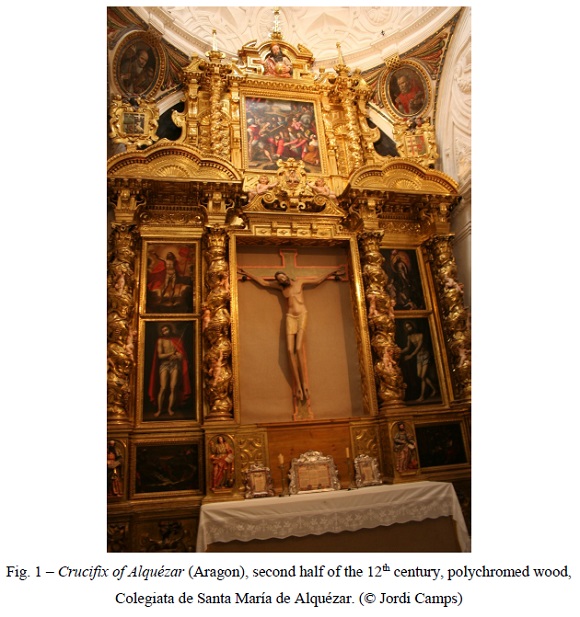
<body><![CDATA[<p><b>RESUMO</b></p>     <p>A imagística românica de madeira policromada na Península Ibérica (séculos    XII-XII) representa uma herança que tem tanto de valioso como de complexo. Exceptuando    algumas linhas gerais que determinam características composicionais e simbólicas,    o contexto local, a liturgia, os artistas ou as oficinas e a influência de certos    modelos prestigiados criaram um cenário altamente atrativo. É importante notar    que algumas das estátuas que se encontram preservadas em separado actualmente    podem muito bem fazer, numa perspectiva mais vasta, parte de conjuntos maiores    de mobiliário litúrgico. Ao mesmo tempo, o número de estudos sobre aspectos    técnicos e materiais que envolvem trabalho interdisciplinar tem aumentado. Uma    das questões que mais preocupa os académicos é a disseminação das tendências    tipológicas e estilísticas. A influência de trabalhos com metal e metais preciosos    na policromia temperada deve ser avaliada. Outras vezes, a disseminação de modalidades    confinadas a uma área poderá perfeitamente obedecer a motivos de culto e peregrinação.    Porém, nem todos os trabalhos seguem estritamente uma modalidade ou outra. Outra    hipótese prende-se com a importação de alguns objectos.</p>     <p><b>Palavras-chave<i>: </i></b>Escultura, Madeira, Policromia, Península Ibérica,    Oficinas.</p> <hr/>     <p>&nbsp;</p>     <p>In the Romanesque period, polychrome wood sculpture in the Hispanic kingdoms    and counties presents an extraordinary variety of types and styles. This is    reflected in the examples that are still worshipped in their original place,    and in the huge number of works conserved in museums and private collections    whose provenance is not always known. Thus, images of the Virgin Mary, different    types of Crucifixes, whole or fragmentary groups of the Crucifixion or the Descent    from the Cross, images of saints or of Christ enthroned and other kinds of statuettes,    make up a rich and, at the same time, complex panorama. We must not forget,    moreover, that production in wood covered other types of objects, items of furniture,    some associated with the altar (frontals, edicules or <i>retrotabula</i>, baldachins)    and the presbytery as a whole (seats, lecterns, and so on), objects that could    also be worked in other materials (stone) or covered with metal.</p>     <p>Classifying and contextualizing them is made difficult by various factors,    largely depending on the long history of the objects that have survived. Firstly,    it is virtually impossible to reconstruct their original site, associated with    an architectural and liturgical context that we can only evoke hypothetically    through indirect sources or by comparison with other examples (<a href="#f1">fig.    1</a>). Secondly, it is difficult to get an idea of the original &ldquo;Romanesque&rdquo;    appearance of the works, given the successive transformations that they have    logically undergone over the centuries, due to renovations, adaptations or restorations    resulting from their continued use. We are paradoxically fortunate that it is    precisely an object&rsquo;s rich and eventful history that has enabled us to contemplate    it today, still a challenge for contemporary scholars. Finally, one has to bear    in mind the scarcity of records to supply us with evidence for dating and classification.    We have very little information regarding their dating, authorship and patronage,    although there are some significant points of reference.</p>     <p>&nbsp;</p>     <p align="center"><a name="f1"></a><img src="/img/revistas/med/n26/26a04f1.jpg"/></p>     
<p>&nbsp;</p>     <p>Previously, too, we want to delimit chronologically the works and the groups    that we will deal with within the margins that place us during the 12th century    and, approximately, the first half of the 13th century, including those that    fit within the art of 1200. As usual, this may be a conventionalism, but we    stand in line with what generally considers historiography on the subject in    relation to the Hispanic world, although in other European areas the beginning    of Gothic art had place in the middle of the 12th century.</p>     ]]></body>
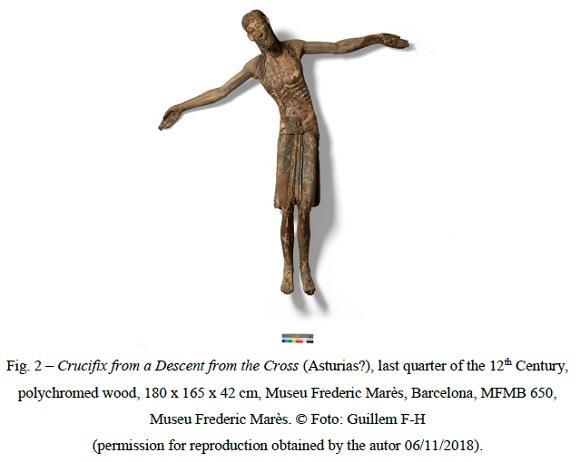
<body><![CDATA[<p>Overview</p>     <p>Despite various general and monographic studies, interest in wood sculpture    was slow to develop if we compare it to the number of chapters devoted to architecture,    monumental sculpture, painting or even the metal arts. Although typological    or compositional comparison with the exceptional ivory carvings of León has    been a recurring feature, it was not until Arthur Kingsley Porter&rsquo;s great book,    published in 1928, that the speciality we are considering here was significantly    tackled<a href="#1"><sup>[1]</sup></a><a name="top1"></a>. Despite that, important    studies like those by Camps Cazorla<a href="#2"><sup>[2]</sup></a><a name="top2"></a>    or Gómez-Moreno<a href="#3"><sup>[3]</sup></a><a name="top3"></a>, from the    1930s, barely touch on it or ignore it altogether, although they do not overlook    ivory carving.</p>     <p>Eventually, the first large-scale effort of systematization appeared with the    great work by Josep Gudiol i Ricart in the volume of the collection <i>Ars Hispaniae    </i>dedicated to painting and statues, ivories included, which appeared in 1950<a href="#4"><sup>[4]</sup></a><a name="top4"></a>.    This was the first attempt at classification by regions, schools or workshops    and types in the Hispanic context, which would be revised in the corrected edition    of the volume in 1980, which we should regard as a second book on the subject<a href="#5"><sup>[5]</sup></a><a name="top5"></a>.    It is still an unavoidable historiographical point of reference in any study    or research work to do with wood sculpture. Later, and at the same time as specific    studies of works, types and territorial contexts intensified, one must bear    in mind how the cataloguing of the works in museums, including the American    ones, made it possible to reconfigure a wide panorama. These fruits were gathered    in the general studies by authors such as Joaquín Yarza or Isidro G. Bango,    among others<a href="#6"><sup>[6]</sup></a><a name="top6"></a>. Despite that,    other works heavily characterized by the importance of black and white photography    do not grant woodcarving the importance it deserves<a href="#7"><sup>[7]</sup></a><a name="top7"></a>.    In this respect, it is important to remember that in the failed attempt at an    exhibition of Medieval Hispanic Art in the early 1990s, reflected in a brilliant    catalogue, some productions, not many, were taken into account, especially from    the Catalan context<a href="#8"><sup>[8]</sup></a><a name="top8"></a>. At the    same time, contributions by regions or by types have become more noticeable,    such as those by Manuel Trens<a href="#9"><sup>[9]</sup></a><a name="top9"></a>,    Rafael Bastardes<a href="#10"><sup>[10]</sup></a><a name="top10"></a>, Celina    Llarás<a href="#11"><sup>[11]</sup></a><a name="top11"></a>, Clara Fernández-Ladreda<a href="#12"><sup>[12]</sup></a><a name="top12"></a>,    Minerva Sáenz<a href="#13"><sup>[13]</sup></a><a name="top13"></a>, María José    Martínez<a href="#14"><sup>[14]</sup></a><a name="top14"></a>, Sergio Pérez    and Rubén Fernández<a href="#15"><sup>[15]</sup></a><a name="top15"></a>, and    Tim Heilbronner<a href="#16"><sup>[16]</sup></a><a name="top16"></a>, among    many others. The studies made since these dates have stressed their liturgical    role and their inclusion with the church&rsquo;s architectural context and spaces,    as in authors like Francesca Español<a href="#17"><sup>[17]</sup></a><a name="top17"></a>,    Gerardo Boto<a href="#18"><sup>[18]</sup></a><a name="top18"></a> and Marc Sureda<a href="#19"><sup>[19]</sup></a><a name="top19"></a>.    Lately, a long list of them is being compiled, volume by volume, in the ambitious    <i>Enciclopedia del Románico</i>, which provides a solid basis for future studies    and classifications<a href="#20"><sup>[20]</sup></a><a name="top20"></a>. For    decades now, the role of the consolidations, restorations and technical and    material studies of works has been gaining ground thanks to the improvement    in the techniques and the means of analysing the wood, the polychromy, and so    on, just as it has been developing for decades everywhere, outside the Iberian    Peninsula<a href="#21"><sup>[21]</sup></a><a name="top21"></a>.</p>     <p>One aspect of study in which we must move forward is the apparent absence of    three- dimensional carvings in wood before the 12th century, despite the existence    of some examples in certain points of Europe well known. It is strange that    in the case of existence, no example has been preserved, as in the case of evorary,    with the exceptional <i>Crucifix of Fernando and Sancha </i>in León. In fact,    the parallelism between the date of this masterpiece (1063) is interesting with    the first document that could allude to a statue in Catalonia, specifically    in Estamariu (1063-1064), next to La Seu d'Urgell, such as Sansterre and Henriet    have observed in one of their works<a href="#22"><sup>[22]</sup></a><a name="top22"></a>.</p>     <p>Museums, because of their need to conserve, study and publish their works,    have also tackled the problems of the origin and the condition of images in    wood. In this case, there may be other problems, particularly the action of    some excessive restorations, or also the not always unintentional confusion    relative to the true origin of some works, seeing as many of them are of unknown    provenance. The review of the documentation, the photographic material and the    collections themselves has continued to provide new information and to introduce    significant rectifications. Thus, by way of example, a Christ from a Descent    from the Cross, traditionally considered to be from Catalonia, actually comes    from a building in Asturias, since the base came from a private collection in    Cangas de Narcea<a href="#23"><sup>[23]</sup></a><a name="top23"></a>(<a href="#f2">fig.    2</a>). However, some recent experiences open the door to future discoveries:    thanks to a photograph taken in situ in 1917, it was possible to attribute a    crucifix that had previously been of unknown provenance to Santa Maria de Cap    d&rsquo;Aran. More significant is the case of another Christ, in this case a Majesty,    attributed for decades to a church near Ripoll; thanks to two photographs taken    in the early twentieth century, we were able to certify that it came from the    church of Sant Miquel de Prats, in Andorra<a href="#24"><sup>[24]</sup></a><a name="top24"></a>.    To all this we may add yet another factor, the rigidity derived from the traditional    division into artistic disciplines that has not always led to the creation and    comparison of data obtained from the study of works similar to one another from    the technical or material point of view. In this respect, the consideration    of panel painted items of furniture ought to be especially useful, so significant    in many ways with regard to the classification of objects carved in wood, as    we shall see below.</p>     <p>&nbsp;</p>     <p align="center"><a name="f2"></a><img src="/img/revistas/med/n26/26a04f2.jpg"/></p>     
<p>&nbsp;</p>     <p><b>In the shadow of the sumptuary arts</b></p>     <p>The hypotheses that have given primacy to three-dimensional works, carved from    a block of wood and covered with precious metal, are extremely well known and    have been discussed at length. Thus, images in wood polychromed in tempera would    be a less sumptuous, more inexpensive version than the former. Their genesis    has to do, depending on the area, with the recovery of volume as a means of    depicting holy images. I cannot go into detail here on these matters, on the    appearance of the earliest European examples of rather monumental three-dimensional    images and the ideological undercurrent opposed to them in the early Middle    Ages, subjects that have been dealt with at length by historians<a href="#25"><sup>[25]</sup></a><a name="top25"></a>.    Occasionally too, typological or even stylistic similarities have been observed    between small metal objects and productions on a monumental scale. In the case    of Hispania, one only has to turn one&rsquo;s gaze towards some images that have been    related to the crucifixes from León carved in ivory. This is the case with the    Crucifixion scene from Corullón (Museo de León)<a href="#26"><sup>[26]</sup></a><a name="top26"></a>,    whose features have been regarded as influenced by some ivory productions, such    as the Evangeliary of Queen Felicia<a href="#27"><sup>[27]</sup></a><a name="top27"></a>.    Some authors like Gómez-Moreno, Gudiol and Estella have stressed the similarities    between the images of Christ on the Cross, on the configuration of the <i>perizonium    </i>and of the anatomical features. Curiously, on the other hand, more recently    it has been suggested that the group from León was an imported work (a question    that I shall deal with below in reference to other works). Whatever the case,    this link between sumptuary works and monumental carving is one of the leitmotivs    of the historiography, as is also the case with other famous Hispanic ivories    such as the Christ of Nicodemus, from the Holy Chamber in Oviedo, or the one    from San Juan de Ortega (Burgos, Museo del Retablo)<a href="#28"><sup>[28]</sup></a><a name="top28"></a>.    The question, now, is to consider to what extent some of these <a name="_bookmark24"></a>emblematic    works, destined for privileged centres, might have become a prestigious model    followed in other fields.</p>     ]]></body>
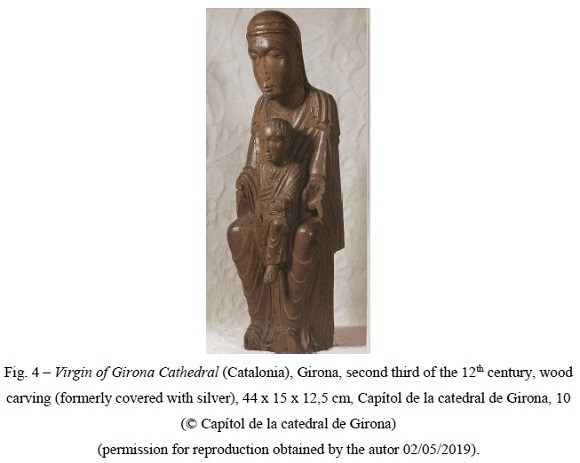
<body><![CDATA[<p>Thus, with respect to the images of the Virgin with the Child, it is essential    to reconsider the role of works such as the <i>Virgin of Irache</i><a href="#29"><sup>[29]</sup></a><a name="top29"></a>,    the one in Pamplona Cathedral, the <i>Virgen de la Vega </i>in Salamanca Cathedral<a href="#30"><sup>[30]</sup></a><a name="top30"></a>(<a href="#f3">fig.    3</a>), or the one in Toledo Cathedral, the latter thought to have been made    in Navarre<a href="#31"><sup>[31]</sup></a><a name="top31"></a>, as archetypes    or as models of examples carved in wood and simply polychromed. A similar problem    arises with the image from Girona Cathedral, which was covered in sheet silver    - according to some traces of nails found in Mary&rsquo;s back - and which was in    fact applied to a refined, precise woodcarving<a href="#32"><sup>[32]</sup></a><a name="top32"></a>    (<a href="#f4">fig. 4</a>). For centuries it must have been one of the liturgical    ornaments on the high altar in the cathedral of Santa Maria, but apparently    it did not leave much of a mark on examples from the surrounding area. From    a historiographical point of view, the quality of its carving has thrown up    the paradox that the image has been dealt with more in works about sculpture    than in those dedicated to precious metalwork. Indeed, with the odd exception    its importance does not seem to be in keeping with its influence on other examples.    The idea of a prestigious model or example is probably not always meant to coincide    in an iconographical, compositional and stylistic reflection, as <i>is </i>the    case in other images.</p>     <p>&nbsp;</p>     <p align="center"><a name="f3"></a><img src="/img/revistas/med/n26/26a04f3.jpg"/></p>     
<p>&nbsp;</p>     <p align="center"><a name="f4"></a><img src="/img/revistas/med/n26/26a04f4.jpg"/></p>     
<p>&nbsp;</p>     <p><b>Styles and types</b></p>     <p>As I said earlier, the first attempts at classifying woodcarvings were based    on criteria of style and type, something that in Catalonia, for example, has    made it possible to establish a certain relative chronology and to structure    much of the panorama, despite the difficulties arising from so much variety.    We shall see some of these cases below, such as the Virgins from La Cerdanya,    in the Pyrenees.</p>     <p>But typological similarities relative to the composition, the arrangement of    the clothing or the attributes do not always correspond to stylistic similarities.    I feel that this is the case with a series of carvings of the Virgin with the    Child grouped together in Aragon around the type called &ldquo;of Jaca&rdquo;, that Clara    Fernández-Ladreda has studied<a href="#33"><sup>[33]</sup></a><a name="top33"></a>.    The most important piece, due to where it was found, is the image from Albay    (Jacetania), which has been compared to a work of unknown provenance conserved    in the Museu Nacional d&rsquo;Art de Catalunya (<a href="#f5">fig. 5</a>), next to    the Mianos and Lastiesas, among others. Despite the evident similarities in    the fall of the creases and in the crowns, I believe that the works must be    associated with different workshops. In my opinion, the carving in the MNAC    can also be made to agree with ligneous and stone sculptures from Castile and    León, and with works from the Germanic world datable to about 1230, if we consider    the elegant way in which the creases in Mary&rsquo;s tunic fall, giving the group    a certain solemnity and a monumental feel.</p>     <p>&nbsp;</p>     ]]></body>
<body><![CDATA[<p align="center"><a name="f5"></a><img src="/img/revistas/med/n26/26a04f5.jpg"/></p>     
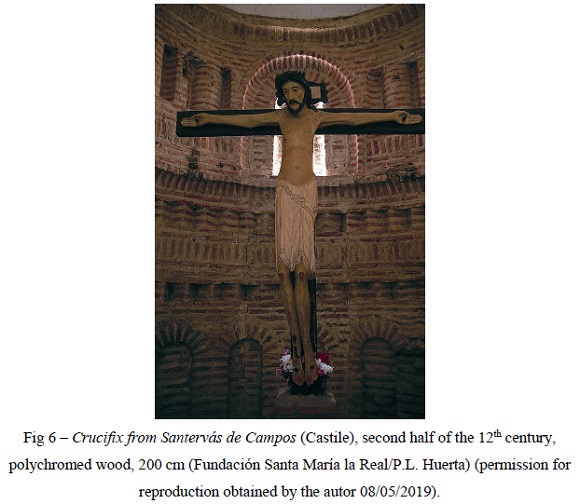
<p>&nbsp;</p>     <p>With regard to the images of Christ on the Cross it is important for example    to refer to the <i>Crucifix from Santa Clara de Astudillo </i>(near Palencia),    dated to the second half of the twelfth century, which belongs to one of the    most frequent types in the groups of Christ on the Cross, dressed in the <i>perizonium</i>.    With different variations, we observe similar cases in Italy, France, and elsewhere.    Examples of this type are conserved from Galicia to Catalonia, always showing    different variations with respect to the clothing, the attributes, the position    of the arms or the head and, needless to say, the style. The original cross    has very often not survived. In fact, in Catalonia it presents us with a choice    apparently halfway between the Majesties and the numerous cases of <i>Christus    Patiens</i>. To go back to the carving from Astudillo, it is an expression of    the dual nature of Christ (divine, human), marked by a solemn expression, the    head richly crowned, with his eyes open. From a stylistic point of view, associations    have been established with ivory carving, specifically the image of Christ from    the reliquary diptych of Bishop Gundisalvo of Oviedo (<i>c. </i>1162-1174).    The details of the cross or of Christ&rsquo;s crown, among other things, show that    some of these images were decorated and treated in an attempt to reflect a certain    splendour, as was seen more forcefully in works covered with precious metal,    as I mentioned above. Beyond the possible association with works in other materials    and formats, the image from Palencia has also been compared typologically to    other crucifixes like those from Ourense Cathedral (Galicia), the <i>Cristo    de los Carboneros </i>from San Cristóbal in Salamanca<a href="#34"><sup>[34]</sup></a><a name="top34"></a>,    or, especially, the one from Santervás de Campos (Valladolid)<a href="#35"><sup>[35]</sup></a><a name="top35"></a>(<a href="#f6">fig.    6</a>). Notwithstanding this, I believe that due to their appearance some of    these works come from other workshops. But only a restoration and a detailed    analysis of these carvings would make it possible to confirm my suspicions,    the result of direct observation.</p>     <p>&nbsp;</p>     <p align="center"><a name="f6"></a><img src="/img/revistas/med/n26/26a04f6.jpg"/></p>     
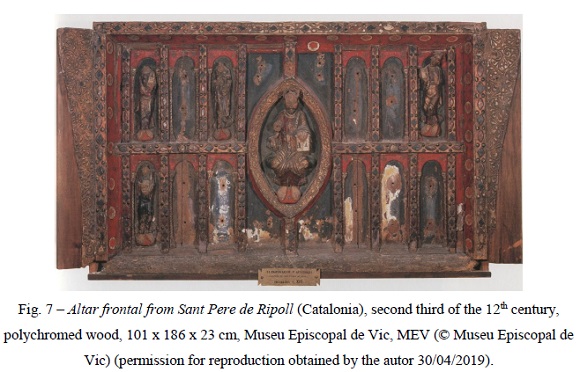
<p>&nbsp;</p>     <p>Another type of order aspect should be revised: we refer to the so-called Calvary    groups and their evolution. Firstly, the formula was adopted to place small-scale    figures of Mary and Saint John attached to the crossbar of the cross (which    coexist with the adoption of the painted figure). Later on, it evolved into    a monumental development, with the figures located apart from Christ and exempt,    which we fully consider of the Gothic period, as we can see in two sizes of    Asturian origin preserved in the museum of Cleveland<a href="#36"><sup>[36]</sup></a><a name="top36"></a>.</p>     <p>The workshops and the coordinated production of objects for worship and furniture</p>     <p>Another aspect that has been considered by historians is that of the workshops,    understood as centres of production from which types were disseminated. At the    same time, works would be distributed to other centres, monastery churches and    parish churches, and so on. They would be centres following general guidelines    covering different types of production, on both a technical and a typological    level. In the case of Catalonia the workshops of the monastery of Ripoll and    the cathedral of La Seu d&rsquo;Urgell have been studied very closely, centres that    were also distinguished by their <i>scriptoria</i>, by ambitious constructions    and by a special dedication to liturgical furniture (altar tables, baldachin    tables, etc.). In the case of the circles of the Ripoll Workshop, the similarities    between various works of different types and techniques are undeniable. On one    hand, the connections are evident between the reliefs on the doorway and the    execution of the applied statuettes of the altar frontal from the old parish    church of Sant Pere<a href="#37"><sup>[37]</sup></a><a name="top37"></a>, attached    to the monastic site (<a href="#f7">fig. 7</a>). The arrangement of the ligneous    <i>Maiestas Domini </i>might even agree with the image of the Dream of Solomon    in the large stone group. In other cases, as in the Majesty from Sant Joan les    Fonts (Museu d&rsquo;Art de Girona)<a href="#38"><sup>[38]</sup></a><a name="top38"></a>,    the rough imitation of the carving&rsquo;s features with respect to the <i>Maiestas    Domini </i>on the doorway in Ripoll is combined with a more accomplished reproduction    of geometrical and floral motifs on painted frontals originating from the same    workshop, like the one from Sant Martí de Puigbò<a href="#39"><sup>[39]</sup></a><a name="top39"></a>.</p>     <p>&nbsp;</p>     ]]></body>
<body><![CDATA[<p align="center"><a name="f7"></a><img src="/img/revistas/med/n26/26a04f7.jpg"/></p>     
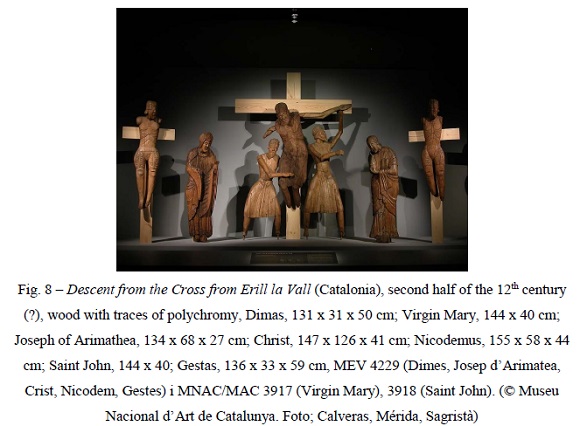
<p>&nbsp;</p>     <p>The style and the repertoires of Ripoll were developed in monumental groups    and images in the surrounding area, as happened in Vic and Besalú. The trends    do not always correspond to dissemination from an easily recognizable great    centre, something that has entailed the invention of names that in actual fact    never performed this role. It is the case with the so-called Erill Workshop,    around which are grouped works that traditional historiography has granted an    excessive role in a group or a place. This hypothetical workshop is distinguished    by the groups of the Descent from the Cross located between the Boí and Aran    valleys, in the Catalan Pyrenees. The most complete group, after which it is    named, is the one from the parish church of Santa Eulàlia in Erill la Vall.    Now split between the Museu Episcopal de Vic and the Museu Nacional d&rsquo;Art de    Catalunya<a href="#40"><sup>[40]</sup></a><a name="top40"></a>, it is composed    of seven figures, something that distinguishes the Catalan groups from all those    known in Europe in the Romanesque period (<a href="#f8">fig. 8</a>). It is unquestionably    a group of notable quality, which excels in the abstract simplification of the    physical features, the gestures and the clothes of the figures. But the work    that most definitely stands out in this workshop is the famous Christ of Mijaran,    an extraordinary torso that is the only vestige, with the hand of Joseph of    Arimathea incorporated on its left-hand side<a href="#41"><sup>[41]</sup></a><a name="top41"></a>.    As you will remember, conditions in the Aran valley are very different to those    in the Ribagorça and Boí valleys. Geographically north-facing, in the Middle    Ages it depended on the Occitan bishopric of Saint-Bertrand de Comminges. Despite    its enormous power, it is feasible to think that in this region or further north    in Languedoc there might have been other groups, now lost, acting as models    or points of reference.</p>     <p>&nbsp;</p>     <p align="center"><a name="f8"></a><img src="/img/revistas/med/n26/26a04f8.jpg"/></p>     
<p>&nbsp;</p>     <p>This series of works also enables us to open up another field of discussion.    Some authors have linked these carvings from Ribagorça and Aran to other examples    from Upper Aragon. Especially notable is the Christ from San Pedro de Siresa,    a carving that was discovered in 1995 and which had originally been in the centre    of a group of the Descent from the Cross<a href="#42"><sup>[42]</sup></a><a name="top42"></a>    (<a href="#f9">fig. 9</a>). Some authors have tried to establish a direct link    between this magnificent carving, also linked to a Descent from the Cross, and    the works from Boí and Aran<a href="#43"><sup>[43]</sup></a><a name="top43"></a>.    The Christ from San Mamés de Asín has also been included in this group<a href="#44"><sup>[44]</sup></a><a name="top44"></a>.    On the other hand, the Crucifix from the collegiate church of Alquezar<a href="#45"><sup>[45]</sup></a><a name="top45"></a>is    in my opinion more remote. In any case, we must ask ourselves to what extent    the compositional and iconographical similarities between some of these works    correspond to the inclusion in common guidelines, general trends or working    methods, rather than to possible direct links between sculptors and workshops.    Similar problems have been posed in other techniques, as in the case of some    important mural painting circles active between Catalonia and Aragon. I believe    this to be one of the key points when classifying and dating works and associating    them with a particular artistic circle. In any case, this observation would    not be contradictory with the possible impact of an image that might have acted    as a model, as a reference for a whole series of images belonging to an extensive    geographical context.</p>     <p>&nbsp;</p>     <p align="center"><a name="f9"></a><img src="/img/revistas/med/n26/26a04f9.jpg"/></p>     
<p>&nbsp;</p>     ]]></body>
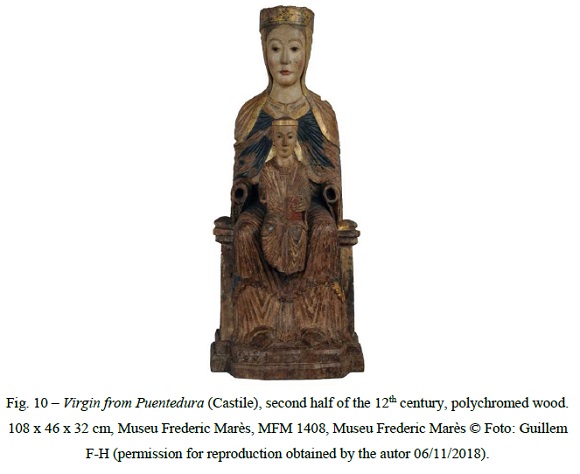
<body><![CDATA[<p><b>Foreign sculptors? Imported works?</b></p>     <p>The importation of works has always been accepted for certain types of art    objects, of different types. An example that is beyond doubt, for example, is    that of the production of enamels from Limoges that spread to many parts of    Europe. Beyond the problematic dissemination of the workshop at Silos<a href="#46"><sup>[46]</sup></a><a name="top46"></a>,    the presence of countless examples in the Hispanic world is undoubted. From    other cultural and political provenances, we are all sufficiently aware of the    huge amount of products that, whether through trade, diplomacy or warfare, arrived    from the East, the Islamic world or, particularly, Al- Andalus. However, and    despite the fact that some authors have dealt with the hypothesis of importation    for some examples of woodcarving, this is an option that I believe has been    barely considered and accepted, occasionally as an alternative to the hypothesis    of the arrival of a foreign sculptor or artist. One of the most notable examples    is the <i>Virgin of Puentedura </i>(Burgos), studied by Ara Gil and Martínez,    which is thought to have a probable French origin<a href="#47"><sup>[47]</sup></a><a name="top47"></a>(<a href="#f10">fig.    10</a>). Indeed, it has been said that the repetitive and refined treatment    of the creases in the clothing recalls those in sculptures from the Île-de-    France, and more specifically from the <i>Portail Royal </i>in Chartres Cathedral,    something that would enable us to justify production in a workshop in that region.    In the context of Portugal the hypothesis has been considered of a foreign origin    for the Christ of Bouças (Matosinhos), given the similarities with examples    from Burgundy and from elsewhere in the Iberian Peninsula, such as Palencia,    Aragon and Catalonia<a href="#48"><sup>[48]</sup></a><a name="top48"></a>.</p>     <p>&nbsp;</p>     <p align="center"><a name="f10"></a><img src="/img/revistas/med/n26/26a04f10.jpg"/></p>     
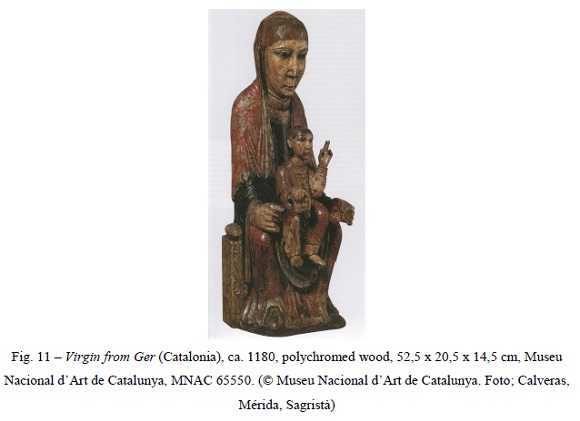
<p>&nbsp;</p>     <p>If we turn to the Catalan context, we may suspect a similar phenomenon in the    case of a group of images of the Virgin that emerged around the bishopric of    La Seu d&rsquo;Urgell towards the last quarter of the twelfth century, which corresponds    to the same stylistic and partly iconographical conception. Lately, some authors    such as Tim Heilbronner have interpreted these images as the symbol of Mary    as a priestess, to judge by her clothing<a href="#_bookmark48">49</a>. Of the ones conserved, the most outstanding piece    in the group is the <i>Virgin of Ger </i>(Museu Nacional d&rsquo;Art de Catalunya)<a href="#50"><sup>[50]</sup></a><a name="top50"></a>    (<a href="#f11">fig. 11</a>), which presents considerable stylistic similarities    with the image of the Angel from a <i>Visitatio Sepulchri </i>from Cologne<a href="#51"><sup>[51]</sup></a><a name="top51"></a>.    If we accept a direct link between the Catalan Virgin and the angel from Cologne,    we have to consider how it came about.</p>     <p>&nbsp;</p>     <p align="center"><a name="f11"></a><img src="/img/revistas/med/n26/26a04f11.jpg"/></p>     
<p>&nbsp;</p>     <p>If we could ever demonstrate this attractive hypothesis, we would be on a similar    level to that of the group of Virgins covered in metal located between the Auvergne    and Catalonia. It includes the images from Châteauneuf-les-Bains (Puy-de-Dôme),    Saint- Chély-d&rsquo;Apcher, in Prunières (Lozère), Saint-Georges de Baroilles (Loire)    (Musée du Louvre), the <i>Virgin of Victory</i>, in Santa Maria de Tuir (Roussillon)    (<a href="#f12">fig. 12</a>), that of Plandogau (Pallars) (Museu Frederic Marès)    and one last example, now lost, that was once in the collection of Carles Vallin    (Barcelona)<a href="#52"><sup>[52]</sup></a><a name="top52"></a>. Let us concentrate    on the image in Tuir (Roussillon). Covered with lead and tin sheet, with traces    of gilt, it presents a relatively habitual composition: Mary appears seated    on a throne, of wood with traces of polychromy, with the Child sitting in the    middle. One of the most significant details of the group is the closed Carolingian-style    crown, as well as the inscription, <i>MATER DEI, </i>that runs around the front    of the plinth. In fact, such a homogenous series poses one of the questions    most discussed with respect to the centres of production of images and the dissemination    of certain types. In this respect, it is interesting to observe that despite    the homogeneity of this group, covering a wide geographical area, there are    also clear differences between each example: technical, compositional, and qualitative    too. Images like those from Châteauneuf-les-Bains or the one from Baroilles,    however, clearly show the dissemination of a type over a wide area, which can    probably be explained by the exemplary nature of a model or prototype, by the    role played by historic Marian pilgrimage routes, or simply by the importation    of objects. In this respect, the hypothesis according to which a point of reference    for these works could have been the lost image from a Marian centre as important    as Le Puy is also very intriguing<a href="#top53"><sup>[53]</sup></a><a name="53"></a>.</p>     ]]></body>
<body><![CDATA[<p>&nbsp;</p>     <p align="center"><a name="f12"></a><img src="/img/revistas/med/n26/26a04f12.jpg"/></p>     
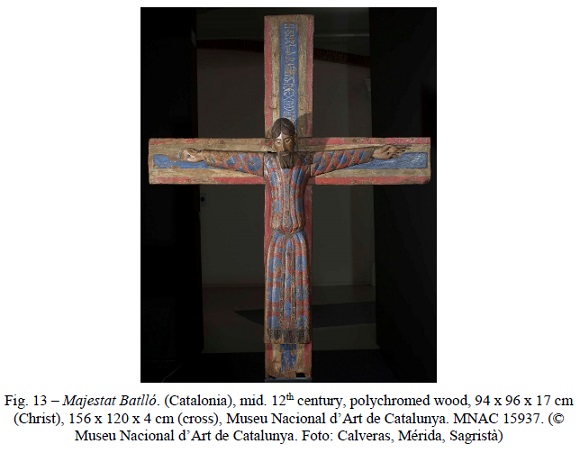
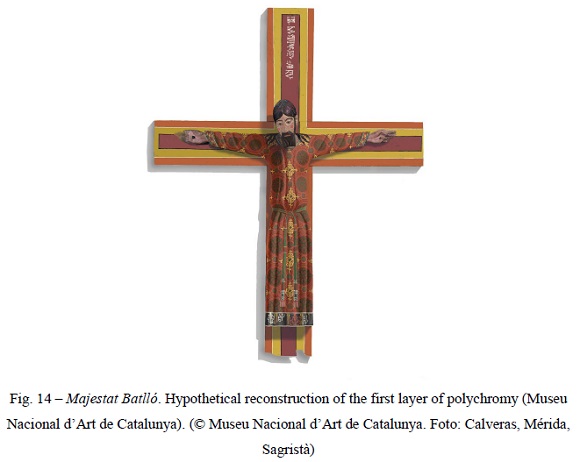
<p>&nbsp;</p>     <p>Apart from the images for worship, another exceptional case of an object carved    in wood is that of the faldstool from Roda d&rsquo;Isàvena, known as the &ldquo;Chair of    Saint Raymond&rdquo;, unfortunately stolen and cut up in 1979 by René Alphonse Van    der Berge, known as <i>Erik le Belge</i><a href="#54"><sup>[54]</sup></a><a name="top54"></a>.    The pieces, in a scissor structure, are worked with a great feeling for detail    and refinement, comparable to that of the metal arts. Due to its exceptional    nature in the Hispanic context, the hypothesis has also been established that    it could be an imported work, probably from northern Europe.</p>     <p>&nbsp;</p>     <p>Interdisciplinary research: some examples</p>     <p>Collaboration between institutions and interdisciplinary research between art    historians or museum and heritage conservators and restorers has generated,    and must continue to generate, very interesting results, always in accordance    with the state of development of each of the subjects and the analysis techniques.    The research has made it possible to learn about the images&rsquo; long history, in    some cases the discovery of deposits of relics, and to scrutinize the layers    and the nature of the examples&rsquo; pigments and agglutinants. In 1952, the work    on a carving of a Suffering Christ (<i>Christus Patiens</i>) in the then Museu    d&rsquo;Art de Catalunya made it possible to discover the cavity in it, with packets    of relics wrapped in pieces of fabric - some from Al-Andalus - and fragments    of parchment. This supplied a most valuable datum, the consecration of the image    in 1147, besides the verification of the relics, and a restoration, in the sixteenth    century<a href="#55"><sup>[55]</sup></a><a name="top55"></a>. In the late twentieth    century works by the Generalitat de Catalunya&rsquo;s Centre for Movable Assets led    to a similar discovery: it made it possible to date the image of the Virgin    from the great Benedictine monastery of Sant Cugat del Vallès to 1218, made    by order of Abbot Ramon de Banyeres<a href="#56"><sup>[56]</sup></a><a name="top56"></a>.</p>     <p>Research work and discoveries of this kind have gradually been taking place.    Thus, in 1988 the <i>Virgin from Astorga Cathedral </i>was worked upon, and    this led to the discovery of a reliquary in the form of a niche in the image&rsquo;s    back. This case, moreover, throws up the possibility that an original layer    of polychromy may have been covered later by a thin sheet of silver<a href="#57"><sup>[57]</sup></a><a name="top57"></a>.</p>     <p>It is interesting to cite in detail another example relating to the work of    the Museu Nacional d&rsquo;Art de Catalunya, where since the beginning of this century    we have been trying to maintain an interdisciplinary line of work addressed    to the study of woodcarving that is slowly producing significant results.</p>     <p>One of the most outstanding images of Romanesque carving in Catalonia is without    doubt the <i>Majestat Batlló</i>, named after the owner who donated it to the    museum. It represents the type of the Majesty, understood as an expression of    the <i>Christus triumphans </i>comparable to the <i>Volto Santo </i>in Lucca,    Tuscany<a href="#58"><sup>[58]</sup></a><a name="top58"></a>. Apart from the    excellent sculptural quality of the carving, the image stands out because much    of the polychromy has survived. The object&rsquo;s outward appearance was revealed    as a result of the cleaning that was done after it entered the museum in 1914<a href="#59"><sup>[59]</sup></a><a name="top59"></a>.    After several subsequent interventions that made its consolidation possible,    it was studied between 2007 and 2010. This enabled us to analyse the different    types of wood and to analyse the polychromy in detail. The investigation confirmed    the presence of a first layer covered by the one now visible, something that    we had already sensed thanks to some lacunas in the external one (<a href="#f13">fig.    13</a>-<a href="#f14">14</a>).</p>     ]]></body>
<body><![CDATA[<p>&nbsp;</p>     <p align="center"><a name="f13"></a><img src="/img/revistas/med/n26/26a04f13.jpg"/></p>     
<p>&nbsp;</p>     <p align="center"><a name="f14"></a><img src="/img/revistas/med/n26/26a04f14.jpg"/></p>     
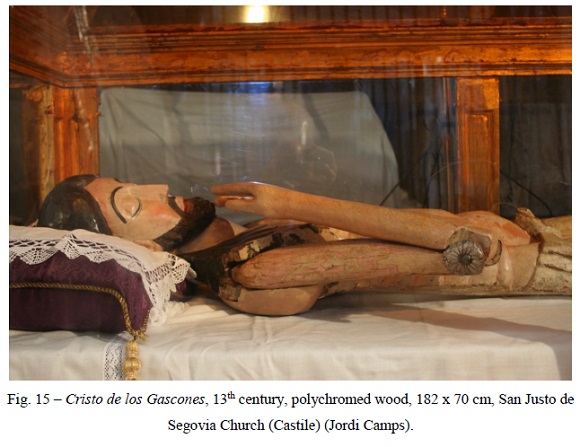
<p>&nbsp;</p>     <p>The pigments used include minerals used relatively frequently, such as lead    white for white, haematites, vermillion or cinnabar for red, aerinite for blue,    for which azurite was also used. The second layer of polychromy, applied without    preliminary preparation, is characterized by the predominance of red and blue,    on both the figure and the cross. In this case, the use of lapis lazuli for    certain areas of blue is noticeable. The decoration of the bottom edge of the    tunic corresponds to the first stage of colour application. A special mention    is warranted by the motifs on the neck, the cuffs and the belt of the tunic;    the grey and worn appearance is due to the application of tin sheet, something    that gave the work a rather luxurious appearance, with the reflection of the    mecca gilt. Generally speaking, one has to point out the refined technique in    the superimposition of the layers of primer and the pigments, and the use of    cinnabar, azurite or lapis lazuli, which were obtained through trade, and which    indicate a profound mastery of the techniques of the period. This may suggest    that it is a work associated with an important centre and a powerful patron.</p>     <p>It is difficult to decide upon the chronological distance between the two layers    of polychromy. Firstly, it is necessary to point out the accuracy that was maintained    with respect to the compositional scheme, of both the Crucifix and the cross.    The traces of inscriptions on the back have yet to be studied, but it is important    to point out that the second inscription on the front is longer in length in    the second layer, although its meaning is the same. This change leads me to    think that the carving was moved to a different place, which could have involved    a difference in height. This would explain why all the symbolic aspects of the    piece survived despite the colour change. The change could have more to do with    the new building in which it was placed and to some event that could have made    it necessary to modify it. In any case, these are hypotheses that are difficult    to confirm.</p>     <p>Lately also, work has been done on an image identified as a Saint John the    Evangelist, kept in the museum in Vilafranca, not far from Barcelona<a href="#60"><sup>[60]</sup></a><a name="top60"></a>.    Its origin is unknown, but it presents all the stylistic traits and some technical    similarities to the works from the Boí and Aran valleys that we saw earlier.    During the restoration process, on the back at shoulder height evidence was    discovered of sockets that must almost certainly have been where wings were    attached. This contribution to the work&rsquo;s initial appearance forced me to reconsider    the identification of the work<a href="#61"><sup>[61]</sup></a><a name="top61"></a>.    A Virgin has also been restored whose historic appearance has been partially    recovered, with the peculiarity that the inclined position of the Child leads    one to conclude that the image was associated with a group that was very probably    part of an Epiphany context<a href="#62"><sup>[62]</sup></a><a name="top62"></a>.</p>     <p>Study avenues for the future</p>     <p>In this essay I have had to give priority to the aspects relative to the formal    configuration of the woodcarving, trying to cover all the components associated    with its production. No less important, however, have been the contributions    made so far pertaining to the location and the interaction of the images in    the vicinity of the altar and the presbytery<a href="#63"><sup>[63]</sup></a><a name="top63"></a>,    their function in worship and their integration in liturgical theatre<a href="#64"><sup>[64]</sup></a><a name="top64"></a>    (<a href="#f15">fig. 15</a>), their role as containers of relics in some cases<a href="#65"><sup>[65]</sup></a><a name="top65"></a>,    and the development of devotion. It is also important to bear in mind the stories    or legends associated with their distant origin or to miraculous interventions,    many of which, but not all, correspond to the Middle Ages<a href="#66"><sup>[66]</sup></a><a name="top66"></a>.    In this respect, their connection is notable in battles or with events in which,    according to the literary and documentary sources, the ruler, often the king,    played a large part<a href="#67"><sup>[67]</sup></a><a name="top67"></a>. On    all these fronts, historiography has made substantial progress over the last    two decades. I find myself obliged, however, to leave the broad and developed    treatment of these subjects for future occasions.</p>     ]]></body>
<body><![CDATA[<p>&nbsp;</p>     <p align="center"><a name="f15"></a><img src="/img/revistas/med/n26/26a04f15.jpg"/></p>     
<p>&nbsp;</p>     <p>In another order of things, we have very little information about promoters    and artists, although the consideration of different foreign cases, like that    of the Presbyter Martinus Madonna<a href="#68"><sup>[68]</sup></a><a name="top68"></a>,    from Central Italy, may be illustrative and may supply intriguing clues. This    work, dated 1199, confronts us with the scant number of Hispanic examples that    can be dated with any degree of precision. This aspect, important when classifying    works, groups and regional peculiarities with justification, opens up another    aspect of the study of woodcarving: that of discerning clearly between the examples    that actually correspond to a date from the Romanesque period from those that    are later. This task, which involves not only the researchers but also the agents    of the spread of innovation in research, has a long way to go in the field of    study, but also in that of the institutions responsible for the conservation    of the works. At the present time, the reality is that numerous general or monographic    publications, as well as catalogues, continue to include objects that belong    to later periods in the &ldquo;Romanesque&rdquo; sections<a href="#69"><sup>[69]</sup></a><a name="top69"></a>.    The creation of a critical corpus like the one that has been carried out in    other spheres<a href="#70"><sup>[70]</sup></a><a name="top70"></a> could represent    a step forward in this task.</p>     <p>As I have been suggesting throughout this essay, and despite the fact that    much very meritorious work has been undertaken, many systematic technical studies    are still needed, analyses of the works that may help to supply data about their    original appearance and about the changes they have undergone throughout history.    With these it will thus be feasible to cross-reference the data obtained from    different works, areas, types, variants and periods. Let us not forget that    the images were placed in a context, with its structures and furniture (beams,    frontals, edicules or tabernacles, baldachins, etc.), which have almost completely    disappeared. Only this way will it be possible for new data to appear, if they    exist, to tell us whether, as is still believed, corporeal images emerged somewhat    later than in other Romanesque regions, or if it is necessary to consider the    existence of examples, lost and/or replaced, before the second half of the twelfth    century.</p>     <p>&nbsp;</p>     <p><b>BIBLIOGRAPHICAL REFERENCES:</b></p>     <!-- ref --><p>ACÍN FANLO, José Luis - <i>Arquitectura románica: siglos X-XI, XII y XIII.    5. Arte religioso de la Diócesis de Jaca (Iglesias Costa, Manuel; edición revisada    y aumentada por Jose Luís Acin Fanlo y Enrique Calvera Nerín)</i>. Zaragoza,    2009.    &nbsp;&nbsp;&nbsp;&nbsp;&nbsp;&nbsp;&nbsp;&nbsp;[&#160;<a href="javascript:void(0);" onclick="javascript: window.open('/scielo.php?script=sci_nlinks&ref=1498222&pid=S1646-740X201900020000400001&lng=','','width=640,height=500,resizable=yes,scrollbars=1,menubar=yes,');">Links</a>&#160;]<!-- end-ref --></p>     <p>AINAUD DE LASARTE, Joan - &ldquo;Un Crist romànic datat&rdquo;. <i>Butlletí de la Societat    Catalana d&rsquo;Estudis Històrics</i>, II, 1953, pp. 341-344.</p>     ]]></body>
<body><![CDATA[<p>AINAUD DE LASARTE, Joan - &ldquo;La consagració dels Crists en creu&rdquo;. <i>Liturgica</i>,    3, 1966, pp. 11-20.</p>     <p>ANGHEBEN, Marcello - &ldquo;Les statues mariales catalanes et la progressive assimilation    de la Vierge à l&rsquo;enfant au prêtre officiant&rdquo;. in BROUQUET, Sophie (ed.) - <i>Sedes    sapientiae. Vierges Noires, culte marial et pèlerinages en France méridionale</i>.    Toulouse: Presses universitaires du Midi, Méridiennes, 2017, pp. 19-45.</p>     <p>ARA GIL, Clementina-Julia - &ldquo;120. Mare de Déu amb el Nen&rdquo;. <i>Fons del Museu    Frederic Marès/1. Catàleg d&rsquo;escultura i pintura medievals</i>. Barcelona: Ajuntament    de Barcelona, 1991, p. 183.</p>     <!-- ref --><p>BANGO TORVISO, Isidro G. - <i>El Románico en España</i>. Madrid: Espasa-Calpe,    1992.    &nbsp;&nbsp;&nbsp;&nbsp;&nbsp;&nbsp;&nbsp;&nbsp;[&#160;<a href="javascript:void(0);" onclick="javascript: window.open('/scielo.php?script=sci_nlinks&ref=1498228&pid=S1646-740X201900020000400006&lng=','','width=640,height=500,resizable=yes,scrollbars=1,menubar=yes,');">Links</a>&#160;]<!-- end-ref --></p>     <p>BARAUT, Cebrià - &ldquo;Un recull de miracles de Santa Maria, procedent de Ripoll,    i les Cantigues d&rsquo;Alfons el Savi&rdquo;. <i>Maria Ecclesia, Regina et Mirabilis, Scripta    et Documenta</i>, VI. Abadia de Montserrat: Ed. Estanislao M. Llopart 1956:    pp. 127-60.</p>     <p>BARRACHINA NAVARRO, Jaume - &ldquo;‘Crist de Davallament&rsquo; - Obra romànica dispersa    en colleccions no tractada fins ara. El colleccionisme a Catalunya&rdquo;. in <i>Catalunya    Romànica</i>, XXVI. Barcelona: Fundació Enciclopèdia Catalana, 1997, pp. 335-341.</p>     <p>BARRACHINA NAVARRO, Jaume - &ldquo;Crist crucificat de Palma de Mallorca&rdquo;. in <i>Catalunya    Romànica</i>, XXVI. Barcelona: Fundació Enciclopèdia Catalana, 1997, pp. 359-360.</p>     <!-- ref --><p>BASTARDES i PARERA, Rafael - <i>Les talles romàniques del Sant Crist a Catalunya</i>.    Barcelona: Artestudi, 1978.    &nbsp;&nbsp;&nbsp;&nbsp;&nbsp;&nbsp;&nbsp;&nbsp;[&#160;<a href="javascript:void(0);" onclick="javascript: window.open('/scielo.php?script=sci_nlinks&ref=1498233&pid=S1646-740X201900020000400010&lng=','','width=640,height=500,resizable=yes,scrollbars=1,menubar=yes,');">Links</a>&#160;]<!-- end-ref --></p>     ]]></body>
<body><![CDATA[<!-- ref --><p>BELTING, Hans - <i>Image et culte: une histoire de l'image avant l'époque de    l'art</i>. Paris: Editions du Cerf, 1998.    &nbsp;&nbsp;&nbsp;&nbsp;&nbsp;&nbsp;&nbsp;&nbsp;[&#160;<a href="javascript:void(0);" onclick="javascript: window.open('/scielo.php?script=sci_nlinks&ref=1498235&pid=S1646-740X201900020000400011&lng=','','width=640,height=500,resizable=yes,scrollbars=1,menubar=yes,');">Links</a>&#160;]<!-- end-ref --></p>     <p>BOTO VARELA, Gerardo - &ldquo;Sobre les persuasives imatges de culte. Encomis i escrutinis    des de l&rsquo;Edat Mitjana hispana&rdquo;. in BOTO VARELA, Gerardo (ed.) - <i>Exposició.    Imatges medievals de culte. Talles de la col·lecció El Conventet</i>. Girona:    Fundació caixa Girona, 2009, pp. 37-43.</p>     <!-- ref --><p>BRACONS i CLAPÉS, Josep - <i>Catàleg de l'escultura gòtica del Museu Episcopal    de Vic</i>. Vic: Patronat d' Estudis Ausonencs, 1983.    &nbsp;&nbsp;&nbsp;&nbsp;&nbsp;&nbsp;&nbsp;&nbsp;[&#160;<a href="javascript:void(0);" onclick="javascript: window.open('/scielo.php?script=sci_nlinks&ref=1498238&pid=S1646-740X201900020000400013&lng=','','width=640,height=500,resizable=yes,scrollbars=1,menubar=yes,');">Links</a>&#160;]<!-- end-ref --></p>     <!-- ref --><p>BUESA CONDE, Domingo J. - <i>La Virgen en el Reino de Aragón. Imágenes medievales</i>.    s.l.: Ibercaja, 1994, pp. 231-234.    &nbsp;&nbsp;&nbsp;&nbsp;&nbsp;&nbsp;&nbsp;&nbsp;[&#160;<a href="javascript:void(0);" onclick="javascript: window.open('/scielo.php?script=sci_nlinks&ref=1498240&pid=S1646-740X201900020000400014&lng=','','width=640,height=500,resizable=yes,scrollbars=1,menubar=yes,');">Links</a>&#160;]<!-- end-ref --></p>     <p>CAMPUZANO <i>et alii </i>- &ldquo;Noves aportacions a l&rsquo;estudi de la Majestat Batlló:    identificació i caracterització de la policromia subjacent&rdquo;. <i>Butlletí del    Museu Nacional d&rsquo;Art de Catalunya</i>, 11, 2011, pp. 13-31.</p>     <!-- ref --><p>CAMPS CAZORLA, Emilio - <i>El arte románico en España</i>. Madrid: Labor, 1935.    &nbsp;&nbsp;&nbsp;&nbsp;&nbsp;&nbsp;&nbsp;&nbsp;[&#160;<a href="javascript:void(0);" onclick="javascript: window.open('/scielo.php?script=sci_nlinks&ref=1498243&pid=S1646-740X201900020000400016&lng=','','width=640,height=500,resizable=yes,scrollbars=1,menubar=yes,');">Links</a>&#160;]<!-- end-ref --></p>     ]]></body>
<body><![CDATA[<p>CAMPS I SÒRIA, Jordi - &ldquo;74. Mare de Déu amb el Nen&rdquo;. in <i>Fons del Museu Frederic    Marès/1. Catàleg d&rsquo;escultura i pintura medievals</i>. Barcelona: Ajuntament    de Barcelona, 1991<i>, </i>p. 143.</p>     <p>CAMPS I SÒRIA, Jordi - &ldquo;Imatge de la Mare de Déu de Ger&rdquo;. in <i>Prefiguració    del Museu Nacional d&rsquo;Art de Catalunya</i>. Barcelona, 1992, p. 149-150.</p>     <p>CAMPS I SÒRIA, Jordi - &ldquo;Majestat Batlló&rdquo;. in <i>Prefiguració del Museu Nacional    d&rsquo;Art de Catalunya</i>. Barcelona, 1992, pp. 154-156.</p>     <p>CAMPS I SÒRIA, Jordi - &ldquo;Mare de Déu de la catedral de Girona&rdquo;. in CASTIÑEIRAS,    Manuel; CAMPS, Jordi; LORÉS, Immaculada (ed.) - <i>El romànic i la Mediterrània.    Catalunya, Toulouse i Pisa. 1120-1180</i>. Barcelona: Museu Nacional d&rsquo;Art de    Catalunya, 2008, pp. 418-419.</p>     <p>CAMPS I SÒRIA, Jordi - &ldquo;Wooden Sculpture&rdquo;. in CASTIÑEIRAS, Manuel; CAMPS, Jordi    - <i>Romanesque art in the MNAC collections</i>. Barcelona, 2008, p. 137-163,    especially pp. 140-142.</p>     <p>CAMPS I SÒRIA, Jordi - <i>Els grups d&rsquo;escultura del davallament de la creu    durant el romànic. De Mijaran i Erill al Santíssim Misteri de Sant Joan de les    Abadesses</i>. Barcelona: Amics del MNAC, 2010 (it includes Spanish translation).</p>     <p>CAMPS I SÒRIA, Jordi - &ldquo;Romanesque Majestats: A Typology of Christus Triumphans    in Catalonia&rdquo;. in MULLINS, Juliet; NÍ GHRÁDAIG, Jenifer; HAWTREE, Richard (ed.)    - <i>Envisioning Christ on the Cross. Ireland and the early medieval West</i>.    Dublin: Four Court Press, 2013, pp. 234-247.</p>     <p>CAMPS I SÒRIA, Jordi - &ldquo;Una aportació a la recuperació del romànic d'Andorra:    la Majestat de Sant Miquel de Prats (Canillo)&rdquo;. in RUIZ I QUESADA, Francesc,    (ed.) - <i>Viatges a la bellesa, miscel·lània homenatge a Maria Rosa Manote    i Clivilles</i>, <i>Retrotabulum Maior</i>, 1. Barcelona, 2015, pp. 63-70.</p>     <p>CAMPS I SÒRIA, Jordi - &ldquo;Imágenes relicario de los siglos XII y XIII en Catalunya&rdquo;.    in VARELA FERNANDES, Carla, (coord.) - <i>Imagens e Liturgia na Idade Media    </i>(&ldquo;Bens Culturais da Igreja&rdquo;, 5). Lisboa, 2016, pp. 125-144.</p>     <p>CAMPS, Jordi; DECTOT, Xavier - <i>Sculptures du Val de Boi</i>. Paris - Barcelona:    Museé National du Moyen Âge, Museu Nacional d&rsquo;Art de Catalunya, 2004.</p>     ]]></body>
<body><![CDATA[<p>CAMPS, Jordi; MIGUÉLEZ, Alicia - &ldquo;Yo, Juan. La recuperación de una talla procedente    del románico catalán&rdquo;. <i>Románico. Revista de Arte</i>. Madrid: Amigos del    Románico (AdR), núm. 21, diciembre 2015, pp. 26-33.</p>     <p>CARRERAS, Anna; MESTRE, Mireia; ORIOLS, Núria - &ldquo;Estudio técnico de una talla    románica y proceso de restauración&rdquo;. <i>Románico. Revista de Arte</i>. Madrid:    Amigos del Románico (AdR), núm. 21, diciembre 2015, pp. 34-43.</p>     <p>CARRERO SANTAMARÍA, Eduardo - &ldquo;El Santo Sepulcro: imagen y funcionalidad espacial    en la capilla dela iglesia de San Justo (Segovia)&rdquo; - <i>Anuario de Estudios    Medievales</i>, 27, 1997, pp. 461-477.</p>     <p>CASCIO, Agnès; DESCHAMPS-TAN, Stéphanie; LE POGAM, Pierre-Yves - &ldquo;La restauration    du Christ Courajod. La luminosité d&rsquo;une polychromie romane restaurée&rdquo;. <i>Techné</i>,    39, 2014, pp. 52-59.</p>     <p>CASTIÑEIRAS, Manuel; CAMPS, Jordi - &ldquo;Figura pintada, imatge esculpida. Eclosió    de la monumentalitat i diàleg entre les arts a Catalunya. 1120-1180&rdquo;. <i>El    romànic i la Mediterrània. Catalunya, Toulouse i Pisa. 1120-1180</i>. Barcelona:    Museu Nacional d&rsquo;Art de Catalunya, 2008<i>, </i>pp.133-147.</p>     <!-- ref --><p>COOK, Walter William Spencer; GUDIOL RICART, José - <i>Pintura e imaginería    románicas </i>(Ars Hispaniae, VI). Madrid: Ed. Plus Ultra, 1950.    &nbsp;&nbsp;&nbsp;&nbsp;&nbsp;&nbsp;&nbsp;&nbsp;[&#160;<a href="javascript:void(0);" onclick="javascript: window.open('/scielo.php?script=sci_nlinks&ref=1498260&pid=S1646-740X201900020000400032&lng=','','width=640,height=500,resizable=yes,scrollbars=1,menubar=yes,');">Links</a>&#160;]<!-- end-ref --></p>     <!-- ref --><p>COOK, Walter William Spencer; GUDIOL RICART, José - <i>Pintura e imaginería    románicas </i>(Ars Hispaniae, VI). Madrid: Ed. Plus Ultra, 1980.    &nbsp;&nbsp;&nbsp;&nbsp;&nbsp;&nbsp;&nbsp;&nbsp;[&#160;<a href="javascript:void(0);" onclick="javascript: window.open('/scielo.php?script=sci_nlinks&ref=1498262&pid=S1646-740X201900020000400033&lng=','','width=640,height=500,resizable=yes,scrollbars=1,menubar=yes,');">Links</a>&#160;]<!-- end-ref --></p>     <p>DEL ALAMO, Constancio; VALDEZ DEL ALAMO, Elisabeth - &ldquo;Mourning Virgin and saint    John&rdquo;. in GUILLERMAN, Dorothy (dir.) - <i>Gothic Sculpture in America. II. The    Museums of the Midwest</i>. Turnhout: Brepols, 2001, pp. 353-355.</p>     ]]></body>
<body><![CDATA[<p>DURAN-PORTA, Joan - &ldquo;Frontal de Sant Pere de Ripoll&rdquo;. in CASTIÑEIRAS, Manuel;    CAMPS, Jordi; LORÉS, Immaculada (ed.) - <i>El romànic i la Mediterrània. Catalunya,    Toulouse i Pisa. 1120-1180</i>. Barcelona: Museu Nacional d&rsquo;Art de Catalunya,    2008, pp. 392-393.</p>     <!-- ref --><p>DURLIAT, Marcel - <i>El arte románico en España</i>. Barcelona: Juventud, 1964.    &nbsp;&nbsp;&nbsp;&nbsp;&nbsp;&nbsp;&nbsp;&nbsp;[&#160;<a href="javascript:void(0);" onclick="javascript: window.open('/scielo.php?script=sci_nlinks&ref=1498266&pid=S1646-740X201900020000400036&lng=','','width=640,height=500,resizable=yes,scrollbars=1,menubar=yes,');">Links</a>&#160;]<!-- end-ref --></p>     <p>DURLIAT, Marcel - &ldquo;La signification des Majestés catalanes&rdquo;. <i>Cahiers Archéologiques</i>,    37, 1989, pp. 69-95.</p>     <p>ESPAÑOL, Francesca - &ldquo;Los Descendimientos hispanos&rdquo;. in SAPORI, Giovanna; TOSCANO,    Bruno (ed.) - <i>La Deposizione lignea in Europa: l'immagine, il culto, la forma</i>.    Perugia: Electa, Editori Umbri Associati, 2004, pp. 511-554.</p>     <p>ESPAÑOL, Francesca - &ldquo;El escenario litúrgico de la catedral de Girona (s. XI-XV).    <i>Hortius Artium Medievalium</i>, 11, 2005, pp. 213-232.</p>     <!-- ref --><p>ESTELLA, Margarita M. - <i>La escultura del marfil en España. Románica y gótica</i>.    Madrid: Editorial Nacional, 1984.    &nbsp;&nbsp;&nbsp;&nbsp;&nbsp;&nbsp;&nbsp;&nbsp;[&#160;<a href="javascript:void(0);" onclick="javascript: window.open('/scielo.php?script=sci_nlinks&ref=1498271&pid=S1646-740X201900020000400040&lng=','','width=640,height=500,resizable=yes,scrollbars=1,menubar=yes,');">Links</a>&#160;]<!-- end-ref --></p>     <p>EUW, Anton von - &ldquo;J. 32 Un ange assis&rdquo;. <i>Rhin-Meuse: art el civilisation    800-1400: une exposition des Ministères belges de la culture française et de    la culture néerlandaise du Schnütgen-Museum de la ville de Cologne</i>. Bruxelles:    Ministère de la Culture française; Cologne: Culture néerlandaise, 1972, p. 301.</p>     <!-- ref --><p>FERNÁNDEZ-LADREDA, Clara - <i>Imaginería medieval mariana</i>. Pamplona: Gobierno    de Navarra, Departamento de Educación y Cultura, 1988.    &nbsp;&nbsp;&nbsp;&nbsp;&nbsp;&nbsp;&nbsp;&nbsp;[&#160;<a href="javascript:void(0);" onclick="javascript: window.open('/scielo.php?script=sci_nlinks&ref=1498274&pid=S1646-740X201900020000400042&lng=','','width=640,height=500,resizable=yes,scrollbars=1,menubar=yes,');">Links</a>&#160;]<!-- end-ref --></p>     <p>FERNÁNDEZ-LADREDA, Clara - &ldquo;Arquetipos y tallas derivadas en la imaginería.    El ejemplo de las vírgenes aragonesas&rdquo;. <i>Modelo, copia y evocación en el románico    hispano</i>. Aguilar de Campoo, 2016, pp. 173-191.</p>     <p>FERRAN, Domènec - &ldquo;136. Mare de Déu de Sant Cugat&rdquo;. <i>Millenum. Història i    Art de l&rsquo;Església Catalana</i>. Barcelona: Generalitat de Catalunya, 1989, pp.    194-195.</p>     <p>FERRAN I LOPEZ, Domènec; PLADEVALL I FONT, Antoni - &ldquo;Sant Cugat del Vallès&rdquo;.    <i>Catalunya Romànica</i>, vol. XVIII. Barcelona, 1991, pp. 184-186.</p>     <p>FOLCH I TORRES, Joaquim - &ldquo;Una &ldquo;Majestat&rdquo; romànica&rdquo;. <i>Gaseta de les Arts</i>,    1, n. 4, 1928, pp. 1-2.</p>     <!-- ref --><p>FORSYTH, Ilene H. - <i>The Throne of Wisdom. Wood sculptures of the Madonna    in Romanesque France</i>. Princeton, 1972.    &nbsp;&nbsp;&nbsp;&nbsp;&nbsp;&nbsp;&nbsp;&nbsp;[&#160;<a href="javascript:void(0);" onclick="javascript: window.open('/scielo.php?script=sci_nlinks&ref=1498280&pid=S1646-740X201900020000400047&lng=','','width=640,height=500,resizable=yes,scrollbars=1,menubar=yes,');">Links</a>&#160;]<!-- end-ref --></p>     <p>GABORIT, Jean-René - &ldquo;Vierges-reliquaires et reliques de la Vierge&rdquo;. in BRETEL,    Paul; ADROHER, Michel; CATAFAU, Aymat (dir.) - <i>La Vierge dans les arts et    les littératures du Moyen Âge. Actes du colloque de Perpignan du 17 au 19 octobre    2013</i>. Paris: Honoré Champion, 2017, pp. 351-369.</p>     <!-- ref --><p>GARCÍA GUINEA, Miguel Ángel; PÉREZ GONZÁLEZ, José María (dir.) - <i>Enciclopedia    del románico</i>. Aguilar de Campoo: Fundación Santa María la Real, 2002- 2018.    &nbsp;&nbsp;&nbsp;&nbsp;&nbsp;&nbsp;&nbsp;&nbsp;[&#160;<a href="javascript:void(0);" onclick="javascript: window.open('/scielo.php?script=sci_nlinks&ref=1498283&pid=S1646-740X201900020000400049&lng=','','width=640,height=500,resizable=yes,scrollbars=1,menubar=yes,');">Links</a>&#160;]<!-- end-ref --></p>     ]]></body>
<body><![CDATA[<!-- ref --><p>GÓMEZ-MORENO, Manuel - <i>El arte románico español. Esquema de un libro</i>.    Madrid: Centro de Estudios Históricos, 1934.    &nbsp;&nbsp;&nbsp;&nbsp;&nbsp;&nbsp;&nbsp;&nbsp;[&#160;<a href="javascript:void(0);" onclick="javascript: window.open('/scielo.php?script=sci_nlinks&ref=1498285&pid=S1646-740X201900020000400050&lng=','','width=640,height=500,resizable=yes,scrollbars=1,menubar=yes,');">Links</a>&#160;]<!-- end-ref --></p>     <p>GRAU LOBO, Luis A. - &ldquo;Museo de León&rdquo;. in GARCÍA GUINEA, Miguel Ángel; PÉREZ    GONZÁLEZ, José María (dir.) - <i>Enciclopedia del Románico en Castilla y León.    León</i>. Aguilar de Campoo: Fundación Santa María la Real, 2002, pp. 602-614.</p>     <p>HEILBRONNER, Tim - &ldquo;The wooden ‘Chasuble Madonnas&rsquo; from Ger, Ix, Targasona    and Talló. About the Iconography of Catalan Madonna statues in the Romanesque    period&rdquo;. <i>Locus Amoenus</i>, 9. Bellaterra, 2007-2008, p. 31-50.</p>     <p>HEILBRONNER, Tim - <i>Ikonographie und zeitgenössische Funktionhölzerner Sitz    madonnen im romanischen Katalonien</i>. Hamburg: Verlag Dr. Kova&#269;, 2013.</p>     <p>HERNADO GARRIDO, José Luis - &ldquo;Imagen de la Virgen de la Vega&rdquo;. in E<i>nciclopedia    del Románico en Castilla y León. Salamanca&hellip;</i>, pp. 285-287.</p>     <p>HUERTA HUERTA, Pedro Luis - &ldquo;Iglesia de San Cristóbal&rdquo;. in E<i>nciclopedia    del Románico en Castilla y León. Salamanca&hellip;</i>, pp. 302-310.</p>     <p>KARGÈRE, Lucretia, RIZZO, Adriana - &ldquo;Twelfth-Century French Polychrome Sculpture    in the Metropolitan Museum of Art: Materials and Techniques&rdquo;. <i>Metropolitan    Museum Studies in Art, Science and Technology, </i>1, 2010, pp. 39-72.</p>     <p>LACARRA DUCAY, María del Carmen - &ldquo;El Cristo de San Pedro de Siresa (aproximación    a su estudio)&rdquo;. <i>Homenaje a Don Antonio Durán Gudiol</i>. Huesca: Instituto    de Estudios Altoaragoneses, 1995, pp. 483-498.</p>     <p>LLARÁS I USÓN, Celina - &ldquo;Marededéu&rdquo;. <i>Catalunya Romànica</i>, XXIII. Barcelona,    1988, pp. 151-152.</p>     ]]></body>
<body><![CDATA[<p>LLARÁS I USÓN, Celina - &ldquo;La talla&rdquo;. <i>Catalunya Romànica</i>, XXVII. Barcelona:    Fundació Enciclopèdia Catalana, 1998, pp. 117-126.</p>     <p>LLARÁS I USÓN, Celina - in ADELL I GISBERT, Albert <i>et alii </i>- &ldquo;Sant Vicenç    de Roda&rdquo;. <i>Catalunya Romànica</i>, XVI. Barcelona, 1996, pp. 435-438</p>     <!-- ref --><p>MANN, Janice - &ldquo;Crucifix&rdquo;. in O&rsquo;NEILL, John P. (ed.) - <i>The Art of Medieval    Spain,</i><i>a.d. 500-1200</i>. New York: Metropolitan Museum of Art, 1993,    &nbsp;&nbsp;&nbsp;&nbsp;&nbsp;&nbsp;&nbsp;&nbsp;[&#160;<a href="javascript:void(0);" onclick="javascript: window.open('/scielo.php?script=sci_nlinks&ref=1498297&pid=S1646-740X201900020000400067&lng=','','width=640,height=500,resizable=yes,scrollbars=1,menubar=yes,');">Links</a>&#160;]<!-- end-ref -->    pp. 222-223.</p>     <p>ARTÍNEZ DE AGUIRRE, Javier - &ldquo;Aproximación iconográfica a la iglesia del Santo    Sepulcro de Torres del Río&rdquo;. in MELERO MONEO, M. Luisa; ESPAÑOL BERTRÁN, Francesca;    ORRIOLS I ALSINA, Anna; RICO CAMPS, Daniel (ed.) - <i>Imágenes y promotores    en el arte medieval: miscelánea en homenaje a Joaquín Yarza Luaces</i>. Bellaterra:    Universitat Autònoma de Barcelona, 2001, pp. 153-165.</p>     <p>MARTÍNEZ MARTÍNEZ, M. José - &ldquo;Imaginería romànica&rdquo;. <i>Arte Antiguo y Medieval    en la Ribera del Duero. Biblioteca. Estudio e Investigación</i>, 16, 2001, pp.    193-210.</p>     <p>MARTÍNEZ MARTÍNEZ, M. José - &ldquo;Virgen con el Niño (Museo Frederic Marès, Barcelona)&rdquo;.    in GUINEA, Miguel Ángel; PÉREZ GONZÁLEZ, José María (dir.) - <i>Enciclopedia    del Románico en Castilla y León, Burgos, IV</i>. Aguilar de Campoo: Fundación    Santa María la Real, 2002, p. 2485.</p>     <p>MATHON, Jean-Bernard (dir.) - <i>Romanes et Gothiques. Vierges à l&rsquo;Enfant restaurées    des Pyrénées Orientales. Perpignan, Chapelle Notre-Dame des Anges du 15 septembre    au 17 décembre 2011</i>. Perpignan: Éd. Silvana, 2011.</p>     <p>NOCENTINI, Serena; REFICE, Paola (ed.) - <i>Mater Amabilis. Madonne medievali    della Diocesi d&rsquo;Arezzo, Cortona e Sansepolcro</i>. Firenze: ArtoutMachietto    Editore, 2012.</p>     <p>O&rsquo;NEILL, John P. (ed.) - <i>The Art of Medieval Spain, a.d. 500-1200</i>. New    York: Metropolitan Museum of Art, 1993.</p>     ]]></body>
<body><![CDATA[<p>PÉREZ GIL, J. - &ldquo;Virgen de la Majestad&rdquo;. in <i>Encrucijadas. Las Edades del    Hombre, Catedral de Astorga</i>. Astorga, 2000, n. 17, pp. 290-291.</p>     <p>PÉREZ MARTÍN, Sergio; FERNÁNDEZ MATEOS, Rubén - <i>La imaginería medieval en    Zamora (siglos XII-XVI)</i>. Zamora: Instituto de Estudios Zamoranos &ldquo;Florián    de Ocampo&rdquo;, Centro de Estudios Beneventanos &ldquo;Ledo del Pozo&rdquo;, 2015.</p>     <p>PONSICH, Pierre - &ldquo;La Vierge de Thuir et les relations artistiques entre la    région auvergnate et les pays catalans à l&rsquo;époque préromane et romane&rdquo;. <i>Les    Cahiers de Saint- Michel de Cuxa</i>, 25. Prades-Codalet, 1994, pp. 51-71.</p>     <!-- ref --><p>PORTER, Arthur K. - <i>Spanish Romanesque Sculpture</i>. Florence: Pantheon;    Paris: The Pegasus Press, 1928.    &nbsp;&nbsp;&nbsp;&nbsp;&nbsp;&nbsp;&nbsp;&nbsp;[&#160;<a href="javascript:void(0);" onclick="javascript: window.open('/scielo.php?script=sci_nlinks&ref=1498308&pid=S1646-740X201900020000400071&lng=','','width=640,height=500,resizable=yes,scrollbars=1,menubar=yes,');">Links</a>&#160;]<!-- end-ref --></p>     <!-- ref --><p>SÁENZ NAVARRO, Minerva - <i>Imaginería románica en La Rioja. Tallas de Cristo    crucificado y de la Virgen con el Niño</i>. Logroño: Gobierno de La Rioja. Instituto    de Estudios Riojanos, 2005.    &nbsp;&nbsp;&nbsp;&nbsp;&nbsp;&nbsp;&nbsp;&nbsp;[&#160;<a href="javascript:void(0);" onclick="javascript: window.open('/scielo.php?script=sci_nlinks&ref=1498310&pid=S1646-740X201900020000400072&lng=','','width=640,height=500,resizable=yes,scrollbars=1,menubar=yes,');">Links</a>&#160;]<!-- end-ref --></p>     <p>SANSTERRE, Jean-Marie; HENRIET, Patrick - &ldquo;De l&rsquo;inanimis imago à l&rsquo;omagem mui    bella: méfiance à l&rsquo;égard des images et essor de leur culte dans l&rsquo;Espagne médiévale    (VII-XIII siècle)&rdquo;. <i>Edad Media. Revista de historia</i>, 10, 2009, pp. 37-92.</p>     <!-- ref --><p>SCHMITT, Jean-Claude - <i>Le Corps des images: essais sur la culture visuelle    au Moyen Âge</i>. Paris: Gallimard, 2002.    &nbsp;&nbsp;&nbsp;&nbsp;&nbsp;&nbsp;&nbsp;&nbsp;[&#160;<a href="javascript:void(0);" onclick="javascript: window.open('/scielo.php?script=sci_nlinks&ref=1498313&pid=S1646-740X201900020000400074&lng=','','width=640,height=500,resizable=yes,scrollbars=1,menubar=yes,');">Links</a>&#160;]<!-- end-ref --></p>     ]]></body>
<body><![CDATA[<p>SIMON, David L. - &ldquo;Romanesque Art in American Collections XXI. The Metropolitan    Museum of Art: Part I. Spain&rdquo;. <i>Gesta</i>, 23, 1984, pp. 145-159.</p>     <p>SUBES, Marie-Pasquine - &ldquo;Le Christ de Mijaran et ses liens avec la sculpture    romane d&rsquo;Erill la Vall et de Ripoll&rdquo;. <i>Quaderns del Museu Episcopal de Vic</i>,    IV, Vic, 2010, pp. 9-30.</p>     <p>SUREDA i JUBANY, Marc - &ldquo;Les lieux de la Vierge. Notes de topo-liturgie mariale    en Catalogne (XIe-XVe siècles)&rdquo;. in MATHON, Jean-Bernard (dir.) - <i>Romanes    et Gothiques. Vierges à l&rsquo;Enfant restaurées des Pyrénées Orientales. Perpignan,    Chapelle Notre-Dame des Anges du 15 septembre au 17 décembre 2011</i>. Perpignan:    Éd. Silvana, 2011, p. 39-69.</p>     <!-- ref --><p>TOMAN, Rolk (ed.) - <i>El románico. Arquitectura-escultura-pintura</i>. Köln:    Könemann, 1996.    &nbsp;&nbsp;&nbsp;&nbsp;&nbsp;&nbsp;&nbsp;&nbsp;[&#160;<a href="javascript:void(0);" onclick="javascript: window.open('/scielo.php?script=sci_nlinks&ref=1498318&pid=S1646-740X201900020000400078&lng=','','width=640,height=500,resizable=yes,scrollbars=1,menubar=yes,');">Links</a>&#160;]<!-- end-ref --></p>     <!-- ref --><p>TRENS, Manuel - <i>Les majestats catalanes</i>. Barcelona: Ed. Alpha, 1966    (Monumentae Cataloniae, XIII).    &nbsp;&nbsp;&nbsp;&nbsp;&nbsp;&nbsp;&nbsp;&nbsp;[&#160;<a href="javascript:void(0);" onclick="javascript: window.open('/scielo.php?script=sci_nlinks&ref=1498320&pid=S1646-740X201900020000400079&lng=','','width=640,height=500,resizable=yes,scrollbars=1,menubar=yes,');">Links</a>&#160;]<!-- end-ref --></p>     <p>VALLE LAFUENTE, Carla del - &ldquo;A L&rsquo;entorn de la creu. Nous plantejaments en la    imatgeria romànica de la Val d&rsquo;Aran&rdquo;. <i>Síntesi. Quaderns dels Seminaris de    Besalú</i>, 2, 2014, pp. 129-144.</p>     <!-- ref --><p>VARELA FERNANDES, Carla - &quot;PATHOS - the bodies of Christ on the Cross.    Rhetoricof suffering in wooden sculpture found in Portugal, twelfth-fourteenth    centuries. A few examples&quot;. <i>RIHA Journal </i>0078 (28 November 2013),    URL: <a href="http://www.riha-journal.org/articles/2013/2013-oct-dec/fernandes-christ" target="_blank">http://www.riha-journal.org/articles/2013/2013-oct-dec/fernandes-christ.    &nbsp;&nbsp;&nbsp;&nbsp;&nbsp;&nbsp;&nbsp;&nbsp;[&#160;<a href="javascript:void(0);" onclick="javascript: window.open('/scielo.php?script=sci_nlinks&ref=1498323&pid=S1646-740X201900020000400081&lng=','','width=640,height=500,resizable=yes,scrollbars=1,menubar=yes,');">Links</a>&#160;]<!-- end-ref --></a></p>     ]]></body>
<body><![CDATA[<!-- ref --><p>VÉLEZ, Pilar (dir.) - <i>Museu Frederic Marès. Guia</i>. Barcelona: Ajuntament    de Barcelona, Institut de Cultura, 2011.    &nbsp;&nbsp;&nbsp;&nbsp;&nbsp;&nbsp;&nbsp;&nbsp;[&#160;<a href="javascript:void(0);" onclick="javascript: window.open('/scielo.php?script=sci_nlinks&ref=1498325&pid=S1646-740X201900020000400082&lng=','','width=640,height=500,resizable=yes,scrollbars=1,menubar=yes,');">Links</a>&#160;]<!-- end-ref --></p>     <!-- ref --><p>WIRTH, Jean - <i>L'Image à l'époque romane</i>. Paris: Editions du Cerf, 1999.    &nbsp;&nbsp;&nbsp;&nbsp;&nbsp;&nbsp;&nbsp;&nbsp;[&#160;<a href="javascript:void(0);" onclick="javascript: window.open('/scielo.php?script=sci_nlinks&ref=1498327&pid=S1646-740X201900020000400083&lng=','','width=640,height=500,resizable=yes,scrollbars=1,menubar=yes,');">Links</a>&#160;]<!-- end-ref --></p>     <!-- ref --><p>YARZA, Joaquín - <i>Arte y arquitectura en España, 500-1250</i>. Madrid: Cátedra,    1979.    &nbsp;&nbsp;&nbsp;&nbsp;&nbsp;&nbsp;&nbsp;&nbsp;[&#160;<a href="javascript:void(0);" onclick="javascript: window.open('/scielo.php?script=sci_nlinks&ref=1498329&pid=S1646-740X201900020000400084&lng=','','width=640,height=500,resizable=yes,scrollbars=1,menubar=yes,');">Links</a>&#160;]<!-- end-ref --></p>     <p>YARZA LUACES, Joaquín - &ldquo;Cristo de Nicodemus&rdquo;. in <i>De Limoges a Silos</i>.    Madrid: Sociedad Estatal para la Acción Cultural Exterior, 2001, pp. 171-172.</p>     <p>YARZA LUACES, Joaquín - &ldquo;Las imágenes hispanas de la Virgen y Limoges&rdquo;. in    <i>De Limoges a Silos</i>. Madrid: Sociedad Estatal para la Acción Cultural    Exterior, 2001, pp. 196-207.</p>     <p>YARZA LUACES, Joaquín - &ldquo;Virgen de las Batallas&rdquo;. in <i>De Limoges a Silos</i>.    Madrid: Sociedad Estatal para la Acción Cultural Exterior, 2001, pp. 217-221.</p>     <p>YZQUIERDO PERRÍN, Ramón - &ldquo;Sillas, coros y cátedras medievales: notas sobre    su ubicación y funciones&rdquo;. in HUERTA, Pedro Luis (coord.) - <i>Mobiliario y    ajuar litúrgico de las iglesias románicas</i>. Aguilar de Campoo: Fundación    Santa María la Real, 2011, pp. 107-148.</p>     ]]></body>
<body><![CDATA[<p>&nbsp;</p>     <p><b>Como citar este artigo</b></p>     <p><b>Referência electrónica:</b></p>     <p>CAMPS I SÒRIA, Jordi - &ldquo;Wooden Sculpture in Romanesque Iberian Peninsula: A    Wide and Attractive Panorama. Lines of Research&rdquo;. <i>Medievalista </i>26 (Julho-Dezembro    2019). [Em linha] [Consultado dd.mm.aaaa]. Disponível em <a href="http://www2.fcsh.unl.pt/iem/medievalista/MEDIEVALISTA26/soria2604.html" target="_blank">http://www2.fcsh.unl.pt/iem/medievalista/MEDIEVALISTA26/soria2604.html</a></p>     <p>&nbsp;</p>     <p>Data recepção do artigo / Received for publication: 21 de novembro de 2018  </p>     <p>Data aceitação do artigo / Accepted in revised form: 29 de abril de 2019</p>     <p>&nbsp;</p>     <p><b>NOTAS</b></p>     <p><a href="#top1"><sup>[1]</sup></a><a name="1"></a> PORTER, Arthur K. - <i>Spanish    Romanesque Sculpture</i>. Florence: Pantheon; Paris: The Pegasus Press, 1928.</p>     ]]></body>
<body><![CDATA[<p><a href="#top2"><sup>[2]</sup></a><a name="2"></a> CAMPS CAZORLA, Emilio -    <i>El arte románico en España</i>. Madrid: Labor, 1935.</p>     <p><a href="#top3"><sup>[3]</sup></a><a name="3"></a> GÓMEZ-MORENO, Manuel - <i>El    arte románico español. Esquema de un libro</i>. Madrid: Centro de Estudios Históricos,    1934, p. 26, pl. XXX. In any case, the attempts at comparison between the ivories    and the wood, are interesting, how it approximates the Calvary of Corullón with    the book-cover of Queen Felicia (Metropolitan Museum of Art, New York) (p. 26,    pl. XXX).</p>     <p><a href="#top4"><sup>[4]</sup></a><a name="4"></a> COOK, Walter William Spencer;    GUDIOL RICART, José - <i>Pintura e imaginería románicas </i>(Ars Hispaniae,    VI). Madrid: Ed. Plus Ultra, 1950, pp. 279-389.</p>     <p><a href="#top5"><sup>[5]</sup></a><a name="5"></a> COOK, Walter William Spencer;    GUDIOL RICART, José - <i>Pintura e imaginería románicas</i>¼, pp. 263-355.</p>     <p><a href="#top6"><sup>[6]</sup></a><a name="6"></a> YARZA, Joaquín - <i>Arte    y arquitectura en España, 500-1250</i>. Madrid: Cátedra, 1979; BANGO TORVISO,    Isidro G., <i>El Románico en España</i>. Madrid: Espasa-Calpe, 1992.</p>     <p><a href="#top7"><sup>[7]</sup></a><a name="7"></a> DURLIAT, Marcel - <i>El    arte románico en España</i>, Barcelona: Juventud, 1964. The most significant    case is that of the publications of <i>Zodiaque</i>, published in Sainte-Marie    de la Pierre-qui-vire, and his collection &quot;la nuit des temps&quot;, with    the volumes ordered according to regional criteria.</p>     <p><a href="#top8"><sup>[8]</sup></a><a name="8"></a> O&rsquo;NEILL, John P. (ed.) -    <i>The Art of Medieval Spain, a.d. 500-1200</i>. New York: Metropolitan Museum    of Art, 1993, cat. 102, p. 222-223, cat. 137, p. 282, cat. 139, pp. 284-286,    cat. 164-168, pp. 316-324.</p>     <p><a href="#top9"><sup>[9]</sup></a><a name="9"></a> TRENS, Manuel - <i>Les majestats    catalanes</i>, Barcelona: Ed. Alpha, 1966 (Monumentae Cataloniae, XIII).</p>     <p><a href="#top10"><sup>[10]</sup></a><a name="10"></a> BASTARDES i PARERA, Rafael    - <i>Les talles romàniques del Sant Crist a Catalunya</i>. Barcelona: Artestudi,    1978.</p>     <p><a href="#top11"><sup>[11]</sup></a><a name="11"></a> LLARÁS i USÓN, Celina    - &ldquo;La talla&rdquo;. in <i>Catalunya Romànica</i>, XXVII. Barcelona: Fundació Enciclopèdia    Catalana, 1998, pp. 117-126.</p>     ]]></body>
<body><![CDATA[<p><a href="#top12"><sup>[12]</sup></a><a name="12"></a> FERNÁNDEZ-LADREDA, Clara    - <i>Imaginería medieval mariana</i>. Pamplona: Gobierno de Navarra, Departamento    de Educación y Cultura, 1988.</p>     <p><a href="#top13"><sup>[13]</sup></a><a name="13"></a> SÁENZ NAVARRO, Minerva    - <i>Imaginería románica en La Rioja. Tallas de Cristo crucificado y de la Virgen    con el Niño</i>. Logroño: Gobierno de La Rioja. Instituto de Estudios Riojanos,    2005.</p>     <p><a href="#top14"><sup>[14]</sup></a><a name="14"></a> MARTÍNEZ MARTÍNEZ, M.    José, &ldquo;Imaginería romànica&rdquo;, <i>Arte Antiguo y Medieval en la Ribera del Duero.    Biblioteca. Estudio e Investigación</i>, 16, 2001, pp. 193-210.</p>     <p><a href="#top15"><sup>[15]</sup></a><a name="15"></a> PÉREZ MARTÍN, Sergio;    FERNÁNDEZ MATEOS, Rubén - <i>La imaginería medieval en Zamora (siglos XII-XVI)</i>.    Zamora: Instituto de Estudios Zamoranos &ldquo;Florián de Ocampo&rdquo;, Centro de Estudios    Beneventanos &ldquo;Ledo del Pozo&rdquo;, 2015, pp. 21-44.</p>     <p><a href="#top16"><sup>[16]</sup></a><a name="16"></a> HEILBRONNER, Tim - &ldquo;The    wooden ‘Chasuble Madonnas&rsquo; from Ger, Ix, Targasona and Talló. About the Iconography    of Catalan Madonna statues in the Romanesque period&rdquo;. <i>Locus Amoenus</i>,    9. Bellaterra, 2007-2008, p. 31-50; <i>Ikonographie und zeitgenössische Funktionhölzerner    Sitz madonnen im romanischen Katalonien</i>. Hamburg: Verlag Dr. Kova&#269;,    2013.</p>     <p><a href="#top17"><sup>[17]</sup></a><a name="17"></a> ESPAÑOL, Francesca -    &ldquo;Los Descendimientos hispanos&rdquo;. in SAPORI, Giovanna; TOSCANO, Bruno (ed.) -    <i>La Deposizione lignea in Europa: l'immagine, il culto, la forma</i>. Perugia:    Electa, Editori Umbri Associati, 2004, pp. 511-554.</p>     <p><a href="#top18"><sup>[18]</sup></a><a name="18"></a> BOTO VARELA, Gerardo    - &ldquo;Sobre les persuasives imatges de culte. Encomis i escrutinis des de l&rsquo;Edat    Mitjana hispana&rdquo;. in BOTO VARELA, Gerardo (ed.), <i>Exposició. Imatges medievals    de culte. Talles de la collecció El Conventet</i>. Girona: Fundació caixa Girona,    2009, pp. 37-43.</p>     <p><a href="#top19"><sup>[19]</sup></a><a name="19"></a> SUREDA i JUBANY, Marc    - &ldquo;Les lieux de la Vierge. Notes de topo-liturgie mariale en Catalogne (XIe-XVe    siècles)&rdquo;. in MATHON, Jean-Bernard (dir.) - <i>Romanes et Gothiques. Vierges    à l&rsquo;Enfant restaurées des Pyrénées Orientales. Perpignan, Chapelle Notre-Dame    des Anges du 15 septembre au 17 décembre 2011</i>. Perpignan: Éd. Silvana, 2011,    p. 39-69.</p>     <p><a href="#top20"><sup>[20]</sup></a><a name="20"></a> GARCÍA GUINEA, Miguel    Ángel; PÉREZ GONZÁLEZ, José María (dir.) - <i>Enciclopedia del románico en Castilla    y León. León</i>. Aguilar de Campoo: Fundación Santa María la Real, 2002-2018.</p>     <p><a href="#top21"><sup>[21]</sup></a><a name="21"></a> For example, CASCIO,    Agnès; DESCHAMPS-TAN, Stéphanie; LE POGAM, Pierre-Yves - &ldquo;La restauration du    Christ Courajod. La luminosité d&rsquo;une polychromie romane restaurée&rdquo;, <i>Techné</i>,    39, 2014, pp. 52-59; KARGERE, Lucretia, RIZZO, Adriana - &ldquo;Twelfth-Century French    Polychrome Sculpture in The Metropolitan Museum of Art: Materials and Techniques&rdquo;.    <i>Metropolitan Museum Studies in Art, Science and Technology, </i>1, 2010,    pp. 39-72, particularly pp. 59-61.</p>     ]]></body>
<body><![CDATA[<p><a href="#top22"><sup>[22]</sup></a><a name="22"></a> SANSTERRE, Jean-Marie;    HENRIET, Patrick - &ldquo;De l&rsquo;inanimis imago à l&rsquo;omagem mui bella: méfiance à l&rsquo;égard    des images et essor de leur culte dans l&rsquo;Espagne médiévale (VII-XIII siècle)&rdquo;.    <i>Edad Media. Revista de historia</i>, 10, 2009, pp. 37-92.</p>     <p><a href="#top23"><sup>[23]</sup></a><a name="23"></a> BARRACHINA NAVARRO, Jaume    - &ldquo;Crist de Davallament&rdquo;, &ldquo;Obra romànica dispersa en colleccions no tractada    fins ara. El colleccionisme a Catalunya&rdquo;. in <i>Catalunya Romànica</i>, XXVI.    Barcelona: Fundació Enciclopèdia Catalana, 1997, pp. 335-341, p. 357, n. 1;    VÉLEZ, Pilar (dir.) - <i>Museu Frederic Marès. Guia</i>. Barcelona: Ajuntament    de Barcelona, Institut de Cultura, 2011, pp. 36-37.</p>     <p><a href="#top24"><sup>[24]</sup></a><a name="24"></a> CAMPS I SÒRIA, Jordi    - &ldquo;Una aportació a la recuperació del romànic d'Andorra: la Majestat de Sant    Miquel de Prats (Canillo)&rdquo;. in RUIZ I QUESADA, Francesc (ed.) - <i>Viatges a    la bellesa, miscel·lània homenatge a Maria Rosa Manote i Clivilles</i>, <i>Retrotabulum    Maior</i>, 1. Barcelona, 2015, pp. 63-70.</p>     <p><a href="#top25"><sup>[25]</sup></a><a name="25"></a> BELTING, Hans - <i>Image    et culte: une histoire de l'image avant l'époque de l'art</i>. Paris: Editions    du Cerf, 1998; WIRTH, Jean - <i>L'Image à l'époque romane</i>. Paris: Editions    du Cerf, 1999; SCHMITT, Jean- Claude - <i>Le Corps des images: essais sur la    culture visuelle au Moyen Âge</i>. Paris: Gallimard, 2002.</p>     <p><a href="#top26"><sup>[26]</sup></a><a name="26"></a> GRAU LOBO, Luis A. -    &ldquo;Museo de León&rdquo;. in GARCÍA GUINEA, Miguel Ángel; PÉREZ GONZÁLEZ, José María    (dir.) - <i>Enciclopedia del Románico en Castilla y León. León</i>. Aguilar    de Campoo: Fundación Santa María la Real, 2002, pp. 602-614; especially pp.    609-610.</p>     <p><a href="#top27"><sup>[27]</sup></a><a name="27"></a> The Metropolitan Museum    of Art, New York [17.190.134 i 17.190.33].</p>     <p><a href="#top28"><sup>[28]</sup></a><a name="28"></a> ESTELLA, Margarita M.    - <i>La escultura del marfil en España. Románica y gótica</i>. Madrid: Editorial    Nacional, 1984, pp. 59-60 and 70-74; YARZA LUACES, Joaquín - &ldquo;Cristo de Nicodemus&rdquo;.    in <i>De Limoges a Silos</i>. Madrid: Sociedad Estatal para la Acción Cultural    Exterior, 2001, pp. 171-172.</p>     <p><a href="#top29"><sup>[29]</sup></a><a name="29"></a> FERNÁNDEZ-LADREDA, Clara    - <i>Imaginería medieval&hellip;</i>, pp. 41-94.</p>     <p><a href="#top30"><sup>[30]</sup></a><a name="30"></a> HERNADO GARRIDO, José    Luis - &ldquo;Imagen de la Virgen de la Vega&rdquo;. in E<i>nciclopedia del Románico en    Castilla y León. Salamanca&hellip;</i>, pp. 285-287.</p>     <p><a href="#top31"><sup>[31]</sup></a><a name="31"></a> A significant synthesis    of the images of the metal Virgin is in YARZA LUACES, Joaquín - &ldquo;Las imágenes    hispanas de la Virgen y Limoges&rdquo;. in <i>De Limoges a Silos</i>…, pp. 196-207.</p>     ]]></body>
<body><![CDATA[<p><a href="#top32"><sup>[32]</sup></a><a name="32"></a> Museu del Tresor de la    Catedral de Girona, inv. 10. LLARÁS I USÓN, Celina - &ldquo;Marededéu&rdquo;. in <i>Catalunya    Romànica</i>, XXIII. Barcelona, 1988, pp. 151-152; ESPAÑOL, Francesca - &ldquo;El    escenario litúrgico de la catedral de Girona (s. XI-XV)&rdquo;. <i>Hortius Artium    Medievalium</i>, 11, 2005, pp. 213-232, especially pp. 218-220; CAMPS, Jordi    - &ldquo;Mare de Déu de la catedral de Girona&rdquo; in CASTIÑEIRAS, Manuel; CAMPS, Jordi;    LORÉS, Immaculada (ed.) - <i>El romànic i la Mediterrània. Catalunya, Toulouse    i Pisa. 1120-1180</i>. Barcelona: Museu Nacional d&rsquo;Art de Catalunya, 2008, pp.    418-419.</p>     <p><a href="#top33"><sup>[33]</sup></a><a name="33"></a> FERNÁNDEZ-LADREDA, Clara    - &ldquo;Arquetipos y tallas derivadas en la imaginería. El ejemplo de las vírgenes    aragonesas&rdquo;. in <i>Modelo, copia y evocación en el románico hispano</i>. Aguilar    de Campoo, 2016, pp. 173-191.</p>     <p><a href="#top34"><sup>[34]</sup></a><a name="34"></a> HUERTA HUERTA, Pedro    Luis - &ldquo;Iglesia de San Cristóbal&rdquo;. in E<i>nciclopedia del Románico en Castilla    y León. Salamanca&hellip;</i>, pp. 302-310, especially pp. 309-310.</p>     <p><a href="#top35"><sup>[35]</sup></a><a name="35"></a> SIMON, David L. - &ldquo;Romanesque    Art in American Collections XXI. The Metropolitan Museum of Art: Part I. Spain&rdquo;,    <i>Gesta</i>, 23, 1984, pp. 145-159; MANN, Janice - &ldquo;Crucifix&rdquo;. in O&rsquo;NEILL,    John P. (ed.) - <i>The Art of Medieval Spain… </i>pp. 222-223.</p>     <p><a href="#top36"><sup>[36]</sup></a><a name="36"></a> DEL ALAMO, Constancio;    VALDEZ DEL ALAMO, Elisabeth - &ldquo;Mourning Virgin and saint John&rdquo;. in GUILLERMAN,    Dorothy (dir.) - <i>Gothic Sculpture in America. II. The Museums of the Midwest</i>.</p>     <p>Turnhout: Brepols, 2001, pp. 353-355.</p>     <p><a href="#top37"><sup>[37]</sup></a><a name="37"></a> Museu Episcopal de Vic    (inv. MEV 556). See DURAN-PORTA, Joan - &ldquo;Frontal de Sant Pere de Ripoll&rdquo;. in    CASTIÑEIRAS, Manuel; CAMPS, Jordi; LORÉS, Immaculada (ed.) - <i>El romànic i    la Mediterrània…</i>, pp. 392-393.</p>     <p><a href="#top38"><sup>[38]</sup></a><a name="38"></a> Museu d&rsquo;Art de Girona    (Museu Dicesà de Girona, 11). See, firstly, COOK, Walter William Spencer; GUDIOL    RICART, José - <i>Pintura e imaginería románicas </i>(1950 edition), p. 305.</p>     <p><a href="#top39"><sup>[39]</sup></a><a name="39"></a> Museu Episcopal de Vic    (MEV 9). See CASTIÑEIRAS, Manuel; CAMPS, Jordi - &ldquo;Figura pintada, imatge esculpida.    Eclosió de la monumentalitat i diàleg entre les arts a Catalunya. 1120-1180&rdquo;.    <i>El romànic i la Mediterrània&hellip;, </i>pp.133-147, especially p. 142.</p>     <p><a href="#top40"><sup>[40]</sup></a><a name="40"></a> Museu Episcopal de Vic    (MEV 1953) Museu Nacional d&rsquo;Art de Catalunya (MNAC 3917 i 3918). CAMPS, Jordi    - <i>Els grups d&rsquo;escultura del davallament de la creu durant el romànic. De    Mijaran i Erill al Santíssim Misteri de Sant Joan de les Abadesses</i>. Barcelona:    Amics del MNAC, 2010 (includes Spanish translation).</p>     ]]></body>
<body><![CDATA[<p><a href="#top41"><sup>[41]</sup></a><a name="41"></a> CAMPS, Jordi; DECTOT,    Xavier - <i>Sculptures du Val de Boi</i>, Paris. Barcelona: Museé National du    Moyen Âge, Museu Nacional d&rsquo;Art de Catalunya, 2004; VALLE LAFUENTE, Carla del    - &ldquo;A L&rsquo;entorn de la creu. Nous plantejaments en la imatgeria romànica de la    Val d&rsquo;Aran&rdquo;. <i>Síntesi. Quaderns dels Seminaris de Besalú</i>, 2, 2014, pp.    129-144.</p>     <p><a href="#top42"><sup>[42]</sup></a><a name="42"></a> LACARRA DUCAY, María    del Carmen - &ldquo;El Cristo de San Pedro de Siresa (aproximación a su estudio)&rdquo;.    in <i>Homenaje a Don Antonio Durán Gudiol</i>. Huesca: Instituto de Estudios    Altoaragoneses, 1995, pp. 483-498.</p>     <p><a href="#top43"><sup>[43]</sup></a><a name="43"></a> SUBES, Marie-Pasquine    - &ldquo;Le Christ de Mijaran et ses liens avec la sculpture romane d&rsquo;Erill la Vall    et de Ripoll&rdquo;. <i>Quaderns del Museu Episcopal de Vic</i>, IV, Vic, 2010, pp.    9-30.</p>     <p><a href="#top44"><sup>[44]</sup></a><a name="44"></a> ACÍN FANLO, José Luis    - <i>Arquitectura románica: siglos X-XI, XII y XIII. 5. Arte religioso de la    Diócesis de Jaca (Iglesias Costa, Manuel; edición revisada y aumentada por Jose    Luís Acin Fanlo y Enrique Calvera Nerín)</i>. Zaragoza, 2009, p. 90-91.</p>     <p><a href="#top45"><sup>[45]</sup></a><a name="45"></a> SUBES, Marie-Pasquine    - &ldquo;Le Christ de Mijaran<i>..</i>.&rdquo;, p. 16.</p>     <p><a href="#top46"><sup>[46]</sup></a><a name="46"></a> <i>De Limoges a Silos</i>…</p>     <p><a href="#top47"><sup>[47]</sup></a><a name="47"></a> ARA GIL, Clementina-Julia    - &ldquo;120. Mare de Déu amb el Nen&rdquo;. <i>Fons del Museu Frederic Marès/1. Catàleg    d&rsquo;escultura i pintura medievals</i>. Barcelona: Ajuntament de Barcelona, 1991,    p. 183; MARTÍNEZ MARTÍNEZ, M. José - &ldquo;Virgen con el Niño (Museo Frederic Marès,    Barcelona)&rdquo;. in GUINEA, Miguel Ángel; PÉREZ GONZÁLEZ, José María (dir.) - <i>Enciclopedia    del Románico en Castilla y León, Burgos,</i><i>IV</i>. Aguilar de Campoo: Fundación    Santa María la Real, 2002, p. 2485.</p>     <p><a href="#top48"><sup>[48]</sup></a><a name="48"></a> VARELA FERNANDES, Carla    - &quot;PATHOS - the bodies of Christ on the Cross. Rhetoricof suffering in    wooden sculpture found in Portugal, twelfth-fourteenth centuries. A few examples&quot;.    <i>RIHA Journal </i>0078 (28 November 2013), URL: <a href="http://www.riha-journal.org/articles/2013/2013-oct-dec/fernandes-christ" target="_blank">http://www.riha-journal.org/articles/2013/2013-oct-dec/fernandes-christ</a></p>     <p><a href="#top49"><sup>[49]</sup></a><a name="49"></a> HEILBRONNER, Tim - &ldquo;The    wooden ‘Chasuble Madonnas&rsquo;&rdquo;&hellip;; ANGHEBEN, Marcello - &ldquo;Les statues mariales catalanes    et la progressive assimilation de la Vierge à l&rsquo;enfant au prêtre officiant&rdquo;.    in BROUQUET, Sophie (éd.) - <i>Sedes sapientiae. Vierges Noires, culte marial    et pèlerinages en France méridionale</i>. Toulouse: Presses universitaires du    Midi, Méridiennes, 2017, pp. 19-45.</p>     <p><a href="#top50"><sup>[50]</sup></a><a name="50"></a> Museu Nacional d&rsquo;Art    de Catalunya (MNAC 65503). See CAMPS I SÒRIA, Jordi, - &ldquo;Imatge de la Mare de    Déu de Ger&rdquo;. in <i>Prefiguració del Museu Nacional d&rsquo;Art de Catalunya</i>. Barcelona,    1992, p. 149- 150; CAMPS I SÒRIA, Jordi - &ldquo;Wooden Sculpture&rdquo;. in CASTIÑEIRAS,    Manuel; CAMPS, Jordi - <i>Romanesque art in the MNAC collections</i>. Barcelona,    2008, p. 137-163, especially pp. 140-142.</p>     ]]></body>
<body><![CDATA[<p><a href="#top51"><sup>[51]</sup></a><a name="51"></a> EUW, Anton von - &ldquo;J.    32 Un ange assis&rdquo;. in <i>Rhin-Meuse: art el civilisation 800-1400: une exposition    des Ministères belges de la culture française et de la culture néerlandaise    du Schnütgen-Museum de la ville de Cologne</i>. Bruxelles: Ministère de la Culture    française; Cologne: Culture néerlandaise, 1972, p. 301; TOMAN, Rolk (ed.) -    <i>El románico. Arquitectura-escultura-pintura</i>. Köln: Könemann, 1996, p.    353.</p>     <p><a href="#top52"><sup>[52]</sup></a><a name="52"></a> FORSYTH, Ilene H. - <i>The    Throne of Wisdom. Wood sculptures of the Madonna in Romanesque France</i>. Princeton,    1972, pp. 179-180, fig. 124-125; CAMPS, Jordi - &ldquo;74. Mare de Déu amb el Nen&rdquo;.    <i>Fons del Museu Frederic Marès&hellip;, </i>p. 143.</p>     <p><a href="#top53"><sup>[53]</sup></a><a name="53"></a> PONSICH, Pierre - &ldquo;La    Vierge de Thuir et les relations artistiques entre la région auvergnate et les    pays catalans à l&rsquo;époque préromane et romane&rdquo;. <i>Les Cahiers de Saint-Michel    de Cuxa</i>, 25. Prades- Codalet, 1994, pp. 51-71.</p>     <p><a href="#top54"><sup>[54]</sup></a><a name="54"></a> LLARÁS I USÓN, Celina,    in ADELL I GISBERT, Albert <i>et alii </i>- &ldquo;Sant Vicenç de Roda&rdquo;. in <i>Catalunya    Romànica</i>, XVI, Barcelona, 1996, pp. 435-438; YZQUIERDO PERRÍN, Ramón - &ldquo;Sillas,    coros y cátedras medievales: notas sobre su ubicación y funciones&rdquo;. in HUERTA,    Pedro Luis (coord.) - <i>Mobiliario y ajuar litúrgico de las iglesias románicas.    </i>Aguilar de Campoo: Fundación Santa María la Real, 2011, pp. 107-148, especially    pp. 115-116.</p>     <p><a href="#top55"><sup>[55]</sup></a><a name="55"></a> AINAUD DE LASARTE, Joan    - &ldquo;Un Crist romànic datat&rdquo;. <i>Butlletí de la Societat Catalana d&rsquo;Estudis Històrics</i>,    II, 1953, pp. 341-344; AINAUD DE LASARTE, Joan - &ldquo;La consagració dels Crists    en creu&rdquo;. <i>Liturgica</i>, 3, 1966, pp. 11-20.</p>     <p><a href="#top56"><sup>[56]</sup></a><a name="56"></a> FERRAN, Domènec - &ldquo;136.    Mare de Déu de Sant Cugat&rdquo;. in <i>Millenum. Història i Art de l&rsquo;Església Catalana</i>.    Barcelona: Generalitat de Catalunya, 1989, pp. 194-195; FERRAN I LOPEZ, Domènec;    PLADEVALL I FONT, Antoni - &ldquo;Sant Cugat del Vallès&rdquo;. in <i>Catalunya Romànica</i>,    vol. XVIII. Barcelona, 1991, pp. 184-186.</p>     <p><a href="#top57"><sup>[57]</sup></a><a name="57"></a> PÉREZ GIL, J. - &ldquo;Virgen    de la Majestad&rdquo;. in <i>Encrucijadas. Las Edades del Hombre, Catedral de Astorga</i>.    Astorga, 2000, n. 17, pp. 290-291.</p>     <p><a href="#top58"><sup>[58]</sup></a><a name="58"></a> TRENS, Manuel - <i>Les    majestats catalanes…</i>; BASTARDES I PARERA, Rafael - <i>Les talles romàniques…</i>;    DURLIAT, Marcel - &ldquo;La signification des Majestés catalanes&rdquo;. <i>Cahiers Archéologiques</i>,    37, 1989, pp. 69-95; CAMPS I SÒRIA, Jordi - &ldquo;Romanesque Majestats: A Typology    of Christus Triumphans in Catalonia&rdquo;. in MULLINS, Juliet, NÍ GHRÁDAIG, Jenifer;    HAWTREE, Richard (ed.) - <i>Envisioning Christ on the Cross. Ireland and the    early medieval West</i>. Dublin: Four Court Press, 2013, pp. 234-247.</p>     <p><a href="#top59"><sup>[59]</sup></a><a name="59"></a> FOLCH I TORRES, Joaquim    - &ldquo;Una ‘Majestat&rsquo; romànica&rdquo;. <i>Gaseta de les Arts</i>, 1, n. 4, 1928, pp. 1-2;    CAMPS I SÒRIA, Jordi - &ldquo;Majestat Batlló&rdquo;. in <i>Prefiguració del Museu Nacional    d&rsquo;Art de Catalunya</i>. Barcelona, 1992, pp. 154-156; CAMPUZANO <i>et alii </i>-    &ldquo;Noves aportacions a l&rsquo;estudi de la Majestat Batlló: identificació i caracterització    de la policromia subjacent&rdquo;. <i>Butlletí del Museu Nacional d&rsquo;Art de Catalunya</i>,    11, 2011, pp. 13-31.</p>     <p><a href="#60"><sup>[60]</sup></a><a name="top60"></a> VINSEUM. Museu de les    Cultures del Vi de Catalunya, inv. 3357 ( Manuel Trens collection).</p>     ]]></body>
<body><![CDATA[<p><a href="#top61"><sup>[61]</sup></a><a name="61"></a> CAMPS, Jordi; MIGUÉLEZ,    Alicia - &ldquo;Yo, Juan. La recuperación de una talla procedente del románico catalán&rdquo;.    <i>Románico. Revista de Arte</i>. Madrid: Amigos del Románico (AdR), núm. 21,    diciembre 2015, pp. 26-33; CARRERAS, Anna; MESTRE, Mireia; ORIOLS, Núria - &ldquo;Estudio    técnico de una talla románica y proceso de restauración&rdquo;. <i>Románico…</i>,    pp. 34-43.</p>     <p><a href="#top62"><sup>[62]</sup></a><a name="62"></a> Museu Nacional d&rsquo;Art    de Catalunya (MNAC 15926); See: <a href="http://blog.museunacional.cat/recuperem-una-marededeu-romanica/" target="_blank">http://blog.museunacional.cat/recuperem-una-marededeu-romanica/</a></p>     <p><a href="#top63"><sup>[63]</sup></a><a name="63"></a> SUREDA i JUBANY, Marc    - &ldquo;Les lieux de la Vierge…&rdquo;</p>     <p><a href="#top64"><sup>[64]</sup></a><a name="64"></a> FORSYTH, Ilene H. - <i>The    Throne of Wisdom…</i>, pp. 31-60; MARTÍNEZ DE AGUIRRE, Javier - &ldquo;Aproximación    iconográfica a la iglesia del Santo Sepulcro de Torres del Río&rdquo;. in MELERO MONEO,    M. Luisa; ESPAÑOL BERTRÁN, Francesca; ORRIOLS I ALSINA, Anna; RICO CAMPS, Daniel    (ed.) - <i>Imágenes y promotores en el arte medieval: miscelánea en homenaje    a Joaquín Yarza Luaces</i>. Bellaterra: Universitat Autònoma de Barcelona, 2001,    pp. 153-165; CARRERO SANTAMARÍA, Eduardo - &ldquo;El Santo Sepulcro: imagen y funcionalidad    espacial en la capilla dela iglesia de San Justo (Segovia)&rdquo;. in <i>Anuario de    Estudios Medievales</i>, 27, 1997, pp. 461-477.</p>     <p><a href="#top65"><sup>[65]</sup></a><a name="65"></a> GABORIT, Jean-René -    &ldquo;Vierges-reliquaires et reliques de la Vierge&rdquo;. in BRETEL, Paul; ADROHER, Michel;    CATAFAU, Aymat (dir.) - <i>La Vierge dans les arts et les littératures du Moyen    Âge. Actes du colloque de Perpignan du 17 au 19 octobre 2013</i>. Paris: Honoré    Champion, 2017, pp. 351-369; CAMPS I SÒRIA, Jordi - &ldquo;Imágenes relicario de los    siglos XII y XIII en Catalunya&rdquo;. in VARELA FERNANDES, Carla, (coord.), <i>Imagens    e Liturgia na Idade Media </i>(&ldquo;Bens Culturais da Igreja&rdquo;, 5). Lisboa, 2016,    pp. 125-144.</p>     <p><a href="#top66"><sup>[66]</sup></a><a name="66"></a> See, for instance, the    example of the Virgins on Montserrat and Ripoll, the last one disappeared (Catalonia):    BARAUT, Cebrià - &ldquo;Un recull de miracles de Santa Maria, procedent de Ripoll,    i les Cantigues d&rsquo;Alfons el Savi&rdquo;. in <i>Maria Ecclesia, Regina et Mirabilis,    Scripta et Documenta</i>, VI. Abadia de Montserrat: Ed. Estanislao M. Llopart    1956: pp. 127-60.</p>     <p><a href="#top67"><sup>[67]</sup></a><a name="67"></a> YARZA LUACES, Joaquín    - &ldquo;Virgen de las Batallas., in <i>De Limoges a Silos…</i>, pp. 217-221; BARRACHINA,    Jaume - &ldquo;Crist crucificat de Palma de Mallorca&rdquo;. in <i>Catalunya Romànica</i>,    XXVI…, pp. 359-360; BUESA CONDE, Domingo J. - <i>La Virgen en el Reino de Aragón.    Imágenes medievales</i>. s.l.: Ibercaja, 1994, pp. 231-234.</p>     <p><a href="#top68"><sup>[68]</sup></a><a name="68"></a> Boden Museum, Berlin,    inv. No. 29 (See NOCENTINI, Serena; REFICE, Paola (ed.) - <i>Mater Amabilis.    Madonne medievali della Diocesi d&rsquo;Arezzo, Cortona e Sansepolcro</i>. Firenze:    ArtoutMachietto Editore, 2012).</p>     <p><a href="#top69"><sup>[69]</sup></a><a name="69"></a> A notable attempt at    classification is the one carried out at the Museu Episcopal de Vic (BRACONS    i CLAPÉS, Josep - <i>Catàleg de l'escultura gòtica del Museu Episcopal de Vic</i>.    Vic: Patronat d' Estudis Ausonencs, 1983).</p>     <p><a href="#top70"><sup>[70]</sup></a><a name="70"></a> The catalogue tackles    a region, administratively the Département des Pyrénées Orientales, which in    the Romanesque period was in the Catalan context (MATHON, Jean-Bernard (dir.)    - <i>Romanes et Gothiques…</i>)</p>     ]]></body>
<body><![CDATA[ ]]></body><back>
<ref-list>
<ref id="B1">
<nlm-citation citation-type="">
<person-group person-group-type="author">
<name>
<surname><![CDATA[ACÍN FANLO]]></surname>
<given-names><![CDATA[José Luis]]></given-names>
</name>
</person-group>
<source><![CDATA[Arquitectura románica: siglos X-XI, XII y XIII. 5. Arte religioso de la Diócesis de Jaca (Iglesias Costa, Manuel; edición revisada y aumentada por Jose Luís Acin Fanlo y Enrique Calvera Nerín)]]></source>
<year>2009</year>
<publisher-loc><![CDATA[Zaragoza ]]></publisher-loc>
</nlm-citation>
</ref>
<ref id="B2">
<nlm-citation citation-type="journal">
<person-group person-group-type="author">
<name>
<surname><![CDATA[AINAUD DE LASARTE]]></surname>
<given-names><![CDATA[Joan]]></given-names>
</name>
</person-group>
<article-title xml:lang="“ca”"><![CDATA[Un Crist romànic datat]]></article-title>
<source><![CDATA[Butlletí de la Societat Catalana d’Estudis Històrics]]></source>
<year>1953</year>
<volume>II</volume>
<page-range>341-344</page-range></nlm-citation>
</ref>
<ref id="B3">
<nlm-citation citation-type="journal">
<person-group person-group-type="author">
<name>
<surname><![CDATA[AINAUD DE LASARTE]]></surname>
<given-names><![CDATA[Joan]]></given-names>
</name>
</person-group>
<article-title xml:lang="“ca”"><![CDATA[La consagració dels Crists en creu]]></article-title>
<source><![CDATA[Liturgica]]></source>
<year></year>
<volume>3</volume>
<page-range>1966</page-range><page-range>11-20</page-range></nlm-citation>
</ref>
<ref id="B4">
<nlm-citation citation-type="book">
<person-group person-group-type="author">
<name>
<surname><![CDATA[ANGHEBEN]]></surname>
<given-names><![CDATA[Marcello]]></given-names>
</name>
</person-group>
<article-title xml:lang="fr"><![CDATA[Les statues mariales catalanes et la progressive assimilation de la Vierge à l’enfant au prêtre officiant]]></article-title>
<person-group person-group-type="editor">
<name>
<surname><![CDATA[BROUQUET]]></surname>
<given-names><![CDATA[Sophie]]></given-names>
</name>
</person-group>
<source><![CDATA[Sedes sapientiae: Vierges Noires, culte marial et pèlerinages en France méridionale]]></source>
<year>2017</year>
<page-range>19-45</page-range><publisher-loc><![CDATA[Toulouse ]]></publisher-loc>
<publisher-name><![CDATA[Presses universitaires du Midi, Méridiennes]]></publisher-name>
</nlm-citation>
</ref>
<ref id="B5">
<nlm-citation citation-type="book">
<person-group person-group-type="author">
<name>
<surname><![CDATA[ARA GIL]]></surname>
<given-names><![CDATA[Clementina-Julia]]></given-names>
</name>
</person-group>
<source><![CDATA[120. Mare de Déu amb el Nen: Fons del Museu Frederic Marès/1. Catàleg d’escultura i pintura medievals]]></source>
<year>1991</year>
<page-range>183</page-range><publisher-loc><![CDATA[Barcelona ]]></publisher-loc>
<publisher-name><![CDATA[Ajuntament de Barcelona]]></publisher-name>
</nlm-citation>
</ref>
<ref id="B6">
<nlm-citation citation-type="book">
<person-group person-group-type="author">
<name>
<surname><![CDATA[BANGO TORVISO]]></surname>
<given-names><![CDATA[Isidro G]]></given-names>
</name>
</person-group>
<source><![CDATA[El Románico en España]]></source>
<year>1992</year>
<publisher-loc><![CDATA[Madrid ]]></publisher-loc>
<publisher-name><![CDATA[Espasa-Calpe]]></publisher-name>
</nlm-citation>
</ref>
<ref id="B7">
<nlm-citation citation-type="book">
<person-group person-group-type="author">
<name>
<surname><![CDATA[BARAUT]]></surname>
<given-names><![CDATA[Cebrià]]></given-names>
</name>
</person-group>
<source><![CDATA[Un recull de miracles de Santa Maria, procedent de Ripoll, i les Cantigues d’Alfons el Savi: Maria Ecclesia, Regina et Mirabilis, Scripta et Documenta, VI]]></source>
<year>1956</year>
<page-range>127-60</page-range><publisher-name><![CDATA[Ed. Estanislao M. Llopart]]></publisher-name>
</nlm-citation>
</ref>
<ref id="B8">
<nlm-citation citation-type="book">
<person-group person-group-type="author">
<name>
<surname><![CDATA[BARRACHINA NAVARRO]]></surname>
<given-names><![CDATA[Jaume]]></given-names>
</name>
</person-group>
<article-title xml:lang="“ca”"><![CDATA[Crist de Davallament: Obra romànica dispersa en colleccions no tractada fins ara. El colleccionisme a Catalunya]]></article-title>
<source><![CDATA[Catalunya Romànica, XXVI]]></source>
<year>1997</year>
<page-range>335-341</page-range><publisher-loc><![CDATA[Barcelona ]]></publisher-loc>
<publisher-name><![CDATA[Fundació Enciclopèdia Catalana]]></publisher-name>
</nlm-citation>
</ref>
<ref id="B9">
<nlm-citation citation-type="book">
<person-group person-group-type="author">
<name>
<surname><![CDATA[BARRACHINA NAVARRO]]></surname>
<given-names><![CDATA[Jaume]]></given-names>
</name>
</person-group>
<article-title xml:lang="“ca”"><![CDATA[Crist crucificat de Palma de Mallorca]]></article-title>
<source><![CDATA[Catalunya Romànica, XXVI]]></source>
<year>1997</year>
<page-range>359-360</page-range><publisher-loc><![CDATA[Barcelona ]]></publisher-loc>
<publisher-name><![CDATA[Fundació Enciclopèdia Catalana]]></publisher-name>
</nlm-citation>
</ref>
<ref id="B10">
<nlm-citation citation-type="book">
<person-group person-group-type="author">
<name>
<surname><![CDATA[BASTARDES i PARERA]]></surname>
<given-names><![CDATA[Rafael]]></given-names>
</name>
</person-group>
<source><![CDATA[Les talles romàniques del Sant Crist a Catalunya]]></source>
<year>1978</year>
<publisher-loc><![CDATA[Barcelona ]]></publisher-loc>
<publisher-name><![CDATA[Artestudi]]></publisher-name>
</nlm-citation>
</ref>
<ref id="B11">
<nlm-citation citation-type="book">
<person-group person-group-type="author">
<name>
<surname><![CDATA[BELTING]]></surname>
<given-names><![CDATA[Hans]]></given-names>
</name>
</person-group>
<source><![CDATA[Image et culte: une histoire de l'image avant l'époque de l'art]]></source>
<year>1998</year>
<publisher-loc><![CDATA[Paris ]]></publisher-loc>
<publisher-name><![CDATA[Editions du Cerf]]></publisher-name>
</nlm-citation>
</ref>
<ref id="B12">
<nlm-citation citation-type="book">
<person-group person-group-type="author">
<name>
<surname><![CDATA[BOTO VARELA]]></surname>
<given-names><![CDATA[Gerardo]]></given-names>
</name>
</person-group>
<article-title xml:lang="“ca”"><![CDATA[Sobre les persuasives imatges de culte: Encomis i escrutinis des de l’Edat Mitjana hispana]]></article-title>
<person-group person-group-type="editor">
<name>
<surname><![CDATA[BOTO VARELA]]></surname>
<given-names><![CDATA[Gerardo]]></given-names>
</name>
</person-group>
<source><![CDATA[Exposició. Imatges medievals de culte: Talles de la col·lecció El Conventet]]></source>
<year>2009</year>
<page-range>37-43</page-range><publisher-loc><![CDATA[Girona ]]></publisher-loc>
<publisher-name><![CDATA[Fundació caixa Girona]]></publisher-name>
</nlm-citation>
</ref>
<ref id="B13">
<nlm-citation citation-type="book">
<person-group person-group-type="author">
<name>
<surname><![CDATA[BRACONS i CLAPÉS]]></surname>
<given-names><![CDATA[Josep]]></given-names>
</name>
</person-group>
<source><![CDATA[Catàleg de l'escultura gòtica del Museu Episcopal de Vic]]></source>
<year>1983</year>
<publisher-loc><![CDATA[Vic ]]></publisher-loc>
<publisher-name><![CDATA[Patronat d' Estudis Ausonencs]]></publisher-name>
</nlm-citation>
</ref>
<ref id="B14">
<nlm-citation citation-type="book">
<person-group person-group-type="author">
<name>
<surname><![CDATA[BUESA CONDE]]></surname>
<given-names><![CDATA[Domingo J]]></given-names>
</name>
</person-group>
<source><![CDATA[La Virgen en el Reino de Aragón: Imágenes medievales]]></source>
<year>1994</year>
<page-range>231-234</page-range><publisher-name><![CDATA[Ibercaja]]></publisher-name>
</nlm-citation>
</ref>
<ref id="B15">
<nlm-citation citation-type="journal">
<article-title xml:lang="“ca”"><![CDATA[Noves aportacions a l’estudi de la Majestat Batlló: identificació i caracterització de la policromia subjacent]]></article-title>
<source><![CDATA[Butlletí del Museu Nacional d’Art de Catalunya]]></source>
<year>2011</year>
<volume>11</volume>
<page-range>13-31</page-range></nlm-citation>
</ref>
<ref id="B16">
<nlm-citation citation-type="book">
<person-group person-group-type="author">
<name>
<surname><![CDATA[CAMPS CAZORLA]]></surname>
<given-names><![CDATA[Emilio]]></given-names>
</name>
</person-group>
<source><![CDATA[El arte románico en España]]></source>
<year>1935</year>
<publisher-loc><![CDATA[Madrid ]]></publisher-loc>
<publisher-name><![CDATA[Labor]]></publisher-name>
</nlm-citation>
</ref>
<ref id="B17">
<nlm-citation citation-type="book">
<person-group person-group-type="author">
<name>
<surname><![CDATA[CAMPS I SÒRIA]]></surname>
<given-names><![CDATA[Jordi]]></given-names>
</name>
</person-group>
<article-title xml:lang="“ca”"><![CDATA[74. Mare de Déu amb el Nen]]></article-title>
<source><![CDATA[Fons del Museu Frederic Marès/1: Catàleg d’escultura i pintura medievals]]></source>
<year>1991</year>
<page-range>143</page-range><publisher-loc><![CDATA[Barcelona ]]></publisher-loc>
<publisher-name><![CDATA[Ajuntament de Barcelona]]></publisher-name>
</nlm-citation>
</ref>
<ref id="B18">
<nlm-citation citation-type="">
<person-group person-group-type="author">
<name>
<surname><![CDATA[CAMPS I SÒRIA]]></surname>
<given-names><![CDATA[Jordi]]></given-names>
</name>
</person-group>
<article-title xml:lang="“ca”"><![CDATA[Imatge de la Mare de Déu de Ger]]></article-title>
<source><![CDATA[Prefiguració del Museu Nacional d’Art de Catalunya]]></source>
<year>1992</year>
<page-range>149-150</page-range><publisher-loc><![CDATA[Barcelona ]]></publisher-loc>
</nlm-citation>
</ref>
<ref id="B19">
<nlm-citation citation-type="">
<person-group person-group-type="author">
<name>
<surname><![CDATA[CAMPS I SÒRIA]]></surname>
<given-names><![CDATA[Jordi]]></given-names>
</name>
</person-group>
<article-title xml:lang="“ca”"><![CDATA[Majestat Batlló]]></article-title>
<source><![CDATA[Prefiguració del Museu Nacional d’Art de Catalunya]]></source>
<year>1992</year>
<page-range>154-156</page-range><publisher-loc><![CDATA[Barcelona ]]></publisher-loc>
</nlm-citation>
</ref>
<ref id="B20">
<nlm-citation citation-type="book">
<person-group person-group-type="author">
<name>
<surname><![CDATA[CAMPS I SÒRIA]]></surname>
<given-names><![CDATA[Jordi]]></given-names>
</name>
</person-group>
<article-title xml:lang="“ca”"><![CDATA[Mare de Déu de la catedral de Girona]]></article-title>
<person-group person-group-type="editor">
<name>
<surname><![CDATA[CASTIÑEIRAS]]></surname>
<given-names><![CDATA[Manuel]]></given-names>
</name>
<name>
<surname><![CDATA[CAMPS]]></surname>
<given-names><![CDATA[Jordi]]></given-names>
</name>
<name>
<surname><![CDATA[LORÉS]]></surname>
<given-names><![CDATA[Immaculada]]></given-names>
</name>
</person-group>
<source><![CDATA[El romànic i la Mediterrània: Catalunya, Toulouse i Pisa. 1120-1180]]></source>
<year>2008</year>
<page-range>418-419</page-range><publisher-loc><![CDATA[Barcelona ]]></publisher-loc>
<publisher-name><![CDATA[Museu Nacional d’Art de Catalunya]]></publisher-name>
</nlm-citation>
</ref>
<ref id="B21">
<nlm-citation citation-type="">
<person-group person-group-type="author">
<name>
<surname><![CDATA[CAMPS I SÒRIA]]></surname>
<given-names><![CDATA[Jordi]]></given-names>
</name>
</person-group>
<article-title xml:lang="en"><![CDATA[Wooden Sculpture]]></article-title>
<person-group person-group-type="editor">
<name>
<surname><![CDATA[CASTIÑEIRAS]]></surname>
<given-names><![CDATA[Manuel]]></given-names>
</name>
<name>
<surname><![CDATA[CAMPS]]></surname>
<given-names><![CDATA[Jordi]]></given-names>
</name>
</person-group>
<source><![CDATA[Romanesque art in the MNAC collections]]></source>
<year>2008</year>
<page-range>137-163</page-range><publisher-loc><![CDATA[Barcelona ]]></publisher-loc>
</nlm-citation>
</ref>
<ref id="B22">
<nlm-citation citation-type="book">
<person-group person-group-type="author">
<name>
<surname><![CDATA[CAMPS I SÒRIA]]></surname>
<given-names><![CDATA[Jordi]]></given-names>
</name>
</person-group>
<source><![CDATA[Els grups d’escultura del davallament de la creu durant el romànicDe Mijaran i Erill al Santíssim Misteri de Sant Joan de les Abadesses]]></source>
<year>2010</year>
<publisher-loc><![CDATA[Barcelona ]]></publisher-loc>
<publisher-name><![CDATA[Amics del MNAC]]></publisher-name>
</nlm-citation>
</ref>
<ref id="B23">
<nlm-citation citation-type="book">
<person-group person-group-type="author">
<name>
<surname><![CDATA[CAMPS I SÒRIA]]></surname>
<given-names><![CDATA[Jordi]]></given-names>
</name>
</person-group>
<article-title xml:lang="en"><![CDATA[Romanesque Majestats: A Typology of Christus Triumphans in Catalonia]]></article-title>
<person-group person-group-type="editor">
<name>
<surname><![CDATA[MULLINS]]></surname>
<given-names><![CDATA[Juliet]]></given-names>
</name>
<name>
<surname><![CDATA[NÍ GHRÁDAIG]]></surname>
<given-names><![CDATA[Jenifer]]></given-names>
</name>
<name>
<surname><![CDATA[HAWTREE]]></surname>
<given-names><![CDATA[Richard]]></given-names>
</name>
</person-group>
<source><![CDATA[Envisioning Christ on the Cross: Ireland and the early medieval West]]></source>
<year>2013</year>
<page-range>234-247</page-range><publisher-loc><![CDATA[Dublin ]]></publisher-loc>
<publisher-name><![CDATA[Four Court Press]]></publisher-name>
</nlm-citation>
</ref>
<ref id="B24">
<nlm-citation citation-type="">
<person-group person-group-type="author">
<name>
<surname><![CDATA[CAMPS I SÒRIA]]></surname>
<given-names><![CDATA[Jordi]]></given-names>
</name>
</person-group>
<article-title xml:lang="ca"><![CDATA[Una aportació a la recuperació del romànic d'Andorra: la Majestat de Sant Miquel de Prats (Canillo)]]></article-title>
<person-group person-group-type="editor">
<name>
<surname><![CDATA[RUIZ I QUESADA]]></surname>
<given-names><![CDATA[Francesc]]></given-names>
</name>
</person-group>
<source><![CDATA[Viatges a la bellesa, miscel·lània homenatge a Maria Rosa Manote i Clivilles, Retrotabulum Maior, 1]]></source>
<year>2015</year>
<page-range>63-70</page-range><publisher-loc><![CDATA[Barcelona ]]></publisher-loc>
</nlm-citation>
</ref>
<ref id="B25">
<nlm-citation citation-type="">
<person-group person-group-type="author">
<name>
<surname><![CDATA[CAMPS I SÒRIA]]></surname>
<given-names><![CDATA[Jordi]]></given-names>
</name>
</person-group>
<article-title xml:lang="es"><![CDATA[Imágenes relicario de los siglos XII y XIII en Catalunya]]></article-title>
<person-group person-group-type="editor">
<name>
<surname><![CDATA[VARELA FERNANDES]]></surname>
<given-names><![CDATA[Carla]]></given-names>
</name>
</person-group>
<source><![CDATA[Imagens e Liturgia na Idade Media (“Bens Culturais da Igreja”, 5)]]></source>
<year>2016</year>
<page-range>125-144</page-range><publisher-loc><![CDATA[Lisboa ]]></publisher-loc>
</nlm-citation>
</ref>
<ref id="B26">
<nlm-citation citation-type="book">
<person-group person-group-type="author">
<name>
<surname><![CDATA[CAMPS]]></surname>
<given-names><![CDATA[Jordi]]></given-names>
</name>
<name>
<surname><![CDATA[DECTOT]]></surname>
<given-names><![CDATA[Xavier]]></given-names>
</name>
</person-group>
<source><![CDATA[Sculptures du Val de Boi]]></source>
<year>2004</year>
<publisher-loc><![CDATA[Paris - Barcelona ]]></publisher-loc>
<publisher-name><![CDATA[Museé National du Moyen Âge, Museu Nacional d’Art de Catalunya]]></publisher-name>
</nlm-citation>
</ref>
<ref id="B27">
<nlm-citation citation-type="journal">
<person-group person-group-type="author">
<name>
<surname><![CDATA[CAMPS]]></surname>
<given-names><![CDATA[Jordi]]></given-names>
</name>
<name>
<surname><![CDATA[MIGUÉLEZ]]></surname>
<given-names><![CDATA[Alicia]]></given-names>
</name>
</person-group>
<article-title xml:lang="es"><![CDATA[Yo, Juan: La recuperación de una talla procedente del románico catalán]]></article-title>
<source><![CDATA[Románico Revista de Arte]]></source>
<year>dici</year>
<month>em</month>
<day>br</day>
<numero>21</numero>
<issue>21</issue>
<page-range>26-33</page-range><publisher-loc><![CDATA[Madrid ]]></publisher-loc>
<publisher-name><![CDATA[Amigos del Románico (AdR)]]></publisher-name>
</nlm-citation>
</ref>
<ref id="B28">
<nlm-citation citation-type="journal">
<person-group person-group-type="author">
<name>
<surname><![CDATA[CARRERAS]]></surname>
<given-names><![CDATA[Anna]]></given-names>
</name>
<name>
<surname><![CDATA[MESTRE]]></surname>
<given-names><![CDATA[Mireia]]></given-names>
</name>
<name>
<surname><![CDATA[ORIOLS]]></surname>
<given-names><![CDATA[Núria]]></given-names>
</name>
</person-group>
<article-title xml:lang="es"><![CDATA[Estudio técnico de una talla románica y proceso de restauración]]></article-title>
<source><![CDATA[Románico. Revista de Arte]]></source>
<year>dici</year>
<month>em</month>
<day>br</day>
<numero>21</numero>
<issue>21</issue>
<page-range>34-43</page-range><publisher-loc><![CDATA[Madrid ]]></publisher-loc>
<publisher-name><![CDATA[Amigos del Románico (AdR)]]></publisher-name>
</nlm-citation>
</ref>
<ref id="B29">
<nlm-citation citation-type="journal">
<person-group person-group-type="author">
<name>
<surname><![CDATA[CARRERO SANTAMARÍA]]></surname>
<given-names><![CDATA[Eduardo]]></given-names>
</name>
</person-group>
<article-title xml:lang="es"><![CDATA[El Santo Sepulcro: imagen y funcionalidad espacial en la capilla dela iglesia de San Justo (Segovia)]]></article-title>
<source><![CDATA[Anuario de Estudios Medievales]]></source>
<year>1997</year>
<volume>27</volume>
<page-range>461-477</page-range></nlm-citation>
</ref>
<ref id="B30">
<nlm-citation citation-type="journal">
<person-group person-group-type="author">
<name>
<surname><![CDATA[CASCIO]]></surname>
<given-names><![CDATA[Agnès]]></given-names>
</name>
<name>
<surname><![CDATA[DESCHAMPS-TAN]]></surname>
<given-names><![CDATA[Stéphanie]]></given-names>
</name>
<name>
<surname><![CDATA[LE POGAM]]></surname>
<given-names><![CDATA[Pierre-Yves]]></given-names>
</name>
</person-group>
<article-title xml:lang="fr"><![CDATA[La restauration du Christ Courajod: La luminosité d’une polychromie romane restaurée]]></article-title>
<source><![CDATA[Techné]]></source>
<year>2014</year>
<volume>39</volume>
<page-range>52-59</page-range></nlm-citation>
</ref>
<ref id="B31">
<nlm-citation citation-type="book">
<person-group person-group-type="author">
<name>
<surname><![CDATA[CASTIÑEIRAS]]></surname>
<given-names><![CDATA[Manuel]]></given-names>
</name>
<name>
<surname><![CDATA[CAMPS]]></surname>
<given-names><![CDATA[Jordi]]></given-names>
</name>
</person-group>
<article-title xml:lang="ca"><![CDATA[Figura pintada, imatge esculpida: Eclosió de la monumentalitat i diàleg entre les arts a Catalunya. 1120-1180]]></article-title>
<source><![CDATA[El romànic i la Mediterrània. Catalunya, Toulouse i Pisa. 1120-1180]]></source>
<year>2008</year>
<page-range>133-147</page-range><publisher-loc><![CDATA[Barcelona ]]></publisher-loc>
<publisher-name><![CDATA[Museu Nacional d’Art de Catalunya]]></publisher-name>
</nlm-citation>
</ref>
<ref id="B32">
<nlm-citation citation-type="book">
<person-group person-group-type="author">
<name>
<surname><![CDATA[COOK]]></surname>
<given-names><![CDATA[Walter William Spencer]]></given-names>
</name>
<name>
<surname><![CDATA[GUDIOL RICART]]></surname>
<given-names><![CDATA[José]]></given-names>
</name>
</person-group>
<source><![CDATA[Pintura e imaginería románicas (Ars Hispaniae, VI)]]></source>
<year>1950</year>
<publisher-loc><![CDATA[Madrid ]]></publisher-loc>
<publisher-name><![CDATA[Ed. Plus Ultra]]></publisher-name>
</nlm-citation>
</ref>
<ref id="B33">
<nlm-citation citation-type="book">
<person-group person-group-type="author">
<name>
<surname><![CDATA[COOK]]></surname>
<given-names><![CDATA[Walter William Spencer]]></given-names>
</name>
<name>
<surname><![CDATA[GUDIOL RICART]]></surname>
<given-names><![CDATA[José]]></given-names>
</name>
</person-group>
<source><![CDATA[Pintura e imaginería románicas (Ars Hispaniae, VI)]]></source>
<year>1980</year>
<publisher-loc><![CDATA[Madrid ]]></publisher-loc>
<publisher-name><![CDATA[Ed. Plus Ultra]]></publisher-name>
</nlm-citation>
</ref>
<ref id="B34">
<nlm-citation citation-type="book">
<person-group person-group-type="author">
<name>
<surname><![CDATA[DEL ALAMO]]></surname>
<given-names><![CDATA[Constancio]]></given-names>
</name>
<name>
<surname><![CDATA[VALDEZ DEL ALAMO]]></surname>
<given-names><![CDATA[Elisabeth]]></given-names>
</name>
</person-group>
<article-title xml:lang="en"><![CDATA[Mourning Virgin and saint John]]></article-title>
<person-group person-group-type="editor">
<name>
<surname><![CDATA[GUILLERMAN]]></surname>
<given-names><![CDATA[Dorothy]]></given-names>
</name>
</person-group>
<source><![CDATA[Gothic Sculpture in America: II. The Museums of the Midwest]]></source>
<year>2001</year>
<page-range>353-355</page-range><publisher-loc><![CDATA[Turnhout ]]></publisher-loc>
<publisher-name><![CDATA[Brepols]]></publisher-name>
</nlm-citation>
</ref>
<ref id="B35">
<nlm-citation citation-type="book">
<person-group person-group-type="author">
<name>
<surname><![CDATA[DURAN-PORTA]]></surname>
<given-names><![CDATA[Joan]]></given-names>
</name>
</person-group>
<article-title xml:lang="ca"><![CDATA[Frontal de Sant Pere de Ripoll]]></article-title>
<person-group person-group-type="editor">
<name>
<surname><![CDATA[CASTIÑEIRAS]]></surname>
<given-names><![CDATA[Manuel]]></given-names>
</name>
<name>
<surname><![CDATA[CAMPS]]></surname>
<given-names><![CDATA[Jordi]]></given-names>
</name>
<name>
<surname><![CDATA[LORÉS]]></surname>
<given-names><![CDATA[Immaculada]]></given-names>
</name>
</person-group>
<source><![CDATA[El romànic i la Mediterrània: Catalunya, Toulouse i Pisa. 1120-1180]]></source>
<year>2008</year>
<page-range>392-393</page-range><publisher-loc><![CDATA[Barcelona ]]></publisher-loc>
<publisher-name><![CDATA[Museu Nacional d’Art de Catalunya]]></publisher-name>
</nlm-citation>
</ref>
<ref id="B36">
<nlm-citation citation-type="book">
<person-group person-group-type="author">
<name>
<surname><![CDATA[DURLIAT]]></surname>
<given-names><![CDATA[Marcel]]></given-names>
</name>
</person-group>
<source><![CDATA[El arte románico en España]]></source>
<year>1964</year>
<publisher-loc><![CDATA[Barcelona ]]></publisher-loc>
<publisher-name><![CDATA[Juventud]]></publisher-name>
</nlm-citation>
</ref>
<ref id="B37">
<nlm-citation citation-type="journal">
<person-group person-group-type="author">
<name>
<surname><![CDATA[DURLIAT]]></surname>
<given-names><![CDATA[Marcel]]></given-names>
</name>
</person-group>
<article-title xml:lang="ca"><![CDATA[La signification des Majestés catalanes]]></article-title>
<source><![CDATA[Cahiers Archéologiques]]></source>
<year>1989</year>
<volume>37</volume>
<page-range>69-95</page-range></nlm-citation>
</ref>
<ref id="B38">
<nlm-citation citation-type="book">
<person-group person-group-type="author">
<name>
<surname><![CDATA[ESPAÑOL]]></surname>
<given-names><![CDATA[Francesca]]></given-names>
</name>
</person-group>
<article-title xml:lang="es"><![CDATA[Los Descendimientos hispanos]]></article-title>
<person-group person-group-type="editor">
<name>
<surname><![CDATA[SAPORI]]></surname>
<given-names><![CDATA[Giovanna]]></given-names>
</name>
<name>
<surname><![CDATA[TOSCANO]]></surname>
<given-names><![CDATA[Bruno]]></given-names>
</name>
</person-group>
<source><![CDATA[La Deposizione lignea in Europa: l'immagine, il culto, la forma]]></source>
<year>2004</year>
<page-range>511-554</page-range><publisher-loc><![CDATA[Perugia ]]></publisher-loc>
<publisher-name><![CDATA[Electa, Editori Umbri Associati]]></publisher-name>
</nlm-citation>
</ref>
<ref id="B39">
<nlm-citation citation-type="journal">
<person-group person-group-type="author">
<name>
<surname><![CDATA[ESPAÑOL]]></surname>
<given-names><![CDATA[Francesca]]></given-names>
</name>
</person-group>
<article-title xml:lang="es"><![CDATA[El escenario litúrgico de la catedral de Girona (s. XI-XV)]]></article-title>
<source><![CDATA[Hortius Artium Medievalium]]></source>
<year>2005</year>
<volume>11</volume>
<page-range>213-232</page-range></nlm-citation>
</ref>
<ref id="B40">
<nlm-citation citation-type="book">
<person-group person-group-type="author">
<name>
<surname><![CDATA[ESTELLA]]></surname>
<given-names><![CDATA[Margarita M]]></given-names>
</name>
</person-group>
<source><![CDATA[La escultura del marfil en España: Románica y gótica]]></source>
<year>1984</year>
<publisher-loc><![CDATA[Madrid ]]></publisher-loc>
<publisher-name><![CDATA[Editorial Nacional]]></publisher-name>
</nlm-citation>
</ref>
<ref id="B41">
<nlm-citation citation-type="book">
<person-group person-group-type="author">
<name>
<surname><![CDATA[EUW]]></surname>
<given-names><![CDATA[Anton von]]></given-names>
</name>
</person-group>
<source><![CDATA[J. 32 Un ange assis: Rhin-Meuse: art el civilisation 800-1400: une exposition des Ministères belges de la culture française et de la culture néerlandaise du Schnütgen-Museum de la ville de Cologne]]></source>
<year>1972</year>
<page-range>301</page-range><publisher-loc><![CDATA[BruxellesCologne ]]></publisher-loc>
<publisher-name><![CDATA[Ministère de la Culture françaiseCulture néerlandaise]]></publisher-name>
</nlm-citation>
</ref>
<ref id="B42">
<nlm-citation citation-type="book">
<person-group person-group-type="author">
<name>
<surname><![CDATA[FERNÁNDEZ-LADREDA]]></surname>
<given-names><![CDATA[Clara]]></given-names>
</name>
</person-group>
<source><![CDATA[Imaginería medieval mariana]]></source>
<year>1988</year>
<publisher-loc><![CDATA[Pamplona ]]></publisher-loc>
<publisher-name><![CDATA[Gobierno de Navarra, Departamento de Educación y Cultura]]></publisher-name>
</nlm-citation>
</ref>
<ref id="B43">
<nlm-citation citation-type="">
<person-group person-group-type="author">
<name>
<surname><![CDATA[FERNÁNDEZ-LADREDA]]></surname>
<given-names><![CDATA[Clara]]></given-names>
</name>
</person-group>
<source><![CDATA[Arquetipos y tallas derivadas en la imaginería: El ejemplo de las vírgenes aragonesas”. Modelo, copia y evocación en el románico hispano]]></source>
<year>2016</year>
<page-range>173-191</page-range><publisher-loc><![CDATA[Aguilar de Campoo ]]></publisher-loc>
</nlm-citation>
</ref>
<ref id="B44">
<nlm-citation citation-type="book">
<person-group person-group-type="author">
<name>
<surname><![CDATA[FERRAN]]></surname>
<given-names><![CDATA[Domènec]]></given-names>
</name>
</person-group>
<article-title xml:lang="ca"><![CDATA[136. Mare de Déu de Sant Cugat]]></article-title>
<source><![CDATA[Millenum: Història i Art de l’Església Catalana]]></source>
<year>1989</year>
<page-range>194-195</page-range><publisher-loc><![CDATA[Barcelona ]]></publisher-loc>
<publisher-name><![CDATA[Generalitat de Catalunya]]></publisher-name>
</nlm-citation>
</ref>
<ref id="B45">
<nlm-citation citation-type="journal">
<person-group person-group-type="author">
<name>
<surname><![CDATA[FERRAN I LOPEZ]]></surname>
<given-names><![CDATA[Domènec]]></given-names>
</name>
<name>
<surname><![CDATA[PLADEVALL I FONT]]></surname>
<given-names><![CDATA[Antoni]]></given-names>
</name>
</person-group>
<article-title xml:lang="ca"><![CDATA[Sant Cugat del Vallès]]></article-title>
<source><![CDATA[Catalunya Romànica]]></source>
<year>1991</year>
<volume>XVIII</volume>
<page-range>184-186</page-range><publisher-loc><![CDATA[Barcelona ]]></publisher-loc>
</nlm-citation>
</ref>
<ref id="B46">
<nlm-citation citation-type="journal">
<person-group person-group-type="author">
<name>
<surname><![CDATA[FOLCH I TORRES]]></surname>
<given-names><![CDATA[Joaquim]]></given-names>
</name>
</person-group>
<article-title xml:lang="ca"><![CDATA[Una “Majestat” romànica]]></article-title>
<source><![CDATA[Gaseta de les Arts]]></source>
<year>1928</year>
<volume>1</volume>
<numero>4</numero>
<issue>4</issue>
<page-range>1-2</page-range></nlm-citation>
</ref>
<ref id="B47">
<nlm-citation citation-type="">
<person-group person-group-type="author">
<name>
<surname><![CDATA[FORSYTH]]></surname>
<given-names><![CDATA[Ilene H]]></given-names>
</name>
</person-group>
<source><![CDATA[The Throne of Wisdom: Wood sculptures of the Madonna in Romanesque France]]></source>
<year>1972</year>
<publisher-loc><![CDATA[Princeton ]]></publisher-loc>
</nlm-citation>
</ref>
<ref id="B48">
<nlm-citation citation-type="book">
<person-group person-group-type="author">
<name>
<surname><![CDATA[GABORIT]]></surname>
<given-names><![CDATA[Jean-René]]></given-names>
</name>
</person-group>
<article-title xml:lang="fr"><![CDATA[Vierges-reliquaires et reliques de la Vierge]]></article-title>
<person-group person-group-type="editor">
<name>
<surname><![CDATA[BRETEL]]></surname>
<given-names><![CDATA[Paul]]></given-names>
</name>
<name>
<surname><![CDATA[ADROHER]]></surname>
<given-names><![CDATA[Michel]]></given-names>
</name>
<name>
<surname><![CDATA[CATAFAU]]></surname>
<given-names><![CDATA[Aymat]]></given-names>
</name>
</person-group>
<source><![CDATA[La Vierge dans les arts et les littératures du Moyen Âge. Actes du colloque de Perpignan du 17 au 19 octobre 2013]]></source>
<year>2017</year>
<page-range>351-369</page-range><publisher-loc><![CDATA[Paris ]]></publisher-loc>
<publisher-name><![CDATA[Honoré Champion]]></publisher-name>
</nlm-citation>
</ref>
<ref id="B49">
<nlm-citation citation-type="book">
<person-group person-group-type="author">
<name>
<surname><![CDATA[GARCÍA GUINEA]]></surname>
<given-names><![CDATA[Miguel Ángel]]></given-names>
</name>
<name>
<surname><![CDATA[PÉREZ GONZÁLEZ]]></surname>
<given-names><![CDATA[José María]]></given-names>
</name>
</person-group>
<source><![CDATA[Enciclopedia del románico]]></source>
<year>2002</year>
<month>- </month>
<day>20</day>
<publisher-loc><![CDATA[Aguilar de Campoo ]]></publisher-loc>
<publisher-name><![CDATA[Fundación Santa María la Real]]></publisher-name>
</nlm-citation>
</ref>
<ref id="B50">
<nlm-citation citation-type="book">
<person-group person-group-type="author">
<name>
<surname><![CDATA[GÓMEZ-MORENO]]></surname>
<given-names><![CDATA[Manuel]]></given-names>
</name>
</person-group>
<source><![CDATA[El arte románico español: Esquema de un libro]]></source>
<year>1934</year>
<publisher-loc><![CDATA[Madrid ]]></publisher-loc>
<publisher-name><![CDATA[Centro de Estudios Históricos]]></publisher-name>
</nlm-citation>
</ref>
<ref id="B51">
<nlm-citation citation-type="book">
<person-group person-group-type="author">
<name>
<surname><![CDATA[GRAU LOBO]]></surname>
<given-names><![CDATA[Luis A]]></given-names>
</name>
</person-group>
<article-title xml:lang="es"><![CDATA[Museo de León]]></article-title>
<person-group person-group-type="editor">
<name>
<surname><![CDATA[GARCÍA GUINEA]]></surname>
<given-names><![CDATA[Miguel Ángel]]></given-names>
</name>
<name>
<surname><![CDATA[PÉREZ GONZÁLEZ]]></surname>
<given-names><![CDATA[José María]]></given-names>
</name>
</person-group>
<source><![CDATA[Enciclopedia del Románico en Castilla y León: León]]></source>
<year>2002</year>
<page-range>602-614</page-range><publisher-loc><![CDATA[Aguilar de Campoo ]]></publisher-loc>
<publisher-name><![CDATA[Fundación Santa María la Real]]></publisher-name>
</nlm-citation>
</ref>
<ref id="B52">
<nlm-citation citation-type="journal">
<person-group person-group-type="author">
<name>
<surname><![CDATA[HEILBRONNER]]></surname>
<given-names><![CDATA[Tim]]></given-names>
</name>
</person-group>
<article-title xml:lang="en"><![CDATA[The wooden ‘Chasuble Madonnas’ from Ger, Ix, Targasona and Talló: About the Iconography of Catalan Madonna statues in the Romanesque period]]></article-title>
<source><![CDATA[Locus Amoenus]]></source>
<year>2008</year>
<volume>9</volume>
<page-range>31-50</page-range><publisher-loc><![CDATA[Bellaterra ]]></publisher-loc>
</nlm-citation>
</ref>
<ref id="B53">
<nlm-citation citation-type="book">
<person-group person-group-type="author">
<name>
<surname><![CDATA[HEILBRONNER]]></surname>
<given-names><![CDATA[Tim]]></given-names>
</name>
</person-group>
<source><![CDATA[Ikonographie und zeitgenössische Funktionhölzerner Sitz madonnen im romanischen Katalonien]]></source>
<year>2013</year>
<publisher-loc><![CDATA[Hamburg ]]></publisher-loc>
<publisher-name><![CDATA[Verlag Dr. Kovac]]></publisher-name>
</nlm-citation>
</ref>
<ref id="B54">
<nlm-citation citation-type="">
<person-group person-group-type="author">
<name>
<surname><![CDATA[HERNADO GARRIDO]]></surname>
<given-names><![CDATA[José Luis]]></given-names>
</name>
</person-group>
<article-title xml:lang="es"><![CDATA[Imagen de la Virgen de la Vega]]></article-title>
<source><![CDATA[Enciclopedia del Románico en Castilla y León: Salamanca]]></source>
<year></year>
<page-range>285-287</page-range></nlm-citation>
</ref>
<ref id="B55">
<nlm-citation citation-type="">
<person-group person-group-type="author">
<name>
<surname><![CDATA[HUERTA HUERTA]]></surname>
<given-names><![CDATA[Pedro Luis]]></given-names>
</name>
</person-group>
<article-title xml:lang="es"><![CDATA[Iglesia de San Cristóbal]]></article-title>
<source><![CDATA[Enciclopedia del Románico en Castilla y León: Salamanca]]></source>
<year></year>
<page-range>302-310</page-range></nlm-citation>
</ref>
<ref id="B56">
<nlm-citation citation-type="journal">
<person-group person-group-type="author">
<name>
<surname><![CDATA[KARGÈRE]]></surname>
<given-names><![CDATA[Lucretia]]></given-names>
</name>
<name>
<surname><![CDATA[RIZZO]]></surname>
<given-names><![CDATA[Adriana]]></given-names>
</name>
</person-group>
<article-title xml:lang="en"><![CDATA[Twelfth-Century French Polychrome Sculpture in the Metropolitan Museum of Art: Materials and Techniques]]></article-title>
<source><![CDATA[Metropolitan Museum Studies in Art, Science and Technology]]></source>
<year>2010</year>
<volume>1</volume>
<page-range>39-72</page-range></nlm-citation>
</ref>
<ref id="B57">
<nlm-citation citation-type="book">
<person-group person-group-type="author">
<name>
<surname><![CDATA[LACARRA DUCAY]]></surname>
<given-names><![CDATA[María del Carmen]]></given-names>
</name>
</person-group>
<article-title xml:lang="es"><![CDATA[El Cristo de San Pedro de Siresa (aproximación a su estudio)]]></article-title>
<source><![CDATA[Homenaje a Don Antonio Durán Gudiol]]></source>
<year>1995</year>
<page-range>483-498</page-range><publisher-loc><![CDATA[Huesca ]]></publisher-loc>
<publisher-name><![CDATA[Instituto de Estudios Altoaragoneses]]></publisher-name>
</nlm-citation>
</ref>
<ref id="B58">
<nlm-citation citation-type="journal">
<person-group person-group-type="author">
<name>
<surname><![CDATA[LLARÁS I USÓN]]></surname>
<given-names><![CDATA[Celina]]></given-names>
</name>
</person-group>
<article-title xml:lang="ca"><![CDATA[Marededéu]]></article-title>
<source><![CDATA[Catalunya Romànica]]></source>
<year>1988</year>
<volume>XXIII</volume>
<page-range>151-152</page-range><publisher-loc><![CDATA[Barcelona ]]></publisher-loc>
</nlm-citation>
</ref>
<ref id="B59">
<nlm-citation citation-type="journal">
<person-group person-group-type="author">
<name>
<surname><![CDATA[LLARÁS I USÓN]]></surname>
<given-names><![CDATA[Celina]]></given-names>
</name>
</person-group>
<article-title xml:lang="ca"><![CDATA[La talla]]></article-title>
<source><![CDATA[Catalunya Romànica]]></source>
<year>1998</year>
<volume>XXVII</volume>
<page-range>117-126</page-range><publisher-loc><![CDATA[Barcelona ]]></publisher-loc>
<publisher-name><![CDATA[Fundació Enciclopèdia Catalana]]></publisher-name>
</nlm-citation>
</ref>
<ref id="B60">
<nlm-citation citation-type="journal">
<person-group person-group-type="author">
<name>
<surname><![CDATA[LLARÁS I USÓN]]></surname>
<given-names><![CDATA[Celina]]></given-names>
</name>
<name>
<surname><![CDATA[ADELL I GISBERT]]></surname>
<given-names><![CDATA[Albert]]></given-names>
</name>
</person-group>
<article-title xml:lang="ca"><![CDATA[Sant Vicenç de Roda]]></article-title>
<source><![CDATA[Catalunya Romànica]]></source>
<year>1996</year>
<volume>XVI</volume>
<page-range>435-438</page-range><publisher-loc><![CDATA[Barcelona ]]></publisher-loc>
</nlm-citation>
</ref>
<ref id="B61">
<nlm-citation citation-type="book">
<person-group person-group-type="author">
<name>
<surname><![CDATA[MANN]]></surname>
<given-names><![CDATA[Janice]]></given-names>
</name>
</person-group>
<article-title xml:lang="en"><![CDATA[Crucifix]]></article-title>
<person-group person-group-type="editor">
<name>
<surname><![CDATA[O’NEILL]]></surname>
<given-names><![CDATA[John P]]></given-names>
</name>
</person-group>
<source><![CDATA[The Art of Medieval Spain,a.d. 500-1200]]></source>
<year>1993</year>
<page-range>222-223</page-range><publisher-loc><![CDATA[New York ]]></publisher-loc>
<publisher-name><![CDATA[Metropolitan Museum of Art]]></publisher-name>
</nlm-citation>
</ref>
<ref id="B62">
<nlm-citation citation-type="book">
<person-group person-group-type="author">
<name>
<surname><![CDATA[ARTÍNEZ DE AGUIRRE]]></surname>
<given-names><![CDATA[Javier]]></given-names>
</name>
</person-group>
<article-title xml:lang="es"><![CDATA[Aproximación iconográfica a la iglesia del Santo Sepulcro de Torres del Río]]></article-title>
<person-group person-group-type="editor">
<name>
<surname><![CDATA[MELERO MONEO]]></surname>
<given-names><![CDATA[M Luisa]]></given-names>
</name>
<name>
<surname><![CDATA[ESPAÑOL BERTRÁN]]></surname>
<given-names><![CDATA[Francesca]]></given-names>
</name>
<name>
<surname><![CDATA[ORRIOLS I ALSINA]]></surname>
<given-names><![CDATA[Anna]]></given-names>
</name>
<name>
<surname><![CDATA[RICO CAMPS]]></surname>
<given-names><![CDATA[Daniel]]></given-names>
</name>
</person-group>
<source><![CDATA[Imágenes y promotores en el arte medieval: miscelánea en homenaje a Joaquín Yarza Luaces]]></source>
<year>2001</year>
<page-range>153-165</page-range><publisher-loc><![CDATA[Bellaterra ]]></publisher-loc>
<publisher-name><![CDATA[Universitat Autònoma de Barcelona]]></publisher-name>
</nlm-citation>
</ref>
<ref id="B63">
<nlm-citation citation-type="journal">
<person-group person-group-type="author">
<name>
<surname><![CDATA[MARTÍNEZ MARTÍNEZ]]></surname>
<given-names><![CDATA[M. José]]></given-names>
</name>
</person-group>
<article-title xml:lang="es"><![CDATA[Imaginería romànica]]></article-title>
<source><![CDATA[Arte Antiguo y Medieval en la Ribera del Duero. Biblioteca. Estudio e Investigación]]></source>
<year>2001</year>
<volume>16</volume>
<page-range>193-210</page-range></nlm-citation>
</ref>
<ref id="B64">
<nlm-citation citation-type="book">
<person-group person-group-type="author">
<name>
<surname><![CDATA[MARTÍNEZ MARTÍNEZ]]></surname>
<given-names><![CDATA[M. José]]></given-names>
</name>
</person-group>
<article-title xml:lang="es"><![CDATA[Virgen con el Niño (Museo Frederic Marès, Barcelona)]]></article-title>
<person-group person-group-type="editor">
<name>
<surname><![CDATA[GUINEA]]></surname>
<given-names><![CDATA[Miguel Ángel]]></given-names>
</name>
<name>
<surname><![CDATA[PÉREZ GONZÁLEZ]]></surname>
<given-names><![CDATA[José María]]></given-names>
</name>
</person-group>
<source><![CDATA[Enciclopedia del Románico en Castilla y León, Burgos, IV]]></source>
<year>2002</year>
<page-range>2485</page-range><publisher-loc><![CDATA[Aguilar de Campoo ]]></publisher-loc>
<publisher-name><![CDATA[Fundación Santa María la Real]]></publisher-name>
</nlm-citation>
</ref>
<ref id="B65">
<nlm-citation citation-type="book">
<person-group person-group-type="author">
<name>
<surname><![CDATA[MATHON]]></surname>
<given-names><![CDATA[Jean-Bernard]]></given-names>
</name>
</person-group>
<source><![CDATA[Romanes et Gothiques: Vierges à l’Enfant restaurées des Pyrénées Orientales. Perpignan, Chapelle Notre-Dame des Anges du 15 septembre au 17 décembre 2011]]></source>
<year>2011</year>
<publisher-loc><![CDATA[Perpignan ]]></publisher-loc>
<publisher-name><![CDATA[Éd. Silvana]]></publisher-name>
</nlm-citation>
</ref>
<ref id="B66">
<nlm-citation citation-type="book">
<person-group person-group-type="author">
<name>
<surname><![CDATA[NOCENTINI]]></surname>
<given-names><![CDATA[Serena]]></given-names>
</name>
<name>
<surname><![CDATA[REFICE]]></surname>
<given-names><![CDATA[Paola]]></given-names>
</name>
</person-group>
<source><![CDATA[Mater Amabilis: Madonne medievali della Diocesi d’Arezzo, Cortona e Sansepolcro]]></source>
<year>2012</year>
<publisher-loc><![CDATA[Firenze ]]></publisher-loc>
<publisher-name><![CDATA[ArtoutMachietto Editore]]></publisher-name>
</nlm-citation>
</ref>
<ref id="B67">
<nlm-citation citation-type="book">
<person-group person-group-type="author">
<name>
<surname><![CDATA[O’NEILL]]></surname>
<given-names><![CDATA[John P]]></given-names>
</name>
</person-group>
<source><![CDATA[The Art of Medieval Spain, a.d. 500-1200]]></source>
<year>1993</year>
<publisher-loc><![CDATA[New York ]]></publisher-loc>
<publisher-name><![CDATA[Metropolitan Museum of Art]]></publisher-name>
</nlm-citation>
</ref>
<ref id="B68">
<nlm-citation citation-type="">
<person-group person-group-type="author">
<name>
<surname><![CDATA[PÉREZ GIL]]></surname>
<given-names><![CDATA[J.]]></given-names>
</name>
</person-group>
<article-title xml:lang="es"><![CDATA[Virgen de la Majestad]]></article-title>
<source><![CDATA[Encrucijadas. Las Edades del Hombre, Catedral de Astorga]]></source>
<year>2000</year>
<page-range>290-291</page-range><publisher-loc><![CDATA[Astorga ]]></publisher-loc>
</nlm-citation>
</ref>
<ref id="B69">
<nlm-citation citation-type="book">
<person-group person-group-type="author">
<name>
<surname><![CDATA[PÉREZ MARTÍN]]></surname>
<given-names><![CDATA[Sergio]]></given-names>
</name>
<name>
<surname><![CDATA[FERNÁNDEZ MATEOS]]></surname>
<given-names><![CDATA[Rubén]]></given-names>
</name>
</person-group>
<source><![CDATA[La imaginería medieval en Zamora (siglos XII-XVI)]]></source>
<year>2015</year>
<publisher-loc><![CDATA[Zamora ]]></publisher-loc>
<publisher-name><![CDATA[Instituto de Estudios Zamoranos “Florián de Ocampo”,Centro de Estudios Beneventanos “Ledo del Pozo”]]></publisher-name>
</nlm-citation>
</ref>
<ref id="B70">
<nlm-citation citation-type="journal">
<person-group person-group-type="author">
<name>
<surname><![CDATA[PONSICH]]></surname>
<given-names><![CDATA[Pierre]]></given-names>
</name>
</person-group>
<article-title xml:lang="ca"><![CDATA[La Vierge de Thuir et les relations artistiques entre la région auvergnate et les pays catalans à l’époque préromane et romane]]></article-title>
<source><![CDATA[Les Cahiers de Saint- Michel de Cuxa]]></source>
<year>1994</year>
<volume>25</volume>
<page-range>51-71</page-range><publisher-loc><![CDATA[Prades-Codalet ]]></publisher-loc>
</nlm-citation>
</ref>
<ref id="B71">
<nlm-citation citation-type="book">
<person-group person-group-type="author">
<name>
<surname><![CDATA[PORTER]]></surname>
<given-names><![CDATA[Arthur K.]]></given-names>
</name>
</person-group>
<source><![CDATA[Spanish Romanesque Sculpture]]></source>
<year>1928</year>
<publisher-loc><![CDATA[FlorenceParis ]]></publisher-loc>
<publisher-name><![CDATA[PantheonThe Pegasus Press]]></publisher-name>
</nlm-citation>
</ref>
<ref id="B72">
<nlm-citation citation-type="book">
<person-group person-group-type="author">
<name>
<surname><![CDATA[SÁENZ NAVARRO]]></surname>
<given-names><![CDATA[Minerva]]></given-names>
</name>
</person-group>
<source><![CDATA[Imaginería románica en La Rioja: Tallas de Cristo crucificado y de la Virgen con el Niño]]></source>
<year>2005</year>
<publisher-loc><![CDATA[Logroño ]]></publisher-loc>
<publisher-name><![CDATA[Gobierno de La Rioja. Instituto de Estudios Riojanos]]></publisher-name>
</nlm-citation>
</ref>
<ref id="B73">
<nlm-citation citation-type="journal">
<person-group person-group-type="author">
<name>
<surname><![CDATA[SANSTERRE]]></surname>
<given-names><![CDATA[Jean-Marie]]></given-names>
</name>
<name>
<surname><![CDATA[HENRIET]]></surname>
<given-names><![CDATA[Patrick]]></given-names>
</name>
</person-group>
<article-title xml:lang="fr"><![CDATA[De l’inanimis imago à l’omagem mui bella: méfiance à l’égard des images et essor de leur culte dans l’Espagne médiévale (VII-XIII siècle)]]></article-title>
<source><![CDATA[Edad Media. Revista de historia]]></source>
<year>2009</year>
<volume>10</volume>
<page-range>37-92</page-range></nlm-citation>
</ref>
<ref id="B74">
<nlm-citation citation-type="book">
<person-group person-group-type="author">
<name>
<surname><![CDATA[SCHMITT]]></surname>
<given-names><![CDATA[Jean-Claude]]></given-names>
</name>
</person-group>
<source><![CDATA[Le Corps des images: essais sur la culture visuelle au Moyen Âge]]></source>
<year>2002</year>
<publisher-loc><![CDATA[Paris ]]></publisher-loc>
<publisher-name><![CDATA[Gallimard]]></publisher-name>
</nlm-citation>
</ref>
<ref id="B75">
<nlm-citation citation-type="journal">
<person-group person-group-type="author">
<name>
<surname><![CDATA[SIMON]]></surname>
<given-names><![CDATA[David L]]></given-names>
</name>
</person-group>
<article-title xml:lang="en"><![CDATA[Romanesque Art in American Collections XXI: The Metropolitan Museum of Art: Part I. Spain]]></article-title>
<source><![CDATA[Gesta]]></source>
<year>1984</year>
<volume>23</volume>
<page-range>145-159</page-range></nlm-citation>
</ref>
<ref id="B76">
<nlm-citation citation-type="journal">
<person-group person-group-type="author">
<name>
<surname><![CDATA[SUBES]]></surname>
<given-names><![CDATA[Marie-Pasquine]]></given-names>
</name>
</person-group>
<article-title xml:lang="fr"><![CDATA[Le Christ de Mijaran et ses liens avec la sculpture romane d’Erill la Vall et de Ripoll]]></article-title>
<source><![CDATA[Quaderns del Museu Episcopal de Vic]]></source>
<year>2010</year>
<volume>IV</volume>
<page-range>9-30</page-range><publisher-loc><![CDATA[Vic ]]></publisher-loc>
</nlm-citation>
</ref>
<ref id="B77">
<nlm-citation citation-type="book">
<person-group person-group-type="author">
<name>
<surname><![CDATA[SUREDA i JUBANY]]></surname>
<given-names><![CDATA[Marc]]></given-names>
</name>
</person-group>
<article-title xml:lang="ca"><![CDATA[Les lieux de la Vierge: Notes de topo-liturgie mariale en Catalogne (XIe-XVe siècles)]]></article-title>
<person-group person-group-type="editor">
<name>
<surname><![CDATA[MATHON]]></surname>
<given-names><![CDATA[Jean-Bernard]]></given-names>
</name>
</person-group>
<source><![CDATA[Romanes et Gothiques: Vierges à l’Enfant restaurées des Pyrénées Orientales. Perpignan, Chapelle Notre-Dame des Anges du 15 septembre au 17 décembre 2011]]></source>
<year>2011</year>
<page-range>39-69</page-range><publisher-loc><![CDATA[Perpignan ]]></publisher-loc>
<publisher-name><![CDATA[Éd. Silvana]]></publisher-name>
</nlm-citation>
</ref>
<ref id="B78">
<nlm-citation citation-type="book">
<person-group person-group-type="author">
<name>
<surname><![CDATA[TOMAN]]></surname>
<given-names><![CDATA[Rolk]]></given-names>
</name>
</person-group>
<source><![CDATA[El románico: Arquitectura-escultura-pintura]]></source>
<year>1996</year>
<publisher-loc><![CDATA[Köln ]]></publisher-loc>
<publisher-name><![CDATA[Könemann]]></publisher-name>
</nlm-citation>
</ref>
<ref id="B79">
<nlm-citation citation-type="book">
<person-group person-group-type="author">
<name>
<surname><![CDATA[TRENS]]></surname>
<given-names><![CDATA[Manuel]]></given-names>
</name>
</person-group>
<source><![CDATA[Les majestats catalanes]]></source>
<year>1966</year>
<publisher-loc><![CDATA[Barcelona ]]></publisher-loc>
<publisher-name><![CDATA[Ed. Alpha]]></publisher-name>
</nlm-citation>
</ref>
<ref id="B80">
<nlm-citation citation-type="journal">
<person-group person-group-type="author">
<name>
<surname><![CDATA[VALLE LAFUENTE]]></surname>
<given-names><![CDATA[Carla del]]></given-names>
</name>
</person-group>
<article-title xml:lang="ca"><![CDATA[A L’entorn de la creu: Nous plantejaments en la imatgeria romànica de la Val d’Aran]]></article-title>
<source><![CDATA[Síntesi. Quaderns dels Seminaris de Besalú]]></source>
<year>2014</year>
<volume>2</volume>
<page-range>129-144</page-range></nlm-citation>
</ref>
<ref id="B81">
<nlm-citation citation-type="journal">
<person-group person-group-type="author">
<name>
<surname><![CDATA[VARELA FERNANDES]]></surname>
<given-names><![CDATA[Carla]]></given-names>
</name>
</person-group>
<article-title xml:lang="en"><![CDATA[PATHOS - the bodies of Christ on the Cross: Rhetoricof suffering in wooden sculpture found in Portugal, twelfth-fourteenth centuries. A few examples]]></article-title>
<source><![CDATA[RIHA Journal]]></source>
<year>2013</year>
<volume>0078</volume>
</nlm-citation>
</ref>
<ref id="B82">
<nlm-citation citation-type="book">
<person-group person-group-type="author">
<name>
<surname><![CDATA[VÉLEZ]]></surname>
<given-names><![CDATA[Pilar]]></given-names>
</name>
</person-group>
<source><![CDATA[Museu Frederic Marès: Guia]]></source>
<year>2011</year>
<publisher-loc><![CDATA[Barcelona ]]></publisher-loc>
<publisher-name><![CDATA[Ajuntament de Barcelona, Institut de Cultura]]></publisher-name>
</nlm-citation>
</ref>
<ref id="B83">
<nlm-citation citation-type="book">
<person-group person-group-type="author">
<name>
<surname><![CDATA[WIRTH]]></surname>
<given-names><![CDATA[Jean]]></given-names>
</name>
</person-group>
<source><![CDATA[L'Image à l'époque romane]]></source>
<year>1999</year>
<publisher-loc><![CDATA[Paris ]]></publisher-loc>
<publisher-name><![CDATA[Editions du Cerf]]></publisher-name>
</nlm-citation>
</ref>
<ref id="B84">
<nlm-citation citation-type="book">
<person-group person-group-type="author">
<name>
<surname><![CDATA[YARZA]]></surname>
<given-names><![CDATA[Joaquín]]></given-names>
</name>
</person-group>
<source><![CDATA[Arte y arquitectura en España, 500-1250]]></source>
<year>1979</year>
<publisher-loc><![CDATA[Madrid ]]></publisher-loc>
<publisher-name><![CDATA[Cátedra]]></publisher-name>
</nlm-citation>
</ref>
<ref id="B85">
<nlm-citation citation-type="book">
<person-group person-group-type="author">
<name>
<surname><![CDATA[YARZA LUACES]]></surname>
<given-names><![CDATA[Joaquín]]></given-names>
</name>
</person-group>
<article-title xml:lang="es"><![CDATA[Cristo de Nicodemus]]></article-title>
<source><![CDATA[De Limoges a Silos]]></source>
<year>2001</year>
<page-range>171-17</page-range><publisher-loc><![CDATA[Madrid ]]></publisher-loc>
<publisher-name><![CDATA[Sociedad Estatal para la Acción Cultural Exterior]]></publisher-name>
</nlm-citation>
</ref>
<ref id="B86">
<nlm-citation citation-type="book">
<person-group person-group-type="author">
<name>
<surname><![CDATA[YARZA LUACES]]></surname>
<given-names><![CDATA[Joaquín]]></given-names>
</name>
</person-group>
<article-title xml:lang="es"><![CDATA[Las imágenes hispanas de la Virgen y Limoges]]></article-title>
<source><![CDATA[De Limoges a Silos]]></source>
<year>2001</year>
<page-range>196-207</page-range><publisher-loc><![CDATA[Madrid ]]></publisher-loc>
<publisher-name><![CDATA[Sociedad Estatal para la Acción Cultural Exterior]]></publisher-name>
</nlm-citation>
</ref>
<ref id="B87">
<nlm-citation citation-type="book">
<person-group person-group-type="author">
<name>
<surname><![CDATA[YARZA LUACES]]></surname>
<given-names><![CDATA[Joaquín]]></given-names>
</name>
</person-group>
<article-title xml:lang="es"><![CDATA[Virgen de las Batallas]]></article-title>
<source><![CDATA[De Limoges a Silos]]></source>
<year>2001</year>
<page-range>217-221</page-range><publisher-loc><![CDATA[Madrid ]]></publisher-loc>
<publisher-name><![CDATA[Sociedad Estatal para la Acción Cultural Exterior]]></publisher-name>
</nlm-citation>
</ref>
<ref id="B88">
<nlm-citation citation-type="book">
<person-group person-group-type="author">
<name>
<surname><![CDATA[YZQUIERDO PERRÍN]]></surname>
<given-names><![CDATA[Ramón]]></given-names>
</name>
</person-group>
<article-title xml:lang="es"><![CDATA[Sillas, coros y cátedras medievales: notas sobre su ubicación y funciones]]></article-title>
<person-group person-group-type="editor">
<name>
<surname><![CDATA[HUERTA]]></surname>
<given-names><![CDATA[Pedro Luis]]></given-names>
</name>
</person-group>
<source><![CDATA[Mobiliario y ajuar litúrgico de las iglesias románicas]]></source>
<year>2011</year>
<page-range>107-148</page-range><publisher-loc><![CDATA[Aguilar de Campoo ]]></publisher-loc>
<publisher-name><![CDATA[Fundación Santa María la Real]]></publisher-name>
</nlm-citation>
</ref>
</ref-list>
</back>
</article>