New research findings on 11th-early 13th-century polychrome wood sculpture at the Royal Institute for Cultural Heritage, Brussels
Esculturas policromadas dos séculos XI-início de XIII: novos resultados de pesquisa do Instituto Real do Património Artístico, em Bruxelas
Emmanuelle Mercier*
*Royal Institute for Cultural Heritage, 1000, Brussels, Belgium. emmanuelle.mercier@kikirpa.be
ABSTRACT
11th- to early 13th-century medieval polychrome sculptures can be considered as ancestral testimony of knowledge, practices, and the exchange of carving and painting techniques in the Middle Ages. This paper aims to provide an analysis of 50 years of research in Belgium, including recent case studies. New material elements and analysis results will likely resuscitate the debate on the relative chronology that is usually suggested. The identification of materials reveals the circulation of goods and trade. The richness of pictorial effects and techniques demonstrates a knowhow long considered as typical of the late Gothic period, including the use of oil in the binding media. Most of the information collected in the Belgian corpus matches the results of analyses carried out on sculptures from other European regions, both in terms of the evolution of their appearance and of their techniques. These observations make it possible to put forward the hypothesis of a fast and oral transmission not only within local workshops but in the broader European global context.
Keywords: 11th- to early 13th-century medieval sculpture, Wood carving, Polychromy, Relative chronology, Material history.
]]> RESUMO
As esculturas policromadas dos séculos XI-início de XIII podem ser consideradas um testemunho ancestral de conhecimento, de práticas bem como das trocas de técnicas de escultura e pintura na Idade Média. O presente artigo visa prover uma análise de 50 anos de pesquisa na Bélgica, incluindo também recentes estudos. Elementos materiais novos e os resultados de análises irão provavelmente relançar o debate sobre a cronologia relativa que por norma se sugere. A identificação de materiais revela a circulação de bens e comércio. A riqueza de efeitos pictóricos e técnicas demonstra um savoir-faire considerado até então como típico do período gótico recente, inclusive o uso de óleo como aglutinante. A maioria da informação reunida no corpus belga corresponde aos resultados de análises realizadas em esculturas de outras regiões europeias, tanto em termos de evolução de aspectos como de evolução técnica. Estas observações permitem avançar a hipótese de uma transmissão rápida e oral não só dentro das oficinas mas no contexto global europeu mais vasto.
Palavras-chave: Esculturas dos séculos XI-início de XIII, Escultura em madeira, Policromia, Cronologia relativa, História material.
Introduction
Unlike gold and ivory masterpieces of the 11th and 12th centuries, wood sculpture in the Meuse valley is severely lacking in terms of milestones. In this period, the two iconographic representations are the Madonnas and Child, constituting a clear majority, and a few Crucifixes. Sculptures dating from the first third of the 13th century are more numerous and include nine Madonnas and Child, two Crucifixes, one Christ in Majesty and some representations of Saints in majesty or standing. In spite of the losses, Belgian heritage includes a number of sculptures dating from the year 1000 to the middle of the 12th century, i.e. far earlier than the first painted altar frontals to be preserved in northern Europe. Therefore, 11th- to early 13th-century medieval wooden polychrome sculpture appears to be an important missing link to explore the way materials and techniques have evolved. To analyze this evolution, it is necessary, on the one hand, to rely on the reference dates of a strong relative chronology and, on the other hand, to be sure that the elements to be analyzed are fully authentic. However, not only are the datings of Mosan sculptures based on stylistic analysis quite varied but this meager corpus has undergone losses and deep transformations over the centuries. With the input of new data, this paper aims to give a general idea of the status of the question in Belgium.
I. Relative chronology: what is reliable?
Overview of the complexity of the corpus’s material history
Fires and the practice of burying unused wooden statues have led to many losses, but one of the main causes of damage are wood-eating insects. The biological damage sets in quite quickl. As a consequence, many of them were completely transformed in the 14th century as illustrated by the Hermalle-sous-Huy Virgin[1] (Museums of Art and History of Belgium), and the Virgin in Saint Peter’s church in Bertem[2]. Another type of radical transformation, which took place even earlier, is illustrated by the Virgin in Saint-Materne Church in Walcourt which was first polychromed and then completely covered in metal sheets in the 13th century[3]. In Belgium, sculptures have generally been repainted once or twice each century. As a consequence, no 11th- and 12th-century sculptures studied so far exhibit their original polychromy. Among the sculptures dating from the first decades of the 13th century, only three Virgins appear in their original polychromy. The so-called Black Virgin illustrates another example of transformation. The recent study of the Hal Black Virgin has revealed traces of two medieval polychromies under black repaints[4]. Another phenomenon is the radical transformation of medieval sculptures in the 19th century to bring them into a hypothetical pristine state. In the first half of the 20th century another type of intervention came into being, which this time aimed to get rid of all additions, including polychromies, to return to the sculpture’s ‘naked body’ which was considered to be more authentic even though this bare wood appearance was never the mediaeval artists’ intention. In view of these transformations, the article will focus first of all on the contribution made by a material study on the relative chrolonology issue by using a few case studies for illustration purposes.
The Bon Dieu de Tancrémont, the Xhoris Madonna and Child: the oldest witnesses?
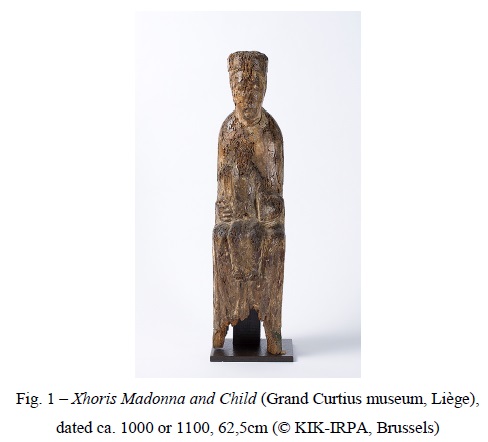
]]> Since the second half of the 20th century, new datings suggested by C14 and dendrochronological analysis have suggested that some sculptures in the round possibly produced before the year 1000 have survived<[5]. The Tancrémont Crucifix was dated at around 1100 until radiocarbon analysis gave it the title of the oldest sculpture in the round in Belgium (799-946; with a probability of 68%)[6]. The new dating is around 1000 whereas the Xhoris Madonna (Grand Curtius museum, Liège), generally attributed to the same workshop[7], is still dated a hundred years later (fig. 1). In spite of different iconographic themes and the considerable damage caused by insects on the Xhoris Madonna, the common traits of the two sculptures lead us to think that they share geographic and chronological production zones: the crowned faces, the cubic shapes, the slightly open downturned mouths. In both sculptures, the bodies’ volumes are smooth, with the draping effect only expressed by are few parallel curves (Christ’s sleeves, Child’s mantle) or straight lines (lower section of the Virgin’s bliaud). If the hypothesis of a Xhoris-Tancrémont group is maintained, the Xhoris Madonna may be considered to be contemporary or even older than the Walcourt Virgin, for which the radiocarbon analysis results (957/1020) are compatible with the consecration of the church in 1026[8].
Tongeren’s Christ on the Cross and Thuin’s Madonna and Child: revealed by X-ray
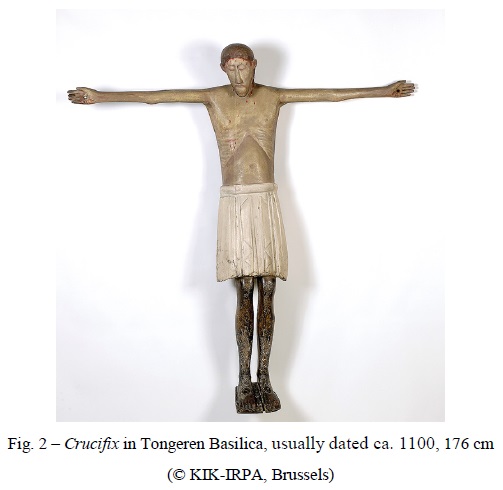
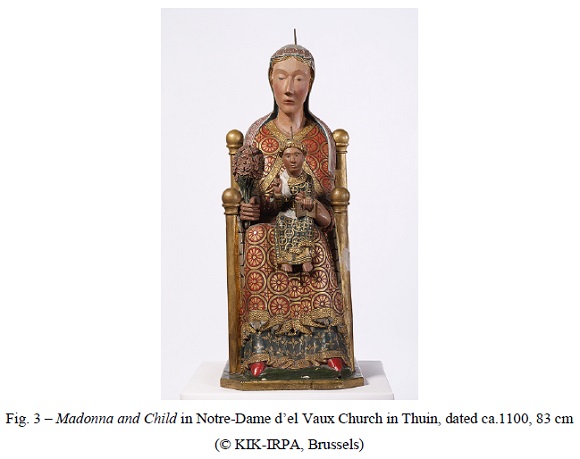
According to the generally accepted relative chronology, the passage from the 11th to the 12th century is illustrated by the Crucifix in Tongeren Basilica[9](fig. 2) and the Virgin in Notre-Dame d’el Vaux Church in Thuin[10] (fig. 3). The sculptures have in common a long face ending in an only slightly protruding chin, a long triangular nose and a small closed mouth. The Virgin was dated by C14 at between 1020 and 1160 (with a probability of 95.4%)[11]. While this very wide margin is compatible with the dating of around 1100, it does not make it possible to attribute the work more precisely to either the 11th or the 12th century. A wood sample taken from the back of the Crucifix is dated between 890 and 1020 with a 95.4% probability. This wide range makes possible the dating of the sculpture during the Ottonian period[12]. The dendrological observations suggest that a dating around 1100 seems more difficult to support.
]]>
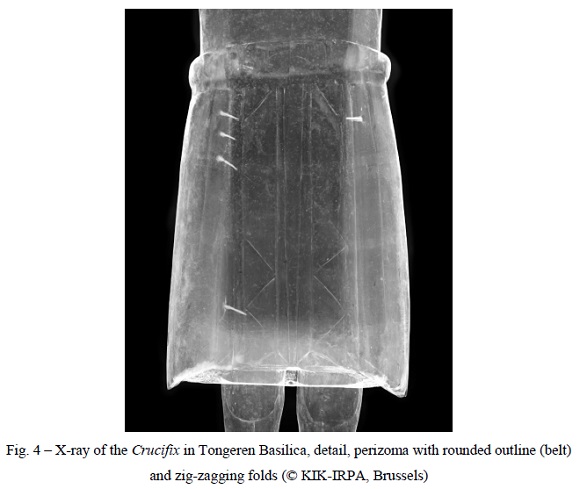
The X-ray of the Crucifix does not reveal any repair work recut on the face (fig. 4). It shows that modern nails were used to fix the sides of the perizoma which are not original. More surprisingly, the X-ray brings to light a series of details that are completely hidden by the thickness of the repaints. These elements invite us to reconsider the extremely bare, almost modern appearance of this Crucifix. On its belt, which is currently a flat band, we can make out the rounded outline of a bretzel-shaped knot that is similar to that of the Landen Crucifix, a sculpture dated in the first half of the 11th century (Grand Curtius museum, Liège)[13](fig. 5). On the X-ray, two parallel sides of the perizoma fall straight down from the knot, each forming zig-zagging folds, only a few of which are still visible to the eyes. On each side of the base of the neck, a double half-circle edged with a zigzag relief on the outside echoes the folds of the perizoma (fig. 6). This decoration, which still bears black paint traces[14], might represent hair falling on the shoulders, although the extremely geometric half-circle shape is puzzling[15]. Tomographic imagery would enable us to gain a precise insight into the volumes of these invisible details. A photo shows the Thuin Virgin as it looked before a heavy intervention in 1891which included: new hands, the addition of a bunch of flowers, an Auvergne-style throne and a polychromy which could have been inspired by the Majestat Batlló[16]. The X-ray brings back to light details that were completely buried in the thick layers of coatings, such as the small ears high on the head, exactly like those on the Crucifix (fig. 7). Under the smooth wavy hair of the 19th century appears the Virgin’s original hair, which seems to consist of fine parallel straight furrows carved in the wood. The veil at the top of the forehead sticks out in a fold shaped like a dovetail. The current round shape of the eyes on the Madonna and Child and on the Christ suggest that only the eyeballs were carved in the wood. However, the X-ray shows that they are more similar to the half-open eyes of the Virgin of Bertem, and this considerably affects the facial expressions.
]]>
The Forest-lez-Bruxelles Crucifix: northern France or Meuse region? 12th or 13th century?
The Crucifix in Forest-lez-Bruxelles church[17]is considered to be one of the high points of 12th-century sculpture in Belgium. However, art historian’s propositions on its attribution to a given region diverge: the Meuse valley or a Brabantine workshop dominated by Mosan influence or in contact with centres in northern France. Neither do they agree on the dating, of around 1160 or around 1200[18]. In the Forest sculpture, the representation gives way to a humanized, suffering Christ as expressed by the body’s slight slumping and the bent legs. While the folds of the perizoma are still straight, they are no longer strictly parallel, as they were in Landen’s Christ, and follow the shape of the legs. At the extremities, the draping creates a succession of wavelets that billow as on the Don Rupert Virgin[19](Grand Curtius Museum) which is dated between 1149 and 1158. The Forest Christ is compared to the Christs appearing on ivory pieces such as the Cross of Sibylle de Flandres conserved at the Louvre (predating 1165) and the Évangélière de Sibylle at Darmstadt’s Hessisches Landesmuseum. The Forest Crucifix has little in common with the Crucifix in Saint Brice Church in Hollogne-sur-Geer near Liège[20]. Here, the perizoma drapes in layers of very long and barely protruding curved folds. Although the iconographic themes are different, comparing this latter Crucifix with the Madonna from Saint Lawrence Chapel in Seron-sous-Forville[21] and the one from Mierchamps[22](both in TreMa museum, Namur) reveals many commonalities both with regard to the treatment of the anatomy and to that of the draperies. It is suggested to date these three sculptures to the last third of the 12th century.
First decades of the 13th century: results of dendrochrological analysis
The dendrochonological analysis carried out in the framework of the author’s PhD research has contributed some new data. The Madonna in Saint John’s Church in Liège is considered a masterpiece of 13th-century European sculpture[23]. It was not immediately recognized as coming from the Meuse area. Indeed, its exceptional quality was attributed to France and to German influences, long after the existence of Mosan art was recognized by Charles de Linas in 1882[24]. The dendrochonological analysis revealed that the oak used to carve the Virgin as well as the group of the Virgin and St. John from a Calvary in the same church, is of local regional origin, most probably from Liège[25]. This new material input confirms that the pieces were produced in the Meuse territory. However, this finding does not tell us anything about the origin of the carver!
Concerning the dating, the dates of the most recent wood rings measured during the dendrochronological analysis provide the termini post quem for the felling of the trees. The results for the four sculptures were compared with the datings usually suggested: Virgin (last ring 1202; datation around 1230), Virgin of the Calvary (1213 → around 1250-1260), Saint John at the Calvary (1214 → around 1240-1250), Calvary figure from the Saint-Mort’s Church in Huy[26] (1173 → around 1230-1250). The sapwood removed by the sculptor must be added to these post quem dates, as well as some duramen. The number of rings in the sapwood can vary considerably from one tree to another[27], and the number of duramen rings removed is unknown[28]. Taking into account the geographic provenance of the trees and the average speed of growth of the measured rings, an estimate of the minimum number of rings of missing sapwood has enabled to suggest the earliest felling dates as follows: Saint John’s Madonna (after 1212), Saint John’s standing Virgin (after 1218) and Saint John form the same Calvary (after 1222), Calvary figure at Huy’s Communal Museum (after 1185). Another element to take into account in dating a piece is the time that elapses between the tree being felled and the wood being used. It is usually assumed that drying as such took little time since sculpting dry oak is difficult. To conclude, taking all of these parameters into consideration, it can be claimed with regard to the beginning of the 13th century that the results of the dendrochronological examination do not contradict the usually suggested datings, but they do not rule out datings earlier in the 13th century.
II. Construction carving: markers of regional identity? Wood species and measures
In the 11th and 12th centuries, carvers used a rather large variety of local species of wood such as lime wood (Tancrémont, Walcourt, Hollogne-sur-Geer, Forest, the Bossière[29] and Mierchamps Virgins), alder (Hermalle-sous-Huy), willow (Bertem, Virgin from the old Descamps collection in the Grand Curtius museum)[30] and aspen (Thuin, Seron,Tongeren, Evegnée Virgin in the Grand Curtius museum)[31], apple (Saint Bishop of Schurhoven in the Museums of Art and History in Brussels)[32] . This habit can explain the importance of the damage caused by insects. While carpenters in the Meuse valley used oak systematically and in large amounts in the 12th century, it is only in the 13th century that oak became the predominant species of wood used to carve sculptures. This phenomenon is also documented in the other area of northern Europe (Rhineland[33], as well as in Scandinavian countries[34]). During the 11th and 12th centuries, the size of Virgins in Majesty varied between 46.5 cm to 85 cm. By the end of the 12th century, a few Madonnas were over a metre tall[35]. This growth increases and extends over time with a series of Madonnas dating from the first decades of the 13th century[36]. The silhouette and the neck being elongated gives these Madonnas a certain elegance when compared to the more austere representations of the preceding centuries. These 13th- century Virgins are all sculpted in oak, but this was also the case for many other Virgins under one metre tall. So the size of the scuptures does not seem to have been a determining factor to explain the use of oak. In the second half of the century, the Madonnas, mostly carved in oak, will generally be maximum one metre high. So the question remains. Why did this change to a harder wood for carving take place precisely when carvers were starting to create deeper and much more complex folds in the draperies of the Gothic sculptures? Might this be related to an evolution in the quality of carver’s tools? Or did the carvers suddenly become concerned with the durability of their works and hence preferred a wood specie that is less prone to insect attacks? Could this change be due to an increased availability of oak?
The joinery
During the whole period under analysis, the arms of the Christs on crosses are traditionnally carved separately and attached with a mortise and tenon system. The head of the Walcourt Virgin was sculpted separately and fixed with a large tenon. For the whole period being analyzed, this sculpture is the only example of this practice, which is visible in 12th-century Auvergne sculpture[37]and in other northern European regions at the beginning of the 13th century[38].
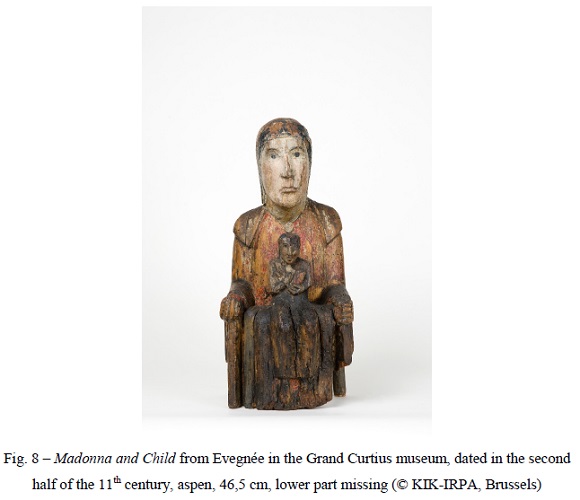
]]> In representations of Virgins and Child, whether the Child is carved in the same block as the Virgin or not does not appear as a habit representative of a chronological evolution. The Xhoris and Evegnée Virgins, the forms of which are limited to the dimensions of the block, are sculpted in a single piece of wood, Child and hands included. The left hand holding the book and the Child’s blessing hand of the Evegnée Virgin are sculpted in mid-relief in the rectangular volume of her torso (fig. 8). The Virgin’s arms, set at right angles, seem to form a unit with the seat. The position of her hands is the only element that breaks the symmetry of the composition: the right hand, with upturned palm, holds an apple, while the left hand holds the vertical frame of the seat, with the back of her hand facing outwards. The Bertem Virgin is also monoxylous apart from the Virgin’s right hand. On the Hermalle and Thuin Madonnas, the hands of the Virgin are carved separately as well as the Child which is attached to the main block with a wooden peg according to a system widely used in the 12th century. In cases of 12th-century Virgins, the Virgin’s hands are usually attached to the main block, symmetrically placed on each side of the Child (Seron, Mierchamps, old Descamps collection).
In the beginning of the 13th century, the volumes of sculptures were still dependent on the single wood block they were carved from: figure from a Calvary in the Musée communal in Huy, Saint Gertrude in Kuringen Church[39], Saint Lucy from Bernister (Treasury of Malmedy Cathedral)[40]. In the Virgin and Child representations, the Child is generally part of the same block, except in the case of the Virgin in Saint John’s. In Paris, in around 1268, instructions are given in the “Livre des Métiers d’Etienne Boileau” stipulating that no carver should make a figure which is not carved of a single piece, except for crowns and crucifixes[41]. Apart from crucifixes, which are traditionally composed of three parts[42], Mosan sculptures dated in the first half of the 13th century do not follow the guild regulations found in Paris. One the one hand, the crowns are usually part of the sculpture, and on the other hand, in the case of sitting figures, right forearms or right hands were usually made of separate pieces. What is more amazing to observe is the construction of draperies by the addition of pieces of wood as in the Crucifix in Serinchamps Church[43]dated around 1220 and the Virgin from Saint Paul’s Cathedral in Liège[44]. In this last example, the presence of the original polychromy on the pegs is a proof of the authenticity of the construction. Such assemblages show a will to free the sculpture from the limits of the block of wood. Furthermore, in well preserved examples, the apples held by the Madonas are sculpted in the same piece of wood as the hand. In several cases, the position of the right separately carved arm was changed during modification work in the 19th century to hold a sceptre. The evolution of the seats would merit a detailed typological and technical study[45]. The one in the Virgin from Evegnée, a simple four-legged bench with the backrest only going halfway up the Virgin’s back, forms a unit with the figure. The seat of the Xhoris Virgin has holes in it that may have been used to attach separately carved elements such as small columns. A more detailed analysis might be able to verify if theses additions correspond is a later change, as was the case for the Hermalle and Bertem Madonnas. In the 12th century, the rare seats to still have their original parts seemed to have a high back with pear-shaped finials which are also attached to the extermities of the arms[46] (Mierchamps Virgin, Custinne Virgin in the TreMa[47], Signeulx Virgin[48], old Descamps collection, Bossière, in Zoutleeuw Church, Saint Eloi of Havenne Chapel in the TreMa[49]). In the 13th century, figures in majesty sit on a low seat, a kind of bench.
Positioning of the sculpture
A specific rule does not seem to emerge either with regard to the positioning of the sculpture in relation to the trunk. The missing or modified parts at the top of the pieces often make it difficult to determine the position of the sculpture in the block of wood. In future, tomography will be able to compensate for this issue. At the moment it is possible to establish that the Evegnée Virgin is carved in a half log of which the heart is towards the back of the sculpture but in the centre with regard to left and right. On the Tongeren Crucifix, the heart of the tree can be seen under the toes of the left foot. With regard to German examples, Endeman states that a rule cannot be determined concerning the positioning of the sculpture with regard to the heart of the tree[50].
In the first decades of the 13th century, the heart of the trunk is usually located more or less centrally in the sculpture, slightly towards the back so that it is removed when hollowing out. However, this precaution is not always respected, and in a few examples the heart is located at the front of the sculpture, leading to the formation of deep cracks and loss of material[51].
Hollowing out
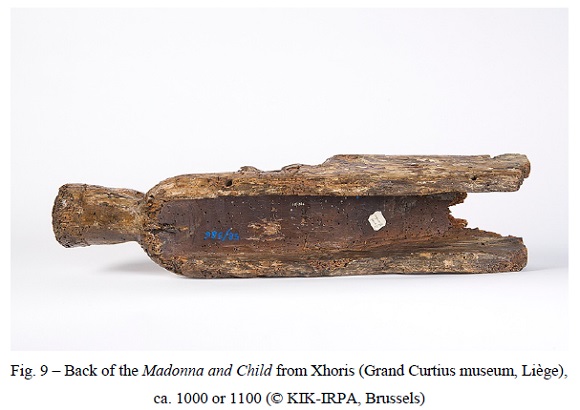
The hollowing out of the back of the sculptures is not systematic in the 11th-century sculptures. The Tancrémont Crucifix is not hollowed out, nor is the Gerresheim Christ in Germany. The back of the Xhoris Virgin is completely hollowed out to the nape of her neck following the forms of the sculpture (fig. 9). Other dorsal cavities are rectangular, as is the case on the Tongeren Crucifix. In Walcourt, it was used as a reliquary. This variety of procedures can also be found in the German corpus, in which half the sculptures up to 1000 AD are hollowed out[52]. In the 12th century, sculptors usually created a single rectangular cavity going up to the shoulder blades using a flat chisel, as in the following cases: Mierchamps, old Deschamps Collection, Seron and Hollogne-sur-Geer Crucifix. The Forest Crucifix has a cavity made up of two separate compartments closed off by a dorsal board, an ancient system also found in Germany on the Saint Georges Crucifix[53]and in France on the Autun Virgin[54]. Can this observation be used as an indication of an older dating for the Forest Crucifix?
]]>
In the very beginning of the 13th century, the back of several Mosan sculptures were hollowed out in two or three separate locations including the head[55]. On the inside, those different compartments communicate with each other. But more generally, only a single cavity was made, and the head of the sculpture was left untouched. Whether a sculpture contained a wooden board closing off the cavity or not is very interesting because it gives an indication of the sculpture’s original placement in the church. The Calvary from Saint-John’s Church in Liège was probably mounted on top of the beam of glory in the choir. Indeed, the sculptures are carved in the round with boards secured with wooden pegs and entirely carved to reproduce the drapery and painted. In the great majority of Virgins and Child, the absence of traces of fixation of a board suggests that the sculptures were originally placed on an altar, inside a tabernacle or in a niche.
Tool traces
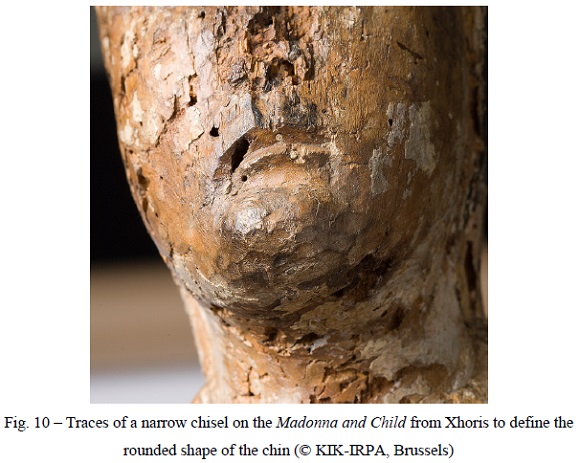
A systematic survey of the tool traces has not yet been carried out for the 11th and 12th centuries. It would be interesting to confirm whether a sharp narrow chisel is used exclusively in early sculptures to the detriment of a rounded gouge, as observed by C. Endeman. Our initial observations seem to confirm this evolution on our corpus. Traces of a narrow chisel are visible on the Xhoris Madonna, where the fingers and veil were carved. This tool was also used to define the rounded shape of the chin (fig. 10). The same observations were made on the head of the Tongeren Christ[56]. In other locations such as on the drapery of the Xhoris Madonna, tool traces seem to have been levelled to obtain a smooth surface. The dorsal cavities of the Walcourt and Xhoris Madonnas and of the Tongeren Christ were created using a flat chisel. The same is observed for the sculptures from the 12th century, such as the Seron and Mierchamp Virgins.
The rounded gouge is commonly used from the first decade of the 13th century. When the back of sculptures is hollowed out, the opening of the dorsal cavity is roughed out with the help of a gouge with curved edges or with a chisel. Both tools can be used but not in the same area of the cavity. The traces are usually between 2 and 3,5 cm long. The tool strikes are in different directions depending on the zone but never crisscross.
]]> Generally, the surface of sculptures from the Meuse valley is meticulously carved and finished very smoothly and presents no traces of tools. However, this cannot be considered as a characteristic of the Mosan production. Indeed, on a limited number of sculptures from the beginning of the 13th century, deep traces of a curved gouge and of chisels are visible and were not meant to be completely obscured by the polychromy. On these sculptures, the tool traces confer to the draperies a certain rhythm, comparable to the works of Mosan goldsmiths such as Hugo d’Oignies[57].Carved decorative patterns and inclusion of glass eyes
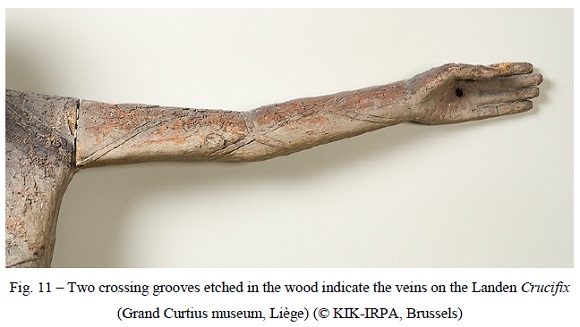
In the 11th- to 12th-century sculptures preserved, no decorative elements were represented in the wood. However, in the Evegnée Madonna a round flat clasp decorate the bliaud. In the arms of the Landen Crucifix two crossing grooves etched in the wood indicate the veins (fig. 11) This detail is apparent on other 12th-century Christs in France, notably the Varenne l'Arconce Christ presented by Nadia Bertoni in this publication. In the first decades of the 13th century, the seats of the Virgins from Saint John’s in Liège and from Oignies[58](New York, Metropolitan Museum) are decorated with foliage motifs carved in the wood. In the Virgin at Utrecht Museum the seat is decorated with gothic open archways[59] (fig. 12). In other scuptures these element are painted on the flat board if the seats.
A glass ball inserted in the location of the iris is illustrated by two sculptures: the Walcourt Madonna, which still has a dark glass eyeball, whereas in the case of the Tongeren Christ’s head, only the empty orbits remain to bear testimony to this practice. The process was used at the beginning of the 13th century on the Virgin of Saint John’s and the small Christ in Majesty from Rausa[60], two sculptures that could be given to the same carver, considering stylistic as well as technical ressemblances[61]. In most part of the sculptures preserved, the artists have relied on polychromy to add detail to the facial features, to create the gaze and characterize the garments with colour and decorative patterns.
III. Polychromy: a northern Europe history?
]]> Completition of the wooden surface: evolution in the use of ground layersThe polychromies of the oldest sculptures are characterized by a thin chalk and glue ground layer which does not modify or complete the forms. On the Tancrémont Crucifix, the thickness of the white ground varies between 30 and 100 microns. And in some parts of the sculpture, the paint layers are applied directly on the wood! This absence of ground layer can be compared with several sculptures dating from around 1000 in Germany, including the Géro and Gerresheim Christs. On the Walcourt Virgin[62], the traces of polychromy found under the 13th century cover of metal foil lie on a very fine layer of lead white, following a technique observed in various French examples[63]. This leads once again to the question of regional specificities.
In the second half of the 12th century, the thickness of the chalk and glue ground tends to increase, an evolution which can be associated with the application of metal leaf on larger surfaces. In a few examples dated in the first decade of the 13th century, the preparation layer is also used to complete the wooden form. On the Virgin from Saint Paul’s Cathedral in Liège, the shape of the thin parallel streaks representing strands of hair is due to the preparation, not the carving. On the face of the Virgin at Utrecht Museum, the waves in the hair are represented by grooves carved in the wood, whereas on the back, only the preparation represents the strands[64]. The representation of the hair in the preparation seems more frequent in sculptures in the Rhine area in the 13th century[65]. Initial examples of a pastiglia decroation only appear in the Meuse regions in the second half of the 13th century[66], while the technique is already used for the representation of cabochons in many sculptures in Sweden and Germany at the end of the 12th century[67]. In sculptures dating from the first decades of the 13th century, the preparation seems to have been carefully polished under the carnations, which look very smooth[68]. On the Saint John from Saint Mort’s Church in Huy, analyses have revealed large amounts of very fine silica grains on the surface of the preparation layer. The presence of this substance might be indicative of surface polishing using asperella according to the practice recommended by the monk Theophilus in the 12th century[69]. A thicker preparation can also help to iron out uneven surfaces, especially those due to deep-handed carving. This is the case with the Virgin at Utrecht Museum, on which the preparation can be as much as one centimetre thick.
The 11th-century sculptures: a polychromy dominated by colours?
To imagine how the sculptures originally looked on the basis of fragments of old layers of paint is still a delicate exercise that calls for nuanced explanations[70]. Thanks to technical investigations, a set of early testimonies now illustrates the existence of “lively painted style” or ‘polychromie au naturel’ among which the Walcourt Virgin is a notable example[71]. It is interesting to note that the presence of relics does not seem to influence the type of coating, be it polychromy or metal foil as illustrated as well by the Paderborn Virgin. The result of the technical studies carried out so far on the Belgian corpus make it possible to state that the 11th-century examples all wear colored garments on which the repetitive patterns are thought to express solemnity and sacredness. The presence of gold was not obseved on the early example examined. The perizoma on the small Crucifix in Léau Church (second half of the 11th century) has a golden surface. The sculpture is currently under examination at IRPA. Initial observation confirms that this imitation gold covers various levels of coloured paint belonging to different older polychromies.
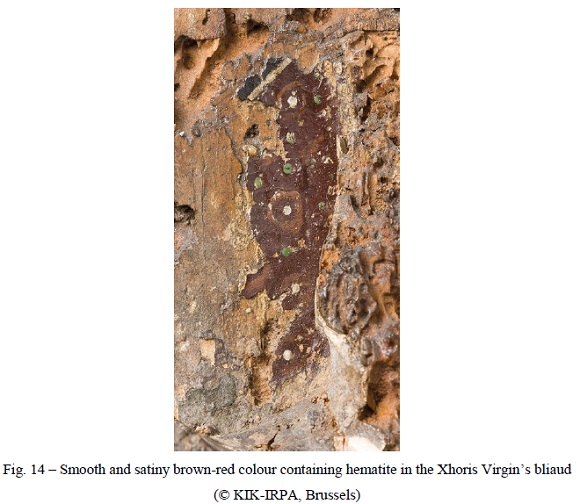
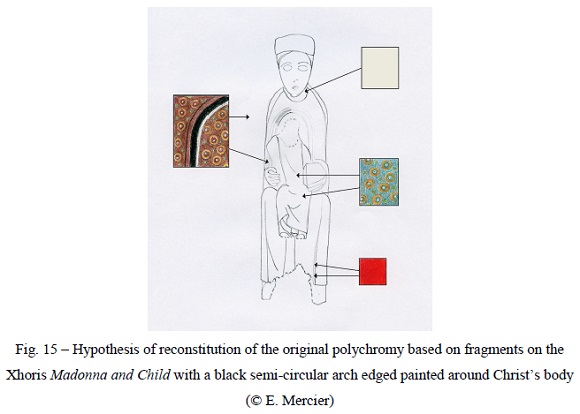
The local blue pigment vivianite has been identified on the mantel of the child of the Xhoris Virgin as well as and on the tunic of the Tancrémont Crucifix[72](fig. 13). On the Xhoris Virgin, the matte pale grey-blue of the Child’s mantle contrasts with the satin shine of the Virgin’s bliaud, which is painted in a very smooth and satiny brown-red colour (fig. 14). This effect is achieved by adding a translucent layer containing a small amount of calcium carbonate and hematite. A thin layer with yellow fluorescence on the surface might be a varnish. This dark satiny shade is used alongside a bright opaque red on the lining of the bliaud. The Virgin’s bliaud and the Child’s mantle are decorated with the same pattern of bright green spots and ochre circles around white dots[73]. It is possible that green stars were also represented. A semi-circular arch edged with black was painted around Christ-child on the bust of the Virgin (fig. 15). This introduction of a third level of reality in the image can be considered as the expression of assumed ‘discordances’ between the plastic form and the polychromy considered to be characteristic of the Romanesque period[74].
]]>
Although there does not seem to be any gold, arsenic yellow orpiment is used to achieve certain golden effects. The association of orpiment with ultramarine, obtained from the semi-precious stone lapis lazuli/ultramarine and imported from Badakhshan (North-East Afghanistan), is illustrated by the Bertem Virgin and other 12th-century Virgins, especially in France but also in Switzerland. On the Bertem Virgin, the ultramarine blue on the Virgin’s mantle lies on an underlayer of indigo[75]. This stratigraphy is similar to the French ‘Lavandieu’ Christ[76]. This appreciation of the colour blue is also visible on the Forest Christ in its original version (not currently visible). This trend of blue garments covered in ultramarine can be seen in a whole range of sculptures in other regions of Europe[77]. In these examples dated in the 12th century, the use of gold is only limited to the edges, the belt and some decorative elements. However, the case of the Dijon Virgin studied by N. Bertoni might reveal that this typology is older.
Second half of the 12th-beginning of the 13th century: Imitation and use of gold and precious stones?
Considering this extensive use of coloured surfaces, we might wonder when and how the change occurred between this taste for colour also called “lively painted style” and the almost all-pervading use of gold on the garments of many 13th-century sculptures, also called “golden style”. This change in taste did not appear all of a sudden. Indeed, in the last third of the 12th century, we observe an increasing number of sculptures on which garments are completely covered with an imitation of gold. It is achieved by using silver leaf covered in a thick layer of yellow glaze. This is the technique used for the Hollogne Crucifix’s perizoma. This gold imitation also corresponds to the second polychromy on the Forest Crucifix. As of the last third of the 12th century, examples of golden-aspect perizomas start spreading in Europe. Remains of glazed silver leaf with yellow glaze[78]can be seen both on the bliaud and the mantle of the Seron Virgin. The edge of the mantle showed a pattern of alternating stripes of white, ultramarine blue, and red painted with lac lake. The use of silver-imitation gold is illustrated by other sculptures dated in the last third of the 12th century as on the bliaud of the Mierchamps Virgin, Saint Eloi of Havenne, Saint Bishop from Schurhoven, Saint Gertrude of Kuringen. This typology of golden-looking garments lined with bright red appears at the same time in other regions, such as France, Sweden, Germany, etc. A quite well preserved example which exhibits its original gold imitation is the Virgin from Saint- Voir in France[79]. One hypothesis for the use of silver in our regions is the operation of the first silver mines in central Europe, in Saxony and Bohemia, in around 1160 AD. According to Peter Spufford, this explains to a large extent the intensification of the circulation of goods not only within Europe but also with Asia.
On the Saint John Virgin, as well as on the majority of the sculpture dated from around 1230, the use of real gold leaf started to appear in first decade of the 13th century. This phenomenon appears quite suddenly. Analysis shows thar the gold leaf shows a high level of purity. This leads to assume contact with a gold coining center in a period when only silver was used in Europe for this purpose. It is therefore likely that the gold bezants available after the Capture of Constantinople in 1204 and the creation of the Latin Empire may have provided the raw materials for the goldbeaters[80].
Matte mordant gilding observed on the garments of six sculptures dated in the first half of the 13th century corroborates Peter Tångeberg’s thesis that this technique observed in Sweden is a northern European tradition parallel to the more common aqueous gilding[81]. Whatever the technique used, on the Belgian sculptures, the gilded surface seems to be systematically covered with a yellow glaze.
The technical study of the Mosan sculpture makes it possibile to state that a style of polychromy dominated by colours also called ‘lively painted style’ which seems to have characterised the 11th-century sculptures continued to develop in parallel with the so- called “golden style” which appeared in the second half of the 12th century. The coexistence of these two types of polychromy has already been highlighted in Sweden and in Norway[82]. In the 13th century, the ‘golden style’ seems to be the most widespread. The Virgin in Saint John’s Church is the only well preserved Mosan example of this type of polychromy, even though the richness and variety of decorative techniques employed, including the inclusion of many rock crystal cabochon, make it an isolated case today[83]. This sculpture could, however, be part of a tradition going back to the end of the 12th century, to which the Oignies Virgin and the Bossière Virgin also belong. On these two sculptures, that are now stripped, the presence of oval-shape shallow cavities in the wood likely for the setting of cabochon demonstrates the richness of the lost polychromy[84].
This taste for gold and the representation of gemstones is illustrated in a series of sculptures dated around the year 1200 in Scandinavian countries and in Germany[85].
]]> In the first decade of the 13th century, a third type of polychromy is observed in the Mosan production which is called “Idealfassung” as illustrated by the small Christ said to be “from Rausa”[86]and the Madonna in Utrecht Museum[87]. This type of polychromy was believed to be characteristic of the 14th century as illustrated by sculptures in Germay[88]. Whereas in the golden style, the lining of the gilded garments is painted in red, in the “ideal style” gilding covers the inside and outside of the garments and only the flesh areas are painted. In both Belgian examples, a fine edge of red glaze of Lac dyes (Kerria Lacca Ker) imported from South Asia underlines the collar of the tunic. The effect that this type of polychromy produces is reminiscent of the metal foil- covered statues with painted faces. This mixed technique is generally illustrated by the Orcival Virgin (12th century) and might be very old, as the golden Virgin of Hildesheim suggests (circa 1010-1015)[89].The question of the use of oil as a binding medium
In the first half of the 13th century, a taste for luminous materials results in the use of smooth and glossy surfaces that are either coloured or metallic. These effects are achieved by various technical means: underlayers with white or red lead pigments; green copper based glazes, red Lac dyes; yellow glazes over gilding. They depend to a large extent on the binding agent. Our observations lead us to conclude that oil does seem to be one of the main ingredients of the pictorial layers’ binders, including azurite. In the first half of the 13th century, this blue pigment is widely used, a phenomenon usually attributed to the Mongolian invasions in eastern Europe which are thought to have stopped trading in lapis lazuli /ultramarine on the trading routes in the north[90]. The azurite-based blue paint layers observed on Belgian sculptures exhibit a dark tonality with a very glossy appearance, which stands in stark contrast to the bright and matte - equally azurite-based - blue polychromy widely found on sculptures in the following centuries possibly to imitate velvet[91]. In the first half of the 13th century, azurite is applied over one or more light blue underlayers containing lead white, a layer structure already in use in the 12th century with lapis lazuli/ultramarine. In most sculptures examined, the dark and glossy blue layers are comprised of very finely ground grains (1-30 microns) contributing to the dark appearance of the upper blue layer. In a few examples, the addition of carbon black pigments is observed. The presence of oil in the azurite layer has been determined by the crossing of various analyses on a sculpture referred to as the Virgin of the Van den Peereboom donation (Royal Museums of Art and History). The analyses made with GC-MS identified linseed oil in the azurite layers and FTIR microscopy (in specular reflection mode) shows the presence of both drying oil and of a protein material in the upper layer. Reconstructions were made to determine the visual properties of different types of azurite-based blue paint possibly used in the 13th century. Only finely ground azurite previously mixed with animal glue or glair and then applied with linseed oil to provide an appearance comparable to that of the blue layers was observed on the sculptures. When applied with glair, following a recipe given by Petrus de Sancto Audemaro[92], the layer is easy to apply and gives the most homogeneous and glossy surface. Observation, analysis and reconstruction suggest that the dark and glossy appearance is an original feature of 13th-century blue layers which would be in line with the aesthetics of that time when luxurious indigo-dyed clothing was valued at the European courts. These blue cloths are rigorously classified, with the most sought ‘azure’ or ‘ynde’ (a very dark blue)[93]or ‘brunette’ cloth, a dark blue fabric from Liège considered to be a very luxurious product. Results of the in-depth study of the Virgin of the Van den Peereboom donation match results of medium analyses acquired over the last few years on 13th- and 14th-century paintings which have established that not only heat-bodied oil mixed with resin but also pure linseed oil were used for different purposes, possibly on the same object[94]. This raised the question of the developpemnt of this knowledge before the 13th century. The few case studies to have been carried out until now on 11th-12th-century sculptures in Belgium have focused on the colours and pigments to the detriment of the painterly effects, which greatly depend on the type of binder. In addition, analysis of the binding media were limited and carried out mainly with solubility tests which are only indicative. This means that old studies need completing and the sample analysis needs bringing up to date both in terms of pigments and binders.
Conclusion
With regard to the dating of 11th- to 12th-century sculptures, the whole corpus would deserve radiocarbon or when possible dendrochronological analysis. These, however, are not a replacement for an iconographic and stylistic analysis. Considering the complex material history of most sculptures, in order to avoid falling in the anachronism trap this analysis must in turn take into account the repair work and transformations which have occurred sometimes early in their existences.
From a technical perspective, although the materials and techniques found do not always seem to be mentioned in mediaeval treatises, they do bear testimony, through their appearances and their uses, to a certain homogeneity in northern Europe. These findings seem to reflect the importance of oral transmission, not only within the workshops but also between geographical areas. Similarly, with regard to form, divergences which appear in literature concerning the attribution of pieces to a specific production area (Mosan, Brabantine, northern French) may also be explained by shared typologies. To determine more specifically if certain technical habits that can be used as markers of regional identity is a delicate task. On the one hand, sculptors from a given location have not necessarily used the same modus operandi. On the other hand, existing data must be completed to provide a better insight of the whole preserved production of northern Europe in order to lead to more rigorous comparisons, keeping in mind that our view of the evolution of 11th- to early 13th-century sculpture is very fragmentary.
A summary of this data makes if possible to qualify the still very common view that in the Romanesque period, the palette of colours was simplified and limited to pure colours of local origin. Materials, on the contrary, came from far away. The large variety of techniques and the complex layered structures observed illustrate a remarkable technical mastery generally assumed to be characteristic of late Gothic. Even if it is becoming more and more difficult to sustain that oil paint was only used to paint doors in the 12th- to early 13th-century, researchers are nevertheless still divided on the question of the development of oil paint technique. Some of them, such as Mark Clark[95], conclude that oil painting remained a “sleeper technology” with no difference in effect to aqueous media until the Van Eyck era. Others, such as Unn Plahter[96], consider that it was not the case in the 13th century and are tempted to question whether an enhanced exploitation of the potentials of oil-based medium took place in the western and northern parts of Europe. 11th- to early 13th-century wood polychrome sculpture is certainly a possible missing link to explore this thorny hypothesis.
At this stage, research results make it possible to note that the material effects, the use of colour, materials and decorative patterns generally follow the same trend as the polychromed sculptures of the rest of norther Europe. Polychromy also being affected by the polymorphism of creation in mediaeval images, a typology can be extended until very late and thus coexist with other formulations. Three types of polychromy exist at the beginning of the century: “lively painted”, “golden style” and “ideal style”. The evolution observed in the sculptures studied in Belgium was also demonstrated on Catalan painted altar frontals. Manuel Castinieras suggests that the exclusive use of colours on the oldest altar is more reminiscent of illuminated manuscript whereas the use of tin sheets which appears in the second half of the 12th century is suggestive of goldsmithery[97]. It will be interesting to observe if this evolution is corroborated by the result of future case studies.
The corpus of Belgian works includes sculptures that have not yet been studied at all and could add pieces to the partial puzzle we have examined here. Ideas for future research have been expressed, and many gaps need to be filled by detailed analyses. In view of the small number of pieces to be analysed, only a systematic work method will guarantee the pertinence of the comparisons.
]]> BIBLIOGRAPHICAL REFERENCES:
BALLESTREM, Agnès; PUISSANT, Martine - “La croix triomphale de l’église Saint- Denis à Forest”. Bulletin de l’Institut royal du Patrimoine Artistique 13 (1971-1972), pp. 53-76.
BERTONI, Nadia; CREN, Stéphane - “Un liant huileux sur une sculpture du Moyen Âge. La polychromie du crucifix de la cathédrale de Trieste”. in GOUPY, Jacques; MOHEN, Jean-Pierre (ed.) - Art et chimie, la couleur (Actes du congrès, Paris, Centre national de la Recherche scientifique, 16-18 sept. 1998). Paris: CNRS ed, 2000, pp. 102-104.
BLINDHEIM, Martin - Main trends of East-Norwegian wooden figure sculpture in the second half of the thirteenth century. Oslo: Dybwad, 1952, pp. 87-111. [ Links ]
BLINDHEIM, Martin - Painted Wooden Sculpture in Norway, C. 1100-1250. Oslo: Scandinavian University Press, 1998. [ Links ]
CASCIO, Agnès; DESCHAMPS-TAN, Stéphanie; LE POGAM, Pierre-Yves - “La restauration du Christ Courajod: la luminosité d’une polychromie romane retrouvée”. Techné 39 (2014), pp. 53-59.
CASTIŇERAS, Manuel - “L’étude des panneaux peints en catalogne: artiste, apprentissage et techniques”. in MALLET, Géraldine; LETURQUE, Anne (dir.) - Arts picturaux en territoires catalans (XIIe-XIVe siècle). Approches matérielles, techniques et comparatives, (Actes des journées d’études), programme Factura, Université Montpellier 3 - Centre d’Études Médiévales de Montpellier, 11 octobre 2012, Montpellier: Presses universitaires de la Méditerranée, 2015, p. 21
CLARK, Marc - Medieval Painter’s Materials and Technique - The Montpellier Liber diversarum arcium. London: Archetype Publications, p. 87.
]]> CLAUSSEN, Hilde - “Grosse Goldene Madonna. Restaurierung und Untersucchungsergebnisse”. Kirchenkunst des Mittelalters. Erhalten und erforschen, Catalogue du Musée diocésain d’Hildesheim, 1989, pp. 58-59DE BOCHGRAVE D’ALTENA, Joseph - “Madones en Majesté, à propos de Notre- Dame d’Eprave”. Revue belge d’Archéologie et d’Histoire de l’art 30 (1961), pp. 71-72, fig. 57.
DE LESPINASSE, R.; DE BONNARDOT, F. - Les métiers et corporations de la ville de paris, xiiie s., le livre de métiers d’etienne boileau, Paris, 1879, paragraph IX of the chapter concerning the wood cutters of Paris.
DE MÉRINDOL, Christian - “Signes de hiérarchie sociale à la fin du Moyen Âge d’après le vêtement, méthodes et recherches”. Le Vêtement. Histoire, Archéologie et Symbolique vestimentaires au Moyen Âge, Paris: Les Cahiers du Léopard d’or, 1, 1989, pp. 181-222.
DIDIER, Robert - “La Sculpture mosane du XIe au milieu du XIIIe siècle”. in Rhein und Maas, Kunst und Kultur, 800-1400. 2. Berichte, Beiträge und Forschungen zum Themenkreis der Ausstellung und des Katalogs. Cologne, 1973, pp. 407-424.
DIDIER, Robert - “Une Vierge ottonienne et son revers du XIIIe siècle”. Bulletin de l’Institut royal du Patrimoine Artistique 25 (1993), pp. 74-78 and p. 27.
ENDEMANN, Klaus - “Spurensicherung, Voraussetzung und notwendige Ergänzung Kunstwissenschaftlicher Analysen. Zum Kruzifixus des ehemaligen Prämonstratenser- Klosters in Cappenberg”. Unter der Lupe, Neue Forschungen zu Skulptur und malerei des Hoch-und-Spätmittelalters (2000), pp. 11-35.
ENDEMANN, Klaus - “Zur Holzskulptur des frühen Mittelalters. Voraussetzungen und Funktion-Schnitztechnik und Fassung”. Zeitschrift für Kunsttechnologie und Konservierung Bd 26 (2012, Heft 2), pp. 406-407.
FRØYSAKER, Tine; KOLLANDSRUD, Kaja, - “The Calvary group in Urnes Stave church, Norway: A technological examination”. in NADOLNY Jilleen (ed.), Medieval Painting in Northern Europe: techniques, analysis, art history. London: Archetype publications, 2006, pp. 43-58
GHISLAIN, Jean-Claude - “La sculpture romane”. in KUPPER, Jean-Louis; GEORGES, Philippe (ed.) - Liège autour de l’an mil, la Naissance d’une principauté (Xe-XIIe siècle). Liège: Editions du Perron, 2000, pp. 133-138.
]]>GHISLAIN, Jean-Claude; MERCIER, Emmanuelle - La Vierge en Majesté romane de Seron. Namur: Guide du visiteur du Musée des Arts anciens du Namurois, 19, 2013. [ Links ]
HOWARD, Helen - Pigments of English Medieval Wall Painting. London: Archetype publications, 2003. [ Links ]
JÄGERS, Elisabeth - “Zur Polychromie der Kölner Skulptur vom 12. bis zum Ende des 14”. in BERGMANN, Ulrike (ed.) - Schnütgen-Museum. Die Holzskulpturen des Mittelalters (1000-1400). Cologne: Druckerei Locher, 1989, pp. 85-106.
KARGÈRE, Lucretia - “The Use of Lapis Lazuli as a Pigment in Medieval Europe”. MET Objectives 4 (2003), pp. 5-7
KARGÈRE, Lucretia; RIZZO, Andrea - “Twelfth-Century French Polychrom Sculpture in The Metropolitan Museum of Art: Materials and Techniques”. Metropolitan Museum Studies in Art, Science, and technology 1 (2010), pp. 39-72.
KOECHLIN, Raymond -“La statuaire belge et les influences françaises aux XIIIe et XIVe siècles”. Gazette des Beaux-Arts t. II (1903), pp. 5-19, p. 8.
KOLLANDSRUD, Kaja - “Vasaris theory of the origins of oil paintings and its influence on cleaning methods: the ruined polychromy of the early thirteenth century Crucifix from Haug, Norway”. LINDLEY, Philippe (ed.), Sculpture Conservation: preservation or interference?. Brookfield: Scholar Press, 1997, pp. 139-149
KOLLANDSRUD, Kaja - “Technical mapping of Norwegian polychrome wooden sculpture, 1100-1350: A preliminary overview”. Oslo University museum of cultural Heritage, occasional papers vol. 1 (2002), pp. 125-141.
]]> LE POGAM, Pierre-Yves - “La polychromie de la sculpture française au XIIe-XIIIe siècle, une esquisse”. La polychromie des sculptures françaises au Moyen Âge, Techné 39 (2014), pp. 43-51MERCIER, Emmanuelle - “La Croix triomphale de l’église Saint-Brice à Hollogne-sur- Geer, notes d’histoire de l’art et remise en contexte”. Bulletin de l’Institut royal du Patrimoine Artistique 31 (2004-2005), 2007, pp. 39-54.
MERCIER, Emmanuelle - “Le Saint Jean au Calvaire du Musée communal de Huy”. Annales du cercle hutois des Sciences et Beaux-Arts 58 (2006-2007), pp. 35-68.
MERCIER, Emmanuelle - “Le Saint Éloi et le Saint Laurent de Hour dans le contexte de la sculpture mosane du XIIIe siècle”. Bulletin de l’Institut royal du Patrimoine Artistique 32 (2006-2008), pp. 131-143.
MERCIER, Emmanuelle - La polychromie de la sculpture mosane en bois du XIIIe siècle. Liège: Université de Liège, 2008. PHD Thesis. [ Links ]
MERCIER, Emmanuelle - “The Artisan Carver’s Materials and Practices: Studying 13th and 14th Century Mosan Sculptures”. in SEYMOUR Kate (ed.) - Polychrome Sculpture: Tool Marks and Construction Techniques, ICOM-CC Interim Meeting, Working Group Sculpture, Polychromy, and Architectural Decoration, Maastricht, 24- 25 oct. 2010, 2014, pp.14-26. http://www.icom-cc.org/ul/cms/fck-uploaded/documents/Polychrome%20Sculpture%20Papers%202010-2013/POLYCHROME%20SCULPTURE%20Vol%201%20Maastricht.pdf. Accessed 28.11.2018
MERCIER, Emmanuelle - “La polychromie de la Sedes Sapientiae de l’église Saint- Jean-l’Evangéliste à Liège: phénomène de transferts artistiques Est-Ouest au début du XIIIe siècle?”. in MALLET, Géraldine; LETURQUE, Anne (dir.) - Arts picturaux en territoires catalans (XIIe-XIVe siècle). Approches matérielles, techniques et comparatives, (Actes des journées d’études), programme Factura, Université Montpellier 3 - Centre d’Études Médiévales de Montpellier, 11 octobre 2012, Montpellier: Presses universitaires de la Méditerranée, 2015, pp. 125-145.
MERCIER, Emmanuelle - “La Sedes Sapientiae de la Cathédrale Saint-Paul à Liège”. Bloc-Notes 33, revue trimestrielle du Trésor de la cathédrale de Liège (décembre 2012), pp. 8-16, http://en.calameo.com/read/001942648b81b54b34d14
MERCIER, Emmanuelle - “La polychromie de la sculpture mosane entre les XIIe et XIVe s. Couleurs, techniques et expressions en rapport avec l’évolution des formes et les pratiques cultuelles dans le diocèse de Liège”. Bulletin de l’Institut royal du Patrimoine Artistique 34 (2013-2015), pp. 41-76.
]]> MERCIER, Emmanuelle - “De Zwarte Madonna van Halle en haar polychromieën”. in HOUSSIAU, Albert; MERCIER, Emmanuelle; DE CLERCQ, Camille - Onze-lieve- vrouw van Halle, Een beeldrijke geschiedenis. Halle: Koninklijke Geschied- en Oudheidkundige Kring van Halle, 2015, pp. 118-130.MERCIER, Emmanuelle - “Brussels-Copenhagen (1967-2017): A story of the history of polychrome sculpture”. in ICOM-CC 18th Triennial Conference Preprints, Copenhagen, 4-8 September 2017, ed. J. Bridgland, art. 1705. Paris: International Council of Museums, 2017, p. 5. https://www.icom-cc-publications-online.org/PublicationDetail.aspx?cid=7a872740-7488-4c80-a349-f8767deb256f
MERCIER, Emmanuelle; SANYOVA, Jana - “Art et techniques de la polychromie romane sur bois dans l’Europe du Nord”. Les Cahiers de Saint-Michel de Cuxa, Actes des XLIIIe journées romanes de Cuxa, 2012, pp. 125-133.
MERCIER, Emmanuelle; SANYOVA, Jana - “A polychrome sculpture from the beginning of the XIIIth century in Royal Museum of Art and History in Brussels: materials and techniques”. in STREETON Noëlle L. W.; KOLLANDSRUD, Kaja (ed.) - Paint and piety: collected essays on medieval painting and polychrome sculpture. Londres: Archetype Publications, 2014, pp. 77-91.
NEYSES, Mechthild - “Dendrochronologische Untersuchungen an Holzskulpturen des Schnütgen-Museum”. in BERGMANN, Ulrike (ed.) - Schnütgen-Museum. Die Holzskulpturen des Mittelalters (1000-1400). Cologne: Druckerei Locher, 1989, pp. 107-112.
PEEZ, Marc - “Gerresheimer Kruzifix. Neue Ergebnisse zur Werktechnik einer ottonischen Monumentalplastik”. in Denkmal-Kultur im Rheinland. Festischrift fuer Udo Mainzer zum 65. Geburtstag; Arbeitsheft der rheinischen Denkmalpflege Worms, Wernersche 75 (2010), pp. 117-127.
PETRUS DE SANCTO AUDEMARO, no. 168 “Comment l’azur est purifié et préparé”, in MERRIFIELD, Mary P. - Medieval and Renaissance Treatises on the Arts of Painting, 2 vols. New York: Dover Publications, 1967, p. 134.
PHILIPPOT, Paul - “Jalons pour une histoire de la sculpture polychrome médiévale”. Revue belge d’archéologie et d’histoire de l’art 53 (1984) pp. 21-42, p. 31.
PLAHTER, Unn - “Norwegian art technology in the twelfth and thirteenth centuries”. Zeischrift für Kunstechnologie und Konservierung” - Bd. 28, 2014, heft 2., pp. 298-332.
PLAHTER, Unn; NORSENG, Per G. - “The trade in painters’ materials in Norway in the Middle Ages trade”. in KIRBY, Jo; NASH, Susie; CANNON, Joanna (ed.) - Trade in Artists’ Materials, Market and Commerce in Europe to 1700. London: Archetype Publications, 2010, pp. 50-73.
]]> SERCK-DEWAIDE, Myriam; VERFAILLE, Simone - “Le Vieux Bon Dieu de Tancrémont. Histoire et traitement”. Bulletin de l’Institut royal du Patrimoine Artistique 23 (1990-1991), pp. 80-100.SERCK-DEWAIDE, Myriam - “Les Sedes Sapientiæ romanes de Bertem et d’Hermalle-sous-Huy. Étude des polychromies successives”. Bulletin de l’Institut royal du Patrimoine Artistique 16 (1976-1977), pp. 56-74.
SERCK-DEWAIDE, Myriam - “N-D de Walcourt. La statue en bois polychrome”, Bulletin de l’Institut royal du Patrimoine Artistique 25 (1993), pp. 45-47.
SCHULZE-SENGER, Christa, et alii - “Das Gero-Kreuz im Kölner Dom”. Kölner Domblatt, Jahrbuch des Zentral-Dombauvereins 41 (1976), pp. 9-56.
SPUFFORD, Peter - “Lapis, Indigo, Woad: Artists’ materials in the Context of International trade before 1700”. in KIRBY, Jo; NASH, Susie; CANNON, Joanna (ed.) - Trade in Artists’ Materials, Market and Commerce in Europe to 1700. London: Archetype Publications, 2010, pp. 10-25.
TÅNGEBERG, Peter - Mittelalterliche Holzskulpturen und Altarschreine in Schweden. Studien zu Form, Material und Technik, (Mittelalterliche Plastik in Schweden). Stockholm: Kunglica Vitterhets Historie och Antikvitets Akademien, 1986. [ Links ]
TÅNGEBERG, Peter; PLAHTER, Unn - “The Crucifix from Hemse”. in NADOLNY Jilleen. (ed.) - Medieval painting in Northern Europe: Techniques, Analysis, Art History. London: Archetype Publications, 2006, pp. 1-19.
TAUBERT, Johannes - Polychrome Sculpture, Meaning, Form, Conservation, (MARINCOLA, Michele. D. (ed.)). Los Angeles: The Getty Conservation Institute, 2015. [ Links ]
]]>VAN HAUWERMEIREN, Corinne - Réévaluation de la chronologie de la statuaire mariale des Pyrénées-Orientales (France). Études technique et stylistique des Vierges à l'Enfant romanes et gothiques. Namur: Université de Namur, 2014, PHD Thesis. [ Links ]
Como citar este artigo
Referência electrónica:
MERCIER, Emmanuelle - “New research findings on 11th-early 13th-century polychrome wood sculpture at the Royal Institute for Cultural Heritage, Brussels”. Medievalista 26 (Julho-Dezembro 2019). [Em linha] [Consultado dd.mm.aaaa].
Disponível em http://www2.fcsh.unl.pt/iem/medievalista/MEDIEVALISTA26/mercier2606.html
Data recepção do artigo / Received for publication: 18 de novembro de 2018
Data aceitação do artigo / Accepted in revised form: 29 de abril de 2019
]]>NOTAS
[1] 75 cm, http://balat.kikirpa.be/object/20044721 (the online balat.kikirpa.be photo library).
[2] 47 cm, http://balat.kikirpa.be/object/32047 ; SERCK-DEWAIDE, Myriam - “Les Sedes Sapientiæ romanes de Bertem et d’Hermalle-sous-Huy. Étude des polychromies successives”. Bulletin de l’Institut royal du Patrimoine Artistique 16 (1976-1977), pp. 56-74.
[3] 62 cm, http://balat.kikirpa.be/object/10060253
[4] 92,5 cm, http://balat.kikirpa.be/object/28680 ; MERCIER, Emmanuelle - “De Zwarte Madonna van Halle en haar polychromieën”. in HOUSSIAU, Albert; MERCIER, Emmanuelle; DE CLERCQ, Camille - Onze-lieve-vrouw van Halle, Een beeldrijke geschiedenis. Halle: Koninklijke Geschied- en Oudheidkundige Kring van Halle, 2015, pp. 118-130.
[5] PEEZ, Marc - “Gerresheimer Kruzifix. Neue Ergebnisse zur Werktechnik einer ottonischen Monumentalplastik”. in Denkmal-Kultur im Rheinland. Festischrift fuer Udo Mainzer zum 65. Geburtstag; Arbeitsheft der rheinischen Denkmalpflege Worms, Wernersche 75 (2010), pp. 117-127. SCHULZE-SENGER, Christa, et alii - “Das Gero-Kreuz im Kölner Dom”. Kölner Domblatt, Jahrbuch des Zentral-Dombauvereins 41 (1976), pp. 9-56.
[6] 157 cm, http://balat.kikirpa.be/object/10029726 ; DIDIER, Robert - “La Sculpture mosane du XIe au milieu du XIIIe siècle”, in Rhein und Maas, Kunst und Kultur, 800-1400. 2. Berichte, Beiträge und Forschungen zum Themenkreis der Ausstellung und des Katalogs. Cologne, 1973, p. 411; SERCK- DEWAIDE, Myriam et alii, “Le Vieux Bon Dieu de Tancrémont”. Bulletin de l’Institut royal du Patrimoine Artistique 23 (1990-1991), pp. 93-99.
[7] 62,5 cm, http://balat.kikirpa.be/object/10134321; SERCK-DEWAIDE, Myriam et alii, “Le Vieux Bon Dieu…”, p. 95; GHISLAIN, Jean-Claude - “La sculpture romane”. in KUPPER, Jean-Louis; GEORGES, Philippe - Liège autour de l’an mil, la Naissance d’une principauté (Xe-XIIe siècle). Liège: Edition du Perron, 2000, p. 134.
[8] UtC-1446: (BP) 1050 +/- 40. VAN STRYDONCK, Marc - “N.-D. de Walcourt, datation par le radiocarbone”; DIDIER, Robert - “Une Vierge ottonienne et son revers du XIIIe siècle”. Bulletin de l’Institut royal du Patrimoine Artistique 25 (1993), pp. 74-78 and p. 27.
]]> [9] 176 cm, forearms not original, http://balat.kikirpa.be/object/40578 ; DIDIER, Robert - “La Sculpture mosane...”, p. 411.[10] 83 cm, http://balat.kikirpa.be/object/10069857 ,Thuin was depending from Liège. DIDIER, Robert - “La Sculpture mosane...”, p. 412.
[11] MERCIER, Emmanuelle - study report, not published; BOUDIN, Mathieu - C14 analysis: 07/05/2015, RICH-21902= 937+/-27BP
[12] Mathieu Boudin - C14 analysis:, 28/01/2019, RICH-26670= 1076+/-24BP.
[13] 156 cm, http://balat.kikirpa.be/object/10127887
[14] Observations made after the opening of a window for a better understanding of the X-Ray.
[15] The hypothesis of a necklace is to consider.
[16] DE BOCHGRAVE D’ALTENA, Joseph - “Madones en Majesté, à propos de Notre-Dame d’Eprave”. Revue belge d’Archéologie et d’Histoire de l’art 30 (1961), pp. 71-72, fig. 57.
[17] 195 cm, http://balat.kikirpa.be/object/20005768
[18] BALLESTREM, Agnès; PUISSANT, Martine - “La croix triomphale de l’église Saint-Denis à Forest”. Bulletin de l’Institut royal du Patrimoine Artistique 13 (1971-1972), pp. 53-76; MERCIER, Emmanuelle - “La Croix triomphale de l’église Saint-Brice à Hollogne-sur-Geer, notes d’histoire de l’art et remise en contexte”. Bulletin de l’Institut royal du Patrimoine Artistique 31 (2004-2005), 2007, pp. 39-54.
]]> [19] 92 cm, http://balat.kikirpa.be/object/10132386[20] 190 cm, http://balat.kikirpa.be/object/10021519 ; MERCIER, Emmanuelle - “La Croix triomphale¼”, pp. 39-54.
[21] 85 cm, http://balat.kikirpa.be/object/10004855 ; GHISLAIN, Jean-Claude; MERCIER, Emmanuelle - La Vierge en Majesté romane de Seron. Namur: Guide du visiteur du Musée des Arts anciens du Namurois, 19, 2013.
[22] 62 cm, http://balat.kikirpa.be/object/11013424 ;The Virgin comes from a small chapel surrounded by fields near la Roche-en-Ardenne; the sculpture is currently being studied at the IRPA. C 14 dating by BOUDIN, Mathieu (2018) gives the following result: 1165AD (95.4%) 1265AD.
[23] 138 cm, http://balat.kikirpa.be/object/10073438
[24] KOECHLIN, Raymond -“La statuaire belge et les influences françaises aux XIIIe et XIVe siècles”. Gazette des Beaux-Arts t. II (1903), pp. 5-19, p. 8.
[25] 152 cm, http://balat.kikirpa.be/object/10073447 ; dendrochronological analysis report by FRAITURE, Pascale (2008), n° P35; P354 and P355.
[26] 115 cm, http://balat.kikirpa.be/object/10120757 (the sculpture was inserted in a baroque Calvary). MERCIER, Emmanuelle - “Le Saint Jean au Calvaire du Musée communal de Huy”. Annales du cercle hutois des Sciences et Beaux-Arts 58 (2006-2007), pp. 35-68.
[27] This number varies between 4 and 34 rings for regional oaks.
[28] On the Virgin in Saint John’s Church, traces of sapwood show that the sculptor used the actual oak log as much as possible. The core of the tree is at the center of the sculpture, slightly offset towards the back. The traces of sapwood are not accessible for dendrochronological analysis for the moment (IT scanning is excepted in the future).
]]> [29] 114 cm, http://balat.kikirpa.be/object/10087447[30] 80 cm, http://balat.kikirpa.be/object/10154993
[31] 46,5 cm, dated in the second half of the 11th century, lower part missing, http://balat.kikirpa.be/object/10127763
[32] 95 cm, http://balat.kikirpa.be/object/20045788
[33] NEYSES, Mechthild - “Dendrochronologische Untersuchungen an Holzskulpturen des Schnütgen- Museum”. in BERGMANN, Ulrike (ed.) - Schnütgen-Museum. Die Holzskulpturen des Mittelalters (1000-1400). Cologne: Druckerei Locher, 1989, pp. 107-112.
[34] KOLLANDSRUD, Kaja - “Technical mapping of Norwegian polychrome wooden sculpture, 1100- 1350: A preliminary overview”. Oslo University museum of cultural Heritage, occasional papers vol. 1 (2002), pp. 125-141; TÅNGEBERG, Peter - Mittelalterliche Holzskulpturen und Altarschreine in Schweden. Studien zu Form, Material und Technik, (Mittelalterliche Plastik in Schweden). Stockholm: Kunglica Vitterhets Historie och Antikvitets Akademien, 1986.
[35] Virgins from the Couvent des Sœurs noires in Leuven (116 cm) http://balat.kikirpa.be/object/93078 ; Bossière (114 cm); Zoutleeuw (102 cm) http://balat.kikirpa.be/object/29216 .
[36] Virgins in St John (138 cm); St-Paul’s Cathedral (129 cm) http://balat.kikirpa.be/object/10005145 ; Zolder (119 cm) http://balat.kikirpa.be/object/66063 ; from de Van den Peereboom donation in the Royal Museums of Art and History, Brussel) (109 cm) http://balat.kikirpa.be/object/20027248 ;Mere (105 cm) http://balat.kikirpa.be/object/40827
[37] KARGÈRE, Lucretia; RIZZO, Andrea - “Twelfth-Century French Polychrom Sculpture in The Metropolitan Museum of Art: Materials and Techniques”. Metropolitan Museum Studies in Art, Science, and technology 1 (2010), pp. 39-72.
[38] Virgin in Børglum Cathedral, Denmark, circa 1230; Saint Maxim on a Throne, Musée de l’Hôtel Sadelin in Saint-Omer, circa 1200, inv. 8149.
]]> [39] 96,6 cm, http://balat.kikirpa.be/object/26943 ; MERCIER, Emmanuelle - “La polychromie de la sculpture mosane entre les XIIe et XIVe s. Couleurs, techniques et expressions en rapport avec l’évolution des formes et les pratiques cultuelles dans le diocèse de Liège”. Bulletin de l’Institut royal du Patrimoine Artistique 34 (2013-2015), p. 46.[40] 84 cm, http://balat.kikirpa.be/object/10090734
[41] DE LESPINASSE, R.; DE BONNARDOT, F. - Les métiers et corporations de la ville de paris, xiiie s., le livre de métiers d’etienne boileau. Paris, 1879, paragraph IX of the chapter concerning the wood cutters of Paris. See BLINDHEIM, Martin - Main trends of East-norwegian wooden figure sculpture in the second half of the thirteenth century. Oslo: Dybwad, 1952, pp. 87-111.
[42] The main part comprises the head and the body. The arms, which have been carved separately, are fastened to matching holes in the torso using tenons. The system with tenon and mortise which is used during the 13th and 14th centuries is very common in the north of Europe, although in Norway other kinds of constructions are observed. BLINDHEIM, Martin - Painted Wooden Sculpture in Norway, c. 1100- 1250. Oslo: Scandinavian University Press, 1998.
[43] 148 cm, http://balat.kikirpa.be/object/10017803
[44] http://balat.kikirpa.be/object/10005145. MERCIER, Emmanuelle - “La Sedes Sapientiae de la Cathédrale Saint-Paul à Liège”. Bloc-Notes 33, revue trimestrielle du Trésor de la cathédrale de Liège (décembre 2012), pp. 8-16, http://en.calameo.com/read/001942648b81b54b34d14
[45] This has been done for the Pyrénées orientales. VAN HAUWERMEIREN, Corinne - Réévaluation de la chronologie de la statuaire mariale des Pyrénées-Orientales (France). Études technique et stylistique des Vierges à l'Enfant romanes et gothiques. Namur: Université de Namur, 2014, PHD Thesis.
[46] These elements were often sculpted separately and fixed using small wooden pegs, which explains why they are often lost or replaced.
[47] 79 cm, http://balat.kikirpa.be/object/10092724
[48] 80,5 cm, http://balat.kikirpa.be/object/10006939. With round finials (original?).
]]> [49] 41 cm, http://balat.kikirpa.be/object/10077062 ; MERCIER, Emmanuelle - “Le Saint Éloi et le Saint Laurent de Hour dans le contexte de la sculpture mosane du XIIIe siècle”. Bulletin de l’Institut royal du Patrimoine Artistique 32 (2006-2008), pp. 131-143.[50] ENDEMANN, Klaus - “Zur Holzskulptur des frühen Mittelalters. Voraussetzungen und Funktion- Schnitztechnik und Fassung”. Zeitschrift für Kunsttechnologie und Konservierung Bd 26 (2012, Heft 2), pp. 406-407.
[51] Saint Joseph (?), musée Grand Curtius, Liège (inv. C181-79), 80 cm; Saint John from Hollogne-sur- Geer, Museum Catharijneconvent, Utrecht (inv. ABM bh490), 116 cm, http://balat.kikirpa.be/object/40004638 ; a Mosan Virgin in the Schnütgenmuseum in Cologne (inv. A25), 84 cm.
[52] ENDEMANN, Klaus - “Zur Holzskulptur …”, pp. 412-413.
[53] Schnütgenmuseum in Cologne (inv. A9), 189,5 cm.
[54] KARGÈRE Lucretia; RIZZO, Andrea - “Twelfth-Century French Polychrome Sculpture…”, pp. 45-47 and pp. 50-51.
[55] Figure from a Calvary from Huy; Sainte Lucie from Bernister; Virgin from Oignies; Crucifix from Forest.
[56] Traces of a small chisel on the rounded part at the back of the head.
[57] Virgin, inv. ABMbh316 and Saint John from the church of Hollogne-sur-Geer, ABMbh490 (Catherijneconventmuseum, Utrecht); Virgin from Saint Paul’s Cathedral in Liège.
[58] inv. 41.190.283, 123 cm, http://balat.kikirpa.be/object/40001239
]]> [59] Catharijneconvent Museum, inv. ABM bh316, 94 cm, attributed to the Meuse region.[60] 63 cm, Musée Grand Curtius, http://balat.kikirpa.be/object/10067696
[61] The way the dorsal cavity is deeply carved is very similar.
[62] SERCK-DEWAIDE, Myriam - “N-D de Walcourt. La statue en bois polychrome”. Bulletin de l’Institut royal du Patrimoine Artistique 25 (1993), pp. 45-47.
[63] LE POGAM, Pierre-Yves - “La polychromie de la sculpture française au XIIe-XIIIe siècle, une esquisse”. La polychromie des sculptures françaises au Moyen Âge, Techné 39 (2014), p. 44.
[64] MERCIER, Emmanuelle, study report, not published, 2005.
[65] JÄGERS, Elisabeth - “Zur Polychromie der Kölner Skulptur vom 12. bis zum Ende des 14”. in BERGMANN, Ulrike (ed.) - Schnütgen-Museum. pp. 89-90.
[66] Virgin from Marche-les-Dames (TreMa musum, Namur), 84,5 cm, http://balat.kikirpa.be/object/10130158
[67] Viklau Madona (Statens Historiska Museet, Stockholm, inv. 18951); Appuna Madona (Statens Historiska Museet, Stockholm, inv. 7890; and the Saint Nicola in Majesty at the Rheinisches Landesmuseum in Bonn.
[68] This is also borne out for sculpture in Sweden as of the second quarter of the 13th century; TÅNGEBERG, Peter - Mittelalterliche Holzskulpturen…, p. 12.
]]> [69] THEOPHILUS, The Various Arts, Livre Ier, chapitre XIX, “Blanchiment au plâtre sur cuir et sur bois” (C. R. DODWELL, Oxford, 1986), p. 18.[70] MERCIER, Emmanuelle - “Brussels-Copenhagen (1967-2017): A story of the history of polychrome sculpture”. in ICOM-CC 18th Triennial Conference Preprints, Copenhagen, 4-8 September 2017, ed. J. Bridgland, art. 1705. Paris: International Council of Museums, 2017, p. 5. https://www.icom-cc-publications-online.org/PublicationDetail.aspx?cid=7a872740-7488-4c80-a349-f8767deb256f. Accessed 28.11.2018
[71] The treatment of the flesh tone is not discussed in this paper. On this argument see: MERCIER, Emmanuelle - “Guess my age. The evolution of flesh tones of medieval sculpture and conservation issues”. in DE ROEMER, Stephanie et alii - Flesh tone in polychrome sculpture, ICOM-CC Sculpture, Polychromy and architectural decoration working group interim meeting, Madrid, 19-20 November 2015, 2018. http://www.icom-cc.org/54/document/flesh-tones-in-polychrome-sculpture-sculpture-polychromy-and-architectural-decorations-interim-2015/?id=1588#.W6uxzWhKjIU. Accessed 24.04.2019
[72] MERCIER, Emmanuelle; SANYOVA, Jana - “Art et techniques de la polychromie romane sur bois dans l’Europe du Nord”. Les Cahiers de Saint-Michel de Cuxa, Actes des XLIIIe journées romanes de Cuxa, 2012, pp. 126-128.
[73] The ochre tone is a mix of white bone and red lead; the green tone is obtained with copper salts (atacamite and paratacamite).
[74] TAUBERT, Johannes - “The polychromy of Romanesque Sculptures”. in MARINCOLA Michele. D. (ed.) - Polychrome Sculpure, Meaning, Form, Conservation. Los Angeles: The Getty Conservation Institute, 2015, pp. 17-25, p. 24 (first published in 1968).
[75] MERCIER, Emmanuelle; SANYOVA, Jana - “Art et techniques…”, p. 129.
[76] KARGÈRE, Lucretia et alii - “Un Christ roman auvergnat retrouve son unité grâce à l’étude de la polychromie”. Technè 39, pp. 60-65.
[77] ENDEMANN, Klaus - “Spurensicherung, Voraussetzung und notwendige Ergänzung Kunstwissenschaftlicher Analysen. Zum Kruzifixus des ehemaligen Prämonstratenser-Klosters in Cappenberg”. Unter der Lupe, Neue Forschungen zu Skulptur und malerei des Hoch-und-Spätmittelalters (2000), pp. 11-35; FRØYSAKER, Tine; KOLLANDSRUD, Kaja - “The Calvary group in Urnes Stave church, Norway: A technological examination”, in NADOLNY Jilleen (ed.) - Medieval Painting in Northern Europe: techniques, analysis, art history. London: Archetype publications, 2006, pp. 43-58; CASCIO, Agnès; DESCHAMPS-TAN, Stéphanie; LE POGAM, Pierre-Yves - “La restauration du Christ Courajod: la luminosité d’une polychromie romane retrouvée”. Techné 39 (2014), pp. 53-59.
[78] The yellow glaze is an oleoresinous varnish. The hypothesis that it is cooked linseed oil is also plausible.
]]> [79] Some years ago, this Virgin was stolen and offered for sale as a Mosan sculpture. The anecdote shows to what extent geographical attributions are very fragile.[80] MERCIER, Emmanuelle; SANYOVA, Jana - “Art et techniques…”, p. 131.
[81] TÅNGEBERG, Peter; PLAHTER, Unn - “The Crucifix from Hemse”. in NADOLNY Jilleen. (ed.) - Medieval painting in Northern Europe: Techniques, Analysis, Art History, London: Archetype Publications, 2006, pp. 1-19.
[82] TÅNGEBERG, Peter - Mittelalterliche Holzskulpturen¼; PLAHTER, Unn - “Norwegian art technology in the twelfth and thirteenth centuries”. Zeischrift für Kunstechnologie und Konservierung” - Bd. 28, 2014, heft 2., pp. 298-332.
[83] Generally speaking, the other 13th-century sculptures from the Meuse valley that were studied included fewer decorative elements and were usually limited to an inset cabochon on the chest or a medallion sculpted in the wood.
[84] For the various ways of representing cabochons. MERCIER, Emmanuelle - “La polychromie de la Sedes Sapientiae de l’église Saint-Jean-l’Evangéliste à Liège: phénomène de transferts artistiques Est- Ouest au début du XIIIe siècle?”. in MALLET, Géraldine; LETURQUE, Anne (dir.) - Arts picturaux en territoires catalans (XIIe-XIVe siècle). Approches matérielles, techniques et comparatives. Montpellier: Presses universitaires de la Méditerranée, 2015, pp. 132-138.
[85] Already cited in the footnote 68. The gemstones are made with pastiglia.
[86] The polychromy has been stripped. Few traces remain. MERCIER, Emmanuelle, study report unpublished, 2003.
[87] Original polychromy visible except for the flesh tones. MERCIER, Emmanuelle, study report unpublished, 2005.
[88] PHILIPPOT, Paul - “Jalons pour une histoire de la sculpture polychrome médiévale”. Revue belge d’archéologie et d’histoire de l’art 53 (1984) pp. 21-42, p. 31.
]]> [89] CLAUSSEN, Hilde - “Grosse Goldene Madonna. Restaurierung und Untersucchungsergebnisse”. Kirchenkunst des Mittelalters. Erhalten und erforschen, Catalogue du Musée diocésain d’Hildesheim, 1989, pp. 58-59.[90] PLAHTER, Unn; NORSENG, Per G. - “The trade in painters’ materials in Norway in the Middle Ages trade” and SPUFFORD, Peter - “Lapis, Indigo, Woad: Artists’ materials in the Context of International trade before 1700”, in KIRBY, Jo; NASH, Susie; CANNON, Joanna (ed.) - Trade in Artists’ Materials, Market and Commerce in Europe to 1700. London: Archetype Publications, 2010, pp. 50-73 and pp. 10- 25; KARGÈRE, Lucretia - “The Use of Lapis Lazuli as a Pigment in Medieval Europe”. MET Objectives 4 (2003), pp. 5-7; HOWARD, Helen - Pigments of English Medieval Wall Painting. London: Archetype publications, 2003, p. 34-35.
[91] DE MÉRINDOL, Christian - “Signes de hiérarchie sociale à la fin du Moyen Âge d’après le vêtement, méthodes et recherches”. Le Vêtement. Histoire, Archéologie et Symbolique vestimentaires au Moyen Âge, Paris: Les Cahiers du Léopard d’or, 1, 1989, pp. 181-222.
[92] PETRUS DE SANCTO AUDEMARO, no. 168 “Comment l’azur est purifié et préparé”, in MERRIFIELD, Mary P. - Medieval and Renaissance Treatises on the Arts of Painting, 2 vols. New York: Dover Publications, 1967, p. 134.
[93] DE MÉRINDOL, Christian. - “Signes de hiérarchie sociale…”, p. 198.
[94] KOLLANDSRUD, Kaja - “Vasaris theory of the origins of oil paintings and its influence on cleaning methods: the ruined polychromy of the early thirtheenth century Crucifix from Haug, Norway”. in LINDLEY, Philippe (ed.), Sculpture Conservation: preservation or interference?. Brookfield: Scholar Press, 1997, pp. 139-149; BERTONI, Nadia; CREN, Stéphane - “Un liant huileux sur une sculpture du Moyen Âge. La polychromie du crucifix de la cathédrale de Trieste”. in GOUPY, Jacques; MOHEN, Jean-Pierre (ed.) - Art et chimie, la couleur, (Actes du congrès, Paris, Centre national de la Recherche scientifique, 16-18 sept. 1998). Paris: CNRS ed, 2000, pp. 102-104.
[95] CLARK, Marc - Medieval Painter’s Materials and Technique - The Montpellier Liber diversarum arcium. London: Archetype Publications, p. 87.
[96] PLAHTER, Unn - “Norwegian art technology…” pp. 74-75.
[97] CASTIŇERAS, Manuel - “L’étude des panneaux peints en catalogne: artiste, apprentissage et techniques”. in MALLET, Géraldine; LETURQUE, Anne (dir.) - Arts picturaux…, p. 21.
]]>