<?xml version="1.0" encoding="ISO-8859-1"?><article xmlns:mml="http://www.w3.org/1998/Math/MathML" xmlns:xlink="http://www.w3.org/1999/xlink" xmlns:xsi="http://www.w3.org/2001/XMLSchema-instance">
<front>
<journal-meta>
<journal-id>1646-8872</journal-id>
<journal-title><![CDATA[Revista de Gestão Costeira Integrada]]></journal-title>
<abbrev-journal-title><![CDATA[RGCI]]></abbrev-journal-title>
<issn>1646-8872</issn>
<publisher>
<publisher-name><![CDATA[Associação Portuguesa dos Recursos Hídricos]]></publisher-name>
</publisher>
</journal-meta>
<article-meta>
<article-id>S1646-88722012000200009</article-id>
<title-group>
<article-title xml:lang="en"><![CDATA[Limpet shell modifications at intertidal hydrothermal vents]]></article-title>
<article-title xml:lang="pt"><![CDATA[Modificações na concha de lapas em fontes hidrotermais de superfície]]></article-title>
</title-group>
<contrib-group>
<contrib contrib-type="author">
<name>
<surname><![CDATA[Couto]]></surname>
<given-names><![CDATA[Ruben P.]]></given-names>
</name>
<xref ref-type="aff" rid="A01"/>
<xref ref-type="aff" rid="A02"/>
</contrib>
<contrib contrib-type="author">
<name>
<surname><![CDATA[Neto]]></surname>
<given-names><![CDATA[Ana I.]]></given-names>
</name>
<xref ref-type="aff" rid="A01"/>
<xref ref-type="aff" rid="A02"/>
</contrib>
<contrib contrib-type="author">
<name>
<surname><![CDATA[Rodrigues]]></surname>
<given-names><![CDATA[Armindo S.]]></given-names>
</name>
<xref ref-type="aff" rid="A01"/>
<xref ref-type="aff" rid="A03"/>
</contrib>
</contrib-group>
<aff id="A01">
<institution><![CDATA[,Universidade dos Açores Departamento de Biologia Centro de Investigação de Recursos Naturais]]></institution>
<addr-line><![CDATA[Ponta Delgada ]]></addr-line>
<country>Portugal</country>
</aff>
<aff id="A02">
<institution><![CDATA[,Universidade do Porto Centro Interdisciplinar de Investigação Marinha e Ambiental ]]></institution>
<addr-line><![CDATA[Porto ]]></addr-line>
<country>Portugal</country>
</aff>
<aff id="A03">
<institution><![CDATA[,Universidade dos Açores Centro de Vulcanologia e Avaliação de Riscos Geológicos ]]></institution>
<addr-line><![CDATA[Ponta Delgada ]]></addr-line>
<country>Portugal</country>
</aff>
<pub-date pub-type="pub">
<day>00</day>
<month>06</month>
<year>2012</year>
</pub-date>
<pub-date pub-type="epub">
<day>00</day>
<month>06</month>
<year>2012</year>
</pub-date>
<volume>12</volume>
<numero>2</numero>
<fpage>253</fpage>
<lpage>256</lpage>
<copyright-statement/>
<copyright-year/>
<self-uri xlink:href="http://scielo.pt/scielo.php?script=sci_arttext&amp;pid=S1646-88722012000200009&amp;lng=en&amp;nrm=iso"></self-uri><self-uri xlink:href="http://scielo.pt/scielo.php?script=sci_abstract&amp;pid=S1646-88722012000200009&amp;lng=en&amp;nrm=iso"></self-uri><self-uri xlink:href="http://scielo.pt/scielo.php?script=sci_pdf&amp;pid=S1646-88722012000200009&amp;lng=en&amp;nrm=iso"></self-uri><abstract abstract-type="short" xml:lang="en"><p><![CDATA[Calcareous organisms are known to be sensitive to acidified seawater, and they have been reported as potential sentinels for ocean acidification studies. Limpets are among the organisms that characterise intertidal zones, and in the Azores can also be found at sites with shallow water hydrothermal activity, where the acidity of seawater in the vicinity of hydrothermal vents is naturally higher due to CO2 release. During an occasional intertidal survey on the occurrence and abundance of intertidal algae we found limpets with abnormal shells, and specimens of Patella candei gomesii (Patellidae) collected under such conditions exhibited weak and almost transparent shells with reduced shell thickness.]]></p></abstract>
<abstract abstract-type="short" xml:lang="pt"><p><![CDATA[Os organismos calcários são conhecidos por serem sensíveis à água do mar acidificada, e têm sido apontados como potenciais sentinelas para estudos sobre acidificação do oceano. As lapas estão entre os organismos que caracterizam a zona intertidal e nos Açores, podendo também ser encontradas em locais com actividade hidrotermal de superfície, onde a acidez da água do mar na proximidade das fontes hidrotermais é naturalmente mais elevada devido à liberação de CO2. Durante uma visita ocasional para avaliar a ocorrência e abundância de algas no intertidal encontraram-se vários espécimes de Patella candei gomesii (Patellidae) com conchas aberrantes, na proximidade de fontes hidrotermais. Estes indivíduos, colectados sob tais condições exibiam conchas frágeis, quase transparentes, com espessura muito reduzida.]]></p></abstract>
<kwd-group>
<kwd lng="en"><![CDATA[Hydrothermal vents]]></kwd>
<kwd lng="en"><![CDATA[Patella candei]]></kwd>
<kwd lng="en"><![CDATA[Acidification]]></kwd>
<kwd lng="en"><![CDATA[Shell erosion]]></kwd>
<kwd lng="en"><![CDATA[Azores]]></kwd>
<kwd lng="pt"><![CDATA[Fontes hidrotermais]]></kwd>
<kwd lng="pt"><![CDATA[Patella candei]]></kwd>
<kwd lng="pt"><![CDATA[Acidificação]]></kwd>
<kwd lng="pt"><![CDATA[Erosão de conchas]]></kwd>
<kwd lng="pt"><![CDATA[Açores]]></kwd>
</kwd-group>
</article-meta>
</front><body><![CDATA[ <p align="right"><b>TECHNICAL NOTE / </b>NOTA T&Eacute;CNICA </p>     <p>&nbsp; </p>     <p><b>Limpet shell modifications at intertidal hydrothermal vents</b><a href="#0">*</a><a name="top0"></a></b></p>     <p><b>Modifica&ccedil;&otilde;es na concha de lapas em fontes hidrotermais de superf&iacute;cie</b></b>     <p>&nbsp;</p>         <p><b>Ruben P. Couto<sup>@, I, II</sup>, Ana I. Neto<sup>I, II</sup>, Armindo S. Rodrigues<sup>I, III</sup></b></p>         <p><sup>@</sup>Corresponding author: <a href="mailto:coutoruben@uac.pt">coutoruben@uac.pt</a></p>         <p><sup>I</sup>CIRN & Departamento de Biologia, Universidade dos A&ccedil;ores, Rua da M&atilde;e de Deus, 9501-801 Ponta Delgada, Portugal.    <br><sup>II</sup>CIIMAR &#8211; Centro Interdisciplinar de Investiga&ccedil;&atilde;o Marinha e Ambiental, Universidade do Porto, Rua dos Bragas, 289, 4050-123 Porto, Portugal.    <br><sup>III</sup>CVARG &#8211; Centro de Vulcanologia e Avalia&ccedil;&atilde;o de Riscos Geol&oacute;gicos, Universidade dos A&ccedil;ores, Rua da M&atilde;e de Deus, 9501-801 Ponta Delgada, Portugal.</p>         ]]></body>
<body><![CDATA[<p>&nbsp;</p> 	    <p><b>ABSTRACT</b></p>         <p>Calcareous organisms are known to be sensitive to acidified seawater, and they have been reported as potential sentinels for ocean acidification studies. Limpets are among the organisms that characterise intertidal zones, and in the Azores can also be found at sites with shallow water hydrothermal activity, where the acidity of seawater in the vicinity of hydrothermal vents is naturally higher due to CO<sub>2</sub> release. During an occasional intertidal survey on the occurrence and abundance of intertidal algae we found limpets with abnormal shells, and specimens of Patella candei gomesii (Patellidae) collected under such conditions exhibited weak and almost transparent shells with reduced shell thickness.</p> 	    <p><b>Keywords: </b>Hydrothermal vents; Patella candei; Acidification; Shell erosion; Azores.</p> 	<hr size="1" noshade>         <p><b>RESUMO</b></p> 	    <p>Os organismos calc&aacute;rios s&atilde;o conhecidos por serem sens&iacute;veis &agrave; &aacute;gua do mar acidificada, e t&ecirc;m sido apontados como potenciais sentinelas para estudos sobre acidifica&ccedil;&atilde;o do oceano. As lapas est&atilde;o entre os organismos que caracterizam a zona intertidal e nos A&ccedil;ores, podendo tamb&eacute;m ser encontradas em locais com actividade hidrotermal de superf&iacute;cie, onde a acidez da &aacute;gua do mar na proximidade das fontes hidrotermais &eacute; naturalmente mais elevada devido &agrave; libera&ccedil;&atilde;o de CO<sub>2</sub>. Durante uma visita ocasional para avaliar a ocorr&ecirc;ncia e abund&acirc;ncia de algas no intertidal encontraram-se v&aacute;rios esp&eacute;cimes de <i>Patella candei gomesii </i>(Patellidae) com conchas aberrantes, na proximidade de fontes hidrotermais. Estes indiv&iacute;duos, colectados sob tais condi&ccedil;&otilde;es exibiam conchas fr&aacute;geis, quase transparentes, com espessura muito reduzida.</p> 	    <p><b>Palavras-chave: </b>Fontes hidrotermais; Patella candei; Acidifica&ccedil;&atilde;o; Eros&atilde;o de conchas; A&ccedil;ores.</p>         <p>&nbsp;</p> 	    <p><b>1. Introdution</b></p> 	    <p>Shallow water hydrothermal activity is common along the shores of volcanic regions like the Azores. Studies conducted at marine hydrothermal vents in the Azores (Cardigos <i>et al.</i>, 2005; Cola&ccedil;o <i>et al.</i>, 2006; Wallenstein <i>et al.</i>, 2009) concluded that the gaseous discharge from the vents is dominated by CO<sub>2</sub> (90%), with low levels of H<sub>2</sub>S, H2 and CH<sub>4</sub>, while the fluids are generally warm, rich in dissolved sulphide (S), H2, CH<sub>4</sub> and Pb, and poor in Fe and Mn. In such environments seawater is naturally acidified due to the CO<sub>2</sub> flux released from volcanic activity and marine organisms that live there (e.g. coralline algae, corals, echinoderms or molluscs, among others) are chronically exposed to conditions that promote the dissolution of their calcified structures/components (Hall-Spencer <i>et al.</i>, 2008; Marshall <i>et al.</i>, 2008; Martin <i>et al.</i>, 2008). The <i>limpet Patella candei gomesii</i> Drouet is common at Azorean intertidal shores, occurring also nearby shallow water hydrothermal vents. The present study firstly reports the occurrence of erosion in shells of <i>Patella candei gomesii</i> as a result of its exposure to natural acidified seawater by hydrothermal activity conditions.</p> 	    ]]></body>
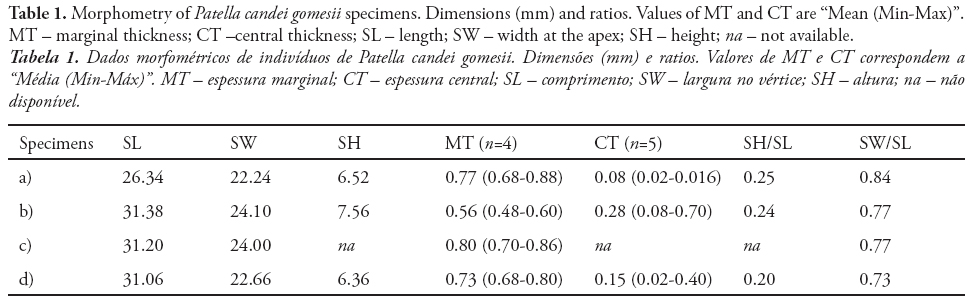
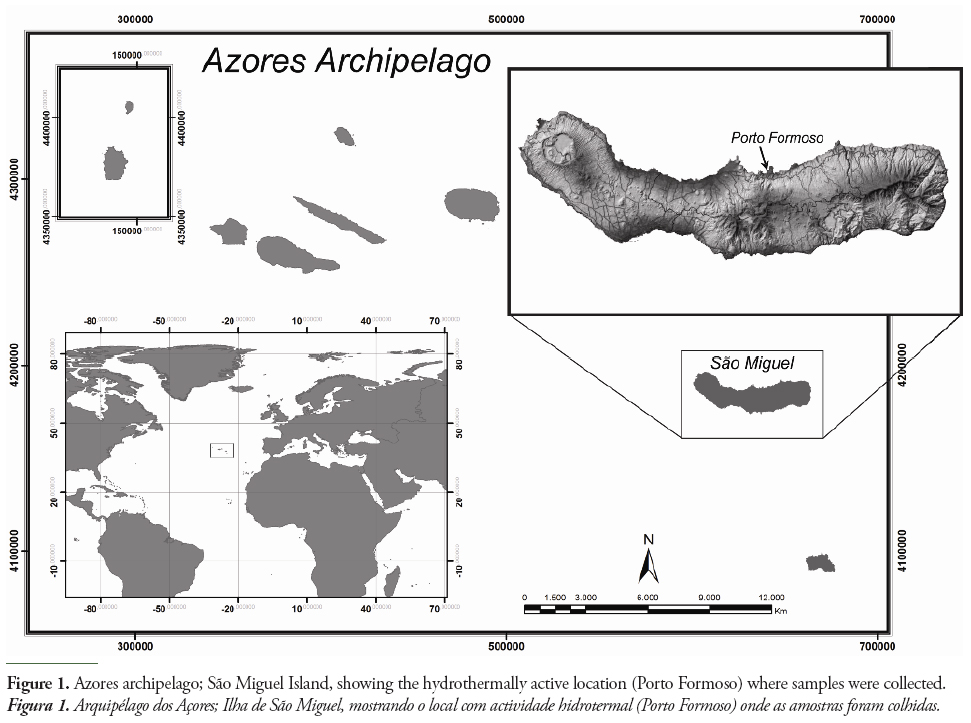
<body><![CDATA[<p>&nbsp;</p> 	    <p><b>2. Materials and methods</b></p> 	    <p>Specimens of limpets exhibiting abnormal shells were found next to shallow water hydrothermal vents during a survey on the occurrence and abundance of intertidal coralline algae. Sampling took place in the summer 2009 at Porto Formoso (37&ordm;49'18.8''N, 025&ordm;27'25.2''W, <a href="/img/revistas/rgci/v12n2/12n2a09f1.jpg">Fig. 1</a>) on S&atilde;o Miguel island (Azores; Portugal). Four specimens were collected with a chisel and preserved in 70% ethanol. The marginal thickness (MT), central thickness (CT), length (SL), width at the apex (SW) and height (SH) of each shell was measured with a Vernier caliper to the nearest 0.02&nbsp;mm, and its conicity (SH/SL) and base ellipticity (SW/SL) calculated.</p>          
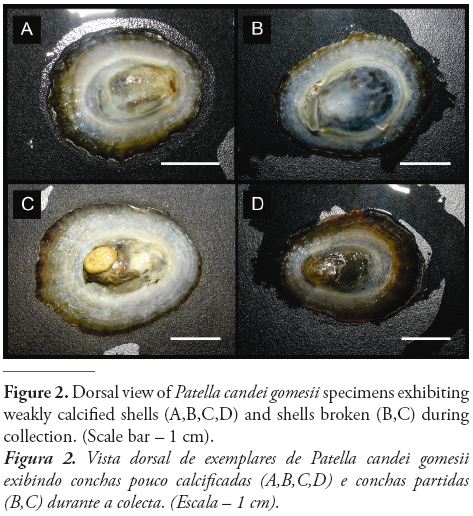
<p>&nbsp;</p> 	    <p><b>3. Results and discussion</b></p> 	    <p>The collecting spot at the hydrothermal vent location is characterised by a warmer and acidic environment (higher temperatures and lower pH) when compared with the surrounded marine environment. Temperature values range from 17.1&ordm;C in April and 24.4&ordm;C in July and pH from 6.5 to 5.5 (Couto <i>et al.</i>, 2010; unpublished data), where normal seawater temperature values in the Azores for the same months are 15.5 &ordm;C and 21.1&ordm;C in April and July, respectively (Instituto Hidrogr&aacute;fico, 2000) and the average pH of surface oceans is 8.07 (Royal Society, 2005).</p> 	    <p>Limpets usually exhibit strong and resistant shells (Cabral &amp; Jorge, 2007) and resistant to the collection method. However, studied specimens presented weak and almost transparent shells (<a href="#f2">Fig. 2</a>), in some cases allowing the visibility of internal structures. Some of the shells broke in the course of their collection (<a href="#f2">Fig. 2, B,C</a>), suggesting a lower breaking stress as reported for other organisms living at acidic conditions (Tunnicliffe <i>et al.</i>, 2009). Similar effects have been reported by Hall-Spencer <i>et al.</i> (2008) for <i>Patella caerulea</i> Linnaeus and by Martin <i>et al.</i> (2008) for other calcified organisms in the Mediterranean Sea.</p>         <p>&nbsp;</p>         <p><a name="f2"></a></p> 	    <p><img src="/img/revistas/rgci/v12n2/12n2a09f2.jpg"> 	    
]]></body>
<body><![CDATA[<p>&nbsp;</p> 	    <p>Concerning shell thickness, it can be observed a major reduction from MT to CT (<a href="/img/revistas/rgci/v12n2/12n2a09t1.jpg">Table 1</a>), which is not normal for <i>Patella genus</i> (Cabral &amp; Jorge, 2007). In specimen a) (<a href="/img/revistas/rgci/v12n2/12n2a09t1.jpg">Table 1</a>) the CT value is more or less 10% of MT. Also, almost transparent and crushing weak shells, suggests erosion/dissolution or lack of biomineralization. Limpets appear to have thinner shells, however there is a lack of shell thickness values from limpets from outside the influence of the hydrothermal vents for comparison.</p>          
<p>Additionally, no epibiont organisms such as crustose coralline algae were observed    on the shells of specimens collected at the hydrothermal vent location, as is    usual in limpets throughout Azorean shores.</p> 	    <p>On the other hand, no major differences were found in shell conicity (SH/SL) or base ellipticity (SW/SL) between specimens from the hydrothermally active location (<a href="/img/revistas/rgci/v12n2/12n2a09t1.jpg">Table 1</a>) and when compared with limpets from outside the influence of the hydrothermal vents (Cabral &amp; Jorge, 2007; C&uacute;rdia <i>et al.</i>, 2005), suggesting that limpets did not change their shell shape as a result of exposure to hydrothermal activity. Increasing shell thickness with increasing size and age appears to be a strategy for maintaining the resistance of the limpet shell to applied compression forces (Cabral &amp; Jorge, 2007). On the other hand, limpets, with thinner shells, are more exposed and susceptible to predation (Haugan <i>et al.</i>, 2006; Hall-Spencer <i>et al.</i>, 2008) and to wave action (Cabral &amp; Jorge, 2007).</p> 	    
<p>Organisms with calcareous structures and the habitats occupied by them have been considered as key type species and key type ecosystems for future research on the effects of ocean acidification (Haugan <i>et al.</i>, 2006). The present results, although preliminary, provide compelling evidence that limpets are sensitive to such environmental changes, and have an enormous potential to be used as sentinel organisms in further studies. It also shows how limpets could be affected by a future scenario of ocean acidification.</p> 	    <p>&nbsp;</p> 	    <p><b>Conclusion</b></p> 	    <p>Shallow water hydrothermal vents are unique habitats with specific abiotic characteristics known to influence marine organisms. Limpets, a food resource at the Azores, were shown to be affected by these environments. Increasing knowledge on those areas will allow understanding processes and relations affecting biological communities creating tools for a proper management.</p> 	    <p>&nbsp;</p> 	    <p><b>Acknowledgements</b></p> 	    ]]></body>
<body><![CDATA[<p>The authors thank Francisco M. Wallenstein for helpful discussions and the English revision of the MS.</p> 	    <p>&nbsp;</p> 	    <p><b>References</b></p> 	    <!-- ref --><p>Cabral J.P.; Jorge R.M.N. (2007) - Compressibility and shell failure in the European Atlantic Patella limpets. <i>Marine Biology</i>, 150(4):585-597. doi: <a href="http://dx.doi.org/10.1007/s00227-006-0379-0" target="_blank">10.1007/s00227-006-0379-0</a>.    &nbsp;&nbsp;&nbsp;&nbsp;&nbsp;&nbsp;&nbsp;&nbsp;[&#160;<a href="javascript:void(0);" onclick="javascript: window.open('/scielo.php?script=sci_nlinks&ref=000046&pid=S1646-8872201200020000900001&lng=','','width=640,height=500,resizable=yes,scrollbars=1,menubar=yes,');">Links</a>&#160;]<!-- end-ref --></p> 	    <!-- ref --><p>Cardigos, F.; Cola&ccedil;o, A.; Dando, P.R.; &Aacute;vila, S.P.; Sarradin, P.M.; Tempera, F.; Concei&ccedil;&atilde;o, P.; Pascoal, A.; Santos, R.S. (2005) - Shallow water hydrothermal vent field fluids and communities of the D. Jo&atilde;o de Castro Seamount (Azores). <i>Chemical Geology</i>, 224(1-3):153-168. doi:<a href="http://dx.doi.org/10.1016/j.chemgeo.2005.07.019" target="_blank">10.1016/j.chemgeo.2005.07.019</a>.    &nbsp;&nbsp;&nbsp;&nbsp;&nbsp;&nbsp;&nbsp;&nbsp;[&#160;<a href="javascript:void(0);" onclick="javascript: window.open('/scielo.php?script=sci_nlinks&ref=000048&pid=S1646-8872201200020000900002&lng=','','width=640,height=500,resizable=yes,scrollbars=1,menubar=yes,');">Links</a>&#160;]<!-- end-ref --></p> 	    <!-- ref --><p>Cola&ccedil;o, A.; Raghukumar, C.; Mohandass, C.; Cardigos, F.; Santos, R.S. (2006) - Effect of shallow-water venting in Azores on a few marine biota.<i> Cahiers de Biologie Marine</i> 47(4):359-364, dispon&iacute;vel em <a href="http://www.sb-roscoff.fr/cbm/pdf/14102793" target="_blank">http://www.sb-roscoff.fr/cbm/pdf/14102793</a>&nbsp;&nbsp;&nbsp;&nbsp;&nbsp;&nbsp;&nbsp;&nbsp;[&#160;<a href="javascript:void(0);" onclick="javascript: window.open('/scielo.php?script=sci_nlinks&ref=000050&pid=S1646-8872201200020000900003&lng=','','width=640,height=500,resizable=yes,scrollbars=1,menubar=yes,');">Links</a>&#160;]<!-- end-ref --><!-- ref --><p>Couto, R.P.; Neto, A.I.; Rodrigues, A.S. (2010) - Metal concentration and structural changes in <i>Corallina elongata</i> (Corallinales, Rhodophyta) from hydrothermal vents. <i>Marine Pollution Bulletin</i>, 60(4):509-514. doi: <a href="http://dx.doi.org/10.1016/j.marpolbul.2009.11.014" target="_blank">10.1016/j.marpolbul.2009.11.014</a>.    &nbsp;&nbsp;&nbsp;&nbsp;&nbsp;&nbsp;&nbsp;&nbsp;[&#160;<a href="javascript:void(0);" onclick="javascript: window.open('/scielo.php?script=sci_nlinks&ref=000051&pid=S1646-8872201200020000900004&lng=','','width=640,height=500,resizable=yes,scrollbars=1,menubar=yes,');">Links</a>&#160;]<!-- end-ref --></p> 	    ]]></body>
<body><![CDATA[<!-- ref --><p>C&uacute;rdia J., Rodrigues A.S., Martins A.M.F., Costa M.J. (2005) - The reproductive cycle of Patella candei gomesii Drou&euml;t, 1858 (Mollusca: Patellogastropoda), an Azorean endemic subspecies. Invertebrate Reproduction and Development, 48(1-3):137-145. doi: <a href="http://dx.doi.org/10.1080/07924259.2005.9652180" target="_blank">10.1080/07924259.2005.9652180</a>.    &nbsp;&nbsp;&nbsp;&nbsp;&nbsp;&nbsp;&nbsp;&nbsp;[&#160;<a href="javascript:void(0);" onclick="javascript: window.open('/scielo.php?script=sci_nlinks&ref=000053&pid=S1646-8872201200020000900005&lng=','','width=640,height=500,resizable=yes,scrollbars=1,menubar=yes,');">Links</a>&#160;]<!-- end-ref --></p> 	    <!-- ref --><p>Hall-Spencer, J.M.; Rodolfo-Metalpa, R.; Martin, S.; Ransome, E.; Fine, M.; Turner, S.M.; Rowley, S.J.; Tedesco, D.; Buia, M.C. (2008) - Volcanic carbon dioxide vents show ecosystem effects of ocean acidification. <i>Nature</i>, 454:96-99. doi: <a href="http://dx.doi.org/10.1038/nature07051" target="_blank">10.1038/nature07051</a>.    &nbsp;&nbsp;&nbsp;&nbsp;&nbsp;&nbsp;&nbsp;&nbsp;[&#160;<a href="javascript:void(0);" onclick="javascript: window.open('/scielo.php?script=sci_nlinks&ref=000055&pid=S1646-8872201200020000900006&lng=','','width=640,height=500,resizable=yes,scrollbars=1,menubar=yes,');">Links</a>&#160;]<!-- end-ref --></p> 	    <p>Haugan, P.M.; Turley, C.; P&ouml;rtner, H.O. (2006) - Effects on the marine environment of ocean acidification resulting from elevated levels of CO<sub>2</sub> in the atmosphere. Report on Ocean Acidification OSPAR, dispon&iacute;vel em <a href="http://www.ospar.org/documents/dbase/publications/p00285_Ocean_20acidification.pdf" target="_blank">http://www.ospar.org/documents/dbase/publications/p00285_Ocean acidification.pdf</a>.</p> 	    <!-- ref --><p>Instituto Hidrogr&aacute;fico (2000) - <i>Roteiro da costa de Portugal: Arquip&eacute;lago dos A&ccedil;ores</i> &#8211; 2nd Edition, 233p., Instituto Hidrogr&aacute;fico, Lisboa, Portugal. ISBN: 972-8486-09-X.    &nbsp;&nbsp;&nbsp;&nbsp;&nbsp;&nbsp;&nbsp;&nbsp;[&#160;<a href="javascript:void(0);" onclick="javascript: window.open('/scielo.php?script=sci_nlinks&ref=000058&pid=S1646-8872201200020000900008&lng=','','width=640,height=500,resizable=yes,scrollbars=1,menubar=yes,');">Links</a>&#160;]<!-- end-ref --></p> 	    <!-- ref --><p>Marshall, D.J.; Santos, J.H.; Leung, K.M.Y.; Chak, W.H. (2008) - Correlations between gastropod shell dissolution and water chemical properties in a tropical estuary. <i>Marine Environmental Research</i>, 66(4):422-429. doi: <a href="http://dx.doi.org/10.1016/j.marenvres.2008.07.003" target="_blank">10.1016/j.marenvres.2008.07.003</a>.    &nbsp;&nbsp;&nbsp;&nbsp;&nbsp;&nbsp;&nbsp;&nbsp;[&#160;<a href="javascript:void(0);" onclick="javascript: window.open('/scielo.php?script=sci_nlinks&ref=000060&pid=S1646-8872201200020000900009&lng=','','width=640,height=500,resizable=yes,scrollbars=1,menubar=yes,');">Links</a>&#160;]<!-- end-ref --></p> 	    <!-- ref --><p>Martin, S.; Rodolfo-Metalpa, R.; Ransome, E.; Rowley, S.J.; Buia, M.C.; Gattuso, J.P.; Hall-Spencer, J.M. (2008) - Effects of naturally acidified seawater on seagrass calcareous epibionts. <i>Biology Letters</i>, 4(6):693-695. doi: <a href="http://dx.doi.org/10.1098/rsbl.2008.0412" target="_blank">10.1098/rsbl.2008.0412</a>.    &nbsp;&nbsp;&nbsp;&nbsp;&nbsp;&nbsp;&nbsp;&nbsp;[&#160;<a href="javascript:void(0);" onclick="javascript: window.open('/scielo.php?script=sci_nlinks&ref=000062&pid=S1646-8872201200020000900010&lng=','','width=640,height=500,resizable=yes,scrollbars=1,menubar=yes,');">Links</a>&#160;]<!-- end-ref --></p> 	    <!-- ref --><p>Royal Society (2005) - <i>Ocean acidification due to increasing atmospheric carbon dioxide</i>. 60p., The Clyvedon Press Ltd, Cardiff, United Kingdom. ISBN: 0 85403 617 2.    &nbsp;&nbsp;&nbsp;&nbsp;&nbsp;&nbsp;&nbsp;&nbsp;[&#160;<a href="javascript:void(0);" onclick="javascript: window.open('/scielo.php?script=sci_nlinks&ref=000064&pid=S1646-8872201200020000900011&lng=','','width=640,height=500,resizable=yes,scrollbars=1,menubar=yes,');">Links</a>&#160;]<!-- end-ref --></p> 	    <!-- ref --><p>Tunnicliffe, V.; Davies, K.T.A.; Butterfield, D.A.; Embley, R.W.; Rose, J.M.; Chadwick Jr, W.W. (2009) - Survival of mussels in extremely acidic waters on a submarine volcano. <i>Nature Geoscience</i>, 2:344-348. doi: <a href="http://dx.doi.org/10.1038/ngeo500" target="_blank">10.1038/ngeo500</a>.    &nbsp;&nbsp;&nbsp;&nbsp;&nbsp;&nbsp;&nbsp;&nbsp;[&#160;<a href="javascript:void(0);" onclick="javascript: window.open('/scielo.php?script=sci_nlinks&ref=000066&pid=S1646-8872201200020000900012&lng=','','width=640,height=500,resizable=yes,scrollbars=1,menubar=yes,');">Links</a>&#160;]<!-- end-ref --></p> 	    <!-- ref --><p>Wallenstein, F.M.; Torr&atilde;o, D.F.; Neto, A.I.; Wilkinson, M.; Rodrigues, A.S. (2009) - Effect of exposure time on the bioaccumulation of Cd, Mg, Mn and Zn in <i>Cystoseira abies-marina</i> samples subject to shallow water hydrothermal activity in S&atilde;o Miguel (Azores). Marine Ecology 30(supplement s1):118-122. doi: <a href="http://dx.doi.org/10.1111/j.1439-0485.2009.00322.x" target="_blank">10.1111/j.1439-0485.2009.00322.x</a>.    &nbsp;&nbsp;&nbsp;&nbsp;&nbsp;&nbsp;&nbsp;&nbsp;[&#160;<a href="javascript:void(0);" onclick="javascript: window.open('/scielo.php?script=sci_nlinks&ref=000068&pid=S1646-8872201200020000900013&lng=','','width=640,height=500,resizable=yes,scrollbars=1,menubar=yes,');">Links</a>&#160;]<!-- end-ref --></p> 	    <p>&nbsp;</p> 	    <p><b>Nota</b></p> 	    <p><a href="#top0">*</a><a name="0"></a>Submission: April 11, 2012; Evaluation: May 6, 2012; Reception of revised manuscript: May 16, 2012; Accepted: May 22, 2012; Available on-line: 12 Junho 2012</p>     ]]></body>
<body><![CDATA[ ]]></body><back>
<ref-list>
<ref id="B1">
<nlm-citation citation-type="journal">
<person-group person-group-type="author">
<name>
<surname><![CDATA[Cabral]]></surname>
<given-names><![CDATA[J.P.]]></given-names>
</name>
<name>
<surname><![CDATA[Jorge]]></surname>
<given-names><![CDATA[R.M.N.]]></given-names>
</name>
</person-group>
<article-title xml:lang="en"><![CDATA[Compressibility and shell failure in the European Atlantic Patella limpets]]></article-title>
<source><![CDATA[Marine Biology]]></source>
<year>2007</year>
<volume>150</volume>
<numero>4</numero>
<issue>4</issue>
<page-range>585-597</page-range></nlm-citation>
</ref>
<ref id="B2">
<nlm-citation citation-type="journal">
<person-group person-group-type="author">
<name>
<surname><![CDATA[Cardigos]]></surname>
<given-names><![CDATA[F.]]></given-names>
</name>
<name>
<surname><![CDATA[Colaço]]></surname>
<given-names><![CDATA[A.]]></given-names>
</name>
<name>
<surname><![CDATA[Dando]]></surname>
<given-names><![CDATA[P.R.]]></given-names>
</name>
<name>
<surname><![CDATA[Ávila]]></surname>
<given-names><![CDATA[S.P.]]></given-names>
</name>
<name>
<surname><![CDATA[Sarradin]]></surname>
<given-names><![CDATA[P.M.]]></given-names>
</name>
<name>
<surname><![CDATA[Tempera]]></surname>
<given-names><![CDATA[F.]]></given-names>
</name>
<name>
<surname><![CDATA[Conceição]]></surname>
<given-names><![CDATA[P.]]></given-names>
</name>
<name>
<surname><![CDATA[Pascoal]]></surname>
<given-names><![CDATA[A.]]></given-names>
</name>
<name>
<surname><![CDATA[Santos]]></surname>
<given-names><![CDATA[R.S.]]></given-names>
</name>
</person-group>
<article-title xml:lang="en"><![CDATA[Shallow water hydrothermal vent field fluids and communities of the D. João de Castro Seamount (Azores)]]></article-title>
<source><![CDATA[Chemical Geology]]></source>
<year>2005</year>
<volume>224</volume>
<numero>1-3</numero>
<issue>1-3</issue>
<page-range>153-168</page-range></nlm-citation>
</ref>
<ref id="B3">
<nlm-citation citation-type="journal">
<person-group person-group-type="author">
<name>
<surname><![CDATA[Colaço]]></surname>
<given-names><![CDATA[A.]]></given-names>
</name>
<name>
<surname><![CDATA[Raghukumar]]></surname>
<given-names><![CDATA[C.]]></given-names>
</name>
<name>
<surname><![CDATA[Mohandass]]></surname>
<given-names><![CDATA[C.]]></given-names>
</name>
<name>
<surname><![CDATA[Cardigos]]></surname>
<given-names><![CDATA[F.]]></given-names>
</name>
<name>
<surname><![CDATA[Santos]]></surname>
<given-names><![CDATA[R.S.]]></given-names>
</name>
</person-group>
<article-title xml:lang="en"><![CDATA[Effect of shallow-water venting in Azores on a few marine biota]]></article-title>
<source><![CDATA[Cahiers de Biologie Marine]]></source>
<year>2006</year>
<volume>47</volume>
<numero>4</numero>
<issue>4</issue>
<page-range>359-364</page-range></nlm-citation>
</ref>
<ref id="B4">
<nlm-citation citation-type="journal">
<person-group person-group-type="author">
<name>
<surname><![CDATA[Couto]]></surname>
<given-names><![CDATA[R.P.]]></given-names>
</name>
<name>
<surname><![CDATA[Neto]]></surname>
<given-names><![CDATA[A.I.]]></given-names>
</name>
<name>
<surname><![CDATA[Rodrigues]]></surname>
<given-names><![CDATA[A.S.]]></given-names>
</name>
</person-group>
<article-title xml:lang="en"><![CDATA[Metal concentration and structural changes in Corallina elongata (Corallinales, Rhodophyta) from hydrothermal vents]]></article-title>
<source><![CDATA[Marine Pollution Bulletin]]></source>
<year>2010</year>
<volume>60</volume>
<numero>4</numero>
<issue>4</issue>
<page-range>509-514</page-range></nlm-citation>
</ref>
<ref id="B5">
<nlm-citation citation-type="journal">
<person-group person-group-type="author">
<name>
<surname><![CDATA[Cúrdia]]></surname>
<given-names><![CDATA[J.]]></given-names>
</name>
<name>
<surname><![CDATA[Rodrigues]]></surname>
<given-names><![CDATA[A.S.]]></given-names>
</name>
<name>
<surname><![CDATA[Martins]]></surname>
<given-names><![CDATA[A.M.F.]]></given-names>
</name>
<name>
<surname><![CDATA[Costa]]></surname>
<given-names><![CDATA[M.J.]]></given-names>
</name>
</person-group>
<article-title xml:lang="en"><![CDATA[The reproductive cycle of Patella candei gomesii Drouët, 1858 (Mollusca: Patellogastropoda), an Azorean endemic subspecies]]></article-title>
<source><![CDATA[Invertebrate Reproduction and Development]]></source>
<year>2005</year>
<volume>48</volume>
<numero>1-3</numero>
<issue>1-3</issue>
<page-range>137-145</page-range></nlm-citation>
</ref>
<ref id="B6">
<nlm-citation citation-type="journal">
<person-group person-group-type="author">
<name>
<surname><![CDATA[Hall-Spencer]]></surname>
<given-names><![CDATA[J.M.]]></given-names>
</name>
<name>
<surname><![CDATA[Rodolfo-Metalpa]]></surname>
<given-names><![CDATA[R.]]></given-names>
</name>
<name>
<surname><![CDATA[Martin]]></surname>
<given-names><![CDATA[S.]]></given-names>
</name>
<name>
<surname><![CDATA[Ransome]]></surname>
<given-names><![CDATA[E.]]></given-names>
</name>
<name>
<surname><![CDATA[Fine]]></surname>
<given-names><![CDATA[M.]]></given-names>
</name>
<name>
<surname><![CDATA[Turner]]></surname>
<given-names><![CDATA[S.M.]]></given-names>
</name>
<name>
<surname><![CDATA[Rowley]]></surname>
<given-names><![CDATA[S.J.]]></given-names>
</name>
<name>
<surname><![CDATA[Tedesco]]></surname>
<given-names><![CDATA[D.]]></given-names>
</name>
<name>
<surname><![CDATA[Buia]]></surname>
<given-names><![CDATA[M.C.]]></given-names>
</name>
</person-group>
<article-title xml:lang="en"><![CDATA[Volcanic carbon dioxide vents show ecosystem effects of ocean acidification]]></article-title>
<source><![CDATA[Nature]]></source>
<year>2008</year>
<volume>454</volume>
<page-range>96-99</page-range></nlm-citation>
</ref>
<ref id="B7">
<nlm-citation citation-type="">
<person-group person-group-type="author">
<name>
<surname><![CDATA[Haugan]]></surname>
<given-names><![CDATA[P.M.]]></given-names>
</name>
<name>
<surname><![CDATA[Turley]]></surname>
<given-names><![CDATA[C.]]></given-names>
</name>
<name>
<surname><![CDATA[Pörtner]]></surname>
<given-names><![CDATA[H.O.]]></given-names>
</name>
</person-group>
<source><![CDATA[Effects on the marine environment of ocean acidification resulting from elevated levels of CO2 in the atmosphere]]></source>
<year>2006</year>
</nlm-citation>
</ref>
<ref id="B8">
<nlm-citation citation-type="book">
<collab>Instituto Hidrográfico</collab>
<source><![CDATA[Roteiro da costa de Portugal: Arquipélago dos Açores]]></source>
<year>2000</year>
<edition>2</edition>
<page-range>233</page-range><publisher-loc><![CDATA[Lisboa ]]></publisher-loc>
<publisher-name><![CDATA[Instituto Hidrográfico]]></publisher-name>
</nlm-citation>
</ref>
<ref id="B9">
<nlm-citation citation-type="journal">
<person-group person-group-type="author">
<name>
<surname><![CDATA[Marshall]]></surname>
<given-names><![CDATA[D.J.]]></given-names>
</name>
<name>
<surname><![CDATA[Santos]]></surname>
<given-names><![CDATA[J.H.]]></given-names>
</name>
<name>
<surname><![CDATA[Leung]]></surname>
<given-names><![CDATA[K.M.Y.]]></given-names>
</name>
<name>
<surname><![CDATA[Chak]]></surname>
<given-names><![CDATA[W.H.]]></given-names>
</name>
</person-group>
<article-title xml:lang="en"><![CDATA[Correlations between gastropod shell dissolution and water chemical properties in a tropical estuary]]></article-title>
<source><![CDATA[Marine Environmental Research]]></source>
<year>2008</year>
<volume>66</volume>
<numero>4</numero>
<issue>4</issue>
<page-range>422-429</page-range></nlm-citation>
</ref>
<ref id="B10">
<nlm-citation citation-type="journal">
<person-group person-group-type="author">
<name>
<surname><![CDATA[Martin]]></surname>
<given-names><![CDATA[S.]]></given-names>
</name>
<name>
<surname><![CDATA[Rodolfo-Metalpa]]></surname>
<given-names><![CDATA[R.]]></given-names>
</name>
<name>
<surname><![CDATA[Ransome]]></surname>
<given-names><![CDATA[E.]]></given-names>
</name>
<name>
<surname><![CDATA[Rowley]]></surname>
<given-names><![CDATA[S.J.]]></given-names>
</name>
<name>
<surname><![CDATA[Buia]]></surname>
<given-names><![CDATA[M.C.]]></given-names>
</name>
<name>
<surname><![CDATA[Gattuso]]></surname>
<given-names><![CDATA[J.P.]]></given-names>
</name>
<name>
<surname><![CDATA[Hall-Spencer]]></surname>
<given-names><![CDATA[J.M.]]></given-names>
</name>
</person-group>
<article-title xml:lang="en"><![CDATA[Effects of naturally acidified seawater on seagrass calcareous epibionts]]></article-title>
<source><![CDATA[Biology Letters]]></source>
<year>2008</year>
<volume>4</volume>
<numero>6</numero>
<issue>6</issue>
<page-range>693-695</page-range></nlm-citation>
</ref>
<ref id="B11">
<nlm-citation citation-type="book">
<collab>Royal Society</collab>
<source><![CDATA[Ocean acidification due to increasing atmospheric carbon dioxide]]></source>
<year>2005</year>
<publisher-loc><![CDATA[Cardiff ]]></publisher-loc>
<publisher-name><![CDATA[The Clyvedon Press Ltd]]></publisher-name>
</nlm-citation>
</ref>
<ref id="B12">
<nlm-citation citation-type="journal">
<person-group person-group-type="author">
<name>
<surname><![CDATA[Tunnicliffe]]></surname>
<given-names><![CDATA[V.]]></given-names>
</name>
<name>
<surname><![CDATA[Davies]]></surname>
<given-names><![CDATA[K.T.A.]]></given-names>
</name>
<name>
<surname><![CDATA[Butterfield]]></surname>
<given-names><![CDATA[D.A.]]></given-names>
</name>
<name>
<surname><![CDATA[Embley]]></surname>
<given-names><![CDATA[R.W.]]></given-names>
</name>
<name>
<surname><![CDATA[Rose]]></surname>
<given-names><![CDATA[J.M.]]></given-names>
</name>
<name>
<surname><![CDATA[Chadwick Jr]]></surname>
<given-names><![CDATA[W.W.]]></given-names>
</name>
</person-group>
<article-title xml:lang="en"><![CDATA[Survival of mussels in extremely acidic waters on a submarine volcano]]></article-title>
<source><![CDATA[Nature Geoscience]]></source>
<year>2009</year>
<volume>2</volume>
<page-range>344-348</page-range></nlm-citation>
</ref>
<ref id="B13">
<nlm-citation citation-type="journal">
<person-group person-group-type="author">
<name>
<surname><![CDATA[Wallenstein]]></surname>
<given-names><![CDATA[F.M.]]></given-names>
</name>
<name>
<surname><![CDATA[Torrão]]></surname>
<given-names><![CDATA[D.F.]]></given-names>
</name>
<name>
<surname><![CDATA[Neto]]></surname>
<given-names><![CDATA[A.I.]]></given-names>
</name>
<name>
<surname><![CDATA[Wilkinson]]></surname>
<given-names><![CDATA[M.]]></given-names>
</name>
<name>
<surname><![CDATA[Rodrigues]]></surname>
<given-names><![CDATA[A.S.]]></given-names>
</name>
</person-group>
<article-title xml:lang="en"><![CDATA[Effect of exposure time on the bioaccumulation of Cd, Mg, Mn and Znin Cystoseira abies-marina samples subject to shallow water hydrothermal activity in São Miguel (Azores).]]></article-title>
<source><![CDATA[Marine Ecology]]></source>
<year>2009</year>
<volume>30</volume>
<numero>^ss1</numero>
<issue>^ss1</issue>
<supplement>s1</supplement>
<page-range>118-122</page-range></nlm-citation>
</ref>
</ref-list>
</back>
</article>