<?xml version="1.0" encoding="ISO-8859-1"?><article xmlns:mml="http://www.w3.org/1998/Math/MathML" xmlns:xlink="http://www.w3.org/1999/xlink" xmlns:xsi="http://www.w3.org/2001/XMLSchema-instance">
<front>
<journal-meta>
<journal-id>1646-8872</journal-id>
<journal-title><![CDATA[Revista de Gestão Costeira Integrada]]></journal-title>
<abbrev-journal-title><![CDATA[RGCI]]></abbrev-journal-title>
<issn>1646-8872</issn>
<publisher>
<publisher-name><![CDATA[Associação Portuguesa dos Recursos Hídricos]]></publisher-name>
</publisher>
</journal-meta>
<article-meta>
<article-id>S1646-88722013000100008</article-id>
<article-id pub-id-type="doi">10.5894/rgci371</article-id>
<title-group>
<article-title xml:lang="en"><![CDATA[Factors affecting the distribution of epibenthic biodiversity in the Cávado estuary (NW Portugal)]]></article-title>
<article-title xml:lang="pt"><![CDATA[Fatores que afetam a distribuição da biodiversidade epibentónica do estuário do Cávado (NW Portugal)]]></article-title>
</title-group>
<contrib-group>
<contrib contrib-type="author">
<name>
<surname><![CDATA[Carvalho]]></surname>
<given-names><![CDATA[A. N.]]></given-names>
</name>
<xref ref-type="aff" rid="A01"/>
</contrib>
<contrib contrib-type="author">
<name>
<surname><![CDATA[Santos]]></surname>
<given-names><![CDATA[P. T.]]></given-names>
</name>
<xref ref-type="aff" rid="A01"/>
</contrib>
</contrib-group>
<aff id="A01">
<institution><![CDATA[,Universidade do Porto Faculdade de Ciências ]]></institution>
<addr-line><![CDATA[Porto ]]></addr-line>
<country>Portugal</country>
</aff>
<aff id="A02">
<institution><![CDATA[,Universidade do Porto Centro Interdisciplinar de Investigação Marinha e Ambiental ]]></institution>
<addr-line><![CDATA[Porto ]]></addr-line>
<country>Portugal</country>
</aff>
<pub-date pub-type="pub">
<day>00</day>
<month>03</month>
<year>2013</year>
</pub-date>
<pub-date pub-type="epub">
<day>00</day>
<month>03</month>
<year>2013</year>
</pub-date>
<volume>13</volume>
<numero>1</numero>
<fpage>101</fpage>
<lpage>111</lpage>
<copyright-statement/>
<copyright-year/>
<self-uri xlink:href="http://scielo.pt/scielo.php?script=sci_arttext&amp;pid=S1646-88722013000100008&amp;lng=en&amp;nrm=iso"></self-uri><self-uri xlink:href="http://scielo.pt/scielo.php?script=sci_abstract&amp;pid=S1646-88722013000100008&amp;lng=en&amp;nrm=iso"></self-uri><self-uri xlink:href="http://scielo.pt/scielo.php?script=sci_pdf&amp;pid=S1646-88722013000100008&amp;lng=en&amp;nrm=iso"></self-uri><abstract abstract-type="short" xml:lang="en"><p><![CDATA[The epibenthic fauna of the lower Cávado estuary at five sampling stations was studied over a period of two years. We examined the spatial and seasonal distribution of different species and analysed temperature, salinity, dissolved oxygen, precipitation and sediment type, which are all important features of estuarine dynamics. A total of 15 taxa were identified. Crustaceans had the highest levels of abundance (91%) and biomass (87%). Crangon crangon was the most abundant species (75%) and Carcinus maenas had the highest biomass (71%). No exotic species were recorded. Multivariate analysis showed two different spatial assemblages, one corresponding to stations nearest to the mouth (higher abundance values) and other to the upstream stations. The Shannon diversity index was highest at the margin station further upstream. Three different assemblages could be distinguished, separating summer/autumn (higher values of abundance) from spring and from winter. According to BIOENV analysis, dissolved oxygen, water temperature and salinity were the environmental variables responsible for the spatial and seasonal distribution of epibenthos, explaining 17.2% of variability. Abundance and biomass were better correlated with water temperature. Sediment type was also important in epibenthic spatial distribution, being abundance, biomass and diversity indexes better correlated with fine sediment (<0.125mm).]]></p></abstract>
<abstract abstract-type="short" xml:lang="pt"><p><![CDATA[A fauna epibentónica do estuário inferior do Rio Cávado foi estudada em cinco estações de amostragem durante um período de dois anos. Apresentamos a distribuição espacial e sazonal das diferentes espécies e uma análise da temperatura, salinidade, oxigénio dissolvido, precipitação e tipo de sedimento, sendo todas, importantes características da dinâmica estuarina. Foram identificados um total de 15 taxa. Os crustáceos apresentaram os valores mais elevados de abundância (91%) e biomassa (87%). Crangon crangon foi a espécie mais abundante (75%) e Carcinus maenas apresentou o valor de biomassa mais elevado (71%). Nenhuma espécie exótica foi registada neste estuário. Análise multivariada mostrou dois grupos espaciais diferentes, um correspondendo às estações de amostragem mais próximas da boca do estuário (valores mais elevados de abundância) e outro às estações de montante. O valor do índice de diversidade de Shannon foi mais elevado a montante na estação localizada na margem. Três grupos diferentes podem ser distinguidos, separando o verão/outono (valores elevados de abundância) da primavera e do inverno. Segundo a análise BIOENV, o oxigénio dissolvido, a temperatura e a salinidade da água, foram as variáveis ambientais responsáveis pela distribuição espacial e sazonal dos epibentos, explicando 17.2% da variabilidade. A abundância e a biomassa estiveram melhor correlacionadas com a temperatura. O tipo de sedimento também foi importante na distribuição espacial dos epibentos, sendo que a abundância, biomassa e índices de diversidade estiveram melhor correlacionados com o sedimento fino (<0.125mm).]]></p></abstract>
<kwd-group>
<kwd lng="en"><![CDATA[epibenthos]]></kwd>
<kwd lng="en"><![CDATA[estuarine ecosystem]]></kwd>
<kwd lng="en"><![CDATA[diversity]]></kwd>
<kwd lng="en"><![CDATA[environmental variables]]></kwd>
<kwd lng="pt"><![CDATA[epibentos]]></kwd>
<kwd lng="pt"><![CDATA[ecossistema estuarino]]></kwd>
<kwd lng="pt"><![CDATA[diversidade]]></kwd>
<kwd lng="pt"><![CDATA[variáveis ambientais]]></kwd>
</kwd-group>
</article-meta>
</front><body><![CDATA[ <p align="right"><b>ARTICLE / </b>ARTIGO</p> 	    <p><b>Factors affecting the distribution of epibenthic biodiversity in the      C&aacute;vado estuary (NW Portugal) <a href="#0">*</a></b><a name="top0"></a></p> 		     <p><b>Fatores que afetam a distribui&ccedil;&atilde;o da biodiversidade epibent&oacute;nica    do estu&aacute;rio do C&aacute;vado (NW Portugal)</b></p>     <p>&nbsp;</p> 		    <p><b>A. N. Carvalho</b> <sup>@, 1</sup>, <b>P. T. Santos</b> <sup>1</sup></p> 		    <p>@ - Corresponding author <a href="mailto:ancarvalho@gmail.com">ancarvalho@gmail.com</a></p> 		    <p>1 - Universidade do Porto, Faculdade de Ci&ecirc;ncias, Rua Campo Alegre s/n, 4169-007 Porto, Portugal / CIIMAR – Centro Interdisciplinar de Investiga&ccedil;&atilde;o Marinha e Ambiental, Rua dos Bragas 289, 4050-123 Porto, Portugal</p> 		    <p>&nbsp;</p> 		    <p><b>ABSTRACT</b></p> 		    <p>The epibenthic fauna of the lower C&aacute;vado estuary at five sampling stations was studied over a period of two years. We examined the spatial and seasonal distribution of different species and analysed temperature, salinity, dissolved oxygen, precipitation and sediment type, which are all important features of estuarine dynamics. A total of 15 taxa were identified. Crustaceans had the highest levels of abundance (91%) and biomass (87%). <i>Crangon crangon</i> was the most abundant species (75%) and <i>Carcinus maenas</i> had the highest biomass (71%). No exotic species were recorded. Multivariate analysis showed two different spatial assemblages, one corresponding to stations nearest to the mouth (higher abundance values) and other to the upstream stations. The Shannon diversity index was highest at the margin station further upstream. Three different assemblages could be distinguished, separating summer/autumn (higher values of abundance) from spring and from winter.</p> 		    ]]></body>
<body><![CDATA[<p>According to BIOENV analysis, dissolved oxygen, water temperature and salinity were the environmental variables responsible for the spatial and seasonal distribution of epibenthos, explaining 17.2% of variability. Abundance and biomass were better correlated with water temperature. Sediment type was also important in epibenthic spatial distribution, being abundance, biomass and diversity indexes better correlated with fine sediment (&lt;0.125mm). </p> 		    <p><b>Keywords:</b> epibenthos; estuarine ecosystem; diversity; environmental variables</p> 		    <p>&nbsp;</p> 		    <p><b>RESUMO</b></p> 		    <p>A fauna epibent&oacute;nica do estu&aacute;rio inferior do Rio C&aacute;vado foi estudada em cinco esta&ccedil;&otilde;es de amostragem durante um per&iacute;odo de dois anos. Apresentamos a distribui&ccedil;&atilde;o espacial e sazonal das diferentes esp&eacute;cies e uma an&aacute;lise da temperatura, salinidade, oxig&eacute;nio dissolvido, precipita&ccedil;&atilde;o e tipo de sedimento, sendo todas, importantes caracter&iacute;sticas da din&acirc;mica estuarina. Foram identificados um total de 15 taxa. Os crust&aacute;ceos apresentaram os valores mais elevados de abund&acirc;ncia (91%) e biomassa (87%). <i>Crangon crangon</i> foi a esp&eacute;cie mais abundante (75%) e <i>Carcinus maenas</i> apresentou o valor de biomassa mais elevado (71%). Nenhuma esp&eacute;cie ex&oacute;tica foi registada neste estu&aacute;rio. An&aacute;lise multivariada mostrou dois grupos espaciais diferentes, um correspondendo &agrave;s esta&ccedil;&otilde;es de amostragem mais pr&oacute;ximas da boca do estu&aacute;rio (valores mais elevados de abund&acirc;ncia) e outro &agrave;s esta&ccedil;&otilde;es de montante. O valor do &iacute;ndice de diversidade de Shannon foi mais elevado a montante na esta&ccedil;&atilde;o localizada na margem. Tr&ecirc;s grupos diferentes podem ser distinguidos, separando o ver&atilde;o/outono (valores elevados de abund&acirc;ncia) da primavera e do inverno.</p> 		    <p>Segundo a an&aacute;lise BIOENV, o oxig&eacute;nio dissolvido, a temperatura e a salinidade da &aacute;gua, foram as vari&aacute;veis ambientais respons&aacute;veis pela distribui&ccedil;&atilde;o espacial e sazonal dos epibentos, explicando 17.2% da variabilidade. A abund&acirc;ncia e a biomassa estiveram melhor correlacionadas com a temperatura. O tipo de sedimento tamb&eacute;m foi importante na distribui&ccedil;&atilde;o espacial dos epibentos, sendo que a abund&acirc;ncia, biomassa e &iacute;ndices de diversidade estiveram melhor correlacionados com o sedimento fino (&lt;0.125mm).</p> 		    <p> <b>Palavras-Chave:</b> epibentos; ecossistema estuarino; diversidade; vari&aacute;veis ambientais</p> 		    <p>&nbsp;</p> 		    <p><b>1. Introduction</b></p> 		    <p>Estuaries are recognised as transition zones, or ecotones, between freshwater and marine habitats (Dyer 1997; Elliott &amp; McLusky 2002; Meire <i>et al.</i> 2005). The species that live in estuaries need to be adapted to rigorous variations in salinity (physiological stress), water movement and turbidity (physical stress) (McLusky 1993; Constable 1999; Little 2000; Meire <i>et al.</i> 2005). Estuaries support many important ecosystem functions such as biogeochemical cycling and nutrient movement, flood mitigation, maintenance of biodiversity and biological production (Meire <i>et al.</i> 2005). Estuaries also provide nursery grounds for several commercial fish and crustacean species and serve as an important link between rivers and the sea for many anadromous and catadromous species (McLusky 1999; Meire <i>et al.</i> 2005; Leit&atilde;o <i>et al.</i> 2006; Cabral <i>et al.</i> 2007; Martinho <i>et al.</i> 2007). Epibenthic fauna is the most important component of the estuarine community and represents a link between different life stages of some species and different niches (Costa-Dias <i>et al.</i> 2010a). Benthos are an important part of the fish and benthic invertebrate food web, which are used by humans as a food source, making them economically relevant (McLusky 1999; Little 2000; Feller 2006). This intermediate position in food webs of epibenthos, makes them an important link in the process of pollutants and toxic compounds pathways in which they become elements of bioamplification and of bioaccumulation of contaminants (Costa-Dias <i>et al.</i> 2010a). Environmental changes by natural or anthropogenic disturbances are able to modify these communities, and may induce negative impacts on the entire ecosystem. Therefore it is necessary to increase knowledge about the ecology of epibenthic communities, particularly in poorly known estuaries.</p> 		    ]]></body>
<body><![CDATA[<p>Previous studies have shown that <i>Pomatoschistus microps</i> (Kr&oslash;yer, 1838) is the most abundant species in the epibenthic fish community of the C&aacute;vado estuary (Coelho &amp; Santos 2006). No published information is, however, available for the epibenthic invertebrate community of this estuary.</p> 		    <p>The aims of this study were as follows: (1) obtain an inventory of the epibenthic fauna in protected area of the lower C&aacute;vado estuary, (2) contribute to the characterisation of the spatial and seasonal distribution of the epibenthic biodiversity and (3) relate the diversity, abundance and biomass distribution of the epibenthic community to environmental information such as temperature, salinity, dissolved oxygen, precipitation and sediment type.</p> 		    <p>&nbsp;</p> 		    <p><b>2. Materials and methods</b></p> 		    <p><b>2.1. Study area</b></p> 		    <p>The C&aacute;vado River originates in Serra de Larouco, North Portugal, at an altitude of about 1520m and courses ~129km to its mouth in Esposende. Its basin covers an area of ~1589km<sup>2</sup>, representing 1.8% of the territory of Portugal. The annual average flow at the mouth is ~71m<sup>3</sup>/s. The C&aacute;vado estuary is integral to the ‘Natural Park of the North Coast’ (Parque Natural Litoral Norte, PNLN) and is classified as CORINE Biotope No. 136, “Foz do C&aacute;vado / Costa Esposende” and was designated as site “Litoral Norte” (code PTCON0017) of the Natura 2000 network.</p> 		    <p>&nbsp;</p> 		    <p><b>2.2. Sampling and laboratory analysis</b></p> 		    <p>Sixteen monthly samples were collected between February 2009 and September 2010 from five stations located along the estuary (E1, E2 and E3 at the margin and E1a and E3a within the channel (<a href="/img/revistas/rgci/v13n1/13n1a08f1.jpg" target="_blank">Figure 1</a>). Samples were gathered with a dredge (40cm wide by 20cm tall) with a 1m long bag that had a mesh size of 10mm. The dredge was towed on the estuary bottom by means of a wire cable operated by hand aboard a slowly moving boat against the river flow. The sampling effort used on the present work was a drag for 1 minute at constant velocity of 1 knot (12.3m<sup>2</sup>). The dragging was conducted during the diurnal tide. Biological samples were fixed in 10% formalin. During sampling, water temperature, salinity and dissolved oxygen were recorded close to the estuary bottom using a multi-parameter probe (Yellow Springs Instruments, Model 85). At each sampling station 1.5 kg of sediment was collected for granulometric analysis at the beginning of this study.</p> 	    
<p>&nbsp;</p> 		    ]]></body>
<body><![CDATA[<p><a href="/img/revistas/rgci/v13n1/13n1a08f1.jpg" target="_blank">Figure 1</a></p> 	    
<p>&nbsp;</p> 		    <p>In the laboratory, the samples were gently washed in running tap water through a sieve (mesh size of 0.5mm) and then the biological material was sorted in a tray with backlight. The epienthic fauna was identified to the lowest taxonomic level and all individuals were weighed (0.001g). Data on individuals per species were used to calculate the biological parameters of abundance (individuals/m<sup>2</sup>) and biomass (g/m<sup>2</sup>). Small sized benthic species, typical infauna like Amphipoda, Isopoda, Gastropoda, Bivalvia and Annelida were not considered for data analysis because the dredge is not adequate for their assessment (Costa-Dias <i>et al.</i> 2010a). This infauna species were presented only in Appendix A to complete the inventory of the benthic species of C&aacute;vado estuary. Sediment samples were dried in an oven at 62&deg;C to constant weight and then sieved. Grain size analysis was carried out by mechanical separation through a column of six sieves with different mesh sizes. Sediment was divided in seven different classes according grain size: gravel (&gt;2mm), very coarse sand (1-2mm), coarse sand (0.5-1.0mm), medium sand (0.25-0.5mm), fine sand (0.125-0.250mm), very fine sand (0.063-0.125mm) and silt (&gt;0.063mm) (Blott &amp; Pye 2001). Dry weight of each fraction of the sediment samples were expressed as percentage of the total sample’s weight. </p> 		    <p>&nbsp;</p> 		    <p><b>2.3. Data analysis</b></p> 		    <p>PRIMER v6 software was used for data analysis to calculate Margalef species richness (R), the indices of Shannon-Wiener diversity (H’), Simpson’s dominance (D) and Pielou’s evenness (J’) (Clarke &amp; Gorley 2001). The same software was used to perform MDS analysis using abundance data after square-root transformation and Bray-Curtis similarity calculation to identify and characterize spatial and seasonal patterns and affinity assemblages. ANOSIM were used to analyse spatial and seasonal variation and differences between epibenthic assemblages and the species contributing to similarities within assemblages were identified by SIMPER analysis (cut-off 90%) (Clarke 1993).</p> 		    <p>Comparisons between values of abundance, biomass and Shannon diversity index of stations and months were conducted using the non parametric analysis Kruskal-Wallis test. The relationship between abundance and biomass and between abundance, biomass, Shannon diversity index and type of sediment was established by the Pearson’s correlation coefficient. All comparisons were made using STATISTICA 10.0 software (Statsoft 2012).</p> 		    <p>In order to establish correlations between the abundance and the environmental variables (temperature, salinity, dissolved oxygen and precipitation), BIOENV procedure with Primer Software (Clarke 1993) was used applying the Spearman rank correlation. We used the abundance data, square-root transformed, and the Bray-Curtis similarity. For abiotic data we used a normalised Euclidean distance matrix. This analysis was complemented by the calculation of a correlation matrix among the biological data (abundance, biomass, species richness, equitability and diversity indexes) and the environmental data using STATISTICA 10.0 software (Statsoft 2012). </p> 		    <p>&nbsp;</p> 		    <p><b>3. Results</b></p> 		    ]]></body>
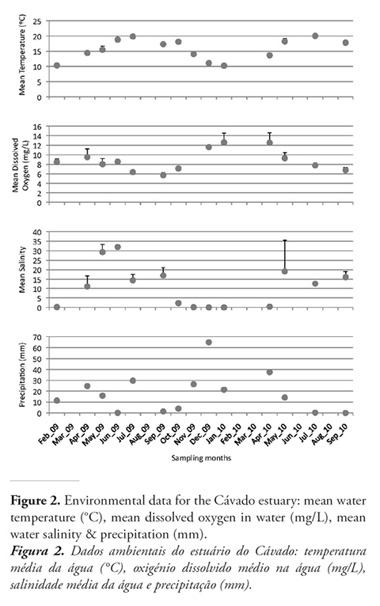
<body><![CDATA[<p><b>3.1. Environmental analysis</b></p> 		    <p>Water temperature values ranged between 10.0&deg;C, in January 2010 at station E1 and E1a, and 20.5&deg;C, in July 2010 at station E3 and E3a, and variation between stations is low. Mean values and standard deviation, considering all station at each month are displayed in <a href="#f2">Figure 2</a>. Salinity values ranged from zero, when precipitation was higher, to 34.0 in May 2009 at station E3. Dissolved oxygen values in the water ranged between 5.10mg/L in September 2009 and 12.5mg/L in January and April 2010, at stations E1 and E1a. Highest levels of precipitation occurred during the winter and spring months. The maximum level of precipitation occurred in December 2009 (65mm; total rainfall registered in the last seven days before the sampling day). Despite the high levels of precipitation recorded in July 2009, summer and early fall are typically characterised by little to no rainfall (IPMA, s/d).</p> 		    <p>&nbsp;</p> 		    <p><a name="f2"></a></p> 		<img src="/img/revistas/rgci/v13n1/13n1a08f2.jpg" />     
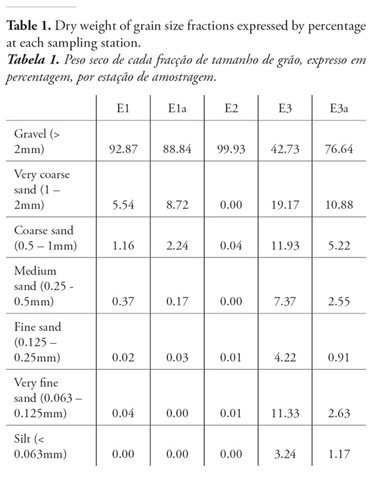
<p>&nbsp;</p> 		    <p>Granulometric analysis showed sampling stations E1, E1a and E2 to be characterised by gravel (= 2mm) (<a href="#t1">Table 1</a>). Stations E3 and E3a, despite being mostly gravel (= 2mm), also contained silt (&lt; 0.063mm). The margin station (E3) had a higher percentage of silt than the channel station (E3a).</p> 		    <p>&nbsp;</p> 		    <p><a name="t1"></a></p> 		<img src="/img/revistas/rgci/v13n1/13n1a08t1.jpg" />     
<p>&nbsp;</p> 		    <p><b>3.2. Spatial and seasonal variations in epibenthic community structure </b></p> 		    ]]></body>
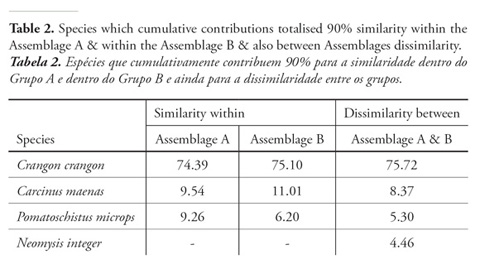
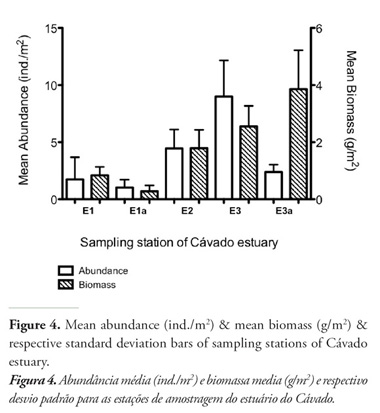
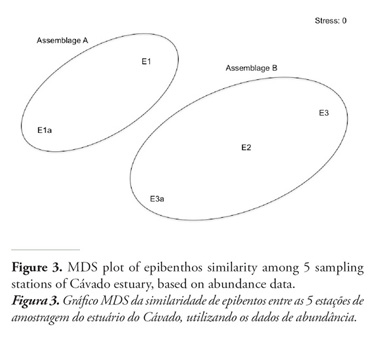
<body><![CDATA[<p>The biological data set consisted of 7352 individuals (Appendix A), with a total biomass of 3682.621g from 15 taxa that included Arthropoda (8) and Vertebrata (7). <i>Crangon crangon</i> was the most abundant species, representing 75% of the total number of individuals collected. This was followed by <i>Carcinus maenas</i> (6%) and <i>Pomatoschistus microps</i> (8%) and <i>Neomysis integer</i> (5%). <i>Carcinus maenas</i> dominated the epibenthic biomass of the C&aacute;vado estuary, making up 71% of the total biomass collected, followed by <i>Crangon crangon</i> (14%), <i>Anguilla anguilla</i> (5%) and <i>Pomatoschistus microps</i> (5%).</p> 		    <p>Based on similarity analysis of abundance data, two assemblages could be distinguished by MDS analysis (stress value= 0.00): Assemblage A corresponding to stations E1 and E1a, and Assemblage B corresponding to stations E2, E3 and E3a as shown in <a href="#f3">Figure 3</a>. However, ANOSIM did not confirm significant differences between the two assemblages (R= 0.75 p&lt; 0.1). SIMPER analysis showed that the species contributing the most to the average similarity within assemblage A and within assemblage B were <i>C. crangon</i>, <i>C. maenas</i> and <i>P. microps</i> (<a href="#t2">Table 2</a>). The species responsible for the 90% cut-off for the dissimilarity observed between assemblages were the three above mentioned ones and also N. integer. Collectively, the stations nearest the mouth (E2/E3/E3a) had higher abundance values (15.9ind./m<sup>2</sup>) (<a href="#f4">Figure 4</a>) and were dominated by <i>C. crangon</i>, whereas stations further upstream (E1/E1a) had a lower abundance (2.8ind./m<sup>2</sup>) but were also dominated by <i>C. crangon</i>. Samples from marginal stations had higher values of abundance (E1 1.7ind./m<sup>2</sup>; E3 9.0ind./m<sup>2</sup>) compared to samples from the channel stations (E1a 1.0ind./m<sup>2</sup>; E3a 2.4ind./m<sup>2</sup>). There were, however, no significant differences between samples (H (df= 4, N= 75) = 3.264 p= 0.515). The stations closest to the mouth (E2/E3/E3a) showed higher values for mean biomass (8.2g/m<sup>2</sup>) when compared to upstream stations (E1/E1a) (1.1g/m<sup>2</sup>). Downstream, the channel station had higher biomass values than the margin. Upstream, the opposite was observed. The samples were not significantly different in terms of biomass (H (df= 4, N= 75) = 4.270 p= 0.371). The Shannon diversity index value was highest at station E1 (1.360) and lowest near the mouth at station E3 (0.711). However, E1 had the highest value of species richness (1.684) and E1a registered the lower value (0.999). Additionally, the relative abundance at the mouth (E3) demonstrated a large difference between the various species. The most abundant (<i>C. crangon</i>) reached 70% and, therefore, lowered equitability (0.277). Values for the Shannon diversity index were not significantly different between the sampling stations (H (df= 4, N= 57) = 3.578 p= 0.467). Accordingly, the Simpson diversity index values ranged between 0.677 at station E1 and 0.312 at station E3 and equitability value was higher at station E1a (0.553).</p> 		    <p>&nbsp;</p> 		    <p><a name="f3"></a></p> 		    <p><img src="/img/revistas/rgci/v13n1/13n1a08f3.jpg" /></p> 		    
<p>&nbsp;</p> 		    <p><a name="t2"></a></p> 		<img src="/img/revistas/rgci/v13n1/13n1a08t2.jpg" />     
<p>&nbsp;</p> 		    <p><a name="f4"></a></p> 		<img src="/img/revistas/rgci/v13n1/13n1a08f4.jpg" />             
<p>&nbsp;</p>         ]]></body>
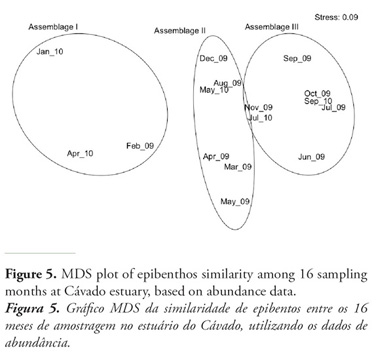
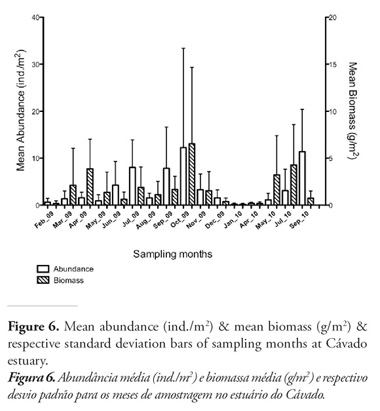
<body><![CDATA[<p>MDS analysis (stress value= 0.09) was performed, using similarity matrix of abundance data to assess the seasonal distribution. Three assemblages could be distinguished: Assemblage I corresponding to February 2009 and January and April 2010; Assemblage II corresponding to March, April, May, August and December 2009 and May 2010; Assemblage III corresponding to June, July, September, October, November 2009 and July and September 2010 as shown in <a href="#f5">Figure 5</a>. ANOSIM confirmed significant differences between the three assemblages (R= 0.79 p&lt; 0.001). SIMPER analysis showed that the species contributing the most to the average similarity within assemblage I were <i>Pomatoschistus microps and Neomysis integer</i> and within assemblage II and III were <i>Crangon crangon</i>, <i>Carcinus maenas</i> and also <i>P. microps and N. integer</i> (<a href="/img/revistas/rgci/v13n1/13n1a08t3.jpg" target="_blank">Table 3</a>). In addition to these four taxa, other species were also responsible for the 90% cut-off for the dissimilarity observed between assemblages. It is the case of <i>Anguilla anguilla</i>, <i>Pomatoschistus minutus</i> and <i>Platichthys flesus</i>, between I and II, <i>A. anguilla</i>, <i>Palaemon serratus</i> and <i>Palaemon elegans</i> between assemblages I and III and <i>P. minutus</i>, <i>P. flesus</i>, <i>P. serratus</i>, <i>P. elegans</i> and <i>Syngnathus acus</i> between assemblages II and III. July, September and October 2009 and September 2010 showed the highest mean abundances of epibenthos (8.1ind./m<sup>2</sup>; 7.9ind./m<sup>2</sup>, 12.3ind./m<sup>2</sup> and 11.4ind./m<sup>2</sup> respectively) as shown in <a href="#f6">Figure 6</a>. We recorded 0.6ind./m<sup>2</sup> in February 2009, 0.2ind./m<sup>2</sup> in January 2010 and 0.4ind./m<sup>2</sup> in April 2010, the months with the lowest mean abundance. There were no significant differences in abundance within the studied period (H (df= 15, N= 240) = 13.642 p= 0.553). April and October 2009 and May and July 2010 had the highest levels of epibenthos biomass (3.9g/m<sup>2</sup>, 6.6g/m<sup>2</sup>, 3.2g/m<sup>2</sup> and 4.3g/m<sup>2</sup>, respectively). February 2009 and January and April 2010 had lower values (0.2g/m<sup>2</sup>; 0.1g/m<sup>2</sup> and 0.2g/m<sup>2</sup>, respectively). There were no significant differences in biomass within the period studied (H (df= 15, N= 240) = 14.907 p= 0.458). The highest Shannon diversity index values were obtained in May 2009 (1.277) and April 2009 (1.269) and the lowest in October 2009 (0.387) and January 2010 (0.440). Shannon diversity index values between sampling months were not significantly different (H (df= 15, N= 57) = 19.432 p= 0.195). May 2009 had the highest recorded species richness (1.267) and September 2009 the highest number of species (9). January 2010 had the lowest species richness (0.311) and also the lowest number of species (2). Accordingly, the values of Simpson diversity index ranged between 0.679 in April 2009 and 0.155 in October 2009. Equitability values varied from 0.847 in April 2010 and 0.199 in October 2009.</p> 	    
<p>&nbsp;</p> 		    <p><a name="f5"></a></p> 		    <p><img src="/img/revistas/rgci/v13n1/13n1a08f5.jpg" /></p> 		    
<p>&nbsp;</p> 		    <p><a name="f6"></a></p> 		    <p><img src="/img/revistas/rgci/v13n1/13n1a08f6.jpg" /></p> 		    
<p>&nbsp;</p> 		    <p><a href="/img/revistas/rgci/v13n1/13n1a08t3.jpg" target="_blank">Table 3</a></p> 	    
<p>&nbsp;</p>             ]]></body>
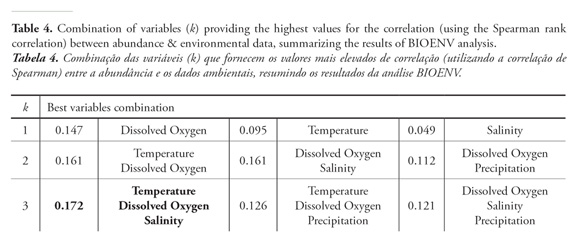
<body><![CDATA[<p>The correlation between epibenthic abundance and biomass was low (R= 0.23, N= 67 p= 0.066).</p> 		    <p>The BIOENV procedure revealed that the environmental variables that most contribute to the spatial distribution and seasonal variation of biological data were dissolved oxygen, temperature and salinity with a combined correlation value of 0.172 (<a href="#t4">Table 4</a>). However, dissolved oxygen is the parameter that explains most of the variability (0.147). The matrix of correlations between biological data (abundance, biomass, species richness, equitability and diversity indexes) and environmental parameters showed that abundance of epibenthos was positively correlated to water temperature (R= 0.31, N= 42 p= 0.044). Biomass was also correlated with water temperature (R= 0.31, N= 42 p= 0.047). The number of species was positively correlated with water temperature (R= 0.38, N=42 p= 0.013) and negatively correlated with dissolved oxygen (R= -0.40, N=42 p= 0.009). Pielou’s equitability was positively correlated with dissolved oxygen (R= 0.43, N=42 p= 0.004) and Simpson diversity index was also positively correlated with this abiotic variable (R= 0.37, N= 42 p= 0.015). The remaining diversity indices did not have a significant correlation with the physicochemical data. Relating biological data with the type of sediment, the abundance was correlated with a high significance with fine sand and very fine sand, (R= 0.89, N= 5 p= 0.041) and (R= 0.89, N= 5 p= 0.042) respectively. Biomass was better correlated with silt (R= 0.57, N= 5 p= 0.316). The number of species was better correlated with medium sand (R= 0.58, N= 5 p= 0.306). Pielou’s equitability was better negative correlated with very fine sand (R= -0.85, N= 5 p= 0.068). Shannon diversity index and Simpson diversity index were better negative correlated with fine sand, (R= -0.78, N= 5 p= 0.116) and (R= -0.76, N= 5 p= 0.134) respectively. Margalef species richness was very low correlated with any grain size of sediment.</p> 		    <p>&nbsp;</p> 		    <p><a name="t4"></a></p> 		    <p><img src="/img/revistas/rgci/v13n1/13n1a08t4.jpg" /></p> 		    
<p>&nbsp;</p> 		    <p><b>4. Discussion</b></p> 		    <p>This work is relevant for the study of estuarine epibenthos in Portugal, adding new information on the ecology and spatial and seasonal distribution patterns along the estuarine gradient in a poorly known estuary of Northwest Portugal.</p> 		    <p>According to our results, during the sampling period, water temperature and salinity showed higher values during the summer months and lower values during the winter as expected. We did not observe a water temperature gradient or large variations among the sampling stations. In general, salinity was lower at most upstream stations (E1, E1a) and higher at most downstream stations (E2, E3 and E3a). Seasonal variations and along to the estuarine gradient as those indicated are very common in Portuguese estuaries (Moreira <i>et al.</i> 1993; Azevedo <i>et al.</i> 2008; Chainho <i>et al.</i> 2008; Sousa <i>et al.</i> 2008b; Costa-Dias <i>et al.</i> 2010b; Medeiros <i>et al.</i> 2012). Winter and spring were the wettest seasons compared to summer, which was generally drier. This follows the pattern of most temperate estuaries, and is characterised by having a significant influx of freshwater during the winter, which has an impact on salinity variation (Elliott &amp; McLusky 2002; Chainho <i>et al.</i> 2006; Teixeira <i>et al.</i> 2008). The presence of gravel at upstream stations and the accumulation of muddy sediments in the stations near of mouth of C&aacute;vado estuary detected in the present study has also been observed in other Portuguese estuaries (Sousa <i>et al.</i> 2006; Chainho <i>et al.</i> 2007; Sousa <i>et al.</i> 2008b; Teixeira <i>et al.</i> 2008).</p> 		    <p>Our results show the representativeness of epibenthic crustaceans and gobies, but not the other species of fish, particularly in adult size. Most eels and flatfishes caught were juveniles. Care must be taken to analyze and compare present data with similar studies, once the gear type, mesh size, speed and depth of sampling chosen could be different. The epibenthic fauna of C&aacute;vado estuary was characterised by the dominance of Crangon crangon in abundance and <i>Carcinus maenas</i> in biomass. These were also the species that dominated the epibenthic community of Minho estuary (Costa-Dias <i>et al.</i> 2010a). The presence of exotic species was not recorded in C&aacute;vado. In Minho, Costa-Dias <i>et al.</i> (2010a) detected the presence of the introduced freshwater crayfish <i>Procambarus clarkii</i> in some of the upper sites. Further studies could be useful in C&aacute;vado estuary, with sampling stations further upstream to assess the presence of exotic species. </p> 		    ]]></body>
<body><![CDATA[<p>Although we did not find significant differences, multivariate analysis indicated two assemblages of epibenthic fauna in C&aacute;vado  		estuary: one corresponding to the upstream stations (Assemblage A) and the other to the stations close to the estuary mouth (Assemblage B).  		The dissimilarity within these two groups is a result of the same species (Crangon crangon, <i>Carcinus maenas</i>, <i>Pomatoschistus  		microps</i> and <i>Neomysis integer</i>) but in different proportions. All of them are typically euryhaline species, common in epibenthic  		communities of temperate European estuaries (Hampel <i>et al.</i> 2009). Comparatively, in Minho dissimilarity between groups is a result  		of the presence of different species. According to Costa-Dias <i>et al.</i> (2010a), the group of stations with a higher influence of  		freshwater was dominated by the <i>Atyaephyra desmarestii</i> and the group of stations with a higher marine influence was dominated  		by <i>C. crangon</i> and P. microps, but their work extended well upstream. In C&aacute;vado, a few individuals of <i>A. desmarestii</i> were collected, regardless of location, in months that have been registered a very low salinity, i.e. more influenced by higher upstream freshwater input. </p> 		    <p>Considering all the species, the stations located on the marginal sand banks had higher abundance than stations located in the channel. This could be related to higher channel’s average depth and stronger water flow. Variations in the distribution of biomass along the estuarine area were due not only to the presence of adult <i>C. maenas</i>, mainly in the channel, but also of <i>Anguilla anguilla</i> and <i>Platichthys flesus</i> near the margins. The Shannon diversity index was higher at upstream stations and lower near the mouth due to the <i>C. crangon</i> higher abundance downstream. Different patterns of sediment deposition and current strength at the narrow mouth of the C&aacute;vado estuary are possible additional causes of these findings. Contrary, in Minho the highest values were recorded at downstream stations (Costa-Dias <i>et al.</i> 2010a). Although we have recorded a lower number of species for C&aacute;vado, we registered a higher value of Shannon diversity to those found in Minho estuary. However, epibenthic diversity of C&aacute;vado was low as compared to other European estuaries (Maes <i>et al.</i> 1998). </p> 		    <p>Analysing the seasonal variation of abundance, three dissimilar epibenthic assemblages were found in C&aacute;vado estuary: Assemblage I corresponded mainly to winter months, Assemblage II mostly related to the spring months but included also other months that showed abundance pattern closest to spring and Assemblage III related to both summer and autumn months. Abundance was higher in the summer and early autumn and lower in the winter. The spring assemblage (II) pattern is influenced by the presence of young A. anguilla and <i>P. flesus</i> at this season, as in other estuaries (Martinho <i>et al.</i> 2007; Freitas <i>et al.</i> 2009; Ramos <i>et al.</i> 2010). The variation of epibenthic biomass did not present a clear seasonal pattern, being higher in months when there was the presence of species heavier individuals as <i>C. maenas</i>, A. anguilla, <i>P. flesus</i>, and <i>Solea solea</i>. Along the sampling months, the Shannon diversity index was higher in spring and summer and lower in autumn and winter. Species numbers were, however, higher in summer and autumn and lower in winter and spring.</p> 		    <p>The environmental parameter with more contribution to the distinction of spatial and seasonal assemblages was dissolved oxygen (correlated with water temperature and salinity). Even so, biological data, such as abundance and biomass, were better correlated with temperature than with salinity. Several studies reported the water temperature and salinity as the most important abiotic factors affecting Portuguese estuarine fauna (Sousa <i>et al.</i> 2006; Sousa <i>et al.</i> 2008b; Teixeira <i>et al.</i> 2008; Costa-Dias <i>et al.</i> 2010a), not dissolved oxygen. The sediment type was also important in spatial distribution of epibenthic communities, being the abundance, biomass and the diversity indexes better correlated with the presence of fine sediment (&lt;0.125mm). The differences found were expected since the hydrodynamic fluctuations have an important effect on the cycles of sediment erosion and deposition and, hence, on the colonisation of benthic communities (Chainho <i>et al.</i> 2006). </p> 		    <p>Pollution can contribute to a loss of biodiversity. It can cause the exclusion of sensitive species that are not able to survive or to adapt to certain levels of pollution, can alter abiotic factors to which some species have a low range of tolerance, or can interfere in interspecific relationships (Sousa <i>et al.</i> 2008a). In the Douro and Mondego estuaries, an increased concentration of pollutants has effects on benthic community structure, namely in terms of a low diversity and the presence of opportunistic species (Mucha <i>et al.</i> 2003; Mucha <i>et al.</i> 2004; Mucha <i>et al.</i> 2005; Chainho <i>et al.</i> 2007). There are a few studies showing the existence of heavy metals and organochlorine pesticides in the fine sediments of the C&aacute;vado estuary (Almeida <i>et al.</i> 2008; Carvalho <i>et al.</i> 2009). The stations examined here, however, were not the same as the sampling stations of that work since such contaminants typically accumulate in fine sediments on the banks of the estuary mouth and our sampling stations were located in zones with low fine sediment contents. The results of the present work suggest, however, that further studies are needed to determine the effects of contaminant bioaccumulation in estuary sediments on the most abundant crustacean, <i>Crangon crangon</i>. This species may be considered as a bioindicator of the quality of the estuarine system, as reported for other European estuaries (Culshaw <i>et al.</i> 2002; Quintaneiro <i>et al.</i> 2006; Jung &amp; Zauke 2008; Jung <i>et al.</i> 2009; Ca&ccedil;ador <i>et al.</i> 2012).</p> 		    <p>The seasonal variation in diversity identified for the C&aacute;vado estuary demonstrates the dynamics of this ecosystem. Like other Portuguese estuaries (Cabral <i>et al.</i> 2007; Ramos <i>et al.</i> 2010; Fran&ccedil;a <i>et al.</i> 2011), the C&aacute;vado assumes regional importance as it acts as a nursery for several fishes species. </p> 		    <p>&nbsp;</p> 		    <p><b>Acknowledgements</b></p> 		    <p>A special thanks to Jo&atilde;o Miquelino for loaning us a fishing boat so that we could collect the samples.</p> 		    <p>&nbsp;</p> 		    ]]></body>
<body><![CDATA[<p><b>References</b></p> 		    <!-- ref --><p>Almeida, C.M.R.; Mucha, A.P.; Bordalo, A.A.; Vasconcelos, M.T.S.D. (2008) - Influence of a salt marsh plant (<i>Halimione portulacoides</i>) on the concentrations and potential mobility of metals in sediments. <i>Science of the Total Environment</i>, 403(1-3):188-195. DOI: <span>10.1016/j.scitotenv.2008.05.044</span>&nbsp;&nbsp;&nbsp;&nbsp;&nbsp;&nbsp;&nbsp;&nbsp;[&#160;<a href="javascript:void(0);" onclick="javascript: window.open('/scielo.php?script=sci_nlinks&ref=000094&pid=S1646-8872201300010000800001&lng=','','width=640,height=500,resizable=yes,scrollbars=1,menubar=yes,');">Links</a>&#160;]<!-- end-ref --><!-- ref --><p>Azevedo, I.C.; Duarte, P.M.; Bordalo, A.A. (2008) - Understanding spatial and temporal dynamics of key environmental characteristics in a mesotidal Atlantic estuary (Douro, NW Portugal). <i>Estuarine, Coastal and Shelf Science</i>, 76(3):620-633. DOI: <span>10.1016/j.ecss.2007.07.034</span>&nbsp;&nbsp;&nbsp;&nbsp;&nbsp;&nbsp;&nbsp;&nbsp;[&#160;<a href="javascript:void(0);" onclick="javascript: window.open('/scielo.php?script=sci_nlinks&ref=000095&pid=S1646-8872201300010000800002&lng=','','width=640,height=500,resizable=yes,scrollbars=1,menubar=yes,');">Links</a>&#160;]<!-- end-ref --><!-- ref --><p>Blott, S.J.; Pye, K. (2001) - Gradistat: a grain size distribution and statistics package for the analysis of unconsolidation sediments. <i>Earth Surface Processes and Landforms</i>, 26(11):1237–1248. DOI: <span>10.1002/esp.261</span>&nbsp;&nbsp;&nbsp;&nbsp;&nbsp;&nbsp;&nbsp;&nbsp;[&#160;<a href="javascript:void(0);" onclick="javascript: window.open('/scielo.php?script=sci_nlinks&ref=000096&pid=S1646-8872201300010000800003&lng=','','width=640,height=500,resizable=yes,scrollbars=1,menubar=yes,');">Links</a>&#160;]<!-- end-ref --><!-- ref --><p>Cabral, H.N.; Vasconcelos, R.; Vinagre, C.; Fran&ccedil;a, S.; Fonseca, V.; Maia, A.; Reis-Santos, P.; Lopes, M.; Ruano, M.; Campos, J.; Freitas, V.; Santos, P.T.; Costa, M.J. (2007) - Relative importance of estuarine flatfish nurseries along the Portuguese coast. <i>Journal of Sea Research</i>, 57(2-3):209-217. DOI: <span>10.1016/j.seares.2006.08.007</span>&nbsp;&nbsp;&nbsp;&nbsp;&nbsp;&nbsp;&nbsp;&nbsp;[&#160;<a href="javascript:void(0);" onclick="javascript: window.open('/scielo.php?script=sci_nlinks&ref=000097&pid=S1646-8872201300010000800004&lng=','','width=640,height=500,resizable=yes,scrollbars=1,menubar=yes,');">Links</a>&#160;]<!-- end-ref --><!-- ref --><p>Ca&ccedil;ador, I.; Costa, J.L.; Duarte, B.; Silva, G.; Medeiros, J.P.; Azeda, C.; Castro, N.; Freitas, J.; Pedro, S.; Almeida, P.R.; Cabral, H.; Costa, M.J. (2012) - Macroinvertebrates and fishes as biomonitors of heavy metal concentration in the Seixal Bay (Tagus estuary): Which species perform better? <i>Ecological Indicators</i>, 19:184–190. DOI: <span>10.1016/j.ecolind.2011.09.007</span>&nbsp;&nbsp;&nbsp;&nbsp;&nbsp;&nbsp;&nbsp;&nbsp;[&#160;<a href="javascript:void(0);" onclick="javascript: window.open('/scielo.php?script=sci_nlinks&ref=000098&pid=S1646-8872201300010000800005&lng=','','width=640,height=500,resizable=yes,scrollbars=1,menubar=yes,');">Links</a>&#160;]<!-- end-ref --><!-- ref --><p>Carvalho, P.N.; Rodrigues, P.N.R.; Basto, M.C.P.; Vasconcelos, M.T.S.D. (2009) - Organochlorine pesticides levels in Portuguese coastal areas. <i>Chemosphere</i>, 75(5):595-600. DOI: <span>10.1016/j.chemosphere.2009.01.060</span>&nbsp;&nbsp;&nbsp;&nbsp;&nbsp;&nbsp;&nbsp;&nbsp;[&#160;<a href="javascript:void(0);" onclick="javascript: window.open('/scielo.php?script=sci_nlinks&ref=000099&pid=S1646-8872201300010000800006&lng=','','width=640,height=500,resizable=yes,scrollbars=1,menubar=yes,');">Links</a>&#160;]<!-- end-ref --><!-- ref --><p>Chainho, P.; Chaves, M.L.; Costa, J.L.; Costa, M.J.; Dauer, D.M. (2008) - Use of multimetric indices to classify estuaries with different hydromorphological characteristics and different levels of human pressure. <i>Marine Pollution Bulletin</i>, 56(6):1128-1137. DOI: <span>10.1016/j.marpolbul.2008.03.018</span>&nbsp;&nbsp;&nbsp;&nbsp;&nbsp;&nbsp;&nbsp;&nbsp;[&#160;<a href="javascript:void(0);" onclick="javascript: window.open('/scielo.php?script=sci_nlinks&ref=000100&pid=S1646-8872201300010000800007&lng=','','width=640,height=500,resizable=yes,scrollbars=1,menubar=yes,');">Links</a>&#160;]<!-- end-ref --><!-- ref --><p>Chainho, P.; Costa, J.L.; Chaves, M.L.; Dauer, D.M.; Costa, M.J. (2007) - Influence of seasonal variability in benthic invertebrate community structure on the use of biotic indices to assess the ecological status of a Portuguese estuary. <i>Marine Pollution Bulletin</i>, 54(10):1586-1597. DOI: <span>10.1016/j.marpolbul.2007.06.009</span>&nbsp;&nbsp;&nbsp;&nbsp;&nbsp;&nbsp;&nbsp;&nbsp;[&#160;<a href="javascript:void(0);" onclick="javascript: window.open('/scielo.php?script=sci_nlinks&ref=000101&pid=S1646-8872201300010000800008&lng=','','width=640,height=500,resizable=yes,scrollbars=1,menubar=yes,');">Links</a>&#160;]<!-- end-ref --><!-- ref --><p>Chainho, P.; Costa, J.L.; Chaves, M.L.; Lane, M.F.; Dauer, D.M.; Costa, M.J. (2006) - Seasonal and spatial patterns of distribution of subtidal benthic invertebrate communities in the Mondego River, Portugal - A poikilohaline estuary. <i>Hydrobiologia</i>, 555(1):59-74. DOI: <span>10.1007/s10750-005-1132-2</span>&nbsp;&nbsp;&nbsp;&nbsp;&nbsp;&nbsp;&nbsp;&nbsp;[&#160;<a href="javascript:void(0);" onclick="javascript: window.open('/scielo.php?script=sci_nlinks&ref=000102&pid=S1646-8872201300010000800009&lng=','','width=640,height=500,resizable=yes,scrollbars=1,menubar=yes,');">Links</a>&#160;]<!-- end-ref --><!-- ref --><p>Clarke, K.R. (1993) - Non-parametric multivariate analyses of changes in community structure. <i>Australian Journal of Ecology</i>, 18(1):117-143. DOI: <span>10.1111/j.1442-9993.1993.tb00438.x</span>&nbsp;&nbsp;&nbsp;&nbsp;&nbsp;&nbsp;&nbsp;&nbsp;[&#160;<a href="javascript:void(0);" onclick="javascript: window.open('/scielo.php?script=sci_nlinks&ref=000103&pid=S1646-8872201300010000800010&lng=','','width=640,height=500,resizable=yes,scrollbars=1,menubar=yes,');">Links</a>&#160;]<!-- end-ref --><!-- ref --><p>Clarke, K.R.; Gorley, R.N. (2001) - <i>PRIMER v5: User Manual/Tutorial</i>. 91p., ed. Primer-e, Plymouth, U.K.    &nbsp;&nbsp;&nbsp;&nbsp;&nbsp;&nbsp;&nbsp;&nbsp;[&#160;<a href="javascript:void(0);" onclick="javascript: window.open('/scielo.php?script=sci_nlinks&ref=000104&pid=S1646-8872201300010000800011&lng=','','width=640,height=500,resizable=yes,scrollbars=1,menubar=yes,');">Links</a>&#160;]<!-- end-ref --></p> 		    <!-- ref --><p>Coelho, C.; Santos, P. (2006) - Diversidade e abund&acirc;ncia da ictiofauna em fun&ccedil;&atilde;o de factores abi&oacute;ticos no estu&aacute;rio do C&aacute;vado. <i>2&ordm; Congresso Ib&eacute;rico de Ecologia. Livro de Resumos</i> 56p., SPECO/AEET. Faculdade de Ci&ecirc;ncias da Universidade de Lisboa, Lisboa, Portugal.    &nbsp;&nbsp;&nbsp;&nbsp;&nbsp;&nbsp;&nbsp;&nbsp;[&#160;<a href="javascript:void(0);" onclick="javascript: window.open('/scielo.php?script=sci_nlinks&ref=000106&pid=S1646-8872201300010000800012&lng=','','width=640,height=500,resizable=yes,scrollbars=1,menubar=yes,');">Links</a>&#160;]<!-- end-ref --> </p> 		    <!-- ref --><p>Constable, A.J. (1999) - Ecology of benthic macro-invertebrates in soft-sediment environments: A review of progress towards quantitative models and predictions. <i>Austral Ecology</i>, 24(4):452-476. DOI: <span>10.1046/j.1442-9993.1999.00977.x</span>&nbsp;&nbsp;&nbsp;&nbsp;&nbsp;&nbsp;&nbsp;&nbsp;[&#160;<a href="javascript:void(0);" onclick="javascript: window.open('/scielo.php?script=sci_nlinks&ref=000108&pid=S1646-8872201300010000800013&lng=','','width=640,height=500,resizable=yes,scrollbars=1,menubar=yes,');">Links</a>&#160;]<!-- end-ref --><!-- ref --><p>Costa-Dias, S.; Freitas, V.; Sousa, R.; Antunes, C. (2010a) - Factors influencing epibenthic assemblages in the Minho Estuary (NW Iberian Peninsula). <i>Marine Pollution Bulletin</i>, 61(4-6):240-246. DOI: <span>10.1016/j.marpolbul.2010.02.020</span>&nbsp;&nbsp;&nbsp;&nbsp;&nbsp;&nbsp;&nbsp;&nbsp;[&#160;<a href="javascript:void(0);" onclick="javascript: window.open('/scielo.php?script=sci_nlinks&ref=000109&pid=S1646-8872201300010000800014&lng=','','width=640,height=500,resizable=yes,scrollbars=1,menubar=yes,');">Links</a>&#160;]<!-- end-ref --><!-- ref --><p>Costa-Dias, S.; Sousa, R.; Antunes, C. (2010b) - Ecological quality assessment of the lower Lima Estuary. <i>Marine Pollution Bulletin</i>, 61(4-6):234-239. DOI: <span>10.1016/j.marpolbul.2010.02.019</span>&nbsp;&nbsp;&nbsp;&nbsp;&nbsp;&nbsp;&nbsp;&nbsp;[&#160;<a href="javascript:void(0);" onclick="javascript: window.open('/scielo.php?script=sci_nlinks&ref=000110&pid=S1646-8872201300010000800015&lng=','','width=640,height=500,resizable=yes,scrollbars=1,menubar=yes,');">Links</a>&#160;]<!-- end-ref --><!-- ref --><p>Culshaw, C.; Newton, L.C.; Weir, I.; Bird, D.J. (2002) - Concentrations of Cd, Zn and Cu in sediments and brown shrimp (<i>Crangon crangon</i> L.) from the Severn Estuary and Bristol Channel, UK. <i>Marine Environmental Research</i>, 54(3-5):331-334. DOI: <span>10.1016/S0141-1136(02)00163-0</span>&nbsp;&nbsp;&nbsp;&nbsp;&nbsp;&nbsp;&nbsp;&nbsp;[&#160;<a href="javascript:void(0);" onclick="javascript: window.open('/scielo.php?script=sci_nlinks&ref=000111&pid=S1646-8872201300010000800016&lng=','','width=640,height=500,resizable=yes,scrollbars=1,menubar=yes,');">Links</a>&#160;]<!-- end-ref --><!-- ref --><p>Dyer, K.R. (1997) - <i>Estuaries: a physical introduction</i>. 2&ordf; ed., 195p., John Wiley and Sons, Chichester, England, U.K.. ISBN: 9780471974703.    &nbsp;&nbsp;&nbsp;&nbsp;&nbsp;&nbsp;&nbsp;&nbsp;[&#160;<a href="javascript:void(0);" onclick="javascript: window.open('/scielo.php?script=sci_nlinks&ref=000112&pid=S1646-8872201300010000800017&lng=','','width=640,height=500,resizable=yes,scrollbars=1,menubar=yes,');">Links</a>&#160;]<!-- end-ref --></p> 		    <!-- ref --><p>Elliott, M.; McLusky, D.S. (2002) - The need for definitions in understanding estuaries. <i>Estuarine, Coastal and Shelf Science</i>, 55(6):815-827. DOI: <span>10.1006/ecss.2002.1031</span>&nbsp;&nbsp;&nbsp;&nbsp;&nbsp;&nbsp;&nbsp;&nbsp;[&#160;<a href="javascript:void(0);" onclick="javascript: window.open('/scielo.php?script=sci_nlinks&ref=000114&pid=S1646-8872201300010000800018&lng=','','width=640,height=500,resizable=yes,scrollbars=1,menubar=yes,');">Links</a>&#160;]<!-- end-ref --><!-- ref --><p>Feller, R.J. (2006) - Weak meiofaunal trophic linkages in <i>Crangon crangon</i> and <i>Carcinus maenus</i>. <i>Journal of Experimental Marine Biology and Ecology</i>, 330(1):274–283. DOI: <span>10.1016/j.jembe.2005.12.033</span>&nbsp;&nbsp;&nbsp;&nbsp;&nbsp;&nbsp;&nbsp;&nbsp;[&#160;<a href="javascript:void(0);" onclick="javascript: window.open('/scielo.php?script=sci_nlinks&ref=000115&pid=S1646-8872201300010000800019&lng=','','width=640,height=500,resizable=yes,scrollbars=1,menubar=yes,');">Links</a>&#160;]<!-- end-ref --><!-- ref --><p>Fran&ccedil;a, S.; Costa, J.M.; Cabral, H.N. (2011) - Inter- and intra-estuarine fish assemblage variability patterns along the Portuguese coast. <i>Estuarine, Coastal and Shelf Science</i>, 91(2):262-271. DOI: <span>10.1016/j.ecss.2010.10.035</span>&nbsp;&nbsp;&nbsp;&nbsp;&nbsp;&nbsp;&nbsp;&nbsp;[&#160;<a href="javascript:void(0);" onclick="javascript: window.open('/scielo.php?script=sci_nlinks&ref=000116&pid=S1646-8872201300010000800020&lng=','','width=640,height=500,resizable=yes,scrollbars=1,menubar=yes,');">Links</a>&#160;]<!-- end-ref --><!-- ref --><p>Freitas, V.; Costa-Dias, S.; Campos, J.; Bio, A.; Santos, P.; Antunes, C. (2009) - Patterns in abundance and distribution of juvenile flounder <i>Platichthys flesus</i> in Minho estuary (NW Iberian Peninsula). <i>Aquatic Ecology</i>, 43(4):1143-1153. DOI: <span>10.1007/s10452-009-9237-8</span>&nbsp;&nbsp;&nbsp;&nbsp;&nbsp;&nbsp;&nbsp;&nbsp;[&#160;<a href="javascript:void(0);" onclick="javascript: window.open('/scielo.php?script=sci_nlinks&ref=000117&pid=S1646-8872201300010000800021&lng=','','width=640,height=500,resizable=yes,scrollbars=1,menubar=yes,');">Links</a>&#160;]<!-- end-ref --><!-- ref --><p>Hampel, H.; Elliott, M.; Cattrijsse, A. (2009) - Macrofaunal communities in the habitats of intertidal marshes along the salinity gradient of the Schelde estuary. <i>Estuarine, Coastal and Shelf Science</i>, 84(1):45-53. DOI: <span>10.1016/j.ecss.2009.05.029</span>&nbsp;&nbsp;&nbsp;&nbsp;&nbsp;&nbsp;&nbsp;&nbsp;[&#160;<a href="javascript:void(0);" onclick="javascript: window.open('/scielo.php?script=sci_nlinks&ref=000118&pid=S1646-8872201300010000800022&lng=','','width=640,height=500,resizable=yes,scrollbars=1,menubar=yes,');">Links</a>&#160;]<!-- end-ref --><p>IPMA (s/d) - Normais Climatol&oacute;gicas - 1971-2000 - Viana do Castelo / Meadela. In: <i>O Clima</i>, IPMA - Instituto Portugu&ecirc;s do Mar e da Atmosfera homepage, Lisboa, Portugal. Available at <span><a href="http://www.ipma.pt/pt/oclima/normais.clima/1971-2000/021/" target="_blank">http://www.ipma.pt/pt/oclima/normais.clima/1971-2000/021/</a></span> (Accessed in January 2013)</p> 		    <!-- ref --><p>Jung, K.; Stelzenmuller, V.; Zauke, G.P. (2009) - Spatial analysis of metal concentrations in the brown shrimp <i>Crangon crangon</i> (Linnaeus, 1758) from the southern North Sea. <i>Scientia Marina</i>, 73(1):105-115. DOI: <span>10.3989/scimar.2009.73n1105</span>&nbsp;&nbsp;&nbsp;&nbsp;&nbsp;&nbsp;&nbsp;&nbsp;[&#160;<a href="javascript:void(0);" onclick="javascript: window.open('/scielo.php?script=sci_nlinks&ref=000120&pid=S1646-8872201300010000800023&lng=','','width=640,height=500,resizable=yes,scrollbars=1,menubar=yes,');">Links</a>&#160;]<!-- end-ref --><!-- ref --><p>Jung, K.; Zauke, G.P. (2008) - Bioaccumulation of trace metals in the brown shrimp <i>Crangon crangon</i> (Linnaeus, 1758) from the German Wadden Sea. <i>Aquatic Toxicology</i>, 88(4):243-249. DOI: <span>10.1016/j.aquatox.2008.05.007</span>&nbsp;&nbsp;&nbsp;&nbsp;&nbsp;&nbsp;&nbsp;&nbsp;[&#160;<a href="javascript:void(0);" onclick="javascript: window.open('/scielo.php?script=sci_nlinks&ref=000121&pid=S1646-8872201300010000800024&lng=','','width=640,height=500,resizable=yes,scrollbars=1,menubar=yes,');">Links</a>&#160;]<!-- end-ref --><!-- ref --><p>Leit&atilde;o, R.; Martinho, F.; Neto, J.M.; Cabral, H.; Marques, J.C.; Pardal, M.A. (2006) - Feeding ecology, population structure and distribution of <i>Pomatoschistus microps</i> (Kr&oslash;yer, 1838) and <i>Pomatoschistus minutus</i> (Pallas, 1770) in a temperate estuary, Portugal. <i>Estuarine, Coastal and Shelf Science</i>, 66(1-2):231-239. DOI: <span>10.1016/j.ecss.2005.08.012</span>&nbsp;&nbsp;&nbsp;&nbsp;&nbsp;&nbsp;&nbsp;&nbsp;[&#160;<a href="javascript:void(0);" onclick="javascript: window.open('/scielo.php?script=sci_nlinks&ref=000122&pid=S1646-8872201300010000800025&lng=','','width=640,height=500,resizable=yes,scrollbars=1,menubar=yes,');">Links</a>&#160;]<!-- end-ref --><!-- ref --><p>Little, C. (2000) - <i>The Biology of Soft Shores and Estuaries</i>. Oxford University Press, New York. ISBN:0198504268.    &nbsp;&nbsp;&nbsp;&nbsp;&nbsp;&nbsp;&nbsp;&nbsp;[&#160;<a href="javascript:void(0);" onclick="javascript: window.open('/scielo.php?script=sci_nlinks&ref=000123&pid=S1646-8872201300010000800026&lng=','','width=640,height=500,resizable=yes,scrollbars=1,menubar=yes,');">Links</a>&#160;]<!-- end-ref --></p> 		    <!-- ref --><p>Maes, J.; Taillieu, A.; Van Damme, P.A.; Cottenie, K.; Ollevier, F. (1998) - Seasonal Patterns in the Fish and Crustacean Community of a Turbid Temperate Estuary (Zeeschelde Estuary, Belgium). <i>Estuarine, Coastal and Shelf Science</i>, 47(2):143-151. DOI: <span>10.1006/ecss.1998.0350</span>&nbsp;&nbsp;&nbsp;&nbsp;&nbsp;&nbsp;&nbsp;&nbsp;[&#160;<a href="javascript:void(0);" onclick="javascript: window.open('/scielo.php?script=sci_nlinks&ref=000125&pid=S1646-8872201300010000800027&lng=','','width=640,height=500,resizable=yes,scrollbars=1,menubar=yes,');">Links</a>&#160;]<!-- end-ref --><!-- ref --><p>Martinho, F.; Leit&atilde;o, R.; Neto, J.M.; Cabral, H.N.; Marques, J.C.; Pardal, M.A. (2007) - The use of nursery areas by juvenile fish in a temperate estuary, Portugal. <i>Hydrobiologia</i>, 587(1):281-290. DOI: <span>10.1007/s10750-007-0689-3</span>&nbsp;&nbsp;&nbsp;&nbsp;&nbsp;&nbsp;&nbsp;&nbsp;[&#160;<a href="javascript:void(0);" onclick="javascript: window.open('/scielo.php?script=sci_nlinks&ref=000126&pid=S1646-8872201300010000800028&lng=','','width=640,height=500,resizable=yes,scrollbars=1,menubar=yes,');">Links</a>&#160;]<!-- end-ref --><!-- ref --><p>McLusky, D.S. (1993) - Marine and estuarine gradients - An overview. Netherlands <i>Journal of Aquatic Ecology</i>, 27(2-4):489-493. DOI: 10.1007/BF02334809&nbsp;&nbsp;&nbsp;&nbsp;&nbsp;&nbsp;&nbsp;&nbsp;[&#160;<a href="javascript:void(0);" onclick="javascript: window.open('/scielo.php?script=sci_nlinks&ref=000127&pid=S1646-8872201300010000800029&lng=','','width=640,height=500,resizable=yes,scrollbars=1,menubar=yes,');">Links</a>&#160;]<!-- end-ref --><!-- ref --><p>McLusky, D.S. (1999) - Estuarine benthic ecology: A European perspective. <i>Austral Ecology</i>, 24(4):302-311. DOI: <span>10.1046/j.1442-9993.1999.00983.x</span>&nbsp;&nbsp;&nbsp;&nbsp;&nbsp;&nbsp;&nbsp;&nbsp;[&#160;<a href="javascript:void(0);" onclick="javascript: window.open('/scielo.php?script=sci_nlinks&ref=000128&pid=S1646-8872201300010000800030&lng=','','width=640,height=500,resizable=yes,scrollbars=1,menubar=yes,');">Links</a>&#160;]<!-- end-ref --><!-- ref --><p>Medeiros, J.P.; Chaves, M.L.; Silva, G.; Azeda, C.; Costa, J.L.; Marques, J.C.; Costa, M.J.; Chainho, P. (2012) - Benthic condition in low salinity areas of the Mira estuary (Portugal): Lessons learnt from freshwater and marine assessment tools. <i>Ecological Indicators</i>, 19(0):79-88. DOI: <span>10.1016/j.ecolind.2011.09.008</span>&nbsp;&nbsp;&nbsp;&nbsp;&nbsp;&nbsp;&nbsp;&nbsp;[&#160;<a href="javascript:void(0);" onclick="javascript: window.open('/scielo.php?script=sci_nlinks&ref=000129&pid=S1646-8872201300010000800031&lng=','','width=640,height=500,resizable=yes,scrollbars=1,menubar=yes,');">Links</a>&#160;]<!-- end-ref --><!-- ref --><p>Meire, P.; Ysebaert, T.; Van Damme, S.; Van Den Bergh, E.; Maris, T.; Struyf, E. (2005) - The Scheldt estuary: A description of a changing ecosystem. <i>Hydrobiologia</i>, 540(1-3):1-11. DOI: <span>10.1007/s10750-005-0896-8</span>&nbsp;&nbsp;&nbsp;&nbsp;&nbsp;&nbsp;&nbsp;&nbsp;[&#160;<a href="javascript:void(0);" onclick="javascript: window.open('/scielo.php?script=sci_nlinks&ref=000130&pid=S1646-8872201300010000800032&lng=','','width=640,height=500,resizable=yes,scrollbars=1,menubar=yes,');">Links</a>&#160;]<!-- end-ref --><!-- ref --><p>Moreira, M.H.; Queiroga, H.; Machado, M.M.; Cunha, M.R. (1993) - Environmental gradients in a southern Europe estuarine system: Ria de Aveiro, Portugal implications for soft bottom macrofauna colonization. Netherlands <i>Journal of Aquatic Ecology</i>, 27(2-4):465-482. DOI: <span>10.1007/BF02334807</span>&nbsp;&nbsp;&nbsp;&nbsp;&nbsp;&nbsp;&nbsp;&nbsp;[&#160;<a href="javascript:void(0);" onclick="javascript: window.open('/scielo.php?script=sci_nlinks&ref=000131&pid=S1646-8872201300010000800033&lng=','','width=640,height=500,resizable=yes,scrollbars=1,menubar=yes,');">Links</a>&#160;]<!-- end-ref --><!-- ref --><p>Mucha, A.P.; Bordalo, A.A.; Vasconcelos, M.T.S.D. (2004) - Sediment quality in the Douro river estuary based on trace metal contents, macrobenthic community and elutriate sediment toxicity test (ESTT). <i>Journal of Environmental Monitoring</i>, 6(7):585-592. DOI: <span>10.1039/B401855A</span>&nbsp;&nbsp;&nbsp;&nbsp;&nbsp;&nbsp;&nbsp;&nbsp;[&#160;<a href="javascript:void(0);" onclick="javascript: window.open('/scielo.php?script=sci_nlinks&ref=000132&pid=S1646-8872201300010000800034&lng=','','width=640,height=500,resizable=yes,scrollbars=1,menubar=yes,');">Links</a>&#160;]<!-- end-ref --><!-- ref --><p>Mucha, A.P.; Vasconcelos, M.T.S.D.; Bordalo, A.A. (2003) - Macrobenthic community in the Douro estuary: Relations with trace metals and natural sediment characteristics. <i>Environmental Pollution</i>, 121(2):169-180. DOI: <span>10.1016/S0269-7491(02)00229-4</span>&nbsp;&nbsp;&nbsp;&nbsp;&nbsp;&nbsp;&nbsp;&nbsp;[&#160;<a href="javascript:void(0);" onclick="javascript: window.open('/scielo.php?script=sci_nlinks&ref=000133&pid=S1646-8872201300010000800035&lng=','','width=640,height=500,resizable=yes,scrollbars=1,menubar=yes,');">Links</a>&#160;]<!-- end-ref --><!-- ref --><p>Mucha, A.P.; Vasconcelos, M.T.S.D.; Bordalo, A.A. (2005) - Spatial and seasonal variations of the macrobenthic community and metal contamination in the Douro estuary (Portugal). <i>Marine Environmental Research</i>, 60(5):531-550. DOI: <span>10.1016/j.marenvres.2004.12.004</span>&nbsp;&nbsp;&nbsp;&nbsp;&nbsp;&nbsp;&nbsp;&nbsp;[&#160;<a href="javascript:void(0);" onclick="javascript: window.open('/scielo.php?script=sci_nlinks&ref=000134&pid=S1646-8872201300010000800036&lng=','','width=640,height=500,resizable=yes,scrollbars=1,menubar=yes,');">Links</a>&#160;]<!-- end-ref --><!-- ref --><p>Quintaneiro, C.; Monteiro, M.; Pastorinho, R.; Soares, A.M.V.M.; Nogueira, A.J.A.; Morgado, F.; Guilhermino, L. (2006) - Environmental pollution and natural populations: A biomarkers case study from the Iberian Atlantic coast. <i>Marine Pollution Bulleti</i>n, 52(11):1406-1413. DOI: <span>10.1016/j.marpolbul.2006.04.002</span>&nbsp;&nbsp;&nbsp;&nbsp;&nbsp;&nbsp;&nbsp;&nbsp;[&#160;<a href="javascript:void(0);" onclick="javascript: window.open('/scielo.php?script=sci_nlinks&ref=000135&pid=S1646-8872201300010000800037&lng=','','width=640,height=500,resizable=yes,scrollbars=1,menubar=yes,');">Links</a>&#160;]<!-- end-ref --><!-- ref --><p>Ramos, S.; R&eacute;, P.; Bordalo, A.A. (2010) - Recruitment of flatfish species to an estuarine nursery habitat (Lima estuary, NW Iberian Peninsula). <i>Journal of Sea Research</i>, 64(4):473-486. DOI: <span>10.1016/j.seares.2010.01.010</span>&nbsp;&nbsp;&nbsp;&nbsp;&nbsp;&nbsp;&nbsp;&nbsp;[&#160;<a href="javascript:void(0);" onclick="javascript: window.open('/scielo.php?script=sci_nlinks&ref=000136&pid=S1646-8872201300010000800038&lng=','','width=640,height=500,resizable=yes,scrollbars=1,menubar=yes,');">Links</a>&#160;]<!-- end-ref --><!-- ref --><p>Sousa, R.; Dias, S.; Antunes, J.C. (2006) - Spatial subtidal macrobenthic distribution in relation to abiotic conditions in the Lima estuary, NW of Portugal. <i>Hydrobiologia</i>, 559(1):135-148. DOI: <span>10.1007/s10750-005-1371-2</span>&nbsp;&nbsp;&nbsp;&nbsp;&nbsp;&nbsp;&nbsp;&nbsp;[&#160;<a href="javascript:void(0);" onclick="javascript: window.open('/scielo.php?script=sci_nlinks&ref=000137&pid=S1646-8872201300010000800039&lng=','','width=640,height=500,resizable=yes,scrollbars=1,menubar=yes,');">Links</a>&#160;]<!-- end-ref --><!-- ref --><p>Sousa, R.; Dias, S.C.; Guilhermino, L.; Antunes, C. (2008a) - Minho river tidal freshwater wetlands: Threats to faunal biodiversity. <i>Aquatic Biology</i>, 3(3):237-250. DOI: <span>10.3354/ab00077</span>&nbsp;&nbsp;&nbsp;&nbsp;&nbsp;&nbsp;&nbsp;&nbsp;[&#160;<a href="javascript:void(0);" onclick="javascript: window.open('/scielo.php?script=sci_nlinks&ref=000138&pid=S1646-8872201300010000800040&lng=','','width=640,height=500,resizable=yes,scrollbars=1,menubar=yes,');">Links</a>&#160;]<!-- end-ref --><!-- ref --><p>Sousa, R.G.; Dias, S.; Freitas, V.; Antunes, C. (2008b) - Subtidal macrozoobenthic assemblages along the River Minho estuarine gradient (north-west Iberian Peninsula). <i>Aquatic Conservation: Marine and Freshwater Ecosystems</i>, 18(7):1063-1077. DOI: <span>10.1002/aqc.871</span>&nbsp;&nbsp;&nbsp;&nbsp;&nbsp;&nbsp;&nbsp;&nbsp;[&#160;<a href="javascript:void(0);" onclick="javascript: window.open('/scielo.php?script=sci_nlinks&ref=000139&pid=S1646-8872201300010000800041&lng=','','width=640,height=500,resizable=yes,scrollbars=1,menubar=yes,');">Links</a>&#160;]<!-- end-ref --><!-- ref --><p>Statsoft (2012) - <i>Electronic statistics textbook</i>. Statsoft inc., Tulsa, OK, U.S.A. Available at <span><a href="http://www.statsoft.com/textbook/" target="_blank">http://www.statsoft.com/textbook/</a></span>&nbsp;&nbsp;&nbsp;&nbsp;&nbsp;&nbsp;&nbsp;&nbsp;[&#160;<a href="javascript:void(0);" onclick="javascript: window.open('/scielo.php?script=sci_nlinks&ref=000140&pid=S1646-8872201300010000800042&lng=','','width=640,height=500,resizable=yes,scrollbars=1,menubar=yes,');">Links</a>&#160;]<!-- end-ref --><!-- ref --><p>Teixeira, H.; Salas, F.; Borja, A.; Neto, J.M.; Marques, J.C. (2008) - A benthic perspective in assessing the ecological status of estuaries: The case of the Mondego estuary (Portugal). <i>Ecological Indicators</i>, 8(4):404-416. DOI: <span>10.1016/j.ecolind.2007.02.008</span>&nbsp;&nbsp;&nbsp;&nbsp;&nbsp;&nbsp;&nbsp;&nbsp;[&#160;<a href="javascript:void(0);" onclick="javascript: window.open('/scielo.php?script=sci_nlinks&ref=000141&pid=S1646-8872201300010000800043&lng=','','width=640,height=500,resizable=yes,scrollbars=1,menubar=yes,');">Links</a>&#160;]<!-- end-ref --><p>&nbsp;</p> 		    ]]></body>
<body><![CDATA[<p><a href="#top0">*</a> <a name="0"></a>Submission: 20 October 2012; Evaluation: 25 November 2012; Revised manuscript: 15 February 2013; Accepted: 20 February 2013; Available on-line: 5 March 2013</p>      ]]></body><back>
<ref-list>
<ref id="B1">
<nlm-citation citation-type="journal">
<person-group person-group-type="author">
<name>
<surname><![CDATA[Almeida]]></surname>
<given-names><![CDATA[C.M.R.]]></given-names>
</name>
<name>
<surname><![CDATA[Mucha]]></surname>
<given-names><![CDATA[A.P.]]></given-names>
</name>
<name>
<surname><![CDATA[Bordalo]]></surname>
<given-names><![CDATA[A.A.]]></given-names>
</name>
<name>
<surname><![CDATA[Vasconcelos]]></surname>
<given-names><![CDATA[M.T.S.D.]]></given-names>
</name>
</person-group>
<article-title xml:lang="en"><![CDATA[Influence of a salt marsh plant (Halimione portulacoides) on the concentrations and potential mobility of metals in sediments]]></article-title>
<source><![CDATA[Science of the Total Environment]]></source>
<year>2008</year>
<volume>403</volume>
<numero>1-3</numero>
<issue>1-3</issue>
<page-range>188-195</page-range></nlm-citation>
</ref>
<ref id="B2">
<nlm-citation citation-type="journal">
<person-group person-group-type="author">
<name>
<surname><![CDATA[Azevedo]]></surname>
<given-names><![CDATA[I.C.]]></given-names>
</name>
<name>
<surname><![CDATA[Duarte]]></surname>
<given-names><![CDATA[P.M.]]></given-names>
</name>
<name>
<surname><![CDATA[Bordalo]]></surname>
<given-names><![CDATA[A.A.]]></given-names>
</name>
</person-group>
<article-title xml:lang="en"><![CDATA[Understanding spatial and temporal dynamics of key environmental characteristics in a mesotidal Atlantic estuary (Douro, NW Portugal)]]></article-title>
<source><![CDATA[Estuarine, Coastal and Shelf Science]]></source>
<year>2008</year>
<volume>76</volume>
<numero>3</numero>
<issue>3</issue>
<page-range>620-633</page-range></nlm-citation>
</ref>
<ref id="B3">
<nlm-citation citation-type="journal">
<person-group person-group-type="author">
<name>
<surname><![CDATA[Blott]]></surname>
<given-names><![CDATA[S.J.]]></given-names>
</name>
<name>
<surname><![CDATA[Pye]]></surname>
<given-names><![CDATA[K.]]></given-names>
</name>
</person-group>
<article-title xml:lang="en"><![CDATA[Gradistat: a grain size distribution and statistics package for the analysis of unconsolidation sediments]]></article-title>
<source><![CDATA[Earth Surface Processes and Landforms]]></source>
<year>2001</year>
<volume>26</volume>
<numero>11</numero>
<issue>11</issue>
<page-range>1237-1248</page-range></nlm-citation>
</ref>
<ref id="B4">
<nlm-citation citation-type="journal">
<person-group person-group-type="author">
<name>
<surname><![CDATA[Cabral]]></surname>
<given-names><![CDATA[H.N.]]></given-names>
</name>
<name>
<surname><![CDATA[Vasconcelos]]></surname>
<given-names><![CDATA[R.]]></given-names>
</name>
<name>
<surname><![CDATA[Vinagre]]></surname>
<given-names><![CDATA[C.]]></given-names>
</name>
<name>
<surname><![CDATA[França]]></surname>
<given-names><![CDATA[S.]]></given-names>
</name>
<name>
<surname><![CDATA[Fonseca]]></surname>
<given-names><![CDATA[V.]]></given-names>
</name>
<name>
<surname><![CDATA[Maia]]></surname>
<given-names><![CDATA[A.]]></given-names>
</name>
<name>
<surname><![CDATA[Reis-Santos]]></surname>
<given-names><![CDATA[P.]]></given-names>
</name>
<name>
<surname><![CDATA[Lopes]]></surname>
<given-names><![CDATA[M.]]></given-names>
</name>
<name>
<surname><![CDATA[Ruano]]></surname>
<given-names><![CDATA[M.]]></given-names>
</name>
<name>
<surname><![CDATA[Campos]]></surname>
<given-names><![CDATA[J.]]></given-names>
</name>
<name>
<surname><![CDATA[Freitas]]></surname>
<given-names><![CDATA[V.]]></given-names>
</name>
<name>
<surname><![CDATA[Santos]]></surname>
<given-names><![CDATA[P.T.]]></given-names>
</name>
<name>
<surname><![CDATA[Costa]]></surname>
<given-names><![CDATA[M.J.]]></given-names>
</name>
</person-group>
<article-title xml:lang="en"><![CDATA[Relative importance of estuarine flatfish nurseries along the Portuguese coast]]></article-title>
<source><![CDATA[Journal of Sea Research]]></source>
<year>2007</year>
<volume>57</volume>
<numero>2-3</numero>
<issue>2-3</issue>
<page-range>209-217</page-range></nlm-citation>
</ref>
<ref id="B5">
<nlm-citation citation-type="journal">
<person-group person-group-type="author">
<name>
<surname><![CDATA[Caçador]]></surname>
<given-names><![CDATA[I.]]></given-names>
</name>
<name>
<surname><![CDATA[Costa]]></surname>
<given-names><![CDATA[J.L.]]></given-names>
</name>
<name>
<surname><![CDATA[Duarte]]></surname>
<given-names><![CDATA[B.]]></given-names>
</name>
<name>
<surname><![CDATA[Silva]]></surname>
<given-names><![CDATA[G.]]></given-names>
</name>
<name>
<surname><![CDATA[Medeiros]]></surname>
<given-names><![CDATA[J.P.]]></given-names>
</name>
<name>
<surname><![CDATA[Azeda]]></surname>
<given-names><![CDATA[C.]]></given-names>
</name>
<name>
<surname><![CDATA[Castro]]></surname>
<given-names><![CDATA[N.]]></given-names>
</name>
<name>
<surname><![CDATA[Freitas]]></surname>
<given-names><![CDATA[J.]]></given-names>
</name>
<name>
<surname><![CDATA[Pedro]]></surname>
<given-names><![CDATA[S.]]></given-names>
</name>
<name>
<surname><![CDATA[Almeida]]></surname>
<given-names><![CDATA[P.R.]]></given-names>
</name>
<name>
<surname><![CDATA[Cabral]]></surname>
<given-names><![CDATA[H.]]></given-names>
</name>
<name>
<surname><![CDATA[Costa]]></surname>
<given-names><![CDATA[M.J.]]></given-names>
</name>
</person-group>
<article-title xml:lang="en"><![CDATA[Macroinvertebrates and fishes as biomonitors of heavy metal concentration in the Seixal Bay (Tagus estuary): Which species perform better?]]></article-title>
<source><![CDATA[Ecological Indicators]]></source>
<year>2012</year>
<volume>19</volume>
<page-range>184-190</page-range></nlm-citation>
</ref>
<ref id="B6">
<nlm-citation citation-type="journal">
<person-group person-group-type="author">
<name>
<surname><![CDATA[Carvalho]]></surname>
<given-names><![CDATA[P.N.]]></given-names>
</name>
<name>
<surname><![CDATA[Rodrigues]]></surname>
<given-names><![CDATA[P.N.R.]]></given-names>
</name>
<name>
<surname><![CDATA[Basto]]></surname>
<given-names><![CDATA[M.C.P.]]></given-names>
</name>
<name>
<surname><![CDATA[Vasconcelos]]></surname>
<given-names><![CDATA[M.T.S.D.]]></given-names>
</name>
</person-group>
<article-title xml:lang="en"><![CDATA[Organochlorine pesticides levels in Portuguese coastal areas]]></article-title>
<source><![CDATA[Chemosphere]]></source>
<year>2009</year>
<volume>75</volume>
<numero>5</numero>
<issue>5</issue>
<page-range>595-600</page-range></nlm-citation>
</ref>
<ref id="B7">
<nlm-citation citation-type="journal">
<person-group person-group-type="author">
<name>
<surname><![CDATA[Chainho]]></surname>
<given-names><![CDATA[P.]]></given-names>
</name>
<name>
<surname><![CDATA[Chaves]]></surname>
<given-names><![CDATA[M.L.]]></given-names>
</name>
<name>
<surname><![CDATA[Costa]]></surname>
<given-names><![CDATA[J.L.]]></given-names>
</name>
<name>
<surname><![CDATA[Costa]]></surname>
<given-names><![CDATA[M.J.]]></given-names>
</name>
<name>
<surname><![CDATA[Dauer]]></surname>
<given-names><![CDATA[D.M.]]></given-names>
</name>
</person-group>
<article-title xml:lang="en"><![CDATA[Use of multimetric indices to classify estuaries with different hydromorphological characteristics and different levels of human pressure]]></article-title>
<source><![CDATA[Marine Pollution Bulletin]]></source>
<year>2008</year>
<volume>56</volume>
<numero>6</numero>
<issue>6</issue>
<page-range>1128-1137</page-range></nlm-citation>
</ref>
<ref id="B8">
<nlm-citation citation-type="journal">
<person-group person-group-type="author">
<name>
<surname><![CDATA[Chainho]]></surname>
<given-names><![CDATA[P.]]></given-names>
</name>
<name>
<surname><![CDATA[Costa]]></surname>
<given-names><![CDATA[J.L.]]></given-names>
</name>
<name>
<surname><![CDATA[Chaves]]></surname>
<given-names><![CDATA[M.L.]]></given-names>
</name>
<name>
<surname><![CDATA[Dauer]]></surname>
<given-names><![CDATA[D.M.]]></given-names>
</name>
<name>
<surname><![CDATA[Costa]]></surname>
<given-names><![CDATA[M.J.]]></given-names>
</name>
</person-group>
<article-title xml:lang="en"><![CDATA[Influence of seasonal variability in benthic invertebrate community structure on the use of biotic indices to assess the ecological status of a Portuguese estuary]]></article-title>
<source><![CDATA[Marine Pollution Bulletin]]></source>
<year>2007</year>
<volume>54</volume>
<numero>10</numero>
<issue>10</issue>
<page-range>1586-1597</page-range></nlm-citation>
</ref>
<ref id="B9">
<nlm-citation citation-type="journal">
<person-group person-group-type="author">
<name>
<surname><![CDATA[Chainho]]></surname>
<given-names><![CDATA[P.]]></given-names>
</name>
<name>
<surname><![CDATA[Costa]]></surname>
<given-names><![CDATA[J.L.]]></given-names>
</name>
<name>
<surname><![CDATA[Chaves]]></surname>
<given-names><![CDATA[M.L.]]></given-names>
</name>
<name>
<surname><![CDATA[Lane]]></surname>
<given-names><![CDATA[M.F.]]></given-names>
</name>
<name>
<surname><![CDATA[Dauer]]></surname>
<given-names><![CDATA[D.M.]]></given-names>
</name>
<name>
<surname><![CDATA[Costa]]></surname>
<given-names><![CDATA[M.J.]]></given-names>
</name>
</person-group>
<article-title xml:lang="en"><![CDATA[Seasonal and spatial patterns of distribution of subtidal benthic invertebrate communities in the Mondego River, Portugal: A poikilohaline estuary]]></article-title>
<source><![CDATA[Hydrobiologia]]></source>
<year>2006</year>
<volume>555</volume>
<numero>1</numero>
<issue>1</issue>
<page-range>59-74</page-range></nlm-citation>
</ref>
<ref id="B10">
<nlm-citation citation-type="journal">
<person-group person-group-type="author">
<name>
<surname><![CDATA[Clarke]]></surname>
<given-names><![CDATA[K.R.]]></given-names>
</name>
</person-group>
<article-title xml:lang="en"><![CDATA[Non-parametric multivariate analyses of changes in community structure]]></article-title>
<source><![CDATA[Australian Journal of Ecology]]></source>
<year>1993</year>
<volume>18</volume>
<numero>1</numero>
<issue>1</issue>
<page-range>117-143</page-range></nlm-citation>
</ref>
<ref id="B11">
<nlm-citation citation-type="book">
<person-group person-group-type="author">
<name>
<surname><![CDATA[Clarke]]></surname>
<given-names><![CDATA[K.R.]]></given-names>
</name>
<name>
<surname><![CDATA[Gorley]]></surname>
<given-names><![CDATA[R.N.]]></given-names>
</name>
</person-group>
<source><![CDATA[PRIMER v5: User Manual/Tutorial]]></source>
<year>2001</year>
<publisher-loc><![CDATA[Plymouth ]]></publisher-loc>
<publisher-name><![CDATA[Primer-e]]></publisher-name>
</nlm-citation>
</ref>
<ref id="B12">
<nlm-citation citation-type="confpro">
<person-group person-group-type="author">
<name>
<surname><![CDATA[Coelho]]></surname>
<given-names><![CDATA[C.]]></given-names>
</name>
<name>
<surname><![CDATA[Santos]]></surname>
<given-names><![CDATA[P.]]></given-names>
</name>
</person-group>
<article-title xml:lang="pt"><![CDATA[Diversidade e abundância da ictiofauna em função de factores abióticos no estuário do Cávado]]></article-title>
<source><![CDATA[Livro de Resumos]]></source>
<year>2006</year>
<conf-name><![CDATA[2 Congresso Ibérico de Ecologia]]></conf-name>
<conf-loc> </conf-loc>
<publisher-loc><![CDATA[Lisboa ]]></publisher-loc>
<publisher-name><![CDATA[SPECOAEETFaculdade de Ciências da Universidade de Lisboa]]></publisher-name>
</nlm-citation>
</ref>
<ref id="B13">
<nlm-citation citation-type="journal">
<person-group person-group-type="author">
<name>
<surname><![CDATA[Constable]]></surname>
<given-names><![CDATA[A.J.]]></given-names>
</name>
</person-group>
<article-title xml:lang="en"><![CDATA[Ecology of benthic macro-invertebrates in soft-sediment environments: A review of progress towards quantitative models and predictions]]></article-title>
<source><![CDATA[Austral Ecology]]></source>
<year>1999</year>
<volume>24</volume>
<numero>4</numero>
<issue>4</issue>
<page-range>452-476</page-range></nlm-citation>
</ref>
<ref id="B14">
<nlm-citation citation-type="journal">
<person-group person-group-type="author">
<name>
<surname><![CDATA[Costa-Dias]]></surname>
<given-names><![CDATA[S.]]></given-names>
</name>
<name>
<surname><![CDATA[Freitas]]></surname>
<given-names><![CDATA[V.]]></given-names>
</name>
<name>
<surname><![CDATA[Sousa]]></surname>
<given-names><![CDATA[R.]]></given-names>
</name>
<name>
<surname><![CDATA[Antunes]]></surname>
<given-names><![CDATA[C.]]></given-names>
</name>
</person-group>
<article-title xml:lang="en"><![CDATA[Factors influencing epibenthic assemblages in the Minho Estuary (NW Iberian Peninsula)]]></article-title>
<source><![CDATA[Marine Pollution Bulletin]]></source>
<year>2010</year>
<volume>61</volume>
<numero>4-6</numero>
<issue>4-6</issue>
<page-range>240-246</page-range></nlm-citation>
</ref>
<ref id="B15">
<nlm-citation citation-type="journal">
<person-group person-group-type="author">
<name>
<surname><![CDATA[Costa-Dias]]></surname>
<given-names><![CDATA[S.]]></given-names>
</name>
<name>
<surname><![CDATA[Sousa]]></surname>
<given-names><![CDATA[R.]]></given-names>
</name>
<name>
<surname><![CDATA[Antunes]]></surname>
<given-names><![CDATA[C.]]></given-names>
</name>
</person-group>
<article-title xml:lang="en"><![CDATA[Ecological quality assessment of the lower Lima Estuary]]></article-title>
<source><![CDATA[Marine Pollution Bulletin]]></source>
<year>2010</year>
<volume>61</volume>
<numero>4-6</numero>
<issue>4-6</issue>
<page-range>234-239</page-range></nlm-citation>
</ref>
<ref id="B16">
<nlm-citation citation-type="journal">
<person-group person-group-type="author">
<name>
<surname><![CDATA[Culshaw]]></surname>
<given-names><![CDATA[C.]]></given-names>
</name>
<name>
<surname><![CDATA[Newton]]></surname>
<given-names><![CDATA[L.C.]]></given-names>
</name>
<name>
<surname><![CDATA[Weir]]></surname>
<given-names><![CDATA[I.]]></given-names>
</name>
<name>
<surname><![CDATA[Bird]]></surname>
<given-names><![CDATA[D.J.]]></given-names>
</name>
</person-group>
<article-title xml:lang="en"><![CDATA[Concentrations of Cd, Zn and Cu in sediments and brown shrimp (Crangon crangon L.) from the Severn Estuary and Bristol Channel, UK]]></article-title>
<source><![CDATA[Marine Environmental Research]]></source>
<year>2002</year>
<volume>54</volume>
<numero>3-5</numero>
<issue>3-5</issue>
<page-range>331-334</page-range></nlm-citation>
</ref>
<ref id="B17">
<nlm-citation citation-type="book">
<person-group person-group-type="author">
<name>
<surname><![CDATA[Dyer]]></surname>
<given-names><![CDATA[K.R.]]></given-names>
</name>
</person-group>
<source><![CDATA[Estuaries: a physical introduction]]></source>
<year>1997</year>
<edition>2ª</edition>
<publisher-loc><![CDATA[Chichester ]]></publisher-loc>
<publisher-name><![CDATA[John Wiley and Sons]]></publisher-name>
</nlm-citation>
</ref>
<ref id="B18">
<nlm-citation citation-type="journal">
<person-group person-group-type="author">
<name>
<surname><![CDATA[Elliott]]></surname>
<given-names><![CDATA[M.]]></given-names>
</name>
<name>
<surname><![CDATA[McLusky]]></surname>
<given-names><![CDATA[D.S.]]></given-names>
</name>
</person-group>
<article-title xml:lang="en"><![CDATA[The need for definitions in understanding estuaries]]></article-title>
<source><![CDATA[Estuarine, Coastal and Shelf Science]]></source>
<year>2002</year>
<volume>55</volume>
<numero>6</numero>
<issue>6</issue>
<page-range>815-827</page-range></nlm-citation>
</ref>
<ref id="B19">
<nlm-citation citation-type="journal">
<person-group person-group-type="author">
<name>
<surname><![CDATA[Feller]]></surname>
<given-names><![CDATA[R.J.]]></given-names>
</name>
</person-group>
<article-title xml:lang="en"><![CDATA[Weak meiofaunal trophic linkages in Crangon crangon and Carcinus maenus]]></article-title>
<source><![CDATA[Journal of Experimental Marine Biology and Ecology]]></source>
<year>2006</year>
<volume>330</volume>
<numero>1</numero>
<issue>1</issue>
<page-range>274-283</page-range></nlm-citation>
</ref>
<ref id="B20">
<nlm-citation citation-type="journal">
<person-group person-group-type="author">
<name>
<surname><![CDATA[França]]></surname>
<given-names><![CDATA[S.]]></given-names>
</name>
<name>
<surname><![CDATA[Costa]]></surname>
<given-names><![CDATA[J.M.]]></given-names>
</name>
<name>
<surname><![CDATA[Cabral]]></surname>
<given-names><![CDATA[H.N.]]></given-names>
</name>
</person-group>
<article-title xml:lang="en"><![CDATA[Inter- and intra-estuarine fish assemblage variability patterns along the Portuguese coast]]></article-title>
<source><![CDATA[Estuarine, Coastal and Shelf Science]]></source>
<year>2011</year>
<volume>91</volume>
<numero>2</numero>
<issue>2</issue>
<page-range>262-271</page-range></nlm-citation>
</ref>
<ref id="B21">
<nlm-citation citation-type="journal">
<person-group person-group-type="author">
<name>
<surname><![CDATA[Freitas]]></surname>
<given-names><![CDATA[V.]]></given-names>
</name>
<name>
<surname><![CDATA[Costa-Dias]]></surname>
<given-names><![CDATA[S.]]></given-names>
</name>
<name>
<surname><![CDATA[Campos]]></surname>
<given-names><![CDATA[J.]]></given-names>
</name>
<name>
<surname><![CDATA[Bio]]></surname>
<given-names><![CDATA[A.]]></given-names>
</name>
<name>
<surname><![CDATA[Santos]]></surname>
<given-names><![CDATA[P.]]></given-names>
</name>
<name>
<surname><![CDATA[Antunes]]></surname>
<given-names><![CDATA[C.]]></given-names>
</name>
</person-group>
<article-title xml:lang="en"><![CDATA[Patterns in abundance and distribution of juvenile flounder Platichthys flesus in Minho estuary (NW Iberian Peninsula)]]></article-title>
<source><![CDATA[Aquatic Ecology]]></source>
<year>2009</year>
<volume>43</volume>
<numero>4</numero>
<issue>4</issue>
<page-range>1143-1153</page-range></nlm-citation>
</ref>
<ref id="B22">
<nlm-citation citation-type="journal">
<person-group person-group-type="author">
<name>
<surname><![CDATA[Hampel]]></surname>
<given-names><![CDATA[H.]]></given-names>
</name>
<name>
<surname><![CDATA[Elliott]]></surname>
<given-names><![CDATA[M.]]></given-names>
</name>
<name>
<surname><![CDATA[Cattrijsse]]></surname>
<given-names><![CDATA[A.]]></given-names>
</name>
</person-group>
<article-title xml:lang="en"><![CDATA[Macrofaunal communities in the habitats of intertidal marshes along the salinity gradient of the Schelde estuary]]></article-title>
<source><![CDATA[Estuarine, Coastal and Shelf Science]]></source>
<year>2009</year>
<volume>84</volume>
<numero>1</numero>
<issue>1</issue>
<page-range>45-53</page-range></nlm-citation>
</ref>
<ref id="B23">
<nlm-citation citation-type="journal">
<person-group person-group-type="author">
<name>
<surname><![CDATA[Jung]]></surname>
<given-names><![CDATA[K.]]></given-names>
</name>
<name>
<surname><![CDATA[Stelzenmuller]]></surname>
<given-names><![CDATA[V.]]></given-names>
</name>
<name>
<surname><![CDATA[Zauke]]></surname>
<given-names><![CDATA[G.P.]]></given-names>
</name>
</person-group>
<article-title xml:lang="en"><![CDATA[Spatial analysis of metal concentrations in the brown shrimp Crangon crangon (Linnaeus, 1758) from the southern North Sea]]></article-title>
<source><![CDATA[Scientia Marina]]></source>
<year>2009</year>
<volume>73</volume>
<numero>1</numero>
<issue>1</issue>
<page-range>105-115</page-range></nlm-citation>
</ref>
<ref id="B24">
<nlm-citation citation-type="journal">
<person-group person-group-type="author">
<name>
<surname><![CDATA[Jung]]></surname>
<given-names><![CDATA[K.]]></given-names>
</name>
<name>
<surname><![CDATA[Zauke]]></surname>
<given-names><![CDATA[G.P.]]></given-names>
</name>
</person-group>
<article-title xml:lang="en"><![CDATA[Bioaccumulation of trace metals in the brown shrimp Crangon crangon (Linnaeus, 1758) from the German Wadden Sea]]></article-title>
<source><![CDATA[Aquatic Toxicology]]></source>
<year>2008</year>
<volume>88</volume>
<numero>4</numero>
<issue>4</issue>
<page-range>243-249</page-range></nlm-citation>
</ref>
<ref id="B25">
<nlm-citation citation-type="journal">
<person-group person-group-type="author">
<name>
<surname><![CDATA[Leitão]]></surname>
<given-names><![CDATA[R.]]></given-names>
</name>
<name>
<surname><![CDATA[Martinho]]></surname>
<given-names><![CDATA[F.]]></given-names>
</name>
<name>
<surname><![CDATA[Neto]]></surname>
<given-names><![CDATA[J.M.]]></given-names>
</name>
<name>
<surname><![CDATA[Cabral]]></surname>
<given-names><![CDATA[H.]]></given-names>
</name>
<name>
<surname><![CDATA[Marques]]></surname>
<given-names><![CDATA[J.C.]]></given-names>
</name>
<name>
<surname><![CDATA[Pardal]]></surname>
<given-names><![CDATA[M.A.]]></given-names>
</name>
</person-group>
<article-title xml:lang="en"><![CDATA[Feeding ecology, population structure and distribution of Pomatoschistus microps (Krøyer, 1838) and Pomatoschistus minutus (Pallas, 1770) in a temperate estuary, Portugal]]></article-title>
<source><![CDATA[Estuarine, Coastal and Shelf Science]]></source>
<year>2006</year>
<volume>66</volume>
<numero>1-2</numero>
<issue>1-2</issue>
<page-range>231-239</page-range></nlm-citation>
</ref>
<ref id="B26">
<nlm-citation citation-type="book">
<person-group person-group-type="author">
<name>
<surname><![CDATA[Little]]></surname>
<given-names><![CDATA[C.]]></given-names>
</name>
</person-group>
<source><![CDATA[The Biology of Soft Shores and Estuaries]]></source>
<year>2000</year>
<publisher-loc><![CDATA[New York ]]></publisher-loc>
<publisher-name><![CDATA[Oxford University Press]]></publisher-name>
</nlm-citation>
</ref>
<ref id="B27">
<nlm-citation citation-type="journal">
<person-group person-group-type="author">
<name>
<surname><![CDATA[Maes]]></surname>
<given-names><![CDATA[J.]]></given-names>
</name>
<name>
<surname><![CDATA[Taillieu]]></surname>
<given-names><![CDATA[A.]]></given-names>
</name>
<name>
<surname><![CDATA[Van Damme]]></surname>
<given-names><![CDATA[P.A.]]></given-names>
</name>
<name>
<surname><![CDATA[Cottenie]]></surname>
<given-names><![CDATA[K.]]></given-names>
</name>
<name>
<surname><![CDATA[Ollevier]]></surname>
<given-names><![CDATA[F.]]></given-names>
</name>
</person-group>
<article-title xml:lang="en"><![CDATA[Seasonal Patterns in the Fish and Crustacean Community of a Turbid Temperate Estuary (Zeeschelde Estuary, Belgium)]]></article-title>
<source><![CDATA[Estuarine, Coastal and Shelf Science]]></source>
<year>1998</year>
<volume>47</volume>
<numero>2</numero>
<issue>2</issue>
<page-range>143-151</page-range></nlm-citation>
</ref>
<ref id="B28">
<nlm-citation citation-type="journal">
<person-group person-group-type="author">
<name>
<surname><![CDATA[Martinho]]></surname>
<given-names><![CDATA[F.]]></given-names>
</name>
<name>
<surname><![CDATA[Leitão]]></surname>
<given-names><![CDATA[R.]]></given-names>
</name>
<name>
<surname><![CDATA[Neto]]></surname>
<given-names><![CDATA[J.M.]]></given-names>
</name>
<name>
<surname><![CDATA[Cabral]]></surname>
<given-names><![CDATA[H.N.]]></given-names>
</name>
<name>
<surname><![CDATA[Marques]]></surname>
<given-names><![CDATA[J.C.]]></given-names>
</name>
<name>
<surname><![CDATA[Pardal]]></surname>
<given-names><![CDATA[M.A.]]></given-names>
</name>
</person-group>
<article-title xml:lang="en"><![CDATA[The use of nursery areas by juvenile fish in a temperate estuary, Portugal]]></article-title>
<source><![CDATA[Hydrobiologia]]></source>
<year>2007</year>
<volume>587</volume>
<numero>1</numero>
<issue>1</issue>
<page-range>281-290</page-range></nlm-citation>
</ref>
<ref id="B29">
<nlm-citation citation-type="journal">
<person-group person-group-type="author">
<name>
<surname><![CDATA[McLusky]]></surname>
<given-names><![CDATA[D.S.]]></given-names>
</name>
</person-group>
<article-title xml:lang="en"><![CDATA[Marine and estuarine gradients - An overview. Netherlands]]></article-title>
<source><![CDATA[Journal of Aquatic Ecology]]></source>
<year>1993</year>
<volume>27</volume>
<numero>2-4</numero>
<issue>2-4</issue>
<page-range>489-493</page-range></nlm-citation>
</ref>
<ref id="B30">
<nlm-citation citation-type="journal">
<person-group person-group-type="author">
<name>
<surname><![CDATA[McLusky]]></surname>
<given-names><![CDATA[D.S.]]></given-names>
</name>
</person-group>
<article-title xml:lang="en"><![CDATA[Estuarine benthic ecology: A European perspective]]></article-title>
<source><![CDATA[Austral Ecology]]></source>
<year>1999</year>
<volume>24</volume>
<numero>4</numero>
<issue>4</issue>
<page-range>302-311</page-range></nlm-citation>
</ref>
<ref id="B31">
<nlm-citation citation-type="journal">
<person-group person-group-type="author">
<name>
<surname><![CDATA[Medeiros]]></surname>
<given-names><![CDATA[J.P.]]></given-names>
</name>
<name>
<surname><![CDATA[Chaves]]></surname>
<given-names><![CDATA[M.L.]]></given-names>
</name>
<name>
<surname><![CDATA[Silva]]></surname>
<given-names><![CDATA[G.]]></given-names>
</name>
<name>
<surname><![CDATA[Azeda]]></surname>
<given-names><![CDATA[C.]]></given-names>
</name>
<name>
<surname><![CDATA[Costa]]></surname>
<given-names><![CDATA[J.L.]]></given-names>
</name>
<name>
<surname><![CDATA[Marques]]></surname>
<given-names><![CDATA[J.C.]]></given-names>
</name>
<name>
<surname><![CDATA[Costa]]></surname>
<given-names><![CDATA[M.J.]]></given-names>
</name>
<name>
<surname><![CDATA[Chainho]]></surname>
<given-names><![CDATA[P.]]></given-names>
</name>
</person-group>
<article-title xml:lang="en"><![CDATA[Benthic condition in low salinity areas of the Mira estuary (Portugal): Lessons learnt from freshwater and marine assessment tools]]></article-title>
<source><![CDATA[Ecological Indicators]]></source>
<year>2012</year>
<volume>19</volume>
<numero>0</numero>
<issue>0</issue>
<page-range>79-88</page-range></nlm-citation>
</ref>
<ref id="B32">
<nlm-citation citation-type="journal">
<person-group person-group-type="author">
<name>
<surname><![CDATA[Meire]]></surname>
<given-names><![CDATA[P.]]></given-names>
</name>
<name>
<surname><![CDATA[Ysebaert]]></surname>
<given-names><![CDATA[T.]]></given-names>
</name>
<name>
<surname><![CDATA[Van Damme]]></surname>
<given-names><![CDATA[S.]]></given-names>
</name>
<name>
<surname><![CDATA[Van Den Bergh]]></surname>
<given-names><![CDATA[E.]]></given-names>
</name>
<name>
<surname><![CDATA[Maris]]></surname>
<given-names><![CDATA[T.]]></given-names>
</name>
<name>
<surname><![CDATA[Struyf]]></surname>
<given-names><![CDATA[E.]]></given-names>
</name>
</person-group>
<article-title xml:lang="en"><![CDATA[The Scheldt estuary: A description of a changing ecosystem]]></article-title>
<source><![CDATA[Hydrobiologia]]></source>
<year>2005</year>
<volume>540</volume>
<numero>1-3</numero>
<issue>1-3</issue>
<page-range>1-11</page-range></nlm-citation>
</ref>
<ref id="B33">
<nlm-citation citation-type="journal">
<person-group person-group-type="author">
<name>
<surname><![CDATA[Moreira]]></surname>
<given-names><![CDATA[M.H.]]></given-names>
</name>
<name>
<surname><![CDATA[Queiroga]]></surname>
<given-names><![CDATA[H.]]></given-names>
</name>
<name>
<surname><![CDATA[Machado]]></surname>
<given-names><![CDATA[M.M.]]></given-names>
</name>
<name>
<surname><![CDATA[Cunha]]></surname>
<given-names><![CDATA[M.R.]]></given-names>
</name>
</person-group>
<article-title xml:lang="en"><![CDATA[Environmental gradients in a southern Europe estuarine system: Ria de Aveiro, Portugal implications for soft bottom macrofauna colonization. Netherlands]]></article-title>
<source><![CDATA[Journal of Aquatic Ecology]]></source>
<year>1993</year>
<volume>27</volume>
<numero>2-4</numero>
<issue>2-4</issue>
<page-range>465-482</page-range></nlm-citation>
</ref>
<ref id="B34">
<nlm-citation citation-type="journal">
<person-group person-group-type="author">
<name>
<surname><![CDATA[Mucha]]></surname>
<given-names><![CDATA[A.P.]]></given-names>
</name>
<name>
<surname><![CDATA[Bordalo]]></surname>
<given-names><![CDATA[A.A.]]></given-names>
</name>
<name>
<surname><![CDATA[Vasconcelos]]></surname>
<given-names><![CDATA[M.T.S.D.]]></given-names>
</name>
</person-group>
<article-title xml:lang="en"><![CDATA[Sediment quality in the Douro river estuary based on trace metal contents, macrobenthic community and elutriate sediment toxicity test (ESTT)]]></article-title>
<source><![CDATA[Journal of Environmental Monitoring]]></source>
<year>2004</year>
<volume>6</volume>
<numero>7</numero>
<issue>7</issue>
<page-range>585-592</page-range></nlm-citation>
</ref>
<ref id="B35">
<nlm-citation citation-type="journal">
<person-group person-group-type="author">
<name>
<surname><![CDATA[Mucha]]></surname>
<given-names><![CDATA[A.P.]]></given-names>
</name>
<name>
<surname><![CDATA[Vasconcelos]]></surname>
<given-names><![CDATA[M.T.S.D.]]></given-names>
</name>
<name>
<surname><![CDATA[Bordalo]]></surname>
<given-names><![CDATA[A.A.]]></given-names>
</name>
</person-group>
<article-title xml:lang="en"><![CDATA[Macrobenthic community in the Douro estuary: Relations with trace metals and natural sediment characteristics]]></article-title>
<source><![CDATA[Environmental Pollution]]></source>
<year>2003</year>
<volume>121</volume>
<numero>2</numero>
<issue>2</issue>
<page-range>169-180</page-range></nlm-citation>
</ref>
<ref id="B36">
<nlm-citation citation-type="journal">
<person-group person-group-type="author">
<name>
<surname><![CDATA[Mucha]]></surname>
<given-names><![CDATA[A.P.]]></given-names>
</name>
<name>
<surname><![CDATA[Vasconcelos]]></surname>
<given-names><![CDATA[M.T.S.D.]]></given-names>
</name>
<name>
<surname><![CDATA[Bordalo]]></surname>
<given-names><![CDATA[A.A.]]></given-names>
</name>
</person-group>
<article-title xml:lang="en"><![CDATA[Spatial and seasonal variations of the macrobenthic community and metal contamination in the Douro estuary (Portugal)]]></article-title>
<source><![CDATA[Marine Environmental Research]]></source>
<year>2005</year>
<volume>60</volume>
<numero>5</numero>
<issue>5</issue>
<page-range>531-550</page-range></nlm-citation>
</ref>
<ref id="B37">
<nlm-citation citation-type="journal">
<person-group person-group-type="author">
<name>
<surname><![CDATA[Quintaneiro]]></surname>
<given-names><![CDATA[C.]]></given-names>
</name>
<name>
<surname><![CDATA[Monteiro]]></surname>
<given-names><![CDATA[M.]]></given-names>
</name>
<name>
<surname><![CDATA[Pastorinho]]></surname>
<given-names><![CDATA[R.]]></given-names>
</name>
<name>
<surname><![CDATA[Soares]]></surname>
<given-names><![CDATA[A.M.V.M.]]></given-names>
</name>
<name>
<surname><![CDATA[Nogueira]]></surname>
<given-names><![CDATA[A.J.A.]]></given-names>
</name>
<name>
<surname><![CDATA[Morgado]]></surname>
<given-names><![CDATA[F.]]></given-names>
</name>
<name>
<surname><![CDATA[Guilhermino]]></surname>
<given-names><![CDATA[L.]]></given-names>
</name>
</person-group>
<article-title xml:lang="en"><![CDATA[Environmental pollution and natural populations: A biomarkers case study from the Iberian Atlantic coast]]></article-title>
<source><![CDATA[Marine Pollution Bulletin]]></source>
<year>2006</year>
<volume>52</volume>
<numero>11</numero>
<issue>11</issue>
<page-range>1406-1413</page-range></nlm-citation>
</ref>
<ref id="B38">
<nlm-citation citation-type="journal">
<person-group person-group-type="author">
<name>
<surname><![CDATA[Ramos]]></surname>
<given-names><![CDATA[S.]]></given-names>
</name>
<name>
<surname><![CDATA[Ré]]></surname>
<given-names><![CDATA[P.]]></given-names>
</name>
<name>
<surname><![CDATA[Bordalo]]></surname>
<given-names><![CDATA[A.A.]]></given-names>
</name>
</person-group>
<article-title xml:lang="en"><![CDATA[Recruitment of flatfish species to an estuarine nursery habitat (Lima estuary, NW Iberian Peninsula)]]></article-title>
<source><![CDATA[Journal of Sea Research]]></source>
<year>2010</year>
<volume>64</volume>
<numero>4</numero>
<issue>4</issue>
<page-range>473-486</page-range></nlm-citation>
</ref>
<ref id="B39">
<nlm-citation citation-type="journal">
<person-group person-group-type="author">
<name>
<surname><![CDATA[Sousa]]></surname>
<given-names><![CDATA[R.]]></given-names>
</name>
<name>
<surname><![CDATA[Dias]]></surname>
<given-names><![CDATA[S.]]></given-names>
</name>
<name>
<surname><![CDATA[Antunes]]></surname>
<given-names><![CDATA[J.C.]]></given-names>
</name>
</person-group>
<article-title xml:lang="en"><![CDATA[Spatial subtidal macrobenthic distribution in relation to abiotic conditions in the Lima estuary, NW of Portugal]]></article-title>
<source><![CDATA[Hydrobiologia]]></source>
<year>2006</year>
<volume>559</volume>
<numero>1</numero>
<issue>1</issue>
<page-range>135-148</page-range></nlm-citation>
</ref>
<ref id="B40">
<nlm-citation citation-type="journal">
<person-group person-group-type="author">
<name>
<surname><![CDATA[Sousa]]></surname>
<given-names><![CDATA[R.]]></given-names>
</name>
<name>
<surname><![CDATA[Dias]]></surname>
<given-names><![CDATA[S.C.]]></given-names>
</name>
<name>
<surname><![CDATA[Guilhermino]]></surname>
<given-names><![CDATA[L.]]></given-names>
</name>
<name>
<surname><![CDATA[Antunes]]></surname>
<given-names><![CDATA[C.]]></given-names>
</name>
</person-group>
<article-title xml:lang="en"><![CDATA[Minho river tidal freshwater wetlands: Threats to faunal biodiversity]]></article-title>
<source><![CDATA[Aquatic Biology]]></source>
<year>2008</year>
<volume>3</volume>
<numero>3</numero>
<issue>3</issue>
<page-range>237-250</page-range></nlm-citation>
</ref>
<ref id="B41">
<nlm-citation citation-type="journal">
<person-group person-group-type="author">
<name>
<surname><![CDATA[Sousa]]></surname>
<given-names><![CDATA[R.G.]]></given-names>
</name>
<name>
<surname><![CDATA[Dias]]></surname>
<given-names><![CDATA[S.]]></given-names>
</name>
<name>
<surname><![CDATA[Freitas]]></surname>
<given-names><![CDATA[V.]]></given-names>
</name>
<name>
<surname><![CDATA[Antunes]]></surname>
<given-names><![CDATA[C.]]></given-names>
</name>
</person-group>
<article-title xml:lang="en"><![CDATA[Subtidal macrozoobenthic assemblages along the River Minho estuarine gradient (north-west Iberian Peninsula)]]></article-title>
<source><![CDATA[Aquatic Conservation: Marine and Freshwater Ecosystems]]></source>
<year>2008</year>
<volume>18</volume>
<numero>7</numero>
<issue>7</issue>
<page-range>1063-1077</page-range></nlm-citation>
</ref>
<ref id="B42">
<nlm-citation citation-type="book">
<collab>Statsoft</collab>
<source><![CDATA[Electronic statistics textbook]]></source>
<year>2012</year>
<publisher-loc><![CDATA[Tulsa^eOK OK]]></publisher-loc>
<publisher-name><![CDATA[Statsoft inc.]]></publisher-name>
</nlm-citation>
</ref>
<ref id="B43">
<nlm-citation citation-type="journal">
<person-group person-group-type="author">
<name>
<surname><![CDATA[Teixeira]]></surname>
<given-names><![CDATA[H.]]></given-names>
</name>
<name>
<surname><![CDATA[Salas]]></surname>
<given-names><![CDATA[F.]]></given-names>
</name>
<name>
<surname><![CDATA[Borja]]></surname>
<given-names><![CDATA[A.]]></given-names>
</name>
<name>
<surname><![CDATA[Neto]]></surname>
<given-names><![CDATA[J.M.]]></given-names>
</name>
<name>
<surname><![CDATA[Marques]]></surname>
<given-names><![CDATA[J.C.]]></given-names>
</name>
</person-group>
<article-title xml:lang="en"><![CDATA[A benthic perspective in assessing the ecological status of estuaries: The case of the Mondego estuary (Portugal)]]></article-title>
<source><![CDATA[Ecological Indicators]]></source>
<year>2008</year>
<volume>8</volume>
<numero>4</numero>
<issue>4</issue>
<page-range>404-416</page-range></nlm-citation>
</ref>
</ref-list>
</back>
</article>