<?xml version="1.0" encoding="ISO-8859-1"?><article xmlns:mml="http://www.w3.org/1998/Math/MathML" xmlns:xlink="http://www.w3.org/1999/xlink" xmlns:xsi="http://www.w3.org/2001/XMLSchema-instance">
<front>
<journal-meta>
<journal-id>1646-8872</journal-id>
<journal-title><![CDATA[Revista de Gestão Costeira Integrada]]></journal-title>
<abbrev-journal-title><![CDATA[RGCI]]></abbrev-journal-title>
<issn>1646-8872</issn>
<publisher>
<publisher-name><![CDATA[Associação Portuguesa dos Recursos Hídricos]]></publisher-name>
</publisher>
</journal-meta>
<article-meta>
<article-id>S1646-88722013000400001</article-id>
<article-id pub-id-type="doi">10.5894/rgci339</article-id>
<title-group>
<article-title xml:lang="en"><![CDATA[Radioactivity from Lisboa urban wastewater discharges in the Tejo River Estuary]]></article-title>
<article-title xml:lang="pt"><![CDATA[Radioactividade no estuário do Tejo proveniente das descargas de águas residuais de Lisboa]]></article-title>
</title-group>
<contrib-group>
<contrib contrib-type="author">
<name>
<surname><![CDATA[Malta]]></surname>
<given-names><![CDATA[Margarida]]></given-names>
</name>
<xref ref-type="aff" rid="A01"/>
</contrib>
<contrib contrib-type="author">
<name>
<surname><![CDATA[Oliveira]]></surname>
<given-names><![CDATA[João M.]]></given-names>
</name>
<xref ref-type="aff" rid="A01"/>
</contrib>
<contrib contrib-type="author">
<name>
<surname><![CDATA[Silva]]></surname>
<given-names><![CDATA[Lídia]]></given-names>
</name>
<xref ref-type="aff" rid="A01"/>
</contrib>
<contrib contrib-type="author">
<name>
<surname><![CDATA[Carvalho]]></surname>
<given-names><![CDATA[Fernando P.]]></given-names>
</name>
<xref ref-type="aff" rid="A01"/>
</contrib>
</contrib-group>
<aff id="A01">
<institution><![CDATA[,Universidade de Lisboa Instituto Superior Técnico Instituto Tecnológico e Nuclear]]></institution>
<addr-line><![CDATA[Sacavém ]]></addr-line>
<country>Portugal</country>
</aff>
<pub-date pub-type="pub">
<day>00</day>
<month>12</month>
<year>2013</year>
</pub-date>
<pub-date pub-type="epub">
<day>00</day>
<month>12</month>
<year>2013</year>
</pub-date>
<volume>13</volume>
<numero>4</numero>
<fpage>399</fpage>
<lpage>408</lpage>
<copyright-statement/>
<copyright-year/>
<self-uri xlink:href="http://scielo.pt/scielo.php?script=sci_arttext&amp;pid=S1646-88722013000400001&amp;lng=en&amp;nrm=iso"></self-uri><self-uri xlink:href="http://scielo.pt/scielo.php?script=sci_abstract&amp;pid=S1646-88722013000400001&amp;lng=en&amp;nrm=iso"></self-uri><self-uri xlink:href="http://scielo.pt/scielo.php?script=sci_pdf&amp;pid=S1646-88722013000400001&amp;lng=en&amp;nrm=iso"></self-uri><abstract abstract-type="short" xml:lang="en"><p><![CDATA[Sediments, water, mussels and fish were collected monthly during a 19 month period at eight sampling stations along the North bank of the Tejo estuary (Lisboa, Portugal). Fresh samples were immediately analysed for short lived gamma emitting radionuclides. Amongst these, 131I and 99mTc were detected in most samples of mussels (Mytilus galloprovincialis) and mullets (Liza ramada). Spatial distribution of samples containing these radionuclides consistently indicated contamination at Alcântara and Praça do Comércio, and, on occasion, at Chelas, all sites inside the estuary. Round-the-year, generally there was no contamination at Algés, near the estuary mouth, and Beirolas, upstream by the Vasco da Gama Bridge. The estuarine areas found contaminated by radionuclides correspond to the areas receiving urban wastewater discharges from the city of Lisboa. The artificial radionuclides 131I and 99mTc are used in nuclear medicine practices and originate from hospital liquid effluent discharges into the city sewage system. Their presence near Praça do Comércio was related to the nearby discharges of a main sewer discharging untreated urban wastewater. Near Alcântara, the sewer outlet discharged treated urban wastewater from the Alcântara wastewater treatment plant and the presence of short-lived radionuclides indicated that sewage treatment and the time delay introduced before discharge of the treated effluent were not sufficient to allow for radioactive decay of those radionuclides. The highest concentration values of 131I and 99mTc determined in mussels and fish were 12±2 and 136±20 Bq Kg-1 wet weight (w.w.), respectively. These concentrations did not exceed the concentrations of naturally-occurring radionuclides, such as 40K that averaged 66±13 Bq Kg-1 (w.w.) in mussels and 618±21 Bq Kg-1 (w.w.) in fish. Nevertheless, artificial radionuclides accumulated in biota increase the radiation dose received by organisms from natural radiation sources and may also increase the risk of radionuclide transfer to humans. Reduction of radioactivity in effluent discharges towards improved estuarine water and sediment quality is debated as a requirement for sustainable use of the estuary.]]></p></abstract>
<abstract abstract-type="short" xml:lang="pt"><p><![CDATA[Amostras de sedimento, água, mexilhão e peixe foram colhidos mensalmente durante um período de 19 meses em várias estações ao longo da margem norte do estuário do Tejo (Lisboa, Portugal). As amostras foram imediatamente analisadas para radionuclidos emissores gama, em especial para os de origem artificial. Entre estes, o 131I e 99mTc foram detectados na maioria das amostras de mexilhões (Mytilus galloprovincialis) e de taínha (Liza ramada). A distribuição espacial das amostras contendo esses radionuclidos indicou contaminação continuada em Alcântara e Praça do Comércio, e, nalgumas ocasiões, também em Chelas. Ao longo do ano, em geral não se detectou contaminação em Algés, na entrada do estuário, e em Beirolas na zona média do estuário cerca da Ponte Vasco da Gama, mas a contaminação radioactiva foi consistentemente detectada nas áreas que recebiam as descargas de águas residuais urbanas da cidade de Lisboa. Os radionuclidos 131I e 99mTc são utilizados em medicina nuclear e têm origem nos efluentes líquidos hospitalares descarregados no sistema de esgotos da cidade. A sua detecção junto à Praça do Comércio relacionou-se com as descargas do esgoto principal da Baixa de Lisboa que, nos anos da amostragem ainda descarregava naquela área águas residuais urbanas não tratadas. Perto de Alcântara, onde se localiza a descarga de águas residuais urbanas tratadas pela estação de tratamento (ETAR) de Alcântara, a detecção daqueles radionuclidos indicou que o tratamento de esgotos e o atraso introduzido na descarga dos efluentes tratados não foram suficientes para permitir o decaimento radioactivo. Os valores mais elevados de concentração de 131I e 99mTc foram 12±2 e 136±20 Bq Kg-1 peso fresco (p.f.) em mexilhões e peixes, respectivamente. Essas concentrações não excederam as concentrações de radionuclidos de origem natural, tais como o 40K que em média foram de 66±13 Bq Kg-1 (p.f.) em mexilhão e 618±21 Bq Kg-1 (p.f.) no peixe. No entanto, a acumulação dos radionuclidos artificiais nos organismos aquáticos aumenta a dose de radiação recebida por esses organismos e aumenta o risco de transferência dos radionuclidos artificiais para os seres humanos. A redução da radioactividade nas descargas de efluentes urbanos para melhorar a qualidade radiológica da água e sedimento do estuário é debatida como condição necessária para um uso sustentável do estuário.]]></p></abstract>
<kwd-group>
<kwd lng="en"><![CDATA[Technetium-99m]]></kwd>
<kwd lng="en"><![CDATA[Iodine-131]]></kwd>
<kwd lng="en"><![CDATA[Cesium-137]]></kwd>
<kwd lng="en"><![CDATA[Natural radionuclides]]></kwd>
<kwd lng="en"><![CDATA[Radioactive contamination]]></kwd>
<kwd lng="en"><![CDATA[Urban wastewater]]></kwd>
<kwd lng="pt"><![CDATA[Tecnécio-99m]]></kwd>
<kwd lng="pt"><![CDATA[Iodo-131]]></kwd>
<kwd lng="pt"><![CDATA[Césio-137]]></kwd>
<kwd lng="pt"><![CDATA[Radionuclidos naturais]]></kwd>
<kwd lng="pt"><![CDATA[Contaminação radioactiva]]></kwd>
<kwd lng="pt"><![CDATA[Águas urbanas residuais]]></kwd>
</kwd-group>
</article-meta>
</front><body><![CDATA[ <p align="right"><b>ARTICLE / </b>ARTIGO</p> 			    <p><b>Radioactivity from Lisboa urban wastewater discharges in the Tejo River Estuary</b><a href="#0">*</a><a name="top0"></a></p>     <p>&nbsp;</p> 			    <p><b>Radioactividade no estu&aacute;rio do Tejo proveniente das descargas de &aacute;guas residuais de Lisboa</b></p>     <p>&nbsp;</p>     <p>&nbsp;</p> 		    <p><b>Margarida Malta<sup>I</sup>; Jo&atilde;o M. Oliveira1; L&iacute;dia Silva<sup>I</sup>; Fernando P. Carvalho<sup>@, I</sup></b></p>     <p><sup>@</sup>Corresponding author: <a href="mailto:carvalho@itn.pt">carvalho@itn.pt</a></p>             <p><sup>I</sup>Instituto Superior T&eacute;cnico/Instituto Tecnol&oacute;gico e Nuclear, Universidade de Lisboa, Estrada Nacional 10, 2686-953 Sacav&eacute;m, Portugal</p>     <p>&nbsp;</p>     ]]></body>
<body><![CDATA[<p>&nbsp;</p> <hr size="1" noshade>     <p><b>ABSTRACT</b></p>     <p>Sediments, water, mussels and fish were collected monthly during a 19 month period at eight sampling stations along the North bank of the Tejo estuary (Lisboa, Portugal). Fresh samples were immediately analysed for short lived gamma emitting radionuclides. Amongst these, <sup>131</sup>I and <sup>99m</sup>Tc were detected in most samples of mussels (<i>Mytilus galloprovincialis</i>) and mullets (<i><i>Liza ramada</i></i>). Spatial distribution of samples containing these radionuclides consistently indicated contamination at Alc&acirc;ntara and Pra&ccedil;a do Com&eacute;rcio, and, on occasion, at Chelas, all sites inside the estuary. Round-the-year, generally there was no contamination at Alg&eacute;s, near the estuary mouth, and Beirolas, upstream by the Vasco da Gama Bridge. The estuarine areas found contaminated by radionuclides correspond to the areas receiving urban wastewater discharges from the city of Lisboa. The artificial radionuclides <sup>131</sup>I and <sup>99m</sup>Tc are used in nuclear medicine practices and originate from hospital liquid effluent discharges into the city sewage system. Their presence near Pra&ccedil;a do Com&eacute;rcio was related to the nearby discharges of a main sewer discharging untreated urban wastewater. Near Alc&acirc;ntara, the sewer outlet discharged treated urban wastewater from the Alc&acirc;ntara wastewater treatment plant and the presence of short-lived radionuclides indicated that sewage treatment and the time delay introduced before discharge of the treated effluent were not sufficient to allow for radioactive decay of those radionuclides. The highest concentration values of <sup>131</sup>I and <sup>99m</sup>Tc determined in mussels and fish were 12&plusmn;2 and 136&plusmn;20 Bq Kg<sup>-1</sup> wet weight (w.w.), respectively. These concentrations did not exceed the concentrations of naturally-occurring radionuclides, such as <sup>40</sup>K that averaged 66&plusmn;13 Bq Kg<sup>-1</sup> (w.w.) in mussels and 618&plusmn;21 Bq Kg<sup>-1</sup> (w.w.) in fish. Nevertheless, artificial radionuclides accumulated in biota increase the radiation dose received by organisms from natural radiation sources and may also increase the risk of radionuclide transfer to humans. Reduction of radioactivity in effluent discharges towards improved estuarine water and sediment quality is debated as a requirement for sustainable use of the estuary.</p>     <p><b>Keywords:</b> Technetium-99m, Iodine-131, Cesium-137, Natural radionuclides, Radioactive contamination, Urban wastewater</p> <hr size="1" noshade>     <p><b>RESUMO</b></p>     <p>Amostras de sedimento, &aacute;gua, mexilh&atilde;o e peixe foram colhidos mensalmente durante um per&iacute;odo de 19 meses em v&aacute;rias esta&ccedil;&otilde;es ao longo da margem norte do estu&aacute;rio do Tejo (Lisboa, Portugal). As amostras foram imediatamente analisadas para radionuclidos emissores gama, em especial para os de origem artificial. Entre estes, o <sup>131</sup>I e <sup>99m</sup>Tc foram detectados na maioria das amostras de mexilh&otilde;es (Mytilus galloprovincialis) e de ta&iacute;nha (<i>Liza ramada</i>). A distribui&ccedil;&atilde;o espacial das amostras contendo esses radionuclidos indicou contamina&ccedil;&atilde;o continuada em Alc&acirc;ntara e Pra&ccedil;a do Com&eacute;rcio, e, nalgumas ocasi&otilde;es, tamb&eacute;m em Chelas. Ao longo do ano, em geral n&atilde;o se detectou contamina&ccedil;&atilde;o em Alg&eacute;s, na entrada do estu&aacute;rio, e em Beirolas na zona m&eacute;dia do estu&aacute;rio cerca da Ponte Vasco da Gama, mas a contamina&ccedil;&atilde;o radioactiva foi consistentemente detectada nas &aacute;reas que recebiam as descargas de &aacute;guas residuais urbanas da cidade de Lisboa. Os radionuclidos <sup>131</sup>I e <sup>99m</sup>Tc s&atilde;o utilizados em medicina nuclear e t&ecirc;m origem nos efluentes l&iacute;quidos hospitalares descarregados no sistema de esgotos da cidade. A sua detec&ccedil;&atilde;o junto &agrave; Pra&ccedil;a do Com&eacute;rcio relacionou-se com as descargas do esgoto principal da Baixa de Lisboa que, nos anos da amostragem ainda descarregava naquela &aacute;rea &aacute;guas residuais urbanas n&atilde;o tratadas. Perto de Alc&acirc;ntara, onde se localiza a descarga de &aacute;guas residuais urbanas tratadas pela esta&ccedil;&atilde;o de tratamento (ETAR) de Alc&acirc;ntara, a detec&ccedil;&atilde;o daqueles radionuclidos indicou que o tratamento de esgotos e o atraso introduzido na descarga dos efluentes tratados n&atilde;o foram suficientes para permitir o decaimento radioactivo. Os valores mais elevados de concentra&ccedil;&atilde;o de <sup>131</sup>I e <sup>99m</sup>Tc foram 12&plusmn;2 e 136&plusmn;20 Bq Kg<sup>-1</sup> peso fresco (p.f.) em mexilh&otilde;es e peixes, respectivamente. Essas concentra&ccedil;&otilde;es n&atilde;o excederam as concentra&ccedil;&otilde;es de radionuclidos de origem natural, tais como o <sup>40</sup>K que em m&eacute;dia foram de 66&plusmn;13 Bq Kg<sup>-1</sup> (p.f.) em mexilh&atilde;o e 618&plusmn;21 Bq Kg<sup>-1</sup> (p.f.) no peixe. No entanto, a acumula&ccedil;&atilde;o dos radionuclidos artificiais nos organismos aqu&aacute;ticos aumenta a dose de radia&ccedil;&atilde;o recebida por esses organismos e aumenta o risco de transfer&ecirc;ncia dos radionuclidos artificiais para os seres humanos. A redu&ccedil;&atilde;o da radioactividade nas descargas de efluentes urbanos para melhorar a qualidade radiol&oacute;gica da &aacute;gua e sedimento do estu&aacute;rio &eacute; debatida como condi&ccedil;&atilde;o necess&aacute;ria para um uso sustent&aacute;vel do estu&aacute;rio.</p>     <p><b>Palavras-chave:</b> Tecn&eacute;cio-99m, Iodo-131, C&eacute;sio-137, Radionuclidos naturais, Contamina&ccedil;&atilde;o radioactiva, &Aacute;guas urbanas residuais.</p> <hr size="1" noshade>     <p>&nbsp;</p>     <p>&nbsp;</p> 			     <p><b>1. INTRODUCTION</b></p>     ]]></body>
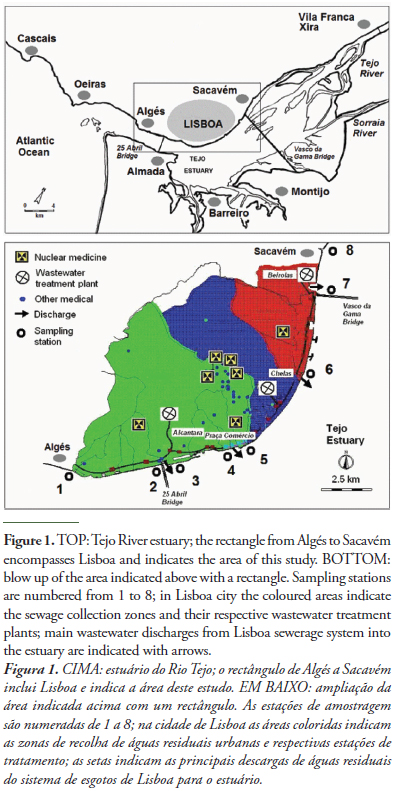
<body><![CDATA[<p>In nuclear medicine, radioisotopes are used both for diagnostic and therapeutic purposes. Currently, about 20 radioisotopes are produced for use in nuclear medicine, such as iodine (<sup>131</sup>I, physical half-life T<sub>&#189;</sub>= 8.0 d), technetium (<sup>99m</sup>Tc, T<sub>&#189;</sub>= 6.01 h), chromium (<sup>51</sup>Cr, T<sub>&#189;</sub>=27.7 d), gallium (<sup>68</sup>Ga, T<sub>&#189;</sub>=3.26 d) and cobalt (<sup>58</sup>Co, T<sub>&#189;</sub>= 70.96 d) (Parrington 1996). In Lisboa, several hospitals and other medical facilities daily use some of these radioisotopes imported from main international radiopharmaceutical suppliers. From this use, hospital solid waste and liquid effluents containing radioactivity are produced. Radioprotection measures are implemented in the medical facilities according to international standards, to prevent or reduce the irradiation and contamination of the staff and facilities. Those measures include procedures for solid waste segregation and safe disposal, and procedures for liquid waste management including special bathrooms for patients under treatment with radiopharmaceuticals.</p>     <p>The radioactive liquid effluents produced at the medical facilities (from patient bathrooms and laboratory sinks) may contain relatively high levels of radioactivity depending on the clinical specialities in the facilities, amount of radioisotopes applied, and number of patients treated. The discharge of radioactive liquid effluents from medical facilities to the environment has been a matter of some concern and investigation in several large European cities leading to enforcement of regulations and inspections to control better radioactive discharges (Mundschenk, 1996; Barquero <i>et al.</i>, 2008; Bergman <i>et al.</i>, 2008; Fischer <i>et al.</i>, 2009; Krawczyk <i><i>et al.</i></i>, 2013). In the case of coastal discharges through marine outfalls the environmental radioactivity enhancement has also been assessed in some areas with a view to protection of fisheries and human consumers against contamination and to the protection of non-human biota against radiation (Carolan <i>et al.</i>, 2011). Often, environmental radioactivity surveys of such areas are carried out to check compliance with radiation dose limits to members of the public (EU, 1996).</p>     <p>In Lisboa, some hospitals are equipped with tanks for temporary storage of radioactive liquid effluents in order to allow for radioactive decay before release into the city sewage system. Nonetheless, not every medical facility performs radioactivity analysis of the effluents and keeps records of radionuclide composition and amounts of radioactivity released into the Lisboa sewage system.  Besides, patients can go home and use the ordinary sewage collection and treatment works from there. After collection in the sewers system, urban wastewaters are mostly treated. Treated wastewaters plus still untreated urban wastewater from some city areas were discharged through several sewer outlets into the Tejo estuary in the years of the sampling (Figueira and Monteiro 2001; Carvalho <i>et al.</i> 2002).</p>     <p>To assess the radioactivity levels in the Tejo estuary resulting from the sewage discharges from Lisboa, an assessment experiment was established in collaboration with the Lisboa municipal administration. Sampling took place in 2004-2005, and was based upon the use of estuarine aquatic compartments (biotic and abiotic) as indicators of contamination along the north bank.</p>     <p>&nbsp;</p>     <p><b>2. MATERIALS AND METHODS</b></p>     <p><i><b>Sampling</b></i></p> Monthly sampling was carried out during a 19-month period, from June 2004 to December 2005, with the help of the Lisboa Fire Brigade. Sampling stations were selected along the shore, from Alg&eacute;s near the maritime traffic control tower at the sea entrance of the estuary, to the mid estuary near Sacav&eacute;m in front of the Nuclear and Technological Institute (ITN). Most stations were located between the 25th April and the Vasco da Gama bridges. Locations were selected near the main urban wastewater discharges (sewer outlets) and in between them in places with walls or piers with intertidal mussel beds (<a href="#f1">Figure 1</a>). 		    <p>&nbsp;</p> 		    <p><a name="f1"></a></p> 		<img src="/img/revistas/rgci/v13n4/13n4a01f1.jpg"/> 		    
<p>&nbsp;</p>     ]]></body>
<body><![CDATA[<p>Water, bottom sediment, mussels (<i>Mytillus galloprovincialis</i>), and mullets (<i><i>Liza ramada</i></i>) were sampled at low tide. Both species were selected for monitoring because they are common biota of the Tejo estuary. Mussels are sessile bivalves eating upon suspended particulate matter that they filter from water, thus integrating and averaging contamination levels at the same place, while mullets are pelagic fish swimming up and down the estuary and are opportunistic feeders. Surface water samples were collected at about 3-5 m from the shoreline, where water depth may vary from 2 to 5 meters, directly into polyethylene cans, using a nylon net filter (300 &micro;m mesh) to avoid large particles. Sub tidal sediment samples were collected at the same locations, using a bulk sediment sampler operated from the boat and collecting the top 10 cm sediment layer. Mussels were collected always at the same beds. Mullets were collected with a cast net. Typical size of samples collected was 2-4 litres of sediment, 10 litres of water, 3 kg of mussels and 12 specimens of adult mullets. Samples were conditioned in plastic containers, identified, and transported in ice chests to the laboratory for immediate processing and radiometric analysis. Not every month all desired sample types could be collected due to occasional adverse weather and tide conditions in the estuary, but the rate of successful sampling was high (&gt;90%).</p>     <p><i><b>Radioactivity analysis</b></i></p>     <p>Analyses of two types were performed. One, was immediately performed by gamma spectrometry in order to allow for measuring the short-lived gamma emitting radionuclides used in nuclear medicine; the other was performed on oven-dry (60oC) and homogenized sample materials, and included alpha and gamma spectrometry for determining naturally occurring radionuclides with longer physical half-lives (T<sub>&#189;</sub>). Immediate gamma radiation measurements were performed on fresh material (<i>in toto</i>) placed in 1.0 L capacity Marinelli beakers on HpGe solid state detectors (Canberra). Gamma spectra were acquired for 1 hour and radionuclides identified and quantified using the software package G&eacute;nie2000 (Canberra). These measurements allowed the determination of radionuclides such as <sup>131</sup>I and <sup>99m</sup>Tc.</p>     <p>For deferred analyses, animal samples were treated by dissecting and separating fresh tissues from shells in the case of mussels (Mytilus galloprovincialis), and separating muscle, liver, and gonads in the case of mullets (<i>Liza ramada</i>). Following oven drying and homogenization, sample aliquots were taken for gamma ray measurement using long counting times (24 h) for quantification of <sup>40</sup>K and <sup>137</sup>Cs. Separate aliquots were used for complete dissolution with HCl and HNO<sub>3</sub>sub> acids followed by radiochemical separation and analysis of <sup>210</sup>Po and <sup>210</sup>Pb by alpha spectrometry. Briefly, <sup>210</sup>Po was analyzed after addition of an internal isotopic tracer (209Po) to the sample, and <sup>210</sup>Pb was determined after in-growth of <sup>210</sup>Po from the parent radionuclide <sup>210</sup>Pb and second <sup>210</sup>Po plating on a silver disc (Carvalho 1995; Carvalho <i>et al.</i>, 2010). Alpha radioactivity measurements of the alpha radiation emitted by the silver discs were performed with ion implanted silicon detectors and alpha spectrometers OctetePlus (ORTEC EG&amp;G) for determination of polonium-210 and lead-210.</p>     <p>A rigorous analytical quality control was maintained through the analysis of certified reference materials using the same methods and through participation in interlaboratory comparison exercises (Pham <i>et al.</i> 2006; Povinec <i>et al.</i>, 2007). Results are expressed in Bq Kg<sup>-1</sup> wet weight (w.w.) for mussels and fish, Bq Kg<sup>-1</sup> dry weight (d.w.) for sediment, and in Bq L<sup>-1</sup> for water, unless stated otherwise.</p>     <p>The global assessment of radionuclide concentrations in several environmental compartments was made averaging all results per radionuclide and per sample type (<a href="/img/revistas/rgci/v13n4/13n4a01t1.jpg" target="_blank">Table 1</a>). For computation of the mean concentration for each radionuclide, samples with radionuclide concentrations below the lower limit of detection were ascribed a value of zero and used in the mean computation.</p>     
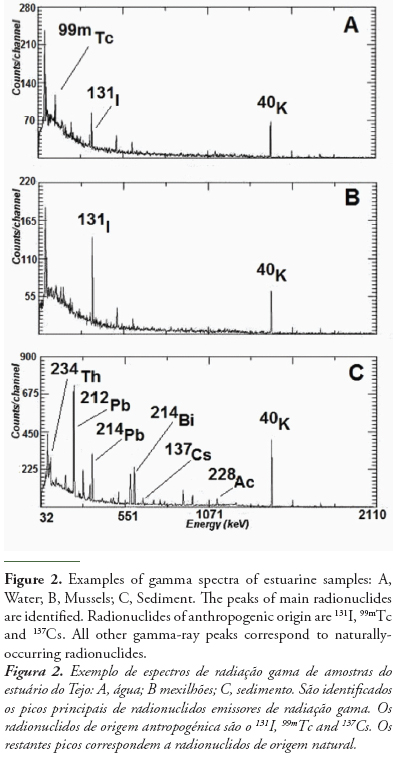
<p>&nbsp;</p>     <p><b>3. RESULTS AND DISCUSSION</b></p>     <p>Gamma spectrometry analyses of fresh materials (biotic and abiotic) consistently allowed the identification and quantification of several artificial and natural radionuclides (<a href="#f2">Figure 2</a>). The spectrograms show the gamma peaks of <sup>131</sup>I, and <sup>99m</sup>Tc, short-lived gamma emitting radioisotopes used in nuclear medicine. <sup>137</sup>Cs (artificial radionuclide from fallout of nuclear weapon tests and nuclear accidents) and <sup>40</sup>K (naturally-occurring radionuclide) were detected as well. Long lived artificial gamma emitting radionuclides other than <sup>137</sup>Cs generally were not detected in sediments.</p> 		    <p>&nbsp;</p> 		    ]]></body>
<body><![CDATA[<p><a name="f2"></a> </p> 		<img src="/img/revistas/rgci/v13n4/13n4a01f2.jpg"/> 		    
<p>&nbsp;</p>     <p>Artificial gamma emitting radioisotopes used in nuclear medicine were found in variable concentrations both in time and space. In all sampling stations, the two artificial radionuclides more consistently found were <sup>131</sup>I and <sup>99m</sup>Tc. Station 3 (Alc&acirc;ntara Mar dock), station 4 (Pra&ccedil;a do Com&eacute;rcio wharf), and station 6 (Chelas dock) were the locations displaying more frequently positive results in more sample types (<a href="/img/revistas/rgci/v13n4/13n4a01f3.jpg" target="_blank">Figure 3</a>). Samples from other stations showed fewer cases of artificial radioactivity presence and in fewer types of environmental samples.</p>     
<p>Round-the-year, samples from Alcantara Mar dock (station 3) showed the presence of <sup>131</sup>I, particularly in mussels. <sup>99m</sup>Tc was also often detected but generally in concentrations lower than those of <sup>131</sup>I. Samples from Pra&ccedil;a do Com&eacute;rcio (station 4) also showed <sup>131</sup>I contamination, but less often than in Alc&acirc;ntara. These two sampling stations were located closer to urban wastewater discharges. During the years of sampling at Alcantara Mar dock, a sewer outlet discharging treated urban wastewater from Alcantara wastewater treatment plant, and at Pra&ccedil;a do Com&eacute;rcio a sewer outlet discharging untreated urban wastewaters, were fully operational (<a href="#f1">Figure 1</a>).</p>     <p>I-131 (T<sub>&#189;</sub>= 8.0 d) has a longer half&ndash;life than <sup>99m</sup>Tc (T<sub>&#189;</sub>= 6.01 h), which allows longer-lasting transport by tidal currents from the discharge points a few km along the shore either upstream or downstream. This was shown by positive radioactivity results from Alg&eacute;s to Beirolas, although radionuclide concentrations displayed decreasing frequency and decreasing concentration values from the stations at Alc&acirc;ntara and Pra&ccedil;a do Com&eacute;rcio to both ends of the city area (<a href="#f1">Figures 1</a> and <a href="/img/revistas/rgci/v13n4/13n4a01f3.jpg" target="_blank">3</a>). At station 8, near Sacav&eacute;m, no biota samples were available and only water and sediments could be analysed. Tc-99m was the only radionuclide of artificial origin detected there, and in low concentrations.</p>     
<p>Concentrations of <sup>131</sup>I in sediments were in average lower than those of technecium, which is in line with known Kd sediment-water partitioning coefficients (Kd= Bq Kg<sup>-1</sup> in sediment dry weight/ Bq L-1 in water) reported in literature: Kd values are of about 70 for iodine and 10<sup>2</sup>-10<sup>3</sup> for technetium in the marine environment (IAEA, 2004). Cesium-137 was rarely detected and always in low concentrations in sediments; furthermore it would very difficult to measure <sup>137</sup>Cs in small volume water samples due to high sorption onto sediments of this radionuclide, with Kd values of  10<sup>4</sup>-10<sup>5</sup>(IAEA, 2004).</p>     <p>At the same sampling station radionuclide concentrations showed wide variations over time, reflecting also the fluctuation of radioactivity in wastewater discharges <a href="/img/revistas/rgci/v13n4/13n4a01f4.jpg" target="_blank">Figure 4</a>). Mussels were the environmental compartment that showed the highest number of positive results (i.e., displaying radionuclide concentrations above detection limit and quantifiable) for artificial radioactive contamination. Practically, in most stations there were always mussels contaminated with <sup>131</sup>I, and often with <sup>99m</sup>Tc also. This is due to the filter-feeding activity of these molluscs that filter large water volumes to feed upon suspended organic particles. It is interesting to notice that the mullets concentrated <sup>99m</sup>Tc from contaminated water to values sometimes much higher than those determined in mussels (<a href="/img/revistas/rgci/v13n4/13n4a01f4.jpg" target="_blank">Figure 4</a>).</p>     
<p>Radioactive iodine and technetium are present also in waste discharges from nuclear fuel reprocessing plants in UK and France into the marine environment, and have been subject to research and environmental surveys (Keogh and al., 2007; Smith <i>et al.</i>, 2001). For example, 99Tc from these waste discharges was consistently measured over several years along the East coast of Ireland in concentrations from 19-45 mBq/L in seawater. Seaweeds accumulate technetium to high concentrations with concentration factors relative to water of about 1.2x10<sup>5</sup> on dry weight (d.w.) basis (CF=Bq Kg<sup>-1</sup> d.w. seaweed/ Bq L10<sup>-1</sup> filtered sea water), while the concentration factor on a wet weight basis for the edible part of mussels was from about 500 to near 1000, and for fish muscle was around 12 (Smith <i>et al.</i>, 2001).While these isotopes measured in the Irish sea are inorganic forms of Tc and I, the radioisotopes in samples from the Tejo estuary are most likely still bound to the radiopharmaceutical organic molecules. This organic binding might contribute to a much higher accumulation in mullet than in mussels, <i>i.e.</i>, the reverse than observations made in Irish Sea on the bioaccumulation of inorganic technetium and iodine. This observation indicates that bioaccumulation of radiopharmaceutical residues by aquatic biota and food chain transfer in the estuarine environment might be different than bioaccumulation of inorganic forms of the same radioelements. Most likely, current knowledge obtained with studies on the environmental behaviour of inorganic I and Tc does not apply to residues of radiopharmaceuticals labelled with these radionuclides. These aspects need further investigation.</p>     <p>Po-210 concentrations determined in mussels&rsquo; soft tissues and in tissues of the mullets <i>Liza ramada</i> were not identical (<a href="/img/revistas/rgci/v13n4/13n4a01f5.jpg" target="_blank">Figure 5</a>). Instead, they varied with the tissue and between species, as expected. The fish muscle displayed the lowest concentrations measured in fish tissues, which for fish filet consumers reduces the transfer of radionuclides, although consumption of other organs such as gonad would transfer much higher activity. It must be said that concentrations determined for naturally-occurring radionuclides, such as <sup>210</sup>Po, <sup>210</sup>Pb and <sup>40</sup>K in biota from the north bank of the Tejo estuary are comparable to values reported in similar species from non-contaminated areas (Cherry 1974; Carvalho 1995; Dahlgaard 1996). This indicates that in the Lisboa area there is no significant enhancement of these radionuclide concentrations above normal background values, as opposed to observations made at the south bank around Barreiro peninsula due to discharge of industrial wastes (Carvalho <i>et al.</i>,2013).</p>     
<p>The mean and range of radionuclide concentrations measured in estuarine samples throughout the sampling period, including artificial and main naturally-occurring radionuclides, is shown in <a href="/img/revistas/rgci/v13n4/13n4a01t1.jpg" target="_blank">Table 1</a>. These radionuclides have different sources. The naturally-occurring radionuclides in mussels and fish tissues did not originate particularly in the urban wastewater discharges. Actually, <sup>210</sup>Po originates in the radioactive decay of uranium series radionuclides, which are ubiquitous in nature. In mussels and fish the concentrations of natural <sup>210</sup>Po and <sup>210</sup>Pb varied over the months, most likely under the effect of the organism physiological conditions. Indeed, it was recently shown in mussels that animal size and accumulation/expenditure of fat are parameters that explain the fluctuation of <sup>210</sup>Po concentrations in mussels throughout the seasons of the year (Carvalho et al, 2010).  The artificial radionuclides <sup>131</sup>I and <sup>99m</sup>Tc displayed average concentrations lower than those of the naturally occurring radionuclides for the entire data set. Notwithstanding, one should keep in mind that concentrations of natural radionuclides are nearly the same in most areas of the estuary while concentrations of artificial radionuclides range from zero in some areas to high values near the sewers discharges (Carvalho et. al, 2013). </p>     
]]></body>
<body><![CDATA[<p>Absorbed radiation doses due to these natural and artificial radionuclides in mussels and in whole body mullets were computed for the maximum concentrations measured, as reported in <a href="/img/revistas/rgci/v13n4/13n4a01t1.jpg" target="_blank">Table 1</a> (Pr&ouml;hl 2003). It may be noticed that in spite of the absorbed radiation dose imparted to aquatic biota by artificial radionuclides, the main contribution to the overall absorbed dose is still originated by the naturally-occurring radionuclides. Amongst these, <sup>210</sup>Po gave the main contribution (95.5%) to the total absorbed dose in mussels while <sup>40</sup>K gave the main contribution (73%) in fish (<a href="/img/revistas/rgci/v13n4/13n4a01f6.jpg" target="_blank">Figure 6</a>). Therefore, despite adding radiation dose to the aquatic organisms and to eventual human consumers of aquatic biota, the contribution of radioisotopes from hospital releases did not represent much in comparison with the radiation dose from naturally occurring radionuclides present in the estuarine environment. Notwithstanding, as discharges fluctuated widely throughout the year the contribution of artificial radionuclides to the radiation dose may also vary over time.</p>     
<p>&nbsp;</p>     <p><b>4. CONCLUSION</b></p>     <p>In the Lisboa area, the Tejo estuary received urban wastewater discharges that carried artificial radioisotopes originated in medical facilities. Besides the risk of radiation exposure of workers of the city sewerage system and wastewater treatment plants, there is also the potential for exposure of members of the public to radioisotopes present in discharges into the estuary. Those radioisotopes were short lived and the temporary storage of contaminated effluents in tanks prior to the discharge should be sufficient to allow for radioactive decay. Nevertheless, there are either facilities without interim storage radioactive effluents or this interim storage was too short and, once released, a rapid transit from the medical facilities to the estuary (a few hours at the maximum) occurred in a systematic manner and allowed the round-the-year detection of <sup>131</sup>I and <sup>99m</sup>Tc, in estuarine water, sediment, mussels, and fish.</p>     <p>The highest radionuclide concentrations were consistently measured near Alc&acirc;ntara and Pra&ccedil;a do Com&eacute;rcio where two major sewers drained the urban wastewater discharges into the estuary. Discharges at these sites were of treated and untreated wastewaters, respectively. Results for Alc&acirc;ntara indicate that radionuclides from hospital effluents were not removed in the Alc&acirc;ntara wastewater treatment plant, as could be expected because waste water treatment plants are designed to treat nutrient organic loads and pathogens.  Dispersal of sewage discharges by the river flow and tidal currents allowed for transport of radioisotopes up and down along the North bank and accumulation of <sup>131</sup>I by mussels in all sampling stations from Alg&eacute;s (estuary mouth) to Beirolas (mid estuary). Fish accumulated radionuclides, <sup>99m</sup>Tc in particular, but fish mobility renders less obvious than the sessile mussels the exact place of radionuclide uptake. Notwithstanding, <sup>99m</sup>Tc was consistently detected in water, mussels and fish in the stations of Alc&acirc;ntara, Pra&ccedil;a do Com&eacute;rcio and Chelas. Therefore, suitable measures to better control radioactivity in hospital effluents and in urban wastewater discharge are desirable in order to abate contaminants in the estuarine environment.</p>     <p>Recent improvements in the sewage system of Lisboa and in the Alc&acirc;ntara wastewater treatment plant aiming at the full treatment of urban wastewaters may have modified the pattern of waste discharges and contaminant distribution in the estuary described herein, and improved the quality of wastewater discharges. Nevertheless, this potential improvement was not checked for radioactivity as yet. Furthermore, it is likely that other discharges of radioisotopes from medical facilities exist around the estuary and the assessment of radioactive contamination of the estuary presented here probably is not complete. In addition, the use of radioisotopes in medicine and the number of treatments dispensed increase every year and new hospitals have been recently built in the Lisboa area and in other cities around the Tejo estuary and in its catchment area.</p>     <p>As professional fisheries along with sport fishing and leisure activities take place in the Tejo estuary, the implementation of a regular programme for radioactivity monitoring in the estuary seems much needed to keep under review the radioactivity levels and to assess and update the radiological risk assessment to members of the public. Results from radioactivity monitoring may provide also useful feedback to better control effluent discharges and to improve radioactive waste management.</p>     <p>&nbsp;</p>     <p><b>ACKOWLEDGEMENTS</b></p>     <p>Are due to the Department of Environment and to the Lisboa Fire Department (C&acirc;mara Municipal de Lisboa) for the support and excellent collaboration with the sampling programme.</p>     ]]></body>
<body><![CDATA[<p>&nbsp;</p>     <p><b>REFERENCES</b></p>     <p>Barquero, R.; Agulla, M.M.; Ruiz, A. (2008) &ndash; Liquid discharges from the use of radionuclides in medicine (diagnosis).<i>Journal of Environmental Radioactivity</i>, 99(10):1535-1538. DOI: <a href="http://dx.doi.org/10.1016/j.jenvrad.2007.12.009" target="_blank">10.1016/j.jenvrad.2007.12.009</a></p>     <p>Bergman, S.S.; Cruz, I.; Avila, R.; Hasselblad, S. (2008) &ndash; A new approach to assessment and management of the impact from medical liquid radioactive waste. <i>Journal of Environmental Radioactivity</i>, 99(10):1572-1577. DOI: <a href="http://dx.doi.org/10.1016/j.jenvrad.2007.12.005" target="_blank">10.1016/j.jenvrad.2007.12.005</a></p>     <p>Carolan, J.V.; Hughes, C.E.; Hoffmann, E.L. (2011) &ndash; Dose assessment for marine biota and humans from discharges of <sup>131</sup>I to the marine environment and uptake by algae in Sydney, Australia. <i>Journal of Environmental Radioactivity</i>, 102(10):953-963. DOI:<a href="http://dx.doi.org/10.1016/j.jenvrad.2009.10.002" target="_blank">10.1016/j.jenvrad.2009.10.002</a></p>     <p>Carvalho, F.P. (1995) &ndash; <sup>210</sup>Po and <sup>210</sup>Pb intake by the Portuguese population: the contribution of seafood. <i>Health Physics</i>, 69(4):469-480. DOI: <a href="http://dx.doi.org/10.1097/00004032-199510000-00004" target="_blank">10.1097/00004032-199510000-00004</a></p>     <p>Carvalho, F.P.; Oliveira, J.M.; Alberto, G.; Batlle, J.V. (2010) &ndash; Factors affecting <sup>210</sup>Po and <sup>210</sup>Pb concentration in mussels and implications for bio monitoring programmes. <i>Marine Pollution Bulletin</i>, 60(10):1734-1742. DOI: <a href="http://dx.doi.org/10.1016/j.marpolbul.2010.06.025" target="_blank">10.1016/j.marpolbul.2010.06.025</a></p>     <p>Carvalho, F.P.; Oliveira, J.M.; Gouveia, J.G.; Figueira, I.; Monteiro, P. (2002) &ndash;Radioactividade de origem artificial no estu&aacute;rio do Tejo na &aacute;rea ribeirinha do Munic&iacute;pio de Lisboa. <i>Actas do 10&ordm; Encontro Nacional de Saneamento B&aacute;sico</i>, Universidade do Minho, Braga<i>, Portugal</i>. Relat&oacute;rio ITN/DPRSN, S&eacute;rie A, n&ordm; 23/2002, Lisboa, Portugal. <a href="http://www.itn.pt/docum/relat/radiolog/rel-radiol-artif-tejo2002.pdf" target="_blank">http://www.itn.pt/docum/relat/radiolog/rel-radiol-artif-tejo2002.pdf</a></p>     <p>Carvalho, F. P.; Oliveira, J.M.; Silva, L.; Malta, M. (2013) &ndash; Radioactivity of anthropogenic origin in the Tejo Estuary and need for improved waste management and environmental monitoring. <i>International Journal of Environmental Studies</i>, DOI:<a href="http://dx.doi.org/10.1080/00207233.2013.845714" target="_blank">10.1080/00207233.2013.845714</a>.</p>     <p>Cherry, R.D.; Shannon, L.V. (1974) &ndash; Alpha Radioactivity of marine organisms. <i>Atomic Energy Review</i>, 12(1):3-45. <a href="http://www.ncbi.nlm.nih.gov/pubmed/4598725" target="_blank">http://www.ncbi.nlm.nih.gov/pubmed/4598725</a></p>     ]]></body>
<body><![CDATA[<p>Dahlgaard, H. (1996) &ndash; Polonium-210 in mussels and fish from the Baltic-North sea estuary. <i>Journal of Environmental Radioactivity</i>, 32(1&ndash;2):91-96. DOI: <a href="http://dx.doi.org/10.1016/0265-931X(95)00081-K" target="_blank">10.1016/0265-931X(95)00081-K</a></p>     <p>EU (1996) &ndash; <i>Directive 96/29/EURATOM</i>, Council Directive of 13 May 1996 laying down basic safety standards for the health protection of the general public and workers against the dangers of ionizing radiation. <a href="http://ec.europa.eu/energy/nuclear/radioprotection/doc/legislation/9629_en.pdf" target="_blank">http://ec.europa.eu/energy/nuclear/radioprotection/doc/legislation/9629_en.pdf</a></p>     <!-- ref --><p>Figueira, I.; Monteiro, P. (2001) - <i>Implica&ccedil;&otilde;es das descargas de &aacute;guas residuais hospitalares nos sistemas de saneamento</i>. Ac&ccedil;&otilde;es de Sensibiliza&ccedil;&atilde;o Ambiental em &Aacute;guas Res&iacute;duais Hospitalares, Direc&ccedil;&atilde;o Geral de Infraestrururas e Equipamentos de Sa&uacute;de, Minist&eacute;rio da Sa&uacute;de, Lisboa, Coimbra, Porto, Portugal. Unpublished.    &nbsp;&nbsp;&nbsp;&nbsp;&nbsp;&nbsp;&nbsp;&nbsp;[&#160;<a href="javascript:void(0);" onclick="javascript: window.open('/scielo.php?script=sci_nlinks&ref=000075&pid=S1646-8872201300040000100010&lng=','','width=640,height=500,resizable=yes,scrollbars=1,menubar=yes,');">Links</a>&#160;]<!-- end-ref --></p>     <p>Fischer, H. W.; Ulbrich, S.; Pittauerov&aacute;, D.; Hettwig, B. (2009) &ndash; Medical radioisotopes in the environment - following the pathway from patient to river sediment. <i>Journal of Environmental Radioactivity</i>, 100:1079-1085. DOI: <a href="http://dx.doi.org/10.1016/j.jenvrad.2009.05.002" target="_blank">10.1016/j.jenvrad.2009.05.002</a></p>     <!-- ref --><p>IAEA (2004)- Sediment Distribution Coefficients and Concentration Factors for Biota in the Marine Environment. <i>Technical Reports Series</i> No. 422. International Atomic Energy Agency, Vienna, Austria <a href="http://www-pub.iaea.org/MTCD/Publications/PDF/TRS422_web.pdf" target="_blank">http://www-pub.iaea.org/MTCD/Publications/PDF/TRS422_web.pdf</a>&nbsp;&nbsp;&nbsp;&nbsp;&nbsp;&nbsp;&nbsp;&nbsp;[&#160;<a href="javascript:void(0);" onclick="javascript: window.open('/scielo.php?script=sci_nlinks&ref=000078&pid=S1646-8872201300040000100012&lng=','','width=640,height=500,resizable=yes,scrollbars=1,menubar=yes,');">Links</a>&#160;]<!-- end-ref --><!-- ref --><p>Keogh S.M., Aldahan A., Possnert G., Finegan P., Leon Vintr&oacute; L., Mitchell P.I. (2007) - Trends in the spatial and temporal distribution of 129I and 99Tc in coastal waters surrounding Ireland using Fucus vesiculosus as a bio-indicator. Journal of Environmental Radioactivity, 95(1):23-38. DOI: <a href="http://dx.doi.org/10.1016/j.jenvrad.2007.01.009" target="_blank">10.1016/j.jenvrad.2007.01.009</a>&nbsp;&nbsp;&nbsp;&nbsp;&nbsp;&nbsp;&nbsp;&nbsp;[&#160;<a href="javascript:void(0);" onclick="javascript: window.open('/scielo.php?script=sci_nlinks&ref=000079&pid=S1646-8872201300040000100013&lng=','','width=640,height=500,resizable=yes,scrollbars=1,menubar=yes,');">Links</a>&#160;]<!-- end-ref --><!-- ref --><p>Krawczyk E., Pi&ntilde;ero-Garc&iacute;a F., Ferro-Garc&iacute;a M.A. (2013) - Discharges of nuclear medicine radioisotopes in Spanish hospitals. <i>Journal of Environmental Radioactivity</i>, 116:93-98. DOI: <a href="http://dx.doi.org/10.1016/j.jenvrad.2012.08.011" target="_blank">10.1016/j.jenvrad.2012.08.011</a>&nbsp;&nbsp;&nbsp;&nbsp;&nbsp;&nbsp;&nbsp;&nbsp;[&#160;<a href="javascript:void(0);" onclick="javascript: window.open('/scielo.php?script=sci_nlinks&ref=000080&pid=S1646-8872201300040000100014&lng=','','width=640,height=500,resizable=yes,scrollbars=1,menubar=yes,');">Links</a>&#160;]<!-- end-ref --><p>Mundschenk, H. (1996) &ndash; Occurrence and Behaviour of Radionuclides in the Moselle River - Part I: Entry of Natural and Artificial Radionuclides. <i>Journal of Environmental Radioactivity</i>, 30(3):199&ndash;213. DOI: <a href="http://dx.doi.org/10.1016/0265-931X(95)00009-Y" target="_blank">10.1016/0265-931X(95)00009-Y</a></p>     <p>Parrington, J.R.; Knox, H.D.; Breneman, S.L.; Baum, E.M; Feiner, F. (1996) &ndash; <i>Nuclides and Isotopes</i>. 64p., Fifteenth Edition, General Electric Nuclear Energy. ISBN: 978-0002988704</p>     ]]></body>
<body><![CDATA[<p>Pham, M.K.; Sanchez-Cabeza, J.A.; Povinec, P.P.; Arnold, D.; Benmansour, M.; Bojanowski, R.; Carvalho, F.P.; Kim, C.K.; Esposito, M.; Gastaud, J.; Gasc&oacute;, C.L.; Ham, G.J.; Hegde, A.G.; Holm, E.; Jaskierowicz, D.; Kanisch, G.; Llaurado, M.; La Rosa, J.; Lee, S.-H.; Liong Wee Kwong, L.; Le Petit, G.; Maruo, Y.; Nielsen, S.P.; Oh, J.-S.; Oregioni, B.; Palomares, J.; Pettersson, H.B.L.; Rulik, P.; . Ryan, T.P.; Sato, K.; Schikowski, J.; Skwarzec, B.; Smedley, P.A.; Tarj&aacute;n, S.; Vajda, N.; Wyse, E. (2006) &ndash; Certified reference material for radionuclides in fish flesh sample IAEA-414 (mixed fish from the Irish Sea and North Sea). <i>Applied Radiation and Isotopes</i>, 64(10-11):1253-1259. DOI: <a href="http://dx.doi.org/10.1016/j.apradiso.2006.02.032" target="_blank">10.1016/j.apradiso.2006.02.032</a></p>     <p>Povinec, P,P.; Pham, M.; Barci-Funel, G.; Bojanowski, R.; Boshkova, T.; Burnett, W.; Carvalho, F.P.; <i>et al.</i> (2007) &ndash; Reference material for radionuclides in sediment, IAEA-384 (Fangataufa Lagoon sediment). <i>Journal of Radioanalytical and Nuclear Chemistry</i>, 273(2):383-393. DOI: <a href="http://dx.doi.org/10.1007/s10967-007-6898-4" target="_blank">10.1007/s10967-007-6898-4</a></p>     <p>Pr&ouml;hl, G. (2003) &ndash; <i>Dosimetric models and data for assessing radiation exposures to biota</i>. FASSET Deliverable 3 Report for the EC 5th Framework Programme Contract FIGE &ndash; CT &ndash; 2000 &ndash; 00102. Dispon&iacute;vel em: <a href="https://wiki.ceh.ac.uk/download/attachments/115802176/fasset_d3.pdf?version=1&amp;modificationDate=1263905014000" target="_blank">https://wiki.ceh.ac.uk/download/attachments/115802176/fasset_d3.pdf?version=1&amp;modificationDate=1263905014000</a></p>     <p>Smith V., Fegan M., Pollard D., Long S., Hayden E., Ryan T.P. (2001) - Technetium-99 in the Irish marine environment. <i>Journal of Environmental Radioactivity</i>, 56:269&ndash;284. <a href="http://dx.doi.org/10.1016/S0265-931X(00)00209-5" target="_blank">http://dx.doi.org/10.1016/S0265-931X(00)00209-5</a></p>     <p>&nbsp;</p>     <p>&nbsp;</p>     <p><a href="#top0">*</a><a name="0"></a>Submission: 10 June 2012; Evaluation: 12 July 2012; Reception of revised manuscript: 24 July 2013; Accepted: 29 July, 2013; Available on-line: 6 August 2013</p>      ]]></body><back>
<ref-list>
<ref id="B1">
<nlm-citation citation-type="journal">
<person-group person-group-type="author">
<name>
<surname><![CDATA[Barquero]]></surname>
<given-names><![CDATA[R.]]></given-names>
</name>
<name>
<surname><![CDATA[Agulla]]></surname>
<given-names><![CDATA[M.M.]]></given-names>
</name>
<name>
<surname><![CDATA[Ruiz]]></surname>
<given-names><![CDATA[A.]]></given-names>
</name>
</person-group>
<article-title xml:lang="en"><![CDATA[Liquid discharges from the use of radionuclides in medicine (diagnosis)]]></article-title>
<source><![CDATA[Journal of Environmental Radioactivity]]></source>
<year>2008</year>
<volume>99</volume>
<numero>10</numero>
<issue>10</issue>
<page-range>1535-1538</page-range></nlm-citation>
</ref>
<ref id="B2">
<nlm-citation citation-type="journal">
<person-group person-group-type="author">
<name>
<surname><![CDATA[Bergman]]></surname>
<given-names><![CDATA[S.S.]]></given-names>
</name>
<name>
<surname><![CDATA[Cruz]]></surname>
<given-names><![CDATA[I.]]></given-names>
</name>
<name>
<surname><![CDATA[Avila]]></surname>
<given-names><![CDATA[R.]]></given-names>
</name>
<name>
<surname><![CDATA[Hasselblad]]></surname>
<given-names><![CDATA[S.]]></given-names>
</name>
</person-group>
<article-title xml:lang="en"><![CDATA[A new approach to assessment and management of the impact from medical liquid radioactive waste]]></article-title>
<source><![CDATA[Journal of Environmental Radioactivity]]></source>
<year>2008</year>
<volume>99</volume>
<numero>10</numero>
<issue>10</issue>
<page-range>1572-1577</page-range></nlm-citation>
</ref>
<ref id="B3">
<nlm-citation citation-type="journal">
<person-group person-group-type="author">
<name>
<surname><![CDATA[Carolan]]></surname>
<given-names><![CDATA[J.V.]]></given-names>
</name>
<name>
<surname><![CDATA[Hughes]]></surname>
<given-names><![CDATA[C.E.]]></given-names>
</name>
<name>
<surname><![CDATA[Hoffmann]]></surname>
<given-names><![CDATA[E.L.]]></given-names>
</name>
</person-group>
<article-title xml:lang="en"><![CDATA[Dose assessment for marine biota and humans from discharges of 131I to the marine environment and uptake by algae in Sydney, Australia]]></article-title>
<source><![CDATA[Journal of Environmental Radioactivity]]></source>
<year>2011</year>
<volume>102</volume>
<numero>10</numero>
<issue>10</issue>
<page-range>953-963</page-range></nlm-citation>
</ref>
<ref id="B4">
<nlm-citation citation-type="journal">
<person-group person-group-type="author">
<name>
<surname><![CDATA[Carvalho]]></surname>
<given-names><![CDATA[F.P.]]></given-names>
</name>
</person-group>
<article-title xml:lang="en"><![CDATA[210Po and 210Pb intake by the Portuguese population: the contribution of seafood]]></article-title>
<source><![CDATA[Health Physics]]></source>
<year>1995</year>
<volume>69</volume>
<numero>4</numero>
<issue>4</issue>
<page-range>469-480</page-range></nlm-citation>
</ref>
<ref id="B5">
<nlm-citation citation-type="journal">
<person-group person-group-type="author">
<name>
<surname><![CDATA[Carvalho]]></surname>
<given-names><![CDATA[F.P.]]></given-names>
</name>
<name>
<surname><![CDATA[Oliveira]]></surname>
<given-names><![CDATA[J.M.]]></given-names>
</name>
<name>
<surname><![CDATA[Alberto]]></surname>
<given-names><![CDATA[G.]]></given-names>
</name>
<name>
<surname><![CDATA[Batlle]]></surname>
<given-names><![CDATA[J.V.]]></given-names>
</name>
</person-group>
<article-title xml:lang="en"><![CDATA[Factors affecting 210Po and 210Pb concentration in mussels and implications for bio monitoring programmes]]></article-title>
<source><![CDATA[Marine Pollution Bulletin]]></source>
<year>2010</year>
<volume>60</volume>
<numero>10</numero>
<issue>10</issue>
<page-range>1734-1742</page-range></nlm-citation>
</ref>
<ref id="B6">
<nlm-citation citation-type="confpro">
<person-group person-group-type="author">
<name>
<surname><![CDATA[Carvalho]]></surname>
<given-names><![CDATA[F.P.]]></given-names>
</name>
<name>
<surname><![CDATA[Oliveira]]></surname>
<given-names><![CDATA[J.M.]]></given-names>
</name>
<name>
<surname><![CDATA[Gouveia]]></surname>
<given-names><![CDATA[J.G.]]></given-names>
</name>
<name>
<surname><![CDATA[Figueira]]></surname>
<given-names><![CDATA[I.]]></given-names>
</name>
<name>
<surname><![CDATA[Monteiro]]></surname>
<given-names><![CDATA[P.]]></given-names>
</name>
</person-group>
<article-title xml:lang="pt"><![CDATA[Radioactividade de origem artificial no estuário do Tejo na área ribeirinha do Município de Lisboa]]></article-title>
<source><![CDATA[Actas]]></source>
<year>2002</year>
<conf-name><![CDATA[10º Encontro Nacional de Saneamento Básico]]></conf-name>
<conf-loc>Braga </conf-loc>
</nlm-citation>
</ref>
<ref id="B7">
<nlm-citation citation-type="journal">
<person-group person-group-type="author">
<name>
<surname><![CDATA[Carvalho]]></surname>
<given-names><![CDATA[F. P.]]></given-names>
</name>
<name>
<surname><![CDATA[Oliveira]]></surname>
<given-names><![CDATA[J.M.]]></given-names>
</name>
<name>
<surname><![CDATA[Silva]]></surname>
<given-names><![CDATA[L.]]></given-names>
</name>
<name>
<surname><![CDATA[Malta]]></surname>
<given-names><![CDATA[M.]]></given-names>
</name>
</person-group>
<article-title xml:lang="en"><![CDATA[Radioactivity of anthropogenic origin in the Tejo Estuary and need for improved waste management and environmental monitoring]]></article-title>
<source><![CDATA[International Journal of Environmental Studies]]></source>
<year>2013</year>
</nlm-citation>
</ref>
<ref id="B8">
<nlm-citation citation-type="journal">
<person-group person-group-type="author">
<name>
<surname><![CDATA[Cherry]]></surname>
<given-names><![CDATA[R.D.]]></given-names>
</name>
<name>
<surname><![CDATA[Shannon]]></surname>
<given-names><![CDATA[L.V.]]></given-names>
</name>
</person-group>
<article-title xml:lang="en"><![CDATA[Alpha Radioactivity of marine organisms]]></article-title>
<source><![CDATA[Atomic Energy Review]]></source>
<year>1974</year>
<volume>12</volume>
<numero>1</numero>
<issue>1</issue>
<page-range>3-45</page-range></nlm-citation>
</ref>
<ref id="B9">
<nlm-citation citation-type="journal">
<person-group person-group-type="author">
<name>
<surname><![CDATA[Dahlgaard]]></surname>
<given-names><![CDATA[H.]]></given-names>
</name>
</person-group>
<article-title xml:lang="en"><![CDATA[Polonium-210 in mussels and fish from the Baltic-North sea estuary]]></article-title>
<source><![CDATA[Journal of Environmental Radioactivity]]></source>
<year>1996</year>
<volume>32</volume>
<numero>1-2</numero>
<issue>1-2</issue>
<page-range>91-96</page-range></nlm-citation>
</ref>
<ref id="B10">
<nlm-citation citation-type="book">
<person-group person-group-type="author">
<name>
<surname><![CDATA[Figueira]]></surname>
<given-names><![CDATA[I.]]></given-names>
</name>
<name>
<surname><![CDATA[Monteiro]]></surname>
<given-names><![CDATA[P.]]></given-names>
</name>
</person-group>
<source><![CDATA[Implicações das descargas de águas residuais hospitalares nos sistemas de saneamento]]></source>
<year>2001</year>
<publisher-loc><![CDATA[LisboaCoimbraPorto ]]></publisher-loc>
<publisher-name><![CDATA[Direcção Geral de Infraestrururas e Equipamentos de Saúde, Ministério da Saúde]]></publisher-name>
</nlm-citation>
</ref>
<ref id="B11">
<nlm-citation citation-type="journal">
<person-group person-group-type="author">
<name>
<surname><![CDATA[Fischer]]></surname>
<given-names><![CDATA[H. W.]]></given-names>
</name>
<name>
<surname><![CDATA[Ulbrich]]></surname>
<given-names><![CDATA[S.]]></given-names>
</name>
<name>
<surname><![CDATA[Pittauerová]]></surname>
<given-names><![CDATA[D.]]></given-names>
</name>
<name>
<surname><![CDATA[Hettwig]]></surname>
<given-names><![CDATA[B.]]></given-names>
</name>
</person-group>
<article-title xml:lang="en"><![CDATA[Medical radioisotopes in the environment: following the pathway from patient to river sediment]]></article-title>
<source><![CDATA[Journal of Environmental Radioactivity]]></source>
<year>2009</year>
<volume>100</volume>
<page-range>1079-1085</page-range></nlm-citation>
</ref>
<ref id="B12">
<nlm-citation citation-type="book">
<collab>IAEA</collab>
<article-title xml:lang="en"><![CDATA[Sediment Distribution Coefficients and Concentration Factors for Biota in the Marine Environment]]></article-title>
<source><![CDATA[]]></source>
<year>2004</year>
<volume>422</volume>
<publisher-loc><![CDATA[Vienna ]]></publisher-loc>
<publisher-name><![CDATA[International Atomic Energy Agency]]></publisher-name>
</nlm-citation>
</ref>
<ref id="B13">
<nlm-citation citation-type="journal">
<person-group person-group-type="author">
<name>
<surname><![CDATA[Keogh]]></surname>
<given-names><![CDATA[S.M.]]></given-names>
</name>
<name>
<surname><![CDATA[Aldahan]]></surname>
<given-names><![CDATA[A.]]></given-names>
</name>
<name>
<surname><![CDATA[Possnert]]></surname>
<given-names><![CDATA[G.]]></given-names>
</name>
<name>
<surname><![CDATA[Finegan]]></surname>
<given-names><![CDATA[P.]]></given-names>
</name>
<name>
<surname><![CDATA[Leon Vintró]]></surname>
<given-names><![CDATA[L.]]></given-names>
</name>
<name>
<surname><![CDATA[Mitchell]]></surname>
<given-names><![CDATA[P.I.]]></given-names>
</name>
</person-group>
<article-title xml:lang="en"><![CDATA[Trends in the spatial and temporal distribution of 129I and 99Tc in coastal waters surrounding Ireland using Fucus vesiculosus as a bio-indicator]]></article-title>
<source><![CDATA[Journal of Environmental Radioactivity]]></source>
<year>2007</year>
<volume>95</volume>
<numero>1</numero>
<issue>1</issue>
<page-range>23-38</page-range></nlm-citation>
</ref>
<ref id="B14">
<nlm-citation citation-type="journal">
<person-group person-group-type="author">
<name>
<surname><![CDATA[Krawczyk]]></surname>
<given-names><![CDATA[E.]]></given-names>
</name>
<name>
<surname><![CDATA[Piñero-García]]></surname>
<given-names><![CDATA[F.]]></given-names>
</name>
<name>
<surname><![CDATA[Ferro-García]]></surname>
<given-names><![CDATA[M.A.]]></given-names>
</name>
</person-group>
<article-title xml:lang="en"><![CDATA[Discharges of nuclear medicine radioisotopes in Spanish hospitals]]></article-title>
<source><![CDATA[Journal of Environmental Radioactivity]]></source>
<year>2013</year>
<volume>116</volume>
<page-range>93-98</page-range></nlm-citation>
</ref>
<ref id="B15">
<nlm-citation citation-type="journal">
<person-group person-group-type="author">
<name>
<surname><![CDATA[Mundschenk]]></surname>
<given-names><![CDATA[H.]]></given-names>
</name>
</person-group>
<article-title xml:lang="en"><![CDATA[Occurrence and Behaviour of Radionuclides in the Moselle River - Part I: Entry of Natural and Artificial Radionuclides]]></article-title>
<source><![CDATA[Journal of Environmental Radioactivity]]></source>
<year>1996</year>
<volume>30</volume>
<numero>3</numero>
<issue>3</issue>
<page-range>199-213</page-range></nlm-citation>
</ref>
<ref id="B16">
<nlm-citation citation-type="book">
<person-group person-group-type="author">
<name>
<surname><![CDATA[Parrington]]></surname>
<given-names><![CDATA[J.R.]]></given-names>
</name>
<name>
<surname><![CDATA[Knox]]></surname>
<given-names><![CDATA[H.D.]]></given-names>
</name>
<name>
<surname><![CDATA[Breneman]]></surname>
<given-names><![CDATA[S.L.]]></given-names>
</name>
<name>
<surname><![CDATA[Baum]]></surname>
<given-names><![CDATA[E.M]]></given-names>
</name>
<name>
<surname><![CDATA[Feiner]]></surname>
<given-names><![CDATA[F.]]></given-names>
</name>
</person-group>
<source><![CDATA[Nuclides and Isotopes]]></source>
<year>1996</year>
<edition>Fifteenth Edition</edition>
<publisher-name><![CDATA[General Electric Nuclear Energy]]></publisher-name>
</nlm-citation>
</ref>
<ref id="B17">
<nlm-citation citation-type="journal">
<person-group person-group-type="author">
<name>
<surname><![CDATA[Pham]]></surname>
<given-names><![CDATA[M.K.]]></given-names>
</name>
<name>
<surname><![CDATA[Sanchez-Cabeza]]></surname>
<given-names><![CDATA[J.A.]]></given-names>
</name>
<name>
<surname><![CDATA[Povinec]]></surname>
<given-names><![CDATA[P.P.]]></given-names>
</name>
<name>
<surname><![CDATA[Arnold]]></surname>
<given-names><![CDATA[D.]]></given-names>
</name>
<name>
<surname><![CDATA[Benmansour]]></surname>
<given-names><![CDATA[M.]]></given-names>
</name>
<name>
<surname><![CDATA[Bojanowski]]></surname>
<given-names><![CDATA[R.]]></given-names>
</name>
<name>
<surname><![CDATA[Carvalho]]></surname>
<given-names><![CDATA[F.P.]]></given-names>
</name>
<name>
<surname><![CDATA[Kim]]></surname>
<given-names><![CDATA[C.K.]]></given-names>
</name>
<name>
<surname><![CDATA[Esposito]]></surname>
<given-names><![CDATA[M.]]></given-names>
</name>
<name>
<surname><![CDATA[Gastaud]]></surname>
<given-names><![CDATA[J.]]></given-names>
</name>
<name>
<surname><![CDATA[Gascó]]></surname>
<given-names><![CDATA[C.L.]]></given-names>
</name>
<name>
<surname><![CDATA[Ham]]></surname>
<given-names><![CDATA[G.J.]]></given-names>
</name>
<name>
<surname><![CDATA[Hegde]]></surname>
<given-names><![CDATA[A.G.]]></given-names>
</name>
<name>
<surname><![CDATA[Holm]]></surname>
<given-names><![CDATA[E.]]></given-names>
</name>
<name>
<surname><![CDATA[Jaskierowicz]]></surname>
<given-names><![CDATA[D.]]></given-names>
</name>
<name>
<surname><![CDATA[Kanisch]]></surname>
<given-names><![CDATA[G.]]></given-names>
</name>
<name>
<surname><![CDATA[Llaurado]]></surname>
<given-names><![CDATA[M.]]></given-names>
</name>
<name>
<surname><![CDATA[La Rosa]]></surname>
<given-names><![CDATA[J.]]></given-names>
</name>
<name>
<surname><![CDATA[Lee]]></surname>
<given-names><![CDATA[S.-H.]]></given-names>
</name>
<name>
<surname><![CDATA[Liong Wee Kwong]]></surname>
<given-names><![CDATA[L.]]></given-names>
</name>
<name>
<surname><![CDATA[Le Petit]]></surname>
<given-names><![CDATA[G.]]></given-names>
</name>
<name>
<surname><![CDATA[Maruo]]></surname>
<given-names><![CDATA[Y.]]></given-names>
</name>
<name>
<surname><![CDATA[Nielsen]]></surname>
<given-names><![CDATA[S.P.]]></given-names>
</name>
<name>
<surname><![CDATA[Oh]]></surname>
<given-names><![CDATA[J.-S.]]></given-names>
</name>
<name>
<surname><![CDATA[Oregioni]]></surname>
<given-names><![CDATA[B.]]></given-names>
</name>
<name>
<surname><![CDATA[Palomares]]></surname>
<given-names><![CDATA[J.]]></given-names>
</name>
<name>
<surname><![CDATA[Pettersson]]></surname>
<given-names><![CDATA[H.B.L.]]></given-names>
</name>
<name>
<surname><![CDATA[Rulik]]></surname>
<given-names><![CDATA[P.]]></given-names>
</name>
<name>
<surname><![CDATA[Ryan]]></surname>
<given-names><![CDATA[T.P.]]></given-names>
</name>
<name>
<surname><![CDATA[Sato]]></surname>
<given-names><![CDATA[K.]]></given-names>
</name>
<name>
<surname><![CDATA[Schikowski]]></surname>
<given-names><![CDATA[J.]]></given-names>
</name>
<name>
<surname><![CDATA[Skwarzec]]></surname>
<given-names><![CDATA[B.]]></given-names>
</name>
<name>
<surname><![CDATA[Smedley]]></surname>
<given-names><![CDATA[P.A.]]></given-names>
</name>
<name>
<surname><![CDATA[Tarján]]></surname>
<given-names><![CDATA[S.]]></given-names>
</name>
<name>
<surname><![CDATA[Vajda]]></surname>
<given-names><![CDATA[N.]]></given-names>
</name>
<name>
<surname><![CDATA[Wyse]]></surname>
<given-names><![CDATA[E.]]></given-names>
</name>
</person-group>
<article-title xml:lang="en"><![CDATA[Certified reference material for radionuclides in fish flesh sample IAEA-414 (mixed fish from the Irish Sea and North Sea)]]></article-title>
<source><![CDATA[Applied Radiation and Isotopes]]></source>
<year>2006</year>
<volume>64</volume>
<page-range>10-11</page-range><page-range>1253-1259</page-range></nlm-citation>
</ref>
<ref id="B18">
<nlm-citation citation-type="journal">
<person-group person-group-type="author">
<name>
<surname><![CDATA[Povinec]]></surname>
<given-names><![CDATA[P.P.]]></given-names>
</name>
<name>
<surname><![CDATA[Pham]]></surname>
<given-names><![CDATA[M.]]></given-names>
</name>
<name>
<surname><![CDATA[Barci-Funel]]></surname>
<given-names><![CDATA[G.]]></given-names>
</name>
<name>
<surname><![CDATA[Bojanowski]]></surname>
<given-names><![CDATA[R.]]></given-names>
</name>
<name>
<surname><![CDATA[Boshkova]]></surname>
<given-names><![CDATA[T.]]></given-names>
</name>
<name>
<surname><![CDATA[Burnett]]></surname>
<given-names><![CDATA[W.]]></given-names>
</name>
<name>
<surname><![CDATA[Carvalho]]></surname>
<given-names><![CDATA[F.P.]]></given-names>
</name>
</person-group>
<article-title xml:lang="en"><![CDATA[Reference material for radionuclides in sediment, IAEA-384 (Fangataufa Lagoon sediment)]]></article-title>
<source><![CDATA[Journal of Radioanalytical and Nuclear Chemistry]]></source>
<year>2007</year>
<volume>273</volume>
<numero>2</numero>
<issue>2</issue>
<page-range>383-393</page-range></nlm-citation>
</ref>
<ref id="B19">
<nlm-citation citation-type="">
<person-group person-group-type="author">
<name>
<surname><![CDATA[Pröhl]]></surname>
<given-names><![CDATA[G.]]></given-names>
</name>
</person-group>
<source><![CDATA[Dosimetric models and data for assessing radiation exposures to biota]]></source>
<year>2003</year>
</nlm-citation>
</ref>
<ref id="B20">
<nlm-citation citation-type="journal">
<person-group person-group-type="author">
<name>
<surname><![CDATA[Smith]]></surname>
<given-names><![CDATA[V.]]></given-names>
</name>
<name>
<surname><![CDATA[Fegan]]></surname>
<given-names><![CDATA[M.]]></given-names>
</name>
<name>
<surname><![CDATA[Pollard]]></surname>
<given-names><![CDATA[D.]]></given-names>
</name>
<name>
<surname><![CDATA[Long]]></surname>
<given-names><![CDATA[S.]]></given-names>
</name>
<name>
<surname><![CDATA[Hayden]]></surname>
<given-names><![CDATA[E.]]></given-names>
</name>
<name>
<surname><![CDATA[Ryan]]></surname>
<given-names><![CDATA[T.P.]]></given-names>
</name>
</person-group>
<article-title xml:lang="en"><![CDATA[Technetium-99 in the Irish marine environment]]></article-title>
<source><![CDATA[Journal of Environmental Radioactivity]]></source>
<year>2001</year>
<volume>56</volume>
<page-range>269-284</page-range></nlm-citation>
</ref>
</ref-list>
</back>
</article>