<?xml version="1.0" encoding="ISO-8859-1"?><article xmlns:mml="http://www.w3.org/1998/Math/MathML" xmlns:xlink="http://www.w3.org/1999/xlink" xmlns:xsi="http://www.w3.org/2001/XMLSchema-instance">
<front>
<journal-meta>
<journal-id>1646-8872</journal-id>
<journal-title><![CDATA[Revista de Gestão Costeira Integrada]]></journal-title>
<abbrev-journal-title><![CDATA[RGCI]]></abbrev-journal-title>
<issn>1646-8872</issn>
<publisher>
<publisher-name><![CDATA[Associação Portuguesa dos Recursos Hídricos]]></publisher-name>
</publisher>
</journal-meta>
<article-meta>
<article-id>S1646-88722014000100009</article-id>
<article-id pub-id-type="doi">10.5894/rgci435</article-id>
<title-group>
<article-title xml:lang="en"><![CDATA[Population biology of Callichirus major (Say, 1818) (Crustacea: Callianassidae) at Piedade Beach, Brazil]]></article-title>
<article-title xml:lang="pt"><![CDATA[Biologia populacional de Callichirus major (Say, 1818) (Crustacea: Callianassidae) na Praia de Piedade, Brasil]]></article-title>
</title-group>
<contrib-group>
<contrib contrib-type="author">
<name>
<surname><![CDATA[Alves-Júnior]]></surname>
<given-names><![CDATA[Flavio de Almeida]]></given-names>
</name>
<xref ref-type="aff" rid="A01"/>
</contrib>
<contrib contrib-type="author">
<name>
<surname><![CDATA[Araújo]]></surname>
<given-names><![CDATA[Marina de Sá Leitão Câmara de]]></given-names>
</name>
<xref ref-type="aff" rid="A02"/>
</contrib>
<contrib contrib-type="author">
<name>
<surname><![CDATA[Coelho]]></surname>
<given-names><![CDATA[Petrônio Alves]]></given-names>
</name>
</contrib>
</contrib-group>
<aff id="A01">
<institution><![CDATA[,Universidade Federal de Pernambuco Museu de Oceanografia Laboratório de Carcinologia]]></institution>
<addr-line><![CDATA[Recife PE]]></addr-line>
</aff>
<aff id="A02">
<institution><![CDATA[,Universidade de Pernambuco Faculdade de Ciências, Educação e Tecnologia de Garanhuns Departamento de Ciências Exatas e Naturais]]></institution>
<addr-line><![CDATA[Garanhuns PE]]></addr-line>
</aff>
<pub-date pub-type="pub">
<day>00</day>
<month>03</month>
<year>2014</year>
</pub-date>
<pub-date pub-type="epub">
<day>00</day>
<month>03</month>
<year>2014</year>
</pub-date>
<volume>14</volume>
<numero>1</numero>
<fpage>109</fpage>
<lpage>118</lpage>
<copyright-statement/>
<copyright-year/>
<self-uri xlink:href="http://scielo.pt/scielo.php?script=sci_arttext&amp;pid=S1646-88722014000100009&amp;lng=en&amp;nrm=iso"></self-uri><self-uri xlink:href="http://scielo.pt/scielo.php?script=sci_abstract&amp;pid=S1646-88722014000100009&amp;lng=en&amp;nrm=iso"></self-uri><self-uri xlink:href="http://scielo.pt/scielo.php?script=sci_pdf&amp;pid=S1646-88722014000100009&amp;lng=en&amp;nrm=iso"></self-uri><abstract abstract-type="short" xml:lang="en"><p><![CDATA[The aim of this paper was to study the population ecology of Callichirus major (Say, 1818) at Piedade Beach, State of Pernambuco, Brazil, through the analysis of parameters such as sex ratio, reproductive period and recruitment of juveniles into this population. Sampling was taken monthly from December 2010 to November 2011. The burrow and air temperatures, as well as the sea water salinity, were measured in situ. A Student t test was applied to compare the value of abiotic factors between the dry and rainy seasons. The sex ratio was analyzed for each month and for the total studied period, and a Chi-square test was applied to verify if it deviated significantly from the expected proportion. The reproductive period was determined based on the frequency of ovigerous females. The recruitment was obtained based on the frequency of non-mature individuals. The influence of the abiotic factors was evaluated through a Pearson’s coefficient. The air and burrow temperatures varied significantly between the dry and rainy periods, with the highest values in the dry period. A total of 389 individuals of C. major (174 &#9794; and 215 &#9792;) were sampled. The sex ratio was 1:1.24 (&#9794;:&#9792;), with females being more abundant than males. In this study, the most active reproductive period of C. major and frequency of ovigerous females was observed in the dry period (equatorial summer). Recruitment of juveniles into the population occurred throughout the year, between the summer and the autumn. According to the correlation matrix, the main abiotic factor influencing the abundance of C. major, especially of ovigerous females, was the burrow temperature. This study creates a baseline for further research with C. major in Northeastern Brazil.]]></p></abstract>
<abstract abstract-type="short" xml:lang="pt"><p><![CDATA[O objetivo deste trabalho foi estudar a ecologia populacional de Callichirus major (Say, 1818) na praia de Piedade, Estado de Pernambuco, Brasil, através da análise de parâmetros como proporção sexual, período reprodutivo e o recrutamento de juvenis nesta população. As coletas foram realizadas mensalmente entre dezembro de 2010 e novembro de 2011. A temperatura do ar e das tocas, além da salinidade da água do mar foram medidas in situ. O teste t de Student foi aplicado para comparar os valores dos fatores abióticos entre as estações seca e chuvosa. A proporção sexual foi analisada para cada mês e durante todo o período estudado, e o teste do qui-quadrado foi aplicado para verificar se desvia significativamente da proporção esperada. O período reprodutivo foi determinado com base na frequência de fêmeas ovígeras. O recrutamento foi obtido com base na frequência de indivíduos imaturos. A influência de fatores abióticos na população foi avaliada através do coeficiente de Pearson. A temperatura do ar e das tocas variou significativamente entre os períodos seco e chuvoso, com valores mais elevados no período seco. Um total de 389 indivíduos C. major foram amostrados (174 &#9794; e 215 &#9792;). A razão sexual foi de 1:1,24 (&#9794;:&#9792;), as fêmeas foram mais abundantes que os machos. No presente estudo, foi observado que o pico da fase reprodutiva e frequência de fêmeas ovígeras de C. major ocorreu na estação seca (verão equatorial). O recrutamento de jovens na população ocorreu durante todo o ano, especialmente entre o verão e o outono. De acordo com a matriz de correlação, o fator abiótico mais influente na abundância de C. major, especialmente em fêmeas ovígeras, é a temperatura das tocas. Este estudo cria uma linha de base para futuras pesquisas com C. major no Nordeste do Brasil.]]></p></abstract>
<kwd-group>
<kwd lng="en"><![CDATA[Axiidea]]></kwd>
<kwd lng="en"><![CDATA[ecology of sand beaches]]></kwd>
<kwd lng="en"><![CDATA[ghost shrimp]]></kwd>
<kwd lng="en"><![CDATA[reproductive period]]></kwd>
<kwd lng="pt"><![CDATA[Axiidea]]></kwd>
<kwd lng="pt"><![CDATA[camarão fantasma]]></kwd>
<kwd lng="pt"><![CDATA[ecologia de praias arenosas]]></kwd>
<kwd lng="pt"><![CDATA[período reprodutivo]]></kwd>
</kwd-group>
</article-meta>
</front><body><![CDATA[ <p align="right"><b>ARTICLE / </b>ARTIGO</p> 			    <p><b>Population biology of Callichirus major (Say, 1818) (Crustacea: Callianassidae) at Piedade Beach, Brazil<a name="top0"></a><a href="#0">*</a></b></p> 	    <p>&nbsp;</p> 			    <p><b>Biologia populacional de Callichirus major (Say, 1818) (Crustacea: Callianassidae) na Praia de Piedade, Brasil</b></p> 			    <p>&nbsp;</p> 	    <p>&nbsp;</p>     <p><b>Flavio de Almeida Alves-J&uacute;nior<sup>I</sup>, Marina de S&aacute; Leit&atilde;o C&acirc;mara de Ara&uacute;jo<sup>II</sup>, Petr&ocirc;nio Alves Coelho&#8224;</b></p> 	    <p><sup>@</sup>Corresponding author</p>                 <p><sup>I</sup>Laborat&oacute;rio de Carcinologia, Museu de Oceanografia da Universidade Federal de Pernambuco (UFPE). Av. Arquitetura, s/n, Cidade Universit&aacute;ria, Recife &ndash; PE. E-mail: <a href="mailto:bioflavio@hotmail.com">bioflavio@hotmail.com</a> (FAAJ)    <br> 			<sup>II</sup>Departamento de Ci&ecirc;ncias Exatas e Naturais, Faculdade de Ci&ecirc;ncias, Educa&ccedil;&atilde;o e Tecnologia de Garanhuns, Universidade de Pernambuco (UPE). Rua Capit&atilde;o Pedro Rodrigues, 105, S&atilde;o Jos&eacute;, Garanhuns - PE. E-mail:<a href="mailto:mslc.araujo@gmail.com">mslc.araujo@gmail.com</a> (MSLCA)</p>                 ]]></body>
<body><![CDATA[<p>&nbsp;</p> 	    <p>&nbsp;</p>             <hr size="1" noshade> 			    <p><b>RESUMO</b></p> 			    <p>O objetivo deste trabalho foi estudar a ecologia populacional de Callichirus major (Say, 1818) na praia de Piedade, Estado de Pernambuco, Brasil, atrav&eacute;s da an&aacute;lise de par&acirc;metros como propor&ccedil;&atilde;o sexual, per&iacute;odo reprodutivo e o recrutamento de juvenis nesta popula&ccedil;&atilde;o. As coletas foram realizadas mensalmente entre dezembro de 2010 e novembro de 2011. A temperatura do ar e das tocas, al&eacute;m da salinidade da &aacute;gua do mar foram medidas in situ. O teste t de Student foi aplicado para comparar os valores dos fatores abi&oacute;ticos entre as esta&ccedil;&otilde;es seca e chuvosa. A propor&ccedil;&atilde;o sexual foi analisada para cada m&ecirc;s e durante todo o per&iacute;odo estudado, e o teste do qui-quadrado foi aplicado para verificar se desvia significativamente da propor&ccedil;&atilde;o esperada. O per&iacute;odo reprodutivo foi determinado com base na frequ&ecirc;ncia de f&ecirc;meas ov&iacute;geras. O recrutamento foi obtido com base na frequ&ecirc;ncia de indiv&iacute;duos imaturos. A influ&ecirc;ncia de fatores abi&oacute;ticos na popula&ccedil;&atilde;o foi avaliada atrav&eacute;s do coeficiente de Pearson. A temperatura do ar e das tocas variou significativamente entre os per&iacute;odos seco e chuvoso, com valores mais elevados no per&iacute;odo seco. Um total de 389 indiv&iacute;duos <i>C. major</i> foram amostrados (174 &#9794; e 215 &#9792;). A raz&atilde;o sexual foi de 1:1,24 (&#9794;:&#9792;), as f&ecirc;meas foram mais abundantes que os machos. No presente estudo, foi observado que o pico da fase reprodutiva e frequ&ecirc;ncia de f&ecirc;meas ov&iacute;geras de <i>C. major</i> ocorreu na esta&ccedil;&atilde;o seca (ver&atilde;o equatorial). O recrutamento de jovens na popula&ccedil;&atilde;o ocorreu durante todo o ano, especialmente entre o ver&atilde;o e o outono. De acordo com a matriz de correla&ccedil;&atilde;o, o fator abi&oacute;tico mais influente na abund&acirc;ncia de <i>C. major</i>, especialmente em f&ecirc;meas ov&iacute;geras, &eacute; a temperatura das tocas. Este estudo cria uma linha de base para futuras pesquisas com <i>C. major</i> no Nordeste do Brasil.</p> 			    <p><b>Palavras-chave:</b> Axiidea, camar&atilde;o fantasma, ecologia de praias arenosas, per&iacute;odo reprodutivo.</p>             <hr size="1" noshade> 			    <p><b>ABSTRACT</b></p> 			    <p>The aim of this paper was to study the population ecology of Callichirus major (Say, 1818) at Piedade Beach, State of Pernambuco, Brazil, through the analysis of parameters such as sex ratio, reproductive period and recruitment of juveniles into this population. Sampling was taken monthly from December 2010 to November 2011. The burrow and air temperatures, as well as the sea water salinity, were measured in situ. A Student t test was applied to compare the value of abiotic factors between the dry and rainy seasons. The sex ratio was analyzed for each month and for the total studied period, and a Chi-square test was applied to verify if it deviated significantly from the expected proportion. The reproductive period was determined based on the frequency of ovigerous females. The recruitment was obtained based on the frequency of non-mature individuals. The influence of the abiotic factors was evaluated through a Pearson&rsquo;s coefficient. The air and burrow temperatures varied significantly between the dry and rainy periods, with the highest values in the dry period. A total of 389 individuals of <i>C. major</i> (174 &#9794; and 215 &#9792;) were sampled. The sex ratio was 1:1.24 (&#9794;:&#9792;), with females being more abundant than males. In this study, the most active reproductive period of <i>C. major</i> and frequency of ovigerous females was observed in the dry period (equatorial summer). Recruitment of juveniles into the population occurred throughout the year, between the summer and the autumn. According to the correlation matrix, the main abiotic factor influencing the abundance of <i>C. major</i>, especially of ovigerous females, was the burrow temperature. This study creates a baseline for further research with <i>C. major</i> in Northeastern Brazil.</p> 			    <p><b>Keywords:</b> Axiidea, ecology of sand beaches, ghost shrimp, reproductive period.</p>             <hr size="1" noshade> 			    <p>&nbsp;</p> 			    <p>&nbsp;</p> 			    ]]></body>
<body><![CDATA[<p><b>1. INTRODUCTION</b></p> 			    <p>Macrocrustaceans are important components of coastal ecosystem communities, with an important role in artisanal, commercial and recreational fisheries. Besides their importance for human consumption, they represent an important food resource for many carnivores, both in the larval or adult phases (Teixeira &amp; S&aacute;, 1998).Studies on these marine and estuarine animals are fundamental to understand their ecology and to raise data for maintenance of natural populations, through conservation mechanisms (Ara&uacute;jo <i>et al.</i>, 2011), and focuses the following aspects: abundance, sex ratio, reproductive period and recruitment of juveniles (Noro &amp; Buckup, 2008; Ara&uacute;jo <i>et al.</i>, 2012). As examples, Ara&uacute;jo &amp; Calado (2008) studied the population biology of <i>Ucides cordatus</i> (Linnaeus, 1763), and Bezerra <i>et al.</i> (2010), who described the spatial distribution of Uca maracoani (Latreille, 1802-1803).    <br> 			    <p>Reproduction is one of the most important phenomena in the life of a given species (Cobo &amp; Fransozo, 2000). Besides the hormonal control, in many crustaceans, reproductive processes are related to environmental conditions (Laufer &amp; Landau, 1991; Quackenbush, 1994; Fingerman, 1995). After spawning, the larvae usually undergo a series of molts in the open sea and then return to the coast to settle. The recruitment of marine benthos is defined as the number of new individuals that settle and survive in the substrate (Keough &amp; Downes, 1982; Caley <i>et al.</i>, 1996). In the case of species with planktonic larvae, it implies the transformation of its habit to a benthic form and survival until the time of settlement (Done, 1982).</p> 			    <p>Burrowing crustaceans of the Infraorder Axiidea have as their main ecological feature the construction of deep galleries in the sandy substrate of shallow waters (Griffis &amp; Chavez, 1988). Their presence is detected by small apertures frequently surrounded by fecal pellets (Weimer &amp; Hoyt, 1964; Frankenberg <i>et al.</i>, 1967; Rodrigues &amp; Shimizu, 1997). Among species of the family Callianassidae, <i>Callichirus major</i> (Say, 1818),popularly known as ghost shrimps and &lsquo;corrupto&rsquo; in Portuguese, stands out. Their distribution includes the littoral of the Western Atlantic, from North Carolina State, United States of America, to Santa Catarina State, Brazil (Coelho &amp; Ramos-Porto, 1986; Manning &amp; Felder, 1986; Coelho, 1997; Melo, 1999).</p> 			    <p>Studies with species of Callianassids are extremely important due to their utilization as bait in coastal areas. Thus, the removal of these burrowing organisms may interfere with the local environment, causing impacts in the target species or in the organisms of the local meiofauna, because the removal revolves the structure of the sediment, causing the death of these individuals (Wynberg &amp; Branch, 1991). The overexploitation of the target species may cause alterations in the density of the animal or even its disappearance (Borzone &amp; Souza, 1996; Rodrigues &amp; Shimizu, 1997).</p> 	    <p>In Brazil, the reproductive patterns of the callianassids are poorly documented, despite of the importance of this group in coastal benthic communities. Studies on <i>C. major</i> have been mainly from the Southern and Southeastern Brazilian coasts (Borzone &amp; Souza, 1996; Shimizu, 1997; Rodrigues &amp; Shimizu, 1997; Souza <i>et al.</i>, 1998; Souza &amp; Borzone, 2003), areas with distinct climatic conditions when compared to the North and Northeast Brazilian coasts, which results in different inter and intraspecific relations (Rodrigues, 1985). In the Northeast of Brazil, studies on this species were accomplished by Ara&uacute;jo <i>et al.</i> (2000), at Sobral Beach, Alagoas State, and by Botter-Carvalho (2001) and Botter-Carvalho <i>et al.</i> (2007), at Piedade Beach, Pernambuco State. Since these studies, there have been no others from the coastal Pernambuco segment. Thus, studies on reproduction, recruitment and sex ratio of these animals are still scarce.</p> 			    <p>The aim of this paper was to analyze some aspects of the life cycle of <i>C. major</i>, including the abundance, sex ratio, reproductive period and recruitment at Piedade Beach, Pernambuco, and to compare the results with the available literature.</p> 			    <p>&nbsp;</p> 			    <p><b>2. MATERIALS AND METHODS</b></p> 			    ]]></body>
<body><![CDATA[<p><b>2.1.Study area</b></p> 			    <p>The municipality of Jaboat&atilde;o dos Guararapes is located at the South of Pernambuco, Northeast of Brazil (<a href="/img/revistas/rgci/v14n1/14n1a09f1.jpg" target="_blank">Fig. 1</a>). It has a megathermal climate with rainfall concentrated from March to August and a well-defined dry period (September to February), characterizing the As&rsquo; climate (Hot Humid Tropical) (K&#246;eppen, 1948; Cavalcanti &amp; Kempf, 1967/69). Piedade beach is located at 8&#176; 09&rsquo; 40.80&rdquo; S and 34&#176; 54&rsquo; 08.98&rdquo; W, and is considered to have intermediate dynamics, with the presence of beachrocks in the intertidal zone.</p> 			    
<p><b>2.2.Sampling</b></p> 			    <p>Samplings were under taken monthly from December 2010 to November 2011, in the intertidal zone of Piedade beach, Pernambuco, Brazil, except in September, since no ghost shrimp was found at the beach. Three equidistant points were selected in the initial, median and final portions of the beach: P01 (8&#176; 08&rsquo; 47.22&rdquo; S and 34&#176; 54&rsquo; 19.03&rdquo; W), P02 (8&#176; 54&rsquo; 39.11&rdquo; S and 34&#176; 54&rsquo; 19.03&rdquo; W) and P03 (8&#176; 10&rsquo; 30.47&rdquo; S and 34&#176; 54&rsquo; 56.99&rdquo; W). At each point, four transects of 1m&sup2; were sampled, being distant 1m from each other, until the waterline of spring low tide (new moon).The animals were monthly sampled with one suction pump (Hailstone &amp; Stephenson, 1961; Rodrigues, 1976), i.e. the number of pumps was always the same. They were preserved in 70% and transported to the laboratory. Some individuals were integrated into the carcinological collection of the <i>Museu de Oceanografia Petr&ocirc;nio Alves Coelho</i> (voucher number MOUFPE 14.863). The burrow temperature was measured with a digital thermometer, and the sea water salinity, with a refractometer. The air temperature and the rainfall were obtained at the ITEP/LAMEPE (<i>Instituto de Tecnologia de Pernambuco - Laborat&oacute;rio de Meteorologia de Pernambuco</i>).</p> 			    <p><b>2.3.Laboratory procedures</b></p> 			    <p>At the laboratory, the individuals were identified and sexed according to Melo (1999). They were classified as juvenile males, juvenile females, adult males, non-ovigerous females and ovigerous females. The total length (TL), from the rostrum to the telson, was measured with a vernier caliper (0.01 mm).</p> 			    <p><b>Statistical analysis</b></p> 			    <p>The minimum, mean &#177; standard deviation and maximum values of the abiotic parameters (burrow temperature, air temperature, sea water salinity and rainfall) were estimated. The Student t test was applied to compare the abiotic factors between the dry and rainy periods.</p> 			    <p>The sex ratio was analyzed by months and by the total study period, and a Chi-square test was applied to determine if the sex ratio deviated significantly from the expected proportion (1:1) (&#967;2= 3.84).</p> 			    <p>The distribution by size class was obtained(using 5 mm size classes), to determine the mode of each sex. Individuals with TL smaller than 40 mm were considered juveniles (based on Alves-J&uacute;nior <i>et al.</i>, 2013), based on the visual observations of maturity.</p> 			    ]]></body>
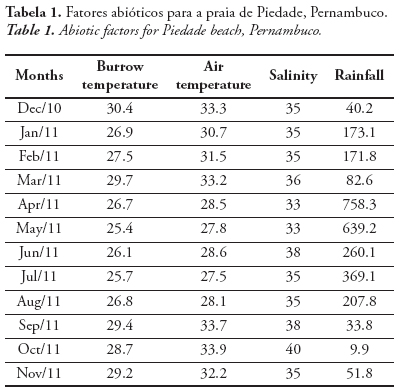
<body><![CDATA[<p>The determination of the reproductive period was based on the monthly percentages of ovigerous females (Vazzoler, 1996). The reproduction was characterized, according to Pinheiro &amp; Fransozo (2002), as: seasonal (ovigerous females in only some months or seasons), continuous (ovigerous females in all months with similar intensity) or seasonal-continuous (ovigerous females in all months, with distinguishable peaks of high reproductive activity in some of them).</p> 			    <p>The monthly proportion of juveniles and adults was estimated and a Chi-square test was applied to determine if they differed significantly from the expected proportion (1:1) (&#967;2= 3.84). The determination of the recruitment period was based on the months where the juveniles were significantly more abundant than adults.</p> 	    <p>A correlation matrix, with Pearson&rsquo;s coefficient of linear correlation (<i>r</i>) was applied to verify the influence of the abiotic factors in the total abundance of <i>C. major</i>, as well as in the abundance of ovigerous females.</p> 			    <p>All statistical analyses were performed at &#945; = 0.05.</p> 			    <p>&nbsp;</p> 			    <p><b>3. RESULTS</b></p> 			    <p>The burrow temperature varied from 25.4 to 30.4 &#176;C (27.7 &#177; 1.6 &#176;C). The air temperature varied from 27.5 to 33.9 &#176;C (30.7 &#177; 2.5 &#176;C). The salinity varied from 33.0 to 40.0 (35.6 &#177; 2.0) and the rainfall, from 9.9 to 758.3 mm (75.8 &#177; 89.6 mm) (<a href="#t1">Tab. 1</a>). The following abiotic factors varied significantly between dry and rainy periods: burrow temperature (<i>t</i> = 2.36; p = 0.03), air temperature (<i>t</i> = 4.15;p = 0.01) and rainfall (<i>t</i> = 2.00; <i>p</i> = 0.01). The burrow and air temperatures were higher in the dry period, and the rainfall was higher in the rainy period. The salinity, however, did not vary significantly between dry and rainy periods (<i>t</i> = 1.13;p = 0.28).</p>                 <p>&nbsp;</p> 			    <p><a name="t1"></a></p> 	<img src="/img/revistas/rgci/v14n1/14n1a09t1.jpg"/> 			    
<p>&nbsp;</p> 			    ]]></body>
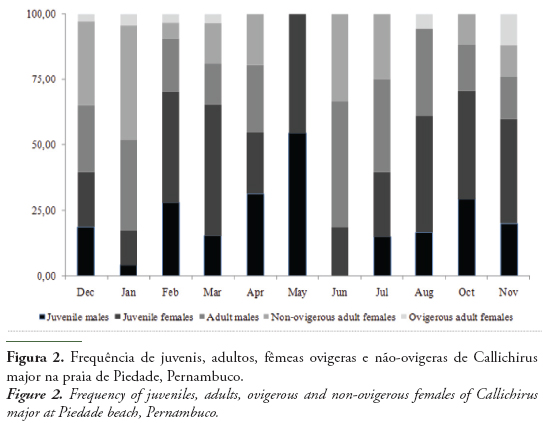
<body><![CDATA[<p>A total of 389 individuals of <i>C. major</i> were sampled during the study period,174 males (80 juveniles and 94 adults) and 215 females (114 juveniles and 101 adults, of which11 were ovigerous females). From these ghost shrimps, 202 were sampled in the dry period, and 183 in the rainy one. The sex ratio was 1:1.24 (&#9794;:&#9792;), with females being significantly more abundant than males (&#967;<sup>2</sup> = 4.37; <i>p</i> &lt; 0.05), especially in March (&#967;<sup>2</sup> = 8.34;  <i>p</i> &lt; 0.05) (<a href="#f2">Fig. 2</a>), when the females represented 68.97% of the ghost shrimps.</p>                 <p>&nbsp;</p> 			    <p><a name="f2"></a></p> 	<img src="/img/revistas/rgci/v14n1/14n1a09f2.jpg"/> 			    
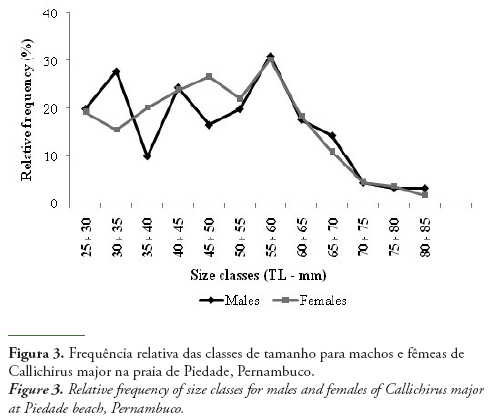
<p>&nbsp;</p> 			    <p>The mean TL was 50.56 &#177; 13.77 mm for males (Min. 27.10 mm and Max. 90.10 mm) and 47.55 &#177; 13.40 mm for females (Min. 25.40 mm and Max. 87.30 mm). Considering the distribution by size class, it could be observed that males were more frequent at 30 &#747; 35 and 55 &#747; 60 mm, while females were frequent at 45 &#747; 50 and 55 &#747; 60 mm (<a href="#f3">Fig. 3</a>).</p>                 <p>&nbsp;</p> 			    <p><a name="f3"></a></p> 	<img src="/img/revistas/rgci/v14n1/14n1a09f3.jpg"/> 			    
<p>&nbsp;</p>             			    <p>The frequency of ovigerous females (<a href="#f2">Fig. 2</a>) was higher in the months of December 2010 to March and November 2011, mostly months of the dry period. A small peak was observed in August, transition from the rainy to the dry period.</p> 	    <p>The recruitment of juveniles into the population (<a href="#f2">Fig. 2</a>) occurred in all months of the year, especially in February, March and May 2011, between the summer and the autumn, when the juveniles were significantly more frequent than adults (&#967;<sup>2</sup> = 9.62, 4.41 and 11.00, respectively; <i>p</i> &lt; 0.05). In April and from July to November 2011, no difference in the frequency of juveniles and adults was detected. The adults were significantly dominant in December 2010, January and June 2011 (&chi;<sup>2</sup> = 9.14, 9.78 and 14.29, respectively; <i>p</i> &lt; 0.05).</p> 			    ]]></body>
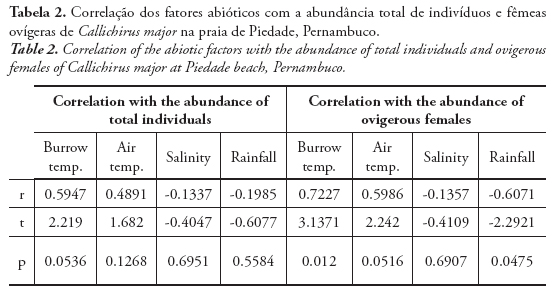
<body><![CDATA[<p>According to the correlation matrix, the abiotic parameter that most influenced the total abundance and abundance of ovigerous females of <i>C. major</i> was the burrow temperature (<a href="#t2">Tab. 2</a>). Although not significant, it was considered regularly correlated. However, considering only the ovigerous females, the correlation with the burrow temperature was considered strong and significant. The air temperature was also positively correlated, despite not significant, to the abundance of total individuals and ovigerous females. The rainfall was negatively correlated to the abundance of ovigerous females, being significant. Positive correlations mean that the parameters are related to an increase in the animal abundance, while negative correlations, cause the decrease in the animal abundance.</p>                 <p>&nbsp;</p> 			    <p><a name="t2"></a></p> 	<img src="/img/revistas/rgci/v14n1/14n1a09t2.jpg"/> 			    
<p>&nbsp;</p>         <p><b>4. DISCUSSION</b></p> 			    <p>The air and burrow temperatures varied significantly between dry and rainy periods, with the highest values in the dry period (September and February). Thus, the temperature followed the seasonal pattern of the littoral of Pernambuco and the Northeast of Brazil, corroborating Arag&atilde;o (1998), Botter-Carvalho (2001) and Cavalcanti <i>et al.</i> (2006). According to Cavalcanti &amp; Kempf (1969), salinity was lowest in the rainy period, and highest, in the dry period, such as observed in this study. However, no significant difference was observed between the periods. In this study, the rainfall differed significantly between dry and rainy periods, and according to Cavalcanti &amp; Kempf (1967/69), there is an inverse relation between salinity and rainfall. According to the classification of K&#246;eppen (1948), the climate of the metropolitan region of Recife is of the type As&rsquo;, with rains from March to August, showing that during this period there is a greater input of freshwater in the sea, influencing the salinity. In the dry period, from September to February, the salinity of the coastal surface water remains relatively uniform.</p> 			    <p>Studies with callianassids show deviations in the sex ratio, with females being more abundant in the populations (Tunberg, 1986; Dworschak, 1988; Hanekom &amp; Baird, 1992; Dumbauld <i>et al.</i>, 1996; Rodrigues &amp; Shimizu, 1997; Shimizu, 1997; Ara&uacute;jo <i>et al.</i>, 2000). The sex ratio observed in our study corroborates these studies. At Piedade beach, however, Botter-Carvalho <i>et al.</i> (2007) observed a sex ratio of 0.98 &#9794;:1.0 &#9792;, with no significant differences between sexes. However, they observed monthly oscillations in the sex ratio; the females were more abundant from September to February and the males, from March to September, and in this study, the females were more abundant in March, with ovigerous females in March and November, and males more abundant in August, October, February and May. Similar results were observed by Hern&aacute;ez &amp; Wehrtmann (2007) for <i>Callichirus seilacheri</i> (Bott, 1955), with no significant differences in the annual sex ratio, but with females significantly more abundant than males in January and September. According to Wenner (1974), the deviations in the sex ratio can be a result of the differences in the life cycle, migration, mortality and growth. These deviations may also be due to biogeographic factors, as well as intra and interspecific factors (Rodrigues, 1985).</p> 			    <p>The capture of individuals with a suction pump can result in an undesirable sampling selectivity. The ovigerous females move to the most superior part of the galleries to release the eggs or to improve their ventilation (Nates &amp; Felder, 1999; Botter-Carvalho <i>et al.</i>, 2007),thus, they could be captured more easily. This is supported by Rowden &amp; Jones (1994), for <i>Callianassa subterranea</i> (Montagu, 1808), where adult females were captured more frequently, since they occupied the higher portion of the burrows. Agonistic behavior occurs in adult males of many callianassids (Tunberg, 1986; Felder &amp; Lovett, 1989; Tamaki <i>et al.</i>, 1997; Shimoda <i>et al.</i>, 2005), including <i>C. major</i> (Rodrigues &amp; Shimizu, 1997). Thus, the males can build deeper burrows than females, and may also escape with greater agility. Both phenomena also explain the higher proportion of females in the population. Nevertheless, the burrows of the juveniles are shallower and they do not have the escape capacity as the adults. Thus, they are easily captured, which may explain their high abundance at Piedade beach, as also observed by Witbaard &amp; Duineveld (1989) for <i>Callianassa subterranea</i> in the North Sea. Of the Callianassidea species studied in Brazil, females were larger than males in <i>Neocallichirus mirim</i> (Rodrigues, 1971) (Pezzuto,1993) and in <i>C. major</i>. That is not the pattern for all these animals, and males were significantly larger than females in many other studies, such as Hailstone &amp; Stephenson (1961), Forbes (1973), Tamaki <i>et al.</i> (1996) and Shimizu (1997).</p> 			    <p>The distribution of ghost shrimps by size class was not normal, i.e., did not follow a Gaussian distribution. Besides, a decline in the frequency of individuals from 60 mm was observed. During the field sampling, a large number of fishermen was observed at the area, and they selected the larger ghost shrimps to use as live bait. This superexploitation of the species may not allow the population to reach their maximum sizes. Hern&aacute;ez &amp; Wehrtmann (2007) showed that the fishing of <i>C. seilacheri</i> to use as live bait considerably affected its reproduction and distribution in intertidal and sublittoral areas.</p> 			    <p>In this study, the highest frequency of ovigerous females was observed in the dry period (equatorial summer - September and February) (<a href="#f2">Fig. 2</a>), and in the transition between the rainy period (equatorial winter- March and August) and the summer, in Northeast Brazil (Cavalcanti &amp; Kempf, 1967/69). Ara&uacute;jo <i>et al.</i> (2000) and Botter-Carvalho <i>et al.</i> (2007) observed a similar period for <i>C. major</i> as well (<a href="/img/revistas/rgci/v14n1/14n1a09t3.jpg" target="_blank">Table 3</a>). According to Botter-Carvalho (2001), the reproductive period of <i>C. major</i> is associated with the summer months in the Brazilian Northeast, where the highest temperatures were observed from December of 2010 to February of 2011, decreasing in March of 2011. Reproductive periods usually occur in seasons with high temperatures, since the temperature favors the sexual activity and embryonic development, as described by Hill (1977) for <i>Upogebia africana</i> (Ortmann, 1894) and Tamaki <i>et al.</i> (1996) for <i>Nihonotrypaea japonica</i> (Ortmann, 1891). Low temperatures are related to the diminution of the burrowing activity of callianassids. According to Posey (1986), low temperatures reduce the metabolism of ghost shrimps. Felder &amp; Griffis (1994) also found higher densities of <i>Lepidophthalmus louisianensis</i> (Schmitt, 1935) at Mississippi, and Bilodeau <i>et al.</i> (2005), for <i>Callichirus islagrande</i> (Schmitt, 1935) at Louisiana, United States of America, in the dry period, as observed in the present study, showing that high temperatures favor the burrowing activity, reproduction and recruitment of the species.</p> 			    
]]></body>
<body><![CDATA[<p>In this study, the total abundance of <i>C. major</i> was not related to salinity, but the abundance of ovigerous females was negatively correlated. According to Hill (1977) and Posey (1986), salinity can exert a strong effect in the population of callianassids, due to its seasonal variations.</p> 	    <p>Seasonal changes in the density of <i>C. major</i> in sandy beaches are attributed to changes in the sediment deposition and coastal erosion that alters the beach profile (Botter-Carvalho <i>et al.</i>, 2002) and events of recruitment (Tamaki &amp; Ingole, 1993; Dumbauld <i>et al.</i>, 1996). Souza <i>et al.</i> (1998) observed intense recruitment at the beginning of the summer in beaches in the State of Paran&aacute;, while Rodrigues &amp; Shimizu (1997) found intense recruitment in October and in June (spring and autumn, respectively) at Bareque&ccedil;aba beach, State of S&atilde;o Paulo. The seasonal variations of juveniles in a population are natural for callianassids, due to predation, environmental and biogeographic factors acting on the larval phases (Rodrigues, 1976). In this study, recruitment was intensified between the summer and autumn, as a result of reproductive activity in the summer. The embryonic development of <i>C. major</i> occurs in 10 stages during 30 days (Rodrigues, 1976). Larval development has from 3 to 5 zoeal stages withduration of 10 to 15 days to reach the decapodid stage (Strasser &amp; Felder, 1999; Abrunhosa <i>et al.</i>, 2008). Such short larval development explains the peak of recruitment right after the peak of ovigerous females. Annual variations in the quantity of recruits are also related to the degree of overexploitation of the population (Souza &amp; Borzone, 2003). The sampling of adults favors the settlement of juveniles, since it reduces the competition for space in the substratum (Rodrigues &amp; Shimizu, 1997).</p> 			    <p>We can conclude that the females are more abundant in the population, which is a pattern for callianassids of the Brazilian coast. A well-defined reproductive period in the summer was observed, when high temperatures favor the reproductive processes and contribute to the larval development of the animal. The recruitment of the species occurs in almost the entire study period, but it is intensified right after the reproductive peak, due to the short larval development of this species. This paper creates a baseline for further researches on <i>C. major</i> in Northeastern Brazil.</p> 			    <p>&nbsp;</p> 			    <p><b>REFERENCES</b></p> 			    <!-- ref --><p>Abrunhosa, F.A.; Arruda, D.C.B.; Simith, D.J.B.; Palmeira, C.A.M. (2008) - The importance of feeding in the larval development of the ghost shrimp <i>Callichirus major</i> (Decapoda: Callianassidae). <i>Anais da AcademiaBrasileira deCi&ecirc;ncias</i> (ISSN 0001-3765), 80(3):445- 453, Rio de Janeiro, RJ, Brasil. Available at <a href="http://www.scielo.br/pdf/aabc/v80n3/a06v80n3.pdf" target="_blank">http://www.scielo.br/pdf/aabc/v80n3/a06v80n3.pdf</a>&nbsp;&nbsp;&nbsp;&nbsp;&nbsp;&nbsp;&nbsp;&nbsp;[&#160;<a href="javascript:void(0);" onclick="javascript: window.open('/scielo.php?script=sci_nlinks&ref=000078&pid=S1646-8872201400010000900001&lng=','','width=640,height=500,resizable=yes,scrollbars=1,menubar=yes,');">Links</a>&#160;]<!-- end-ref --><!-- ref --><p>Alves-J&uacute;nior, F.A.; Ara&uacute;jo, M.S.L.C.; Feitosa, F.A.N. (2013) - Crescimento Alom&eacute;trico de <i>Callichirus major</i> (SAY 1818) (Crustacea: Callianassidae) em uma praia arenosa do Nordeste brasileiro.<i>Tropical Oceanography</i> (ISSN: 1679-3013), 41. &#91;no prelo&#93;. Recife, PE, Brasil.    &nbsp;&nbsp;&nbsp;&nbsp;&nbsp;&nbsp;&nbsp;&nbsp;[&#160;<a href="javascript:void(0);" onclick="javascript: window.open('/scielo.php?script=sci_nlinks&ref=000079&pid=S1646-8872201400010000900002&lng=','','width=640,height=500,resizable=yes,scrollbars=1,menubar=yes,');">Links</a>&#160;]<!-- end-ref --></p> 			    <p>Arag&atilde;o, J.O.R. (1998) - O impacto do Enso e do Dipolo do Atl&acirc;ntico no Nordeste do Brasil. <i>Bulletin de l&rsquo;Institut Fran&ccedil;ais d&rsquo;&Eacute;tudes Andines</i> (ISSN: 0303-7495), 27(3): 839-844, Lima, Per&uacute;. Available at <a href="http://www.ifeanet.org/publicaciones/boletines/27(3)/839.pdf" target="_blank">http://www.ifeanet.org/publicaciones/boletines/27(3)/839.pdf</a></p> 			    <!-- ref --><p>Ara&uacute;jo, J.S.; Calado, T.C.S.; S&aacute;, M.F.P. (2000) - Aspectos reprodutivos de <i>Callichirus major</i> (SAY 1818) (Crustacea: Callianassidae) da praia do Sobral, Macei&oacute;- Alagoas. <i>Boletim de Estudos de Ci&ecirc;ncias do Mar</i> (ISSN: 0102-8596), 11:101-112, Macei&oacute;, AL, Brasil.    &nbsp;&nbsp;&nbsp;&nbsp;&nbsp;&nbsp;&nbsp;&nbsp;[&#160;<a href="javascript:void(0);" onclick="javascript: window.open('/scielo.php?script=sci_nlinks&ref=000082&pid=S1646-8872201400010000900004&lng=','','width=640,height=500,resizable=yes,scrollbars=1,menubar=yes,');">Links</a>&#160;]<!-- end-ref --></p> 			    <!-- ref --><p>Ara&uacute;jo, M.S.L.C.;Calado, T.C.S.(2008) - Bioecologia do Caranguejo-U&ccedil;&aacute; <i>Ucides cordatus</i> (Linnaeus) no Complexo Estuarino Lagunar Mund&aacute;u/Manguaba (CELMM), Alagoas, Brasil. <i>Revista da Gest&atilde;o Costeira Integrada</i>, 8:169-181. doi:<a href="http://dx.doi.org/10.5894/rgci141" target="_blank">10.5894/rgci141</a>&nbsp;&nbsp;&nbsp;&nbsp;&nbsp;&nbsp;&nbsp;&nbsp;[&#160;<a href="javascript:void(0);" onclick="javascript: window.open('/scielo.php?script=sci_nlinks&ref=000084&pid=S1646-8872201400010000900005&lng=','','width=640,height=500,resizable=yes,scrollbars=1,menubar=yes,');">Links</a>&#160;]<!-- end-ref --><!-- ref --><p>Ara&uacute;jo, M.S.L.C.; Negromonte, A.O.;  Barreto, A.V. (2011) - Reproductive period of the swimming crab <i>Callinectes danae</i> at the Santa Cruz Channel, a highly productive tropical estuary in Brazil. <i>Nauplius</i> (ISSN: 0104-6497), 19(2):155-162, Cruz das Almas, BA, Brasil. Available at <a href="http://www.crustacea.org.br/artigos/830_27_Article_7_Araujo_et_al_Reproduction_of_Callinectes_danae.pdf" target="_blank">http://www.crustacea.org.br/artigos/830_27_Article_7_Araujo_et_al_Reproduction_of_Callinectes_danae.pdf</a>&nbsp;&nbsp;&nbsp;&nbsp;&nbsp;&nbsp;&nbsp;&nbsp;[&#160;<a href="javascript:void(0);" onclick="javascript: window.open('/scielo.php?script=sci_nlinks&ref=000085&pid=S1646-8872201400010000900006&lng=','','width=640,height=500,resizable=yes,scrollbars=1,menubar=yes,');">Links</a>&#160;]<!-- end-ref --><!-- ref --><p>Ara&uacute;jo, M.S.L.C.; Barreto, A.V.; Negromonte, A.O.; Schwamborn, R. (2012) - Population ecology of the blue crab <i>Callinectes danae</i> (Crustacea: Portunidae) in a Brazilian tropical estuary. <i>Anais da AcademiaBrasileira deCi&ecirc;ncias</i>, 84(1):129-138. DOI: <a href="http://dx.doi.org/10.1590/S0001-37652012000100013" target="_blank">10.1590/S0001-37652012000100013</a>&nbsp;&nbsp;&nbsp;&nbsp;&nbsp;&nbsp;&nbsp;&nbsp;[&#160;<a href="javascript:void(0);" onclick="javascript: window.open('/scielo.php?script=sci_nlinks&ref=000086&pid=S1646-8872201400010000900007&lng=','','width=640,height=500,resizable=yes,scrollbars=1,menubar=yes,');">Links</a>&#160;]<!-- end-ref --><!-- ref --><p>Bezerra, L.E.A.;Dias, C.B.; Moraes, J. O.; Matthews-Cascon, H. (2010) - Distribui&ccedil;&atilde;o espacial do caranguejo <i>Uca maracoani</i> (Latreile, 1802-1803) (Brachyura: Ocypodidae) em tr&ecirc;s manguezais do Nordeste do Brasil. <i>Revista da Gest&atilde;o Costeira Integrada</i>, N&uacute;mero especial 2, Manguezais do Brasil. <i>No prelo</i>. Available at <a href="http://www.aprh.pt/rgci/pdf/rgcimang63_Bezerra.pdf" target="_blank">http://www.aprh.pt/rgci/pdf/rgcimang63_Bezerra.pdf</a>&nbsp;&nbsp;&nbsp;&nbsp;&nbsp;&nbsp;&nbsp;&nbsp;[&#160;<a href="javascript:void(0);" onclick="javascript: window.open('/scielo.php?script=sci_nlinks&ref=000087&pid=S1646-8872201400010000900008&lng=','','width=640,height=500,resizable=yes,scrollbars=1,menubar=yes,');">Links</a>&#160;]<!-- end-ref --><!-- ref --><p>Bilodeau, A.L.; Felder, D.L.; Neigel, J.E. (2005) - Multiple paternity in the thalassinidean ghost shrimp, <i>Callichirus islagrande</i> (Crustacea: Decapoda: Callianassidae). <i>Marine Biology</i>, 146:381-385. DOI: <a href="http://dx.doi.org/10.1007/s00227-004-1444-1" target="_blank">10.1007/s00227-004-1444-1</a>&nbsp;&nbsp;&nbsp;&nbsp;&nbsp;&nbsp;&nbsp;&nbsp;[&#160;<a href="javascript:void(0);" onclick="javascript: window.open('/scielo.php?script=sci_nlinks&ref=000088&pid=S1646-8872201400010000900009&lng=','','width=640,height=500,resizable=yes,scrollbars=1,menubar=yes,');">Links</a>&#160;]<!-- end-ref --><!-- ref --><p>Borzone, C.A.; Souza, J.R.B. (1996) - A extra&ccedil;&atilde;o de corrupto <i>Callichirus major</i> (Decapoda: Callianassidae) para uso como iscas em praias do litoral do Paran&aacute;: caracter&iacute;sticas da pesca. <i>Ner&iacute;tica</i> (ISSN: 1806-969X), 10:67-79, Pontal do Sul, PR, Brasil.    &nbsp;&nbsp;&nbsp;&nbsp;&nbsp;&nbsp;&nbsp;&nbsp;[&#160;<a href="javascript:void(0);" onclick="javascript: window.open('/scielo.php?script=sci_nlinks&ref=000089&pid=S1646-8872201400010000900010&lng=','','width=640,height=500,resizable=yes,scrollbars=1,menubar=yes,');">Links</a>&#160;]<!-- end-ref --></p> 			    <!-- ref --><p>Botter-Carvalho, M.L. (2001) -  <i>Ecologia de Callichirus major (Say 1818)</i> (Crustacea, Callianassidae) <i>na praia de Piedade, Jaboat&atilde;o dos Guararapes-PE.Recife</i> (PE). 114p., Disserta&ccedil;&atilde;o de Mestrado em Biologia Animal, Universidade Federal de Pernambuco,Brasil. <i>N&atilde;o publicado</i>.    &nbsp;&nbsp;&nbsp;&nbsp;&nbsp;&nbsp;&nbsp;&nbsp;[&#160;<a href="javascript:void(0);" onclick="javascript: window.open('/scielo.php?script=sci_nlinks&ref=000091&pid=S1646-8872201400010000900011&lng=','','width=640,height=500,resizable=yes,scrollbars=1,menubar=yes,');">Links</a>&#160;]<!-- end-ref --></p> 			    ]]></body>
<body><![CDATA[<!-- ref --><p>Botter-Carvalho, M.L.; Santos, P.J.P.; Carvalho, P.V.V.C. (2002) - Spatial Distribuition of <i>Callichirus major</i> (Say 1818) (Decapoda: Callianassidae) on a sandy beach, Piedade, Pernambuco, Brazil. <i>Nauplius</i> (ISSN: 0104-6497), 10(2): 97-109, Cruz das Almas, BA, Brasil. Available at <a href="http://decapoda.nhm.org/pdfs/13801/13801.pdf" target="_blank">http://decapoda.nhm.org/pdfs/13801/13801.pdf</a>&nbsp;&nbsp;&nbsp;&nbsp;&nbsp;&nbsp;&nbsp;&nbsp;[&#160;<a href="javascript:void(0);" onclick="javascript: window.open('/scielo.php?script=sci_nlinks&ref=000093&pid=S1646-8872201400010000900012&lng=','','width=640,height=500,resizable=yes,scrollbars=1,menubar=yes,');">Links</a>&#160;]<!-- end-ref --><!-- ref --><p>Botter-Carvalho, M.L.; Santos, P.J.P.; Carvalho, P.V.V.C. (2007) - Population dynamics of <i>Callichirus major</i> (Say, 1818) (Crustacea, Thalassinidea) on a beach in northeastern Brazil. <i>Estuarine, Coastal and Shelf Science</i> (ISSN: 0272-7714), 71:508-516. doi:<a href="http://dx.doi.org/10.1016/j.ecss.2006.09.001" target="_blank">10.1016/j.ecss.2006.09.001</a> Available at <a href="http://decapoda.nhm.org/pdfs/27735/27735.pdf" target="_blank">http://decapoda.nhm.org/pdfs/27735/27735.pdf</a>&nbsp;&nbsp;&nbsp;&nbsp;&nbsp;&nbsp;&nbsp;&nbsp;[&#160;<a href="javascript:void(0);" onclick="javascript: window.open('/scielo.php?script=sci_nlinks&ref=000094&pid=S1646-8872201400010000900013&lng=','','width=640,height=500,resizable=yes,scrollbars=1,menubar=yes,');">Links</a>&#160;]<!-- end-ref --><!-- ref --><p>Caley, M.J.; Carr, M.H.; Hixon, M.A.; Hughes, T.P.; Jones, G.P.; Menge, B.A. (1996) - Recruitment and the local dynamics of open marine populations. <i>Annual Review of Ecology and Systematics</i>, 27:477-500. doi: <a href="http://dx.doi.org/10.1146/annurev.ecolsys.27.1.477" target="_blank">10.1146/annurev.ecolsys.27.1.477</a>&nbsp;&nbsp;&nbsp;&nbsp;&nbsp;&nbsp;&nbsp;&nbsp;[&#160;<a href="javascript:void(0);" onclick="javascript: window.open('/scielo.php?script=sci_nlinks&ref=000095&pid=S1646-8872201400010000900014&lng=','','width=640,height=500,resizable=yes,scrollbars=1,menubar=yes,');">Links</a>&#160;]<!-- end-ref --><!-- ref --><p>Cavalcanti, L.B.;  Kempf, M. (1967/69) - Estudo da Plataforma Continental na &Aacute;rea do Recife (Brasil). II. Meteorologia e Hidrologia. <i>Trabalhos Oceanogr&aacute;ficos da Universidade Federal de Pernambuco</i> (ISSN: 0374-0412), 9(11):149-158, Recife, PE, Brasil. Available at <a href="http://www.ufpe.br/tropicaloceanography/resumos/9_10_11_cavalcanti.html" target="_blank">http://www.ufpe.br/tropicaloceanography/resumos/9_10_11_cavalcanti.html</a>&nbsp;&nbsp;&nbsp;&nbsp;&nbsp;&nbsp;&nbsp;&nbsp;[&#160;<a href="javascript:void(0);" onclick="javascript: window.open('/scielo.php?script=sci_nlinks&ref=000096&pid=S1646-8872201400010000900015&lng=','','width=640,height=500,resizable=yes,scrollbars=1,menubar=yes,');">Links</a>&#160;]<!-- end-ref --><!-- ref --><p>Cavalcanti, E.P.; Silva, V.P.R.; Sousa, F.A.S. (2006) - Programa computacional para a estimativa da temperatura do ar para a Regi&atilde;o Nordeste do Brasil. <i>Revista Brasileira de Engenharia Agr&iacute;cola e Ambiental</i> (ISSN: 1415-4366), 10:140-147, Campina Grande, PB, Brasil. Available at <a href="http://www.scielo.br/pdf/rbeaa/v10n1/v10n1a21.pdf" target="_blank">http://www.scielo.br/pdf/rbeaa/v10n1/v10n1a21.pdf</a>&nbsp;&nbsp;&nbsp;&nbsp;&nbsp;&nbsp;&nbsp;&nbsp;[&#160;<a href="javascript:void(0);" onclick="javascript: window.open('/scielo.php?script=sci_nlinks&ref=000097&pid=S1646-8872201400010000900016&lng=','','width=640,height=500,resizable=yes,scrollbars=1,menubar=yes,');">Links</a>&#160;]<!-- end-ref --><!-- ref --><p>Cobo, V.J.; Fransozo, A. (2000) - Fecundity and reproduction period of the red mangrove crab <i>Goniopsis cruentata</i> (Brachyura, Grapsidae) S&atilde;o Paulo State, Brazil. In: Klein, J.C.V. and Schram ,F.R. (org.), <i>Crustacean Issues, The Biodiversity Crisis and Crustacea</i>, Vol.12, pp. 527-533, A.A. Balkema, Rotterdam, the Netherlands. ISBN: 9054104783.    &nbsp;&nbsp;&nbsp;&nbsp;&nbsp;&nbsp;&nbsp;&nbsp;[&#160;<a href="javascript:void(0);" onclick="javascript: window.open('/scielo.php?script=sci_nlinks&ref=000098&pid=S1646-8872201400010000900017&lng=','','width=640,height=500,resizable=yes,scrollbars=1,menubar=yes,');">Links</a>&#160;]<!-- end-ref --></p> 			    <!-- ref --><p>Coelho, P.A. (1997) - Revis&atilde;o das esp&eacute;cies de Thalassinidea encontradas em Pernambuco, Brasil (Crustacea, Decapoda). <i>Trabalhos Oceanogr&aacute;ficos da Universidade Federal de Pernambuco</i> (ISSN: 0374-0412), 25:137-161, Recife, PE, Brasil. Available at <a href="http://www.revista.ufpe.br/tropicaloceanography/artigos_completos_resumos_t_d/25_1997_coelho_5.pdf" target="_blank">http://www.revista.ufpe.br/tropicaloceanography/artigos_completos_resumos_t_d/25_1997_coelho_5.pdf</a>&nbsp;&nbsp;&nbsp;&nbsp;&nbsp;&nbsp;&nbsp;&nbsp;[&#160;<a href="javascript:void(0);" onclick="javascript: window.open('/scielo.php?script=sci_nlinks&ref=000100&pid=S1646-8872201400010000900018&lng=','','width=640,height=500,resizable=yes,scrollbars=1,menubar=yes,');">Links</a>&#160;]<!-- end-ref --><!-- ref --><p>Coelho, P.A.; Ramos-Porto, M. (1986) - Sinopse dos crust&aacute;ceos dec&aacute;podos brasileiros (Familias Callianassidae, Callianadeidae, Upogebiidae, Diogenidae). <i>Trabalhos Oceanogr&aacute;ficos da Universidade Federal de Pernambuco</i> (ISSN: 0374-0412), 19:27-53 , Recife, PE, Brasil. Available at <a href="http://www.revista.ufpe.br/tropicaloceanography/artigos_completos_resumos_t_d/19_1985_1986_coelho.pdf" target="_blank">http://www.revista.ufpe.br/tropicaloceanography/artigos_completos_resumos_t_d/19_1985_1986_coelho.pdf</a>&nbsp;&nbsp;&nbsp;&nbsp;&nbsp;&nbsp;&nbsp;&nbsp;[&#160;<a href="javascript:void(0);" onclick="javascript: window.open('/scielo.php?script=sci_nlinks&ref=000101&pid=S1646-8872201400010000900019&lng=','','width=640,height=500,resizable=yes,scrollbars=1,menubar=yes,');">Links</a>&#160;]<!-- end-ref --><!-- ref --><p>Done, T.J. (1982) - Patterns in the distribution of coral communities across the central great barrier reef. <i>Coral Reefs</i>, 1:95-107. doi:<a href="http://dx.doi.org/10.1007/BF00301691" target="_blank">10.1007/BF00301691</a>&nbsp;&nbsp;&nbsp;&nbsp;&nbsp;&nbsp;&nbsp;&nbsp;[&#160;<a href="javascript:void(0);" onclick="javascript: window.open('/scielo.php?script=sci_nlinks&ref=000102&pid=S1646-8872201400010000900020&lng=','','width=640,height=500,resizable=yes,scrollbars=1,menubar=yes,');">Links</a>&#160;]<!-- end-ref --><!-- ref --><p>Dumbauld, B.R.; Armstrong, D.A.; Feldman, K.L. (1996) - Life history characteristics of two sympatric thalassinidean shrimps, <i>Neotrypaea californiensis</i> and <i>Upogebia pugettensis</i>, with implications for oyster culture. <i>Journal of Crustacean Biology</i> (ISSN: 0278-0372), 16:689-708, New Braunfels, TX, USA. Available at <a href="http://decapoda.nhm.org/pdfs/15596/15596.pdf" target="_blank">http://decapoda.nhm.org/pdfs/15596/15596.pdf</a>&nbsp;&nbsp;&nbsp;&nbsp;&nbsp;&nbsp;&nbsp;&nbsp;[&#160;<a href="javascript:void(0);" onclick="javascript: window.open('/scielo.php?script=sci_nlinks&ref=000103&pid=S1646-8872201400010000900021&lng=','','width=640,height=500,resizable=yes,scrollbars=1,menubar=yes,');">Links</a>&#160;]<!-- end-ref --><!-- ref --><p>Dworschak, P.C. (1988) - The biology of <i>Upogebia pusilla</i> (Petagna)(Decapoda, Thalassinidea) Growth and production. <i>Marine Ecology</i>, 9(1):51-77. doi:<a href="http://dx.doi.org/10.1111/j.1439-0485.1988.tb00198.x" target="_blank">10.1111/j.1439-0485.1988.tb00198.x</a>&nbsp;&nbsp;&nbsp;&nbsp;&nbsp;&nbsp;&nbsp;&nbsp;[&#160;<a href="javascript:void(0);" onclick="javascript: window.open('/scielo.php?script=sci_nlinks&ref=000104&pid=S1646-8872201400010000900022&lng=','','width=640,height=500,resizable=yes,scrollbars=1,menubar=yes,');">Links</a>&#160;]<!-- end-ref --><!-- ref --><p>Felder, D.L.; Lovett, D.L. (1989) - Relative growth and sexual maturation in the estuarine ghost shrimp <i>Callianassa louisianensis</i> Schmitt, 1935. <i>Journal of Crustacean Biology</i> (ISSN: 0278-0372), 9:540-553, New Braunfels, TX, USA. Available at <a href="http://www.jstor.org/discover/10.2307/1548586?uid=2134&amp;uid=2&amp;uid=70&amp;uid=4&amp;sid=21103303217313" target="_blank">http://www.jstor.org/discover/10.2307/1548586?uid=2134&amp;uid=2&amp;uid=70&amp;uid=4&amp;sid=21103303217313</a>&nbsp;&nbsp;&nbsp;&nbsp;&nbsp;&nbsp;&nbsp;&nbsp;[&#160;<a href="javascript:void(0);" onclick="javascript: window.open('/scielo.php?script=sci_nlinks&ref=000105&pid=S1646-8872201400010000900023&lng=','','width=640,height=500,resizable=yes,scrollbars=1,menubar=yes,');">Links</a>&#160;]<!-- end-ref --><!-- ref --><p>Felder, D.L.; Griffis, R.B. (1994) - <i>Dominant infaunal communities at risk in shoreline habitats: burrowing thalassinid Crustacea</i>.  87p., New Orleans, U.S. Department of the Interior, Minerals Management Service. Available at <a href="http://www.data.boem.gov/PI/PDFImages/ESPIS/3/3439.pdf" target="_blank">http://www.data.boem.gov/PI/PDFImages/ESPIS/3/3439.pdf</a>&nbsp;&nbsp;&nbsp;&nbsp;&nbsp;&nbsp;&nbsp;&nbsp;[&#160;<a href="javascript:void(0);" onclick="javascript: window.open('/scielo.php?script=sci_nlinks&ref=000106&pid=S1646-8872201400010000900024&lng=','','width=640,height=500,resizable=yes,scrollbars=1,menubar=yes,');">Links</a>&#160;]<!-- end-ref --><p>Forbes, A.T. (1973) - An unusual abbreviated larval life history in the estuarine burrowing prawn <i>Callianassa kraussi</i> (Crustacea: Decapoda: Thalassinidea). <i>Marine Biology</i> (ISSN: 0022-0981), 22:361&ndash;365. DOI: <a href="http://dx.doi.org/10.1007/BF00391395" target="_blank">10.1007/BF00391395</a>.</p> 			    <!-- ref --><p>Fingerman, M. (1995) - Endocrine mechanisms in crayfish, with emphasis on reproduction and neurotransmitter regulation of hormone release. <i>American Zoology</i> (ISSN: 0003-1569), 35:68-78, McLean, VA, USA. Available at <a href="http://icb.oxfordjournals.org/content/35/1/68.full.pdf" target="_blank">http://icb.oxfordjournals.org/content/35/1/68.full.pdf</a>&nbsp;&nbsp;&nbsp;&nbsp;&nbsp;&nbsp;&nbsp;&nbsp;[&#160;<a href="javascript:void(0);" onclick="javascript: window.open('/scielo.php?script=sci_nlinks&ref=000108&pid=S1646-8872201400010000900026&lng=','','width=640,height=500,resizable=yes,scrollbars=1,menubar=yes,');">Links</a>&#160;]<!-- end-ref --><!-- ref --><p>Frankenberg, D.; Coles, S.L.; Johannes, R.E. (1967) - The potencial trophic significance of <i>Callianassa major</i> fecal pellets. <i>Limnology and Oceanography</i> (ISSN: 0024-3590), 12(1): 113-120, Waco, TE, USA. Available at <a href="http://wap.aslo.org/lo/toc/vol_12/issue_1/0113.pdf" target="_blank">http://wap.aslo.org/lo/toc/vol_12/issue_1/0113.pdf</a>&nbsp;&nbsp;&nbsp;&nbsp;&nbsp;&nbsp;&nbsp;&nbsp;[&#160;<a href="javascript:void(0);" onclick="javascript: window.open('/scielo.php?script=sci_nlinks&ref=000109&pid=S1646-8872201400010000900027&lng=','','width=640,height=500,resizable=yes,scrollbars=1,menubar=yes,');">Links</a>&#160;]<!-- end-ref --><!-- ref --><p>Griffis, R.B.; Chavez, F.L. (1988) - Effects of Sediment Type on Burrows of <i>Callianassa californiensis</i> Dana, 1854 and <i>Callianassa gigas</i> Dana, 1852. <i>Journal of Experimental Marine Biology and Ecology</i>, 117(3):239-253. DOI: <a href="http://dx.doi.org/10.1016/0022-0981(88)90060-3" target="_blank">10.1016/0022-0981(88)90060-3</a>&nbsp;&nbsp;&nbsp;&nbsp;&nbsp;&nbsp;&nbsp;&nbsp;[&#160;<a href="javascript:void(0);" onclick="javascript: window.open('/scielo.php?script=sci_nlinks&ref=000110&pid=S1646-8872201400010000900028&lng=','','width=640,height=500,resizable=yes,scrollbars=1,menubar=yes,');">Links</a>&#160;]<!-- end-ref --><!-- ref --><p>Hailstone, T.S.; Stephenson, W. (1961) - The biology of <i>Callianassa (Trypaea) australiensis</i> Dana, 1852 (Crustacea, Thalassinidea).<i>University of Queensland papers, Department of Zoology</i> (ISSN: 0079-8835), 1(12): 259-285. Available at <a href="http://espace.library.uq.edu.au/view/UQ:222651" target="_blank">http://espace.library.uq.edu.au/view/UQ:222651</a>&nbsp;&nbsp;&nbsp;&nbsp;&nbsp;&nbsp;&nbsp;&nbsp;[&#160;<a href="javascript:void(0);" onclick="javascript: window.open('/scielo.php?script=sci_nlinks&ref=000111&pid=S1646-8872201400010000900029&lng=','','width=640,height=500,resizable=yes,scrollbars=1,menubar=yes,');">Links</a>&#160;]<!-- end-ref --><!-- ref --><p>Hanekom, N.; Baird, D. (1992) - Growth, production and consumption of the thalassinid prawn <i>Upogebia africana</i> (Ortmann, 1894) in the Swart kops estuary. <i>South African Journal of Zoology</i> (ISSN: 0379-4369), 27: 130-139. Available at <a href="http://content.ajarchive.org" target="_blank">http://content.ajarchive.org</a>&nbsp;&nbsp;&nbsp;&nbsp;&nbsp;&nbsp;&nbsp;&nbsp;[&#160;<a href="javascript:void(0);" onclick="javascript: window.open('/scielo.php?script=sci_nlinks&ref=000112&pid=S1646-8872201400010000900030&lng=','','width=640,height=500,resizable=yes,scrollbars=1,menubar=yes,');">Links</a>&#160;]<!-- end-ref --><!-- ref --><p>Hern&aacute;ez, P.; Wehrtmann, I.S. (2007) - Population biology of the burrowing shrimp <i>Callichirus seilacheri</i> (Decapoda: Callianassidae) in northern Chile. <i>Revista de Biolog&iacute;a Tropical</i> (ISSN: 0034-7744), 55:141-152, San Jos&eacute;, Costa Rica. Available at <a href="http://www.redalyc.org/pdf/449/44909918.pdf" target="_blank">http://www.redalyc.org/pdf/449/44909918.pdf</a>&nbsp;&nbsp;&nbsp;&nbsp;&nbsp;&nbsp;&nbsp;&nbsp;[&#160;<a href="javascript:void(0);" onclick="javascript: window.open('/scielo.php?script=sci_nlinks&ref=000113&pid=S1646-8872201400010000900031&lng=','','width=640,height=500,resizable=yes,scrollbars=1,menubar=yes,');">Links</a>&#160;]<!-- end-ref --><!-- ref --><p>Hill, B.J. (1977) - The effect of heated effluent on egg production in the estuarine prawn <i>Upogebia africana</i> (Ortmann, 1894). <i>Journal of Experimental Marine Biology and Ecology</i>, 29:291-302. DOI: <a href="http://dx.doi.org/10.1016/0022-0981(77)90072-7" target="_blank">10.1016/0022-0981(77)90072-7</a>&nbsp;&nbsp;&nbsp;&nbsp;&nbsp;&nbsp;&nbsp;&nbsp;[&#160;<a href="javascript:void(0);" onclick="javascript: window.open('/scielo.php?script=sci_nlinks&ref=000114&pid=S1646-8872201400010000900032&lng=','','width=640,height=500,resizable=yes,scrollbars=1,menubar=yes,');">Links</a>&#160;]<!-- end-ref --><!-- ref --><p>Keough, M.J.; Downes, B. J. (1982) - Recruitment of marine invertebrates: The roles of active larval choice and early mortality. <i>Oecologia Brasiliensis</i>, 54:348-352. DOI: <a href="http://dx.doi.org/10.1007/BF00380003" target="_blank">10.1007/BF00380003</a>.    &nbsp;&nbsp;&nbsp;&nbsp;&nbsp;&nbsp;&nbsp;&nbsp;[&#160;<a href="javascript:void(0);" onclick="javascript: window.open('/scielo.php?script=sci_nlinks&ref=000115&pid=S1646-8872201400010000900033&lng=','','width=640,height=500,resizable=yes,scrollbars=1,menubar=yes,');">Links</a>&#160;]<!-- end-ref --></p> 			    <!-- ref --><p>K&#246;eppen, W. (1948) - <i>Climatologia: con un estudio de los climas de la Tierra</i>. 478p., Fondo de Cultura Economica, M&eacute;xico.    &nbsp;&nbsp;&nbsp;&nbsp;&nbsp;&nbsp;&nbsp;&nbsp;[&#160;<a href="javascript:void(0);" onclick="javascript: window.open('/scielo.php?script=sci_nlinks&ref=000117&pid=S1646-8872201400010000900034&lng=','','width=640,height=500,resizable=yes,scrollbars=1,menubar=yes,');">Links</a>&#160;]<!-- end-ref --></p> 			    <!-- ref --><p>Laufer, H.; Landau, M. (1991) - Endocrine control of reproduction in shrimp and other Crustacea. <i>In</i>: Loach, P.F.; Dougherty, W.J. and Davidson, M.A. (org.), <i>Frontiers of shrimp research</i>, pp.65-81, Elsevier, Amsterdam, the Netherlands. ISBN: 978-0-444-52850-6&nbsp;&nbsp;&nbsp;&nbsp;&nbsp;&nbsp;&nbsp;&nbsp;[&#160;<a href="javascript:void(0);" onclick="javascript: window.open('/scielo.php?script=sci_nlinks&ref=000119&pid=S1646-8872201400010000900035&lng=','','width=640,height=500,resizable=yes,scrollbars=1,menubar=yes,');">Links</a>&#160;]<!-- end-ref --><!-- ref --><p>Manning, R.B.; Felder, D.L. (1986) - The status of the callianassid genus <i>Callichirus</i> Stimpson, 1866 (Crustacea: Decapoda: Thalassinidea). <i>Proceedings of the Biological Society of Washington</i> (ISSN: 0006-324X), 99: 437-443.    &nbsp;&nbsp;&nbsp;&nbsp;&nbsp;&nbsp;&nbsp;&nbsp;[&#160;<a href="javascript:void(0);" onclick="javascript: window.open('/scielo.php?script=sci_nlinks&ref=000120&pid=S1646-8872201400010000900036&lng=','','width=640,height=500,resizable=yes,scrollbars=1,menubar=yes,');">Links</a>&#160;]<!-- end-ref --></p> 			    <!-- ref --><p>Melo, G.A.S. (1999) - <i>Manual de identifica&ccedil;&atilde;o dos crust&aacute;ceos decapodos do litoral brasileiro: Anomura, Thalassinidea, Palinuridea, Astacidea</i>. 551p., S&atilde;o Paulo, Pl&ecirc;iade/FAPESP, S&atilde;o Paulo, SP, Brasil. ISBN: 85-85795-08-5&nbsp;&nbsp;&nbsp;&nbsp;&nbsp;&nbsp;&nbsp;&nbsp;[&#160;<a href="javascript:void(0);" onclick="javascript: window.open('/scielo.php?script=sci_nlinks&ref=000122&pid=S1646-8872201400010000900037&lng=','','width=640,height=500,resizable=yes,scrollbars=1,menubar=yes,');">Links</a>&#160;]<!-- end-ref --><!-- ref --><p>Nates, S.F.; Felder, D.L. (1999) - Growth and maturation of the ghost shrimp <i>Lepidophthalmus sinuensis</i> Lemaitre and Rodrigues, 1991 (Crustacea, Decapoda, Callianassidae), a burrowing pest in penaeid shrimp culture ponds. <i>Fishery Bulletin</i> (ISSN: 0090-0656), 97:541-562. Available at <a href="http://fishbull.noaa.gov/10natesf.pdf" target="_blank">http://fishbull.noaa.gov/10natesf.pdf</a>&nbsp;&nbsp;&nbsp;&nbsp;&nbsp;&nbsp;&nbsp;&nbsp;[&#160;<a href="javascript:void(0);" onclick="javascript: window.open('/scielo.php?script=sci_nlinks&ref=000123&pid=S1646-8872201400010000900038&lng=','','width=640,height=500,resizable=yes,scrollbars=1,menubar=yes,');">Links</a>&#160;]<!-- end-ref --><!-- ref --><p>Noro, C.K.; Buckup, L. (2008) - Estrutura populacional e biologia reprodutiva de <i>Parastacus defossus</i> (Crustacea: Decapoda: Parastacidae). <i>Revista Brasileira de Zoologia</i> (ISSN: 1806-969X), 25:624-629. Available at <a href="http://www.scielo.br/pdf/rbzool/v25n4/07.pdf" target="_blank">http://www.scielo.br/pdf/rbzool/v25n4/07.pdf</a>&nbsp;&nbsp;&nbsp;&nbsp;&nbsp;&nbsp;&nbsp;&nbsp;[&#160;<a href="javascript:void(0);" onclick="javascript: window.open('/scielo.php?script=sci_nlinks&ref=000124&pid=S1646-8872201400010000900039&lng=','','width=640,height=500,resizable=yes,scrollbars=1,menubar=yes,');">Links</a>&#160;]<!-- end-ref --><!-- ref --><p>Pezzuto, P.R. (1993) - <i>Ecologia populacional de Neocallichirus mirim (Rodrigues, 1971) (Dec&aacute;poda, Callianassidae) na praia do Cassino, RS, Brasil</i>. 172p., Disserta&ccedil;&atilde;o de Mestrado, Universidade do Rio Grande, Rio Grande do Sul, RS, Brasil. <i>N&atilde;o publicado</i>.    &nbsp;&nbsp;&nbsp;&nbsp;&nbsp;&nbsp;&nbsp;&nbsp;[&#160;<a href="javascript:void(0);" onclick="javascript: window.open('/scielo.php?script=sci_nlinks&ref=000125&pid=S1646-8872201400010000900040&lng=','','width=640,height=500,resizable=yes,scrollbars=1,menubar=yes,');">Links</a>&#160;]<!-- end-ref --></p> 			    <!-- ref --><p>Pinheiro, M.A.A.; Fransozo, A. (2002) - Reproduction of the speckled swimming crab <i>Arenaeus cribrarius</i> (Brachyura: Portunidae) on the Brazilian coast near 23&#176;30&acute;S. <i>Journal Crustacean Biology</i> (ISSN: 0278-0372), 22(2):416-428. Available at <a href="http://www.jstor.org/stable/1549966" target="_blank">http://www.jstor.org/stable/1549966</a>&nbsp;&nbsp;&nbsp;&nbsp;&nbsp;&nbsp;&nbsp;&nbsp;[&#160;<a href="javascript:void(0);" onclick="javascript: window.open('/scielo.php?script=sci_nlinks&ref=000127&pid=S1646-8872201400010000900041&lng=','','width=640,height=500,resizable=yes,scrollbars=1,menubar=yes,');">Links</a>&#160;]<!-- end-ref --><!-- ref --><p>Posey, M.H. (1986) - Predation on a burrowing shrimp, distribution and community consequence. <i>Journal of Experimental Marine Biology and Ecology</i>, 103(1):143-162. DOI: <a href="http://dx.doi.org/10.1016/0022-0981(86)90138-3" target="_blank">10.1016/0022-0981(86)90138-3</a>&nbsp;&nbsp;&nbsp;&nbsp;&nbsp;&nbsp;&nbsp;&nbsp;[&#160;<a href="javascript:void(0);" onclick="javascript: window.open('/scielo.php?script=sci_nlinks&ref=000128&pid=S1646-8872201400010000900042&lng=','','width=640,height=500,resizable=yes,scrollbars=1,menubar=yes,');">Links</a>&#160;]<!-- end-ref --><!-- ref --><p>Quackenbush, L.S. (1994) - Lobster reproduction: a review. <i>Crustaceana</i> (ISSN: 0011-216X), 67 (1): 82-94. Available at <a href="http://www.jstor.org/discover/10.2307/20104969?uid=3738880&amp;uid=2&amp;uid=4&amp;sid=21103260528427" target="_blank">http://www.jstor.org/discover/10.2307/20104969?uid=3738880&amp;uid=2&amp;uid=4&amp;sid=21103260528427</a>&nbsp;&nbsp;&nbsp;&nbsp;&nbsp;&nbsp;&nbsp;&nbsp;[&#160;<a href="javascript:void(0);" onclick="javascript: window.open('/scielo.php?script=sci_nlinks&ref=000129&pid=S1646-8872201400010000900043&lng=','','width=640,height=500,resizable=yes,scrollbars=1,menubar=yes,');">Links</a>&#160;]<!-- end-ref --><!-- ref --><p>Rodrigues, S.A. (1976) - Sobre a reprodu&ccedil;&atilde;o, embriologia e desenvolvimento larval de Callichirus major Say, 1818 (Crustacea, Decapoda, Thalassinidea). <i>Boletim de Zoologia da Universidade de S&atilde;o Paulo</i> (ISSN: 0031-1049), 1:85-104, S&atilde;o Paulo, SP, Brasil.    &nbsp;&nbsp;&nbsp;&nbsp;&nbsp;&nbsp;&nbsp;&nbsp;[&#160;<a href="javascript:void(0);" onclick="javascript: window.open('/scielo.php?script=sci_nlinks&ref=000130&pid=S1646-8872201400010000900044&lng=','','width=640,height=500,resizable=yes,scrollbars=1,menubar=yes,');">Links</a>&#160;]<!-- end-ref --></p> 			    <!-- ref --><p>Rodrigues, S.A. (1985) - Sobre o crescimento relativo de <i>Callichirus major</i> (Say, 1818) (Crustacea, Decapoda, Thalassinidea). <i>Boletim de Zoologia da Universidade de S&atilde;o Paulo</i> (ISSN: 0031-1049), 9: 195-211, S&atilde;o Paulo, SP, Brasil.    &nbsp;&nbsp;&nbsp;&nbsp;&nbsp;&nbsp;&nbsp;&nbsp;[&#160;<a href="javascript:void(0);" onclick="javascript: window.open('/scielo.php?script=sci_nlinks&ref=000132&pid=S1646-8872201400010000900045&lng=','','width=640,height=500,resizable=yes,scrollbars=1,menubar=yes,');">Links</a>&#160;]<!-- end-ref --></p> 			    <!-- ref --><p>Rodrigues, S.A., Shimizu, R.M. (1997) - Autoecologia de <i>Callichirus major</i> (Say, 1818). In: Absal&atilde;o, R. and Esteves, A.M. (org.), Ecologia de praias arenosas do litoral brasileiro,Volume 3. p. 155-170. <i>Oecologia Brasiliensis</i> (ISSN:1980-6442), Rio de Janeiro,Brasil.    &nbsp;&nbsp;&nbsp;&nbsp;&nbsp;&nbsp;&nbsp;&nbsp;[&#160;<a href="javascript:void(0);" onclick="javascript: window.open('/scielo.php?script=sci_nlinks&ref=000134&pid=S1646-8872201400010000900046&lng=','','width=640,height=500,resizable=yes,scrollbars=1,menubar=yes,');">Links</a>&#160;]<!-- end-ref --></p> 			    <!-- ref --><p>Rowden, A.A., Jones, M.B. (1994) - A contribution to the biology of the burrowing mud shrimp, <i>Callianassa subterranea</i> (Decapoda: Thalassinidea). <i>Journal of the Marine Biological Association of the United Kingdom</i> (ISSN: 0025-3154), 74:623-635. DOI:<a href="http://dx.doi.org/10.1017/S0025315400047706" target="_blank">10.1017/S0025315400047706</a>&nbsp;&nbsp;&nbsp;&nbsp;&nbsp;&nbsp;&nbsp;&nbsp;[&#160;<a href="javascript:void(0);" onclick="javascript: window.open('/scielo.php?script=sci_nlinks&ref=000136&pid=S1646-8872201400010000900047&lng=','','width=640,height=500,resizable=yes,scrollbars=1,menubar=yes,');">Links</a>&#160;]<!-- end-ref --><!-- ref --><p>Shimizu, R.M. (1997) - <i>Ecologia populacional de Scolelepis squamata (Muller, 1806)</i> (Polychaeta: Spinodae) e Callichirus major (<i>Say 1818</i>) (Crustacea: Decapoda: Thalassinidae) <i>da praia de Bareque&ccedil;aba (S&atilde;o Sebasti&atilde;o, SP)</i>. 49p.,Teses de Doutorado, Universidade de S&atilde;o Paulo, S&atilde;o Paulo, Brasil. <i>N&atilde;o publicado</i>.    &nbsp;&nbsp;&nbsp;&nbsp;&nbsp;&nbsp;&nbsp;&nbsp;[&#160;<a href="javascript:void(0);" onclick="javascript: window.open('/scielo.php?script=sci_nlinks&ref=000137&pid=S1646-8872201400010000900048&lng=','','width=640,height=500,resizable=yes,scrollbars=1,menubar=yes,');">Links</a>&#160;]<!-- end-ref --></p> 			    <!-- ref --><p>Shimoda, K.; Wardiatno, Y.; Kubo, K.; Tamaki, A. (2005) - Intraspecific behaviors and major cheliped sexual dimorphism in three congeneric callianassid shrimps. <i>Marine Biology</i>, 146:543-557. DOI: <a href="http://dx.doi.org/10.1007/s00227-004-1453-0" target="_blank">10.1007/s00227-004-1453-0</a>.    &nbsp;&nbsp;&nbsp;&nbsp;&nbsp;&nbsp;&nbsp;&nbsp;[&#160;<a href="javascript:void(0);" onclick="javascript: window.open('/scielo.php?script=sci_nlinks&ref=000139&pid=S1646-8872201400010000900049&lng=','','width=640,height=500,resizable=yes,scrollbars=1,menubar=yes,');">Links</a>&#160;]<!-- end-ref --></p> 			    <!-- ref --><p>Souza, J.R.B.; Borzone, C.A.; Brey, T. (1998) - Population dynamics and secondary production of <i>Callichirus major</i> (Crustacea: Thalassinidea) on a southern Brazilian sandy beach. <i>Archives of Fisheries and Marine Research</i>, 46(2):151-164. Available at <a href="http://epic.awi.de/417/" target="_blank">http://epic.awi.de/417/</a>&nbsp;&nbsp;&nbsp;&nbsp;&nbsp;&nbsp;&nbsp;&nbsp;[&#160;<a href="javascript:void(0);" onclick="javascript: window.open('/scielo.php?script=sci_nlinks&ref=000141&pid=S1646-8872201400010000900050&lng=','','width=640,height=500,resizable=yes,scrollbars=1,menubar=yes,');">Links</a>&#160;]<!-- end-ref --><!-- ref --><p>Souza, J.R.B.;  Borzone, C.A. (2003) - A extra&ccedil;&atilde;o do corrupto, <i>Callichirus major</i> (Say) (Crustacea, Thalassinidea), para uso como isca em praias do litoral do Paran&aacute;: as popula&ccedil;&otilde;es exploradas. <i>Revista Brasileira de Zoologia</i> (ISSN: 1806-969X), 20(4):625-630. Available at <a href="http://www.readcube.com/articles/10.1590/S0101-81752003000400011?locale=en" target="_blank">http://www.readcube.com/articles/10.1590/S0101-81752003000400011?locale=en</a>&nbsp;&nbsp;&nbsp;&nbsp;&nbsp;&nbsp;&nbsp;&nbsp;[&#160;<a href="javascript:void(0);" onclick="javascript: window.open('/scielo.php?script=sci_nlinks&ref=000142&pid=S1646-8872201400010000900051&lng=','','width=640,height=500,resizable=yes,scrollbars=1,menubar=yes,');">Links</a>&#160;]<!-- end-ref --><!-- ref --><p>Strasser, K.M., Felder, D.L. (1999) - Larval Development in Two Populations of the Ghost Shrimp <i>Callichirus major</i> (Decapoda: Thalassinidea) under Laboratory Conditions. <i>Journal of Crustacean Biology</i> (ISSN: 0278-0372), 19(4):844-878. Available at <a href="http://www.jstor.org/discover/10.2307/1549305?uid=2&amp;uid=4&amp;sid=21103311600993" target="_blank">http://www.jstor.org/discover/10.2307/1549305?uid=2&amp;uid=4&amp;sid=21103311600993</a>&nbsp;&nbsp;&nbsp;&nbsp;&nbsp;&nbsp;&nbsp;&nbsp;[&#160;<a href="javascript:void(0);" onclick="javascript: window.open('/scielo.php?script=sci_nlinks&ref=000143&pid=S1646-8872201400010000900052&lng=','','width=640,height=500,resizable=yes,scrollbars=1,menubar=yes,');">Links</a>&#160;]<!-- end-ref --><!-- ref --><p>Teixeira, R.L.; S&aacute;, H.S. (1998) - Abund&acirc;ncia de macrocrust&aacute;ceos dec&aacute;podas nas &aacute;reas rasas do complexo lagunar Munda&uacute;/Manguaba, AL. <i>Revista Brasileira de Biologia</i> (ISSN: 0034-7108), 58(3):339-404, S&atilde;o Carlos, SP, Brazil. Available at <a href="http://www.scielo.br/pdf/rbbio/v58n3/4567.pdf" target="_blank">http://www.scielo.br/pdf/rbbio/v58n3/4567.pdf</a>&nbsp;&nbsp;&nbsp;&nbsp;&nbsp;&nbsp;&nbsp;&nbsp;[&#160;<a href="javascript:void(0);" onclick="javascript: window.open('/scielo.php?script=sci_nlinks&ref=000144&pid=S1646-8872201400010000900053&lng=','','width=640,height=500,resizable=yes,scrollbars=1,menubar=yes,');">Links</a>&#160;]<!-- end-ref --><!-- ref --><p>Tamaki, A.; Ingole, B. (1993) - Distribution of juvenile and adult ghost shrimps <i>Callianassa japonica</i> Ortmann (Thalassinidea), on an intertidal flat: intraspecific facilitation as a possible pattern-generating factor. <i>Journal of Crustacean Biology</i> (ISSN: 0278-0372), 13:83-175. Available at <a href="http://www.jstor.org/discover/10.2307/1549132?uid=2&amp;uid=4&amp;sid=21103311600993" target="_blank">http://www.jstor.org/discover/10.2307/1549132?uid=2&amp;uid=4&amp;sid=21103311600993</a>&nbsp;&nbsp;&nbsp;&nbsp;&nbsp;&nbsp;&nbsp;&nbsp;[&#160;<a href="javascript:void(0);" onclick="javascript: window.open('/scielo.php?script=sci_nlinks&ref=000145&pid=S1646-8872201400010000900054&lng=','','width=640,height=500,resizable=yes,scrollbars=1,menubar=yes,');">Links</a>&#160;]<!-- end-ref --><!-- ref --><p>Tamaki, A.; Tanoue, H.; Itoch, J.; Fukuda, Y. (1996) - Brooding and larval developmental periods of the callianassid ghost shrimp, <i>Callianassa japonica</i> (Decapoda: Thalassinidea). <i>Journal of the Marine Biological Association of the United Kingdom</i> (ISSN: 0025-3154), 76:675-689. doi: <a href="http://dx.doi.org/10.1017/S0025315400031386" target="_blank">http://dx.doi.org/10.1017/S0025315400031386</a> Available at http://journals.cambridge.org/action/displayAbstract?fromPage=online&amp;aid=4369508&nbsp;&nbsp;&nbsp;&nbsp;&nbsp;&nbsp;&nbsp;&nbsp;[&#160;<a href="javascript:void(0);" onclick="javascript: window.open('/scielo.php?script=sci_nlinks&ref=000146&pid=S1646-8872201400010000900055&lng=','','width=640,height=500,resizable=yes,scrollbars=1,menubar=yes,');">Links</a>&#160;]<!-- end-ref --><!-- ref --><p>Tamaki, A.; Ingole, B.; Ikebe, K.; Muramatsu, K.; Taka, M.; Tanaka, M. (1997) - Life history of the ghost shrimp <i>Callianassa japonica</i> Ortmann, 1891 (Decapoda: Thalassinidea), on an intertidal sandflat in western Kyushu. Japan. <i>Journal of Experimental Marine Biology and Ecology</i> (ISSN: 0022-0981), 210:223-250. doi:<a href="http://dx.doi.org/10.1016/S0022-0981(96)02709-8" target="_blank">10.1016/S0022-0981(96)02709-8</a>&nbsp;&nbsp;&nbsp;&nbsp;&nbsp;&nbsp;&nbsp;&nbsp;[&#160;<a href="javascript:void(0);" onclick="javascript: window.open('/scielo.php?script=sci_nlinks&ref=000147&pid=S1646-8872201400010000900056&lng=','','width=640,height=500,resizable=yes,scrollbars=1,menubar=yes,');">Links</a>&#160;]<!-- end-ref --><!-- ref --><p>Tunberg, B. (1986) - Studies on the population ecology of <i>Upogebia deltaura</i> (Leach) (Crustacea, Thalassinidea). <i>Estuarine, Costal and Shelf Science</i> (ISSN: 0272-7714), 22(6):753-765. DOI: <a href="http://dx.doi.org/10.1016/0272-7714(86)90097-1" target="_blank">http://dx.doi.org/10.1016/0272-7714(86)90097-1</a>&nbsp;&nbsp;&nbsp;&nbsp;&nbsp;&nbsp;&nbsp;&nbsp;[&#160;<a href="javascript:void(0);" onclick="javascript: window.open('/scielo.php?script=sci_nlinks&ref=000148&pid=S1646-8872201400010000900057&lng=','','width=640,height=500,resizable=yes,scrollbars=1,menubar=yes,');">Links</a>&#160;]<!-- end-ref --><!-- ref --><p>Vazzoler, A.E.A.M. (1996) - <i>Biologia da reprodu&ccedil;&atilde;o de peixes tele&oacute;steos: teoria e pratica</i>. 169p., EDUEM, Maring&aacute;. ISBN: 85-85545-16-x&nbsp;&nbsp;&nbsp;&nbsp;&nbsp;&nbsp;&nbsp;&nbsp;[&#160;<a href="javascript:void(0);" onclick="javascript: window.open('/scielo.php?script=sci_nlinks&ref=000149&pid=S1646-8872201400010000900058&lng=','','width=640,height=500,resizable=yes,scrollbars=1,menubar=yes,');">Links</a>&#160;]<!-- end-ref --><!-- ref --><p>Weimer, R.J.; Hoyt, J.H. (1964) - Burrows of <i>Callianassa major</i> Say 1818, geologic indicators of littoral and shallow neritic environments. <i>Journal of Paleontology</i> (ISSN: 0022-3360), 38(4):761-767. Available at <a href="http://raznoe.photo29.ru/Burrows_Callianassa1967.pdf" target="_blank">http://raznoe.photo29.ru/Burrows_Callianassa1967.pdf</a>&nbsp;&nbsp;&nbsp;&nbsp;&nbsp;&nbsp;&nbsp;&nbsp;[&#160;<a href="javascript:void(0);" onclick="javascript: window.open('/scielo.php?script=sci_nlinks&ref=000150&pid=S1646-8872201400010000900059&lng=','','width=640,height=500,resizable=yes,scrollbars=1,menubar=yes,');">Links</a>&#160;]<!-- end-ref --><!-- ref --><p>Wenner A.M., Fusaro, C.; Oaten, A. (1974) - Size at onset of sexual maturity and growth rate in crustacean populations. <i>Canadian Journal of Zoology</i> (ISSN: 1480-3283), 52:1095-1106. Available at <a href="http://www.nrcresearchpress.com/doi/abs/10.1139/z74-147#.Us2MUPRDspo" target="_blank">http://www.nrcresearchpress.com/doi/abs/10.1139/z74-147#.Us2MUPRDspo</a>&nbsp;&nbsp;&nbsp;&nbsp;&nbsp;&nbsp;&nbsp;&nbsp;[&#160;<a href="javascript:void(0);" onclick="javascript: window.open('/scielo.php?script=sci_nlinks&ref=000151&pid=S1646-8872201400010000900060&lng=','','width=640,height=500,resizable=yes,scrollbars=1,menubar=yes,');">Links</a>&#160;]<!-- end-ref --><!-- ref --><p>Witbaard, R.;  Duineveld, G.C.A. (1989) - Some aspects of the biology and ecology of the burrowing shrimp <i>Callianassa subterranea</i> (Montagu, 1808) (Thalassinidea) from the southern North Sea. <i>Sarsia North Atlantic Marine Science</i> (ISSN: 0036-4827), 74:145-222.    &nbsp;&nbsp;&nbsp;&nbsp;&nbsp;&nbsp;&nbsp;&nbsp;[&#160;<a href="javascript:void(0);" onclick="javascript: window.open('/scielo.php?script=sci_nlinks&ref=000152&pid=S1646-8872201400010000900061&lng=','','width=640,height=500,resizable=yes,scrollbars=1,menubar=yes,');">Links</a>&#160;]<!-- end-ref --></p> 			    <!-- ref --><p>Wynberg, R.P.; Branch, G.M. (1991) - An assessment of bait-collecting for <i>Callianassa Kraussi</i> Stebbing in Langebaan Lagoon, Western Cape, and of associated avian predation. <i>South African Journal of Marine Sciences</i>, 11: 141-152. doi:<a href="http://dx.doi.org/10.2989/025776191784287592" target="_blank">10.2989/025776191784287592</a>&nbsp;&nbsp;&nbsp;&nbsp;&nbsp;&nbsp;&nbsp;&nbsp;[&#160;<a href="javascript:void(0);" onclick="javascript: window.open('/scielo.php?script=sci_nlinks&ref=000154&pid=S1646-8872201400010000900062&lng=','','width=640,height=500,resizable=yes,scrollbars=1,menubar=yes,');">Links</a>&#160;]<!-- end-ref --><p>&nbsp;</p> 	    <p>&nbsp;</p>                <p><a name="0"></a><a href="#top0">*</a>Submission: 20 August 2013; Evaluation: 26 September 2013; Reception of revised manuscript: 20 August 2013; Accepted: 13 October 2013 Available on-line: 14 January 2014</p> 	     ]]></body><back>
<ref-list>
<ref id="B1">
<nlm-citation citation-type="journal">
<person-group person-group-type="author">
<name>
<surname><![CDATA[Abrunhosa]]></surname>
<given-names><![CDATA[F.A.]]></given-names>
</name>
<name>
<surname><![CDATA[Arruda]]></surname>
<given-names><![CDATA[D.C.B.]]></given-names>
</name>
<name>
<surname><![CDATA[Simith]]></surname>
<given-names><![CDATA[D.J.B.]]></given-names>
</name>
<name>
<surname><![CDATA[Palmeira]]></surname>
<given-names><![CDATA[C.A.M.]]></given-names>
</name>
</person-group>
<article-title xml:lang="en"><![CDATA[The importance of feeding in the larval development of the ghost shrimp Callichirus major (Decapoda: Callianassidae)]]></article-title>
<source><![CDATA[Anais da AcademiaBrasileira de Ciências]]></source>
<year>2008</year>
<volume>80</volume>
<numero>3</numero>
<issue>3</issue>
<page-range>445- 453</page-range><publisher-loc><![CDATA[Rio de Janeiro ]]></publisher-loc>
</nlm-citation>
</ref>
<ref id="B2">
<nlm-citation citation-type="journal">
<person-group person-group-type="author">
<name>
<surname><![CDATA[Alves-Júnior]]></surname>
<given-names><![CDATA[F.A.]]></given-names>
</name>
<name>
<surname><![CDATA[Araújo]]></surname>
<given-names><![CDATA[M.S.L.C.]]></given-names>
</name>
<name>
<surname><![CDATA[Feitosa]]></surname>
<given-names><![CDATA[F.A.N.]]></given-names>
</name>
</person-group>
<article-title xml:lang="pt"><![CDATA[Crescimento Alométrico de Callichirus major (SAY 1818) (Crustacea: Callianassidae) em uma praia arenosa do Nordeste brasileiro]]></article-title>
<source><![CDATA[Tropical Oceanography]]></source>
<year>2013</year>
<volume>41</volume>
<publisher-loc><![CDATA[Recife ]]></publisher-loc>
</nlm-citation>
</ref>
<ref id="B3">
<nlm-citation citation-type="journal">
<person-group person-group-type="author">
<name>
<surname><![CDATA[Aragão]]></surname>
<given-names><![CDATA[J.O.R.]]></given-names>
</name>
</person-group>
<article-title xml:lang="pt"><![CDATA[O impacto do Enso e do Dipolo do Atlântico no Nordeste do Brasil]]></article-title>
<source><![CDATA[Bulletin de l’Institut Français d’Études Andines]]></source>
<year>1998</year>
<volume>27</volume>
<numero>3</numero>
<issue>3</issue>
<page-range>839-844</page-range><publisher-loc><![CDATA[Lima ]]></publisher-loc>
</nlm-citation>
</ref>
<ref id="B4">
<nlm-citation citation-type="journal">
<person-group person-group-type="author">
<name>
<surname><![CDATA[Araújo]]></surname>
<given-names><![CDATA[J.S.]]></given-names>
</name>
<name>
<surname><![CDATA[Calado]]></surname>
<given-names><![CDATA[T.C.S.]]></given-names>
</name>
<name>
<surname><![CDATA[Sá]]></surname>
<given-names><![CDATA[M.F.P.]]></given-names>
</name>
</person-group>
<article-title xml:lang="pt"><![CDATA[Aspectos reprodutivos de Callichirus major (SAY 1818) (Crustacea: Callianassidae) da praia do Sobral, Maceió- Alagoas]]></article-title>
<source><![CDATA[Boletim de Estudos de Ciências do Mar]]></source>
<year>2000</year>
<volume>11</volume>
<page-range>101-112</page-range><publisher-loc><![CDATA[Maceió ]]></publisher-loc>
</nlm-citation>
</ref>
<ref id="B5">
<nlm-citation citation-type="journal">
<person-group person-group-type="author">
<name>
<surname><![CDATA[Araújo]]></surname>
<given-names><![CDATA[M.S.L.C.]]></given-names>
</name>
<name>
<surname><![CDATA[Calado]]></surname>
<given-names><![CDATA[T.C.S.]]></given-names>
</name>
</person-group>
<article-title xml:lang="pt"><![CDATA[Bioecologia do Caranguejo-Uçá Ucides cordatus (Linnaeus) no Complexo Estuarino Lagunar Mundáu/Manguaba (CELMM), Alagoas, Brasil]]></article-title>
<source><![CDATA[Revista da Gestão Costeira Integrada]]></source>
<year>2008</year>
<volume>8</volume>
<page-range>169-181</page-range></nlm-citation>
</ref>
<ref id="B6">
<nlm-citation citation-type="journal">
<person-group person-group-type="author">
<name>
<surname><![CDATA[Araújo]]></surname>
<given-names><![CDATA[M.S.L.C.]]></given-names>
</name>
<name>
<surname><![CDATA[Negromonte]]></surname>
<given-names><![CDATA[A.O.]]></given-names>
</name>
<name>
<surname><![CDATA[Barreto]]></surname>
<given-names><![CDATA[A.V.]]></given-names>
</name>
</person-group>
<article-title xml:lang="pt"><![CDATA[Reproductive period of the swimming crab Callinectes danae at the Santa Cruz Channel, a highly productive tropical estuary in Brazil]]></article-title>
<source><![CDATA[Nauplius]]></source>
<year>2011</year>
<volume>19</volume>
<numero>2</numero>
<issue>2</issue>
<page-range>155-162</page-range><publisher-loc><![CDATA[Cruz das Almas ]]></publisher-loc>
</nlm-citation>
</ref>
<ref id="B7">
<nlm-citation citation-type="journal">
<person-group person-group-type="author">
<name>
<surname><![CDATA[Araújo]]></surname>
<given-names><![CDATA[M.S.L.C.]]></given-names>
</name>
<name>
<surname><![CDATA[Barreto]]></surname>
<given-names><![CDATA[A.V.]]></given-names>
</name>
<name>
<surname><![CDATA[Negromonte]]></surname>
<given-names><![CDATA[A.O.]]></given-names>
</name>
<name>
<surname><![CDATA[Schwamborn]]></surname>
<given-names><![CDATA[R.]]></given-names>
</name>
</person-group>
<article-title xml:lang="en"><![CDATA[Population ecology of the blue crab Callinectes danae (Crustacea: Portunidae) in a Brazilian tropical estuary]]></article-title>
<source><![CDATA[Anais da Academia Brasileira de Ciências]]></source>
<year>2012</year>
<volume>84</volume>
<numero>1</numero>
<issue>1</issue>
<page-range>129-138</page-range></nlm-citation>
</ref>
<ref id="B8">
<nlm-citation citation-type="journal">
<person-group person-group-type="author">
<name>
<surname><![CDATA[Bezerra]]></surname>
<given-names><![CDATA[L.E.A.]]></given-names>
</name>
<name>
<surname><![CDATA[Dias]]></surname>
<given-names><![CDATA[C.B.]]></given-names>
</name>
<name>
<surname><![CDATA[Moraes]]></surname>
<given-names><![CDATA[J. O.]]></given-names>
</name>
<name>
<surname><![CDATA[Matthews-Cascon]]></surname>
<given-names><![CDATA[H.]]></given-names>
</name>
</person-group>
<article-title xml:lang="pt"><![CDATA[Distribuição espacial do caranguejo Uca maracoani (Latreile, 1802-1803) (Brachyura: Ocypodidae) em três manguezais do Nordeste do Brasil]]></article-title>
<source><![CDATA[Revista da Gestão Costeira Integrada]]></source>
<year>2010</year>
<numero>Número especial 2</numero>
<issue>Número especial 2</issue>
</nlm-citation>
</ref>
<ref id="B9">
<nlm-citation citation-type="journal">
<person-group person-group-type="author">
<name>
<surname><![CDATA[Bilodeau]]></surname>
<given-names><![CDATA[A.L.]]></given-names>
</name>
<name>
<surname><![CDATA[Felder]]></surname>
<given-names><![CDATA[D.L.]]></given-names>
</name>
<name>
<surname><![CDATA[Neigel]]></surname>
<given-names><![CDATA[J.E.]]></given-names>
</name>
</person-group>
<article-title xml:lang="en"><![CDATA[Multiple paternity in the thalassinidean ghost shrimp, Callichirus islagrande (Crustacea: Decapoda: Callianassidae)]]></article-title>
<source><![CDATA[Marine Biology]]></source>
<year>2005</year>
<volume>146</volume>
<page-range>381-385</page-range></nlm-citation>
</ref>
<ref id="B10">
<nlm-citation citation-type="journal">
<person-group person-group-type="author">
<name>
<surname><![CDATA[Borzone]]></surname>
<given-names><![CDATA[C.A.]]></given-names>
</name>
<name>
<surname><![CDATA[Souza]]></surname>
<given-names><![CDATA[J.R.B.]]></given-names>
</name>
</person-group>
<article-title xml:lang="pt"><![CDATA[A extração de corrupto Callichirus major (Decapoda: Callianassidae) para uso como iscas em praias do litoral do Paraná: características da pesca]]></article-title>
<source><![CDATA[Nerítica]]></source>
<year>1996</year>
<volume>10</volume>
<page-range>67-79</page-range><publisher-loc><![CDATA[Pontal do Sul ]]></publisher-loc>
</nlm-citation>
</ref>
<ref id="B11">
<nlm-citation citation-type="">
<person-group person-group-type="author">
<name>
<surname><![CDATA[Botter-Carvalho]]></surname>
<given-names><![CDATA[M.L.]]></given-names>
</name>
</person-group>
<source><![CDATA[Ecologia de Callichirus major (Say 1818) (Crustacea, Callianassidae) na praia de Piedade, Jaboatão dos Guararapes-PE.Recife (PE)]]></source>
<year>2001</year>
</nlm-citation>
</ref>
<ref id="B12">
<nlm-citation citation-type="journal">
<person-group person-group-type="author">
<name>
<surname><![CDATA[Botter-Carvalho]]></surname>
<given-names><![CDATA[M.L.]]></given-names>
</name>
<name>
<surname><![CDATA[Santos]]></surname>
<given-names><![CDATA[P.J.P.]]></given-names>
</name>
<name>
<surname><![CDATA[Carvalho]]></surname>
<given-names><![CDATA[P.V.V.C.]]></given-names>
</name>
</person-group>
<article-title xml:lang="en"><![CDATA[Spatial Distribuition of Callichirus major (Say 1818) (Decapoda: Callianassidae) on a sandy beach, Piedade, Pernambuco, Brazil]]></article-title>
<source><![CDATA[Nauplius]]></source>
<year>2002</year>
<volume>10</volume>
<numero>2</numero>
<issue>2</issue>
<page-range>97-109</page-range><publisher-loc><![CDATA[Cruz das Almas ]]></publisher-loc>
</nlm-citation>
</ref>
<ref id="B13">
<nlm-citation citation-type="journal">
<person-group person-group-type="author">
<name>
<surname><![CDATA[Botter-Carvalho]]></surname>
<given-names><![CDATA[M.L.]]></given-names>
</name>
<name>
<surname><![CDATA[Santos]]></surname>
<given-names><![CDATA[P.J.P.]]></given-names>
</name>
<name>
<surname><![CDATA[Carvalho]]></surname>
<given-names><![CDATA[P.V.V.C.]]></given-names>
</name>
</person-group>
<article-title xml:lang="en"><![CDATA[Population dynamics of Callichirus major (Say, 1818) (Crustacea, Thalassinidea) on a beach in northeastern Brazil]]></article-title>
<source><![CDATA[Estuarine, Coastal and Shelf Science]]></source>
<year>2007</year>
<volume>71</volume>
<page-range>508-516</page-range></nlm-citation>
</ref>
<ref id="B14">
<nlm-citation citation-type="journal">
<person-group person-group-type="author">
<name>
<surname><![CDATA[Caley]]></surname>
<given-names><![CDATA[M.J.]]></given-names>
</name>
<name>
<surname><![CDATA[Carr]]></surname>
<given-names><![CDATA[M.H.]]></given-names>
</name>
<name>
<surname><![CDATA[Hixon]]></surname>
<given-names><![CDATA[M.A.]]></given-names>
</name>
<name>
<surname><![CDATA[Hughes]]></surname>
<given-names><![CDATA[T.P.]]></given-names>
</name>
<name>
<surname><![CDATA[Jones]]></surname>
<given-names><![CDATA[G.P.]]></given-names>
</name>
<name>
<surname><![CDATA[Menge]]></surname>
<given-names><![CDATA[B.A.]]></given-names>
</name>
</person-group>
<article-title xml:lang="en"><![CDATA[Recruitment and the local dynamics of open marine populations.]]></article-title>
<source><![CDATA[Annual Review of Ecology and Systematics]]></source>
<year>1996</year>
<volume>27</volume>
<page-range>477-500</page-range></nlm-citation>
</ref>
<ref id="B15">
<nlm-citation citation-type="">
<person-group person-group-type="author">
<name>
<surname><![CDATA[Cavalcanti]]></surname>
<given-names><![CDATA[L.B.]]></given-names>
</name>
<name>
<surname><![CDATA[Kempf]]></surname>
<given-names><![CDATA[M.]]></given-names>
</name>
</person-group>
<article-title xml:lang="pt"><![CDATA[Estudo da Plataforma Continental na Área do Recife (Brasil): II. Meteorologia e Hidrologia]]></article-title>
<source><![CDATA[]]></source>
<year>1967</year>
<volume>9</volume>
<numero>11</numero>
<issue>11</issue>
<page-range>149-158</page-range><publisher-loc><![CDATA[Recife ]]></publisher-loc>
</nlm-citation>
</ref>
<ref id="B16">
<nlm-citation citation-type="journal">
<person-group person-group-type="author">
<name>
<surname><![CDATA[Cavalcanti]]></surname>
<given-names><![CDATA[E.P.]]></given-names>
</name>
<name>
<surname><![CDATA[Silva]]></surname>
<given-names><![CDATA[V.P.R.]]></given-names>
</name>
<name>
<surname><![CDATA[Sousa]]></surname>
<given-names><![CDATA[F.A.S.]]></given-names>
</name>
</person-group>
<article-title xml:lang="pt"><![CDATA[Programa computacional para a estimativa da temperatura do ar para a Região Nordeste do Brasil]]></article-title>
<source><![CDATA[Revista Brasileira de Engenharia Agrícola e Ambiental]]></source>
<year>2006</year>
<volume>10</volume>
<page-range>140-147</page-range><publisher-loc><![CDATA[Campina Grande ]]></publisher-loc>
</nlm-citation>
</ref>
<ref id="B17">
<nlm-citation citation-type="book">
<person-group person-group-type="author">
<name>
<surname><![CDATA[Cobo]]></surname>
<given-names><![CDATA[V.J.]]></given-names>
</name>
<name>
<surname><![CDATA[Fransozo]]></surname>
<given-names><![CDATA[A.]]></given-names>
</name>
</person-group>
<article-title xml:lang="en"><![CDATA[Fecundity and reproduction period of the red mangrove crab Goniopsis cruentata (Brachyura, Grapsidae) São Paulo State, Brazil]]></article-title>
<person-group person-group-type="editor">
<name>
<surname><![CDATA[Klein]]></surname>
<given-names><![CDATA[J.C.V.]]></given-names>
</name>
<name>
<surname><![CDATA[Schram]]></surname>
<given-names><![CDATA[F.R.]]></given-names>
</name>
</person-group>
<source><![CDATA[Crustacean Issues: The Biodiversity Crisis and Crustacea]]></source>
<year>2000</year>
<volume>12</volume>
<page-range>527-533</page-range><publisher-loc><![CDATA[Rotterdam ]]></publisher-loc>
<publisher-name><![CDATA[A.A. Balkema]]></publisher-name>
</nlm-citation>
</ref>
<ref id="B18">
<nlm-citation citation-type="journal">
<person-group person-group-type="author">
<name>
<surname><![CDATA[Coelho]]></surname>
<given-names><![CDATA[P.A.]]></given-names>
</name>
</person-group>
<article-title xml:lang="pt"><![CDATA[Revisão das espécies de Thalassinidea encontradas em Pernambuco, Brasil (Crustacea, Decapoda)]]></article-title>
<source><![CDATA[Trabalhos Oceanográficos da Universidade Federal de Pernambuco]]></source>
<year>1997</year>
<volume>25</volume>
<page-range>137-161</page-range><publisher-loc><![CDATA[Recife ]]></publisher-loc>
</nlm-citation>
</ref>
<ref id="B19">
<nlm-citation citation-type="journal">
<person-group person-group-type="author">
<name>
<surname><![CDATA[Coelho]]></surname>
<given-names><![CDATA[P.A.]]></given-names>
</name>
<name>
<surname><![CDATA[Ramos-Porto]]></surname>
<given-names><![CDATA[M.]]></given-names>
</name>
</person-group>
<article-title xml:lang="pt"><![CDATA[Sinopse dos crustáceos decápodos brasileiros (Familias Callianassidae, Callianadeidae, Upogebiidae, Diogenidae)]]></article-title>
<source><![CDATA[Trabalhos Oceanográficos da Universidade Federal de Pernambuco]]></source>
<year>1986</year>
<volume>19</volume>
<page-range>27-53</page-range><publisher-loc><![CDATA[Recife ]]></publisher-loc>
</nlm-citation>
</ref>
<ref id="B20">
<nlm-citation citation-type="journal">
<person-group person-group-type="author">
<name>
<surname><![CDATA[Done]]></surname>
<given-names><![CDATA[T.J.]]></given-names>
</name>
</person-group>
<article-title xml:lang="en"><![CDATA[Patterns in the distribution of coral communities across the central great barrier reef]]></article-title>
<source><![CDATA[Coral Reefs]]></source>
<year>1982</year>
<volume>1</volume>
<page-range>95-107</page-range></nlm-citation>
</ref>
<ref id="B21">
<nlm-citation citation-type="journal">
<person-group person-group-type="author">
<name>
<surname><![CDATA[Dumbauld]]></surname>
<given-names><![CDATA[B.R.]]></given-names>
</name>
<name>
<surname><![CDATA[Armstrong]]></surname>
<given-names><![CDATA[D.A.]]></given-names>
</name>
<name>
<surname><![CDATA[Feldman]]></surname>
<given-names><![CDATA[K.L.]]></given-names>
</name>
</person-group>
<article-title xml:lang="en"><![CDATA[Life history characteristics of two sympatric thalassinidean shrimps, Neotrypaea californiensis and Upogebia pugettensis, with implications for oyster culture]]></article-title>
<source><![CDATA[Journal of Crustacean Biology]]></source>
<year>1996</year>
<volume>16</volume>
<page-range>689-708</page-range><publisher-loc><![CDATA[New Braunfels ]]></publisher-loc>
</nlm-citation>
</ref>
<ref id="B22">
<nlm-citation citation-type="journal">
<person-group person-group-type="author">
<name>
<surname><![CDATA[Dworschak]]></surname>
<given-names><![CDATA[P.C.]]></given-names>
</name>
</person-group>
<article-title xml:lang="en"><![CDATA[The biology of Upogebia pusilla (Petagna)(Decapoda, Thalassinidea) Growth and production]]></article-title>
<source><![CDATA[Marine Ecology]]></source>
<year>1988</year>
<volume>9</volume>
<numero>1</numero>
<issue>1</issue>
<page-range>51-77</page-range></nlm-citation>
</ref>
<ref id="B23">
<nlm-citation citation-type="journal">
<person-group person-group-type="author">
<name>
<surname><![CDATA[Felder]]></surname>
<given-names><![CDATA[D.L.]]></given-names>
</name>
<name>
<surname><![CDATA[Lovett]]></surname>
<given-names><![CDATA[D.L.]]></given-names>
</name>
</person-group>
<article-title xml:lang="en"><![CDATA[Relative growth and sexual maturation in the estuarine ghost shrimp Callianassa louisianensis Schmitt, 1935]]></article-title>
<source><![CDATA[Journal of Crustacean Biology]]></source>
<year>1989</year>
<page-range>540-553</page-range><publisher-loc><![CDATA[New Braunfels ]]></publisher-loc>
</nlm-citation>
</ref>
<ref id="B24">
<nlm-citation citation-type="book">
<person-group person-group-type="author">
<name>
<surname><![CDATA[Felder]]></surname>
<given-names><![CDATA[D.L.]]></given-names>
</name>
<name>
<surname><![CDATA[Griffis]]></surname>
<given-names><![CDATA[R.B.]]></given-names>
</name>
</person-group>
<source><![CDATA[Dominant infaunal communities at risk in shoreline habitats: burrowing thalassinid Crustacea]]></source>
<year>1994</year>
<publisher-loc><![CDATA[New Orleans ]]></publisher-loc>
<publisher-name><![CDATA[.S. Department of the Interior, Minerals Management Service]]></publisher-name>
</nlm-citation>
</ref>
<ref id="B25">
<nlm-citation citation-type="journal">
<person-group person-group-type="author">
<name>
<surname><![CDATA[Forbes]]></surname>
<given-names><![CDATA[A.T.]]></given-names>
</name>
</person-group>
<article-title xml:lang="en"><![CDATA[An unusual abbreviated larval life history in the estuarine burrowing prawn Callianassa kraussi (Crustacea: Decapoda: Thalassinidea)]]></article-title>
<source><![CDATA[Marine Biology]]></source>
<year>1973</year>
<volume>22</volume>
<page-range>361-365</page-range></nlm-citation>
</ref>
<ref id="B26">
<nlm-citation citation-type="journal">
<person-group person-group-type="author">
<name>
<surname><![CDATA[Fingerman]]></surname>
<given-names><![CDATA[M.]]></given-names>
</name>
</person-group>
<article-title xml:lang="en"><![CDATA[Endocrine mechanisms in crayfish, with emphasis on reproduction and neurotransmitter regulation of hormone release]]></article-title>
<source><![CDATA[American Zoology]]></source>
<year>1995</year>
<volume>35</volume>
<page-range>68-78</page-range><publisher-loc><![CDATA[McLean ]]></publisher-loc>
</nlm-citation>
</ref>
<ref id="B27">
<nlm-citation citation-type="journal">
<person-group person-group-type="author">
<name>
<surname><![CDATA[Frankenberg]]></surname>
<given-names><![CDATA[D.]]></given-names>
</name>
<name>
<surname><![CDATA[Coles]]></surname>
<given-names><![CDATA[S.L.]]></given-names>
</name>
<name>
<surname><![CDATA[Johannes]]></surname>
<given-names><![CDATA[R.E.]]></given-names>
</name>
</person-group>
<article-title xml:lang="en"><![CDATA[The potencial trophic significance of Callianassa major fecal pellets]]></article-title>
<source><![CDATA[Limnology and Oceanography]]></source>
<year>1967</year>
<volume>12</volume>
<numero>1</numero>
<issue>1</issue>
<page-range>113-120</page-range><publisher-loc><![CDATA[Waco ]]></publisher-loc>
</nlm-citation>
</ref>
<ref id="B28">
<nlm-citation citation-type="journal">
<person-group person-group-type="author">
<name>
<surname><![CDATA[Griffis]]></surname>
<given-names><![CDATA[R.B.]]></given-names>
</name>
<name>
<surname><![CDATA[Chavez]]></surname>
<given-names><![CDATA[F.L.]]></given-names>
</name>
</person-group>
<article-title xml:lang="en"><![CDATA[Effects of Sediment Type on Burrows of Callianassa californiensis Dana, 1854 and Callianassa gigas Dana, 1852]]></article-title>
<source><![CDATA[Journal of Experimental Marine Biology and Ecology]]></source>
<year>1988</year>
<volume>117</volume>
<numero>3</numero>
<issue>3</issue>
<page-range>239-253</page-range></nlm-citation>
</ref>
<ref id="B29">
<nlm-citation citation-type="journal">
<person-group person-group-type="author">
<name>
<surname><![CDATA[Hailstone]]></surname>
<given-names><![CDATA[T.S.]]></given-names>
</name>
<name>
<surname><![CDATA[Stephenson]]></surname>
<given-names><![CDATA[W.]]></given-names>
</name>
</person-group>
<article-title xml:lang="en"><![CDATA[The biology of Callianassa (Trypaea) australiensis Dana, 1852 (Crustacea, Thalassinidea)]]></article-title>
<source><![CDATA[University of Queensland papers, Department of Zoology]]></source>
<year>1961</year>
<volume>1</volume>
<numero>12</numero>
<issue>12</issue>
<page-range>259-285</page-range></nlm-citation>
</ref>
<ref id="B30">
<nlm-citation citation-type="journal">
<person-group person-group-type="author">
<name>
<surname><![CDATA[Hanekom]]></surname>
<given-names><![CDATA[N.]]></given-names>
</name>
<name>
<surname><![CDATA[Baird]]></surname>
<given-names><![CDATA[D.]]></given-names>
</name>
</person-group>
<article-title xml:lang="en"><![CDATA[Growth, production and consumption of the thalassinid prawn Upogebia africana (Ortmann, 1894) in the Swart kops estuary]]></article-title>
<source><![CDATA[South African Journal of Zoology]]></source>
<year>1992</year>
<volume>27</volume>
<page-range>130-139</page-range></nlm-citation>
</ref>
<ref id="B31">
<nlm-citation citation-type="journal">
<person-group person-group-type="author">
<name>
<surname><![CDATA[Hernáez]]></surname>
<given-names><![CDATA[P.]]></given-names>
</name>
<name>
<surname><![CDATA[Wehrtmann]]></surname>
<given-names><![CDATA[I.S.]]></given-names>
</name>
</person-group>
<article-title xml:lang="en"><![CDATA[Population biology of the burrowing shrimp Callichirus seilacheri (Decapoda: Callianassidae) in northern Chile]]></article-title>
<source><![CDATA[Revista de Biología Tropical]]></source>
<year>2007</year>
<volume>55</volume>
<page-range>141-152</page-range><publisher-loc><![CDATA[San José ]]></publisher-loc>
</nlm-citation>
</ref>
<ref id="B32">
<nlm-citation citation-type="journal">
<person-group person-group-type="author">
<name>
<surname><![CDATA[Hill]]></surname>
<given-names><![CDATA[B.J.]]></given-names>
</name>
</person-group>
<article-title xml:lang="en"><![CDATA[The effect of heated effluent on egg production in the estuarine prawn Upogebia africana (Ortmann, 1894)]]></article-title>
<source><![CDATA[Journal of Experimental Marine Biology and Ecology]]></source>
<year>1977</year>
<volume>29</volume>
<page-range>291-302</page-range></nlm-citation>
</ref>
<ref id="B33">
<nlm-citation citation-type="journal">
<person-group person-group-type="author">
<name>
<surname><![CDATA[Keough]]></surname>
<given-names><![CDATA[M.J.]]></given-names>
</name>
<name>
<surname><![CDATA[Downes]]></surname>
<given-names><![CDATA[B.J.]]></given-names>
</name>
</person-group>
<article-title xml:lang="en"><![CDATA[Recruitment of marine invertebrates: The roles of active larval choice and early mortality]]></article-title>
<source><![CDATA[Oecologia Brasiliensis]]></source>
<year>1982</year>
<volume>54</volume>
<page-range>348-352</page-range></nlm-citation>
</ref>
<ref id="B34">
<nlm-citation citation-type="book">
<person-group person-group-type="author">
<name>
<surname><![CDATA[Köeppen]]></surname>
<given-names><![CDATA[W.]]></given-names>
</name>
</person-group>
<source><![CDATA[Climatologia: con un estudio de los climas de la Tierra]]></source>
<year>1948</year>
<publisher-name><![CDATA[Fondo de Cultura Economica]]></publisher-name>
</nlm-citation>
</ref>
<ref id="B35">
<nlm-citation citation-type="book">
<person-group person-group-type="author">
<name>
<surname><![CDATA[Laufer]]></surname>
<given-names><![CDATA[H.]]></given-names>
</name>
<name>
<surname><![CDATA[Landau]]></surname>
<given-names><![CDATA[M.]]></given-names>
</name>
</person-group>
<article-title xml:lang="en"><![CDATA[Endocrine control of reproduction in shrimp and other Crustacea]]></article-title>
<person-group person-group-type="editor">
<name>
<surname><![CDATA[Loach]]></surname>
<given-names><![CDATA[P.F.]]></given-names>
</name>
<name>
<surname><![CDATA[Dougherty]]></surname>
<given-names><![CDATA[W.J.]]></given-names>
</name>
<name>
<surname><![CDATA[Davidson]]></surname>
<given-names><![CDATA[M.A.]]></given-names>
</name>
</person-group>
<source><![CDATA[Frontiers of shrimp research]]></source>
<year>1991</year>
<page-range>65-81</page-range><publisher-loc><![CDATA[Amsterdam ]]></publisher-loc>
<publisher-name><![CDATA[Elsevier]]></publisher-name>
</nlm-citation>
</ref>
<ref id="B36">
<nlm-citation citation-type="journal">
<person-group person-group-type="author">
<name>
<surname><![CDATA[Manning]]></surname>
<given-names><![CDATA[R.B.]]></given-names>
</name>
<name>
<surname><![CDATA[Felder]]></surname>
<given-names><![CDATA[D.L.]]></given-names>
</name>
</person-group>
<article-title xml:lang="en"><![CDATA[The status of the callianassid genus Callichirus Stimpson, 1866 (Crustacea: Decapoda: Thalassinidea)]]></article-title>
<source><![CDATA[Proceedings of the Biological Society of Washington]]></source>
<year>1986</year>
<volume>99</volume>
<page-range>437-443</page-range></nlm-citation>
</ref>
<ref id="B37">
<nlm-citation citation-type="book">
<person-group person-group-type="author">
<name>
<surname><![CDATA[Melo]]></surname>
<given-names><![CDATA[G.A.S.]]></given-names>
</name>
</person-group>
<source><![CDATA[Manual de identificação dos crustáceos decapodos do litoral brasileiro: Anomura, Thalassinidea, Palinuridea, Astacidea]]></source>
<year>1999</year>
<publisher-loc><![CDATA[São Paulo^eSPSão Paulo SP]]></publisher-loc>
<publisher-name><![CDATA[PlêiadeFAPESP]]></publisher-name>
</nlm-citation>
</ref>
<ref id="B38">
<nlm-citation citation-type="journal">
<person-group person-group-type="author">
<name>
<surname><![CDATA[Nates]]></surname>
<given-names><![CDATA[S.F.]]></given-names>
</name>
<name>
<surname><![CDATA[Felder]]></surname>
<given-names><![CDATA[D.L.]]></given-names>
</name>
</person-group>
<article-title xml:lang="en"><![CDATA[Growth and maturation of the ghost shrimp Lepidophthalmus sinuensis Lemaitre and Rodrigues, 1991 (Crustacea, Decapoda, Callianassidae), a burrowing pest in penaeid shrimp culture ponds]]></article-title>
<source><![CDATA[Fishery Bulletin]]></source>
<year>1999</year>
<volume>97</volume>
<page-range>541-562</page-range></nlm-citation>
</ref>
<ref id="B39">
<nlm-citation citation-type="journal">
<person-group person-group-type="author">
<name>
<surname><![CDATA[Noro]]></surname>
<given-names><![CDATA[C.K.]]></given-names>
</name>
<name>
<surname><![CDATA[Buckup]]></surname>
<given-names><![CDATA[L.]]></given-names>
</name>
</person-group>
<article-title xml:lang="pt"><![CDATA[Estrutura populacional e biologia reprodutiva de Parastacus defossus (Crustacea: Decapoda: Parastacidae)]]></article-title>
<source><![CDATA[Revista Brasileira de Zoologia]]></source>
<year>2008</year>
<volume>25</volume>
<page-range>624-629</page-range></nlm-citation>
</ref>
<ref id="B40">
<nlm-citation citation-type="">
<person-group person-group-type="author">
<name>
<surname><![CDATA[Pezzuto]]></surname>
<given-names><![CDATA[P.R.]]></given-names>
</name>
</person-group>
<source><![CDATA[Ecologia populacional de Neocallichirus mirim (Rodrigues, 1971) (Decápoda, Callianassidae) na praia do Cassino, RS, Brasil]]></source>
<year>1993</year>
</nlm-citation>
</ref>
<ref id="B41">
<nlm-citation citation-type="journal">
<person-group person-group-type="author">
<name>
<surname><![CDATA[Pinheiro]]></surname>
<given-names><![CDATA[M.A.A.]]></given-names>
</name>
<name>
<surname><![CDATA[Fransozo]]></surname>
<given-names><![CDATA[A.]]></given-names>
</name>
</person-group>
<article-title xml:lang="en"><![CDATA[Reproduction of the speckled swimming crab Arenaeus cribrarius (Brachyura: Portunidae) on the Brazilian coast near 23°30´S]]></article-title>
<source><![CDATA[Journal Crustacean Biology]]></source>
<year>2002</year>
<volume>22</volume>
<numero>2</numero>
<issue>2</issue>
<page-range>416-428</page-range></nlm-citation>
</ref>
<ref id="B42">
<nlm-citation citation-type="journal">
<person-group person-group-type="author">
<name>
<surname><![CDATA[Posey]]></surname>
<given-names><![CDATA[M.H.]]></given-names>
</name>
</person-group>
<article-title xml:lang="en"><![CDATA[Predation on a burrowing shrimp, distribution and community consequence]]></article-title>
<source><![CDATA[Journal of Experimental Marine Biology and Ecology]]></source>
<year>1986</year>
<volume>103</volume>
<numero>1</numero>
<issue>1</issue>
<page-range>143-162</page-range></nlm-citation>
</ref>
<ref id="B43">
<nlm-citation citation-type="journal">
<person-group person-group-type="author">
<name>
<surname><![CDATA[Quackenbush]]></surname>
<given-names><![CDATA[L.S.]]></given-names>
</name>
</person-group>
<article-title xml:lang="en"><![CDATA[Lobster reproduction: a review]]></article-title>
<source><![CDATA[Crustaceana]]></source>
<year>1994</year>
<volume>67</volume>
<numero>1</numero>
<issue>1</issue>
<page-range>82-94</page-range></nlm-citation>
</ref>
<ref id="B44">
<nlm-citation citation-type="journal">
<person-group person-group-type="author">
<name>
<surname><![CDATA[Rodrigues]]></surname>
<given-names><![CDATA[S.A.]]></given-names>
</name>
</person-group>
<article-title xml:lang="pt"><![CDATA[Sobre a reprodução, embriologia e desenvolvimento larval de Callichirus major Say, 1818 (Crustacea, Decapoda, Thalassinidea)]]></article-title>
<source><![CDATA[Boletim de Zoologia da Universidade de São Paulo]]></source>
<year>1976</year>
<volume>1</volume>
<page-range>85-104</page-range><publisher-loc><![CDATA[São Paulo ]]></publisher-loc>
</nlm-citation>
</ref>
<ref id="B45">
<nlm-citation citation-type="journal">
<person-group person-group-type="author">
<name>
<surname><![CDATA[Rodrigues]]></surname>
<given-names><![CDATA[S.A.]]></given-names>
</name>
</person-group>
<article-title xml:lang="pt"><![CDATA[Sobre o crescimento relativo de Callichirus major (Say, 1818) (Crustacea, Decapoda, Thalassinidea)]]></article-title>
<source><![CDATA[Boletim de Zoologia da Universidade de São Paulo]]></source>
<year>1985</year>
<volume>9</volume>
<page-range>195-211</page-range><publisher-loc><![CDATA[São Paulo ]]></publisher-loc>
</nlm-citation>
</ref>
<ref id="B46">
<nlm-citation citation-type="">
<person-group person-group-type="author">
<name>
<surname><![CDATA[Rodrigues]]></surname>
<given-names><![CDATA[S.A.]]></given-names>
</name>
<name>
<surname><![CDATA[Shimizu]]></surname>
<given-names><![CDATA[R.M.]]></given-names>
</name>
</person-group>
<article-title xml:lang="pt"><![CDATA[Autoecologia de Callichirus major (Say, 1818)]]></article-title>
<person-group person-group-type="editor">
<name>
<surname><![CDATA[Absalão]]></surname>
<given-names><![CDATA[R.]]></given-names>
</name>
<name>
<surname><![CDATA[Esteves]]></surname>
<given-names><![CDATA[A.M.]]></given-names>
</name>
</person-group>
<source><![CDATA[Ecologia de praias arenosas do litoral brasileiro]]></source>
<year>1997</year>
<volume>3</volume>
<page-range>155-170</page-range><publisher-loc><![CDATA[Rio de Janeiro ]]></publisher-loc>
</nlm-citation>
</ref>
<ref id="B47">
<nlm-citation citation-type="journal">
<person-group person-group-type="author">
<name>
<surname><![CDATA[Rowden]]></surname>
<given-names><![CDATA[A.A.]]></given-names>
</name>
<name>
<surname><![CDATA[Jones]]></surname>
<given-names><![CDATA[M.B.]]></given-names>
</name>
</person-group>
<article-title xml:lang="en"><![CDATA[A contribution to the biology of the burrowing mud shrimp, Callianassa subterranea (Decapoda: Thalassinidea)]]></article-title>
<source><![CDATA[Journal of the Marine Biological Association of the United Kingdom]]></source>
<year>1994</year>
<volume>74</volume>
<page-range>623-635</page-range></nlm-citation>
</ref>
<ref id="B48">
<nlm-citation citation-type="">
<person-group person-group-type="author">
<name>
<surname><![CDATA[Shimizu]]></surname>
<given-names><![CDATA[R.M.]]></given-names>
</name>
</person-group>
<source><![CDATA[Ecologia populacional de Scolelepis squamata (Muller, 1806) (Polychaeta: Spinodae) e Callichirus major (Say 1818) (Crustacea: Decapoda: Thalassinidae) da praia de Barequeçaba (São Sebastião, SP)]]></source>
<year>1997</year>
</nlm-citation>
</ref>
<ref id="B49">
<nlm-citation citation-type="journal">
<person-group person-group-type="author">
<name>
<surname><![CDATA[Shimoda]]></surname>
<given-names><![CDATA[K.]]></given-names>
</name>
<name>
<surname><![CDATA[Wardiatno]]></surname>
<given-names><![CDATA[Y.]]></given-names>
</name>
<name>
<surname><![CDATA[Kubo]]></surname>
<given-names><![CDATA[K.]]></given-names>
</name>
<name>
<surname><![CDATA[Tamaki]]></surname>
<given-names><![CDATA[A.]]></given-names>
</name>
</person-group>
<article-title xml:lang="en"><![CDATA[Intraspecific behaviors and major cheliped sexual dimorphism in three congeneric callianassid shrimps]]></article-title>
<source><![CDATA[Marine Biology]]></source>
<year>2005</year>
<volume>146</volume>
<page-range>543-557</page-range></nlm-citation>
</ref>
<ref id="B50">
<nlm-citation citation-type="journal">
<person-group person-group-type="author">
<name>
<surname><![CDATA[Souza]]></surname>
<given-names><![CDATA[J.R.B.]]></given-names>
</name>
<name>
<surname><![CDATA[Borzone]]></surname>
<given-names><![CDATA[C.A.]]></given-names>
</name>
<name>
<surname><![CDATA[Brey]]></surname>
<given-names><![CDATA[T.]]></given-names>
</name>
</person-group>
<article-title xml:lang="en"><![CDATA[Population dynamics and secondary production of Callichirus major (Crustacea: Thalassinidea) on a southern Brazilian sandy beach]]></article-title>
<source><![CDATA[Archives of Fisheries and Marine Research]]></source>
<year>1998</year>
<volume>46</volume>
<numero>2</numero>
<issue>2</issue>
<page-range>151-164</page-range></nlm-citation>
</ref>
<ref id="B51">
<nlm-citation citation-type="journal">
<person-group person-group-type="author">
<name>
<surname><![CDATA[Souza]]></surname>
<given-names><![CDATA[J.R.B.]]></given-names>
</name>
<name>
<surname><![CDATA[Borzone]]></surname>
<given-names><![CDATA[C.A.]]></given-names>
</name>
</person-group>
<article-title xml:lang="pt"><![CDATA[A extração do corrupto, Callichirus major (Say) (Crustacea, Thalassinidea), para uso como isca em praias do litoral do Paraná: as populações exploradas]]></article-title>
<source><![CDATA[Revista Brasileira de Zoologia]]></source>
<year>2003</year>
<volume>20</volume>
<numero>4</numero>
<issue>4</issue>
<page-range>625-630</page-range></nlm-citation>
</ref>
<ref id="B52">
<nlm-citation citation-type="journal">
<person-group person-group-type="author">
<name>
<surname><![CDATA[Strasser]]></surname>
<given-names><![CDATA[K.M.]]></given-names>
</name>
<name>
<surname><![CDATA[Felder]]></surname>
<given-names><![CDATA[D.L.]]></given-names>
</name>
</person-group>
<article-title xml:lang="en"><![CDATA[Larval Development in Two Populations of the Ghost Shrimp Callichirus major (Decapoda: Thalassinidea) under Laboratory Conditions]]></article-title>
<source><![CDATA[Journal of Crustacean Biology]]></source>
<year>1999</year>
<volume>19</volume>
<numero>4</numero>
<issue>4</issue>
<page-range>844-878</page-range></nlm-citation>
</ref>
<ref id="B53">
<nlm-citation citation-type="journal">
<person-group person-group-type="author">
<name>
<surname><![CDATA[Teixeira]]></surname>
<given-names><![CDATA[R.L.]]></given-names>
</name>
<name>
<surname><![CDATA[Sá]]></surname>
<given-names><![CDATA[H.S.]]></given-names>
</name>
</person-group>
<article-title xml:lang="pt"><![CDATA[Abundância de macrocrustáceos decápodas nas áreas rasas do complexo lagunar Mundaú/Manguaba, AL.]]></article-title>
<source><![CDATA[Revista Brasileira de Biologia]]></source>
<year>1998</year>
<volume>58</volume>
<numero>3</numero>
<issue>3</issue>
<page-range>339-404</page-range><publisher-loc><![CDATA[São Carlos ]]></publisher-loc>
</nlm-citation>
</ref>
<ref id="B54">
<nlm-citation citation-type="journal">
<person-group person-group-type="author">
<name>
<surname><![CDATA[Tamaki]]></surname>
<given-names><![CDATA[A.]]></given-names>
</name>
<name>
<surname><![CDATA[Ingole]]></surname>
<given-names><![CDATA[B.]]></given-names>
</name>
</person-group>
<article-title xml:lang="en"><![CDATA[Distribution of juvenile and adult ghost shrimps Callianassa japonica Ortmann (Thalassinidea), on an intertidal flat: intraspecific facilitation as a possible pattern-generating factor]]></article-title>
<source><![CDATA[Journal of Crustacean Biology]]></source>
<year>1993</year>
<volume>13</volume>
<page-range>83-175</page-range></nlm-citation>
</ref>
<ref id="B55">
<nlm-citation citation-type="journal">
<person-group person-group-type="author">
<name>
<surname><![CDATA[Tamaki]]></surname>
<given-names><![CDATA[A.]]></given-names>
</name>
<name>
<surname><![CDATA[Tanoue]]></surname>
<given-names><![CDATA[H.]]></given-names>
</name>
<name>
<surname><![CDATA[Itoch]]></surname>
<given-names><![CDATA[J.]]></given-names>
</name>
<name>
<surname><![CDATA[Fukuda]]></surname>
<given-names><![CDATA[Y.]]></given-names>
</name>
</person-group>
<article-title xml:lang="en"><![CDATA[Brooding and larval developmental periods of the callianassid ghost shrimp, Callianassa japonica (Decapoda: Thalassinidea)]]></article-title>
<source><![CDATA[Journal of the Marine Biological Association of the United Kingdom]]></source>
<year>1996</year>
<volume>76</volume>
<page-range>675-689</page-range></nlm-citation>
</ref>
<ref id="B56">
<nlm-citation citation-type="journal">
<person-group person-group-type="author">
<name>
<surname><![CDATA[Tamaki]]></surname>
<given-names><![CDATA[A.]]></given-names>
</name>
<name>
<surname><![CDATA[Ingole]]></surname>
<given-names><![CDATA[B.]]></given-names>
</name>
<name>
<surname><![CDATA[Ikebe]]></surname>
<given-names><![CDATA[K.]]></given-names>
</name>
<name>
<surname><![CDATA[Muramatsu]]></surname>
<given-names><![CDATA[K.]]></given-names>
</name>
<name>
<surname><![CDATA[Taka]]></surname>
<given-names><![CDATA[M.]]></given-names>
</name>
<name>
<surname><![CDATA[Tanaka]]></surname>
<given-names><![CDATA[M.]]></given-names>
</name>
</person-group>
<article-title xml:lang="en"><![CDATA[Life history of the ghost shrimp Callianassa japonica Ortmann, 1891 (Decapoda: Thalassinidea), on an intertidal sandflat in western Kyushu. Japan]]></article-title>
<source><![CDATA[Journal of Experimental Marine Biology and Ecology]]></source>
<year>1997</year>
<volume>210</volume>
<page-range>223-250</page-range></nlm-citation>
</ref>
<ref id="B57">
<nlm-citation citation-type="journal">
<person-group person-group-type="author">
<name>
<surname><![CDATA[Tunberg]]></surname>
<given-names><![CDATA[B.]]></given-names>
</name>
</person-group>
<article-title xml:lang="en"><![CDATA[Studies on the population ecology of Upogebia deltaura (Leach) (Crustacea, Thalassinidea)]]></article-title>
<source><![CDATA[Estuarine, Costal and Shelf Science]]></source>
<year>1986</year>
<volume>22</volume>
<numero>6</numero>
<issue>6</issue>
<page-range>753-765</page-range></nlm-citation>
</ref>
<ref id="B58">
<nlm-citation citation-type="book">
<person-group person-group-type="author">
<name>
<surname><![CDATA[Vazzoler]]></surname>
<given-names><![CDATA[A.E.A.M.]]></given-names>
</name>
</person-group>
<source><![CDATA[Biologia da reprodução de peixes teleósteos: teoria e pratica]]></source>
<year>1996</year>
<publisher-loc><![CDATA[Maringá ]]></publisher-loc>
<publisher-name><![CDATA[EDUEM]]></publisher-name>
</nlm-citation>
</ref>
<ref id="B59">
<nlm-citation citation-type="journal">
<person-group person-group-type="author">
<name>
<surname><![CDATA[Weimer]]></surname>
<given-names><![CDATA[R.J.]]></given-names>
</name>
<name>
<surname><![CDATA[Hoyt]]></surname>
<given-names><![CDATA[J.H.]]></given-names>
</name>
</person-group>
<article-title xml:lang="en"><![CDATA[Burrows of Callianassa major Say 1818, geologic indicators of littoral and shallow neritic environments]]></article-title>
<source><![CDATA[Journal of Paleontology]]></source>
<year>1964</year>
<volume>38</volume>
<numero>4</numero>
<issue>4</issue>
<page-range>761-767</page-range></nlm-citation>
</ref>
<ref id="B60">
<nlm-citation citation-type="journal">
<person-group person-group-type="author">
<name>
<surname><![CDATA[Wenner]]></surname>
<given-names><![CDATA[A.M.]]></given-names>
</name>
<name>
<surname><![CDATA[Fusaro]]></surname>
<given-names><![CDATA[C.]]></given-names>
</name>
<name>
<surname><![CDATA[Oaten]]></surname>
<given-names><![CDATA[A.]]></given-names>
</name>
</person-group>
<article-title xml:lang="en"><![CDATA[Size at onset of sexual maturity and growth rate in crustacean populations]]></article-title>
<source><![CDATA[Canadian Journal of Zoology]]></source>
<year>1974</year>
<volume>52</volume>
<page-range>1095-1106</page-range></nlm-citation>
</ref>
<ref id="B61">
<nlm-citation citation-type="journal">
<person-group person-group-type="author">
<name>
<surname><![CDATA[Witbaard]]></surname>
<given-names><![CDATA[R.]]></given-names>
</name>
<name>
<surname><![CDATA[Duineveld]]></surname>
<given-names><![CDATA[G.C.A.]]></given-names>
</name>
</person-group>
<article-title xml:lang="en"><![CDATA[Some aspects of the biology and ecology of the burrowing shrimp Callianassa subterranea (Montagu, 1808) (Thalassinidea) from the southern North Sea]]></article-title>
<source><![CDATA[Sarsia North Atlantic Marine Science]]></source>
<year>1989</year>
<volume>74</volume>
<page-range>145-222</page-range></nlm-citation>
</ref>
<ref id="B62">
<nlm-citation citation-type="journal">
<person-group person-group-type="author">
<name>
<surname><![CDATA[Wynberg]]></surname>
<given-names><![CDATA[R.P.]]></given-names>
</name>
<name>
<surname><![CDATA[Branch]]></surname>
<given-names><![CDATA[G.M.]]></given-names>
</name>
</person-group>
<article-title xml:lang="en"><![CDATA[An assessment of bait-collecting for Callianassa Kraussi Stebbing in Langebaan Lagoon, Western Cape, and of associated avian predation]]></article-title>
<source><![CDATA[South African Journal of Marine Sciences]]></source>
<year>1991</year>
<volume>11</volume>
<page-range>141-152</page-range></nlm-citation>
</ref>
</ref-list>
</back>
</article>