<?xml version="1.0" encoding="ISO-8859-1"?><article xmlns:mml="http://www.w3.org/1998/Math/MathML" xmlns:xlink="http://www.w3.org/1999/xlink" xmlns:xsi="http://www.w3.org/2001/XMLSchema-instance">
<front>
<journal-meta>
<journal-id>1646-8872</journal-id>
<journal-title><![CDATA[Revista de Gestão Costeira Integrada]]></journal-title>
<abbrev-journal-title><![CDATA[RGCI]]></abbrev-journal-title>
<issn>1646-8872</issn>
<publisher>
<publisher-name><![CDATA[Associação Portuguesa dos Recursos Hídricos]]></publisher-name>
</publisher>
</journal-meta>
<article-meta>
<article-id>S1646-88722014000400005</article-id>
<article-id pub-id-type="doi">10.5894/rgci513</article-id>
<title-group>
<article-title xml:lang="en"><![CDATA[The role of environmental education in changing school students’ perceptions of and attitudes toward coral reefs in the Fernando de Noronha Archipelago, Brazil]]></article-title>
<article-title xml:lang="pt"><![CDATA[O papel da educação ambiental na mudança das percepções e atitudes dos estudantes quanto aos recifes de coral no Arquipélago de Fernando de Noronha, Brasil]]></article-title>
</title-group>
<contrib-group>
<contrib contrib-type="author">
<name>
<surname><![CDATA[Amaral]]></surname>
<given-names><![CDATA[Fernanda Maria Duarte do]]></given-names>
</name>
<xref ref-type="aff" rid="A01"/>
</contrib>
<contrib contrib-type="author">
<name>
<surname><![CDATA[Santos]]></surname>
<given-names><![CDATA[Maria de Fátima de Araújo Vieira]]></given-names>
</name>
<xref ref-type="aff" rid="A01"/>
</contrib>
<contrib contrib-type="author">
<name>
<surname><![CDATA[Melo]]></surname>
<given-names><![CDATA[Katarina Vasconcelos de]]></given-names>
</name>
<xref ref-type="aff" rid="A01"/>
</contrib>
<contrib contrib-type="author">
<name>
<surname><![CDATA[Fraga]]></surname>
<given-names><![CDATA[Catarina Fernandes de Oliveira]]></given-names>
</name>
<xref ref-type="aff" rid="A02"/>
</contrib>
<contrib contrib-type="author">
<name>
<surname><![CDATA[Oliveira]]></surname>
<given-names><![CDATA[Gilvaneide Ferreira de]]></given-names>
</name>
<xref ref-type="aff" rid="A02"/>
</contrib>
<contrib contrib-type="author">
<name>
<surname><![CDATA[Steiner]]></surname>
<given-names><![CDATA[Andrea Quirino]]></given-names>
</name>
<xref ref-type="aff" rid="A03"/>
</contrib>
<contrib contrib-type="author">
<name>
<surname><![CDATA[Pedrini]]></surname>
<given-names><![CDATA[Alexandre de Gusmão]]></given-names>
</name>
<xref ref-type="aff" rid="A04"/>
</contrib>
</contrib-group>
<aff id="A01">
<institution><![CDATA[,Universidade Federal Rural de Pernambuco Departamento de Biologia ]]></institution>
<addr-line><![CDATA[Recife PE]]></addr-line>
<country>Brazil</country>
</aff>
<aff id="A02">
<institution><![CDATA[,Universidade Federal Rural de Pernambuco Departamento de Educação ]]></institution>
<addr-line><![CDATA[Recife PE]]></addr-line>
<country>Brazil</country>
</aff>
<aff id="A03">
<institution><![CDATA[,Universidade Federal Rural de Pernambuco Departamento de Ciência Política ]]></institution>
<addr-line><![CDATA[Recife PE]]></addr-line>
<country>Brazil</country>
</aff>
<aff id="A04">
<institution><![CDATA[,Universidade do Estado do Rio de Janeiro Departamento de Biologia Vegetal ]]></institution>
<addr-line><![CDATA[Rio de Janeiro RJ]]></addr-line>
<country>Brazil</country>
</aff>
<pub-date pub-type="pub">
<day>00</day>
<month>12</month>
<year>2014</year>
</pub-date>
<pub-date pub-type="epub">
<day>00</day>
<month>12</month>
<year>2014</year>
</pub-date>
<volume>14</volume>
<numero>4</numero>
<fpage>581</fpage>
<lpage>590</lpage>
<copyright-statement/>
<copyright-year/>
<self-uri xlink:href="http://scielo.pt/scielo.php?script=sci_arttext&amp;pid=S1646-88722014000400005&amp;lng=en&amp;nrm=iso"></self-uri><self-uri xlink:href="http://scielo.pt/scielo.php?script=sci_abstract&amp;pid=S1646-88722014000400005&amp;lng=en&amp;nrm=iso"></self-uri><self-uri xlink:href="http://scielo.pt/scielo.php?script=sci_pdf&amp;pid=S1646-88722014000400005&amp;lng=en&amp;nrm=iso"></self-uri><abstract abstract-type="short" xml:lang="en"><p><![CDATA[The objective of this study was to investigate attitudes regarding the conservation of reef environments at the Fernando de Noronha Archipelago. The project was conducted with students aged 10-18, in 2005, and included several educational activi- ties, as well as the creation of a Reef Environment Museum at the local public school; questionnaires were administered in order to compare students' knowledge before and after these activities by using reference concepts of reefs, corals, environ- mental education and citizenship. We also analyzed students’ views on the importance of corals, possible benefits brought about by reefs, changes in the marine environment, and their interest in participating in projects related to the conservation of reef environments. Initially, corals and reefs were perceived by students as valuable resources only when they generated eco- nomic advantages through tourism. After the educational interventions the students acquired concepts that were more aligned with environmental conservation per se; among the main results approximately 25% more students said they would agree to participate in educational projects to promote the conservation of reef environments after the interventions. However, due to the lack of interest in the project by several of what should have been key actors in the process, this study also showed that support from indirect actors (teachers, parents, school personnel) is just as important as the participation of the targeted group itself.]]></p></abstract>
<abstract abstract-type="short" xml:lang="pt"><p><![CDATA[O objetivo deste estudo foi investigar atitudes relacionadas à conservação dos ambientes recifais no Arquipélago de Fernando de Noronha. O projeto foi conduzido com estudantes com idades entre 10 e 18 anos, em 2005, e incluiu diversas atividades educacionais, bem como a criação de um Museu de Ambientes Recifais na escolar pública local; questionários foram apli- cados a fim de comparar o conhecimento dos alunos antes e após estas atividades, através do uso dos conceitos de referência de recifes, corais, educação ambiental e cidadania. Também se analisou a visão dos estudantes sobre a importância dos corais, os possíveis benefícios trazidos pelos recifes, as mudanças no ambiente marinho e o interesse na participação de pro- jetos relacionados à conservação dos ambientes recifais. Inicialmente, os corais e os recifes foram percebidos pelos estu- dantes como recursos valiosos apenas quando geravam vantagens econômicas por meio do turismo. Após as intervenções educativas, os estudantes adquiriram conceitos que estavam mais alinhados com a conservação ambiental por si só; entre os resultados principais, aproximadamente 25% mais estudantes disseram que aceitariam participar de projetos educacionais para promover a conservação dos ambientes recifais após as intervenções. Entretanto, devido à falta de interesse de alguns dos que deveriam ter sido atores chave no processo, este estudo também mostrou que o apoio de atores indiretos (professores, pais, funcionários da escolar) é tão importante quanto à participação do grupo enfocado.]]></p></abstract>
<kwd-group>
<kwd lng="en"><![CDATA[citizenship]]></kwd>
<kwd lng="en"><![CDATA[environmental perception]]></kwd>
<kwd lng="en"><![CDATA[environmental education]]></kwd>
<kwd lng="en"><![CDATA[coral reefs]]></kwd>
<kwd lng="pt"><![CDATA[cidadania]]></kwd>
<kwd lng="pt"><![CDATA[percepção ambiental]]></kwd>
<kwd lng="pt"><![CDATA[educação ambiental]]></kwd>
<kwd lng="pt"><![CDATA[recifes de coral]]></kwd>
</kwd-group>
</article-meta>
</front><body><![CDATA[ <p align="right"><b>ARTICLE</b> / ARTIGO</p>     <p><b>The role of environmental education in changing school students&#8217; perceptions of and attitudes toward coral reefs in the Fernando de Noronha Archipelago, Brazil</b><a href="#0">*</a><a name="top0"></a></p>     <p>&nbsp;</p>     <p><b>O papel da educa&ccedil;&atilde;o ambiental na mudan&ccedil;a das percep&ccedil;&otilde;es e   atitudes dos estudantes quanto aos recifes de coral no Arquip&eacute;lago de   Fernando de Noronha, Brasil</b></p>     <p>&nbsp;</p>     <p>&nbsp;</p>     <p><b>Fernanda Maria Duarte do Amaral <sup>@, 1</sup>, Maria de   F&aacute;tima de Ara&uacute;jo Vieira Santos <sup>1</sup>, Katarina Vasconcelos de Melo <sup>1</sup>,   Catarina Fernandes de Oliveira Fraga <sup>2</sup>, Gilvaneide Ferreira de   Oliveira <sup>2</sup>, Andrea Quirino    Steiner <sup>3</sup>, Alexandre de Gusm&atilde;o   Pedrini <sup>4</sup></b></p>     <p><sup>@</sup>Corresponding author</p>     <p><sup>1</sup>Universidade Federal Rural de Pernambuco (UFRPE), Departamento de Biologia, Rua Dom Manoel de Medeiros, s/n &#8211; Dois Irm&atilde;os, Recife, PE, Brazil. e-mails: Amaral &lt;<a href="mailto:fdamaral@db.ufrpe.br">fdamaral@db.ufrpe.br</a>&gt;; Santos &lt;<a href="mailto:fatima.santos@db.ufrpe.br">fatima.santos@db.ufrpe.br</a>&gt;; Melo &lt;<a href="mailto:katyvmelo@ig.com.br">katyvmelo@ig.com.br</a>&gt;    <br> <sup>2</sup>Universidade Federal Rural de Pernambuco (UFRPE), Departamento de Educa&ccedil;&atilde;o, Recife, PE, Brazil. e-mails: Fraga &lt;<a href="mailto:catarinafof@gmail.com">catarinafof@gmail.com</a>&gt;; Oliveira &lt;<a href="mailto:gil@ded.ufrpe.br">gil@ded.ufrpe.br</a>&gt;    ]]></body>
<body><![CDATA[<br> <sup>3</sup>Universidade Federal Rural de Pernambuco (UFRPE), Departamento de Ci&ecirc;ncia Pol&iacute;tica, Recife, PE, Brazil. e-mail: &lt;<a href="mailto:ecodea@gmail.com">ecodea@gmail.com</a>&gt;    <br> <sup>4</sup>Universidade do Estado do Rio de Janeiro (UERJ), Departamento de Biologia Vegetal, Rio de Janeiro, RJ, Brazil. e-mail: &lt;<a href="mailto:pedrini@globo.com">pedrini@globo.com</a>&gt;</p>     <p>&nbsp;</p>     <p>&nbsp;</p> 	  <hr size="1" noshade>     <p><b>ABSTRACT</b>    <br>   The objective of this study was to investigate attitudes regarding the conservation of reef environments at the Fernando de Noronha Archipelago. The project was conducted with students aged 10-18, in 2005, and included several educational activi- ties, as well as the creation of a Reef Environment Museum at the local public school; questionnaires were administered in order to compare students' knowledge before and after these activities by using reference concepts of reefs, corals, environ- mental education and citizenship. We also analyzed students&#8217; views on the importance of corals, possible benefits brought about by reefs, changes in the marine environment, and their interest in participating in projects related to the conservation of reef environments. Initially, corals and reefs were perceived by students as valuable resources only when they generated eco- nomic advantages through tourism. After the educational interventions the students acquired concepts that were more aligned with environmental conservation per se; among the main results approximately 25% more students said they would agree to participate in educational projects to promote the conservation of reef environments after the interventions. However, due to the lack of interest in the project by several of what should have been key actors in the process, this study also showed that support from indirect actors (teachers, parents, school personnel) is just as important as the participation of the targeted group itself.</p>     <p><b>Keywords:&nbsp;</b> citizenship; environmental perception; environmental education; coral reefs</p> <hr size="1" noshade>     <p><b>RESUMO</b></p>     <p>O objetivo deste estudo foi investigar atitudes relacionadas &agrave; conserva&ccedil;&atilde;o dos ambientes recifais no Arquip&eacute;lago de Fernando de Noronha. O projeto foi conduzido com estudantes com idades entre 10 e 18 anos, em 2005, e incluiu diversas atividades educacionais, bem como a cria&ccedil;&atilde;o de um Museu de Ambientes Recifais na escolar p&uacute;blica local; question&aacute;rios foram apli- cados a fim de comparar o conhecimento dos alunos antes e ap&oacute;s estas atividades, atrav&eacute;s do uso dos conceitos de refer&ecirc;ncia de recifes, corais, educa&ccedil;&atilde;o ambiental e cidadania. Tamb&eacute;m se analisou a vis&atilde;o dos estudantes sobre a import&acirc;ncia dos corais, os poss&iacute;veis benef&iacute;cios trazidos pelos recifes, as mudan&ccedil;as no ambiente marinho e o interesse na participa&ccedil;&atilde;o de pro- jetos relacionados &agrave; conserva&ccedil;&atilde;o dos ambientes recifais. Inicialmente, os corais e os recifes foram percebidos pelos estu- dantes como recursos valiosos apenas quando geravam vantagens econ&ocirc;micas por meio do turismo. Ap&oacute;s as interven&ccedil;&otilde;es educativas, os estudantes adquiriram conceitos que estavam mais alinhados com a conserva&ccedil;&atilde;o ambiental por si s&oacute;; entre os resultados principais, aproximadamente 25% mais estudantes disseram que aceitariam participar de projetos educacionais para promover a conserva&ccedil;&atilde;o dos ambientes recifais ap&oacute;s as interven&ccedil;&otilde;es. Entretanto, devido &agrave; falta de interesse de alguns dos que deveriam ter sido atores chave no processo, este estudo tamb&eacute;m mostrou que o apoio de atores indiretos (professores, pais, funcion&aacute;rios da escolar) &eacute; t&atilde;o importante quanto &agrave; participa&ccedil;&atilde;o do grupo enfocado.</p>     <p><b>Palavras-chave:</b> cidadania; percep&ccedil;&atilde;o ambiental; educa&ccedil;&atilde;o ambiental; recifes de coral</p> 	  <hr size="1" noshade>     ]]></body>
<body><![CDATA[<p>&nbsp;</p>     <p>&nbsp;</p>     <p><b>1. Introduction</b></p>     <p>The Fernando de Noronha Archipelago (FN) is a ditrict of the state of Pernambuco, Brazil, located 545 km from the capital, Recife. The archipelago is formed by 21 islands and islets of volcanic origin; the main island – the only one that is inhabited – occupies an area of approximately 17 km<sup>2</sup>.</p>     <p>The first scientific expeditions to the archipelago were carried out by Charles Darwin in the 19th century on board of the H.M.S. Beagle (Amaral et al., 2009; Laborel, 1970), yet anthropogenic impacts on the archipelago date back to the 18th century. At that time, most of the plant cover was removed to prevent fugitives from the local prison from hiding, and such modifications in the environment are still visible today. In spite of this, the beautiful and unique scenery that remains has potential for tourism related activities – the type of activity that maintains Fernando de Noronha's economy today.</p>     <p>The Fernando de Noronha National Park (PARNMARFN), created in 1988, includes 55% of the main island, all of the secondary islands and islets, and most of the adjacent waters up to depths of 50 m (FUNATURA, 1990). In 2001 UNESCO declared the archipelago a World Heritage Site.</p>     <p>Coral reefs, in turn, provide innumerable ecosystem services and carry social and economic importance. According to one estimate, reef environments are responsible for services and resources (tourism, coastal protection, food, etc.) that, if calculated in monetary terms, would be worth more than 375 billion dollars a year. Similarly, the destruction of one kilometer of coral reefs can bring about losses of up to US$1.2 million (Bryant et al., 1998). It is important to highlight, however, that such estimates are only for comparative educational purposes, as the true value of any given ecosystem is far beyond any amount of money.</p>     <p>There is a population of approximately 2,800 people on the main island, among whom there are social problems such as violence against the elderly (Ara&uacute;jo & Lobo Filho, 2009) and a rate of alcoholism that is much higher than in other regions of Brazil (Filizola et al., 2008). The population also suffers from environmental problems related to its poorly conserved ecosystems, including its reef environments (Monteiro Filho & Borges, 2003; Motta et al., 1998; Castro, 2010). This directly affects the local food chain and fish stocks and, consequently, the local fish industry and economy. Overall, the conservation challenges faced by the Fernando de Noronha Archipelago are common to small islands in general, where it is especially hard to balance conservation and development (Calado et al., 2014a; 2014b).</p>     <p>In Brazil, environmental education is regulated by law. On the federal level, according to the definition included in the National Environmental Education Policy, environmental education “can be understood as the processes through which individuals and collectivity construct social values, knowledge, habilities and attitudes regarding environmental conservation” (Presid&ecirc;ncia da Rep&uacute;blica, 1999). This policy also states that environmental education must be present in all modalities of formal education, in a transversal manner.</p>     <p>However, Bizerril & Faria (2001) have highlighted that approaching environmental education from an interdisciplinary standpoint is complicated in the country because the inevitable team effort exposes (often insecure) teachers’ pedagogical practices to colleagues and involves more need for studying in what is already a tight schedule. Similarly, Steele (2011) has discussed how embedding environmental education in the school curricula must be accompanied by strong professional development and confidence and leadership-boosting programs.</p>     ]]></body>
<body><![CDATA[<p>Education programs for school children and teenagers about coral reefs have been provided throughout the world, in locations such as Singapore (Chou & Goh, 1998), Mexico (Rodriguez-Mart&iacute;nez & Ortiz , 1999), the Marshall Islands (Bhandari & Abe, 2000), Tanzania (Howe, 2001), Panama (Goreau et al., 2003), Australia (Stepath, 2004; Stepath, 2006), Trinidad and Tobago (Armstrong, 2005), the Philippines (Goreau & Goreau, 2007) and Brazil (Silva J&uacute;nior et al., 2010).</p>     <p>Positive results were found in most of these studies. In Trinidad and Tobago, Armstrong (2005) successfully evaluated an eight-week pilot environmental education project focusing on coral reefs that was carried out in 15 primary schools. In Australia, Stepath (2004; 2006) applied and assessed a marine education program with 320 high school students of Queensland. Placed into  groups that were exposed to different educational interventions (class presentations and/or field trips), students who participated both in class presentations and field trips scored higher in terms of awareness and attitudes towards reef environments, and stated intentions to act. Similarly, Howe (2001) analyzed the effects of a marine educational program in southern Tanzania that was carried out with 198 children in 14 schools. A preliminary evaluation showed that the program was important to expand the local knowledge base and to help the community become more active in managing coastal resources.</p>     <p>According to Freire (2002, 2013), teaching practices must consider personal, ethical, social, and cultural dimensions and must be approached both from individual and collective standpoints. When students in coral reef education programs become aware of local problems, they also become potential multipliers of possible local solutions. It is therefore very important that these educational activities take local socio-economic realities into consideration (Dal Pian, 1992), as well as previous knowledge and relationships with nature.</p>     <p>The design of this study focused on referential concepts of corals and reefs and their importance, environmental conservation, and citizenship awareness. All of these concepts are profoundly related to the archipelago's social and environmental well-being, and most especially to the population’s main source of income: tourism.</p>     <p>Thus, this study aimed to investigate attitudes towards the conservation of reef environments in Fernando de Noronha Archipelago before and after a series of environmental education interventions with the purpose of increasing knowledge of these ecosystems, promoting citizenship and environmental awareness, and contributing to the conservation of the reef environments.</p>     <p>In addition to presenting findings related to students’ attitudes towards conservation of local reef environments, the article follows up by discussing difficulties in the process, possible result distortions, and lessons learned.</p>     <p>&nbsp;</p>     <p><b>2. Methods</b></p>     <p>The study was undertaken in 2005 at the archipelago’s public school (Escola Arquipelago)– the only school in the island of Fernando de Noronha, Pernambuco State, Brazil (<a href="/img/revistas/rgci/v14n4/14n4a05f1.jpg" target="_blank">Figure 1</a>)  at the time – and focused on students from 5th to 8th grade (aged 10-18)<a href="#1">1</a><a name="top1"></a>. The first step was to carry out a sensibilization activity to which practically all of the island’s organizations were invited (school teachers and staff, NGOs, churches, staff of 1 Although presently Brazilian educational law does not use the grade format to classify class levels (former “s&eacute;ries” are now “anos”), this was not the case at the time of the study. theday care unit, etc.). Approximately 200 people participated – almost 10% of the island’s population at the time (2005).</p>     
<p>Educational activities were developed around the following reference concepts: corals, reefs and their importance; environmental conservation; and environmental education and citizenship. The school already approached environmental education as a transversal issue.</p>     ]]></body>
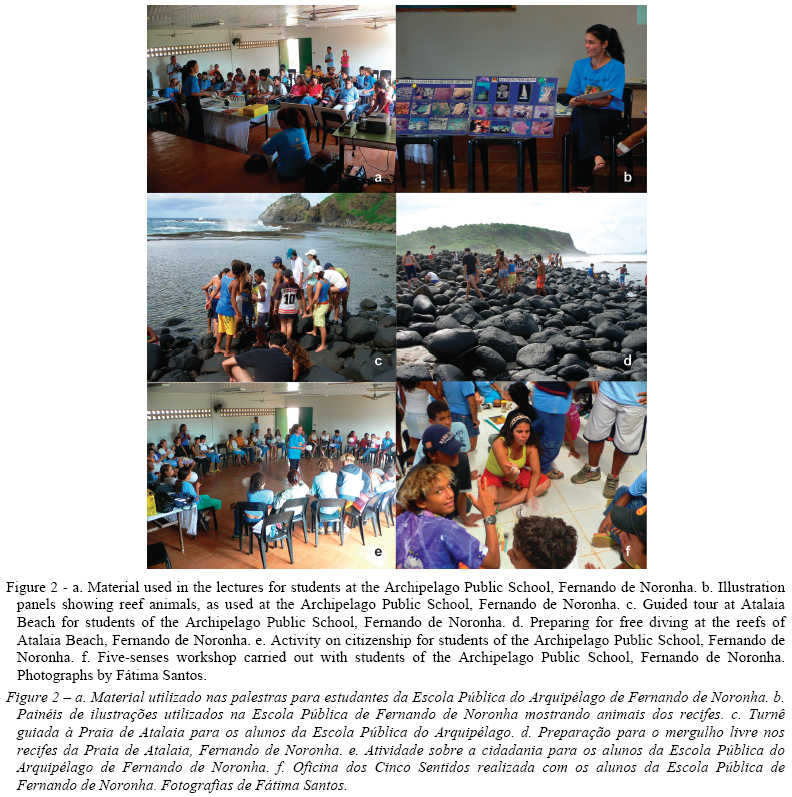
<body><![CDATA[<p><b>2.1. Environmental Awareness Strategies</b></p>     <p>The educational activities included videos, photograph presentations and the display of preserved specimens and/or skeletons of corals and other components of the reef fauna. Such materials were exhibited and also used in talks by the professors from the Federal Rural University of Pernambuco (UFRPE) and some local monitors who participated in the project. Field trips involving group dynamics and guided tours were carried out <a href="#2">2</a><a name="top2"></a>, including diving in the local reef environments (<a href="/img/revistas/rgci/v14n4/14n4a05f2.jpg">Figure 2a-f</a>)  <a href="#3">3</a><a name="top3"></a>.  Although teachers did not participate actively, they were present and followed the educational activities.</p>     
<p>In order to create a public and permanent visitation area and to promote continuous construction and dissemination of knowledge, the Reef Environment Museum (Museu do Ambiente Recifal – MAR) was installed inside the school. The material used included posters and photographs of Fernando de Noronha's reef environment, as well as preserved specimens of the reef fauna and flora. The museum was opened by the project team on June 10th, 2005, with the presence of local authorities and the school community.</p>     <p><b>2.2. Data sampling</b></p>     <p>A questionnaire completed by the archipelago's school students included 13 questions. The first five provided a profile of the students (age, gender, grade and time living on the island). The eight remaining questions were open-ended and evaluated the progress of the construction of the referential concepts while inquiring about corals and reefs and their importance; environmental conservation; environmental education; and  citizenship awareness. It was also asked that the students list the marine animals they knew inhabited the archipelago’s waters.</p>     <p>The questionnaires were applied three times over the 2005 school year (in February, March and June). The first happened before the educational interventions and diagnosed the students' existing perceptions and know edge about the referential concepts. The other two questionnaires were applied after the interventions and served to evaluate changes in these concepts after the educational activities.</p>     <p>The first interventions took place between February 28th and March 7th, 2005,    and included lectures, workshops, group dynamics, guided tours, diving and observation    of fauna and flora. The second intervention took place between June 6th and    10th and included similar activities<a name="top4"></a><a href="#4">4</a>.</p>     <p>The group who filled in the questionaire before any intervention was made up of 30 students from the (approximately 10% of the total student population) – these being from 5th through 8th grades. The sex ratio was approximately the same (52% male and 48%  female). Age ranged between 12 and 18. Students had lived between one and 17 years on the island – an average of 12.2 years (half had lived there between 12 and 13 years). After the first intervention, a total of 38 students – 50% male and 50% female, aged 10 to 15 – answered the questionnaire; these students had lived an average of eight years on the island. The results of the third questionnaire will not be considered in the analysis, as explained in the next section. The majority of the students that carried out the educational activities and responded to the questionnaires were the same throughout the project.</p>     <p><b>2.3. Questionnaire Evaluation</b></p>     <p>When examining the responses we focused on the knowledge building process in order to analyze students’ cognitive stage in relation to each concept in question. In this manner, it was possible to identify which concepts were under-developed (when incomplete answers were provided), which were not developed at all (when the answers were very far from the reference concept) and which were fully developed (when answers satisfactorily covered the main elements of the reference concept) (Vasconcelos et al., 2008).</p>     ]]></body>
<body><![CDATA[<p>These criteria were based on the evaluation system and terminology adopted by the Department of Education of the State of Pernambuco at the time, to which the island school is bound:</p> <ul>     <li>a. Constructed (C) – complete or almost complete answers, which include the main elements of the referential concepts;</li>     <li>b. Under construction (UC) – partial answers, lacking important elements of the referential concept;</li>     <li>c. Not constructed (NC) – questions left unanswered or completely incorrect which do not include any of the elements of the referential concepts.</li>     </ul>     <p>When the third questionnaire was distributed, the project team observed that one of the teachers openly told students to rush through the questionnaire in order for class to continue, a fact that undoubtedly distorted these  results. Thus, in our analysis we will only consider the results of the first and second questionnaires.</p>     <p>&nbsp;</p>     <p><b>3. Results</b></p>     <p>Although this was not used as part of the evaluation, it is important to mention that students easily located and identified several organisms during the guided tours to the local beaches, such as corals, mollusks, shrimp, polychaetes, fish, starfish, sea urchins, algae, etc. They also showed that they had understood the activities carried out by enthusiastically pointing out movement, structures and relationships between these organisms.</p>     <p>&nbsp;</p>     ]]></body>
<body><![CDATA[<p><a href="/img/revistas/rgci/v14n4/14n4a05t1.jpg" target="_blank">Table 1</a></p>     
<p>&nbsp;</p>     <p>Students paradoxically fared worse in the third questionnaire, even though at that point they had received more information and undergone both theoretical and practical activities both in the classroom and in the field. As described previously, in this case the project team observed that one of the teachers openly told students to rush through the questionnaire in order for class to continue, a fact that undoubtedly distorted these results. The way teachers and staff treated the project might also have negatively affected the results by giving students the wrong idea that reef conservation is not that important.</p>     <p>In relation to the number of marine animals known before the interventions, 40% of students cited more than seven animals (thus their knowledge was considered to be constructed). The average number of animals cited amongst all students was seven, when considering the entire group. Of the 207 citations, the animals most mentioned were dolphins (13%), sharks (12%), turtles (8%), and moray eels (8%). After the first intervention, again, 40% of the students cited more than seven animals, but the general average number cited rose to eight. Out of a total of 144 citations, the animals most mentioned were sharks, fish, and rays (9% each), and corals, turtles, and dolphins (8% each).</p>     <p>The knowledge on corals and reefs was considered not constructed for 63% of the students before the first intervention. Among the remaining 37% (who showed knowledge under construction) responses for corals were limited to concepts such as “fragile live beings” and “barriers to contain the ocean”, or “home to several marine organisms”. After this first intervention the rate of responses with knowledge considered to be under construction rose to 74%, with respect to the same content as that used before the intervention. Overall, most students had trouble distinguishing the terms “reef” and “coral”, which were often used interchangeably, even after the two interventions. Some considered reefs and corals a physical threat to surfers and tourists, while others saw them as ornaments that “should be softer so that tourists and surfers could take better advantage of them”. Nevertheless, some students clearly absorbed new concepts and complemented their answers by citing coral symbiosis with zooxanthellae, for instance.</p>     <p>Regarding the importance of corals, before any intervention, most students (90%) cited solely the generation of income from tourist visitation. Only 10% listed these organisms' ecological importance. However, after the first intervention 50% of the responses mentioned at  least one kind of importance unrelated to economic profit, such as food and shelter for other marine organisms (knowledge under construction). Only 2% cited more than one kind of ecological importance, which was considered to be constructed knowledge.</p>     <p>Eighty-three percent of the students who answered the initial questionnaires did not see any possible benefits brought about by reefs (with the exception of the financial benefit of attracting tourists cited in some responses). As mentioned previously, many considered reefs to be an obstacle for surfers, with no advantages whatsoever. The remaining 17% (whose knowledge was considered to be under construction) cited only one service or benefit aside from profit, either as protection against the sea or as a source of food for the community. After the first intervention the number of responses with non-constructed knowledge decreased to 66%, which now included profits for the diving industry. Only 3% of the students had noticed at least one type of change in the marine environment over the past few years. Most (77%) did not answer or did not believe that the environment was being impacted in any way, which also included answers such as “corals and reefs are always being preserved in order to decorate the ocean”. Twenty percent, however, demonstrated knowledge under construction by citing general problems they believed to be affecting the local marine ecosystems, such as pollution (as that recorded by Sul et al., 2009, for instance), and species extinction (there are no records of recent extinctions in the archipelago). After the first intervention the rate of responses that showed non-constructed knowledge decreased to 61%, yet out-of-place comments like “new species are appearing” or “corals are reproducing themselves more and more lately” were still common.</p>     <p>Before any intervention, most students (73%) presented non-constructed knowledge about environmental education; the remaining students (27%) had a partial concept that “we must bring about awareness in order to preserve the environment”. However, after the first intervention 8% of the responses showed constructed knowledge, while 39% showed knowledge under construction (which included responses such as “not stepping on corals” and “not removing corals from the sea”) and 53% showed non-constructed knowledge.</p>     <p>Before the interventions, only 20% of students said they would agree to participate in an educational project to preserve coral reefs and reef environments. The other 80% either answered incoherently or openly said they would not participate (classified as non-constructed knowledge). After the first intervention, 10% thought it was important to participate (constructed knowledge) and 24% said they would participate but also showed they did not really understand the practical meaning of such participation.</p>     <p>Regarding the concept of citizenship, 83% of the students initially demonstrated non-constructed knowledge and responded incoherently. Even after the first intervention, 47% still showed non-constructed knowledge, with answers such as “a way for teachers to evaluate students”.</p>     ]]></body>
<body><![CDATA[<p>&nbsp;</p>     <p><b>4. Discussion</b></p>     <p>This project was received with enthusiasm by students and parents, who openly demonstrated their appreciation in learning more about their island’s marine ecosystems and organisms. However, it did not receive the same support from the school staff. One clear example was the Reef Environments Museum. Created with the participation of the students to be a lasting educational tool inside the school, it was deliberately removed by staff before the end of the project. Unfortunately, coral reef museums directed at children are rare. In fact, Goreau & Goreau (2007) have stated that the Museo Sang Bata Sa Negros, in the Philippines, is believed to be the only children’s coral reef museum in the world.</p>     <p>Parlo & Butler (2007) in an evaluation of partipants of a coastal marine teacher workshop in the state of Georgia (USA), revealed that teachers found it difficult to apply what was learned in the workshop because they felt compelled to follow the standard curriculum. Additionally, teachers thought it was important to focus on preparation for standardized tests.</p>     <p>As mentioned previously, students paradoxically fared worse in the third questionnaire despite the fact that at that point they had received more information and undergone more.</p>     <p>A previous study carried out in 2002 at the same school also investigated students' conservation attitudes and knowledge of corals and reefs. Steiner et al. (2004) studied the environmental perception of students from grades 6-9 and found different results. In that study, almost half of the students interviewed gave correct definitions of corals, while roughly one-quarter gave incorrect or partially correct answers; most also cited the importance of corals in the food chain. Regarding reefs, most students defined these structures as groups of corals.</p>     <p>Similarly, a study that also involved educational interventions and before and after questionnaires filled in by the students, obtained excellent results in changing the attitudes of 6th and 9th grade students of six schools located in the Metropolitan Area of Recife, also in the state of Pernambuco (Vasconcelos et al., 2008). Additionally, the number of animals cited by the students of this study before the interventions was higher (40) than that found by Steiner et al. (2004), where only 21 organisms were listed. Both studies found similar difficulty among students regarding the distinction between  the concepts of reefs and corals. Oigman-Pszczol et al. (2007) encountered confusion in conceptual knowledge as well in the difference between algae and corals in a coastal tourist town in southeastern Brazil.</p>     <p>In Fernando de Noronha, despite the fact that many students had been born or lived on the island for several years, most of the changes observed in the marine environment were not specific to the island, but rather general responses such as “species extinction” or “marine pollution”.</p>     <p>The fact that most students related the importance of reef environments and corals to profit is not surprising, as tourism is probably the main source of income for many of their parents. Nevertheless, the low rate of responses that included references to the ecological or intrinsic importance of the reefs is worrysome. These results were similar to those of Rodriguez-Mart&iacute;nez & Ortiz (1999), who in a study with primary and secondary students of Quintana Roo, a coastal state in southeastern Mexico, found that the children had little awareness of coral reefs and their importance.</p>     <p>Likewise, the concept of citizenship was not familiar among the students in Fernando de Noronha and had probably never been mentioned in school, as was clear in students' accounts during the interventions and in the results even after these activities.</p>     ]]></body>
<body><![CDATA[<p>Kaza (1995) has stated that “While traditional education programs are often aimed at school children, in its first years a marine protected area may need to direct its programs towards local leaders, government officials or influential community members”. Unfortunately there was a complete lack of interest in the project by key  community leaders. . Future educational projects in the area might benefit if accompanied by professional development programs directed at the school teachers, such as the one described by Rivera et al. (2013).</p>     <p>Aside from its initial intention, this study also showed that support from indirect actors (teachers, parents, etc.) is just as important as the participation of the targeted group itself (see also Sauv&eacute;, 2005). With the benefit of hindsight, our project may have been more effective if an initial phase had been dedicated exclusively to school teachers and staff.</p>     <p>Additionally, it is important that future programs reflect not only what is thought to be right by external perceptions (such as those of researchers), but also that of the local community. Projects that inform the social and environmental importance of the island’s ecosystems but also reflect how locals value reef environments will certainly make a difference in the long run.</p>     <p><b>Acknowledgements</b></p>     <p>Many thanks to Dr. Simon Foale (James Cook University) and Dr. Terry Done (AIMS), as well as three anonymous reviewers, for their important comments on the manuscript. The authors also are grateful to the Secretaria de Educa&ccedil;&atilde;o Superior do Minist&eacute;rio da Educa&ccedil;&atilde;o (SESu/MEC), and the Conselho Nacional de Desenvolvimento Cient&iacute;fico e Tecnol&oacute;gico (CNPq) for the financial support; and the Administra&ccedil;&atilde;o do Distrito Estadual do Arquip&eacute;lago de Fernando de Noronha, the Instituto Brasileiro do Meio Ambiente e dos Recursos Naturais Renov&aacute;veis (IBAMA), the Associa&ccedil;&atilde;o de Condutores de Informa&ccedil;&otilde;es Tur&iacute;sticas (ACITUR), and the Escola Arquip&eacute;lago for the logistical support. They also wish to thank the valuable contribution of the district councilors Mr. Carlos Flor and Mr. Ren&ecirc; Jer&ocirc;nimo, as well as all students and parents for their enthusiastic participation in the project. The first author also wishes to thank CNPq for the research productivity fellowship received during the period.</p>     <p>&nbsp;</p>     <p>&nbsp;</p>     <p><b>Refer&ecirc;ncias bibliogr&aacute;ficas</b></p>     <!-- ref --><p>Amaral, F.M.D.; Ramos, C.A.C.; Le&atilde;o, Z.M.A.N.; Kikuchi, R.K.P.; Lima, K.K.M.; Longo, L.L.; Cordeiro, R.T.S.; Lira, S.M.A.; Vasconcelos, S.L. (2009) - Checklist and morphometry of ben- thic cnidarians from the Fernando de Noronha Archipelago, Brazil. Cahiers de Biologie Marine (ISSN: 2262-3094). 50(3):277-290, Station Biologique de Roscoff, Roscoff. France. Available on-line at <a href="http://www.sb-roscoff.fr/cbm/pdf/2141350703" target="_blank">http://www.sb-roscoff.fr/cbm/pdf/2141350703</a>&nbsp;&nbsp;&nbsp;&nbsp;&nbsp;&nbsp;&nbsp;&nbsp;[&#160;<a href="javascript:void(0);" onclick="javascript: window.open('/scielo.php?script=sci_nlinks&ref=000091&pid=S1646-8872201400040000500001&lng=','','width=640,height=500,resizable=yes,scrollbars=1,menubar=yes,');">Links</a>&#160;]<!-- end-ref --><!-- ref --><p>Ara&uacute;jo, L.F.; Lobo Filho, J.G. (2009) - An&aacute;lise psicossocial da viol&ecirc;ncia contra idosos. Psicologia: Reflex&atilde;o e Cr&iacute;tica, 22(1):153-160. DOI: <a href="http://dx.doi.org/10.1590/S0102-79722009000100020" target="_blank">10.1590/S0102-79722009000100020</a>&nbsp;    &nbsp;&nbsp;&nbsp;&nbsp;&nbsp;&nbsp;&nbsp;&nbsp;[&#160;<a href="javascript:void(0);" onclick="javascript: window.open('/scielo.php?script=sci_nlinks&ref=000092&pid=S1646-8872201400040000500002&lng=','','width=640,height=500,resizable=yes,scrollbars=1,menubar=yes,');">Links</a>&#160;]<!-- end-ref --></p>     <!-- ref --><p>Armstrong, H.G. (2005) - Environmental education in Tobago&#8217;s primary schools: a case study of coral reef education. Revista de Biolog&iacute;a Tropical (ISSN: 0034-7744), 53(1):229-238, Uni- versidad de Costa Rica, S&atilde;o Jos&eacute;, Costa Rica. Available on-line at <a href="http://www.redalyc.org/pdf/449/44920889024.pdf" target="_blank">http://www.redalyc.org/pdf/449/44920889024.pdf</a>&nbsp;    &nbsp;&nbsp;&nbsp;&nbsp;&nbsp;&nbsp;&nbsp;&nbsp;[&#160;<a href="javascript:void(0);" onclick="javascript: window.open('/scielo.php?script=sci_nlinks&ref=000094&pid=S1646-8872201400040000500003&lng=','','width=640,height=500,resizable=yes,scrollbars=1,menubar=yes,');">Links</a>&#160;]<!-- end-ref --></p>     <!-- ref --><p>Ballantyne, R.; Packer, J. (2002) - Nature-based Excursions: School Students&#8217; Perceptions of Learning in Natural Environments. In- ternational Research in Geographical and Environmental Edu- cation, 11(3):218-236. DOI: <a href="http://dx.doi.org/10.1080/10382040208667488" target="_blank">10.1080/10382040208667488</a>.    &nbsp;&nbsp;&nbsp;&nbsp;&nbsp;&nbsp;&nbsp;&nbsp;[&#160;<a href="javascript:void(0);" onclick="javascript: window.open('/scielo.php?script=sci_nlinks&ref=000096&pid=S1646-8872201400040000500004&lng=','','width=640,height=500,resizable=yes,scrollbars=1,menubar=yes,');">Links</a>&#160;]<!-- end-ref --></p>     <!-- ref --><p>Behrendt, M.; Franklin, T. (2014) - A review of research on school field trips and their value in education. International Journal of Environmental &amp; Science Education, 9(3):235-245. DOI: <a href="http://dx.doi.org/10.12973/ijese.2014.213a" target="_blank">10.12973/ijese.2014.    &nbsp;&nbsp;&nbsp;&nbsp;&nbsp;&nbsp;&nbsp;&nbsp;[&#160;<a href="javascript:void(0);" onclick="javascript: window.open('/scielo.php?script=sci_nlinks&ref=000098&pid=S1646-8872201400040000500005&lng=','','width=640,height=500,resizable=yes,scrollbars=1,menubar=yes,');">Links</a>&#160;]<!-- end-ref -->213a</a>.</p>     <!-- ref --><p>Bhandari, B.B.; Abe, O. (2000) - Environmental Education in the Asia-Pacific Region: Some Problems and Prospects. Interna- tional Review for Environmental Strategies (ISSN: 1345-759), 1(1):57-77, Institute for Global Environmental Strategies, To- kyo, Japan. Available on-line at <a href="http//pub.iges.or.jp/modules/envirolib/upload/405/attach/057_077_bhandari_abe.pdf" target="_blank">http//pub.iges.or.jp/modules/ envirolib/upload/405/attach/057_077_bhandari_abe.pdf</a>&nbsp;&nbsp;&nbsp;&nbsp;&nbsp;&nbsp;&nbsp;&nbsp;[&#160;<a href="javascript:void(0);" onclick="javascript: window.open('/scielo.php?script=sci_nlinks&ref=000100&pid=S1646-8872201400040000500006&lng=','','width=640,height=500,resizable=yes,scrollbars=1,menubar=yes,');">Links</a>&#160;]<!-- end-ref --><!-- ref --><p>Bizerril, M.X.A.; Faria, D.S. (2001) - Percep&ccedil;&atilde;o de professores sobre a educa&ccedil;&atilde;o ambiental no ensino fundamental. Revista Brasileira de Estudos Pedag&oacute;gicos (ISSN: 2176-6681), 82(200/201/202):57-69, Inep, Bras&iacute;lia, DF, Brazil. Available on- line at <a href="http://rbep.inep.gov.br/index.php/RBEP/article/view/414" target="_blank">http://rbep.inep.gov.br/index.php/RBEP/article/view/414</a>&nbsp;&nbsp;&nbsp;&nbsp;&nbsp;&nbsp;&nbsp;&nbsp;[&#160;<a href="javascript:void(0);" onclick="javascript: window.open('/scielo.php?script=sci_nlinks&ref=000101&pid=S1646-8872201400040000500007&lng=','','width=640,height=500,resizable=yes,scrollbars=1,menubar=yes,');">Links</a>&#160;]<!-- end-ref --><!-- ref --><p>Bryant, D.; Burke, L.; Mcmanus, J; Spalding, M. (1998) - Reefs at Risk: A Map-Based Indicator of Threats to the World&acute;s Coral Reefs. World Resources Institute (ISSN: 0258-6150), 60p., Washington, D.C., U.S.A. Available on-line at <a href="http://coralreef.noaa.gov/aboutcrcp/strategy/reprioritization/wgroups/resources/climate/resources/reefsatrisk.pdf" target="_blank">http://coralreef. noaa.gov/aboutcrcp/strategy/reprioritization/wgroups/resources/climate/resources/reefsatrisk.pdf</a>&nbsp;&nbsp;&nbsp;&nbsp;&nbsp;&nbsp;&nbsp;&nbsp;[&#160;<a href="javascript:void(0);" onclick="javascript: window.open('/scielo.php?script=sci_nlinks&ref=000102&pid=S1646-8872201400040000500008&lng=','','width=640,height=500,resizable=yes,scrollbars=1,menubar=yes,');">Links</a>&#160;]<!-- end-ref --><!-- ref --><p>Calado, H.; Fonseca, C.; Verg&iacute;lio, M.; Costa, A.; Moniz, F.; Gil, A.; Dias, J.A. (2014a) - Small Islands Conservation and Protected Areas. Revista Gest&atilde;o Costeira Integrada / Journal of Inte- grated Coastal Zone Management, 14(2):167-174. DOI: <a href="http://dx.doi.org/10.5894/rgci523" target="_blank">10.5894/rgci523</a>&nbsp;&nbsp;&nbsp;&nbsp;&nbsp;&nbsp;&nbsp;&nbsp;[&#160;<a href="javascript:void(0);" onclick="javascript: window.open('/scielo.php?script=sci_nlinks&ref=000103&pid=S1646-8872201400040000500009&lng=','','width=640,height=500,resizable=yes,scrollbars=1,menubar=yes,');">Links</a>&#160;]<!-- end-ref --><!-- ref --><p>Calado, H.; Verg&iacute;lio, M.; Fonseca, C.; Gil, A.; Moniz, F.; Silva, S.F.; Moreira, M.; Bragagnolo, C.; Silva, C.; Pereira, M. (2014b) - Developing a Planning and Management System for Protected Areas on Small Islands (The Azores Archipelago, Por- tugal): the SMARTPARKS Project. Revista Gest&atilde;o Costeira Integrada / Journal of Integrated Coastal Zone Management, 14(2):335-344. DOI: <a href="http://dx.doi.org/10.5894/rgci496" target="_blank">10.5894/rgci496</a>&nbsp;&nbsp;&nbsp;&nbsp;&nbsp;&nbsp;&nbsp;&nbsp;[&#160;<a href="javascript:void(0);" onclick="javascript: window.open('/scielo.php?script=sci_nlinks&ref=000104&pid=S1646-8872201400040000500010&lng=','','width=640,height=500,resizable=yes,scrollbars=1,menubar=yes,');">Links</a>&#160;]<!-- end-ref --><!-- ref --><p>Castro, J.W.A. (2010) - Ilhas oce&acirc;nicas da Trindade e Fernando de Noronha, Brasil: Uma vis&atilde;o da Geologia Ambiental. Revista Gest&atilde;o Costeira Integrada / Journal of Integrated Coastal Zone Management, 10(3):303-319. DOI: <a href="http://dx.doi.org/10.5894/rgci170" target="_blank">10.5894/rgci170</a>.    &nbsp;&nbsp;&nbsp;&nbsp;&nbsp;&nbsp;&nbsp;&nbsp;[&#160;<a href="javascript:void(0);" onclick="javascript: window.open('/scielo.php?script=sci_nlinks&ref=000105&pid=S1646-8872201400040000500011&lng=','','width=640,height=500,resizable=yes,scrollbars=1,menubar=yes,');">Links</a>&#160;]<!-- end-ref --></p>     <!-- ref --><p>Chou, L.M.; Goh, B.P.L. (1998) - Singapore coral reefs &#8211; balancing development and conservation. In: B. Morton (ed.), Proceedings of the Third International Conference on the Marine Biology of the South China Sea, pp.355-368, Hong Kong University Press, Hong Kong, China. ISBN: 978-9622094611.    &nbsp;&nbsp;&nbsp;&nbsp;&nbsp;&nbsp;&nbsp;&nbsp;[&#160;<a href="javascript:void(0);" onclick="javascript: window.open('/scielo.php?script=sci_nlinks&ref=000107&pid=S1646-8872201400040000500012&lng=','','width=640,height=500,resizable=yes,scrollbars=1,menubar=yes,');">Links</a>&#160;]<!-- end-ref --></p>     <!-- ref --><p>Dal Pian, M.C. (1992) - O Ensino de Ci&ecirc;ncias e Cidadania. Em Aberto (ISSN 0104-1037), 11(55):49-55, Inep, Bras&iacute;lia, Distrito Federal, Brazil. Available on-line at <a href="http://www.livrosgratis.com.br/arquivos_livros/me000628.pdf#page=50" target="_blank">http://www.livrosgratis.com.br/arquivos_livros/me000628.pdf#page=50</a>&nbsp;&nbsp;&nbsp;&nbsp;&nbsp;&nbsp;&nbsp;&nbsp;[&#160;<a href="javascript:void(0);" onclick="javascript: window.open('/scielo.php?script=sci_nlinks&ref=000109&pid=S1646-8872201400040000500013&lng=','','width=640,height=500,resizable=yes,scrollbars=1,menubar=yes,');">Links</a>&#160;]<!-- end-ref --><!-- ref --><p>Filizola, P.R.B.; Nascimento, A.E.; Sougey, E.B.; Meira-Lima, I.V. (2008) - Alcoolismo no Nordeste do Brasil &#8211; preval&ecirc;ncia e perfil sociodemogr&aacute;fico dos afetados. Jornal Brasileiro de Psiquiatria (ISSN 0047-2085), 57(4):227-232, Universidade Federal do Rio de Janeiro, Rio de Janeiro, RJ, Brazil. Available on-line at <a href="http://www.scielo.br/pdf/jbpsiq/v57n4/a01v57n4.pdf" target="_blank">http://www.scielo.br/pdf/jbpsiq/v57n4/a01v57n4.pdf</a>&nbsp;&nbsp;&nbsp;&nbsp;&nbsp;&nbsp;&nbsp;&nbsp;[&#160;<a href="javascript:void(0);" onclick="javascript: window.open('/scielo.php?script=sci_nlinks&ref=000110&pid=S1646-8872201400040000500014&lng=','','width=640,height=500,resizable=yes,scrollbars=1,menubar=yes,');">Links</a>&#160;]<!-- end-ref --><!-- ref --><p>Freire, P. (2002) - Pedagogia da Autonomia. 54p., Paz e Terra, S&atilde;o Paulo, SP, Brazil. Available on-line at <a href="http://www2.uesb.br/pedh/wp-content/uploads/2014/02/Pedagogia-da-Autonomia.pdf" target="_blank">http://www2.uesb.br/pedh/wp-content/uploads/2014/02/Pedagogia-da-Autonomia.pdf</a>&nbsp;&nbsp;&nbsp;&nbsp;&nbsp;&nbsp;&nbsp;&nbsp;[&#160;<a href="javascript:void(0);" onclick="javascript: window.open('/scielo.php?script=sci_nlinks&ref=000111&pid=S1646-8872201400040000500015&lng=','','width=640,height=500,resizable=yes,scrollbars=1,menubar=yes,');">Links</a>&#160;]<!-- end-ref --><!-- ref --><p>Freire, P. (2013) - Educa&ccedil;&atilde;o e mudan&ccedil;a. 46p., Paz e Terra, Rio de Janeiro, RJ, Brazil. ISBN 978-8577532209. Available on-line at <a href="http://www.hdbr.org.br/data/site/uploads/arquivos/Paulo%20Freire%20-%20Educação%20e%20Mudança.pdf" target="_blank">http://www.hdbr.org.br/data/site/uploads/arquivos/Paulo%20Freire%20-%20Educa&ccedil;&atilde;o%20e%20Mudan&ccedil;a.pdf</a>&nbsp;    &nbsp;&nbsp;&nbsp;&nbsp;&nbsp;&nbsp;&nbsp;&nbsp;[&#160;<a href="javascript:void(0);" onclick="javascript: window.open('/scielo.php?script=sci_nlinks&ref=000112&pid=S1646-8872201400040000500016&lng=','','width=640,height=500,resizable=yes,scrollbars=1,menubar=yes,');">Links</a>&#160;]<!-- end-ref --></p>     <!-- ref --><p>FUNATURA (1990) - Plano de Manejo do Parque Nacional Marinho de Fernando de Noronha. 253p., Funda&ccedil;&atilde;o Pr&oacute;- Natureza (FUNATURA) / Instituto Brasileiro do Meio Ambiente e dos Recursos Naturais Renov&aacute;veis (IBAMA), Bras&iacute;lia, DF, Brasil. Available on-line at <a href="http://www.icmbio.gov.br/portal/images/stories/biodiversidade/_PARNA_MARINHA_DE_FERNANDO_DE_NORONHA.pdf" target="_blank">http://www.icmbio.gov.br/portal/images/stories/biodiversidade/_PARNA_MARINHA_DE_FERNANDO_ DE_NORONHA.pdf</a>&nbsp;&nbsp;&nbsp;&nbsp;&nbsp;&nbsp;&nbsp;&nbsp;[&#160;<a href="javascript:void(0);" onclick="javascript: window.open('/scielo.php?script=sci_nlinks&ref=000114&pid=S1646-8872201400040000500017&lng=','','width=640,height=500,resizable=yes,scrollbars=1,menubar=yes,');">Links</a>&#160;]<!-- end-ref --><p>Goreau, M.; Goreau, T.J. (2007) - Children&#8217;s Coral Reef Education Programs in Sagay: Progress Report to the Sagay Marine Re- serve, the Museo Sang Bata Sa Negros, the Snorkel Bob Foun- dation &amp; the Global Coral Reef Alliance. Global Coral Reef Al- liance, Cambridge, MA. U.S.A.. Available on-line at <a href="http://www.snorkelbob.com/Childrens%20Coral%20Reef%20Education%20Programs%20in%20Sagay.pdf" target="_blank">http:// www.snorkelbob.com/Childrens%20Coral%20Reef%20Education%20Programs%20in%20Sagay.pdf</a>&nbsp;</p>     <!-- ref --><p>Goreau, M.; Goreau, T.J.; Solis, R. (2003) &#8211; Children's Environ- mental Education Program: Kuna Yala, Panama, Phase II. s.p., Global Coral Reef Alliance, Cambridge, MA, U.S.A.. Available on-line at <a href=" http://www.globalcoral.org/_oldgcra/Children's%20Environmental%20Education%20Program,%20Kuna%20Yala,%20Panama,%20Phase%20II.htm" target="_blank"> http://www.globalcoral.org/_oldgcra/Children's%20Environmental%20Education%20Program,%20Kuna%20Yala,%20Panama,%20Phase%20II.htm</a>&nbsp;&nbsp;&nbsp;&nbsp;&nbsp;&nbsp;&nbsp;&nbsp;[&#160;<a href="javascript:void(0);" onclick="javascript: window.open('/scielo.php?script=sci_nlinks&ref=000116&pid=S1646-8872201400040000500019&lng=','','width=640,height=500,resizable=yes,scrollbars=1,menubar=yes,');">Links</a>&#160;]<!-- end-ref --><!-- ref --><p>Howe, V. (2001) - Local community training and education in southern Tanzania &#8211; a case study. Marine Policy, 25(6):445- 455. DOI: <a href="http://dx.doi.org/10.1016/S0308-597X%2801%2900029-X" target="_blank">10.1016/S0308-597X(01)00029-X</a>&nbsp;&nbsp;&nbsp;&nbsp;&nbsp;&nbsp;&nbsp;&nbsp;[&#160;<a href="javascript:void(0);" onclick="javascript: window.open('/scielo.php?script=sci_nlinks&ref=000117&pid=S1646-8872201400040000500020&lng=','','width=640,height=500,resizable=yes,scrollbars=1,menubar=yes,');">Links</a>&#160;]<!-- end-ref --><!-- ref --><p>Kaza, S. (1995) - Marine education and interpretation. In: Susan Gubbay (ed.), Marine Protected Areas, pp.174-198. Springer Netherlands, Dordrecht, The Netherlands. ISBN: 978- 9401042345. DOI: <a href="http://dx.doi.org/10.1007/978-94-011-0527-9_9" target="_blank">10.1007/978-94-011-0527-9_9</a>.    &nbsp;&nbsp;&nbsp;&nbsp;&nbsp;&nbsp;&nbsp;&nbsp;[&#160;<a href="javascript:void(0);" onclick="javascript: window.open('/scielo.php?script=sci_nlinks&ref=000118&pid=S1646-8872201400040000500021&lng=','','width=640,height=500,resizable=yes,scrollbars=1,menubar=yes,');">Links</a>&#160;]<!-- end-ref -->&nbsp;</p>     <!-- ref --><p>Laborel, J.L. (1969) - Les peuplements de madreporaires des c&ocirc;tes tropicales du Br&eacute;sil. Annales de l&acute;Universit&eacute; d&#8217;Abidjan, S&eacute;rie E, II(3):39-47, Abidjan, Ivory Coast.    &nbsp;&nbsp;&nbsp;&nbsp;&nbsp;&nbsp;&nbsp;&nbsp;[&#160;<a href="javascript:void(0);" onclick="javascript: window.open('/scielo.php?script=sci_nlinks&ref=000120&pid=S1646-8872201400040000500022&lng=','','width=640,height=500,resizable=yes,scrollbars=1,menubar=yes,');">Links</a>&#160;]<!-- end-ref -->&nbsp;</p>     <!-- ref --><p>Monteiro Filho M, Borges J: (2003) - Sombras no para&iacute;so: Pousadas domiciliares de Fernando de Noronha lutam para manter espa&ccedil;o. Revista Problemas Brasileiros (ISSN: 0101-4269), 357 (May- June): 16-18. SESC, S&atilde;o Paulo, S&atilde;o Paulo, Brazil. Available on- line at <a href="http://www.sescsp.org.br/online/artigo/1860_SOMBRAS%20+NO+PARAISO" target="_blank">http://www.sescsp.org.br/online/artigo/1860_SOMBRAS +NO+PARAISO</a>&nbsp;    &nbsp;&nbsp;&nbsp;&nbsp;&nbsp;&nbsp;&nbsp;&nbsp;[&#160;<a href="javascript:void(0);" onclick="javascript: window.open('/scielo.php?script=sci_nlinks&ref=000122&pid=S1646-8872201400040000500023&lng=','','width=640,height=500,resizable=yes,scrollbars=1,menubar=yes,');">Links</a>&#160;]<!-- end-ref --></p>     <!-- ref --><p>Morag, O.; Tal, T.; Rotem-Keren, T. (2013) - Long-term educa- tional programs in nature-parks: Characteristics, outcomes and challenges. International Journal of Environmental &amp; Science Education, 8(3):427-449. DOI: <a href="http://dx.doi.org/10.12973/ijese.2013.213a" target="_blank">10.12973/ijese.2013.213a</a>.    &nbsp;&nbsp;&nbsp;&nbsp;&nbsp;&nbsp;&nbsp;&nbsp;[&#160;<a href="javascript:void(0);" onclick="javascript: window.open('/scielo.php?script=sci_nlinks&ref=000124&pid=S1646-8872201400040000500024&lng=','','width=640,height=500,resizable=yes,scrollbars=1,menubar=yes,');">Links</a>&#160;]<!-- end-ref -->&nbsp;</p>     <!-- ref --><p>Motta, M.; Silva, V.L.; Montenegro, A.A.A.; Montenegro, S.M.G.L.; Correa, M.M. (1998) - Avalia&ccedil;&atilde;o da qualidade da &aacute;gua dos mananciais na ilha de Fernando de Noronha. Revista Ambiente e &Aacute;gua, 3(3):114-127. DOI:<a href="http://dx.doi.org/10.4136/ambi-agua.66" target="_blank">10.4136/ambi-agua.66</a>.    &nbsp;&nbsp;&nbsp;&nbsp;&nbsp;&nbsp;&nbsp;&nbsp;[&#160;<a href="javascript:void(0);" onclick="javascript: window.open('/scielo.php?script=sci_nlinks&ref=000126&pid=S1646-8872201400040000500025&lng=','','width=640,height=500,resizable=yes,scrollbars=1,menubar=yes,');">Links</a>&#160;]<!-- end-ref -->&nbsp;</p>     <!-- ref --><p>Oigman-Pszczol, S.S.; Oliveira, A.E.S.; Creed, J.C. (2007) - Percep- tions of coral in a coastal tourist town in Brazil. Coral Reefs, 26(3):667-670. DOI: <a href="http://dx.doi.org/10.1007/s00338-007-0239-5" target="_blank">10.1007/s00338-007-0239-5</a>&nbsp;    &nbsp;&nbsp;&nbsp;&nbsp;&nbsp;&nbsp;&nbsp;&nbsp;[&#160;<a href="javascript:void(0);" onclick="javascript: window.open('/scielo.php?script=sci_nlinks&ref=000128&pid=S1646-8872201400040000500026&lng=','','width=640,height=500,resizable=yes,scrollbars=1,menubar=yes,');">Links</a>&#160;]<!-- end-ref --></p>     <!-- ref --><p>Parlo, A.T.; Butler, M.B. (2007) - Impediments to Environmental Education Instruction in the Classroom: A Post-Workshop In- quiry. Journal of Environmental Science and Education (ISSN: 1306-3065), 2(1):32-37, International Society of Educational Research (iSER), Turkey. Available on-line at <a href="http://www.ijese.com/IJESE_V3_N1_Parlo&Butler.pdf" target="_blank">http://www.ijese.com/IJESE_V3_N1_Parlo&amp;Butler.pdf</a>&nbsp;    &nbsp;&nbsp;&nbsp;&nbsp;&nbsp;&nbsp;&nbsp;&nbsp;[&#160;<a href="javascript:void(0);" onclick="javascript: window.open('/scielo.php?script=sci_nlinks&ref=000130&pid=S1646-8872201400040000500027&lng=','','width=640,height=500,resizable=yes,scrollbars=1,menubar=yes,');">Links</a>&#160;]<!-- end-ref --></p>     <p>Presid&ecirc;ncia da Rep&uacute;blica (1999) - Lei 9.795, de 27 de abril de 1999. Disp&otilde;e sobre a educa&ccedil;&atilde;o ambiental, institui a Pol&iacute;tica Nacional de Educa&ccedil;&atilde;o Ambiental e d&aacute; outras provid&ecirc;ncias. publicado no D.O.U. de 28.4.1999, Bras&iacute;lia, DF, Brazil. Available on-line at <a href="http://www.planalto.gov.br/ccivil_03/leis/l9795.htm" target="_blank">http://www.planalto.gov.br/ccivil_03/leis/l9795.htm</a>&nbsp;</p>     ]]></body>
<body><![CDATA[<!-- ref --><p>Rivera, M.A.J.; Manning, M.M.; Krup, D.A. (2013) - A Unique Marine and Environmental Science Program for High School Teachers in Hawai&#8217;i: Professional Development, Teacher Con- fidence, and Lessons Learned. International Journal of Envi- ronmental &amp; Science Education, 8(2):217-239. DOI: <a href="http://dx.doi.org/10.12973/ijese.2013.202a" target="_blank">10.12973/ijese.2013.202a</a>.    &nbsp;&nbsp;&nbsp;&nbsp;&nbsp;&nbsp;&nbsp;&nbsp;[&#160;<a href="javascript:void(0);" onclick="javascript: window.open('/scielo.php?script=sci_nlinks&ref=000133&pid=S1646-8872201400040000500028&lng=','','width=640,height=500,resizable=yes,scrollbars=1,menubar=yes,');">Links</a>&#160;]<!-- end-ref --></p>    <!-- ref --><p>Rodriguez-Mart&iacute;nez, R.; Ortiz, L.M. (1999) - Coral reef education in schools of Quintana Roo, Mexico. Ocean &amp; Coastal Man- agement, 42(12):1061-1068. DOI: <a href="http://dx.doi.org/10.1016/S0964-5691(99)00061-7" target="_blank">10.1016/S0964-5691(99)00061-7</a>&nbsp;&nbsp;&nbsp;&nbsp;&nbsp;&nbsp;&nbsp;&nbsp;[&#160;<a href="javascript:void(0);" onclick="javascript: window.open('/scielo.php?script=sci_nlinks&ref=000135&pid=S1646-8872201400040000500029&lng=','','width=640,height=500,resizable=yes,scrollbars=1,menubar=yes,');">Links</a>&#160;]<!-- end-ref --><!-- ref --><p>Sauv&eacute;, L. (2005) - Currents in Environmental Education: Mapping a Complex and Evolving Pedagogical Field. Canadian Journal of Environmental Education (ISSN 1205-5352), 10:11-37, EECOM / Lakehead University, Ontario, Canada. Available on- line at <a href="http://cjee.lakeheadu.ca/index.php/cjee/article/view/175/9" target="_blank">http://cjee.lakeheadu.ca/index.php/cjee/article/view/175/9</a>&nbsp;&nbsp;&nbsp;&nbsp;&nbsp;&nbsp;&nbsp;&nbsp;[&#160;<a href="javascript:void(0);" onclick="javascript: window.open('/scielo.php?script=sci_nlinks&ref=000136&pid=S1646-8872201400040000500030&lng=','','width=640,height=500,resizable=yes,scrollbars=1,menubar=yes,');">Links</a>&#160;]<!-- end-ref --><!-- ref --><p>Silva J&uacute;nior, J.M.; Gerling, C.; Venturi, E.; Ara&uacute;jo, L.L.; Silva, F.J.L. (2010) -&nbsp; Em F&eacute;rias Ecol&oacute;gicas: um programa de edu- ca&ccedil;&atilde;o ambiental marinha em Fernando de Noronha. In: Ale- xandre de Gusm&atilde;o Pedrini (org.), Educa&ccedil;&atilde;o ambiental marinha e costeira no Brasil, pp. 201-226, Editora da Universidade do Estado do Rio de Janeiro (EDUERJ), Rio de Janeiro, RJ, Brasil. ISBN: 978-8575111802.    &nbsp;&nbsp;&nbsp;&nbsp;&nbsp;&nbsp;&nbsp;&nbsp;[&#160;<a href="javascript:void(0);" onclick="javascript: window.open('/scielo.php?script=sci_nlinks&ref=000137&pid=S1646-8872201400040000500031&lng=','','width=640,height=500,resizable=yes,scrollbars=1,menubar=yes,');">Links</a>&#160;]<!-- end-ref -->&nbsp;</p>     <!-- ref --><p>Steele, A. (2011) - Beyond Contradiction: Exploring the work of secondary science teachers as they embed environmental educa- tion in curricula. International Journal of Environmental &amp; Sci- ence Education (ISSN 1306-3065), 6(1):1-22, International So- ciety of Educational Research (iSER), Turkey. Available on-line at <a href="http://www.ijese.com/IJESE_v6n1_Steele.pdf" target="_blank">http://www.ijese.com/IJESE_v6n1_Steele.pdf</a>&nbsp;&nbsp;&nbsp;&nbsp;&nbsp;&nbsp;&nbsp;&nbsp;[&#160;<a href="javascript:void(0);" onclick="javascript: window.open('/scielo.php?script=sci_nlinks&ref=000139&pid=S1646-8872201400040000500032&lng=','','width=640,height=500,resizable=yes,scrollbars=1,menubar=yes,');">Links</a>&#160;]<!-- end-ref --><!-- ref --><p>Steiner, A.Q.; Melo, K.V.; Tavares, S.; Amaral, F.D.; Barradas, J.I.; Santos, M.F.A.V. (2004) - Moradores e estudantes do Arqui- p&eacute;lago de Fernando de Noronha (Pernambuco/Brasil) e a per- cep&ccedil;&atilde;o do ambiente recifal. OLAM (ISSN 1982-7784), 4(1),394- 408, Rio Claro, S&atilde;o Paulo, Brazil.    &nbsp;&nbsp;&nbsp;&nbsp;&nbsp;&nbsp;&nbsp;&nbsp;[&#160;<a href="javascript:void(0);" onclick="javascript: window.open('/scielo.php?script=sci_nlinks&ref=000140&pid=S1646-8872201400040000500033&lng=','','width=640,height=500,resizable=yes,scrollbars=1,menubar=yes,');">Links</a>&#160;]<!-- end-ref -->&nbsp;</p>     <!-- ref --><p>Stepath, C.M. (2004) - Coral reef education and Australian high school students. Proceedings of the Marine Education Society of Australasia, n.p. (16p.). Available on-line at <a href="http://files.eric.ed.gov/fulltext/ED491455.pdf" target="_blank">http://files.eric.ed.gov/fulltext/ED491455.pdf</a>&nbsp;    &nbsp;&nbsp;&nbsp;&nbsp;&nbsp;&nbsp;&nbsp;&nbsp;[&#160;<a href="javascript:void(0);" onclick="javascript: window.open('/scielo.php?script=sci_nlinks&ref=000142&pid=S1646-8872201400040000500034&lng=','','width=640,height=500,resizable=yes,scrollbars=1,menubar=yes,');">Links</a>&#160;]<!-- end-ref --></p>     <!-- ref --><p>Stepath, C.M. (2006) - Coral reefs as sites for experiential environ- mental education: learning with Australian students &#8211; a founda- tional study. 265p., PhD thesis, James Cook University, Queen- sland, Australia. Available on-line at <a href="http://researchonline.jcu.edu.au/1253/" target="_blank">http://researchonline.jcu.edu.au/1253/</a>&nbsp;    &nbsp;&nbsp;&nbsp;&nbsp;&nbsp;&nbsp;&nbsp;&nbsp;[&#160;<a href="javascript:void(0);" onclick="javascript: window.open('/scielo.php?script=sci_nlinks&ref=000144&pid=S1646-8872201400040000500035&lng=','','width=640,height=500,resizable=yes,scrollbars=1,menubar=yes,');">Links</a>&#160;]<!-- end-ref --></p>     <!-- ref --><p>Sul, J.A.I.; Spengler, A.; Costa, M.F. (2009) - Here, there and eve- rywhere. Small plastic fragments and pellets on beaches of Fernando de Noronha (Equatorial Western Atlantic). Marine Pollution Bulletin, 58(8):1236-1238. DOI: <a href="http://dx.doi.org/10.1016/j.marpolbul.2009.05.004" target="_blank">10.1016/j.marpolbul.2009. 05.004</a>.    &nbsp;&nbsp;&nbsp;&nbsp;&nbsp;&nbsp;&nbsp;&nbsp;[&#160;<a href="javascript:void(0);" onclick="javascript: window.open('/scielo.php?script=sci_nlinks&ref=000146&pid=S1646-8872201400040000500036&lng=','','width=640,height=500,resizable=yes,scrollbars=1,menubar=yes,');">Links</a>&#160;]<!-- end-ref -->&nbsp;</p>    <!-- ref --><p>Vasconcelos, F.A.L.; Amaral, F.D.; Steiner, A.Q. (2008) - Students&#8217; view of reef environments in the Metropolitan Area of Recife, Pernambuco State, Brazil. Arquivos de Ci&ecirc;ncias do Mar (ISSN 0374-5686), 41(1):104-112, Fortaleza, Cear&aacute;, Brazil.    &nbsp;&nbsp;&nbsp;&nbsp;&nbsp;&nbsp;&nbsp;&nbsp;[&#160;<a href="javascript:void(0);" onclick="javascript: window.open('/scielo.php?script=sci_nlinks&ref=000148&pid=S1646-8872201400040000500037&lng=','','width=640,height=500,resizable=yes,scrollbars=1,menubar=yes,');">Links</a>&#160;]<!-- end-ref --></p>     <p>&nbsp;</p>       <p><a href="#top0">*</a><a name="0"></a>Submission: 21 MAY 2014; Peer review: 21 JUN 2014; Revised: 25 SET 2014; Accepted: 7 OCT 2014; Available on-line: 10 OUT 2014</p>     <p>&nbsp;</p>     ]]></body>
<body><![CDATA[<p><b>Notes</b></p>     <p><a href="#top1">1</a><a name="1"></a>- Although presently Brazilian educational law does not use the    <br>   grade format to classify class levels (former “s&eacute;ries” are now    <br> “anos”), this was not the case at the time of the study.</p>     <p><a href="#top2">2</a><a name="2"></a>- See studies such as those by Ballantyne & Packer (2002), Morag et al. (2013) and Behrendt & Franklin (2013) for the benefits of field trips and outdoor educational programs for students.</p>     <p><a href="#top3">3</a><a name="3"></a>- As an activity complementary to the project, in September of 2005, two students who participated in the project were selected to receive financial aid (SESU/ MEC) and to visit the research team's laboratory at the UFRPE, as well as reef environments in several beaches of the states of Pernambuco and Alagoas. These students were taught to observe, analyze and compare the biotic and abiotic components of both the continental and the archipelago reef ecosystems and were trained to become ecotourism guides. The initial idea was to train all of the students participating.</p>     <p><a href="#top4">4</a><a name="4"></a>- The short amount of time between the interventions and questionnaire evaluations was due to limitations related to funding, as it was required that the entire project be carried out within one year.</p>      ]]></body><back>
<ref-list>
<ref id="B1">
<nlm-citation citation-type="journal">
<person-group person-group-type="author">
<name>
<surname><![CDATA[Amaral]]></surname>
<given-names><![CDATA[F.M.D.]]></given-names>
</name>
<name>
<surname><![CDATA[Ramos]]></surname>
<given-names><![CDATA[C.A.C.]]></given-names>
</name>
<name>
<surname><![CDATA[Leão]]></surname>
<given-names><![CDATA[Z.M.A.N.]]></given-names>
</name>
<name>
<surname><![CDATA[Kikuchi]]></surname>
<given-names><![CDATA[R.K.P.]]></given-names>
</name>
<name>
<surname><![CDATA[Lima]]></surname>
<given-names><![CDATA[K.K.M.]]></given-names>
</name>
<name>
<surname><![CDATA[Longo]]></surname>
<given-names><![CDATA[L.L.]]></given-names>
</name>
<name>
<surname><![CDATA[Cordeiro]]></surname>
<given-names><![CDATA[R.T.S.]]></given-names>
</name>
<name>
<surname><![CDATA[Lira]]></surname>
<given-names><![CDATA[S.M.A.]]></given-names>
</name>
<name>
<surname><![CDATA[Vasconcelos]]></surname>
<given-names><![CDATA[S.L.]]></given-names>
</name>
</person-group>
<article-title xml:lang="en"><![CDATA[Checklist and morphometry of ben-thic cnidarians from the Fernando de Noronha Archipelago, Brazil]]></article-title>
<source><![CDATA[Cahiers de Biologie Marine]]></source>
<year>2009</year>
<volume>50</volume>
<numero>3</numero>
<issue>3</issue>
<page-range>277-290</page-range><publisher-loc><![CDATA[Roscoff ]]></publisher-loc>
<publisher-name><![CDATA[Station Biologique de Roscoff]]></publisher-name>
</nlm-citation>
</ref>
<ref id="B2">
<nlm-citation citation-type="journal">
<person-group person-group-type="author">
<name>
<surname><![CDATA[Araújo]]></surname>
<given-names><![CDATA[L.F.]]></given-names>
</name>
<name>
<surname><![CDATA[Lobo Filho]]></surname>
<given-names><![CDATA[J.G.]]></given-names>
</name>
</person-group>
<article-title xml:lang="pt"><![CDATA[Análise psicossocial da violência contra idosos]]></article-title>
<source><![CDATA[Psicologia: Reflexão e Crítica]]></source>
<year>2009</year>
<volume>22</volume>
<numero>1</numero>
<issue>1</issue>
<page-range>153-160</page-range></nlm-citation>
</ref>
<ref id="B3">
<nlm-citation citation-type="journal">
<person-group person-group-type="author">
<name>
<surname><![CDATA[Armstrong]]></surname>
<given-names><![CDATA[H.G.]]></given-names>
</name>
</person-group>
<article-title xml:lang="en"><![CDATA[Environmental education in Tobago’s primary schools: a case study of coral reef education]]></article-title>
<source><![CDATA[Revista de Biología Tropical]]></source>
<year>2005</year>
<volume>53</volume>
<numero>1</numero>
<issue>1</issue>
<page-range>229-238</page-range><publisher-loc><![CDATA[São José ]]></publisher-loc>
<publisher-name><![CDATA[Universidad de Costa Rica]]></publisher-name>
</nlm-citation>
</ref>
<ref id="B4">
<nlm-citation citation-type="journal">
<person-group person-group-type="author">
<name>
<surname><![CDATA[Ballantyne]]></surname>
<given-names><![CDATA[R.]]></given-names>
</name>
<name>
<surname><![CDATA[Packer]]></surname>
<given-names><![CDATA[J.]]></given-names>
</name>
</person-group>
<article-title xml:lang="en"><![CDATA[Nature-based Excursions: School Students’ Perceptions of Learning in Natural Environments]]></article-title>
<source><![CDATA[International Research in Geographical and Environmental Education]]></source>
<year>2002</year>
<volume>11</volume>
<numero>3</numero>
<issue>3</issue>
<page-range>218-236</page-range></nlm-citation>
</ref>
<ref id="B5">
<nlm-citation citation-type="journal">
<person-group person-group-type="author">
<name>
<surname><![CDATA[Behrendt]]></surname>
<given-names><![CDATA[M.]]></given-names>
</name>
<name>
<surname><![CDATA[Franklin]]></surname>
<given-names><![CDATA[T.]]></given-names>
</name>
</person-group>
<article-title xml:lang="en"><![CDATA[A review of research on school field trips and their value in education]]></article-title>
<source><![CDATA[International Journal of Environmental & Science Education]]></source>
<year>2014</year>
<volume>9</volume>
<numero>3</numero>
<issue>3</issue>
<page-range>235-245</page-range></nlm-citation>
</ref>
<ref id="B6">
<nlm-citation citation-type="journal">
<person-group person-group-type="author">
<name>
<surname><![CDATA[Bhandari]]></surname>
<given-names><![CDATA[B.B.]]></given-names>
</name>
<name>
<surname><![CDATA[Abe]]></surname>
<given-names><![CDATA[O.]]></given-names>
</name>
</person-group>
<article-title xml:lang="en"><![CDATA[Environmental Education in the Asia-Pacific Region: Some Problems and Prospects]]></article-title>
<source><![CDATA[International Review for Environmental Strategies]]></source>
<year>2000</year>
<volume>1</volume><volume>Tokyo</volume>
<numero>1</numero>
<issue>1</issue>
<page-range>57-77</page-range><publisher-name><![CDATA[Institute for Global Environmental Strategies]]></publisher-name>
</nlm-citation>
</ref>
<ref id="B7">
<nlm-citation citation-type="journal">
<person-group person-group-type="author">
<name>
<surname><![CDATA[Bizerril]]></surname>
<given-names><![CDATA[M.X.A.]]></given-names>
</name>
<name>
<surname><![CDATA[Faria]]></surname>
<given-names><![CDATA[D.S.]]></given-names>
</name>
</person-group>
<article-title xml:lang="pt"><![CDATA[Percepção de professores sobre a educação ambiental no ensino fundamental]]></article-title>
<source><![CDATA[Revista Brasileira de Estudos Pedagógicos]]></source>
<year>2001</year>
<volume>82</volume>
<numero>200/201/202</numero>
<issue>200/201/202</issue>
<page-range>57-69</page-range><publisher-loc><![CDATA[Brasília ]]></publisher-loc>
<publisher-name><![CDATA[Inep]]></publisher-name>
</nlm-citation>
</ref>
<ref id="B8">
<nlm-citation citation-type="journal">
<person-group person-group-type="author">
<name>
<surname><![CDATA[Bryant]]></surname>
<given-names><![CDATA[D.]]></given-names>
</name>
<name>
<surname><![CDATA[Burke]]></surname>
<given-names><![CDATA[L.]]></given-names>
</name>
<name>
<surname><![CDATA[Mcmanus]]></surname>
<given-names><![CDATA[J]]></given-names>
</name>
<name>
<surname><![CDATA[Spalding]]></surname>
<given-names><![CDATA[M.]]></given-names>
</name>
</person-group>
<article-title xml:lang="en"><![CDATA[Reefs at Risk: A Map-Based Indicator of Threats to the World´s Coral Reefs]]></article-title>
<source><![CDATA[World Resources Institute]]></source>
<year>1998</year>
<publisher-loc><![CDATA[Washington ]]></publisher-loc>
</nlm-citation>
</ref>
<ref id="B9">
<nlm-citation citation-type="journal">
<person-group person-group-type="author">
<name>
<surname><![CDATA[Calado]]></surname>
<given-names><![CDATA[H.]]></given-names>
</name>
<name>
<surname><![CDATA[Fonseca]]></surname>
<given-names><![CDATA[C.]]></given-names>
</name>
<name>
<surname><![CDATA[Vergílio]]></surname>
<given-names><![CDATA[M.]]></given-names>
</name>
<name>
<surname><![CDATA[Costa]]></surname>
<given-names><![CDATA[A.]]></given-names>
</name>
<name>
<surname><![CDATA[Moniz]]></surname>
<given-names><![CDATA[F.]]></given-names>
</name>
<name>
<surname><![CDATA[Gil]]></surname>
<given-names><![CDATA[A.]]></given-names>
</name>
<name>
<surname><![CDATA[Dias]]></surname>
<given-names><![CDATA[J.A.]]></given-names>
</name>
</person-group>
<article-title xml:lang="en"><![CDATA[Small Islands Conservation and Protected Areas]]></article-title>
<source><![CDATA[Journal of Integrated Coastal Zone Management]]></source>
<year>2014</year>
<volume>14</volume>
<numero>2</numero>
<issue>2</issue>
<page-range>167-174</page-range></nlm-citation>
</ref>
<ref id="B10">
<nlm-citation citation-type="journal">
<person-group person-group-type="author">
<name>
<surname><![CDATA[Calado]]></surname>
<given-names><![CDATA[H.]]></given-names>
</name>
<name>
<surname><![CDATA[Vergílio]]></surname>
<given-names><![CDATA[M.]]></given-names>
</name>
<name>
<surname><![CDATA[Fonseca]]></surname>
<given-names><![CDATA[C.]]></given-names>
</name>
<name>
<surname><![CDATA[Gil]]></surname>
<given-names><![CDATA[A.]]></given-names>
</name>
<name>
<surname><![CDATA[Moniz]]></surname>
<given-names><![CDATA[F.]]></given-names>
</name>
<name>
<surname><![CDATA[Silva]]></surname>
<given-names><![CDATA[S.F.]]></given-names>
</name>
<name>
<surname><![CDATA[Moreira]]></surname>
<given-names><![CDATA[M.]]></given-names>
</name>
<name>
<surname><![CDATA[Bragagnolo]]></surname>
<given-names><![CDATA[C.]]></given-names>
</name>
<name>
<surname><![CDATA[Silva]]></surname>
<given-names><![CDATA[C.]]></given-names>
</name>
<name>
<surname><![CDATA[Pereira]]></surname>
<given-names><![CDATA[M.]]></given-names>
</name>
</person-group>
<article-title xml:lang="en"><![CDATA[Developing a Planning and Management System for Protected Areas on Small Islands (The Azores Archipelago, Portugal): the SMARTPARKS Project]]></article-title>
<source><![CDATA[Journal of Integrated Coastal Zone Management]]></source>
<year>2014</year>
<volume>14</volume>
<numero>2</numero>
<issue>2</issue>
<page-range>335-344</page-range></nlm-citation>
</ref>
<ref id="B11">
<nlm-citation citation-type="journal">
<person-group person-group-type="author">
<name>
<surname><![CDATA[Castro]]></surname>
<given-names><![CDATA[J.W.A.]]></given-names>
</name>
</person-group>
<article-title xml:lang="en"><![CDATA[Ilhas oceânicas da Trindade e Fernando de Noronha, Brasil: Uma visão da Geologia Ambiental]]></article-title>
<source><![CDATA[Journal of Integrated Coastal Zone Management]]></source>
<year>2010</year>
<volume>10</volume>
<numero>3</numero>
<issue>3</issue>
<page-range>303-319</page-range></nlm-citation>
</ref>
<ref id="B12">
<nlm-citation citation-type="book">
<person-group person-group-type="author">
<name>
<surname><![CDATA[Chou]]></surname>
<given-names><![CDATA[L.M.]]></given-names>
</name>
<name>
<surname><![CDATA[Goh]]></surname>
<given-names><![CDATA[B.P.L.]]></given-names>
</name>
</person-group>
<article-title xml:lang="en"><![CDATA[Singapore coral reefs: balancing development and conservation]]></article-title>
<person-group person-group-type="editor">
<name>
<surname><![CDATA[Morton]]></surname>
<given-names><![CDATA[B.]]></given-names>
</name>
</person-group>
<source><![CDATA[Proceedings of the Third International Conference on the Marine Biology of the South China Sea]]></source>
<year>1998</year>
<page-range>355-368</page-range><publisher-loc><![CDATA[Hong Kong ]]></publisher-loc>
<publisher-name><![CDATA[Hong Kong University Press]]></publisher-name>
</nlm-citation>
</ref>
<ref id="B13">
<nlm-citation citation-type="journal">
<person-group person-group-type="author">
<name>
<surname><![CDATA[Dal Pian]]></surname>
<given-names><![CDATA[M.C.]]></given-names>
</name>
</person-group>
<article-title xml:lang="pt"><![CDATA[O Ensino de Ciências e Cidadania]]></article-title>
<source><![CDATA[Em Aberto]]></source>
<year>1992</year>
<volume>11</volume>
<numero>55</numero>
<issue>55</issue>
<page-range>49-55</page-range><publisher-loc><![CDATA[Brasília ]]></publisher-loc>
<publisher-name><![CDATA[Inep]]></publisher-name>
</nlm-citation>
</ref>
<ref id="B14">
<nlm-citation citation-type="journal">
<person-group person-group-type="author">
<name>
<surname><![CDATA[Filizola]]></surname>
<given-names><![CDATA[P.R.B.]]></given-names>
</name>
<name>
<surname><![CDATA[Nascimento]]></surname>
<given-names><![CDATA[A.E.]]></given-names>
</name>
<name>
<surname><![CDATA[Sougey]]></surname>
<given-names><![CDATA[E.B.]]></given-names>
</name>
<name>
<surname><![CDATA[Meira-Lima]]></surname>
<given-names><![CDATA[I.V.]]></given-names>
</name>
</person-group>
<article-title xml:lang="pt"><![CDATA[Alcoolismo no Nordeste do Brasil: prevalência e perfil sociodemográfico dos afetados]]></article-title>
<source><![CDATA[Jornal Brasileiro de Psiquiatria]]></source>
<year>2008</year>
<volume>57</volume>
<numero>0047-2085</numero><numero>4</numero>
<issue>0047-2085</issue><issue>4</issue>
<page-range>227-232</page-range><publisher-loc><![CDATA[Rio de Janeiro ]]></publisher-loc>
<publisher-name><![CDATA[Universidade Federal do Rio de Janeiro]]></publisher-name>
</nlm-citation>
</ref>
<ref id="B15">
<nlm-citation citation-type="book">
<person-group person-group-type="author">
<name>
<surname><![CDATA[Freire]]></surname>
<given-names><![CDATA[P.]]></given-names>
</name>
</person-group>
<source><![CDATA[Pedagogia da Autonomia]]></source>
<year>2002</year>
<publisher-loc><![CDATA[São Paulo^eSP SP]]></publisher-loc>
<publisher-name><![CDATA[Paz e Terra]]></publisher-name>
</nlm-citation>
</ref>
<ref id="B16">
<nlm-citation citation-type="book">
<person-group person-group-type="author">
<name>
<surname><![CDATA[Freire]]></surname>
<given-names><![CDATA[P.]]></given-names>
</name>
</person-group>
<source><![CDATA[Educação e mudança]]></source>
<year>2013</year>
<publisher-loc><![CDATA[Rio de Janeiro^eRJ RJ]]></publisher-loc>
<publisher-name><![CDATA[Paz e Terra]]></publisher-name>
</nlm-citation>
</ref>
<ref id="B17">
<nlm-citation citation-type="book">
<collab>FUNATURA</collab>
<source><![CDATA[Plano de Manejo do Parque Nacional Marinho de Fernando de Noronha]]></source>
<year>1990</year>
<publisher-name><![CDATA[Fundação Pró- Natureza (FUNATURA)Instituto Brasileiro do Meio Ambiente e dos Recursos Naturais Renováveis (IBAMA)]]></publisher-name>
</nlm-citation>
</ref>
<ref id="B18">
<nlm-citation citation-type="book">
<person-group person-group-type="author">
<name>
<surname><![CDATA[Goreau]]></surname>
<given-names><![CDATA[M.]]></given-names>
</name>
<name>
<surname><![CDATA[Goreau]]></surname>
<given-names><![CDATA[T.J.]]></given-names>
</name>
</person-group>
<source><![CDATA[Children’s Coral Reef Education Programs in Sagay: Progress Report to the Sagay Marine Reserve, the Museo Sang Bata Sa Negros, the Snorkel Bob Foundation & the Global Coral Reef Alliance]]></source>
<year>2007</year>
<publisher-loc><![CDATA[Cambridge^eMA MA]]></publisher-loc>
<publisher-name><![CDATA[Global Coral Reef Alliance]]></publisher-name>
</nlm-citation>
</ref>
<ref id="B19">
<nlm-citation citation-type="book">
<person-group person-group-type="author">
<name>
<surname><![CDATA[Goreau]]></surname>
<given-names><![CDATA[M.]]></given-names>
</name>
<name>
<surname><![CDATA[Goreau]]></surname>
<given-names><![CDATA[T.J.]]></given-names>
</name>
<name>
<surname><![CDATA[Solis]]></surname>
<given-names><![CDATA[R.]]></given-names>
</name>
</person-group>
<source><![CDATA[Children's Environmental Education Program: Kuna Yala, Panama, Phase II]]></source>
<year>2003</year>
<page-range>s.p.</page-range><publisher-loc><![CDATA[Cambridge^eMA MA]]></publisher-loc>
<publisher-name><![CDATA[Global Coral Reef Alliance]]></publisher-name>
</nlm-citation>
</ref>
<ref id="B20">
<nlm-citation citation-type="journal">
<person-group person-group-type="author">
<name>
<surname><![CDATA[Howe]]></surname>
<given-names><![CDATA[V.]]></given-names>
</name>
</person-group>
<article-title xml:lang="en"><![CDATA[Local community training and education in southern Tanzania: a case study]]></article-title>
<source><![CDATA[Marine Policy]]></source>
<year>2001</year>
<volume>25</volume>
<numero>6</numero>
<issue>6</issue>
<page-range>445- 455</page-range></nlm-citation>
</ref>
<ref id="B21">
<nlm-citation citation-type="book">
<person-group person-group-type="author">
<name>
<surname><![CDATA[Kaza]]></surname>
<given-names><![CDATA[S.]]></given-names>
</name>
</person-group>
<article-title xml:lang="en"><![CDATA[Marine education and interpretation]]></article-title>
<person-group person-group-type="editor">
<name>
<surname><![CDATA[Gubbay]]></surname>
<given-names><![CDATA[Susan]]></given-names>
</name>
</person-group>
<source><![CDATA[Marine Protected Areas]]></source>
<year>1995</year>
<page-range>174-198</page-range><publisher-loc><![CDATA[Dordrecht ]]></publisher-loc>
<publisher-name><![CDATA[Springer Netherlands]]></publisher-name>
</nlm-citation>
</ref>
<ref id="B22">
<nlm-citation citation-type="journal">
<person-group person-group-type="author">
<name>
<surname><![CDATA[Laborel]]></surname>
<given-names><![CDATA[J.L.]]></given-names>
</name>
</person-group>
<article-title xml:lang="fr"><![CDATA[Les peuplements de madreporaires des côtes tropicales du Brésil]]></article-title>
<source><![CDATA[Annales de l´Université d’Abidjan, Série E]]></source>
<year>1969</year>
<volume>II</volume>
<numero>3</numero>
<issue>3</issue>
<page-range>39-47</page-range><publisher-loc><![CDATA[Abidjan ]]></publisher-loc>
</nlm-citation>
</ref>
<ref id="B23">
<nlm-citation citation-type="journal">
<person-group person-group-type="author">
<name>
<surname><![CDATA[Monteiro Filho]]></surname>
<given-names><![CDATA[M]]></given-names>
</name>
<name>
<surname><![CDATA[Borges]]></surname>
<given-names><![CDATA[J]]></given-names>
</name>
</person-group>
<article-title xml:lang="pt"><![CDATA[Sombras no paraíso: Pousadas domiciliares de Fernando de Noronha lutam para manter espaço]]></article-title>
<source><![CDATA[Revista Problemas Brasileiros]]></source>
<year>2003</year>
<volume>357</volume>
<numero>May- June</numero>
<issue>May- June</issue>
<page-range>16-18</page-range><publisher-loc><![CDATA[São Paulo ]]></publisher-loc>
<publisher-name><![CDATA[SESC]]></publisher-name>
</nlm-citation>
</ref>
<ref id="B24">
<nlm-citation citation-type="journal">
<person-group person-group-type="author">
<name>
<surname><![CDATA[Morag]]></surname>
<given-names><![CDATA[O.]]></given-names>
</name>
<name>
<surname><![CDATA[Tal]]></surname>
<given-names><![CDATA[T.]]></given-names>
</name>
<name>
<surname><![CDATA[Rotem-Keren]]></surname>
<given-names><![CDATA[T.]]></given-names>
</name>
</person-group>
<article-title xml:lang="pt"><![CDATA[Long-term educational programs in nature-parks: Characteristics, outcomes and challenges]]></article-title>
<source><![CDATA[International Journal of Environmental & Science Education]]></source>
<year>2013</year>
<volume>8</volume>
<numero>3</numero>
<issue>3</issue>
<page-range>427-449</page-range></nlm-citation>
</ref>
<ref id="B25">
<nlm-citation citation-type="journal">
<person-group person-group-type="author">
<name>
<surname><![CDATA[Motta]]></surname>
<given-names><![CDATA[M.]]></given-names>
</name>
<name>
<surname><![CDATA[Silva]]></surname>
<given-names><![CDATA[V.L.]]></given-names>
</name>
<name>
<surname><![CDATA[Montenegro]]></surname>
<given-names><![CDATA[A.A.A.]]></given-names>
</name>
<name>
<surname><![CDATA[Montenegro]]></surname>
<given-names><![CDATA[S.M.G.L.]]></given-names>
</name>
<name>
<surname><![CDATA[Correa]]></surname>
<given-names><![CDATA[M.M.]]></given-names>
</name>
</person-group>
<article-title xml:lang="pt"><![CDATA[Avaliação da qualidade da água dos mananciais na ilha de Fernando de Noronha]]></article-title>
<source><![CDATA[Revista Ambiente e Água]]></source>
<year>1998</year>
<volume>3</volume>
<numero>3</numero>
<issue>3</issue>
<page-range>114-127</page-range></nlm-citation>
</ref>
<ref id="B26">
<nlm-citation citation-type="journal">
<person-group person-group-type="author">
<name>
<surname><![CDATA[Oigman-Pszczol]]></surname>
<given-names><![CDATA[S.S.]]></given-names>
</name>
<name>
<surname><![CDATA[Oliveira]]></surname>
<given-names><![CDATA[A.E.S.]]></given-names>
</name>
<name>
<surname><![CDATA[Creed]]></surname>
<given-names><![CDATA[J.C.]]></given-names>
</name>
</person-group>
<article-title xml:lang="en"><![CDATA[Perceptions of coral in a coastal tourist town in Brazil]]></article-title>
<source><![CDATA[Coral Reefs]]></source>
<year>2007</year>
<volume>26</volume>
<numero>3</numero>
<issue>3</issue>
<page-range>667-670</page-range></nlm-citation>
</ref>
<ref id="B27">
<nlm-citation citation-type="journal">
<person-group person-group-type="author">
<name>
<surname><![CDATA[Parlo]]></surname>
<given-names><![CDATA[A.T.]]></given-names>
</name>
<name>
<surname><![CDATA[Butler]]></surname>
<given-names><![CDATA[M.B.]]></given-names>
</name>
</person-group>
<article-title xml:lang="en"><![CDATA[Impediments to Environmental Education Instruction in the Classroom: A Post-Workshop Inquiry]]></article-title>
<source><![CDATA[Journal of Environmental Science and Education]]></source>
<year>2007</year>
<volume>2</volume>
<numero>1</numero>
<issue>1</issue>
<page-range>32-37</page-range><publisher-name><![CDATA[International Society of Educational Research (iSER)]]></publisher-name>
</nlm-citation>
</ref>
<ref id="B28">
<nlm-citation citation-type="journal">
<person-group person-group-type="author">
<name>
<surname><![CDATA[Rivera]]></surname>
<given-names><![CDATA[M.A.J.]]></given-names>
</name>
<name>
<surname><![CDATA[Manning]]></surname>
<given-names><![CDATA[M.M.]]></given-names>
</name>
<name>
<surname><![CDATA[Krup]]></surname>
<given-names><![CDATA[D.A.]]></given-names>
</name>
</person-group>
<article-title xml:lang="en"><![CDATA[A Unique Marine and Environmental Science Program for High School Teachers in Hawai’i: Professional Development, Teacher Confidence, and Lessons Learned]]></article-title>
<source><![CDATA[International Journal of Environmental & Science Education]]></source>
<year>2013</year>
<volume>8</volume>
<numero>2</numero>
<issue>2</issue>
<page-range>217-239</page-range></nlm-citation>
</ref>
<ref id="B29">
<nlm-citation citation-type="journal">
<person-group person-group-type="author">
<name>
<surname><![CDATA[Rodriguez-Martínez]]></surname>
<given-names><![CDATA[R.]]></given-names>
</name>
<name>
<surname><![CDATA[Ortiz]]></surname>
<given-names><![CDATA[L.M.]]></given-names>
</name>
</person-group>
<article-title xml:lang="en"><![CDATA[Coral reef education in schools of Quintana Roo, Mexico]]></article-title>
<source><![CDATA[Ocean & Coastal Management]]></source>
<year>1999</year>
<volume>42</volume>
<numero>12</numero>
<issue>12</issue>
<page-range>1061-1068</page-range></nlm-citation>
</ref>
<ref id="B30">
<nlm-citation citation-type="journal">
<person-group person-group-type="author">
<name>
<surname><![CDATA[Sauvé]]></surname>
<given-names><![CDATA[L.]]></given-names>
</name>
</person-group>
<article-title xml:lang="en"><![CDATA[Currents in Environmental Education: Mapping a Complex and Evolving Pedagogical Field]]></article-title>
<source><![CDATA[Canadian Journal of Environmental Education]]></source>
<year>2005</year>
<volume>10</volume>
<page-range>11-37</page-range><publisher-loc><![CDATA[Ontario ]]></publisher-loc>
<publisher-name><![CDATA[EECOMLakehead University]]></publisher-name>
</nlm-citation>
</ref>
<ref id="B31">
<nlm-citation citation-type="book">
<person-group person-group-type="author">
<name>
<surname><![CDATA[Silva Júnior]]></surname>
<given-names><![CDATA[J.M.]]></given-names>
</name>
<name>
<surname><![CDATA[Gerling]]></surname>
<given-names><![CDATA[C.]]></given-names>
</name>
<name>
<surname><![CDATA[Venturi]]></surname>
<given-names><![CDATA[E.]]></given-names>
</name>
<name>
<surname><![CDATA[Araújo]]></surname>
<given-names><![CDATA[L.L.]]></given-names>
</name>
<name>
<surname><![CDATA[Silva]]></surname>
<given-names><![CDATA[F.J.L.]]></given-names>
</name>
</person-group>
<article-title xml:lang="pt"><![CDATA[Em Férias Ecológicas: um programa de educação ambiental marinha em Fernando de Noronha]]></article-title>
<person-group person-group-type="editor">
<name>
<surname><![CDATA[Pedrini]]></surname>
<given-names><![CDATA[Alexandre de Gusmão]]></given-names>
</name>
</person-group>
<source><![CDATA[Educação ambiental marinha e costeira no Brasil]]></source>
<year>2010</year>
<page-range>201-226</page-range><publisher-loc><![CDATA[Rio de Janeiro^eRJ RJ]]></publisher-loc>
<publisher-name><![CDATA[Editora da Universidade do Estado do Rio de Janeiro (EDUERJ)]]></publisher-name>
</nlm-citation>
</ref>
<ref id="B32">
<nlm-citation citation-type="journal">
<person-group person-group-type="author">
<name>
<surname><![CDATA[Steele]]></surname>
<given-names><![CDATA[A.]]></given-names>
</name>
</person-group>
<article-title xml:lang="en"><![CDATA[Beyond Contradiction: Exploring the work of secondary science teachers as they embed environmental education in curricula]]></article-title>
<source><![CDATA[International Journal of Environmental & Science Education]]></source>
<year>2011</year>
<volume>6</volume>
<numero>1</numero>
<issue>1</issue>
<page-range>1-22</page-range><publisher-name><![CDATA[International Society of Educational Research (iSER)]]></publisher-name>
</nlm-citation>
</ref>
<ref id="B33">
<nlm-citation citation-type="journal">
<person-group person-group-type="author">
<name>
<surname><![CDATA[Steiner]]></surname>
<given-names><![CDATA[A.Q.]]></given-names>
</name>
<name>
<surname><![CDATA[Melo]]></surname>
<given-names><![CDATA[K.V.]]></given-names>
</name>
<name>
<surname><![CDATA[Tavares]]></surname>
<given-names><![CDATA[S.]]></given-names>
</name>
<name>
<surname><![CDATA[Amaral]]></surname>
<given-names><![CDATA[F.D.]]></given-names>
</name>
<name>
<surname><![CDATA[Barradas]]></surname>
<given-names><![CDATA[J.I.]]></given-names>
</name>
<name>
<surname><![CDATA[Santos]]></surname>
<given-names><![CDATA[M.F.A.V.]]></given-names>
</name>
</person-group>
<article-title xml:lang="pt"><![CDATA[Moradores e estudantes do Arquipélago de Fernando de Noronha (Pernambuco/Brasil) e a percepção do ambiente recifal]]></article-title>
<source><![CDATA[OLAM]]></source>
<year>2004</year>
<volume>4</volume>
<numero>1</numero>
<issue>1</issue>
<page-range>394- 408</page-range><publisher-loc><![CDATA[Rio ClaroSão Paulo ]]></publisher-loc>
</nlm-citation>
</ref>
<ref id="B34">
<nlm-citation citation-type="">
<person-group person-group-type="author">
<name>
<surname><![CDATA[Stepath]]></surname>
<given-names><![CDATA[C.M.]]></given-names>
</name>
</person-group>
<article-title xml:lang="en"><![CDATA[Coral reef education and Australian high school students]]></article-title>
<source><![CDATA[Proceedings of the Marine Education Society of Australasia]]></source>
<year>2004</year>
</nlm-citation>
</ref>
<ref id="B35">
<nlm-citation citation-type="">
<person-group person-group-type="author">
<name>
<surname><![CDATA[Stepath]]></surname>
<given-names><![CDATA[C.M.]]></given-names>
</name>
</person-group>
<source><![CDATA[Coral reefs as sites for experiential environmental education: learning with Australian students - a foundational study]]></source>
<year>2006</year>
</nlm-citation>
</ref>
<ref id="B36">
<nlm-citation citation-type="journal">
<person-group person-group-type="author">
<name>
<surname><![CDATA[Sul]]></surname>
<given-names><![CDATA[J.A.I.]]></given-names>
</name>
<name>
<surname><![CDATA[Spengler]]></surname>
<given-names><![CDATA[A.]]></given-names>
</name>
<name>
<surname><![CDATA[Costa]]></surname>
<given-names><![CDATA[M.F.]]></given-names>
</name>
</person-group>
<article-title xml:lang="en"><![CDATA[Here, there and everywhere: Small plastic fragments and pellets on beaches of Fernando de Noronha (Equatorial Western Atlantic)]]></article-title>
<source><![CDATA[Marine Pollution Bulletin]]></source>
<year>2009</year>
<volume>58</volume>
<numero>8</numero>
<issue>8</issue>
<page-range>1236-1238</page-range></nlm-citation>
</ref>
<ref id="B37">
<nlm-citation citation-type="journal">
<person-group person-group-type="author">
<name>
<surname><![CDATA[Vasconcelos]]></surname>
<given-names><![CDATA[F.A.L.]]></given-names>
</name>
<name>
<surname><![CDATA[Amaral]]></surname>
<given-names><![CDATA[F.D.]]></given-names>
</name>
<name>
<surname><![CDATA[Steiner]]></surname>
<given-names><![CDATA[A.Q.]]></given-names>
</name>
</person-group>
<article-title xml:lang="en"><![CDATA[Students’ view of reef environments in the Metropolitan Area of Recife, Pernambuco State, Brazil]]></article-title>
<source><![CDATA[Arquivos de Ciências do Mar]]></source>
<year>2008</year>
<volume>41</volume>
<numero>1</numero>
<issue>1</issue>
<page-range>104-112</page-range><publisher-loc><![CDATA[Fortaleza ]]></publisher-loc>
</nlm-citation>
</ref>
</ref-list>
</back>
</article>