<?xml version="1.0" encoding="ISO-8859-1"?><article xmlns:mml="http://www.w3.org/1998/Math/MathML" xmlns:xlink="http://www.w3.org/1999/xlink" xmlns:xsi="http://www.w3.org/2001/XMLSchema-instance">
<front>
<journal-meta>
<journal-id>1646-8872</journal-id>
<journal-title><![CDATA[Revista de Gestão Costeira Integrada]]></journal-title>
<abbrev-journal-title><![CDATA[RGCI]]></abbrev-journal-title>
<issn>1646-8872</issn>
<publisher>
<publisher-name><![CDATA[Associação Portuguesa dos Recursos Hídricos]]></publisher-name>
</publisher>
</journal-meta>
<article-meta>
<article-id>S1646-88722016000100008</article-id>
<article-id pub-id-type="doi">10.5894/rgci651</article-id>
<title-group>
<article-title xml:lang="en"><![CDATA[Holocene invertebrates from the Rocas Atoll: A contribution for the ecological history of South Atlantic islands]]></article-title>
<article-title xml:lang="pt"><![CDATA[Invertebrados holocénicos do Atol das Rocas: contribuição para a história ecológica das ilhas do Atlântico Sul]]></article-title>
</title-group>
<contrib-group>
<contrib contrib-type="author">
<name>
<surname><![CDATA[Soares]]></surname>
<given-names><![CDATA[Marcelo de Oliveira]]></given-names>
</name>
<xref ref-type="aff" rid="A01"/>
<xref ref-type="aff" rid="A02"/>
</contrib>
<contrib contrib-type="author">
<name>
<surname><![CDATA[Barroso]]></surname>
<given-names><![CDATA[Cristiane Xerez]]></given-names>
</name>
<xref ref-type="aff" rid="A01"/>
</contrib>
<contrib contrib-type="author">
<name>
<surname><![CDATA[Lima]]></surname>
<given-names><![CDATA[Ítalo Cesar Camelo Soares]]></given-names>
</name>
<xref ref-type="aff" rid="A01"/>
</contrib>
<contrib contrib-type="author">
<name>
<surname><![CDATA[Santiago]]></surname>
<given-names><![CDATA[Maria Marlúcia Freitas]]></given-names>
</name>
<xref ref-type="aff" rid="A03"/>
</contrib>
<contrib contrib-type="author">
<name>
<surname><![CDATA[Lemos]]></surname>
<given-names><![CDATA[Valesca Brasil]]></given-names>
</name>
<xref ref-type="aff" rid="A04"/>
</contrib>
</contrib-group>
<aff id="A01">
<institution><![CDATA[,Universidade Federal do Ceará Instituto de Ciências do Mar ]]></institution>
<addr-line><![CDATA[Fortaleza CE]]></addr-line>
<country>Brazil</country>
</aff>
<aff id="A02">
<institution><![CDATA[,Universitat Autònoma de Barcelona Institut de Ciència i Tecnologia Ambientals ]]></institution>
<addr-line><![CDATA[Barcelona ]]></addr-line>
<country>Spain</country>
</aff>
<aff id="A03">
<institution><![CDATA[,Universidade Federal do Ceará Departamento de Física ]]></institution>
<addr-line><![CDATA[Fortaleza CE]]></addr-line>
<country>Brazil</country>
</aff>
<aff id="A04">
<institution><![CDATA[,Universidade Federal do Rio Grande do Sul Departamento de Paleontologia e Estratigrafia ]]></institution>
<addr-line><![CDATA[Porto Alegre RS]]></addr-line>
<country>Brasil</country>
</aff>
<pub-date pub-type="pub">
<day>00</day>
<month>03</month>
<year>2016</year>
</pub-date>
<pub-date pub-type="epub">
<day>00</day>
<month>03</month>
<year>2016</year>
</pub-date>
<volume>16</volume>
<numero>1</numero>
<fpage>89</fpage>
<lpage>94</lpage>
<copyright-statement/>
<copyright-year/>
<self-uri xlink:href="http://scielo.pt/scielo.php?script=sci_arttext&amp;pid=S1646-88722016000100008&amp;lng=en&amp;nrm=iso"></self-uri><self-uri xlink:href="http://scielo.pt/scielo.php?script=sci_abstract&amp;pid=S1646-88722016000100008&amp;lng=en&amp;nrm=iso"></self-uri><self-uri xlink:href="http://scielo.pt/scielo.php?script=sci_pdf&amp;pid=S1646-88722016000100008&amp;lng=en&amp;nrm=iso"></self-uri><abstract abstract-type="short" xml:lang="en"><p><![CDATA[The South Atlantic Ocean is the youngest of the world’s oceans and one of the most important biodiversity hotspots; however, there is a lack of scientific knowledge about its ecological history. Here, we present the first results of a fossil invertebrate survey from the Rocas Atoll. By using radiometric dating (14C) and a survey of fossilized benthic invertebrates on this atoll, we provide new paleobiogeographic and paleoceanographic information. The results suggest eight taxa (five mollusks, two corals, and one decapod). Dates ranged from 3449 ± 790 y BP to 3033 ± 620 y BP. The data represent new invertebrate records for the middle Holocene in this atoll, and evidence of sea-level changes in this period. Considering that the Rocas Atoll is one of the newest marine atolls in the world, these results suggest recent colonization by species from the Southwestern Atlantic Coast and Fernando de Noronha Archipelago.]]></p></abstract>
<abstract abstract-type="short" xml:lang="pt"><p><![CDATA[O Atlântico Sul é o oceano mais recente e um dos mais importantes hotspots de biodiversidade; entretanto, há uma lacuna no conhecimento científico sobre sua história ecológica. Aqui, são apresentados os primeiros resultados de um estudo sobre invertebrados fósseis do Atol das Rocas. Utilizando datação radiométrica (14C) e levantamento de invertebrados bentônicos fossilizados desse atol, são fornecidas novas informações paleobiogegráficas e paleoceanográficas. Os resultados mostram a ocorrência de oito táxons (cinco moluscos, dois corais e um crustáceo decápoda), com datas variando de 3449 ± 790 a 3033 ± 620 anos antes do presente. Os dados revelam novos registros de invertebrados para o Holoceno Médio nesse atol e novas evidências de mudanças no nível do mar durante esse período. Considerando que o Atol das Rocas é um dos mais recentes atóis do mundo, esses resultados sugerem uma colonização recente por espécies advindas da costa do Atlântico Sul Ocidental e do Arquipélago de Fernando de Noronha.]]></p></abstract>
<kwd-group>
<kwd lng="en"><![CDATA[Paleoceanography]]></kwd>
<kwd lng="en"><![CDATA[Benthic communities]]></kwd>
<kwd lng="en"><![CDATA[Paleobiogeography]]></kwd>
<kwd lng="pt"><![CDATA[costa sudeste brasileira]]></kwd>
<kwd lng="pt"><![CDATA[elementos potencialmente tóxicos]]></kwd>
<kwd lng="pt"><![CDATA[extração sequencial]]></kwd>
<kwd lng="pt"><![CDATA[Risk Assessment Code (RAC)]]></kwd>
</kwd-group>
</article-meta>
</front><body><![CDATA[ <p align="right"><b>ARTICLE / </b>ARTIGO</p>     <p><b>Holocene invertebrates from the Rocas Atoll: A contribution for the ecological history of South Atlantic islands<a href="#0">*</a><a name="top0"></a></b></p>     <p><b>Invertebrados holoc&eacute;nicos do Atol das Rocas: contribui&ccedil;&atilde;o para a hist&oacute;ria ecol&oacute;gica das ilhas do Atl&acirc;ntico Sul</b></p>     <p>&nbsp;</p>     <p>&nbsp;</p>     <p><b>Marcelo de Oliveira Soares<sup>@, 1, 2</sup>; Cristiane Xerez Barrosoa<sup>1</sup>; &Iacute;talo Cesar Camelo Soares Limaa<sup>1</sup>;  Maria Marl&uacute;cia Freitas Santiago<sup>3</sup>; Valesca Brasil Lemos<sup>4</sup></b></p>     <p>&nbsp;</p>     <p><sup>@</sup>Corresponding author to whom correspondence should be addressed: Soares &lt;<a href="mailto:bio_marcelo@yahoo.com.br">bio_marcelo@yahoo.com.br</a>&gt;    <br>     <sup>1</sup>Universidade Federal do Cear&aacute; (UFC), Instituto de Ci&ecirc;ncias do Mar (LABOMAR), Av. Aboli&ccedil;&atilde;o, 3207, CEP 60165-081, Fortaleza, CE, Brazil.    <br>     <sup>2</sup>Universitat Aut&ograve;noma de Barcelona, Institut de Ci&egrave;ncia i Tecnologia Ambientals (ICTA), Edifici Z, 081093, Barcelona, Spain.    ]]></body>
<body><![CDATA[<br>     <sup>3</sup>Universidade Federal do Cear&aacute; (UFC), Departamento de F&iacute;sica, Av.Mister Hull, 60455-760, Fortaleza, CE, Brazil.    <br>     <sup>4</sup>Universidade Federal do Rio Grande do Sul (UFRGS), Departamento de Paleontologia e Estratigrafia, Av. Bento Gon&ccedil;alves, 9500, CEP 91509-900, Proto Alegre-RS, Brasil.</p>     <p>&nbsp;</p>     <p>&nbsp;</p> <hr size="1" noshade>     <p><b>ABSTRACT</b></p>     <p>The South Atlantic Ocean is the youngest of the world&rsquo;s oceans and one of the most important biodiversity hotspots; however, there is a lack of scientific knowledge about its ecological history. Here, we present the first results of a fossil invertebrate survey from the Rocas Atoll. By using radiometric dating (<sup>14</sup>C) and a survey of fossilized benthic invertebrates on this atoll, we provide new paleobiogeographic and paleoceanographic information. The results suggest eight taxa (five mollusks, two corals, and one decapod). Dates ranged from 3449 &plusmn; 790 y BP to 3033 &plusmn; 620 y BP. The data represent new invertebrate records for the middle Holocene in this atoll, and evidence of sea-level changes in this period. Considering that the Rocas Atoll is one of the newest marine atolls in the world, these results suggest recent colonization by species from the Southwestern Atlantic Coast and Fernando de Noronha Archipelago.</p>     <p><b>Keywords:</b> Paleoceanography, Benthic communities, Paleobiogeography</p> <hr size="1" noshade>     <p><b>RESUMO</b></p>     <p>O Atl&acirc;ntico Sul &eacute; o oceano mais recente e um dos mais importantes hotspots de biodiversidade; entretanto, h&aacute; uma lacuna no conhecimento cient&iacute;fico sobre sua hist&oacute;ria ecol&oacute;gica. Aqui, s&atilde;o apresentados os primeiros resultados de um estudo sobre invertebrados f&oacute;sseis do Atol das Rocas. Utilizando data&ccedil;&atilde;o radiom&eacute;trica (<sup>14</sup>C) e levantamento de invertebrados bent&ocirc;nicos fossilizados desse atol, s&atilde;o fornecidas novas informa&ccedil;&otilde;es paleobiogegr&aacute;ficas e paleoceanogr&aacute;ficas. Os resultados mostram a ocorr&ecirc;ncia de oito t&aacute;xons (cinco moluscos, dois corais e um crust&aacute;ceo dec&aacute;poda), com datas variando de 3449 &plusmn; 790 a 3033 &plusmn; 620 anos antes do presente. Os dados revelam novos registros de invertebrados para o Holoceno M&eacute;dio nesse atol e novas evid&ecirc;ncias de mudan&ccedil;as no n&iacute;vel do mar durante esse per&iacute;odo. Considerando que o Atol das Rocas &eacute; um dos mais recentes at&oacute;is do mundo, esses resultados sugerem uma coloniza&ccedil;&atilde;o recente por esp&eacute;cies advindas da costa do Atl&acirc;ntico Sul Ocidental e do Arquip&eacute;lago de Fernando de Noronha.</p>     <p><b>Palavras-chave:</b> costa sudeste brasileira, elementos potencialmente t&oacute;xicos, extra&ccedil;&atilde;o sequencial, Risk Assessment Code (RAC)</p> <hr size="1" noshade>     ]]></body>
<body><![CDATA[<p>&nbsp;</p>     <p>&nbsp;</p>     <p><b>1. Introduction</b></p>     <p>The South Atlantic Ocean is the youngest of all oceans and one of most important biodiversity hotspots in the world (Neraudeau & Mathey, 2000; Roberts <i>et al.</i>, 2002; Miloslavich <i>et al.</i>, 2011). This ocean has some important and particular biogeographic and ecological characteristics such as isolation, biogeographic barriers, geomorphology, reef types, and oceanic islands (Hachich <i>et al.</i>, 2015). St. Helena is one of the most isolated oceanic islands. Other islands located far from the Brazilian coast are Ascension, Trindade, and St. Paul&rsquo;s Rocks. Closer to the continental shores, but still far enough to demonstrate the effects of isolation are Fernando de Noronha Archipelago and Rocas Atoll (Joyeux <i>et al.</i>, 2001). The paleobiogeography and paleoecology of the Indian and Pacific Ocean islands have been more frequently studied than those of the South Atlantic Ocean (McDowall, 2005; Hickerson & Meyer, 2008). The South American marine biodiversity is the least well known among tropical sub-regions (with the exception of Costa Rica and Panama) (Miloslavich <i>et al.</i>, 2011).</p>     <p>Beach rocks are common inorganic deposits in tropical areas (Irion <i>et al.</i>, 2012) and form in the oceans and along the coast, such as the calcarenites in atolls (Pereira <i>et al.</i>, 2007, Woodroffe, 2008). Beach sandstone banks are structures that provide evidence for coastline dislocation in relation to the continent (Davies & Kinsey, 1973, Mauz <i>et al.</i>, 2015), provide paleobiogeographic data (Shen <i>et al.</i>, 2013), and cause vertical variations in the sea level (Spurgeon <i>et al.</i>, 2003; Morais <i>et al.</i>, 2009, Erginal <i>et al.</i>, 2013). Studies on tropical Atlantic reefs, particularly of the barrier reefs and atolls in the Caribbean region (Stoddart <i>et al.</i>, 1982, Beier, 1985, Gischler & Lomando, 1997) have shown that beach rocks can be used as indicators of sea-level oscillations and ecological history of atolls during the Holocene.</p>     <p>Atolls are ring-shaped oceanic reefs that commonly include an internal lagoon and islands formed by sandy Holocene deposits (Barry <i>et al.</i>, 2007). Calcarenites have been reported on islands from Atolls (Stoddart & Cann, 1965; Woodroffe, 2008), although few studies have been conducted on the paleobiogeographic and paleoceanographic features of the tropical South Atlantic (Le&atilde;o & Kikuchi, 2005, Irion <i>et al.</i>, 2012, Angulo <i>et al.</i>, 2013).</p>     <p>The Rocas Atoll is a unique atoll formation and potentially one of the most &ldquo;pristine&rdquo; reefs in South Atlantic (Longo <i>et al.</i>, 2015). Several studies have been recently conducted on the atoll (for example, Gherardi & Bosence, 1999, 2001, 2005; Soares <i>et al.</i>, 2011; Pereira <i>et al.</i>, 2010, 2013, 2015; and Longo <i>et al.</i>, 2015).</p>     <p>These studies involved the collection of geomorphological and biological data, but to our knowledge, no studies have been conducted on fossilized benthic invertebrates that could provide information about the recent ecological history. The Rocas Atoll is the only atoll in the tropical southwestern Atlantic and is one of the smallest in the world (Gherardi & Bosence, 2005). This makes the reef a significant source of information about the ecology and history of the South Atlantic Ocean (Longo <i>et al.</i>, 2015). This study has two objectives: 1) to identify the fossilized benthic invertebrates in calcarenites on the Rocas Atoll, and 2) to determine, by radiometric dating (<sup>14</sup>C), the age of these records.</p>     <p>&nbsp;</p>     <p><b>2. Material and Methods</b></p>     ]]></body>
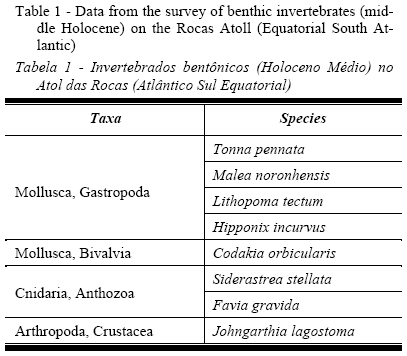
<body><![CDATA[<p><b>2.1. Study site</b></p>     <p>The Rocas Atoll is located 267 km to the northeast of Brazil (mainland) and 148 km west of the Fernando de Noronha Archipelago (Supporting Information I). The tectonic setting and substrate character of the atoll were reviewed by Kikuchi & Le&atilde;o (1997), who states that the Rocas Atoll and Fernando de Noronha Archipelago belonged to an alignment of seamounts, which is a branch of the meso-oceanic chain. In the Rocas Atoll, seawater temperature averages 27&deg;C, but can reach 42&deg;C in pools, and surface salinity varies between 36&permil; and 37&permil;. The tide regime is semidiurnal and mesotidal, with the maximum variation of 2.7 m, leaving the reef flat and the calcarenites exposed at low tide (Gherardi & Bosence, 1999, 2001, Soares <i>et al.</i>, 2011). According to the review by Kikuchi & Le&atilde;o (1997), 80% of the waves come from E and 15% from NE, at a range of 4 to 7 s and heights of 1 to 2 m.</p>     <p>The atoll reef rim has a slightly elliptical shape, 3.5 km long (E-W) and 2.5 km wide. There are two sand cays on the atoll, Farol and Cemit&eacute;rio Islands, located on the leeward side and oriented SW-NE and SE-NW, respectively. They are accumulations of bioclastic calcareous sediments, mainly coralline algal fragments, generated by mechanical and biological breakdown (Gherardi & Bosence, 2001). Farol Island is the largest, with a length of 850 m and width of 250 m. Cemit&eacute;rio Island is 350 m long and 170 m wide. The maximum elevation of Farol Island is 3.7 m, and of Cemit&eacute;rio Island, 2.8 m (Kikuchi & Le&atilde;o, 1997).</p>     <p><b>2.2. Methods</b></p>     <p>The field survey included identification of the calcarenite facies (Bioclastic / Peloidal Grainstones) in Cemit&eacute;rio Island in order to understand the geological context of the collected taxa. Samples (gastropod shells) for radiometric dating (<sup>14</sup>C) were collected from calcarenites 2.0 m above mean sea level (MSL). <sup>14</sup>C datings were performed in the Physics Laboratory of Federal University of Cear&aacute; (UFC). Detailed methods are available in the Supporting Information II.</p>     <p>&nbsp;</p>     <p><b>3. Results</b></p>     <p>Qualitative analysis revealed an assembly constituted by marine invertebrates such as mollusks (gastropods and bivalves), corals, and crustaceans (<a href="#t1">Table I</a>). Gastropods were the most prevalent animal group including four species.</p>     <p>&nbsp;</p>     <p><a name="t1"></a></p>     ]]></body>
<body><![CDATA[<p><img src="/img/revistas/rgci/v16n1/16n1a08t1.jpg"></p>     
<p>&nbsp;</p>     <p>Gastropods showed the greatest diversity, represented by <i>Lithopoma tectum</i> (Lightfoot, 1786), <i>Hipponix incurvus</i> (Gmelin, 1791), <i>Malea noronhensis</i> (Kempf and Matthews, 1969), and <i>Tonna pennata</i> (Morch, 1853). The only bivalve observed was <i>Codakia orbicularis</i> (Linnaeus, 1758), which is representative of the infauna of unconsolidated sediments. The scleractinian corals, <i>Favia gravida</i> (Verrill, 1868) and <i>Siderastrea stellata</i> (Verrill, 1868), are represented by fossilized components identified in this survey. The decapod <i>Johng-arthia lagostoma</i> (Milne-Edwards, 1835) was also recorded.</p>     <p>Radiometric dating of the calcarenite ranged from 3449 &plusmn; 790 y BP to 3033 &plusmn; 620 y BP, situating the samples in the middle Holocene (Quaternary). Considering this data, a theoretical model of these benthic communities can be proposed. This invertebrate assembly is probably representative of a low-energy subtidal environment; most likely, a back-reef lagoon ecosystem with a benthic community represented by two assemblies (I and II). Assembly I is indicative of an unconsolidated bottom assembly (<i>T. pennata, M. noronhensis, C. orbicularis, and J. lagostoma</i>). On the other hand, Assembly II indicates consolidated bottom community of coralline patch-reefs distributed on the bottom of the lagoon (<i>H. incurvus, L. tectum, S. stellata, F. gravida</i>).</p>     <p>&nbsp;</p>     <p><b>4. Discussion</b></p>     <p>The gastropods <i>T. pennata</i> and <i>M. noronhensis</i>, belonging to the family Tonnidae, inhabit unconsolidated substrates (sand) in shallow water from the intertidal zone to a depth of 15 m (Kempf & Matthews, 1969, Rios, 1994, 2009). <i>T. pennata</i> is an anfiatlantic species widely distributed in the western Atlantic (records ranging from Bermuda, Florida, Caribbean Sea, Colombia, Venezuela, and Brazil) and the archipelagos of Madeira, Canary, and Cape Verde in the eastern Atlantic (Rios, 1994, 2009).</p>     <p>In Brazil, <i>T. pennata</i> occurs in the Brazilian northeast coastal zone (from Cear&aacute; to Bahia), in the Fernando de Noronha Archipelago, and on the Rocas Atoll (Rios, 2009). The wide geographic distribution of <i>T. pennata</i> is likely due to its planktonic larval stage (planktotrophic veliger larvae), which increases its ability to disperse (Leal, 1991). On the other hand, <i>M. noronhensis</i> is endemic to the southwestern tropical Atlantic Islands (Fernando de Noronha Archipelago and Rocas Atoll). This species was described by Kempf & Matthews (1969) from empty shells, and no live specimens (with soft parts) have been collected so far. Kempf & Matthews (1969) also mention that this is the first recent record of the genus <i>Malea</i> from the Atlantic Ocean. Previous records were only of Tertiary fauna from Jamaica and Florida (Woodring, 1928).</p>     <p>The species <i>H. incurvus</i> (Gastropoda: Hipponicidae) inhabits consolidated substrates (mainly corals) in shallow waters (Rios, 1994, 2009; Simone, 2002). Restricted to the western Atlantic, <i>H. incurvus</i> shows a wide latitudinal distribution, occurring from North Carolina (USA) to Santa Catarina (Brazil), including the Fernando de Noronha Archipelago, Rocas Atoll, Abrolhos Archipelago, and the chain Vitoria-Trindade (Trindade Islands, Martin Vaz Archipelago, and some submarine mountains) (Leal, 1991; Rios, 1994, 2009; Simone, 2002). Similar to <i>T. pennata</i>, <i>H. incurvus</i> has a larval planktonic stage (lecithotrophic veliger larvae) that increases its ability to disperse.</p>     <p><i>L. tectum</i> (Gastropoda: Turbinidae) is a species that inhabits consolidated substrate from the intertidal zone to a depth of 10 m (Rios, 1994, 2009). This species has only been recorded in the western Atlantic (Bahamas, Mexico, Caribe, Venezuela, and Brazil). In Brazil, <i>L. tectum</i> occurs in the costal zones of Rio Grande do Norte to Santa Catarina, Fernando de Noronha Archipelago, Rocas Atoll, and Trindade Island (Leal, 1991, Rios, 1994, 2009). Similar to <i>H. incurvus</i>, <i>L. tectum</i> has a lecithotrophic veliger larva.</p>     ]]></body>
<body><![CDATA[<p>The species <i>C. orbicularis</i> (Bivalvia: Lucinidae) inhabits unconsolidated substrates (sandy and muddy) in shallow water (depth, 2&ndash;55 m) (Rios, 1994, 2009). This species has a restricted geographical distribution - the western Atlantic, with records from North Carolina to Brazil (from Cear&aacute; to S&atilde;o Paulo) (Rios, 1994, 2009). According to Gomes <i>et al.</i> (2006), <i>C. orbicularis</i> also occurs in Saint Paul&rsquo;s Rocks and Fernando de Noronha Archipelago. To our knowledge, this is the first record of this species on the Rocas Atoll.</p>     <p>Corals are indicators of environmental variables in the ecosystems of the middle Holocene. <i>S. stellata</i> is known to exhibit tolerance for wide temperature variation, high rates of sedimentation and turbidity, and resistance to hydrodynamics (Le&atilde;o <i>et al.</i>, 2003). <i>F. gravida</i> is highly resistant to environmental variation, particularly variations in temperature, salinity, and turbidity. <i>S. stellata</i> and <i>F. gravida</i> are very common modern reef coral in the tropical southeast Atlantic coast and on the Rocas Atoll (Longo <i>et al.</i>, 2015). <i>J. lagostoma</i> is a species of crab that lives on Ascension Island and on three other islands in the South Atlantic (Trindade Island, Fernando de Noronha, and Rocas Atoll) (Hartnoll <i>et al.</i>, 2009). The biogeography of this species across a small number of islands in the southern Atlantic Ocean is very unusual and difficult to explain by planktonic dispersal. Hartnoll <i>et al.</i> (2009) suggested the existence of former islands, now submerged, which could have acted as &ldquo;stepping stones&rdquo; for the colonization of Ascension Island.</p>     <p>Gischler & Lomando (1997) reported that the main invertebrates found in the calcarenites of the barrier reefs and atolls of Belize were mollusks and corals. Kikuchi & Le&atilde;o (1997) and Gherardi & Bosence (2005) noted the presence of coral and mollusks fragments on the Rocas Atoll; however, the benthic invertebrates were not identified. For the first time, to our knowledge, we identify eight invertebrate (mainly mollusks) fossilized species on the Rocas Atoll. Nevertheless, high levels of endemic species restricted to the northeast coast of Brazil or to the South Atlantic Islands were observed. Thus, islands present a diversity and stability paradox. They are often extremely poor in the number of species, but have considerable biological interest in terms of extraordinary endemic genera and taxonomically isolated groups (Cronk, 1997). The answer to this paradox is isolation from the continent and location in the ocean. The Rocas Atoll is located approximately 300 km from the South American continent. However, the data show species commonly found in the coastal zone (<i>S. stellata</i> and <i>F. gravida</i> are abundantly found corals on the coast of Brazil). The data also indicate invertebrate species such as <i>M. noronhensis</i> restricted to the South Atlantic Ocean Islands (<i>J. lagostoma</i>) and endemic to the insular Rocas Atoll / Fernando de Noronha complex.</p>     <p>Because of the extreme isolation of the shallow water, the tropical biota of the southwestern Atlantic region has stimulated much interest in terms of its taxonomic composition, origin, and evolution (Hachich <i>et al.</i>, 2015). Large areas of biogeographic interest in the southern Atlantic are not well known; among these environments are oceanic islands with a reef fauna of low species diversity, presenting isolation effects (Floeter & Gasparini, 2000). Considering that the islands may vary in their age of formation, size, and distance from the coast, comparative studies among their paleofauna may reveal considerable information on the evolution patterns and distribution of sea species (Joyeux <i>et al.</i>, 2001).</p>     <p>Centers of endemism predominate in areas isolated by distance or oceanography. For example, isolated islands rich in endemic species include St. Helena and Ascension Islands in the Atlantic Ocean. These endemism centers also occur where no reversing currents move water from the tropical to temperate latitudes (Roberts <i>et al.</i>, 2002). The islands of the Rocas Atoll and Fernando de Noronha are situated in the Caribbean Province, in the Antillean sub-region, by virtue of their malacofauna. Faunal invasion probably occurs from St. Helena and the Ascension islands. The South Equatorial Current from the Gulf of Guinea, which flows into Cape S&atilde;o Roque, may be the main avenue for species introduction. The South Equatorial Current flows in the direction of Fernando de Noronha, crosses the region of the Rocas Atoll, with a constant westward drift at a speed of 0.8&ndash;1.0 knot (Kikuchi & Le&atilde;o, 1997), and then to the southeastern tropical coast.</p>     <p>Radiometric datings of the calcarenite situate the samples in the middle Holocene (Quaternary). Gherardi & Bosence (2005) suggests that the development of beach rock can occur when a sufficiently large amount of detrital biogenic material is allowed to accumulate. Conditions necessary to ensure detrital material for beach rock formation includes constant, strong wind direction and absence of devastating storms. The same authors suggest that the present day Rocas Atoll topography may be the result of late Holocene SW Atlantic sea-level changes. The geologic history of the Rocas Atoll finishes at a short geological period with the oldest date only 4860 y BP <sup>14</sup>C (Kikuchi & Le&atilde;o, 1997). The data of Kikuchi & Le&atilde;o (1997) and Gherardi & Bosence (2005) and the new biogeographic data from this study suggest a hypothesis of recent colonization on the Rocas Atoll, probably only in the Holocene, from the Tropical Southwestern Atlantic coast and Fernando de Noronha Archipelago.</p>     <p>&nbsp;</p>     <p><b>5. Conclusions</b></p>     <p>Benthic invertebrates (mollusks, corals, and crustaceans) discovered on the Rocas Atoll constitute new records of species with radiometric dates ranging from 3449 &plusmn; 790 y BP to 3033 &plusmn; 620 y BP. These oceanic reef fossils provide important paleoceanographic (evidence of sea-level changes) and paleobiogeographic (new invertebrate records) data for the middle Holocene in the South Atlantic. Knowledge of the main fossilized benthic species in this scarcely known region in the Equatorial South Atlantic is important for understanding the paleobiogeography of marine islands. Therefore, future studies on quantitative benthic assemblages in the Rocas Atoll should use paleoecology and sea level history to understand the geological history of this island. This information can promote effective management of tropical oceanic reefs in the face of rising sea levels in the Anthropocene. In particular, stratigraphic changes in the distribution of benthic organisms can be used as indicators of sea level changes. To understand the recent ecological history of South Atlantic Islands, comprehensive surveys over a range of islands in the tropical Atlantic Ocean are required.</p>     <p>&nbsp;</p>     ]]></body>
<body><![CDATA[<p><b>Acknowledgments</b></p>     <p>The first author thanks the CNPq (National Scientific Research and Development Board) (Process 479198/2012-8 and Process 233808/2014-0), PETROBRAS and Funda&ccedil;&atilde;o SOS Mata Atl&acirc;ntica for financing the field work, and ICMBIO for granting the research license and supporting the field activities (mainly the coordinator of Reserva Biol&oacute;gica Mauriz&eacute;lia Brito). We wish to acknowledge the editor and the anonymous referees for comments provided on the manuscript, which significantly improved this paper. We thank the biologist and diver Carlos Augusto Meirelles for his support in collecting paleontological material. </p>     <p>&nbsp;</p>     <p>&nbsp;</p>     <p><b>References</b></p>     <!-- ref --><p>Angulo, R.J.; Souza, M.C.; Fernandes, L.A.; Disar&oacute;, S.T. (2013) - Quaternary sea-level changes and aeolianites in the Fernando de Noronha archipelago, northeastern Brazil. <i>Quaternary International</i>, 305:15-30. DOI: <a href="http://dx.doi.org/10.1016/j.quaint.2012.12.029" target="_blank">10.1016/j.quaint.2012.12.029</a>&nbsp;&nbsp;&nbsp;&nbsp;&nbsp;&nbsp;&nbsp;&nbsp;[&#160;<a href="javascript:void(0);" onclick="javascript: window.open('/scielo.php?script=sci_nlinks&ref=1417762&pid=S1646-8872201600010000800001&lng=','','width=640,height=500,resizable=yes,scrollbars=1,menubar=yes,');">Links</a>&#160;]<!-- end-ref --><!-- ref --><p>Barry, S.J.; Cowell, P.J.; Woodroffe, C.D. (2007) - A morphodinamic model of reef-island development on atolls. <i>Sedimentary Geology</i>, 197(1-2):47-63. DOI: <a href="http://dx.doi.org/10.1016/j.sedgeo.2006.08.006" target="_blank">10.1016/j.sedgeo.2006.08.006</a>&nbsp;&nbsp;&nbsp;&nbsp;&nbsp;&nbsp;&nbsp;&nbsp;[&#160;<a href="javascript:void(0);" onclick="javascript: window.open('/scielo.php?script=sci_nlinks&ref=1417763&pid=S1646-8872201600010000800002&lng=','','width=640,height=500,resizable=yes,scrollbars=1,menubar=yes,');">Links</a>&#160;]<!-- end-ref --><!-- ref --><p>Beier, J.A. (1985) - Diagenesis of Quaternary Bahamian beachrock: petrographic and diagenetic evidence. <i>Journal of Sedimentary Petrology</i>, 55(5):755-761. DOI: <a href="http://dx.doi.org/10.1306/212F87DD-2B24-11D7-8648000102C1865D" target="_blank">10.1306/212F87DD-2B24-11D7-8648000102C1865D</a>&nbsp;&nbsp;&nbsp;&nbsp;&nbsp;&nbsp;&nbsp;&nbsp;[&#160;<a href="javascript:void(0);" onclick="javascript: window.open('/scielo.php?script=sci_nlinks&ref=1417764&pid=S1646-8872201600010000800003&lng=','','width=640,height=500,resizable=yes,scrollbars=1,menubar=yes,');">Links</a>&#160;]<!-- end-ref --><!-- ref --><p>Cronk, Q.C.B. (1997) - Islands: stability, diversity, conservation. <i>Biodiversity Conservation</i>, 6(3):477-493. DOI: <a href="http://dx.doi.org/10.1023/A:1018372910025" target="_blank">10.1023/A:1018372910025</a>&nbsp;&nbsp;&nbsp;&nbsp;&nbsp;&nbsp;&nbsp;&nbsp;[&#160;<a href="javascript:void(0);" onclick="javascript: window.open('/scielo.php?script=sci_nlinks&ref=1417765&pid=S1646-8872201600010000800004&lng=','','width=640,height=500,resizable=yes,scrollbars=1,menubar=yes,');">Links</a>&#160;]<!-- end-ref --><p>Davies, P.J.; Kinsey, D.W. (1973) - Organic and inorganic factors in recent beach rock formation, Heron Island, Great Barrier Reef. <i>Journal of Sedimentary Petrology</i>, 43(1):59&ndash;81. DOI: <a href="http://dx.doi.org/10.1306/74D726E4-2B21-11D7-8648000102C1865D" target="_blank">10.1306/74D726E4-2B21-11D7-8648000102C1865D</a></p>     ]]></body>
<body><![CDATA[<!-- ref --><p>Erginal, A.E.; Ekinci, Y.L.; Demirci, A.; Bozcu, M.; Ozturk, M.Z.; Avcioglu, M.; Oztura, E. (2013) - First record of beachrock on Black Sea coast of Turkey: Implications for Late Holocene sea-level fluctuations. <i>Sedimentary Geology</i>, 294:294-302. DOI: <a href="http://dx.doi.org/10.1016/j.sedgeo.2013.06.003" target="_blank">10.1016/j.sedgeo.2013.06.003</a>&nbsp;&nbsp;&nbsp;&nbsp;&nbsp;&nbsp;&nbsp;&nbsp;[&#160;<a href="javascript:void(0);" onclick="javascript: window.open('/scielo.php?script=sci_nlinks&ref=1417767&pid=S1646-8872201600010000800006&lng=','','width=640,height=500,resizable=yes,scrollbars=1,menubar=yes,');">Links</a>&#160;]<!-- end-ref --><!-- ref --><p>Floeter, S.R.; Gasparini, J.L. (2000) - The southwestern Atlantic reef fish fauna: composition and zoogeographic patterns. <i>Journal of Fish Biology</i>, 56(5):1099-1114. DOI: <a href="http://dx.doi.org/10.1006/jfbi.2000.1231" target="_blank">10.1006/jfbi.2000.1231</a>&nbsp;&nbsp;&nbsp;&nbsp;&nbsp;&nbsp;&nbsp;&nbsp;[&#160;<a href="javascript:void(0);" onclick="javascript: window.open('/scielo.php?script=sci_nlinks&ref=1417768&pid=S1646-8872201600010000800007&lng=','','width=640,height=500,resizable=yes,scrollbars=1,menubar=yes,');">Links</a>&#160;]<!-- end-ref --><!-- ref --><p>Gherardi, D.F.M.; Bosence, D.W.J. (1999) - Modeling of the ecological succession of encrusting organisms in recent coralline-algal frameworks from Atol das Rocas, Brazil. Palaios, 14(2):145-158. DOI: <a href="http://dx.doi.org/10.2307/3515370" target="_blank">10.2307/3515370</a>&nbsp;&nbsp;&nbsp;&nbsp;&nbsp;&nbsp;&nbsp;&nbsp;[&#160;<a href="javascript:void(0);" onclick="javascript: window.open('/scielo.php?script=sci_nlinks&ref=1417769&pid=S1646-8872201600010000800008&lng=','','width=640,height=500,resizable=yes,scrollbars=1,menubar=yes,');">Links</a>&#160;]<!-- end-ref --><!-- ref --><p>Gherardi, D.F.M.; Bosence, D.W.J. (2001) - Composition and community structure of the coralline-algal reefs from Atol das Rocas, South Atlantic, Brazil. <i>Coral Reefs</i>, 19(3):205-219. DOI: <a href="http://dx.doi.org/10.1007/s003380000100" target="_blank">10.1007/s003380000100</a>&nbsp;&nbsp;&nbsp;&nbsp;&nbsp;&nbsp;&nbsp;&nbsp;[&#160;<a href="javascript:void(0);" onclick="javascript: window.open('/scielo.php?script=sci_nlinks&ref=1417770&pid=S1646-8872201600010000800009&lng=','','width=640,height=500,resizable=yes,scrollbars=1,menubar=yes,');">Links</a>&#160;]<!-- end-ref --><!-- ref --><p>Gherardi, D.F.M.; Bosence, D.W.J. (2005) - Late Holocene reef growth and relative sea-level changes in Atol das Rocas, equatorial South Atlantic. <i>Coral Reefs</i>, 24(2):264-272. DOI: <a href="http://dx.doi.org/10.1007/s00338-005-0475-5" target="_blank">10.1007/s00338-005-0475-5</a>&nbsp;&nbsp;&nbsp;&nbsp;&nbsp;&nbsp;&nbsp;&nbsp;[&#160;<a href="javascript:void(0);" onclick="javascript: window.open('/scielo.php?script=sci_nlinks&ref=1417771&pid=S1646-8872201600010000800010&lng=','','width=640,height=500,resizable=yes,scrollbars=1,menubar=yes,');">Links</a>&#160;]<!-- end-ref --><!-- ref --><p>Gischler, E.; Lomando, A.J. (1997) - Holocene cemented beach deposits in Belize. <i>Sedimentary Geology</i>, 110(3-4):277-297. DOI: <a href="http://dx.doi.org/10.1016/S0037-0738(96)00088-7" target="_blank">10.1016/S0037-0738(96)00088-7</a>&nbsp;&nbsp;&nbsp;&nbsp;&nbsp;&nbsp;&nbsp;&nbsp;[&#160;<a href="javascript:void(0);" onclick="javascript: window.open('/scielo.php?script=sci_nlinks&ref=1417772&pid=S1646-8872201600010000800011&lng=','','width=640,height=500,resizable=yes,scrollbars=1,menubar=yes,');">Links</a>&#160;]<!-- end-ref --><!-- ref --><p>Gomes, R.S.; Costa, P.M.S.; Monteiro, J.C.; Coelho, A.C.S.; Salgado, N.C.  (2006) - Moluscos das Ilhas Oce&acirc;nicas brasileiras. In: R. J. V. Alves & J.W.A. Castro (eds), <i>Ilhas Oce&acirc;nicas brasileiras da pesquisa ao manejo</i>, pp. 179-198, Minist&eacute;rio do Meio Ambiente, Secretaria de Biodiversidade e Florestas, Bras&iacute;lia, DF, Brazil. ISBN: 8587166913.    &nbsp;&nbsp;&nbsp;&nbsp;&nbsp;&nbsp;&nbsp;&nbsp;[&#160;<a href="javascript:void(0);" onclick="javascript: window.open('/scielo.php?script=sci_nlinks&ref=1417773&pid=S1646-8872201600010000800012&lng=','','width=640,height=500,resizable=yes,scrollbars=1,menubar=yes,');">Links</a>&#160;]<!-- end-ref --></p>     <p>Hachich, N.F.; Bonsall, M.B.; Arraut, E.M.; Barneche, D.R.; Lewinsohn, T.M.; Floeter, S.R. (2015) &ndash; Island biogeography: patterns of marine shallow-water organisms in the Atlantic Ocean. <i>Journal of Biogeography</i>, 42/10):1871-1882. DOI: <a href="http://dx.doi.org/10.1111/jbi.12560" target="_blank">10.1111/jbi.12560</a></p>     <p>Hartnoll, R.G.; Broderick, A.C.; Godley, B.J.; Saunders, K.E. (2009) &ndash; Population Structure of the land crab Johngarthia lagostoma on Ascension Island. <i>Journal of Crustacean Biology</i>, 29(1):57-61. DOI: <a href="http://dx.doi.org/10.1651/08-2992.1" target="_blank">10.1651/08-2992.1</a></p>     ]]></body>
<body><![CDATA[<!-- ref --><p>Hickerson, M.J.; Meyer, C.P. (2008) - Testing comparative phylogeographic models of marine vicariance and dispersal using a hierarchical Bayesian approach. <i>BMC Evolutionary Biology</i>, 8:322. DOI: <a href="http://dx.doi.org/10.1186/1471-2148-8-322" target="_blank">10.1186/1471-2148-8-322</a>&nbsp;&nbsp;&nbsp;&nbsp;&nbsp;&nbsp;&nbsp;&nbsp;[&#160;<a href="javascript:void(0);" onclick="javascript: window.open('/scielo.php?script=sci_nlinks&ref=1417777&pid=S1646-8872201600010000800015&lng=','','width=640,height=500,resizable=yes,scrollbars=1,menubar=yes,');">Links</a>&#160;]<!-- end-ref --><!-- ref --><p>Irion, G.; Morais, J.O.; Bungenstock, F. (2012) - Holocene and Pleistocene sea-level indicators at the coast of Jericoacoara, Cear&aacute;, NE Brazil. <i>Quaternary Research</i>, 77(2):251-257. DOI: <a href="http://dx.doi.org/10.1016/j.yqres.2011.10.007" target="_blank">10.1016/j.yqres.2011.10.007</a>&nbsp;&nbsp;&nbsp;&nbsp;&nbsp;&nbsp;&nbsp;&nbsp;[&#160;<a href="javascript:void(0);" onclick="javascript: window.open('/scielo.php?script=sci_nlinks&ref=1417778&pid=S1646-8872201600010000800016&lng=','','width=640,height=500,resizable=yes,scrollbars=1,menubar=yes,');">Links</a>&#160;]<!-- end-ref --><!-- ref --><p>Joyeux, J.C.; Floeter, S.R.; Ferreira, C.E.L.; Gasparine, J.L. (2001) - Biogeography of tropical reef fish: the South Atlantic puzzle. <i>Journal of Biogeography</i>, 28(7):831-841. DOI: <a href="http://dx.doi.org/10.1046/j.1365-2699.2001.00602.x" target="_blank">10.1046/j.1365-2699.2001.00602.x</a>&nbsp;&nbsp;&nbsp;&nbsp;&nbsp;&nbsp;&nbsp;&nbsp;[&#160;<a href="javascript:void(0);" onclick="javascript: window.open('/scielo.php?script=sci_nlinks&ref=1417779&pid=S1646-8872201600010000800017&lng=','','width=640,height=500,resizable=yes,scrollbars=1,menubar=yes,');">Links</a>&#160;]<!-- end-ref --><!-- ref --><p>Kempf, M.; Matthews, H.R. (1969) - Occurrence of the genus Malea Valenciennes, 1832 in Atlantic waters, with the description of a new species (Mollusca: Gastropoda). <i>Arquivos de Ci&ecirc;ncias do Mar</i> (ISSN 0374-5686), 9(1):57-62, Fortaleza, CE, Brazil. Available on-line at <a href="http://www.labomar.ufc.br/images/stories/arquivos/ArqCienMar/V09_1_1969/acm_1969_9_1_12.pdf" target="_blank">http://www.labomar.ufc.br/images/stories/arquivos/ArqCienMar/V09_1_1969/acm_1969_9_1_12.pdf</a>&nbsp;&nbsp;&nbsp;&nbsp;&nbsp;&nbsp;&nbsp;&nbsp;[&#160;<a href="javascript:void(0);" onclick="javascript: window.open('/scielo.php?script=sci_nlinks&ref=1417780&pid=S1646-8872201600010000800018&lng=','','width=640,height=500,resizable=yes,scrollbars=1,menubar=yes,');">Links</a>&#160;]<!-- end-ref --><!-- ref --><p>Kikuchi, R.K.P.; Le&atilde;o, Z.M.A.N. (1997) - Rocas (Southwestern Equatorial Atlantic, Brazil): an atoll built primarily by coralline algae. In: H. A. Lessios & I. G. Macintyre (eds.), <i>Proceedings of the 8TH International Coral Reef Symposium</i>, pp.731-736, Smithsonian Tropical Research Institute, Panama City. Available on-line at <a href="http://www.researchgate.net/publication/221965459_Rocas_(Southwestern_Equatorial_Atlantic_Brazil)_an_atoll_built_primarily_by_coralline_algae" target="_blank">http://www.researchgate.net/publication/221965459_Rocas_(Southwestern_Equatorial_Atlantic_Brazil)_an_atoll_built_primarily_by_coralline_algae</a>&nbsp;&nbsp;&nbsp;&nbsp;&nbsp;&nbsp;&nbsp;&nbsp;[&#160;<a href="javascript:void(0);" onclick="javascript: window.open('/scielo.php?script=sci_nlinks&ref=1417781&pid=S1646-8872201600010000800019&lng=','','width=640,height=500,resizable=yes,scrollbars=1,menubar=yes,');">Links</a>&#160;]<!-- end-ref --><!-- ref --><p>Leal, J.H. (1991) - <i>Marine prosobranch gastropods from Oceanic Islands off Brazil, species composition and biogeography</i>. 418p., Dr. W. Backhuys Publishers / U.B.S. Oegstgeest, Amsterdam, The Netherlands. ISBN: 978-9073348110&nbsp;&nbsp;&nbsp;&nbsp;&nbsp;&nbsp;&nbsp;&nbsp;[&#160;<a href="javascript:void(0);" onclick="javascript: window.open('/scielo.php?script=sci_nlinks&ref=1417782&pid=S1646-8872201600010000800020&lng=','','width=640,height=500,resizable=yes,scrollbars=1,menubar=yes,');">Links</a>&#160;]<!-- end-ref --><!-- ref --><p>Le&atilde;o, Z.M.A.N.; Kikuchi, R.K.P.; Testa, V. (2003) - Corals and coral reefs of Brazil. <i>Latin American Coral Reefs</i>, 2003:9-52. DOI: <a href="http://dx.doi.org/10.1016/B978-044451388-5/50003-5" target="_blank">10.1016/B978-044451388-5/50003-5</a>&nbsp;&nbsp;&nbsp;&nbsp;&nbsp;&nbsp;&nbsp;&nbsp;[&#160;<a href="javascript:void(0);" onclick="javascript: window.open('/scielo.php?script=sci_nlinks&ref=1417783&pid=S1646-8872201600010000800021&lng=','','width=640,height=500,resizable=yes,scrollbars=1,menubar=yes,');">Links</a>&#160;]<!-- end-ref --><!-- ref --><p>Le&atilde;o, Z.M.A.N.; Kikuchi, R.K.P. (2005) - A relic coral fauna threatened by global changes and human activities, Eastern Brazil. <i>Marine Pollution Bulletin</i>, 51(5-7):599-611. DOI: <a href="http://dx.doi.org/10.1016/j.marpolbul.2005.04.024" target="_blank">10.1016/j.marpolbul.2005.04.024</a>&nbsp;&nbsp;&nbsp;&nbsp;&nbsp;&nbsp;&nbsp;&nbsp;[&#160;<a href="javascript:void(0);" onclick="javascript: window.open('/scielo.php?script=sci_nlinks&ref=1417784&pid=S1646-8872201600010000800022&lng=','','width=640,height=500,resizable=yes,scrollbars=1,menubar=yes,');">Links</a>&#160;]<!-- end-ref --><p>Longo, G.O.; Morais, R.A.; Martins, C.D.L.; Mendes, T.C.; Aued, A.W.; C&acirc;ndido, D.; Oliveira, J.; Nunes, L.T.; Fontoura, L.; Sissini, M.N.; Teschima, M.M.; Silva, M.B.; Ramlov, F.; Gouveia, L.; Ferreira, C.E.L.; Segal, B.; Horta, P.A.; Floeter, S.R. (2015) &ndash; Between-habitat variation of benthic cover, reef fish assemblage and feeding pressure at the only atoll in South Atlantic: Rocas Atoll, NE Brazil. <i>PLoS ONE</i>, 10(6):e0127176. DOI: <a href="http://dx.doi.org/10.1371/journal.pone.0127176" target="_blank">10.1371/journal.pone.0127176</a></p>     <p>Mauz, B.; Vacchi, M.; Green, A.; Hoffman, G.; Cooper, A. (2015) &ndash; Beachrock: A tool for reconstructing relative sea level in the far field. <i>Marine Geology</i>, 362(1):1-16. DOI: <a href="http://dx.doi.org/10.1016/j.margeo.2015.01.009" target="_blank">10.1016/j.margeo.2015.01.009</a></p>     ]]></body>
<body><![CDATA[<!-- ref --><p>Mcdowall, R.M. (2005) - Falkland Islands biogeography: converging trajectories in the South Atlantic Ocean. <i>Journal of Biogeography</i>, 32(1):49-52. DOI: <a href="http://dx.doi.org/10.1111/j.1365-2699.2004.01167.x" target="_blank">10.1111/j.1365-2699.2004.01167.x</a>&nbsp;&nbsp;&nbsp;&nbsp;&nbsp;&nbsp;&nbsp;&nbsp;[&#160;<a href="javascript:void(0);" onclick="javascript: window.open('/scielo.php?script=sci_nlinks&ref=1417787&pid=S1646-8872201600010000800025&lng=','','width=640,height=500,resizable=yes,scrollbars=1,menubar=yes,');">Links</a>&#160;]<!-- end-ref --><!-- ref --><p>Miloslavich, P.; Klein, E.; D&iacute;az, J.M.; Hern&aacute;ndez, C.E.; Bigatti, G.; Campos, L. (2011) - Marine Biodiversity in the Atlantic and Pacific Coasts of South America: Knowledge and Gaps. <i>PLoS ONE</i>, 6(1):e14631. DOI: <a href="http://dx.doi.org/10.1371/journal.pone.0014631" target="_blank">10.1371/journal.pone.0014631</a>&nbsp;&nbsp;&nbsp;&nbsp;&nbsp;&nbsp;&nbsp;&nbsp;[&#160;<a href="javascript:void(0);" onclick="javascript: window.open('/scielo.php?script=sci_nlinks&ref=1417788&pid=S1646-8872201600010000800026&lng=','','width=640,height=500,resizable=yes,scrollbars=1,menubar=yes,');">Links</a>&#160;]<!-- end-ref --><!-- ref --><p>Morais, J.O.; Irion, G.F.; Pinheiro, L.S.; Kasbohm, J. (2009) - Preliminary results on Holocene sea-level changes on Cear&aacute; coast/Brazil. <i>Journal of Coastal Research</i> (ISSN 0749-0258),  SI56:646-649, Lisboa, Portugal. Available on-line at <a href="http://e-geo.fcsh.unl.pt/ICS2009/_docs/ICS2009_Volume_I/646.649_J.O.Morais_ICS2009.pdf" target="_blank">http://e-geo.fcsh.unl.pt/ICS2009/_docs/ICS2009_Volume_I/646.649_J.O.Morais_ICS2009.pdf</a>&nbsp;&nbsp;&nbsp;&nbsp;&nbsp;&nbsp;&nbsp;&nbsp;[&#160;<a href="javascript:void(0);" onclick="javascript: window.open('/scielo.php?script=sci_nlinks&ref=1417789&pid=S1646-8872201600010000800027&lng=','','width=640,height=500,resizable=yes,scrollbars=1,menubar=yes,');">Links</a>&#160;]<!-- end-ref --><!-- ref --><p>Neraudeau, D.; Mathey, B. (2000) - Biogeography and diversity of South Atlantic Cretaceous echinoids: implications for circulation patterns. <i>Paleogeography, Paleoclimatology, Palaecology</i>, 156(1-2):71-88. DOI: <a href="http://dx.doi.org/10.1016/S0031-0182(99)00132-7" target="_blank">10.1016/S0031-0182(99)00132-7</a>&nbsp;&nbsp;&nbsp;&nbsp;&nbsp;&nbsp;&nbsp;&nbsp;[&#160;<a href="javascript:void(0);" onclick="javascript: window.open('/scielo.php?script=sci_nlinks&ref=1417790&pid=S1646-8872201600010000800028&lng=','','width=640,height=500,resizable=yes,scrollbars=1,menubar=yes,');">Links</a>&#160;]<!-- end-ref --><p>Pereira, M.M.V; Ros, L.F.; Bezerra, F.H.R. (2007) - Lithofaciology and palaeoenvironmental analysis of Holocene beachrocks in northeastern Brazil. <i>Journal of Coastal Research</i>, 23(6):1535&ndash;1548. DOI: <a href="http://dx.doi.org/10.2112/05-0562.1" target="_blank">10.2112/05-0562.1</a></p>     <!-- ref --><p>Pereira, N.S.; Manso, V.A.V.; Silva, A.M.C.; Silva, M.B. (2010) - Mapeamento Geomorfol&oacute;gico e Morfodin&acirc;mica do Atol das Rocas, Atl&acirc;ntico Sul. <i>Journal of Integrated Coastal Management / Revista da Gest&atilde;o Costeira Integrada</i>, 10(3):331-345. DOI: <a href="http://dx.doi.org/10.5894/rgci209" target="_blank">10.5894/rgci209</a>&nbsp;&nbsp;&nbsp;&nbsp;&nbsp;&nbsp;&nbsp;&nbsp;[&#160;<a href="javascript:void(0);" onclick="javascript: window.open('/scielo.php?script=sci_nlinks&ref=1417792&pid=S1646-8872201600010000800030&lng=','','width=640,height=500,resizable=yes,scrollbars=1,menubar=yes,');">Links</a>&#160;]<!-- end-ref --><!-- ref --><p>Pereira, N.S.; Manso, V.A.V.;Macedo, R.J.A.; DIAS, J.M.A.; Silva, A.M.C. (2013) - Detrital carbonate sedimentation of the Rocas Atoll, South Atlantic. <i>Anais da Academia Brasileira de Ci&ecirc;ncias</i>, 85(1):57-72. DOI: <a href="http://dx.doi.org/10.1590/S0001-37652013000100005" target="_blank">10.1590/S0001-37652013000100005</a>&nbsp;&nbsp;&nbsp;&nbsp;&nbsp;&nbsp;&nbsp;&nbsp;[&#160;<a href="javascript:void(0);" onclick="javascript: window.open('/scielo.php?script=sci_nlinks&ref=1417793&pid=S1646-8872201600010000800031&lng=','','width=640,height=500,resizable=yes,scrollbars=1,menubar=yes,');">Links</a>&#160;]<!-- end-ref --><!-- ref --><p>Pereira, N.S.; Voegelin, A.R; Paulukat, C.; Sial, A.N.; Ferreira, V.P.; Frei, R. (2015) - Chromium-isotope signatures in scleractinian corals from the Rocas Atoll, Tropical South Atlantic. <i>Geobiology</i>, 14(1):1-14. DOI: <a href="http://dx.doi.org/10.1111/gbi.12155" target="_blank">10.1111/gbi.12155</a>&nbsp;&nbsp;&nbsp;&nbsp;&nbsp;&nbsp;&nbsp;&nbsp;[&#160;<a href="javascript:void(0);" onclick="javascript: window.open('/scielo.php?script=sci_nlinks&ref=1417794&pid=S1646-8872201600010000800032&lng=','','width=640,height=500,resizable=yes,scrollbars=1,menubar=yes,');">Links</a>&#160;]<!-- end-ref --><!-- ref --><p>Rios, E. C. (1994) - <i>Seashells of Brazil</i>. 481p., Funda&ccedil;&atilde;o da Universidade do Rio Grande, Rio Grande, RS, Brazil. ISBN: 8585042362.    &nbsp;&nbsp;&nbsp;&nbsp;&nbsp;&nbsp;&nbsp;&nbsp;[&#160;<a href="javascript:void(0);" onclick="javascript: window.open('/scielo.php?script=sci_nlinks&ref=1417795&pid=S1646-8872201600010000800033&lng=','','width=640,height=500,resizable=yes,scrollbars=1,menubar=yes,');">Links</a>&#160;]<!-- end-ref --> </p>     ]]></body>
<body><![CDATA[<!-- ref --><p>Rios, E. C. (2009) - <i>Compendium of Brazilian Sea Shells</i>. 668p., Editora Evangraf, Rio Grande, RS, Brazil. ISBN: 8577271730&nbsp;&nbsp;&nbsp;&nbsp;&nbsp;&nbsp;&nbsp;&nbsp;[&#160;<a href="javascript:void(0);" onclick="javascript: window.open('/scielo.php?script=sci_nlinks&ref=1417797&pid=S1646-8872201600010000800034&lng=','','width=640,height=500,resizable=yes,scrollbars=1,menubar=yes,');">Links</a>&#160;]<!-- end-ref --><!-- ref --><p>Roberts, C.M.; McClean, C.J.; Veron, J.E.N.; Hawkins, J.P.; Allen, G.R.; McAllister, D.E.; Mittermeier, C.G.; Schueler, F.W.; Spalding, M.; Wells, F.; Vynne, C.; Werner, T.B. (2002) - Marine biodiversity hotspots and conservation priorities for tropical reefs. <i>Science</i>, 295(5558):1280-1284. DOI: <a href="http://dx.doi.org/10.1126/science.1067728" target="_blank">10.1126/science.1067728</a>&nbsp;&nbsp;&nbsp;&nbsp;&nbsp;&nbsp;&nbsp;&nbsp;[&#160;<a href="javascript:void(0);" onclick="javascript: window.open('/scielo.php?script=sci_nlinks&ref=1417798&pid=S1646-8872201600010000800035&lng=','','width=640,height=500,resizable=yes,scrollbars=1,menubar=yes,');">Links</a>&#160;]<!-- end-ref --><!-- ref --><p>Shen, J.W.; Long, J.O.; Pedoja, K.; Yang, H.Q.; Xu, H.L.; Sun, J.L. (2013) - Holocene coquina beachrock from Haishan Island, east coast of Guangdong Province, China. <i>Quaternary International</i>, 310:199-212. DOI: <a href="http://dx.doi.org/10.1016/j.quaint.2013.05.011" target="_blank">10.1016/j.quaint.2013.05.011</a>.    &nbsp;&nbsp;&nbsp;&nbsp;&nbsp;&nbsp;&nbsp;&nbsp;[&#160;<a href="javascript:void(0);" onclick="javascript: window.open('/scielo.php?script=sci_nlinks&ref=1417799&pid=S1646-8872201600010000800036&lng=','','width=640,height=500,resizable=yes,scrollbars=1,menubar=yes,');">Links</a>&#160;]<!-- end-ref --></p>     <!-- ref --><p>Simone, L. R. L. (2002) - Comparative morphological study and phylogeny of representatives of the Superfamily Calyptraeoidea (including Hipponicoidea) (Mollusca, Caenogastropoda). <i>Biota Neotropica</i>, 2(2):1-37. DOI: <a href="http://dx.doi.org/10.1590/S1676-06032002000200013" target="_blank">10.1590/S1676-06032002000200013</a>.    &nbsp;&nbsp;&nbsp;&nbsp;&nbsp;&nbsp;&nbsp;&nbsp;[&#160;<a href="javascript:void(0);" onclick="javascript: window.open('/scielo.php?script=sci_nlinks&ref=1417801&pid=S1646-8872201600010000800037&lng=','','width=640,height=500,resizable=yes,scrollbars=1,menubar=yes,');">Links</a>&#160;]<!-- end-ref --></p>     <!-- ref --><p>Soares, M. O.; Meirelles, C. A.O.; Lemos, V.B. (2011) - Reef bio-constructors of Rocas Atoll, Equatorial South Atlantic. <i>Biotemas</i> (ISSN 2175-7925), 24:37-46, Florian&oacute;polis, Santa Catarina. Available on-line at <a href="https://periodicos.ufsc.br/index.php/biotemas/article/download/2175-7925.2011v24n2p37/17820" target="_blank">https://periodicos.ufsc.br/index.php/biotemas/article/download/2175-7925.2011v24n2p37/17820</a>&nbsp;&nbsp;&nbsp;&nbsp;&nbsp;&nbsp;&nbsp;&nbsp;[&#160;<a href="javascript:void(0);" onclick="javascript: window.open('/scielo.php?script=sci_nlinks&ref=1417803&pid=S1646-8872201600010000800038&lng=','','width=640,height=500,resizable=yes,scrollbars=1,menubar=yes,');">Links</a>&#160;]<!-- end-ref --><p>Spurgeon, D.; Davis Jr., R.A.; Shinnu, E.A. (2003) - Formation of &lsquo;Beach Rock&rsquo; at Siesta Key, Florida and its influence on barrier island development. <i>Marine Geology</i>, 200(1&ndash;4):19-29. DOI: <a href="http://dx.doi.org/10.1590/S1676-06032002000200013" target="_blank">10.1590/S1676-06032002000200013</a></p>     <!-- ref --><p>Stoddart, D.R.; Cann, J.R. (1965) - Nature and origin of beach rock. <i>Journal of Sedimentary Petrology</i>, 35(1):243-247. DOI: <a href="http://dx.doi.org/10.1306/74D7122B-2B21-11D7-8648000102C1865D" target="_blank">10.1306/74D7122B-2B21-11D7-8648000102C1865D</a>.    &nbsp;&nbsp;&nbsp;&nbsp;&nbsp;&nbsp;&nbsp;&nbsp;[&#160;<a href="javascript:void(0);" onclick="javascript: window.open('/scielo.php?script=sci_nlinks&ref=1417805&pid=S1646-8872201600010000800040&lng=','','width=640,height=500,resizable=yes,scrollbars=1,menubar=yes,');">Links</a>&#160;]<!-- end-ref --></p>     ]]></body>
<body><![CDATA[<!-- ref --><p>Stoddart, D.R.; Fosberg, E.R.; Spellman, D.L. (1982) - Cays of the Belize Barrier Reef and lagoon. <i>Atoll Research Bulletin</i> (ISSN 0077-5630), 256:1-76, New York, United States of America. Available on-line at <a href="http://www.sil.si.edu/digitalcollections/atollresearchbulletin/issues/00256.pdf" target="_blank">http://www.sil.si.edu/digitalcollections/atollresearchbulletin/issues/00256.pdf</a>&nbsp;&nbsp;&nbsp;&nbsp;&nbsp;&nbsp;&nbsp;&nbsp;[&#160;<a href="javascript:void(0);" onclick="javascript: window.open('/scielo.php?script=sci_nlinks&ref=1417807&pid=S1646-8872201600010000800041&lng=','','width=640,height=500,resizable=yes,scrollbars=1,menubar=yes,');">Links</a>&#160;]<!-- end-ref --><!-- ref --><p>Woodroffe, C.D. (2008) - Reef-island topography and the vulnerability of atolls to sea-level rise. <i>Global Planet Change</i>, 62(1-2):77-96. DOI: <a href="http://dx.doi.org/10.1016/j.gloplacha.2007.11.001" target="_blank">10.1016/j.gloplacha.2007.11.001</a>.    &nbsp;&nbsp;&nbsp;&nbsp;&nbsp;&nbsp;&nbsp;&nbsp;[&#160;<a href="javascript:void(0);" onclick="javascript: window.open('/scielo.php?script=sci_nlinks&ref=1417808&pid=S1646-8872201600010000800042&lng=','','width=640,height=500,resizable=yes,scrollbars=1,menubar=yes,');">Links</a>&#160;]<!-- end-ref --></p>     <!-- ref --><p>Woodring, W.P.  (1928) - Miocene Mollusks from Bowden, Jamaica. Part 2, Gastropods and Discussion of Results. In: W. P. Woodring (ed.), <i>Contributions to the Geology and Palaeontology of the West Indies</i>, 564p., Carnegie Institution, Washington, D.C., U.S.A.    &nbsp;&nbsp;&nbsp;&nbsp;&nbsp;&nbsp;&nbsp;&nbsp;[&#160;<a href="javascript:void(0);" onclick="javascript: window.open('/scielo.php?script=sci_nlinks&ref=1417810&pid=S1646-8872201600010000800043&lng=','','width=640,height=500,resizable=yes,scrollbars=1,menubar=yes,');">Links</a>&#160;]<!-- end-ref --></p>     <p>&nbsp;</p>     <p>&nbsp;</p>     <p><a href="#top0">*</a><a name="0"></a>Submission: 26 OCT 2015; Peer review: 29 NOV 2015; Revised: 11 JAN 2016; Accepted: 21 FEB 2016; Available on-line: 26 FEB 2016</p>     <p><b>Appendix</b></p>     <p>This article contains supporting information online at <a href="http://www.aprh.pt/rgci/pdf/rgci-651_Soares_Supporting-Information.pdf" target="_blank">http://www.aprh.pt/rgci/pdf/rgci-651_Soares_Supporting-Information.pdf</a></a></p>     ]]></body>
<body><![CDATA[ ]]></body><back>
<ref-list>
<ref id="B1">
<nlm-citation citation-type="journal">
<person-group person-group-type="author">
<name>
<surname><![CDATA[Angulo]]></surname>
<given-names><![CDATA[R.J.]]></given-names>
</name>
<name>
<surname><![CDATA[Souza]]></surname>
<given-names><![CDATA[M.C.]]></given-names>
</name>
<name>
<surname><![CDATA[Fernandes]]></surname>
<given-names><![CDATA[L.A.]]></given-names>
</name>
<name>
<surname><![CDATA[Disaró]]></surname>
<given-names><![CDATA[S.T.]]></given-names>
</name>
</person-group>
<article-title xml:lang="en"><![CDATA[Quaternary sea-level changes and aeolianites in the Fernando de Noronha archipelago, northeastern Brazil]]></article-title>
<source><![CDATA[Quaternary International]]></source>
<year>2013</year>
<volume>305</volume>
<page-range>15-30</page-range></nlm-citation>
</ref>
<ref id="B2">
<nlm-citation citation-type="journal">
<person-group person-group-type="author">
<name>
<surname><![CDATA[Barry]]></surname>
<given-names><![CDATA[S.J.]]></given-names>
</name>
<name>
<surname><![CDATA[Cowell]]></surname>
<given-names><![CDATA[P.J.]]></given-names>
</name>
<name>
<surname><![CDATA[Woodroffe]]></surname>
<given-names><![CDATA[C.D.]]></given-names>
</name>
</person-group>
<article-title xml:lang="en"><![CDATA[A morphodinamic model of reef-island development on atolls]]></article-title>
<source><![CDATA[Sedimentary Geology]]></source>
<year>2007</year>
<volume>197</volume>
<numero>1-2</numero>
<issue>1-2</issue>
<page-range>47-63</page-range></nlm-citation>
</ref>
<ref id="B3">
<nlm-citation citation-type="journal">
<person-group person-group-type="author">
<name>
<surname><![CDATA[Beier]]></surname>
<given-names><![CDATA[J.A.]]></given-names>
</name>
</person-group>
<article-title xml:lang="en"><![CDATA[Diagenesis of Quaternary Bahamian beachrock: petrographic and diagenetic evidence]]></article-title>
<source><![CDATA[Journal of Sedimentary Petrology]]></source>
<year>1985</year>
<volume>55</volume>
<numero>5</numero>
<issue>5</issue>
<page-range>755-761</page-range></nlm-citation>
</ref>
<ref id="B4">
<nlm-citation citation-type="journal">
<person-group person-group-type="author">
<name>
<surname><![CDATA[Cronk]]></surname>
<given-names><![CDATA[Q.C.B.]]></given-names>
</name>
</person-group>
<article-title xml:lang="en"><![CDATA[Islands: stability, diversity, conservation]]></article-title>
<source><![CDATA[Biodiversity Conservation]]></source>
<year>1997</year>
<volume>6</volume>
<numero>3</numero>
<issue>3</issue>
<page-range>477-493</page-range></nlm-citation>
</ref>
<ref id="B5">
<nlm-citation citation-type="journal">
<person-group person-group-type="author">
<name>
<surname><![CDATA[Davies]]></surname>
<given-names><![CDATA[P.J.]]></given-names>
</name>
<name>
<surname><![CDATA[Kinsey]]></surname>
<given-names><![CDATA[D.W.]]></given-names>
</name>
</person-group>
<article-title xml:lang="en"><![CDATA[Organic and inorganic factors in recent beach rock formation, Heron Island, Great Barrier Reef]]></article-title>
<source><![CDATA[Journal of Sedimentary Petrology]]></source>
<year>1973</year>
<volume>43</volume>
<numero>1</numero>
<issue>1</issue>
<page-range>59-81</page-range></nlm-citation>
</ref>
<ref id="B6">
<nlm-citation citation-type="journal">
<person-group person-group-type="author">
<name>
<surname><![CDATA[Erginal]]></surname>
<given-names><![CDATA[A.E.]]></given-names>
</name>
<name>
<surname><![CDATA[Demirci]]></surname>
<given-names><![CDATA[A.]]></given-names>
</name>
<name>
<surname><![CDATA[Bozcu]]></surname>
<given-names><![CDATA[M.]]></given-names>
</name>
<name>
<surname><![CDATA[Ozturk]]></surname>
<given-names><![CDATA[M.Z.]]></given-names>
</name>
<name>
<surname><![CDATA[Avcioglu]]></surname>
<given-names><![CDATA[M.]]></given-names>
</name>
<name>
<surname><![CDATA[Oztura]]></surname>
<given-names><![CDATA[E.]]></given-names>
</name>
</person-group>
<article-title xml:lang="en"><![CDATA[First record of beachrock on Black Sea coast of Turkey: Implications for Late Holocene sea-level fluctuations]]></article-title>
<source><![CDATA[Sedimentary Geology]]></source>
<year>2013</year>
<volume>294</volume>
<page-range>294-302</page-range></nlm-citation>
</ref>
<ref id="B7">
<nlm-citation citation-type="journal">
<person-group person-group-type="author">
<name>
<surname><![CDATA[Floeter]]></surname>
<given-names><![CDATA[S.R.]]></given-names>
</name>
<name>
<surname><![CDATA[Gasparini]]></surname>
<given-names><![CDATA[J.L.]]></given-names>
</name>
</person-group>
<article-title xml:lang="en"><![CDATA[The southwestern Atlantic reef fish fauna: composition and zoogeographic patterns]]></article-title>
<source><![CDATA[Journal of Fish Biology]]></source>
<year>2000</year>
<volume>56</volume>
<numero>5</numero>
<issue>5</issue>
<page-range>1099-1114</page-range></nlm-citation>
</ref>
<ref id="B8">
<nlm-citation citation-type="journal">
<person-group person-group-type="author">
<name>
<surname><![CDATA[Gherardi]]></surname>
<given-names><![CDATA[D.F.M.]]></given-names>
</name>
<name>
<surname><![CDATA[Bosence]]></surname>
<given-names><![CDATA[D.W.J.]]></given-names>
</name>
</person-group>
<article-title xml:lang="en"><![CDATA[Modeling of the ecological succession of encrusting organisms in recent coralline-algal frameworks from Atol das Rocas, Brazil]]></article-title>
<source><![CDATA[Palaios]]></source>
<year>1999</year>
<volume>14</volume>
<numero>2</numero>
<issue>2</issue>
<page-range>145-158</page-range></nlm-citation>
</ref>
<ref id="B9">
<nlm-citation citation-type="journal">
<person-group person-group-type="author">
<name>
<surname><![CDATA[Gherardi]]></surname>
<given-names><![CDATA[D.F.M.]]></given-names>
</name>
<name>
<surname><![CDATA[Bosence]]></surname>
<given-names><![CDATA[D.W.J.]]></given-names>
</name>
</person-group>
<article-title xml:lang="en"><![CDATA[Composition and community structure of the coralline-algal reefs from Atol das Rocas, South Atlantic, Brazil]]></article-title>
<source><![CDATA[Coral Reefs]]></source>
<year>2001</year>
<volume>19</volume>
<numero>3</numero>
<issue>3</issue>
<page-range>205-219</page-range></nlm-citation>
</ref>
<ref id="B10">
<nlm-citation citation-type="journal">
<person-group person-group-type="author">
<name>
<surname><![CDATA[Gherardi]]></surname>
<given-names><![CDATA[D.F.M.]]></given-names>
</name>
<name>
<surname><![CDATA[Bosence]]></surname>
<given-names><![CDATA[D.W.J.]]></given-names>
</name>
</person-group>
<article-title xml:lang="en"><![CDATA[Late Holocene reef growth and relative sea-level changes in Atol das Rocas, equatorial South Atlantic]]></article-title>
<source><![CDATA[Coral Reefs]]></source>
<year>2005</year>
<volume>24</volume>
<numero>2</numero>
<issue>2</issue>
<page-range>264-272</page-range></nlm-citation>
</ref>
<ref id="B11">
<nlm-citation citation-type="journal">
<person-group person-group-type="author">
<name>
<surname><![CDATA[Gischler]]></surname>
<given-names><![CDATA[E.]]></given-names>
</name>
<name>
<surname><![CDATA[Lomando]]></surname>
<given-names><![CDATA[A.J.]]></given-names>
</name>
</person-group>
<article-title xml:lang="en"><![CDATA[Holocene cemented beach deposits in Belize]]></article-title>
<source><![CDATA[Sedimentary Geology]]></source>
<year>1997</year>
<volume>110</volume>
<numero>3-4</numero>
<issue>3-4</issue>
<page-range>277-297</page-range></nlm-citation>
</ref>
<ref id="B12">
<nlm-citation citation-type="book">
<person-group person-group-type="author">
<name>
<surname><![CDATA[Gomes]]></surname>
<given-names><![CDATA[R.S.]]></given-names>
</name>
<name>
<surname><![CDATA[Costa]]></surname>
<given-names><![CDATA[P.M.S.]]></given-names>
</name>
<name>
<surname><![CDATA[Monteiro]]></surname>
<given-names><![CDATA[J.C.]]></given-names>
</name>
<name>
<surname><![CDATA[Coelho]]></surname>
<given-names><![CDATA[A.C.S.]]></given-names>
</name>
<name>
<surname><![CDATA[Salgado]]></surname>
<given-names><![CDATA[N.C.]]></given-names>
</name>
</person-group>
<article-title xml:lang="pt"><![CDATA[Moluscos das Ilhas Oceânicas brasileiras]]></article-title>
<person-group person-group-type="editor">
<name>
<surname><![CDATA[Alves]]></surname>
<given-names><![CDATA[R. J. V.]]></given-names>
</name>
<name>
<surname><![CDATA[Castro]]></surname>
<given-names><![CDATA[J.W.A.]]></given-names>
</name>
</person-group>
<source><![CDATA[Ilhas Oceânicas brasileiras da pesquisa ao manejo]]></source>
<year>2006</year>
<page-range>179-198</page-range><publisher-loc><![CDATA[Brasília^eDF DF]]></publisher-loc>
<publisher-name><![CDATA[Ministério do Meio Ambiente, Secretaria de Biodiversidade e Florestas]]></publisher-name>
</nlm-citation>
</ref>
<ref id="B13">
<nlm-citation citation-type="journal">
<person-group person-group-type="author">
<name>
<surname><![CDATA[Hachich]]></surname>
<given-names><![CDATA[N.F.]]></given-names>
</name>
<name>
<surname><![CDATA[Bonsall]]></surname>
<given-names><![CDATA[M.B.]]></given-names>
</name>
<name>
<surname><![CDATA[Arraut]]></surname>
<given-names><![CDATA[E.M.]]></given-names>
</name>
<name>
<surname><![CDATA[Barneche]]></surname>
<given-names><![CDATA[D.R.]]></given-names>
</name>
<name>
<surname><![CDATA[Lewinsohn]]></surname>
<given-names><![CDATA[T.M.]]></given-names>
</name>
<name>
<surname><![CDATA[Floeter]]></surname>
<given-names><![CDATA[S.R.]]></given-names>
</name>
</person-group>
<article-title xml:lang="en"><![CDATA[Island biogeography: patterns of marine shallow-water organisms in the Atlantic Ocean]]></article-title>
<source><![CDATA[Journal of Biogeography]]></source>
<year>2015</year>
<volume>42</volume>
<numero>10</numero>
<issue>10</issue>
<page-range>1871-1882</page-range></nlm-citation>
</ref>
<ref id="B14">
<nlm-citation citation-type="journal">
<person-group person-group-type="author">
<name>
<surname><![CDATA[Hartnoll]]></surname>
<given-names><![CDATA[R.G.]]></given-names>
</name>
<name>
<surname><![CDATA[Broderick]]></surname>
<given-names><![CDATA[A.C.]]></given-names>
</name>
<name>
<surname><![CDATA[Godley]]></surname>
<given-names><![CDATA[B.J.]]></given-names>
</name>
<name>
<surname><![CDATA[Saunders]]></surname>
<given-names><![CDATA[K.E.]]></given-names>
</name>
</person-group>
<article-title xml:lang="en"><![CDATA[Population Structure of the land crab Johngarthia lagostoma on Ascension Island]]></article-title>
<source><![CDATA[Journal of Crustacean Biology]]></source>
<year>2009</year>
<volume>29</volume>
<numero>1</numero>
<issue>1</issue>
<page-range>57-61</page-range></nlm-citation>
</ref>
<ref id="B15">
<nlm-citation citation-type="journal">
<person-group person-group-type="author">
<name>
<surname><![CDATA[Hickerson]]></surname>
<given-names><![CDATA[M.J.]]></given-names>
</name>
<name>
<surname><![CDATA[Meyer]]></surname>
<given-names><![CDATA[C.P.]]></given-names>
</name>
</person-group>
<article-title xml:lang="en"><![CDATA[Testing comparative phylogeographic models of marine vicariance and dispersal using a hierarchical Bayesian approach]]></article-title>
<source><![CDATA[BMC Evolutionary Biology]]></source>
<year>2008</year>
<volume>8</volume>
<page-range>322</page-range></nlm-citation>
</ref>
<ref id="B16">
<nlm-citation citation-type="journal">
<person-group person-group-type="author">
<name>
<surname><![CDATA[Irion]]></surname>
<given-names><![CDATA[G.]]></given-names>
</name>
<name>
<surname><![CDATA[Morais]]></surname>
<given-names><![CDATA[J.O.]]></given-names>
</name>
<name>
<surname><![CDATA[Bungenstock]]></surname>
<given-names><![CDATA[F.]]></given-names>
</name>
</person-group>
<article-title xml:lang="en"><![CDATA[Holocene and Pleistocene sea-level indicators at the coast of Jericoacoara, Ceará, NE Brazil]]></article-title>
<source><![CDATA[Quaternary Research]]></source>
<year>2012</year>
<volume>77</volume>
<numero>2</numero>
<issue>2</issue>
<page-range>251-257</page-range></nlm-citation>
</ref>
<ref id="B17">
<nlm-citation citation-type="journal">
<person-group person-group-type="author">
<name>
<surname><![CDATA[Joyeux]]></surname>
<given-names><![CDATA[J.C.]]></given-names>
</name>
<name>
<surname><![CDATA[Floeter]]></surname>
<given-names><![CDATA[S.R.]]></given-names>
</name>
<name>
<surname><![CDATA[Ferreira]]></surname>
<given-names><![CDATA[C.E.L.]]></given-names>
</name>
<name>
<surname><![CDATA[Gasparine]]></surname>
<given-names><![CDATA[J.L.]]></given-names>
</name>
</person-group>
<article-title xml:lang="en"><![CDATA[Biogeography of tropical reef fish: the South Atlantic puzzle]]></article-title>
<source><![CDATA[Journal of Biogeography]]></source>
<year>2001</year>
<volume>28</volume>
<numero>7</numero>
<issue>7</issue>
<page-range>831-841</page-range></nlm-citation>
</ref>
<ref id="B18">
<nlm-citation citation-type="journal">
<person-group person-group-type="author">
<name>
<surname><![CDATA[Kempf]]></surname>
<given-names><![CDATA[M.]]></given-names>
</name>
<name>
<surname><![CDATA[Matthews]]></surname>
<given-names><![CDATA[H.R.]]></given-names>
</name>
</person-group>
<article-title xml:lang="en"><![CDATA[Occurrence of the genus Malea Valenciennes, 1832 in Atlantic waters, with the description of a new species (Mollusca: Gastropoda)]]></article-title>
<source><![CDATA[Arquivos de Ciências do Mar]]></source>
<year>1969</year>
<volume>9</volume>
<numero>0374-5686</numero><numero>1</numero>
<issue>0374-5686</issue><issue>1</issue>
<page-range>57-62</page-range><publisher-loc><![CDATA[Fortaleza ]]></publisher-loc>
</nlm-citation>
</ref>
<ref id="B19">
<nlm-citation citation-type="confpro">
<person-group person-group-type="author">
<name>
<surname><![CDATA[Kikuchi]]></surname>
<given-names><![CDATA[R.K.P.]]></given-names>
</name>
<name>
<surname><![CDATA[Leão]]></surname>
<given-names><![CDATA[Z.M.A.N.]]></given-names>
</name>
</person-group>
<article-title xml:lang="en"><![CDATA[Rocas (Southwestern Equatorial Atlantic, Brazil): an atoll built primarily by coralline algae]]></article-title>
<person-group person-group-type="editor">
<name>
<surname><![CDATA[Lessios]]></surname>
<given-names><![CDATA[H. A.]]></given-names>
</name>
<name>
<surname><![CDATA[Macintyre]]></surname>
<given-names><![CDATA[I. G.]]></given-names>
</name>
</person-group>
<source><![CDATA[Proceedings of the]]></source>
<year>1997</year>
<conf-name><![CDATA[8TH International Coral Reef Symposium]]></conf-name>
<conf-loc> </conf-loc>
<page-range>731-736</page-range><publisher-loc><![CDATA[Panama City ]]></publisher-loc>
<publisher-name><![CDATA[Smithsonian Tropical Research Institute]]></publisher-name>
</nlm-citation>
</ref>
<ref id="B20">
<nlm-citation citation-type="book">
<person-group person-group-type="author">
<name>
<surname><![CDATA[Leal]]></surname>
<given-names><![CDATA[J.H.]]></given-names>
</name>
</person-group>
<source><![CDATA[Marine prosobranch gastropods from Oceanic Islands off Brazil, species composition and biogeography]]></source>
<year>1991</year>
<publisher-loc><![CDATA[Amsterdam ]]></publisher-loc>
<publisher-name><![CDATA[Dr. W. Backhuys Publishers - U.B.S. Oegstgeest]]></publisher-name>
</nlm-citation>
</ref>
<ref id="B21">
<nlm-citation citation-type="journal">
<person-group person-group-type="author">
<name>
<surname><![CDATA[Leão]]></surname>
<given-names><![CDATA[Z.M.A.N.]]></given-names>
</name>
<name>
<surname><![CDATA[Kikuchi]]></surname>
<given-names><![CDATA[R.K.P.]]></given-names>
</name>
<name>
<surname><![CDATA[Testa]]></surname>
<given-names><![CDATA[V.]]></given-names>
</name>
</person-group>
<article-title xml:lang="en"><![CDATA[Corals and coral reefs of Brazil]]></article-title>
<source><![CDATA[Latin American Coral Reefs]]></source>
<year>2003</year>
<volume>2003</volume>
<page-range>9-52</page-range></nlm-citation>
</ref>
<ref id="B22">
<nlm-citation citation-type="journal">
<person-group person-group-type="author">
<name>
<surname><![CDATA[Leão]]></surname>
<given-names><![CDATA[Z.M.A.N.]]></given-names>
</name>
<name>
<surname><![CDATA[Kikuchi]]></surname>
<given-names><![CDATA[R.K.P.]]></given-names>
</name>
</person-group>
<article-title xml:lang="en"><![CDATA[A relic coral fauna threatened by global changes and human activities, Eastern Brazil]]></article-title>
<source><![CDATA[Marine Pollution Bulletin]]></source>
<year>2005</year>
<volume>51</volume>
<numero>5-7</numero>
<issue>5-7</issue>
<page-range>599-611</page-range></nlm-citation>
</ref>
<ref id="B23">
<nlm-citation citation-type="journal">
<person-group person-group-type="author">
<name>
<surname><![CDATA[Longo]]></surname>
<given-names><![CDATA[G.O.]]></given-names>
</name>
<name>
<surname><![CDATA[Morais]]></surname>
<given-names><![CDATA[R.A.]]></given-names>
</name>
<name>
<surname><![CDATA[Martins]]></surname>
<given-names><![CDATA[C.D.L.]]></given-names>
</name>
<name>
<surname><![CDATA[Mendes]]></surname>
<given-names><![CDATA[T.C.]]></given-names>
</name>
<name>
<surname><![CDATA[Aued]]></surname>
<given-names><![CDATA[A.W.]]></given-names>
</name>
<name>
<surname><![CDATA[Cândido]]></surname>
<given-names><![CDATA[D.]]></given-names>
</name>
<name>
<surname><![CDATA[Oliveira]]></surname>
<given-names><![CDATA[J.]]></given-names>
</name>
<name>
<surname><![CDATA[Nunes]]></surname>
<given-names><![CDATA[L.T.]]></given-names>
</name>
<name>
<surname><![CDATA[Fontoura]]></surname>
<given-names><![CDATA[L.]]></given-names>
</name>
<name>
<surname><![CDATA[Sissini]]></surname>
<given-names><![CDATA[M.N.]]></given-names>
</name>
<name>
<surname><![CDATA[Teschima]]></surname>
<given-names><![CDATA[M.M.]]></given-names>
</name>
<name>
<surname><![CDATA[Silva]]></surname>
<given-names><![CDATA[M.B.]]></given-names>
</name>
<name>
<surname><![CDATA[Ramlov]]></surname>
<given-names><![CDATA[F.]]></given-names>
</name>
<name>
<surname><![CDATA[Gouveia]]></surname>
<given-names><![CDATA[L.]]></given-names>
</name>
<name>
<surname><![CDATA[Ferreira]]></surname>
<given-names><![CDATA[C.E.L.]]></given-names>
</name>
<name>
<surname><![CDATA[Segal]]></surname>
<given-names><![CDATA[B.]]></given-names>
</name>
<name>
<surname><![CDATA[Horta]]></surname>
<given-names><![CDATA[P.A.]]></given-names>
</name>
<name>
<surname><![CDATA[Floeter]]></surname>
<given-names><![CDATA[S.R.]]></given-names>
</name>
</person-group>
<article-title xml:lang="en"><![CDATA[Between-habitat variation of benthic cover, reef fish assemblage and feeding pressure at the only atoll in South Atlantic, Rocas Atoll, NE Brazil]]></article-title>
<source><![CDATA[PLoS ONE]]></source>
<year>2015</year>
<volume>10</volume>
<numero>6</numero>
<issue>6</issue>
<page-range>e0127176</page-range></nlm-citation>
</ref>
<ref id="B24">
<nlm-citation citation-type="journal">
<person-group person-group-type="author">
<name>
<surname><![CDATA[Mauz]]></surname>
<given-names><![CDATA[B.]]></given-names>
</name>
<name>
<surname><![CDATA[Vacchi]]></surname>
<given-names><![CDATA[M.]]></given-names>
</name>
<name>
<surname><![CDATA[Green]]></surname>
<given-names><![CDATA[A.]]></given-names>
</name>
<name>
<surname><![CDATA[Hoffman]]></surname>
<given-names><![CDATA[G.]]></given-names>
</name>
<name>
<surname><![CDATA[Cooper]]></surname>
<given-names><![CDATA[A.]]></given-names>
</name>
</person-group>
<article-title xml:lang="en"><![CDATA[Beachrock: A tool for reconstructing relative sea level in the far field]]></article-title>
<source><![CDATA[Marine Geology]]></source>
<year>2015</year>
<volume>362</volume>
<numero>1</numero>
<issue>1</issue>
<page-range>1-16</page-range></nlm-citation>
</ref>
<ref id="B25">
<nlm-citation citation-type="journal">
<person-group person-group-type="author">
<name>
<surname><![CDATA[Mcdowall]]></surname>
<given-names><![CDATA[R.M.]]></given-names>
</name>
</person-group>
<article-title xml:lang="en"><![CDATA[Falkland Islands biogeography: converging trajectories in the South Atlantic Ocean]]></article-title>
<source><![CDATA[Journal of Biogeography]]></source>
<year>2005</year>
<volume>32</volume>
<numero>1</numero>
<issue>1</issue>
<page-range>49-52</page-range></nlm-citation>
</ref>
<ref id="B26">
<nlm-citation citation-type="journal">
<person-group person-group-type="author">
<name>
<surname><![CDATA[Miloslavich]]></surname>
<given-names><![CDATA[P.]]></given-names>
</name>
<name>
<surname><![CDATA[Klein]]></surname>
<given-names><![CDATA[E.]]></given-names>
</name>
<name>
<surname><![CDATA[Díaz]]></surname>
<given-names><![CDATA[J.M.]]></given-names>
</name>
<name>
<surname><![CDATA[Hernández]]></surname>
<given-names><![CDATA[C.E.]]></given-names>
</name>
<name>
<surname><![CDATA[Bigatti]]></surname>
<given-names><![CDATA[G.]]></given-names>
</name>
<name>
<surname><![CDATA[Campos]]></surname>
<given-names><![CDATA[L.]]></given-names>
</name>
</person-group>
<article-title xml:lang="en"><![CDATA[Marine Biodiversity in the Atlantic and Pacific Coasts of South America: Knowledge and Gaps]]></article-title>
<source><![CDATA[PLoS ONE]]></source>
<year>2011</year>
<volume>6</volume>
<numero>1</numero>
<issue>1</issue>
<page-range>e14631</page-range></nlm-citation>
</ref>
<ref id="B27">
<nlm-citation citation-type="journal">
<person-group person-group-type="author">
<name>
<surname><![CDATA[Morais]]></surname>
<given-names><![CDATA[J.O.]]></given-names>
</name>
<name>
<surname><![CDATA[Irion]]></surname>
<given-names><![CDATA[G.F.]]></given-names>
</name>
<name>
<surname><![CDATA[Pinheiro]]></surname>
<given-names><![CDATA[L.S.]]></given-names>
</name>
<name>
<surname><![CDATA[Kasbohm]]></surname>
<given-names><![CDATA[J.]]></given-names>
</name>
</person-group>
<article-title xml:lang="en"><![CDATA[Preliminary results on Holocene sea-level changes on Ceará coast, Brazil]]></article-title>
<source><![CDATA[Journal of Coastal Research]]></source>
<year>2009</year>
<volume>SI56</volume>
<page-range>646-649</page-range><publisher-loc><![CDATA[Lisboa ]]></publisher-loc>
</nlm-citation>
</ref>
<ref id="B28">
<nlm-citation citation-type="journal">
<person-group person-group-type="author">
<name>
<surname><![CDATA[Neraudeau]]></surname>
<given-names><![CDATA[D.]]></given-names>
</name>
<name>
<surname><![CDATA[Mathey]]></surname>
<given-names><![CDATA[B.]]></given-names>
</name>
</person-group>
<article-title xml:lang="en"><![CDATA[Biogeography and diversity of South Atlantic Cretaceous echinoids: implications for circulation patterns]]></article-title>
<source><![CDATA[Paleogeography, Paleoclimatology, Palaecology]]></source>
<year>2000</year>
<volume>156</volume>
<numero>1-2</numero>
<issue>1-2</issue>
<page-range>71-88</page-range></nlm-citation>
</ref>
<ref id="B29">
<nlm-citation citation-type="journal">
<person-group person-group-type="author">
<name>
<surname><![CDATA[Pereira]]></surname>
<given-names><![CDATA[M.M.V.]]></given-names>
</name>
<name>
<surname><![CDATA[Ros]]></surname>
<given-names><![CDATA[L.F.]]></given-names>
</name>
<name>
<surname><![CDATA[Bezerra]]></surname>
<given-names><![CDATA[F.H.R.]]></given-names>
</name>
</person-group>
<article-title xml:lang="en"><![CDATA[Lithofaciology and palaeoenvironmental analysis of Holocene beachrocks in northeastern Brazil]]></article-title>
<source><![CDATA[Journal of Coastal Research]]></source>
<year>2007</year>
<volume>23</volume>
<numero>6</numero>
<issue>6</issue>
<page-range>1535-1548</page-range></nlm-citation>
</ref>
<ref id="B30">
<nlm-citation citation-type="journal">
<person-group person-group-type="author">
<name>
<surname><![CDATA[Pereira]]></surname>
<given-names><![CDATA[N.S.]]></given-names>
</name>
<name>
<surname><![CDATA[Manso]]></surname>
<given-names><![CDATA[V.A.V.]]></given-names>
</name>
<name>
<surname><![CDATA[Silva]]></surname>
<given-names><![CDATA[A.M.C.]]></given-names>
</name>
<name>
<surname><![CDATA[Silva]]></surname>
<given-names><![CDATA[M.B.]]></given-names>
</name>
</person-group>
<article-title xml:lang="pt"><![CDATA[Mapeamento Geomorfológico e Morfodinâmica do Atol das Rocas, Atlântico Sul.]]></article-title>
<source><![CDATA[Journal of Integrated Coastal Management / Revista da Gestão Costeira Integrada]]></source>
<year>2010</year>
<volume>10</volume>
<numero>3</numero>
<issue>3</issue>
<page-range>331-345</page-range></nlm-citation>
</ref>
<ref id="B31">
<nlm-citation citation-type="journal">
<person-group person-group-type="author">
<name>
<surname><![CDATA[Pereira]]></surname>
<given-names><![CDATA[N.S.]]></given-names>
</name>
<name>
<surname><![CDATA[Manso]]></surname>
<given-names><![CDATA[V.A.V.]]></given-names>
</name>
<name>
<surname><![CDATA[Macedo]]></surname>
<given-names><![CDATA[R.J.A.]]></given-names>
</name>
<name>
<surname><![CDATA[Dias]]></surname>
<given-names><![CDATA[J.M.A.]]></given-names>
</name>
<name>
<surname><![CDATA[Silva]]></surname>
<given-names><![CDATA[A.M.C.]]></given-names>
</name>
</person-group>
<article-title xml:lang="en"><![CDATA[Detrital carbonate sedimentation of the Rocas Atoll, South Atlantic]]></article-title>
<source><![CDATA[Anais da Academia Brasileira de Ciências]]></source>
<year>2013</year>
<volume>85</volume>
<numero>1</numero>
<issue>1</issue>
<page-range>57-72</page-range></nlm-citation>
</ref>
<ref id="B32">
<nlm-citation citation-type="journal">
<person-group person-group-type="author">
<name>
<surname><![CDATA[Pereira]]></surname>
<given-names><![CDATA[N.S.]]></given-names>
</name>
<name>
<surname><![CDATA[Voegelin]]></surname>
<given-names><![CDATA[A.R.]]></given-names>
</name>
<name>
<surname><![CDATA[Paulukat]]></surname>
<given-names><![CDATA[C.]]></given-names>
</name>
<name>
<surname><![CDATA[Sial]]></surname>
<given-names><![CDATA[A.N.]]></given-names>
</name>
<name>
<surname><![CDATA[Ferreira]]></surname>
<given-names><![CDATA[V.P.]]></given-names>
</name>
<name>
<surname><![CDATA[Frei]]></surname>
<given-names><![CDATA[R.]]></given-names>
</name>
</person-group>
<article-title xml:lang="en"><![CDATA[Chromium-isotope signatures in scleractinian corals from the Rocas Atoll, Tropical South Atlantic]]></article-title>
<source><![CDATA[Geobiology]]></source>
<year>2015</year>
<volume>14</volume>
<numero>1</numero>
<issue>1</issue>
<page-range>1-14</page-range></nlm-citation>
</ref>
<ref id="B33">
<nlm-citation citation-type="book">
<person-group person-group-type="author">
<name>
<surname><![CDATA[Rios]]></surname>
<given-names><![CDATA[E. C.]]></given-names>
</name>
</person-group>
<source><![CDATA[Seashells of Brazil]]></source>
<year>1994</year>
<publisher-loc><![CDATA[Rio Grande^eRS RS]]></publisher-loc>
<publisher-name><![CDATA[Fundação da Universidade do Rio Grande]]></publisher-name>
</nlm-citation>
</ref>
<ref id="B34">
<nlm-citation citation-type="book">
<person-group person-group-type="author">
<name>
<surname><![CDATA[Rios]]></surname>
<given-names><![CDATA[E. C.]]></given-names>
</name>
</person-group>
<source><![CDATA[Compendium of Brazilian Sea Shells]]></source>
<year>2009</year>
<publisher-loc><![CDATA[Rio Grande^eRS RS]]></publisher-loc>
<publisher-name><![CDATA[Editora Evangraf]]></publisher-name>
</nlm-citation>
</ref>
<ref id="B35">
<nlm-citation citation-type="journal">
<person-group person-group-type="author">
<name>
<surname><![CDATA[Roberts]]></surname>
<given-names><![CDATA[C.M.]]></given-names>
</name>
<name>
<surname><![CDATA[McClean]]></surname>
<given-names><![CDATA[C.J.]]></given-names>
</name>
<name>
<surname><![CDATA[Veron]]></surname>
<given-names><![CDATA[J.E.N.]]></given-names>
</name>
<name>
<surname><![CDATA[Hawkins]]></surname>
<given-names><![CDATA[J.P.]]></given-names>
</name>
<name>
<surname><![CDATA[Allen]]></surname>
<given-names><![CDATA[G.R.]]></given-names>
</name>
<name>
<surname><![CDATA[McAllister]]></surname>
<given-names><![CDATA[D.E.]]></given-names>
</name>
<name>
<surname><![CDATA[Mittermeier]]></surname>
<given-names><![CDATA[C.G.]]></given-names>
</name>
<name>
<surname><![CDATA[Schueler]]></surname>
<given-names><![CDATA[F.W.]]></given-names>
</name>
<name>
<surname><![CDATA[Spalding]]></surname>
<given-names><![CDATA[M.]]></given-names>
</name>
<name>
<surname><![CDATA[Wells]]></surname>
<given-names><![CDATA[F.]]></given-names>
</name>
<name>
<surname><![CDATA[Vynne]]></surname>
<given-names><![CDATA[C.]]></given-names>
</name>
<name>
<surname><![CDATA[Werner]]></surname>
<given-names><![CDATA[T.B.]]></given-names>
</name>
</person-group>
<article-title xml:lang="en"><![CDATA[Marine biodiversity hotspots and conservation priorities for tropical reefs]]></article-title>
<source><![CDATA[Science]]></source>
<year>2002</year>
<volume>295</volume>
<numero>5558)</numero>
<issue>5558)</issue>
<page-range>1280-1284</page-range></nlm-citation>
</ref>
<ref id="B36">
<nlm-citation citation-type="journal">
<person-group person-group-type="author">
<name>
<surname><![CDATA[Shen]]></surname>
<given-names><![CDATA[J.W.]]></given-names>
</name>
<name>
<surname><![CDATA[Long]]></surname>
<given-names><![CDATA[J.O.]]></given-names>
</name>
<name>
<surname><![CDATA[Pedoja]]></surname>
<given-names><![CDATA[K.]]></given-names>
</name>
<name>
<surname><![CDATA[Yang]]></surname>
<given-names><![CDATA[H.Q.]]></given-names>
</name>
<name>
<surname><![CDATA[Xu]]></surname>
<given-names><![CDATA[H.L.]]></given-names>
</name>
<name>
<surname><![CDATA[Sun]]></surname>
<given-names><![CDATA[J.L.]]></given-names>
</name>
</person-group>
<article-title xml:lang="en"><![CDATA[Holocene coquina beachrock from Haishan Island, east coast of Guangdong Province, China]]></article-title>
<source><![CDATA[Quaternary International]]></source>
<year>2013</year>
<volume>310</volume>
<page-range>199-212</page-range></nlm-citation>
</ref>
<ref id="B37">
<nlm-citation citation-type="journal">
<person-group person-group-type="author">
<name>
<surname><![CDATA[Simone]]></surname>
<given-names><![CDATA[L. R. L.]]></given-names>
</name>
</person-group>
<article-title xml:lang="en"><![CDATA[Comparative morphological study and phylogeny of representatives of the Superfamily Calyptraeoidea (including Hipponicoidea) (Mollusca, Caenogastropoda)]]></article-title>
<source><![CDATA[Biota Neotropica]]></source>
<year>2002</year>
<volume>2</volume>
<numero>2</numero>
<issue>2</issue>
<page-range>1-37</page-range></nlm-citation>
</ref>
<ref id="B38">
<nlm-citation citation-type="journal">
<person-group person-group-type="author">
<name>
<surname><![CDATA[Soares]]></surname>
<given-names><![CDATA[M. O.]]></given-names>
</name>
<name>
<surname><![CDATA[Meirelles]]></surname>
<given-names><![CDATA[C.A.O.]]></given-names>
</name>
<name>
<surname><![CDATA[Lemos]]></surname>
<given-names><![CDATA[V.B.]]></given-names>
</name>
</person-group>
<article-title xml:lang="en"><![CDATA[Reef bio-constructors of Rocas Atoll, Equatorial South Atlantic]]></article-title>
<source><![CDATA[Biotemas]]></source>
<year>2011</year>
<volume>24</volume>
<numero>2175-7925</numero>
<issue>2175-7925</issue>
<page-range>37-46</page-range><publisher-loc><![CDATA[Florianópolis ]]></publisher-loc>
</nlm-citation>
</ref>
<ref id="B39">
<nlm-citation citation-type="journal">
<person-group person-group-type="author">
<name>
<surname><![CDATA[Spurgeon]]></surname>
<given-names><![CDATA[D.]]></given-names>
</name>
<name>
<surname><![CDATA[Davis Jr.]]></surname>
<given-names><![CDATA[R.A.]]></given-names>
</name>
<name>
<surname><![CDATA[Shinnu]]></surname>
<given-names><![CDATA[E.A.]]></given-names>
</name>
</person-group>
<article-title xml:lang="en"><![CDATA[Formation of ‘Beach Rock’ at Siesta Key, Florida and its influence on barrier island development]]></article-title>
<source><![CDATA[Marine Geology]]></source>
<year>2003</year>
<volume>200</volume>
<numero>1-4</numero>
<issue>1-4</issue>
<page-range>19-29</page-range></nlm-citation>
</ref>
<ref id="B40">
<nlm-citation citation-type="journal">
<person-group person-group-type="author">
<name>
<surname><![CDATA[Stoddart]]></surname>
<given-names><![CDATA[D.R.]]></given-names>
</name>
<name>
<surname><![CDATA[Cann]]></surname>
<given-names><![CDATA[J.R.]]></given-names>
</name>
</person-group>
<article-title xml:lang="en"><![CDATA[Nature and origin of beach rock]]></article-title>
<source><![CDATA[Journal of Sedimentary Petrology]]></source>
<year>1965</year>
<volume>35</volume>
<numero>1</numero>
<issue>1</issue>
<page-range>243-247</page-range></nlm-citation>
</ref>
<ref id="B41">
<nlm-citation citation-type="journal">
<person-group person-group-type="author">
<name>
<surname><![CDATA[Stoddart]]></surname>
<given-names><![CDATA[D.R.]]></given-names>
</name>
<name>
<surname><![CDATA[Fosberg]]></surname>
<given-names><![CDATA[E.R.]]></given-names>
</name>
<name>
<surname><![CDATA[Spellman]]></surname>
<given-names><![CDATA[D.L.]]></given-names>
</name>
</person-group>
<article-title xml:lang="en"><![CDATA[Cays of the Belize Barrier Reef and lagoon]]></article-title>
<source><![CDATA[Atoll Research Bulletin]]></source>
<year>1982</year>
<volume>256</volume>
<page-range>1-76</page-range><publisher-loc><![CDATA[New York ]]></publisher-loc>
</nlm-citation>
</ref>
<ref id="B42">
<nlm-citation citation-type="journal">
<person-group person-group-type="author">
<name>
<surname><![CDATA[Woodroffe]]></surname>
<given-names><![CDATA[C.D.]]></given-names>
</name>
</person-group>
<article-title xml:lang="en"><![CDATA[Reef-island topography and the vulnerability of atolls to sea-level rise]]></article-title>
<source><![CDATA[Global Planet Change]]></source>
<year>2008</year>
<volume>62</volume>
<numero>1-2</numero>
<issue>1-2</issue>
<page-range>77-96</page-range></nlm-citation>
</ref>
<ref id="B43">
<nlm-citation citation-type="book">
<person-group person-group-type="author">
<name>
<surname><![CDATA[Woodring]]></surname>
<given-names><![CDATA[W.P.]]></given-names>
</name>
</person-group>
<article-title xml:lang="en"><![CDATA[Miocene Mollusks from Bowden, Jamaica: Part 2, Gastropods and Discussion of Results]]></article-title>
<person-group person-group-type="editor">
<name>
<surname><![CDATA[Woodring]]></surname>
<given-names><![CDATA[W. P.]]></given-names>
</name>
</person-group>
<source><![CDATA[Contributions to the Geology and Palaeontology of the West Indies]]></source>
<year>1928</year>
<publisher-loc><![CDATA[Washington^eD.C. D.C.]]></publisher-loc>
<publisher-name><![CDATA[Carnegie Institution]]></publisher-name>
</nlm-citation>
</ref>
</ref-list>
</back>
</article>