<?xml version="1.0" encoding="ISO-8859-1"?><article xmlns:mml="http://www.w3.org/1998/Math/MathML" xmlns:xlink="http://www.w3.org/1999/xlink" xmlns:xsi="http://www.w3.org/2001/XMLSchema-instance">
<front>
<journal-meta>
<journal-id>1647-2160</journal-id>
<journal-title><![CDATA[Revista Portuguesa de Enfermagem de Saúde Mental]]></journal-title>
<abbrev-journal-title><![CDATA[Revista Portuguesa de Enfermagem de Saúde Mental]]></abbrev-journal-title>
<issn>1647-2160</issn>
<publisher>
<publisher-name><![CDATA[Sociedade Portuguesa de Enfermagem de Saúde Mental]]></publisher-name>
</publisher>
</journal-meta>
<article-meta>
<article-id>S1647-21602016000200008</article-id>
<article-id pub-id-type="doi">10.19131/rpesm.0116</article-id>
<title-group>
<article-title xml:lang="en"><![CDATA[Emotional intelligence and psychological capital: What is the role of workplace spirituality?]]></article-title>
<article-title xml:lang="pt"><![CDATA[Inteligência emocional e capital psicológico: Qual o papel da espiritualidade organizacional?]]></article-title>
<article-title xml:lang="es"><![CDATA[Inteligencia emocional y capital psicológico: ¿Cuál es el papel de la espiritualidad organizacional?]]></article-title>
</title-group>
<contrib-group>
<contrib contrib-type="author">
<name>
<surname><![CDATA[Mónico]]></surname>
<given-names><![CDATA[Lisete]]></given-names>
</name>
<xref ref-type="aff" rid="A01"/>
</contrib>
<contrib contrib-type="author">
<name>
<surname><![CDATA[Mellão]]></surname>
<given-names><![CDATA[Nathália]]></given-names>
</name>
<xref ref-type="aff" rid="A01"/>
<xref ref-type="aff" rid="A02"/>
</contrib>
<contrib contrib-type="author">
<name>
<surname><![CDATA[Nobre-Lima]]></surname>
<given-names><![CDATA[Luiza]]></given-names>
</name>
<xref ref-type="aff" rid="A01"/>
</contrib>
<contrib contrib-type="author">
<name>
<surname><![CDATA[Parreira]]></surname>
<given-names><![CDATA[Pedro]]></given-names>
</name>
<xref ref-type="aff" rid="A02"/>
</contrib>
<contrib contrib-type="author">
<name>
<surname><![CDATA[Carvalho]]></surname>
<given-names><![CDATA[Carla]]></given-names>
</name>
<xref ref-type="aff" rid="A01"/>
</contrib>
</contrib-group>
<aff id="A01">
<institution><![CDATA[,University of Coimbra Faculty of Psychology and Education Sciences ]]></institution>
<addr-line><![CDATA[Coimbra ]]></addr-line>
<country>Portugal</country>
</aff>
<aff id="A02">
<institution><![CDATA[,Nursing School of Coimbra  ]]></institution>
<addr-line><![CDATA[Coimbra ]]></addr-line>
<country>Portugal</country>
</aff>
<pub-date pub-type="pub">
<day>00</day>
<month>04</month>
<year>2016</year>
</pub-date>
<pub-date pub-type="epub">
<day>00</day>
<month>04</month>
<year>2016</year>
</pub-date>
<numero>spe3</numero>
<fpage>45</fpage>
<lpage>50</lpage>
<copyright-statement/>
<copyright-year/>
<self-uri xlink:href="http://scielo.pt/scielo.php?script=sci_arttext&amp;pid=S1647-21602016000200008&amp;lng=en&amp;nrm=iso"></self-uri><self-uri xlink:href="http://scielo.pt/scielo.php?script=sci_abstract&amp;pid=S1647-21602016000200008&amp;lng=en&amp;nrm=iso"></self-uri><self-uri xlink:href="http://scielo.pt/scielo.php?script=sci_pdf&amp;pid=S1647-21602016000200008&amp;lng=en&amp;nrm=iso"></self-uri><abstract abstract-type="short" xml:lang="en"><p><![CDATA[BACKGROUND: Workplace Spirituality is understood as the sense of community in the group, alignment with organizational values, sense of usefulness to the community, hapiness in work, and the oportunities for inner life. Organizations that encourage Workplace Spirituality achieve higher revenues and increase employee commitment, reducing absenteeism and depression. We believe that Workplace Spirituality can play a significant role in the relationshipbetween Emotional intelligence and Psychological Capital. AIM:To analyze the moderator or mediator role of Workplace Spirituality in the relationshipbetween Emotional Intelligence and Psychological Capital. METHODS: A quantitative survey was made with a sample of 301 workers who answered the Emotional Intelligence Scale, PsyCapQuestionnaire, and Workplace Spirituality Questionnaire. Reliability and validity analysis ensured a trusted use of these measures. RESULTS: We found a significant relationshipbetween Emotional Intelligence and Workplace Spirituality (r=.358) and between Emotional Intelligence with Psychological Capital (r=.599). Together, the five dimensions of Workplace Spirituality had a predictive capacity of 33% of the Psychological Capital. The relationshipbetween Emotional Intelligence and Psychological Capital was slightly moderated by Workplace Spirituality (p=.024). Furthermore, Workplace Spirituality was a partial mediator on the relationshipbetween Emotional Intelligence and Psychological Capital (direct effect of &#946;<=.55, indirect effect of &#946;=.17, p<.05). CONCLUSION: Workplace Spirituality, Emotional Intelligence, and Psychological Capital are positively correlated. Workplace Spirituality affects the relationshipbetween Emotional Intelligence and Psychological Capital, acting as a moderator variable (small effect size). Workplace Spirituality is a partial mediator on the relationship between Emotional Intelligence and Psychological Capital.]]></p></abstract>
<abstract abstract-type="short" xml:lang="pt"><p><![CDATA[CONTEXTO: A Espiritualidade Organizacional é entendida como o sentido de comunidade na equipa, alinhamento com os valores da organização, sentido de préstimo à comunidade, alegria no trabalho e oportunidades para a vida interior. Organizações que incentivam a espiritualidade organizacional alcançam maiores receitas e aumentam o comprometimento dos colaboradores, reduzindo o absenteísmo e a depressão. Acreditamos que a Espiritualidade Organizacional pode desempenhar um papel relevante na relação entre Inteligência Emocional e Capital Psicológico. OBJETIVO(S): Analisar o papel moderador ou mediador da Espiritualidade Organizacional na relação entre Inteligência Emocional e Capital Psicológico. METODOLOGIA: Foi realizado um inquérito quantitativo com uma amostra de 301 trabalhadores que responderam às escalas de Inteligência Emocional, Capital Psicológico e Espiritualidade Organizacional. As análises de validade e fiabilidade asseguraram uma utilização confiável das medidas. RESULTADOS: Encontrámos uma relação positiva da Inteligência Emocional com a Espiritualidade Organizacional (r=0.358) e com o Capital Psicológico (r=0.599). Conjuntamente, as cinco dimensões de Espiritualidade Organizacional tiveram uma capacidade preditiva de 33% do Capital Psicológico. A relação entre a Inteligência Emocional e o Capital Psicológico Capital foi levemente moderada pela Espiritualidade Organizacional (p=.024). Para além disso, a Espiritualidade Organizacional revelou-se um mediador parcial na relação entre Inteligência Emocional e Capital Psicológico (efeito direto de &#946; = 0.55, efeito indireto de &#946;=.17, p<.05). CONCLUSÃO: Espiritualidade Organizacional, Inteligência Emocional e Capital Psicológico estão positivamente correlacionados. A Espiritualidade Organizacional influencia a relação entre Inteligência Emocional e Capital Psicológico, agindo como variável de moderação (baixa magnitude). A Espiritualidade Organizacional revelou-se um mediador parcial na relação entre inteligência Emocional e Capital Psicológico.]]></p></abstract>
<abstract abstract-type="short" xml:lang="es"><p><![CDATA[CONTEXTO:La Espiritualidad Organizacional se entiende como el sentido de comunidad en el grupo, alineamiento con los valores organizacionales, sensación de contribución a la comunidad, alegría en el trabajo y oportunidades de vida interior. Las organizaciones que fomentan la Espiritualidad Organizacional logran mayores beneficios y aumentan el compromiso de los empleados, reduciendo el ausentismo y la depresión. Creemos que la Espiritualidad Organizacional puede desempeñar un papel pertinenteen la relación entre Inteligencia Emocional y Capital Psicológico. OBJETIVO(S):Analizar el papel de moderación o demediación de la Espiritualidad Organizacional en la relación entre Inteligencia Emocional y Capital Psicológico. METODOLOGÍA: La encuesta cuantitativa se realizó con una muestra de 301 trabajadores que respondieron a las escalas de Inteligencia Emocional, Capital Psicológico y Espiritualidad Organizacional. Los estudios de validez y fiabilidad garantizaran un uso confiablede las medidas. RESULTADOS:Se encontró una relación positiva de la Inteligencia Emocional con la Espiritualidad Organizacional(r=0.358) y el Capital Psicológico (r=0.599). En conjunto, lascinco dimensiones de la Espiritualidadde la organización mostraron una capacidad de predicción de 33% del Capital Psicológico. La relación entre la Inteligencia Emocional y el Capital Psicológicofue ligeramente moderada por la Espiritualidad Organizacional(p=.024).Además, la Espiritualidad Organizacional demostró ser un mediador parcial en la relación entre la Inteligencia Emocional y el Capital Psicológico(efecto directo de&#946;=.55, efecto indirecto de &#946;=.17, p<.05). CONCLUSIÓN:EspiritualidadOrganizacional,Inteligencia Emocional y Capital Psicológicos e correlacionan positivamente. La Espiritualidad Organizacional influye en la relación entre la Inteligencia Emocional y el Capital Psicológico, actuando como variable de moderación (baja potencia).La Espiritualidad Organizacional demostró ser un mediador parcial en la relación entre la Inteligencia Emocional y el Capital Psicológico.]]></p></abstract>
<kwd-group>
<kwd lng="en"><![CDATA[Workplace spirituality]]></kwd>
<kwd lng="en"><![CDATA[Emotional intelligence]]></kwd>
<kwd lng="en"><![CDATA[Psychological capital]]></kwd>
<kwd lng="en"><![CDATA[Moderation and mediation]]></kwd>
<kwd lng="pt"><![CDATA[Espiritualidade organizacional]]></kwd>
<kwd lng="pt"><![CDATA[Inteligência emocional]]></kwd>
<kwd lng="pt"><![CDATA[Capital psicológico]]></kwd>
<kwd lng="pt"><![CDATA[Moderação e mediação]]></kwd>
<kwd lng="es"><![CDATA[Espiritualidad organizacional]]></kwd>
<kwd lng="es"><![CDATA[Inteligencia emocional]]></kwd>
<kwd lng="es"><![CDATA[Capital psicológico]]></kwd>
<kwd lng="es"><![CDATA[Moderacióny mediación]]></kwd>
</kwd-group>
</article-meta>
</front><body><![CDATA[ <div>      <p align="right"><b>ARTIGO DE INVESTIGAÇÃO</b></p>      <p>&nbsp;</p>      <p><b>Emotional intelligence and psychological capital: What is the role of workplace spirituality?</b></p>      <p>&nbsp;</p>      <p><b>Inteligência emocional e capital psicológico: Qual o papel da espiritualidade organizacional?</b></p>      <p>&nbsp;</p>      <p><b>Inteligencia emocional y capital psicológico: ¿Cuál es el papel de la espiritualidad organizacional?</b></p>      <p>&nbsp;</p>      <p><b>Lisete Mónico*, Nathália Mellão**, Luiza Nobre-Lima***, Pedro Parreira****, &amp; Carla Carvalho*****</b></p>      ]]></body>
<body><![CDATA[<p>*PhD; Assistant Professor; Faculty of Psychology and Education Sciences, University of Coimbra, Rua do Colégio Novo, 3000 Coimbra, Portugal. E-mail: <a href="mailto:lisete.monico@fpce.uc.pt">lisete.monico@fpce.uc.pt</a></p>      <p>**Master on Work, Organizational, and Personnel Psychology, University of Coimbra and Université Paris Descartes V, 3000 Coimbra, Portugal. E-mail: <a href="mailto:namellao@hotmail.com"> namellao@hotmail.com</a></p>      <p>***PhD; Assistant Professor; Faculty of Psychology and Education Sciences, University of Coimbra, 3000 Coimbra, Portugal. E-mail: <a href="mailto:luizabelima@fpce.uc.pt"> luizabelima@fpce.uc.pt</a></p>      <p>****PhD, Adjunct Professor at Nursing School of Coimbra, Portugal, 3000 Coimbra, Portugal. E-mail: <a href="mailto:parreira@esenfc.pt">parreira@esenfc.pt</a></p>      <p>*****PhD; Assistant Professor; Faculty of Psychology and Education Sciences, University of Coimbra, 3000 Coimbra, Portugal. E-mail: <a href="mailto:ccarvalho@fpce.uc.pt"> ccarvalho@fpce.uc.pt</a></p>      <p>&nbsp;</p>      <p><b>ABSTRACT</b></p>      <p><b>BACKGROUND:</b> Workplace Spirituality&nbsp;is understood as&nbsp;the sense of community&nbsp;in the group, alignment with&nbsp;organizational values, sense of usefulness to the community, hapiness in work,&nbsp;and the oportunities&nbsp;for inner life. Organizations&nbsp;that encourage&nbsp;Workplace Spirituality&nbsp;achieve&nbsp;higher revenues and&nbsp;increase employee commitment, reducing&nbsp;absenteeism&nbsp;and depression. We believe that Workplace Spirituality can play a significant role in the relationshipbetween Emotional intelligence and Psychological Capital. </p>      <p><b>AIM:</b>To analyze the moderator or mediator role of Workplace Spirituality in the relationshipbetween Emotional Intelligence and Psychological Capital.</p>      <p><b>METHODS:</b> A quantitative survey was made with a sample of 301 workers who answered the Emotional Intelligence Scale, PsyCapQuestionnaire, and Workplace Spirituality Questionnaire. Reliability and validity analysis ensured a trusted use of these measures.</p>      ]]></body>
<body><![CDATA[<p><b>RESULTS:</b> We found a significant relationshipbetween Emotional Intelligence and Workplace Spirituality (<i>r</i>=.358) and between Emotional Intelligence with Psychological Capital (<i>r</i>=.599). Together, the five dimensions of Workplace Spirituality had a predictive capacity of 33% of the Psychological Capital. The relationshipbetween Emotional Intelligence and Psychological Capital was slightly moderated by Workplace Spirituality (<i>p</i>=.024). Furthermore, Workplace Spirituality was a partial mediator on the relationshipbetween Emotional Intelligence and Psychological Capital (direct effect of &#946;<=.55, indirect effect of &#946;=.17, <i>p</i>&lt;.05).</p>      <p><b>CONCLUSION: </b>Workplace Spirituality, Emotional Intelligence, and Psychological Capital are positively correlated. Workplace Spirituality affects the relationshipbetween Emotional Intelligence and Psychological Capital, acting as a moderator variable (small effect size). Workplace Spirituality is a partial mediator on the relationship between Emotional Intelligence and Psychological Capital.</p>      <p><b>Keywords:</b> Workplace spirituality; Emotional intelligence; Psychological capital; Moderation and mediation</p>      <p>&nbsp;</p>      <p><b>RESUMO</b></p>      <p><b>CONTEXTO:</b> A Espiritualidade Organizacional é entendida como o sentido de comunidade na equipa, alinhamento com os valores da organização, sentido de préstimo à comunidade, alegria no trabalho e oportunidades para a vida interior. Organizações que incentivam a espiritualidade organizacional alcançam maiores receitas e aumentam o comprometimento dos colaboradores, reduzindo o absenteísmo e a depressão. Acreditamos que a Espiritualidade Organizacional pode desempenhar um papel relevante na relação entre Inteligência Emocional e Capital Psicológico.</p>      <p><b>OBJETIVO(S):</b> Analisar o papel moderador ou mediador da Espiritualidade Organizacional na relação entre Inteligência Emocional e Capital Psicológico.</p>      <p><b>METODOLOGIA:</b> Foi realizado um inquérito quantitativo com uma amostra de 301 trabalhadores que responderam às escalas de Inteligência Emocional, Capital Psicológico e Espiritualidade Organizacional. As análises de validade e fiabilidade asseguraram uma utilização confiável das medidas.</p>      <p><b>RESULTADOS:</b> Encontrámos uma relação positiva da Inteligência Emocional com a Espiritualidade Organizacional (<i>r</i>=0.358) e com o Capital Psicológico (<i>r</i>=0.599). Conjuntamente, as cinco dimensões de Espiritualidade Organizacional tiveram uma capacidade preditiva de 33% do Capital Psicológico. A relação entre a Inteligência Emocional e o Capital Psicológico Capital foi levemente moderada pela Espiritualidade Organizacional (<i>p</i>=.024). Para além disso, a Espiritualidade Organizacional revelou-se um mediador parcial na relação entre Inteligência Emocional e Capital Psicológico (efeito direto de &#946; = 0.55, efeito indireto de &#946;=.17, <i>p</i>&lt;.05).</p>      <p><b>CONCLUSÃO:</b> Espiritualidade Organizacional, Inteligência Emocional e Capital Psicológico estão positivamente correlacionados. A Espiritualidade Organizacional influencia a relação entre Inteligência Emocional e Capital Psicológico, agindo como variável de moderação (baixa magnitude). A Espiritualidade Organizacional revelou-se um mediador parcial na relação entre inteligência Emocional e Capital Psicológico.</p>      ]]></body>
<body><![CDATA[<p><b>Palavras-Chave:</b> Espiritualidade organizacional; Inteligência emocional; Capital psicológico; Moderação e mediação.</p>      <p>&nbsp;</p>      <p><b>RESUMEN</b></p>      <p><b>CONTEXTO:</b>La Espiritualidad Organizacional se entiende como el sentido de comunidad en el grupo, alineamiento con los valores organizacionales, sensación de contribución a la comunidad, alegría en el trabajo y oportunidades de vida interior. Las organizaciones que fomentan la Espiritualidad Organizacional logran mayores beneficios y aumentan el compromiso de los empleados, reduciendo el ausentismo y la depresión. Creemos que la Espiritualidad Organizacional puede desempeñar un papel pertinenteen la relación entre Inteligencia Emocional y Capital Psicológico.</p>      <p><b>OBJETIVO(S):</b>Analizar el papel de moderación o demediación de la Espiritualidad Organizacional en la relación entre Inteligencia Emocional y Capital Psicológico.</p>      <p><b>METODOLOGÍA:</b> La encuesta cuantitativa se realizó con una muestra de 301 trabajadores que respondieron a las escalas de Inteligencia Emocional, Capital Psicológico y Espiritualidad Organizacional. Los estudios de validez y fiabilidad garantizaran un uso confiablede las medidas. </p>      <p><b>RESULTADOS:</b>Se encontró una relación positiva de la Inteligencia Emocional con la Espiritualidad Organizacional(r=0.358) y el Capital Psicológico (r=0.599). En conjunto, lascinco dimensiones de la Espiritualidadde la organización mostraron una capacidad de predicción de 33% del Capital Psicológico. La relación entre la Inteligencia Emocional y el Capital Psicológicofue ligeramente moderada por la Espiritualidad Organizacional(p=.024).Además, la Espiritualidad Organizacional demostró ser un mediador parcial en la relación entre la Inteligencia Emocional y el Capital Psicológico(efecto directo de&#946;=.55, efecto indirecto de &#946;=.17, p&lt;.05).</p>      <p><b>CONCLUSIÓN:</b>EspiritualidadOrganizacional,Inteligencia Emocional y Capital Psicológicos e correlacionan positivamente. La Espiritualidad Organizacional influye en la relación entre la Inteligencia Emocional y el Capital Psicológico, actuando como variable de moderación (baja potencia).La Espiritualidad Organizacional demostró ser un mediador parcial en la relación entre la Inteligencia Emocional y el Capital Psicológico.</p>      <p><b>Descriptores: </b>Espiritualidadorganizacional; Inteligencia emocional; Capital psicológico; Moderacióny mediación</p>      <p>&nbsp;</p>      ]]></body>
<body><![CDATA[<p><b>Introduction</b></p>      <p>Workplace spirituality has been gaining ground in academic research. Since the article published in the <i>Journal of Organizational Change Management</i> in 1999, it has gained respectable academic focus, and the debate about what exactly spirituality means also started growing (v.g. Ashmos &amp; Duchon, 2000; Duchon &amp; Plowman, 2005; Krishnakumar &amp; Neck, 2002; Poole, 2009). </p>      <p>Workplace spirituality is not associated with religion, religious beliefs or conversion. It concerns the employee’s understanding of oneself as a spiritual being who needs nutrition for the soul from work, “experiencing a sense of purpose and meaning in the work beyond of meaning found” (Ashmos &amp; Duchon, 2000, p.135). It is understood as&nbsp;the sense of community&nbsp;in the group, alignment with&nbsp;organizational values, sense of usefulness to the community, hapiness in work,&nbsp;and the oportunities&nbsp;for inner life. It is related to the search for connection with coworkers and other stakeholders and to the alignment of values &#8203;&#8203;and fundamental beliefs of and for the organization (Milliman, Czaplewski, &amp; Fergusson 2003; Vilaça, Mónico, &amp; Castro, 2012). Several studies have pointed out that organizations that encourage workplace spirituality achieve higher revenues, increased productivity and employee commitment, reducing absenteeism and depression (Krishnakumar &amp; Neck, 2002; Poole, 2009). </p>      <p>At the beginning&nbsp;of this century, Luthans (Luthans &amp; Youssef, 2007; Luthans, Youssef, &amp; Avolio, 2007) suggested that&nbsp;the focus of attention&nbsp;in the field&nbsp;of organizational behavior&nbsp;should center&nbsp;on the Positive Organizational Behavior (POB), through study&nbsp;and aplication&nbsp;of skills&nbsp;in the psychological&nbsp;and human resources, positively&nbsp;oriented, which&nbsp;could be measured,&nbsp;developed and managed&nbsp;so as to enhance&nbsp;the performance of&nbsp;employees&nbsp;in organizations. Hope, resilience, self-efficacy/confidence, and optimism were presented as POB states, considering that they represent a higher order setting in employees, named as Positive Psychological Capital, understood as&nbsp;the set of&nbsp;positive personality&nbsp;characteristics&nbsp;employed in&nbsp;the workplace (Luthans et al., 2007). Employee´s hope, optimism, and resilience are associated with individuals’ attitudes and performance at work (Luthans &amp; Youssef, 2007).</p>      <p>Rego, Souto, and Cunha (2007) have associated POB with workplace spirituality, stating that there are many publications both on positive organizational behavior and workplace spirituality, but only a few studies linking the two constructs. They consider workplace spirituality as a thread of organizational behavior and of positive psychology. Organizations with well-developed spirituality have employees more committed to the organization and to the achievement of self-development and self-knowledge. </p>      <p>Other studies have examined that some organizational employees deal more effectively with their emotions than others, benefiting their cognitive processes. This leads to the emergence of Emotional Intelligence concept, defined as a set of skills that individuals have to resort to sophisticated systems, for processing information about their and others emotions, as well as the ability to employ this information as guiding their cognitions and behaviors (Mayer, Salovey, &amp; Caruso, 2008). The concept of Emotional Intelligence has spread quickly in the organizational context, becoming popular as a desirable characteristic and a widespread success predictor. This idea came from Goleman (1995), who disseminated that Emotional Intelligence would be the most important capability to explain the success at work, leading companies to invest in training and changing their selection practices. People with high Emotional Intelligence would present an effective performance at work, assuming the existence of the construct and its utility, without, however, relying on this one empirical data (Cobero, Primi, &amp; Muniz, 2006; Sousa, Mónico &amp; Castro, 2012). </p>      <p>There are few studies relating Emotional Intelligence with Psychological Capital. Analyzing this relationshipin an organizational scope will be important to understand how the organizations’ performance can be increasingly developed. Scrutinizing the role of Workplace Spirituality on this relationshipis a new and important subject, which may indicate how increased Workplace Spirituality can strengthen the relationshipbetween Emotional Intelligence and Psychological Capital. More specifically, we intend to examine the moderator and/or mediator role of Workplace Spirituality in the relationshipbetween Emotional Intelligence and Psychological Capital.</p>      <p>&nbsp;</p>      <p><b>Method</b></p>      <p><b>Sample</b></p>      ]]></body>
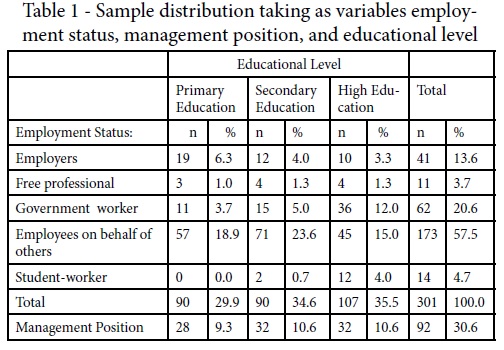
<body><![CDATA[<p>The sample is composed by 132 males (43.7%) and 169 females (56%) of ages between 18 and 67 years old (M= 40.11, SD=10.78; for males: <i>M </i>= 40.28, <i>SD </i>= 12.11; for females: <i>M </i>= 39.97,<i>SD </i>= 9.66). Concerning education level, 29.9% (n=90) have basic education, 34.6% (n=104) have secondary education, and 35.5% (n=107) have higher education. More than 50% are employees&nbsp;on behalf of others and nearly a third of the sample perform leadershiproles (<a href="#t1">Table 1</a>).</p>      <p>&nbsp;</p>  <a name="t1">      <p><img src="/img/revistas/rpesm/nspe3/spe3a08t1.jpg"></p>      
<p>&nbsp;</p>      <p><b>Materials</b></p>      <p><b>Workplace spirituality.</b></p>      <p>We have aplied a 6-point Likert scale (1 = strongly untrue to 6 = strongly true) adapted from Ashmos and Duchon (2000) and Milliman et al. (2003)for Portuguese population by Rego et al. (2007). The questionnaire comprises 17 items (&#945; = .933), evaluating the workplace spirituality in five dimensions: (1)<i> Team’s sense of community</i> mainly provides information related to the sense of community and common purpose, team spirit and mutual care among members (&#945; = 0.926); (2) <i>Alignment between organizational and individual values</i> relates to the compatibility of the individual’s values &#8203;&#8203;and inner life with the organization's values, mission and purposes (&#945; = 0.885); (3) <i>Sense of contribution to the community</i> provides information about the relationshipbetween work and personal values (&#945; = 0.810); (4) <i>Sense of enjoyment at work</i> is related to the sense of pleasure and enjoyment at work (&#945; = 0.783); and (5) <i>Oportunities for the inner life</i> evaluates how the organization respects the individual’s spiritual values and the spirituality of the workers (&#945; = 0.751). Confirmatory factor analysis was performed with AMOS 22.0, showing a good fit for the proposed model, CFI = 0.938; NIF = 0.908; RMSEA = 0.077 (Bentler, 1990;  Byrne, 2001; Kline; 1998). </p>      <p>&nbsp;</p>      <p><b>PsyCap questionnaire.</b></p>      <p>We have adopted the PsyCap Questionnaire, a 6-point Likert scale (1 = strongly disagree to 6 = strongly agree) from Vilaça et al. (2012). PsyCapQuestionnaire is widely used in positive psychology research and also in organization studies (Luthans et al. 2008). It comprises 24 items (&#945; = .919), six for each of the four dimensions: <i>Hope</i> is based on the goal-directed determination/willpower and the way to achieve goals (&#945; = .824); <i>Optimism</i> is the characteristic of those who perceive positive events as internal, stable and global, and negative events as external, unstable and specific (&#945; = .690); <i>Self-efficacy </i>is the confidence that an individual has in his ability to direct their cognitive resources, motivation and action to perform a given intervention in a specific context (<&#945; = .891); and <i>Resilience</i> is the people’s ability to rebound and succeed from adversity or failure (&#945; = .773). Despite the low reliability of the Optimism dimension, confirmatory factor analysis showed an acceptable fit for the tetra-dimensional model (CFI = .876; NFI = .819; RMSEA = .075).</p>      ]]></body>
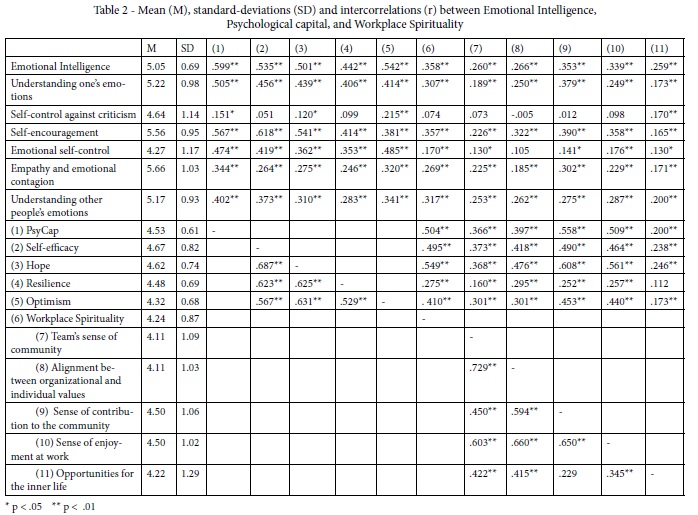
<body><![CDATA[<p>&nbsp;</p>      <p><b>Emotional Intelligence Scale.</b></p>      <p>Initially composed by 96 items, the Emotional Intelligence Scale was reduced to 17 items with a7-point Likert scale (1 = the statement absolutely does not aply to me  to 7 = the statement aplies completely to me) by Rego et al. (2007), grouped into six dimensions: Understanding one’s emotions (3 items; &#945; = .753), Self-control against criticism (3 items; &#945; = .815), Self-encouragement (use of emotions; 3 items; &#945; = .782), Emotional self-control (regulation of emotions; 3 items; &#945; = 771), Empathy and emotional contagion (2 items; &#945; = .817), and Understanding other people’s emotions (3 items; &#945; = .791).           Confirmatory factor analysis of Rego et al. (2007) model showed a good fit (CFI = .925; NFI = .881;< RMSEA = .068).</p>      <p>&nbsp;</p>      <p><b>Procedures and Data Analysis</b></p>      <p>All care was taken to ensure participants’ anonymity and to ensure the confidentiality of the data, so that the answers were not skewed. All formal and ethical situations were taken into account. A groupof master students received training in collecting the sample following rigorous procedures. This was done in order to acquire a greater number of participants in a short time. </p>      <p>This is a non-experimental and transversal study. The data was processed in SPSS and AMOS 22.0. The existence of outliers was measured by the square distance of Mahalanobis, and the normality of the variables was evaluated by the coefficients of asymmetry (Sk) and kurtosis (Ku) uni- and multivariate. None of the variables presented Sk or Ku values that could indicate violations of normal distribution, |Sk| &lt; 3 and |Ku| &lt; 8.</p>      <p>&nbsp;</p>      <p><b>Results</b></p>      <p><a href="#t2">Table 2</a> illustrates the descriptive statistics and the intercorrelations between Workplace Spirituality, Emotional Intelligence, and Psychological Capital. As we can see, there is a significant association between Emotional Intelligence and Workplace Spirituality (<i>r</i> = .358) and between Emotional Intelligence and Psychological Capital (<i>r</i> = .599). Workplace Spirituality and Psychological Capital was linked in <i>r</i> = .504.</p>      ]]></body>
<body><![CDATA[<p>&nbsp;</p>  <a name="t2">      <p><img src="/img/revistas/rpesm/nspe3/spe3a08t2.jpg"></p>      
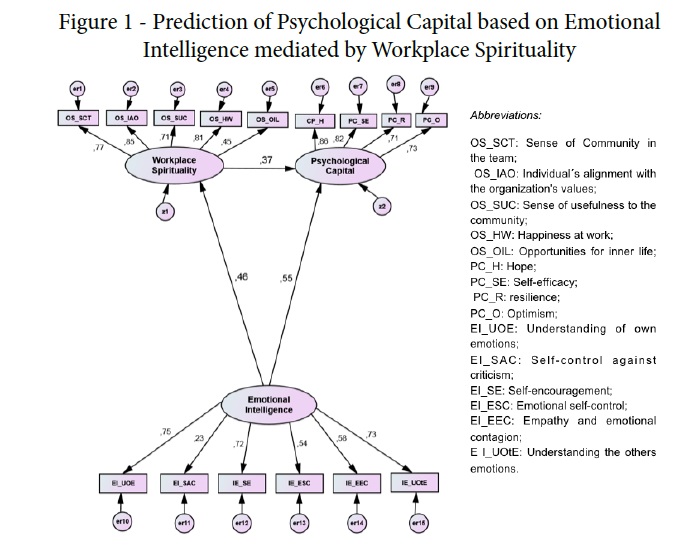
<p>&nbsp;</p>      <p>Multiple regression analyses pointed that, altogether, the five dimensions of Workplace Spirituality had a predictive capacity of 33% (<i>R</i><sup>2</sup>) of the Psychological Capital, being <i>Sense of usefulness to the community</i> (&#946; = .330) and <i>Hapiness at work</i> (&#946; = .268) the significant predictors (p&lt; .001).  On the other hand, Emotional Intelligence predicts 16.8% of the Workplace Spirituality (being <i>Self-encouragement</i> the only significant predictor, &#946; = .230 , <i>p</i> = .001) and  44.7% of the Psychological Capital (being <i>Self-encouragement</i> &#946; = .398, <i>Emotional self-control</i> &#946; = .269, and <i>Understanding other people’s emotions</i> &#946; = .197 the significant predictors, <i>p</i> &lt; .001).  </p>      <p>The relationshipbetween Emotional Intelligence and Psychological Capital was moderated by Workplace Spirituality, (&#946; = -.100, p= .024), however with a very low effect size (&#916;R2 = .01). Going to the mediation model, we analyzed the indirect effect of Workplace Spirituality in the relationshipbetween Emotional Intelligence and Psychological Capital (see <a href="#f1">Figure 1</a>). Workplace Spirituality was shown to be a partial mediator on this relationship(direct effect of &#946;<=.55, indirect effect of &#946;=.17, <i>p</i> &lt;.05).</p>      <p>&nbsp;</p>  <a name="f1">      <p><img src="/img/revistas/rpesm/nspe3/spe3a08f1.jpg"></p>      
<p>&nbsp;</p>      <p><b>Discussion</b></p>      <p>This study aimed to analyze the role of Workplace Spirituality in the relationshipbetween Emotional Intelligence and Psychological Capital. The association between these three constructs was not found in the literature. Despite of that, there is enough research that shows the positive influence of Emotional Intelligence in satisfaction (Franca &amp; Mónico, 2014), self-esteem (Mónico, Santos, &amp; Lima, 2014), and in individual and groupperformance, and also the negative impact on stress (Lucas &amp; Mónico, 2013) and turnover intention (e.g., Cobero et al., 2006). We found that self-encouragement promotes an increase in the perception of Workplace Spirituality. Furthermore, the ability to self-motivate using our own feelings (<i>self-encouragement</i>) and to control these feelings in emotional situations (<i>emotional self-control</i>) promotes employees Psychological Capital. This result is in line with the literature that associates Psychological Capital with emotional intelligence (Nellão &amp; Mónico, 2013), and also wirh performance, work attitude, leadership, satisfaction, and creativity (Luthans et al., 2006; Luthans &amp; Youssef, 2007; Toor &amp; Ofori, 2010).</p>      ]]></body>
<body><![CDATA[<p>Several studies found a positive&nbsp;relationship between&nbsp;Workplace Spirituality and organizational climate, productivity, commitment, performance, and intuitive and creative potential of employees to promote honesty and trust among organizational members, and also between them and the other stakeholders (Krishnakumar &amp; Neck, 2002; Rego et al., 2007). In a recent work it was found that Workplace Spirituality is able to influence the Psychological Capital of workers (Pedreira &amp; Mónico, 2013); we strengthened that this relationshipoccurs if the employees feel hapy and useful in their work and that Workplace Spirituality strengths the relationshipbetween Emotional Intelligence and Psychological Capital. Indeed, Workplace Spirituality&nbsp;can be considered as a&nbsp;framework of&nbsp;organizational values&nbsp;&#8203;&#8203;evidenced in the culture,&nbsp;which promotes employee's&nbsp;experience of transcendence&nbsp;through the&nbsp;work process (Giacalone &amp; Jurkiewicz, 2003). With this transcendental experience each employee can be involved with the organization&nbsp;beyond required work, facilitating&nbsp;their sense of&nbsp;connection with others&nbsp;in a way that&nbsp;promotes the feeling&nbsp;of fullness&nbsp;and hapiness.</p>      <p><b>&nbsp;</b></p>      <p><b>Conclusion </b></p>      <p>Workplace Spirituality, Emotional Intelligence, and Psychological Capital are positively correlated. Workplace Spirituality affects the relationshipbetween Emotional Intelligence and Psychological Capital, acting as a moderator variable, although with a small effect size. Furthermore, Workplace Spirituality showed to be a partial mediator on the relationshipbetween Emotional Intelligence and Psychological Capital.</p>      <p>&nbsp;</p>      <p><b>Implications for Clinical Practice</b></p>      <p>In clinical practice, the research on emotional intelligence, psychological capital and Workplace Spirituality is scarce and still at the developmental stage. </p>      <p>Considering the implications, questions related to the improvement of emotional intelligence and psychological capital in healthcare professionals should be considered. This development can highlight healthcare professionals’ psychological empowerment, a set of psychological states which are necessary for professionals feel that they have control over their work.</p>      <p>Good workplace spirituality can enhance structural empowerment. This perspective of empowerment focuses on social and structural conditions that allow empowerment at the workplace. It only exists if the healthcare professionals have access to oportunities, information, suport and resources, being the workplace spirituality a good promoter, influencing healthcare provision, work requirements, job satisfaction, and the continuity of healthcare professionals in their clinical practice.</p>      <p><b>&nbsp;</b></p>      ]]></body>
<body><![CDATA[<p><b>References</b></p>      <!-- ref --><p>Ashmos, D. P.,  &amp;  Duchon, D. (2000). Spirituality at work: A conceptualization and measure. <i>Journal of Management Inquiry</i>, <i>9</i>(2),134-145.    &nbsp;&nbsp;&nbsp;&nbsp;&nbsp;&nbsp;&nbsp;&nbsp;[&#160;<a href="javascript:void(0);" onclick="javascript: window.open('/scielo.php?script=sci_nlinks&ref=1199056&pid=S1647-2160201600020000800001&lng=','','width=640,height=500,resizable=yes,scrollbars=1,menubar=yes,');">Links</a>&#160;]<!-- end-ref --></p>      <!-- ref --><p>Cobero, C., Primi, R., &amp; Muniz, M. (2006). Inteligência emocional e desempenho no trabalho: Um estudo com MSCEIT, BPR-5 e 16PF. <i>Paidéia, 16</i>(35), 337-348.    &nbsp;&nbsp;&nbsp;&nbsp;&nbsp;&nbsp;&nbsp;&nbsp;[&#160;<a href="javascript:void(0);" onclick="javascript: window.open('/scielo.php?script=sci_nlinks&ref=1199058&pid=S1647-2160201600020000800002&lng=','','width=640,height=500,resizable=yes,scrollbars=1,menubar=yes,');">Links</a>&#160;]<!-- end-ref --></p>      <!-- ref --><p>Duchon, D., &amp; Plowman, D. A. (2005). Nurturing the spirit at work: Impact on work unit performance. <i>LeadershipQuarterly</i>, <i>16</i>, 807-833.    &nbsp;&nbsp;&nbsp;&nbsp;&nbsp;&nbsp;&nbsp;&nbsp;[&#160;<a href="javascript:void(0);" onclick="javascript: window.open('/scielo.php?script=sci_nlinks&ref=1199060&pid=S1647-2160201600020000800003&lng=','','width=640,height=500,resizable=yes,scrollbars=1,menubar=yes,');">Links</a>&#160;]<!-- end-ref --></p>      <!-- ref --><p>Franca, L. A., &amp; Mónico, L. S. (2014). The role of emotional intelligence in job satisfaction of individuals. <i>International Journal of Developmental and Educational Psychology</i>, <i>1</i>(7), 203-212.    &nbsp;&nbsp;&nbsp;&nbsp;&nbsp;&nbsp;&nbsp;&nbsp;[&#160;<a href="javascript:void(0);" onclick="javascript: window.open('/scielo.php?script=sci_nlinks&ref=1199062&pid=S1647-2160201600020000800004&lng=','','width=640,height=500,resizable=yes,scrollbars=1,menubar=yes,');">Links</a>&#160;]<!-- end-ref --></p>      <!-- ref --><p>Giacalone, R. A., &amp; Jurkiewicz, C. L. (2003). Toward a science of workplace spirituality. In R. A. Giacalone &amp; C. L. Jurkiewicz (Eds.), <i>The handbook of workplace spirituality and organizational performance</i>, 3-28.    &nbsp;&nbsp;&nbsp;&nbsp;&nbsp;&nbsp;&nbsp;&nbsp;[&#160;<a href="javascript:void(0);" onclick="javascript: window.open('/scielo.php?script=sci_nlinks&ref=1199064&pid=S1647-2160201600020000800005&lng=','','width=640,height=500,resizable=yes,scrollbars=1,menubar=yes,');">Links</a>&#160;]<!-- end-ref --> </p>      <!-- ref --><p>Goleman, D. (1995). <i>Emotional intelligence</i>.    &nbsp;&nbsp;&nbsp;&nbsp;&nbsp;&nbsp;&nbsp;&nbsp;[&#160;<a href="javascript:void(0);" onclick="javascript: window.open('/scielo.php?script=sci_nlinks&ref=1199066&pid=S1647-2160201600020000800006&lng=','','width=640,height=500,resizable=yes,scrollbars=1,menubar=yes,');">Links</a>&#160;]<!-- end-ref --> New York, United States of America: Bantam Books.</p>      <!-- ref --><p>Krishnakumar, S., &amp; Neck, C.P. (2002). The &quot;what&quot;, &quot;why&quot; and &quot;how&quot; of spirituality in the workplace. <i>Journal of Managerial Psychology</i>, <i>17</i>(3), 153-164.    &nbsp;&nbsp;&nbsp;&nbsp;&nbsp;&nbsp;&nbsp;&nbsp;[&#160;<a href="javascript:void(0);" onclick="javascript: window.open('/scielo.php?script=sci_nlinks&ref=1199068&pid=S1647-2160201600020000800007&lng=','','width=640,height=500,resizable=yes,scrollbars=1,menubar=yes,');">Links</a>&#160;]<!-- end-ref --></p>      <!-- ref --><p>Lucas, H. M., &amp; Mónico, L. S. (2013). Emotional intelligence and the protection of organizational stress. <i>International Journal of Developmental and Educational Psychology</i>, <i>2</i>(1), 551-560.    &nbsp;&nbsp;&nbsp;&nbsp;&nbsp;&nbsp;&nbsp;&nbsp;[&#160;<a href="javascript:void(0);" onclick="javascript: window.open('/scielo.php?script=sci_nlinks&ref=1199070&pid=S1647-2160201600020000800008&lng=','','width=640,height=500,resizable=yes,scrollbars=1,menubar=yes,');">Links</a>&#160;]<!-- end-ref --></p>      <!-- ref --><p>Luthans, F., &amp; Youssef. C. M. (2007). Emerging positive organizational behavior. <i>Journal of Management</i>, <i>33</i>(3), 321-349. doi: <a href="http://dx.doi.org/10.1177/0149206307300814"target="_blank">http://dx.doi.org/10.1177/0149206307300814 </a>&nbsp;&nbsp;&nbsp;&nbsp;&nbsp;&nbsp;&nbsp;&nbsp;[&#160;<a href="javascript:void(0);" onclick="javascript: window.open('/scielo.php?script=sci_nlinks&ref=1199072&pid=S1647-2160201600020000800009&lng=','','width=640,height=500,resizable=yes,scrollbars=1,menubar=yes,');">Links</a>&#160;]<!-- end-ref --><!-- ref --><p>Luthans, F., Youssef. C. M., &amp; Avolio, B. J. (2007). <i>Psychological capital: Developing the human competitive edge</i>. Oxford, United Kingdom: Oxford University Press.    &nbsp;&nbsp;&nbsp;&nbsp;&nbsp;&nbsp;&nbsp;&nbsp;[&#160;<a href="javascript:void(0);" onclick="javascript: window.open('/scielo.php?script=sci_nlinks&ref=1199073&pid=S1647-2160201600020000800010&lng=','','width=640,height=500,resizable=yes,scrollbars=1,menubar=yes,');">Links</a>&#160;]<!-- end-ref --></p>      ]]></body>
<body><![CDATA[<!-- ref --><p>Mayer, J. D., Salovey, P., &amp; Caruso, D.R. (2008). Emotional intelligence: New ability or eclectic mix of traits? <i>American Psychologist</i>, <i>63</i>(6), 503-517. doi: <a href="http://dx.doi.org/10.1037/0003-066X.63.6.503"target="_blank">http://dx.doi.org/10.1037/0003-066X.63.6.503 </a>&nbsp;&nbsp;&nbsp;&nbsp;&nbsp;&nbsp;&nbsp;&nbsp;[&#160;<a href="javascript:void(0);" onclick="javascript: window.open('/scielo.php?script=sci_nlinks&ref=1199075&pid=S1647-2160201600020000800011&lng=','','width=640,height=500,resizable=yes,scrollbars=1,menubar=yes,');">Links</a>&#160;]<!-- end-ref --><!-- ref --><p>Mellão, N., &amp; Mónico, L. S. (2013). The relation between emotional intelligence and psychological capital of employees. <i>International Journal of Developmental and Educational Psychology</i>, <i>2</i>(1), 545-550.    &nbsp;&nbsp;&nbsp;&nbsp;&nbsp;&nbsp;&nbsp;&nbsp;[&#160;<a href="javascript:void(0);" onclick="javascript: window.open('/scielo.php?script=sci_nlinks&ref=1199076&pid=S1647-2160201600020000800012&lng=','','width=640,height=500,resizable=yes,scrollbars=1,menubar=yes,');">Links</a>&#160;]<!-- end-ref --></p>      <!-- ref --><p>Milliman, J., Czaplewski, A. J., &amp; Fergusson, J. (2003). Workplace spirituality and employee work attitudes: An exploratory empirical assessment. <i>Journal of Organizational Change Management</i>, <i>6</i>(4), 426-447. doi: <a href="http://dx.doi.org/10.1108/09534810310484172"target="_blank">http://dx.doi.org/10.1108/09534810310484172 </a>&nbsp;&nbsp;&nbsp;&nbsp;&nbsp;&nbsp;&nbsp;&nbsp;[&#160;<a href="javascript:void(0);" onclick="javascript: window.open('/scielo.php?script=sci_nlinks&ref=1199078&pid=S1647-2160201600020000800013&lng=','','width=640,height=500,resizable=yes,scrollbars=1,menubar=yes,');">Links</a>&#160;]<!-- end-ref --><!-- ref --><p>Mónico, L. S., Santos, P. I., &amp; Lima, L. N. (2014). The implications of emotional intelligence in self-esteem. <i>Revista de Saúde Pública</i>, <i>48</i>, 190-281.    &nbsp;&nbsp;&nbsp;&nbsp;&nbsp;&nbsp;&nbsp;&nbsp;[&#160;<a href="javascript:void(0);" onclick="javascript: window.open('/scielo.php?script=sci_nlinks&ref=1199079&pid=S1647-2160201600020000800014&lng=','','width=640,height=500,resizable=yes,scrollbars=1,menubar=yes,');">Links</a>&#160;]<!-- end-ref --></p>      <!-- ref --><p>Pedreira, L., &amp; Mónico, L. S. (2013). Workaholism and psychological capital: Repercussions on workplace spirituality. <i>International Journal of Developmental and Educational Psychology</i>, <i>2</i>(1), 535-544.    &nbsp;&nbsp;&nbsp;&nbsp;&nbsp;&nbsp;&nbsp;&nbsp;[&#160;<a href="javascript:void(0);" onclick="javascript: window.open('/scielo.php?script=sci_nlinks&ref=1199081&pid=S1647-2160201600020000800015&lng=','','width=640,height=500,resizable=yes,scrollbars=1,menubar=yes,');">Links</a>&#160;]<!-- end-ref --></p>      <!-- ref --><p>Poole, E. (2009). Organizational spirituality: A literature review<i>. Journal of Business Ethics</i>, <i>84</i>(4), 577-588.    &nbsp;&nbsp;&nbsp;&nbsp;&nbsp;&nbsp;&nbsp;&nbsp;[&#160;<a href="javascript:void(0);" onclick="javascript: window.open('/scielo.php?script=sci_nlinks&ref=1199083&pid=S1647-2160201600020000800016&lng=','','width=640,height=500,resizable=yes,scrollbars=1,menubar=yes,');">Links</a>&#160;]<!-- end-ref --></p>      ]]></body>
<body><![CDATA[<!-- ref --><p>Rego, A., Souto, S., &amp; Cunha, M. P. (2007). Espiritualidade nas organizações positividade e desempenho. <i>Comportamento Organizacional e Gestão</i>, <i>13</i>(1), 7-36.    &nbsp;&nbsp;&nbsp;&nbsp;&nbsp;&nbsp;&nbsp;&nbsp;[&#160;<a href="javascript:void(0);" onclick="javascript: window.open('/scielo.php?script=sci_nlinks&ref=1199085&pid=S1647-2160201600020000800017&lng=','','width=640,height=500,resizable=yes,scrollbars=1,menubar=yes,');">Links</a>&#160;]<!-- end-ref --></p>      <!-- ref --><p>Sousa, A. P., Mónico, L. S., &amp; Castro, F. V. (2012). Workaholic ou worklover: A importância da inteligência emocional. <i>International Journal of Developmental and Educational Psychology</i>, <i>4</i>(1), 281-289.    &nbsp;&nbsp;&nbsp;&nbsp;&nbsp;&nbsp;&nbsp;&nbsp;[&#160;<a href="javascript:void(0);" onclick="javascript: window.open('/scielo.php?script=sci_nlinks&ref=1199087&pid=S1647-2160201600020000800018&lng=','','width=640,height=500,resizable=yes,scrollbars=1,menubar=yes,');">Links</a>&#160;]<!-- end-ref --></p>      <!-- ref --><p>Toor, S. R., &amp; Ofori, G. (2010). Positive psychological capital (PsyCap) as a source of sustainable competitive advantage for organizations. <i>International Journal of Project Management</i>, <i>136</i>(3), 341–352.    &nbsp;&nbsp;&nbsp;&nbsp;&nbsp;&nbsp;&nbsp;&nbsp;[&#160;<a href="javascript:void(0);" onclick="javascript: window.open('/scielo.php?script=sci_nlinks&ref=1199089&pid=S1647-2160201600020000800019&lng=','','width=640,height=500,resizable=yes,scrollbars=1,menubar=yes,');">Links</a>&#160;]<!-- end-ref --> </p>      <!-- ref --><p>Vilaça, I., Mónico, L. S., &amp; Castro, F. V. (2012). Da espiritualidade organizacional ao capital psicológico individual: Qual o papel da liderança autêntica? <i>International Journal of Developmental and Educational Psychology</i>, <i>4</i>(1), 281-289.    &nbsp;&nbsp;&nbsp;&nbsp;&nbsp;&nbsp;&nbsp;&nbsp;[&#160;<a href="javascript:void(0);" onclick="javascript: window.open('/scielo.php?script=sci_nlinks&ref=1199091&pid=S1647-2160201600020000800020&lng=','','width=640,height=500,resizable=yes,scrollbars=1,menubar=yes,');">Links</a>&#160;]<!-- end-ref --></p>      <p>&nbsp;</p>      <p>Recebido a 31 de outubro de 2015</p>      ]]></body>
<body><![CDATA[<p>Aceite para publicação a 10 de março de 2016</p>       ]]></body><back>
<ref-list>
<ref id="B1">
<nlm-citation citation-type="journal">
<person-group person-group-type="author">
<name>
<surname><![CDATA[Ashmos]]></surname>
<given-names><![CDATA[D. P.]]></given-names>
</name>
<name>
<surname><![CDATA[Duchon]]></surname>
<given-names><![CDATA[D.]]></given-names>
</name>
</person-group>
<article-title xml:lang="en"><![CDATA[Spirituality at work:: A conceptualization and measure]]></article-title>
<source><![CDATA[Journal of Management Inquiry]]></source>
<year>2000</year>
<volume>9</volume>
<numero>2</numero>
<issue>2</issue>
<page-range>134-145</page-range></nlm-citation>
</ref>
<ref id="B2">
<nlm-citation citation-type="journal">
<person-group person-group-type="author">
<name>
<surname><![CDATA[Cobero]]></surname>
<given-names><![CDATA[C.]]></given-names>
</name>
<name>
<surname><![CDATA[Primi]]></surname>
<given-names><![CDATA[R.]]></given-names>
</name>
<name>
<surname><![CDATA[Muniz]]></surname>
<given-names><![CDATA[M.]]></given-names>
</name>
</person-group>
<article-title xml:lang="pt"><![CDATA[Inteligência emocional e desempenho no trabalho: Um estudo com MSCEIT, BPR-5 e 16PF]]></article-title>
<source><![CDATA[Paidéia]]></source>
<year>2006</year>
<volume>16</volume>
<numero>35</numero>
<issue>35</issue>
<page-range>337-348</page-range></nlm-citation>
</ref>
<ref id="B3">
<nlm-citation citation-type="journal">
<person-group person-group-type="author">
<name>
<surname><![CDATA[Duchon]]></surname>
<given-names><![CDATA[D.]]></given-names>
</name>
<name>
<surname><![CDATA[Plowman]]></surname>
<given-names><![CDATA[D. A.]]></given-names>
</name>
</person-group>
<article-title xml:lang="en"><![CDATA[Nurturing the spirit at work: Impact on work unit performance]]></article-title>
<source><![CDATA[Leadership Quarterly]]></source>
<year>2005</year>
<volume>16</volume>
<page-range>807-833</page-range></nlm-citation>
</ref>
<ref id="B4">
<nlm-citation citation-type="journal">
<person-group person-group-type="author">
<name>
<surname><![CDATA[Franca]]></surname>
<given-names><![CDATA[L. A.]]></given-names>
</name>
<name>
<surname><![CDATA[Mónico]]></surname>
<given-names><![CDATA[L. S.]]></given-names>
</name>
</person-group>
<article-title xml:lang="en"><![CDATA[The role of emotional intelligence in job satisfaction of individuals]]></article-title>
<source><![CDATA[International Journal of Developmental and Educational Psychology]]></source>
<year>2014</year>
<volume>1</volume>
<numero>7</numero>
<issue>7</issue>
<page-range>203-212</page-range></nlm-citation>
</ref>
<ref id="B5">
<nlm-citation citation-type="">
<person-group person-group-type="author">
<name>
<surname><![CDATA[Giacalone]]></surname>
<given-names><![CDATA[R. A.]]></given-names>
</name>
<name>
<surname><![CDATA[Jurkiewicz]]></surname>
<given-names><![CDATA[C. L.]]></given-names>
</name>
</person-group>
<article-title xml:lang="en"><![CDATA[Toward a science of workplace spirituality]]></article-title>
<person-group person-group-type="editor">
<name>
<surname><![CDATA[Giacalone]]></surname>
<given-names><![CDATA[R. A.]]></given-names>
</name>
<name>
<surname><![CDATA[Jurkiewicz]]></surname>
<given-names><![CDATA[C. L.]]></given-names>
</name>
</person-group>
<source><![CDATA[The handbook of workplace spirituality and organizational performance]]></source>
<year>2003</year>
<page-range>3-28</page-range></nlm-citation>
</ref>
<ref id="B6">
<nlm-citation citation-type="">
<person-group person-group-type="author">
<name>
<surname><![CDATA[Goleman]]></surname>
<given-names><![CDATA[D.]]></given-names>
</name>
</person-group>
<source><![CDATA[Emotional intelligence]]></source>
<year>1995</year>
</nlm-citation>
</ref>
<ref id="B7">
<nlm-citation citation-type="journal">
<person-group person-group-type="author">
<name>
<surname><![CDATA[Krishnakumar]]></surname>
<given-names><![CDATA[S.]]></given-names>
</name>
<name>
<surname><![CDATA[Neck]]></surname>
<given-names><![CDATA[C.P.]]></given-names>
</name>
</person-group>
<article-title xml:lang="en"><![CDATA[The "what", "why" and "how" of spirituality in the workplace]]></article-title>
<source><![CDATA[Journal of Managerial Psychology]]></source>
<year>2002</year>
<volume>17</volume>
<numero>3</numero>
<issue>3</issue>
<page-range>153-164</page-range></nlm-citation>
</ref>
<ref id="B8">
<nlm-citation citation-type="journal">
<person-group person-group-type="author">
<name>
<surname><![CDATA[Lucas]]></surname>
<given-names><![CDATA[H. M.]]></given-names>
</name>
<name>
<surname><![CDATA[Mónico]]></surname>
<given-names><![CDATA[L. S.]]></given-names>
</name>
</person-group>
<article-title xml:lang="en"><![CDATA[Emotional intelligence and the protection of organizational stress]]></article-title>
<source><![CDATA[International Journal of Developmental and Educational Psychology]]></source>
<year>2013</year>
<volume>2</volume>
<numero>1</numero>
<issue>1</issue>
<page-range>551-560</page-range></nlm-citation>
</ref>
<ref id="B9">
<nlm-citation citation-type="journal">
<person-group person-group-type="author">
<name>
<surname><![CDATA[Luthans]]></surname>
<given-names><![CDATA[F.]]></given-names>
</name>
<name>
<surname><![CDATA[Youssef]]></surname>
<given-names><![CDATA[C. M.]]></given-names>
</name>
</person-group>
<article-title xml:lang="en"><![CDATA[Emerging positive organizational behavior]]></article-title>
<source><![CDATA[Journal of Management]]></source>
<year>2007</year>
<volume>33</volume>
<numero>3</numero>
<issue>3</issue>
<page-range>321-349</page-range></nlm-citation>
</ref>
<ref id="B10">
<nlm-citation citation-type="book">
<person-group person-group-type="author">
<name>
<surname><![CDATA[Luthans]]></surname>
<given-names><![CDATA[F.]]></given-names>
</name>
<name>
<surname><![CDATA[Youssef]]></surname>
<given-names><![CDATA[C. M.]]></given-names>
</name>
<name>
<surname><![CDATA[Avolio]]></surname>
<given-names><![CDATA[B. J.]]></given-names>
</name>
</person-group>
<source><![CDATA[Psychological capital:: Developing the human competitive edge]]></source>
<year>2007</year>
<publisher-loc><![CDATA[Oxford ]]></publisher-loc>
<publisher-name><![CDATA[Oxford University Press]]></publisher-name>
</nlm-citation>
</ref>
<ref id="B11">
<nlm-citation citation-type="journal">
<person-group person-group-type="author">
<name>
<surname><![CDATA[Mayer]]></surname>
<given-names><![CDATA[J. D.]]></given-names>
</name>
<name>
<surname><![CDATA[Salovey]]></surname>
<given-names><![CDATA[P.]]></given-names>
</name>
<name>
<surname><![CDATA[Caruso]]></surname>
<given-names><![CDATA[D.R.]]></given-names>
</name>
</person-group>
<article-title xml:lang="en"><![CDATA[Emotional intelligence: New ability or eclectic mix of traits?]]></article-title>
<source><![CDATA[American Psychologist]]></source>
<year>2008</year>
<volume>63</volume>
<numero>6</numero>
<issue>6</issue>
<page-range>503-517</page-range></nlm-citation>
</ref>
<ref id="B12">
<nlm-citation citation-type="journal">
<person-group person-group-type="author">
<name>
<surname><![CDATA[Mellão]]></surname>
<given-names><![CDATA[N.]]></given-names>
</name>
<name>
<surname><![CDATA[Mónico]]></surname>
<given-names><![CDATA[L. S.]]></given-names>
</name>
</person-group>
<article-title xml:lang="en"><![CDATA[The relation between emotional intelligence and psychological capital of employees]]></article-title>
<source><![CDATA[International Journal of Developmental and Educational Psychology]]></source>
<year>2013</year>
<volume>2</volume>
<numero>1</numero>
<issue>1</issue>
<page-range>545-550</page-range></nlm-citation>
</ref>
<ref id="B13">
<nlm-citation citation-type="journal">
<person-group person-group-type="author">
<name>
<surname><![CDATA[Milliman]]></surname>
<given-names><![CDATA[J.]]></given-names>
</name>
<name>
<surname><![CDATA[Czaplewski]]></surname>
<given-names><![CDATA[A. J.]]></given-names>
</name>
<name>
<surname><![CDATA[Fergusson]]></surname>
<given-names><![CDATA[J.]]></given-names>
</name>
</person-group>
<article-title xml:lang="en"><![CDATA[Workplace spirituality and employee work attitudes: An exploratory empirical assessment]]></article-title>
<source><![CDATA[Journal of Organizational Change Management]]></source>
<year>2003</year>
<volume>6</volume>
<numero>4</numero>
<issue>4</issue>
<page-range>426-447</page-range></nlm-citation>
</ref>
<ref id="B14">
<nlm-citation citation-type="journal">
<person-group person-group-type="author">
<name>
<surname><![CDATA[Mónico]]></surname>
<given-names><![CDATA[L. S.]]></given-names>
</name>
<name>
<surname><![CDATA[Santos]]></surname>
<given-names><![CDATA[P. I.]]></given-names>
</name>
<name>
<surname><![CDATA[Lima]]></surname>
<given-names><![CDATA[L. N.]]></given-names>
</name>
</person-group>
<article-title xml:lang="en"><![CDATA[The implications of emotional intelligence in self-esteem]]></article-title>
<source><![CDATA[Revista de Saúde Pública]]></source>
<year>2014</year>
<volume>48</volume>
<page-range>190-281</page-range></nlm-citation>
</ref>
<ref id="B15">
<nlm-citation citation-type="journal">
<person-group person-group-type="author">
<name>
<surname><![CDATA[Pedreira]]></surname>
<given-names><![CDATA[L.]]></given-names>
</name>
<name>
<surname><![CDATA[Mónico]]></surname>
<given-names><![CDATA[L. S.]]></given-names>
</name>
</person-group>
<article-title xml:lang="en"><![CDATA[Workaholism and psychological capital: Repercussions on workplace spirituality]]></article-title>
<source><![CDATA[International Journal of Developmental and Educational Psychology]]></source>
<year>2013</year>
<volume>2</volume>
<numero>1</numero>
<issue>1</issue>
<page-range>535-544</page-range></nlm-citation>
</ref>
<ref id="B16">
<nlm-citation citation-type="journal">
<person-group person-group-type="author">
<name>
<surname><![CDATA[Poole]]></surname>
<given-names><![CDATA[E.]]></given-names>
</name>
</person-group>
<article-title xml:lang="en"><![CDATA[Organizational spirituality: A literature review]]></article-title>
<source><![CDATA[Journal of Business Ethics]]></source>
<year>2009</year>
<volume>84</volume>
<numero>4</numero>
<issue>4</issue>
<page-range>577-588</page-range></nlm-citation>
</ref>
<ref id="B17">
<nlm-citation citation-type="journal">
<person-group person-group-type="author">
<name>
<surname><![CDATA[Rego]]></surname>
<given-names><![CDATA[A.]]></given-names>
</name>
<name>
<surname><![CDATA[Souto]]></surname>
<given-names><![CDATA[S.]]></given-names>
</name>
<name>
<surname><![CDATA[Cunha]]></surname>
<given-names><![CDATA[M. P.]]></given-names>
</name>
</person-group>
<article-title xml:lang="pt"><![CDATA[Espiritualidade nas organizações positividade e desempenho]]></article-title>
<source><![CDATA[Comportamento Organizacional e Gestão]]></source>
<year>2007</year>
<volume>13</volume>
<numero>1</numero>
<issue>1</issue>
<page-range>7-36</page-range></nlm-citation>
</ref>
<ref id="B18">
<nlm-citation citation-type="journal">
<person-group person-group-type="author">
<name>
<surname><![CDATA[Sousa]]></surname>
<given-names><![CDATA[A. P.]]></given-names>
</name>
<name>
<surname><![CDATA[Mónico]]></surname>
<given-names><![CDATA[L. S.]]></given-names>
</name>
<name>
<surname><![CDATA[Castro]]></surname>
<given-names><![CDATA[F. V.]]></given-names>
</name>
</person-group>
<article-title xml:lang="en"><![CDATA[Workaholic ou worklover: A importância da inteligência emocional]]></article-title>
<source><![CDATA[International Journal of Developmental and Educational Psychology]]></source>
<year>2012</year>
<volume>4</volume>
<numero>1</numero>
<issue>1</issue>
<page-range>281-289</page-range></nlm-citation>
</ref>
<ref id="B19">
<nlm-citation citation-type="journal">
<person-group person-group-type="author">
<name>
<surname><![CDATA[Toor]]></surname>
<given-names><![CDATA[S. R.]]></given-names>
</name>
<name>
<surname><![CDATA[Ofori]]></surname>
<given-names><![CDATA[G.]]></given-names>
</name>
</person-group>
<article-title xml:lang="en"><![CDATA[Positive psychological capital (PsyCap) as a source of sustainable competitive advantage for organizations]]></article-title>
<source><![CDATA[International Journal of Project Management]]></source>
<year>2010</year>
<volume>136</volume>
<numero>3</numero>
<issue>3</issue>
<page-range>341-352</page-range></nlm-citation>
</ref>
<ref id="B20">
<nlm-citation citation-type="journal">
<person-group person-group-type="author">
<name>
<surname><![CDATA[Vilaça]]></surname>
<given-names><![CDATA[I.]]></given-names>
</name>
<name>
<surname><![CDATA[Mónico]]></surname>
<given-names><![CDATA[L. S.]]></given-names>
</name>
<name>
<surname><![CDATA[Castro]]></surname>
<given-names><![CDATA[F. V.]]></given-names>
</name>
</person-group>
<article-title xml:lang="pt"><![CDATA[Da espiritualidade organizacional ao capital psicológico individual: Qual o papel da liderança autêntica]]></article-title>
<source><![CDATA[International Journal of Developmental and Educational Psychology]]></source>
<year>2012</year>
<volume>4</volume>
<numero>1</numero>
<issue>1</issue>
<page-range>281-289</page-range></nlm-citation>
</ref>
</ref-list>
</back>
</article>