<?xml version="1.0" encoding="ISO-8859-1"?><article xmlns:mml="http://www.w3.org/1998/Math/MathML" xmlns:xlink="http://www.w3.org/1999/xlink" xmlns:xsi="http://www.w3.org/2001/XMLSchema-instance">
<front>
<journal-meta>
<journal-id>1647-2160</journal-id>
<journal-title><![CDATA[Revista Portuguesa de Enfermagem de Saúde Mental]]></journal-title>
<abbrev-journal-title><![CDATA[Revista Portuguesa de Enfermagem de Saúde Mental]]></abbrev-journal-title>
<issn>1647-2160</issn>
<publisher>
<publisher-name><![CDATA[Sociedade Portuguesa de Enfermagem de Saúde Mental]]></publisher-name>
</publisher>
</journal-meta>
<article-meta>
<article-id>S1647-21602016000300005</article-id>
<article-id pub-id-type="doi">10.19131/rpesm.0155</article-id>
<title-group>
<article-title xml:lang="en"><![CDATA[Changes perceived by users after treatment for alcohol dependence]]></article-title>
<article-title xml:lang="pt"><![CDATA[Mudanças percebidas por usuários após tratamento de dependência ao álcool]]></article-title>
<article-title xml:lang="es"><![CDATA[Cambios percibidos por los usuarios después del tratamiento de la dependencia del alcohol]]></article-title>
</title-group>
<contrib-group>
<contrib contrib-type="author">
<name>
<surname><![CDATA[Vieira]]></surname>
<given-names><![CDATA[Camila Barcelos]]></given-names>
</name>
<xref ref-type="aff" rid="A01"/>
<xref ref-type="aff" rid="A02"/>
</contrib>
<contrib contrib-type="author">
<name>
<surname><![CDATA[Cardoso]]></surname>
<given-names><![CDATA[Lorena Silveira]]></given-names>
</name>
<xref ref-type="aff" rid="A01"/>
<xref ref-type="aff" rid="A02"/>
</contrib>
<contrib contrib-type="author">
<name>
<surname><![CDATA[Siqueira]]></surname>
<given-names><![CDATA[Marluce Miguel de]]></given-names>
</name>
<xref ref-type="aff" rid="A01"/>
<xref ref-type="aff" rid="A02"/>
</contrib>
</contrib-group>
<aff id="A01">
<institution><![CDATA[,Centre for Studies and Research on Alcohol and Other Drugs  ]]></institution>
<addr-line><![CDATA[ ]]></addr-line>
</aff>
<aff id="A02">
<institution><![CDATA[,Federal University of Espírito Santo  ]]></institution>
<addr-line><![CDATA[Vitória Espírito Santo]]></addr-line>
<country>Brazil</country>
</aff>
<pub-date pub-type="pub">
<day>00</day>
<month>12</month>
<year>2016</year>
</pub-date>
<pub-date pub-type="epub">
<day>00</day>
<month>12</month>
<year>2016</year>
</pub-date>
<numero>16</numero>
<fpage>34</fpage>
<lpage>40</lpage>
<copyright-statement/>
<copyright-year/>
<self-uri xlink:href="http://scielo.pt/scielo.php?script=sci_arttext&amp;pid=S1647-21602016000300005&amp;lng=en&amp;nrm=iso"></self-uri><self-uri xlink:href="http://scielo.pt/scielo.php?script=sci_abstract&amp;pid=S1647-21602016000300005&amp;lng=en&amp;nrm=iso"></self-uri><self-uri xlink:href="http://scielo.pt/scielo.php?script=sci_pdf&amp;pid=S1647-21602016000300005&amp;lng=en&amp;nrm=iso"></self-uri><abstract abstract-type="short" xml:lang="en"><p><![CDATA[OBJECTIVE: To evaluate the changes resulting from alcoholism treatment received from a programme specialising in the care of alcoholics. METHODS: Evaluative, descriptive study with a quantitative and cross-sectional approach. The data analysis was performed using SPSS 20.0 with univariate analysis applied for the description of socioeconomic and clinical variables and Escala de Mudança Percebida [Perceived Change Scale] (EMP - patient) item scores, and bivariate analysis to test the association between the final scale score and the socioeconomic and clinical variables. RESULTS: The sample was predominantly male (81%) with an in-service treatment time greater than four years (45.2%) and an abstinence period between zero and four weeks (35.7%). Regarding the perception of changes, in general, 83.3% of the alcoholic patients declared themselves to be better than before treatment, whereas the perception of worsening was only detected in the sexuality (26.8%) and sleep (16.7%) items. No significant relationship was found between the variables analysed. CONCLUSION: The study showed that, in general, the patients perceived themselves as better after receiving treatment; moreover, the EMP is a sensitive measure to evaluate treatment outcomes because it indicates the positive and negative effects of treatment on the patients&#8217; lives.]]></p></abstract>
<abstract abstract-type="short" xml:lang="pt"><p><![CDATA[OBJETIVO: Avaliar as mudanças decorrentes do tratamento recebido em um programa especializado no atendimento de alcoolistas. METODOLOGIA: Trata-se de um estudo avaliativo, descritivo com abordagem quantitativa e de corte transversal. A análise dos dados foi feita através do programa SPSS 20.0, utilizando a análise univariada para a descrição das variáveis socioeconômicas, clínicas e da Escala de Mudança Percebida (EMP-paciente) e a análise bivariada, a fim de verificar a associação entre o escore final da escala e as variáveis socioeconômicas e clínicas. RESULTADOS: A amostra foi predominantemente masculina (81%), com tempo de tratamento no serviço maior que quatro anos (45,2%) e tempo de abstinência entre zero e quatro semanas (35,7%). Com relação à percepção das mudanças, de forma geral, 83,3% dos pacientes alcoolistas declararam estar melhor do que antes do tratamento, havendo percepção de piora apenas nos itens sexualidade (26,8%) e sono (16,7%). Não foi encontrada relação estatística entre as variáveis analisadas. CONCLUSÃO: O estudo mostrou que, de maneira geral, os pacientes perceberam-se melhores após o tratamento recebido, sendo a escala EMP é uma medida sensível para avaliar os resultados do tratamento, pois indica os pontos positivos e negativos do tratamento sobre a vida do paciente.]]></p></abstract>
<abstract abstract-type="short" xml:lang="es"><p><![CDATA[OBJETIVO: Evaluar los cambios resultantes del tratamiento recibido en un programa especializado en el cuidado de los alcohólicos. METODOLOGÍA: Se trata de una evaluación, estudio descriptivo con un enfoque cuantitativo y transversal. El análisis de datos se realizó mediante el programa SPSS 20.0 usando el análisis univariante para la descripción de socio-económico, clínica y percepción de cambio de escala (EMP-paciente) y el análisis de dos variables para determinar la asociación entre la puntuación final escala y variables socioeconómicas y clínicas. RESULTADOS: La muestra fue predominantemente hombres (81%), con mayor tiempo de tratamiento en el servicio de cuatro años (45,2%) y el tiempo de espera entre cero y cuatro semanas (35,7%). En cuanto a la percepción de los cambios en general, el 83,3% de los pacientes alcohólicos afirma que es mejor que antes del tratamiento, con el empeoramiento de la percepción de la sexualidad sólo en artículos (26,8%) y del sueño (16,7%). No hubo relación estadística entre las variables. CONCLUSIÓN: El estudio mostró que, en general, los pacientes perciben mejor después del tratamiento recibido, y la escala EMP es una medida sensible para evaluar los resultados del tratamiento, ya que indica los pros y los contras de tratamiento en la vida paciente.]]></p></abstract>
<kwd-group>
<kwd lng="en"><![CDATA[Health evaluation]]></kwd>
<kwd lng="en"><![CDATA[Mental health]]></kwd>
<kwd lng="en"><![CDATA[Alcoholism]]></kwd>
<kwd lng="en"><![CDATA[Treatment outcome]]></kwd>
<kwd lng="pt"><![CDATA[Avaliação em saúde]]></kwd>
<kwd lng="pt"><![CDATA[Saúde mental]]></kwd>
<kwd lng="pt"><![CDATA[Alcoolismo]]></kwd>
<kwd lng="pt"><![CDATA[Resultado do tratamento]]></kwd>
<kwd lng="es"><![CDATA[Evaluación en salud]]></kwd>
<kwd lng="es"><![CDATA[Salud mental]]></kwd>
<kwd lng="es"><![CDATA[Alcoholismo]]></kwd>
<kwd lng="es"><![CDATA[Resultado del tratamiento]]></kwd>
</kwd-group>
</article-meta>
</front><body><![CDATA[ 
	    <p align="right"><b>ARTIGO DE INVESTIGA&#199;&Atilde;O</b></p>

	    <p><b>&nbsp;</b></p>

	    <p><b>Changes perceived by users after treatment for alcohol dependence</b></p>

	    <p><b>&nbsp;</b></p>

	    <p><b>Mudan&#231;as percebidas por usu&aacute;rios ap&oacute;s tratamento de depend&ecirc;ncia ao &aacute;lcool</b></p>

	    <p><b>&nbsp;</b></p>
	
	    <p><b>Cambios percibidos por los usuarios despu&eacute;s del tratamiento de la dependencia del alcohol</b></p>

	    <p><b>&nbsp;</b></p>

	    <p><b>Camila Barcelos Vieira*, Lorena Silveira Cardoso**, &amp; Marluce Miguel de Siqueira***</b></p>

	    ]]></body>
<body><![CDATA[<p>*Centre for Studies and Research on Alcohol and Other Drugs; Graduate Programme in Public Health, Federal University of Esp&iacute;rito Santo, Avenida Marechal Campos, n. 1468, 29040&#45;090 Vit&oacute;ria, Esp&iacute;rito Santo, Brazil. E&#45;mail: <a href="mailto:cepad@ccs.ufes.br" target="_blank">cepad@ccs.ufes.br</a></p>

	    <p>**MSc; Centre for Studies and Research on Alcohol and Other Drugs; Graduate Programme in Public Health, Federal University of Esp&iacute;rito Santo, 29040&#45;090 Vit&oacute;ria, Esp&iacute;rito Santo, Brazil. E&#45;mail: <a href="mailto:cepad@ccs.ufes.br" target="_blank">cepad@ccs.ufes.br</a></p>

	    <p>***PhD; Centre for Studies and Research on Alcohol and Other Drugs; Graduate Programme in Public Health, Federal University of Esp&iacute;rito Santo, 29040&#45;090 Vit&oacute;ria, Esp&iacute;rito Santo, Brazil.E&#45;mail: <a href="mailto:cepad@ccs.ufes.br" target="_blank">cepad@ccs.ufes.br</a></p>

	    <p>&nbsp;</p>

	    <p><b>ABSTRACT</b></p>

	    <p><b>OBJECTIVE:</b> To evaluate the changes resulting from alcoholism treatment received from a programme specialising in the care of alcoholics.</p>

	    <p><b>METHODS:</b> Evaluative, descriptive study with a quantitative and cross&#45;sectional approach. The data analysis was performed using SPSS 20.0 with univariate analysis applied for the description of socioeconomic and clinical variables and Escala de Mudan&#231;a Percebida &#91;Perceived Change Scale&#93; (EMP &#150; patient) item scores, and bivariate analysis to test the association between the final scale score and the socioeconomic and clinical variables.</p>

	    <p><b>RESULTS:</b> The sample was predominantly male (81%) with an in&#45;service treatment time greater than four years (45.2%) and an abstinence period between zero and four weeks (35.7%). Regarding the perception of changes, in general, 83.3% of the alcoholic patients declared themselves to be better than before treatment, whereas the perception of worsening was only detected in the sexuality (26.8%) and sleep (16.7%) items. No significant relationship was found between the variables analysed.</p>

	    <p><b>CONCLUSION:</b> The study showed that, in general, the patients perceived themselves as better after receiving treatment; moreover, the EMP is a sensitive measure to evaluate treatment outcomes because it indicates the positive and negative effects of treatment on the patients&#8217; lives.</p>

	    <p><b>Keywords:</b> Health evaluation; Mental health; Alcoholism; Treatment outcome</p>

	    ]]></body>
<body><![CDATA[<p><i>&nbsp;</i></p>

	    <p><b>RESUMO</b></p>

	    <p><b>OBJETIVO:</b> Avaliar as mudan&#231;as decorrentes do tratamento recebido em um programa especializado no atendimento de alcoolistas.</p>

	    <p><b>METODOLOGIA:</b> Trata&#45;se de um estudo avaliativo, descritivo com abordagem quantitativa e de corte transversal. A an&aacute;lise dos dados foi feita atrav&eacute;s do programa SPSS 20.0, utilizando a an&aacute;lise univariada para a descri&#231;&atilde;o das vari&aacute;veis socioecon&ocirc;micas, cl&iacute;nicas e da Escala de Mudan&#231;a Percebida (EMP&#45;paciente) e a an&aacute;lise bivariada, a fim de verificar a associa&#231;&atilde;o entre o escore final da escala e as vari&aacute;veis socioecon&ocirc;micas e cl&iacute;nicas.</p>

	    <p><b>RESULTADOS:</b> A amostra foi predominantemente masculina (81%), com tempo de tratamento no servi&#231;o maior que quatro anos (45,2%) e tempo de abstin&ecirc;ncia entre zero e quatro semanas (35,7%). Com rela&#231;&atilde;o &agrave; percep&#231;&atilde;o das mudan&#231;as, de forma geral, 83,3% dos pacientes alcoolistas declararam estar melhor do que antes do tratamento, havendo percep&#231;&atilde;o de piora apenas nos itens sexualidade (26,8%) e sono (16,7%). N&atilde;o foi encontrada rela&#231;&atilde;o estat&iacute;stica entre as vari&aacute;veis analisadas.</p>

	    <p><b>CONCLUS&Atilde;O:</b> O estudo mostrou que, de maneira geral, os pacientes perceberam&#45;se melhores ap&oacute;s o tratamento recebido, sendo a escala EMP &eacute; uma medida sens&iacute;vel para avaliar os resultados do tratamento, pois indica os pontos positivos e negativos do tratamento sobre a vida do paciente.</p>

	    <p><b>Palavras&#45;Chave:</b> Avalia&#231;&atilde;o em sa&uacute;de; Sa&uacute;de mental; Alcoolismo; Resultado do tratamento</p>

	    <p>&nbsp;</p>

	    <p><b>RESUMEN</b></p>

	    <p><b>OBJETIVO:</b> Evaluar los cambios resultantes del tratamiento recibido en un programa especializado en el cuidado de los alcoh&oacute;licos.</p>

	    ]]></body>
<body><![CDATA[<p><b>METODOLOG&Iacute;A:</b> Se trata de una evaluaci&oacute;n, estudio descriptivo con un enfoque cuantitativo y transversal. El an&aacute;lisis de datos se realiz&oacute; mediante el programa SPSS 20.0 usando el an&aacute;lisis univariante para la descripci&oacute;n de socio&#45;econ&oacute;mico, cl&iacute;nica y percepci&oacute;n de cambio de escala (EMP&#45;paciente) y el an&aacute;lisis de dos variables para determinar la asociaci&oacute;n entre la puntuaci&oacute;n final escala y variables socioecon&oacute;micas y cl&iacute;nicas.</p>

	    <p><b>RESULTADOS:</b> La muestra fue predominantemente hombres (81%), con mayor tiempo de tratamiento en el servicio de cuatro a&ntilde;os (45,2%) y el tiempo de espera entre cero y cuatro semanas (35,7%). En cuanto a la percepci&oacute;n de los cambios en general, el 83,3% de los pacientes alcoh&oacute;licos afirma que es mejor que antes del tratamiento, con el empeoramiento de la percepci&oacute;n de la sexualidad s&oacute;lo en art&iacute;culos (26,8%) y del sue&ntilde;o (16,7%). No hubo relaci&oacute;n estad&iacute;stica entre las variables.</p>

	    <p><b>CONCLUSI&Oacute;N:</b> El estudio mostr&oacute; que, en general, los pacientes perciben mejor despu&eacute;s del tratamiento recibido, y la escala EMP es una medida sensible para evaluar los resultados del tratamiento, ya que indica los pros y los contras de tratamiento en la vida paciente.</p>

	    <p><b>Palabras Clave:</b>Evaluaci&oacute;n en salud; Salud mental; Alcoholismo; Resultado del tratamiento</p>

	    <p>&nbsp;</p>

	    <p><b>Introduction</b>&nbsp;</p>

	    <p>The consumption of psychoactive drugs is a worldwide phenomenon that has transcended its categorisation as a health problem. Recent data from the 2014 World Drug Report indicate that the prevalence of drug use worldwide has remained stable, involving approximately 5% of the global population between 15&#45;64 years of age. According to the World Health Organization (WHO, 2004), approximately two billion people consume alcoholic beverages and nearly 76.3 million live with a diagnosis of disorders related to the consumption of such beverages.</p>

	    <p>According to the most recent WHO report of 2010, the worldwide consumption of alcohol is equivalent to 6.2 litres of pure alcohol per person older than 15 years. That same document noted the misuse of alcohol as one of the main factors contributing to the decrease in health worldwide, responsible for 5.9% of deaths, which represents more deaths than those caused by HIV/AIDS and tuberculosis. Corroborating these data, the WHO (2014) reports that 5.1% of the global burden of disease and injury is attributable to alcohol; moreover, its harmful use is associated with more than 200 types of diseases.</p>

	    <p>The situation in Latin America appears to be worsening as noted by Babor and Caetano in their 2005 study, in which the countries that compose the region exhibited 50% greater per capita alcohol consumption than the global consumption levels. In the same region, 4.8% of deaths that occurred in the first decade of the millennium might be attributed to alcohol consumption.</p>

	    <p>In Brazil, according to the 1<sup>st</sup> National Survey on Alcohol Consumption Patterns in the Brazilian Population (I Levantamento Nacional sobre os Padr&otilde;es de Consumo de &Aacute;lcool na Popula&#231;&atilde;o Brasileira&nbsp; &#45; I LENAD), conducted in 2007, 52% of Brazilians over the age of 18 are considered drinkers (consuming alcohol at least once per year) with 29% of those drinking five or more servings on those occasions when they drank the most in the last year (a pattern considered at&#45;risk). The 2<sup>nd</sup> LENAD (2014) notes that despite the absence of an increase from 2006 to 2012 in the number of people who consume alcohol in Brazil, those who were already drinkers drank more and more often.</p>

	    ]]></body>
<body><![CDATA[<p>Considering the harm caused by substance abuse and dependency, not only to the physical self but also to the social and economic environment, the fundamental roles of diagnosis and treatment in the prognosis of these disorders expand the global perspectives of prevention and health promotion (WHO, 2014).</p>

	    <p>The WHO (2001) highlighted the importance of mental health services in conducting research and in monitoring to establish the needs of its users and to evaluate preventative and therapeutic treatment as well as the outcome of treatment to ensure greater efficacy of the investments in health and to verify the effectiveness of public policies.</p>

	    <p>The evaluation of health, in addition to being multidimensional, should include all participants of the treatment process: users, family members, and professionals. However, the evaluation of outcomes from the patients&#8217; perspectives has been increasingly used due to the increasingly evident concept of the patient as an active participant in treatment and the importance of subjective data in complementing the evaluation (Bandeira, Calzavara, Costa &amp; Cesari, 2009). Patients are capable of providing a unique view of their clinical status and of the effects of interventions on their lives, whereas it is not possible to access information about the events experienced by patients through third parties (Silva, Bandeira, Scalon &amp; Quaglia, 2012).</p>

	    <p>Capturing the perception of patients regarding the effect of treatment outcomes on their health provides subjective data that may demonstrate the real impact of the changes produced by treatment on the patients&#8217; lives and in conjunction with objective measures of treatment outcomes may constitute an indicator of the social validity of the interventions (Mercier, Landry, Corbi&egrave;re &amp; Perrault, 2002). Hence, with the object of developing a measure that exclusively evaluates the effects of treatment rendered by the mental health service from the point of view of the patient, Mercier <i>et al.</i> (2004) created the Questionnaire of Perceived Changes, which evaluates the perception of change as a result of the treatment received from community mental health services from the user&#8217;s perspective. In Brazil, this instrument underwent cross&#45;cultural adaptation and was known as the Escala de Mudan&#231;a Percebida (EMP) &#91;Perceived Change Scale&#93;, which includes a version for patients and for family members (Bandeira <i>et al.</i>, 2009).</p>

	    <p>According to Mercier <i>et al.</i> (2004), the evaluation of treatment outcomes by the patient him/herself, particularly the perception of change, may be highly advantageous from an administrative viewpoint due to the ease of use. This type of evaluation may assist the service professionals to re&#45;set treatment objectives for each patient, allowing for individualised care according to the personal needs of each patient, and to monitor the changes that occurred during and after treatment, thereby eliminating possible interferences in addition to producing a motivating therapeutic effect on the patient (Mercier <i>et al.</i>, 2002).</p>

	    <p>Thus, the present study seeks to evaluate the changes resulting from treatment received in a programme specialising in the treatment of alcoholism from the user&#8217;s perspective.</p>

	    <p><b>&nbsp;</b></p>

	    <p><b>Methods</b></p>

	    <p>This is an evaluative and descriptive study with a quantitative and cross&#45;sectional approach, conducted in a programme specialising in the care of alcoholism, the Programme for Alcoholic Care (Programa de Atendimento ao Alcoolista &#45; PAA). The programme was established in 1985 and is located in the outpatient clinic of the Medical Clinic of the Cassiano Ant&ocirc;nio de Moraes University Hospital (Hospital Universit&aacute;rio Cassiano Ant&ocirc;nio de Moraes &#150; HUCAM) in the municipality of Vit&oacute;ria, Esp&iacute;rito Santo, Brazil; its goals are drug abstinence, the treatment of clinical complications, and relapse prevention.</p>

	    <p>The PAA&#8217;s work proposal encompasses the activity of an interdisciplinary team composed at present of professionals from social services, medicine, nursing, and their respective graduate students.</p>

	    ]]></body>
<body><![CDATA[<p>The programme is pioneering in its structuring of an interdisciplinary approach and in its offering of assistive nursing to the alcoholic and his or her family members, who are addressed using a holistic approach and a methodology based on self&#45;care and basic human needs, which are Horta and Orem&#8217;s nursing principles, respectively (Alto&eacute;, Ambr&oacute;sio, Cortes &amp;Siqueira, 2013, Pechansky, Szobot &amp; Scivoletto, 2004)<sup>11,12</sup>.</p>

	    <p>The sample studied consisted of 42 patients cared for in the PAA from the second half of 2013 to the first half of 2014 and selected by convenience. At present, the programme cares for nearly 300 clients. The sample size was calculated using Epi Info 6.04 with a 95% confidence interval, 5% error, and 50% prevalence, which yielded a sample size of 40 individuals. Two additional individuals who had already agreed to participate in the survey were included.</p>

	    <p>The inclusion criteria adopted for patient selection were the following: agreeing to participate in the study; having a diagnosis of alcoholism classified according to the WHO&#8217;s International Classification of Diseases (ICD&#45;10); undergoing treatment time on the service equal to or greater than one month; and reaching age 18 years or older. Eere excluded the patients who were unable to provide answers to the research tool at the time of its application, due to language disorders and/or severe psychiatric disorders.</p>

	    <p>For data collection, a previously tested and improved upon socioeconomic and clinical questionnaire developed by the investigators was used. Together with the questionnaire, the patient version of the <i>Escala de Mudan&#231;a Percebida</i> (EMP &#150; patient), which consists of 19 items, was used. These items refer to the following dimensions of patients&#8217; lives: 1) psychological dimension; 2) physical health; 3) social life; and 4) living conditions. The possible answers for each of the scale&#8217;s items were distributed along a three&#45;point Likert scale, i.e., 1 &#45; worse than before; 2 &#45; no change; and 3 &#45; better than before (Bandeira <i>et al.</i>, 2009).</p>

	    <p>The questionnaire and the EMP &#150; patient scale were applied through an individual interview in a room at the service facility under voluntary participation. All participants were informed of the study&#8217;s objectives and all signed an informed consent form.</p>

	    <p>Data were analysed using the Statistical Package for the Social Sciences (SPSS 20.0), with univariate analysis applied to describe the socioeconomic and clinical variables and the EMP &#150; patient item scores. Bivariate analysis was applied to test for associations between the final score of the EMP &#150; patient scale and the socioeconomic and clinical variables (age group, gender, treatment time, abstinence time, and comorbidities) by means of appropriate statistical tests. The level of significance was 5%.</p>

	    <p>This study is part of a larger study titled &#8220;Rede de Sa&uacute;de Mental: Avaliando a realidade capixaba&#8221; &#91;&#8220;Mental Health Network: Assessing the Esp&iacute;rito Santo Reality&#8221;&#93;, which was approved by the Research Ethics Committee of the Health Sciences Centre of the Federal University of Esp&iacute;rito Santo (Universidade Federal do Esp&iacute;rito Santo &#45; UFES). The study is in accordance with the provisions of Resolution No. 466/2012 of the National Health Council concerning Research on Human Subjects under opinion number 338,114 dated July 2013.</p>

	    <p>&nbsp;</p>

	    <p><b>Results and Discussion</b></p>

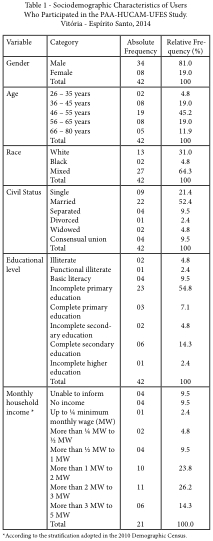
	    <p>A total of 42 patients participated in the study. The majority were males (81.0%) between the ages of 46 and 55 (42.5%), as shown in <a href="#t1">Table 1</a>. The prevalence of male patients aligns with data from the 2<sup>nd</sup> LENAD (2014), in which men constituted the majority amongst non&#45;abstaining individuals (62.0%), amongst individuals who drink at least once a week (63.0%), and amongst dependent individuals (10.48%). However, the report indicated that women are the most at&#45;risk population, because of the significant increase in frequent drinking and more harmful drinking amongst females between 2006 and 2012. This persistent increase in the use of alcohol by the female population occurs not only in Brazil, but also throughout the world, coinciding with economic development and the change in gender roles (WHO, 2014).Regarding age groups, despite studies that point to the beginning of alcohol abuse in adolescence (Laranjeira, Pinsky, Zaleski &amp; Caetano, 2007, Laranjeira, Madruga, Pinsky, Caetano &amp; Mitsuhiro, 2014), it is difficult to establish a diagnosis of alcoholism at that phase of life; moreover, because alcoholism is a slowly developing disorder, this difficulty explains the predominance of the cited age range (Pechansky <i>et.al.</i>, 2004).</p>

	    ]]></body>
<body><![CDATA[<p>&nbsp;</p>

	<a name="t1">

	    <p><img src="/img/revistas/rpesm/n16/n16a05t1.jpg"></p>

	    
<p>&nbsp;</p>
	
	    <p>Most participants self&#45;identified as mixed&#45;race (64.3%). With regard to socioeconomic level, 26.2% reported household income between two to three times the minimum monthly wage, followed by 23.8% who declared household income between one and two times the minimum monthly wage, and with 33.3% of the participants reporting household income as derived from retirement.</p>

	    <p>In relation to educational level, most participants did not complete primary education (54.8%), as shown in <a href="#t1">Table 1</a>. Studies have demonstrated that black or mixed&#45;race individuals of low socioeconomic and educational levels are amongst the groups with greater abusive consumption of alcohol and those considered tobacco smokers, particularly heavy smokers (Primo &amp; Stein, 2004, Costa et.al., 2004), which could explain the presence of the same characteristics amongst the population dependent on alcohol, in the sample.</p>

	    <p>When we evaluated the civil status variable, we observed a greater proportion of married individuals (52.4%), which contradicts the finding of Scheffer, Pasa, and Almeida (2010), who have noted the difficulty amongst the chemically dependent population in maintaining stable relationships.</p>

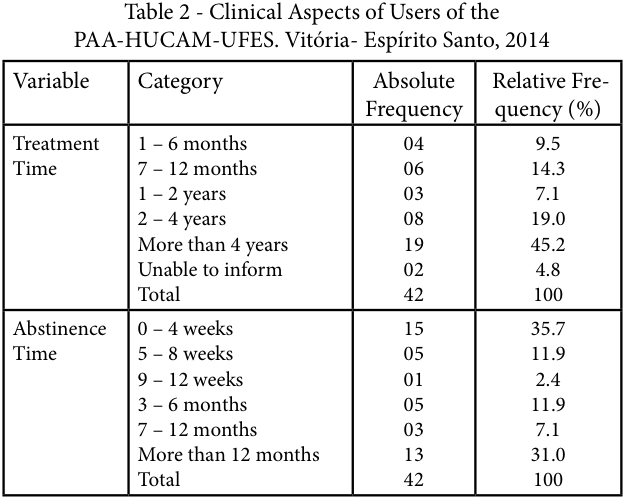
	    <p><a href="#t2">Table 2</a> presents the data related to the clinical characteristics of the studied sample. A total of 45.2% of the patients received treatment from the service for more than 4 years; 35.7% were abstinent for between 0 to 4 weeks, followed by 31% who were abstinent for more than 12 months. When we analysed abstinence time in association with service treatment period of more than four years, it was observed that the reason for the abstinence period occurring between the two extremes was because the programme aims to maintain abstinence; however, when patients reach this goal, they progressively retreat from the service. Notwithstanding, the service remains accessible for any eventual need, such as a relapse.</p>

	    <p>&nbsp;</p>

	<a name="t2">

	    <p><img src="/img/revistas/rpesm/n16/n16a05t2.jpg"></p>

	    
<p>&nbsp;</p>

	    ]]></body>
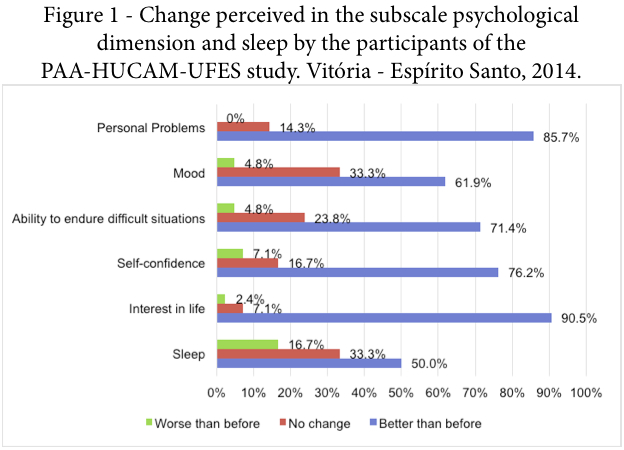
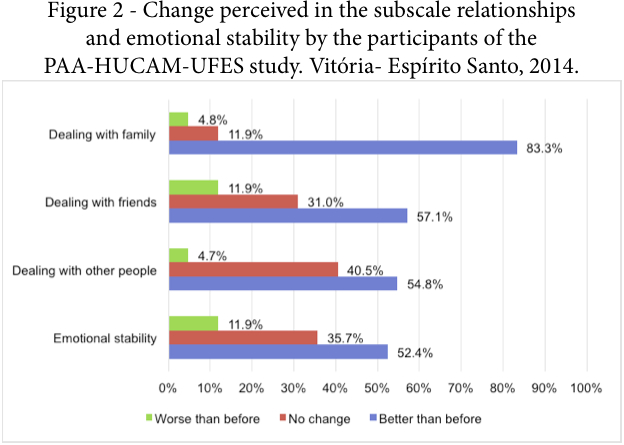
<body><![CDATA[<p>The percentage of &#8220;better&#8221;, &#8220;worse&#8221;, or &#8220;no change&#8221; responses for each item in the EMP &#150; patient scale is shown in the figures below, separated according to the subscales of psychological dimension and sleep; emotional relationships and stability; and activities and physical health.</p>

	    <p>Patients reported perceiving positive change (improvement) in 4 items of the psychological dimension and sleep subscale: interest in life (90.5%), personal problems (85.7%), self&#45;confidence (76.2%), and the ability to endure difficult situations (71.4%) as shown in <a href="#f1">Figure 1</a>. These findings may be related to the occurrence of psychopathological frameworks resulting from the abuse of and dependency on alcohol, which upon receiving appropriate treatment for both the psychiatric condition and the dependency, along with drug therapy, leads to significant improvement (Laranjeira <i>et al.</i>, 2014, Hess, Almeida &amp; Moraes, 2012). Despite the programme&#8217;s lack of reliance on a psychiatrist as part of the team&#8217;s composition, it appears that the strategy adopted has interfered in the perception of improvement by the patients with respect to psychopathological symptoms.</p>

	    <p>&nbsp;</p>

	<a name="f1">

	    <p><img src="/img/revistas/rpesm/n16/n16a05f1.jpg"></p>

	    
<p>&nbsp;</p>

	    <p>The patients reported a considerable degree of worsening (16.7%) for the sleep item in the psychological dimension and the sleep subscale. This finding may be explained by the fact that alcohol, when used occasionally, may at first prolong sleep; however, when it is withdrawn, sleep is reduced and becomes interrupted and superficial, which, along with the increased anxiety that occurs, are symptoms characteristic of alcohol withdrawal syndrome. Improvement in the sleep pattern occurs slowly, typically during the first year of detoxification, provided relapses do not occur (Brower &amp; Perron, 2010, Brida, 2009).</p>

	    <p>In the relationships and emotional stability subscale, considerable improvement (83.3%) was observed with regard to dealing with family and treatment (<a href="#f2">Figure 2</a>) because family relations, through their derangement or rupture, are highly impacted by alcohol, which contributes to high levels of interpersonal conflicts. The structuring of services to include the alcoholic&#8217;s family members and social networks is necessary for successful treatment (Brida, 2009, Ferraboli et al., 2015). Moreover, the sample exhibited a treatment time greater than four years, which may have allowed for restructuring of the family relations by means of the dependency treatment, although the programme does not include a strategy directed to family members.</p>

	    <p>&nbsp;</p>

	<a name="f2">

	    <p><img src="/img/revistas/rpesm/n16/n16a05f2.jpg"></p>

	    
<p>&nbsp;</p>

	    ]]></body>
<body><![CDATA[<p>In the activities and physical health subscale, the perception of improvement was observed in the energy (83.3%) and appetite (69.0%) items, which are constant complaints among alcoholic patients due to alcohol&#8217;s actions on the nervous and the digestive systems (Brida, 2009).</p>

	    <p>The item sexuality was perceived as worse than before treatment for 26.8% of the sample, a finding that is related to the harmful action of alcohol on sexual potency and performance, affecting up to 80% of alcoholics. Chronic and prolonged consumption of alcohol impairs all aspects of male sexual function, causing worsening of erections (time and intensity); reduced testosterone levels; reduced sperm counts; and worse performance testing. The emergence of complications, such as depression or the deterioration of marital relations over the years, creates difficulties in establishing an exclusive cause&#45;effect relationship with alcohol because these factors directly affect male sexual function. Regarding the female population, the consumption of alcohol leads to the inability to achieve orgasm, the worsening of vaginal lubrication, and painful sexual intercourse (Pereira et al., 2016). Furthermore, it may be related to the side effects of psychotropic drugs used in treatment (Silva et al., 2012).</p>

	    <p>The lack of perceived change in sexuality reported by 48.8% of the sample may be related to the taboos associated to the topic of sexuality, which persist in a male&#45;chauvinist society and which may have led to denial mechanisms. No perceived change was also reported for the item leisure activities (38.1%), which may suggest to the treatment team that patients have difficulty establishing pleasurable activities not associated with alcohol use, which before the period of abstinence was the patients&#8217; main pastime.</p>

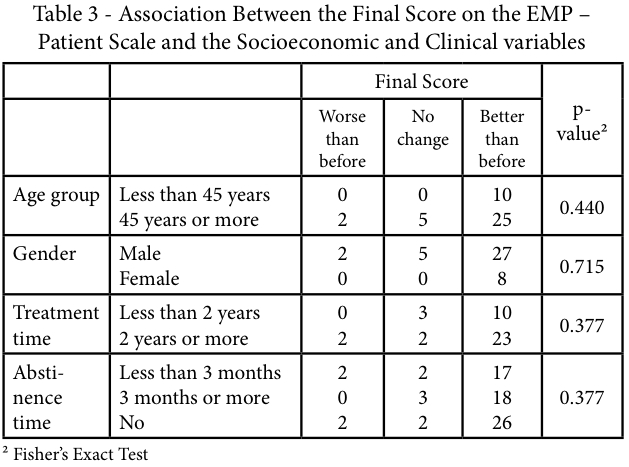
	    <p><a href="#t3">Table 3</a> compares the final scores on the EMP &#150; patient scale <i>versus</i> the socioeconomic and clinical variables. Because the Fisher&#8217;s exact test did not detect statistical significance at the 5% alpha level, no significant relationship between the socioeconomic variables and the scale&#8217;s final score was observed.</p>

	    <p>&nbsp;</p>

	<a name="t3">

	    <p><img src="/img/revistas/rpesm/n16/n16a05t3.jpg"></p>

	    
<p>&nbsp;</p>

	    <p>The absence of statistical significance in the correlation of the variables pointed out may be related to the limitations of the study, since the size of the study sample is small and there is no proportionality in the observed variables. Therefore, it is suggested to conduct future research with a larger number of participants.&nbsp;&nbsp;</p>

	    <p>The study brings significant contributions to the multiprofessional teams of services that serve alcoholics, which include nursing professionals, since it corroborates with the need to break with cartesian models of treatment of chemical dependency, comprising the user of the service in its integrality, with the focus on the individual and not on the substance itself.</p>

	    <p>&nbsp;</p>

	    ]]></body>
<body><![CDATA[<p><b>Conclusions</b>&nbsp;</p>

	    <p>The present study showed that, in general, patients perceive themselves as better after receiving treatment, demonstrating the effectiveness of the treatment offered by the programme, which still receives limited funding.</p>

	    <p>However, certain aspects of the patient&#8217;s life should be considered by the programme in its approach to treatment, i.e., sleep and sexuality, despite these topics being considered during the nursing consultation. As such, it is necessary to monitor and to develop interventions focused on the above&#45;cited aspects and to adopt a cross&#45;disciplinary approach through the coordinated enterprise of the service team. The study demonstrated that the EMP scale is a sensitive measure to evaluate treatment outcomes because it indicates the positive and negative impacts of treatment on the patients&#8217; lives.</p>

	    <p>In Brazil, studies on the perception of change by users as a result of treatment are only just commencing. Because it is an innovative initiative, no such studies have been conducted with patients in relation to alcohol dependence.</p>

	    <p>Thus, these measurements may be useful to improve the quality of services and to broaden the treatment offered; moreover, they should be considered in evaluation studies and in the routine menu of services.</p>

	    <p>Although the scale used in this study was originally conceived for patients with moderate to severe psychiatric disorders who were receiving treatment from mental health services, this study demonstrated applicability to the treatments of users of psychoactive substances.</p>

	    <p>&nbsp;</p>

	    <p><b>References</b></p>

	    <!-- ref --><p>Alto&eacute;, M. N., Ambr&oacute;sio, B. T., Cortes, P. R., e Siqueira, M. M. (2013). Programa de atendimento ao alcoolista: 20 anos de ensino, extens&atilde;o e pesquisa. <i>Revista Guar&aacute;</i>(1), 82&#45;88.    &nbsp;&nbsp;&nbsp;&nbsp;&nbsp;&nbsp;&nbsp;&nbsp;[&#160;<a href="javascript:void(0);" onclick="javascript: window.open('/scielo.php?script=sci_nlinks&ref=1200944&pid=S1647-2160201600030000500001&lng=','','width=640,height=500,resizable=yes,scrollbars=1,menubar=yes,');">Links</a>&#160;]<!-- end-ref --></p>

	    ]]></body>
<body><![CDATA[<!-- ref --><p>Babor, T. F., &amp; Caetano, R. (2005). Evidence&#45;based alcohol policy in the Americas: Strengths, weaknesses, and future challenges.<b>&nbsp;</b><i>Revista Panamericana de Salud P&uacute;blica</i><i>,</i> <i>18</i>, 4&#45;5.    &nbsp;&nbsp;&nbsp;&nbsp;&nbsp;&nbsp;&nbsp;&nbsp;[&#160;<a href="javascript:void(0);" onclick="javascript: window.open('/scielo.php?script=sci_nlinks&ref=1200946&pid=S1647-2160201600030000500002&lng=','','width=640,height=500,resizable=yes,scrollbars=1,menubar=yes,');">Links</a>&#160;]<!-- end-ref --></p>

	    <!-- ref --><p>Bandeira, M., Calzavara, M. G. P., Costa, C. S., e Cesari, L. (2009). Avalia&#231;&atilde;o de servi&#231;os de sa&uacute;de mental: Adapta&#231;&atilde;o transcultural de uma medida da percep&#231;&atilde;o dos usu&aacute;rios sobre os resultados do tratamento.&nbsp;<i>Jornal Brasileiro de Psiquiatria</i>,&nbsp;<i>58</i>(2), 107&#45;114.    &nbsp;&nbsp;&nbsp;&nbsp;&nbsp;&nbsp;&nbsp;&nbsp;[&#160;<a href="javascript:void(0);" onclick="javascript: window.open('/scielo.php?script=sci_nlinks&ref=1200948&pid=S1647-2160201600030000500003&lng=','','width=640,height=500,resizable=yes,scrollbars=1,menubar=yes,');">Links</a>&#160;]<!-- end-ref -->&nbsp;</p>

	    <!-- ref --><p>Brida, D. O. (2009). <i>A inser&#231;&atilde;o do servi&#231;o social no trabalho com alcoolistas e suas fam&iacute;lias no Centro de Aten&#231;&atilde;o Psicossocial I do munic&iacute;pio de S&atilde;o Joaquim/SC</i> (Trabalho de Conclus&atilde;o de Curso Bacharel em Servi&#231;o Social). Florian&oacute;polis: Universidade Federal de Santa Catarina.    &nbsp;&nbsp;&nbsp;&nbsp;&nbsp;&nbsp;&nbsp;&nbsp;[&#160;<a href="javascript:void(0);" onclick="javascript: window.open('/scielo.php?script=sci_nlinks&ref=1200950&pid=S1647-2160201600030000500004&lng=','','width=640,height=500,resizable=yes,scrollbars=1,menubar=yes,');">Links</a>&#160;]<!-- end-ref --></p>

	    <p>Brower, K.J. &amp; Perron, B.E. (2010). Prevalence and correlates of Withdrawal&#45;Related insomnia among adults with alcohol dependence: results from a national survey. <i>Am J Addict, 19</i>(8), 238&#45;244</p>

	    <!-- ref --><p>Costa, J. S. D., Silveira, M. F., Gazalle, F. K., Oliveira, S. S., Hallal, P. C., Menezes, A. M. B., ... e Macedo, S. (2004). Consumo abusivo de &aacute;lcool e fatores associados: Estudo de base populacional.&nbsp;<i>Revista de Sa&uacute;de P&uacute;blica</i>,&nbsp;<i>38</i>(2), 284&#45;291.    &nbsp;&nbsp;&nbsp;&nbsp;&nbsp;&nbsp;&nbsp;&nbsp;[&#160;<a href="javascript:void(0);" onclick="javascript: window.open('/scielo.php?script=sci_nlinks&ref=1200953&pid=S1647-2160201600030000500006&lng=','','width=640,height=500,resizable=yes,scrollbars=1,menubar=yes,');">Links</a>&#160;]<!-- end-ref --></p>

	    <p>Ferraboli, C.R., Guimar&atilde;es, A.N., Kolhs, M., Galli, K.S.B., Guimar&atilde;es, A.N. &amp; Schneider, J.F. (2015). Alcoolismo e din&acirc;mica familiar. <i>Cien. Cuid. Sa&uacute;de, 14</i>(4), 1555&#45;1563.</p>

	    ]]></body>
<body><![CDATA[<p>Hess, A.R.B., Almeida, R.M.M., Moraes, A.L. (2012). Comorbidades psiqui&aacute;tricas em dependentes qu&iacute;micos em abstin&ecirc;ncia em ambiente protegido.<i>Estudos de Psicologia, 17</i>(1), 171&#45;178.</p>

	    <!-- ref --><p>Laranjeira, R., Pinsky, I., Zaleski, M., e Caetano R. (2007). <i>I levantamento nacional sobre os padr&otilde;es de consumo de &aacute;lcool na popula&#231;&atilde;o brasileira.</i> Bras&iacute;lia: Secretaria Nacional Antidrogas.    &nbsp;&nbsp;&nbsp;&nbsp;&nbsp;&nbsp;&nbsp;&nbsp;[&#160;<a href="javascript:void(0);" onclick="javascript: window.open('/scielo.php?script=sci_nlinks&ref=1200957&pid=S1647-2160201600030000500009&lng=','','width=640,height=500,resizable=yes,scrollbars=1,menubar=yes,');">Links</a>&#160;]<!-- end-ref --></p>

	    <!-- ref --><p>Laranjeira, R., Madruga, C. S., Pinsky, I., Caetano, R., e Mitsuhiro, S.S. (2014). <i>II levantamento nacional de &aacute;lcool e drogas &#150; 2012.</i> S&atilde;o Paulo: Instituto Nacional de Ci&ecirc;ncia e Tecnologia para Pol&iacute;ticas P&uacute;blicas de &Aacute;lcool e Outras Drogas da Universidade Federal de S&atilde;o Paulo.    &nbsp;&nbsp;&nbsp;&nbsp;&nbsp;&nbsp;&nbsp;&nbsp;[&#160;<a href="javascript:void(0);" onclick="javascript: window.open('/scielo.php?script=sci_nlinks&ref=1200959&pid=S1647-2160201600030000500010&lng=','','width=640,height=500,resizable=yes,scrollbars=1,menubar=yes,');">Links</a>&#160;]<!-- end-ref --></p>

	    <!-- ref --><p>Mercier, L., Landry, M., Corbi&egrave;re, M., &amp; Perrault, M. (2002). Measuring clients perception as outcome measurement. In A. R. Roberts, &amp; K. R. Yeager, <i>Evidence&#45;based</i> <i>practice manual: Research and outcome measures in health and human service</i> (pp. 904&#45;909). Oxford: University Press.    &nbsp;&nbsp;&nbsp;&nbsp;&nbsp;&nbsp;&nbsp;&nbsp;[&#160;<a href="javascript:void(0);" onclick="javascript: window.open('/scielo.php?script=sci_nlinks&ref=1200961&pid=S1647-2160201600030000500011&lng=','','width=640,height=500,resizable=yes,scrollbars=1,menubar=yes,');">Links</a>&#160;]<!-- end-ref --></p>

	    <!-- ref --><p>Pechansky, F., Szobot, C. M., e Scivoletto, S. (2004). Uso de &aacute;lcool entre adolescentes: Conceitos, caracter&iacute;sticas epidemiol&oacute;gicas e fatores etiopatog&ecirc;nicos.&nbsp;<i>Revista Brasileira de Psiquiatria</i>,&nbsp;<i>26</i>(Suppl. 1), 14&#45;17.    &nbsp;&nbsp;&nbsp;&nbsp;&nbsp;&nbsp;&nbsp;&nbsp;[&#160;<a href="javascript:void(0);" onclick="javascript: window.open('/scielo.php?script=sci_nlinks&ref=1200963&pid=S1647-2160201600030000500012&lng=','','width=640,height=500,resizable=yes,scrollbars=1,menubar=yes,');">Links</a>&#160;]<!-- end-ref -->&nbsp;</p>

	    <p>Pereira, V.V., Ferreira, A. V., Novais, R. L. R., Andrade, H. S., Guimar&atilde;es, E. A. de A., Machado, R. M. (2016). Disfun&#231;&atilde;o sexual e o uso de drogas: uma an&aacute;lise diagn&oacute;stica. <i>Arq. Cienc. Sa&uacute;de UNIPAR, 20</i> (2), 89&#45;94.</p>

	    ]]></body>
<body><![CDATA[<!-- ref --><p>Primo, N. L. N. P., &amp; Stein, A. T. (2004). Preval&ecirc;ncia do abuso e da depend&ecirc;ncia de &aacute;lcool em Rio Grande (RS): Um estudo transversal de base populacional.&nbsp;<i>Revista de Psiquiatria do Rio Grande do Sul</i>,&nbsp;<i>26</i>(3), 280&#45;286.    &nbsp;&nbsp;&nbsp;&nbsp;&nbsp;&nbsp;&nbsp;&nbsp;[&#160;<a href="javascript:void(0);" onclick="javascript: window.open('/scielo.php?script=sci_nlinks&ref=1200966&pid=S1647-2160201600030000500014&lng=','','width=640,height=500,resizable=yes,scrollbars=1,menubar=yes,');">Links</a>&#160;]<!-- end-ref -->&nbsp;</p>

	    <!-- ref --><p>Scheffer, M., Pasa, G. G., e Almeida, R. M. M. (2010). Depend&ecirc;ncia de &aacute;lcool, coca&iacute;na e <i>crack</i> e transtornos psiqui&aacute;tricos. <i>Psicologia: Teoria e Pesquisa, 26</i>(3), 533&#45;541.    &nbsp;&nbsp;&nbsp;&nbsp;&nbsp;&nbsp;&nbsp;&nbsp;[&#160;<a href="javascript:void(0);" onclick="javascript: window.open('/scielo.php?script=sci_nlinks&ref=1200968&pid=S1647-2160201600030000500015&lng=','','width=640,height=500,resizable=yes,scrollbars=1,menubar=yes,');">Links</a>&#160;]<!-- end-ref --></p>

	    <!-- ref --><p>Silva, M. A., Bandeira, M., Scalon, J. D., e Quaglia, M. A. Ci. (2012). Satisfa&#231;&atilde;o dos pacientes com os servi&#231;os de sa&uacute;de mental: A percep&#231;&atilde;o de mudan&#231;as como preditora.&nbsp;<i>Jornal Brasileiro de Psiquiatria</i>,&nbsp;<i>61</i>(2), 64&#45;71.    &nbsp;&nbsp;&nbsp;&nbsp;&nbsp;&nbsp;&nbsp;&nbsp;[&#160;<a href="javascript:void(0);" onclick="javascript: window.open('/scielo.php?script=sci_nlinks&ref=1200970&pid=S1647-2160201600030000500016&lng=','','width=640,height=500,resizable=yes,scrollbars=1,menubar=yes,');">Links</a>&#160;]<!-- end-ref -->&nbsp;</p>

	    <!-- ref --><p>United Nations Office on Drugs and Crime. (2014). <i>World Drug Report 2014.</i> New York: United Nations Office on Drugs and Crime.    &nbsp;&nbsp;&nbsp;&nbsp;&nbsp;&nbsp;&nbsp;&nbsp;[&#160;<a href="javascript:void(0);" onclick="javascript: window.open('/scielo.php?script=sci_nlinks&ref=1200972&pid=S1647-2160201600030000500017&lng=','','width=640,height=500,resizable=yes,scrollbars=1,menubar=yes,');">Links</a>&#160;]<!-- end-ref --></p>

	    <!-- ref --><p>World Health Organization. (2001). <i>The world health report 2001 &#150; Mental health: New understanding, new hope.</i> Geneva: World Health Organization.    &nbsp;&nbsp;&nbsp;&nbsp;&nbsp;&nbsp;&nbsp;&nbsp;[&#160;<a href="javascript:void(0);" onclick="javascript: window.open('/scielo.php?script=sci_nlinks&ref=1200974&pid=S1647-2160201600030000500018&lng=','','width=640,height=500,resizable=yes,scrollbars=1,menubar=yes,');">Links</a>&#160;]<!-- end-ref --></p>

	    ]]></body>
<body><![CDATA[<!-- ref --><p>World Health Organization. (2004). <i>Global status report on alcohol 2004.    &nbsp;&nbsp;&nbsp;&nbsp;&nbsp;&nbsp;&nbsp;&nbsp;[&#160;<a href="javascript:void(0);" onclick="javascript: window.open('/scielo.php?script=sci_nlinks&ref=1200976&pid=S1647-2160201600030000500019&lng=','','width=640,height=500,resizable=yes,scrollbars=1,menubar=yes,');">Links</a>&#160;]<!-- end-ref --></i> Su&iacute;&#231;a: World Health Organization.</p>

	    <!-- ref --><p>World Health Organization. (2014). <i>Global status report on alcohol and health</i>.    &nbsp;&nbsp;&nbsp;&nbsp;&nbsp;&nbsp;&nbsp;&nbsp;[&#160;<a href="javascript:void(0);" onclick="javascript: window.open('/scielo.php?script=sci_nlinks&ref=1200978&pid=S1647-2160201600030000500020&lng=','','width=640,height=500,resizable=yes,scrollbars=1,menubar=yes,');">Links</a>&#160;]<!-- end-ref --> Su&iacute;&#231;a: World Health Organization.</p>

	    <p>&nbsp;</p>

	    <p>Recebido a 28 de fevereiro de 2016</p>

	    <p>Aceite para publica&#231;&atilde;o a 30 de outubro&nbsp; de 2016</p>
	
     ]]></body><back>
<ref-list>
<ref id="B1">
<nlm-citation citation-type="journal">
<person-group person-group-type="author">
<name>
<surname><![CDATA[Altoé]]></surname>
<given-names><![CDATA[M. N.]]></given-names>
</name>
<name>
<surname><![CDATA[Ambrósio]]></surname>
<given-names><![CDATA[B. T.]]></given-names>
</name>
<name>
<surname><![CDATA[Cortes]]></surname>
<given-names><![CDATA[P. R.]]></given-names>
</name>
<name>
<surname><![CDATA[Siqueira]]></surname>
<given-names><![CDATA[M. M.]]></given-names>
</name>
</person-group>
<article-title xml:lang="pt"><![CDATA[Programa de atendimento ao alcoolista: 20 anos de ensino, extensão e pesquisa]]></article-title>
<source><![CDATA[Revista Guará]]></source>
<year>2013</year>
<numero>1</numero>
<issue>1</issue>
<page-range>82-88</page-range></nlm-citation>
</ref>
<ref id="B2">
<nlm-citation citation-type="journal">
<person-group person-group-type="author">
<name>
<surname><![CDATA[Babor]]></surname>
<given-names><![CDATA[T. F.]]></given-names>
</name>
<name>
<surname><![CDATA[Caetano]]></surname>
<given-names><![CDATA[R.]]></given-names>
</name>
</person-group>
<article-title xml:lang="en"><![CDATA[Evidence-based alcohol policy in the Americas: Strengths, weaknesses, and future challenges]]></article-title>
<source><![CDATA[Revista Panamericana de Salud Pública]]></source>
<year>2005</year>
<volume>18</volume>
<page-range>4-5</page-range></nlm-citation>
</ref>
<ref id="B3">
<nlm-citation citation-type="journal">
<person-group person-group-type="author">
<name>
<surname><![CDATA[Bandeira]]></surname>
<given-names><![CDATA[M.]]></given-names>
</name>
<name>
<surname><![CDATA[Calzavara]]></surname>
<given-names><![CDATA[M. G. P.]]></given-names>
</name>
<name>
<surname><![CDATA[Costa]]></surname>
<given-names><![CDATA[C. S.]]></given-names>
</name>
<name>
<surname><![CDATA[Cesari]]></surname>
<given-names><![CDATA[L.]]></given-names>
</name>
</person-group>
<article-title xml:lang="pt"><![CDATA[Avaliação de serviços de saúde mental: Adaptação transcultural de uma medida da percepção dos usuários sobre os resultados do tratamento]]></article-title>
<source><![CDATA[Jornal Brasileiro de Psiquiatria]]></source>
<year>2009</year>
<volume>58</volume>
<numero>2</numero>
<issue>2</issue>
<page-range>107-114</page-range></nlm-citation>
</ref>
<ref id="B4">
<nlm-citation citation-type="">
<person-group person-group-type="author">
<name>
<surname><![CDATA[Brida]]></surname>
<given-names><![CDATA[D. O.]]></given-names>
</name>
</person-group>
<source><![CDATA[A inserção do serviço social no trabalho com alcoolistas e suas famílias no Centro de Atenção Psicossocial I do município de São Joaquim/SC]]></source>
<year>2009</year>
</nlm-citation>
</ref>
<ref id="B5">
<nlm-citation citation-type="journal">
<person-group person-group-type="author">
<name>
<surname><![CDATA[Brower]]></surname>
<given-names><![CDATA[K. J.]]></given-names>
</name>
<name>
<surname><![CDATA[Perron]]></surname>
<given-names><![CDATA[B. E.]]></given-names>
</name>
</person-group>
<article-title xml:lang="en"><![CDATA[Prevalence and correlates of Withdrawal-Related insomnia among adults with alcohol dependence: results from a national survey]]></article-title>
<source><![CDATA[American Journal of Addictions]]></source>
<year>2010</year>
<volume>19</volume>
<numero>8</numero>
<issue>8</issue>
<page-range>238-244</page-range></nlm-citation>
</ref>
<ref id="B6">
<nlm-citation citation-type="journal">
<person-group person-group-type="author">
<name>
<surname><![CDATA[Costa]]></surname>
<given-names><![CDATA[J. S. D.]]></given-names>
</name>
<name>
<surname><![CDATA[Silveira]]></surname>
<given-names><![CDATA[M. F.]]></given-names>
</name>
<name>
<surname><![CDATA[Gazalle]]></surname>
<given-names><![CDATA[F. K.]]></given-names>
</name>
<name>
<surname><![CDATA[Oliveira]]></surname>
<given-names><![CDATA[S. S.]]></given-names>
</name>
<name>
<surname><![CDATA[Hallal]]></surname>
<given-names><![CDATA[P. C.]]></given-names>
</name>
<name>
<surname><![CDATA[Menezes]]></surname>
<given-names><![CDATA[A. M. B.]]></given-names>
</name>
<name>
<surname><![CDATA[Macedo]]></surname>
<given-names><![CDATA[S.]]></given-names>
</name>
</person-group>
<article-title xml:lang="pt"><![CDATA[Consumo abusivo de álcool e fatores associados: Estudo de base populacional]]></article-title>
<source><![CDATA[Revista de Saúde Pública]]></source>
<year>2004</year>
<volume>38</volume>
<numero>2</numero>
<issue>2</issue>
<page-range>284-291</page-range></nlm-citation>
</ref>
<ref id="B7">
<nlm-citation citation-type="journal">
<person-group person-group-type="author">
<name>
<surname><![CDATA[Ferraboli]]></surname>
<given-names><![CDATA[C. R.]]></given-names>
</name>
<name>
<surname><![CDATA[Guimarães]]></surname>
<given-names><![CDATA[A. N.]]></given-names>
</name>
<name>
<surname><![CDATA[Kolhs]]></surname>
<given-names><![CDATA[M.]]></given-names>
</name>
<name>
<surname><![CDATA[Galli]]></surname>
<given-names><![CDATA[K. S. B.]]></given-names>
</name>
<name>
<surname><![CDATA[Guimarães]]></surname>
<given-names><![CDATA[A. N.]]></given-names>
</name>
<name>
<surname><![CDATA[Schneider]]></surname>
<given-names><![CDATA[J. F.]]></given-names>
</name>
</person-group>
<article-title xml:lang="pt"><![CDATA[Alcoolismo e dinâmica familiar]]></article-title>
<source><![CDATA[Ciência, Cuidado e Saúde]]></source>
<year>2015</year>
<volume>14</volume>
<numero>4</numero>
<issue>4</issue>
<page-range>1555-1563</page-range></nlm-citation>
</ref>
<ref id="B8">
<nlm-citation citation-type="journal">
<person-group person-group-type="author">
<name>
<surname><![CDATA[Hess]]></surname>
<given-names><![CDATA[A. R. B.]]></given-names>
</name>
<name>
<surname><![CDATA[Almeida]]></surname>
<given-names><![CDATA[R. M. M.]]></given-names>
</name>
<name>
<surname><![CDATA[Moraes]]></surname>
<given-names><![CDATA[A. L.]]></given-names>
</name>
</person-group>
<article-title xml:lang="pt"><![CDATA[Comorbidades psiquiátricas em dependentes químicos em abstinência em ambiente protegido]]></article-title>
<source><![CDATA[Estudos de Psicologia]]></source>
<year>2012</year>
<volume>17</volume>
<numero>1</numero>
<issue>1</issue>
<page-range>171-178</page-range></nlm-citation>
</ref>
<ref id="B9">
<nlm-citation citation-type="book">
<person-group person-group-type="author">
<name>
<surname><![CDATA[Laranjeira]]></surname>
<given-names><![CDATA[R.]]></given-names>
</name>
<name>
<surname><![CDATA[Pinsky]]></surname>
<given-names><![CDATA[I.]]></given-names>
</name>
<name>
<surname><![CDATA[Zaleski]]></surname>
<given-names><![CDATA[M.]]></given-names>
</name>
<name>
<surname><![CDATA[Caetano]]></surname>
<given-names><![CDATA[R.]]></given-names>
</name>
</person-group>
<source><![CDATA[I levantamento nacional sobre os padrões de consumo de álcool na população brasileira]]></source>
<year>2007</year>
<publisher-loc><![CDATA[Brasília ]]></publisher-loc>
<publisher-name><![CDATA[Secretaria Nacional Antidrogas]]></publisher-name>
</nlm-citation>
</ref>
<ref id="B10">
<nlm-citation citation-type="book">
<person-group person-group-type="author">
<name>
<surname><![CDATA[Laranjeira]]></surname>
<given-names><![CDATA[R.]]></given-names>
</name>
<name>
<surname><![CDATA[Madruga]]></surname>
<given-names><![CDATA[C. S.]]></given-names>
</name>
<name>
<surname><![CDATA[Pinsky]]></surname>
<given-names><![CDATA[I.]]></given-names>
</name>
<name>
<surname><![CDATA[Caetano]]></surname>
<given-names><![CDATA[R.]]></given-names>
</name>
<name>
<surname><![CDATA[Mitsuhiro]]></surname>
<given-names><![CDATA[S. S.]]></given-names>
</name>
</person-group>
<source><![CDATA[II levantamento nacional de álcool e drogas - 2012]]></source>
<year>2014</year>
<publisher-loc><![CDATA[São Paulo ]]></publisher-loc>
<publisher-name><![CDATA[Instituto Nacional de Ciência e Tecnologia para Políticas Públicas de Álcool e Outras Drogas da Universidade Federal de São Paulo]]></publisher-name>
</nlm-citation>
</ref>
<ref id="B11">
<nlm-citation citation-type="book">
<person-group person-group-type="author">
<name>
<surname><![CDATA[Mercier]]></surname>
<given-names><![CDATA[L.]]></given-names>
</name>
<name>
<surname><![CDATA[Landry]]></surname>
<given-names><![CDATA[M.]]></given-names>
</name>
<name>
<surname><![CDATA[Corbière]]></surname>
<given-names><![CDATA[M.]]></given-names>
</name>
<name>
<surname><![CDATA[Perrault]]></surname>
<given-names><![CDATA[M.]]></given-names>
</name>
</person-group>
<article-title xml:lang="en"><![CDATA[Measuring clients perception as outcome measurement]]></article-title>
<person-group person-group-type="editor">
<name>
<surname><![CDATA[Roberts]]></surname>
<given-names><![CDATA[A. R.]]></given-names>
</name>
<name>
<surname><![CDATA[Yeager]]></surname>
<given-names><![CDATA[K. R.]]></given-names>
</name>
</person-group>
<source><![CDATA[Evidence-based practice manual: Research and outcome measures in health and human service]]></source>
<year>2002</year>
<page-range>904-909</page-range><publisher-loc><![CDATA[Oxford ]]></publisher-loc>
<publisher-name><![CDATA[University Press]]></publisher-name>
</nlm-citation>
</ref>
<ref id="B12">
<nlm-citation citation-type="journal">
<person-group person-group-type="author">
<name>
<surname><![CDATA[Pechansky]]></surname>
<given-names><![CDATA[F.]]></given-names>
</name>
<name>
<surname><![CDATA[Szobot]]></surname>
<given-names><![CDATA[C. M.]]></given-names>
</name>
<name>
<surname><![CDATA[Scivoletto]]></surname>
<given-names><![CDATA[S.]]></given-names>
</name>
</person-group>
<article-title xml:lang="pt"><![CDATA[Uso de álcool entre adolescentes: Conceitos, características epidemiológicas e fatores etiopatogênicos]]></article-title>
<source><![CDATA[Revista Brasileira de Psiquiatria]]></source>
<year>2004</year>
<volume>26</volume>
<numero>^s1</numero>
<issue>^s1</issue>
<supplement>1</supplement>
<page-range>14-17</page-range></nlm-citation>
</ref>
<ref id="B13">
<nlm-citation citation-type="journal">
<person-group person-group-type="author">
<name>
<surname><![CDATA[Pereira]]></surname>
<given-names><![CDATA[V. V.]]></given-names>
</name>
<name>
<surname><![CDATA[Ferreira]]></surname>
<given-names><![CDATA[A. V.]]></given-names>
</name>
<name>
<surname><![CDATA[Novais]]></surname>
<given-names><![CDATA[R. L. R.]]></given-names>
</name>
<name>
<surname><![CDATA[Andrade]]></surname>
<given-names><![CDATA[H. S.]]></given-names>
</name>
<name>
<surname><![CDATA[Guimarães]]></surname>
<given-names><![CDATA[E. A. de A.]]></given-names>
</name>
<name>
<surname><![CDATA[Machado]]></surname>
<given-names><![CDATA[R. M.]]></given-names>
</name>
</person-group>
<article-title xml:lang="pt"><![CDATA[Disfunção sexual e o uso de drogas: uma análise diagnóstica]]></article-title>
<source><![CDATA[Arquivo de Ciências da Saúde UNIPAR]]></source>
<year>2016</year>
<volume>20</volume>
<numero>2</numero>
<issue>2</issue>
<page-range>89-94</page-range></nlm-citation>
</ref>
<ref id="B14">
<nlm-citation citation-type="journal">
<person-group person-group-type="author">
<name>
<surname><![CDATA[Primo]]></surname>
<given-names><![CDATA[N. L. N. P.]]></given-names>
</name>
<name>
<surname><![CDATA[Stein]]></surname>
<given-names><![CDATA[A. T.]]></given-names>
</name>
</person-group>
<article-title xml:lang="pt"><![CDATA[Prevalência do abuso e da dependência de álcool em Rio Grande (RS): Um estudo transversal de base populacional]]></article-title>
<source><![CDATA[Revista de Psiquiatria do Rio Grande do Sul]]></source>
<year>2004</year>
<volume>26</volume>
<numero>3</numero>
<issue>3</issue>
<page-range>280-286</page-range></nlm-citation>
</ref>
<ref id="B15">
<nlm-citation citation-type="journal">
<person-group person-group-type="author">
<name>
<surname><![CDATA[Scheffer]]></surname>
<given-names><![CDATA[M.]]></given-names>
</name>
<name>
<surname><![CDATA[Pasa]]></surname>
<given-names><![CDATA[G. G.]]></given-names>
</name>
<name>
<surname><![CDATA[Almeida]]></surname>
<given-names><![CDATA[R. M. M.]]></given-names>
</name>
</person-group>
<article-title xml:lang="pt"><![CDATA[Dependência de álcool, cocaína e crack e transtornos psiquiátricos]]></article-title>
<source><![CDATA[Psicologia: Teoria e Pesquisa]]></source>
<year>2010</year>
<volume>26</volume>
<numero>3</numero>
<issue>3</issue>
<page-range>533-541</page-range></nlm-citation>
</ref>
<ref id="B16">
<nlm-citation citation-type="journal">
<person-group person-group-type="author">
<name>
<surname><![CDATA[Silva]]></surname>
<given-names><![CDATA[M. A.]]></given-names>
</name>
<name>
<surname><![CDATA[Bandeira]]></surname>
<given-names><![CDATA[M.]]></given-names>
</name>
<name>
<surname><![CDATA[Scalon]]></surname>
<given-names><![CDATA[J. D.]]></given-names>
</name>
<name>
<surname><![CDATA[Quaglia]]></surname>
<given-names><![CDATA[M. A. Ci.]]></given-names>
</name>
</person-group>
<article-title xml:lang="pt"><![CDATA[Satisfação dos pacientes com os serviços de saúde mental: A percepção de mudanças como preditora]]></article-title>
<source><![CDATA[Jornal Brasileiro de Psiquiatria]]></source>
<year>2012</year>
<volume>61</volume>
<numero>2</numero>
<issue>2</issue>
<page-range>64-71</page-range></nlm-citation>
</ref>
<ref id="B17">
<nlm-citation citation-type="book">
<collab>United Nations Office on Drugs and Crime</collab>
<source><![CDATA[World Drug Report 2014]]></source>
<year>2014</year>
<publisher-loc><![CDATA[New York ]]></publisher-loc>
<publisher-name><![CDATA[United Nations Office on Drugs and Crime]]></publisher-name>
</nlm-citation>
</ref>
<ref id="B18">
<nlm-citation citation-type="book">
<collab>World Health Organization</collab>
<source><![CDATA[The world health report 2001 - Mental health: New understanding, new hope]]></source>
<year>2001</year>
<publisher-loc><![CDATA[Geneva ]]></publisher-loc>
<publisher-name><![CDATA[World Health Organization]]></publisher-name>
</nlm-citation>
</ref>
<ref id="B19">
<nlm-citation citation-type="">
<collab>World Health Organization</collab>
<source><![CDATA[Global status report on alcohol 2004]]></source>
<year>2004</year>
</nlm-citation>
</ref>
<ref id="B20">
<nlm-citation citation-type="">
<collab>World Health Organization</collab>
<source><![CDATA[Global status report on alcohol and health]]></source>
<year>2014</year>
</nlm-citation>
</ref>
</ref-list>
</back>
</article>