<?xml version="1.0" encoding="ISO-8859-1"?><article xmlns:mml="http://www.w3.org/1998/Math/MathML" xmlns:xlink="http://www.w3.org/1999/xlink" xmlns:xsi="http://www.w3.org/2001/XMLSchema-instance">
<front>
<journal-meta>
<journal-id>1647-2160</journal-id>
<journal-title><![CDATA[Revista Portuguesa de Enfermagem de Saúde Mental]]></journal-title>
<abbrev-journal-title><![CDATA[Revista Portuguesa de Enfermagem de Saúde Mental]]></abbrev-journal-title>
<issn>1647-2160</issn>
<publisher>
<publisher-name><![CDATA[Sociedade Portuguesa de Enfermagem de Saúde Mental]]></publisher-name>
</publisher>
</journal-meta>
<article-meta>
<article-id>S1647-21602019000200004</article-id>
<article-id pub-id-type="doi">10.19131/rpesm.0260</article-id>
<title-group>
<article-title xml:lang="en"><![CDATA[Common mental disorders and risk behaviours in motorcyclists victims of traffic-accidents]]></article-title>
<article-title xml:lang="pt"><![CDATA[Transtornos mentais comuns e comportamentos de risco em motociclistas vítimas de acidentes de trânsito]]></article-title>
<article-title xml:lang="es"><![CDATA[Transtornos mentales comunes y comportamientos de riesgo en motociclistas vítimas de accidentes de tránsito]]></article-title>
</title-group>
<contrib-group>
<contrib contrib-type="author">
<name>
<surname><![CDATA[Coêlho]]></surname>
<given-names><![CDATA[Vanessa Maria da Silva]]></given-names>
</name>
</contrib>
<contrib contrib-type="author">
<name>
<surname><![CDATA[Santos]]></surname>
<given-names><![CDATA[Washington José dos]]></given-names>
</name>
</contrib>
<contrib contrib-type="author">
<name>
<surname><![CDATA[Santos]]></surname>
<given-names><![CDATA[Gustavo Barreto]]></given-names>
</name>
</contrib>
<contrib contrib-type="author">
<name>
<surname><![CDATA[Ceballos]]></surname>
<given-names><![CDATA[Albanita Gomes da Costa de]]></given-names>
</name>
<xref ref-type="aff" rid="A01"/>
</contrib>
<contrib contrib-type="author">
<name>
<surname><![CDATA[de Oliveira]]></surname>
<given-names><![CDATA[Bruno]]></given-names>
</name>
<xref ref-type="aff" rid="A02"/>
</contrib>
</contrib-group>
<aff id="A01">
<institution><![CDATA[,Universidade Federal de Pernambuco Departamento de Medicina Social ]]></institution>
<addr-line><![CDATA[Recife PE]]></addr-line>
<country>Brasil</country>
</aff>
<aff id="A02">
<institution><![CDATA[,University of Brighton School of Applied Social Sciences ]]></institution>
<addr-line><![CDATA[Brighton ]]></addr-line>
<country>Reino Unido</country>
</aff>
<pub-date pub-type="pub">
<day>00</day>
<month>12</month>
<year>2019</year>
</pub-date>
<pub-date pub-type="epub">
<day>00</day>
<month>12</month>
<year>2019</year>
</pub-date>
<numero>22</numero>
<fpage>27</fpage>
<lpage>34</lpage>
<copyright-statement/>
<copyright-year/>
<self-uri xlink:href="http://scielo.pt/scielo.php?script=sci_arttext&amp;pid=S1647-21602019000200004&amp;lng=en&amp;nrm=iso"></self-uri><self-uri xlink:href="http://scielo.pt/scielo.php?script=sci_abstract&amp;pid=S1647-21602019000200004&amp;lng=en&amp;nrm=iso"></self-uri><self-uri xlink:href="http://scielo.pt/scielo.php?script=sci_pdf&amp;pid=S1647-21602019000200004&amp;lng=en&amp;nrm=iso"></self-uri><abstract abstract-type="short" xml:lang="en"><p><![CDATA[BACKGROUND: Motorcycles accidents are a public health problem. Drivers´ behaviours are pointed out as one of the main causes of their occurrence and may be associated with psychiatric comorbidities as Common Mental Disorders (CMD). AIM: To analyse the association between CMD and risk behaviours adopted by motorcyclists victims of traffic accidents. METHODS: This is a cross-sectional study with injured motorcyclists who were hospitalised in a Hospital located in Northeast of Brazil. A questionnaire was used containing items related to sociodemographic, occupational and behavioural factors, mental health (Self Reporting Questionnaire-20) and aspects of the accident and road conditions. Descriptive and bivariate analyses were performed, calculating the odds ratio (OR) and the 95% confidence interval (CI) and the level of significance was set at 5%. RESULTS: A total of 170 motorcycle drivers were surveyed. There was a predominance of males (95.9%), with a mean age of 31 years. The prevalence of CMD was 14.7%. The bivariate analysis indicated that the disorders were associated with driving with sleep/fatigue (OR=4.7) and driving a motorcycle without wearing a helmet (OR=2,7). CONCLUSION: This study result indicated a link between being the driver's diagnosed with a common mental disorder and risky behaviour in traffic. The research denoted the dimension of accidents involving a motorcycle and, also, highlights how drivers' mental health is a factor impacting the behaviours adopted by them. Thus, poor mental health may influence their road accidents.]]></p></abstract>
<abstract abstract-type="short" xml:lang="pt"><p><![CDATA[CONTEXTO: Os acidentes de trânsito envolvendo motocicletas são um problema de saúde pública. Os comportamentos dos condutores são apontados como uma das principais causas de sua ocorrência, podendo estar associados às comorbidades psiquiátricas, como os Transtornos Mentais Comuns (TMC). OBJETIVO: Analisar a associação entre TMC e comportamentos de risco adotados por motociclistas vítimas de acidente de trânsito. MÉTODOS: Estudo transversal com motociclistas acidentados internados no Departamento de Traumatologia de um hospital no nordeste do Brasil. Aplicou-se um questionário contendo itens relacionados a fatores sociodemográficos, ocupacionais e comportamentais; saúde mental (Self Reporting Questionnaire-20) e aspectos do acidente e condições das vias. Foram realizadas análises descritivas e bivariada, calculando-se a odds ratio e o intervalo de confiança de 95%. O nível de significância adotado foi de 5%. RESULTADOS: Foram entrevistados 170 condutores de motocicletas. Houve predomínio do sexo masculino (95,9%), com média de idade de 31 anos. A prevalência de TMC foi de 14,7%. A análise bivariada indicou que os referidos transtornos estavam associados a dirigir com sono / fadiga (OR = 4,7) e conduzir motocicleta sem usar capacete (OR = 2,7). CONCLUSÕES: Os resultados evidenciam uma associação entre a presença de TMC com alguns comportamentos de risco no trânsito. A pesquisa denota a dimensão dos acidentes envolvendo motocicletas e, também, destaca como a saúde mental dos motociclistas é um fator impactante nos comportamentos adotados por eles. Assim, a saúde mental deficiente pode influenciar seus acidentes rodoviários.]]></p></abstract>
<abstract abstract-type="short" xml:lang="es"><p><![CDATA[CONTEXTO: Los accidentes de tráfico que involucran las motocicletas son un problema de salud pública. Los comportamientos de los conductores son señalados como una de las principales causas de su ocurrencia, pudiendo estar asociados a las comorbilidades psiquiátricas, como los Trastornos Mentales Comunes (TMC). OBJETIVO: Analizar la asociación entre TMC y comportamientos de riesgo adoptados por los motociclistas víctimas de accidentes de tráfico. METODOLOGÍA: Estudio transversal con motociclistas heridos admitidos en el Departamento de Traumatología de uno hospital em nordeste de Brasil. Se aplicó un cuestionario que contenía elementos relacionados con factores sociodemográficos, ocupacionales y conductuales; Salud mental (Self Reporting Questionnaire-20) y aspectos del accidente y las condiciones de las vías. Se realizaron análisis descriptivos y bivariados, calculando la relación de probabilidades y el intervalo de confianza del 95%. El nivel de significancia adoptado fue del 5%. RESULTADOS: Fueram estudiados 170 conductores de motocicletas. Hubo un predominio de varones (95,9%), con una edad media de 31 años. La prevalencia de TMC fue del 14,7%. El análisis bivariado indicó que los trastornos antes mencionados estaban asociados con la conducción con sueño/fatiga (OR = 4,7) y la conducción de una motocicleta sin usar un casco (OR = 2,7). CONCLUSIÓN: Los resultados muestram una asociación entre la presencia de TMC con algunos comportamientos de riesgo de tráfico. La investigación denota el tamaño de los accidentes que involucran a las motocicletas y también destaca cómo la salud mental de los motociclistas es un factor impactante en los comportamientos adoptados por ellos. Por lo tanto, la salud mental deficiente puede influir en sus accidentes de tráfico.]]></p></abstract>
<kwd-group>
<kwd lng="en"><![CDATA[Mental disorders]]></kwd>
<kwd lng="en"><![CDATA[Dangerous behaviour]]></kwd>
<kwd lng="en"><![CDATA[Accidents]]></kwd>
<kwd lng="en"><![CDATA[traffic]]></kwd>
<kwd lng="en"><![CDATA[Motorcycles]]></kwd>
<kwd lng="pt"><![CDATA[Transtornos mentais]]></kwd>
<kwd lng="pt"><![CDATA[Comportamento perigoso]]></kwd>
<kwd lng="pt"><![CDATA[Acidentes de trânsito]]></kwd>
<kwd lng="pt"><![CDATA[Motocicletas]]></kwd>
<kwd lng="es"><![CDATA[Trastornos mentales]]></kwd>
<kwd lng="es"><![CDATA[Comportamiento peligroso]]></kwd>
<kwd lng="es"><![CDATA[Accidentes de tránsito]]></kwd>
<kwd lng="es"><![CDATA[Motocicletas]]></kwd>
</kwd-group>
</article-meta>
</front><body><![CDATA[ <div>       <p align="right"><b>ARTIGO DE INVESTIGA&Ccedil;&Atilde;O</b></p>       <p>&nbsp;</p>       <p><b>Common mental disorders and risk behaviours in motorcyclists victims of traffic-accidents</b></p>       <p>&nbsp;</p>       <p><b>Transtornos mentais comuns e comportamentos de risco em motociclistas v&iacute;timas de acidentes de tr&acirc;nsito</b></p>       <p>&nbsp;</p>       <p><b>Transtornos mentales comunes y comportamientos de riesgo en motociclistas v&iacute;timas de accidentes de tr&aacute;nsito</b></p>       <p>&nbsp;</p>       <p><b>Vanessa Maria da Silva Co&ecirc;lho*, Washington Jos&eacute; dos Santos**, Gustavo Barreto Santos***, Albanita Gomes da Costa de Ceballos****, &amp; Bruno de Oliveira*****</b></p>       ]]></body>
<body><![CDATA[<p>*Fisioterapeuta; Mestre em Sa&uacute;de Coletiva, Rua Professor Ant&ocirc;nio Austreg&eacute;silo, n&ordm; 142, 50630-620 Recife (PE), Brasil. E-mail: <a href="mailto:vanessamscoelho@outlook.com">vanessamscoelho@outlook.com</a></p>       <p>**Fisioterapeuta; Mestre em Sa&uacute;de Coletiva, 50050-245 Recife (PE), Brasil. E-mail: <a href="mailto:washingtonfisio@gmail.com">washingtonfisio@gmail.com</a></p>       <p>***Fisioterapeuta; Mestre em Sa&uacute;de Coletiva, 52030-175 Recife (PE), Brasil. E-mail: <a href="mailto:gbarretosan@gmail.com">gbarretosan@gmail.com</a></p>       <p>****Fonoaudi&oacute;loga; Doutora em Sa&uacute;de P&uacute;blica; Professora na Universidade Federal de Pernambuco, Departamento de Medicina Social, 50740-600 Recife (PE), Brasil. E-mail: <a href="mailto:albanita.costa@ufpe.br">albanita.costa@ufpe.br</a></p>       <p>*****Psic&oacute;logo; Docente na University of Brighton, School of Applied Social Sciences, BN1 9PH Brighton, Reino Unido. E-mail: <a href="mailto:B.DeOliveira2@brighton.ac.uk">B.DeOliveira2@brighton.ac.uk</a></p>       <p>&nbsp;</p>       <p><b>ABSTRACT</b></p>       <p><b>BACKGROUND:</b> Motorcycles accidents are a public health problem. Drivers&acute; behaviours are pointed out as one of the main causes of their occurrence and may be associated with psychiatric comorbidities as Common Mental Disorders (CMD).</p>       <p><b>AIM:</b> To analyse the association between CMD and risk behaviours adopted by motorcyclists victims of traffic accidents.</p>       <p><b>METHODS:</b> This is a cross-sectional study with injured motorcyclists who were hospitalised in a Hospital located in Northeast of Brazil. A questionnaire was used containing items related to sociodemographic, occupational and behavioural factors, mental health (Self Reporting Questionnaire-20) and aspects of the accident and road conditions. Descriptive and bivariate analyses were performed, calculating the odds ratio (OR) and the 95% confidence interval (CI) and the level of significance was set at 5%.&nbsp;&nbsp;&nbsp; </p>       ]]></body>
<body><![CDATA[<p><b>RESULTS:</b> A total of 170 motorcycle drivers were surveyed. There was a predominance of males (95.9%), with a mean age of 31 years. The prevalence of CMD was 14.7%. The bivariate analysis indicated that the disorders were associated with driving with sleep/fatigue (OR=4.7) and driving a motorcycle without wearing a helmet (OR=2,7).&nbsp;&nbsp; </p>       <p><b>CONCLUSION</b>: This study result indicated a link between being the driver&rsquo;s diagnosed with a common mental disorder and risky behaviour in traffic. The research denoted the dimension of accidents involving a motorcycle and, also, highlights how drivers&rsquo; mental health is a factor impacting the behaviours adopted by them. Thus, poor mental health may influence their road accidents.</p>       <p><b>Keywords:</b> Mental disorders; Dangerous behaviour; Accidents, traffic; Motorcycles</p>       <p>&nbsp;</p>       <p><b>RESUMO</b></p>       <p><b>CONTEXTO:</b> Os acidentes de tr&acirc;nsito envolvendo motocicletas s&atilde;o um problema de sa&uacute;de p&uacute;blica. Os comportamentos dos condutores s&atilde;o apontados como uma das principais causas de sua ocorr&ecirc;ncia, podendo estar associados &agrave;s comorbidades psiqui&aacute;tricas, como os Transtornos Mentais Comuns (TMC).</p>       <p><b>OBJETIVO:</b> Analisar a associa&ccedil;&atilde;o entre TMC e comportamentos de risco adotados por motociclistas v&iacute;timas de acidente de tr&acirc;nsito.</p>       <p><b>M&Eacute;TODOS:</b> Estudo transversal com motociclistas acidentados internados no Departamento de Traumatologia de um hospital no nordeste do Brasil. Aplicou-se um question&aacute;rio contendo itens relacionados a fatores sociodemogr&aacute;ficos, ocupacionais e comportamentais; sa&uacute;de mental (Self Reporting Questionnaire-20) e aspectos do acidente e condi&ccedil;&otilde;es das vias. Foram realizadas an&aacute;lises descritivas e bivariada, calculando-se a <i>odds ratio</i> e o intervalo de confian&ccedil;a de 95%. O n&iacute;vel de signific&acirc;ncia adotado foi de 5%.</p>       <p><b>RESULTADOS: </b>Foram entrevistados 170 condutores de motocicletas. Houve predom&iacute;nio do sexo masculino (95,9%), com m&eacute;dia de idade de 31 anos. A preval&ecirc;ncia de TMC foi de 14,7%. A an&aacute;lise bivariada indicou que os referidos transtornos estavam associados a dirigir com sono / fadiga (OR = 4,7) e conduzir motocicleta sem usar capacete (OR = 2,7).</p>       <p><b>CONCLUS&Otilde;ES</b>: Os resultados evidenciam uma associa&ccedil;&atilde;o entre a presen&ccedil;a de TMC com alguns comportamentos de risco no tr&acirc;nsito.&nbsp; A pesquisa denota a dimens&atilde;o dos acidentes envolvendo motocicletas e, tamb&eacute;m, destaca como a sa&uacute;de mental dos motociclistas &eacute; um fator impactante nos comportamentos adotados por eles. Assim, a sa&uacute;de mental deficiente pode influenciar seus acidentes rodovi&aacute;rios.</p>       ]]></body>
<body><![CDATA[<p><b>Palavras-Chave: </b>Transtornos mentais; Comportamento perigoso; Acidentes de tr&acirc;nsito; Motocicletas</p>       <p>&nbsp;</p>       <p><b>RESUMEN</b></p>       <p><b>CONTEXTO:</b> Los accidentes de tr&aacute;fico que involucran las motocicletas son un problema de salud p&uacute;blica. Los comportamientos de los conductores son se&ntilde;alados como una de las principales causas de su ocurrencia, pudiendo estar asociados a las comorbilidades psiqui&aacute;tricas, como los Trastornos Mentales Comunes (TMC).</p>       <p><b>OBJETIVO:</b> Analizar la asociaci&oacute;n entre TMC y comportamientos de riesgo adoptados por los motociclistas v&iacute;ctimas de accidentes de tr&aacute;fico.</p>       <p><b>METODOLOG&Iacute;A:</b> Estudio transversal con motociclistas heridos admitidos en el Departamento de Traumatolog&iacute;a de uno hospital em nordeste de Brasil. Se aplic&oacute; un cuestionario que conten&iacute;a elementos relacionados con factores sociodemogr&aacute;ficos, ocupacionales y conductuales; Salud mental (Self Reporting Questionnaire-20) y aspectos del accidente y las condiciones de las v&iacute;as. Se realizaron an&aacute;lisis descriptivos y bivariados, calculando la relaci&oacute;n de probabilidades y el intervalo de confianza del 95%. El nivel de significancia adoptado fue del 5%.</p>       <p><b>RESULTADOS:</b> Fueram estudiados 170 conductores de motocicletas. Hubo un predominio de varones (95,9%), con una edad media de 31 a&ntilde;os. La prevalencia de TMC fue del 14,7%. El an&aacute;lisis bivariado indic&oacute; que los trastornos antes mencionados estaban asociados con la conducci&oacute;n con sue&ntilde;o/fatiga (OR = 4,7) y la conducci&oacute;n de una motocicleta sin usar un casco (OR = 2,7).</p>       <p><b>CONCLUSI&Oacute;N:</b> Los resultados muestram una asociaci&oacute;n entre la presencia de TMC con algunos comportamientos de riesgo de tr&aacute;fico. La investigaci&oacute;n denota el tama&ntilde;o de los accidentes que involucran a las motocicletas y tambi&eacute;n destaca c&oacute;mo la salud mental de los motociclistas es un factor impactante en los comportamientos adoptados por ellos. Por lo tanto, la salud mental deficiente puede influir en sus accidentes de tr&aacute;fico.</p>       <p><b>Palabras Clave</b>: Trastornos mentales; Comportamiento peligroso; Accidentes de tr&aacute;nsito; Motocicletas</p>       <p>&nbsp;</p>       ]]></body>
<body><![CDATA[<p><b>Introduction</b></p>       <p>Among the many challenges that governments need to manage deaths and injuries resulting from traffic accidents (aforementioned - TA) are a growing public health problem. Due to their epidemic potential of TA, especially in urban areas, and to the human and social consequences (such as overload of the public health system, potential years of lost lives, the extent of disability, hospital admissions, treatment costs, among others). About 1.35 million people die each year in traffic and another 50 million injured (World Health Organization [WHO], 2018). More than half of these deaths occur among participants with less protection and therefore more vulnerable in traffic: pedestrians (23%), cyclists (3%) and motorcyclists (28%). (WHO, 2018).</p>       <p>Turning to the data on TA shows that, during 2016 in Brazil, there were 37,345 deaths and 180,443 hospitalisations recorded (Minist&eacute;rio da Sa&uacute;de (BR), 2018). Therein, 32.23% of the deaths were motorcyclists and 22.97% occupants of automobiles (Minist&eacute;rio da Sa&uacute;de (BR), 2018). Regarding hospital admissions, they correspond to 58.03% and 7.81% of the cases, respectively (Minist&eacute;rio da Sa&uacute;de (BR), 2018). To illustrate, in the State of Pernambuco, motorcycles are responsible for 77% of accidents and 42% of deaths (Secretaria Estadual de Sa&uacute;de de Pernambuco [SES/PE], 2016). Previous research has already shown that motorcyclists are at a higher risk of death or injury in traffic accidents than drivers of any other type of vehicle (National Highway Transportation Safety Administration [NHTSA], 2016).</p>       <p>Theofilatos and Yannis (2014) highlighted that behavioural factors are related to determinants and causes of traffic accidents involving motorcyclists and the severity of injuries resulting from accidents. These factors also known as risk behaviour should be understood as &quot;transgressive behaviour of traffic rules that establish a dangerous situation and increase the likelihood of accidents, which also result from individual choices and experiences and the sociocultural context&quot; (Rios, 2015, p. 22) and are frequently associated with psychiatric comorbidities (Kieling et al., 2011) as Common Mental Disorders (aforementioned - CMD).</p>       <p>Having defined what is meant by TA, this paper now moves on to discuss CMDs. CDMs epidemiologically affect the individual&rsquo;s performance in daily activities, being composed of non-psychotic signs and symptoms such as insomnia, fatigue, irritability, aggression, mood swings, forgetfulness, difficulty concentrating, anxiety and a feeling of worthlessness (Goldberg &amp; Huxley, 1992). The presence of mental disorders can impact the driver&rsquo;s ability to drive as well as affect the way of driving a vehicle then lead to adverse outcomes in driving, contributing to the incidence of TA (Kieling et al., 2011).</p>       <p>The investigation of factors associated with the mental and behavioural health of road users is essential to identify characteristics that relate to the occurrence of accidents. The presence of CMD may lead to a person taking more risk behaviours in traffic which is what this research attempts to investigate. Therefore, there is a gap to explore the understanding of these relationships. This article aims to present a nuanced analysis between common mental disorders and the risk associated with behaviours of motorcyclists who were victims of traffic accidents.</p>       <p>&nbsp;</p>       <p><b>Methods</b></p>       <p>This research is an exploratory cross-sectional study which is part of a project, entitled &ldquo;Factors related to work accidents with motorcyclists in Pernambuco&rdquo;.</p>       <p>Located in the northeast of Brazil, Pernambuco is the 7th state with the most significant number of inhabitants in the country and the 2nd in the Northeast, with 9.5 million people (Instituto Brasileiro de Geografia e Estat&iacute;stica [IBGE], 2018). Its fleet of vehicles is estimated at 3 million (10th in the national ranking), of which just over 1 million are motorcycles (July / 2018 data) (Departamento Nacional de Tr&acirc;nsito [DENATRAN], 2018).</p>       ]]></body>
<body><![CDATA[<p>All the participants were motorcycle drivers who were hospitalised in the traumatology department of the hospital of Recife, Pernambuco (PE), Northeast of Brazil. The participants surveyed in this research were 18 years old or over. Were excluded those who had some altered level of consciousness that was unable to respond to the questionnaire and Glasgow-coma score from moderate to severe.</p>       <p>The research lasted four months (May to September 2016). During this period, daily visits were made to the health unit by the researchers, for data collection. </p>       <p>The hospital was chosen for this research is the largest unit of public health in Pernambuco and is a reference in the treatment of traffic accidents, where people from all over the Brazilian Northeast are sent for specialist treatment.</p>       <p>The research data collection instrument is comprised of items alluding to sociodemographic ( such as sex, age, relationship status, number children, schooling level, self-reported ethnic background and income), employment status (currently employed or unemployed) and behavioural factors; mental health; aspects of the accident and road conditions.</p>       <p>To measure behavioural factors were used questions contained in the USIATT system (Land Transportation Accident Information Sentinel Unit(s)) developed by Estate Health Department n&ordm; 482 de 27/12/2016 (Pernambuco, 2016) such as&nbsp; were the participant driving a motorcycle without using personal protection equipment, did the participants had a valid motorcycle driver&rsquo;s license, were the participant driving under the influence of alcohol, were he or she using a helmet, were he or she driving feeling sleepy or tired, were they speeding, disrespect for traffic signs, driving under the influence of illegal drugs, driving under the influence of medications, using a mobile phone or radio communicator while driving motorcycle).</p>       <p>To measure CMD were including the 20 questions that compose the Self-Reporting Questionnaire (SRQ-20). This is a measuring instrument developed by Harding et al. (1980) has been used for WHO for common mental disorder screening. The SRQ-20 has 20 dichotomic questions (Yes/No) about physical and psychiatric symptoms. It was validated for Mari and Williams (1986), with sensibility and specifity 80%. In this study we considered each answer Yes=1 and No=0. After summing this answers was used a cut point to which less than or equal to 7 is unsuspected and 8 or more equal suspect. The researchers asked the questions directly to the research participants.</p>       <p>For statistical data analysis, the Statistical Package for the Social Sciences (SPSS), version 20.0, was used. Descriptive analyses of the variables were performed. In the bivariate analysis, we analysed the association between the independent and dependent variables, represented by the CMD and the risk behaviours adopted in traffic, respectively. The association between the variables was estimated from the odds ratio and confidence intervals (CI = 95%). The level of significance was set at 5%.</p>       <p>The study was approved by the Research Ethics Committees of the Health Sciences Center of the Federal University of Pernambuco (Universidade Federal de Pernambuco – UFPE) and in the ethic committee in the hospital where the study was realized (CAEE n&ordm; 53093116.0.0000.5208 and 53093116.0.3001.5198, respectively). All the participants signed were told about the research aims and after acceptance, the participants were invited to sign an Informed Consent Form.</p>       <p>&nbsp;</p>       <p><b>Results</b></p>       ]]></body>
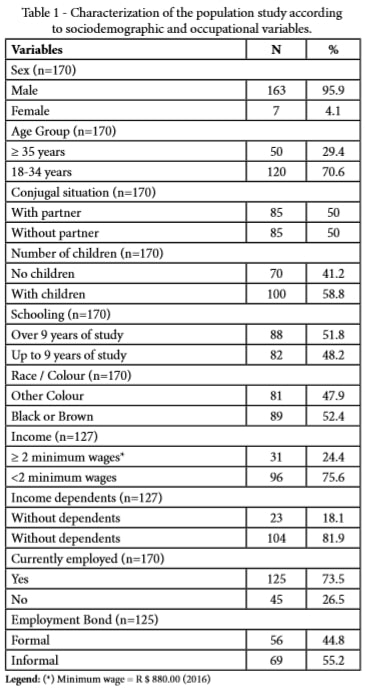
<body><![CDATA[<p>A total of 170 motorcycle drivers were surveyed. There was a predominance of males (95.9%), with a mean age of 31 years (standard deviation = 9.8 years, ranging from 18 to 67 years). A large part of the population was currently employed (73.5%), with monthly income less than two minimum wages (75.6%) and with at least one dependent (81.9%) (<a href="#t1">Table 1</a>).</p>   <a name="t1"></a>       <p><img src="/img/revistas/rpesm/n22/n22a04t1.jpg"></p>       
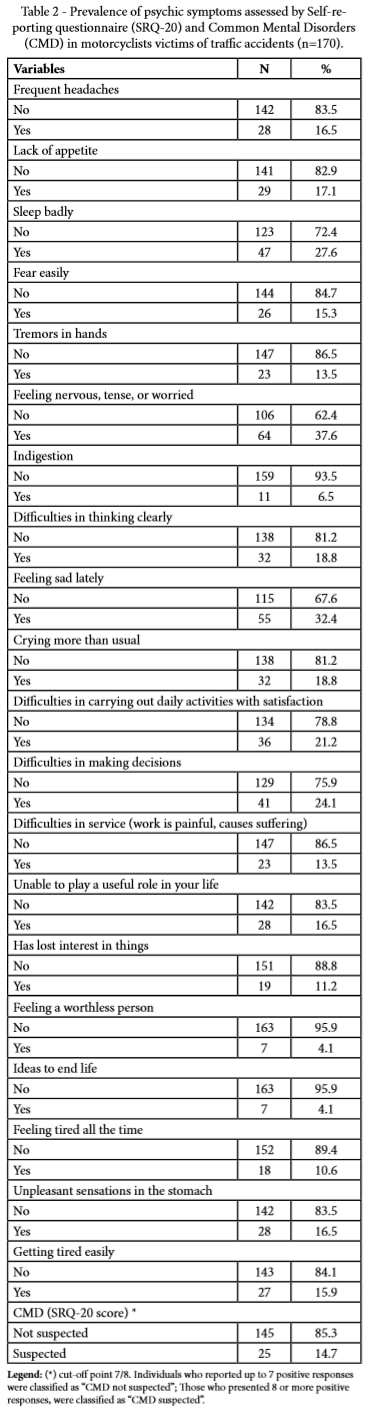
<p>&nbsp;</p>       <p>The overall prevalence of CMD was 14.7% (<a href="#t2">Table 2</a>). The most significant psychic symptoms assessed by SRQ-20 were: feeling nervous, tense, worried, and feeling sad lately, both reported by more than 30% of respondents (<a href="#t2">Table 2</a>).</p>   <a name="t2"></a>       <p><img src="/img/revistas/rpesm/n22/n22a04t2.jpg"></p>       
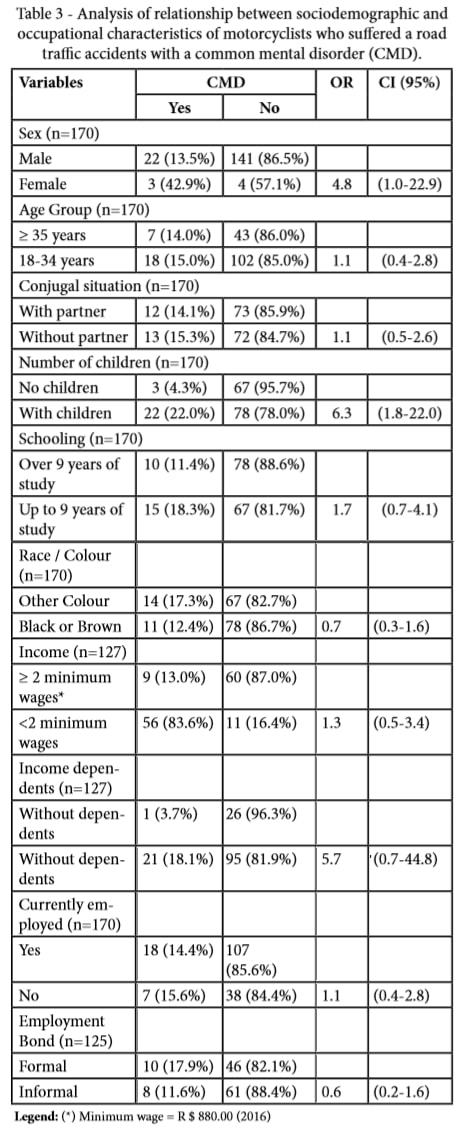
<p>&nbsp;</p>       <p>The cases of suspected CMD were more frequent in females (42.9%), individuals with up to nine years of schooling (18.3%), those who had at least one child (22%), had monthly income less than two minimum wages (83.6%) and had at least one dependent (18.1%) (<a href="#t3">Table 3</a>).</p>   <a name="t3"></a>       <p><img src="/img/revistas/rpesm/n22/n22a04t3.jpg"></p>       
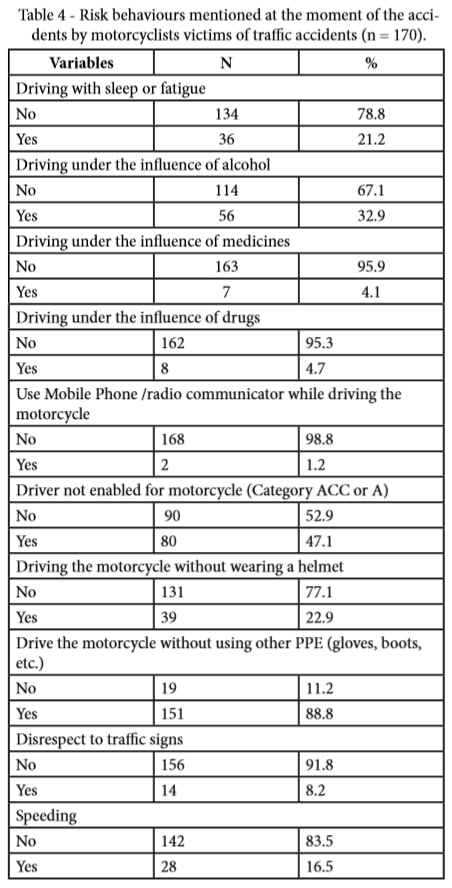
<p>&nbsp;</p>       <p>Among the main risk behaviours adopted at the moment of the accident reported by motorcyclists, the most notable are driving under the influence of alcohol (32.9%), driving with sleep or fatigue (21.2%) and driving the motorcycle more than speed (16.5%). Also, about half of the sample studied reported not having a National Driver&rsquo;s License, and 22.9% stated that they did not wear a helmet while driving the motorcycle. It is noteworthy that the frequency of use of other personal protective equipment (PPE), such as boots, gloves, coats, etc., is low. (Almost 90% of respondents reported not using other PPE). The results are shown in <a href="#t4">Table 4</a>.</p>   <a name="t4"></a>       ]]></body>
<body><![CDATA[<p><img src="/img/revistas/rpesm/n22/n22a04t4.jpg"></p>       
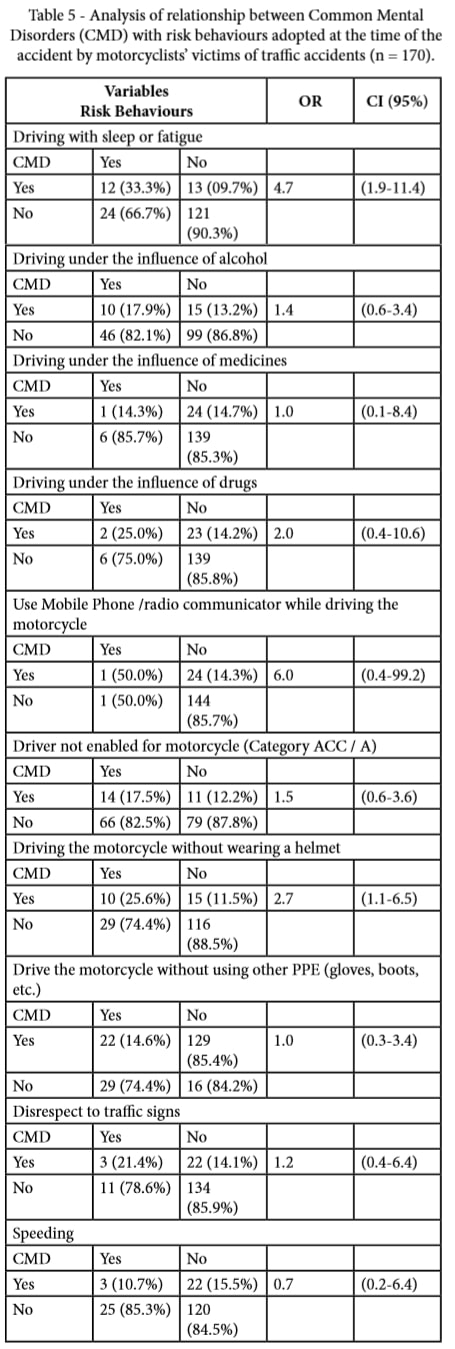
<p>&nbsp;</p>       <p>Almost all motorcyclists (95.9%) reported experiencing at least one risk behaviour at the time preceding the accident. Of these, when questioned about how they felt about the accident, 101 (62.0%) reported not feeling responsible for the accident.</p>       <p>CMDs was positively associated with the following risk behaviours in traffic: driving with sleep or fatigue (OR = 4.7, 95% CI = 1.9-11.4) and driving a motorcycle without a helmet (OR = 2.7, 95% CI = 1.1-6.5) (Table 5), that is, individuals exposed to risk (classified as CMD suspects) presented a 4.7 times greater chance of driving with sleep / fatigue and 2.7 motorcycle without wearing a helmet when compared to non-exposed individuals (classified as non-suspected CMD) (<a href="#t5">Table 5</a>).</p>   <a name="t5"></a>       <p><img src="/img/revistas/rpesm/n22/n22a04t5.jpg"></p>       
<p>&nbsp;</p>       <p>The sociodemographic variables were tested as potential confounders considering the common mental disorders as exposure and each of the risk behaviours independently as an outcome. However, there was no statistical significance.</p>       <p>&nbsp;</p>       <p><b>Discussion</b></p>       <p>Common mental disorders and the adoption of risk behaviours precedent to the accident point to a worrying health situation in the study population are prevalent. Among the risk behaviours analysed, driving the motorcycle without personal protective equipment, without a driver&rsquo;s license, under the influence of alcohol, with sleep and fatigue and more than speed were the most reported. There was an association between CMDs and the outcome of driving with sleep or fatigue and driving a motorcycle without wearing a helmet at the time of the accident.</p>       ]]></body>
<body><![CDATA[<p>Although there are few studies with motorcyclists in general, it is known that in professional motorcyclists, the prevalence of mental disorders throughout life is high (about 75%) (Kieling et al., 2011). Among these, the most frequent are substance abuse disorders - alcohol (43.6%) and marijuana (39.6%) - and mood disorders (31.7%) (Kieling et al., 2011). Mental disorders of different natures are associated with the probability of individuals breaking laws and engaging in traffic accidents (Kieling et al., 2011).</p>       <p>Other studies with professional motorcyclists in Jequi&eacute; (Bahia, Brazil) and Campinas (S&atilde;o Paulo, Brazil), identified a prevalence of CMD of 14.1% and 30.2%, respectively (Cear&aacute;, 2015; Santana, Amorim e Silva J&uacute;nior, 2014). It identified associations with drug use, alcohol abuse and the probability of being involved in traffic accidents (Cear&aacute;, 2015).</p>       <p>In the study population, the most frequent responses to SRQ-20 items were: feeling nervous, worried, and feeling sad lately. Similar symptoms have been reported by professional motorcyclists (Santana, Amorim e Silva J&uacute;nior, 2014). People who have some social and personal maladjustment are more likely to manifest risk behaviours in motorcycle driving, being more likely to be involved in accidents comorbidities (Kieling et al., 2011).</p>       <p>Regarding risk behaviour at the time of the accident such as driving with sleep and/or fatigue, driving under the influence of alcohol, driving the motorcycle in excess of speed, driving a motorcycle without a helmet and not having a motorcycle license were already identified as the primary factors for occurrence and/or severity of the accident suffered by motorcyclists (Shaker, Eldesouky, Hasan &amp; Bayomy, 2014; Van Elslande et al., 2013).</p>       <p>On the other hand, the association between CMD and traffic risk behaviours shows that these disorders are associated with driving with sleep or fatigue and driving a motorcycle without wearing a helmet. Therefore, physical exhaustion and changes in the quality and quantity of sleep can compromise the physical and mental health of the individuals, decreasing drivers&rsquo; alertness (Higgins et al., 2017), and are related to several types of risk behaviour in traffic among motorcyclists, especially speeding (Chen &amp; Chen, 2016).</p>       <p>Besides, the association between CMD and non-use of the helmet might indicate patients with mental disorders usually fail to perform self-care (Martins et al., 2016). Also, in more severe cases, to adopt self-destructive behaviours that put their lives and others at risk, since such disorders interfere with the individual&rsquo;s functional capacity in different aspects of daily living (Fernandes et al., 2018).</p>       <p>Our findings add to the literature, for example, research by Mollanorouzi, Mirabbasi, Rouhani &amp; Hasanpour (2014) on anxiety (one symptom of CMD) in motorcyclists and associated factors identified that all participants (n = 73) had mild anxiety; 21%, moderate anxiety and 6%, severe anxiety. These authors identified a positive association between anxiety with driving experience, being motor-driven and history of trauma, and a negative association with age and safety. Safe driving reduces the level of anxiety and is related to wearing a helmet.</p>       <p>As limitations of the study, the sampling came from a single health unit and the restriction of applying the questionnaire in an isolated way of other patients and companions, which may have made them constrained to answer some items of the questionnaire, leading to -to deny certain feelings or situations and/or give more socially acceptable responses. Also, while cross-sectional studies are beneficial for describing disease patterns in the population and identifying vulnerable or risk groups, as they simultaneously recognise exposure and disease, their main disadvantage is that they do not prove causal associations, that is, a temporal sequence between the disclosure and the outcome of an injury.</p>       <p>&nbsp;</p>       <p><b>Conclusion</b></p>       ]]></body>
<body><![CDATA[<p>The results of the present study evidenced an association between the presence of CMD and some risky behaviour in traffic (driving with sleep/fatigue and not using a helmet). Although the research may present limitations, it denotes the dimension of accidents involving motorcycles and signals how to the mental health of their drivers and the behaviours adopted by them in traffic can influence their causality.</p>       <p>Traffic accidents involving motorcyclists are among the leading causes of morbidity and mortality, demanding new research that will give a more comprehensive look at this category of drivers. Such surveys should consider local contexts, so they can serve as a basis for accident prevention actions.</p>       <p>&nbsp;</p>       <p><b>Implications for Clinical Practice</b></p>       <p>Driving is a complex act that involves the interplay between cognitive and motor skills, perception, attention and memory. The driver&rsquo;s psychological state can positively or negatively influence the complex interplay of driving skills. The psychology of traffic is a field that has as its main objective seeking the guarantee of safe traffic. Thus, the understanding of the psychology of traffic could enact the reduction of the number and severity of accidents. With that in mind, this study demonstrates the relationship between risk behaviour in traffic, accidents and mental health benefit the whole society by reinforcing the clinical importance of conducting periodic psychological evaluations in motor vehicle drivers.</p>       <p>&nbsp;</p>       <p><b>References</b></p>       <p>Cear&aacute;, A. T. (2015). <i>Personalidade, identidade, abuso de subst&acirc;ncias psicoativas e outros transtornos mentais em motoboys</i>. (Tese de Doutoramento). Universidade Estadual de Campinas, Brasil.</p>       <!-- ref --><p>Chen, Y. C. &amp; Chen, P. L (2016). Insufficient sleep hours associated with varied types of risky riding behaviours among motorcyclist:&nbsp; Yi Chu Chen. <i>European Journal of Public Health</i>, 26(Issue suppl 1), 435-436. Doi: <a href="https://doi.org/10.1093/eurpub/ckw175.006"target=&rdquo;_blank&rdquo;>10.1093/eurpub/ckw175.006</a>.    &nbsp;&nbsp;&nbsp;&nbsp;&nbsp;&nbsp;&nbsp;&nbsp;[&#160;<a href="javascript:void(0);" onclick="javascript: window.open('/scielo.php?script=sci_nlinks&ref=1216828&pid=S1647-2160201900020000400002&lng=','','width=640,height=500,resizable=yes,scrollbars=1,menubar=yes,');">Links</a>&#160;]<!-- end-ref --></p>       ]]></body>
<body><![CDATA[<!-- ref --><p>Departamento Nacional de Tr&acirc;nsito – DENATRAN. (2018).&nbsp; <i>Frota de ve&iacute;culos, por tipo e com placa, segundo as Grandes Regi&otilde;es e Unidades da Federa&ccedil;&atilde;o - JUL / 2018</i>. Dispon&iacute;vel em: <a href="https://www.denatran.gov.br/estatistica/635-frota-2018"target=&rdquo;_blank&rdquo;>https://www.denatran.gov.br/estatistica/635-frota-2018</a>.    &nbsp;&nbsp;&nbsp;&nbsp;&nbsp;&nbsp;&nbsp;&nbsp;[&#160;<a href="javascript:void(0);" onclick="javascript: window.open('/scielo.php?script=sci_nlinks&ref=1216830&pid=S1647-2160201900020000400003&lng=','','width=640,height=500,resizable=yes,scrollbars=1,menubar=yes,');">Links</a>&#160;]<!-- end-ref --></p>       <!-- ref --><p>Fernandes, M. A., Ribeiro, H. K. P., Santos, J. D. M., Monteiro, C. F. de S., Costa, R. dos S, &amp; Soares, R. F. S. (2018). Preval&ecirc;ncia dos transtornos de ansiedade como causa de afastamento de trabalhadores.&nbsp;<i>Revista Brasileira de Enfermagem</i>,&nbsp;71(Supl. 5), 2213-2220. <a href="https://dx.doi.org/10.1590/0034-7167-2017-0953"target=&rdquo;_blank&rdquo;>Doi: 10.1590/0034-7167-2017-0953</a>.    &nbsp;&nbsp;&nbsp;&nbsp;&nbsp;&nbsp;&nbsp;&nbsp;[&#160;<a href="javascript:void(0);" onclick="javascript: window.open('/scielo.php?script=sci_nlinks&ref=1216832&pid=S1647-2160201900020000400004&lng=','','width=640,height=500,resizable=yes,scrollbars=1,menubar=yes,');">Links</a>&#160;]<!-- end-ref --></p>       <!-- ref --><p>Goldberg, D. P. &amp; Huxley, P. (1992). <i>Common mental disorders: a bio-social model</i>. London: Tavistock.    &nbsp;&nbsp;&nbsp;&nbsp;&nbsp;&nbsp;&nbsp;&nbsp;[&#160;<a href="javascript:void(0);" onclick="javascript: window.open('/scielo.php?script=sci_nlinks&ref=1216834&pid=S1647-2160201900020000400005&lng=','','width=640,height=500,resizable=yes,scrollbars=1,menubar=yes,');">Links</a>&#160;]<!-- end-ref --></p>       <!-- ref --><p>Harding, T. W., Aranoo, M. V., Baltazar, J., Climent, C. E., Ibrahim, H. H. A., Ignacio, L. L., Murthy, R. S. &amp; Wig, N. N. (1980). Mental disorders in primary health care: a study of their frequency and diagnosis in four developing countries. <i>Psychological Medicine</i>, 10, 231–241. Doi: <a href="https://doi.org/10.1017/s0033291700043993"target=&rdquo;_blank&rdquo;>10.1017/s0033291700043993</a>.    &nbsp;&nbsp;&nbsp;&nbsp;&nbsp;&nbsp;&nbsp;&nbsp;[&#160;<a href="javascript:void(0);" onclick="javascript: window.open('/scielo.php?script=sci_nlinks&ref=1216836&pid=S1647-2160201900020000400006&lng=','','width=640,height=500,resizable=yes,scrollbars=1,menubar=yes,');">Links</a>&#160;]<!-- end-ref --></p>       <!-- ref --><p>Higgins, J. S., Michael, J., Austin, R., &Aring;kerstedt, T., Van Dongen, H. P., Watson, N., Czeisler, C., Pack, A. I. &amp; Rosekind, M. R (2017). Asleep at the Wheel—The Road to Addressing Drowsy Driving. <i>SLEEP</i>, 40(2), zsx001. Doi: <a href="https://doi.org/10.1093/sleep/zsx001"target=&rdquo;_blank&rdquo;>10.1093/sleep/zsx001</a>.    &nbsp;&nbsp;&nbsp;&nbsp;&nbsp;&nbsp;&nbsp;&nbsp;[&#160;<a href="javascript:void(0);" onclick="javascript: window.open('/scielo.php?script=sci_nlinks&ref=1216838&pid=S1647-2160201900020000400007&lng=','','width=640,height=500,resizable=yes,scrollbars=1,menubar=yes,');">Links</a>&#160;]<!-- end-ref --></p>       ]]></body>
<body><![CDATA[<!-- ref --><p>Instituto Brasileiro de Geografia e Estat&iacute;stica – IBGE.(2018) <i>Brasil em S&iacute;ntese. Brasil / Pernambuco</i>. Dispon&iacute;vel em: <a href="https://cidades.ibge.gov.br/brasil/pe/panorama"target=&rdquo;_blank&rdquo;>https://cidades.ibge.gov.br/brasil/pe/panorama</a>.    &nbsp;&nbsp;&nbsp;&nbsp;&nbsp;&nbsp;&nbsp;&nbsp;[&#160;<a href="javascript:void(0);" onclick="javascript: window.open('/scielo.php?script=sci_nlinks&ref=1216840&pid=S1647-2160201900020000400008&lng=','','width=640,height=500,resizable=yes,scrollbars=1,menubar=yes,');">Links</a>&#160;]<!-- end-ref --></p>       <!-- ref --><p>Kieling, R. R., Izobot, C. M., Matte, B., Coelho, R. S., Kieling, C., Pechanscky, F. &amp; Rohde, L. A. (2011). Mental disorders and delivery motorcycle drivers (motoboys): A dangerous association. <i>European Psychiatry</i>, 26(1), 23-27. Doi: <a href="https://doi.org/10.1016/j.eurpsy.2010.03.004"target=&rdquo;_blank&rdquo;>10.1016/j.eurpsy.2010.03.004</a>.    &nbsp;&nbsp;&nbsp;&nbsp;&nbsp;&nbsp;&nbsp;&nbsp;[&#160;<a href="javascript:void(0);" onclick="javascript: window.open('/scielo.php?script=sci_nlinks&ref=1216842&pid=S1647-2160201900020000400009&lng=','','width=640,height=500,resizable=yes,scrollbars=1,menubar=yes,');">Links</a>&#160;]<!-- end-ref --></p>       <!-- ref --><p>Mari J. J., &amp; Williams P. A. (1986) A validity study of a Psychhiatric Screening Questionnaire (SRQ 20) in primary care in city of S&atilde;o Paulo. <i>Brazilian Journal of Psychiatry</i>, 148, 23-26. Dispon&iacute;vel em: <a href="https://www.ncbi.nlm.nih.gov/pubmed/3955316"target=&rdquo;_blank&rdquo;>https://www.ncbi.nlm.nih.gov/pubmed/3955316</a>.    &nbsp;&nbsp;&nbsp;&nbsp;&nbsp;&nbsp;&nbsp;&nbsp;[&#160;<a href="javascript:void(0);" onclick="javascript: window.open('/scielo.php?script=sci_nlinks&ref=1216844&pid=S1647-2160201900020000400010&lng=','','width=640,height=500,resizable=yes,scrollbars=1,menubar=yes,');">Links</a>&#160;]<!-- end-ref --></p>       <!-- ref --><p>Martins, A. M. E. B. L, Nascimento, J. E., Souza, J. G. S., S&aacute;, M. A. B., Feres, S. B. L., Soares, B. P. &amp; Ferreira, E. F. (2016). Associa&ccedil;&atilde;o entre transtornos mentais comuns e condi&ccedil;&otilde;es subjetivas de sa&uacute;de entre idosos. <i>Ci&ecirc;ncia e Sa&uacute;de Coletiva, </i>21(11), 3387-3398. Doi: <a href="http://dx.doi.org/10.1590/1413-812320152111.07842015"target=&rdquo;_blank&rdquo;>10.1590/1413-812320152111.07842015</a>.    &nbsp;&nbsp;&nbsp;&nbsp;&nbsp;&nbsp;&nbsp;&nbsp;[&#160;<a href="javascript:void(0);" onclick="javascript: window.open('/scielo.php?script=sci_nlinks&ref=1216846&pid=S1647-2160201900020000400011&lng=','','width=640,height=500,resizable=yes,scrollbars=1,menubar=yes,');">Links</a>&#160;]<!-- end-ref --></p>       <!-- ref --><p>Minist&eacute;rio da Sa&uacute;de (BR). Departamento de Inform&aacute;tica do SUS – DATASUS. (2018). <i>Informa&ccedil;&otilde;es de Sa&uacute;de (TABNET)</i>. Dispon&iacute;vel em:&nbsp; <a href="http://tabnet.datasus.gov.br/cgi/deftohtm.exe?sim/cnv/ext10uf.def"target=&rdquo;_blank&rdquo;>http://tabnet.datasus.gov.br/cgi/deftohtm.exe?sim/cnv/ext10uf.def</a>.    &nbsp;&nbsp;&nbsp;&nbsp;&nbsp;&nbsp;&nbsp;&nbsp;[&#160;<a href="javascript:void(0);" onclick="javascript: window.open('/scielo.php?script=sci_nlinks&ref=1216848&pid=S1647-2160201900020000400012&lng=','','width=640,height=500,resizable=yes,scrollbars=1,menubar=yes,');">Links</a>&#160;]<!-- end-ref --></p>       ]]></body>
<body><![CDATA[<!-- ref --><p>Mollanorouzi, S. F., Mirabbasi, S., Rouhani, H. &amp; Hasanpour, P. (2014). P124: Anxiety in Motorcyclists; its Relation to Safety, Age, Riding Experience, Having License and Trauma History (2014). <i>Shefaye Khatam</i>, 2(S1), 148. Dispon&iacute;vel em: <a href="http://shefayekhatam.ir/article-1-250-en.pdf"target=&rdquo;_blank&rdquo;>http://shefayekhatam.ir/article-1-250-en.pdf</a>.    &nbsp;&nbsp;&nbsp;&nbsp;&nbsp;&nbsp;&nbsp;&nbsp;[&#160;<a href="javascript:void(0);" onclick="javascript: window.open('/scielo.php?script=sci_nlinks&ref=1216850&pid=S1647-2160201900020000400013&lng=','','width=640,height=500,resizable=yes,scrollbars=1,menubar=yes,');">Links</a>&#160;]<!-- end-ref --></p>       <p>National Highway Transportation Safety Administration – NHTSA. (2018). <i>Traffic Safety Facts. 2016 Data. Motorcycles. (Report No. DOT HS 812 492)</i>. Washington, DC: NHTSA - National Center for Statistics and Analysis. Dispon&iacute;vel em: <a href="http://www-nrd.nhtsa.dot.gov/Pubs/811639.pdf"target=&rdquo;_blank&rdquo;>http://www-nrd.nhtsa.dot.gov/Pubs/811639.pdf</a>.</p>       <p>Pernambuco. (2016). <i>Portaria SES n&ordm; 482 de 27/12/2016: Institucionaliza o Sistema de Informa&ccedil;&atilde;o sobre Acidentes de Transporte Terrestre (Sinatt) e regulamenta a Vigil&acirc;ncia Sentinela de Acidentes de Transporte Terrestre, no &acirc;mbito estadual</i>. Recife, Pernambuco: Di&aacute;rio Oficial do Estado de Pernambuco. Dispon&iacute;vel em: <a href="http://200.238.101.22/docreader/docreader.aspx?bib=20161228&amp;amp;pasta=Dezembro\Dia%2028"target=&rdquo;_blank&rdquo;>http://200.238.101.22/docreader/docreader.aspx?bib=20161228&amp;amp;pasta=Dezembro\Dia%2028</a>.</p>       <!-- ref --><p>Santana, M. L. A. D&acute;A., Amorim, C. R. &amp; Silva Junior, V. F. (2014). Prevalence of common mental disorders in motorcycle taxi drivers: focus on health worker. <i>Journal of Nursing UFPE on line</i>, 8(8), 2653-2659. Doi: <a href="http://dx.doi.org/10.5205/reuol.6081-52328-1-SM.0808201411"target=&rdquo;_blank&rdquo;>10.5205/reuol.6081-52328-1-SM.0808201411</a>.    &nbsp;&nbsp;&nbsp;&nbsp;&nbsp;&nbsp;&nbsp;&nbsp;[&#160;<a href="javascript:void(0);" onclick="javascript: window.open('/scielo.php?script=sci_nlinks&ref=1216854&pid=S1647-2160201900020000400016&lng=','','width=640,height=500,resizable=yes,scrollbars=1,menubar=yes,');">Links</a>&#160;]<!-- end-ref --></p>       <!-- ref --><p>Secretaria Estadual de Sa&uacute;de de Pernambuco – SES/PE (2016)<i>. Acidentes de Transporte Terrestre em Pernambuco. 2016</i>. Relat&oacute;rio apresentado na 8&ordf; Assembleia do Conselho Nacional de Secret&aacute;rios de Sa&uacute;de – CONASS. Bras&iacute;lia, Brazil.&nbsp; Dispon&iacute;vel em: <a href="https://www.slideshare.net/CONASS/8-assembleia-do-conass-acidentes-de-transporte-terrestre-em-pernambuco"target=&rdquo;_blank&rdquo;>https://www.slideshare.net/CONASS/8-assembleia-do-conass-acidentes-de-transporte-terrestre-em-pernambuco</a>.    &nbsp;&nbsp;&nbsp;&nbsp;&nbsp;&nbsp;&nbsp;&nbsp;[&#160;<a href="javascript:void(0);" onclick="javascript: window.open('/scielo.php?script=sci_nlinks&ref=1216856&pid=S1647-2160201900020000400017&lng=','','width=640,height=500,resizable=yes,scrollbars=1,menubar=yes,');">Links</a>&#160;]<!-- end-ref --></p>       <p>Rios, P. A. A. (2015). <i>Epidemiologia dos acidentes de tr&acirc;nsito: incid&ecirc;ncia de envolvimento e fatores comportamentais em um estudo de base populacional.</i> (Tese de Doutoramento), Universidade Federal da Bahia, Brasil.</p>       <p>Shaker, R. H., Eldesouky, R. Sh., Hasan, O. M. &amp; Bayomy H (2014). Motorcycle Crashes: Attitudes of the Motorcyclists Regarding Riders&rsquo; Experience and Safety Measures. <i>Journal of Community Health</i>, 39(6), 1222-1230. Doi: <a href="http://dx.doi.org/10.1007/s10900-014-9883-1"target=&rdquo;_blank&rdquo;>10.1007/s10900-014-9883-1</a>.</p>       ]]></body>
<body><![CDATA[<p>Theofilatos, A. &amp; Yannis G (2014). Relationship Between Motorcyclists&rsquo; Attitudes, Behavior, and Other Attributes With Declared Accident Involvement in Europe. <i>Traffic&nbsp;Injury Prevention, </i>15(2), 156-164. Doi: <a href="http://dx.doi.org/10.1080/15389588.2013.801554"target=&rdquo;_blank&rdquo;>10.1080/15389588.2013.801554</a>.</p>       <!-- ref --><p>Van Elslande, P., Yannis, G., Feypell, V., Papadimitriou, E., Tan, C. &amp; Jordan, M. (2013). <i>Contributory factors of Powered Two Wheelers Crashes</i>. Artigo apresentado na 13th World Conference on Transport Research. Rio De Janeiro, Brazil. Dispon&iacute;vel em: <a href="https://www.nrso.ntua.gr/geyannis/wp-content/uploads/geyannis-pc157.pdf"target=&rdquo;_blank&rdquo;>https://www.nrso.ntua.gr/geyannis/wp-content/uploads/geyannis-pc157.pdf</a>.    &nbsp;&nbsp;&nbsp;&nbsp;&nbsp;&nbsp;&nbsp;&nbsp;[&#160;<a href="javascript:void(0);" onclick="javascript: window.open('/scielo.php?script=sci_nlinks&ref=1216861&pid=S1647-2160201900020000400021&lng=','','width=640,height=500,resizable=yes,scrollbars=1,menubar=yes,');">Links</a>&#160;]<!-- end-ref --></p>       <p>World Health Organization - WHO. Division of Mental Health. (1994). <i>A user&rsquo;s guide to Self-Reporting Questionnaire (SRQ)</i>. Geneva: World Health Organization. Dispon&iacute;vel em: <a href="http://apps.who.int/iris/bitstream/10665/61113/1/WHO_MNH_PSF_94.8.pdf"target=&rdquo;_blank&rdquo;>http://apps.who.int/iris/bitstream/10665/61113/1/WHO_MNH_PSF_94.8.pdf</a></p>       <!-- ref --><p>World Health Organization – WHO. (2018). <i>Global status report on road safety 2018</i>. Geneva: World Health Organization. Dispon&iacute;vel em: <a href="https://www.who.int/violence_injury_prevention/road_safety_status/2018/en/"target=&rdquo;_blank&rdquo;>https://www.who.int/violence_injury_prevention/road_safety_status/2018/en/</a>&nbsp;&nbsp;&nbsp;&nbsp;&nbsp;&nbsp;&nbsp;&nbsp;[&#160;<a href="javascript:void(0);" onclick="javascript: window.open('/scielo.php?script=sci_nlinks&ref=1216864&pid=S1647-2160201900020000400023&lng=','','width=640,height=500,resizable=yes,scrollbars=1,menubar=yes,');">Links</a>&#160;]<!-- end-ref --><p>&nbsp;</p>       <p><b>Notas</b></p>       <p>O primeiro autor participou da concep&ccedil;&atilde;o, coleta e an&aacute;lise dos dados, interpreta&ccedil;&atilde;o dos resultados, e da reda&ccedil;&atilde;o do artigo. Os segundo e terceiro autores participaram da coleta de dados, interpreta&ccedil;&atilde;o dos resultados e da reda&ccedil;&atilde;o do artigo. O quarto autor participou da concep&ccedil;&atilde;o, da an&aacute;lise dos dados e interpreta&ccedil;&atilde;o dos resultados, da revis&atilde;o cr&iacute;tica do conte&uacute;do e do artigo, e reda&ccedil;&atilde;o da vers&atilde;o final do artigo. O quinto autor da revis&atilde;o cr&iacute;tica do conte&uacute;do do artigo e da reda&ccedil;&atilde;o da vers&atilde;o final do artigo. Todos os autores aprovaram a vers&atilde;o final do artigo.</p>       <p>&nbsp;</p>       <p>Recebido em 31 de mar&ccedil;o de 2019</p>       ]]></body>
<body><![CDATA[<p>Aceite para publica&ccedil;&atilde;o em 3 de setembro de 2019</p>       <p>&nbsp;</p> </div>      ]]></body><back>
<ref-list>
<ref id="B1">
<nlm-citation citation-type="book">
<person-group person-group-type="author">
<name>
<surname><![CDATA[Ceará]]></surname>
<given-names><![CDATA[A. T.]]></given-names>
</name>
</person-group>
<source><![CDATA[Personalidade, identidade, abuso de substâncias psicoativas e outros transtornos mentais em motoboys]]></source>
<year>2015</year>
<publisher-name><![CDATA[Universidade Estadual de Campinas]]></publisher-name>
</nlm-citation>
</ref>
<ref id="B2">
<nlm-citation citation-type="journal">
<person-group person-group-type="author">
<name>
<surname><![CDATA[Chen]]></surname>
<given-names><![CDATA[Y. C.]]></given-names>
</name>
<name>
<surname><![CDATA[Chen]]></surname>
<given-names><![CDATA[P. L]]></given-names>
</name>
</person-group>
<article-title xml:lang="en"><![CDATA[Insufficient sleep hours associated with varied types of risky riding behaviours among motorcyclist: Yi Chu Chen]]></article-title>
<source><![CDATA[European Journal of Public Health]]></source>
<year>2016</year>
<volume>26</volume>
<numero>suppl 1</numero>
<issue>suppl 1</issue>
<page-range>435-436</page-range></nlm-citation>
</ref>
<ref id="B3">
<nlm-citation citation-type="">
<collab>Departamento Nacional de Trânsito - DENATRAN</collab>
<source><![CDATA[Frota de veículos, por tipo e com placa, segundo as Grandes Regiões e Unidades da Federação - JUL / 2018]]></source>
<year>2018</year>
</nlm-citation>
</ref>
<ref id="B4">
<nlm-citation citation-type="journal">
<person-group person-group-type="author">
<name>
<surname><![CDATA[Fernandes]]></surname>
<given-names><![CDATA[M. A.]]></given-names>
</name>
<name>
<surname><![CDATA[Ribeiro]]></surname>
<given-names><![CDATA[H. K. P.]]></given-names>
</name>
<name>
<surname><![CDATA[Santos]]></surname>
<given-names><![CDATA[J. D. M.]]></given-names>
</name>
<name>
<surname><![CDATA[Monteiro]]></surname>
<given-names><![CDATA[C. F. de S.]]></given-names>
</name>
<name>
<surname><![CDATA[Costa]]></surname>
<given-names><![CDATA[R. dos S]]></given-names>
</name>
<name>
<surname><![CDATA[Soares]]></surname>
<given-names><![CDATA[R. F. S.]]></given-names>
</name>
</person-group>
<article-title xml:lang="pt"><![CDATA[Prevalência dos transtornos de ansiedade como causa de afastamento de trabalhadores]]></article-title>
<source><![CDATA[Revista Brasileira de Enfermagem]]></source>
<year>2018</year>
<volume>71</volume>
<numero>Supl. 5</numero>
<issue>Supl. 5</issue>
<page-range>2213-2220</page-range></nlm-citation>
</ref>
<ref id="B5">
<nlm-citation citation-type="book">
<person-group person-group-type="author">
<name>
<surname><![CDATA[Goldberg]]></surname>
<given-names><![CDATA[D. P.]]></given-names>
</name>
<name>
<surname><![CDATA[Huxley]]></surname>
<given-names><![CDATA[P.]]></given-names>
</name>
</person-group>
<source><![CDATA[Common mental disorders: a bio-social model]]></source>
<year>1992</year>
<publisher-loc><![CDATA[London ]]></publisher-loc>
<publisher-name><![CDATA[Tavistock]]></publisher-name>
</nlm-citation>
</ref>
<ref id="B6">
<nlm-citation citation-type="journal">
<person-group person-group-type="author">
<name>
<surname><![CDATA[Harding]]></surname>
<given-names><![CDATA[T. W.]]></given-names>
</name>
<name>
<surname><![CDATA[Aranoo]]></surname>
<given-names><![CDATA[M. V.]]></given-names>
</name>
<name>
<surname><![CDATA[Baltazar]]></surname>
<given-names><![CDATA[J.]]></given-names>
</name>
<name>
<surname><![CDATA[Climent]]></surname>
<given-names><![CDATA[C. E.]]></given-names>
</name>
<name>
<surname><![CDATA[Ibrahim]]></surname>
<given-names><![CDATA[H. H. A.]]></given-names>
</name>
<name>
<surname><![CDATA[Ignacio]]></surname>
<given-names><![CDATA[L. L.]]></given-names>
</name>
<name>
<surname><![CDATA[Murthy]]></surname>
<given-names><![CDATA[R. S.]]></given-names>
</name>
<name>
<surname><![CDATA[Wig]]></surname>
<given-names><![CDATA[N. N.]]></given-names>
</name>
</person-group>
<article-title xml:lang="en"><![CDATA[Mental disorders in primary health care: a study of their frequency and diagnosis in four developing countries]]></article-title>
<source><![CDATA[Psychological Medicine]]></source>
<year>1980</year>
<volume>10</volume>
<page-range>231-241</page-range></nlm-citation>
</ref>
<ref id="B7">
<nlm-citation citation-type="journal">
<person-group person-group-type="author">
<name>
<surname><![CDATA[Higgins]]></surname>
<given-names><![CDATA[J. S.]]></given-names>
</name>
<name>
<surname><![CDATA[Michael]]></surname>
<given-names><![CDATA[J.]]></given-names>
</name>
<name>
<surname><![CDATA[Austin]]></surname>
<given-names><![CDATA[R.]]></given-names>
</name>
<name>
<surname><![CDATA[Åkerstedt]]></surname>
<given-names><![CDATA[T.]]></given-names>
</name>
<name>
<surname><![CDATA[Van Dongen]]></surname>
<given-names><![CDATA[H. P.]]></given-names>
</name>
<name>
<surname><![CDATA[Watson]]></surname>
<given-names><![CDATA[N.]]></given-names>
</name>
<name>
<surname><![CDATA[Czeisler]]></surname>
<given-names><![CDATA[C.]]></given-names>
</name>
<name>
<surname><![CDATA[Pack]]></surname>
<given-names><![CDATA[A. I.]]></given-names>
</name>
<name>
<surname><![CDATA[Rosekind]]></surname>
<given-names><![CDATA[M. R]]></given-names>
</name>
</person-group>
<article-title xml:lang="en"><![CDATA[Asleep at the Wheel: The Road to Addressing Drowsy Driving]]></article-title>
<source><![CDATA[SLEEP]]></source>
<year>2017</year>
<volume>40</volume>
<numero>2</numero>
<issue>2</issue>
<page-range>zsx001</page-range></nlm-citation>
</ref>
<ref id="B8">
<nlm-citation citation-type="">
<collab>Instituto Brasileiro de Geografia e Estatística - IBGE</collab>
<source><![CDATA[Brasil em Síntese]]></source>
<year>2018</year>
<publisher-loc><![CDATA[Pernambuco ]]></publisher-loc>
</nlm-citation>
</ref>
<ref id="B9">
<nlm-citation citation-type="journal">
<person-group person-group-type="author">
<name>
<surname><![CDATA[Kieling]]></surname>
<given-names><![CDATA[R. R.]]></given-names>
</name>
<name>
<surname><![CDATA[Izobot]]></surname>
<given-names><![CDATA[C. M.]]></given-names>
</name>
<name>
<surname><![CDATA[Matte]]></surname>
<given-names><![CDATA[B.]]></given-names>
</name>
<name>
<surname><![CDATA[Coelho]]></surname>
<given-names><![CDATA[R. S.]]></given-names>
</name>
<name>
<surname><![CDATA[Kieling]]></surname>
<given-names><![CDATA[C.]]></given-names>
</name>
<name>
<surname><![CDATA[Pechanscky]]></surname>
<given-names><![CDATA[F.]]></given-names>
</name>
<name>
<surname><![CDATA[Rohde]]></surname>
<given-names><![CDATA[L. A.]]></given-names>
</name>
</person-group>
<article-title xml:lang="en"><![CDATA[Mental disorders and delivery motorcycle drivers (motoboys): A dangerous association]]></article-title>
<source><![CDATA[European Psychiatry]]></source>
<year>2011</year>
<volume>26</volume>
<numero>1</numero>
<issue>1</issue>
<page-range>23-27</page-range></nlm-citation>
</ref>
<ref id="B10">
<nlm-citation citation-type="journal">
<person-group person-group-type="author">
<name>
<surname><![CDATA[Mari]]></surname>
<given-names><![CDATA[J. J.]]></given-names>
</name>
<name>
<surname><![CDATA[Williams]]></surname>
<given-names><![CDATA[P. A.]]></given-names>
</name>
</person-group>
<article-title xml:lang="en"><![CDATA[A validity study of a Psychhiatric Screening Questionnaire (SRQ 20) in primary care in city of São Paulo]]></article-title>
<source><![CDATA[Brazilian Journal of Psychiatry]]></source>
<year>1986</year>
<volume>148</volume>
<page-range>23-26</page-range></nlm-citation>
</ref>
<ref id="B11">
<nlm-citation citation-type="journal">
<person-group person-group-type="author">
<name>
<surname><![CDATA[Martins]]></surname>
<given-names><![CDATA[A. M. E. B. L]]></given-names>
</name>
<name>
<surname><![CDATA[Nascimento]]></surname>
<given-names><![CDATA[J. E.]]></given-names>
</name>
<name>
<surname><![CDATA[Souza]]></surname>
<given-names><![CDATA[J. G. S.]]></given-names>
</name>
<name>
<surname><![CDATA[Sá]]></surname>
<given-names><![CDATA[M. A. B.]]></given-names>
</name>
<name>
<surname><![CDATA[Feres]]></surname>
<given-names><![CDATA[S. B. L.]]></given-names>
</name>
<name>
<surname><![CDATA[Soares]]></surname>
<given-names><![CDATA[B. P.]]></given-names>
</name>
<name>
<surname><![CDATA[Ferreira]]></surname>
<given-names><![CDATA[E. F.]]></given-names>
</name>
</person-group>
<article-title xml:lang="pt"><![CDATA[Associação entre transtornos mentais comuns e condições subjetivas de saúde entre idosos]]></article-title>
<source><![CDATA[Ciência e Saúde Coletiva]]></source>
<year>2016</year>
<volume>21</volume>
<numero>11</numero>
<issue>11</issue>
<page-range>3387-3398</page-range></nlm-citation>
</ref>
<ref id="B12">
<nlm-citation citation-type="">
<collab>Ministério da Saúde (BR)^dDepartamento de Informática do SUS - DATASUS</collab>
<source><![CDATA[Informações de Saúde (TABNET)]]></source>
<year>2018</year>
</nlm-citation>
</ref>
<ref id="B13">
<nlm-citation citation-type="journal">
<person-group person-group-type="author">
<name>
<surname><![CDATA[Mollanorouzi]]></surname>
<given-names><![CDATA[S. F.]]></given-names>
</name>
<name>
<surname><![CDATA[Mirabbasi]]></surname>
<given-names><![CDATA[S.]]></given-names>
</name>
<name>
<surname><![CDATA[Rouhani]]></surname>
<given-names><![CDATA[H.]]></given-names>
</name>
<name>
<surname><![CDATA[Hasanpour]]></surname>
<given-names><![CDATA[P.]]></given-names>
</name>
</person-group>
<article-title xml:lang="en"><![CDATA[P124: Anxiety in Motorcyclists; its Relation to Safety, Age, Riding Experience, Having License and Trauma History (2014)]]></article-title>
<source><![CDATA[Shefaye Khatam]]></source>
<year>2014</year>
<volume>2</volume>
<numero>S1</numero>
<issue>S1</issue>
<page-range>148</page-range></nlm-citation>
</ref>
<ref id="B14">
<nlm-citation citation-type="book">
<collab>National Highway Transportation Safety Administration - NHTSA</collab>
<source><![CDATA[Traffic Safety Facts. 2016 Data. Motorcycles. (Report No. DOT HS 812 492)]]></source>
<year>2018</year>
<publisher-loc><![CDATA[Washington ]]></publisher-loc>
<publisher-name><![CDATA[NHTSA - National Center for Statistics and Analysis]]></publisher-name>
</nlm-citation>
</ref>
<ref id="B15">
<nlm-citation citation-type="book">
<collab>Pernambuco</collab>
<source><![CDATA[Portaria SES nº 482 de 27/12/2016: Institucionaliza o Sistema de Informação sobre Acidentes de Transporte Terrestre (Sinatt) e regulamenta a Vigilância Sentinela de Acidentes de Transporte Terrestre, no âmbito estadual.]]></source>
<year>2016</year>
<publisher-loc><![CDATA[Recife ]]></publisher-loc>
<publisher-name><![CDATA[Diário Oficial do Estado de Pernambuco]]></publisher-name>
</nlm-citation>
</ref>
<ref id="B16">
<nlm-citation citation-type="journal">
<person-group person-group-type="author">
<name>
<surname><![CDATA[Santana]]></surname>
<given-names><![CDATA[M. L. A. D´A.]]></given-names>
</name>
<name>
<surname><![CDATA[Amorim]]></surname>
<given-names><![CDATA[C. R.]]></given-names>
</name>
<name>
<surname><![CDATA[Silva Junior]]></surname>
<given-names><![CDATA[V. F.]]></given-names>
</name>
</person-group>
<article-title xml:lang="en"><![CDATA[Prevalence of common mental disorders in motorcycle taxi drivers: focus on health worker]]></article-title>
<source><![CDATA[Journal of Nursing UFPE on line]]></source>
<year>2014</year>
<volume>8</volume>
<numero>8</numero>
<issue>8</issue>
<page-range>2653-2659</page-range></nlm-citation>
</ref>
<ref id="B17">
<nlm-citation citation-type="book">
<collab>Secretaria Estadual de Saúde de Pernambuco - SES/PE</collab>
<source><![CDATA[Acidentes de Transporte Terrestre em Pernambuco. 2016]]></source>
<year>2016</year>
<publisher-loc><![CDATA[Brasília ]]></publisher-loc>
<publisher-name><![CDATA[8ª Assembleia do Conselho Nacional de Secretários de Saúde - CONASS]]></publisher-name>
</nlm-citation>
</ref>
<ref id="B18">
<nlm-citation citation-type="book">
<person-group person-group-type="author">
<name>
<surname><![CDATA[Rios]]></surname>
<given-names><![CDATA[P. A. A.]]></given-names>
</name>
</person-group>
<source><![CDATA[Epidemiologia dos acidentes de trânsito: incidência de envolvimento e fatores comportamentais em um estudo de base populacional]]></source>
<year>2015</year>
<publisher-name><![CDATA[Universidade Federal da Bahia]]></publisher-name>
</nlm-citation>
</ref>
<ref id="B19">
<nlm-citation citation-type="journal">
<person-group person-group-type="author">
<name>
<surname><![CDATA[Shaker]]></surname>
<given-names><![CDATA[R. H.]]></given-names>
</name>
<name>
<surname><![CDATA[Eldesouky]]></surname>
<given-names><![CDATA[R. Sh.]]></given-names>
</name>
<name>
<surname><![CDATA[Hasan]]></surname>
<given-names><![CDATA[O. M.]]></given-names>
</name>
<name>
<surname><![CDATA[Bayomy]]></surname>
<given-names><![CDATA[H]]></given-names>
</name>
</person-group>
<article-title xml:lang="en"><![CDATA[Motorcycle Crashes: Attitudes of the Motorcyclists Regarding Riders' Experience and Safety Measures]]></article-title>
<source><![CDATA[Journal of Community Health]]></source>
<year>2014</year>
<volume>39</volume>
<numero>6</numero>
<issue>6</issue>
<page-range>1222-1230</page-range></nlm-citation>
</ref>
<ref id="B20">
<nlm-citation citation-type="journal">
<person-group person-group-type="author">
<name>
<surname><![CDATA[Theofilatos]]></surname>
<given-names><![CDATA[A.]]></given-names>
</name>
<name>
<surname><![CDATA[Yannis]]></surname>
<given-names><![CDATA[G]]></given-names>
</name>
</person-group>
<article-title xml:lang="en"><![CDATA[Relationship Between Motorcyclists' Attitudes, Behavior, and Other Attributes With Declared Accident Involvement in Europe]]></article-title>
<source><![CDATA[Traffic Injury Prevention]]></source>
<year>2014</year>
<volume>15</volume>
<numero>2</numero>
<issue>2</issue>
<page-range>156-164</page-range></nlm-citation>
</ref>
<ref id="B21">
<nlm-citation citation-type="book">
<person-group person-group-type="author">
<name>
<surname><![CDATA[Van Elslande]]></surname>
<given-names><![CDATA[P.]]></given-names>
</name>
<name>
<surname><![CDATA[Yannis]]></surname>
<given-names><![CDATA[G.]]></given-names>
</name>
<name>
<surname><![CDATA[Feypell]]></surname>
<given-names><![CDATA[V.]]></given-names>
</name>
<name>
<surname><![CDATA[Papadimitriou]]></surname>
<given-names><![CDATA[E.]]></given-names>
</name>
<name>
<surname><![CDATA[Tan]]></surname>
<given-names><![CDATA[C.]]></given-names>
</name>
<name>
<surname><![CDATA[Jordan]]></surname>
<given-names><![CDATA[M.]]></given-names>
</name>
</person-group>
<source><![CDATA[Contributory factors of Powered Two Wheelers Crashes]]></source>
<year>2013</year>
<publisher-loc><![CDATA[Rio De Janeiro ]]></publisher-loc>
<publisher-name><![CDATA[13th World Conference on Transport Research]]></publisher-name>
</nlm-citation>
</ref>
<ref id="B22">
<nlm-citation citation-type="book">
<collab>World Health Organization - WHO.^dDivision of Mental Health.</collab>
<source><![CDATA[A user's guide to Self-Reporting Questionnaire (SRQ)]]></source>
<year>1994</year>
<publisher-loc><![CDATA[Geneva ]]></publisher-loc>
<publisher-name><![CDATA[World Health Organization]]></publisher-name>
</nlm-citation>
</ref>
<ref id="B23">
<nlm-citation citation-type="book">
<collab>World Health Organization - WHO</collab>
<source><![CDATA[Global status report on road safety 2018]]></source>
<year>2018</year>
<publisher-loc><![CDATA[Geneva ]]></publisher-loc>
<publisher-name><![CDATA[World Health Organization]]></publisher-name>
</nlm-citation>
</ref>
</ref-list>
</back>
</article>