Vidal Romaní, J. R.*; Sanjurjo Sánchez, J.*; Vaqueiro, M.*,** & Fernández Mosquera, D.*
* Instituto Universitario de Xeoloxía Isidro Parga Pondal. 15071 A Coruña, Spain.
** CEM. c/ Manuel de Castro 8-3ºD, 36201 Vigo, Spain.
E-mail and Fax of the corresponding author:
xemoncho@udc.es. Fax (0034) 981167172
All the authors contributed equally to this work
Abstract
]]> The run-off infiltration through the discontinuities of the granitic rocky massifs causes the alteration of the rock and the associated formation of deposits which are considered speleothems due to the environment and genetic process where they are formed. Speleothems are formed by minerals (opal-A, pigotite, struvite, evansite-bolivarite, taranakite, goethite, etc.) whose constituent elements come from the rock weathering by the water strengthened by the biological activity that is developed in the fissural system and that modifies the geochemical properties of the water increasing its corrosivity. The fabric of these speleothems is highly porous and allows the development of microorganisms either in the voids or on the surface of the speleothem. There have been identified colonies of bacteria, cells, fungi hyphae, spores, algae, diatoms, polychetes, mites, etc., organisms that at least develop part of their vital cycle in the speleothem and that have an active role in the construction of speleothems when acting as deposition nuclei or sedimentary trap of the mobilized materials. The development of speleothems is intermittent and associated with water circulation episodes normally coupled with rain events.Keywords: Granite cave, biospeleothem, opal-A, pigotite, struvite, evansite.
Espeleotemas de Cavernas Graníticas
Resumo
A infiltração do escoamento através das descontinuidades dos maciços rochosos graníticos provoca a alteração das rochas e a formação de depósitos associados que são considerados espeleotemas, devido ao ambiente e ao processo genético, onde são formadas. Espeleotemas são formados por minerais (opala-A, pigotite, estruvita, evansite-bolivarite, taranakite, goethita, etc.), cujos elementos constituintes provêm do intemperismo de rocha pela água reforçada pela atividade biológica que se desenvolve no sistema fissural e que modifica as propriedades geoquímicas da água aumentando a sua agressividade. A fabric destes espeleotemas é altamente porosa e permite o desenvolvimento de microorganismos, quer nos vazios ou na superfície do espeleotemas. Foram identificadas colónias de bactérias, células, hifas de fungos, esporos, algas, diatomáceas, polychetes, ácaros, etc., os organismos que desenvolvem, pelo menos, parte do seu ciclo vital no espeleotemas e que têm um papel activo na construção de espeleotemas quando actuam como núcleos de deposição de sedimentos ou armadilha dos materiais mobilizados. O desenvolvimento dos espeleotemas é intermitente e associada a episódios de circulação de água normalmente associada a períodos de chuva.
Palavras-chave: Cova granítica, bioespeleoteme, opala A, pigotite, struvite, evansite.
1. INTRODUCTION
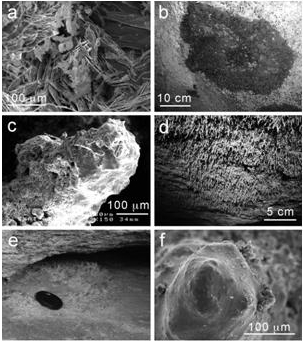
Run-off in continental zones is produced not only subaerially but also through the system of discontinuities of the rocky massifs. The effects of the water circulation through the massifs of non-soluble rocks (granite, quartzite) are relatively well-known, (Urbani, 1996, Wray, 1997a, 1997b, 1997c, Twidale and Vidal Romani, 2005). The first one is the chemical weathering (oxidation, hydration, hydrolisation, solubilisation, etc.) of the rock then complementing it with the mechanical or physical erosion. For the granite the weathering affects the minerals that form the rock, mainly quartz, feldspar and mica ordered from minor to greater susceptibility to weathering, in a different way. Water is the main weathering agent though in granitic fissural environments the biological effect has to be added as it contributes decisively to remark their effects (influence on pH and Eh) when increasing the water aggressiveness in weathering processes. Likewise, the velocity to which water flows through the fissural system has influence on the weathering processes and also depends on different factors, ones of general character (position of the base level, geomorphic stress (gravity), dimensions of the conduits through which water flows) and other more specific ones such as water movement by capillarity, superficial water tension or water adherence to the conduit walls. From all the enumerated factors the ones that influence more on the speleothem development are morphology and dimensions of the conduit through which water circulates (Figs. 1a and 2a). Small conduits will imply a slow water circulation, increasing the reactivity time of the water with the rock and, therefore, the persistence of the chemical and biological weathering.
]]>
Fig. 1 – Opal-A speleothems: (a) Gypsum twins formed by planar crystals on the tip of a speleothem. Ávila, Central Spain.; (b) Water output on the ceiling of a granite cave with associated rim of opal-A stalactites; (c) Opal-A coats the porous texture near the tip of speleothem from Traba Mountains, Northern Galicia, Spain; (d) Opal-A grass-shaped stalactites on the ceiling of a granite cave, Cova do Demo, Vigo, Spain; (e) Opal-A antistalactites from Mina Clavero, Córdoba, Argentina; (f) Opal-A stalagmite from Colegio Liqueño, Pampa de Achala, Córdoba, Argentina.
– Espeleotemas de Opala-A: (a) Maclas de gesso formadas por cristais planares na ponta de uma espeleotema (Ávila, Espanha Central); (b) Infiltração de água no tecto de uma caverna granítica com bordos de estalactites de opala-A associados; (c) A opala-A cobre a textura porosa perto da ponta de uma espeleotema das Montanhas Traba (Norte da Galiza, Espanha); (d) Estalactites de opala-A com “forma de relva” no tecto de uma caverna granítica (Caverna do Demo, Vigo, Espanha); (e) Anti-estalactites de opala-A da Mina Clavero (Córdoba, Argentina); (f) Estalagmite de opala-A de Colegio Liqueño (Pampa de Achala, Córdoba, Argentina).
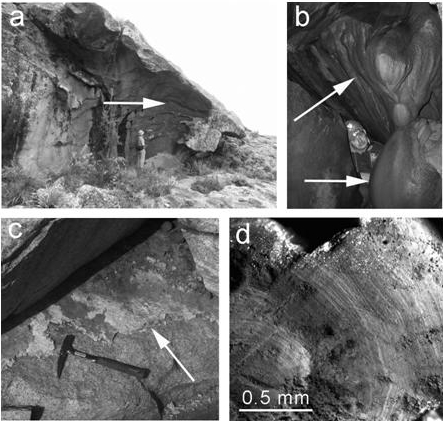
Fig. 2 – Different kinds of speleothems. (a) Granite tafone from Los Gigantes (Sierra Grande de Córdoba, Argentina): the gray and black dots are the water outputs where the speleothems are formed; (b) Pigotite column, covered by gour dam, 3000 years old from Trapa Cave, Galiñeiro, Galicia Spain; (c) Evansite deposits associated to planar fissure. Monte Costa Grande, Muros, Coruña Spain; (d) Cross-section of a pigotite speleothem formed by rhythmic accretion, with dark and light layers from Trapa Cave, Galiñeiro, Galicia Spain.
– Diferentes tipos de espeleotemas. (a) Tafone de granito de Los Gigantes (Sierra Grande de Córdoba, Argentina): os pontos cinzentos e pretos são infiltrações de água onde as espeleotemas se formam; (b) Coluna de pigotite coberta por uma micro-barragem com 3000 anos de idade da Caverna Trapa (Galiñeiro, Galiza, Espanha); (c) Depósitos de evansite associados a fissura planar (Monte Costa Grande, Muros, Corunha, Espanha); (d) Perfil transversal de uma espeleotema de pigotite formada por acreção rítmica com camadas escuras e claras na Caverna Trapa (Galiñeiro, Galiza, Espanha).
Early reports described the deposits only considering their morphology, being known as coralloids, crusts, speleothems, etc. (Caldcleugh 1829, Swarzlow and Keller, 1937, Finlayson, 1981, Finlayson, 1982, Finlayson and Webb 1985, Finlayson, 1986, Kashima, 1987). In later works, more precise terminology is used; the deposits associated with a punctual output of the water at the roof of the rock cavity are called stalactites; the ones due to the dripping on the ground of the cavity, stalagmites; while the ones formed from a laminar water flow over a place of any inclination from horizontal to vertical are called flowstones (Vidal Romaní et al., 2003). But in all cases the speleothem growth is controlled by the water contribution that justifies a preferential growth in the sense of the gravity with lineal or planar development when the dropping is either free or related to a surface of slope variable (Fig. 1b). But a reduction in volume or speed (they are related magnitudes) of the water flow channelled towards the speleothem will reduce the influence of the geomorphic stress (gravity) on the water movement, increasing the importance of the other forces that also has influence on the water movement: capillarity, viscosity, superficial tension, water adherence to the surface on which the speleothem develops giving rise to another type of speleothems such as grass-shaped speleothems, antistalactites (Vidal Romaní and Vaqueiro, 2007).
]]>2. SPELEOTHEM MINERALOGY AND GENESIS
One of the features of the speleothems of granitic cavities is the chemical composition that, though very varied, is always monomineral, what indicates that are formed in only one process of mineralogenesis. The speleothem mineralogy cited up to now is: evansite-bolivarite, struvite, pigotite, taranakite, allophane, goethite, hematite, etc. (Webb, 1976, Macías et al., 1980, Hill and Forti, 1995) though the prevailing mineralogy of speleothems in granite rocks are opal-A, pigotite and evansite-bolivarite. The geographic-climatic environments where they have been described are also varied: temperate humid (Spain, Portugal, United Kingdom, Germany, Poland, Czech Republic), tropical (Brazil, Venezuela, Madagascar, Hawaii), arid (Australia, Argentina, Brazil, Nigeria, New Mexico, USA) (Willems et al., 1998, 2002, Twidale and Vidal Romaní 2005).
Following there are described the more frequent mineralogical types found in speleothems of granitic fissural environments and their relationship with the biological processes developed inside them.
Opal-A speleothems. SiO2.15(H2O)
They are mainly formed by Si and H2O and are associated with the fissural systems of acid rocks: granites, quartzites and quartz veins (Table 1).
Summary of elemental composition of speleothems obtained by EDS coupled to SEM, from samples of diverse provenance.
]]> Síntese da composição elementar das espeleotemas obtida por EDS acoplado a SEM de amostras de diversas proveniências.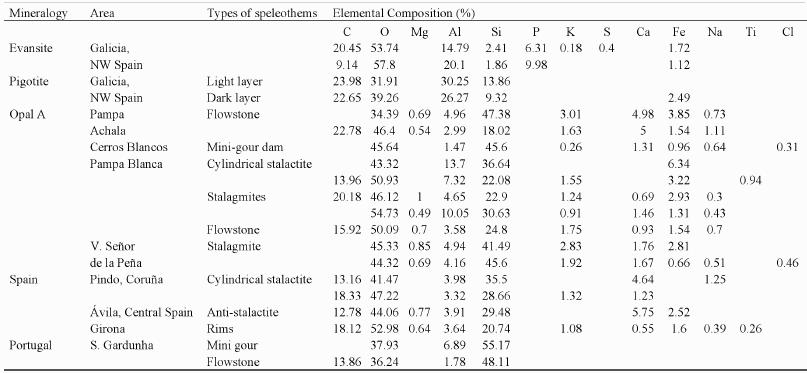
In the chemical composition of opal speleothems associated with granites, Si and H2O prevail while, Al, Ca, Fe, Mg, Na, K, Cl and Ti are in less proportion. Also, there are other elements of biogenic origin like S and C. The DTA-GTA diagrams of opal-A speleothems show the endothermic peak of low temperature (145ºC) corresponding to dehydration and the exothermic peak between 300 and 450ºC (sometimes 500ºC) due to organic matter oxidation (Vidal Romaní and Vilaplana, 1984) (Vidal Romaní et al., 1998). X-ray diffraction (Macías et al., 1979) shows the diffuse band between 8.8 Å and 10 Å corresponding to amorphous opal. For the development of the opal-A speleothems the decisive step is the dissolution of Si of the minerals of the granite, and especially of quartz, a process defined by the water pH. In natural environments (with pH values between 5-8), the Si dissolution included in the most stable crystalline structures (quartz) is very low (Welch and Ullman, 1996). However, after the biogenic weathering by bacteria, fungi, lichens silicates are dissolved and Si is easily mobilized (Ehrlich, 1996; Barker et al., 1997; Furukawa and O’Reilly, 2007). The attack of lichens is very aggressive both physically and chemically due to the high chelant ability of the lichenic acids (Barker et al., 1997). Bacteria and fungi, ubiquitous in superficial environments, also produce similar destructive effects (Ehrlich, 1996) by means of the production of organic acids of low molecular weight (mainly oxalate) (McMahon and Chapelle, 1991, Barker et al., 1997) which increases the solubility of quartz in the pH range 2.0-8.5 (Brady and Walter, 1990, Bennett, 1991). Opal-A speleothems are formed by precipitation of the dissolved Si by oversaturation by evaporation and/or synthesis carried out by some organisms, (e.g., diatoms). The so formed deposits present two types of textures: open work (highly porous) (Fig. 1c) and massive non porous. The most frequent one, especially in young speleothems, is the first and is formed by a porous agglomerate of angulous clasts of opal-A. On the contrary, in older speleothems or of greater dimensions, the texture is massive, with few voids as they have been infilled with re-dissolved opal-A (Fig. 1b). SEM and petrographic microscope analyses provide more information on shape and internal texture of speleothems. The speleothems are developed according to the water flow towards the point where the speleothem grows (Vidal Romaní and Vilaplana, 1984). A slow flow is the most suitable for the development of speleothems, whichever type it is (blanket, branched or cylindrical) (Vidal Romaní et al., 1998). Either cylindrical speleothems or flowstones show identical porous texture. This is due to dehydration of silica gel that produces angulous clasts of opal-A whose accumulation is a sediment with open work texture (Fig. 1b). This porous fabric allows the circulation and also the temporal water storage in the speleothem. The process is similar for the flowstone where the water movement accumulates on the surface of the rock marking the maximum overspill rim with glassy opal clast accumulations of sinuous outline that allows damming water producing microgours or rimstone (Figs. 1c, d and e). From the examination of thin sections (Twidale and Vidal Romaní, 2005) of stalactites it may be appreciated the rhythmic texture formed by layer-by-layer accretion as it occurs in their congeners in limestone caves (Vidal Romaní and Vilaplana, 1984). As the preferential water circulation in opal speleothems is mainly external, the rhythmic structure will be located on the free ends of the stalactites (Fig. 1b). On the contrary, it has not been observed in other types of speleothems (stalagmites, mini gour, anti-gravitational stalactites, grass-shaped stalactites, etc.) (Vidal Romaní and Vaqueiro, 2007) not related to dripping but laminar flow or with water capillary movement.
The porous fabric of the speleothems where water stores temporarily is the suitable place for the development of microbiological activity (Fig. 1f). Microorganisms have a role in the Si fixation either stabilizing the clasts themselves or incorporating the Si into their organic structures. It is the case of certain fungi that have molecules in their walls that cause the Si precipitation or in the silaffins of diatoms (Kröger et al., 1999). Additionally, organic acids produced by some organisms act as chelant compounds that have influence on the pH changes (Franklin et al., 1994, Welch and Ullman, 1996).
2.1. Formation of gypsum crystals
Some organisms (bacteria and fungi) decompose the organic material generating reduced S (H2S) that quickly oxidises into SO4–2 which is combined with the Ca of the plagioclases finally forming gypsum (SO4Ca.2H2O), normally a mineral that is always associated with opal speleothems. These gypsum crystals are idiomorphic and are normally developed in the free end of the speleothem and correspond to the end of the growing stage. They form a crest of gypsum whiskers giving rise to the so-called cauliflower crystals (Vidal Romaní et al., 1998). Gypsum whiskers are associated as druses where crystals appear twinned with astonishing idiomorphic shape. They appear (Twidale and Vidal Romaní, 2005) as (1) prismatic twins: monoclinic class 2/m, (2) acicular twins and (3) planar twins, respectively. The growth of these whisker druses is produced inside of the last drop that has concentrated on the free end of the speleothem. For drops located inside the channels, acicular crystal beams are formed. For the ellipsoid drops, elongated, along the sense of the gravity, the pseudoprismatic crystals will be formed, while for platy drops (typical of the stalagmites), crystal druses or bevelled planar twins limited by the upper surface of the drop.
Pigotite speleothems.
]]> Al4C6H5O10.13H2O or 4Al2 O3.C12 H10 O8.27H2OThis is a salt composed of alumina and organic acids formed on the surface of the granite and typically found in granitic cavities (Table 1). It forms incrustations on the walls of granitic fissures and caverns (Fig. 2b). This mineral was early described by Johnston (1840) in coastal caves from Cornwall (United Kingdom) and was dedicated to Rev. M. Pigot. Johnston (1840) considered it as an organic substance derived from the decay of moist moorlands above the cave what he calls mudesous acid, combined with Al (dominant) and Fe (secondary). Due to its amorphous character, the information given by the existing bibliography is not very precise when trying to define the chemical and mineralogical composition. Pigotite is presented as stalactites, stalagmites, columns and flowstone covering from horizontal surfaces to very stepped walls, even vertical. Up to now, the biggest pigotite speleothem has been located by one of us (M. Vaqueiro (Fig. 2b)) in Serra do Galiñeiro, Galicia, NW Spain and is formed by the union of a stalactite and a stalagmite in a column of more than 1 metre long. A cross or longitudinal section of that sample shows a rhythmic accretion structure in concentric layers (Fig. 2d) as it occurs in calcite speleothems. The different layers alternatively show light (Al prevails) (cream) and dark colours (Fe prevails) (reddish chestnut) that seem to correspond to seasonal stages (winter-summer) similar to the varves of lake deposits. On surface the aspect of these pigotite deposits is slightly different presenting a crenulated morphology due to the development of mini gours with dimensions from millimetres to some micra. For the speleothems described in Galicia, NW Spain, the radiocarbon dating gave an age ranging from 1500 years B.P. (O Folón System, Galicia, Spain) to 3000 years B.P. (Trapa cave system, Galiñeiro Sierra, Galicia, Spain) what confirms a great continuity and quickly growth in the deposition process even when compared to calcium carbonate speleothems. The quantity of water present in this mineral is highly variable, but always important in natural conditions. Once a sample is taken from the cave, the dehydration transforms the mineral into a powdered mass with very little cohesion in a short time.
Evansite-bolivarite.
Al3(PO4)(OH)6.6(H2O)- Al2(PO4)(OH)3.4-5(H2O)
These kinds of speleothems are found in well jointed rocky massifs with development of sheet structure. All these types of speleothems display a typical structure in rhythmic layers or layered sequences (flowstone), some centimetres thick covering surfaces of various square metres (Fig. 2c). The colour of evansite is yellow to yellowish brown to reddish. Evansite is amorphous and massive with a morphology in botryoidal or reniform coatings; concentric, colloform structure at times; opaline; stalactitic. They are very frequent in Galicia, NW Spain, but also in other parts of the World (Mt. Zeleznik, Gomor, Slovakia). A mineral species related to evansite and also amorphous is the bolivarite defined for the first time in Campo Lameiro, Pontevedra, Spain (Navarro and Barea 1921), which is shown to have physical and optical properties similar to those of evansite. Both minerals are X-ray amorphous. According to previous literature (García-Guinea et al., 1995), DTA spectra of both minerals show a strong endothermic effect at 120 ºC and a weaker one at 399 ºC. IR spectra show absorption peaks at 3500, 1600 and 100 cm (super –1), which are attributed to OH, H2 O and PO4, respectively. NMR spectra give a P signal centred at –10.7 ppm, typical of amorphous phosphates, and an Al signal centred at –4.2 ppm, which is typical of Al in octahedral coordination. Chemical analyses give the empirical formula Al2 (PO4) (sub 0.92) (OH) (sub 3.25) .4.03H2O for bolivarite and Al3 (PO4) (sub 1.09) (OH) (sub 5.73) .7.77H2O for evansite. The results of analyses of specimens of hydrous aluminium phosphates from Costa Grande (Galicia, Spain) indicate a range of Al:P atomic ratios varying between 2 and 3.58. Because of the amorphous nature of these materials, it is difficult to know if these analytical data pertain to mixtures of hydrous aluminium phosphates or if bolivarite and evansite represent intermediate members of a wide solid-solution series in which PO4 radicals are replaced by 3(OH). Some authors, (Martín Cardoso and Parga Pondal, 1935; García-Guinea et al., 1995), believe that under the name of evansite-bolivarite there may be represented transition terms between alumina silicates and alumina phosphates where the phosphorous that appears in them increases progressively as Si diminishes till substituting it completely.
3. BIOLOGICAL ACTIVITY IN SPELEOTHEMS
In the fissural systems developed in granitic rocks through which water circulates, different traces of biological activity may be recognized: organisms s.s.; pollen and spores and products of biological activity (organic S, P and C). All these organic remains are also distinguished if they come from outside the fissural system (allochthonous) or from biological activity in the same fissure (autochthonous).
]]> 3.1. Allochthonous remains
They come from organisms that develop most of their vital cycle outside the fissural system where the speleothem will be formed or when they correspond only to reproductive forms (pollen or spores). Up to now, there have been identified: Polychaetes (Polychaeta) (Fig. 3a), Arthropod Mytes sp. (Acarus) (Fig. 3b), palynomorphs of Pinaceae, Oleaceae, Mimosaceae, Poaceae, Brassicaeae (Fig. 3c), Cyperaceae (Fig. 3d), Fagaceae, Anacardiaceae, etc., spores of ferns (Pteridophyta) (Fig. 4a) and Dinophyceae.
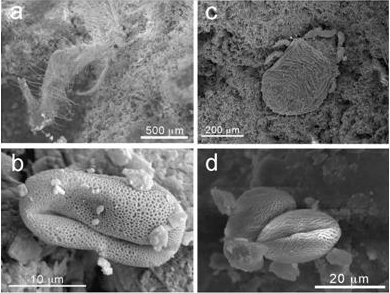
Fig. 3 – Organisms found in opal-A speleothems (I): (a) Polychete on the surface of an opal-A speleothem from Eyre Peninsula, South Australia; (b) Pollen grain of Brassicaceae from Cerros Blancos, Pampa de Achala, Córdoba, Argentina (courtesy of L. de Villar Seoane); (c) Mite trapped in a gour dam of opal-A from Cerros Blancos, Pampa de Achala, Córdoba, Argentina; (d) Pollen grain of Anacardiaceae from Cerros Blancos, Pampa de Achala, Córdoba, Argentina (courtesy of L. de Villar Seoane).
– Organismos encontrados nas espeleotemas de opla-A (I): (a) Poliquetas na superfície de uma opala-A da Península Eyre (Sul da Austrália); (b) Grão de pólen de Brassicaceae de Cerros Blancos (Pampa de Achala, Córdoba, Argentina) (cortesia de L. de Villar Seoane); (c) Ácaro preso numa micro-barragem de opala-A de Cerros Blancos (Pampa de Achala, Córdoba, Argentina); (d) Grãos de pólen de Anacardiaceae de Cerros Blancos (Pampa de Achala, Córdoba, Argentina) (cortesia de L. de Villar Seoane).
Fig. 4 – Organisms found in opal-A speleothems (II): (a) Spore of Pteridaceae, Pampa de Achala, Argentina; (b) Algae Oscillatoria sp Pampa de Achala, Argentina; (c); Cyanobacteria filaments, Cerros Blancos, Argentina. (d) Germinated Ascospores, Pampa de Achala, Argentina. (e). Diatom frustule of Planothidium sp, Colegio Liqueño, Argentina. (f). Diatom frustules of Stephanodiscus sp, Cerros Blancos, Argentina. (courtesy of L. de Villar Seoane).
– Organismos encontrados nas espeleotemas de opla-A (II): (a) Esporo de Pteridaceae (Pampa de Achala, Argentina); (b) Algae Oscillatoria sp (Pampa de Achala, Argentina); (c) Filamentos de cianobactéria (Cerros Blancos, Argentina); (d) Ascosporos germinados (Pampa de Achala, Argentina); (e) Frústula diatomácea de Planothidium sp (Colegio Liqueño, Argentina); (f) Frústula diatomácea de Stephanodiscus sp (Cerros Blancos, Argentina) (cortesia de L. de Villar Seoane).
]]>3.2. Autochthonous remains
The term autochthonous is used here in the sense of organisms that develop naturally in the speleothems though they may be cosmopolitan species. Vegetative forms and forms of resistance are found in the speleothem developed in their vital cycle. Up to now, there have been identified: heterotrophic bacteria and cyanobacteria, filamentous ones (Schizotrix (Figs. 4b and c), Anabaena, Nostoc), unicellular (Xenococcaceae and other unidentified ones), Algae in developed colonies and as resistance forms like cistes and spores. There are observed unicellular individuals and colonies of pennal diatoms (Neidium, Synedra, Sellaphora, Odontidium sp.) and central diatoms (Melosira, Aulacoseira, Stephanodiscus sp.) (Fig. 4e and f), Crysophyceae (Cryptomonas sp.), haptophyta, among other undentified ones, fungi like spores and unicellular and multicellular vegetative forms (hyphae). There are observed hyphae of Basiomicetes, unicellular fungi (Ascomycetes and Mixomycetes) and Protozoa that appear as isolated individuals or rarely grouped.
3.3. Products of organic activity
They are mainly represented by organic C, P and S (Table 1) as proved by the isotopic fractionation of S of some of them though no trace of the organism is recognized in them. These 3 elements do not appear individualized but combined with other mineral components pertaining to the rock giving place to minerals like evansite-bolivarite, struvite, pigotite, taranakite, etc.
The 3 types of organic remains described in the speleothems allow the reconstruction with high accuracy of the ecological conditions of the microenvironment of the speleothem and of the adjoining environment where it is developed. Another aspect to be underlined is that these organic remains have an important role in the development of speleothems when acting as physical trap to fix the opal clasts of the speleothems or even when acting as precipitation nuclei of the different substances that carry water in dissolution. Another important effect is the role that they have, especially the waste of organic activity (C, P and S) when changing the conditions of the pH originating the precipitation or the complexation of Si and Al giving place to speleothems of evansite-boliviarite, opal, pigotite or even to the growth of crystals of calcium sulphate, calcium carbonate, phosphate, etc.
4. DISCUSSION
The weathering of granitic rocky massifs is carried out inside their fissure system when this is partially open and allows the water circulation through it at very slow speed. In the weathering process of the granite the microbiological activity has an important role as it accelerates its decay (Cañaveras et al., 2001). The mobilization of the mineral ions coming from the rock depends on the water pH at the same time closely related to the content in organic matter that depends on the microbiological activity (Barker et al., 1997). The chemical elements of the rock minerals are dissolved and will be deposited close to their initial position creating the speleothems. The precipitations of Si, Al and organic matter are produced by oversaturation due to water evaporation.
]]> When Si, Al and humic acids precipitate, opal-A, evansite-bolivarite and pigotite speleothems are produced respectively. However, the biological influence on the speleothem development does not finish with the first deposition but is renewed after each new episode of rainwater circulation, what explains the varved structure seen in the speleothems, for example the ones described in this paper of evansite-bolivarite, pigotite and opal-A, similar to the ones of the speleothems of carbonated or soluble rocks.Though the speleothems described herein are associated with systems of discontinuities in partially open granitic rocks and with water circulating through them, the other factor clearly related to the development of speleothems is the interference with the biological activity developed either in the same subterranean environment or outside it. The distinction between allochthonous and autochthonous organic elements clearly shows that the same organisms or their activity products are the ones that influence on the development of the speleothems what allow to reasonably classifying them as biospeleothems for their close relation either in the genesis of the new minerals, in the precipitation mechanisms or in the weathering processes of the rocky substratum. A clear example of this relationship, microorganism and speleothem development, is the diatom colonies associated with opal-A speleothems. Some authors (Kashima 1987; Forti 2001) have supposed that the diatoms are alien to the system presuming that they are introduced from outside by the rainwater infiltrated in the rocky fissure system. Whichever their origin is, external or internal, they have a clear development in the same speleothem (Vidal Romaní et al., 1998) having direct or indirect influence on the final aspect of the speleothem. These associations may be specially observed in the drop associated with the free end of the cylindrical speleothem (Vidal Romaní et al., 1998) though they may also appear on their external surface or in any small concavity where water accumulates temporarily. The development of diatom colonies is reduced progressively as water evaporation is transformed into silica gel which finally will totally cover the diatoms incorporating them to the speleothem as fabric elements. Another element of influence of the organic activity in the speleothem development is the sulphates produced by oxidation of organic matter (bacteria, fungi) that are combined with Ca coming from the alteration of the plagioclases giving place to gypsum crystals (whiskers) (Twidale and Vidal Romaní, 2005). Generally, whiskers are calcium sulphate crystals though in some cases (Vidal Romaní, 1983) calcium carbonates or phosphates have been found. The formation of whiskers of substances in low concentrations from a base of silica gel is a well-known process in lab experiments (García-Ruiz et al., 1981, García-Ruiz et al., 1982, López Azevedo and García Ruíz, 1982) and allows the growth of very pure crystals and with good morphologic development.
5. CONCLUSIONS
The granite weathering in the fissural systems, partially open, are produced by the interaction water-rock where there are involved not only the chemical weathering but also microbiological processes either directly (conducted by the same microorganisms) or indirectly (reactions between the rock and the metabolic products derived from the organic activity). The microbiological activity enhances the rock alteration and dissolves elements from rock minerals (Si and Al, preferably and in less proportion others as Ca, K, Na, Fe) as other organic ones due to the microbiological activity (S, P and C). The oversaturation by water evaporation causes the precipitation of the elements and solubilised compounds originating speleothems of pigotite (fulvic acids), evansite-bolivarite (Al and Si phosphates) and opal-A (Si and H2O) combined with gypsum (S, C, O, H2O). Opal-A is the most frequent and morphologically most diversified kind of speleothem and the one in which the interaction between microorganisms and speleothem growth is better shown. The mineralogical chemical composition of the speleothems are an image of the influence of the chemical processes of the rock weathering and of the ones related to microbiological activity developed in the rocky fissural system materialized in the different types of speleothems. The pigotite speleothems are formed when the biological effects prevail over the chemical ones; the evansite-bolivarite ones would be an intermediate case, and finally the opal-A ones would be those where the chemical effects prevail over the biological ones. All of them, however, are a proof that at micro scale there exists a close relationship between chemical weathering and biological activity in the rock weathering in the fissural environments of granitic rocky massifs and of their relationship with the runoff that circulates through them.
ACKNOWLEDGEMENTS
We thank Ana Martelli for the English translation of the paper in draft form and the help to eliminate many errors and inconsistencies. We gratefully acknowledge Dra. Liliana Villar de Seoane for the identification of biological remains in opal-A speleothems. This paper is a contribution to the Research Project BTE-CGL-2006-08996 of the Ministry of Education and Science of Spain.
REFERENCES
]]> Barker, W. W., Welch, S. A. & Banfield, J. F. (1997) – Biogeochemical weathering of silicate minerals. In: Geomicrobiology: interactions between microbes and minerals, (Banfield J. F. and Nealson K. H. eds.). Washington: Mineralogical Society of America. 391-428.Bennett, P. C. (1991) – Quartz dissolution in an organic-rich aqueous system. Geochimica et Cosmochimica Acta, 55, 1781-1797.
Brady, P. V. & Walther, J. V. (1990) – Kinetics of quartz dissolution at low temperatures. Chemical Geology, 82: 253-264.
Caldcleugh, A. (1829) – On the geology of Rio de Janeiro. Transactions of the Geological Society, 2: 69-72.
Cañaveras, J. C., Sánchez-Moral, S., Soler, V. & Saiz-Jiménez, C. (2001) – Microorganisms and microbially induced fabrics in cave walls. Geomicrobiology Journal, 18: 223-240.
Ehrlich, H. L. (1996) – Geomicrobiology. 3rd edition. Marcel Dekker, Inc., New York, 719 pp.
Finlayson, B. (1981) – Underground streams on acid igneous rocks in Victoria. Helictite, 19(1): 5-14.
Finlayson, B. (1982) – Granite caves in Girraween National Park, Southeast Queensland. Helictite, 20(2): 53-59.
Finlayson, B. (1986) – The formation of caves in granite. Book In: New directions in karst, Sweeting, M. M. P., K., (ed.). Norwich (UK)l: Geobooks, 333-347.
Finlayson, B. & Webb, J. A. (1985) – Amorphous speleothems. Cave Science. 12-1: 3-8.
]]> Forti, P. (2001) – Biogenic speleothems: an overview. International Journal of Speleology, 30A((1/4)): 39-56.Franklin, S. P., Ajas, A. Jr., Dewers, T. A.& Tieh, T. T. (1994) – The role of carboxilic acids in albite and quartz dissolution: An experimental study under diagenetic conditions. Geochimica et Cosmochimica Acta, 58(20), 4259-4279.
Furukawa, Y. & O’Reilli, S. E. (2007) – Rapid precipitation of amorphous silica in experimental systems with nontronite (NAu-1) and Shewanella oneidensis. Geochimica et Cosmochimica Acta vol. 71-2, pp. 363-377.
García Ruíz, J. M., López Acevedo, V. & Tavira, P. (1981) – Crecimiento de triquitos sobre gel de sílice. I. Aplicación al BrK. Estudios Geológicos, 37: 3-8.
García-Guinea, J., Millán Chagoyen, A. & Nickel, E. H. (1995) – A re-investigation of bolivarite and evansite. The Canadian Mineralogist, 33, 59-65.
García-Ruíz, J. M. & Migues, F. (1982) – Condiciones de formación del primer precipitado en la técnica del gel de sílice. Estudios Geológicos, 38, 3-14.
Hill, C. A. & Forti, P. (1995) – The classification of cave minerals and speleothems. International Journal of Speleology, 24(1-4): 77-82.
Johnston, J. F. W. (1840) – On the constitution of Pigotite and on the Mudesous and Mudesic acids. Philosophical Transactions of the Royal Society of London, vol. 4, 1837-1843, pp. 239-241.
Kashima, N. (1987) – Diatom contributions of coralloid speleothems, from Togawa-Sakaidani-do Cave in Miyazaki Prefecture, Central Kyushu, Japan. International Journal of Speleology, 16: 95-100.
Kröger, N., Deutzmann, R. & Sumper, M. (1999) – Polycationic peptides from diatom biosilica that direct silica nanosphere formation. Science, 286, 1129-1131.
]]> López-Acevedo, V. & García-Ruíz, J. M. (1982) – An experimental study of the calcium phosphate precipitation using silica gel technique. Estudios Geológicos, 38: 227-232.Macías, F., Guitián, F., García, E. & Vidal Romaní, J. R. (1979) – Componentes no cristalinos y cristalinos (gibbsita y caolinita) en los productos de neoformación de rocas graníticas de Galicia. Cadernos do Laboratorio Xeolóxico de Laxe n.º 1, pp. 56-67.
Macías, F., Vidal Romaní, R. & Guitián, F. (1980) – Fosfatos organógenos en los recubrimientos de los granitos de Monte Louro. Cadernos do Laboratorio Xeolóxico de Laxe: 69-82.
Martín Cardoso, G. & Parga Pondal, I. (1935) – Hallazgo de la eosforita en el Son (Coruña). Las Ciencias, t.II, 849-850.
McMahon, P. B. & Chapelle, F. H. (1991) – Microbial production of organic acids in aquiterd sediments and its role in aquifer geochemistry. Nature, 349: 233-235.
Navarro, L. & Barea, P. (1921) – La bolivarita, nueva especie mineral. Boletín de la Real Sociedad Española de Historia Natural, 21, 326-328.
Swarzlow, C. I. & Keller, W. D. (1937) – Coralloid Opal. Journal of Geology, 45, pp.101-108.
Twidale, C. R. & Vidal Romaní, J. R. (2005) – Landforms and geology of granite terrains. Balkema, London, 351 pp.
Urbani, F. (1996) – Venezuelan cave minerals: a review. Boletín de la Sociedad Venezolana de Espelelología. 30: 1-13
Vidal Romaní, J. R. (1983) – El cuaternario de la provincia de A Coruña. Geomorfología granítica. Modelos elásticos de formación de cavidades. Tesis Doctoral. Servicio de Publicaciones. Universidad Complutense, Madrid.
]]> Vidal Romaní, J. R. & Vilaplana, J. M. (1984) – Datos preliminares para el estudio de espeleotemas en cavidades graníticas. Cadernos do Laboratorio Xeolóxico de Laxe, 7: 305-324.Vidal Romaní, J. R. & Vaqueiro, M. (2007) – Types of granite cavities and associated speleothems: genesis and evolution. Nature Conservation 63, 41-46.
Vidal Romaní, J. R., Bourne, J. A., Twidale, C. R. & Campbell, E. M. (2003) – Siliceous cylindrical speleothems in granitoids in warm semiarid and humid climates. Zeitschrift für Geomorphologie, 47(4): 417-437.
Vidal Romaní, J. R., Twidale, C. R., Bourne, J. & Campbell, E. M. (1998) – Espeleotemas y formas constructivas en granitoides. In: Investigaciones recientes en la Geomorfología española. (Ortíz, A. G. and Franch, F. S., Eds.) 1.ª edición. Barcelona: Actas Reunión de Geomorfología (Granada). 777-782.
Webb, W. B. (1976) – Cave minerals and speleothems. Book In: The science of speleology, Ford, T. D. and Cullingford, C. H. D., eds.). London: Academic Press, 267-328.
Welch, S. A. & Ullman, W. J. (1996) – Feldspar dissolution in acidic and organic solutions: Compositional and pH dependence of dissolution rate. Geochimica et Cosmochimica Acta, 60(16), 2939-2948.
Willems, L., Compère, P., Hatert, F., Pouclet, A., Vicat, J. P., Ek, C. & Boulvain, F. (2002) – Karst in Granitic rocks, South Camerun: cave genesis and silica and taranakite speleothems. Terra Nova, 14: 355-362. [ Links ]
Willems, L., Compere, P. & Sponholz, B. (1998) – Study of siliceous karst genesis in eastern Niger: microscopy and X-ray microanalysis of speleothems. Zeitschrift für Geomorphologie, 42(2), 129-142.
Wray, R. A. L. (1997a) – The formation and significance of coraline silica speleothems in the Sidney Basin, southeastern Australia. Physical Geography, 18(1): 1-17.
Wray, R. A. L. (1997b) – A global review of solutional weathering forms on quartz sandstones. Earth- Science Reviews. 42(3): 137-160.
]]> Wray, R. A. L. (1997c) – The formation and significance of coraline silica speleothems in the Sidney Basin, southeastern Australia. Physical Geography, 18(1): 1-17. ]]>