R. J. S. Teixeira*; A. M. R. Neiva** & M. E. P. Gomes*
* Department of Geology, University of Trás-os-Montes e Alto Douro, Apartado 1013, 5000-801 Vila Real, Portugal rteixeir@utad.pt
** Department of Earth Sciences, University of Coimbra, 3000-272 Coimbra and Geosciences Centre, Portugal
Abstract
At Donai, Pena Maquieira, and Mourisqueiro, in northeastern Portugal, amphibole asbestos minerals are associated with serpentinites, amphibole schists and steatitic rocks. In order to assess the environmental impact of these deposits, the Donai quarry and the talc mines of Pena Maquieira and Mourisqueiro were studied in detail, because long-term exposure to amphibole asbestos is known to cause pulmonary diseases. At Donai, tremolite asbestos occurs in shear zones and faults cutting serpentinites, whereas massive (non-fibrous) tremolite occurs as intercalations associated with amphibole schists, and chloritites. Serpentinites from the Donai quarry are mainly tremolite-free. At Pena Maquieira, tremolite asbestos fills faults cutting serpentinites. At Mourisqueiro, actinolite asbestos occurs within amphibole schists and steatitic rocks in a highly deformed zone. Geological mapping, examinations by petrographic microscope and electron-microprobe, and determinations of SiO2, CaO, and MgO for serpentinites, and CaO and MgO for steatitic rocks will help to assess the presence of admixed asbestos within these rocks. The identification of asbestos is essential in order to exploit these serpentinites and steatitic rocks with minimal disturbance of asbestiform minerals.
Keywords: Tremolite and actinolite asbestos, amphibole schists, serpentinites, steatitic rocks.
]]> Geoquímica de asbestos anfibólicos do nordeste de Portugal e sua utilização na monitorização do impacte ambiental resultante da exploração de pedreiras e minas
Resumo
Em Donai, Pena Maquieira e Mourisqueiro, Nordeste de Portugal, existem asbestos anfibólicos associados a serpentinitos, xistos anfibólicos e rochas esteatíticas. Com o objectivo de avaliar o impacto ambiental destas ocorrências minerais, foram estudadas em pormenor a pedreira de Donai e as minas de talco de Pena Maquieira e Mourisqueiro, dado que a exposição prolongada a asbestos anfibólicos pode causar essencialmente doenças pulmonares. Em Donai, os asbestos tremolíticos ocorrem em zonas de cisalhamento e falhas que cortam o serpentinito, enquanto a tremolite não fibrosa ocorre em intercalações associadas a xistos anfibólicos e clorititos. O serpentinito da pedreira de Donai não contém praticamente qualquer tremolite. Em Pena Maquieira, os asbestos tremolíticos preenchem falhas que cortam o serpentinito, enquanto em Mourisqueiro, ocorrem asbestos actinolíticos em xistos anfibólicos e rochas esteatíticas, numa zona de alto grau de deformação. A cartografia geológica, estudos no microscópio petrográfico e microssonda electrónica e as determinações de SiO2, CaO e MgO nos serpentinitos e de CaO e MgO nas rochas esteatíticas irão facilitar a detecção de asbestos anfibólicos nestas rochas. A identificação de asbestos anfibólicos é essencial para que a exploração de serpentinitos e rochas esteatíticas ocorra em segurança e com a menor perturbação possível causada por minerais asbestiformes.
Palavras-chave: Asbestos tremolíticos e actinolíticos, xistos anfibólicos, serpentinitos, rochas esteatíticas.
INTRODUCTION
For several decades of the 20th century, five different fibrous amphiboles: actinolite, anthophyllite, cummingtonite-grunerite (montasite-amosite), riebeckite (crocidolite), and tremolite, and a fibrous serpentine (chrysotile) were extensively mined and processed to produce asbestos products for many industrial and commercial applications (Skinner et al., 1988; Klein, 1993; Ross & Virta, 2001; Nolan et al., 2007). However, these asbestos minerals were found to be closely linked to three respiratory diseases (asbestosis, lung carcinoma, mesothelioma), but cancers of the gastrointestinal tract have also been described among some workforces (e.g., McDonald et al., 1983; Browne & Wagner, 2001; Langer, 2001; Gianfagna et al. 2003; Addison & McConnell, 2008; Gamble & Gibbs, 2008). Asbestos exposure is also associated with increased autoimmune responses in humans (Blake et al., 2008; Pfau et al., 2008). Today, the most commonly used asbestos mineral is chrysotile, which poses minimal hazard to human health under controlled usage and environments (Churg, 1993; Camus, 2001; Gamble & Gibbs, 2008). Therefore, amphibole asbestos is now little used or produced, but it still remains in the environment (Wicks, 1998; Langer, 2001). In fact, tremolite and other amphibole asbestos may occur within chrysotile-bearing rocks (Williams-Jones et al., 2001), and in other mineral deposits, like the vermiculite mine located near Libby, Montana, U.S.A. (Ross & Nolan, 2003). The amphibole asbestos content of talc deposits is directly related to the talc-forming environment. Talc deposits formed by contact or regional metamorphism show a strong tendency or consistently contain asbestiform amphiboles within the talc ore, while those formed by hydrothermal processes show negligible amounts or a complete absence of amphibole (Van Gosen et al., 2004).
Since asbestos is especially dangerous when inhaled, subsurface deposits may cause a smaller risk than the surface deposits. However, when these deposits are mined, airborne concentrations could increase greatly (Luus, 2007). For example, in Libby, Montana, U.S.A., mining and processing of talc and vermiculite containing tremolite asbestos increased airborne asbestos concentrations from <0.004 fibres/cm3 in 1847 to 0.022 fibres/cm3 in 1995 (Luus, 2007). These airborne concentrations affected directly the mine workers, as well as the community, since workers brought home materials from the mine and used them as clean fill in constructing driveways and gardens (Cudgell & Kamp, 2004). Furthermore, asbestos become embedded in the tree bark, where it persists and can affect those who harvest the contaminated wood (Anderson et al., 2005).
This paper concerns the compositions and geochemistry of amphibole asbestos and associated rocks from Donai and Pena Maquieira areas in Bragança massif and Mourisqueiro area (Vale da Porca) in the Morais massif. Amphibole asbestos was mined intermittently at Pena Maquieira from the 1940’s until the 1960’s. It was the only mine in northern Portugal with permission to exploit asbestos. Serpentinite is exploited presently in the Donai area, whereas talc is being exploited at Mourisqueiro. Amphibole asbestos minerals are associated with rocks quarried for a variety of industrial products, such as polished serpentinite from Donai, pottery products, and anti-agglomerates for fertilizers and animal food (e.g., steatitic rock from Mourisqueiro). It is important for Portuguese mining companies to distinguish and reject all the amphibole asbestos in the above products so as to minimize health risks. So, the objective of this paper is to use the geochemical and mineralogical data to assess the distribution of amphibole asbestos in these deposits.
]]> GEOLOGICAL SETTING
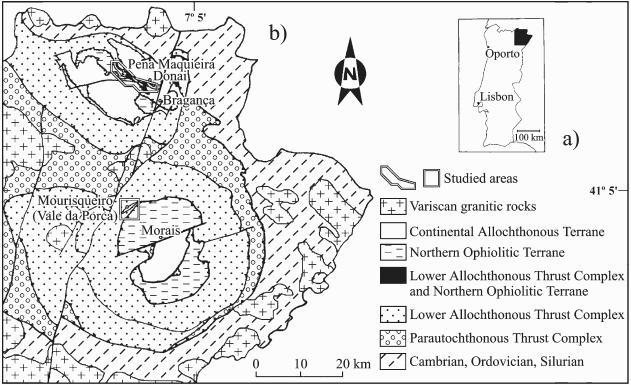
Amphibole asbestos from Trás-os-Montes, northeastern Portugal, occurs closely associated with ultramafic and mafic rocks from the Bragança and Morais (Neiva, 1948) nappe complexes, which consist of four allochthonous terranes separated by three major overthrusts (Fig. 1). They are: 1) a parautochthonous thrust complex formed mainly by Silurian and Lower Devonian metasediments of green schist metamorphic facies; 2) a lower allochthonous thrust complex consisting of Silurian metasedimentary formations and characterized by bimodal magmatism and the presence of relic mineral parageneses of high-pressure Variscan metamorphism (Munhá & Ribeiro, 1984; Santos, 1998); 3) a northern ophiolitic terrane, comprising ophiolitic sequences of an early prograde amphibolite facies of Variscan metamorphism and dismembered by the Variscan orogeny; 4) a continental allochthonous terrane, consisting mostly of mafic and ultramafic igneous rocks and high-grade metamorphic rocks (Ribeiro et al., 1990; Quesada, 1992; Marques et al., 1996).
Fig. 1 – a) Index map of the studied areas. b) Geological map of northeastern Portugal (modified from Ribeiro 1974).
– a) Localização das áreas estudadas. b) Carta geológica do nordeste de Portugal (modificada de Ribeiro, 1974).
At Donai, serpentinites are intercalated within lower Devonian chlorite phyllites and along a N80ºW shear zone (Fig. 2). Centimeter-thick slip-fibre tremolite asbestos veins occur along shear zones and faults cutting serpentinites. However, massive (non-fibrous) tremolite also occurs as meter-thick intercalations associated with amphibole schists and rarely chloritites. Talc schist is also found associated with serpentinites to the southeast of the Donai outcrop.
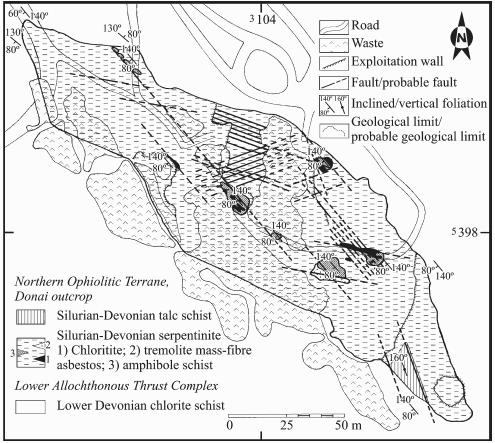
– Carta geológica de pormenor do afloramento da pedreira de Donai, no Terreno Ofiolítico do NW Ibérico. Levantamento geológico efectuado por Teixeira (2000). As referências marginais correspondem a coordenadas Gauss.
At Pena Maquieira, two areas are distinguished (Fig. 3): a) a northeastern area consisting of a 15-110 m thick elongated steatitic rock unit tending NW-SE; b) a southwestern area with small outcrops of steatitic rock within serpentinites. The mine is located in a talc schist antiform (Neiva, 1948; Vilela de Matos & Alves, 1988) with the northeastern limb corresponding to the northeastern part and the southwestern limb corresponding to the southwestern part. At Pena Maquieira, tremolite asbestos occurs mainly as slip-fibres and more rarely as cross-fibres along N50ºW and E-W subvertical faults (Neiva, 1948). The fibre veins cutting serpentinites are commonly 2-15 cm thick.
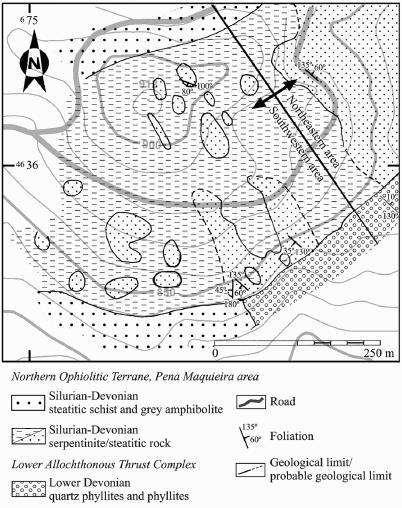
Fig. 3 – Geological map of Pena Maquieira area within the northern ophiolitic terrane. Geological survey by Vilela de Matos & Alves (1988), reviewed later by Teixeira (2000). The marginal marks correspond to UTM coordinates.
– Carta geológica de pormenor da área de Pena Maquieira, no Terreno Ofiolítico do NW Ibérico. Levantamento geológico efectuado por Vilela de Matos & Alves (1988), revisto por Teixeira (2000). As referências marginais correspondem a coordenadas UTM.
At Mourisqueiro, southwest of the Vale da Porca overthrust, serpentinites intercalated between amphibolites and amphibole schist are overlain by a mylonitized formation, which consists of serpentinitic and chlorititic nodules in a matrix of talc and some amphibole (Fig. 4). Amphibolitized mafic granulites occur on the top of the mylonitized formation. A zone of talc schist measuring 1m in thickness is associated with a N60ºE vertical fault and is also found at the contact with some serpentinitic intercalations in amphibolites.
]]>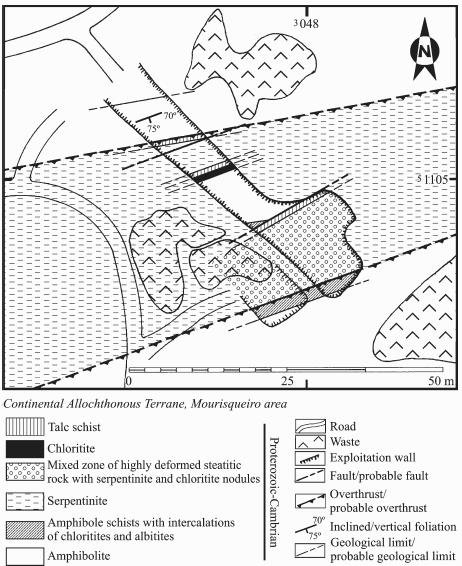
Fig. 4 – Detailed geological map of Mourisqueiro mine within the continental allochthonous terrane. Geological survey by Teixeira (2000). The marginal marks correspond to Gauss coordinates.
– Carta geológica de pormenor da mina de Mourisqueiro, no Terreno Continental Alóctone. Levantamento geológico efectuado por Teixeira (2000). As referências marginais correspondem a coordenadas Gauss.
At Mourisqueiro, serpentinites are partially replaced by talc and cut by picrolite veins filling fractures. Actinolite asbestos is associated with amphibolites, amphibole schists, serpentinites, and steatitic rocks in a highly deformed zone. These actinolite asbestos veins contain two different types of fibres: a) long, flexible, and soft fibres (Fig. 5a) and b) short, brittle, and rough fibres (Fig. 5b). The pseudo-fibrous green picrolite veins consist of antigorite.
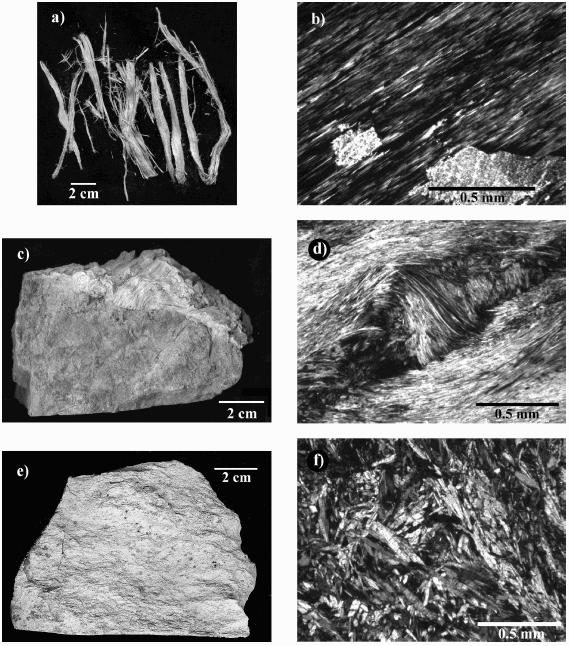
Fig. 5 – a, c, e – photographs and b, d, f – photomicrographs of amphibole asbestos from northeastern Portugal. a) Slip-fibres of actinolite asbestos from Mourisqueiro; b) Slip-fibre tremolite asbestos from Donai, two xenomorphic talc crystals also occur (crossed nicols); c) Serpentinite from Pena Maquieira containing a cross-fibre vein of tremolite asbestos; d) Deformed cross-fibre vein of tremolite asbestos from Pena Maquieira (crossed nicols); e) Massive tremolite from Donai; f) Massive tremolite from Donai (crossed nicols).
– a, c, e- fotografias e b, d, f- microfotografias de asbestos anfibólicos do nordeste de Portugal. a) Asbesto actinolítico do tipo “slip-fibre” de Mourisqueiro; b) Asbesto tremolítico do tipo “slip-fibre” de Donai, onde ocorrem dois cristais xenoblásticos de talco (nicóis cruzados); c) Serpentinito de Pena Maquieira contendo um veio de asbesto tremolítico do tipo “cross-fibre”; d) Microfotografia de asbesto tremolítico do tipo “cross-fibre” de Pena Maquieira, intensamente deformado (nicóis cruzados); e) Massa de tremolite de Donai; f) Microfotografia da massa de tremolite de Donai (nicóis cruzados).
]]>At Donai, Pena Maquieira and Mourisqueiro, the contacts of amphibole asbestos with country rock are sharp. Amphibole schists from Donai and Mourisqueiro consist mainly of non-fibrous prismatic actinolite crystals but also contain some actinolite fibres. Clinochlore and ilmenite are also present associated with the amphibolites. Magnesiohornblende porphyroblasts also occur at Donai. Serpentinites from Donai, Pena Maquieira and Mourisqueiro contain the minerals antigorite (> 90 %), talc, penninite, magnetite, chromite, pyrrhotite, pentlandite, magnesite, and dolomite. At Donai, olivine megacrysts are locally replaced by lizardite and very rare tremolite also occurs. At Mourisqueiro, the steatitic rock has a mylonitic texture and consists mainly of talc, but penninite, actinolite, dolomite, magnesite, and chromite also occur.
PHYSICAL AND OPTICAL PROPERTIES OF AMPHIBOLE ASBESTOS
Tremolite fibres occur at Donai and Pena Maquieira, whereas actinolite fibres occur at Mourisqueiro (Neiva, 1948; Teixeira, 2000). The tremolite asbestos consists of: a) slip-fibre veins with the fibre axis subparallel to vein walls (Figs. 5a, b); b) cross-fibre veins with the fibre axis normal to vein walls (Figs. 5c, d). The massive (non-fibrous) tremolite intercalations consist mainly of randomly oriented acicular crystals (Figs. 5e, f), but they also contain some fibrous crystals.
Hand-specimen and microscopic measurements show that tremolite slip-fibres are from 0.1 mm to 8 cm long and < 1 – 75 mm thick, but tremolite asbestos cross-fibres are up to 2 cm long (Figs. 5b, c, d, e, f). Actinolite fibres are from 0.25 mm to 14 cm long and < 1 – 25 µm thick (Fig. 5a). Tremolite fibres are colourless, present several fractures and are altered to clinochlore, talc and antigorite. Actinolite is slightly pleochroic from ß, g = pale green to α = colourless and locally altered to talc.
Clinochlore was found at Donai and Mourisqueiro, commonly in aggregates surrounding chromite crystals or in small ellipsoidal nodules. Penninite only occurs in crystal aggregates, locally replacing the actinolite at Mourisqueiro. Secondary talc fills fractures of tremolite and actinolite. Antigorite was only found replacing tremolite crystals at Pena Maquieira.
ANALYTICAL METHODS
Bulk chemical analyses and the trace elements Cr, Zn, Ni, Cu and Co were determined by atomic absorption spectrometry at the Department of Chemistry, University of Trás-os-Montes and Alto Douro, Portugal. Precisions were ± 1% for Al, Fe3+, Mg, Ca, Zn, Ni, Cu and Co, ± 2% for Mn, Na, K and ± 7% for Cr. Other methods used include: gravimetry for SiO2, titration with a standardized potassium permanganate solution for FeO (both with a precision of ± 1%), and molecular absorption spectrometry for Ti and P with a precision of ± 2% and ± 1%, respectively. The limit of detection is 2.5 ppm for Ti, 0.4 ppm for PO43–, and 2 ppm for the other trace elements. Losses on ignition were determined by heating the samples at 1000 ºC for 2 hours. H2O+ for serpentinites was determined at the Department of Earth Sciences, University of Coimbra, Portugal, using a Penfield tube, with a precision of ± 1%. The determinations of trace elements Be, Ge, Ga, Li, Zr, Sc, Y, Sr, Pb, Ba, Rb, Cs, Ta and U were carried out by inductively coupled plasma-mass spectrometer (ICP-MS). The acid digestion of 0.2 g of dried rock powder with 2.5 ml of concentrated HNO3 and 10 ml of 40 % v/v HF were made in a 50 ml P. T. F. E. beaker for two hours at high temperature and pressure, evaporation to dryness and subsequent dissolution in 20 ml of 1 % v/v HNO3. Chemical analyses were performed with an ICP-MS VG Elemental Plasma Quad II equipment at the Department of Earth Sciences, University of Bristol, U. K., using the method of Bailey et al. (1993) and Lewis et al. (1997). Measurements were carried out in triplicate using 100 ppb In as internal standard. The precision was ± 5% and the typical detection limits are in the range 0.05 to 0.1 ppm.
]]> Amphiboles were analyzed on a Cameca Camebax electron-microprobe at the Laboratories of Geological and Mining Institute, São Mamede de Infesta, Portugal. Analyses were conducted at an accelerating voltage of 15 kV and a beam current of 20 nA. Standards used were wollastonite (Si, Ca), MnTiO3 (Ti, Mn), Al2O3 (Al), Fe2O3 (Fe), MgO (Mg), albite (Na), orthoclase (K), Cr2O3 (Cr), NiO (Ni), CoO (Co), and fluorite (F). Each element was counted for 20 s at the peak and 10 s at the background. Minerals were also analyzed on a JEOL JXA 8600 electron-microprobe at the Department of Earth Sciences, University of Bristol, U. K. An accelerating voltage of 15 kV and a beam current of 15 nA were applied. The standards used were diopside (Si), SrTiO6 (Ti), spinel (Al), Fe2O3 (Fe), MnO (Mn), olivine (Mg), wollastonite (Ca), albite (Na), orthoclase (K), Cr2O3 (Cr), NiO (Ni), Co (Co) and MgF2 (F). Each element was counted for 30 s at the peak and 16 s at the background. ZAF corrections were applied in both cases.
GEOCHEMISTRY OF AMPHIBOLE ASBESTOS AND ASSOCIATED ROCKS
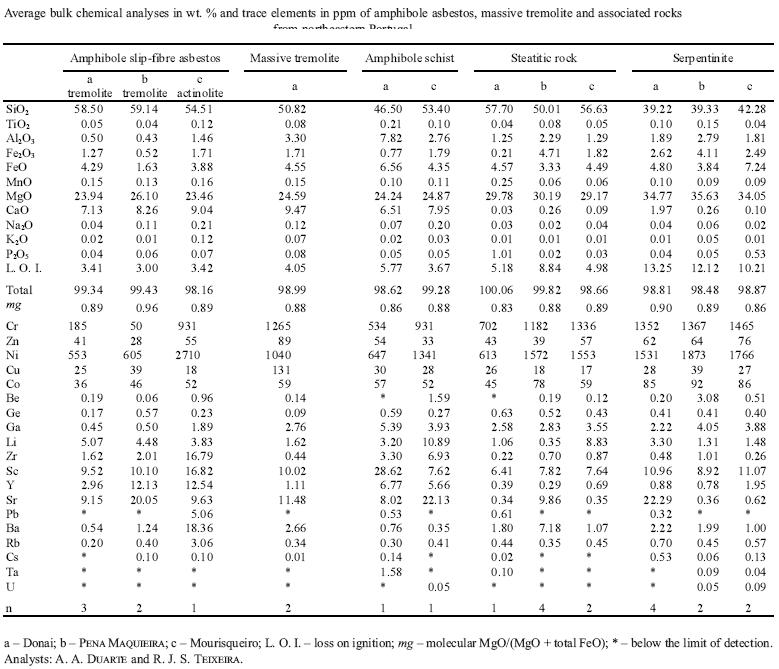
Bulk chemical analyses and contents of trace elements of amphibole asbestos, massive (non-fibrous) tremolite and associated amphibole schists, steatitic rocks and serpentinites are given in Table 1.
Average bulk chemical analyses in wt. % and trace elements in ppm of amphibole asbestos, massive tremolite and associated rocks from northeastern Portugal
Análises químicas (%) e elementos menores (ppm) de asbestos anfibólicos, massas de tremolite e rochas associadas do nordeste de Portugal
Among the amphibole samples, massive (non-fibrous) tremolite is the poorest in Si, Ge, Li, Zr, Y and the richest in Al, Fe2+, Ca, Cr, Zn, Cu, Co and Ga. Slip-fibre actinolite asbestos is the poorest in Mg and the richest in Na, K, Ni, Be, Zr, Sc, Y, Pb and Ba.
]]> Amphibole asbestos and massive (non-fibrous) tremolite have a chemical composition close to that of the amphibole schists (Figs. 6, 7a, b). However, they are richer in SiO2, CaO and poorer in FeO and Ga than the respective amphibole schist they are associated with (Table 1).The tremolite and actinolite asbestos samples are richer in SiO2, CaO, Y and poorer in Fe2O3, FeO, MgO, Cr and Co than the associated serpentinites (Table 1). At Mourisqueiro, actinolite asbestos is richer in CaO, K2O, Ni, Zr, Sc, Y, Pb, Ba, Rb, Cs and poorer in FeO, total FeO, MgO, Ga and Li than the associated amphibole schist and steatitic rock (Table 1).
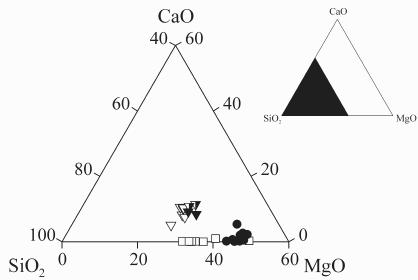
Fig. 6 – SiO2-CaO-MgO diagram of amphibole asbestos and associated rocks from northeastern Portugal. Symbols :  - amphibole asbestos from Donai, Pena Maquieira and Mourisqueiro;
  - massive (non-fibrous) tremolite;
  - amphibole schists from Donai and Mourisqueiro; ∇- steatitic rocks from Donai, Pena Maquieira and Mourisqueiro;
  - serpentinites from Donai, Pena Maquieira and Mourisqueiro.
– Diagrama SiO2-CaO-MgO de asbestos anfibólicos e rochas associadas do nordeste de Portugal. Símbolos: - asbestos anfibólicos de Donai, Pena Maquieira e Mourisqueiro; - tremolite em massa (não fibrosa); - xistos anfibólicos de Donai e Mourisqueiro; ∇ - rochas esteatíticas de Donai, Pena Maquieira e Mourisqueiro; - serpentinitos de Donai, Pena Maquieira e Mourisqueiro.
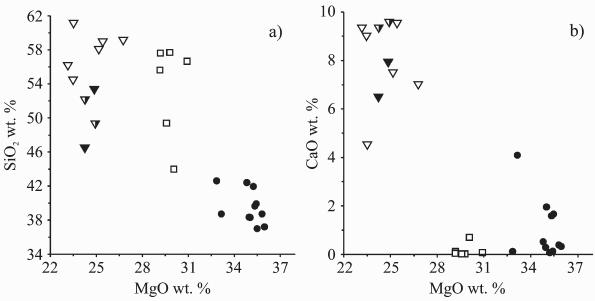
Fig. 7 – Plots a) SiO2 versus MgO diagram and b) CaO versus MgO diagram of amphibole asbestos and associated rocks from northeastern Portugal. Symbols: - amphibole asbestos from Donai, Pena Maquieira and Mourisqueiro; - massive (non-fibrous) tremolite; - amphibole schists from Donai and Mourisqueiro; ∇- steatitic rocks from Donai, Pena Maquieira and Mourisqueiro; - serpentinites from Donai, Pena Maquieira and Mourisqueiro.
– Diagramas a) SiO2 versus MgO e b) CaO versus MgO de asbestos anfibólicos e rochas associadas do nordeste de Portugal. Símbolos: - asbestos anfibólicos de Donai, Pena Maquieira e Mourisqueiro; - tremolite em massa (não fibrosa); - xistos anfibólicos de Donai e Mourisqueiro; ∇- rochas esteatíticas de Donai, Pena Maquieira e Mourisqueiro; - serpentinitos de Donai, Pena Maquieira e Mourisqueiro.
GEOCHEMISTRY OF AMPHIBOLES
Average electron-microprobe data for amphibole asbestos, non-asbestiform amphiboles in associated schists and massive (non-fibrous) tremolite are given in Table 2. Asbestos from Donai and Pena Maquieira are of tremolite composition, while those from Mourisqueiro are of actinolite composition (Fig. 8). The associated amphibole shists contain non-asbestiform amphiboles either with similar or different composition to that of respective asbestos. The schist at Donai contains magnesiohornblende and actinolite, while the schist at Mourisqueiro contains tremolite and actinolite (Fig. 8).
Average electron microprobe analyses of amphibole asbestos, massive tremolite and non-asbestiform amphiboles in amphiboles schists from northeastern Portugal
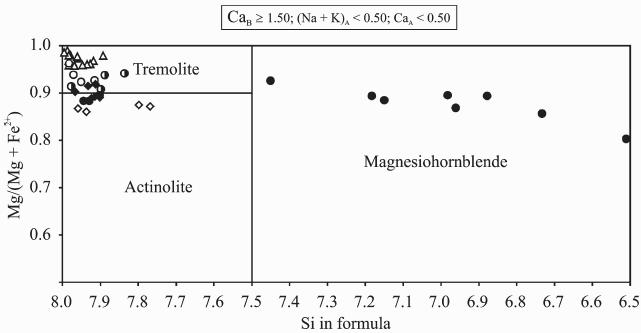
Fig. 8 – Compositions of the amphibole asbestos and non-asbestiform amphibole in amphibole schists from northeastern Portugal, plotted according to the IMA nomenclature (LEAKE et al. 1997). Symbols: - amphibole asbestos from Donai,
  - amphibole asbestos from Pena Maquieira,
  - amphibole asbestos from Mourisqueiro,
  - non-asbestiform amphibole in massive intercalations from Donai
  - non-asbestiform amphibole in amphibole schist from Donai,
  - non-asbestiform amphibole in amphibole schist from Mourisqueiro.
– Composições químicas de asbestos anfibólicos e de anfíbolas não asbestiformes de xistos anfibólicos do nordeste de Portugal, projectadas de acordo com a nomenclatura da IMA (Leake et al. 1997). Símbolos:  - asbesto anfibólico de Donai, - asbesto anfibólico de Pena Maquieira, - asbesto anfibólico de Mourisqueiro, - anfíbola não asbestiforme de massas intercaladas no serpentinito de Donai - anfíbola não asbestiforme do xisto anfibólico de Donai, - anfíbola não asbestiforme do xisto anfibólico de Mourisqueiro.
DISCUSSION
Despite the fact that asbestiform amphiboles comprise approximately 5% of industrially utilised asbestos (the rest being chrysotile), they have been disproportionately pathogenic, especially due to their morphology and mineralogy, which makes them more biopersistent and biochemically reactive than chrysotile (Gibbons, 1998). Thus, care must be taken to avoid them during the exploitation of rocks containing such minerals.
Based on optical and electron-microprobe examination, serpentinite from Donai appears to be almost free of detectable tremolite. However, all shear zones and faults in the serpentinite commonly contain tremolite asbestos. Amphibole schist and massive (non-fibrous) tremolite must also be avoided, because they contain some fibrous actinolite and are associated with tremolite asbestos.
The Pena Maquieira mine is now closed down and any future exploitation must take into account the occurrences of tremolite asbestos veins cutting serpentinites.
At Mourisqueiro, talc should only be exploited from the talc schist. Steatitic rock is highly deformed and mixed with actinolite asbestos, amphibole schists and chloritites, and thus should also not be mined for talc.
Asbestos may be identified visually, but optical and electron-microprobe examinations are recommended, because they may be fine-grained and disseminated. Although a particle size distribution investigation was not performed during this study, it would be of great interest in future investigations to report fibre size distributions for samples of airborne dust collected in the working areas of mines and mills, especially in the case of the highly deformed steatitic rock of Mourisqueiro, due to the presence of disseminated actinolite asbestos. At Donai quarry and mine of Pena Maquieira, the environmental impact on the air, soil, and also on the scarce surface water, can be significantly reduced if special care is taken during the extraction of serpentinite. In fact, the tremolite asbestos is preferentially located in veins that occur along shear zones and faults, and could be easily removed and stored.
Bulk chemical analyses of amphibole asbestos and associated rocks (Table 1) enable one to define some geochemical distinctions that may assist in exploitation. Whole-rock chemical analyses of serpentinites containing tremolite and actinolite asbestos must be richer in SiO2, CaO and poorer in MgO than serpentinites free of amphibole asbestos, which could contain up to ca. 4 % of CaO due to the presence of dolomite. Steatitic rock containing actinolite asbestos must be richer in CaO and poorer in MgO than the same rock free of amphibole asbestos. Therefore, the SiO2, CaO, and MgO contents of serpentinites and the CaO and MgO contents of steatitic rocks determined by atomic absorption spectrometry and gravimetry (or alternatively by X-ray fluorescence) may assist in finding amphibole-rich zones at a low cost and minimum of time. The data are best plotted on SiO2-MgO and CaO-MgO diagrams for serpentinites and a CaO-MgO diagram for steatitic rocks, in order to show the best distinction between amphibole asbestos, serpentinites, amphibole schists, and steatitic rocks (Fig. 7). These diagrams will show a good distinction between rocks free of asbestos and those that potentially could contain significant amounts of asbestos. However, examinations by petrographic microscope and electron-microprobe will help to confirm that this method works well.
CONCLUSIONS
]]> 1) Serpentinites from Donai contain very rare amphibole, but tremolite asbestos occurs in shear zones and faults cutting the serpentinites.2) At Pena Maquieira, the mine ore consists mainly of steatitic rock, but there are small outcrops of steatitic rock within serpentinites which are cut by faults filled with tremolite.
3) The Mourisqueiro talc mine is developed in a talc schist. However, a large mixed zone of highly deformed steatitic rock contains actinolite asbestos and amphibole schists.
4) Tremolite asbestos occurs mainly as slip-fibre and mass-fibre at Donai and slip-fibre at Pena Maquieira, while actinolite asbestos occurs as slip-fibre at Mourisqueiro.
5) Non-fibrous tremolite from Donai is the richest in Al, Fe2+, Ca, Cr, Zn, Cu, Co, Ga and the poorest in Si, Ge, Li, Zr and Y. Slip-fibre actinolite asbestos from Mourisqueiro is the richest in Na, K, Ni, Be, Zr, Sc, Y, Pb and Ba and the poorest in Mg.
6) The presence of significant Ca (> ca. 4 %) in whole rock serpentinite and steatite can indicate the presence of tremolite and/or actinolite impurities, because tremolite and actinolite asbestos are richer in CaO and poorer in MgO than the associated rocks. Chemical analyses combined with optical examinations may help to avoid mining material contaminated with fibrous amphiboles from these areas.
ACKNOWLEDGEMENTS
We are grateful to Prof. B. J. Wood for providing access to the EUGF-Bristol facility, contract ERBFMGECT 980128, electron-microprobe and ICP-MS facilities at the Department of Earth Sciences, University of Bristol, U. K. Thanks are also due to Prof. M. R. Machado Leite, Dr. J. M. Farinha Ramos and Mr. F. A. P. Santos for the use of electron-microprobe at Mining and Geological Institute, São Mamede de Infesta, Portugal. This research was carried out in the program of Geosciences Centre, University of Coimbra, Portugal.
]]> REFERENCES
(Addison, J. & McConnell, E. E. (2008) – A review of carcinogenicity studies of asbestos and non-asbestos tremolite and other amphiboles. Regul. Toxicol. Pharm., 52, pp. S187-S199.
Anderson, B. A., Dearwent, S. M., Durant, J. T., Dyken, J. J., Freed, J.A., Moore, S. M. & Wheeler, J. S. (2005) – Exposure pathway evaluations for sites that processed asbestos-contaminated vermiculite. Int. J. Hyg. Environ. Health, 208, pp. 55-65.
Bailey, E. H., Kemp, A. J. & Ragnarsdottir, K. V. (1993) – Determination of uranium and thorium in basalts and uranium in aqueous solution by Inductively Coupled Plasma Mass Spectrometry. J. Anal. Atomic Spectrom., 8, pp. 551-556.
Blake, D. J., Wetzel, S. A. & Pfau, J. C. (2008) – Autoantibodies from mice exposed to Libby amphibole asbestos bind SSA/Ro52-enriched apoptotic blebs of murine macrophages. Toxicology, 246, pp. 172-179.
Browne, K & Wagner, J. C. (2001) – Environmental exposure to amphibole-asbestos and mesothelioma. Can. Mineral. Spec. Publ., 5, pp. 21-28.
Camus, M. (2001) – Exposure to commercial chrysotile – Mineralogy, modern products and exposures: Rapporteur’s report. Can. Mineral. Spec. Publ., 5, pp.127-129.
Churg, A. (1993) – Asbestos lung burden and disease patterns in man. In: Guthrie Jr., G. D. & Mossman, B. T. (editors). Health effects of mineral dusts. Min. Soc. Am. Rev. Mineral., 28, pp. 410-426.
Cudgell, D. W. & Kamp, D. W. (2004) – Asbestos and Pleura. Chest, 125, pp. 1103-1117.
Gamble, J. F. & Gibbs, G. W. (2008) – An evaluation of the risks of lung cancer and mesothelioma from exposure to amphibole cleavage fragments. Regul. Toxicol. Pharm., 52, pp. S154-S186.
]]> Gianfagna, A., Ballirano, P., Bellatreccia, F., Bruni, B., Paoletti, L. & Oberti, R. (2003) – Characterization of amphibole fibres linked to mesothelioma in the area of Biancavilla, Eastern Sicily, Italy. Min. Mag., 67, pp. 1221-1229.Gibbons, W. (1998) – The exploitation and environmental legacy of amphibole asbestos : A Late 20th Century Overview. Environ. Geochem. Health, 20, pp. 213-230.
Klein, C. (1993) – Rocks, minerals, and a dusty world. In: Guthrie Jr., G. D. & Mossman, B. T. (editors). Health effects of mineral dusts. Min. Soc. Am. Rev. Mineral., 28, pp. 7-59.
Langer, A. M. (2001) – Health experience of some U. S. and Canadian workers exposed to asbestos: foundation for risk assessment. Can. Mineral. Spec. Publ., 5, pp. 9-20.
Leake, B. E., Woolley, A. R., Arps, C. E. S., Birch, W. D., Gilbert, M. C., Grice, J. D.; Hawthorne, F. C., Kato, A., Kisch, H. J., Krivovichev, V. G., Linthout, K., Laaird, J., Mandarino, J. M. A., Maresch, W. V., Nickel, E. H., Rock, N. M. S., Schumacher, J. C., Smith, D. C., Stephenson, N. C. N., Ungaretti, L., Whittaker, E. J. W. & Youzhi, G. (1997) – Nomenclature of amphiboles: report of the subcommittee on amphiboles of the International Mineralogical Association Commission on new minerals and mineral names. Min. Mag., 61, pp. 295-321.
Lewis, A. J., Palmer, M. R., Sturchio, N. C. & Kemp, A. J. (1997) – The rare earth element geochemistry of acid-sulphate and acid-sulphate-chloride geothermal systems from Yellowstone National Park, Wyoming, USA. Geochim. Cosmochim. Acta, 61, pp. 695-706.
Luus, K. (2007) – Asbestos: mining exposure, health effects and policy implications. McGill J. Med., 10, pp. 121-126.
Marques, F. O., Ribeiro, A. & Munhá, J. M. (1996) – Geodynamic evolution of the continental allochthonous terranes (CAT) of the Bragança Nappe Complex NE Portugal. Tectonics, 15, pp. 747-762.
McDonald, A. D., Frey, J. S., Wooley, A. J. & McDonald, J. C. (1983) – Dust exposure and mortality in an American factory using chrysotile, amosite and crocidolite in mainly textile manufacture. Br. J. Indust. Med., 40, p. 368.
Munhá, J. M. & Ribeiro, M. L. (1984) – Blueschists in the Iberian Variscan chain (Trás-os-Montes, NE Portugal). Com. Serv. Geol. Portugal, 70: 31-53. [ Links ]
Neiva, J. M. C. (1948) – Rochas e minérios da região Bragança – Vinhais. Serviço de Fomento Mineiro, 14, pp. 1-251.
Nolan, R. P., Langer, A. M., Ross, M., Addison, J. & Gee, J. B. L. (2007) – Non-occupational exposure to commercial amphibole asbestos and asbestos-related disease: is there a role for grunerite asbestos (amosite)? P. Geologist Assoc., 118, pp. 117-127.
Pfau, J. C., Sentissi, J. J., Li, S., Calderon-Garcidue, L., Brown, J. M. & Blake, D. J. (2008) – Asbestos-Induced Autoimmunity in C57Bl/6 Mice. J. Immunotoxicol., 5, pp. 129-137.
Quesada, C. (1992) – Evolución tectónica del Macizo Ibérico (Una historia de crecimiento por acrecencia sucesiva de terrenos durante el Proterozoico superior y el Paleozoico). In: Gutiérrez Marco, J. C., Saavedra, J. & Rábano, I. (editors). Paleozoico Inferior de Ibero-América. Universidad de Extremadura, Spain, pp. 173-190.
Ribeiro, A. (1974) – Contribution à l´étude tectonique de Trás-os-Montes Oriental. Mem. Serv. Geol. Portugal, 24 (Nova Série). [ Links ]
Ribeiro, A., Pereira, E. & Dias, R. (1990) – Allochtonous sequences: Structure in the Northwest of the Iberian Peninsula. In: Dallmeyer, D., Martinez Garcia, E. (editors). Pre-Mesozoic Geology of Iberia. Springer-Verlag, Berlin Heidelberg, pp. 220-246.
Ross, M. & Nolan, R. P. (2003) – History of asbestos discovery and use and asbestos-related disease in context with occurrence of asbestos within ophiolite complexes. Geol. Soc. Am. Spec. Pap., 373, pp. 447-470.
Ross, M. & Virta, R. L. (2001) – Occurrence, production and uses of asbestos. Can. Mineral. Spec. Publ., 5, pp. 79-88.
Santos, J. F. H. P. (1998) – Geoquímica de litologias básicas e ultrabásicas da Unidade Alóctone Superior do Maciço de Bragança. Unpublished Ph.D. thesis, University of Aveiro, Portugal.
Schumacher, J. C. (1997) – Appendix 2 – The estimation of the proportion of ferric iron in the electron-microprobe analysis of amphiboles. In: Leake, B. E., Woolley, A. R., Arps, C. E. S., Birch, W. D., Gilbert, M. C., Grice, J. D., Hawthorne, F. C., Kato, A., Kisch, H. J., Krivovichev, V. G., Linthout, K., Laaird, J., Mandarino, J. M. A., Maresch, W. V., Nickel, E. H., Rock, N. M. S., Schumacher, J. C., Smith, D. C., Stephenson, N. C. N., Ungaretti, L., Whittaker, E. J. W. & Youzhi, G. G. Nomenclature of amphiboles: report of the subcommittee on amphiboles of the International Mineralogical Association Commission on new minerals and mineral names. Min. Mag., 61, pp. 312-321.
]]> Skinner, H. C. W., Ross, M. & Frondel, C. (1988) – Asbestos and other fibrous materials: mineralogy, crystal chemistry, and health effects. Oxford University Press, New York, United States of America.Teixeira, R. J. S. (2000) – Serpentina, asbesto e talco: Impacte ambiental das suas explorações no Nordeste de Portugal. Unpublished M.Sc. thesis, University of Coimbra, Portugal.
Van Gosen, B. S., Lowers, H. A., Sutley, S. J. & Gent, C. A. (2004) – Using the geologic setting of talc deposits as an indicator of amphibole asbestos content. Environ. Geol., 45, pp. 920-939.
Vilela de Matos, A. & Alves, P. H. (1988) – Valorização das jazidas de talco - COMITAL: 1º relatório anual de progresso - Acções preparatórias do Programa Integrado de Desenvolvimento Regional de Trás-os-Montes. Unpublished report, University of Trás-os-Montes e Alto Douro, Vila Real, Portugal.
Wicks, F. J. (1998) – Report on an international workshop on the health effects of chrysotile asbestos: contribution of science to risk management. Newsl. Mineral. Assoc. Can., 58, pp. 6-7.
Williams-Jones, A. E., Normand C., Clark, J. R., Vali, H., Martin, R. F., Dufresne, A. & Nayebzadeh, A. (2001) – Controls of amphibole formation in chrysotile deposits: evidence from the Jeffrey mine, Asbestos, Quebec. Can. Mineral. Spec. Publ., 5, pp. 89-104.
]]>