N. Moreira*1; G. Machado**2; P. E. Fonseca***,****; J. C. Silva***,****; R. C. G. S. Jorge***,***** & J. Mata***,****
* Centro de Ciência Viva de Estremoz e LIRIO (Laboratório de Investigação de Rochas Industriais e Ornamentais da Escola de Ciências e
Tecnologia da Universidade de Évora); nmoreira@estremoz.cienciaviva.pt.
** GeoBioTec, Departamento de Geociências, Universidade de Aveiro, 3810-193 Aveiro, Portugal. machadogil@gmail.com.
*** Faculdade de Ciências da Universidade de Lisboa, Departamento de Geologia (GeoFCUL), Edifício C6, Campo Grande, 1749-016 Lisboa,
Portugal, pefonseca@fc.ul.pt; joao.ec.silva@gmail.com; rjorge@fc.ul.pt; jmata@fc.ul.pt
**** Centro de Geologia da Universidade de Lisboa (CeGUL).
***** Centro de Recursos Minerais, Mineralogia e Cristalografia, Universidade de Lisboa e Laboratório Associado / Institute for Systems Research – (Creminer LA/ISR).
]]> 1 Corresponding author2 Current address: Galp Energia, R. Tomás da Fonseca, Torre A, 1600-209 Lisboa, Portugal.
Abstract
We present a preliminary characterization of the structure, stratigraphy and petrography of a sequence including the Odivelas Limestone near Covas Ruivas locality (Ossa-Morena Zone, Évora-Beja Domain). In this area, limestone and tuffites occur spatially associated with mafic meta-volcanic rocks presenting mineral parageneses typical of low grade metamorphism (greenschists facies) and with the occasional occurrence of silica iron exhalites (jaspers). Previous work dated the limestones at this locality as latest Emsian – early mid Eifelian. As indicated by folded and brittle structures, this Devonian sequence was affected by two Variscan deformation phases, which where individualized, related with regional orogenic D2 and D3 phases. The structural data indicate that the Odivelas Limestone stratigraphically overlays the metavolcanic rocks, although de contact between them was tectonically affected by a thrusting and/or shearing. Considering age assigned to the Odivelas Limestone and the fact that the effects of the regional D1 are not visible in the studied area one can consider that, in this region, D1 is pre-latest Emsian, i.e., Lower Devonian or older.
Keywords: Odivelas Limestone, Ossa-Morena Zone, Deformation phases, Variscan Orogeny.
A sequência vulcano-sedimentar paleozóica de Odivelas: implicações para a geologia do limite Sudoeste da Zona de Ossa-Morena
Resumo
Neste artigo apresentamos uma caracterização preliminar da estrutura, estratigrafia, e petrografia da sequência que engloba os Calcários de Odivelas, perto da localidade de Covas Ruivas (Zona de Ossa-Morena, domínio Évora-Beja). Nesta área calcários e tufitos (Calcários de Odivelas) afloram associados a rochas metavulcânicas máficas, evidenciando um metamorfismo de baixo grau (fácies dos xistos verdes) e a ocorrências pontuais de jaspes. Trabalhos anteriores atribuíram estes calcários ao intervalo Emsiano terminal a Eifeliano médio baixo. A sequência Devónica estudada foi afectada por duas fases de deformação Variscas, correlacionáveis com as fases D2 e D3 reconhecidas a nível regional. Os dados estruturais indicam que os Calcários de Odivelas estão estratigraficamente suprajacentes às rochas metavulcânicas, embora o contacto esteja afectado tectonicamente por um cavalgamento e/ou desligamento. Considerando a idade atribuída aos Calcários de Odivelas e o facto de os efeitos da D1 regional não se fazerem aqui notar, consideremos que nesta zona a D1 é pré-Emsiano terminal, i.e., Devónico inferior ou anterior.
]]> Palavras-chave: Calcários de Odivelas, Zona de Ossa-Morena, Fases de deformação, Orogenia Varisca.
1. INTRODUCTION AND GEOLOGICAL SETTING
1.1. SW Iberian in European Variscan Belt
The Iberian Variscan belt (Fig. 1A) has been, for many years, the subject of numerous structural, metamorphic, magmatic and stratigraphic studies, aiming to understand its geodynamic evolution (Lötze, 1945; Silva et al., 1970; Julivert, 1971; Ribeiro et al., 1979; 1990; 2007; 2009; 2010; Andrade, 1983; Oliveira et al., 1991; Fonseca, 1989; 1995; Fonseca & Ribeiro, 1993; Araújo, 1995; Fonseca et al., 1999; Rosas, 2003; Rosas et al., 2008).
The Ossa-Morena Zone (OMZ) is a major geotectonic domain located in the southern border of the Iberian Massif (IM) which represents the largest and one of the most complete and continuous exposures of the Variscan Belt in Western Europe (Fig. 1A; Lötze, 1945; Julivert, 1971; Ribeiro et al., 1990). The southern branch of the Iberian Variscan Belt comprises highly deformed exotic terranes of oceanic nature; these include the “Pulo do Lobo” Accretionary Terrane (PLAT), the Beja-Acebuches Ophiolite Complex (BAOC) (Fig. 1C; e.g., Munhá et al., 1986; Fonseca & Ribeiro, 1993; Quesada et al., 1994; Fonseca et al., 1999) and the Internal Ossa-Morena Zone Ophiolitic Sequences (IOMZOS; Fonseca et al., 1999; Araújo et al., 2005; Pedro et al., 2006; Ribeiro et al., 2007, 2009; Pin et al., 2008; Pedro et al., in press).
The BAOC (ca. 30 km to the South of the studied area) has been regarded as an exotic oceanic terrain accreted to the Iberian Autochthon (OMZ), before the middle Devonian (Eifelian) (Fonseca & Ribeiro, 1993; Fonseca et al., 1999). It underlines the OMZ / South Portuguese Zone (SPZ) boundary (Fig. 1), being tectonically bordered in the South by the ductile/brittle Ferreira-Ficalho thrust.
It has been proposed (CrespoBlanc & Orozco, 1988; Quesada et al., 1994; Fonseca, 1995, 1997; Fonseca et al., 1999; Almeida et al., 2001; Ribeiro et al., 2007; 2009; 2010) that a major ocean (Rheic) was closed by subduction/obduction leaving some remanent ophiolitic slices (e.g., the Lizard suture in SW England and the Beja Acebuches suture zone). Data acquired during the last decade clearly show that dismembered ophiolitic slices also crop out in the OMZ (the IOMZOS) which correspond to allochthonous klippen on top of lower Palaeozoic sequences (Fig. 1; e.g., Pedro, 2004; Araújo et al., 2005; 2006; Pedro et al., 2006; in press).
1.2. Synthesis of the OMZ Tectonostratigraphy
]]> According to Oliveira et al. (1991), the OMZ can be divided into five sectors, with distinct metamorphic and structural characteristics.Araújo (1995) adopted the proposal of Oliveira et al.(1991) also taking into account the subdivision proposed by Apalategui et al. (1990) and defined the Évora-Beja domain, which includes the Montemor-Ficalho sector and BIC defined by Oliveira et al. (1991).
The Évora-Beja domain is limited to the North by the Santo Aleixo Thrust (Fig. 1C; Araújo, 1995) and to the South by a thrust that connects the OMZ with the Beja-Acebuches Ofiolitic Complex (BAOC) (Fig. 1A; Fonseca, 1989; Fonseca et al., 1999). This domain is characterized by the abundance of acid, intermediated and basic intrusive rocks, whose genesis is related to the Rheic Ocean subduction below the OMZ (Pedro, 2004; Pedro et al., 2006; Ribeiro et al., 2007). Araújo (1995) considers that these intrusions span in time from the Middle Devonian to the Carboniferous and are only affected by the pulses of the last episode of Variscan deformation. The volcano-sedimentary formations have a large spectrum of ages, from Upper Proterozoic to Upper Palaeozoic. Fonseca & Ribeiro (1992) and Araújo (1995) identified three phases of Variscan tectonic deformation in this domain. This tectonic complexity and the rarity of geochronological data, make the stratigraphic correlation with the other sectors of the OMZ difficult.
Fig. 1 – A – Iberian Peninsula main geotectonic divisions (adapted from RIBEIRO et al., 1979; 1990; SAN JOSÉ et al., 2004): MCS – Meso-Cenozoic rocks; OMZ – Ossa-Morena Zone, SPZ – South Portuguese Zone, CIZ – Central Iberian Zone, WALZ – West Asturian-Leonese Zone, CZ – Cantabrian Zone, GTOMZ – Galicia-Trás-os-Montes Zone, 1 – Pedroches Batholith axis, 2 – Beja-Acebuches Ophiolite; B – Simplified geological map of Ossa-Morena Zone / South Portuguese Zone northernmost contact, with location of study área (adapted from OLIVEIRA et al., 2006); C – Geological profile on OMZ, SW Portugal: SPZ – South Portuguese Zone; CIZ – Centro Iberian Zone; BCSZ – Badajoz-Córdoba Shear Zone (RIBEIRO et al., 2007).
– A – Principais divisões geotectónicas da Península Ibérica (adaptado de Ribeiro et al, 1979; 1990; San José et al, 2004): MCS – Sequências Meso-Cenozóica, OMZ – Zona de Ossa-Morena, SPZ – Zona Sul Portuguesa, CIZ – Zona Centro-Ibérica, WALZ – Zona Oeste Astúrico-Leonesa, CZ – Zona Cantábrica, GTOMZ – Zona de Galiza Trás-os-Montes, 1 – Eixo do Batólito de Pedroches, 2 – Ofiolíto de Beja-Acebuches, B – Mapa geológico simplificado do limite entre a Zona Sul Portuguesa e a Zona de Ossa-Morena, com localização da área em estudo (adaptado de Oliveira et al, 2006); C – Corte geológico transversal à OMZ, SW Portugal: SPZ – Zona Sul Portuguesa, CIZ – Zona Centro-Ibérica, BCSZ – Zona de Cisalhamento Badajoz-Córdova (Ribeiro et al, 2007).
Other important sub domain related with the studied area is the Santa Susana-Odivelas subsector and the Beja Igneous Complex (BIC) (Oliveira et al., 1991). The BIC (Fig. 1B) is a plutonic association of variable compositions, from basic (Beja Gabbro-Dioritic complex, Silva et al., 1970) to acid rocks (Baleizão-Alcáçovas porphyry, Carvalho et al., 1971), also including volcano-sedimentary complexes (Odivelas basic Complex, Toca da Moura Complex, Santos et al., 1987). The northern boundary with the Montemor-Ficalho Sector is not tectonic, while the southern contact coincides with the BAOC and the Ferreira – Ficalho Thrust (Oliveira et al., 1991).
Recently, Jesus et al. (2007) and Pin et al. (2008) dated the plutonic bodies of the BIC. Jesus et al. (2007) dated the Layered Gabbroic sequence as lower-middle Mississippian (ca. 355 Ma to ca. 345 Ma) formed in the early stages of collision magmatism and the Baleizão Porphyry Complex as Pennsylvanian (ca. 300 Ma) and was considered to correspond to post-collision magmatism. Pin et al. (2008) obtained U-Pb zircon ages around 350 Ma interpreting them as reflecting the BIC intrusion in a late-collisonal transcurrent setting.
The volcano-sedimentary complexes have distinct tectono-stratigraphic characteristics, and occur separated in Santa Susana Odivelas sub-sector. Within this subsector, volcanic and plutonic complexes are present in the geo-transverse between Odivelas and Alvito. These include Odivelas Complex, Faro-Alvito Complex and Peroguarda Complex (Fig. 2). Considering its occurrence in the studied area, only the main Peroguarda Complex, will be described. Andrade et al. (1976) studied the Peroguarda Complex and sub-divided it in Casa Branca dolerites, Rebolado basalts and Mota Preta tuffs.
]]>Fig. 2 – Geological map of the main igneous units surrounding the studied area: DI – Monte Olival Dolerite, DII – Monforte Diorite, DIII – Monte Novo Diorite, DIV – Malcabrão Gabbros, DV – Assentes Quartzo-diorite, DVI – Alvito Quartzo-diorite, PI – Monte Ruivo Porphyry, PII – Castelo Ventoso Porphyry; BI – Casa Branca Dolerite, BII – Rebolado Basalts, BIII – Mota Preta Tufts; GI – Herdade Grande Gabbros, GII – Balona Gabbros, GIII – Gravitosa Gabbros; CCR – Odivelas Limestone. The white color represents Cenozoic cover (adapted from ANDRADE et al., 1976; SANTOS et al., 1990).
– Mapa geológico das principais unidades ígneas nas imediações a área em estudo: DI – Doleríto de Monte Olival, DII – Dioríto de Monforte, DIII – Dioríto de Monte Novo, DIV – Gabros de Malcabrão, DV –Quartzo-diorito de Assentes, DVI – Quartzo-diorito de Alvito, PI –Pórfiros de Monte Ruivo, PII – Pórfiros Castelo Ventoso; BI –Doleríto de Casa Branca, BII – Basaltos do Rebolado, BIII – Tufos de Mota Preta; GI – Gabros da Herdade Grande, GII – Gabros de Balona, GIII – Gabros da Gravitosa; CCR – Calcários de Odivelas. A cor branca representa a cobertura Cenozóica (adaptado de Andrade et al., 1976; Santos et al., 1990).
The Rebolado basalts are apparently placed at foot and hanging wall of the Odivelas Limestone. They are formed by massive spilitised lava flows (gradding to the Casa Branca dolerites) and by pyroclastic facies. Santos et al. (1990) referred to the Rebolado basalts as the unit OD-6 (Fig. 2). The geochemical studies performed by these authors allowed the confirmation of its orogenic character, as indicated by its calc-alkaline/tholeitic chemical signatures.
The Odivelas Limestone is a Devonian unit that occurs in scattered within and around the Beja Igneous Complex, Ossa-Morena Zone (BIC – OMZ) (Andrade, 1983). Its precise age has been a subject of debate for decades. The first stratigraphic study indicated an age of mid and/or late Devonian based on fauna rich in crinoids, corals, brachiopods and bryozoans, occurring at the Cortes locality (Fig. 2; Conde & Andrade, 1974; Andrade et al., 1976). However recent findings indicate that the age of these limestones is latest Eifelian-earliest Givetian at the Cortes locality (Fig. 2; Machado et al., 2009) and latest Emsian – early mid Eifelian at the Covas Ruivas locality (Fig. 2; Machado et al., 2010).
The occurrence of limestones, easily datable using precise stratigraphic criteria (e.g., conodonts, crinoids), associated with volcanic and sub-volcanic rocks offers an unique opportunity for the chronological characterization of the extrusive part of the BIC and for the dating of the various regional tectonic events.
Aiming a contribution for the understanding of the Late Palaeozoic evolution of the Southern border of the Ossa-Morena Zone, we present preliminary data on the structural geology, stratigraphy and petrography of the Covas Ruivas Devonian sequence, in the Northeastern bank of the Odivelas reservoir (Fig. 2), Beja district.
2. RESULTS
]]> 2.1. Stratigraphy and PetrographyA Palaeozoic volcano-sedimentary sequence that crops out in the Odivelas reservoir area shows distinct and unusual characteristics when compared with other OMZ sectors. In this chapter, we will describe the mineralogical, textural and stratigraphic characteristics of relevant outcropping rocks in the studied area.
2.1.1. Limestones and tuffites sequence (LTS)
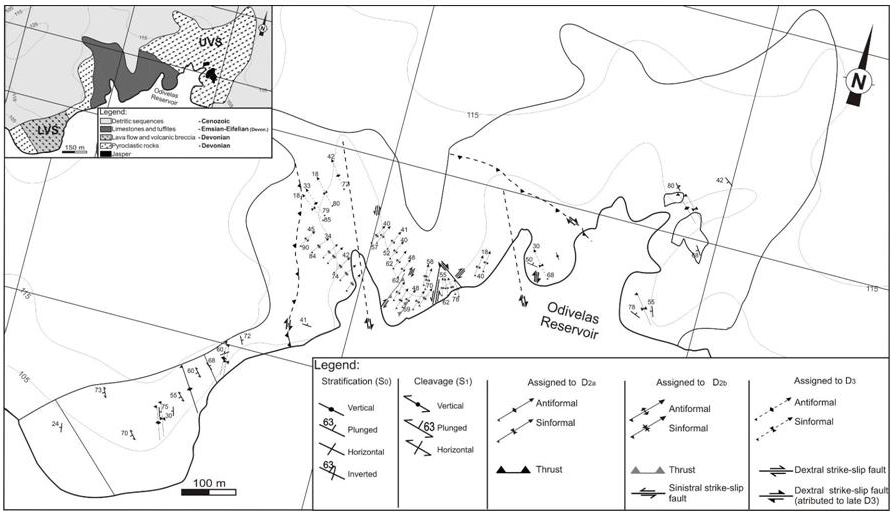
The Covas Ruivas locality shows a long sequence of volcanic (see chapter 2.1.2.) and sedimentary rocks that crop out along the banks of the Odivelas reservoir (Fig. 3). In spite of minor faults and local lack of exposure, biostratigraphical data (Machado et al., 2010) suggest that there are no major gaps or repetitions, indicating a fairly continuous sequence from the basal part (to the West) to the top (to the East). The total thickness of the LTS is estimated to be around 200m.
The volcanic lavic and pyroclastic rocks exposed to the West grade upwards into tuffs and tuffites. The basal part of the LTS is dominated by thin-bedded, quartz-rich tuffites with subordinate limestone beds. In the basal 9 m the limestone beds are made up by cm- to dm-thick crinoidal grainstones with few basinal elements (peloids, pelagic microfossils). From ca. 9 m up to 47 m the limestone beds (mainly calcimudstones) become rarer and laterally discontinuous. This is accompanied by an increase of the amount of organic matter and proportion of basinal elements. Accordingly the interbedded tuffites become darker and richer in siliceous detritus and pelagic fossils, locally forming radiolarite lenses. Above 47 m limestone beds become suddenly dominant over the tuffites (which become more calcite-rich) and are markedly coarser (wacke- to grainrudstones). The thickness of limestone beds increases (dm- to m-thick) and the proportion of reef-derived bioclasts becomes dominant, although basinal elements remain important components (10% to 40% of total allochems) (Machado et al., 2010). This relatively long interval of basinal deposition followed by a sudden increase of calciclastic material in this time interval (earliest Eifelian) represent characteristic lithological features of the pre-basal Chotec event beds (see Machado et al., 2010 for details). In the interval from 47 m up to 57 m there are significant fluctuations on the thickness and lateral continuity of limestone beds and the interbedded tuffites. Above this interval and up to 80 m (top of the first part of the section) limestone beds have fairly constant thicknesses and lateral continuity and are generally dominant over the tuffites, which are calcite-rich although quartz remains an important component (Machado et al., 2010). The two other parts of the LTS are separated from the first part by an observational gap and a faulted zone respectively. The second and third parts of the sequence show a relatively monotonous sequence of dm-thick crinoidal grainstone beds interbedded with mm- to cm-thick laminated tuffite beds (Machado et al., 2010). The top of the third part of the sequence is already late middle Eifelian in age (see Machado et al., 2010 for details on conodont biostratigraphy and sequence interpretation).
2.1.2. Volcanic Sequences (VS)
In the described section, magmatic rocks are present in positions both geometrically below (Lower Volcanics – LVS) and above (Upper Volcanics – UVS) the Devonian sediments (Fig. 3).
]]> Fig. 3 – Simplified lithological and structural map of the studied area (see also MOREIRA et al., 2010).
– Mapa litológica e estrutural simplificado da área em estudo (consultar também Moreira et al. 2010).
The LVS can be subdivided in 3 major units taking into account the type of dominant volcanic material. They are: 1) pyroclastic heterometric lithified deposits where lithoclastic blocks can reach some 15 cm in diameter (see Plate 1F); 2) lava flows; 3) volcanic breccia (Fig. 3). This volcanic pile outcrops along some 300 m in the dam bank.
Micropetrographic observation of the lavic rocks reveals that, despite metamorphic blastesis, deformation was not significantly penetrative to obliterate the main textural aspects of the volcanic protoliths. The porphyritic character of most of the lavas is easily recognized, with phenocrysts set in fine grained (aphanitic) groundmasses, producing typical relict textures of the blasto-porphyritic type (see Plate 1H). Groundmasses frequently present fluidal arrangement of feldspar crystals reflecting flow of magma.
Groundmasses are dominated by plagioclase and alkali feldspar, while the phenocryst generation is mainly composed by plagioclase. Where the blastesis was less important, zoned clinopyroxene relict phenocrysts are sometimes preserved. Opaque minerals are partially transformed in titanite.
The preserved and/or inferred magmatic mineralogy suggest that the majority of the metavolcanic rocks are of basic to intermediate composition.
Small amygdales filled by pistacitic epidote, chlorite and carbonate are volumetrically important in some levels of the magmatic sequence. Judging by textural criteria, inside the amygdales epidote crystallization preceded the formation of chlorite.
The presence of actinolite, chlorite and epidote indicates that volcanic rocks were metamorphosed in conditions typical of the greenschist facies. It should be mentioned that the abundance of the Ca-amphibole is more important towards the top of the sequence.
The UVS are mainly pyroclastic (Fig. 3) and dominated by lappilli tuffs, which probably correspond to more distal volcanic facies than those preserved on the LVS. Interbedded in these tuffs some lava flows occur, petrographically identical to those described for the LVS, and some lenses of silica-iron exhalites (see Plate 1 D, E).
]]>2.1.3. Silica iron exhalites
The Odivelas silica iron exhalites (jaspers) are made up of microcrystalline quartz and hematite with notable absence of detritic minerals. The proportions of quartz and hematite are variable (90-95 vol% and 5-10 vol%), respectively. The degree of recrystallization of jaspers varies to a great extent. Commonly, less recrystallized samples exhibit domains with well preserved primary textures. Of these, the most prominent are spherulitic structures (see Plate 1 E) and brecciation features.
When well-preserved, spherulites (0.03 – 0.5 mm) consist of a central core of anhedral grains of hematite sometimes intergrown with microcrystalline quartz. The core is involved by one or more concentric layers of microcrystalline quartz or chalcedony. Groups of spherulites are frequently coalesced, sometimes assuming a wavy form, reminiscent of plastic movements of soft, unconsolidated sediments.
Syn-sedimentary brecciation features are common throughout the whole jasper-bearing area. They are characterized by the presence of millimetric to centimetric fragments surrounded by a complex network of microcrystalline quartz. The morphology of fragments ranges from very sharp-edged to angular or subrounded shapes, frequently exhibiting mutually-fitting broken walls. The fragments are made up either by microcrystalline quartz (± hematite – type I) or by hematite (± microcrystalline quartz – type II). In type I fragments the presence of spherulites is common. Type II fragments often exhibit sets of polygonal cracks filled by microcrystalline quartz indicative of early-stage diagenesis dehydration-contraction phenomena. The relative abundance of the type II fragments suggests a post-diagenetic disruption of pristine banded structures.
Collectively, these features indicate that these Si-Fe rich sediments formed from the crystallization of silica iron oxyhydroxide gel, compatible with the low-temperature hydrothermal activity contemporaneous with their deposition.
2.2. Structure and Tectonics
2.2.1. Folded Structures
The studied area has a significant diversity of folded structures (Fig. 3; Plate 1 B, C). Three different families are recognized with respect to the folded structures’ geometry (Fig. 4).
]]>Fig. 4 – Geometric and kinematic synthesis of folded families in the studied area.
– Síntese da geometria e cinemática das famílias de dobras presentes na área em estudo
Turner & Weiss (1963) classification was used to describe the fold geometry, for the relation of hinge line and axial plane attitudes, and Fleuty (1964) classification, for the interlimb angle (Ramsay & Huber, 1983).
2.2.1.1. Family 1
From the geometrical point of view, this family is composed by two macro scale folds. The structure that crops out to the NW is not fully mapped, because the Cenozoic deposits cover part of the structure. These folds are located in edges of the studied area. They affect mainly the volcanic rocks.
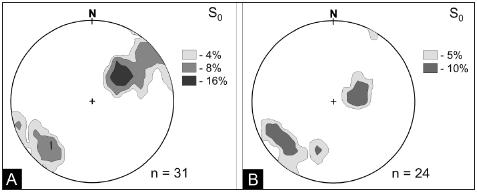
They are cylindrical asymmetric with the long limb (SW limb) tilting ca. 30º to SW and the short limb (NE limb) has slopes 70º to NE. The axial plane has a NW-SE direction, plunged about 72º to SW. This fold family has a hinge line slightly inclined (about 15º) to SE. These are open folds, with an interlimb angle of around 80º. It is possible to classify these folds as inclined slightly plunging, using the relation between the hinge line and the axial plane. These are folds with normal polarity forming essentially antiforms-anticlines. The polarity is determined based essentially on the presence of graded bedding on pyroclastic beds.
These “macro-folds” generated parasitic folds. The parasitic folds observed within the long limb are also cylindrical asymmetric, with long limb tilting 40º to SW and the short limb tilting 75° in the opposite direction (Fig. 5). The parasitic folds are closed, with an inter-limb angle of around 65º. They have an axial plane with a direction of around N130º, plunging about 70° to SW. The parasitic folds located on the short limbs are closed (interlimb angle 65°), with hinge lines plunging 50° to N; the axial plane direction is approximately N-S, with slopes around 80º to W. They are asymmetric, with long limb plunging 70º to the NE and the short limb 60º to the opposite direction.
]]>
Fig. 5 – Family 1 folds: Schmidt diagram (lower hemisphere) with diagram point density: A – S0 on Upper Volcanic Sequence (31 measurements); B – S0 on Lower Volcanic Sequence (24 measurements).
– Primeira família de dobras: Diagrama de Schmidt (hemisfério inferior) com diagrama de densidade de pontos: A – S0 na sequencia vulcânica superior (31 medições); B – S0 na sequencia vulcânica inferior (24 medições).
An axial plane cleavage (S1) with a pervasive attitude N140º, 70°SW is observed in these folds (Fig. 6).
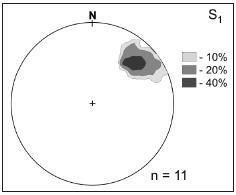
Fig. 6 – Family 1 folds: Schmidt diagram (lower hemisphere), with diagram point density that shows the poles of axial plane cleavage (S1) on volcanic rocks, with greater frequency around N140º, 70ºSW.
]]> – Segunda família de dobras: Diagrama de Schmidt (hemisfério inferior) com diagrama de densidade de pontos mostrando os dados relativos aos pólos da clivagem de plano axial (S1) nas sequências vulcânicas, com maior frequência em torno de N140º, 70ºSW.
Cinematically the macrofolds have a very clear vergency to the NE quadrant, with evidence both in folding and the associated axial plane cleavage (S1). The vergency of the parasitic folds could be differentiated: in the long limb the vergency is to NE as the macrofold, in the short limb the vergency is to E.
If we assume that the tensional forces required to form these folds are perpendicular to axial planes, then the direction of maximum compression (s1) would be, if the deformation was coaxial, approximately SW-NE.
2.2.1.2. Family 2
This family includes most of folded structures present in the studied area. These structures generate sequences of folds with alternating antiformal and sinformal sequences, which are also anticlines and synclines respectively, considering they all have normal polarity.
Geometrically, the folds of family 2 have the axis plunging to NE. Folds are open (interlimb angle of around 80º), with hinge lines dipping 40° to NE (Fig. 7A); they are cylindrical asymmetric, with the long limb plunging 50° to NE and short limb 71º to N-NW. They have an average axial plane attitude N22º, 70º SE (Fig. 7B). These folds are classified based on the relationship between the hinge line and axial plane attitudes to inclined plunging. In some antiformal structures, it is possible to observe deformation accommodation by reverse faulting.
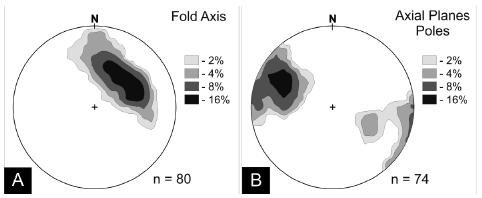
Fig. 7 – Family 2 folds: Schmidt diagram (lower hemisphere) with diagram point density: A – hinge lines, with greater frequency around 49º, N41º (80 measurements); B – axial plane poles, with greater frequency around 20º, N292º (74 measurements).
]]> – Segunda família de dobras: Diagrama de Schmidt (hemisfério inferior) com diagrama de densidade: A – eixos das dobras com maior frequência em torno de 49º, N41º (80 medições); B – pólos dos planos axiais, com maior frequência em torno de 20º, N292º (74 medições).
Locally a fold system subtype is identified in this family. This sub-type is characterised by closed folds (opening angle is 70°), cylindrical asymmetric, with long limb tilting 40° to NW and the short limb that plunges approximately 70° to NE. The hinge line tilts about 60º to NW-NNW and its axial plane shows a direction of N345º tilting about 65° to W. Thus, these folds are classified as inclined plunging.
From the kinematic point of view, these folds present vergency to NW. This vergency is mainly observed in the field, but only quantified from the projection data in a stereogram. The axial planes plunge to SE with geometric vergency to NNW-NW.
It should also be noted that these folds’ family have a thickening of layers in its axis, more evident in tuffite beds, also possible to observe in limestone beds as well.
The subtype has an axial plane inclined to SW. These structures have vergency to NE-ENE. The explanation for the low spatial dispersion of this subtype will be addressed in subsequent chapter. The folds of this subtype have a very clear thickening of beds in their axis.
This family has an axial plane with NNE direction, plunging to SE, with vergency to WNW. If deformation was coaxial, these folds would be explained by tensional forces with maximum compression direction ESE-WNW.
These folds subtype that has vergency to NE-ENE, are restricted to a deformation corridor located between two faults, and this is possibly the reason for the recorded divergence. Geometrically, the two subtypes are quite identical.
2.2.1.3. Family 3
]]> The detailed mapping shows that the geometry of this family, located in the NW area of the LTS, consists on cylindrical folds, more or less symmetrical, with the tilt values of the limbs ranging from 40º to 60º in opposite directions (NE and NW). It is characterised by open folds (interlimb angle around 90º), with hinge lines dipping 40° to NW (Fig. 8A) and axial plane with a prevailing attitude N310º, 80º NE (Fig. 8B).
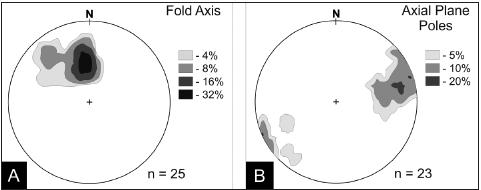
Fig. 8 – Family 3 folds: Schmidt diagram (lower hemisphere) with diagram point density: A – hinge lines, with greater frequency around 49º, N341º (25 measurements); B– axial plane poles, with greater frequency around 15º, N72º (23 measurements).
– Terceira família de dobras: Diagrama de Schmidt (hemisfério inferior) com diagrama de densidade: A – eixos das dobras com maior frequência em torno de 49º, N341º (25 medições); B – pólos dos planos axiais, com maior frequência em torno de 15º, N72º (23 medições).
A large sinform fold, located in the eastern border of the LTS with volcanic rocks (UVS), is also part of this family. It presents a hinge line plunging 30° to NW, with an axial plane with a direction 310º, tilting 66° to NE. This sinform has parasitic folds. All the mapped folds have normal polarity.
This family has, in general, axial planes slightly plunged to the NE quadrant, with a fold vergency to SW. The large sinform on the East of LTS has the same vergency. Consequently, this family has a geometrical vergency to SW, with axial planes plunging to the NE quadrant and a direction approximately NW-SE. These structures can be explained, in view of a dominant compressive field, where the maximum compression tensor has a direction approximately NE-SW, perpendicular to the axial planes.
It should be noted that fold families 2 and 3 are present only in LTS. The family 1 could only be detected in the massive volcanic sequence. This is interpreted as resulting from distinct rheological characteristics of the different rock types (LTS vs. VS), which may have induced the genesis of a tectonic discontinuity (thrust/shearing?) during Variscan deformation events.
]]> 2.2.2. Brittle Structures
Some of the brittle structures are interpreted as deduced, which explains some inconsistencies in the structural interpretation.
Similarly to the more ductile structures, the brittle structures are divided into fault families, with distinct geometric and kinematics characteristics (Fig. 9). The fragile structures are divided into four families:
I. Parallel faults and/or overlap limit LTS-UVS and LTS-LVS;
II. Faults with direction N10° to N45°;
III. Faults with direction N-S;
IV. Faults with direction N315° to N350°;
Fig. 9 – Geometric and kinematic synthesis of four brittle structures families in the study area.
]]> – Síntese das características geométricas e cinemáticas das estruturas frágeis presentes na área em estudo.
I – Parallel faults and/or overlap limits LTS-VSB and LTS-VST
This family includes two faults separating the LTS from the VS. In the borderland between LTS and LVS, the contact is sharp, and the attitude of the LVS stratification (S0) is distinct from the LTS. This contact can be interpreted as a brittle/ductile dextral strike-slip fault. This fault has a direction N340º, plunging to W.
A difference in the folding geometry between the LTS and the UVS can be observed. This differentiation, caused by different rheological behaviours, is similar to the one observed at the limit between the LTS and LVS. The limit is also interpreted as a fault with a general direction of N290º, with a fault plane inclined to SW (Fig. 3).
Cinematically, both faults could be assumed to be dextral brittle/ductile strike-slip or brittle/ductile thrust with vergency to NE. The kinematics could correspond to a previous deformation phase (which are grouped in fold family 1 – see chapter 2.2.1.1) or a late D3, but always related with a significantly diverse rheological behaviour.
The presence of these thrusts with vergency to NE, along the limit between the LTS and LVS, accompanied by folds with axial plane sub-parallel to the fault, points to the association of these two types of structures with the same deformation episode (thrust criteria). In this case, the stress field would be dominantly compressive in order to generate the folding. If we consider that the deformation is coaxial, then the direction of maximum compression (s1) would be perpendicular to the axial plane.
Alternatively, if this is interpreted as a ductile/fragile dextral strike-slip structure, a compressive s1 approximately with N-S direction should be considered.
II – Faults direction N10° to N45°
]]> The detailed mapping points out that this family is composed by faults with directions between the N6º to N45º. The slope is very variable, but always above 38º to NNW or to SSE. This family is only identified in the LTS.The mentioned faults have different drives. Four combinations of different horizontal and vertical component can be distinguished:
– Reverse faults with vergency to NW, without horizontal component (only visible in one case) – direction N45º;
– Reverse faults with a NW vergency, with dextral horizontal component (only visible in one case) – direction N20;
– Reverse faults with vergency to SE, without horizontal component (in four places) – direction between N6º to N20º;
– Dextral strike-slip fault, without vertical component (visible in three places) – direction between N10º to N20º.
There are evidences of two distinct fields of tension that would explain the two main types of faults:
– The reverse faults are formed by ductile deformation accommodation. These faults are associated with folded structures grouped in family 2 (see chapter 2.2.1.2.; Fig. 10). Considering that the deformation is coaxial, a stress field near vertical s3, s2 SW-NE and s1 NW-SE is required to form this fault association (Fig. 10B).
– To explain the dextral strike-slip faults observed in some places, a stress field with maximum compression near NE-SW is required.
]]>
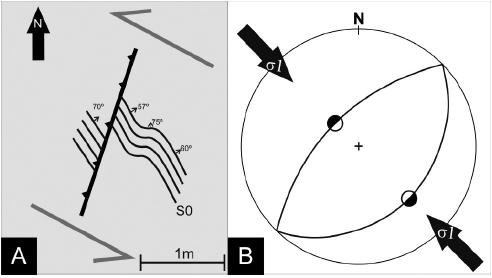
Fig. 10 – A – Schematic and interpretative map that shows the relationship between the family 2 folded structures and the N20º thrust with vergency to SE, framed within a sinistral transpressive regime; B – Thrust families projections that are include in this fault family (horizontal movements not recorded).
– A – Esquema interpretativo das relações entre as estruturas pertencentes à segunda família de dobramento e os cavalgamentos de direcção N20º com vergência para SE, associados a um regime transpressivo esquerdo; B – Projecção das famílias de cavalgamentos que estão incluídas nesta família de falhas (sem referência à movimentação horizontal).
III – Faults with N-S direction;
Two main faults of this family correspond to the limit of the deformed zone, referenced on fold family 2, and have, usually, a vertical slope. These faults appear to be of similar origin. In the studied region, it only affects the LTS. The faults of this family show the same relative kinematics. One of the faults drags the stratification, showing clear sinistral horizontal movement (Fig. 11).
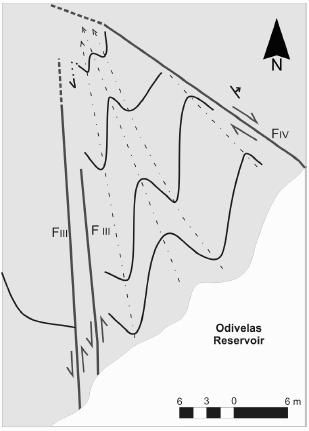
Fig. 11 – Schematic and interpretative map of the deformation in a deformation corridor, which promotes a rotation on folds grouped on family 2 (in this corridor, hinge lines plunges to N350º, since in family 2 hinge lines plunges to NE quadrant; FIII fault family III and FIV fault family IV).
– Esquema interpretativo da deformação observada no seio do corredor de deformação, com rotação das dobras pertencentes à segunda família de dobras (neste corredor os eixos das dobras mergulham para N350º, enquanto a geometria da família 2 apresenta eixos mergulhantes para o quadrante NE; FIII terceira família de falhas e FIV quarta família de falhas).
]]>With respect to the dynamic analysis of structures grouped in this family, they all show a similar origin, since they all have similarities in their geometrical and kinematic characteristics.
If we consider a coaxial deformation, although the conjugate faults have not been found in mapped area, we can infer on the possible direction of maximum compression, responsible for the formation of these faults; s1 with a SE-NW direction.
IV – Faults direction N315° to N350°
In this family, that includes five faults, all the faults that have directions between N315° and N350° are sub-vertical. Regarding the kinematics of these faults, they have a dominant horizontal component (vertical component not deduced); however it is necessary to subdivide this family into two groups:
– Fault of direction N315°, vertical, with sinistral strike-slip component (very scarce);
– Fault direction N320° and N350°, with vertical dextral strike-slip component (more abundant).
The sinistrogiral strike-slip structures can be explained by a stress field where the maximum compression direction was close to WNW-ESE, while the dextral strike slip faults, imply a s1 with approximately N-S direction.
Fig. 11 represents an area where three faults are observed, two of which are N-S sinistrogiral strike-slip structures (fault family III) and the other is a dextral strike-slip with direction N320° (belonging to this family). The activity of these faults cause a rotation on folded structures, which led to a reorientation of the original structure. These folds were similar to the folds of family 2, rotated by the action of these three faults.
]]>3. Discussion and conclusions
3.1. Correlation with OMZ Structures
In the OZM, the first Variscan deformation event (D1) has been interpreted as corresponding to the installation of BAOC to the North with the consequent generation of a flake tectonic geometry (Araújo et al., 1993; Fonseca & Ribeiro, 1992). It is considered to have lasted from the Early to Mid Devonian (Fig. 12 and 13), but may have started in the Silurian in the SW parts of the Évora-Beja Domain (cf. Fonseca & Ribeiro, 1993; Araújo, 1995; Ribeiro et al., 2007, 2009, 2010). Considering the age assigned to the Odivelas Limestone (latest Emsian-early mid Eifelian; see Machado et al., 2010) and the fact that the effect of the regional D1 is not visible in the studied area one can infer, in this region, D1 is pre-latest Emsian, i.e., Lower Devonian or older (Fig. 12).
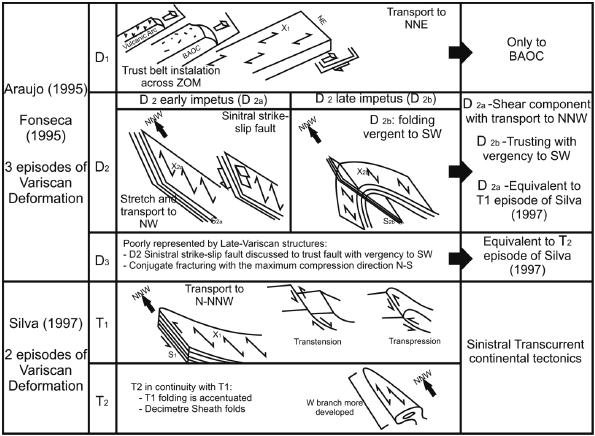
Fig. 12 – Summary geometric and kinematic characteristics of the main Variscan deformation episodes in Évora-Beja Domain according to different authors (adapted from ROSAS, 2003).
– Características geométricas e cinemáticas sumárias dos principais episódios de deformação Variscos no domínio Évora-Beja, segundo diversos autores (adaptado de Rosas, 2003).
Fig. 13 – Dating of the main events of deformation in the Iberian Peninsula in SW Iberia (Dias & Ribeiro, 1995).
]]> – Datação dos principais episódios de deformação na Península Ibérica no SW da Ibéria (Dias & Ribeiro, 1995).
In the studied area, the presence of folds with axial planes aligned NW-SE and vergency to NE (family 1) is interpreted as resulting from the first pulses of the 2nd regional deformation phase (D2a).
As the subduction continued the second deformation phase (D2) was generated (Araújo, 1995) (Fig. 12). Regionally the D2 folds, in the Évora-Beja Domain, have N-S to SW-NE direction and are asymmetric with W to NW vergency, suggesting a constrictive system (Dias & Ribeiro, 1995, Ribeiro et al., 2010). The D2 hinge lines have a great dispersion, due the effect of the third deformation episode (D3) (Araújo, 1995).
In the Covas Ruivas area we grouped folds with similar geometry in family 2 described in chapter 2. However, as they show a low dispersion of the hinge lines, standing to NE quadrant, they are coherent with D2b structures described by Araújo (1995) and Ribeiro et al., (2010).
The third deformation phase in the OMZ (D3) has presumably a Famennian-Visean (Late Devonian-Mississippian) age (Fonseca, 1995). During this phase the intracontinental deformation mechanisms were predominant, with a maximum compression direction close to NE-SW (Araújo, 1995, Dias & Ribeiro 1995).
This last episode of deformation is represented in the studied area by faults family III which have a N10º direction, with dextral strike-slip movement. No previous works in OMZ refer faults with these geometric and kinematic characteristics. However, Basile and Dias (2008) have reported the presence of dextral strike-slip faults with NNE-SSW direction in the SPZ. According to these authors, these faults are associated with later stages of D3.
Finally it is important to refer that the dextral strike-slip faults with direction between N350º and N315º described above (see chapter 2.2.1), can be related with Porto-Tomar-Ferreira do Alentejo shear zone and the Santa Susana Shear Zone with which they share kinematic and geometric similarities. Almeida et al. (2006) and Oliveira et al. (2007) refer that the later was active at least since the Pennsylvanian.
The distinct folds families present in different units (family 1 in VS and family 2 and 3 in LTS) is interpreted as resulting from distinct rheological characteristics of the different rock types, which may have induced, during Variscan deformation events, the genesis of the observed tectonic discontinuity (thrust/shearing?) between them.
Moreover, the observed structures are consistent with models developed for the southern border of the OMZ (e.g., Andrade 1983; Santos et al., 1987; 1990; Jesus et al., 2007; Araújo et al., 2005; Fonseca, 1995; Fonseca & Ribeiro, 1993; Fonseca et al. 1999; Ribeiro et al., 2010).
]]>3.2 Palaeogeography
The Limestones and Tuffites sequence (LTS) indicates calciturbidite deposition associated with a reef system, probably at the base of a slope setting. This is indicated by the reef-originated bioclasts forming the limestones and the occurrence of interbedded tuffites which probably represent basinal deposition between turbidite events (Machado et al., 2010). The close association of a reef system with volcanic rocks suggests the existence of a relatively isolated area of carbonate sedimentation. There is no evidence of the existence of a carbonate platform. Similar tectonosedimentary settings were described in the Bohemian massif (e.g., Galle et al., 1995, Hladil et al., 1994, 1999; Chlupác & Hladil, 1992) and Rheno-Hercynian zone (e.g., Flick et al., 2008; Königshof et al., 2010).
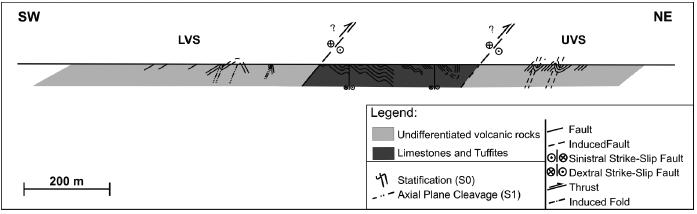
Fig. 14 – Simplified geological profile for the studied area.
– Corte geológico simplificado da área em estudo.
The discrete occurrences (few square meters) of silica iron exhalites in association with the volcanic sequences indicate the existence of low temperature, diffuse hydrothermal activity. Moreover, well preserved primary textures observed in many samples of these exhalites suggest that these sediments formed from the crystallization of silica iron oxyhydroxide gel.
The occurrence of spatially related Middle Devonian volcanic basic to intermediate rocks, iron-silica ores and reef-related limestones at the Covas Ruivas site can be compared with other occurrences elsewhere in the European Variscides. The Lahn and Dill synclines in the Rheno-Hercynian zone (Germany) show extensive Devonian volcanic rocks mostly of submarine facies (Breitkreuz & Flick, 1997; Flick et al., 2008; Nesbor et al., 1993). During the Middle Devonian several reefs developed in areas of volcanic islands and seamounts (Flick et al., 2008; Königshof et al., 2010), as recorded by reef and peri-reefal facies. Several iron ore occurrences are known from the same synclines (Lahn-Dill ores) which had economic importance in the recent past (Flick et al., 1990; 2008). The resemblance of the petrology of these ores with the ones from the BIC is striking. The same type of ores is also present in the Moravian-Silesian part of the Bohemian massif within thick Middle Devonian volcanic successions (Václav Kachlík, pers. com.). It thus seems that a similar tectono-magmatic-sedimentary setting prevailed during the Lower-Middle Devonian in wide spread areas of what are now the European Variscides.
]]> The precise dating of the limestones and the definition of their stratigraphical position on top of the LVS will allow, once the geochemical affinities of the magmatic rocks are known (work in progress), to better constrain the evolution of the Southern domains of the Ossa-Morena Zone.
ACKNOWLEDGEMENTS
Noel Moreira acknowledges António Ribeiro for the scientific clarification and Amadeu Dias Foundation and the University of LisbonGil Machado acknowledges the Fundação para a Ciência e Tecnologia PhD grant SFRH/BD/23787/2005. Field work of Paulo Fonseca, João Silva and João Mata was supported by Centro de Geologia da Universidade de Lisboa
Authors thank Alexandre Araújo and Tomás de Oliveira for their critical reading and review, which helped to improve the quality of the final manuscript.
REFERENCES
Almeida, E., Pous, J., Santos, F. M., Fonseca, P. E., Marcuello, A., Queralt, P., Nolasco, R. & Mendes-Victor, L. (2001) – Electromagnetic imaging of a transpressional tectonics in SW Iberia. Geophys. Res. Lett., AGU, Vol. 28, N.º 03, pp. 439-442, doi: 10.1029/2000GL012037.
Almeida, P., Dias da Silva, I. & Oliveira, H. (2006) – Caracterização Tectono-Estratigráfica da Zona de Cisalhamento de Santa Susana (ZCSS) no Bordo SW da Zona de Ossa-Morena (ZOM), (Portugal), VII Congresso Nacional de Geologia, Livro de Resumos volume I: 49-53.
Andrade (1983) – Contribution à l’analyse de la suture hercynienne de Beja (Portugal). PhD Thesis, Nancy, 137 p.
]]>Andrade, A., Pinto, A. & Conde, L. (1976) – Sur la géologie du Massif de Beja: Observations sur la transversale d`Odivelas. Comunicações dos Serviços Geológicos de Portugal, tomo 60: 171-202. [ Links ]
Apalategui, O., Eguiluz, L. & Quesada, C. (1990) – The structure of the Ossa-Morena Zone. In: R. D. Dallmeyer, E Martinez (eds): Pré-Mesozóic Geology of Ibéria. Dallmeyer e Martinez-Garcia (Eds.) Springer-Verlag: 280-291.
Araújo, A. (1995) – Estrutura de uma Geotransversal entre Brinches e Mourão (Zona de Ossa-Morena): Implicações na evolução geodinâmica da margem Sudoeste do Terreno Autóctone Ibérico. PhD Thesis, umpublished, Dep. Geociências, Univ. Évora.
Araújo, A., Fonseca, P. E. & Ribeiro, A. (1993) – Obduction and flake tectonics in the Variscan of SW Iberia; XII Reunião do Oeste Peninsular, Évora, September 1993, Terra Abstracts, Supplement n.º 6 to Terra Nova, Vol.5, 24, 8 p. [ Links ]
Araújo, A., Fonseca, P. E., Munhá, J., Moita, P.; Pedro, J. C. & Ribeiro, A. (2005) – The Moura Phylonitic Complex: An Accretionary Complex related with obduction in the Southern Iberia Variscan Suture. Geodynamica Acta, Volume 18, Issue 5, pp. 375-388, doi:10.3166/ga.18.375-388. [ Links ]
Araújo, A., Piçarra, J., Borrego, J., Pedro, J. & Oliveira, J. T. (2006) – As Regiões Central e Sul da Zona de Ossa-Morena. In: Geologia de Portugal no Contexto da Ibéria (Dias, R., Araújo, A., Terrinha, P. e Kullberg, J., Editores). Uni. Évora, Évora: 151-172.
Basile, C. & Dias, R. (2008) – Zonas de Cisalhamento NNE-SSW no litoral SW de Portugal: uma evolução complexa durante as fases finais do ciclo Varisco. GGET’2008 – 8.ª conferência Anual. Resumos alargados, Porto.
Breitkreuz, C. & Flick, H. (1997) – Sedimentation am trachytisch/alkalirhyolithischen Inselvulkan von Katzenelnbo-gen-Steinkopf (Devon/Rheinisches Schiefergebirge). Geol. Jb. Hessen, 125: 5-16.
Carvalho, D., Goinhas, J., Oliveira, V & Ribeiro A. (1971) – Observações sobre a geologia do sul de Portugal e consequências metalogenéticas. Est. Notas e Trab., Serviços de Fomento Mineiro, vol. XX, fasc. 1-2: 153-199.
Chlupác, I. & Hladil, J. (1992) – New Devonian occurrences in the Jested Mts., North Bohemia. Journal of the Czech Geological Society, 37(3): 185-191.
]]> Conde, L. & Andrade, A. (1974) – Sur la faune meso et/ou neodevoniennedes calcaires du Monte das Cortes, Odivelas (Massif de Beja). Mem. Not. Pub. Mus. Lab. Mineral. Geol. Uni. Coimbra, vol. 78: 141-146.Crespo-Blanc, A. & Orozco, M. (1988) – The Southern Iberian Shear Zone: a major boundary in the Hercynian folded belt. Tectonophysics, 148: 221-227.
Dallmeyer, R. D., Fonseca, P. E., Quesada, C. & Ribeiro, A. (1993) – 40Ar/39Ar mineral age constraints for the tectonothermal evolution of a Variscan Suture in SW Iberia; Tectonophysics, vol. 222, (1993), Elsevier Sc. Pub. Amsterdam, pp. 177-194, doi: 10.1016/0040-1951(93)90048-O.
Dias, R. & Ribeiro, A. (1995) – The Ibero-Armorican Arc: a collision effect against an irregular continent?. Tectonophysics, vol. 246: 113-128.
Flick, H., Nesbor, H. D. & Behnisch, R. (1990) – Iron ore of the Lahn-Dill type formed by diagenetic seeping of pyroclastic sequences – a case study on the Schalstein section at Gänsberg (Weilburg). International Journal of Earth Sciences, 79 (2): 401-415.
Flick, H., Nesbor, H. D. & Königshof, P. (2008) – Volcanism and reef development in the Devonian: A case study from the Rheinisches Schiefergebirge (Lahn syncline, Germany). In: KÖNIGSHOF, P. & Linnemann, U. Final Meeting of the IGCP 497 & IGCP 499 Excursion Guide. 159 p.
Fonseca, P. E. (1989) – Estudo de um segmento da sutura da Cadeia Varisca Ibérica: Serpa – Pulo do Lobo. Master Thesis Lisbon, Dep. Geologia da FCUL.
—— (1995) – Estudo da sutura varisca no SW Ibérico nas regiões de Serpa-Beja-Torrão e Alvito-Viana do Alentejo. PhD Thesis, unpublished, Dep. Geologia da FCUL.
—— (1997) – Domínios Meridionais da Zona Ossa-Morena e limites com a Zona Sul Portuguesa: Metamorfismo de alta pressão relacionado com a Sutura Varisca Ibérica. Estudos sobre a Geologia da Zona de Ossa-Morena (Maciço Ibérico) – Livro de Homenagem ao Prof. Francisco Gonçalves, Évora, pp. 133-168
Fonseca, P. E. & Ribeiro, A. (1992) – Ophiolite emplacement and flake tectonics: The example of Beja-Acebuches (SW Iberia Variscan Fold Belt); 29th International Geological Congress 1992, Kyoto, Japão, Vol 2, P31, 420 p.
]]> Fonseca, P. E. & Ribeiro, A. (1993) – The Tectonics of Beja-Acebuches Ophiolite: A major suture in the Iberian Variscan Fold Belt; Geologische Rundschau, 1993, 3-82, pp. 440-447, doi: 10.1007/BF00212408.Fonseca, P. E., Munhá, J., Pedro, J. C., Moita, P., Araújo, A., Rosas, F. & Leal, N. (1999) –Variscan Ophiolites and High-Pressure metamorphism in Southern Iberia, Ofioliti, 24/2, Sp. Iss.: 259-268.
Galle, A., Hladil, J. & Isaacson, P. E. (1995) – Middle Devonian biogeography of closing South Laurussia to North Gondwana Variscides; examples from the Bohemian Massif, Czech Republic, with emphasis on Horni Benesov. Palaios, 10: 221-239.
Hladil, J. Helesicová, K., Hrubanová, J., Müller, P. & Ures, M. (1994) – Devonian island elevations under the scope: Central Europe, basement of the Carpathian Mountains in Moravia. Jahrbuch der Geologischen Bundesanstalt in Wien, 136/4: 741-750.
Hladil, J., Mazur, S., Galle, A. & Ebert, J. R. (1999) – Revised age of the Maly Bozkow limestone in the Klodzko metamorphic unit, early Givetian, late Middle Devonian; implications for the geology of the Sudetes, SW Poland. Neues Jahrbuch fur Geologie und Palaontologie, Abhandlungen, 211: 329-353.
Julivert, M. (1971) – Decollement tectonics in the Hercynian Cordillera of Northwest Spain: American Journal of Science, v. 270: 1-29.
Jesus, A. P., Munhá, J., Mateus, A., Tassinari, C. & Nutman, A. P. (2007) – The Beja Layered Gabbroic Sequence (OssaMorena Zone, Southern Portugal): geochronology and geodynamic implications, Geodinâmica Acta, 20/3:139-157
Königshof, P., Nesbor, H. D. & Flick, H., (2010) – Volcanism and reef development in the Devonian: A case study from the Lahn syncline, Rheinisches Schiefergebirge (Germany). Gondwana Research, 17 (2-3): 264-280.
Lopes, L. (2003) – Contribuição para o conhecimento tectono – estratigráfico do Nordeste Alentejano; Transversal Terena – Elvas. Implicações económicas no aproveitamento de rochas ornamentais existentes na região (mármores e granitos). PhD Thesis, umpublished, Dep. de Geociências, Univ. Évora.
Lotze, F. (1945), Zur Gliederung der Varisciden der Iberishen Meseta. Geoteckt Forsch, vol. 6: 78-92.
]]> Machado, G., Hladil, J., Koptíková, L., Fonseca, P., Rocha, F. T. & Galle A. (2009) – The Odivelas Limestone: Evidence for a Middle Devonian reef system in western Ossa-Morena Zone. Geologica Carpathica, 60, 2, pp. 121-137.Machado, G., Hladil, J., Koptikova, L., Slavik, L., Moreira, N., Fonseca, M. & Fonseca, P. (2010) – An Emsian-Eifelian Carbonate-Volcaniclastic Sequence and the possible Record of the basal chote? event in western Ossa-Morena Zone, Portugal (Odivelas Limestone), Geologica Belgica, Vol 13, nº 4: 431-446,doi: 10.2478/v10096-009-0008-1. [ Links ]
Moreira, N., Machado, G. & Fonseca, P.E. (2010) – Cartografia estrutural dos calcários de Odivelas – Implicações na geologia do bordo SW da Zona de Ossa-Morena. VIII Congresso Nacional de Geologia, Univ. Minho. Revista e-Terra, VOLUME 11 – N.º 22, ISSN 1645- 0388. (http://www.e-terra.geopor.pt). [ Links ]
Munhá, J., Oliveira, J. T., Ribeiro, A., Oliveira, V., Quesada, C. & Kerrich, R. (1986) – Beja-Acebuches Ophiolite characterization and geodynamic significance, Maleo, 2(13): 31.
Nesbor, H. D., Buggish, W., Flick, H., Horn, M. & Lippert, H. J. (1993) – Vulkanismus im Devon des Rhenoherzynikums. Fazielle und Paläogeographische entwicklung vulkanish geprägter mariner Becken am Beispiel des Lahn-Dill Gebietes. Geol. Abh. Hessen, 98: 3-87.
Oliveira, H., Dias da Silva, I. & Almeida, P. (2007) – Tectonic and Stratigraphic Description and Mapping of the Santa Susana Shear Zone (SSSZ), the SW Border of Ossa-Morena Zone (OMZ), Barrancão – Ribeira de S. Cristóvão Sector (Portugal): Theoretical Implications; Geogaceta, 41: 151-154.
Oliveira, J. T., Oliveira, V. & Piçarra, J. M. (1991) – Traços gerais da evolução tectono-estratigráfica da Zona de Ossa-Morena, em Portugal: síntese critica do estado actual dos conhecimentos, Comunicações dos Serviços Geológicos de Portugal, t.77: 3-26. [ Links ]
Oliveira, J. T., Pereira, P., Ramalho, M., Antunes, M. T. & Monteiro, J. H. (1992) – Carta Geológica de Portugal à escala 1:500.000, 5.ª edição, Serviços Geológicos de Portugal.
Oliveira, J. T., Relvas, J., Pereira, Z., Munhá, J., Matos, J. X., Barriga, F. & Rosa, C. (2006) – O Complexo Vulcano Sedimentar de Toca da Moura-Cabrela (Zona de Ossa Morena); Evolução Tectono-Estratigráfica e Mineralizações Associadas. In: Geologia de Portugal no Contexto da Ibéria (Dias, R., Araújo, A., Terrinha, P. e Kullberg, J., Editores). Uni. Évora, Évora: 181-194.
Pedro, J. C. (2004) – Estudo Geológico e Geoquímico das sequências Ofiolíticas internas da Zona de Ossa-Morena (Portugal), PhD Thesis, umpublished, Dep. de Geociências da Univ. Évora.
]]> Pedro, J. C., Araújo, A., Fonseca, P. & Munhá, J. (2006) – Ofiolitos e Metamorfismo de Alta-Pressão. In: Geologia de Portugal no Contexto da Ibéria (Dias, R., Araújo, A., Terrinha, P. e Kullberg, J., Editores). Uni. Évora, Évora: 195-206.Pedro, J. C., Araújo, A., Tassinari, C., Fonseca, P. E. & Ribeiro, A. (in press.) – Geochemistry and U-Pb zircon age of the Internal Ossa-Morena Zone Ophiolite Sequences: a remnant of Rheic Ocean in SW Iberia, Ofioliti.
Pin, C., Fonseca, P. E., Paquette, J. L., Castro, P. & Matte, Ph. (2008) – The ca. 350 Ma Beja Igneous Complex: A record of transcurrent slab break-off in the Southern Iberia Variscan Belt?, Tectonophysics. pp. 356-377, doi: 10.1016/j.tecto.2008.06.001; 461 p.
Quesada, C., Fonseca, P. E., Munhá, J., Oliveira, J. T. & Ribeiro, A. (1994) – The Beja-Acebuches Ophiolite (Southern Iberia Variscan Fold belt): geological characterization and geodynamic significance; Boletín Geológico y Minero, Vol. 105-1 (1994): 3-49.
Ramsay, J. G. & Huber, M. I. (1983) – The Techniques of Modern Structural Geology. Vol.II: Folds and Fractures. Academic Press, New York.
Ribeiro, A., Antunes, M., Ferreira, M., Rocha, R., Soares, A., Zbyszewski, G., Almeida, F., Carvalho, D. & Monteiro, J. (1979) – Introduction à la Géologie Générale du Portugal. Serviços Geológicos de Portugal, Lisboa, 114 p.
Ribeiro, A., Pereira, E. & Dias, R. (1990) – Structure in the northwest of the Iberian Peninsula. In: Dallmeyer, R.D. e Martínez- -García, E. (Eds.) – Pre-Mesozoic Geology of Iberia, Springer-Verlag: 220-236.
Ribeiro, A., Munhá, J., Dias, R., Mateus, A., Pereira, E.; Ribeiro, M.L., Fonseca, P. E., Araújo, A., Oliveira, J. T., Romão, J., Chaminé, H., Coke, C. & Pedro, J. C. (2007) – Geodynamic evolution of SW Europe Variscides, Tectonics, Vol. 26, nº 6, TC6009, doi: 10.1029/2006TC002058.
Ribeiro, A., Munhá, J., Mateus, A., Fonseca, P. E., Pereira, E., Noronha, F., Romão, J., Feliciano, J., Castro, P., Meireles, C. & Ferreira, N. (2009) – Mechanics of thick-skinned Variscan overprinting of Cadomian basement (Iberian Variscides), Académie des Sciences/Elsevier, Comptes Rendus Géoscience, Vol. 341, Special Issue on Palaeozoic Tectonics and Geology (K. Schulmann, J. M. Lardeux, J. Dewey, R. Scrivener Eds.), pp. 127-139, doi: 10.1016/j.crte.2008.12.003.
Ribeiro, A., Munhá, J., Fonseca, P. E., Araújo, A., Pedro, J., Mateus, A., Tassinari, C., Machado, G. & Jesus, A. (2010) – Variscan Ophiolite Belts in the Ossa-Morena Zone (Southwest Iberia): geological characterization and geodynamic significance, IGCP Project 497, Ocean Rheic Special Volume, Gondwana Research. doi: 10.1016/j.gr.2009.09.005.
]]> Rosas, F. (2003) – Estudo Tectónico do Sector de Viana do Alentejo – Alvito: Evolução Geodinâmica e Modelação Analógica de Estruturas em Afloramentos Chave. PhD Thesis, umpublished, Dep. Geologia da FCUL.Rosas, F., Marques, F., Ballèvre, M. and Tassinari C. (2008) – Geodynamic evolution of the SWVariscides: Orogenic collapse shown by new tectonometamorphic and isotopic data from western Ossa-Morena Zone, SW Iberia, Tectonics, 27, TC6008, doi:10.1029/2008TC002333.
Santos, J., Mata, J., Gonçalves, F. & Munhá, J. (1987) – Contribuição para o conhecimento geológico-petrológico da região de Santa Susana: o Complexo Vulcano-Sedimentar da Toca da Moura. Com. Serv. Geol. Portugal, t. 73: 29-48 [ Links ]
Santos, J. F., Andrade, A. S. & Munhá, J. M (1990) – Magmatismo Orogénico Varisco no limite meridional da Zona de Ossa-Morena. Comum. Serv. Geol. Portugal, t.76: 91-124. [ Links ]
San-José M. A., Herranz P. & Pieren A. P. (2004) – A review of the Ossa-Morena Zone and its limits. Implications for the definition of the Lusitan-Marianic Zone. J. Iber. Geol. 30: 7-22. [ Links ]
Silva, L. C., Quadrado R. & Ribeiro, A. (1970) – Nota Prévia sobre a existência de uma estrutura zonada e de anortositos no maciço gabro-diorítico de Beja. Bol. Mus. Lab. Min. Geol. Univ. Lisboa, 11 (2): 223-232.
Plate 1 – Field and microscopic images of the Odivelas Volcano-sedimentary sequence (Covas Ruivas locality) /
Estampa 1 – Fotografias de campo e em microscópio da sequência vulcano-sedimentar de Odivelas (Covas Ruivas)
]]> A. Graded bedding in limestone. There is a tuffitic bed on the top. / Gradação granulométrica em Calcários, com estrato tufítico no topo.B. Fold showing deformation accommodation for fault. / Dobra com acomodação da deformação por falha.
C. Family 2 fold, affected by two small dextral strike.slip faults. / Dobra pertencente à segunda família, afectada por dois pequenos desligamentos direitos.
D. Jasper deposits in volcanic rocks. / Depósitos de jaspes em rochas vulcânicas.
E. Spherullites structures, in jaspers, envolved by hematite (microscope image). / Estruturas esferolíticas, em jaspes, envolvidos por hematite (imagem microscópica).
F. Detail of a coarse pyroclastic deposit. / Detalhe de um afloramento de depósitos piroclásticos.
G. Relict phonocrystal of albitized plagioclase (Pl) and prophyroblast of actinolite (Act) set on a fine grained matrix mainly formed by feldspar. / Relíquia de um fenocristal de plagioclase albitizada (Pl) e porfiroblastos de actinolite (Act) presente numa matriz de granularidade fina constituída por feldspato.
H. Blasto-porphyritic rock showing relicts of clinopyroxene phenocrystals (Cpx) and of albitized plagioclase (Pl) set on a feldspatic matrix. Amygdalaes (A) of epidote and chlorite are also visible. / Rocha blasto-porfirítica mostrando relíquias de fenocristais de clinopiroxena (Cpx) e de plagioclase albitizada (Pl) presente numa matriz feldspática. São visíveis também amígdalas (A) de epídoto e clorite.
]]>