<?xml version="1.0" encoding="ISO-8859-1"?><article xmlns:mml="http://www.w3.org/1998/Math/MathML" xmlns:xlink="http://www.w3.org/1999/xlink" xmlns:xsi="http://www.w3.org/2001/XMLSchema-instance">
<front>
<journal-meta>
<journal-id>2182-1372</journal-id>
<journal-title><![CDATA[Da Investigação às Práticas]]></journal-title>
<abbrev-journal-title><![CDATA[Invest. Práticas]]></abbrev-journal-title>
<issn>2182-1372</issn>
<publisher>
<publisher-name><![CDATA[Instituto Politécnico de Lisboa - Escola Superior de Educação]]></publisher-name>
</publisher>
</journal-meta>
<article-meta>
<article-id>S2182-13722014000100004</article-id>
<title-group>
<article-title xml:lang="en"><![CDATA[Between theory and practice: Teaching maths to elementary school students in Poland]]></article-title>
</title-group>
<contrib-group>
<contrib contrib-type="author">
<name>
<surname><![CDATA[&#379;ytko]]></surname>
<given-names><![CDATA[Ma&#322;gorzata]]></given-names>
</name>
<xref ref-type="aff" rid="AFF"/>
</contrib>
</contrib-group>
<aff id="AF1">
<institution><![CDATA[,University of Warsaw Faculty of Education Department of Elementary Education]]></institution>
<addr-line><![CDATA[ ]]></addr-line>
</aff>
<pub-date pub-type="pub">
<day>00</day>
<month>03</month>
<year>2014</year>
</pub-date>
<pub-date pub-type="epub">
<day>00</day>
<month>03</month>
<year>2014</year>
</pub-date>
<volume>4</volume>
<numero>1</numero>
<fpage>44</fpage>
<lpage>58</lpage>
<copyright-statement/>
<copyright-year/>
<self-uri xlink:href="http://scielo.pt/scielo.php?script=sci_arttext&amp;pid=S2182-13722014000100004&amp;lng=en&amp;nrm=iso"></self-uri><self-uri xlink:href="http://scielo.pt/scielo.php?script=sci_abstract&amp;pid=S2182-13722014000100004&amp;lng=en&amp;nrm=iso"></self-uri><self-uri xlink:href="http://scielo.pt/scielo.php?script=sci_pdf&amp;pid=S2182-13722014000100004&amp;lng=en&amp;nrm=iso"></self-uri><abstract abstract-type="short" xml:lang="en"><p><![CDATA[The development of children's school achievements in mathematics is one of the most important aims of education in Poland. The results of research concerning monitoring of school achievements in maths is not optimistic. We can observe low levels of children’s understanding of the merits of maths, self-developed strategies in solving problems and practical usage of maths skills. This article frames the discussion of this problem in its psychological and didactic context and analyses the causes as they relate to school practice in teaching maths.]]></p></abstract>
<abstract abstract-type="short" xml:lang="pt"><p><![CDATA[O sucesso escolar das crianças em Matemática é um dos objetivos mais importantes da educação na Polónia. Os resultados da investigação relativos aos desempenhos escolares em Matemática não são otimistas. Podemos observar baixos níveis de compreensão das crianças sobre a utilidade da Matemática, da capacidade de utilização de estratégias pessoais na resolução de problemas e do uso prático de capacidades matemáticas. Este artigo apresenta a discussão deste problema num quadro psicológico e didático e analisa as causas ligadas à prática escolar do ensino da Matemática]]></p></abstract>
<abstract abstract-type="short" xml:lang="fr"><p><![CDATA[La réussite scolaire des enfants en mathématiques est l'un des objectifs les plus importants de l'éducation en Pologne. Les résultats de la recherche concernant le contrôle des résultats scolaires en mathématiques n'est pas optimiste. Nous pouvons observer le faible niveau des enfants en ce qui concerne la compréhension de l’utilité des mathématiques, les stratégies d'auto-développement dans la résolution de problèmes et l'utilisation pratique des compétences en mathématiques. L'article porte sur la discussion de ce problème dans un cadre psychologique et didactique et sur l’analyse des causes liées à la pratique scolaire de l'enseignement des mathématiques]]></p></abstract>
<kwd-group>
<kwd lng="en"><![CDATA[teaching maths]]></kwd>
<kwd lng="en"><![CDATA[classroom communication]]></kwd>
<kwd lng="en"><![CDATA[pupils’ mistakes]]></kwd>
<kwd lng="en"><![CDATA[elementary education]]></kwd>
<kwd lng="pt"><![CDATA[ensino de matemática]]></kwd>
<kwd lng="pt"><![CDATA[comunicação na sala de aula]]></kwd>
<kwd lng="pt"><![CDATA[erros de alunos]]></kwd>
<kwd lng="pt"><![CDATA[educação elementar]]></kwd>
<kwd lng="fr"><![CDATA[enseignement des mathématiques]]></kwd>
<kwd lng="fr"><![CDATA[communication en classe]]></kwd>
<kwd lng="fr"><![CDATA[erreurs des élèves]]></kwd>
<kwd lng="fr"><![CDATA[enseignement primaire]]></kwd>
</kwd-group>
</article-meta>
</front><body><![CDATA[  	    <p align="right"><font face="Verdana"><b><font size="4">ARTIGOS</font></b> </font></p> 	    <p align="left"><font face="Verdana"> 	<b><font size="4">Between theory and practice: Teaching maths to elementary school students in  Poland </font> </b><font size="2">    <br> </font></font></p>    <p>&nbsp;</p>      <p align="left"> <font face="Verdana" size="2"> <b>Ma&#322;gorzata &#379;ytko</b>     <br> Department of Elementary Education, Faculty of Education, University of Warsaw</font></p>     <p align="left"><font face="Verdana" size="2"> <a href="mailto:malgorzata.zytko@wp.pl">malgorzata.zytko@wp.pl</a> &nbsp;    <br> </font></p> <a name="topc0"><a href="#c0">Contacto</a></a>    <p>&nbsp;</p>     ]]></body>
<body><![CDATA[<p align="left"><font face="Verdana" size="2"> <b>ABSTRACT </b></font></p> 	    <p><font face="Verdana" size="2">The development of children's school achievements in  mathematics is one of the most important aims of education in Poland. The  results of research concerning monitoring of school achievements in maths is not  optimistic. We can observe low levels of children’s understanding of the merits  of maths, self-developed strategies in solving problems and practical usage of  maths skills. This article frames the discussion of this problem in its  psychological and didactic context and analyses the causes as they relate to  school practice in teaching maths. </font>    <br> 	    <p align="left"><b><font face="Verdana" size="2"> Keywords</b>: teaching maths, classroom communication, pupils’ mistakes,  elementary education.</font></p> 	    <p>&nbsp;</p> 	    <p align="left"><font face="Verdana" size="2"> 	<b>RESUMO </b></font></p> 	    <p><font face="Verdana" size="2">O sucesso escolar das crianças em Matemática é um dos objetivos  mais importantes da educação na Polónia. Os resultados da investigação relativos  aos desempenhos escolares em Matemática não são otimistas. Podemos observar  baixos níveis de compreensão das crianças sobre a utilidade da Matemática, da  capacidade de utilização de estratégias pessoais na resolução de problemas e do  uso prático de capacidades matemáticas. Este artigo apresenta a discussão deste  problema num quadro psicológico e didático e analisa as causas ligadas à prática  escolar do ensino da Matemática. </font>    <br> 	    <p align="left"><b><font face="Verdana" size="2"> Palavras-chave</b>: ensino de matemática, comunicação na sala de aula, erros  de alunos, educação elementar.</font></p> 	    <p>&nbsp;</p> 	    ]]></body>
<body><![CDATA[<p align="left"><font face="Verdana" size="2"> 	<b>RÉSUMÉ </b></font></p> 	    <p><font face="Verdana" size="2">La réussite scolaire des enfants en mathématiques est l'un des  objectifs les plus importants de l'éducation en Pologne. Les résultats de la  recherche concernant le contrôle des résultats scolaires en mathématiques n'est  pas optimiste.      <br> Nous pouvons observer le faible niveau des enfants en ce qui concerne la  compréhension de l’utilité des mathématiques, les stratégies  d'auto-développement dans la résolution de problèmes et l'utilisation pratique  des compétences en mathématiques. L'article porte sur la discussion de ce  problème dans un cadre psychologique et didactique et sur l’analyse des causes  liées à la pratique scolaire de l'enseignement des mathématiques. </font>    <br> 	    <p align="left"><b><font face="Verdana" size="2"> Mots-clés</b>: enseignement des mathématiques, communication en classe, erreurs des  élèves, enseignement primaire..</font></p>     <p>&nbsp;</p>     <p align="left"><font face="Verdana" size="2">     <br></font><font face="Verdana"><b>1. THE IMPORTANCE OF MATHEMATICAL EDUCATION FOR CHILDREN’S DEVELOPMENT</b> </font><font face="Verdana" size="2">    <br>     <br> Mathematics as an element of the school curriculum is often mistakenly treated  as a collection of facts, formulas and algorithms, which require mostly rote  learning. Meanwhile, in reality, mathematics is a type of human activity whose  most characteristic feature is the intense involvement of intellectual processes  in the solving of problems. In other words, mathematics is not about counting,  but about thinking. The main goals of mathematical education include:  mathematising, discovering, reasoning, communicating (Freudenthal, 1972).  Following Freudenthal’s words the main goal of this paper is to analyse to what  extent teaching maths is in fact teaching counting or thinking. Polish  elementary school practice is under consideration. My comparison is based on the  results of&nbsp; nationwide research on the maths achievements of 9-years olds  complimented by TIMSS research. </font></p>     ]]></body>
<body><![CDATA[<p align="left"><font face="Verdana" size="2"> The crux of the analysis is the reasons for differences and similarities in  research results. They were significant in typical and non – typical tasks  solved by students and curriculum-related as well as non-curriculum related  ones. </font></p>     <p align="left"><font face="Verdana" size="2"> Referring to the above mentioned background, it is worth expanding on the  psychological basis of maths teaching. It applies modern developmental  psychology, especially constructivist and cognitive theories as well as  interdisciplinary research results – neurocognitive ones and the analyses of the  role of discourse and communication in child development. </font></p>     <p align="left"><font face="Verdana" size="2"> According to J. Bruner (1986) there are two factors in the process of the  recognition of the world:     <br> - objective scientific explanation of the world order     <br> - individual mind effort to understand and make sense of its subjective world in  the context of other individual worlds </font></p>     <p align="left"><font face="Verdana" size="2"> In his theory Bruner emphasised the significance of child intuition and  non-academic notions. He warned against the premature introduction of formal  knowledge and definitions to children. At the same time he promoted the idea of  experience and exploration of the world by children. J. Bruner has distinguished  three modes of representation in cognitive development: enactive, iconic and  symbolic ones which are accessible to a human being during their lifetime. </font></p>     <p align="left"><font face="Verdana" size="2"> In early education in maths the shift from the enactive to the symbolic stage is  far too fast. In Bruner’s opinion, the education process should encourage the  child’s own activity to discover, autonomously recognise and structure his/her  knowledge </font></p>     <p align="left"><font face="Verdana" size="2"> The independent child’s activity guarantees its better usage and understanding . </font></p>     <p align="left"><font face="Verdana" size="2"> The teacher who engages children to engage in active dialogue and supports them  in the cognitive process builds a kind of scaffolding. He/she creates the social  context by which a pupil can learn to solve problems and cooperate with peers. </font></p>     <p align="left"><font face="Verdana" size="2"> The role of social interaction in knowledge acquisition was also stressed by L.  S.Wygotsky in his psychological theory. He emphasised the significance of the  zone of proximal development which is prior to development and makes it a  challenge instead of a series of well – known/familiar skills. </font></p>     ]]></body>
<body><![CDATA[<p align="left"><font face="Verdana" size="2"> An interesting approach to the communication process which supports learning and  development of thinking is presented by A. Sfard in her book <i>Thinking as  communicating. Human development, the growth of discourses and mathematizing (</i>Sfard,  2008)<i>.</i> She is of the opinion that thinking is an individualised form of  interpersonal communication. She introduces the term commognition and stresses  that communication is a kind of activity in which the activity of A is continued  by B. The meaning of communication in this discursive approach is not confined  to the relation between sender and receiver. It is a complicated web of  relations in which the activities of particular subjects constitute a part of  the dynamic model. </font></p>     <p align="left"><font face="Verdana" size="2"> In this approach communication is integrated into the community, but the  communication process never determines reaction. The discourse becomes a kind of  joint recognition, discovering notions, exploration and experience. Therefore, a  pupil who is solving some mathematical problem may suggest many different  strategies, all of which will be adequate to the communication situation, even  if they are wrong from a mathematical point of view. </font></p>     <p align="left"><font face="Verdana" size="2"> The significance of early cognitive experience and activity in discovering the  world is also confirmed by modern neurobiological research. It shows that the  brain cells of young children are twice as active as adult brain cells. This  process last till 9-10 years of age. </font></p>     <p align="left"><font face="Verdana" size="2"> If children do not face intellectual challenge and only follow the patterns  imposed by teachers their brains do not develop in a traditional educational  environment. </font></p>     <p align="left"><font face="Verdana" size="2"> Through learning mathematics, the children can develop:  </font>  </p>     <blockquote> 	    <blockquote> 		    <p align="left"><font face="Verdana" size="2">    <br>- critical and reflective thinking  		    <br>- the perception of regularities and relationships  		    ]]></body>
<body><![CDATA[<br>- problem-solving skills  		    <br>- creation of models and synthetic formulas  		    <br>- the formulation of hypotheses and their verification in practice  		    <br>- the use of various strategies for a solution  		    <br>- an explanation of the way in which a solution was achieved  		    <br>- an assessment of the correctness of the solution  		    <br>- arguing and generalizing  		    <br>- the use of acquired skills and knowledge in a new situation.  		    <br></font></p> 	</blockquote> </blockquote>     <p align="left"><font face="Verdana" size="2"> Therefore, during the education process it is worth paying attention to the  following issues: </font> </p>     ]]></body>
<body><![CDATA[<blockquote> 	    <blockquote> 		    <p align="left"><font face="Verdana" size="2">    <br> 		- the creation of educational situations which enable children to use their cognitive ability and to construct their knowledge on their own  		    <br>- the social nature of mathematics and offering opportunities for learning through the communication process  		    <br>- boosting children’s thinking during the solving of mathematical problems which should be constructed so as to pose an intellectual challenge for children and refer to their zone of proximal development              <br>- encouraging children to search for their own strategy to solve the problem, to treat the solution proposed by the teacher or presented in the textbook as one of the possible solutions, but not the only right one              <br>- discussion and verification by the pupils of various solution strategies, convincing each other about the correctness of their solutions              <br>- intense activity during the solving of mathematical problems – using not only specific elements, but also less conventional ones such as drawings,          pictograms, visualizations, situational models, diagrams illustrating relationships and dependencies, building blocks, various teaching aids              <br>- creating opportunities to manipulate specific elements until the children understand the sense of the given mathematical operation and the problem-solving strategy, until they construct their own interpretations              ]]></body>
<body><![CDATA[<br>- manipulation of mathematical symbols to achieve an understanding of the given mathematical concept, use of the teachers’ notations and notations          developed by the children              <br>- solving problems in groups, negotiating solutions, looking for arguments and evidence that could convince a peer to accept the selected solution              <br>- searching for individual solutions to mathematical problems, respecting the various approaches to the given task,              <br>- the ability to perceive errors, to explain how they arose and to search for the strategy to arrive at the correct solution              <br>- promote the interesting and original solutions proposed by the pupils, encourage them to develop their own mathematical problems or riddles to be solved              <br>- use specific everyday situations as sources of problems and tasks that activate mathematical thinking     <br></font></p> 	</blockquote> </blockquote>     <p align="left"><font face="Verdana" size="2">    <br></font> <font face="Verdana"><b>2. ANALYTICAL SKILLS OF PUPILS COMPLETING PRIMARY EDUCATION IN POLAND  </b></font></p>     <p align="left"><font face="Verdana" size="2">     ]]></body>
<body><![CDATA[<br>The goals and tasks of mathematical education presented above, and the suggested  methods for their effective achievement can be compared with the results of  teachers’ activity in the educational practice. I shall refer to the results of  nationwide research into school achievements in the field of mathematics among  pupils who complete elementary education. In Poland, elementary school lasts for  6 years and is divided into two phases: 3-year elementary education (integrated)  and 3-year stage of primary school, with the curriculum broken down by subject.  Children commence mandatory education at the age of seven; as of 2014 this  mandatory age will be lowered to six year. </font></p>     <p align="left"><font face="Verdana" size="2">The results of research presented in this text refer to achievements of children  completing low primary education, which means they are 9 years old. </font></p>     <p align="left"><font face="Verdana" size="2">In the years 2006-2011 a research  project was carried out in Poland, financed by the European Social Fund. It  covered the monitoring of school achievement in  children completing low primary education, regarding their language and  mathematical skills. </font></p>     <p align="left"><font face="Verdana" size="2">The main goals of the research were as follows:</font></p>     <blockquote> 	    <blockquote> 		    <p align="left"><font face="Verdana" size="2">    <br>Ø Diagnosis of school achievements in language and mathematics  		    <br>Ø Description of school achievement context: impact of school and family background              <br>Ø Improvement in quality of education at primary school level  		    ]]></body>
<body><![CDATA[<br></font></p> 	</blockquote> </blockquote>     <p align="left"><font face="Verdana" size="2">The research was conducted on a nationwide scale and covered four types of  environments: countryside, small town, medium-sized town and large city. The  numbers of participants in the subsequent years are presented below: </font></p>     <p align="left"><font face="Verdana" size="2">Quantitative research     <br>    <blockquote> 	    <blockquote> <b>2006</b> – 2500 pupils and their parents, 137 teachers and  head- teachers     <br> <b>2008</b> – 4800 pupils, 262 teachers     <br> <b>2010</b> – 4800 pupils, 290 teachers     <br><b> 2011 -  </b>3800 pupils, 170 teachers </font></p></blockquote> 	</blockquote>     <p align="left"><font face="Verdana" size="2">The quantitative research was supplemented by qualitative research in schools  randomly selected from among schools where the pupils achieved above-average and  below-average results in the skills assessment tests. In those schools,  interviews were conducted with headmasters and teachers, and classes delivered  for third grade pupils were monitored. In this way, the researchers attempted to  identify factors which influenced the pupils’ school achievements and which were  tied to the teachers’ work methods, their manner of communication with the  pupils during the classes, the set educational goals and tasks as well their  expectations regarding the pupils and their activity (D&#261;browski, 2009; 2011;  Murawska &amp; &#379;ytko, 2012; &#379;ytko &amp; Dagiel, 2011). </font></p>     ]]></body>
<body><![CDATA[<p align="left"><font face="Verdana" size="2">Analysis of the research results can be used as the basis to determine the level  of maths skills of third graders and the features that characterize the relevant  educational practice. </font></p>     <p align="left"><font face="Verdana" size="2">What do we know about the maths skills of 9-year olds?      <br></font></p>     <p align="left"><font face="Verdana" size="2"><b>Calculation</b></font></p>     <blockquote> 	    <blockquote> 		    <p align="left"><font face="Verdana" size="2"> 		    <br>Ø highly developed skill of calculating following the given pattern  		    <br>Ø low level of understanding of the sense of maths calculations despite doing them  		    <br>Ø low level of self-developed calculation strategies  		    ]]></body>
<body><![CDATA[<br>Ø low level of practical usage of one’s maths knowledge  		    <br> </font></p> 	</blockquote> </blockquote>     <p align="left"><font face="Verdana" size="2"><b>Solving text problems</b> </font> </p>     <blockquote> 	    <blockquote> 		    <p align="left"><font face="Verdana" size="2"> 		    <br>Ø highly developed skill of doing simple, typical tasks  		    <br>Ø not well developed skill of doing non-typical tasks  		    <br>Ø common false perception of solving text problems i.e. correct solution should cover all given numbers presented in the text              <br>Ø common false perception of checking and verifying the result, automatically following the pattern </font></p> 	</blockquote> </blockquote>     ]]></body>
<body><![CDATA[<p align="left"><font face="Verdana" size="2">    <br><b>Logical reasoning and reading text containing numbers such as menu, price  list, timetable</b> </font></p>     <blockquote> 	    <blockquote> 		    <p align="left"><font face="Verdana" size="2"> 		    <br>Ø highly developed skill of searching for information (diagrams, tables, charts etc.) and using it in practice (although not taught at school)              <br>Ø surprisingly well-developed skill of recognizing and explaining rules and logic behind mathematical tasks</font></p> 	</blockquote> </blockquote>     <p align="left"><font face="Verdana" size="2">    <br>What do we know about maths teaching school practice?      <br></font></p>     ]]></body>
<body><![CDATA[<p align="left"><font face="Verdana" size="2">Observations of classes in the schools participating in the research provided  knowledge on the process of teacher-pupil communication, types of activities  undertaken by the pupils, types of questions asked by teachers and children. The  characteristic features of most maths classes include:     <br></font></p>     <p align="left"><font face="Verdana" size="2">The lack of:</font></p>     <blockquote> 	    <blockquote> 		    <p align="left"><font face="Verdana" size="2"> 		    <br>Ø teachers’ initiatives supporting students motivation to learn mathematics  		    <br>Ø opportunities for students to talk about maths  		    <br>Ø intellectual challenges in the field of maths  		    <br>Ø children’s thinking during maths lessons </font></p> 	</blockquote> </blockquote>     ]]></body>
<body><![CDATA[<p align="left"><font face="Verdana" size="2">    <br>Aside from that, another visible issue are the teachers’ preference to follow  one scheme of problem solving and rare opportunities for children in school  practice to look for individual problem-solving strategies.  <a href="#t1">Table 1</a> presents the  results of observations conducted during classes held in the third grade of  primary school, regarding the types of activities undertaken by the children  during classes of Polish language and maths. The observations were carried out  in 2010 at 20 primary schools in Poland. The total time of observation was 3117  minutes during 70 courses – 33 of maths and 37 of Polish language. The total  observation time of maths lessons was 1444 minutes. </font></p>      <p>&nbsp;</p>     <p><font face="Verdana" size="2"><a name="t1">Table 1</a>: Children’s activity during maths lessons </font></p> <table class="MsoNormalTable" align="center" border="1" cellpadding="0" cellspacing="0"> 	<tr> 		<td valign="top" width="199" align="center"> 		    <p align="left"><font face="Verdana" size="2">    <br> 		<b>Percentage of children’s participation </b></font></td> 		<td valign="top" width="114" align="center"> 		    <p align="left"><font face="Verdana" size="2">    <br> 		<b>Total – all schools </b>    <br> 		<b>2010 </b></font></td> 		<td valign="top" width="136" align="center"> 		    <p align="left"><font face="Verdana" size="2">    ]]></body>
<body><![CDATA[<br> 		<b>Maths education </b>    <br> 		<b>2010 </b></font></td> 	</tr> 	<tr> 		<td valign="top" width="199" align="center"> 		    <p align="left"><font face="Verdana" size="2">    <br> 		<b>Organisation arrangements </b></font></td> 		<td valign="top" width="114" align="center"> 		    <p align="left"><font face="Verdana" size="2">    <br> 		7.1 		</font> 		</td> 		<td valign="top" width="136" align="center"> 		    <p align="left"><font face="Verdana" size="2">    <br> 		6.1 		</font> 		</td> 	</tr> 	<tr> 		<td valign="top" width="199" align="center"> 		    <p align="left"><font face="Verdana" size="2">    <br> 		<b>Checking&nbsp; knowledge </b></font></td> 		<td valign="top" width="114" align="center"> 		    ]]></body>
<body><![CDATA[<p align="left"><font face="Verdana" size="2">    <br> 		61.1 		</font> 		</td> 		<td valign="top" width="136" align="center"> 		    <p align="left"><font face="Verdana" size="2">    <br> 		84.9 		</font> 		</td> 	</tr> 	<tr> 		<td valign="top" width="199" align="center"> 		    <p align="left"><font face="Verdana" size="2">    <br> 		<b>Listening to teacher</b> 		</font> 		</td> 		<td valign="top" width="114" align="center"> 		    <p align="left"><font face="Verdana" size="2">    <br> 		27.3 		</font> 		</td> 		<td valign="top" width="136" align="center"> 		    <p align="left"><font face="Verdana" size="2">    <br> 		14.7 		</font> 		</td> 	</tr> 	<tr> 		<td valign="top" width="199" align="center"> 		    ]]></body>
<body><![CDATA[<p align="left"><font face="Verdana" size="2">    <br> 		<b>Discussion </b></font></td> 		<td valign="top" width="114" align="center"> 		    <p align="left"><font face="Verdana" size="2">    <br> 		3.7 		</font> 		</td> 		<td valign="top" width="136" align="center"> 		    <p align="left"><font face="Verdana" size="2">    <br> 		0.1 		</font> 		</td> 	</tr> 	<tr> 		<td valign="top" width="199" align="center"> 		    <p align="left"><font face="Verdana" size="2">    <br> 		<b>Creative activity</b> 		</font> 		</td> 		<td valign="top" width="114" align="center"> 		    <p align="left"><font face="Verdana" size="2">    <br> 		2.3 		</font> 		</td> 		<td valign="top" width="136" align="center"> 		    ]]></body>
<body><![CDATA[<p align="left"><font face="Verdana" size="2">    <br> 		0.4 		</font> 		</td> 	</tr> 	<tr> 		<td valign="top" width="199" align="center"> 		    <p align="left"><font face="Verdana" size="2">    <br> 		<b>Total time of observation&nbsp;&nbsp;&nbsp;&nbsp;&nbsp;&nbsp;&nbsp;&nbsp;&nbsp; </b>    <br> 		<b>&nbsp;(in minutes) </b></font></td> 		<td valign="top" width="114" align="center"> 		    <p align="left"><font face="Verdana" size="2">    <br> 		3117 		</font> 		</td> 		<td valign="top" width="136" align="center"> 		    <p align="left"><font face="Verdana" size="2">    <br> 		1444 		</font> 		</td> 	</tr> </table>     <p>&nbsp;</p>     ]]></body>
<body><![CDATA[<p align="left"><font face="Verdana" size="2">The dominant form is the pupils’ participation in the process of verification of  their knowledge by the teacher, and the listening to teacher – that is,  situations that do not require significant activity by the pupils. Situations in  which the pupils are active, express their own opinions, discuss, undertake  creative tasks are much rarer. More creative activity and discussion can be  observed during language classes than during maths ones. The maths classes,  according to the observation results, involve primarily the children’s  participation in the checking of their knowledge by the teacher. </p>       <p align="left"><font face="Verdana" size="2"><a href="#t2">Table 2</a> presents the types of statements made by teachers during communication  with pupils during maths lessons. The results reveal the frequency – in minutes  – at which the various types of statements appeared during the observed classes.  As shown above, the most frequent type of teachers’ statement – made every 2.4  minutes – is the giving of instructions and checking the children’s knowledge  and understanding. The children’s asking for explanation of the achieved  solution or asking open questions occurs much less frequently - during maths  classes such statements appear sporadically, every 160.4 minutes. The teachers  very infrequently support the children in problem solving – more frequently,  made impatient by the lack of answer, they prompt the right solution or answer  the questions instead of the pupils. </font> </p>    <p>&nbsp;</p>     <p align="left"><font face="Verdana" size="2"><a name="t2">Table 2</a>: Teachers’ statements during maths lessons </font> </p> <table class="MsoNormalTable" align="center" border="1" cellpadding="0" cellspacing="0"> 	<tr> 		<td valign="top" width="215" align="center"> 		    <p align="left"><font face="Verdana" size="2">    <br> 		<b>How often (in minutes) the teacher</b>     <br> 		</font> 		</td> 		<td valign="top" width="132" align="center"> 		    <p align="left"><font face="Verdana" size="2">    <br> 		<b>Total – all schools </b>    <br> 		2010 		</font> 		</td> 		<td valign="top" width="142" align="center"> 		    ]]></body>
<body><![CDATA[<p align="left"><font face="Verdana" size="2">    <br> 		<b>Maths education 2010 </b>    <br> 		</font> 		</td> 	</tr> 	<tr> 		<td valign="top" width="215" align="center"> 		    <p align="left"><font face="Verdana" size="2">    <br> 		Gives instructions 		</font> 		</td> 		<td valign="top" width="132" align="center"> 		    <p align="left"><font face="Verdana" size="2">    <br> 		2.4 		</font> 		</td> 		<td valign="top" width="142" align="center"> 		    <p align="left"><font face="Verdana" size="2">    <br> 		2.2 		</font> 		</td> 	</tr> 	<tr> 		<td valign="top" width="215" align="center"> 		    <p align="left"><font face="Verdana" size="2">    ]]></body>
<body><![CDATA[<br> 		Asks questions checking the knowledge of children  		</font>  		</td> 		<td valign="top" width="132" align="center"> 		    <p align="left"><font face="Verdana" size="2">    <br> 		3.4 		</font> 		</td> 		<td valign="top" width="142" align="center"> 		    <p align="left"><font face="Verdana" size="2">    <br> 		2.9 		</font> 		</td> 	</tr> 	<tr> 		<td valign="top" width="215" align="center"> 		    <p align="left"><font face="Verdana" size="2">    <br> 		Asks children to explain, to reason, etc. (open question)  		</font>  		</td> 		<td valign="top" width="132" align="center"> 		    <p align="left"><font face="Verdana" size="2">    <br> 		43.9 		</font> 		</td> 		<td valign="top" width="142" align="center"> 		    <p align="left"><font face="Verdana" size="2">    ]]></body>
<body><![CDATA[<br> 		160.4 		</font> 		</td> 	</tr> 	<tr> 		<td valign="top" width="215" align="center"> 		    <p align="left"><font face="Verdana" size="2">    <br> 		Imposes answers, answers himself/herself  		</font>  		</td> 		<td valign="top" width="132" align="center"> 		    <p align="left"><font face="Verdana" size="2">    <br> 		8.4 		</font> 		</td> 		<td valign="top" width="142" align="center"> 		    <p align="left"><font face="Verdana" size="2">    <br> 		6.9 		</font> 		</td> 	</tr> 	<tr> 		<td valign="top" width="215" align="center"> 		    <p align="left"><font face="Verdana" size="2">    <br> 		Supports children in their problem solving  		</font>  		</td> 		<td valign="top" width="132" align="center"> 		    <p align="left"><font face="Verdana" size="2">    ]]></body>
<body><![CDATA[<br> 		97.4 		</font> 		</td> 		<td valign="top" width="142" align="center"> 		    <p align="left"><font face="Verdana" size="2">    <br> 		72.2 		</font> 		</td> 	</tr> 	<tr> 		<td valign="top" width="215" align="center"> 		    <p align="left"><font face="Verdana" size="2">    <br> 		Accepts children’s suggestions  		</font>  		</td> 		<td valign="top" width="132" align="center"> 		    <p align="left"><font face="Verdana" size="2">    <br> 		42.1 		</font> 		</td> 		<td valign="top" width="142" align="center"> 		    <p align="left"><font face="Verdana" size="2">    <br> 		55.5 		</font> 		</td> 	</tr> 	<tr> 		<td valign="top" width="215" align="center"> 		    <p align="left"><font face="Verdana" size="2">    ]]></body>
<body><![CDATA[<br> 		<b>Total observation time&nbsp</b>     <br> 		<b>(in minutes) </b></font></td> 		<td valign="top" width="132" align="center"> 		    <p align="left"><font face="Verdana" size="2">    <br> 		3117 		</font> 		</td> 		<td valign="top" width="142" align="center"> 		    <p align="left"><font face="Verdana" size="2">    <br> 		1444 		</font> 		</td> 	</tr> </table>     <p>&nbsp;</p>     <p align="left">  <font face="Verdana"> <b>3. ANALYSIS OF PUPILS’ ERRORS – EXAMPLES REPRESENTATIVES OF THE NON-TYPICAL  PROBLEMS</b></font></p>     <p align="left"> <font face="Verdana" size="2">     <br> The children’s maths skills were studied in the research in following domains:</font></p>     ]]></body>
<body><![CDATA[<blockquote> 	    <blockquote> 		    <p align="left"><font face="Verdana" size="2"> 		    <br>- calculation  		    <br>- solving text problems  		    <br>- logical reasoning and reading text containing numbers such as menu, price list, timetable     <br>&nbsp;</font></p> 	</blockquote> </blockquote>     <p align="left"> <font face="Verdana" size="2"> The exercises that the children had to perform during a maths test included  typical ones, frequently practiced at school, and non-typical ones, which  required the application of the acquired knowledge and skills in new situations,  to solve a problem. </font></p>     <p align="left"> <font face="Verdana" size="2"> Below is one of the examples of non-typical problems: </font></p>     <p align="left"> <font face="Verdana" size="2"> <i>There were 40 sparrows on the tree. Suddenly most of them flew away, apart  from 8. How many sparrows stayed on the tree? </i></font></p>     ]]></body>
<body><![CDATA[<p align="left"> <font face="Verdana" size="2"> This problem was solved correctly by 30.8%&nbsp; third-grade pupils from the  nationwide sample – which means the result is unsatisfactory. Almost 70% of the  children were unable to deal with this problem. The problem is non-typical,  because the correct answer is provided in the text – it only needs to be found  and captured. Some of the children succeeded and gave such answers as: </font></p>     <p>&nbsp;</p> <a href ="/img/revistas/inp/v4n1/4n1a04f1.jpg">Figure 1</a>     
<p>&nbsp;</p>       <p align="left"> <font face="Verdana" size="2"> In that case, the pupil underlined the number which is the correct answer in the  text, and next gave a verbal answer. In another case, a child added their own  comment, “calculation not necessary.”     <br></font></p>      <p>&nbsp;</p>  <img src="/img/revistas/inp/v4n1/4n1a04f2.jpg">     
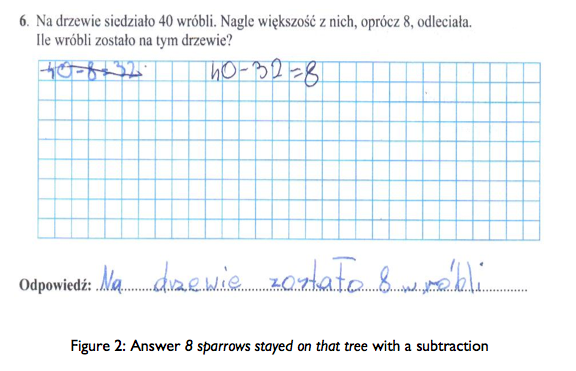
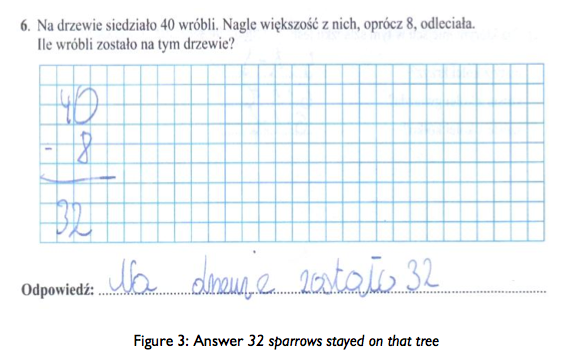
<p>&nbsp;</p>      <p align="left"> <font face="Verdana" size="2"> In another example, a mathematical operation appeared – the child calculated  mentally how many birds flew away and wrote down the subtraction whose result  confirmed the answer. This child tried to prove that the provided result was not  accidental.     <br> &nbsp;</font></p>     <p align="left"> <font face="Verdana" size="2"> However, almost half of the respondents – as much as 49.1% of the children  solved the problem by performing the subtraction as presented in the example  below.     ]]></body>
<body><![CDATA[<br></font></p>       <p>&nbsp;</p>  <img src="/img/revistas/inp/v4n1/4n1a04f3.jpg">     
<p>&nbsp;</p>       <p align="left"> <font face="Verdana" size="2"> The pupils used the numbers provided in the text of the problem. It was stated  that some of the sparrows flew away, so the subtraction has to be performed.&nbsp;  This is one of the many examples of typical mistakes made by children, which  proves that methodological stereotypes are present in the school practice and  popularized by teachers during the process of mathematical education. The  children are taught to solve the text problems not by looking for a solution for  the actual problem, but by performing the right calculation which has to utilize  all numbers provided in the text.     <br></font></p>     <p align="left"> <font face="Verdana" size="2"> Aside from subtraction, division can also be performed, as shown in the example  presented below: </font></p>     <p>&nbsp;</p> <a href ="/img/revistas/inp/v4n1/4n1a04f4.jpg">Figure 4</a>     
<p>&nbsp;</p>     <p align="left"> <font face="Verdana" size="2"> An interesting approach was found in the next example. The child came to the  conclusion that the authors of the test made an error in the text of the problem  and formulated the question in a wrong manner, so they needed to be corrected.  The child crossed out the question given in the test and entered his/her own  proposal, “How many sparrows flew away?” </font></p>      <p>&nbsp;</p> <a href ="/img/revistas/inp/v4n1/4n1a04f5.jpg">Figure 5</a>     
]]></body>
<body><![CDATA[<p>&nbsp;</p>      <p align="left"> <font face="Verdana" size="2"> It is also worth noting that in this example the child attempted a calculation –  subtracting &nbsp;the smaller number from the bigger one, but did not manage to do it  properly, so he/she drew a simple diagram which was the result of subtracting 8  from 40. </font></p>     <p align="left"> <font face="Verdana" size="2"> In order to verify the degree to which our research hypothesis, stating that  sources of that error are linked to the manner of teaching, would be confirmed,  in a subsequent run of the research a closed question was applied. </font></p>     <p align="left"> <font face="Verdana" size="2"> <i>There were 30 sparrows on the tree. Suddenly most of them flew away, apart  from 6.    <br> How many sparrows stayed on the tree?</i> </font></p>     <p align="left"> <font face="Verdana" size="2"> The children were given 4 answers to choose from:</font></p>     <blockquote> 	    <blockquote> 		    <p align="left"><font face="Verdana" size="2">    <br>A.5  		    ]]></body>
<body><![CDATA[<br>B.24     <br>C.6  		    <br>D.36 </font></p> 	</blockquote> </blockquote>     <p align="left"> <font face="Verdana" size="2">     <br> The results achieved were similar to the previous problem, asked in the open  form: A – 4% of answers, B-41.9%, C – 50.2%, D – 3.3%. Half of the children  provided the correct answer, but almost 42% made the same mistake as previously  – they performed subtraction with the use of numbers provided in the text. </font></p>     <p align="left"> <font face="Verdana" size="2"> Analysis of the solutions shows clearly that changes are required in the process  of teaching the children how to solve text-based tasks, because the results  achieved so far do not show that the manner of teaching mathematics supports the  development of the children’s thinking. Quite the contrary, the thinking schemes  are preserved by practicing typical tasks and exercises. This hypothesis is  additionally strengthened by the analysis of statements made by teachers during  the solving of text-based tasks in class. Here is one example.  </font></p>     <p align="left"> <font face="Verdana" size="2"> The teacher formulates instructions such as: </font></p>     <p align="left"> <font face="Verdana" size="2"> <i>Open your books on page 24, task 7.</i> </font></p>     <p align="left"> <font face="Verdana" size="2"> <i>Karol, will you read aloud for us?</i> </font></p>     <p align="left"> <font face="Verdana" size="2"> <i>What kind of data do we have in this task?</i>     ]]></body>
<body><![CDATA[<br> </font></p>     <p align="left"> <font face="Verdana" size="2"> <i>What kind of calculations do we have to apply? </i>    <br> <i>…</i>     <br> <i>Now we will do task number 9. This time we will have to multiply and divide. </i>    <br> </font></p>     <p align="left"> <font face="Verdana" size="2"> This means that his statements stress the search for the appropriate calculation  by the children – and not for the strategy to solve the problem contained in the  task. </font></p>     <p align="left"> <font face="Verdana" size="2"> The second example of a text task which I shall present here will enable better  understanding of the problem – also by describing the nature of mistakes made by  the pupils. </font></p>     <p align="left"> <font face="Verdana" size="2"> The children had to solve the following task: </font></p>     <p align="left"> <font face="Verdana" size="2"> <i>By the road where Camil lives trees were planted – &nbsp;one every 10 metres. The  first one at the beginning, the last one at the end of the road. The road is 130  metres long.    <br> How many trees were planted?</i>     ]]></body>
<body><![CDATA[<br></font></p>       <p>&nbsp;</p> <a href ="/img/revistas/inp/v4n1/4n1a04f6.jpg">Figure 6</a>     
<p>&nbsp;</p>       <p align="left"> <font face="Verdana" size="2"> Most of the respondents performed the wrong calculations, using the numbers  provided in the task. The children either divided or multiplied the numbers, as  in the examples below: </font></p>      <p>&nbsp;</p> <a href ="/img/revistas/inp/v4n1/4n1a04f7.jpg">Figure 7</a>     
<p>&nbsp;</p>     <p align="left"> <font face="Verdana" size="2"> Only a few percent of the children attempted to use a drawing to solve this  problem, in order to imagine the situation described in the task. This led them  to the correct solution.  </font></p>     <p align="left"> <font face="Verdana" size="2"> Below are two examples of tasks whose contents are similar to the previous ones,  but solved correctly with the use of drawings made by the children.     <br></font></p>       <p>&nbsp;</p> <a href ="/img/revistas/inp/v4n1/4n1a04f8.jpg">Figure 8</a>     
]]></body>
<body><![CDATA[<p>&nbsp;</p>       <p align="left"> <font face="Verdana" size="2"> 6. Along the road where Camil lives, 13 young trees were planted. The trees were  planted one every 10 metres, the first one at the beginning of the road and the  last one at the end. What is the length of the road?</font></p>        <p>&nbsp;</p> <a href ="/img/revistas/inp/v4n1/4n1a04f9.jpg">Figure 9</a>     
<p>&nbsp;</p>      <p align="left"> <font face="Verdana" size="2"> 9. Along the road where Camil lives, trees were planted, one every 10 metres.  The first tree was planted at the beginning of the road, the last one at the  end. The road is 150 metres long. How many trees were planted? </font></p>     <p align="left"> <font face="Verdana" size="2"> In both cases the children attempted to solve the problem contained in the task.  In the second example the solution does not involve a calculation, but uses a  drawing which shows the child’s way of thinking.     <br> </font></p>     <p align="left"> <font face="Verdana" size="2">     <br></font> <font face="Verdana"> <b>SUMMARY </b></font></p>     <p align="left"> <font face="Verdana" size="2">     ]]></body>
<body><![CDATA[<br> Analysis of the selected results of research conducted on Polish 9-year olds  regarding their mathematical skills suggest the presence of a very disturbing  phenomenon, of schematization of the children’s thinking already at the early  stages of school education. The teachers rarely offer the children the  opportunity to develop their own strategies for problem solving – they prefer to  provide the instruction for arriving at the solution, and next to practice that  skill on a series of typical tasks. This does not support the development of the  children’s independent thinking, rather locks them within existing schemes. The  educational practice is therefore closer to behavioural education models than to  cognitive constructivism or the cognitive approach. This is certainly a reason  for in-depth reflection on the ways of developing the children’s mathematical  skills, but also on the level of teachers’ training and on the relationship  between pedagogical theory and actual school practice. In order to increase  teaching quality at the early school stages, analysis of the research results is  required, and actions need to be undertaken that would change the school  practice in that respect. The paradox of the current educational situation lies  in the fact that the children have often better mastered those skills which the  school did not work on – and therefore did not deprive them of the creative  element in their thinking. This is confirmed by the international TIMMS (Trends  in International Mathematics and Science Study, 2012) (Mullis et al., 2012)  study of the mathematical, research and sciences skills, in which Poland  participated for the first time in 2011. The Polish third graders came out with  good results, above average in terms of data presentation (tables, charts,  pictograms) – however, they did not acquire those skills at school, similarly as  in the case of solving problem-based tasks. The national curriculum does not  cover data presentation (charts, tables) and problem based tasks. The emphasis  is put on calculation and practice in solving typical tasks following the given  pattern. However, one should be taken into account - the fact that the school  nowadays is only one source of education. Children learn a lot outside school,  especially via media, from different sources. The results achieved by Polish  pupils in the area of arithmetic (numbers and calculation) are below average –  and this is the type of skill that is practiced especially intensively at  school. The total result of Poland in TIMSS is not very optimistic; we achieved  34th place in maths, last in Europe, among 50 countries which participated in  this research. </font></p>     <p align="left"> <font face="Verdana" size="2"> The discrepancy is clearly visible but what is more, if we focus only on the  area of the national curriculum covered the result for Poland is still the same-  we come even lower in 35th place. It seems to prove the conclusion that maths  skills practice at school is not sufficiently well-mastered to achieve better  than average results. </font></p>     <p align="left"> <font face="Verdana" size="2"> The promotion of good educational practices is one of the ways of influencing  educational change. The creation of and support for groups of teachers who work  with children using the assumptions of constructivist theories should give  positive results over time.     <br></font></p>    <p>&nbsp;</p>     <p align="left">  <font face="Verdana"> <b>References</b>  </font></p> 	<font face="Verdana" size="2"> 	    <!-- ref --><p>Bruner, J. (1986). <i>Actual minds, possible worlds.</i> MA: Harvard University  Press.    &nbsp;&nbsp;&nbsp;&nbsp;&nbsp;&nbsp;&nbsp;&nbsp;[&#160;<a href="javascript:void(0);" onclick="javascript: window.open('/scielo.php?script=sci_nlinks&ref=1646133&pid=S2182-1372201400010000400001&lng=','','width=640,height=500,resizable=yes,scrollbars=1,menubar=yes,');">Links</a>&#160;]<!-- end-ref --></p>      <!-- ref --><p>D&#261;browski, M. (2009). <i>Research on the basic skills of a 9-year old in  language and mathematics. A third grade pupil and his/her teacher – report from  research 2008,</i> CKE Warsaw.    &nbsp;&nbsp;&nbsp;&nbsp;&nbsp;&nbsp;&nbsp;&nbsp;[&#160;<a href="javascript:void(0);" onclick="javascript: window.open('/scielo.php?script=sci_nlinks&ref=1646135&pid=S2182-1372201400010000400002&lng=','','width=640,height=500,resizable=yes,scrollbars=1,menubar=yes,');">Links</a>&#160;]<!-- end-ref --></p>      ]]></body>
<body><![CDATA[<!-- ref --><p>D&#261;browski, M. (2011).<i> The research on basic skills of 9-year old in language  and mathematics. Third grade pupil 2010,</i> CKE Warsaw 2011<i>.    &nbsp;&nbsp;&nbsp;&nbsp;&nbsp;&nbsp;&nbsp;&nbsp;[&#160;<a href="javascript:void(0);" onclick="javascript: window.open('/scielo.php?script=sci_nlinks&ref=1646137&pid=S2182-1372201400010000400003&lng=','','width=640,height=500,resizable=yes,scrollbars=1,menubar=yes,');">Links</a>&#160;]<!-- end-ref --></i>     <!-- ref --><br> Freudenthal, H. (1972). <i>Mathematics as an Educational Task. New York:</i>  Springer.    &nbsp;&nbsp;&nbsp;&nbsp;&nbsp;&nbsp;&nbsp;&nbsp;[&#160;<a href="javascript:void(0);" onclick="javascript: window.open('/scielo.php?script=sci_nlinks&ref=1646139&pid=S2182-1372201400010000400004&lng=','','width=640,height=500,resizable=yes,scrollbars=1,menubar=yes,');">Links</a>&#160;]<!-- end-ref --></p>      <!-- ref --><p>Mullis, I. V. S., Martin, M. O., Minnich, C. A., Tanco, G. M., Arora, A.,  Centurino, V. A. S. & Castle, C. E. (Eds.) (2012). <i>TIMSS 2011 Encyclopedia.  Education Policy and Curriculum in Mathematics and Sciences</i>. Boston: TIMSS &amp;  PIRLS Intenational Center, Lynch School of Education, Boston College.    &nbsp;&nbsp;&nbsp;&nbsp;&nbsp;&nbsp;&nbsp;&nbsp;[&#160;<a href="javascript:void(0);" onclick="javascript: window.open('/scielo.php?script=sci_nlinks&ref=1646141&pid=S2182-1372201400010000400005&lng=','','width=640,height=500,resizable=yes,scrollbars=1,menubar=yes,');">Links</a>&#160;]<!-- end-ref --></p>      <!-- ref --><p>Murawska, B. & &#379;ytko, M. (2012).<i> The research on basic skills of 9-year old  in language and mathematics. Pupil – his/her home and School.</i> CKE Warsaw.    &nbsp;&nbsp;&nbsp;&nbsp;&nbsp;&nbsp;&nbsp;&nbsp;[&#160;<a href="javascript:void(0);" onclick="javascript: window.open('/scielo.php?script=sci_nlinks&ref=1646143&pid=S2182-1372201400010000400006&lng=','','width=640,height=500,resizable=yes,scrollbars=1,menubar=yes,');">Links</a>&#160;]<!-- end-ref --></p>      <!-- ref --><p>&#379;ytko, M. & Dagiel, M. (2011). <i>School life reality&nbsp; in the rural areas.</i>  CKE Warsaw 2011.    &nbsp;&nbsp;&nbsp;&nbsp;&nbsp;&nbsp;&nbsp;&nbsp;[&#160;<a href="javascript:void(0);" onclick="javascript: window.open('/scielo.php?script=sci_nlinks&ref=1646145&pid=S2182-1372201400010000400007&lng=','','width=640,height=500,resizable=yes,scrollbars=1,menubar=yes,');">Links</a>&#160;]<!-- end-ref --></p> </font> </p>    ]]></body>
<body><![CDATA[<p>&nbsp;</p>     <p align="left"><font face="Verdana" size="2"> <b><a href="#topc0">Contacto</a><a name="c0"></a>: </b>Ma&#322;gorzata &#379;ytko, Mokotowska 16/20 00-561 Warsaw,  Poland </p>     <p>&nbsp;</p> (recebido em maio de 2013, aceite para publicação em janeiro de 2014)  </font></p>      ]]></body><back>
<ref-list>
<ref id="B1">
<nlm-citation citation-type="book">
<person-group person-group-type="author">
<name>
<surname><![CDATA[Bruner]]></surname>
<given-names><![CDATA[J.]]></given-names>
</name>
</person-group>
<source><![CDATA[Actual minds, possible worlds]]></source>
<year>1986</year>
<publisher-loc><![CDATA[MA ]]></publisher-loc>
<publisher-name><![CDATA[Harvard University Press]]></publisher-name>
</nlm-citation>
</ref>
<ref id="B2">
<nlm-citation citation-type="book">
<person-group person-group-type="author">
<name>
<surname><![CDATA[D&#261;browski]]></surname>
<given-names><![CDATA[M.]]></given-names>
</name>
</person-group>
<source><![CDATA[Research on the basic skills of a 9-year old in language and mathematics: A third grade pupil and his/her teacher - report from research 2008]]></source>
<year>2009</year>
<publisher-loc><![CDATA[Warsaw ]]></publisher-loc>
<publisher-name><![CDATA[CKE]]></publisher-name>
</nlm-citation>
</ref>
<ref id="B3">
<nlm-citation citation-type="book">
<person-group person-group-type="author">
<name>
<surname><![CDATA[D&#261;browski]]></surname>
<given-names><![CDATA[M.]]></given-names>
</name>
</person-group>
<source><![CDATA[The research on basic skills of 9-year old in language and mathematics: Third grade pupil 2010]]></source>
<year>2011</year>
<month>20</month>
<day>11</day>
<publisher-loc><![CDATA[Warsaw ]]></publisher-loc>
<publisher-name><![CDATA[CKE]]></publisher-name>
</nlm-citation>
</ref>
<ref id="B4">
<nlm-citation citation-type="book">
<person-group person-group-type="author">
<name>
<surname><![CDATA[Freudenthal]]></surname>
<given-names><![CDATA[H.]]></given-names>
</name>
</person-group>
<source><![CDATA[Mathematics as an Educational Task]]></source>
<year>1972</year>
<publisher-loc><![CDATA[New York ]]></publisher-loc>
<publisher-name><![CDATA[Springer]]></publisher-name>
</nlm-citation>
</ref>
<ref id="B5">
<nlm-citation citation-type="book">
<person-group person-group-type="author">
<name>
<surname><![CDATA[Mullis]]></surname>
<given-names><![CDATA[I. V. S.]]></given-names>
</name>
<name>
<surname><![CDATA[Martin]]></surname>
<given-names><![CDATA[M. O.]]></given-names>
</name>
<name>
<surname><![CDATA[Minnich]]></surname>
<given-names><![CDATA[C. A.]]></given-names>
</name>
<name>
<surname><![CDATA[Tanco]]></surname>
<given-names><![CDATA[G. M.]]></given-names>
</name>
<name>
<surname><![CDATA[Arora]]></surname>
<given-names><![CDATA[A.]]></given-names>
</name>
<name>
<surname><![CDATA[Centurino]]></surname>
<given-names><![CDATA[V. A. S.]]></given-names>
</name>
<name>
<surname><![CDATA[Castle]]></surname>
<given-names><![CDATA[C. E.]]></given-names>
</name>
</person-group>
<source><![CDATA[TIMSS 2011 Encyclopedia: Education Policy and Curriculum in Mathematics and Sciences]]></source>
<year>2012</year>
<publisher-loc><![CDATA[Boston ]]></publisher-loc>
<publisher-name><![CDATA[TIMSS & PIRLS Intenational Center, Lynch School of Education, Boston College]]></publisher-name>
</nlm-citation>
</ref>
<ref id="B6">
<nlm-citation citation-type="book">
<person-group person-group-type="author">
<name>
<surname><![CDATA[Murawska]]></surname>
<given-names><![CDATA[B.]]></given-names>
</name>
<name>
<surname><![CDATA[&#379;ytko]]></surname>
<given-names><![CDATA[M.]]></given-names>
</name>
</person-group>
<source><![CDATA[The research on basic skills of 9-year old in language and mathematics: Pupil - his/her home and School]]></source>
<year>2012</year>
<publisher-loc><![CDATA[Warsaw ]]></publisher-loc>
<publisher-name><![CDATA[CKE]]></publisher-name>
</nlm-citation>
</ref>
<ref id="B7">
<nlm-citation citation-type="book">
<person-group person-group-type="author">
<name>
<surname><![CDATA[&#379;ytko]]></surname>
<given-names><![CDATA[M.]]></given-names>
</name>
<name>
<surname><![CDATA[Dagiel]]></surname>
<given-names><![CDATA[M.]]></given-names>
</name>
</person-group>
<source><![CDATA[School life reality in the rural areas]]></source>
<year>2011</year>
<publisher-loc><![CDATA[Warsaw ]]></publisher-loc>
<publisher-name><![CDATA[CKE]]></publisher-name>
</nlm-citation>
</ref>
</ref-list>
</back>
</article>