<?xml version="1.0" encoding="ISO-8859-1"?><article xmlns:mml="http://www.w3.org/1998/Math/MathML" xmlns:xlink="http://www.w3.org/1999/xlink" xmlns:xsi="http://www.w3.org/2001/XMLSchema-instance">
<front>
<journal-meta>
<journal-id>2182-3030</journal-id>
<journal-title><![CDATA[CIDADES, Comunidades e Territórios]]></journal-title>
<abbrev-journal-title><![CDATA[CIDADES]]></abbrev-journal-title>
<issn>2182-3030</issn>
<publisher>
<publisher-name><![CDATA[DINÂMIA'CET-IUL, Centro de Estudos sobre a Mudança Socioeconómica e o Território]]></publisher-name>
</publisher>
</journal-meta>
<article-meta>
<article-id>S2182-30302016000200011</article-id>
<article-id pub-id-type="doi">10.15847/citiescommunitiesterritories.dec2016.033.art09</article-id>
<title-group>
<article-title xml:lang="en"><![CDATA[Recording the optimistic: An audiovisual approach to the city of Lisbon by its architecture school in the 1980s]]></article-title>
</title-group>
<contrib-group>
<contrib contrib-type="author">
<name>
<surname><![CDATA[Silva]]></surname>
<given-names><![CDATA[Leonor Matos]]></given-names>
</name>
</contrib>
</contrib-group>
<aff id="A01">
<institution><![CDATA[,ISCTE-IUL, Instituto Universitário de Lisboa DINÂMIA'CET-IUL, Instituto Universitário de Lisboa ]]></institution>
<addr-line><![CDATA[ ]]></addr-line>
</aff>
<pub-date pub-type="pub">
<day>31</day>
<month>12</month>
<year>2016</year>
</pub-date>
<pub-date pub-type="epub">
<day>31</day>
<month>12</month>
<year>2016</year>
</pub-date>
<numero>33</numero>
<fpage>144</fpage>
<lpage>157</lpage>
<copyright-statement/>
<copyright-year/>
<self-uri xlink:href="http://scielo.pt/scielo.php?script=sci_arttext&amp;pid=S2182-30302016000200011&amp;lng=en&amp;nrm=iso"></self-uri><self-uri xlink:href="http://scielo.pt/scielo.php?script=sci_abstract&amp;pid=S2182-30302016000200011&amp;lng=en&amp;nrm=iso"></self-uri><self-uri xlink:href="http://scielo.pt/scielo.php?script=sci_pdf&amp;pid=S2182-30302016000200011&amp;lng=en&amp;nrm=iso"></self-uri><abstract abstract-type="short" xml:lang="en"><p><![CDATA[With the revolution of 25 April 1974, Portugal initiated a unique cultural journey that paralleled, in the architectural field, the questioning of the modern movement that occurred since the aftermath of World War II. The academic context was a particular mirror for this criticism. The director of the Lisbon architecture course pronounced its engagement in "a sort of counter-culture"; the cultural critique that occurred, however, was more of a fortunate accident. In fact, an optimistic post-traumatic euphoria was a common element in some of the most radical pedagogical expressions that took place. In the face of the 'creative' productions that unfolded under the Lisbon architecture school in the 1980s, we acknowledge an unconventional form of expression that leads us to question whether a particular identity frame has characterised Portuguese architectural culture and its interrelation with the city of Lisbon ever since. This paper provides evidence for such a claim by examining previously untapped primary sources - testimonies and documents - that relate directly to Lisbon's architecture course between 1976 and 1986 and which have informed background research for a PhD. Three videos from the School's archives were analysed to demonstrate how students related to the topic of urbanity, specifically that of Lisbon, via this particular form of art.]]></p></abstract>
<kwd-group>
<kwd lng="en"><![CDATA[Architectural education]]></kwd>
<kwd lng="en"><![CDATA[Lisbon]]></kwd>
<kwd lng="en"><![CDATA[audiovisual]]></kwd>
<kwd lng="en"><![CDATA[video]]></kwd>
<kwd lng="en"><![CDATA[faculty of architecture]]></kwd>
<kwd lng="en"><![CDATA[contemporary architectural culture]]></kwd>
</kwd-group>
</article-meta>
</front><body><![CDATA[ <p align="right"><font face="Verdana" size="2"><b>ARTIGO    ORIGINAL</b></font></p>     <p align="right"></p>     <p>&nbsp;</p> <b><font face="Verdana" size="4"><b>Recording the optimistic.  An audiovisual approach to the city of Lisbon by its architecture school in the 1980s. </b></font></b> </p>     <p>&nbsp;</p>     <p></p>     <p><b><font face="Verdana" size="2">Leonor Matos Silva<a name="top1" id="top1"></a><a href="#1">I</a><sup> </sup></font><font size="2" face="Verdana, Arial, Helvetica, sans-serif">[<a name="top2" id="top2"></a><a href="#2">2</a>]</font><font face="Verdana" size="2"><sup><br /> </sup></font></b></p>     <p><font size="4" face="Verdana, Arial, Helvetica, sans-serif"><font size="2" face="Verdana, Arial, Helvetica, sans-serif"><a name="1" id="1"></a>[<a href="#top1">I</a>]</font></font><font size="2" face="Verdana">DIN&Acirc;MIA'CET-IUL, Instituto Universit&aacute;rio de Lisboa, Portugal. e-mail: <a href="mailto:leonorcms@gmail.com">leonorcms@gmail.com</a></font><font size="2" face="Verdana, Arial, Helvetica, sans-serif">.<br /> </font><br /> </p>    <p>&nbsp;</p>     <p><font size="2" face="Verdana, Arial, Helvetica, sans-serif"><br />   </font><br /> </p> <hr size="1" noshade="noshade" />     <p><b><font face="Verdana, Arial, Helvetica, sans-serif" size="2">ABSTRACT</font></b></p>     ]]></body>
<body><![CDATA[<p><font face="Verdana, Arial, Helvetica, sans-serif" size="2">With the revolution of 25 April 1974, Portugal initiated a unique cultural journey that paralleled, in the architectural field, the questioning of the modern movement that occurred since the aftermath of World War II. The academic context was a particular mirror for this criticism. The director of the Lisbon architecture course pronounced its engagement in &quot;a sort of counter-culture&quot;; the cultural critique that occurred, however, was more of a fortunate accident.  In fact, an optimistic post-traumatic euphoria was a common element in some of the most radical pedagogical expressions that took place. In the face of the 'creative' productions that unfolded under the Lisbon architecture school in the 1980s, we acknowledge an unconventional form of expression that leads us to question whether a particular identity frame has characterised Portuguese architectural culture and its interrelation with the city of Lisbon ever since. This paper provides evidence for such a claim by examining previously untapped primary sources - testimonies and documents - that relate directly to Lisbon's architecture course between 1976 and 1986 and which have informed background research for a PhD. Three videos from the School's archives were analysed to demonstrate how students related to the topic of urbanity, specifically that of Lisbon, via this particular form of art..  </font></p>     <p><font face="Verdana, Arial, Helvetica, sans-serif" size="2"><b>Keywords:</b>    </font><font face="Verdana, Arial, Helvetica, sans-serif" size="2">Architectural education; Lisbon; audiovisual; video; faculty of architecture; contemporary architectural culture.</font></p> <hr size="1" noshade="noshade" />     <p>&nbsp;</p>      <p> 	<font size="2" face="Verdana, Arial, Helvetica, sans-serif">In 1974, after 48 years of dictatorship, Portugal entered a new era of 	democracy. The post-revolutionary period presented a unique opportunity for 	debate and transformation in the university sector, and Lisbon's architecture school is an ideal example of this phenomenon.</font></p>     <p><font size="2" face="Verdana, Arial, Helvetica, sans-serif"> 	This essay has its origins in an ongoing PhD research project that is 	investigating the importance of the ten years that followed a revolution in 	the architecture course of the Superior School of Fine Arts in Lisbon. In 	this thesis, it will be argued that the School has had a profound though 	largely unnoticed impact on Portugal's cultural history. This proposition 	will in part be supported by an account of some relevant initiatives that 	were taken in the period from 1976, when classes restarted, to 1986, when 	the 1957 curriculum was taught for the last time and the Superior School 	gave way to the autonomous Faculty of Architecture. The analysis presented 	here derives from an in-depth study of one of these initiatives: the conception, creation and materialisation of an audiovisual section	[<a name="top3" id="top3"></a><a href="#3">3</a>] within the School. The 	implementation of an audiovisual approach to the city of Lisbon by its 	architecture school, we argue, supports our belief that the city of Lisbon 	itself became a dominant setting and object of study in the school's 	educational programme after the revolution of 25 April 1974. </font></p>     <p><font size="2" face="Verdana, Arial, Helvetica, sans-serif"> 	The ultimate purpose of this essay is to present some of its academic works 	in the context of a critical analysis of the School's phenomenology in the 	period under consideration. In the first section, we address some of the 	social and political factors that led to the creation of a 'video section' 	in the School, in 1982. In the second section, we focus on three videos 	selected from the present Faculty of Architecture's Multimedia Centre's 	collection [<a name="top4" id="top4"></a><a href="#4">4</a>], considering 	(1) authorship (by one or more architecture students) and (2) date of 	production (between 1980 and 1990). In the conclusion, we will argue that 	these objects denote both an underlying cultural awakening and a general 	sense of optimism. </font></p>     <p>&nbsp;</p>     <p> 	<font size="3" face="Verdana, Arial, Helvetica, sans-serif"><b>1. </b> 	<b> The Lisbon School of Architecture in the 1980s - A cultural insight	</b> </font></p>     <p><font size="2" face="Verdana, Arial, Helvetica, sans-serif"> 	Throughout the 20th century and until the mid-1980s, the official teaching 	of architecture was confined to the Superior School of Fine Arts in Lisbon 	and its counterpart in Oporto. Therefore, when a revolution erupted, the 	suspension of classes in the Lisbon school's first section (architecture 	course) had a major social impact (Silva, 2011). Student general assemblies 	vigorously debated the installation of democratic rule (ESBAL, 1974). The 	detachment of the architecture course from the second section (painting and 	sculpture courses) and the creation of two separate departments was one of the controversial issues, since it set the practical framework for how the	<i>beaux-arts</i> pedagogical system should be revaluated (Taveira, 	2014). An alternative proposal, put forward by Nuno Portas, was to 	establish a new school. This proposal, which became the main polemic 	(Fernandes, 2013), gained legitimacy because it was supported by the fifth 	transitory government [<a name="top5" id="top5"></a><a href="#5">5</a>]. 	Portas proposed the elimination of the first section, implying a turnaround 	in the existing pedagogical structure. In 1976, however, architecture 	classes officially reopened under a legal Dispatch (FAUL, 1976), issued 	under the sixth government [<a name="top6" id="top6"></a><a href="#6">6</a>], that repudiated this attempt by mirroring the outcome of the revolution 	within the School, favouring the School's internal prominent political 	faction. </font></p>     <p><font size="2" face="Verdana, Arial, Helvetica, sans-serif"> 	This option, on the one hand, would ensure continuity, since it 	acknowledged the creation of an architecture department within the 	pre-revolutionary purpose of integration in universities (George, 1982:17). 	On the other hand, this outcome would represent an exception that needs to 	be clarified. </font></p>     ]]></body>
<body><![CDATA[<p><font size="2" face="Verdana, Arial, Helvetica, sans-serif"> 	Among the factors that support the singularity of this period, one is 	particularly significant in the context of the present video analysis. 	Although the Architecture Department (DA) would become a Faculty of 	Architecture (FA) integrated with the Technical University of Lisbon in 	1979 [<a name="top7" id="top7"></a><a href="#7">7</a>], the School's 	facilities continued to be based in Saint Francis Convent, at Chiado, 	Lisbon, until December 1993 (FAUL, 1994). It therefore had a close 	relationship with the other fine arts courses, sharing the medieval 	building with the historical city as background. This meant that the Lisbon 	School of architecture developed its own identity even though, in practice, 	it 'followed the line' of a single director and did not engage in a participative form of management, as suggested in the 1974 discussions	[<a name="top8" id="top8"></a><a href="#8">8</a>]. In the present context, 	it is important to be aware that the revolutionary debate of the mid-1970s 	had little impact, although the School's embeddedness within the external  	cultural environment, and the conduct of the institution's leader, were 	significant. </font></p>     <p><font size="2" face="Verdana, Arial, Helvetica, sans-serif"> Augusto Brand&#227;o's role in the direction taken by the Lisbon school of 	architecture from 1975 to 1992 is of particular importance for this 	analysis. Research has shown that, in terms of leadership, he understood 	where and how he could play an effective role. In some ways, he was a step 	ahead of his time; in hindsight, his actions mark him out as a strategist 	and visionary [<a name="top9" id="top9"></a><a href="#9">9</a>]. </font></p>     <p><font size="2" face="Verdana, Arial, Helvetica, sans-serif"> During the 1974 crisis, Brand&#227;o became a staunch supporter of 	Frederico George, a senior professor who was the only academic capable of 	uniting all the internal political factions. George's support, in turn, was 	essential if Brand&#227;o was to successfully advocate for the re-opening 	of the course. From then on, although George assumed the formal leadership 	position, Brand&#227;o effectively managed the School. By 1986, when 	Portugal entered the European Economic Community (EEC) and architectural education was liberalised [<a name="top10" id="top10"></a><a href="#10">10</a>], Augusto Brand&#227;o had unquestionably been the School's core. </font></p>     <p><font size="2" face="Verdana, Arial, Helvetica, sans-serif"> In respect to the institution's formal structure, he had chosen to 	administer it &quot;like an enterprise&quot; (Brand&#227;o, 1981). Having sensed 	early on the cultural environment into which the School was going to 	emerge, Brand&#227;o engaged in 'liberal' conduct. He was supportive of 	many teachers' agendas [<a name="top11" id="top11"></a><a href="#11">11</a>]and of requests from students, individually or as a group	[<a name="top12" id="top12"></a><a href="#12">12</a>]. He would positively 	favour rival parties (Silva, 2015), encouraging the school population to acknowledge his 'inclusive' tactics	[<a name="top13" id="top13"></a><a href="#13">13</a>]. </font></p>     <p><font size="2" face="Verdana, Arial, Helvetica, sans-serif"> Brand&#227;o understood the risks of following liberalism's fundamental principle of taking account of minorities [<a name="top14" id="top14"></a><a href="#14">14</a>]; that is, he knew that 	adopting a <i>laissez-faire</i> approach would open the way to 	experimentation and to getting it wrong, or not getting it done at all, 	which ultimately led to peer disrespect. Order was important, as was clear 	in several formal school activity plans (e.g. FAUL, 1982). Brand&#227;o 	would eventually adopt an aggressive external discourse, providing an 	official narrative to justify his 'liberal' course of action. For instance, 	as early as 1981, he claimed to the media that the School was engaged in &quot;a sort of counterculture&quot;: </font></p>     <p><font size="2" face="Verdana, Arial, Helvetica, sans-serif"> By intervening actively in the city of Lisbon, the School creates a sort of 	counterculture, since it calls into question the existing architectural 	culture. &#8230; That is the renewing vitality that turns a university institution into an unsatisfied and globally critical one. [<a name="top15" id="top15"></a><a href="#15">15</a>](Brand&#227;o, 1981) </font></p>     <p><font size="2" face="Verdana, Arial, Helvetica, sans-serif"> 	Various official statements from the 1980s all suggest the same: on the one 	hand, an official branding for the Lisbon school; on the other hand, a reaction against the cultural hegemony of the Oporto school	[<a name="top16" id="top16"></a><a href="#16">16</a>]. As previously 	explained, Brand&#227;o's agenda in relation to self-image was essentially 	reactive: If the smaller Oporto school was culturally prestigious because 	its size gave it a kind of elite status then the Lisbon school's 	pedagogical openness - either intentional or accidental - was a reasonable image to project. </font></p>     <p><font size="2" face="Verdana, Arial, Helvetica, sans-serif"> The post-revolutionary Lisbon school of architecture faced complex 	problems, of which education was just one. In this context, if 	individuality, free enterprise, experiment, novelty, and the like helped 	the institution to stand out, Brand&#227;o would support them. In the 	absence of consistent disciplinary roots, the outcome of this 'liberal' 	conduct was, in the end, incoherent, resulting mostly in architectural 	styling, pedagogical disintegration and favouritism. Being essentially 	undisciplined, some radical pedagogies that emerged spontaneously in this 	context actually represent brief signs of a cultural shock, desynchronised 	from the 1960s[<a name="top17" id="top17"></a><a href="#17">17</a>]. </font></p>     <p><font size="2" face="Verdana, Arial, Helvetica, sans-serif"> Brand&#227;o's conception of a video section (FAUL, 1982) [<a name="top18" id="top18"></a><a href="#18">18</a>] is a good example of a 	cultural accomplishment that shows, if nothing else, that he intended to be technologically and culturally up-to-date	[<a name="top19" id="top19"></a><a href="#19">19</a>]. This, together with 	the students' artistic drive, would lead the architecture school to 	resemble a forum - something akin to a video store. This idea is well 	expressed by Richard Brody (2015) in his account of Tom Roston's essay I 	Lost It At the Video Store: A Filmmakers' Oral History of a Vanished Era. 	He compares the film-school generation of Scorsese, De Palma, Spielberg and 	Lucas with the French New Wave, suggesting an underlying dialectic between 	the orderly educational system and &quot;autodidactic methods&quot;. Since the Lisbon 	architecture school's 'video section' did not adopt a specific didactic 	programme, comparing a video store with a film school is like comparing an 	architecture school with architectural practices; in those days, students worked in both: </font></p>     <p><font size="2" face="Verdana, Arial, Helvetica, sans-serif"> 	Then, when these younger filmmakers went to film school, video stores were 	a kind of counter-programming, an assertion of values and of personalities 	different from those found in their studies. They exalted the anti-academic 	values of disorder, spontaneity, and enthusiasm. (Brody, 2015) </font></p>     ]]></body>
<body><![CDATA[<p><font size="2" face="Verdana, Arial, Helvetica, sans-serif"> 	In fact, while actual architecture education was practised in real life - 	mostly in offices with senior architects in charge - then the Lisbon 	architecture school represented a site that proposed an implicit radical 	pedagogy. On another level, if participating in an architecture course was 	an autodidactic experience, then learning was about the amount of 	engagement and satisfaction one extracted from its possibilities. In the 	end, the question of optimism was decisive for a cultural embedment within 	the Lisbon school in the 1980s. </font></p>     <p><font size="2" face="Verdana, Arial, Helvetica, sans-serif"> By 1984, the 'video sector' was already in the habit of living in the 	present, that is, major events were recorded with no long-term purpose. It 	is precisely this practice of recording &quot;everything&quot;, regardless of its 	immediate utility, that makes today's archive an important testimony to 	this optimism.[<a name="top20" id="top20"></a><a href="#20">20</a>]</font></p>     <p>&nbsp;</p>     <p><font size="3" face="Verdana, Arial, Helvetica, sans-serif"><b>2. </b>   <b>Recording the optimistic - Video Analysis</b> </font></p>     <p><font size="2" face="Verdana, Arial, Helvetica, sans-serif"> 	The methodology for the present study of FAUL's archives involved 	collecting all material that would, firstly, generate better understanding 	of the institution's history and, secondly, identify a focal area. To that 	end, we began by reviewing all of the video production listings and 	previewing a sample of those that seemed relevant and interesting. The 	video archive, however, contained little information about the production 	of any of the materials from the 1980s. The credits make reference to 	title, authorship and date, but these are all questionable. Nonetheless, 	the materials presented here contain significant information in their own 	right. Aside from the content of the creative videos (we did not include 	films of conferences or classes), the fact that they do not comprise a 	coherent assemblage of work supports the optimism thesis, in the sense that 	they were not subject to quality controls or standardisation, although some 	might have been cut from the archive to reduce its size along the way. </font></p>     <p><font size="2" face="Verdana, Arial, Helvetica, sans-serif"> 	The criteria for inclusion of particular videos in this collection were: 	they all had a number of features in common and therefore represented a 	unique group in the archive's legacy; they were executed in the 1980s; and 	there was reason to hypothesise that they were grounded in a scholarly 	experience of celebration (although this was sometimes distorted by the 	aesthetics of the film itself, as we will see). Specifically, for the 	following analysis, the videos were selected according to three main common features: having the 'historical city' as a subject	[<a name="top21" id="top21"></a><a href="#21">21</a>]; being informed by 	experimentalism; and having a contemporaneous character. </font></p>     <p><font size="2" face="Verdana, Arial, Helvetica, sans-serif"> 	1. </font></p>     <p><font size="2" face="Verdana, Arial, Helvetica, sans-serif"> Title: Tedium [Original: T&#233;dio] </font></p>     <p><font size="2" face="Verdana, Arial, Helvetica, sans-serif"> Authorship: Ant&#243;nio Rocha </font></p>     <p><font size="2" face="Verdana, Arial, Helvetica, sans-serif"> Collaboration: Maria Jo&#227;o Ara&#250;jo </font></p>     ]]></body>
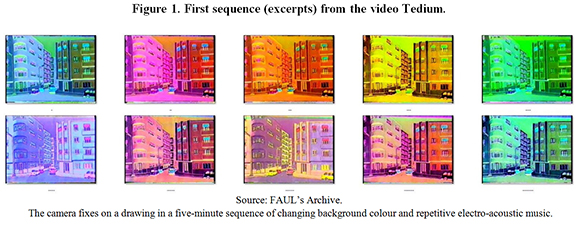
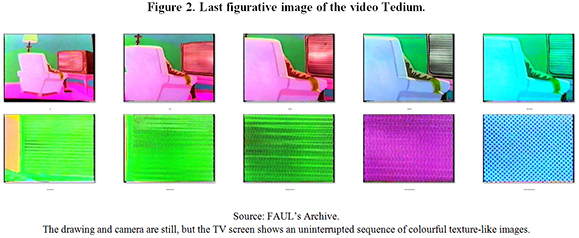
<body><![CDATA[<p><font size="2" face="Verdana, Arial, Helvetica, sans-serif"> Music by: Epic Decline [original: Ocaso &#201;pico]; Author's nickname: 'Farinha' </font></p>     <p><font size="2" face="Verdana, Arial, Helvetica, sans-serif"> 	Year of production: 1983(?) </font></p>     <p><font size="2" face="Verdana, Arial, Helvetica, sans-serif"> Length: 20&#180;07 </font></p>     <p><font size="2" face="Verdana, Arial, Helvetica, sans-serif"> 	Type of film: Animation (Archived as School Work) </font></p>     <p><font size="2" face="Verdana, Arial, Helvetica, sans-serif"> 	Description: </font></p>     <p><font size="2" face="Verdana, Arial, Helvetica, sans-serif"> 	This video comprises a series of drawings organised as a story board and 	filmed with a fixed camera that zooms in and out. A colour filter and a 	strong soundtrack were added in post-production. It is divided into two 	parts: the first is an introspective narrative and the second is more 	experimental. </font></p>     <p><font size="2" face="Verdana, Arial, Helvetica, sans-serif"> 	The first drawing shows a stylised Portuguese modernist neighbourhood. 	There is insufficient information to determine whether it is central 	European modern (1930s generation) or late modern. The importance of this 	drawing is, precisely, the imaginary city - where all modernisms converge 	into one, and all influences and idealisms add up to minimal expression. 	Hence, modernism is an historical aspect here, an imaginary past, and not a 	purpose. In that sense, this animation feature could be grounded in the 	historical city of Lisbon, which was a basic urban reference for all 	students at the Lisbon school of architecture. </font></p>     <p><font size="2" face="Verdana, Arial, Helvetica, sans-serif"> The first five minutes have a long, monotonous soundtrack. The fixed image 	is partly dynamic because of a rapidly changing colour range, which 	introduces an element of suspense and the expectation of a narrative to 	come (<a href="#f1">Figure 1</a>). The next frame marks a shift to the interior of an 	apartment via movement of the camera over a drawing that includes a street, 	a building fa&#231;ade and an open window. A new image shows the interior 	of the apartment: the back of a sofa turned to a TV screen, where a man 	seems to be sitting and smoking. (We get to see only his foot and hand) (<a href="#f2">Figure 2</a>). </font></p>     <p>&nbsp;</p> <a name="f1" id="f1"></a><img src="/img/revistas/cct/n33/n33a11f1.jpg" />     
<p>&nbsp;</p> <a name="f2" id="f2"></a><img src="/img/revistas/cct/n33/n33a11f2.jpg" />     
]]></body>
<body><![CDATA[<p>&nbsp;</p>     <p><font size="2" face="Verdana, Arial, Helvetica, sans-serif"> 	The second half of this video starts when the camera zooms in to the TV 	screen, after which the viewer is presented with eleven minutes of 	'textures'- cloths, wall paper or construction surfaces. At first, these 	images induce a psychedelic impression, but gradually formalise into 	identifiable objects, such as flowers. </font></p>      <p><font size="2" face="Verdana, Arial, Helvetica, sans-serif"> 	In the second half of this first experience, all connection with 	architecture ceases and the video merely explores the technical and 	artistic potential of the medium (zoom in/zoom out, colour range, 	soundtrack). </font></p>     <p><font size="2" face="Verdana, Arial, Helvetica, sans-serif"> 	At this point, an appropriate question would be: If this film were to be 	found away from the archive of the Lisbon school of architecture, what does 	it relate to? One possibility is that it is a 'telefilm', as the author 	describes it in the beginning; that is, a film produced to appear on a TV 	screen. In that case, although very close to computational imaging, it 	would have an animation or music video purpose. </font></p>     <p><font size="2" face="Verdana, Arial, Helvetica, sans-serif"> Nonetheless, the final product also has the appearance of video art. Although there was at that time &quot;scarcely any interest in multimedia&quot;[<a name="top22" id="top22"></a><a href="#22">22</a>](Pinharanda, 1995: 	626), Ernesto de Sousa had presented videos in his art performances as 	early as the 1970s and, in 1985, just two years after it was founded, the 	Modern Art Centre of the Gulbenkian Foundation (CAM) in Lisbon had also 	supported a two-week multimedia event involving a number of artistic and 	technological performances. </font></p> <font size="2" face="Verdana, Arial, Helvetica, sans-serif">An analogy that could help to clarify the influence of contemporary pop 	culture on the scholarly environment is <i>Money for Nothing</i>, a 1985 	Dire Straits' music video (Barron, 1986). Part of <i>Tedium</i>'s imagery 	is connected to it[<a name="top23" id="top23"></a><a href="#23">23</a>]. 	Furthermore, <i>Money for Nothing</i> represented an overvalued prospect 	of prosperity that had not existed before MTV - a sign of social optimism 	that would be portrayed by music video clips and by video broadcasting itself [<a name="top24" id="top24"></a><a href="#24">24</a>]. In	<i>Tedium</i>, by contrast, the light image of optimism is avoided: 	colour and music are aggressively varied and dense. Its title was probably 	added after it was produced, as in a viewer warning. This video nonetheless 	shows the meaning of initiative and optimism in a practical sense, 	regardless of the object's substance.</font></p>     <p><font size="2" face="Verdana, Arial, Helvetica, sans-serif"> 	2. </font></p>     <p><font size="2" face="Verdana, Arial, Helvetica, sans-serif"> 	Title: The Place Where I Was Born [Original: O Lugar Onde Nasci] </font></p>     <p><font size="2" face="Verdana, Arial, Helvetica, sans-serif"> 	Authorship: Paolo Sousa and Margarida Corvo </font></p>     <p><font size="2" face="Verdana, Arial, Helvetica, sans-serif"> 	Year of production: 1988 </font></p>     <p><font size="2" face="Verdana, Arial, Helvetica, sans-serif"> Length: 20&#180;52 </font></p>     ]]></body>
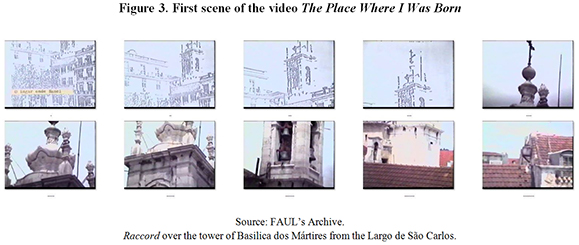
<body><![CDATA[<p><font size="2" face="Verdana, Arial, Helvetica, sans-serif"> 	Type of film: Documentary (Archived as School Work) </font></p>     <p><font size="2" face="Verdana, Arial, Helvetica, sans-serif"> 	Description: </font></p>     <p><font size="2" face="Verdana, Arial, Helvetica, sans-serif"> The first scene of this video is the filming of a reproduction (photocopy) 	of the Largo de S&#227;o Carlos (Saint Charles' Square) during which a 	fixed camera zooms in to the rear tower of Basilica dos Mártires. The 	transition to the second scene - the streets of Lisbon - is accomplished 	through a <i>raccord</i> (match cut) over this tower (<a href="#f3">Figure 3</a>). From 	then on, the video combines footage of the city of Lisbon's historical 	sites with frames of posters of each of the School works that were exhibited under the title &quot;The City of Pessoa&quot;. </font></p>     <p>&nbsp;</p> <a name="f3" id="f3"></a><img src="/img/revistas/cct/n33/n33a11f3.jpg" />     
<p>&nbsp;</p>     <p><font size="2" face="Verdana, Arial, Helvetica, sans-serif"> Fernando Pessoa was a famous poet born in Largo de S&#227;o Carlos in 1888. 	Therefore this video (and the School works) probably had as its theme the 	city where the poet lived his everyday life, i.e., the historical city of Lisbon. </font></p>     <p><font size="2" face="Verdana, Arial, Helvetica, sans-serif"> The Largo de S&#227;o Carlos is a favourite film location, followed by the 	Chiado, as well as Baixa and some areas of the waterfront such as Santa Apol&#243;nia and Bel&#233;m. </font></p>     <p><font size="2" face="Verdana, Arial, Helvetica, sans-serif"> 	The video is 20 minutes long, almost all of which is recorded with a 	hand-held camera. Anonymous people and transport, and modernist Portuguese 	architecture, figure prominently in the city. </font></p>     <p><font size="2" face="Verdana, Arial, Helvetica, sans-serif"> 	The recorded images are very dynamic, indicating extensive post-assembly 	work in which interior and exterior images alternate. The interior shots 	were made with a fixed camera focused on the panels of School work that 	displayed photographs and photocopies of a real and imaginary city of 	Pessoa. </font></p>     <p><font size="2" face="Verdana, Arial, Helvetica, sans-serif"> 	The music is smooth jazz, in the style of the time. Sometimes it becomes 	less even in character, seemingly synchronising with images that correspond 	to the invigorated Lisbon city of the 1980s, teeming with people and 	traffic. </font></p>      ]]></body>
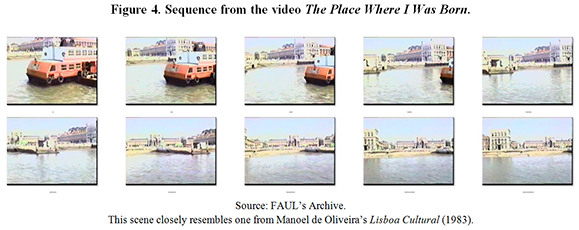
<body><![CDATA[<p><font size="2" face="Verdana, Arial, Helvetica, sans-serif"> 	Although architecture provided the motivation for this piece and it was 	produced within an architectural pedagogical context, architecture and the 	city are clearly excuses to experiment with film. In that sense, it is an 	experimental film. The students are, in fact, trying to explore their 	script and the techniques they know - the <i>raccord</i> being one of 	them - and, possibly, drawing on their cultural references (<a href="#f4">Figure 4</a>). The 	video camera is not used to interpret the occupying space or to substitute 	for it (for instance, in brainstorming sessions) as part of the design 	process. Rather, it is an instrument for registering and documenting the 	architect's previously gathered ideas and self-conception of the object he 	is filming - here, the urban space. Therefore, it could be characterised as 	a documentary film [<a name="top25" id="top25"></a><a href="#25">25</a>]. </font></p>     <p>&nbsp;</p> <a name="f4" id="f4"></a><img src="/img/revistas/cct/n33/n33a11f4.jpg" />     
<p>&nbsp;</p>      <p><font size="2" face="Verdana, Arial, Helvetica, sans-serif"> Filming the city, with its ever-present movement, is an old	[<a name="top26" id="top26"></a><a href="#26">26</a>] as well as a 	contemporary practice. In this film, movement and the metropolis are 	transmitting an idea of contemporaneity. The city of Lisbon, as the 	capital, is depicted to highlight its vibrancy and scale, but there is also 	a clear effort to present an image of psychological openness. Despite the 	narrow streets and traffic, openness is portrayed by the inclusion of views 	from elevated locations across the distant Tagus. These contrasts are part 	of the 1980s' idea of Lisbon as a new cosmopolitan centre, renewed after 	decades of shutdown. The ubiquity of the old and the dirty are merely 	details - optimism stands out, represented by the rapid transition between 	filming locations and emphasised by the sensual, sometimes vibrant musical 	soundtrack. </font></p>     <p><font size="2" face="Verdana, Arial, Helvetica, sans-serif"> 	3. </font></p>     <p><font size="2" face="Verdana, Arial, Helvetica, sans-serif"> Title: Harbour Station (Rocha de Conde de &#211;bidos) [original: Gare Mar&#237;tima (Rocha de Conde de &#211;bidos)] </font></p>     <p><font size="2" face="Verdana, Arial, Helvetica, sans-serif"> Director: Jos&#233; Gorj&#227;o Jorge </font></p>     <p><font size="2" face="Verdana, Arial, Helvetica, sans-serif"> Director's Assistant: Jo&#227;o Redondo </font></p>     <p><font size="2" face="Verdana, Arial, Helvetica, sans-serif"> Script: Lu&#237;sa Pacheco Marques e Jos&#233; Gorj&#227;o Jorge </font></p>     <p><font size="2" face="Verdana, Arial, Helvetica, sans-serif"> Texts: Lu&#237;sa Pacheco Marques, Jos&#233; Gorj&#227;o Jorge e Michel Toussaint </font></p>     ]]></body>
<body><![CDATA[<p><font size="2" face="Verdana, Arial, Helvetica, sans-serif"> Producer: Quev&#237;deo </font></p>     <p><font size="2" face="Verdana, Arial, Helvetica, sans-serif"> 	Year of production: 1990 </font></p>     <p><font size="2" face="Verdana, Arial, Helvetica, sans-serif"> Length: 16&#180;06 </font></p>     <p><font size="2" face="Verdana, Arial, Helvetica, sans-serif"> 	Type of film: Documentary (Archived as a Faculty of Architecture 	Production) </font></p>     <p><font size="2" face="Verdana, Arial, Helvetica, sans-serif"> 	Description: </font></p>     <p><font size="2" face="Verdana, Arial, Helvetica, sans-serif"> Among the three videos here examined, this is the best documented. Its 	credits are complete, and its history can be traced through old 	correspondence involving the Faculty of Architecture. We were also able to 	add the testimonies of Jos&#233; Gorj&#227;o Jorge, the film's director 	(assistant professor at the Lisbon school) and of Jo&#227;o Redondo, 	architecture student, who worked closely on the film as director's assistant. </font></p>     <p><font size="2" face="Verdana, Arial, Helvetica, sans-serif"> 	Although it is clearly a documentary film about an established city 	riverfront, it was described by the Faculty's director at the time as an 	'architecture film' (FAUL, 1990). This video is rigorously designed and 	carefully executed; it is, without doubt, an aesthetically pleasing and 	serious explanation of an architectural piece. The question of whether it 	is a film about an architecture piece or an 'architecture film' depends not 	only on the focal object, but also on the recording process - should the 	video represent the director's point of view of that specific work of 	architecture, or should the video camera be an extension of a 	three-dimensional live incursion into the historical city? </font></p>       <p><font size="2" face="Verdana, Arial, Helvetica, sans-serif"> 	As in the first video analysed in this essay, the film's experimental 	nature is reflected in its ability to make the Faculty of Architecture 	address a building in terms it had not used before; that is, video might 	have been used in the School environment since the early 1980s, but cameras 	had not previously been handled at this level of professionalism. </font></p>     <p><font size="2" face="Verdana, Arial, Helvetica, sans-serif"> 	This film is the product of a complex workforce, most of whom came from 	outside the School</font><font color="#FF0000" size="2" face="Verdana, Arial, Helvetica, sans-serif"><font color="#000000"> <a name="27" id="27"></a>[<a href="#top27">27]</a></font></font><font size="2" face="Verdana, Arial, Helvetica, sans-serif">, but 	it was unlikely to have been created if it had not been for the mind-set of the promoters from within. </font></p>     <p> <font size="2" face="Verdana, Arial, Helvetica, sans-serif"> 	Both its technical and architectonic elements justified sending the video 	to the FIFARC </font><font color="#FF0000" size="2" face="Verdana, Arial, Helvetica, sans-serif"><font color="#000000"><a name="28" id="28"></a>[<a href="#top28">28]</a></font></font> <font size="2" face="Verdana, Arial, Helvetica, sans-serif"> festival 	in France. Should all these steps - imagining the film, executing it, 	exposing it abroad - have actually been considered experimental, and not 	just circumstantial, then a 'video section' might have become consolidated 	from the 1990s on, based on what its Director at the time, Troufa Real, 	claimed as the School's &quot;interest (...) in continuing this video series 	about our architecture&quot;</font><font color="#FF0000" size="2" face="Verdana, Arial, Helvetica, sans-serif"><font color="#000000"><a name="29" id="29"></a>[<a href="#top29">29]</a></font></font><font size="2" face="Verdana, Arial, Helvetica, sans-serif"> (FAUL, 1990).</font> </p>       ]]></body>
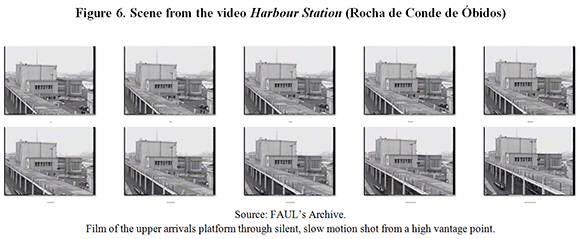
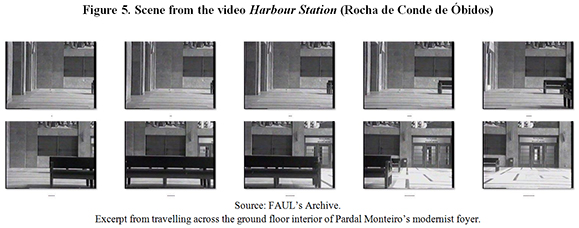
<body><![CDATA[<p><font size="2" face="Verdana, Arial, Helvetica, sans-serif"> 	If nationalism was the official predicate under dictatorship, then after 	the revolution, anything that would invoke Portugal's empire - like this 	film object </font><font color="#FF0000" size="2" face="Verdana, Arial, Helvetica, sans-serif"><font color="#000000"><a name="30" id="30"></a>[<a href="#top30">30]</a></font></font><font size="2" face="Verdana, Arial, Helvetica, sans-serif"> - was most 	likely not consensual. The contemporary debate on Portuguese architecture 	in the 1980s and early 1990s was about freedom at what cost? Yet the crisis 	was quickly overcome, followed by the emergence of a new sense of respect for the country's built environment, to the extent	 of 	hosting an international EXPO on its capital's riverfront in 1998. In this 	context, the idea of making a documentary about a 1940s modernist harbour station was contemporary. </font></p>     <p><font size="2" face="Verdana, Arial, Helvetica, sans-serif"> 	In addition to this renewed engagement with celebrating the past, there was 	a clear interest in different techniques of film making - travelling and 	Steadicam being the most widely explored (Figures <a href="#f5">5</a> and <a href="#f6">6</a>) - and in 	different languages (visual, audio, literary, etc.), reflecting the 	School's interest in semiotics that began in the 1970s. For instance, in 	the first part of the film there is no narrative: The building itself is 	described exclusively by the assemblage of moving images and radiophonic 	excerpts. In the second part, the camera is placed on a boat leaving the 	harbour and a narrative voice describes the building's history (authorship, 	dates, etc.). On another level, although the building served to bring 	multitudes together, at various times the only soundtrack is silence; this 	highlights the building's archaeological character, as if in rehearsal for 	the later narrative description. </font></p>     <p>&nbsp;</p> <a name="f5" id="f5"></a><img src="/img/revistas/cct/n33/n33a11f5.jpg" />     
<p>&nbsp;</p> <a name="f6" id="f6"></a><img src="/img/revistas/cct/n33/n33a11f6.jpg" />     
<p>&nbsp;</p>     <p><font size="3" face="Verdana, Arial, Helvetica, sans-serif"><b>Conclusion</b> </font></p>     <p><font size="2" face="Verdana, Arial, Helvetica, sans-serif"> 	Research to date suggests that a clearer picture of architectural education 	in Lisbon in the 1980s will enrich our understanding of contemporary 	Portuguese culture. </font></p>     <p><font size="2" face="Verdana, Arial, Helvetica, sans-serif"> 	This essay had its origins in the Conference Optimistic Suburbia and, in 	particular, its sub-theme Outside looking in: Visions from others - art, 	literature, cinema and music. It examined the establishment, and some of 	the outputs, of a video section within Lisbon's school of architecture 	through an analysis of three videos, mostly executed on its own initiative 	and using its own human and technical resources. In doing so, the first 	part of the discussion provided cultural insight into the factors that made 	their accomplishment possible. </font></p>     <p><font size="2" face="Verdana, Arial, Helvetica, sans-serif"> 	On a deeper level, a more speculative hypothesis was presented in relation 	to the videos' production. Scaling and objectivity, however, lead to the 	conclusion that is summarised in the paper's title. </font></p>     <p><font size="2" face="Verdana, Arial, Helvetica, sans-serif"> 	Recording the optimistic is indeed one way of describing the audiovisual 	work of students of the Lisbon school of architecture. It summarises what 	the school had to offer from 1976 to the end of the following decade, and 	the three videos analysed in this paper are a reflection of this because 	they used the historical city as their main resource and they provide 	evidence of diversity and experimentation within the school. Moreover, 	these materials indicate that the school was part of a contemporary 	landscape in which radical pedagogies flourished, as in many schools around 	the world. </font></p>     ]]></body>
<body><![CDATA[<p>&nbsp;</p>     <p><font size="2" face="Verdana, Arial, Helvetica, sans-serif">NOTES </font></p>     <p><font size="2" face="Verdana, Arial, Helvetica, sans-serif"> 	The images of the video footage presented in this essay have not undergone 	any digital modification. </font></p>     <p><font size="2" face="Verdana, Arial, Helvetica, sans-serif"> 	All quotes and terms in the original language (Portuguese) have been 	translated by the author. </font></p>     <p>&nbsp;</p>     <p><font size="2" face="Verdana, Arial, Helvetica, sans-serif">BIBIOGRAPHY </font></p>     <p>   <font size="2" face="Verdana, Arial, Helvetica, sans-serif"><b>Books</b> </font></p>     <!-- ref --><p><font size="2" face="Verdana, Arial, Helvetica, sans-serif"> Brand&#227;o, A. (s.d.), <i>Desenhos</i>, Lisboa: Faculdade de Arquitectura da Universidade T&#233;cnica de Lisboa.    &nbsp;&nbsp;&nbsp;&nbsp;&nbsp;&nbsp;&nbsp;&nbsp;[&#160;<a href="javascript:void(0);" onclick="javascript: window.open('/scielo.php?script=sci_nlinks&ref=1686303&pid=S2182-3030201600020001100001&lng=','','width=640,height=500,resizable=yes,scrollbars=1,menubar=yes,');">Links</a>&#160;]<!-- end-ref --> </font></p>     <!-- ref --><p><font size="2" face="Verdana, Arial, Helvetica, sans-serif"> Brand&#227;o, A. (1981), &quot;Intervindo na cidade como contracultura&quot;, <i>O Primeiro de Janeiro</i>, Porto.    &nbsp;&nbsp;&nbsp;&nbsp;&nbsp;&nbsp;&nbsp;&nbsp;[&#160;<a href="javascript:void(0);" onclick="javascript: window.open('/scielo.php?script=sci_nlinks&ref=1686305&pid=S2182-3030201600020001100002&lng=','','width=640,height=500,resizable=yes,scrollbars=1,menubar=yes,');">Links</a>&#160;]<!-- end-ref --> </font></p>     <!-- ref --><p><font size="2" face="Verdana, Arial, Helvetica, sans-serif"> Brand&#227;o, A. (1981), &quot;Esta Escola tem de funcionar como se fosse uma 	empresa&quot;, <i>Diário Popular</i>, Lisboa (21.12.1981).    &nbsp;&nbsp;&nbsp;&nbsp;&nbsp;&nbsp;&nbsp;&nbsp;[&#160;<a href="javascript:void(0);" onclick="javascript: window.open('/scielo.php?script=sci_nlinks&ref=1686307&pid=S2182-3030201600020001100003&lng=','','width=640,height=500,resizable=yes,scrollbars=1,menubar=yes,');">Links</a>&#160;]<!-- end-ref --> </font></p>     <!-- ref --><p><font size="2" face="Verdana, Arial, Helvetica, sans-serif"> Colomina, B., et al (2012), &quot;Radical Pedagogies in Architectural 	Education&quot;, <i>The Architectural Review</i>, London (28.09.2012).    &nbsp;&nbsp;&nbsp;&nbsp;&nbsp;&nbsp;&nbsp;&nbsp;[&#160;<a href="javascript:void(0);" onclick="javascript: window.open('/scielo.php?script=sci_nlinks&ref=1686309&pid=S2182-3030201600020001100004&lng=','','width=640,height=500,resizable=yes,scrollbars=1,menubar=yes,');">Links</a>&#160;]<!-- end-ref --> </font></p>     <!-- ref --><p><font size="2" face="Verdana, Arial, Helvetica, sans-serif"> 	Bandeira, P. (2014), <i>Porto School: B Side</i>, s.l., Documenta.    &nbsp;&nbsp;&nbsp;&nbsp;&nbsp;&nbsp;&nbsp;&nbsp;[&#160;<a href="javascript:void(0);" onclick="javascript: window.open('/scielo.php?script=sci_nlinks&ref=1686311&pid=S2182-3030201600020001100005&lng=','','width=640,height=500,resizable=yes,scrollbars=1,menubar=yes,');">Links</a>&#160;]<!-- end-ref --> </font></p>     <!-- ref --><p><font size="2" face="Verdana, Arial, Helvetica, sans-serif"> 	Barron, S. [director] (1986), <i>Dire Straits: Money for Nothing</i>, 	London: Phonogram Records.    &nbsp;&nbsp;&nbsp;&nbsp;&nbsp;&nbsp;&nbsp;&nbsp;[&#160;<a href="javascript:void(0);" onclick="javascript: window.open('/scielo.php?script=sci_nlinks&ref=1686313&pid=S2182-3030201600020001100006&lng=','','width=640,height=500,resizable=yes,scrollbars=1,menubar=yes,');">Links</a>&#160;]<!-- end-ref --> </font></p>     <!-- ref --><p><font size="2" face="Verdana, Arial, Helvetica, sans-serif"> Brody, R. (2015), &quot;The Video Store as a Film School&quot;, <i>The New Yorker</i>, October 2. Available at <a href="http://www.newyorker.com/culture/cultural-comment/the-video-store-as-film-school" target="_blank">http://www.newyorker.com/culture/cultural-comment/the-video-store-as-film-school</a></font>&nbsp;&nbsp;&nbsp;&nbsp;&nbsp;&nbsp;&nbsp;&nbsp;[&#160;<a href="javascript:void(0);" onclick="javascript: window.open('/scielo.php?script=sci_nlinks&ref=1686315&pid=S2182-3030201600020001100007&lng=','','width=640,height=500,resizable=yes,scrollbars=1,menubar=yes,');">Links</a>&#160;]<!-- end-ref --><!-- ref --><p><font size="2" face="Verdana, Arial, Helvetica, sans-serif"> 	Decreto-Lei 489-E/79, 21 de Dezembro. [Decree Law 489-E.79, 21 December] </font>&nbsp;&nbsp;&nbsp;&nbsp;&nbsp;&nbsp;&nbsp;&nbsp;[&#160;<a href="javascript:void(0);" onclick="javascript: window.open('/scielo.php?script=sci_nlinks&ref=1686316&pid=S2182-3030201600020001100008&lng=','','width=640,height=500,resizable=yes,scrollbars=1,menubar=yes,');">Links</a>&#160;]<!-- end-ref --><!-- ref --><p><font size="2" face="Verdana, Arial, Helvetica, sans-serif"> 	Despacho 135/MEC/86, 21 de Junho. [Ministerial Dispatch135/MEC/86, 21 	June].    &nbsp;&nbsp;&nbsp;&nbsp;&nbsp;&nbsp;&nbsp;&nbsp;[&#160;<a href="javascript:void(0);" onclick="javascript: window.open('/scielo.php?script=sci_nlinks&ref=1686317&pid=S2182-3030201600020001100009&lng=','','width=640,height=500,resizable=yes,scrollbars=1,menubar=yes,');">Links</a>&#160;]<!-- end-ref --> </font></p>     <!-- ref --><p><font size="2" face="Verdana, Arial, Helvetica, sans-serif"> 	Figueira, J. (2015), 	    <i> Periferia Perfeita. P&#243;s-Modernidade na Arquitectura Portuguesa. Anos 1960-1980 </i> , Lisboa: Caleidosc&#243;pio.    &nbsp;&nbsp;&nbsp;&nbsp;&nbsp;&nbsp;&nbsp;&nbsp;[&#160;<a href="javascript:void(0);" onclick="javascript: window.open('/scielo.php?script=sci_nlinks&ref=1686319&pid=S2182-3030201600020001100010&lng=','','width=640,height=500,resizable=yes,scrollbars=1,menubar=yes,');">Links</a>&#160;]<!-- end-ref --> </font></p>     <!-- ref --><p><font size="2" face="Verdana, Arial, Helvetica, sans-serif"> George, F. (1982), &quot;Discurso do Professor Frederico George em 1977&quot;, <i>Jornal Arquitectos</i>, 8/9 (Agosto 1982).    &nbsp;&nbsp;&nbsp;&nbsp;&nbsp;&nbsp;&nbsp;&nbsp;[&#160;<a href="javascript:void(0);" onclick="javascript: window.open('/scielo.php?script=sci_nlinks&ref=1686321&pid=S2182-3030201600020001100011&lng=','','width=640,height=500,resizable=yes,scrollbars=1,menubar=yes,');">Links</a>&#160;]<!-- end-ref --> </font></p>     <!-- ref --><p> 	<font size="2" face="Verdana, Arial, Helvetica, sans-serif">&quot;liberalism&quot; (2014), <i> Encyclop&#230;dia Britannica. Encyclop&#230;dia Britannica Ultimate Reference Suite </i> . Chicago: Encyclop&#230;dia Britannica.    &nbsp;&nbsp;&nbsp;&nbsp;&nbsp;&nbsp;&nbsp;&nbsp;[&#160;<a href="javascript:void(0);" onclick="javascript: window.open('/scielo.php?script=sci_nlinks&ref=1686323&pid=S2182-3030201600020001100012&lng=','','width=640,height=500,resizable=yes,scrollbars=1,menubar=yes,');">Links</a>&#160;]<!-- end-ref --> </font></p>     <!-- ref --><p><font size="2" face="Verdana, Arial, Helvetica, sans-serif"> 	Newman, M.Z. (2014), <i>Video Revolutions. On the History of a Medium</i> 	, New York: Columbia University Press.    &nbsp;&nbsp;&nbsp;&nbsp;&nbsp;&nbsp;&nbsp;&nbsp;[&#160;<a href="javascript:void(0);" onclick="javascript: window.open('/scielo.php?script=sci_nlinks&ref=1686325&pid=S2182-3030201600020001100013&lng=','','width=640,height=500,resizable=yes,scrollbars=1,menubar=yes,');">Links</a>&#160;]<!-- end-ref --> </font></p>     <!-- ref --><p><font size="2" face="Verdana, Arial, Helvetica, sans-serif"> Pinharanda, J.L. (1995), &quot;O decl&#237;nio das vanguardas: dos anos 50 ao 	fim do mil&#233;nio&quot;, <i>Hist&#243;ria da Arte Portuguesa</i>, Lisboa: C&#237;rculo de Leitores.    &nbsp;&nbsp;&nbsp;&nbsp;&nbsp;&nbsp;&nbsp;&nbsp;[&#160;<a href="javascript:void(0);" onclick="javascript: window.open('/scielo.php?script=sci_nlinks&ref=1686327&pid=S2182-3030201600020001100014&lng=','','width=640,height=500,resizable=yes,scrollbars=1,menubar=yes,');">Links</a>&#160;]<!-- end-ref --> </font></p>     <!-- ref --><p><font size="2" face="Verdana, Arial, Helvetica, sans-serif"> Silva, L.M. (2015),	<i>Arquitectura em VHS. Trabalho de investiga&#231;&#227;o em curso</i>. 	Available at 	<a href="http://arquitecturaemvhs.blogspot.com" target="_blank"> 		http://arquitecturaemvhs.blogspot.com	</a> 	.    &nbsp;&nbsp;&nbsp;&nbsp;&nbsp;&nbsp;&nbsp;&nbsp;[&#160;<a href="javascript:void(0);" onclick="javascript: window.open('/scielo.php?script=sci_nlinks&ref=1686329&pid=S2182-3030201600020001100015&lng=','','width=640,height=500,resizable=yes,scrollbars=1,menubar=yes,');">Links</a>&#160;]<!-- end-ref --> </font></p>     <!-- ref --><p><font size="2" face="Verdana, Arial, Helvetica, sans-serif"> Silva, L.M. (2011), Cultura arquitect&#243;nica em Lisboa. Um olhar a 	partir da ESBAL/FAUTL no per&#237;odo de 1975 a 1990, Disserta&#231;&#227;o 	de Mestrado em Arquitectura, Faculdade de Arquitectura da Universidade T&#233;cnica de Lisboa.    &nbsp;&nbsp;&nbsp;&nbsp;&nbsp;&nbsp;&nbsp;&nbsp;[&#160;<a href="javascript:void(0);" onclick="javascript: window.open('/scielo.php?script=sci_nlinks&ref=1686331&pid=S2182-3030201600020001100016&lng=','','width=640,height=500,resizable=yes,scrollbars=1,menubar=yes,');">Links</a>&#160;]<!-- end-ref --> </font></p>     <!-- ref --><p><font size="2" face="Verdana, Arial, Helvetica, sans-serif"> Silva, L.M., [2016; in press], &quot;When did Chiado burn? Creative scenes on 	dry land. Chiado and the School of Fine-Arts before 1988&quot;. In P. Costa, P. 	Guerra (org), <i> I&#180;ll Be Your Mirror. Creative Milieus and Cultural Scenes in 		Contemporary Urban Spaces </i> 	.    &nbsp;&nbsp;&nbsp;&nbsp;&nbsp;&nbsp;&nbsp;&nbsp;[&#160;<a href="javascript:void(0);" onclick="javascript: window.open('/scielo.php?script=sci_nlinks&ref=1686333&pid=S2182-3030201600020001100017&lng=','','width=640,height=500,resizable=yes,scrollbars=1,menubar=yes,');">Links</a>&#160;]<!-- end-ref --> </font></p>     <!-- ref --><p><font size="2" face="Verdana, Arial, Helvetica, sans-serif"> 	Telles, G. (1987), 	    <i> Lisboa. Entre o Passado e o Futuro, Lisboa: Universidade Nova de Lisboa</i> , Faculdade de Ci&#234;ncias e Tecnologia.    &nbsp;&nbsp;&nbsp;&nbsp;&nbsp;&nbsp;&nbsp;&nbsp;[&#160;<a href="javascript:void(0);" onclick="javascript: window.open('/scielo.php?script=sci_nlinks&ref=1686335&pid=S2182-3030201600020001100018&lng=','','width=640,height=500,resizable=yes,scrollbars=1,menubar=yes,');">Links</a>&#160;]<!-- end-ref --> </font></p>     <!-- ref --><p><font size="2" face="Verdana, Arial, Helvetica, sans-serif"> Urbano, L. (2013), &quot;Filmes de Cidades&quot;. <i>Hist&#243;rias Simples</i>, 	Porto: AJDJAC.    &nbsp;&nbsp;&nbsp;&nbsp;&nbsp;&nbsp;&nbsp;&nbsp;[&#160;<a href="javascript:void(0);" onclick="javascript: window.open('/scielo.php?script=sci_nlinks&ref=1686337&pid=S2182-3030201600020001100019&lng=','','width=640,height=500,resizable=yes,scrollbars=1,menubar=yes,');">Links</a>&#160;]<!-- end-ref --> </font></p>     <p>   <font size="2" face="Verdana, Arial, Helvetica, sans-serif"><b>Archives </b> </font></p>     <p>   <font size="2" face="Verdana, Arial, Helvetica, sans-serif"><i>Pinto, L.'s Personal Archive</i> </font></p>     <p><font size="2" face="Verdana, Arial, Helvetica, sans-serif"> ESBAL, 1974. Estrutura de Ensino. Seminário. 22.05.74. A) Resumo das Interven&#231;&#245;es. Typed memo. </font></p>     <p><font size="2" face="Verdana, Arial, Helvetica, sans-serif"> 	2.2 FAUL's Archives </font></p>     <p><font size="2" face="Verdana, Arial, Helvetica, sans-serif"> 	FAUL, 1976. Despacho 7/76 e 7A/76, assinado pelo Secretário de Estado 	do Ensino Superior A. Brotas. [Legal Dispatch 7/76 e 7A/76, signed by 	Secretary of State for Superior Education A. Brotas]. </font></p>     <p><font size="2" face="Verdana, Arial, Helvetica, sans-serif"> FAUL, 1979. Of&#237;cio com a Refer&#234;ncia 1/DA 340 30 para o Presidente 	da Administra&#231;&#227;o da Funda&#231;&#227;o Calouste Gulbenkian, por 	A. Brand&#227;o, 27 Agosto 1979. [Correspondence by A. Brand&#227;o, 27 August 1979]. </font></p>     <p><font size="2" face="Verdana, Arial, Helvetica, sans-serif"> FAUL, 1982. Relat&#243;rio das Actividades do Departamento de Arquitectura 	da ESBAL no Ano Lectivo 1981/1982. Perspectivas para 1982/1983 por Augusto 	Brand&#227;o, 28 Junho 1982. [Activities Report by A. Brand&#227;o, 28 June 1982]. </font></p>     ]]></body>
<body><![CDATA[<p><font size="2" face="Verdana, Arial, Helvetica, sans-serif"> FAUL, 1984. Solicita&#231;&#227;o para Comiss&#227;o de 	Coordena&#231;&#227;o Regional de Lisboa e Vale do Tejo, por Augusto 	Brand&#227;o, 16 Outubro 1984. [Correspondence by A. Brand&#227;o, 16 October 1984]. </font></p>     <p><font size="2" face="Verdana, Arial, Helvetica, sans-serif"> FAUL, 1990. Of&#237;cio com Refer&#234;ncia 13 MAR. 90 - 00280 do 	Presidente do Conselho Directivo &#224; Comiss&#227;o Nacional para as 	Comemora&#231;&#245;es dos Descobrimentos Portugueses, por Real, J., 13 Mar&#231;o 1990. [Correspondence by Real, J., 13 March 1990]. </font></p>     <p><font size="2" face="Verdana, Arial, Helvetica, sans-serif"> FAUL, 1994. Relat&#243;rio de Actividades e Plano de Desenvolvimento, 	Faculdade de Arquitectura da Universidade T&#233;cnica de Lisboa, Janeiro 1994. [FAUTL Activities Report and Developing Plan, January 1994] </font></p>     <p><font size="2" face="Verdana, Arial, Helvetica, sans-serif"> Jorge, J. [director] (1990), Gare Mar&#237;tima (Rocha de Conde de &#211;bidos), Filme Documentário. [Film documentar by Jorge, J]. </font></p>     <p><font size="2" face="Verdana, Arial, Helvetica, sans-serif"> Rocha, A. (1983), T&#233;dio, Trabalho Escolar. [School Work film documentary by Rocha, A.]. </font></p>     <p><font size="2" face="Verdana, Arial, Helvetica, sans-serif"> 	Sousa, P., Corvo, M. (1988), O Lugar Onde Nasci, Trabalho Escolar. [School 	Work film documentar by Sousa, P., Corvo, M.]. </font></p>     <p>   <font size="2" face="Verdana, Arial, Helvetica, sans-serif"><b>Interviews</b> </font></p>     <p><font size="2" face="Verdana, Arial, Helvetica, sans-serif"> Brand&#227;o, A. (2013), Interview by the author, 2013.03.15. </font></p>     <p><font size="2" face="Verdana, Arial, Helvetica, sans-serif"> 	Jorge, J. (2015), Interview by the author, 2015.02.23. </font></p>     <p><font size="2" face="Verdana, Arial, Helvetica, sans-serif"> 	Fernandes, J. M. (2013), Interview by the author, 2013.03.07. </font></p>     ]]></body>
<body><![CDATA[<p><font size="2" face="Verdana, Arial, Helvetica, sans-serif"> 	Portas, N. (2014), Interview by the author, 2014.10.29. </font></p>     <p><font size="2" face="Verdana, Arial, Helvetica, sans-serif"> 	Redondo, J. (2016), Interview by the author, 2016.04.23. </font></p>     <p><font size="2" face="Verdana, Arial, Helvetica, sans-serif"> 	Taveira, T. (2014), Interview by the author, 2014.05.21. </font></p>   	<font size="2" face="Verdana, Arial, Helvetica, sans-serif"><br clear="all"/> 	</font> 	<hr width="33%" size="1" align="left"/> 	    <p> 		<font color="#FF0000" size="2" face="Verdana, Arial, Helvetica, sans-serif"><font color="#000000"><a name="2" id="2"></a>[<a href="#top2">2]</a></font></font><font size="2" face="Verdana, Arial, Helvetica, sans-serif"> The author would like to acknowledge the collaboration of the 			Faculty of Architecture of the University of Lisbon. The author 			must particularly express her gratitude for the testimonies of 			Jos&#233; Gorj&#227;o Jorge and Jo&#227;o Redondo. This essay has 			been developed with the support of Funda&#231;&#227;o para a 			Ci&#234;ncia e a Tecnologia (SFRH/BD/80535/2011) as part of the 			POCH - Human Capital Operational Programme in conjunction with the 			European Social Fund and National Funds of the Ministry of 		Education and Science. </font></p> 	  	    <p> 		<font color="#FF0000" size="2" face="Verdana, Arial, Helvetica, sans-serif"><font color="#000000"><a name="3" id="3"></a>[<a href="#top3">3]</a></font></font> <font size="2" face="Verdana, Arial, Helvetica, sans-serif">This section had various informal designations.      </font></p> 	  	    <p> 		<font color="#FF0000" size="2" face="Verdana, Arial, Helvetica, sans-serif"><font color="#000000"><a name="4" id="4"></a>[<a href="#top4">4]</a></font></font> <font size="2" face="Verdana, Arial, Helvetica, sans-serif">Centro de Multimedia da Faculdade de Arquitectura da Universidade 	  de Lisboa.      </font></p> 	  	    <p> 		<font color="#FF0000" size="2" face="Verdana, Arial, Helvetica, sans-serif"><font color="#000000"><a name="5" id="5"></a>[<a href="#top5">5]</a></font></font> <font size="2" face="Verdana, Arial, Helvetica, sans-serif">Nuno Portas was appointed by Avel&#227;s Nunes, the Secretary of 			State for Superior Education of the fifth government, as a member 			of an implementation committee for a new school; the design of its 			pedagogical structure was one of his responsibilities as head of 		this committee. </font></p> 	  	    <p> 		<font color="#FF0000" size="2" face="Verdana, Arial, Helvetica, sans-serif"><font color="#000000"><a name="6" id="6"></a>[<a href="#top6">6]</a></font></font> <font size="2" face="Verdana, Arial, Helvetica, sans-serif">The fifth and the sixth governments are specifically mentioned here 			since there was a significant political change in the transition 			between them. In fact, the first five transitory governments form a 			series. The third to the fifth in particular can be seen as part of 			a radical left-wing trend, while the sixth was already moving 	  towards a European-type democracy.      </font></p> 	  	    <p> 		<font color="#FF0000" size="2" face="Verdana, Arial, Helvetica, sans-serif"><font color="#000000"><a name="7" id="7"></a>[<a href="#top7">7]</a></font></font> <font size="2" face="Verdana, Arial, Helvetica, sans-serif">Decreto-Lei 489-E/79, 21 de Dezembro. (Decree Law 489-E.79, 21 	  December).      </font></p> 	  	    <p> 		<font color="#FF0000" size="2" face="Verdana, Arial, Helvetica, sans-serif"><font color="#000000"><a name="8" id="8"></a>[<a href="#top8">8]</a></font></font> <font size="2" face="Verdana, Arial, Helvetica, sans-serif">In 1974, groups of politicised students took direct action by, for 	  instance, expelling some teachers from their classes.      </font></p> 	  	    ]]></body>
<body><![CDATA[<p> 		<font color="#FF0000" size="2" face="Verdana, Arial, Helvetica, sans-serif"><font color="#000000"><a name="9" id="9"></a>[<a href="#top9">9]</a></font></font> <font size="2" face="Verdana, Arial, Helvetica, sans-serif">Augusto Brand&#227;o graduated with honours in architecture from 			the Lisbon school in 1957, becoming an assistant professor at the 			same School the following year. His influence was apparent during 			the revolutionary crisis. From1978 to 1991 he assumed several 			formal academic positions: president of the governing board of the 			architecture course, a member of the implementation committee of 			the new Faculty and, later, president of its pedagogical and 			scientific board (various dates). From 1992 on, he left public 			teaching to continue his career in private architecture schools. 		(Brand&#227;o, s.d.). </font></p> 	  	    <p> 		<font color="#FF0000" size="2" face="Verdana, Arial, Helvetica, sans-serif"><font color="#000000"><a name="10" id="10"></a>[<a href="#top10">10]</a></font></font> <font size="2" face="Verdana, Arial, Helvetica, sans-serif">The first private university architecture course (Cooperativa 			Lus&#237;ada) was authorised under the Despacho 135/MEC/86, 21 de 		Junho. (Ministerial Dispatch135/MEC/86, 21 June). </font></p> 	  	    <p> 		<font color="#FF0000" size="2" face="Verdana, Arial, Helvetica, sans-serif"><font color="#000000"><a name="11" id="11"></a>[<a href="#top11">11]</a></font></font> <font size="2" face="Verdana, Arial, Helvetica, sans-serif">On some occasions, Brand&#227;o supported events proposed by the 			teachers, such as the post-modernist Symposia, organised by Tomas 		Taveira (Silva, 2015). </font></p> 	  	    <p> 		<font color="#FF0000" size="2" face="Verdana, Arial, Helvetica, sans-serif"><font color="#000000"><a name="12" id="12"></a>[<a href="#top12">12]</a></font></font> <font size="2" face="Verdana, Arial, Helvetica, sans-serif">For example, a letter to a state office stated: &quot;We hereby manifest 			this Faculty's interest in putting forth internships for our new 			graduates in the urban planning field&quot;. (FAUL, 1984). Student 			engagement, however, was low. During the period in question, rates 			of absence from class by both students and teachers were very high 		(Silva, 2011). </font></p> 	  	    <p> 		<font color="#FF0000" size="2" face="Verdana, Arial, Helvetica, sans-serif"><font color="#000000"><a name="13" id="13"></a>[<a href="#top13">13]</a></font></font> <font size="2" face="Verdana, Arial, Helvetica, sans-serif">This included various self-aggrandising events, such as 	  spectacular, American-style graduation ceremonies (Silva, 2016).      </font></p> 	  	    <p> 		<font color="#FF0000" size="2" face="Verdana, Arial, Helvetica, sans-serif"><font color="#000000"><a name="14" id="14"></a>[<a href="#top14">14]</a></font></font> <font size="2" face="Verdana, Arial, Helvetica, sans-serif">&quot;Liberals often have been wary of democracy &#8230; because of 			fears that it might generate a tyranny by the majority. One might 			briskly say, therefore, that democracy looks after majorities and 			liberalism after unpopular minorities.&quot; (Britannica, &quot;Liberalism&quot;, 		2014). </font></p> 	  	    <p> 		<font color="#FF0000" size="2" face="Verdana, Arial, Helvetica, sans-serif"><font color="#000000"><a name="15" id="15"></a>[<a href="#top15">15]</a></font></font> <font size="2" face="Verdana, Arial, Helvetica, sans-serif">&quot;Com a sua ac&#231;&#227;o de interven&#231;&#227;o na cidade de 			Lisboa, a escola cria uma esp&#233;cie de contracultura, na medida 			em que p&#245;e em causa a cultura arquitect&#243;nica existente. 		  &#8230; &#201; essa vitalidade reformadora que faz da 			institui&#231;&#227;o universitária uma institui&#231;&#227;o 		insatisfeita e cr&#237;tica do mundo circundante&quot;. </font></p> 	  	    <p> 		<font color="#FF0000" size="2" face="Verdana, Arial, Helvetica, sans-serif"><font color="#000000"><a name="16" id="16"></a>[<a href="#top16">16]</a></font></font> <font size="2" face="Verdana, Arial, Helvetica, sans-serif">The silent North-South scholarly dialogue is fundamental to 			understanding architectural culture in the 1980s. (For an account 			of the 'outspoken' mediatic history, see Figueira, 2015). In the 			following decades, this action-counteraction would fade due, among 			other reasons, to the proliferation of architecture schools, which 	  helped to soften reactiveness to societal change.      </font></p> 	  	    <p> 		<font color="#FF0000" size="2" face="Verdana, Arial, Helvetica, sans-serif"><font color="#000000"><a name="17" id="17"></a>[<a href="#top17">17]</a></font></font> <font size="2" face="Verdana, Arial, Helvetica, sans-serif">We support this thesis on the basis of Beatriz Colomina's work as 			well as Pedro Bandeira's research on pedagogy. Specifically, 			Colomina's (2012) 'Radical pedagogies' project states that 		  &quot;pedagogical experiments played a crucial role in shaping 			architectural discourse and practice in the second half of the 20th 			century&quot;. Similarly, Pedro Bandeira, who studied what went on 			'behind the scenes' of the mainstream School of Oporto, observed 		  &quot;other narratives, certainly smaller, but that represent a 			counterculture, a radical pedagogy, or self-taught trajectories 			identified with a critique of everyday life and demonstrated in 			projects, in interventional actions, in performative gestures, and 		in movements of insurrection or irony&quot; (Bandeira, 2014:12). </font></p> 	  	    <p> 		<font color="#FF0000" size="2" face="Verdana, Arial, Helvetica, sans-serif"><font color="#000000"><a name="18" id="18"></a>[<a href="#top18">18]</a></font></font> <font size="2" face="Verdana, Arial, Helvetica, sans-serif">Brand&#227;o had already asked the Gulbenkian Foundation for 			financial support to acquire filming equipment as early as 1979 		(FAUL, 1979). </font></p> 	  	    ]]></body>
<body><![CDATA[<p> 		<font color="#FF0000" size="2" face="Verdana, Arial, Helvetica, sans-serif"><font color="#000000"><a name="19" id="19"></a>[<a href="#top19">19]</a></font></font> <font size="2" face="Verdana, Arial, Helvetica, sans-serif">Michael Newman points out that video technology was introduced as 			an instrument for architectural education in the USA as early as 			the 60s: &quot;Before it was a consumer technology, videotape was in use 			in a variety of contexts other than television production &#8230; 		  In the later 1960s, the Chicago Tribune reported that videotape was 			widely used in 'education' &#8230; The National Education 			Association published a how-to book in 1968 entitled Portable Video 			Tape Recorder: A Guide for Teachers, detailing myriad uses and 		techniques&quot; (Newman, 2014: 22). </font></p> 	  	    <p> 		<font color="#FF0000" size="2" face="Verdana, Arial, Helvetica, sans-serif"><font color="#000000"><a name="20" id="20"></a>[<a href="#top20">20]</a></font></font> <font size="2" face="Verdana, Arial, Helvetica, sans-serif">Today, the archive contains more than 2596 titles, most of which 	  are records of school life.      </font></p> 	  	    <p> 		<font color="#FF0000" size="2" face="Verdana, Arial, Helvetica, sans-serif"><font color="#000000"><a name="21" id="21"></a>[<a href="#top21">21]</a></font></font> <font size="2" face="Verdana, Arial, Helvetica, sans-serif">'Historical city' is here used following Telles (1987: 15).      </font></p> 	  	    <p> 		<font color="#FF0000" size="2" face="Verdana, Arial, Helvetica, sans-serif"><font color="#000000"><a name="22" id="22"></a>[<a href="#top22">22]</a></font></font> <font size="2" face="Verdana, Arial, Helvetica, sans-serif">&quot;um raro interesse pelo multim&#233;dia.&quot;		    </font></p> 	  	    <p> 		<font color="#FF0000" size="2" face="Verdana, Arial, Helvetica, sans-serif"><font color="#000000"><a name="23" id="23"></a>[<a href="#top23">23]</a></font></font> <font size="2" face="Verdana, Arial, Helvetica, sans-serif">Cf the first image in <a href="#f2">Figure 2</a>. The <i>Money for Nothing</i> 		  music video includes pieces of a computerised animation of vivid 			colours and patterns. In the middle of a living room, a man sits on 			a sofa next to a standing lamp and a dog, in front of a TV that 	  plays images of Dire Straits.      </font></p> 	  	    <p> 		<font color="#FF0000" size="2" face="Verdana, Arial, Helvetica, sans-serif"><font color="#000000"><a name="24" id="24"></a>[<a href="#top24">24]</a></font></font> <font size="2" face="Verdana, Arial, Helvetica, sans-serif">The song and lyrics of <i>Money for Nothing</i> were inspired by 			an encounter between Mark Knopfler, the lead singer of the band, 			with a man working in a household appliance store. In a  			conversation about TV, at a time when MTV broadcasting was becoming 			popular, the man claimed that being famous and playing music was 	  not real work.      </font></p> 	  	    <p> 		<font color="#FF0000" size="2" face="Verdana, Arial, Helvetica, sans-serif"><font color="#000000"><a name="25" id="25"></a>[<a href="#top25">25]</a></font></font> <font size="2" face="Verdana, Arial, Helvetica, sans-serif">As listed, this film is classified as a School work. In Portuguese 			architecture school, the final studio class assessment was usually 			a presentation of the student's pathway through a combination of 			drawings, models, posters, portfolios, etc.. In this context, a 			video could have been accepted as the medium for a final 	  presentation.      </font></p> 	  	    <p> 		<font color="#FF0000" size="2" face="Verdana, Arial, Helvetica, sans-serif"><font color="#000000"><a name="26" id="26"></a>[<a href="#top26">26]</a></font></font> <font size="2" face="Verdana, Arial, Helvetica, sans-serif">As Lu&#237;s Urbano states, filming the city - observing, 			registering and representing the metropolis - occurred early on in 			filmmaking. As an example, Urbano points to the Lumi&#232;re 			brothers and their particular concern with movement (Urbano, 2013: 		70).</font>	</p> 	  	    <p> 		<font color="#FF0000" size="2" face="Verdana, Arial, Helvetica, sans-serif"><font color="#000000"><a name="27" id="27"></a>[<a href="#top27">27]</a></font></font> <font size="2" face="Verdana, Arial, Helvetica, sans-serif">This video was produced with the financial aid of not only the CAM 			(Centre of Modern Art) but also the National Commission for the 			Commemoration of the Portuguese Discoveries [Comiss&#227;o Nacional 		para as Comemora&#231;&#245;es dos Descobrimentos Portugueses]. </font></p> 	  	    <p> 		<font color="#FF0000" size="2" face="Verdana, Arial, Helvetica, sans-serif"><font color="#000000"><a name="28" id="28"></a>[<a href="#top28">28]</a></font></font> <font size="2" face="Verdana, Arial, Helvetica, sans-serif">Festival International du Film d'Architecture, d'Urbanisme et 	  d'Environement Urbain de Bordeaux.      </font></p> 	  	    ]]></body>
<body><![CDATA[<p> 		<font color="#FF0000" size="2" face="Verdana, Arial, Helvetica, sans-serif"><font color="#000000"><a name="29" id="29"></a>[<a href="#top29">29]</a></font></font> <font size="2" face="Verdana, Arial, Helvetica, sans-serif">&quot;Interesse &#8230; em continuar esta s&#233;rie de videogramas 		sobre a nossa Arquitectura&quot;. </font></p> 	  	    <p> 		<font color="#FF0000" size="2" face="Verdana, Arial, Helvetica, sans-serif"><font color="#000000"><a name="30" id="30"></a>[<a href="#top30">30]</a></font></font> <font size="2" face="Verdana, Arial, Helvetica, sans-serif">The Harbour Station's building, by architect Pardal Monteiro, was 			the facilities for the departure and arrival from the African 	  colonies.      </font></p>      ]]></body><back>
<ref-list>
<ref id="B1">
<nlm-citation citation-type="book">
<person-group person-group-type="author">
<name>
<surname><![CDATA[Brandão]]></surname>
<given-names><![CDATA[A.]]></given-names>
</name>
</person-group>
<source><![CDATA[Desenhos]]></source>
<year></year>
<publisher-loc><![CDATA[Lisboa ]]></publisher-loc>
<publisher-name><![CDATA[Faculdade de Arquitectura da Universidade Técnica de Lisboa]]></publisher-name>
</nlm-citation>
</ref>
<ref id="B2">
<nlm-citation citation-type="journal">
<person-group person-group-type="author">
<name>
<surname><![CDATA[Brandão]]></surname>
<given-names><![CDATA[A.]]></given-names>
</name>
</person-group>
<article-title xml:lang="pt"><![CDATA[Intervindo na cidade como contracultura]]></article-title>
<source><![CDATA[O Primeiro de Janeiro]]></source>
<year>1981</year>
<publisher-loc><![CDATA[Porto ]]></publisher-loc>
</nlm-citation>
</ref>
<ref id="B3">
<nlm-citation citation-type="journal">
<person-group person-group-type="author">
<name>
<surname><![CDATA[Brandão]]></surname>
<given-names><![CDATA[A.]]></given-names>
</name>
</person-group>
<article-title xml:lang="pt"><![CDATA[Esta Escola tem de funcionar como se fosse uma empresa]]></article-title>
<source><![CDATA[Diário Popular]]></source>
<year>1981</year>
<publisher-loc><![CDATA[Lisboa ]]></publisher-loc>
</nlm-citation>
</ref>
<ref id="B4">
<nlm-citation citation-type="journal">
<person-group person-group-type="author">
<name>
<surname><![CDATA[Colomina]]></surname>
<given-names><![CDATA[B.]]></given-names>
</name>
</person-group>
<article-title xml:lang="en"><![CDATA[Radical Pedagogies in Architectural Education]]></article-title>
<source><![CDATA[The Architectural Review]]></source>
<year>2012</year>
<publisher-loc><![CDATA[London ]]></publisher-loc>
</nlm-citation>
</ref>
<ref id="B5">
<nlm-citation citation-type="book">
<person-group person-group-type="author">
<name>
<surname><![CDATA[Bandeira]]></surname>
<given-names><![CDATA[P.]]></given-names>
</name>
</person-group>
<source><![CDATA[Porto School: B Side]]></source>
<year>2014</year>
<publisher-name><![CDATA[Documenta]]></publisher-name>
</nlm-citation>
</ref>
<ref id="B6">
<nlm-citation citation-type="book">
<person-group person-group-type="author">
<name>
<surname><![CDATA[Barron]]></surname>
<given-names><![CDATA[S.]]></given-names>
</name>
</person-group>
<source><![CDATA[Dire Straits: Money for Nothing]]></source>
<year>1986</year>
<publisher-loc><![CDATA[London ]]></publisher-loc>
<publisher-name><![CDATA[Phonogram Records]]></publisher-name>
</nlm-citation>
</ref>
<ref id="B7">
<nlm-citation citation-type="journal">
<person-group person-group-type="author">
<name>
<surname><![CDATA[Brody]]></surname>
<given-names><![CDATA[R.]]></given-names>
</name>
</person-group>
<article-title xml:lang="en"><![CDATA[The Video Store as a Film School]]></article-title>
<source><![CDATA[The New Yorker]]></source>
<year>2015</year>
</nlm-citation>
</ref>
<ref id="B8">
<nlm-citation citation-type="">
<source><![CDATA[Decreto-Lei 489-E/79]]></source>
<year>21 d</year>
<month>e </month>
<day>De</day>
</nlm-citation>
</ref>
<ref id="B9">
<nlm-citation citation-type="">
<source><![CDATA[Despacho 135/MEC/86]]></source>
<year>21 d</year>
<month>e </month>
<day>Ju</day>
</nlm-citation>
</ref>
<ref id="B10">
<nlm-citation citation-type="book">
<person-group person-group-type="author">
<name>
<surname><![CDATA[Figueira]]></surname>
<given-names><![CDATA[J.]]></given-names>
</name>
</person-group>
<source><![CDATA[Periferia Perfeita: Pós-Modernidade na Arquitectura Portuguesa. Anos 1960-1980]]></source>
<year>2015</year>
<publisher-loc><![CDATA[Lisboa ]]></publisher-loc>
<publisher-name><![CDATA[Caleidoscópio]]></publisher-name>
</nlm-citation>
</ref>
<ref id="B11">
<nlm-citation citation-type="journal">
<person-group person-group-type="author">
<name>
<surname><![CDATA[George]]></surname>
<given-names><![CDATA[F.]]></given-names>
</name>
</person-group>
<article-title xml:lang="pt"><![CDATA[Discurso do Professor Frederico George em 1977]]></article-title>
<source><![CDATA[Jornal Arquitectos]]></source>
<year>1982</year>
<volume>8/9</volume>
</nlm-citation>
</ref>
<ref id="B12">
<nlm-citation citation-type="book">
<article-title xml:lang="en"><![CDATA[liberalism]]></article-title>
<source><![CDATA[Encyclopædia Britannica: Encyclopædia Britannica Ultimate Reference Suite]]></source>
<year>2014</year>
<publisher-loc><![CDATA[Chicago ]]></publisher-loc>
<publisher-name><![CDATA[Encyclopædia Britannica]]></publisher-name>
</nlm-citation>
</ref>
<ref id="B13">
<nlm-citation citation-type="book">
<person-group person-group-type="author">
<name>
<surname><![CDATA[Newman]]></surname>
<given-names><![CDATA[M.Z.]]></given-names>
</name>
</person-group>
<source><![CDATA[Video Revolutions: On the History of a Medium]]></source>
<year>2014</year>
<publisher-loc><![CDATA[New York ]]></publisher-loc>
<publisher-name><![CDATA[Columbia University Press]]></publisher-name>
</nlm-citation>
</ref>
<ref id="B14">
<nlm-citation citation-type="book">
<person-group person-group-type="author">
<name>
<surname><![CDATA[Pinharanda]]></surname>
<given-names><![CDATA[J.L.]]></given-names>
</name>
</person-group>
<article-title xml:lang="pt"><![CDATA[O declínio das vanguardas: dos anos 50 ao fim do milénio]]></article-title>
<source><![CDATA[História da Arte Portuguesa]]></source>
<year>1995</year>
<publisher-loc><![CDATA[Lisboa ]]></publisher-loc>
<publisher-name><![CDATA[Círculo de Leitores]]></publisher-name>
</nlm-citation>
</ref>
<ref id="B15">
<nlm-citation citation-type="">
<person-group person-group-type="author">
<name>
<surname><![CDATA[Silva]]></surname>
<given-names><![CDATA[L.M.]]></given-names>
</name>
</person-group>
<source><![CDATA[Arquitectura em VHS: Trabalho de investigação em curso]]></source>
<year>2015</year>
</nlm-citation>
</ref>
<ref id="B16">
<nlm-citation citation-type="">
<person-group person-group-type="author">
<name>
<surname><![CDATA[Silva]]></surname>
<given-names><![CDATA[L.M.]]></given-names>
</name>
</person-group>
<source><![CDATA[Cultura arquitectónica em Lisboa: Um olhar a partir da ESBAL/FAUTL no período de 1975 a 1990]]></source>
<year>2011</year>
</nlm-citation>
</ref>
<ref id="B17">
<nlm-citation citation-type="">
<person-group person-group-type="author">
<name>
<surname><![CDATA[Silva]]></surname>
<given-names><![CDATA[L.M.]]></given-names>
</name>
</person-group>
<article-title xml:lang="en"><![CDATA[When did Chiado burn? Creative scenes on dry land: Chiado and the School of Fine-Arts before 1988]]></article-title>
<person-group person-group-type="editor">
<name>
<surname><![CDATA[Costa]]></surname>
<given-names><![CDATA[P.]]></given-names>
</name>
<name>
<surname><![CDATA[Guerra]]></surname>
<given-names><![CDATA[P.]]></given-names>
</name>
</person-group>
<source><![CDATA[I´ll Be Your Mirror: Creative Milieus and Cultural Scenes in Contemporary Urban Spaces]]></source>
<year></year>
</nlm-citation>
</ref>
<ref id="B18">
<nlm-citation citation-type="book">
<person-group person-group-type="author">
<name>
<surname><![CDATA[Telles]]></surname>
<given-names><![CDATA[G.]]></given-names>
</name>
</person-group>
<source><![CDATA[Lisboa: Entre o Passado e o Futuro]]></source>
<year>1987</year>
<publisher-loc><![CDATA[Lisboa ]]></publisher-loc>
<publisher-name><![CDATA[Universidade Nova de Lisboa, Faculdade de Ciências e Tecnologia]]></publisher-name>
</nlm-citation>
</ref>
<ref id="B19">
<nlm-citation citation-type="book">
<person-group person-group-type="author">
<name>
<surname><![CDATA[Urbano]]></surname>
<given-names><![CDATA[L.]]></given-names>
</name>
</person-group>
<article-title xml:lang="pt"><![CDATA[Filmes de Cidades]]></article-title>
<source><![CDATA[Histórias Simples]]></source>
<year>2013</year>
<publisher-loc><![CDATA[Porto ]]></publisher-loc>
<publisher-name><![CDATA[AJDJAC]]></publisher-name>
</nlm-citation>
</ref>
</ref-list>
</back>
</article>