<?xml version="1.0" encoding="ISO-8859-1"?><article xmlns:mml="http://www.w3.org/1998/Math/MathML" xmlns:xlink="http://www.w3.org/1999/xlink" xmlns:xsi="http://www.w3.org/2001/XMLSchema-instance">
<front>
<journal-meta>
<journal-id>2182-5173</journal-id>
<journal-title><![CDATA[Revista Portuguesa de Medicina Geral e Familiar]]></journal-title>
<abbrev-journal-title><![CDATA[Rev Port Med Geral Fam]]></abbrev-journal-title>
<issn>2182-5173</issn>
<publisher>
<publisher-name><![CDATA[Associação Portuguesa de Medicina Geral e Familiar]]></publisher-name>
</publisher>
</journal-meta>
<article-meta>
<article-id>S2182-51732015000100004</article-id>
<title-group>
<article-title xml:lang="en"><![CDATA[Anxiety and depression in Portuguese patients with chronic obstructive pulmonary disease: a multicentre cross-sectional study]]></article-title>
<article-title xml:lang="pt"><![CDATA[Ansiedade e depressão em pacientes Portugueses com doença pulmonar obstrutiva crónica: um estudo multicêntrico, transversal]]></article-title>
</title-group>
<contrib-group>
<contrib contrib-type="author">
<name>
<surname><![CDATA[Jácome]]></surname>
<given-names><![CDATA[Cristina]]></given-names>
</name>
<xref ref-type="aff" rid="A01"/>
</contrib>
<contrib contrib-type="author">
<name>
<surname><![CDATA[Marques]]></surname>
<given-names><![CDATA[Alda]]></given-names>
</name>
<xref ref-type="aff" rid="A01"/>
<xref ref-type="aff" rid="A02"/>
</contrib>
<contrib contrib-type="author">
<name>
<surname><![CDATA[Gabriel]]></surname>
<given-names><![CDATA[Raquel]]></given-names>
</name>
<xref ref-type="aff" rid="A03"/>
</contrib>
<contrib contrib-type="author">
<name>
<surname><![CDATA[Cruz]]></surname>
<given-names><![CDATA[Joana]]></given-names>
</name>
<xref ref-type="aff" rid="A01"/>
<xref ref-type="aff" rid="A03"/>
</contrib>
<contrib contrib-type="author">
<name>
<surname><![CDATA[Figueiredo]]></surname>
<given-names><![CDATA[Daniela]]></given-names>
</name>
<xref ref-type="aff" rid="A01"/>
<xref ref-type="aff" rid="A02"/>
</contrib>
</contrib-group>
<aff id="A01">
<institution><![CDATA[,University of Aveiro School of Health Sciences ]]></institution>
<addr-line><![CDATA[Aveiro ]]></addr-line>
<country>Portugal</country>
</aff>
<aff id="A02">
<institution><![CDATA[,Unidade de Investigação e Formação sobre Adultos e Idosos  ]]></institution>
<addr-line><![CDATA[Porto ]]></addr-line>
<country>Portugal</country>
</aff>
<aff id="A03">
<institution><![CDATA[,University of Aveiro Department of Health Sciences ]]></institution>
<addr-line><![CDATA[Aveiro ]]></addr-line>
<country>Portugal</country>
</aff>
<pub-date pub-type="pub">
<day>00</day>
<month>02</month>
<year>2015</year>
</pub-date>
<pub-date pub-type="epub">
<day>00</day>
<month>02</month>
<year>2015</year>
</pub-date>
<volume>31</volume>
<numero>1</numero>
<fpage>24</fpage>
<lpage>32</lpage>
<copyright-statement/>
<copyright-year/>
<self-uri xlink:href="http://scielo.pt/scielo.php?script=sci_arttext&amp;pid=S2182-51732015000100004&amp;lng=en&amp;nrm=iso"></self-uri><self-uri xlink:href="http://scielo.pt/scielo.php?script=sci_abstract&amp;pid=S2182-51732015000100004&amp;lng=en&amp;nrm=iso"></self-uri><self-uri xlink:href="http://scielo.pt/scielo.php?script=sci_pdf&amp;pid=S2182-51732015000100004&amp;lng=en&amp;nrm=iso"></self-uri><abstract abstract-type="short" xml:lang="en"><p><![CDATA[Objectives: To assess symptoms of anxiety and depression among Portuguese patients with chronic obstructive pulmonary disease (COPD) and associated predictive factors. Study design: A multicentre, cross-sectional study. Setting: Three primary care centres and one district hospital in the central region of Portugal. Participants: 302 Portuguese outpatients with COPD. Methods: Symptoms of anxiety and depression were assessed with the Hospital Anxiety and Depression Scale (HADS). Scores =8 were considered clinically significant. Results: This sample of patients had a mean age of 67±12 years and 41% were female. COPD was graded as mild in 106 (35.1%), moderate in 106 (35.1%) and severe-to-very-severe 90 patients (29.8%). Clinically significant anxiety was found in 53.3% of patients and symptoms of depression in 45.4%. Symptoms of anxiety were associated with limitation of activities (OR 1.39, 95% CI 1.04-1.84), age (0.97, 95% CI 0.94-0.99) and female gender (OR 0.37; 95% CI 0.20-0.66). Symptoms of depression were associated with functional mobility (OR 1.91, 95% CI 1.38-2.66) and limitation of activities (OR 1.12, 95% CI 1.04-1.21). Conclusions: A high proportion of Portuguese patients with COPD experience symptoms of anxiety and depression. National pulmonary rehabilitation programmes might need to include collaborative self-management interventions to address patients’ emotional needs.]]></p></abstract>
<abstract abstract-type="short" xml:lang="pt"><p><![CDATA[Objetivos: Avaliar sintomas de ansiedade e depressão em pacientes Portugueses com doença pulmonar obstrutiva crónica (DPOC) e fatores preditores associados. Tipo de estudo: Estudo multicêntrico, transversal. Local: Três centros de saúde e um hospital distrital da região centro de Portugal. População: 302 pacientes com DPOC. Métodos: Os sintomas de ansiedade e depressão foram avaliados através da Escala de Ansiedade e Depressão (HADS). Pontuações =8 foram consideradas clinicamente significativas. Resultados: Esta amostra de pacientes tinham em média de 67±12 anos de idade e 41,1% era do género feminino. A DPOC era de grau ligeiro em 106 (35,1%) pacientes, moderado em 106 (35,1%) e grave-a-muito-grave em 90 (29,8%). Sintomas de ansiedade clinicamente significativos estavam presentes em 53,3% dos pacientes e sintomas de depressão em 45,4%. Os sintomas de ansiedade estavam associados a limitação nas atividades (OR 1,39, 95% CI 1,04-1,84), idade (0,97, 95% CI 0,94-0,99) e género feminino (OR 0,37; 95% CI 0,20-0,66). Os sintomas de depressão estavam associados à mobilidade funcional (OR 1,91, 95% CI 1,38-2,66) e a limitação nas atividades (OR 1,12, 95% CI 1,04-1,21). Conclusão: Uma elevada proporção de pacientes com DPOC experiencia sintomas de ansiedade e depressão. Os programas nacionais de reabilitação respiratória deveriam incluir intervenções colaborativas de autogestão que respondam a estas necessidades emocionais.]]></p></abstract>
<kwd-group>
<kwd lng="en"><![CDATA[Chronic Obstructive Pulmonary Disease]]></kwd>
<kwd lng="en"><![CDATA[Anxiety]]></kwd>
<kwd lng="en"><![CDATA[Depression]]></kwd>
<kwd lng="pt"><![CDATA[Doença Pulmonar Obstrutiva Crónica]]></kwd>
<kwd lng="pt"><![CDATA[Ansiedade]]></kwd>
<kwd lng="pt"><![CDATA[Depressão]]></kwd>
</kwd-group>
</article-meta>
</front><body><![CDATA[ <p align="right"><b>ESTUDOS ORIGINAIS</b></p>     <p><font size="4"><b>Anxiety and depression in Portuguese     patients with chronic obstructive pulmonary disease: a multicentre     cross-sectional study</b></font></p>     <p><font size="3"><b>Ansiedade     e depress&atilde;o em pacientes Portugueses com doen&ccedil;a pulmonar obstrutiva cr&oacute;nica: um   estudo multic&ecirc;ntrico, transversal</b></font></p>       <p><b>Cristina J&aacute;come, MSc,* Alda Marques, PhD,**     Raquel Gabriel, MSc,*** Joana Cruz, MSc,**** Daniela Figueiredo, PhD*****</b></p>       <p>*School of     Health Sciences, University of Aveiro (ESSUA), Aveiro, Portugal</p>       <p>**School of     Health Sciences, University of Aveiro (ESSUA), Aveiro, Portugal. Unidade de     Investiga&ccedil;&atilde;o e Forma&ccedil;&atilde;o sobre Adultos e Idosos (UNIFAI), Porto, Portugal</p>       <p>***Department     of Health Sciences, University of Aveiro (SACS), Aveiro, Portugal</p>       <p>****School     of Health Sciences, University of Aveiro (ESSUA), Aveiro, Portugal. Department     of Health Sciences, University of Aveiro (SACS), Aveiro, Portugal</p>       <p>*****School     of Health Sciences, University of Aveiro (ESSUA), Aveiro, Portugal. Unidade de     Investiga&ccedil;&atilde;o e Forma&ccedil;&atilde;o sobre Adultos e Idosos (UNIFAI), Porto, Portugal</p>         <p><a href="#c0">Endere&ccedil;o para correspond&ecirc;ncia</a> | <a href="#c0">Direcci&oacute;n para correspondencia</a> | <a href="#c0">Correspondence</a><a name="topc0"></a></p> <hr/>     ]]></body>
<body><![CDATA[<p>&nbsp;</p>        <p><b>ABSTRACT</b></p>       <p><b>Objectives:</b> To assess symptoms of     anxiety and depression among Portuguese patients with chronic obstructive pulmonary     disease (COPD) and associated predictive factors.</p>       <p><b>Study design:</b> A multicentre,     cross-sectional study.</p>       <p><b>Setting:</b> Three primary care centres and     one district hospital in the central region of Portugal.</p>       <p><b>Participants:</b> 302 Portuguese     outpatients with COPD.</p>       <p><b>Methods:</b> Symptoms of anxiety and     depression were assessed with the Hospital Anxiety and Depression Scale (HADS).     Scores &#8805;8 were considered clinically significant.</p>       <p><b>Results:</b> This sample of patients had a     mean age of 67&plusmn;12 years and 41% were female. COPD was graded as mild in 106     (35.1%), moderate in 106 (35.1%) and severe-to-very-severe 90 patients (29.8%).     Clinically significant anxiety was found in 53.3% of patients and symptoms of     depression in 45.4%. Symptoms of anxiety were associated with limitation of     activities (OR 1.39, 95% CI 1.04-1.84), age (0.97, 95% CI 0.94-0.99) and female     gender (OR 0.37; 95% CI 0.20-0.66). Symptoms of depression were associated with     functional mobility (OR 1.91, 95% CI 1.38-2.66) and limitation of activities     (OR 1.12, 95% CI 1.04-1.21).</p>       <p><b>Conclusions:</b> A high proportion of     Portuguese patients with COPD experience symptoms of anxiety and depression.     National pulmonary rehabilitation programmes might need to include     collaborative self-management interventions to address patients’ emotional needs.</p>       <p><b>Keywords:</b> Chronic Obstructive Pulmonary     Disease; Anxiety; Depression.</p>     <hr/>     ]]></body>
<body><![CDATA[<p>&nbsp;</p>     <p><b>RESUMO</b></p>       <p><b>Objetivos:</b> Avaliar sintomas de     ansiedade e depress&atilde;o em pacientes Portugueses com doen&ccedil;a pulmonar obstrutiva   cr&oacute;nica (DPOC) e fatores preditores associados.</p>       <p><b>Tipo de estudo:</b> Estudo multic&ecirc;ntrico,     transversal.</p>       <p><b>Local:</b> Tr&ecirc;s centros de sa&uacute;de e um     hospital distrital da regi&atilde;o centro de Portugal.</p>       <p><b>Popula&ccedil;&atilde;o:</b> 302 pacientes com DPOC.</p>       <p><b>M&eacute;todos:</b> Os sintomas de ansiedade e     depress&atilde;o foram avaliados atrav&eacute;s da Escala de Ansiedade e Depress&atilde;o (HADS).     Pontua&ccedil;&otilde;es &#8805;8 foram consideradas clinicamente significativas.</p>       <p><b>Resultados:</b> Esta amostra de pacientes     tinham em m&eacute;dia de 67&plusmn;12 anos de idade e 41,1% era do g&eacute;nero feminino. A DPOC     era de grau ligeiro em 106 (35,1%) pacientes, moderado em 106 (35,1%) e     grave-a-muito-grave em 90 (29,8%). Sintomas de ansiedade clinicamente     significativos estavam presentes em 53,3% dos pacientes e sintomas de depress&atilde;o     em 45,4%. Os sintomas de ansiedade estavam associados a limita&ccedil;&atilde;o nas     atividades (OR 1,39, 95% CI 1,04-1,84), idade (0,97, 95% CI 0,94-0,99) e g&eacute;nero     feminino (OR 0,37; 95% CI 0,20-0,66). Os sintomas de depress&atilde;o estavam     associados &agrave; mobilidade funcional (OR 1,91, 95% CI 1,38-2,66) e a limita&ccedil;&atilde;o nas     atividades (OR 1,12, 95% CI 1,04-1,21).</p>       <p><b>Conclus&atilde;o:</b> Uma elevada propor&ccedil;&atilde;o de     pacientes com DPOC experiencia sintomas de ansiedade e depress&atilde;o. Os programas     nacionais de reabilita&ccedil;&atilde;o respirat&oacute;ria deveriam incluir interven&ccedil;&otilde;es     colaborativas de autogest&atilde;o que respondam a estas necessidades emocionais.</p>       <p><b>Palavras-chave:</b> Doen&ccedil;a Pulmonar     Obstrutiva Cr&oacute;nica; Ansiedade; Depress&atilde;o.</p>     <hr/>     ]]></body>
<body><![CDATA[<p>&nbsp;</p>       <p><b>Introduction</b></p>       <p>Chronic     obstructive pulmonary disease (COPD) affects 210 million people worldwide. It     is projected to be the seventh leading cause of years lived with disability by     2030.<sup>1-2</sup> In Portugal, the prevalence of COPD is 14.2% in the     population above 45 years of age. It is estimated that 800,000 citizens live     with COPD.<sup>3</sup> COPD is characterised by persistent limitation of     airflow that is usually progressive. Exacerbations and comorbidities can cause     a highly incapacitating disease.<sup>4</sup></p>       <p>Anxiety and     depression are common symptoms in patients with COPD. This may have a     detrimental effect on quality of life and well-being as these symptoms can     affect emotional, social and physical functioning.<sup>5</sup> There is a     complex interaction between anxiety and breathlessness that often exists as a     vicious cycle of worsening symptoms.<sup>6</sup></p>       <p>In studies     conducted in the United Kingdom, Denmark, Canada and New Zealand, 50% to 74% of     patients with COPD presented symptoms of anxiety and 28% to 80% symptoms of     depression.<sup>7-10</sup> In recent systematic reviews, lower prevalences have     been reported, with 10-55%<sup>11</sup> of patients showing symptoms of anxiety     and 7-46%<sup>12</sup> depression. In Portugal, the prevalence of symptoms of     anxiety and depression in patients with COPD is unknown. One retrospective     study, of the impact of comorbidities in outcomes of respiratory     rehabilitation, reported that 21.1% (n=24) of patients with COPD had anxiety or     depression.<sup>13</sup></p>       <p>The current     study aimed to assess symptoms of anxiety and depression among Portuguese     patients with COPD and to identify associated factors.</p>       <p><b>Methods</b></p>       <p><b>Study design</b></p>       <p>A     multicentre, cross-sectional study of Portuguese outpatients with COPD was     conducted in the central region of Portugal between December 2010 and December     2012. The study received Institutional Ethics Committee approval. The reporting     of this study conforms to the STROBE statement.<sup>14</sup></p>       <p><b>Participants</b></p>       ]]></body>
<body><![CDATA[<p>The sample     was recruited from three primary care centres and one district hospital. The     clinicians of these institutions identified patients for the study. They     ensured that patients met the criteria for eligibility. Inclusion criteria     included a diagnosis of COPD according to the Global Initiative for Chronic     Obstructive Lung Disease (GOLD) criteria,<sup>4</sup> age &#8805; 18 years old,     the ability to understand the purpose of the study and to give vo-luntarily     consent to participate. Exclusion criteria were the presence of severe     psychiatric conditions or the inability to understand and co-operate.</p>       <p>Eligible     patients were contacted by telephone. The researchers explained the purpose of     the study and asked about their willingness to participate. If they agreed to     participate, an appointment was scheduled at the patient’s primary care clinic     or hospital. Before data collection, more detailed information about the study     was provided to the patient and written informed consent was obtained.</p>       <p><b>Data collection procedures</b></p>       <p>Socio-demographic     data (age, gender, educational level, marital status and occupation) and     clinical data (body mass index (BMI), comorbidities, medication) were recorded     first. Lung function and functional mobility were then assessed. Lastly,     limitation of activities resulting from breathlessness and symptoms of anxiety     and depression were assessed.</p>       <p><b>Measures</b></p>       <p><b><i>Lung     function</i></b></p>       <p>Spirometry,     using a portable spirometer (MicroLab 3500, CareFusion, Kent, UK), was     performed according to the American Thoracic Society/European Respiratory     Society Task Force standards for lung function tes-ting.<sup>15</sup> The     classification of the severity COPD was made in accordance with the GOLD     criteria.<sup>4</sup></p>       <p><b><i>Functional     mobility</i></b></p>       <p>The Timed Up     and Go (TUG) test was used as a test of functional mobility. This test is often     used in patients with COPD.<sup>16-17</sup> It requires the patient to rise     from a standard chair, walk 3 meters, turn around, walk back to the chair, and     sit down, after the command “go”.<sup>18</sup> Patients were instructed to walk     quickly, but as safely as possible. Two TUG tests were performed and the best     performance was considered.</p>       <p><b><i>Limitation     of activities resulting from breathlessness</i></b></p>       ]]></body>
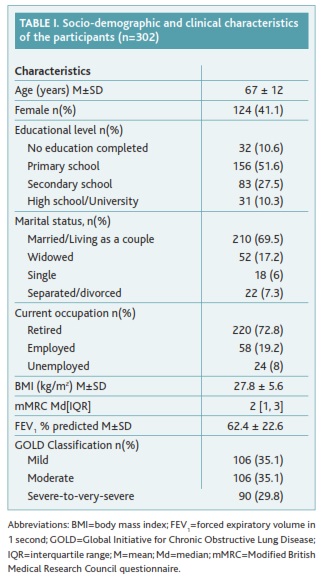
<body><![CDATA[<p>The Modified     British Medical Research Council questionnaire (mMRC) was used to assess     symptoms in patients with COPD, as recommended by GOLD.<sup>4</sup> Patients     reported their limitation of activities resulting from breathlessness by     selecting the statement that best described their limitation.<sup>19</sup> The     questionnaire comprises five grades (statements) on a scale from 0 to 4, with     higher grades indicating greater perceived respiratory limitation. </p>       <p><b><i>Symptoms     of anxiety and depression</i></b></p>       <p>The     Portuguese version of the Hospital Anxiety and Depression Scale (HADS) was used     to assess symptoms of anxiety and depression.<sup>20</sup> This scale has been     widely used in patients with COPD and has been reported internationally as a     valid and reliable instrument.<sup>21</sup> The HADS contains 14 items. Seven     items measure symptoms of anxiety (HADS-A) and 7 symptoms of depression     (HADS-D).<sup>22</sup> The presence of clinically significant symptoms of     anxiety or depression was defined by a HADS-A/HADS-D score of &#8805; 8.<sup>21</sup> The severity of symptoms of anxiety or depression was categorised as mild     (score 8-10), moderate (score 11-14) or severe (score 15-21).<sup>20</sup> Coefficients of Cronbach’s alpha found in the present study (0.78 for anxiety     and 0.74 for depression) were similar to those reported by Pais-Ribeiro et al     (0.76 and 0.81, respectively).<sup>20</sup></p>       <p><b>Statistical analysis</b></p>       <p>Descriptive     statistics were used to describe the socio-demographic variables, clinical     characteristics, and the HADS-A/HADS-D scores. As most of the previous stu-dies     of symptoms of anxiety and depression in COPD used “point prevalence”, the     frequency of symptoms of anxiety and depression (HADS-A/HADS-D&#8805;8) was     computed based on this estimation. This facilitated the discussion of results.     Frequencies were presented together with the 95% confidence intervals. The     severity of symptoms of anxiety and depression was categorised as ‘mild’     (HADS-A/HADS-D &#8805;8 and &#8804;10), ‘moderate’ (HADS-A/HADS-D &#8805;11 and     &#8804;14) or ‘severe’ (HADS-A/HADS-D &#8805;15 and &#8804;21).<sup>20</sup> To     explore associations between variables related to the presence of clinically     significant symptoms of anxiety and depression, variables of patients with and     without symptoms of anxiety and depression (HADS-A/HADS-D&#8805;8 compared to     HADS-A/HADS-D&lt;8) were compared using independent t-tests for normally     distributed data, Mann-Whitney U-tests for non-normally distributed data and     ordinal data, and Chi-square tests for categorical data. In the case of     chi-square tests, when a statistically significant difference was found for a     categorical variable with more than two categories, chi-square multiple     comparison tests with Bonferroni correction were performed to explore which     categories differed from each other. The variables that were statistically different     (<i>p</i>&lt;0.05) between the two groups     were used to further explore their relationship with the severity of anxiety     and depression and to perform two multivariate logistic regressions (Enter     method). The dependent variable in each multivariate logistic regression was     the presence of clinically significant symptoms of anxiety symptoms or     depression (0 = absent, 1 = present). Multiple logistic regression analysis was     used for predictive purposes and to adjust for possible confounders.<sup>23</sup> The level of significance considered was 0.05. Statistical analyses were     performed using IBM SPSS Statistics version 20.0 (IBM Corporation, Armonk, NY,     USA).</p>       <p><b>Results</b></p>       <p><b>Characteristics of participants </b></p>       <p>The total     number of patients initially screened at the participating institutions was not     possible to obtain due to the recruitment strategy. A total of 340 patients     with COPD were approached by the research team for inclusion in the study,     however 32 refused to participate due to personal reasons and 6 failed to     attend the arranged meeting. The final sample comprised 302 patients with COPD     (mean age 67&plusmn;12 years old; 41.1% female). The majority of participants had     completed primary school (n=156; 51.6%) and were retired (n=220; 72.8%). The     mean BMI was 27.8&plusmn;5.6kg/m<sup>2</sup> and the median mMRC grade was 2 (‘I walk     slower than people of the same age on the level because of the breathlessness’,     or ‘I have to stop for breath when walking on my own pace on the level’).     According to the GOLD criteria, 106 (35.1%) patients had mild, 106 (35.1%) mode-rate     and 90 (29.8%) had severe-to-very-severe COPD. <a href="#t1">Table I</a> shows the     socio-demographic and clinical cha-racteristics of the study participants.</p>       <p>&nbsp;</p>    <p align="center"><a name="t1"></a><img src="/img/revistas/rpmgf/v31n1/31n1a04t1.jpg"/></p>    
]]></body>
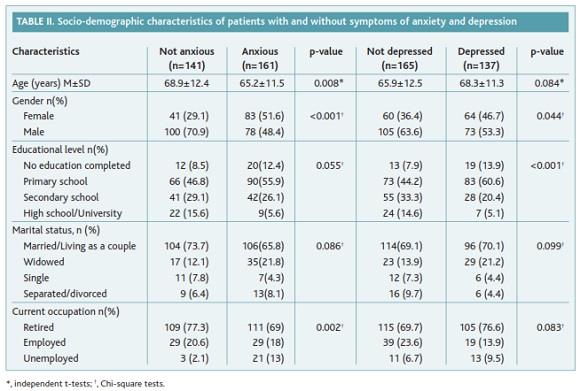
<body><![CDATA[<p>&nbsp;</p>       <p><b>Symptoms of anxiety and depression </b></p>       <p>The mean     anxiety score was 8.1&plusmn;4.4 and the mean depression score was 7.3&plusmn;4. A total of     161 (53.3%; 95% CI 48-58.9) patients had clinically significant symptoms of     anxiety. Symptoms of anxiety were experienced mainly as ‘mild’ (n=74; 46%, 95% CI     38.5-53.4) or ‘moderate’ (n=59; 36.6%, 95% CI 29.2-44.7) with few ‘severe’     cases (n=28; 17.4%, 95% CI 11.8-23.6). Clinically significant symptoms of     depression were present in 45.4% (95% CI 40.1-50.7, n=137) of patients. These     symptoms were experienced as ‘mild’ in the majority of the sample (n=74; 54%,     95% CI 46-62.8), but also ‘moderate’ (n=48; 35%, 95% CI 27-43.1) and a few     ‘severe’ cases were found (n=15; 11%, 95% CI 5.8-16.1). A total of 99 (32.8%,     95% CI 27.5-38.1) patients had both symptoms of anxiety and depression.</p>       <p><b>Associations between anxiety and depression     and socio-demographic characteristics</b></p>       <p>Symptoms of     anxiety and depression were more frequent in female patients (<i>p</i>&lt;0.001 and <i>p</i>=0.044) (<a href="#t2">table II</a>). Symptoms of anxiety were also more frequent in     younger patients (<i>p</i>=0.008) and     unemployed patients (<i>p</i>=0.002).     Symptoms of depression were more frequent in those with lower educational     levels (no education completed, primary school and secondary school; <i>p</i>&lt;0.001) (<a href="#t2">table II</a>). Regarding the     association of gender and severity of anxiety, it was found that the frequency     of females with moderate and severe anxiety (66.1% and 67.9%, respectively) was     significantly higher than females with mild anxiety (33.8%, <i>p</i>&lt;0.001). No other statistically     significant differences were found.</p>       <p>&nbsp;</p>    <p align="center"><a name="t2"></a><img src="/img/revistas/rpmgf/v31n1/31n1a04t2.jpg"/></p>    
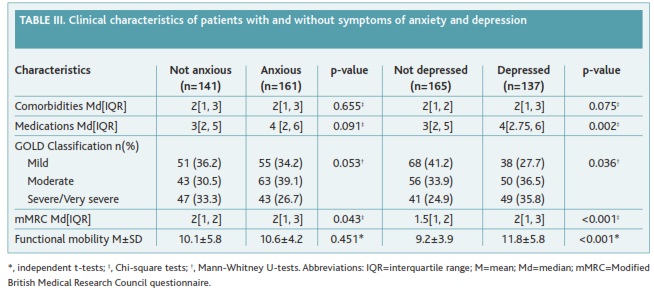
<p>&nbsp;</p>       <p><b>Relationship between symptoms of anxiety     and depression and clinical characteristics </b></p>       <p>The     frequency of symptoms of anxiety and depression was higher in patients with     greater limitation of activities resulting from breathlessness (mMRC, <i>p</i>=0.043 and <i>p</i>&lt;0.001) (<a href="#t3">table III</a>). The frequency of symptoms of depression     was also higher in patients with higher medication intake (<i>p</i>=0.002), advanced COPD (<i>p</i>=0.036)     and lower functional mobility (<i>p</i>&lt;0.001)     (<a href="#t3">table III</a>). Limitation of activities resulting from breathlessness was higher     in patients with moderate or severe anxiety (Median 2, Interquartile range     (1,3); 2(2,3)) and depression (3(2,3); 3(1.5,3)) than in those with mild     anxiety (2(1,2), <i>p</i>=0.026) and     depression (2(1,3), <i>p</i>=0.016). No     other statistically significant differences were observed regar-ding the     severity of symptoms.</p>       ]]></body>
<body><![CDATA[<p>&nbsp;</p>    <p align="center"><a name="t3"></a><img src="/img/revistas/rpmgf/v31n1/31n1a04t3.jpg"/></p>    
<p>&nbsp;</p>       <p><b>Predictors of anxiety and depression </b></p>       <p>Two     multivariate logistic regressions were performed to identify the predictors of     symptoms of anxiety and depression. Symptoms of anxiety were predicted by     limitation of activities resulting from breathlessness (OR 1.39, 95% CI     1.04-1.84), age (0.97, 95% CI 0.94-0.99), and female gender (OR 0.37; 95% CI     0.20-0.66). Symptoms of depression were predicted by functional mobility (OR     1.91, 95% CI 1.38-2.66) and limitation of activities (OR 1.12, 95% CI     1.04-1.21). These logistic regression models predicted 13% of the total     variance of anxiety and 22.4% of the total variance of symptoms of depression.</p>       <p><b>Discussion</b></p>       <p>This study     showed that a large proportion of Portuguese patients with COPD present     symptoms of anxiety and depression. Limitation of activities resulting from     breathlessness, female gender, age and functional mobility were predictors of     these distressing symptoms.</p>       <p>More than     half of patients had symptoms of anxiety (53.3%) and 45.4% had symptoms of     depression. This is higher than the value reported by Carreiro (21.1%).<sup>13</sup> The proportions found in the present study fall within the range of estimates     found among patients with COPD in other countries.<sup>7-12</sup> Comparisons     need to be interpreted with caution as different instruments were used in other     studies.</p>       <p>The presence     of symptoms of both anxiety and depression was predicted by limitation of     activities resulting from breathlessness. The severity of anxiety and     depression was also related to the severity of breathlessness. Respiratory     symptoms have been associated with patients’ anxiety and depression.<sup>8</sup> The frequency of symptoms of anxiety was similar in early and advanced COPD.     The results strengthen previous findings stating that even at earlier stages of     the disease, the uncertain and unpredictable nature of the symptoms and acute     exacerbations have an impact of on patients’ emotional well-being.<sup>24</sup> </p>       <p>Anxiety was     also predicted by female gender and age. Female gender was related to higher     emotional distress, consistent with previously published results.<sup>25-26</sup> This may reflect the gender differences already found in the general     population.<sup>27</sup> A higher frequency of symptoms of anxiety was found in     younger and unemployed patients, which has been found previously.<sup>25-26,28</sup> These findings are relevant for clinical practice. It can be hypothesised that     older patients interpret the occurrence of an illness as an expected late-life     stressor.<sup>28-29</sup> Low educational levels were associated with a higher     frequency of depression. This was expected since having a high educational     level has been shown to be an important contributor to enhanced personal     internal resources.<sup>30</sup></p>       ]]></body>
<body><![CDATA[<p>Regarding     symptoms of depression, the severity of COPD had a different role. More     advanced disease was associated with a higher frequency of symptoms of     depression. This might be explained by the role of physical functioning on     symptoms of depression.<sup>31-32</sup> Patients with advanced COPD experience     more physical disa-bility. This was confirmed by the logistic regression     analysis, which identified patients’ functional mobility as a predictor of     clinically significant symptoms of depression.</p>       <p>These     findings suggest that many patients with COPD suffer from symptoms of anxiety     and depression and thus interventions are needed to promote a healthy     adjustment to the disease. Pulmonary rehabilitation programmes are recommended     to improve the physical and psychological condition of patients with COPD.<sup>33-34</sup> According to recent international guidelines, these programmes should include     exercise training, education and behavioural change through collaborative     self-management interventions.<sup>33</sup> In COPD and other chronic diseases,     there is evidence that these interventions have a significant positive effect     on patients’ emotional function.<sup>35-38</sup> In Portugal, pulmonary     rehabilitation programmes are scarce and typically combine exercise training     with education.<sup>39-40</sup> Patients’ emotional needs are not often     directly addressed. It would be logical to complement national programmes with     collaborative self-management interventions, since they may increase     instrumental and emotional coping abilities to allow patients to manage the     demands of the disease. Collaborative self-management interventions place     patients and health professionals in partnership to enhance patients’     self-efficacy and self-management abilities.<sup>33</sup> It remains to be     determined if involving the family caregiver in this partnership brings     additional benefits to patients.</p>       <p>This study     has some limitations. Possible sources of bias were the recruitment strategy     using clinicians in the institutions involved and the fact that the sample was     recruited from only the central region of Portugal. Future studies containing a     larger sample and inclu-ding patients with COPD from other regions of the     country would be more representative of the Portuguese population with COPD. A     control group of healthy individuals with similar socio-demographic     characteristics should also be included in further research to increase the     validity of these findings. The use of HADS to assess symptoms of anxiety and     depression may have introduced a bias in the study since some authors have     recently emphasised that the assumed bi-dimensionality of the HADS may not be     appropriate.<sup>41-42</sup> However, this instrument was used as a screening     tool for symptoms of anxiety and depression and not as an instrument for     diagnosis of clinical anxiety or depression. The HADS has shown to be a     reliable instrument internationally for measuring emotional distress of     patients with COPD. This study focused on the presence of clinically     significant symptoms of anxiety and depression (i.e., HADS-A/HADS-D&#8805;8).     It may be interes-ting to explore the absolute scores of HADS-A and HADS-D and     derive predictive equations. Another limitation of the present study is related     to its cross-sectional nature. The frequency of distressing symptoms and the     relationships with associated factors could not be established along the     progression of the disease. Longitudinal studies following a cohort of patients     with COPD would address this issue and identify other predictors of symptoms of     anxiety and depression. For ins-tance, the predictive value of alexithymia     could be investigated. Recent research found a strong association between this     condition and distressing symptoms in patients with COPD.<sup>43</sup></p>       <p><b>Conclusion</b></p>     <p>A large     proportion of Portuguese patients with COPD experience symptoms of anxiety and     depression. Limi-tation of activities resulting from breathlessness, female     gender, age, and functional mobility were predictors of these distressing symptoms.     To address patients’ emotional needs, national pulmonary rehabilitation     programmes should include a collaborative self-management component. Future     research could explore the effects of involving family caregivers in these     interventions on beneficial outcomes for patients.</p>       <p>&nbsp;</p>       <p><b>REFERENCES</b></p>       <!-- ref --><p>1. World     Health Organization. Global surveillance, prevention and control of chronic     respiratory diseases: a comprehensive approach. Geneva: WHO; 2007. ISBN     9789241563468&nbsp;&nbsp;&nbsp;&nbsp;&nbsp;&nbsp;&nbsp;&nbsp;[&#160;<a href="javascript:void(0);" onclick="javascript: window.open('/scielo.php?script=sci_nlinks&ref=000090&pid=S2182-5173201500010000400001&lng=','','width=640,height=500,resizable=yes,scrollbars=1,menubar=yes,');">Links</a>&#160;]<!-- end-ref --><!-- ref --><p>2. Mathers     CD, Loncar D. Projections of global mortality and burden of disease from 2002     to 2030. PLoS Med. 2006;3(11):2011-30.    &nbsp;&nbsp;&nbsp;&nbsp;&nbsp;&nbsp;&nbsp;&nbsp;[&#160;<a href="javascript:void(0);" onclick="javascript: window.open('/scielo.php?script=sci_nlinks&ref=000091&pid=S2182-5173201500010000400002&lng=','','width=640,height=500,resizable=yes,scrollbars=1,menubar=yes,');">Links</a>&#160;]<!-- end-ref --></p>       ]]></body>
<body><![CDATA[<!-- ref --><p>3.     Observat&oacute;rio Nacional das Doen&ccedil;as Respirat&oacute;rias. Prevenir a doen&ccedil;a, acompanhar     e reabilitar o doente: relat&oacute;rio de 2013. Lisboa: ONDR; 2013.    &nbsp;&nbsp;&nbsp;&nbsp;&nbsp;&nbsp;&nbsp;&nbsp;[&#160;<a href="javascript:void(0);" onclick="javascript: window.open('/scielo.php?script=sci_nlinks&ref=000093&pid=S2182-5173201500010000400003&lng=','','width=640,height=500,resizable=yes,scrollbars=1,menubar=yes,');">Links</a>&#160;]<!-- end-ref --></p>       <!-- ref --><p>4. Vestbo J,     Hurd SS, Agust&iacute; AG, Jones PW, Vogelmeier C, Anzueto A, et al. Global strategy     for the diagnosis, management, and prevention of chronic obstructive pulmonary     disease. Am J Respir Crit Care Med. 2013;187(4):347-65.    &nbsp;&nbsp;&nbsp;&nbsp;&nbsp;&nbsp;&nbsp;&nbsp;[&#160;<a href="javascript:void(0);" onclick="javascript: window.open('/scielo.php?script=sci_nlinks&ref=000095&pid=S2182-5173201500010000400004&lng=','','width=640,height=500,resizable=yes,scrollbars=1,menubar=yes,');">Links</a>&#160;]<!-- end-ref --></p>       <!-- ref --><p>5. Wouters     EF, Celis MP, Breyer MK, Rutten EP, Graat-Verboom L, Spruit MA. Co-morbid     manifestations in COPD. Respir Med: COPD Update. 2007;3(4):135-51.    &nbsp;&nbsp;&nbsp;&nbsp;&nbsp;&nbsp;&nbsp;&nbsp;[&#160;<a href="javascript:void(0);" onclick="javascript: window.open('/scielo.php?script=sci_nlinks&ref=000097&pid=S2182-5173201500010000400005&lng=','','width=640,height=500,resizable=yes,scrollbars=1,menubar=yes,');">Links</a>&#160;]<!-- end-ref --></p>       <!-- ref --><p>6. Willgoss     TG, Yohannes AM, Goldbart J, Fatoye F. “Everything was spiraling out of     control”: experiences of anxiety in people with chronic obstructive pulmonary     disease. Heart Lung. 2012;41(6):562-71.    &nbsp;&nbsp;&nbsp;&nbsp;&nbsp;&nbsp;&nbsp;&nbsp;[&#160;<a href="javascript:void(0);" onclick="javascript: window.open('/scielo.php?script=sci_nlinks&ref=000099&pid=S2182-5173201500010000400006&lng=','','width=640,height=500,resizable=yes,scrollbars=1,menubar=yes,');">Links</a>&#160;]<!-- end-ref --></p>       <!-- ref --><p>7. Stage KB,     Middelboe T, Pisinger C. Measurement of depression in patients with chronic     obstructive pulmonary disease (COPD). Nord J Psychiatry. 2003;57(4):297-301.    &nbsp;&nbsp;&nbsp;&nbsp;&nbsp;&nbsp;&nbsp;&nbsp;[&#160;<a href="javascript:void(0);" onclick="javascript: window.open('/scielo.php?script=sci_nlinks&ref=000101&pid=S2182-5173201500010000400007&lng=','','width=640,height=500,resizable=yes,scrollbars=1,menubar=yes,');">Links</a>&#160;]<!-- end-ref --></p>       ]]></body>
<body><![CDATA[<!-- ref --><p>8. Yohannes     AM, Willgoss TG, Baldwin RC, Connolly MJ. Depression and anxiety in chronic     heart failure and chronic obstructive pulmonary disease: prevalence, relevance,     clinical implications and management principles. Int J Geriatr Psychiatry.     2010;25(12):1209-21.    &nbsp;&nbsp;&nbsp;&nbsp;&nbsp;&nbsp;&nbsp;&nbsp;[&#160;<a href="javascript:void(0);" onclick="javascript: window.open('/scielo.php?script=sci_nlinks&ref=000103&pid=S2182-5173201500010000400008&lng=','','width=640,height=500,resizable=yes,scrollbars=1,menubar=yes,');">Links</a>&#160;]<!-- end-ref --></p>       <!-- ref --><p>9. Lacasse     Y, Rousseau L, Maltais F. Prevalence of depressive symptoms and depression in     patients with severe oxygen-dependent chronic obstructive pulmonary disease. J     Cardiopulm Rehabil. 2001;21(2):80-6.    &nbsp;&nbsp;&nbsp;&nbsp;&nbsp;&nbsp;&nbsp;&nbsp;[&#160;<a href="javascript:void(0);" onclick="javascript: window.open('/scielo.php?script=sci_nlinks&ref=000105&pid=S2182-5173201500010000400009&lng=','','width=640,height=500,resizable=yes,scrollbars=1,menubar=yes,');">Links</a>&#160;]<!-- end-ref --></p>       <!-- ref --><p>10. Dowson     C, Laing R, Barraclough R, Town I, Mulder R, Norris K, et al. The use of the     Hospital Anxiety and Depression Scale (HADS) in patients with chronic     obstructive pulmonary disease: a pilot study. N Z Med J. 2001;114(1141):447-9.    &nbsp;&nbsp;&nbsp;&nbsp;&nbsp;&nbsp;&nbsp;&nbsp;[&#160;<a href="javascript:void(0);" onclick="javascript: window.open('/scielo.php?script=sci_nlinks&ref=000107&pid=S2182-5173201500010000400010&lng=','','width=640,height=500,resizable=yes,scrollbars=1,menubar=yes,');">Links</a>&#160;]<!-- end-ref --></p>       <!-- ref --><p>11. Willgoss     TG, Yohannes AM. Anxiety disorders in patients with COPD: a systematic review.     Respir Care. 2013;58(5):858-66.    &nbsp;&nbsp;&nbsp;&nbsp;&nbsp;&nbsp;&nbsp;&nbsp;[&#160;<a href="javascript:void(0);" onclick="javascript: window.open('/scielo.php?script=sci_nlinks&ref=000109&pid=S2182-5173201500010000400011&lng=','','width=640,height=500,resizable=yes,scrollbars=1,menubar=yes,');">Links</a>&#160;]<!-- end-ref --></p>       <!-- ref --><p>12. Zhang     MW, Ho RC, Cheung MW, Fu E, Mak A. Prevalence of depressive symptoms in     patients with chronic obstructive pulmonary disease: a systematic review,     meta-analysis and meta-regression. Gen Hosp Psychiatry. 2011;33(3):217-23.    &nbsp;&nbsp;&nbsp;&nbsp;&nbsp;&nbsp;&nbsp;&nbsp;[&#160;<a href="javascript:void(0);" onclick="javascript: window.open('/scielo.php?script=sci_nlinks&ref=000111&pid=S2182-5173201500010000400012&lng=','','width=640,height=500,resizable=yes,scrollbars=1,menubar=yes,');">Links</a>&#160;]<!-- end-ref --></p>       ]]></body>
<body><![CDATA[<!-- ref --><p>13. Carreiro     A, Santos J, Rodrigues F. Impacto das comorbilidades num programa de     reabilita&ccedil;&atilde;o respirat&oacute;ria em doentes com doen&ccedil;a pulmonar obstrutiva cr&oacute;nica     (Impact of comorbidities in pulmonary rehabilitation outcomes in patients with     COPD). Rev Port Pneumol. 2013;19(3):106-13.    &nbsp;&nbsp;&nbsp;&nbsp;&nbsp;&nbsp;&nbsp;&nbsp;[&#160;<a href="javascript:void(0);" onclick="javascript: window.open('/scielo.php?script=sci_nlinks&ref=000113&pid=S2182-5173201500010000400013&lng=','','width=640,height=500,resizable=yes,scrollbars=1,menubar=yes,');">Links</a>&#160;]<!-- end-ref --> Portuguese</p>       <!-- ref --><p>14. von Elm     E, Altman DG, Egger M, Pocock SJ, G&oslash;tzsche PC, Vandenbroucke JP. The     Strengthening the Reporting of Observational Studies in Epidemiology (STROBE)     Statement: guidelines for reporting observational studies. J Clin Epidemiol.     2008;61(4):344-9.    &nbsp;&nbsp;&nbsp;&nbsp;&nbsp;&nbsp;&nbsp;&nbsp;[&#160;<a href="javascript:void(0);" onclick="javascript: window.open('/scielo.php?script=sci_nlinks&ref=000115&pid=S2182-5173201500010000400014&lng=','','width=640,height=500,resizable=yes,scrollbars=1,menubar=yes,');">Links</a>&#160;]<!-- end-ref --></p>       <!-- ref --><p>15. Miller     MR, Hankinson J, Brusasco V, Burgos F, Casaburi R, Coates A, et al.     Standardisation of spirometry. Eur Respir J. 2005;26(2):319-38.    &nbsp;&nbsp;&nbsp;&nbsp;&nbsp;&nbsp;&nbsp;&nbsp;[&#160;<a href="javascript:void(0);" onclick="javascript: window.open('/scielo.php?script=sci_nlinks&ref=000117&pid=S2182-5173201500010000400015&lng=','','width=640,height=500,resizable=yes,scrollbars=1,menubar=yes,');">Links</a>&#160;]<!-- end-ref --></p>       <!-- ref --><p>16.     Beauchamp MK, O’Hoski S, Goldstein RS, Brooks D. Effect of pulmonary     rehabilitation on balance in persons with chronic obstructive pulmonary     disease. Arch Phys Med Rehabil. 2010;91(9):1460-5.    &nbsp;&nbsp;&nbsp;&nbsp;&nbsp;&nbsp;&nbsp;&nbsp;[&#160;<a href="javascript:void(0);" onclick="javascript: window.open('/scielo.php?script=sci_nlinks&ref=000119&pid=S2182-5173201500010000400016&lng=','','width=640,height=500,resizable=yes,scrollbars=1,menubar=yes,');">Links</a>&#160;]<!-- end-ref --></p>       <!-- ref --><p>17. J&aacute;come     C, Cruz J, Gabriel R, Figueiredo D, Marques A. Functional balance in older     adults with COPD. J Aging Phys Act. 2014;22(3):357-63.    &nbsp;&nbsp;&nbsp;&nbsp;&nbsp;&nbsp;&nbsp;&nbsp;[&#160;<a href="javascript:void(0);" onclick="javascript: window.open('/scielo.php?script=sci_nlinks&ref=000121&pid=S2182-5173201500010000400017&lng=','','width=640,height=500,resizable=yes,scrollbars=1,menubar=yes,');">Links</a>&#160;]<!-- end-ref --></p>       ]]></body>
<body><![CDATA[<!-- ref --><p>18.     Podsiadlo D, Richardson S. The timed “Up &amp; Go”: a test of basic functional     mobility for frail elderly persons. J Am Geriatr Soc. 1991;39(2):142-8.    &nbsp;&nbsp;&nbsp;&nbsp;&nbsp;&nbsp;&nbsp;&nbsp;[&#160;<a href="javascript:void(0);" onclick="javascript: window.open('/scielo.php?script=sci_nlinks&ref=000123&pid=S2182-5173201500010000400018&lng=','','width=640,height=500,resizable=yes,scrollbars=1,menubar=yes,');">Links</a>&#160;]<!-- end-ref --></p>       <!-- ref --><p>19. Doherty     DE, Belfer MH, Brunton SA, Fromer L, Morris CM, Snader TC. Chronic obstructive     pulmonary disease: consensus recommendations for early diagnosis and treatment.     J Fam Pract. 2006;55 Suppl 1:S1-8.    &nbsp;&nbsp;&nbsp;&nbsp;&nbsp;&nbsp;&nbsp;&nbsp;[&#160;<a href="javascript:void(0);" onclick="javascript: window.open('/scielo.php?script=sci_nlinks&ref=000125&pid=S2182-5173201500010000400019&lng=','','width=640,height=500,resizable=yes,scrollbars=1,menubar=yes,');">Links</a>&#160;]<!-- end-ref --></p>       <!-- ref --><p>20.     Pais-Ribeiro J, Silva I, Ferreira T, Martins A, Meneses R, Baltar M. Validation     study of a Portuguese version of the Hospital Anxiety and Depression Scale.     Psychol Health Med. 2007;12(2):225-35.    &nbsp;&nbsp;&nbsp;&nbsp;&nbsp;&nbsp;&nbsp;&nbsp;[&#160;<a href="javascript:void(0);" onclick="javascript: window.open('/scielo.php?script=sci_nlinks&ref=000127&pid=S2182-5173201500010000400020&lng=','','width=640,height=500,resizable=yes,scrollbars=1,menubar=yes,');">Links</a>&#160;]<!-- end-ref --></p>       <!-- ref --><p>21. Bjelland     I, Dahl AA, Haug TT, Neckelmann D. The validity of the Hospital Anxiety and Depression     Scale: an updated literature review. J Psychosom Res. 2002;52(2):69-77.    &nbsp;&nbsp;&nbsp;&nbsp;&nbsp;&nbsp;&nbsp;&nbsp;[&#160;<a href="javascript:void(0);" onclick="javascript: window.open('/scielo.php?script=sci_nlinks&ref=000129&pid=S2182-5173201500010000400021&lng=','','width=640,height=500,resizable=yes,scrollbars=1,menubar=yes,');">Links</a>&#160;]<!-- end-ref --></p>       <!-- ref --><p>22. Zigmond     AS, Snaith RP. The hospital anxiety and depression scale. Acta Psychiatr Scand.     1983;67(6):361-70.    &nbsp;&nbsp;&nbsp;&nbsp;&nbsp;&nbsp;&nbsp;&nbsp;[&#160;<a href="javascript:void(0);" onclick="javascript: window.open('/scielo.php?script=sci_nlinks&ref=000131&pid=S2182-5173201500010000400022&lng=','','width=640,height=500,resizable=yes,scrollbars=1,menubar=yes,');">Links</a>&#160;]<!-- end-ref --></p>       ]]></body>
<body><![CDATA[<!-- ref --><p>23. McIlroy     SP, Dynan KB, Lawson JT, Patterson CC, Passmore AP. Moderately elevated plasma     homocysteine, methylenetetrahydrofolate reductase genotype, and risk for     stroke, vascular dementia, and Alzheimer disease in Northern Ireland. Stroke.     2002;33(10):2351-6.    &nbsp;&nbsp;&nbsp;&nbsp;&nbsp;&nbsp;&nbsp;&nbsp;[&#160;<a href="javascript:void(0);" onclick="javascript: window.open('/scielo.php?script=sci_nlinks&ref=000133&pid=S2182-5173201500010000400023&lng=','','width=640,height=500,resizable=yes,scrollbars=1,menubar=yes,');">Links</a>&#160;]<!-- end-ref --></p>       <!-- ref --><p>24. Boyle     AH. An integrative review of the impact of COPD on families. South Online J     Nurs Res. 2009;9(3):1-12.    &nbsp;&nbsp;&nbsp;&nbsp;&nbsp;&nbsp;&nbsp;&nbsp;[&#160;<a href="javascript:void(0);" onclick="javascript: window.open('/scielo.php?script=sci_nlinks&ref=000135&pid=S2182-5173201500010000400024&lng=','','width=640,height=500,resizable=yes,scrollbars=1,menubar=yes,');">Links</a>&#160;]<!-- end-ref --></p>       <!-- ref --><p>25. Karakurt     P, &Uuml;nsal A. Fatigue, anxiety and depression levels, activities of daily living     of patients with chronic obstructive pulmonary disease. Int J Nurs Pract.     2013;19(2):221-31.    &nbsp;&nbsp;&nbsp;&nbsp;&nbsp;&nbsp;&nbsp;&nbsp;[&#160;<a href="javascript:void(0);" onclick="javascript: window.open('/scielo.php?script=sci_nlinks&ref=000137&pid=S2182-5173201500010000400025&lng=','','width=640,height=500,resizable=yes,scrollbars=1,menubar=yes,');">Links</a>&#160;]<!-- end-ref --></p>       <!-- ref --><p>26. Lee H,     Yoon JY, Kim I, Jeong YH. The effects of personal resources and coping     strategies on depression and anxiety in patients with chronic obstructive     pulmonary disease. Heart Lung. 2013;42(6):473-9.    &nbsp;&nbsp;&nbsp;&nbsp;&nbsp;&nbsp;&nbsp;&nbsp;[&#160;<a href="javascript:void(0);" onclick="javascript: window.open('/scielo.php?script=sci_nlinks&ref=000139&pid=S2182-5173201500010000400026&lng=','','width=640,height=500,resizable=yes,scrollbars=1,menubar=yes,');">Links</a>&#160;]<!-- end-ref --></p>       <!-- ref --><p>27. Altemus     M. Sex differences in depression and anxiety disorders: potential biological     determinants. Horm Behav. 2006;50(4):534-8.    &nbsp;&nbsp;&nbsp;&nbsp;&nbsp;&nbsp;&nbsp;&nbsp;[&#160;<a href="javascript:void(0);" onclick="javascript: window.open('/scielo.php?script=sci_nlinks&ref=000141&pid=S2182-5173201500010000400027&lng=','','width=640,height=500,resizable=yes,scrollbars=1,menubar=yes,');">Links</a>&#160;]<!-- end-ref --></p>       ]]></body>
<body><![CDATA[<!-- ref --><p>28. Cleland     JA, Lee AJ, Hall S. Associations of depression and anxiety with gender, age,     health-related quality of life and symptoms in primary care COPD patients. Fam     Pract. 2007;24(3):217-23.    &nbsp;&nbsp;&nbsp;&nbsp;&nbsp;&nbsp;&nbsp;&nbsp;[&#160;<a href="javascript:void(0);" onclick="javascript: window.open('/scielo.php?script=sci_nlinks&ref=000143&pid=S2182-5173201500010000400028&lng=','','width=640,height=500,resizable=yes,scrollbars=1,menubar=yes,');">Links</a>&#160;]<!-- end-ref --></p>       <!-- ref --><p>29. Balcells     E, Gea J, Ferrer J, Serra I, Orozco-Levi M, de Batlle J, et al. Factors     affecting the relationship between psychological status and quality of life in     COPD patients. Health Qual Life Outcomes. 2010;8(1):108.    &nbsp;&nbsp;&nbsp;&nbsp;&nbsp;&nbsp;&nbsp;&nbsp;[&#160;<a href="javascript:void(0);" onclick="javascript: window.open('/scielo.php?script=sci_nlinks&ref=000145&pid=S2182-5173201500010000400029&lng=','','width=640,height=500,resizable=yes,scrollbars=1,menubar=yes,');">Links</a>&#160;]<!-- end-ref --></p>       <!-- ref --><p>30. Drageset     S, Lindstr&ouml;m TC. Coping with a possible breast cancer diagnosis: demographic     factors and social support. J Adv Nurs. 2005;51(3):217-26.    &nbsp;&nbsp;&nbsp;&nbsp;&nbsp;&nbsp;&nbsp;&nbsp;[&#160;<a href="javascript:void(0);" onclick="javascript: window.open('/scielo.php?script=sci_nlinks&ref=000147&pid=S2182-5173201500010000400030&lng=','','width=640,height=500,resizable=yes,scrollbars=1,menubar=yes,');">Links</a>&#160;]<!-- end-ref --></p>       <!-- ref --><p>31. Lazarus     RS, Folkman S. Stress, appraisal, and coping. New York: Springer; 1984. ISBN     9780826141927&nbsp;&nbsp;&nbsp;&nbsp;&nbsp;&nbsp;&nbsp;&nbsp;[&#160;<a href="javascript:void(0);" onclick="javascript: window.open('/scielo.php?script=sci_nlinks&ref=000149&pid=S2182-5173201500010000400031&lng=','','width=640,height=500,resizable=yes,scrollbars=1,menubar=yes,');">Links</a>&#160;]<!-- end-ref --><!-- ref --><p>32. Ng TP,     Niti M, Fones C, Yap KB, Tan WC. Co-morbid association of depression and COPD:     a population-based study. Respir Med. 2009;103(6):895-901.    &nbsp;&nbsp;&nbsp;&nbsp;&nbsp;&nbsp;&nbsp;&nbsp;[&#160;<a href="javascript:void(0);" onclick="javascript: window.open('/scielo.php?script=sci_nlinks&ref=000150&pid=S2182-5173201500010000400032&lng=','','width=640,height=500,resizable=yes,scrollbars=1,menubar=yes,');">Links</a>&#160;]<!-- end-ref --></p>       <!-- ref --><p>33. Spruit     MA, Singh SJ, Garvey C, ZuWallack R, Nici L, Rochester C, et al. An official     American Thoracic Society/European Respiratory Society Statement: key concepts     and advances in pulmonary rehabilitation. Am J Respir Crit Care Med.     2013;188(8):e13-e64.    &nbsp;&nbsp;&nbsp;&nbsp;&nbsp;&nbsp;&nbsp;&nbsp;[&#160;<a href="javascript:void(0);" onclick="javascript: window.open('/scielo.php?script=sci_nlinks&ref=000152&pid=S2182-5173201500010000400033&lng=','','width=640,height=500,resizable=yes,scrollbars=1,menubar=yes,');">Links</a>&#160;]<!-- end-ref --></p>       <!-- ref --><p>34. Paz-D&iacute;az     H, Montes de Oca M, L&oacute;pez JM, Celli BR. Pulmonary rehabilitation improves     depression, anxiety, dyspnea and health status in patients with COPD. Am J Phys     Med Rehabil. 2007;86(1):30-6.    &nbsp;&nbsp;&nbsp;&nbsp;&nbsp;&nbsp;&nbsp;&nbsp;[&#160;<a href="javascript:void(0);" onclick="javascript: window.open('/scielo.php?script=sci_nlinks&ref=000154&pid=S2182-5173201500010000400034&lng=','','width=640,height=500,resizable=yes,scrollbars=1,menubar=yes,');">Links</a>&#160;]<!-- end-ref --></p>       <!-- ref --><p>35. Coventry     PA, Bower P, Keyworth C, Kenning C, Knopp J, Garrett C, et al. The effect of     complex interventions on depression and anxiety in chronic obstructive     pulmonary disease: systematic review and meta-analysis. PLoS ONE.     2013;8(4):e60532.    &nbsp;&nbsp;&nbsp;&nbsp;&nbsp;&nbsp;&nbsp;&nbsp;[&#160;<a href="javascript:void(0);" onclick="javascript: window.open('/scielo.php?script=sci_nlinks&ref=000156&pid=S2182-5173201500010000400035&lng=','','width=640,height=500,resizable=yes,scrollbars=1,menubar=yes,');">Links</a>&#160;]<!-- end-ref --></p>       <!-- ref --><p>36. Adams     SG, Smith PK, Allan PF, Anzueto A, Pugh JA, Cornell JE. Systematic review of     the chronic care model in chronic obstructive pulmonary disease prevention and     management. Arch Intern Med. 2007;167(6):551-61.    &nbsp;&nbsp;&nbsp;&nbsp;&nbsp;&nbsp;&nbsp;&nbsp;[&#160;<a href="javascript:void(0);" onclick="javascript: window.open('/scielo.php?script=sci_nlinks&ref=000158&pid=S2182-5173201500010000400036&lng=','','width=640,height=500,resizable=yes,scrollbars=1,menubar=yes,');">Links</a>&#160;]<!-- end-ref --></p>       <!-- ref --><p>37. Okamura     H, Fukui S, Nagasaka Y, Koike M, Uchitomi Y. Psychoeducational intervention for     patients with primary breast cancer and patient satisfaction with information:     an exploratory analysis. Breast Cancer Res Treat. 2003;80(3):331-8.    &nbsp;&nbsp;&nbsp;&nbsp;&nbsp;&nbsp;&nbsp;&nbsp;[&#160;<a href="javascript:void(0);" onclick="javascript: window.open('/scielo.php?script=sci_nlinks&ref=000160&pid=S2182-5173201500010000400037&lng=','','width=640,height=500,resizable=yes,scrollbars=1,menubar=yes,');">Links</a>&#160;]<!-- end-ref --></p>       <!-- ref --><p>38. Sharif F,     Mohebbi S, Tabatabaee HR, Saberi-Firoozi M, Gholamzadeh S. Effects of     psycho-educational intervention on health-related quality of life (QOL) of     patients with chronic liver disease referring to Shiraz University of Medical     Sciences. Health Qual Life Outcomes. 2005;3(1):81.    &nbsp;&nbsp;&nbsp;&nbsp;&nbsp;&nbsp;&nbsp;&nbsp;[&#160;<a href="javascript:void(0);" onclick="javascript: window.open('/scielo.php?script=sci_nlinks&ref=000162&pid=S2182-5173201500010000400038&lng=','','width=640,height=500,resizable=yes,scrollbars=1,menubar=yes,');">Links</a>&#160;]<!-- end-ref --></p>       <!-- ref --><p>39. Sim&atilde;o P,     Almeida P. Reabilita&ccedil;&atilde;o respirat&oacute;ria: uma estrat&eacute;gia para a sua implementa&ccedil;&atilde;o.     Rev Port Pneumol. 2009;XV Suppl 1:S93-S118.    &nbsp;&nbsp;&nbsp;&nbsp;&nbsp;&nbsp;&nbsp;&nbsp;[&#160;<a href="javascript:void(0);" onclick="javascript: window.open('/scielo.php?script=sci_nlinks&ref=000164&pid=S2182-5173201500010000400039&lng=','','width=640,height=500,resizable=yes,scrollbars=1,menubar=yes,');">Links</a>&#160;]<!-- end-ref --></p>       <!-- ref --><p>40.     Direc&ccedil;&atilde;o-Geral da Sa&uacute;de. Orienta&ccedil;&otilde;es t&eacute;cnicas sobre reabilita&ccedil;&atilde;o respirat&oacute;ria     na doen&ccedil;a pulmonar obstrutiva cr&oacute;nica (DPOC): circular informativa n&ordm; 40/DSPCD,     de 27/10/09. Lisboa: DGS; 2009.    &nbsp;&nbsp;&nbsp;&nbsp;&nbsp;&nbsp;&nbsp;&nbsp;[&#160;<a href="javascript:void(0);" onclick="javascript: window.open('/scielo.php?script=sci_nlinks&ref=000166&pid=S2182-5173201500010000400040&lng=','','width=640,height=500,resizable=yes,scrollbars=1,menubar=yes,');">Links</a>&#160;]<!-- end-ref --></p>       <!-- ref --><p>41. Cosco     TD, Doyle F, Ward M, McGee H. Latent structure of the Hospital Anxiety and     Depression Scale: a 10-year systematic review. J Psychosom Res. 2012;72(3):180-4.    &nbsp;&nbsp;&nbsp;&nbsp;&nbsp;&nbsp;&nbsp;&nbsp;[&#160;<a href="javascript:void(0);" onclick="javascript: window.open('/scielo.php?script=sci_nlinks&ref=000168&pid=S2182-5173201500010000400041&lng=','','width=640,height=500,resizable=yes,scrollbars=1,menubar=yes,');">Links</a>&#160;]<!-- end-ref --></p>     <!-- ref --><p>42. Herrmann     C. International experiences with the Hospital Anxiety and Depression Scale: a     review of validation data and clinical results. J Psychosom Res.     1997;42(1):17-41.    &nbsp;&nbsp;&nbsp;&nbsp;&nbsp;&nbsp;&nbsp;&nbsp;[&#160;<a href="javascript:void(0);" onclick="javascript: window.open('/scielo.php?script=sci_nlinks&ref=000170&pid=S2182-5173201500010000400042&lng=','','width=640,height=500,resizable=yes,scrollbars=1,menubar=yes,');">Links</a>&#160;]<!-- end-ref --></p>       <!-- ref --><p>43. Tselebis     A, Kosmas E, Bratis D, Moussas G, Karkanias A, Ilias I, et al. Prevalence of     alexithymia and its association with anxiety and depression in a sample of     Greek chronic obstructive pulmonary disease (COPD) outpatients. Ann Gen     Psychiatry. 2010;9:16.    &nbsp;&nbsp;&nbsp;&nbsp;&nbsp;&nbsp;&nbsp;&nbsp;[&#160;<a href="javascript:void(0);" onclick="javascript: window.open('/scielo.php?script=sci_nlinks&ref=000172&pid=S2182-5173201500010000400043&lng=','','width=640,height=500,resizable=yes,scrollbars=1,menubar=yes,');">Links</a>&#160;]<!-- end-ref --></p>       <p>&nbsp;</p>     <p><a href="#topc0">Endere&ccedil;o para correspond&ecirc;ncia</a> | <a href="#topc0">Direcci&oacute;n para correspondencia</a> | <a href="#topc0">Correspondence</a><a name="c0"></a></p>        <p>Alda Marques</p>       <p>School of     Health Sciences, University of Aveiro</p>       <p>Campus     Universit&aacute;rio de Santiago - Agras do Crasto, Edif&iacute;cio 30</p>     <p>3810-193     Aveiro, Portugal </p>       <p>E-mail: <a href="mailto:amarques@ua.pt">amarques@ua.pt</a></p>       <p>&nbsp;</p>       <p><b>Acknowledgements</b></p>       ]]></body>
<body><![CDATA[<p>The authors     would like to acknowledge all institutions and patients involved for their     participation in this research. </p>     <p><b>Declaration     of Interest</b></p>       <p>This work     was supported by Portuguese National Funds through FCT - Foundation for Science     and Technology (grant number RIPD/CIF/109502/2009). The authors report no     conflict of interest. </p>       <p>&nbsp;</p>       <p><b>Recebido em 11-08-2014</b></p>       <p><b>Aceite para publica&ccedil;&atilde;o em 10-12-2014</b></p>      ]]></body><back>
<ref-list>
<ref id="B1">
<label>1</label><nlm-citation citation-type="book">
<collab>World Health Organization</collab>
<source><![CDATA[Global surveillance, prevention and control of chronic respiratory diseases: a comprehensive approach]]></source>
<year>2007</year>
<publisher-loc><![CDATA[Geneva ]]></publisher-loc>
<publisher-name><![CDATA[WHO]]></publisher-name>
</nlm-citation>
</ref>
<ref id="B2">
<label>2</label><nlm-citation citation-type="journal">
<person-group person-group-type="author">
<name>
<surname><![CDATA[Mathers]]></surname>
<given-names><![CDATA[CD]]></given-names>
</name>
<name>
<surname><![CDATA[Loncar]]></surname>
<given-names><![CDATA[D]]></given-names>
</name>
</person-group>
<article-title xml:lang="en"><![CDATA[Projections of global mortality and burden of disease from 2002 to 2030]]></article-title>
<source><![CDATA[PLoS Med]]></source>
<year>2006</year>
<volume>3</volume>
<numero>11</numero>
<issue>11</issue>
<page-range>2011-30</page-range></nlm-citation>
</ref>
<ref id="B3">
<label>3</label><nlm-citation citation-type="book">
<collab>Observatório Nacional das Doenças Respiratórias</collab>
<source><![CDATA[Prevenir a doença, acompanhar e reabilitar o doente: relatório de 2013]]></source>
<year>2013</year>
<publisher-loc><![CDATA[Lisboa ]]></publisher-loc>
<publisher-name><![CDATA[ONDR]]></publisher-name>
</nlm-citation>
</ref>
<ref id="B4">
<label>4</label><nlm-citation citation-type="journal">
<person-group person-group-type="author">
<name>
<surname><![CDATA[Vestbo]]></surname>
<given-names><![CDATA[J]]></given-names>
</name>
<name>
<surname><![CDATA[Hurd]]></surname>
<given-names><![CDATA[SS]]></given-names>
</name>
<name>
<surname><![CDATA[Agustí]]></surname>
<given-names><![CDATA[AG]]></given-names>
</name>
<name>
<surname><![CDATA[Jones]]></surname>
<given-names><![CDATA[PW]]></given-names>
</name>
<name>
<surname><![CDATA[Vogelmeier]]></surname>
<given-names><![CDATA[C]]></given-names>
</name>
<name>
<surname><![CDATA[Anzueto]]></surname>
<given-names><![CDATA[A]]></given-names>
</name>
</person-group>
<article-title xml:lang="en"><![CDATA[Global strategy for the diagnosis, management, and prevention of chronic obstructive pulmonary disease]]></article-title>
<source><![CDATA[Am J Respir Crit Care Med]]></source>
<year>2013</year>
<volume>187</volume>
<numero>4</numero>
<issue>4</issue>
<page-range>347-65</page-range></nlm-citation>
</ref>
<ref id="B5">
<label>5</label><nlm-citation citation-type="journal">
<person-group person-group-type="author">
<name>
<surname><![CDATA[Wouters]]></surname>
<given-names><![CDATA[EF]]></given-names>
</name>
<name>
<surname><![CDATA[Celis]]></surname>
<given-names><![CDATA[MP]]></given-names>
</name>
<name>
<surname><![CDATA[Breyer]]></surname>
<given-names><![CDATA[MK]]></given-names>
</name>
<name>
<surname><![CDATA[Rutten]]></surname>
<given-names><![CDATA[EP]]></given-names>
</name>
<name>
<surname><![CDATA[Graat-Verboom]]></surname>
<given-names><![CDATA[L]]></given-names>
</name>
<name>
<surname><![CDATA[Spruit]]></surname>
<given-names><![CDATA[MA]]></given-names>
</name>
</person-group>
<article-title xml:lang="en"><![CDATA[Co-morbid manifestations in COPD]]></article-title>
<source><![CDATA[Respir Med: COPD Update]]></source>
<year>2007</year>
<volume>3</volume>
<numero>4</numero>
<issue>4</issue>
<page-range>135-51</page-range></nlm-citation>
</ref>
<ref id="B6">
<label>6</label><nlm-citation citation-type="journal">
<person-group person-group-type="author">
<name>
<surname><![CDATA[Willgoss]]></surname>
<given-names><![CDATA[TG]]></given-names>
</name>
<name>
<surname><![CDATA[Yohannes]]></surname>
<given-names><![CDATA[AM]]></given-names>
</name>
<name>
<surname><![CDATA[Goldbart]]></surname>
<given-names><![CDATA[J]]></given-names>
</name>
<name>
<surname><![CDATA[Fatoye]]></surname>
<given-names><![CDATA[F]]></given-names>
</name>
</person-group>
<article-title xml:lang="en"><![CDATA[“Everything was spiraling out of control”: experiences of anxiety in people with chronic obstructive pulmonary disease]]></article-title>
<source><![CDATA[Heart Lung]]></source>
<year>2012</year>
<volume>41</volume>
<numero>6</numero>
<issue>6</issue>
<page-range>562-71</page-range></nlm-citation>
</ref>
<ref id="B7">
<label>7</label><nlm-citation citation-type="journal">
<person-group person-group-type="author">
<name>
<surname><![CDATA[Stage]]></surname>
<given-names><![CDATA[KB]]></given-names>
</name>
<name>
<surname><![CDATA[Middelboe]]></surname>
<given-names><![CDATA[T]]></given-names>
</name>
<name>
<surname><![CDATA[Pisinger]]></surname>
<given-names><![CDATA[C]]></given-names>
</name>
</person-group>
<article-title xml:lang="en"><![CDATA[Measurement of depression in patients with chronic obstructive pulmonary disease (COPD)]]></article-title>
<source><![CDATA[Nord J Psychiatry]]></source>
<year>2003</year>
<volume>57</volume>
<numero>4</numero>
<issue>4</issue>
<page-range>297-301</page-range></nlm-citation>
</ref>
<ref id="B8">
<label>8</label><nlm-citation citation-type="journal">
<person-group person-group-type="author">
<name>
<surname><![CDATA[Yohannes]]></surname>
<given-names><![CDATA[AM]]></given-names>
</name>
<name>
<surname><![CDATA[Willgoss]]></surname>
<given-names><![CDATA[TG]]></given-names>
</name>
<name>
<surname><![CDATA[Baldwin]]></surname>
<given-names><![CDATA[RC]]></given-names>
</name>
<name>
<surname><![CDATA[Connolly]]></surname>
<given-names><![CDATA[MJ]]></given-names>
</name>
</person-group>
<article-title xml:lang="en"><![CDATA[Depression and anxiety in chronic heart failure and chronic obstructive pulmonary disease: prevalence, relevance, clinical implications and management principles]]></article-title>
<source><![CDATA[Int J Geriatr Psychiatry]]></source>
<year>2010</year>
<volume>25</volume>
<numero>12</numero>
<issue>12</issue>
<page-range>1209-21</page-range></nlm-citation>
</ref>
<ref id="B9">
<label>9</label><nlm-citation citation-type="journal">
<person-group person-group-type="author">
<name>
<surname><![CDATA[Lacasse]]></surname>
<given-names><![CDATA[Y]]></given-names>
</name>
<name>
<surname><![CDATA[Rousseau]]></surname>
<given-names><![CDATA[L]]></given-names>
</name>
<name>
<surname><![CDATA[Maltais]]></surname>
<given-names><![CDATA[F]]></given-names>
</name>
</person-group>
<article-title xml:lang="en"><![CDATA[Prevalence of depressive symptoms and depression in patients with severe oxygen-dependent chronic obstructive pulmonary disease]]></article-title>
<source><![CDATA[J Cardiopulm Rehabil]]></source>
<year>2001</year>
<volume>21</volume>
<numero>2</numero>
<issue>2</issue>
<page-range>80-6</page-range></nlm-citation>
</ref>
<ref id="B10">
<label>10</label><nlm-citation citation-type="journal">
<person-group person-group-type="author">
<name>
<surname><![CDATA[Dowson]]></surname>
<given-names><![CDATA[C]]></given-names>
</name>
<name>
<surname><![CDATA[Laing]]></surname>
<given-names><![CDATA[R]]></given-names>
</name>
<name>
<surname><![CDATA[Barraclough]]></surname>
<given-names><![CDATA[R]]></given-names>
</name>
<name>
<surname><![CDATA[Town]]></surname>
<given-names><![CDATA[I]]></given-names>
</name>
<name>
<surname><![CDATA[Mulder]]></surname>
<given-names><![CDATA[R]]></given-names>
</name>
<name>
<surname><![CDATA[Norris]]></surname>
<given-names><![CDATA[K]]></given-names>
</name>
</person-group>
<article-title xml:lang="en"><![CDATA[The use of the Hospital Anxiety and Depression Scale (HADS) in patients with chronic obstructive pulmonary disease: a pilot study]]></article-title>
<source><![CDATA[N Z Med J]]></source>
<year>2001</year>
<volume>114</volume>
<numero>1141</numero>
<issue>1141</issue>
<page-range>447-9</page-range></nlm-citation>
</ref>
<ref id="B11">
<label>11</label><nlm-citation citation-type="journal">
<person-group person-group-type="author">
<name>
<surname><![CDATA[Willgoss]]></surname>
<given-names><![CDATA[TG]]></given-names>
</name>
<name>
<surname><![CDATA[Yohannes]]></surname>
<given-names><![CDATA[AM]]></given-names>
</name>
</person-group>
<article-title xml:lang="en"><![CDATA[Anxiety disorders in patients with COPD: a systematic review]]></article-title>
<source><![CDATA[Respir Care]]></source>
<year>2013</year>
<volume>58</volume>
<numero>5</numero>
<issue>5</issue>
<page-range>858-66</page-range></nlm-citation>
</ref>
<ref id="B12">
<label>12</label><nlm-citation citation-type="journal">
<person-group person-group-type="author">
<name>
<surname><![CDATA[Zhang]]></surname>
<given-names><![CDATA[MW]]></given-names>
</name>
<name>
<surname><![CDATA[Ho]]></surname>
<given-names><![CDATA[RC]]></given-names>
</name>
<name>
<surname><![CDATA[Cheung]]></surname>
<given-names><![CDATA[MW]]></given-names>
</name>
<name>
<surname><![CDATA[Fu]]></surname>
<given-names><![CDATA[E]]></given-names>
</name>
<name>
<surname><![CDATA[Mak]]></surname>
<given-names><![CDATA[A]]></given-names>
</name>
</person-group>
<article-title xml:lang="en"><![CDATA[Prevalence of depressive symptoms in patients with chronic obstructive pulmonary disease: a systematic review, meta-analysis and meta-regression]]></article-title>
<source><![CDATA[Gen Hosp Psychiatry]]></source>
<year>2011</year>
<volume>33</volume>
<numero>3</numero>
<issue>3</issue>
<page-range>217-23</page-range></nlm-citation>
</ref>
<ref id="B13">
<label>13</label><nlm-citation citation-type="journal">
<person-group person-group-type="author">
<name>
<surname><![CDATA[Carreiro]]></surname>
<given-names><![CDATA[A]]></given-names>
</name>
<name>
<surname><![CDATA[Santos]]></surname>
<given-names><![CDATA[J]]></given-names>
</name>
<name>
<surname><![CDATA[Rodrigues]]></surname>
<given-names><![CDATA[F]]></given-names>
</name>
</person-group>
<article-title xml:lang="pt"><![CDATA[Impacto das comorbilidades num programa de reabilitação respiratória em doentes com doença pulmonar obstrutiva crónica]]></article-title>
<source><![CDATA[Rev Port Pneumol]]></source>
<year>2013</year>
<volume>19</volume>
<numero>3</numero>
<issue>3</issue>
<page-range>106-13</page-range></nlm-citation>
</ref>
<ref id="B14">
<label>14</label><nlm-citation citation-type="journal">
<person-group person-group-type="author">
<name>
<surname><![CDATA[von Elm]]></surname>
<given-names><![CDATA[E]]></given-names>
</name>
<name>
<surname><![CDATA[Altman]]></surname>
<given-names><![CDATA[DG]]></given-names>
</name>
<name>
<surname><![CDATA[Egger]]></surname>
<given-names><![CDATA[M]]></given-names>
</name>
<name>
<surname><![CDATA[Pocock]]></surname>
<given-names><![CDATA[SJ]]></given-names>
</name>
<name>
<surname><![CDATA[Gøtzsche]]></surname>
<given-names><![CDATA[PC]]></given-names>
</name>
<name>
<surname><![CDATA[Vandenbroucke]]></surname>
<given-names><![CDATA[JP]]></given-names>
</name>
</person-group>
<article-title xml:lang="en"><![CDATA[The Strengthening the Reporting of Observational Studies in Epidemiology (STROBE) Statement: guidelines for reporting observational studies]]></article-title>
<source><![CDATA[J Clin Epidemiol]]></source>
<year>2008</year>
<volume>61</volume>
<numero>4</numero>
<issue>4</issue>
<page-range>344-9</page-range></nlm-citation>
</ref>
<ref id="B15">
<label>15</label><nlm-citation citation-type="journal">
<person-group person-group-type="author">
<name>
<surname><![CDATA[Miller]]></surname>
<given-names><![CDATA[MR]]></given-names>
</name>
<name>
<surname><![CDATA[Hankinson]]></surname>
<given-names><![CDATA[J]]></given-names>
</name>
<name>
<surname><![CDATA[Brusasco]]></surname>
<given-names><![CDATA[V]]></given-names>
</name>
<name>
<surname><![CDATA[Burgos]]></surname>
<given-names><![CDATA[F]]></given-names>
</name>
<name>
<surname><![CDATA[Casaburi]]></surname>
<given-names><![CDATA[R]]></given-names>
</name>
<name>
<surname><![CDATA[Coates]]></surname>
<given-names><![CDATA[A]]></given-names>
</name>
</person-group>
<article-title xml:lang="en"><![CDATA[Standardisation of spirometry]]></article-title>
<source><![CDATA[Eur Respir J]]></source>
<year>2005</year>
<volume>26</volume>
<numero>2</numero>
<issue>2</issue>
<page-range>319-38</page-range></nlm-citation>
</ref>
<ref id="B16">
<label>16</label><nlm-citation citation-type="journal">
<person-group person-group-type="author">
<name>
<surname><![CDATA[Beauchamp]]></surname>
<given-names><![CDATA[MK]]></given-names>
</name>
<name>
<surname><![CDATA[O'Hoski]]></surname>
<given-names><![CDATA[S]]></given-names>
</name>
<name>
<surname><![CDATA[Goldstein]]></surname>
<given-names><![CDATA[RS]]></given-names>
</name>
<name>
<surname><![CDATA[Brooks]]></surname>
<given-names><![CDATA[D]]></given-names>
</name>
</person-group>
<article-title xml:lang="en"><![CDATA[Effect of pulmonary rehabilitation on balance in persons with chronic obstructive pulmonary disease]]></article-title>
<source><![CDATA[Arch Phys Med Rehabil]]></source>
<year>2010</year>
<volume>91</volume>
<numero>9</numero>
<issue>9</issue>
<page-range>1460-5</page-range></nlm-citation>
</ref>
<ref id="B17">
<label>17</label><nlm-citation citation-type="journal">
<person-group person-group-type="author">
<name>
<surname><![CDATA[Jácome]]></surname>
<given-names><![CDATA[C]]></given-names>
</name>
<name>
<surname><![CDATA[Cruz]]></surname>
<given-names><![CDATA[J]]></given-names>
</name>
<name>
<surname><![CDATA[Gabriel]]></surname>
<given-names><![CDATA[R]]></given-names>
</name>
<name>
<surname><![CDATA[Figueiredo]]></surname>
<given-names><![CDATA[D]]></given-names>
</name>
<name>
<surname><![CDATA[Marques]]></surname>
<given-names><![CDATA[A]]></given-names>
</name>
</person-group>
<article-title xml:lang="en"><![CDATA[Functional balance in older adults with COPD]]></article-title>
<source><![CDATA[J Aging Phys Act]]></source>
<year>2014</year>
<volume>22</volume>
<numero>3</numero>
<issue>3</issue>
<page-range>357-63</page-range></nlm-citation>
</ref>
<ref id="B18">
<label>18</label><nlm-citation citation-type="journal">
<person-group person-group-type="author">
<name>
<surname><![CDATA[Podsiadlo]]></surname>
<given-names><![CDATA[D]]></given-names>
</name>
<name>
<surname><![CDATA[Richardson]]></surname>
<given-names><![CDATA[S]]></given-names>
</name>
</person-group>
<article-title xml:lang="en"><![CDATA[The timed "Up & Go": a test of basic functional mobility for frail elderly persons]]></article-title>
<source><![CDATA[J Am Geriatr Soc]]></source>
<year>1991</year>
<volume>39</volume>
<numero>2</numero>
<issue>2</issue>
<page-range>142-8</page-range></nlm-citation>
</ref>
<ref id="B19">
<label>19</label><nlm-citation citation-type="journal">
<person-group person-group-type="author">
<name>
<surname><![CDATA[Doherty]]></surname>
<given-names><![CDATA[DE]]></given-names>
</name>
<name>
<surname><![CDATA[Belfer]]></surname>
<given-names><![CDATA[MH]]></given-names>
</name>
<name>
<surname><![CDATA[Brunton]]></surname>
<given-names><![CDATA[SA]]></given-names>
</name>
<name>
<surname><![CDATA[Fromer]]></surname>
<given-names><![CDATA[L]]></given-names>
</name>
<name>
<surname><![CDATA[Morris]]></surname>
<given-names><![CDATA[CM]]></given-names>
</name>
<name>
<surname><![CDATA[Snader]]></surname>
<given-names><![CDATA[TC]]></given-names>
</name>
</person-group>
<article-title xml:lang="en"><![CDATA[Chronic obstructive pulmonary disease: consensus recommendations for early diagnosis and treatment]]></article-title>
<source><![CDATA[J Fam Pract]]></source>
<year>2006</year>
<volume>55</volume>
<numero>^s1</numero>
<issue>^s1</issue>
<supplement>1</supplement>
<page-range>S1-8</page-range></nlm-citation>
</ref>
<ref id="B20">
<label>20</label><nlm-citation citation-type="journal">
<person-group person-group-type="author">
<name>
<surname><![CDATA[Pais-Ribeiro]]></surname>
<given-names><![CDATA[J]]></given-names>
</name>
<name>
<surname><![CDATA[Silva]]></surname>
<given-names><![CDATA[I]]></given-names>
</name>
<name>
<surname><![CDATA[Ferreira]]></surname>
<given-names><![CDATA[T]]></given-names>
</name>
<name>
<surname><![CDATA[Martins]]></surname>
<given-names><![CDATA[A]]></given-names>
</name>
<name>
<surname><![CDATA[Meneses]]></surname>
<given-names><![CDATA[R]]></given-names>
</name>
<name>
<surname><![CDATA[Baltar]]></surname>
<given-names><![CDATA[M]]></given-names>
</name>
</person-group>
<article-title xml:lang="en"><![CDATA[Validation study of a Portuguese version of the Hospital Anxiety and Depression Scale]]></article-title>
<source><![CDATA[Psychol Health Med]]></source>
<year>2007</year>
<volume>12</volume>
<numero>2</numero>
<issue>2</issue>
<page-range>225-35</page-range></nlm-citation>
</ref>
<ref id="B21">
<label>21</label><nlm-citation citation-type="journal">
<person-group person-group-type="author">
<name>
<surname><![CDATA[Bjelland]]></surname>
<given-names><![CDATA[I]]></given-names>
</name>
<name>
<surname><![CDATA[Dahl]]></surname>
<given-names><![CDATA[AA]]></given-names>
</name>
<name>
<surname><![CDATA[Haug]]></surname>
<given-names><![CDATA[TT]]></given-names>
</name>
<name>
<surname><![CDATA[Neckelmann]]></surname>
<given-names><![CDATA[D]]></given-names>
</name>
</person-group>
<article-title xml:lang="en"><![CDATA[The validity of the Hospital Anxiety and Depression Scale: an updated literature review]]></article-title>
<source><![CDATA[J Psychosom Res]]></source>
<year>2002</year>
<volume>52</volume>
<numero>2</numero>
<issue>2</issue>
<page-range>69-77</page-range></nlm-citation>
</ref>
<ref id="B22">
<label>22</label><nlm-citation citation-type="journal">
<person-group person-group-type="author">
<name>
<surname><![CDATA[Zigmond]]></surname>
<given-names><![CDATA[AS]]></given-names>
</name>
<name>
<surname><![CDATA[Snaith]]></surname>
<given-names><![CDATA[RP]]></given-names>
</name>
</person-group>
<article-title xml:lang="en"><![CDATA[The hospital anxiety and depression scale]]></article-title>
<source><![CDATA[Acta Psychiatr Scand]]></source>
<year>1983</year>
<volume>67</volume>
<numero>6</numero>
<issue>6</issue>
<page-range>361-70</page-range></nlm-citation>
</ref>
<ref id="B23">
<label>23</label><nlm-citation citation-type="journal">
<person-group person-group-type="author">
<name>
<surname><![CDATA[McIlroy]]></surname>
<given-names><![CDATA[SP]]></given-names>
</name>
<name>
<surname><![CDATA[Dynan]]></surname>
<given-names><![CDATA[KB]]></given-names>
</name>
<name>
<surname><![CDATA[Lawson]]></surname>
<given-names><![CDATA[JT]]></given-names>
</name>
<name>
<surname><![CDATA[Patterson]]></surname>
<given-names><![CDATA[CC]]></given-names>
</name>
<name>
<surname><![CDATA[Passmore]]></surname>
<given-names><![CDATA[AP]]></given-names>
</name>
</person-group>
<article-title xml:lang="en"><![CDATA[Moderately elevated plasma homocysteine, methylenetetrahydrofolate reductase genotype, and risk for stroke, vascular dementia, and Alzheimer disease in Northern Ireland]]></article-title>
<source><![CDATA[Stroke]]></source>
<year>2002</year>
<volume>33</volume>
<numero>10</numero>
<issue>10</issue>
<page-range>2351-6</page-range></nlm-citation>
</ref>
<ref id="B24">
<label>24</label><nlm-citation citation-type="journal">
<person-group person-group-type="author">
<name>
<surname><![CDATA[Boyle]]></surname>
<given-names><![CDATA[AH]]></given-names>
</name>
</person-group>
<article-title xml:lang="en"><![CDATA[An integrative review of the impact of COPD on families]]></article-title>
<source><![CDATA[South Online J Nurs Res]]></source>
<year>2009</year>
<volume>9</volume>
<numero>3</numero>
<issue>3</issue>
<page-range>1-12</page-range></nlm-citation>
</ref>
<ref id="B25">
<label>25</label><nlm-citation citation-type="journal">
<person-group person-group-type="author">
<name>
<surname><![CDATA[Karakurt]]></surname>
<given-names><![CDATA[P]]></given-names>
</name>
<name>
<surname><![CDATA[Ünsal]]></surname>
<given-names><![CDATA[A]]></given-names>
</name>
</person-group>
<article-title xml:lang="en"><![CDATA[Fatigue, anxiety and depression levels, activities of daily living of patients with chronic obstructive pulmonary disease]]></article-title>
<source><![CDATA[Int J Nurs Pract]]></source>
<year>2013</year>
<volume>19</volume>
<numero>2</numero>
<issue>2</issue>
<page-range>221-31</page-range></nlm-citation>
</ref>
<ref id="B26">
<label>26</label><nlm-citation citation-type="journal">
<person-group person-group-type="author">
<name>
<surname><![CDATA[Lee]]></surname>
<given-names><![CDATA[H]]></given-names>
</name>
<name>
<surname><![CDATA[Yoon]]></surname>
<given-names><![CDATA[JY]]></given-names>
</name>
<name>
<surname><![CDATA[Kim]]></surname>
<given-names><![CDATA[I]]></given-names>
</name>
<name>
<surname><![CDATA[Jeong]]></surname>
<given-names><![CDATA[YH]]></given-names>
</name>
</person-group>
<article-title xml:lang="en"><![CDATA[The effects of personal resources and coping strategies on depression and anxiety in patients with chronic obstructive pulmonary disease]]></article-title>
<source><![CDATA[Heart Lung]]></source>
<year>2013</year>
<volume>42</volume>
<numero>6</numero>
<issue>6</issue>
<page-range>473-9</page-range></nlm-citation>
</ref>
<ref id="B27">
<label>27</label><nlm-citation citation-type="journal">
<person-group person-group-type="author">
<name>
<surname><![CDATA[Altemus]]></surname>
<given-names><![CDATA[M]]></given-names>
</name>
</person-group>
<article-title xml:lang="en"><![CDATA[Sex differences in depression and anxiety disorders: potential biological determinants]]></article-title>
<source><![CDATA[Horm Behav]]></source>
<year>2006</year>
<volume>50</volume>
<numero>4</numero>
<issue>4</issue>
<page-range>534-8</page-range></nlm-citation>
</ref>
<ref id="B28">
<label>28</label><nlm-citation citation-type="journal">
<person-group person-group-type="author">
<name>
<surname><![CDATA[Cleland]]></surname>
<given-names><![CDATA[JA]]></given-names>
</name>
<name>
<surname><![CDATA[Lee]]></surname>
<given-names><![CDATA[AJ]]></given-names>
</name>
<name>
<surname><![CDATA[Hall]]></surname>
<given-names><![CDATA[S]]></given-names>
</name>
</person-group>
<article-title xml:lang="en"><![CDATA[Associations of depression and anxiety with gender, age, health-related quality of life and symptoms in primary care COPD patients]]></article-title>
<source><![CDATA[Fam Pract]]></source>
<year>2007</year>
<volume>24</volume>
<numero>3</numero>
<issue>3</issue>
<page-range>217-23</page-range></nlm-citation>
</ref>
<ref id="B29">
<label>29</label><nlm-citation citation-type="journal">
<person-group person-group-type="author">
<name>
<surname><![CDATA[Balcells]]></surname>
<given-names><![CDATA[E]]></given-names>
</name>
<name>
<surname><![CDATA[Gea]]></surname>
<given-names><![CDATA[J]]></given-names>
</name>
<name>
<surname><![CDATA[Ferrer]]></surname>
<given-names><![CDATA[J]]></given-names>
</name>
<name>
<surname><![CDATA[Serra]]></surname>
<given-names><![CDATA[I]]></given-names>
</name>
<name>
<surname><![CDATA[Orozco-Levi]]></surname>
<given-names><![CDATA[M]]></given-names>
</name>
<name>
<surname><![CDATA[de Batlle]]></surname>
<given-names><![CDATA[J]]></given-names>
</name>
</person-group>
<article-title xml:lang="en"><![CDATA[Factors affecting the relationship between psychological status and quality of life in COPD patients]]></article-title>
<source><![CDATA[Health Qual Life Outcomes]]></source>
<year>2010</year>
<volume>8</volume>
<numero>1</numero>
<issue>1</issue>
<page-range>108</page-range></nlm-citation>
</ref>
<ref id="B30">
<label>30</label><nlm-citation citation-type="journal">
<person-group person-group-type="author">
<name>
<surname><![CDATA[Drageset]]></surname>
<given-names><![CDATA[S]]></given-names>
</name>
<name>
<surname><![CDATA[Lindström]]></surname>
<given-names><![CDATA[TC]]></given-names>
</name>
</person-group>
<article-title xml:lang="en"><![CDATA[Coping with a possible breast cancer diagnosis: demographic factors and social support]]></article-title>
<source><![CDATA[J Adv Nurs]]></source>
<year>2005</year>
<volume>51</volume>
<numero>3</numero>
<issue>3</issue>
<page-range>217-26</page-range></nlm-citation>
</ref>
<ref id="B31">
<label>31</label><nlm-citation citation-type="book">
<person-group person-group-type="author">
<name>
<surname><![CDATA[Lazarus]]></surname>
<given-names><![CDATA[RS]]></given-names>
</name>
<name>
<surname><![CDATA[Folkman]]></surname>
<given-names><![CDATA[S]]></given-names>
</name>
</person-group>
<source><![CDATA[Stress, appraisal, and coping]]></source>
<year>1984</year>
<publisher-loc><![CDATA[New York ]]></publisher-loc>
<publisher-name><![CDATA[Springer]]></publisher-name>
</nlm-citation>
</ref>
<ref id="B32">
<label>32</label><nlm-citation citation-type="journal">
<person-group person-group-type="author">
<name>
<surname><![CDATA[Ng]]></surname>
<given-names><![CDATA[TP]]></given-names>
</name>
<name>
<surname><![CDATA[Niti]]></surname>
<given-names><![CDATA[M]]></given-names>
</name>
<name>
<surname><![CDATA[Fones]]></surname>
<given-names><![CDATA[C]]></given-names>
</name>
<name>
<surname><![CDATA[Yap]]></surname>
<given-names><![CDATA[KB]]></given-names>
</name>
<name>
<surname><![CDATA[Tan]]></surname>
<given-names><![CDATA[WC]]></given-names>
</name>
</person-group>
<article-title xml:lang="en"><![CDATA[Co-morbid association of depression and COPD: a population-based study]]></article-title>
<source><![CDATA[Respir Med]]></source>
<year>2009</year>
<volume>103</volume>
<numero>6</numero>
<issue>6</issue>
<page-range>895-901</page-range></nlm-citation>
</ref>
<ref id="B33">
<label>33</label><nlm-citation citation-type="journal">
<person-group person-group-type="author">
<name>
<surname><![CDATA[Spruit]]></surname>
<given-names><![CDATA[MA]]></given-names>
</name>
<name>
<surname><![CDATA[Singh]]></surname>
<given-names><![CDATA[SJ]]></given-names>
</name>
<name>
<surname><![CDATA[Garvey]]></surname>
<given-names><![CDATA[C]]></given-names>
</name>
<name>
<surname><![CDATA[ZuWallack]]></surname>
<given-names><![CDATA[R]]></given-names>
</name>
<name>
<surname><![CDATA[Nici]]></surname>
<given-names><![CDATA[L]]></given-names>
</name>
<name>
<surname><![CDATA[Rochester]]></surname>
<given-names><![CDATA[C]]></given-names>
</name>
</person-group>
<article-title xml:lang="en"><![CDATA[An official American Thoracic Society/European Respiratory Society Statement: key concepts and advances in pulmonary rehabilitation]]></article-title>
<source><![CDATA[Am J Respir Crit Care Med]]></source>
<year>2013</year>
<volume>188</volume>
<numero>8</numero>
<issue>8</issue>
<page-range>e13-e64</page-range></nlm-citation>
</ref>
<ref id="B34">
<label>34</label><nlm-citation citation-type="journal">
<person-group person-group-type="author">
<name>
<surname><![CDATA[Paz-Díaz]]></surname>
<given-names><![CDATA[H]]></given-names>
</name>
<name>
<surname><![CDATA[Montes de Oca]]></surname>
<given-names><![CDATA[M]]></given-names>
</name>
<name>
<surname><![CDATA[López]]></surname>
<given-names><![CDATA[JM]]></given-names>
</name>
<name>
<surname><![CDATA[Celli]]></surname>
<given-names><![CDATA[BR]]></given-names>
</name>
</person-group>
<article-title xml:lang="en"><![CDATA[Pulmonary rehabilitation improves depression, anxiety, dyspnea and health status in patients with COPD]]></article-title>
<source><![CDATA[Am J Phys Med Rehabil]]></source>
<year>2007</year>
<volume>86</volume>
<numero>1</numero>
<issue>1</issue>
<page-range>30-6</page-range></nlm-citation>
</ref>
<ref id="B35">
<label>35</label><nlm-citation citation-type="journal">
<person-group person-group-type="author">
<name>
<surname><![CDATA[Coventry]]></surname>
<given-names><![CDATA[PA]]></given-names>
</name>
<name>
<surname><![CDATA[Bower]]></surname>
<given-names><![CDATA[P]]></given-names>
</name>
<name>
<surname><![CDATA[Keyworth]]></surname>
<given-names><![CDATA[C]]></given-names>
</name>
<name>
<surname><![CDATA[Kenning]]></surname>
<given-names><![CDATA[C]]></given-names>
</name>
<name>
<surname><![CDATA[Knopp]]></surname>
<given-names><![CDATA[J]]></given-names>
</name>
<name>
<surname><![CDATA[Garrett]]></surname>
<given-names><![CDATA[C]]></given-names>
</name>
</person-group>
<article-title xml:lang="en"><![CDATA[The effect of complex interventions on depression and anxiety in chronic obstructive pulmonary disease: systematic review and meta-analysis]]></article-title>
<source><![CDATA[PLoS ONE]]></source>
<year>2013</year>
<volume>8</volume>
<numero>4</numero>
<issue>4</issue>
<page-range>e60532</page-range></nlm-citation>
</ref>
<ref id="B36">
<label>36</label><nlm-citation citation-type="journal">
<person-group person-group-type="author">
<name>
<surname><![CDATA[Adams]]></surname>
<given-names><![CDATA[SG]]></given-names>
</name>
<name>
<surname><![CDATA[Smith]]></surname>
<given-names><![CDATA[PK]]></given-names>
</name>
<name>
<surname><![CDATA[Allan]]></surname>
<given-names><![CDATA[PF]]></given-names>
</name>
<name>
<surname><![CDATA[Anzueto]]></surname>
<given-names><![CDATA[A]]></given-names>
</name>
<name>
<surname><![CDATA[Pugh]]></surname>
<given-names><![CDATA[JA]]></given-names>
</name>
<name>
<surname><![CDATA[Cornell]]></surname>
<given-names><![CDATA[JE]]></given-names>
</name>
</person-group>
<article-title xml:lang="en"><![CDATA[Systematic review of the chronic care model in chronic obstructive pulmonary disease prevention and management]]></article-title>
<source><![CDATA[Arch Intern Med]]></source>
<year>2007</year>
<volume>167</volume>
<numero>6</numero>
<issue>6</issue>
<page-range>551-61</page-range></nlm-citation>
</ref>
<ref id="B37">
<label>37</label><nlm-citation citation-type="journal">
<person-group person-group-type="author">
<name>
<surname><![CDATA[Okamura]]></surname>
<given-names><![CDATA[H]]></given-names>
</name>
<name>
<surname><![CDATA[Fukui]]></surname>
<given-names><![CDATA[S]]></given-names>
</name>
<name>
<surname><![CDATA[Nagasaka]]></surname>
<given-names><![CDATA[Y]]></given-names>
</name>
<name>
<surname><![CDATA[Koike]]></surname>
<given-names><![CDATA[M]]></given-names>
</name>
<name>
<surname><![CDATA[Uchitomi]]></surname>
<given-names><![CDATA[Y]]></given-names>
</name>
</person-group>
<article-title xml:lang="en"><![CDATA[Psychoeducational intervention for patients with primary breast cancer and patient satisfaction with information: an exploratory analysis]]></article-title>
<source><![CDATA[Breast Cancer Res Treat]]></source>
<year>2003</year>
<volume>80</volume>
<numero>3</numero>
<issue>3</issue>
<page-range>331-8</page-range></nlm-citation>
</ref>
<ref id="B38">
<label>38</label><nlm-citation citation-type="journal">
<person-group person-group-type="author">
<name>
<surname><![CDATA[Sharif]]></surname>
<given-names><![CDATA[F]]></given-names>
</name>
<name>
<surname><![CDATA[Mohebbi]]></surname>
<given-names><![CDATA[S]]></given-names>
</name>
<name>
<surname><![CDATA[Tabatabaee]]></surname>
<given-names><![CDATA[HR]]></given-names>
</name>
<name>
<surname><![CDATA[Saberi-Firoozi]]></surname>
<given-names><![CDATA[M]]></given-names>
</name>
<name>
<surname><![CDATA[Gholamzadeh]]></surname>
<given-names><![CDATA[S]]></given-names>
</name>
</person-group>
<article-title xml:lang="en"><![CDATA[Effects of psycho-educational intervention on health-related quality of life (QOL) of patients with chronic liver disease referring to Shiraz University of Medical Sciences]]></article-title>
<source><![CDATA[Health Qual Life Outcomes]]></source>
<year>2005</year>
<volume>3</volume>
<numero>1</numero>
<issue>1</issue>
<page-range>81</page-range></nlm-citation>
</ref>
<ref id="B39">
<label>39</label><nlm-citation citation-type="journal">
<person-group person-group-type="author">
<name>
<surname><![CDATA[Simão]]></surname>
<given-names><![CDATA[P]]></given-names>
</name>
<name>
<surname><![CDATA[Almeida]]></surname>
<given-names><![CDATA[P]]></given-names>
</name>
</person-group>
<article-title xml:lang="pt"><![CDATA[Reabilitação respiratória: uma estratégia para a sua implementação]]></article-title>
<source><![CDATA[Rev Port Pneumol]]></source>
<year>2009</year>
<volume>XV</volume>
<numero>^s1</numero>
<issue>^s1</issue>
<supplement>1</supplement>
<page-range>S93-S118</page-range></nlm-citation>
</ref>
<ref id="B40">
<label>40</label><nlm-citation citation-type="book">
<collab>Direcção-Geral da Saúde</collab>
<source><![CDATA[Orientações técnicas sobre reabilitação respiratória na doença pulmonar obstrutiva crónica (DPOC): circular informativa nº 40/DSPCD, de 27/10/09]]></source>
<year>2009</year>
<publisher-loc><![CDATA[Lisboa ]]></publisher-loc>
<publisher-name><![CDATA[DGS]]></publisher-name>
</nlm-citation>
</ref>
<ref id="B41">
<label>41</label><nlm-citation citation-type="journal">
<person-group person-group-type="author">
<name>
<surname><![CDATA[Cosco]]></surname>
<given-names><![CDATA[TD]]></given-names>
</name>
<name>
<surname><![CDATA[Doyle]]></surname>
<given-names><![CDATA[F]]></given-names>
</name>
<name>
<surname><![CDATA[Ward]]></surname>
<given-names><![CDATA[M]]></given-names>
</name>
<name>
<surname><![CDATA[McGee]]></surname>
<given-names><![CDATA[H]]></given-names>
</name>
</person-group>
<article-title xml:lang="en"><![CDATA[Latent structure of the Hospital Anxiety and Depression Scale: a 10-year systematic review]]></article-title>
<source><![CDATA[J Psychosom Res]]></source>
<year>2012</year>
<volume>72</volume>
<numero>3</numero>
<issue>3</issue>
<page-range>180-4</page-range></nlm-citation>
</ref>
<ref id="B42">
<label>42</label><nlm-citation citation-type="journal">
<person-group person-group-type="author">
<name>
<surname><![CDATA[Herrmann]]></surname>
<given-names><![CDATA[C]]></given-names>
</name>
</person-group>
<article-title xml:lang="en"><![CDATA[International experiences with the Hospital Anxiety and Depression Scale: a review of validation data and clinical results]]></article-title>
<source><![CDATA[J Psychosom Res]]></source>
<year>1997</year>
<volume>42</volume>
<numero>1</numero>
<issue>1</issue>
<page-range>17-41</page-range></nlm-citation>
</ref>
<ref id="B43">
<label>43</label><nlm-citation citation-type="journal">
<person-group person-group-type="author">
<name>
<surname><![CDATA[Tselebis]]></surname>
<given-names><![CDATA[A]]></given-names>
</name>
<name>
<surname><![CDATA[Kosmas]]></surname>
<given-names><![CDATA[E]]></given-names>
</name>
<name>
<surname><![CDATA[Bratis]]></surname>
<given-names><![CDATA[D]]></given-names>
</name>
<name>
<surname><![CDATA[Moussas]]></surname>
<given-names><![CDATA[G]]></given-names>
</name>
<name>
<surname><![CDATA[Karkanias]]></surname>
<given-names><![CDATA[A]]></given-names>
</name>
<name>
<surname><![CDATA[Ilias]]></surname>
<given-names><![CDATA[I]]></given-names>
</name>
</person-group>
<article-title xml:lang="en"><![CDATA[Prevalence of alexithymia and its association with anxiety and depression in a sample of Greek chronic obstructive pulmonary disease (COPD) outpatients]]></article-title>
<source><![CDATA[Ann Gen Psychiatry]]></source>
<year>2010</year>
<volume>9</volume>
<page-range>16</page-range></nlm-citation>
</ref>
</ref-list>
</back>
</article>