<?xml version="1.0" encoding="ISO-8859-1"?><article xmlns:mml="http://www.w3.org/1998/Math/MathML" xmlns:xlink="http://www.w3.org/1999/xlink" xmlns:xsi="http://www.w3.org/2001/XMLSchema-instance">
<front>
<journal-meta>
<journal-id>2182-5173</journal-id>
<journal-title><![CDATA[Revista Portuguesa de Medicina Geral e Familiar]]></journal-title>
<abbrev-journal-title><![CDATA[Rev Port Med Geral Fam]]></abbrev-journal-title>
<issn>2182-5173</issn>
<publisher>
<publisher-name><![CDATA[Associação Portuguesa de Medicina Geral e Familiar]]></publisher-name>
</publisher>
</journal-meta>
<article-meta>
<article-id>S2182-51732015000600004</article-id>
<title-group>
<article-title xml:lang="en"><![CDATA[Attitudes of family medicine residents towards patients with alcohol-related problems]]></article-title>
<article-title xml:lang="pt"><![CDATA[Atitudes dos internos de medicina geral e familiar para com os doentes com problemas ligados ao álcool]]></article-title>
</title-group>
<contrib-group>
<contrib contrib-type="author">
<name>
<surname><![CDATA[Santos]]></surname>
<given-names><![CDATA[Gui]]></given-names>
</name>
<xref ref-type="aff" rid="A01"/>
</contrib>
<contrib contrib-type="author">
<name>
<surname><![CDATA[Rosário]]></surname>
<given-names><![CDATA[Frederico]]></given-names>
</name>
<xref ref-type="aff" rid="A02"/>
</contrib>
</contrib-group>
<aff id="A01">
<institution><![CDATA[,Villa Longa Family Health Unit  ]]></institution>
<addr-line><![CDATA[ ]]></addr-line>
</aff>
<aff id="A02">
<institution><![CDATA[,Tomaz Ribeiro Primary Health Care Centre  ]]></institution>
<addr-line><![CDATA[ ]]></addr-line>
</aff>
<pub-date pub-type="pub">
<day>00</day>
<month>12</month>
<year>2015</year>
</pub-date>
<pub-date pub-type="epub">
<day>00</day>
<month>12</month>
<year>2015</year>
</pub-date>
<volume>31</volume>
<numero>6</numero>
<fpage>376</fpage>
<lpage>382</lpage>
<copyright-statement/>
<copyright-year/>
<self-uri xlink:href="http://scielo.pt/scielo.php?script=sci_arttext&amp;pid=S2182-51732015000600004&amp;lng=en&amp;nrm=iso"></self-uri><self-uri xlink:href="http://scielo.pt/scielo.php?script=sci_abstract&amp;pid=S2182-51732015000600004&amp;lng=en&amp;nrm=iso"></self-uri><self-uri xlink:href="http://scielo.pt/scielo.php?script=sci_pdf&amp;pid=S2182-51732015000600004&amp;lng=en&amp;nrm=iso"></self-uri><abstract abstract-type="short" xml:lang="en"><p><![CDATA[Objective: To evaluate attitudes of family medicine residents to patients with alcohol-related problems. Study design: Cross-sectional study. Participants: Family medicine residents registered in the Family Medicine Residency Program in Lisbon. Methods: Attitudes to patients with alcohol-related problems were assessed using the Short Alcohol and Alcohol Problems Perception Questionnaire. Associations were tested between questionnaire scores, gender and postgraduate training year. Results: One hundred and ninety five residents meeting inclusion and exclusion criteria answered the questionnaire. Residents were on average 29.2 years old, and 74.4% were female. Residents felt secure in working with at-risk drinkers (88.7% scored above the Role Security scale midpoint) but reported lower levels of therapeutic commitment (57.9% scored above the scale midpoint). Although residents showed on average positive attitudes, they considered working with patients with alcohol-related problems an unpleasant task. Male and female residents reported similar attitudes towards these patients in all questionnaire domains (all p>0.05), and their attitudes remained unchanged throughout training (all p>0.05). Conclusions: Residency training does not change residents' attitudes to patients with excessive alcohol consumption. Inclusion of alcohol specific training modules into the residency program that take residents' attitudes into account may help to improve residents' willingness to counsel problem drinkers to reduce alcohol consumption.]]></p></abstract>
<abstract abstract-type="short" xml:lang="pt"><p><![CDATA[Objectivos: Avaliar as atitudes dos internos de medicina geral e familiar para com os doentes com problemas ligados ao álcool. Tipo de estudo: Estudo transversal. População: Internos de medicina geral e familiar registados na Coordenação de Internato de Medicina Geral e Familiar de Lisboa e Vale do Tejo. Métodos: As atitudes dos internos foram avaliadas usando o Short Alcohol and Alcohol Problems Perception Questionnaire. Foram investigadas associações entre os resultados do questionário, o género e o ano de internato. Resultados: Cento e noventa e cinco internos, cumprindo critérios de inclusão e exclusão, responderam ao questionário. A idade média dos internos era de 29,2 anos e 74,4% eram do sexo feminino. Os internos consideraram sentir-se seguros para abordar doentes com consumo excessivo de álcool (88,7% tiveram resultados acima do ponto médio da escala Segurança), tendo, contudo, apresentado níveis mais baixos no Compromisso Terapêutico (57,9% tiveram resultados acima do ponto médio da escala). Apesar de terem, em média, atitudes positivas, os internos consideraram que trabalhar com estes doentes era uma tarefa desagradável, dado que apenas 22,6% pontuaram acima do ponto médio da escala Satisfação. As atitudes para com os doentes com consumo excessivo de álcool foram semelhantes em ambos os sexos (p>0,05), não se tendo igualmente observado diferenças nas atitudes com o ano de internato (p>0,05). Conclusões: As atitudes dos internos de medicina geral e familiar para com os doentes com consumo excessivo de álcool mantêm-se inalteradas durante o processo de especialização. A inclusão de módulos de treino durante o internato na abordagem a esta problemática, e que tenham em conta as atitudes dos internos, poderão aumentar a sua motivação para abordar estes doentes.]]></p></abstract>
</article-meta>
</front><body><![CDATA[ <p align="right"><b>ESTUDOS ORIGINAIS</b></p>     <p><font size="4"><b>Attitudes of family medicine residents towards patients with alcohol-related problems</b></font></p>     <p><font size="3"><b>Atitudes dos internos de medicina geral e familiar para com os doentes com problemas ligados ao &#225;lcool</b></font></p>       <p><b>Gui Santos,* Frederico     Ros&#225;rio**</b></p>       <p>*Family medicine resident. Villa Longa Family Health Unit</p>       <p>**Family physician. Tomaz Ribeiro Primary Health Care Centre</p>       <p><a href="#c0">Endere&ccedil;o para correspond&ecirc;ncia</a> | <a href="#c0">Direcci&oacute;n para correspondencia</a> | <a href="#c0">Correspondence</a><a name="topc0"></a></p> <hr/>     <p>&nbsp;</p>     <p><b>ABSTRACT</b></p>       <p><b>Objective:</b> To evaluate     attitudes of family medicine residents to patients with alcohol-related     problems.</p>       ]]></body>
<body><![CDATA[<p><b>Study design:</b> Cross-sectional study.</p>       <p><b>Participants:</b> Family     medicine residents registered in the Family Medicine Residency Program in     Lisbon.</p>       <p><b>Methods:</b> Attitudes to     patients with alcohol-related problems were assessed using the Short Alcohol     and Alcohol Problems Perception Questionnaire. Associations were tested between     questionnaire scores, gender and postgraduate training year.</p>       <p><b>Results:</b> One hundred and     ninety five residents meeting inclusion and exclusion criteria answered the     questionnaire. Residents were on average 29.2 years old, and 74.4% were female.     Residents felt secure in working with at-risk drinkers (88.7% scored above the     Role Security scale midpoint) but reported lower levels of therapeutic     commitment (57.9% scored above the scale midpoint). Although residents showed     on average positive attitudes, they considered working with patients with     alcohol-related problems an unpleasant task. Male and female residents reported     similar attitudes towards these patients in all questionnaire domains (all     p&gt;0.05), and their attitudes remained unchanged throughout training (all     p&gt;0.05). </p>       <p><b>Conclusions:</b> Residency     training does not change residents&#8217; attitudes to patients with excessive     alcohol consumption. Inclusion of alcohol specific training modules into the     residency program that take residents&#8217; attitudes into account may help to     improve residents&#8217; willingness to counsel problem drinkers to reduce alcohol     consumption.</p>  <hr/>     <p>&nbsp;</p>     <p><b>RESUMO</b></p>       <p><b>Objectivos:</b> Avaliar as     atitudes dos internos de medicina geral e familiar para com os doentes com   problemas ligados ao &#225;lcool.</p>       <p><b>Tipo de estudo:</b> Estudo     transversal.</p>       <p><b>Popula&#231;&#227;o:</b> Internos de     medicina geral e familiar registados na Coordena&#231;&#227;o de Internato de Medicina     Geral e Familiar de Lisboa e Vale do Tejo.</p>       ]]></body>
<body><![CDATA[<p><b>M&#233;todos:</b> As atitudes dos     internos foram avaliadas usando o <i>Short     Alcohol and Alcohol Problems Perception Questionnaire.</i> Foram investigadas     associa&#231;&#245;es entre os resultados do question&#225;rio, o g&#233;nero e o ano de internato.</p>       <p><b>Resultados:</b> Cento e noventa     e cinco internos, cumprindo crit&#233;rios de inclus&#227;o e exclus&#227;o, responderam ao     question&#225;rio. A idade m&#233;dia dos internos era de 29,2 anos e 74,4% eram do sexo     feminino. Os internos consideraram sentir-se seguros para abordar doentes com     consumo excessivo de &#225;lcool (88,7% tiveram resultados acima do ponto m&#233;dio da     escala Seguran&#231;a), tendo, contudo, apresentado n&#237;veis mais baixos no     Compromisso Terap&#234;utico (57,9% tiveram resultados acima do ponto m&#233;dio da     escala). Apesar de terem, em m&#233;dia, atitudes positivas, os internos     consideraram que trabalhar com estes doentes era uma tarefa desagrad&#225;vel, dado     que apenas 22,6% pontuaram acima do ponto m&#233;dio da escala Satisfa&#231;&#227;o. As     atitudes para com os doentes com consumo excessivo de &#225;lcool foram semelhantes     em ambos os sexos (<i>p</i>&gt;0,05), n&#227;o se     tendo igualmente observado diferen&#231;as nas atitudes com o ano de internato (<i>p</i>&gt;0,05).</p>       <p><b>Conclus&#245;es:</b> As atitudes dos     internos de medicina geral e familiar para com os doentes com consumo excessivo     de &#225;lcool mant&#234;m-se inalteradas durante o processo de especializa&#231;&#227;o. A     inclus&#227;o de m&#243;dulos de treino durante o internato na abordagem a esta     problem&#225;tica, e que tenham em conta as atitudes dos internos, poder&#227;o aumentar     a sua motiva&#231;&#227;o para abordar estes doentes.</p>  <hr/>     <p>&nbsp;</p>     <p><b>Introduction</b></p>       <p>Alcohol consumption is a major public health problem. It ranks second     among all causes of substance abuse-related disease, and fifth among all     modifiable risk factors. It is a more important risk factor for disease than     high body-mass index, high fasting plasma glucose or high total cholesterol.<sup>1</sup></p>       <p>In Portugal, the prevalence of alcohol consumption is higher than that     of any other addictive substance.<sup>2</sup> Despite this, it remains largely     unnoticed, masked by cultural acceptance and misinformation.</p>       <p>Alcohol-related problems are usually associated with dependency.     However, the majority of these problems occur in those who are not alcohol     dependent, but drink above recommended levels (two standard drinks a day for     men, one for women). These drinking patterns are termed hazardous and harmful     drinking. They may affect up to 30% of patients on a family physician&#8217;s adult     patient list, while alcohol dependency affects only 2% to 5%.<sup>3-6</sup></p>       <p>Family physicians occupy a strategic position in the primary care     structure, which allows them to combat and reduce alcohol consumption. They     recognize alcohol as an important risk factor and have at their disposal highly     cost-effective techniques to address alcohol-related problems.<sup>7-9</sup></p>       <p>Collectively known as alcohol screening and motivational-based brief     interventions, these techniques are among the most effective in a physician&#8217;s     therapeutic arsenal (Number Needed to Treat=8).<sup>10-11</sup> However, a     significant number of family physicians remain unwilling to integrate these     countermeasures in routine clinical practice, despite considerable efforts     deployed to this end.<sup>10,12-14</sup></p>       ]]></body>
<body><![CDATA[<p>When asked about this contradiction, family physicians mention lack of     training as an important barrier in addressing alcohol consumption with their     patients.<sup>10,15</sup> However, even with training, alcohol screening and     brief intervention rates remain low. Evidence shows that some physicians     benefit more than others from training, depending on their attitudes towards     problem drinkers. Physicians with positive attitudes benefit from training and     increase their brief intervention rates, whereas those with negative attitudes     remain unengaged. This suggests that alcohol training programs need to take     physicians&#8217; attitudes into account.<sup>16</sup></p>       <p>Family medicine residents are in a knowledge acquisition and skills     development process and represent an ideal target for education and training in     dealing with alcohol-related problems. Despite this, we know very little about     attitudes of family medicine residents in dealing with problem drinkers,     especially given the influence of attitudes in the effectiveness of training.<sup>7,12,16-18</sup> With training, these future family physicians have the knowledge, skills, and     commitment needed to address alcohol-related problems.</p>       <p>In this study we aimed to evaluate attitudes of family medicine     residents towards patients with alcohol-related problems. It is our intention to     determine if residency training changes residents&#8217; attitudes towards these     patients. We hypothesize that residency training improves residents&#8217; attitudes,     making them feel more secure and therapeutically committed to manage patients     with alcohol-related problems.</p>       <p><b>Methods</b></p>       <p><b>Population and sample</b></p>       <p>All family medicine residents in Lisbon with a working e-mail address     were invited to participate.</p>       <p>Residents who obtained their medical degree outside Portugal were     excluded to ensure that possible differences in attitudes towards patients with     alcohol-related problems were unrelated to prior medical training.</p>       <p><b>Study type</b></p>       <p>Cross-sectional study.</p>       <p><b>Data collection</b></p>       ]]></body>
<body><![CDATA[<p>Residents&#8217; e-mail addresses were obtained from the Family Medicine     Residency Program database. An e-mail was sent to each resident, describing the     purpose of the study, and containing a link to the online questionnaire.     Residents were asked to fill in the questionnaire through a computer     interface&#8212;Google Drive Form. Answers were automatically recorded upon     questionnaire completion between September 15 and October 15, 2014.</p>       <p>To increase participation, two e-mail reminders were sent encouraging     questionnaire completion.</p>       <p><b>Measures</b></p>       <p>Residents were asked to report on demographics (age, sex, and     postgraduate training year) and on their attitudes towards patients with     alcohol-related problems. The latter was measured with the <i>Short Alcohol and Alcohol Problems Perception Questionnaire</i> (SAAPPQ), a validated instrument based on factor analysis of the original <i>Alcohol and Alcohol Problems Perception     Questionnaire.</i><sup>6,19</sup> It asks physicians to express agreement on a     seven-point Likert scale (ranked from <i>&#8216;strongly     disagree&#8217;</i> to <i>&#8216;strongly agree&#8217;</i>)     with ten statements regarding hazardous or harmful drinkers:</p>       <p>1. I feel I know     enough about the causes of drinking problems to carry out my role when working     with drinkers.</p>       <p>2. I feel I can     appropriately advise my patients about drinking and its effects.</p>       <p>3. I feel I do not     have much to be proud of when working with drinkers.</p>       <p>4. All in all I am     inclined to feel I am a failure with drinkers. </p>       <p>5. I want to work     with drinkers.</p>       <p>6. Pessimism is the     most realistic attitude to take toward drinkers.</p>       ]]></body>
<body><![CDATA[<p>7. I feel I have     the right to ask patients questions about their drinking when necessary.</p>       <p>8. I feel that my     patients believe I have the right to ask them questions about drinking when     necessary.</p>       <p>9. In general, it     is rewarding to work with drinkers. </p>       <p>10. In general, I     like drinkers.</p>       <p>Items are summed in pairs, each one measuring a subscale: Adequacy     (statements 1 and 2), Self-esteem (statements 3 and 4), Motivation (statements     5 and 6), Legitimacy (statements 7 and 8), and Satisfaction (statements 9 and     10). </p>       <p>The two Self-esteem items (statements 3 and 4) and the second     Motivation item (statement 6) were reverse scored since they are phrased in the     semantically opposite direction. </p>       <p>These subscales are the expression of the latent factors Role Security     (Adequacy and Legitimacy) and Therapeutic Commitment (Self-esteem, Motivation,     and Satisfaction). The latent factors are measured adding the scores of the     respective subscales.</p>       <p><b>Informed consent</b></p>       <p>The questionnaire included an introduction to the study and stated its     objectives. Anonymity was ensured. No personal data that could identify the     subjects were collected. The only personal data collected were age, gender and     postgraduate training year. Participants were informed that by filling in the     questionnaire they were accepting to participate in the study. </p>       <p><b>Confidentiality</b></p>       ]]></body>
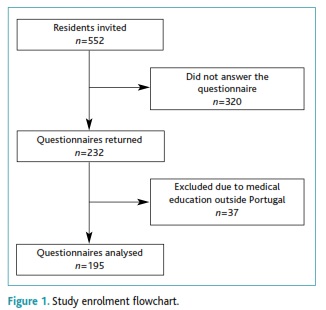
<body><![CDATA[<p>Participants answered the online questionnaire wi-thout the presence     of the investigators. Confidentiality was assured regarding all data collected.</p>       <p><b>Ethical approvals</b></p>       <p>The study protocol was approved by the Ethics Committee of the     Regional Health Administration of Lisbon and Tagus Valley on July 25, 2014,     Proc. 058/CES/INV/2014. Data collection was approved by the National Data     Protection Committee.</p>       <p><b>Data analysis</b></p>       <p>Results are expressed as mean (plus and minus the standard deviation)     or as a frequency distribution as appropriate. Residents&#8217; attitudes are     described for the whole sample as well as for each postgraduate training year.</p>       <p>Association between gender and postgraduate training year was tested     with Pearson&#8217;s c<sup>2</sup> test.     Differences between ages across genders were tested with an independent samples     t-test. Association between attitudes and gender was tested with the     Mann-Whitney test. Association between attitudes and postgraduate training was     tested with Kruskal-Wallis test. A two-tailed <i>p</i>-value &lt;0.05 was used as the cut-off point for significance. Analysis     was conducted using R<sup>&#169;</sup> 3.0.2 (2013 The R Foundation for Statistical     Computing).</p>       <p><b>Results</b></p>       <p><b>Sample characteristics </b></p>       <p>Two hundred and thirty two out of 552 (42.0%) residents completed the     questionnaire (<a href="#f1">Figure 1</a>). We excluded 37 (15.9%) residents because they     received their medical education outside Portugal. The final sample (n=195) was     29.2&#177;4.9 years old ranging from 25 years to 55 years, and most residents were     female (74.4%). Seventy two (36.9%) residents were in the first postgraduate     training year, 41 (21.0%) in the second, 43 (22.1%) in the third and 39 (20.0%)     in the fourth. No differences were found between male and female residents     concerning age and postgraduate training year (all <i>p</i>&gt;0.05).</p>       <p>&nbsp;</p>    ]]></body>
<body><![CDATA[<p align="center"><a name="f1"></a><img src="/img/revistas/rpmgf/v31n6/31n6a04f1.jpg"/></p>    
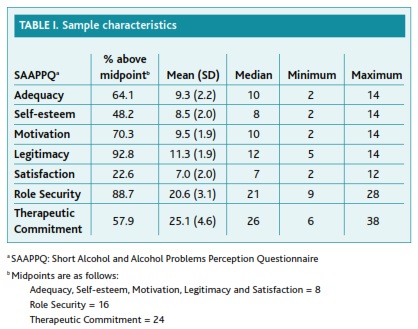
<p>&nbsp;</p>       <p><b>Residents&#8217; attitudes towards     patients with excessive alcohol consumption</b></p>       <p>With the exception of Satisfaction, residents&#8217; attitudes were on     average above the midpoint of SAAPPQ&#8217;s scales (<a href="#t1">Table I</a>). Residents felt secure     in working with patients with excessive alcohol consumption, since 88.7% of     them scored above the midpoint of Role Security. They regarded managing     patients with alcohol-related problems as a legitimate part of their job, and     considered they had acceptable knowledge and skill levels to perform this task.     When compared to Role Security, residents reported lower Therapeutic Commitment     in working with patients with excessive alcohol consumption, since only 57.9%     scored above the midpoint of the scale (<a href="#t1">Table I</a>). Although fairly motivated to     work with hazardous or harmful drinkers, they expressed neutral feelings about     their self--esteem when performing this specific task. Residents considered     managing patients with excessive alcohol consumption a somewhat unpleasant     experience, since only 22.6% reported a positive score on the Satisfaction     sub-scale. Male and female residents reported similar attitudes towards these     patients in all the SAAPPQ&#8217; domains (Mann-Whitney test, all <i>p</i>&gt;0.05).</p>       <p>&nbsp;</p>    <p align="center"><a name="t1"></a><img src="/img/revistas/rpmgf/v31n6/31n6a04t1.jpg"/></p>    
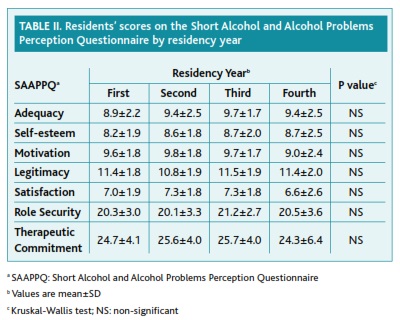
<p>&nbsp;</p>       <p>We also found similar results concerning residents&#8217; attitudes between     postgraduate training years (<a href="#t2">Table II</a>), suggesting that attitudes remain     unchanged throughout training (Kruskal-Wallis test, all <i>p</i>&gt;0.05).</p>        <p>&nbsp;</p>    <p align="center"><a name="t2"></a><img src="/img/revistas/rpmgf/v31n6/31n6a04t2.jpg"/></p>    
]]></body>
<body><![CDATA[<p>&nbsp;</p>       <p><b>Discussion</b></p>       <p style='text-align:justify'>This study found     that residents&#8217; attitudes towards patients with alcohol-related problems remain     unchanged throughout training. We expected to observe some improvement during     the four training years, given the progressive acquisition of knowledge, skills     and experience in clinical practice. However, residents seem to reach the end     of their training period with the same attitudes they have in the beginning.     Evidence suggests that residents receive insufficient training in dealing with     patients with excessive alcohol consumption,<sup>20</sup> which may explain our     findings. Having this in mind, we propose that delivering an alcohol training     program that takes residents&#8217; attitudes into account may improve feelings of     security and commitment to work with hazardous and harmful drinkers, leading to     an improvement in alcohol screening and brief intervention rates. This claim     finds support in successful programs seeking to improve residents&#8217; engagement     with patients with alcohol-related problems. Adding alcohol-specific training     modules to the residency program seems to improve residents&#8217; knowledge and     attitudes towards these patients, as well as their intervention rates.<sup>10,15,20-21</sup> Besides addressing attitudes, other training components show promising results     such as increasing opportunities to engage with drinkers,<sup>22</sup> feedback     and coaching using an Objective Structured Clinical Examination format,<sup>15</sup> and use of validated screening tools.<sup>10</sup> Additional research is     needed to establish how residency training addresses alcohol-related problems     and how we can improve training.</p>       <p>Residents reported feeling more secure than committed in working with     hazardous and harmful drinkers. They considered addressing patients&#8217; alcohol     habits an integral part of the family physicians job, and felt they have the     necessary knowledge and skills to approach them. However, their willingness to     actually engage with hazardous and harmful drinkers seems to fall behind their     sense of security. This finding is supported by previous studies concerning     general practitioners&#8217; attitudes towards patients with alcohol-related     problems. Geirsson <i>et al.</i> found that     Swedish general practitioners had positive attitudes concerning legitimacy and     adequacy towards working with problem drinkers but lacked motivation,     satisfaction, and task-specific self-esteem in doing it. These authors also     considered physicians&#8217; lack of training as a major obstacle to improving care     of patients with problem drinking.<sup>23</sup> Wilson <i>et al.</i> found a similar pattern among English general practitioners.     Eighty seven percent of these professionals agreed that this task was a     legitimate part of their work, and 78% felt they had enough knowledge and     skills. On the other hand, only 53% reported high self-esteem levels, 42% felt     motivated, and 15% agreed they felt satisfaction in working with hazardous and     harmful drinkers.<sup>18</sup> The ODHIN&#8212;<i>Optimizing Delivery of Health Care Interventions</i>&#8212;study (in     which 234 Portuguese family physicians participated) showed that 92% of all     general practitioners felt secure but only 46% considered being therapeutically     committed.<sup>24</sup> This similarity in attitudes between family medicine     residents and family physicians suggests that attitudes towards patients with     alcohol-related problems remain unchanged even after residency training ends.     The reasons for this are unclear but one possible explanation may relate to the     lack of training in alcohol-related problems in continuing medical education.     Additional research is needed to explain this finding.</p>       <p>The results from this study, supported by the results from other     studies, suggest that to improve screening and counselling rates we must     address physicians&#8217; emotional responses, especially concerning attitudes     related to their therapeutic commitment. We hypothesize that including     alcohol-specific training modules into the residency training program that take     residents&#8217; emotions into account will increase their willingness to work with     drinkers, setting the stage for an improvement in screening and counselling     rates. We also wonder if residents&#8217; self-perception of their knowledge and     skills match their real capabilities. Training on coping with alcohol-related     problems is rare in residency training, and is seldom addressed in medical     schools. Results from other studies show that most physicians think medical     school training leaves doctors unprepared to work with problem drinkers,<sup>25</sup> that they are unaware of daily drinking limits,<sup>26-27</sup> and that they     have no knowledge of validated screening tools to identify drinkers.<sup>12,27-28</sup> Since physicians show reluctance to admit their own lack of knowledge and     skills concerning alcohol-related problems,<sup>29</sup> we believe residents     may have overrated their adequacy levels. If this is true, then we need to     include training modules in the residency program that address knowledge,     skills and attitudes towards working with patients with excessive alcohol     consumption.</p>       <p>To our knowledge, this is the first study to use a validated     instrument to determine the attitudes of family medicine residents&#8217; in Portugal     towards patients with excessive alcohol consumption. We believe the me-thods     and results from this study can help in the design of future studies aiming to     clarify the relation between residency training and residents&#8217; attitudes     towards problem drinkers. The results from this study may also help to design     new alcohol-related training modules (or improve existing ones) tailored to     residents&#8217; attitudes. Nevertheless, we recognize the existence of some caveats     that need to be kept in mind when interpreting these results. First, we only     surveyed residents from one Family Medicine Residency Program. This sample may     not be representative of all Portuguese family medicine residents. Second, we     obtained a low response rate to our survey. This may also affect     representativeness since it is conceivable that residents with a higher     interest in alcohol-related problems were more likely to respond to the survey.     Third, residents who completed the questionnaire may have higher motivation     towards this subject than those who did not, which means their views may not     represent the views of those who chose not to answer. Finally, we did not     evaluate the residency program to determine the existence of specific alcohol     training modules, meaning that it is not possible to relate attitudes to     training.</p>       <p>Further investigation on this matter is needed to determine the views     of residents from other Family Medicine Residency Programs, and to relate them     with possible differences in residency training programs.</p>       <p><b>Conclusions</b></p>       <p>Attitudes of family medicine residents to patients with excessive     alcohol consumption remain unchanged as they go through residency training.     Inclusion of alcohol specific training modules into the residency program that     take the attitudes of residents into account may help to improve their     willingness to engage with patients with alcohol-related problems.</p>       <p>&nbsp;</p>       ]]></body>
<body><![CDATA[<p><b>REFERENCES</b></p>       <!-- ref --><p>1. Lim SS, Vos T, Flaxman AD, Danaei G, Shibuya K, Adair-Rohani H, et     al. A comparative risk assessment of burden of disease and injury attributable     to 67 risk factors and risk factor clusters in 21 regions, 1990-2010: a     systematic analysis for the Global Burden of Disease Study 2010. Lancet.     2012;380(9859):2224-60.    &nbsp;&nbsp;&nbsp;&nbsp;&nbsp;&nbsp;&nbsp;&nbsp;[&#160;<a href="javascript:void(0);" onclick="javascript: window.open('/scielo.php?script=sci_nlinks&ref=1358066&pid=S2182-5173201500060000400001&lng=','','width=640,height=500,resizable=yes,scrollbars=1,menubar=yes,');">Links</a>&#160;]<!-- end-ref --></p>       <!-- ref --><p>2. Balsa C, Vital C, Urbano C. III Inqu&#233;rito nacional ao consumo de     subst&#226;ncias psicoativas na popula&#231;&#227;o portuguesa: relat&#243;rio preliminar. Lisboa:     SICAD; 2013.    &nbsp;&nbsp;&nbsp;&nbsp;&nbsp;&nbsp;&nbsp;&nbsp;[&#160;<a href="javascript:void(0);" onclick="javascript: window.open('/scielo.php?script=sci_nlinks&ref=1358068&pid=S2182-5173201500060000400002&lng=','','width=640,height=500,resizable=yes,scrollbars=1,menubar=yes,');">Links</a>&#160;]<!-- end-ref --></p>       <!-- ref --><p>3. Friedmann PD. Alcohol use in adults. N Eng J Med.     2013;368(4):365-73.    &nbsp;&nbsp;&nbsp;&nbsp;&nbsp;&nbsp;&nbsp;&nbsp;[&#160;<a href="javascript:void(0);" onclick="javascript: window.open('/scielo.php?script=sci_nlinks&ref=1358070&pid=S2182-5173201500060000400003&lng=','','width=640,height=500,resizable=yes,scrollbars=1,menubar=yes,');">Links</a>&#160;]<!-- end-ref --></p>       <!-- ref --><p>4. Saitz R. Alcohol screening and brief intervention in primary care:     absence of evidence for efficacy in people with dependence or very heavy     drinking. Drug Alcohol Rev. 2010;29(6):631-40.    &nbsp;&nbsp;&nbsp;&nbsp;&nbsp;&nbsp;&nbsp;&nbsp;[&#160;<a href="javascript:void(0);" onclick="javascript: window.open('/scielo.php?script=sci_nlinks&ref=1358072&pid=S2182-5173201500060000400004&lng=','','width=640,height=500,resizable=yes,scrollbars=1,menubar=yes,');">Links</a>&#160;]<!-- end-ref --></p>       <!-- ref --><p>5. Anderson P, Laurant M, Kaner E, Wensing M, Grol R. Engaging general     practitioners in the management of hazardous and harmful alcohol consumption:     results of a meta-analysis. J Stud Alcohol. 2004;65(2):191-9.    &nbsp;&nbsp;&nbsp;&nbsp;&nbsp;&nbsp;&nbsp;&nbsp;[&#160;<a href="javascript:void(0);" onclick="javascript: window.open('/scielo.php?script=sci_nlinks&ref=1358074&pid=S2182-5173201500060000400005&lng=','','width=640,height=500,resizable=yes,scrollbars=1,menubar=yes,');">Links</a>&#160;]<!-- end-ref --></p>       <p>6. Ribeiro C. A medicina geral e familiar e a abordagem do consumo de     &#225;lcool: detec&#231;&#227;o e interven&#231;&#245;es breves no &#226;mbito dos cuidados de sa&#250;de     prim&#225;rios (The family medicine approach to alcohol consumption: detection and brief     interventions in Primary Health Care). Acta Med Port. 2011;24(S2):355-68.     Portuguese</p>       <!-- ref --><p>7. Wojnar M. Optimizing Delivery of Health Care Interventions (ODHIN):     survey of attitudes and managing alcohol problems in general practice in Europe     - final report. Warsaw: Medical University of Warsaw; 2014.    &nbsp;&nbsp;&nbsp;&nbsp;&nbsp;&nbsp;&nbsp;&nbsp;[&#160;<a href="javascript:void(0);" onclick="javascript: window.open('/scielo.php?script=sci_nlinks&ref=1358077&pid=S2182-5173201500060000400007&lng=','','width=640,height=500,resizable=yes,scrollbars=1,menubar=yes,');">Links</a>&#160;]<!-- end-ref --></p>       <!-- ref --><p>8. Anderson P, Cremona A, Paton A, Turner C, Wallace P. The risk of     alcohol. Addiction. 1993;88(11):1493-508.    &nbsp;&nbsp;&nbsp;&nbsp;&nbsp;&nbsp;&nbsp;&nbsp;[&#160;<a href="javascript:void(0);" onclick="javascript: window.open('/scielo.php?script=sci_nlinks&ref=1358079&pid=S2182-5173201500060000400008&lng=','','width=640,height=500,resizable=yes,scrollbars=1,menubar=yes,');">Links</a>&#160;]<!-- end-ref --></p>       <!-- ref --><p>9. Moyer A, Finney JW, Swearingen CE, Vergun P. Brief interventions     for alcohol problems: a meta-analytic review of controlled investigations in     treatment-seeking and non-treatment-seeking populations. Addiction.     2002;97(3):279-92.    &nbsp;&nbsp;&nbsp;&nbsp;&nbsp;&nbsp;&nbsp;&nbsp;[&#160;<a href="javascript:void(0);" onclick="javascript: window.open('/scielo.php?script=sci_nlinks&ref=1358081&pid=S2182-5173201500060000400009&lng=','','width=640,height=500,resizable=yes,scrollbars=1,menubar=yes,');">Links</a>&#160;]<!-- end-ref --></p>       <!-- ref --><p>10. Pringle JL, Kowalchuk A, Meyers JA, Seale JP. Equipping residents     to address alcohol and drug abuse: the National SBIRT Residency Training     Project. J Grad Med Educ. 2012;4(1):58-63.    &nbsp;&nbsp;&nbsp;&nbsp;&nbsp;&nbsp;&nbsp;&nbsp;[&#160;<a href="javascript:void(0);" onclick="javascript: window.open('/scielo.php?script=sci_nlinks&ref=1358083&pid=S2182-5173201500060000400010&lng=','','width=640,height=500,resizable=yes,scrollbars=1,menubar=yes,');">Links</a>&#160;]<!-- end-ref --></p>       ]]></body>
<body><![CDATA[<!-- ref --><p>11. Anderson P, Gual A, Colom J. Alcohol and primary health care:     clinical guidelines on identification and brief interventions. Barcelona:     Department of Health of the Government of Catalonia; 2005.    &nbsp;&nbsp;&nbsp;&nbsp;&nbsp;&nbsp;&nbsp;&nbsp;[&#160;<a href="javascript:void(0);" onclick="javascript: window.open('/scielo.php?script=sci_nlinks&ref=1358085&pid=S2182-5173201500060000400011&lng=','','width=640,height=500,resizable=yes,scrollbars=1,menubar=yes,');">Links</a>&#160;]<!-- end-ref --></p>       <!-- ref --><p>12. Aalto M, Pekuri P, Sepp&#228; K. Primary health care nurses' and     physicians' attitudes, knowledge and beliefs regarding brief intervention for     heavy drinkers. Addiction. 2001;96(2):305-11.    &nbsp;&nbsp;&nbsp;&nbsp;&nbsp;&nbsp;&nbsp;&nbsp;[&#160;<a href="javascript:void(0);" onclick="javascript: window.open('/scielo.php?script=sci_nlinks&ref=1358087&pid=S2182-5173201500060000400012&lng=','','width=640,height=500,resizable=yes,scrollbars=1,menubar=yes,');">Links</a>&#160;]<!-- end-ref --></p>       <!-- ref --><p>13. Rumpf HJ, Bohlmann J, Hill A, Hapke U, John U. Physicians' low     detection rates of alcohol dependence or abuse: a matter of methodological     shortcomings? Gen Hosp Psychiatry. 2001;23(3):133-7.    &nbsp;&nbsp;&nbsp;&nbsp;&nbsp;&nbsp;&nbsp;&nbsp;[&#160;<a href="javascript:void(0);" onclick="javascript: window.open('/scielo.php?script=sci_nlinks&ref=1358089&pid=S2182-5173201500060000400013&lng=','','width=640,height=500,resizable=yes,scrollbars=1,menubar=yes,');">Links</a>&#160;]<!-- end-ref --></p>       <!-- ref --><p>14. O'Donnell A, Anderson P, Newbury-Birch D, Schulte B, Schmidt C,     Reimer J, et al. The impact of brief alcohol interventions in primary     healthcare: a systematic review of reviews. Alcohol Alcohol. 2014;49(1):66-78.    &nbsp;&nbsp;&nbsp;&nbsp;&nbsp;&nbsp;&nbsp;&nbsp;[&#160;<a href="javascript:void(0);" onclick="javascript: window.open('/scielo.php?script=sci_nlinks&ref=1358091&pid=S2182-5173201500060000400014&lng=','','width=640,height=500,resizable=yes,scrollbars=1,menubar=yes,');">Links</a>&#160;]<!-- end-ref --></p>       <!-- ref --><p>15. Cole B, Clark DC, Seale JP, Shellenberger S, Lyme A, Johnson JA,     et al. Reinventing the reel: an innovative approach to resident skill-building     in motivational interviewing for brief intervention. Subst Abus.     2012;33(3):278-81.    &nbsp;&nbsp;&nbsp;&nbsp;&nbsp;&nbsp;&nbsp;&nbsp;[&#160;<a href="javascript:void(0);" onclick="javascript: window.open('/scielo.php?script=sci_nlinks&ref=1358093&pid=S2182-5173201500060000400015&lng=','','width=640,height=500,resizable=yes,scrollbars=1,menubar=yes,');">Links</a>&#160;]<!-- end-ref --></p>       ]]></body>
<body><![CDATA[<!-- ref --><p>16. Anderson P, Kaner E, Wutzke S, Funk M, Heather N, Wensing M, et     al. Attitudes and managing alcohol problems in general practice: an interaction     analysis based on findings from a WHO collaborative study. Alcohol Alcohol.     2004;39(4):351-6.    &nbsp;&nbsp;&nbsp;&nbsp;&nbsp;&nbsp;&nbsp;&nbsp;[&#160;<a href="javascript:void(0);" onclick="javascript: window.open('/scielo.php?script=sci_nlinks&ref=1358095&pid=S2182-5173201500060000400016&lng=','','width=640,height=500,resizable=yes,scrollbars=1,menubar=yes,');">Links</a>&#160;]<!-- end-ref --></p>       <!-- ref --><p>17. Deehan A, Marshall EJ, Strang J. Tackling alcohol misuse:     opportunities and obstacles in primary care. Br J Gen Pract.     1998;48(436):1779-82.    &nbsp;&nbsp;&nbsp;&nbsp;&nbsp;&nbsp;&nbsp;&nbsp;[&#160;<a href="javascript:void(0);" onclick="javascript: window.open('/scielo.php?script=sci_nlinks&ref=1358097&pid=S2182-5173201500060000400017&lng=','','width=640,height=500,resizable=yes,scrollbars=1,menubar=yes,');">Links</a>&#160;]<!-- end-ref --></p>       <!-- ref --><p>18. Wilson GB, Lock CA, Heather N, Cassidy P, Christie MM, Kaner EF.     Intervention against excessive alcohol consumption in primary health care: a     survey of GPs' attitudes and practices in England 10 years on. Alcohol Alcohol.     2011;46(5):570-7.    &nbsp;&nbsp;&nbsp;&nbsp;&nbsp;&nbsp;&nbsp;&nbsp;[&#160;<a href="javascript:void(0);" onclick="javascript: window.open('/scielo.php?script=sci_nlinks&ref=1358099&pid=S2182-5173201500060000400018&lng=','','width=640,height=500,resizable=yes,scrollbars=1,menubar=yes,');">Links</a>&#160;]<!-- end-ref --></p>       <!-- ref --><p>19. Anderson P, Clement S. The AAPPQ revisited: the measurement of general     practitioners' attitudes to alcohol problems. Br J Addict. 1987;82(7):753-9.    &nbsp;&nbsp;&nbsp;&nbsp;&nbsp;&nbsp;&nbsp;&nbsp;[&#160;<a href="javascript:void(0);" onclick="javascript: window.open('/scielo.php?script=sci_nlinks&ref=1358101&pid=S2182-5173201500060000400019&lng=','','width=640,height=500,resizable=yes,scrollbars=1,menubar=yes,');">Links</a>&#160;]<!-- end-ref --></p>       <!-- ref --><p>20. Foley ME, Garland E, Stimmel B, Merino R. Innovative clinical     addiction research training track in preventive medicine. Subst Abus.     2000;21(2):111-9.    &nbsp;&nbsp;&nbsp;&nbsp;&nbsp;&nbsp;&nbsp;&nbsp;[&#160;<a href="javascript:void(0);" onclick="javascript: window.open('/scielo.php?script=sci_nlinks&ref=1358103&pid=S2182-5173201500060000400020&lng=','','width=640,height=500,resizable=yes,scrollbars=1,menubar=yes,');">Links</a>&#160;]<!-- end-ref --></p>       ]]></body>
<body><![CDATA[<!-- ref --><p>21. Seale JP, Shellenberger S, Boltri JM, Okosun IS, Barton B. Effects     of screening and brief intervention training on resident and faculty alcohol     intervention behaviours: a pre- post-intervention assessment. BMC Fam Pract.     2005;6:46.    &nbsp;&nbsp;&nbsp;&nbsp;&nbsp;&nbsp;&nbsp;&nbsp;[&#160;<a href="javascript:void(0);" onclick="javascript: window.open('/scielo.php?script=sci_nlinks&ref=1358105&pid=S2182-5173201500060000400021&lng=','','width=640,height=500,resizable=yes,scrollbars=1,menubar=yes,');">Links</a>&#160;]<!-- end-ref --></p>       <!-- ref --><p>22. Schorling JB, Klas PT, Willems JP, Everett AS. Addressing alcohol     use among primary care patients: differences between family medicine and     internal medicine residents. J Gen Intern Med. 1994;9(5):248-54.    &nbsp;&nbsp;&nbsp;&nbsp;&nbsp;&nbsp;&nbsp;&nbsp;[&#160;<a href="javascript:void(0);" onclick="javascript: window.open('/scielo.php?script=sci_nlinks&ref=1358107&pid=S2182-5173201500060000400022&lng=','','width=640,height=500,resizable=yes,scrollbars=1,menubar=yes,');">Links</a>&#160;]<!-- end-ref --></p>       <!-- ref --><p>23. Geirsson M, Bendtsen P, Spak F. Attitudes of Swedish general     practitioners and nurses working with lifestyle change, with special reference     to alcohol consumption. Alcohol Alcohol. 2005;40(5):388-93.    &nbsp;&nbsp;&nbsp;&nbsp;&nbsp;&nbsp;&nbsp;&nbsp;[&#160;<a href="javascript:void(0);" onclick="javascript: window.open('/scielo.php?script=sci_nlinks&ref=1358109&pid=S2182-5173201500060000400023&lng=','','width=640,height=500,resizable=yes,scrollbars=1,menubar=yes,');">Links</a>&#160;]<!-- end-ref --></p>       <!-- ref --><p>24. Anderson P, Wojnar M, Jakubczyk A, Gual A, Reynolds J, Segura L,     et al. Managing alcohol problems in general practice in Europe: results from     the European ODHIN survey of general practitioners. Alcohol Alcohol.     2014;49(5):531-9.    &nbsp;&nbsp;&nbsp;&nbsp;&nbsp;&nbsp;&nbsp;&nbsp;[&#160;<a href="javascript:void(0);" onclick="javascript: window.open('/scielo.php?script=sci_nlinks&ref=1358111&pid=S2182-5173201500060000400024&lng=','','width=640,height=500,resizable=yes,scrollbars=1,menubar=yes,');">Links</a>&#160;]<!-- end-ref --></p>       <!-- ref --><p>25. Roche AM, Guray C, Saunders JB. General practitioners' experiences     of patients with drug and alcohol problems. Br J Addict. 1991;86(3):263-75.    &nbsp;&nbsp;&nbsp;&nbsp;&nbsp;&nbsp;&nbsp;&nbsp;[&#160;<a href="javascript:void(0);" onclick="javascript: window.open('/scielo.php?script=sci_nlinks&ref=1358113&pid=S2182-5173201500060000400025&lng=','','width=640,height=500,resizable=yes,scrollbars=1,menubar=yes,');">Links</a>&#160;]<!-- end-ref --></p>       ]]></body>
<body><![CDATA[<!-- ref --><p>26. Roche AM, Richard GP. Doctors' willingness to intervene in     patients' drug and alcohol problems. Soc Sci Med. 1991;33(9):1053-61.    &nbsp;&nbsp;&nbsp;&nbsp;&nbsp;&nbsp;&nbsp;&nbsp;[&#160;<a href="javascript:void(0);" onclick="javascript: window.open('/scielo.php?script=sci_nlinks&ref=1358115&pid=S2182-5173201500060000400026&lng=','','width=640,height=500,resizable=yes,scrollbars=1,menubar=yes,');">Links</a>&#160;]<!-- end-ref --></p>       <p>27. Akvardar Y, U&#231;ku R, Unal B, G&#252;nay T, Akdede BB, Erg&#246;r G, et al.     Pratisyen Hekimler Alkol Kullan&#305;m Sorunlar&#305; Olan Hastalar&#305;     Tan&#305;yor ve Tedavi Ediyorlar M&#305;? (Do general practitioners diagnose     and treat patients with alcohol use problems?). Turk Psikiyatri Derg.     2010;21(1):5-13. Turkish</p>       <!-- ref --><p>28. Nygaard P, Paschall MJ, Aasland OG, Lund KE. Use and barriers to     use of screening and brief interventions for alcohol problems among Norwegian     general practitioners. Alcohol Alcohol. 2010;45(2):207-12.    &nbsp;&nbsp;&nbsp;&nbsp;&nbsp;&nbsp;&nbsp;&nbsp;[&#160;<a href="javascript:void(0);" onclick="javascript: window.open('/scielo.php?script=sci_nlinks&ref=1358118&pid=S2182-5173201500060000400028&lng=','','width=640,height=500,resizable=yes,scrollbars=1,menubar=yes,');">Links</a>&#160;]<!-- end-ref --></p>       <!-- ref --><p>29. Miller NS, Sheppard LM, Colenda CC, Magen J. Why physicians are     unprepared to treat patients who have alcohol- and drug-related disorders. Acad     Med. 2001;76(5):410-8.    &nbsp;&nbsp;&nbsp;&nbsp;&nbsp;&nbsp;&nbsp;&nbsp;[&#160;<a href="javascript:void(0);" onclick="javascript: window.open('/scielo.php?script=sci_nlinks&ref=1358120&pid=S2182-5173201500060000400029&lng=','','width=640,height=500,resizable=yes,scrollbars=1,menubar=yes,');">Links</a>&#160;]<!-- end-ref --></p>       <p>&nbsp;</p>     <p><a href="#topc0">Endere&ccedil;o para correspond&ecirc;ncia</a> | <a href="#topc0">Direcci&oacute;n para correspondencia</a> | <a href="#topc0">Correspondence</a><a name="c0"></a></p>      <p>Gui Santos</p>       ]]></body>
<body><![CDATA[<p>Av. D. Jo&#227;o II, Lote 4.47.01, Bloco A, 1&#186; D</p>       <p>1990-098 Lisboa - PORTUGAL</p>       <p>E-mail: <a href="mailto:guimms85@gmail.com">guimms85@gmail.com</a></p></p>       <p><b>Conflict of interests</b></p>       <p>Frederico Ros&#225;rio is an invited reviewer of this journal and declares     he was not involved in the editorial decision process for this paper.</p>       <p>The authors have no other conflicts of interest to declare.</p>     <p><b>Ethical approvals</b></p>       <p>The study protocol was approved by the Ethics Committee of the     Regional Health Administration of Lisbon and Tagus Valley on July 25, 2014,     Proc.058/CES/INV/2014. Data collection was approved by the National Data     Protection Committee.</p>     <p>&nbsp;</p>       <p><b>Recebido em 16-06-2015</b></p>       ]]></body>
<body><![CDATA[<p><b>Aceite para publica&#231;&#227;o em     23-11-2015</b></p>      ]]></body><back>
<ref-list>
<ref id="B1">
<label>1</label><nlm-citation citation-type="journal">
<person-group person-group-type="author">
<name>
<surname><![CDATA[Lim]]></surname>
<given-names><![CDATA[SS]]></given-names>
</name>
<name>
<surname><![CDATA[Vos]]></surname>
<given-names><![CDATA[T]]></given-names>
</name>
<name>
<surname><![CDATA[Flaxman]]></surname>
<given-names><![CDATA[AD]]></given-names>
</name>
<name>
<surname><![CDATA[Danaei]]></surname>
<given-names><![CDATA[G]]></given-names>
</name>
<name>
<surname><![CDATA[Shibuya]]></surname>
<given-names><![CDATA[K]]></given-names>
</name>
<name>
<surname><![CDATA[Adair-Rohani]]></surname>
<given-names><![CDATA[H]]></given-names>
</name>
</person-group>
<article-title xml:lang="en"><![CDATA[A comparative risk assessment of burden of disease and injury attributable to 67 risk factors and risk factor clusters in 21 regions, 1990-2010: a systematic analysis for the Global Burden of Disease Study 2010]]></article-title>
<source><![CDATA[Lancet]]></source>
<year>2012</year>
<volume>380</volume>
<numero>9859</numero>
<issue>9859</issue>
<page-range>2224-60</page-range></nlm-citation>
</ref>
<ref id="B2">
<label>2</label><nlm-citation citation-type="book">
<person-group person-group-type="author">
<name>
<surname><![CDATA[Balsa]]></surname>
<given-names><![CDATA[C]]></given-names>
</name>
<name>
<surname><![CDATA[Vital]]></surname>
<given-names><![CDATA[C]]></given-names>
</name>
<name>
<surname><![CDATA[Urbano]]></surname>
<given-names><![CDATA[C]]></given-names>
</name>
</person-group>
<source><![CDATA[III Inquérito nacional ao consumo de substâncias psicoativas na população portuguesa: relatório preliminar]]></source>
<year>2013</year>
<publisher-loc><![CDATA[Lisboa ]]></publisher-loc>
<publisher-name><![CDATA[SICAD]]></publisher-name>
</nlm-citation>
</ref>
<ref id="B3">
<label>3</label><nlm-citation citation-type="journal">
<person-group person-group-type="author">
<name>
<surname><![CDATA[Friedmann]]></surname>
<given-names><![CDATA[PD]]></given-names>
</name>
</person-group>
<article-title xml:lang="en"><![CDATA[Alcohol use in adults]]></article-title>
<source><![CDATA[N Eng J Med]]></source>
<year>2013</year>
<volume>368</volume>
<numero>4</numero>
<issue>4</issue>
<page-range>365-73</page-range></nlm-citation>
</ref>
<ref id="B4">
<label>4</label><nlm-citation citation-type="journal">
<person-group person-group-type="author">
<name>
<surname><![CDATA[Saitz]]></surname>
<given-names><![CDATA[R]]></given-names>
</name>
</person-group>
<article-title xml:lang="en"><![CDATA[Alcohol screening and brief intervention in primary care: absence of evidence for efficacy in people with dependence or very heavy drinking]]></article-title>
<source><![CDATA[Drug Alcohol Rev]]></source>
<year>2010</year>
<volume>29</volume>
<numero>6</numero>
<issue>6</issue>
<page-range>631-40</page-range></nlm-citation>
</ref>
<ref id="B5">
<label>5</label><nlm-citation citation-type="journal">
<person-group person-group-type="author">
<name>
<surname><![CDATA[Anderson]]></surname>
<given-names><![CDATA[P]]></given-names>
</name>
<name>
<surname><![CDATA[Laurant]]></surname>
<given-names><![CDATA[M]]></given-names>
</name>
<name>
<surname><![CDATA[Kaner]]></surname>
<given-names><![CDATA[E]]></given-names>
</name>
<name>
<surname><![CDATA[Wensing]]></surname>
<given-names><![CDATA[M]]></given-names>
</name>
<name>
<surname><![CDATA[Grol]]></surname>
<given-names><![CDATA[R]]></given-names>
</name>
</person-group>
<article-title xml:lang="en"><![CDATA[Engaging general practitioners in the management of hazardous and harmful alcohol consumption: results of a meta-analysis]]></article-title>
<source><![CDATA[J Stud Alcohol]]></source>
<year>2004</year>
<volume>65</volume>
<numero>2</numero>
<issue>2</issue>
<page-range>191-9</page-range></nlm-citation>
</ref>
<ref id="B6">
<label>6</label><nlm-citation citation-type="journal">
<person-group person-group-type="author">
<name>
<surname><![CDATA[Ribeiro]]></surname>
<given-names><![CDATA[C]]></given-names>
</name>
</person-group>
<article-title xml:lang="pt"><![CDATA[A medicina geral e familiar e a abordagem do consumo de álcool: detecção e intervenções breves no âmbito dos cuidados de saúde primários]]></article-title>
<source><![CDATA[Acta Med Port]]></source>
<year>2011</year>
<volume>24</volume>
<numero>S2</numero>
<issue>S2</issue>
<page-range>355-68</page-range></nlm-citation>
</ref>
<ref id="B7">
<label>7</label><nlm-citation citation-type="book">
<person-group person-group-type="author">
<name>
<surname><![CDATA[Wojnar]]></surname>
<given-names><![CDATA[M]]></given-names>
</name>
</person-group>
<source><![CDATA[Optimizing Delivery of Health Care Interventions (ODHIN): survey of attitudes and managing alcohol problems in general practice in Europe - final report]]></source>
<year>2014</year>
<publisher-loc><![CDATA[Warsaw ]]></publisher-loc>
<publisher-name><![CDATA[Medical University of Warsaw]]></publisher-name>
</nlm-citation>
</ref>
<ref id="B8">
<label>8</label><nlm-citation citation-type="journal">
<person-group person-group-type="author">
<name>
<surname><![CDATA[Anderson]]></surname>
<given-names><![CDATA[P]]></given-names>
</name>
<name>
<surname><![CDATA[Cremona]]></surname>
<given-names><![CDATA[A]]></given-names>
</name>
<name>
<surname><![CDATA[Paton]]></surname>
<given-names><![CDATA[A]]></given-names>
</name>
<name>
<surname><![CDATA[Turner]]></surname>
<given-names><![CDATA[C]]></given-names>
</name>
<name>
<surname><![CDATA[Wallace]]></surname>
<given-names><![CDATA[P]]></given-names>
</name>
</person-group>
<article-title xml:lang="en"><![CDATA[The risk of alcohol]]></article-title>
<source><![CDATA[Addiction]]></source>
<year>1993</year>
<volume>88</volume>
<numero>11</numero>
<issue>11</issue>
<page-range>1493-508</page-range></nlm-citation>
</ref>
<ref id="B9">
<label>9</label><nlm-citation citation-type="journal">
<person-group person-group-type="author">
<name>
<surname><![CDATA[Moyer]]></surname>
<given-names><![CDATA[A]]></given-names>
</name>
<name>
<surname><![CDATA[Finney]]></surname>
<given-names><![CDATA[JW]]></given-names>
</name>
<name>
<surname><![CDATA[Swearingen]]></surname>
<given-names><![CDATA[CE]]></given-names>
</name>
<name>
<surname><![CDATA[Vergun]]></surname>
<given-names><![CDATA[P]]></given-names>
</name>
</person-group>
<article-title xml:lang="en"><![CDATA[Brief interventions for alcohol problems: a meta-analytic review of controlled investigations in treatment-seeking and non-treatment-seeking populations]]></article-title>
<source><![CDATA[Addiction]]></source>
<year>2002</year>
<volume>97</volume>
<numero>3</numero>
<issue>3</issue>
<page-range>279-92</page-range></nlm-citation>
</ref>
<ref id="B10">
<label>10</label><nlm-citation citation-type="journal">
<person-group person-group-type="author">
<name>
<surname><![CDATA[Pringle]]></surname>
<given-names><![CDATA[JL]]></given-names>
</name>
<name>
<surname><![CDATA[Kowalchuk]]></surname>
<given-names><![CDATA[A]]></given-names>
</name>
<name>
<surname><![CDATA[Meyers]]></surname>
<given-names><![CDATA[JA]]></given-names>
</name>
<name>
<surname><![CDATA[Seale]]></surname>
<given-names><![CDATA[JP]]></given-names>
</name>
</person-group>
<article-title xml:lang="en"><![CDATA[Equipping residents to address alcohol and drug abuse: the National SBIRT Residency Training Project]]></article-title>
<source><![CDATA[J Grad Med Educ]]></source>
<year>2012</year>
<volume>4</volume>
<numero>1</numero>
<issue>1</issue>
<page-range>58-63</page-range></nlm-citation>
</ref>
<ref id="B11">
<label>11</label><nlm-citation citation-type="book">
<person-group person-group-type="author">
<name>
<surname><![CDATA[Anderson]]></surname>
<given-names><![CDATA[P]]></given-names>
</name>
<name>
<surname><![CDATA[Gual]]></surname>
<given-names><![CDATA[A]]></given-names>
</name>
<name>
<surname><![CDATA[Colom]]></surname>
<given-names><![CDATA[J]]></given-names>
</name>
</person-group>
<source><![CDATA[Alcohol and primary health care: clinical guidelines on identification and brief interventions]]></source>
<year>2005</year>
<publisher-loc><![CDATA[Barcelona ]]></publisher-loc>
<publisher-name><![CDATA[Department of Health of the Government of Catalonia]]></publisher-name>
</nlm-citation>
</ref>
<ref id="B12">
<label>12</label><nlm-citation citation-type="journal">
<person-group person-group-type="author">
<name>
<surname><![CDATA[Aalto]]></surname>
<given-names><![CDATA[M]]></given-names>
</name>
<name>
<surname><![CDATA[Pekuri]]></surname>
<given-names><![CDATA[P]]></given-names>
</name>
<name>
<surname><![CDATA[Seppä]]></surname>
<given-names><![CDATA[K]]></given-names>
</name>
</person-group>
<article-title xml:lang="en"><![CDATA[Primary health care nurses' and physicians' attitudes, knowledge and beliefs regarding brief intervention for heavy drinkers]]></article-title>
<source><![CDATA[Addiction]]></source>
<year>2001</year>
<volume>96</volume>
<numero>2</numero>
<issue>2</issue>
<page-range>305-11</page-range></nlm-citation>
</ref>
<ref id="B13">
<label>13</label><nlm-citation citation-type="journal">
<person-group person-group-type="author">
<name>
<surname><![CDATA[Rumpf]]></surname>
<given-names><![CDATA[HJ]]></given-names>
</name>
<name>
<surname><![CDATA[Bohlmann]]></surname>
<given-names><![CDATA[J]]></given-names>
</name>
<name>
<surname><![CDATA[Hill]]></surname>
<given-names><![CDATA[A]]></given-names>
</name>
<name>
<surname><![CDATA[Hapke]]></surname>
<given-names><![CDATA[U]]></given-names>
</name>
<name>
<surname><![CDATA[John]]></surname>
<given-names><![CDATA[U]]></given-names>
</name>
</person-group>
<article-title xml:lang="en"><![CDATA[Physicians' low detection rates of alcohol dependence or abuse: a matter of methodological shortcomings?]]></article-title>
<source><![CDATA[Gen Hosp Psychiatry]]></source>
<year>2001</year>
<volume>23</volume>
<numero>3</numero>
<issue>3</issue>
<page-range>133-7</page-range></nlm-citation>
</ref>
<ref id="B14">
<label>14</label><nlm-citation citation-type="journal">
<person-group person-group-type="author">
<name>
<surname><![CDATA[O'Donnell]]></surname>
<given-names><![CDATA[A]]></given-names>
</name>
<name>
<surname><![CDATA[Anderson]]></surname>
<given-names><![CDATA[P]]></given-names>
</name>
<name>
<surname><![CDATA[Newbury-Birch]]></surname>
<given-names><![CDATA[D]]></given-names>
</name>
<name>
<surname><![CDATA[Schulte]]></surname>
<given-names><![CDATA[B]]></given-names>
</name>
<name>
<surname><![CDATA[Schmidt]]></surname>
<given-names><![CDATA[C]]></given-names>
</name>
<name>
<surname><![CDATA[Reimer]]></surname>
<given-names><![CDATA[J]]></given-names>
</name>
</person-group>
<article-title xml:lang="en"><![CDATA[The impact of brief alcohol interventions in primary healthcare: a systematic review of reviews]]></article-title>
<source><![CDATA[Alcohol Alcohol]]></source>
<year>2014</year>
<volume>49</volume>
<numero>1</numero>
<issue>1</issue>
<page-range>66-78</page-range></nlm-citation>
</ref>
<ref id="B15">
<label>15</label><nlm-citation citation-type="journal">
<person-group person-group-type="author">
<name>
<surname><![CDATA[Cole]]></surname>
<given-names><![CDATA[B]]></given-names>
</name>
<name>
<surname><![CDATA[Clark]]></surname>
<given-names><![CDATA[DC]]></given-names>
</name>
<name>
<surname><![CDATA[Seale]]></surname>
<given-names><![CDATA[JP]]></given-names>
</name>
<name>
<surname><![CDATA[Shellenberger]]></surname>
<given-names><![CDATA[S]]></given-names>
</name>
<name>
<surname><![CDATA[Lyme]]></surname>
<given-names><![CDATA[A]]></given-names>
</name>
<name>
<surname><![CDATA[Johnson]]></surname>
<given-names><![CDATA[JA]]></given-names>
</name>
</person-group>
<article-title xml:lang="en"><![CDATA[Reinventing the reel: an innovative approach to resident skill-building in motivational interviewing for brief intervention]]></article-title>
<source><![CDATA[Subst Abus]]></source>
<year>2012</year>
<volume>33</volume>
<numero>3</numero>
<issue>3</issue>
<page-range>278-81</page-range></nlm-citation>
</ref>
<ref id="B16">
<label>16</label><nlm-citation citation-type="journal">
<person-group person-group-type="author">
<name>
<surname><![CDATA[Anderson]]></surname>
<given-names><![CDATA[P]]></given-names>
</name>
<name>
<surname><![CDATA[Kaner]]></surname>
<given-names><![CDATA[E]]></given-names>
</name>
<name>
<surname><![CDATA[Wutzke]]></surname>
<given-names><![CDATA[S]]></given-names>
</name>
<name>
<surname><![CDATA[Funk]]></surname>
<given-names><![CDATA[M]]></given-names>
</name>
<name>
<surname><![CDATA[Heather]]></surname>
<given-names><![CDATA[N]]></given-names>
</name>
<name>
<surname><![CDATA[Wensing]]></surname>
<given-names><![CDATA[M]]></given-names>
</name>
</person-group>
<article-title xml:lang="en"><![CDATA[Attitudes and managing alcohol problems in general practice: an interaction analysis based on findings from a WHO collaborative study]]></article-title>
<source><![CDATA[Alcohol Alcohol]]></source>
<year>2004</year>
<volume>39</volume>
<numero>4</numero>
<issue>4</issue>
<page-range>351-6</page-range></nlm-citation>
</ref>
<ref id="B17">
<label>17</label><nlm-citation citation-type="journal">
<person-group person-group-type="author">
<name>
<surname><![CDATA[Deehan]]></surname>
<given-names><![CDATA[A]]></given-names>
</name>
<name>
<surname><![CDATA[Marshall]]></surname>
<given-names><![CDATA[EJ]]></given-names>
</name>
<name>
<surname><![CDATA[Strang]]></surname>
<given-names><![CDATA[J]]></given-names>
</name>
</person-group>
<article-title xml:lang="en"><![CDATA[Tackling alcohol misuse: opportunities and obstacles in primary care]]></article-title>
<source><![CDATA[Br J Gen Pract]]></source>
<year>1998</year>
<volume>48</volume>
<numero>436</numero>
<issue>436</issue>
<page-range>1779-82</page-range></nlm-citation>
</ref>
<ref id="B18">
<label>18</label><nlm-citation citation-type="journal">
<person-group person-group-type="author">
<name>
<surname><![CDATA[Wilson]]></surname>
<given-names><![CDATA[GB]]></given-names>
</name>
<name>
<surname><![CDATA[Lock]]></surname>
<given-names><![CDATA[CA]]></given-names>
</name>
<name>
<surname><![CDATA[Heather]]></surname>
<given-names><![CDATA[N]]></given-names>
</name>
<name>
<surname><![CDATA[Cassidy]]></surname>
<given-names><![CDATA[P]]></given-names>
</name>
<name>
<surname><![CDATA[Christie]]></surname>
<given-names><![CDATA[MM]]></given-names>
</name>
<name>
<surname><![CDATA[Kaner]]></surname>
<given-names><![CDATA[EF]]></given-names>
</name>
</person-group>
<article-title xml:lang="en"><![CDATA[Intervention against excessive alcohol consumption in primary health care: a survey of GPs' attitudes and practices in England 10 years on]]></article-title>
<source><![CDATA[Alcohol Alcohol]]></source>
<year>2011</year>
<volume>46</volume>
<numero>5</numero>
<issue>5</issue>
<page-range>570-7</page-range></nlm-citation>
</ref>
<ref id="B19">
<label>19</label><nlm-citation citation-type="journal">
<person-group person-group-type="author">
<name>
<surname><![CDATA[Anderson]]></surname>
<given-names><![CDATA[P]]></given-names>
</name>
<name>
<surname><![CDATA[Clement]]></surname>
<given-names><![CDATA[S]]></given-names>
</name>
</person-group>
<article-title xml:lang="en"><![CDATA[The AAPPQ revisited: the measurement of general practitioners' attitudes to alcohol problems]]></article-title>
<source><![CDATA[Br J Addict]]></source>
<year>1987</year>
<volume>82</volume>
<numero>7</numero>
<issue>7</issue>
<page-range>753-9</page-range></nlm-citation>
</ref>
<ref id="B20">
<label>20</label><nlm-citation citation-type="journal">
<person-group person-group-type="author">
<name>
<surname><![CDATA[Foley]]></surname>
<given-names><![CDATA[ME]]></given-names>
</name>
<name>
<surname><![CDATA[Garland]]></surname>
<given-names><![CDATA[E]]></given-names>
</name>
<name>
<surname><![CDATA[Stimmel]]></surname>
<given-names><![CDATA[B]]></given-names>
</name>
<name>
<surname><![CDATA[Merino]]></surname>
<given-names><![CDATA[R]]></given-names>
</name>
</person-group>
<article-title xml:lang="en"><![CDATA[Innovative clinical addiction research training track in preventive medicine]]></article-title>
<source><![CDATA[Subst Abus]]></source>
<year>2000</year>
<volume>21</volume>
<numero>2</numero>
<issue>2</issue>
<page-range>111-9</page-range></nlm-citation>
</ref>
<ref id="B21">
<label>21</label><nlm-citation citation-type="journal">
<person-group person-group-type="author">
<name>
<surname><![CDATA[Seale]]></surname>
<given-names><![CDATA[JP]]></given-names>
</name>
<name>
<surname><![CDATA[Shellenberger]]></surname>
<given-names><![CDATA[S]]></given-names>
</name>
<name>
<surname><![CDATA[Boltri]]></surname>
<given-names><![CDATA[JM]]></given-names>
</name>
<name>
<surname><![CDATA[Okosun]]></surname>
<given-names><![CDATA[IS]]></given-names>
</name>
<name>
<surname><![CDATA[Barton]]></surname>
<given-names><![CDATA[B]]></given-names>
</name>
</person-group>
<article-title xml:lang="en"><![CDATA[Effects of screening and brief intervention training on resident and faculty alcohol intervention behaviours: a pre- post-intervention assessment]]></article-title>
<source><![CDATA[BMC Fam Pract]]></source>
<year>2005</year>
<volume>6</volume>
<page-range>46</page-range></nlm-citation>
</ref>
<ref id="B22">
<label>22</label><nlm-citation citation-type="journal">
<person-group person-group-type="author">
<name>
<surname><![CDATA[Schorling]]></surname>
<given-names><![CDATA[JB]]></given-names>
</name>
<name>
<surname><![CDATA[Klas]]></surname>
<given-names><![CDATA[PT]]></given-names>
</name>
<name>
<surname><![CDATA[Willems]]></surname>
<given-names><![CDATA[JP]]></given-names>
</name>
<name>
<surname><![CDATA[Everett]]></surname>
<given-names><![CDATA[AS]]></given-names>
</name>
</person-group>
<article-title xml:lang="en"><![CDATA[Addressing alcohol use among primary care patients: differences between family medicine and internal medicine residents]]></article-title>
<source><![CDATA[J Gen Intern Med]]></source>
<year>1994</year>
<volume>9</volume>
<numero>5</numero>
<issue>5</issue>
<page-range>248-54</page-range></nlm-citation>
</ref>
<ref id="B23">
<label>23</label><nlm-citation citation-type="journal">
<person-group person-group-type="author">
<name>
<surname><![CDATA[Geirsson]]></surname>
<given-names><![CDATA[M]]></given-names>
</name>
<name>
<surname><![CDATA[Bendtsen]]></surname>
<given-names><![CDATA[P]]></given-names>
</name>
<name>
<surname><![CDATA[Spak]]></surname>
<given-names><![CDATA[F]]></given-names>
</name>
</person-group>
<article-title xml:lang="en"><![CDATA[Attitudes of Swedish general practitioners and nurses working with lifestyle change, with special reference to alcohol consumption]]></article-title>
<source><![CDATA[Alcohol Alcohol]]></source>
<year>2005</year>
<volume>40</volume>
<numero>5</numero>
<issue>5</issue>
<page-range>388-93</page-range></nlm-citation>
</ref>
<ref id="B24">
<label>24</label><nlm-citation citation-type="journal">
<person-group person-group-type="author">
<name>
<surname><![CDATA[Anderson]]></surname>
<given-names><![CDATA[P]]></given-names>
</name>
<name>
<surname><![CDATA[Wojnar]]></surname>
<given-names><![CDATA[M]]></given-names>
</name>
<name>
<surname><![CDATA[Jakubczyk]]></surname>
<given-names><![CDATA[A]]></given-names>
</name>
<name>
<surname><![CDATA[Gual]]></surname>
<given-names><![CDATA[A]]></given-names>
</name>
<name>
<surname><![CDATA[Reynolds]]></surname>
<given-names><![CDATA[J]]></given-names>
</name>
<name>
<surname><![CDATA[Segura]]></surname>
<given-names><![CDATA[L]]></given-names>
</name>
</person-group>
<article-title xml:lang="en"><![CDATA[Managing alcohol problems in general practice in Europe: results from the European ODHIN survey of general practitioners]]></article-title>
<source><![CDATA[Alcohol Alcohol]]></source>
<year>2014</year>
<volume>49</volume>
<numero>5</numero>
<issue>5</issue>
<page-range>531-9</page-range></nlm-citation>
</ref>
<ref id="B25">
<label>25</label><nlm-citation citation-type="journal">
<person-group person-group-type="author">
<name>
<surname><![CDATA[Roche]]></surname>
<given-names><![CDATA[AM]]></given-names>
</name>
<name>
<surname><![CDATA[Guray]]></surname>
<given-names><![CDATA[C]]></given-names>
</name>
<name>
<surname><![CDATA[Saunders]]></surname>
<given-names><![CDATA[JB]]></given-names>
</name>
</person-group>
<article-title xml:lang="en"><![CDATA[General practitioners' experiences of patients with drug and alcohol problems]]></article-title>
<source><![CDATA[Br J Addict]]></source>
<year>1991</year>
<volume>86</volume>
<numero>3</numero>
<issue>3</issue>
<page-range>263-75</page-range></nlm-citation>
</ref>
<ref id="B26">
<label>26</label><nlm-citation citation-type="journal">
<person-group person-group-type="author">
<name>
<surname><![CDATA[Roche]]></surname>
<given-names><![CDATA[AM]]></given-names>
</name>
<name>
<surname><![CDATA[Richard]]></surname>
<given-names><![CDATA[GP]]></given-names>
</name>
</person-group>
<article-title xml:lang="en"><![CDATA[Doctors' willingness to intervene in patients' drug and alcohol problems]]></article-title>
<source><![CDATA[Soc Sci Med]]></source>
<year>1991</year>
<volume>33</volume>
<numero>9</numero>
<issue>9</issue>
<page-range>1053-61</page-range></nlm-citation>
</ref>
<ref id="B27">
<label>27</label><nlm-citation citation-type="journal">
<person-group person-group-type="author">
<name>
<surname><![CDATA[Akvardar]]></surname>
<given-names><![CDATA[Y]]></given-names>
</name>
<name>
<surname><![CDATA[Uçku]]></surname>
<given-names><![CDATA[R]]></given-names>
</name>
<name>
<surname><![CDATA[Unal]]></surname>
<given-names><![CDATA[B]]></given-names>
</name>
<name>
<surname><![CDATA[Günay]]></surname>
<given-names><![CDATA[T]]></given-names>
</name>
<name>
<surname><![CDATA[Akdede]]></surname>
<given-names><![CDATA[BB]]></given-names>
</name>
<name>
<surname><![CDATA[Ergör]]></surname>
<given-names><![CDATA[G]]></given-names>
</name>
</person-group>
<article-title xml:lang="tr"><![CDATA[Pratisyen Hekimler Alkol Kullanim Sorunlari Olan Hastalari Taniyor ve Tedavi Ediyorlar Mi?]]></article-title>
<source><![CDATA[Turk Psikiyatri Derg]]></source>
<year>2010</year>
<volume>21</volume>
<numero>1</numero>
<issue>1</issue>
<page-range>5-13</page-range></nlm-citation>
</ref>
<ref id="B28">
<label>28</label><nlm-citation citation-type="journal">
<person-group person-group-type="author">
<name>
<surname><![CDATA[Nygaard]]></surname>
<given-names><![CDATA[P]]></given-names>
</name>
<name>
<surname><![CDATA[Paschall]]></surname>
<given-names><![CDATA[MJ]]></given-names>
</name>
<name>
<surname><![CDATA[Aasland]]></surname>
<given-names><![CDATA[OG]]></given-names>
</name>
<name>
<surname><![CDATA[Lund]]></surname>
<given-names><![CDATA[KE]]></given-names>
</name>
</person-group>
<article-title xml:lang="en"><![CDATA[Use and barriers to use of screening and brief interventions for alcohol problems among Norwegian general practitioners]]></article-title>
<source><![CDATA[Alcohol Alcohol]]></source>
<year>2010</year>
<volume>45</volume>
<numero>2</numero>
<issue>2</issue>
<page-range>207-12</page-range></nlm-citation>
</ref>
<ref id="B29">
<label>29</label><nlm-citation citation-type="journal">
<person-group person-group-type="author">
<name>
<surname><![CDATA[Miller]]></surname>
<given-names><![CDATA[NS]]></given-names>
</name>
<name>
<surname><![CDATA[Sheppard]]></surname>
<given-names><![CDATA[LM]]></given-names>
</name>
<name>
<surname><![CDATA[Colenda]]></surname>
<given-names><![CDATA[CC]]></given-names>
</name>
<name>
<surname><![CDATA[Magen]]></surname>
<given-names><![CDATA[J]]></given-names>
</name>
</person-group>
<article-title xml:lang="en"><![CDATA[Why physicians are unprepared to treat patients who have alcohol- and drug-related disorders]]></article-title>
<source><![CDATA[Acad Med]]></source>
<year>2001</year>
<volume>76</volume>
<numero>5</numero>
<issue>5</issue>
<page-range>410-8</page-range></nlm-citation>
</ref>
</ref-list>
</back>
</article>