<?xml version="1.0" encoding="ISO-8859-1"?><article xmlns:mml="http://www.w3.org/1998/Math/MathML" xmlns:xlink="http://www.w3.org/1999/xlink" xmlns:xsi="http://www.w3.org/2001/XMLSchema-instance">
<front>
<journal-meta>
<journal-id>2182-7230</journal-id>
<journal-title><![CDATA[Revista Nutrícias]]></journal-title>
<abbrev-journal-title><![CDATA[Nutrícias]]></abbrev-journal-title>
<issn>2182-7230</issn>
<publisher>
<publisher-name><![CDATA[Associação Portuguesa dos Nutricionistas]]></publisher-name>
</publisher>
</journal-meta>
<article-meta>
<article-id>S2182-72302013000400004</article-id>
<title-group>
<article-title xml:lang="en"><![CDATA[The Effect of a Nutrition Education Intervention on School-age Boys Attending a Sports Camp]]></article-title>
<article-title xml:lang="pt"><![CDATA[Efeito de uma Intervenção de Educação Alimentar em Meninos em Idade Escolar a Frequentar um Campo Desportivo]]></article-title>
</title-group>
<contrib-group>
<contrib contrib-type="author">
<name>
<surname><![CDATA[Silva]]></surname>
<given-names><![CDATA[Catarina Santos]]></given-names>
</name>
<xref ref-type="aff" rid="A01"/>
<xref ref-type="aff" rid="A02"/>
</contrib>
<contrib contrib-type="author">
<name>
<surname><![CDATA[Teixeira]]></surname>
<given-names><![CDATA[Vítor Hugo]]></given-names>
</name>
<xref ref-type="aff" rid="A02"/>
<xref ref-type="aff" rid="A03"/>
</contrib>
<contrib contrib-type="author">
<name>
<surname><![CDATA[Carvalho]]></surname>
<given-names><![CDATA[Pedro]]></given-names>
</name>
<xref ref-type="aff" rid="A02"/>
<xref ref-type="aff" rid="A04"/>
</contrib>
</contrib-group>
<aff id="A01">
<institution><![CDATA[,Fundação Condessa de Penha Longa  ]]></institution>
<addr-line><![CDATA[Vila de Cucujães ]]></addr-line>
<country>Portugal</country>
</aff>
<aff id="A02">
<institution><![CDATA[,Universidade do Porto Faculdade de Ciências da Nutrição e Alimentação ]]></institution>
<addr-line><![CDATA[Porto ]]></addr-line>
<country>Portugal</country>
</aff>
<aff id="A03">
<institution><![CDATA[,Centro de Investigação em Actividade Física, Saúde e Lazer  ]]></institution>
<addr-line><![CDATA[Porto ]]></addr-line>
<country>Portugal</country>
</aff>
<aff id="A04">
<institution><![CDATA[,Futebol Clube do Porto  ]]></institution>
<addr-line><![CDATA[Porto ]]></addr-line>
<country>Portugal</country>
</aff>
<pub-date pub-type="pub">
<day>00</day>
<month>12</month>
<year>2013</year>
</pub-date>
<pub-date pub-type="epub">
<day>00</day>
<month>12</month>
<year>2013</year>
</pub-date>
<numero>19</numero>
<fpage>16</fpage>
<lpage>20</lpage>
<copyright-statement/>
<copyright-year/>
<self-uri xlink:href="http://scielo.pt/scielo.php?script=sci_arttext&amp;pid=S2182-72302013000400004&amp;lng=en&amp;nrm=iso"></self-uri><self-uri xlink:href="http://scielo.pt/scielo.php?script=sci_abstract&amp;pid=S2182-72302013000400004&amp;lng=en&amp;nrm=iso"></self-uri><self-uri xlink:href="http://scielo.pt/scielo.php?script=sci_pdf&amp;pid=S2182-72302013000400004&amp;lng=en&amp;nrm=iso"></self-uri><abstract abstract-type="short" xml:lang="en"><p><![CDATA[Introduction: Changes in dietary and lifestyle patterns worldwide have led to an increased prevalence of childhood obesity, becoming imperative to explore effective strategies to both prevent and treat this disease. Objectives: This non-randomized controlled trial evaluated the effectiveness of a short-term nutrition education intervention (4 hours, distributed over 5 days) on improving the dietary knowledge, diet quality and Body Mass Index-for-age z-score of 26 school-age boys (6 to 11 years old) attending a holiday sports camp. Methodology: Both intervention (n=26) and control (n=39) groups were evaluated immediately before and 6 weeks after the intervention (Body Mass Index and KIDMED were evaluated for both groups; while nutrition knowledge questionnaire was only for intervention group). Results: In the intervention group, a significant decrease was observed in Body Mass Index z-score (p Conclusions: Holiday sports camps with nutrition education interventions can be a promising strategy to combat childhood obesity.]]></p></abstract>
<abstract abstract-type="short" xml:lang="pt"><p><![CDATA[Introdução: Modificações nos padrões alimentares e nos estilos de vida a nível mundial estão a levar ao aumento da prevalência da obesidade infantil, tornando-se imperativo explorar estratégias eficazes para prevenir e tratar esta doença. Objectivos: Este estudo não randomizado controlado avaliou a eficácia de uma intervenção de educação alimentar de curta duração (4 horas, distribuídas por 5 dias) na melhoria dos conhecimentos dietéticos, qualidade alimentar e z-score de Índice de Massa Corporal de 26 meninos em idade escolar (6 a 11 anos) a frequentar um campo de férias desportivo. Metodologia: Tanto o grupo de intervenção (n=26) como o grupo controlo (n=39) foram avaliados imediatamente antes e 6 semanas após a intervenção (Índice de Massa Corporal e KIDMED foram avaliados em ambos os grupos; questionário de conhecimentos de nutrição foi aplicado apenas no grupo de intervenção). Resultados: No grupo de intervenção, foi observada uma diminuição significativa no z-score de Índice de Massa Corporal (p Conclusões: Os campos de férias desportivos que integram intervenções de educação alimentar podem ser uma estratégia promissora no combate à obesidade infantil.]]></p></abstract>
<kwd-group>
<kwd lng="en"><![CDATA[Childhood obesity]]></kwd>
<kwd lng="en"><![CDATA[Nutrition education]]></kwd>
<kwd lng="en"><![CDATA[Nutrition knowledge]]></kwd>
<kwd lng="en"><![CDATA[Dietary quality]]></kwd>
<kwd lng="en"><![CDATA[Holiday sports camp]]></kwd>
<kwd lng="pt"><![CDATA[Obesidade infantil]]></kwd>
<kwd lng="pt"><![CDATA[Educação alimentar]]></kwd>
<kwd lng="pt"><![CDATA[Conhecimento nutricional]]></kwd>
<kwd lng="pt"><![CDATA[Qualidade alimentar]]></kwd>
<kwd lng="pt"><![CDATA[Campo de férias desportivo]]></kwd>
</kwd-group>
</article-meta>
</front><body><![CDATA[ <p align="right"><b>ARTIGO ORIGINAL</p></b> <br/> <br/><b >The Effect of a Nutrition Education Intervention on School-age Boys Attending a Sports Camp</b> <br/> <br/><b >Efeito de uma Interven&#231;&#227;o de Educa&#231;&#227;o Alimentar em Meninos em Idade Escolar a Frequentar um Campo Desportivo</b>     <p>&nbsp;</p>     <p> <br/><b >Catarina Santos Silva<sup>1,2</sup>; V&#237;tor Hugo Teixeira<sup>3,4</sup>; Pedro Carvalho<sup>3,5</sup></b>     <br>      <p ><sup>1</sup>Nutricionista, Funda&#231;&#227;o Condessa de Penha Longa, Largo do M&#225;rtir de S&#227;o Sebasti&#227;o, 3720-000 Vila de Cucuj&#227;es, Portugal     <br><sup>2</sup>Estagi&#225;ria em Ci&#234;ncias da Nutri&#231;&#227;o, Faculdade de Ci&#234;ncias da Nutri&#231;&#227;o e Alimenta&#231;&#227;o da Universidade do Porto (Ano Lectivo 2010/2011), Rua Dr. Roberto Frias, s/n, 4200-465 Porto, Portugal     <br><sup>3</sup>Faculdade de Ci&#234;ncias da Nutri&#231;&#227;o e Alimenta&#231;&#227;o da Universidade do Porto, Rua Dr. Roberto Frias, s/n, 4200-465 Porto, Portugal     <br><sup>4</sup>Centro de Investiga&#231;&#227;o em Actividade F&#237;sica, Sa&#250;de e Lazer, Rua Dr. Pl&#225;cido Costa, 91, 4200-450 Porto, Portugal     <br><sup>5</sup>Projecto Dragon Force, Futebol Clube do Porto, Est&#225;dio do Drag&#227;o, Via Futebol Clube do Porto, 4350-415 Porto, Portugal     <p><a href="#c0">Endere&#231;o para correspond&#234;ncia</a><a name="topc0"></a></p>     ]]></body>
<body><![CDATA[<p>&nbsp;</p>     <p><b >ABSTRACT</b></p>     <p>  <br/>Introduction: Changes in dietary and lifestyle patterns worldwide have led to an increased prevalence of childhood obesity, becoming imperative to explore effective strategies to both prevent and treat this disease.  <br/>Objectives: This non-randomized controlled trial evaluated the effectiveness of a short-term nutrition education intervention (4 hours, distributed over 5 days) on improving the dietary knowledge, diet quality and Body Mass Index-for-age z-score of 26 school-age boys (6 to 11 years old) attending a holiday sports camp. <br/>Methodology: Both intervention (n=26) and control (n=39) groups were evaluated immediately before and 6 weeks after the intervention (Body Mass Index and KIDMED were evaluated for both groups; while nutrition knowledge questionnaire was only for intervention group).  <br/>Results: In the intervention group, a significant decrease was observed in Body Mass Index z-score (p<0.05), but the overweight and obesity prevalence remained unchanged. No significant changes in knowledge and diet quality were found in both groups. In the control group, there were not significant changes for any variable. <br/>Conclusions: Holiday sports camps with nutrition education interventions can be a promising strategy to combat childhood obesity. </p>     <p><b >keywords</b>: Childhood obesity, Nutrition education, Nutrition knowledge , Dietary quality, Holiday sports camp </p>     <p>&nbsp;</p>  <hr>     <p>&nbsp;</p>     <p><b >RESUMO</b> </p>      <p>Introdu&#231;&#227;o: Modifica&#231;&#245;es nos padr&#245;es alimentares e nos estilos de vida a n&#237;vel mundial est&#227;o a levar ao aumento da preval&#234;ncia da obesidade infantil, tornando-se imperativo explorar estrat&#233;gias eficazes para prevenir e tratar esta doen&#231;a. Objectivos: Este estudo n&#227;o randomizado controlado avaliou a efic&#225;cia de uma interven&#231;&#227;o de educa&#231;&#227;o alimentar de curta dura&#231;&#227;o (4 horas, distribu&#237;das por 5 dias) na melhoria dos conhecimentos diet&#233;ticos, qualidade alimentar e z-score de &#205;ndice de Massa Corporal de 26 meninos em idade escolar (6 a 11 anos) a frequentar um campo de f&#233;rias desportivo.  <br/>Metodologia: Tanto o grupo de interven&#231;&#227;o (n=26) como o grupo controlo (n=39) foram avaliados imediatamente antes e 6 semanas ap&#243;s a interven&#231;&#227;o (&#205;ndice de Massa Corporal e KIDMED foram avaliados em ambos os grupos; question&#225;rio de conhecimentos de nutri&#231;&#227;o foi aplicado apenas no grupo de interven&#231;&#227;o). <br/>Resultados: No grupo de interven&#231;&#227;o, foi observada uma diminui&#231;&#227;o significativa no z-score de &#205;ndice de Massa Corporal (p<0.05), sem altera&#231;&#245;es significativas nos conhecimentos nem na qualidade alimentar. No grupo controlo, n&#227;o se verificaram altera&#231;&#245;es significativas em nenhuma das vari&#225;veis. <br/>Conclus&#245;es: Os campos de f&#233;rias desportivos que integram interven&#231;&#245;es de educa&#231;&#227;o alimentar podem ser uma estrat&#233;gia promissora no combate &#224; obesidade infantil. </p>     <p><b >Palavras-Chave</b>: Obesidade infantil, Educa&#231;&#227;o alimentar, Conhecimento nutricional, Qualidade alimentar, Campo de f&#233;rias desportivo </p>      <p>&nbsp;</p> <hr>     ]]></body>
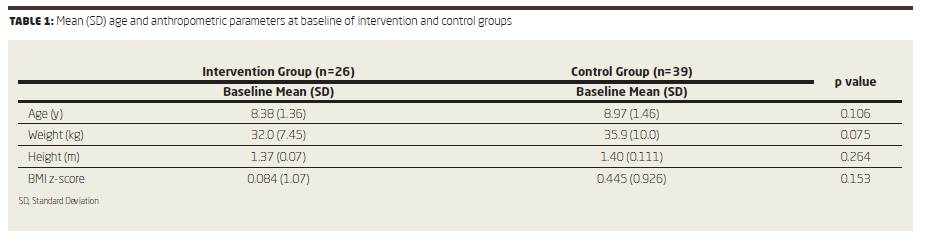
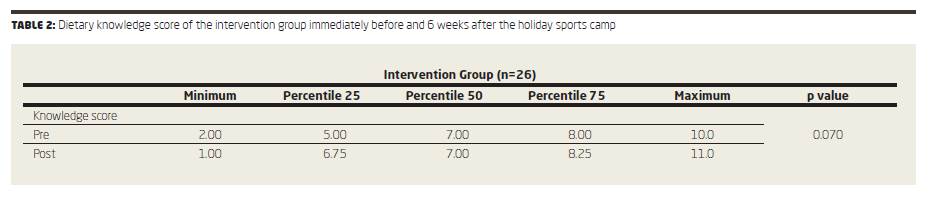
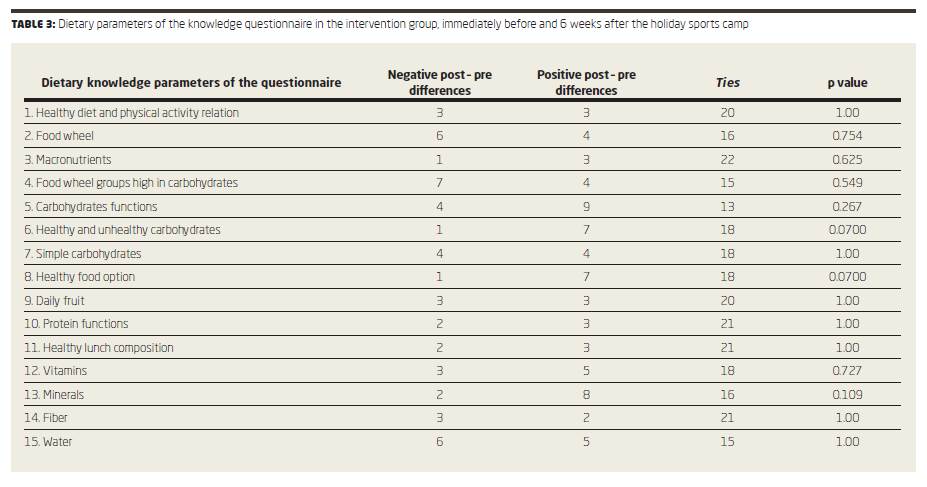
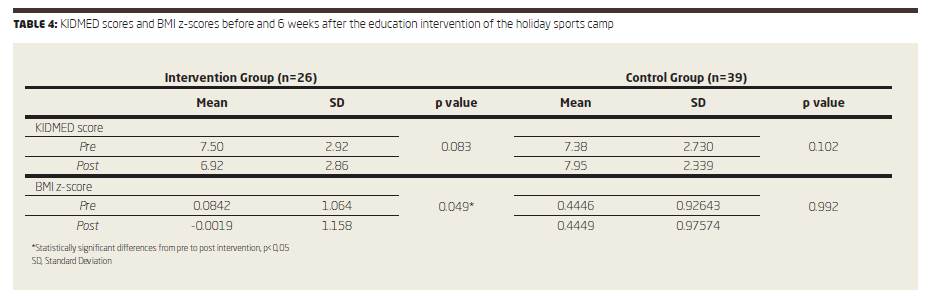
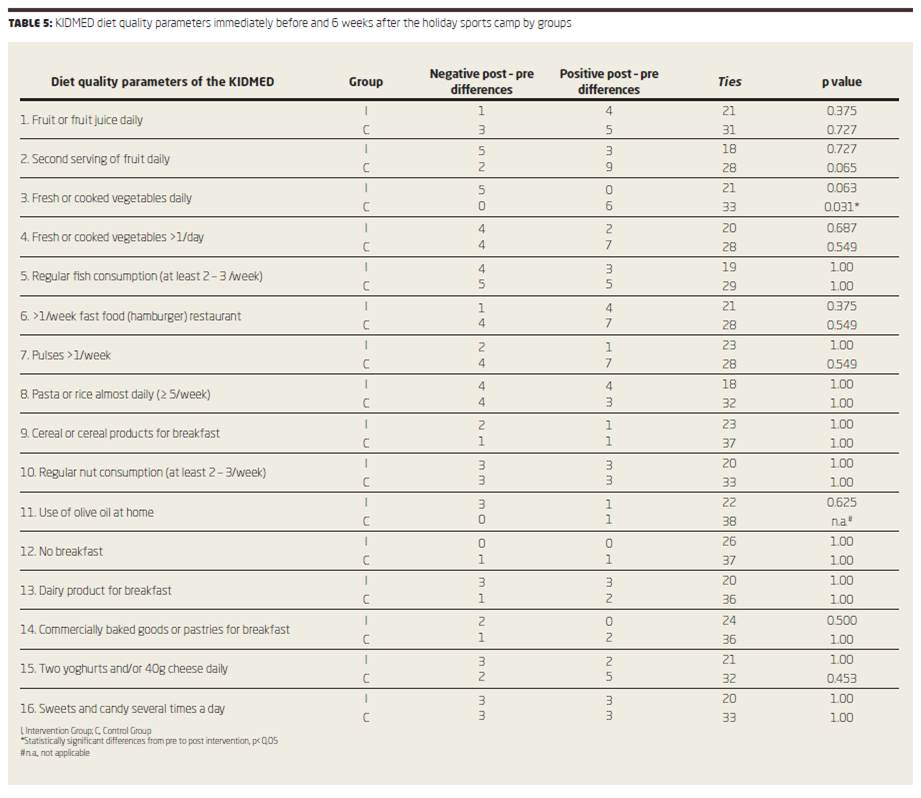
<body><![CDATA[<p>&nbsp;</p>     <p><b >INTRODU&#199;&#195;O</b> <br/>Changes in dietary and lifestyle patterns worldwide have led to an increased prevalence of obesity (1). Childhood obesity, in particular, has risen dramatically in the past decades and, today, about 10% of the world&#8217;s school-aged children have excessive body fat, with a quarter of these being obese (2). Portugal has followed the same trend and it is estimated that in boys between 6 and 10 years old the prevalence of overweight vary from 14.7 to 30.5% and of obesity vary from 5.3 to 13.2%, according to country region (3). Health consequences of obesity are multiple and serious. Short term morbidities include psychological or psychiatric problems, cardiovascular risk factors, such as high blood pressure, dyslipidaemia and impaired glucose tolerance, with deposition of fat in insulin-sensitive tissues such as muscle and liver, and asthma or worsening of pre-existing asthma (4, 5). Childhood obesity and its morbidities tend to persist in adulthood, predicting a risk of premature mortality (4). <br/>Such scenario requires the development of effective strategies to both prevent and treat childhood overweight and obesity, through the promotion of healthy lifestyles since infancy and the creation of healthy environments. Although there is not enough evidence, interventions that combine nutrition and physical activity seem to be promising in childhood obesity prevention and/or treatment (6), and more cost-effectiveness (7). The Mediterranean Diet is associated with lower rates of chronic disease morbidity and higher life expectancy and has been considered one of the healthiest existing dietary patterns. It is also suggested that nutrition knowledge may play a small but pivotal role in the adoption of healthier food habits (8) and this improvement on diet quality is inversely associated with body mass index (BMI) (9). It becomes essential to boost the involvement of other resources in society, such as sports clubs and associations, and explore the potentialities of nutrition education interventions in sporting environments per excellence. <br/>Holiday sports camps can be a good environment to introduce nutrition education interventions, aiming to improve the lifestyle and health of participants. </p>     <p><b>OBJECTIVES</b> <br/>The present study aimed to evaluate the effectiveness of a short-term nutrition education intervention on improving the dietary knowledge, diet quality and BMI-for-age z-score of school-age boys attending a holiday sports camp. </p>     <p><b>METHODOLODY</b> <br/><u>Participants</u> <br/>The study participants were a non-representative sample from the Dragon Force, a soccer school from FCPorto. Inclusion criteria were: 1) age between six and eleven years old; 2) male gender; and 3) registration in a Dragon Force school. <br/>The intervention group (n=26) was formed from a convenient sample of the total range (n=56) of students who participated in the Easter holiday sports camp. The student recruitment for the intervention group was done on the first day of the holiday sports camp, before the beginning of any activity. The control group (n=39) was formed two days prior to holiday sports camp from the students registered as well in a Dragon Force school, but who did not attend the Easter holiday sports camp. We excluded the students who did not accomplish the inclusion criteria, and also those who did not accomplish all the procedures and measurements during the study period. The final sample consisted of 65 boys; 26 formed the intervention group. Verbal consent was obtained from parents, after being informed about the study procedures. <br/><u>Study Design</u><u></u> <br/>The study was a non-randomized controlled trial, which used a repeated measures pre-post design and a comparison group. The intervention lasted for a period of 4 hours, distributed over 5 days. <br/><u>Measurements</u> <br/><u>Nutritional and Dietary Knowledge</u><u></u> <br/>Nutritional and dietary knowledge was assessed only in the intervention group, through a non-validated questionnaire, designed by us according to nutrition topics included in the nutrition education intervention during the holiday sports camp. The questionnaire consisted of 15 multiple choice questions, each one with 3 possible options for choice; right answers were classified with +1 and the wrong ones were given 0, with a maximum of 15 points. <br/><u>Dietary Quality</u><u></u> <br/>Dietary quality was measured by the adherence to a Mediterranean-style diet and assessed through the KIDMED, a quality index for children and youth developed by Serra-Majem and colleagues (10). The KIDMED combines the Mediterranean diet characteristics as well as the general dietary guidelines for children (9) in a total of 16 &#8220;yes-or-no&#8221; questions. For &#8220;yes&#8221; answers, questions denoting negative connotation are quoted with -1 and those denoting positive connotation are assigned with +1. &#8220;No&#8221; answers are given 0. The KIDMED score is calculated by summing the values attributed to each question and ranges from -4 to +12. The final score can be classified into three levels: a) <u>&gt;</u>8, optimal Mediterranean diet; b) 4 &#8211; 7, improvement needed to adjust intake to Mediterranean patterns; c) <u>&lt;</u>3, very low diet quality. <br/><u>Anthropometry</u> <br/>Body weight and height were evaluated in training clothes and BMI was calculated (kg/m<sup>2</sup>). Weight was measured to the nearest 0.1 kg with a SECA<sup>&#174;</sup> electronic weighting scale and height was measured to the nearest 0.1 cm with a SECA<sup>&#174;</sup> stadiometer. To measure height, participants stayed upright on a horizontal surface with their heads in the Frankfort plane (11). BMI z-scores were then obtained, and for nutritional status classification, BMI was categorized using the Centers for Disease Control and Prevention (CDC) age- and gender-specific cut-off percentiles: BMI &lt;5th percentile (underweight); 5th percentile <u>&lt;</u> BMI &lt;85th percentile (healthy weight); 85<sup>th</sup> percentile <u>&lt;</u> BMI &lt;95<sup>th</sup> percentile (overweight); and BMI <u>&gt;</u> 95<sup>th</sup> percentile (obesity) (12). <br/><u>Procedures</u> <br/>The baseline BMI z-score, nutrition knowledge and dietary quality were assessed in the first day of the holiday sports camp in the intervention group.  <br/>In the control group, the baseline measurements of BMI z-score and dietary quality were assessed two days before the beginning of the holiday sports camp, following the same procedures of the intervention group, with the exception of the application of the knowledge questionnaire. <br/>Nutrition education intervention in the intervention group was carried out throughout the week of holiday sports camp. <br/>Six weeks after the end of the holiday sports camp, students of both groups were asked to repeat the same measurements and questionnaires performed before the intervention period. <br/><u>Nutrition Education Intervention</u> <br/>The nutrition education intervention consisted of 4 sessions distributed over the 5-day holiday sports camp, totaling 4 hours of intervention. The sessions covered issues such as general healthy eating and healthy food choices, particularly upon carbohydrate-rich food and fruits and vegetables. Participants also took part in a &#8220;Nutrition Peddy Paper&#8221;, whose enigmas asked for tasks that foster and exercise nutritional knowledge, providing an amusing and competitive learning. <br/><u>Statistical Analysis</u><u></u> <br/>To analyze the data, the SPSS for Windows statistical software package version 17.0 was used. Descriptive analyses were carried out for the KIDMED and BMI percentiles categories for each group. Normality of the variables was tested with Kolmogorov-Smirnov Test. To assess differences between baseline and post-intervention data by group, paired samples t Test was used for normally distributed variables. When variables were not normally distributed, Wilcoxon Signed Ranks Test was used. To compare variables between groups, independent samples t Test was used. Sign Test was performed for dichotomous variables, using the binomial distribution. Differences were considered statistically significant when p<0.05.  </p>     <p><b>RESULTS</b> <br/>At baseline, the intervention group did not differ significantly in age and anthropometric measures from the control group (<a href ="/img/revistas/nut/n19/n19a04t1.jpg">Tabela 1</a>). In the intervention group, 11.5% of the participants were overweight and 7.70% were obese at baseline, whereas in the control group 25.6% were overweight and 7.70 were obese. <br/>There was a change in the desired direction of the dietary knowledge score in the intervention group (<a href ="/img/revistas/nut/n19/n19a04t2.jpg">Tabela 2</a>), 6 weeks after the holiday sports camp, although not significant (p>0.05), obtaining the same results when we analyzed differences for each knowledge questionnaire question (<a href ="/img/revistas/nut/n19/n19a04t3.jpg">Tabela 3</a>). <br/>In the intervention group, baseline KIDMED index was less than 4 (very low diet quality) for 7.70% of the group, from 4 to 7 (improvement needed to adjust intake to Mediterranean patterns) for 46.15% and higher than 7 (optimal Mediterranean diet) for 46.15%, whereas in the control group very low diet quality was found for 7.70%, intermediate diet quality for 41.0% and high index results were found in 51.3%. In both groups, however, the KIDMED total score showed no significant differences (p>0.05) after the intervention period (<a href ="/img/revistas/nut/n19/n19a04t4.jpg">Tabela 4</a>). <br/>Analyzing the differences in answers of each <br/>KIDMED question by groups (<a href ="/img/revistas/nut/n19/n19a04t5.jpg">Tabela 5</a>), from pre to post intervention, differences were observed only for the daily intake of fresh or cooked vegetables (p<0.05), which increased in the control group. Intervention group had a decrease in the daily intake of fresh or cooked vegetables (p<0.1), which agrees with the slight non-significant impairment of the overall diet quality in this group (Tables 4 and 5). The opposite trend occurs in the control group for the daily intake of a second piece of fruit, in which it was possible to observe an increased consumption (p<0.1). <br/>After the intervention, the overall BMI z-score of the intervention group decreased 0.086 (0.212) units (p<0.05), while in the control group there was no significant change in BMI z-score, as shown in Table 4. Even so, descriptive data showed that these diferences did not reduce the overweight and obesity prevalence in the intervention group, which remained unchanged. In the control group, little variations in the BMI led to an increased prevalence of overweight from 25.6% to 28.2% and a decreased prevalence of obesity from 7.70% to 5.10%. </p>     
<p><b>DISCUSSION AND CONCLUSION</b> <br/>In the present research, the effectiveness of a 5-day nutrition education intervention in the context of a holiday sports camp was evaluated. The results suggest that the short-term intervention originated a change in the desired direction of participant&#8217;s nutrition and dietary knowledge, although not statistically significant. This outcome was followed by an overall decrease in BMI z-score; however, this reduction did not influence the prevalence of overweight and obesity in the intervention group.  <br/>Some residential weight-loss camps interventions on nutrition education and physical activity also led to significant improvements in BMI z-score (13-15), but the differences were stronger. However, these studies were conducted among older children, who attended residential camps, for longer periods and had other type of interventions not performed in our study, such as controlled ingested energy. On the other hand, the intervention samples of these studies were overweight or obese children only and also included girls. We found that, in the control group, the percentage of obese children decreased, but that possibly happened because the small variations affected values near or over the cut-offs. <br/>The association between nutrition knowledge and dietary intake has been more explored in intervention programs in the school context. Two recent studies (16, 17) upon nutrition education and physical activity among primary-school children showed significant improvements in knowledge and dietary intakes of intervention groups after an intervention period of 1 to 2 months. In our study, such results were not found, probably because of the very short period of the intervention (5 days). The School Health Education Evaluation study found that 15 hours of nutrition education could be expected to produce changes in knowledge, whereas for changes in attitudes and behaviors it would be necessary about 50 hours (18). Moreover, it appears that girls tend to respond better to educational components grounded in social learning, while boys may be more influenced by structural and environmental changes facilitating increased physical activity and improved dietary intake (19). <br/>This raises a major methodological issue of this study, because there may have been differences in physical activity between both groups, during the holiday sports camp period, which could have also contributed for the differences observed in BMI z-score. On the other hand, we have to consider that younger children may have difficulty in conceptualizing their real dietary intake, whereas older children may respond under the influence of some social desirability.  <br/>Recently, Kelly et al. (20) emphasized the importance of programs such as weight loss camps in childhood obesity treatment, especially those that withdraw children from their obesogenic environment and place them in an active, recreational and educational environment for extended periods of time. This holiday sports camp was not exclusively for obese children, but provided a healthy environment and nutrition education that may influence future participant&#8217;s behavior and, thus, acting, not only as a treatment strategy for childhood obesity, but also as a prevention strategy. <br/>Even so, this study has some limitations that have to be considered. The short duration of the holiday sports camp was a drawback that induces the very short intervention period, which proved insufficient, as we have seen, to produce more consistent nutritional and dietary knowledge and, mainly, improved dietary habits. On the other hand, the questionnaire applied to evaluate the participants knowledge was not validated for this population, which may interfere with the outcomes. A major limitation of this research is the study design and the very small sample size. This was not a randomized controlled trial, given the financial, timing and organizational constraints of the camp (we could not control the registration of the boys in the holiday sports camp). The small sample size of both intervention and control groups may also have resulted in larger estimation errors. A question that remains unclear is the possible impact of physical activity on BMI z-score in the intervention group. This variable was not measured and compared between both groups, which limit the conclusions. Finally, the outcomes observed in this research may not be reproduced in other holiday sports camps, because of the non-representativeness of the sample and due to the presence of differences in participant backgrounds and in structure, contents and environment offered by the camps that may affect the final results. <br/>Additional studies are needed on the effectiveness of nutrition education strategies implemented in sports camps on improving participant&#8217;s health and in prevention/treatment of childhood obesity. <br/>In conclusion, this research showed that short-term nutrition education interventions may have an impact in the desired direction on dietary quality and nutritional knowledge but, in spite of the absence of stronger results, it also gave some tracks for future interventions, showing that holiday sports camps with nutrition education interventions can be a promising strategy to improve child health and to combat childhood obesity. Better results can be expected in longer interventions with structural and environmental changes and a subsequent follow-up extended in time. </p>     <p>&nbsp;</p>     <!-- ref --><p><b >REFERENCES</b> <br/>1. WHO. Diet, Nutrition and the Prevention of Chronic Diseases: report of a joint WHO/FAO expert consultation Geneva: World Health Organization; 2003 <br/>2. Lobstein T, Baur L, Uauy R. Obesity in children and young people: a crisis in public health. Obesity Reviews. 2004; 5:4-85 <br/>3.    &nbsp;&nbsp;&nbsp;&nbsp;&nbsp;&nbsp;&nbsp;&nbsp;[&#160;<a href="javascript:void(0);" onclick="javascript: window.open('/scielo.php?script=sci_nlinks&ref=1723908&pid=S2182-7230201300040000400001&lng=','','width=640,height=500,resizable=yes,scrollbars=1,menubar=yes,');">Links</a>&#160;]<!-- end-ref --><!-- ref --> Moreira P. Overweight and obesity in Portuguese children and adolescents. Journal of Public Health. 2007; 15:155-61 <br/>4.    &nbsp;&nbsp;&nbsp;&nbsp;&nbsp;&nbsp;&nbsp;&nbsp;[&#160;<a href="javascript:void(0);" onclick="javascript: window.open('/scielo.php?script=sci_nlinks&ref=1723909&pid=S2182-7230201300040000400002&lng=','','width=640,height=500,resizable=yes,scrollbars=1,menubar=yes,');">Links</a>&#160;]<!-- end-ref --><!-- ref --> Reilly JJ, Methven E, McDowell ZC, Hacking B, Alexander D, Stewart L, et al. Health consequences of obesity. Archives of Disease in Childhood. 2003; 88(9):748-52 <br/>5.    &nbsp;&nbsp;&nbsp;&nbsp;&nbsp;&nbsp;&nbsp;&nbsp;[&#160;<a href="javascript:void(0);" onclick="javascript: window.open('/scielo.php?script=sci_nlinks&ref=1723910&pid=S2182-7230201300040000400003&lng=','','width=640,height=500,resizable=yes,scrollbars=1,menubar=yes,');">Links</a>&#160;]<!-- end-ref --><!-- ref --> Weiss R, Caprio S. The metabolic consequences of childhood obesity. Best Practice & Research Clinical Endocrinology & Metabolism. 2005; 19(3):405-19 <br/>6.    &nbsp;&nbsp;&nbsp;&nbsp;&nbsp;&nbsp;&nbsp;&nbsp;[&#160;<a href="javascript:void(0);" onclick="javascript: window.open('/scielo.php?script=sci_nlinks&ref=1723911&pid=S2182-7230201300040000400004&lng=','','width=640,height=500,resizable=yes,scrollbars=1,menubar=yes,');">Links</a>&#160;]<!-- end-ref --><!-- ref --> Summerbell CW, E; Edmunds, L; Kelly, SAM; Brown, T; Campbell, KJ. Interventions for preventing obesity in children. Cochrane Database of Systematic Reviews. 2005; (3) <br/>7. John J, Wenig CM, Wolfenstetter SB. Recent economic findings on childhood obesity: cost-of-illness and cost-effectiveness of interventions. Current Opinion in Clinical Nutrition & Metabolic Care. 2010; 13(3):305-313  <br/>8.    &nbsp;&nbsp;&nbsp;&nbsp;&nbsp;&nbsp;&nbsp;&nbsp;[&#160;<a href="javascript:void(0);" onclick="javascript: window.open('/scielo.php?script=sci_nlinks&ref=1723912&pid=S2182-7230201300040000400005&lng=','','width=640,height=500,resizable=yes,scrollbars=1,menubar=yes,');">Links</a>&#160;]<!-- end-ref --><!-- ref --> Worsley A. Nutrition knowledge and food consumption: can nutrition knowledge change food behaviour&#8204; Asia Pacific Journal of Clinical Nutrition. 2002; 11:S579-S85 <br/>9.    &nbsp;&nbsp;&nbsp;&nbsp;&nbsp;&nbsp;&nbsp;&nbsp;[&#160;<a href="javascript:void(0);" onclick="javascript: window.open('/scielo.php?script=sci_nlinks&ref=1723913&pid=S2182-7230201300040000400006&lng=','','width=640,height=500,resizable=yes,scrollbars=1,menubar=yes,');">Links</a>&#160;]<!-- end-ref --><!-- ref --> Kontogianni MD, Farmaki A-E, Vidra N, Sofrona S, Magkanari F, Yannakoulia M. Associations between Lifestyle Patterns and Body Mass Index in a Sample of Greek Children and Adolescents. Journal of the American Dietetic Association. 2010; 110(2):215-21 <br/>10.    &nbsp;&nbsp;&nbsp;&nbsp;&nbsp;&nbsp;&nbsp;&nbsp;[&#160;<a href="javascript:void(0);" onclick="javascript: window.open('/scielo.php?script=sci_nlinks&ref=1723914&pid=S2182-7230201300040000400007&lng=','','width=640,height=500,resizable=yes,scrollbars=1,menubar=yes,');">Links</a>&#160;]<!-- end-ref --><!-- ref --> Serra-Majem L, Ribas L, Ngo J, Ortega RM, Garc&#237;a A, P&#233;rez-Rodrigo C, et al. Food, youth and the Mediterranean diet in Spain. Development of KIDMED, Mediterranean Diet Quality Index in children and adolescents. Public Health Nutrition. 2004; 7(07):931-35 <br/>11.    &nbsp;&nbsp;&nbsp;&nbsp;&nbsp;&nbsp;&nbsp;&nbsp;[&#160;<a href="javascript:void(0);" onclick="javascript: window.open('/scielo.php?script=sci_nlinks&ref=1723915&pid=S2182-7230201300040000400008&lng=','','width=640,height=500,resizable=yes,scrollbars=1,menubar=yes,');">Links</a>&#160;]<!-- end-ref --><!-- ref --> International standards for anthropometric assessment. Rev. ed. ed. Potchefstroom, South Africa: International Society for the Advancement of Kinanthropometry; 2006  <br/>12. Kuczmarski RJ OC, Guo SS et al. CDC Growth charts for the United States: methods and development. Vital and Health Statistics. 2002; 11(246):1-190 <br/>13.    &nbsp;&nbsp;&nbsp;&nbsp;&nbsp;&nbsp;&nbsp;&nbsp;[&#160;<a href="javascript:void(0);" onclick="javascript: window.open('/scielo.php?script=sci_nlinks&ref=1723916&pid=S2182-7230201300040000400009&lng=','','width=640,height=500,resizable=yes,scrollbars=1,menubar=yes,');">Links</a>&#160;]<!-- end-ref --><!-- ref --> Gately PJ, Cooke CB, Barth JH, Bewick BM, Radley D, Hill AJ. Children's Residential Weight-Loss Programs Can Work: A Prospective Cohort Study of Short-Term Outcomes for Overweight and Obese Children. Pediatrics. 2005; 116(1):73-77 <br/>14.    &nbsp;&nbsp;&nbsp;&nbsp;&nbsp;&nbsp;&nbsp;&nbsp;[&#160;<a href="javascript:void(0);" onclick="javascript: window.open('/scielo.php?script=sci_nlinks&ref=1723917&pid=S2182-7230201300040000400010&lng=','','width=640,height=500,resizable=yes,scrollbars=1,menubar=yes,');">Links</a>&#160;]<!-- end-ref --><!-- ref --> Huelsing J, Kanafani N, Mao J, White NH. Camp Jump Start: Effects of a Residential Summer Weight-Loss Camp for Older Children and Adolescents. Pediatrics. 2010; 125(4):e884-e890 <br/>15.    &nbsp;&nbsp;&nbsp;&nbsp;&nbsp;&nbsp;&nbsp;&nbsp;[&#160;<a href="javascript:void(0);" onclick="javascript: window.open('/scielo.php?script=sci_nlinks&ref=1723918&pid=S2182-7230201300040000400011&lng=','','width=640,height=500,resizable=yes,scrollbars=1,menubar=yes,');">Links</a>&#160;]<!-- end-ref --><!-- ref --> Wong WW, Abrams SH, Mikhail C, Terrazas NL, Wilson TA, Arceo D, et al. An Innovative Summer Camp Program Improves Weight and Self-esteem in Obese Children. Journal of Pediatric Gastroenterology and Nutrition. 2009; 49(4):493-497 <br/>16.    &nbsp;&nbsp;&nbsp;&nbsp;&nbsp;&nbsp;&nbsp;&nbsp;[&#160;<a href="javascript:void(0);" onclick="javascript: window.open('/scielo.php?script=sci_nlinks&ref=1723919&pid=S2182-7230201300040000400012&lng=','','width=640,height=500,resizable=yes,scrollbars=1,menubar=yes,');">Links</a>&#160;]<!-- end-ref --><!-- ref --> Francis M, Nichols SSD, Dalrymple N. The effects of a school-based intervention programme on dietary intakes and physical activity among primary-school children in Trinidad and Tobago. Public Health Nutrition. 2010; 13(5):738-747 <br/>17.    &nbsp;&nbsp;&nbsp;&nbsp;&nbsp;&nbsp;&nbsp;&nbsp;[&#160;<a href="javascript:void(0);" onclick="javascript: window.open('/scielo.php?script=sci_nlinks&ref=1723920&pid=S2182-7230201300040000400013&lng=','','width=640,height=500,resizable=yes,scrollbars=1,menubar=yes,');">Links</a>&#160;]<!-- end-ref --><!-- ref --> Slawta JN, DeNeui D. Be a Fit Kid: nutrition and physical activity for the fourth grade. Health promotion practice. 2010; 11(4):522-29 <br/>18.    &nbsp;&nbsp;&nbsp;&nbsp;&nbsp;&nbsp;&nbsp;&nbsp;[&#160;<a href="javascript:void(0);" onclick="javascript: window.open('/scielo.php?script=sci_nlinks&ref=1723921&pid=S2182-7230201300040000400014&lng=','','width=640,height=500,resizable=yes,scrollbars=1,menubar=yes,');">Links</a>&#160;]<!-- end-ref --><!-- ref --> Lytle LA. Nutrition education for school-aged children. Journal of Nutrition Education. 1995; 27:298-311 <br/>19.    &nbsp;&nbsp;&nbsp;&nbsp;&nbsp;&nbsp;&nbsp;&nbsp;[&#160;<a href="javascript:void(0);" onclick="javascript: window.open('/scielo.php?script=sci_nlinks&ref=1723922&pid=S2182-7230201300040000400015&lng=','','width=640,height=500,resizable=yes,scrollbars=1,menubar=yes,');">Links</a>&#160;]<!-- end-ref --><!-- ref --> Kropski JA, Keckley PH, Jensen GL. School-based Obesity Prevention Programs: An Evidence-based Review. Obesity. 2008; 16(5):1009-1018 <br/>20.    &nbsp;&nbsp;&nbsp;&nbsp;&nbsp;&nbsp;&nbsp;&nbsp;[&#160;<a href="javascript:void(0);" onclick="javascript: window.open('/scielo.php?script=sci_nlinks&ref=1723923&pid=S2182-7230201300040000400016&lng=','','width=640,height=500,resizable=yes,scrollbars=1,menubar=yes,');">Links</a>&#160;]<!-- end-ref --><!-- ref --> Kelly KP, Kirschenbaum DS. Immersion treatment of childhood and adolescent obesity: the first review of a promising intervention. Obesity Reviews. 2011; 12(1):37-49     &nbsp;&nbsp;&nbsp;&nbsp;&nbsp;&nbsp;&nbsp;&nbsp;[&#160;<a href="javascript:void(0);" onclick="javascript: window.open('/scielo.php?script=sci_nlinks&ref=1723924&pid=S2182-7230201300040000400017&lng=','','width=640,height=500,resizable=yes,scrollbars=1,menubar=yes,');">Links</a>&#160;]<!-- end-ref --><p>&nbsp;</p>     <p>  <b ><a href="#topc0">Endere&#231;o para correspond&#234;ncia</a><a name="c0"></a></b> <br/>Catarina Santos Silva <br/>Rua D.&#170; Almira Brand&#227;o, n.&#186; 426, 3720-400 Vila de Cucuj&#227;es     <br> <a href="mailto:catarinasantosilva@gmail.com">catarinasantosilva@gmail.com</a></p> </p>  <br/>Recebido a 4 de Outubro de 2013 <br/>Aceite a 26 de Novembro de 2013 <br/>       ]]></body><back>
<ref-list>
<ref id="B1">
<label>2</label><nlm-citation citation-type="journal">
<person-group person-group-type="author">
<name>
<surname><![CDATA[Lobstein]]></surname>
<given-names><![CDATA[T]]></given-names>
</name>
<name>
<surname><![CDATA[Baur]]></surname>
<given-names><![CDATA[L]]></given-names>
</name>
<name>
<surname><![CDATA[Uauy]]></surname>
<given-names><![CDATA[R]]></given-names>
</name>
</person-group>
<article-title xml:lang="en"><![CDATA[Obesity in children and young people: a crisis in public health]]></article-title>
<source><![CDATA[Obesity Reviews]]></source>
<year>2004</year>
<volume>5</volume>
<page-range>4-85</page-range></nlm-citation>
</ref>
<ref id="B2">
<label>3</label><nlm-citation citation-type="journal">
<person-group person-group-type="author">
<name>
<surname><![CDATA[Moreira]]></surname>
<given-names><![CDATA[P]]></given-names>
</name>
</person-group>
<article-title xml:lang="en"><![CDATA[Overweight and obesity in Portuguese children and adolescents]]></article-title>
<source><![CDATA[Journal of Public Health]]></source>
<year>2007</year>
<volume>15</volume>
<page-range>155-61</page-range></nlm-citation>
</ref>
<ref id="B3">
<label>4</label><nlm-citation citation-type="journal">
<person-group person-group-type="author">
<name>
<surname><![CDATA[Reilly]]></surname>
<given-names><![CDATA[JJ]]></given-names>
</name>
<name>
<surname><![CDATA[Methven]]></surname>
<given-names><![CDATA[E]]></given-names>
</name>
<name>
<surname><![CDATA[McDowell]]></surname>
<given-names><![CDATA[ZC]]></given-names>
</name>
<name>
<surname><![CDATA[Hacking]]></surname>
<given-names><![CDATA[B]]></given-names>
</name>
<name>
<surname><![CDATA[Alexander]]></surname>
<given-names><![CDATA[D]]></given-names>
</name>
<name>
<surname><![CDATA[Stewart]]></surname>
<given-names><![CDATA[L]]></given-names>
</name>
</person-group>
<article-title xml:lang="en"><![CDATA[Health consequences of obesity]]></article-title>
<source><![CDATA[Archives of Disease in Childhood]]></source>
<year>2003</year>
<volume>88</volume>
<numero>9</numero>
<issue>9</issue>
<page-range>748-52</page-range></nlm-citation>
</ref>
<ref id="B4">
<label>5</label><nlm-citation citation-type="journal">
<person-group person-group-type="author">
<name>
<surname><![CDATA[Weiss]]></surname>
<given-names><![CDATA[R]]></given-names>
</name>
<name>
<surname><![CDATA[Caprio]]></surname>
<given-names><![CDATA[S]]></given-names>
</name>
</person-group>
<article-title xml:lang="en"><![CDATA[The metabolic consequences of childhood obesity]]></article-title>
<source><![CDATA[Best Practice & Research Clinical Endocrinology & Metabolism]]></source>
<year>2005</year>
<volume>19</volume>
<numero>3</numero>
<issue>3</issue>
<page-range>405-19</page-range></nlm-citation>
</ref>
<ref id="B5">
<label>7</label><nlm-citation citation-type="journal">
<person-group person-group-type="author">
<name>
<surname><![CDATA[John]]></surname>
<given-names><![CDATA[J]]></given-names>
</name>
<name>
<surname><![CDATA[Wenig]]></surname>
<given-names><![CDATA[CM]]></given-names>
</name>
<name>
<surname><![CDATA[Wolfenstetter]]></surname>
<given-names><![CDATA[SB]]></given-names>
</name>
</person-group>
<article-title xml:lang="en"><![CDATA[Recent economic findings on childhood obesity: cost-of-illness and cost-effectiveness of interventions]]></article-title>
<source><![CDATA[Current Opinion in Clinical Nutrition & Metabolic Care]]></source>
<year>2010</year>
<volume>13</volume>
<numero>3</numero>
<issue>3</issue>
<page-range>305-313</page-range></nlm-citation>
</ref>
<ref id="B6">
<label>8</label><nlm-citation citation-type="journal">
<person-group person-group-type="author">
<name>
<surname><![CDATA[Worsley]]></surname>
<given-names><![CDATA[A]]></given-names>
</name>
</person-group>
<article-title xml:lang="en"><![CDATA[Nutrition knowledge and food consumption: can nutrition knowledge change food behaviour?]]></article-title>
<source><![CDATA[Asia Pacific Journal of Clinical Nutrition]]></source>
<year>2002</year>
<volume>11</volume>
<page-range>S579-S85</page-range></nlm-citation>
</ref>
<ref id="B7">
<label>9</label><nlm-citation citation-type="journal">
<person-group person-group-type="author">
<name>
<surname><![CDATA[Kontogianni]]></surname>
<given-names><![CDATA[MD]]></given-names>
</name>
<name>
<surname><![CDATA[Farmaki A-E]]></surname>
</name>
<name>
<surname><![CDATA[Vidra]]></surname>
<given-names><![CDATA[N]]></given-names>
</name>
<name>
<surname><![CDATA[Sofrona]]></surname>
<given-names><![CDATA[S]]></given-names>
</name>
<name>
<surname><![CDATA[Magkanari]]></surname>
<given-names><![CDATA[F]]></given-names>
</name>
<name>
<surname><![CDATA[Yannakoulia]]></surname>
<given-names><![CDATA[M]]></given-names>
</name>
</person-group>
<article-title xml:lang="en"><![CDATA[Associations between Lifestyle Patterns and Body Mass Index in a Sample of Greek Children and Adolescents]]></article-title>
<source><![CDATA[Journal of the American Dietetic Association]]></source>
<year>2010</year>
<volume>110</volume>
<numero>2</numero>
<issue>2</issue>
<page-range>215-21</page-range></nlm-citation>
</ref>
<ref id="B8">
<label>10</label><nlm-citation citation-type="journal">
<person-group person-group-type="author">
<name>
<surname><![CDATA[Serra-Majem]]></surname>
<given-names><![CDATA[L]]></given-names>
</name>
<name>
<surname><![CDATA[Ribas]]></surname>
<given-names><![CDATA[L]]></given-names>
</name>
<name>
<surname><![CDATA[Ngo]]></surname>
<given-names><![CDATA[J]]></given-names>
</name>
<name>
<surname><![CDATA[Ortega]]></surname>
<given-names><![CDATA[RM]]></given-names>
</name>
<name>
<surname><![CDATA[García]]></surname>
<given-names><![CDATA[A]]></given-names>
</name>
<name>
<surname><![CDATA[Pérez-Rodrigo]]></surname>
<given-names><![CDATA[C]]></given-names>
</name>
</person-group>
<article-title xml:lang="en"><![CDATA[Food, youth and the Mediterranean diet in Spain: Development of KIDMED, Mediterranean Diet Quality Index in children and adolescents]]></article-title>
<source><![CDATA[Public Health Nutrition]]></source>
<year>2004</year>
<volume>7</volume>
<numero>07</numero>
<issue>07</issue>
<page-range>931-35</page-range></nlm-citation>
</ref>
<ref id="B9">
<label>12</label><nlm-citation citation-type="journal">
<person-group person-group-type="author">
<name>
<surname><![CDATA[Kuczmarski RJ]]></surname>
<given-names><![CDATA[OC]]></given-names>
</name>
</person-group>
<collab>Guo SS et al</collab>
<article-title xml:lang="en"><![CDATA[CDC Growth charts for the United States: methods and development]]></article-title>
<source><![CDATA[Vital and Health Statistics]]></source>
<year>2002</year>
<volume>11</volume>
<numero>246</numero>
<issue>246</issue>
<page-range>1-190</page-range></nlm-citation>
</ref>
<ref id="B10">
<label>13</label><nlm-citation citation-type="journal">
<person-group person-group-type="author">
<name>
<surname><![CDATA[Gately]]></surname>
<given-names><![CDATA[PJ]]></given-names>
</name>
<name>
<surname><![CDATA[Cooke]]></surname>
<given-names><![CDATA[CB]]></given-names>
</name>
<name>
<surname><![CDATA[Barth]]></surname>
<given-names><![CDATA[JH]]></given-names>
</name>
<name>
<surname><![CDATA[Bewick]]></surname>
<given-names><![CDATA[BM]]></given-names>
</name>
<name>
<surname><![CDATA[Radley]]></surname>
<given-names><![CDATA[D]]></given-names>
</name>
<name>
<surname><![CDATA[Hill]]></surname>
<given-names><![CDATA[AJ]]></given-names>
</name>
</person-group>
<article-title xml:lang="en"><![CDATA[Children's Residential Weight-Loss Programs Can Work: A Prospective Cohort Study of Short-Term Outcomes for Overweight and Obese Children]]></article-title>
<source><![CDATA[Pediatrics]]></source>
<year>2005</year>
<volume>116</volume>
<numero>1</numero>
<issue>1</issue>
<page-range>73-77</page-range></nlm-citation>
</ref>
<ref id="B11">
<label>14</label><nlm-citation citation-type="journal">
<person-group person-group-type="author">
<name>
<surname><![CDATA[Huelsing]]></surname>
<given-names><![CDATA[J]]></given-names>
</name>
<name>
<surname><![CDATA[Kanafani]]></surname>
<given-names><![CDATA[N]]></given-names>
</name>
<name>
<surname><![CDATA[Mao]]></surname>
<given-names><![CDATA[J]]></given-names>
</name>
<name>
<surname><![CDATA[White]]></surname>
<given-names><![CDATA[NH]]></given-names>
</name>
</person-group>
<article-title xml:lang="en"><![CDATA[Camp Jump Start: Effects of a Residential Summer Weight-Loss Camp for Older Children and Adolescents]]></article-title>
<source><![CDATA[Pediatrics]]></source>
<year>2010</year>
<volume>125</volume>
<numero>4</numero>
<issue>4</issue>
<page-range>e884-e890</page-range></nlm-citation>
</ref>
<ref id="B12">
<label>15</label><nlm-citation citation-type="journal">
<person-group person-group-type="author">
<name>
<surname><![CDATA[Wong]]></surname>
<given-names><![CDATA[WW]]></given-names>
</name>
<name>
<surname><![CDATA[Abrams]]></surname>
<given-names><![CDATA[SH]]></given-names>
</name>
<name>
<surname><![CDATA[Mikhail]]></surname>
<given-names><![CDATA[C]]></given-names>
</name>
<name>
<surname><![CDATA[Terrazas]]></surname>
<given-names><![CDATA[NL]]></given-names>
</name>
<name>
<surname><![CDATA[Wilson]]></surname>
<given-names><![CDATA[TA]]></given-names>
</name>
<name>
<surname><![CDATA[Arceo]]></surname>
<given-names><![CDATA[D]]></given-names>
</name>
</person-group>
<article-title xml:lang="en"><![CDATA[An Innovative Summer Camp Program Improves Weight and Self-esteem in Obese Children]]></article-title>
<source><![CDATA[Journal of Pediatric Gastroenterology and Nutrition]]></source>
<year>2009</year>
<volume>49</volume>
<numero>4</numero>
<issue>4</issue>
<page-range>493-497</page-range></nlm-citation>
</ref>
<ref id="B13">
<label>16</label><nlm-citation citation-type="journal">
<person-group person-group-type="author">
<name>
<surname><![CDATA[Francis]]></surname>
<given-names><![CDATA[M]]></given-names>
</name>
<name>
<surname><![CDATA[Nichols]]></surname>
<given-names><![CDATA[SSD]]></given-names>
</name>
<name>
<surname><![CDATA[Dalrymple]]></surname>
<given-names><![CDATA[N]]></given-names>
</name>
</person-group>
<article-title xml:lang="en"><![CDATA[The effects of a school-based intervention programme on dietary intakes and physical activity among primary-school children in Trinidad and Tobago]]></article-title>
<source><![CDATA[Public Health Nutrition]]></source>
<year>2010</year>
<volume>13</volume>
<numero>5</numero>
<issue>5</issue>
<page-range>738-747</page-range></nlm-citation>
</ref>
<ref id="B14">
<label>17</label><nlm-citation citation-type="journal">
<person-group person-group-type="author">
<name>
<surname><![CDATA[Slawta]]></surname>
<given-names><![CDATA[JN]]></given-names>
</name>
<name>
<surname><![CDATA[DeNeui]]></surname>
<given-names><![CDATA[D]]></given-names>
</name>
</person-group>
<article-title xml:lang="en"><![CDATA[Be a Fit Kid: nutrition and physical activity for the fourth grade]]></article-title>
<source><![CDATA[Health promotion practice]]></source>
<year>2010</year>
<volume>11</volume>
<numero>4</numero>
<issue>4</issue>
<page-range>522-29</page-range></nlm-citation>
</ref>
<ref id="B15">
<label>18</label><nlm-citation citation-type="journal">
<person-group person-group-type="author">
<name>
<surname><![CDATA[Lytle]]></surname>
<given-names><![CDATA[LA]]></given-names>
</name>
</person-group>
<article-title xml:lang="en"><![CDATA[Nutrition education for school-aged children]]></article-title>
<source><![CDATA[Journal of Nutrition Education]]></source>
<year>1995</year>
<volume>27</volume>
<page-range>298-311</page-range></nlm-citation>
</ref>
<ref id="B16">
<label>19</label><nlm-citation citation-type="journal">
<person-group person-group-type="author">
<name>
<surname><![CDATA[Kropski]]></surname>
<given-names><![CDATA[JA]]></given-names>
</name>
<name>
<surname><![CDATA[Keckley]]></surname>
<given-names><![CDATA[PH]]></given-names>
</name>
<name>
<surname><![CDATA[Jensen]]></surname>
<given-names><![CDATA[GL]]></given-names>
</name>
</person-group>
<article-title xml:lang="en"><![CDATA[School-based Obesity Prevention Programs: An Evidence-based Review]]></article-title>
<source><![CDATA[Obesity]]></source>
<year>2008</year>
<volume>16</volume>
<numero>5</numero>
<issue>5</issue>
<page-range>1009-1018</page-range></nlm-citation>
</ref>
<ref id="B17">
<label>20</label><nlm-citation citation-type="journal">
<person-group person-group-type="author">
<name>
<surname><![CDATA[Kelly]]></surname>
<given-names><![CDATA[KP]]></given-names>
</name>
<name>
<surname><![CDATA[Kirschenbaum]]></surname>
<given-names><![CDATA[DS]]></given-names>
</name>
</person-group>
<article-title xml:lang="en"><![CDATA[Immersion treatment of childhood and adolescent obesity: the first review of a promising intervention]]></article-title>
<source><![CDATA[Obesity Reviews]]></source>
<year>2011</year>
<volume>12</volume>
<numero>1</numero>
<issue>1</issue>
<page-range>37-49</page-range></nlm-citation>
</ref>
</ref-list>
</back>
</article>