<?xml version="1.0" encoding="ISO-8859-1"?><article xmlns:mml="http://www.w3.org/1998/Math/MathML" xmlns:xlink="http://www.w3.org/1999/xlink" xmlns:xsi="http://www.w3.org/2001/XMLSchema-instance">
<front>
<journal-meta>
<journal-id>2182-8458</journal-id>
<journal-title><![CDATA[Tourism & Management Studies]]></journal-title>
<abbrev-journal-title><![CDATA[TMStudies]]></abbrev-journal-title>
<issn>2182-8458</issn>
<publisher>
<publisher-name><![CDATA[Escola Superior de Gestão, Hotelaria e Turismo da Universidade do Algarve]]></publisher-name>
</publisher>
</journal-meta>
<article-meta>
<article-id>S2182-84582013000100005</article-id>
<title-group>
<article-title xml:lang="en"><![CDATA[The influence of teenagers on a family&#8217;s vacation choices]]></article-title>
<article-title xml:lang="pt"><![CDATA[A influência dos adolescentes no processo de compra de viagens de lazer]]></article-title>
</title-group>
<contrib-group>
<contrib contrib-type="author">
<name>
<surname><![CDATA[Tiago]]></surname>
<given-names><![CDATA[Maria Teresa Borges]]></given-names>
</name>
<xref ref-type="aff" rid="A01"/>
</contrib>
<contrib contrib-type="author">
<name>
<surname><![CDATA[Tiago]]></surname>
<given-names><![CDATA[Flávio Gomes Borges]]></given-names>
</name>
<xref ref-type="aff" rid="A01"/>
</contrib>
</contrib-group>
<aff id="A01">
<institution><![CDATA[,University of the Azores Department of Business and Economics ]]></institution>
<addr-line><![CDATA[ ]]></addr-line>
<country>Portugal</country>
</aff>
<pub-date pub-type="pub">
<day>00</day>
<month>00</month>
<year>2013</year>
</pub-date>
<pub-date pub-type="epub">
<day>00</day>
<month>00</month>
<year>2013</year>
</pub-date>
<volume>9</volume>
<numero>1</numero>
<fpage>28</fpage>
<lpage>34</lpage>
<copyright-statement/>
<copyright-year/>
<self-uri xlink:href="http://scielo.pt/scielo.php?script=sci_arttext&amp;pid=S2182-84582013000100005&amp;lng=en&amp;nrm=iso"></self-uri><self-uri xlink:href="http://scielo.pt/scielo.php?script=sci_abstract&amp;pid=S2182-84582013000100005&amp;lng=en&amp;nrm=iso"></self-uri><self-uri xlink:href="http://scielo.pt/scielo.php?script=sci_pdf&amp;pid=S2182-84582013000100005&amp;lng=en&amp;nrm=iso"></self-uri><abstract abstract-type="short" xml:lang="en"><p><![CDATA[Family decision-making research has frequently examined the roles of adults and children on purchase decisions. Empirical results show a propensity toward a joint decision process in problem recognition and the final decision stages. This article argues that teenagers&#8217; influence on a family&#8217; buying decisions suffers from a certain conceptual and definitional ambiguity, and oversimplification regarding the different modes of influence. Nevertheless, there is a consensus in business and academia that kids in general have an increasing influence in the decision making process of families. Thus, the objectives of this research are to measure teenagers&#8217; and parents' perceptions regarding tactics used by both, especially pester power, in the context of the decision-making process for a family&#8217;s travelling choice and for breakfast cereals. The research aims to assess the differences driven by demographic characteristics.]]></p></abstract>
<abstract abstract-type="short" xml:lang="pt"><p><![CDATA[A interação e influência das crianças e dos adultos nos processos de decisão de compra familiares têm sido alvo de inúmeros trabalhos académicos. As evidências empíricas apontam para uma decisão partilhada, quer na fase de reconhecimento do problema, quer nas últimas etapas do processo de decisão. Neste artigo a tónica é colocada na influência e nas táticas negociais empregues pelos adolescentes nesse processo familiar, que não tem sido alvo de grande atenção, apesar da reconhecida importância deste segmento, tanto pelos investigadores como pelas empresas. Assim, procura-se com este trabalho aferir as perceções e as táticas empregues pelos adolescentes e pelos seus progenitores com relação a dois tipos de produtos: viagens de lazer e cereais para pequenos-almoços. A escolha de dois tipos de produtos com tipologias e complexidade diferente permite retirar ilações quanto aos padrões empregues e à influência das caraterísticas demográficas no comportamento familiar de decisão de compra.]]></p></abstract>
<kwd-group>
<kwd lng="en"><![CDATA[Teenagers]]></kwd>
<kwd lng="en"><![CDATA[family decision-making]]></kwd>
<kwd lng="en"><![CDATA[vacations]]></kwd>
<kwd lng="en"><![CDATA[tourism]]></kwd>
<kwd lng="pt"><![CDATA[Processo de decisão de compra]]></kwd>
<kwd lng="pt"><![CDATA[adolescentes]]></kwd>
<kwd lng="pt"><![CDATA[viagens de lazer]]></kwd>
<kwd lng="pt"><![CDATA[turismo]]></kwd>
</kwd-group>
</article-meta>
</front><body><![CDATA[ <p>         <b>The influence of teenagers on a family&#8217;s vacation choices</b>     </p>         <p>         <b>A influ&#234;ncia dos adolescentes no processo de compra de viagens de lazer</b>     </p>       <p>&nbsp;</p>         <p>         <b>Maria Teresa Borges Tiago<sup>1</sup>, Fl&#225;vio Gomes Borges Tiago<sup>2</sup></b>     </p>         <p> Department of Business and Economics, University of the Azores, Portugal; <sup>1</sup><a href="mailto:mariaborges@uac.pt">mariaborges@uac.pt</a>;        <sup>2</sup><a href="mailto:flaviotiago@uac.pt">flaviotiago@uac.pt</a>     </p>     <p>&nbsp;</p>         <p>         <b>ABSTRACT</b>     </p>         <p>         Family decision-making research has frequently examined the roles of adults and children on purchase decisions. Empirical results show a propensity         toward a joint decision process in problem recognition and the final decision stages. This article argues that teenagers&#8217; influence on a         family&#8217; buying decisions suffers from a certain conceptual and definitional ambiguity, and oversimplification regarding the different modes of         influence. Nevertheless, there is a consensus in business and academia that kids in general have an increasing influence in the decision making process         of families.     </p>         <p>         Thus, the objectives of this research are to measure teenagers&#8217; and parents' perceptions regarding tactics used by both, especially pester power,         in the context of the decision-making process for a family&#8217;s travelling choice and for breakfast cereals. The research aims to assess the         differences driven by demographic characteristics.     </p>         <p>         <b>Keywords</b>         : Teenagers, family decision-making, vacations, tourism.     </p>       ]]></body>
<body><![CDATA[<p>&nbsp;</p>         <p>         <b>RESUMO</b>     </p>         <p>         A intera&#231;&#227;o e influ&#234;ncia das crian&#231;as e dos adultos nos processos de decis&#227;o de compra familiares t&#234;m sido alvo de         in&#250;meros trabalhos acad&#233;micos. As evid&#234;ncias emp&#237;ricas apontam para uma decis&#227;o partilhada, quer na fase de reconhecimento do         problema, quer nas &#250;ltimas etapas do processo de decis&#227;o. Neste artigo a t&#243;nica &#233; colocada na influ&#234;ncia e nas t&#225;ticas         negociais empregues pelos adolescentes nesse processo familiar, que n&#227;o tem sido alvo de grande aten&#231;&#227;o, apesar da reconhecida         import&#226;ncia deste segmento, tanto pelos investigadores como pelas empresas. Assim, procura-se com este trabalho aferir as perce&#231;&#245;es e as         t&#225;ticas empregues pelos adolescentes e pelos seus progenitores com rela&#231;&#227;o a dois tipos de produtos: viagens de lazer e cereais para         pequenos-almo&#231;os. A escolha de dois tipos de produtos com tipologias e complexidade diferente permite retirar ila&#231;&#245;es quanto aos         padr&#245;es empregues e &#224; influ&#234;ncia das carater&#237;sticas demogr&#225;ficas no comportamento familiar de decis&#227;o de compra.     </p>         <p>         <b>Palavras-chave</b>         : Processo de decis&#227;o de compra, adolescentes, viagens de lazer, turismo.     </p>      <p>&nbsp;</p>          <p>         <b>1. Introduction</b>     </p>         <p>         In 2011, international tourism generated US$ 1.030 billion (&#8364; 740 billion) in export earnings. UNWTO forecasts a growth in international tourist         arrivals of between 3% and 4% in 2012. When looking at the different segments of tourism, one of the growing segments is the family traveler (travelers         with children or grandchildren between the ages of 0-18 years). Last year, this segment represented almost 30% of U.S. adult leisure travelers.     </p>         <p>         From the very simple to the very complex, decision-making is something that consumers have to deal with several times a day in their daily lives,         whether as an individual or as a family. The usual approach to family decision-making assumes that the two parents who have formed or are considering         forming it, pool their incomes and maximize a neoclassical household utility function, subject to the total income constraint and the time constraints         (Manser &amp; Brown, 1980), but it also includes kids&#8217; influence on the parents&#8217; decision-making process.     </p>         <p>         Studies in several countries show that the social role of young people has changed over time. Young people, teenagers or even small children are better         informed and richer than they have ever been, and play a critical role in the family decision-making structure. Thus, emphasis is placed on familial         influences to capture contemporary family interactions in relation to purchases, communication and decision-making.     </p>         <p>         Since behavioral characteristics of youth are very different from those of adults, this demographic should be treated in a specific and appropriate         manner, considering its stages of cognitive development and its consumption needs.              Therefore, our aims are to contribute to the understanding of the influence tactics most used by teenagers in the purchase process, to determine the         effectiveness of these tactics and the nature of influence used related to product type, and establish a relationship between the type of households         and the tactics used.     </p>         ]]></body>
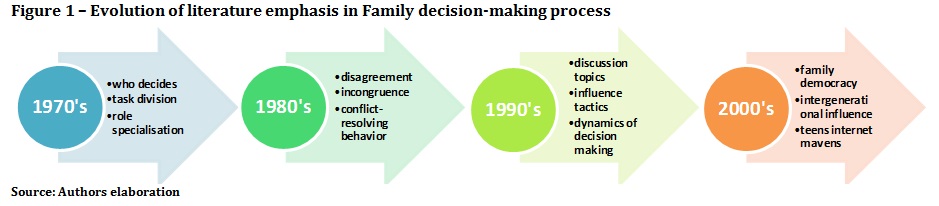
<body><![CDATA[<p>         This paper has five sections and is organized as follows. Section 1 contains a brief background for this research. Section 2 presents a literature         review surrounding the role of young people in the family decision-making process. An evaluation framework is developed in section 3, as well as a set         of hypotheses. In the last two sections we conclude our study, reiterate the major points and suggest avenues for further investigation.     </p> 	    <p>&nbsp;</p>         <p>         <b>2. Literature review</b>     </p>         <p>         Many (if not most) important decisions are not made by one person acting alone, and most consumed items, such as food, are often jointly         &#8220;consumed&#8221; (Davis, 1976). Therefore, families are by nature a relevant unit for studying consumer behavior. The research on family         decision-making has tended to examine disparities in spousal influence; the role of the young family members was often neglected (M. Belch &amp;         Willis, 2002; Davis, 1976; Kozak, 2010; Manser &amp; Brown, 1980; Su, Fern, &amp; Ye, 2003).     </p>         <p>         To determine how a family makes buying decisions and how it affects the future purchasing behavior of its members, it is very helpful to understand the         functions provided by the family and the roles played by its members in the decision-making process (see <a href ="/img/revistas/tms/v9n1/9n1a05f1.jpg">Figure 1</a>).     </p> 	 	<a href ="/img/revistas/tms/v9n1/9n1a05f1.jpg">Figure 1</a>      
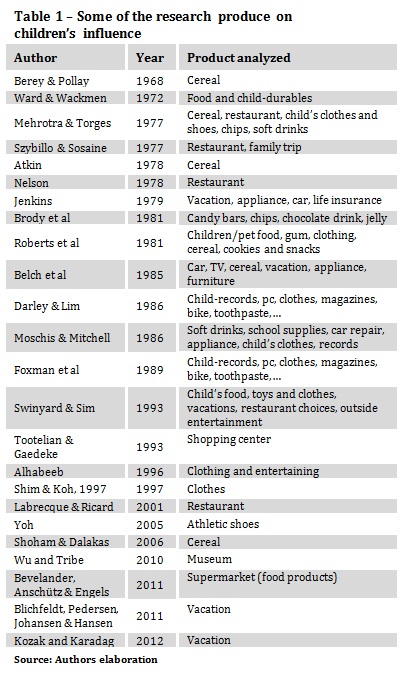
<p>     During the investigation of family decision processes, four stages take place. The first explores how a family decides and the roles played by the couple; the second analyses how spouses act in terms of wielding influence in spousal conflict resolution during a decision (    Corfman &amp; Lehmann, 1987); the third emphasizes a joint decision-making process in greater detail with     a focus was on how partners discuss the matter and which influence tactics are used (Kirchler, 1995);     the fourth assumes the existence of new roles and patterns inside the families as well as reflecting on the almost natural click-buying decision-making of     teens. </p>     <p>     Going beyond the second phase, several studies focused on the growing influence of children in family decision-making and interviewed children as well as     parents about the children&#8217;s influence (Labrecque &amp; Ricard, 2001). Most of these were     produced and published in the 1970s and 1980s (see <a href="#t1">Table 1</a>). </p>     <p>&nbsp;</p>     <p><a name="t1"><img src="/img/revistas/tms/v9n1/9n1a05t1.jpg"></p>     
<p>&nbsp;</p>     ]]></body>
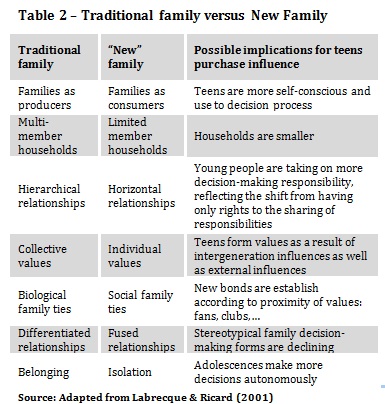
<body><![CDATA[<p>     Over the last four decades, family structures all over the world have undergone profound modifications, especially in developed countries. These trends     changed family characteristics and how young people were perceived by society. Some of the major social transformations present in modern societies are     related to delayed marriages, older parents, postponed childbearing, single-parent families, reconstituted families and stepfamilies as well as other     individual phenomena, such as the growing participation of women in the labor market (Flurry, 2007). All these transformations have significantly altered     the social statuses of children and adolescents within the family, and contributed to the construction of a youthful image and demarcation of independent     decision-making (see <a href="#t2">Table 2</a>). </p>     <p>&nbsp;</p>     <p><a name="t2"><img src="/img/revistas/tms/v9n1/9n1a05t2.jpg"></p>     
<p>&nbsp;</p>     <p>     For a long time, young people were considered subjects with less developed psycho-cognitive processes and experiences than those of older age, and     therefore scant attention was given to their opinions and expressions on any subject, even those most relevant to them. Since the 1980s, this perspective     has undergone profound changes, including the increasing buying activities performed by these teens. </p>     <p>     Studies in the United States show, through percentages and monetary values, the great importance of the youth segment for marketers. Since 1997, the     influence of children on parental purchasing decisions increased by 54%; they influence 80% of household expenditures on food (Flurry, 2007). In the late     1990s, youth-focused marketing reports show that American children influenced $188 billion directly and $300 billion indirectly in parents&#8217;     purchasing behavior (Shoham &amp; Dalakas, 2006). Similar evidence exists in other parts of the world, such as China. Chinese children (ages seven to 11)     influence 68.7% of parents' regular purchases and 23.3% of a family&#8217;s durable goods purchases (J. McNeal &amp; Yeh, 2003). Israeli children influence     more than 50% of family purchase decisions&#160; (Shoham &amp; Dalakas, 2006). </p>     <p>     Regarding influence, we consider the process that occurs when an individual acts in such a way to intentionally change the behavior of another individual     (Cartwright &amp; Roth, 1957). In this sense, children and teenagers become responsible for selling many products through their influence on the purchasing     decisions of parents. </p>     <p>     Back in 1977, Ward et al. split the family influence on children&#8217;s consumption behavior into family&#8217;s behavior variables and family&#8217;s     patterns variables. These effects combined have a direct influence on the development of general cognitive abilities of young children and an indirect     influence on the development of children&#8217;s consumer skills. </p>     <p>     Children tend to act as major decision makers at purchase time. They not only decide to acquire products directly related to them but also other products     that will be consumed by the family. Thus, the youth market has increasingly attracted the attention of firms that find in this niche a new window of     opportunity. </p>     <p>     McNeal (1992) presented three divisions of the children&#8217;s market: (1) the primary market where youth are treated as end users; (2) influence market     where kids are considered as direct and indirect influences on parents&#8217; decisions; and (3) future market where youth are consider as a potential     future purchase decision-makers. </p>     ]]></body>
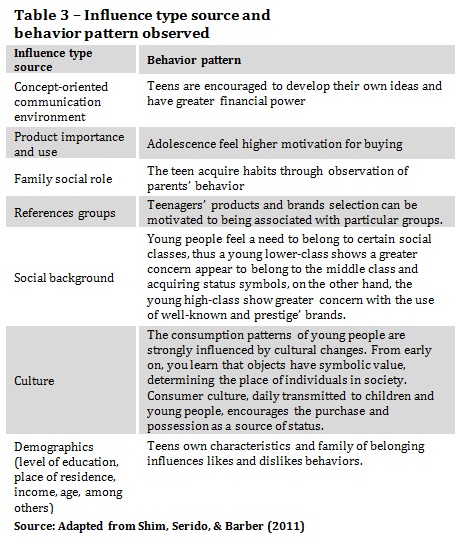
<body><![CDATA[<p>     The influence of young people in the family decision-making process has been widely studied, yet only a few works have been produced regarding the specific     role of teenagers (M. Belch &amp; Willis, 2002; M. A. Belch, Krentler, &amp; Willis-Flurry, 2005; Foxman, Tansuhaj, &amp; Ekstrom, 1989; Hunter-Jones,     2004; Mittal &amp; Royne, 2010; K. Palan &amp; R. Wilkes, 1997; Shoham &amp; Dalakas, 2006). </p>     <p>     Understanding the factors affecting the influence of the adolescent in family purchase decisions is a challenge, since this segment has gained much more     power over the last two decades. In different studies, several variables are presented and their use varies from author to author. However, the most common     are: the importance of the product or service and its use by adolescents, the stages of the buying decision, the influence strategies used and demographic     variables relating to adolescents and parents. </p>     <p>     As noted by Isler, Popper, and Ward (1979) small children have huge purchasing power, even though they don&#8217;t spend their own money and just ask for     products. On other hand, adolescents tend to be more avid consumers since they are at the initial stage of using their own money&#8212;in some cases with     credit cards &#8212; and also have additional influence on family buying patterns. As surveys show, teenagers tend to be sophisticated consumers and use a     variety of influence strategies on their parents (Shim, Serido, &amp; Barber, 2011). Palan and Wilkes (1997) provided a categorization of influence     strategies used by adolescents to influence the outcome of the family decision-making process. These persuading techniques vary according to the purchase     decision stage &#8212; problem recognition, information search choice and decision-making. And they tend to determine the behavior patterns observed across     decision stages, as found by most of the research. Nevertheless, the use of the different techniques is not done in a separate mode, reflecting other     sources of influence, as presented below (see <a href="#t3">Table 3</a>). </p>     <p>&nbsp;</p>     <p><a name="t3"><img src="/img/revistas/tms/v9n1/9n1a05t3.jpg"></p>     
<p>&nbsp;</p>     <p>     According to McNeal and Yeh (2003), the categories in which young people have a great influence on     families&#8217; buying decisions can be divided into three major areas: </p>     <p>     a) Items for themselves. This area includes snacks, clothing and electronics. </p>     <p>     b) Items for home. Young people also influence their parents regarding objects and furniture for the house. </p>     <p>     c) Items for family members outside the home. These items include holidays, cars and restaurants. </p>     ]]></body>
<body><![CDATA[<p>     In order to gain a full understanding of the parent-adolescent purchase relationship, this work closely examines the key construct of pester power,     counting the teen&#8217;s influence on family consumption. </p>     <p>     According to Ghani &amp; Zain (2004), there is now a unique market position of young consumers and their     spending power and influence, which has resulted in increasingly large budgets. This has led to several opposing viewpoints. On one side, authors focus on     the highly influential marketing process used to sell products to teens, also known as pester power. Most of these works attempted to understand the impact     of advertising on teens&#8217; purchasing behavior and influence, assuming that adolescents are highly persuaded by media ads and have     conditional/emotional behaviors subsequent to exposure. However, Nash (2009) pointed out that the use of     the pester power definition can sound pejorative to the industry practitioners, since it emphasized the use of promotional strategies aimed at young     people, encouraging unwanted purchase requests to the family. </p>     <p>     Empirical studies have acknowledged that adolescents use a number of different influence attempts, including, but not limited to, asking, pleading,     bargaining, persisting, using force, telling, being demonstrative, sugar-coating, threatening, and using pity&#160;(Atkin, 1978; Isler et al., 1987; McNeal, 1992; Williams and Burns, 2000). </p>     <p>     As Al-Zu'bi et al. (2008) noted, parents tend to have few educational goals in their minds regarding     their consumer role, and therefore young people tend to use pester power to obtain the product or service they want. In their work, Proctor and Richards     (2000) claimed that research concerning pester power must be established using more precise descriptions of what occurs in parent-teen purchase     relationships beyond the initial requests and pleading forms. This is the path that will be followed in the next sections. </p>     <p>&nbsp;</p>     <p>     <b>Evaluation Framework and Hypotheses</b> </p>     <p>     One of the potential global segments is the dot.com generation, which grew up technologically knowledgeable, socially active and with a high influence on     household decision-making. </p>     <p>     In accordance with Piaget&#8217;s theory, Roedder (1999) suggested that young people are able to: (i) make or influence consumer decisions in a more     adaptive manner as compared to their younger counterparts; (ii) adopt a more strategic posture regarding consumption; cast a wider net in the information     search stage; and (iii) have more sophisticated and rational strategies regarding requests and pleading to suit the situation or answer the objections of     parents. </p>     <p>     As showed in the abovementioned literature review, family power dynamics tend to change through the years. Children and adolescents in particular have gain     power in the last two decades. Often a family travel group consists of the nuclear family; therefore analyzing the family dynamic is crucial to understand the choices made in vacation planning and decision-making (Blichfeldt, Pedersen, Johansen, &amp; Hansen, 2011;    Dunne, 1999;Thornton Gareth &amp; Williams, 1997     ).&#160; There are two central questions that arise when studying this subject: 1) Do families allow adolescents to have power and control over their     spending regarding leisure travel? 2) Do they use the same approaches in order to influence family purchase decisions in the case of vacations or daily     life products? </p>     <p>     In order to fully answer these questions, a framework was developed. The goal is to update previous findings with respect to adolescent influence on family purchase decisions, particularly major purchase decisions for products and services used by the entire family (Beatty &amp; Talpade, 1994; Foxman, et al., 1989) and     compare those to the decisions regarding family vacations. For this purpose, the following model was adopted (<a href="#f2">Figure 2</a>). </p>     ]]></body>
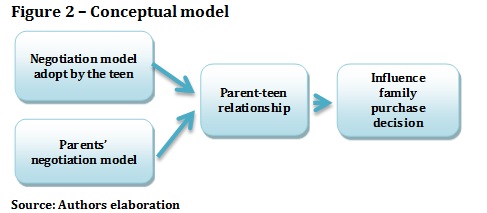
<body><![CDATA[<p>&nbsp;</p>     <p><a name="f2"><img src="/img/revistas/tms/v9n1/9n1a05f2.jpg"></p>     
<p>&nbsp;</p>     <p>     It is acknowledged that the family&#8217; decision-making process relies on the parent-teen relationship, which encompasses many facets including social,     consumption and behavioral aspects. </p>     <p> One basic characteristic considered in buying behavior is gender and the inequality between males and females. As noted by Flurry (2007), research over time indicated that female children were more influential than were male children across all stages of the decision-making process. These assessments found an exception in Chinese culture, as found by Pervan and Lee (1998). Considering the family changes occurring over the past two decades, such as postponed     childbearing, single parent households and fused relationships, it is suggested that the moderating effect of gender may no longer be in effect. Therefore,     hypothesis one is designed to test the proposition that no differences derived from children&#8217;s gender can be found in their purchase influence: </p>     <p>     H1. No difference in purchase decision influence will be found between male and female teenagers. </p>     <p>     Looking at traditional models of vacation decision-making (e.g. Mansfeld, 1994; Um &amp; Crompton, 1990), we find that the starting point of the vacation     decision-making process is considered to be the making of the generic decision whether to go or not to go on vacation. Usually this type of decision is     tightly connected to the parents&#8217; cultural background and to their social status. Research on the effects of family socio-economic status on young     people&#8217; influence has been mixed; most of the research measured household income and parents' education levels (Shoham and Dalakas, 2006). For that     reason, the second hypothesis developed here is concerned with parents&#8217; background impact on their negation model, as well as the teen negation     approach when deciding to go or not to go on vacation. </p>     <p>     H2: Young people whose parents have attained higher educational levels will have more influence on purchase decisions than will young people whose parents     have attained lower educational levels. </p>     <p>     Palan and Wilkes (1997) examined persuading techniques used by teenagers within a family consumption     context. These authors found a relationship between influence tactics and parental response strategies. Past researchers have acknowledged that young     people use a number of different influence attempts, such as asking, pleading, bargaining, persisting, using force, telling, being demonstrative, sugar-coating, threatening, and using pity&#160;(Isler, et al., 1979; J. U. McNeal, 1992; Williams &amp; Burns, 2000).     McNeal and Yeh (2003) suggested that these young people&#8217;s tactics vary in accordance with the     typology of product and moment/nature of consumption. The work of Shoham &amp; Dalakas (2006) produced     some interesting findings, e.g. that influence tactics are used differentially with varying effectiveness, but are product-invariant for the most part.     Furthermore, Bevelander et al. (2011) found that young people spent their money readily on food and     snacks; in this domain, they tend to adopt rational strategies of requests and pleading. These authors found that this behavior tends to decline over time,     as clothing and entertainment products become more important at older ages and more sophisticated negotiation techniques start to be employed. Considering this, the influence of teenagers on vacation travel choices should vary as well as their influence tactics (Blichfeldt, et al., 2011). The results should also be quite different when comparing adolescent     influence regarding daily family product consumption or the choice of family vacations.&#160; With this in mind, the third and fourth hypotheses are: </p>     <p>     H3: Teenagers use different influence tactics with varying effectiveness. </p>     ]]></body>
<body><![CDATA[<p>     H4: Teenagers use different influence tactics when negotiating a convenience product (breakfast cereals) or a tourism product. </p>     <p>     Almost 40 years ago, Davis (1976, p. 241) stated that &#8220;     <i>         the number of products that an individual always buys for individual consumption must certainly represent a very small proportion of consumer         expenditure     </i>     &#8221;, leaving a considerable part of purchasing decisions to a complex family dynamic model. Unveiling the influence of young people on this model is     the aim of this work. Thus the different tactics of persuasion are analyzed, considering a daily-basis product (breakfast cereals) and a more complex     product (family vacation destination). </p>     <p>&nbsp;</p>     <p>     <b>Methodology </b> </p>     <p>     Beyond the borders of the U.S. and Asian countries, little or no empirical studies have been done regarding young people&#8217;s consumer behavior. As     such, the present work focuses on Portuguese adolescent habits regarding tourism products. </p>     <p>     Group interviews and face-to-face self-administered questionnaires, including drop-off and pick-up, were respectively employed to solicit responses from     adolescents and their parents. </p>     <p>     The group interviews were conducted during regular classroom hours with cooperation by the schools&#8217; administrations. Data were collected in urban and     middle-class preferential schools. </p>     <p>     In this study, the questionnaire contained a similar structure to the one used by Shoham and Dalakas (2006). Therefore, the questionnaire included     questions on adolescents&#8217; influence tactics regarding two products &#8211; breakfast cereals and traveling products. Parental yielding was also     assessed in this survey.&#160; </p>     <p>&nbsp;</p>     <p>     <b>Results</b> </p>     ]]></body>
<body><![CDATA[<p>     A convenience sample (n= 119) of youth ranging from 10 to 12 (34,5 percent), from 13 to 15 (30,3 percent) and from 16 to 18 (35,3 percent) was chosen from     four schools in coordination with the schools&#8217; administration boards. Slightly more than half of the respondents (55,5 percent) were girls and the     remaining (44,5 percent) boys. </p>     <p>     Parents&#8217; education levels ranged from primary, elementary school and secondary school (55,5 percent), to diploma (26,9 percent) and bachelor and     higher education (17,6 percent). There are two additional remarks that need to be made: (i) average monthly household income was slightly higher than the     national average, and that can reflect the selection of schools; (ii) the youth inquiries are in the context of planning one trip/year. Since the sample     was collected in an island context, it stands to reason that for holidays, typical families try to go somewhere different. </p>     <p>     The results achieved regarding tactics&#8217; frequency of use and effectiveness in the family decision process is presented in <a href="#t4">Table 4</a>. </p>     <p>&nbsp;</p>     <p><a name="t4"><img src="/img/revistas/tms/v9n1/9n1a05t4.jpg"></p>     
<p>&nbsp;</p>     <p>     The patterns of most tactical choices are remarkably similar between the two different products of breakfast cereal and family trips. However, the second     most-used tactic is begging and whining and the third choice is negation with logical arguments. In the case of the cereals, these tactics were adopted and     deemed effective in a similar order. However, begging and whining proved to be an ineffective tactic for a teenager when trying to influence the family     vacation decision process (46.3% of use against 10.9% of effectiveness). Social influence from their peers is also a non-effective tactic (21.9% of use     against 14.2% of effectiveness). </p>     <p>     Thus, it appears that the influence tactics and parental acquiescence do not form a continuum for both types of products, as found in previous studies.     There is a clearly ordered pattern of usage and effectiveness of tactics in the case of the breakfast cereals. However, a different pattern was found for     travelling choices. </p>     <p>     Looking at the tactics adopted by three main subsets of the sample (10 to 12; 13 to 15; 16 to 18 years old) regarding tourism products, it is clear that     the younger children tend to use more emotional-based strategies, such as begging, whining and persistence. The subset of 16 to 18 years old shows a higher     use and influence of social references, revealing the relevance of their peers. This segment and the 13- to 15-year-old segment also disclosed that they     tend to use guilt as strategic option.&#160; </p>     <p>     We used general linear modeling to answer the remaining research questions. The evidence found in the literature led us to establish a priori four sets of     interrelated dependent variables that derive from two suppositions: (i) the adoption of any influence tactic reduces the likelihood to adopt another     tactic; and (ii) when a parent tends to succumb to one tactic, the likelihood he/she will also yield to another is reduced. In our research, 32 influence     tactics and yielding were considered as dependent variables; adolescent&#8217;s gender and age, parent&#8217;s education level, and family income were the     independent variables used. </p>     ]]></body>
<body><![CDATA[<p> The analysis yielded 128 analysis of variance (ANOVA) models. Of these, eleven were significant at p &lt; 0,05 and another six at p &lt;0,10. The Eta    <sup>2</sup> for the 17 models varied between 2,6% percent and 9 percent. The results suggested that adolescents&#8217; gender had little importance in     explaining the frequency of use of the tactics by adolescents. However, adolescents&#8217; gender was found to be significant in the choice of the tactics used to influence family vacation decisions: deals (sig=0,079; Eta<sup>2</sup>= 0,026) and screaming, shouting, anger, and getting mad (sig=0,036; Eta    <sup>2</sup>= 0,037). Furthermore, gender was found to affect the likelihood of parents yielding to adolescents&#8217; requests. </p>     <p>     To assess the possible impact of parental education level on young adults&#8217; influence tactics and on yielding to these tactics, an analysis of     variance was performed (6 of 32 the ANOVA models were significant). The results found that parents&#8217; educational levels affect the choice and     yielding, especially regarding breakfast cereals. The Eta<sup>2</sup> suggested a higher level of pester power (0,062) when teens use the tactic of begging     and whining in the choice of vacation destinations, especially for those parents with lower educational levels. </p>     <p>     Our findings support the conceptual framework regarding hypotheses three and four, since there is a clearly ordered pattern of usage and effectiveness of     tactics in the case of the breakfast cereals. However, a different pattern was found when analyzing the tourism product choices. Our results did not     support the first two hypotheses. First, evidence showed that adolescent gender has significant impact on the choice of the tactics used to influence     family vacation decisions. Secondly, the results indicated that youth whose parents have attained lower educational levels have more influence on purchase     decisions than will youth whose parents have attained higher educational levels. </p>     <p>&nbsp;</p>     <p>     <b>Conclusions and suggestions for further investigation </b> </p>     <p>     The influence of youth on family decision-making occurs when they act to modify the purchasing behavior of their parents or guardians. The information that     teens transmit is selected according to their needs and wants, and they act in such a way to change and influence the purchase procedure with the aim of     acquiring a product that pleases them. In this way, the intensity of influence used by young people tends to depend on two factors: their assertiveness and     the tendency of parents to be acquiescent to their requests. </p>     <p>     Upon examination and reflection of the literature, it became apparent that the adolescent influence on the family purchase decision process has not been     adequately documented, especially regarding more complex products such as family vacations. Therefore, the aim of this work is to contribute to a deeper     understanding of youthful consumer behavior regarding tourism products, to uncover new meanings associated with this phenomenon and to compare it to a     convenience product decision-making process. </p>     <p>     The results generated some interesting findings. First, it was shown that the tactics adopt by young people to influence family consumption patterns vary     when considering a convenience product or a more complex product, such as tourism products. The results also show that in the case of cereals, teens tend     to use the tactics that present a higher level of effectiveness. Our results also confirm that teenagers&#8217; influence on vacation travel choice varies     as well as the influence tactics they adopted (Blichfeldt, et al., 2011). The difference obtained     regarding these two products are in accordance with the study by McNeal and Yeh (2003). One of the     findings is that parents tend to acquiesce more to appeals made by younger children. </p>     <p>     The work of Shoham &amp; Dalakas (2006) did not find differences between gender regarding tactics     adoption and pester power. However, our results show that in terms of tourism products, there are significant differences between girls and boys regarding     tactics adopted and their effectiveness. Girls tend to influence parents more regarding tourism products. </p>     <p> Aside from this, the analysis reveals another different result from the work by Shoham &amp; Dalakas (2006). These authors found evidence of higher pester power in parents with higher educational levels. But     in our case, the results found that young people whose parents have attained lower educational levels will have more influence in purchase decisions than     will young people whose parents have attained higher educational levels. This leads us to conclude that teenagers in highly educated households have less     pester power, and therefore their influence on family tourism product decisions is lower.&#160;&#160; </p>     ]]></body>
<body><![CDATA[<p>     The results allow us to make three major conclusions regarding adolescent influence on family tourism product choices: (i) there are three distinctive     groups of teens that adopt different tactics, which correspond to a gradient from emotional to rational during their growing process and have distinctive     outcomes for family decision processes; (ii) girls are more effective in influencing family decisions regarding travelling and vacation choices; and (iii)     family educational background, usually tightly connected to income and past tourism experiences, influence parents&#8217; acquiescence to youth     tactics.&#160; &#160; </p>     <p>     This information gathered here is beneficial to tourism marketing managers, who can use it to redirect their marketing strategies and target more youth     segments. Since three distinctive segments were found, marketers can promote different strategies for each of these segments. To the youngest segment,     marketing can emphasize the emotional dimension usually used by those children. The oldest segment can be target with more rational and elaborate messages,     since it has been found that these teenagers process highly rational messages and use this same approach with parents. They also can use this knowledge to     reach parents directly or indirectly through their teenagers, especially girls, since girls show a higher influence on the family decision process. </p>     <p>     However, these findings should be viewed in light of some limitations. Further work is clearly needed to examine the inclusion of other variables, such as     cultural dimensions and/or family background regarding tourism product consumption, such as past tourism experiences. Moreover, it would be interesting to     enlarge this convenience sample and collect data in different countries. Certainly, there is ample scope for further research in this area. </p>     <p>&nbsp;</p>     <p>     <b>Acknowledgement</b>     : Funding for this work is granted by FCT &#8211; CEEAplA, Research Center for Applied Economics and data gathered by Carmen Queir&#243;s. </p>     <p>&nbsp;</p>     <p>    <b>References</b> </p>     <!-- ref --><p>     Al-Zu'bi, A., Crowther, G., &amp; Worsdale, G. (2008). Jordanian children's perception of fathers' communication structures and patterns: scales revision     and validation. <i>Young Consumers: Insight and Ideas for Responsible Marketers, 9</i>(4), 265-281.    &nbsp;&nbsp;&nbsp;&nbsp;&nbsp;&nbsp;&nbsp;&nbsp;[&#160;<a href="javascript:void(0);" onclick="javascript: window.open('/scielo.php?script=sci_nlinks&ref=000110&pid=S2182-8458201300010000500001&lng=','','width=640,height=500,resizable=yes,scrollbars=1,menubar=yes,');">Links</a>&#160;]<!-- end-ref --> </p>     <!-- ref --><p>     Beatty, S., &amp; Talpade, S. (1994). Adolescent influence in family decision making: a replication with extension. <i>Journal of Consumer Research, 21</i>     (2), 332-341.    &nbsp;&nbsp;&nbsp;&nbsp;&nbsp;&nbsp;&nbsp;&nbsp;[&#160;<a href="javascript:void(0);" onclick="javascript: window.open('/scielo.php?script=sci_nlinks&ref=000112&pid=S2182-8458201300010000500002&lng=','','width=640,height=500,resizable=yes,scrollbars=1,menubar=yes,');">Links</a>&#160;]<!-- end-ref --> </p>     <!-- ref --><p>     Belch, M., &amp; Willis, L. (2002). Family decision at the turn of the century: has the changing structure of households impacted the family decision     making process? <i>Journal of Consumer Behaviour, 2</i>(2), 111-124.    &nbsp;&nbsp;&nbsp;&nbsp;&nbsp;&nbsp;&nbsp;&nbsp;[&#160;<a href="javascript:void(0);" onclick="javascript: window.open('/scielo.php?script=sci_nlinks&ref=000114&pid=S2182-8458201300010000500003&lng=','','width=640,height=500,resizable=yes,scrollbars=1,menubar=yes,');">Links</a>&#160;]<!-- end-ref --> </p>     <!-- ref --><p> Belch, M. A., Krentler, K. A., &amp; Willis-Flurry, L. A. (2005). Teen internet mavens: influence in family decision making.    <i>Journal of Business Research, 58</i>(5), 569-575.    &nbsp;&nbsp;&nbsp;&nbsp;&nbsp;&nbsp;&nbsp;&nbsp;[&#160;<a href="javascript:void(0);" onclick="javascript: window.open('/scielo.php?script=sci_nlinks&ref=000116&pid=S2182-8458201300010000500004&lng=','','width=640,height=500,resizable=yes,scrollbars=1,menubar=yes,');">Links</a>&#160;]<!-- end-ref --> </p>     <!-- ref --><p> Bevelander, K. E., Ansch&#252;tz, D. J., &amp; Engels, R. C. M. E. (2011). Social modeling of food purchases at supermarkets in teenage girls.    <i>Appetite, </i>57, 99-104.    &nbsp;&nbsp;&nbsp;&nbsp;&nbsp;&nbsp;&nbsp;&nbsp;[&#160;<a href="javascript:void(0);" onclick="javascript: window.open('/scielo.php?script=sci_nlinks&ref=000118&pid=S2182-8458201300010000500005&lng=','','width=640,height=500,resizable=yes,scrollbars=1,menubar=yes,');">Links</a>&#160;]<!-- end-ref --><i> </i> </p>     <!-- ref --><p> Blichfeldt, B. S., Pedersen, B. M., Johansen, A., &amp; Hansen, L. (2011). Tweens on Holidays. In-Situ Decision-making from Children's Perspective.    <i>Scandinavian Journal of Hospitality and Tourism, 11</i>(2), 135-149.    &nbsp;&nbsp;&nbsp;&nbsp;&nbsp;&nbsp;&nbsp;&nbsp;[&#160;<a href="javascript:void(0);" onclick="javascript: window.open('/scielo.php?script=sci_nlinks&ref=000120&pid=S2182-8458201300010000500006&lng=','','width=640,height=500,resizable=yes,scrollbars=1,menubar=yes,');">Links</a>&#160;]<!-- end-ref --> </p>     <!-- ref --><p>     Cartwright, D. S., &amp; Roth, I. (1957). Success and satisfaction in psychotherapy. <i>Journal of Clinical Psychology</i>, 13, 20-26.    &nbsp;&nbsp;&nbsp;&nbsp;&nbsp;&nbsp;&nbsp;&nbsp;[&#160;<a href="javascript:void(0);" onclick="javascript: window.open('/scielo.php?script=sci_nlinks&ref=000122&pid=S2182-8458201300010000500007&lng=','','width=640,height=500,resizable=yes,scrollbars=1,menubar=yes,');">Links</a>&#160;]<!-- end-ref --> </p>     <!-- ref --><p>     Corfman, K., &amp; Lehmann, D. (1987). Models of cooperative group decision-making and relative influence: An experimental investigation of family purchase     decisions. <i>Journal of Consumer Research, 14</i>(1), 1-13.    &nbsp;&nbsp;&nbsp;&nbsp;&nbsp;&nbsp;&nbsp;&nbsp;[&#160;<a href="javascript:void(0);" onclick="javascript: window.open('/scielo.php?script=sci_nlinks&ref=000124&pid=S2182-8458201300010000500008&lng=','','width=640,height=500,resizable=yes,scrollbars=1,menubar=yes,');">Links</a>&#160;]<!-- end-ref --> </p>     <!-- ref --><p>     Davis, H. L. (1976). Decision Making within the Household. <i>The Journal of Consumer Research, 2</i>(4), 241-260.    &nbsp;&nbsp;&nbsp;&nbsp;&nbsp;&nbsp;&nbsp;&nbsp;[&#160;<a href="javascript:void(0);" onclick="javascript: window.open('/scielo.php?script=sci_nlinks&ref=000126&pid=S2182-8458201300010000500009&lng=','','width=640,height=500,resizable=yes,scrollbars=1,menubar=yes,');">Links</a>&#160;]<!-- end-ref --> </p>     <!-- ref --><p> Dunne, M. (1999). The role and influence of children in family holiday decision making.    <i>International Journal of Advertising and Marketing to Children, 1</i>(3), 181-191.    &nbsp;&nbsp;&nbsp;&nbsp;&nbsp;&nbsp;&nbsp;&nbsp;[&#160;<a href="javascript:void(0);" onclick="javascript: window.open('/scielo.php?script=sci_nlinks&ref=000128&pid=S2182-8458201300010000500010&lng=','','width=640,height=500,resizable=yes,scrollbars=1,menubar=yes,');">Links</a>&#160;]<!-- end-ref --> </p>     <!-- ref --><p> Flurry, L. A. (2007). Children's influence in family decision-making: Examining the impact of the changing American family.    <i>Journal of Business Research, 60</i>(4), 322-330.    &nbsp;&nbsp;&nbsp;&nbsp;&nbsp;&nbsp;&nbsp;&nbsp;[&#160;<a href="javascript:void(0);" onclick="javascript: window.open('/scielo.php?script=sci_nlinks&ref=000130&pid=S2182-8458201300010000500011&lng=','','width=640,height=500,resizable=yes,scrollbars=1,menubar=yes,');">Links</a>&#160;]<!-- end-ref --> </p>     <!-- ref --><p> Foxman, E., Tansuhaj, P., &amp; Ekstrom, K. (1989). Family members' perceptions of adolescents' influence in family decision making.    <i>Journal of Consumer Research, 15</i>(4), 482-491.    &nbsp;&nbsp;&nbsp;&nbsp;&nbsp;&nbsp;&nbsp;&nbsp;[&#160;<a href="javascript:void(0);" onclick="javascript: window.open('/scielo.php?script=sci_nlinks&ref=000132&pid=S2182-8458201300010000500012&lng=','','width=640,height=500,resizable=yes,scrollbars=1,menubar=yes,');">Links</a>&#160;]<!-- end-ref --> </p>     <!-- ref --><p> Ghani, N. H. A., &amp; Zain, O. M. (2004). Malaysian children&#8217;s attitudes towards television advertising.    <i>Young Consumers: Insight and Ideas for Responsible Marketers, 5</i>(3), 41-51.    &nbsp;&nbsp;&nbsp;&nbsp;&nbsp;&nbsp;&nbsp;&nbsp;[&#160;<a href="javascript:void(0);" onclick="javascript: window.open('/scielo.php?script=sci_nlinks&ref=000134&pid=S2182-8458201300010000500013&lng=','','width=640,height=500,resizable=yes,scrollbars=1,menubar=yes,');">Links</a>&#160;]<!-- end-ref --> </p>     <!-- ref --><p>     Hunter-Jones, P. (2004). Young people, holiday-taking and cancer: an exploratory analysis. <i>Tourism Management, 25</i>(2), 249-258.    &nbsp;&nbsp;&nbsp;&nbsp;&nbsp;&nbsp;&nbsp;&nbsp;[&#160;<a href="javascript:void(0);" onclick="javascript: window.open('/scielo.php?script=sci_nlinks&ref=000136&pid=S2182-8458201300010000500014&lng=','','width=640,height=500,resizable=yes,scrollbars=1,menubar=yes,');">Links</a>&#160;]<!-- end-ref --> </p>     <!-- ref --><p>     Isler, L., Popper, E., &amp; Wart, S. (1979). <i>Children's Purchase Requests and Parental Responses: Results from a Diary Study</i>. Cambridge, Mass:     Marketing Science Institute.    &nbsp;&nbsp;&nbsp;&nbsp;&nbsp;&nbsp;&nbsp;&nbsp;[&#160;<a href="javascript:void(0);" onclick="javascript: window.open('/scielo.php?script=sci_nlinks&ref=000138&pid=S2182-8458201300010000500015&lng=','','width=640,height=500,resizable=yes,scrollbars=1,menubar=yes,');">Links</a>&#160;]<!-- end-ref --> </p>     <!-- ref --><p> Kirchler, E. (1995). Studying economic decisions within private households: A critical review and design for a &#8220;couple experiences diary&#8221;.    <i>Journal of Economic Psychology, 16</i>(3), 393-419.    &nbsp;&nbsp;&nbsp;&nbsp;&nbsp;&nbsp;&nbsp;&nbsp;[&#160;<a href="javascript:void(0);" onclick="javascript: window.open('/scielo.php?script=sci_nlinks&ref=000140&pid=S2182-8458201300010000500016&lng=','','width=640,height=500,resizable=yes,scrollbars=1,menubar=yes,');">Links</a>&#160;]<!-- end-ref --> </p>     <!-- ref --><p>     Kozak, M. (2010). Holiday taking decisions-The role of spouses. <i>Tourism Management, 31</i>(4), 489-494.    &nbsp;&nbsp;&nbsp;&nbsp;&nbsp;&nbsp;&nbsp;&nbsp;[&#160;<a href="javascript:void(0);" onclick="javascript: window.open('/scielo.php?script=sci_nlinks&ref=000142&pid=S2182-8458201300010000500017&lng=','','width=640,height=500,resizable=yes,scrollbars=1,menubar=yes,');">Links</a>&#160;]<!-- end-ref --> </p>     <!-- ref --><p>     Labrecque, J., &amp; Ricard, L. (2001). Children's influence on family decision-making: a restaurant study. <i>Journal of Business Research, 54</i>(2),     173-176.    &nbsp;&nbsp;&nbsp;&nbsp;&nbsp;&nbsp;&nbsp;&nbsp;[&#160;<a href="javascript:void(0);" onclick="javascript: window.open('/scielo.php?script=sci_nlinks&ref=000144&pid=S2182-8458201300010000500018&lng=','','width=640,height=500,resizable=yes,scrollbars=1,menubar=yes,');">Links</a>&#160;]<!-- end-ref --> </p>     <!-- ref --><p>     Manser, M., &amp; Brown, M. (1980). Marriage and household decision-making: A bargaining analysis. <i>International Economic Review, 21</i>(1), 31-44.    &nbsp;&nbsp;&nbsp;&nbsp;&nbsp;&nbsp;&nbsp;&nbsp;[&#160;<a href="javascript:void(0);" onclick="javascript: window.open('/scielo.php?script=sci_nlinks&ref=000146&pid=S2182-8458201300010000500019&lng=','','width=640,height=500,resizable=yes,scrollbars=1,menubar=yes,');">Links</a>&#160;]<!-- end-ref --> </p>     <!-- ref --><p>     Mcneal, J., &amp; Yeh, C. (2003). Consumer behavior of Chinese children: 1995-2002. <i>Journal of Consumer Marketing, 20</i>(6), 542-554.    &nbsp;&nbsp;&nbsp;&nbsp;&nbsp;&nbsp;&nbsp;&nbsp;[&#160;<a href="javascript:void(0);" onclick="javascript: window.open('/scielo.php?script=sci_nlinks&ref=000148&pid=S2182-8458201300010000500020&lng=','','width=640,height=500,resizable=yes,scrollbars=1,menubar=yes,');">Links</a>&#160;]<!-- end-ref --> </p>     <!-- ref --><p>     Mcneal, J. U. (1992).<i> Kids&#160; as&#160; Customers:&#160; A&#160; Handbook&#160; of Marketing to Children</i>. New&#160; York: Lexington&#160; Books.    &nbsp;&nbsp;&nbsp;&nbsp;&nbsp;&nbsp;&nbsp;&nbsp;[&#160;<a href="javascript:void(0);" onclick="javascript: window.open('/scielo.php?script=sci_nlinks&ref=000150&pid=S2182-8458201300010000500021&lng=','','width=640,height=500,resizable=yes,scrollbars=1,menubar=yes,');">Links</a>&#160;]<!-- end-ref --> </p>     <!-- ref --><p>     Mittal, B., &amp; Royne, M. (2010). Consuming as a family: Modes of intergenerational influence on young adults. <i>Journal of Consumer Behaviour, 9</i>     (4), 239-257.    &nbsp;&nbsp;&nbsp;&nbsp;&nbsp;&nbsp;&nbsp;&nbsp;[&#160;<a href="javascript:void(0);" onclick="javascript: window.open('/scielo.php?script=sci_nlinks&ref=000152&pid=S2182-8458201300010000500022&lng=','','width=640,height=500,resizable=yes,scrollbars=1,menubar=yes,');">Links</a>&#160;]<!-- end-ref --> </p>     <!-- ref --><p>     Nash, C. (2009). The parent child purchase relationship. (<i>Masters thesis, Dublin Institute of Technology, 2009). </i>Retrieved from      <a href="http://arrow.dit.ie/busmas/24/" target="_blank">http://arrow.dit.ie/busmas/24/</a>.    &nbsp;&nbsp;&nbsp;&nbsp;&nbsp;&nbsp;&nbsp;&nbsp;[&#160;<a href="javascript:void(0);" onclick="javascript: window.open('/scielo.php?script=sci_nlinks&ref=000154&pid=S2182-8458201300010000500023&lng=','','width=640,height=500,resizable=yes,scrollbars=1,menubar=yes,');">Links</a>&#160;]<!-- end-ref --> </p>     <!-- ref --><p>     Palan, K., &amp; Wilkes, R. (1997). Adolescent-parent interaction in family decision making. <i>Journal of Consumer Research, 24</i>(2), 159-169.    &nbsp;&nbsp;&nbsp;&nbsp;&nbsp;&nbsp;&nbsp;&nbsp;[&#160;<a href="javascript:void(0);" onclick="javascript: window.open('/scielo.php?script=sci_nlinks&ref=000156&pid=S2182-8458201300010000500024&lng=','','width=640,height=500,resizable=yes,scrollbars=1,menubar=yes,');">Links</a>&#160;]<!-- end-ref --> </p>     <!-- ref --><p> Pervan, S., &amp; Lee, C. C. K. (1998). An observational study of the family decision making process of Chinese immigrant families.    <i>Asian-Pacific Advances in Consumer Research, 3</i>, 20-25.    &nbsp;&nbsp;&nbsp;&nbsp;&nbsp;&nbsp;&nbsp;&nbsp;[&#160;<a href="javascript:void(0);" onclick="javascript: window.open('/scielo.php?script=sci_nlinks&ref=000158&pid=S2182-8458201300010000500025&lng=','','width=640,height=500,resizable=yes,scrollbars=1,menubar=yes,');">Links</a>&#160;]<!-- end-ref --> </p>     <!-- ref --><p> Shim, S., &amp; Koh, A. (1997). Profiling adolescent consumer decision-making styles: Effects of socialization agents and social-structural variables.    <i>Clothing and Textiles Research Journal, 15</i>(1), 50-59.    &nbsp;&nbsp;&nbsp;&nbsp;&nbsp;&nbsp;&nbsp;&nbsp;[&#160;<a href="javascript:void(0);" onclick="javascript: window.open('/scielo.php?script=sci_nlinks&ref=000160&pid=S2182-8458201300010000500026&lng=','','width=640,height=500,resizable=yes,scrollbars=1,menubar=yes,');">Links</a>&#160;]<!-- end-ref --> </p>     <!-- ref --><p>     Shim, S., Serido, J., &amp; Barber, B. L. (2011). A consumer way of thinking: linking consumer socialization and consumption motivation perspectives to     adolescent development. <i>Journal of Research on Adolescence, 21</i>(1), 290-299.    &nbsp;&nbsp;&nbsp;&nbsp;&nbsp;&nbsp;&nbsp;&nbsp;[&#160;<a href="javascript:void(0);" onclick="javascript: window.open('/scielo.php?script=sci_nlinks&ref=000162&pid=S2182-8458201300010000500027&lng=','','width=640,height=500,resizable=yes,scrollbars=1,menubar=yes,');">Links</a>&#160;]<!-- end-ref --> </p>     <!-- ref --><p> Shoham, A., &amp; Dalakas, V. (2006). How our adolescent children influence us as parents to yield to their purchase requests.    <i>Journal of Consumer Marketing, 23</i>(6), 344-350.    &nbsp;&nbsp;&nbsp;&nbsp;&nbsp;&nbsp;&nbsp;&nbsp;[&#160;<a href="javascript:void(0);" onclick="javascript: window.open('/scielo.php?script=sci_nlinks&ref=000164&pid=S2182-8458201300010000500028&lng=','','width=640,height=500,resizable=yes,scrollbars=1,menubar=yes,');">Links</a>&#160;]<!-- end-ref --> </p>     <!-- ref --><p>     Su, C., Fern, E., &amp; Ye, K. (2003). A temporal dynamic model of spousal family purchase-decision behavior. <i>Journal of Marketing Research, 40</i>(3),     268-281.    &nbsp;&nbsp;&nbsp;&nbsp;&nbsp;&nbsp;&nbsp;&nbsp;[&#160;<a href="javascript:void(0);" onclick="javascript: window.open('/scielo.php?script=sci_nlinks&ref=000166&pid=S2182-8458201300010000500029&lng=','','width=640,height=500,resizable=yes,scrollbars=1,menubar=yes,');">Links</a>&#160;]<!-- end-ref --> </p>     <!-- ref --><p> Thornton Gareth, P. R., &amp; Williams, A. M. (1997). Tourist group holiday decision-making and behaviour: the influence of children.    <i>Tourism Management, 18</i>(5), 287-297.    &nbsp;&nbsp;&nbsp;&nbsp;&nbsp;&nbsp;&nbsp;&nbsp;[&#160;<a href="javascript:void(0);" onclick="javascript: window.open('/scielo.php?script=sci_nlinks&ref=000168&pid=S2182-8458201300010000500030&lng=','','width=640,height=500,resizable=yes,scrollbars=1,menubar=yes,');">Links</a>&#160;]<!-- end-ref --> </p>     <!-- ref --><p> Tootelian, D. H., &amp; Gaedeke, R. M. (1993). The Team Market: An Exploratory Analysis of Income, Spending and Shopping Patterns.    <i> Journal of Consumer Marketing, 9</i>(4), 35-44.    &nbsp;&nbsp;&nbsp;&nbsp;&nbsp;&nbsp;&nbsp;&nbsp;[&#160;<a href="javascript:void(0);" onclick="javascript: window.open('/scielo.php?script=sci_nlinks&ref=000170&pid=S2182-8458201300010000500031&lng=','','width=640,height=500,resizable=yes,scrollbars=1,menubar=yes,');">Links</a>&#160;]<!-- end-ref --> </p>     <!-- ref --><p>     Ward, D., Wackman, B., &amp; Wartella, E. (1977). <i>How&#160; Children Learn to Buy: The Development of Consumer Information Processing Skills</i>.     Beverly Hills: SAGE.    &nbsp;&nbsp;&nbsp;&nbsp;&nbsp;&nbsp;&nbsp;&nbsp;[&#160;<a href="javascript:void(0);" onclick="javascript: window.open('/scielo.php?script=sci_nlinks&ref=000172&pid=S2182-8458201300010000500032&lng=','','width=640,height=500,resizable=yes,scrollbars=1,menubar=yes,');">Links</a>&#160;]<!-- end-ref --> </p>     <!-- ref --><p>     Williams, L. A., &amp; Burns, A. C. (2000). Exploring the dimensionality of children's direct influence attempts. <i>Advances in consumer research, 27</i>,     64-71.    &nbsp;&nbsp;&nbsp;&nbsp;&nbsp;&nbsp;&nbsp;&nbsp;[&#160;<a href="javascript:void(0);" onclick="javascript: window.open('/scielo.php?script=sci_nlinks&ref=000174&pid=S2182-8458201300010000500033&lng=','','width=640,height=500,resizable=yes,scrollbars=1,menubar=yes,');">Links</a>&#160;]<!-- end-ref --> </p>     <p>&nbsp;</p>     <p>     <b>Article history</b> </p>     <p>     Received: 30 June 2012 </p>     <p>     Accepted: 04 September 2012 </p>       ]]></body><back>
<ref-list>
<ref id="B1">
<nlm-citation citation-type="journal">
<person-group person-group-type="author">
<name>
<surname><![CDATA[Al-Zu'bi]]></surname>
<given-names><![CDATA[A.]]></given-names>
</name>
<name>
<surname><![CDATA[Crowther]]></surname>
<given-names><![CDATA[G.]]></given-names>
</name>
<name>
<surname><![CDATA[Worsdale]]></surname>
<given-names><![CDATA[G.]]></given-names>
</name>
</person-group>
<article-title xml:lang="en"><![CDATA[Jordanian children's perception of fathers' communication structures and patterns: scales revision and validation]]></article-title>
<source><![CDATA[Young Consumers: Insight and Ideas for Responsible Marketers]]></source>
<year>2008</year>
<volume>9</volume>
<numero>4</numero>
<issue>4</issue>
<page-range>265-281</page-range></nlm-citation>
</ref>
<ref id="B2">
<nlm-citation citation-type="journal">
<person-group person-group-type="author">
<name>
<surname><![CDATA[Beatty]]></surname>
<given-names><![CDATA[S.]]></given-names>
</name>
<name>
<surname><![CDATA[Talpade]]></surname>
<given-names><![CDATA[S.]]></given-names>
</name>
</person-group>
<article-title xml:lang="en"><![CDATA[Adolescent influence in family decision making: a replication with extension]]></article-title>
<source><![CDATA[Journal of Consumer Research]]></source>
<year>1994</year>
<volume>21</volume>
<numero>2</numero>
<issue>2</issue>
<page-range>332-341</page-range></nlm-citation>
</ref>
<ref id="B3">
<nlm-citation citation-type="journal">
<person-group person-group-type="author">
<name>
<surname><![CDATA[Belch]]></surname>
<given-names><![CDATA[M.]]></given-names>
</name>
<name>
<surname><![CDATA[Willis]]></surname>
<given-names><![CDATA[L.]]></given-names>
</name>
</person-group>
<article-title xml:lang="en"><![CDATA[Family decision at the turn of the century: has the changing structure of households impacted the family decision making process?]]></article-title>
<source><![CDATA[Journal of Consumer Behaviour]]></source>
<year>2002</year>
<volume>2</volume>
<numero>2</numero>
<issue>2</issue>
<page-range>111-124</page-range></nlm-citation>
</ref>
<ref id="B4">
<nlm-citation citation-type="journal">
<person-group person-group-type="author">
<name>
<surname><![CDATA[Belch]]></surname>
<given-names><![CDATA[M. A.]]></given-names>
</name>
<name>
<surname><![CDATA[Krentler]]></surname>
<given-names><![CDATA[K. A.]]></given-names>
</name>
<name>
<surname><![CDATA[Willis-Flurry]]></surname>
<given-names><![CDATA[L. A.]]></given-names>
</name>
</person-group>
<article-title xml:lang="en"><![CDATA[Teen internet mavens: influence in family decision making]]></article-title>
<source><![CDATA[Journal of Business Research]]></source>
<year>2005</year>
<volume>58</volume>
<numero>5</numero>
<issue>5</issue>
<page-range>569-575</page-range></nlm-citation>
</ref>
<ref id="B5">
<nlm-citation citation-type="journal">
<person-group person-group-type="author">
<name>
<surname><![CDATA[Bevelander]]></surname>
<given-names><![CDATA[K. E.]]></given-names>
</name>
<name>
<surname><![CDATA[Anschütz]]></surname>
<given-names><![CDATA[D. J.]]></given-names>
</name>
<name>
<surname><![CDATA[Engels]]></surname>
<given-names><![CDATA[R. C. M. E.]]></given-names>
</name>
</person-group>
<article-title xml:lang="en"><![CDATA[Social modeling of food purchases at supermarkets in teenage girls]]></article-title>
<source><![CDATA[Appetite]]></source>
<year>2011</year>
<volume>57</volume>
<page-range>99-104</page-range></nlm-citation>
</ref>
<ref id="B6">
<nlm-citation citation-type="journal">
<person-group person-group-type="author">
<name>
<surname><![CDATA[Blichfeldt]]></surname>
<given-names><![CDATA[B. S.]]></given-names>
</name>
<name>
<surname><![CDATA[Pedersen]]></surname>
<given-names><![CDATA[B. M.]]></given-names>
</name>
<name>
<surname><![CDATA[Johansen]]></surname>
<given-names><![CDATA[A.]]></given-names>
</name>
<name>
<surname><![CDATA[Hansen]]></surname>
<given-names><![CDATA[L.]]></given-names>
</name>
</person-group>
<article-title xml:lang="en"><![CDATA[Tweens on Holidays: In-Situ Decision-making from Children's Perspective]]></article-title>
<source><![CDATA[Scandinavian Journal of Hospitality and Tourism]]></source>
<year>2011</year>
<volume>11</volume>
<numero>2</numero>
<issue>2</issue>
<page-range>135-149</page-range></nlm-citation>
</ref>
<ref id="B7">
<nlm-citation citation-type="journal">
<person-group person-group-type="author">
<name>
<surname><![CDATA[Cartwright]]></surname>
<given-names><![CDATA[D. S.]]></given-names>
</name>
<name>
<surname><![CDATA[Roth]]></surname>
<given-names><![CDATA[I.]]></given-names>
</name>
</person-group>
<article-title xml:lang="en"><![CDATA[Success and satisfaction in psychotherapy]]></article-title>
<source><![CDATA[Journal of Clinical Psychology]]></source>
<year>1957</year>
<volume>13</volume>
<page-range>20-26</page-range></nlm-citation>
</ref>
<ref id="B8">
<nlm-citation citation-type="journal">
<person-group person-group-type="author">
<name>
<surname><![CDATA[Corfman]]></surname>
<given-names><![CDATA[K.]]></given-names>
</name>
<name>
<surname><![CDATA[Lehmann]]></surname>
<given-names><![CDATA[D.]]></given-names>
</name>
</person-group>
<article-title xml:lang="en"><![CDATA[Models of cooperative group decision-making and relative influence: An experimental investigation of family purchase decisions]]></article-title>
<source><![CDATA[Journal of Consumer Research]]></source>
<year>1987</year>
<volume>14</volume>
<numero>1</numero>
<issue>1</issue>
<page-range>1-13</page-range></nlm-citation>
</ref>
<ref id="B9">
<nlm-citation citation-type="journal">
<person-group person-group-type="author">
<name>
<surname><![CDATA[Davis]]></surname>
<given-names><![CDATA[H. L.]]></given-names>
</name>
</person-group>
<article-title xml:lang="en"><![CDATA[Decision Making within the Household]]></article-title>
<source><![CDATA[The Journal of Consumer Research]]></source>
<year>1976</year>
<volume>2</volume>
<numero>4</numero>
<issue>4</issue>
<page-range>241-260</page-range></nlm-citation>
</ref>
<ref id="B10">
<nlm-citation citation-type="journal">
<person-group person-group-type="author">
<name>
<surname><![CDATA[Dunne]]></surname>
<given-names><![CDATA[M.]]></given-names>
</name>
</person-group>
<article-title xml:lang="en"><![CDATA[The role and influence of children in family holiday decision making]]></article-title>
<source><![CDATA[International Journal of Advertising and Marketing to Children]]></source>
<year>1999</year>
<volume>1</volume>
<numero>3</numero>
<issue>3</issue>
<page-range>181-191</page-range></nlm-citation>
</ref>
<ref id="B11">
<nlm-citation citation-type="journal">
<person-group person-group-type="author">
<name>
<surname><![CDATA[Flurry]]></surname>
<given-names><![CDATA[L. A.]]></given-names>
</name>
</person-group>
<article-title xml:lang="en"><![CDATA[Children's influence in family decision-making: Examining the impact of the changing American family]]></article-title>
<source><![CDATA[Journal of Business Research]]></source>
<year>2007</year>
<volume>60</volume>
<numero>4</numero>
<issue>4</issue>
<page-range>322-330</page-range></nlm-citation>
</ref>
<ref id="B12">
<nlm-citation citation-type="journal">
<person-group person-group-type="author">
<name>
<surname><![CDATA[Foxman]]></surname>
<given-names><![CDATA[E.]]></given-names>
</name>
<name>
<surname><![CDATA[Tansuhaj]]></surname>
<given-names><![CDATA[P.]]></given-names>
</name>
<name>
<surname><![CDATA[Ekstrom]]></surname>
<given-names><![CDATA[K.]]></given-names>
</name>
</person-group>
<article-title xml:lang="en"><![CDATA[Family members' perceptions of adolescents' influence in family decision making]]></article-title>
<source><![CDATA[Journal of Consumer Research]]></source>
<year>1989</year>
<volume>15</volume>
<numero>4</numero>
<issue>4</issue>
<page-range>482-491</page-range></nlm-citation>
</ref>
<ref id="B13">
<nlm-citation citation-type="journal">
<person-group person-group-type="author">
<name>
<surname><![CDATA[Ghani]]></surname>
<given-names><![CDATA[N. H. A.]]></given-names>
</name>
<name>
<surname><![CDATA[Zain]]></surname>
<given-names><![CDATA[O. M.]]></given-names>
</name>
</person-group>
<article-title xml:lang="en"><![CDATA[Malaysian children&#8217;s attitudes towards television advertising]]></article-title>
<source><![CDATA[Young Consumers: Insight and Ideas for Responsible Marketers]]></source>
<year>2004</year>
<volume>5</volume>
<numero>3</numero>
<issue>3</issue>
<page-range>41-51</page-range></nlm-citation>
</ref>
<ref id="B14">
<nlm-citation citation-type="journal">
<person-group person-group-type="author">
<name>
<surname><![CDATA[Hunter-Jones]]></surname>
<given-names><![CDATA[P.]]></given-names>
</name>
</person-group>
<article-title xml:lang="en"><![CDATA[Young people, holiday-taking and cancer: an exploratory analysis]]></article-title>
<source><![CDATA[Tourism Management]]></source>
<year>2004</year>
<volume>25</volume>
<numero>2</numero>
<issue>2</issue>
<page-range>249-258</page-range></nlm-citation>
</ref>
<ref id="B15">
<nlm-citation citation-type="book">
<person-group person-group-type="author">
<name>
<surname><![CDATA[Isler]]></surname>
<given-names><![CDATA[L.]]></given-names>
</name>
<name>
<surname><![CDATA[Popper]]></surname>
<given-names><![CDATA[E.]]></given-names>
</name>
<name>
<surname><![CDATA[Wart]]></surname>
<given-names><![CDATA[S.]]></given-names>
</name>
</person-group>
<source><![CDATA[Children's Purchase Requests and Parental Responses: Results from a Diary Study]]></source>
<year>1979</year>
<publisher-loc><![CDATA[Cambridge ]]></publisher-loc>
<publisher-name><![CDATA[Marketing Science Institute]]></publisher-name>
</nlm-citation>
</ref>
<ref id="B16">
<nlm-citation citation-type="journal">
<person-group person-group-type="author">
<name>
<surname><![CDATA[Kirchler]]></surname>
<given-names><![CDATA[E.]]></given-names>
</name>
</person-group>
<article-title xml:lang="en"><![CDATA[Studying economic decisions within private households: A critical review and design for a &#8220;couple experiences diary&#8221;]]></article-title>
<source><![CDATA[Journal of Economic Psychology]]></source>
<year>1995</year>
<volume>16</volume>
<numero>3</numero>
<issue>3</issue>
<page-range>393-419</page-range></nlm-citation>
</ref>
<ref id="B17">
<nlm-citation citation-type="journal">
<person-group person-group-type="author">
<name>
<surname><![CDATA[Kozak]]></surname>
<given-names><![CDATA[M.]]></given-names>
</name>
</person-group>
<article-title xml:lang="en"><![CDATA[Holiday taking decisions: The role of spouses]]></article-title>
<source><![CDATA[Tourism Management]]></source>
<year>2010</year>
<volume>31</volume>
<numero>4</numero>
<issue>4</issue>
<page-range>489-494</page-range></nlm-citation>
</ref>
<ref id="B18">
<nlm-citation citation-type="journal">
<person-group person-group-type="author">
<name>
<surname><![CDATA[Labrecque]]></surname>
<given-names><![CDATA[J.]]></given-names>
</name>
<name>
<surname><![CDATA[Ricard]]></surname>
<given-names><![CDATA[L.]]></given-names>
</name>
</person-group>
<article-title xml:lang="en"><![CDATA[Children's influence on family decision-making: a restaurant study]]></article-title>
<source><![CDATA[Journal of Business Research]]></source>
<year>2001</year>
<volume>54</volume>
<numero>2</numero>
<issue>2</issue>
<page-range>173-176</page-range></nlm-citation>
</ref>
<ref id="B19">
<nlm-citation citation-type="journal">
<person-group person-group-type="author">
<name>
<surname><![CDATA[Manser]]></surname>
<given-names><![CDATA[M.]]></given-names>
</name>
<name>
<surname><![CDATA[Brown]]></surname>
<given-names><![CDATA[M.]]></given-names>
</name>
</person-group>
<article-title xml:lang="en"><![CDATA[Marriage and household decision-making: A bargaining analysis]]></article-title>
<source><![CDATA[International Economic Review]]></source>
<year>1980</year>
<volume>21</volume>
<numero>1</numero>
<issue>1</issue>
<page-range>31-44</page-range></nlm-citation>
</ref>
<ref id="B20">
<nlm-citation citation-type="journal">
<person-group person-group-type="author">
<name>
<surname><![CDATA[Mcneal]]></surname>
<given-names><![CDATA[J.]]></given-names>
</name>
<name>
<surname><![CDATA[Yeh]]></surname>
<given-names><![CDATA[C.]]></given-names>
</name>
</person-group>
<article-title xml:lang="en"><![CDATA[Consumer behavior of Chinese children: 1995-2002]]></article-title>
<source><![CDATA[Journal of Consumer Marketing]]></source>
<year>2003</year>
<volume>20</volume>
<numero>6</numero>
<issue>6</issue>
<page-range>542-554</page-range></nlm-citation>
</ref>
<ref id="B21">
<nlm-citation citation-type="book">
<person-group person-group-type="author">
<name>
<surname><![CDATA[Mcneal]]></surname>
<given-names><![CDATA[J. U.]]></given-names>
</name>
</person-group>
<source><![CDATA[Kids as Customers: A Handbook of Marketing to Children]]></source>
<year>1992</year>
<publisher-loc><![CDATA[New York ]]></publisher-loc>
<publisher-name><![CDATA[Lexington Books]]></publisher-name>
</nlm-citation>
</ref>
<ref id="B22">
<nlm-citation citation-type="journal">
<person-group person-group-type="author">
<name>
<surname><![CDATA[Mittal]]></surname>
<given-names><![CDATA[B.]]></given-names>
</name>
<name>
<surname><![CDATA[Royne]]></surname>
<given-names><![CDATA[M.]]></given-names>
</name>
</person-group>
<article-title xml:lang="en"><![CDATA[Consuming as a family: Modes of intergenerational influence on young adults]]></article-title>
<source><![CDATA[Journal of Consumer Behaviour]]></source>
<year>2010</year>
<volume>9</volume>
<numero>4</numero>
<issue>4</issue>
<page-range>239-257</page-range></nlm-citation>
</ref>
<ref id="B23">
<nlm-citation citation-type="">
<person-group person-group-type="author">
<name>
<surname><![CDATA[Nash]]></surname>
<given-names><![CDATA[C.]]></given-names>
</name>
</person-group>
<source><![CDATA[The parent child purchase relationship]]></source>
<year>2009</year>
</nlm-citation>
</ref>
<ref id="B24">
<nlm-citation citation-type="journal">
<person-group person-group-type="author">
<name>
<surname><![CDATA[Palan]]></surname>
<given-names><![CDATA[K.]]></given-names>
</name>
<name>
<surname><![CDATA[Wilkes]]></surname>
<given-names><![CDATA[R.]]></given-names>
</name>
</person-group>
<article-title xml:lang="en"><![CDATA[Adolescent-parent interaction in family decision making]]></article-title>
<source><![CDATA[Journal of Consumer Research]]></source>
<year>1997</year>
<volume>24</volume>
<numero>2</numero>
<issue>2</issue>
<page-range>159-169</page-range></nlm-citation>
</ref>
<ref id="B25">
<nlm-citation citation-type="journal">
<person-group person-group-type="author">
<name>
<surname><![CDATA[Pervan]]></surname>
<given-names><![CDATA[S.]]></given-names>
</name>
<name>
<surname><![CDATA[Lee]]></surname>
<given-names><![CDATA[C. C. K.]]></given-names>
</name>
</person-group>
<article-title xml:lang="en"><![CDATA[An observational study of the family decision making process of Chinese immigrant families]]></article-title>
<source><![CDATA[Asian-Pacific Advances in Consumer Research]]></source>
<year>1998</year>
<volume>3</volume>
<page-range>20-25</page-range></nlm-citation>
</ref>
<ref id="B26">
<nlm-citation citation-type="journal">
<person-group person-group-type="author">
<name>
<surname><![CDATA[Shim]]></surname>
<given-names><![CDATA[S.]]></given-names>
</name>
<name>
<surname><![CDATA[Koh]]></surname>
<given-names><![CDATA[A.]]></given-names>
</name>
</person-group>
<article-title xml:lang="en"><![CDATA[Profiling adolescent consumer decision-making styles: Effects of socialization agents and social-structural variables]]></article-title>
<source><![CDATA[Clothing and Textiles Research Journal]]></source>
<year>1997</year>
<volume>15</volume>
<numero>1</numero>
<issue>1</issue>
<page-range>50-59</page-range></nlm-citation>
</ref>
<ref id="B27">
<nlm-citation citation-type="journal">
<person-group person-group-type="author">
<name>
<surname><![CDATA[Shim]]></surname>
<given-names><![CDATA[S.]]></given-names>
</name>
<name>
<surname><![CDATA[Serido]]></surname>
<given-names><![CDATA[J.]]></given-names>
</name>
<name>
<surname><![CDATA[Barber]]></surname>
<given-names><![CDATA[B. L.]]></given-names>
</name>
</person-group>
<article-title xml:lang="en"><![CDATA[A consumer way of thinking: linking consumer socialization and consumption motivation perspectives to adolescent development]]></article-title>
<source><![CDATA[Journal of Research on Adolescence]]></source>
<year>2011</year>
<volume>21</volume>
<numero>1</numero>
<issue>1</issue>
<page-range>290-299</page-range></nlm-citation>
</ref>
<ref id="B28">
<nlm-citation citation-type="journal">
<person-group person-group-type="author">
<name>
<surname><![CDATA[Shoham]]></surname>
<given-names><![CDATA[A.]]></given-names>
</name>
<name>
<surname><![CDATA[Dalakas]]></surname>
<given-names><![CDATA[V.]]></given-names>
</name>
</person-group>
<article-title xml:lang="en"><![CDATA[How our adolescent children influence us as parents to yield to their purchase requests]]></article-title>
<source><![CDATA[Journal of Consumer Marketing]]></source>
<year>2006</year>
<volume>23</volume>
<numero>6</numero>
<issue>6</issue>
<page-range>344-350</page-range></nlm-citation>
</ref>
<ref id="B29">
<nlm-citation citation-type="journal">
<person-group person-group-type="author">
<name>
<surname><![CDATA[Su]]></surname>
<given-names><![CDATA[C.]]></given-names>
</name>
<name>
<surname><![CDATA[Fern]]></surname>
<given-names><![CDATA[E.]]></given-names>
</name>
<name>
<surname><![CDATA[Ye]]></surname>
<given-names><![CDATA[K.]]></given-names>
</name>
</person-group>
<article-title xml:lang="en"><![CDATA[A temporal dynamic model of spousal family purchase-decision behavior]]></article-title>
<source><![CDATA[Journal of Marketing Research]]></source>
<year>2003</year>
<volume>40</volume>
<numero>3</numero>
<issue>3</issue>
<page-range>268-281</page-range></nlm-citation>
</ref>
<ref id="B30">
<nlm-citation citation-type="journal">
<person-group person-group-type="author">
<name>
<surname><![CDATA[Thornton Gareth]]></surname>
<given-names><![CDATA[P. R.]]></given-names>
</name>
<name>
<surname><![CDATA[Williams]]></surname>
<given-names><![CDATA[A. M.]]></given-names>
</name>
</person-group>
<article-title xml:lang="en"><![CDATA[Tourist group holiday decision-making and behaviour: the influence of children]]></article-title>
<source><![CDATA[Tourism Management]]></source>
<year>1997</year>
<volume>18</volume>
<numero>5</numero>
<issue>5</issue>
<page-range>287-297</page-range></nlm-citation>
</ref>
<ref id="B31">
<nlm-citation citation-type="journal">
<person-group person-group-type="author">
<name>
<surname><![CDATA[Tootelian]]></surname>
<given-names><![CDATA[D. H.]]></given-names>
</name>
<name>
<surname><![CDATA[Gaedeke]]></surname>
<given-names><![CDATA[R. M.]]></given-names>
</name>
</person-group>
<article-title xml:lang="en"><![CDATA[The Team Market: An Exploratory Analysis of Income, Spending and Shopping Patterns]]></article-title>
<source><![CDATA[Journal of Consumer Marketing]]></source>
<year>1993</year>
<volume>9</volume>
<numero>4</numero>
<issue>4</issue>
<page-range>35-44</page-range></nlm-citation>
</ref>
<ref id="B32">
<nlm-citation citation-type="book">
<person-group person-group-type="author">
<name>
<surname><![CDATA[Ward]]></surname>
<given-names><![CDATA[D.]]></given-names>
</name>
<name>
<surname><![CDATA[Wackman]]></surname>
<given-names><![CDATA[B.]]></given-names>
</name>
<name>
<surname><![CDATA[Wartella]]></surname>
<given-names><![CDATA[E.]]></given-names>
</name>
</person-group>
<source><![CDATA[How Children Learn to Buy: The Development of Consumer Information Processing Skills]]></source>
<year>1977</year>
<publisher-loc><![CDATA[Beverly Hills ]]></publisher-loc>
<publisher-name><![CDATA[SAGE]]></publisher-name>
</nlm-citation>
</ref>
<ref id="B33">
<nlm-citation citation-type="journal">
<person-group person-group-type="author">
<name>
<surname><![CDATA[Williams]]></surname>
<given-names><![CDATA[L. A.]]></given-names>
</name>
<name>
<surname><![CDATA[Burns]]></surname>
<given-names><![CDATA[A. C.]]></given-names>
</name>
</person-group>
<article-title xml:lang="en"><![CDATA[Exploring the dimensionality of children's direct influence attempts]]></article-title>
<source><![CDATA[Advances in consumer research]]></source>
<year>2000</year>
<volume>27</volume>
<page-range>64-71</page-range></nlm-citation>
</ref>
</ref-list>
</back>
</article>