<?xml version="1.0" encoding="ISO-8859-1"?><article xmlns:mml="http://www.w3.org/1998/Math/MathML" xmlns:xlink="http://www.w3.org/1999/xlink" xmlns:xsi="http://www.w3.org/2001/XMLSchema-instance">
<front>
<journal-meta>
<journal-id>2182-8458</journal-id>
<journal-title><![CDATA[Tourism & Management Studies]]></journal-title>
<abbrev-journal-title><![CDATA[TMStudies]]></abbrev-journal-title>
<issn>2182-8458</issn>
<publisher>
<publisher-name><![CDATA[Escola Superior de Gestão, Hotelaria e Turismo da Universidade do Algarve]]></publisher-name>
</publisher>
</journal-meta>
<article-meta>
<article-id>S2182-84582013000100015</article-id>
<title-group>
<article-title xml:lang="en"><![CDATA[The Portuguese consumer sentiment index toward marketing&#8209;mix in crisis context]]></article-title>
<article-title xml:lang="pt"><![CDATA[Índice do sentimento do consumidor português em relação ao marketing-mix em contexto de crise]]></article-title>
</title-group>
<contrib-group>
<contrib contrib-type="author">
<name>
<surname><![CDATA[Fernandes]]></surname>
<given-names><![CDATA[Paula Odete]]></given-names>
</name>
<xref ref-type="aff" rid="A01"/>
<xref ref-type="aff" rid="A02"/>
</contrib>
<contrib contrib-type="author">
<name>
<surname><![CDATA[Pimenta]]></surname>
<given-names><![CDATA[Rui Esteves]]></given-names>
</name>
<xref ref-type="aff" rid="A03"/>
</contrib>
</contrib-group>
<aff id="A01">
<institution><![CDATA[,Polytechnic Institute of Bragança  ]]></institution>
<addr-line><![CDATA[ ]]></addr-line>
</aff>
<aff id="A02">
<institution><![CDATA[,Universidade da Beira Interior Núcleo de Estudos em Ciências Empresariais ]]></institution>
<addr-line><![CDATA[ ]]></addr-line>
</aff>
<aff id="A03">
<institution><![CDATA[,Polytechnic Institute of Porto  ]]></institution>
<addr-line><![CDATA[ ]]></addr-line>
<country>Portugal</country>
</aff>
<pub-date pub-type="pub">
<day>00</day>
<month>00</month>
<year>2013</year>
</pub-date>
<pub-date pub-type="epub">
<day>00</day>
<month>00</month>
<year>2013</year>
</pub-date>
<volume>9</volume>
<numero>1</numero>
<fpage>97</fpage>
<lpage>100</lpage>
<copyright-statement/>
<copyright-year/>
<self-uri xlink:href="http://scielo.pt/scielo.php?script=sci_arttext&amp;pid=S2182-84582013000100015&amp;lng=en&amp;nrm=iso"></self-uri><self-uri xlink:href="http://scielo.pt/scielo.php?script=sci_abstract&amp;pid=S2182-84582013000100015&amp;lng=en&amp;nrm=iso"></self-uri><self-uri xlink:href="http://scielo.pt/scielo.php?script=sci_pdf&amp;pid=S2182-84582013000100015&amp;lng=en&amp;nrm=iso"></self-uri><abstract abstract-type="short" xml:lang="en"><p><![CDATA[The purpose of this research is to better understand the behaviour of the Portuguese consumer sentiment index toward marketing-mix in a crisis context. For this purpose we used an instrument translated and validated by the Index of Consumer Sentiment toward Marketing proposed by Gaski and Etzel (1986). This Index was used in this research since it offers a widely accepted and readily understood approach to measure citizen experiences as consumers in a society. All analysis was based on a consumer survey. The survey procedures resulted in 600 usable surveys, distributed by five regions (NUT II) in Continental Portugal. A 4% precision error and 5% of significance level were assumed. The results showed that the Portuguese consumer sentiment index toward marketing&#8209;mix is weakly positive and could be a consequence of the present economic and financial context that the country is undergoing.]]></p></abstract>
<abstract abstract-type="short" xml:lang="pt"><p><![CDATA[O principal objectivo do presente estudo assenta em entender o comportamento do índice do sentimento do consumidor português em relação ao marketing-mix em contexto de crise. Para tal, utilizou-se um instrumento validado por Gaski e Etzel (1986), adaptado ao contexto português. O índice utilizado neste estudo oferece uma abordagem amplamente aceite e compreensível permitindo medira experiência dos cidadãos como consumidores. Toda a análise teve por base um inquérito por questionário aplicado a 600 consumidores portugueses, distribuídos pelas cinco regiões (NUT II) de Portugal Continental. Assumiu-se um erro amostral de 4% e um nível de significância de 5%. Os principais resultados obtidos mostraram que o índice do sentimento do consumidor português em relação ao marketing-mix é ligeiramente positivo podendo ser consequência do actual contexto económico-financeiro que o país atravessa.]]></p></abstract>
<kwd-group>
<kwd lng="en"><![CDATA[Index of consumer sentiments toward marketing]]></kwd>
<kwd lng="en"><![CDATA[sentiments toward marketing&#8209;mix]]></kwd>
<kwd lng="en"><![CDATA[Portugal]]></kwd>
<kwd lng="pt"><![CDATA[Índice do sentimento do consumidor em relação ao marketing]]></kwd>
<kwd lng="pt"><![CDATA[sentimento em relação ao marketing-mix]]></kwd>
<kwd lng="pt"><![CDATA[Portugal]]></kwd>
</kwd-group>
</article-meta>
</front><body><![CDATA[ <p>         <b>The Portuguese consumer sentiment index toward marketing&#8209;mix in crisis context</b>     </p> 	        <p>&nbsp;</p>         <p>         <b>&#205;ndice do sentimento do consumidor portugu&#234;s em rela&#231;&#227;o ao marketing-mix em contexto de crise</b>     </p> 	        <p>&nbsp;</p>         <p>         <b>Paula Odete Fernandes<sup>1</sup>, Rui Esteves Pimenta<sup>2</sup></b>     </p>         <p><sup>1</sup>         Polytechnic Institute of Bragan&#231;a (IPB), Researcher of NECE (UBI), Portugal, <a href="mailto:pof@ipb.pt">pof@ipb.pt</a>;</p>          <p><sup>2</sup>         Polytechnic Institute of Porto (IPP), Portugal, <a href="mailto:rep@estsp.ipp.pt">rep@estsp.ipp.pt</a>     </p>         <p>&nbsp;</p>           <p>         <b>ABSTRACT</b>             </p>         <p>         The purpose of this research is to better understand the behaviour of the Portuguese consumer sentiment index toward marketing-mix in a crisis context.         For this purpose we used an instrument translated and validated by the Index of Consumer Sentiment toward Marketing proposed by Gaski and Etzel (1986).         This Index was used in this research since it offers a widely accepted and readily understood approach to measure citizen experiences as consumers in a         society. All analysis was based on a consumer survey. The survey procedures resulted in 600 usable surveys, distributed by five regions (NUT II) in         Continental Portugal. A 4% precision error and 5% of significance level were assumed. The results showed that the Portuguese consumer sentiment index         toward marketing&#8209;mix is weakly positive and could be a consequence of the present economic and financial context that the country is undergoing.     </p> 	            ]]></body>
<body><![CDATA[<p>         <b>Keywords: </b>         Index of consumer sentiments toward marketing, sentiments toward marketing&#8209;mix; Portugal.     </p> 	        <p>&nbsp;</p>         <p>         <b>RESUMO</b>     </p>          <p>         O principal objectivo do presente estudo assenta em entender o comportamento do &#237;ndice do sentimento do consumidor portugu&#234;s em         rela&#231;&#227;o ao marketing-mix em contexto de crise. Para tal, utilizou-se um instrumento validado por Gaski e Etzel (1986), adaptado ao contexto         portugu&#234;s. O &#237;ndice utilizado neste estudo oferece uma abordagem amplamente aceite e compreens&#237;vel permitindo medira experi&#234;ncia         dos cidad&#227;os como consumidores. Toda a an&#225;lise teve por base um inqu&#233;rito por question&#225;rio aplicado a 600 consumidores portugueses,         distribu&#237;dos pelas cinco regi&#245;es (NUT II) de Portugal Continental. Assumiu-se um erro amostral de 4% e um n&#237;vel de signific&#226;ncia de         5%. Os principais resultados obtidos mostraram que o &#237;ndice do sentimento do consumidor portugu&#234;s em rela&#231;&#227;o ao marketing-mix         &#233; ligeiramente positivo podendo ser consequ&#234;ncia do actual contexto econ&#243;mico-financeiro que o pa&#237;s atravessa.     </p>         <p>         <b>Palavras-chave: </b>         &#205;ndice do sentimento do consumidor em rela&#231;&#227;o ao marketing, sentimento em rela&#231;&#227;o ao marketing-mix; Portugal.     </p>          <p>&nbsp;</p>          <p>         <b>1.&#160; </b>         <b>Introduction</b>              </p>         <p>         To better understand the behaviour of the Portuguese consumer sentiment index toward marketing&#8209;mix in a crisis context is one of the most         important issues currently arising. The concept of consumer sentiment refers to the general feelings that consumers have for marketing and the market         place. Bearing this in mind and considering that marketing has an intrinsic purpose which is to serve customers, including the consumer, how these         customers view and value the performance of all the activities related to the marketing-mix is a pertinent question. Hence, marketers and researchers         must apply much more effort in understanding the consumers&#8217; sentiments. It should be noted that, on the one hand, the consumer sentiment measures         are intended to help managers assess the likelihood of consumer spending rising or falling and, on the other hand, they are more attitudinal in nature         and support marketing managers to better understand the fields of satisfaction or dissatisfaction with the policies of the marketing-mix.     </p>         <p>         These are not new issues and, over the years, they have been, in one way or another, the subject of much research and theory development in marketing         fields. For the policymaker, tracking consumer sentiment can provide early warnings on market conduct and performance. For the marketing manager,         consumer sentiment may be helpful both to assess the general mood of the market as well as to function as background against which to benchmark         satisfaction information from one&#8217;s own customers (Varadarajan &amp; Thirunarayana, 1990; Lawson, Todd &amp; Boshoff, 2001).     </p>         <p>         In this regard, this study is an attempt to find out the consumer sentiment in continental Portugal toward marketing practice by measuring consumer         attitudes toward the four elements of the marketing-mix (i.e., Product, Price, Promotion, Place/Retail), postulated by McCarthy (1960). The measurement         instrument used in this research was adopted from Gaski and Etzel&#8217;s study (1986). Six hundred questionnaires were applied in shopping centres, in         the five regions (according to the territorial division) of continental Portugal, during the month of July 2010.     </p>         ]]></body>
<body><![CDATA[<p>         To this end, this article is divided into four further sections: in the second section it is intended to make an overview of the thematic under         consideration after which the methodology that supports the study is presented, followed by the presentation and analysis of the results and, finally,         the presentation of the most relevant conclusions of this research.     </p> 	        <p>&nbsp;</p>         <p>         <b>2. Background</b>     </p>         <p>         Attitude is an essential concept in research in the marketing field. Fishbein and Ajzen (1975, p.6) define attitudes as &#8220;a learned predisposition         to respond in a consistently favourable or unfavourable manner with respect to a given object&#8221;. Kotler (2000) stated that an attitude is as an         individual personal evaluation, emotional feeling and action tendency toward some objects or ideas. People learn attitudes over time by being directly         in contact with the object (experience) or by receiving information about the object; consumers use learned attitudes as a guide to their explicit         behaviour with respect to the attitude object, taking on to consistently favourable or unfavourable patterns of responses (Hatzios, 1996).     </p>         <p>         Barksdale and Darden (1972) were pioneers in the development of issues related to consumers&#8217; attitudes towards marketing practices, having         published several studies and research on these matters. The studies measure the consumer attitudes toward the four marketing-mix variables. In order         to track, more effectively and reliably, how well marketers were doing with the general public, Gaski and Etzel (1986, 2005) proposed a new measure to         assess consumer sentiment, modified the Barksdale and Darden scale and built the so-called Index of Consumer Sentiment toward Marketing (ICSM). Their         findings highlighted that a number of factors influence consumers&#8217; attitudes toward marketing. This Index was generated for each element of the         mix by summing the scores across the five items and an overall index of sentiment towards marketing was obtained based on a sum of the four components         weighed by the consumers&#8217; perceived importance of each element (Gaski &amp; Etzel, 1986, 2005; Gaski, 2008).     </p>         <p>         Since its publication, there have been a number of attempts to evaluate and supervise consumer sentiment but these have tended to be ad hoc rather than         systematically applied over time (Lawson, Todd &amp; Boshoff, 2001). According to these authors, in the recent literature the work carried out by         Fornell, in 1992, moves away from the Gaski and Eztel method, which looks at the overall feelings and uses a series of general questions towards a         process of aggregating satisfaction responses from a sample of companies drawn from different areas of the economy.     </p>         <p>         Although the approach of Fornell contains more detail, it is problematic to administer without major support. It also raises questions about how         sentiment measures from different sectors of the economy are aggregated (Lawson, Todd &amp; Boshoff, 2001). As a practical and easily administered         tool, the Gaski and Etzel measure is still the most well developed approach to consumer sentiment identified in the literature and, perhaps, the one         subject to the most rigorous testing for reliability and validity (Lawson, Todd &amp; Boshoff, 2001).     </p>         <p>         Measures used in Gaski and Etzel&#8217;s Index of Consumer Sentiments toward Marketing offer researchers a comprehensive and largely accepted approach         to evaluate citizen experiences as consumers in society (e.g., Wee &amp; Chan, 1989; Chan, Yau &amp; Chan, 1990; Chan &amp; Cui, 2004; Peterson &amp;         Ekici, 2007; Gaski, 2008).     </p>         <p>         Following this line of thought, the purpose of this research is to investigate the overall attitudes of consumers in Portugal toward marketing. For         this reason, the ICSM measures are used in this study and serve as the foundation for identifying measures that would best capture the experience of         being a consumer in a country.     </p> 	        <p>&nbsp;</p>         ]]></body>
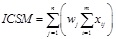
<body><![CDATA[<p>         <b>1.&#160; </b>         <b>Methodology</b>     </p>         <p>         This study is an attempt to identify the consumer sentiment in Continental Portugal toward marketing practice by measuring consumer attitudes toward         the four elements of the marketing&#8209;mix. The measurement instrument used in this study was adopted from Gaski and Etzel&#8217;s study (1986,         2005). Apart from a group of questions which aim to measure satisfaction with the policies of the marketing-mix, the consumers&#8217; perception of         governmental regulation concerning trading activities and the socio-demographic variables, the questionnaire also includes measures of consumer         attitudes toward each of the four marketing-mix variables (a total of 20 items, 5 items for each component). These four variables are intended to         correspond approximately to the four components of the marketing&#8209;mix as they impact on consumers. Items include both favourable and unfavourable         statements, to offset any affirmation/negation response tendency. A 5-point Likert scale anchored by &#8216;strongly disagree&#8217; [1] to         &#8216;strongly agree&#8217; [5] was adopted as the attitude measurement for the variables.     </p>         <p>         To construct the Index of Consumer Sentiment toward Marketing (ICSM), the same procedure of the Gaski and Etzel (1986, 2005) and Gaski study (2008) was         followed. The ICSM index measure is composed of four multi-item Likert scales, each reflecting one of the elements of marketing as it is experienced by         consumers. For this index the responses were scored from -2 to +2, with the most favourable answer (i.e., &#8220;disagree strongly&#8221; with a         negative statement, &#8220;agree strongly&#8221; with a positive statement) receiving the highest score, indicative of the most favourable attitude.         Calculation of the separate component measures for product, price, promotion, and place involves adding the scores within each of the four elements,         and weighing each element by a self-reported importance measure (5&#8209;point scale, &#8220;Not at all important&#8221;-&#8220;Extremely         important&#8221; to the consumer respondent). An individual&#8217;s consumer sentiment score is then determined by summing the four weighed elements,         based on the following <a href="#e1">equation 1</a>:     </p>             <p>&nbsp;</p>     <p><a name="e1"><img src="/img/revistas/tms/v9n1/9n1a15e1.jpg"></p>     
<p>&nbsp;</p>         <p>         Where:     </p>         <p>         <i>x<sub>ij</sub></i>         = scale item response i in category (marketing element) j,     </p>         <p>         <i>w<sub>j</sub></i>         = mean importance weight for the marketing-mix category j,     </p>         <p>         <i>m </i>         = number of items in marketing-mix category (five), and     </p>         ]]></body>
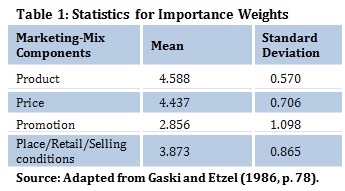
<body><![CDATA[<p>         <i>n </i>         = number of marketing-mix categories (four).     </p>         <p>         In this study, we used the importance weights for the marketing-mix category proposed by Gaski and Etzel (1986) (<a href="#t1">Table 1</a>), since they are situated         between the minimum and maximum values &#8203;&#8203;published in more recent research (e.g., Peterson &amp; Ekici, 2007; Gaski, 2008). The mean         importance weights for the four elements indicate that product and price are perceived as most important for consumers (<a href="#t1">Table 1</a>).     </p> 	 	        <p>&nbsp;</p>     <p><a name="t1"><img src="/img/revistas/tms/v9n1/9n1a15t1.jpg"></p>     
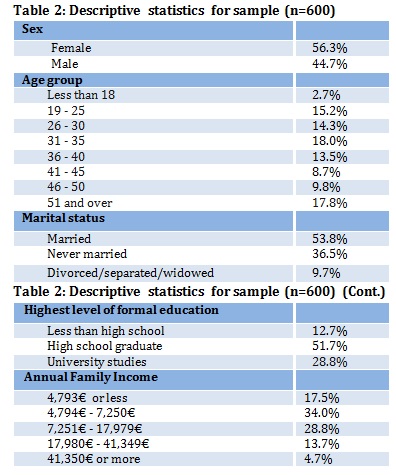
<p>&nbsp;</p>         <p>                  The target population of the research covered all five regions in mainland Portugal. The regions were defined as follows: North; Centre; Lisbon;         Alentejo; and Algarve, according to data from the Portugal National Institute of Statistics. A self-administered survey method was adopted to ensure         the confidentiality and non-obligation aspects of participating in the survey. The sample used to infer about the population consisted of 600         consumers, who were selected proportionally to the existent population over 15 years of age. A precision error of 4% and a significance level of 5%         were assumed.     </p> 	        <p>&nbsp;</p>         <p>         <b>2.&#160; </b>         <b>Results and discussion</b>     </p>         <p>         <a href="#t2">Table 2</a> presents details on the demographic characteristics of the sample group. The survey procedures resulted in 600 usable surveys. More than 56         percent of respondents were male. About 18% of the respondents were in the thirty-one to thirty-five age groups and almost the majority of the         respondents were over thirty-six years of age. More than half of the respondents were married. The modal value for education level was &#8220;high         school graduate&#8221;. The modal value for annual household income was 4,794&#8364; to 7,250&#8364;.     </p> 	        <p>&nbsp;</p>     ]]></body>
<body><![CDATA[<p><a name="t2"><img src="/img/revistas/tms/v9n1/9n1a15t2.jpg"></p>     
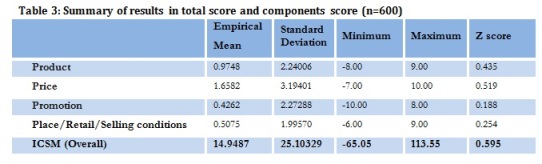
<p>&nbsp;</p>         <p>         <a href="#t3">Table 3</a> presents the means, standard deviations, minimum, maximum and Z scores for each component of the Marketing-Mix and for total score ICSM. The         norms for each component were computed by converting scales (to a format of -2 to +2, so that the theoretical mean was 0), and then summing the         responses for the five questions comprising each dimension. This resulting score was multiplied by the importance rating given by each respondent to         the corresponding dimension (according the values presented in <a href="#t1">Table 1</a>).     </p>  	        <p>&nbsp;</p>     <p><a name="t3"><img src="/img/revistas/tms/v9n1/9n1a15t3.jpg"></p>     
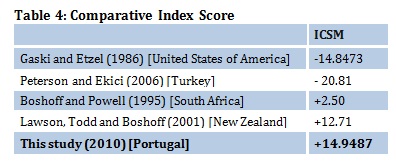
<p>&nbsp;</p>          <p>         In the results presented in previous <a href="#t3">Table 3</a>, almost all the components reached the maximum, and the promotion component had a lower value. For the         minimum, values &#8203;&#8203;were not obtained, which is a good indicator, but the promotion reached the minimum value (-10) presenting the lower         mean, which suggests some consumers decide on purchasing products without taking into consideration the promotion factor. On the other hand, the price         component has the highest average. The mean consumer sentiment score obtained (the &#8216;index&#8217; measure) was +14.9487. By itself, this reveals,         very weakly, that the consumer attitude toward marketing is slightly in the favourable range (total range = -200 to +200). In the present study the         Portuguese have a similar sentiment, compared with other studies, even in a crisis context (<a href="#t4">Table 4</a>).     </p>     	        <p>&nbsp;</p>     <p><a name="t4"><img src="/img/revistas/tms/v9n1/9n1a15t4.jpg"></p>     
<p>&nbsp;</p>         ]]></body>
<body><![CDATA[<p>         <a href="#t5">Table 5</a> shows the correlations between the different components of the marketing-mix and ICSM. All the correlations are significant at a significance         level of 1%, but only the price and the product components present the strongest correlation with ICSM, which indicates that the price component in a         crisis context is the most important policy in the marketing-mix strategy to define ICSM.     </p>  	        <p>&nbsp;</p>     <p><a name="t5"><img src="/img/revistas/tms/v9n1/9n1a15t5.jpg"></p>     
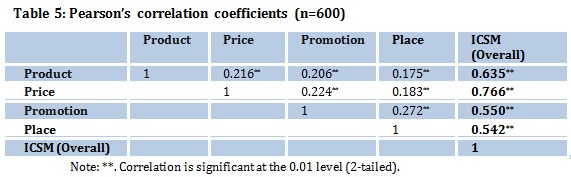
<p>&nbsp;</p>     <p>     <b>3.&#160; </b>     <b>Conclusion</b> </p>     <p>     It was intended with this work to contribute to scientific and academic research mainly because it provides the first relevant information on the     Portuguese sentiment towards policies of the marketing-mix. </p>     <p>     The Index of Consumer Sentiment toward Marketing, presented in this study, offers the opportunity to understand the true state of the consumer&#8217;s     attitudinal relation with marketing practice. This Index, developed by Gaski and Etzel (1986) was generated for each element of marketing-mix by summing     the scores across the five items and an overall index of sentiment towards marketing was obtained based on a sum of the four components weighed by the     consumers&#8217; perceived importance of each element. </p>     <p>     According to the correlations between the different components of the marketing-mix and ICSM it is possible to observe that the price is the most important     component to determine the index, followed by the product and the promotion and place policies which have similar importance. </p>     <p>     The results showed that the Portuguese consumer sentiment index toward marketing&#8209;mix is weakly positive and it could be a consequence of the present     economic and financial context that the country is undergoing. </p>     <p>     Further studies are necessary to analyse the index evolution and to determine the mean importance of marketing-mix elements for Portuguese consumers. </p>         ]]></body>
<body><![CDATA[<p>&nbsp;</p>     <p>     <b>References</b> </p>     <!-- ref --><p>     Barksdale, H. &amp; Darden, W. (1972). Consumer attitudes toward marketing and consumerism. <i>Journal of Marketing</i>, 36, 28-35.    &nbsp;&nbsp;&nbsp;&nbsp;&nbsp;&nbsp;&nbsp;&nbsp;[&#160;<a href="javascript:void(0);" onclick="javascript: window.open('/scielo.php?script=sci_nlinks&ref=000075&pid=S2182-8458201300010001500001&lng=','','width=640,height=500,resizable=yes,scrollbars=1,menubar=yes,');">Links</a>&#160;]<!-- end-ref --> </p>     <!-- ref --><p>    Chan, E., Yau, O.     &amp; Chan, R. (1990). Consumer sentiment in Australia: A replication and cross&#8209;national comparison. <i>European Journal of Marketing, 24</i>(10),     44-58.    &nbsp;&nbsp;&nbsp;&nbsp;&nbsp;&nbsp;&nbsp;&nbsp;[&#160;<a href="javascript:void(0);" onclick="javascript: window.open('/scielo.php?script=sci_nlinks&ref=000077&pid=S2182-8458201300010001500002&lng=','','width=640,height=500,resizable=yes,scrollbars=1,menubar=yes,');">Links</a>&#160;]<!-- end-ref --> </p>     <!-- ref --><p> Chan, T. &amp; Cui, G. (2004). Consumer attitudes toward marketing in a transitional economy: A replication and extension.    <i>Journal of Consumer Marketing, 21</i>(1), 10-26.    &nbsp;&nbsp;&nbsp;&nbsp;&nbsp;&nbsp;&nbsp;&nbsp;[&#160;<a href="javascript:void(0);" onclick="javascript: window.open('/scielo.php?script=sci_nlinks&ref=000079&pid=S2182-8458201300010001500003&lng=','','width=640,height=500,resizable=yes,scrollbars=1,menubar=yes,');">Links</a>&#160;]<!-- end-ref --> </p>     <!-- ref --><p> Fishbein, M. &amp; Ajzen, I. (1975). <i>Belief, attitude, intention and behavior</i>. Retrieved June 28, 2012, from    <a href="http://home.comcast.net/~icek.aizen/book/ch1.pdf" target="_blank">http://home.comcast.net/~icek.aizen/book/ch1.pdf</a>.    &nbsp;&nbsp;&nbsp;&nbsp;&nbsp;&nbsp;&nbsp;&nbsp;[&#160;<a href="javascript:void(0);" onclick="javascript: window.open('/scielo.php?script=sci_nlinks&ref=000081&pid=S2182-8458201300010001500004&lng=','','width=640,height=500,resizable=yes,scrollbars=1,menubar=yes,');">Links</a>&#160;]<!-- end-ref --> </p>     ]]></body>
<body><![CDATA[<!-- ref --><p> Gaski, J. (2008). The Index of consumer sentiment toward marketing: Validation, updated results, and demographic analysis.    <i>Journal of Consumer Policy</i>, 31, 195-216.    &nbsp;&nbsp;&nbsp;&nbsp;&nbsp;&nbsp;&nbsp;&nbsp;[&#160;<a href="javascript:void(0);" onclick="javascript: window.open('/scielo.php?script=sci_nlinks&ref=000083&pid=S2182-8458201300010001500005&lng=','','width=640,height=500,resizable=yes,scrollbars=1,menubar=yes,');">Links</a>&#160;]<!-- end-ref --> </p>     <!-- ref --><p>     Gaski, J. &amp; Etzel, M. (1986). The Index of consumer sentiment toward marketing. <i>Journal of Marketing</i>, <i>50</i>(3), 71-82.    &nbsp;&nbsp;&nbsp;&nbsp;&nbsp;&nbsp;&nbsp;&nbsp;[&#160;<a href="javascript:void(0);" onclick="javascript: window.open('/scielo.php?script=sci_nlinks&ref=000085&pid=S2182-8458201300010001500006&lng=','','width=640,height=500,resizable=yes,scrollbars=1,menubar=yes,');">Links</a>&#160;]<!-- end-ref --> </p>     <!-- ref --><p> Gaski, J. &amp; EtzeL, M. (2005). National aggregate consumer sentiment toward marketing: A thirty-year retrospective and analysis.    <i>Journal of Consumer Research</i>, <i>31</i>(4), 859-867.    &nbsp;&nbsp;&nbsp;&nbsp;&nbsp;&nbsp;&nbsp;&nbsp;[&#160;<a href="javascript:void(0);" onclick="javascript: window.open('/scielo.php?script=sci_nlinks&ref=000087&pid=S2182-8458201300010001500007&lng=','','width=640,height=500,resizable=yes,scrollbars=1,menubar=yes,');">Links</a>&#160;]<!-- end-ref --> </p>     <!-- ref --><p> Hatzios, M. (1996). <i>Effective models for measuring students' attitudes toward the marketing education program</i>. Retrieved June 28, 2012, from    <a href="http://scholar.lib.vt.edu/ejournals/JVTE/v13n1/" target="_blank">http://scholar.lib.vt.edu/ejournals/JVTE/v13n1/</a>.    &nbsp;&nbsp;&nbsp;&nbsp;&nbsp;&nbsp;&nbsp;&nbsp;[&#160;<a href="javascript:void(0);" onclick="javascript: window.open('/scielo.php?script=sci_nlinks&ref=000089&pid=S2182-8458201300010001500008&lng=','','width=640,height=500,resizable=yes,scrollbars=1,menubar=yes,');">Links</a>&#160;]<!-- end-ref --> </p>     <!-- ref --><p>     Kotler, P. (2000). <i>Marketing Management</i>, London: Prentice Hall.    &nbsp;&nbsp;&nbsp;&nbsp;&nbsp;&nbsp;&nbsp;&nbsp;[&#160;<a href="javascript:void(0);" onclick="javascript: window.open('/scielo.php?script=sci_nlinks&ref=000091&pid=S2182-8458201300010001500009&lng=','','width=640,height=500,resizable=yes,scrollbars=1,menubar=yes,');">Links</a>&#160;]<!-- end-ref --> </p>     ]]></body>
<body><![CDATA[<!-- ref --><p> Lawson, R., Todd, S. &amp; Boshoff, C. (2001). Relationships Between Consumer Sentiment Towards Marketing and Consumer Lifestyles.    <i>Australasian Marketing Journal</i>, <i>9</i>(2), 7-22.    &nbsp;&nbsp;&nbsp;&nbsp;&nbsp;&nbsp;&nbsp;&nbsp;[&#160;<a href="javascript:void(0);" onclick="javascript: window.open('/scielo.php?script=sci_nlinks&ref=000093&pid=S2182-8458201300010001500010&lng=','','width=640,height=500,resizable=yes,scrollbars=1,menubar=yes,');">Links</a>&#160;]<!-- end-ref --> </p>     <!-- ref --><p>     Mccarthy, J. (1960). <i>Basic marketing: A managerial approach</i>, Homewood: Richard D. Irwin.    &nbsp;&nbsp;&nbsp;&nbsp;&nbsp;&nbsp;&nbsp;&nbsp;[&#160;<a href="javascript:void(0);" onclick="javascript: window.open('/scielo.php?script=sci_nlinks&ref=000095&pid=S2182-8458201300010001500011&lng=','','width=640,height=500,resizable=yes,scrollbars=1,menubar=yes,');">Links</a>&#160;]<!-- end-ref --> </p>     <!-- ref --><p> Peterson, M., &amp; Ekici, A. (2007). Consumer Attitude Toward Marketing and Subjective Quality of Life in the Context of a Developing Country.    <i>Journal of Macromarketing, 27</i>(4), 350-359.    &nbsp;&nbsp;&nbsp;&nbsp;&nbsp;&nbsp;&nbsp;&nbsp;[&#160;<a href="javascript:void(0);" onclick="javascript: window.open('/scielo.php?script=sci_nlinks&ref=000097&pid=S2182-8458201300010001500012&lng=','','width=640,height=500,resizable=yes,scrollbars=1,menubar=yes,');">Links</a>&#160;]<!-- end-ref --> </p>     <!-- ref --><p>     Varadarajan, P., &amp; Thirunarayana, P. (1990). Consumers&#8217; attitudes towards marketing practices, consumerism and government regulations:     Cross-national perspectives. <i>European Journal of Marketing</i>, <i>24</i>(6), 6-23.    &nbsp;&nbsp;&nbsp;&nbsp;&nbsp;&nbsp;&nbsp;&nbsp;[&#160;<a href="javascript:void(0);" onclick="javascript: window.open('/scielo.php?script=sci_nlinks&ref=000099&pid=S2182-8458201300010001500013&lng=','','width=640,height=500,resizable=yes,scrollbars=1,menubar=yes,');">Links</a>&#160;]<!-- end-ref --> </p>     <!-- ref --><p>     Wee, C. &amp; Chan, M. (1989). Consumer sentiment toward marketing in Hong Kong. <i>European Journal of Marketing, 23</i>(4), 25-39.    &nbsp;&nbsp;&nbsp;&nbsp;&nbsp;&nbsp;&nbsp;&nbsp;[&#160;<a href="javascript:void(0);" onclick="javascript: window.open('/scielo.php?script=sci_nlinks&ref=000101&pid=S2182-8458201300010001500014&lng=','','width=640,height=500,resizable=yes,scrollbars=1,menubar=yes,');">Links</a>&#160;]<!-- end-ref --> </p>         ]]></body>
<body><![CDATA[<p>&nbsp;</p>     <p>     <b>Article history</b> </p>     <p>     Submitted: 16 June 2012 </p>     <p>     Accepted: 18 November 2012 </p>       ]]></body><back>
<ref-list>
<ref id="B1">
<nlm-citation citation-type="journal">
<person-group person-group-type="author">
<name>
<surname><![CDATA[Barksdale]]></surname>
<given-names><![CDATA[H.]]></given-names>
</name>
<name>
<surname><![CDATA[Darden]]></surname>
<given-names><![CDATA[W.]]></given-names>
</name>
</person-group>
<article-title xml:lang="en"><![CDATA[Consumer attitudes toward marketing and consumerism]]></article-title>
<source><![CDATA[Journal of Marketing]]></source>
<year>1972</year>
<volume>36</volume>
<page-range>28-35</page-range></nlm-citation>
</ref>
<ref id="B2">
<nlm-citation citation-type="journal">
<person-group person-group-type="author">
<name>
<surname><![CDATA[Chan]]></surname>
<given-names><![CDATA[E.]]></given-names>
</name>
<name>
<surname><![CDATA[Yau]]></surname>
<given-names><![CDATA[O.]]></given-names>
</name>
<name>
<surname><![CDATA[Chan]]></surname>
<given-names><![CDATA[R.]]></given-names>
</name>
</person-group>
<article-title xml:lang="en"><![CDATA[Consumer sentiment in Australia: A replication and cross&#8209;national comparison]]></article-title>
<source><![CDATA[European Journal of Marketing]]></source>
<year>1990</year>
<volume>24</volume>
<numero>10</numero>
<issue>10</issue>
<page-range>44-58</page-range></nlm-citation>
</ref>
<ref id="B3">
<nlm-citation citation-type="journal">
<person-group person-group-type="author">
<name>
<surname><![CDATA[Chan]]></surname>
<given-names><![CDATA[T.]]></given-names>
</name>
<name>
<surname><![CDATA[Cui]]></surname>
<given-names><![CDATA[G.]]></given-names>
</name>
</person-group>
<article-title xml:lang="en"><![CDATA[Consumer attitudes toward marketing in a transitional economy: A replication and extension]]></article-title>
<source><![CDATA[Journal of Consumer Marketing]]></source>
<year>2004</year>
<volume>21</volume>
<numero>1</numero>
<issue>1</issue>
<page-range>10-26</page-range></nlm-citation>
</ref>
<ref id="B4">
<nlm-citation citation-type="">
<person-group person-group-type="author">
<name>
<surname><![CDATA[Fishbein]]></surname>
<given-names><![CDATA[M.]]></given-names>
</name>
<name>
<surname><![CDATA[Ajzen]]></surname>
<given-names><![CDATA[I.]]></given-names>
</name>
</person-group>
<source><![CDATA[Belief, attitude, intention and behavior]]></source>
<year>1975</year>
</nlm-citation>
</ref>
<ref id="B5">
<nlm-citation citation-type="journal">
<person-group person-group-type="author">
<name>
<surname><![CDATA[Gaski]]></surname>
<given-names><![CDATA[J.]]></given-names>
</name>
</person-group>
<article-title xml:lang="en"><![CDATA[The Index of consumer sentiment toward marketing: Validation, updated results, and demographic analysis]]></article-title>
<source><![CDATA[Journal of Consumer Policy]]></source>
<year>2008</year>
<volume>31</volume>
<page-range>195-216</page-range></nlm-citation>
</ref>
<ref id="B6">
<nlm-citation citation-type="journal">
<person-group person-group-type="author">
<name>
<surname><![CDATA[Gaski]]></surname>
<given-names><![CDATA[J.]]></given-names>
</name>
<name>
<surname><![CDATA[Etzel]]></surname>
<given-names><![CDATA[M.]]></given-names>
</name>
</person-group>
<article-title xml:lang="en"><![CDATA[The Index of consumer sentiment toward marketing]]></article-title>
<source><![CDATA[Journal of Marketing]]></source>
<year>1986</year>
<volume>50</volume>
<numero>3</numero>
<issue>3</issue>
<page-range>71-82</page-range></nlm-citation>
</ref>
<ref id="B7">
<nlm-citation citation-type="journal">
<person-group person-group-type="author">
<name>
<surname><![CDATA[Gaski]]></surname>
<given-names><![CDATA[J.]]></given-names>
</name>
<name>
<surname><![CDATA[EtzeL]]></surname>
<given-names><![CDATA[M.]]></given-names>
</name>
</person-group>
<article-title xml:lang="en"><![CDATA[National aggregate consumer sentiment toward marketing: A thirty-year retrospective and analysis]]></article-title>
<source><![CDATA[Journal of Consumer Research]]></source>
<year>2005</year>
<volume>31</volume>
<numero>4</numero>
<issue>4</issue>
<page-range>859-867</page-range></nlm-citation>
</ref>
<ref id="B8">
<nlm-citation citation-type="">
<person-group person-group-type="author">
<name>
<surname><![CDATA[Hatzios]]></surname>
<given-names><![CDATA[M.]]></given-names>
</name>
</person-group>
<source><![CDATA[Effective models for measuring students' attitudes toward the marketing education program]]></source>
<year>1996</year>
</nlm-citation>
</ref>
<ref id="B9">
<nlm-citation citation-type="book">
<person-group person-group-type="author">
<name>
<surname><![CDATA[Kotler]]></surname>
<given-names><![CDATA[P.]]></given-names>
</name>
</person-group>
<source><![CDATA[Marketing Management]]></source>
<year>2000</year>
<publisher-loc><![CDATA[London ]]></publisher-loc>
<publisher-name><![CDATA[Prentice Hall]]></publisher-name>
</nlm-citation>
</ref>
<ref id="B10">
<nlm-citation citation-type="journal">
<person-group person-group-type="author">
<name>
<surname><![CDATA[Lawson]]></surname>
<given-names><![CDATA[R.]]></given-names>
</name>
<name>
<surname><![CDATA[Todd]]></surname>
<given-names><![CDATA[S.]]></given-names>
</name>
<name>
<surname><![CDATA[Boshoff]]></surname>
<given-names><![CDATA[C.]]></given-names>
</name>
</person-group>
<article-title xml:lang="en"><![CDATA[Relationships Between Consumer Sentiment Towards Marketing and Consumer Lifestyles]]></article-title>
<source><![CDATA[Australasian Marketing Journal]]></source>
<year>2001</year>
<volume>9</volume>
<numero>2</numero>
<issue>2</issue>
<page-range>7-22</page-range></nlm-citation>
</ref>
<ref id="B11">
<nlm-citation citation-type="book">
<person-group person-group-type="author">
<name>
<surname><![CDATA[Mccarthy]]></surname>
<given-names><![CDATA[J.]]></given-names>
</name>
</person-group>
<source><![CDATA[Basic marketing: A managerial approach]]></source>
<year>1960</year>
<publisher-loc><![CDATA[Homewood ]]></publisher-loc>
<publisher-name><![CDATA[Richard D. Irwin]]></publisher-name>
</nlm-citation>
</ref>
<ref id="B12">
<nlm-citation citation-type="journal">
<person-group person-group-type="author">
<name>
<surname><![CDATA[Peterson]]></surname>
<given-names><![CDATA[M.]]></given-names>
</name>
<name>
<surname><![CDATA[Ekici]]></surname>
<given-names><![CDATA[A.]]></given-names>
</name>
</person-group>
<article-title xml:lang="en"><![CDATA[Consumer Attitude Toward Marketing and Subjective Quality of Life in the Context of a Developing Country]]></article-title>
<source><![CDATA[Journal of Macromarketing]]></source>
<year>2007</year>
<volume>27</volume>
<numero>4</numero>
<issue>4</issue>
<page-range>350-359</page-range></nlm-citation>
</ref>
<ref id="B13">
<nlm-citation citation-type="journal">
<person-group person-group-type="author">
<name>
<surname><![CDATA[Varadarajan]]></surname>
<given-names><![CDATA[P.]]></given-names>
</name>
<name>
<surname><![CDATA[Thirunarayana]]></surname>
<given-names><![CDATA[P.]]></given-names>
</name>
</person-group>
<article-title xml:lang="en"><![CDATA[Consumers&#8217; attitudes towards marketing practices, consumerism and government regulations: Cross-national perspectives]]></article-title>
<source><![CDATA[European Journal of Marketing]]></source>
<year>1990</year>
<volume>24</volume>
<numero>6</numero>
<issue>6</issue>
<page-range>6-23</page-range></nlm-citation>
</ref>
<ref id="B14">
<nlm-citation citation-type="journal">
<person-group person-group-type="author">
<name>
<surname><![CDATA[Wee]]></surname>
<given-names><![CDATA[C.]]></given-names>
</name>
<name>
<surname><![CDATA[Chan]]></surname>
<given-names><![CDATA[M.]]></given-names>
</name>
</person-group>
<article-title xml:lang="en"><![CDATA[Consumer sentiment toward marketing in Hong Kong]]></article-title>
<source><![CDATA[European Journal of Marketing]]></source>
<year>1989</year>
<volume>23</volume>
<numero>4</numero>
<issue>4</issue>
<page-range>25-39</page-range></nlm-citation>
</ref>
</ref-list>
</back>
</article>