<?xml version="1.0" encoding="ISO-8859-1"?><article xmlns:mml="http://www.w3.org/1998/Math/MathML" xmlns:xlink="http://www.w3.org/1999/xlink" xmlns:xsi="http://www.w3.org/2001/XMLSchema-instance">
<front>
<journal-meta>
<journal-id>2182-8458</journal-id>
<journal-title><![CDATA[Tourism & Management Studies]]></journal-title>
<abbrev-journal-title><![CDATA[TMStudies]]></abbrev-journal-title>
<issn>2182-8458</issn>
<publisher>
<publisher-name><![CDATA[Escola Superior de Gestão, Hotelaria e Turismo da Universidade do Algarve]]></publisher-name>
</publisher>
</journal-meta>
<article-meta>
<article-id>S2182-84582014000100002</article-id>
<title-group>
<article-title xml:lang="en"><![CDATA[Critical success factors for a total quality culture: A structural model]]></article-title>
<article-title xml:lang="pt"><![CDATA[Fatores críticos de sucesso de uma cultura da qualidade total: um modelo estrutural]]></article-title>
</title-group>
<contrib-group>
<contrib contrib-type="author">
<name>
<surname><![CDATA[Campos]]></surname>
<given-names><![CDATA[Ana Cláudia]]></given-names>
</name>
<xref ref-type="aff" rid="A01"/>
</contrib>
<contrib contrib-type="author">
<name>
<surname><![CDATA[Mendes]]></surname>
<given-names><![CDATA[Júlio da Costa]]></given-names>
</name>
<xref ref-type="aff" rid="A01"/>
</contrib>
<contrib contrib-type="author">
<name>
<surname><![CDATA[Silva]]></surname>
<given-names><![CDATA[João Albino]]></given-names>
</name>
<xref ref-type="aff" rid="A01"/>
</contrib>
<contrib contrib-type="author">
<name>
<surname><![CDATA[Valle]]></surname>
<given-names><![CDATA[Patrícia Oom do]]></given-names>
</name>
<xref ref-type="aff" rid="A01"/>
</contrib>
</contrib-group>
<aff id="A01">
<institution><![CDATA[,University of the Algarve Faculty of Economics Centre for Spatial and Organizational Dynamics]]></institution>
<addr-line><![CDATA[FARO ]]></addr-line>
<country>Portugal</country>
</aff>
<pub-date pub-type="pub">
<day>31</day>
<month>01</month>
<year>2014</year>
</pub-date>
<pub-date pub-type="epub">
<day>31</day>
<month>01</month>
<year>2014</year>
</pub-date>
<volume>10</volume>
<numero>1</numero>
<fpage>07</fpage>
<lpage>15</lpage>
<copyright-statement/>
<copyright-year/>
<self-uri xlink:href="http://scielo.pt/scielo.php?script=sci_arttext&amp;pid=S2182-84582014000100002&amp;lng=en&amp;nrm=iso"></self-uri><self-uri xlink:href="http://scielo.pt/scielo.php?script=sci_abstract&amp;pid=S2182-84582014000100002&amp;lng=en&amp;nrm=iso"></self-uri><self-uri xlink:href="http://scielo.pt/scielo.php?script=sci_pdf&amp;pid=S2182-84582014000100002&amp;lng=en&amp;nrm=iso"></self-uri><abstract abstract-type="short" xml:lang="en"><p><![CDATA[Research on quality based on the cultural perspective claims that, more than an implementation of tools and techniques, quality is the outcome of cultural factors, namely organisational values and practices among which leadership and employee working patterns are of paramount importance. The development of a total quality culture is a strategic issue for the achievement of stakeholder satisfaction and business competitiveness in a highly demanding and uncertain business environment. In this research a model integrating the critical success factors for a total quality culture was tested in organisations of two subsectors of the tourism industry, using the SEM (Structural Equation Models with Latent Variables) approach by means of the PLS (Partial Least Squares) technique. Main findings corroborate that leadership and employee empowerment are key success factors for a total quality culture, thus reinforcing the principle that everyone in the organisation is responsible for quality. However, organisational information and communication practices were not found to be key success factors.]]></p></abstract>
<abstract abstract-type="short" xml:lang="pt"><p><![CDATA[A investigação em torno da qualidade adotando a perspetiva cultural tem vindo a consolidar a noção de que aquela, mais do que fruto da aplicação de técnicas e ferramentas, é resultado de fatores de ordem cultural, como os valores e práticas organizacionais, de que ressaltam os da liderança e os subjacentes às formas de trabalho desenvolvidas em geral na organização e, em particular, pelos colaboradores. O desenvolvimento de uma cultura da qualidade total é entendido como fundamental no sentido de se alcançar a satisfação dos stakeholders e a competitividade do desempenho organizacional num ambiente de negócios simultaneamente muito exigente e incerto. Nesta investigação procurou-se testar um modelo que agrega um conjunto de fatores críticos de sucesso para a cultura da qualidade total, tomando como base de análise organizações de dois subsectores do turismo, alojamento e restauração, e recorrendo para o efeito ao método SEM (Structural Equation Models with Latent Variables) via abordagem PLS (Partial Least Squares). Os principais resultados corroboram a importância crítica da liderança e do empowerment numa cultura da qualidade total, reforçando, por conseguinte, o princípio segundo o qual ‘todos, na organização, são responsáveis pela qualidade’.]]></p></abstract>
<kwd-group>
<kwd lng="en"><![CDATA[Leadership]]></kwd>
<kwd lng="en"><![CDATA[empowerment]]></kwd>
<kwd lng="en"><![CDATA[information/communication]]></kwd>
<kwd lng="en"><![CDATA[total quality culture]]></kwd>
<kwd lng="en"><![CDATA[PLS]]></kwd>
<kwd lng="pt"><![CDATA[Liderança]]></kwd>
<kwd lng="pt"><![CDATA[empowerment]]></kwd>
<kwd lng="pt"><![CDATA[informação/comunicação]]></kwd>
<kwd lng="pt"><![CDATA[cultura da qualidade total]]></kwd>
<kwd lng="pt"><![CDATA[PLS]]></kwd>
</kwd-group>
</article-meta>
</front><body><![CDATA[ <p align="right"><font size="2" face="Verdana"><b>TOURISM - SCIENTIFIC PAPERS</b></font></p>       <p>&nbsp;</p>   <font face="Verdana" size="4">    <p><b>Critical success     factors for a total quality culture: A structural model</b></p>       <p>&nbsp;</p></font>   <font face="Verdana" size="3">    <p><b>Fatores críticos de sucesso de uma cultura da qualidade total: um     modelo estrutural</b></p></font>       <p>&nbsp;</p>       <p>&nbsp;</p>   <font size="2" face="Verdana">    <p><b>Ana Cláudia Campos<sup>I</sup>; Júlio da Costa Mendes<sup>II</sup>; Jo&atilde;o     Albino Silva<sup>III</sup>; Patr&iacute;cia   Oom do Valle<sup>IV</sup></b></p> </font>     <p><font face="Verdana" size="2"><sup>I</sup>University   of the Algarve, Faculty of Economics, CIEO (Centre for Spatial and Organizational   Dynamics), Campus de Gambelas, 8005-139 FARO   Portugal, 8005-334 Faro &ndash; Portugal, <a href="mailto:acalves@ualg.pt">acalves@ualg.pt</a> </font>    <br> <font face="Verdana" size="2"><sup>II</sup>University   of the Algarve, Faculty of Economics, CIEO (Centre for Spatial and   Organizational Dynamics),    8005-139 Faro – Portugal, <a href="mailto:jmendes@ualg.pt">jmendes@ualg.pt</a> </font>    ]]></body>
<body><![CDATA[<br> <font face="Verdana" size="2"><sup>III</sup>University     of the Algarve, Faculty of Economics, CIEO (Centre for Spatial and     Organizational Dynamics),  8005-139 Faro &ndash; Portugal, <a href="mailto:jsilva@ualg.pt">jsilva@ualg.pt</a></font>    <br> <font face="Verdana" size="2"><sup>VI</sup>University     of the Algarve, Faculty of Economics, CIEO (Centre for Spatial and     Organizational Dynamics),  8005-139 Faro &ndash; Portugal, <a href="mailto:pvallle@ualg.pt">pvallle@ualg.pt</a></font></p> <font face="Verdana" size="2">       <p>&nbsp;</p>       <p>&nbsp;</p> <hr size="1" noshade>       <p><b>ABSTRACT</b></p>     <p>Research on quality     based on the cultural perspective claims that, more than an implementation of     tools and techniques, quality is the outcome of cultural factors, namely     organisational values and practices among which leadership and employee working     patterns are of paramount importance. The development of a total quality     culture is a strategic issue for the achievement of stakeholder satisfaction     and business competitiveness in a highly demanding and uncertain business     environment. In this research a model integrating the critical success factors     for a total quality culture was tested in organisations of two subsectors of     the tourism industry, using the SEM (Structural Equation Models with Latent     Variables) approach by means of the PLS (Partial Least Squares) technique. Main     findings corroborate that leadership and employee empowerment are key success     factors for a total quality culture, thus reinforcing the principle that     everyone in the organisation is responsible for quality. However,     organisational information and communication practices were not found to be key     success factors.</p>       <p><b>Keywords: </b>Leadership, empowerment, information/communication, total     quality culture, PLS.</p> <hr size="1" noshade>      <p><b>RESUMO</b></p>     <p>A investigação em torno da qualidade adotando a     perspetiva cultural tem vindo a consolidar a noção de que aquela, mais do que     fruto da aplicação de técnicas e ferramentas, é resultado de fatores de ordem     cultural, como os valores e práticas organizacionais, de que ressaltam os da     liderança e os subjacentes às formas de trabalho desenvolvidas em geral na     organização e, em particular, pelos colaboradores. O desenvolvimento de uma     cultura da qualidade total é entendido como fundamental no sentido de se     alcançar a satisfação dos <i>stakeholders</i> e a competitividade do desempenho organizacional num ambiente de negócios     simultaneamente muito exigente e incerto. Nesta investigação procurou-se testar     um modelo que agrega um conjunto de fatores críticos de sucesso para a cultura     da qualidade total, tomando como base de análise organizações de dois     subsectores do turismo, alojamento e restauração, e recorrendo para o efeito ao     método SEM (<i>Structural Equation Models     with Latent Variables</i>) via abordagem PLS (<i>Partial Least Squares</i>). Os principais resultados corroboram a     importância crítica da liderança e do <i>empowerment</i> numa cultura da qualidade total, reforçando, por conseguinte, o princípio     segundo o qual ‘todos, na organização, são responsáveis pela qualidade’. </p>       <p><b>Palavras-chave: </b>Liderança, <i>empowerment</i>,     informação/comunicação, cultura da qualidade total, PLS.</p>   <hr size="1" noshade>       ]]></body>
<body><![CDATA[<p>&nbsp;</p>       <p>&nbsp;</p></font>   <font size="3" face="Verdana">    <p><b>1.&nbsp;&nbsp;&nbsp; Introduction</b></p></font>   <font face="Verdana" size="2">    <p>Quality orientation has become a key focus in consumer     behaviour and business practice (Wang et al., 2012). It is now agreed among     managers that quality is a source of competitive advantage in a globalised     business environment in which demanding consumers, innovation, knowledge     creation, and technology play a decisive role (Hutchins &amp; Gould, 2004;     Gretzel et al., 2006). </p>       <p>In the last decade of the 20<sup>th</sup> century,     research on quality attempted to explore new conceptualisations which were     expected to uncover dimensions of analysis neglected before (Barrett &amp;     Waddell, 2001). The cultural perspective on quality emerged from empirical     findings that evinced either the failure of quality programmes implemented     without the support of a consistent values system (Barrett &amp; Waddell, 2001)     or the existence of contradictory effects in organisations across industries     (Cameron &amp; Sine, 1999; Foley, 2000) and problems of a diverse nature (Zu et     al., 2010).</p>       <p>Within the cultural perspective, quality is an     organisational subsystem (Kujala &amp; Lillrank, 2004), a culture characterised     by its values, beliefs, and practices (Michaud et al., 1991; Dodwell &amp;     Simmons, 1994; Cameron &amp; Sine, 1999). Values are ‘enduring goals that serve     as guiding principles in people's lives’ and are ‘conceptualised as explicit or     implicit formulisations of the “desirable” that influence individuals’ means     and ends of action’ (Aktas et al., 2011). Practices are systems and behaviours     sustained in an organisation (Asree et al., 2010), and beliefs are shared     assumptions on how individuals in the organisation perceive their own     environment but also guides to the course of action in concrete situations     (Kujala &amp; Lillrank, 2004).</p>       <p>Recent research has highlighted     critical dimensions in the cultural change process, such as leadership which     starts and conducts this process (Lee-Ross &amp; Johns, 2001), in addition to     acknowledged forms of empowerment and the effective management of information     and organisational communication as the basis for informed decision making     processes (Dodwell &amp; Simmons, 1994; Lenehan &amp; Harrington, 1998).</p>       <p>Quality challenges are perceived as highly important     in tourism. On the one hand, tourism is expected to continue to grow in the     next two decades, both in terms of international arrivals and receipts (WTO,     2012). On the other hand, the industry increasingly depends on travel consumers     who are behaving more responsibly toward consumption purchases and choices and     are highly aware of sustainability issues (Page &amp; Connell, 2006; Crick     &amp; Spencer, 2011).</p>       <p>Tourism activities involve the consumption of a     holistic product (Weiermair, 1997) and are affected by structural factors (demographic,     cultural, economic, scientific, and technological variables) which have an     impact on tourism growth and globalisation. In addition, tourism planning is     now closely related to concerns about economic, social, and environmental     sustainability (Inskeep, 1991; OMT, 1997; Bramwell &amp; Lane, 2000). </p>       <p>A literature review shows that     quality issues have been capturing the attention of scholars in the field of     tourism (Cluzeau, 1997; Gorga, 1999; Piqueras, 2000; Lee-Ross &amp; Johns,     2001) at the organisation and destination levels alike. The role of quality is     also recognised in organisational differentiation in a globalised market,     especially in tourism businesses mostly composed of micro companies which find     difficulty in competing through price (Lee-Ross &amp; Johns, 2001). </p>       ]]></body>
<body><![CDATA[<p>Some authors refer to the importance of the quality     culture construct in the context of tourism competitiveness (Cluzeau, 1997;     Gorga, 1999; Piqueras, 2000). However, there is still a need to explore its     application to the sector, in particular to tourism businesses which present     certain specific characteristics (Thomas et al., 2011; Kandampully, 2000).</p>       <p>In the present study, the relevance of organisational     practices and values to a total quality culture will be analysed, based on     managers’ perceptions of two main tourism subsectors: accommodation and food     &amp; beverage. Structural equation models with latent variables method (SEM)     will be used via the partial least squares (PLS) technique, which is suitable for the study of latent variables.</p>       <p>&nbsp;</p></font>   <font face="Verdana" size="3">    <p><b>2.   Total quality culture (TQC) critical success     factors </b></p></font> <font face="Verdana" size="2">    <p>Changes that have occurred in research trends on     quality – from technical approaches focused mainly on quantitative tools to     cultural approaches – are a consequence of empirical findings that evinced the     failure of quality programmes that have been implemented in organisations     lacking the support of an adequate value system (Zu et al., 2010; Barrett &amp;     Waddell, 2001) and contradictory results in the effects of those same     programmes (Cameron &amp; Sine, 1999; Foley, 2000).</p>       <p>Theoretical approaches began to explore the     integration of quality programmes through a cultural perspective, according to     which quality is a set of values, an organisational ideology more than a set of     tools and techniques (Cameron &amp; Sine, 1999). Within this view, quality is a     culture that strives for perfection and continuous improvement (Dodwell &amp;     Simmons, 1994), an organisational experience in which mental attitudes and     initiatives are included and objectives of increasing sales profits connect to     the strengthening of relationships with customers (Lenehan &amp; Harrington,     1998). </p>       <p>It has been claimed that quality culture is that part     of organisational culture related to habits, beliefs, values, and behaviours to     improve quality (Gryna, 2001). In a similar way, Cameron and Sine (1999) define     it as the subset of overall organisational culture that mirrors the general     approach, the values, the orientation towards quality that underlies     organisational actions and behaviours. Total quality culture, on the other     hand, is meant to denote an orientation towards business excellence. For     instance, Batten (1994) uses this construct to represent the focus of every     individual and the application of organisational assets and resources in an     endless push to improve quality <i>in every     dimension of an organisation</i>.  </p>       <p>Theoretically, cultural change is not a consensual     issue (Hildebrandt et al., 1991; Kujala &amp; Lillrank, 2004), nonetheless it     is understood as vital in the process of organisational adaptation to the external     environment and increasing competitiveness. Leadership, factual knowledge of     current quality culture and management of critical success factors of a total     quality culture are key elements of the cultural change process (Kanji &amp;     Wallace, 2000; Gryna, 2001).</p>       <p><b><i>Top management leadership: </i></b>Leadership motivated by a shared vision and     focused on the common good of the organisation is a requisite for a successful     implementation of total quality principles (Guillén &amp; González, 2001). Top     managers responsible for making the strategic decisions involving their     organisations play a key role in culture formation and control (Aktas et al.,     2011) and therefore in the way that culture is collectively represented,     valued, and practiced. Top management leadership is <i>critically important </i>(Barrett &amp; Waddell, 2001) not only to the     generation of relevant effects in financial performance but also to the success     of overall orientation towards quality. A visible and active leadership is able     to deal with resistance to change by adopting a committed attitude to total     quality values and practices. </p>       <p><b><i>Empowerment (and teamwork)</i></b>: Defined as the individual’s capacity to     influence and control his own working environment and strive for more     self-determination (Gill et al., 2010), empowerment involves the transfer of     authority and responsibility in the making decision process from managers to     employees (Dimitriades, 2001). Empowerment has become an acknowledged practice     as a result of changes occurring in the work environment that eventually led to     the flattening of organisational structure, in addition to changes in beliefs     about the strategic value of employees to organisations, now recognised as a     source of competitive advantage (Pelit et al., 2011).</p>       ]]></body>
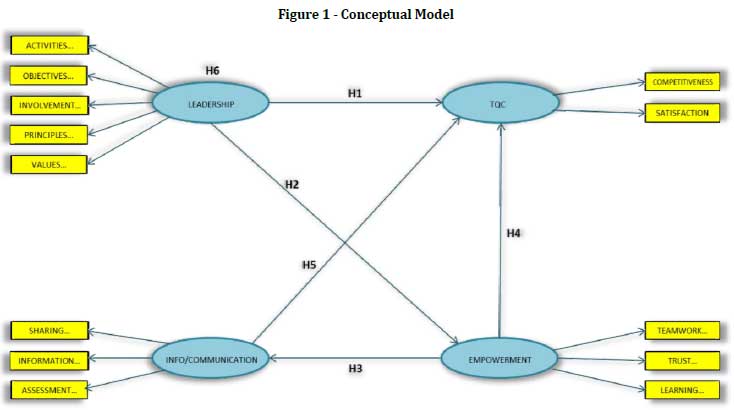
<body><![CDATA[<p>From a cultural point of view, empowerment is related     to organisations that have developed according to a group culture (Zu et al.,     2010), or a clan culture (Aktas et al., 2011), in which leadership has adopted     a participative style fostering interaction and open communication, team work,     respect for employees’ creativity, and their needs for personal development and     knowledge. Perles (2002) asserts team work has been seen by some authors as a     key factor in the achievement of business excellence. Barret and Waddell (2001)     concluded in their study that team work positively impacts quality performance,     thus organisations that support empowerment and team work obtain higher levels     of performance and employee satisfaction. Teams take direct responsibility in     the detection and solving of quality problems.</p>       <p>Participation expresses the notion     that people are persuaded to adopt new attitudes and mindsets through     involvement in activities that imply new behaviours (Gryna, 2001). Within a     total quality culture framework, participation of individuals at every     organisational level in quality activities is also seen as critical.</p>       <p><b><i>Information and communication management: </i></b>Management by fact (Kanji &amp; Wallace, 2000) includes the performance     of activities guided by the continuous improvement principle. Quality does not     improve unless it is measured (Reichheld &amp; Sasser, 1990). Such activities,     measurement and analysis of process performance, feedback of achieved results     and information sharing are the basis of an informed decision (Fife, 2001).     Information collection is important in several ways: to identify poor or     unsatisfactory performance, to motivate people to improve continually, or to     assist in the decision process at all organisational levels in the way     relationships with stakeholders should develop (Porter, 1997). Total quality     culture is highly dependent on quantitative and qualitative measurement systems     and supports the development, the maintenance, and changes in the     organisation’s policies and processes (Fife, 2001).</p>       <p>&nbsp;</p></font>   <font face="Verdana" size="3">    <p><b>3.   Conceptual model and research hypotheses</b></p></font> <font face="Verdana" size="2">    <p>A literature review shows there is wide consensus on     the relevance of leadership in the development of a total quality culture, in     terms of dissemination of a strategic vision on quality (Dimitriades, 2001;     Guillén &amp; González, 2001), definition of quality objectives and strategies     (Gryna, 2001; Laszlo, 1999) and, more generally, of its contribution to     organisational performance when top managers make all relevant decisions in     terms of the organisation’s mission and objectives (Yuan &amp; Lee, 2011). Leadership,     as a critical success factor for a total quality culture, is represented as     active, dynamic, and motivating <b>(H1).</b> </p>       <p>Fife (2001) claims leadership systems are crucial to     the implementation of a total quality culture. Social changes have driven     organisational restructuring and flattening, eventually leading to the     obsolescence of an autocratic style of management focused on managers’ formal     authority. Today’s leaders are called to adopt a bottom-up approach, ensuring     that policies and processes support shared responsibility by means of     empowerment <b>(H2)</b>.</p>       <p>By stimulating employees’ participation and     involvement, teamwork leads to the adoption of practices and activities     especially conceived to tackle, prevent or solve quality problems, namely     information collection on the internal environment of a business (Gryna, 2001).     A dynamic and flexible organisational structure is of great importance to     nurturing honest communication and sharing of information (Feigenbaum, 1999) <b>(H3)</b>. Information management is     regarded as highly relevant to the making of informed decisions on quality;     however it depends on effective communication channels (Woods, 1998) <b>(H5)</b>. Barret and Waddell’s (2001)     research has shown the contribution of empowerment to a successful quality     culture <b>(H4)</b>. The combination of     managers’ overt commitment to quality with empowerment practices contributes     more strongly to a total quality culture (Baker &amp; Crompton, 2000) than     managers’ behaviour or empowerment alone <b>(H6).</b></p>       <p><b>H1. </b>Leadership influences positively the organisation’s     total quality culture</p>       <p><b>H2. </b>Leadership influences positively empowerment practices     in the organisation</p>       ]]></body>
<body><![CDATA[<p><b>H3. </b>Empowerment influences positively the organisation’s     information and communication practices</p>       <p><b>H4. </b>Empowerment influences positively the organisation’s     total quality culture</p>       <p><b>H5. </b>Information and communication practices influence     positively the organisation’s total quality culture</p>       <p><b>H6.</b> The coexistence of leadership and empowerment practices has a higher     effect on total quality culture than that of leadership or empowerment     practices considered in isolation.</p>       <p>The conceptual model comprises four latent variables.     ‘Leadership’ is an exogenous variable and ‘Information/Communication’,     ‘Empowerment’, and ‘Total Quality Culture’ are endogenous variables. ‘Total     Quality Culture’ is the variable whose predictive value will be taken as the     most relevant in the model. ‘Leadership’ is measured through five indicators (<i>activities to improve quality, objectives     and strategies to improve quality, involvement in cultural change, quality     principles and rules, values and motivations to improve quality</i>),     ‘Empowerment, through three indicators (<i>teamwork,     trust relationships, learning opportunities</i>), ‘Information/Communication’     through three indicators (<i>communication     and information sharing, information for decision making, performance     assessment measures</i>), and ‘Total Quality Culture’ through two indicators (<i>organisational competitiveness, stakeholders     satisfaction</i>). The selection of indicators was based on the working     definitions presented below (<a href="/img/revistas/tms/v10n1/10n1a02f1.jpg">Figure 1</a>), which captured most relevant aspects     found in the literature. All indicators included in the model are reflective     and relations between latent variable are recursive, i.e., unidirectional     (Chin, 2000). </p>     
<p>&nbsp;</p></font> <font face="Verdana" size="3">    <p><b>4.   Methodology</b></p></font> <font face="Verdana" size="2">    <p><b>4.1     Setting</b></p>       <p>The study is based on accommodation and food &amp;     beverage organisations of Lagos, a municipality of the Algarve region.     Geographically, Lagos is located on the western coast of the Algarve (PEL,     2003). Reflecting the development pattern of the region, tourism became     important in Lagos from the 60s onwards, eventually becoming its main economic     activity (Sirgado, 1990). Sand, Sea and Sun was by then the sole tourism     product, and the unplanned growth of tourist accommodation, particularly in     coastal areas, and high seasonality had a strong environmental, urban, and     socio-economic impact.</p>       <p>However, in the last decade, the historic and cultural     heritage of Lagos has driven the building of a new vision of tourism     development in the municipality. The Lagos Strategic Plan (PEL, 2003)     corroborates the prominence of tourism activity and proposes a strategic     approach to tourism development based on service quality improvement,     diversification of tourism products, in harmony with recent trends in consumer     behaviour and destination choice criteria. In fact, this document states that     further investment in the Sand, Sea, and Sun product is not a priority to     Lagos, or indeed even to the Algarve region. </p>       ]]></body>
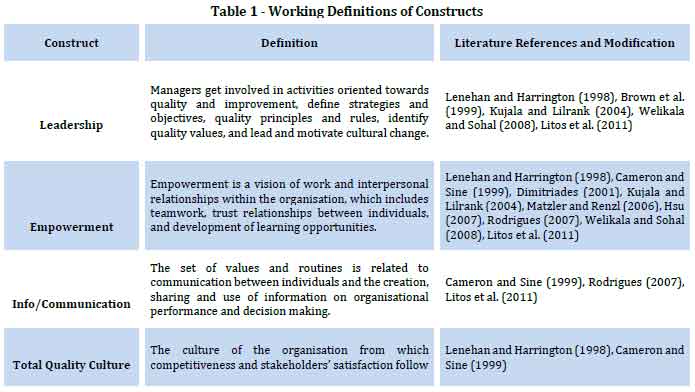
<body><![CDATA[<p><b>4.2     Data collection and sample</b></p>       <p>The population is composed of two segments of tourism     organisations – food &amp; beverage and accommodation – operating in the town     of Lagos. The sampling method adopted for the food &amp; beverage segment was     simple random sampling. The acceptable margin of error was 5% based on a 95%     confidence level. The sampling frame was 192 units and the sample 128 units.     Accommodation organisations have been segmented into the following types: guest     houses, bed &amp; breakfast, private homes, hotel-apartments, hotels, and     motels. The sampling frame was 43 units. The sampling method chosen for     accommodation organisations above 10 units was the stratified random sampling,     assuming a margin of error of 10% based on a 95% confidence level. The method     used for organisations below 10 units was the census. The sample was 37 units.</p>       <p>The study’s informants were the managers of     accommodation and food &amp; beverage organisations. The questionnaire survey     was chosen as the data collecting method through personal interviews. A     pre-test was performed on January 22-27 2006. Following the pre-test,     questionnaire dimension and vocabulary were refined. Field work began on June     20<sup>th</sup> and was completed on August 31<sup>st</sup>, 2006. A total of     134 questionnaires were validated, corresponding to a response rate of 81%.</p>       <p><b>4.3     Measures</b></p>       <p>Questions aimed at measuring, on the one hand,     adherence to leadership, empowerment, information and communication practices     and values and, on the other, managers’ perceptions on the effects of total     quality culture (stakeholder satisfaction and organisational competitiveness).     In the first case, a 5-point Likert scale was adopted, ranging from 1 –     ‘definitely no’ to 5 – ‘definitely yes’. In the second, the 5-point Likert     scale ranged from 1 – ‘strongly disagree’ to 5 – ‘strongly agree’. A neutral     position was included in the questionnaire (does not know/not answering).</p>       <p>The study’s indicators followed from a literature     review and working definitions of constructs, as shown in the <a href="/img/revistas/tms/v10n1/10n1a02t1.jpg">table 1</a>.</p>       
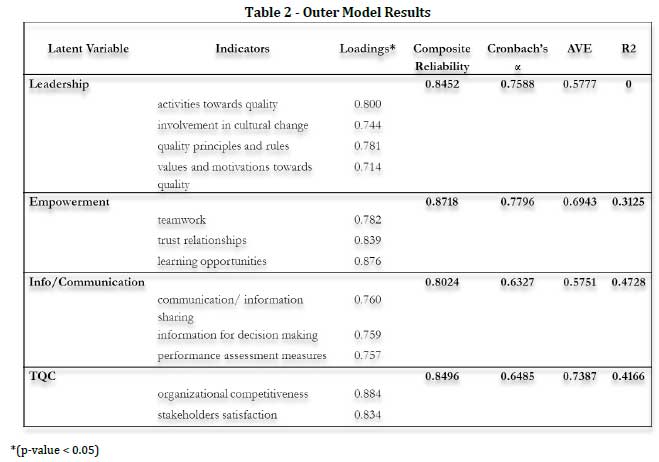
<p><b>4.4 Data     analysis method</b></p>       <p>The data analysis method used in the study was     structural equation modelling (SEM) using the partial least squares path     modelling (PLS-PM) approach. This method uses an algorithm that maximises the     explained variances of a set of endogenous latent variables (or constructs)     allowing an estimate of the relationships among the latent variables     (coefficients of the inner model) and their relationship to the corresponding     indicators (coefficients of the outer model) (Haenlein &amp; Kaplan, 2004). The     most recognised advantage of PLS-PM over the well-known Covariance–based SEM     approach is its ability to fit complex models with small samples sizes (&lt;     200) (Henseler et al., 2009; Haenlein &amp; Kaplan, 2004; Hulland, 1999). Smart     PLS 2.0 was the software employed in the study.</p>       <p>&nbsp;</p></font>   <font face="Verdana" size="3">    <p><b>5. Data analysis and     results</b></p></font> <font face="Verdana" size="2">    ]]></body>
<body><![CDATA[<p><b>5.1     Sample description and results</b></p>       <p>Among the respondents, there were 70% male and 30%     female individuals. The most represented age group were individuals between 45     and 54 years old (33%), followed by the age group between 35 and 44 years old     (31%). The great majority of respondents lived in the town of Lagos. Concerning     education levels, 71% of respondents have elementary school and secondary     education diplomas. Only 29% of respondents have higher education diplomas.</p>       <p><b>5.2     Outer model</b></p>       <p>The outer model specifies the relationships between a     latent variable and corresponding indicators (Henseler et al., 2009). The model     represents a reflective relationship between latent variables and indicators.     Henseler <i>et al. </i>(2009) recommend the     development of a reflective model for the purpose of identification of critical     success factors. It also assumes construct unidimensionality, i.e., each set of     indicators is associated with only one latent variable (Henseler et al., 2009;     Hulland, 1999; Stan &amp; Saporta, 2005).</p>       <p>Latent variables were measured through a confirmatory     factor analysis using the PLS approach. The assessment of the outer model was     based on reliability and validity criteria (Hulland, 1999). The first criterion     checked was internal consistency reliability, which refers to     inter-correlations of indicators or the extent to which they measure the same     latent variable. Henseler <i>et al</i>.     (2009) recommend the use of the composite reliability measure instead of     Cronbach’s alpha because, unlike the traditional measure, composite reliability     prioritises indicator loadings. However both measures can have similar     interpretations. As with Cronbach’s alpha (Streiner, 2003), Henseler <i>et al.</i> (2009) suggest values between 0.8     and 0.9 as references for good reliability. However, composite reliability should be     higher than 0.7 to be considered acceptable. In     the current study, every construct obtained values between 0.8 and 0.9:     ‘Information/Communication’ scored the lowest (0.8024) and ‘Empowerment’ the     highest (0.8718). In addition to composite reliability, the individual     indicator reliability measure has     also been examined. Hulland (1999) recommends that indicators with loadings     below the 0.5 threshold should be dropped so that the explanatory power of the     model may improve. None of the indicators included in the model obtained     loadings below 0.5; however, the measurement item <i>‘objectives and strategies to improve quality’ </i>has been dropped due     to its proximity to the threshold (0.557). As a consequence, the composite     reliability value of the latent variable ‘Leadership’ increased and surpassed     the 0.50 threshold. </p>       <p>Validity criteria include the examination of two     subtypes of validity: convergent and     discriminant validity. The first subtype ‘signifies that a set of indicators     represents one and the same underlying construct’ (Henseler et al., 2009), and     the second criterion ‘represents the extent to which measures of a given     construct differ from measures of other constructs in the same model’ (Hulland,     1999).</p>       <p>Fornell and Larcker (1981) recommend the use of the     average variance extracted (AVE) in the examination of convergent validity,     with 0.5 as the benchmark value of a sufficient level of convergence. In the     model, all latent variables obtained values higher than 0.5.</p>       <p>&nbsp;</p>     <p align="center"><a href="/img/revistas/tms/v10n1/10n1a02t2.jpg">Table 2</a></p>       
<p>&nbsp;</p>       ]]></body>
<body><![CDATA[<p>With respect to discriminant validity, two criteria     are usually examined: AVE and cross-loadings. The AVE is analysed in terms     of  Fornell and Larcker’s (1981)     principle which asserts that ‘this measure should be greater than the variance     shared between the construct and other constructs in the model (i.e., the     squared correlation between two constructs)’ (Hulland, 1999). Checking     cross-loadings is recommended by Henseler <i>et     al.</i>, 2009 as a way to assess ‘if an indicator has a higher correlation with     another latent variable than with its respective latent variable’, in which     case the model should be reconsidered. Results are shown in <a href="/img/revistas/tms/v10n1/10n1a02t3.jpg">Tables 3</a> and <a href="/img/revistas/tms/v10n1/10n1a02t4.jpg">4</a> and     indicate that the model satisfies both criteria.</p>     
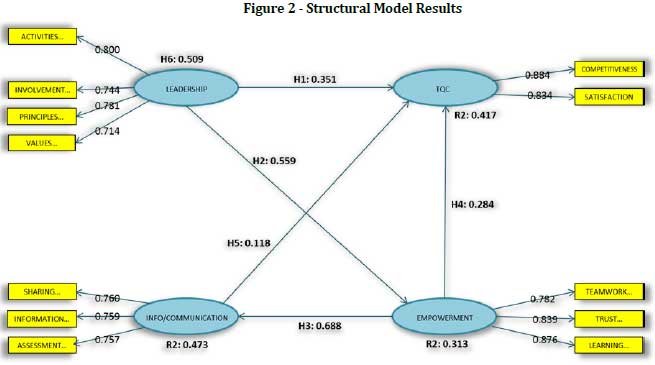
<p><b>5.3   Structural Model</b></p>       <p>The structural (inner) model estimates latent     variables’ relationships. An examination of the R<sup>2</sup> values (the     coefficient of determination of the endogenous latent variables) shows that the     equations used to predict total quality culture have a moderate predictive     power (Henseler et al., 2009). Based on the signs and statistical significance     of the path coefficients, the research hypotheses have been tested.</p>       <p>&nbsp;</p>       <p align="center"><a href="/img/revistas/tms/v10n1/10n1a02f2.jpg">Figure 2</a></p>       
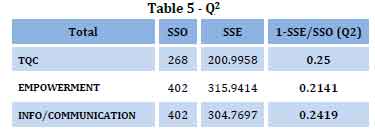
<p>&nbsp;</p>       <p>A bootstrapping procedure was performed for 5000     samples with the purpose of analysing the t-statistics (t-values) which measure     the statistical significance of path coefficients. The procedure indicates that all path coefficients, with the     exception of the path ‘Info/Communication &#8594; TQC’ are significant     (&gt;1.645). Therefore all research hypotheses but one (H5) are corroborated.     H6, which analysed measuring leadership total effects on total quality culture     (0.351+0.559*0.284=0.509) <i>versus</i> measuring in isolation leadership direct effects (0.351) and empowerment     practices direct effects (0.284) on total quality culture, is also not     rejected. These findings suggest that, in order to place the organisation’s     current culture closer to a total quality culture, managers should prioritise     connecting leadership practices to empowerment practices and environments.</p>       <p>A blindfolding technique was used to assess the     model’s predictive power (Henseler et al., 2009). The Stone-Geisser’s Q<sup>2</sup> criterion assumes all Q<sup>2 </sup>values are positive (&gt;0) and Henseler <i>et al.</i> (2009) set 0.02, 0.15 and 0.35     values as benchmarks of, respectively, small, medium and large predictive     relevance. Results show all endogenous latent variables obtained Q<sup>2</sup> values larger than 0.15, corresponding to a satisfactory prediction capability. </p>       <p>&nbsp;</p>       <p align="center"><img src="/img/revistas/tms/v10n1/10n1a02t5.jpg" width="375" height="134"></p>       
]]></body>
<body><![CDATA[<p align="center">&nbsp;</p>       <p>&nbsp;</p></font> <font face="Verdana" size="3">    <p><b>6.   Discussion and conclusions</b></p></font> <font face="Verdana" size="2">    <p>This study specified and estimated a model in the     quality management area, based on the cultural perspective on quality. A review     of the literature pointed to a gap in tourism studies on the relationship     between the cultural perspective on total quality and tourism organisations. </p>       <p>Statistical analysis supports the paths ‘Leadership     &#8594; TQC’ and ‘Leadership &#8594; Empowerment’, confirming the positive     direction from the exogenous variable to the endogenous variables. Results     obtained are consistent with theory and empirical findings (Gryna, 2001;     Guillén &amp; González, 2001; Cameron &amp; Sine, 1999; Laszlo, 1999; Batten,     1994).</p>       <p>The same can be said of the paths ‘Empowerment &#8594;     Info/Communication’ and ‘Empowerment &#8594; TQC’. Again, this study’s results     and previous findings reported in the literature converge (Barrett &amp;     Waddell, 2001; Lenehan &amp; Harrington, 1998, on the relationship between     empowerment and quality culture; Dimitriades, 2001: Kandampully &amp; Duddy,     2001, on the relationship between empowerment and information/communication). However,     against expectations, H5 was not supported by statistical analysis.</p>       <p>This study’s results showed that leadership is a     critical success factor for a total quality culture, in particular if the     manager is directly involved in quality, behaves unambiguously, and leads and     motivates cultural change. Dissemination of values and employee motivation in     the cause of quality are relevant factors in the development of a total quality     culture. The study’s results reinforce the manager’s prominence in the role of     leader of cultural change. </p>       <p>Results on the relationship between leadership and     empowerment practices confirm a key total quality principle according to which     everyone in the organisation is responsible for quality.</p>       <p>This study’s main contribution to theory is the development     of a model that integrates constructs found in the literature which have not     been either jointly analysed or measured statistically. Most important,     however, is the finding of the positive joint effect of leadership and     empowerment.</p>       <p>Furthermore, the application to     tourism of the cultural perspective on quality highlighted organisational     practices and perceptions of managers of this particular sector of economic     activity in which micro and small businesses prevail. These managers’     perceptions can provide a basis for a comparative analysis with other sectors     of economic activity or, more specifically, other tourism subsectors, from     which a broader vision on quality culture practices and values may emerge.</p>       ]]></body>
<body><![CDATA[<p>From an organisational point of view, the study confirms     the importance of leadership in the building process of a total quality     culture, in particular in the context of a highly competitive business     environment, empowered consumers and competition through quality services.     Cultural change towards total quality, as expected, begins at the top of the     organisation. The study’s findings also suggest that managers will contribute     more positively to a total quality culture if they are supportive of teamwork,     shared responsibility, as well as employee initiative and autonomy in decision     making.</p>       <p>A limitation of the present study relates to the model     itself. Although results obtained were satisfactory, the structural model can     be improved. In particular, the theoretical complexity of the total quality     construct may justify the inclusion of additional latent variables or     complementary dimensions for further analysis. More empirical studies are     needed to develop a comprehensive theory on this multidimensional construct.</p>       <p>From a methodological point of view, this study has     several limitations. The first one concerns the population under analysis. The     understanding and building of an organisation’s total quality culture depends     also to a great degree on employee behaviour and values, and their perceptions     of the current and total quality culture could assist in uncovering key issues     and improvement dimensions. Additionally, the use of complementary data     collecting and analysis methods, namely qualitative, may contribute to building     a more robust theoretical framework.</p>       <p>&nbsp;</p></font>   <font face="Verdana" size="3">    <p><b>References</b></p></font> <font face="Verdana" size="2">    <!-- ref --><p>Aktas,     E., Çiçek, I. &amp; K&#305;yakc, M. (2011). The effect of organisational     culture on organisational efficiency: the moderating role of organisational     environment and CEO values. <i>Procedia -     Social and Behavioral Sciences</i>, Vol. <i>24</i>,     1560–1573.    &nbsp;&nbsp;&nbsp;&nbsp;&nbsp;&nbsp;&nbsp;&nbsp;[&#160;<a href="javascript:void(0);" onclick="javascript: window.open('/scielo.php?script=sci_nlinks&ref=000108&pid=S2182-8458201400010000200001&lng=','','width=640,height=500,resizable=yes,scrollbars=1,menubar=yes,');">Links</a>&#160;]<!-- end-ref --></p>       <!-- ref --><p>Asree,     S., Zain, M. &amp; Razalli, M. R. (2010). Influence of leadership competency     and organisational culture on responsiveness and performance of firms. <i>International Journal of Contemporary     Hospitality Management</i>, <i>22</i>(4),     500-516.    &nbsp;&nbsp;&nbsp;&nbsp;&nbsp;&nbsp;&nbsp;&nbsp;[&#160;<a href="javascript:void(0);" onclick="javascript: window.open('/scielo.php?script=sci_nlinks&ref=000110&pid=S2182-8458201400010000200002&lng=','','width=640,height=500,resizable=yes,scrollbars=1,menubar=yes,');">Links</a>&#160;]<!-- end-ref --></p>       <!-- ref --><p>Baker,     D. &amp; Crompton, J., (2000). Quality, satisfaction and behavioral intentions. <i>Annals of Tourism Research</i>, <i>27</i>(3), 785-804.    &nbsp;&nbsp;&nbsp;&nbsp;&nbsp;&nbsp;&nbsp;&nbsp;[&#160;<a href="javascript:void(0);" onclick="javascript: window.open('/scielo.php?script=sci_nlinks&ref=000112&pid=S2182-8458201400010000200003&lng=','','width=640,height=500,resizable=yes,scrollbars=1,menubar=yes,');">Links</a>&#160;]<!-- end-ref --></p>       <p>Barrett,     B. &amp; Waddell, D. (2001). Quality culture and its impact on quality     performance. <i>The 5th International and 8th National Research Conference on     Quality and Innovation Management 12-14 Feb. 2001</i>, The Euro-Australian     Cooperation Centre, Victoria, 1-11.</p>       <!-- ref --><p>Batten, J., (1994). A total quality culture. <i>Management     Review</i>, Vol. <i>94</i>, 61.    &nbsp;&nbsp;&nbsp;&nbsp;&nbsp;&nbsp;&nbsp;&nbsp;[&#160;<a href="javascript:void(0);" onclick="javascript: window.open('/scielo.php?script=sci_nlinks&ref=000115&pid=S2182-8458201400010000200005&lng=','','width=640,height=500,resizable=yes,scrollbars=1,menubar=yes,');">Links</a>&#160;]<!-- end-ref --></p>       <!-- ref --><p>Bramwell,     B., Lane, B., (2000). Collaboration and partnerships in tourism planning. In:     B. Bramwell &amp; B. Lane (Ed.),<i> Tourism Collaboration and Partnerships,     Politics, Practice and Sustainability</i> (pp. 1-19). Clevedon: Channel View     Publications.    &nbsp;&nbsp;&nbsp;&nbsp;&nbsp;&nbsp;&nbsp;&nbsp;[&#160;<a href="javascript:void(0);" onclick="javascript: window.open('/scielo.php?script=sci_nlinks&ref=000117&pid=S2182-8458201400010000200006&lng=','','width=640,height=500,resizable=yes,scrollbars=1,menubar=yes,');">Links</a>&#160;]<!-- end-ref --></p>       <!-- ref --><p>Brown,     A., Van der Wiele, T. &amp; Millen, R. (1999). Self-assessment     and quality awards: a formula for making quality strategic?. <i>Strategic Change</i>, <i>8</i>(2), 87-93.    &nbsp;&nbsp;&nbsp;&nbsp;&nbsp;&nbsp;&nbsp;&nbsp;[&#160;<a href="javascript:void(0);" onclick="javascript: window.open('/scielo.php?script=sci_nlinks&ref=000119&pid=S2182-8458201400010000200007&lng=','','width=640,height=500,resizable=yes,scrollbars=1,menubar=yes,');">Links</a>&#160;]<!-- end-ref --></p>       <!-- ref --><p>Cameron,     K. &amp; Sine, W. (1999). A framework for organisational quality culture. <i>Quality     Management Journal</i>, <i>6</i>(4), 7-25.    &nbsp;&nbsp;&nbsp;&nbsp;&nbsp;&nbsp;&nbsp;&nbsp;[&#160;<a href="javascript:void(0);" onclick="javascript: window.open('/scielo.php?script=sci_nlinks&ref=000121&pid=S2182-8458201400010000200008&lng=','','width=640,height=500,resizable=yes,scrollbars=1,menubar=yes,');">Links</a>&#160;]<!-- end-ref --> </p>       ]]></body>
<body><![CDATA[<!-- ref --><p>Chin,     W. (2000). <i>Partial Least Squares for     researchers: an overview and presentation of recent advances using the PLS     approach</i>. Retrived July 14, 2011, from     <a href="http://disc-nt.cba.uh.edu/chin/indx.html" target="_blank">http://disc-nt.cba.uh.edu/chin/indx.html</a>&nbsp;&nbsp;&nbsp;&nbsp;&nbsp;&nbsp;&nbsp;&nbsp;[&#160;<a href="javascript:void(0);" onclick="javascript: window.open('/scielo.php?script=sci_nlinks&ref=000123&pid=S2182-8458201400010000200009&lng=','','width=640,height=500,resizable=yes,scrollbars=1,menubar=yes,');">Links</a>&#160;]<!-- end-ref --><p>Cluzeau, C. O. (1997). La qualité à     l’échélon de la destination touristique’. <i>Quality     Management in Tourism</i>, 47th Congress AEIST     Thailand, Ed. AIEST, 39, 141-172.</p>     <!-- ref --><p>Crick,     A. P. &amp; Spencer, A. (2011). Hospitality quality: new directions and new     challenges. <i>International Journal of     Contemporary Hospitality Management</i>, <i>23</i>(4),     463-478.    &nbsp;&nbsp;&nbsp;&nbsp;&nbsp;&nbsp;&nbsp;&nbsp;[&#160;<a href="javascript:void(0);" onclick="javascript: window.open('/scielo.php?script=sci_nlinks&ref=000125&pid=S2182-8458201400010000200011&lng=','','width=640,height=500,resizable=yes,scrollbars=1,menubar=yes,');">Links</a>&#160;]<!-- end-ref --></p>       <!-- ref --><p>Dimitriades,     Z. S. (2001). Empowerment in total quality: designing and implementing     effective employee decision-making strategies. <i>Quality Management Journal</i>, <i>8</i>(2), 19-28.    &nbsp;&nbsp;&nbsp;&nbsp;&nbsp;&nbsp;&nbsp;&nbsp;[&#160;<a href="javascript:void(0);" onclick="javascript: window.open('/scielo.php?script=sci_nlinks&ref=000127&pid=S2182-8458201400010000200012&lng=','','width=640,height=500,resizable=yes,scrollbars=1,menubar=yes,');">Links</a>&#160;]<!-- end-ref --></p>       <!-- ref --><p>Dodwell,     S. &amp; Simmons, P. (1994). Trials and tribulations in the pursuit of quality     improvement. <i>International Journal of Contemporary Hospitality Management</i>, <i>6</i>(1-2), 14-18.    &nbsp;&nbsp;&nbsp;&nbsp;&nbsp;&nbsp;&nbsp;&nbsp;[&#160;<a href="javascript:void(0);" onclick="javascript: window.open('/scielo.php?script=sci_nlinks&ref=000129&pid=S2182-8458201400010000200013&lng=','','width=640,height=500,resizable=yes,scrollbars=1,menubar=yes,');">Links</a>&#160;]<!-- end-ref --> </p>       <!-- ref --><p>Feigenbaum,     A. V. (1999). The new quality for the twenty-first century. <i>The Total     Quality Management Magazine, 11</i>(6),     376-383.    &nbsp;&nbsp;&nbsp;&nbsp;&nbsp;&nbsp;&nbsp;&nbsp;[&#160;<a href="javascript:void(0);" onclick="javascript: window.open('/scielo.php?script=sci_nlinks&ref=000131&pid=S2182-8458201400010000200014&lng=','','width=640,height=500,resizable=yes,scrollbars=1,menubar=yes,');">Links</a>&#160;]<!-- end-ref --></p>       ]]></body>
<body><![CDATA[<!-- ref --><p>Fife, J. D. (2001). Qualitative and quantitative     measures: one driver of a quality culture. <i>New Directions for Institutional     Research</i>, Vol. <i>112</i>, 97-108.    &nbsp;&nbsp;&nbsp;&nbsp;&nbsp;&nbsp;&nbsp;&nbsp;[&#160;<a href="javascript:void(0);" onclick="javascript: window.open('/scielo.php?script=sci_nlinks&ref=000133&pid=S2182-8458201400010000200015&lng=','','width=640,height=500,resizable=yes,scrollbars=1,menubar=yes,');">Links</a>&#160;]<!-- end-ref --></p>       <!-- ref --><p>Foley,     K. J. (2000). From quality management to organisation excellence: «Don’t throw     the baby out with the bath water»’.    &nbsp;&nbsp;&nbsp;&nbsp;&nbsp;&nbsp;&nbsp;&nbsp;[&#160;<a href="javascript:void(0);" onclick="javascript: window.open('/scielo.php?script=sci_nlinks&ref=000135&pid=S2182-8458201400010000200016&lng=','','width=640,height=500,resizable=yes,scrollbars=1,menubar=yes,');">Links</a>&#160;]<!-- end-ref --> <i>Ist International Research Conference on     Organisational Excellence in The Third Millenium</i>, Centre For Management     Quality Research, Royal Melbourne Institute of Technology, Sydney, August 2000.</p>       <!-- ref --><p>Fornell, C. &amp; Larcker, D. (1981). Structural     equation models with unobservable variables and measurement error: algebra and     statistics. <i>Journal of Marketing Research</i>, <i>18</i>(3), 328-388.    &nbsp;&nbsp;&nbsp;&nbsp;&nbsp;&nbsp;&nbsp;&nbsp;[&#160;<a href="javascript:void(0);" onclick="javascript: window.open('/scielo.php?script=sci_nlinks&ref=000137&pid=S2182-8458201400010000200017&lng=','','width=640,height=500,resizable=yes,scrollbars=1,menubar=yes,');">Links</a>&#160;]<!-- end-ref --></p>       <!-- ref --><p>Gill, A., Fitzgerald, S., Bhutani, S., Mand, H. &amp;     Sharma, S., (2010). The relationship between transformational leadership and     employee desire for empowerment. <i>International Journal of     Contemporary Hospitality Management</i>, <i>22</i>(2),     263-273.    &nbsp;&nbsp;&nbsp;&nbsp;&nbsp;&nbsp;&nbsp;&nbsp;[&#160;<a href="javascript:void(0);" onclick="javascript: window.open('/scielo.php?script=sci_nlinks&ref=000139&pid=S2182-8458201400010000200018&lng=','','width=640,height=500,resizable=yes,scrollbars=1,menubar=yes,');">Links</a>&#160;]<!-- end-ref --></p>       <!-- ref --><p>Gorga, V.     (1999). Una aproximación a la calidad turística en el plano internacional. <i>Estudios     Turísticos</i>, Instituto de Estudios Turísticos, Secretaría de Estado de     Comercio, Turismo y Pymes, Vol. <i>139</i>,     35-41.    &nbsp;&nbsp;&nbsp;&nbsp;&nbsp;&nbsp;&nbsp;&nbsp;[&#160;<a href="javascript:void(0);" onclick="javascript: window.open('/scielo.php?script=sci_nlinks&ref=000141&pid=S2182-8458201400010000200019&lng=','','width=640,height=500,resizable=yes,scrollbars=1,menubar=yes,');">Links</a>&#160;]<!-- end-ref --></p>       ]]></body>
<body><![CDATA[<!-- ref --><p>Guillén, M. &amp; González, T. F. (2001). The ethical     dimension of managerial leadership: two illustrative case studies in TQM. <i>Journal     of Business Ethics</i>, Vol. <i>34</i>,     175-189.    &nbsp;&nbsp;&nbsp;&nbsp;&nbsp;&nbsp;&nbsp;&nbsp;[&#160;<a href="javascript:void(0);" onclick="javascript: window.open('/scielo.php?script=sci_nlinks&ref=000143&pid=S2182-8458201400010000200020&lng=','','width=640,height=500,resizable=yes,scrollbars=1,menubar=yes,');">Links</a>&#160;]<!-- end-ref --></p>       <!-- ref --><p>Gretzel, U., Fesenmaier, D. R. &amp; O’Leary, J. T.     (2006). The transformation of consumer behavior. In: D. Buhalis &amp; C. Costa     (Ed.),<i> Tourism Business Frontiers     (Consumers, Products and Industry)</i> (pp. 9-18)<i>. </i>Burlington: Butterworth-Heinemann.    &nbsp;&nbsp;&nbsp;&nbsp;&nbsp;&nbsp;&nbsp;&nbsp;[&#160;<a href="javascript:void(0);" onclick="javascript: window.open('/scielo.php?script=sci_nlinks&ref=000145&pid=S2182-8458201400010000200021&lng=','','width=640,height=500,resizable=yes,scrollbars=1,menubar=yes,');">Links</a>&#160;]<!-- end-ref --></p>       <!-- ref --><p>Gryna, F. M. (2001). <i>Quality Planning and Analysis</i>,     4th Edition. New York: McGraw-Hill.    &nbsp;&nbsp;&nbsp;&nbsp;&nbsp;&nbsp;&nbsp;&nbsp;[&#160;<a href="javascript:void(0);" onclick="javascript: window.open('/scielo.php?script=sci_nlinks&ref=000147&pid=S2182-8458201400010000200022&lng=','','width=640,height=500,resizable=yes,scrollbars=1,menubar=yes,');">Links</a>&#160;]<!-- end-ref --></p>       <!-- ref --><p>Haenlein, M. &amp; Kaplan, A. (2004). A beginner’s guide     to Partial Least Squares analysis. <i>Understanding     Statistics</i>, <i>3</i>(4), 283-297.    &nbsp;&nbsp;&nbsp;&nbsp;&nbsp;&nbsp;&nbsp;&nbsp;[&#160;<a href="javascript:void(0);" onclick="javascript: window.open('/scielo.php?script=sci_nlinks&ref=000149&pid=S2182-8458201400010000200023&lng=','','width=640,height=500,resizable=yes,scrollbars=1,menubar=yes,');">Links</a>&#160;]<!-- end-ref --></p>       <!-- ref --><p>Henseler, J., Ringle, C. M. &amp; Sinkovics, R. R.     (2009). The use of Partial Least Squares Path Modeling in international     marketing. In:  R. R. Sinkovics &amp; P.     N. Ghauri (Ed.), <i>New Challenges to     International Marketing</i> (pp. 277-320). Bingley:     Emerald.    &nbsp;&nbsp;&nbsp;&nbsp;&nbsp;&nbsp;&nbsp;&nbsp;[&#160;<a href="javascript:void(0);" onclick="javascript: window.open('/scielo.php?script=sci_nlinks&ref=000151&pid=S2182-8458201400010000200024&lng=','','width=640,height=500,resizable=yes,scrollbars=1,menubar=yes,');">Links</a>&#160;]<!-- end-ref --></p>       ]]></body>
<body><![CDATA[<!-- ref --><p>Hildebrandt, S., Kristensen, K., Kanji, G. &amp;     Dahlgaard, J. J. (1991). Quality culture and     TQM’. <i>Total Quality Management</i>, <i>2</i>(1),     1-15.    &nbsp;&nbsp;&nbsp;&nbsp;&nbsp;&nbsp;&nbsp;&nbsp;[&#160;<a href="javascript:void(0);" onclick="javascript: window.open('/scielo.php?script=sci_nlinks&ref=000153&pid=S2182-8458201400010000200025&lng=','','width=640,height=500,resizable=yes,scrollbars=1,menubar=yes,');">Links</a>&#160;]<!-- end-ref --> </p>       <!-- ref --><p>Hsu, S.-H. (2007). Human capital,     network resources and organisational innovativeness. <i>Total Quality Management</i>, <i>18</i>(9),     983-998.    &nbsp;&nbsp;&nbsp;&nbsp;&nbsp;&nbsp;&nbsp;&nbsp;[&#160;<a href="javascript:void(0);" onclick="javascript: window.open('/scielo.php?script=sci_nlinks&ref=000155&pid=S2182-8458201400010000200026&lng=','','width=640,height=500,resizable=yes,scrollbars=1,menubar=yes,');">Links</a>&#160;]<!-- end-ref --></p>       <!-- ref --><p>Hulland, J. (1999). Use of Partial Least Squares (PLS)     in strategic management research: a review of four recent studies. <i>Strategic Management Journal, Vol. 20</i>,     195-204.    &nbsp;&nbsp;&nbsp;&nbsp;&nbsp;&nbsp;&nbsp;&nbsp;[&#160;<a href="javascript:void(0);" onclick="javascript: window.open('/scielo.php?script=sci_nlinks&ref=000157&pid=S2182-8458201400010000200027&lng=','','width=640,height=500,resizable=yes,scrollbars=1,menubar=yes,');">Links</a>&#160;]<!-- end-ref --></p>       <!-- ref --><p>Hutchins, G. &amp; Gould, D. (2004). New quality     management paradigm. <i>The Quality     Management Forum</i>, <i>30</i>(3), 1-16.    &nbsp;&nbsp;&nbsp;&nbsp;&nbsp;&nbsp;&nbsp;&nbsp;[&#160;<a href="javascript:void(0);" onclick="javascript: window.open('/scielo.php?script=sci_nlinks&ref=000159&pid=S2182-8458201400010000200028&lng=','','width=640,height=500,resizable=yes,scrollbars=1,menubar=yes,');">Links</a>&#160;]<!-- end-ref --></p>       <!-- ref --><p>Inskeep, E. (1991). <i>Tourism Planning - An     Integrated Planning &amp; Development Approach.</i> Reinhold: Van Nortrand.    &nbsp;&nbsp;&nbsp;&nbsp;&nbsp;&nbsp;&nbsp;&nbsp;[&#160;<a href="javascript:void(0);" onclick="javascript: window.open('/scielo.php?script=sci_nlinks&ref=000161&pid=S2182-8458201400010000200029&lng=','','width=640,height=500,resizable=yes,scrollbars=1,menubar=yes,');">Links</a>&#160;]<!-- end-ref --></p>       ]]></body>
<body><![CDATA[<!-- ref --><p>Kandampully, J. (2000). The impact of demand     fluctuation on the quality of service: a tourism industry example. <i>Managing     Service Quality</i>, <i>10</i>(1), 10-18.    &nbsp;&nbsp;&nbsp;&nbsp;&nbsp;&nbsp;&nbsp;&nbsp;[&#160;<a href="javascript:void(0);" onclick="javascript: window.open('/scielo.php?script=sci_nlinks&ref=000163&pid=S2182-8458201400010000200030&lng=','','width=640,height=500,resizable=yes,scrollbars=1,menubar=yes,');">Links</a>&#160;]<!-- end-ref --></p>       <!-- ref --><p>Kandampully, J. &amp; Duddy, R. (2001). Service     system: a strategic approach to gain a competitive advantage in the hospitality     and tourism Industry.<i> International Journal of Hospitality &amp; Tourism     Administration, </i>Vol. 2,     27-47.    &nbsp;&nbsp;&nbsp;&nbsp;&nbsp;&nbsp;&nbsp;&nbsp;[&#160;<a href="javascript:void(0);" onclick="javascript: window.open('/scielo.php?script=sci_nlinks&ref=000165&pid=S2182-8458201400010000200031&lng=','','width=640,height=500,resizable=yes,scrollbars=1,menubar=yes,');">Links</a>&#160;]<!-- end-ref --></p>       <!-- ref --><p>Kanji, G. &amp; Wallace, W. (2000). Business     excellence through customer satisfaction. <i>Total Quality Management</i>, <i>11</i>(7), 979-998.    &nbsp;&nbsp;&nbsp;&nbsp;&nbsp;&nbsp;&nbsp;&nbsp;[&#160;<a href="javascript:void(0);" onclick="javascript: window.open('/scielo.php?script=sci_nlinks&ref=000167&pid=S2182-8458201400010000200032&lng=','','width=640,height=500,resizable=yes,scrollbars=1,menubar=yes,');">Links</a>&#160;]<!-- end-ref --></p>       <!-- ref --><p>Kujala, J. &amp; Lillrank, P. (2004). Total Quality     Management as a cultural phenomenon. <i>Quality Management Journal</i>, <i>11</i>(4), 43-55.    &nbsp;&nbsp;&nbsp;&nbsp;&nbsp;&nbsp;&nbsp;&nbsp;[&#160;<a href="javascript:void(0);" onclick="javascript: window.open('/scielo.php?script=sci_nlinks&ref=000169&pid=S2182-8458201400010000200033&lng=','','width=640,height=500,resizable=yes,scrollbars=1,menubar=yes,');">Links</a>&#160;]<!-- end-ref --> </p>       <!-- ref --><p>Laszlo, G. P. (1999). Implementing a quality     management program – three Cs of success: commitment, culture, cost. <i>The     Total Quality Management Magazine</i>, <i>11</i>(4),     231-237.    &nbsp;&nbsp;&nbsp;&nbsp;&nbsp;&nbsp;&nbsp;&nbsp;[&#160;<a href="javascript:void(0);" onclick="javascript: window.open('/scielo.php?script=sci_nlinks&ref=000171&pid=S2182-8458201400010000200034&lng=','','width=640,height=500,resizable=yes,scrollbars=1,menubar=yes,');">Links</a>&#160;]<!-- end-ref --></p>       ]]></body>
<body><![CDATA[<!-- ref --><p>Lee-Ross, D. &amp; Johns, N. (2001). Globalisation,     total quality management and service in tourism destination organisations. In:     S. Wahab &amp; C. Cooper (Ed.), <i>Tourism     in the Age of Globalisation</i> (pp. 242-257). Abingdon: Routledge.    &nbsp;&nbsp;&nbsp;&nbsp;&nbsp;&nbsp;&nbsp;&nbsp;[&#160;<a href="javascript:void(0);" onclick="javascript: window.open('/scielo.php?script=sci_nlinks&ref=000173&pid=S2182-8458201400010000200035&lng=','','width=640,height=500,resizable=yes,scrollbars=1,menubar=yes,');">Links</a>&#160;]<!-- end-ref --></p>       <!-- ref --><p>Lenehan, T. &amp; Harrington, D. (1998). <i>Managing     Quality in Tourism</i>. Dublin: Oak Tree Press.    &nbsp;&nbsp;&nbsp;&nbsp;&nbsp;&nbsp;&nbsp;&nbsp;[&#160;<a href="javascript:void(0);" onclick="javascript: window.open('/scielo.php?script=sci_nlinks&ref=000175&pid=S2182-8458201400010000200036&lng=','','width=640,height=500,resizable=yes,scrollbars=1,menubar=yes,');">Links</a>&#160;]<!-- end-ref --></p>       <!-- ref --><p>Litos, C. I., Politis, Y. N., Grigoroudis, E. T. &amp;     Moustakis, V. S. (2011). A setor-oriented methodology for the development of     business excellence model - an application in the Greek hotel industry. <i>Journal of Quality Assurance in Hospitality     &amp; Tourism</i>, Vol. <i>12</i>, 83–103.    &nbsp;&nbsp;&nbsp;&nbsp;&nbsp;&nbsp;&nbsp;&nbsp;[&#160;<a href="javascript:void(0);" onclick="javascript: window.open('/scielo.php?script=sci_nlinks&ref=000177&pid=S2182-8458201400010000200037&lng=','','width=640,height=500,resizable=yes,scrollbars=1,menubar=yes,');">Links</a>&#160;]<!-- end-ref --></p>       <!-- ref --><p>Matzler, K. &amp; Renzl, B. (2006). The relationship     between interpersonal trust, employee satisfaction, and employee loyalty. <i>Total Quality Management</i>, <i>17</i>(10), 1261-1271.    &nbsp;&nbsp;&nbsp;&nbsp;&nbsp;&nbsp;&nbsp;&nbsp;[&#160;<a href="javascript:void(0);" onclick="javascript: window.open('/scielo.php?script=sci_nlinks&ref=000179&pid=S2182-8458201400010000200038&lng=','','width=640,height=500,resizable=yes,scrollbars=1,menubar=yes,');">Links</a>&#160;]<!-- end-ref --></p>       <!-- ref --><p>Michaud, J. L., Planque, V., Barbaza, Y.,     Scoatariu-Gourtay, A., Thibal, S., Blanchet, J.-R. &amp; Croizé, J.-C. (1991).     Tourism qualitatif – ses conditions et ses chances futures sur le plan     economique, social et ecologique, <i>41éme     Congrés de l’AIEST</i>,    &nbsp;&nbsp;&nbsp;&nbsp;&nbsp;&nbsp;&nbsp;&nbsp;[&#160;<a href="javascript:void(0);" onclick="javascript: window.open('/scielo.php?script=sci_nlinks&ref=000181&pid=S2182-8458201400010000200039&lng=','','width=640,height=500,resizable=yes,scrollbars=1,menubar=yes,');">Links</a>&#160;]<!-- end-ref --> Seychelles, 63-78. </p>       ]]></body>
<body><![CDATA[<!-- ref --><p>Organisação     Mundial do Turismo (1997). <i>Turismo Internacional: Uma Perspetiva Global, </i>2ªedição. São Paulo: Artmed Ed. S.A.    &nbsp;&nbsp;&nbsp;&nbsp;&nbsp;&nbsp;&nbsp;&nbsp;[&#160;<a href="javascript:void(0);" onclick="javascript: window.open('/scielo.php?script=sci_nlinks&ref=000183&pid=S2182-8458201400010000200040&lng=','','width=640,height=500,resizable=yes,scrollbars=1,menubar=yes,');">Links</a>&#160;]<!-- end-ref --></p>       <!-- ref --><p>Page, S. J. &amp; Connell, J. (2006). <i>Tourism – A     Modern Synthesis</i>. London:     Thomson.    &nbsp;&nbsp;&nbsp;&nbsp;&nbsp;&nbsp;&nbsp;&nbsp;[&#160;<a href="javascript:void(0);" onclick="javascript: window.open('/scielo.php?script=sci_nlinks&ref=000185&pid=S2182-8458201400010000200041&lng=','','width=640,height=500,resizable=yes,scrollbars=1,menubar=yes,');">Links</a>&#160;]<!-- end-ref --></p>       <!-- ref --><p>PEL (2003). <i>Plano Estratégico de Lagos</i>. Retrived July 7,     2006, from <a href="http://www.cm-lagos.pt" target="_blank">http://www.cm-lagos.pt</a>&nbsp;&nbsp;&nbsp;&nbsp;&nbsp;&nbsp;&nbsp;&nbsp;[&#160;<a href="javascript:void(0);" onclick="javascript: window.open('/scielo.php?script=sci_nlinks&ref=000187&pid=S2182-8458201400010000200042&lng=','','width=640,height=500,resizable=yes,scrollbars=1,menubar=yes,');">Links</a>&#160;]<!-- end-ref --><!-- ref --><p>Pelit, E., Yüksel, Ö. &amp; Arslantürk, Y. (2011). The effects of employee empowerment on employee job satisfaction: a     study on hotels in Turkey. <i>International     Journal of Contemporary Hospitality Management</i>, <i>23</i>(6), 784-802.    &nbsp;&nbsp;&nbsp;&nbsp;&nbsp;&nbsp;&nbsp;&nbsp;[&#160;<a href="javascript:void(0);" onclick="javascript: window.open('/scielo.php?script=sci_nlinks&ref=000188&pid=S2182-8458201400010000200043&lng=','','width=640,height=500,resizable=yes,scrollbars=1,menubar=yes,');">Links</a>&#160;]<!-- end-ref --></p>     <!-- ref --><p>Perles, G. S. M. (2002). The ethical dimension of     leadership in the programmes of Total Quality Management. <i>Journal of Business     Ethics</i>,     Vol. <i>39</i>, 59-66.    &nbsp;&nbsp;&nbsp;&nbsp;&nbsp;&nbsp;&nbsp;&nbsp;[&#160;<a href="javascript:void(0);" onclick="javascript: window.open('/scielo.php?script=sci_nlinks&ref=000190&pid=S2182-8458201400010000200044&lng=','','width=640,height=500,resizable=yes,scrollbars=1,menubar=yes,');">Links</a>&#160;]<!-- end-ref --></p>       <!-- ref --><p>Piqueras,     V. Y. (2000). Incorporación de la gestión de calidad en las empresas y los     destinos turísticos. <i>Turismo 1999 – II Congresso Universidad y Empresa</i>,     Valencia, Dt. David Blanquer, Ed. Tirant lo Blanch,     259-279.    &nbsp;&nbsp;&nbsp;&nbsp;&nbsp;&nbsp;&nbsp;&nbsp;[&#160;<a href="javascript:void(0);" onclick="javascript: window.open('/scielo.php?script=sci_nlinks&ref=000192&pid=S2182-8458201400010000200045&lng=','','width=640,height=500,resizable=yes,scrollbars=1,menubar=yes,');">Links</a>&#160;]<!-- end-ref --></p>       <!-- ref --><p>Porter, A. M. (1997). In some companies quality     culture is tangible. <i>Purchasing</i>, Vol. <i>16</i>, 51-52.    &nbsp;&nbsp;&nbsp;&nbsp;&nbsp;&nbsp;&nbsp;&nbsp;[&#160;<a href="javascript:void(0);" onclick="javascript: window.open('/scielo.php?script=sci_nlinks&ref=000194&pid=S2182-8458201400010000200046&lng=','','width=640,height=500,resizable=yes,scrollbars=1,menubar=yes,');">Links</a>&#160;]<!-- end-ref --> </p>       <!-- ref --><p>Reichheld, F. F. &amp; Sasser Jr.,     W. E. (1990, September-October). Zero defections: quality comes to services. <i>Harvard     Business Review</i>, <i>68</i>(5), 105-111.    &nbsp;&nbsp;&nbsp;&nbsp;&nbsp;&nbsp;&nbsp;&nbsp;[&#160;<a href="javascript:void(0);" onclick="javascript: window.open('/scielo.php?script=sci_nlinks&ref=000196&pid=S2182-8458201400010000200047&lng=','','width=640,height=500,resizable=yes,scrollbars=1,menubar=yes,');">Links</a>&#160;]<!-- end-ref --></p>       <!-- ref --><p>Rodrigues, C. A. (2007). The quality organisation: a     conceptual framework. <i>Total Quality Management</i>, <i>18</i>(7), 697-713.    &nbsp;&nbsp;&nbsp;&nbsp;&nbsp;&nbsp;&nbsp;&nbsp;[&#160;<a href="javascript:void(0);" onclick="javascript: window.open('/scielo.php?script=sci_nlinks&ref=000198&pid=S2182-8458201400010000200048&lng=','','width=640,height=500,resizable=yes,scrollbars=1,menubar=yes,');">Links</a>&#160;]<!-- end-ref --></p>       <!-- ref --><p>Sirgado, J.     R. (1990). <i>Turismo e desenvolvimento local e regional – o caso do concelho     de Lagos na região do Algarve e no país</i>. Dissertação de Mestrado     apresentada à Faculdade de Geografia da Universidade de Lisboa, Lisboa.    &nbsp;&nbsp;&nbsp;&nbsp;&nbsp;&nbsp;&nbsp;&nbsp;[&#160;<a href="javascript:void(0);" onclick="javascript: window.open('/scielo.php?script=sci_nlinks&ref=000200&pid=S2182-8458201400010000200049&lng=','','width=640,height=500,resizable=yes,scrollbars=1,menubar=yes,');">Links</a>&#160;]<!-- end-ref --></p>       <p>Stan, V. &amp; Saporta, G. (2005). Customer     satisfaction and PLS structural equation modeling. An application to the     automobile market. <i>XIth International     Symposium on Applied Stochastic Models and Data Analysis</i>, 17-20 mai 2005,     Brest, 756-763.</p>       ]]></body>
<body><![CDATA[<!-- ref --><p>Streiner, D. L. (2003). Starting at the beginning: an     introduction to Coefficient Alpha and Internal Consistency.  <i>Journal     of Personality Assessment</i>, <i>80(1)</i>,     99-103.    &nbsp;&nbsp;&nbsp;&nbsp;&nbsp;&nbsp;&nbsp;&nbsp;[&#160;<a href="javascript:void(0);" onclick="javascript: window.open('/scielo.php?script=sci_nlinks&ref=000203&pid=S2182-8458201400010000200051&lng=','','width=640,height=500,resizable=yes,scrollbars=1,menubar=yes,');">Links</a>&#160;]<!-- end-ref --></p>       <!-- ref --><p>Thomas, R., Shawb, G. &amp; Page, S. J. (2011).     Understanding small firms in tourism: a perspetive on research trends and     challenges. <i>Tourism Management</i>, <i>32</i>(5), 963-976.    &nbsp;&nbsp;&nbsp;&nbsp;&nbsp;&nbsp;&nbsp;&nbsp;[&#160;<a href="javascript:void(0);" onclick="javascript: window.open('/scielo.php?script=sci_nlinks&ref=000205&pid=S2182-8458201400010000200052&lng=','','width=640,height=500,resizable=yes,scrollbars=1,menubar=yes,');">Links</a>&#160;]<!-- end-ref --></p>       <!-- ref --><p>Wang, C.-H., Chen, K.-Y. &amp; Chen, S.-C. (2012).     Total quality management, market orientation and hotel performance: the     moderating effects of external environmental factors. <i>International Journal of Hospitality Management</i>, Vol. <i>31</i>, 119-129.    &nbsp;&nbsp;&nbsp;&nbsp;&nbsp;&nbsp;&nbsp;&nbsp;[&#160;<a href="javascript:void(0);" onclick="javascript: window.open('/scielo.php?script=sci_nlinks&ref=000207&pid=S2182-8458201400010000200053&lng=','','width=640,height=500,resizable=yes,scrollbars=1,menubar=yes,');">Links</a>&#160;]<!-- end-ref --></p>       <p>Weiermair, K. (1997). On the concept and definition of     quality in tourism. <i>Quality Management in Tourism</i>, 47th Congress     Thailand, Ed. AIEST, 39, 33-58.</p>       <!-- ref --><p>Welikala,     D. &amp; Sohal, A. S. (2008). Total quality management     and employee’s involvement: a case study of an Australian organisation. <i>Total Quality Management</i>, <i>19</i>(6), 627-642.    &nbsp;&nbsp;&nbsp;&nbsp;&nbsp;&nbsp;&nbsp;&nbsp;[&#160;<a href="javascript:void(0);" onclick="javascript: window.open('/scielo.php?script=sci_nlinks&ref=000210&pid=S2182-8458201400010000200055&lng=','','width=640,height=500,resizable=yes,scrollbars=1,menubar=yes,');">Links</a>&#160;]<!-- end-ref --></p>       <!-- ref --><p>Woods, J. (1998). <i>The     six values of a quality culture.</i> <i>The Quality Yearbook, 1998 Edition</i>.     Retrived October 14, 2005, from <a href="http://my.execpc.com/~jwoods/6values.htm" target="_blank">http://my.execpc.com/~jwoods/6values.htm</a>&nbsp;&nbsp;&nbsp;&nbsp;&nbsp;&nbsp;&nbsp;&nbsp;[&#160;<a href="javascript:void(0);" onclick="javascript: window.open('/scielo.php?script=sci_nlinks&ref=000212&pid=S2182-8458201400010000200056&lng=','','width=640,height=500,resizable=yes,scrollbars=1,menubar=yes,');">Links</a>&#160;]<!-- end-ref --><!-- ref --><p>World Tourism Organisation, 2012, <i>Tourism Highlights     2012 Edition</i>. Retrived October 15, 2012, from     <a href="http://www.world-tourism.org/facts/menu.html" target="_blank">http://www.world-tourism.org/facts/menu.html</a>&nbsp;&nbsp;&nbsp;&nbsp;&nbsp;&nbsp;&nbsp;&nbsp;[&#160;<a href="javascript:void(0);" onclick="javascript: window.open('/scielo.php?script=sci_nlinks&ref=000213&pid=S2182-8458201400010000200057&lng=','','width=640,height=500,resizable=yes,scrollbars=1,menubar=yes,');">Links</a>&#160;]<!-- end-ref --><!-- ref --><p>Yuan, C.-K., Lee &amp; C.-Y. (2011). Exploration of a construct model linking leadership types, organisation     culture, employees performance and leadership performance. <i>Procedia - Social and Behavioral Sciences</i>, Vol. <i>25</i>, 123 – 136.    &nbsp;&nbsp;&nbsp;&nbsp;&nbsp;&nbsp;&nbsp;&nbsp;[&#160;<a href="javascript:void(0);" onclick="javascript: window.open('/scielo.php?script=sci_nlinks&ref=000214&pid=S2182-8458201400010000200058&lng=','','width=640,height=500,resizable=yes,scrollbars=1,menubar=yes,');">Links</a>&#160;]<!-- end-ref --></p>       <!-- ref --><p>Zu, X., Robbins, T. L. &amp; Fredendall, L. D. (2010).     Mapping the critical links between organisational culture and TQM/SixSigma     practices. <i>International Journal of     Production Economics</i>, <i>123</i>(1),     86–106.    &nbsp;&nbsp;&nbsp;&nbsp;&nbsp;&nbsp;&nbsp;&nbsp;[&#160;<a href="javascript:void(0);" onclick="javascript: window.open('/scielo.php?script=sci_nlinks&ref=000216&pid=S2182-8458201400010000200059&lng=','','width=640,height=500,resizable=yes,scrollbars=1,menubar=yes,');">Links</a>&#160;]<!-- end-ref --></p>       <p>&nbsp;</p>       <p>&nbsp;</p>       <p><b>Article     history:</b></p>     <p>Submitted: 28 June 2013 </p>       <p>Accepted: 15 October     2013</p> </font>     ]]></body>
<body><![CDATA[ ]]></body><back>
<ref-list>
<ref id="B1">
<nlm-citation citation-type="journal">
<person-group person-group-type="author">
<name>
<surname><![CDATA[Aktas]]></surname>
<given-names><![CDATA[E.]]></given-names>
</name>
<name>
<surname><![CDATA[Çiçek]]></surname>
<given-names><![CDATA[I.]]></given-names>
</name>
<name>
<surname><![CDATA[K&#305;yakc]]></surname>
<given-names><![CDATA[M.]]></given-names>
</name>
</person-group>
<article-title xml:lang="en"><![CDATA[The effect of organisational culture on organisational efficiency: the moderating role of organisational environment and CEO values]]></article-title>
<source><![CDATA[Procedia - Social and Behavioral Sciences]]></source>
<year>2011</year>
<volume>24</volume>
<page-range>1560-1573</page-range></nlm-citation>
</ref>
<ref id="B2">
<nlm-citation citation-type="journal">
<person-group person-group-type="author">
<name>
<surname><![CDATA[Asree]]></surname>
<given-names><![CDATA[S.]]></given-names>
</name>
<name>
<surname><![CDATA[Zain]]></surname>
<given-names><![CDATA[M.]]></given-names>
</name>
<name>
<surname><![CDATA[Razalli]]></surname>
<given-names><![CDATA[M. R.]]></given-names>
</name>
</person-group>
<article-title xml:lang="en"><![CDATA[Influence of leadership competency and organisational culture on responsiveness and performance of firms]]></article-title>
<source><![CDATA[International Journal of Contemporary Hospitality Management]]></source>
<year>2010</year>
<volume>22</volume>
<numero>4</numero>
<issue>4</issue>
<page-range>500-516</page-range></nlm-citation>
</ref>
<ref id="B3">
<nlm-citation citation-type="journal">
<person-group person-group-type="author">
<name>
<surname><![CDATA[Baker]]></surname>
<given-names><![CDATA[D.]]></given-names>
</name>
<name>
<surname><![CDATA[Crompton]]></surname>
<given-names><![CDATA[J.]]></given-names>
</name>
</person-group>
<article-title xml:lang="en"><![CDATA[Quality, satisfaction and behavioral intentions]]></article-title>
<source><![CDATA[Annals of Tourism Research]]></source>
<year>2000</year>
<volume>27</volume>
<numero>3</numero>
<issue>3</issue>
<page-range>785-804</page-range></nlm-citation>
</ref>
<ref id="B4">
<nlm-citation citation-type="">
<person-group person-group-type="author">
<name>
<surname><![CDATA[Barrett]]></surname>
<given-names><![CDATA[B.]]></given-names>
</name>
<name>
<surname><![CDATA[Waddell]]></surname>
<given-names><![CDATA[D.]]></given-names>
</name>
</person-group>
<article-title xml:lang="en"><![CDATA[Quality culture and its impact on quality performance]]></article-title>
<source><![CDATA[]]></source>
<year>2001</year>
</nlm-citation>
</ref>
<ref id="B5">
<nlm-citation citation-type="journal">
<person-group person-group-type="author">
<name>
<surname><![CDATA[Batten]]></surname>
<given-names><![CDATA[J.]]></given-names>
</name>
</person-group>
<article-title xml:lang="en"><![CDATA[A total quality culture]]></article-title>
<source><![CDATA[Management Review]]></source>
<year>1994</year>
<volume>94</volume>
<page-range>61</page-range></nlm-citation>
</ref>
<ref id="B6">
<nlm-citation citation-type="book">
<person-group person-group-type="author">
<name>
<surname><![CDATA[Bramwell]]></surname>
<given-names><![CDATA[B.]]></given-names>
</name>
<name>
<surname><![CDATA[Lane]]></surname>
<given-names><![CDATA[B.]]></given-names>
</name>
</person-group>
<article-title xml:lang="en"><![CDATA[Collaboration and partnerships in tourism planning]]></article-title>
<person-group person-group-type="editor">
<name>
<surname><![CDATA[Bramwell]]></surname>
<given-names><![CDATA[B.]]></given-names>
</name>
<name>
<surname><![CDATA[Lane]]></surname>
<given-names><![CDATA[B.]]></given-names>
</name>
</person-group>
<source><![CDATA[Tourism Collaboration and Partnerships, Politics, Practice and Sustainability]]></source>
<year>2000</year>
<page-range>1-19</page-range><publisher-loc><![CDATA[Clevedon ]]></publisher-loc>
<publisher-name><![CDATA[Channel View Publications]]></publisher-name>
</nlm-citation>
</ref>
<ref id="B7">
<nlm-citation citation-type="journal">
<person-group person-group-type="author">
<name>
<surname><![CDATA[Brown]]></surname>
<given-names><![CDATA[A.]]></given-names>
</name>
<name>
<surname><![CDATA[Van der Wiele]]></surname>
<given-names><![CDATA[T.]]></given-names>
</name>
<name>
<surname><![CDATA[Millen]]></surname>
<given-names><![CDATA[R.]]></given-names>
</name>
</person-group>
<article-title xml:lang="en"><![CDATA[Self-assessment and quality awards: a formula for making quality strategic?]]></article-title>
<source><![CDATA[Strategic Change]]></source>
<year>1999</year>
<volume>8</volume>
<numero>2</numero>
<issue>2</issue>
<page-range>87-93</page-range></nlm-citation>
</ref>
<ref id="B8">
<nlm-citation citation-type="journal">
<person-group person-group-type="author">
<name>
<surname><![CDATA[Cameron]]></surname>
<given-names><![CDATA[K.]]></given-names>
</name>
<name>
<surname><![CDATA[Sine]]></surname>
<given-names><![CDATA[W.]]></given-names>
</name>
</person-group>
<article-title xml:lang="en"><![CDATA[A framework for organisational quality culture]]></article-title>
<source><![CDATA[Quality Management Journal]]></source>
<year>1999</year>
<volume>6</volume>
<numero>4</numero>
<issue>4</issue>
<page-range>7-25</page-range></nlm-citation>
</ref>
<ref id="B9">
<nlm-citation citation-type="">
<person-group person-group-type="author">
<name>
<surname><![CDATA[Chin]]></surname>
<given-names><![CDATA[W.]]></given-names>
</name>
</person-group>
<source><![CDATA[Partial Least Squares for researchers: an overview and presentation of recent advances using the PLS approach]]></source>
<year>2000</year>
</nlm-citation>
</ref>
<ref id="B10">
<nlm-citation citation-type="book">
<person-group person-group-type="author">
<name>
<surname><![CDATA[Cluzeau]]></surname>
<given-names><![CDATA[C. O.]]></given-names>
</name>
</person-group>
<article-title xml:lang="fr"><![CDATA[La qualité à l’échélon de la destination touristique’]]></article-title>
<source><![CDATA[Quality Management in Tourism: 47th Congress AEIST Thailand]]></source>
<year>1997</year>
<page-range>141-172</page-range><publisher-name><![CDATA[Ed. AIEST]]></publisher-name>
</nlm-citation>
</ref>
<ref id="B11">
<nlm-citation citation-type="journal">
<person-group person-group-type="author">
<name>
<surname><![CDATA[Crick]]></surname>
<given-names><![CDATA[A. P.]]></given-names>
</name>
<name>
<surname><![CDATA[Spencer]]></surname>
<given-names><![CDATA[A.]]></given-names>
</name>
</person-group>
<article-title xml:lang="en"><![CDATA[Hospitality quality: new directions and new challenges]]></article-title>
<source><![CDATA[International Journal of Contemporary Hospitality Management]]></source>
<year>2011</year>
<volume>23</volume>
<numero>4</numero>
<issue>4</issue>
<page-range>463-478</page-range></nlm-citation>
</ref>
<ref id="B12">
<nlm-citation citation-type="journal">
<person-group person-group-type="author">
<name>
<surname><![CDATA[Dimitriades]]></surname>
<given-names><![CDATA[Z. S.]]></given-names>
</name>
</person-group>
<article-title xml:lang="en"><![CDATA[Empowerment in total quality: designing and implementing effective employee decision-making strategies]]></article-title>
<source><![CDATA[Quality Management Journal]]></source>
<year>2001</year>
<volume>8</volume>
<numero>2</numero>
<issue>2</issue>
<page-range>19-28</page-range></nlm-citation>
</ref>
<ref id="B13">
<nlm-citation citation-type="journal">
<person-group person-group-type="author">
<name>
<surname><![CDATA[Dodwell]]></surname>
<given-names><![CDATA[S.]]></given-names>
</name>
<name>
<surname><![CDATA[Simmons]]></surname>
<given-names><![CDATA[P.]]></given-names>
</name>
</person-group>
<article-title xml:lang="en"><![CDATA[Trials and tribulations in the pursuit of quality improvement]]></article-title>
<source><![CDATA[International Journal of Contemporary Hospitality Management]]></source>
<year>1994</year>
<volume>6</volume>
<numero>1-2</numero>
<issue>1-2</issue>
<page-range>14-18</page-range></nlm-citation>
</ref>
<ref id="B14">
<nlm-citation citation-type="journal">
<person-group person-group-type="author">
<name>
<surname><![CDATA[Feigenbaum]]></surname>
<given-names><![CDATA[A. V.]]></given-names>
</name>
</person-group>
<article-title xml:lang="en"><![CDATA[The new quality for the twenty-first century]]></article-title>
<source><![CDATA[The Total Quality Management Magazine]]></source>
<year>1999</year>
<volume>11</volume>
<numero>6</numero>
<issue>6</issue>
<page-range>376-383</page-range></nlm-citation>
</ref>
<ref id="B15">
<nlm-citation citation-type="journal">
<person-group person-group-type="author">
<name>
<surname><![CDATA[Fife]]></surname>
<given-names><![CDATA[J. D.]]></given-names>
</name>
</person-group>
<article-title xml:lang="en"><![CDATA[Qualitative and quantitative measures: one driver of a quality culture]]></article-title>
<source><![CDATA[New Directions for Institutional Research]]></source>
<year>2001</year>
<volume>112</volume>
<page-range>97-108</page-range></nlm-citation>
</ref>
<ref id="B16">
<nlm-citation citation-type="">
<person-group person-group-type="author">
<name>
<surname><![CDATA[Foley]]></surname>
<given-names><![CDATA[K. J.]]></given-names>
</name>
</person-group>
<article-title xml:lang="en"><![CDATA[From quality management to organisation excellence: «Don’t throw the baby out with the bath water»]]></article-title>
<source><![CDATA[]]></source>
<year>2000</year>
</nlm-citation>
</ref>
<ref id="B17">
<nlm-citation citation-type="journal">
<person-group person-group-type="author">
<name>
<surname><![CDATA[Fornell]]></surname>
<given-names><![CDATA[C.]]></given-names>
</name>
<name>
<surname><![CDATA[Larcker]]></surname>
<given-names><![CDATA[D.]]></given-names>
</name>
</person-group>
<article-title xml:lang="en"><![CDATA[Structural equation models with unobservable variables and measurement error: algebra and statistics]]></article-title>
<source><![CDATA[Journal of Marketing Research]]></source>
<year>1981</year>
<volume>18</volume>
<numero>3</numero>
<issue>3</issue>
<page-range>328-388</page-range></nlm-citation>
</ref>
<ref id="B18">
<nlm-citation citation-type="journal">
<person-group person-group-type="author">
<name>
<surname><![CDATA[Gill]]></surname>
<given-names><![CDATA[A.]]></given-names>
</name>
<name>
<surname><![CDATA[Fitzgerald]]></surname>
<given-names><![CDATA[S.]]></given-names>
</name>
<name>
<surname><![CDATA[Bhutani]]></surname>
<given-names><![CDATA[S.]]></given-names>
</name>
<name>
<surname><![CDATA[Mand]]></surname>
<given-names><![CDATA[H.]]></given-names>
</name>
<name>
<surname><![CDATA[Sharma]]></surname>
<given-names><![CDATA[S.]]></given-names>
</name>
</person-group>
<article-title xml:lang="en"><![CDATA[The relationship between transformational leadership and employee desire for empowerment]]></article-title>
<source><![CDATA[International Journal of Contemporary Hospitality Management]]></source>
<year>2010</year>
<volume>22</volume>
<numero>2</numero>
<issue>2</issue>
<page-range>263-273</page-range></nlm-citation>
</ref>
<ref id="B19">
<nlm-citation citation-type="journal">
<person-group person-group-type="author">
<name>
<surname><![CDATA[Gorga]]></surname>
<given-names><![CDATA[V.]]></given-names>
</name>
</person-group>
<article-title xml:lang="es"><![CDATA[Una aproximación a la calidad turística en el plano internacional]]></article-title>
<source><![CDATA[Estudios Turísticos]]></source>
<year>1999</year>
<volume>139</volume>
<page-range>35-41</page-range></nlm-citation>
</ref>
<ref id="B20">
<nlm-citation citation-type="journal">
<person-group person-group-type="author">
<name>
<surname><![CDATA[Guillén]]></surname>
<given-names><![CDATA[M.]]></given-names>
</name>
<name>
<surname><![CDATA[González]]></surname>
<given-names><![CDATA[T. F.]]></given-names>
</name>
</person-group>
<article-title xml:lang="en"><![CDATA[The ethical dimension of managerial leadership: two illustrative case studies in TQM]]></article-title>
<source><![CDATA[Journal of Business Ethics]]></source>
<year>2001</year>
<volume>34</volume>
<page-range>175-189</page-range></nlm-citation>
</ref>
<ref id="B21">
<nlm-citation citation-type="book">
<person-group person-group-type="author">
<name>
<surname><![CDATA[Gretzel]]></surname>
<given-names><![CDATA[U.]]></given-names>
</name>
<name>
<surname><![CDATA[Fesenmaier]]></surname>
<given-names><![CDATA[D. R.]]></given-names>
</name>
<name>
<surname><![CDATA[O’Leary]]></surname>
<given-names><![CDATA[J. T.]]></given-names>
</name>
</person-group>
<article-title xml:lang="en"><![CDATA[The transformation of consumer behavior]]></article-title>
<person-group person-group-type="editor">
<name>
<surname><![CDATA[Buhalis]]></surname>
<given-names><![CDATA[D.]]></given-names>
</name>
<name>
<surname><![CDATA[Costa]]></surname>
<given-names><![CDATA[C.]]></given-names>
</name>
</person-group>
<source><![CDATA[Tourism Business Frontiers: Consumers, Products and Industry]]></source>
<year>2006</year>
<page-range>9-18</page-range><publisher-loc><![CDATA[Burlington ]]></publisher-loc>
<publisher-name><![CDATA[Butterworth-Heinemann]]></publisher-name>
</nlm-citation>
</ref>
<ref id="B22">
<nlm-citation citation-type="book">
<person-group person-group-type="author">
<name>
<surname><![CDATA[Gryna]]></surname>
<given-names><![CDATA[F. M.]]></given-names>
</name>
</person-group>
<source><![CDATA[Quality Planning and Analysis]]></source>
<year>2001</year>
<edition>4</edition>
<publisher-loc><![CDATA[New York ]]></publisher-loc>
<publisher-name><![CDATA[McGraw-Hill]]></publisher-name>
</nlm-citation>
</ref>
<ref id="B23">
<nlm-citation citation-type="journal">
<person-group person-group-type="author">
<name>
<surname><![CDATA[Haenlein]]></surname>
<given-names><![CDATA[M.]]></given-names>
</name>
<name>
<surname><![CDATA[Kaplan]]></surname>
<given-names><![CDATA[A.]]></given-names>
</name>
</person-group>
<article-title xml:lang="en"><![CDATA[A beginner’s guide to Partial Least Squares analysis]]></article-title>
<source><![CDATA[Understanding Statistics]]></source>
<year>2004</year>
<volume>3</volume>
<numero>4</numero>
<issue>4</issue>
<page-range>283-297</page-range></nlm-citation>
</ref>
<ref id="B24">
<nlm-citation citation-type="book">
<person-group person-group-type="author">
<name>
<surname><![CDATA[Henseler]]></surname>
<given-names><![CDATA[J.]]></given-names>
</name>
<name>
<surname><![CDATA[Ringle]]></surname>
<given-names><![CDATA[C. M.]]></given-names>
</name>
<name>
<surname><![CDATA[Sinkovics]]></surname>
<given-names><![CDATA[R. R.]]></given-names>
</name>
</person-group>
<article-title xml:lang="en"><![CDATA[The use of Partial Least Squares Path Modeling in international marketing]]></article-title>
<person-group person-group-type="editor">
<name>
<surname><![CDATA[Sinkovics]]></surname>
<given-names><![CDATA[R. R.]]></given-names>
</name>
<name>
<surname><![CDATA[Ghauri]]></surname>
<given-names><![CDATA[P. N.]]></given-names>
</name>
</person-group>
<source><![CDATA[New Challenges to International Marketing]]></source>
<year>2009</year>
<page-range>277-320</page-range><publisher-loc><![CDATA[Bingley ]]></publisher-loc>
<publisher-name><![CDATA[Emerald]]></publisher-name>
</nlm-citation>
</ref>
<ref id="B25">
<nlm-citation citation-type="journal">
<person-group person-group-type="author">
<name>
<surname><![CDATA[Hildebrandt]]></surname>
<given-names><![CDATA[S.]]></given-names>
</name>
<name>
<surname><![CDATA[Kristensen]]></surname>
<given-names><![CDATA[K.]]></given-names>
</name>
<name>
<surname><![CDATA[Kanji]]></surname>
<given-names><![CDATA[G.]]></given-names>
</name>
<name>
<surname><![CDATA[Dahlgaard]]></surname>
<given-names><![CDATA[J. J.]]></given-names>
</name>
</person-group>
<article-title xml:lang="en"><![CDATA[Quality culture and TQM’]]></article-title>
<source><![CDATA[Total Quality Management]]></source>
<year>1991</year>
<volume>2</volume>
<numero>1</numero>
<issue>1</issue>
<page-range>1-15</page-range></nlm-citation>
</ref>
<ref id="B26">
<nlm-citation citation-type="journal">
<person-group person-group-type="author">
<name>
<surname><![CDATA[Hsu]]></surname>
<given-names><![CDATA[S.-H.]]></given-names>
</name>
</person-group>
<article-title xml:lang="en"><![CDATA[Human capital, network resources and organisational innovativeness]]></article-title>
<source><![CDATA[Total Quality Management]]></source>
<year>2007</year>
<volume>18</volume>
<numero>9</numero>
<issue>9</issue>
<page-range>983-998</page-range></nlm-citation>
</ref>
<ref id="B27">
<nlm-citation citation-type="journal">
<person-group person-group-type="author">
<name>
<surname><![CDATA[Hulland]]></surname>
<given-names><![CDATA[J.]]></given-names>
</name>
</person-group>
<article-title xml:lang="en"><![CDATA[Use of Partial Least Squares (PLS) in strategic management research: a review of four recent studies]]></article-title>
<source><![CDATA[Strategic Management Journal]]></source>
<year>1999</year>
<volume>20</volume>
<page-range>195-204</page-range></nlm-citation>
</ref>
<ref id="B28">
<nlm-citation citation-type="journal">
<person-group person-group-type="author">
<name>
<surname><![CDATA[Hutchins]]></surname>
<given-names><![CDATA[G.]]></given-names>
</name>
<name>
<surname><![CDATA[Gould]]></surname>
<given-names><![CDATA[D.]]></given-names>
</name>
</person-group>
<article-title xml:lang="en"><![CDATA[New quality management paradigm]]></article-title>
<source><![CDATA[The Quality Management Forum]]></source>
<year>2004</year>
<volume>30</volume>
<numero>3</numero>
<issue>3</issue>
<page-range>1-16</page-range></nlm-citation>
</ref>
<ref id="B29">
<nlm-citation citation-type="book">
<person-group person-group-type="author">
<name>
<surname><![CDATA[Inskeep]]></surname>
<given-names><![CDATA[E.]]></given-names>
</name>
</person-group>
<source><![CDATA[Tourism Planning - An Integrated Planning & Development Approach]]></source>
<year>1991</year>
<publisher-loc><![CDATA[Reinhold ]]></publisher-loc>
<publisher-name><![CDATA[Van Nortrand]]></publisher-name>
</nlm-citation>
</ref>
<ref id="B30">
<nlm-citation citation-type="journal">
<person-group person-group-type="author">
<name>
<surname><![CDATA[Kandampully]]></surname>
<given-names><![CDATA[J.]]></given-names>
</name>
</person-group>
<article-title xml:lang="en"><![CDATA[The impact of demand fluctuation on the quality of service: a tourism industry example]]></article-title>
<source><![CDATA[Managing Service Quality]]></source>
<year>2000</year>
<volume>10</volume>
<numero>1</numero>
<issue>1</issue>
<page-range>10-18</page-range></nlm-citation>
</ref>
<ref id="B31">
<nlm-citation citation-type="journal">
<person-group person-group-type="author">
<name>
<surname><![CDATA[Kandampully]]></surname>
<given-names><![CDATA[J.]]></given-names>
</name>
<name>
<surname><![CDATA[Duddy]]></surname>
<given-names><![CDATA[R.]]></given-names>
</name>
</person-group>
<article-title xml:lang="en"><![CDATA[Service system: a strategic approach to gain a competitive advantage in the hospitality and tourism Industry]]></article-title>
<source><![CDATA[International Journal of Hospitality & Tourism Administration]]></source>
<year>2001</year>
<volume>2</volume>
<page-range>27-47</page-range></nlm-citation>
</ref>
<ref id="B32">
<nlm-citation citation-type="journal">
<person-group person-group-type="author">
<name>
<surname><![CDATA[Kanji]]></surname>
<given-names><![CDATA[G.]]></given-names>
</name>
<name>
<surname><![CDATA[Wallace]]></surname>
<given-names><![CDATA[W.]]></given-names>
</name>
</person-group>
<article-title xml:lang="en"><![CDATA[Business excellence through customer satisfaction]]></article-title>
<source><![CDATA[Total Quality Management]]></source>
<year>2000</year>
<volume>11</volume>
<numero>7</numero>
<issue>7</issue>
<page-range>979-998</page-range></nlm-citation>
</ref>
<ref id="B33">
<nlm-citation citation-type="journal">
<person-group person-group-type="author">
<name>
<surname><![CDATA[Kujala]]></surname>
<given-names><![CDATA[J.]]></given-names>
</name>
<name>
<surname><![CDATA[Lillrank]]></surname>
<given-names><![CDATA[P.]]></given-names>
</name>
</person-group>
<article-title xml:lang="en"><![CDATA[Total Quality Management as a cultural phenomenon]]></article-title>
<source><![CDATA[Quality Management Journal]]></source>
<year>2004</year>
<volume>11</volume>
<numero>4</numero>
<issue>4</issue>
<page-range>43-55</page-range></nlm-citation>
</ref>
<ref id="B34">
<nlm-citation citation-type="journal">
<person-group person-group-type="author">
<name>
<surname><![CDATA[Laszlo]]></surname>
<given-names><![CDATA[G. P.]]></given-names>
</name>
</person-group>
<article-title xml:lang="en"><![CDATA[Implementing a quality management program - three Cs of success: commitment, culture, cost]]></article-title>
<source><![CDATA[The Total Quality Management Magazine]]></source>
<year>1999</year>
<volume>11</volume>
<numero>4</numero>
<issue>4</issue>
<page-range>231-237</page-range></nlm-citation>
</ref>
<ref id="B35">
<nlm-citation citation-type="book">
<person-group person-group-type="author">
<name>
<surname><![CDATA[Lee-Ross]]></surname>
<given-names><![CDATA[D.]]></given-names>
</name>
<name>
<surname><![CDATA[Johns]]></surname>
<given-names><![CDATA[N.]]></given-names>
</name>
</person-group>
<article-title xml:lang="en"><![CDATA[Globalisation, total quality management and service in tourism destination organisations]]></article-title>
<person-group person-group-type="editor">
<name>
<surname><![CDATA[Wahab]]></surname>
<given-names><![CDATA[S.]]></given-names>
</name>
<name>
<surname><![CDATA[Cooper]]></surname>
<given-names><![CDATA[C.]]></given-names>
</name>
</person-group>
<source><![CDATA[Tourism in the Age of Globalisation]]></source>
<year>2001</year>
<page-range>242-257</page-range><publisher-loc><![CDATA[Abingdon ]]></publisher-loc>
<publisher-name><![CDATA[Routledge]]></publisher-name>
</nlm-citation>
</ref>
<ref id="B36">
<nlm-citation citation-type="book">
<person-group person-group-type="author">
<name>
<surname><![CDATA[Lenehan]]></surname>
<given-names><![CDATA[T.]]></given-names>
</name>
<name>
<surname><![CDATA[Harrington]]></surname>
<given-names><![CDATA[D.]]></given-names>
</name>
</person-group>
<source><![CDATA[Managing Quality in Tourism]]></source>
<year>1998</year>
<publisher-loc><![CDATA[Dublin ]]></publisher-loc>
<publisher-name><![CDATA[Oak Tree Press]]></publisher-name>
</nlm-citation>
</ref>
<ref id="B37">
<nlm-citation citation-type="journal">
<person-group person-group-type="author">
<name>
<surname><![CDATA[Litos]]></surname>
<given-names><![CDATA[C. I.]]></given-names>
</name>
<name>
<surname><![CDATA[Politis]]></surname>
<given-names><![CDATA[Y. N.]]></given-names>
</name>
<name>
<surname><![CDATA[Grigoroudis]]></surname>
<given-names><![CDATA[E. T.]]></given-names>
</name>
<name>
<surname><![CDATA[Moustakis]]></surname>
<given-names><![CDATA[V. S.]]></given-names>
</name>
</person-group>
<article-title xml:lang="en"><![CDATA[A setor-oriented methodology for the development of business excellence model - an application in the Greek hotel industry]]></article-title>
<source><![CDATA[Journal of Quality Assurance in Hospitality & Tourism]]></source>
<year>2011</year>
<volume>12</volume>
<page-range>83-103</page-range></nlm-citation>
</ref>
<ref id="B38">
<nlm-citation citation-type="journal">
<person-group person-group-type="author">
<name>
<surname><![CDATA[Matzler]]></surname>
<given-names><![CDATA[K.]]></given-names>
</name>
<name>
<surname><![CDATA[Renzl]]></surname>
<given-names><![CDATA[B.]]></given-names>
</name>
</person-group>
<article-title xml:lang="en"><![CDATA[The relationship between interpersonal trust, employee satisfaction, and employee loyalty]]></article-title>
<source><![CDATA[Total Quality Management]]></source>
<year>2006</year>
<volume>17</volume>
<numero>10</numero>
<issue>10</issue>
<page-range>1261-1271</page-range></nlm-citation>
</ref>
<ref id="B39">
<nlm-citation citation-type="">
<person-group person-group-type="author">
<name>
<surname><![CDATA[Michaud]]></surname>
<given-names><![CDATA[J. L.]]></given-names>
</name>
<name>
<surname><![CDATA[Planque]]></surname>
<given-names><![CDATA[V.]]></given-names>
</name>
<name>
<surname><![CDATA[Barbaza]]></surname>
<given-names><![CDATA[Y.]]></given-names>
</name>
<name>
<surname><![CDATA[Scoatariu-Gourtay]]></surname>
<given-names><![CDATA[A.]]></given-names>
</name>
<name>
<surname><![CDATA[Thibal]]></surname>
<given-names><![CDATA[S.]]></given-names>
</name>
<name>
<surname><![CDATA[Blanchet]]></surname>
<given-names><![CDATA[J.-R.]]></given-names>
</name>
<name>
<surname><![CDATA[Croizé]]></surname>
<given-names><![CDATA[J.-C.]]></given-names>
</name>
</person-group>
<article-title xml:lang="fr"><![CDATA[Tourism qualitatif - ses conditions et ses chances futures sur le plan economique, social et ecologique]]></article-title>
<source><![CDATA[41éme Congrés de l’AIEST]]></source>
<year>1991</year>
</nlm-citation>
</ref>
<ref id="B40">
<nlm-citation citation-type="book">
<collab>Organisação Mundial do Turismo</collab>
<source><![CDATA[Turismo Internacional: Uma Perspetiva Global]]></source>
<year>1997</year>
<edition>2</edition>
<publisher-loc><![CDATA[São Paulo ]]></publisher-loc>
<publisher-name><![CDATA[Artmed Ed. S.A.]]></publisher-name>
</nlm-citation>
</ref>
<ref id="B41">
<nlm-citation citation-type="book">
<person-group person-group-type="author">
<name>
<surname><![CDATA[Page]]></surname>
<given-names><![CDATA[S. J.]]></given-names>
</name>
<name>
<surname><![CDATA[Connell]]></surname>
<given-names><![CDATA[J.]]></given-names>
</name>
</person-group>
<source><![CDATA[Tourism - A Modern Synthesis]]></source>
<year>2006</year>
<publisher-loc><![CDATA[London ]]></publisher-loc>
<publisher-name><![CDATA[Thomson]]></publisher-name>
</nlm-citation>
</ref>
<ref id="B42">
<nlm-citation citation-type="">
<collab>PEL</collab>
<source><![CDATA[Plano Estratégico de Lagos]]></source>
<year>2003</year>
</nlm-citation>
</ref>
<ref id="B43">
<nlm-citation citation-type="journal">
<person-group person-group-type="author">
<name>
<surname><![CDATA[Pelit]]></surname>
<given-names><![CDATA[E.]]></given-names>
</name>
<name>
<surname><![CDATA[Yüksel]]></surname>
<given-names><![CDATA[Ö.]]></given-names>
</name>
<name>
<surname><![CDATA[Arslantürk]]></surname>
<given-names><![CDATA[Y.]]></given-names>
</name>
</person-group>
<article-title xml:lang="en"><![CDATA[The effects of employee empowerment on employee job satisfaction: a study on hotels in Turkey]]></article-title>
<source><![CDATA[International Journal of Contemporary Hospitality Management]]></source>
<year>2011</year>
<volume>23</volume>
<numero>6</numero>
<issue>6</issue>
<page-range>784-802</page-range></nlm-citation>
</ref>
<ref id="B44">
<nlm-citation citation-type="journal">
<person-group person-group-type="author">
<name>
<surname><![CDATA[Perles]]></surname>
<given-names><![CDATA[G. S. M.]]></given-names>
</name>
</person-group>
<article-title xml:lang="en"><![CDATA[The ethical dimension of leadership in the programmes of Total Quality Management]]></article-title>
<source><![CDATA[Journal of Business Ethics]]></source>
<year>2002</year>
<volume>39</volume>
<page-range>59-66</page-range></nlm-citation>
</ref>
<ref id="B45">
<nlm-citation citation-type="book">
<person-group person-group-type="author">
<name>
<surname><![CDATA[Piqueras]]></surname>
<given-names><![CDATA[V. Y.]]></given-names>
</name>
</person-group>
<article-title xml:lang="en"><![CDATA[Incorporación de la gestión de calidad en las empresas y los destinos turísticos]]></article-title>
<source><![CDATA[Turismo 1999 - II Congresso Universidad y Empresa]]></source>
<year>2000</year>
<page-range>259-279</page-range><publisher-loc><![CDATA[Valencia ]]></publisher-loc>
<publisher-name><![CDATA[Dt. David BlanquerEd. Tirant lo Blanch]]></publisher-name>
</nlm-citation>
</ref>
<ref id="B46">
<nlm-citation citation-type="journal">
<person-group person-group-type="author">
<name>
<surname><![CDATA[Porter]]></surname>
<given-names><![CDATA[A. M.]]></given-names>
</name>
</person-group>
<article-title xml:lang="en"><![CDATA[In some companies quality culture is tangible]]></article-title>
<source><![CDATA[Purchasing]]></source>
<year>1997</year>
<volume>16</volume>
<page-range>51-52</page-range></nlm-citation>
</ref>
<ref id="B47">
<nlm-citation citation-type="journal">
<person-group person-group-type="author">
<name>
<surname><![CDATA[Reichheld]]></surname>
<given-names><![CDATA[F. F.]]></given-names>
</name>
<name>
<surname><![CDATA[Sasser Jr.]]></surname>
<given-names><![CDATA[W. E.]]></given-names>
</name>
</person-group>
<article-title xml:lang="en"><![CDATA[Zero defections: quality comes to services]]></article-title>
<source><![CDATA[Harvard Business Review]]></source>
<year>1990</year>
<volume>68</volume>
<numero>5</numero>
<issue>5</issue>
<page-range>105-111</page-range></nlm-citation>
</ref>
<ref id="B48">
<nlm-citation citation-type="journal">
<person-group person-group-type="author">
<name>
<surname><![CDATA[Rodrigues]]></surname>
<given-names><![CDATA[C. A.]]></given-names>
</name>
</person-group>
<article-title xml:lang="en"><![CDATA[The quality organisation: a conceptual framework]]></article-title>
<source><![CDATA[Total Quality Management]]></source>
<year>2007</year>
<volume>18</volume>
<numero>7</numero>
<issue>7</issue>
<page-range>697-713</page-range></nlm-citation>
</ref>
<ref id="B49">
<nlm-citation citation-type="">
<person-group person-group-type="author">
<name>
<surname><![CDATA[Sirgado]]></surname>
<given-names><![CDATA[J. R.]]></given-names>
</name>
</person-group>
<source><![CDATA[Turismo e desenvolvimento local e regional - o caso do concelho de Lagos na região do Algarve e no país]]></source>
<year>1990</year>
</nlm-citation>
</ref>
<ref id="B50">
<nlm-citation citation-type="">
<person-group person-group-type="author">
<name>
<surname><![CDATA[Stan]]></surname>
<given-names><![CDATA[V.]]></given-names>
</name>
<name>
<surname><![CDATA[Saporta]]></surname>
<given-names><![CDATA[G.]]></given-names>
</name>
</person-group>
<article-title xml:lang="en"><![CDATA[Customer satisfaction and PLS structural equation modeling: An application to the automobile market]]></article-title>
<source><![CDATA[]]></source>
<year>2005</year>
<page-range>756-763</page-range></nlm-citation>
</ref>
<ref id="B51">
<nlm-citation citation-type="journal">
<person-group person-group-type="author">
<name>
<surname><![CDATA[Streiner]]></surname>
<given-names><![CDATA[D. L.]]></given-names>
</name>
</person-group>
<article-title xml:lang="en"><![CDATA[Starting at the beginning: an introduction to Coefficient Alpha and Internal Consistency]]></article-title>
<source><![CDATA[Journal of Personality Assessment]]></source>
<year>2003</year>
<volume>80</volume>
<numero>1</numero>
<issue>1</issue>
<page-range>99-103</page-range></nlm-citation>
</ref>
<ref id="B52">
<nlm-citation citation-type="journal">
<person-group person-group-type="author">
<name>
<surname><![CDATA[Thomas]]></surname>
<given-names><![CDATA[R.]]></given-names>
</name>
<name>
<surname><![CDATA[Shawb]]></surname>
<given-names><![CDATA[G.]]></given-names>
</name>
<name>
<surname><![CDATA[Page]]></surname>
<given-names><![CDATA[S. J.]]></given-names>
</name>
</person-group>
<article-title xml:lang="en"><![CDATA[Understanding small firms in tourism: a perspetive on research trends and challenges]]></article-title>
<source><![CDATA[Tourism Management]]></source>
<year>2011</year>
<volume>32</volume>
<numero>5</numero>
<issue>5</issue>
<page-range>963-976</page-range></nlm-citation>
</ref>
<ref id="B53">
<nlm-citation citation-type="journal">
<person-group person-group-type="author">
<name>
<surname><![CDATA[Wang]]></surname>
<given-names><![CDATA[C.-H.]]></given-names>
</name>
<name>
<surname><![CDATA[Chen]]></surname>
<given-names><![CDATA[K.-Y.]]></given-names>
</name>
<name>
<surname><![CDATA[Chen]]></surname>
<given-names><![CDATA[S.-C.]]></given-names>
</name>
</person-group>
<article-title xml:lang="en"><![CDATA[Total quality management, market orientation and hotel performance: the moderating effects of external environmental factors]]></article-title>
<source><![CDATA[International Journal of Hospitality Management]]></source>
<year>2012</year>
<volume>31</volume>
<page-range>119-129</page-range></nlm-citation>
</ref>
<ref id="B54">
<nlm-citation citation-type="book">
<person-group person-group-type="author">
<name>
<surname><![CDATA[Weiermair]]></surname>
<given-names><![CDATA[K.]]></given-names>
</name>
</person-group>
<article-title xml:lang="en"><![CDATA[On the concept and definition of quality in tourism]]></article-title>
<source><![CDATA[Quality Management in Tourism: 47th Congress Thailand]]></source>
<year>1997</year>
<page-range>33-58</page-range><publisher-name><![CDATA[Ed. AIEST]]></publisher-name>
</nlm-citation>
</ref>
<ref id="B55">
<nlm-citation citation-type="journal">
<person-group person-group-type="author">
<name>
<surname><![CDATA[Welikala]]></surname>
<given-names><![CDATA[D.]]></given-names>
</name>
<name>
<surname><![CDATA[Sohal]]></surname>
<given-names><![CDATA[A. S.]]></given-names>
</name>
</person-group>
<article-title xml:lang="en"><![CDATA[Total quality management and employee’s involvement: a case study of an Australian organisation]]></article-title>
<source><![CDATA[Total Quality Management]]></source>
<year>2008</year>
<volume>19</volume>
<numero>6</numero>
<issue>6</issue>
<page-range>627-642</page-range></nlm-citation>
</ref>
<ref id="B56">
<nlm-citation citation-type="">
<person-group person-group-type="author">
<name>
<surname><![CDATA[Woods]]></surname>
<given-names><![CDATA[J.]]></given-names>
</name>
</person-group>
<source><![CDATA[The six values of a quality culture: The Quality Yearbook, 1998 Edition]]></source>
<year>1998</year>
</nlm-citation>
</ref>
<ref id="B57">
<nlm-citation citation-type="">
<collab>World Tourism Organisation</collab>
<source><![CDATA[Tourism Highlights 2012 Edition]]></source>
<year>2012</year>
</nlm-citation>
</ref>
<ref id="B58">
<nlm-citation citation-type="journal">
<person-group person-group-type="author">
<name>
<surname><![CDATA[Yuan]]></surname>
<given-names><![CDATA[C.-K.]]></given-names>
</name>
<name>
<surname><![CDATA[Lee]]></surname>
<given-names><![CDATA[C.-Y.]]></given-names>
</name>
</person-group>
<article-title xml:lang="en"><![CDATA[Exploration of a construct model linking leadership types, organisation culture, employees performance and leadership performance]]></article-title>
<source><![CDATA[Procedia - Social and Behavioral Sciences]]></source>
<year>2011</year>
<volume>25</volume>
<page-range>123 - 136</page-range></nlm-citation>
</ref>
<ref id="B59">
<nlm-citation citation-type="journal">
<person-group person-group-type="author">
<name>
<surname><![CDATA[Zu]]></surname>
<given-names><![CDATA[X.]]></given-names>
</name>
<name>
<surname><![CDATA[Robbins]]></surname>
<given-names><![CDATA[T. L.]]></given-names>
</name>
<name>
<surname><![CDATA[Fredendall]]></surname>
<given-names><![CDATA[L. D.]]></given-names>
</name>
</person-group>
<article-title xml:lang="en"><![CDATA[Mapping the critical links between organisational culture and TQM/SixSigma practices]]></article-title>
<source><![CDATA[International Journal of Production Economics]]></source>
<year>2010</year>
<volume>123</volume>
<numero>1</numero>
<issue>1</issue>
<page-range>86-106</page-range></nlm-citation>
</ref>
</ref-list>
</back>
</article>
