Tourist satisfaction and loyalty in the hotel business: An application to the island of São Miguel, Azores
Satisfação e fidelização dos turistas na hotelaria: aplicação ao caso de São Miguel, Açores
Maria da Graça BatistaI; João Pedro CoutoII; Diana BotelhoIII; Cláudia FaiasIV
IUniversity of Azores, Economics and Management Department, Centro de Estudos de Economia Aplicada do Atlântico (CEEAplA), Rua da Mãe de Deus 9501-801 Ponta Delgada, Açores, Portugal, mbatista@uac.pt
IIUniversity of Azores, Economics and Management Department, Centro de Estudos de Economia Aplicada do Atlântico (CEEAplA), 9501-801 Ponta Delgada, Açores, Portugal, jpedro@uac.pt ]]>
ABSTRACT
This paper analyses the influence of service quality on customer satisfaction and loyalty. Questionnaires were used to retrieve data were used to construct a model of structural equations to test the perception of quality, satisfaction and subsequent loyalty of tourists. The results suggest that the main influential variables of satisfaction were the quality of service offered and how management dealt with complaints. The factors that contributed most to tourist loyalty were affective commitment, satisfaction, price, complaint management and the image of the hotel itself. The findings highlight factors that can be used as indicators of how managers can generate added value for their customers.
Keywords: Customer satisfaction, customer loyalty, service quality.
RESUMO
Este artigo analisa a influência da qualidade do serviço na satisfação e fidelização dos clientes. Foi realizado um inquérito por questionário aos turistas e, com base nos dados recolhidos, procedeu-se à construção de um modelo de equações estruturais para testar a perceção de qualidade, satisfação e lealdade posterior de turistas. Os resultados sugerem que as principais variáveis que influenciam a satisfação são a qualidade do serviço oferecido e o modo como a gestão do hotel com as reclamações. Os fatores que mais contribuíram para a fidelização do turista foram o comprometimento afetivo, satisfação, preço, gestão de reclamações e a imagem do próprio hotel. Estes resultados apontam para fatores que podem ser usados, pelos gestores, como indicadores de como poderão gerar valor acrescentado para os seus clientes.
Palavras-chave: Satisfação cliente, fidelização cliente, qualidade de serviço.
1. Introduction
Many companies confirm that only offering a product or service and making it available to the market is insufficient to draw new customers and retain the loyalty of current customers. Consumers are assertive about what the purpose of the product or service they are acquiring is and seek to learn the philosophy of the company, the benefits it brings to society, and especially how it treats customers.
Through quality and a constant search for growth and development, the hotel business will withstand the fierce competition in the contemporary marketplace. The search for quality in hotel services is the search for a differential treatment of the customer.
The problem in customer satisfaction is presented as an area of critical importance for managers – especially in the hotel sector – in which the performance of each hotel is essential to its success. In this context, guest satisfaction must be one of the prime objectives (Pinto, 2008).
2. Literature review
Kotler (2003) defines satisfaction as a feeling of pleasure or disappointment based on a comparison between the perceived performance of the product and the expectations of the customer. Satisfaction is measured through the relationship between what the customer received and what he or she expected to receive. If the perception is greater than expectation, the customer becomes more satisfied than expected, but if it is less, he will become disappointed and will not react positively to the experience.
The quality of the service rendered by the hotel is a fundamental aspect of its competitiveness since the expectations of customers are increasing continually. However, like other organizations, the hotel business must take this trend as an opportunity and not as a threat.
]]> Many researchers have tried to unveil the connections between service quality, satisfaction and loyalty (Oliver, 1997; Zeithaml, Berry & Parasuraman, 1996). Ostrowski, O’Brien and Gordon (1993) identified a positive and significant relationship between service quality and consumer loyalty in the aviation industry. Boulding, Kalra, Staelin and Zeithaml (1993) discovered a correlation between service quality and customer behaviour.Oliver (1997) suggested a conceptual model that sought to show the direct effects of the quality of service, satisfaction and loyalty on earnings. Cronin and Taylor (1992) used a model of structural equations to demonstrate how satisfaction directly influences customer loyalty. They also found an important connection between satisfaction and loyalty in a hospital system (Woodside & Lysonski, 1989).
Further studies of clients of commercial banks indicated that satisfaction influences consumer loyalty (Hallowell, 1996). In addition, Bloemer and Ruyter (1998) concluded that quality of service is directly or indirectly related to loyalty via satisfaction and the latter has a direct effect in the loyalty in the banking system. When applied to the tourism sector, the modified conceptual model revealed a positive effect of satisfaction in loyalty (Moreno, Molina & Moreno, 2013; Pritchard & Howard, 1997). Consequently, previous studies seem to support the claim that satisfaction is the greatest antecedent of loyalty.
Henry (2000) mentions a strong connection between the repurchase process and consumer loyalty. This behaviour is common in segmenting consumers, but it is not the most important or the final factor in understanding the mentality of a loyal customer.
Bloemer and Ruyter (1998) described companies’ interest in analysing and measuring the satisfaction of their customers. However, the reality of companies increased spending cuts in the last decade is reflected in a decline of commitment to customer satisfaction. The focus on satisfaction helps eliminate the negative potential for consumer dissatisfaction (see as an example Fernandes & Correia, 2013).
In this section we presented a brief discussion of service satisfaction, quality and loyalty. This gave us the framework on which to develop our research model and hypotheses.
3. Conceptual model and hypotheses to test
We adopted as a reference the model developed by Johnson, Gustafsson, Andreassen, Lervik and Cha (2001), also known as the Norwegian Customer Satisfaction Barometer (NCSB). In this model we have quality dimensions as antecedents of satisfaction and satisfaction, while we have price, complaints management, image, as well as affective and calculated commitment as antecedents of loyalty. This model also tests the direct effects of price and claims management on satisfaction and the indirect effect of satisfaction on loyalty through image, affective commitment and calculated commitment.
]]> Figure 1
To Fornell, Johnson, Anderson, Cha and Bryant (1996), perceived quality is taken from a market analysis of consumer experience. The quality measurements of the model were based on a multi-item scale for measuring quality based on the SERVQUAL scale developed by Parasuraman, Zeithaml and Berry (1988). This scale includes five measurements: (1) Tangibility: physical elements such as the appearance of employees, uniforms, aspect of the facilities, equipment and physical disposition; (2) Trust/reliability: how the organization and its employees provide services; (3) Responsiveness: the ability of employees to provide a service fitting the needs and demands of the customer; (4) Security: assessment of the knowledge and courtesy of employees, as well as their ability to inspire trust; (5) Empathy/accessibility: disposition of the employees to provide a personalised service and tend to the needs of the clients.
According to Fornell et al. (1996), customer satisfaction can be used to evaluate and intensify the performance of companies, industries, economic sectors and even national economies – through the quality of their goods and services. Therefore, we define the following hypothesis:
Hypothesis 1: Quality has a positive effect on satisfaction.
From an economic perspective, price is viewed as a measurement of the effort made by the customer to obtain a product or service. Johnson et al. (2001) considered the price of the product or service in relation to these benchmark varieties: comparison between the product price and the expected price; and the prices of competitors and quality – thus leading to attempts to eliminate duplicity in other models which consider the perceived value and quality both. Since quality is part of the value, only the price is considered influential in customer satisfaction and loyalty. As a consequence, the following hypothesis was established:
Hypothesis 2: Price has a positive effect on satisfaction and loyalty
According to Johnson et al. (2001), the consequences of satisfaction developed during a time when a formal complaint management system did not exist or was relatively rudimentary. There was little focus on the treatment of complaints as a mechanism to retain customers and increase earnings. Theoretically, complaints were a consequence of a low level of satisfaction rather than an opportunity to increase the level of satisfaction. Complaints from customers are important as they are part of the customer recovery process in the subsequent search for loyalty. Therefore, the companies receiving this information can improve their products significantly, correcting or perfecting their operational activities and solving other business related matters. Companies with advanced complaint management systems not only control them but also spread the resulting information throughout the organization and create solutions to preserve and increase customer satisfaction. Therefore, the following hypothesis was considered:
Hypothesis 3: Complaint management has a positive effect on satisfaction and loyalty.
Kotler’s (2003) definition of satisfaction emphasises the relationship between perceived performance and customer expectations. If the expectations are met, the customer is satisfied. The perception of service quality reflects the evaluation of customer perception of services provided at specific points in time, making satisfaction a judgment of quality formed over time. The evaluation of satisfaction by the customer entails several sentimental and emotional aspects that are frequently mistaken for a feeling of satisfaction itself. The distinction between these feelings is important to understand the core concept of satisfaction. In other words, satisfaction is the net result of all possible post-purchase responses, in other words, how well the product serves the wishes or needs of the customer.
]]> According to Fornell (1992), the concept of cumulative satisfaction is formed as a result of a global consumer experience of a product or service. Under this definition, customer satisfaction should partly consist of the experience and perception of a product or service including, among other factors the customer’s experience of quality, service, marketing activities, mix of the company, image of the company and expectations of the product or service. As a result, it is proposed that:Hypothesis 4: Satisfaction positively affects loyalty.
According to Nguyen and Leblanc (2001), the company’s image is the impression created in the mind of consumers and is related to tangible and behavioural attributes, such as the company name and variety of products. Johnson et al. (2001) define image as the result of more recent consumer experiences or client satisfaction.
Baptista (2003) argues that the image of a company or tourism destination transmitted to the market constitutes an essential element in marketing strategy which can put it ahead of the competition. Baptista (2003) also claims the company’s image can be associated with a brand, for the purpose of affecting and motivating current and potential customers to choose their services. The brand image is dependent upon the standardization of the provided service, offering a guarantee of efficiency inherent in the brand. In the Norwegian model, image is viewed as both a consequence of satisfaction and an antecedent of customer loyalty. Therefore, the following hypothesis was tested:
Hypothesis 5: Satisfaction has a positive effect on the hotel’s image and an indirect effect on loyalty.
Affective commitment is directed at emotions: it captures the affection that customers feel toward a brand or company and a resulting level of involvement and confidence. This serves as a psychological barrier to the departure of customers.
To Müller, Rauski, Eyng and Moreira (2005), a committed individual makes a considerable effort in favor of the organization and has the following characteristics: (1) a strong belief in and acceptance of the objectives and values of the organization; (2) a tendency to manifest a considerable effort in favor of the organization; and (3) manifestation of a strong desire to remain a member of the organization. From this definition, it is seen that customers with a high degree of commitment show an internalization of the values and objectives of the organization, and consequently they tend to gravitate to it. From this point of view, individuals have an active posture. They are willing to give their utmost commitment, contributing positively to the organization. Therefore, the following hypothesis will test this affective commitment:
Hypothesis 6: Tourist satisfaction has a positive effect on affective commitment and an indirect effect on loyalty.
Also known as instrumental commitment, affective commitment is defined in terms of rewards and personal costs and is bound to the condition of being a member of the organization or not. Commitment is the product of a psycho-social mechanism of trading and expectations between the individual and the organization in aspects such as salary, status, freedom and satisfaction.
According to Becker (1960), this commitment is a consequence of the individual’s perception of the exchanges established with the organization. The individual remains in the organization because of the costs and consequences associated with leaving. In other words, the person will choose to remain with the company as long as the choice is beneficial. As soon as the individual perceives a shortfall on the returns, he will probably quit the company.
]]> This calculated commitment in the Norwegian model is considered the most rational and leads us to the economic aspect of the transaction, including the intensity with which the clients are retained by a company’s service or location. Therefore, the hypothesis formulated is:Hypothesis 7: Satisfaction has a positive effect on calculated commitment and an indirect effect on loyalty.
Hallowell (1996) defines customer loyalty as a predisposition to purchase a product or service offered by a company a second time. Therefore, it is not enough to be a satisfied customer: it is necessary that the customer also feels the desire of returning to acquire the product or service again. According to Fornell (1992), loyalty is the consequence of several interactions between the parts through which the consumer gains trust in the services of the company. It may be defined as an intention or behaviour related to the product or the supplier.
Through these new customer satisfaction index models, the information regarding the customer perceptions of the quality of these products and services is evaluated. Loyalty is measured by the intention of reacquisition and acceptance of the price.
4. Methodology and results
Seeking to deepen the knowledge of tourists visiting the Azores and their experience at the destination, an explanatory research was made with 107 tourists who visited São Miguel between December 2009 and April 2010. The questionnaire used was formulated to analyse the profile of the tourists, as well as the variables leading to their satisfaction and loyalty.
The questionnaire was based on the Norwegian model (NCSB) proposed by Johnson et al. (2001) which made it possible to study the profile of the customers and the expected and perceived quality of an organization’s services – where the measurement variables of the model influenced the latent variables of customer satisfaction and loyalty. The issues related to “Measurement of Quality” used the measurements of the SERVQUAL model to measure the quality of services.
The data retrieved with the questionnaire was used to support an explanatory model of the perception of quality, satisfaction and subsequent loyalty of the tourists related to their stay at the hotels in São Miguel, while on vacation or business there. The model was specified in order to consider the determinants of satisfaction of these agents.
The results on the socio-demographic characterization of the respondents are presented according to the following variables: gender, age, nationality, civil status, education degree, income, Azorean ancestry, purpose of visit, length of stay and type of accompanying persons.
]]> Among the respondents to the questionnaire, 52.80% were female and 47.20% were male. Regarding age, 20.79% of the respondents were between the ages of 11 and 30. Those between ages 31 and 50 made up 34.66% of the respondents, while 30.69% of respondents were in the 51-70 age bracket. Respondents older than 71 years old comprised 13.86% of the sample. The sample is diversified in terms of nationality. However, most of the respondents are of Portuguese origin (37.89%), followed by the Spanish and Brazilians, each with 7.37%, and the Americans with 3.16%.Of all those responding, 35.35% claimed to be divorced or single, while 64.65% stated they were married. In terms of education, 2.91% of the respondents lacked qualifications, while 17.48% finished elementary school. Those with preparatory education made up 11.65% of the respondents questioned. The number of respondents increases from this point on, with 25.24% finishing high school and 42.72% being college graduates. It has been shown that 8.99% of the respondents claimed to have an annual income under 6,000€, while 21.35% claimed an annual income between 6,001€ and 8,000€. Of those questioned, 10.11% claimed to have an income between 8,001€ and 10,000€, while 59.55% earned more than 10,001€.
The vast majority of tourists (67.29%) were on vacation during their stay at the hotels. Of the remainder, 15.89% arrived in São Miguel to visit family and friends, 10.28% were travelling on business. Only 6.54% presented other motives. It was confirmed that 26.26% of the respondents were of Azorean ancestry, while 73.74% claimed otherwise.
Regarding the duration of their stay at São Miguel hotels, 62.26% of the respondents stayed less than seven days, with 31.14% of the respondents staying one to two weeks. Only 6.60% of the guests stayed longer than three weeks. Most of the tourists were accompanied by a spouse/partner (28.30%) or a group of adults (27.36%). Of the remaining tourists, 19.81% were accompanied by family with children and 15.10% were alone. A small part of the sample, 9.43% was on business since they were accompanied by colleagues or business partners.
After characterizing the sample, we applied factor analysis to reduce the variables used into dimensions. This technique was used in order to facilitate access to information about clients’ perception of different quality measurements of the offered services, in addition to satisfaction and subsequent loyalty of the guests. This method analyses the correlations between a set of variables. The analysis results in the specification of a number of factors. According to Hill and Hill (2005), “These factors are new variables defined by linear combinations of the analysed variables, which theoretically explain how the initial variables are correlated”.
The evaluation of relationships between the variables was based on the coefficient of correlation as a means of association, with the analysis technique of the main components being evaluated afterwards by the statistical tests of Kaiser-Meyer-Olkin (KMO) and Barlett.
The KMO statistics which vary between 0 and 1 compare the correlations of zero order with the partial correlations observed between the variables. According to Pestana and Gageiro (2000), the evaluation scale of the KMO used to verify the correlation between the variables under analysis is made of value intervals, corresponding to: (1) between 1 and 0.9 is an excellent factorial analysis; (2) between 0.8 and 0.9 is good; (3) between 0.7 and 0.8 is average; (4) between 0.6 and 0.7 is reasonable; (5) between 0.5 and 0.6 is bad; and (6) lower than 0.5 is an unacceptable factorial analysis.
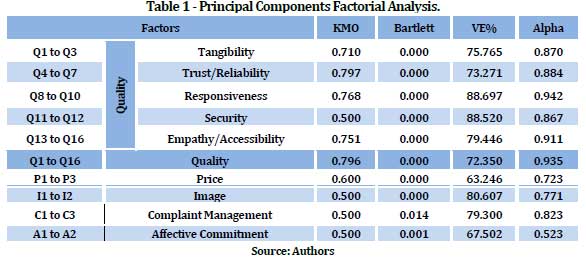
For this study, and according to Table 1 (Principal Components Factorial Analysis), the factors of tangibility, trust, responsiveness and empathy present a KMO between 0.7 and 0.8 demonstrating an average correlation between the variables, and consequently an adequate factorial analysis. Price is a factor with a reasonable factorial analysis, while security, image, customer service and affective commitment display a bad factorial analysis.
When Barlett’s test is associated to a significance level of 0.000, it leads to rejection of the hypothesis that the correlation matrix of the population is the identity, showing that it is adequate for the application of this technique.
When examining the variance percentage explained by factor, it appears that the linear combination formed by the first factor – tangibility – explains 75.77% of the total variance. Confidence explains 73.27% and responsiveness 88.70%. Security and empathy explain 88.52% and 79.45% respectively. The price factor explains 63.24%, image explains 80.61%, customer service explains 79.3% and affective commitment explains 67.50% of the total variance.
]]> On the other hand, the Cronbach’s alpha ranges from 0 and 1, and it is one of the most used measurements to verify the internal consistency of a group of variables. It is considered that internal consistency is: (1) very good for an alpha between 1 and 0.9; (2) good when the alpha is between 0.8 and 0.9, (3) reasonable for an alpha between 0.7 and 0.8; (4) weak when the alpha is between 0.6 and 0.7 and (5) unacceptable when the alpha is lower than 0.6.By analysing the internal consistency of the factors which determine tourist satisfaction with and loyalty to São Miguel hotels, we found that responsiveness and empathy have a satisfactory internal consistency, while tangibility, confidence, security and customer service have a good internal consistency. Price and image have a reasonable internal consistency. Only affective commitment has an unacceptable internal consistency.
After the creation of a connection diagram developed in the AMOS module of the SPSS program –including all the quality measurements (Q1 to Q16) into only one factor – we can confirm through Table 1 that the values from the tests improve. Therefore, the quality factor presents a KMO of 0.796, representing an average correlation between the variables and consequently a satisfactory factorial analysis. Barlett’s test has associated a significance level of 0.000, meaning that it accepts the model with 99% of reliability and an error of 1%. This factor even explains 72.35% of the total variance and has a satisfactory internal consistency (α =0.935).
Following these analyses we proceed to estimate a structural equations model to test our framework and test the hypotheses. When using the technique of structural equations, the Norwegian model needs to be adjusted both from a structural and a measurement point of view. The structural model considers the adaptation of the data to the model (Hair Jr., Anderson, Tatham & Black, 1998).
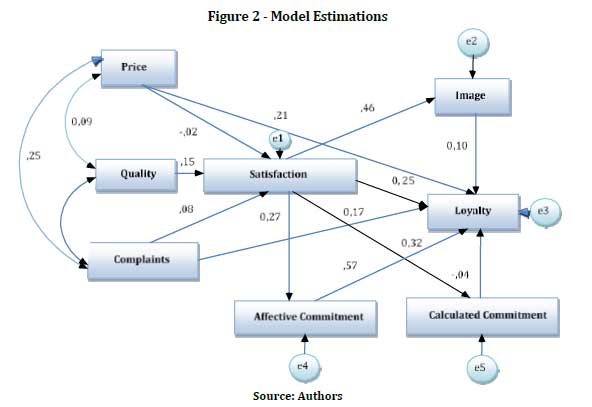
Figure 2 (Model Estimations) presents the summary of the results found through analysis of the relationship of preceding variables of tourist satisfaction with and loyalty to São Miguel hotels.
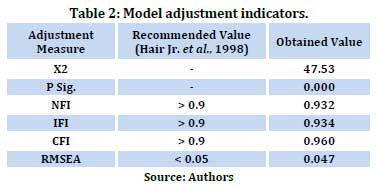
Taking into account the existence of missing values because the questionnaire allowed for a sample with asymptotic distribution, we resorted to the adjustment indexes identified in Table 2 (Model adjustment indicators).
]]> The low value of the chi-square is a sign of good adherence of the data to the model. The same conclusion can be inferred by the Root Mean Square Error of Approximation (RMSEA), which presents a value below the acceptable range for this indicator.
Analysis also confirmed that the statistical test had to reject the null hypothesis of equality between the covariance matrixes of the collected data as simulated in the proposed model (p-value equal to zero).
Therefore, absolute adjustment did not occur. The incremental indexes present values above 0.9 (NFI=0.932) which is recommended by Hair Jr. et al. (1998). The other main incremental adjustment indexes (IFI and CFI) came quite close to the cut-off of 0.90.
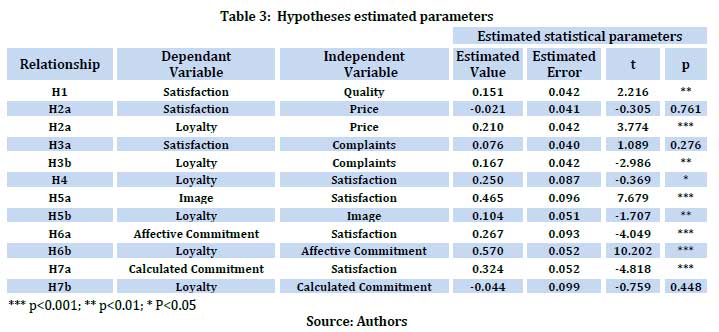
An initial analysis of the model from the perspective of satisfaction antecedents led us to observe that quality is the factor with greatest impact on satisfaction in the studied sample (b=0.151). Hypothesis 1 stands as verified in Table 3 (Hypotheses Estimated parameters). Such a finding is in accordance with the results of Fornell et al. (1996), who empirically confirmed that satisfaction is more influenced by quality than price or expectations. In this sense, organizations in this area of business must invest their efforts primarily in increasing the quality of their services in order to satisfy guests.
At the same time, Hypothesis 2a states that price influences tourist satisfaction. However, this hypothesis was rejected (β =-0.021; t = -0.305, p = 0.7610). This result was similarly found in some studies of economic sectors by Fornell et al. (1996). Additionally, the hypothesis claiming that price influences loyalty in a positive manner, Hypothesis 2b, was supported (β =0.210; t =3.774, p =***).
Hypothesis 3a was rejected according to the values given by parameters (β = 0.076; t =1.089; p =0.276), but Hypothesis 3b was supported. This means that customer service does not have a positive effect on satisfaction (β =0.076, t =1.089, p =0.276).
However, customer service was regarded as having a positive effect on loyalty (β =0.167, t =-2.986, p =**). Therefore, good management of customer service means that after departing, tourists will return to the same hotel. This result agrees with the study by Johnson et al. (2001), who concluded that tourists making complaints who are familiar with the organization will take care of problems by attempting to solve them in the best possible manner which benefits the organization.
An initial analysis of the model from the perspective of satisfaction antecedents led us to observe that quality is the factor with greatest impact on satisfaction in the studied sample (b=0.151). Hypothesis 1 stands as verified in Table 3 (Hypotheses Estimated parameters). Such a finding is in accordance with the results of Fornell et al. (1996), who empirically confirmed that satisfaction is more influenced by quality than price or expectations. In this sense, organizations in this area of business must invest their efforts primarily in increasing the quality of their services in order to satisfy guests.
At the same time, Hypothesis 2a states that price influences tourist satisfaction. However, this hypothesis was rejected (β =-0.021; t = -0.305, p = 0.7610). This result was similarly found in some studies of economic sectors by Fornell et al. (1996). Additionally, the hypothesis claiming that price influences loyalty in a positive manner, Hypothesis 2b, was supported (β =0.210; t =3.774, p =***).
Hypothesis 3a was rejected according to the values given by parameters (β = 0.076; t =1.089; p =0.276), but Hypothesis 3b was supported. This means that customer service does not have a positive effect on satisfaction (β =0.076, t =1.089, p =0.276).
]]> However, customer service was regarded as having a positive effect on loyalty (β =0.167, t =-2.986, p =**). Therefore, good management of customer service means that after departing, tourists will return to the same hotel. This result agrees with the study by Johnson et al. (2001), who concluded that tourists making complaints who are familiar with the organization will take care of problems by attempting to solve them in the best possible manner which benefits the organization.Hypothesis 4 assumes that guest satisfaction has a positive influence on customer loyalty. In fact, this relation is supported by the parameters β =0.250; t = 0.369 and p = *. The results demonstrate the importance to hotels of investing their efforts in guest satisfaction.
Hypothesis 5a – the company’s image has a positive influence on tourist satisfaction – was supported. In the same manner, the hypothesis that image influences tourist loyalty (Hypothesis 5b) was also supported. Image is strongly related to tangible and behavioural attributes, which are connected to the company’s name, variety of products and services offered, ideology, and quality transmitted to the guests.
Hypotheses 6a to 7b analyse commitment. Table 3 shows that satisfaction influences affective commitment (primarily emotional) by the studied parameters, namely β =0.267, t =-4.049, p =***, with the latter influencing loyalty (β =0.570, t =10.202, p =***). On the other hand, tourist satisfaction has a positive effect on calculated behaviour (primarily rational) (β =0.324, t =-4.818, p =***). However, the final hypothesis, 7b, was rejected since the relationship between the factors of calculated commitment and loyalty have the following values for the parameters β =-0.044 t =-0.759 p =0.448.
5. Discussion and conclusions
The present study deals with the theme of satisfaction, more precisely the quality of services provided by São Miguel hotels and implications for satisfaction and loyalty of tourists. The island of São Miguel, with its strong, rich cultural identity and natural heritage is capable of becoming a great tourist attraction, as shown in the opinions expressed in the questionnaire used.
The present study applied the Norwegian model of satisfaction index to tourists who stayed at São Miguel hotels. The purpose was to evaluate satisfaction and loyalty of the tourists regarding their stay at the hotels. This study confirmed that a large part of tourists who visited São Miguel were Portuguese, between 31 and 50 years of age. The majority were accompanied by a group of adults or spouses spending a few days on vacation, staying less than a week at the hotels.
A technique of structural equations was used and the results revealed that the Norwegian model partially confirms its applicability in the São Miguel hotel business. Of the 12 relationship specified, 10 confirmed their relationship, with the exception of price which has no effect on satisfaction and calculated commitment which has no influence on guest loyalty. A possible explanation for the first case is that the price differences for accommodations in São Miguel are minimal. The second case is explained by the fact guests remained loyal to the same hotel because of the costs and benefits associated with their departure.
The results found in this study are consistent with the studies by Fornell (1992) and Johnson et al. (2001), since customer loyalty is not solely based on satisfaction. There are other factors influencing it which were confirmed in this study. Given the model formulated, the research methodology and the results presented, the objectives defined prior to this study were achieved. However, other factors could have been added to the model and improved the variability of the explanation in both satisfaction and loyalty of tourists.
]]> The problems inherent in consumer satisfaction are difficult for managers, especially in the hotel sector where performance of hotel units is required for strategic success. Within this context, having satisfied guests must be the primary objective. The questionnaire used during this study enables hotel units to make specific quality analyses according to the perception of their guests. These analyses can be made individually or by several units within a hotel chain. To that end, the results obtained in this study can be readily applied by managers of these units.Striving constantly for guest satisfaction and loyalty can make it possible for the hotel business to sustain itself in today’s fiercely competitive market. The search for quality in hotel services is the search for a new way of handling the market. This study concludes that quality has the greatest impact on tourist satisfaction and that affective commitment has the greatest influence on tourist loyalty. In this sense, the organizations in this branch of services must turn their efforts primarily to boosting the quality of their services to satisfy their guests.
Providing quality service must be considered an essential strategy for the success and survival of any company – and represents a challenge to the managers. Therefore, by recognizing the quality factors influencing tourist satisfaction and the reasons underlying their choice of hotels – as assessed by guests – will allow managers to draw conclusions, providing indicators of how to generate added value to their units and allowing them to tailor their services to the specific needs of each guest.
Any empirical study of this kind has limitations, whether in the methodology that was followed or in the way the field research was conducted. In terms of methodology, there arose an immediate need to select factors able to explain general satisfaction.
Although we could have incorporated a greater number of explanatory variables, this would have made the questionnaire longer, and respondents might have declined to complete it. Therefore, we decided based on the literature review to reduce that aspect to eight attributes that are generally accepted as relevant to evaluating quality of service and consequently explaining tourist satisfaction and loyalty. At the same time, it would be ideal if the data were collected over a greater length of time to reduce the possible influence of seasonality. However, restrictions imposed by the hotel units dictated that the field work could not exceed five months.
Another limitation results from the fact the study was done on only one island; therefore, the samples considered do not allow a generalization to the other islands in the archipelago even though some of the hotels under study have units on those islands. These limitations do not detract from the importance of this study. Instead this study provides fundamental information to validate the NCSB model and presents data on how hotel managers can improve their performance.
Based on these results, future research should be developed with the Norwegian model proposed by Johnson et al. (2001) on the other Azores islands in order to arrive at a greater understanding of the factors that are the most influential in tourist satisfaction and loyalty. The collection of data from this study was carried out during the off season for the hotel business; therefore, it is recommended that future studies be done during the holiday seasons since tourists travelling during other seasons may have different opinions.
It is worth highlighting that the variables of the model used in this work should be viewed as a reference. Therefore, it is recommended that further studies follow this model of existing factors, in addition to developing others that may be a part of the working system of each company while improving quality by making guest satisfaction and loyalty a reality.
Another suggestion is to broaden the scope of the study to new forms of hotel management which already have a significant demand, such as tourism in rural areas and health and beauty resorts. Finally, this study contributes to the national index of models that have evolved which seek to monitor constant changes in the provision of organizational services. Consequently, it is indispensable to carry out new studies in an effort to expand and evaluate these services, improving on existing models of customer satisfaction and loyalty.
]]> References
Baptista, M. (2003). Turismo - Gestão estratégica. Lisboa: Editorial Verbo. [ Links ]
Becker, H. S. (1960). Notes on the concept of commitment. The American Journal of Sociology, 66(1), 32-40. [ Links ]
Bloemer, J. & Ruyter, K. (1998). On the relationship between store image, store satisfaction and store loyalty. European Journal of Marketing, 32(5/6), 499-513. [ Links ]
Boulding, K., Kalra, A., Staelin R. & Zeithaml, V. A. (1993). A dynamic process model of service quality: From expectations to behavioral intentions. Journal of Marketing Research, 30(1), 7-27. [ Links ]
Cronin, J. J. & Taylor, S. A. (1992). Measuring service quality: A re-examination and extension. Journal of Marketing, 56(3), 55-68. [ Links ]
Fernandes, P. O. & Correia, L. F. (2013). Atitudes do consumidor em relação às práticas do marketing em Portugal. Tourism & Management Studies, 9(2), 86-92. [ Links ]
Fornell, C. (1992). A national customer satisfaction barometer: The Swedish experience. Journal of Marketing, 56(1), 6-21. [ Links ]
Fornell, C., Johnson, M. D., Anderson, E. W., Cha, J. & Bryant, B. E. (1996). The American customer satisfaction index: Nature, purpose, and findings. Journal of Marketing, 60(4), 7-18. [ Links ]
Hair Jr., J. F., Anderson, R., Tatham, R. & Black, W. C. (1998). Multivariate Data Analysis (5th Ed.). Upper Saddle River: Prentice Hall. [ Links ]
Henry, C. D. (2000). Is customer loyalty a pernicious myth?. Business Horizons, 43(4), 13-16. [ Links ]
Hill, M. M., Hill, A. (2005). Investigação por questionário (2.ª Ed.). Lisboa: Edições Sílabo. [ Links ]
Johnson, M. D., Gustafsson, A., Andreassen, T. W., Lervik, L. & Cha, J. (2001). The evolution and future of national customer satisfaction index models. Journal of Economic Psychology, 22(2), 217-245. [ Links ]
Kotler, P. (2003). Marketing management (11th Ed.). Upper Saddle River: Pearson Education International. [ Links ]
Müller, M., Rauski, E. F., Eyng, I. S. & Moreira, J. (2005). Comprometimento organizacional: Um estudo de caso no supermercado “Beta”. Revista Gestão Industrial 1(4), 93-100. [ Links ]
Nguyen, N. & Leblanc, G. (2001). Corporate image and corporate reputation in customers’ retention decisions in services. Journal of Retailing and Consumer Services, 8(4), 227-236. [ Links ]
Oliver, R. L. (1997). Satisfaction: A behavioral perspective on the consumer. New York: Irwin/McGraw-Hill. [ Links ]
Ostrowski, P. L., O’Brien, T. V. & Gordon, G. L. (1993). Service quality and customer loyalty in the commercial airline industry. Journal of Travel Research, 32(2), 16-24. [ Links ]
Parasuraman, A., Zeithaml, V. A. & Berry, L. L. (1988). SERVQUAL: A multiple-item scale for measuring consumer perceptions of service quality. Journal of Retailing, 64(1), 12-37. [ Links ]
Pestana, J. & Gageiro, M. (2000). A análise de dados para Ciências Sociais. A complementaridade do SPSS. Lisboa: Edições Sílabo. [ Links ]
Pinto, S. (2008). Empresas de hotelaria: Uma análise económica e financeira (Master dissertation, ISCTE Business School, 2008). Lisboa: ISCTE. [ Links ]
Pritchard, M. P. & Howard D. R. (1997). The loyal traveler: Examining a typology of service patronage. Journal of Travel Research, 35(4), 2-10. [ Links ]
Woodside, A. G. & Lysonski S. (1989). A general model of traveler destination choice. Journal of Travel Research, 27(4), 8-14. [ Links ]
Zeithaml, V. A., Berry, L. L. & Parasuraman, A. (1996). The behavioral consequences of service quality. Journal of Marketing, 60(2), 31-46. [ Links ]
Article history:
]]> Submitted: 15 June, 2013Accepted: 25 November 2013
]]>