<?xml version="1.0" encoding="ISO-8859-1"?><article xmlns:mml="http://www.w3.org/1998/Math/MathML" xmlns:xlink="http://www.w3.org/1999/xlink" xmlns:xsi="http://www.w3.org/2001/XMLSchema-instance">
<front>
<journal-meta>
<journal-id>2182-8458</journal-id>
<journal-title><![CDATA[Tourism & Management Studies]]></journal-title>
<abbrev-journal-title><![CDATA[TMStudies]]></abbrev-journal-title>
<issn>2182-8458</issn>
<publisher>
<publisher-name><![CDATA[Escola Superior de Gestão, Hotelaria e Turismo da Universidade do Algarve]]></publisher-name>
</publisher>
</journal-meta>
<article-meta>
<article-id>S2182-84582014000100004</article-id>
<title-group>
<article-title xml:lang="en"><![CDATA[Performance evaluation methods in the hotel industry]]></article-title>
<article-title xml:lang="pt"><![CDATA[Os métodos de avaliação de desempenho na hotelaria]]></article-title>
</title-group>
<contrib-group>
<contrib contrib-type="author">
<name>
<surname><![CDATA[Nunes]]></surname>
<given-names><![CDATA[Catarina Rosa]]></given-names>
</name>
<xref ref-type="aff" rid="A01"/>
<xref ref-type="aff" rid="A02"/>
</contrib>
<contrib contrib-type="author">
<name>
<surname><![CDATA[Machado]]></surname>
<given-names><![CDATA[Maria João Cardoso Vieira]]></given-names>
</name>
<xref ref-type="aff" rid="A03"/>
<xref ref-type="aff" rid="A02"/>
</contrib>
</contrib-group>
<aff id="A01">
<institution><![CDATA[,Escola Superior de Hotelaria e Turismo do Estoril Management Department ]]></institution>
<addr-line><![CDATA[ ]]></addr-line>
</aff>
<aff id="A02">
<institution><![CDATA[,Instituto Superior de Ciências do Trabalho e da Empresa-Instituto Universitário de Lisboa Business Research Unit ]]></institution>
<addr-line><![CDATA[ ]]></addr-line>
</aff>
<aff id="A03">
<institution><![CDATA[,Instituto Superior de Ciências do Trabalho e da Empresa-Instituto Universitário de Lisboa Accounting Department ]]></institution>
<addr-line><![CDATA[Lisboa ]]></addr-line>
<country>Portugal</country>
</aff>
<pub-date pub-type="pub">
<day>31</day>
<month>01</month>
<year>2014</year>
</pub-date>
<pub-date pub-type="epub">
<day>31</day>
<month>01</month>
<year>2014</year>
</pub-date>
<volume>10</volume>
<numero>1</numero>
<fpage>24</fpage>
<lpage>30</lpage>
<copyright-statement/>
<copyright-year/>
<self-uri xlink:href="http://scielo.pt/scielo.php?script=sci_arttext&amp;pid=S2182-84582014000100004&amp;lng=en&amp;nrm=iso"></self-uri><self-uri xlink:href="http://scielo.pt/scielo.php?script=sci_abstract&amp;pid=S2182-84582014000100004&amp;lng=en&amp;nrm=iso"></self-uri><self-uri xlink:href="http://scielo.pt/scielo.php?script=sci_pdf&amp;pid=S2182-84582014000100004&amp;lng=en&amp;nrm=iso"></self-uri><abstract abstract-type="short" xml:lang="en"><p><![CDATA[This paper aims to contribute to increasing knowledge of performance evaluation methods used by the hotel industry, analysing whether there is a link between hotel characteristics and evaluation methods used. To achieve this goal we conducted surveys and interviews with financial officers of 275 four and five star hotels located in Portugal. The results support the conclusion that there is a link between hotel characteristics and performance evaluation methods used.]]></p></abstract>
<abstract abstract-type="short" xml:lang="pt"><p><![CDATA[O presente trabalho tem como objetivo contribuir para o conhecimento sobre os métodos de avaliação de desempenho utilizados pelo sector hoteleiro, analisando se existe associação entre as características dos hotéis e os métodos utilizados. Para atingir este objetivo foram realizados inquéritos e entrevistas aos responsáveis financeiros de 275 hotéis de 4 e 5 estrelas localizados em Portugal. Os resultados obtidos permitem concluir que existem associações entre as características dos hotéis e os métodos de avaliação de desempenho utilizados.]]></p></abstract>
<kwd-group>
<kwd lng="en"><![CDATA[Performance evaluation]]></kwd>
<kwd lng="en"><![CDATA[hotel industry]]></kwd>
<kwd lng="en"><![CDATA[management accounting]]></kwd>
<kwd lng="en"><![CDATA[Tableau de Bord]]></kwd>
<kwd lng="en"><![CDATA[Balanced Scorecard]]></kwd>
<kwd lng="pt"><![CDATA[Avaliação de desempenho]]></kwd>
<kwd lng="pt"><![CDATA[hotelaria]]></kwd>
<kwd lng="pt"><![CDATA[contabilidade de gestão]]></kwd>
<kwd lng="pt"><![CDATA[Tableau de Bord]]></kwd>
<kwd lng="pt"><![CDATA[Balanced Scorecard]]></kwd>
</kwd-group>
</article-meta>
</front><body><![CDATA[ <p align="right"><font size="2" face="Verdana"><b>TOURISM - SCIENTIFIC PAPERS</b></font></p>  <font face="Verdana" size="2">     <p>&nbsp;</p></font> <font face="Verdana" size="4">    <p><b>Performance evaluation methods in the hotel industry</b></p></font> <font face="Verdana" size="3">    <p>&nbsp;</p>     <p><b>Os métodos de avaliação de desempenho na hotelaria</b></p> </font> <font face="Verdana" size="2">    <p>&nbsp;</p>     <p>&nbsp;</p>     <p><b>Catarina     Rosa Nunes<sup>I</sup>; Maria João Cardoso Vieira   Machado<sup>II</sup></b></p> <sup>I</sup>Escola Superior de Hotelaria e Turismo do   Estoril, Management Department, Researcher for UNIDE-IUL, Avenida Condes de   Barcelona 808, 2769-510 Estoril, Portugal,     <a href="mailto:catarina.nunes@eshte.pt">catarina.nunes@eshte.pt</a>    <br>     <sup>II</sup>Instituto Universitário de Lisboa (ISCTE-IUL), Accounting Department, Researcher for UNIDE-IUL, 1649-026 Lisboa, Portugal, <a href="mailto:mjcvm@iscte.pt">mjcvm@iscte.pt</a>     <p>&nbsp;</p>     ]]></body>
<body><![CDATA[<p>&nbsp;</p> <hr size="1" noshade>     <p><b>ABSTRACT </b></p>     <p>This     paper aims to contribute to increasing knowledge of performance evaluation     methods used by the hotel industry, analysing whether there is a link between     hotel characteristics and evaluation methods used. To achieve this goal we     conducted surveys and interviews with financial officers of 275 four and five     star hotels located in Portugal. The results support the conclusion that there     is a link between hotel characteristics and performance evaluation methods     used.</p>     <p><b>Keywords:</b> Performance evaluation, hotel industry, management accounting, Tableau     de Bord, Balanced Scorecard.</p> <hr size="1" noshade>       <p><b>RESUMO</b></p>     <p>O     presente trabalho tem como objetivo contribuir para o conhecimento sobre os     métodos de avaliação de desempenho utilizados pelo sector hoteleiro, analisando     se existe associação entre as características dos hotéis e os métodos     utilizados. Para atingir este objetivo foram realizados inquéritos e     entrevistas aos responsáveis financeiros de 275 hotéis de 4 e 5 estrelas     localizados em Portugal. Os resultados obtidos permitem concluir que existem associações     entre as características dos hotéis e os métodos de avaliação de desempenho     utilizados.</p>       <p><b>Palavras-chave:</b> Avaliação de desempenho; hotelaria; contabilidade de     gestão; <i>Tableau de Bord</i> e <i>Balanced Scorecard</i></p>   <hr size="1" noshade>       <p>&nbsp;</p>       <p>&nbsp;</p></font>   <font face="Verdana" size="3">    <p><b>1.   Introduction</b></p></font> <font face="Verdana" size="2">    ]]></body>
<body><![CDATA[<p>The overall objective of this     study is to contribute to increasing knowledge of performance evaluation     methods used by the hotel industry. As specific goals we can state the     following: a) identify the performance evaluation methods most used by hotels,     and b) analyse the link between hotel characteristics and the performance     evaluation methods they use.</p>       <p>To study whether organizations     use performance evaluation methods considered in theoretical discussions to be     the most suitable continues to be a focus of researchers (Albright, Burgess,     Hibbets &amp; Roberts, 2010; Butler, Henderson &amp; Rainborn, 2011; Cardinaels     &amp; Veen-Dirks, 2010; Cokins, 2010; Herath, Bremser &amp; Birnberg, 2010; Kraus &amp; Lind, 2010; Neumann,     Roberts &amp; Cauvin, 2010; Northcott &amp; Smith, 2011; Sundin, Granlund &amp; Brown, 2010; Tayler,     2010; Vila, Costa &amp; Rovira, 2010). Several authors state that it is     important to analyse the link between management accounting methods used and     the characteristics of the companies, namely, their dimension (Chenhall, 2003;     Haldma &amp; Lääts, 2002; Joshi, 2001; Innes, Mitchell &amp; Sinclair, 2000;     Abdel-Kader &amp; Luther, 2008; Cadez &amp; Guilding, 2008; Woods, 2009),     ownership of their capital (Ghosh &amp; Chan, 1997; Clarke, Hill &amp; Stevens,     1999; Haldma &amp; Lääts, 2002), and their legal form (Machado, 2011).</p>       <p>This study’s universe consists of the four and five     star hotels located in Portugal. A single questionnaire was designed and&nbsp;applied&nbsp;via two different     methods: interviews and surveys. The surveys were administered through the     SURVS platform. We obtained the collaboration of 275 hotels which corresponds     to a response rate of 58%.</p>       <p>&nbsp;</p></font>   <font face="Verdana" size="3">    <p><b>2.   Literature     review</b></p></font>   <font face="Verdana" size="2">    <p>In this review the various performance evaluation     methods available will be considered, with an emphasis on the Tableau de Bord     (TB) and the Balanced Scorecard (BSC).</p>       <p>The Tableau de Bord concept arose in the 50s (Pezet,     2009) from within the bosom of the French industry, with the objective of     improving production performance through a deeper understanding of production     systems and processes. Subsequently, the managers of several companies used     this method so that they could gain a global and periodical perspective on     their business in a clear and succinct way and using a range of indicators,     which allowed them to make more conscious decisions (Gray &amp; Pesqueux, 1993;     Epstein &amp; Manzoni, 1997; Epstein &amp; Manzoni, 1998). Some decades later,     the TB model underwent some changes to include non-financial indicators, again     in an attempt to meet the needs of managers (Travaille &amp; Marsal, 2007;     Quesado, Guzmán &amp; Rodrigues,     2012).</p>       <p>The main distinguishing factor between the TB and the     BSC is the fact that in the TB the indicators are not related or connected     between them, not providing a view of the company as a whole or including its     goals and strategy, as the BSC allows (Quesado <i>et al</i>., 2012).</p>       <p>The BSC was first introduced in     the 90s (Kaplan &amp; Norton, 1992) as a method of performance evaluation that     combines financial and non-financial indicators (Budde, 2007; Dilla &amp;     Steinbart, 2005; Ittner, Larcker     &amp; Meyer, 2003; Johanson, Skoog, Backlund &amp; Almqvist, 2006; Kaplan,     1994; Kaplan &amp; Norton, 1993; Kaplan, Norton &amp; Bjarne, 2010; Lipe &amp;     Salterio, 2000; Pandey, 2005; Roberts, Albright &amp; Hibbets, 2004; Banker &amp; Mashruwala, 2007; Corona, 2009;     Luft, 2009; Martin &amp; Petty, 2000), thereby responding to the various     criticisms of previously existing methods (Corona, 2009; Geer, Tuijl &amp;     Rutte, 2009). Later the BSC was restructured and presented by its authors not     only as a method of performance evaluation but also as a strategy management     model (Kaplan &amp; Norton, 1996a, 1996b, 1996c, 1996d). In the following     decade, Kaplan and Norton (2001a, 2001b, 2001c) showed the importance of     motivation and the participation of all employees to the method’s success.</p>       <p>According to several authors (Sainaghi, 2010; Anderson, Fish, Xia &amp; Michello, 1999; Chen, 2009),     any company’s ability to stay in the current market is directly linked to the     results it obtains. The methods presented above help managers to improve their     strategies for better performance (Chen, 2009; Bol, 2011). These methods began     to be developed in industrial sectors and only subsequently in service sectors     (Chen, 2007; Evans, 2005; Pan, 2005), with a definitely reduced amount of     research on this topic specifically on the hotel industry (Sainaghi, 2010). In     recent decades, performance evaluation has been examined in this industry due     to the fact that several authors have noted the particular characteristics of     the hotel industry, such as seasonality (Mia     &amp; Patiar, 2001; Winata &amp; Mia, 2005),     increase in competitiveness and strong sector growth (Collier &amp; Gregory,     1995; Ezzamel, 1990; Borodako, 2011; Martínez-Lópes &amp;     Vargas-Sánchez, 2013). According to Faria, Trigueiros and     Ferreira (2012), there is in Portugal much potential for research in this area     because there is still much information that remains unexplored in all     industries.</p>       ]]></body>
<body><![CDATA[<p>Several authors state that the     characteristics of a company influence the management accounting methods used     (Machado, 2011). Of these characteristics, dimension, capital ownership and     legal form stand out. Company dimension has been studied by Chenhall (2003),     Haldma and Lääts (2002), Joshi (2001), Innes, Mitchell and Sinclair (2000),     Abdel-Kader and Luther (2008), Cadez and Guilding (2008), Woods (2009), these     authors having concluded that larger companies use more sophisticated     management accounting methods. Capital ownership is a contingent variable     studied by Ghosh and Chan (1997), Clarke <i>et     al</i>. (1999) and Haldma and Lääts (2002), these authors having, however,     obtained contradictory results. Whereas in the first two papers the authors     conclude that there are more sophisticated methods of management accounting in     multinational subsidiaries when compared to regional companies, Haldma and     Lääts (2002) found no association between the two variables in Estonian     companies. The legal form was analysed by Machado (2011) in small and     medium-sized Portuguese industrial companies with no association between     management accounting methods used by companies and their legal form.</p>       <p>&nbsp;</p></font>   <font face="Verdana" size="3">    <p><b>3.   Methodology</b></p></font>   <font face="Verdana" size="2">    <p>Based on the above literature review, the     following study question was defined: is there a link between performance     evaluation methods and the characteristics of four and five star hotels in Portugal?</p>       <p>This study question was formulated after a     pilot test in hotels within the Lisbon district, using a convenience sample     which allowed us to conclude that lower category hotels (from three to one     star) did not use performance evaluation methods, except for those belonging to     large hotel chains or groups where those same groups also included four and/or     five star hotels. From this, the universe of this study was defined: four and     five star hotels located in Portugal.</p>       <p>Since the data required to perform this     study are not published nor available for consultation, it became necessary to     choose a method for data collection. Aiming at the triangulation of     information, two data collection methods were used: interviews and surveys     administered to the hotels’ financial officers. For geographical reasons, the     interviews were conducted in hotels located in Lisbon and its metropolitan     area, while the surveys were conducted over the internet in the rest of the     country. Before sending the link or the survey in a digital format, telephone     calls were made to explain the importance of the answers for the study and to     motivate the officers to complete the survey.</p>       <p>Using information obtained from the     Portuguese Tourism Board, all 478 hotels with four or five stars located in     Portugal were contacted, and the collaboration of 275 hotels was obtained,     representing a response rate of 58%, much higher than what was obtained in     other studies previously conducted in Portugal (Machado, 2013), and in other     countries (Joshi, 2001; Haldma &amp; Lääts, 2002) with response rates of 36%,     24% and 34% respectively. Although the response rate is higher than that of     similar studies, according to Siegel and Castellan (1988) whenever non-response     exceeds 20%, an involuntary bias may occur in the results, which makes tests     for bias caused by non-response relevant. Young, Wim     and Chen (2005) point out three types of analysis that should be     conducted to check the existence or not of bias caused by non-response:     analysis of bias caused by the sample’s geographic coverage, analysis of bias     caused by the different industries being studied, and finally analysis of bias     caused by the dimension of the companies being studied.</p>       <p>Regarding bias caused     by the industry, this problem does not arise in this study due to the fact that     all the hotels belong to the same industry, thus ruling out the possibility of     this type of distortion.</p>       <p>Regarding the analysis of bias caused by geographical coverage, if we compare the geographical     distribution of the universe of hotels with the geographical distribution of     the respondents, we conclude that there is no district with a response rate     under 50% or above 75%. There is therefore a balanced geographical distribution     of the responding hotels in relation to the total universe of study.</p>       <p>Regarding bias caused     by the dimension of the companies in the study, a Student’s <i>t</i>-test for equal averages regarding the     variable number of bedrooms was performed, this variable being described in the     results section. This test does not require a normality assumption regarding     the variable being studied for samples exceeding thirty cases (Siegel &amp;     Castellan, 1988) and has as null hypothesis equality between the average of     hotels cooperating with the study and the average of hotels that did not     cooperate with the study. An alternative hypothesis is the difference between     the average of hotels cooperating with the study and the average of hotels that     did not cooperate with the study. The <i>t</i>-test     applied assumes equality of variances, and was analysed using the Levene test.     This test shows a <i>p</i>-value of 0.169     which leads to the non-rejection of the null hypothesis for equal variances     thus validating the Student’s <i>t</i>-test.     The resulting <i>t</i>-test shows a value of     1.035 for 38 degrees of freedom, with a <i>p</i>-value     of 0.307, which leads to the decision of non-rejection of the null hypothesis     for equal averages. In terms of the analysis of the three types of bias     possible, we can conclude that based on the facts above there is no scientific     evidence that any bias was caused by non-response in this study.</p>       ]]></body>
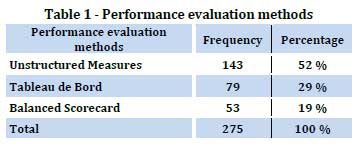
<body><![CDATA[<p>&nbsp;</p></font>   <font face="Verdana" size="3">    <p><b>4.   Results</b></p></font>   <font face="Verdana" size="2">    <p>To fulfil the purpose of this     study – analysing the influence of hotel characteristics on the evaluation     methods hotels use – it was necessary to create variable performance evaluation     methods, including three response categories: unstructured measures (UM),     Tableau de Bord (TB), and Balanced Scorecard (BSC). These response categories     were defined after the data collection allowed us to conclude that all the     hotels surveyed use simultaneously financial and non-financial measures to     assess their performance. How these measures are structured is what differs in     each case. In the first category (UM) were included all the hotels with a     random array of financial and non-financial indicators unintegrated into an     organised and consistent structure of performance evaluation. In the TB     category were classified all the hotels with a framework of indicators, both     financial and non-financial, organised according to the principles underlying     the Tableau de Bord described in the literature review, namely, the absence of     a relationship between the indicators and the strategic goals of the hotel. In     the BSC category were placed all the hotels with a framework of indicators,     both financial and non-financial, organised according to the perspectives of     the BSC described in the literature review, and linked with strategic goals.</p>       <p>The analysis of <a href="#t1">Table 1</a> shows that most of the hotels     surveyed (52%) uses only one set of unstructured measures as a performance     evaluation method. The second most used method is the TB, in 29% of hotels,     followed by the BSC which is used by 19% of the respondents.</p>       <p><a name="t1"></a></p>       <p>&nbsp;</p>       <p align="center"><img src="/img/revistas/tms/v10n1/10n1a04t1.jpg" width="359" height="146"></p>       
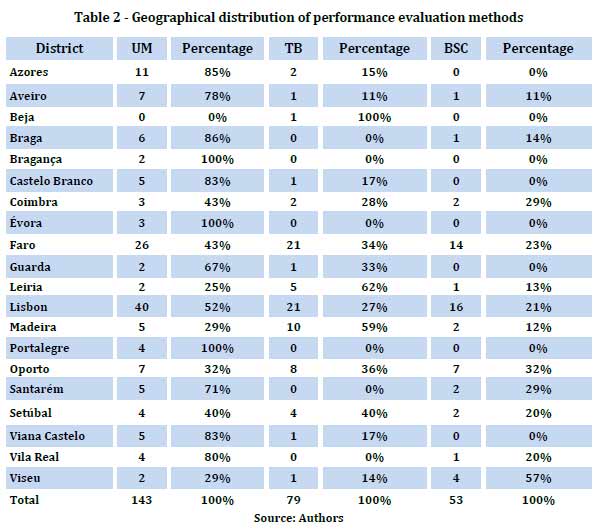
<p>&nbsp;</p>       <p>The     analysis in <a href="/img/revistas/tms/v10n1/10n1a04t2.jpg">Table 2</a> shows that in the majority of districts the method most     used of performance evaluation was the UM, with the exception of the districts     of Beja, Leiria, Madeira, Oporto and Viseu. In the first three districts     mentioned, most hotels use the TB. In the district of Oporto, although the TB     is the most used method, the percentage difference to unstructured measures is     only about 5%. The district of Viseu is the only one in which most hotels use     the BSC.</p>       
<p>After the variable performance evaluation methods are     defined, the five variables reflecting the characteristics of the hotels are     analysed, namely, legal form, accounting type, dimension, belonging to a hotel     chain, and capital ownership.</p>       ]]></body>
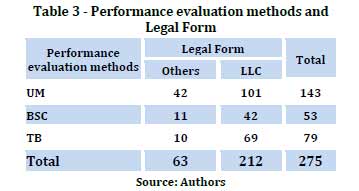
<body><![CDATA[<p>Regarding the first variable,     legal form, the data collected show that 212 hotels (77%) are limited liability     companies (LLC), the remaining being placed under the legal form we named     “Others”. The link between variable performance evaluation methods and legal     form is presented in <a href="#t3">Table 3</a>, which allows us to conclude that the majority of     hotels using the BSC and the TB are limited liability companies, with 42 out of     53 hotels using the BSC and 69 out of 79 hotels using the TB.</p>       <p><a name="t3"></a></p>       <p>&nbsp;</p>       <p align="center"><img src="/img/revistas/tms/v10n1/10n1a04t3.jpg" width="359" height="191"></p>       
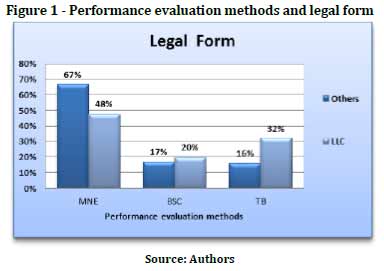
<p>&nbsp;</p>       <p><b>Legal Form</b></p>       <p><a href="#f1">Figure 1</a> shows a clear link between the use of more     complex and sophisticated performance evaluation methods and the legal form of     LLC. The majority (67%) of hotels with other legal forms use unstructured     measures of performance evaluation, while most hotels that are LLC (52%) use     the BSC or the TB.</p>       <p><a name="f1"></a></p>       <p>&nbsp;</p>       <p align="center"><img src="/img/revistas/tms/v10n1/10n1a04f1.jpg" width="384" height="271"></p>       
]]></body>
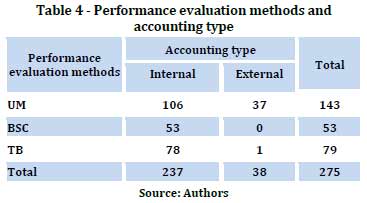
<body><![CDATA[<p align="center">&nbsp;</p>       <p>With these findings, it became important to verify the     existence, or not, of a statistically proven link. For this purpose the Pearson     Chi-Squared test was applied, and a score of 8.220 was obtained for two degrees     of freedom, with a <i>p-value</i> of 0.016,     which allows us to reject the null hypothesis of independence between the     variables and accept the hypothesis of a link between the performance     evaluation methods used by hotels and their legal form, admitting an error of     5%. This conclusion contradicts what was reported by Machado (2011), who found     no link between management accounting methods used by Portuguese small and     medium-sized industrial companies and their legal form.</p>       <p>The second characteristic studied – type of accounting     – was divided into two response categories. In the first were included hotels     where accounting is handled internally by hotel employees or by employees of a     business group in which the hotel is integrated. In the second category were     included hotels where accounting is handled by an entity not belonging to the     hotel or to the hotel group in which the hotel is integrated. The analysis of     <a href="#t4">Table 4</a> shows that 237 hotels (86%) handle their accounting internally and only     38 hotels (14%) rely on external entities to handle their accounting. One of     the most striking data in <a href="#t4">Table 4</a> is the fact that none of the hotels with     external accounting use the BSC as a performance evaluation method and only one     uses the TB.</p>       <p><a name="t4"></a></p>       <p>&nbsp;</p>       <p align="center"><img src="/img/revistas/tms/v10n1/10n1a04t4.jpg" width="367" height="203"></p> </font>     
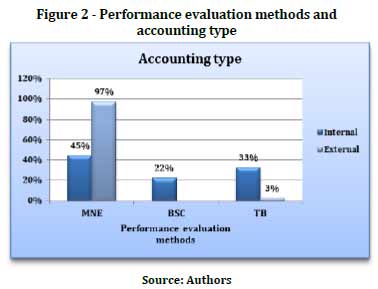
<p><font face="Verdana" size="2">In <a href="#f2">Figure 2</a> we can see a clear contrast between the performance   evaluation methods used by the two categories of hotels. The majority (97%) of   the hotels with external accounting use only unstructured measures of   performance evaluation, while the majority (55%) of the hotels with internal   accounting use the BSC or the TB.  </font></p>     <p><a name="f2"></a></p>     <p>&nbsp;</p> <font face="Verdana" size="2">     <p align="center"><img src="/img/revistas/tms/v10n1/10n1a04f2.jpg" width="378" height="289"></p>     
]]></body>
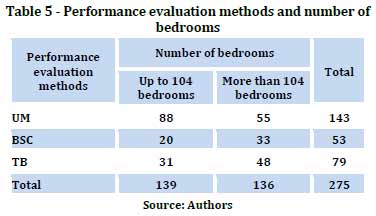
<body><![CDATA[<p align="center">&nbsp;</p>     <p>Although the figure is quite explicit, we cannot     perform the Pearson Chi-Squared test, because the data do not meet one of the     assumptions of the test (Siegel &amp; Castellan, 1988) since one of the     expected frequencies has a value less than 1.</p>     <p>Regarding the third hotel characteristic, dimension,     it was first necessary to choose the most appropriate variable by which to     measure it. Reviewed studies from other industries use as company dimension     measures sales volume (Haldma &amp; Lääts, 2002)     and the number of employees (Chenhall, 2003; Machado, 2011; Machado, 2013).     However, while gathering information for this study, we found that in the specific     case of the hotel industry these criteria do not reflect in most cases the     actual dimension of the hotel. In many hotels, the employees performing tasks     related to bedroom cleaning, kitchen chores and catering and bar services, as     well as the entertainment services and recreational activities offered by     several hotels, are hired as services rendered by firms not belonging to the     hotel or are recruited from temporary employment agencies during the periods of     higher demand for the hotel. For this reason, it seems more appropriate and     reliable in the case of the hotel industry to use the number of bedrooms and     not the number of employees as the dimension variable.</p>     <p>The data collected regarding the variable number of     bedrooms allow the conclusion that the hotels surveyed have between a minimum     of 7 and a maximum of 577 bedrooms, the average dimension being of 133 bedrooms     while half the hotels have between 7 and 104 bedrooms. As the number of     bedrooms is a continuous variable, it was divided into two groups identifying     the smaller and larger hotels. The splitting of a continuous variable into two     categories, one with the lowest values &#8203;&#8203;and one with the highest     values, &#8203;&#8203;can be done using a sturdy statistic like the median     (Hill &amp; Hill, 2002; Machado, 2011). This procedure was applied to the     variable number of bedrooms (<a href="#t5">Table 5</a>), whereby we obtained two response     categories: the first includes the smaller hotels which have up to 104     bedrooms, and the second includes the largest hotels with more than 104 bedrooms.</p>     <p><a name="t5"></a></p>     <p>&nbsp;</p>     <p align="center"><img src="/img/revistas/tms/v10n1/10n1a04t5.jpg" width="376" height="216"></p>     
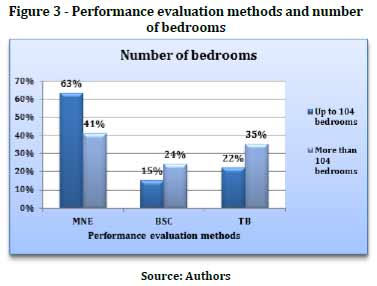
<p>&nbsp;</p>     <p>The analysis in <a href="#t5">Table 5</a> shows that 88 (63%) of the     smaller hotels use unstructured measures to evaluate their performance, whereas     the 136 larger hotels use mostly the TB or the BSC, which together add up to     60% of the observations. Looking at <a href="#f3">Figure 3</a>, we can see that the majority     (63%) of the smaller hotels use unstructured measures as a performance     evaluation method, followed by the TB in 22% of the cases and the BSC in 15% of     the hotels. Regarding the larger hotels, there is less     heterogeneity&#8203;&#8203;, with the unstructured measures still being the     most used method, but representing only 41% of cases, followed very closely by     the TB (used by 35% of the hotels), and the BSC which is used by 24% of the     hotels.</p>     <p><a name="f3"></a></p>     ]]></body>
<body><![CDATA[<p>&nbsp;</p>     <p align="center"><img src="/img/revistas/tms/v10n1/10n1a04f3.jpg" width="377" height="286"></p>     
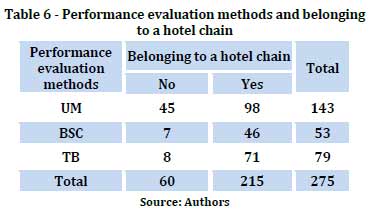
<p align="center">&nbsp;</p>     <p>These results suggest that larger hotels use more     complex performance evaluation methods, which makes it relevant to see whether     there is a link between these two variables. Application of the Pearson Chi-Squared     test resulted in a value of 14.43, for two degrees of freedom, with a <i>p-value</i> of 0.001, which allows us to     reject the null hypothesis of independence between variables and accept the     hypothesis of the existence of a relationship between the variable performance     evaluation methods and dimension. These results allow us to generalise to the     hotel industry what has already been reported by Chenhall (2003) and Machado     (2011) for the manufacturing industry: larger companies use more sophisticated     management accounting techniques.</p>     <p>The fourth hotel characteristic studied is belonging     to a hotel chain. The analysis of <a href="#t6">Table 6</a> shows that 215 of the hotels surveyed     (78%) belong to a chain. Of the 60 hotels that do not belong to a chain, 45 use     unstructured measures to evaluate their performance.</p>     <p><a name="t6"></a></p>     <p>&nbsp;</p>     <p align="center"><img src="/img/revistas/tms/v10n1/10n1a04t6.jpg" width="369" height="209"></p> </font>     
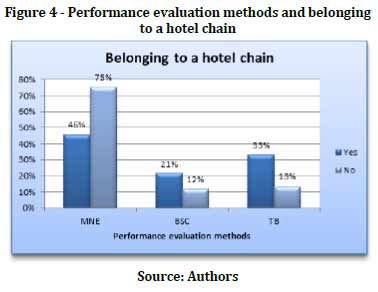
<p>&nbsp;</p>     <p><font face="Verdana" size="2">Looking at <a href="#f4">Figure 4</a> we can conclude that 75% of the   hotels surveyed, those which do not belong to a chain, use unstructured   measures as a performance evaluation method, while only 46% of hotels belonging   to a chain use this method. The majority (54%) of hotels belonging to a hotel   chain use the BSC (33%) or the TB (21%).  </font></p>     ]]></body>
<body><![CDATA[<p><a name="f4"></a></p>     <p>&nbsp;</p> <font face="Verdana" size="2"></font>     <p align="center"><font size="2" face="Verdana"><img src="/img/revistas/tms/v10n1/10n1a04f4.jpg" width="378" height="292"></font></p>     
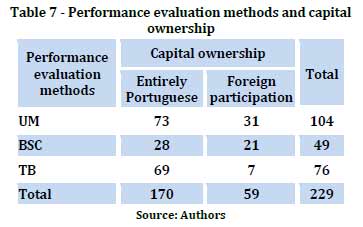
<p align="center">&nbsp;</p>     <p><font size="2" face="Verdana">The results obtained allow the conclusion that hotels   belonging to a hotel chain, tend to use more complex methods of performance   evaluation, which makes it relevant to check the existence of a statistically   proven link between performance evaluation methods and belonging or not to a   hotel chain by the surveyed hotel. For this we used the Pearson Chi-Squared   test, obtaining a result of 16.44, for two degrees of freedom and a <i>p-value</i> of 0.000, which allows us to   reject the null hypothesis of independence between variables and accept the   hypothesis of the existence of a relationship between the performance   evaluation methods used by the hotels and whether they belong or not to a hotel   chain.</font></p> <font face="Verdana" size="2">     <p>The fifth characteristic studied is the hotels’   capital ownership measured by the percentage of foreign capital, as suggested   by Ghosh and Chan (1997), Clarke <i>et al.</i> (1999), Haldma and Lääts (2002), and Machado (2011, 2013). Of the 275     respondent hotels, only 229 provided a valid response to the question regarding     the percentage of foreign capital in the total share capital of the hotel. The     responses obtained were grouped into two categories: entirely Portuguese, for     all the hotels owned 100% by Portuguese entities; and foreign participation,     for all the cases where part of the capital is held by foreign entities. The     analysis in <a href="#t7">Table 7</a> shows that for 170 hotels (74%) the capital is 100%     Portuguese, and only 59 hotels (26%) have a foreign participation in their     capital.</p>     <p><a name="t7"></a></p>     <p>&nbsp;</p>     <p align="center"><img src="/img/revistas/tms/v10n1/10n1a04t7.jpg" width="363" height="227"></p>     
<p align="center">&nbsp;</p> </font>     ]]></body>
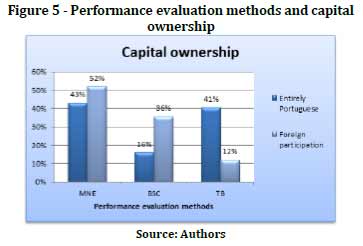
<body><![CDATA[<p><font face="Verdana" size="2">The analysis in <a href="#f5">Figure 5</a> allows the conclusion that   the most significant difference between the performance evaluation methods used   and capital ownership occurs in the use of the TB and the BSC. Hotels with   foreign participation in their capital use proportionally more the BSC (36%)   and less the TB (12%) than hotels with entirely Portuguese capital, of which   16% use the BSC and 41% the TB. </font></p>     <p><a name="f5"></a></p>     <p>&nbsp;</p> <font face="Verdana" size="2"></font>     <p align="center"><font size="2" face="Verdana"><img src="/img/revistas/tms/v10n1/10n1a04f5.jpg" width="363" height="246"></font></p>     
<p>&nbsp;</p>     <p><font size="2" face="Verdana">From these results we can conclude that hotels with   foreign participation in their capital tend to use more complex methods of   performance evaluation when compared to hotels entirely owned by national   capital. These findings make it relevant to verify the existence of a link   between the performance evaluation methods and the capital ownership of the   hotels. For this purpose the Pearson Chi-Squared test was applied with a result   of 19.26, for two degrees of freedom with a <i>p-value</i> of 0.000, which allows us to reject the null hypothesis of independence between   variables and accept the hypothesis of the existence of a relationship between   the performance evaluation methods used by hotels and the fact that the capital   is fully owned by Portuguese shareholders or has foreign participation. These   results allow the generalisation to the hotel industry of the findings of Ghosh   and Chan (1997), Clarke <i>et al.</i> (1999), and Machado (2011) – obtained while studying other industries – which   state that management accounting methods are more sophisticated in subsidiaries   of multinationals than in local companies.</font></p> <font face="Verdana" size="2">     <p>&nbsp;</p></font> <font face="Verdana" size="3">    <p><b>5.   Conclusion</b></p></font> <font face="Verdana" size="2">    <p>This study had two specific goals: to identify the     methods of performance evaluation used by the hotel industry and to analyse the     link between hotel characteristics and the performance evaluation methods     hotels use.</p>     <p>Regarding the first goal, the results obtained allow     the conclusion that the most frequently used performance evaluation method are     unstructured measures and that the least frequently used method is the BSC.     Regarding the second goal, the data collected allow us to conclude that there     is a link between the performance evaluation methods used and some hotel     characteristics, namely, legal form; dimension – measured by the number of     bedrooms; belonging to a hotel chain; and capital ownership.</p>     ]]></body>
<body><![CDATA[<p>A main limitation of this study     is possibly one of the methods used for collecting the data, the interviews,     may influence respondents' answers, and also that surveys conducted over the     internet do not allow a full understanding of the questions posed.</p>     <p>However, this study contributes to the knowledge of     performance evaluation in three ways. As a contribution to business practice,     the results show that, unlike what has been reported by the empirical studies     reviewed, the BSC is very seldom used in Portugal in the hotel industry. This     result should be a warning to managers since the methods of performance     evaluation used by hotels are not considered the most appropriate in     theoretical discussions. This study also offers two contributions to the     discussion of theory. Firstly, the results obtained fill a gap in understanding     because the empirical data show, for the first time, the existence of a     relationship between the legal form of a company and the methods used to     evaluate its performance. Secondly, the study suggests the use of a new     variable to measure company dimension in the hotel industry – number of     bedrooms – for which we found a statistically significant link with methods     used to evaluate performance.</p>     <p>The evidence gathered suggests the need for further     research with the goal of detecting causes behind the fact that most hotels do     not use performance evaluation methods considered more suitable in theoretical     discussions.</p>     <p>&nbsp;</p></font> <font face="Verdana" size="3">    <p><b>References</b></p></font> <font face="Verdana" size="2">    <!-- ref --><p>Abdel-Kader, M. &amp; Luther, R. (2008).     The impact of firm characteristics on management accounting practices: A     UK-based empirical analysis. <i>The British Accounting Review,</i> <i>40</i>(1), 2-27.    &nbsp;&nbsp;&nbsp;&nbsp;&nbsp;&nbsp;&nbsp;&nbsp;[&#160;<a href="javascript:void(0);" onclick="javascript: window.open('/scielo.php?script=sci_nlinks&ref=000118&pid=S2182-8458201400010000400001&lng=','','width=640,height=500,resizable=yes,scrollbars=1,menubar=yes,');">Links</a>&#160;]<!-- end-ref --> </p>     <!-- ref --><p>Albright, T., Burgess, C. M., Hibbets, A. R. &amp;   Roberts, M. L. (2010). Four steps to simplify multimeasure performance   evaluations using the balanced scorecard. <i>The     Journal of Corporate Accounting &amp; Finance</i>, <i>21</i>(5), 63-68<i>.    &nbsp;&nbsp;&nbsp;&nbsp;&nbsp;&nbsp;&nbsp;&nbsp;[&#160;<a href="javascript:void(0);" onclick="javascript: window.open('/scielo.php?script=sci_nlinks&ref=000120&pid=S2182-8458201400010000400002&lng=','','width=640,height=500,resizable=yes,scrollbars=1,menubar=yes,');">Links</a>&#160;]<!-- end-ref --></i></p>     <!-- ref --><p>Anderson, R.I., Fish, M., Xia, Y. &amp;   Michello, F. (1999). Measuring efficiency in the hotel industry: A stochastic   frontier approach. <i>International Journal     of Hospitality Management</i>, <i>18</i>(1),     45-57.    &nbsp;&nbsp;&nbsp;&nbsp;&nbsp;&nbsp;&nbsp;&nbsp;[&#160;<a href="javascript:void(0);" onclick="javascript: window.open('/scielo.php?script=sci_nlinks&ref=000122&pid=S2182-8458201400010000400003&lng=','','width=640,height=500,resizable=yes,scrollbars=1,menubar=yes,');">Links</a>&#160;]<!-- end-ref --></p>     <!-- ref --><p>Banker, R. D. &amp; Mashruwala, R. (2007). The     moderating role of competition in the relationship between nonfinancial measures     and future financial performance. <i>Contemporary     Accounting Research</i>, <i>24</i>(3),     763-793.    &nbsp;&nbsp;&nbsp;&nbsp;&nbsp;&nbsp;&nbsp;&nbsp;[&#160;<a href="javascript:void(0);" onclick="javascript: window.open('/scielo.php?script=sci_nlinks&ref=000124&pid=S2182-8458201400010000400004&lng=','','width=640,height=500,resizable=yes,scrollbars=1,menubar=yes,');">Links</a>&#160;]<!-- end-ref --></p>     <!-- ref --><p>Bol, J. (2011). The determinants and     Performance effects of managers’ performance evaluation biases. <i>The     Accounting Review</i>, <i>86</i>(5), 1549-1575.    &nbsp;&nbsp;&nbsp;&nbsp;&nbsp;&nbsp;&nbsp;&nbsp;[&#160;<a href="javascript:void(0);" onclick="javascript: window.open('/scielo.php?script=sci_nlinks&ref=000126&pid=S2182-8458201400010000400005&lng=','','width=640,height=500,resizable=yes,scrollbars=1,menubar=yes,');">Links</a>&#160;]<!-- end-ref --></p>     <!-- ref --><p>Borodako, K. (2011). Cooperation of small and     medium-sized tourism enterprises (SMTES) with tourism stakeholders in the     ma&#322;opolska region – top management perspective approach. <i>Tourism &amp; Management Studies</i>, 7,     24-32.    &nbsp;&nbsp;&nbsp;&nbsp;&nbsp;&nbsp;&nbsp;&nbsp;[&#160;<a href="javascript:void(0);" onclick="javascript: window.open('/scielo.php?script=sci_nlinks&ref=000128&pid=S2182-8458201400010000400006&lng=','','width=640,height=500,resizable=yes,scrollbars=1,menubar=yes,');">Links</a>&#160;]<!-- end-ref --></p>     <!-- ref --><p>Budde, J. (2007). Performance measure congruity and     the balanced scorecard. <i>Journal of     Accounting Research</i>, <i>45</i>(3),     515-539.    &nbsp;&nbsp;&nbsp;&nbsp;&nbsp;&nbsp;&nbsp;&nbsp;[&#160;<a href="javascript:void(0);" onclick="javascript: window.open('/scielo.php?script=sci_nlinks&ref=000130&pid=S2182-8458201400010000400007&lng=','','width=640,height=500,resizable=yes,scrollbars=1,menubar=yes,');">Links</a>&#160;]<!-- end-ref --></p>     <!-- ref --><p>Butler, J., Henderson, S. C. &amp; Rainborn, C.     (2011). Sustainability and the balanced scorecard: integrating green measures     into business reporting. <i>Management     Accounting Quarterly</i>, <i>12</i>(2),     2-11.    &nbsp;&nbsp;&nbsp;&nbsp;&nbsp;&nbsp;&nbsp;&nbsp;[&#160;<a href="javascript:void(0);" onclick="javascript: window.open('/scielo.php?script=sci_nlinks&ref=000132&pid=S2182-8458201400010000400008&lng=','','width=640,height=500,resizable=yes,scrollbars=1,menubar=yes,');">Links</a>&#160;]<!-- end-ref --></p>     <!-- ref --><p>Cadez, S. &amp; Guilding, C. (2008). An exploratory     investigation of an integrated contingency model of strategic management     accounting. <i>Accounting, Organizations and Society,</i> <i>33</i>(7), 836-863.    &nbsp;&nbsp;&nbsp;&nbsp;&nbsp;&nbsp;&nbsp;&nbsp;[&#160;<a href="javascript:void(0);" onclick="javascript: window.open('/scielo.php?script=sci_nlinks&ref=000134&pid=S2182-8458201400010000400009&lng=','','width=640,height=500,resizable=yes,scrollbars=1,menubar=yes,');">Links</a>&#160;]<!-- end-ref --></p>     <!-- ref --><p>Cardinaels, E. &amp; Veen-Dirks, P. M. G. (2010).     Financial versus non-financial information: the impact of information     organization and presentation in a balanced scorecard. <i>Accounting, Organizations and Society</i>, <i>35</i>(6), 565-578.    &nbsp;&nbsp;&nbsp;&nbsp;&nbsp;&nbsp;&nbsp;&nbsp;[&#160;<a href="javascript:void(0);" onclick="javascript: window.open('/scielo.php?script=sci_nlinks&ref=000136&pid=S2182-8458201400010000400010&lng=','','width=640,height=500,resizable=yes,scrollbars=1,menubar=yes,');">Links</a>&#160;]<!-- end-ref --></p>     <!-- ref --><p>Chen, C. F. (2007). Applying the stochastic frontier     approach to measure hotel managerial efficiency in Taiwan. <i>Tourism Management</i>, <i>28</i>(3),     696-702.    &nbsp;&nbsp;&nbsp;&nbsp;&nbsp;&nbsp;&nbsp;&nbsp;[&#160;<a href="javascript:void(0);" onclick="javascript: window.open('/scielo.php?script=sci_nlinks&ref=000138&pid=S2182-8458201400010000400011&lng=','','width=640,height=500,resizable=yes,scrollbars=1,menubar=yes,');">Links</a>&#160;]<!-- end-ref --></p>     <!-- ref --><p>Chen, T.-H. (2009). Performance     measurement of an enterprise and business units with an application to a     Taiwanese hotel chain. <i>International Journal of Hospitality Management</i>, <i>28</i>(3),     415-422.    &nbsp;&nbsp;&nbsp;&nbsp;&nbsp;&nbsp;&nbsp;&nbsp;[&#160;<a href="javascript:void(0);" onclick="javascript: window.open('/scielo.php?script=sci_nlinks&ref=000140&pid=S2182-8458201400010000400012&lng=','','width=640,height=500,resizable=yes,scrollbars=1,menubar=yes,');">Links</a>&#160;]<!-- end-ref --> </p>     <!-- ref --><p>Chenhall, R. H. (2003). Management control     systems design within its organizational context: findings from     contingency-based research and directions for the future. <i>Accounting, Organizations and Society</i>, <i>28</i>(2), 127-168.    &nbsp;&nbsp;&nbsp;&nbsp;&nbsp;&nbsp;&nbsp;&nbsp;[&#160;<a href="javascript:void(0);" onclick="javascript: window.open('/scielo.php?script=sci_nlinks&ref=000142&pid=S2182-8458201400010000400013&lng=','','width=640,height=500,resizable=yes,scrollbars=1,menubar=yes,');">Links</a>&#160;]<!-- end-ref --></p>     <!-- ref --><p>Clarke, P. J., Hill, N. T. &amp; Stevens,     K. (1999). Activity-Based Costing in Ireland: Barriers to, and opportunities     for change. <i>Critical Perspectives on Accounting</i>, <i>10</i>(4), 443-468.    &nbsp;&nbsp;&nbsp;&nbsp;&nbsp;&nbsp;&nbsp;&nbsp;[&#160;<a href="javascript:void(0);" onclick="javascript: window.open('/scielo.php?script=sci_nlinks&ref=000144&pid=S2182-8458201400010000400014&lng=','','width=640,height=500,resizable=yes,scrollbars=1,menubar=yes,');">Links</a>&#160;]<!-- end-ref --></p>     <!-- ref --><p>Cokins, G. (2010). The promise and perils of the     balanced scorecard. <i>The Journal of     Corporate Accounting &amp; Finance</i>, <i>21</i>(3),     19-28<i>.    &nbsp;&nbsp;&nbsp;&nbsp;&nbsp;&nbsp;&nbsp;&nbsp;[&#160;<a href="javascript:void(0);" onclick="javascript: window.open('/scielo.php?script=sci_nlinks&ref=000146&pid=S2182-8458201400010000400015&lng=','','width=640,height=500,resizable=yes,scrollbars=1,menubar=yes,');">Links</a>&#160;]<!-- end-ref --></i></p>     <!-- ref --><p>Collier, P. &amp; Gregory, A. (1995). <i>Management Accounting in Hotel Groups.</i> London: CIMA.    &nbsp;&nbsp;&nbsp;&nbsp;&nbsp;&nbsp;&nbsp;&nbsp;[&#160;<a href="javascript:void(0);" onclick="javascript: window.open('/scielo.php?script=sci_nlinks&ref=000148&pid=S2182-8458201400010000400016&lng=','','width=640,height=500,resizable=yes,scrollbars=1,menubar=yes,');">Links</a>&#160;]<!-- end-ref --></p>     <!-- ref --><p>Corona, C. (2009). Dynamic performance measurement     with intangible assets. <i>Review Accounting     Studies</i>, <i>14</i>(2-3), 314-348.    &nbsp;&nbsp;&nbsp;&nbsp;&nbsp;&nbsp;&nbsp;&nbsp;[&#160;<a href="javascript:void(0);" onclick="javascript: window.open('/scielo.php?script=sci_nlinks&ref=000150&pid=S2182-8458201400010000400017&lng=','','width=640,height=500,resizable=yes,scrollbars=1,menubar=yes,');">Links</a>&#160;]<!-- end-ref --></p>     <!-- ref --><p>Dilla, W. N. &amp; Steinbart, P. J. (2005). Relative     weighting of common and unique balanced scorecard measures by knowledgeable     decision makers. <i>Behavioural Research in     Accounting</i>, <i>17</i>(1), 43-53.    &nbsp;&nbsp;&nbsp;&nbsp;&nbsp;&nbsp;&nbsp;&nbsp;[&#160;<a href="javascript:void(0);" onclick="javascript: window.open('/scielo.php?script=sci_nlinks&ref=000152&pid=S2182-8458201400010000400018&lng=','','width=640,height=500,resizable=yes,scrollbars=1,menubar=yes,');">Links</a>&#160;]<!-- end-ref --> </p>     <!-- ref --><p>Epstein, M. &amp; Manzoni, J. (1997). The balanced scorecard and tableau     de bord: translating strategy into action. <i>Strategic Finance</i>, <i>79</i>(2), 28-36.    &nbsp;&nbsp;&nbsp;&nbsp;&nbsp;&nbsp;&nbsp;&nbsp;[&#160;<a href="javascript:void(0);" onclick="javascript: window.open('/scielo.php?script=sci_nlinks&ref=000154&pid=S2182-8458201400010000400019&lng=','','width=640,height=500,resizable=yes,scrollbars=1,menubar=yes,');">Links</a>&#160;]<!-- end-ref --></p>     <!-- ref --><p>Epstein, M. &amp; Manzoni, J. (1998).     Implementing corporate strategy: from tableaux de board to balanced scorecards. <i>European     Management Journal</i>, <i>16</i>(2),     190-204.    &nbsp;&nbsp;&nbsp;&nbsp;&nbsp;&nbsp;&nbsp;&nbsp;[&#160;<a href="javascript:void(0);" onclick="javascript: window.open('/scielo.php?script=sci_nlinks&ref=000156&pid=S2182-8458201400010000400020&lng=','','width=640,height=500,resizable=yes,scrollbars=1,menubar=yes,');">Links</a>&#160;]<!-- end-ref --> </p>     <!-- ref --><p>Evans, N. (2005). A resource-based view of outsourcing     and its implications for organizational performance in the hotel sector. <i>Tourism Management</i>, <i>26</i>(5), 707-21.    &nbsp;&nbsp;&nbsp;&nbsp;&nbsp;&nbsp;&nbsp;&nbsp;[&#160;<a href="javascript:void(0);" onclick="javascript: window.open('/scielo.php?script=sci_nlinks&ref=000158&pid=S2182-8458201400010000400021&lng=','','width=640,height=500,resizable=yes,scrollbars=1,menubar=yes,');">Links</a>&#160;]<!-- end-ref --> </p>     <!-- ref --><p>Ezzamel, M., (1990). The impact of     environmental uncertainty, managerial autonomy and size on budget     characteristics. <i>Management Accounting Research</i>, <i>1</i>(3), 181-197.    &nbsp;&nbsp;&nbsp;&nbsp;&nbsp;&nbsp;&nbsp;&nbsp;[&#160;<a href="javascript:void(0);" onclick="javascript: window.open('/scielo.php?script=sci_nlinks&ref=000160&pid=S2182-8458201400010000400022&lng=','','width=640,height=500,resizable=yes,scrollbars=1,menubar=yes,');">Links</a>&#160;]<!-- end-ref --></p>     <!-- ref --><p>Faria, A. R., Trigueiros, D. &amp; Ferreira, L.     (2012). Práticas de custeio e controlo de gestão     no sector hoteleiro do algarve. <i>Tourism &amp; Management     Studies</i>, 8, 100-107.    &nbsp;&nbsp;&nbsp;&nbsp;&nbsp;&nbsp;&nbsp;&nbsp;[&#160;<a href="javascript:void(0);" onclick="javascript: window.open('/scielo.php?script=sci_nlinks&ref=000162&pid=S2182-8458201400010000400023&lng=','','width=640,height=500,resizable=yes,scrollbars=1,menubar=yes,');">Links</a>&#160;]<!-- end-ref --></p>     <!-- ref --><p>Geer, E. V., Tuijl, H. F. J. M. &amp; Rutte, C. G.     (2009). Performance management in healthcare: performance indicator     development, task uncertainty, and types of performance indicators. <i>Social Science &amp; Medicine</i>, <i>69</i>(10), 1523–1530.    &nbsp;&nbsp;&nbsp;&nbsp;&nbsp;&nbsp;&nbsp;&nbsp;[&#160;<a href="javascript:void(0);" onclick="javascript: window.open('/scielo.php?script=sci_nlinks&ref=000164&pid=S2182-8458201400010000400024&lng=','','width=640,height=500,resizable=yes,scrollbars=1,menubar=yes,');">Links</a>&#160;]<!-- end-ref --></p>     <!-- ref --><p>Ghosh, B. C. &amp; Chan, Y. (1997). Management     accounting in Singapore &#8209; well in place? <i>Managerial Auditing Journal</i>, <i>12</i>(1), 16-18.    &nbsp;&nbsp;&nbsp;&nbsp;&nbsp;&nbsp;&nbsp;&nbsp;[&#160;<a href="javascript:void(0);" onclick="javascript: window.open('/scielo.php?script=sci_nlinks&ref=000166&pid=S2182-8458201400010000400025&lng=','','width=640,height=500,resizable=yes,scrollbars=1,menubar=yes,');">Links</a>&#160;]<!-- end-ref --></p>     <!-- ref --><p>Gray, J. &amp; Pesqueux, Y. (1993). Evolutions     actuelles des systemes de tableau de bord. Comparaison des pratiques de quelques     multinationales americaines et françaises. <i>Revue Française de Comptabilité</i>,     242, 61-70.    &nbsp;&nbsp;&nbsp;&nbsp;&nbsp;&nbsp;&nbsp;&nbsp;[&#160;<a href="javascript:void(0);" onclick="javascript: window.open('/scielo.php?script=sci_nlinks&ref=000168&pid=S2182-8458201400010000400026&lng=','','width=640,height=500,resizable=yes,scrollbars=1,menubar=yes,');">Links</a>&#160;]<!-- end-ref --></p>     <!-- ref --><p>Haldma, T. &amp; Lääts, K. (2002). Contingencies     influencing the management accounting practices of Estonian manufacturing     companies. <i>Management Accounting Research</i>, <i>13</i>(4), 379-400.    &nbsp;&nbsp;&nbsp;&nbsp;&nbsp;&nbsp;&nbsp;&nbsp;[&#160;<a href="javascript:void(0);" onclick="javascript: window.open('/scielo.php?script=sci_nlinks&ref=000170&pid=S2182-8458201400010000400027&lng=','','width=640,height=500,resizable=yes,scrollbars=1,menubar=yes,');">Links</a>&#160;]<!-- end-ref --></p>     <!-- ref --><p>Herath, H. S. B., Bremser, W. G. &amp; Birnberg, J. G.     (2010). Joint selection of balanced scorecard targets and weights in a     collaborative setting. <i>Journal of     Accounting and Public Policy</i>, <i>29</i>(1),     45-59.    &nbsp;&nbsp;&nbsp;&nbsp;&nbsp;&nbsp;&nbsp;&nbsp;[&#160;<a href="javascript:void(0);" onclick="javascript: window.open('/scielo.php?script=sci_nlinks&ref=000172&pid=S2182-8458201400010000400028&lng=','','width=640,height=500,resizable=yes,scrollbars=1,menubar=yes,');">Links</a>&#160;]<!-- end-ref --></p>     <!-- ref --><p>Hill, M., &amp; Hill, A. (2002). <i>Investigação por questionário</i>. Lisboa: Edições Sílabo.    &nbsp;&nbsp;&nbsp;&nbsp;&nbsp;&nbsp;&nbsp;&nbsp;[&#160;<a href="javascript:void(0);" onclick="javascript: window.open('/scielo.php?script=sci_nlinks&ref=000174&pid=S2182-8458201400010000400029&lng=','','width=640,height=500,resizable=yes,scrollbars=1,menubar=yes,');">Links</a>&#160;]<!-- end-ref --></p>     <!-- ref --><p>Innes, J., Mitchell, F. &amp; Sinclair, D. (2000).     Activity-based costing in the U.K.’s largest companies: a comparison of 1994     and 1999 survey results. <i>Management     Accounting Research</i>, <i>11</i>(3),     349-362.    &nbsp;&nbsp;&nbsp;&nbsp;&nbsp;&nbsp;&nbsp;&nbsp;[&#160;<a href="javascript:void(0);" onclick="javascript: window.open('/scielo.php?script=sci_nlinks&ref=000176&pid=S2182-8458201400010000400030&lng=','','width=640,height=500,resizable=yes,scrollbars=1,menubar=yes,');">Links</a>&#160;]<!-- end-ref --></p>     <!-- ref --><p>Ittner C. D., Larcker, D. F. &amp; Meyer, M. W.     (2003). Subjectivity and the weighting of performance measures: evidence from a     balanced scorecard. <i>The Accounting Review</i>, <i>78</i>(3), 725-758.    &nbsp;&nbsp;&nbsp;&nbsp;&nbsp;&nbsp;&nbsp;&nbsp;[&#160;<a href="javascript:void(0);" onclick="javascript: window.open('/scielo.php?script=sci_nlinks&ref=000178&pid=S2182-8458201400010000400031&lng=','','width=640,height=500,resizable=yes,scrollbars=1,menubar=yes,');">Links</a>&#160;]<!-- end-ref --></p>     <!-- ref --><p>Johanson, U., Skoog, M., Backlund, A. &amp; Almqvist,     R. (2006). Balancing dilemmas of the balanced scorecard. <i>Accounting, Auditing &amp; Accountability Journal</i>, <i>19</i>(6), 842-857.    &nbsp;&nbsp;&nbsp;&nbsp;&nbsp;&nbsp;&nbsp;&nbsp;[&#160;<a href="javascript:void(0);" onclick="javascript: window.open('/scielo.php?script=sci_nlinks&ref=000180&pid=S2182-8458201400010000400032&lng=','','width=640,height=500,resizable=yes,scrollbars=1,menubar=yes,');">Links</a>&#160;]<!-- end-ref --></p>     <!-- ref --><p>Joshi, P. L. (2001). The international diffusion of     new management accounting practices: The case of India. <i>Journal of     International Accounting Auditing and Taxation</i>, <i>10</i>(1), 85-109.    &nbsp;&nbsp;&nbsp;&nbsp;&nbsp;&nbsp;&nbsp;&nbsp;[&#160;<a href="javascript:void(0);" onclick="javascript: window.open('/scielo.php?script=sci_nlinks&ref=000182&pid=S2182-8458201400010000400033&lng=','','width=640,height=500,resizable=yes,scrollbars=1,menubar=yes,');">Links</a>&#160;]<!-- end-ref --></p>     <!-- ref --><p>Kaplan, R. S. (1994). Devising a balanced scorecard     matched to business strategy. <i>Strategy     &amp; Leadership</i>, <i>22</i>(5), 15-48.    &nbsp;&nbsp;&nbsp;&nbsp;&nbsp;&nbsp;&nbsp;&nbsp;[&#160;<a href="javascript:void(0);" onclick="javascript: window.open('/scielo.php?script=sci_nlinks&ref=000184&pid=S2182-8458201400010000400034&lng=','','width=640,height=500,resizable=yes,scrollbars=1,menubar=yes,');">Links</a>&#160;]<!-- end-ref --></p>     <!-- ref --><p>Kaplan, R. S. &amp; Norton, D. P. (1992). The balanced     scorecard: measures that drive performance. <i>Harvard     Business Review</i>, <i>70</i>(1), 71-79.    &nbsp;&nbsp;&nbsp;&nbsp;&nbsp;&nbsp;&nbsp;&nbsp;[&#160;<a href="javascript:void(0);" onclick="javascript: window.open('/scielo.php?script=sci_nlinks&ref=000186&pid=S2182-8458201400010000400035&lng=','','width=640,height=500,resizable=yes,scrollbars=1,menubar=yes,');">Links</a>&#160;]<!-- end-ref --></p>     <!-- ref --><p>Kaplan, R. S. &amp; Norton, D. P. (1993). Putting the     balanced scorecard to work. <i>Harvard     Business Review</i>, <i>71</i>(5), 134-147.    &nbsp;&nbsp;&nbsp;&nbsp;&nbsp;&nbsp;&nbsp;&nbsp;[&#160;<a href="javascript:void(0);" onclick="javascript: window.open('/scielo.php?script=sci_nlinks&ref=000188&pid=S2182-8458201400010000400036&lng=','','width=640,height=500,resizable=yes,scrollbars=1,menubar=yes,');">Links</a>&#160;]<!-- end-ref --></p>     <!-- ref --><p>Kaplan, R. S. &amp; Norton, D.     P.  (1996a). Using the balanced scorecard     as a strategic management system. <i>Harvard     Business Review</i>, <i>74</i>(1), 75-85.    &nbsp;&nbsp;&nbsp;&nbsp;&nbsp;&nbsp;&nbsp;&nbsp;[&#160;<a href="javascript:void(0);" onclick="javascript: window.open('/scielo.php?script=sci_nlinks&ref=000190&pid=S2182-8458201400010000400037&lng=','','width=640,height=500,resizable=yes,scrollbars=1,menubar=yes,');">Links</a>&#160;]<!-- end-ref --></p>     <!-- ref --><p>Kaplan, R. S. &amp; Norton, D. P. (1996b). <i>The balanced scorecard: translating strategy     into action</i>. Boston: Harvard Business School Press.    &nbsp;&nbsp;&nbsp;&nbsp;&nbsp;&nbsp;&nbsp;&nbsp;[&#160;<a href="javascript:void(0);" onclick="javascript: window.open('/scielo.php?script=sci_nlinks&ref=000192&pid=S2182-8458201400010000400038&lng=','','width=640,height=500,resizable=yes,scrollbars=1,menubar=yes,');">Links</a>&#160;]<!-- end-ref --></p>     <!-- ref --><p>Kaplan, R. S. &amp; Norton, D. P. (1996c). Liking de     balanced scorecard to strategy. <i>California     Management Review</i>, <i>39</i>(1), 53-79.    &nbsp;&nbsp;&nbsp;&nbsp;&nbsp;&nbsp;&nbsp;&nbsp;[&#160;<a href="javascript:void(0);" onclick="javascript: window.open('/scielo.php?script=sci_nlinks&ref=000194&pid=S2182-8458201400010000400039&lng=','','width=640,height=500,resizable=yes,scrollbars=1,menubar=yes,');">Links</a>&#160;]<!-- end-ref --></p>     <!-- ref --><p>Kaplan, R. S. &amp; Norton, D. P. (1996d). Strategic     learning &amp; the balanced scorecard. <i>Harvard     Business Review</i>, <i>24</i>(5), 18-24.    &nbsp;&nbsp;&nbsp;&nbsp;&nbsp;&nbsp;&nbsp;&nbsp;[&#160;<a href="javascript:void(0);" onclick="javascript: window.open('/scielo.php?script=sci_nlinks&ref=000196&pid=S2182-8458201400010000400040&lng=','','width=640,height=500,resizable=yes,scrollbars=1,menubar=yes,');">Links</a>&#160;]<!-- end-ref --></p>     <!-- ref --><p>Kaplan,     R. S. &amp; Norton, D. P. (2001a). Leading change with the balanced scorecard. <i>Financial Executive</i>, <i>17</i>(6), 64-66.    &nbsp;&nbsp;&nbsp;&nbsp;&nbsp;&nbsp;&nbsp;&nbsp;[&#160;<a href="javascript:void(0);" onclick="javascript: window.open('/scielo.php?script=sci_nlinks&ref=000198&pid=S2182-8458201400010000400041&lng=','','width=640,height=500,resizable=yes,scrollbars=1,menubar=yes,');">Links</a>&#160;]<!-- end-ref --></p>     <!-- ref --><p>Kaplan, R. S. &amp; Norton, D. P. (2001b).     Transforming the balanced scorecard from performance measurement to strategic     management: part I. <i>Accounting Horizons</i>, <i>15</i>(1), 87-104.    &nbsp;&nbsp;&nbsp;&nbsp;&nbsp;&nbsp;&nbsp;&nbsp;[&#160;<a href="javascript:void(0);" onclick="javascript: window.open('/scielo.php?script=sci_nlinks&ref=000200&pid=S2182-8458201400010000400042&lng=','','width=640,height=500,resizable=yes,scrollbars=1,menubar=yes,');">Links</a>&#160;]<!-- end-ref --></p>     <!-- ref --><p>Kaplan,     R. S. &amp; Norton, D. P. (2001c). Transforming the balanced scorecard from     performance measurement to strategic management: part II. <i>Accounting Horizons</i>, <i>15</i>(2),     147-160.    &nbsp;&nbsp;&nbsp;&nbsp;&nbsp;&nbsp;&nbsp;&nbsp;[&#160;<a href="javascript:void(0);" onclick="javascript: window.open('/scielo.php?script=sci_nlinks&ref=000202&pid=S2182-8458201400010000400043&lng=','','width=640,height=500,resizable=yes,scrollbars=1,menubar=yes,');">Links</a>&#160;]<!-- end-ref --></p>     <!-- ref --><p>Kaplan,     R. S., Norton, D. P. &amp; Bjarne, R. (2010). Managing alliances with the     balanced scorecard. <i>Harvard Business     Review</i>, <i>88</i>(1-2), 114-120.    &nbsp;&nbsp;&nbsp;&nbsp;&nbsp;&nbsp;&nbsp;&nbsp;[&#160;<a href="javascript:void(0);" onclick="javascript: window.open('/scielo.php?script=sci_nlinks&ref=000204&pid=S2182-8458201400010000400044&lng=','','width=640,height=500,resizable=yes,scrollbars=1,menubar=yes,');">Links</a>&#160;]<!-- end-ref --></p>     <!-- ref --><p>Kraus, K. &amp; Lind, J. (2010). The impact of     corporate balanced scorecard on corporate control: a research note. <i>Management Accounting Research</i>, <i>21</i>(4), 265-277.    &nbsp;&nbsp;&nbsp;&nbsp;&nbsp;&nbsp;&nbsp;&nbsp;[&#160;<a href="javascript:void(0);" onclick="javascript: window.open('/scielo.php?script=sci_nlinks&ref=000206&pid=S2182-8458201400010000400045&lng=','','width=640,height=500,resizable=yes,scrollbars=1,menubar=yes,');">Links</a>&#160;]<!-- end-ref --></p>     <!-- ref --><p>Lipe, M. G. &amp; Salterio, S. E. (2000). The balanced scorecard: judgmental effects of common and unique     performance Measures. <i>The Accounting     Review</i>, <i>75</i>(3), 283-298.    &nbsp;&nbsp;&nbsp;&nbsp;&nbsp;&nbsp;&nbsp;&nbsp;[&#160;<a href="javascript:void(0);" onclick="javascript: window.open('/scielo.php?script=sci_nlinks&ref=000208&pid=S2182-8458201400010000400046&lng=','','width=640,height=500,resizable=yes,scrollbars=1,menubar=yes,');">Links</a>&#160;]<!-- end-ref --></p>     <!-- ref --><p>Luft,     J. (2009). Nonfinancial Information and Accounting: A     Reconsideration of Benefits and Challenges. <i>Accounting Horizons</i>, <i>23</i>(3), 307–325.    &nbsp;&nbsp;&nbsp;&nbsp;&nbsp;&nbsp;&nbsp;&nbsp;[&#160;<a href="javascript:void(0);" onclick="javascript: window.open('/scielo.php?script=sci_nlinks&ref=000210&pid=S2182-8458201400010000400047&lng=','','width=640,height=500,resizable=yes,scrollbars=1,menubar=yes,');">Links</a>&#160;]<!-- end-ref --></p>     <!-- ref --><p>Machado, M.     J. (2011). Variáveis contingenciais aos métodos de valoração dos produtos:     estudo empírico em PME’s industriais portuguesas. <i>RBGN</i> - <i>Revista Brasileira de     Gestão de Negócios</i>, <i>13</i>(41),     396-414.    &nbsp;&nbsp;&nbsp;&nbsp;&nbsp;&nbsp;&nbsp;&nbsp;[&#160;<a href="javascript:void(0);" onclick="javascript: window.open('/scielo.php?script=sci_nlinks&ref=000212&pid=S2182-8458201400010000400048&lng=','','width=640,height=500,resizable=yes,scrollbars=1,menubar=yes,');">Links</a>&#160;]<!-- end-ref --></p>     <!-- ref --><p>Machado. M.     J. (2013). Balanced Scorecard: Empirical Study on Small and     Medium Size Enterprises. <i>RBGN</i> – <i>Review of     Business Management, 15</i>(46), 129-148.    &nbsp;&nbsp;&nbsp;&nbsp;&nbsp;&nbsp;&nbsp;&nbsp;[&#160;<a href="javascript:void(0);" onclick="javascript: window.open('/scielo.php?script=sci_nlinks&ref=000214&pid=S2182-8458201400010000400049&lng=','','width=640,height=500,resizable=yes,scrollbars=1,menubar=yes,');">Links</a>&#160;]<!-- end-ref --> </p>     <!-- ref --><p>Martin, J. D. &amp; Petty,     J. W. &nbsp;(2000). <i>Value based management: the corporate response to the     shareholder revolution</i>. Boston: Harvard Business School Press.    &nbsp;&nbsp;&nbsp;&nbsp;&nbsp;&nbsp;&nbsp;&nbsp;[&#160;<a href="javascript:void(0);" onclick="javascript: window.open('/scielo.php?script=sci_nlinks&ref=000216&pid=S2182-8458201400010000400050&lng=','','width=640,height=500,resizable=yes,scrollbars=1,menubar=yes,');">Links</a>&#160;]<!-- end-ref --></p>     <!-- ref --><p>Martínez-López A. M.   &amp; Vargas-Sánchez, A. (2013). Factores con un especial     impacto en el nivel de innovación del sector hotelero español. <i>Tourism &amp; Management Studies</i>, 9(2), 7-12.    &nbsp;&nbsp;&nbsp;&nbsp;&nbsp;&nbsp;&nbsp;&nbsp;[&#160;<a href="javascript:void(0);" onclick="javascript: window.open('/scielo.php?script=sci_nlinks&ref=000218&pid=S2182-8458201400010000400051&lng=','','width=640,height=500,resizable=yes,scrollbars=1,menubar=yes,');">Links</a>&#160;]<!-- end-ref --></p>     <!-- ref --><p>Mia, L.,   &amp; Patiar, A. (2001). The Use of Management Accounting Systems in Hotels: an     Exploratory Study. <i>International Journal of Hospitality Management</i>, 20     (2), 111-128.    &nbsp;&nbsp;&nbsp;&nbsp;&nbsp;&nbsp;&nbsp;&nbsp;[&#160;<a href="javascript:void(0);" onclick="javascript: window.open('/scielo.php?script=sci_nlinks&ref=000220&pid=S2182-8458201400010000400052&lng=','','width=640,height=500,resizable=yes,scrollbars=1,menubar=yes,');">Links</a>&#160;]<!-- end-ref --></p>     <!-- ref --><p>Neumann, B. R., Roberts, M. L. &amp; Cauvin, E.     (2010). Information search using the balanced scorecard: what matters? <i>The Journal of Corporate Accounting &amp;     Finance</i>, <i>21</i>(3), 61-66<i>.    &nbsp;&nbsp;&nbsp;&nbsp;&nbsp;&nbsp;&nbsp;&nbsp;[&#160;<a href="javascript:void(0);" onclick="javascript: window.open('/scielo.php?script=sci_nlinks&ref=000222&pid=S2182-8458201400010000400053&lng=','','width=640,height=500,resizable=yes,scrollbars=1,menubar=yes,');">Links</a>&#160;]<!-- end-ref --></i></p>     <!-- ref --><p>Northcott, D. &amp; Smith, J. (2011). Management     performance at the top: a balanced scorecard for boards of directors. <i>Journal of Accounting &amp; Organizational     Change</i>, <i>7</i>(1), 33-56.    &nbsp;&nbsp;&nbsp;&nbsp;&nbsp;&nbsp;&nbsp;&nbsp;[&#160;<a href="javascript:void(0);" onclick="javascript: window.open('/scielo.php?script=sci_nlinks&ref=000224&pid=S2182-8458201400010000400054&lng=','','width=640,height=500,resizable=yes,scrollbars=1,menubar=yes,');">Links</a>&#160;]<!-- end-ref --></p>     <!-- ref --><p>Pan, C. (2005). Market structure and profitability in     the international tourist industry. <i>Tourism     Management</i>, <i>26</i>(6), 845-50.    &nbsp;&nbsp;&nbsp;&nbsp;&nbsp;&nbsp;&nbsp;&nbsp;[&#160;<a href="javascript:void(0);" onclick="javascript: window.open('/scielo.php?script=sci_nlinks&ref=000226&pid=S2182-8458201400010000400055&lng=','','width=640,height=500,resizable=yes,scrollbars=1,menubar=yes,');">Links</a>&#160;]<!-- end-ref --> </p>     <!-- ref --><p>Pandey, I. M. (2005). Balanced scorecard: myth and     reality. <i>Vikalpa</i>, <i>30</i>(1), 51-66.    &nbsp;&nbsp;&nbsp;&nbsp;&nbsp;&nbsp;&nbsp;&nbsp;[&#160;<a href="javascript:void(0);" onclick="javascript: window.open('/scielo.php?script=sci_nlinks&ref=000228&pid=S2182-8458201400010000400056&lng=','','width=640,height=500,resizable=yes,scrollbars=1,menubar=yes,');">Links</a>&#160;]<!-- end-ref --></p>     <!-- ref --><p>Pezet, A. (2009). The history of the French tableau de     bord (1885-1975): evidence from the archives<b><i>. </i></b><i>Accounting, Business &amp;     Financial History</i>, <i>19</i>(2), 103-125.    &nbsp;&nbsp;&nbsp;&nbsp;&nbsp;&nbsp;&nbsp;&nbsp;[&#160;<a href="javascript:void(0);" onclick="javascript: window.open('/scielo.php?script=sci_nlinks&ref=000230&pid=S2182-8458201400010000400057&lng=','','width=640,height=500,resizable=yes,scrollbars=1,menubar=yes,');">Links</a>&#160;]<!-- end-ref --></p>     <!-- ref --><p>Quesado,     P., Guzmán, B. &amp; Rodrigues, L. (2012). O tableau de Bord e o Balanced     Scorecard: uma análise comparativa. <i>Revista     de Contabilidade e Controladoria</i>, <i>4</i>(2),     128-150.    &nbsp;&nbsp;&nbsp;&nbsp;&nbsp;&nbsp;&nbsp;&nbsp;[&#160;<a href="javascript:void(0);" onclick="javascript: window.open('/scielo.php?script=sci_nlinks&ref=000232&pid=S2182-8458201400010000400058&lng=','','width=640,height=500,resizable=yes,scrollbars=1,menubar=yes,');">Links</a>&#160;]<!-- end-ref --></p>     <!-- ref --><p>Roberts, M.     L., Albright, T. L. &amp; Hibbets, A. R. (2004). Debiasing     balanced scorecard evaluations. <i>Behavioural     Research in Accounting</i>, <i>16</i>(1),     75-88.    &nbsp;&nbsp;&nbsp;&nbsp;&nbsp;&nbsp;&nbsp;&nbsp;[&#160;<a href="javascript:void(0);" onclick="javascript: window.open('/scielo.php?script=sci_nlinks&ref=000234&pid=S2182-8458201400010000400059&lng=','','width=640,height=500,resizable=yes,scrollbars=1,menubar=yes,');">Links</a>&#160;]<!-- end-ref --></p>     <!-- ref --><p>Sainaghi, R. (2010). Hotel performance: state of the art. <i>International Journal of Contemporary Hospitality Management</i>, <i>22</i>(7), 920-952.    &nbsp;&nbsp;&nbsp;&nbsp;&nbsp;&nbsp;&nbsp;&nbsp;[&#160;<a href="javascript:void(0);" onclick="javascript: window.open('/scielo.php?script=sci_nlinks&ref=000236&pid=S2182-8458201400010000400060&lng=','','width=640,height=500,resizable=yes,scrollbars=1,menubar=yes,');">Links</a>&#160;]<!-- end-ref --></p>     <!-- ref --><p>Siegel, S. &amp; Castellan, N. J. (1988). <i>Nonparametric Statistics     for the behavioural sciences </i>(2.ª Ed.). New York:     McGraw-hill.    &nbsp;&nbsp;&nbsp;&nbsp;&nbsp;&nbsp;&nbsp;&nbsp;[&#160;<a href="javascript:void(0);" onclick="javascript: window.open('/scielo.php?script=sci_nlinks&ref=000238&pid=S2182-8458201400010000400061&lng=','','width=640,height=500,resizable=yes,scrollbars=1,menubar=yes,');">Links</a>&#160;]<!-- end-ref --></p>     <!-- ref --><p>Sundin, H., Granlund, M. &amp; Brown, D. A. (2010).     Balancing multiple competing objectives with a balanced scorecard. <i>European Accounting Review</i>, <i>19</i>(2), 203&#8209;246.    &nbsp;&nbsp;&nbsp;&nbsp;&nbsp;&nbsp;&nbsp;&nbsp;[&#160;<a href="javascript:void(0);" onclick="javascript: window.open('/scielo.php?script=sci_nlinks&ref=000240&pid=S2182-8458201400010000400062&lng=','','width=640,height=500,resizable=yes,scrollbars=1,menubar=yes,');">Links</a>&#160;]<!-- end-ref --></p>     <!-- ref --><p>Tayler, W. B. (2010). The balanced scorecard as a     strategy-evaluation tool: the effects of implementation involvement and a     causal-chain focus. <i>The Accounting Review</i>, <i>85</i>(3), 1095-1117.    &nbsp;&nbsp;&nbsp;&nbsp;&nbsp;&nbsp;&nbsp;&nbsp;[&#160;<a href="javascript:void(0);" onclick="javascript: window.open('/scielo.php?script=sci_nlinks&ref=000242&pid=S2182-8458201400010000400063&lng=','','width=640,height=500,resizable=yes,scrollbars=1,menubar=yes,');">Links</a>&#160;]<!-- end-ref --></p>     <!-- ref --><p>Travaille, D. &amp; Marsal, C. (2007). Automatisation     des tableaux de bord et cohérence du contrôle de gestion: à propos de deux cas. <i>Comptabilité     Contrôle Audit</i>, <i>13</i>(2),     75-96.    &nbsp;&nbsp;&nbsp;&nbsp;&nbsp;&nbsp;&nbsp;&nbsp;[&#160;<a href="javascript:void(0);" onclick="javascript: window.open('/scielo.php?script=sci_nlinks&ref=000244&pid=S2182-8458201400010000400064&lng=','','width=640,height=500,resizable=yes,scrollbars=1,menubar=yes,');">Links</a>&#160;]<!-- end-ref --></p>     <!-- ref --><p>Vila, M., Costa, G. &amp; Rovira, X. (2010). The creation and use of scorecards in tourism planning: a Spanish     example. <i>Tourism Management</i>, <i>31</i>(2), 232-239.    &nbsp;&nbsp;&nbsp;&nbsp;&nbsp;&nbsp;&nbsp;&nbsp;[&#160;<a href="javascript:void(0);" onclick="javascript: window.open('/scielo.php?script=sci_nlinks&ref=000246&pid=S2182-8458201400010000400065&lng=','','width=640,height=500,resizable=yes,scrollbars=1,menubar=yes,');">Links</a>&#160;]<!-- end-ref --></p>     <!-- ref --><p>Winata, L., &amp; Mia, L. (2005). Information     Technology and the Performance Effect of Managers Participation in Budgeting:     Evidence from the Hotel Industry. <i>International Journal of Hospitality     Management</i>, 24 (1), 21-39.    &nbsp;&nbsp;&nbsp;&nbsp;&nbsp;&nbsp;&nbsp;&nbsp;[&#160;<a href="javascript:void(0);" onclick="javascript: window.open('/scielo.php?script=sci_nlinks&ref=000248&pid=S2182-8458201400010000400066&lng=','','width=640,height=500,resizable=yes,scrollbars=1,menubar=yes,');">Links</a>&#160;]<!-- end-ref --></p>     <!-- ref --><p>Woods, M. (2009). A contingency theory perspective on     the risk management control system within Birmingham city council. <i>Management     Accounting Research, 20</i>(1), 69-81.    &nbsp;&nbsp;&nbsp;&nbsp;&nbsp;&nbsp;&nbsp;&nbsp;[&#160;<a href="javascript:void(0);" onclick="javascript: window.open('/scielo.php?script=sci_nlinks&ref=000250&pid=S2182-8458201400010000400067&lng=','','width=640,height=500,resizable=yes,scrollbars=1,menubar=yes,');">Links</a>&#160;]<!-- end-ref --> </p>     <!-- ref --><p>Young, S. M., Wim, A. V. S. &amp;   Chen, C. X. (2005).  Assessing quality of     evidence in empirical management accounting research: the case of survey     studies. <i>Accounting, Organizations and     Society</i>, <i>30</i>(7-8), 655-684.    &nbsp;&nbsp;&nbsp;&nbsp;&nbsp;&nbsp;&nbsp;&nbsp;[&#160;<a href="javascript:void(0);" onclick="javascript: window.open('/scielo.php?script=sci_nlinks&ref=000252&pid=S2182-8458201400010000400068&lng=','','width=640,height=500,resizable=yes,scrollbars=1,menubar=yes,');">Links</a>&#160;]<!-- end-ref --></p>     <p>&nbsp;</p>     <p>&nbsp;</p>     <p><b>Article     history:</b></p>     <p>Submitted: 30 June 2013</p>     <p>Accepted: 10 November     2013</p> </font>      ]]></body><back>
<ref-list>
<ref id="B1">
<nlm-citation citation-type="journal">
<person-group person-group-type="author">
<name>
<surname><![CDATA[Abdel-Kader]]></surname>
<given-names><![CDATA[M.]]></given-names>
</name>
<name>
<surname><![CDATA[Luther]]></surname>
<given-names><![CDATA[R.]]></given-names>
</name>
</person-group>
<article-title xml:lang="en"><![CDATA[The impact of firm characteristics on management accounting practices: A UK-based empirical analysis]]></article-title>
<source><![CDATA[The British Accounting Review]]></source>
<year>2008</year>
<volume>40</volume>
<numero>1</numero>
<issue>1</issue>
<page-range>2-27</page-range></nlm-citation>
</ref>
<ref id="B2">
<nlm-citation citation-type="journal">
<person-group person-group-type="author">
<name>
<surname><![CDATA[Albright]]></surname>
<given-names><![CDATA[T.]]></given-names>
</name>
<name>
<surname><![CDATA[Burgess]]></surname>
<given-names><![CDATA[C. M.]]></given-names>
</name>
<name>
<surname><![CDATA[Hibbets]]></surname>
<given-names><![CDATA[A. R.]]></given-names>
</name>
<name>
<surname><![CDATA[Roberts]]></surname>
<given-names><![CDATA[M. L.]]></given-names>
</name>
</person-group>
<article-title xml:lang="en"><![CDATA[Four steps to simplify multimeasure performance evaluations using the balanced scorecard]]></article-title>
<source><![CDATA[The Journal of Corporate Accounting & Finance]]></source>
<year>2010</year>
<volume>21</volume>
<numero>5</numero>
<issue>5</issue>
<page-range>63-68</page-range></nlm-citation>
</ref>
<ref id="B3">
<nlm-citation citation-type="journal">
<person-group person-group-type="author">
<name>
<surname><![CDATA[Anderson]]></surname>
<given-names><![CDATA[R.I.]]></given-names>
</name>
<name>
<surname><![CDATA[Fish]]></surname>
<given-names><![CDATA[M.]]></given-names>
</name>
<name>
<surname><![CDATA[Xia]]></surname>
<given-names><![CDATA[Y.]]></given-names>
</name>
<name>
<surname><![CDATA[Michello]]></surname>
<given-names><![CDATA[F.]]></given-names>
</name>
</person-group>
<article-title xml:lang="en"><![CDATA[Measuring efficiency in the hotel industry: A stochastic frontier approach]]></article-title>
<source><![CDATA[International Journal of Hospitality Management]]></source>
<year>1999</year>
<volume>18</volume>
<numero>1</numero>
<issue>1</issue>
<page-range>45-57</page-range></nlm-citation>
</ref>
<ref id="B4">
<nlm-citation citation-type="journal">
<person-group person-group-type="author">
<name>
<surname><![CDATA[Banker]]></surname>
<given-names><![CDATA[R. D.]]></given-names>
</name>
<name>
<surname><![CDATA[Mashruwala]]></surname>
<given-names><![CDATA[R.]]></given-names>
</name>
</person-group>
<article-title xml:lang="en"><![CDATA[The moderating role of competition in the relationship between nonfinancial measures and future financial performance]]></article-title>
<source><![CDATA[Contemporary Accounting Research]]></source>
<year>2007</year>
<volume>24</volume>
<numero>3</numero>
<issue>3</issue>
<page-range>763-793</page-range></nlm-citation>
</ref>
<ref id="B5">
<nlm-citation citation-type="journal">
<person-group person-group-type="author">
<name>
<surname><![CDATA[Bol]]></surname>
<given-names><![CDATA[J.]]></given-names>
</name>
</person-group>
<article-title xml:lang="en"><![CDATA[The determinants and Performance effects of managers’ performance evaluation biases]]></article-title>
<source><![CDATA[The Accounting Review]]></source>
<year>2011</year>
<volume>86</volume>
<numero>5</numero>
<issue>5</issue>
<page-range>1549-1575</page-range></nlm-citation>
</ref>
<ref id="B6">
<nlm-citation citation-type="journal">
<person-group person-group-type="author">
<name>
<surname><![CDATA[Borodako]]></surname>
<given-names><![CDATA[K.]]></given-names>
</name>
</person-group>
<article-title xml:lang="en"><![CDATA[Cooperation of small and medium-sized tourism enterprises (SMTES) with tourism stakeholders in the ma&#322;opolska region - top management perspective approach]]></article-title>
<source><![CDATA[Tourism & Management Studies]]></source>
<year>2011</year>
<volume>7</volume>
<page-range>24-32</page-range></nlm-citation>
</ref>
<ref id="B7">
<nlm-citation citation-type="journal">
<person-group person-group-type="author">
<name>
<surname><![CDATA[Budde]]></surname>
<given-names><![CDATA[J.]]></given-names>
</name>
</person-group>
<article-title xml:lang="en"><![CDATA[Performance measure congruity and the balanced scorecard]]></article-title>
<source><![CDATA[Journal of Accounting Research]]></source>
<year>2007</year>
<volume>45</volume>
<numero>3</numero>
<issue>3</issue>
<page-range>515-539</page-range></nlm-citation>
</ref>
<ref id="B8">
<nlm-citation citation-type="journal">
<person-group person-group-type="author">
<name>
<surname><![CDATA[Butler]]></surname>
<given-names><![CDATA[J.]]></given-names>
</name>
<name>
<surname><![CDATA[Henderson]]></surname>
<given-names><![CDATA[S. C.]]></given-names>
</name>
<name>
<surname><![CDATA[Rainborn]]></surname>
<given-names><![CDATA[C.]]></given-names>
</name>
</person-group>
<article-title xml:lang="en"><![CDATA[Sustainability and the balanced scorecard: integrating green measures into business reporting]]></article-title>
<source><![CDATA[Management Accounting Quarterly]]></source>
<year>2011</year>
<volume>12</volume>
<numero>2</numero>
<issue>2</issue>
<page-range>2-11</page-range></nlm-citation>
</ref>
<ref id="B9">
<nlm-citation citation-type="journal">
<person-group person-group-type="author">
<name>
<surname><![CDATA[Cadez]]></surname>
<given-names><![CDATA[S.]]></given-names>
</name>
<name>
<surname><![CDATA[Guilding]]></surname>
<given-names><![CDATA[C.]]></given-names>
</name>
</person-group>
<article-title xml:lang="en"><![CDATA[An exploratory investigation of an integrated contingency model of strategic management accounting]]></article-title>
<source><![CDATA[Accounting, Organizations and Society]]></source>
<year>2008</year>
<volume>33</volume>
<numero>7</numero>
<issue>7</issue>
<page-range>836-863</page-range></nlm-citation>
</ref>
<ref id="B10">
<nlm-citation citation-type="journal">
<person-group person-group-type="author">
<name>
<surname><![CDATA[Cardinaels]]></surname>
<given-names><![CDATA[E.]]></given-names>
</name>
<name>
<surname><![CDATA[Veen-Dirks]]></surname>
<given-names><![CDATA[P. M. G.]]></given-names>
</name>
</person-group>
<article-title xml:lang="en"><![CDATA[Financial versus non-financial information: the impact of information organization and presentation in a balanced scorecard]]></article-title>
<source><![CDATA[Accounting, Organizations and Society]]></source>
<year>2010</year>
<volume>35</volume>
<numero>6</numero>
<issue>6</issue>
<page-range>565-578</page-range></nlm-citation>
</ref>
<ref id="B11">
<nlm-citation citation-type="journal">
<person-group person-group-type="author">
<name>
<surname><![CDATA[Chen]]></surname>
<given-names><![CDATA[C. F.]]></given-names>
</name>
</person-group>
<article-title xml:lang="en"><![CDATA[Applying the stochastic frontier approach to measure hotel managerial efficiency in Taiwan]]></article-title>
<source><![CDATA[Tourism Management]]></source>
<year>2007</year>
<volume>28</volume>
<numero>3</numero>
<issue>3</issue>
<page-range>696-702</page-range></nlm-citation>
</ref>
<ref id="B12">
<nlm-citation citation-type="journal">
<person-group person-group-type="author">
<name>
<surname><![CDATA[Chen]]></surname>
<given-names><![CDATA[T.-H.]]></given-names>
</name>
</person-group>
<article-title xml:lang="en"><![CDATA[Performance measurement of an enterprise and business units with an application to a Taiwanese hotel chain]]></article-title>
<source><![CDATA[International Journal of Hospitality Management]]></source>
<year>2009</year>
<volume>28</volume>
<numero>3</numero>
<issue>3</issue>
<page-range>415-422</page-range></nlm-citation>
</ref>
<ref id="B13">
<nlm-citation citation-type="journal">
<person-group person-group-type="author">
<name>
<surname><![CDATA[Chenhall]]></surname>
<given-names><![CDATA[R. H.]]></given-names>
</name>
</person-group>
<article-title xml:lang="en"><![CDATA[Management control systems design within its organizational context: findings from contingency-based research and directions for the future]]></article-title>
<source><![CDATA[Accounting, Organizations and Society]]></source>
<year>2003</year>
<volume>28</volume>
<numero>2</numero>
<issue>2</issue>
<page-range>127-168</page-range></nlm-citation>
</ref>
<ref id="B14">
<nlm-citation citation-type="journal">
<person-group person-group-type="author">
<name>
<surname><![CDATA[Clarke]]></surname>
<given-names><![CDATA[P. J.]]></given-names>
</name>
<name>
<surname><![CDATA[Hill]]></surname>
<given-names><![CDATA[N. T.]]></given-names>
</name>
<name>
<surname><![CDATA[Stevens]]></surname>
<given-names><![CDATA[K.]]></given-names>
</name>
</person-group>
<article-title xml:lang="en"><![CDATA[Activity-Based Costing in Ireland: Barriers to, and opportunities for change]]></article-title>
<source><![CDATA[Critical Perspectives on Accounting]]></source>
<year>1999</year>
<volume>10</volume>
<numero>4</numero>
<issue>4</issue>
<page-range>443-468</page-range></nlm-citation>
</ref>
<ref id="B15">
<nlm-citation citation-type="journal">
<person-group person-group-type="author">
<name>
<surname><![CDATA[Cokins]]></surname>
<given-names><![CDATA[G.]]></given-names>
</name>
</person-group>
<article-title xml:lang="en"><![CDATA[The promise and perils of the balanced scorecard]]></article-title>
<source><![CDATA[The Journal of Corporate Accounting & Finance]]></source>
<year>2010</year>
<volume>21</volume>
<numero>3</numero>
<issue>3</issue>
<page-range>19-28</page-range></nlm-citation>
</ref>
<ref id="B16">
<nlm-citation citation-type="book">
<person-group person-group-type="author">
<name>
<surname><![CDATA[Collier]]></surname>
<given-names><![CDATA[P.]]></given-names>
</name>
<name>
<surname><![CDATA[Gregory]]></surname>
<given-names><![CDATA[A.]]></given-names>
</name>
</person-group>
<source><![CDATA[Management Accounting in Hotel Groups]]></source>
<year>1995</year>
<publisher-loc><![CDATA[London ]]></publisher-loc>
<publisher-name><![CDATA[CIMA]]></publisher-name>
</nlm-citation>
</ref>
<ref id="B17">
<nlm-citation citation-type="journal">
<person-group person-group-type="author">
<name>
<surname><![CDATA[Corona]]></surname>
<given-names><![CDATA[C.]]></given-names>
</name>
</person-group>
<article-title xml:lang="en"><![CDATA[Dynamic performance measurement with intangible assets]]></article-title>
<source><![CDATA[Review Accounting Studies]]></source>
<year>2009</year>
<volume>14</volume>
<numero>2-3</numero>
<issue>2-3</issue>
<page-range>314-348</page-range></nlm-citation>
</ref>
<ref id="B18">
<nlm-citation citation-type="journal">
<person-group person-group-type="author">
<name>
<surname><![CDATA[Dilla]]></surname>
<given-names><![CDATA[W. N.]]></given-names>
</name>
<name>
<surname><![CDATA[Steinbart]]></surname>
<given-names><![CDATA[P. J.]]></given-names>
</name>
</person-group>
<article-title xml:lang="en"><![CDATA[Relative weighting of common and unique balanced scorecard measures by knowledgeable decision makers]]></article-title>
<source><![CDATA[Behavioural Research in Accounting]]></source>
<year>2005</year>
<volume>17</volume>
<numero>1</numero>
<issue>1</issue>
<page-range>43-53</page-range></nlm-citation>
</ref>
<ref id="B19">
<nlm-citation citation-type="journal">
<person-group person-group-type="author">
<name>
<surname><![CDATA[Epstein]]></surname>
<given-names><![CDATA[M.]]></given-names>
</name>
<name>
<surname><![CDATA[Manzoni]]></surname>
<given-names><![CDATA[J.]]></given-names>
</name>
</person-group>
<article-title xml:lang="en"><![CDATA[The balanced scorecard and tableau de bord: translating strategy into action]]></article-title>
<source><![CDATA[Strategic Finance]]></source>
<year>1997</year>
<volume>79</volume>
<numero>2</numero>
<issue>2</issue>
<page-range>28-36</page-range></nlm-citation>
</ref>
<ref id="B20">
<nlm-citation citation-type="journal">
<person-group person-group-type="author">
<name>
<surname><![CDATA[Epstein]]></surname>
<given-names><![CDATA[M.]]></given-names>
</name>
<name>
<surname><![CDATA[Manzoni]]></surname>
<given-names><![CDATA[J.]]></given-names>
</name>
</person-group>
<article-title xml:lang="en"><![CDATA[Implementing corporate strategy: from tableaux de board to balanced scorecards]]></article-title>
<source><![CDATA[European Management Journal]]></source>
<year>1998</year>
<volume>16</volume>
<numero>2</numero>
<issue>2</issue>
<page-range>190-204</page-range></nlm-citation>
</ref>
<ref id="B21">
<nlm-citation citation-type="journal">
<person-group person-group-type="author">
<name>
<surname><![CDATA[Evans]]></surname>
<given-names><![CDATA[N.]]></given-names>
</name>
</person-group>
<article-title xml:lang="en"><![CDATA[A resource-based view of outsourcing and its implications for organizational performance in the hotel sector]]></article-title>
<source><![CDATA[Tourism Management]]></source>
<year>2005</year>
<volume>26</volume>
<numero>5</numero>
<issue>5</issue>
<page-range>707-21</page-range></nlm-citation>
</ref>
<ref id="B22">
<nlm-citation citation-type="journal">
<person-group person-group-type="author">
<name>
<surname><![CDATA[Ezzamel]]></surname>
<given-names><![CDATA[M.]]></given-names>
</name>
</person-group>
<article-title xml:lang="en"><![CDATA[The impact of environmental uncertainty, managerial autonomy and size on budget characteristics]]></article-title>
<source><![CDATA[Management Accounting Research]]></source>
<year>1990</year>
<volume>1</volume>
<numero>3</numero>
<issue>3</issue>
<page-range>181-197</page-range></nlm-citation>
</ref>
<ref id="B23">
<nlm-citation citation-type="journal">
<person-group person-group-type="author">
<name>
<surname><![CDATA[Faria]]></surname>
<given-names><![CDATA[A. R.]]></given-names>
</name>
<name>
<surname><![CDATA[Trigueiros]]></surname>
<given-names><![CDATA[D.]]></given-names>
</name>
<name>
<surname><![CDATA[Ferreira]]></surname>
<given-names><![CDATA[L.]]></given-names>
</name>
</person-group>
<article-title xml:lang="pt"><![CDATA[Práticas de custeio e controlo de gestão no sector hoteleiro do algarve]]></article-title>
<source><![CDATA[Tourism & Management Studies]]></source>
<year>2012</year>
<volume>8</volume>
<page-range>100-107</page-range></nlm-citation>
</ref>
<ref id="B24">
<nlm-citation citation-type="journal">
<person-group person-group-type="author">
<name>
<surname><![CDATA[Geer]]></surname>
<given-names><![CDATA[E. V.]]></given-names>
</name>
<name>
<surname><![CDATA[Tuijl]]></surname>
<given-names><![CDATA[H. F. J. M.]]></given-names>
</name>
<name>
<surname><![CDATA[Rutte]]></surname>
<given-names><![CDATA[C. G.]]></given-names>
</name>
</person-group>
<article-title xml:lang="en"><![CDATA[Performance management in healthcare: performance indicator development, task uncertainty, and types of performance indicators]]></article-title>
<source><![CDATA[Social Science & Medicine]]></source>
<year>2009</year>
<volume>69</volume>
<numero>10</numero>
<issue>10</issue>
<page-range>1523-1530</page-range></nlm-citation>
</ref>
<ref id="B25">
<nlm-citation citation-type="journal">
<person-group person-group-type="author">
<name>
<surname><![CDATA[Ghosh]]></surname>
<given-names><![CDATA[B. C.]]></given-names>
</name>
<name>
<surname><![CDATA[Chan]]></surname>
<given-names><![CDATA[Y.]]></given-names>
</name>
</person-group>
<article-title xml:lang="en"><![CDATA[Management accounting in Singapore &#8209; well in place?]]></article-title>
<source><![CDATA[Managerial Auditing Journal]]></source>
<year>1997</year>
<volume>12</volume>
<numero>1</numero>
<issue>1</issue>
<page-range>16-18</page-range></nlm-citation>
</ref>
<ref id="B26">
<nlm-citation citation-type="journal">
<person-group person-group-type="author">
<name>
<surname><![CDATA[Gray]]></surname>
<given-names><![CDATA[J.]]></given-names>
</name>
<name>
<surname><![CDATA[Pesqueux]]></surname>
<given-names><![CDATA[Y.]]></given-names>
</name>
</person-group>
<article-title xml:lang="fr"><![CDATA[Evolutions actuelles des systemes de tableau de bord: Comparaison des pratiques de quelques multinationales americaines et françaises]]></article-title>
<source><![CDATA[Revue Française de Comptabilité]]></source>
<year>1993</year>
<volume>242</volume>
<page-range>61-70</page-range></nlm-citation>
</ref>
<ref id="B27">
<nlm-citation citation-type="journal">
<person-group person-group-type="author">
<name>
<surname><![CDATA[Haldma]]></surname>
<given-names><![CDATA[T.]]></given-names>
</name>
<name>
<surname><![CDATA[Lääts]]></surname>
<given-names><![CDATA[K.]]></given-names>
</name>
</person-group>
<article-title xml:lang="en"><![CDATA[Contingencies influencing the management accounting practices of Estonian manufacturing companies]]></article-title>
<source><![CDATA[Management Accounting Research]]></source>
<year>2002</year>
<volume>13</volume>
<numero>4</numero>
<issue>4</issue>
<page-range>379-400</page-range></nlm-citation>
</ref>
<ref id="B28">
<nlm-citation citation-type="journal">
<person-group person-group-type="author">
<name>
<surname><![CDATA[Herath]]></surname>
<given-names><![CDATA[H. S. B.]]></given-names>
</name>
<name>
<surname><![CDATA[Bremser]]></surname>
<given-names><![CDATA[W. G.]]></given-names>
</name>
<name>
<surname><![CDATA[Birnberg]]></surname>
<given-names><![CDATA[J. G.]]></given-names>
</name>
</person-group>
<article-title xml:lang="en"><![CDATA[Joint selection of balanced scorecard targets and weights in a collaborative setting]]></article-title>
<source><![CDATA[Journal of Accounting and Public Policy]]></source>
<year>2010</year>
<volume>29</volume>
<numero>1</numero>
<issue>1</issue>
<page-range>45-59</page-range></nlm-citation>
</ref>
<ref id="B29">
<nlm-citation citation-type="book">
<person-group person-group-type="author">
<name>
<surname><![CDATA[Hill]]></surname>
<given-names><![CDATA[M.]]></given-names>
</name>
<name>
<surname><![CDATA[Hill]]></surname>
<given-names><![CDATA[A.]]></given-names>
</name>
</person-group>
<source><![CDATA[Investigação por questionário]]></source>
<year>2002</year>
<publisher-loc><![CDATA[Lisboa ]]></publisher-loc>
<publisher-name><![CDATA[Edições Sílabo]]></publisher-name>
</nlm-citation>
</ref>
<ref id="B30">
<nlm-citation citation-type="journal">
<person-group person-group-type="author">
<name>
<surname><![CDATA[Innes]]></surname>
<given-names><![CDATA[J.]]></given-names>
</name>
<name>
<surname><![CDATA[Mitchell]]></surname>
<given-names><![CDATA[F.]]></given-names>
</name>
<name>
<surname><![CDATA[Sinclair]]></surname>
<given-names><![CDATA[D.]]></given-names>
</name>
</person-group>
<article-title xml:lang="en"><![CDATA[Activity-based costing in the U.K.’s largest companies: a comparison of 1994 and 1999 survey results]]></article-title>
<source><![CDATA[Management Accounting Research]]></source>
<year>2000</year>
<volume>11</volume>
<numero>3</numero>
<issue>3</issue>
<page-range>349-362</page-range></nlm-citation>
</ref>
<ref id="B31">
<nlm-citation citation-type="journal">
<person-group person-group-type="author">
<name>
<surname><![CDATA[Ittner]]></surname>
<given-names><![CDATA[C. D.]]></given-names>
</name>
<name>
<surname><![CDATA[Larcker]]></surname>
<given-names><![CDATA[D. F.]]></given-names>
</name>
<name>
<surname><![CDATA[Meyer]]></surname>
<given-names><![CDATA[M. W.]]></given-names>
</name>
</person-group>
<article-title xml:lang="en"><![CDATA[Subjectivity and the weighting of performance measures: evidence from a balanced scorecard]]></article-title>
<source><![CDATA[The Accounting Review]]></source>
<year>2003</year>
<volume>78</volume>
<numero>3</numero>
<issue>3</issue>
<page-range>725-758</page-range></nlm-citation>
</ref>
<ref id="B32">
<nlm-citation citation-type="journal">
<person-group person-group-type="author">
<name>
<surname><![CDATA[Johanson]]></surname>
<given-names><![CDATA[U.]]></given-names>
</name>
<name>
<surname><![CDATA[Skoog]]></surname>
<given-names><![CDATA[M.]]></given-names>
</name>
<name>
<surname><![CDATA[Backlund]]></surname>
<given-names><![CDATA[A.]]></given-names>
</name>
<name>
<surname><![CDATA[Almqvist]]></surname>
<given-names><![CDATA[R.]]></given-names>
</name>
</person-group>
<article-title xml:lang="en"><![CDATA[Balancing dilemmas of the balanced scorecard]]></article-title>
<source><![CDATA[Accounting, Auditing & Accountability Journal]]></source>
<year>2006</year>
<volume>19</volume>
<numero>6</numero>
<issue>6</issue>
<page-range>842-857</page-range></nlm-citation>
</ref>
<ref id="B33">
<nlm-citation citation-type="journal">
<person-group person-group-type="author">
<name>
<surname><![CDATA[Joshi]]></surname>
<given-names><![CDATA[P. L.]]></given-names>
</name>
</person-group>
<article-title xml:lang="en"><![CDATA[The international diffusion of new management accounting practices: The case of India]]></article-title>
<source><![CDATA[Journal of International Accounting Auditing and Taxation]]></source>
<year>2001</year>
<volume>10</volume>
<numero>1</numero>
<issue>1</issue>
<page-range>85-109</page-range></nlm-citation>
</ref>
<ref id="B34">
<nlm-citation citation-type="journal">
<person-group person-group-type="author">
<name>
<surname><![CDATA[Kaplan]]></surname>
<given-names><![CDATA[R. S.]]></given-names>
</name>
</person-group>
<article-title xml:lang="en"><![CDATA[Devising a balanced scorecard matched to business strategy]]></article-title>
<source><![CDATA[Strategy & Leadership]]></source>
<year>1994</year>
<volume>22</volume>
<numero>5</numero>
<issue>5</issue>
<page-range>15-48</page-range></nlm-citation>
</ref>
<ref id="B35">
<nlm-citation citation-type="journal">
<person-group person-group-type="author">
<name>
<surname><![CDATA[Kaplan]]></surname>
<given-names><![CDATA[R. S.]]></given-names>
</name>
<name>
<surname><![CDATA[Norton]]></surname>
<given-names><![CDATA[D. P.]]></given-names>
</name>
</person-group>
<article-title xml:lang="en"><![CDATA[The balanced scorecard: measures that drive performance]]></article-title>
<source><![CDATA[Harvard Business Review]]></source>
<year>1992</year>
<volume>70</volume>
<numero>1</numero>
<issue>1</issue>
<page-range>71-79</page-range></nlm-citation>
</ref>
<ref id="B36">
<nlm-citation citation-type="journal">
<person-group person-group-type="author">
<name>
<surname><![CDATA[Kaplan]]></surname>
<given-names><![CDATA[R. S.]]></given-names>
</name>
<name>
<surname><![CDATA[Norton]]></surname>
<given-names><![CDATA[D. P.]]></given-names>
</name>
</person-group>
<article-title xml:lang="en"><![CDATA[Putting the balanced scorecard to work]]></article-title>
<source><![CDATA[Harvard Business Review]]></source>
<year>1993</year>
<volume>71</volume>
<numero>5</numero>
<issue>5</issue>
<page-range>134-147</page-range></nlm-citation>
</ref>
<ref id="B37">
<nlm-citation citation-type="journal">
<person-group person-group-type="author">
<name>
<surname><![CDATA[Kaplan]]></surname>
<given-names><![CDATA[R. S.]]></given-names>
</name>
<name>
<surname><![CDATA[Norton]]></surname>
<given-names><![CDATA[D. P.]]></given-names>
</name>
</person-group>
<article-title xml:lang="en"><![CDATA[Using the balanced scorecard as a strategic management system]]></article-title>
<source><![CDATA[Harvard Business Review]]></source>
<year>1996</year>
<volume>74</volume>
<numero>1</numero>
<issue>1</issue>
<page-range>75-85</page-range></nlm-citation>
</ref>
<ref id="B38">
<nlm-citation citation-type="book">
<person-group person-group-type="author">
<name>
<surname><![CDATA[Kaplan]]></surname>
<given-names><![CDATA[R. S.]]></given-names>
</name>
<name>
<surname><![CDATA[Norton]]></surname>
<given-names><![CDATA[D. P.]]></given-names>
</name>
</person-group>
<source><![CDATA[The balanced scorecard: translating strategy into action]]></source>
<year>1996</year>
<publisher-loc><![CDATA[Boston ]]></publisher-loc>
<publisher-name><![CDATA[Harvard Business School Press]]></publisher-name>
</nlm-citation>
</ref>
<ref id="B39">
<nlm-citation citation-type="journal">
<person-group person-group-type="author">
<name>
<surname><![CDATA[Kaplan]]></surname>
<given-names><![CDATA[R. S.]]></given-names>
</name>
<name>
<surname><![CDATA[Norton]]></surname>
<given-names><![CDATA[D. P.]]></given-names>
</name>
</person-group>
<article-title xml:lang="en"><![CDATA[Liking de balanced scorecard to strategy]]></article-title>
<source><![CDATA[California Management Review]]></source>
<year>1996</year>
<volume>39</volume>
<numero>1</numero>
<issue>1</issue>
<page-range>53-79</page-range></nlm-citation>
</ref>
<ref id="B40">
<nlm-citation citation-type="journal">
<person-group person-group-type="author">
<name>
<surname><![CDATA[Kaplan]]></surname>
<given-names><![CDATA[R. S.]]></given-names>
</name>
<name>
<surname><![CDATA[Norton]]></surname>
<given-names><![CDATA[D. P.]]></given-names>
</name>
</person-group>
<article-title xml:lang="en"><![CDATA[Strategic learning & the balanced scorecard]]></article-title>
<source><![CDATA[Harvard Business Review]]></source>
<year>1996</year>
<volume>24</volume>
<numero>5</numero>
<issue>5</issue>
<page-range>18-24</page-range></nlm-citation>
</ref>
<ref id="B41">
<nlm-citation citation-type="journal">
<person-group person-group-type="author">
<name>
<surname><![CDATA[Kaplan]]></surname>
<given-names><![CDATA[R. S.]]></given-names>
</name>
<name>
<surname><![CDATA[Norton]]></surname>
<given-names><![CDATA[D. P.]]></given-names>
</name>
</person-group>
<article-title xml:lang="en"><![CDATA[Leading change with the balanced scorecard]]></article-title>
<source><![CDATA[Financial Executive]]></source>
<year>2001</year>
<volume>17</volume>
<numero>6</numero>
<issue>6</issue>
<page-range>64-66</page-range></nlm-citation>
</ref>
<ref id="B42">
<nlm-citation citation-type="journal">
<person-group person-group-type="author">
<name>
<surname><![CDATA[Kaplan]]></surname>
<given-names><![CDATA[R. S.]]></given-names>
</name>
<name>
<surname><![CDATA[Norton]]></surname>
<given-names><![CDATA[D. P.]]></given-names>
</name>
</person-group>
<article-title xml:lang="en"><![CDATA[Transforming the balanced scorecard from performance measurement to strategic management: part I]]></article-title>
<source><![CDATA[Accounting Horizons]]></source>
<year>2001</year>
<volume>15</volume>
<numero>1</numero>
<issue>1</issue>
<page-range>87-104</page-range></nlm-citation>
</ref>
<ref id="B43">
<nlm-citation citation-type="journal">
<person-group person-group-type="author">
<name>
<surname><![CDATA[Kaplan]]></surname>
<given-names><![CDATA[R. S.]]></given-names>
</name>
<name>
<surname><![CDATA[Norton]]></surname>
<given-names><![CDATA[D. P.]]></given-names>
</name>
</person-group>
<article-title xml:lang="en"><![CDATA[Transforming the balanced scorecard from performance measurement to strategic management: part II]]></article-title>
<source><![CDATA[Accounting Horizons]]></source>
<year>2001</year>
<volume>15</volume>
<numero>2</numero>
<issue>2</issue>
<page-range>147-160</page-range></nlm-citation>
</ref>
<ref id="B44">
<nlm-citation citation-type="journal">
<person-group person-group-type="author">
<name>
<surname><![CDATA[Kaplan]]></surname>
<given-names><![CDATA[R. S.]]></given-names>
</name>
<name>
<surname><![CDATA[Norton]]></surname>
<given-names><![CDATA[D. P.]]></given-names>
</name>
<name>
<surname><![CDATA[Bjarne]]></surname>
<given-names><![CDATA[R.]]></given-names>
</name>
</person-group>
<article-title xml:lang="en"><![CDATA[Managing alliances with the balanced scorecard]]></article-title>
<source><![CDATA[Harvard Business Review]]></source>
<year>2010</year>
<volume>88</volume>
<numero>1-2</numero>
<issue>1-2</issue>
<page-range>114-120</page-range></nlm-citation>
</ref>
<ref id="B45">
<nlm-citation citation-type="journal">
<person-group person-group-type="author">
<name>
<surname><![CDATA[Kraus]]></surname>
<given-names><![CDATA[K.]]></given-names>
</name>
<name>
<surname><![CDATA[Lind]]></surname>
<given-names><![CDATA[J.]]></given-names>
</name>
</person-group>
<article-title xml:lang="en"><![CDATA[The impact of corporate balanced scorecard on corporate control: a research note]]></article-title>
<source><![CDATA[Management Accounting Research]]></source>
<year>2010</year>
<volume>21</volume>
<numero>4</numero>
<issue>4</issue>
<page-range>265-277</page-range></nlm-citation>
</ref>
<ref id="B46">
<nlm-citation citation-type="journal">
<person-group person-group-type="author">
<name>
<surname><![CDATA[Lipe]]></surname>
<given-names><![CDATA[M. G.]]></given-names>
</name>
<name>
<surname><![CDATA[Salterio]]></surname>
<given-names><![CDATA[S. E.]]></given-names>
</name>
</person-group>
<article-title xml:lang="en"><![CDATA[The balanced scorecard: judgmental effects of common and unique performance Measures]]></article-title>
<source><![CDATA[The Accounting Review]]></source>
<year>2000</year>
<volume>75</volume>
<numero>3</numero>
<issue>3</issue>
<page-range>283-298</page-range></nlm-citation>
</ref>
<ref id="B47">
<nlm-citation citation-type="journal">
<person-group person-group-type="author">
<name>
<surname><![CDATA[Luft]]></surname>
<given-names><![CDATA[J.]]></given-names>
</name>
</person-group>
<article-title xml:lang="en"><![CDATA[Nonfinancial Information and Accounting: A Reconsideration of Benefits and Challenges]]></article-title>
<source><![CDATA[Accounting Horizons]]></source>
<year>2009</year>
<volume>23</volume>
<numero>3</numero>
<issue>3</issue>
<page-range>307-325</page-range></nlm-citation>
</ref>
<ref id="B48">
<nlm-citation citation-type="journal">
<person-group person-group-type="author">
<name>
<surname><![CDATA[Machado]]></surname>
<given-names><![CDATA[M. J.]]></given-names>
</name>
</person-group>
<article-title xml:lang="en"><![CDATA[Variáveis contingenciais aos métodos de valoração dos produtos: estudo empírico em PME’s industriais portuguesas]]></article-title>
<source><![CDATA[RBGN - Revista Brasileira de Gestão de Negócios]]></source>
<year>2011</year>
<volume>13</volume>
<numero>41</numero>
<issue>41</issue>
<page-range>396-414</page-range></nlm-citation>
</ref>
<ref id="B49">
<nlm-citation citation-type="journal">
<person-group person-group-type="author">
<name>
<surname><![CDATA[Machado]]></surname>
<given-names><![CDATA[M. J.]]></given-names>
</name>
</person-group>
<article-title xml:lang="en"><![CDATA[Balanced Scorecard: Empirical Study on Small and Medium Size Enterprises]]></article-title>
<source><![CDATA[RBGN - Review of Business Management]]></source>
<year>2013</year>
<volume>15</volume>
<numero>46</numero>
<issue>46</issue>
<page-range>129-148</page-range></nlm-citation>
</ref>
<ref id="B50">
<nlm-citation citation-type="book">
<person-group person-group-type="author">
<name>
<surname><![CDATA[Martin]]></surname>
<given-names><![CDATA[J. D.]]></given-names>
</name>
<name>
<surname><![CDATA[Petty]]></surname>
<given-names><![CDATA[J. W.]]></given-names>
</name>
</person-group>
<source><![CDATA[Value based management: the corporate response to the shareholder revolution]]></source>
<year>2000</year>
<publisher-loc><![CDATA[Boston ]]></publisher-loc>
<publisher-name><![CDATA[Harvard Business School Press]]></publisher-name>
</nlm-citation>
</ref>
<ref id="B51">
<nlm-citation citation-type="journal">
<person-group person-group-type="author">
<name>
<surname><![CDATA[Martínez-López]]></surname>
<given-names><![CDATA[A. M.]]></given-names>
</name>
<name>
<surname><![CDATA[Vargas-Sánchez]]></surname>
<given-names><![CDATA[A.]]></given-names>
</name>
</person-group>
<article-title xml:lang="es"><![CDATA[Factores con un especial impacto en el nivel de innovación del sector hotelero español]]></article-title>
<source><![CDATA[Tourism & Management Studies]]></source>
<year>2013</year>
<volume>9</volume>
<numero>2</numero>
<issue>2</issue>
<page-range>7-12</page-range></nlm-citation>
</ref>
<ref id="B52">
<nlm-citation citation-type="journal">
<person-group person-group-type="author">
<name>
<surname><![CDATA[Mia]]></surname>
<given-names><![CDATA[L.]]></given-names>
</name>
<name>
<surname><![CDATA[Patiar]]></surname>
<given-names><![CDATA[A.]]></given-names>
</name>
</person-group>
<article-title xml:lang="en"><![CDATA[The Use of Management Accounting Systems in Hotels: an Exploratory Study]]></article-title>
<source><![CDATA[International Journal of Hospitality Management]]></source>
<year>2001</year>
<volume>20</volume>
<numero>2</numero>
<issue>2</issue>
<page-range>111-128</page-range></nlm-citation>
</ref>
<ref id="B53">
<nlm-citation citation-type="journal">
<person-group person-group-type="author">
<name>
<surname><![CDATA[Neumann]]></surname>
<given-names><![CDATA[B. R.]]></given-names>
</name>
<name>
<surname><![CDATA[Roberts]]></surname>
<given-names><![CDATA[M. L.]]></given-names>
</name>
<name>
<surname><![CDATA[Cauvin]]></surname>
<given-names><![CDATA[E.]]></given-names>
</name>
</person-group>
<article-title xml:lang="en"><![CDATA[Information search using the balanced scorecard: what matters?]]></article-title>
<source><![CDATA[The Journal of Corporate Accounting & Finance]]></source>
<year>2010</year>
<volume>21</volume>
<numero>3</numero>
<issue>3</issue>
<page-range>61-66</page-range></nlm-citation>
</ref>
<ref id="B54">
<nlm-citation citation-type="journal">
<person-group person-group-type="author">
<name>
<surname><![CDATA[Northcott]]></surname>
<given-names><![CDATA[D.]]></given-names>
</name>
<name>
<surname><![CDATA[Smith]]></surname>
<given-names><![CDATA[J.]]></given-names>
</name>
</person-group>
<article-title xml:lang="en"><![CDATA[Management performance at the top: a balanced scorecard for boards of directors]]></article-title>
<source><![CDATA[Journal of Accounting & Organizational Change]]></source>
<year>2011</year>
<volume>7</volume>
<numero>1</numero>
<issue>1</issue>
<page-range>33-56</page-range></nlm-citation>
</ref>
<ref id="B55">
<nlm-citation citation-type="journal">
<person-group person-group-type="author">
<name>
<surname><![CDATA[Pan]]></surname>
<given-names><![CDATA[C.]]></given-names>
</name>
</person-group>
<article-title xml:lang="en"><![CDATA[Market structure and profitability in the international tourist industry]]></article-title>
<source><![CDATA[Tourism Management]]></source>
<year>2005</year>
<volume>26</volume>
<numero>6</numero>
<issue>6</issue>
<page-range>845-50</page-range></nlm-citation>
</ref>
<ref id="B56">
<nlm-citation citation-type="journal">
<person-group person-group-type="author">
<name>
<surname><![CDATA[Pandey]]></surname>
<given-names><![CDATA[I. M.]]></given-names>
</name>
</person-group>
<article-title xml:lang="en"><![CDATA[Balanced scorecard: myth and reality]]></article-title>
<source><![CDATA[Vikalpa]]></source>
<year>2005</year>
<volume>30</volume>
<numero>1</numero>
<issue>1</issue>
<page-range>51-66</page-range></nlm-citation>
</ref>
<ref id="B57">
<nlm-citation citation-type="journal">
<person-group person-group-type="author">
<name>
<surname><![CDATA[Pezet]]></surname>
<given-names><![CDATA[A.]]></given-names>
</name>
</person-group>
<article-title xml:lang="en"><![CDATA[The history of the French tableau de bord (1885-1975): evidence from the archives]]></article-title>
<source><![CDATA[Accounting, Business & Financial History]]></source>
<year>2009</year>
<volume>19</volume>
<numero>2</numero>
<issue>2</issue>
<page-range>103-125</page-range></nlm-citation>
</ref>
<ref id="B58">
<nlm-citation citation-type="journal">
<person-group person-group-type="author">
<name>
<surname><![CDATA[Quesado]]></surname>
<given-names><![CDATA[P.]]></given-names>
</name>
<name>
<surname><![CDATA[Guzmán]]></surname>
<given-names><![CDATA[B.]]></given-names>
</name>
<name>
<surname><![CDATA[Rodrigues]]></surname>
<given-names><![CDATA[L.]]></given-names>
</name>
</person-group>
<article-title xml:lang="pt"><![CDATA[O tableau de Bord e o Balanced Scorecard: uma análise comparativa]]></article-title>
<source><![CDATA[Revista de Contabilidade e Controladoria]]></source>
<year>2012</year>
<volume>4</volume>
<numero>2</numero>
<issue>2</issue>
<page-range>128-150</page-range></nlm-citation>
</ref>
<ref id="B59">
<nlm-citation citation-type="journal">
<person-group person-group-type="author">
<name>
<surname><![CDATA[Roberts]]></surname>
<given-names><![CDATA[M. L.]]></given-names>
</name>
<name>
<surname><![CDATA[Albright]]></surname>
<given-names><![CDATA[T. L.]]></given-names>
</name>
<name>
<surname><![CDATA[Hibbets]]></surname>
<given-names><![CDATA[A. R.]]></given-names>
</name>
</person-group>
<article-title xml:lang="en"><![CDATA[Debiasing balanced scorecard evaluations]]></article-title>
<source><![CDATA[Behavioural Research in Accounting]]></source>
<year>2004</year>
<volume>16</volume>
<numero>1</numero>
<issue>1</issue>
<page-range>75-88</page-range></nlm-citation>
</ref>
<ref id="B60">
<nlm-citation citation-type="journal">
<person-group person-group-type="author">
<name>
<surname><![CDATA[Sainaghi]]></surname>
<given-names><![CDATA[R.]]></given-names>
</name>
</person-group>
<article-title xml:lang="en"><![CDATA[Hotel performance: state of the art]]></article-title>
<source><![CDATA[International Journal of Contemporary Hospitality Management]]></source>
<year>2010</year>
<volume>22</volume>
<numero>7</numero>
<issue>7</issue>
<page-range>920-952</page-range></nlm-citation>
</ref>
<ref id="B61">
<nlm-citation citation-type="book">
<person-group person-group-type="author">
<name>
<surname><![CDATA[Siegel]]></surname>
<given-names><![CDATA[S.]]></given-names>
</name>
<name>
<surname><![CDATA[Castellan]]></surname>
<given-names><![CDATA[N. J.]]></given-names>
</name>
</person-group>
<source><![CDATA[Nonparametric Statistics for the behavioural sciences]]></source>
<year>1988</year>
<edition>2</edition>
<publisher-loc><![CDATA[New York ]]></publisher-loc>
<publisher-name><![CDATA[McGraw-hill]]></publisher-name>
</nlm-citation>
</ref>
<ref id="B62">
<nlm-citation citation-type="journal">
<person-group person-group-type="author">
<name>
<surname><![CDATA[Sundin]]></surname>
<given-names><![CDATA[H.]]></given-names>
</name>
<name>
<surname><![CDATA[Granlund]]></surname>
<given-names><![CDATA[M.]]></given-names>
</name>
<name>
<surname><![CDATA[Brown]]></surname>
<given-names><![CDATA[D. A.]]></given-names>
</name>
</person-group>
<article-title xml:lang="en"><![CDATA[Balancing multiple competing objectives with a balanced scorecard]]></article-title>
<source><![CDATA[European Accounting Review]]></source>
<year>2010</year>
<volume>19</volume>
<numero>2</numero>
<issue>2</issue>
<page-range>203&#8209;246</page-range></nlm-citation>
</ref>
<ref id="B63">
<nlm-citation citation-type="journal">
<person-group person-group-type="author">
<name>
<surname><![CDATA[Tayler]]></surname>
<given-names><![CDATA[W. B.]]></given-names>
</name>
</person-group>
<article-title xml:lang="en"><![CDATA[The balanced scorecard as a strategy-evaluation tool: the effects of implementation involvement and a causal-chain focus]]></article-title>
<source><![CDATA[The Accounting Review]]></source>
<year>2010</year>
<volume>85</volume>
<numero>3</numero>
<issue>3</issue>
<page-range>1095-1117</page-range></nlm-citation>
</ref>
<ref id="B64">
<nlm-citation citation-type="journal">
<person-group person-group-type="author">
<name>
<surname><![CDATA[Travaille]]></surname>
<given-names><![CDATA[D.]]></given-names>
</name>
<name>
<surname><![CDATA[Marsal]]></surname>
<given-names><![CDATA[C.]]></given-names>
</name>
</person-group>
<article-title xml:lang="fr"><![CDATA[Automatisation des tableaux de bord et cohérence du contrôle de gestion: à propos de deux cas]]></article-title>
<source><![CDATA[Comptabilité Contrôle Audit]]></source>
<year>2007</year>
<volume>13</volume>
<numero>2</numero>
<issue>2</issue>
<page-range>75-96</page-range></nlm-citation>
</ref>
<ref id="B65">
<nlm-citation citation-type="journal">
<person-group person-group-type="author">
<name>
<surname><![CDATA[Vila]]></surname>
<given-names><![CDATA[M.]]></given-names>
</name>
<name>
<surname><![CDATA[Costa]]></surname>
<given-names><![CDATA[G.]]></given-names>
</name>
<name>
<surname><![CDATA[Rovira]]></surname>
<given-names><![CDATA[X.]]></given-names>
</name>
</person-group>
<article-title xml:lang="en"><![CDATA[The creation and use of scorecards in tourism planning: a Spanish example]]></article-title>
<source><![CDATA[Tourism Management]]></source>
<year>2010</year>
<volume>31</volume>
<numero>2</numero>
<issue>2</issue>
<page-range>232-239</page-range></nlm-citation>
</ref>
<ref id="B66">
<nlm-citation citation-type="journal">
<person-group person-group-type="author">
<name>
<surname><![CDATA[Winata]]></surname>
<given-names><![CDATA[L.]]></given-names>
</name>
<name>
<surname><![CDATA[Mia]]></surname>
<given-names><![CDATA[L.]]></given-names>
</name>
</person-group>
<article-title xml:lang="en"><![CDATA[Information Technology and the Performance Effect of Managers Participation in Budgeting: Evidence from the Hotel Industry]]></article-title>
<source><![CDATA[International Journal of Hospitality Management]]></source>
<year>2005</year>
<volume>24</volume>
<numero>1</numero>
<issue>1</issue>
<page-range>21-39</page-range></nlm-citation>
</ref>
<ref id="B67">
<nlm-citation citation-type="journal">
<person-group person-group-type="author">
<name>
<surname><![CDATA[Woods]]></surname>
<given-names><![CDATA[M.]]></given-names>
</name>
</person-group>
<article-title xml:lang="en"><![CDATA[A contingency theory perspective on the risk management control system within Birmingham city council]]></article-title>
<source><![CDATA[Management Accounting Research]]></source>
<year>2009</year>
<volume>20</volume>
<numero>1</numero>
<issue>1</issue>
<page-range>69-81</page-range></nlm-citation>
</ref>
<ref id="B68">
<nlm-citation citation-type="journal">
<person-group person-group-type="author">
<name>
<surname><![CDATA[Young]]></surname>
<given-names><![CDATA[S. M.]]></given-names>
</name>
<name>
<surname><![CDATA[Wim]]></surname>
<given-names><![CDATA[A. V. S.]]></given-names>
</name>
<name>
<surname><![CDATA[Chen]]></surname>
<given-names><![CDATA[C. X.]]></given-names>
</name>
</person-group>
<article-title xml:lang="en"><![CDATA[Assessing quality of evidence in empirical management accounting research: the case of survey studies]]></article-title>
<source><![CDATA[Accounting, Organizations and Society]]></source>
<year>2005</year>
<volume>30</volume>
<numero>7-8</numero>
<issue>7-8</issue>
<page-range>655-684</page-range></nlm-citation>
</ref>
</ref-list>
</back>
</article>