<?xml version="1.0" encoding="ISO-8859-1"?><article xmlns:mml="http://www.w3.org/1998/Math/MathML" xmlns:xlink="http://www.w3.org/1999/xlink" xmlns:xsi="http://www.w3.org/2001/XMLSchema-instance">
<front>
<journal-meta>
<journal-id>2182-8458</journal-id>
<journal-title><![CDATA[Tourism & Management Studies]]></journal-title>
<abbrev-journal-title><![CDATA[TMStudies]]></abbrev-journal-title>
<issn>2182-8458</issn>
<publisher>
<publisher-name><![CDATA[Escola Superior de Gestão, Hotelaria e Turismo da Universidade do Algarve]]></publisher-name>
</publisher>
</journal-meta>
<article-meta>
<article-id>S2182-84582014000100006</article-id>
<title-group>
<article-title xml:lang="en"><![CDATA[Success factors of regional airports: The case of Oporto airport]]></article-title>
<article-title xml:lang="pt"><![CDATA[Fatores de sucesso dos aeroportos regionais: o caso do aeroporto do Porto]]></article-title>
</title-group>
<contrib-group>
<contrib contrib-type="author">
<name>
<surname><![CDATA[Carballo-Cruz]]></surname>
<given-names><![CDATA[Francisco]]></given-names>
</name>
<xref ref-type="aff" rid="A01"/>
</contrib>
<contrib contrib-type="author">
<name>
<surname><![CDATA[Costa]]></surname>
<given-names><![CDATA[Vânia]]></given-names>
</name>
<xref ref-type="aff" rid="A02"/>
<xref ref-type="aff" rid="A03"/>
</contrib>
</contrib-group>
<aff id="A01">
<institution><![CDATA[,University of Minho Núcleo de Investigação em Políticas Económicas ]]></institution>
<addr-line><![CDATA[Braga ]]></addr-line>
<country>Portugal</country>
</aff>
<aff id="A02">
<institution><![CDATA[,Polytechnic Institute of Cávado and Ave School of Management ]]></institution>
<addr-line><![CDATA[Barcelos ]]></addr-line>
<country>Portugal</country>
</aff>
<aff id="A03">
<institution><![CDATA[,University of Vigo Research Group in Economic Analysis ]]></institution>
<addr-line><![CDATA[ ]]></addr-line>
<country>Spain</country>
</aff>
<pub-date pub-type="pub">
<day>31</day>
<month>01</month>
<year>2014</year>
</pub-date>
<pub-date pub-type="epub">
<day>31</day>
<month>01</month>
<year>2014</year>
</pub-date>
<volume>10</volume>
<numero>1</numero>
<fpage>37</fpage>
<lpage>45</lpage>
<copyright-statement/>
<copyright-year/>
<self-uri xlink:href="http://scielo.pt/scielo.php?script=sci_arttext&amp;pid=S2182-84582014000100006&amp;lng=en&amp;nrm=iso"></self-uri><self-uri xlink:href="http://scielo.pt/scielo.php?script=sci_abstract&amp;pid=S2182-84582014000100006&amp;lng=en&amp;nrm=iso"></self-uri><self-uri xlink:href="http://scielo.pt/scielo.php?script=sci_pdf&amp;pid=S2182-84582014000100006&amp;lng=en&amp;nrm=iso"></self-uri><abstract abstract-type="short" xml:lang="en"><p><![CDATA[Oporto Airport (OPO) is a success story among European regional airports. This success is expressed, among other ways, in the rapid expansion of routes and the strong growth in demand, as well as in the recognition of the airport’s quality by its users. Over the past decade, the volume of traffic increased by almost 3.4 million passengers, from the 2.6 million recorded in 2002 to over 6 million in 2012. In this paper, we analyse some of the factors that influenced the success of Oporto Airport, namely the expansion of capacity and improvements to infrastructure, the increase in the number of routes and the increased demand in response to the new capacities of this airport-airlines set. Particular emphasis is given to the role of low cost carriers (LCC) in the growth of Oporto Airport and to strategies of attracting more traffic. Some of the main opportunities and challenges that this airport will face in the coming years are also discussed.]]></p></abstract>
<abstract abstract-type="short" xml:lang="pt"><p><![CDATA[O aeroporto do Porto (OPO) é um caso de sucesso entre os aeroportos regionais europeus. Esse sucesso tem expressão, entre outras dimensões, na rápida expansão da oferta de rotas e no intenso crescimento da procura, assim como no reconhecimento da qualidade do aeroporto pelos seus utilizadores. Nos últimos dez anos, o volume de tráfego aumentou mais de 3,4 milhões de passageiros, passando dos 2,6 milhões registados em 2002 para mais de 6 milhões em 2012. Neste artigo analisam-se alguns dos fatores que influenciaram o sucesso do aeroporto do Porto, nomeadamente a ampliação de capacidade e a qualificação da infraestrutura, a expansão do número de rotas e a resposta da procura às novas capacidades e valências do conjunto aeroporto-companhias aéreas. Dá-se particular relevo ao papel das companhias aéreas low cost (LCC) no crescimento do aeroporto do Porto e às estratégias de captação de tráfego. São também discutidas algumas das principais oportunidades e desafios que o aeroporto enfrentará nos próximos anos.]]></p></abstract>
<kwd-group>
<kwd lng="en"><![CDATA[Air transport]]></kwd>
<kwd lng="en"><![CDATA[airports]]></kwd>
<kwd lng="en"><![CDATA[low cost carriers (LCC)]]></kwd>
<kwd lng="en"><![CDATA[tourism]]></kwd>
<kwd lng="pt"><![CDATA[Transporte aéreo]]></kwd>
<kwd lng="pt"><![CDATA[aeroportos]]></kwd>
<kwd lng="pt"><![CDATA[companhias aéreas de baixo custo (LCC)]]></kwd>
<kwd lng="pt"><![CDATA[turismo]]></kwd>
</kwd-group>
</article-meta>
</front><body><![CDATA[ <p align="right"><font size="2" face="Verdana"><b>TOURISM - SCIENTIFIC PAPERS</b></font></p>  <font face="Verdana" size="2">       <p>&nbsp;</p></font>   <font face="Verdana" size="4">    <p><b>Success factors of regional airports: The case of Oporto airport</b></p></font>     <p>&nbsp;</p> <font face="Verdana" size="3">    <p><b>Fatores de sucesso dos aeroportos regionais: o caso do aeroporto do   Porto</b></p></font> <font face="Verdana" size="2">    <p>&nbsp;</p>     <p>&nbsp;</p>     <p><b>Francisco     Carballo-Cruz<sup>I</sup>; V&acirc;nia Costa<sup>II</sup></b></p>       <p><sup>I</sup>NIPE and University of Minho, Largo do     Paço s/n, 4704-553 Braga, Portugal, <a href="mailto:fcarballo@eeg.uminho.pt">fcarballo@eeg.uminho.pt</a>    <br>     <sup>II</sup>Polytechnic     Institute of Cávado and Ave, School of Management, Campus do IPCA, 4750-810     Barcelos, Portugal, and Research Group in Economic Analysis (RGEA), University of Vigo, Spain, <a href="mailto:vcosta@ipca.pt">vcosta@ipca.pt</a> </p>     ]]></body>
<body><![CDATA[<p>&nbsp;</p>     <p>&nbsp;</p> <hr size="1" noshade>     <p><b>ABSTRACT</b></p>     <p>Oporto   Airport (OPO) is a success story among European regional airports. This success   is expressed, among other ways, in the rapid expansion of routes and the strong   growth in demand, as well as in the recognition of the airport’s quality by its   users. Over the past decade, the volume of traffic increased by almost 3.4   million passengers, from the 2.6 million recorded in 2002 to over 6 million in   2012. In this paper, we analyse some of the factors that influenced the success   of Oporto Airport, namely the expansion of capacity and improvements to   infrastructure, the increase in the number of routes and the increased demand   in response to the new capacities of this airport-airlines set. Particular   emphasis is given to the role of low   cost carriers (LCC) in the growth of Oporto Airport and to strategies of   attracting more traffic. Some of the main opportunities and challenges that   this airport will face in the coming years are also discussed.</p>     <p><b>Keywords: </b>Air transport, airports, low cost carriers (LCC),     tourism. </p>   <hr size="1" noshade>       <p><b>RESUMO</b></p>       <p>O aeroporto do Porto (OPO) é um caso de sucesso entre os     aeroportos regionais europeus. Esse sucesso tem expressão, entre outras     dimensões, na rápida expansão da oferta de rotas e no intenso crescimento da     procura, assim como no reconhecimento da qualidade do aeroporto pelos seus     utilizadores. Nos últimos dez anos, o volume de     tráfego aumentou mais de 3,4 milhões de passageiros, passando dos 2,6 milhões     registados em 2002 para mais de 6 milhões em 2012. Neste artigo analisam-se     alguns dos fatores que influenciaram o sucesso do aeroporto do Porto,     nomeadamente a ampliação de capacidade e a qualificação da infraestrutura, a     expansão do número de rotas e a resposta da procura às novas capacidades e     valências do conjunto aeroporto-companhias aéreas. Dá-se particular relevo ao     papel das companhias aéreas low     cost (LCC) no     crescimento do aeroporto do Porto e às estratégias de captação de tráfego. São     também discutidas algumas das principais oportunidades e desafios que o     aeroporto enfrentará nos próximos anos.</p>     <p><b>Palavras-chave: </b>Transporte aéreo,     aeroportos, companhias aéreas de baixo custo (LCC), turismo.</p>   <hr size="1" noshade>     <p>&nbsp;</p>     <p>&nbsp;</p></font> <font face="Verdana" size="3">    ]]></body>
<body><![CDATA[<p><b>1.   Introduction </b></p></font> <font face="Verdana" size="2">    <p>Over the last fifteen years air transport has     radically changed in Europe. Since the completion of the liberalisation process     in 1997, the growth of low cost carriers (LCC), resulting from their aggressive     pricing policies, completely transformed supply and significantly boosted     demand. Specifically, the intensification of price competition has stimulated     tourist demand for medium-distance travel to enjoy short breaks or weekends in     cities with tourist attractions. Reduced prices have also induced the higher     travel demand of international students and migrant workers, who return home     more frequently. Finally, low prices have also given rise to the deviation of     business passengers to LCC, who have gained importance in LCC’s total demand. </p>     <p>As the LCC sector developed, the airport industry     experienced a profound metamorphosis (Graham, 2008). In general, airports begin     to be managed as dynamic businesses that compete for airlines and passengers     (Forsyth et     al., 2010). Simultaneously, regional     airports experienced very significant growth (Graham, 2013) and compete for     passengers with airports of the main networks. Before the outbreak of LCC,     regional airports were at best entry points of hub-and-spoke systems of     traditional airline companies (full     service carriers) or infrastructures for supporting tourism activities of high     seasonality. Currently, regional airports along with secondary airports are the     basis of the point-to-point business of LCC. Due to the intense growth of these     companies, regional airports are the most dynamic part of the European airport     system, with growth rates well above the main airports (ACI Europe, 2013).</p>     <p>According to ACI Europe (2012), between 2001 and     2010, air traffic in European regional airports increased by 60%, exceeding 500     million passengers in 2010. During this period, international traffic at     airports with less than five million passengers grew by over 80%. In addition     to this growth in passengers, there has also been a change in the connectivity     rationale of these airports, which are no longer transport infrastructures for     feeding hubs. Regional airports are the nodes of a set of overlapped networks     with direct connections between several regions of Europe, to some extent an     alternative to the hub-and-spoke networks that dominate in some European     countries.</p>     <p>Regional airports have a catalytic effect on     economic development and hence are considered by regional and local authorities     to be strategic assets for any region. These infrastructures are critical for     attracting and retaining investment, for leveraging economic growth and for     generating employment. Specifically, regional airports employ directly about     500,000 workers and indirectly almost double that (ACI Europe, 2012). In     addition to these impacts, these airports improve the accessibility levels of     the regions in which they are located, ensuring their connectivity to the rest     of Europe and, therefore, to the rest of the world (Zuidberg &amp; Veldhuis,     2012).</p>     <p>Oporto Airport,     located 11 kilometres north of the city of Oporto, is the second airport in     level of passenger traffic in Portugal, just after Lisbon (6,050,094 vs.     15,301,176). It is devoted to international regular traffic for business and     tourism. Oporto Airport has the largest catchment area of Portuguese airports,     as in an area of a 90-minute travel distance live around four million     inhabitants. The hinterland of Oporto Airport covers the central region of     Portugal and the region of Galicia in Spain. In this case, the low level of     supply of Galician airports and proximity to the border located 95 km from the     airport help improve the attractiveness of Oporto Airport. The dynamics of this     airport are also associated with the importance of the industrial concentration     of the northern region of Portugal (the largest in the country), the tradition     of migratory workers in the area (to which they travel regularly to visit     friends and relatives) and the attractiveness of the city of Oporto and its     surroundings as a tourist destination (particularly for city breaks).</p>     <p>In 2012, 23 airlines     operated at Oporto Airport, which supported about 58,000 aircraft movements and     carried over 6,050,000 passengers and 34,500 cargo tons (ANA, 2013a). The airport     currently enjoys a very significant capacity to absorb demand. In its maximum     capacity, the current supply conditions allow an increase in the number of     passengers by 50% and a growth in the cargo volume of 100%, approximately.     Oporto Airport represents about 20% of the total traffic in Portuguese airports     and almost 18% of LCC traffic in the country (ANA, 2013a). Over the last twenty     years, passenger volume almost quadrupled from just over 1.6 million passengers     in 1992 to over 6 million in 2012.</p>     <p>Portuguese airports,     including Oporto Airport, are managed by one operator, ANA – Airports of     Portugal. As a result of the budgetary difficulties of the Portuguese economy     and in order to achieve the privatisation objectives included in the Programme     of Economic and Financial Assistance, resulting from the bailout of the country     in 2011, the government decided to privatise ANA. The airport operator was     privatised in December 2012. The French infrastructure manager Vinci acquired     ANA by €3,080 million and will manage Portuguese airports over a period of 50     years.</p>     <p>The objectives of this     work are: i) to describe the case of Oporto Airport in various aspects because     it can be considered a success within regional airports in Europe; ii) to     analyse the factors that contributed to this success, both from the supply and     the demand side, and iii) to discuss the challenges that the infrastructure     will face in the near future to consolidate and strengthen its position in the     airport market. The methodology used is case study. Oporto Airport is a very     interesting case because it is a regional airport that combines different types     of traffic, business (~45%), tourism (~30%) and visiting friends and relatives     (VFR) (~20%), posing consequently great challenges in the definition and     implementation of its strategy. In the context of this case study, we carried     out a comprehensive collection of airport information, a detailed analysis of     the gathered data, an assessment of the current situation using comparative     elements and a projection of future scenarios, in order to anticipate the main     challenges of Oporto Airport in the medium and long term.</p>     <p>The structure of the     paper is as follows. Section Two summarises the supply factors that contributed     to the good performance of Oporto Airport in recent years including the     infrastructure renewal and expansion in the number of routes, analysing in this     case the role of LCC in increasing flight connections. Section Three explains     the response of increased demand after the change in supply conditions and     analyses the interaction between air transport and tourism at the regional     level. Finally, Section Four presents and discusses some of the opportunities     and challenges that Oporto Airport will face in the coming years.</p>     ]]></body>
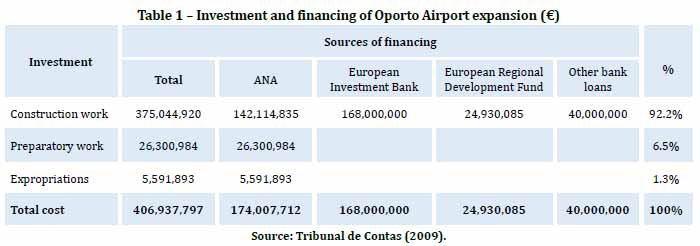
<body><![CDATA[<p>&nbsp;</p></font> <font face="Verdana" size="3">    <p><b>2.   Supply   factors</b></p></font> <font face="Verdana" size="2">    <p><b>2.1. Infrastructure renovation </b></p>     <p>Over recent years, there has been an ambitious expansion and     modernisation of Oporto Airport, designed to increase its capacity and improve     its operations. In 1999 the airport had a capacity of 14 movements per hour and     about three million passengers per year. The main constraints of Oporto Airport     in the late nineties were related to the capacity constraints of the check-in     and baggage handling system, the shortage of parking places, the inadequacy of     the operational lay-out of the areas of aircraft manoeuvre, handicapped     accessibility and capacities of some sectors, and the small size of available     spaces for the development and expansion of new functions.</p>     <p>In response to these weaknesses and the favourable trend in demand, the     airport operator decided to expand Oporto Airport’s supply. The enlargement and     qualification of supply were enshrined in the 2000 Master Plan (ANA, 2000), in     which was defined a medium and long term strategy, operationalised in three     well-defined stages. The first one proposed to increase the installed capacity     to 6 million passengers per year, the second to 11 million and the third to 15     million. Seven years later, in the 2007 Master Plan (ANA, 2007b), an increase     in capacity to fifteen million passengers – which is the maximum volume of     demand technically admissible in the airport’s current location – remained the     objective in terms of supply expansion.</p>     <p>Between 2000 and 2006, a large investment in the     expansion and upgrading of Oporto Airport was carried out. This investment     exceeded €400 million; 375 million were devoted to construction work and around     25 million to preparation work (see <a href="/img/revistas/tms/v10n1/10n1a06t1.jpg">Table 1</a>). This investment was financed with     ANA’s own resources (43%), loans from the European Investment Bank (41%), other     loans (10%) and EU funding from the European Regional Development Fund – ERDF     (6%).</p>     
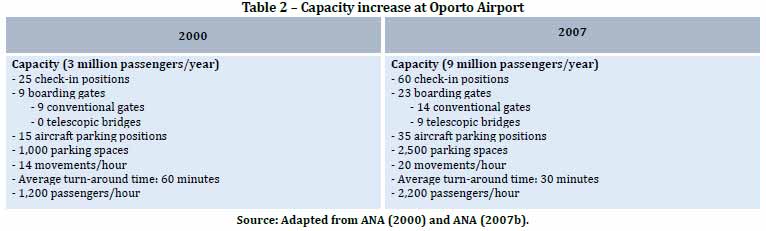
<p>After the expansion, the     airport has a maximum annual capacity of 9 million passengers and 60 thousand     cargo tons and of 20 aircraft movements per hour (ANA, 2012c). Enlarging and     qualifying the airport entailed a supply increase of its various facilities.     <a href="/img/revistas/tms/v10n1/10n1a06t2.jpg">Table 2</a> shows the level of supply of several valences of the airport before and     after the expansion.</p>     
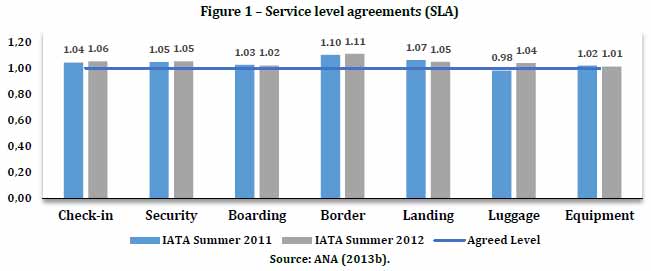
<p>The expansion and general improvement of airport     facilities resulted in a more efficient operation for companies and a greater     level of comfort and general service for passengers. Based on the results of     satisfaction surveys conducted in a large number of airports around the world     by ACI-Airport Council International, Oporto Airport received several     distinctions in the ASQ-Airport Service Quality awards. In 2006, Oporto Airport     was considered the third best airport in Europe and the third in the world in     the category of two to five million passengers. In the following year it was     voted the best airport in Europe. In 2008, 2009, 2010 and 2011, it remained in     the top three in Europe. It was considered the second best European airport in     2010 and the third best in the remaining three years.</p>     <p>Since 2006, ANA has had agreements with its business     partners (handling agents, airlines and the Foreigners and Borders Service) for     quality commitments, which are formalised through Service Level Agreements     (SLA). These agreements establish quality objectives for different service     processes that are critical to airport operations – which are regularly     monitored – and clarify the responsibilities of each business partner. Overall,     results show higher evaluations than the level agreed for every SLA (see <a href="/img/revistas/tms/v10n1/10n1a06f1.jpg">Figure     1</a>). The assessment of airport passenger satisfaction has been measured through     regular surveys. Results translate into a level of satisfaction – in the range     0-5 – of 4.08 in 2010, 4.07 in 2011 and 4.08 in 2012, revealing the highest     degree of satisfaction among Portuguese airports in 2010 and 2011 and the     second highest in 2012 (ANA, 2013b).</p>     
<p><b>2.2. Expansion of routes: The role of LCC</b></p>     ]]></body>
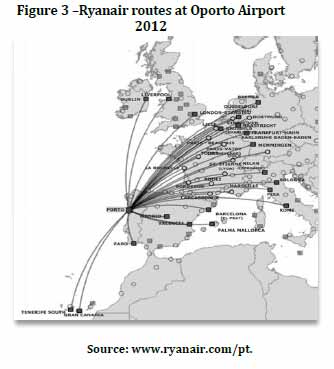
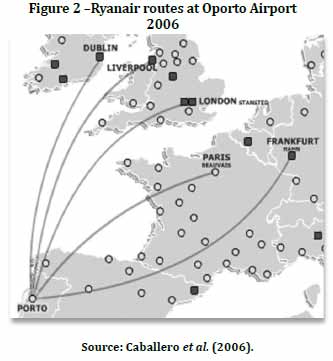
<body><![CDATA[<p>Another factor that explains traffic growth is     the attraction of low cost airlines. Generally, LCC airports seek to enable     these companies to reduce costs and exploit economies of density through the     intensive use of aircraft (Pitt &amp; Brown, 2001). According to Warnock-Smith     and Potter (2005), the choice of airports by LCC is based, primarily, on the     size of the catchment area, secondly, on the availability of slots and,     thirdly, on reduced turnaround times and low congestion levels. The next factor     in order of importance is reduced airport charges. Other factors identified as     relevant, albeit less important, are positive prospects for business and     tourist traffic, the awareness of airport management of the importance of     keeping costs low and the existence of high levels of competition with other     airports, good road access and sufficient spare capacity to accommodate demand     growths.</p>     <p>In the case of Oporto Airport, the existence of     some of these factors has allowed a quick development of LCC business. Firstly,     the possibility of increasing its catchment area to the south, to the central     region of the country, and to the north, to the region of Galicia in Spain, as     well as good prospects for passenger growth in specific demand segments such as     tourism, business and VFR. Secondly, the availability of a renewed     infrastructure with overcapacity, which allows airlines quick and flexible     operations without having to deal with traditional supply constraints (slots availability,     quick turnarounds and enough capacity to accommodate large demand growths).     Thirdly, although LCC do not enjoy significant advantages in terms of airport     charges, airport services offer competitive prices. Fourthly, there exists a     relatively autonomous management focused on improving efficiency levels.     Fifthly, there are good road accesses and sufficient parking spaces at reduced     prices, as well as decent links to public transport networks, in particular to     coach and metro services. And lastly, there was a relatively low level of     competition with a relatively dominant air operator, before the entry of LCC.</p>     <p>Services supply at Oporto Airport increased     significantly since the entry of LCC. According to Almeida (2011), the increase in     routes and frequencies offered by LCCs resulted in major changes in air     transport, inducing a change in demand behaviour     and a positive effect on the development of other activity sectors, such as     tourism. Low cost airlines started operations in Oporto Airport in 2004, with the     entry of Air Berlin, linking Oporto via Palma to several European destinations. In that     year, Air Berlin carried just over 13,000 passengers, representing 0.5 % of the     total airport traffic (Caballero, Losada &amp; Marrana, 2006). In 2005, Ryanair started flying from Oporto, with     connections to London-Stansted and Frankfurt-Hanh, transporting almost 250,000     passengers, representing 7.5% of the Oporto Airport demand. In 2006, Ryanair     added three new destinations: Paris-Beauvais (daily flights), Dublin (daily     flights) and Liverpool (three flights per week). The number of passengers     carried that year reached approximately 525,000. This growth allowed Ryanair to     reach second place in the ranking of airlines with operations at Oporto     Airport, with a market share of 15.3%. In 2006, Hapag-Lloyd Express (HPX) began     operating in Oporto, with connections to Cologne and Stuttgart (three flights     per week in each case).</p>     <p>In 2007, there was a     large increase in the number of low cost routes in Oporto Airport. EasyJet, Brussels     Airlines, Transavia and Clickair joined the three companies already operating     at the airport. EasyJet connected Oporto to Geneva and Basel, while Brussels     Airlines, Transavia and Clickair connected Oporto with the airports of     Brussels-BRU, Barcelona-El Prat and Paris-Orly, respectively. That year,     Ryanair flew to 13 destinations, while HPX increased one destination over its     previous year’s supply (Hamburg).</p>     <p>From 2009 onwards, the     LCC operating in Oporto Airport are Air Belin, Brussels Airlines, EasyJet,     Ryanair and Transavia. The 23 destinations offered in 2007 by these companies     doubled in 2012, reaching 46. The airline with the largest operation at Oporto     Airport in 2012 was Ryanair, which offered 33 routes, well above EasyJet with     six routes, and Transavia with four routes. The other two LCC only flew to one     destination in each case. In 2007, the 54 routes of Oporto Airport offered     5,950,000 seats, 29% of which on low cost carriers. In 2012, from the 7,875,000     seats offered in the 81 routes of the airport, nearly 51% were supplied by LCC.</p>     <p>The opening of Ryanair’s operational base in     Oporto Airport was a big jump from the supply standpoint. This supply expansion     resulted in a very strong demand growth of Ryanair services. Ryanair’s bet on     Oporto Airport derives from the fulfilment of some of the requirements that the     company considers fundamental to operating at a given airport. According to     Barrett (2004), the criteria for Ryanair to consider an airport as low cost     friendly are to have lower airport charges, an aircraft turnaround time of 25     minutes, simple terminals, services that allow for quick check-in, good     commercial facilities (catering and shops), adequate connections by road and no     executive class or business lounges.</p>     <p>An operational base consists of an airport where     an airline locates aircrafts, crew and support operational services (Graham   &amp; Shaw, 2008). The choice of airports for this function is mostly based,     especially in the case of LCC, on logistics and on the possibility of maximising     the use of aircrafts, as well as on the existence of incentives and other types     of benefits associated with operating at the airport (Alderighi, Cento, Nijkamp   &amp; Rietveld,     2007). Despite the potential advantages     of this management option, the installation of an operational base implies     generally significant investment (Coombs, 2011), particularly because it     involves the allocation of exclusive aircrafts to meet the expected supply     levels.</p>     <p>Ryanair’s base at Oporto, which began operating     in September 2009, was the first one in Portugal and the thirty-third in Europe Ryanair     currently has operating bases outside Europe, namely in Morocco. The Oporto base entailed an investment of €146     million and the allocation of three aircrafts. In the first full year after opening     (2010), the number of passengers increased by over 40% in relation to the     previous one (2009). The number of passengers carried by Ryanair almost doubled     from 2009 to 2011 (1,193,705 vs. 2,268,713). Three years after opening, the     base had five aircrafts, flying to 33 international destinations, with the     exception of Faro.</p>     <p>Ryanair’s increase in     supply since its entry into Oporto Airport has been very significant. In 2006,     when it flew to only five destinations (<a href="#f2">Figure 2</a>), the number of seats offered     was 625,000 (12.1% of the seats offered in the airport). In 2012, when it     operated 33 direct connections (<a href="#f3">Figure 3</a>), the seats offered exceeded 2,770,000 (35.2% of the seats offered in the airport).</p>     <p><a name="f2"></a></p>     ]]></body>
<body><![CDATA[<p>&nbsp;</p>     <p align="center"><img src="/img/revistas/tms/v10n1/10n1a06f2.jpg" width="333" height="361"></p>     
<p align="center">&nbsp;</p>     <p><a name="f3"></a></p>     <p>&nbsp;</p>     <p align="center"><img src="/img/revistas/tms/v10n1/10n1a06f3.jpg" width="334" height="369"></p>     
<p align="center">&nbsp;</p>     <p>Agreements with airlines have driven the     expansion and consolidation of flights supply in Oporto Airport. These     agreements are a factor of the utmost importance to attracting airlines,     especially LCC, since they prefer airport operators (and hence airports) that     show flexibility and willingness to negotiate on costs. These agreements     between the airport operator and the airlines may have different modalities     (Graham &amp; Dennis, 2007). It may be only a discount on airport charges or     may involve the sharing of risks, based on the number of passenger arrivals     (Graham, 2013). They may also imply the coverage of new services’ marketing     costs or, in general, the costs of launching new routes (Starkie, 2012). In     addition to the direct subsidies granted by airport operators, in some     countries such as Spain, agreements may also include subsidies from public     authorities (Castillo-Manzano, López-Valpuesta   &amp; González-Laxe, 2011).</p>     <p>In Portugal these     agreements are part of a programme to promote routes launched in late 2007,     called Initiative.pt – <i>Developing Tourism     and Aviation</i>. This programme covers all Portuguese airports, as the airport     operator manages all the airfields of the country. Initiative.pt combines     support based on the number of passenger arrivals with promotional grants, and     it is funded by the airport operator and public and parapublic entities.</p>     <p>During the first four years in place, Initiative.pt     supported 43 routes, with an investment of over €13 million. The funding of     this programme is ensured by ANA (40%), Turismo de Portugal (30%) and several     regional agencies of tourism promotion (20%) (ANA, 2013b). The programme is     intended primarily for the creation of new routes and the increase of     frequencies in routes considered under-served. The support for airlines adopts,     in many cases, a model of co-investment with a variable component based on     passenger arrivals and a fixed marketing    component which is specifically designed     to promote the supported route. Data provided by Turismo de Portugal via the     press reveal that in the first four years in place, the programme supported 23     routes of LCC (Ryanair [18] and EasyJet [5]), 10 of traditional airlines (TAP [3]     and SATA [7]) and 10 of hybrid, charter or regional airlines (Jet2 [4], Tui Fly [2], Sky Europe [1], Aer Lingus [1], Aigle Azur [1] and Thomson Fly [1]). Twenty-three     routes were supported in Faro, ten in Madeira, five in Lisbon, four in Ponta     Delgada and one in Porto Santo. The 43 supported routes benefit from a funding     of €13.3 million and handled 1,630,000 passengers, representing an average     support per passenger of €8.15 (ANA, 2013b).</p>     ]]></body>
<body><![CDATA[<p>In March 2012, the second phase of Initiative.pt,     called Initiative.pt 2.0, was launched. This stage involves an investment of   €15 million and the financing of one million and a half passengers during the     three years of the programme. According to ANA (2013b), Initiative.pt 2.0 will     provide financial and logistic support to 60 routes and will fund the opening     of 45 new routes, the extension of three routes during the winter period and a     frequency increase in other two. In 2012, under this programme, 28 new routes     were created – six of these in Oporto Airport – and 60 received financial and     logistic support, 10 of these at Oporto Airport (see <a href="/img/revistas/tms/v10n1/10n1a06f4.jpg">Figure 4</a>).</p>     
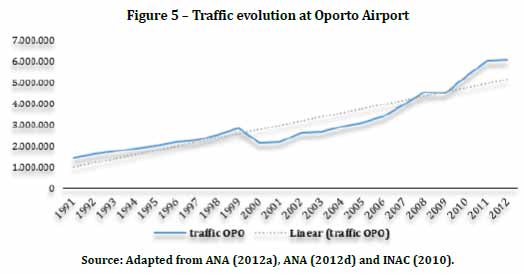
<p>&nbsp;</p></font> <font face="Verdana" size="3">    <p><b>3.   Demand response</b></p></font> <font face="Verdana" size="2">    <p>From the demand point of     view, four different periods in Oporto Airport may be identified: the first one     from 1990 to 1999, the second one from 2000 to 2003, the third one from 2004 to     2009 and the fourth from 2010 to 2012 (see <a href="#f5">Figure 5</a>). The first period is     characterised by steady growth, which accelerated in 1998 and 1999. The decline     and stagnation of traffic mark the second period. The third period is     characterised by the return to growth, particularly in 2007 and 2008. In     contrast, in 2009, there was a traffic stagnation, in line with what happened     in all European markets, coinciding with the most depressed period of the     economic and financial crisis, which began in 2008. From 2010 onwards, air     traffic went back to a positive trend, with average growth rates of 7.5% per     year. In 2012 there was a record number of airport users, slightly surpassing six million passengers.</p>     <p><a name="f5"></a></p>     <p>&nbsp;</p>     <p align="center"><img src="/img/revistas/tms/v10n1/10n1a06f5.jpg" width="524" height="274"></p>     
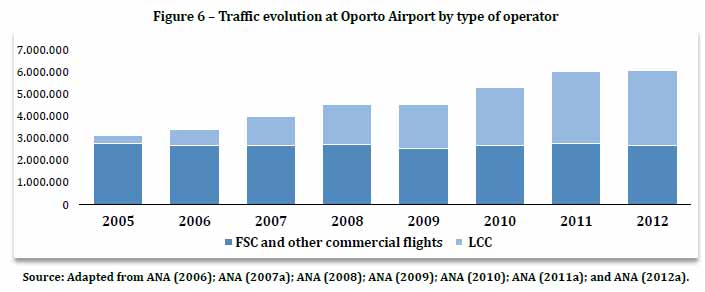
<p align="center">&nbsp;</p>     <p>From   the completion of the airport expansion in 2006, LCC growth accelerated   considerably, reaching 1,250,000 passengers in 2007 (700,000 in 2006), almost   2,000,000 in 2009 and over 3,350,000 in 2012. The main impact of the entrance   of LCC, in terms of traffic composition, was the stagnation of Full Service   Carriers (FSC) passenger volumes – 2.5 million passengers per year since 2006.   LCC traffic increased as long as the <i>status   quo</i> in FSC traffic allowed the first to progressively increase its market   share at the airport, rising from 9.5% in 2006 to 31% in 2007 and to 43.5% in   2009 (see <a href="/img/revistas/tms/v10n1/10n1a06f6.jpg">Figure 6</a>). In 2011, LCC traffic exceeded, for the first time, half of   Oporto Airport’s traffic and in 2012 reached a market share slightly higher   than 55%.  </p>     
<p>The academic   literature on air transport concludes that the most important factor in   choosing airlines is the price of the ticket, particularly in the case of LCC.   According to the results of a comparative study conducted by O’Connell and   Williams (2005), 80% of low cost passengers choose an airline based on price.   Other studies conclude that, although the price is the most important factor,   there are other factors influencing the choice, such as proximity to the   airport (Martínez-García &amp; Royo-Vela, 2010). Ryan and Birks (2005) also   point out two important factors in users’ choice: the availability and cost of   hotel facilities and the availability and affordability of parking spaces. In   the case of Oporto Airport, the absence of competing airports within a very   broad geographical area and the existence of good road accessibility and   (cheap) parking availability may be, jointly with LCC low prices, important   factors for explaining the intense traffic growth of recent years.</p>     ]]></body>
<body><![CDATA[<p>The main markets of Oporto     Airport are France, Spain, Portugal, Germany, the UK, Switzerland, Italy,     Belgium and Luxembourg. In 2012, the fifteen destinations with larger demand     accounted for 65.7% of total airport traffic (see <a href="/img/revistas/tms/v10n1/10n1a06t3.jpg">Table 3</a>). Besides the strong     concentration of demand in a limited number of destinations, Oporto Airport has an important market concentration by operators. </p>     
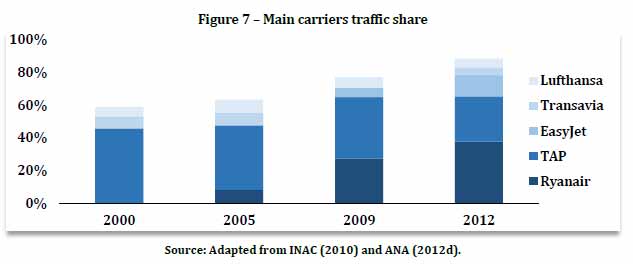
<p>In 2012 the most     important companies, according to the number of carried passengers, were     Ryanair, EasyJet and TAP Portugal (see <a href="/img/revistas/tms/v10n1/10n1a06f7.jpg">Figure 7</a>). By 2010, TAP Portugal was the     main carrier at the airport. From that year onwards, Ryanair led the ranking of     carried passengers. In 2011, Ryanair transported 1,678,872 passengers,     surpassing TAP Portugal just by 41,334 passengers. In 2012, the distance     between both companies widened extraordinarily, surpassing 2.1 million     passengers. In 2012, Ryanair had 37.8% of the airport market share and 68.2% of     the LCC market share (ANA, 2012d). In that year, TAP saw its Oporto Airport     market share drop for the fifth consecutive year, from nearly 40% in 2008 to just 27.6%.</p>     
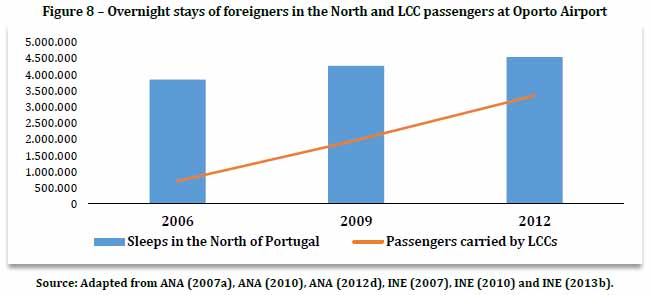
<p>The growing presence     of low cost carriers in Oporto Airport has changed the profile of its users.     The comparison of passenger characteristics in 2004 and 2012 reveals     significant differences. During this period, the presence of women increased     (30.9% in 2004 to 48.5% in 2012) and the same happened with people under 30     (26.1% in 2004 to 44.2% in 2012). Furthermore, the weight of passengers with     higher education degrees decreased (44.1% in 2004 to 33.0% in 2012) (ANA, 2011b;     ANA, 2012b). Regarding reasons for travelling, the changes are also very     significant. There was a significant loss of business passengers, whereas a     considerable increase in tourist and VFR traffic was felt. There was also a     strong growth of users residing abroad, namely tourists and Portuguese     immigrants (58.4% in 2004 and 89.9% in 2012).</p>     <p>The attractiveness of     any tourist destination depends on its natural resources, local culture and     man-made infrastructure (Bieger &amp; Wittmer, 2006). Within the latter,     transport infrastructures, especially regional airports, are very important, as     they are a gateway for tourism (Robertson, 1995). The availability of low cost     routes at airports of this type is critical to the enhancement of tourism,     given that, according to Donzelli (2010), LCC not only attract traffic from FSC     but also generate new demand. According     to Skeels (2005), 59% of LCC passengers are new consumers who would not travel     if this alternative were not available, and only 37% are switchers (changed from     FSC to LCC). The increased supply of LCC in Oporto Airport has boosted tourism     growth in the city and the northern region as a whole. Leisure passengers of     Oporto Airport fly mostly on LCC, specifically 65% in 2012.</p>     <p>Despite the changed conditions of supply, the main tourist markets in the     North remain the same as one decade ago. In 2012 France (32%), Spain (26%), the     UK (10%), Germany (8%), Switzerland (8%), Italy (7%) and the Netherlands (4%)     were the main origin countries of tourists in the region (INE, 2013a). In 2012     the number of overnight stays of tourists from the main markets represented     approximately 44% of all overnight stays in the region (INE, 2013b).</p>     <p>That same year, 41% of tourists slept only in Oporto, 39% in the North,     mainly in the cities of Braga, Guimarães and Viana do Castelo, and 20% in     Oporto and other northern cities of Portugal (IPDT, 2012a, 2012B, 2012c and     2012d). According to the same source, in 2012 tourists spent about €626 during     their stay, which corresponds to an average daily expense of €84.2.</p>     <p>The determination of the direction of causality between growth in LCC     supply and tourism growth is a complex subject. It is a feedback process that     ultimately benefits all stakeholders. In this case, passengers carried by LCC     via Oporto Airport and foreign tourists from northern Portugal follow a     parallel trend that confirms the existence of some kind of interaction between both phenomena (see <a href="/img/revistas/tms/v10n1/10n1a06f8.jpg">Figure 8</a>).</p>     
<p>&nbsp;</p></font> <font face="Verdana" size="3">    <p><b>4.   Opportunities and challenges</b></p></font> <font face="Verdana" size="2">    <p>Despite the rapid growth of recent years, Oporto Airport still has room     to grow. The city of Oporto and the North of Portugal are consolidating as a     multiproduct tourist destination which will boost airport demand in the coming     years. The demand for city breaks has been growing consistently. Between 2007 and 2011,     the number of overnight stays in the Oporto region increased by 16.5%,     exceeding 2,750,000. Hotel capacity accompanied the increase in demand and in     the same period the number of beds increased by 15.5%. The cultural heritage of Oporto and the surrounding region, as well as the progressive     improvement of its tourist infrastructure, are the major assets of the     destination. This growing tourist attractiveness, in 2013, resulted in Oporto     and the Douro Valley being considered the Best European Destination by the     Lonely Planet. Also     within the tourism sector, cruise tourism is a segment which has proved very     dynamic in recent years. Over the past five     years, Oporto has witnessed a growing number of small-scale cruises and     cruisers in the Leixões port. Between 2007 and 2012, the number of passengers     on these small-scale cruises practically multiplied by five, exceeding 75,000.     The completion of the passenger station in the cruise terminal scheduled for     late 2013 will further boost this tourist segment. In this context, it is     extremely important that Oporto will likely become a point of boarding and/or     departing for cruises. If that happens, cruises would ensure additional traffic     to Oporto Airport.</p>     ]]></body>
<body><![CDATA[<p>Another source of growth for Oporto Airport is traffic with origin or     destination in Galicia. The lack of coordination of the three Galician airports     has limited the growth of their flight supply and prevented the consolidation     of low cost routes. Additionally, the radial model of route management of some     airlines with Madrid-Barajas as a hub airport severely punishes Galician     passengers in their trips to European destinations. These drawbacks, together     with the crisis in Spain, have resulted in an 18% decrease in the combined     traffic of the three Galician airports since 2007, which lost in cumulative     terms more than 850,000 passengers, 575,000 of which at Vigo airport. In the     same period, Oporto Airport increased its traffic by over 52%, gaining     cumulatively over 2,000,000 passengers. It is worth noting in this regard that,     in 2007, the combined traffic of the three Galician airports exceeded by almost     750,000 passengers the traffic in Oporto (4,722,935 vs. 3,988,388), while, in     2012, it was lower by nearly 2,200,000 passengers (3,868,787 vs. 6,050,094).     The attractiveness of Oporto Airport for Galician passengers is growing.     According to airport management, in 2012 over 700,000 Galician passengers used     Oporto Airport, representing 12% of total traffic. The outlook for growth in     this market segment is very positive, considering the good road access and the     increasing provision of public transport, linking several Galician cities and     Oporto Airport directly.</p>     <p>Besides opportunities for traffic growth and business development,     Oporto Airport faces important challenges. The recent privatisation of the Portuguese     airport manager poses significant challenges both at political and regulatory     levels. The airports’ system went from a public monopoly to a private monopoly,     now owned by Vinci, a French infrastructure operator. The underlying management     model hampers the implementation of individual commercial policies and promotes     cross subsidisation between airports so as to meet public service obligations     or support individual growth strategies within the system. This way, certain     airports may be favoured over others, depending on the requirements of the     airlines with greater bargaining power or on operators’ short-term performance.     Political actors in the North should follow the developments of ANA’s operation     and management model and airport regulation model, particularly as far as the     determination of airport fees is concerned.</p>     <p>The management of the high dependence on LCC, namely on Ryanair, in the     supply and demand of this airport, deserves particular attention by the airport     operator. Ryanair supplies over 35% of airport seats and carries nearly 40% of     airport passengers. These large market shares ascribe Ryanair strong market     power and, therefore, great bargaining capacity to obtain favourable agreements     with the airport manager. This poses significant risks in the future,     especially since Ryanair has shown in the past that the closure of its activity     in certain airports is not problematic and that the cessation of operations due     to lack of “favourable” conditions is part of its business model. One way to mitigate     this problem, at least partially, may involve the establishment of competitive     conditions for attracting new airlines, including other LCC, by the airport     manager. This will increase the supply of routes and destinations and promote     higher levels of competition in the airport.</p>     <p>&nbsp;</p></font> <font face="Verdana" size="3">    <p><b>References</b></p></font> <font face="Verdana" size="2">    <!-- ref --><p>ACI Europe (2012). <i>How regional airports link people, places and products. </i>Brussels: Airports Council International.    &nbsp;&nbsp;&nbsp;&nbsp;&nbsp;&nbsp;&nbsp;&nbsp;[&#160;<a href="javascript:void(0);" onclick="javascript: window.open('/scielo.php?script=sci_nlinks&ref=000088&pid=S2182-8458201400010000600001&lng=','','width=640,height=500,resizable=yes,scrollbars=1,menubar=yes,');">Links</a>&#160;]<!-- end-ref --></p>     <!-- ref --><p>ACI Europe (2013). <i>Supportive &amp; fully aligned EU policy required for regional airports.</i> Brussels: Airports Council International.    &nbsp;&nbsp;&nbsp;&nbsp;&nbsp;&nbsp;&nbsp;&nbsp;[&#160;<a href="javascript:void(0);" onclick="javascript: window.open('/scielo.php?script=sci_nlinks&ref=000090&pid=S2182-8458201400010000600002&lng=','','width=640,height=500,resizable=yes,scrollbars=1,menubar=yes,');">Links</a>&#160;]<!-- end-ref --></p>     <!-- ref --><p>Alderighi, M., Cento, A.,     Nijkamp, P., &amp; Rietveld, P. (2007). Assessment of new hub-and-spoke and point-to-point airline network configurations. <i>Transport Reviews, </i>27(5), 529-549.    &nbsp;&nbsp;&nbsp;&nbsp;&nbsp;&nbsp;&nbsp;&nbsp;[&#160;<a href="javascript:void(0);" onclick="javascript: window.open('/scielo.php?script=sci_nlinks&ref=000092&pid=S2182-8458201400010000600003&lng=','','width=640,height=500,resizable=yes,scrollbars=1,menubar=yes,');">Links</a>&#160;]<!-- end-ref --></p>     <!-- ref --><p>Almeida, C.  R. (2011). The new challenges of tourism     airports: The case of Faro airport. <i>Tourism &amp; Management Studies</i>, 7, 109-120.    &nbsp;&nbsp;&nbsp;&nbsp;&nbsp;&nbsp;&nbsp;&nbsp;[&#160;<a href="javascript:void(0);" onclick="javascript: window.open('/scielo.php?script=sci_nlinks&ref=000094&pid=S2182-8458201400010000600004&lng=','','width=640,height=500,resizable=yes,scrollbars=1,menubar=yes,');">Links</a>&#160;]<!-- end-ref --></p>     <!-- ref --><p>ANA     (2000). <i>Plano Diretor Aeroporto Francisco     Sá Carneiro 2000. </i>Lisboa: ANA Aeroportos de Portugal.    &nbsp;&nbsp;&nbsp;&nbsp;&nbsp;&nbsp;&nbsp;&nbsp;[&#160;<a href="javascript:void(0);" onclick="javascript: window.open('/scielo.php?script=sci_nlinks&ref=000096&pid=S2182-8458201400010000600005&lng=','','width=640,height=500,resizable=yes,scrollbars=1,menubar=yes,');">Links</a>&#160;]<!-- end-ref --> </p>     <!-- ref --><p>ANA (2006). <i>Relatório de Gestão e Contas 2005. </i>Lisboa: ANA Aeroportos de Portugal.    &nbsp;&nbsp;&nbsp;&nbsp;&nbsp;&nbsp;&nbsp;&nbsp;[&#160;<a href="javascript:void(0);" onclick="javascript: window.open('/scielo.php?script=sci_nlinks&ref=000098&pid=S2182-8458201400010000600006&lng=','','width=640,height=500,resizable=yes,scrollbars=1,menubar=yes,');">Links</a>&#160;]<!-- end-ref --></p>     <!-- ref --><p>ANA (2007a). <i>Relatório Anual de Estatística de Tráfego 2006. </i>Lisboa: ANA Aeroportos de Portugal.    &nbsp;&nbsp;&nbsp;&nbsp;&nbsp;&nbsp;&nbsp;&nbsp;[&#160;<a href="javascript:void(0);" onclick="javascript: window.open('/scielo.php?script=sci_nlinks&ref=000100&pid=S2182-8458201400010000600007&lng=','','width=640,height=500,resizable=yes,scrollbars=1,menubar=yes,');">Links</a>&#160;]<!-- end-ref --></p>     <!-- ref --><p>ANA     (2007b). <i>Plano Diretor Aeroporto     Francisco Sá Carneiro 2007. </i>Lisboa: ANA Aeroportos de Portugal.    &nbsp;&nbsp;&nbsp;&nbsp;&nbsp;&nbsp;&nbsp;&nbsp;[&#160;<a href="javascript:void(0);" onclick="javascript: window.open('/scielo.php?script=sci_nlinks&ref=000102&pid=S2182-8458201400010000600008&lng=','','width=640,height=500,resizable=yes,scrollbars=1,menubar=yes,');">Links</a>&#160;]<!-- end-ref --></p>     <!-- ref --><p>ANA (2008). <i>Relatório Anual de Estatística de Tráfego 2007. </i>Lisboa: ANA Aeroportos de Portugal.    &nbsp;&nbsp;&nbsp;&nbsp;&nbsp;&nbsp;&nbsp;&nbsp;[&#160;<a href="javascript:void(0);" onclick="javascript: window.open('/scielo.php?script=sci_nlinks&ref=000104&pid=S2182-8458201400010000600009&lng=','','width=640,height=500,resizable=yes,scrollbars=1,menubar=yes,');">Links</a>&#160;]<!-- end-ref --></p>     <!-- ref --><p>ANA (2009). <i>Relatório Anual de Estatística de Tráfego 2008. </i>Lisboa: ANA Aeroportos de Portugal.    &nbsp;&nbsp;&nbsp;&nbsp;&nbsp;&nbsp;&nbsp;&nbsp;[&#160;<a href="javascript:void(0);" onclick="javascript: window.open('/scielo.php?script=sci_nlinks&ref=000106&pid=S2182-8458201400010000600010&lng=','','width=640,height=500,resizable=yes,scrollbars=1,menubar=yes,');">Links</a>&#160;]<!-- end-ref --></p>     <!-- ref --><p>ANA (2010). <i>Relatório Anual de Estatística de Tráfego 2009. </i>Lisboa: ANA Aeroportos de Portugal.    &nbsp;&nbsp;&nbsp;&nbsp;&nbsp;&nbsp;&nbsp;&nbsp;[&#160;<a href="javascript:void(0);" onclick="javascript: window.open('/scielo.php?script=sci_nlinks&ref=000108&pid=S2182-8458201400010000600011&lng=','','width=640,height=500,resizable=yes,scrollbars=1,menubar=yes,');">Links</a>&#160;]<!-- end-ref --></p>     <!-- ref --><p>ANA (2011a). <i>Relatório Anual de Estatística de Tráfego 2010. </i>Lisboa: ANA Aeroportos de Portugal.    &nbsp;&nbsp;&nbsp;&nbsp;&nbsp;&nbsp;&nbsp;&nbsp;[&#160;<a href="javascript:void(0);" onclick="javascript: window.open('/scielo.php?script=sci_nlinks&ref=000110&pid=S2182-8458201400010000600012&lng=','','width=640,height=500,resizable=yes,scrollbars=1,menubar=yes,');">Links</a>&#160;]<!-- end-ref --></p>     <!-- ref --><p>ANA (2011b). <i>Perfil do Passageiro de 2011.</i> Lisboa: ANA Aeroportos de Portugal.    &nbsp;&nbsp;&nbsp;&nbsp;&nbsp;&nbsp;&nbsp;&nbsp;[&#160;<a href="javascript:void(0);" onclick="javascript: window.open('/scielo.php?script=sci_nlinks&ref=000112&pid=S2182-8458201400010000600013&lng=','','width=640,height=500,resizable=yes,scrollbars=1,menubar=yes,');">Links</a>&#160;]<!-- end-ref -->  </p>     <!-- ref --><p>ANA (2012a). <i>Relatório Anual de Estatística de Tráfego 2011. </i>Lisboa: ANA Aeroportos de Portugal.    &nbsp;&nbsp;&nbsp;&nbsp;&nbsp;&nbsp;&nbsp;&nbsp;[&#160;<a href="javascript:void(0);" onclick="javascript: window.open('/scielo.php?script=sci_nlinks&ref=000114&pid=S2182-8458201400010000600014&lng=','','width=640,height=500,resizable=yes,scrollbars=1,menubar=yes,');">Links</a>&#160;]<!-- end-ref --></p>     <!-- ref --><p>ANA (2012b). <i>Caracterização do Perfil do Passageiro e     Consumidor – Verão IATA 2012. </i>Lisboa: ANA Aeroportos de Portugal.    &nbsp;&nbsp;&nbsp;&nbsp;&nbsp;&nbsp;&nbsp;&nbsp;[&#160;<a href="javascript:void(0);" onclick="javascript: window.open('/scielo.php?script=sci_nlinks&ref=000116&pid=S2182-8458201400010000600015&lng=','','width=640,height=500,resizable=yes,scrollbars=1,menubar=yes,');">Links</a>&#160;]<!-- end-ref -->  </p>     <!-- ref --><p>ANA (2012c). <i>Infrastructure – Aeroporto Francisco Sá Carneiro. </i>Lisboa: ANA Aeroportos de Portugal.    &nbsp;&nbsp;&nbsp;&nbsp;&nbsp;&nbsp;&nbsp;&nbsp;[&#160;<a href="javascript:void(0);" onclick="javascript: window.open('/scielo.php?script=sci_nlinks&ref=000118&pid=S2182-8458201400010000600016&lng=','','width=640,height=500,resizable=yes,scrollbars=1,menubar=yes,');">Links</a>&#160;]<!-- end-ref -->  </p>     <!-- ref --><p>ANA (2012d). <i>Relatório de Tráfego, Dezembro de 2012 – AerOporto do Oporto. </i>Lisboa: ANA Aeroportos de Portugal.    &nbsp;&nbsp;&nbsp;&nbsp;&nbsp;&nbsp;&nbsp;&nbsp;[&#160;<a href="javascript:void(0);" onclick="javascript: window.open('/scielo.php?script=sci_nlinks&ref=000120&pid=S2182-8458201400010000600017&lng=','','width=640,height=500,resizable=yes,scrollbars=1,menubar=yes,');">Links</a>&#160;]<!-- end-ref --></p>     <!-- ref --><p>ANA (2013a). <i>Relatório de Gestão e Contas 2012. </i>Lisboa: ANA Aeroportos de Portugal.    &nbsp;&nbsp;&nbsp;&nbsp;&nbsp;&nbsp;&nbsp;&nbsp;[&#160;<a href="javascript:void(0);" onclick="javascript: window.open('/scielo.php?script=sci_nlinks&ref=000122&pid=S2182-8458201400010000600018&lng=','','width=640,height=500,resizable=yes,scrollbars=1,menubar=yes,');">Links</a>&#160;]<!-- end-ref --></p>     <!-- ref --><p>ANA (2013b). <i>Relatório de Sustentabilidade 2012. </i>Lisboa: ANA Aeroportos de Portugal.    &nbsp;&nbsp;&nbsp;&nbsp;&nbsp;&nbsp;&nbsp;&nbsp;[&#160;<a href="javascript:void(0);" onclick="javascript: window.open('/scielo.php?script=sci_nlinks&ref=000124&pid=S2182-8458201400010000600019&lng=','','width=640,height=500,resizable=yes,scrollbars=1,menubar=yes,');">Links</a>&#160;]<!-- end-ref -->  </p>     <!-- ref --><p>Barrett, S. (2004). The sustainability of the Ryanair model. <i>International Journal of Transport Management</i>, 2(2), 89-98.    &nbsp;&nbsp;&nbsp;&nbsp;&nbsp;&nbsp;&nbsp;&nbsp;[&#160;<a href="javascript:void(0);" onclick="javascript: window.open('/scielo.php?script=sci_nlinks&ref=000126&pid=S2182-8458201400010000600020&lng=','','width=640,height=500,resizable=yes,scrollbars=1,menubar=yes,');">Links</a>&#160;]<!-- end-ref --></p>     <!-- ref --><p>Bieger, T. &amp; Wittmer,     A. (2006). Air transport and tourism: Perspectives and challenges for     destinations, airlines and governments. <i>Journal of Air Transport Management, </i>12, 40-46.    &nbsp;&nbsp;&nbsp;&nbsp;&nbsp;&nbsp;&nbsp;&nbsp;[&#160;<a href="javascript:void(0);" onclick="javascript: window.open('/scielo.php?script=sci_nlinks&ref=000128&pid=S2182-8458201400010000600021&lng=','','width=640,height=500,resizable=yes,scrollbars=1,menubar=yes,');">Links</a>&#160;]<!-- end-ref --></p>     <!-- ref --><p>Caballero, A., Losada, A. &amp; Marrana, J. (2006). <i>O     Sistema Aeroportuário do Eixo Atlântico</i>. Vigo: Biblioteca dos Estudos Estratégicos, Eixo Atlântico.    &nbsp;&nbsp;&nbsp;&nbsp;&nbsp;&nbsp;&nbsp;&nbsp;[&#160;<a href="javascript:void(0);" onclick="javascript: window.open('/scielo.php?script=sci_nlinks&ref=000130&pid=S2182-8458201400010000600022&lng=','','width=640,height=500,resizable=yes,scrollbars=1,menubar=yes,');">Links</a>&#160;]<!-- end-ref --></p>     <!-- ref --><p>Castillo-Manzano, J.,     López-Valpuesta, L. &amp; González-Laxe, F. (2011). The     effects of the LCC boom on the urban tourism fabric: The viewpoint of tourism managers. <i>Tourism Management</i>, 32(5), 1085-1095.    &nbsp;&nbsp;&nbsp;&nbsp;&nbsp;&nbsp;&nbsp;&nbsp;[&#160;<a href="javascript:void(0);" onclick="javascript: window.open('/scielo.php?script=sci_nlinks&ref=000132&pid=S2182-8458201400010000600023&lng=','','width=640,height=500,resizable=yes,scrollbars=1,menubar=yes,');">Links</a>&#160;]<!-- end-ref --></p>     <!-- ref --><p>Coombs,     T. (2011). Challenging times for airport investors:     Trends in airport traffic. <i>Journal of Air Transport Management</i>, 5(4), 306-310.    &nbsp;&nbsp;&nbsp;&nbsp;&nbsp;&nbsp;&nbsp;&nbsp;[&#160;<a href="javascript:void(0);" onclick="javascript: window.open('/scielo.php?script=sci_nlinks&ref=000134&pid=S2182-8458201400010000600024&lng=','','width=640,height=500,resizable=yes,scrollbars=1,menubar=yes,');">Links</a>&#160;]<!-- end-ref --></p>     <!-- ref --><p>Donzelli, M. (2010). The effect of low-cost air transportation on the local economy: Evidence from Southern Italy. <i>Journal of Air Transport Management, </i>16, 121-126.    &nbsp;&nbsp;&nbsp;&nbsp;&nbsp;&nbsp;&nbsp;&nbsp;[&#160;<a href="javascript:void(0);" onclick="javascript: window.open('/scielo.php?script=sci_nlinks&ref=000136&pid=S2182-8458201400010000600025&lng=','','width=640,height=500,resizable=yes,scrollbars=1,menubar=yes,');">Links</a>&#160;]<!-- end-ref --></p>     <!-- ref --><p>Forsyth, P.,     Gillen, D., Müller, J. &amp; Niemeier, H.-Martin. (2010). <i>Airport Competition: The European Experience</i>. Surrey, UK: Ashgate Publishing, Ltd.    &nbsp;&nbsp;&nbsp;&nbsp;&nbsp;&nbsp;&nbsp;&nbsp;[&#160;<a href="javascript:void(0);" onclick="javascript: window.open('/scielo.php?script=sci_nlinks&ref=000138&pid=S2182-8458201400010000600026&lng=','','width=640,height=500,resizable=yes,scrollbars=1,menubar=yes,');">Links</a>&#160;]<!-- end-ref --></p>     <!-- ref --><p>Graham, A. (2008). <i>Managing Airports: An International Perspective </i>(3<sup>d</sup> Ed.). Oxford: Elsevier Butterworth-Heinemann.    &nbsp;&nbsp;&nbsp;&nbsp;&nbsp;&nbsp;&nbsp;&nbsp;[&#160;<a href="javascript:void(0);" onclick="javascript: window.open('/scielo.php?script=sci_nlinks&ref=000140&pid=S2182-8458201400010000600027&lng=','','width=640,height=500,resizable=yes,scrollbars=1,menubar=yes,');">Links</a>&#160;]<!-- end-ref --></p>     <!-- ref --><p>Graham, A. (2013). Understanding the low cost carrier and airport relationship: A critical analysis of the salient issues. <i>Tourism Management, </i>36, 66-76.    &nbsp;&nbsp;&nbsp;&nbsp;&nbsp;&nbsp;&nbsp;&nbsp;[&#160;<a href="javascript:void(0);" onclick="javascript: window.open('/scielo.php?script=sci_nlinks&ref=000142&pid=S2182-8458201400010000600028&lng=','','width=640,height=500,resizable=yes,scrollbars=1,menubar=yes,');">Links</a>&#160;]<!-- end-ref --> </p>     <!-- ref --><p>Graham, A. &amp; Dennis, N.     (2007). Airport traffic and financial performance: a UK and Ireland case study. <i>Journal of Transport Geography</i>, 15(3), 161-171.    &nbsp;&nbsp;&nbsp;&nbsp;&nbsp;&nbsp;&nbsp;&nbsp;[&#160;<a href="javascript:void(0);" onclick="javascript: window.open('/scielo.php?script=sci_nlinks&ref=000144&pid=S2182-8458201400010000600029&lng=','','width=640,height=500,resizable=yes,scrollbars=1,menubar=yes,');">Links</a>&#160;]<!-- end-ref --></p>     <!-- ref --><p>Graham,     B. &amp; Shaw, J. (2008). Low-cost airlines in Europe: reconciling     liberalization and sustainability. <i>Geoforum</i>, 39(3), 1439-1451.    &nbsp;&nbsp;&nbsp;&nbsp;&nbsp;&nbsp;&nbsp;&nbsp;[&#160;<a href="javascript:void(0);" onclick="javascript: window.open('/scielo.php?script=sci_nlinks&ref=000146&pid=S2182-8458201400010000600030&lng=','','width=640,height=500,resizable=yes,scrollbars=1,menubar=yes,');">Links</a>&#160;]<!-- end-ref --></p>     <!-- ref --><p>INAC     (2010). <i>Evolução do Transporte Aéreo no     AerOporto Francisco Sá Carneiro</i> (1990-2009). Lisboa: Instituto Nacional de Aviação Civil.    &nbsp;&nbsp;&nbsp;&nbsp;&nbsp;&nbsp;&nbsp;&nbsp;[&#160;<a href="javascript:void(0);" onclick="javascript: window.open('/scielo.php?script=sci_nlinks&ref=000148&pid=S2182-8458201400010000600031&lng=','','width=640,height=500,resizable=yes,scrollbars=1,menubar=yes,');">Links</a>&#160;]<!-- end-ref --> </p>     <!-- ref --><p>INE (2007). <i>Anuário     Estatístico da Região Norte 2006. </i>Lisboa: Instituto Nacional de Estatística.    &nbsp;&nbsp;&nbsp;&nbsp;&nbsp;&nbsp;&nbsp;&nbsp;[&#160;<a href="javascript:void(0);" onclick="javascript: window.open('/scielo.php?script=sci_nlinks&ref=000150&pid=S2182-8458201400010000600032&lng=','','width=640,height=500,resizable=yes,scrollbars=1,menubar=yes,');">Links</a>&#160;]<!-- end-ref --></p>     <!-- ref --><p>INE (2010). <i>Anuário     Estatístico da Região Norte 2009. </i>Lisboa: Instituto Nacional de Estatística.    &nbsp;&nbsp;&nbsp;&nbsp;&nbsp;&nbsp;&nbsp;&nbsp;[&#160;<a href="javascript:void(0);" onclick="javascript: window.open('/scielo.php?script=sci_nlinks&ref=000152&pid=S2182-8458201400010000600033&lng=','','width=640,height=500,resizable=yes,scrollbars=1,menubar=yes,');">Links</a>&#160;]<!-- end-ref --> </p>     <!-- ref --><p>INE (2013a). <i>Estatísticas do Turismo 2012. </i>Lisboa: Instituto Nacional de Estatística.    &nbsp;&nbsp;&nbsp;&nbsp;&nbsp;&nbsp;&nbsp;&nbsp;[&#160;<a href="javascript:void(0);" onclick="javascript: window.open('/scielo.php?script=sci_nlinks&ref=000154&pid=S2182-8458201400010000600034&lng=','','width=640,height=500,resizable=yes,scrollbars=1,menubar=yes,');">Links</a>&#160;]<!-- end-ref --></p>     <!-- ref --><p>INE (2013b). <i>Dormidas     por País de Residência e Meses – TOP 10. </i>Lisboa: Instituto Nacional de Estatística.    &nbsp;&nbsp;&nbsp;&nbsp;&nbsp;&nbsp;&nbsp;&nbsp;[&#160;<a href="javascript:void(0);" onclick="javascript: window.open('/scielo.php?script=sci_nlinks&ref=000156&pid=S2182-8458201400010000600035&lng=','','width=640,height=500,resizable=yes,scrollbars=1,menubar=yes,');">Links</a>&#160;]<!-- end-ref --></p>     <!-- ref --><p>IPDT (2012a). <i>Perfil dos Turistas do Oporto e     Norte Portugal 1º trimestre de 2012. </i>Oporto: Instituto de Planeamento e Desenvolvimento do Turismo.    &nbsp;&nbsp;&nbsp;&nbsp;&nbsp;&nbsp;&nbsp;&nbsp;[&#160;<a href="javascript:void(0);" onclick="javascript: window.open('/scielo.php?script=sci_nlinks&ref=000158&pid=S2182-8458201400010000600036&lng=','','width=640,height=500,resizable=yes,scrollbars=1,menubar=yes,');">Links</a>&#160;]<!-- end-ref -->  </p>     <!-- ref --><p>IPDT (2012b). <i>Perfil dos Turistas do Oporto e     Norte Portugal 2º trimestre de 2012. </i>Oporto: Instituto de Planeamento e Desenvolvimento do Turismo.    &nbsp;&nbsp;&nbsp;&nbsp;&nbsp;&nbsp;&nbsp;&nbsp;[&#160;<a href="javascript:void(0);" onclick="javascript: window.open('/scielo.php?script=sci_nlinks&ref=000160&pid=S2182-8458201400010000600037&lng=','','width=640,height=500,resizable=yes,scrollbars=1,menubar=yes,');">Links</a>&#160;]<!-- end-ref -->  </p>     <!-- ref --><p>IPDT (2012c). <i>Perfil dos Turistas do Oporto e     Norte Portugal 3º trimestre de 2012. </i>Oporto: Instituto de Planeamento e Desenvolvimento do Turismo.    &nbsp;&nbsp;&nbsp;&nbsp;&nbsp;&nbsp;&nbsp;&nbsp;[&#160;<a href="javascript:void(0);" onclick="javascript: window.open('/scielo.php?script=sci_nlinks&ref=000162&pid=S2182-8458201400010000600038&lng=','','width=640,height=500,resizable=yes,scrollbars=1,menubar=yes,');">Links</a>&#160;]<!-- end-ref -->    </p>     <!-- ref --><p>IPDT (2012d). <i>Perfil dos Turistas do Oporto e     Norte Portugal 4º trimestre de 2012. </i>Oporto: Instituto de Planeamento e Desenvolvimento do Turismo.    &nbsp;&nbsp;&nbsp;&nbsp;&nbsp;&nbsp;&nbsp;&nbsp;[&#160;<a href="javascript:void(0);" onclick="javascript: window.open('/scielo.php?script=sci_nlinks&ref=000164&pid=S2182-8458201400010000600039&lng=','','width=640,height=500,resizable=yes,scrollbars=1,menubar=yes,');">Links</a>&#160;]<!-- end-ref -->    </p>     <!-- ref --><p>O’Connell, J., &amp; Williams, G. (2005). Passengers’ perceptions of low cost airlines and full service carriers: A case study     involving Ryanair, Aer Lingus, Air Asia and Malaysia Airlines. <i>Journal of Air Transport Management</i>, 11(4), 259-272.    &nbsp;&nbsp;&nbsp;&nbsp;&nbsp;&nbsp;&nbsp;&nbsp;[&#160;<a href="javascript:void(0);" onclick="javascript: window.open('/scielo.php?script=sci_nlinks&ref=000166&pid=S2182-8458201400010000600040&lng=','','width=640,height=500,resizable=yes,scrollbars=1,menubar=yes,');">Links</a>&#160;]<!-- end-ref --></p>     <!-- ref --><p>Martínez-García, E. &amp;   Royo-Vela, M. (2010). Segmentation   of low-cost flights users at secondary airports. <i>Journal of Air Transport Management</i>, 16(4), 234-237.    &nbsp;&nbsp;&nbsp;&nbsp;&nbsp;&nbsp;&nbsp;&nbsp;[&#160;<a href="javascript:void(0);" onclick="javascript: window.open('/scielo.php?script=sci_nlinks&ref=000168&pid=S2182-8458201400010000600041&lng=','','width=640,height=500,resizable=yes,scrollbars=1,menubar=yes,');">Links</a>&#160;]<!-- end-ref --></p>     <!-- ref --><p>Pitt, M. &amp; Brown, A.     (2001). Developing a strategic direction for airports to enable the provision of services to both network and low-fare carriers. <i>Facilities</i>, 19(1/2), 52-60.    &nbsp;&nbsp;&nbsp;&nbsp;&nbsp;&nbsp;&nbsp;&nbsp;[&#160;<a href="javascript:void(0);" onclick="javascript: window.open('/scielo.php?script=sci_nlinks&ref=000170&pid=S2182-8458201400010000600042&lng=','','width=640,height=500,resizable=yes,scrollbars=1,menubar=yes,');">Links</a>&#160;]<!-- end-ref --></p>     <!-- ref --><p>Robertson, J. A. W. (1995).     Airports and economic regeneration. <i>Journal of Air Transport Management</i>, 2, 81-88.    &nbsp;&nbsp;&nbsp;&nbsp;&nbsp;&nbsp;&nbsp;&nbsp;[&#160;<a href="javascript:void(0);" onclick="javascript: window.open('/scielo.php?script=sci_nlinks&ref=000172&pid=S2182-8458201400010000600043&lng=','','width=640,height=500,resizable=yes,scrollbars=1,menubar=yes,');">Links</a>&#160;]<!-- end-ref --></p>     <!-- ref --><p>Ryan, C. &amp; Birks, S.     (2005). Passengers and low cost flights: evidence from the Trans-Tasman routes. <i>Journal of Travel and Tourism Marketing</i>, 19(1), 15-27.    &nbsp;&nbsp;&nbsp;&nbsp;&nbsp;&nbsp;&nbsp;&nbsp;[&#160;<a href="javascript:void(0);" onclick="javascript: window.open('/scielo.php?script=sci_nlinks&ref=000174&pid=S2182-8458201400010000600044&lng=','','width=640,height=500,resizable=yes,scrollbars=1,menubar=yes,');">Links</a>&#160;]<!-- end-ref --></p>     <!-- ref --><p>Ryanair     (2013). Figura de rotas. Retrieved October,     12, 2013, from <a href="http://www.ryanair.com/pt/destinos-a-baixo-preco" target="_blank">http://www.ryanair.com/pt/destinos-a-baixo-preco</a>&nbsp;&nbsp;&nbsp;&nbsp;&nbsp;&nbsp;&nbsp;&nbsp;[&#160;<a href="javascript:void(0);" onclick="javascript: window.open('/scielo.php?script=sci_nlinks&ref=000176&pid=S2182-8458201400010000600045&lng=','','width=640,height=500,resizable=yes,scrollbars=1,menubar=yes,');">Links</a>&#160;]<!-- end-ref --><!-- ref --><p>Starkie, D. (2012).     European airports and airlines: evolving relationships and the regulatory implications. <i>Journal of Air Transport Management</i>, 21, 40-49.    &nbsp;&nbsp;&nbsp;&nbsp;&nbsp;&nbsp;&nbsp;&nbsp;[&#160;<a href="javascript:void(0);" onclick="javascript: window.open('/scielo.php?script=sci_nlinks&ref=000177&pid=S2182-8458201400010000600046&lng=','','width=640,height=500,resizable=yes,scrollbars=1,menubar=yes,');">Links</a>&#160;]<!-- end-ref --></p>     <!-- ref --><p>Skeels, J.     (2005). <i>Is airport growth a necessity or     a luxury? Overall view of market growth</i>.    &nbsp;&nbsp;&nbsp;&nbsp;&nbsp;&nbsp;&nbsp;&nbsp;[&#160;<a href="javascript:void(0);" onclick="javascript: window.open('/scielo.php?script=sci_nlinks&ref=000179&pid=S2182-8458201400010000600047&lng=','','width=640,height=500,resizable=yes,scrollbars=1,menubar=yes,');">Links</a>&#160;]<!-- end-ref --> Report Presented to ACI Annual Congress 2005, Munich.</p>     <!-- ref --><p>Tribunal     de Contas (2009). <i>Auditoria temática às     derrapagens em obras públicas: Ampliação do AerOporto Francisco Sá Carneiro</i>. Relatório de Auditoria nº 06/2009 AUDIT Processo 07/07, Lisboa.    &nbsp;&nbsp;&nbsp;&nbsp;&nbsp;&nbsp;&nbsp;&nbsp;[&#160;<a href="javascript:void(0);" onclick="javascript: window.open('/scielo.php?script=sci_nlinks&ref=000181&pid=S2182-8458201400010000600048&lng=','','width=640,height=500,resizable=yes,scrollbars=1,menubar=yes,');">Links</a>&#160;]<!-- end-ref --></p>     ]]></body>
<body><![CDATA[<!-- ref --><p>Warnock-Smith, D. &amp; Potter, A. (2005). An exploratory study into airport choice factors for European low-cost airlines. <i>Journal of Air Transport Management</i>, 11(6), 388–392.    &nbsp;&nbsp;&nbsp;&nbsp;&nbsp;&nbsp;&nbsp;&nbsp;[&#160;<a href="javascript:void(0);" onclick="javascript: window.open('/scielo.php?script=sci_nlinks&ref=000183&pid=S2182-8458201400010000600049&lng=','','width=640,height=500,resizable=yes,scrollbars=1,menubar=yes,');">Links</a>&#160;]<!-- end-ref --></p>     <!-- ref --><p>Zuidberg, J. &amp; Veldhuis, J. (2012). <i>The role of regional airports in a future transportation system</i>.     SEO&#8208;report nr. 2012&#8208;05. Retrieved September, 14, 2013, from     <a href="http://www.seo.nl/en/page/article/the-role-of-regional-airports-in-a-future-transportation-system/" target="_blank">http://www.seo.nl/en/page/article/the-role-of-regional-airports-in-a-future-transportation-system/</a>.    &nbsp;&nbsp;&nbsp;&nbsp;&nbsp;&nbsp;&nbsp;&nbsp;[&#160;<a href="javascript:void(0);" onclick="javascript: window.open('/scielo.php?script=sci_nlinks&ref=000185&pid=S2182-8458201400010000600050&lng=','','width=640,height=500,resizable=yes,scrollbars=1,menubar=yes,');">Links</a>&#160;]<!-- end-ref --></p>     <p>&nbsp;</p>     <p>&nbsp;</p>     <p><b>Ackowledgement</b>:</p>     <p>The     first author acknowledges the financial support of&nbsp;FEDER funds through the Operational Programme for Competitiveness Factors   &ndash; COMPETE and National Funds through FCT &ndash; Foundation for Science and     Technology within the Project PTDC/SEN-T&#8203;RA/108522/&#8203;2008.</p>     <p>&nbsp; </p> </font><font face="Verdana" size="2">    <p><b>Article   history:</b></p>       ]]></body>
<body><![CDATA[<p>Submitted: 12 June 2013</p>       <p>Accepted: 30 November     2013</p> </font>      ]]></body><back>
<ref-list>
<ref id="B1">
<nlm-citation citation-type="book">
<collab>ACI Europe</collab>
<source><![CDATA[How regional airports link people, places and products]]></source>
<year>2012</year>
<publisher-loc><![CDATA[Brussels ]]></publisher-loc>
<publisher-name><![CDATA[Airports Council International]]></publisher-name>
</nlm-citation>
</ref>
<ref id="B2">
<nlm-citation citation-type="book">
<collab>ACI Europe</collab>
<source><![CDATA[Supportive & fully aligned EU policy required for regional airports]]></source>
<year>2013</year>
<publisher-loc><![CDATA[Brussels ]]></publisher-loc>
<publisher-name><![CDATA[Airports Council International]]></publisher-name>
</nlm-citation>
</ref>
<ref id="B3">
<nlm-citation citation-type="journal">
<person-group person-group-type="author">
<name>
<surname><![CDATA[Alderighi]]></surname>
<given-names><![CDATA[M.]]></given-names>
</name>
<name>
<surname><![CDATA[Cento]]></surname>
<given-names><![CDATA[A.]]></given-names>
</name>
<name>
<surname><![CDATA[Nijkamp]]></surname>
<given-names><![CDATA[P.]]></given-names>
</name>
<name>
<surname><![CDATA[Rietveld]]></surname>
<given-names><![CDATA[P.]]></given-names>
</name>
</person-group>
<article-title xml:lang="en"><![CDATA[Assessment of new hub-and-spoke and point-to-point airline network configurations]]></article-title>
<source><![CDATA[Transport Reviews]]></source>
<year>2007</year>
<volume>27</volume>
<numero>5</numero>
<issue>5</issue>
<page-range>529-549</page-range></nlm-citation>
</ref>
<ref id="B4">
<nlm-citation citation-type="journal">
<person-group person-group-type="author">
<name>
<surname><![CDATA[Almeida]]></surname>
<given-names><![CDATA[C. R.]]></given-names>
</name>
</person-group>
<article-title xml:lang="en"><![CDATA[The new challenges of tourism airports: The case of Faro airport]]></article-title>
<source><![CDATA[Tourism & Management Studies]]></source>
<year>2011</year>
<volume>7</volume>
<page-range>109-120</page-range></nlm-citation>
</ref>
<ref id="B5">
<nlm-citation citation-type="book">
<collab>ANA</collab>
<source><![CDATA[Plano Diretor Aeroporto Francisco Sá Carneiro 2000]]></source>
<year>2000</year>
<publisher-loc><![CDATA[Lisboa ]]></publisher-loc>
<publisher-name><![CDATA[ANA Aeroportos de Portugal]]></publisher-name>
</nlm-citation>
</ref>
<ref id="B6">
<nlm-citation citation-type="book">
<collab>ANA</collab>
<source><![CDATA[Relatório de Gestão e Contas 2005]]></source>
<year>2006</year>
<publisher-loc><![CDATA[Lisboa ]]></publisher-loc>
<publisher-name><![CDATA[ANA Aeroportos de Portugal]]></publisher-name>
</nlm-citation>
</ref>
<ref id="B7">
<nlm-citation citation-type="book">
<collab>ANA</collab>
<source><![CDATA[Relatório Anual de Estatística de Tráfego 2006]]></source>
<year>2007</year>
<publisher-loc><![CDATA[Lisboa ]]></publisher-loc>
<publisher-name><![CDATA[ANA Aeroportos de Portugal]]></publisher-name>
</nlm-citation>
</ref>
<ref id="B8">
<nlm-citation citation-type="book">
<collab>ANA</collab>
<source><![CDATA[Plano Diretor Aeroporto Francisco Sá Carneiro 2007]]></source>
<year>2007</year>
<publisher-loc><![CDATA[Lisboa ]]></publisher-loc>
<publisher-name><![CDATA[ANA Aeroportos de Portugal]]></publisher-name>
</nlm-citation>
</ref>
<ref id="B9">
<nlm-citation citation-type="book">
<collab>ANA</collab>
<source><![CDATA[Relatório Anual de Estatística de Tráfego 2007]]></source>
<year>2008</year>
<publisher-loc><![CDATA[Lisboa ]]></publisher-loc>
<publisher-name><![CDATA[ANA Aeroportos de Portugal]]></publisher-name>
</nlm-citation>
</ref>
<ref id="B10">
<nlm-citation citation-type="book">
<collab>ANA</collab>
<source><![CDATA[Relatório Anual de Estatística de Tráfego 2008]]></source>
<year>2009</year>
<publisher-loc><![CDATA[Lisboa ]]></publisher-loc>
<publisher-name><![CDATA[ANA Aeroportos de Portugal]]></publisher-name>
</nlm-citation>
</ref>
<ref id="B11">
<nlm-citation citation-type="book">
<collab>ANA</collab>
<source><![CDATA[Relatório Anual de Estatística de Tráfego 2009]]></source>
<year>2010</year>
<publisher-loc><![CDATA[Lisboa ]]></publisher-loc>
<publisher-name><![CDATA[ANA Aeroportos de Portugal]]></publisher-name>
</nlm-citation>
</ref>
<ref id="B12">
<nlm-citation citation-type="book">
<collab>ANA</collab>
<source><![CDATA[Relatório Anual de Estatística de Tráfego 2010]]></source>
<year>2011</year>
<publisher-loc><![CDATA[Lisboa ]]></publisher-loc>
<publisher-name><![CDATA[ANA Aeroportos de Portugal]]></publisher-name>
</nlm-citation>
</ref>
<ref id="B13">
<nlm-citation citation-type="book">
<collab>ANA</collab>
<source><![CDATA[Perfil do Passageiro de 2011]]></source>
<year>2011</year>
<publisher-loc><![CDATA[Lisboa ]]></publisher-loc>
<publisher-name><![CDATA[ANA Aeroportos de Portugal]]></publisher-name>
</nlm-citation>
</ref>
<ref id="B14">
<nlm-citation citation-type="book">
<collab>ANA</collab>
<source><![CDATA[Relatório Anual de Estatística de Tráfego 2011]]></source>
<year>2012</year>
<publisher-loc><![CDATA[Lisboa ]]></publisher-loc>
<publisher-name><![CDATA[ANA Aeroportos de Portugal]]></publisher-name>
</nlm-citation>
</ref>
<ref id="B15">
<nlm-citation citation-type="book">
<collab>ANA</collab>
<source><![CDATA[Caracterização do Perfil do Passageiro e Consumidor - Verão IATA 2012]]></source>
<year>2012</year>
<publisher-loc><![CDATA[Lisboa ]]></publisher-loc>
<publisher-name><![CDATA[ANA Aeroportos de Portugal]]></publisher-name>
</nlm-citation>
</ref>
<ref id="B16">
<nlm-citation citation-type="book">
<collab>ANA</collab>
<source><![CDATA[Infrastructure - Aeroporto Francisco Sá Carneiro]]></source>
<year>2012</year>
<publisher-loc><![CDATA[Lisboa ]]></publisher-loc>
<publisher-name><![CDATA[ANA Aeroportos de Portugal]]></publisher-name>
</nlm-citation>
</ref>
<ref id="B17">
<nlm-citation citation-type="book">
<collab>ANA</collab>
<source><![CDATA[Relatório de Tráfego, Dezembro de 2012 - AerOporto do Oporto]]></source>
<year>2012</year>
<publisher-loc><![CDATA[Lisboa ]]></publisher-loc>
<publisher-name><![CDATA[ANA Aeroportos de Portugal]]></publisher-name>
</nlm-citation>
</ref>
<ref id="B18">
<nlm-citation citation-type="book">
<collab>ANA</collab>
<source><![CDATA[Relatório de Gestão e Contas 2012]]></source>
<year>2013</year>
<publisher-loc><![CDATA[Lisboa ]]></publisher-loc>
<publisher-name><![CDATA[ANA Aeroportos de Portugal]]></publisher-name>
</nlm-citation>
</ref>
<ref id="B19">
<nlm-citation citation-type="book">
<collab>ANA</collab>
<source><![CDATA[Relatório de Sustentabilidade 2012]]></source>
<year>2013</year>
<publisher-loc><![CDATA[Lisboa ]]></publisher-loc>
<publisher-name><![CDATA[ANA Aeroportos de Portugal]]></publisher-name>
</nlm-citation>
</ref>
<ref id="B20">
<nlm-citation citation-type="journal">
<person-group person-group-type="author">
<name>
<surname><![CDATA[Barrett]]></surname>
<given-names><![CDATA[S.]]></given-names>
</name>
</person-group>
<article-title xml:lang="en"><![CDATA[The sustainability of the Ryanair model]]></article-title>
<source><![CDATA[International Journal of Transport Management]]></source>
<year>2004</year>
<volume>2</volume>
<numero>2</numero>
<issue>2</issue>
<page-range>89-98</page-range></nlm-citation>
</ref>
<ref id="B21">
<nlm-citation citation-type="journal">
<person-group person-group-type="author">
<name>
<surname><![CDATA[Bieger]]></surname>
<given-names><![CDATA[T.]]></given-names>
</name>
<name>
<surname><![CDATA[Wittmer]]></surname>
<given-names><![CDATA[A.]]></given-names>
</name>
</person-group>
<article-title xml:lang="en"><![CDATA[Air transport and tourism: Perspectives and challenges for destinations, airlines and governments]]></article-title>
<source><![CDATA[Journal of Air Transport Management]]></source>
<year>2006</year>
<volume>12</volume>
<page-range>40-46</page-range></nlm-citation>
</ref>
<ref id="B22">
<nlm-citation citation-type="book">
<person-group person-group-type="author">
<name>
<surname><![CDATA[Caballero]]></surname>
<given-names><![CDATA[A.]]></given-names>
</name>
<name>
<surname><![CDATA[Losada]]></surname>
<given-names><![CDATA[A.]]></given-names>
</name>
<name>
<surname><![CDATA[Marrana]]></surname>
<given-names><![CDATA[J.]]></given-names>
</name>
</person-group>
<source><![CDATA[O Sistema Aeroportuário do Eixo Atlântico]]></source>
<year>2006</year>
<publisher-loc><![CDATA[Vigo ]]></publisher-loc>
<publisher-name><![CDATA[Biblioteca dos Estudos Estratégicos, Eixo Atlântico]]></publisher-name>
</nlm-citation>
</ref>
<ref id="B23">
<nlm-citation citation-type="journal">
<person-group person-group-type="author">
<name>
<surname><![CDATA[Castillo-Manzano]]></surname>
<given-names><![CDATA[J.]]></given-names>
</name>
<name>
<surname><![CDATA[López-Valpuesta]]></surname>
<given-names><![CDATA[L.]]></given-names>
</name>
<name>
<surname><![CDATA[González-Laxe]]></surname>
<given-names><![CDATA[F.]]></given-names>
</name>
</person-group>
<article-title xml:lang="en"><![CDATA[The effects of the LCC boom on the urban tourism fabric: The viewpoint of tourism managers]]></article-title>
<source><![CDATA[Tourism Management]]></source>
<year>2011</year>
<volume>32</volume>
<numero>5</numero>
<issue>5</issue>
<page-range>1085-1095</page-range></nlm-citation>
</ref>
<ref id="B24">
<nlm-citation citation-type="journal">
<person-group person-group-type="author">
<name>
<surname><![CDATA[Coombs]]></surname>
<given-names><![CDATA[T.]]></given-names>
</name>
</person-group>
<article-title xml:lang="en"><![CDATA[Challenging times for airport investors: Trends in airport traffic]]></article-title>
<source><![CDATA[Journal of Air Transport Management]]></source>
<year>2011</year>
<volume>5</volume>
<numero>4</numero>
<issue>4</issue>
<page-range>306-310</page-range></nlm-citation>
</ref>
<ref id="B25">
<nlm-citation citation-type="journal">
<person-group person-group-type="author">
<name>
<surname><![CDATA[Donzelli]]></surname>
<given-names><![CDATA[M.]]></given-names>
</name>
</person-group>
<article-title xml:lang="en"><![CDATA[The effect of low-cost air transportation on the local economy: Evidence from Southern Italy]]></article-title>
<source><![CDATA[Journal of Air Transport Management]]></source>
<year>2010</year>
<volume>16</volume>
<page-range>121-126</page-range></nlm-citation>
</ref>
<ref id="B26">
<nlm-citation citation-type="book">
<person-group person-group-type="author">
<name>
<surname><![CDATA[Forsyth]]></surname>
<given-names><![CDATA[P.]]></given-names>
</name>
<name>
<surname><![CDATA[Gillen]]></surname>
<given-names><![CDATA[D.]]></given-names>
</name>
<name>
<surname><![CDATA[Müller]]></surname>
<given-names><![CDATA[J.]]></given-names>
</name>
<name>
<surname><![CDATA[Niemeier]]></surname>
<given-names><![CDATA[H.-Martin]]></given-names>
</name>
</person-group>
<source><![CDATA[Airport Competition: The European Experience]]></source>
<year>2010</year>
<publisher-loc><![CDATA[Surrey ]]></publisher-loc>
<publisher-name><![CDATA[Ashgate Publishing, Ltd.]]></publisher-name>
</nlm-citation>
</ref>
<ref id="B27">
<nlm-citation citation-type="book">
<person-group person-group-type="author">
<name>
<surname><![CDATA[Graham]]></surname>
<given-names><![CDATA[A.]]></given-names>
</name>
</person-group>
<source><![CDATA[Managing Airports: An International Perspective]]></source>
<year>2008</year>
<edition>3</edition>
<publisher-loc><![CDATA[Oxford ]]></publisher-loc>
<publisher-name><![CDATA[Elsevier Butterworth-Heinemann]]></publisher-name>
</nlm-citation>
</ref>
<ref id="B28">
<nlm-citation citation-type="journal">
<person-group person-group-type="author">
<name>
<surname><![CDATA[Graham]]></surname>
<given-names><![CDATA[A.]]></given-names>
</name>
</person-group>
<article-title xml:lang="en"><![CDATA[Understanding the low cost carrier and airport relationship: A critical analysis of the salient issues]]></article-title>
<source><![CDATA[Tourism Management]]></source>
<year>2013</year>
<volume>36</volume>
<page-range>66-76</page-range></nlm-citation>
</ref>
<ref id="B29">
<nlm-citation citation-type="journal">
<person-group person-group-type="author">
<name>
<surname><![CDATA[Graham]]></surname>
<given-names><![CDATA[A.]]></given-names>
</name>
<name>
<surname><![CDATA[Dennis]]></surname>
<given-names><![CDATA[N.]]></given-names>
</name>
</person-group>
<article-title xml:lang="en"><![CDATA[Airport traffic and financial performance: a UK and Ireland case study]]></article-title>
<source><![CDATA[Journal of Transport Geography]]></source>
<year>2007</year>
<volume>15</volume>
<numero>3</numero>
<issue>3</issue>
<page-range>161-171</page-range></nlm-citation>
</ref>
<ref id="B30">
<nlm-citation citation-type="journal">
<person-group person-group-type="author">
<name>
<surname><![CDATA[Graham]]></surname>
<given-names><![CDATA[B.]]></given-names>
</name>
<name>
<surname><![CDATA[Shaw]]></surname>
<given-names><![CDATA[J.]]></given-names>
</name>
</person-group>
<article-title xml:lang="en"><![CDATA[Low-cost airlines in Europe: reconciling liberalization and sustainability]]></article-title>
<source><![CDATA[Geoforum]]></source>
<year>2008</year>
<volume>39</volume>
<numero>3</numero>
<issue>3</issue>
<page-range>1439-1451</page-range></nlm-citation>
</ref>
<ref id="B31">
<nlm-citation citation-type="book">
<collab>INAC</collab>
<source><![CDATA[Evolução do Transporte Aéreo no AerOporto Francisco Sá Carneiro (1990-2009)]]></source>
<year>2010</year>
<publisher-loc><![CDATA[Lisboa ]]></publisher-loc>
<publisher-name><![CDATA[Instituto Nacional de Aviação Civil]]></publisher-name>
</nlm-citation>
</ref>
<ref id="B32">
<nlm-citation citation-type="book">
<collab>INE</collab>
<source><![CDATA[Anuário Estatístico da Região Norte 2006]]></source>
<year>2007</year>
<publisher-loc><![CDATA[Lisboa ]]></publisher-loc>
<publisher-name><![CDATA[Instituto Nacional de Estatística]]></publisher-name>
</nlm-citation>
</ref>
<ref id="B33">
<nlm-citation citation-type="book">
<collab>INE</collab>
<source><![CDATA[Anuário Estatístico da Região Norte 2009]]></source>
<year>2010</year>
<publisher-loc><![CDATA[Lisboa ]]></publisher-loc>
<publisher-name><![CDATA[Instituto Nacional de Estatística]]></publisher-name>
</nlm-citation>
</ref>
<ref id="B34">
<nlm-citation citation-type="book">
<collab>INE</collab>
<source><![CDATA[Estatísticas do Turismo 2012]]></source>
<year>2013</year>
<publisher-loc><![CDATA[Lisboa ]]></publisher-loc>
<publisher-name><![CDATA[Instituto Nacional de Estatística]]></publisher-name>
</nlm-citation>
</ref>
<ref id="B35">
<nlm-citation citation-type="book">
<collab>INE</collab>
<source><![CDATA[Dormidas por País de Residência e Meses - TOP 10]]></source>
<year>2013</year>
<publisher-loc><![CDATA[Lisboa ]]></publisher-loc>
<publisher-name><![CDATA[Instituto Nacional de Estatística]]></publisher-name>
</nlm-citation>
</ref>
<ref id="B36">
<nlm-citation citation-type="book">
<collab>IPDT</collab>
<source><![CDATA[Perfil dos Turistas do Oporto e Norte Portugal 1º trimestre de 2012]]></source>
<year>2012</year>
<publisher-loc><![CDATA[Oporto ]]></publisher-loc>
<publisher-name><![CDATA[Instituto de Planeamento e Desenvolvimento do Turismo]]></publisher-name>
</nlm-citation>
</ref>
<ref id="B37">
<nlm-citation citation-type="book">
<collab>IPDT</collab>
<source><![CDATA[Perfil dos Turistas do Oporto e Norte Portugal 2º trimestre de 2012]]></source>
<year>2012</year>
<publisher-loc><![CDATA[Oporto ]]></publisher-loc>
<publisher-name><![CDATA[Instituto de Planeamento e Desenvolvimento do Turismo]]></publisher-name>
</nlm-citation>
</ref>
<ref id="B38">
<nlm-citation citation-type="book">
<collab>IPDT</collab>
<source><![CDATA[Perfil dos Turistas do Oporto e Norte Portugal 3º trimestre de 2012]]></source>
<year>2012</year>
<publisher-loc><![CDATA[Oporto ]]></publisher-loc>
<publisher-name><![CDATA[Instituto de Planeamento e Desenvolvimento do Turismo]]></publisher-name>
</nlm-citation>
</ref>
<ref id="B39">
<nlm-citation citation-type="book">
<collab>IPDT</collab>
<source><![CDATA[Perfil dos Turistas do Oporto e Norte Portugal 4º trimestre de 2012]]></source>
<year>2012</year>
<publisher-loc><![CDATA[Oporto ]]></publisher-loc>
<publisher-name><![CDATA[Instituto de Planeamento e Desenvolvimento do Turismo]]></publisher-name>
</nlm-citation>
</ref>
<ref id="B40">
<nlm-citation citation-type="journal">
<person-group person-group-type="author">
<name>
<surname><![CDATA[O’Connell]]></surname>
<given-names><![CDATA[J.]]></given-names>
</name>
<name>
<surname><![CDATA[Williams]]></surname>
<given-names><![CDATA[G.]]></given-names>
</name>
</person-group>
<article-title xml:lang="en"><![CDATA[Passengers’ perceptions of low cost airlines and full service carriers: A case study involving Ryanair, Aer Lingus, Air Asia and Malaysia Airlines]]></article-title>
<source><![CDATA[Journal of Air Transport Management]]></source>
<year>2005</year>
<volume>11</volume>
<numero>4</numero>
<issue>4</issue>
<page-range>259-272</page-range></nlm-citation>
</ref>
<ref id="B41">
<nlm-citation citation-type="journal">
<person-group person-group-type="author">
<name>
<surname><![CDATA[Martínez-García]]></surname>
<given-names><![CDATA[E.]]></given-names>
</name>
<name>
<surname><![CDATA[Royo-Vela]]></surname>
<given-names><![CDATA[M.]]></given-names>
</name>
</person-group>
<article-title xml:lang="en"><![CDATA[Segmentation of low-cost flights users at secondary airports]]></article-title>
<source><![CDATA[Journal of Air Transport Management]]></source>
<year>2010</year>
<volume>16</volume>
<numero>4</numero>
<issue>4</issue>
<page-range>234-237</page-range></nlm-citation>
</ref>
<ref id="B42">
<nlm-citation citation-type="journal">
<person-group person-group-type="author">
<name>
<surname><![CDATA[Pitt]]></surname>
<given-names><![CDATA[M.]]></given-names>
</name>
<name>
<surname><![CDATA[Brown]]></surname>
<given-names><![CDATA[A.]]></given-names>
</name>
</person-group>
<article-title xml:lang="en"><![CDATA[Developing a strategic direction for airports to enable the provision of services to both network and low-fare carriers]]></article-title>
<source><![CDATA[Facilities]]></source>
<year>2001</year>
<volume>19</volume>
<numero>1/2</numero>
<issue>1/2</issue>
<page-range>52-60</page-range></nlm-citation>
</ref>
<ref id="B43">
<nlm-citation citation-type="journal">
<person-group person-group-type="author">
<name>
<surname><![CDATA[Robertson]]></surname>
<given-names><![CDATA[J. A. W.]]></given-names>
</name>
</person-group>
<article-title xml:lang="en"><![CDATA[Airports and economic regeneration]]></article-title>
<source><![CDATA[Journal of Air Transport Management]]></source>
<year>1995</year>
<volume>2</volume>
<page-range>81-88</page-range></nlm-citation>
</ref>
<ref id="B44">
<nlm-citation citation-type="journal">
<person-group person-group-type="author">
<name>
<surname><![CDATA[Ryan]]></surname>
<given-names><![CDATA[C.]]></given-names>
</name>
<name>
<surname><![CDATA[Birks]]></surname>
<given-names><![CDATA[S.]]></given-names>
</name>
</person-group>
<article-title xml:lang="en"><![CDATA[Passengers and low cost flights: evidence from the Trans-Tasman routes]]></article-title>
<source><![CDATA[Journal of Travel and Tourism Marketing]]></source>
<year>2005</year>
<volume>19</volume>
<numero>1</numero>
<issue>1</issue>
<page-range>15-27</page-range></nlm-citation>
</ref>
<ref id="B45">
<nlm-citation citation-type="">
<collab>Ryanair</collab>
<source><![CDATA[Figura de rotas]]></source>
<year>2013</year>
</nlm-citation>
</ref>
<ref id="B46">
<nlm-citation citation-type="journal">
<person-group person-group-type="author">
<name>
<surname><![CDATA[Starkie]]></surname>
<given-names><![CDATA[D.]]></given-names>
</name>
</person-group>
<article-title xml:lang="en"><![CDATA[European airports and airlines: evolving relationships and the regulatory implications]]></article-title>
<source><![CDATA[Journal of Air Transport Management]]></source>
<year>2012</year>
<volume>21</volume>
<page-range>40-49</page-range></nlm-citation>
</ref>
<ref id="B47">
<nlm-citation citation-type="">
<person-group person-group-type="author">
<name>
<surname><![CDATA[Skeels]]></surname>
<given-names><![CDATA[J.]]></given-names>
</name>
</person-group>
<article-title xml:lang="en"><![CDATA[Is airport growth a necessity or a luxury? Overall view of market growth.]]></article-title>
<source><![CDATA[]]></source>
<year>2005</year>
</nlm-citation>
</ref>
<ref id="B48">
<nlm-citation citation-type="">
<collab>Tribunal de Contas</collab>
<source><![CDATA[Auditoria temática às derrapagens em obras públicas: Ampliação do AerOporto Francisco Sá Carneiro]]></source>
<year>2009</year>
<publisher-loc><![CDATA[Lisboa ]]></publisher-loc>
</nlm-citation>
</ref>
<ref id="B49">
<nlm-citation citation-type="journal">
<person-group person-group-type="author">
<name>
<surname><![CDATA[Warnock-Smith]]></surname>
<given-names><![CDATA[D.]]></given-names>
</name>
<name>
<surname><![CDATA[Potter]]></surname>
<given-names><![CDATA[A.]]></given-names>
</name>
</person-group>
<article-title xml:lang="en"><![CDATA[An exploratory study into airport choice factors for European low-cost airlines]]></article-title>
<source><![CDATA[Journal of Air Transport Management]]></source>
<year>2005</year>
<volume>11</volume>
<numero>6</numero>
<issue>6</issue>
<page-range>388-392</page-range></nlm-citation>
</ref>
<ref id="B50">
<nlm-citation citation-type="">
<person-group person-group-type="author">
<name>
<surname><![CDATA[Zuidberg]]></surname>
<given-names><![CDATA[J.]]></given-names>
</name>
<name>
<surname><![CDATA[Veldhuis]]></surname>
<given-names><![CDATA[J.]]></given-names>
</name>
</person-group>
<source><![CDATA[The role of regional airports in a future transportation system]]></source>
<year>2012</year>
</nlm-citation>
</ref>
</ref-list>
</back>
</article>