<?xml version="1.0" encoding="ISO-8859-1"?><article xmlns:mml="http://www.w3.org/1998/Math/MathML" xmlns:xlink="http://www.w3.org/1999/xlink" xmlns:xsi="http://www.w3.org/2001/XMLSchema-instance">
<front>
<journal-meta>
<journal-id>2182-8458</journal-id>
<journal-title><![CDATA[Tourism & Management Studies]]></journal-title>
<abbrev-journal-title><![CDATA[TMStudies]]></abbrev-journal-title>
<issn>2182-8458</issn>
<publisher>
<publisher-name><![CDATA[Escola Superior de Gestão, Hotelaria e Turismo da Universidade do Algarve]]></publisher-name>
</publisher>
</journal-meta>
<article-meta>
<article-id>S2182-84582014000100007</article-id>
<title-group>
<article-title xml:lang="en"><![CDATA[Ryanair and Spain: Air connectivity and tourism from the perspective of complex networks]]></article-title>
<article-title xml:lang="es"><![CDATA[Ryanair en España: conectividad aérea y turismo desde la perspectiva de las redes complejas]]></article-title>
</title-group>
<contrib-group>
<contrib contrib-type="author">
<name>
<surname><![CDATA[Iñiguez]]></surname>
<given-names><![CDATA[Tatiana]]></given-names>
</name>
<xref ref-type="aff" rid="A01"/>
</contrib>
<contrib contrib-type="author">
<name>
<surname><![CDATA[Plumed]]></surname>
<given-names><![CDATA[Marta]]></given-names>
</name>
<xref ref-type="aff" rid="A02"/>
</contrib>
<contrib contrib-type="author">
<name>
<surname><![CDATA[Martínez]]></surname>
<given-names><![CDATA[María Pilar Latorre]]></given-names>
</name>
<xref ref-type="aff" rid="A03"/>
</contrib>
</contrib-group>
<aff id="A01">
<institution><![CDATA[,Escuela de Turismo Universitaria de Zaragoza Departamento de Sociología ]]></institution>
<addr-line><![CDATA[Zaragoza ]]></addr-line>
<country>Spain</country>
</aff>
<aff id="A02">
<institution><![CDATA[,Universidad de Zaragoza Facultad de Empresa y Gestión Pública Departamento de Psicología y Sociología]]></institution>
<addr-line><![CDATA[Huesca ]]></addr-line>
<country>Spain</country>
</aff>
<aff id="A03">
<institution><![CDATA[,Escuela de Turismo Universitaria de Zaragoza Departamento de Organización de Empresas ]]></institution>
<addr-line><![CDATA[Zaragoza ]]></addr-line>
<country>Spain</country>
</aff>
<pub-date pub-type="pub">
<day>31</day>
<month>01</month>
<year>2014</year>
</pub-date>
<pub-date pub-type="epub">
<day>31</day>
<month>01</month>
<year>2014</year>
</pub-date>
<volume>10</volume>
<numero>1</numero>
<fpage>46</fpage>
<lpage>52</lpage>
<copyright-statement/>
<copyright-year/>
<self-uri xlink:href="http://scielo.pt/scielo.php?script=sci_arttext&amp;pid=S2182-84582014000100007&amp;lng=en&amp;nrm=iso"></self-uri><self-uri xlink:href="http://scielo.pt/scielo.php?script=sci_abstract&amp;pid=S2182-84582014000100007&amp;lng=en&amp;nrm=iso"></self-uri><self-uri xlink:href="http://scielo.pt/scielo.php?script=sci_pdf&amp;pid=S2182-84582014000100007&amp;lng=en&amp;nrm=iso"></self-uri><abstract abstract-type="short" xml:lang="en"><p><![CDATA[This research presents an innovative exploratory study of connectivity in Spain through the analysis of the main low-cost air company in Europe, Ryanair, employing complex network theory techniques. Knowing the connectivity of each one of the airports that operate in Spain, we analyse the different characteristics of national and international tourist flows in the country. Our results show that the most important European tourist flow is from United Kingdom to the Spanish coast and that the diversification of flights at different airports in the country promotes the development of new tourist destinations which have thus experienced an increase in their number of visitors. We start a new line of research that can analyse different parameters of air connectivity and the implications for tourism.]]></p></abstract>
<abstract abstract-type="short" xml:lang="es"><p><![CDATA[Esta investigación presenta un innovador estudio exploratorio de la conectividad en España a través del análisis de la principal aerolínea low cost de Europa, Ryanair, gracias a la técnica de redes complejas. Conociendo la conectividad de cada uno de los aeropuertos en los que opera la compañía en España, se pretenden analizar las diferentes características de los flujos turísticos nacionales e internacionales que se dan en el país. Así, algunos de los resultados obtenidos reflejan que el flujo turístico más importante de Europa es el procedente de Reino Unido con destino a la costa española, o que la diversificación de los vuelos en diferentes aeropuertos del país promueve al desarrollo de nuevos destinos turísticos que, de esta forma, han experimentado un aumento en su número de visitantes. Se inicia así una nueva línea de investigación en la que pueden analizarse los distintos parámetros de conectividad aérea y sus relevantes implicaciones para el turismo.]]></p></abstract>
<kwd-group>
<kwd lng="en"><![CDATA[Connectivity]]></kwd>
<kwd lng="en"><![CDATA[low-cost companies]]></kwd>
<kwd lng="en"><![CDATA[tourism]]></kwd>
<kwd lng="en"><![CDATA[Ryanair]]></kwd>
<kwd lng="en"><![CDATA[Spain]]></kwd>
<kwd lng="en"><![CDATA[complex networks]]></kwd>
<kwd lng="es"><![CDATA[Conectividad]]></kwd>
<kwd lng="es"><![CDATA[compañías de bajo coste]]></kwd>
<kwd lng="es"><![CDATA[turismo]]></kwd>
<kwd lng="es"><![CDATA[Ryanair]]></kwd>
<kwd lng="es"><![CDATA[España]]></kwd>
<kwd lng="es"><![CDATA[redes complejas]]></kwd>
</kwd-group>
</article-meta>
</front><body><![CDATA[ <p align="right"><font size="2" face="Verdana"><b>TOURISM - SCIENTIFIC PAPERS</b></font></p> <font size="2" face="Verdana">       <p>&nbsp;</p></font> <font size="4" face="Verdana">     <p><b>Ryanair and Spain: Air connectivity and tourism from the perspective of     complex networks</b></p></font>     <p>&nbsp;</p> <font size="3" face="Verdana">     <p><b>Ryanair en España: conectividad aérea y turismo desde la perspectiva   de las redes complejas</b></p></font> <font size="2" face="Verdana">    <p>&nbsp;</p>     <p>&nbsp;</p>     <p><b>Tatiana     Iñiguez<sup>I</sup>; Marta Plumed<sup>II</sup>; <b>Mar&iacute;a Pilar Latorre Mart&iacute;nez</b><sup>II</sup></b><font size="2" face="Verdana"> </font></p> </font><font size="2" face="Verdana">       <p><sup>I</sup>Escuela de Turismo Universitaria de     Zaragoza (España), Departamento de Sociología, Plaza Ecce Homo, 3, 50003,     Zaragoza, Spain, <a href="mailto:tatianai@unizar.es">tatianai@unizar.es</a>    <br>     <sup>II</sup>Universidad de Zaragoza (España),     Facultad de Empresa y Gestión Pública, Departamento de Psicología y Sociología, 22001, Huesca, Spain, <a href="mailto:mplumed@unizar.es">mplumed@unizar.es</a>    ]]></body>
<body><![CDATA[<br>     <sup>III</sup>Escuela     de Turismo Universitaria de Zaragoza (España), Departamento de Organización de Empresas, 50003, Zaragoza, Spain, <a href="mailto:latorrep@unizar.es">latorrep@unizar.es</a></p>       <p>&nbsp;</p>       <p>&nbsp;</p>   <hr size="1" noshade>       <p><b>ABSTRACT</b></p>       <p>This research presents an innovative     exploratory study of connectivity in Spain through the analysis of the main     low-cost air company in Europe, Ryanair, employing complex network theory     techniques. Knowing the connectivity of each one of the airports that operate     in Spain, we analyse the different characteristics of national and     international tourist flows in the country. Our results show that the most     important European tourist flow is from United Kingdom to the Spanish coast and     that the diversification of flights at different airports in the country     promotes the development of new tourist destinations which have thus     experienced an increase in their number of visitors. We start a new line of     research that can analyse different parameters of air connectivity and the implications for tourism.</p>       <p><b>Keywords: </b>Connectivity, low-cost companies, tourism, Ryanair, Spain, complex networks.</p>   <hr size="1" noshade>       <p><b>RESUMEN</b></p>       <p>Esta investigación presenta un innovador estudio exploratorio de la     conectividad en España a través del análisis de la principal aerolínea low cost     de Europa, Ryanair, gracias a la técnica de redes complejas. Conociendo la     conectividad de cada uno de los aeropuertos en los que opera la compañía en     España, se pretenden analizar las diferentes características de los flujos     turísticos nacionales e internacionales que se dan en el país. Así, algunos de     los resultados obtenidos reflejan que el flujo turístico más importante de     Europa es el procedente de Reino Unido con destino a la costa española, o que     la diversificación de los vuelos en diferentes aeropuertos del país promueve al     desarrollo de nuevos destinos turísticos que, de esta forma, han experimentado     un aumento en su número de visitantes. Se inicia así una nueva línea de     investigación en la que pueden analizarse los distintos parámetros de conectividad aérea y sus relevantes implicaciones para el turismo.</p>       <p><b>Palabras Clave: </b>Conectividad, compañías de bajo coste, turismo, Ryanair, España, redes complejas.</p>   <hr size="1" noshade>       <p>&nbsp;</p>       ]]></body>
<body><![CDATA[<p>&nbsp;</p></font>   <font face="Verdana" size="3">    <p><b>1.   Introduction</b></p></font>  <font face="Verdana" size="2">     <p>Tourism and transport is an inseparable coupling in     which, especially in the case of international trips, the plane is the major     means of mobility for people travelling both for leisure and recreational     purposes (Seguí Pons &amp; Martínez Reynés, 2010). Thus, transport     infrastructure is considered one of the most important factors in the     development of cities’ tourism (Calvo-Mora, Berbel-Pineda, Periáñez, &amp; Suárez, 2011). In the     tourism sector, the development of low-cost carriers (LCCs) in Europe has     represented an revolution in relation to tourist movements (Dobruszkes, 2009),     especially since the liberalisation of air transport in the European Union and     the new open-skies policy introduced in 1997 (Hernández, 2008; Ribeiro de     Almeida, 2011). In Spain, according to the Instituto de Estudios Turísticos     (IET, 2012), LCCs have achieved a market share superior to that of full-service     network carriers (FSNCs), covering around 57% of international arrivals in     Spanish airports in 2011 and having an annual growth twice that of traditional airlines (4.9% compared with 2.9% in 2011). </p>       <p>LCCs     can reduce fares by minimising the costs that these enterprises consider     superfluous to customers (Rodríguez Gamero, 2008). Apart from these     characteristics, which explain the high popularity that LCCs have achieved     among normal tourists (Alderighi, Cento, Nijkamp, &amp; Rietveld, 2012),     another aspect positively valued by customers is the direct connectivity     between the origin and the destination, that is flights without stopovers (Castillo-Manzano, Lopez-Valpuesta, &amp; Pedregal, 2012a, 2012b).</p>       <p>LCC use is not just another     variable in tourist transport analysis. Owing to its current development     compared with FSNCs, it is being studied by the scientific community as a     determinant defining the profile of the tourists who tend to use them for their     leisure trips (Martínez-García &amp; Raya, 2008; Martínez-García &amp; Royo-Vela,     2010). The characteristics of LCC travellers identified in several studies, in contrast to travellers using FSNCs, are as follows:</p>       <p>§&nbsp; Aged between 15 and 24 years old or older than 64</p>       <p>§&nbsp; Medium to low income level</p>       <p>§&nbsp; Travelling for leisure purposes</p>       <p>§&nbsp; Periods of stay and tourist expenses in the destination are lower than for FSNC travellers</p>       <p>§&nbsp; Chosen tourist products are both urban and sun and sand tourism</p>       ]]></body>
<body><![CDATA[<p>§&nbsp; Quite loyal to the destination, visiting several times</p>       <p>§&nbsp; Use the Internet to look for information and buy trips without tourist packages</p>       <p>§&nbsp; Come mainly from Germany, the United Kingdom (UK), Spain, France and Italy</p>       <p>§&nbsp; Principal     destinations are the UK and Spain (IET, 2012; Martínez-García &amp; Raya, 2008;     Martínez-García &amp; Royo-Vela, 2010; Raya-Vilchez &amp; Martínez-García, 2011).</p>       <p>All these characteristics allow us to draw a     relevant conclusion: the democratisation of international trips thanks to LCCs     (Rodríguez Gamero, 2008) has made it possible for a great part of the     population who previously could not travel abroad due to their socio-economic     circumstances to do so. This increase in the volume of international tourist     flows favours an increase in the social and economic benefits in the principal     LCC destinations (Rey, Myro, &amp; Galera, 2011), the growth of tourist incomes     in the area and the creation of new jobs associated with tourist activities (Donzelli, 2010).</p>       <p>The development of LCCs is forcing quantitative and     qualitative changes in tourist policies in the destinations that receive most     of the LCC travellers. These changes will also affect the planning policies of     the territory and tourist infrastructures (Vera-Rebollo &amp; Ivars-Baidal,     2009). For example, in the Spanish case, there is increasing specialisation in     real-state for tourism year on year on the Mediterranean coast (hotels, second     homes, airports, etc.) as a result of the need to meet the transport and     accommodation demands of the great number of foreign tourists (Vera-Rebollo &amp; Ivars-Baidal, 2009).</p>       <p>For these reasons, it can     be concluded that international tourism cannot currently be understood without     taking into account the great development in LCCs, which is decisive in     defining both the issuing markets and tourist destinations (Hosteltur, 2011).     The influence of LCCs in international mobility is so important that several     theorists are using LCCs as determining factors to understand migratory     tendencies, such as the migratory network between Poland and the UK (Burrell,     2011). Similarly, we consider it necessary to study LCC connectivity in order     to define the relationships between tourist issuing and host cities and their     weight; this will enable us to determine quantitatively those cities which have     a higher connectivity with other origins and destinations and what the     connections are. Categorising and characterising the network provided by LCCs     in Spain can facilitate a better comprehension of tourist mobility flows within     the continent. This could be used as the basis for the development of national     tourist policy and as a first attempt to research more geographically enclosed     or focused phenomena such as migratory flows (Burrell, 2011). Thus, we propose     a novel perspective on this subject by developing an analysis of Ryanair in     Spain as a paradigmatic case study of LCCs by employing complex network theory (CNT) techniques.</p>       <p>Ryanair is an Irish air     company created in Dublin in 1985, which operates following the aforementioned     characteristics of LCCs (IET, 2012; Martínez-García &amp; Raya, 2008;     Martínez-García &amp; Royo-Vela, 2010; Raya-Vilchez &amp; Martínez-García,     2011). In January 2013, the airline was active in 185 cities of 28 countries     (all European, except Morocco), carrying out more than 1,500 flights per day     with more than 1,500 available routes. It has 50 bases of operations, works in     147 airports and has around 8,500 passengers every year (Ryanair, 2013), making     it the most significant LCC in Europe (Hosteltur, 2011; Rodríguez Gamero,     2008). In this study, we     consider that the analysis of the connectivity among European cities     facilitated by Ryanair can be a key factor in understanding the international     tourist flows in the continent, this being the most representative LCC and the one with the widest connectivity network.</p>       <p>Some studies have already     analysed connectivity networks in Europe (Burghouwt, Hakfoort, &amp; Ritsema van     Eck, 2003), including the role played by LCCs in the development of these     networks (Dobruszkes, 2006; Jimenez, Claro, &amp; de Sousa 2012). However,     there is still very little analysis of the implications of these networks for     tourism by the international scientific community, an aspect to which we     contribute with the results of our research. This study is also novel by     analysing tourist flows using the CNT. We take Ryanair as a case study to     analyse how its nodes (Spanish airports) interrelate (link), both among the     Spanish nodes and with the other European airports, to determine the weight of     each node in relation to the rest and the kind(s) of connectivity they have, analysing the implications for tourism.</p>       <p>&nbsp;</p></font>   <font face="Verdana" size="3">    ]]></body>
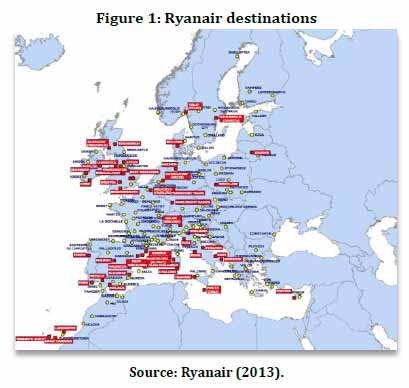
<body><![CDATA[<p><b>2.   Method</b></p></font>   <font face="Verdana" size="2">    <p>As mentioned in the introduction, to analyse the     complex network of aerial transportation through LCCs in Spain, we have taken     Ryanair as a case study and applied CNT. Regarding the method, CNT is grounded     in the use of graphs, where the studied data are a set of connected nodes with     several properties influencing other nodes (Arenas, Díaz-Guilera, Kurthsd,     Moreno, &amp; Zhou, 2008; Newman, 2003; Réka &amp; Barabási, 2002; Strogatz,     2001; Watts, 1999). Complex systems have a set of characteristics defining     their structure: they are composed of several parts which interact, every part     has an internal structure and a specific aim, and what happens in one part affects the whole system in a non-linear manner.</p>       <p>A “graph” in this context is made up of “vertices” or “nodes” and lines     called edges that connect them. In the context of network theory, a complex     network is graph(network) with     non-trivial topological features and     with patterns of connection between their elements that are neither purely     regular nor purely random. The mathematical abstraction of a complex network is     a graph G comprising a set of N nodes (or vertices) connected by a set of M     links (or edges), k<sub>i</sub> being the degree (number of links) of node i.</p>     <p>We call all nodes with a direct connection to     another node neighbours, i.e. neighbours of V<sub>i</sub>. In the first part of     our study, we determine the structural properties of the complex network, that is, how the nodes are connected.</p>       <p><b>2.1 analysis of CNT in the case of Ryanair</b></p>       <p>First, an analysis of Ryanair’s destinations was     undertaken. As mentioned in the introduction, the company currently has 185     destinations in 28 countries. <a href="#f1">Figure 1</a> shows the existing connections among them in Spain and the rest of Europe.</p>       <p><a name="f1"></a></p>       <p>&nbsp;</p>       <p align="center"><img src="/img/revistas/tms/v10n1/10n1a07f1.jpg" width="409" height="388"></p>       
<p align="center">&nbsp;</p>       ]]></body>
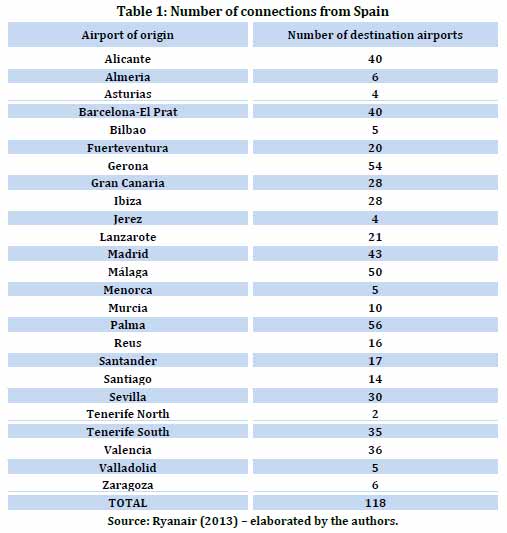
<body><![CDATA[<p>Once all the nodes in the network had been     identified, a database comprising every country was developed and a weight     (number of flights per week) was assigned to the links among the nodes, thus     creating the connections between the networks of all the 25 Spanish airports in     which Ryanair operates, i.e. a matrix of adjacency was created     for each airport. In the graphic of the network developed for Spain, each node     represents an airport, with a line linking the route from an airport to     another; the linking line grows thicker as the number of connections per week (weight) increases.</p>       <p>&nbsp;</p></font>   <font face="Verdana" size="3">    <p><b>3.   Results</b></p></font>   <font face="Verdana" size="2">    <p>This section presents the results of the analysis     of the structural properties of the Spanish network in relation to the tourist     sector. First the general features of this network are examined in order to     provide a basis for then focusing on the properties of network centrality and     betweenness. These properties provide a better understanding of the functioning     of the Spanish complex network from the perspective of the airline Ryanair and thus the implications of different flows for tourism.</p>       <p><b>3.1. Characteristics of the Ryanair network in Spain </b></p>       <p>Spain is connected nationally and     internationally to 118 destinations through Ryanair, Palma being the airport     with the highest offer of 56 destinations and Tenerife North the least connected airport with only two destinations (see <a href="#t1">Table 1</a>).</p>       <p><a name="t1"></a></p>       <p>&nbsp;</p>       <p align="center"><img src="/img/revistas/tms/v10n1/10n1a07t1.jpg" width="507" height="533"></p>       
<p align="center">&nbsp;</p>       ]]></body>
<body><![CDATA[<p>Considering the number of     connections between every European airport in which Ryanair operates (28     countries including Spain) and comparing the Spanish information with other     European countries, we can see from <a href="/img/revistas/tms/v10n1/10n1a07f2.jpg">Figure 2</a> that Spain is in second place regarding connectivity, only surpassed by the UK.</p>     
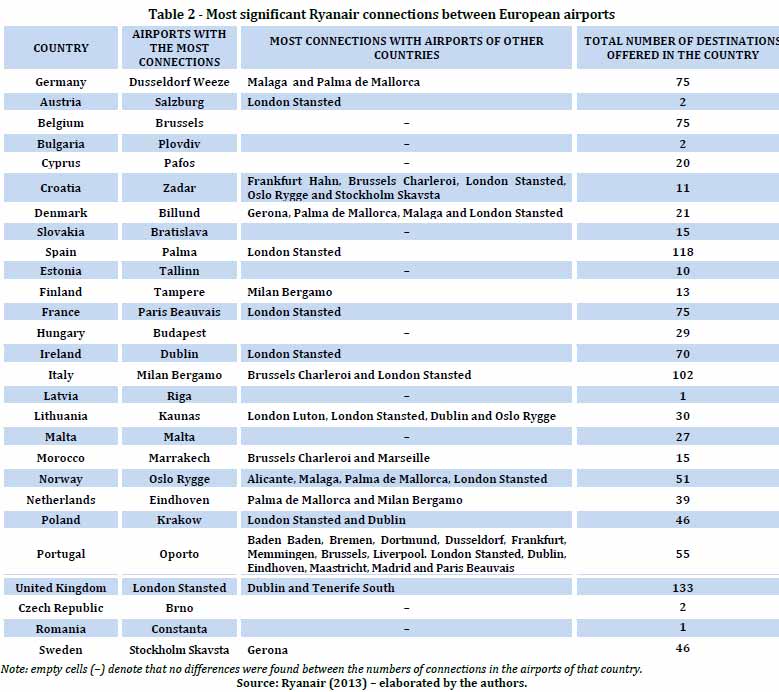
<p>Regarding the general     characteristics of the network, <a href="/img/revistas/tms/v10n1/10n1a07t2.jpg">Table 2</a> displays the main connections between     European airports (the airports can be either originating or destination airports).</p>       
<p>Looking at <a href="/img/revistas/tms/v10n1/10n1a07t2.jpg">Table 2</a>, we can see that several     European countries have an important index of connectivity with Spanish     airports. For example, the airports of Malaga and Palma de Mallorca are the     main origins or destinations for Ryanair flights in Germany, Denmark, Norway     and the Netherlands. On the other hand, Gerona has important connections with Denmark and Sweden, Alicante with Norway, and Madrid with Portugal.</p>       
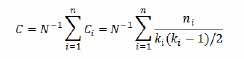
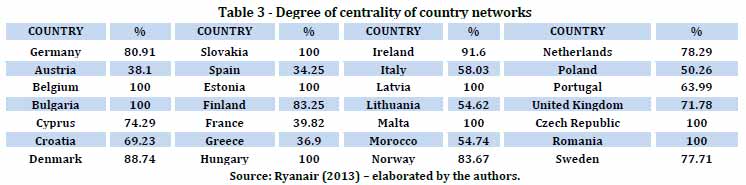
<p><b>3.2. Centrality</b></p>       <p>The centralisation rate     refers to the special condition in which an airport plays a main role because     it is connected to all the nodes (destinations) of the network. Thus, 100%     denotes a connection to all the airports (i.e. a star network) and 0% denotes a     mesh network. In our research, this analysis determines whether the Ryanair     airports in Spain have an important network of connections without a central     point or whether one main airport issues and receives most flights in the country. It is calculated as follows:</p>       <p>&nbsp;</p>       <p align="center"><img src="/img/revistas/tms/v10n1/10n1a07e1.jpg" width="244" height="59"></p>       
<p>&nbsp;</p>       <p>In this formula, n<sub>i</sub> is the number of connections between nodes closer to node i and k<sub>i</sub> is the degree. <a href="/img/revistas/tms/v10n1/10n1a07t3.jpg">Table 3</a> presents the degree of centrality for each country.</p>       
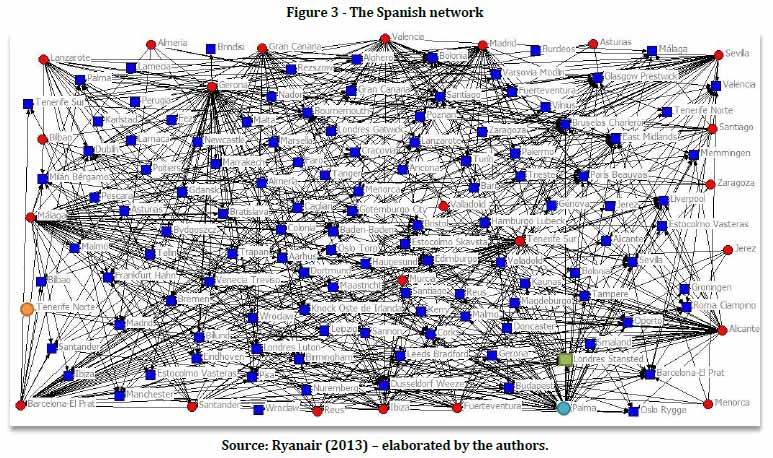
<p>Spain, like other countries such as Austria, France     and Greece, has a low centralization rate (34.2%) and thus has a mesh network as displayed in <a href="/img/revistas/tms/v10n1/10n1a07f3.jpg">Figure 3</a>.</p>     
]]></body>
<body><![CDATA[<p>Mesh networks, where there is     no central airport, are very different from networks with a high     centralization, as the case of Belgium for example. Belgium has a star network,     i.e. connectivity is focused in just one node (airport), as displayed in <a href="/img/revistas/tms/v10n1/10n1a07f4.jpg">Figure     4</a>, which shows that Brussels airport is the origin or destination of all the Ryanair flights of the country.</p>     
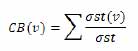
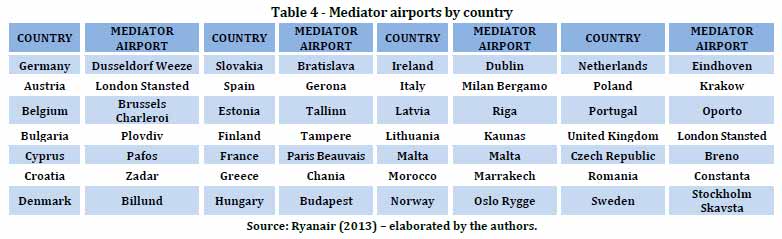
<p>The study of this property is relevant as it     indicates the degree of the dependency of a country on just one airport,     implying that if that main node fails, the damage in the whole network is     greater, affecting its whole connectivity. In contrast, in countries with a     mesh network, where there is no central airport, not only is that possible     damage minimised but also domestic tourism is favoured as there is greater connectivity among the cities of the country.</p>     <p><b>3.3. Betweenness</b></p>     <p>Mediation is one of the centrality indicators most     used in the physics literature. This represents the number of short routes     between any pair of nodes in the network. The concept is related to the     frequency of an airport being on the shortest route between two other airports,     i.e. the geodesic path. In our study, this index allows us to discover which     Spanish airport serves as the main mediator among the other connected airports.     Although this normally coincides with the airport or node with the greatest     number of Ryanair flights in the country, on some occasions the mediator     airport may not belong to that country. For example, in Austria, the airport     with the highest degree of betweenness among its nodes is London Stansted. The formula that describes this property is as follows:</p>     <p>&nbsp;</p>     <p align="center"><img src="/img/revistas/tms/v10n1/10n1a07e2.jpg" width="138" height="51"></p>       
<p>&nbsp;</p>       <p>In this     formula, v is the studied node,  &#963;st<b><i> (v)</i></b> is the number of paths from s to t going     through v and    &#963;st  is the number of paths from <i><b>s</b></i> to <i><b>t</b></i>. </p>       <p><a href="/img/revistas/tms/v10n1/10n1a07t4.jpg">Table 4</a>    shows the mediator airports in all 28 European countries in which Ryanair     operates. In the case of Spain, the airport of Gerona airport has the highest     betweenness rate, so we can assume that it is the most connected city of the country.<b> &nbsp; </b></p>     
<p>&nbsp;</p></font> <font face="Verdana" size="3">    ]]></body>
<body><![CDATA[<p><b>4.   Discussion</b></p></font> <font face="Verdana" size="2">    <p>The purpose of this paper     was to open up a new line of research linking tourist flows with airport     connectivity based on complex network analysis, focusing in this case on LCCs     and Ryanair specifically. Its eminently exploratory and broad nature means that     the conclusions are general and therefore we cannot focus attention on     particular cases except as examples to show the aforementioned phenomena. Based on the foregoing, we can draw a number of conclusions.</p>       <p>In Europe, generally,     centralisation rates are high. In most cases, one airport plays the main role     in every country. We find the lowest centralisation rates in countries with     many destinations, such as Italy, Spain and the United Kingdom, where the most     important originating and destination airports are diversified; thus, these     countries have a great variety of tourist flows. On the other hand, in places     where centralisation is high, such as Belgium, tourist flows have only one airport as the principal originating and destination hub.</p>       <p>Betweenness determines     the airport that has the shortest path between any pair of nodes. This     information can be very useful for tourists as the mediator airport offers the     shortest routes to their destinations. Thus, for example, if Spanish tourists     wish to visit any city in the UK, the shortest route to their destination may     be offered by the airport of Gerona (which has the highest mediation index in     Spain; see <a href="/img/revistas/tms/v10n1/10n1a07t3.jpg">Table 3</a>).  This means a     benefit for those cities with a high mediation index that are not consolidated     international tourist destinations, such as Gerona, Reus and Alicante. These     cities are favoured as connection points among origins and destinations. This     not only provides recognition to those cities that otherwise would be unknown     to international tourists, but also generates tourist incomes by virtue of     their role as a stopover for many international trips. Thus, new destinations     are created, which are also the origins of new routes where “there are more     people arriving by plane than by train” (Hosteltur, 2011, p. 15). Therefore, while     FSNCs tend to prioritise activity in major cities, the increase in LCCs has     meant great benefits for other cities where the possibilities of travelling     have been increased, mainly internationally, without depending on making stops in many cases.</p>       
<p>At this point, we can     contemplate the following question: Does LCC connectivity determine the current     tourist flows in Europe? Previous studies have analysed the networks of     worldwide airports (Guimerà, Mossa, Turtschi, &amp; Amaral, 2005), or particular countries (Bagler, 2004; Li &amp; Cai, 2004).     However, until now no research has focused on LCCs, which have completely     changed air passenger transport. Therefore, the analysis of Ryanair as a     complex network and its implications for tourism is pioneering in international     research and can make a significant contribution in explaining European tourist     flows, especially in the case of transnational flows due to airport     connectivity, as the most prevalent LCC determines the features of many cities     as issuers and receivers of tourism. With regard to this, the tourist flows     between countries in northern Europe and Mediterranean destinations are     confirmed. This can be illustrated by the example of the high connectivity     between Germany and Palma de Mallorca (Spain), with 40% of the Germans who     travel to Spain visiting the Balearic Islands (Hosteltur, 2011; IET, 2011a, 2012).</p>       <p>Thus, if we use Spain as an example of tourist receivers, in 2012 the IET     reported that the UK was its most important country of origin regarding     international tourism, with almost 14 million arrivals, 83% of them by LCCs     (IET, 2012). This concurs with the results of our study as the two countries     with the highest number of Ryanair destinations in Europe are the UK with 133     destinations and Spain with 108 and the most connected cities are London and     Tenerife in the first case and Palma de Mallorca and London in the second case.     This validates the significant connection between both countries and reflects     the most important tourist flows across the continent. In the case of Italy,     the IET (2011a) reported that 66% of tourists who travelled to Spain did so by     LCC, with a constant annual increase of around 8%, which makes Italy another     important country of origin for Spain thanks to these airlines. Something similar     is happening with Belgium, which is also becoming an important issuing market for Spain (IET, 2011a).</p>       <p>The results of this analysis also demonstrate the     contribution of LCCs to the consolidation of emerging tourist destinations. In     the case of Spain, the great diversification of its connectivity with a low     centralisation rate (34.25%, see <a href="/img/revistas/tms/v10n1/10n1a07t3.jpg">Table 3</a>) but without a central point for     tourist flows gives a clear indication of the considerable influence of Ryanair     in the increase in foreign tourists. Approximately 30% of foreign tourists went     to cities that are not traditional international tourism destinations, such as     Zaragoza, Gerona, Jaen and Murcia, where the arrival of tourists using LCCs     constitutes between 80% and 95% of the total number (IET, 2011b). In this     group, as previously mentioned, those cities that are not completely     consolidated destinations internationally but that have a high mediation index,     such as Gerona, benefit from being a linking point between issuing and     receiving points (IET, 2011b). Thus, LCCs establish connections between     airports branded as “second level”, giving visibility to those cities where     these airlines are invigorating elements for their connectivity and their economy (Seguí Pons &amp; Martínez Reynés, 2010).</p>       
<p>Apart from the aforementioned results, we can also     find implications for tourism management. First, this information could be very     useful to airlines already operating in the countries considered in this study     and for those thinking of opening new markets and working in new countries;     studies such as this are good sources of information for the analysis of     competence in the air passenger transport sector. Second, it is important to     consider that the failure of one or several nodes can affect the development     and connectivity of the whole system (Arenas <i>et al</i>., 2008). As previously shown, in some countries, such as     Belgium, most connections depend on just one airport, which increases the risk     for the whole network in the case of climate problems, for example, or the     closure of the airport due to a terrorist threat, which is more common in the     airports of major cities. Thus, the closure of one airport supposes the     cancellation of flights to and from those airports that depend on it in the     same country and even international connections, increasing the damage.     Therefore, network analysis also allows us to identify the most important node     of every country and whether the centralisation rate is too high, which could be helpful in avoiding potential problems.</p>       <p>Without a deeper analysis of every aspect     considered in this study, we can still confirm that the development of LCCs     influences international tourist flows, not only in the democratisation of     international travel as other studies have confirmed (Rodríguez Gamero, 2008),     but also in every aspect of tourist mobility (Dobruszkes, 2009; IET, 2011b;     Hosteltur, 2011; Seguí Pons &amp; Martínez Reynés, 2010) and non-tourist     mobility (Burrell, 2011). For these reasons, this novel exploratory study of     Ryanair in Spain as a paradigmatic example of LCCs from the perspective of the     CNT opens up a new line of research for the analysis of the different     parameters of airport connectivity. It also offers implications for tourism,     with the aim of having real applicability in the management and configuration of destinations and tourist flows in Europe in general and Spain in particular.</p>       <p>&nbsp;</p></font>   <font face="Verdana" size="3">    ]]></body>
<body><![CDATA[<p><b>References</b></p></font>   <font face="Verdana" size="2">    <!-- ref --><p>Alderighi, M., Cento, A., Nijkamp, P.     &amp; Rietveld, P. (2012). Competition in the European aviation market: The entry of low-cost airlines. <i>Journal of Transport Geography, 24</i>, 223–233.    &nbsp;&nbsp;&nbsp;&nbsp;&nbsp;&nbsp;&nbsp;&nbsp;[&#160;<a href="javascript:void(0);" onclick="javascript: window.open('/scielo.php?script=sci_nlinks&ref=000094&pid=S2182-8458201400010000700001&lng=','','width=640,height=500,resizable=yes,scrollbars=1,menubar=yes,');">Links</a>&#160;]<!-- end-ref --> </p>       <!-- ref --><p>Arenas, A., Díaz-Guilera, A., Kurthsd, J., Moreno, Y. &amp; Zhou, C. (2008). Synchronization in complex networks. <i>Physics Reports, 469</i>(3), 93–153.    &nbsp;&nbsp;&nbsp;&nbsp;&nbsp;&nbsp;&nbsp;&nbsp;[&#160;<a href="javascript:void(0);" onclick="javascript: window.open('/scielo.php?script=sci_nlinks&ref=000096&pid=S2182-8458201400010000700002&lng=','','width=640,height=500,resizable=yes,scrollbars=1,menubar=yes,');">Links</a>&#160;]<!-- end-ref --></p>       <!-- ref --><p>Bagler, G. (2004). Analysis of airport network of India as a complex weighted network. <i>Physica A</i>, <i>387</i>(12), 2972–2980.    &nbsp;&nbsp;&nbsp;&nbsp;&nbsp;&nbsp;&nbsp;&nbsp;[&#160;<a href="javascript:void(0);" onclick="javascript: window.open('/scielo.php?script=sci_nlinks&ref=000098&pid=S2182-8458201400010000700003&lng=','','width=640,height=500,resizable=yes,scrollbars=1,menubar=yes,');">Links</a>&#160;]<!-- end-ref --></p>       <!-- ref --><p>Burghouwt, G., Hakfoort, J. &amp; Ritsema van Eck, J. (2003). The spatial configuration of airline networks in Europe. <i>Journal of Air Transport Management,</i> <i>9</i>(5), 309–323.    &nbsp;&nbsp;&nbsp;&nbsp;&nbsp;&nbsp;&nbsp;&nbsp;[&#160;<a href="javascript:void(0);" onclick="javascript: window.open('/scielo.php?script=sci_nlinks&ref=000100&pid=S2182-8458201400010000700004&lng=','','width=640,height=500,resizable=yes,scrollbars=1,menubar=yes,');">Links</a>&#160;]<!-- end-ref --> </p>       <!-- ref --><p>Burrell, K. (2011). Going steerage on Ryanair: Cultures of migrant air     travel between Poland and the UK. <i>Journal     of Transport Geography,</i> <i>19</i>(5), 1023–1030.    &nbsp;&nbsp;&nbsp;&nbsp;&nbsp;&nbsp;&nbsp;&nbsp;[&#160;<a href="javascript:void(0);" onclick="javascript: window.open('/scielo.php?script=sci_nlinks&ref=000102&pid=S2182-8458201400010000700005&lng=','','width=640,height=500,resizable=yes,scrollbars=1,menubar=yes,');">Links</a>&#160;]<!-- end-ref --> </p>     <!-- ref --><p>Calvo-Mora, A., Berbel-Pineda, J. M., Periáñez, R. &amp; Suárez, E. M.     (2011). Determining factors of a city’s tourism     attractiveness. <i>Tourism &amp; Management Studies</i>, <i>7</i>, 9–23.    &nbsp;&nbsp;&nbsp;&nbsp;&nbsp;&nbsp;&nbsp;&nbsp;[&#160;<a href="javascript:void(0);" onclick="javascript: window.open('/scielo.php?script=sci_nlinks&ref=000104&pid=S2182-8458201400010000700006&lng=','','width=640,height=500,resizable=yes,scrollbars=1,menubar=yes,');">Links</a>&#160;]<!-- end-ref --></p>     <!-- ref --><p>Castillo-Manzano, J.     I., Lopez-Valpuesta, L. &amp; Pedregal, D. J. (2012a). How can the effects of the introduction of a new airline on a national     airline network be measured? <i>Journal of Transport Economics and Policy, 46</i>(2), 263–279.    &nbsp;&nbsp;&nbsp;&nbsp;&nbsp;&nbsp;&nbsp;&nbsp;[&#160;<a href="javascript:void(0);" onclick="javascript: window.open('/scielo.php?script=sci_nlinks&ref=000106&pid=S2182-8458201400010000700007&lng=','','width=640,height=500,resizable=yes,scrollbars=1,menubar=yes,');">Links</a>&#160;]<!-- end-ref --></p>       <!-- ref --><p>Castillo-Manzano, J. I., Lopez-Valpuesta, L. &amp; Pedregal, D. J.     (2012b). What role will hubs play in the LCC point-to-point connections era?     The Spanish experience. <i>Journal of Transport Geography, 24</i>, 262–270.    &nbsp;&nbsp;&nbsp;&nbsp;&nbsp;&nbsp;&nbsp;&nbsp;[&#160;<a href="javascript:void(0);" onclick="javascript: window.open('/scielo.php?script=sci_nlinks&ref=000108&pid=S2182-8458201400010000700008&lng=','','width=640,height=500,resizable=yes,scrollbars=1,menubar=yes,');">Links</a>&#160;]<!-- end-ref --> </p>       <!-- ref --><p>Dobruszkes, F. (2006). An analysis of European low-cost airlines and     their networks. <i>Journal of Transport Geography, 14</i>(4), 249–264.    &nbsp;&nbsp;&nbsp;&nbsp;&nbsp;&nbsp;&nbsp;&nbsp;[&#160;<a href="javascript:void(0);" onclick="javascript: window.open('/scielo.php?script=sci_nlinks&ref=000110&pid=S2182-8458201400010000700009&lng=','','width=640,height=500,resizable=yes,scrollbars=1,menubar=yes,');">Links</a>&#160;]<!-- end-ref --> </p>       <!-- ref --><p>Dobruszkes, F. (2009). New Europe, new low-cost air services. <i>Journal of Transport Geography,</i> <i>17</i>(6), 423–432.    &nbsp;&nbsp;&nbsp;&nbsp;&nbsp;&nbsp;&nbsp;&nbsp;[&#160;<a href="javascript:void(0);" onclick="javascript: window.open('/scielo.php?script=sci_nlinks&ref=000112&pid=S2182-8458201400010000700010&lng=','','width=640,height=500,resizable=yes,scrollbars=1,menubar=yes,');">Links</a>&#160;]<!-- end-ref --> </p>       <!-- ref --><p>Donzelli, M. (2010). The effect of low-cost air transportation on the     local economy evidence from Southern Italy. <i>Journal of Air Transport Management, 16</i>(3), 121–126.    &nbsp;&nbsp;&nbsp;&nbsp;&nbsp;&nbsp;&nbsp;&nbsp;[&#160;<a href="javascript:void(0);" onclick="javascript: window.open('/scielo.php?script=sci_nlinks&ref=000114&pid=S2182-8458201400010000700011&lng=','','width=640,height=500,resizable=yes,scrollbars=1,menubar=yes,');">Links</a>&#160;]<!-- end-ref --> </p>       <!-- ref --><p>Guimerà, R.,&nbsp;Mossa, S.,&nbsp;Turtschi, A. &amp; Amaral, L. A. N.     (2005). The worldwide air transportation network:     Anomalous centrality, community structure, and cities’ global roles. <i>Proceedings of the Natural Academy of Sciences of the United States of America, 102</i>(22), 7794–7799.    &nbsp;&nbsp;&nbsp;&nbsp;&nbsp;&nbsp;&nbsp;&nbsp;[&#160;<a href="javascript:void(0);" onclick="javascript: window.open('/scielo.php?script=sci_nlinks&ref=000116&pid=S2182-8458201400010000700012&lng=','','width=640,height=500,resizable=yes,scrollbars=1,menubar=yes,');">Links</a>&#160;]<!-- end-ref --></p>       <!-- ref --><p>Hernández, J. A.     (2008). <i>El turismo de masas. Evolución y perspectivas. </i>Síntesis: Editorial Síntesis.    &nbsp;&nbsp;&nbsp;&nbsp;&nbsp;&nbsp;&nbsp;&nbsp;[&#160;<a href="javascript:void(0);" onclick="javascript: window.open('/scielo.php?script=sci_nlinks&ref=000118&pid=S2182-8458201400010000700013&lng=','','width=640,height=500,resizable=yes,scrollbars=1,menubar=yes,');">Links</a>&#160;]<!-- end-ref --></p>       <!-- ref --><p>Hosteltur (2011). El efecto de Ryanair sobre los destinos españoles. <i>Hosteltur, </i>n. 204, 1–15.    &nbsp;&nbsp;&nbsp;&nbsp;&nbsp;&nbsp;&nbsp;&nbsp;[&#160;<a href="javascript:void(0);" onclick="javascript: window.open('/scielo.php?script=sci_nlinks&ref=000120&pid=S2182-8458201400010000700014&lng=','','width=640,height=500,resizable=yes,scrollbars=1,menubar=yes,');">Links</a>&#160;]<!-- end-ref --> </p>       <!-- ref --><p>IET (2011a). <i>Movimientos     Turísticos Entre Fronteras (FRONTUR). Encuesta de Gasto Turístico (EGATUR</i>). Madrid: Instituto de Estudios Turísticos.    &nbsp;&nbsp;&nbsp;&nbsp;&nbsp;&nbsp;&nbsp;&nbsp;[&#160;<a href="javascript:void(0);" onclick="javascript: window.open('/scielo.php?script=sci_nlinks&ref=000122&pid=S2182-8458201400010000700015&lng=','','width=640,height=500,resizable=yes,scrollbars=1,menubar=yes,');">Links</a>&#160;]<!-- end-ref --></p>       <!-- ref --><p>IET (2011b). <i>Informe anual de CBC</i>. Madrid: Instituto de Estudios Turísticos.    &nbsp;&nbsp;&nbsp;&nbsp;&nbsp;&nbsp;&nbsp;&nbsp;[&#160;<a href="javascript:void(0);" onclick="javascript: window.open('/scielo.php?script=sci_nlinks&ref=000124&pid=S2182-8458201400010000700016&lng=','','width=640,height=500,resizable=yes,scrollbars=1,menubar=yes,');">Links</a>&#160;]<!-- end-ref --></p>       <!-- ref --><p>IET (2012). <i>Turismo,     Tráfico Aéreo y Compañías Aéreas de Bajo Coste en el Año 2011</i>. Madrid: Instituto de Estudios Turísticos.    &nbsp;&nbsp;&nbsp;&nbsp;&nbsp;&nbsp;&nbsp;&nbsp;[&#160;<a href="javascript:void(0);" onclick="javascript: window.open('/scielo.php?script=sci_nlinks&ref=000126&pid=S2182-8458201400010000700017&lng=','','width=640,height=500,resizable=yes,scrollbars=1,menubar=yes,');">Links</a>&#160;]<!-- end-ref --></p>       <!-- ref --><p>Jimenez, E., Claro,     J. &amp; de Sousa, J. P. (2012). Spatial and     commercial evolution of aviation networks: A case study in mainland Portugal. <i>Journal of Transport Geography, 24</i>, 383–395.    &nbsp;&nbsp;&nbsp;&nbsp;&nbsp;&nbsp;&nbsp;&nbsp;[&#160;<a href="javascript:void(0);" onclick="javascript: window.open('/scielo.php?script=sci_nlinks&ref=000128&pid=S2182-8458201400010000700018&lng=','','width=640,height=500,resizable=yes,scrollbars=1,menubar=yes,');">Links</a>&#160;]<!-- end-ref --> </p>       <!-- ref --><p>Li,     W. &amp;&nbsp;Cai,     X. (2004). Statistical analysis of airport network of China. <i>Physical Review E</i>, <i>69</i>(4). DOI: 10.1103/PhysRevE.69.046106.    &nbsp;&nbsp;&nbsp;&nbsp;&nbsp;&nbsp;&nbsp;&nbsp;[&#160;<a href="javascript:void(0);" onclick="javascript: window.open('/scielo.php?script=sci_nlinks&ref=000130&pid=S2182-8458201400010000700019&lng=','','width=640,height=500,resizable=yes,scrollbars=1,menubar=yes,');">Links</a>&#160;]<!-- end-ref --></p>       <!-- ref --><p>Martínez-García, E. &amp; Raya, J. M. (2008). Length of stay for low-cost tourism. <i>Tourism Management, 29</i>(6), 1064–1075.    &nbsp;&nbsp;&nbsp;&nbsp;&nbsp;&nbsp;&nbsp;&nbsp;[&#160;<a href="javascript:void(0);" onclick="javascript: window.open('/scielo.php?script=sci_nlinks&ref=000132&pid=S2182-8458201400010000700020&lng=','','width=640,height=500,resizable=yes,scrollbars=1,menubar=yes,');">Links</a>&#160;]<!-- end-ref --> </p>       <!-- ref --><p>Martínez-García, E. &amp; Royo-Vela, M. (2010). Segmentation of low-cost     flights users at secondary airports. <i>Journal     of Air Transport Management,</i> <i>16</i>(4), 234–237.    &nbsp;&nbsp;&nbsp;&nbsp;&nbsp;&nbsp;&nbsp;&nbsp;[&#160;<a href="javascript:void(0);" onclick="javascript: window.open('/scielo.php?script=sci_nlinks&ref=000134&pid=S2182-8458201400010000700021&lng=','','width=640,height=500,resizable=yes,scrollbars=1,menubar=yes,');">Links</a>&#160;]<!-- end-ref --> </p>       <!-- ref --><p>Newman, M. E. J. (2003). The structure and function of complex networks. <i>SIAM Reviews</i>, <i>45</i>(2), 167–256.    &nbsp;&nbsp;&nbsp;&nbsp;&nbsp;&nbsp;&nbsp;&nbsp;[&#160;<a href="javascript:void(0);" onclick="javascript: window.open('/scielo.php?script=sci_nlinks&ref=000136&pid=S2182-8458201400010000700022&lng=','','width=640,height=500,resizable=yes,scrollbars=1,menubar=yes,');">Links</a>&#160;]<!-- end-ref --></p>       <!-- ref --><p>Raya-Vilchez, J. M. &amp; Martínez-García, E. (2011). Nationality and low-cost trip duration. A microeconometric analysis. <i>Journal of Air Transport Management,</i> <i>17</i>(3), 168–174.    &nbsp;&nbsp;&nbsp;&nbsp;&nbsp;&nbsp;&nbsp;&nbsp;[&#160;<a href="javascript:void(0);" onclick="javascript: window.open('/scielo.php?script=sci_nlinks&ref=000138&pid=S2182-8458201400010000700023&lng=','','width=640,height=500,resizable=yes,scrollbars=1,menubar=yes,');">Links</a>&#160;]<!-- end-ref --> </p>       <!-- ref --><p>Réka, A. &amp; Barabási,&nbsp;A. (2002). Statistical mechanics of complex networks. <i>Reviews of Modern Physics</i>, <i>74</i>(1), 47–97.    &nbsp;&nbsp;&nbsp;&nbsp;&nbsp;&nbsp;&nbsp;&nbsp;[&#160;<a href="javascript:void(0);" onclick="javascript: window.open('/scielo.php?script=sci_nlinks&ref=000140&pid=S2182-8458201400010000700024&lng=','','width=640,height=500,resizable=yes,scrollbars=1,menubar=yes,');">Links</a>&#160;]<!-- end-ref --></p>       <!-- ref --><p>Rey, B., Myro, R. L.     &amp; Galera, A. (2011). Effect of low-cost airlines on tourism in Spain. A dynamic panel data model. <i>Journal of Air Transport Management, 17</i>(3), 163–167.    &nbsp;&nbsp;&nbsp;&nbsp;&nbsp;&nbsp;&nbsp;&nbsp;[&#160;<a href="javascript:void(0);" onclick="javascript: window.open('/scielo.php?script=sci_nlinks&ref=000142&pid=S2182-8458201400010000700025&lng=','','width=640,height=500,resizable=yes,scrollbars=1,menubar=yes,');">Links</a>&#160;]<!-- end-ref --> </p>       <!-- ref --><p>Ribeiro de Almeida, C. (2011). The new challenges of tourism airports – The case of Faro airport. <i>Tourism &amp; Management Studies, 7</i>, 109–120.    &nbsp;&nbsp;&nbsp;&nbsp;&nbsp;&nbsp;&nbsp;&nbsp;[&#160;<a href="javascript:void(0);" onclick="javascript: window.open('/scielo.php?script=sci_nlinks&ref=000144&pid=S2182-8458201400010000700026&lng=','','width=640,height=500,resizable=yes,scrollbars=1,menubar=yes,');">Links</a>&#160;]<!-- end-ref --></p>       <!-- ref --><p>Rodríguez Gamero, M.     I. (2008). Compañías de Bajo Coste y Democratización de los Cielos. El caso de     Ryanair en Europa y Península. <i>Estudios Turísticos, </i>N.º 175<i>–</i>176, 81–87.    &nbsp;&nbsp;&nbsp;&nbsp;&nbsp;&nbsp;&nbsp;&nbsp;[&#160;<a href="javascript:void(0);" onclick="javascript: window.open('/scielo.php?script=sci_nlinks&ref=000146&pid=S2182-8458201400010000700027&lng=','','width=640,height=500,resizable=yes,scrollbars=1,menubar=yes,');">Links</a>&#160;]<!-- end-ref --> </p>       <!-- ref --><p>Ryanair (2013). <i>Map of routes</i>. Retrieved from   <a href="http://www.ryanair.com/es/destinos-economicos" target="_blank">http://www.ryanair.com/es/destinos-economicos</a>&nbsp;&nbsp;&nbsp;&nbsp;&nbsp;&nbsp;&nbsp;&nbsp;[&#160;<a href="javascript:void(0);" onclick="javascript: window.open('/scielo.php?script=sci_nlinks&ref=000148&pid=S2182-8458201400010000700028&lng=','','width=640,height=500,resizable=yes,scrollbars=1,menubar=yes,');">Links</a>&#160;]<!-- end-ref --><!-- ref --><p>Seguí Pons, J. M.     &amp; Martínez Reynés, M. R. (2010). Movilidad y Sostenibilidad en el     Transporte Aéreo: Las Compañías de Bajo Coste en los Destinos Turísticos de     España y Baleares. <i>Revista Transporte y Territorio, </i>n.º 2, 68–98.    &nbsp;&nbsp;&nbsp;&nbsp;&nbsp;&nbsp;&nbsp;&nbsp;[&#160;<a href="javascript:void(0);" onclick="javascript: window.open('/scielo.php?script=sci_nlinks&ref=000149&pid=S2182-8458201400010000700029&lng=','','width=640,height=500,resizable=yes,scrollbars=1,menubar=yes,');">Links</a>&#160;]<!-- end-ref --> </p>       <!-- ref --><p>Strogatz, S. H. (2001). Exploring complex networks. <i>Nature</i>, <i>410</i>(6825), 268–276.    &nbsp;&nbsp;&nbsp;&nbsp;&nbsp;&nbsp;&nbsp;&nbsp;[&#160;<a href="javascript:void(0);" onclick="javascript: window.open('/scielo.php?script=sci_nlinks&ref=000151&pid=S2182-8458201400010000700030&lng=','','width=640,height=500,resizable=yes,scrollbars=1,menubar=yes,');">Links</a>&#160;]<!-- end-ref --></p>       ]]></body>
<body><![CDATA[<!-- ref --><p>Vera-Rebollo, J. F.     &amp; Ivars-Baidal, J. A. (2009). Spread of low-cost carriers: Tourism and regional policy effects in Spain. <i>Regional Studies, 43</i>(4), 559–570.    &nbsp;&nbsp;&nbsp;&nbsp;&nbsp;&nbsp;&nbsp;&nbsp;[&#160;<a href="javascript:void(0);" onclick="javascript: window.open('/scielo.php?script=sci_nlinks&ref=000153&pid=S2182-8458201400010000700031&lng=','','width=640,height=500,resizable=yes,scrollbars=1,menubar=yes,');">Links</a>&#160;]<!-- end-ref --> </p>       <!-- ref --><p>Watts,     D. J. (1999). Networks, dynamics, and the small world phenomenon. <i>American     Journal of Sociology</i>, <i>105</i>(2), 493–527.    &nbsp;&nbsp;&nbsp;&nbsp;&nbsp;&nbsp;&nbsp;&nbsp;[&#160;<a href="javascript:void(0);" onclick="javascript: window.open('/scielo.php?script=sci_nlinks&ref=000155&pid=S2182-8458201400010000700032&lng=','','width=640,height=500,resizable=yes,scrollbars=1,menubar=yes,');">Links</a>&#160;]<!-- end-ref --></p>       <p>&nbsp;</p>       <p>&nbsp;</p>       <p><b>Article     history:</b></p>       <p>Submitted: 15 June 2013</p>       <p>Accepted: 31 October     2013</p> </font>      ]]></body><back>
<ref-list>
<ref id="B1">
<nlm-citation citation-type="journal">
<person-group person-group-type="author">
<name>
<surname><![CDATA[Alderighi]]></surname>
<given-names><![CDATA[M.]]></given-names>
</name>
<name>
<surname><![CDATA[Cento]]></surname>
<given-names><![CDATA[A.]]></given-names>
</name>
<name>
<surname><![CDATA[Nijkamp]]></surname>
<given-names><![CDATA[P.]]></given-names>
</name>
<name>
<surname><![CDATA[Rietveld]]></surname>
<given-names><![CDATA[P.]]></given-names>
</name>
</person-group>
<article-title xml:lang="en"><![CDATA[Competition in the European aviation market: The entry of low-cost airlines]]></article-title>
<source><![CDATA[Journal of Transport Geography]]></source>
<year>2012</year>
<volume>24</volume>
<page-range>223-233</page-range></nlm-citation>
</ref>
<ref id="B2">
<nlm-citation citation-type="journal">
<person-group person-group-type="author">
<name>
<surname><![CDATA[Arenas]]></surname>
<given-names><![CDATA[A.]]></given-names>
</name>
<name>
<surname><![CDATA[Díaz-Guilera]]></surname>
<given-names><![CDATA[A.]]></given-names>
</name>
<name>
<surname><![CDATA[Kurthsd]]></surname>
<given-names><![CDATA[J.]]></given-names>
</name>
<name>
<surname><![CDATA[Moreno]]></surname>
<given-names><![CDATA[Y.]]></given-names>
</name>
<name>
<surname><![CDATA[Zhou]]></surname>
<given-names><![CDATA[C.]]></given-names>
</name>
</person-group>
<article-title xml:lang="en"><![CDATA[Synchronization in complex networks]]></article-title>
<source><![CDATA[Physics Reports]]></source>
<year>2008</year>
<volume>469</volume>
<numero>3</numero>
<issue>3</issue>
<page-range>93-153</page-range></nlm-citation>
</ref>
<ref id="B3">
<nlm-citation citation-type="journal">
<person-group person-group-type="author">
<name>
<surname><![CDATA[Bagler]]></surname>
<given-names><![CDATA[G.]]></given-names>
</name>
</person-group>
<article-title xml:lang="en"><![CDATA[Analysis of airport network of India as a complex weighted network]]></article-title>
<source><![CDATA[Physica A]]></source>
<year>2004</year>
<volume>387</volume>
<numero>12</numero>
<issue>12</issue>
<page-range>2972-2980</page-range></nlm-citation>
</ref>
<ref id="B4">
<nlm-citation citation-type="journal">
<person-group person-group-type="author">
<name>
<surname><![CDATA[Burghouwt]]></surname>
<given-names><![CDATA[G.]]></given-names>
</name>
<name>
<surname><![CDATA[Hakfoort]]></surname>
<given-names><![CDATA[J.]]></given-names>
</name>
<name>
<surname><![CDATA[Ritsema van Eck]]></surname>
<given-names><![CDATA[J.]]></given-names>
</name>
</person-group>
<article-title xml:lang="en"><![CDATA[The spatial configuration of airline networks in Europe]]></article-title>
<source><![CDATA[Journal of Air Transport Management]]></source>
<year>2003</year>
<volume>9</volume>
<numero>5</numero>
<issue>5</issue>
<page-range>309-323</page-range></nlm-citation>
</ref>
<ref id="B5">
<nlm-citation citation-type="journal">
<person-group person-group-type="author">
<name>
<surname><![CDATA[Burrell]]></surname>
<given-names><![CDATA[K.]]></given-names>
</name>
</person-group>
<article-title xml:lang="en"><![CDATA[Going steerage on Ryanair: Cultures of migrant air travel between Poland and the UK]]></article-title>
<source><![CDATA[Journal of Transport Geography]]></source>
<year>2011</year>
<volume>19</volume>
<numero>5</numero>
<issue>5</issue>
<page-range>1023-1030</page-range></nlm-citation>
</ref>
<ref id="B6">
<nlm-citation citation-type="journal">
<person-group person-group-type="author">
<name>
<surname><![CDATA[Calvo-Mora]]></surname>
<given-names><![CDATA[A.]]></given-names>
</name>
<name>
<surname><![CDATA[Berbel-Pineda]]></surname>
<given-names><![CDATA[J. M.]]></given-names>
</name>
<name>
<surname><![CDATA[Periáñez]]></surname>
<given-names><![CDATA[R.]]></given-names>
</name>
<name>
<surname><![CDATA[Suárez]]></surname>
<given-names><![CDATA[E. M.]]></given-names>
</name>
</person-group>
<article-title xml:lang="en"><![CDATA[Determining factors of a city’s tourism attractiveness]]></article-title>
<source><![CDATA[Tourism & Management Studies]]></source>
<year>2011</year>
<volume>7</volume>
<page-range>9-23</page-range></nlm-citation>
</ref>
<ref id="B7">
<nlm-citation citation-type="journal">
<person-group person-group-type="author">
<name>
<surname><![CDATA[Castillo-Manzano]]></surname>
<given-names><![CDATA[J. I.]]></given-names>
</name>
<name>
<surname><![CDATA[Lopez-Valpuesta]]></surname>
<given-names><![CDATA[L.]]></given-names>
</name>
<name>
<surname><![CDATA[Pedregal]]></surname>
<given-names><![CDATA[D. J.]]></given-names>
</name>
</person-group>
<article-title xml:lang="en"><![CDATA[How can the effects of the introduction of a new airline on a national airline network be measured?]]></article-title>
<source><![CDATA[Journal of Transport Economics and Policy]]></source>
<year>2012</year>
<volume>46</volume>
<numero>2</numero>
<issue>2</issue>
<page-range>263-279</page-range></nlm-citation>
</ref>
<ref id="B8">
<nlm-citation citation-type="journal">
<person-group person-group-type="author">
<name>
<surname><![CDATA[Castillo-Manzano]]></surname>
<given-names><![CDATA[J. I.]]></given-names>
</name>
<name>
<surname><![CDATA[Lopez-Valpuesta]]></surname>
<given-names><![CDATA[L.]]></given-names>
</name>
<name>
<surname><![CDATA[Pedregal]]></surname>
<given-names><![CDATA[D. J.]]></given-names>
</name>
</person-group>
<article-title xml:lang="en"><![CDATA[What role will hubs play in the LCC point-to-point connections era? The Spanish experience.]]></article-title>
<source><![CDATA[Journal of Transport Geography]]></source>
<year>2012</year>
<volume>24</volume>
<page-range>262-270</page-range></nlm-citation>
</ref>
<ref id="B9">
<nlm-citation citation-type="journal">
<person-group person-group-type="author">
<name>
<surname><![CDATA[Dobruszkes]]></surname>
<given-names><![CDATA[F.]]></given-names>
</name>
</person-group>
<article-title xml:lang="en"><![CDATA[An analysis of European low-cost airlines and their networks]]></article-title>
<source><![CDATA[Journal of Transport Geography]]></source>
<year>2006</year>
<volume>14</volume>
<numero>4</numero>
<issue>4</issue>
<page-range>249-264</page-range></nlm-citation>
</ref>
<ref id="B10">
<nlm-citation citation-type="journal">
<person-group person-group-type="author">
<name>
<surname><![CDATA[Dobruszkes]]></surname>
<given-names><![CDATA[F.]]></given-names>
</name>
</person-group>
<article-title xml:lang="en"><![CDATA[New Europe, new low-cost air services]]></article-title>
<source><![CDATA[Journal of Transport Geography]]></source>
<year>2009</year>
<volume>17</volume>
<numero>6</numero>
<issue>6</issue>
<page-range>423-432</page-range></nlm-citation>
</ref>
<ref id="B11">
<nlm-citation citation-type="journal">
<person-group person-group-type="author">
<name>
<surname><![CDATA[Donzelli]]></surname>
<given-names><![CDATA[M.]]></given-names>
</name>
</person-group>
<article-title xml:lang="en"><![CDATA[The effect of low-cost air transportation on the local economy evidence from Southern Italy]]></article-title>
<source><![CDATA[Journal of Air Transport Management]]></source>
<year>2010</year>
<volume>16</volume>
<numero>3</numero>
<issue>3</issue>
<page-range>121-126</page-range></nlm-citation>
</ref>
<ref id="B12">
<nlm-citation citation-type="journal">
<person-group person-group-type="author">
<name>
<surname><![CDATA[Guimerà]]></surname>
<given-names><![CDATA[R.]]></given-names>
</name>
<name>
<surname><![CDATA[Mossa]]></surname>
<given-names><![CDATA[S.]]></given-names>
</name>
<name>
<surname><![CDATA[Turtschi]]></surname>
<given-names><![CDATA[A.]]></given-names>
</name>
<name>
<surname><![CDATA[Amaral]]></surname>
<given-names><![CDATA[L. A. N.]]></given-names>
</name>
</person-group>
<article-title xml:lang="en"><![CDATA[The worldwide air transportation network: Anomalous centrality, community structure, and cities’ global roles]]></article-title>
<source><![CDATA[Proceedings of the Natural Academy of Sciences of the United States of America]]></source>
<year>2005</year>
<volume>102</volume>
<numero>22</numero>
<issue>22</issue>
<page-range>7794-7799</page-range></nlm-citation>
</ref>
<ref id="B13">
<nlm-citation citation-type="book">
<person-group person-group-type="author">
<name>
<surname><![CDATA[Hernández]]></surname>
<given-names><![CDATA[J. A.]]></given-names>
</name>
</person-group>
<source><![CDATA[El turismo de masas: Evolución y perspectivas]]></source>
<year>2008</year>
<publisher-loc><![CDATA[Síntesis ]]></publisher-loc>
<publisher-name><![CDATA[Editorial Síntesis]]></publisher-name>
</nlm-citation>
</ref>
<ref id="B14">
<nlm-citation citation-type="journal">
<collab>Hosteltur</collab>
<article-title xml:lang="es"><![CDATA[El efecto de Ryanair sobre los destinos españoles]]></article-title>
<source><![CDATA[Hosteltur]]></source>
<year>2011</year>
<volume>204</volume>
<page-range>1-15</page-range></nlm-citation>
</ref>
<ref id="B15">
<nlm-citation citation-type="book">
<collab>IET</collab>
<source><![CDATA[Movimientos Turísticos Entre Fronteras (FRONTUR): Encuesta de Gasto Turístico (EGATUR)]]></source>
<year>2011</year>
<publisher-loc><![CDATA[Madrid ]]></publisher-loc>
<publisher-name><![CDATA[Instituto de Estudios Turísticos]]></publisher-name>
</nlm-citation>
</ref>
<ref id="B16">
<nlm-citation citation-type="book">
<collab>IET</collab>
<source><![CDATA[Informe anual de CBC]]></source>
<year>2011</year>
<publisher-loc><![CDATA[Madrid ]]></publisher-loc>
<publisher-name><![CDATA[Instituto de Estudios Turísticos]]></publisher-name>
</nlm-citation>
</ref>
<ref id="B17">
<nlm-citation citation-type="book">
<collab>IET</collab>
<source><![CDATA[Turismo, Tráfico Aéreo y Compañías Aéreas de Bajo Coste en el Año 2011]]></source>
<year>2012</year>
<publisher-loc><![CDATA[Madrid ]]></publisher-loc>
<publisher-name><![CDATA[Instituto de Estudios Turísticos]]></publisher-name>
</nlm-citation>
</ref>
<ref id="B18">
<nlm-citation citation-type="journal">
<person-group person-group-type="author">
<name>
<surname><![CDATA[Jimenez]]></surname>
<given-names><![CDATA[E.]]></given-names>
</name>
<name>
<surname><![CDATA[Claro]]></surname>
<given-names><![CDATA[J.]]></given-names>
</name>
<name>
<surname><![CDATA[Sousa]]></surname>
<given-names><![CDATA[J. P.]]></given-names>
</name>
</person-group>
<article-title xml:lang="en"><![CDATA[Spatial and commercial evolution of aviation networks: A case study in mainland Portugal]]></article-title>
<source><![CDATA[Journal of Transport Geography]]></source>
<year>2012</year>
<volume>24</volume>
<page-range>383-395</page-range></nlm-citation>
</ref>
<ref id="B19">
<nlm-citation citation-type="journal">
<person-group person-group-type="author">
<name>
<surname><![CDATA[Li]]></surname>
<given-names><![CDATA[W.]]></given-names>
</name>
<name>
<surname><![CDATA[Cai]]></surname>
<given-names><![CDATA[X.]]></given-names>
</name>
</person-group>
<article-title xml:lang="en"><![CDATA[Statistical analysis of airport network of China]]></article-title>
<source><![CDATA[Physical Review E]]></source>
<year>2004</year>
<volume>69</volume>
<numero>4</numero>
<issue>4</issue>
</nlm-citation>
</ref>
<ref id="B20">
<nlm-citation citation-type="journal">
<person-group person-group-type="author">
<name>
<surname><![CDATA[Martínez-García]]></surname>
<given-names><![CDATA[E.]]></given-names>
</name>
<name>
<surname><![CDATA[Raya]]></surname>
<given-names><![CDATA[J. M.]]></given-names>
</name>
</person-group>
<article-title xml:lang="en"><![CDATA[Length of stay for low-cost tourism]]></article-title>
<source><![CDATA[Tourism Management]]></source>
<year>2008</year>
<volume>29</volume>
<numero>6</numero>
<issue>6</issue>
<page-range>1064-1075</page-range></nlm-citation>
</ref>
<ref id="B21">
<nlm-citation citation-type="journal">
<person-group person-group-type="author">
<name>
<surname><![CDATA[Martínez-García]]></surname>
<given-names><![CDATA[E.]]></given-names>
</name>
<name>
<surname><![CDATA[Royo-Vela]]></surname>
<given-names><![CDATA[M.]]></given-names>
</name>
</person-group>
<article-title xml:lang="en"><![CDATA[Segmentation of low-cost flights users at secondary airports]]></article-title>
<source><![CDATA[Journal of Air Transport Management]]></source>
<year>2010</year>
<volume>16</volume>
<numero>4</numero>
<issue>4</issue>
<page-range>234-237</page-range></nlm-citation>
</ref>
<ref id="B22">
<nlm-citation citation-type="journal">
<person-group person-group-type="author">
<name>
<surname><![CDATA[Newman]]></surname>
<given-names><![CDATA[M. E. J.]]></given-names>
</name>
</person-group>
<article-title xml:lang="en"><![CDATA[The structure and function of complex networks]]></article-title>
<source><![CDATA[SIAM Reviews]]></source>
<year>2003</year>
<volume>45</volume>
<numero>2</numero>
<issue>2</issue>
<page-range>167-256</page-range></nlm-citation>
</ref>
<ref id="B23">
<nlm-citation citation-type="journal">
<person-group person-group-type="author">
<name>
<surname><![CDATA[Raya-Vilchez]]></surname>
<given-names><![CDATA[J. M.]]></given-names>
</name>
<name>
<surname><![CDATA[Martínez-García]]></surname>
<given-names><![CDATA[E.]]></given-names>
</name>
</person-group>
<article-title xml:lang="en"><![CDATA[Nationality and low-cost trip duration: A microeconometric analysis]]></article-title>
<source><![CDATA[Journal of Air Transport Management]]></source>
<year>2011</year>
<volume>17</volume>
<numero>3</numero>
<issue>3</issue>
<page-range>168-174</page-range></nlm-citation>
</ref>
<ref id="B24">
<nlm-citation citation-type="journal">
<person-group person-group-type="author">
<name>
<surname><![CDATA[Réka]]></surname>
<given-names><![CDATA[A.]]></given-names>
</name>
<name>
<surname><![CDATA[Barabási]]></surname>
<given-names><![CDATA[A.]]></given-names>
</name>
</person-group>
<article-title xml:lang="en"><![CDATA[Statistical mechanics of complex networks]]></article-title>
<source><![CDATA[Reviews of Modern Physics]]></source>
<year>2002</year>
<volume>74</volume>
<numero>1</numero>
<issue>1</issue>
<page-range>47-97</page-range></nlm-citation>
</ref>
<ref id="B25">
<nlm-citation citation-type="journal">
<person-group person-group-type="author">
<name>
<surname><![CDATA[Rey]]></surname>
<given-names><![CDATA[B.]]></given-names>
</name>
<name>
<surname><![CDATA[Myro]]></surname>
<given-names><![CDATA[R. L.]]></given-names>
</name>
<name>
<surname><![CDATA[Galera]]></surname>
<given-names><![CDATA[A.]]></given-names>
</name>
</person-group>
<article-title xml:lang="en"><![CDATA[Effect of low-cost airlines on tourism in Spain: A dynamic panel data model]]></article-title>
<source><![CDATA[Journal of Air Transport Management]]></source>
<year>2011</year>
<volume>17</volume>
<numero>3</numero>
<issue>3</issue>
<page-range>163-167</page-range></nlm-citation>
</ref>
<ref id="B26">
<nlm-citation citation-type="journal">
<person-group person-group-type="author">
<name>
<surname><![CDATA[Ribeiro de Almeida]]></surname>
<given-names><![CDATA[C.]]></given-names>
</name>
</person-group>
<article-title xml:lang="en"><![CDATA[The new challenges of tourism airports - The case of Faro airport]]></article-title>
<source><![CDATA[Tourism & Management Studies]]></source>
<year>2011</year>
<volume>7</volume>
<page-range>109-120</page-range></nlm-citation>
</ref>
<ref id="B27">
<nlm-citation citation-type="journal">
<person-group person-group-type="author">
<name>
<surname><![CDATA[Rodríguez Gamero]]></surname>
<given-names><![CDATA[M. I.]]></given-names>
</name>
</person-group>
<article-title xml:lang="es"><![CDATA[Compañías de Bajo Coste y Democratización de los Cielos: El caso de Ryanair en Europa y Península]]></article-title>
<source><![CDATA[Estudios Turísticos]]></source>
<year>2008</year>
<volume>175-176</volume>
<page-range>81-87</page-range></nlm-citation>
</ref>
<ref id="B28">
<nlm-citation citation-type="">
<collab>Ryanair</collab>
<source><![CDATA[Map of routes]]></source>
<year>2013</year>
</nlm-citation>
</ref>
<ref id="B29">
<nlm-citation citation-type="journal">
<person-group person-group-type="author">
<name>
<surname><![CDATA[Seguí Pons]]></surname>
<given-names><![CDATA[J. M.]]></given-names>
</name>
<name>
<surname><![CDATA[Martínez Reynés]]></surname>
<given-names><![CDATA[M. R.]]></given-names>
</name>
</person-group>
<article-title xml:lang="es"><![CDATA[Movilidad y Sostenibilidad en el Transporte Aéreo: Las Compañías de Bajo Coste en los Destinos Turísticos de España y Baleares]]></article-title>
<source><![CDATA[Revista Transporte y Territorio]]></source>
<year>2010</year>
<volume>2</volume>
<page-range>68-98</page-range></nlm-citation>
</ref>
<ref id="B30">
<nlm-citation citation-type="journal">
<person-group person-group-type="author">
<name>
<surname><![CDATA[Strogatz]]></surname>
<given-names><![CDATA[S. H.]]></given-names>
</name>
</person-group>
<article-title xml:lang="en"><![CDATA[Exploring complex networks]]></article-title>
<source><![CDATA[Nature]]></source>
<year>2001</year>
<volume>410</volume>
<numero>6825</numero>
<issue>6825</issue>
<page-range>268-276</page-range></nlm-citation>
</ref>
<ref id="B31">
<nlm-citation citation-type="journal">
<person-group person-group-type="author">
<name>
<surname><![CDATA[Vera-Rebollo]]></surname>
<given-names><![CDATA[J. F.]]></given-names>
</name>
<name>
<surname><![CDATA[Ivars-Baidal]]></surname>
<given-names><![CDATA[J. A.]]></given-names>
</name>
</person-group>
<article-title xml:lang="en"><![CDATA[Spread of low-cost carriers: Tourism and regional policy effects in Spain]]></article-title>
<source><![CDATA[Regional Studies]]></source>
<year>2009</year>
<volume>43</volume>
<numero>4</numero>
<issue>4</issue>
<page-range>559-570</page-range></nlm-citation>
</ref>
<ref id="B32">
<nlm-citation citation-type="journal">
<person-group person-group-type="author">
<name>
<surname><![CDATA[Watts]]></surname>
<given-names><![CDATA[D. J.]]></given-names>
</name>
</person-group>
<article-title xml:lang="en"><![CDATA[Networks, dynamics, and the small world phenomenon]]></article-title>
<source><![CDATA[American Journal of Sociology]]></source>
<year>1999</year>
<volume>105</volume>
<numero>2</numero>
<issue>2</issue>
<page-range>493-527</page-range></nlm-citation>
</ref>
</ref-list>
</back>
</article>