Mobile technology, games and nature areas: The tourist perspective
Tecnologia móvel, games e espaços naturais: a perspectiva do turista
Marcelo de Oliveira NunesI; Verônica Feder MayerII
IUniversidade Federal do Rio Grande do Sul, Business School, Post-graduate Programme in Administration (PPGA/EA), Rua Washington Luiz, 855 – Centro. CEP: 90010-460. Porto Alegre, RS, Brasil, m.nunes@ufrgs.br
IIUniversidade Federal Fluminense, School of Tourism and Hospitality, Department of Tourism. 24020-140, Niterói, RJ, Brasil, veronicamayer@id.uff.br
ABSTRACT
New mobile technologies such as smartphones and tablets allow tourists and tourism service providers to interact nearly free of time or space constraints. Since tourists are by definition mobile, it is argued that this trend merits greater focus in research involving the various spaces through which “the always connected traveller” passes. Hence, this study aims to test the acceptance of a smartphone game which would support the tourism experience of visitors to an island with tourism. To this end, a survey was carried out with 378 tourists who perceived using the game as useful, easy, enjoyable, and compatible with the location. Results indicate that an updated tourist profile of a more connected and technologically sophisticated public includes interest in interaction with mobile technologies that assist tourists even on trips where they want to experience nature, adventure, social interaction and relaxation. Finally, the authors reflect on the use of games as a means of promoting sustainable behaviour among tourists.
Keywords: Tourism and technology, gamification, mobile applications, smartphones.
RESUMO
Novas tecnologias móveis, como smartphones e tablets, propiciam que turistas e prestadores de serviços turísticos interajam praticamente sem restrições de tempo e espaço. Considerando que o turista é por definição móvel, acredita-se que esta tendência mereça destaque nas pesquisas envolvendo os diferentes espaços por onde circula o “viajante sempre conectado”. Assim, este trabalho visa testar a aceitação de um game para smartphones, que auxiliaria a experiência turística de visitantes de uma ilha turística. Para tanto, foi conduzido um levantamento com 378 turistas, que perceberam seu uso como útil, fácil, compatível com o local e divertido. Resultados indicam que o novo perfil do turista, entendido como mais conectado e tecnologicamente sofisticado, demonstra interesse pelo uso interativo de tecnologias móveis que o auxiliem, mesmo em viagens motivadas pelo contato com a natureza, aventura, interação social e descanso. Por fim, os autores refletem sobre o uso dos games na promoção de comportamentos sustentáveis.
Palavras-chave: Turismo e tecnologia, gamificação, aplicativos móveis, smartphones.
]]> 1. Introduction
Information is commonly recognised as a fundamental attribute of tourism. For this reason, innovations within Information and Communication Technologies (ICTs) have a direct impact which can be felt throughout the production process of tourism (Buhalis & Licata, 2002). As customers, tourists depend on information available on destinations and service providers to help them make decisions about their trip, since tourist services cannot be experienced beforehand.
In this way, new mobile devices such as smartphones and tablets become important digital platforms which allow interactions between businesses and tourists, and between tourists themselves. It is argued that this new technology plays a significant role in that it can benefit tourists throughout the entire travel cycle (Okazaki, Campo & Andreu, 2012). Nonetheless, systems which include using information about the client (i.e., their geographical location) can be experienced to a certain degree by the client as invasive. Therefore, a recommended solution for this problem is to develop systems which users think are not just useful but also engaging and interactive (Heijden, 2004).
To this end, techniques and mechanisms coming out of game and video game design are proposed as tools which allow greater engagement, contributing to client loyalty (Zichermann & Linder, 2010; Deterding, Dixon, Khaled & Nacke, 2011; Huotari & Hamari, 2012). Following on this, this paper aims to offer and measure the acceptance of an application for mobile devices which could facilitate tourist activities on an island off the Rio de Janeiro coast in Brazil. Research was carried out with 378 tourists who assessed the proposed application in four dimensions: perceived usefulness, ease of use, compatibility with the location and perceived enjoyment. This study is made necessary by the intense, daily use of mobile devices by individuals who have adopted new behaviour and attitudes in their leisure travel. This study also examines the use of new technologies in natural environments and their conservation.
2. Review of literature
A recent study by Amadeus (2011) provides evidence for a new tendency in tourism: the always connected traveller. The growing number of people who use mobile devices such as smartphones and tablets has motivated tourism service providers to find new ways of interacting with consumers.
To give an idea of this trend, according to International Data Corporation (IDC), the demand for cell phones grew 14.6% in Brazil alone in the first trimester of 2013 compared to the same period in the previous year (Convergência Digital – UOL, 2013). This growth was caused primarily by the sale of smartphones in Brazil, sales for which grew by 85.7% during this period with 5.4 million new units in the market. The liveliness of this market is not restricted to developing nations. Again according to IDC, the world market for smartphones grew by 41.6% in the first trimester of 2013 compared to the same period in 2012 (IDC, 2013).
In their studies, Amadeus (2011) and Okazaki et al. (2012) argue that thanks to the inherently ubiquitous nature of mobile devices some interaction and communication strategies of tourist businesses or Destination Marketing Organisations (DMOs) can be valuable to tourists in all of the phases of their trip: before, during, and after the trip. As can be seen in Figure 1, the authors adapt the general consumer behaviour theory.
]]>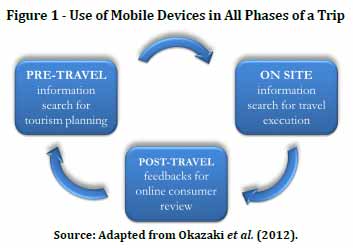
“Pre-travel search corresponds to pre-purchase search in general consumption, which ‘occurs in response to the activation of problem recognition’ […]. On-site information search occurs after arrival of travel destination […] [and] is the most important area in mobile tourism marketing, because travellers are normally unfamiliar with the destination sites and often need information that is not foreseen before the travel. […] Finally, post-travel feedbacks can be given through online consumer reviews, such as TripAdvisor or Twitter” (Okazaki et al., 2012, p. 340-341).
Focusing on possible practices at destinations, Neuhofer, Buhalis and Ladkin (2012) state that mobile technologies have offered one of the most significant contributions within the tourist experience paradigm. They suggest that new mobile ICTs ‘allow DMOs to not only co-create experiences in the physical destination space on-site but to extend experience co-creation into a virtual space’ (p. 44). According to these authors, smartphones and tablets with wireless connectivity permit travellers to share personal content from their experiences (i.e., comments, photos and videos) while they are still experiencing the destination. In this way, DMOs and local service providers have a chance to co-create experiences with tourists at various levels of engagement and in physical and virtual environments at the same time.
It is worth pointing out that mobile devices also facilitate monitoring tourists at the destination. Before Global Positioning Systems (GPS), this task was expensive, labour-intensive, inconvenient and tiring – including observation or the use of questionnaires and interviews. Currently, GPS systems imbedded in personal mobile devices offer an alternative, as both a more efficient and effective means to understand the space-time dynamics of tourists at the destination (Shoval & Isaacson, 2007).
However, the use of GPS in cell phones for commercial ends is still a controversial topic because it raises questions of invasion of privacy and security which can be unacceptable to users of these devices. In order to motivate users to allow this practice, the authors propose that it is necessary to make use of innovative and interactive techniques of engagement. In this way, the losses perceived in releasing private information can be minimised by the benefits gained.
Along these lines, Heijden (2004) argues that the very nature of utilitarian and hedonic systems can be differentiated based on the tacticts deployed to encourage their use. Utilitarian systems are designed to better performance and efficiency in users’ tasks; therefore, these systems are geared towards productive use. On the other hand, hedonic systems offer fun and pleasure through multiple sensory channels and, consequently, they tend to be used for longer periods of time.
A technique widely used lately in the design of interactive applications for smartphones and tablets is called “gamification”, however, due to its novelty, it still lacks theoretical definition within academic research (Deterding et al., 2011; Huotari & Hamari, 2012). As a consequence, we present some preliminary definitions which may contribute to a greater understanding of this technique and its objectives, so as to encourage its acceptance and application within the tourism literature.
Generally, gamification has been defined as the use of game mechanics, elements, and thinking in contexts, activities or products previously not related to games (Deterding et al., 2011; McGonigal, 2011; Zichermann & Linder, 2010). Typically, it is thought that gamification has the potential to generate highly engaging systems because they make use of conceptual characteristics of games which, according to McGonigal (2011) are:
1) Goal: This is the result expected by the player. This becomes the main focus and continually guides the player throughout the game. The goal triggers a sense of purpose in the player within the game environment;
]]> 2) Rules: These are the limits placed on the way the goal can be met. By removing or limiting the most obvious paths to the goal, the rules compel the players to explore the possible use of unexplored places. The rules stimulate creativity and strengthen strategic thinking.3) Feedback system: This shows the players how close they are to their goal. This can take the form of points, levels, grades or progress bars. Continuous feedback promises players that the goal is attainable and sustains motivation to keep playing.
4) Voluntary participation: This means that all those who take part in the game consciously and deliberately accept the goal, the rules, and the feedback. Through the player’s awareness of being part of a game, a common basis for various people to play together is established. Additionally, this characteristic guarantees that a task which is purposefully stressful and challenging is experienced as a safe and pleasurable activity.
Zichermann and Linder (2010) add to this list one more trait: the Reward. According to these authors, rewards through points – which might or might not be redeemed for prizes in real life – confer greater meaning to participation in the game. One alternative is the concept of virtual badges which have become popular thanks to the application Foursquare (https://pt.foursquare.com/) (Deterding et al., 2011). Badges hold symbolic value for their wearers and for the reference groups to which they belong. Even though society in general condemns boasting about personal achievements, these badges allow individuals to be proud of their achievements without being too obvious. In a virtual environment, badges can also be shared on social networks, which for users means greater visibility for their achievements, and for companies means more visibility for their brands (Zichermann & Linder, 2010).
In a different take on this subject, Huotari and Hamari (2012) find potential in game methods to increase profits for services. In this way, they define gamification as a process of improving a service by offering game experiences so as to create more added value for clients.
Along these lines, Zichermann and Linder (2010) propose the concept of “incidental games”. Every day we engage in behaviours which can easily be experienced as games, based on the above-mentioned conceptual characteristics. Morning visits to the bakery and transportation from home to work are, among others, examples of repetitive activities which according to these authors have latent potential for gamification, since some people perceive these as passive games.
In view of these opportunities, it remains for the relevant professionals to identify and activate these as games. To do this, one way would be to incorporate the concept of rules and a system of points into the activities in question. This point system would generate zones for the different levels of “players” – or clients – allowing companies to offer conveniences and privileges to the most common groups – or to the most loyal clients. One example which illustrates these authors’ proposal are the “frequent flyer” programmes offered by airlines and hotels, where tourists receive miles (points) every time they travel and they advance through levels (phases) until they reach the condition (status) of preferred client. These programmes use more sophisticated mechanisms as compared to typical customer loyalty programmes, which most often only offer financial incentives (discounts) on future purchases and which, therefore, have the potential for gamification (Zichermann & Linder, 2010).
According to the website Gamification.com (CGO, 2013), gamification applications can make sense in connection to consumers, education, businesses, governments, health and social welfare. Within tourist consumption, an example of success is the mobile application Epic Mix (Epic Mix, 2013), launched by Vail Resorts in 2010, in the United States. This application was developed to enhance the experience of skiers and snowboarders on the mountains managed by this resort group, providing interactive maps and integration into social networks with the option of connecting with friends also on the mountain, and offering badges to tourists as they explore the ski slopes.
The authors of this paper argue, therefore, that the technique of gamification has a rich potential within tourism, especially when it is linked to mobile devices which constantly accompany the 21st century traveller. Along these lines, the differences between the profiles of travellers need to be considered, as summarised in the following theoretical discussion.
In the literature, it can be found different typologies and models for tourist characteristics in their choice or preference for particular tourist destinations. Perhaps one of the most significant models is the Psychographic System of Stanley Plog, which attempts to associate psychological traits and personalities of tourists with their preferences expressed in their choice of destinations to satisfy their needs (Plog, 2002).
]]> Plog has identified two principle types of tourists: allocentric and psychocentric. The allocentric (or adventurous) tourists are those which like to try little known destinations. They are self-confident and energetic, trusting more in their own judgement than that of specialists, and they enjoy challenges. At the other extreme are found the psychocentric (or dependent) tourists who are considered more conservative and cautious and who prefer more well-known and safe destinations.Despite some controversy and limited empirical support, the Plog system is simple and offers good insight into the attitudes of different kinds of tourists in relation to diverse destinations, which may or may not be reflected in actual travelling behaviour (Litvin, 2006). In this way, some types of psychographic categories have been applied to ecotourism. The latter includes motivations to travel linked to experiencing nature, escaping stress, and seeking sensations (Galloway, 2002), as well as finding peace and tranquillity, while escaping urban settings and crowds (Weaver & Lawton, 2002).
In connection to this, according to Weaver and Lawton (2007), the dominant dichotomy in terms of behaviour in the literature is the hard/soft ecotourists one and their variations. According to these authors, tourists in nature areas can show either characteristics of a high level of environmental commitment, sustainability, physical activity and rejection of typical tourism services (harder), or lower levels of these traits (softer). One important variation is that of “structured ecotourists” who maintain a strong interest (hard) in interacting with natural attractions one moment and in another they show weak interest (soft) in ecotourism, such as seeking comfort and sophisticated meals (Weaver & Lawton, 2002).
This apparently conflicted relationship shows how diverse the categories and subcategories of tourists in nature areas can be. Additionally, it is argued that technological advances play a significant role in increasing this conflict since, as suggested above, mobile technologies can also help ecotourists, offering them convenience throughout their trip.
In reference to convenience, it is clear that new technology has the potential to improve the performance of tasks by its users, although the expected gains are limited to the ability of these users to accept and use available systems (Davis, 1989). Consistent with factors in the acceptance of innovation as found in the literature, the most important factors in consumer decisions to accept a mobile device service include the relative advantages and the perceived complexity of the innovation (Shankar & Balasubramanian, 2009).
One of the most widely used models of consumer behaviour is the Technology Acceptance Model (Davis, 1989), which includes in the antecedents of the intention to use new technology, the perception of users of how useful and user-friendly it is. Therefore, one of the determining factors is the usefulness of the technology or its instrumental value, according to which users aim to achieve goals beyond merely interacting with the system (Heijden, 2004).
Subsequently, it has been discovered that some systems can be pleasurable to interact with in and of themselves, which needs to be taken into account when evaluating acceptance (Davis, Bagozzi & Warshaw 1992). In this way, once again we note the hedonic nature of some systems, that is, those with interactions which do not imply a utilitarian function (Heijden, 2004).
Additionally, Moore and Benbasat (1991) point out the importance of distinguishing between the individual’s perceptions of the object itself (in this case, of the technology or computer system) and a perception of the utilisation of the object (performance). According to these authors, an innovation spreads not only because of perceptions of the innovation itself but also because of perceptions of its utilisation. In this way, the variables proposed in their model, such as compatibility, should observe these specifics in the environment of analysis.
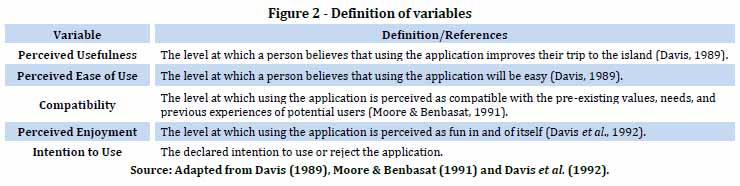
Based on these findings, the variables used to measure acceptance of the proposed application in this study are shown in Figure 2.
]]> 3. Methods
This study used quantitative and exploratory research methods in order to gather data on tourists’ impressions of a device for smartphone type cell phones which did not yet exist, called “Ilha Grande (Big Island) Mix”, in order to test this service idea with the public.
3.1 ilha Grande
As for the object of this study, Ilha Grande (“Big Island”) is located off the Costa Verde (“Green Coast”) in the state of Rio de Janeiro, considered for administration purposes one of the islands within the municipality of Angra dos Reis. Despite the obvious tourist appeal of the region, it was only after the construction and paving of the Rio-Santos road (BR-101) that the flow of tourists to the southern part of the state began to grow. Another decade passed before Ilha Grande shut down its last prison (1994) and tourists discovered the island for both Sun and Sand and Ecotourism (Ferreira, 2010).
The choice of this location for this study is justified by the fact that it is a destination which typically attracts young tourists as an ideal place to go hiking. Additionally, it bears other characteristics which facilitate the application of the concept being tested, among which are transformations in the technological infrastructure of the island and observed changes in the habits of visitors.
3.2 The Ilha Grande Mix
The application tested as a concept in this study will trace the activities of visitors as they walk along park trails. It will be integrated into a web platform which permits users to visualise the following: their route on the island throughout the day, the interesting places they find, how long they take to follow their route, and other functions related to tourist behaviour and interaction with the natural environment.
In addition, as in a game, users receive badges as they progress through the system as a way to incentivise their exploration of the park. They can also access what they have achieved and overcome in real time on their smartphone or at the end of the day on an internet website, and share this on social networks. Finally, the system will list local tourism services providers. Tourists, therefore, will have access to information on excursions, restaurants, “pousadas”, hostels, in addition to public services such as health clinics, police, and firefighters.
3.3 Procedures
Between 17 and 21 February, 2012, 378 people were interviewed. The research was carried out with visitors to the Parque Estadual da Ilha Grande (Ilha Grande State Park or PEIG) at the entrance located in the town of Abraão, the most important island community within the municipality of Angra dos Reis, in the state of Rio de Janeiro, Brazil. The sample was non-randomised because the research covers topics which require a basic familiarity with mobile applications and new technologies. Therefore, those surveyed were predominantly young visitors familiar with technological innovations and who make up the target public of the service tested in this study.
]]> Participants were invited to attend a 15 minute presentation on the details of functions included in the “Ilha Grande Mix” application as described above. After the presentation, interviewees responded to a questionnaire where they evaluated their acceptance of the game in four dimensions (usefulness, ease of use, compatibility with the location, and enjoyment) and indicated their intent to use on a 7-point Likert scale. For the entertainment value, a semantic differential scale was used, also of 7 points.
4. Results
Of those interviewed, 61.4% were between 20 and 29 years old, and 24.1% were between 30 and 39 years old. Using Getúlio Vargas Foundation’s criteria for income classes (Neri, 2011), the majority fell within class C (43.7%) and AB (30.4%), with 54.5% men and 45.5% women. These tourists were mostly residents in the state of Rio de Janeiro (72.2%), with a high level of education (77% had degrees and post-graduate degrees) and were travelling with friends and family (97%). Of those interviewed with smartphones (46%), 38% asserted they used them to search for information on the Internet about Ilha Grande.
The participants in this study said their main reason for travelling was to relax (30%), interact socially with friends and other people (18.9%), have an adventure, take a break from their routine, have new experiences (14.2%) and experience nature (10.2%).
4.1 Acceptance of the application
In order to verify the degree of acceptance of the application in the defined dimensions, an exploratory factor analysis (EFA) was carried out. The sample was shown to be adequate for use in this procedure, with a KMO of 0.908 and a level of significance of 0.000 on Bartlett’s test. For the EFA, the method of principal component analysis with an equamax rotation was used. The results indicated four factors with eigenvalues over 1.0 and 76.8% of variance explained. After the EFA, the factors found were measured for Cronback’s alpha, demonstrating robust reliability above 0.8, as shown in Table 1.
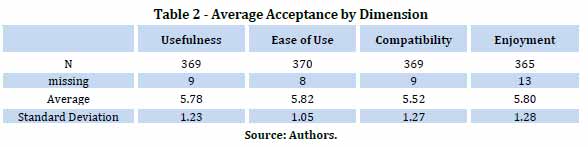
The results of the EFA and the reliability analysis indicate that the proposed items initially put on the questionnaire adequately reflect the four dimensions recommended in the literature on technology acceptance. The averages obtained for the dimensions of usefulness, ease of use, compatibility with the location, and enjoyment indicate that the concept of the “Ilha Grande Mix” application created a positive perception for all the dimensions. It can be stated that the research subjects showed a high level of acceptance of this interactive tourism game.
]]>
Additional analysis indicated that there was no statistically significant difference between men and women in perception, or between age groups or income classes. In terms of motivation, no significant levels of differences were identified between the groups.
4.2 Intention to use
Regarding the intention to utilise the application, the results indicate strong probability of use, with an average of 5.81 and a standard deviation of 1.36, on a scale of 1 to 7. The majority of respondents (63.1%) indicated a strong probability they would use the “Ilha Grande Mix”.
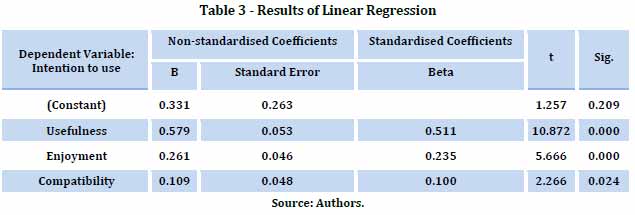
In order to find out which of the four dimensions studied have a greater capacity to predict respondents’ declared intention to use, a multiple regression was carried out using the stepwise method. Multiple regression allows an assessment of the relationship between a dependent variable (intention to use) and different independent variables (usefulness, ease of use, compatibility, and enjoyment). The stepwise method enables identification of the most fitting model, that is, the model that contains the best combination of predictive variables (Hair, Black, Babin, Anderson & Tatham, 2009). The results of the multiple regression indicated that three variables contributed to a significant degree to the intention to use the application: usefulness, enjoyment and compatibility. The model obtained an R=0.736 and an R2=0.538, with a significance of 0.000. The regression coefficients are presented in Table 3.
The results of the multiple regression point towards excluding the variable ease of use from the model, which could mean that this public is not concerned with this aspect when choosing to acquire the application.
The “Ilha Grande Mix” appears to be in line with the principle motivations of tourists on Ilha Grande, since it is a technology which can increase social interaction and interaction with nature, as well as having the potential for individual entertainment and having new experiences. In this way, it has a strong chance of success in a nature destination popular with a young public which connects to and acquires new technologies, with a high level of education.
5. Conclusions
This paper discussed the topic of new mobile devices and their applications in the travel sector, in addition to presenting a new trend towards using game methods in non-game areas in order to promote consumer engagement – gamification. As a way to find out if this phenomenon could be found in nature tourism destinations, this study proposed that an application for smartphones be developed and tested this idea’s acceptance with visitors on an island with tourism.
]]> Overall, the use of this application was perceived as useful, easy, fun, and compatible with the location, which generated a strong intention to use this application among respondents. According to the tested model, the variables most responsible for this intention were usefulness, compatibility, and perceived enjoyment. As a result, some comments can be made on this topic. Firstly, people from younger age groups and those who interact regularly with technology are already using other applications and games in their day to day, and possibly feel that ease of use would not therefore affect the likelihood of their using the “Ilha Grande Mix”. Secondly, the application was not available for testing. Thus respondents experienced only its general concept, which prevented a proper evaluation of this dimension.Additionally, this research provided empirical support for the concept of structured ecotourists discussed previously. This fieldwork revealed trip motivations typically ascribed to hard ecotourists (to have adventures and participate in activities in nature), as well as soft ecotourists (relaxation). In terms of the relevance of this disparity, the application is considered suited for useful as well as pleasure-oriented uses since the proposal for the application was equally well received by both groups.
Given the results of the research, the potential for mobile devices to enhance tourist experiences for their users is clear, promoting various levels of engagement and interaction. It is recommended, therefore, that local service providers such as “pousadas”, hostels, restaurants and travel agencies invest in this model of interaction with tourists, keeping in mind interesting tools in game techniques and mechanics are available.
Finally, we believe that a system such as that presented in this study would be valuable also to the public sector and destination planning organisations, especially in nature areas. Clearly tourism in these areas can be a “double-edged sword”: even as it generates funds and drives local economies, without adequate planning it can lead to exhaustion of natural resources.
Therefore, a gamified application which can be entertaining and functional at the same time, such as the “Ilha Grande Mix”, can help control and monitor visits to conservation areas, also adding to the presentation of educational activities for tourists connected to interpretation of environmental and cultural heritage, and to the importance and different forms of environmentally responsible behaviour in these areas. In this way, technology would assist in helping visitors. Besides having fun and improving their social interactions, they can develop a greater sensitivity and commitment to the environment, which in the long run would contribute to the development of sustainable tourism in these regions.
References
Amadeus - Travel Tech Consulting, Inc. (2011). The always-connected traveler: How mobile will transform the future of air travel. Retrieved may 17, 2013, from http://www.amadeus.com/airlineIT/the-always-connected-traveller/index.html?REF=41 [ Links ]
Buhalis, D. & Licata, M. C. (2002). The future eTourism intermediaries. Tourism Management, 23(3), 207–220. [ Links ]
]]>CGO – Gamification Corp (2013). Gamification Corp - The leading source for gamification news and info. Retrieved June 7, 2013, from http://www.gamification.co/ [ Links ]
Convergência Digital – UOL. (2013). Venda de smartphones cresce 85,7% no 1º tri no Brasil. Retieved June 7, 2013, from http://convergenciadigital.uol.com.br/cgi/cgilua.exe/sys/start.htm?infoid=33974&sid=17#.UbeRoPKEr-A [ Links ]
Davis, F. D. (1989). Perceived usefulness, perceived ease of use, and user acceptance of information technology. MIS Quarterly, 13(3), 319-339. [ Links ]
Davis, F. D., Bagozzi, R. P. & Warshaw, P. R. (1992). Extrinsic and intrinsic motivation to use computers in the workplace. Journal of Applied Social Psychology, 22(14), 1111-1132. [ Links ]
Deterding, S., Dixon, D., Khaled, R. & Nacke, L. (2011). From game design elements to gamefulness: defining “gamification”. [ Links ] MindTrek’11, September 28-30, 2011, Tampere, Finland.
Epic Mix (2013). Epic Mix - How it works. Retrieved June 5, 2013, from http://www.epicmix.com/How-It-Works.aspx#epicmix [ Links ]
Ferreira, H. C. H. (2010). A dinâmica da participação na construção de territórios sociais e do patrimônio ambiental da Ilha Grande-RJ. (Tese de doutorado, Universidade Federal Rural do Rio de Janeiro, 2010). Retrieved June 5, 2013, from http://r1.ufrrj.br/cpda/wp-content/uploads/2011/08/tese_Helena_Catao.pdf [ Links ]
Galloway, G. (2002). Psychographic segmentation of park visitor markets: evidence for the utility of sensation seeking. Tourism Management, 23(6), 581–596. [ Links ]
Hair, J., Black, W., Babin, B., Anderson, R. & Tatham, R. (2009). Análise multivariada de dados (6.ª Ed.). Porto Alegre: Bookman. [ Links ]
Heijden, H. van der. (2004). User acceptance of hedonic information systems. MIS Quarterly, 28(4), 695-704. [ Links ]
Huotari, K. & Hamari, J. (2012). Defining gamification - a service marketing perspective. [ Links ] MindTrek 2012, October 3-5, 2012, Tampere, Finland.
IDC - International Data Corporation (2013). Android and iOS Combine for 92.3% of All Smartphone Operating System Shipments in the First Quarter While Windows Phone Leapfrogs BlackBerry, According to IDC. Retrieved June 7, 2013, from http://www.idc.com/getdoc.jsp?containerId=prUS24108913Links ]idc.com/getdoc.jsp?containerId=prUS24108913" target="_blank">
]]>Litvin, S. W. (2006). Revisiting Plog’s model of allocentricity and psychocentricity . . . one more time. Cornell Hotel and Restaurant Administration Quarterly, 47(3), 245-253. [ Links ]
McGonigal, J. (2011). Reality is broken: Why games make us better and how they can change the world. Nova Iorque: The Penguin Press. [ Links ]
Moore, G. C. & Benbasat, I. (1991). Development of an instrument to measure the perceptions of adopting an information technology innovation. Information Systems Research, 2(3), 192-222. [ Links ]
Neri, M. (2011). A nova classe média - O lado brilhante da pirâmide. Rio de Janeiro: Saraiva. [ Links ]
Neuhofer, B., Buhalis, D. & Ladkin, A. (2012). Conceptualising technology enhanced destination experiences. Journal of Destination Marketing & Management, 1(1-2), 36–46. [ Links ]
]]>Okazaki, S., Campo, S. & Andreu, L. (2012). Mobile marketing in tourism services. In R. H. Tsiotsou & R. E. Goldsmith (Eds.), Strategic marketing in tourism services (pp. 339-357). Bingley: Emerald. [ Links ]
Plog, S. C. (2002). The power of psychographics and the concept of venturesomeness. Journal of Travel Research, 40(3), 244-251. [ Links ]
Shankar, V. & Balasubramanian, S. (2009). Mobile marketing: a synthesis and prognosis. Journal of Interactive Marketing, 23(2), 118–129. [ Links ]
Shoval, N. & Isaacson, M. (2007). Tracking tourists in the digital age. Annals of Tourism Research, 34(1), 141–159. [ Links ]
Weaver, D. B. & Lawton, L. J. (2002). Overnight ecotourist market segmentation in the Gold Coast hinterland of Australia. Journal of Travel Research, 40(3), 270-280. [ Links ]
]]>Weaver, D. B. & Lawton, L. J. (2007). Twenty years on: The state of contemporary ecotourism research. Tourism Management, 28(5), 1168–1179. [ Links ]
Zichermann, G. & Linder, J. (2010). Game-based marketing: Inspire customer loyalty through rewards, challenges, and contests. Nova Jersey: Wiley. [ Links ]
Article history:
Submitted: 20 June 2013
Accepted: 12 November 2013
]]>