Satisfaction in hospitality on TripAdvisor.com: An analysis of the correlation between evaluation criteria and overall satisfaction
A satisfação na hotelaria pelo TripAdvisor: uma análise da correlação entre os critérios de avaliação e satisfação geral
Pablo Flôres LimbergerI; Francisco Antonio dos AnjosII; Jéssica Vieira de Souza MeiraIII; Sara Joana Gadotti dos AnjosIV
IUniversity of the Vale do Itajaí – Univali, Post-graduate Programme in Tourism and Hospitality – Research Group for Hospitality, Gastronomy and Tourism Services, Capes Fellow, CEP 88337-300, Balneário Camboriú, SC, Brazil, pflimberger@gmail.com
IIUniversity of the Vale do Itajaí – Univali, Post-graduate Programme in Tourism and Hospitality – Research group for Planning and Management of Tourism Venues, CEP 88337-300, Balneário Camboriú, SC, Brazil, anjos@univali.br ]]>
IIIUniversity of the Vale do Itajaí – Univali, Post-graduate Programme in Tourism and Hospitality – Research Group for Hospitality, Gastronomy Tourism Services, CEP 88337-300, Balneário Camboriú, SC, Brazil, jessica.meira@univali.br
IVUniversity of the Vale do Itajaí – Univali, Post-graduate Programme in Tourism and Hospitality – Research Group for Hospitality, Gastronomy and Tourism Services, CEP 88337-300, Balneário Camboriú, SC, Brazil, sara@univali.br
ABSTRACT
Social media has changed the way tourists seek and exchange information, resulting in changes in the management of tourism businesses including hospitality facilities. Guest reviews and comments have had an impact on the reputation of organisations, both positive and negative. Websites with user-generated content spread this information to other tourists through the evaluation of service provided and thereby influence the decision of new visitors. Accordingly, this research sought to identify the correlation between overall satisfaction and the evaluation criteria used on a website. For this, we analysed 660 reviews (236 of three-star hotels, 125 of four-star hotels and 299 of five-star hotels) on TripAdvisor, containing independent reviews including overall satisfaction, value (cost-benefit), location, sleep quality, rooms, cleanliness and service. Results showed a strong correlation of overall satisfaction with the criteria of room, service provided and cost-benefit.
Keywords: TripAdvisor, user-generated content, quality of service, hospitality.
RESUMO
As mídias sociais alteraram a forma dos turistas buscarem e trocarem informações, determinando mudanças gerenciais para as empresas turísticas, incluindo os meios de hospedagem. Os comentários e avaliações de hóspedes têm impactado na reputação das organizações, tanto positivamente como negativamente. Os sítios de conteúdo gerado pelos usuários permitem que estas informações cheguem a outros turistas, através da avaliação do serviço prestado e influenciando na decisão de novos visitantes. Desta forma, esta investigação procurou identificar a correlação entre a satisfação geral e os critérios de avaliação. Para isto, foram analisadas 660 avaliações (236 nos hotéis 03 estrelas, 125 nos hotéis 04 estrelas e 299 nos hotéis 05 estrelas) no Tripadvisor, que continham de forma independente, avaliações sobre: satisfação geral, valor (custo-benefício), localização, qualidade do sono, quartos, limpeza e serviço. Os resultados apontaram para um maior índice de correlação da satisfação geral com os critérios quarto, serviço ofertado e custo-benefício.
Palavras-Chave: TripAdvisor, conteúdo gerado por usuário, qualidade do serviço, hotelaria.
1. Introduction
Social media has changed the management of tourism businesses both through relationships between users and businesses and through the wide (positive and negative) impact of user-generated content on other users (or potential consumers) – via electronic word of mouth (Cox, Burgess, Sellito & Buultjens, 2009; Law et al., 2009; Huang et al., 2010; Sparks & Browning, 2010; Schetzina, 2012; Simms, 2012; Weilin & Svetlana, 2012). Within social media (and their applications) restrictions on time and space have decreased (Huang et al., 2010), increasing the wide impact of tourists’ comments about their experiences (Sparks & Browning, 2010).
This user-generated information has become part of trip planning, influencing consumers in the decision making process (Cox et al., 2009; Stringam et al., 2010; Wilson et al., 2012) because people tend trust this information more when it comes directly from other consumers (Stringam et al., 2010; Schetzina, 2012; Simms, 2012; Weilin & Svetlana, 2012).
The hospitality sector in particular has been vulnerable to social media, reflecting the rise in internet reservations which are influenced by other guests’ comments (Jeong & Jeon, 2008; Zheng et al., 2009; Sparks & Browning, 2010; Stringam et al., 2010). According to research done by Zheng et al. (2009), approximately 55% of readers consult online comments during their decision process.
Social media, besides providing information useful to tourists, can help managers better understand the industry’s dynamics. Accordingly, researchers such as Jeong and Jeon (2008), Barcala et al. (2009) and Stringam et al. (2010) have studied the relationship between services provided and customer expectations and satisfaction with the service provided. Stringam et al. (2010) studied the relationship between the overall satisfaction of guests with hotel services, the condition of hotels, cleanliness of rooms and room comfort. The study done by Jeong and Jeon (2008) found a connection between posted comments and expectations for the level of service and room rates (in a hotel case study). They primarily identified the relevance of price and location of hotel facilities. The study by Barcala et al. (2009) focused on price, number of stars, promised services and location.
This study aims to verify the correlation between overall satisfaction and six evaluation criteria for services provided. Research was based on information garnered from the TripAdvisor website, one of the leaders in social media in travel content, with the largest volume of forums and discussions of any website (Jeong & Jeon, 2008; Barcala et al., 2009; Huang et al., 2010). The evaluation criteria for services provided made available on TripAdvisor are overall satisfaction, value (cost-benefit), location, sleep quality, rooms, cleanliness and service. This study seeks to corroborate research by Stringam et al. (2010) covering the variables of location and value which were found to be relevant in research on expectations by Jeong and Jeon (2008) and Barcala et al. (2009). Another fundamental reason to use TripAdvisor is that on this website, overall satisfaction as well as evaluation criteria have to be filled out separately, allowing us to identify which of the criteria has the strongest relationship with overall satisfaction.
This research used a method of multivariate analysis: multiple correspondence. This method was chosen in order to find the correlation between overall satisfaction and other attributes and also because of the non-metric characteristics of the data. The sample consisted of 236 reviews of three-star hotels, 126 reviews of four-star hotels and 299 reviews of five-star hotels, all with a sampling error of 5% within the universe of reviews collected on 6 May, 2013. The hotels studied were classified using the new Brazilian system of ratings for hospitality facilities.
The study is presented in this introduction, followed by theoretical foundations, methods, results and discussion, conclusions, and bibliography.
]]>2. Social media in tourism
Research on social media in connection to travel has been widely discussed by authors from around the world. Some studies on this topic were carried out by Jeong and Jeon (2008); Barcala et al., (2009); Cox et al., (2009); Law et al., (2009); Zheng et al., (2009); Huang et al., (2010); O’Connor (2010); Sparks and Browning (2010); Stringam et al. (2010); Schetzina, 2012; Simms, 2012; Weilin and Svetlana (2012); and Wilson et al., (2012).
Law et al. (2009) point out that the success of a business is related to its ability to acquire and use updated information. Information technology helps organisations, influencing competitiveness by helping decision making and appropriate investment. After returning to their homes, tourists frequently post their recommendations on websites dedicated to travel (Law et al., 2009). These posts have attracted the attention of tourists and potential tourists as a source of information (O’Connor, 2010; Schetzina, 2012; Simms, 2012).
Social network sites have recently emerged as an important marketing medium on the Internet and in tourism advertising. This innovative communication tool allows people to interact with each other on the basis of common interests and has changed the nature of communication between individuals, especially tourists. On social networks, travellers can communicate about their trips in large numbers, without time or geographical limitations (Huang et al., 2010; Schetzina, 2012). While in the past dissatisfied consumers could tell 12 to 20 people about their experiences, the full reach of complaints on the Internet cannot be measured (Sparks & Browning, 2010).
These activities include searching for travel information, maintaining connections, finding travel companions, sampling tips and suggestions, or simply having fun sharing their travel experiences with others (Huang et al., 2010). Online comments are a source of information to help plan trips. All evidence points to a change in the way that consumers search for information on travel and hospitality (Cox et al., 2009; Simms, 2012; Wilson et al., 2012). Social networks, blogs, videos and user-generated comments have revolutionised the way information is communicated about travel (Stringam et al., 2010).
An effective and appropriate management of comments can transform a dissatisfied consumer into a loyal consumer and in this way increase the retention of loyal consumers. This process thus has positive possibilities for management (Zheng et al., 2009).
Currently, intermediary websites about travel facilitate user-generated content in the form of comments and reviews. While ratings vary in format, the majority of user-generated reviews are based on the traditional system of stars. However, they can also be based on travellers’ perceptions instead of using a clear criteria as used in the traditional evaluation system (Stringam et al., 2010).
User-generated content can be viewed as a form of electronic word of mouth (Cox et al., 2009; Weilin & Svetlana, 2012). In terms of marketing, user-generated content on websites is an effective method of consumer to consumer e-marketing (Cox et al., 2009; Schetzina, 2012).
Websites and social media have changed the scope of “word-of-mouth” communication. While in the past this was based on people talking in pairs or in small groups, today the Internet has expanded and changed “word-of-mouth” into a massive means of communication within predefined groups, friends, or thousands of strangers connected in online communities (O’Connor, 2010).
]]> Consumers put greater trust in reviews by travellers on travel websites and these have a greater impact on sales than recommendations of travellers found on hotel or virtual travel agency websites (Stringam et al., 2010; Weilin & Svetlana, 2012). According to Gretzel (cited in Cox et al., 2009), looking into the experiences of other consumers in comments and other material on travel websites is the most popular source of information. Research by Weilin and Svetlana (2012) indicates that almost all respondents plan to read online comments while planning their trips and that online comments are more likely to contain updated, detailed and trustworthy information.In addition, Cox et al. (2009) in their research found that user-generated content appears to function as an additional source of information which tourists consider one part of their process of information gathering rather than the only source of information.
Motives for users to post in social media has been researched by authors such as Zheng et al., (2009); Huang et al., (2010); and Wilson et al., (2012). In the study by Zheng et al. (2009), results suggest that negative experiences are more likely to motivate dissatisfied consumers to post on the Internet (Zheng et al., 2009).
Simms’ (2012) study focused on how characteristics of trips (for example, familiarity with destinations, length of trip, location of destinations) influence the choice of user-generated content. Results showed that characteristics of trips play a fundamental role in choice of user-generated content. Travellers tend to search for a larger amount of information when they are visiting a location for the first time and researching international trips.
In a study by Wilson et al. (2012), the phenomena of user-generated content and the influence of nationality were researched to identify motivation to post (or not post) and where and what type of contents consumers share immediately after trips. Preliminary results reveal that there exists a difference in motivation and the type of social media based on nationality. The Swiss and British, for example, prefer to post photos on Facebook, while the Spanish prefer reviews on TripAdvisor.
Hidden motives and barriers to sharing travel experiences on social networking websites used by university and technical degree students in the U.S. were studied by Huang et al. (2010). Results of this research show that users of social networks intend to continue sharing their travel experiences for three main reasons: to get travel information, disseminate information and record their own experiences (Huang et al., 2010).
The first motive – to get travel information – was found in the study to be the main motive for sharing information on social networks focused on travel. The second intention is what social networks make possible, where anybody can disseminate information online, acting as a reporter, journalist, producer, influential authority, social promoter or an explorer. Electronic “word-of-mouth” can have as much of a positive as a negative impact on tourism products. The third motive for sharing information is that social networks have become the favourite places for travellers to post their travel diaries. Tourists like to share their experiences and recommendations with others (Huang et al., 2010).
There is a belief that websites which have user-generated content have been compromised by fake comments (O’Connor, 2010; Zheng et al., 2009). However, according to a study by O’Connor (2010), this belief is baseless as research has found little evidence of fake comments in research.
Studies show that there are three factors which can reveal if a comment is fake, according to Keates (cited in O’Connor, 2010): results which differ markedly from those posted around them, mentions of neighbouring properties as superior, and having written about one hotel only and visiting the website only in order to post the comment in question. O’Connor’s (2010) research suggests that fake comments are unsubstantiated, although some comments are suspect. The vast majority of comments do not match the criteria suggested by Keates (cited in O’Connor, 2010) to help identify fake comments. Another factor which guarantees the validity of information, according to Dellarocas (cited in O’Connor, 2010), is the total number of posted comments.
Organisations seek to prevent fake testimonies from appearing on their websites. According to O’Connor (2010), TripAdvisor is doing a good job of policing its system, thus avoiding fake commentaries. This observation is corroborated by Jeong and Jeon (2008), who confirm that TripAdvisor has implemented various methods of improving its integrity and credibility such as sophisticated algorithms, periodic checks and investigation of abuse by readers.
]]>3. Social media and hospitality
To be successful in the future, hotels need to acknowledge that social networks and user-generated content exist and then try to influence its development to increase the amount of business generated and to build loyalty in consumers (O’Connor, 2010; Schetzina, 2012). Consumers can have an impact on the profile of a brand or the reputation of a business by spreading “word-of-mouth” worldwide. The hotel industry is particularly vulnerable because of an increase in reservations made via the Internet. The decision process is influenced by comments about guests’ experiences in a particular hotel facility (Jeong & Jeon, 2008; Zheng et al., 2009; Sparks & Browning, 2010; Stringam et al., 2010; Schetzina, 2012).
In their research, Wilson et al. (2012) corroborate this statement since they confirm that the scale and wide impact of “word-of-mouth” has made it necessary for organisations to understand and take advantage of consumer opinion as a form of feedback. Research shows that consumers perceive reviews by their peers as an important source of information during their decision making process and that favourable comments increase the chance that they will make a reservation with a hotel online.
In order to keep consumers loyal and attract new consumers, it is important that hotel managers understand the negative influence of online comments. According to research by Zheng et al. (2009), about 55% of readers will take into account online comments when they make purchases. In other words, online comments have a great impact on the very base of hotel operations.
Quality of service in hotels has unique characteristics arising out of the special nature of its services and is more complex to analyse than quality in the manufacturing industry. This complexity arises out of the intangible, ephemeral, inseparable and heterogeneous nature of hospitality (Fitzsimmons & Fitzsimmons, 2005). With respect to quality of service, Parasuraman et al. (1985) distinguish between three key points: quality of service is more difficult to evaluate than quality of material goods; perceived quality of service is the result of comparing expectations with actual service performance; and reviews of quality of service are based not only on results of services but also on the process of delivering these services.
The second key point has been studied by Jeong and Jeon (2008), comparing the consistency of posted comments with the expected level of service and room rate (in a hotel case study). Results of this study indicate that value is one of the key predictors of guest satisfaction leading to the intention to return. Irrespective of class of hotel and daily average price, location has the greatest average importance among the seven performance attributes.
The relationships between overall satisfaction, four traits (treated here as subcategories) and the intention of recommending the hotel to other travellers were analysed by Stringam et al. (2010) in a study of Expedia (a site which allows users to make trip reservations as well as give other travellers help through reviews in the form of ratings and/or comments). Their study sought to determine the relationship between hotel consumers’ overall satisfaction and reviews, focusing on the following subcategories: hotel service, hotel condition, room cleanliness and room comfort (Stringam et al., 2010).
The level of individual overall satisfaction of travellers is generally consistent with these subcategories. Hotel service and hotel comfort have the greatest influence on overall satisfaction, according to Stringam et al. (2010).
The strong correlation between the subcategories (in this case, with overall satisfaction) supports the findings of previous research on the management of quality of service, from which stands out in particular how perceptions of the process or the way in which services delivered are closely related to overall perceptions. Hotel service overall includes simultaneous production and consumption, which makes quality control more complicated than at the standard of room cleanliness (Stringam et al., 2010).
]]> Barcala et al. (2009) in their research analysed the influence of the following factors in guest expectations: price, star ratings, promised services and location. Results indicate that price and star ratings negatively affect guest reviews, suggesting that previous expectations are essential in later reviews.Price is related to quality through the idea that consumers connect a high price for a product and/or service directly with higher quality. Star ratings indicate that the higher the number of stars, the more additional services are offered, thus affecting guests’ expectations. The services offered (weight room, air conditioning, 24-hour room service, pool, among others) add to estimations of overall quality with the hope that these services will have a positive impact on reviews. As for location, the research literature indicates that this is one of the most important factors in the choice of a particular hotel and therefore has a significant effect on quality of service (Barcala et al., 2009).
Another aspect emphasised by Cox et al. (2009) relates to how, in the hotel industry, the majority of consumers prefer information from other consumers rather than trusting only in descriptions of hotels provided by the hotel itself. Information gathered from user-generated content is generally used by travellers after they choose a destination, when they are looking for accommodations (Cox et al., 2009).
4. The TripAdvisor case study
TripAdvisor was launched in February 2000, in the United States, operating websites in the United Kingdom, France and Germany (Huang et al., 2010). It is part of the Expedia Inc. Group, an e-commerce giant which operates a large variety of websites with user-generated content including booking-buddy.com, independenttraveler.com, seatguru.com, smartertravel.com and TripAdvisor itself (O’Connor, 2010). TripAdvisor has already been the focus of some studies, including Jeong and Jeon (2008); Barcala et al. (2009); Huang et al. (2010); O’Connor (2010); Sparks and Browning (2010); and Weilin and Svetlana (2012).
It is difficult to categorise TripAdvisor as it is in part similar to a social network, a virtual community and a blog. However, it is clear that its primary function is collecting and disseminating user-generated content about travel, including comments, ratings (reviews), photos and videos. Among its primary characteristics are comments and reviews. Travellers can go to the website and consult both quantitative and qualitative reviews about any restaurant, hotel or other destination attractions, all posted by other travellers (O’Connor, 2010).
This social medium (TripAdvisor) has become one of the world leaders in travel information, containing more user-generated content than any other travel website and bringing people together in discussion forums (Jeong & Jeon, 2008; Barcala et al., 2009; Huang et al., 2010).
This website offers travel agencies the chance to list information without any cost, but it uses a pay-per-click marketing platform. As a result, the earnings of TripAdvisor.com are not linked to reservations but to potential consumers looking for hotel rooms (Barcala et al., 2009).
Comments on TripAdvisor are presented as a research and hotel reservation tool to be used during the decision process about reservations. In fact, these websites are constructed on a trust system, developed by allowing consumers to post positive or negative comments (Sparks & Browning, 2010).
]]> Through the method of content analysis, O’Connor (2010) in his study confirmed that the data presented on TripAdvisor are significant and appropriate to use while planning trips. Considering the number of visitors to the TripAdvisor website, it is clear that its content is being consulted.As they write reviews, users can consider criteria such as overall satisfaction, value (cost-benefit), location, sleep quality, rooms, cleanliness, service and/or add new criteria. Reviews run from 1 to 5, where 1 is horrible and 5 is excellent. In addition to ratings, the website encourages elaboration through comments so that other users get the most information possible.
5. Methods
This exploratory and quantitative study used a technique of multiple correspondence analysis to reach its proposed objective. The analysis of correspondence is a multivariate analysis technique which, according to Hair Jr. (2005, p. 34), provides a “multivariate representation of interdependence for non-metric data which is not possible with other methods”. This technique of analysis is based on some underlying premises, including, according to Gouvêa et al. (2012), a number of categories per variable greater or equal to three and the size of the sample. Keeping in mind these premises and the (non-metric) data characteristics, correspondence analysis is an appropriate technique for this research.
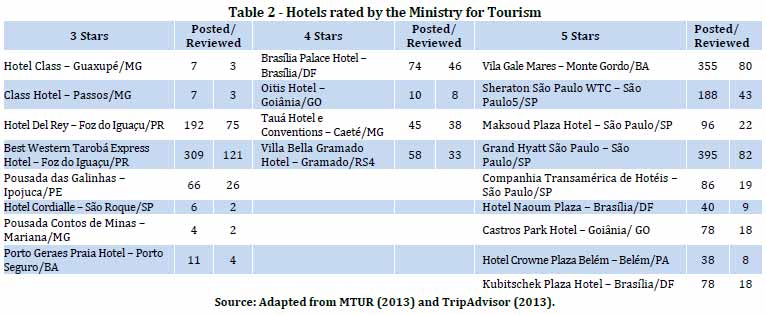
The hotels analysed were those rated up to January 2013 by the Ministry for Tourism using the new Brazilian system of rating for hospitality facilities. The hospitality rating system includes two to five stars hotels for each of which the TripAdvisor page was accessed on 6 May, 2013. All the hotels with three to five stars registered in Brazil (Table 2) were analysed. The exceptions were hotels which did not have complete reviews, which were excluded, including AGM Hotelaria e Serviços Ltda de Varginha hotel, Minas Gerais (three stars); Hotel Porto do Sol de Caetité, Bahia (three stars); Hotel Embaixador de Porto Alegre, Rio Grande do Sul (four stars); and Hotel Girassol Plaza de Palmas, Tocantins (four stars). Hotels with two stars were excluded because there were not enough completed reviews to analyse.
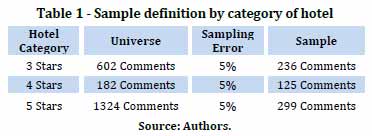
]]> A sampling error of 5% was found for the sample. As individual calculations were done for each category of hotel, samples were defined for each category, as shown in Table 1.
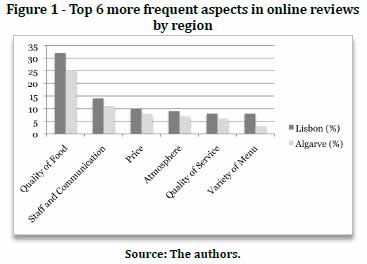
The size of the sample was calculated based on Figure 1, for which z refers to the distribution pattern, p is the estimated percentage, q is the compliment of p, e is the sampling error, and N is the universe size.
The completed reviews were analysed, consisting of posts which contained ratings for overall satisfaction, value (cost-benefit), location, sleep quality, rooms, cleanliness and service. The choice criteria for reviews was date, as the reviews included were the first reviews in any language. Statistica 8.0 software was used to do the calculations in this study. Table 2 shows the hotels studied, as well as the total number of reviews and the number of analyses.
6. Results and discussion
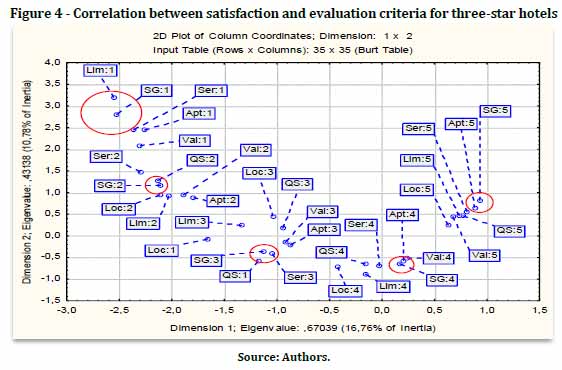
Results, as expected, revealed a tendency. In general, for a satisfaction level of X, the evaluation criteria corresponded to X. However, as we can see in Figure 2, Figure 3, and Figure 4, some evaluation criteria showed a stronger relationship with overall satisfaction than others. In the figures below, the numbers represent guests’ ratings, while the words are abbreviated as follows: overall satisfaction (SG), value (Val), location (Loc), sleep quality (QS), rooms (Apt), cleanliness (Lim) and service (Ser).
]]>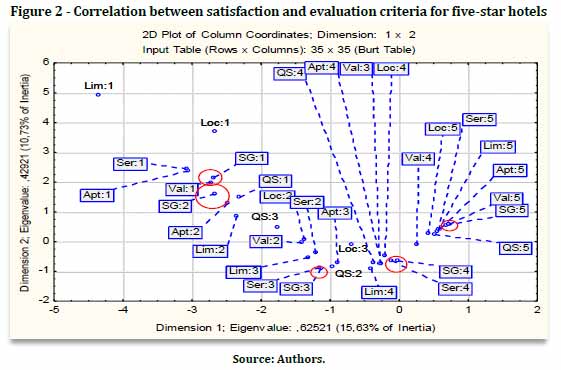
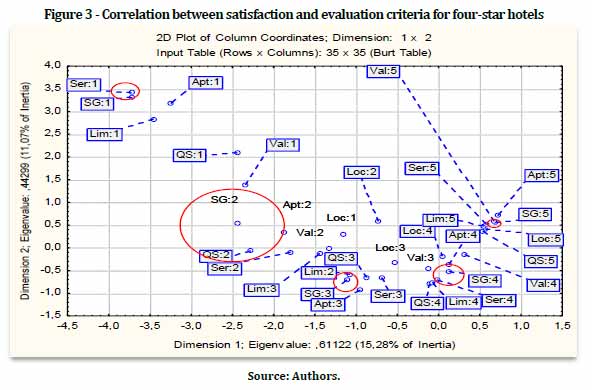
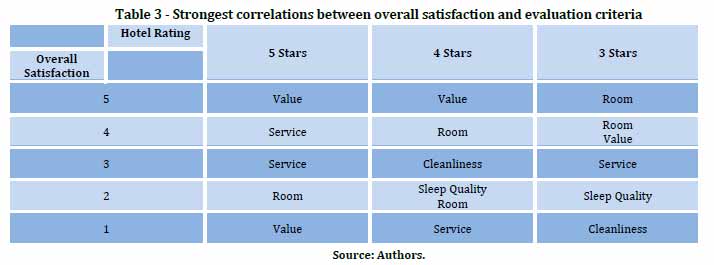
Figure 2 shows the correlation between satisfaction and evaluation criteria for five-star hotels. Guests rated their overall satisfaction at all levels (that is from 1 to 5). For an overall satisfaction of 5, the results showed a greater correlation with value, as did an overall satisfaction level of 1. For an overall satisfaction of 4, the strongest correlation was with service, as seen also with an overall satisfaction of 3. For an overall satisfaction of 2, the main correlation was with the room. Figure 3 shows the correlation between satisfaction and evaluation criteria for four-star hotels. Once again, as with five-star hotels, guests rated their overall satisfaction at all levels. For an overall satisfaction of 5, the strongest correlation was with value. For an overall satisfaction of 4, there was a correlation with the room. For an overall satisfaction of 3, correlation was greater with cleanliness. For an overall satisfaction of 2, correlations were found with both sleep quality and the room, while an overall satisfaction of 1 correlated with service.
Figure 4 shows the correlation between satisfaction and evaluation criteria for three-star hotels. As in the cases above, guests rated their overall satisfaction at all levels (from 1 to 5). In terms of an overall satisfaction of 5, the strongest relationship is with the room. For an overall satisfaction of 4, a strong correlation was found with the room and value. For the overall satisfaction of 3, it was service, while the strongest correlation for an overall satisfaction of 2 was with sleep quality and for an overall satisfaction of 1, with cleanliness.
]]>
These results have implications for hospitality management as they show which are the most important criteria for each of the overall satisfaction levels (from 1 to 5). Table 3 is a summary of what the figures showed, as can be seen below.
We can highlight that room, service and value (cost-benefit) showed a greater correlation with overall satisfaction than the other criteria, corroborating the research done by Stringam et al. (2010) and Jeong and Jeon (2008). It is also important to note that location did not show the strongest correlation in any of the cases with overall satisfaction. Given that in studies by Barcala et al. (2009) and Jeong and Jeon (2008) location is a strongly influential factor in the choice of lodging facilities, regardless of rating (by stars), this may indicate a tendency for location to influence the process of choosing lodging facilities, although, in research by Barcala et al. (2009), Jeong and Jeon (2008) and in this study, location has little influence on overall satisfaction.
Taking into consideration the hotel rating and overall satisfaction levels of 4 and 5, we can see that value (cost-benefit) is a constant. However, guests of five-star hotels tend to place greater value on service than guests of three or four-star hotels, who put greater value on the residential units (rooms). This may reflect well-planned hospitality facilities since physical improvements tend to be more expensive (cost and time).
7. Conclusions
As pointed out by various authors (some of whom have already been cited in this research), social media has changed the way in which organisations relate to tourists and the way in which tourists relate to each other, strengthening “word-of-mouth” communication. The hotel sector is the most vulnerable sector in this changed environment, and as such, managers need to understand different relationships arising out of the tools which facilitate the exchange of user-generated content.
This study aimed to identify the correlation between overall satisfaction and evaluation criteria in the services provided by TripAdvisor. The research method used was multiple correspondence analysis, a type of multivariate analysis technique.
]]> The results of this study support the research of Stringam et al. (2010) in that overall satisfaction is normally consistent with their subcategories. This study showed that hotel service, the residential unit and value have the strongest influence on overall satisfaction. Notably, this research corroborates studies by Barcala et al. (2009) and Jeong and Jeon (2008) which argue that location is a strongly influential factor in the choice of lodging facilities but that it has little influence in overall post-service satisfaction. Another contribution of this study is connected to overall satisfaction levels of four and five. Guests of five-star hotels place greater value on services than on the room (residential unit), which is also more important for three and four-star hotel guests. Overall, regardless of hotel rating, guests tend to consider value (cost-benefit) in their reviews.This study contributes to better management of hotels in that it has identified which evaluation criteria used by guests are more strongly correlated with overall satisfaction. The results examine realities faced by Brazilian hotels rated with the Ministry for Tourism rating system for hospitality. It would be of interest to do this research in other places or within specific sectors of hospitality to add to results and incentivise future discussions.
References
Barcala, M. F., Díaz, M. G. & Rodriguez, J. P. (2009). Factors influencing guests’ hotel quality appraisals. European Journal of Tourism Research, 2(1), 25-40. [ Links ]
Cox, C., Burgess, S., Sellito, C. & Buultjens, J. (2009). The role of user-generated content in tourist’ travel planning behavior. Journal of Hospitality Marketing & Management, 18(8), 743-764. [ Links ]
Fitzsimmons, J. A. & Fitzsimmons, M. J. (2005). Administração de serviços: operações, estratégia e tecnologia de informação. Porto Alegre: Bookman. [ Links ]
]]>Jeong, M. & Jeon, M. M. (2008). Customer reviews of hotel experiences through consumer generated media (CGM). Journal of Hospitality & Leisure Marketing, 17(1-2), 121-138. [ Links ]
Gouvêa, M. A., Prearo, L. C. & Romeiro, M. C. (2012). Avaliação da adequação de técnicas multivariadas em estudos do comportamento do consumidor em teses e dissertações de duas instituições de ensino superior. Revista Administração, 47(2), 338-355. [ Links ]
Hair Jr., J. F. (2005). Análise multivariada de dados. Porto Alegre: Bookman. [ Links ]
Huang, Y., Basu, C. & Hsu, M. K. (2010). Exploring motivations of travel knowledge sharing on social network sites: an empirical investigation of U.S. college students. Journal of Hospitality Marketing & Management, 19(7), 717-734. [ Links ]
Law, R., Leung, R. & Buhalis, D. (2009). Information technology applications in hospitality and tourism: a review of publications from 2005 to 2007. Journal of Travel & Tourism Marketing, 26(5-6), 599-623. [ Links ]
]]>MTUR - Ministério do Turismo (2013). Sistema Brasileiro de Classificação de Meios de Hospedagem - Lista de estabelecimentos classificados. Accessed January 15, 2013, from http://www.classificacao.turismo.gov.br/MTUR-classificacao/mtur-site/pesquisarClassificados. [ Links ]
O’Connor, P. (2010). Managing a hotel’s image on TripAdvisor. Journal of Hospitality Marketing & Management, 19(7), 754-772. [ Links ]
Parasuraman, A., Zeithaml, V. A. & Berry, L. L. (1985). A conceptual model of service quality and its implications for future research. Journal of Marketing, Vol. 49 (Fall 1985), 41-50. [ Links ]
Schetzina, C. (2012). Traveler reviews: analytics, consumer expectations and the future of user-generated content. PhoCusWright`s, March 2012, 01-15. [ Links ]
Simms, A. (2012). Online user-generated content for travel planning: different for different kinds of trips? E-review of Tourism Research, 10(3), 76-85. [ Links ]
]]>Sparks, B. A. & Browning, V. (2010). Complaining in cyberspace: the motive and forms of hotel guests´ complaints online. Journal of Hospitality Marketing & Management, 19(7), 797-818. [ Links ]
Stringam, B. B., Gerdes Jr. J. & Vanleeuwen, D. M. (2010). Assessing the importance and relationships of ratings on user-generated traveler reviews. Journal of Quality Assurance in Hospitality & Tourism, 11(2), 73-92. [ Links ]
TripAdvisor (2013). Número de postagens sobre cada estabelecimento. Accessed may 6, 2013, from http://www.TripAdvisor.com.br/ [ Links ]
Weilin, L. & Svetlana, S. (2012). Ecoturism experiences reported online: Classification of satisfaction attributes. Tourism Management, 33(3), 702-712. [ Links ]
Wilson, A., Murphy, H. & Fierro, J. C. (2012). Hospitality and travel: the nature and implications of user-generated content. Cornell hospitality quarterly, 53(3), 220-228. [ Links ]
Zheng, T., Youn, H. & Kincaid, C. S. (2009). An analysis of customers`e-complaints for luxury resort properties. Journal of Hospitality Marketing & Management, 18(7), 718-729. [ Links ]
Financial support was provided by the State of Santa Catarina. Foundation for the Support of Research and Innovation - Fapesc/SC – Brazil.
Article history:
Submitted: 30 June 2013
Accepted: 10 November 2013
]]>