<?xml version="1.0" encoding="ISO-8859-1"?><article xmlns:mml="http://www.w3.org/1998/Math/MathML" xmlns:xlink="http://www.w3.org/1999/xlink" xmlns:xsi="http://www.w3.org/2001/XMLSchema-instance">
<front>
<journal-meta>
<journal-id>2182-8458</journal-id>
<journal-title><![CDATA[Tourism & Management Studies]]></journal-title>
<abbrev-journal-title><![CDATA[TMStudies]]></abbrev-journal-title>
<issn>2182-8458</issn>
<publisher>
<publisher-name><![CDATA[Escola Superior de Gestão, Hotelaria e Turismo da Universidade do Algarve]]></publisher-name>
</publisher>
</journal-meta>
<article-meta>
<article-id>S2182-84582014000100011</article-id>
<title-group>
<article-title xml:lang="en"><![CDATA[Influential factors in the competitiveness of mature tourism destinations]]></article-title>
<article-title xml:lang="pt"><![CDATA[Os fatores que influenciam a competitividade dos destinos turísticos maduros]]></article-title>
</title-group>
<contrib-group>
<contrib contrib-type="author">
<name>
<surname><![CDATA[Santos]]></surname>
<given-names><![CDATA[Margarida Custódio]]></given-names>
</name>
<xref ref-type="aff" rid="A01"/>
</contrib>
<contrib contrib-type="author">
<name>
<surname><![CDATA[Ferreira]]></surname>
<given-names><![CDATA[Ana Maria]]></given-names>
</name>
<xref ref-type="aff" rid="A02"/>
</contrib>
<contrib contrib-type="author">
<name>
<surname><![CDATA[Costa]]></surname>
<given-names><![CDATA[Carlos]]></given-names>
</name>
<xref ref-type="aff" rid="A03"/>
</contrib>
</contrib-group>
<aff id="A01">
<institution><![CDATA[,University of the Algarve School of Management, Hospitality and Tourism ]]></institution>
<addr-line><![CDATA[Faro ]]></addr-line>
<country>Portugal</country>
</aff>
<aff id="A02">
<institution><![CDATA[,University of Évora Department of Sociology ]]></institution>
<addr-line><![CDATA[Évora ]]></addr-line>
<country>Portugal</country>
</aff>
<aff id="A03">
<institution><![CDATA[,University of Évora Department of Sociology Unidade de Investigação em Governança, Competitividade e Políticas Públicas]]></institution>
<addr-line><![CDATA[Aveiro ]]></addr-line>
<country>Portugal</country>
</aff>
<pub-date pub-type="pub">
<day>31</day>
<month>01</month>
<year>2014</year>
</pub-date>
<pub-date pub-type="epub">
<day>31</day>
<month>01</month>
<year>2014</year>
</pub-date>
<volume>10</volume>
<numero>1</numero>
<fpage>73</fpage>
<lpage>81</lpage>
<copyright-statement/>
<copyright-year/>
<self-uri xlink:href="http://scielo.pt/scielo.php?script=sci_arttext&amp;pid=S2182-84582014000100011&amp;lng=en&amp;nrm=iso"></self-uri><self-uri xlink:href="http://scielo.pt/scielo.php?script=sci_abstract&amp;pid=S2182-84582014000100011&amp;lng=en&amp;nrm=iso"></self-uri><self-uri xlink:href="http://scielo.pt/scielo.php?script=sci_pdf&amp;pid=S2182-84582014000100011&amp;lng=en&amp;nrm=iso"></self-uri><abstract abstract-type="short" xml:lang="en"><p><![CDATA[With a few exceptions, the traditional models that aim at identifying the factors that influence the competitiveness of tourism destinations are very difficult to operationalise because they need a large number of indicators to inform the concepts. This paper presents a different approach that postulates that researchers should try to identify the specific factors that impact competitiveness of tourism destinations according to the stage of the destinations’ life cycle. With the aim of identifying these specific factors, an extensive literature review was undertaken, focusing in particular on the papers that explicitly recognised that the destinations under analysis in the studies were in the mature stage of their lifecycle. From the literature review, we concluded that the specific factors able to negatively influence the performance of mature tourism destinations can be grouped into four areas. The first area concerns the deterioration of the destinations’ infrastructure; the second is related to the destinations’ management, namely the lack of a shared strategic vision among stakeholders; the third area is associated with the loss of economic vitality in the destinations; finally, the fourth area includes the impact of tourism development over the years on the territory, specifically social, environmental and cultural impacts. The results obtained from the empirical study allow us to conclude that the lack of environmental problems, not being overdeveloped in terms of construction and having maintained authenticity are all perceived by tourists as more important for the competitiveness of tourism destinations than factors normally considered more relevant, such as prices and the quality of accommodations.]]></p></abstract>
<abstract abstract-type="short" xml:lang="pt"><p><![CDATA[Muitos dos modelos de competitividade dos destinos turísticos apresentados até ao momento, para além de serem modelos genéricos que visam principalmente identificar os diferentes fatores que influenciam a capacidade de competir dos destinos turísticos e de serem muito difíceis de operacionalizar devido ao elevado número de indicadores que comportam, não equacionam a possibilidade de introdução de elementos explicativos da performance dos destinos. Uma abordagem diferente propõe que se identifiquem os fatores específicos suscetíveis de influenciar a competitividade dos destinos turísticos de acordo com a fase de desenvolvimento em que se encontram. Com o objetivo de identificar esses fatores específicos capazes de influir na capacidade de competir dos destinos turísticos maduros foi efetuada uma extensa revisão da literatura, privilegiando artigos que de forma explícita referissem que os respetivos destinos se encontram na fase de maturidade. Decorrente da revisão da literatura efetuada verificou-se que os fatores suscetíveis de influenciar negativamente a capacidade de competir dos destinos turísticos em fase de maturidade se podem agrupar em torno de quatro grandes áreas. A primeira área reporta-se à deterioração das infraestruturas do destino, a segunda relaciona-se com a gestão dos destinos, nomeadamente a falta de visão estratégica com que são conduzidos, a terceira área refere-se a alguma perda da vitalidade económica desses destinos e a quarta grande área identificada diz respeito aos impactos que a atividade do turismo teve sobre o território, nomeadamente os impactos ambientais, sociais e culturais. Os resultados obtidos no estudo empírico permitem-nos concluir que a ausência de problemas ambientais, não apresentar excesso de construção e ter mantido a autenticidade são percecionados pelos turistas como mais importantes para a competitividade dos destinos turísticos em fase de maturidade do que fatores habitualmente considerados mais relevantes, como os preços e a qualidade do alojamento.]]></p></abstract>
<kwd-group>
<kwd lng="en"><![CDATA[Competitiveness]]></kwd>
<kwd lng="en"><![CDATA[specific factors]]></kwd>
<kwd lng="en"><![CDATA[mature tourism destinations]]></kwd>
<kwd lng="pt"><![CDATA[Competitividade]]></kwd>
<kwd lng="pt"><![CDATA[fatores específicos]]></kwd>
<kwd lng="pt"><![CDATA[destinos turísticos maduros]]></kwd>
</kwd-group>
</article-meta>
</front><body><![CDATA[ <p align="right"><font size="2" face="Verdana"><b>TOURISM - SCIENTIFIC PAPERS</b></font></p>  <font face="Verdana" size="2">       <p>&nbsp;</p></font>  <font face="Verdana" size="4">      <p><b>Influential factors in the     competitiveness of mature tourism destinations</b></p></font>     <p>&nbsp;</p> <font face="Verdana" size="3">     <p><b>Os fatores que   influenciam a competitividade dos destinos turísticos maduros</b></p></font>     <p>&nbsp;</p>     <p>&nbsp;</p> <font face="Verdana" size="2">     <p><b>Margarida Custódio Santos<sup>I</sup>; Ana Maria Ferreira<sup>II</sup>; Carlos Costa<sup>III</sup></b></p>       <p><sup>I</sup>University     of the Algarve, School of Management, Hospitality and Tourism, Campus da Penha,     35, 8005-139, Faro, Portugal, <a href="mailto:mmsantos@ualg.pt">mmsantos@ualg.pt</a>    <br>     <sup>II</sup>University     of Évora, Department of Sociology, 7004-516, Évora, Portugal, <a href="mailto:amferreira@uevora.pt">amferreira@uevora.pt</a>    ]]></body>
<body><![CDATA[<br>     <sup>III</sup>University of Aveiro, Department of     Economics, Management and Industrial Engineering, GOVCOPP, 3810-193, Aveiro, Portugal, <a href="mailto:ccosta@ua.pt">ccosta@ua.pt</a></p>     <p>&nbsp;</p>       <p>&nbsp;</p> <hr noshade size="1">       <p><b>ABSTRACT</b></p>     <p>With a few exceptions,     the traditional models that aim at identifying the factors that influence the     competitiveness of tourism destinations are very difficult to operationalise     because they need a large number of indicators to inform the concepts. This     paper presents a different approach that postulates that researchers should try     to identify the specific factors that impact competitiveness of tourism     destinations according to the stage of the destinations’ life cycle. With the     aim of identifying these specific factors, an extensive literature review was     undertaken, focusing in particular on the papers that explicitly recognised     that the destinations under analysis in the studies were in the mature stage of     their lifecycle.    </p>       <p>From     the literature review, we concluded that the specific factors able to     negatively influence the performance of mature tourism destinations can be     grouped into four areas. The first area concerns the deterioration of the     destinations’ infrastructure; the second is related to the destinations’     management, namely the lack of a shared strategic vision among stakeholders;     the third area is associated with the loss of economic vitality in the     destinations; finally, the fourth area includes the impact of tourism     development over the years on the territory, specifically social, environmental     and cultural impacts.</p>       <p>The results obtained from the empirical study allow us     to conclude that the lack of environmental problems, not being overdeveloped in     terms of construction and having maintained authenticity are all perceived by     tourists as more important for the competitiveness of tourism destinations than     factors normally considered more relevant, such as prices and the quality of     accommodations. </p>       <p><b>Keywords</b>: Competitiveness, specific factors, mature tourism     destinations.</p>   <hr noshade size="1">       <p><b>RESUMO</b></p>     <p>Muitos     dos modelos de competitividade dos destinos turísticos apresentados até ao     momento, para além de serem modelos genéricos que visam principalmente     identificar os diferentes fatores que influenciam a capacidade de competir dos     destinos turísticos e de serem muito difíceis de operacionalizar devido ao     elevado número de indicadores que comportam, não equacionam a possibilidade de     introdução de elementos explicativos da performance dos destinos. </p>       ]]></body>
<body><![CDATA[<p>Uma abordagem diferente propõe que se identifiquem os     fatores específicos suscetíveis de influenciar a competitividade dos destinos     turísticos de acordo com a fase de desenvolvimento em que se encontram. Com o     objetivo de identificar esses fatores específicos capazes de influir na     capacidade de competir dos destinos turísticos maduros foi efetuada uma extensa     revisão da literatura, privilegiando artigos que de forma explícita referissem     que os respetivos destinos se encontram na fase de maturidade.</p>       <p>Decorrente     da revisão da literatura efetuada verificou-se que os fatores suscetíveis de     influenciar negativamente a capacidade de competir dos destinos turísticos em     fase de maturidade se podem agrupar em torno de quatro grandes áreas. A     primeira área reporta-se à deterioração das infraestruturas do destino, a     segunda relaciona-se com a gestão dos destinos, nomeadamente a falta de visão     estratégica com que são conduzidos, a terceira área refere-se a alguma perda da     vitalidade económica desses destinos e a quarta grande área identificada diz     respeito aos impactos que a atividade do turismo teve sobre o território,     nomeadamente os impactos ambientais, sociais e culturais.</p>       <p>Os resultados obtidos no estudo empírico permitem-nos     concluir que a ausência de problemas ambientais, não apresentar excesso de     construção e ter mantido a autenticidade são percecionados pelos turistas como     mais importantes para a competitividade dos destinos turísticos em fase de     maturidade do que fatores habitualmente considerados mais relevantes, como os     preços e a qualidade do alojamento.  </p>       <p><b>Palavras-chave:</b> Competitividade, fatores específicos, destinos turísticos maduros.</p>   <hr noshade size="1">       <p>&nbsp;</p>       <p>&nbsp;</p></font>   <font face="Verdana" size="3">    <p><b>1.   Introduction</b></p></font>   <font face="Verdana" size="2">    <p>The     concept of competitiveness has been analysed and discussed across different     disciplines, mainly in economics, management, and political sciences. Each of     these disciplines has offered distinct perspectives on defining, understanding     and measuring this concept. The complexity and scope of the competitiveness     have thus contributed to the difficulty in developing a clear and universally     accepted definition in the research community. However, we can identify two     different broad perspectives in conceptualising and evaluating this concept. On     the one hand, as a relative concept, there have been attempts to evaluate the     competitiveness of one destination in relation to its competitors. On the other     hand, as a multidimensional concept, there have been attempts to develop models     that encompass the factors that explain the variable capacity of destinations     to compete (Dwyer &amp; Kim, 2003; March, 2004).</p>       <p>More recently, Wilde and     Cox (2008), Enright and Newton (2005) and Dwyer and Kim (2003) have argued that     researchers should make efforts to identify the underlying specific factors     that influence the capacity of the destination to compete according to their     stage of development in the destinations’ life cycle. In this paper, we attempt     to characterise mature tourism destinations by identifying the factors that     might have a negative impact on these destinations´ competitiveness (Bieger,     2002; Seaton and Alford, 2001; Go &amp; Govers, 2000). After identifying these     factors, this paper aims to assess the importance given in tourist demand to     each of the factors identified and to determine whether different     methodological approaches have influenced the results obtained.</p>       <p>&nbsp;</p></font>   <font face="Verdana" size="3">    ]]></body>
<body><![CDATA[<p><b>2.   The     competiveness of tourism destinations</b></p></font>   <font face="Verdana" size="2">    <p>In regards to gauging     the competitiveness of tourism destinations, it is possible to identify a vast     body of work, the most well-known being the model developed by Ritchie and     Crouch (2003). Although this is considered the most complete model developed to     date (Mazanec et al., 2007; Hong, 2008; Dwyer &amp; Kim, 2003), one of its     weakness lies in that it is a purely descriptive model. According to Mazanec et     al. (2007), regardless of how elaborate the concept-definition systems may be,     they cannot provide explanations for observable phenomena. Other weaknesses     include the difficulty in obtaining data that allows us to assess all the     factors and the absence of a weighting system to indicate the order of     importance of the different factors and elements identified. </p>       <p>In order to overcome     these weaknesses, the authors Dwyer and Kim (2003) developed an alternative     model that, despite containing many of the factors and elements identified by     Ritchie and Crouch (2003), is different mainly in that it explicitly     acknowledges tourist demand as an influential element in destination     competitiveness. Another significant difference lies in the fact that this     model expressly acknowledges that competitiveness should not be viewed as the     final goal of a destination development policy, but rather as an intermediate     objective, enabling the local, regional or national community to attain     socio-economic prosperity. </p>       <p>Mazanec     et al. (2007) take the view that the considerable research conducted into the     concept of destination competiveness has identified a large number of factors     that shape the concept, including factors that facilitate or provide on the supply     side as well as factors that create preferences on the demand side.     Nevertheless, the efforts made to date have been unable to provide a response     regarding the type of mechanism that channels all these factors into one     construct, termed destination competitiveness. According to the authors, the     scientific community should focus its attention on developing models that     establish a causal relationship between the factors identified as being part     and parcel of destination competiveness and destination performance, thereby     allowing for the implementation of measures to determine which changes should     be made to boost the success of tourism at a given destination.</p>       <p>The authors Wilde and     Cox (2008) argue that the concept of tourist destination competitiveness and     understanding the importance of the factors that inform the concept should be     linked to the stage of development and evolution of the tourism destination in     question. This view is also highlighted by Mazanec el al. (2007), Dwyer and Kim     (2003), and by Enright and Newton (2005), who state that destinations should     adopt a more specific approach adapted to the destination in question, in order     to add value to and develop the destination’s competitiveness, paying special     attention to those factors that determine the competitiveness of a given     destination at different stages of its development. </p>       <p>&nbsp;</p></font>   <font face="Verdana" size="3">    <p><b>3.   Identifying     the specific factors capable of influencing competiveness</b></p></font>   <font face="Verdana" size="2">    <p>A     considerable number of research studies have suggested that tourism     destinations undergo a cycle of development over time, but that these changes     are not always positive ones and may even lead to the destinations’ decline     (Buhalis, 2000; Agarwal, 1997; Haywood, 1986; Hovinen, 1982; Butler, 1980;     among others). </p>       <p>Hovinen (1982) was one     of the first researchers to apply the destination lifecycle model proposed by     Butler (1980), concluding that tourism development in Lancaster County,     Pennsylvania fit perfectly within the first three stages of Butler’s model.     However, the destination in question provides no empirical evidence that would     allow us to prove the existence of the consolidation and stagnation stages. The     development at this particular destination diverges significantly from the     characteristics of the consolidation and stagnation stages, evidencing     characteristics of both stages at the same time, which is why Hovinen (1982)     suggests merging them into one single stage, which he calls the maturity stage.</p>       <p>Based on the empirical     evidence gathered by Hovinen (1982), Foster and Murphy (1991), Getz (1992),     Agarwal (1997) and Briossoulis (2004), we can say that destinations at the     maturity stage may simultaneously show characteristics of the consolidation,     stagnation, decline and recovery stages discussed by Butler (1980). </p>       ]]></body>
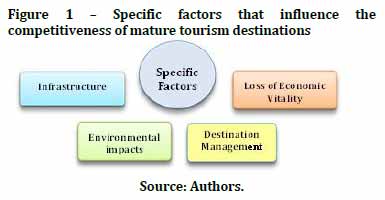
<body><![CDATA[<p>On     the basis of our extensive review of the literature that states explicitly that     the destination in question is at the maturity stage, as well as on the     research conducted by Wilde and Cox (2008), we can conclude that there are     specific factors that may adversely affect the competitiveness of mature     tourism destinations. This includes the lack of maintenance and modernisation     of the existing infrastructure, difficulty in creating a shared vision as to     how the destination should develop, difficulty in getting the different     stakeholders to cooperate, the loss of the destinations’ economic vitality and,     finally, social, cultural and environmental impacts on the destinations as a result of their involvement in     tourism over the years (<a href="#f1">Figure 1</a>). </p>       <p><a name="f1"></a></p>       <p>&nbsp;</p>       <p align="center"><img src="/img/revistas/tms/v10n1/10n1a11f1.jpg" width="385" height="200"></p>       
<p align="center">&nbsp;</p>       <p><b>3.1     Lack of maintenance and failure to modernise infrastructure</b></p>       <p>At mature destinations, basic infrastructure     development does not always keep pace with the speed and level of effectiveness     needed in the construction of accommodations and residential units (Buhalis,     1999; Priestley &amp; Mundet, 1998; Priestley, 1995; Ioannides, 1992; Smith,     1992). According to Ritchie and Crouch (2003), this may hinder the     competitiveness of the destination on two fronts. First, a tourist’s perception     of the destination’s infrastructure may be a factor in choosing or rejecting     that particular destination and, second, the quality of the infrastructure     affects the level of effectiveness and efficiency of the organisations that     carry on or intend to carry on their activities at the destination.</p>       <p>According to Mo et al. (1993), tourism infrastructure     comes second to the atmosphere at the tourism destination as the factor that     exerts the greatest influence on the tourist’s experience. Given the importance     that the infrastructure holds in the tourist’s experience as well as the     business opportunities it can offer to the private sector (Dwyer &amp; Kim.,     2003; Mo et al., 1993; Murphy et al., 2000), it can only be expected that     tourism destinations should attach special emphasis to their ongoing     development and modernisation.</p>       <p>However, Twining-Ward and Baum (1998) argue that     tourism destinations recognise the need to innovate only when signs of decline     have already appeared and, in this situation, many destinations invest in     diversifying the products they offer in order to stave off this decline. This     diversification strategy includes building golf courses, spas, conference     rooms, casinos, marinas, and developing natural and cultural tourism     (Rodríguez-Díaz &amp; Espino-Rodríguez, 2008; Faulkner &amp; Tideswell, 2005;     Vera Rebollo &amp; Ivars Baidal, 2003; Briassoulis, 2004; Agarwal, 2002; Foster     &amp; Murphy, 1991). </p>       <p>The infrastructure referred to above is built to     attract tourists with greater spending power and to reduce seasonal tourism (Markwick, 2000; Briassoulis, 2004), yet this type     of development may accentuate some of the adverse environmental repercussions,     namely by aggravating conflicts related to water use or worsening coastal erosion     (Malvárez García &amp; Pollard, 2003; Ioannides, 2001). Besides environmental     repercussions, the construction of this type of infrastructure does not always     help these destinations to stand out from their most direct competitors, as it     is easy to imitate and the destination itself becomes even farther removed from     its original geographical features (Cooper &amp; Jackson, 1989; Butler, 1980).</p>       ]]></body>
<body><![CDATA[<p>In regards to accommodation, the     first and biggest flaw in mature tourism destinations is exceeding the     available capacity, whether of official establishments or unofficial beds     (Faulkner &amp; Tideswell, 2005; Briassoulis, 2004; Rebollo &amp; Baidal, 2003;     Formica &amp; Uysal, 1996; Ioannides, 1992). Secondly, the factors that make     these accommodation units unsuitable for the demands of today’s tourists are     the absence of leisure and well-being facilities, and the lack of care taken in     the architecture, design and surroundings, which are very often characterised     by large-scale construction where very little heed has been paid to aesthetics     (Aguiló et al., 2005; Priestley &amp; Mundet, 1998). </p>       <p><b>3.2     Environmental repercussions </b></p>       <p>It is widely recognised that tourism has both positive     and negative effects on the environment, and there is a large body of research     work that has discussed this theme. The best resources we found on this     relationship are the following works: Gössling, 2002; Sun and Walsh, 1998;     Hunter and Green; 1995; OECD, 1980; and Pigram, 1980. In this section, we will     examine how the impact of tourism on the environment makes itself felt at     mature tourism destinations and how it is able to influence the competitiveness     of such areas. </p>       <p>According to the OECD (1980), tourism may have many     repercussions in the environment, including:</p>       <p>•     Sound, air,     water and area pollution</p>       <p>•     Loss of     natural landscapes (agricultural and grazing land) and the inaccessibility of     some areas </p>       <p>•     Destruction     of flora and fauna </p>       <p>•     Deterioration     of built-up areas</p>       <p>•     Crowding as     a result of excessive concentration</p>       <p>•     Conflict as     a result of changes in the resident population’s way of life</p>       ]]></body>
<body><![CDATA[<p>•     Abandonment     of traditional activities, which are unable to compete with tourism in terms of     existing resources</p>       <p>Apart from the repercussions     mentioned in the OECD Report (1980) and evident in the literature, we have     noted that tourism development may also have a very significant impact on the     aesthetics of the areas where it appears, which Inskeep (1991) terms visual     pollution. This usually stems from (i) the construction of accommodation units     and other infrastructures that are very poor in architectural and design terms     and do not blend in with the surroundings, (ii) the use of unsuitable building     materials for facades, (iii) inadequate infrastructural planning, (iv)     unsuitable landscaping arrangements, (v) the use of large and aesthetically     poor advertising signs, (v) the proliferation of telecommunications and energy     support structures, (vii) the obstruction of panoramic views by buildings and     (viii) the poor upkeep of buildings and the surrounding areas. </p>       <p>Mature tourism destinations have been exposed to     tourism development for a greater period of time and, as Haywood (2005) states,     the tourism industry makes many demands on the areas involved and may even lead     to the depletion of such areas, since the development process and mass use,     concentrated in terms of time and space, may compromise their attractiveness if     the activities carried on in these areas are not properly managed and their     load capacity is not respected. </p>       <p>Bearing in mind that today’s tourists not only prize a     well-preserved environment, without excess development and crowding and also     maintaining high aesthetic standards, a failure to solve the problems related     to adverse environmental impacts is a factor that may drastically reduce the     competitiveness of the tourism destinations affected (Aguiló et al., 2005; Hu     &amp; Wall, 2005). As Milhalic (2000) points out, they will only be able to     compete for tourists with less spending power, who are less demanding in terms     of environmental aesthetics and quality. Consequently, the way tourism     destinations are managed takes on vital importance and will be discussed in the     following section. </p>       <p><b>3.3     Tourist destination management</b></p>       <p>Mature tourism destinations need     to improve coordination and management to make them more diversified, so as to     be able to compete with new tourism destinations that use new management models     (Bieger, 2002). Knowles and Curtis (1999) call these destinations     third-generation tourism destinations and state that this type of destination     is characterised by a high degree of quality planning, control and     specification. Bieger (2002) believes that the centralised management of these     destinations confers major benefits with regards to the planning, financing and     implementation of activities that are of interest to the destination in     comparison to tourism destinations that are characterised by a high level of     fragmentation at the decision-making level.</p>       <p>In parallel, there have been changes in terms of     tourist demand, particularly towards a focus on the usefulness of the trip and     the possibility of making reservations at increasingly later times, which makes     the existence of a central distribution system indispensable. A further two     aspects to be taken into consideration are the increase in customer demand for     an optimised chain of services – that is to say, for all the elements of the     product to be in harmony and guaranteed in terms of quality – and the need to     provide customers with a much wider range of products (Bieger, 2002).</p>       <p>Traditionally, the organisations responsible for     destination management (DMOs) have limited their activities to promoting the     destination (Jamal &amp; Jamrozy, 2006; Dwyer &amp; Kim, 2003) and have not     exerted enough control over the product and the way in which it is     commercialised, as well as neglecting to develop new tourism products. Like     Dwyer and Kim (2003) and Hassan (2000), Pechlaner and Tschurtschenthaler (2003)     take the view that DMOs should also be facilitators with regards to marketing     management. That is to say, in addition to promoting the destination, they     should gather, process and publicise information about the characteristics,     values and needs of the main market segments. This in-depth knowledge would     enable a systematic focus on researching comparative advantages that, according     to Pechlaner and Tschurtschenthaler (2003), lead to the development of new     innovative tourist products that are able to satisfy the needs of the main     segments of the market. </p>       <p>Faulkner and Tideswell (2005) examined the necessary     measures that a mature tourist destination should take to enhance its     competiveness and avoid going into decline, concluding that it is essential to     involve all stakeholders in the process. This broader set of participants     reflects the need for a holistic approach to destination management and planning     and also recognises that social and environmental aspects are as important and     merit as much attention as economic aspects. In addition, this broader level of     participation makes it possible to develop a shared vision about the future of     the destination. This shared vision creates a reference point for the     individual actors operating at the destination.</p>       <p>Buhalis (2000) specifically states that the greatest     challenge posed to DMOs is that of having the necessary leadership capacity to     develop innovative tourism products by creating, at a local level, partnerships     which are capable of offering unique tourism experiences to prospective     visitors. </p>       ]]></body>
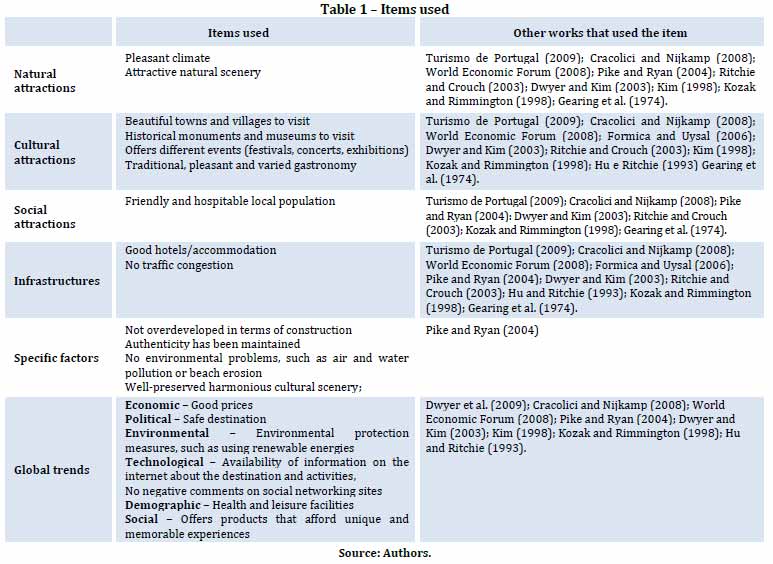
<body><![CDATA[<p><b>3.4     Economic vitality </b></p>       <p>The loss of economic vitality as a characteristic of     mature tourism destinations derives essentially from exceeding the     accommodation capacity, a fall in the number of tourists or reducing the prices     charged in order to attract a larger number of tourists. The price-reduction     strategy is mostly seen at destinations that are highly dependent on powerful     intermediaries capable of influencing tourist flow (Aguiló et al., 2005;     Knowles &amp; Curtis, 1999; Priestley &amp; Mundet, 1998; Twining-Ward &amp;     Baum, 1998; Cooper, 1990; Ioannides, 1992). </p>       <p>Correcting the flaws referred to in the preceding     points – that is, by careful construction and maintenance of the     infrastructure, solving environmental and aesthetic impact problems, and     managing the destination in a way that is capable of creating a shared vision     of how it will develop – may help to attract tourists with greater spending     power and less price sensitivity, thus contributing also to the economic     sustainability of the region as a whole.</p>       <p>The development of innovative     tourism products that take into consideration the specific needs of given     market segments and are capable of affording unique, authentic tourism     experiences may significantly enhance the competitiveness of mature tourism     destinations. Unlike tourism products developed in the past, which actually     added to adverse repercussions on the environment, these innovative products     should help mitigate the existing problems and add to the sustainability of     tourism destinations, allowing them to stand out from their competitors.</p>       <p>&nbsp;</p></font>   <font face="Verdana" size="3">    <p><b>4.   Methodology </b></p></font>   <font face="Verdana" size="2">    <p>The objectives of this paper     deal, on the one hand, with the identification of the specific factors that are     likely to adversely affect the competitiveness of tourism destinations in the     maturity stage and, on the other hand, assessing the importance given by the     tourism demand to factors that potentially influence the competitiveness of     these tourism destinations in the maturity stage. To this end, we created a     scale that combines factors normally used to measure the competitiveness of     tourism destinations with factors identified in the literature review in Section     3, which specifically focus on tourism destinations in the maturity stage. The     specific factors identified of destination management and loss of economic     vitality are not included in the scale, since in a pre-test the tourists     surveyed evidenced some difficulties in deciding on these aspects.</p>       <p>At the same time, this paper also aims to assess to     what extent the form of the questions could influence results, i.e., if the use     of a quantitative methodology (closed-ended questions) or a qualitative method     (open-ended questions) influences the importance attributed to different     factors or even reveals the existence of factors that are not usually taken     into consideration.</p>       <p>In order to achieve the outlined objectives, a     questionnaire was prepared that included two open-ended questions, in which     respondents were asked to indicate first the characteristics that in their     opinion make a tourism destination attractive and then the features that make a     tourist destination unattractive. The third question consisted of a scale with     a total of twenty items (<a href="/img/revistas/tms/v10n1/10n1a11t1.jpg">Table 1</a>), which included the factors identified in     accordance with the literature review.</p>         
<p>Data collection was carried out in August and     September 2010 at Faro International Airport and a total of 392 valid responses     were obtained. The data obtained from the two open-ended questions were subjected     to content analysis using the SPSS Text Analysis for Surveys 3.0 that enables     the development of categories. </p>       ]]></body>
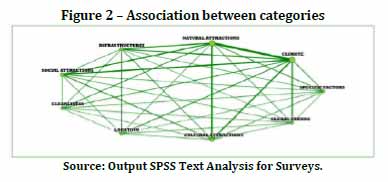
<body><![CDATA[<p>For the closed-ended question, a Likert scale of five     points was used from 1 &quot;unimportant&quot; to 5 &quot;very important&quot;     to assess the importance of each item. The Cronbach's alpha coefficient for the     scale was 0.809, indicating that the internal consistency and validation of the     instrument is good.</p>       <p>&nbsp;</p></font>   <font face="Verdana" size="3">    <p><b>5.   Results </b></p></font>   <font face="Verdana" size="2">    <p><b>5.1     Sample characterisation</b></p>       <p>The majority of respondents or 53.6% are men, and     46.4% are women, mostly residing in the UK (38.6%), followed by Germany     (27.1%), the Netherlands (14.8%) and Ireland (7.7%). The average age stands at     43.1 years. The age group between 45-64 years is the most significant, followed     by the age group of individuals between 25 and 44 years. With regards to the     education of the respondents, it was found that most had higher education,     62.2%, and only 1.3% of respondents had only a primary education. In specific,     22.2% had completed a professional course and 13.5% had only completed their     secondary education. The most frequently mentioned motivation for the trip was     leisure (98.2%), only 1.8% were in the destination for professional reasons,     3.1% for health reasons and 11.3% were visiting family and friends.</p>       <p><b>5.2 Factors influencing the competitiveness of destinations: Qualitative     analysis</b></p>       <p>Categories were extracted by     grouping words and expressions in answers into broader sets, with the result     that the words or expressions associated with the weather were mentioned by the     largest number of respondents, i.e., of the 392 individuals in the sample, 257     respondents (corresponding to 65.5% of the sample) mentioned the weather. The     second most mentioned category was the one that encompasses references to     natural attractions, with 245 respondents (62.5%) mentioning a word or phrase     that refers to that category. To a lesser extent, respondents mentioned words     or phrases associated with cultural attractions (32.1%), social attractions     (28.3%) and infrastructures (20.2%). The remaining categories were mentioned by     less than 20% of respondents, i.e., the cleanliness category was mentioned by     14.0% of respondents, the specific factors category by 13.5% of respondents,     the global trends category by 12.8%, and location was mentioned by 10.7% of the     sample.</p>       <p>The use of SPSS Text Analysis for     Surveys enables us to verify the associations between the categories mentioned,     i.e., it is possible to determine that a respondent mentioned simultaneously     words or expressions that refer to the x category and to the y category. The     strength of the association is given by the frequency, i.e., the association     between two categories is more significant if a larger number of respondents     mentioned both categories simultaneously. <a href="#f2">Figure 2</a> shows that there is a strong     association between the categories “natural attractions” and the “climate” and     between the “natural attractions” and “cultural attractions”, and three     triangles can also be seen. The first is formed by the categories “natural and     social attractions” and “climate”, the second by the “natural attractions” and     “cultural attractions” and the “weather” and a third by the “infrastructures”,     “natural attractions” and “the climate”.  </p>       <p><a name="f2"></a></p>       <p>&nbsp;</p>   </font>     ]]></body>
<body><![CDATA[<p align="center"><font size="2" face="Verdana"><img src="/img/revistas/tms/v10n1/10n1a11f2.jpg" width="388" height="182"></font></p>     
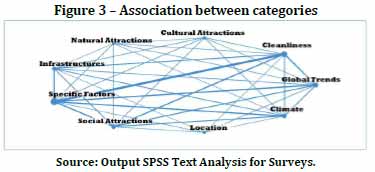
<p align="center">&nbsp;</p>        <p><font size="2" face="Verdana">When the question was formulated in the negative,     62.5% of respondents mentioned words or phrases that were grouped in the     category designated as “specific factors”, which gathers references to     excessive construction, lack of maintenance of spaces and noise. The second     category comprises references to the lack of cleanliness and the existence of     garbage that were reported by 45.7% of respondents. The third category “global     trends”, mentioned by 30.9% of respondents, contains expressions related to     high prices and aspects associated with the lack of security. The fourth     category “social attractions” brings together words that refer not only to the     lack of friendliness of local residents but also to other tourists who frequent     the destination, mentioned by 28.1% of respondents. The categories “climate”   and “infrastructures” were mentioned respectively by 27.0% and 20.7% of     respondents. The categories “cultural attractions”, “natural attractions” and   “location” include words or phrases mentioned by less than 10% of respondents.</font></p>       <p><font size="2" face="Verdana"><a href="#f3">Figure 3</a> visually translates the associations     established between the different categories. It is possible to detect a     triangle formed by the category ”specific factors”, which mainly includes the     impacts of tourism development in the territory, the category “cleanliness” and     the category “global trends”, which is strongly influenced by issues related to     price and security.</font></p>       <p><a name="f3"></a></p>       <p>&nbsp;</p>       <p align="center"><img src="/img/revistas/tms/v10n1/10n1a11f3.jpg" width="375" height="172"></p>       
<p>&nbsp;</p>       <p><font size="2" face="Verdana">The most common expressions relate to climate and were     mentioned by 31.4% of respondents. However, if we add to this expression also     the word “sun” and the expression “pleasant climate”, it was found that 64.8%     of respondents consider the quality of the environment a decisive factor in the     attractiveness of the destination. Then come words referring to the beauty of     the landscape (23.7%) and beaches (23.5%), i.e., to the beauty of the natural     resources of the destination, assuming that the respondents were referring only     the natural landscape. The expressions to be potentially included in natural     attractions were mentioned by 65.8% of respondents.</font></p>       <p><font size="2" face="Verdana">In fourth place appears the issue of “overbuilding”   and the fifth most mentioned word expresses the importance of the impact of   dirt on the attractiveness of tourism destinations. On the whole, the words   that refer to these specific factors were mentioned by 63.5% of respondents and   the question of “cleanliness” or lack of it by 52.7%.</font></p>       ]]></body>
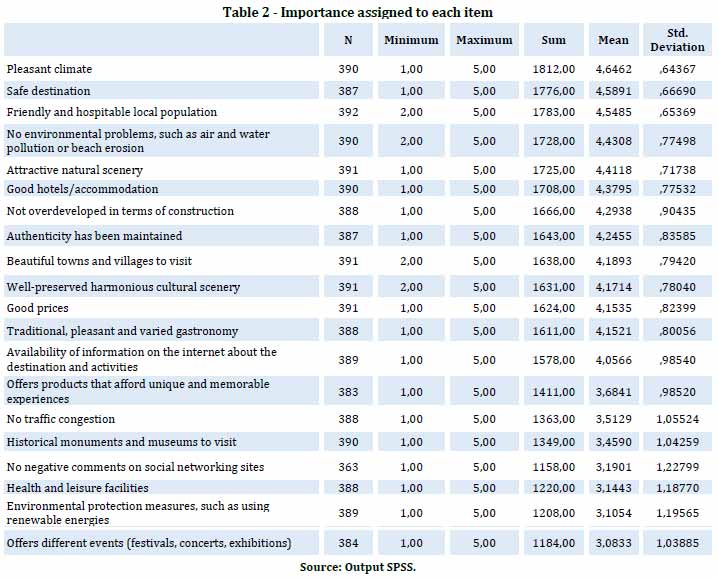
<body><![CDATA[<p><font size="2" face="Verdana">The sixth most mentioned factor is concerned with the     friendliness of the people with whom the respondents interact in the     destination, be these the resident population, service providers or other     tourists. If to this factor we join expressions that refer explicitly to the     friendliness of the resident population, 27% of respondents consider this as     having a significant influence on the attractiveness of destinations.</font></p>       <p><font size="2" face="Verdana">In seventh place comes the price, i.e., beyond     climate, natural attractions, cleanliness, friendliness of the people and the     fact that the destination is not overbuilt, respondents then consider the costs     associated with the trip in the attractiveness of tourism destinations. </font></p>       <p><font size="2" face="Verdana">In tenth place comes the expression “bad weather” that     reinforces the importance attributed to the climate, and eleventh and twelfth     are two factors that refer back again to tourism over-development that may     adversely affect the attractiveness of the destination, which is materialised     here in the expressions “too many people/tourists” and “noise”. </font></p>       <p><font size="2" face="Verdana">Gastronomy comes in fifteenth in the attractiveness of     the destination and is the most used word in the category “cultural     attractions”, mentioned by 23.2% of respondents.</font></p>       <p><font size="2" face="Verdana">The words or phrases that refer     to security appear at a surprising low rate given the importance that is     attributed to security in the literature when this element is assessed through     a quantitative methodology. However, expressed spontaneously, issues related to     security appear only eighteenth in importance. Although this is not expected     compared to results produced by other methods, this can be understood in that     the evidence found in other research areas that used a combination of     quantitative and qualitative methodologies. </font></p>       <p><font size="2" face="Verdana">The same analysis applies to some extent to the     position assigned to accommodations, usually regarded as decisive. In     spontaneous answers, the respondents did not ascribe to this a strong role in     the attractiveness of the destination. One possible reason for this finding may     be linked to the fact that in the 1960s and 1970s accommodations quality was     relatively scarce in destinations. However, at present there is a huge number     of destinations that provide a wide range of high quality accommodation and in     some cases very poorly differentiated.</font></p>       <p><font size="2" face="Verdana"><b>5.3 Factors influencing the competitiveness     of destinations: Quantitative analysis</b></font></p>       <p><font size="2" face="Verdana">Items to assess the attractiveness of mature tourism     destinations in the analysis had a varying number of responses, including items     that were evaluated by all respondents (“having a friendly and welcoming     resident population”) and others for which there was a greater difficulty in     assessment as expressed by a greater number of respondents who chose not to     evaluate the element. Regarding the item “destination, no negative comments to     present on social networks”, it was found that a high number of respondents     chose the option “do not know/no answer”.</font></p>       <p>&nbsp;</p>       <p align="center"><font size="2" face="Verdana"><a href="/img/revistas/tms/v10n1/10n1a11t2.jpg">Table 2</a></font></p>     
]]></body>
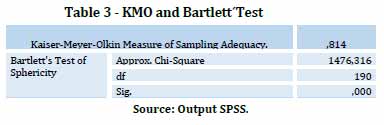
<body><![CDATA[<p>&nbsp;</p>     <p><font size="2" face="Verdana">Regarding the items that were considered most   important in the choice of destination, there is the “climate”, “security” and   “friendliness of the resident population”. Then follows the items “no   environmental problems” and the “existence of an attractive natural landscape”.   Only in sixth comes the “quality of accommodations”. The next four items are   again related to the region and respective   development. “Is not overbuilt” and “has kept authenticity” appear in seventh   and eighth place. The existence at the destination of villages, towns and   beautiful cities to visit and a well preserved and harmonious cultural   (traditional) landscape follow in ninth and tenth place. These items are   considered more important in choosing the destination than the existence of   historical monuments and museums to visit because this factor appears only in   sixteenth place.</font></p>     <p><font size="2" face="Verdana">The eleventh place is occupied by     price, which is usually considered a decisive factor in the competitiveness of     tourism destinations (Dwyer et al., 2000). The existence of a typical, good and     varied gastronomy follows in twelfth place and two subsequent ranks (thirteenth   – “possible to obtain information on the Internet about the destination” – and     fourteenth – “offers products that confer unique and memorable experiences”)     are occupied by factors that integrate global forces with greater ability to     induce changes worldwide. The fifteenth place is occupied by an item that     incorporates the environmental impacts identified as influencing the     competitiveness of tourism destinations in the maturity stage. The item “does     not have negative comments on social networks” appears only in seventeenth     place; however, it is noteworthy that this factor has the highest standard     deviation among the twenty factors in analysis, being indicative of widely     divergent opinions among respondents.</font></p>       <p><font size="2" face="Verdana">The last three positions are     occupied by the items “existence of health and wellness equipment”, “measures     to protect natural resources” and “events to attend”. The item that was     intended to assess the importance of “measures to protect natural resources”   presents a comparatively modest result compared to the item that assessed the   presence of “environmental problems in the destination”. This discrepancy in     the evaluation can mean that tourists do not have a clear perception that the     practice of certain actions, e.g., producing excessive waste, results in the     emergence of environmental problems at the destination level. The item     considered less relevant to the choice of a destination is the existence of   “events to attend”, which usually incorporates factors assessing the     attractiveness of tourism destinations.</font></p>       <p><font size="2" face="Verdana"><b>5.4. Results of factor analysis</b></font></p>       <p><font size="2" face="Verdana">The results of the Kaiser-Meyer-Olkin (KMO) test was     0.814, which allows us to conclude that our data is appropriate to use in factor     analysis. At the same time, the Bartlett's test of sphericity shows a value of     0.000, allowing us to reject the null hypothesis and conclude that indeed the     variables under analysis are correlated (see <a href="#t3">Table 3</a>).</font></p>       <p><a name="t3"></a></p>       <p>&nbsp;</p>       <p align="center"><img src="/img/revistas/tms/v10n1/10n1a11t3.jpg" width="384" height="125"></p>       
<p>&nbsp;</p>       ]]></body>
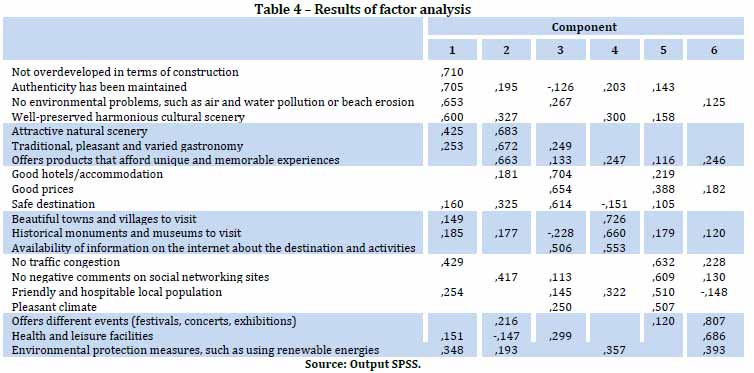
<body><![CDATA[<p><font size="2" face="Verdana">Regarding the extraction method, we chose the method     of principal components and varimax rotation, which aims to get a factor     structure in which each of the original variables is strongly associated with     only a single factor, thus allowing an easier reading of the results obtained     (Maroco, 2003). To determine the number of principal components to retain, there     are, according to Pestana and Gageiro (2008), different possible procedures:     (i) the proportion of explained variance is greater than 60%, (ii) the variance     of the components (eigenvalues) is greater than 1, and (iii) in the scree plot,     the points in the larger slope are indicative of the number of components to     retain. Thus – and in accordance with the second procedure – in our case six     components or factors must be retained, since 56.7% of the total variance is     explained. </font></p>       <p><font size="2" face="Verdana">The factors identified and shown     in <a href="/img/revistas/tms/v10n1/10n1a11t4.jpg">Table 4</a> corroborate the evidence found throughout our literature review.     They are also manifest in the description and commentary of the empirical     results of our research. In addition to structural factors, such as the     existence of natural and cultural resources, there are also specific elements     capable of influencing the competitiveness of destinations, according to the     stage of the destinations’ life cycle. </font></p>       
<p><font size="2" face="Verdana">As can be seen, the first factor extracted encompasses     all items that result from impacts on the territory as a result of tourism     development and are likely to constitute a potential obstacle to the     competitiveness of tourism destinations in the maturity stage. The second     factor extracted, which we call “natural resources and provided experiences”,     encompasses the natural landscape, the unique and memorable experiences, which     can, of course, also include gastronomy – the third item integrated in this     factor. Prices, quality of accommodations and security make up the third     extracted factor, which makes clear that the existence of quality     accommodations, one of the items commonly measured in studies of attractiveness     of destinations, should also be linked to the issues of costs and safety (See     <a href="/img/revistas/tms/v10n1/10n1a11t4.jpg">Table 4</a>).</font></p>       
<p><font size="2" face="Verdana">The fourth factor is     comprised of cultural resources and information available on the Internet.     Again, here emerge factors usually considered in studies of attractiveness     associated with factors that are critical for the attractiveness of tourism     destinations (see <a href="/img/revistas/tms/v10n1/10n1a11t4.jpg">Table 4</a>). </font></p>       
<p><font size="2" face="Verdana">The fifth factor     extracted concerns feeling welcome at the destination, both in terms of the     reception offered by the host community and ease of movement at the     destination, including also the weather. This factor is complemented by the     item regarding comments about the destination on the Internet. This item can in     a virtual way anticipate the feeling of being welcome that respondents are     likely to experience through the personal experiences of other tourists (see     <a href="/img/revistas/tms/v10n1/10n1a11t4.jpg">Table 4</a>). </font></p>       
<p><font size="2" face="Verdana">The sixth factor     extracted includes items that can be considered complementary and perceived as     not fundamental but that, under certain circumstances, may be decisive. The     question of measures to protect natural resources only becomes important for     tourists when there are visible problems in terms of resources. In addition,     the availability of health facilities will only be decisive if the tourists, in     the course of their holiday, need to use a hospital (See <a href="/img/revistas/tms/v10n1/10n1a11t4.jpg">Table 4</a>).</font></p>       
<p>&nbsp;</p>       <p><font size="3" face="Verdana"><b>6.   Conclusion</b></font></p>     <p><font size="2" face="Verdana">Increased global competition     means some established tourism destinations face major challenges in     maintaining their competitiveness, leading a high number of researchers to look     for the best way to conceptualise and measure the competitiveness of tourism     destinations. In this context, one of the goals of our paper is to prove that,     according to the stage in the life cycle of a destination, there are specific     factors able to influence the competitiveness of the destination. Since the     focus of our work is tourism destinations in the maturity phase, we tried, at     first, to establish the characteristics of these destinations in order to     evaluate which characteristics would have, in the present and future, the     ability to influence the competitiveness of these destinations. </font></p>       <p><font size="2" face="Verdana">We find that the     specific factors identified should join the factors commonly used to measure     the attractiveness of tourist destinations, including the existence of     infrastructures; natural, cultural and social attractions; and, more recently,     safety.</font></p>       ]]></body>
<body><![CDATA[<p><font size="2" face="Verdana">Measured     through a quantitative methodology, the results allow us to conclude that,     among the factors considered relevant for the competitiveness of tourism     destinations in the maturity stage, the lack of environmental problems comes in     fourth place, after factors already known as crucial, such as climate, safety     and the friendliness and hospitality of the resident population. At the same     time, we note that the fact that the destination is not overbuilt and has kept     its authenticity is considered more relevant than having cultural resources.     Any of these three items (does not present environmental problems, has not been     overbuilt and has kept authenticity) comes ahead of factors normally considered     crucial in the competitiveness of tourism destinations, such as price. The fact     that a destination does not present environmental problems is considered more     important than the existence of quality accommodations in that destination.</font></p>       <p><font size="2" face="Verdana">The use of a qualitative     methodology changed the importance given to certain items. However, we note     that, among the words or phrases listed spontaneously and more often, appears     excessive construction, mentioned by around 63.5% of respondents. Only natural     attractions (65.8%) and climate (64.8%) were mentioned by a higher number of     respondents.</font></p>       <p><font size="2" face="Verdana">The factor analysis     conducted regarding the importance of each factor allowed us to detect that the     latent variable with the greatest explanatory power, i.e., responsible for     explaining 22.5% of the variance, includes four items that we call “impacts of     tourism development in the region” and that are exactly the specific factors     identified as likely to adversely affect the competitiveness of tourism     destinations in the maturity stage.</font></p>       <p><font size="2" face="Verdana">The use of a qualitative     methodology allowed the detection of two items that were not included in     quantitative methodology but that, for a considerable number of respondents,     have a significant relevance. The scale did not include any item relating to     the cleanliness of the destination. However, it was found that 40.5% of     respondents said, spontaneously, that the presence of dirt and litter makes a     tourist destination unattractive. The location of the destination was not     integrated in the scale; however, noting the fact that 10.7% of respondents     referred explicitly to the convenient location of the destination, i.e., being     not too far from home and having good air connections makes the destination     more attractive – we find it appropriate that, in future research processes,     these two items be considered.  </font></p>       <p><font size="2" face="Verdana">There are certain items     that, regardless of the method chosen, are always considered very relevant,     such as the climate or the existence of attractions. However, the same is not     true with regard to security, because using quantitative methodology, this has     been considered the second most important factor, but through our qualitative     methodology, the words that refer to the importance of safety are only     mentioned in eighteenth place, i.e., only 11.2% of respondents spontaneously     referred to safety as a competitiveness factor. Similarly to scientific     evidence found in other research areas and also in studies about the     competitiveness of tourism destinations, it was found that the way the     questions are formulated can very significantly influence the results. In this     sense, we can conclude that a triangulation of methodologies offers the most     guarantees to more completely access the factors that influence the     competitiveness of tourism destinations.</font></p>       <p>&nbsp;</p>       <p><font size="3" face="Verdana"><b>References</b></font></p>     <!-- ref --><p><font size="2" face="Verdana">Agarwal, S. (1997). The resort cycle and seaside     tourism: An assessment of its applicability and validity. <i>Tourism Management</i>, <i>18</i>(2),     65-73.    &nbsp;&nbsp;&nbsp;&nbsp;&nbsp;&nbsp;&nbsp;&nbsp;[&#160;<a href="javascript:void(0);" onclick="javascript: window.open('/scielo.php?script=sci_nlinks&ref=000140&pid=S2182-8458201400010001100001&lng=','','width=640,height=500,resizable=yes,scrollbars=1,menubar=yes,');">Links</a>&#160;]<!-- end-ref --></font></p>       <!-- ref --><p><font size="2" face="Verdana">Agarwal, S. (2002). Restructuring seaside tourism. <i>Annals of Tourism Research</i>, (29)1,     25-55.    &nbsp;&nbsp;&nbsp;&nbsp;&nbsp;&nbsp;&nbsp;&nbsp;[&#160;<a href="javascript:void(0);" onclick="javascript: window.open('/scielo.php?script=sci_nlinks&ref=000142&pid=S2182-8458201400010001100002&lng=','','width=640,height=500,resizable=yes,scrollbars=1,menubar=yes,');">Links</a>&#160;]<!-- end-ref --></font></p>       <!-- ref --><p><font size="2" face="Verdana">Aguiló, E.,     Alegre, J. &amp; Sard, M. (2005). The persistence of     the sun and sand tourism model. <i>Tourism     Management</i>, <i>26</i>(26), 219–231.    &nbsp;&nbsp;&nbsp;&nbsp;&nbsp;&nbsp;&nbsp;&nbsp;[&#160;<a href="javascript:void(0);" onclick="javascript: window.open('/scielo.php?script=sci_nlinks&ref=000144&pid=S2182-8458201400010001100003&lng=','','width=640,height=500,resizable=yes,scrollbars=1,menubar=yes,');">Links</a>&#160;]<!-- end-ref --></font></p>       <!-- ref --><p><font size="2" face="Verdana">Bieger, T. (2002). <i>Management     von Destinationen</i> (5ª ed.). Munique: Oldenbourg.    &nbsp;&nbsp;&nbsp;&nbsp;&nbsp;&nbsp;&nbsp;&nbsp;[&#160;<a href="javascript:void(0);" onclick="javascript: window.open('/scielo.php?script=sci_nlinks&ref=000146&pid=S2182-8458201400010001100004&lng=','','width=640,height=500,resizable=yes,scrollbars=1,menubar=yes,');">Links</a>&#160;]<!-- end-ref --></font></p>       <!-- ref --><p><font size="2" face="Verdana">Briassoulis, H. (2004). Crete: Endowed by nature,     privileged by geography, threatened by tourism? In B. Bramwell (ed.), <i>Coastal mass tourism: diversification and     sustainable development in Southern Europe </i>(48-67). Clevedon: Channel View.    &nbsp;&nbsp;&nbsp;&nbsp;&nbsp;&nbsp;&nbsp;&nbsp;[&#160;<a href="javascript:void(0);" onclick="javascript: window.open('/scielo.php?script=sci_nlinks&ref=000148&pid=S2182-8458201400010001100005&lng=','','width=640,height=500,resizable=yes,scrollbars=1,menubar=yes,');">Links</a>&#160;]<!-- end-ref --></font></p>       <!-- ref --><p><font size="2" face="Verdana">Buhalis, D. (1999). Tourism on the Greek Islands:     Issues of peripherality, competitiveness and development. <i>International Journal of Tourism Research</i>, <i>1</i>, 341-358.    &nbsp;&nbsp;&nbsp;&nbsp;&nbsp;&nbsp;&nbsp;&nbsp;[&#160;<a href="javascript:void(0);" onclick="javascript: window.open('/scielo.php?script=sci_nlinks&ref=000150&pid=S2182-8458201400010001100006&lng=','','width=640,height=500,resizable=yes,scrollbars=1,menubar=yes,');">Links</a>&#160;]<!-- end-ref --></font></p>       <!-- ref --><p><font size="2" face="Verdana">Buhalis, D. (2000). Marketing the competitive     destination of the future. <i>Tourism     Management</i>, <i>21(1)</i>, 97-116.    &nbsp;&nbsp;&nbsp;&nbsp;&nbsp;&nbsp;&nbsp;&nbsp;[&#160;<a href="javascript:void(0);" onclick="javascript: window.open('/scielo.php?script=sci_nlinks&ref=000152&pid=S2182-8458201400010001100007&lng=','','width=640,height=500,resizable=yes,scrollbars=1,menubar=yes,');">Links</a>&#160;]<!-- end-ref --></font></p>       <!-- ref --><p><font size="2" face="Verdana">Butler, R. (1980). The concept of a tourist area of     life cycle of evolution: implications for management of resources. <i>Canadian Geographer</i>, <i>24</i>(1), 5-12.    &nbsp;&nbsp;&nbsp;&nbsp;&nbsp;&nbsp;&nbsp;&nbsp;[&#160;<a href="javascript:void(0);" onclick="javascript: window.open('/scielo.php?script=sci_nlinks&ref=000154&pid=S2182-8458201400010001100008&lng=','','width=640,height=500,resizable=yes,scrollbars=1,menubar=yes,');">Links</a>&#160;]<!-- end-ref --></font></p>       <!-- ref --><p><font size="2" face="Verdana">Cooper, C. &amp; Jackson, S. (1989). Destination life     cycle: The Isle of Man case study. <i>Annals       of Tourism Research</i>, <i>16</i>(3),     377-398.    &nbsp;&nbsp;&nbsp;&nbsp;&nbsp;&nbsp;&nbsp;&nbsp;[&#160;<a href="javascript:void(0);" onclick="javascript: window.open('/scielo.php?script=sci_nlinks&ref=000156&pid=S2182-8458201400010001100009&lng=','','width=640,height=500,resizable=yes,scrollbars=1,menubar=yes,');">Links</a>&#160;]<!-- end-ref --></font></p>       <!-- ref --><p><font size="2" face="Verdana">Cooper, C. (1990). Resorts in decline: The management response. <i>Tourism Management</i>, <i>11</i>(1), 63-67.    &nbsp;&nbsp;&nbsp;&nbsp;&nbsp;&nbsp;&nbsp;&nbsp;[&#160;<a href="javascript:void(0);" onclick="javascript: window.open('/scielo.php?script=sci_nlinks&ref=000158&pid=S2182-8458201400010001100010&lng=','','width=640,height=500,resizable=yes,scrollbars=1,menubar=yes,');">Links</a>&#160;]<!-- end-ref --></font></p>       <!-- ref --><p><font size="2" face="Verdana">Cracolici, M. F. &amp; Nijkamp, P. (2008). The attractiveness     and competitiveness of tourist destinations: A study of Southern Italian regions. <i>Tourism Management</i>, <i>30</i>, 336-344.    &nbsp;&nbsp;&nbsp;&nbsp;&nbsp;&nbsp;&nbsp;&nbsp;[&#160;<a href="javascript:void(0);" onclick="javascript: window.open('/scielo.php?script=sci_nlinks&ref=000160&pid=S2182-8458201400010001100011&lng=','','width=640,height=500,resizable=yes,scrollbars=1,menubar=yes,');">Links</a>&#160;]<!-- end-ref --></font></p>       <!-- ref --><p><font size="2" face="Verdana">Dwyer, L. &amp; Kim, C. (2003). Destination     competitiveness: Determinants and indicators. <i>Current Issues in Tourism</i>,<i> 6</i>(5),     369-414.    &nbsp;&nbsp;&nbsp;&nbsp;&nbsp;&nbsp;&nbsp;&nbsp;[&#160;<a href="javascript:void(0);" onclick="javascript: window.open('/scielo.php?script=sci_nlinks&ref=000162&pid=S2182-8458201400010001100012&lng=','','width=640,height=500,resizable=yes,scrollbars=1,menubar=yes,');">Links</a>&#160;]<!-- end-ref --></font></p>       <!-- ref --><p><font size="2" face="Verdana">Dwyer, L., Edwards, D., Mistilis, N., Roman, C. &amp;   Scotte, N. (2009). Destination and enterprise management for a tourism future. <i>Tourism Management</i>, <i>30</i>(1), 63-74.    &nbsp;&nbsp;&nbsp;&nbsp;&nbsp;&nbsp;&nbsp;&nbsp;[&#160;<a href="javascript:void(0);" onclick="javascript: window.open('/scielo.php?script=sci_nlinks&ref=000164&pid=S2182-8458201400010001100013&lng=','','width=640,height=500,resizable=yes,scrollbars=1,menubar=yes,');">Links</a>&#160;]<!-- end-ref --></font></p>       <!-- ref --><p><font size="2" face="Verdana">Dwyer, L., Forsyth, P. &amp; Rao, P. (2000). The price     competitiveness of travel and tourism: A comparison of 19 destinations. <i>Tourism Management</i>, <i>21</i>(1), 9-22.    &nbsp;&nbsp;&nbsp;&nbsp;&nbsp;&nbsp;&nbsp;&nbsp;[&#160;<a href="javascript:void(0);" onclick="javascript: window.open('/scielo.php?script=sci_nlinks&ref=000166&pid=S2182-8458201400010001100014&lng=','','width=640,height=500,resizable=yes,scrollbars=1,menubar=yes,');">Links</a>&#160;]<!-- end-ref --></font></p>       <!-- ref --><p><font size="2" face="Verdana">Enright, M. J. &amp; Newton, J. (2005). Determinants     of tourism destination competitiveness in Asia Pacific: Comprehensiveness and universality. <i>Journal of Travel Research</i>, <i>43(4)</i>, 339-350.    &nbsp;&nbsp;&nbsp;&nbsp;&nbsp;&nbsp;&nbsp;&nbsp;[&#160;<a href="javascript:void(0);" onclick="javascript: window.open('/scielo.php?script=sci_nlinks&ref=000168&pid=S2182-8458201400010001100015&lng=','','width=640,height=500,resizable=yes,scrollbars=1,menubar=yes,');">Links</a>&#160;]<!-- end-ref --></font></p>       <p><font size="2" face="Verdana">Faulkner, B. &amp; Tideswell, C.     (2005). Rejuvenating a maturing tourist destination: The case of the Gold     Coast: Australia. In R. Butler (ed.), <i>The     Tourism Area Life Cycle</i>, Vol. 1 (pp. 306-337). Channel View Publications.</font></p>       <!-- ref --><p><font size="2" face="Verdana">Formica, S. &amp; Uysal, M. (1996). The revitalization     of Italy as a tourist destination. <i>Tourism     Management</i>, <i>17</i>(5), 323-331.    &nbsp;&nbsp;&nbsp;&nbsp;&nbsp;&nbsp;&nbsp;&nbsp;[&#160;<a href="javascript:void(0);" onclick="javascript: window.open('/scielo.php?script=sci_nlinks&ref=000171&pid=S2182-8458201400010001100017&lng=','','width=640,height=500,resizable=yes,scrollbars=1,menubar=yes,');">Links</a>&#160;]<!-- end-ref --></font></p>       ]]></body>
<body><![CDATA[<!-- ref --><p><font size="2" face="Verdana">Formica, S. &amp; Uysal, M. (2006). Destination     attractiveness based on supply and demand evaluations: An analytical framework. <i>Journal of Travel Research</i>, <i>44(4)</i>, 418-430.    &nbsp;&nbsp;&nbsp;&nbsp;&nbsp;&nbsp;&nbsp;&nbsp;[&#160;<a href="javascript:void(0);" onclick="javascript: window.open('/scielo.php?script=sci_nlinks&ref=000173&pid=S2182-8458201400010001100018&lng=','','width=640,height=500,resizable=yes,scrollbars=1,menubar=yes,');">Links</a>&#160;]<!-- end-ref --></font></p>       <!-- ref --><p><font size="2" face="Verdana">Foster, D. M. &amp; Murphy, P. (1991). Resort cycle     revisited - the retirement connection. <i>Annals       of Tourism Research</i>, <i>18(4)</i>,     553-567.    &nbsp;&nbsp;&nbsp;&nbsp;&nbsp;&nbsp;&nbsp;&nbsp;[&#160;<a href="javascript:void(0);" onclick="javascript: window.open('/scielo.php?script=sci_nlinks&ref=000175&pid=S2182-8458201400010001100019&lng=','','width=640,height=500,resizable=yes,scrollbars=1,menubar=yes,');">Links</a>&#160;]<!-- end-ref --></font></p>       <!-- ref --><p><font size="2" face="Verdana">Gearing, C. E., Swart, W. W. &amp; Var, T. (1974).     Establishing a measure of touristic attractiveness. Journal of Traval Research, <i>12(4)</i>, 1-8.    &nbsp;&nbsp;&nbsp;&nbsp;&nbsp;&nbsp;&nbsp;&nbsp;[&#160;<a href="javascript:void(0);" onclick="javascript: window.open('/scielo.php?script=sci_nlinks&ref=000177&pid=S2182-8458201400010001100020&lng=','','width=640,height=500,resizable=yes,scrollbars=1,menubar=yes,');">Links</a>&#160;]<!-- end-ref --></font></p>       <!-- ref --><p><font size="2" face="Verdana">Getz, D. (1992). Tousim planning and destination life     cycle. <i>Annals of Tourism Research</i>, <i>19(4)</i>, 752-770.    &nbsp;&nbsp;&nbsp;&nbsp;&nbsp;&nbsp;&nbsp;&nbsp;[&#160;<a href="javascript:void(0);" onclick="javascript: window.open('/scielo.php?script=sci_nlinks&ref=000179&pid=S2182-8458201400010001100021&lng=','','width=640,height=500,resizable=yes,scrollbars=1,menubar=yes,');">Links</a>&#160;]<!-- end-ref --></font></p>       <!-- ref --><p><font size="2" face="Verdana">Go, F. &amp; Govers, R. (2000). Integrated quality     management for tourist destinations: A European perspective on achieving     competitiveness. <i>Tourism Management</i>, <i>21(1)</i>, 79-88.    &nbsp;&nbsp;&nbsp;&nbsp;&nbsp;&nbsp;&nbsp;&nbsp;[&#160;<a href="javascript:void(0);" onclick="javascript: window.open('/scielo.php?script=sci_nlinks&ref=000181&pid=S2182-8458201400010001100022&lng=','','width=640,height=500,resizable=yes,scrollbars=1,menubar=yes,');">Links</a>&#160;]<!-- end-ref --></font></p>       ]]></body>
<body><![CDATA[<!-- ref --><p><font size="2" face="Verdana">Gössling, S. (2002). Global environmental consequences     of tourism. <i>Global Environmental Change</i>, <i>12(4)</i>, 283–302.    &nbsp;&nbsp;&nbsp;&nbsp;&nbsp;&nbsp;&nbsp;&nbsp;[&#160;<a href="javascript:void(0);" onclick="javascript: window.open('/scielo.php?script=sci_nlinks&ref=000183&pid=S2182-8458201400010001100023&lng=','','width=640,height=500,resizable=yes,scrollbars=1,menubar=yes,');">Links</a>&#160;]<!-- end-ref --></font></p>       <!-- ref --><p><font size="2" face="Verdana">Hassan, S. (2000). Determinants of market     competitiveness in an environmentally sustainable tourism industry. <i>Journal of Travel Research</i>, <i>38</i>(3<i>)</i>,     239-245.    &nbsp;&nbsp;&nbsp;&nbsp;&nbsp;&nbsp;&nbsp;&nbsp;[&#160;<a href="javascript:void(0);" onclick="javascript: window.open('/scielo.php?script=sci_nlinks&ref=000185&pid=S2182-8458201400010001100024&lng=','','width=640,height=500,resizable=yes,scrollbars=1,menubar=yes,');">Links</a>&#160;]<!-- end-ref --></font></p>       <!-- ref --><p><font size="2" face="Verdana">Haywood, K. M. (1986). Can the tourist-area lifecycle     be made operational? <i>Tourism Management</i>, <i>7(3)</i>, 154–167.    &nbsp;&nbsp;&nbsp;&nbsp;&nbsp;&nbsp;&nbsp;&nbsp;[&#160;<a href="javascript:void(0);" onclick="javascript: window.open('/scielo.php?script=sci_nlinks&ref=000187&pid=S2182-8458201400010001100025&lng=','','width=640,height=500,resizable=yes,scrollbars=1,menubar=yes,');">Links</a>&#160;]<!-- end-ref --></font></p>       <!-- ref --><p><font size="2" face="Verdana">Haywood, K. M. (2005). Evolution of tourism areas and     the tourism industry. In R. Butler, <i>The     Tourism Area Life Cycle</i> (51-70). Clevedon: Channel View.    &nbsp;&nbsp;&nbsp;&nbsp;&nbsp;&nbsp;&nbsp;&nbsp;[&#160;<a href="javascript:void(0);" onclick="javascript: window.open('/scielo.php?script=sci_nlinks&ref=000189&pid=S2182-8458201400010001100026&lng=','','width=640,height=500,resizable=yes,scrollbars=1,menubar=yes,');">Links</a>&#160;]<!-- end-ref --></font></p>       <!-- ref --><p><font size="2" face="Verdana">Hong, W. C. (2008). <i>Competitiveness in the tourism sector</i>. Heidelberg: Phisica-Verlag.    &nbsp;&nbsp;&nbsp;&nbsp;&nbsp;&nbsp;&nbsp;&nbsp;[&#160;<a href="javascript:void(0);" onclick="javascript: window.open('/scielo.php?script=sci_nlinks&ref=000191&pid=S2182-8458201400010001100027&lng=','','width=640,height=500,resizable=yes,scrollbars=1,menubar=yes,');">Links</a>&#160;]<!-- end-ref --></font></p>       ]]></body>
<body><![CDATA[<!-- ref --><p><font size="2" face="Verdana">Hovinen, G. R. (1982). Visitor     cycles: outlook for tourism in Lancaster County. <i>Annals of Tourism Research</i>, <i>9(3)</i>,     565–583.    &nbsp;&nbsp;&nbsp;&nbsp;&nbsp;&nbsp;&nbsp;&nbsp;[&#160;<a href="javascript:void(0);" onclick="javascript: window.open('/scielo.php?script=sci_nlinks&ref=000193&pid=S2182-8458201400010001100028&lng=','','width=640,height=500,resizable=yes,scrollbars=1,menubar=yes,');">Links</a>&#160;]<!-- end-ref --></font></p>       <!-- ref --><p><font size="2" face="Verdana">Hu, W. &amp; Wall, G. (2005). Environmental     management, environmental image and the competitive tourist attraction. <i>Journal of Sustainable Tourism</i>, <i>3</i>(6), 617-635.    &nbsp;&nbsp;&nbsp;&nbsp;&nbsp;&nbsp;&nbsp;&nbsp;[&#160;<a href="javascript:void(0);" onclick="javascript: window.open('/scielo.php?script=sci_nlinks&ref=000195&pid=S2182-8458201400010001100029&lng=','','width=640,height=500,resizable=yes,scrollbars=1,menubar=yes,');">Links</a>&#160;]<!-- end-ref --></font></p>       <!-- ref --><p><font size="2" face="Verdana">Hu, Y. &amp; Ritchie, B. J. R. (1993), Measuring     destination attractiveness: A contextual approach. <i>Journal of Travel Research</i>, <i>32</i>(2),     25-34.    &nbsp;&nbsp;&nbsp;&nbsp;&nbsp;&nbsp;&nbsp;&nbsp;[&#160;<a href="javascript:void(0);" onclick="javascript: window.open('/scielo.php?script=sci_nlinks&ref=000197&pid=S2182-8458201400010001100030&lng=','','width=640,height=500,resizable=yes,scrollbars=1,menubar=yes,');">Links</a>&#160;]<!-- end-ref --></font></p>       <!-- ref --><p><font size="2" face="Verdana">Hunter, C. &amp; Green, H. (1995). <i>Tourism and the environment: A sustainable     relationship?</i> Londres: Routledge.    &nbsp;&nbsp;&nbsp;&nbsp;&nbsp;&nbsp;&nbsp;&nbsp;[&#160;<a href="javascript:void(0);" onclick="javascript: window.open('/scielo.php?script=sci_nlinks&ref=000199&pid=S2182-8458201400010001100031&lng=','','width=640,height=500,resizable=yes,scrollbars=1,menubar=yes,');">Links</a>&#160;]<!-- end-ref --></font></p>       <!-- ref --><p><font size="2" face="Verdana">Inskeep, E. (1991). <i>Tourism planning - an integrated and sustainable development approach</i>.     New York: Van Nostrand Reinhold.    &nbsp;&nbsp;&nbsp;&nbsp;&nbsp;&nbsp;&nbsp;&nbsp;[&#160;<a href="javascript:void(0);" onclick="javascript: window.open('/scielo.php?script=sci_nlinks&ref=000201&pid=S2182-8458201400010001100032&lng=','','width=640,height=500,resizable=yes,scrollbars=1,menubar=yes,');">Links</a>&#160;]<!-- end-ref --></font></p>       ]]></body>
<body><![CDATA[<!-- ref --><p><font size="2" face="Verdana">Ioannides, D. (1992). Tourism development agents - The     Cypriot resort cycle. <i>Annals of Tourism     Research, 19(4)</i>, 711-73.    &nbsp;&nbsp;&nbsp;&nbsp;&nbsp;&nbsp;&nbsp;&nbsp;[&#160;<a href="javascript:void(0);" onclick="javascript: window.open('/scielo.php?script=sci_nlinks&ref=000203&pid=S2182-8458201400010001100033&lng=','','width=640,height=500,resizable=yes,scrollbars=1,menubar=yes,');">Links</a>&#160;]<!-- end-ref --></font></p>       <!-- ref --><p><font size="2" face="Verdana">Ioannides, D. (2001). The dynamics and effects of     tourism evolution in Cyprus. In Y. Apostolopoulos, P. Loukissas &amp; L.     Leontidou (eds.), <i>Mediterranean tourism:       facets of socioeconomic development and cultural change</i> (pp. 112-145).     Londres: Routledge.    &nbsp;&nbsp;&nbsp;&nbsp;&nbsp;&nbsp;&nbsp;&nbsp;[&#160;<a href="javascript:void(0);" onclick="javascript: window.open('/scielo.php?script=sci_nlinks&ref=000205&pid=S2182-8458201400010001100034&lng=','','width=640,height=500,resizable=yes,scrollbars=1,menubar=yes,');">Links</a>&#160;]<!-- end-ref --></font></p>       <!-- ref --><p><font size="2" face="Verdana">Jamal, T. &amp; Jamrozy, U. (2006). Collaborative     networks and partnerships for integrated destination management. In D. Buhalis     e C. Costa (eds.), <i>Tourism management       dynamics - trends, management and tools </i>(pp. 164-172). Oxford: Elsevier     Butterworth-Heinemann.    &nbsp;&nbsp;&nbsp;&nbsp;&nbsp;&nbsp;&nbsp;&nbsp;[&#160;<a href="javascript:void(0);" onclick="javascript: window.open('/scielo.php?script=sci_nlinks&ref=000207&pid=S2182-8458201400010001100035&lng=','','width=640,height=500,resizable=yes,scrollbars=1,menubar=yes,');">Links</a>&#160;]<!-- end-ref --></font></p>       <!-- ref --><p><font size="2" face="Verdana">Kim, H. (1998). Perceived attractiveness of Korean destinations. <i>Annals of Tourism Research</i>, <i>25</i>(2), 340-361.    &nbsp;&nbsp;&nbsp;&nbsp;&nbsp;&nbsp;&nbsp;&nbsp;[&#160;<a href="javascript:void(0);" onclick="javascript: window.open('/scielo.php?script=sci_nlinks&ref=000209&pid=S2182-8458201400010001100036&lng=','','width=640,height=500,resizable=yes,scrollbars=1,menubar=yes,');">Links</a>&#160;]<!-- end-ref --></font></p>       <!-- ref --><p><font size="2" face="Verdana">Knowles, T. &amp; Curtis S. (1999). The market viability     of European mass tourist destinations: A post-stagnation life-cycle analysis. <i>International Journal of Tourism Research</i>, <i>1</i>, 87-96.    &nbsp;&nbsp;&nbsp;&nbsp;&nbsp;&nbsp;&nbsp;&nbsp;[&#160;<a href="javascript:void(0);" onclick="javascript: window.open('/scielo.php?script=sci_nlinks&ref=000211&pid=S2182-8458201400010001100037&lng=','','width=640,height=500,resizable=yes,scrollbars=1,menubar=yes,');">Links</a>&#160;]<!-- end-ref --></font></p>       ]]></body>
<body><![CDATA[<!-- ref --><p><font size="2" face="Verdana">Kozak, M. &amp; Rimmington, M. (1998). Benchmarking:     Destination attractiveness and small hospitality business performance. <i>International Journal of Contemporary       Hospitality Management</i>, <i>10</i>(5),     184-188.    &nbsp;&nbsp;&nbsp;&nbsp;&nbsp;&nbsp;&nbsp;&nbsp;[&#160;<a href="javascript:void(0);" onclick="javascript: window.open('/scielo.php?script=sci_nlinks&ref=000213&pid=S2182-8458201400010001100038&lng=','','width=640,height=500,resizable=yes,scrollbars=1,menubar=yes,');">Links</a>&#160;]<!-- end-ref --> </font></p>       <!-- ref --><p><font size="2" face="Verdana">Malvárez García, G. &amp; Pollard, G. (2003). The     planning and practice of coastel zone management in Southern Spain. Journal of     Sustainable Tourism, <i>11</i>(2&amp;3),     204-223.    &nbsp;&nbsp;&nbsp;&nbsp;&nbsp;&nbsp;&nbsp;&nbsp;[&#160;<a href="javascript:void(0);" onclick="javascript: window.open('/scielo.php?script=sci_nlinks&ref=000215&pid=S2182-8458201400010001100039&lng=','','width=640,height=500,resizable=yes,scrollbars=1,menubar=yes,');">Links</a>&#160;]<!-- end-ref --></font></p>       <p><font size="2" face="Verdana">March, R. (2004). <i>A     Marketing-Oriented tool to assess destination competitiveness</i>. Gold Coast,     Queensland: Cooperative Research Centre for Sustainable Tourism.</font></p>       <!-- ref --><p><font size="2" face="Verdana">Markwick, M. (2000). Golf tourism development,     stakeholders, differing discourses and alternative agendas: The case of Malta. <i>Tourism Management</i>, <i>21(5)</i>,     515-524.    &nbsp;&nbsp;&nbsp;&nbsp;&nbsp;&nbsp;&nbsp;&nbsp;[&#160;<a href="javascript:void(0);" onclick="javascript: window.open('/scielo.php?script=sci_nlinks&ref=000218&pid=S2182-8458201400010001100041&lng=','','width=640,height=500,resizable=yes,scrollbars=1,menubar=yes,');">Links</a>&#160;]<!-- end-ref --></font></p>       <!-- ref --><p><font size="2" face="Verdana">Maroco, J.     (2003). <i>Análise estatística - com utilização     do SPSS</i> (2nd ed). Lisboa: Sílabo.    &nbsp;&nbsp;&nbsp;&nbsp;&nbsp;&nbsp;&nbsp;&nbsp;[&#160;<a href="javascript:void(0);" onclick="javascript: window.open('/scielo.php?script=sci_nlinks&ref=000220&pid=S2182-8458201400010001100042&lng=','','width=640,height=500,resizable=yes,scrollbars=1,menubar=yes,');">Links</a>&#160;]<!-- end-ref --></font></p>       <!-- ref --><p><font size="2" face="Verdana">Mazanec, J., Wöber, K. &amp; Zins, A. (2007). Tourism     destination competitiveness: from definition to explanation? <i>Journal of Travel Research</i>, <i>46(1)</i>, 86-95.    &nbsp;&nbsp;&nbsp;&nbsp;&nbsp;&nbsp;&nbsp;&nbsp;[&#160;<a href="javascript:void(0);" onclick="javascript: window.open('/scielo.php?script=sci_nlinks&ref=000222&pid=S2182-8458201400010001100043&lng=','','width=640,height=500,resizable=yes,scrollbars=1,menubar=yes,');">Links</a>&#160;]<!-- end-ref -->  </font></p>       <!-- ref --><p><font size="2" face="Verdana">Mihalic, T. (2000). Environmental     management of a tourist destination - A factor of tourism competitiveness. <i>Tourism Management, 21(1)</i>, 65-78.    &nbsp;&nbsp;&nbsp;&nbsp;&nbsp;&nbsp;&nbsp;&nbsp;[&#160;<a href="javascript:void(0);" onclick="javascript: window.open('/scielo.php?script=sci_nlinks&ref=000224&pid=S2182-8458201400010001100044&lng=','','width=640,height=500,resizable=yes,scrollbars=1,menubar=yes,');">Links</a>&#160;]<!-- end-ref --></font></p>       <!-- ref --><p><font size="2" face="Verdana">Mo, C., Howard, D. R. &amp; Havitz, M E. (1993).     Testing an international tourist role typology. <i>Annals of Tourism Research, 20(2)</i>, 319-335.    &nbsp;&nbsp;&nbsp;&nbsp;&nbsp;&nbsp;&nbsp;&nbsp;[&#160;<a href="javascript:void(0);" onclick="javascript: window.open('/scielo.php?script=sci_nlinks&ref=000226&pid=S2182-8458201400010001100045&lng=','','width=640,height=500,resizable=yes,scrollbars=1,menubar=yes,');">Links</a>&#160;]<!-- end-ref --></font></p>       <!-- ref --><p><font size="2" face="Verdana">Murphy, P., Pritchard, M. P.   &amp; Smith, B. (2000). The Destination product and its impact on traveller     perceptions. <i>Tourism Management, 21(1)</i>,     43-52.    &nbsp;&nbsp;&nbsp;&nbsp;&nbsp;&nbsp;&nbsp;&nbsp;[&#160;<a href="javascript:void(0);" onclick="javascript: window.open('/scielo.php?script=sci_nlinks&ref=000228&pid=S2182-8458201400010001100046&lng=','','width=640,height=500,resizable=yes,scrollbars=1,menubar=yes,');">Links</a>&#160;]<!-- end-ref --></font></p>       <!-- ref --><p><font size="2" face="Verdana">OECD (1980). <i>The     impact of tourism on the environment: General reports</i>. Paris: OECD.    &nbsp;&nbsp;&nbsp;&nbsp;&nbsp;&nbsp;&nbsp;&nbsp;[&#160;<a href="javascript:void(0);" onclick="javascript: window.open('/scielo.php?script=sci_nlinks&ref=000230&pid=S2182-8458201400010001100047&lng=','','width=640,height=500,resizable=yes,scrollbars=1,menubar=yes,');">Links</a>&#160;]<!-- end-ref --></font></p>       <!-- ref --><p><font size="2" face="Verdana">Pechlaner, H. &amp; Tschurtschenthaler, P. (2003).     Tourism policy, tourism organisations and change management in Alpine regions     and destinations: A European perspective. <i>Current     Issues in Tourism</i>, <i>6</i>(6), 508-539.    &nbsp;&nbsp;&nbsp;&nbsp;&nbsp;&nbsp;&nbsp;&nbsp;[&#160;<a href="javascript:void(0);" onclick="javascript: window.open('/scielo.php?script=sci_nlinks&ref=000232&pid=S2182-8458201400010001100048&lng=','','width=640,height=500,resizable=yes,scrollbars=1,menubar=yes,');">Links</a>&#160;]<!-- end-ref --></font></p>       <!-- ref --><p><font size="2" face="Verdana">Pestana, M. H. &amp; Gageiro, J. N. (2008). <i>Análise de dados para ciências sociais - A complementaridade     do SPSS</i> (5th ed.) Lisboa: Edições Sílabo.    &nbsp;&nbsp;&nbsp;&nbsp;&nbsp;&nbsp;&nbsp;&nbsp;[&#160;<a href="javascript:void(0);" onclick="javascript: window.open('/scielo.php?script=sci_nlinks&ref=000234&pid=S2182-8458201400010001100049&lng=','','width=640,height=500,resizable=yes,scrollbars=1,menubar=yes,');">Links</a>&#160;]<!-- end-ref --></font></p>       <!-- ref --><p><font size="2" face="Verdana">Pigram, J. J. (1980). Environmental implications of tourism     development. <i>Annals of Tourism Research</i>, <i>7</i>(4), 554-583.    &nbsp;&nbsp;&nbsp;&nbsp;&nbsp;&nbsp;&nbsp;&nbsp;[&#160;<a href="javascript:void(0);" onclick="javascript: window.open('/scielo.php?script=sci_nlinks&ref=000236&pid=S2182-8458201400010001100050&lng=','','width=640,height=500,resizable=yes,scrollbars=1,menubar=yes,');">Links</a>&#160;]<!-- end-ref --></font></p>       <!-- ref --><p><font size="2" face="Verdana">Pike, S. &amp; Ryan, C. (2004). Destination     positioning analysis through a comparison of cognitive, affective, and conative     perceptions. <i>Journal of Travel Research</i>, <i>42</i>, 333-342.    &nbsp;&nbsp;&nbsp;&nbsp;&nbsp;&nbsp;&nbsp;&nbsp;[&#160;<a href="javascript:void(0);" onclick="javascript: window.open('/scielo.php?script=sci_nlinks&ref=000238&pid=S2182-8458201400010001100051&lng=','','width=640,height=500,resizable=yes,scrollbars=1,menubar=yes,');">Links</a>&#160;]<!-- end-ref --></font></p>       <!-- ref --><p><font size="2" face="Verdana">Priestley, G. &amp; Mundet, L. (1998). The post-stagnation     phase of the resort cycle. <i>Annals of     Tourism Research</i>, <i>25</i>(1), 85-111.    &nbsp;&nbsp;&nbsp;&nbsp;&nbsp;&nbsp;&nbsp;&nbsp;[&#160;<a href="javascript:void(0);" onclick="javascript: window.open('/scielo.php?script=sci_nlinks&ref=000240&pid=S2182-8458201400010001100052&lng=','','width=640,height=500,resizable=yes,scrollbars=1,menubar=yes,');">Links</a>&#160;]<!-- end-ref --></font></p>       <!-- ref --><p><font size="2" face="Verdana">Priestley, G. (1995). Problems of tourism development     in Spain. In H. Coccossis &amp; P. Nijkamp (eds.), <i>Sustainable tourism development</i> (pp. 187-198). Brookfield: Avebury.    &nbsp;&nbsp;&nbsp;&nbsp;&nbsp;&nbsp;&nbsp;&nbsp;[&#160;<a href="javascript:void(0);" onclick="javascript: window.open('/scielo.php?script=sci_nlinks&ref=000242&pid=S2182-8458201400010001100053&lng=','','width=640,height=500,resizable=yes,scrollbars=1,menubar=yes,');">Links</a>&#160;]<!-- end-ref --> </font></p>       <!-- ref --><p><font size="2" face="Verdana">Rebollo, J. F. V. &amp; Baidal, J. A. I. (2003). Measuring     sustainability in a mass tourist destination: pressures, perceptions and policy     responses in Torrevieja, Spain. <i>Journal       of Sustainable Tourism</i>, <i>11</i>(2&amp;3),     181-203.    &nbsp;&nbsp;&nbsp;&nbsp;&nbsp;&nbsp;&nbsp;&nbsp;[&#160;<a href="javascript:void(0);" onclick="javascript: window.open('/scielo.php?script=sci_nlinks&ref=000244&pid=S2182-8458201400010001100054&lng=','','width=640,height=500,resizable=yes,scrollbars=1,menubar=yes,');">Links</a>&#160;]<!-- end-ref --></font></p>       <!-- ref --><p><font size="2" face="Verdana">Ritchie, J. R. B. &amp; Crouch, G. I. (2003). <i>The competitive destination – A sustainable     tourism perspective</i>. Wallingford: CABI Publishing.    &nbsp;&nbsp;&nbsp;&nbsp;&nbsp;&nbsp;&nbsp;&nbsp;[&#160;<a href="javascript:void(0);" onclick="javascript: window.open('/scielo.php?script=sci_nlinks&ref=000246&pid=S2182-8458201400010001100055&lng=','','width=640,height=500,resizable=yes,scrollbars=1,menubar=yes,');">Links</a>&#160;]<!-- end-ref --></font></p>       <!-- ref --><p><font size="2" face="Verdana">Rodríguez-Díaz, M. &amp; Espino-Rodríguez, T. F.     (2008). A model of strategic evaluation of a tourism destination based on     internal and relational capabilities. <i>Journal       of Travel Research</i>, <i>46(4)</i>,     368-380.    &nbsp;&nbsp;&nbsp;&nbsp;&nbsp;&nbsp;&nbsp;&nbsp;[&#160;<a href="javascript:void(0);" onclick="javascript: window.open('/scielo.php?script=sci_nlinks&ref=000248&pid=S2182-8458201400010001100056&lng=','','width=640,height=500,resizable=yes,scrollbars=1,menubar=yes,');">Links</a>&#160;]<!-- end-ref --></font></p>       <!-- ref --><p><font size="2" face="Verdana">Seaton, A.V. &amp; Alford, P. (2001). The effects of     globalisation on tourism promotion. In S. Wahab &amp; Cooper, C. (eds.), <i>Tourism in the age of globalisation</i> (pp.     97-122). Londres: Routledge.    &nbsp;&nbsp;&nbsp;&nbsp;&nbsp;&nbsp;&nbsp;&nbsp;[&#160;<a href="javascript:void(0);" onclick="javascript: window.open('/scielo.php?script=sci_nlinks&ref=000250&pid=S2182-8458201400010001100057&lng=','','width=640,height=500,resizable=yes,scrollbars=1,menubar=yes,');">Links</a>&#160;]<!-- end-ref --></font></p>       <!-- ref --><p><font size="2" face="Verdana">Smith, R. A. (1992). Beach resort evolution -     implications for planning. <i>Annals of     Tourism Research</i>, <i>19(2)</i>, 304-322.    &nbsp;&nbsp;&nbsp;&nbsp;&nbsp;&nbsp;&nbsp;&nbsp;[&#160;<a href="javascript:void(0);" onclick="javascript: window.open('/scielo.php?script=sci_nlinks&ref=000252&pid=S2182-8458201400010001100058&lng=','','width=640,height=500,resizable=yes,scrollbars=1,menubar=yes,');">Links</a>&#160;]<!-- end-ref --></font></p>       <!-- ref --><p><font size="2" face="Verdana">Sun, D. &amp; Walsh, D. (1998). Review of studies on     environmental impacts of recreation and tourism in Australia. <i>Journal of Environmental Management,</i> <i>53(4)</i>, 323-338.    &nbsp;&nbsp;&nbsp;&nbsp;&nbsp;&nbsp;&nbsp;&nbsp;[&#160;<a href="javascript:void(0);" onclick="javascript: window.open('/scielo.php?script=sci_nlinks&ref=000254&pid=S2182-8458201400010001100059&lng=','','width=640,height=500,resizable=yes,scrollbars=1,menubar=yes,');">Links</a>&#160;]<!-- end-ref --></font></p>       <!-- ref --><p><font size="2" face="Verdana">Turismo de     Portugal (2009). <i>Atratividade dos       destinos turísticos: estudo de avaliação</i>. Lisboa:     Turismo de Portugal.    &nbsp;&nbsp;&nbsp;&nbsp;&nbsp;&nbsp;&nbsp;&nbsp;[&#160;<a href="javascript:void(0);" onclick="javascript: window.open('/scielo.php?script=sci_nlinks&ref=000256&pid=S2182-8458201400010001100060&lng=','','width=640,height=500,resizable=yes,scrollbars=1,menubar=yes,');">Links</a>&#160;]<!-- end-ref --></font></p>       <!-- ref --><p><font size="2" face="Verdana">Twining-Ward, L. &amp; Baum, T. (1998). Dilemmas     facing mature island destinations: Cases from the Baltic. <i>Progress in Tourism and Hospitality Research</i>, <i>4(2)</i>, 131-140.    &nbsp;&nbsp;&nbsp;&nbsp;&nbsp;&nbsp;&nbsp;&nbsp;[&#160;<a href="javascript:void(0);" onclick="javascript: window.open('/scielo.php?script=sci_nlinks&ref=000258&pid=S2182-8458201400010001100061&lng=','','width=640,height=500,resizable=yes,scrollbars=1,menubar=yes,');">Links</a>&#160;]<!-- end-ref --></font></p>       <p><font size="2" face="Verdana">Wilde, S. &amp; Cox, C. (2008). Linking destination     competitiveness and destination development: findings from a mature Australian     tourism destination, <i>Proceedings of the       Travel and Tourism Research Association (TTRA) European Chapter Conference -       Competition in tourism: business and destination perspectives</i>. Helsinki,     Finland, 467-478.</font></p>       <!-- ref --><p><font size="2" face="Verdana">World Economic Forum (2008). <i>The travel &amp; tourism competitiveness report 2008</i>. Genebra:     World Economic Forum.    &nbsp;&nbsp;&nbsp;&nbsp;&nbsp;&nbsp;&nbsp;&nbsp;[&#160;<a href="javascript:void(0);" onclick="javascript: window.open('/scielo.php?script=sci_nlinks&ref=000261&pid=S2182-8458201400010001100063&lng=','','width=640,height=500,resizable=yes,scrollbars=1,menubar=yes,');">Links</a>&#160;]<!-- end-ref --></font></p>       ]]></body>
<body><![CDATA[<p>&nbsp;</p>       <p>&nbsp;</p>     <p><font size="2" face="Verdana"><b>Article     history:</b></font></p>       <p><font size="2" face="Verdana">Submitted: 06 June 2012</font></p>       <p><font size="2" face="Verdana">Accepted: 5 March 2013</font></p>      ]]></body><back>
<ref-list>
<ref id="B1">
<nlm-citation citation-type="journal">
<person-group person-group-type="author">
<name>
<surname><![CDATA[Agarwal]]></surname>
<given-names><![CDATA[S.]]></given-names>
</name>
</person-group>
<article-title xml:lang="en"><![CDATA[The resort cycle and seaside tourism: An assessment of its applicability and validity]]></article-title>
<source><![CDATA[Tourism Management]]></source>
<year>1997</year>
<volume>18</volume>
<numero>2</numero>
<issue>2</issue>
<page-range>65-73</page-range></nlm-citation>
</ref>
<ref id="B2">
<nlm-citation citation-type="journal">
<person-group person-group-type="author">
<name>
<surname><![CDATA[Agarwal]]></surname>
<given-names><![CDATA[S.]]></given-names>
</name>
</person-group>
<article-title xml:lang="en"><![CDATA[Restructuring seaside tourism]]></article-title>
<source><![CDATA[Annals of Tourism Research]]></source>
<year>2002</year>
<volume>29</volume>
<numero>1</numero>
<issue>1</issue>
<page-range>25-55</page-range></nlm-citation>
</ref>
<ref id="B3">
<nlm-citation citation-type="journal">
<person-group person-group-type="author">
<name>
<surname><![CDATA[Aguiló]]></surname>
<given-names><![CDATA[E.]]></given-names>
</name>
<name>
<surname><![CDATA[Alegre]]></surname>
<given-names><![CDATA[J.]]></given-names>
</name>
<name>
<surname><![CDATA[Sard]]></surname>
<given-names><![CDATA[M.]]></given-names>
</name>
</person-group>
<article-title xml:lang="en"><![CDATA[The persistence of the sun and sand tourism model]]></article-title>
<source><![CDATA[Tourism Management]]></source>
<year>2005</year>
<volume>26</volume>
<numero>26</numero>
<issue>26</issue>
<page-range>219-231</page-range></nlm-citation>
</ref>
<ref id="B4">
<nlm-citation citation-type="book">
<person-group person-group-type="author">
<name>
<surname><![CDATA[Bieger]]></surname>
<given-names><![CDATA[T.]]></given-names>
</name>
</person-group>
<source><![CDATA[Management von Destinationen]]></source>
<year>2002</year>
<edition>5</edition>
<publisher-loc><![CDATA[Munique ]]></publisher-loc>
<publisher-name><![CDATA[Oldenbourg]]></publisher-name>
</nlm-citation>
</ref>
<ref id="B5">
<nlm-citation citation-type="book">
<person-group person-group-type="author">
<name>
<surname><![CDATA[Briassoulis]]></surname>
<given-names><![CDATA[H.]]></given-names>
</name>
</person-group>
<article-title xml:lang="en"><![CDATA[Crete: Endowed by nature, privileged by geography, threatened by tourism?]]></article-title>
<person-group person-group-type="editor">
<name>
<surname><![CDATA[Bramwell]]></surname>
<given-names><![CDATA[B.]]></given-names>
</name>
</person-group>
<source><![CDATA[Coastal mass tourism: diversification and sustainable development in Southern Europe]]></source>
<year>2004</year>
<page-range>48-67</page-range><publisher-loc><![CDATA[Clevedon ]]></publisher-loc>
<publisher-name><![CDATA[Channel View]]></publisher-name>
</nlm-citation>
</ref>
<ref id="B6">
<nlm-citation citation-type="journal">
<person-group person-group-type="author">
<name>
<surname><![CDATA[Buhalis]]></surname>
<given-names><![CDATA[D.]]></given-names>
</name>
</person-group>
<article-title xml:lang="en"><![CDATA[Tourism on the Greek Islands: Issues of peripherality, competitiveness and development]]></article-title>
<source><![CDATA[International Journal of Tourism Research]]></source>
<year>1999</year>
<volume>1</volume>
<page-range>341-358</page-range></nlm-citation>
</ref>
<ref id="B7">
<nlm-citation citation-type="journal">
<person-group person-group-type="author">
<name>
<surname><![CDATA[Buhalis]]></surname>
<given-names><![CDATA[D.]]></given-names>
</name>
</person-group>
<article-title xml:lang="en"><![CDATA[Marketing the competitive destination of the future]]></article-title>
<source><![CDATA[Tourism Management]]></source>
<year>2000</year>
<volume>21</volume>
<numero>1</numero>
<issue>1</issue>
<page-range>97-116</page-range></nlm-citation>
</ref>
<ref id="B8">
<nlm-citation citation-type="journal">
<person-group person-group-type="author">
<name>
<surname><![CDATA[Butler]]></surname>
<given-names><![CDATA[R.]]></given-names>
</name>
</person-group>
<article-title xml:lang="en"><![CDATA[The concept of a tourist area of life cycle of evolution: implications for management of resources]]></article-title>
<source><![CDATA[Canadian Geographer]]></source>
<year>1980</year>
<volume>24</volume>
<numero>1</numero>
<issue>1</issue>
<page-range>5-12</page-range></nlm-citation>
</ref>
<ref id="B9">
<nlm-citation citation-type="journal">
<person-group person-group-type="author">
<name>
<surname><![CDATA[Cooper]]></surname>
<given-names><![CDATA[C.]]></given-names>
</name>
<name>
<surname><![CDATA[Jackson]]></surname>
<given-names><![CDATA[S.]]></given-names>
</name>
</person-group>
<article-title xml:lang="en"><![CDATA[Destination life cycle: The Isle of Man case study]]></article-title>
<source><![CDATA[Annals of Tourism Research]]></source>
<year>1989</year>
<volume>16</volume>
<numero>3</numero>
<issue>3</issue>
<page-range>377-398</page-range></nlm-citation>
</ref>
<ref id="B10">
<nlm-citation citation-type="journal">
<person-group person-group-type="author">
<name>
<surname><![CDATA[Cooper]]></surname>
<given-names><![CDATA[C.]]></given-names>
</name>
</person-group>
<article-title xml:lang="en"><![CDATA[Resorts in decline: The management response]]></article-title>
<source><![CDATA[Tourism Management]]></source>
<year>1990</year>
<volume>11</volume>
<numero>1</numero>
<issue>1</issue>
<page-range>63-67</page-range></nlm-citation>
</ref>
<ref id="B11">
<nlm-citation citation-type="journal">
<person-group person-group-type="author">
<name>
<surname><![CDATA[Cracolici]]></surname>
<given-names><![CDATA[M. F.]]></given-names>
</name>
<name>
<surname><![CDATA[Nijkamp]]></surname>
<given-names><![CDATA[P.]]></given-names>
</name>
</person-group>
<article-title xml:lang="en"><![CDATA[The attractiveness and competitiveness of tourist destinations: A study of Southern Italian regions]]></article-title>
<source><![CDATA[Tourism Management]]></source>
<year>2008</year>
<volume>30</volume>
<page-range>336-344</page-range></nlm-citation>
</ref>
<ref id="B12">
<nlm-citation citation-type="journal">
<person-group person-group-type="author">
<name>
<surname><![CDATA[Dwyer]]></surname>
<given-names><![CDATA[L.]]></given-names>
</name>
<name>
<surname><![CDATA[Kim]]></surname>
<given-names><![CDATA[C.]]></given-names>
</name>
</person-group>
<article-title xml:lang="en"><![CDATA[Destination competitiveness: Determinants and indicators]]></article-title>
<source><![CDATA[Current Issues in Tourism]]></source>
<year>2003</year>
<volume>6</volume>
<numero>5</numero>
<issue>5</issue>
<page-range>369-414</page-range></nlm-citation>
</ref>
<ref id="B13">
<nlm-citation citation-type="journal">
<person-group person-group-type="author">
<name>
<surname><![CDATA[Dwyer]]></surname>
<given-names><![CDATA[L.]]></given-names>
</name>
<name>
<surname><![CDATA[Edwards]]></surname>
<given-names><![CDATA[D.]]></given-names>
</name>
<name>
<surname><![CDATA[Mistilis]]></surname>
<given-names><![CDATA[N.]]></given-names>
</name>
<name>
<surname><![CDATA[Roman]]></surname>
<given-names><![CDATA[C.]]></given-names>
</name>
<name>
<surname><![CDATA[Scotte]]></surname>
<given-names><![CDATA[N.]]></given-names>
</name>
</person-group>
<article-title xml:lang="en"><![CDATA[Destination and enterprise management for a tourism future]]></article-title>
<source><![CDATA[Tourism Management]]></source>
<year>2009</year>
<volume>30</volume>
<numero>1</numero>
<issue>1</issue>
<page-range>63-74</page-range></nlm-citation>
</ref>
<ref id="B14">
<nlm-citation citation-type="journal">
<person-group person-group-type="author">
<name>
<surname><![CDATA[Dwyer]]></surname>
<given-names><![CDATA[L.]]></given-names>
</name>
<name>
<surname><![CDATA[Forsyth]]></surname>
<given-names><![CDATA[P.]]></given-names>
</name>
<name>
<surname><![CDATA[Rao]]></surname>
<given-names><![CDATA[P.]]></given-names>
</name>
</person-group>
<article-title xml:lang="en"><![CDATA[The price competitiveness of travel and tourism: A comparison of 19 destinations]]></article-title>
<source><![CDATA[Tourism Management]]></source>
<year>2000</year>
<volume>21</volume>
<numero>1</numero>
<issue>1</issue>
<page-range>9-22</page-range></nlm-citation>
</ref>
<ref id="B15">
<nlm-citation citation-type="journal">
<person-group person-group-type="author">
<name>
<surname><![CDATA[Enright]]></surname>
<given-names><![CDATA[M. J.]]></given-names>
</name>
<name>
<surname><![CDATA[Newton]]></surname>
<given-names><![CDATA[J.]]></given-names>
</name>
</person-group>
<article-title xml:lang="en"><![CDATA[Determinants of tourism destination competitiveness in Asia Pacific: Comprehensiveness and universality]]></article-title>
<source><![CDATA[Journal of Travel Research]]></source>
<year>2005</year>
<volume>43</volume>
<numero>4</numero>
<issue>4</issue>
<page-range>339-350</page-range></nlm-citation>
</ref>
<ref id="B16">
<nlm-citation citation-type="book">
<person-group person-group-type="author">
<name>
<surname><![CDATA[Faulkner]]></surname>
<given-names><![CDATA[B.]]></given-names>
</name>
<name>
<surname><![CDATA[Tideswell]]></surname>
<given-names><![CDATA[C.]]></given-names>
</name>
</person-group>
<article-title xml:lang="en"><![CDATA[Rejuvenating a maturing tourist destination: The case of the Gold Coast: Australia]]></article-title>
<person-group person-group-type="editor">
<name>
<surname><![CDATA[Butler]]></surname>
<given-names><![CDATA[R.]]></given-names>
</name>
</person-group>
<source><![CDATA[The Tourism Area Life Cycle]]></source>
<year>2005</year>
<page-range>306-337</page-range><publisher-name><![CDATA[Channel View Publications]]></publisher-name>
</nlm-citation>
</ref>
<ref id="B17">
<nlm-citation citation-type="journal">
<person-group person-group-type="author">
<name>
<surname><![CDATA[Formica]]></surname>
<given-names><![CDATA[S.]]></given-names>
</name>
<name>
<surname><![CDATA[Uysal]]></surname>
<given-names><![CDATA[M.]]></given-names>
</name>
</person-group>
<article-title xml:lang="en"><![CDATA[The revitalization of Italy as a tourist destination]]></article-title>
<source><![CDATA[Tourism Management]]></source>
<year>1996</year>
<volume>17</volume>
<numero>5</numero>
<issue>5</issue>
<page-range>323-331</page-range></nlm-citation>
</ref>
<ref id="B18">
<nlm-citation citation-type="journal">
<person-group person-group-type="author">
<name>
<surname><![CDATA[Formica]]></surname>
<given-names><![CDATA[S.]]></given-names>
</name>
<name>
<surname><![CDATA[Uysal]]></surname>
<given-names><![CDATA[M.]]></given-names>
</name>
</person-group>
<article-title xml:lang="en"><![CDATA[Destination attractiveness based on supply and demand evaluations: An analytical framework]]></article-title>
<source><![CDATA[Journal of Travel Research]]></source>
<year>2006</year>
<volume>44</volume>
<numero>4</numero>
<issue>4</issue>
<page-range>418-430</page-range></nlm-citation>
</ref>
<ref id="B19">
<nlm-citation citation-type="journal">
<person-group person-group-type="author">
<name>
<surname><![CDATA[Foster]]></surname>
<given-names><![CDATA[D. M.]]></given-names>
</name>
<name>
<surname><![CDATA[Murphy]]></surname>
<given-names><![CDATA[P.]]></given-names>
</name>
</person-group>
<article-title xml:lang="en"><![CDATA[Resort cycle revisited - the retirement connection]]></article-title>
<source><![CDATA[Annals of Tourism Research]]></source>
<year>1991</year>
<volume>18</volume>
<numero>4</numero>
<issue>4</issue>
<page-range>553-567</page-range></nlm-citation>
</ref>
<ref id="B20">
<nlm-citation citation-type="journal">
<person-group person-group-type="author">
<name>
<surname><![CDATA[Gearing]]></surname>
<given-names><![CDATA[C. E.]]></given-names>
</name>
<name>
<surname><![CDATA[Swart]]></surname>
<given-names><![CDATA[W. W.]]></given-names>
</name>
<name>
<surname><![CDATA[Var]]></surname>
<given-names><![CDATA[T.]]></given-names>
</name>
</person-group>
<article-title xml:lang="en"><![CDATA[Establishing a measure of touristic attractiveness]]></article-title>
<source><![CDATA[Journal of Traval Research]]></source>
<year>1974</year>
<volume>12</volume>
<numero>4</numero>
<issue>4</issue>
<page-range>1-8</page-range></nlm-citation>
</ref>
<ref id="B21">
<nlm-citation citation-type="journal">
<person-group person-group-type="author">
<name>
<surname><![CDATA[Getz]]></surname>
<given-names><![CDATA[D.]]></given-names>
</name>
</person-group>
<article-title xml:lang="en"><![CDATA[Tousim planning and destination life cycle]]></article-title>
<source><![CDATA[Annals of Tourism Research]]></source>
<year>1992</year>
<volume>19</volume>
<numero>4</numero>
<issue>4</issue>
<page-range>752-770</page-range></nlm-citation>
</ref>
<ref id="B22">
<nlm-citation citation-type="journal">
<person-group person-group-type="author">
<name>
<surname><![CDATA[Go]]></surname>
<given-names><![CDATA[F.]]></given-names>
</name>
<name>
<surname><![CDATA[Govers]]></surname>
<given-names><![CDATA[R.]]></given-names>
</name>
</person-group>
<article-title xml:lang="en"><![CDATA[Integrated quality management for tourist destinations: A European perspective on achieving competitiveness]]></article-title>
<source><![CDATA[Tourism Management]]></source>
<year>2000</year>
<volume>21</volume>
<numero>1</numero>
<issue>1</issue>
<page-range>79-88</page-range></nlm-citation>
</ref>
<ref id="B23">
<nlm-citation citation-type="journal">
<person-group person-group-type="author">
<name>
<surname><![CDATA[Gössling]]></surname>
<given-names><![CDATA[S.]]></given-names>
</name>
</person-group>
<article-title xml:lang="en"><![CDATA[Global environmental consequences of tourism]]></article-title>
<source><![CDATA[Global Environmental Change]]></source>
<year>2002</year>
<volume>12</volume>
<numero>4</numero>
<issue>4</issue>
<page-range>283-302</page-range></nlm-citation>
</ref>
<ref id="B24">
<nlm-citation citation-type="journal">
<person-group person-group-type="author">
<name>
<surname><![CDATA[Hassan]]></surname>
<given-names><![CDATA[S.]]></given-names>
</name>
</person-group>
<article-title xml:lang="en"><![CDATA[Determinants of market competitiveness in an environmentally sustainable tourism industry]]></article-title>
<source><![CDATA[Journal of Travel Research]]></source>
<year>2000</year>
<volume>38</volume>
<numero>3</numero>
<issue>3</issue>
<page-range>239-245</page-range></nlm-citation>
</ref>
<ref id="B25">
<nlm-citation citation-type="journal">
<person-group person-group-type="author">
<name>
<surname><![CDATA[Haywood]]></surname>
<given-names><![CDATA[K. M.]]></given-names>
</name>
</person-group>
<article-title xml:lang="en"><![CDATA[Can the tourist-area lifecycle be made operational?]]></article-title>
<source><![CDATA[Tourism Management]]></source>
<year>1986</year>
<volume>7</volume>
<numero>3</numero>
<issue>3</issue>
<page-range>154-167</page-range></nlm-citation>
</ref>
<ref id="B26">
<nlm-citation citation-type="book">
<person-group person-group-type="author">
<name>
<surname><![CDATA[Haywood]]></surname>
<given-names><![CDATA[K. M.]]></given-names>
</name>
</person-group>
<article-title xml:lang="en"><![CDATA[Evolution of tourism areas and the tourism industry]]></article-title>
<person-group person-group-type="editor">
<name>
<surname><![CDATA[Butler]]></surname>
<given-names><![CDATA[R.]]></given-names>
</name>
</person-group>
<source><![CDATA[The Tourism Area Life Cycle]]></source>
<year>2005</year>
<page-range>51-70</page-range><publisher-loc><![CDATA[Clevedon ]]></publisher-loc>
<publisher-name><![CDATA[Channel View]]></publisher-name>
</nlm-citation>
</ref>
<ref id="B27">
<nlm-citation citation-type="book">
<person-group person-group-type="author">
<name>
<surname><![CDATA[Hong]]></surname>
<given-names><![CDATA[W. C.]]></given-names>
</name>
</person-group>
<source><![CDATA[Competitiveness in the tourism sector]]></source>
<year>2008</year>
<publisher-loc><![CDATA[Heidelberg ]]></publisher-loc>
<publisher-name><![CDATA[Phisica-Verlag]]></publisher-name>
</nlm-citation>
</ref>
<ref id="B28">
<nlm-citation citation-type="journal">
<person-group person-group-type="author">
<name>
<surname><![CDATA[Hovinen]]></surname>
<given-names><![CDATA[G. R.]]></given-names>
</name>
</person-group>
<article-title xml:lang="en"><![CDATA[Visitor cycles: outlook for tourism in Lancaster County]]></article-title>
<source><![CDATA[Annals of Tourism Research]]></source>
<year>1982</year>
<volume>9</volume>
<numero>3</numero>
<issue>3</issue>
<page-range>565-583</page-range></nlm-citation>
</ref>
<ref id="B29">
<nlm-citation citation-type="journal">
<person-group person-group-type="author">
<name>
<surname><![CDATA[Hu]]></surname>
<given-names><![CDATA[W.]]></given-names>
</name>
<name>
<surname><![CDATA[Wall]]></surname>
<given-names><![CDATA[G.]]></given-names>
</name>
</person-group>
<article-title xml:lang="en"><![CDATA[Environmental management, environmental image and the competitive tourist attraction]]></article-title>
<source><![CDATA[Journal of Sustainable Tourism]]></source>
<year>2005</year>
<volume>3</volume>
<numero>6</numero>
<issue>6</issue>
<page-range>617-635</page-range></nlm-citation>
</ref>
<ref id="B30">
<nlm-citation citation-type="journal">
<person-group person-group-type="author">
<name>
<surname><![CDATA[Hu]]></surname>
<given-names><![CDATA[Y.]]></given-names>
</name>
<name>
<surname><![CDATA[Ritchie]]></surname>
<given-names><![CDATA[B. J. R.]]></given-names>
</name>
</person-group>
<article-title xml:lang="en"><![CDATA[Measuring destination attractiveness: A contextual approach]]></article-title>
<source><![CDATA[Journal of Travel Research]]></source>
<year>1993</year>
<volume>32</volume>
<numero>2</numero>
<issue>2</issue>
<page-range>25-34</page-range></nlm-citation>
</ref>
<ref id="B31">
<nlm-citation citation-type="book">
<person-group person-group-type="author">
<name>
<surname><![CDATA[Hunter]]></surname>
<given-names><![CDATA[C.]]></given-names>
</name>
<name>
<surname><![CDATA[Green]]></surname>
<given-names><![CDATA[H.]]></given-names>
</name>
</person-group>
<source><![CDATA[Tourism and the environment: A sustainable relationship?]]></source>
<year>1995</year>
<publisher-loc><![CDATA[Londres ]]></publisher-loc>
<publisher-name><![CDATA[Routledge]]></publisher-name>
</nlm-citation>
</ref>
<ref id="B32">
<nlm-citation citation-type="book">
<person-group person-group-type="author">
<name>
<surname><![CDATA[Inskeep]]></surname>
<given-names><![CDATA[E.]]></given-names>
</name>
</person-group>
<source><![CDATA[Tourism planning - an integrated and sustainable development approach]]></source>
<year>1991</year>
<publisher-loc><![CDATA[New York ]]></publisher-loc>
<publisher-name><![CDATA[Van Nostrand Reinhold]]></publisher-name>
</nlm-citation>
</ref>
<ref id="B33">
<nlm-citation citation-type="journal">
<person-group person-group-type="author">
<name>
<surname><![CDATA[Ioannides]]></surname>
<given-names><![CDATA[D.]]></given-names>
</name>
</person-group>
<article-title xml:lang="en"><![CDATA[Tourism development agents - The Cypriot resort cycle]]></article-title>
<source><![CDATA[Annals of Tourism Research]]></source>
<year>1992</year>
<volume>19</volume>
<numero>4</numero>
<issue>4</issue>
<page-range>711-73</page-range></nlm-citation>
</ref>
<ref id="B34">
<nlm-citation citation-type="book">
<person-group person-group-type="author">
<name>
<surname><![CDATA[Ioannides]]></surname>
<given-names><![CDATA[D.]]></given-names>
</name>
</person-group>
<article-title xml:lang="en"><![CDATA[The dynamics and effects of tourism evolution in Cyprus]]></article-title>
<person-group person-group-type="editor">
<name>
<surname><![CDATA[Apostolopoulos]]></surname>
<given-names><![CDATA[Y.]]></given-names>
</name>
<name>
<surname><![CDATA[Loukissas]]></surname>
<given-names><![CDATA[P.]]></given-names>
</name>
<name>
<surname><![CDATA[Leontidou]]></surname>
<given-names><![CDATA[L.]]></given-names>
</name>
</person-group>
<source><![CDATA[Mediterranean tourism: facets of socioeconomic development and cultural change]]></source>
<year>2001</year>
<page-range>112-145</page-range><publisher-loc><![CDATA[Londres ]]></publisher-loc>
<publisher-name><![CDATA[Routledge]]></publisher-name>
</nlm-citation>
</ref>
<ref id="B35">
<nlm-citation citation-type="book">
<person-group person-group-type="author">
<name>
<surname><![CDATA[Jamal]]></surname>
<given-names><![CDATA[T.]]></given-names>
</name>
<name>
<surname><![CDATA[Jamrozy]]></surname>
<given-names><![CDATA[U.]]></given-names>
</name>
</person-group>
<article-title xml:lang="en"><![CDATA[Collaborative networks and partnerships for integrated destination management]]></article-title>
<person-group person-group-type="editor">
<name>
<surname><![CDATA[Buhalis]]></surname>
<given-names><![CDATA[D.]]></given-names>
</name>
<name>
<surname><![CDATA[Costa]]></surname>
<given-names><![CDATA[C.]]></given-names>
</name>
</person-group>
<source><![CDATA[Tourism management dynamics - trends, management and tools]]></source>
<year>2006</year>
<page-range>164-172</page-range><publisher-loc><![CDATA[Oxford ]]></publisher-loc>
<publisher-name><![CDATA[Elsevier Butterworth-Heinemann]]></publisher-name>
</nlm-citation>
</ref>
<ref id="B36">
<nlm-citation citation-type="journal">
<person-group person-group-type="author">
<name>
<surname><![CDATA[Kim]]></surname>
<given-names><![CDATA[H.]]></given-names>
</name>
</person-group>
<article-title xml:lang="en"><![CDATA[Perceived attractiveness of Korean destinations]]></article-title>
<source><![CDATA[Annals of Tourism Research]]></source>
<year>1998</year>
<volume>25</volume>
<numero>2</numero>
<issue>2</issue>
<page-range>340-361</page-range></nlm-citation>
</ref>
<ref id="B37">
<nlm-citation citation-type="journal">
<person-group person-group-type="author">
<name>
<surname><![CDATA[Knowles]]></surname>
<given-names><![CDATA[T.]]></given-names>
</name>
<name>
<surname><![CDATA[Curtis]]></surname>
<given-names><![CDATA[S.]]></given-names>
</name>
</person-group>
<article-title xml:lang="en"><![CDATA[The market viability of European mass tourist destinations: A post-stagnation life-cycle analysis]]></article-title>
<source><![CDATA[International Journal of Tourism Research]]></source>
<year>1999</year>
<volume>1</volume>
<numero>87-96</numero>
<issue>87-96</issue>
</nlm-citation>
</ref>
<ref id="B38">
<nlm-citation citation-type="journal">
<person-group person-group-type="author">
<name>
<surname><![CDATA[Kozak]]></surname>
<given-names><![CDATA[M.]]></given-names>
</name>
<name>
<surname><![CDATA[Rimmington]]></surname>
<given-names><![CDATA[M.]]></given-names>
</name>
</person-group>
<article-title xml:lang="en"><![CDATA[Benchmarking: Destination attractiveness and small hospitality business performance]]></article-title>
<source><![CDATA[International Journal of Contemporary Hospitality Management]]></source>
<year>1998</year>
<volume>10</volume>
<numero>5</numero>
<issue>5</issue>
<page-range>184-188</page-range></nlm-citation>
</ref>
<ref id="B39">
<nlm-citation citation-type="journal">
<person-group person-group-type="author">
<name>
<surname><![CDATA[Malvárez García]]></surname>
<given-names><![CDATA[G.]]></given-names>
</name>
<name>
<surname><![CDATA[Pollard]]></surname>
<given-names><![CDATA[G.]]></given-names>
</name>
</person-group>
<article-title xml:lang="en"><![CDATA[The planning and practice of coastel zone management in Southern Spain]]></article-title>
<source><![CDATA[Journal of Sustainable Tourism]]></source>
<year>2003</year>
<volume>11</volume>
<numero>2&3</numero>
<issue>2&3</issue>
<page-range>204-223</page-range></nlm-citation>
</ref>
<ref id="B40">
<nlm-citation citation-type="book">
<person-group person-group-type="author">
<name>
<surname><![CDATA[March]]></surname>
<given-names><![CDATA[R.]]></given-names>
</name>
</person-group>
<source><![CDATA[A Marketing-Oriented tool to assess destination competitiveness]]></source>
<year>2004</year>
<publisher-loc><![CDATA[Gold Coast ]]></publisher-loc>
<publisher-name><![CDATA[Cooperative Research Centre for Sustainable Tourism]]></publisher-name>
</nlm-citation>
</ref>
<ref id="B41">
<nlm-citation citation-type="journal">
<person-group person-group-type="author">
<name>
<surname><![CDATA[Markwick]]></surname>
<given-names><![CDATA[M.]]></given-names>
</name>
</person-group>
<article-title xml:lang="en"><![CDATA[Golf tourism development, stakeholders, differing discourses and alternative agendas: The case of Malta]]></article-title>
<source><![CDATA[Tourism Management]]></source>
<year>2000</year>
<volume>21</volume>
<numero>5</numero>
<issue>5</issue>
<page-range>515-524</page-range></nlm-citation>
</ref>
<ref id="B42">
<nlm-citation citation-type="book">
<person-group person-group-type="author">
<name>
<surname><![CDATA[Maroco]]></surname>
<given-names><![CDATA[J.]]></given-names>
</name>
</person-group>
<source><![CDATA[Análise estatística - com utilização do SPSS]]></source>
<year>2003</year>
<edition>2</edition>
<publisher-loc><![CDATA[Lisboa ]]></publisher-loc>
<publisher-name><![CDATA[Sílabo]]></publisher-name>
</nlm-citation>
</ref>
<ref id="B43">
<nlm-citation citation-type="journal">
<person-group person-group-type="author">
<name>
<surname><![CDATA[Mazanec]]></surname>
<given-names><![CDATA[J.]]></given-names>
</name>
<name>
<surname><![CDATA[Wöber]]></surname>
<given-names><![CDATA[K.]]></given-names>
</name>
<name>
<surname><![CDATA[Zins]]></surname>
<given-names><![CDATA[A.]]></given-names>
</name>
</person-group>
<article-title xml:lang="en"><![CDATA[Tourism destination competitiveness: from definition to explanation?]]></article-title>
<source><![CDATA[Journal of Travel Research]]></source>
<year>2007</year>
<volume>46</volume>
<numero>1</numero>
<issue>1</issue>
<page-range>86-95</page-range></nlm-citation>
</ref>
<ref id="B44">
<nlm-citation citation-type="journal">
<person-group person-group-type="author">
<name>
<surname><![CDATA[Mihalic]]></surname>
<given-names><![CDATA[T.]]></given-names>
</name>
</person-group>
<article-title xml:lang="en"><![CDATA[Environmental management of a tourist destination - A factor of tourism competitiveness]]></article-title>
<source><![CDATA[Tourism Management]]></source>
<year>2000</year>
<volume>21</volume>
<numero>1</numero>
<issue>1</issue>
<page-range>65-78</page-range></nlm-citation>
</ref>
<ref id="B45">
<nlm-citation citation-type="journal">
<person-group person-group-type="author">
<name>
<surname><![CDATA[Mo]]></surname>
<given-names><![CDATA[C.]]></given-names>
</name>
<name>
<surname><![CDATA[Howard]]></surname>
<given-names><![CDATA[D. R.]]></given-names>
</name>
<name>
<surname><![CDATA[Havitz]]></surname>
<given-names><![CDATA[M E.]]></given-names>
</name>
</person-group>
<article-title xml:lang="en"><![CDATA[Testing an international tourist role typology]]></article-title>
<source><![CDATA[Annals of Tourism Research]]></source>
<year>1993</year>
<volume>20</volume>
<numero>2</numero>
<issue>2</issue>
<page-range>319-335</page-range></nlm-citation>
</ref>
<ref id="B46">
<nlm-citation citation-type="journal">
<person-group person-group-type="author">
<name>
<surname><![CDATA[Murphy]]></surname>
<given-names><![CDATA[P.]]></given-names>
</name>
<name>
<surname><![CDATA[Pritchard]]></surname>
<given-names><![CDATA[M. P.]]></given-names>
</name>
<name>
<surname><![CDATA[Smith]]></surname>
<given-names><![CDATA[B.]]></given-names>
</name>
</person-group>
<article-title xml:lang="en"><![CDATA[The Destination product and its impact on traveller perceptions]]></article-title>
<source><![CDATA[Tourism Management]]></source>
<year>2000</year>
<volume>21</volume>
<numero>1</numero>
<issue>1</issue>
<page-range>43-52</page-range></nlm-citation>
</ref>
<ref id="B47">
<nlm-citation citation-type="book">
<collab>OECD</collab>
<source><![CDATA[The impact of tourism on the environment: General reports]]></source>
<year>1980</year>
<publisher-loc><![CDATA[Paris ]]></publisher-loc>
<publisher-name><![CDATA[OECD]]></publisher-name>
</nlm-citation>
</ref>
<ref id="B48">
<nlm-citation citation-type="journal">
<person-group person-group-type="author">
<name>
<surname><![CDATA[Pechlaner]]></surname>
<given-names><![CDATA[H.]]></given-names>
</name>
<name>
<surname><![CDATA[Tschurtschenthaler]]></surname>
<given-names><![CDATA[P.]]></given-names>
</name>
</person-group>
<article-title xml:lang="en"><![CDATA[Tourism policy, tourism organisations and change management in Alpine regions and destinations: A European perspective]]></article-title>
<source><![CDATA[Current Issues in Tourism]]></source>
<year>2003</year>
<volume>6</volume>
<numero>6</numero>
<issue>6</issue>
<page-range>508-539</page-range></nlm-citation>
</ref>
<ref id="B49">
<nlm-citation citation-type="book">
<person-group person-group-type="author">
<name>
<surname><![CDATA[Pestana]]></surname>
<given-names><![CDATA[M. H.]]></given-names>
</name>
<name>
<surname><![CDATA[Gageiro]]></surname>
<given-names><![CDATA[J. N.]]></given-names>
</name>
</person-group>
<source><![CDATA[Análise de dados para ciências sociais - A complementaridade do SPSS]]></source>
<year>2008</year>
<edition>5</edition>
<publisher-loc><![CDATA[Lisboa ]]></publisher-loc>
<publisher-name><![CDATA[Edições Sílabo]]></publisher-name>
</nlm-citation>
</ref>
<ref id="B50">
<nlm-citation citation-type="journal">
<person-group person-group-type="author">
<name>
<surname><![CDATA[Pigram]]></surname>
<given-names><![CDATA[J. J.]]></given-names>
</name>
</person-group>
<article-title xml:lang="en"><![CDATA[Environmental implications of tourism development]]></article-title>
<source><![CDATA[Annals of Tourism Research]]></source>
<year>1980</year>
<volume>7</volume>
<numero>4</numero>
<issue>4</issue>
<page-range>554-583</page-range></nlm-citation>
</ref>
<ref id="B51">
<nlm-citation citation-type="journal">
<person-group person-group-type="author">
<name>
<surname><![CDATA[Pike]]></surname>
<given-names><![CDATA[S.]]></given-names>
</name>
<name>
<surname><![CDATA[Ryan]]></surname>
<given-names><![CDATA[C.]]></given-names>
</name>
</person-group>
<article-title xml:lang="en"><![CDATA[Destination positioning analysis through a comparison of cognitive, affective, and conative perceptions]]></article-title>
<source><![CDATA[Journal of Travel Research]]></source>
<year>2004</year>
<volume>42</volume>
<page-range>333-342</page-range></nlm-citation>
</ref>
<ref id="B52">
<nlm-citation citation-type="journal">
<person-group person-group-type="author">
<name>
<surname><![CDATA[Priestley]]></surname>
<given-names><![CDATA[G.]]></given-names>
</name>
<name>
<surname><![CDATA[Mundet]]></surname>
<given-names><![CDATA[L.]]></given-names>
</name>
</person-group>
<article-title xml:lang="en"><![CDATA[The post-stagnation phase of the resort cycle]]></article-title>
<source><![CDATA[Annals of Tourism Research]]></source>
<year>1998</year>
<volume>25</volume>
<numero>1</numero>
<issue>1</issue>
<page-range>85-111</page-range></nlm-citation>
</ref>
<ref id="B53">
<nlm-citation citation-type="book">
<person-group person-group-type="author">
<name>
<surname><![CDATA[Priestley]]></surname>
<given-names><![CDATA[G.]]></given-names>
</name>
</person-group>
<article-title xml:lang="en"><![CDATA[Problems of tourism development in Spain]]></article-title>
<person-group person-group-type="editor">
<name>
<surname><![CDATA[Coccossis]]></surname>
<given-names><![CDATA[H.]]></given-names>
</name>
<name>
<surname><![CDATA[Nijkamp]]></surname>
<given-names><![CDATA[P.]]></given-names>
</name>
</person-group>
<source><![CDATA[Sustainable tourism development]]></source>
<year>1995</year>
<page-range>187-198</page-range><publisher-loc><![CDATA[Brookfield ]]></publisher-loc>
<publisher-name><![CDATA[Avebury]]></publisher-name>
</nlm-citation>
</ref>
<ref id="B54">
<nlm-citation citation-type="journal">
<person-group person-group-type="author">
<name>
<surname><![CDATA[Rebollo]]></surname>
<given-names><![CDATA[J. F. V.]]></given-names>
</name>
<name>
<surname><![CDATA[Baidal]]></surname>
<given-names><![CDATA[J. A. I.]]></given-names>
</name>
</person-group>
<article-title xml:lang="en"><![CDATA[Measuring sustainability in a mass tourist destination: pressures, perceptions and policy responses in Torrevieja, Spain]]></article-title>
<source><![CDATA[Journal of Sustainable Tourism]]></source>
<year>2003</year>
<volume>11</volume>
<numero>2&3</numero>
<issue>2&3</issue>
<page-range>181-203</page-range></nlm-citation>
</ref>
<ref id="B55">
<nlm-citation citation-type="book">
<person-group person-group-type="author">
<name>
<surname><![CDATA[Ritchie]]></surname>
<given-names><![CDATA[J. R. B.]]></given-names>
</name>
<name>
<surname><![CDATA[Crouch]]></surname>
<given-names><![CDATA[G. I.]]></given-names>
</name>
</person-group>
<source><![CDATA[The competitive destination - A sustainable tourism perspective]]></source>
<year>2003</year>
<publisher-loc><![CDATA[Wallingford ]]></publisher-loc>
<publisher-name><![CDATA[CABI Publishing]]></publisher-name>
</nlm-citation>
</ref>
<ref id="B56">
<nlm-citation citation-type="journal">
<person-group person-group-type="author">
<name>
<surname><![CDATA[Rodríguez-Díaz]]></surname>
<given-names><![CDATA[M.]]></given-names>
</name>
<name>
<surname><![CDATA[Espino-Rodríguez]]></surname>
<given-names><![CDATA[T. F.]]></given-names>
</name>
</person-group>
<article-title xml:lang="en"><![CDATA[A model of strategic evaluation of a tourism destination based on internal and relational capabilities]]></article-title>
<source><![CDATA[Journal of Travel Research]]></source>
<year>2008</year>
<volume>46</volume>
<numero>4</numero>
<issue>4</issue>
<page-range>368-380</page-range></nlm-citation>
</ref>
<ref id="B57">
<nlm-citation citation-type="book">
<person-group person-group-type="author">
<name>
<surname><![CDATA[Seaton]]></surname>
<given-names><![CDATA[A.V.]]></given-names>
</name>
<name>
<surname><![CDATA[Alford]]></surname>
<given-names><![CDATA[P.]]></given-names>
</name>
</person-group>
<article-title xml:lang="en"><![CDATA[The effects of globalisation on tourism promotion]]></article-title>
<person-group person-group-type="editor">
<name>
<surname><![CDATA[Wahab]]></surname>
<given-names><![CDATA[S.]]></given-names>
</name>
<name>
<surname><![CDATA[Cooper]]></surname>
<given-names><![CDATA[C.]]></given-names>
</name>
</person-group>
<source><![CDATA[Tourism in the age of globalisation]]></source>
<year>2001</year>
<page-range>97-122</page-range><publisher-loc><![CDATA[Londres ]]></publisher-loc>
<publisher-name><![CDATA[Routledge]]></publisher-name>
</nlm-citation>
</ref>
<ref id="B58">
<nlm-citation citation-type="journal">
<person-group person-group-type="author">
<name>
<surname><![CDATA[Smith]]></surname>
<given-names><![CDATA[R. A.]]></given-names>
</name>
</person-group>
<article-title xml:lang="en"><![CDATA[Beach resort evolution - implications for planning]]></article-title>
<source><![CDATA[Annals of Tourism Research]]></source>
<year>1992</year>
<volume>19</volume>
<numero>2</numero>
<issue>2</issue>
<page-range>304-322</page-range></nlm-citation>
</ref>
<ref id="B59">
<nlm-citation citation-type="journal">
<person-group person-group-type="author">
<name>
<surname><![CDATA[Sun]]></surname>
<given-names><![CDATA[D.]]></given-names>
</name>
<name>
<surname><![CDATA[Walsh]]></surname>
<given-names><![CDATA[D.]]></given-names>
</name>
</person-group>
<article-title xml:lang="en"><![CDATA[Review of studies on environmental impacts of recreation and tourism in Australia]]></article-title>
<source><![CDATA[Journal of Environmental Management]]></source>
<year>1998</year>
<volume>53</volume>
<numero>4</numero>
<issue>4</issue>
<page-range>323-338</page-range></nlm-citation>
</ref>
<ref id="B60">
<nlm-citation citation-type="book">
<collab>Turismo de Portugal</collab>
<source><![CDATA[Atratividade dos destinos turísticos: estudo de avaliação]]></source>
<year>2009</year>
<publisher-loc><![CDATA[Lisboa ]]></publisher-loc>
<publisher-name><![CDATA[Turismo de Portugal]]></publisher-name>
</nlm-citation>
</ref>
<ref id="B61">
<nlm-citation citation-type="journal">
<person-group person-group-type="author">
<name>
<surname><![CDATA[Twining-Ward]]></surname>
<given-names><![CDATA[L.]]></given-names>
</name>
<name>
<surname><![CDATA[Baum]]></surname>
<given-names><![CDATA[T.]]></given-names>
</name>
</person-group>
<article-title xml:lang="en"><![CDATA[Dilemmas facing mature island destinations: Cases from the Baltic]]></article-title>
<source><![CDATA[Progress in Tourism and Hospitality Research]]></source>
<year>1998</year>
<volume>4</volume>
<numero>2</numero>
<issue>2</issue>
<page-range>131-140</page-range></nlm-citation>
</ref>
<ref id="B62">
<nlm-citation citation-type="">
<person-group person-group-type="author">
<name>
<surname><![CDATA[Wilde]]></surname>
<given-names><![CDATA[S.]]></given-names>
</name>
<name>
<surname><![CDATA[Cox]]></surname>
<given-names><![CDATA[C.]]></given-names>
</name>
</person-group>
<article-title xml:lang="en"><![CDATA[Linking destination competitiveness and destination development: findings from a mature Australian tourism destination]]></article-title>
<source><![CDATA[]]></source>
<year>2008</year>
<page-range>467-478</page-range></nlm-citation>
</ref>
<ref id="B63">
<nlm-citation citation-type="book">
<collab>World Economic Forum</collab>
<source><![CDATA[The travel & tourism competitiveness report 2008]]></source>
<year>2008</year>
<publisher-loc><![CDATA[Genebra ]]></publisher-loc>
<publisher-name><![CDATA[World Economic Forum]]></publisher-name>
</nlm-citation>
</ref>
</ref-list>
</back>
</article>