<?xml version="1.0" encoding="ISO-8859-1"?><article xmlns:mml="http://www.w3.org/1998/Math/MathML" xmlns:xlink="http://www.w3.org/1999/xlink" xmlns:xsi="http://www.w3.org/2001/XMLSchema-instance">
<front>
<journal-meta>
<journal-id>2182-8458</journal-id>
<journal-title><![CDATA[Tourism & Management Studies]]></journal-title>
<abbrev-journal-title><![CDATA[TMStudies]]></abbrev-journal-title>
<issn>2182-8458</issn>
<publisher>
<publisher-name><![CDATA[Escola Superior de Gestão, Hotelaria e Turismo da Universidade do Algarve]]></publisher-name>
</publisher>
</journal-meta>
<article-meta>
<article-id>S2182-84582014000100013</article-id>
<title-group>
<article-title xml:lang="en"><![CDATA[Local residents’ attitudes towards the impact of tourism development in Cape Verde]]></article-title>
<article-title xml:lang="es"><![CDATA[Actitudes de la población residente hacia el impacto del desarrollo turístico en Cabo Verde]]></article-title>
</title-group>
<contrib-group>
<contrib contrib-type="author">
<name>
<surname><![CDATA[Cañizares]]></surname>
<given-names><![CDATA[Sandra María Sánchez]]></given-names>
</name>
<xref ref-type="aff" rid="A01"/>
</contrib>
<contrib contrib-type="author">
<name>
<surname><![CDATA[Tabales]]></surname>
<given-names><![CDATA[Julia M. Núñez]]></given-names>
</name>
<xref ref-type="aff" rid="A01"/>
</contrib>
<contrib contrib-type="author">
<name>
<surname><![CDATA[García]]></surname>
<given-names><![CDATA[Fernando J. Fuentes]]></given-names>
</name>
<xref ref-type="aff" rid="A01"/>
</contrib>
</contrib-group>
<aff id="A01">
<institution><![CDATA[,University of Cordoba Faculty of Economics Department of Statistics, Business Organization and Applied Economy]]></institution>
<addr-line><![CDATA[Córdoba ]]></addr-line>
<country>Spain</country>
</aff>
<pub-date pub-type="pub">
<day>31</day>
<month>01</month>
<year>2014</year>
</pub-date>
<pub-date pub-type="epub">
<day>31</day>
<month>01</month>
<year>2014</year>
</pub-date>
<volume>10</volume>
<numero>1</numero>
<fpage>87</fpage>
<lpage>96</lpage>
<copyright-statement/>
<copyright-year/>
<self-uri xlink:href="http://scielo.pt/scielo.php?script=sci_arttext&amp;pid=S2182-84582014000100013&amp;lng=en&amp;nrm=iso"></self-uri><self-uri xlink:href="http://scielo.pt/scielo.php?script=sci_abstract&amp;pid=S2182-84582014000100013&amp;lng=en&amp;nrm=iso"></self-uri><self-uri xlink:href="http://scielo.pt/scielo.php?script=sci_pdf&amp;pid=S2182-84582014000100013&amp;lng=en&amp;nrm=iso"></self-uri><abstract abstract-type="short" xml:lang="en"><p><![CDATA[The attitudes and perceptions of local communities or residents are of special interest when examining and managing the economic, socio-cultural and environmental aspects of tourism development in a given area. In this paper, we analyse the perceptions and attitudes of residents in an emerging tourist destination: the island country of Cape Verde (Africa). A survey and multivariate analysis is used for the analysis. More specifically, we focus on the island of São Vicente, an enclave that has remained relatively isolated from foreign tourism until fairly recently, and which is currently experiencing a tourism boom that is altering the way of life of local residents. The results reveal that, in general terms, the local community perceives that tourism brings economic opportunities - especially for a population whose traditional fate was to emigrate - and has other positive impacts such as increased investments in infrastructures and higher quality hospitality and retail establishments.]]></p></abstract>
<abstract abstract-type="short" xml:lang="es"><p><![CDATA[Las actitudes y percepciones de las comunidades locales y de los residentes son de especial interés a la hora de examinar y gestionar los aspectos económicos, socioculturales y medioambientales asociados al desarrollo turístico en una zona. En este artículo se analizan las percepciones y actitudes de los residentes de un destino turístico emergente: el archipiélago de Cabo Verde (África). Para dicho análisis se ha aplicado una encuesta diseñada al efecto y un análisis de tipo multivariante. En concreto, se ha focalizado el estudio en la isla de São Vicente, un enclave que ha permanecido relativamente aislado del turismo extranjero hasta fechas recientes, en que ha experimentado un boom turístico que está modificando el modo de vida de los residentes. Los resultados ponen de manifiesto que, en términos generales, la comunidad local percibe que el turismo está proporcionando oportunidades económicas -especialmente para la población destinada originalmente a la emigración- y que igualmente supone otros impactos positivos como el incremento de las inversiones en infraestructuras y la mayor calidad en la hostelería y los pequeños comercios.]]></p></abstract>
<kwd-group>
<kwd lng="en"><![CDATA[Residents]]></kwd>
<kwd lng="en"><![CDATA[attitudes]]></kwd>
<kwd lng="en"><![CDATA[perception]]></kwd>
<kwd lng="en"><![CDATA[tourism]]></kwd>
<kwd lng="en"><![CDATA[management]]></kwd>
<kwd lng="es"><![CDATA[residentes]]></kwd>
<kwd lng="es"><![CDATA[actitudes]]></kwd>
<kwd lng="es"><![CDATA[percepción]]></kwd>
<kwd lng="es"><![CDATA[turismo]]></kwd>
<kwd lng="es"><![CDATA[gestión]]></kwd>
</kwd-group>
</article-meta>
</front><body><![CDATA[ <p align="right"><font size="2" face="Verdana"><b>TOURISM - SCIENTIFIC PAPERS</b></font></p>  <font face="Verdana" size="2">       <p>&nbsp;</p></font>   <font face="Verdana" size="4">    <p><b>Local residents’     attitudes towards the impact of tourism development in Cape Verde</b></p>     <p>&nbsp;</p></font> <font face="Verdana" size="3">    <p><b>Actitudes de la población residente hacia el impacto del desarrollo   turístico en Cabo Verde </b></p></font>     <p>&nbsp;</p>     <p>&nbsp;</p> <font face="Verdana" size="2">    <p><b>Sandra     María Sánchez Cañizares<sup>I</sup>; Julia     M. N&uacute;&ntilde;ez Tabales<sup>II</sup>; Fernando     J. Fuentes Garc&iacute;a<sup>III</sup>    </b></p>       <p><sup>I</sup>University of Cordoba, Faculty of Economics<b>, </b>Department of Statistics, Business     Organization and Applied Economy, Puerta Nueva s/n, 14071, Córdoba, Spain,     <a href="mailto:sandra.sanchez@uco.es">sandra.sanchez@uco.es</a>    <br>     <sup>II</sup>University of Cordoba, Faculty of Economics, Department     of Statistics, Business Organization and Applied Economy, 14071, Córdoba<b>, </b>Spain, <a href="mailto:es2nutaj@uco.es">es2nutaj@uco.es</a>    ]]></body>
<body><![CDATA[<br>     <sup>III</sup>University of Cordoba, Faculty of Economics Department     of Statistics, Business Organization and Applied Economy, 14071, Córdoba, Spain, <a href="mailto:fernando.fuentes@uco.es">fernando.fuentes@uco.es</a></p>     <p>&nbsp;</p>       <p>&nbsp;</p>   <hr noshade size="1">       <p><b>ABSTRACT</b></p>     <p>The attitudes and perceptions of local communities or residents are of     special interest when examining and managing the economic, socio-cultural and     environmental aspects of tourism development in a given area. In this paper, we     analyse the perceptions and attitudes of residents in an emerging tourist     destination: the island country of Cape Verde (Africa). A survey and     multivariate analysis is used for the analysis. More specifically, we focus on     the island of São Vicente, an enclave that has remained relatively isolated     from foreign tourism until fairly recently, and which is currently experiencing     a tourism boom that is altering the way of life of local residents. The results     reveal that, in general terms, the local community perceives that tourism     brings economic opportunities – especially for a population whose traditional     fate was to emigrate – and has other positive impacts such as increased     investments in infrastructures and higher quality hospitality and retail     establishments.</p>       <p><b>Keywords: </b>Residents, attitudes, perception, tourism,     management.</p>   <hr noshade size="1">       <p><b>RESUMEN</b></p>     <p>Las actitudes y percepciones de las comunidades locales y de los residentes     son de especial interés a la hora de examinar y gestionar los aspectos     económicos, socioculturales y medioambientales asociados al desarrollo     turístico en una zona. En este artículo se analizan las percepciones y     actitudes de los residentes de un destino turístico emergente: el archipiélago     de Cabo Verde (África). Para dicho análisis se ha aplicado una encuesta     diseñada al efecto y un análisis de tipo multivariante. En concreto, se ha     focalizado el estudio en la isla de São Vicente, un enclave que ha permanecido     relativamente aislado del turismo extranjero hasta fechas recientes, en que ha     experimentado un boom turístico que está modificando el modo de vida de los     residentes. Los resultados ponen de manifiesto que, en términos generales, la     comunidad local percibe que el turismo está proporcionando oportunidades     económicas -especialmente para la población destinada originalmente a la     emigración- y que igualmente supone otros impactos positivos como el incremento     de las inversiones en infraestructuras y la mayor calidad en la hostelería y     los pequeños comercios. </p>       <p><b>Palabras-clave: </b>residentes, actitudes, percepción, turismo, gestión.</p>   <hr noshade size="1">       <p>&nbsp;</p>       ]]></body>
<body><![CDATA[<p>&nbsp;</p></font>   <font face="Verdana" size="3">    <p><b>1.   Introduction</b></p></font>   <font face="Verdana" size="2">    <p>In recent decades, the tourism sector has     increased its contribution to global GDP, although important differences still     exist across countries. As a result of this expansion, there is growing     interest in the study of the impact of tourism development on surrounding     environments.</p>       <p>In this paper, tourism is understood as the     temporary movement of people to destinations outside of their normal place of     work and residence, as well as those activities undertaken during their stay in     a given destination and the facilities created to cater to their needs     (Mathieson &amp; Wall, 1982). Cultural interactions between local residents and     tourists during their stay are common and give rise to changes in the quality     of life of both individuals and communities by affecting value systems, family     divisions and relationships, attitudes, behavioural patterns and expressions of     creativity (Fox, 1977; Cohen, 1984; Pizam &amp; Milman, 1984).</p>       <p>Two major events, in particular, influence     changes in the quality of life of the local community: tourist-resident     relationships, and the development of the tourism industry itself (Puczko &amp;     Ratz, 2000). </p>       <p>In order to stimulate tourism development in a     given geographic location, it is vital to gain the cooperation of a number of     stakeholders (Lanquar, 1985; Vargas Sanchés,     Plaza Mejía &amp; Porras Bueno, 2007), particularly destination communities,     coastal and inland locations, as well as public agencies, tourism agents and     promoters, and tourists themselves. In addition, it is essential to take into     account the perceptions and attitudes of local residents when designing tourism     development policies (Allen, Long, Perdue &amp; Kieselbach, 1988; Ap, 1992;     Diedrich &amp; García-Buades, 2009; Gursoy, Jurowski &amp; Uysal, 2002; Ritchie     &amp; Inkari, 2006).</p>       <p>This type of research is justified in that more     effective tourism development models can be designed if we know the reasons why     residents give or withhold their support for tourism development in their local     community. Further, it is important to focus on the conflicts of interest that     may arise between local residents and the authorities responsible for local     tourism development plans as it will otherwise be impossible to offer quality     tourism that enhances perceived benefits and reduces the negative impacts of     tourism (Gursoy <i>et al</i>., 2002; Royo     &amp; Ruiz, 2009).</p>       <p>With a view to involving local residents in     tourism policies, it is essential that residents have a positive attitude     towards tourism development in their community. When this is not the case,     unsatisfied, apathetic or unhappy residents will ultimately transmit their     feelings to tourists, who, in turn, are likely to be reluctant to visit     destinations where they feel unwelcome (Fridgen, 1991; Royo &amp; Ruiz, 2009).     Moreover, the local residents will be unwilling to work in the tourism     industry, there will be fewer entrepreneurial and innovative initiatives, and     resident-tourist interactions will also very likely be negative (Pearce, 1998;     Díaz &amp; Gutiérrez, 2010).</p>       <p>In short, given that resident behaviour is an     essential aspect of the tourism product, the ultimate goal is to understand and     subsequently manage residents’ attitudes and seek support for the area’s     tourism development model (Akis, Peristianis &amp; Warner, 1996; Díaz &amp;     Gutiérrez, 2010).</p>       <p>In this paper we analyse the attitudes of     residents in an emerging tourism destination: the island country of Cape Verde     (Africa), specifically the inhabitants of São Vicente Island, which is     currently experiencing a tourism boom that is altering the way of life of its     residents.</p>       ]]></body>
<body><![CDATA[<p>To determine the attitudes of the residents of     São Vicente, we conducted a survey of 298 residents from June to September     2011. Respondents were asked about their personal opinions of tourism on the     island, as well as its positive and negative impacts.</p>       <p>In the geographical scope of this article and     under the theme of analysis we would like to acknowledge the following     contributions: Simão and Môsso (2013) about the case of Sal Island, as well as     Ribeiro, Valle and Silva (2013).</p>       <p>&nbsp;</p></font>   <font face="Verdana" size="3">    <p><b>2.   Attitude: concept and     contributions to the field of tourism</b></p></font>   <font face="Verdana" size="2">    <p>A first approach to the concept of <i>attitude </i>is that of “a mental and neural     state of readiness, organised through experience, exerting a directive and     dynamic influence upon the individual’s response to all objects and situations     with which it is related” (Allport, 1935). Attitude has also been defined as a     process that leads an individual to behave in a particular manner with respect     to an object or stimulus (Summers, 1982).</p>       <p>Rosenberg and Hovland (1960) proposed a     three-component model to explain how attitudes are formed. Their model includes     a <i>cognitive </i>component (an     individual’s thoughts and beliefs regarding an object), an <i>affective </i>component (an individual’s favourable or unfavourable     feeling towards an object based on the aforementioned cognitive component) and     a <i>behavioural </i>component (an     individual’s effective action or behaviour with respect to an object). The     latter component does not always exist, that is, the individual may have an     unfavourable attitude toward an object, but may never act on it.</p>       <p>Attitudes are not innate, but are acquired over time     through a learning process influenced by external and internal factors (i.e.,     family, social groups, experience, personality, etc.). </p>       <p>In the literature, as well as in organisations that     manage tourism activities in given destinations, visitor satisfaction surveys     are very common, even analysing the impact of tourism in the quality of life of     travellers (Carneiro and Eusébio, 2011); however, surveys of resident     satisfaction are less frequent. In the 1960s, researchers focused exclusively     on the positive impacts of tourism in developed regions and even more so in     less developed regions (Swain, Brent &amp; Long, 1998). As an example of this, Spain, in particular, is a country where tourism was     especially important during the 1960s, when the completely open yet perhaps     slightly disorderly growth model received no criticisms or restrictions at the     time. From the 1970s onwards, the     analysis of residents’ opinions became increasingly important, with the number     of studies that examine tourism from the perspective of residents growing     considerably in recent decades (Harrill, 2004; Monterrubio, 2008).</p>       <p>Following Vargas Sánchez <i>et al</i>. (2007) and our review of the literature, in the discussion     below we highlight the main contributions of several authors in this field of     study:</p>       <p>§&nbsp; From     the second half of the 1970s, most studies focused on the situation of a     specific location at a given moment in time when tourism was already a major     source of income for the area. It would not be until after the 1970s that     studies began to examine the negative impacts of tourism development (Marrero,     2006).</p>       ]]></body>
<body><![CDATA[<p>§&nbsp; Very     few studies have explored the impact of tourism development as perceived by the     local community before development takes place, or before members of the     community realise that tourism is a sector with growth potential in a region     (Keogh, 1990; Hernández, Cohen &amp; García, 1996).</p>       <p>§&nbsp; A     large number of studies have focused on residents’ perceptions regarding the     impacts of tourism. However, it should be noted that other approaches are now     being developed. For example, there are studies which centre on residents’     perceptions regarding the development of tourism policies by the public     authorities involved (Ishikawa &amp; Fukushige,     2006), those which analyse how residents’ attitudes towards tourism development     affects their behaviour (Lepp, 2004), and others that analyse the relationship     between residents’ perceptions of the impact of tourism and community     satisfaction (Ko &amp; Steward, 2002). A     further approach takes into account the impacts of tourism perceived by     residents and the level of tourism development in the area (Long, Perdue &amp;     Allen, 1990; Allen, Hafer, Long &amp; Perdue, 1993). According to Butler (1980)     and Díaz and Martínez (2002), residents’ attitudes change as tourism develops.</p>       <p>§&nbsp; As     regards the statistical techniques used, many studies have focused on the     relationship between the variables that determine residents’ attitudes towards     tourism (Lindberg &amp; Johnson, 1997; Ko &amp; Steward, 2002; Jurowski &amp;     Gursoy, 2004; Dyer, Gursoy, Sharma &amp; Carter, 2008).</p>       <p>&nbsp;</p></font>   <font face="Verdana" size="3">    <p><b>3.   Benefits and costs of tourism</b></p></font>   <font face="Verdana" size="2">    <p>Social Exchange Theory holds that individuals select     their interactions after evaluating their costs and benefits (Homans, 1961).     According to this theory, attitudes are affected by the perception of the     interactions that individuals believe they are performing. In short,     individuals who stand to gain personally from tourism also perceive greater     economic benefits and fewer negative social and environmental impacts arising     from tourism development than those who do not (Getz, 1994).</p>       <p>Much of the research on this subject has found that     host communities are influenced by the perceived impact of tourism in three     basic cost-benefit categories: economic, environmental and social (Murphy,     1985; Gunn, 1988; Gee, Mackens &amp; Choy, 1989; McIntosh &amp; Goeldner, 1990; Gursoy <i>et al</i>., 2002; Vargas Sanchés <i>et     al</i>., 2007). Some authors break the “social” category down into two further     categories, social and cultural, and thus consider four categories of factors.</p>       <p>According to Díaz and Gutiérrez (2010), given that     several impacts can converge in several dimensions or categories, more or less     relevant impact-dimensions can be observed according to groups or segments. The     interests of each group of residents will differ in terms of their     predisposition towards tourism depending on how they are affected by the     different dimensions. </p>       <p>Both positive and negative social, environmental,     cultural and economic impacts are closely linked. Some studies have concluded     that it is likely that residents of economically depressed regions will     underestimate the costs of tourism development and overestimate the economic     benefits such development will bring (Liu &amp; Var,     1986; Sheldon &amp; Var, 1984; Var, Kendall     &amp; Tarakcoglu, 1985). As a result, it would seem feasible that the poorer     the perception of the state of the local economy, the better the community’s     reaction to tourism (Cater, 1987; Harris, McLaughlin &amp; Brown, 1998).</p>       <p>Residents will have a more favourable attitude towards     tourism development provided they perceive a positive outcome from their     relationship with tourists and tourism activity (Allen <i>et al</i>., 1993). However, due to the heterogeneity of the destination     community, there will always be groups that support tourism development when     they see that an exchange is beneficial to their well-being, while others will     oppose it if they feel that the exchange will somehow be detrimental to them.</p>       ]]></body>
<body><![CDATA[<p>In its guide for local administrators, the World Tourism     Organization acknowledges a number of positive and negative socioeconomic     impacts of tourism (see <a href="/img/revistas/tms/v10n1/10n1a13t1.jpg">Table 1</a>).The environmental dimension of tourism also     has both positive and negative aspects: tourism can be the basis for      protecting natural resources and     conserving homogeneous urban designs (Díaz &amp; Gutiérrez, 2010) or, in contrast, a tourism model in which visitor numbers are     controlled – although managed to some extent by local authorities – could be     geared towards specific individual goals.</p>         
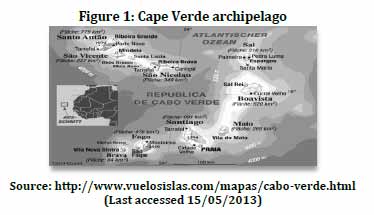
<p>&nbsp;</p></font>   <font face="Verdana" size="3">    <p><b>4.   Factors that influence residents’ attitudes</b></p></font>   <font face="Verdana" size="2">    <p>It is of vital importance to understand the     combination of factors that influence residents’ attitudes and condition the     degree to which they over evaluate or under evaluate (positive and negative)     the various impacts mentioned in the previous section. In examining residents’     attitudes, it is also important to highlight certain aspects such as the type     and degree of interaction between residents and tourists, the importance of the     industry for the community, the level of visitor involvement with the tourism     sector, and the general level of development of the host community (Murphy,     1985). In addition to these general factors, other more specific factors should     also be considered such as having been born in the community (Um &amp; Crompton, 1987; Cannan &amp; Hennessy, 1989), the length of time an individual has lived     in the community (Liu &amp; Var, 1986), age     and educational level (Allen <i>et al</i>.,     1988), the level of tourism concentration in the community (Pizam, 1978),     economic dependence on the tourism industry (Long <i>et al</i>., 1990; Madrigal, 1993), and the distance between place of     residence and tourism activities (Belisle &amp; Hoy, 1980; Sheldon &amp; Var, 1984).</p>       <p>According to Royo and Ruiz (2009), the factors that     influence the perceived costs and benefits of tourism include the level of     dependence on tourism, the level of local tourism development, the use of     tourism resources by residents, and feelings towards the community and     commitment to the community. These factors or determinants can vary the     intensity or the direction of the impact either positively or negatively. </p>       <p>Moreover, Díaz and Gutiérrez (2010) argue that there     are three moderating factors that affect the impact of tourism on the local community:     tourists, the destination (the sector of tourism activity) and the     socio-demographic characteristics of the residents.</p>       <p>&nbsp;</p></font>  <font face="Verdana" size="3">     <p><b>5.   Geography, history and economy of     the study area</b></p></font>   <font face="Verdana" size="2">    <p>Cape Verde is an island state that comprises an     archipelago of ten volcanic islands and eight islets. It is located south of     the Canary Islands and around 450 km from Senegal (<a href="#f1">Figure 1</a>). The total area of     the archipelago covers 4,033 square kilometres, of which only 11% is arable,     and boasts a population of 516,000 inhabitants in addition to a similar number     of Cape Verdeans who live abroad. The Cape Verde islands are divided into two     groups: the northern Barlavento or Windward Islands and the southern Sotavento     or Leeward Islands. The first group  comprises the islands of Santo Antão, São Vicente, Santa Luzia     (uninhabited), São Nicolau, Sal, and Boa Vista, while the second group     comprises the islands of Santiago (which hosts the nation’s capital, Praia),     Fogo, Maio, and Brava.</p>       <p><a name="f1"></a></p>       ]]></body>
<body><![CDATA[<p>&nbsp;</p>       <p align="center"><img src="/img/revistas/tms/v10n1/10n1a13f1.jpg" width="374" height="215"></p>       
<p>&nbsp;</p>       <p>Cape Verde has a subtropical climate, with an     average annual temperature of 24ºC. The archipelago has two distinct seasons:     the dry season, which runs from October to July, with the hottest month being     September, and the wet season, which runs from August to October. Rainfall is     very irregular on some islands, while on others it may not rain for several     years.</p>       <p>The uninhabited islands were discovered by the     Portuguese navigator Diogo Gomes in 1460, giving the Crown of Portugal the     strategic position it needed to expand its trade routes throughout Southern     Africa. As a result, the islands were colonised by the Portuguese, who were     granted exclusive trade rights along the West African Coast as well as the     possibility of exploiting African slaves (ICEX, 2012).</p>       <p>Well into the sixteenth century, the archipelago     declined in importance as a hub on the trade routes between Europe and South     America. Following decolonisation in the twentieth century, Cape Verde gained     independence in 1975. Between 1975 and 1991, Cape Verde established the First     Republic (1975-1991), which was characterised by an interventionist economic     policy and autarkic development based on centralised planning and the dominance     of the public sector (ICEX, 2012).</p>       <p>In 1991, the Constitution was amended and a     multi-party democracy was established, making Cape Verde the first sub-Saharan     African country to hold free elections. In the same decade, a process was     initiated to open up the country to the market economy and other nations. Cape     Verde also made important investments in education and health, thus converging     towards a European model by privatising and liberalising certain sectors.     However, Cape Verde still remains dependent on foreign aid, especially from the     European Union.</p>       <p>According to the ICEX report (2011), Cape Verde is now     considered one of the African countries with the greatest political freedom, as     well as freedom of the press and civil rights, meaning that the country now     enjoys political stability and a low level of corruption compared to     neighbouring African countries. </p>       <p>According to the United Nations Human Development     Report (2012), Cape Verde is now in the group of countries with medium human     development, ranking 133 out of the 187 countries evaluated. The global crisis     has affected the Cape Verdean economy and its macroeconomic variables given the     negative impact of the reduction in direct foreign investment flows and     tourism. However, the country has not experienced a sharp contraction in     economic activity, with GDP growth estimated at 5.5% in 2011 (ICEX, 2011).</p>       <p>Cape Verde is heavily dependent on imports, including     food, owing to the lack of arable land and the prolonged absence of rainfall.     Tourist arrivals and remittances from emigrants offset the country’s structural     trade balance deficit.</p>       ]]></body>
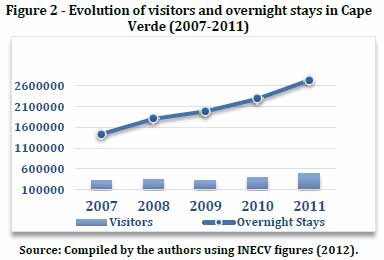
<body><![CDATA[<p>Since 1999, imports to Cape Verde have been     liberalised and preferential agreements with the European Union have     facilitated exports. In 2007, the country joined the World Trade Organization.     Import licenses have been replaced by simple import declarations.</p>       <p>Tourism     is gradually becoming the main source of employment and economic growth, with a     steady growth in the number of visitors and total overnight stays (<a href="#f2">Figure 2</a>).     The contribution of tourism to GDP growth has increased considerably in recent     years (from 4% in 1998 to 25% in 2010). </p>       <p><a name="f2"></a></p>       <p>&nbsp;</p>       <p align="center"><img src="/img/revistas/tms/v10n1/10n1a13f2.jpg" width="384" height="260"></p>       
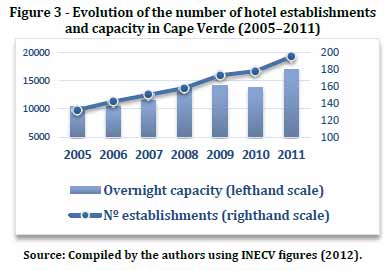
<p>&nbsp;</p>       <p>The tourism policy of the Cape Verdean government is     aimed at improving infrastructures, in particular by increasing the number of     international airports on the islands. There are plans to build new     international airports on the islands of Santiago and Maio. The archipelago’s     national airline, TACV (Cabo Verde Airlines), is the focus of a reengineering     plan and is expected to be privatised in the future. One of the goals of     privatisation is to increase long-haul international flights and thus     facilitate the arrival of tourists to the islands.</p>       <p>According to the Cape Verde National Statistics Office     (INECV, 2012), the main inbound tourism markets to the country are the United     Kingdom (19%), France (14%), Portugal (14%), Germany (13%), Italy (12%) and     Benelux (5.1%).</p>       <p>In 2010, Cape Verde ranked eightieth on the Travel and     Tourism Competitiveness Index (TTCI) published by the World Economic Forum,     which evaluates improvements in tourism policies, the business environment in     the tourism sector, and infrastructures. The boost in the tourism sector has     had an impact on the development of the construction sector, in which many     projects have been funded by foreign investors, considerably increasing the     number of hotels. According to ICEX (2011), around 90% of foreign investment     flows in Cape Verde are targeted at tourism. In 2011, the number of available     overnight lodgings exceeded 17,000 (<a href="#f3">Figure 3</a>), having almost doubled in recent     years. The most visited islands are Boa Vista and Sal (cornering 39% and 35% of     visitors in 2011, respectively), with Santiago and São Vicente being slightly     less popular. The country received 475,000 tourists in 2011 compared to 287,000     in 2009. The hotel industry accounted for almost 25% of GDP in 2011.</p>       <p><a name="f3"></a></p>       ]]></body>
<body><![CDATA[<p>&nbsp;</p>       <p align="center"><img src="/img/revistas/tms/v10n1/10n1a13f3.jpg" width="391" height="270"></p>       
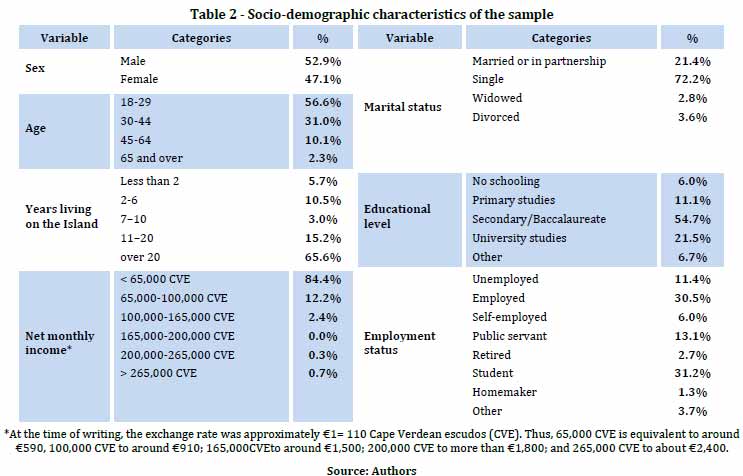
<p>&nbsp;</p>       <p>Foreign trade operations are controlled by the Central     Bank of Cape Verde, which gave its seal of approval to import declarations in     order to guarantee the provision of currency for the payment of goods.</p>       <p>Foreign investment in Cape Verde has become very     important in recent years, according to the state investment and tourism     promotion agency Cabo Verde Investimentos, investments exceeded 800 million     euros in 2008. Investment is targeted primarily at tourism development and the     privatisation of public enterprises. In 2007, the Enacol petrochemical company,     the SCT tobacco company, and other similar companies were privatised. There are     currently various incentives to invest in the country. The main investors in     Cape Verde belong to the European Union: the main investors in 2008 were Italy     (€310 million), Portugal (€256 million), Ireland (€120 million), Spain (€108     million) and the United Kingdom (€34 million). Large hotel chains such as RIU,     Meliá and Iberostar are promoting development based primarily on resort-type     hotels with all-inclusive tourism packages.</p>       <p>&nbsp;</p></font>   <font face="Verdana" size="3">    <p><b>6.   Local residents’ perception of     the impacts of tourism development on the Island of São Vicente</b></p></font>   <font face="Verdana" size="2">    <p>This section is divided into three sub-sections. In     the first subsection we analyse the study sample in order to obtain the     sociodemographic characteristics of the residents. Following the analysis, we     examine residents’ perceptions of the impacts of tourism development. Finally,     a cluster analysis is performed on residents’ evaluation of the available     services on the island.</p>       <p><b>6.1 Sample analysis</b></p>       <p><a href="/img/revistas/tms/v10n1/10n1a13t2.jpg">Table 2</a> shows the socio-demographic characteristics of     the residents from the island of São Vicente that comprise the study sample. As     can be seen in the table, the sample comprises primarily young people (over 87%     of the respondents are aged 44 and under, while over 55% are aged 30 and under)     and habitual island residents (more than 65% have been living in São Vicente     for over 20 years). Most of the respondents are single, and have completed     secondary school or baccalaureate, although a significant percentage of the     respondents (21.5%) are university graduates. The majority of respondents     (84.4%) earn a monthly income of less than 65,000 Cape Verdean escudos. The     sample also includes a large number of students and salaried employees. The     residents of Cape Verde generally speak several languages. As well as Portuguese     and Creole, which are the most widely-spoken languages, 44.6% of the      residents surveyed also speak English     and 35.14% speak French. This is probably due to the fact that many of the     residents on the island are university graduates.</p>         
]]></body>
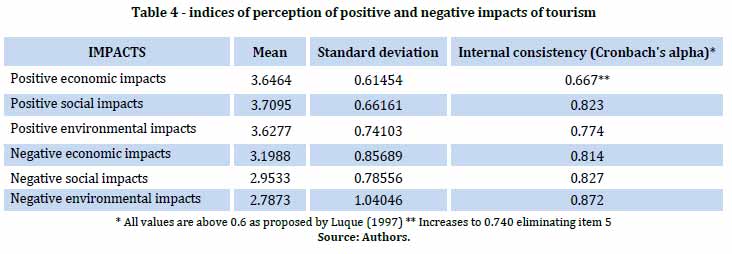
<body><![CDATA[<p>As regards the relationship between the island’s     residents and the tourism sector, we found that a small percentage (18%) have     or have had a job in the sector; a figure that doubles in the case of residents     whose relatives also work in the tourism sector. However, the large majority of     the residents interviewed (60.2%) indicated that they would like to work in the     tourism sector in the future.</p>       <p><b>6.2 perception of the impact of tourism development</b></p>       <p>The     block of the questionnaire that analysed residents’ perceptions of the impacts     of tourism development on the island of São     Vicente consisted of 35 items divided into six sections: economic,     socio-cultural, and environmental impacts, each one in a positive and negative     version.     It is interesting to note that the residents stated that tourism     contributes to recovering traditional handicrafts, with a score of more than 4     points. High scores were also found for degree of agreement with the statement     that tourism increases investments and the development of infrastructures, in     addition to the quality of the hospitality and retail sectors, and the     sensation that residents feel proud about belonging to the island owing to the     amount of tourists who visit it.</p>       <p>As     regards resident’s perceptions of the negative impacts of tourism, the degree     of agreement is generally lower and in many cases below the 3-point mean.     Higher average degrees of agreement were found for impacts related to the     increase in alcoholism and sexual permissiveness and more robberies and     vandalism. This is due to the greater sense of insecurity perceived by citizen     in recent times.<b> &nbsp; </b>  </p>         <p>In     general, the results (<a href="/img/revistas/tms/v10n1/10n1a13t3.jpg">Table 3</a>) show a certain degree of agreement (the means     are usually above 3 points) for the positive impacts of tourism. In addition,     we built a cumulative index for each of the blocks of questions by calculating     the average of the items that constitute them, in order to use each type of     impact as an aggregate variable in the subsequent regression model (<a href="/img/revistas/tms/v10n1/10n1a13t4.jpg">Table 4</a>).</p>       
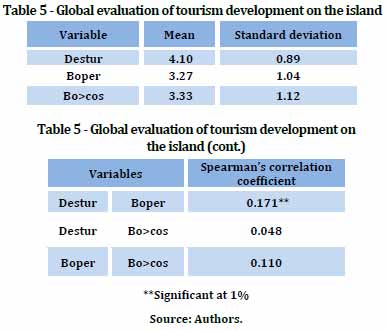
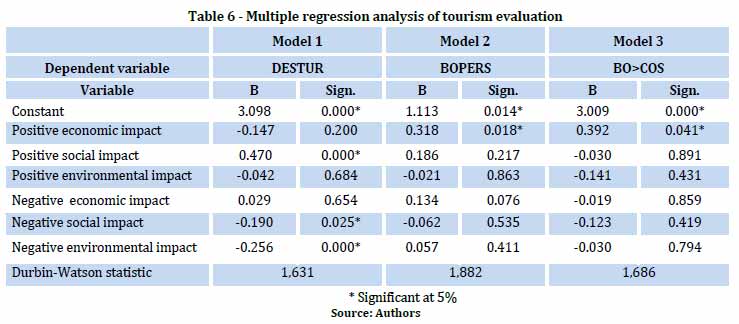
<p>The     variables that were considered relevant in defining residents’ overall opinion     about tourism development on the     island of São Vicente were measured using the following three items:</p>       <p>§&nbsp; Agrees with greater     tourism development in the area (Destur);</p>       <p>§&nbsp; Considers that tourism     development can benefit them personally (Bopers);</p>       <p>Considers that the benefits of tourism outweigh     the costs (Bo&gt;cos).</p>         <p>The variables were first measured using a     5-point semantic differential scale. The descriptive results and correlations     between the three variables are presented in <a href="#t5">Table 5</a>. The results show that the     majority of the respondents are in favour of greater tourism development in the     area owing to the positive benefits to be gained from such development.     However, the respondents are more divided regarding the perception that tourism     development entails personal gains or that the benefits of tourism outweigh the     costs arising from the influx of visitors. In addition, a significant     correlation was only found between the degree of agreement with more tourism     development on the island and the perception that it can contribute to personal     benefit.</p>       ]]></body>
<body><![CDATA[<p><a name="t5"></a></p>       <p>&nbsp;</p>       <p align="center"><img src="/img/revistas/tms/v10n1/10n1a13t5.jpg" width="386" height="331"></p>           
<p>&nbsp;</p>       <p>In a second step, we built three multiple linear regression models to     determine the influence of the perception indices on positive and negative     economic, socio-cultural, and environmental impacts on the three previous     dependent variables (<a href="/img/revistas/tms/v10n1/10n1a13t6.jpg">Table 6</a>) and to what extent each impact contributes to     residents’ global evaluation of the benefits of tourism in São Vicente.</p>       
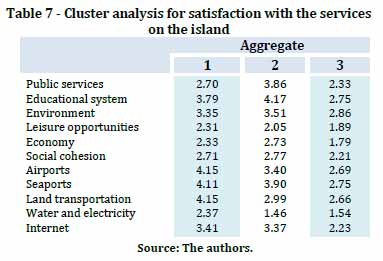
<p>The residual plots in the     three models show no signs of heteroscedasticity. Furthermore, Durbin-Watson     values &#8203;&#8203;close to 2 do not support the     existence of autocorrelation. Finally, VIF below critical value of 10 and     tolerance for each explanatory variable in the three models have not detected     the existence of multicollinearity.</p>    <p>Based on the analysis of the coefficients of each model, we can conclude     that the perception that tourism brings positive economic impacts has a higher     weighting. This is because it is the only statistically significant variable in     the evaluation of the personal benefits residents believe they might gain, as     well as in the cost-benefit balance. However, when residents state their     opinion about the desirability of more tourism development in São Vicente,     positive and negative socio-cultural impacts and potential adverse     environmental impacts play an important role in their evaluation, which in this     case is not influenced by economic elements.</p>    <p><b>6.3 Cluster analysis on the evaluation of     services on the island</b></p>       <p>Finally, we performed a cluster analysis to identify     groups of residents which evaluated the services available on São Vicente in a     similar manner. The items included in this block were measured using a 5-point     Likert scale to analyse the perception of residents regarding: Public services,     Educational system, Environment, Leisure opportunities, Economy (Cost of     living, businesses and employment opportunities), Cohesion and social     opportunities, Transportation (Airports, seaports and land transportation) and     Utilities (Electricity, water and internet).</p>       <p>Three clusters were obtained     using a k-means analysis (<a href="#t7">Table 7</a>). The reason to opt for three groups was that     it achieves a more consistent number of cases among clusters and shows clearer     information about them. An Anova analysis was carried out to validate the     results; according to it, all items showed significant differences between     clusters.</p>       ]]></body>
<body><![CDATA[<p><a name="t7"></a></p>       <p>&nbsp;</p>       <p align="center"><img src="/img/revistas/tms/v10n1/10n1a13t7.jpg" width="383" height="261"></p>       
<p>&nbsp;</p>       <p>The first     cluster consists of 91 residents who positively evaluated the island’s     transportation services, whether by air, land or sea. When filtering this     group, we found that it primarily comprised men and students with some     knowledge of languages &#8203;&#8203;who     showed a greater degree of agreement with the development of tourism on the     island.</p>       <p>The respondents in the second     group, which consists of 78 individuals, stated that they were more satisfied     with aspects such as the educational system, public services and sea transport     systems; however, they were also particularly sensitive to the malfunctioning     of electricity and water supplies. After filtering, it was revealed that this     group has the highest knowledge of languages of the three clusters and     primarily comprises salaried employees. Although the respondents said that     tourism development was generally positive, a certain percentage was     indifferent or stated that tourism development was negative.</p>       <p>The third     cluster, with 101 residents, is the largest of the three. The respondents in     this cluster had the most negative perception of tourism given that they rated     all the items below the 3-point mark. They were especially critical of     utilities, the island’s economy and the leisure opportunities of São Vicente.     Unlike the previous two groups, this group comprises almost entirely women,     89.2% of whom belong to the 18 to 44 age range. Although most are residents who     have lived on the island for over 20 years, a significant number (19.8%) have     only been living on São Vicente for 2 to 6 years. Although a certain percentage     of individuals in the group stated that they spoke English (38.6%) or French     (29.7%), the knowledge of languages among the respondents in this cluster was     lower than in the previous two groups. The most frequent employment status in     this group was salaried employee and student. This group strongly agreed with     increasing tourism development in the area, although 56.4% stated that they     believed that they would not benefit personally from it and 58.2% did not have     a clear or positive opinion regarding the possibility that the benefits of     tourism would outweigh the costs on the island.</p>       <p>&nbsp;</p></font> <font face="Verdana" size="3">    <p><b>7. Conclusions</b></p></font>   <font face="Verdana" size="2">    <p>In order to ensure the success of tourism     development plans in a geographic area, it is vital to take into account     diverse groups of stakeholders; and especially the perceptions and attitudes of     the local community regarding the impact of tourism development from an     economic, socio-cultural and environmental point of view.</p>       ]]></body>
<body><![CDATA[<p>In this study, we     analysed the perceptions and attitudes of the inhabitants of the island of São     Vicente in the Cape Verde archipelago. São Vicente is an emerging tourist     destination in comparison to the neighbouring islands of Sal and Boa Vista,     which are undergoing major changes as a result of the massive influx of tourists.     Our results have shown that:</p>       <p>1)&nbsp;&nbsp;&nbsp; Residents’ attitudes toward     tourism development and its impacts differ depending on the domains affected by     such development. For example, when analysing the personal benefits that could     be gained from tourism, we find that economic impacts are statistically     significant. However, when examining the advantages to increasing tourism     development on the island, socio-cultural and environmental impacts are more     influential than economic impacts.</p>       <p>2)&nbsp;&nbsp;&nbsp; The majority of residents are in favour of     continuing with the plan to increase tourist arrivals owing to the positive     benefits that tourism development can bring, such as the recovery of     traditional handicrafts, greater investments in infrastructures and higher     quality hospitality and retail establishments. Therefore, the prevailing     positive attitude coincides with the results of other studies carried out in     the Cape Verde Islands in general (Ribeiro <i>et     al</i>., 2013) or on Sal Island in particular (Simão &amp; Môsso, 2013). Attitudes towards possible negative impacts are much less     marked in the community and are primarily focused on feelings of greater     insecurity and the concern that there will be greater sexual permissiveness and     alcohol consumption. Coinciding with most of the previous studies of     literature, tourism development will bring to the area more benefits than harm.     It can be argued that residents are currently in the phase of     &quot;euphoria&quot;, as concluded Vargas Sanchés <i>et al.</i> (2007) in their study, although in this case we could qualify     it as &quot;moderate euphoria&quot;.</p>       <p>3)&nbsp;&nbsp;&nbsp; The segmentation of the sample based on     satisfaction with the services available on the island revealed two groups     that, in broad terms, had a positive opinion of the services offered and also     showed a higher degree of agreement with tourism development. A third group,     which accounted for slightly more than a third of the sample (37%), had a more     negative opinion of the island’s services. This group consisted almost entirely     of women with relatively little knowledge of languages. Therefore, this is     evidence once more for varying levels of support for tourism within a specific     community (Dogan, 1989; Colmenares, 2008; Díaz &amp; Gutiérrez, 2010; Ribeiro <i>et al</i>,     2013).</p>    <p>In conclusion, the island of     São Vicente has enormous potential for the development of cultural as well as     sun and beach tourism. However, in order for tourism on the island to be     sustainable and ensure that the residents perceive the benefits to be gained     from tourism, greater participation by local residents in tourism initiatives     is needed. In this respect, public agencies, NGOs and universities (both     domestic and international) play a significant role and should make a     commitment to training and heightening the awareness of a predominantly young     population. By doing so, the island would become a model of how well-managed     tourism can produce a high degree of satisfaction among residents, while     allowing for sustainable growth.</p>    <p>This research suffers from     certain limitations, mainly the method and selected technical instruments and     the characteristics of the empirical support. In this sense, structural     equation modelling or multivariable models could be used for graduating the     positive or negative attitudes towards tourism development. The empirical     research was developed on different dates for each of the analysed groups,     which could generate some distortions in the results. Subsequent studies will     allow comparison of the results obtained, as well as introduce new variables     and dimensions adapted to the geographical area in question, even expanding the     study to other islands of the Cape Verde archipelago.</p>    <p>Given that attitude is a     tourist intangible and dynamic in its formation (Díaz &amp; Gutiérrez, 2010), its longitudinal analysis is an essential reason why, as a     future line of research, it might be interesting to set up an observatory to     analyse the attitudes of residents as Cape Verde makes more progress towards     becoming an emerging tourism destination.</p>      <p>&nbsp;</p></font> <font face="Verdana" size="3">    <p><b>References</b></p></font> <font face="Verdana" size="2">    <!-- ref --><p>Akis, S., Peristianis, N.     &amp; Warner, J. (1996). Residents attitudes to tourism development: the case     of Cyprus. <i>Tourism     Management</i>, <i>17</i>(7), 481-404.    &nbsp;&nbsp;&nbsp;&nbsp;&nbsp;&nbsp;&nbsp;&nbsp;[&#160;<a href="javascript:void(0);" onclick="javascript: window.open('/scielo.php?script=sci_nlinks&ref=000132&pid=S2182-8458201400010001300001&lng=','','width=640,height=500,resizable=yes,scrollbars=1,menubar=yes,');">Links</a>&#160;]<!-- end-ref --></p>       <!-- ref --><p>Allen, L. R., Long, P. T., Perdue, R. R. &amp; Kieselbach, S. (1988). The impact of tourism     development on residents’ perception of community life. <i>Journal of Travel     Research</i>, <i>27</i>(1), 16-21.    &nbsp;&nbsp;&nbsp;&nbsp;&nbsp;&nbsp;&nbsp;&nbsp;[&#160;<a href="javascript:void(0);" onclick="javascript: window.open('/scielo.php?script=sci_nlinks&ref=000134&pid=S2182-8458201400010001300002&lng=','','width=640,height=500,resizable=yes,scrollbars=1,menubar=yes,');">Links</a>&#160;]<!-- end-ref --></p>    <!-- ref --><p>Allen, L. R., Hafer, H. R., Long,     P. T. &amp; Perdue, R. R. (1993). Rural residents attitudes toward     recreation and tourism development. <i>Journal of Travel Research</i>, <i>31</i>(4), 27-33.    &nbsp;&nbsp;&nbsp;&nbsp;&nbsp;&nbsp;&nbsp;&nbsp;[&#160;<a href="javascript:void(0);" onclick="javascript: window.open('/scielo.php?script=sci_nlinks&ref=000136&pid=S2182-8458201400010001300003&lng=','','width=640,height=500,resizable=yes,scrollbars=1,menubar=yes,');">Links</a>&#160;]<!-- end-ref --></p>       <!-- ref --><p>Allport, G. W. (1935). Attitudes. In C. Murchison     (Ed.), <i>A handbook of Social Psychology </i>(pp. 798-844). New York: Clark     Univ.    &nbsp;&nbsp;&nbsp;&nbsp;&nbsp;&nbsp;&nbsp;&nbsp;[&#160;<a href="javascript:void(0);" onclick="javascript: window.open('/scielo.php?script=sci_nlinks&ref=000138&pid=S2182-8458201400010001300004&lng=','','width=640,height=500,resizable=yes,scrollbars=1,menubar=yes,');">Links</a>&#160;]<!-- end-ref --> </p>    <!-- ref --><p>Ap, J. (1992). Residents´     perception on tourism impacts. <i>Annals of Tourism Research</i>, <i>19</i>(4), 665-690.    &nbsp;&nbsp;&nbsp;&nbsp;&nbsp;&nbsp;&nbsp;&nbsp;[&#160;<a href="javascript:void(0);" onclick="javascript: window.open('/scielo.php?script=sci_nlinks&ref=000140&pid=S2182-8458201400010001300005&lng=','','width=640,height=500,resizable=yes,scrollbars=1,menubar=yes,');">Links</a>&#160;]<!-- end-ref --> </p>       <!-- ref --><p>Belisle, F. J. &amp; Hoy, D. R. (1980). The perceived     impact of tourism by residents: a case study in Santa Marta, Colombia. <i>Annals     of Tourism Research</i>, <i>7</i>(1),     83-101.    &nbsp;&nbsp;&nbsp;&nbsp;&nbsp;&nbsp;&nbsp;&nbsp;[&#160;<a href="javascript:void(0);" onclick="javascript: window.open('/scielo.php?script=sci_nlinks&ref=000142&pid=S2182-8458201400010001300006&lng=','','width=640,height=500,resizable=yes,scrollbars=1,menubar=yes,');">Links</a>&#160;]<!-- end-ref --></p>    <!-- ref --><p>Butler, R. (1980). The concept     of tourism area cycle of evolution: implications for management of resources. <i>Canadian     Geographer</i>, <i>24</i>(1), 5-12.    &nbsp;&nbsp;&nbsp;&nbsp;&nbsp;&nbsp;&nbsp;&nbsp;[&#160;<a href="javascript:void(0);" onclick="javascript: window.open('/scielo.php?script=sci_nlinks&ref=000144&pid=S2182-8458201400010001300007&lng=','','width=640,height=500,resizable=yes,scrollbars=1,menubar=yes,');">Links</a>&#160;]<!-- end-ref --></p>       <!-- ref --><p>Cannan, P. &amp; Hennessy, M. (1989). The growth     machine, tourism and the selling of culture. <i>Sociological Perspectives</i>, <i>32</i>(2), 227-243.    &nbsp;&nbsp;&nbsp;&nbsp;&nbsp;&nbsp;&nbsp;&nbsp;[&#160;<a href="javascript:void(0);" onclick="javascript: window.open('/scielo.php?script=sci_nlinks&ref=000146&pid=S2182-8458201400010001300008&lng=','','width=640,height=500,resizable=yes,scrollbars=1,menubar=yes,');">Links</a>&#160;]<!-- end-ref --></p>       <!-- ref --><p>Carneiro, M. J. &amp; Eusébio, C. (2011). Segmentation     of the tourism market using the impact of tourism on quality of life. <i>Tourism &amp; Management Studies, </i>7,     91-100.    &nbsp;&nbsp;&nbsp;&nbsp;&nbsp;&nbsp;&nbsp;&nbsp;[&#160;<a href="javascript:void(0);" onclick="javascript: window.open('/scielo.php?script=sci_nlinks&ref=000148&pid=S2182-8458201400010001300009&lng=','','width=640,height=500,resizable=yes,scrollbars=1,menubar=yes,');">Links</a>&#160;]<!-- end-ref --></p>       <!-- ref --><p>Cater, E. A. (1987). Tourism in the least developed     countries. <i>Annals of Tourism Research</i>, Vol. 14, 202-226.    &nbsp;&nbsp;&nbsp;&nbsp;&nbsp;&nbsp;&nbsp;&nbsp;[&#160;<a href="javascript:void(0);" onclick="javascript: window.open('/scielo.php?script=sci_nlinks&ref=000150&pid=S2182-8458201400010001300010&lng=','','width=640,height=500,resizable=yes,scrollbars=1,menubar=yes,');">Links</a>&#160;]<!-- end-ref --></p>       <!-- ref --><p>Cohen, E. (1984). The sociology of tourism:     approaches, issues, and findings. <i>Annual Review of Sociology</i>, Vol. 10, 373-392.    &nbsp;&nbsp;&nbsp;&nbsp;&nbsp;&nbsp;&nbsp;&nbsp;[&#160;<a href="javascript:void(0);" onclick="javascript: window.open('/scielo.php?script=sci_nlinks&ref=000152&pid=S2182-8458201400010001300011&lng=','','width=640,height=500,resizable=yes,scrollbars=1,menubar=yes,');">Links</a>&#160;]<!-- end-ref --></p>       <!-- ref --><p>Colmenares, L. (2008). La actitud de los residentes: factor clave en el     desarrollo de un nuevo destino. <i>Scientia     Unellezea</i>, <i>3</i>(1), 43-79.    &nbsp;&nbsp;&nbsp;&nbsp;&nbsp;&nbsp;&nbsp;&nbsp;[&#160;<a href="javascript:void(0);" onclick="javascript: window.open('/scielo.php?script=sci_nlinks&ref=000154&pid=S2182-8458201400010001300012&lng=','','width=640,height=500,resizable=yes,scrollbars=1,menubar=yes,');">Links</a>&#160;]<!-- end-ref --></p>    <!-- ref --><p>Díaz, J. A. &amp; Martínez, V.     (2002). <i>Sociología del Turismo</i>. Madrid: UNED.    &nbsp;&nbsp;&nbsp;&nbsp;&nbsp;&nbsp;&nbsp;&nbsp;[&#160;<a href="javascript:void(0);" onclick="javascript: window.open('/scielo.php?script=sci_nlinks&ref=000156&pid=S2182-8458201400010001300013&lng=','','width=640,height=500,resizable=yes,scrollbars=1,menubar=yes,');">Links</a>&#160;]<!-- end-ref --> </p>       <!-- ref --><p>Díaz, R. &amp; Gutiérrez, D. (2010). La actitud del residente en el destino     turístico de Tenerife: evaluación y tendencia. <i>PASOS: Revista de Turismo y Patrimonio Cultural</i>, <i>8</i>(4), 431-444.    &nbsp;&nbsp;&nbsp;&nbsp;&nbsp;&nbsp;&nbsp;&nbsp;[&#160;<a href="javascript:void(0);" onclick="javascript: window.open('/scielo.php?script=sci_nlinks&ref=000158&pid=S2182-8458201400010001300014&lng=','','width=640,height=500,resizable=yes,scrollbars=1,menubar=yes,');">Links</a>&#160;]<!-- end-ref --> </p>       <!-- ref --><p>Diedrich, A. &amp; García-Buades, E. (2009). Local perceptions of tourism     as indicators of destination decline<i>. Tourism Management</i>, <i>30</i>(4), 512-521.    &nbsp;&nbsp;&nbsp;&nbsp;&nbsp;&nbsp;&nbsp;&nbsp;[&#160;<a href="javascript:void(0);" onclick="javascript: window.open('/scielo.php?script=sci_nlinks&ref=000160&pid=S2182-8458201400010001300015&lng=','','width=640,height=500,resizable=yes,scrollbars=1,menubar=yes,');">Links</a>&#160;]<!-- end-ref --></p>       <!-- ref --><p>Dogan, H. Z. (1989). Forms of Adjustment:     Sociocultural Impacts of Tourism. <i>Annals     of Tourism Research</i>, Vol. 16, 223-239.    &nbsp;&nbsp;&nbsp;&nbsp;&nbsp;&nbsp;&nbsp;&nbsp;[&#160;<a href="javascript:void(0);" onclick="javascript: window.open('/scielo.php?script=sci_nlinks&ref=000162&pid=S2182-8458201400010001300016&lng=','','width=640,height=500,resizable=yes,scrollbars=1,menubar=yes,');">Links</a>&#160;]<!-- end-ref --></p>       <!-- ref --><p>Fox, M. (1977). The social impact of tourism: A     challenge to researchers and planners. In B. Finney &amp; K. A. Watson (Ed<i>.</i>), <i>A new kind of sugar: Tourism in     the Pacific </i>(pp. 27-48).     Honolulu: Santa Cruz Centre for South Pacific Studies.    &nbsp;&nbsp;&nbsp;&nbsp;&nbsp;&nbsp;&nbsp;&nbsp;[&#160;<a href="javascript:void(0);" onclick="javascript: window.open('/scielo.php?script=sci_nlinks&ref=000164&pid=S2182-8458201400010001300017&lng=','','width=640,height=500,resizable=yes,scrollbars=1,menubar=yes,');">Links</a>&#160;]<!-- end-ref --></p>       <!-- ref --><p>Fridgen, J. D. (1991). <i>Dimensions of tourism.</i> East Lansing: The Educational Institute of the American Hotel and Motel Association.    &nbsp;&nbsp;&nbsp;&nbsp;&nbsp;&nbsp;&nbsp;&nbsp;[&#160;<a href="javascript:void(0);" onclick="javascript: window.open('/scielo.php?script=sci_nlinks&ref=000166&pid=S2182-8458201400010001300018&lng=','','width=640,height=500,resizable=yes,scrollbars=1,menubar=yes,');">Links</a>&#160;]<!-- end-ref --></p>       <!-- ref --><p>Gee, C. Y., Mackens, J. C. &amp; Choy, D. J. (1989). <i>The     Travel Industry. </i>New York: Van Nostrand Reinhold.    &nbsp;&nbsp;&nbsp;&nbsp;&nbsp;&nbsp;&nbsp;&nbsp;[&#160;<a href="javascript:void(0);" onclick="javascript: window.open('/scielo.php?script=sci_nlinks&ref=000168&pid=S2182-8458201400010001300019&lng=','','width=640,height=500,resizable=yes,scrollbars=1,menubar=yes,');">Links</a>&#160;]<!-- end-ref --></p>       <!-- ref --><p>Getz, D. (1994). Residents’ attitudes towards tourism:     A longitudinal study in Spey Valley, Scotland. <i>Tourism Management</i>, <i>15</i>(4), 247-258.    &nbsp;&nbsp;&nbsp;&nbsp;&nbsp;&nbsp;&nbsp;&nbsp;[&#160;<a href="javascript:void(0);" onclick="javascript: window.open('/scielo.php?script=sci_nlinks&ref=000170&pid=S2182-8458201400010001300020&lng=','','width=640,height=500,resizable=yes,scrollbars=1,menubar=yes,');">Links</a>&#160;]<!-- end-ref --></p>       <!-- ref --><p>Gunn, C. A. (1988). <i>Tourism Planning</i>. New York:     Taylor &amp; Francis.    &nbsp;&nbsp;&nbsp;&nbsp;&nbsp;&nbsp;&nbsp;&nbsp;[&#160;<a href="javascript:void(0);" onclick="javascript: window.open('/scielo.php?script=sci_nlinks&ref=000172&pid=S2182-8458201400010001300021&lng=','','width=640,height=500,resizable=yes,scrollbars=1,menubar=yes,');">Links</a>&#160;]<!-- end-ref --></p>       <!-- ref --><p>Gursoy, D., Jurowski, C. &amp; Uysal, M. (2002). Resident attitudes: A     Structural Modeling Approach. <i>Annals of Tourism Research, 29</i>(1), 79-105.    &nbsp;&nbsp;&nbsp;&nbsp;&nbsp;&nbsp;&nbsp;&nbsp;[&#160;<a href="javascript:void(0);" onclick="javascript: window.open('/scielo.php?script=sci_nlinks&ref=000174&pid=S2182-8458201400010001300022&lng=','','width=640,height=500,resizable=yes,scrollbars=1,menubar=yes,');">Links</a>&#160;]<!-- end-ref --></p>    <!-- ref --><p>Harrill, R. (2004). Residents´     attitudes toward tourism development: a literature review with implications for     tourism planning. <i>Journal of Planning Literature</i>, <i>18</i>(1), 251-266.    &nbsp;&nbsp;&nbsp;&nbsp;&nbsp;&nbsp;&nbsp;&nbsp;[&#160;<a href="javascript:void(0);" onclick="javascript: window.open('/scielo.php?script=sci_nlinks&ref=000176&pid=S2182-8458201400010001300023&lng=','','width=640,height=500,resizable=yes,scrollbars=1,menubar=yes,');">Links</a>&#160;]<!-- end-ref --></p>       <!-- ref --><p>Harris, C., McLaughlin, W. &amp; Brown, G. (1998).     Rural communities in the interior Columbia Basin: How resilient are they?. <i>Journal     of Forestry</i>, Nr. 96, 11-15.    &nbsp;&nbsp;&nbsp;&nbsp;&nbsp;&nbsp;&nbsp;&nbsp;[&#160;<a href="javascript:void(0);" onclick="javascript: window.open('/scielo.php?script=sci_nlinks&ref=000178&pid=S2182-8458201400010001300024&lng=','','width=640,height=500,resizable=yes,scrollbars=1,menubar=yes,');">Links</a>&#160;]<!-- end-ref --></p>    <!-- ref --><p>Hernández, S. A., Cohen, J.     &amp; García, H. L. (1996). Residents´ attitudes towards an instant resort     enclave. <i>Annals of Tourism Research</i>, Vol. 16, 755-759.    &nbsp;&nbsp;&nbsp;&nbsp;&nbsp;&nbsp;&nbsp;&nbsp;[&#160;<a href="javascript:void(0);" onclick="javascript: window.open('/scielo.php?script=sci_nlinks&ref=000180&pid=S2182-8458201400010001300025&lng=','','width=640,height=500,resizable=yes,scrollbars=1,menubar=yes,');">Links</a>&#160;]<!-- end-ref --></p>       <!-- ref --><p>Homans, G. (1961). <i>Social Behavior: Elementary     Forms. </i>New York: Harcourt Brace Jovanovich.    &nbsp;&nbsp;&nbsp;&nbsp;&nbsp;&nbsp;&nbsp;&nbsp;[&#160;<a href="javascript:void(0);" onclick="javascript: window.open('/scielo.php?script=sci_nlinks&ref=000182&pid=S2182-8458201400010001300026&lng=','','width=640,height=500,resizable=yes,scrollbars=1,menubar=yes,');">Links</a>&#160;]<!-- end-ref --></p>       <!-- ref --><p>ICEX     (2011). <i>Informe económico y comercial Cabo Verde. </i>Retrieved May, 13, 2013,     from <a href="http://www.oficinascomerciales.es/icex/cda/controller/pageOfecomes/0,5310,5280449_5282957_5284971_4317866_CV,00.html" target="_blank">http://www.oficinascomerciales.es/icex/cda/controller/pageOfecomes/0,5310,5280449_5282957_5284971_4317866_CV,00.html</a> &nbsp;&nbsp;&nbsp;&nbsp;&nbsp;&nbsp;&nbsp;&nbsp;[&#160;<a href="javascript:void(0);" onclick="javascript: window.open('/scielo.php?script=sci_nlinks&ref=000184&pid=S2182-8458201400010001300027&lng=','','width=640,height=500,resizable=yes,scrollbars=1,menubar=yes,');">Links</a>&#160;]<!-- end-ref --><!-- ref --><p>ICEX     (2012). <i>Guía de organismos de apoyo a  la inversión en Cabo Verde</i>. Retrieved May, 13, 2013, from <a href="http://www.icex.es/icex/cma/contentTypes/common/records/mostrarDocumento/?doc=4628986" target="_blank">http://www.icex.es/icex/cma/contentTypes/common/records/mostrarDocumento/?doc=4628986</a>&nbsp;&nbsp;&nbsp;&nbsp;&nbsp;&nbsp;&nbsp;&nbsp;[&#160;<a href="javascript:void(0);" onclick="javascript: window.open('/scielo.php?script=sci_nlinks&ref=000185&pid=S2182-8458201400010001300028&lng=','','width=640,height=500,resizable=yes,scrollbars=1,menubar=yes,');">Links</a>&#160;]<!-- end-ref --><!-- ref --><p>INECV-     Cape Verde National Statistics Office (2012). <i>Resultados do inventario annual aos Estabelecimentos hoteleiros, 2011,     INECV</i>. Retrieved May, 13, 2013, from <a href="http://www.ine.cv/actualise/destaques/files/29819538732013Inventario Anual aos Estabelecimentos Hoteleiros 2012.pdf" target="_blank">http://www.ine.cv/actualise/destaques/files/29819538732013Inventario%20Anual%20aos%20Estabelecimentos%20Hoteleiros%202012.pdf</a>&nbsp;&nbsp;&nbsp;&nbsp;&nbsp;&nbsp;&nbsp;&nbsp;[&#160;<a href="javascript:void(0);" onclick="javascript: window.open('/scielo.php?script=sci_nlinks&ref=000186&pid=S2182-8458201400010001300029&lng=','','width=640,height=500,resizable=yes,scrollbars=1,menubar=yes,');">Links</a>&#160;]<!-- end-ref --><!-- ref --><p>Ishikawa, N. &amp; Fukushige,     M. (2006). Who expects the municipalities to take the iniciative in tourism     development? Residents´ attitudes of Amami Oshima Island in Japan. <i>Tourism     Management</i>, <i>28</i>(2), 461-475.    &nbsp;&nbsp;&nbsp;&nbsp;&nbsp;&nbsp;&nbsp;&nbsp;[&#160;<a href="javascript:void(0);" onclick="javascript: window.open('/scielo.php?script=sci_nlinks&ref=000187&pid=S2182-8458201400010001300030&lng=','','width=640,height=500,resizable=yes,scrollbars=1,menubar=yes,');">Links</a>&#160;]<!-- end-ref --> </p>    <!-- ref --><p>Jurowski, C. &amp; Gursoy, D.     (2004). Distance effects on residents´ attitudes toward tourism, <i>Annals of     Tourism Research</i>, <i>31</i>(2), 296-304.    &nbsp;&nbsp;&nbsp;&nbsp;&nbsp;&nbsp;&nbsp;&nbsp;[&#160;<a href="javascript:void(0);" onclick="javascript: window.open('/scielo.php?script=sci_nlinks&ref=000189&pid=S2182-8458201400010001300031&lng=','','width=640,height=500,resizable=yes,scrollbars=1,menubar=yes,');">Links</a>&#160;]<!-- end-ref --></p>       <!-- ref --><p>Keogh, B. (1990). Resident and recreationists’     perceptions and attitudes with respect to tourism development. <i>Journal of     Applied Recreation Research</i>, <i>15</i>(2),     71-83.    &nbsp;&nbsp;&nbsp;&nbsp;&nbsp;&nbsp;&nbsp;&nbsp;[&#160;<a href="javascript:void(0);" onclick="javascript: window.open('/scielo.php?script=sci_nlinks&ref=000191&pid=S2182-8458201400010001300032&lng=','','width=640,height=500,resizable=yes,scrollbars=1,menubar=yes,');">Links</a>&#160;]<!-- end-ref --></p>    ]]></body>
<body><![CDATA[<!-- ref --><p>Ko, D.-W. &amp; Steward, W. P.     (2002). A structural equation model of residents´ attitudes for tourism     development. <i>Tourism Management</i>, <i>23</i>(5), 521-530.    &nbsp;&nbsp;&nbsp;&nbsp;&nbsp;&nbsp;&nbsp;&nbsp;[&#160;<a href="javascript:void(0);" onclick="javascript: window.open('/scielo.php?script=sci_nlinks&ref=000193&pid=S2182-8458201400010001300033&lng=','','width=640,height=500,resizable=yes,scrollbars=1,menubar=yes,');">Links</a>&#160;]<!-- end-ref --></p>    <!-- ref --><p>Lanquar, R. (1985). <i>Sociologie     du tourisme et des voyages</i>. Paris: Presses Universitaires de France.    &nbsp;&nbsp;&nbsp;&nbsp;&nbsp;&nbsp;&nbsp;&nbsp;[&#160;<a href="javascript:void(0);" onclick="javascript: window.open('/scielo.php?script=sci_nlinks&ref=000195&pid=S2182-8458201400010001300034&lng=','','width=640,height=500,resizable=yes,scrollbars=1,menubar=yes,');">Links</a>&#160;]<!-- end-ref --></p>    <!-- ref --><p>Lepp, A. (2004). <i>Tourism in     a rural Ugandan village: impacts, local meaning and implications for     development</i> (Doctoral thesis, University of Florida, 2004). Gainesville:     University of Florida.    &nbsp;&nbsp;&nbsp;&nbsp;&nbsp;&nbsp;&nbsp;&nbsp;[&#160;<a href="javascript:void(0);" onclick="javascript: window.open('/scielo.php?script=sci_nlinks&ref=000197&pid=S2182-8458201400010001300035&lng=','','width=640,height=500,resizable=yes,scrollbars=1,menubar=yes,');">Links</a>&#160;]<!-- end-ref --></p>    <!-- ref --><p>Lindberg, K. &amp; Johnson, R.     L. (1997). Modelling residents´ attitudes toward tourism. <i>Annals of Tourism Research</i>, <i>24</i>(2),     402-424.    &nbsp;&nbsp;&nbsp;&nbsp;&nbsp;&nbsp;&nbsp;&nbsp;[&#160;<a href="javascript:void(0);" onclick="javascript: window.open('/scielo.php?script=sci_nlinks&ref=000199&pid=S2182-8458201400010001300036&lng=','','width=640,height=500,resizable=yes,scrollbars=1,menubar=yes,');">Links</a>&#160;]<!-- end-ref --></p>       <!-- ref --><p>Liu, J. C. &amp; Var, T. (1986). Residents´ attitudes     toward tourism impacts in Hawaii. <i>Annals of Tourism Research</i>, <i>13</i>(2), 193-214.    &nbsp;&nbsp;&nbsp;&nbsp;&nbsp;&nbsp;&nbsp;&nbsp;[&#160;<a href="javascript:void(0);" onclick="javascript: window.open('/scielo.php?script=sci_nlinks&ref=000201&pid=S2182-8458201400010001300037&lng=','','width=640,height=500,resizable=yes,scrollbars=1,menubar=yes,');">Links</a>&#160;]<!-- end-ref --></p>       ]]></body>
<body><![CDATA[<!-- ref --><p>Luque, T. (1997). <i>Investigación     de marketing</i>. Ariel: Barcelona.    &nbsp;&nbsp;&nbsp;&nbsp;&nbsp;&nbsp;&nbsp;&nbsp;[&#160;<a href="javascript:void(0);" onclick="javascript: window.open('/scielo.php?script=sci_nlinks&ref=000203&pid=S2182-8458201400010001300038&lng=','','width=640,height=500,resizable=yes,scrollbars=1,menubar=yes,');">Links</a>&#160;]<!-- end-ref --></p>       <!-- ref --><p>Madrigal, R. (1993). A tale of tourism in two cities. <i>Annals     of Tourism Research</i>, <i>20</i>(2),     336-353.    &nbsp;&nbsp;&nbsp;&nbsp;&nbsp;&nbsp;&nbsp;&nbsp;[&#160;<a href="javascript:void(0);" onclick="javascript: window.open('/scielo.php?script=sci_nlinks&ref=000205&pid=S2182-8458201400010001300039&lng=','','width=640,height=500,resizable=yes,scrollbars=1,menubar=yes,');">Links</a>&#160;]<!-- end-ref --></p>    <!-- ref --><p>Marrero, J. R. (2006). El discurso de rechazo al     turismo en Canarias: una aproximación cualitativa. <i>Pasos: Revista de turismo     y patrimonio cultural</i>, <i>4</i>(3),     327-341.    &nbsp;&nbsp;&nbsp;&nbsp;&nbsp;&nbsp;&nbsp;&nbsp;[&#160;<a href="javascript:void(0);" onclick="javascript: window.open('/scielo.php?script=sci_nlinks&ref=000207&pid=S2182-8458201400010001300040&lng=','','width=640,height=500,resizable=yes,scrollbars=1,menubar=yes,');">Links</a>&#160;]<!-- end-ref --></p>       <!-- ref --><p>Mathieson, A. &amp; Wall, G. (1982). <i>Tourism: economic, physical,     and social impacts. </i>New York: Longman House.    &nbsp;&nbsp;&nbsp;&nbsp;&nbsp;&nbsp;&nbsp;&nbsp;[&#160;<a href="javascript:void(0);" onclick="javascript: window.open('/scielo.php?script=sci_nlinks&ref=000209&pid=S2182-8458201400010001300041&lng=','','width=640,height=500,resizable=yes,scrollbars=1,menubar=yes,');">Links</a>&#160;]<!-- end-ref --></p>       <!-- ref --><p>McIntosh, R. W. &amp; Goeldner, C. R.  (1990). <i>Tourism: Principles, Practices,     Philosophies. </i>New York: Wiley.    &nbsp;&nbsp;&nbsp;&nbsp;&nbsp;&nbsp;&nbsp;&nbsp;[&#160;<a href="javascript:void(0);" onclick="javascript: window.open('/scielo.php?script=sci_nlinks&ref=000211&pid=S2182-8458201400010001300042&lng=','','width=640,height=500,resizable=yes,scrollbars=1,menubar=yes,');">Links</a>&#160;]<!-- end-ref --></p>    ]]></body>
<body><![CDATA[<!-- ref --><p>Monterrubio, J. C. (2008).     Residents´ perception of tourism: a critical theoretical and methodological     review. <i>Ciencia ergo sum</i>, <i>15</i>(1),     35-44.    &nbsp;&nbsp;&nbsp;&nbsp;&nbsp;&nbsp;&nbsp;&nbsp;[&#160;<a href="javascript:void(0);" onclick="javascript: window.open('/scielo.php?script=sci_nlinks&ref=000213&pid=S2182-8458201400010001300043&lng=','','width=640,height=500,resizable=yes,scrollbars=1,menubar=yes,');">Links</a>&#160;]<!-- end-ref --></p>       <!-- ref --><p>Murphy, P. E. (1985). <i>Tourism: A Community     Approach. </i>New     York: Routledge.    &nbsp;&nbsp;&nbsp;&nbsp;&nbsp;&nbsp;&nbsp;&nbsp;[&#160;<a href="javascript:void(0);" onclick="javascript: window.open('/scielo.php?script=sci_nlinks&ref=000215&pid=S2182-8458201400010001300044&lng=','','width=640,height=500,resizable=yes,scrollbars=1,menubar=yes,');">Links</a>&#160;]<!-- end-ref --></p>       <!-- ref --><p>OMT (2004). <i>Gestión para la saturación turística en sitios de interés     natural y cultural: Guía práctica. </i>Madrid: OMT.    &nbsp;&nbsp;&nbsp;&nbsp;&nbsp;&nbsp;&nbsp;&nbsp;[&#160;<a href="javascript:void(0);" onclick="javascript: window.open('/scielo.php?script=sci_nlinks&ref=000217&pid=S2182-8458201400010001300045&lng=','','width=640,height=500,resizable=yes,scrollbars=1,menubar=yes,');">Links</a>&#160;]<!-- end-ref --></p>       <!-- ref --><p>Pearce, P. L. (1998). The relationship between     resident and tourists: the research literature and management directions. In W.     F. Theobald (Ed.), <i>Global Tourism </i>(pp.     129-149).Oxford: Butterworth-Heinemman.    &nbsp;&nbsp;&nbsp;&nbsp;&nbsp;&nbsp;&nbsp;&nbsp;[&#160;<a href="javascript:void(0);" onclick="javascript: window.open('/scielo.php?script=sci_nlinks&ref=000219&pid=S2182-8458201400010001300046&lng=','','width=640,height=500,resizable=yes,scrollbars=1,menubar=yes,');">Links</a>&#160;]<!-- end-ref --></p>       <!-- ref --><p>Long, P. T., Perdue, R. R. &amp; Allen, L. (1990).     Resident support for tourism development. <i>Annals of Tourism Research</i>, <i>17</i>(4), 586-599.    &nbsp;&nbsp;&nbsp;&nbsp;&nbsp;&nbsp;&nbsp;&nbsp;[&#160;<a href="javascript:void(0);" onclick="javascript: window.open('/scielo.php?script=sci_nlinks&ref=000221&pid=S2182-8458201400010001300047&lng=','','width=640,height=500,resizable=yes,scrollbars=1,menubar=yes,');">Links</a>&#160;]<!-- end-ref --></p>       ]]></body>
<body><![CDATA[<!-- ref --><p>Pizam, A. (1978). Tourism’s impacts: the social costs     to the destination community as perceived by its residents. <i>Journal of     Travel Research</i>, <i>16</i>(4), 8-12.    &nbsp;&nbsp;&nbsp;&nbsp;&nbsp;&nbsp;&nbsp;&nbsp;[&#160;<a href="javascript:void(0);" onclick="javascript: window.open('/scielo.php?script=sci_nlinks&ref=000223&pid=S2182-8458201400010001300048&lng=','','width=640,height=500,resizable=yes,scrollbars=1,menubar=yes,');">Links</a>&#160;]<!-- end-ref --></p>       <!-- ref --><p>Pizam, A. &amp; Milman, A. (1984). The social impacts     of tourism. <i>UNEP Industry and Environment</i>, <i>7</i>(1), 11-14.    &nbsp;&nbsp;&nbsp;&nbsp;&nbsp;&nbsp;&nbsp;&nbsp;[&#160;<a href="javascript:void(0);" onclick="javascript: window.open('/scielo.php?script=sci_nlinks&ref=000225&pid=S2182-8458201400010001300049&lng=','','width=640,height=500,resizable=yes,scrollbars=1,menubar=yes,');">Links</a>&#160;]<!-- end-ref --></p>       <!-- ref --><p>Puczko, L. &amp; Ratz, T. (2000). Tourist and resident     perceptions of the physical impacts of tourism at Lake Balaton, Hungary: Issues     for sustainable tourism management. <i>Journal of Sustainable Tourism</i>, <i>8</i>(6), 458–478.    &nbsp;&nbsp;&nbsp;&nbsp;&nbsp;&nbsp;&nbsp;&nbsp;[&#160;<a href="javascript:void(0);" onclick="javascript: window.open('/scielo.php?script=sci_nlinks&ref=000227&pid=S2182-8458201400010001300050&lng=','','width=640,height=500,resizable=yes,scrollbars=1,menubar=yes,');">Links</a>&#160;]<!-- end-ref --></p>       <!-- ref --><p>Ribeiro, M.A., Valle, P. &amp; Silva, J.     (2013).Residents´ Attitudes towards tourism development. <i>Tourism Development: An International Journal of Tourism Space, Place     and Environment</i> (in press). DOI: 10.1080/14616688.2013.769022.    &nbsp;&nbsp;&nbsp;&nbsp;&nbsp;&nbsp;&nbsp;&nbsp;[&#160;<a href="javascript:void(0);" onclick="javascript: window.open('/scielo.php?script=sci_nlinks&ref=000229&pid=S2182-8458201400010001300051&lng=','','width=640,height=500,resizable=yes,scrollbars=1,menubar=yes,');">Links</a>&#160;]<!-- end-ref --></p>       <!-- ref --><p>Ritchie, B. &amp; Inkari, M. (2006). Host community     attitudes toward tourism and cultural tourism development: the case of the     Lewes District, Southern England. <i>International Journal of Tourism Research</i>, <i>8</i>(11), 27-44.    &nbsp;&nbsp;&nbsp;&nbsp;&nbsp;&nbsp;&nbsp;&nbsp;[&#160;<a href="javascript:void(0);" onclick="javascript: window.open('/scielo.php?script=sci_nlinks&ref=000231&pid=S2182-8458201400010001300052&lng=','','width=640,height=500,resizable=yes,scrollbars=1,menubar=yes,');">Links</a>&#160;]<!-- end-ref --></p>       ]]></body>
<body><![CDATA[<!-- ref --><p>Rosenberg, M. J. &amp; Hovland, C. I. (1960).     Cognitive, affective and behavioral components of attitudes. In C. I. Hovland     &amp; M. J. Rosenberg (Ed.), <i>Attitude organization and change: An analysis     of consistency among attitude components </i>(pp. 112-163). New Haven: Yale     University Press.    &nbsp;&nbsp;&nbsp;&nbsp;&nbsp;&nbsp;&nbsp;&nbsp;[&#160;<a href="javascript:void(0);" onclick="javascript: window.open('/scielo.php?script=sci_nlinks&ref=000233&pid=S2182-8458201400010001300053&lng=','','width=640,height=500,resizable=yes,scrollbars=1,menubar=yes,');">Links</a>&#160;]<!-- end-ref --></p>    <!-- ref --><p>Royo, M. &amp; Ruiz, M. E.     (2009). Actitud     del residente hacia el turismo y el visitante: factores determinantes en el     turismo y excursionismo rural-cultural. <i>Cuadernos de Turismo</i>, Nr. 23,     217-236.    &nbsp;&nbsp;&nbsp;&nbsp;&nbsp;&nbsp;&nbsp;&nbsp;[&#160;<a href="javascript:void(0);" onclick="javascript: window.open('/scielo.php?script=sci_nlinks&ref=000235&pid=S2182-8458201400010001300054&lng=','','width=640,height=500,resizable=yes,scrollbars=1,menubar=yes,');">Links</a>&#160;]<!-- end-ref --></p>    <!-- ref --><p>Dyer, P., Gursoy, D., Sharma, B.     &amp; Carter, J. (2008). Structural modeling of resident perceptions of     tourism and associated development on the Sunshine Coast, Australia. <i>International     Journal of Hospitality and Tourism Administration</i>, <i>9</i>(3), 288-311.    &nbsp;&nbsp;&nbsp;&nbsp;&nbsp;&nbsp;&nbsp;&nbsp;[&#160;<a href="javascript:void(0);" onclick="javascript: window.open('/scielo.php?script=sci_nlinks&ref=000237&pid=S2182-8458201400010001300055&lng=','','width=640,height=500,resizable=yes,scrollbars=1,menubar=yes,');">Links</a>&#160;]<!-- end-ref --></p>       <!-- ref --><p>Sheldon, P. J. &amp; Var, T. (1984). Resident     Attitudes to Tourism in North Wales. <i>Tourism Management, 5</i>(1), 40-47.    &nbsp;&nbsp;&nbsp;&nbsp;&nbsp;&nbsp;&nbsp;&nbsp;[&#160;<a href="javascript:void(0);" onclick="javascript: window.open('/scielo.php?script=sci_nlinks&ref=000239&pid=S2182-8458201400010001300056&lng=','','width=640,height=500,resizable=yes,scrollbars=1,menubar=yes,');">Links</a>&#160;]<!-- end-ref --></p>       <!-- ref --><p>Simão, J. &amp; Môsso, A. (2013). Residents´     perceptions towards tourism development: the case of Sal Island<i>. International Journal of Development Issues</i>, <i>12</i>(2), 140-157.    &nbsp;&nbsp;&nbsp;&nbsp;&nbsp;&nbsp;&nbsp;&nbsp;[&#160;<a href="javascript:void(0);" onclick="javascript: window.open('/scielo.php?script=sci_nlinks&ref=000241&pid=S2182-8458201400010001300057&lng=','','width=640,height=500,resizable=yes,scrollbars=1,menubar=yes,');">Links</a>&#160;]<!-- end-ref --></p>    ]]></body>
<body><![CDATA[<!-- ref --><p>Smith, M. D. &amp; Krannich,     R. S. (1998). Tourism dependence and resident attitudes. <i>Annals of Tourism     Research, 25</i>(4), 783-801.    &nbsp;&nbsp;&nbsp;&nbsp;&nbsp;&nbsp;&nbsp;&nbsp;[&#160;<a href="javascript:void(0);" onclick="javascript: window.open('/scielo.php?script=sci_nlinks&ref=000243&pid=S2182-8458201400010001300058&lng=','','width=640,height=500,resizable=yes,scrollbars=1,menubar=yes,');">Links</a>&#160;]<!-- end-ref --></p>       <!-- ref --><p>Summers, G. F. (1982). <i>Medición de actitudes. </i>Ciudad de Mexico: Editorial     Trillas.    &nbsp;&nbsp;&nbsp;&nbsp;&nbsp;&nbsp;&nbsp;&nbsp;[&#160;<a href="javascript:void(0);" onclick="javascript: window.open('/scielo.php?script=sci_nlinks&ref=000245&pid=S2182-8458201400010001300059&lng=','','width=640,height=500,resizable=yes,scrollbars=1,menubar=yes,');">Links</a>&#160;]<!-- end-ref --></p>       <!-- ref --><p>Swain, M. B., Brent, M. &amp; Long, V. H. (1998). Annals and tourism evolving:     index in 25 years of publication. <i>Annals of Tourism Research</i>, Vol. 25     supplements, 991-1014.    &nbsp;&nbsp;&nbsp;&nbsp;&nbsp;&nbsp;&nbsp;&nbsp;[&#160;<a href="javascript:void(0);" onclick="javascript: window.open('/scielo.php?script=sci_nlinks&ref=000247&pid=S2182-8458201400010001300060&lng=','','width=640,height=500,resizable=yes,scrollbars=1,menubar=yes,');">Links</a>&#160;]<!-- end-ref --></p>       <!-- ref --><p>Um, S. &amp; Crompton, J. L. (1987). Measuring Resident’s     Attachment Levels in a Host Community. <i>Journal of Travel Research</i>, <i>26</i>(2), 27-29.    &nbsp;&nbsp;&nbsp;&nbsp;&nbsp;&nbsp;&nbsp;&nbsp;[&#160;<a href="javascript:void(0);" onclick="javascript: window.open('/scielo.php?script=sci_nlinks&ref=000249&pid=S2182-8458201400010001300061&lng=','','width=640,height=500,resizable=yes,scrollbars=1,menubar=yes,');">Links</a>&#160;]<!-- end-ref --></p>       <!-- ref --><p>United Nations (2012). <i>Human Development Report</i>.     Retrieved April 12, 2013, from <a href="http://hdr.undp.org/en/reports/global/hdr2011/" target="_blank">http://hdr.undp.org/en/reports/global/hdr2011/</a>&nbsp;&nbsp;&nbsp;&nbsp;&nbsp;&nbsp;&nbsp;&nbsp;[&#160;<a href="javascript:void(0);" onclick="javascript: window.open('/scielo.php?script=sci_nlinks&ref=000251&pid=S2182-8458201400010001300062&lng=','','width=640,height=500,resizable=yes,scrollbars=1,menubar=yes,');">Links</a>&#160;]<!-- end-ref --><!-- ref --><p>Var, T. &amp; Kendall, K. W. (1985). Residents’ Attitudes toward     Tourists in a Turkish Resort Town. <i>Annals of Tourism Research</i>, <i>12</i>(4), 652-658.    &nbsp;&nbsp;&nbsp;&nbsp;&nbsp;&nbsp;&nbsp;&nbsp;[&#160;<a href="javascript:void(0);" onclick="javascript: window.open('/scielo.php?script=sci_nlinks&ref=000252&pid=S2182-8458201400010001300063&lng=','','width=640,height=500,resizable=yes,scrollbars=1,menubar=yes,');">Links</a>&#160;]<!-- end-ref --></p>    <p>Vargas Sánchez, A., Plaza Mejía,     M. A. &amp; Porras Bueno, N. (2007). Desarrollo del turismo y percepción de la     comunidad local: factores determinantes de su actitud hacia un mayor desarrollo     turístico. <i>Actas XXI Congreso Anual AEDEM</i>, Vol.1. Madrid: Universidad Rey Juan Carlos.</p>         <p>&nbsp;</p>         <p>&nbsp;</p>         <p><b>Acknowledgements</b></p>         <p>The results of this paper are     based on research funded by the Spanish International Cooperation Agency     (Spanish acronym: AECID) via projects PCI-A/023083/09 and A/032748/10. The     authors wish to thank both the AECID and the inhabitants of the Cape Verde     archipelago.</p> </font>       <p><font size="2" face="Verdana">The results of this paper are     based on research funded by the Spanish International Cooperation Agency     (Spanish acronym: AECID) via projects PCI-A/023083/09 and A/032748/10. The     authors wish to thank both the AECID and the inhabitants of the Cape Verde     archipelago.</font></p>       <p>&nbsp;</p>   <font face="Verdana" size="2">         <p><b>Article     history:</b></p>         <p>Submitted: 25 June 2013</p>         ]]></body>
<body><![CDATA[<p>Accepted: 31 November     2013</p>   </font>      ]]></body><back>
<ref-list>
<ref id="B1">
<nlm-citation citation-type="journal">
<person-group person-group-type="author">
<name>
<surname><![CDATA[Akis]]></surname>
<given-names><![CDATA[S.]]></given-names>
</name>
<name>
<surname><![CDATA[Peristianis]]></surname>
<given-names><![CDATA[N.]]></given-names>
</name>
<name>
<surname><![CDATA[Warner]]></surname>
<given-names><![CDATA[J.]]></given-names>
</name>
</person-group>
<article-title xml:lang="en"><![CDATA[Residents attitudes to tourism development: the case of Cyprus]]></article-title>
<source><![CDATA[Tourism Management]]></source>
<year>1996</year>
<volume>17</volume>
<numero>7</numero>
<issue>7</issue>
<page-range>481-404</page-range></nlm-citation>
</ref>
<ref id="B2">
<nlm-citation citation-type="journal">
<person-group person-group-type="author">
<name>
<surname><![CDATA[Allen]]></surname>
<given-names><![CDATA[L. R.]]></given-names>
</name>
<name>
<surname><![CDATA[Long]]></surname>
<given-names><![CDATA[P. T.]]></given-names>
</name>
<name>
<surname><![CDATA[Perdue]]></surname>
<given-names><![CDATA[R. R.]]></given-names>
</name>
<name>
<surname><![CDATA[Kieselbach]]></surname>
<given-names><![CDATA[S.]]></given-names>
</name>
</person-group>
<article-title xml:lang="en"><![CDATA[The impact of tourism development on residents’ perception of community life]]></article-title>
<source><![CDATA[Journal of Travel Research]]></source>
<year>1988</year>
<volume>27</volume>
<numero>1</numero>
<issue>1</issue>
<page-range>16-21</page-range></nlm-citation>
</ref>
<ref id="B3">
<nlm-citation citation-type="journal">
<person-group person-group-type="author">
<name>
<surname><![CDATA[Allen]]></surname>
<given-names><![CDATA[L. R.]]></given-names>
</name>
<name>
<surname><![CDATA[Hafer]]></surname>
<given-names><![CDATA[H. R.]]></given-names>
</name>
<name>
<surname><![CDATA[Long]]></surname>
<given-names><![CDATA[P. T.]]></given-names>
</name>
<name>
<surname><![CDATA[Perdue]]></surname>
<given-names><![CDATA[R. R.]]></given-names>
</name>
</person-group>
<article-title xml:lang="en"><![CDATA[Rural residents attitudes toward recreation and tourism development]]></article-title>
<source><![CDATA[Journal of Travel Research]]></source>
<year>1993</year>
<volume>31</volume>
<numero>4</numero>
<issue>4</issue>
<page-range>27-33</page-range></nlm-citation>
</ref>
<ref id="B4">
<nlm-citation citation-type="book">
<person-group person-group-type="author">
<name>
<surname><![CDATA[Allport]]></surname>
<given-names><![CDATA[G. W.]]></given-names>
</name>
</person-group>
<article-title xml:lang="en"><![CDATA[Attitudes]]></article-title>
<person-group person-group-type="editor">
<name>
<surname><![CDATA[Murchison]]></surname>
<given-names><![CDATA[C.]]></given-names>
</name>
</person-group>
<source><![CDATA[A handbook of Social Psychology]]></source>
<year>1935</year>
<page-range>798-844</page-range><publisher-loc><![CDATA[New York ]]></publisher-loc>
<publisher-name><![CDATA[Clark Univ.]]></publisher-name>
</nlm-citation>
</ref>
<ref id="B5">
<nlm-citation citation-type="journal">
<person-group person-group-type="author">
<name>
<surname><![CDATA[Ap]]></surname>
<given-names><![CDATA[J.]]></given-names>
</name>
</person-group>
<article-title xml:lang="en"><![CDATA[Residents´ perception on tourism impacts]]></article-title>
<source><![CDATA[Annals of Tourism Research]]></source>
<year>1992</year>
<volume>19</volume>
<numero>4</numero>
<issue>4</issue>
<page-range>665-690</page-range></nlm-citation>
</ref>
<ref id="B6">
<nlm-citation citation-type="journal">
<person-group person-group-type="author">
<name>
<surname><![CDATA[Belisle]]></surname>
<given-names><![CDATA[F. J.]]></given-names>
</name>
<name>
<surname><![CDATA[Hoy]]></surname>
<given-names><![CDATA[D. R.]]></given-names>
</name>
</person-group>
<article-title xml:lang="en"><![CDATA[The perceived impact of tourism by residents: a case study in Santa Marta, Colombia]]></article-title>
<source><![CDATA[Annals of Tourism Research]]></source>
<year>1980</year>
<volume>7</volume>
<numero>1</numero>
<issue>1</issue>
<page-range>83-101</page-range></nlm-citation>
</ref>
<ref id="B7">
<nlm-citation citation-type="journal">
<person-group person-group-type="author">
<name>
<surname><![CDATA[Butler]]></surname>
<given-names><![CDATA[R.]]></given-names>
</name>
</person-group>
<article-title xml:lang="en"><![CDATA[The concept of tourism area cycle of evolution: implications for management of resources]]></article-title>
<source><![CDATA[Canadian Geographer]]></source>
<year>1980</year>
<volume>24</volume>
<numero>1</numero>
<issue>1</issue>
<page-range>5-12</page-range></nlm-citation>
</ref>
<ref id="B8">
<nlm-citation citation-type="journal">
<person-group person-group-type="author">
<name>
<surname><![CDATA[Cannan]]></surname>
<given-names><![CDATA[P.]]></given-names>
</name>
<name>
<surname><![CDATA[Hennessy]]></surname>
<given-names><![CDATA[M.]]></given-names>
</name>
</person-group>
<article-title xml:lang="en"><![CDATA[The growth machine, tourism and the selling of culture]]></article-title>
<source><![CDATA[Sociological Perspectives]]></source>
<year>1989</year>
<volume>32</volume>
<numero>2</numero>
<issue>2</issue>
<page-range>227-243</page-range></nlm-citation>
</ref>
<ref id="B9">
<nlm-citation citation-type="journal">
<person-group person-group-type="author">
<name>
<surname><![CDATA[Carneiro]]></surname>
<given-names><![CDATA[M. J.]]></given-names>
</name>
<name>
<surname><![CDATA[Eusébio]]></surname>
<given-names><![CDATA[C.]]></given-names>
</name>
</person-group>
<article-title xml:lang="en"><![CDATA[Segmentation of the tourism market using the impact of tourism on quality of life]]></article-title>
<source><![CDATA[Tourism & Management Studies]]></source>
<year>2011</year>
<volume>7</volume>
<page-range>91-100</page-range></nlm-citation>
</ref>
<ref id="B10">
<nlm-citation citation-type="journal">
<person-group person-group-type="author">
<name>
<surname><![CDATA[Cater]]></surname>
<given-names><![CDATA[E. A.]]></given-names>
</name>
</person-group>
<article-title xml:lang="en"><![CDATA[Tourism in the least developed countries]]></article-title>
<source><![CDATA[Annals of Tourism Research]]></source>
<year>1987</year>
<volume>14</volume>
<page-range>202-226</page-range></nlm-citation>
</ref>
<ref id="B11">
<nlm-citation citation-type="journal">
<person-group person-group-type="author">
<name>
<surname><![CDATA[Cohen]]></surname>
<given-names><![CDATA[E.]]></given-names>
</name>
</person-group>
<article-title xml:lang="en"><![CDATA[The sociology of tourism: approaches, issues, and findings]]></article-title>
<source><![CDATA[Annual Review of Sociology]]></source>
<year>1984</year>
<volume>10</volume>
<page-range>373-392</page-range></nlm-citation>
</ref>
<ref id="B12">
<nlm-citation citation-type="journal">
<person-group person-group-type="author">
<name>
<surname><![CDATA[Colmenares]]></surname>
<given-names><![CDATA[L.]]></given-names>
</name>
</person-group>
<article-title xml:lang="es"><![CDATA[La actitud de los residentes: factor clave en el desarrollo de un nuevo destino]]></article-title>
<source><![CDATA[Scientia Unellezea]]></source>
<year>2008</year>
<volume>3</volume>
<numero>1</numero>
<issue>1</issue>
<page-range>43-79</page-range></nlm-citation>
</ref>
<ref id="B13">
<nlm-citation citation-type="book">
<person-group person-group-type="author">
<name>
<surname><![CDATA[Díaz]]></surname>
<given-names><![CDATA[J. A.]]></given-names>
</name>
<name>
<surname><![CDATA[Martínez]]></surname>
<given-names><![CDATA[V.]]></given-names>
</name>
</person-group>
<source><![CDATA[Sociología del Turismo]]></source>
<year>2002</year>
<publisher-loc><![CDATA[Madrid ]]></publisher-loc>
<publisher-name><![CDATA[UNED]]></publisher-name>
</nlm-citation>
</ref>
<ref id="B14">
<nlm-citation citation-type="journal">
<person-group person-group-type="author">
<name>
<surname><![CDATA[Díaz]]></surname>
<given-names><![CDATA[R.]]></given-names>
</name>
<name>
<surname><![CDATA[Gutiérrez]]></surname>
<given-names><![CDATA[D.]]></given-names>
</name>
</person-group>
<article-title xml:lang="es"><![CDATA[La actitud del residente en el destino turístico de Tenerife: evaluación y tendencia]]></article-title>
<source><![CDATA[PASOS: Revista de Turismo y Patrimonio Cultural]]></source>
<year>2010</year>
<volume>8</volume>
<numero>4</numero>
<issue>4</issue>
<page-range>431-444</page-range></nlm-citation>
</ref>
<ref id="B15">
<nlm-citation citation-type="journal">
<person-group person-group-type="author">
<name>
<surname><![CDATA[Diedrich]]></surname>
<given-names><![CDATA[A.]]></given-names>
</name>
<name>
<surname><![CDATA[García-Buades]]></surname>
<given-names><![CDATA[E.]]></given-names>
</name>
</person-group>
<article-title xml:lang="en"><![CDATA[Local perceptions of tourism as indicators of destination decline]]></article-title>
<source><![CDATA[Tourism Management]]></source>
<year>2009</year>
<volume>30</volume>
<numero>4</numero>
<issue>4</issue>
<page-range>512-521</page-range></nlm-citation>
</ref>
<ref id="B16">
<nlm-citation citation-type="journal">
<person-group person-group-type="author">
<name>
<surname><![CDATA[Dogan]]></surname>
<given-names><![CDATA[H. Z.]]></given-names>
</name>
</person-group>
<article-title xml:lang="en"><![CDATA[Forms of Adjustment: Sociocultural Impacts of Tourism]]></article-title>
<source><![CDATA[Annals of Tourism Research]]></source>
<year>1989</year>
<volume>16</volume>
<page-range>223-239</page-range></nlm-citation>
</ref>
<ref id="B17">
<nlm-citation citation-type="book">
<person-group person-group-type="author">
<name>
<surname><![CDATA[Fox]]></surname>
<given-names><![CDATA[M.]]></given-names>
</name>
</person-group>
<article-title xml:lang="en"><![CDATA[The social impact of tourism: A challenge to researchers and planners]]></article-title>
<person-group person-group-type="editor">
<name>
<surname><![CDATA[Finney]]></surname>
<given-names><![CDATA[B.]]></given-names>
</name>
<name>
<surname><![CDATA[Watson]]></surname>
<given-names><![CDATA[K. A.]]></given-names>
</name>
</person-group>
<source><![CDATA[A new kind of sugar: Tourism in the Pacific]]></source>
<year>1977</year>
<page-range>27-48</page-range><publisher-loc><![CDATA[Honolulu ]]></publisher-loc>
<publisher-name><![CDATA[Santa Cruz Centre for South Pacific Studies]]></publisher-name>
</nlm-citation>
</ref>
<ref id="B18">
<nlm-citation citation-type="book">
<person-group person-group-type="author">
<name>
<surname><![CDATA[Fridgen]]></surname>
<given-names><![CDATA[J. D.]]></given-names>
</name>
</person-group>
<source><![CDATA[Dimensions of tourism]]></source>
<year>1991</year>
<publisher-loc><![CDATA[East Lansing ]]></publisher-loc>
<publisher-name><![CDATA[The Educational Institute of the American Hotel and Motel Association]]></publisher-name>
</nlm-citation>
</ref>
<ref id="B19">
<nlm-citation citation-type="book">
<person-group person-group-type="author">
<name>
<surname><![CDATA[Gee]]></surname>
<given-names><![CDATA[C. Y.]]></given-names>
</name>
<name>
<surname><![CDATA[Mackens]]></surname>
<given-names><![CDATA[J. C.]]></given-names>
</name>
<name>
<surname><![CDATA[Choy]]></surname>
<given-names><![CDATA[D. J.]]></given-names>
</name>
</person-group>
<source><![CDATA[The Travel Industry]]></source>
<year>1989</year>
<publisher-loc><![CDATA[New York ]]></publisher-loc>
<publisher-name><![CDATA[Van Nostrand Reinhold]]></publisher-name>
</nlm-citation>
</ref>
<ref id="B20">
<nlm-citation citation-type="journal">
<person-group person-group-type="author">
<name>
<surname><![CDATA[Getz]]></surname>
<given-names><![CDATA[D.]]></given-names>
</name>
</person-group>
<article-title xml:lang="en"><![CDATA[Residents’ attitudes towards tourism: A longitudinal study in Spey Valley, Scotland]]></article-title>
<source><![CDATA[Tourism Management]]></source>
<year>1994</year>
<volume>15</volume>
<numero>4</numero>
<issue>4</issue>
<page-range>247-258</page-range></nlm-citation>
</ref>
<ref id="B21">
<nlm-citation citation-type="book">
<person-group person-group-type="author">
<name>
<surname><![CDATA[Gunn]]></surname>
<given-names><![CDATA[C. A.]]></given-names>
</name>
</person-group>
<source><![CDATA[Tourism Planning]]></source>
<year>1988</year>
<publisher-loc><![CDATA[New York ]]></publisher-loc>
<publisher-name><![CDATA[Taylor & Francis]]></publisher-name>
</nlm-citation>
</ref>
<ref id="B22">
<nlm-citation citation-type="journal">
<person-group person-group-type="author">
<name>
<surname><![CDATA[Gursoy]]></surname>
<given-names><![CDATA[D.]]></given-names>
</name>
<name>
<surname><![CDATA[Jurowski]]></surname>
<given-names><![CDATA[C.]]></given-names>
</name>
<name>
<surname><![CDATA[Uysal]]></surname>
<given-names><![CDATA[M.]]></given-names>
</name>
</person-group>
<article-title xml:lang="en"><![CDATA[Resident attitudes: A Structural Modeling Approach]]></article-title>
<source><![CDATA[Annals of Tourism Research]]></source>
<year>2002</year>
<volume>29</volume>
<numero>1</numero>
<issue>1</issue>
<page-range>79-105</page-range></nlm-citation>
</ref>
<ref id="B23">
<nlm-citation citation-type="journal">
<person-group person-group-type="author">
<name>
<surname><![CDATA[Harrill]]></surname>
<given-names><![CDATA[R.]]></given-names>
</name>
</person-group>
<article-title xml:lang="en"><![CDATA[Residents´ attitudes toward tourism development: a literature review with implications for tourism planning]]></article-title>
<source><![CDATA[Journal of Planning Literature]]></source>
<year>2004</year>
<volume>18</volume>
<numero>1</numero>
<issue>1</issue>
<page-range>251-266</page-range></nlm-citation>
</ref>
<ref id="B24">
<nlm-citation citation-type="journal">
<person-group person-group-type="author">
<name>
<surname><![CDATA[Harris]]></surname>
<given-names><![CDATA[C.]]></given-names>
</name>
<name>
<surname><![CDATA[McLaughlin]]></surname>
<given-names><![CDATA[W.]]></given-names>
</name>
<name>
<surname><![CDATA[Brown]]></surname>
<given-names><![CDATA[G.]]></given-names>
</name>
</person-group>
<article-title xml:lang="en"><![CDATA[Rural communities in the interior Columbia Basin: How resilient are they?]]></article-title>
<source><![CDATA[Journal of Forestry]]></source>
<year>1998</year>
<volume>96</volume>
<page-range>11-15</page-range></nlm-citation>
</ref>
<ref id="B25">
<nlm-citation citation-type="journal">
<person-group person-group-type="author">
<name>
<surname><![CDATA[Hernández]]></surname>
<given-names><![CDATA[S. A.]]></given-names>
</name>
<name>
<surname><![CDATA[Cohen]]></surname>
<given-names><![CDATA[J.]]></given-names>
</name>
<name>
<surname><![CDATA[García]]></surname>
<given-names><![CDATA[H. L.]]></given-names>
</name>
</person-group>
<article-title xml:lang="en"><![CDATA[Residents´ attitudes towards an instant resort enclave]]></article-title>
<source><![CDATA[Annals of Tourism Research]]></source>
<year>1996</year>
<volume>16</volume>
<page-range>755-759</page-range></nlm-citation>
</ref>
<ref id="B26">
<nlm-citation citation-type="book">
<person-group person-group-type="author">
<name>
<surname><![CDATA[Homans]]></surname>
<given-names><![CDATA[G.]]></given-names>
</name>
</person-group>
<source><![CDATA[Social Behavior: Elementary Forms]]></source>
<year>1961</year>
<publisher-loc><![CDATA[New York ]]></publisher-loc>
<publisher-name><![CDATA[Harcourt Brace Jovanovich]]></publisher-name>
</nlm-citation>
</ref>
<ref id="B27">
<nlm-citation citation-type="">
<collab>ICEX</collab>
<source><![CDATA[Informe económico y comercial Cabo Verde]]></source>
<year>2011</year>
</nlm-citation>
</ref>
<ref id="B28">
<nlm-citation citation-type="">
<collab>ICEX</collab>
<source><![CDATA[Guía de organismos de apoyo a la inversión en Cabo Verde]]></source>
<year>2012</year>
</nlm-citation>
</ref>
<ref id="B29">
<nlm-citation citation-type="">
<collab>INECV- Cape Verde National Statistics Office</collab>
<source><![CDATA[Resultados do inventario annual aos Estabelecimentos hoteleiros, 2011, INECV]]></source>
<year>2012</year>
</nlm-citation>
</ref>
<ref id="B30">
<nlm-citation citation-type="journal">
<person-group person-group-type="author">
<name>
<surname><![CDATA[Ishikawa]]></surname>
<given-names><![CDATA[N.]]></given-names>
</name>
<name>
<surname><![CDATA[Fukushige]]></surname>
<given-names><![CDATA[M.]]></given-names>
</name>
</person-group>
<article-title xml:lang="en"><![CDATA[Who expects the municipalities to take the iniciative in tourism development? Residents´ attitudes of Amami Oshima Island in Japan]]></article-title>
<source><![CDATA[Tourism Management]]></source>
<year>2006</year>
<volume>28</volume>
<numero>2</numero>
<issue>2</issue>
<page-range>461-475</page-range></nlm-citation>
</ref>
<ref id="B31">
<nlm-citation citation-type="journal">
<person-group person-group-type="author">
<name>
<surname><![CDATA[Jurowski]]></surname>
<given-names><![CDATA[C.]]></given-names>
</name>
<name>
<surname><![CDATA[Gursoy]]></surname>
<given-names><![CDATA[D.]]></given-names>
</name>
</person-group>
<article-title xml:lang="en"><![CDATA[Distance effects on residents´ attitudes toward tourism]]></article-title>
<source><![CDATA[Annals of Tourism Research]]></source>
<year>2004</year>
<volume>31</volume>
<numero>2</numero>
<issue>2</issue>
<page-range>296-304</page-range></nlm-citation>
</ref>
<ref id="B32">
<nlm-citation citation-type="journal">
<person-group person-group-type="author">
<name>
<surname><![CDATA[Keogh]]></surname>
<given-names><![CDATA[B.]]></given-names>
</name>
</person-group>
<article-title xml:lang="en"><![CDATA[Resident and recreationists’ perceptions and attitudes with respect to tourism development]]></article-title>
<source><![CDATA[Journal of Applied Recreation Research]]></source>
<year>1990</year>
<volume>15</volume>
<numero>2</numero>
<issue>2</issue>
<page-range>71-83</page-range></nlm-citation>
</ref>
<ref id="B33">
<nlm-citation citation-type="journal">
<person-group person-group-type="author">
<name>
<surname><![CDATA[Ko]]></surname>
<given-names><![CDATA[D.-W.]]></given-names>
</name>
<name>
<surname><![CDATA[Steward]]></surname>
<given-names><![CDATA[W. P.]]></given-names>
</name>
</person-group>
<article-title xml:lang="en"><![CDATA[A structural equation model of residents´ attitudes for tourism development]]></article-title>
<source><![CDATA[Tourism Management]]></source>
<year>2002</year>
<volume>23</volume>
<numero>5</numero>
<issue>5</issue>
<page-range>521-530</page-range></nlm-citation>
</ref>
<ref id="B34">
<nlm-citation citation-type="book">
<person-group person-group-type="author">
<name>
<surname><![CDATA[Lanquar]]></surname>
<given-names><![CDATA[R.]]></given-names>
</name>
</person-group>
<source><![CDATA[Sociologie du tourisme et des voyages]]></source>
<year>1985</year>
<publisher-loc><![CDATA[Paris ]]></publisher-loc>
<publisher-name><![CDATA[Presses Universitaires de France]]></publisher-name>
</nlm-citation>
</ref>
<ref id="B35">
<nlm-citation citation-type="book">
<person-group person-group-type="author">
<name>
<surname><![CDATA[Lepp]]></surname>
<given-names><![CDATA[A.]]></given-names>
</name>
</person-group>
<source><![CDATA[Tourism in a rural Ugandan village: impacts, local meaning and implications for development]]></source>
<year>2004</year>
<publisher-loc><![CDATA[Gainesville ]]></publisher-loc>
<publisher-name><![CDATA[University of Florida]]></publisher-name>
</nlm-citation>
</ref>
<ref id="B36">
<nlm-citation citation-type="journal">
<person-group person-group-type="author">
<name>
<surname><![CDATA[Lindberg]]></surname>
<given-names><![CDATA[K.]]></given-names>
</name>
<name>
<surname><![CDATA[Johnson]]></surname>
<given-names><![CDATA[R. L.]]></given-names>
</name>
</person-group>
<article-title xml:lang="en"><![CDATA[Modelling residents´ attitudes toward tourism]]></article-title>
<source><![CDATA[Annals of Tourism Research]]></source>
<year>1997</year>
<volume>24</volume>
<numero>2</numero>
<issue>2</issue>
<page-range>402-424</page-range></nlm-citation>
</ref>
<ref id="B37">
<nlm-citation citation-type="journal">
<person-group person-group-type="author">
<name>
<surname><![CDATA[Liu]]></surname>
<given-names><![CDATA[J. C.]]></given-names>
</name>
<name>
<surname><![CDATA[Var]]></surname>
<given-names><![CDATA[T.]]></given-names>
</name>
</person-group>
<article-title xml:lang="en"><![CDATA[Residents´ attitudes toward tourism impacts in Hawaii]]></article-title>
<source><![CDATA[Annals of Tourism Research]]></source>
<year>1986</year>
<volume>13</volume>
<numero>2</numero>
<issue>2</issue>
<page-range>193-214</page-range></nlm-citation>
</ref>
<ref id="B38">
<nlm-citation citation-type="book">
<person-group person-group-type="author">
<name>
<surname><![CDATA[Luque]]></surname>
<given-names><![CDATA[T.]]></given-names>
</name>
</person-group>
<source><![CDATA[Investigación de marketing]]></source>
<year>1997</year>
<publisher-loc><![CDATA[Barcelona ]]></publisher-loc>
<publisher-name><![CDATA[Ariel]]></publisher-name>
</nlm-citation>
</ref>
<ref id="B39">
<nlm-citation citation-type="journal">
<person-group person-group-type="author">
<name>
<surname><![CDATA[Madrigal]]></surname>
<given-names><![CDATA[R.]]></given-names>
</name>
</person-group>
<article-title xml:lang="en"><![CDATA[A tale of tourism in two cities]]></article-title>
<source><![CDATA[Annals of Tourism Research]]></source>
<year>1993</year>
<volume>20</volume>
<numero>2</numero>
<issue>2</issue>
<page-range>336-353</page-range></nlm-citation>
</ref>
<ref id="B40">
<nlm-citation citation-type="journal">
<person-group person-group-type="author">
<name>
<surname><![CDATA[Marrero]]></surname>
<given-names><![CDATA[J. R.]]></given-names>
</name>
</person-group>
<article-title xml:lang="es"><![CDATA[El discurso de rechazo al turismo en Canarias: una aproximación cualitativa]]></article-title>
<source><![CDATA[Pasos: Revista de turismo y patrimonio cultural]]></source>
<year>2006</year>
<volume>4</volume>
<numero>3</numero>
<issue>3</issue>
<page-range>327-341</page-range></nlm-citation>
</ref>
<ref id="B41">
<nlm-citation citation-type="book">
<person-group person-group-type="author">
<name>
<surname><![CDATA[Mathieson]]></surname>
<given-names><![CDATA[A.]]></given-names>
</name>
<name>
<surname><![CDATA[Wall]]></surname>
<given-names><![CDATA[G.]]></given-names>
</name>
</person-group>
<source><![CDATA[Tourism: economic, physical, and social impacts]]></source>
<year>1982</year>
<publisher-loc><![CDATA[New York ]]></publisher-loc>
<publisher-name><![CDATA[Longman House]]></publisher-name>
</nlm-citation>
</ref>
<ref id="B42">
<nlm-citation citation-type="book">
<person-group person-group-type="author">
<name>
<surname><![CDATA[McIntosh]]></surname>
<given-names><![CDATA[R. W.]]></given-names>
</name>
<name>
<surname><![CDATA[Goeldner]]></surname>
<given-names><![CDATA[C. R.]]></given-names>
</name>
</person-group>
<source><![CDATA[Tourism: Principles, Practices, Philosophies]]></source>
<year>1990</year>
<publisher-loc><![CDATA[New York ]]></publisher-loc>
<publisher-name><![CDATA[Wiley]]></publisher-name>
</nlm-citation>
</ref>
<ref id="B43">
<nlm-citation citation-type="journal">
<person-group person-group-type="author">
<name>
<surname><![CDATA[Monterrubio]]></surname>
<given-names><![CDATA[J. C.]]></given-names>
</name>
</person-group>
<article-title xml:lang="en"><![CDATA[Residents´ perception of tourism: a critical theoretical and methodological review]]></article-title>
<source><![CDATA[Ciencia ergo sum]]></source>
<year>2008</year>
<volume>15</volume>
<numero>1</numero>
<issue>1</issue>
<page-range>35-44</page-range></nlm-citation>
</ref>
<ref id="B44">
<nlm-citation citation-type="book">
<person-group person-group-type="author">
<name>
<surname><![CDATA[Murphy]]></surname>
<given-names><![CDATA[P. E.]]></given-names>
</name>
</person-group>
<source><![CDATA[Tourism: A Community Approach]]></source>
<year>1985</year>
<publisher-loc><![CDATA[New York ]]></publisher-loc>
<publisher-name><![CDATA[Routledge]]></publisher-name>
</nlm-citation>
</ref>
<ref id="B45">
<nlm-citation citation-type="book">
<collab>OMT</collab>
<source><![CDATA[Gestión para la saturación turística en sitios de interés natural y cultural: Guía práctica]]></source>
<year>2004</year>
<publisher-loc><![CDATA[Madrid ]]></publisher-loc>
<publisher-name><![CDATA[OMT]]></publisher-name>
</nlm-citation>
</ref>
<ref id="B46">
<nlm-citation citation-type="book">
<person-group person-group-type="author">
<name>
<surname><![CDATA[Pearce]]></surname>
<given-names><![CDATA[P. L.]]></given-names>
</name>
</person-group>
<article-title xml:lang="en"><![CDATA[The relationship between resident and tourists: the research literature and management directions]]></article-title>
<person-group person-group-type="editor">
<name>
<surname><![CDATA[Theobald]]></surname>
<given-names><![CDATA[W. F.]]></given-names>
</name>
</person-group>
<source><![CDATA[Global Tourism]]></source>
<year>1998</year>
<page-range>129-149</page-range><publisher-loc><![CDATA[Oxford ]]></publisher-loc>
<publisher-name><![CDATA[Butterworth-Heinemman]]></publisher-name>
</nlm-citation>
</ref>
<ref id="B47">
<nlm-citation citation-type="journal">
<person-group person-group-type="author">
<name>
<surname><![CDATA[Long]]></surname>
<given-names><![CDATA[P. T.]]></given-names>
</name>
<name>
<surname><![CDATA[Perdue]]></surname>
<given-names><![CDATA[R. R.]]></given-names>
</name>
<name>
<surname><![CDATA[Allen]]></surname>
<given-names><![CDATA[L.]]></given-names>
</name>
</person-group>
<article-title xml:lang="en"><![CDATA[Resident support for tourism development]]></article-title>
<source><![CDATA[Annals of Tourism Research]]></source>
<year>1990</year>
<volume>17</volume>
<numero>4</numero>
<issue>4</issue>
<page-range>586-599</page-range></nlm-citation>
</ref>
<ref id="B48">
<nlm-citation citation-type="journal">
<person-group person-group-type="author">
<name>
<surname><![CDATA[Pizam]]></surname>
<given-names><![CDATA[A.]]></given-names>
</name>
</person-group>
<article-title xml:lang="en"><![CDATA[Tourism’s impacts: the social costs to the destination community as perceived by its residents]]></article-title>
<source><![CDATA[Journal of Travel Research]]></source>
<year>1978</year>
<volume>16</volume>
<numero>4</numero>
<issue>4</issue>
<page-range>8-12</page-range></nlm-citation>
</ref>
<ref id="B49">
<nlm-citation citation-type="journal">
<person-group person-group-type="author">
<name>
<surname><![CDATA[Pizam]]></surname>
<given-names><![CDATA[A.]]></given-names>
</name>
<name>
<surname><![CDATA[Milman]]></surname>
<given-names><![CDATA[A.]]></given-names>
</name>
</person-group>
<article-title xml:lang="en"><![CDATA[The social impacts of tourism]]></article-title>
<source><![CDATA[UNEP Industry and Environment]]></source>
<year>1984</year>
<volume>7</volume>
<numero>1</numero>
<issue>1</issue>
<page-range>11-14</page-range></nlm-citation>
</ref>
<ref id="B50">
<nlm-citation citation-type="journal">
<person-group person-group-type="author">
<name>
<surname><![CDATA[Puczko]]></surname>
<given-names><![CDATA[L.]]></given-names>
</name>
<name>
<surname><![CDATA[Ratz]]></surname>
<given-names><![CDATA[T.]]></given-names>
</name>
</person-group>
<article-title xml:lang="en"><![CDATA[Tourist and resident perceptions of the physical impacts of tourism at Lake Balaton, Hungary: Issues for sustainable tourism management]]></article-title>
<source><![CDATA[Journal of Sustainable Tourism]]></source>
<year>2000</year>
<volume>8</volume>
<numero>6</numero>
<issue>6</issue>
<page-range>458-478</page-range></nlm-citation>
</ref>
<ref id="B51">
<nlm-citation citation-type="journal">
<person-group person-group-type="author">
<name>
<surname><![CDATA[Ribeiro]]></surname>
<given-names><![CDATA[M.A.]]></given-names>
</name>
<name>
<surname><![CDATA[Valle]]></surname>
<given-names><![CDATA[P.]]></given-names>
</name>
<name>
<surname><![CDATA[Silva]]></surname>
<given-names><![CDATA[J.]]></given-names>
</name>
</person-group>
<article-title xml:lang="en"><![CDATA[Residents´ Attitudes towards tourism development]]></article-title>
<source><![CDATA[Tourism Development: An International Journal of Tourism Space, Place and Environment]]></source>
<year>2013</year>
</nlm-citation>
</ref>
<ref id="B52">
<nlm-citation citation-type="journal">
<person-group person-group-type="author">
<name>
<surname><![CDATA[Ritchie]]></surname>
<given-names><![CDATA[B.]]></given-names>
</name>
<name>
<surname><![CDATA[Inkari]]></surname>
<given-names><![CDATA[M.]]></given-names>
</name>
</person-group>
<article-title xml:lang="en"><![CDATA[Host community attitudes toward tourism and cultural tourism development: the case of the Lewes District, Southern England]]></article-title>
<source><![CDATA[International Journal of Tourism Research]]></source>
<year>2006</year>
<volume>8</volume>
<numero>11</numero>
<issue>11</issue>
<page-range>27-44</page-range></nlm-citation>
</ref>
<ref id="B53">
<nlm-citation citation-type="book">
<person-group person-group-type="author">
<name>
<surname><![CDATA[Rosenberg]]></surname>
<given-names><![CDATA[M. J.]]></given-names>
</name>
<name>
<surname><![CDATA[Hovland]]></surname>
<given-names><![CDATA[C. I.]]></given-names>
</name>
</person-group>
<article-title xml:lang="en"><![CDATA[Cognitive, affective and behavioral components of attitudes]]></article-title>
<person-group person-group-type="editor">
<name>
<surname><![CDATA[Hovland]]></surname>
<given-names><![CDATA[C. I.]]></given-names>
</name>
<name>
<surname><![CDATA[Rosenberg]]></surname>
<given-names><![CDATA[M. J.]]></given-names>
</name>
</person-group>
<source><![CDATA[Attitude organization and change: An analysis of consistency among attitude components]]></source>
<year>1960</year>
<page-range>112-163</page-range><publisher-loc><![CDATA[New Haven ]]></publisher-loc>
<publisher-name><![CDATA[Yale University Press]]></publisher-name>
</nlm-citation>
</ref>
<ref id="B54">
<nlm-citation citation-type="journal">
<person-group person-group-type="author">
<name>
<surname><![CDATA[Royo]]></surname>
<given-names><![CDATA[M.]]></given-names>
</name>
<name>
<surname><![CDATA[Ruiz]]></surname>
<given-names><![CDATA[M. E.]]></given-names>
</name>
</person-group>
<article-title xml:lang="es"><![CDATA[Actitud del residente hacia el turismo y el visitante: factores determinantes en el turismo y excursionismo rural-cultural]]></article-title>
<source><![CDATA[Cuadernos de Turismo]]></source>
<year>2009</year>
<volume>23</volume>
<page-range>217-236</page-range></nlm-citation>
</ref>
<ref id="B55">
<nlm-citation citation-type="journal">
<person-group person-group-type="author">
<name>
<surname><![CDATA[Dyer]]></surname>
<given-names><![CDATA[P.]]></given-names>
</name>
<name>
<surname><![CDATA[Gursoy]]></surname>
<given-names><![CDATA[D.]]></given-names>
</name>
<name>
<surname><![CDATA[Sharma]]></surname>
<given-names><![CDATA[B.]]></given-names>
</name>
<name>
<surname><![CDATA[Carter]]></surname>
<given-names><![CDATA[J.]]></given-names>
</name>
</person-group>
<article-title xml:lang="en"><![CDATA[Structural modeling of resident perceptions of tourism and associated development on the Sunshine Coast, Australia]]></article-title>
<source><![CDATA[International Journal of Hospitality and Tourism Administration]]></source>
<year>2008</year>
<volume>9</volume>
<numero>3</numero>
<issue>3</issue>
<page-range>288-311</page-range></nlm-citation>
</ref>
<ref id="B56">
<nlm-citation citation-type="journal">
<person-group person-group-type="author">
<name>
<surname><![CDATA[Sheldon]]></surname>
<given-names><![CDATA[P. J.]]></given-names>
</name>
<name>
<surname><![CDATA[Var]]></surname>
<given-names><![CDATA[T.]]></given-names>
</name>
</person-group>
<article-title xml:lang="en"><![CDATA[Resident Attitudes to Tourism in North Wales]]></article-title>
<source><![CDATA[Tourism Management]]></source>
<year>1984</year>
<volume>5</volume>
<numero>1</numero>
<issue>1</issue>
<page-range>40-47</page-range></nlm-citation>
</ref>
<ref id="B57">
<nlm-citation citation-type="journal">
<person-group person-group-type="author">
<name>
<surname><![CDATA[Simão]]></surname>
<given-names><![CDATA[J.]]></given-names>
</name>
<name>
<surname><![CDATA[Môsso]]></surname>
<given-names><![CDATA[A.]]></given-names>
</name>
</person-group>
<article-title xml:lang="en"><![CDATA[Residents´ perceptions towards tourism development: the case of Sal Island]]></article-title>
<source><![CDATA[International Journal of Development Issues]]></source>
<year>2013</year>
<volume>12</volume>
<numero>2</numero>
<issue>2</issue>
<page-range>140-157</page-range></nlm-citation>
</ref>
<ref id="B58">
<nlm-citation citation-type="journal">
<person-group person-group-type="author">
<name>
<surname><![CDATA[Smith]]></surname>
<given-names><![CDATA[M. D.]]></given-names>
</name>
<name>
<surname><![CDATA[Krannich]]></surname>
<given-names><![CDATA[R. S.]]></given-names>
</name>
</person-group>
<article-title xml:lang="en"><![CDATA[Tourism dependence and resident attitudes]]></article-title>
<source><![CDATA[Annals of Tourism Research]]></source>
<year>1998</year>
<volume>25</volume>
<numero>4</numero>
<issue>4</issue>
<page-range>783-801</page-range></nlm-citation>
</ref>
<ref id="B59">
<nlm-citation citation-type="book">
<person-group person-group-type="author">
<name>
<surname><![CDATA[Summers]]></surname>
<given-names><![CDATA[G. F.]]></given-names>
</name>
</person-group>
<source><![CDATA[Medición de actitudes]]></source>
<year>1982</year>
<publisher-loc><![CDATA[Ciudad de Mexico ]]></publisher-loc>
<publisher-name><![CDATA[Editorial Trillas]]></publisher-name>
</nlm-citation>
</ref>
<ref id="B60">
<nlm-citation citation-type="journal">
<person-group person-group-type="author">
<name>
<surname><![CDATA[Swain]]></surname>
<given-names><![CDATA[M. B.]]></given-names>
</name>
<name>
<surname><![CDATA[Brent]]></surname>
<given-names><![CDATA[M.]]></given-names>
</name>
<name>
<surname><![CDATA[Long]]></surname>
<given-names><![CDATA[V. H.]]></given-names>
</name>
</person-group>
<article-title xml:lang="en"><![CDATA[Annals and tourism evolving: index in 25 years of publication]]></article-title>
<source><![CDATA[Annals of Tourism Research]]></source>
<year>1998</year>
<volume>25</volume>
<page-range>991-1014</page-range></nlm-citation>
</ref>
<ref id="B61">
<nlm-citation citation-type="journal">
<person-group person-group-type="author">
<name>
<surname><![CDATA[Um]]></surname>
<given-names><![CDATA[S.]]></given-names>
</name>
<name>
<surname><![CDATA[Crompton]]></surname>
<given-names><![CDATA[J. L.]]></given-names>
</name>
</person-group>
<article-title xml:lang="en"><![CDATA[Measuring Resident’s Attachment Levels in a Host Community]]></article-title>
<source><![CDATA[Journal of Travel Research]]></source>
<year>1987</year>
<volume>26</volume>
<numero>2</numero>
<issue>2</issue>
<page-range>27-29</page-range></nlm-citation>
</ref>
<ref id="B62">
<nlm-citation citation-type="">
<collab>United Nations</collab>
<source><![CDATA[Human Development Report]]></source>
<year>2012</year>
</nlm-citation>
</ref>
<ref id="B63">
<nlm-citation citation-type="journal">
<person-group person-group-type="author">
<name>
<surname><![CDATA[Var]]></surname>
<given-names><![CDATA[T.]]></given-names>
</name>
<name>
<surname><![CDATA[Kendall]]></surname>
<given-names><![CDATA[K. W.]]></given-names>
</name>
</person-group>
<article-title xml:lang="en"><![CDATA[Residents’ Attitudes toward Tourists in a Turkish Resort Town]]></article-title>
<source><![CDATA[Annals of Tourism Research]]></source>
<year>1985</year>
<volume>12</volume>
<numero>4</numero>
<issue>4</issue>
<page-range>652-658</page-range></nlm-citation>
</ref>
<ref id="B64">
<nlm-citation citation-type="book">
<person-group person-group-type="author">
<name>
<surname><![CDATA[Vargas Sánchez]]></surname>
<given-names><![CDATA[A.]]></given-names>
</name>
<name>
<surname><![CDATA[Plaza Mejía]]></surname>
<given-names><![CDATA[M. A.]]></given-names>
</name>
<name>
<surname><![CDATA[Porras Bueno]]></surname>
<given-names><![CDATA[N.]]></given-names>
</name>
</person-group>
<article-title xml:lang="es"><![CDATA[Desarrollo del turismo y percepción de la comunidad local: factores determinantes de su actitud hacia un mayor desarrollo turístico]]></article-title>
<source><![CDATA[Actas XXI Congreso Anual AEDEM]]></source>
<year>2007</year>
<publisher-loc><![CDATA[Madrid ]]></publisher-loc>
<publisher-name><![CDATA[Universidad Rey Juan Carlos]]></publisher-name>
</nlm-citation>
</ref>
</ref-list>
</back>
</article>