<?xml version="1.0" encoding="ISO-8859-1"?><article xmlns:mml="http://www.w3.org/1998/Math/MathML" xmlns:xlink="http://www.w3.org/1999/xlink" xmlns:xsi="http://www.w3.org/2001/XMLSchema-instance">
<front>
<journal-meta>
<journal-id>2182-8458</journal-id>
<journal-title><![CDATA[Tourism & Management Studies]]></journal-title>
<abbrev-journal-title><![CDATA[TMStudies]]></abbrev-journal-title>
<issn>2182-8458</issn>
<publisher>
<publisher-name><![CDATA[Escola Superior de Gestão, Hotelaria e Turismo da Universidade do Algarve]]></publisher-name>
</publisher>
</journal-meta>
<article-meta>
<article-id>S2182-84582014000100015</article-id>
<title-group>
<article-title xml:lang="en"><![CDATA[The antecedents of word of mouth intentions about a Brazilian tourist destination]]></article-title>
<article-title xml:lang="pt"><![CDATA[Os antecedentes da intenção de recomendação de um destino turístico brasileiro]]></article-title>
</title-group>
<contrib-group>
<contrib contrib-type="author">
<name>
<surname><![CDATA[Abdalla]]></surname>
<given-names><![CDATA[Márcio Moutinho]]></given-names>
</name>
<xref ref-type="aff" rid="A01"/>
</contrib>
<contrib contrib-type="author">
<name>
<surname><![CDATA[Ribas]]></surname>
<given-names><![CDATA[José Roberto]]></given-names>
</name>
<xref ref-type="aff" rid="A02"/>
</contrib>
<contrib contrib-type="author">
<name>
<surname><![CDATA[Vieira]]></surname>
<given-names><![CDATA[Paulo Roberto da Costa]]></given-names>
</name>
<xref ref-type="aff" rid="A03"/>
</contrib>
</contrib-group>
<aff id="A01">
<institution><![CDATA[,Universidade Federal Fluminense Instituto de Ciências Humanas e Sociais Programa de Pós Graduação em Administração]]></institution>
<addr-line><![CDATA[Rio de Janeiro ]]></addr-line>
<country>Brasil</country>
</aff>
<aff id="A02">
<institution><![CDATA[,Universidade Federal do Rio de Janeiro Escola Politécnica Centro de Tecnologia]]></institution>
<addr-line><![CDATA[Rio de Janeiro ]]></addr-line>
<country>Brasil</country>
</aff>
<aff id="A03">
<institution><![CDATA[,Universidade Estácio de Sá Departamento de Administração Centro de Investigação]]></institution>
<addr-line><![CDATA[Rio de Janeiro ]]></addr-line>
<country>Brasil</country>
</aff>
<pub-date pub-type="pub">
<day>31</day>
<month>01</month>
<year>2014</year>
</pub-date>
<pub-date pub-type="epub">
<day>31</day>
<month>01</month>
<year>2014</year>
</pub-date>
<volume>10</volume>
<numero>1</numero>
<fpage>104</fpage>
<lpage>111</lpage>
<copyright-statement/>
<copyright-year/>
<self-uri xlink:href="http://scielo.pt/scielo.php?script=sci_arttext&amp;pid=S2182-84582014000100015&amp;lng=en&amp;nrm=iso"></self-uri><self-uri xlink:href="http://scielo.pt/scielo.php?script=sci_abstract&amp;pid=S2182-84582014000100015&amp;lng=en&amp;nrm=iso"></self-uri><self-uri xlink:href="http://scielo.pt/scielo.php?script=sci_pdf&amp;pid=S2182-84582014000100015&amp;lng=en&amp;nrm=iso"></self-uri><abstract abstract-type="short" xml:lang="en"><p><![CDATA[The purpose of this research is to assess the constructs positive affection, negative affection, service quality, hedonic value, utilitarian value and satisfaction as antecedents considered by foreign tourists in their intention to recommend a Brazilian tourist destination. The analysis was supported by structural equation modeling of a cross-sectional sample of 203 foreign tourists. Data were collected through a structured questionnaire of 22 questions, adapted from the study by Babin, Lee, Kim & Griffin (2005). Regarding the objective of this study, the results suggest that only the latent variables satisfaction and hedonic value are directly related to the intention to recommend a Brazilian tourist destination by foreign tourists. Furthermore, the analysis confirms that tourist satisfaction positively influences intention to recommend the destination, which is consistent with the hypothesis signalized by previous studies.]]></p></abstract>
<abstract abstract-type="short" xml:lang="pt"><p><![CDATA[O objetivo desta pesquisa é avaliar os construtos ‘afeto positivo’, ‘afeto negativo’, ‘qualidade do serviço’, ‘valor hedônico’, ‘valor utilitário’ e ‘satisfação’ como antecedentes considerados pelos turistas estrangeiros em sua intenção de recomendar um destino turístico brasileiro. A análise foi suportada por modelagem de equações estruturais de uma amostra transversal de 203 turistas estrangeiros. Os dados foram coletados através de um instrumento estruturado de 22 assertivas, adaptadas a partir do estudo de Babin, Lee, Kim & Griffin (2005). Em relação ao objetivo do estudo, os resultados sugerem que apenas as variáveis latentes ‘satisfação’ e ‘valor hedônico’ estão diretamente relacionadas à intenção de recomendar um destino turístico brasileiro por turistas estrangeiros. Além disso, a análise confirma que a satisfação do turista influencia positivamente a intenção de recomendar o destino, que corrobora a hipótese sinalizada por estudos anteriores.]]></p></abstract>
<kwd-group>
<kwd lng="en"><![CDATA[Affection]]></kwd>
<kwd lng="en"><![CDATA[Brazilian tourist destinations]]></kwd>
<kwd lng="en"><![CDATA[word of mouth]]></kwd>
<kwd lng="en"><![CDATA[structural equation modeling]]></kwd>
<kwd lng="en"><![CDATA[satisfaction]]></kwd>
<kwd lng="pt"><![CDATA[Afeição]]></kwd>
<kwd lng="pt"><![CDATA[destinos turísticos brasileiros]]></kwd>
<kwd lng="pt"><![CDATA[comunicação boca-a-boca]]></kwd>
<kwd lng="pt"><![CDATA[modelagem de equações estruturais]]></kwd>
<kwd lng="pt"><![CDATA[satisfação]]></kwd>
</kwd-group>
</article-meta>
</front><body><![CDATA[ <p align="right"><font size="2" face="Verdana"><b>TOURISM - SCIENTIFIC PAPERS</b></font></p>  <font face="Verdana" size="4">     <p><b>The     antecedents of word of mouth intentions about a Brazilian tourist destination</b></p>       <p>&nbsp;</p></font>   <font face="Verdana" size="3">    <p><b>Os antecedentes da intenção de recomendação de um destino turístico     brasileiro</b></p></font> <font face="Verdana" size="2">    <p>&nbsp;</p>     <p>&nbsp;</p>     <p><b>Márcio     Moutinho Abdalla<sup>I</sup></b><b>;<sup></sup></b> <b>Jos&eacute;   Roberto Ribas<sup>II</sup>; Paulo   Roberto da Costa Vieira<sup>III</sup></b></p>     <p><sup>I</sup>Universidade Federal Fluminense, Instituto de     Ciências Humanas e Sociais, Departamento de Administração, Programa de Pós     Graduação em Administração (PPGA), Mestrado em Administração. Rua Desembargador     Ellis Hermídio Figueira, 783, Bloco A, Sala 304, Aterrado, Volta Redonda, Rio     de Janeiro, Brasil, CEP 27213-415, <a href="mailto:marciomabdalla@gmail.com">marciomabdalla@gmail.com</a>    <br>     <sup>II</sup>Universidade Federal do Rio de Janeiro,     Escola Politécnica, Centro de Tecnologia, Bloco F, Sala 101, Cidade   Universitária, Rio de Janeiro, 21941-909 Brasil,   <a href="mailto:ribas@poli.ufrj.br">ribas@poli.ufrj.br</a>    <br>   <sup>III</sup>Universidade Estácio de Sá, Departamento     de Administração, Centro de Investigação, Mestrado em Administração e     Desenvolvimento Empresarial, 20071-001, Rio de Janeiro, Brasil, <a href="mailto:paulorcv2304@yahoo.com.br">paulorcv2304@yahoo.com.br</a></p>     ]]></body>
<body><![CDATA[<p>&nbsp;</p>     <p>&nbsp;</p> <hr noshade size="1">     <p><b>ABSTRACT</b></p>     <p>The purpose of this     research is to assess the constructs positive affection, negative affection,     service quality, hedonic value, utilitarian value and satisfaction as     antecedents considered by foreign tourists in their intention to recommend a     Brazilian tourist destination. The analysis was supported by structural     equation modeling of a cross-sectional sample of 203 foreign tourists. Data     were collected through a structured questionnaire of 22 questions, adapted from     the study by Babin, Lee, Kim &amp; Griffin (2005). Regarding the objective of     this study, the results suggest that only the latent variables satisfaction and     hedonic value are directly related to the intention to recommend a Brazilian     tourist destination by foreign tourists. Furthermore, the analysis confirms     that tourist satisfaction positively influences intention to recommend the     destination, which is consistent with the hypothesis signalized by previous     studies. </p>       <p><b>Keywords</b>: Affection, Brazilian tourist destinations, word     of mouth, structural equation modeling, satisfaction.</p>   <hr noshade size="1">       <p><b>RESUMO</b></p>     <p>O objetivo desta pesquisa é     avaliar os construtos ‘afeto positivo’, ‘afeto negativo’, ‘qualidade do     serviço’, ‘valor hedônico’, ‘valor utilitário’ e ‘satisfação’ como antecedentes     considerados pelos turistas estrangeiros em sua intenção de recomendar um     destino turístico brasileiro. A análise foi suportada por modelagem de equações     estruturais de uma amostra transversal de 203 turistas estrangeiros. Os dados     foram coletados através de um instrumento estruturado de 22 assertivas,     adaptadas a partir do estudo de Babin, Lee, Kim &amp; Griffin (2005). Em     relação ao objetivo do estudo, os resultados sugerem que apenas as variáveis     latentes ‘satisfação’ e ‘valor hedônico’ estão diretamente relacionadas à     intenção de recomendar um destino turístico brasileiro por turistas     estrangeiros. Além disso, a análise confirma que a satisfação do turista     influencia positivamente a intenção de recomendar o destino, que corrobora a     hipótese sinalizada por estudos anteriores.</p>     <p><b>Palavras-chave: </b>Afeição, destinos turísticos brasileiros, comunicação boca-a-boca, modelagem de equações estruturais, satisfação.</p> <hr noshade size="1">     <p>&nbsp;</p>     <p>&nbsp;</p></font> <font face="Verdana" size="3">     ]]></body>
<body><![CDATA[<p><b>1.   Introduction</b></p></font>   <font face="Verdana" size="2">    <p>Tourism is     an increasingly promising economic activity because of the widespread need for     leisure in today's society, which in general demands a routine marked by     intense work activity (World Tourism Organization - WTO, 2003; Vieira, Altaf     &amp; Trocolli, 2012). Lemos (2000) lists some elements of tourism promotion,     among which we can highlight the decline of air fares, the increase of tourist     market segmentation, the improvement in communications technology, the     conversion of local elements into tourist products and falling size of     families, which consequently reduces the total costs of tourism. </p>       <p>With     respect to Ilha Grande, located offshore from the city of Angra dos Reis, Rio     de Janeiro state, in addition to these justifications, the increased tourist     flow can be traced to the demolition of Cândido Mendes Prison in 1994 and the     island’s selection by <i>O Globo</i> newspaper in 2007 as the &quot;second-leading wonder of the state of Rio de     Janeiro&quot; (Mendonça, 2008). </p>       <p>According     to research by the Brazilian government travel bureau, Embratur (2013), 29.9%     of international tourists interviewed said they were influenced by information     passed on by friends about the destination country. This form of communication,     free of intent to sell, provides greater credibility to receivers, so     word-of-mouth (WOM) communication has gained prominence. According to Schiffman     and Kanuk (2009), the main characteristics of communication by WOM are     impartiality, informality and the fact that it occurs between two or more     people, none of whom represents commercial sources or gets something directly     from any sale connected to the recommendation. It is important to identify the     antecedents of WOM communication in tourism and to better understand the     factors influencing this phenomenon. </p>       <p>Thus, the     main objective of this study was to verify whether the antecedent factors     (positive affection, negative affection, quality of service, hedonic value, utilitarian value and consumer satisfaction) influence the positive     intention of foreign tourists to recommend Ilha Grande as a Brazilian tourist destination.</p>       <p>Among the main contribution     of this paper, we highlight the adaptation of a model, originally employed in     investigating the antecedents to recommend restaurants (Babin et al, 2005) to a     tourist destination context. We can also say that the analysis of constructs     related to emotions, such as positive and negative affection, and constructs     hedonic value and utilitarian value as possible antecedents of the WOM     intentions are important contributions to the tourism field. Understanding what     leads an international tourist to recommend a tourist destination seems to be     of utmost importance to ensure the maintenance of local tourist demand.</p>     <p>&nbsp;</p></font> <font face="Verdana" size="3">    <p><b>2.   Theoretical   Background</b></p></font> <font face="Verdana" size="2">    <p><b>2.1. Positive and Negative Affections</b></p>       <p>When     studying the subject affection, researchers invariably encounter the concept of     emotion (Solomon, 2002; Schiffman &amp; Kanuk, 2009; Sheth, Mittal &amp;     Newman, 2001; Hawkins, Mothersbaugh &amp; Best, 2007). Grönroos (2009) notes     that emotions are related in many ways to the cognitive perception of service     processes and cites the importance of taking into account affective functions     in the management of service quality. For Sheth, Mittal and Newman (2001), emotions     are the sense of the occurrence of some physiological arousal followed by a     behavioral response. Emotions can be divided into three components:     physiological, behavioral and cognitive. While the physiological component,     also called autonomous arousal, is linked to bodily reactions to a stimulus,     the cognitive component occurs after the physiological and serves as an     interpretation or analysis of the meaning of that stimulus. Thus, the     behavioral component can be understood as a physiological response to cognitive     interpretation (Sheth, Mittal &amp; Newman, 2001). </p>       ]]></body>
<body><![CDATA[<p>The     precursors of measurement of these states were Mehrabian and Russell (1974),     who in attempting to understand the interactive processes between humans and     environmental variables, based their study on a stimulus-organism-response     (SOR) model and developed a scale to measure affective attitudes, called     Pleasure, Arousal and Dominance (PAD).</p>       <p><b>2.2. Utilitarian and Hedonic Values</b></p>       <p>Besides     emotions, the study of consumer behavior also considers the value attributed to     their purchases. The literature divides this value in two major groups:     utilitarian value and hedonic value. Utilitarian value, usually represented by     utilitarian needs, relates to the basic functions and material benefits. For     Strahilevitz and Myers (1998), the utilitarian perspective is based on     functional thinking centered on the product or service, that is, consumption is     understood as a way to do something defined in advance. </p>       <p>Hedonic     value is associated with hedonic needs, in other words, the desire for pleasure     and self expression. Sheth, Mittal and Newman (2001) associate hedonic value to     the value attributed to the use of products and services for the intrinsic     pleasure they provide, not their ability to resolve problems. Hedonic value is     tied to sensory pleasure, or the value attributed to products and services that     provide pleasure through fantasies and emotional stimuli. </p>       <p>Some     examples of hedonic consumption of goods and services are buying diamonds,     taking trips and engaging in sports and cultural events. Among the elements of     the hedonic value, the same authors emphasize sensory pleasure, aesthetic     pleasure, emotional experience and fun. Mowen and Minor (2003) agree with these     authors in defining hedonic consumption as satisfaction of the needs that     consumers have to use products and services that provide fantasies and     emotions.</p>       <p>Allen     (2000) mentions vacationing and the associated travel as an example that can     clearly be classified as hedonic consumption, because it involves emotional     desires, with imaginative and mental representations with meanings and     intangible attributes, complemented by tangible attributes. Swarbrooke and     Horner (2002) contribute in this respect by proposing a model with six     intrinsic motivations for tourists regarding travel - cultural, physical,     status, personal development, emotional and personal goals, and stress the     hedonic value assigned by tourists to the chosen destination. </p>       <p><b>2.3. Quality of     Services</b></p>       <p>Gouvêa and     Masano (2008) argue that although services are at the heart of economic     activities in the modern world, studies about service quality and its inclusion     in managers’ agendas are recent, having started in the 1980s. Fitzsimmons     and Fitzsimmons (2000) propose that service quality should be evaluated     throughout the process of providing service as a result of each customer’s     contact, understood as a <i>moment of truth</i>,     namely an opportunity to satisfy the customer. For Zeithaml (1988), quality can be broadly defined as superiority or     excellence, and by extension, perceived quality can be defined as consumers’     decisions regarding the superiority or excellence of a product or service. </p>       <p>Schiffman     and Kanuk (2009) and Grönroos (2009) argue that perceived quality is composed     of extrinsic factors besides intrinsic ones to the service. Extrinsic factors     are generally products of customers' expectations, formed by marketing actions,     and imply an impact on the expected quality. For the latter author, the total     perceived quality, besides being comprised of experienced quality and expected     quality, is influenced by direct image. According to Grönroos (2009), image     plays a central role in customer perception of service quality and is just as     important for a services company as for any other firm.</p>       <p><b>2.4. Satisfaction with Services </b></p>       ]]></body>
<body><![CDATA[<p>Kruel,     Daronco and Dill (2008) argue that the theme satisfaction has been extensively     covered in literature, especially in the study of consumer behavior, which has     led to numerous advances in the knowledge of the antecedents of this state, providing     a better understanding of the satisfaction-dissatisfaction dichotomy. Although the literature provides many     definitions of satisfaction, the concept proposed by Oliver (1997) stands out,     according to which satisfaction is a response of a consumer regarding a feature     of a product or service that provides a higher or lower level of contentment. </p>       <p>Marchetti     and Prado (2001) argue that the literature contains two types of definitions of     satisfaction: one focusing on the outcome for the consumer and the other the     process itself. Hoffman, Bateson, Ikeda &amp; Campomar (2011), in turn,     evaluate satisfaction based on the difference between perceptions and     expectations, so that when perceptions exceed expectations, there is     satisfaction with the service offered. </p>       <p><b>2.5. Intention to Recommend </b></p>       <p>Hawkins, Mothersbaugh and Best (2007) believe that about two-thirds of     all consumer decisions are influenced by WOM communication or recommendation.     For Solomon (2002), this form of communication tends to be more reliable than the     recommendations obtained through the formal marketing channels. Schiffman and     Kanuk (2009) believe that the effectiveness of communication by WOM is due to     the influence of people who have more knowledge or credibility on a particular     subject. Mowen and Minor (2003) observe that some people provide information     more frequently than others. For them, such behavior or attitude can influence     the purchasing decisions of others. Matos (2011) explains the importance of WOM     communication in the service sector because services are intangible in nature     and thus cannot be tested before the purchase itself. Thus, the consumer seeks     other references, such as price, corporate image and references (WOM) from     friends and relatives.</p>       <p>Studies     have sought greater understanding of the factors that influence the intention     of recommending particular product or service to someone, in a variety of     contexts. For example, Heitmann, Lehmann and Herrmann (2007), in a study of     customers of electronic products, defined such elements as sense of fairness,     trust, anticipatory grieving, evaluation of costs and final negative effect as     directly affecting customer satisfaction and therefore loyalty and intention to     recommend. McKee, Simmers and Licata (2006) analyzed the beliefs of customers     about their ability to participate in services, in other words, the use of     self-sufficiency in the choice of services, as well as the effect on the     response to the service. Harrison-Walker (2001) mentioned affective commitment     and quality of consumer services as potential antecedents of positive WOM     communication. </p>       <p>Lam and So     (2013) assessed the mediating role of life satisfaction on the relationship     between leisure satisfaction and WOM, in the intention to recommend. In their     study they proposed that satisfaction has its importance on mediating both     constructs, however, it is not always leading to a WOM, due to many other     reasons.</p>       <p>Martin and     Lueg (2013) evaluated the importance of WOM in the consumer purchase decision,     having concluded  that characteristics of     both the WOM speaker (trustworthiness, experience, and evidence) and the WOM     listener (self-perceived knowledge and purchase involvement) affect the     intention to recommend, as well as whether the WOM is face-to-face or online.</p>       <p><b>2.6. Tourism and the Tourist Destination Studied </b></p>       <p>According     to Molina (2001), tourism has advantages over other economic activities, by not     relying on technological resources, since man predominates over machine,     requiring less financial outlay. According to Cruz (2001), geographical space     is the main object of consumption of tourists, who go to the “product” to be     consumed, the tourist destination. Because of this characteristic, tourism     involves transformations to at least three parts of geographic space: flow     origins, travel space and flow destinations.</p>       <p>In Brazil,     tourism has been expanding above the world average and setting new records for     the country (Embratur, 2006). According to data from the World Tourism     Organization (UNWTO, 2006), in 2004 and 2005, average growth in arrivals of     foreign tourists in the world was 5.5%. In Brazil, growth was around 12.5%     during this period, demonstrating the potential of the country with regard to     this activity. </p>       ]]></body>
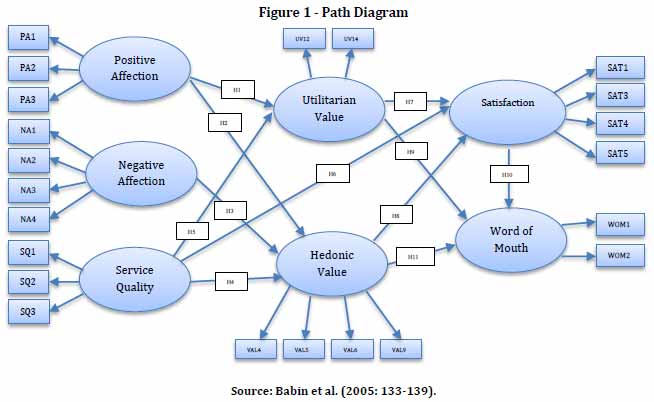
<body><![CDATA[<p>The city     of Angra dos Reis, an internationally known tourist destination, gained     prominence after the construction of Highway BR101, which connects the coastal     cities of Rio de Janeiro and Santos, in the 1970s (Luchiari, 1999). In     addition, the demolition of Cândido Mendes Prison on Ilha Grande in 1994     accelerated the flow of tourists to this location (Mendonça, 2008). For this     author, the growth in tourism also gained strength due to the mention of Ilha     Grande in <i>O Globo</i> newspaper in 2007     as the &quot;second-leading wonder of the state of Rio de Janeiro.&quot;</p>     <p>&nbsp;</p></font> <font face="Verdana" size="3">    <p><b>3.   Research   Method</b></p></font> <font face="Verdana" size="2">    <p>We     gathered data relevant to the determination of the following latent variables     or dimensions: positive affection,     negative affection, service quality, hedonic value, utilitarian value,     satisfaction and intention to recommend. The     data on these variables were collected through a structured questionnaire     consisting of 22 questions. The original model (Babin et al., 2005) used     several scales, such as Likert and semantic differential. In this study, we     adapted the model, only using a five-point Likert scale. This adaptation aimed     to facilitate understanding of the respondents, given the great diversity and     intellectual differences among tourists. Furthermore, to obtain a better fit of     the model to the problem studied, we reduced the number of indicators from 27     to 22.</p>       <p>The survey     instrument was presented in Portuguese, English and Spanish. The     questionnaires were given to a sample of foreign tourists at the time of their     return trips from Ilha Grande, which is generally by boat. This sampling     technique, besides being simpler than going to the island to seek out     respondents, also provided a more representative sample because it did not     discriminate among any particular hotel or tourist resort on the island,     although the sample was still not random. For the treatment of data we mainly     used structural equation modeling (SEM), that were analyzed by the AMOS® 16.0     program. In the model adopted (<a href="/img/revistas/tms/v10n1/10n1a15f1.jpg">Figure 1</a>), we followed the recommendation of     Babin et al. (2005) to determine the path diagram, with some adaptation. </p>     
<p>According     to estimates of the Angra dos Reis Tourism Foundation, about 330,000 tourists     visited Ilha Grande in 2007 (TURISANGRA, 2007). According to Hair, Anderson, Tathan &amp; Black (2009), the proper use of structural equation modeling     requires a minimum sample of 100 valid questionnaires, and the ideal value is     200 valid questionnaires. Our sample had 203 valid questionnaires (95% of the total of 213 applied).</p>      <p><b>4. Hypothesis     Specification </b></p>     <p>On the     subject of consumer attitudes, Blackwell, Miniard and Engel (2005) characterize     the cognitive components (related beliefs) and affective (associated feelings)     as determinants of such attitudes. Dhar and Wertenbroch (2000) show that goods     or brands with hedonic characteristics are better suited to premium pricing     strategies, although utilitarian elements, such as medicines, can also display     these characteristics, since they have some emotional attachment (Huerta &amp;     Urdan, 2006). Babin and Attaway (2000) found that positive affection leads to     an increase in hedonic and utilitarian values. Babin and Darden (1996) asserted     that negative affection mainly influences hedonic value and found no     significant changes in utilitarian value. Lee, Lee &amp; Choi (2011) examined     the role of emotions on utilitarian value.They showed that even consumers with     a high degree of negative feelings maintained the same level of spending as     buyers less susceptible to negative moods. Based on the assumptions, we formulated the following hypotheses: </p>    <p><i>H1:     Positive affection positively influences utilitarian value. </i></p>    <p><i>H2:     Positive affection positively influences hedonic value. </i></p>    ]]></body>
<body><![CDATA[<p><i>H3:     Negative affection negatively influences hedonic value. </i></p>       <p>Oliver     (1999) and Parasuraman, Zeithaml and Berry (1988) argue that perceived quality     of services is an antecedent to satisfaction. Corroborating this assertion,     Lucian and Moura (2008) show the effect of service quality in the context of a     soccer game, related to consumer satisfaction, validating the hypotheses of     those authors. Hepp (2008), besides corroborating these findings, created a     model that shows a strong influence of the perceived quality variable on the     perceived value variable. Babin, Darden and Griffin (1994) proposed a     two-dimensional scale, called Personal Shopping Value (PSV), to reflect the     implications of perceived quality in hedonic and utilitarian values, showing a     relationship between the constructs. In the field of tourism, it highlighted     the work of Lee, Jeon &amp; Kim (2011), which also suggests that the quality of     tourism services is an antecedent of tourist satisfaction. Based on this     theoretical framework, we formulated the following hypotheses:</p>     <p><i>H4: Service quality positively influences hedonic value.</i></p>       <p><i>H5: Service quality positively influences utilitarian value.</i></p>       <p><i>H6: Service quality positively influences tourist satisfaction.</i></p>       <p>Babin,     Darden and Griffin (1994) developed a scale to measure two types of results of     human behavior. The first is related to utility and conscious search for a specific     purpose, while the second is related to spontaneous responses, in other words,     hedonic or symbolic aspects. By this scale, these authors established a way to     evaluate the hedonic and utilitarian benefits related to customer satisfaction     at a shopping mall. The relation among hedonic value and satisfaction also was     employed by Grappi and Montanari (2011) to analyze the role of social identification in Italian tourism. We thus formulated the following hypotheses:</p>    <p><i> H7: Utilitarian value positively influences     tourist satisfaction.</i></p>    <p><i> H8: Hedonic value positively influences     tourist satisfaction.</i></p>       <p>Several     authors (Szymanski &amp; Henard, 2001; Lloyd, Yip &amp; Luk, 2013; Kim, Sun     &amp; Kim, 2013),argue that WOM recommendation is closely related to the need     for social acceptance of consumers, linked to the need to communicate their     consumption patterns, whether utilitarian or hedonic. Babin et al. (2005)     proposed that hedonic and utilitarian values function as mediators of     satisfaction and intentions to communicate by WOM, being directly influenced by affective states. Thus, we formulated the following hypotheses: </p>    <p><i>H9:     Utilitarian value positively influences intention to recommend. </i></p>    ]]></body>
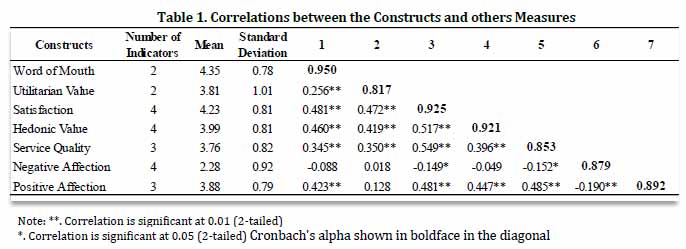
<body><![CDATA[<p><i>H11:     Hedonic value positively influences intention to recommend. </i></p>       <p>Blackwell,     Miniard and Engel (2005) argue that satisfaction or dissatisfaction is     characterized as a condition precedent to communication by WOM. Matos (2011)     validated the positive and significant effect of satisfaction on WOM. Besides     these authors, several others have also proposed the construct validity of     satisfaction as a previous construct of recommendation (e.g. Hennig-Thurau,     Gwinner &amp; Gremler, 2002; Lee, Jeon &amp; Kim, 2011; Nursair, Parsa &amp;     Cobanoglu, 2011). Thus, to evaluate the validity of the relationship between     tourist satisfaction and intention to recommend based on proposals in the above theoretical framework, we formulated the following final hypothesis:</p>    <p><i>H10:  Tourist satisfaction positively influences     intention to recommend.</i></p>     <p>&nbsp;</p></font>  <font face="Verdana" size="3">     <p><b>5.   Analysis     of Results </b></p></font>   <font face="Verdana" size="2">    <p>The sample, composed of 203     respondents, was delineate according to information on gender, age, education     level, and information about the number of nights spent at the tourist     destination, whether it was the first visit and how the tourist learned of the     destination. We only applied the questionnaire to foreign tourists over 18     years old who and had remained for more than a night on Ilha Grande. The     majority of the responding foreign tourists chose not to inform their     nationality (33%), followed by British tourists (20%), Americans (10%) and     tourists from other countries. Regarding missing data, we found during the     tabulation the existence of 10 incomplete questionnaires or questionnaires with     multiple answers on questions that permit only one answer, out of a total of     213 questionnaires. We chose the full-case approach (Hair et al., 2009) and we     excluded the 10 incomplete questionnaires, so that the final number was 203.     The internal consistency of the questionnaire was assessed by measuring the     Cronbach’s alpha. We found a coefficient of 0.903 for the 22 variables.     According to Hair et al. (2009), this measure ensures the validation of the     construct and allows assuming that future research would give similar results.     The correlations between constructs as well as information about each of them are shown in <a href="/img/revistas/tms/v10n1/10n1a15t1.jpg">Table 1</a>.</p>       
<p><b>5.1. Structural Equation Modeling</b></p>       <p>The structural equation     modeling (SEM) technique is an extension of several other multivariate     techniques, such as exploratory factor analysis and multiple regression (Hair     et al. 2009; Garson, 2002). For multivariate analysis, specifically one that     uses structural equation modeling. We did not find any outliers among the     responses. Data normality was assessed by skewness, which must be less than 3,     and kurtosis, which must be less than 8. It was found that all results were     within established limits. We analyzed linearity through Pearson’s linear     correlation matrix and found that the distribution has linear. Regarding     homoscedasticity, according to the Levene test, of the 22 variables in the     model, 10 reflected a slight degree of heteroscedasticity, an undesired by but     acceptable situation. However, four variables showed homoscedasticity at a     significance level of p = 0.000, three showed homoscedasticity at p = 0.005;     one showed homoscedasticity at p = 0.01 and one at p = 0.05.</p>       <p>In evaluating the fit of a     model developed by the SEM technique using software, the researcher is faced     with a series of coefficients. Garson (2008) warns that the researcher must not     engage in a hunt for coefficients, and that reporting of all indexes is     unnecessary. Kline (2011) recommends the use of at least four tests     (Chi-square, GFI, NFI and CFI). For this paper, we chose Chi-square (Cmin);     degrees of freedom (DF); goodness-of-fit index (GFI); normed fit index (NFI); Tucker-Lewis index (TLI);     comparative fit index (CFI); and root mean square error of approximation     (RMSEA).</p>       <p>The model was estimated by     maximum likelihood estimation (MLE), which according to Codes (2005) is the     most used method for evaluation in SEM. It involves calculating all parameters     of the model at once. The method stands out by assuming model parameters with     population values, not just sample ones. The final model can be classified as     recursive and reflexive and was composed of 55 variables. Of these variables,     22 were observed and 33 latent (also considering the variables related to the     errors). We found that of all the variables studied, 29 were classified as     exogenous and 26 as endogenous. Moreover, the model showed a Chi-square value     of 269.287, with 195 degrees of freedom.</p>       ]]></body>
<body><![CDATA[<p>Structural equation     modeling has only one statistic test of significance, the Chi-square test that     compares obtained Chi-square value with tabled values for given degrees of     freedom. Because the Chi-square statistics tends to be substantial when the     model not hold and when the sample size is large, researchers developed fit     indices. One of the fit statistics to address this problem was the     Chi-squared/degrees of freedom ratio, which appears as CMIN/DF.</p>     <p>To evaluate the model and     test its adherence, or fit (goodness of fit), we used the ratio     Chi-square/degrees of freedom as one of the indexes. This index should be below     5. In     the model estimated, this value was 1.381, indicating good fit. The GFI was     above 0.89, indicating a medium fit. The TLI, NFI and CFI indexes had     reasonable magnitudes, all being above 0.90, as recommended in the literature.     The RMSEA was below 0.05, also demonstrating acceptable fit. The values found are summarized in <a href="/img/revistas/tms/v10n1/10n1a15t2.jpg">Table 2</a>.</p>         
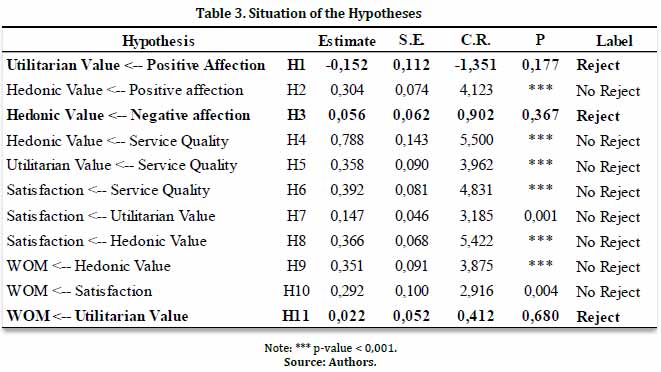
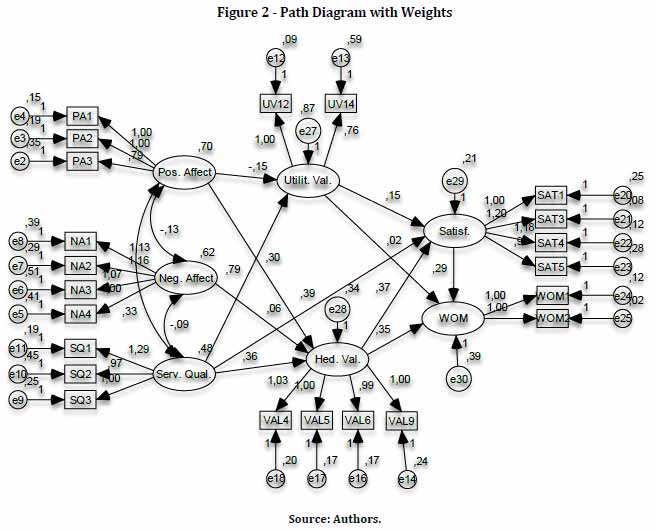
<p>As noted in <a href="/img/revistas/tms/v10n1/10n1a15t3.jpg">Table 3</a>, out of     11 proposals by the initial assumptions of the model, three (utilitarian value     &lt;--- positive affection; hedonic value &lt;--- negative affection and intent     to recommend &lt;--- utilitarian value) fall below the minimum critical ratio     value (|1.96|), indicated in the column with the symbol CR. Moreover, the three     relationships were not statistically significant, leading to rejection of the     corresponding hypotheses. The relationship between the constructs satisfaction     &lt;--- utilitarian value and intent to recommend &lt;--- satisfaction, were not below the minimum critical ratio value,     enabling their consideration at a significance level of 0.005, which is fairly representative. <a href="/img/revistas/tms/v10n1/10n1a15f2.jpg">Figure 2</a> shows the path diagram with the respective weights.</p>      
<p>&nbsp;</p></font> <font face="Verdana" size="3">    <p><b>6.   Conclusions</b></p></font> <font face="Verdana" size="2">    <p>The main objective of this     study was to determine whether the antecedent factors (positive and negative affection,     quality of service, utilitarian and hedonic values and consumer satisfaction)     influence the intention to recommend Ilha Grande (Angra dos Reis, RJ), as a     Brazilian tourist destination for international tourists. We found that three     out of the eleven hypotheses were rejected. The rejection of the first of these     hypotheses (H1 - positive affection positively influences utilitarian value)     refutes the argument of Babin et al. (2005), that there should be a positive     relationship between the variables positive affection and utilitarian value. We     believe that the tourists who go to a destination such as the Ilha Grande     already have high expectations of its natural beauty, beyond the symbolic (or     hedonic) elements present. </p>       <p>Activities such as a dinner     by the seaside, a walk through the rainforest or a boat trip along the coast     reinforce the symbolism of the journey and the symbolic sense of pleasure felt     by tourists, bringing good memories and experiences of the location. However,     when faced with a utilitarian need, such as buying medicine, the tourist sees     the situation much more like a problem – an interruption that subtracts from     leisure time – than a positive experience. Thus, even a visitor who is in a     positive emotional and affective state does not perceive the utility of mundane     purchases as a positive experience. </p>       <p>The rejection of the second     of these hypothesis (H3 - negative affection positively affects hedonic value)     contradicts the belief that tourists are affected by emotional states and     suffer negative emotional influence on their perceptions of hedonic (or     symbolic) value related to their stay on Ilha Grande. The rejection of this     hypothesis allowed an interesting conclusion: even with altered moods and/or     emotions, tourists still attribute a symbolic value to the trip. In other     words, although a person shows negative emotions – such as irritation,     annoyance or boredom – we believe he or she still intrinsically values the     tourism experience out of a symbolic vision. We believe that hedonic value is     maintained because of trips are linked to dreams and desires, so are carefully     planned. This can translate into unique experiences, leading tourists, even     when in a bad mood, to keep believing in the symbolism of the experience. With     the rejection of this hypothesis, the negative affect factor ceased to be     important in this work, since it is assumed that this factor acted only as an     antecedent of hedonic value, and that was not linked with any other latent     variable. </p>       <p>The rejection of the third     of these hypotheses (H9 - utilitarian value positively influences intention to     recommend) runs counter to the idea cited by Babin et al. (2005) that a good     assessment of the utilitarian value positively influences the intention to     recommend a tourist destination. However, since this survey was limited to a     sample of foreign tourists, we believe they may have planned their trips with     low expectations about the structure of essential services offered in the     place. This belief is based on Brazil's poor reputation abroad with respect to     development and civility. In addition, tourists who come to Brazil, and     specifically to Ilha Grande, are generally looking enjoy its natural     attractions, not caring if they will have to sleep in camps or eat in a tent on     the beach. Thus, one cannot attribute importance to utilitarian value as a     prominent element for recommendation of destination. In other words, the     findings here suggest that international tourists visiting Ilha Grande in     general care little for matters linked to utilitarian value. This assumption is     based on the rejection of two hypotheses related to this construct and the     belief that tourists specifically seek to enjoy the natural attractions     (attached directly to the point hedonic value), caring little about whether this     will be accompanied by the discomfort of sleeping in a tent or having to eat at     a lunch stand (utilitarian aspects). </p>       <p>Although the utilitarian     value construct functioned as a mediating variable between the constructs of     service quality and satisfaction (H5 and H7), we believe, based on the     literature, that this construct makes little (if any) difference in this     situation, considering that the perception of quality is a natural antecedent     of satisfaction. Thus, we feel that in this context, utilitarian value has     little relevance to international tourists and is a dispensable construct in     this model. </p>       ]]></body>
<body><![CDATA[<p>According to the results,     perceived quality of services is as an important variable, since it is an     antecedent of two other latent variables of the model: hedonic value (H4) and     satisfaction (H6), as well as utilitarian value, already mentioned. The     dimension of the hedonic value has two antecedents: positive affection,     legitimized by the non-rejection of H2 (positive affection positively     influences hedonic value) and quality of service, validated by the     non-rejection of H4 (quality of service positively influences hedonic value).     While on the one hand, negative emotional states do not influence the formation     of hedonic value (H3), on the other positive affective states act as     significant antecedents to the composition of this value. We assume, through     the validation of H2, that enthusiasm, happiness, satisfaction and good     disposition improve tourists’ symbolic perception of the location. Although     other positive affective states were not tested, it can be stated that for     tourists, generally in a good mood to begin with, tend to have a better     perception about hedonism and symbolism regarding the destination. </p>       <p>With respect to the central     aim of this study, we found that only the latent variables satisfaction and     hedonic value are directly related to the intent to recommend Ilha Grande by     tourists (H10 and H11). Our results for H10 (tourist satisfaction positively     influences intention to recommend) have also been found in several other     studies. </p>       <p>Among the various important     points of this work is the demonstration of the irrelevance of negative     affection in a model of intention to recommend. According to the survey     results, this affective state does not interfere in the recommendation process,     as opposed to positive affective state, which directly impacts the formation of     hedonic value. This study therefore strengthens the position that positive and     negative affective states are different constructs and are not part of a continuum,     as also suggested by Mehrabian and Russell (1974) and Mowen and Minor (2003).</p>       <p>For the tourism industry,     this study provided important information, not only to managers and owners of     lodging facilities, but also for the whole chain of services related to     tourism, such as food, entertainment, and transportation companies.     Furthermore, it provides important information for decision making in     government. We stress the importance of striving for excellence in service,     especially for foreign tourists, who as a rule are used to a higher standard of     care compared to Brazilians. </p>       <p>In relation to government,     the paper shows that to international tourists in general, it matters little     whether they will stay in a luxurious resort or go camping on the beach. Tourists     that visit destinations such as Ilha Grande are generally interested in seeing     the natural beauty. Thus, the government should heighten efforts for     environmental preservation. For this type of target market, is more important     to stay in a small hotel without so many amenities but is environmentally     friendly than in a grandiose resort that ignores environmental preservation.</p>       <p>Although this assessment     enhances our knowledge on the experiential concept, it has some limitations     which have to be taken into account when interpreting the results. The findings     are limited to the foreign travelers experience on visiting Ilha Grande during     a specific period of time. While respondents were representative in terms of     sample size and demographic profile, findings cannot be generalized to the     wider tourist population. Further research may assess the validity of the     experience construct in other service contexts.</p>       <p>One important restriction     of this study is due to not having taken into account the effects of the     foreign traveler involvement on the evaluation of overall experiences,     satisfaction and intention to recommend. The involvement during consumption     directly impact on the quality of the perceived experience and plays a     significant role in explaining consumer behavior. Further research should     enhance this study by replicating the model under different levels of     involvement.</p>     <p>&nbsp;</p></font> <font face="Verdana" size="3">    <p><b>References</b></p></font> <font face="Verdana" size="2">    <!-- ref --><p>Allen, M. W. (2000). The attribute-mediation and     Product Meaning approaches to the influences of human values on consumer choices. In F. Columbus (Ed.). <i>Advances in Psychology Research</i>, (1), 31-76.    &nbsp;&nbsp;&nbsp;&nbsp;&nbsp;&nbsp;&nbsp;&nbsp;[&#160;<a href="javascript:void(0);" onclick="javascript: window.open('/scielo.php?script=sci_nlinks&ref=000102&pid=S2182-8458201400010001500001&lng=','','width=640,height=500,resizable=yes,scrollbars=1,menubar=yes,');">Links</a>&#160;]<!-- end-ref --> </p>       <!-- ref --><p>Babin B. J. &amp; Attaway J. S. (2000). Atmospheric     Affect as a Tool for Creating Value and Gaining Share of Customer. <i>Journal of Business Research, 49</i>(2), 91-100.    &nbsp;&nbsp;&nbsp;&nbsp;&nbsp;&nbsp;&nbsp;&nbsp;[&#160;<a href="javascript:void(0);" onclick="javascript: window.open('/scielo.php?script=sci_nlinks&ref=000104&pid=S2182-8458201400010001500002&lng=','','width=640,height=500,resizable=yes,scrollbars=1,menubar=yes,');">Links</a>&#160;]<!-- end-ref --></p>       <!-- ref --><p>Babin B. J. Darden, W. R.,     &amp; Griffin, M. (1994). Work and/or fun: Measuring hedonic and utilitarian     shopping. <i>Journal of Consumer Research</i>, <i>20</i>(4), 644-656.    &nbsp;&nbsp;&nbsp;&nbsp;&nbsp;&nbsp;&nbsp;&nbsp;[&#160;<a href="javascript:void(0);" onclick="javascript: window.open('/scielo.php?script=sci_nlinks&ref=000106&pid=S2182-8458201400010001500003&lng=','','width=640,height=500,resizable=yes,scrollbars=1,menubar=yes,');">Links</a>&#160;]<!-- end-ref --></p>     <!-- ref --><p>Babin B. J. &amp; Darden, W. R. (1996). Good and     bad shopping vibes: spending and patronage satisfaction. <i>Journal of Business Research</i>, <i>35</i>(3), 201-206.    &nbsp;&nbsp;&nbsp;&nbsp;&nbsp;&nbsp;&nbsp;&nbsp;[&#160;<a href="javascript:void(0);" onclick="javascript: window.open('/scielo.php?script=sci_nlinks&ref=000108&pid=S2182-8458201400010001500004&lng=','','width=640,height=500,resizable=yes,scrollbars=1,menubar=yes,');">Links</a>&#160;]<!-- end-ref --></p>       <!-- ref --><p>Babin B. J., Lee, Y. K., Kim, E. J &amp; Griffin,     M. (2005). Modeling consumer satisfaction and word-of-mouth: Restaurant     Patronage in Korea. <i>The Journal of Services Marketing, 19</i>(3), 133-139.    &nbsp;&nbsp;&nbsp;&nbsp;&nbsp;&nbsp;&nbsp;&nbsp;[&#160;<a href="javascript:void(0);" onclick="javascript: window.open('/scielo.php?script=sci_nlinks&ref=000110&pid=S2182-8458201400010001500005&lng=','','width=640,height=500,resizable=yes,scrollbars=1,menubar=yes,');">Links</a>&#160;]<!-- end-ref --></p>       <!-- ref --><p>Blackwell, R. D., Miniard,     P. W. &amp; Engel, J. F. (2005). <i>Comportamento do consumidor</i>. 9<sup>th </sup>ed. São Paulo: Pioneira Thomson Learning.    &nbsp;&nbsp;&nbsp;&nbsp;&nbsp;&nbsp;&nbsp;&nbsp;[&#160;<a href="javascript:void(0);" onclick="javascript: window.open('/scielo.php?script=sci_nlinks&ref=000112&pid=S2182-8458201400010001500006&lng=','','width=640,height=500,resizable=yes,scrollbars=1,menubar=yes,');">Links</a>&#160;]<!-- end-ref --> </p>     <!-- ref --><p>Cruz, R. C. A. (2003). <i>Introdução à geografia do turismo. </i>2<sup>nd</sup> ed. São Paulo: Roca.    &nbsp;&nbsp;&nbsp;&nbsp;&nbsp;&nbsp;&nbsp;&nbsp;[&#160;<a href="javascript:void(0);" onclick="javascript: window.open('/scielo.php?script=sci_nlinks&ref=000114&pid=S2182-8458201400010001500007&lng=','','width=640,height=500,resizable=yes,scrollbars=1,menubar=yes,');">Links</a>&#160;]<!-- end-ref --></p>       <!-- ref --><p>Dhar, R. &amp; Wetenbroch, K. (2000). Consumer     choice between hedonic and utilitarian goods. <i>Journal of Marketing Research</i>. <i>37</i>(1), 60-71.    &nbsp;&nbsp;&nbsp;&nbsp;&nbsp;&nbsp;&nbsp;&nbsp;[&#160;<a href="javascript:void(0);" onclick="javascript: window.open('/scielo.php?script=sci_nlinks&ref=000116&pid=S2182-8458201400010001500008&lng=','','width=640,height=500,resizable=yes,scrollbars=1,menubar=yes,');">Links</a>&#160;]<!-- end-ref --></p>       <!-- ref --><p>Empresa Brasileira de     Turismo (Embratur). (2006). <i>Turismo no     Brasil: 2007-2010</i>. Brasília:     Embratur.    &nbsp;&nbsp;&nbsp;&nbsp;&nbsp;&nbsp;&nbsp;&nbsp;[&#160;<a href="javascript:void(0);" onclick="javascript: window.open('/scielo.php?script=sci_nlinks&ref=000118&pid=S2182-8458201400010001500009&lng=','','width=640,height=500,resizable=yes,scrollbars=1,menubar=yes,');">Links</a>&#160;]<!-- end-ref --></p>     <!-- ref --><p>Empresa Brasileira de Turismo (Embratur).     (2013).   <i>Estudo da demanda turística internacional 2006-2012.</i> Brasília: Embratur. Retrieved December, 14,     2013, from <a href="http://www.dadosefatos.turismo.gov.br/export/sites/default/dadosefatos/demanda_turistica/internacional/download_internacional/Demanda_Turxstica_Internacional_-_Fichas_Sinteses_-_2006-2012_reparado_nota_FOZ.pdf" target="_blank">http://www.dadosefatos.turismo.gov.br/export/sites/default/dadosefatos/demanda_turistica/internacional/download_internacional/Demanda_Turxstica_Internacional_-_Fichas_Sinteses_-_2006-2012_reparado_nota_FOZ.pdf</a>.    &nbsp;&nbsp;&nbsp;&nbsp;&nbsp;&nbsp;&nbsp;&nbsp;[&#160;<a href="javascript:void(0);" onclick="javascript: window.open('/scielo.php?script=sci_nlinks&ref=000120&pid=S2182-8458201400010001500010&lng=','','width=640,height=500,resizable=yes,scrollbars=1,menubar=yes,');">Links</a>&#160;]<!-- end-ref --></p>       <!-- ref --><p>Fitzsimmons, J. A. &amp;     Fitzsimmons, M. J. (2011). <i>Administração de Serviços:</i> <i>operações,     estratégia e tecnologia de informação</i>. 6<sup>th</sup> ed. Porto Alegre: Bookman.    &nbsp;&nbsp;&nbsp;&nbsp;&nbsp;&nbsp;&nbsp;&nbsp;[&#160;<a href="javascript:void(0);" onclick="javascript: window.open('/scielo.php?script=sci_nlinks&ref=000122&pid=S2182-8458201400010001500011&lng=','','width=640,height=500,resizable=yes,scrollbars=1,menubar=yes,');">Links</a>&#160;]<!-- end-ref --></p>     <!-- ref --><p>Garson, D. (2002). <i>Guide to Writing Empirical Papers, Theses and Dissertations.</i> New York: Marcel Dekker.    &nbsp;&nbsp;&nbsp;&nbsp;&nbsp;&nbsp;&nbsp;&nbsp;[&#160;<a href="javascript:void(0);" onclick="javascript: window.open('/scielo.php?script=sci_nlinks&ref=000124&pid=S2182-8458201400010001500012&lng=','','width=640,height=500,resizable=yes,scrollbars=1,menubar=yes,');">Links</a>&#160;]<!-- end-ref --></p>       <!-- ref --><p>Garson, D. (2002). <i>Structural Equation Modelling</i>. Retrieved December 2, 2009, from <a href="http://faculty.chass.ncsu.edu/garson/PA765/structur.htm#biblio" target="_blank">http://faculty.chass.ncsu.edu/garson/PA765/structur.htm#biblio</a>&nbsp;&nbsp;&nbsp;&nbsp;&nbsp;&nbsp;&nbsp;&nbsp;[&#160;<a href="javascript:void(0);" onclick="javascript: window.open('/scielo.php?script=sci_nlinks&ref=000126&pid=S2182-8458201400010001500013&lng=','','width=640,height=500,resizable=yes,scrollbars=1,menubar=yes,');">Links</a>&#160;]<!-- end-ref --><!-- ref --><p>Gouvêa, M. A. &amp; Masano, A.     C. R. (2008). Serviços Bancários no     Segmento de Alta Renda na Cidade de São Paulo.    &nbsp;&nbsp;&nbsp;&nbsp;&nbsp;&nbsp;&nbsp;&nbsp;[&#160;<a href="javascript:void(0);" onclick="javascript: window.open('/scielo.php?script=sci_nlinks&ref=000127&pid=S2182-8458201400010001500014&lng=','','width=640,height=500,resizable=yes,scrollbars=1,menubar=yes,');">Links</a>&#160;]<!-- end-ref --> XXXII Encontro Nacional da ANPAD     (EnANPAD), 32. <i>Anais...</i> Rio de     Janeiro/RJ.</p>       <!-- ref --><p>Grappi, S., &amp;     Montanari, F. (2011). The role of social identification and hedonism in     affecting tourist re-patronizing behaviours: The case of an Italian festival. <i>Tourism Management, 32</i>(5),1128-1140.    &nbsp;&nbsp;&nbsp;&nbsp;&nbsp;&nbsp;&nbsp;&nbsp;[&#160;<a href="javascript:void(0);" onclick="javascript: window.open('/scielo.php?script=sci_nlinks&ref=000129&pid=S2182-8458201400010001500015&lng=','','width=640,height=500,resizable=yes,scrollbars=1,menubar=yes,');">Links</a>&#160;]<!-- end-ref --></p>       <!-- ref --><p>Grönroos, C. (2009). <i>Marketing:</i> <i>gerenciamento e serviços.</i> 3<sup>rd</sup> ed. Rio de Janeiro:     Elsevier - Campus.    &nbsp;&nbsp;&nbsp;&nbsp;&nbsp;&nbsp;&nbsp;&nbsp;[&#160;<a href="javascript:void(0);" onclick="javascript: window.open('/scielo.php?script=sci_nlinks&ref=000131&pid=S2182-8458201400010001500016&lng=','','width=640,height=500,resizable=yes,scrollbars=1,menubar=yes,');">Links</a>&#160;]<!-- end-ref --></p>     ]]></body>
<body><![CDATA[<!-- ref --><p>Hair, Jr. J. F., Anderson, R. E., Tathan, R. L.     &amp; Black, W. C. (2009). <i>Análise multivariada de dados</i>. 6<sup>th</sup> ed. Porto Alegre: Bookman.    &nbsp;&nbsp;&nbsp;&nbsp;&nbsp;&nbsp;&nbsp;&nbsp;[&#160;<a href="javascript:void(0);" onclick="javascript: window.open('/scielo.php?script=sci_nlinks&ref=000133&pid=S2182-8458201400010001500017&lng=','','width=640,height=500,resizable=yes,scrollbars=1,menubar=yes,');">Links</a>&#160;]<!-- end-ref --></p>       <!-- ref --><p>Harrison-Walker, L. J.     (2001). The measurement of word-of-mouth communication and an investigation of service quality and customer commitment as potential antecedents. <i>Journal of Service Research</i>, <i>4</i>(1), 60-75.    &nbsp;&nbsp;&nbsp;&nbsp;&nbsp;&nbsp;&nbsp;&nbsp;[&#160;<a href="javascript:void(0);" onclick="javascript: window.open('/scielo.php?script=sci_nlinks&ref=000135&pid=S2182-8458201400010001500018&lng=','','width=640,height=500,resizable=yes,scrollbars=1,menubar=yes,');">Links</a>&#160;]<!-- end-ref --></p>       <!-- ref --><p>Hawkins, D., Mothersbaugh,     D. &amp; Best, R. (2007). <i>Comportamento do consumidor:</i> construindo a estratégia de marketing. 10<sup>th</sup> Rio de Janeiro: Campus.    &nbsp;&nbsp;&nbsp;&nbsp;&nbsp;&nbsp;&nbsp;&nbsp;[&#160;<a href="javascript:void(0);" onclick="javascript: window.open('/scielo.php?script=sci_nlinks&ref=000137&pid=S2182-8458201400010001500019&lng=','','width=640,height=500,resizable=yes,scrollbars=1,menubar=yes,');">Links</a>&#160;]<!-- end-ref --></p>       <!-- ref --><p>Heitmann, M., Lehmann, D. R. &amp; Herrmann, A. (2007). Choice goal attainment and decision and     consumption satisfaction. <i>Journal of     Marketing Research</i>, <i>44</i>(2),     234-250.    &nbsp;&nbsp;&nbsp;&nbsp;&nbsp;&nbsp;&nbsp;&nbsp;[&#160;<a href="javascript:void(0);" onclick="javascript: window.open('/scielo.php?script=sci_nlinks&ref=000139&pid=S2182-8458201400010001500020&lng=','','width=640,height=500,resizable=yes,scrollbars=1,menubar=yes,');">Links</a>&#160;]<!-- end-ref -->&nbsp;</p>     <!-- ref --><p>Hennig-Thurau, T., Gwinner, K. P. &amp; Gremler, D.     (2002). Understanding relationship marketing outcomes: an integration of     relational benefits and relationship quality. <i>Journal of Service Research, </i>Vol. <i>4</i>, 230-247.    &nbsp;&nbsp;&nbsp;&nbsp;&nbsp;&nbsp;&nbsp;&nbsp;[&#160;<a href="javascript:void(0);" onclick="javascript: window.open('/scielo.php?script=sci_nlinks&ref=000141&pid=S2182-8458201400010001500021&lng=','','width=640,height=500,resizable=yes,scrollbars=1,menubar=yes,');">Links</a>&#160;]<!-- end-ref --></p>       ]]></body>
<body><![CDATA[<!-- ref --><p>Hepp, C. P. T. (2008). Satisfação,     Lealdade e Envolvimento do Consumidor: Um Estudo no Varejo de Vestuário.    &nbsp;&nbsp;&nbsp;&nbsp;&nbsp;&nbsp;&nbsp;&nbsp;[&#160;<a href="javascript:void(0);" onclick="javascript: window.open('/scielo.php?script=sci_nlinks&ref=000143&pid=S2182-8458201400010001500022&lng=','','width=640,height=500,resizable=yes,scrollbars=1,menubar=yes,');">Links</a>&#160;]<!-- end-ref --> XXXII     Encontro Nacional da ANPAD (EnANPAD), 32. <i>Anais...</i> Rio de Janeiro/RJ.</p>     <!-- ref --><p>Hoffman, K. D., Bateson, J. E. G., Ikeda, A. A.     &amp; Campomar, M. C. (2011). <i>Princípios     de Marketing de serviços: Conceitos, Estratégias e Casos.</i> 3<sup>th</sup> ed. São Paulo: Cengage Learning.    &nbsp;&nbsp;&nbsp;&nbsp;&nbsp;&nbsp;&nbsp;&nbsp;[&#160;<a href="javascript:void(0);" onclick="javascript: window.open('/scielo.php?script=sci_nlinks&ref=000145&pid=S2182-8458201400010001500023&lng=','','width=640,height=500,resizable=yes,scrollbars=1,menubar=yes,');">Links</a>&#160;]<!-- end-ref --></p>       <!-- ref --><p>Huertas, M. K. Z. &amp; Urdan, A. T. (2006). Atitude do consumidor sobre medicamentos:     cognitiva ou afetiva?. <i>Faces Revista de     Administração</i>. Belo Horizonte, <i>5</i>(3), 11-26.    &nbsp;&nbsp;&nbsp;&nbsp;&nbsp;&nbsp;&nbsp;&nbsp;[&#160;<a href="javascript:void(0);" onclick="javascript: window.open('/scielo.php?script=sci_nlinks&ref=000147&pid=S2182-8458201400010001500024&lng=','','width=640,height=500,resizable=yes,scrollbars=1,menubar=yes,');">Links</a>&#160;]<!-- end-ref --> </p>       <!-- ref --><p>Instituto Brasileiro de Geografia Estatística (IBGE) (2004). <i>Perfil dos municípios brasileiros</i>.  Retrieved January 1, 2008, from <a href="http://www.ibge.gov.br/cidadesat/default.php" target="_blank">http://www.ibge.gov.br/cidadesat/default.php</a><u>.    &nbsp;&nbsp;&nbsp;&nbsp;&nbsp;&nbsp;&nbsp;&nbsp;[&#160;<a href="javascript:void(0);" onclick="javascript: window.open('/scielo.php?script=sci_nlinks&ref=000149&pid=S2182-8458201400010001500025&lng=','','width=640,height=500,resizable=yes,scrollbars=1,menubar=yes,');">Links</a>&#160;]<!-- end-ref --></u></p>       <!-- ref --><p>Kim, S-B, Sun, K-A, &amp; Kim, D-Y. (2013). The Influence of Consumer     Value-Based Factors on Attitude-Behavioral Intention in Social Commerce: the     Differences Between High and Low Technology Experience Groups. <i>Journal of Travel &amp; Tourism Marketing, 30</i>(1-2), 108-125.    &nbsp;&nbsp;&nbsp;&nbsp;&nbsp;&nbsp;&nbsp;&nbsp;[&#160;<a href="javascript:void(0);" onclick="javascript: window.open('/scielo.php?script=sci_nlinks&ref=000151&pid=S2182-8458201400010001500026&lng=','','width=640,height=500,resizable=yes,scrollbars=1,menubar=yes,');">Links</a>&#160;]<!-- end-ref --></p>       ]]></body>
<body><![CDATA[<!-- ref --><p>Kline, R. B. (2011). <i>Principles and Practice of     Structural Equation Modeling</i>. 3<sup>rd</sup> ed. New York: The Guilford Press.    &nbsp;&nbsp;&nbsp;&nbsp;&nbsp;&nbsp;&nbsp;&nbsp;[&#160;<a href="javascript:void(0);" onclick="javascript: window.open('/scielo.php?script=sci_nlinks&ref=000153&pid=S2182-8458201400010001500027&lng=','','width=640,height=500,resizable=yes,scrollbars=1,menubar=yes,');">Links</a>&#160;]<!-- end-ref --></p>       <!-- ref --><p>Kruel, M., Daronco, E. &amp; Dill, R. P. (2008). Mensuração da satisfação: um estudo     comparativo entre lógica nebulosa (fuzzy logic) e programação linear.    &nbsp;&nbsp;&nbsp;&nbsp;&nbsp;&nbsp;&nbsp;&nbsp;[&#160;<a href="javascript:void(0);" onclick="javascript: window.open('/scielo.php?script=sci_nlinks&ref=000155&pid=S2182-8458201400010001500028&lng=','','width=640,height=500,resizable=yes,scrollbars=1,menubar=yes,');">Links</a>&#160;]<!-- end-ref --> XXXII Encontro Nacional da ANPAD (EnANPAD), 32. <i>Anais...</i> Rio de Janeiro/RJ.</p>       <!-- ref --><p>Kurtz, D. L. &amp; Clow, K. E. (1998). <i>Services Marketing</i>. New York: McGraw Hill.    &nbsp;&nbsp;&nbsp;&nbsp;&nbsp;&nbsp;&nbsp;&nbsp;[&#160;<a href="javascript:void(0);" onclick="javascript: window.open('/scielo.php?script=sci_nlinks&ref=000157&pid=S2182-8458201400010001500029&lng=','','width=640,height=500,resizable=yes,scrollbars=1,menubar=yes,');">Links</a>&#160;]<!-- end-ref --></p>       <!-- ref --><p>Lam, D. &amp; So, A. (2013). Do happy tourists spread more word-to-mouth? The mediating role of life satisfaction. <i>Annals of Tourism Research</i>, <i>43</i>, 624-650.    &nbsp;&nbsp;&nbsp;&nbsp;&nbsp;&nbsp;&nbsp;&nbsp;[&#160;<a href="javascript:void(0);" onclick="javascript: window.open('/scielo.php?script=sci_nlinks&ref=000159&pid=S2182-8458201400010001500030&lng=','','width=640,height=500,resizable=yes,scrollbars=1,menubar=yes,');">Links</a>&#160;]<!-- end-ref --></p>       <!-- ref --><p>Lee, J-S, Lee, C-K, &amp; Choi, Y. (2011). Examining the Role of Emotional and Functional Values in Festival Evaluation. <i>Journal of Travel Research,</i> <i>50</i>(6), 685-696.    &nbsp;&nbsp;&nbsp;&nbsp;&nbsp;&nbsp;&nbsp;&nbsp;[&#160;<a href="javascript:void(0);" onclick="javascript: window.open('/scielo.php?script=sci_nlinks&ref=000161&pid=S2182-8458201400010001500031&lng=','','width=640,height=500,resizable=yes,scrollbars=1,menubar=yes,');">Links</a>&#160;]<!-- end-ref --></p>       ]]></body>
<body><![CDATA[<!-- ref --><p>Lee, S., Jeon, S., &amp; Kim, D. (2011). The impact     of tour quality and tourist satisfaction on tourist loyalty: The case of Chinese tourists in Korea. <i>Tourism Management, 32</i>(5),1115-1124.    &nbsp;&nbsp;&nbsp;&nbsp;&nbsp;&nbsp;&nbsp;&nbsp;[&#160;<a href="javascript:void(0);" onclick="javascript: window.open('/scielo.php?script=sci_nlinks&ref=000163&pid=S2182-8458201400010001500032&lng=','','width=640,height=500,resizable=yes,scrollbars=1,menubar=yes,');">Links</a>&#160;]<!-- end-ref --></p>       <!-- ref --><p>Lemos, L. de. (2000). <i>Turismo: que negócio é esse? Uma análise da     economia do turismo.</i> 2ªed. Campinas: Papirus.    &nbsp;&nbsp;&nbsp;&nbsp;&nbsp;&nbsp;&nbsp;&nbsp;[&#160;<a href="javascript:void(0);" onclick="javascript: window.open('/scielo.php?script=sci_nlinks&ref=000165&pid=S2182-8458201400010001500033&lng=','','width=640,height=500,resizable=yes,scrollbars=1,menubar=yes,');">Links</a>&#160;]<!-- end-ref --></p>       <!-- ref --><p>Lloyd, A.E., Yip, L.S.C.,     &amp; Luk, S.T.K. (2013). An examination of the differences in retail service evaluation between     domestic and tourist shoppers in Hong Kong. <i>Tourism Management</i>, <i>32</i>(3),     520–533.    &nbsp;&nbsp;&nbsp;&nbsp;&nbsp;&nbsp;&nbsp;&nbsp;[&#160;<a href="javascript:void(0);" onclick="javascript: window.open('/scielo.php?script=sci_nlinks&ref=000167&pid=S2182-8458201400010001500034&lng=','','width=640,height=500,resizable=yes,scrollbars=1,menubar=yes,');">Links</a>&#160;]<!-- end-ref --></p>       <!-- ref --><p>Luchiari, M. T. D. P.     (1999). Turismo, natureza e cultura caiçara: um novo colonialismo?. In: C.     Serrano. et al (org), <i>Viagem à natureza –     Turismo, cultura e ambiente</i>. 2nd ed. São Paulo: Papirus.    &nbsp;&nbsp;&nbsp;&nbsp;&nbsp;&nbsp;&nbsp;&nbsp;[&#160;<a href="javascript:void(0);" onclick="javascript: window.open('/scielo.php?script=sci_nlinks&ref=000169&pid=S2182-8458201400010001500035&lng=','','width=640,height=500,resizable=yes,scrollbars=1,menubar=yes,');">Links</a>&#160;]<!-- end-ref --></p>       <!-- ref --><p>Marchetti, R. &amp; Prado, P. H. M. (2001). Um <i>tour</i> pelas medidas de satisfação do consumidor. <i>Revista     de Administração de Empresas (RAE)</i>, <i>41</i>(4),     56-67.    &nbsp;&nbsp;&nbsp;&nbsp;&nbsp;&nbsp;&nbsp;&nbsp;[&#160;<a href="javascript:void(0);" onclick="javascript: window.open('/scielo.php?script=sci_nlinks&ref=000171&pid=S2182-8458201400010001500036&lng=','','width=640,height=500,resizable=yes,scrollbars=1,menubar=yes,');">Links</a>&#160;]<!-- end-ref --></p>     ]]></body>
<body><![CDATA[<!-- ref --><p>Martin, W.C.,     &amp; Lueg, J.E. (2013). Modeling Word-of-Mouth Usage<i>. Journal of Business Research</i>, <i>66</i>(7), 801-808.    &nbsp;&nbsp;&nbsp;&nbsp;&nbsp;&nbsp;&nbsp;&nbsp;[&#160;<a href="javascript:void(0);" onclick="javascript: window.open('/scielo.php?script=sci_nlinks&ref=000173&pid=S2182-8458201400010001500037&lng=','','width=640,height=500,resizable=yes,scrollbars=1,menubar=yes,');">Links</a>&#160;]<!-- end-ref --></p>       <!-- ref --><p>Matos, C. A. de. (20011). Uma Generalização Empírica sobre Comunicação Boca a Boca Usando Metanálise. <i>Revista de Administração Contemporânea (RAC)</i>, <i>15</i>(5), art.5, 877-896.    &nbsp;&nbsp;&nbsp;&nbsp;&nbsp;&nbsp;&nbsp;&nbsp;[&#160;<a href="javascript:void(0);" onclick="javascript: window.open('/scielo.php?script=sci_nlinks&ref=000175&pid=S2182-8458201400010001500038&lng=','','width=640,height=500,resizable=yes,scrollbars=1,menubar=yes,');">Links</a>&#160;]<!-- end-ref --></p>       <!-- ref --><p>Mckee, D., Simmers, C. S. &amp; Licata, J. (2006). Customer Self-Efficacy and Response to     Service.<b>&nbsp;</b><i>Journal of Service Research</i>, <i>8</i>(3), 207-220.    &nbsp;&nbsp;&nbsp;&nbsp;&nbsp;&nbsp;&nbsp;&nbsp;[&#160;<a href="javascript:void(0);" onclick="javascript: window.open('/scielo.php?script=sci_nlinks&ref=000177&pid=S2182-8458201400010001500039&lng=','','width=640,height=500,resizable=yes,scrollbars=1,menubar=yes,');">Links</a>&#160;]<!-- end-ref --></p>     <!-- ref --><p>Mehrabian, A. &amp; Russell, J. A. (1974).<i> An Approach to Environmental Psychology</i>. Cambridge: MIT Press.    &nbsp;&nbsp;&nbsp;&nbsp;&nbsp;&nbsp;&nbsp;&nbsp;[&#160;<a href="javascript:void(0);" onclick="javascript: window.open('/scielo.php?script=sci_nlinks&ref=000179&pid=S2182-8458201400010001500040&lng=','','width=640,height=500,resizable=yes,scrollbars=1,menubar=yes,');">Links</a>&#160;]<!-- end-ref --></p>       <!-- ref --><p>Mendonça, T. C. de M. (2008). O turismo que se tem e o turismo que se quer: discursos e     significados a propósito do turismo na Vila do Abraão – Ilha Grande (Angra dos     Reis, RJ) . In: V Seminário de Pesquisa em Turismo do Mercosul – (SEMINTUR),    &nbsp;&nbsp;&nbsp;&nbsp;&nbsp;&nbsp;&nbsp;&nbsp;[&#160;<a href="javascript:void(0);" onclick="javascript: window.open('/scielo.php?script=sci_nlinks&ref=000181&pid=S2182-8458201400010001500041&lng=','','width=640,height=500,resizable=yes,scrollbars=1,menubar=yes,');">Links</a>&#160;]<!-- end-ref --> 5. <i>Anais..</i><b>.</b> Caxias do Sul. Turismo: Inovações da Pesquisa na América Latina. Caxias     do Sul, UCS. </p>       ]]></body>
<body><![CDATA[<p>Molina, S. E. (2001). <i>Turismo e ecologia</i>. Bauru, SP: EDUSC.</p>     <!-- ref --><p>Moura, F. T. &amp; Lucian, R. (2008). A experiência     extraordinária de um jogo de futebol: a influência do ambiente de serviços e da     qualidade percebida na satisfação dos consumidores.    &nbsp;&nbsp;&nbsp;&nbsp;&nbsp;&nbsp;&nbsp;&nbsp;[&#160;<a href="javascript:void(0);" onclick="javascript: window.open('/scielo.php?script=sci_nlinks&ref=000184&pid=S2182-8458201400010001500043&lng=','','width=640,height=500,resizable=yes,scrollbars=1,menubar=yes,');">Links</a>&#160;]<!-- end-ref --> XXXII Encontro Nacional da     ANPAD (EnANPAD), 32. <i>Anais...</i> Rio de Janeiro/RJ.</p>       <!-- ref --><p>Mowen, J. C. &amp; Minor,     M. S. (2003). <i>Comportamento do Consumidor. </i>São Paulo: Prentice     Hal.    &nbsp;&nbsp;&nbsp;&nbsp;&nbsp;&nbsp;&nbsp;&nbsp;[&#160;<a href="javascript:void(0);" onclick="javascript: window.open('/scielo.php?script=sci_nlinks&ref=000186&pid=S2182-8458201400010001500044&lng=','','width=640,height=500,resizable=yes,scrollbars=1,menubar=yes,');">Links</a>&#160;]<!-- end-ref --></p>       <!-- ref --><p>Nursair, K.K., Parsa, H.G., &amp; Cobanoglu, C. (2011). Building a model of commitment for Generation     Y: An empirical study on e-travel retailers. <i>Tourism Management, 32</i>(4), 833-843.    &nbsp;&nbsp;&nbsp;&nbsp;&nbsp;&nbsp;&nbsp;&nbsp;[&#160;<a href="javascript:void(0);" onclick="javascript: window.open('/scielo.php?script=sci_nlinks&ref=000188&pid=S2182-8458201400010001500045&lng=','','width=640,height=500,resizable=yes,scrollbars=1,menubar=yes,');">Links</a>&#160;]<!-- end-ref --></p>     <!-- ref --><p>Oliver, R. L. (1997). <i>Satisfaction:</i> <i>a behavioral perspective on the consumer</i>. Boston: Irwin/McGraw-Hill.    &nbsp;&nbsp;&nbsp;&nbsp;&nbsp;&nbsp;&nbsp;&nbsp;[&#160;<a href="javascript:void(0);" onclick="javascript: window.open('/scielo.php?script=sci_nlinks&ref=000190&pid=S2182-8458201400010001500046&lng=','','width=640,height=500,resizable=yes,scrollbars=1,menubar=yes,');">Links</a>&#160;]<!-- end-ref --></p>       <!-- ref --><p>Oliver, R. L. (1999). Whence customer loyalty? <i>Journal of Marketing</i>. <i>63</i>, (Special issue), 33-44.    &nbsp;&nbsp;&nbsp;&nbsp;&nbsp;&nbsp;&nbsp;&nbsp;[&#160;<a href="javascript:void(0);" onclick="javascript: window.open('/scielo.php?script=sci_nlinks&ref=000192&pid=S2182-8458201400010001500047&lng=','','width=640,height=500,resizable=yes,scrollbars=1,menubar=yes,');">Links</a>&#160;]<!-- end-ref --></p>       <!-- ref --><p>Organização Mundial do Turismo (OMT). (2003). <i>Guia de desenvolvimento do turismo     sustentável. </i>Porto Alegre: Bookman.    &nbsp;&nbsp;&nbsp;&nbsp;&nbsp;&nbsp;&nbsp;&nbsp;[&#160;<a href="javascript:void(0);" onclick="javascript: window.open('/scielo.php?script=sci_nlinks&ref=000194&pid=S2182-8458201400010001500048&lng=','','width=640,height=500,resizable=yes,scrollbars=1,menubar=yes,');">Links</a>&#160;]<!-- end-ref --></p>       <!-- ref --><p>Organização Mundial do     Turismo (OMT). (2008). <i>Barômetro OMT del     Turismo Mundial 2006.</i> Madrid: OMT, 2006. Retrieved on November, 12, 2008 from     <a href="http://www.world-tourism.org/facts/menu.html" target="_blank">http://www.world-tourism.org/facts/menu.html</a>.    &nbsp;&nbsp;&nbsp;&nbsp;&nbsp;&nbsp;&nbsp;&nbsp;[&#160;<a href="javascript:void(0);" onclick="javascript: window.open('/scielo.php?script=sci_nlinks&ref=000196&pid=S2182-8458201400010001500049&lng=','','width=640,height=500,resizable=yes,scrollbars=1,menubar=yes,');">Links</a>&#160;]<!-- end-ref --></p>       <!-- ref --><p>Parasuraman, A., Zeithaml, V.     A. &amp; Berry, L. L. (1988). SERVQUAL: A multiple item, scale for measuring consumer perceptions of     service quality. <i>Journal of Retailing</i>, <i>64</i>(1),     12-40.    &nbsp;&nbsp;&nbsp;&nbsp;&nbsp;&nbsp;&nbsp;&nbsp;[&#160;<a href="javascript:void(0);" onclick="javascript: window.open('/scielo.php?script=sci_nlinks&ref=000198&pid=S2182-8458201400010001500050&lng=','','width=640,height=500,resizable=yes,scrollbars=1,menubar=yes,');">Links</a>&#160;]<!-- end-ref --></p>     <!-- ref --><p>Prefeitura Municipal de Angra dos Reis (PMAR)     (2007). <i>TURISANGRA.</i> <i>Caracterização e Dimensionamento do Setor Turístico no Município de Angra dos Reis – 2007</i>.    &nbsp;&nbsp;&nbsp;&nbsp;&nbsp;&nbsp;&nbsp;&nbsp;[&#160;<a href="javascript:void(0);" onclick="javascript: window.open('/scielo.php?script=sci_nlinks&ref=000200&pid=S2182-8458201400010001500051&lng=','','width=640,height=500,resizable=yes,scrollbars=1,menubar=yes,');">Links</a>&#160;]<!-- end-ref --></p>       <!-- ref --><p>Sheth, J. N., Mittal, B. &amp; Newman, B. I.     (2001). <i>Comportamento do cliente:</i> <i>indo além do comportamento do consumidor</i>. São Paulo: Atlas.    &nbsp;&nbsp;&nbsp;&nbsp;&nbsp;&nbsp;&nbsp;&nbsp;[&#160;<a href="javascript:void(0);" onclick="javascript: window.open('/scielo.php?script=sci_nlinks&ref=000202&pid=S2182-8458201400010001500052&lng=','','width=640,height=500,resizable=yes,scrollbars=1,menubar=yes,');">Links</a>&#160;]<!-- end-ref --></p>       <!-- ref --><p>Schiffman, L. G. &amp; Kanuk, L. L. (2009). <i>Comportamento do consumidor</i>. 9th ed. Rio de Janeiro: LTC editora.    &nbsp;&nbsp;&nbsp;&nbsp;&nbsp;&nbsp;&nbsp;&nbsp;[&#160;<a href="javascript:void(0);" onclick="javascript: window.open('/scielo.php?script=sci_nlinks&ref=000204&pid=S2182-8458201400010001500053&lng=','','width=640,height=500,resizable=yes,scrollbars=1,menubar=yes,');">Links</a>&#160;]<!-- end-ref --></p>     <!-- ref --><p>Schreiber, J.     B., Nora, A., Stage, F. K, Barlow, E. A. &amp; King, J. (2006). Reporting Structural Equation Modeling and     Confirmatory Fator Analysis Results: A Review. <i>The Journal of Educational Research, 99</i>(6), 323-337.    &nbsp;&nbsp;&nbsp;&nbsp;&nbsp;&nbsp;&nbsp;&nbsp;[&#160;<a href="javascript:void(0);" onclick="javascript: window.open('/scielo.php?script=sci_nlinks&ref=000206&pid=S2182-8458201400010001500054&lng=','','width=640,height=500,resizable=yes,scrollbars=1,menubar=yes,');">Links</a>&#160;]<!-- end-ref --></p>       <!-- ref --><p>Solomon, M. R. (2002). <i>O comportamento do consumidor</i>: comprando, possuindo e sendo. 5th ed. Porto Alegre: Bookman.    &nbsp;&nbsp;&nbsp;&nbsp;&nbsp;&nbsp;&nbsp;&nbsp;[&#160;<a href="javascript:void(0);" onclick="javascript: window.open('/scielo.php?script=sci_nlinks&ref=000208&pid=S2182-8458201400010001500055&lng=','','width=640,height=500,resizable=yes,scrollbars=1,menubar=yes,');">Links</a>&#160;]<!-- end-ref --></p>     <!-- ref --><p>Strahilevitz, M. &amp; Myers, J. G. (1998).     Donations to charity as purchase incentives: How well they work may depend on     what you are trying to sell. <i>Journal     of Consumer Research</i>, <i>24</i>(4), 434-446.    &nbsp;&nbsp;&nbsp;&nbsp;&nbsp;&nbsp;&nbsp;&nbsp;[&#160;<a href="javascript:void(0);" onclick="javascript: window.open('/scielo.php?script=sci_nlinks&ref=000210&pid=S2182-8458201400010001500056&lng=','','width=640,height=500,resizable=yes,scrollbars=1,menubar=yes,');">Links</a>&#160;]<!-- end-ref --></p>       <!-- ref --><p>Swarbrooke, J.     &amp; Horner, S. (2002). <i>O comportamento do consumidor no turismo.</i> São Paulo: Aleph.    &nbsp;&nbsp;&nbsp;&nbsp;&nbsp;&nbsp;&nbsp;&nbsp;[&#160;<a href="javascript:void(0);" onclick="javascript: window.open('/scielo.php?script=sci_nlinks&ref=000212&pid=S2182-8458201400010001500057&lng=','','width=640,height=500,resizable=yes,scrollbars=1,menubar=yes,');">Links</a>&#160;]<!-- end-ref --></p>       <!-- ref --><p>Szymanski, D. &amp; Henard, D. (2001). Customer satisfaction: A meta-analysis of the empirical evidence. <i>Journal of the Academy of Marketing Science, </i>29(1), 16-35.    &nbsp;&nbsp;&nbsp;&nbsp;&nbsp;&nbsp;&nbsp;&nbsp;[&#160;<a href="javascript:void(0);" onclick="javascript: window.open('/scielo.php?script=sci_nlinks&ref=000214&pid=S2182-8458201400010001500058&lng=','','width=640,height=500,resizable=yes,scrollbars=1,menubar=yes,');">Links</a>&#160;]<!-- end-ref --></p>       <!-- ref --><p>Vieira, P.R.C, Altaf, J.G., Trocolli,I.R. (2012). Predisposição para recomendar um local     turístico: avaliação ex-post no Corcovado (RJ). <i>Caderno Virtual de Turismo</i>. <i>12</i>(3), 253-271.    &nbsp;&nbsp;&nbsp;&nbsp;&nbsp;&nbsp;&nbsp;&nbsp;[&#160;<a href="javascript:void(0);" onclick="javascript: window.open('/scielo.php?script=sci_nlinks&ref=000216&pid=S2182-8458201400010001500059&lng=','','width=640,height=500,resizable=yes,scrollbars=1,menubar=yes,');">Links</a>&#160;]<!-- end-ref --></p>       <!-- ref --><p>Zeithaml, V. A. (1988).     Consumer perceptions of price, quality and value: a means-end model and     synthesis of evidence. <i>Journal of marketing, 52</i>(7), 2-22.    &nbsp;&nbsp;&nbsp;&nbsp;&nbsp;&nbsp;&nbsp;&nbsp;[&#160;<a href="javascript:void(0);" onclick="javascript: window.open('/scielo.php?script=sci_nlinks&ref=000218&pid=S2182-8458201400010001500060&lng=','','width=640,height=500,resizable=yes,scrollbars=1,menubar=yes,');">Links</a>&#160;]<!-- end-ref --></p>       <p>&nbsp;</p>       <p>&nbsp;</p>       <p><b>Article     history:</b></p>       ]]></body>
<body><![CDATA[<p>Submitted: 21 June 2013</p>       <p>Accepted: 22 November 2013</p> </font>      ]]></body><back>
<ref-list>
<ref id="B1">
<nlm-citation citation-type="journal">
<person-group person-group-type="author">
<name>
<surname><![CDATA[Allen]]></surname>
<given-names><![CDATA[M. W.]]></given-names>
</name>
</person-group>
<article-title xml:lang="en"><![CDATA[The attribute-mediation and Product Meaning approaches to the influences of human values on consumer choices]]></article-title>
<source><![CDATA[Advances in Psychology Research]]></source>
<year>2000</year>
<volume>1</volume>
<page-range>31-76</page-range></nlm-citation>
</ref>
<ref id="B2">
<nlm-citation citation-type="journal">
<person-group person-group-type="author">
<name>
<surname><![CDATA[Babin]]></surname>
<given-names><![CDATA[B. J.]]></given-names>
</name>
<name>
<surname><![CDATA[Attaway]]></surname>
<given-names><![CDATA[J. S.]]></given-names>
</name>
</person-group>
<article-title xml:lang="en"><![CDATA[Atmospheric Affect as a Tool for Creating Value and Gaining Share of Customer]]></article-title>
<source><![CDATA[Journal of Business Research]]></source>
<year>2000</year>
<volume>49</volume>
<numero>2</numero>
<issue>2</issue>
<page-range>91-100</page-range></nlm-citation>
</ref>
<ref id="B3">
<nlm-citation citation-type="journal">
<person-group person-group-type="author">
<name>
<surname><![CDATA[Babin]]></surname>
<given-names><![CDATA[B. J.]]></given-names>
</name>
<name>
<surname><![CDATA[Darden]]></surname>
<given-names><![CDATA[W. R.]]></given-names>
</name>
<name>
<surname><![CDATA[Griffin]]></surname>
<given-names><![CDATA[M.]]></given-names>
</name>
</person-group>
<article-title xml:lang="en"><![CDATA[Work and/or fun: Measuring hedonic and utilitarian shopping]]></article-title>
<source><![CDATA[Journal of Consumer Research]]></source>
<year>1994</year>
<volume>20</volume>
<numero>4</numero>
<issue>4</issue>
<page-range>644-656</page-range></nlm-citation>
</ref>
<ref id="B4">
<nlm-citation citation-type="journal">
<person-group person-group-type="author">
<name>
<surname><![CDATA[Babin]]></surname>
<given-names><![CDATA[B. J.]]></given-names>
</name>
<name>
<surname><![CDATA[Darden]]></surname>
<given-names><![CDATA[W. R.]]></given-names>
</name>
</person-group>
<article-title xml:lang="en"><![CDATA[Good and bad shopping vibes: spending and patronage satisfaction]]></article-title>
<source><![CDATA[Journal of Business Research]]></source>
<year>1996</year>
<volume>35</volume>
<numero>3</numero>
<issue>3</issue>
<page-range>201-206</page-range></nlm-citation>
</ref>
<ref id="B5">
<nlm-citation citation-type="journal">
<person-group person-group-type="author">
<name>
<surname><![CDATA[Babin]]></surname>
<given-names><![CDATA[B. J.]]></given-names>
</name>
<name>
<surname><![CDATA[Lee]]></surname>
<given-names><![CDATA[Y. K.]]></given-names>
</name>
<name>
<surname><![CDATA[Kim]]></surname>
<given-names><![CDATA[E. J]]></given-names>
</name>
<name>
<surname><![CDATA[Griffin]]></surname>
<given-names><![CDATA[M.]]></given-names>
</name>
</person-group>
<article-title xml:lang="en"><![CDATA[Modeling consumer satisfaction and word-of-mouth: Restaurant Patronage in Korea]]></article-title>
<source><![CDATA[The Journal of Services Marketing]]></source>
<year>2005</year>
<volume>19</volume>
<numero>3</numero>
<issue>3</issue>
<page-range>133-139</page-range></nlm-citation>
</ref>
<ref id="B6">
<nlm-citation citation-type="book">
<person-group person-group-type="author">
<name>
<surname><![CDATA[Blackwell]]></surname>
<given-names><![CDATA[R. D.]]></given-names>
</name>
<name>
<surname><![CDATA[Miniard]]></surname>
<given-names><![CDATA[P. W.]]></given-names>
</name>
<name>
<surname><![CDATA[Engel]]></surname>
<given-names><![CDATA[J. F.]]></given-names>
</name>
</person-group>
<source><![CDATA[Comportamento do consumidor]]></source>
<year>2005</year>
<edition>9</edition>
<publisher-loc><![CDATA[São Paulo ]]></publisher-loc>
<publisher-name><![CDATA[Pioneira Thomson Learning]]></publisher-name>
</nlm-citation>
</ref>
<ref id="B7">
<nlm-citation citation-type="book">
<person-group person-group-type="author">
<name>
<surname><![CDATA[Cruz]]></surname>
<given-names><![CDATA[R. C. A.]]></given-names>
</name>
</person-group>
<source><![CDATA[Introdução à geografia do turismo]]></source>
<year>2003</year>
<edition>2</edition>
<publisher-loc><![CDATA[São Paulo ]]></publisher-loc>
<publisher-name><![CDATA[Roca]]></publisher-name>
</nlm-citation>
</ref>
<ref id="B8">
<nlm-citation citation-type="journal">
<person-group person-group-type="author">
<name>
<surname><![CDATA[Dhar]]></surname>
<given-names><![CDATA[R.]]></given-names>
</name>
<name>
<surname><![CDATA[Wetenbroch]]></surname>
<given-names><![CDATA[K.]]></given-names>
</name>
</person-group>
<article-title xml:lang="en"><![CDATA[Consumer choice between hedonic and utilitarian goods]]></article-title>
<source><![CDATA[Journal of Marketing Research]]></source>
<year>2000</year>
<volume>37</volume>
<numero>1</numero>
<issue>1</issue>
<page-range>60-71</page-range></nlm-citation>
</ref>
<ref id="B9">
<nlm-citation citation-type="book">
<collab>Empresa Brasileira de Turismo (Embratur)</collab>
<source><![CDATA[Turismo no Brasil: 2007-2010]]></source>
<year>2006</year>
<publisher-loc><![CDATA[Brasília ]]></publisher-loc>
<publisher-name><![CDATA[Embratur]]></publisher-name>
</nlm-citation>
</ref>
<ref id="B10">
<nlm-citation citation-type="book">
<collab>Empresa Brasileira de Turismo (Embratur)</collab>
<source><![CDATA[Estudo da demanda turística internacional 2006-2012]]></source>
<year>2013</year>
<publisher-loc><![CDATA[Brasília ]]></publisher-loc>
<publisher-name><![CDATA[Embratur]]></publisher-name>
</nlm-citation>
</ref>
<ref id="B11">
<nlm-citation citation-type="book">
<person-group person-group-type="author">
<name>
<surname><![CDATA[Fitzsimmons]]></surname>
<given-names><![CDATA[J. A.]]></given-names>
</name>
<name>
<surname><![CDATA[Fitzsimmons]]></surname>
<given-names><![CDATA[M. J.]]></given-names>
</name>
</person-group>
<source><![CDATA[Administração de Serviços: operações, estratégia e tecnologia de informação]]></source>
<year>2011</year>
<edition>6</edition>
<publisher-loc><![CDATA[Porto Alegre ]]></publisher-loc>
<publisher-name><![CDATA[Bookman]]></publisher-name>
</nlm-citation>
</ref>
<ref id="B12">
<nlm-citation citation-type="book">
<person-group person-group-type="author">
<name>
<surname><![CDATA[Garson]]></surname>
<given-names><![CDATA[D.]]></given-names>
</name>
</person-group>
<source><![CDATA[Guide to Writing Empirical Papers, Theses and Dissertations]]></source>
<year>2002</year>
<publisher-loc><![CDATA[New York ]]></publisher-loc>
<publisher-name><![CDATA[Marcel Dekker]]></publisher-name>
</nlm-citation>
</ref>
<ref id="B13">
<nlm-citation citation-type="">
<person-group person-group-type="author">
<name>
<surname><![CDATA[Garson]]></surname>
<given-names><![CDATA[D.]]></given-names>
</name>
</person-group>
<source><![CDATA[Structural Equation Modelling]]></source>
<year>2002</year>
</nlm-citation>
</ref>
<ref id="B14">
<nlm-citation citation-type="">
<person-group person-group-type="author">
<name>
<surname><![CDATA[Gouvêa]]></surname>
<given-names><![CDATA[M. A.]]></given-names>
</name>
<name>
<surname><![CDATA[Masano]]></surname>
<given-names><![CDATA[A. C. R.]]></given-names>
</name>
</person-group>
<article-title xml:lang="pt"><![CDATA[Serviços Bancários no Segmento de Alta Renda na Cidade de São Paulo]]></article-title>
<source><![CDATA[]]></source>
<year>2008</year>
</nlm-citation>
</ref>
<ref id="B15">
<nlm-citation citation-type="journal">
<person-group person-group-type="author">
<name>
<surname><![CDATA[Grappi]]></surname>
<given-names><![CDATA[S.]]></given-names>
</name>
<name>
<surname><![CDATA[Montanari]]></surname>
<given-names><![CDATA[F.]]></given-names>
</name>
</person-group>
<article-title xml:lang="en"><![CDATA[The role of social identification and hedonism in affecting tourist re-patronizing behaviours: The case of an Italian festival]]></article-title>
<source><![CDATA[Tourism Management]]></source>
<year>2011</year>
<volume>32</volume>
<numero>5</numero>
<issue>5</issue>
<page-range>1128-1140</page-range></nlm-citation>
</ref>
<ref id="B16">
<nlm-citation citation-type="book">
<person-group person-group-type="author">
<name>
<surname><![CDATA[Grönroos]]></surname>
<given-names><![CDATA[C.]]></given-names>
</name>
</person-group>
<source><![CDATA[Marketing: gerenciamento e serviços]]></source>
<year>2009</year>
<edition>3</edition>
<publisher-loc><![CDATA[Rio de Janeiro ]]></publisher-loc>
<publisher-name><![CDATA[Elsevier - Campus]]></publisher-name>
</nlm-citation>
</ref>
<ref id="B17">
<nlm-citation citation-type="book">
<person-group person-group-type="author">
<name>
<surname><![CDATA[Hair]]></surname>
<given-names><![CDATA[Jr. J. F.]]></given-names>
</name>
<name>
<surname><![CDATA[Anderson]]></surname>
<given-names><![CDATA[R. E.]]></given-names>
</name>
<name>
<surname><![CDATA[Tathan]]></surname>
<given-names><![CDATA[R. L.]]></given-names>
</name>
<name>
<surname><![CDATA[Black]]></surname>
<given-names><![CDATA[W. C.]]></given-names>
</name>
</person-group>
<source><![CDATA[Análise multivariada de dados]]></source>
<year>2009</year>
<edition>6</edition>
<publisher-loc><![CDATA[Porto Alegre ]]></publisher-loc>
<publisher-name><![CDATA[Bookman]]></publisher-name>
</nlm-citation>
</ref>
<ref id="B18">
<nlm-citation citation-type="journal">
<person-group person-group-type="author">
<name>
<surname><![CDATA[Harrison-Walker]]></surname>
<given-names><![CDATA[L. J.]]></given-names>
</name>
</person-group>
<article-title xml:lang="en"><![CDATA[The measurement of word-of-mouth communication and an investigation of service quality and customer commitment as potential antecedents]]></article-title>
<source><![CDATA[Journal of Service Research]]></source>
<year>2001</year>
<volume>4</volume>
<numero>1</numero>
<issue>1</issue>
<page-range>60-75</page-range></nlm-citation>
</ref>
<ref id="B19">
<nlm-citation citation-type="book">
<person-group person-group-type="author">
<name>
<surname><![CDATA[Hawkins]]></surname>
<given-names><![CDATA[D.]]></given-names>
</name>
<name>
<surname><![CDATA[Mothersbaugh]]></surname>
<given-names><![CDATA[D.]]></given-names>
</name>
<name>
<surname><![CDATA[Best]]></surname>
<given-names><![CDATA[R.]]></given-names>
</name>
</person-group>
<source><![CDATA[Comportamento do consumidor: construindo a estratégia de marketing]]></source>
<year>2007</year>
<edition>10</edition>
<publisher-loc><![CDATA[Rio de Janeiro ]]></publisher-loc>
<publisher-name><![CDATA[Campus]]></publisher-name>
</nlm-citation>
</ref>
<ref id="B20">
<nlm-citation citation-type="journal">
<person-group person-group-type="author">
<name>
<surname><![CDATA[Heitmann]]></surname>
<given-names><![CDATA[M.]]></given-names>
</name>
<name>
<surname><![CDATA[Lehmann]]></surname>
<given-names><![CDATA[D. R.]]></given-names>
</name>
<name>
<surname><![CDATA[Herrmann]]></surname>
<given-names><![CDATA[A.]]></given-names>
</name>
</person-group>
<article-title xml:lang="en"><![CDATA[Choice goal attainment and decision and consumption satisfaction]]></article-title>
<source><![CDATA[Journal of Marketing Research]]></source>
<year>2007</year>
<volume>44</volume>
<numero>2</numero>
<issue>2</issue>
<page-range>234-250</page-range></nlm-citation>
</ref>
<ref id="B21">
<nlm-citation citation-type="journal">
<person-group person-group-type="author">
<name>
<surname><![CDATA[Hennig-Thurau]]></surname>
<given-names><![CDATA[T.]]></given-names>
</name>
<name>
<surname><![CDATA[Gwinner]]></surname>
<given-names><![CDATA[K. P.]]></given-names>
</name>
<name>
<surname><![CDATA[Gremler]]></surname>
<given-names><![CDATA[D.]]></given-names>
</name>
</person-group>
<article-title xml:lang="en"><![CDATA[Understanding relationship marketing outcomes: an integration of relational benefits and relationship quality]]></article-title>
<source><![CDATA[Journal of Service Research]]></source>
<year>2002</year>
<volume>4</volume>
<page-range>230-247</page-range></nlm-citation>
</ref>
<ref id="B22">
<nlm-citation citation-type="">
<person-group person-group-type="author">
<name>
<surname><![CDATA[Hepp]]></surname>
<given-names><![CDATA[C. P. T.]]></given-names>
</name>
</person-group>
<article-title xml:lang="pt"><![CDATA[Satisfação, Lealdade e Envolvimento do Consumidor: Um Estudo no Varejo de Vestuário]]></article-title>
<source><![CDATA[]]></source>
<year>2008</year>
</nlm-citation>
</ref>
<ref id="B23">
<nlm-citation citation-type="book">
<person-group person-group-type="author">
<name>
<surname><![CDATA[Hoffman]]></surname>
<given-names><![CDATA[K. D.]]></given-names>
</name>
<name>
<surname><![CDATA[Bateson]]></surname>
<given-names><![CDATA[J. E. G.]]></given-names>
</name>
<name>
<surname><![CDATA[Ikeda]]></surname>
<given-names><![CDATA[A. A.]]></given-names>
</name>
<name>
<surname><![CDATA[Campomar]]></surname>
<given-names><![CDATA[M. C.]]></given-names>
</name>
</person-group>
<source><![CDATA[Princípios de Marketing de serviços: Conceitos, Estratégias e Casos]]></source>
<year>2011</year>
<edition>3</edition>
<publisher-loc><![CDATA[São Paulo ]]></publisher-loc>
<publisher-name><![CDATA[Cengage Learning]]></publisher-name>
</nlm-citation>
</ref>
<ref id="B24">
<nlm-citation citation-type="journal">
<person-group person-group-type="author">
<name>
<surname><![CDATA[Huertas]]></surname>
<given-names><![CDATA[M. K. Z.]]></given-names>
</name>
<name>
<surname><![CDATA[Urdan]]></surname>
<given-names><![CDATA[A. T.]]></given-names>
</name>
</person-group>
<article-title xml:lang="pt"><![CDATA[Atitude do consumidor sobre medicamentos: cognitiva ou afetiva?]]></article-title>
<source><![CDATA[Faces Revista de Administração]]></source>
<year>2006</year>
<volume>5</volume>
<numero>3</numero>
<issue>3</issue>
<page-range>11-26</page-range></nlm-citation>
</ref>
<ref id="B25">
<nlm-citation citation-type="">
<collab>Instituto Brasileiro de Geografia Estatística (IBGE)</collab>
<source><![CDATA[Perfil dos municípios brasileiros]]></source>
<year>2004</year>
</nlm-citation>
</ref>
<ref id="B26">
<nlm-citation citation-type="journal">
<person-group person-group-type="author">
<name>
<surname><![CDATA[Kim]]></surname>
<given-names><![CDATA[S-B]]></given-names>
</name>
<name>
<surname><![CDATA[Sun]]></surname>
<given-names><![CDATA[K-A]]></given-names>
</name>
<name>
<surname><![CDATA[Kim]]></surname>
<given-names><![CDATA[D-Y.]]></given-names>
</name>
</person-group>
<article-title xml:lang="en"><![CDATA[The Influence of Consumer Value-Based Factors on Attitude-Behavioral Intention in Social Commerce: the Differences Between High and Low Technology Experience Groups]]></article-title>
<source><![CDATA[Journal of Travel & Tourism Marketing]]></source>
<year>2013</year>
<volume>30</volume>
<numero>1-2</numero>
<issue>1-2</issue>
<page-range>108-125</page-range></nlm-citation>
</ref>
<ref id="B27">
<nlm-citation citation-type="book">
<person-group person-group-type="author">
<name>
<surname><![CDATA[Kline]]></surname>
<given-names><![CDATA[R. B.]]></given-names>
</name>
</person-group>
<source><![CDATA[Principles and Practice of Structural Equation Modeling]]></source>
<year>2011</year>
<edition>3</edition>
<publisher-loc><![CDATA[New York ]]></publisher-loc>
<publisher-name><![CDATA[The Guilford Press]]></publisher-name>
</nlm-citation>
</ref>
<ref id="B28">
<nlm-citation citation-type="">
<person-group person-group-type="author">
<name>
<surname><![CDATA[Kruel]]></surname>
<given-names><![CDATA[M.]]></given-names>
</name>
<name>
<surname><![CDATA[Daronco]]></surname>
<given-names><![CDATA[E.]]></given-names>
</name>
<name>
<surname><![CDATA[Dill]]></surname>
<given-names><![CDATA[R. P.]]></given-names>
</name>
</person-group>
<article-title xml:lang="pt"><![CDATA[Mensuração da satisfação: um estudo comparativo entre lógica nebulosa (fuzzy logic) e programação linear]]></article-title>
<source><![CDATA[]]></source>
<year>2008</year>
</nlm-citation>
</ref>
<ref id="B29">
<nlm-citation citation-type="book">
<person-group person-group-type="author">
<name>
<surname><![CDATA[Kurtz]]></surname>
<given-names><![CDATA[D. L.]]></given-names>
</name>
<name>
<surname><![CDATA[Clow]]></surname>
<given-names><![CDATA[K. E.]]></given-names>
</name>
</person-group>
<source><![CDATA[Services Marketing]]></source>
<year>1998</year>
<publisher-loc><![CDATA[New York ]]></publisher-loc>
<publisher-name><![CDATA[McGraw Hill]]></publisher-name>
</nlm-citation>
</ref>
<ref id="B30">
<nlm-citation citation-type="journal">
<person-group person-group-type="author">
<name>
<surname><![CDATA[Lam]]></surname>
<given-names><![CDATA[D.]]></given-names>
</name>
<name>
<surname><![CDATA[So]]></surname>
<given-names><![CDATA[A.]]></given-names>
</name>
</person-group>
<article-title xml:lang="en"><![CDATA[Do happy tourists spread more word-to-mouth? The mediating role of life satisfaction]]></article-title>
<source><![CDATA[Annals of Tourism Research]]></source>
<year>2013</year>
<volume>43</volume>
<page-range>624-650</page-range></nlm-citation>
</ref>
<ref id="B31">
<nlm-citation citation-type="journal">
<person-group person-group-type="author">
<name>
<surname><![CDATA[Lee]]></surname>
<given-names><![CDATA[J-S]]></given-names>
</name>
<name>
<surname><![CDATA[Lee]]></surname>
<given-names><![CDATA[C-K]]></given-names>
</name>
<name>
<surname><![CDATA[Choi]]></surname>
<given-names><![CDATA[Y.]]></given-names>
</name>
</person-group>
<article-title xml:lang="en"><![CDATA[Examining the Role of Emotional and Functional Values in Festival Evaluation]]></article-title>
<source><![CDATA[Journal of Travel Research]]></source>
<year>2011</year>
<volume>50</volume>
<numero>6</numero>
<issue>6</issue>
<page-range>685-696</page-range></nlm-citation>
</ref>
<ref id="B32">
<nlm-citation citation-type="journal">
<person-group person-group-type="author">
<name>
<surname><![CDATA[Lee]]></surname>
<given-names><![CDATA[S.]]></given-names>
</name>
<name>
<surname><![CDATA[Jeon]]></surname>
<given-names><![CDATA[S.]]></given-names>
</name>
<name>
<surname><![CDATA[Kim]]></surname>
<given-names><![CDATA[D.]]></given-names>
</name>
</person-group>
<article-title xml:lang="en"><![CDATA[The impact of tour quality and tourist satisfaction on tourist loyalty: The case of Chinese tourists in Korea]]></article-title>
<source><![CDATA[Tourism Management]]></source>
<year>2011</year>
<volume>32</volume>
<numero>5</numero>
<issue>5</issue>
<page-range>1115-1124</page-range></nlm-citation>
</ref>
<ref id="B33">
<nlm-citation citation-type="book">
<person-group person-group-type="author">
<name>
<surname><![CDATA[Lemos]]></surname>
<given-names><![CDATA[L. de.]]></given-names>
</name>
</person-group>
<source><![CDATA[Turismo: que negócio é esse? Uma análise da economia do turismo]]></source>
<year>2000</year>
<edition>2</edition>
<publisher-loc><![CDATA[Campinas ]]></publisher-loc>
<publisher-name><![CDATA[Papirus]]></publisher-name>
</nlm-citation>
</ref>
<ref id="B34">
<nlm-citation citation-type="journal">
<person-group person-group-type="author">
<name>
<surname><![CDATA[Lloyd]]></surname>
<given-names><![CDATA[A.E.]]></given-names>
</name>
<name>
<surname><![CDATA[Yip]]></surname>
<given-names><![CDATA[L.S.C.]]></given-names>
</name>
<name>
<surname><![CDATA[Luk]]></surname>
<given-names><![CDATA[S.T.K.]]></given-names>
</name>
</person-group>
<article-title xml:lang="en"><![CDATA[An examination of the differences in retail service evaluation between domestic and tourist shoppers in Hong Kong]]></article-title>
<source><![CDATA[Tourism Management]]></source>
<year>2013</year>
<volume>32</volume>
<numero>3</numero>
<issue>3</issue>
<page-range>520-533</page-range></nlm-citation>
</ref>
<ref id="B35">
<nlm-citation citation-type="book">
<person-group person-group-type="author">
<name>
<surname><![CDATA[Luchiari]]></surname>
<given-names><![CDATA[M. T. D. P.]]></given-names>
</name>
</person-group>
<article-title xml:lang="pt"><![CDATA[Turismo, natureza e cultura caiçara: um novo colonialismo?]]></article-title>
<person-group person-group-type="editor">
<name>
<surname><![CDATA[Serrano]]></surname>
<given-names><![CDATA[C.]]></given-names>
</name>
</person-group>
<source><![CDATA[Viagem à natureza - Turismo, cultura e ambiente]]></source>
<year>1999</year>
<edition>2</edition>
<publisher-loc><![CDATA[São Paulo ]]></publisher-loc>
<publisher-name><![CDATA[Papirus]]></publisher-name>
</nlm-citation>
</ref>
<ref id="B36">
<nlm-citation citation-type="journal">
<person-group person-group-type="author">
<name>
<surname><![CDATA[Marchetti]]></surname>
<given-names><![CDATA[R.]]></given-names>
</name>
<name>
<surname><![CDATA[Prado]]></surname>
<given-names><![CDATA[P. H. M.]]></given-names>
</name>
</person-group>
<article-title xml:lang="pt"><![CDATA[Um tour pelas medidas de satisfação do consumidor]]></article-title>
<source><![CDATA[Revista de Administração de Empresas (RAE)]]></source>
<year>2001</year>
<volume>41</volume>
<numero>4</numero>
<issue>4</issue>
<page-range>56-67</page-range></nlm-citation>
</ref>
<ref id="B37">
<nlm-citation citation-type="journal">
<person-group person-group-type="author">
<name>
<surname><![CDATA[Martin]]></surname>
<given-names><![CDATA[W.C.]]></given-names>
</name>
<name>
<surname><![CDATA[Lueg]]></surname>
<given-names><![CDATA[J.E.]]></given-names>
</name>
</person-group>
<article-title xml:lang="en"><![CDATA[Modeling Word-of-Mouth Usage]]></article-title>
<source><![CDATA[Journal of Business Research]]></source>
<year>2013</year>
<volume>66</volume>
<numero>7</numero>
<issue>7</issue>
<page-range>801-808</page-range></nlm-citation>
</ref>
<ref id="B38">
<nlm-citation citation-type="journal">
<person-group person-group-type="author">
<name>
<surname><![CDATA[Matos]]></surname>
<given-names><![CDATA[C. A. de.]]></given-names>
</name>
</person-group>
<article-title xml:lang="pt"><![CDATA[Uma Generalização Empírica sobre Comunicação Boca a Boca Usando Metanálise]]></article-title>
<source><![CDATA[Revista de Administração Contemporânea (RAC)]]></source>
<year>2001</year>
<month>1</month>
<volume>15</volume>
<numero>5</numero>
<issue>5</issue>
<page-range>877-896</page-range></nlm-citation>
</ref>
<ref id="B39">
<nlm-citation citation-type="journal">
<person-group person-group-type="author">
<name>
<surname><![CDATA[Mckee]]></surname>
<given-names><![CDATA[D.]]></given-names>
</name>
<name>
<surname><![CDATA[Simmers]]></surname>
<given-names><![CDATA[C. S.]]></given-names>
</name>
<name>
<surname><![CDATA[Licata]]></surname>
<given-names><![CDATA[J.]]></given-names>
</name>
</person-group>
<article-title xml:lang="en"><![CDATA[Customer Self-Efficacy and Response to Service]]></article-title>
<source><![CDATA[Journal of Service Research]]></source>
<year>2006</year>
<volume>8</volume>
<numero>3</numero>
<issue>3</issue>
<page-range>207-220</page-range></nlm-citation>
</ref>
<ref id="B40">
<nlm-citation citation-type="book">
<person-group person-group-type="author">
<name>
<surname><![CDATA[Mehrabian]]></surname>
<given-names><![CDATA[A.]]></given-names>
</name>
<name>
<surname><![CDATA[Russell]]></surname>
<given-names><![CDATA[J. A.]]></given-names>
</name>
</person-group>
<source><![CDATA[An Approach to Environmental Psychology]]></source>
<year>1974</year>
<publisher-loc><![CDATA[Cambridge ]]></publisher-loc>
<publisher-name><![CDATA[MIT Press]]></publisher-name>
</nlm-citation>
</ref>
<ref id="B41">
<nlm-citation citation-type="">
<person-group person-group-type="author">
<name>
<surname><![CDATA[Mendonça]]></surname>
<given-names><![CDATA[T. C. de M.]]></given-names>
</name>
</person-group>
<article-title xml:lang="pt"><![CDATA[O turismo que se tem e o turismo que se quer: discursos e significados a propósito do turismo na Vila do Abraão - Ilha Grande (Angra dos Reis, RJ)]]></article-title>
<source><![CDATA[]]></source>
<year>2008</year>
</nlm-citation>
</ref>
<ref id="B42">
<nlm-citation citation-type="book">
<person-group person-group-type="author">
<name>
<surname><![CDATA[Molina]]></surname>
<given-names><![CDATA[S. E.]]></given-names>
</name>
</person-group>
<source><![CDATA[Turismo e ecologia]]></source>
<year>2001</year>
<publisher-loc><![CDATA[Bauru ]]></publisher-loc>
<publisher-name><![CDATA[EDUSC]]></publisher-name>
</nlm-citation>
</ref>
<ref id="B43">
<nlm-citation citation-type="">
<person-group person-group-type="author">
<name>
<surname><![CDATA[Moura]]></surname>
<given-names><![CDATA[F. T.]]></given-names>
</name>
<name>
<surname><![CDATA[Lucian]]></surname>
<given-names><![CDATA[R.]]></given-names>
</name>
</person-group>
<article-title xml:lang="pt"><![CDATA[A experiência extraordinária de um jogo de futebol: a influência do ambiente de serviços e da qualidade percebida na satisfação dos consumidores]]></article-title>
<source><![CDATA[]]></source>
<year>2008</year>
</nlm-citation>
</ref>
<ref id="B44">
<nlm-citation citation-type="book">
<person-group person-group-type="author">
<name>
<surname><![CDATA[Mowen]]></surname>
<given-names><![CDATA[J. C.]]></given-names>
</name>
<name>
<surname><![CDATA[Minor]]></surname>
<given-names><![CDATA[M. S.]]></given-names>
</name>
</person-group>
<source><![CDATA[Comportamento do Consumidor]]></source>
<year>2003</year>
<publisher-loc><![CDATA[São Paulo ]]></publisher-loc>
<publisher-name><![CDATA[Prentice Hal]]></publisher-name>
</nlm-citation>
</ref>
<ref id="B45">
<nlm-citation citation-type="journal">
<person-group person-group-type="author">
<name>
<surname><![CDATA[Nursair]]></surname>
<given-names><![CDATA[K.K.]]></given-names>
</name>
<name>
<surname><![CDATA[Parsa]]></surname>
<given-names><![CDATA[H.G.]]></given-names>
</name>
<name>
<surname><![CDATA[Cobanoglu]]></surname>
<given-names><![CDATA[C.]]></given-names>
</name>
</person-group>
<article-title xml:lang="en"><![CDATA[Building a model of commitment for Generation Y: An empirical study on e-travel retailers]]></article-title>
<source><![CDATA[Tourism Management]]></source>
<year>2011</year>
<volume>32</volume>
<numero>4</numero>
<issue>4</issue>
<page-range>833-843</page-range></nlm-citation>
</ref>
<ref id="B46">
<nlm-citation citation-type="book">
<person-group person-group-type="author">
<name>
<surname><![CDATA[Oliver]]></surname>
<given-names><![CDATA[R. L.]]></given-names>
</name>
</person-group>
<source><![CDATA[Satisfaction: a behavioral perspective on the consumer]]></source>
<year>1997</year>
<publisher-loc><![CDATA[Boston ]]></publisher-loc>
<publisher-name><![CDATA[Irwin/McGraw-Hill]]></publisher-name>
</nlm-citation>
</ref>
<ref id="B47">
<nlm-citation citation-type="journal">
<person-group person-group-type="author">
<name>
<surname><![CDATA[Oliver]]></surname>
<given-names><![CDATA[R. L.]]></given-names>
</name>
</person-group>
<article-title xml:lang="en"><![CDATA[Whence customer loyalty?]]></article-title>
<source><![CDATA[Journal of Marketing]]></source>
<year>1999</year>
<volume>63</volume>
<numero>Special</numero>
<issue>Special</issue>
<page-range>33-44</page-range></nlm-citation>
</ref>
<ref id="B48">
<nlm-citation citation-type="book">
<collab>Organização Mundial do Turismo (OMT)</collab>
<source><![CDATA[Guia de desenvolvimento do turismo sustentável]]></source>
<year>2003</year>
<publisher-loc><![CDATA[Porto Alegre ]]></publisher-loc>
<publisher-name><![CDATA[Bookman]]></publisher-name>
</nlm-citation>
</ref>
<ref id="B49">
<nlm-citation citation-type="book">
<collab>Organização Mundial do Turismo (OMT)</collab>
<source><![CDATA[Barômetro OMT del Turismo Mundial 2006]]></source>
<year>2008</year>
<publisher-loc><![CDATA[Madrid ]]></publisher-loc>
<publisher-name><![CDATA[OMT]]></publisher-name>
</nlm-citation>
</ref>
<ref id="B50">
<nlm-citation citation-type="journal">
<person-group person-group-type="author">
<name>
<surname><![CDATA[Parasuraman]]></surname>
<given-names><![CDATA[A.]]></given-names>
</name>
<name>
<surname><![CDATA[Zeithaml]]></surname>
<given-names><![CDATA[V. A.]]></given-names>
</name>
<name>
<surname><![CDATA[Berry]]></surname>
<given-names><![CDATA[L. L.]]></given-names>
</name>
</person-group>
<article-title xml:lang="en"><![CDATA[SERVQUAL: A multiple item, scale for measuring consumer perceptions of service quality]]></article-title>
<source><![CDATA[Journal of Retailing]]></source>
<year>1988</year>
<volume>64</volume>
<numero>1</numero>
<issue>1</issue>
<page-range>12-40</page-range></nlm-citation>
</ref>
<ref id="B51">
<nlm-citation citation-type="">
<collab>Prefeitura Municipal de Angra dos Reis (PMAR)</collab>
<source><![CDATA[TURISANGRA: Caracterização e Dimensionamento do Setor Turístico no Município de Angra dos Reis - 2007]]></source>
<year>2007</year>
</nlm-citation>
</ref>
<ref id="B52">
<nlm-citation citation-type="book">
<person-group person-group-type="author">
<name>
<surname><![CDATA[Sheth]]></surname>
<given-names><![CDATA[J. N.]]></given-names>
</name>
<name>
<surname><![CDATA[Mittal]]></surname>
<given-names><![CDATA[B.]]></given-names>
</name>
<name>
<surname><![CDATA[Newman]]></surname>
<given-names><![CDATA[B. I.]]></given-names>
</name>
</person-group>
<source><![CDATA[Comportamento do cliente: indo além do comportamento do consumidor]]></source>
<year>2001</year>
<publisher-loc><![CDATA[São Paulo ]]></publisher-loc>
<publisher-name><![CDATA[Atlas]]></publisher-name>
</nlm-citation>
</ref>
<ref id="B53">
<nlm-citation citation-type="book">
<person-group person-group-type="author">
<name>
<surname><![CDATA[Schiffman]]></surname>
<given-names><![CDATA[L. G.]]></given-names>
</name>
<name>
<surname><![CDATA[Kanuk]]></surname>
<given-names><![CDATA[L. L.]]></given-names>
</name>
</person-group>
<source><![CDATA[Comportamento do consumidor]]></source>
<year>2009</year>
<edition>9</edition>
<publisher-loc><![CDATA[Rio de Janeiro ]]></publisher-loc>
<publisher-name><![CDATA[LTC editora]]></publisher-name>
</nlm-citation>
</ref>
<ref id="B54">
<nlm-citation citation-type="journal">
<person-group person-group-type="author">
<name>
<surname><![CDATA[Schreiber]]></surname>
<given-names><![CDATA[J. B.]]></given-names>
</name>
<name>
<surname><![CDATA[Nora]]></surname>
<given-names><![CDATA[A.]]></given-names>
</name>
<name>
<surname><![CDATA[Stage]]></surname>
<given-names><![CDATA[F. K]]></given-names>
</name>
<name>
<surname><![CDATA[Barlow]]></surname>
<given-names><![CDATA[E. A.]]></given-names>
</name>
<name>
<surname><![CDATA[King]]></surname>
<given-names><![CDATA[J.]]></given-names>
</name>
</person-group>
<article-title xml:lang="en"><![CDATA[Reporting Structural Equation Modeling and Confirmatory Fator Analysis Results: A Review]]></article-title>
<source><![CDATA[The Journal of Educational Research]]></source>
<year>2006</year>
<volume>99</volume>
<numero>6</numero>
<issue>6</issue>
<page-range>323-337</page-range></nlm-citation>
</ref>
<ref id="B55">
<nlm-citation citation-type="book">
<person-group person-group-type="author">
<name>
<surname><![CDATA[Solomon]]></surname>
<given-names><![CDATA[M. R.]]></given-names>
</name>
</person-group>
<source><![CDATA[O comportamento do consumidor: comprando, possuindo e sendo]]></source>
<year>2002</year>
<edition>5</edition>
<publisher-loc><![CDATA[Porto Alegre ]]></publisher-loc>
<publisher-name><![CDATA[Bookman]]></publisher-name>
</nlm-citation>
</ref>
<ref id="B56">
<nlm-citation citation-type="journal">
<person-group person-group-type="author">
<name>
<surname><![CDATA[Strahilevitz]]></surname>
<given-names><![CDATA[M.]]></given-names>
</name>
<name>
<surname><![CDATA[Myers]]></surname>
<given-names><![CDATA[J. G.]]></given-names>
</name>
</person-group>
<article-title xml:lang="en"><![CDATA[Donations to charity as purchase incentives: How well they work may depend on what you are trying to sell]]></article-title>
<source><![CDATA[Journal of Consumer Research]]></source>
<year>1998</year>
<volume>24</volume>
<numero>4</numero>
<issue>4</issue>
<page-range>434-446</page-range></nlm-citation>
</ref>
<ref id="B57">
<nlm-citation citation-type="book">
<person-group person-group-type="author">
<name>
<surname><![CDATA[Swarbrooke]]></surname>
<given-names><![CDATA[J.]]></given-names>
</name>
<name>
<surname><![CDATA[Horner]]></surname>
<given-names><![CDATA[S.]]></given-names>
</name>
</person-group>
<source><![CDATA[O comportamento do consumidor no turismo]]></source>
<year>2002</year>
<publisher-loc><![CDATA[São Paulo ]]></publisher-loc>
<publisher-name><![CDATA[Aleph]]></publisher-name>
</nlm-citation>
</ref>
<ref id="B58">
<nlm-citation citation-type="journal">
<person-group person-group-type="author">
<name>
<surname><![CDATA[Szymanski]]></surname>
<given-names><![CDATA[D.]]></given-names>
</name>
<name>
<surname><![CDATA[Henard]]></surname>
<given-names><![CDATA[D.]]></given-names>
</name>
</person-group>
<article-title xml:lang="en"><![CDATA[Customer satisfaction: A meta-analysis of the empirical evidence]]></article-title>
<source><![CDATA[Journal of the Academy of Marketing Science]]></source>
<year>2001</year>
<volume>29</volume>
<numero>1</numero>
<issue>1</issue>
<page-range>16-35</page-range></nlm-citation>
</ref>
<ref id="B59">
<nlm-citation citation-type="journal">
<person-group person-group-type="author">
<name>
<surname><![CDATA[Vieira]]></surname>
<given-names><![CDATA[P.R.C]]></given-names>
</name>
<name>
<surname><![CDATA[Altaf]]></surname>
<given-names><![CDATA[J.G.]]></given-names>
</name>
<name>
<surname><![CDATA[Trocolli]]></surname>
<given-names><![CDATA[I.R.]]></given-names>
</name>
</person-group>
<article-title xml:lang="pt"><![CDATA[Predisposição para recomendar um local turístico: avaliação ex-post no Corcovado (RJ)]]></article-title>
<source><![CDATA[Caderno Virtual de Turismo]]></source>
<year>2012</year>
<volume>12</volume>
<numero>3</numero>
<issue>3</issue>
<page-range>253-271</page-range></nlm-citation>
</ref>
<ref id="B60">
<nlm-citation citation-type="journal">
<person-group person-group-type="author">
<name>
<surname><![CDATA[Zeithaml]]></surname>
<given-names><![CDATA[V. A.]]></given-names>
</name>
</person-group>
<article-title xml:lang="en"><![CDATA[Consumer perceptions of price, quality and value: a means-end model and synthesis of evidence]]></article-title>
<source><![CDATA[Journal of marketing]]></source>
<year>1988</year>
<volume>52</volume>
<numero>7</numero>
<issue>7</issue>
<page-range>2-22</page-range></nlm-citation>
</ref>
</ref-list>
</back>
</article>