<?xml version="1.0" encoding="ISO-8859-1"?><article xmlns:mml="http://www.w3.org/1998/Math/MathML" xmlns:xlink="http://www.w3.org/1999/xlink" xmlns:xsi="http://www.w3.org/2001/XMLSchema-instance">
<front>
<journal-meta>
<journal-id>2182-8458</journal-id>
<journal-title><![CDATA[Tourism & Management Studies]]></journal-title>
<abbrev-journal-title><![CDATA[TMStudies]]></abbrev-journal-title>
<issn>2182-8458</issn>
<publisher>
<publisher-name><![CDATA[Escola Superior de Gestão, Hotelaria e Turismo da Universidade do Algarve]]></publisher-name>
</publisher>
</journal-meta>
<article-meta>
<article-id>S2182-84582014000300003</article-id>
<title-group>
<article-title xml:lang="en"><![CDATA[Entrepreneurship from the perspective of small business support entities]]></article-title>
<article-title xml:lang="pt"><![CDATA[Empreendedorismo na perspectiva das empresas de fomento às pequenas empresas]]></article-title>
</title-group>
<contrib-group>
<contrib contrib-type="author">
<name>
<surname><![CDATA[Góes]]></surname>
<given-names><![CDATA[António Oscar Santos]]></given-names>
</name>
<xref ref-type="aff" rid="A01"/>
</contrib>
<contrib contrib-type="author">
<name>
<surname><![CDATA[Brugni]]></surname>
<given-names><![CDATA[Talles Vianna]]></given-names>
</name>
<xref ref-type="aff" rid="A02"/>
</contrib>
</contrib-group>
<aff id="A01">
<institution><![CDATA[,State University of Santa Cruz Management Department ]]></institution>
<addr-line><![CDATA[Bahia ]]></addr-line>
<country>Brazil</country>
</aff>
<aff id="A02">
<institution><![CDATA[,University of São Paulo Department of Accounting and Actuarial Science ]]></institution>
<addr-line><![CDATA[São Paulo ]]></addr-line>
<country>Brazil</country>
</aff>
<pub-date pub-type="pub">
<day>00</day>
<month>12</month>
<year>2014</year>
</pub-date>
<pub-date pub-type="epub">
<day>00</day>
<month>12</month>
<year>2014</year>
</pub-date>
<volume>10</volume>
<numero>Especial</numero>
<fpage>19</fpage>
<lpage>25</lpage>
<copyright-statement/>
<copyright-year/>
<self-uri xlink:href="http://scielo.pt/scielo.php?script=sci_arttext&amp;pid=S2182-84582014000300003&amp;lng=en&amp;nrm=iso"></self-uri><self-uri xlink:href="http://scielo.pt/scielo.php?script=sci_abstract&amp;pid=S2182-84582014000300003&amp;lng=en&amp;nrm=iso"></self-uri><self-uri xlink:href="http://scielo.pt/scielo.php?script=sci_pdf&amp;pid=S2182-84582014000300003&amp;lng=en&amp;nrm=iso"></self-uri><abstract abstract-type="short" xml:lang="en"><p><![CDATA[In this paper we discuss the entrepreneurship phenomena from the perspective of five supporting entrepreneurial organisations in the city of Itabuna - Bahia, Brazil. The entrepreneurial environment, strategies and challenges encountered in the opening, continuity and succession of business formed the theoretical scope. We examined the modus operandi of entrepreneurs in the management of micro and small firms. The research used a qualitative approach, both exploratory and bibliographic. The fieldwork was based on interviews and content analysis systematised the information collected. The interview results revealed strengths and weaknesses in the local business environment. The results show a business setting with contradictory situations: on the one hand, full of opportunities while on the other hand there are many uncertainties to overcome. Most entrepreneurs develop actions/strategies empirically, and experience is the most common factor in business administration.]]></p></abstract>
<abstract abstract-type="short" xml:lang="pt"><p><![CDATA[Este paper discute o fenômeno do empreendedorismo sob a ótica de cinco entidades de apoio ao tecido empresarial da cidade de Itabuna - Bahia, Brasil. O ambiente empreendedor, as estratégias, os desafios encontrados na abertura e continuidade dos negócios e a sucessão foram os temas desenvolvidos neste estudo. O referencial teórico aborda o empreendedorismo na dimensão econômica e na dimensão comportamental. Objetivou-se expor o modus operandi dos empresários no gerenciamento das micro e pequenas empresas sob a ótica dos responsáveis das agências de fomento ao empreendedorismo. A pesquisa tem uma abordagem qualitativa e bibliográfica e foi realizada por meio de entrevistas e análise de conteúdo, que por sua vez sistematizou as informações coletadas. O atual panorama empreendedor expõe situações favoráveis e desfavoráveis dos empreendedores. Os resultados mostram um ambiente empresarial em situações contraditórias: de um lado, repleto de oportunidades; do outro, muitas incertezas a serem ultrapassadas. A maioria dos empresários desenvolve ações/estratégias de forma empírica e a vivência é o fator mais utilizado na administração.]]></p></abstract>
<kwd-group>
<kwd lng="en"><![CDATA[Entrepreneurship]]></kwd>
<kwd lng="en"><![CDATA[strategies]]></kwd>
<kwd lng="en"><![CDATA[business]]></kwd>
<kwd lng="en"><![CDATA[challenges]]></kwd>
<kwd lng="en"><![CDATA[succession]]></kwd>
<kwd lng="pt"><![CDATA[Empreendedorismo]]></kwd>
<kwd lng="pt"><![CDATA[estratégias]]></kwd>
<kwd lng="pt"><![CDATA[negócios]]></kwd>
<kwd lng="pt"><![CDATA[desafios]]></kwd>
<kwd lng="pt"><![CDATA[sucessão]]></kwd>
</kwd-group>
</article-meta>
</front><body><![CDATA[ <p align="right"><font size="2" face="Verdana"><b><b>MANAGEMENT  - SCIENTIFIC PAPERS</b></b></font></p>     <p>&nbsp;</p>     <p><font size="4" face="Verdana"><b>Entrepreneurship from the   perspective of small business support entities</b> </font></p>     <p>&nbsp;</p>     <p><font size="3" face="Verdana"><b>Empreendedorismo na perspectiva das empresas de   fomento &#224;s pequenas empresas</b> </font></p>     <p>&nbsp;</p>     <p>&nbsp;</p>     <p><font size="2" face="Verdana"><b>Ant&#243;nio Oscar Santos G&#243;es<sup>1</sup></b>; <b>Talles Vianna Brugni<sup>2</sup></b></font></p>     <p><font size="2" face="Verdana"><sup>1</sup>State   University of Santa Cruz (UESC), Management Department, Campus Soane Nazar&#233; de   Andrade, Rodovia Jorge Amado, km 16, Salobrinho, CEP: 45662-900, Bahia, Brazil,   <a href="mailto:oscargoes11@hotmail.com">oscargoes11@hotmail.com</a> </font>    <br> <font size="2" face="Verdana"><sup>2</sup>University of S&#227;o Paulo (USP), Department of Accounting and Actuarial Science, 05508-900, S&#227;o Paulo, Brazil, <a href="mailto:tallesbrugni@hotmail.com">tallesbrugni@hotmail.com</a> </font></p>     ]]></body>
<body><![CDATA[<p>&nbsp;</p>     <p>&nbsp;</p> <hr noshade size="1">     <p><font size="2" face="Verdana"><b>ABSTRACT</b> </font></p>     <p><font size="2" face="Verdana">In this   paper we discuss the entrepreneurship phenomena from the perspective of five   supporting entrepreneurial organisations in the city of Itabuna &#8211; Bahia,   Brazil. The entrepreneurial environment, strategies and challenges encountered   in the opening, continuity and succession of business formed the theoretical   scope. We examined the <i>modus operandi</i> of entrepreneurs in the management of micro and small firms. The research used   a qualitative approach, both exploratory and bibliographic. The fieldwork was   based on interviews and content analysis systematised the information   collected. The interview results revealed strengths and weaknesses in the local   business environment. The results show a business setting with contradictory   situations: on the one hand, full of opportunities while on the other hand   there are many uncertainties to overcome. Most entrepreneurs develop   actions/strategies empirically, and experience is the most common factor in   business administration. </font></p>     <p><font size="2" face="Verdana"><b>Keywords: </b>Entrepreneurship,   strategies, business, challenges, succession. </font></p> <hr noshade size="1">     <p><font size="2" face="Verdana"><b>RESUMO</b> </font></p>     <p><font size="2" face="Verdana">Este   paper discute o fen&#244;meno do empreendedorismo sob a &#243;tica de cinco entidades de   apoio ao tecido empresarial da cidade de Itabuna &#8211; Bahia, Brasil. O ambiente   empreendedor, as estrat&#233;gias, os desafios encontrados na abertura e   continuidade dos neg&#243;cios e a sucess&#227;o foram os temas desenvolvidos neste   estudo. O referencial te&#243;rico aborda o empreendedorismo na dimens&#227;o econ&#244;mica e   na dimens&#227;o comportamental. Objetivou-se expor o <i>modus operandi</i> dos empres&#225;rios no gerenciamento das micro e   pequenas empresas sob a &#243;tica dos respons&#225;veis das ag&#234;ncias de fomento ao   empreendedorismo. A pesquisa tem uma abordagem qualitativa e bibliogr&#225;fica e   foi realizada por meio de entrevistas e an&#225;lise de conte&#250;do, que por sua vez   sistematizou as informa&#231;&#245;es coletadas. O atual panorama empreendedor exp&#245;e   situa&#231;&#245;es favor&#225;veis e desfavor&#225;veis dos empreendedores. Os resultados mostram   um ambiente empresarial em situa&#231;&#245;es contradit&#243;rias: de um lado, repleto de   oportunidades; do outro, muitas incertezas a serem ultrapassadas. A maioria dos   empres&#225;rios desenvolve a&#231;&#245;es/estrat&#233;gias de forma emp&#237;rica e a viv&#234;ncia &#233; o fator mais utilizado na administra&#231;&#227;o. </font></p>     <p><font size="2" face="Verdana"><b>Palavras-Chave: </b>Empreendedorismo, estrat&#233;gias, neg&#243;cios, desafios, sucess&#227;o. </font></p> <hr noshade size="1">     <p>&nbsp;</p>     <p>&nbsp;</p>     ]]></body>
<body><![CDATA[<p><font size="3" face="Verdana"><b>1. Introduction: The business universe</b> </font></p>     <p><font size="2" face="Verdana">Entrepreneurship is   regarded as a vital force in the economic performance of all economies in the   world. International organisations dedicate part of their guidelines, studies   and procedures to economic actions focusing on this element, and all   governments of countries with an entrepreneurial culture focus their efforts on   activities that encourage social and economic growth. Entrepreneurship can be a   mechanism for supporting economic development promoting and maintaining jobs,   creating new businesses, encouraging innovation and stimulation of the economy,   and, of course, generating wealth. </font></p>     <p><font size="2" face="Verdana">Entrepreneurship as a   phenomenon and the entrepreneur as a historical agent of change can be   fundamental parts of the economic structure of a society and generate excellent      results &#8211; economic, financial, social, and ecological &#8211; for the progress of humanity. </font></p>     <p><font size="2" face="Verdana">The most striking features   of entrepreneurs are their ability to add and complement input &#8211; and to fill in   the blanks or eliminate shortcomings in the market. Entrepreneurs are agents   able to associate  and complete the   necessary input for a certain production process. They are the driving force for growth and economic transformation, stresses Leibenstein (1968: 72-75). </font></p>     <p><font size="2" face="Verdana">In the late 80s, Drucker   (1986) and Filion (1998) stated that entrepreneurship has returned as a topic   of discussion in society: it has become an important issue in various social   sectors. The literature on economics has gradually established that entrepreneurship   is a dynamic and revitalising process in economies, and sees entrepreneurs as   capable of maximising results (Leibenstein, 1968). </font></p>     <p><font size="2" face="Verdana">Furthermore,   entrepreneurship is expected to play a relevant role within new demands of   society, as well as to establish new ways of managing organisations. Elements   such as competition, strategy, survival, competitiveness, innovation,   opportunities, risk, and creation of new ventures are gaining space in economic   activities. An entrepreneurial culture with rising professionalism in   companies, particularly in small and micro businesses, is being established. </font></p>     <p><font size="2" face="Verdana">It is from this innovative   perspective that this research debates the topic of entrepreneurship. The   theoretical review below discusses the traditional entrepreneur model in   economic and behavioural dimensions. Regarding the overall objective, this   study investigates the dynamics of formation, survival and succession of   ventures in the city of Itabuna, Brazil. In order to achieve this broad   objective, we assess the institutional role of public and private organisations   in fostering the creation of new businesses and guidelines for business   continuity and longevity (measures and guidelines). Both bibliographic and   qualitative research were the most used tools for achieving results. Content   analysis confirmed the revelations of respondents.  </font></p>     <p><font size="2" face="Verdana">We explore the postulates   of entrepreneurship as a business model to be used by entrepreneurs. Some   questions emerge. How can income and occupation be generated for people&#8204; How   can a steady pace of growth be maintained in societies&#8204; How can the   entrepreneurial spirit be encouraged&#8204; How can an entrepreneurial mind-set be   developed in individuals&#8204; </font></p>     <p>&nbsp;</p>     <p><font size="3" face="Verdana"><b>2. Literature review: To undertake what is needed</b> </font></p>     ]]></body>
<body><![CDATA[<p><font size="2" face="Verdana"><b>2.1</b> <b>Entrepreneurship: Some concepts,   definitions and contradictions</b> </font></p>     <p><font size="2" face="Verdana">The word   "Entrepreneur" comes from the French word <i>entreprendre</i>, meaning &#8220;do something&#8221; or &#8220;undertake&#8221; (Swedberg,   2000). Its definition has emerged from the works of French economists, Richard   Cantillon (1680-1734) and Jean-Baptiste Say (1767-1832), when they devoted   attention to the creation of new enterprises and managerial procedures (De   Paula, Cerqueira and Albuquerque, 2004: 573). With the advance of studies in   this area, it has been found that there are some differences between entrepreneurs and these differences have conceptual and practical implications (Bayma, Sant&#8217;Anna e Diniz, 2013: 93) </font></p>     <p><font size="2" face="Verdana">Cantillon, according to his   perception of his own commercial experience (Roll, 1972), was the first   economist to develop key ideas relating to the entrepreneur and   entrepreneurship for academic use. This author viewed the entrepreneur as the   bearer of risks inflicted by the changes in market demand and argued that   traders were involved in the balance of supply and demand. Cantillon outlined an   entrepreneur in search of business opportunities, worried about economic   management, and astute in obtaining better returns on capital invested (Filion,   1998: 1-2; Filion, 1999a: 6) </font></p>     <p><font size="2" face="Verdana">Jean-Baptiste Say is one of   the most insightful thinkers in economics and, along with Cantillon, placed the   role of the entrepreneur at the centre of economic theory when he invented the   term "entrepreneur" to highlight his vital role in economics, in   which he would be responsible for the growth of industry &#8211; a dynamisation of the productive process. </font></p>     <p><font size="2" face="Verdana">The desirable features of a   good entrepreneur, agent or "master-servant" should be the ability to   plan, assess projects and be able to take risks. Say developed moral qualities   that should be part of the entrepreneur's behaviour, such as: judgement,   perseverance, good sense, knowledge of the world, as well as business expertise (Say, 1972). </font></p>     <p><font size="2" face="Verdana">The economist Alfred   Marshall (1842-1924) contributed much to the discussion on entrepreneurship in   his treatise "Principles of Economics" of 1980. He recognised the   necessity of entrepreneurship in production and incorporated organisation in   the three classic factors of production. According to this author, organisation   would be the factor coordinating the others: land, capital and labour, and he viewed   entrepreneurship as the moving element in enterprises. Businessmen had to   create new products or improve the manufacturing plan of a former product.   Marshall (1985) believed that the entrepreneur should have a deep knowledge of industry and, he should be a natural leader. </font></p>     <p><font size="2" face="Verdana">In addition,   entrepreneurship is seen as an activity of risk and opportunities. The risk   relates to events which frequently have occurred in previous times or   experiences and therefore can be estimated as probabilities. Uncertainty also   occurs as single instances for which probability can only be estimated. In the   ideas of Knight (1972), the entrepreneur has the function of absorbing the   uncertainty involved in the decision making process and its consequences. The   fundamental role of the entrepreneur is to tackle uncertainty. </font></p>     <p><font size="2" face="Verdana">Businesses in the   contemporary world are developed within a highly unstable environment   characterised by permanent change. The entrepreneur has to deal with this   setting both inside and outside organisations. Opportunities are scarce.   Threats are constant and from different factors such as technology,   legislation, economic policies, financial crises, and new consumer preferences &#8211; beneficial or not for economic activities. </font></p>     <p><font size="2" face="Verdana">In business activities, the agent who makes the   quickest decisions will be able to see opportunities where others do not see   them. Kirzner (1986) called this a "constantly alert state". In other   words, entrepreneurship is a warning sign for businesses which find profit   opportunities when they are visible to some individuals but not to others or to   competitors. Thus, the entrepreneur is not a holder of innovative ideas, but   someone alert to existing opportunities, waiting to be discovered, as asserts Salazar (2006: 201). </font></p>     <p><font size="2" face="Verdana">Another point of relevance are the contributions of   Schumpeter's theories, including the aspects of innovation, economic   development, balance and imbalance of the capitalist system, through creative   destruction and resistance to change. "Development" in the economic   environment is understood by Schumpeter (1985: 47) when managers radically   change the way organisations produce, and this change happens through new   combinations in the means of production through innovations, with entrepreneurs   as the main agents. Schumpeter (1985) notes that there are two types of   entrepreneurs. Those that innovate constantly are called a special type of   entrepreneur. The others are "stuck" to the habit of doing things   always in the same way, and are considered mere administrators, organisers of production. </font></p>     ]]></body>
<body><![CDATA[<p><font size="2" face="Verdana">Another dimension to consider in entrepreneurship is   the psychological question. The behavioural school was the subject of much   debate and their conclusions were always criticised, as confirms Filion   (1999a). Regardless of this position, much of the work developed by   psychologists is accepted in the scientific world. Their results have the   validity and reliability of empirical research, thus they have gained   theoretical support and acceptance in the academic environment, according to   Filion (1998; 1999a). The legacy of McClelland (1961) contributed to some   understanding of the behaviour/performance of people (Gibson, 2006: 144) and   study of this author is essential to understanding the entrepreneurial   phenomenon.    </font></p>     <p><font size="2" face="Verdana">Mark Casson (1982), despite being an economist, also   contributed substantially to the behavioural theory of entrepreneurship. Casson   (2004), while analysing the market, severely criticises the idea that the   information available is perfect. Here this entrepreneurship theory diverged   from the neoclassical orthodox approach by identifying that the information   found in the enterprise environment is heterogeneous, scarce, localised and   constantly becoming obsolete. Thus, "the entrepreneur, confident of being   in possession of information, knowledge and superior judgment compared to the   other market participants, takes over in order to reallocate resources in a more efficient way", writes Braga (2003: 25). </font></p>     <p><font size="2" face="Verdana">Another author who also contributed to formulating the   equation for entrepreneurial behaviour was Timmons (1989). He centred his   studies on the proactive attitudes and initiatives of entrepreneurs (Mac&#234;do et al., 2009). </font></p>     <p><font size="2" face="Verdana">Boava (2006), reflecting on the work of Timmons,   stresses that the primary factor for someone to become a successful   entrepreneur is his ability to undertake, and for that,  the following behaviours are needed: &#8220;a)   proactively respond to challenges and learn through mistakes; b) take   initiative; c) have perseverance and determination&#8221; (Boava, 2006: 46). A   successful entrepreneur, according to Timmons (1989), is the one who has a high level of creativity and innovation and also the ability to manage businesses. </font></p>     <p><font size="2" face="Verdana">We identify economic and behavioral aspects in this   discussion.  Thereby, based on studies of   Smith (1967), Bayma, Sant'Anna and Diniz (2013) expose what kinds of   entrepreneurs are characterized as: craftsmen and opportunists. Entrepreneurs   are agents of changes in social structures or by their more traditional   typologies or by innovative ones. We observe, therefore, behavioral and   economic qualities. The same authors emphasise that: </font></p>     <blockquote>       <p><font size="2" face="Verdana">&#8220;The (&#8230;)     [craftsmen] are characterized by being children of workers and with technical     training. These are professionals dedicated to excellence in the service they     provide and try to avoid the influence of managers and trade unions while     performing their trade. They appreciate quality services and serious employees     and do not give importance to growth. The opportunists, however, normally have     a full university education in areas such as administration. Normally they have     a managerial background before opening their own business. It is worth     stressing also that this profile strives for business growth and higher     profits&#8221;. (Bayma, Sant&#8217;Anna e Diniz, 2013: 93). </font></p> </blockquote>     <p><font size="2" face="Verdana"><b>2.2. Succession: Encouraging business longevity</b>    </font></p>     <p><font size="2" face="Verdana">Business succession is   another topic of interest to owners of micro and small businesses. Sometimes   the owner of an establishment is not attentive to this important step.   Succession is a topic that cannot and should not be ignored. To talk about a   company transfer means, in principle, the removal of the owner from the   management of activities.  </font></p>     <p><font size="2" face="Verdana">The authors Lodi (1987),   Bernhoeft (1989) and Leone (1992) suggest that succession should be discussed   by entrepreneurs so that transitions can be carried out in an organised way,   with a minimum of turbulence. Entrepreneurs must be careful with the transfer   of businesses in order for these to have greater longevity. Procedures for   business transfers need to be discussed not only by the owners of commercial   establishments but also by international organisations. The European Union   (2006: 9), when examining this issue, says that &#8220;one third of European   businessmen will abandon entrepreneurial activity over the next ten years.&#8221; </font></p>     ]]></body>
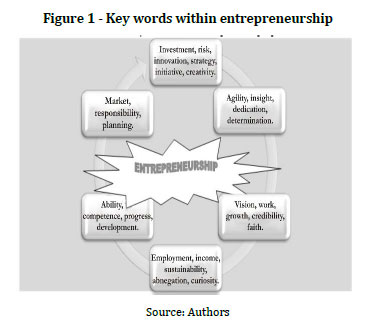
<body><![CDATA[<p><font size="2" face="Verdana">Given the above, succession   is a topic of great importance to the organisations that support   entrepreneurship (business), and this is a topic of discussion for the European   Union, The Organisation for Economic Co-operation and Development (OECD) and   Brazilian entities, i.e., SEBRAE (Brazilian Support Service for micro and Small   Enterprises). </font></p>     <p>&nbsp;</p>     <p><font size="3" face="Verdana"><b>3. Methods</b> </font></p>     <p><font size="2" face="Verdana">This   study used qualitative research methods using tools such as an informal   exploratory study and bibliographic research. The literature review was used to   build a theoretical-conceptual framework. As for the fieldwork, we used   structured interviews based on a script, with six responsible people who   directly promote entrepreneurial activities.  </font></p>     <p><font size="2" face="Verdana">Our   observations relied on a predetermined script. The documentary research adhered   to the records, reports and documents of the entities studied. Secondary data   was obtained from public and private organisations. Content analysis was the   strategy applied for the interpretation of this qualitative information. </font></p>     <p>&nbsp;</p>     <p><font size="3" face="Verdana"><b>4. Results and discussion: </b> <b>Business support organisations</b> </font></p>     <p><font size="2" face="Verdana"><b>4.1. A definition of entrepreneurs</b> </font></p>     <p><font size="2" face="Verdana">Interviews were held with   representatives from AMPESBA (Association of Micro and Small Enterprises of   Bahia State), from CDL (Board of Itabuna Shopkeepers), from ACI (Commercial and   Business Association of Itabuna), from UESC (Santa Cruz State University), from   the Secretary of Industry, Commerce and Tourism of the Itabuna city hall. The   questionnaire was comprised of two main topics: first, we asked about general   strategy, and then we asked about initiatives taken by each institution   analysed. The first topic covered words associated with entrepreneurship. We   asked respondents "What are the key words that come to your mind when you   think of &#8216;entrepreneurship&#8217;&#8204;" The answers were quite broad, revealing that   this topic is extremely wide. Neither in the theoretical nor in the empirical   fields is there a coherent delimitation. Below, we present the words suggested by the heads of the entities questioned: </font></p>     <p>&nbsp;</p>     ]]></body>
<body><![CDATA[<p align="center"><img src="/img/revistas/tms/v10nespecial/10a03f1.jpg" width="372" height="324"></p>     
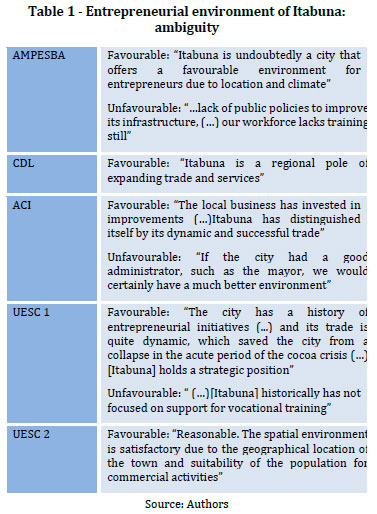
<p>&nbsp;</p>     <p><font size="2" face="Verdana">Filion (1999a), Swedberg   (2000), Gartner (2001), Audretsch (2002), Falcone & Osborne (2005), and   Boava (2006) have previously identified the lack of a systematic definition.   Their studies have shown that the entrepreneurial phenomenon is diverse in its   definition and conceptualisation. There is a very wide approach whenever the   entrepreneurial character is defined or conceptualised into a model of   entrepreneurs, in the sphere of ideas as well as in business reality. </font></p>     <p><font size="2" face="Verdana">Another aspect researched   refers to external environment issues. The city of Itabuna is favourable to   business activities but introduces some ambiguity. On the one hand, the   representatives of the entities interviewed revealed that Itabuna is a regional   focus of services and trade in full expansion. Its geographical location and   the surrounding municipalities also facilitate the economic growth of the city.   On the other hand, it has a precarious infrastructure which requires a   substantial investment in its strategic sectors. The Bahia Secretary of Industry,   Commerce and Mining confirms this, as reported in newspapers such as the article "New Eldorado Baiano" (Governo da Bahia, 2010: 1) </font></p>     <p><font size="2" face="Verdana">A lot of opportunities will   open up for micro and small entrepreneurs (Conex&#227;o, 2010) and this &#8220;unique   time" will make it possible to start an activity or strengthen an existing   one. The role of the entrepreneur is to discover the possibilities that the market is offering and to try to take the full advantage of these. </font></p>     <p><font size="2" face="Verdana">On the other hand, we found   some concerns of respondents. They commented that the region is lacking in   infrastructure to absorb foreign investment, the workforce lacks training, the   public administration needs to be professionalised with good and efficient   managers and coordination between politicians needs to increase. To support   this understanding, we transcribe some quotes from respondents.  </font></p>     <p>&nbsp;</p>     <p align="center"><img src="/img/revistas/tms/v10nespecial/10a03t1.jpg" width="377" height="514"></p>     
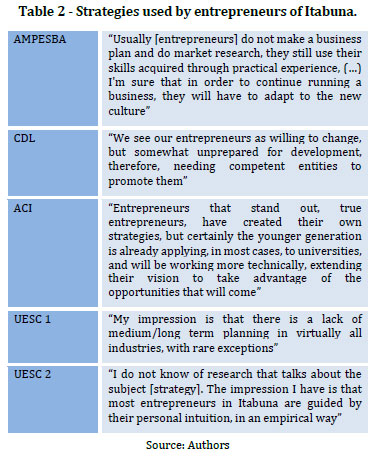
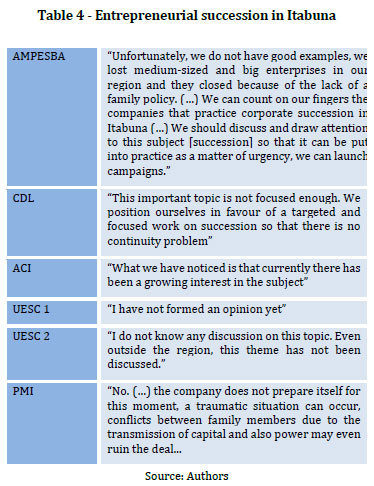
<p>&nbsp;</p>     <p><font size="2" face="Verdana">We also asked representatives   of business support organisations if the entrepreneurs apply differentiated   strategies in their businesses. The responses pointed out that the entrepreneur   settles for survival, business plans are neglected and companies survive with   great difficulty. In their words, it became clear that there is a need for   better training of individuals in order for them to work in a business, and   there is a widespread lack of planning. Below, we validate this analysis   through the words of respondents: </font></p>     ]]></body>
<body><![CDATA[<p>&nbsp;</p>     <p align="center"><img src="/img/revistas/tms/v10nespecial/10a03t2.jpg" width="377" height="456"></p>     
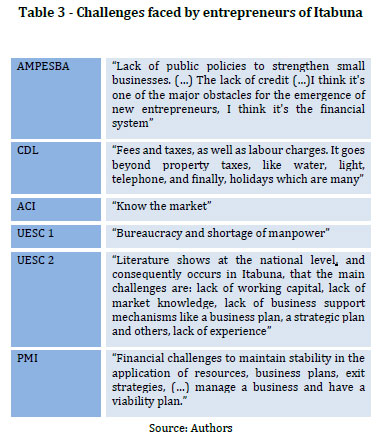
<p>&nbsp;</p>     <p><font size="2" face="Verdana">Many points were raised by   respondents. The lack of public policies to strengthen small businesses was   discussed by one of the interviewees. Insufficient credit is another concern of   the business community &#8211; from the perspective of representatives of support   organisations. Fees, taxes and labour burdens particularly harm small   businesses and are seen as aggravating factors. Knowing the market is also   another challenge. Excessive bureaucracy and disability in the workforce are   worrying, and, finally, the lack of training in basic principles of management   is an obstacle to be overcome by the entrepreneurs. Below we transcribe some   speeches that highlight the challenges encountered by owners of micro and small   establishments, from the perspective of leaders of support organisations. </font></p>     <p>&nbsp;</p>     <p align="center"><img src="/img/revistas/tms/v10nespecial/10a03t3.jpg" width="377" height="439"></p>     
<p>&nbsp;</p>     <p><font size="2" face="Verdana">The succession of companies   was another topic discussed in this survey which is a subject of great   discussion in international organisms, as mentioned by the European Commission   (2006). Succession planning, when organised in advance, reduces the number of   business closures. Establishments may be closed due to the lack of a successor   and not because of financial or managerial issues. Thinking about succession in   advance is a passport to eternity for a businessman in the "hands" or   "under the management" of another person. The successor will come   from his own family or outside of it. </font></p>     <p><font size="2" face="Verdana">Initiatives   including guidelines for business transfers should be directed to   entrepreneurs. In the European Union, out of three owners of establishments,   one will cease activity over the next ten years (European Commission, 2006).   Fl&#246;ren (1998), Brown and Coverley (1999) stated that only a few companies   include succession in their strategies. The information collected from   respondents confirms this same lack of interest in the issue of corporate succession. </font></p>     <p><font size="2" face="Verdana">The   results are worrying. The respondents (AMPESBA, CDL, UESC, ACI, PMI) informed   us that this subject is not part of the day-to-day discussions of companies in   the city of Itabuna-Brazil; succession is not discussed by entrepreneurs nor   addressed in the business fabric of the city. Below are some reports from   respondents. </font></p>     ]]></body>
<body><![CDATA[<p>&nbsp;</p>     <p align="center"><img src="/img/revistas/tms/v10nespecial/10a03t4.jpg" width="374" height="486"></p>     
<p>&nbsp;</p>     <p><font size="2" face="Verdana">Through   these analyses, we uncovered the complexity of the business world of Itabuna.   Business activities include a wide range of contexts that were attested in the   verbal responses of respondents when they conceptualise enterprises.  </font></p>     <p><font size="2" face="Verdana">The   business environment of the studied city is very propitious for businesses. The   respondents, in their reflections, describe the business environment of   Itabuna-Brazil as very receptive to micro and small establishments, an   appropriate location for business transactions, even though it has poor   infrastructure. The city has an inclination for business activities and it   favours entrepreneurship </font></p>     <p><font size="2" face="Verdana">Next,   we discuss the main guidelines developed by support organisations to improve   the business environment in Itabuna-Brazil. The greatest challenge was to   understand how the practices of these entities provide a better business   environment.  </font></p>     <p><font size="2" face="Verdana"><b>4.2. Organisations that support entrepreneurial   activity: Institutional roles</b> </font></p>     <p><font size="2" face="Verdana">Our first observation   relates to the institutional role of the support organisations. We asked the   leaders of these entities, how they aid in the creation and continuation of   economic activity. The responses received are detailed below.  </font></p>     <p><font size="2" face="Verdana">The representative of the   AMPESBA said his goal is to represent the sector of micro and small enterprises   and of the constituted authorities, fighting for better conditions in the   financial system and creating favourable conditions for taxes. The respondent   stated that his achievements are still far from satisfying needs but added that   he needs to do much more.  </font></p>     <p><font size="2" face="Verdana">The head of the CDL stated   that he accompanies entrepreneurs in their training in accounting and legal   issues. The president of the ACI, Eduardo Fontes Neto stated that his primary   goal is to defend the interests of the business class in general and to promote   business expansion in both industrial and service areas. Furthermore, he aims   to develop initiatives for the improvement and development of business   techniques, propagate actions and campaigns that strengthen free initiative and   entrepreneurship, defending with legal means their associates, and interacting   with other organisations representing the country.  </font></p>     ]]></body>
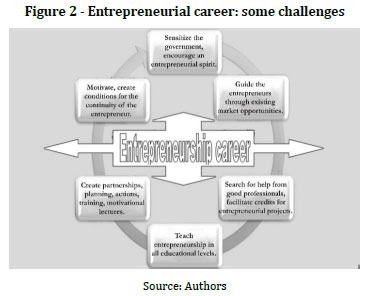
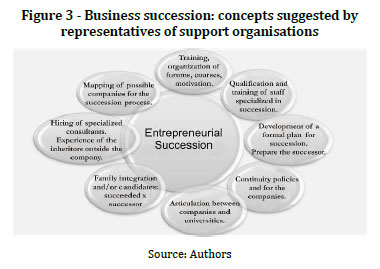
<body><![CDATA[<p><font size="2" face="Verdana">The Santa Cruz State   University had two representatives, the first was the head of the NIT &#8211; the Centre for   Technological Innovation of the UESC and the second, the Dean of Extension   Studies. The person in charge of the NIT stated that the priority of the   organisation is to guide any member of the community assisted by the UESC in   intellectual property protection practices, and also to encourage   entrepreneurship in the academic community and in the technology-based business milieu. </font></p>     <p><font size="2" face="Verdana">The Dean of Extension   Studies of the UESC, Raymundo Bonfim dos Santos, stated that "at this time   [November 2010] we're not working on that approach". He said that when he   was in charge of the Municipal Job Agency (AME) of Itabuna, he developed, along   with his employees, initiatives in the field of entrepreneurship such as   training entrepreneurs and workers, encouraging businessmen to adopt management   instruments, business plan, strategic planning, and the use of control procedures. </font></p>     <p><font size="2" face="Verdana">The Secretary of Industry,   Commerce and Tourism &#8211; PMI &#8211; through its director, stated that the organisation   promotes initiatives directed towards the development of tourism, industry,   commerce and service, generating employment and income, proposing a municipal   policy for local economic development, as well as coordinating with other secretariats to develop the tourism and economic potential of Itabuna. </font></p>     <p><font size="2" face="Verdana">Courses, conferences,   leadership forums, legal and accounting support, joint policies, external   investment research, sales promotion campaigns: all occur in Itabuna. These   events are visible, and are registered in the internal documents of the central   government, and in advertising agencies, newspapers, and media. Their purpose   is valid, but these activities should be improved.  </font></p>     <p><font size="2" face="Verdana">The institutional roles of   these firms and their actions are very distant from the business reality. There   is a gap between proposals, guidelines and facts that support and strengthen   the entrepreneurial spirit of the city. These organisations need to make a   qualitative leap by working on additional improvements for the entrepreneurs of   Itabuna-Brazil. </font></p>     <p><font size="2" face="Verdana">Through   observations and analysis, we conclude that these firms urgently need to move   forward with their proposals. Their practices are intermittent, isolated, and   incipient: events without significant impact on the business process. Working   closely with entrepreneurs, we realised that the contact between these entities   are only friendly, not including any consistent contracts or effective business   programmes. </font></p>     <p><font size="2" face="Verdana">The third and fourth   questions focused on the entrepreneurial career and on business transfers,   respectively. We asked the following questions: How can an entrepreneurial path   be encouraged&#8204; How can business owners be prepared and guided through the   succession process&#8204; Respondents showed interest in supporting entrepreneurial   training through the inclusion of "business notions" in basic   education. As for succession, they felt preparation and planning are the best paths. </font></p>     <p><font size="2" face="Verdana">We made two   self-explanatory figures, shown below, to synthesise the entrepreneurial career   and the transfer of businesses &#8211; based on reports from respondents   (representatives from the entities AMPESBA, CDL, UESC, ACI, PMI). In <a href="#f2">Figure 2</a>,   the leaders suggested procedures and aspects that must be present in the   training of entrepreneurs. In <a href="#f3">Figure 3</a> are specific guidelines to use at the time of a succession. </font></p>     <p><a name="f2"></a></p>     <p>&nbsp;</p>     ]]></body>
<body><![CDATA[<p align="center"><img src="/img/revistas/tms/v10nespecial/10a03f2.jpg" width="369" height="296"></p>     
<p>&nbsp;</p>     <p><a name="f3"></a></p>     <p>&nbsp;</p>     <p align="center"><img src="/img/revistas/tms/v10nespecial/10a03f3.jpg" width="380" height="269"></p>     
<p>&nbsp;</p>     <p><font size="2" face="Verdana">Babson College in   Massachusetts, USA, offers their students an entrepreneurial education. The   Indian Institute of Entrepreneurship also supports business careers with their   training programmes. These institutions already realise that studying the   entrepreneurial model strengthens business activities. The enhancement of the   entrepreneur profession by society constitutes a cornerstone for the   consolidation of commercial establishments, a structured craft like many others   already recognised in the academic environment. </font></p>     <p><font size="2" face="Verdana">Succession was another   point discussed in this survey. This topic is discussed superficially and often   not appreciated in the business environment. In fact, the entrepreneurs from   Itabuna do not prepare their successors. Therefore, the continuity of   activities is neglected. Respondents, aware of this situation, listed   initiatives that should be encouraged in the society being studied. These   practices, shown in <a href="#f3">Figure 3</a>, reduce the undesired closure of enterprises,   consolidate businesses to allow their longevity and, finally, facilitate an   orderly and planned succession. </font></p>     <p><font size="2" face="Verdana">Finally we conducted   interviews with representatives of development agencies on the topic   "business beliefs". Respondents suggested other possibilities that   should be adopted by entrepreneurs. Their suggestions were the following:   contribute to an economic plan for the region through the UESC &#8211; Santa Cruz   State University; make business activity a tradition within society, seen as an   important profession; seek funding alternatives with lower interest rates;   conduct research in the entrepreneurial field; and deal with global   competition. </font></p>     <p><font size="2" face="Verdana">Respondents indicated a few   relevant practices to strengthen the local economy through micro and small   businesses. Among them were relevant initiatives: some create a plan for the   medium and long term coordinated between organisations; develop a public policy   that benefits entrepreneurs; promote trade activities; and identify appropriate   conditions for the goals of entrepreneurs.  </font></p>     ]]></body>
<body><![CDATA[<p><font size="2" face="Verdana">Given the above, it is   evident that there is a long way to go before the business class can be   strengthened in the city studied. The challenges are immense, the demands are   also intense and many arduous tasks are still ahead.  We believe that the stakeholders of these   entities, together, can make the business sector much more solid, cohesive and   competitive, perhaps even an entrepreneurial city, as suggested already by   Drucker (1986).  </font></p>     <p>&nbsp;</p>     <p><font size="3" face="Verdana"><b>5. Final thoughts: The   search for integration</b> </font></p>     <p><font size="2" face="Verdana">Organisations that promote   entrepreneurship, in theory, have a crucial role in boosting the economy: a   strengthened entrepreneurial fabric creates a prosperous city. Itabuna is   favourable to business activities because it is a convergent centre. Support   agencies should encourage the creation of enterprises, in particular small   businesses, because Brazil has good prospects for economic growth and social   development over the next ten years (2011-2021), and the town in question is   part of this promising setting. At this moment it is vital to consolidate   Itabuna as a business centre in the state of Bahia, Brazil. </font></p>     <p><font size="2" face="Verdana">The &#8220;winds&#8221; are favourable   for doing business, but entrepreneurial practices require great effort from   those involved. These organisations (AMPESBA, CDL, UESC, ACI, PMI) must work   more effectively to build an entrepreneurial city. The activities carried out   by these organisations are fragile, poorly prepared and incoherent.   Representatives of these organisations have good intentions, but the economic   process is extremely fast: it will not survive on good intentions alone. An integrated effort is needed for these organisations to produce better results. </font></p>     <p><font size="2" face="Verdana">Organisations need to   create aid mechanisms (courses, orientations, meetings, consultancies, debates,   business fairs, services, and so on) for business owners as well as defend the   entrepreneurial class with public institutions such as banks. In general, they   need to protect and ensure the interests of their members. In addition, they   need to consolidate entrepreneurial training for businessmen, to   professionalise business activities.  </font></p>     <p><font size="2" face="Verdana">We can infer that support   organisations work in isolation, without coordination. Some contact between   them has been found, but this is not very developed, as it is only occasional   and without systematisation. These agencies maintain their own interests and   they do not join together and work on larger projects involving all the   stakeholders. The surveyed entities operate far from each other with merely   cordial relationships. </font></p>     <p><font size="2" face="Verdana">The efforts of the   representative of the AMPESBA to defend the needs of the micro and small   entrepreneurs in Itabuna are another relevant example of initiatives. The   directors of these entities need urgently to make a comprehensive plan that   takes into account the problems identified in the business scenario of Itabuna.   Critical situations must be addressed, not only by individual entrepreneurs,   but also by their representatives. The city needs to improve its   infrastructure, facilitate access to credit with lower interest rates for   productive activities, and effectively integrate universities and businesses,   the UESC in particular. </font></p>     <p><font size="2" face="Verdana">Santa Cruz State University   (UESC) is a respected entity within Itabuna society, yet we could not perceive   anything extraordinary developed by the UESC for strengthening entrepreneurship   in Itabuna. We observe only a few initiatives without continuity, initiatives   without entrepreneurial training and only a few annual seminars on the subject   in question. There are few courses for specialisation with a management   approach and recently an extension project for high school students in business   education. We hope that UESC contributes even more to teaching, research, and   extension with entrepreneurial purposes. </font></p>     <p><font size="2" face="Verdana">In conclusion, all is not   lost: entrepreneurship will advance by its very nature. We believe that the   time is now for promotional entities to contribute to entrepreneurs in some   way. Eduardo Neto (ACI) has already stated: Itabuna is a "headstrong" city. </font></p>     ]]></body>
<body><![CDATA[<p>&nbsp;</p>     <p><font size="3" face="Verdana"><b>References</b> </font></p>     <!-- ref --><p><font size="2" face="Verdana">Audretsch, D.B. (2002). Entrepreneurship:   A Survey of the Literature<i>. European     Commission</i>. 1-73. Retrieved January 15, 2010, from <a href="http://ec.europa.eu/old-address-ec.htm" target="_blank">http://ec.europa.eu/old-address-ec.htm</a>.    &nbsp;&nbsp;&nbsp;&nbsp;&nbsp;&nbsp;&nbsp;&nbsp;[&#160;<a href="javascript:void(0);" onclick="javascript: window.open('/scielo.php?script=sci_nlinks&ref=000125&pid=S2182-8458201400030000300001&lng=','','width=640,height=500,resizable=yes,scrollbars=1,menubar=yes,');">Links</a>&#160;]<!-- end-ref -->  </font></p>     <!-- ref --><p><font size="2" face="Verdana">Bayma, F., Sant&#8217;Anna, A. D.   S., & Diniz, D. M. (2013). Types of entrepreneurs in the conversion process of economic functions   in towns: Paraty case study (Rio de Janeiro State). <i>Tourism   & Management Studies</i>, <i>9</i>(1), 92-96.    &nbsp;&nbsp;&nbsp;&nbsp;&nbsp;&nbsp;&nbsp;&nbsp;[&#160;<a href="javascript:void(0);" onclick="javascript: window.open('/scielo.php?script=sci_nlinks&ref=000127&pid=S2182-8458201400030000300002&lng=','','width=640,height=500,resizable=yes,scrollbars=1,menubar=yes,');">Links</a>&#160;]<!-- end-ref --> </font></p>     <!-- ref --><p><font size="2" face="Verdana">Bernhoeft, R. (1989). <i>Empresa   familiar. Sucess&#227;o profissionalizada ou sobreviv&#234;ncia comprometida.</i> (2.ed). <i>S&#227;o Paulo</i>: Nobel.    &nbsp;&nbsp;&nbsp;&nbsp;&nbsp;&nbsp;&nbsp;&nbsp;[&#160;<a href="javascript:void(0);" onclick="javascript: window.open('/scielo.php?script=sci_nlinks&ref=000129&pid=S2182-8458201400030000300003&lng=','','width=640,height=500,resizable=yes,scrollbars=1,menubar=yes,');">Links</a>&#160;]<!-- end-ref --> </font></p>     <!-- ref --><p><font size="2" face="Verdana">Boaba, D.L.T. (2006). Estudo sobre a Dimens&#227;o Ontol&#243;gica do   Empreendedorismo. <i>Disserta&#231;&#227;o de Mestrado     em Administa&#231;&#227;o</i>. Londrina: PPA-UEL/UEM.    &nbsp;&nbsp;&nbsp;&nbsp;&nbsp;&nbsp;&nbsp;&nbsp;[&#160;<a href="javascript:void(0);" onclick="javascript: window.open('/scielo.php?script=sci_nlinks&ref=000131&pid=S2182-8458201400030000300004&lng=','','width=640,height=500,resizable=yes,scrollbars=1,menubar=yes,');">Links</a>&#160;]<!-- end-ref --> </font></p>     ]]></body>
<body><![CDATA[<!-- ref --><p><font size="2" face="Verdana">Braga, J.N. de P. (2003). O empreendedorismo como instrumento de   desenvolvimento. O programa IES/SOFTEX, <i>Disserta&#231;&#227;o     de mestrado profissional em Admininstra&#231;&#227;o</i>. Salvador: Escola de Administra&#231;&#227;o da Universidade Federal da Bahia.    &nbsp;&nbsp;&nbsp;&nbsp;&nbsp;&nbsp;&nbsp;&nbsp;[&#160;<a href="javascript:void(0);" onclick="javascript: window.open('/scielo.php?script=sci_nlinks&ref=000133&pid=S2182-8458201400030000300005&lng=','','width=640,height=500,resizable=yes,scrollbars=1,menubar=yes,');">Links</a>&#160;]<!-- end-ref --> </font></p>     <!-- ref --><p><font size="2" face="Verdana">Brown, R.B., & Coverley, R. (1999). Succession Planning in Family Businesses. A study from   East Anglia, U.K. <i>Journal of Small     Business Management</i>, 37(1), 93-97.    &nbsp;&nbsp;&nbsp;&nbsp;&nbsp;&nbsp;&nbsp;&nbsp;[&#160;<a href="javascript:void(0);" onclick="javascript: window.open('/scielo.php?script=sci_nlinks&ref=000135&pid=S2182-8458201400030000300006&lng=','','width=640,height=500,resizable=yes,scrollbars=1,menubar=yes,');">Links</a>&#160;]<!-- end-ref --> </font></p>     <!-- ref --><p><font size="2" face="Verdana">Casson, M. (1982). <i>The entrepreneur: an economic teory</i>.   Oxford: Martin Robertson.    &nbsp;&nbsp;&nbsp;&nbsp;&nbsp;&nbsp;&nbsp;&nbsp;[&#160;<a href="javascript:void(0);" onclick="javascript: window.open('/scielo.php?script=sci_nlinks&ref=000137&pid=S2182-8458201400030000300007&lng=','','width=640,height=500,resizable=yes,scrollbars=1,menubar=yes,');">Links</a>&#160;]<!-- end-ref --> </font></p>     <!-- ref --><p><font size="2" face="Verdana">Casson, M. (2004).  Entrepreneurship   and the theory of the firm. <i>Paper of University of Reading</i>, 1-26. Retrieved May, 20, 2010, from <a href="http://www.reading.ac.uk/search/public/search?q=MARK+CASSON+intrapreneurship&entqr=0&output=xml_no_dtd&sort=date%3AD%3AL%3Ad1&client=internal&ud=1&oe=UTF-8&ie=UTF-8&proxystylesheet=internal&site=internal" target="_blank">http://www.reading.ac.uk/search/public/search?q=MARK+CASSON+intrapreneurship&amp;entqr=0&amp;output=xml_no_dtd&amp;sort=date%3AD%3AL%3Ad1&amp;client=internal&amp;ud=1&amp;oe=UTF-8&amp;ie=UTF-8&amp;proxystylesheet=internal&amp;site=internal</a> </font>&nbsp;&nbsp;&nbsp;&nbsp;&nbsp;&nbsp;&nbsp;&nbsp;[&#160;<a href="javascript:void(0);" onclick="javascript: window.open('/scielo.php?script=sci_nlinks&ref=000139&pid=S2182-8458201400030000300008&lng=','','width=640,height=500,resizable=yes,scrollbars=1,menubar=yes,');">Links</a>&#160;]<!-- end-ref --><!-- ref --><p><font size="2" face="Verdana">Comiss&#227;o Europeia (2006). <i>Mercado   de Transmiss&#227;o de Empresas &#8211; Promover Mercados Transparentes para a Transmiss&#227;o de Empresas na Europa</i>. Relat&#243;rio do grupo de peritos. <i>Bruxelas</i>: Direc&#231;&#227;o Geral das Empresas e da Ind&#250;stria.    &nbsp;&nbsp;&nbsp;&nbsp;&nbsp;&nbsp;&nbsp;&nbsp;[&#160;<a href="javascript:void(0);" onclick="javascript: window.open('/scielo.php?script=sci_nlinks&ref=000140&pid=S2182-8458201400030000300009&lng=','','width=640,height=500,resizable=yes,scrollbars=1,menubar=yes,');">Links</a>&#160;]<!-- end-ref --> </font></p>     <!-- ref --><p><font size="2" face="Verdana">Conex&#227;o (2010). <i>Oportunidades   com a Copa do Mundo</i>. Publica&#231;&#227;o do Sebrae para o Empreendedor Baiano:   Ago/Set, 187. Retrieved May, 20, 2010 from <a href="http://201.2.114.147/bds/BDS.nsf/0f5e363a16336c5e03256c67006799da/44fac45fb386a816832577ae00501da4/$FILE/NT000447EA.pdf" target="_blank">http://201.2.114.147/bds/BDS.nsf/0f5e363a16336c5e03256c67006799da/44fac45fb386a816832577ae00501da4/$FILE/NT000447EA.pdf</a>.    &nbsp;&nbsp;&nbsp;&nbsp;&nbsp;&nbsp;&nbsp;&nbsp;[&#160;<a href="javascript:void(0);" onclick="javascript: window.open('/scielo.php?script=sci_nlinks&ref=000142&pid=S2182-8458201400030000300010&lng=','','width=640,height=500,resizable=yes,scrollbars=1,menubar=yes,');">Links</a>&#160;]<!-- end-ref --> </font></p>     <!-- ref --><p><font size="2" face="Verdana">De Paula, J.A., Cerqueira, H.E.A. da G., & Albuquerque, E. da M. E   (2004). O Empres&#225;rio na Teoria Econ&#244;mica. <i>Revista     de Economia Pol&#237;tica,</i> 24(4), oct-dec, 563-583.    &nbsp;&nbsp;&nbsp;&nbsp;&nbsp;&nbsp;&nbsp;&nbsp;[&#160;<a href="javascript:void(0);" onclick="javascript: window.open('/scielo.php?script=sci_nlinks&ref=000144&pid=S2182-8458201400030000300011&lng=','','width=640,height=500,resizable=yes,scrollbars=1,menubar=yes,');">Links</a>&#160;]<!-- end-ref -->  </font></p>     <!-- ref --><p><font size="2" face="Verdana">Drucker, P.F. (1986). <i>Inova&#231;&#227;o e Esp&#237;rito Empreendedor (entrepreneurship): pr&#225;tica e princ&#237;pios. </i>S&#227;o Paulo: Pioneira.    &nbsp;&nbsp;&nbsp;&nbsp;&nbsp;&nbsp;&nbsp;&nbsp;[&#160;<a href="javascript:void(0);" onclick="javascript: window.open('/scielo.php?script=sci_nlinks&ref=000146&pid=S2182-8458201400030000300012&lng=','','width=640,height=500,resizable=yes,scrollbars=1,menubar=yes,');">Links</a>&#160;]<!-- end-ref --> </font></p>     <!-- ref --><p><font size="2" face="Verdana">Falcone, T., & Osborne,   S. (2005). <i>Entrepreneurship: A Diverse Concept in a Diverse World</i>. USASBE &#8211; United States Association for Small Business and Entrepreneurship. Retrieved April 15, 2010, from </font><a href="http://usasbe.org/knowledge/proceedings/proceedingResults.asp?proceedingyear=2005&sortSelect=title" target="_blank"><font size="2" face="Verdana">http://usasbe.org/knowledge/proceedings/proceedingResults.asp&#8204;proceedingyear=2005&sortSelect=title</font></a><font size="2" face="Verdana"> </font>&nbsp;&nbsp;&nbsp;&nbsp;&nbsp;&nbsp;&nbsp;&nbsp;[&#160;<a href="javascript:void(0);" onclick="javascript: window.open('/scielo.php?script=sci_nlinks&ref=000148&pid=S2182-8458201400030000300013&lng=','','width=640,height=500,resizable=yes,scrollbars=1,menubar=yes,');">Links</a>&#160;]<!-- end-ref --><!-- ref --><p><font size="2" face="Verdana">Filion, L.J.   (1998). From Entrepreneurship to Entreprenology: the emergence of a new   discipline. <i>Journal of Enterprising Cultures</i>,   6(1), 1-23.    &nbsp;&nbsp;&nbsp;&nbsp;&nbsp;&nbsp;&nbsp;&nbsp;[&#160;<a href="javascript:void(0);" onclick="javascript: window.open('/scielo.php?script=sci_nlinks&ref=000149&pid=S2182-8458201400030000300014&lng=','','width=640,height=500,resizable=yes,scrollbars=1,menubar=yes,');">Links</a>&#160;]<!-- end-ref --> </font></p>     <!-- ref --><p><font size="2" face="Verdana">Louis, J.(1999). Empreendedorismo: empreendedores e   propriet&#225;rios-gerentes de pequenos neg&#243;cios. <i>Revista de     Admininstra&#231;&#227;o, </i>S&#227;o Paulo, 34(2), 5-28.    &nbsp;&nbsp;&nbsp;&nbsp;&nbsp;&nbsp;&nbsp;&nbsp;[&#160;<a href="javascript:void(0);" onclick="javascript: window.open('/scielo.php?script=sci_nlinks&ref=000151&pid=S2182-8458201400030000300015&lng=','','width=640,height=500,resizable=yes,scrollbars=1,menubar=yes,');">Links</a>&#160;]<!-- end-ref --> </font></p>     ]]></body>
<body><![CDATA[<!-- ref --><p><font size="2" face="Verdana">Fl&#246;ren, R.H.   (1998). The Significance of family business in the Netherlands. <i>Family Business Review</i>, XI, 2, 121-178.    &nbsp;&nbsp;&nbsp;&nbsp;&nbsp;&nbsp;&nbsp;&nbsp;[&#160;<a href="javascript:void(0);" onclick="javascript: window.open('/scielo.php?script=sci_nlinks&ref=000153&pid=S2182-8458201400030000300016&lng=','','width=640,height=500,resizable=yes,scrollbars=1,menubar=yes,');">Links</a>&#160;]<!-- end-ref --> </font></p>     <!-- ref --><p><font size="2" face="Verdana">Gartner, W.B. (2001). Is there an   elephant in entrepreneurship&#8204; Blind assumptions in theory development. (Business research). <i>Business journals.</i> Retrieved March 11, 2010, from <a href="http://www.entrepreneur.com/tradejournals/article/80787420_1.html" target="_blank">http://www.entrepreneur.com/tradejournals/article/80787420_1.html</a></font>&nbsp;&nbsp;&nbsp;&nbsp;&nbsp;&nbsp;&nbsp;&nbsp;[&#160;<a href="javascript:void(0);" onclick="javascript: window.open('/scielo.php?script=sci_nlinks&ref=000155&pid=S2182-8458201400030000300017&lng=','','width=640,height=500,resizable=yes,scrollbars=1,menubar=yes,');">Links</a>&#160;]<!-- end-ref --><!-- ref --><p><font size="2" face="Verdana">Gibson, J.L., (org.). (2006). <i>Organiza&#231;&#245;es: comportamento, estrutura e processos.</i> S&#227;o Paulo: McGraw-Hill.    &nbsp;&nbsp;&nbsp;&nbsp;&nbsp;&nbsp;&nbsp;&nbsp;[&#160;<a href="javascript:void(0);" onclick="javascript: window.open('/scielo.php?script=sci_nlinks&ref=000156&pid=S2182-8458201400030000300018&lng=','','width=640,height=500,resizable=yes,scrollbars=1,menubar=yes,');">Links</a>&#160;]<!-- end-ref --> </font></p>     <!-- ref --><p><font size="2" face="Verdana">Governo da Bahia (2010). <i>Informativo: Bahia Oportunidades &#8211; Sul e Extremo Sul</i>.  Salvador: Secret&#225;ria da Ind&#250;stria, Com&#233;rcio e Minera&#231;&#227;o.    &nbsp;&nbsp;&nbsp;&nbsp;&nbsp;&nbsp;&nbsp;&nbsp;[&#160;<a href="javascript:void(0);" onclick="javascript: window.open('/scielo.php?script=sci_nlinks&ref=000158&pid=S2182-8458201400030000300019&lng=','','width=640,height=500,resizable=yes,scrollbars=1,menubar=yes,');">Links</a>&#160;]<!-- end-ref --> </font></p>     <!-- ref --><p><font size="2" face="Verdana">Kirzner, I. M. (1986). <i>Competi&#231;&#227;o   e atividade empresarial</i>. Rio de Janeiro: Instituto Liberal.    &nbsp;&nbsp;&nbsp;&nbsp;&nbsp;&nbsp;&nbsp;&nbsp;[&#160;<a href="javascript:void(0);" onclick="javascript: window.open('/scielo.php?script=sci_nlinks&ref=000160&pid=S2182-8458201400030000300020&lng=','','width=640,height=500,resizable=yes,scrollbars=1,menubar=yes,');">Links</a>&#160;]<!-- end-ref --> </font></p>     <!-- ref --><p><font size="2" face="Verdana">Knight, F. (1972). <i>Risco, incerteza e lucro</i>. Rio de Janeiro: Editora Express&#227;o e Cultura.    &nbsp;&nbsp;&nbsp;&nbsp;&nbsp;&nbsp;&nbsp;&nbsp;[&#160;<a href="javascript:void(0);" onclick="javascript: window.open('/scielo.php?script=sci_nlinks&ref=000162&pid=S2182-8458201400030000300021&lng=','','width=640,height=500,resizable=yes,scrollbars=1,menubar=yes,');">Links</a>&#160;]<!-- end-ref --> </font></p>     <!-- ref --><p><font size="2" face="Verdana">Leibenstein, H.   (1968). Entrepreneur and development. <i>The     American Economic</i> R<i>eview</i>, 58(2),   72-84.    &nbsp;&nbsp;&nbsp;&nbsp;&nbsp;&nbsp;&nbsp;&nbsp;[&#160;<a href="javascript:void(0);" onclick="javascript: window.open('/scielo.php?script=sci_nlinks&ref=000164&pid=S2182-8458201400030000300022&lng=','','width=640,height=500,resizable=yes,scrollbars=1,menubar=yes,');">Links</a>&#160;]<!-- end-ref -->  </font></p>     <!-- ref --><p><font size="2" face="Verdana">Leone, N.M. de C.P.G. (1992). A suces&#227;o   em pequena e m&#233;dia empresa comercial na regi&#227;o de Jo&#227;o Pessoa. <i>Revista de Administra&#231;&#227;o</i>, 27(3), 84-91.    &nbsp;&nbsp;&nbsp;&nbsp;&nbsp;&nbsp;&nbsp;&nbsp;[&#160;<a href="javascript:void(0);" onclick="javascript: window.open('/scielo.php?script=sci_nlinks&ref=000166&pid=S2182-8458201400030000300023&lng=','','width=640,height=500,resizable=yes,scrollbars=1,menubar=yes,');">Links</a>&#160;]<!-- end-ref --> </font></p>     <!-- ref --><p><font size="2" face="Verdana">Lodi, J. B. (1987). <i>Sucess&#227;o e Conflito na Empresa Familiar.</i> S&#227;o Paulo: Pioneira.    &nbsp;&nbsp;&nbsp;&nbsp;&nbsp;&nbsp;&nbsp;&nbsp;[&#160;<a href="javascript:void(0);" onclick="javascript: window.open('/scielo.php?script=sci_nlinks&ref=000168&pid=S2182-8458201400030000300024&lng=','','width=640,height=500,resizable=yes,scrollbars=1,menubar=yes,');">Links</a>&#160;]<!-- end-ref --> </font></p>     <!-- ref --><p><font size="2" face="Verdana">Mac&#234;do, F.M.F., Boava, D.L.T., & Silva, A.F. (2009).   Estudo sobre as abordagens econ&#244;mica e comportamental no empreendedorismo. <i>Anais do XII SemeAd</i>, Cidade Universit&#225;ria, S&#227;o Paulo (em CDROM).    &nbsp;&nbsp;&nbsp;&nbsp;&nbsp;&nbsp;&nbsp;&nbsp;[&#160;<a href="javascript:void(0);" onclick="javascript: window.open('/scielo.php?script=sci_nlinks&ref=000170&pid=S2182-8458201400030000300025&lng=','','width=640,height=500,resizable=yes,scrollbars=1,menubar=yes,');">Links</a>&#160;]<!-- end-ref --> </font></p>     <!-- ref --><p><font size="2" face="Verdana">Maclelland,   D.C. (1961). <i>The achieving society. </i>New   York: VanNostrand.    &nbsp;&nbsp;&nbsp;&nbsp;&nbsp;&nbsp;&nbsp;&nbsp;[&#160;<a href="javascript:void(0);" onclick="javascript: window.open('/scielo.php?script=sci_nlinks&ref=000172&pid=S2182-8458201400030000300026&lng=','','width=640,height=500,resizable=yes,scrollbars=1,menubar=yes,');">Links</a>&#160;]<!-- end-ref --> </font></p>     <!-- ref --><p><font size="2" face="Verdana">Marshall, A.   (1985). <i>Princ&#237;pios     de economia: tratado introdut&#243;rio</i>. S&#227;o Paulo: Nova Cultura.    &nbsp;&nbsp;&nbsp;&nbsp;&nbsp;&nbsp;&nbsp;&nbsp;[&#160;<a href="javascript:void(0);" onclick="javascript: window.open('/scielo.php?script=sci_nlinks&ref=000174&pid=S2182-8458201400030000300027&lng=','','width=640,height=500,resizable=yes,scrollbars=1,menubar=yes,');">Links</a>&#160;]<!-- end-ref --> </font></p>     <!-- ref --><p><font size="2" face="Verdana">Melo Neto, F.P. de, & Froes, C. (2002). <i>Empreendedorismo social: a transi&#231;&#227;o para a   sociedade sustent&#225;vel</i>. Rio de Janeiro: Qualitymark.    &nbsp;&nbsp;&nbsp;&nbsp;&nbsp;&nbsp;&nbsp;&nbsp;[&#160;<a href="javascript:void(0);" onclick="javascript: window.open('/scielo.php?script=sci_nlinks&ref=000176&pid=S2182-8458201400030000300028&lng=','','width=640,height=500,resizable=yes,scrollbars=1,menubar=yes,');">Links</a>&#160;]<!-- end-ref --> </font></p>     <!-- ref --><p><font size="2" face="Verdana">Quivy, R., & Campenhoudt, L.V. (2008). <i>Manual de investiga&#231;&#227;o em Ci&#234;ncias Sociais. </i>Lisboa:   Gradiva.    &nbsp;&nbsp;&nbsp;&nbsp;&nbsp;&nbsp;&nbsp;&nbsp;[&#160;<a href="javascript:void(0);" onclick="javascript: window.open('/scielo.php?script=sci_nlinks&ref=000178&pid=S2182-8458201400030000300029&lng=','','width=640,height=500,resizable=yes,scrollbars=1,menubar=yes,');">Links</a>&#160;]<!-- end-ref --> </font></p>     <!-- ref --><p><font size="2" face="Verdana">Roll, E. (1972). <i>Hist&#243;ria das Doutrinas Econ&#244;micas</i>. S&#227;o Paulo: Companhia Editora Nacional.    &nbsp;&nbsp;&nbsp;&nbsp;&nbsp;&nbsp;&nbsp;&nbsp;[&#160;<a href="javascript:void(0);" onclick="javascript: window.open('/scielo.php?script=sci_nlinks&ref=000180&pid=S2182-8458201400030000300030&lng=','','width=640,height=500,resizable=yes,scrollbars=1,menubar=yes,');">Links</a>&#160;]<!-- end-ref --> </font></p>     <!-- ref --><p><font size="2" face="Verdana">Salazar, J.N.A. (2006). Estrat&#233;gia organizacional e   empreendedorismo. <i>Organiza&#231;&#245;es em     contexto, 2</i>(4), 196-214.    &nbsp;&nbsp;&nbsp;&nbsp;&nbsp;&nbsp;&nbsp;&nbsp;[&#160;<a href="javascript:void(0);" onclick="javascript: window.open('/scielo.php?script=sci_nlinks&ref=000182&pid=S2182-8458201400030000300031&lng=','','width=640,height=500,resizable=yes,scrollbars=1,menubar=yes,');">Links</a>&#160;]<!-- end-ref --> </font></p>     <!-- ref --><p><font size="2" face="Verdana">Say, J.-B. (1972). <i>Traite D&#8217;&#201;conomie Politique</i>.    &nbsp;&nbsp;&nbsp;&nbsp;&nbsp;&nbsp;&nbsp;&nbsp;[&#160;<a href="javascript:void(0);" onclick="javascript: window.open('/scielo.php?script=sci_nlinks&ref=000184&pid=S2182-8458201400030000300032&lng=','','width=640,height=500,resizable=yes,scrollbars=1,menubar=yes,');">Links</a>&#160;]<!-- end-ref --> France: Calmann-L&#233;vy. </font></p>     <!-- ref --><p><font size="2" face="Verdana">Silvia, E.L. da, & Menezes, E.M. (2001). <i>Metodologia da pesquisa e elabora&#231;&#227;o de disserta&#231;&#227;o. </i>Florian&#243;polis: Laborat&#243;rio de Ensino a Dist&#226;ncia da UFSC.    &nbsp;&nbsp;&nbsp;&nbsp;&nbsp;&nbsp;&nbsp;&nbsp;[&#160;<a href="javascript:void(0);" onclick="javascript: window.open('/scielo.php?script=sci_nlinks&ref=000186&pid=S2182-8458201400030000300033&lng=','','width=640,height=500,resizable=yes,scrollbars=1,menubar=yes,');">Links</a>&#160;]<!-- end-ref --> </font></p>     <!-- ref --><p><font size="2" face="Verdana">Schumpeter, J.A. (1985). <i>Teoria   do Desenvolvimento Econ&#244;mico: uma investiga&#231;&#227;o sobre lucros, capital, cr&#233;dito e ciclo econ&#244;mico. </i>S&#227;o Paulo: Nova Cultura.    &nbsp;&nbsp;&nbsp;&nbsp;&nbsp;&nbsp;&nbsp;&nbsp;[&#160;<a href="javascript:void(0);" onclick="javascript: window.open('/scielo.php?script=sci_nlinks&ref=000188&pid=S2182-8458201400030000300034&lng=','','width=640,height=500,resizable=yes,scrollbars=1,menubar=yes,');">Links</a>&#160;]<!-- end-ref --> </font></p>     <p><font size="2" face="Verdana">Smith. A. (1967). <i>The entrepreneur and his firm: the   relationship between type of man and type of company</i>. East Lansing, MI:   Michigan State University. </font></p>     <!-- ref --><p><font size="2" face="Verdana">Swedberg, R. (2000). The   Social Science View of Entrepreneurship: Introduction and Practical Applications.   I<i>n </i>Richard Swedberg (org.), <i>Entrepreneurship:</i> <i>The social science view </i>(pp. 7-44). Oxford: Oxford University Press.    &nbsp;&nbsp;&nbsp;&nbsp;&nbsp;&nbsp;&nbsp;&nbsp;[&#160;<a href="javascript:void(0);" onclick="javascript: window.open('/scielo.php?script=sci_nlinks&ref=000191&pid=S2182-8458201400030000300036&lng=','','width=640,height=500,resizable=yes,scrollbars=1,menubar=yes,');">Links</a>&#160;]<!-- end-ref --> </font></p>     ]]></body>
<body><![CDATA[<p><font size="2" face="Verdana">Swedberf, R. (2007). Rebuilding Schumpeter&#8217;s   Theory of Entrepreneurship. <i>Atas da     Conference on Marshall, Schumpeter and Social Science</i>, Hitotsubashi University, JAS Japan. Retrieved February 12, 2010, from <a href="http://www.lib.hit-u.ac.jp/service/tenji/amjas/Swedberg.pdf" target="_blank">http://www.lib.hit-u.ac.jp/service/tenji/amjas/Swedberg.pdf</a></font></p>     <p><font size="2" face="Verdana">Timmons,   J.A. (1989). <i>The entrepreneurial mind</i>. Andover, MA: Brick House Publishing. </font></p>     <p>&nbsp;</p>     <p>&nbsp;</p>     <p><font size="2" face="Verdana"><b>Article history    <br> </b><b>Submitted:</b></font><font size="2" face="Verdana">  11   June 2012    <br> </font><b><font size="2" face="Verdana">Accepted:</font></b><font size="2" face="Verdana"> 22 November 2013</font></p>      ]]></body><back>
<ref-list>
<ref id="B1">
<nlm-citation citation-type="">
<person-group person-group-type="author">
<name>
<surname><![CDATA[Audretsch]]></surname>
<given-names><![CDATA[D.B.]]></given-names>
</name>
</person-group>
<article-title xml:lang="en"><![CDATA[Entrepreneurship: A Survey of the Literature]]></article-title>
<source><![CDATA[European Commission]]></source>
<year>2002</year>
<page-range>1-73</page-range></nlm-citation>
</ref>
<ref id="B2">
<nlm-citation citation-type="journal">
<person-group person-group-type="author">
<name>
<surname><![CDATA[Bayma]]></surname>
<given-names><![CDATA[F.]]></given-names>
</name>
<name>
<surname><![CDATA[Sant&#8217;Anna]]></surname>
<given-names><![CDATA[A. D. S.]]></given-names>
</name>
<name>
<surname><![CDATA[Diniz]]></surname>
<given-names><![CDATA[D. M.]]></given-names>
</name>
</person-group>
<article-title xml:lang="en"><![CDATA[Types of entrepreneurs in the conversion process of economic functions in towns: Paraty case study (Rio de Janeiro State)]]></article-title>
<source><![CDATA[Tourism & Management Studies]]></source>
<year>2013</year>
<volume>9</volume>
<numero>1</numero>
<issue>1</issue>
<page-range>92-96</page-range></nlm-citation>
</ref>
<ref id="B3">
<nlm-citation citation-type="book">
<person-group person-group-type="author">
<name>
<surname><![CDATA[Bernhoeft]]></surname>
<given-names><![CDATA[R.]]></given-names>
</name>
</person-group>
<source><![CDATA[Empresa familiar: Sucessão profissionalizada ou sobrevivência comprometida]]></source>
<year>1989</year>
<edition>2</edition>
<publisher-loc><![CDATA[São Paulo ]]></publisher-loc>
<publisher-name><![CDATA[Nobel]]></publisher-name>
</nlm-citation>
</ref>
<ref id="B4">
<nlm-citation citation-type="">
<person-group person-group-type="author">
<name>
<surname><![CDATA[Boaba]]></surname>
<given-names><![CDATA[D.L.T.]]></given-names>
</name>
</person-group>
<source><![CDATA[Estudo sobre a Dimensão Ontológica do Empreendedorismo]]></source>
<year>2006</year>
</nlm-citation>
</ref>
<ref id="B5">
<nlm-citation citation-type="">
<person-group person-group-type="author">
<name>
<surname><![CDATA[Braga]]></surname>
<given-names><![CDATA[J.N. de P.]]></given-names>
</name>
</person-group>
<source><![CDATA[O empreendedorismo como instrumento de desenvolvimento: O programa IES/SOFTEX]]></source>
<year>2003</year>
</nlm-citation>
</ref>
<ref id="B6">
<nlm-citation citation-type="journal">
<person-group person-group-type="author">
<name>
<surname><![CDATA[Brown]]></surname>
<given-names><![CDATA[R.B.]]></given-names>
</name>
<name>
<surname><![CDATA[Coverley]]></surname>
<given-names><![CDATA[R.]]></given-names>
</name>
</person-group>
<article-title xml:lang="en"><![CDATA[Succession Planning in Family Businesses: A study from East Anglia, U.K.]]></article-title>
<source><![CDATA[Journal of Small Business Management]]></source>
<year>1999</year>
<volume>37</volume>
<numero>1</numero>
<issue>1</issue>
<page-range>93-97</page-range></nlm-citation>
</ref>
<ref id="B7">
<nlm-citation citation-type="book">
<person-group person-group-type="author">
<name>
<surname><![CDATA[Casson]]></surname>
<given-names><![CDATA[M.]]></given-names>
</name>
</person-group>
<source><![CDATA[The entrepreneur: an economic teory]]></source>
<year>1982</year>
<publisher-loc><![CDATA[Oxford ]]></publisher-loc>
<publisher-name><![CDATA[Martin Robertson]]></publisher-name>
</nlm-citation>
</ref>
<ref id="B8">
<nlm-citation citation-type="">
<person-group person-group-type="author">
<name>
<surname><![CDATA[Casson]]></surname>
<given-names><![CDATA[M.]]></given-names>
</name>
</person-group>
<article-title xml:lang="en"><![CDATA[Entrepreneurship and the theory of the firm]]></article-title>
<source><![CDATA[Paper of University of Reading]]></source>
<year>2004</year>
<page-range>1-26</page-range></nlm-citation>
</ref>
<ref id="B9">
<nlm-citation citation-type="book">
<collab>Comissão Europeia</collab>
<source><![CDATA[Mercado de Transmissão de Empresas: Promover Mercados Transparentes para a Transmissão de Empresas na Europa]]></source>
<year>2006</year>
<publisher-loc><![CDATA[Bruxelas ]]></publisher-loc>
<publisher-name><![CDATA[Direcção Geral das Empresas e da Indústria]]></publisher-name>
</nlm-citation>
</ref>
<ref id="B10">
<nlm-citation citation-type="">
<collab>Conexão</collab>
<source><![CDATA[Oportunidades com a Copa do Mundo]]></source>
<year>2010</year>
</nlm-citation>
</ref>
<ref id="B11">
<nlm-citation citation-type="journal">
<person-group person-group-type="author">
<name>
<surname><![CDATA[De Paula]]></surname>
<given-names><![CDATA[J.A.]]></given-names>
</name>
<name>
<surname><![CDATA[Cerqueira]]></surname>
<given-names><![CDATA[H.E.A. da G.]]></given-names>
</name>
<name>
<surname><![CDATA[Albuquerque]]></surname>
<given-names><![CDATA[E. da M. E]]></given-names>
</name>
</person-group>
<article-title xml:lang="pt"><![CDATA[O Empresário na Teoria Econômica]]></article-title>
<source><![CDATA[Revista de Economia Política]]></source>
<year>2004</year>
<volume>24</volume>
<numero>4</numero>
<issue>4</issue>
<page-range>563-583</page-range></nlm-citation>
</ref>
<ref id="B12">
<nlm-citation citation-type="book">
<person-group person-group-type="author">
<name>
<surname><![CDATA[Drucker]]></surname>
<given-names><![CDATA[P.F.]]></given-names>
</name>
</person-group>
<source><![CDATA[Inovação e Espírito Empreendedor (entrepreneurship): prática e princípios]]></source>
<year>1986</year>
<publisher-loc><![CDATA[São Paulo ]]></publisher-loc>
<publisher-name><![CDATA[Pioneira]]></publisher-name>
</nlm-citation>
</ref>
<ref id="B13">
<nlm-citation citation-type="book">
<person-group person-group-type="author">
<name>
<surname><![CDATA[Falcone]]></surname>
<given-names><![CDATA[T.]]></given-names>
</name>
<name>
<surname><![CDATA[Osborne]]></surname>
<given-names><![CDATA[S.]]></given-names>
</name>
</person-group>
<source><![CDATA[Entrepreneurship: A Diverse Concept in a Diverse World]]></source>
<year>2005</year>
<publisher-name><![CDATA[USASBE - United States Association for Small Business and Entrepreneurship]]></publisher-name>
</nlm-citation>
</ref>
<ref id="B14">
<nlm-citation citation-type="journal">
<person-group person-group-type="author">
<name>
<surname><![CDATA[Filion]]></surname>
<given-names><![CDATA[L.J.]]></given-names>
</name>
</person-group>
<article-title xml:lang="en"><![CDATA[From Entrepreneurship to Entreprenology: the emergence of a new discipline]]></article-title>
<source><![CDATA[Journal of Enterprising Cultures]]></source>
<year>1998</year>
<volume>6</volume>
<numero>1</numero>
<issue>1</issue>
<page-range>1-23</page-range></nlm-citation>
</ref>
<ref id="B15">
<nlm-citation citation-type="journal">
<person-group person-group-type="author">
<name>
<surname><![CDATA[Louis]]></surname>
<given-names><![CDATA[J.]]></given-names>
</name>
</person-group>
<article-title xml:lang="pt"><![CDATA[Empreendedorismo: empreendedores e proprietários-gerentes de pequenos negócios]]></article-title>
<source><![CDATA[Revista de Admininstração]]></source>
<year>1999</year>
<volume>34</volume>
<numero>2</numero>
<issue>2</issue>
<page-range>5-28</page-range></nlm-citation>
</ref>
<ref id="B16">
<nlm-citation citation-type="journal">
<person-group person-group-type="author">
<name>
<surname><![CDATA[Flören]]></surname>
<given-names><![CDATA[R.H.]]></given-names>
</name>
</person-group>
<article-title xml:lang="en"><![CDATA[The Significance of family business in the Netherlands]]></article-title>
<source><![CDATA[Family Business Review]]></source>
<year>1998</year>
<volume>XI</volume>
<numero>2</numero>
<issue>2</issue>
<page-range>121-178</page-range></nlm-citation>
</ref>
<ref id="B17">
<nlm-citation citation-type="journal">
<person-group person-group-type="author">
<name>
<surname><![CDATA[Gartner]]></surname>
<given-names><![CDATA[W.B.]]></given-names>
</name>
</person-group>
<article-title xml:lang="en"><![CDATA[Is there an elephant in entrepreneurship&#8204; Blind assumptions in theory development. (Business research)]]></article-title>
<source><![CDATA[Business journals]]></source>
<year>2001</year>
</nlm-citation>
</ref>
<ref id="B18">
<nlm-citation citation-type="book">
<person-group person-group-type="author">
<name>
<surname><![CDATA[Gibson]]></surname>
<given-names><![CDATA[J.L.]]></given-names>
</name>
</person-group>
<source><![CDATA[Organizações: comportamento, estrutura e processos]]></source>
<year>2006</year>
<publisher-loc><![CDATA[São Paulo ]]></publisher-loc>
<publisher-name><![CDATA[McGraw-Hill]]></publisher-name>
</nlm-citation>
</ref>
<ref id="B19">
<nlm-citation citation-type="book">
<collab>Governo da Bahia</collab>
<source><![CDATA[Informativo: Bahia Oportunidades - Sul e Extremo Sul]]></source>
<year>2010</year>
<publisher-loc><![CDATA[Salvador ]]></publisher-loc>
<publisher-name><![CDATA[Secretária da Indústria, Comércio e Mineração]]></publisher-name>
</nlm-citation>
</ref>
<ref id="B20">
<nlm-citation citation-type="book">
<person-group person-group-type="author">
<name>
<surname><![CDATA[Kirzner]]></surname>
<given-names><![CDATA[I. M.]]></given-names>
</name>
</person-group>
<source><![CDATA[Competição e atividade empresarial]]></source>
<year>1986</year>
<publisher-loc><![CDATA[Rio de Janeiro ]]></publisher-loc>
<publisher-name><![CDATA[Instituto Liberal]]></publisher-name>
</nlm-citation>
</ref>
<ref id="B21">
<nlm-citation citation-type="book">
<person-group person-group-type="author">
<name>
<surname><![CDATA[Knight]]></surname>
<given-names><![CDATA[F.]]></given-names>
</name>
</person-group>
<source><![CDATA[Risco, incerteza e lucro]]></source>
<year>1972</year>
<publisher-loc><![CDATA[Rio de Janeiro ]]></publisher-loc>
<publisher-name><![CDATA[Editora Expressão e Cultura]]></publisher-name>
</nlm-citation>
</ref>
<ref id="B22">
<nlm-citation citation-type="journal">
<person-group person-group-type="author">
<name>
<surname><![CDATA[Leibenstein]]></surname>
<given-names><![CDATA[H.]]></given-names>
</name>
</person-group>
<article-title xml:lang="en"><![CDATA[Entrepreneur and development]]></article-title>
<source><![CDATA[The American Economic Review]]></source>
<year>1968</year>
<volume>58</volume>
<numero>2</numero>
<issue>2</issue>
<page-range>72-84</page-range></nlm-citation>
</ref>
<ref id="B23">
<nlm-citation citation-type="journal">
<person-group person-group-type="author">
<name>
<surname><![CDATA[Leone]]></surname>
<given-names><![CDATA[N.M. de C.P.G.]]></given-names>
</name>
</person-group>
<article-title xml:lang="pt"><![CDATA[A sucesão em pequena e média empresa comercial na região de João Pessoa]]></article-title>
<source><![CDATA[Revista de Administração]]></source>
<year>1992</year>
<volume>27</volume>
<numero>3</numero>
<issue>3</issue>
<page-range>84-91</page-range></nlm-citation>
</ref>
<ref id="B24">
<nlm-citation citation-type="book">
<person-group person-group-type="author">
<name>
<surname><![CDATA[Lodi]]></surname>
<given-names><![CDATA[J. B.]]></given-names>
</name>
</person-group>
<source><![CDATA[Sucessão e Conflito na Empresa Familiar]]></source>
<year>1987</year>
<publisher-loc><![CDATA[São Paulo ]]></publisher-loc>
<publisher-name><![CDATA[Pioneira]]></publisher-name>
</nlm-citation>
</ref>
<ref id="B25">
<nlm-citation citation-type="">
<person-group person-group-type="author">
<name>
<surname><![CDATA[Macêdo]]></surname>
<given-names><![CDATA[F.M.F.]]></given-names>
</name>
<name>
<surname><![CDATA[Boava]]></surname>
<given-names><![CDATA[D.L.T.]]></given-names>
</name>
<name>
<surname><![CDATA[Silva]]></surname>
<given-names><![CDATA[A.F.]]></given-names>
</name>
</person-group>
<article-title xml:lang="pt"><![CDATA[Estudo sobre as abordagens econômica e comportamental no empreendedorismo]]></article-title>
<source><![CDATA[Anais do XII SemeAd]]></source>
<year>2009</year>
<publisher-loc><![CDATA[São Paulo ]]></publisher-loc>
</nlm-citation>
</ref>
<ref id="B26">
<nlm-citation citation-type="book">
<person-group person-group-type="author">
<name>
<surname><![CDATA[Maclelland]]></surname>
<given-names><![CDATA[D.C.]]></given-names>
</name>
</person-group>
<source><![CDATA[The achieving society]]></source>
<year>1961</year>
<publisher-loc><![CDATA[New York ]]></publisher-loc>
<publisher-name><![CDATA[VanNostrand]]></publisher-name>
</nlm-citation>
</ref>
<ref id="B27">
<nlm-citation citation-type="book">
<person-group person-group-type="author">
<name>
<surname><![CDATA[Marshall]]></surname>
<given-names><![CDATA[A.]]></given-names>
</name>
</person-group>
<source><![CDATA[Princípios de economia: tratado introdutório]]></source>
<year>1985</year>
<publisher-loc><![CDATA[São Paulo ]]></publisher-loc>
<publisher-name><![CDATA[Nova Cultura]]></publisher-name>
</nlm-citation>
</ref>
<ref id="B28">
<nlm-citation citation-type="book">
<person-group person-group-type="author">
<name>
<surname><![CDATA[Melo Neto]]></surname>
<given-names><![CDATA[F.P. de]]></given-names>
</name>
<name>
<surname><![CDATA[Froes]]></surname>
<given-names><![CDATA[C.]]></given-names>
</name>
</person-group>
<source><![CDATA[Empreendedorismo social: a transição para a sociedade sustentável]]></source>
<year>2002</year>
<publisher-loc><![CDATA[Rio de Janeiro ]]></publisher-loc>
<publisher-name><![CDATA[Qualitymark]]></publisher-name>
</nlm-citation>
</ref>
<ref id="B29">
<nlm-citation citation-type="book">
<person-group person-group-type="author">
<name>
<surname><![CDATA[Quivy]]></surname>
<given-names><![CDATA[R.]]></given-names>
</name>
<name>
<surname><![CDATA[Campenhoudt]]></surname>
<given-names><![CDATA[L.V.]]></given-names>
</name>
</person-group>
<source><![CDATA[Manual de investigação em Ciências Sociais]]></source>
<year>2008</year>
<publisher-loc><![CDATA[Lisboa ]]></publisher-loc>
<publisher-name><![CDATA[Gradiva]]></publisher-name>
</nlm-citation>
</ref>
<ref id="B30">
<nlm-citation citation-type="book">
<person-group person-group-type="author">
<name>
<surname><![CDATA[Roll]]></surname>
<given-names><![CDATA[E.]]></given-names>
</name>
</person-group>
<source><![CDATA[História das Doutrinas Econômicas]]></source>
<year>1972</year>
<publisher-loc><![CDATA[São Paulo ]]></publisher-loc>
<publisher-name><![CDATA[Companhia Editora Nacional]]></publisher-name>
</nlm-citation>
</ref>
<ref id="B31">
<nlm-citation citation-type="journal">
<person-group person-group-type="author">
<name>
<surname><![CDATA[Salazar]]></surname>
<given-names><![CDATA[J.N.A.]]></given-names>
</name>
</person-group>
<article-title xml:lang="pt"><![CDATA[Estratégia organizacional e empreendedorismo]]></article-title>
<source><![CDATA[Organizações em contexto]]></source>
<year>2006</year>
<volume>2</volume>
<numero>4</numero>
<issue>4</issue>
<page-range>196-214</page-range></nlm-citation>
</ref>
<ref id="B32">
<nlm-citation citation-type="">
<person-group person-group-type="author">
<name>
<surname><![CDATA[Say]]></surname>
<given-names><![CDATA[J.-B.]]></given-names>
</name>
</person-group>
<source><![CDATA[Traite D&#8217;Économie Politique]]></source>
<year>1972</year>
</nlm-citation>
</ref>
<ref id="B33">
<nlm-citation citation-type="book">
<person-group person-group-type="author">
<name>
<surname><![CDATA[Silvia]]></surname>
<given-names><![CDATA[E.L. da]]></given-names>
</name>
<name>
<surname><![CDATA[Menezes]]></surname>
<given-names><![CDATA[E.M.]]></given-names>
</name>
</person-group>
<source><![CDATA[Metodologia da pesquisa e elaboração de dissertação]]></source>
<year>2001</year>
<publisher-loc><![CDATA[Florianópolis ]]></publisher-loc>
<publisher-name><![CDATA[Laboratório de Ensino a Distância da UFSC]]></publisher-name>
</nlm-citation>
</ref>
<ref id="B34">
<nlm-citation citation-type="book">
<person-group person-group-type="author">
<name>
<surname><![CDATA[Schumpeter]]></surname>
<given-names><![CDATA[J.A.]]></given-names>
</name>
</person-group>
<source><![CDATA[Teoria do Desenvolvimento Econômico: uma investigação sobre lucros, capital, crédito e ciclo econômico]]></source>
<year>1985</year>
<publisher-loc><![CDATA[São Paulo ]]></publisher-loc>
<publisher-name><![CDATA[Nova Cultura]]></publisher-name>
</nlm-citation>
</ref>
<ref id="B35">
<nlm-citation citation-type="book">
<person-group person-group-type="author">
<name>
<surname><![CDATA[Smith]]></surname>
<given-names><![CDATA[A.]]></given-names>
</name>
</person-group>
<source><![CDATA[The entrepreneur and his firm: the relationship between type of man and type of company]]></source>
<year>1967</year>
<publisher-loc><![CDATA[East Lansing ]]></publisher-loc>
<publisher-name><![CDATA[Michigan State University]]></publisher-name>
</nlm-citation>
</ref>
<ref id="B36">
<nlm-citation citation-type="book">
<person-group person-group-type="author">
<name>
<surname><![CDATA[Swedberg]]></surname>
<given-names><![CDATA[R.]]></given-names>
</name>
</person-group>
<article-title xml:lang="en"><![CDATA[The Social Science View of Entrepreneurship: Introduction and Practical Applications]]></article-title>
<person-group person-group-type="editor">
<name>
<surname><![CDATA[Swedberg]]></surname>
<given-names><![CDATA[Richard]]></given-names>
</name>
</person-group>
<source><![CDATA[Entrepreneurship: The social science view]]></source>
<year>2000</year>
<page-range>7-44</page-range><publisher-loc><![CDATA[Oxford ]]></publisher-loc>
<publisher-name><![CDATA[Oxford University Press]]></publisher-name>
</nlm-citation>
</ref>
<ref id="B37">
<nlm-citation citation-type="">
<person-group person-group-type="author">
<name>
<surname><![CDATA[Swedberf]]></surname>
<given-names><![CDATA[R.]]></given-names>
</name>
</person-group>
<article-title xml:lang="en"><![CDATA[Rebuilding Schumpeter&#8217;s Theory of Entrepreneurship]]></article-title>
<source><![CDATA[]]></source>
<year>2007</year>
</nlm-citation>
</ref>
<ref id="B38">
<nlm-citation citation-type="book">
<person-group person-group-type="author">
<name>
<surname><![CDATA[Timmons]]></surname>
<given-names><![CDATA[J.A.]]></given-names>
</name>
</person-group>
<source><![CDATA[The entrepreneurial mind]]></source>
<year>1989</year>
<publisher-loc><![CDATA[Andover ]]></publisher-loc>
<publisher-name><![CDATA[Brick House Publishing]]></publisher-name>
</nlm-citation>
</ref>
</ref-list>
</back>
</article>