<?xml version="1.0" encoding="ISO-8859-1"?><article xmlns:mml="http://www.w3.org/1998/Math/MathML" xmlns:xlink="http://www.w3.org/1999/xlink" xmlns:xsi="http://www.w3.org/2001/XMLSchema-instance">
<front>
<journal-meta>
<journal-id>2182-8458</journal-id>
<journal-title><![CDATA[Tourism & Management Studies]]></journal-title>
<abbrev-journal-title><![CDATA[TMStudies]]></abbrev-journal-title>
<issn>2182-8458</issn>
<publisher>
<publisher-name><![CDATA[Escola Superior de Gestão, Hotelaria e Turismo da Universidade do Algarve]]></publisher-name>
</publisher>
</journal-meta>
<article-meta>
<article-id>S2182-84582014000300021</article-id>
<title-group>
<article-title xml:lang="en"><![CDATA[Internationalization of service-oriented companies: Case study research into a hospitality group]]></article-title>
<article-title xml:lang="pt"><![CDATA[Internacionalização de empresas de serviços: Um estudo de caso aplicado a um grupo hoteleiro]]></article-title>
</title-group>
<contrib-group>
<contrib contrib-type="author">
<name>
<surname><![CDATA[Carvalho]]></surname>
<given-names><![CDATA[Luísa]]></given-names>
</name>
<xref ref-type="aff" rid="A01"/>
<xref ref-type="aff" rid="A02"/>
</contrib>
</contrib-group>
<aff id="A01">
<institution><![CDATA[,Open University Department of Social Sciences and Management ]]></institution>
<addr-line><![CDATA[Oeiras ]]></addr-line>
<country>Portugal</country>
</aff>
<aff id="A02">
<institution><![CDATA[,University of Évora Centro de Estudos e Formação Avançada em Gestão e Economia ]]></institution>
<addr-line><![CDATA[ ]]></addr-line>
<country>Portugal</country>
</aff>
<pub-date pub-type="pub">
<day>00</day>
<month>12</month>
<year>2014</year>
</pub-date>
<pub-date pub-type="epub">
<day>00</day>
<month>12</month>
<year>2014</year>
</pub-date>
<volume>10</volume>
<numero>Especial</numero>
<fpage>169</fpage>
<lpage>173</lpage>
<copyright-statement/>
<copyright-year/>
<self-uri xlink:href="http://scielo.pt/scielo.php?script=sci_arttext&amp;pid=S2182-84582014000300021&amp;lng=en&amp;nrm=iso"></self-uri><self-uri xlink:href="http://scielo.pt/scielo.php?script=sci_abstract&amp;pid=S2182-84582014000300021&amp;lng=en&amp;nrm=iso"></self-uri><self-uri xlink:href="http://scielo.pt/scielo.php?script=sci_pdf&amp;pid=S2182-84582014000300021&amp;lng=en&amp;nrm=iso"></self-uri><abstract abstract-type="short" xml:lang="en"><p><![CDATA[The service sector has grown in importance in recent years mainly because it contributes towards economic growth and job creation in many countries. As yet, the services sector has been the subject of little research and few empirical studies, especially within the field of innovation. Moreover, the specific features of services make it difficult to study their internationalization, notably in tourism companies. The purpose of this study is twofold. Firstly, to present a literature review of internationalization in services and hospitality companies in particular. Secondly, to discuss a case study focusing on the largest Portuguese hospitality group (Pestana Group). This allows us to formulate hypotheses that support empirical study and make some important observations regarding service-oriented companies.]]></p></abstract>
<abstract abstract-type="short" xml:lang="pt"><p><![CDATA[O setor dos serviços ganhou um peso significativo nos últimos anos e contribuiu para o crescimento económico e criação de emprego em muitos países. Contudo, ainda que nos últimos anos os estudos sobre o setor serviços tenham vindo a aumentar, este setor carece ainda de investigação, principalmente de estudos empíricos aplicados ao estudo da inovação e da internacionalização. Para além disso as características dos serviços, em particular no caso da hotelaria dificultam o estudo da internacionalização. Este artigo tem dois objetivos. Por um lado, apresenta uma revisão de literatura sobre internacionalização de serviços, com ênfase no caso da hotelaria. E, por outro lado, pretende discutir um estudo de caso aplicado ao maior grupo hoteleiro português (Grupo Pestana). Esta investigação permitiu a formulação de hipóteses que suportam o estudo empírico e apontou um conjunto de pistas relevantes sobre este assunto no caso das empresas hoteleiras.]]></p></abstract>
<kwd-group>
<kwd lng="en"><![CDATA[internationalization]]></kwd>
<kwd lng="en"><![CDATA[hospitality companies]]></kwd>
<kwd lng="en"><![CDATA[services]]></kwd>
<kwd lng="en"><![CDATA[strategy]]></kwd>
<kwd lng="pt"><![CDATA[Estratégia]]></kwd>
<kwd lng="pt"><![CDATA[hotelaria]]></kwd>
<kwd lng="pt"><![CDATA[internacionalização]]></kwd>
<kwd lng="pt"><![CDATA[serviços]]></kwd>
</kwd-group>
</article-meta>
</front><body><![CDATA[ <p align="right"><font size="2" face="Verdana"><b><b>TOURISM -  SCIENTIFIC PAPERS</b></b></font></p>     <p>&nbsp;</p>     <p><font size="4" face="Verdana"><b>Internationalization of service-oriented companies: Case study research   into a hospitality group</b> </font></p>     <p>&nbsp;</p>     <p><font size="3" face="Verdana"><b>Internacionaliza&#231;&#227;o de   empresas de servi&#231;os: Um estudo de caso aplicado a um grupo hoteleiro</b> </font></p>     <p>&nbsp;</p>     <p>&nbsp;</p>     <p><font size="2" face="Verdana"><b>Lu&#237;sa   Carvalho<sup>1</sup></b> </font></p>     <p><font size="2" face="Verdana"><sup>1</sup>Department of Social Sciences and Management, Open   University, Edif&#237;cio Inova&#231;&#227;o I, Av. Jacques Delors, 211, 2740-122 Porto Salvo,   Oeiras, Portugal and CEFAGE, (Centro de Estudos e Forma&#231;&#227;o Avan&#231;ada em Gest&#227;o e Economia), University of &#201;vora, Portugal, <a href="mailto:luisam.carvalho@uab.pt">luisam.carvalho@uab.pt</a> </font></p>     <p>&nbsp;</p>     ]]></body>
<body><![CDATA[<p>&nbsp;</p> <hr noshade size="1">     <p><font size="2" face="Verdana"><b>ABSTRACT</b> </font></p>     <p><font size="2" face="Verdana">The service sector has grown in importance in recent   years mainly because it contributes towards economic growth and job creation in   many countries. As yet, the services sector has been the subject of little   research and few empirical studies, especially within the field of innovation.   Moreover, the specific features of services make it difficult to study their   internationalization, notably in tourism companies. The purpose of this study   is twofold. Firstly, to present a literature review of internationalization in   services and hospitality companies in particular. Secondly, to discuss a case   study focusing on the largest Portuguese hospitality group (Pestana Group). This allows   us to formulate hypotheses that support empirical study and make  some important observations regarding service-oriented companies. </font></p>     <p><font size="2" face="Verdana"><b>Keywords:</b> internationalization, hospitality companies, services, strategy.  </font></p> <hr noshade size="1">     <p><font size="2" face="Verdana"><b>RESUMO</b> </font></p>     <p><font size="2" face="Verdana">O   setor dos servi&#231;os ganhou um peso significativo nos &#250;ltimos anos e contribuiu   para o crescimento econ&#243;mico e cria&#231;&#227;o de emprego em muitos pa&#237;ses. Contudo,   ainda que nos &#250;ltimos anos os estudos sobre o setor servi&#231;os tenham vindo a   aumentar, este setor carece ainda de investiga&#231;&#227;o, principalmente de estudos   emp&#237;ricos aplicados ao estudo da inova&#231;&#227;o e da internacionaliza&#231;&#227;o. Para al&#233;m   disso as caracter&#237;sticas dos servi&#231;os, em particular no caso da hotelaria   dificultam o estudo da internacionaliza&#231;&#227;o. Este artigo tem dois objetivos. Por   um lado, apresenta uma revis&#227;o de literatura sobre internacionaliza&#231;&#227;o de   servi&#231;os, com &#234;nfase no caso da hotelaria. E, por outro lado, pretende discutir   um estudo de caso aplicado ao maior grupo hoteleiro portugu&#234;s (Grupo Pestana).   Esta investiga&#231;&#227;o permitiu a formula&#231;&#227;o de hip&#243;teses que suportam o estudo   emp&#237;rico e apontou um conjunto de pistas relevantes sobre este assunto no caso das empresas hoteleiras. </font></p>     <p><font size="2" face="Verdana"><b>Palavras-chave: </b>Estrat&#233;gia, hotelaria, internacionaliza&#231;&#227;o, servi&#231;os. </font></p> <hr noshade size="1">     <p>&nbsp;</p>     <p>&nbsp;</p>     <p><font size="3" face="Verdana"><b>1.   Literature Review</b> </font></p>     ]]></body>
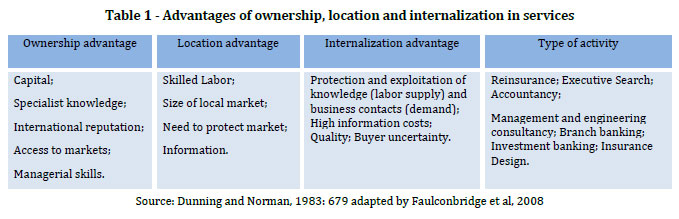
<body><![CDATA[<p><font size="2" face="Verdana"><b>1.1.   Internationalization</b> <b>of services:     Some frameworks</b> </font></p>     <p><font size="2" face="Verdana">The   internationalization of companies to new markets often creates opportunities   for value creation and growth (Lu & Beamish, 2001). Therefore,   internationalization is considered a means of improving performance and some   companies move rapidly to global expansion and is rapidly conducted in a few   cases, for instance when they start on a global scale (Oviatt & McDougall, 1994; Knight & Cavusgil, 1996; Rialp et al, 2005). </font></p>     <p><font size="2" face="Verdana">Studies on internationalization   strategies in the service sector are divided into two distinct groups. Whereas the first   claims there are differences between the internationalization of products and   services (Root, 1987; Bradley, 1991), the second argues that the   specificities of services are a minor factor and that internationalization   theory used to study industry can also be applied to services (Boddewyn et al,   1986) (Erramilli, 1990). Many services e.g. information services and   accounting, can be produced by decoupling production and consumption so that   they are exportable and become &#8216;hard services&#8217;; on the other hand, separation   is not possible in another set of services such as hotels and hospitals, namely &#8216;soft services&#8217;, (Vandermerwe & Chadwick, 1989; Erramilli, 1991). </font></p>     <p><font size="2" face="Verdana"><b>1.2.   Theories of internationalization in services</b> </font></p>     <p><font size="2" face="Verdana">The   eclectic paradigm or OLI theory (Ownership, Location, Internalization) was the pioneering theory that helps us to   understand the internationalization process in services companies (Dunning   & Norman, 1983, 1987; Dunning, 2001). Dicken (2003) say these firms decide   to internationalize if they have some competitive advantages in terms of OLI   assets and competencies over those in the host country. Bryson et al (2004)   argue that the ownership advantage (referred to as company&#8217;s specific   advantage) is based on the company&#8217;s reputation and knowledge of its human   resources. The location advantage refers to the importance of knowledge about   specific aspects of the local market and of providing customer service (face-to-face) in the host country. </font></p>     <p><font size="2" face="Verdana">The advantages of internalizing are determined by the   firm&#8217;s ability to preserve specific knowledge without the risk of loss or   sharing, as well as its ability to use knowledge of customer needs and profile   in the provision of services and the possibility of controlling the quality of   service provided. All these advantages could be better exploited if the company   moved to these markets (rather than exporting or licensing) and took total   control of the internationalization process. <a href="/img/revistas/tms/v10nespecial/10a21t1.jpg">Table 1</a> presents the advantages of OLI in services companies. </font></p>     
<p><font size="2" face="Verdana">With regard to the internationalization of hospitality   companies, the mode of entry into the hospitality sector implies a high level   of control in the internationalization process. An assessment is made of four   types of control: a) management and quality control b) physical assets c)   organizational routines and tacit knowledge d) codified strategic assets (e.g.   brand and booking system). Depending on the entry   strategy used, responsibility for the control of this area by international hotel company or hotel of host country varies (Contractor & Kundu, 1997). </font></p>     <p><font size="2" face="Verdana">In this context, the different options are divided into three groups: a)   Direct investment with total control (acquisition and creation of new   subsidiaries); b) Direct investment involving shared control; c) Forms that do   not involve capital such as management contracts and franchising (Buckley,   1995). In the case of direct investment with total control, the company has   exclusive control over the four areas mentioned above; on the other hand,   direct investment in cooperation (joint ventures) is only full control over   codified assets while other areas are usually shared with the partner. In the   case of management contracts, hotel chains are responsible for operations,   implementing systems, procedures and brand, recruitment of hotel directors,   human resources policies and quality. The hotel is managed as a property of the   hotel chain.  </font></p>     <p><font size="2" face="Verdana">Finally, in franchising contracts the hotel chain   gives its brand to the hotel and includes marketing and quality control. In   this case, the chain does not manage the hotel; the hotel has daily control of   operations and its physical assets. The chain only controls the codified   assets, while the tacit control of assets is shared with the hotel.    </font></p>     <p>&nbsp;</p>     ]]></body>
<body><![CDATA[<p align="center"><font size="2" face="Verdana"><b><a href="/img/revistas/tms/v10nespecial/10a21t2.jpg">Table 2</a></b></font></p>     
<p>&nbsp;</p>     <p><font size="2" face="Verdana">Factors that determine internationalization and the   selection of country for internationalization may include trading conditions   (country risk, cultural distance and market potential) and other factors related   with organizational skills (size, international experience, intangible assets   and skills).  </font></p>     <p><font size="2" face="Verdana"><b>1.3.1. Factors related with trading conditions </b> </font></p>     <p><font size="2" face="Verdana"><b>i) Country risk</b> </font></p>     <p><font size="2" face="Verdana">Companies   operating in international environments face a set of circumstances determined   by the economic and political situation of the destination country (political   instability, currency risk, etc.). When risks are high, companies seek to   ensure a position that makes it easier for them to abandon the country without   substantial losses (Kim & Hwang, 1992). In these circumstances, firms   prefer licensing or joint ventures rather than investments that involve total   ownership. Moreover, it is important to note that the more risky and volatile   markets make internalized activities less attractive (Buckley & Casson, 1976). </font></p>     <p><font size="2" face="Verdana"><b>ii) Cultural distance </b> </font></p>     <p><font size="2" face="Verdana">A   perceived cultural distance between the country of origin and destination is   one of the most studied variables (Johanson & Vahlne, 1977, 1990). Some authors argue that cultural differences may be lead to the need for new methods   of ownership in order to deal with the difficulties of training local resources   and the transfer of the firm&#8217;s know-how (Gatignon & Anderson, 1988). This   is particularly relevant in the case of service firm (Erramilli & Rao, 1990).   Internalizing foreign operations through entry modes involves a high level of   control so as to ensure that the service is provided according to the standards imposed by the mother company. </font></p>     <p><font size="2" face="Verdana"><b>iii) Market potential</b> </font></p>     <p><font size="2" face="Verdana">Theorists   of internalizing (Buckley & Casson, 1976) and studies related to life   cycles (Vernon, 1966) have associated market size with entry modes that involve   a high degree of involvement and control. The possibility of adjusting the   sales volume in the growth phase evidently allows faster amortization of the fixed costs. </font></p>     ]]></body>
<body><![CDATA[<p><font size="2" face="Verdana"><b>2.3.2. Factors related with organizational skills</b> </font></p>     <p><font size="2" face="Verdana"><b>i) Dimension</b> </font></p>     <p><font size="2" face="Verdana">International   activities consume a great deal of resources with the result that large   companies often have a greater capacity to internationalize. Some studies   confirm that smaller firms face certain constraints in accessing financial   resources and management (Kogut & Singh, 1988, Agarwal & Ramaswami, 1992). </font></p>     <p><font size="2" face="Verdana"><b>ii) International experience</b> </font></p>     <p><font size="2" face="Verdana">Standard   literature on the subject suggests a positive relationship between   international experience and the adoption of entry modes with a high level of   control. </font></p>     <p><font size="2" face="Verdana">In   this context, the investor&#8217;s inexperience and lack of knowledge may be a major   obstacle to the development of operations (Johanson & Vahlne, 1977). This   means that an inexperienced investor can make bad decisions on the location,   adaptation of products and services to the local market, human resource   management and contact with suppliers and banks. As a result, many investors   prefer to enter international markets using methods that involve less   commitment (Eriksson et al, 1997). Companies with more international experience   show greater independence in the control of risk, and profit from international operations. </font></p>     <p><font size="2" face="Verdana"><b>iii) Intangible assets and competences</b> </font></p>     <p><font size="2" face="Verdana">Some studies argue that when the development of   foreign operations involves a high component of intangibility and specific   skills, the company tends to choose entry modes that involve high levels of   control (Buckley & Casson, 1976, Hill et al, 1990). In hospitality   companies, this variable is very important as a competitive advantage of hotel   chains and involves specific skills related to tacit knowledge; control   prevents the risk of competitive advantage resulting from indirect control and   ensures that operations are conducted according to the quality standards of the mother company. </font></p>     <p>&nbsp;</p>     <p><font size="3" face="Verdana"><b>3.   Empirical study</b> </font></p>     ]]></body>
<body><![CDATA[<p><font size="2" face="Verdana"><b>3.1.   Methodology, problems and propositions </b> </font></p>     <p><font size="2" face="Verdana">This section presents the   case study of the internationalization of the Pestana Group. This is currently   the largest Portuguese group working in the sector and began implementing its   internationalization strategy in several countries some years ago.  </font></p>     <p><font size="2" face="Verdana">Our empirical   research was carried out by applying case study methodology which, according to   Yin (1989), investigates a contemporary phenomenon within a real-life context   when the boundaries between the phenomenon and context are not clearly evident   and where multiple sources of evidence could be used.   Comparing case study methodology with other methodologies, Yin (1989) states   that issues raised by the research must be analyzed in order to define which   the method to use.  More specifically,   this method is suitable for answering explanatory &#8216;how&#8217; and &#8216;why&#8217; questions and   deals with operational facts that occur over time rather than frequencies or   incidence. To achieve a better understanding of internationalization strategies   particularly in the service sector, the main aim of our research was to address   the question: How are services with &#8220;soft&#8221; features such as hotels   internationalized&#8204; Based on the literature review presented in the above sections, the following propositions were formulated: </font></p>     <p><font size="2" face="Verdana"><i><u>P1: Entry modes that involve a high degree of control   are positively associated with the increase of cultural distance</u></i> </font></p>     <p><font size="2" face="Verdana">Proposition 1 endeavors to answer one of the issues raised by this research, namely to   understand if cultural distance involves greater control over the activities of   the hotel.  </font></p>     <p><font size="2" face="Verdana"><i><u>P2:   Entry modes that involve a high degree of control are positively associated   with the market potential </u></i> </font></p>     <p><font size="2" face="Verdana">Proposition 2 aims to understand the extent to which   the degree of control is associated with size and market potential. </font></p>     <p><font size="2" face="Verdana"><i><u>P3:   Entry modes that involve a high degree of control are positively associated   with company size </u></i> </font></p>     <p><font size="2" face="Verdana">Proposition 3 aims to determine whether company size   influences the entry mode in international markets.  </font></p>     <p><font size="2" face="Verdana"><i><u>P4:   The type of control depends on international experience </u></i> </font></p>     ]]></body>
<body><![CDATA[<p><font size="2" face="Verdana">Proposition 4 analyzes whether the type of control in   internationalization process is determined by international experience, which   is the focus of much of the literature on the subject.  </font></p>     <p><font size="2" face="Verdana"><i><u>P5:   Entry modes that involve a high degree of control are positively associated   with a high degree of intangibility and specificity of the service provided by   the company </u></i> </font></p>     <p><font size="2" face="Verdana">Proposition 5 allows us to test if the   intangibility of services, i.e. the inclusion of &#8216;soft&#8217; services, influences the modes of internationalization. </font></p>     <p><font size="2" face="Verdana">The unit of analysis is the organization, i.e., the   Pestana Group. The choice of this case followed criteria that guaranteed   reliability. As mentioned in the first part of this study, innovation and   internationalization in services are understudied and still in their infancy in   the case of hotels. This led to the application of case study research.   According to Yin (1989), any research is typified as a case study when there is   a desire to understand a complex social phenomenon, and its investigation   retains the holistic and meaningful characteristics of real-life events. Both   these aspects fit this case perfectly and we consulted secondary information   about the Pestana Group to assess this information.  </font></p>     <p><font size="2" face="Verdana">Data were collected by means of multiple lines of   evidence as Yin suggested (1989). The main methods and sources of data   collection were: (1) the internet, which provided historical data and some of   the company&#8217;s recent results, (2) documental analysis, especially institutional   publications with information about the company profile and history as well as other documents provided by the company, and (3) interviews. </font></p>     <p><font size="2" face="Verdana"><b>2.   2. Case Study: Internationalization of the Pestana group </b> </font></p>     <p><font size="2" face="Verdana"><b>2.2.1.   Description of the company </b> </font></p>     <p><font size="2" face="Verdana">The Pestana Group<a href="#_ftn1" name="_ftnref1" title="">[1]</a> is Portugal&#8217;s largest international tourism and leisure group and one of   the largest in Europe, where it ranks 25th. There are   eight business divisions operating under the Pestana brand that include; Hotels   & Resorts, <i>Pousadas de Portugal</i>,   Holiday Ownership, Gaming, Travel, Golf and Residence, Industry and the   International Business Centre of Madeira. Starting with a 300-bedroom hotel in   Madeira in 1972, the family-owned Pestana Group has grown steadily and its   portfolio currently includes almost 90 four and five star hotels worldwide   divided into two brands: Pestana Hotels & Resorts and Pousadas de Portugal. In 1985 the   Pestana Group began an expansion drive in mainland Portugal, which has then   continued in Africa and South America. The Group opened its first hotel in a   European capital outside Portugal, the Pestana Chelsea Bridge Hotel & Spa   in London n 2010, and in May the following year, it opened the Pestana Berlin Tiergarten.  It has continued with its ongoing global   diversification process that has taken Pestana hotels to ten countries in three   continents of the world: Argentina, Brazil, Venezuela, Portugal, Germany,   England, Cape Verde, Mozambique, S&#227;o Tom&#233; and Principe and South Africa. In the   leisure area, the Group now owns and runs 44 hotels (9 in Madeira, 9 in the   Algarve, 1 in Lisbon, 2 in Cascais and Sintra, 1 in Porto, 1 in England, 1 in   Germany, 9 in Brazil, 3 in Mozambique, 1 in South Africa, 1 in Cape Verde, 2 in   Argentina, 1 in Venezuela and 3 in S&#227;o Tom&#233; and Pr&#237;ncipe) as well as  37   Pousadas de Portugal, 15 Holiday Ownership units, 6 golf courses, 3 real estate   ventures, two casinos (in Madeira and S&#227;o Tom&#233; and Pr&#237;ncipe), an air charter   company and a tour operator.  In 2003, the group was awarded the   international tender to manage the <i>Pousadas     de Portugal</i> chain, which added 44 unique properties to its portfolio that   are located in converted monuments, palaces, convents and castles spread   throughout Portugal. According to information provided by the Pestana Group, it   will continue to grow and open the following projects between 2012 and 2013:   USA: Pestana South Beach Art Deco Hotel in Miami; Uruguay: Pestana Montevideo,   Montevideo; Argentina: Pestana Buenos Aires Golf & Residences (their 3rd   investment in Argentina); Morocco: Pestana Casablanca, Anfa Place Beach Resort,   Casablanca; Angola: Pestana Luanda Bay, Luanda; Portugal: Pestana Tr&#243;ia   Eco-Resort, Tr&#243;ia; Pousada de Cascais, Cascais; Pousada da Serra da Estrela,   Covilh&#227;;?1 Hotel in   Lisbon &#8211; name to be defined; 1 Pousada in Lisbon&#8211; name to be defined. </font></p>     <p><font size="2" face="Verdana">The Group is   constantly looking into ownership and management proposals, particularly in   South American and European capitals, and expects to have reached its 100th   property by the end of 2012, the year in which it celebrates its 40th   anniversary in the hotel industry. In 2010, the Group&#8217;s revenue came to 500   million Euros (EBITDA 100 million Euros).  The Pestana Group currently has a workforce of 7,000 people worldwide. </font></p>     <p><font size="2" face="Verdana"><b>2.2.3.   Development strategies of the Pestana Group </b> </font></p>     ]]></body>
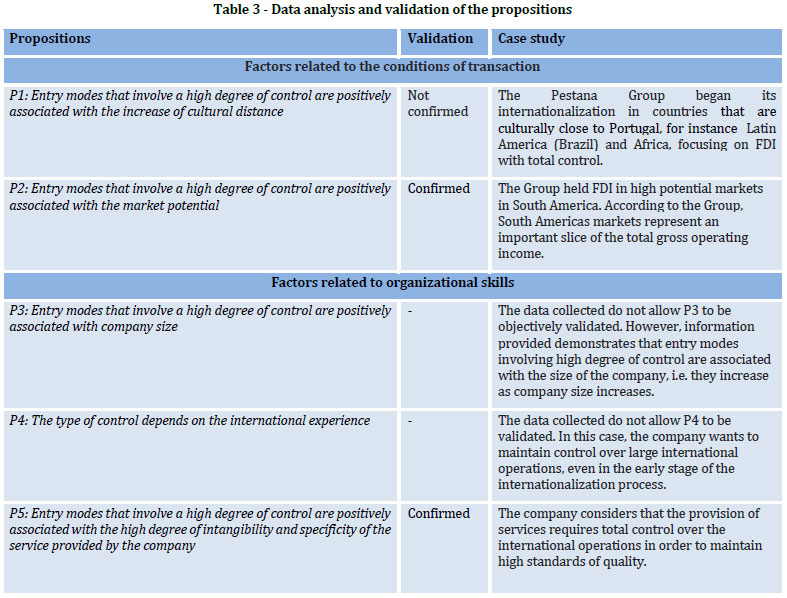
<body><![CDATA[<p><font size="2" face="Verdana">The strategies adopted by the   Pestana Group are based on three vectors:  </font></p>     <p><font size="2" face="Verdana">1 - Horizontal integration: After having   secured a solid base in their home market in the autonomous region of Madeira,   the Pestana Group set out to increase its &#8216;core business&#8217; (hospitality). The   growth initially remained in Portugal - the Algarve, Cascais, Sintra and Porto   - and later grew through internationalization; this started out in countries   that shared affinities with Portuguese culture, such as Mozambique, Brazil and   Cape Verde. Reaching out to the rest of the world in 2010, it opened the   Pestana Chelsea Bridge in London, thereby taking its first step outside   Portuguese speaking countries but still in Europe. In 2011, the group opened   the Pestana Berlin. In 2012-2013, there are plans to open new hotels in the USA, Uruguay, Argentina, Portugal (Cascais, Troia, Serra da Estrela) Morocco and Angola. </font></p>     <p><font size="2" face="Verdana">2 - Vertical integration: Growth in other   sub-sectors of tourism in Portugal including gambling, golf, real estate,   leisure air travel via charter flights and tourist operations abroad (with   special focus on the United Kingdom).  </font></p>     <p><font size="2" face="Verdana">3 - Their tourism and leisure industry is   diverse and tailored to each of the areas where they operate, adapting its business to the specific characteristics of each region, i.e., it   never relies on standardized models. </font></p>     <p>&nbsp;</p>     <p><font size="3" face="Verdana"><b>3. Analysis of results   and concluding remarks</b> </font></p>     <p><font size="2" face="Verdana">This case study   research followed the pattern-matching techniques (Yin, 1989), which is one of   the recommended methods for such an analysis. This method allows   empirically-based or observed patterns to be compared with expected patterns.   If patterns match, the results help increase the internal validity of the case   study. The proposition resulted from the literature and the studies identified   as relevant to the research. </font></p>     <p><font size="2" face="Verdana">The results will be analyzed using <a href="/img/revistas/tms/v10nespecial/10a21t3.jpg">table 3</a>,   which presents the findings on the validation of the formulated propositions.    </font></p>     
<p><font size="2" face="Verdana">The results indicate that in terms   of horizontal strategy, the company embarked on an internationalization   strategy in markets with there was more cultural proximity (Mozambique, Brazil   and Cape Verde). It was only after they had acquired further international   experience that they decided to enter other markets, such as Venezuela and Argentina.   The Pestana Group recently opened hotels in two European countries (UK and   Germany), both of which are more distant from a cultural viewpoint. According to the Group, their growth strategy   was decided upon after examining expansion into defined geographic areas in   order to achieve economies of scale and synergies. At the same time, they   decided on a strategy of vertical growth in other subsectors of tourism   activity, such as golf, recreational real estate, leisure   air travel and tourism operations. This concerted strategy aims to avoid   dependence on major international operators and increases the attractiveness of   the product in their core business.  </font></p>     <p><font size="2" face="Verdana">According to <a href="/img/revistas/tms/v10nespecial/10a21t1.jpg">Table 1</a> in the literature review and the   results suggested by the propositions in the study, the Pestana Group is   following a strategy of internationalization that falls within the OLI   paradigm. The Pestana Group recognizes the value of owning property for reasons   related to capital; moreover, it has always been a family business and intends   to foster  the association of reputation and brand with its quality image. It is an advantage   to expand to larger markets, thereby removing size limitations associated with   the Portuguese market. Finally, their internationalization strategies allow   them to protect internalized knowledge (in the case of hospitality, tacit   knowledge seems to be very important but difficult to transfer) and it   facilitates quality control (an extremely important factor in hotel chains)   given the internationalization to African and South American markets where   there is uncertainty and risks. This strategy allows the process to be   internalized and ensures greater control over market uncertainty. </font></p>     
]]></body>
<body><![CDATA[<p><font size="2" face="Verdana">In conclusion, the results indicate that the   characteristics of internationalization in the service sector, particularly in   the case of hospitality companies, are different from those in the   manufacturing sector.  The findings of a   similar study made of the Pestana Group in 2008 are comparable (Carvalho &   Sarkar, 2008). This case study suggests that the Group decided on FDI with   total ownership as a way of controlling the standards and quality associated   with their brand, as well as international operations. On the other hand, this   family-run business has grown from a small nucleus in Madeira which could have   influenced the choice of ownership and control in the internationalization   process. The increased size of the company may or may not determine a change in   that trend, even assuming that the characteristics of intangibility of the service   are a limitation. Further studies could apply the same methodology to other   groups and companies in the hospitality sector in order to compare   internationalization strategies and validate the influence of variables such as   dimension and the importance of the internal market in the internationalization process. </font></p>     <p>&nbsp;</p>     <p><font size="3" face="Verdana"><b>References</b> </font></p>     <!-- ref --><p><font size="2" face="Verdana">Agarwal, S. &   Ramaswami, S. (1992). Choice of foreign market entry mode: Impact of ownership,   location and internalisation factors. <i>Journal of International Business Studies</i>,   23(1), 1-27.    &nbsp;&nbsp;&nbsp;&nbsp;&nbsp;&nbsp;&nbsp;&nbsp;[&#160;<a href="javascript:void(0);" onclick="javascript: window.open('/scielo.php?script=sci_nlinks&ref=000086&pid=S2182-8458201400030002100001&lng=','','width=640,height=500,resizable=yes,scrollbars=1,menubar=yes,');">Links</a>&#160;]<!-- end-ref --> </font></p>     <!-- ref --><p><font size="2" face="Verdana">Bradley, F.   (1991). <i>International marketing     strategy</i>. New York: Prentice-Hall.    &nbsp;&nbsp;&nbsp;&nbsp;&nbsp;&nbsp;&nbsp;&nbsp;[&#160;<a href="javascript:void(0);" onclick="javascript: window.open('/scielo.php?script=sci_nlinks&ref=000088&pid=S2182-8458201400030002100002&lng=','','width=640,height=500,resizable=yes,scrollbars=1,menubar=yes,');">Links</a>&#160;]<!-- end-ref --> </font></p>     <!-- ref --><p><font size="2" face="Verdana">Bryson J. & Daniels,   P. W.& Warf, B. (2004). <i>Service worlds</i>. London:   Routledge.    &nbsp;&nbsp;&nbsp;&nbsp;&nbsp;&nbsp;&nbsp;&nbsp;[&#160;<a href="javascript:void(0);" onclick="javascript: window.open('/scielo.php?script=sci_nlinks&ref=000090&pid=S2182-8458201400030002100003&lng=','','width=640,height=500,resizable=yes,scrollbars=1,menubar=yes,');">Links</a>&#160;]<!-- end-ref --> </font></p>     <!-- ref --><p><font size="2" face="Verdana">Buckley, P. (1995). <i>Foreign direct investment and   multinational enterprise</i>. London: Edith Penrose.    &nbsp;&nbsp;&nbsp;&nbsp;&nbsp;&nbsp;&nbsp;&nbsp;[&#160;<a href="javascript:void(0);" onclick="javascript: window.open('/scielo.php?script=sci_nlinks&ref=000092&pid=S2182-8458201400030002100004&lng=','','width=640,height=500,resizable=yes,scrollbars=1,menubar=yes,');">Links</a>&#160;]<!-- end-ref --> </font></p>     <!-- ref --><p><font size="2" face="Verdana">Buckley, P. &   Casson, M. C. (1976). <i>The Future of the     multinational enterprise</i>. London: McMillan.    &nbsp;&nbsp;&nbsp;&nbsp;&nbsp;&nbsp;&nbsp;&nbsp;[&#160;<a href="javascript:void(0);" onclick="javascript: window.open('/scielo.php?script=sci_nlinks&ref=000094&pid=S2182-8458201400030002100005&lng=','','width=640,height=500,resizable=yes,scrollbars=1,menubar=yes,');">Links</a>&#160;]<!-- end-ref --> </font></p>     <!-- ref --><p><font size="2" face="Verdana">Carvalho, L. &   Sarkar, S. (2008). Estrat&#233;gias de internacionaliza&#231;&#227;o no sector do turismo: um   estudo emp&#237;rico.    &nbsp;&nbsp;&nbsp;&nbsp;&nbsp;&nbsp;&nbsp;&nbsp;[&#160;<a href="javascript:void(0);" onclick="javascript: window.open('/scielo.php?script=sci_nlinks&ref=000096&pid=S2182-8458201400030002100006&lng=','','width=640,height=500,resizable=yes,scrollbars=1,menubar=yes,');">Links</a>&#160;]<!-- end-ref -->  2&#186; Encontro Luso-Brasileiro de Estrat&#233;gia, ISCTE,  20-22- Novembro, Lisboa, Portugal. </font></p>     <!-- ref --><p><font size="2" face="Verdana">Contractor, F. &   Kundu, S. (1997). Modal choice in a world of alliances: analyzing   organizational forms in International Hotel Sector<i>.  Journal of International     Business Studies</i>, 16(3), 325-357.    &nbsp;&nbsp;&nbsp;&nbsp;&nbsp;&nbsp;&nbsp;&nbsp;[&#160;<a href="javascript:void(0);" onclick="javascript: window.open('/scielo.php?script=sci_nlinks&ref=000098&pid=S2182-8458201400030002100007&lng=','','width=640,height=500,resizable=yes,scrollbars=1,menubar=yes,');">Links</a>&#160;]<!-- end-ref --> </font></p>     <!-- ref --><p><font size="2" face="Verdana">Dicken, P. (2003). <i>Global Shift,</i> 4th   edition. London: Sage.    &nbsp;&nbsp;&nbsp;&nbsp;&nbsp;&nbsp;&nbsp;&nbsp;[&#160;<a href="javascript:void(0);" onclick="javascript: window.open('/scielo.php?script=sci_nlinks&ref=000100&pid=S2182-8458201400030002100008&lng=','','width=640,height=500,resizable=yes,scrollbars=1,menubar=yes,');">Links</a>&#160;]<!-- end-ref --> </font></p>     <!-- ref --><p><font size="2" face="Verdana">Dunning, J. H.   & Norman, G. (1983). The theory of the multinational enterprise: an application of multinational   office location. <i>Environment and Planning</i>, 15(5), 675 &#8211; 692.    &nbsp;&nbsp;&nbsp;&nbsp;&nbsp;&nbsp;&nbsp;&nbsp;[&#160;<a href="javascript:void(0);" onclick="javascript: window.open('/scielo.php?script=sci_nlinks&ref=000102&pid=S2182-8458201400030002100009&lng=','','width=640,height=500,resizable=yes,scrollbars=1,menubar=yes,');">Links</a>&#160;]<!-- end-ref --> </font></p>     <!-- ref --><p><font size="2" face="Verdana">Dunning, J. (2001). The   eclectic (OLI) paradigm of international production: Past, present and future. <i>Int. J. of the Economics of Business</i>,   8(2), 173-190.    &nbsp;&nbsp;&nbsp;&nbsp;&nbsp;&nbsp;&nbsp;&nbsp;[&#160;<a href="javascript:void(0);" onclick="javascript: window.open('/scielo.php?script=sci_nlinks&ref=000104&pid=S2182-8458201400030002100010&lng=','','width=640,height=500,resizable=yes,scrollbars=1,menubar=yes,');">Links</a>&#160;]<!-- end-ref --> </font></p>     <!-- ref --><p><font size="2" face="Verdana">Dunning, J. H.   & Norman, G. (1987). The location choice of offices of international companies. <i>Environment and     Planning</i>, 19(5), 613- 631.    &nbsp;&nbsp;&nbsp;&nbsp;&nbsp;&nbsp;&nbsp;&nbsp;[&#160;<a href="javascript:void(0);" onclick="javascript: window.open('/scielo.php?script=sci_nlinks&ref=000106&pid=S2182-8458201400030002100011&lng=','','width=640,height=500,resizable=yes,scrollbars=1,menubar=yes,');">Links</a>&#160;]<!-- end-ref --> </font></p>     <!-- ref --><p><font size="2" face="Verdana">Eriksson, K. &   Johanson, J. & Majkgard, A. & Sharma, D. (1997). Experiential knowledge and cost in the   internationalization process. <i>Journal of     International Business Studies</i>, 28(2), 337-360.    &nbsp;&nbsp;&nbsp;&nbsp;&nbsp;&nbsp;&nbsp;&nbsp;[&#160;<a href="javascript:void(0);" onclick="javascript: window.open('/scielo.php?script=sci_nlinks&ref=000108&pid=S2182-8458201400030002100012&lng=','','width=640,height=500,resizable=yes,scrollbars=1,menubar=yes,');">Links</a>&#160;]<!-- end-ref --> </font></p>     <!-- ref --><p><font size="2" face="Verdana">Erramilli, M.   (1990). Entry mode choice in service industries. <i>International Marketing Review</i>, 7(5),   50-62.    &nbsp;&nbsp;&nbsp;&nbsp;&nbsp;&nbsp;&nbsp;&nbsp;[&#160;<a href="javascript:void(0);" onclick="javascript: window.open('/scielo.php?script=sci_nlinks&ref=000110&pid=S2182-8458201400030002100013&lng=','','width=640,height=500,resizable=yes,scrollbars=1,menubar=yes,');">Links</a>&#160;]<!-- end-ref --> </font></p>     <!-- ref --><p><font size="2" face="Verdana">Erramilli, M.   (1991). The experience factor in foreign market entry behaviour of service   firms. <i>Journal of International     Business Studies</i>, 22(3), 479-501.    &nbsp;&nbsp;&nbsp;&nbsp;&nbsp;&nbsp;&nbsp;&nbsp;[&#160;<a href="javascript:void(0);" onclick="javascript: window.open('/scielo.php?script=sci_nlinks&ref=000112&pid=S2182-8458201400030002100014&lng=','','width=640,height=500,resizable=yes,scrollbars=1,menubar=yes,');">Links</a>&#160;]<!-- end-ref --> </font></p>     <!-- ref --><p><font size="2" face="Verdana">Erramilli, M. & Rao,   C.P. (1990). Choice of foreign   market entry mode by service firms: Role of market knowledge. <i>Management International     Review</i>, 30(2), 135-50.    &nbsp;&nbsp;&nbsp;&nbsp;&nbsp;&nbsp;&nbsp;&nbsp;[&#160;<a href="javascript:void(0);" onclick="javascript: window.open('/scielo.php?script=sci_nlinks&ref=000114&pid=S2182-8458201400030002100015&lng=','','width=640,height=500,resizable=yes,scrollbars=1,menubar=yes,');">Links</a>&#160;]<!-- end-ref --> </font></p>     <!-- ref --><p><font size="2" face="Verdana">Gatignon, H. &   Anderson, E. (1988). The multinational corporation's degree of control over foreign subsidiaries: an   empirical test of a transaction cost explanation. <i>Journal of Law, Economics and Organization</i>, 4(2), 305-336.    &nbsp;&nbsp;&nbsp;&nbsp;&nbsp;&nbsp;&nbsp;&nbsp;[&#160;<a href="javascript:void(0);" onclick="javascript: window.open('/scielo.php?script=sci_nlinks&ref=000116&pid=S2182-8458201400030002100016&lng=','','width=640,height=500,resizable=yes,scrollbars=1,menubar=yes,');">Links</a>&#160;]<!-- end-ref --> </font></p>     <!-- ref --><p><font size="2" face="Verdana">Hill, C. &   Hwang, P. & Kim, W. C. (1990). An eclectic theory of the choice of   international entry mode, <i>Strategic     Management Journal</i>, 11(2), 117-128.    &nbsp;&nbsp;&nbsp;&nbsp;&nbsp;&nbsp;&nbsp;&nbsp;[&#160;<a href="javascript:void(0);" onclick="javascript: window.open('/scielo.php?script=sci_nlinks&ref=000118&pid=S2182-8458201400030002100017&lng=','','width=640,height=500,resizable=yes,scrollbars=1,menubar=yes,');">Links</a>&#160;]<!-- end-ref --> </font></p>     <!-- ref --><p><font size="2" face="Verdana">Johanson, J. & Vahlne,   J-E (1977). The   internationalisation process of the firm &#8211; a model of knowledge development and   increasing foreign market commitment. <i>Journal of     International Business Studies</i>, 8(1), 23-32 </font>&nbsp;&nbsp;&nbsp;&nbsp;&nbsp;&nbsp;&nbsp;&nbsp;[&#160;<a href="javascript:void(0);" onclick="javascript: window.open('/scielo.php?script=sci_nlinks&ref=000120&pid=S2182-8458201400030002100018&lng=','','width=640,height=500,resizable=yes,scrollbars=1,menubar=yes,');">Links</a>&#160;]<!-- end-ref --><!-- ref --><p><font size="2" face="Verdana">Johanson, J. & Vahlne,   J.E. (1990). The   mechanism of internationalisation. <i>International     Marketing Review</i>, 7(4), 11-34.    &nbsp;&nbsp;&nbsp;&nbsp;&nbsp;&nbsp;&nbsp;&nbsp;[&#160;<a href="javascript:void(0);" onclick="javascript: window.open('/scielo.php?script=sci_nlinks&ref=000121&pid=S2182-8458201400030002100019&lng=','','width=640,height=500,resizable=yes,scrollbars=1,menubar=yes,');">Links</a>&#160;]<!-- end-ref --> </font></p>     ]]></body>
<body><![CDATA[<!-- ref --><p><font size="2" face="Verdana">Kim,   W.C. & Hwang, P. (1992). Global strategy and multinationals   entry mode choice. <i>Journal of     Business Studies,</i> 23(1), 29-53.    &nbsp;&nbsp;&nbsp;&nbsp;&nbsp;&nbsp;&nbsp;&nbsp;[&#160;<a href="javascript:void(0);" onclick="javascript: window.open('/scielo.php?script=sci_nlinks&ref=000123&pid=S2182-8458201400030002100020&lng=','','width=640,height=500,resizable=yes,scrollbars=1,menubar=yes,');">Links</a>&#160;]<!-- end-ref --> </font></p>     <p><font size="2" face="Verdana">Knight, G.A. &   Cavusgil, S.T. (1996). The born global firm: A challenge to traditional internationalization theory. In S.T. Cavusgil & T. Madsen (Eds.). <i>Advances in international marketing</i>,   (pp.11-26), Vol. 8. Greenwich: JAI Press. </font></p>     <!-- ref --><p><font size="2" face="Verdana">Kogut, B. &   Singh, A. (1988). Entering the United States by acquisition or joint venture:   Country patterns and cultural characteristics. In F. Contractor & P.   Lorange, (Eds.), <i>Cooperative Strategies     in International Business</i>. Lexington: D.C. Heath.    &nbsp;&nbsp;&nbsp;&nbsp;&nbsp;&nbsp;&nbsp;&nbsp;[&#160;<a href="javascript:void(0);" onclick="javascript: window.open('/scielo.php?script=sci_nlinks&ref=000126&pid=S2182-8458201400030002100022&lng=','','width=640,height=500,resizable=yes,scrollbars=1,menubar=yes,');">Links</a>&#160;]<!-- end-ref --> </font></p>     <!-- ref --><p><font size="2" face="Verdana">Lu, J. & Beamish, P.W. (2001). The internationalization and performance of SMEs. <i>Strategic Management Journal,</i> 22 (6&#8211;7), 565&#8211;586.    &nbsp;&nbsp;&nbsp;&nbsp;&nbsp;&nbsp;&nbsp;&nbsp;[&#160;<a href="javascript:void(0);" onclick="javascript: window.open('/scielo.php?script=sci_nlinks&ref=000128&pid=S2182-8458201400030002100023&lng=','','width=640,height=500,resizable=yes,scrollbars=1,menubar=yes,');">Links</a>&#160;]<!-- end-ref --> </font></p>     <!-- ref --><p><font size="2" face="Verdana">Oviatt, B.M. &   McDougall, P.P. (1994). Toward a theory of international new ventures. <i>Journal of International Business Studies</i>, 25(1), 45&#8211;64.    &nbsp;&nbsp;&nbsp;&nbsp;&nbsp;&nbsp;&nbsp;&nbsp;[&#160;<a href="javascript:void(0);" onclick="javascript: window.open('/scielo.php?script=sci_nlinks&ref=000130&pid=S2182-8458201400030002100024&lng=','','width=640,height=500,resizable=yes,scrollbars=1,menubar=yes,');">Links</a>&#160;]<!-- end-ref --> </font></p>     <!-- ref --><p><font size="2" face="Verdana">Rialp, A. & Rialp,   J. & Knight, G.A. (2005). The phenomenon of early internationalizing firms;   what do we know after a decade (1993 &#8211; 2003) of scientific inquiry&#8204;. <i>International Business Review</i>, 14(2), 147&#8211;166.    &nbsp;&nbsp;&nbsp;&nbsp;&nbsp;&nbsp;&nbsp;&nbsp;[&#160;<a href="javascript:void(0);" onclick="javascript: window.open('/scielo.php?script=sci_nlinks&ref=000132&pid=S2182-8458201400030002100025&lng=','','width=640,height=500,resizable=yes,scrollbars=1,menubar=yes,');">Links</a>&#160;]<!-- end-ref --> </font></p>     <!-- ref --><p><font size="2" face="Verdana">Root, F. (1987).  <i>Foreign   market entry strategies</i>, New York: AMACOM </font>&nbsp;&nbsp;&nbsp;&nbsp;&nbsp;&nbsp;&nbsp;&nbsp;[&#160;<a href="javascript:void(0);" onclick="javascript: window.open('/scielo.php?script=sci_nlinks&ref=000134&pid=S2182-8458201400030002100026&lng=','','width=640,height=500,resizable=yes,scrollbars=1,menubar=yes,');">Links</a>&#160;]<!-- end-ref --><!-- ref --><p><font size="2" face="Verdana">Vernon, R. (1966). The   product cycle hypothesis in a new international environment. <i>Oxford Bulletin of Economics and Statistics</i>,   41(4), 255-267.    &nbsp;&nbsp;&nbsp;&nbsp;&nbsp;&nbsp;&nbsp;&nbsp;[&#160;<a href="javascript:void(0);" onclick="javascript: window.open('/scielo.php?script=sci_nlinks&ref=000135&pid=S2182-8458201400030002100027&lng=','','width=640,height=500,resizable=yes,scrollbars=1,menubar=yes,');">Links</a>&#160;]<!-- end-ref --> </font></p>     <p><font size="2" face="Verdana">Yin, R. K. (1989). <i>Case study research - Design and methods</i>.   Thousand Oaks, CA: Sage Publications. </font></p>     <p>&nbsp;</p>     <p>&nbsp;</p>     <p><font size="2" face="Verdana"><b>Article history    <br> </b></font><font size="2" face="Verdana">Submitted:   28 June 2012    <br> </font><font size="2" face="Verdana">Accepted: 22 November   2012    </font></p>     ]]></body>
<body><![CDATA[<p>&nbsp;</p>     <p>&nbsp;</p>     <p><font size="3"><b><font face="Verdana">Notas</font></b></font></p>     <p><font size="2" face="Verdana"><a href="#_ftnref1" name="_ftn1" title="">[1]</a> All information was provided by the Pestana Group and is available at <a href="http://www.pestana.com" target="_blank">www.pestana.com</a></font></p>      ]]></body><back>
<ref-list>
<ref id="B1">
<nlm-citation citation-type="journal">
<person-group person-group-type="author">
<name>
<surname><![CDATA[Agarwal]]></surname>
<given-names><![CDATA[S.]]></given-names>
</name>
<name>
<surname><![CDATA[Ramaswami]]></surname>
<given-names><![CDATA[S.]]></given-names>
</name>
</person-group>
<article-title xml:lang="en"><![CDATA[Choice of foreign market entry mode: Impact of ownership, location and internalisation factors]]></article-title>
<source><![CDATA[Journal of International Business Studies]]></source>
<year>1992</year>
<volume>23</volume>
<numero>1</numero>
<issue>1</issue>
<page-range>1-27</page-range></nlm-citation>
</ref>
<ref id="B2">
<nlm-citation citation-type="book">
<person-group person-group-type="author">
<name>
<surname><![CDATA[Bradley]]></surname>
<given-names><![CDATA[F.]]></given-names>
</name>
</person-group>
<source><![CDATA[International marketing strategy]]></source>
<year>1991</year>
<publisher-loc><![CDATA[New York ]]></publisher-loc>
<publisher-name><![CDATA[Prentice-Hall]]></publisher-name>
</nlm-citation>
</ref>
<ref id="B3">
<nlm-citation citation-type="book">
<person-group person-group-type="author">
<name>
<surname><![CDATA[Bryson]]></surname>
<given-names><![CDATA[J.]]></given-names>
</name>
<name>
<surname><![CDATA[Daniels]]></surname>
<given-names><![CDATA[P. W.]]></given-names>
</name>
<name>
<surname><![CDATA[Warf]]></surname>
<given-names><![CDATA[B.]]></given-names>
</name>
</person-group>
<source><![CDATA[Service worlds]]></source>
<year>2004</year>
<publisher-loc><![CDATA[London ]]></publisher-loc>
<publisher-name><![CDATA[Routledge]]></publisher-name>
</nlm-citation>
</ref>
<ref id="B4">
<nlm-citation citation-type="book">
<person-group person-group-type="author">
<name>
<surname><![CDATA[Buckley]]></surname>
<given-names><![CDATA[P.]]></given-names>
</name>
</person-group>
<source><![CDATA[Foreign direct investment and multinational enterprise]]></source>
<year>1995</year>
<publisher-loc><![CDATA[London ]]></publisher-loc>
<publisher-name><![CDATA[Edith Penrose]]></publisher-name>
</nlm-citation>
</ref>
<ref id="B5">
<nlm-citation citation-type="book">
<person-group person-group-type="author">
<name>
<surname><![CDATA[Buckley]]></surname>
<given-names><![CDATA[P.]]></given-names>
</name>
<name>
<surname><![CDATA[Casson]]></surname>
<given-names><![CDATA[M. C.]]></given-names>
</name>
</person-group>
<source><![CDATA[The Future of the multinational enterprise]]></source>
<year>1976</year>
<publisher-loc><![CDATA[London ]]></publisher-loc>
<publisher-name><![CDATA[McMillan]]></publisher-name>
</nlm-citation>
</ref>
<ref id="B6">
<nlm-citation citation-type="">
<person-group person-group-type="author">
<name>
<surname><![CDATA[Carvalho]]></surname>
<given-names><![CDATA[L.]]></given-names>
</name>
<name>
<surname><![CDATA[Sarkar]]></surname>
<given-names><![CDATA[S.]]></given-names>
</name>
</person-group>
<article-title xml:lang="pt"><![CDATA[Estratégias de internacionalização no sector do turismo: um estudo empírico]]></article-title>
<source><![CDATA[]]></source>
<year>2008</year>
</nlm-citation>
</ref>
<ref id="B7">
<nlm-citation citation-type="journal">
<person-group person-group-type="author">
<name>
<surname><![CDATA[Contractor]]></surname>
<given-names><![CDATA[F.]]></given-names>
</name>
<name>
<surname><![CDATA[Kundu]]></surname>
<given-names><![CDATA[S.]]></given-names>
</name>
</person-group>
<article-title xml:lang="en"><![CDATA[Modal choice in a world of alliances: analyzing organizational forms in International Hotel Sector]]></article-title>
<source><![CDATA[Journal of International Business Studies]]></source>
<year>1997</year>
<volume>16</volume>
<numero>3</numero>
<issue>3</issue>
<page-range>325-357</page-range></nlm-citation>
</ref>
<ref id="B8">
<nlm-citation citation-type="book">
<person-group person-group-type="author">
<name>
<surname><![CDATA[Dicken]]></surname>
<given-names><![CDATA[P.]]></given-names>
</name>
</person-group>
<source><![CDATA[Global Shift]]></source>
<year>2003</year>
<edition>4</edition>
<publisher-loc><![CDATA[London ]]></publisher-loc>
<publisher-name><![CDATA[Sage]]></publisher-name>
</nlm-citation>
</ref>
<ref id="B9">
<nlm-citation citation-type="journal">
<person-group person-group-type="author">
<name>
<surname><![CDATA[Dunning]]></surname>
<given-names><![CDATA[J. H.]]></given-names>
</name>
<name>
<surname><![CDATA[Norman]]></surname>
<given-names><![CDATA[G.]]></given-names>
</name>
</person-group>
<article-title xml:lang="en"><![CDATA[The theory of the multinational enterprise: an application of multinational office location]]></article-title>
<source><![CDATA[Environment and Planning]]></source>
<year>1983</year>
<volume>15</volume>
<numero>5</numero>
<issue>5</issue>
<page-range>675 - 692</page-range></nlm-citation>
</ref>
<ref id="B10">
<nlm-citation citation-type="journal">
<person-group person-group-type="author">
<name>
<surname><![CDATA[Dunning]]></surname>
<given-names><![CDATA[J.]]></given-names>
</name>
</person-group>
<article-title xml:lang="en"><![CDATA[The eclectic (OLI) paradigm of international production: Past, present and future]]></article-title>
<source><![CDATA[Int. J. of the Economics of Business]]></source>
<year>2001</year>
<volume>8</volume>
<numero>2</numero>
<issue>2</issue>
<page-range>173-190</page-range></nlm-citation>
</ref>
<ref id="B11">
<nlm-citation citation-type="journal">
<person-group person-group-type="author">
<name>
<surname><![CDATA[Dunning]]></surname>
<given-names><![CDATA[J. H.]]></given-names>
</name>
<name>
<surname><![CDATA[Norman]]></surname>
<given-names><![CDATA[G.]]></given-names>
</name>
</person-group>
<article-title xml:lang="en"><![CDATA[The location choice of offices of international companies]]></article-title>
<source><![CDATA[Environment and Planning]]></source>
<year>1987</year>
<volume>19</volume>
<numero>5</numero>
<issue>5</issue>
<page-range>613- 631</page-range></nlm-citation>
</ref>
<ref id="B12">
<nlm-citation citation-type="journal">
<person-group person-group-type="author">
<name>
<surname><![CDATA[Eriksson]]></surname>
<given-names><![CDATA[K.]]></given-names>
</name>
<name>
<surname><![CDATA[Johanson]]></surname>
<given-names><![CDATA[J.]]></given-names>
</name>
<name>
<surname><![CDATA[Majkgard]]></surname>
<given-names><![CDATA[A.]]></given-names>
</name>
<name>
<surname><![CDATA[Sharma]]></surname>
<given-names><![CDATA[D.]]></given-names>
</name>
</person-group>
<article-title xml:lang="en"><![CDATA[Experiential knowledge and cost in the internationalization process]]></article-title>
<source><![CDATA[Journal of International Business Studies]]></source>
<year>1997</year>
<volume>28</volume>
<numero>2</numero>
<issue>2</issue>
<page-range>337-360</page-range></nlm-citation>
</ref>
<ref id="B13">
<nlm-citation citation-type="journal">
<person-group person-group-type="author">
<name>
<surname><![CDATA[Erramilli]]></surname>
<given-names><![CDATA[M.]]></given-names>
</name>
</person-group>
<article-title xml:lang="en"><![CDATA[Entry mode choice in service industries]]></article-title>
<source><![CDATA[International Marketing Review]]></source>
<year>1990</year>
<volume>7</volume>
<numero>5</numero>
<issue>5</issue>
<page-range>50-62</page-range></nlm-citation>
</ref>
<ref id="B14">
<nlm-citation citation-type="journal">
<person-group person-group-type="author">
<name>
<surname><![CDATA[Erramilli]]></surname>
<given-names><![CDATA[M.]]></given-names>
</name>
</person-group>
<article-title xml:lang="en"><![CDATA[The experience factor in foreign market entry behaviour of service firms]]></article-title>
<source><![CDATA[Journal of International Business Studies]]></source>
<year>1991</year>
<volume>22</volume>
<numero>3</numero>
<issue>3</issue>
<page-range>479-501</page-range></nlm-citation>
</ref>
<ref id="B15">
<nlm-citation citation-type="journal">
<person-group person-group-type="author">
<name>
<surname><![CDATA[Erramilli]]></surname>
<given-names><![CDATA[M.]]></given-names>
</name>
<name>
<surname><![CDATA[Rao]]></surname>
<given-names><![CDATA[C.P.]]></given-names>
</name>
</person-group>
<article-title xml:lang="en"><![CDATA[Choice of foreign market entry mode by service firms: Role of market knowledge]]></article-title>
<source><![CDATA[Management International Review]]></source>
<year>1990</year>
<volume>30</volume>
<numero>2</numero>
<issue>2</issue>
<page-range>135-50</page-range></nlm-citation>
</ref>
<ref id="B16">
<nlm-citation citation-type="journal">
<person-group person-group-type="author">
<name>
<surname><![CDATA[Gatignon]]></surname>
<given-names><![CDATA[H.]]></given-names>
</name>
<name>
<surname><![CDATA[Anderson]]></surname>
<given-names><![CDATA[E.]]></given-names>
</name>
</person-group>
<article-title xml:lang="en"><![CDATA[The multinational corporation's degree of control over foreign subsidiaries: an empirical test of a transaction cost explanation]]></article-title>
<source><![CDATA[Journal of Law, Economics and Organization]]></source>
<year>1988</year>
<volume>4</volume>
<numero>2</numero>
<issue>2</issue>
<page-range>305-336</page-range></nlm-citation>
</ref>
<ref id="B17">
<nlm-citation citation-type="journal">
<person-group person-group-type="author">
<name>
<surname><![CDATA[Hill]]></surname>
<given-names><![CDATA[C.]]></given-names>
</name>
<name>
<surname><![CDATA[Hwang]]></surname>
<given-names><![CDATA[P.]]></given-names>
</name>
<name>
<surname><![CDATA[Kim]]></surname>
<given-names><![CDATA[W. C.]]></given-names>
</name>
</person-group>
<article-title xml:lang="en"><![CDATA[An eclectic theory of the choice of international entry mode]]></article-title>
<source><![CDATA[Strategic Management Journal]]></source>
<year>1990</year>
<volume>11</volume>
<numero>2</numero>
<issue>2</issue>
<page-range>117-128</page-range></nlm-citation>
</ref>
<ref id="B18">
<nlm-citation citation-type="journal">
<person-group person-group-type="author">
<name>
<surname><![CDATA[Johanson]]></surname>
<given-names><![CDATA[J.]]></given-names>
</name>
<name>
<surname><![CDATA[Vahlne]]></surname>
<given-names><![CDATA[J-E]]></given-names>
</name>
</person-group>
<article-title xml:lang="en"><![CDATA[The internationalisation process of the firm: a model of knowledge development and increasing foreign market commitment]]></article-title>
<source><![CDATA[Journal of International Business Studies]]></source>
<year>1977</year>
<volume>8</volume>
<numero>1</numero>
<issue>1</issue>
<page-range>23-32</page-range></nlm-citation>
</ref>
<ref id="B19">
<nlm-citation citation-type="journal">
<person-group person-group-type="author">
<name>
<surname><![CDATA[Johanson]]></surname>
<given-names><![CDATA[J.]]></given-names>
</name>
<name>
<surname><![CDATA[Vahlne]]></surname>
<given-names><![CDATA[J.E.]]></given-names>
</name>
</person-group>
<article-title xml:lang="en"><![CDATA[The mechanism of internationalisation]]></article-title>
<source><![CDATA[International Marketing Review]]></source>
<year>1990</year>
<volume>7</volume>
<numero>4</numero>
<issue>4</issue>
<page-range>11-34</page-range></nlm-citation>
</ref>
<ref id="B20">
<nlm-citation citation-type="journal">
<person-group person-group-type="author">
<name>
<surname><![CDATA[Kim]]></surname>
<given-names><![CDATA[W.C.]]></given-names>
</name>
<name>
<surname><![CDATA[Hwang]]></surname>
<given-names><![CDATA[P.]]></given-names>
</name>
</person-group>
<article-title xml:lang="en"><![CDATA[Global strategy and multinationals entry mode choice]]></article-title>
<source><![CDATA[Journal of Business Studies]]></source>
<year>1992</year>
<volume>23</volume>
<numero>1</numero>
<issue>1</issue>
<page-range>29-53</page-range></nlm-citation>
</ref>
<ref id="B21">
<nlm-citation citation-type="book">
<person-group person-group-type="author">
<name>
<surname><![CDATA[Knight]]></surname>
<given-names><![CDATA[G.A.]]></given-names>
</name>
<name>
<surname><![CDATA[Cavusgil]]></surname>
<given-names><![CDATA[S.T.]]></given-names>
</name>
</person-group>
<article-title xml:lang="en"><![CDATA[The born global firm: A challenge to traditional internationalization theory]]></article-title>
<person-group person-group-type="editor">
<name>
<surname><![CDATA[Cavusgil]]></surname>
<given-names><![CDATA[S.T.]]></given-names>
</name>
<name>
<surname><![CDATA[Madsen]]></surname>
<given-names><![CDATA[T.]]></given-names>
</name>
</person-group>
<source><![CDATA[Advances in international marketing]]></source>
<year>1996</year>
<page-range>11-26</page-range><publisher-loc><![CDATA[Greenwich ]]></publisher-loc>
<publisher-name><![CDATA[JAI Press]]></publisher-name>
</nlm-citation>
</ref>
<ref id="B22">
<nlm-citation citation-type="book">
<person-group person-group-type="author">
<name>
<surname><![CDATA[Kogut]]></surname>
<given-names><![CDATA[B.]]></given-names>
</name>
<name>
<surname><![CDATA[Singh]]></surname>
<given-names><![CDATA[A.]]></given-names>
</name>
</person-group>
<article-title xml:lang="en"><![CDATA[Entering the United States by acquisition or joint venture: Country patterns and cultural characteristics]]></article-title>
<person-group person-group-type="editor">
<name>
<surname><![CDATA[Contractor]]></surname>
<given-names><![CDATA[F.]]></given-names>
</name>
<name>
<surname><![CDATA[Lorange]]></surname>
<given-names><![CDATA[P.]]></given-names>
</name>
</person-group>
<source><![CDATA[Cooperative Strategies in International Business]]></source>
<year>1988</year>
<publisher-loc><![CDATA[Lexington ]]></publisher-loc>
<publisher-name><![CDATA[D.C. Heath]]></publisher-name>
</nlm-citation>
</ref>
<ref id="B23">
<nlm-citation citation-type="journal">
<person-group person-group-type="author">
<name>
<surname><![CDATA[Lu]]></surname>
<given-names><![CDATA[J.]]></given-names>
</name>
<name>
<surname><![CDATA[Beamish]]></surname>
<given-names><![CDATA[P.W.]]></given-names>
</name>
</person-group>
<article-title xml:lang="en"><![CDATA[The internationalization and performance of SMEs]]></article-title>
<source><![CDATA[Strategic Management Journal]]></source>
<year>2001</year>
<volume>22</volume>
<numero>6-7</numero>
<issue>6-7</issue>
<page-range>565-586</page-range></nlm-citation>
</ref>
<ref id="B24">
<nlm-citation citation-type="journal">
<person-group person-group-type="author">
<name>
<surname><![CDATA[Oviatt]]></surname>
<given-names><![CDATA[B.M.]]></given-names>
</name>
<name>
<surname><![CDATA[McDougall]]></surname>
<given-names><![CDATA[P.P.]]></given-names>
</name>
</person-group>
<article-title xml:lang="en"><![CDATA[Toward a theory of international new ventures]]></article-title>
<source><![CDATA[Journal of International Business Studies]]></source>
<year>1994</year>
<volume>25</volume>
<numero>1</numero>
<issue>1</issue>
<page-range>45-64</page-range></nlm-citation>
</ref>
<ref id="B25">
<nlm-citation citation-type="journal">
<person-group person-group-type="author">
<name>
<surname><![CDATA[Rialp]]></surname>
<given-names><![CDATA[A.]]></given-names>
</name>
<name>
<surname><![CDATA[Rialp]]></surname>
<given-names><![CDATA[J.]]></given-names>
</name>
<name>
<surname><![CDATA[Knight]]></surname>
<given-names><![CDATA[G.A.]]></given-names>
</name>
</person-group>
<article-title xml:lang="en"><![CDATA[The phenomenon of early internationalizing firms: what do we know after a decade (1993 - 2003) of scientific inquiry&#8204;]]></article-title>
<source><![CDATA[International Business Review]]></source>
<year>2005</year>
<volume>14</volume>
<numero>2</numero>
<issue>2</issue>
<page-range>147-166</page-range></nlm-citation>
</ref>
<ref id="B26">
<nlm-citation citation-type="book">
<person-group person-group-type="author">
<name>
<surname><![CDATA[Root]]></surname>
<given-names><![CDATA[F.]]></given-names>
</name>
</person-group>
<source><![CDATA[Foreign market entry strategies]]></source>
<year>1987</year>
<publisher-loc><![CDATA[New York ]]></publisher-loc>
<publisher-name><![CDATA[AMACOM]]></publisher-name>
</nlm-citation>
</ref>
<ref id="B27">
<nlm-citation citation-type="journal">
<person-group person-group-type="author">
<name>
<surname><![CDATA[Vernon]]></surname>
<given-names><![CDATA[R.]]></given-names>
</name>
</person-group>
<article-title xml:lang="en"><![CDATA[The product cycle hypothesis in a new international environment]]></article-title>
<source><![CDATA[Oxford Bulletin of Economics and Statistics]]></source>
<year>1966</year>
<volume>41</volume>
<numero>4</numero>
<issue>4</issue>
<page-range>255-267</page-range></nlm-citation>
</ref>
<ref id="B28">
<nlm-citation citation-type="book">
<person-group person-group-type="author">
<name>
<surname><![CDATA[Yin]]></surname>
<given-names><![CDATA[R. K.]]></given-names>
</name>
</person-group>
<source><![CDATA[Case study research: Design and methods]]></source>
<year>1989</year>
<publisher-loc><![CDATA[Thousand Oaks ]]></publisher-loc>
<publisher-name><![CDATA[Sage Publications]]></publisher-name>
</nlm-citation>
</ref>
</ref-list>
</back>
</article>