<?xml version="1.0" encoding="ISO-8859-1"?><article xmlns:mml="http://www.w3.org/1998/Math/MathML" xmlns:xlink="http://www.w3.org/1999/xlink" xmlns:xsi="http://www.w3.org/2001/XMLSchema-instance">
<front>
<journal-meta>
<journal-id>2182-8458</journal-id>
<journal-title><![CDATA[Tourism & Management Studies]]></journal-title>
<abbrev-journal-title><![CDATA[TMStudies]]></abbrev-journal-title>
<issn>2182-8458</issn>
<publisher>
<publisher-name><![CDATA[Escola Superior de Gestão, Hotelaria e Turismo da Universidade do Algarve]]></publisher-name>
</publisher>
</journal-meta>
<article-meta>
<article-id>S2182-84582014000300022</article-id>
<title-group>
<article-title xml:lang="en"><![CDATA[Tourism industry: Role of the real effective exchange rate]]></article-title>
<article-title xml:lang="pt"><![CDATA[Indústria turística: a importância da taxa de câmbio efetiva real]]></article-title>
</title-group>
<contrib-group>
<contrib contrib-type="author">
<name>
<surname><![CDATA[Ganchev]]></surname>
<given-names><![CDATA[Gancho Todorov]]></given-names>
</name>
<xref ref-type="aff" rid="A01"/>
</contrib>
</contrib-group>
<aff id="A01">
<institution><![CDATA[,South-West University Neofit Rilski Faculty of Economics ]]></institution>
<addr-line><![CDATA[Blagoevgrad ]]></addr-line>
<country>Bulgaria</country>
</aff>
<pub-date pub-type="pub">
<day>00</day>
<month>12</month>
<year>2014</year>
</pub-date>
<pub-date pub-type="epub">
<day>00</day>
<month>12</month>
<year>2014</year>
</pub-date>
<volume>10</volume>
<numero>Especial</numero>
<fpage>174</fpage>
<lpage>179</lpage>
<copyright-statement/>
<copyright-year/>
<self-uri xlink:href="http://scielo.pt/scielo.php?script=sci_arttext&amp;pid=S2182-84582014000300022&amp;lng=en&amp;nrm=iso"></self-uri><self-uri xlink:href="http://scielo.pt/scielo.php?script=sci_abstract&amp;pid=S2182-84582014000300022&amp;lng=en&amp;nrm=iso"></self-uri><self-uri xlink:href="http://scielo.pt/scielo.php?script=sci_pdf&amp;pid=S2182-84582014000300022&amp;lng=en&amp;nrm=iso"></self-uri><abstract abstract-type="short" xml:lang="en"><p><![CDATA[This paper aims to evaluate an econometric model of equilibrium for the Bulgarian foreign tourism industry. The main microeconomic assumptions of the model are the existence of identical consumers, identical composite tourism industry product and perfect market conditions. The real effective exchange rate (REER) is used as a proxy for the composite product price and other proxies are introduced for foreign income and domestic tourism industry capacity. The data is deseasonalised with a geometric mean and the Hodrick-Prescott filter. The TSLS method of estimation is applied to take into account the over-identified model. The estimation results are consistent with core microeconomic theory. The estimated model allows for price equilibrium convergence. Dropping the initial constraints allows for additional conclusions. The tourism industry can substantially gain from advertising, product diversification and diminished reliance on summer bookings. Given the important macroeconomic role of the tourism industry under the Currency Board regime and the potential for tourism industry vulnerability, the government could play an important role in promoting sustainable development in the tourism sector.]]></p></abstract>
<abstract abstract-type="short" xml:lang="pt"><p><![CDATA[Este trabalho tem como objetivo avaliar um modelo econométrico de equilíbrio para a indústria do turismo estrangeiro búlgaro. As principais premissas microeconómicas do modelo são a existência de consumidores idênticos, idêntico produto turismo compósito e condições de mercado perfeitas. A taxa de câmbio efetiva real (TCER) é usada como uma proxy para produto composto preço e outras proxies são introduzidas para a rendimento externo e capacidade doméstica da indústria do turismo. Os dados são corregidos da sazonalidade, com uma média geométrica e o filtro de Hodrick - Prescott. O método TSLS de estimação é aplicado a ter em conta o modelo identificado. Os resultados da estimação são consistentes com a teoria microeconómica. O modelo estimado permite a convergência de equilíbrio de preços. Sem considerar as restrições iniciais, permite tirar conclusões adicionais. A indústria do turismo pode ganhar substancialmente através da promoção, da diversificação de produtos e da diminuição da dependência das reservas de verão. Dado o papel macroeconómico importante da indústria do turismo sob o regime do Gabinete de Câmbio e do potencial de vulnerabilidade da indústria do turismo, o governo poderia desempenhar um papel importante na promoção do desenvolvimento sustentável no sector do turismo.]]></p></abstract>
<kwd-group>
<kwd lng="en"><![CDATA[Bulgaria]]></kwd>
<kwd lng="en"><![CDATA[Real effective exchange rate]]></kwd>
<kwd lng="en"><![CDATA[partial equilibrium]]></kwd>
<kwd lng="en"><![CDATA[supply and demand curves]]></kwd>
<kwd lng="en"><![CDATA[tourism sector]]></kwd>
<kwd lng="pt"><![CDATA[Bulgária]]></kwd>
<kwd lng="pt"><![CDATA[taxa de câmbio efetiva real]]></kwd>
<kwd lng="pt"><![CDATA[equilíbrio parcial]]></kwd>
<kwd lng="pt"><![CDATA[curvas da oferta e da procura]]></kwd>
<kwd lng="pt"><![CDATA[setor do turismo]]></kwd>
</kwd-group>
</article-meta>
</front><body><![CDATA[ <p align="right"><font size="2" face="Verdana"><b><b>TOURISM -  SCIENTIFIC PAPERS</b></b></font></p>     <p>&nbsp;</p>     <p><font size="4" face="Verdana"><b>Tourism industry: Role   of the real effective exchange rate</b> </font></p>     <p>&nbsp;</p>     <p><font size="3" face="Verdana"><b>Ind&#250;stria   tur&#237;stica: a import&#226;ncia da taxa de c&#226;mbio efetiva real </b> </font></p>     <p>&nbsp;</p>     <p>&nbsp;</p>     <p><font size="2" face="Verdana"><b>Gancho Todorov Ganchev<sup>1</sup></b> </font></p>     <p><font size="2" face="Verdana"><sup>1</sup>South-West University   &#8220;Neofit Rilski&#8221;, Dean, Faculty of Economics, 66 Ivan Michailov st., 2700 Blagoevgrad, Bulgaria, <a href="mailto:ganchev@swu.bg">ganchev@swu.bg</a> </font></p>     <p>&nbsp;</p>     ]]></body>
<body><![CDATA[<p>&nbsp;</p> <hr noshade size="1">     <p><font size="2" face="Verdana"><b>ABSTRACT</b> </font></p>     <p><font size="2" face="Verdana">This paper aims to   evaluate an econometric model of equilibrium for the Bulgarian foreign tourism   industry. The main microeconomic assumptions of the model are the existence of   identical consumers, identical composite tourism industry product and perfect   market conditions. The real effective exchange rate (REER) is used as a proxy   for the composite product price and other proxies are introduced for foreign   income and domestic tourism industry capacity. The data is deseasonalised with   a geometric mean and the Hodrick-Prescott filter. The TSLS method of estimation   is applied to take into account the over-identified model. The estimation   results are consistent with core microeconomic theory. The estimated model   allows for price equilibrium convergence. Dropping the initial constraints   allows for additional conclusions.  </font></p>     <p><font size="2" face="Verdana">The tourism industry can   substantially gain from advertising, product diversification and diminished   reliance on summer bookings. Given the important macroeconomic role of the   tourism industry under the Currency Board regime and the potential for tourism   industry vulnerability, the government could play an important role in   promoting sustainable development in the tourism sector. </font></p>     <p><font size="2" face="Verdana"><b>Keywords: </b>Bulgaria, Real effective exchange   rate, partial equilibrium, supply and demand curves, tourism sector. </font></p> <hr noshade size="1">     <p><font size="2" face="Verdana"><b>RESUMO </b> </font></p>     <p><font size="2" face="Verdana">Este trabalho tem como objetivo avaliar um modelo   econom&#233;trico de equil&#237;brio para a ind&#250;stria do turismo estrangeiro b&#250;lgaro. As   principais premissas microecon&#243;micas do modelo s&#227;o a   exist&#234;ncia de consumidores id&#234;nticos, id&#234;ntico produto turismo comp&#243;sito e   condi&#231;&#245;es de mercado perfeitas. A taxa de c&#226;mbio efetiva real (TCER) &#233; usada   como uma proxy para produto composto pre&#231;o e outras   proxies s&#227;o introduzidas para a rendimento externo e capacidade dom&#233;stica da   ind&#250;stria do turismo. Os dados s&#227;o corregidos da sazonalidade, com uma m&#233;dia   geom&#233;trica e o filtro de Hodrick - Prescott. O m&#233;todo TSLS de estima&#231;&#227;o &#233;   aplicado a ter em conta o modelo identificado. Os resultados da estima&#231;&#227;o s&#227;o   consistentes com a teoria microecon&#243;mica. O modelo estimado permite a   converg&#234;ncia de equil&#237;brio de pre&#231;os. Sem considerar as restri&#231;&#245;es iniciais, permite tirar conclus&#245;es adicionais. </font></p>     <p><font size="2" face="Verdana">A ind&#250;stria do turismo pode ganhar substancialmente atrav&#233;s   da promo&#231;&#227;o, da diversifica&#231;&#227;o de produtos e da diminui&#231;&#227;o da depend&#234;ncia das   reservas de ver&#227;o. Dado o papel macroecon&#243;mico importante da ind&#250;stria do   turismo sob o regime do Gabinete de C&#226;mbio e do potencial de vulnerabilidade da   ind&#250;stria do turismo, o governo poderia desempenhar um papel importante na promo&#231;&#227;o do desenvolvimento sustent&#225;vel no sector do turismo. </font></p>     <p><font size="2" face="Verdana"><b>Palavras-chave</b>: Bulg&#225;ria, taxa de c&#226;mbio efetiva real, equil&#237;brio parcial, curvas da oferta e da procura, setor do turismo. </font></p> <hr noshade size="1">     <p>&nbsp;</p>     ]]></body>
<body><![CDATA[<p>&nbsp;</p>     <p><font size="3" face="Verdana"><b>1. REER and the tourism industry in Bulgaria</b> </font></p>     <p><font size="2" face="Verdana">The tourism industry is certainly one of the most   dynamic sectors of the Bulgarian economy. The recent strategy of the Ministry   of Economy and Energy of Bulgaria includes tourism, together with the   manufacturing industry and the small and medium size enterprises sector, in the   group of the most competitive sectors of the Bulgarian economy. Tourism became   even more important for the Bulgarian economy after the impact of the global   economic crisis of 2008-2009.  </font></p>     <p><font size="2" face="Verdana">The old (2000-2006) and the present (2007-2013)   National Development Plan rely on tourism as one of the engines of economic   growth. </font></p>     <p><font size="2" face="Verdana">The tourism sector is important also from a   macroeconomic point of view. It is one of the few sectors generating foreign   trade surpluses and hence contributing to the external equilibrium of the   Bulgarian economy.  </font></p>     <p><font size="2" face="Verdana">The worsening of the current account deficit was one   of the biggest weaknesses in the Bulgarian economy (IMF, 2004). Although the   Bulgarian current account improved after the outset of the current economic   crisis, the role of the tourism sector is still crucial as a source of scarce   foreign currency. At the same time, the fixed exchange rate (Currency Board)   regime of the Bulgarian lev, makes the position of the tourism sector quite   vulnerable, given the well-known price-sensitive nature of the demand for   tourism services (Durbarry, 2002). This follows from the fact that the country   cannot rely on national currency depreciation in case of rising domestic costs   or falling external demand. </font></p>     <p><font size="2" face="Verdana">It is generally recognised that the exchange rate is   especially important for the tourism sector and foreign tourist inflow in   particular (Tribe, 2011). Since both the exchange rate and the price level are   important for foreign tourist services demand (Tse, 2001), it is natural to use   the Real Effective Exchange Rate (REER) as an integrated measure of the tourism   sector&#8217;s export price. The importance of different specifications of the REER   for various sectors in international competitiveness is widely accepted (Schmitz, De Clercq, Fodora, Lauro, Pinheiro, 2012). </font></p>     <p><font size="2" face="Verdana">There are relatively few analytical papers trying to   explain the factors behind the strong expansion of the tourism industry in   Bulgaria. An exception is Marinov&#8217;s (2008) paper.  As a consequence, it is unclear to which   extent the relative macroeconomic stability of the Bulgarian economy is   compatible with tourism sector&#8217;s strong growth and what external factors may affect the industry&#8217;s performance. </font></p>     <p><font size="2" face="Verdana">The aim of the present paper is to suggest a simple   explanation of the tourism industry&#8217;s growth especially in the period preceding   the economic crisis, based on partial equilibrium analysis. Keeping the   analysis as simple as possible, we can still explain what are the main driving forces and possible threats to the tourism sector. </font></p>     <p>&nbsp;</p>     ]]></body>
<body><![CDATA[<p><font size="3" face="Verdana"><b>2. A simple partial equilibrium model</b> </font></p>     <p><font size="2" face="Verdana">The main objective of this paper   is to evaluate demand and supply curves for the Bulgarian foreign tourism   services market. </font></p>     <p><font size="2" face="Verdana">For this purpose, we assume that the demand side   consists of identical consumers enjoying identical linear utility functions and   identical income levels. Furthermore, we conjecture that these consumers buy   the same constant basket of goods and services. In brief, we have identical   consumers buying the same composite product. </font></p>     <p><font size="2" face="Verdana">To simplify additionally our   task, we presume that foreign tourists&#8217; basket coincides with the basket, used   by the authorities to compute the Real Effective Exchange Rate (REER). The   nominal effective exchange rate is defined as a geometric weighted average of   the bilateral exchange rates of the currency of a given country against the   currencies of the partner countries of this country. The real effective   exchange rate is defined as a geometric weighted average of relative prices   (costs) between a given country and its trading partners, expressed in a common   currency. It is calculated by deflating the nominal effective exchange rate   using appropriate price and cost indexes. The basic feature of the methodology,   applied by the BNB and ECB, is the usage of a geometric average in the   calculations of the effective exchange rates and of weights, based on manufacturing trade accounting for third countries (BNB2:1-4). </font></p>     <p><font size="2" face="Verdana">In this paper we used the variant of REER with the   consumer price index as deflator in contrast to the unit labor cost   alternative. Thus the REER becomes the &#8220;price&#8221; of one unit of compound tourist&#8217;   services product per unit of foreign currency, bought   and sold on a perfect market. This is a new   specification of REER in the context of the tourism industry. Usually the REER   is viewed as a macroeconomic variable affecting long term macroeconomic equilibrium (Pineda, Cashin & Sun, 2009). </font></p>     <p><font size="2" face="Verdana">The REER is calculated by the Bulgarian National Bank   (BNB), according to the following formulae: </font></p>     <p><font size="2" face="Verdana"><b><a name="e1"></a></b></font></p>     <p><font size="2" face="Verdana"><b><img src="/img/revistas/tms/v10nespecial/10a22e1.jpg" width="373" height="66">, </b> </font></p>     
<p><font size="2" face="Verdana">Where <i>DEFLATOR<sub>BG</sub></i> is the deflator for Bulgaria (CPI for   Bulgaria), <i>DEFLATOR<sub>i</sub></i> is the deflator (CPI) for the respective   foreign trade partner country, <i>ER<sub>BGN/currency_of_i</sub></i> &#8211; the exchange rate of the Bulgarian lev (BGN) against the unit currency of the partner country i, i=1,..,n, and <i>w<sub>i</sub> </i>&#8211; the weight of the partner country i in the basket; </font></p>     <p><font size="2" face="Verdana">Both the supply and demand of tourism services are   supposed to depend on the price, i.e., on the REER. The quantities of tourism   services supplied and demanded coincide in our case with real foreign tourist   spending and are taken from this item in the balance of payments statistics of   Bulgaria.  </font></p>     ]]></body>
<body><![CDATA[<p><font size="2" face="Verdana">Consequently we can write two equations: </font></p>     <p><font size="2" face="Verdana"><b><a name="e2"></a></b></font></p>     <p><font size="2" face="Verdana"><b><img src="/img/revistas/tms/v10nespecial/10a22e2.jpg" width="171" height="23"></b></font></p>     


<p><font size="2" face="Verdana"><b><img src="/img/revistas/tms/v10nespecial/10a22e3.jpg" width="164" height="27"></b></font></p>     
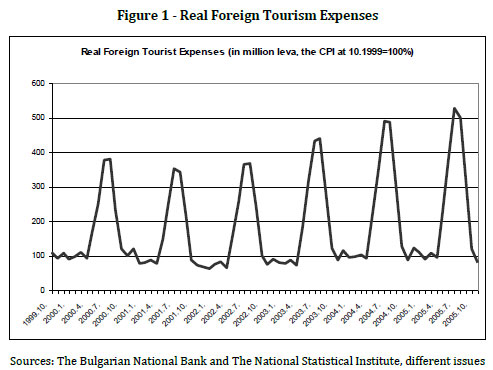
<p><font size="2" face="Verdana">Where ST stands for the supply of tourism services; DT   represents foreign demand; CT is the capacity of the domestic tourism industry   and YF reflects the foreign income. </font></p>     <p><font size="2" face="Verdana">As a result of this formulation, the supply and demand   for tourism services are supposed to depend additionally   on domestic tourist industry capacity and the foreign income level   respectively. The latter two variables can be interpreted as shift parameters,   displacing supply and demand curves.  </font></p>     <p><font size="2" face="Verdana">Since in equilibrium the supply equals demand, we have   two equations, one dependent and three exogenous variables. </font></p>     <p><font size="2" face="Verdana">From the point of view of econometric estimation, the   two simultaneous structural equations system with three instrumental variables   is clearly over identified, so the Ordinary Least Squares (OLS) method is not   applicable (Piganiol, 1978). In this case we can apply the two-stage LS method   (TSLS). </font></p>     <p><font size="2" face="Verdana">Another problem is seasonality. This is particularly   noticeable in the case of foreign tourism earnings, represented in <a href="#f1">Figure 1</a>.   One can easily observe the summer bookings by foreign tourist spending time in   Bulgaria. The seasonal factors seriously worsen the results of econometric   estimation of the relationship between dependent and independent variables.    </font></p>     <p><a name="f1"></a></p>     ]]></body>
<body><![CDATA[<p>&nbsp;</p>     <p align="center"><img src="/img/revistas/tms/v10nespecial/10a22f1.jpg" width="493" height="370"></p>     
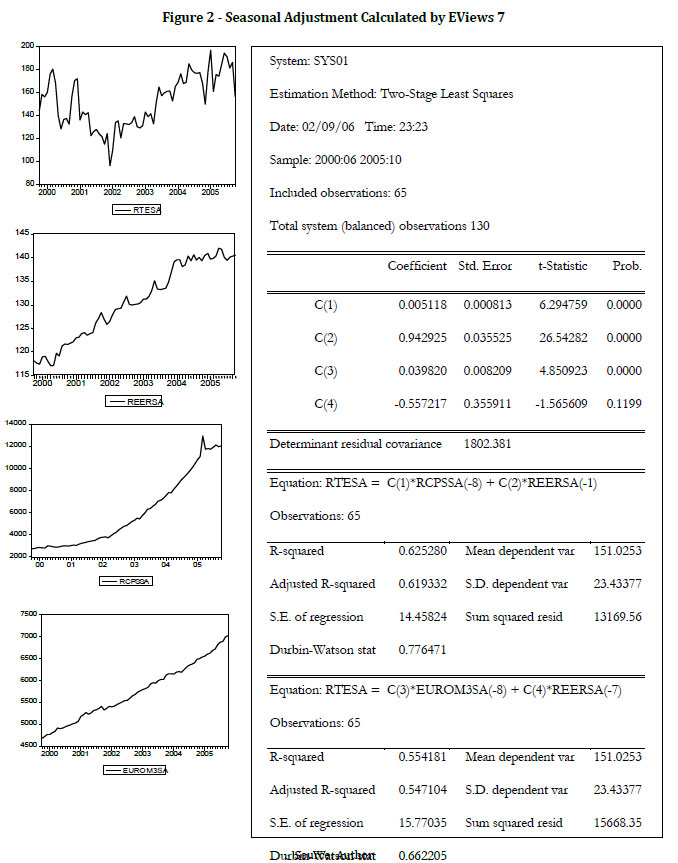
<p>&nbsp;</p>     <p><font size="2" face="Verdana">To resolve this problem, we applied two variants of   seasonal adjustment. The first is based on the method of multiplicative moving   averages. The calculation involves the technique of geometric mean centred   moving average, used by the econometric software package of EViews7. The   results of the seasonal smoothing are presented in <a href="/img/revistas/tms/v10nespecial/10a22f2.jpg">Figure 2</a>. </font></p>     
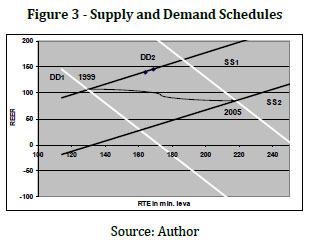
<p><font size="2" face="Verdana"><a href="#f3">Figure 3</a> plots supply and demand schedules based on   the HP filter smoothing estimation (equations <a href="#e6">6</a> and <a href="#e7">7</a>). The SS1 and SS2 lines   stand for supply in 1999 and 2005, while the DD1 and DD2 lines replicate   demand.     </font></p>     <p><a name="f3"></a></p>     <p>&nbsp;</p>     <p align="center"><img src="/img/revistas/tms/v10nespecial/10a22f3.jpg" width="309" height="241"></p>     
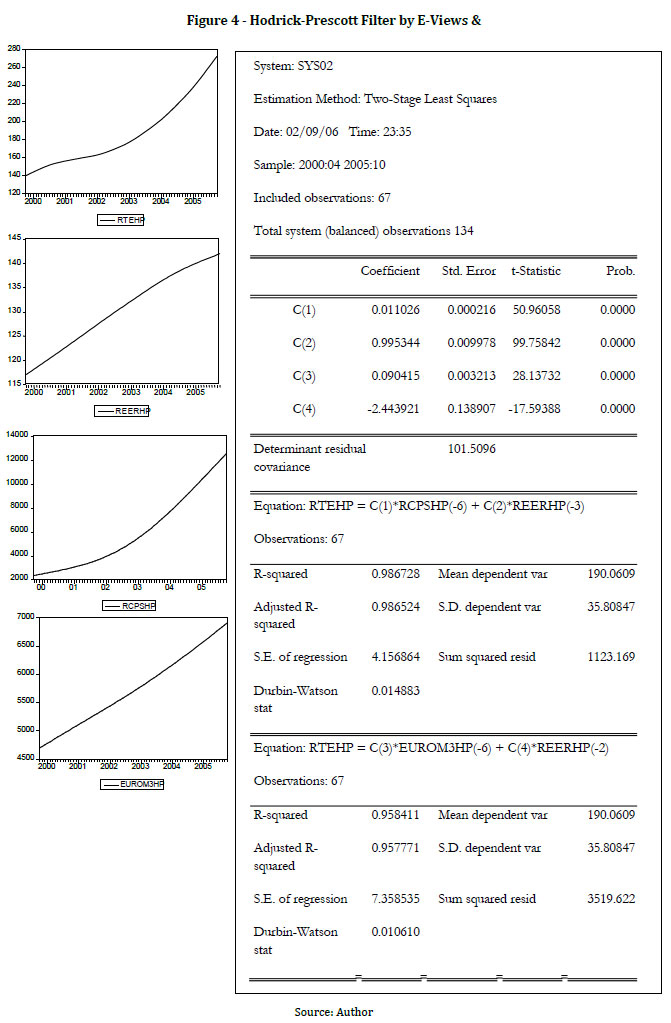
<p>&nbsp;</p>     <p><font size="2" face="Verdana">The second approach exploits the Hodrick-Prescott (HP)   filter (Hodrick and Prescott, 1997). The latter is a two-sided linear filter   that computes smoothed sequences by minimising the series&#8217; variance, subject to   penalty constraints. In our case the penalty parameter ? equals 14400, a level appropriate for monthly data. The results are   presented in graphic form in the <a href="/img/revistas/tms/v10nespecial/10a22f4.jpg">Figure 4</a>. </font></p>     
]]></body>
<body><![CDATA[<p><font size="2" face="Verdana">The difference between the two methods is in the   degree of smoothing. The HP filter allows for much smoother series, suitable   for analysing long term relations but implies additional loss of information. </font></p>     <p><font size="2" face="Verdana">Another problem is the cointegration of series data.   For this purpose we applied Augmented Dickey-Fuller Unit-Root test for all   series drawn in the analysis (Dickey and Fuller, 1979). All the seasonally   adjusted data correspond to an I(1) process, so the   series are of the same order of integration and can be estimated as a system   without additional transformations. </font></p>     <p>&nbsp;</p>     <p><font size="3" face="Verdana"><b>3. Proxies and estimation results</b> </font></p>     <p><font size="2" face="Verdana">Some of the variables from the equations (<a href="#e1">1</a>) and (<a href="#e2">2</a>)   are relatively easy to evaluate. This applies especially to the REER. The data   about the real effective exchange rate is regularly published by the BNB. The   REER calculated by the BNB is based on the CPI index as of the end of period   (BNB1, 2005). The same applies to the data about the real foreign tourist   expenses, respectively the variables ST and DT.  </font></p>     <p><font size="2" face="Verdana">In the same time, it is difficult to obtain data about   the domestic tourism industry capacity and foreign income, especially on a   monthly basis. The natural solution is to look for proxies. </font></p>     <p><font size="2" face="Verdana">To estimate the domestic tourism industry capacity, we   used data about real credit to the private sector as a proxy. Real credit   equals the commercial banking sector lending to the private sector, divided by   the Consumer Price Index (CPI). Real credit to the private sector (the variable   rcps) turns out to be highly correlated with tourism industry performance.  </font></p>     <p><font size="2" face="Verdana">The latter variable is used for the econometric   estimation of two variants. The first is rcpssa &#8211; reflecting seasonally   adjusted data for real credit &#8211; and the second, rcpshp &#8211; standing in for real   credit time series in levels smoothed by the HP filter. This procedure implies,   in principle, a lack of seasonality in the data (Mise, Kim & Newbold,   2003). However, this technique was initially conceived for seasonal adjustment   (Akaike, 1980). In practice, for relatively short periods without pronounced   longer term cycles the HP filter can be applied directly to row data since seasonal movements will behave as short term cycles </font></p>     <p><font size="2" face="Verdana">The same approach is applied to the proxy dealing with   foreign income. The variable used in this case is the M3 money supply in the   eurozone. The latter variable is generally correlated with income growth, on   the one hand, and reflects demand dynamics in the most important economic   region (the EC) for Bulgarian foreign tourist earnings, on the other. The   variable is employed in both seasonally adjusted and filter smoothed variants. </font></p>     <p><font size="2" face="Verdana">The results of the seasonally adjusted econometric   estimation are as follows: </font></p>     ]]></body>
<body><![CDATA[<p><img src="/img/revistas/tms/v10nespecial/10a22e4.jpg" width="376" height="29"></p>     
<p><a name="e5"></a></p>     <p><img src="/img/revistas/tms/v10nespecial/10a22e5.jpg" width="376" height="25"></p>     
<p><font size="2" face="Verdana">The   numbers in brackets display the time lags. All the coefficients are significant   with the exception of the coefficient before REERSA in the equation (<a href="#e5">5</a>). The   absolute ratio between the coefficients, reflecting the impact of price (REER)   on the quantities supplied and demanded respectively (0.993/0.557=1.783) is   obviously higher than one, implying an equilibrium non-convergence property of   the system, according to the elementary rules of partial equilibrium stability dynamics (Ory & Raimbourg, 1995). </font></p>     <p><font size="2" face="Verdana">This   means that the system is not supposed to return to equilibrium if disturbed.   However, since the second coefficient is not significant, we may conjecture   that disequilibrium dynamics are not highly probable. </font></p>     <p><font size="2" face="Verdana">The   filter smoothed variant of the estimation takes the following parameters: </font></p>     <p><a name="e6"></a></p>     <p><img src="/img/revistas/tms/v10nespecial/10a22e6.jpg" width="376" height="25"></p>     

<p><a name="e7"></a></p>     <p><img src="/img/revistas/tms/v10nespecial/10a22e7.jpg" width="376" height="25"></p>     
]]></body>
<body><![CDATA[<p><font size="2" face="Verdana">In this system all the coefficients are significant.   The equilibrium dynamics properties are also different. The absolute level of   the price (REER) related coefficients ratio is less than one   (0.995/2.444=0.407) thus allowing for equilibrium convergence. </font></p>     <p><font size="2" face="Verdana">The equilibrium convergence should not be   overestimated, because it does not preclude overcapacity. In fact an exogenous   decline in demand (provoked by income decline for example) will simply enforce   short run market equilibrium without affecting overcapacity and eventual   accumulation of excessive debt in the tourism industry.  </font></p>     <p><font size="2" face="Verdana">However, if we drop the simplifying assumption about   REER (if the REER does not equal the real tourism services price), then an   enhanced price sensitivity of the tourism sector to excess demand in the market   could insure short-run equilibrium. To illustrate this, we can visualise the   supply and demand interplay. </font></p>     <p><font size="2" face="Verdana">As we can see from this figure, the real equilibrium   level of tourism services, in terms of REER, declines. The main reason for this   is the fast increase in supply. Therefore, we can expect that either the   effective prices declined or that the tourism industry accepted   underutilisation of capacity.  </font></p>     <p><font size="2" face="Verdana">However, we have good reasons to speculate that the   industry could have reached a higher efficiency rank with less investment. </font></p>     <p>&nbsp;</p>     <p><font size="3" face="Verdana"><b>4. Some conclusions about Bulgaria as a foreign tourist destination</b> </font></p>     <p><font size="2" face="Verdana">The above econometric estimation of the partial   equilibrium model allows for some additional conclusions about the Bulgarian   foreign tourist industry. </font></p>     <p><font size="2" face="Verdana">The first conclusion is obvious: the price (REER)   affects the industry&#8217;s dynamics. Since, however, (as one can easily see from   the smoothed series) the REER has a stable upward trend (this trend is   generally not affected by the tourism industry itself), the growth of the   sector cannot be explained by the low (compared to the EU and Russia) price level in Bulgaria. </font></p>     <p><font size="2" face="Verdana">The main driving forces are the tourism industry&#8217;s   building capacity to include increasing leverage on the supply side and regular   income growth in countries which consume Bulgaria&#8217;s tourism services on the   demand side. The model suggests that in 2005 the tourism sector suffered   probably from excess supply and needed lower prices. The deceleration of   tourism industry growth after 2009-2009 may be explained by income growth decline in the EU area. </font></p>     ]]></body>
<body><![CDATA[<p><font size="2" face="Verdana">While the factors affecting the slope of the demand   and supply schedules are in principle of a short-run nature, the time lags are   relatively long &#8211; up to six months. This signifies that price shocks need   fairly long periods to be absorbed. The long delay of demand response can be explained by contracting practices in the international tourism market. </font></p>     <p><font size="2" face="Verdana">The long term (shift) factors (money supply/income and   industry capacity/leverage) have more extended impact periods &#8211; up to eight months. </font></p>     <p><font size="2" face="Verdana">The model does not allow for long term (reflecting   interrelations between demand, tourism industry capacity and labour supply)   equilibrium dynamics research. Nevertheless, we can conjecture that these   relationships probably do not overrule the possibility of overcapacity. </font></p>     <p><font size="2" face="Verdana">The model is based on the idea that consumers of the   tourism industry product are identical and the product is not diversified. The   removal of this constraint would certainty improve the ability of the tourism   industry to adjust to exogenous shocks.  </font></p>     <p><font size="2" face="Verdana">Advertising, product diversification and a diminishing   dependence of the tourism industry on summer bookings will certainly improve   the prospects for foreign tourists if combined with higher price sensitivity. </font></p>     <p><font size="2" face="Verdana">On the other hand, taking into account the important   macroeconomic role of the tourism under the Currency Board Rule, the government   is strongly interested in supporting the tourism industry.  </font></p>     <p><font size="2" face="Verdana">So, as final remark, the tourism sector needs a   complex strategy including appropriate pricing, product strategy, strategic   financing and constructive government support. </font></p>     <p>&nbsp;</p>     <p><font size="3" face="Verdana"><b>References</b> </font></p>     <!-- ref --><p><font size="2" face="Verdana">Akaike   H., (1980). Seasonal Adjustment by a Bayesian Modeling. <i>Journal of Time     Series Analysis</i> 1, 1-13.    &nbsp;&nbsp;&nbsp;&nbsp;&nbsp;&nbsp;&nbsp;&nbsp;[&#160;<a href="javascript:void(0);" onclick="javascript: window.open('/scielo.php?script=sci_nlinks&ref=000102&pid=S2182-8458201400030002200001&lng=','','width=640,height=500,resizable=yes,scrollbars=1,menubar=yes,');">Links</a>&#160;]<!-- end-ref --> </font></p>     <!-- ref --><p><font size="2" face="Verdana">Bulgarian   national bank. Retrieved June 27, 2012 from <a href="http://www.bnb.bg/bnb/home" target="_blank">http://www.bnb.bg/bnb/home</a></font>&nbsp;&nbsp;&nbsp;&nbsp;&nbsp;&nbsp;&nbsp;&nbsp;[&#160;<a href="javascript:void(0);" onclick="javascript: window.open('/scielo.php?script=sci_nlinks&ref=000104&pid=S2182-8458201400030002200002&lng=','','width=640,height=500,resizable=yes,scrollbars=1,menubar=yes,');">Links</a>&#160;]<!-- end-ref --><!-- ref --><p><font size="2" face="Verdana">Bulgarian   national bank, Methodological   Notes on the Calculations of the Nominal and Real Effective Exchange Rates of   Bulgaria. Retrieved June 27, 2012 from <a href="http://www.bnb.bg/bnb/home" target="_blank">http://www.bnb.bg/bnb/home</a></font>&nbsp;&nbsp;&nbsp;&nbsp;&nbsp;&nbsp;&nbsp;&nbsp;[&#160;<a href="javascript:void(0);" onclick="javascript: window.open('/scielo.php?script=sci_nlinks&ref=000105&pid=S2182-8458201400030002200003&lng=','','width=640,height=500,resizable=yes,scrollbars=1,menubar=yes,');">Links</a>&#160;]<!-- end-ref --><!-- ref --><p><font size="2" face="Verdana">Dickey D.A., Fuller   W.A., (1979). Distribution of the Estimators for Autoregressive Time Series   with a Unit Root. <i>Journal of the American     Statistical Association</i>, 74(366), 427-431.    &nbsp;&nbsp;&nbsp;&nbsp;&nbsp;&nbsp;&nbsp;&nbsp;[&#160;<a href="javascript:void(0);" onclick="javascript: window.open('/scielo.php?script=sci_nlinks&ref=000106&pid=S2182-8458201400030002200004&lng=','','width=640,height=500,resizable=yes,scrollbars=1,menubar=yes,');">Links</a>&#160;]<!-- end-ref --> </font></p>     <!-- ref --><p><font size="2" face="Verdana">Durbarry R., (2002). <i>Long Run Structural Tourist Demand Modeling</i>: An Application to   France, TTRI Discussion   Paper 2002/1. Retrieved June 27, 2012 from <a href="http://fama2.us.es:8080/turismo/turismonet1/economia del turismo/demanda turistica/long run structural demand tourism in France.pdf" target="_blank">http://fama2.us.es:8080/turismo/turismonet1/economia%20del%20turismo/demanda%20turistica/long%20run%20structural%20demand%20tourism%20in%20France.pdf</a></font>&nbsp;&nbsp;&nbsp;&nbsp;&nbsp;&nbsp;&nbsp;&nbsp;[&#160;<a href="javascript:void(0);" onclick="javascript: window.open('/scielo.php?script=sci_nlinks&ref=000108&pid=S2182-8458201400030002200005&lng=','','width=640,height=500,resizable=yes,scrollbars=1,menubar=yes,');">Links</a>&#160;]<!-- end-ref --><p><font size="2" face="Verdana">IMF (INTERNATIONAL MONETARY FUND), (2004). <i>Country Report No. 04/177</i>, June 2004.   Retrieved June 27, 2012 from <a href="http://www.imf.org/external/pubs/ft/scr/2004/cr04177.pdf" target="_blank">http://www.imf.org/external/pubs/ft/scr/2004/cr04177.pdf</a></font></p>     <p><font size="2" face="Verdana">Marinov S., (2008). <i>Strategic Goals for Enhancing the Competitiveness of Bulgaria as   Tourist Destination</i>, University of Economics- Varna, November 30, 2008.   Retrieved June 27, 2012 from <a href="http://www.asecu.gr/files/RomaniaProceedings/41.pdf" target="_blank">http://www.asecu.gr/files/RomaniaProceedings/41.pdf</a></font></p>     <!-- ref --><p><font size="2" face="Verdana">Ministry   of Economy and Energy of Bulgaria, <i>Strategy for Improvement of the     Productive Sector</i> (2000-2006). Retrieved June 30, 2012 from <a href="http://old.mee.government.bg/eng/integration/eu/docs.html?id=24321" target="_blank">http://old.mee.government.bg/eng/integration/eu/docs.html&#8204;id=24321</a> </font>&nbsp;&nbsp;&nbsp;&nbsp;&nbsp;&nbsp;&nbsp;&nbsp;[&#160;<a href="javascript:void(0);" onclick="javascript: window.open('/scielo.php?script=sci_nlinks&ref=000111&pid=S2182-8458201400030002200008&lng=','','width=640,height=500,resizable=yes,scrollbars=1,menubar=yes,');">Links</a>&#160;]<!-- end-ref --><!-- ref --><p><font size="2" face="Verdana">Mise E., Kim T.H., Newbold P., (2003). <i>The Hodrick-Prescott Filter at Time Series   Endpoints</i>, University of Nottingham, Discussion Papers in Economics,   Discussion Paper No 03/08. Retrieved June 30, 2012 from <a href="http://www.econbiz.de/Record/the-hodrick-prescott-filter-at-time-series-endpoints-mise-emi/10001766035" target="_blank">http://www.econbiz.de/Record/the-hodrick-prescott-filter-at-time-series-endpoints-mise-emi/10001766035</a></font>&nbsp;&nbsp;&nbsp;&nbsp;&nbsp;&nbsp;&nbsp;&nbsp;[&#160;<a href="javascript:void(0);" onclick="javascript: window.open('/scielo.php?script=sci_nlinks&ref=000112&pid=S2182-8458201400030002200009&lng=','','width=640,height=500,resizable=yes,scrollbars=1,menubar=yes,');">Links</a>&#160;]<!-- end-ref --><!-- ref --><p><font size="2" face="Verdana">Hodrick R.J. And   Prescott E.C., (1997). Postwar U.S. Business Cycles: An Empirical   Investigation, <i>Journal of Money</i>, Credit, and Banking, 29(1), 1&#8211;16.    &nbsp;&nbsp;&nbsp;&nbsp;&nbsp;&nbsp;&nbsp;&nbsp;[&#160;<a href="javascript:void(0);" onclick="javascript: window.open('/scielo.php?script=sci_nlinks&ref=000113&pid=S2182-8458201400030002200010&lng=','','width=640,height=500,resizable=yes,scrollbars=1,menubar=yes,');">Links</a>&#160;]<!-- end-ref --> </font></p>     <!-- ref --><p><font size="2" face="Verdana">Ory J-N & Raimbourg   Ph., (1995). <i>Microeconomie</i>.   Levallois-Perret, France: BREAL.    &nbsp;&nbsp;&nbsp;&nbsp;&nbsp;&nbsp;&nbsp;&nbsp;[&#160;<a href="javascript:void(0);" onclick="javascript: window.open('/scielo.php?script=sci_nlinks&ref=000115&pid=S2182-8458201400030002200011&lng=','','width=640,height=500,resizable=yes,scrollbars=1,menubar=yes,');">Links</a>&#160;]<!-- end-ref --> </font></p>     <!-- ref --><p><font size="2" face="Verdana">Pineda E., Cashin P.,   Sun Y., (2009). <i>Assessing Exchange Rate Competitiveness in the     Eastern Caribbean Currency Union</i>, IMF,   WP/09/78. Retrieved June 29, 2012 from <a href="https://www.imf.org/external/pubs/ft/wp/2009/wp0978.pdf" target="_blank">https://www.imf.org/external/pubs/ft/wp/2009/wp0978.pdf</a></font>&nbsp;&nbsp;&nbsp;&nbsp;&nbsp;&nbsp;&nbsp;&nbsp;[&#160;<a href="javascript:void(0);" onclick="javascript: window.open('/scielo.php?script=sci_nlinks&ref=000117&pid=S2182-8458201400030002200012&lng=','','width=640,height=500,resizable=yes,scrollbars=1,menubar=yes,');">Links</a>&#160;]<!-- end-ref --><!-- ref --><p><font size="2" face="Verdana">Piganiol   B., (1978). <i>Statistique et Econom&#233;trie</i>,   Dalloz: Paris.    &nbsp;&nbsp;&nbsp;&nbsp;&nbsp;&nbsp;&nbsp;&nbsp;[&#160;<a href="javascript:void(0);" onclick="javascript: window.open('/scielo.php?script=sci_nlinks&ref=000118&pid=S2182-8458201400030002200013&lng=','','width=640,height=500,resizable=yes,scrollbars=1,menubar=yes,');">Links</a>&#160;]<!-- end-ref --> </font></p>     <!-- ref --><p><font size="2" face="Verdana">Schmitz   M., De Clercq M., Fidora M., Lauro B., Pinheiro C. (2012<i>).  Revisiting     of the Effective Exchange Rates of the Euro</i>, European Central Bank, Occasional Papers, No   134/June, 2012. Retrieved June 30, 2012 from <a href="http://www.ecb.europa.eu/pub/pdf/scpops/ecbocp134.pdf" target="_blank">http://www.ecb.europa.eu/pub/pdf/scpops/ecbocp134.pdf</a></font>&nbsp;&nbsp;&nbsp;&nbsp;&nbsp;&nbsp;&nbsp;&nbsp;[&#160;<a href="javascript:void(0);" onclick="javascript: window.open('/scielo.php?script=sci_nlinks&ref=000120&pid=S2182-8458201400030002200014&lng=','','width=640,height=500,resizable=yes,scrollbars=1,menubar=yes,');">Links</a>&#160;]<!-- end-ref --><!-- ref --><p><font size="2" face="Verdana">Tribe J. (2011). <i>The Economics of Recreation, Leisure and Tourism</i>.   Oxford: Butterworth-Heinemann.    &nbsp;&nbsp;&nbsp;&nbsp;&nbsp;&nbsp;&nbsp;&nbsp;[&#160;<a href="javascript:void(0);" onclick="javascript: window.open('/scielo.php?script=sci_nlinks&ref=000121&pid=S2182-8458201400030002200015&lng=','','width=640,height=500,resizable=yes,scrollbars=1,menubar=yes,');">Links</a>&#160;]<!-- end-ref --> </font></p>     ]]></body>
<body><![CDATA[<!-- ref --><p><font size="2" face="Verdana">TSE R.Y.C. (2001).   Estimating the Impact of Economic Factors on Tourism: Evidence from Hong-Kong. <i>Tourism Economics</i>, 7(3), 277&#8211;293.    &nbsp;&nbsp;&nbsp;&nbsp;&nbsp;&nbsp;&nbsp;&nbsp;[&#160;<a href="javascript:void(0);" onclick="javascript: window.open('/scielo.php?script=sci_nlinks&ref=000123&pid=S2182-8458201400030002200016&lng=','','width=640,height=500,resizable=yes,scrollbars=1,menubar=yes,');">Links</a>&#160;]<!-- end-ref --> </font></p>     <p>&nbsp;</p>     <p>&nbsp;</p>     <p><font size="2" face="Verdana"><b>Article history    <br> </b><b>Submitted:</b>  30 June 2013    <br>     <b>Accepted:</b> 2 November 2013</font></p>      ]]></body><back>
<ref-list>
<ref id="B1">
<nlm-citation citation-type="journal">
<person-group person-group-type="author">
<name>
<surname><![CDATA[Akaike]]></surname>
<given-names><![CDATA[H.]]></given-names>
</name>
</person-group>
<article-title xml:lang="en"><![CDATA[Seasonal Adjustment by a Bayesian Modeling]]></article-title>
<source><![CDATA[Journal of Time Series Analysis]]></source>
<year>1980</year>
<volume>1</volume>
<numero>1-13</numero>
<issue>1-13</issue>
</nlm-citation>
</ref>
<ref id="B2">
<nlm-citation citation-type="">
<collab>Bulgarian national bank</collab>
<source><![CDATA[]]></source>
<year></year>
</nlm-citation>
</ref>
<ref id="B3">
<nlm-citation citation-type="">
<collab>Bulgarian national bank</collab>
<source><![CDATA[Methodological Notes on the Calculations of the Nominal and Real Effective Exchange Rates of Bulgaria]]></source>
<year></year>
</nlm-citation>
</ref>
<ref id="B4">
<nlm-citation citation-type="journal">
<person-group person-group-type="author">
<name>
<surname><![CDATA[Dickey]]></surname>
<given-names><![CDATA[D.A.]]></given-names>
</name>
<name>
<surname><![CDATA[Fuller]]></surname>
<given-names><![CDATA[W.A.]]></given-names>
</name>
</person-group>
<article-title xml:lang="en"><![CDATA[Distribution of the Estimators for Autoregressive Time Series with a Unit Root]]></article-title>
<source><![CDATA[Journal of the American Statistical Association]]></source>
<year>1979</year>
<volume>74</volume>
<numero>366</numero>
<issue>366</issue>
<page-range>427-431</page-range></nlm-citation>
</ref>
<ref id="B5">
<nlm-citation citation-type="">
<person-group person-group-type="author">
<name>
<surname><![CDATA[Durbarry]]></surname>
<given-names><![CDATA[R.]]></given-names>
</name>
</person-group>
<source><![CDATA[Long Run Structural Tourist Demand Modeling: An Application to France]]></source>
<year>2002</year>
</nlm-citation>
</ref>
<ref id="B6">
<nlm-citation citation-type="">
<collab>IMF (INTERNATIONAL MONETARY FUND)</collab>
<source><![CDATA[Country Report]]></source>
<year>2004</year>
</nlm-citation>
</ref>
<ref id="B7">
<nlm-citation citation-type="">
<person-group person-group-type="author">
<name>
<surname><![CDATA[Marinov]]></surname>
<given-names><![CDATA[S.]]></given-names>
</name>
</person-group>
<source><![CDATA[Strategic Goals for Enhancing the Competitiveness of Bulgaria as Tourist Destination]]></source>
<year>2008</year>
</nlm-citation>
</ref>
<ref id="B8">
<nlm-citation citation-type="">
<collab>Ministry of Economy and Energy of Bulgaria</collab>
<source><![CDATA[Strategy for Improvement of the Productive Sector (2000-2006)]]></source>
<year></year>
</nlm-citation>
</ref>
<ref id="B9">
<nlm-citation citation-type="">
<person-group person-group-type="author">
<name>
<surname><![CDATA[Mise]]></surname>
<given-names><![CDATA[E.]]></given-names>
</name>
<name>
<surname><![CDATA[Kim]]></surname>
<given-names><![CDATA[T.H.]]></given-names>
</name>
<name>
<surname><![CDATA[Newbold]]></surname>
<given-names><![CDATA[P.]]></given-names>
</name>
</person-group>
<source><![CDATA[The Hodrick-Prescott Filter at Time Series Endpoints]]></source>
<year>2003</year>
</nlm-citation>
</ref>
<ref id="B10">
<nlm-citation citation-type="journal">
<person-group person-group-type="author">
<name>
<surname><![CDATA[Hodrick]]></surname>
<given-names><![CDATA[R.J.]]></given-names>
</name>
<name>
<surname><![CDATA[Prescott]]></surname>
<given-names><![CDATA[E.C.]]></given-names>
</name>
</person-group>
<article-title xml:lang="en"><![CDATA[Postwar U.S. Business Cycles: An Empirical Investigation]]></article-title>
<source><![CDATA[Journal of Money, Credit, and Banking]]></source>
<year>1997</year>
<volume>29</volume>
<numero>1</numero>
<issue>1</issue>
<page-range>1-16</page-range></nlm-citation>
</ref>
<ref id="B11">
<nlm-citation citation-type="book">
<person-group person-group-type="author">
<name>
<surname><![CDATA[Ory]]></surname>
<given-names><![CDATA[J-N]]></given-names>
</name>
<name>
<surname><![CDATA[Raimbourg]]></surname>
<given-names><![CDATA[Ph.]]></given-names>
</name>
</person-group>
<source><![CDATA[Microeconomie]]></source>
<year>1995</year>
<publisher-loc><![CDATA[Levallois-Perret ]]></publisher-loc>
<publisher-name><![CDATA[BREAL]]></publisher-name>
</nlm-citation>
</ref>
<ref id="B12">
<nlm-citation citation-type="">
<person-group person-group-type="author">
<name>
<surname><![CDATA[Pineda]]></surname>
<given-names><![CDATA[E.]]></given-names>
</name>
<name>
<surname><![CDATA[Cashin]]></surname>
<given-names><![CDATA[P.]]></given-names>
</name>
<name>
<surname><![CDATA[Sun]]></surname>
<given-names><![CDATA[Y.]]></given-names>
</name>
</person-group>
<source><![CDATA[Assessing Exchange Rate Competitiveness in the Eastern Caribbean Currency Union]]></source>
<year>2009</year>
</nlm-citation>
</ref>
<ref id="B13">
<nlm-citation citation-type="book">
<person-group person-group-type="author">
<name>
<surname><![CDATA[Piganiol]]></surname>
<given-names><![CDATA[B.]]></given-names>
</name>
</person-group>
<source><![CDATA[Statistique et Econométrie]]></source>
<year>1978</year>
<publisher-loc><![CDATA[Paris ]]></publisher-loc>
<publisher-name><![CDATA[Dalloz]]></publisher-name>
</nlm-citation>
</ref>
<ref id="B14">
<nlm-citation citation-type="">
<person-group person-group-type="author">
<name>
<surname><![CDATA[Schmitz]]></surname>
<given-names><![CDATA[M.]]></given-names>
</name>
<name>
<surname><![CDATA[De Clercq]]></surname>
</name>
<name>
<surname><![CDATA[Fidora]]></surname>
<given-names><![CDATA[M.]]></given-names>
</name>
<name>
<surname><![CDATA[Lauro]]></surname>
<given-names><![CDATA[B.]]></given-names>
</name>
<name>
<surname><![CDATA[Pinheiro]]></surname>
<given-names><![CDATA[C.]]></given-names>
</name>
</person-group>
<source><![CDATA[Revisiting of the Effective Exchange Rates of the Euro]]></source>
<year>2012</year>
</nlm-citation>
</ref>
<ref id="B15">
<nlm-citation citation-type="book">
<person-group person-group-type="author">
<name>
<surname><![CDATA[Tribe]]></surname>
<given-names><![CDATA[J.]]></given-names>
</name>
</person-group>
<source><![CDATA[The Economics of Recreation, Leisure and Tourism]]></source>
<year>2011</year>
<publisher-loc><![CDATA[Oxford ]]></publisher-loc>
<publisher-name><![CDATA[Butterworth-Heinemann]]></publisher-name>
</nlm-citation>
</ref>
<ref id="B16">
<nlm-citation citation-type="journal">
<person-group person-group-type="author">
<name>
<surname><![CDATA[TSE]]></surname>
<given-names><![CDATA[R.Y.C.]]></given-names>
</name>
</person-group>
<article-title xml:lang="en"><![CDATA[Estimating the Impact of Economic Factors on Tourism: Evidence from Hong-Kong]]></article-title>
<source><![CDATA[Tourism Economics]]></source>
<year>2001</year>
<volume>7</volume>
<numero>3</numero>
<issue>3</issue>
<page-range>277-293</page-range></nlm-citation>
</ref>
</ref-list>
</back>
</article>