<?xml version="1.0" encoding="ISO-8859-1"?><article xmlns:mml="http://www.w3.org/1998/Math/MathML" xmlns:xlink="http://www.w3.org/1999/xlink" xmlns:xsi="http://www.w3.org/2001/XMLSchema-instance">
<front>
<journal-meta>
<journal-id>2182-8458</journal-id>
<journal-title><![CDATA[Tourism & Management Studies]]></journal-title>
<abbrev-journal-title><![CDATA[TMStudies]]></abbrev-journal-title>
<issn>2182-8458</issn>
<publisher>
<publisher-name><![CDATA[Escola Superior de Gestão, Hotelaria e Turismo da Universidade do Algarve]]></publisher-name>
</publisher>
</journal-meta>
<article-meta>
<article-id>S2182-84582015000100001</article-id>
<title-group>
<article-title xml:lang="en"><![CDATA[Strategies for writing a research paper]]></article-title>
<article-title xml:lang="pt"><![CDATA[Estratégias para escrever um artigo de investigação]]></article-title>
</title-group>
<contrib-group>
<contrib contrib-type="author">
<name>
<surname><![CDATA[Santos]]></surname>
<given-names><![CDATA[Jose António C.]]></given-names>
</name>
</contrib>
<contrib contrib-type="author">
<name>
<surname><![CDATA[Santos]]></surname>
<given-names><![CDATA[Margarida Custódio]]></given-names>
</name>
</contrib>
</contrib-group>
<aff id="A">
<institution><![CDATA[,  ]]></institution>
<addr-line><![CDATA[ ]]></addr-line>
</aff>
<pub-date pub-type="pub">
<day>31</day>
<month>01</month>
<year>2015</year>
</pub-date>
<pub-date pub-type="epub">
<day>31</day>
<month>01</month>
<year>2015</year>
</pub-date>
<volume>11</volume>
<numero>1</numero>
<fpage>7</fpage>
<lpage>13</lpage>
<copyright-statement/>
<copyright-year/>
<self-uri xlink:href="http://scielo.pt/scielo.php?script=sci_arttext&amp;pid=S2182-84582015000100001&amp;lng=en&amp;nrm=iso"></self-uri><self-uri xlink:href="http://scielo.pt/scielo.php?script=sci_abstract&amp;pid=S2182-84582015000100001&amp;lng=en&amp;nrm=iso"></self-uri><self-uri xlink:href="http://scielo.pt/scielo.php?script=sci_pdf&amp;pid=S2182-84582015000100001&amp;lng=en&amp;nrm=iso"></self-uri></article-meta>
</front><body><![CDATA[ <p align="right"><font size="2" face="Verdana"><b>EDITORS  NOTES</b></b></font></p>     <p align="right">&nbsp;</p>     <p><font size="4" face="Verdana"><b>Strategies for writing a research paper</b></font></p>     <p>&nbsp;</p>     <p><font size="3" face="Verdana"><b>Estratégias para escrever um artigo de investigação</b></font></p>     <p>&nbsp;</p>     <p>&nbsp;</p>     <p><font size="2" face="Verdana"><b>Jose António C. Santos; Margarida Custódio Santos</b></font></p>     <p>&nbsp;</p>     <p><font size="3" face="Verdana"><b>1.&nbsp;&nbsp;&nbsp;&nbsp;&nbsp;&nbsp; Introduction</b></font></p>     ]]></body>
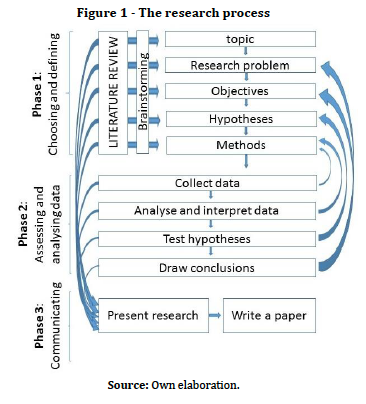
<body><![CDATA[<p><font size="3" face="Verdana"></font><font size="2" face="Verdana">Writing and   publishing good research papers is essential for many reasons: not only   advancing researchers’ academic careers but above all for disseminating   research findings and advancing the state of empirical knowledge. In addition,   publications are a measure of the academic productivity needed for promotion.   Another reason is that most researchers become experts in a given research   area, and they are recognised as such by their peers when they contribute   actively to the literature, helping to advance the state of empirical knowledge (El-Serag, 2006).</font></p>     <p><font size="2" face="Verdana">Research is not   complete until results have been published, especially in the case of publicly   funded research (Audisio et al., 2009; Davidson &amp; Delbridge, 2011).   Conversely, a track record of prior publications is essential for any competitive grant application (El-Serag, 2006).</font></p>     <p><font size="2" face="Verdana">Publishing the   best possible research papers is also the main goal of journal editors, who   value papers of interest to their readership that show originality, importance,   clear research questions, correct methods and excellent style (Johnson, 2008).   When evaluating your research, editors consider whether your paper, if   published in their journal, is likely to be heavily cited, thus enhancing the   standing and reputation of their journal (Davidson &amp; Delbridge, 2011).   Editors and reviewers spend hours reading manuscripts and greatly appreciate   receiving papers that are easy to read and edit. They dislike long, wordy   papers in a poor style with conclusions not justified by data, showing an   inability to follow the ‘authors’ guidelines’ and containing careless, sloppy mistakes (Johnson, 2008).</font></p>     <p><font size="2" face="Verdana">In point of   fact, most submitted papers need substantial improvements before they can be   published, and, unfortunately, many of them get rejected because they do not   fulfil basic conditions for publication. Therefore, this paper seeks to provide   some basic strategies for writing research papers and help especially novel   researchers to improve papers before submitting them to journals. Sharing   thoughts and experiences is the very essence of academic activities, and this   can be quite rewarding if it substantially contributes to improving researchers’ chances of publishing results. </font></p>     <p>&nbsp;</p>     <p><b><font size="3" face="Verdana">2. The research process</font></b></p>     <p><font size="2" face="Verdana">A paper is the   outcome of three different processes: research, writing and publication.   Although this paper focuses on the writing process, it is important to   understand the processes that you need to follow before and after writing. A   good paper is the outcome of well-conducted research, careful writing and successful publication processes. </font></p>     <p><font size="2" face="Verdana">The research   process is, in most cases, the implementation of a previously designed research   plan. As shown in <a href="#f1">Figure 1</a>, the research process is divided into three phases,   each one comprising several steps. Phase one, choosing and defining, is   theoretical or conceptual and based on a literature review. In this phase, you   choose and define the fundamentals of your research: topic, research problem,   objectives, hypotheses and methods. Much search, brainstorming and adaptation   may be necessary during this phase. Regardless, you should not go on to the   next phase &#8211; for instance, collecting data &#8211; before making the right decisions regarding research problem, objectives, hypotheses and methods.</font></p>     <p>&nbsp;</p>     <p><a name="f1"></a></p>     ]]></body>
<body><![CDATA[<p align="center"> <img src="/img/revistas/tms/v11n1/11n1a01f1.jpg" width="366" height="404"></p>     
<p>&nbsp;</p>     <p><font size="2" face="Verdana">Phase two,   assessing and analysing data, is empirical, as well as analytical, and it deals   with data collection, processing, analysis and interpretation. Hypotheses are   tested, and conclusions are drawn in order to address the research problem and objectives of the study.</font></p>     <p><font size="2" face="Verdana">Phase three   deals with ‘communicating’ your research. This is the time to communicate your   findings to the research community. There are several ways of doing this,   including writing a report, making a presentation in a conference or writing a paper. </font></p>     <p>&nbsp;</p>     <p><b><font size="3" face="Verdana">3. &nbsp;&nbsp;&nbsp;&nbsp;&nbsp; The writing process</font></b></p>     <p><font size="2" face="Verdana">Ideally, you   should start the writing process as a logical consequence of the research   process. As a matter of course, during the research process, you produce drafts   of your research methodology and findings that you now need to transform into a   paper. The following sections provide some strategies that may help you to   convert your research into a well-written and appropriately structured paper. <a href="#f2">Figure 2</a> shows a chart of this process. </font></p>     <p>&nbsp;</p>     <p><a name="f2"></a></p>     <p align="center"> <img src="/img/revistas/tms/v11n1/11n1a01f2.jpg" width="364" height="293"></p>     
]]></body>
<body><![CDATA[<p>&nbsp;</p>     <p><font size="3" face="Verdana"><b><font size="2">3.1 &nbsp;&nbsp;&nbsp; Follow the journal’s guidelines</font></b></font></p>     <p><font size="2" face="Verdana">It is strongly   advised that, before you start writing your paper, you decide which is your   target journal (Rosenfeldt, Dowling, Pepe &amp; Fullerton, 2000; Johnson, 2011;   Saper, 2014). Then read carefully the ‘journal guidelines’ or ‘authors’   guidelines’ provided by that journal (Chiswick, 2004; Johnson, 2008; Davidson   &amp; Delbridge, 2011). The reason for this is that you need to adapt your paper   to the journal guidelines from the very beginning because these deal with   content and form, therefore affecting the entire paper and making it a   difficult task to adapt to the journal’s norms after the paper is written. By   following guidelines appropriate to your type of study, you are likely to   improve your paper and thus increase your chances of being published (Davidson   &amp; Delbridge, 2011). On the contrary, submitting papers without following journal guidelines dramatically increases the possibility of rejection. </font></p>     <p><font size="2" face="Verdana">Besides   following the guidelines closely, reading some papers in your target journal   also gives you an idea of the structure, norms and general organisation of   papers approved for that journal. Another advantage is to identify the research   interests of editors and the research areas of recently approved papers (Saper, 2014). </font></p>     <p><font size="2" face="Verdana">In the case of   the <i>Tourism &amp; Management Studies</i>   journal the guidelines provide information about length of papers (6,000   words), abstracts (150 words) and keywords (5 words), as well as structure   (introduction, methodology, results, discussion, conclusions and references), citation style and organisation of the list of references (APA style). </font></p>     <p><b><font size="2" face="Verdana">3.2 &nbsp;&nbsp;&nbsp; Use an adequate paper structure</font></b></p>     <p><font size="2" face="Verdana">An appropriate   paper structure is a fundamental tool for developing and presenting research,   and it makes it easier for readers to understand the content of papers. This   can vary in small ways depending on the research field and journal guidelines,   but it is commonly accepted that research papers should have a title, abstract   and keywords and be divided into sections, including introduction, methods,   results and discussion, conclusions and references (Rosenfeldt et al., 2000;   Chiswick, 2004; Børresen, 2013). <i>Tourism   &amp; Management Studies</i>’ editors prefer to include results and discussion   in the same section. There must be a logical and understandable link between   sections (Chiswick, 2004; Andonie &amp; Dzitac, 2010) in such a way that all   sections &#8211; as indispensable parts of the whole &#8211; communicate with   each other and contribute to the unity and internal consistency of the paper. A   logical flow must exist not only from section to section but also from   paragraph to paragraph and from sentence to sentence (Andonie &amp; Dzitac, 2010). Each element of a paper’s structure is analysed and discussed below. </font></p>     <p><b><font size="2" face="Verdana"><i>3.2.1 &nbsp;&nbsp;&nbsp; Title</i></font></b></p>     <p><font size="2" face="Verdana">According to   El-Serag (2006), ‘The title should be informative and specific to the study,   and should contain key elements that advertise the paper’s contents. The use of   subtitles allows the insertion of additional information’ (p. 20). Choosing a   good title and subtitle is fundamental for a paper’s success, as they are the   first elements to catch the attention of editors and readers, and they tell   them what the paper is all about. This first contact with the topic of the   paper determines if the paper falls within the scope of the journal or the   readers’ interests, and it is decisive in their immediate decision to dedicate   some time to exploring or reading it. Through the title and subtitle, it is   also possible to deduce what type of paper it is and whether its topic is   attractive to a broad audience, for instance, if it is a theoretical paper, an   empirical or theoretical and empirical paper or a case study. Purely   theoretical papers have a higher rejection rate, unless the authors truly   innovate and firmly ground their theories. Quite often, case studies have an   extremely high rejection rate because they have validity only within restricted contexts, and they are not attractive enough to reach a broad, international audience. </font></p>     <p><font size="2" face="Verdana">Titles (and   subtitles) should address the content of the paper and be short, simple, easy   to understand and attractive to the paper’s audience. It is important that   titles contain some strong keywords dealing with the content of the papers, to   ensure that the titles are detected by fellow researchers searching literature databases (Davidson &amp; Delbridge, 2011).</font></p>     ]]></body>
<body><![CDATA[<p><font size="2" face="Verdana"><b><i>3.2.2 &nbsp;&nbsp;&nbsp; Affiliation</i></b></font></p>     <p><font size="2" face="Verdana">Next follows   the affiliation of all authors. Journals have different requirements regarding   the affiliation, but authors’ names, universities and faculties or schools,   countries and e-mails are common. Some journals also demand degrees and   telephone and fax numbers of authors. In the case of the <i>Tourism &amp; Management Studies</i> journal, the information regarding   affiliation should be as follows for each author: name, university, faculty or   school, department/research centre, postal code, city, country and e-mail   address. In the case of the corresponding author, the complete mail address must be added.</font></p>     <p><font size="2" face="Verdana">The inclusion   of this information is extremely important for the indexation process of the   SciELO Citation Index/Web of Science, including the attribution of empirical   production to the correct institutions, research centres and countries of   publication. For publication purposes, authors need to use always exactly the   same name without any variations from paper to paper, otherwise the indexing   machines will treat these as different names (even with the slightest   variation) belonging to different authors. The same applies to the names of institutions. </font></p>     <p><font size="2" face="Verdana">Authors should   submit two versions of their paper: a DV version (director version) with the   full affiliation of authors and an RV version (review version) without the   affiliation or any other information regarding the authors. Make sure that   direct identifiers are removed from the data (Davidson &amp; Delbridge, 2011)   and properties of the Word document. This is important for the implementation of blind refereeing, which obviously means the authors must be kept anonymous.</font></p>     <p><font size="2" face="Verdana">Concerning   research, teamwork is preferable to individual work, and journals usually   prefer papers with multiple authors, especially teams involving different nationalities. </font></p>     <p><font size="2" face="Verdana"><b><i>3.2.3 &nbsp;&nbsp;&nbsp; Abstract</i></b> </font></p>     <p><font size="2" face="Verdana">The function of   the abstract is to give a quick overview of the contents of the paper. The   abstract is the only part of the manuscript read by the vast majority of   readers (El-Serag, 2006; Audisio et al., 2009; Shidham, Path, Pitman &amp;   DeMay, 2012), and, through it, the reader decides if it is worth reading the   entire paper. According to Andonie and Dzitac (2010), an abstract should be   concise and include motivation, problem statement, approach, results and   conclusions. In the <i>Tourism &amp;   Management Studies</i> editors’&nbsp;   view, objectives also need to be stated clearly, and all key information   must be included. For Johnson (2008), an abstract should be structured per the   specific journal’s format within the word limit, without acronyms and   abbreviations. The word limit for abstracts varies from journal to journal,   usually from 150 to 250 words, so it is important to adapt the abstract to the target journal’s guidelines for structure and length. </font></p>     <p><font size="2" face="Verdana">Together with   the title and keywords, the abstract should be written last to make sure that   it includes the most important aspects of the study. These three parts of the   paper are strongly interconnected, and they reflect the ability of the   researchers to concentrate the key aspects of their study into a limited number of words. </font></p>     <p><font size="2" face="Verdana"><i><b>3.2.4 &nbsp;&nbsp;&nbsp; Keywords</b></i> </font></p>     <p><font size="2" face="Verdana">Keywords are   usually limited to five basic pieces of information containing one or more   words, and they need to be carefully chosen in order to include the very   essence of the paper. Keywords are fundamental elements for the dissemination   of your research, as strong keywords enhance the likelihood that your paper will   be retrieved by a search engine out of the huge number of published papers,   when someone searches for a specific topic using a keyword (Audisio et al., 2009).</font></p>     ]]></body>
<body><![CDATA[<p><font size="2" face="Verdana"><i><b>3.2.5 &nbsp;&nbsp;&nbsp; Introduction</b></i> </font></p>     <p><font size="2" face="Verdana">Some authors   write the introduction at an early stage as a guideline to the further   development of the paper. In this case, they need to review this section and   make all necessary changes when the rest of the paper is ready. Others prefer   to write the introduction in the final stages of the paper. Davidson and   Delbridge (2011) succinctly explain some of the most important aspects of this section: </font></p>     <p><font size="2" face="Verdana">The purpose of   the introduction is to explain to the reader what the research question is, how   it is original, how it is important and succinctly outline how the study   intends to answer it. It is critical that the paper starts with a brief   introduction to the topic, which clearly describes how and why the research   question has arisen. Provide adequate background information using relevant   literature to acquaint readers with the topic but do not include a detailed   literature review. Explicitly state the importance of your research as the   reader may not necessarily make the leap in logic that is obvious to you. The   introduction should end with the aims being clearly stated. If the study is addressing a hypothesis, then the hypothesis should be stated here too (pp. 62&#8211;63).</font></p>     <p><font size="2" face="Verdana">This quotation contains all the basic elements of the introduction, of   which the most important are contextualisation, originality, research question,   importance of research, objectives and hypotheses. The originality, or ‘How   does your research add to the literature?’ (Audisio et al., 2009), is   fundamental, as in most cases it determines if your paper is worth sending on   to be reviewed or not. It can be seen as the added value that your paper brings   to the stock of knowledge in a given research field. The research question   &#8211; which, in the opinion of Davidson and Delbridge (2011), constitutes the   core of the paper &#8211; needs to be formulated in the introduction and must be robust and well defined (Davidson &amp; Delbridge, 2011). </font></p>     <p><font size="2" face="Verdana">As the   introduction is critical to attracting the readers’ attention, it should   consist of short sentences (Shidham et al., 2012) and be brief, coherent,   logical and stimulating &#8211; but not confusing to the reader &#8211; as well   as creating a receptive mood (Chiswick, 2004). Concerning length, a typical introduction does not exceed one or two pages.</font></p>     <p><font size="2" face="Verdana"><b><i>3.2.6 &nbsp;&nbsp;&nbsp; Literature review</i></b> </font></p>     <p><font size="2" face="Verdana">Reviewing what   others have written on your topic is a fundamental step in any research, and it serves a number of purposes: </font></p> <ul>       <li><font size="2" face="Verdana">Identifying what has already been     done and has contributed significantly to your topic;</font></li>       <li><font size="2" face="Verdana">Identifying what still needs to be     done in order to justify the originality and importance of your research;</font></li>       <li><font size="2" face="Verdana">Establishing links between your     research and the most relevant research on the topic (i.e. by comparing your     study to previous research, you can point out similarities and contradictions);</font></li>       ]]></body>
<body><![CDATA[<li><font size="2" face="Verdana">Defining relevant concepts for your     study;</font></li>       <li><font size="2" face="Verdana">Identifying relevant theories,     research designs, approaches and methods used in the study of similar research     problems that can be appropriate for your study.</font></li>     </ul>     <p><font size="2" face="Verdana">The literature   review needs to be the first step of your research because, without it, you   cannot prove the originality and appropriateness of your study. However, one   thing is reviewing the literature for an academic dissertation and another is   presenting a literature review in a paper. In the latter case, it must be brief   and contain only the most relevant references, especially the most updated ones &#8211; to satisfy some or all purposes mentioned above.</font></p>     <p><font size="2" face="Verdana">Sometimes a   paper is based on a research project (for instance a dissertation) finished   some years ago, and it does not use references from the last three or four   years. Of course, depending on the research area, references thus are outdated,   which is a possible reason for rejection. To avoid this situation, you must update your references before submitting your paper.</font></p>     <p><font size="2" face="Verdana"><i><b>3.2.7 &nbsp;&nbsp;&nbsp; Methods</b></i></font></p>     <p><font size="2" face="Verdana">This is the   most important section of any research paper because it determines the   empirical validity of the study. Methodologies need to explain how results were   obtained, and they should allow a researcher in that field to repeat the study (Saper, 2014). </font></p>     <p><font size="2" face="Verdana">Editors or   reviewers reject papers when they consider that the research methods used are   not appropriate or not strong enough. For the <i>Tourism &amp; Management Studies</i> journal, methodologies are given   first-class status, and any paper is rejected that does not use proper methods   (at least in the reviewers and editors’ opinion) in answering the research   question and accomplishing its objectives. While there may be an opportunity to   re-analyse the results, perhaps using more appropriate statistical tests, the methods   cannot be changed without re-doing the research: what is done is done   (Chiswick, 2004). You need to write about the methods in the past tense with   adequate detail to repeat the study design and validate results (Johnson,   2008). Provide details of the selection and description of study participants,   data collection processes and methods used in analyses. When in doubt, provide more (rather than fewer) details (El-Serag, 2006).</font></p>     <p><font size="2" face="Verdana">Any research   problem to be solved needs appropriate methods, depending on the topic and   research field. In some cases, qualitative research methods may be adequate,   while in other cases, quantitative methods are required. Another possibility is to use a combination of methods.</font></p>     <p><font size="2" face="Verdana">Qualitative   research methods are traditionally used in social sciences, and they use   smaller samples aimed at achieving an in-depth understanding of human   behaviour. The most common is interviews, which can be structured,   semi-structured or unstructured. These data samples do not allow extrapolation   to entire populations, but they can be important in formulating hypotheses that   can be tested in another step using quantitative data. In fact, qualitative and   quantitative methods are quite compatible, and they can be used in mixed-method   approaches. Triangulation is the use of a combination of two or more research   methods in the study of the same phenomenon in order to validate data through   cross verification and to enhance confidence in results. In most cases, this is the preferred methodology in social sciences.</font></p>     ]]></body>
<body><![CDATA[<p><font size="2" face="Verdana">When using   quantitative methods, you need to explain the size of the sample of the   statistical population under study and the procedures for selecting this   sample. Specify if the sample is statistically representative, allowing   inferences from the sample to the general population. You should use   appropriate methods to calculate ideal sample sizes. When you cannot work with   a random sample, you need to work with a sample that is as representative as   possible: the more representative, the better. One strong reason for rejecting   a paper is if editors or reviewers consider that the sample used is not ideal.   In this case, the validity of the study is restricted to the group of individuals who constitute the sample.</font></p>     <p><font size="2" face="Verdana">A pilot test is   quite important for evaluating feasibility and making all necessary corrections   or improvements to surveys, before you carry out any large-scale quantitative   research. At least one of the authors needs to have an in-depth knowledge of   research methods and statistics. When applicable, it is important to enlist the   help of a statistician at the outset to determine sample size, power analysis and appropriate statistical methods (Johnson, 2008).</font></p>     <p><font size="2" face="Verdana"><b><i>3.2.8 &nbsp;&nbsp;&nbsp; Discussion of results (or findings)</i></b></font></p>     <p><font size="2" face="Verdana">The results   section is a critical part of the manuscript (Shidham et al., 2012). The   presentation of results is the outcome of the application of methods to primary   or secondary research resources. Some basic rules can help you to present your results in the best possible way:</font></p> <ul>       <li><font size="2" face="Verdana"> Interpret results and their implications,     instead of simply presenting them in a descriptive way; </font></li>       <li><font size="2" face="Verdana"> Use primary data, which is more     relevant than secondary data;</font></li>       <li><font size="2" face="Verdana"> Use a combination of text and visual     aids such as graphs, tables or figures &#8211; these need to be well designed     in order to make sure the reader understands the results more easily.     Presenting the data in graphs has the advantage of clarity and impact, and it     can bring out relationships between various parameters (Rosenfeldt et al.,     2000);</font></li>       <li><font size="2" face="Verdana"> Keep graphs (or other visual aids)     simple (Rosenfeldt et al., 2000);</font></li>       <li><font size="2" face="Verdana"> Do not repeat information presented     in tables and figures in the text (El-Serag, 2006); instead, analyse data in     qualitative terms without being repetitive (Davidson &amp; Delbridge, 2011); </font></li>       <li><font size="2" face="Verdana"> Check that tables, graphs and     figures are correctly labelled with numbers and titles and that they are cited     in the previous paragraph; make sure that you indicate the source of your data;</font></li>       ]]></body>
<body><![CDATA[<li><font size="2" face="Verdana"> Write results in the past tense, in     a logical sequence (Johnson, 2008);</font></li>       <li><font size="2" face="Verdana"> Match the arrangement of data to the     methodology and communicate as much information as is relevant (Shidham et al.,     2012); </font></li>       <li><font size="2" face="Verdana"> Do not omit unexpected results or     results that do not satisfy your hypotheses; report them and discuss your     analysis (Davidson &amp; Delbridge, 2011); </font></li>       <li><font size="2" face="Verdana">Avoid abbreviations if possible, but     define them if used (Shidham et al., 2012);</font></li>       <li><font size="2" face="Verdana">When using quantitative methods,     first present results of descriptive analyses, followed by results of     inferential analyses (Fortin, 1999).</font></li>     </ul>     <p><font size="2" face="Verdana"><b><i>3.2.9 &nbsp;&nbsp;&nbsp; Conclusions</i></b></font></p>     <p><font size="2" face="Verdana">The conclusions   section is the most important part of your paper and the one that readers   remember best. You have the chance to say the last word on your subject and leave a good final impression of your research. </font></p>     <p><font size="2" face="Verdana">Here are important rules to follow in the conclusions section:</font></p> <ul>       <li><font size="2" face="Verdana"> Link your conclusions with the     introduction &#8211; conclusions must have a direct relationship to the     objectives stated in the beginning of the paper and answer the research     question(s) and objectives, as well as confirm or refute hypotheses; </font></li>       ]]></body>
<body><![CDATA[<li><font size="2" face="Verdana"> Compare your conclusions to previous     research and point out implications and contributions of your paper to     advancing knowledge in your field of research; </font></li>       <li><font size="2" face="Verdana"> Avoid any repetition of results     presented in the previous section and any ambiguity or speculation;</font></li>       <li><font size="2" face="Verdana"> Make your conclusions solid,     synthetic, brief, clear and convincing;</font></li>       <li><font size="2" face="Verdana"> Explain study limitations and make     recommendations for future research.</font></li>     </ul>     <p><font size="2" face="Verdana"><i><b>3.2.10  References</b></i></font></p>     <p><font size="2" face="Verdana">You need to   structure the list of references according to your target journal’s guidelines.   This is one of the sections that require the most attention and control by   editors and the one that usually presents the highest number of inaccuracies.   Authors and journals cannot publish papers with missing or incomplete references without compromising their reputation. </font></p>     <p><font size="2" face="Verdana">There are   different styles for organising and presenting references. The most common in   social sciences is probably the APA style. If you cannot afford to buy the   Publication Manual of the American Psychological Association (the most accurate   and complete document on the subject), it is advisable to check out materials   on APA style guides that are available on the Internet. In organising your list of references, here are some important rules to follow:</font></p> <ul>       <li><font size="2" face="Verdana"> Follow journal guidelines;</font></li>       <li><font size="2" face="Verdana"> Include only references cited within     the text;</font></li>       ]]></body>
<body><![CDATA[<li><font size="2" face="Verdana"> Double-check references for     accuracy:</font></li>       <li><font size="2" face="Verdana"> Ensure that all information in the     references list is complete and accurate (Davidson &amp; Delbridge, 2011);</font></li>     </ul>     <p>&nbsp;</p>     <p><font size="3" face="Verdana"><b>4. &nbsp;&nbsp;&nbsp;&nbsp;&nbsp; Style matters:   Use adequate academic writing</b></font></p>     <p><font size="2" face="Verdana">Writing a paper   using adequate academic writing involves many rules, and it is an extremely   challenging task. To start with, you need to ensure you have relevant findings   to communicate to readers. In fact, it is with the readers in mind that you   have to find the best possible way of communicating your findings and   arguments. Readers should be able to read and understand your paper without   much effort (Gerstein, 2013). The following guidelines from different authors can help you to find the most adequate academic writing style for your paper: </font></p> <ul>       <li><font size="2" face="Verdana"> Use sentences that are short, clear     and direct; use&nbsp; formal and     carefully structured wording and make sure the subject of each sentence appears     early in the sentence (Fahy, 2008); </font></li>       <li><font size="2" face="Verdana"> Do not insert large chunks of     information between subjects and verbs (Chiswick, 2004);</font></li>       <li><font size="2" face="Verdana"> Make your ideas clear and your     arguments easy to follow (Fahy, 2008);</font></li>       <li><font size="2" face="Verdana"> Ensure that the information you wish     to emphasise comes at the end of each sentence or clause (Chiswick, 2004);</font></li>       ]]></body>
<body><![CDATA[<li><font size="2" face="Verdana"> Avoid repetition, wordiness, long     sentences and excessive adverbs and adjectives (Johnson, 2008);</font></li>       <li><font size="2" face="Verdana"> Select, in general, for ‘active’     rather than ‘passive voice’ in verbs (Fahy, 2008) since the active voice is     more concise and crisp (Johnson, 2008);</font></li>       <li><font size="2" face="Verdana"> Utilise the spell-check function in     your word processing programme (Davidson &amp; Delbridge, 2011);</font></li>       <li><font size="2" face="Verdana"> Write to enhance the elements of     careful word choice: clarity, simplicity and accuracy &#8211; clarity means     choosing the simplest and most accurate word to express each idea; accuracy     means choosing the precise word to express what you mean; clarity is improved     if, once having chosen a precise word, you use the same word consistently     throughout and do not substitute inexact synonyms (Fahy, 2008);</font></li>       <li><font size="2" face="Verdana"> Double-check grammar, style,     spelling and references; shorten and cut down your paper at every chance,     editing for crispness, with a focus on accuracy, clarity and brevity (Johnson,     2008);</font></li>       <li><font size="2" face="Verdana"> Ensure you use research terminology     correctly; do not confuse or misuse terms (Davidson &amp; Delbridge, 2011);</font></li>       <li><font size="2" face="Verdana">Turn long paragraphs into short     paragraphs, long sentences into short sentences and long words into short words     (Davidson &amp; Delbridge, 2011).</font></li>     </ul>     <p>&nbsp;</p>     <p><font size="3" face="Verdana"><b>5. &nbsp;&nbsp;&nbsp;&nbsp;&nbsp; Revision and   proofreading</b> </font></p>     ]]></body>
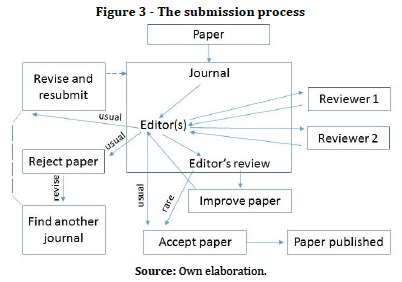
<body><![CDATA[<p><font size="2" face="Verdana">When your paper   is complete, revise it thoroughly and make all necessary changes. If multiple authors   sign the work, all of them should revise the entire paper and not only their   contributions. A complete paper needs to be subjected to multiple revisions before submission. </font></p>     <p><font size="2" face="Verdana">If English is   the intended language of your paper and it is not your mother tongue, you will   need translation or proofreading services provided by a native speaker with   skills in academic writing (Børresen, 2013). In this situation, some journals demand a proofreading certificate.</font></p>     <p>&nbsp;</p>     <p><font size="3" face="Verdana"><b>6. &nbsp;&nbsp;&nbsp;&nbsp;&nbsp; The submission   process</b></font></p>     <p><font size="2" face="Verdana">Having a good   research paper that complies with your target journal’s guidelines is only the first step of the submission process, as shown in <a href="#f3">Figure 3</a>.</font></p>     <p>&nbsp;</p>      <p><a name="f3"></a></p>     <p align="center"> <img src="/img/revistas/tms/v11n1/11n1a01f3.jpg" width="402" height="282"></p>     
<p>&nbsp;</p>     <p><font size="2" face="Verdana">Most journals   require a confirmation that your paper is original and that it has not been   submitted to other journals at the same time. As mentioned earlier, in order to   implement the double-blind review process, journals need an RV version without   identification of the authors. After submission, the editors make a first   evaluation of if the paper fits in the scope of the journal and complies with   journal rules. If this is not the case or if the editors find any other obvious   reason to refuse publication, the paper is immediately rejected. Otherwise, the   editors send the RV version to two reviewers who are experts in the paper’s   topic. If the paper has a strong statistical component, at least one of the   reviewers must be an expert in the methods used. Each reviewer evaluates the   paper according to different parameters and sends a report back to the editors.   To give an example from the <i>Tourism &amp;   Management Studies</i> journal, the parameters evaluated by the reviewers on a   scale from 1 (very weak) to 5 (excellent) include importance of the topic and   innovativeness of the research, objectives, literature review, methods,   results, structure, academic writing and contributions to the field. If the   editors decide to reject the paper, it cannot be submitted later to the same   journal. If the decision is ‘revise and resubmit’, you can revise the paper   according to the suggestions of the reviewers and resubmit it to the same   journal. Another option is for you to use the feedback of the reviewers to   improve your paper and submit it to another journal. Any paper selected for   publication needs to be reviewed by the editors after receiving the peer   reviewers’ evaluations. Acceptance without suggestions for improvements by the   reviewers and editors is nearly impossible. The most usual process is that the   editors send the reviewers’ suggestions and their own suggestions for improving   the paper to the authors. In this case, the authors need to revise the paper   along the lines suggested by the editors and reviewers and send the paper back   to the editors along with an improvements report. Normally, the editors accept the paper for publication if suggestions have been successfully implemented.</font></p>     ]]></body>
<body><![CDATA[<p>&nbsp;</p>     <p><font size="3" face="Verdana"><b>7. &nbsp;&nbsp;&nbsp;&nbsp;&nbsp; Concluding remarks</b></font></p>     <p><font size="2" face="Verdana">Preparing a   research paper for publication requires methodical work that involves three   processes, each one with exact rules and steps. Provided you have done solid   research, it is quite important to adopt strategies that will increase the   likelihood that your paper gets accepted for publication. Our main purpose was   to explain these strategies in order to help authors to write good research papers.</font></p>     <p><font size="2" face="Verdana">Many authors   have addressed the topic of writing good papers. However, we believe this paper contributes to the literature by:</font></p> <ul>       <li><font size="2" face="Verdana"> Presenting strategies based on a     combination of our experience as journal editors and the existing literature</font></li>       <li><font size="2" face="Verdana"> Integrating the writing process into     a broader context together with the research and publication processes</font></li>       <li><font size="2" face="Verdana"> Developing our own models of these     processes to represent the processes in charts </font></li>       <li><font size="2" face="Verdana"> Writing a paper can be a wonderful     and rewarding experience, especially when you see your first, or next, paper     published. </font></li>     </ul>     <p>&nbsp;</p>     ]]></body>
<body><![CDATA[<p>&nbsp;</p>     <p><font size="3" face="Verdana"><b>References</b></font></p>     <!-- ref --><p><font size="2" face="Verdana">Andonie, R. &amp; Dzitac I. (2010). How   to write a good paper in computer science and how will it be measured by ISI   Web of Knowledge. <i>International Journal of Computers, Communications &amp; Control</i>, <i>5</i>(4), 432&#8211;446.    &nbsp;&nbsp;&nbsp;&nbsp;&nbsp;&nbsp;&nbsp;&nbsp;[&#160;<a href="javascript:void(0);" onclick="javascript: window.open('/scielo.php?script=sci_nlinks&ref=000145&pid=S2182-8458201500010000100001&lng=','','width=640,height=500,resizable=yes,scrollbars=1,menubar=yes,');">Links</a>&#160;]<!-- end-ref --></font></p>     <!-- ref --><p><font size="2" face="Verdana">Audisio, R. A., Rolf, A., Stahel, R. A.,   Matti, S., Aapro, M. S., Costa, A., Pandey, M. &amp; Pavlidis, N. (2009).   Successful publishing: How to get your paper accepted. <i>Surgical Oncology</i>, <i>18</i>, 350&#8211;356.    &nbsp;&nbsp;&nbsp;&nbsp;&nbsp;&nbsp;&nbsp;&nbsp;[&#160;<a href="javascript:void(0);" onclick="javascript: window.open('/scielo.php?script=sci_nlinks&ref=000147&pid=S2182-8458201500010000100002&lng=','','width=640,height=500,resizable=yes,scrollbars=1,menubar=yes,');">Links</a>&#160;]<!-- end-ref --></font></p>     <!-- ref --><p><font size="2" face="Verdana">Børresen, T. (2013). How to write a good   scientific paper. <i>Journal of Aquatic Food     Product Technology</i>, <i>22</i>, 435&#8211;435. doi: 10.1080/10498850.2013.827558</font>&nbsp;&nbsp;&nbsp;&nbsp;&nbsp;&nbsp;&nbsp;&nbsp;[&#160;<a href="javascript:void(0);" onclick="javascript: window.open('/scielo.php?script=sci_nlinks&ref=000149&pid=S2182-8458201500010000100003&lng=','','width=640,height=500,resizable=yes,scrollbars=1,menubar=yes,');">Links</a>&#160;]<!-- end-ref --><!-- ref --><p><font size="2" face="Verdana">Chiswick, M. (2004). Writing a research paper. <i>Current Paediatrics</i>, <i>14</i>, 513&#8211;518.    &nbsp;&nbsp;&nbsp;&nbsp;&nbsp;&nbsp;&nbsp;&nbsp;[&#160;<a href="javascript:void(0);" onclick="javascript: window.open('/scielo.php?script=sci_nlinks&ref=000150&pid=S2182-8458201500010000100004&lng=','','width=640,height=500,resizable=yes,scrollbars=1,menubar=yes,');">Links</a>&#160;]<!-- end-ref --></font></p>     <!-- ref --><p><font size="2" face="Verdana">Davidson, A. &amp; Delbridge, E. (2011).   How to write a research paper. <i>Paediatrics     and Child Health</i>, <i>22</i>(2), 61&#8211;65.    &nbsp;&nbsp;&nbsp;&nbsp;&nbsp;&nbsp;&nbsp;&nbsp;[&#160;<a href="javascript:void(0);" onclick="javascript: window.open('/scielo.php?script=sci_nlinks&ref=000152&pid=S2182-8458201500010000100005&lng=','','width=640,height=500,resizable=yes,scrollbars=1,menubar=yes,');">Links</a>&#160;]<!-- end-ref --></font></p>     <!-- ref --><p><font size="2" face="Verdana">El-Serag, H. B. (2006). Scientific   manuscripts: The fun of writing and submitting. <i>Gastrointestinal Endoscopy</i>, <i>64</i>(6), 19&#8211;22.    &nbsp;&nbsp;&nbsp;&nbsp;&nbsp;&nbsp;&nbsp;&nbsp;[&#160;<a href="javascript:void(0);" onclick="javascript: window.open('/scielo.php?script=sci_nlinks&ref=000154&pid=S2182-8458201500010000100006&lng=','','width=640,height=500,resizable=yes,scrollbars=1,menubar=yes,');">Links</a>&#160;]<!-- end-ref --></font></p>     <!-- ref --><p><font size="2" face="Verdana">Fahy, K. (2008). Writing for publication: the basics. <i>Women and Birth</i>, <i>21</i>, 86&#8211;91.    &nbsp;&nbsp;&nbsp;&nbsp;&nbsp;&nbsp;&nbsp;&nbsp;[&#160;<a href="javascript:void(0);" onclick="javascript: window.open('/scielo.php?script=sci_nlinks&ref=000156&pid=S2182-8458201500010000100007&lng=','','width=640,height=500,resizable=yes,scrollbars=1,menubar=yes,');">Links</a>&#160;]<!-- end-ref --></font></p>     <!-- ref --><p><font size="2" face="Verdana">Fortin, M.-F. (1999). <i>O processo de investigação: da concepção à   realização</i>. Loures: Lusociência.    &nbsp;&nbsp;&nbsp;&nbsp;&nbsp;&nbsp;&nbsp;&nbsp;[&#160;<a href="javascript:void(0);" onclick="javascript: window.open('/scielo.php?script=sci_nlinks&ref=000158&pid=S2182-8458201500010000100008&lng=','','width=640,height=500,resizable=yes,scrollbars=1,menubar=yes,');">Links</a>&#160;]<!-- end-ref --></font></p>     <!-- ref --><p><font size="2" face="Verdana">Gerstein, H. (2013). Writing science that   your colleagues can read. <i>Journal of     Diabetes and Its Complications</i>, <i>28</i>, 4&#8211;5.    &nbsp;&nbsp;&nbsp;&nbsp;&nbsp;&nbsp;&nbsp;&nbsp;[&#160;<a href="javascript:void(0);" onclick="javascript: window.open('/scielo.php?script=sci_nlinks&ref=000160&pid=S2182-8458201500010000100009&lng=','','width=640,height=500,resizable=yes,scrollbars=1,menubar=yes,');">Links</a>&#160;]<!-- end-ref --></font></p>     <!-- ref --><p><font size="2" face="Verdana">Johnson, T. M. (2008). Tips on how to   write a paper. <i>Journal of the American Academy of Dermatology</i>, <i>59</i>(6), 1064&#8211;1069. doi:10.1016/j.jaad.2008.07.007</font>&nbsp;&nbsp;&nbsp;&nbsp;&nbsp;&nbsp;&nbsp;&nbsp;[&#160;<a href="javascript:void(0);" onclick="javascript: window.open('/scielo.php?script=sci_nlinks&ref=000162&pid=S2182-8458201500010000100010&lng=','','width=640,height=500,resizable=yes,scrollbars=1,menubar=yes,');">Links</a>&#160;]<!-- end-ref --><!-- ref --><p><font size="2" face="Verdana">Rosenfeldt, F. L., Dowling, J. T., Pepe, S. &amp; Fullerton, M. J. (2000). How to write a paper for publication. <i>Heart, Lung and Circulation</i>, <i>9</i>, 82&#8211;87.    &nbsp;&nbsp;&nbsp;&nbsp;&nbsp;&nbsp;&nbsp;&nbsp;[&#160;<a href="javascript:void(0);" onclick="javascript: window.open('/scielo.php?script=sci_nlinks&ref=000163&pid=S2182-8458201500010000100011&lng=','','width=640,height=500,resizable=yes,scrollbars=1,menubar=yes,');">Links</a>&#160;]<!-- end-ref --></font></p>     <!-- ref --><p><font size="2" face="Verdana">Saper, C. B. (2014). Academic publishing,   part III: how to write a research paper (so that it will be accepted) in a   high-quality journal. <i>Annals of Neurology</i>, <i>77</i>(1), 8&#8211;12.    &nbsp;&nbsp;&nbsp;&nbsp;&nbsp;&nbsp;&nbsp;&nbsp;[&#160;<a href="javascript:void(0);" onclick="javascript: window.open('/scielo.php?script=sci_nlinks&ref=000165&pid=S2182-8458201500010000100012&lng=','','width=640,height=500,resizable=yes,scrollbars=1,menubar=yes,');">Links</a>&#160;]<!-- end-ref --></font></p>     <!-- ref --><p><font size="2" face="Verdana">Shidham, V. B., Path, F. R. C., Pitman,   M. B. &amp; DeMay, R. M (2012). How to write an article: Preparing a   publishable manuscript! <i>CytoJournal</i>, <i>9</i>(1), 1&#8211;12. doi: 10.4103/1742-6413.92545.    &nbsp;&nbsp;&nbsp;&nbsp;&nbsp;&nbsp;&nbsp;&nbsp;[&#160;<a href="javascript:void(0);" onclick="javascript: window.open('/scielo.php?script=sci_nlinks&ref=000167&pid=S2182-8458201500010000100013&lng=','','width=640,height=500,resizable=yes,scrollbars=1,menubar=yes,');">Links</a>&#160;]<!-- end-ref --></font></p>      ]]></body><back>
<ref-list>
<ref id="B1">
<nlm-citation citation-type="journal">
<person-group person-group-type="author">
<name>
<surname><![CDATA[Andonie]]></surname>
<given-names><![CDATA[R.]]></given-names>
</name>
<name>
<surname><![CDATA[Dzitac]]></surname>
<given-names><![CDATA[I.]]></given-names>
</name>
</person-group>
<article-title xml:lang="en"><![CDATA[How to write a good paper in computer science and how will it be measured by ISI Web of Knowledge]]></article-title>
<source><![CDATA[International Journal of Computers, Communications & Control]]></source>
<year>2010</year>
<volume>5</volume>
<numero>4</numero>
<issue>4</issue>
<page-range>432-446</page-range></nlm-citation>
</ref>
<ref id="B2">
<nlm-citation citation-type="journal">
<person-group person-group-type="author">
<name>
<surname><![CDATA[Audisio]]></surname>
<given-names><![CDATA[R. A.]]></given-names>
</name>
<name>
<surname><![CDATA[Rolf]]></surname>
<given-names><![CDATA[A.]]></given-names>
</name>
<name>
<surname><![CDATA[Stahel]]></surname>
<given-names><![CDATA[R. A.]]></given-names>
</name>
<name>
<surname><![CDATA[Matti]]></surname>
<given-names><![CDATA[S.]]></given-names>
</name>
<name>
<surname><![CDATA[Aapro]]></surname>
<given-names><![CDATA[M. S.]]></given-names>
</name>
<name>
<surname><![CDATA[Costa]]></surname>
<given-names><![CDATA[A.]]></given-names>
</name>
<name>
<surname><![CDATA[Pandey]]></surname>
<given-names><![CDATA[M.]]></given-names>
</name>
<name>
<surname><![CDATA[Pavlidis]]></surname>
<given-names><![CDATA[N.]]></given-names>
</name>
</person-group>
<article-title xml:lang="en"><![CDATA[Successful publishing: How to get your paper accepted]]></article-title>
<source><![CDATA[Surgical Oncology]]></source>
<year>2009</year>
<numero>18</numero>
<issue>18</issue>
<page-range>350-356</page-range></nlm-citation>
</ref>
<ref id="B3">
<nlm-citation citation-type="journal">
<person-group person-group-type="author">
<name>
<surname><![CDATA[Børresen]]></surname>
<given-names><![CDATA[T.]]></given-names>
</name>
</person-group>
<article-title xml:lang="en"><![CDATA[How to write a good scientific paper]]></article-title>
<source><![CDATA[Journal of Aquatic Food Product Technology]]></source>
<year>2013</year>
<numero>22</numero>
<issue>22</issue>
<page-range>435-435</page-range></nlm-citation>
</ref>
<ref id="B4">
<nlm-citation citation-type="journal">
<person-group person-group-type="author">
<name>
<surname><![CDATA[Chiswick]]></surname>
<given-names><![CDATA[M.]]></given-names>
</name>
</person-group>
<article-title xml:lang="en"><![CDATA[Writing a research paper]]></article-title>
<source><![CDATA[Current Paediatrics]]></source>
<year>2004</year>
<numero>14</numero>
<issue>14</issue>
<page-range>513-518</page-range></nlm-citation>
</ref>
<ref id="B5">
<nlm-citation citation-type="journal">
<person-group person-group-type="author">
<name>
<surname><![CDATA[Davidson]]></surname>
<given-names><![CDATA[A.]]></given-names>
</name>
<name>
<surname><![CDATA[Delbridge]]></surname>
<given-names><![CDATA[E.]]></given-names>
</name>
</person-group>
<article-title xml:lang="en"><![CDATA[How to write a research paper]]></article-title>
<source><![CDATA[Paediatrics and Child Health]]></source>
<year>2011</year>
<volume>22</volume>
<numero>2</numero>
<issue>2</issue>
<page-range>61-65</page-range></nlm-citation>
</ref>
<ref id="B6">
<nlm-citation citation-type="journal">
<person-group person-group-type="author">
<name>
<surname><![CDATA[El-Serag]]></surname>
<given-names><![CDATA[H. B.]]></given-names>
</name>
</person-group>
<article-title xml:lang="en"><![CDATA[Scientific manuscripts: The fun of writing and submitting]]></article-title>
<source><![CDATA[Gastrointestinal Endoscopy]]></source>
<year>2006</year>
<volume>64</volume>
<numero>6</numero>
<issue>6</issue>
<page-range>19-22</page-range></nlm-citation>
</ref>
<ref id="B7">
<nlm-citation citation-type="journal">
<person-group person-group-type="author">
<name>
<surname><![CDATA[Fahy]]></surname>
<given-names><![CDATA[K.]]></given-names>
</name>
</person-group>
<article-title xml:lang="en"><![CDATA[Writing for publication: the basics]]></article-title>
<source><![CDATA[Women and Birth]]></source>
<year>2008</year>
<numero>21</numero>
<issue>21</issue>
<page-range>86-91</page-range></nlm-citation>
</ref>
<ref id="B8">
<nlm-citation citation-type="book">
<person-group person-group-type="author">
<name>
<surname><![CDATA[Fortin]]></surname>
<given-names><![CDATA[M.-F.]]></given-names>
</name>
</person-group>
<source><![CDATA[O processo de investigação: da concepção à realização]]></source>
<year>1999</year>
<publisher-loc><![CDATA[Loures ]]></publisher-loc>
<publisher-name><![CDATA[Lusociência]]></publisher-name>
</nlm-citation>
</ref>
<ref id="B9">
<nlm-citation citation-type="journal">
<person-group person-group-type="author">
<name>
<surname><![CDATA[Gerstein]]></surname>
<given-names><![CDATA[H.]]></given-names>
</name>
</person-group>
<article-title xml:lang="en"><![CDATA[Writing science that your colleagues can read]]></article-title>
<source><![CDATA[Journal of Diabetes and Its Complications]]></source>
<year>2013</year>
<numero>28</numero>
<issue>28</issue>
<page-range>4-5</page-range></nlm-citation>
</ref>
<ref id="B10">
<nlm-citation citation-type="journal">
<person-group person-group-type="author">
<name>
<surname><![CDATA[Johnson]]></surname>
<given-names><![CDATA[T. M.]]></given-names>
</name>
</person-group>
<article-title xml:lang="en"><![CDATA[Tips on how to write a paper]]></article-title>
<source><![CDATA[Journal of the American Academy of Dermatology]]></source>
<year>2008</year>
<volume>59</volume>
<numero>6</numero>
<issue>6</issue>
<page-range>1064-1069</page-range></nlm-citation>
</ref>
<ref id="B11">
<nlm-citation citation-type="journal">
<person-group person-group-type="author">
<name>
<surname><![CDATA[Rosenfeldt]]></surname>
<given-names><![CDATA[F. L.]]></given-names>
</name>
<name>
<surname><![CDATA[Dowling]]></surname>
<given-names><![CDATA[J. T.]]></given-names>
</name>
<name>
<surname><![CDATA[Pepe]]></surname>
<given-names><![CDATA[S.]]></given-names>
</name>
<name>
<surname><![CDATA[Fullerton]]></surname>
<given-names><![CDATA[M. J.]]></given-names>
</name>
</person-group>
<article-title xml:lang="en"><![CDATA[How to write a paper for publication]]></article-title>
<source><![CDATA[Heart, Lung and Circulation]]></source>
<year>2000</year>
<numero>9</numero>
<issue>9</issue>
<page-range>82-87</page-range></nlm-citation>
</ref>
<ref id="B12">
<nlm-citation citation-type="journal">
<person-group person-group-type="author">
<name>
<surname><![CDATA[Saper]]></surname>
<given-names><![CDATA[C. B.]]></given-names>
</name>
</person-group>
<article-title xml:lang="en"><![CDATA[Academic publishing, part III: how to write a research paper (so that it will be accepted) in a high-quality journal]]></article-title>
<source><![CDATA[Annals of Neurology]]></source>
<year>2014</year>
<volume>77</volume>
<numero>1</numero>
<issue>1</issue>
<page-range>8-12</page-range></nlm-citation>
</ref>
<ref id="B13">
<nlm-citation citation-type="journal">
<person-group person-group-type="author">
<name>
<surname><![CDATA[Shidham]]></surname>
<given-names><![CDATA[V. B.]]></given-names>
</name>
<name>
<surname><![CDATA[Path]]></surname>
<given-names><![CDATA[F. R. C.]]></given-names>
</name>
<name>
<surname><![CDATA[Pitman]]></surname>
<given-names><![CDATA[M. B.]]></given-names>
</name>
<name>
<surname><![CDATA[DeMay]]></surname>
<given-names><![CDATA[R. M]]></given-names>
</name>
</person-group>
<article-title xml:lang="en"><![CDATA[How to write an article: Preparing a publishable manuscript!]]></article-title>
<source><![CDATA[CytoJournal]]></source>
<year>2012</year>
<volume>9</volume>
<numero>1</numero>
<issue>1</issue>
<page-range>1-12</page-range></nlm-citation>
</ref>
</ref-list>
</back>
</article>