Host-tourist interaction and impact of tourism on residents’ Quality of Life
Interação residente-visitante e impacte do turismo na Qualidade de Vida dos residentes
Maria João Carneiro1; Celeste Eusébio2
1University of Aveiro, Department of Economics, Management and Industrial Engineering (DEGEI), Researcher at the Governance, Competitiveness and Public Policies (GOVCOPP) Research Unit of the University of Aveiro, DEGEI – Universidade de Aveiro, 3810-193 Aveiro, Portugal, mjcarneiro@ua.pt
2University of Aveiro, Department of Economics, Management and Industrial Engineering (DEGEI), Researcher at the Governance, Competitiveness and Public Policies (GOVCOPP) Research Unit of the University of Aveiro, DEGEI – Universidade de Aveiro, 3810-193 Aveiro, Portugal, celeste.eusebio@ua.pt
ABSTRACT
This paper analyses the relationship between host-tourist interactions and residents’ perceptions of tourism impacts on their QOL. A survey of residents in two Portuguese beach communities was conducted. Two PCAs were used to identify dimensions of host-tourist interaction and QOL domains. Furthermore, an importance-perceived impact analysis and Paired t-tests were carried out to identify gaps between the levels of importance that residents attribute to several domains of their QOL and their perceptions of tourism impacts in these QOL domains. Correlation tests were used to find statistical significant associations between host-tourist interaction dimensions and residents’ QOL domains. Results suggest that the interaction between residents and visitors in these destinations is low and very superficial, gaps between importance and tourism impacts emerged in several domains of residents’ QOL and there is a positive relationship between host–tourist interactions and residents’ perceptions of tourism impacts on several domains of their QOL. The paper ends with some theoretical and practical implications.
Keywords: Residents’ QOL, tourism, host-tourist interactions, gaps, beach tourism destinations.
RESUMO
Este artigo analisa a relação entre as interações residente-visitante e as perceções dos residentes sobre os impactes do turismo na sua Qualidade de Vida (QV). Foi realizado um inquérito aos residentes de duas comunidades costeiras portuguesas. Para identificar as dimensões da interação residente-visitante e do impacte do turismo na QV, foram utilizadas duas Análises de Componentes Principais (ACP). Adicionalmente, para identificar os gaps existentes entre os níveis de importância que os residentes atribuem às diversas dimensões da QV e as suas perceções sobre os impactes do turismo nessas dimensões da QV, foram também realizadas uma análise importância-impacte percebido e testes t para amostras emparelhadas. Foram, igualmente, utilizados testes de correlação para identificar associações estatisticamente significativas entre as dimensões da interação residente-visitante e os domínios da QV dos residentes. Os resultados obtidos sugerem que a interação residente-visitante nestes destinos é baixa e muito superficial, que existem gaps entre a importância e os impactes do turismo nos diversos domínios da QV e que há uma relação positiva entre as interações residente-visitante e as perceções dos impactes do turismo nos diversos domínios da sua QV. O artigo termina com algumas implicações teóricas e práticas.
Palavras-chave: QV dos residentes, turismo, interação residente-visitante, gaps, destinos turísticos de costa.
]]> 1. Introduction
Quality of Life (QOL) is a recent issue in tourism literature (Andereck, Valentine, Vogt & Knopf, 2005; Andereck & Nyaupane, 2011; Dolnicar, Lazarevski & Yanamandram, 2013; Eusébio & Carneiro, 2011; Moscardo, 2009;). The research in this field is still very scarce and limited to specific areas (Benckendorft, Edwards, Jurowski, Liburd, Miller & Moscardo, 2009; Eusébio & Carneiro, 2011; Moscardo, 2009). Considering a systemic approach to the tourism industry, the influence of tourism on QOL may occur in three main places: (i) the generating regions of visitors; (ii) the destination regions and (iii) the transit regions. Despite being very important to increase knowledge about the tourism impacts on QOL occurring in the three main places where the tourism takes place, in the last years the majority of published research has concentrated on the effects of tourism on the tourists' QOL (e.g. Dolnicar, Yanamandram & Cliff, 2012; Dolnicar et al., 2013; Eusébio & Carneiro, 2011; Moscardo, 2009). A limited number of studies have directly examined the residents’ perceptions of the impacts of tourism on their QOL (Andereck & Nyaupane, 2011). The majority of the literature published has focused on the residents’ perceptions of tourism impacts and on their attitudes towards tourism development (Andereck & Nyaupane, 2011; Andereck, Valentine, Vogt & Knopf, 2007; Cañizares, Tabales, & García, 2014;Fredline, Deery & Jago, 2013; Meng, Li & Uysal, 2010; Perdue, Long & Kang, 1999; Rodrigues, Vieira, Marques, & Teixeira, 2014; Sirgy, Widgery, Lee, & Yu, 2009). Then, there is agreement that more research should be conducted about the impacts of tourism on the QOL of residents. As Meng et al. (2010) stated, more empirical studies about the impact of tourism on residents’ QOL should be carried out due to the limited number of studies published and because the findings obtained from previous research have been contradictory. Moreover, to increase the positive effects of tourism on residents’ QOL, it is important to identify the factors that may influence this impact. In this field the literature is very scarce. In order to extend knowledge about residents’ perceptions of the impacts of tourism on their QOL and concerning the factors that may influence these perceptions, the present study analyses the relationship between host-tourist interactions and the residents’ perceptions of the impacts of tourism on their QOL in two Portuguese beach tourism destinations.
This research differentiates itself from most research in recent years in four aspects. First, this research develops a new measurement approach to investigate the impacts of tourism on residents’ QOL. Second, the analysis of the importance that residents attribute to several domains of their QOL and the analysis of their perceptions about the tourism impacts on these domains allows to identify gaps in these domains. This information highlights the domains of residents’ QOL that require more intervention when tourism development agents design and implement strategies for tourism development. Third, the analysis of the relationship between residents’ perceptions of the tourism impacts on their QOL and the frequency of different types of host-tourist interactions provide, simultaneously, important theoretical and practical contributions, given that this is an as-yet-unexplored research line. Finally, the empirical study was conducted in two important Portuguese beach tourism destinations located in the Central Region of Portugal (Barra and Costa Nova), where there are no studies in this field.
The paper begins with a literature review concerning three important topics for this research: (i) tourism and QOL, with a specific focus on residents; and (ii) host-tourist interactions and impacts of tourism on residents’ QOL. This literature review is followed by an empirical study carried out in two Portuguese beach tourism destinations. A methodology section is provided, followed by a discussion of results section. Finally, the paper ends with conclusions and implications about how to promote tourism development in order to enhance the QOL of residents.
2. Literature review
2.1 Impacts of tourism on residents’ QOL
Quality of life is a multidimensional concept that has been the object of increasing research, especially in some areas such as medicine (Eusébio & Carneiro, 2011). Consequently several definitions of this concept have emerged in the literature. Andereck and Nyaupane (2011) mentioned that more than 100 definitions and models of QOL have been published. However, despite the large number of definitions and models, it remains very difficult to define this concept, because it is a subjective experience dependent on an individual’s perceptions and emotional state (Andereck & Nyaupane, 2011; Andereck et al., 2007). Moreover, a literature review about the concepts used to define QOL reveals that this is a concept that has been defined in many ways. For example, some researchers define this concept in terms of life satisfaction while others argue that life satisfaction is a component of QOL (Eusébio & Carneiro, 2011; Dolnicar et al., 2012; Moscardo, 2009).
Andereck and Nyaupane (2011) highlight that, although QOL is a value which is considered universal, the components that are appreciated as contributing to QOL may diverge among individuals. In this context, several measures have been used to assess QOL, normally classified into two types: (i) objective measures (e.g. income level, education) and (ii) subjective measures (e.g. level of satisfaction with various aspects of life) (Andereck & Nyaupane, 2011; Meng et al., 2010). Additionally, studies conducted in this field can also measure general aspects of QOL or specific domains (e.g. emotional and psychological well-being, social relationships, material well-being, wellness, personal development). According to Dolnicar et al. (2012), there is a general consensus that total perceived QOL is a combination of satisfaction with several domains in life. However, there is little consensus about the key domains that should be considered for measuring the construct of QOL. Only two domains emerged in the majority of the research in this field: work and material well-being and health (Dolnicar et al., 2012). However, Moscardo (2009), based on a literature review on QOL domains, identified basic physiological needs, security, belongingness and self-esteem as the domains of QOL most frequently mentioned. Furthermore, in this line of thought, it is also important to highlight that there is heterogeneity in the perception of QOL, given that people not only differ in their overall QOL score but also in relation to the contributions of the different domains to their QOL. Then, in this kind of research, it is very important to analyse simultaneously the importance of the various domains included in QOL and the level of satisfaction with these domains.
The relationship between tourism and QOL only became a topic of research in recent years (Andereck & Nyaupane, 2011; Andereck et al., 2007; Dolnicar et al., 2013; Dolnicar et al., 2012; Meng et al., 2010; Moscardo, 2009). From a literature review concerning studies about this topic, two types of studies may be identified: (i) studies about the impact of tourism on visitors’ QOL (e.g. Carneiro & Eusébio, 2011; Dolnicar et al., 2013; Dolnicar et al., 2012; Sirgy et al., 2010); and (ii) studies about the impact of tourism on residents’ QOL (e.g. Andereck & Nyaupane, 2011; Andereck et al., 2007, Fredline et al., 2013; Meng et al., 2010; Perdue et al., 1999; Sirgy et al., 2009). Studies examining the impact of tourism on visitors’ QOL are not reviewed in this paper because the focus of this research is on the impact of tourism on residents’ QOL.
]]> Few studies have examined residents’ perceptions of the tourism impact on their QOL (Andereck & Nyaupane, 2011; Fredline et al., 2012; Meng et al., 2010). The majority of the studies published in recent decades have analysed residents’ perception of the impacts of tourism on the communities where they live and not on their own QOL. However, as mentioned by Andereck and Nyaupane (2011), there are differences between studies on residents’ perceptions of impacts and studies concerning residents’ QOL. The first type of studies focus on the way residents perceive the influence of tourism on communities and on the environment, while the second investigates the way these impacts affect individual or family life satisfaction, comprising satisfaction with community.The few studies published highlight the relevant impact of tourism in enhancing several domains of residents’ QOL (Andereck et al., 2005; Andereck & Nyaupane, 2011). Tourism generates employment opportunities and tax revenues, as well as services and products (e.g. tourism facilities, events, cultural attractions) that may be enjoyed by residents (Andereck et al., 2005; Andereck & Nyaupane, 2011). However, tourism can also have negative impacts on residents’ QOL, giving rise to, for example, crowding, traffic and parking problems, criminality, an increase in the cost of living, changes in the hosts’ way of life and friction between tourists and residents (Andereck et al., 2005).
Andereck & Nyaupane’s (2011) study is one of the few published researches that examined the impact of tourism on residents’ QOL. In this research the authors explored, among other issues, residents’ perceptions of the impacts of tourism on QOL and factors that may influence these perceptions in Arizona. Eight domains of residents’ QOL were analysed in this study: community well-being, urban issues, way of life, community pride and awareness, natural and cultural preservation, economic strength, recreation amenities and crime and substance abuse. Moreover, the study conducted by Andereck & Nyaupane (2011) not only measured the residents’ perception of tourism impacts on their QOL, it also evaluated how these domains of QOL are important for residents. The results of this study reveal a higher impact of tourism on some dimensions of QOL related to opportunities of access to services, facilities and attractions (e.g. retail shops, restaurants, festivals) created in the community as a result of tourism development, a strong and diverse economy and awareness regarding the importance of nature and cultural heritage.
In 2007, Andereck et al. (2007) published a study entitled “a cross-cultural analysis of tourism and quality of life perceptions” where the differences between Hispanic and Anglo residents with respect to their perception of tourism and QOL were investigated. The results obtained in this study revealed significant differences only in some domains of QOL (e.g. environmental and sociocultural variables).
Some studies have been conducted about the impact of specific types of tourism activities on residents’ QOL. In this field, Fredline et al. (2013) carried out a study where the impacts of an event on residents’ QOL were evaluated. Moreover, Perdue et al.’s (2010) study compared the tourism development cycle and social disruption theories to assess the impact of gaming tourism on residents’ QOL. Roel (1999) also analysed the relationship between residents’ perceptions of the impact which gaming had in Nevada and their perceived QOL.
The analysis of the studies published regarding the impacts of tourism on residents’ QOL clearly show that interest in this topic has increased in recent years in terms of research, although there is no agreement about the framework that should be used to measure these impacts. Moreover, the findings obtained in these studies are diverse and a very limited number of studies have analysed the factors that may influence these impacts. Considering this last conclusion and the need to further analyse the factors influencing the impacts of tourism on residents’ QOL, the relationship between host-tourist interaction and residents’ perceptions of tourism impacts on their QOL is analysed in this paper.
2.2 Host-tourist interactions and impacts of tourism on residents’ QOL
The host-tourist interactions and its results have received little attention in the literature of tourism (Eusébio & Carneiro, 2012; Kastenholz, Carneiro, Eusébio & Figueiredo, 2013; Pizam, Uriely & Reichel, 2000; Reisinger & Turner, 2003). However, in recent years the number of papers published in this field has increased. Frequently, host–tourist interaction is defined as the personal encounter that takes place between tourist and host in specific places (Reisinger & Turner, 2003). Based on this definition, three types of social contact between tourists and hosts may occur: when visitors purchase products, when visitors and hosts use the same place, attraction or facility and when the two actors exchange information and ideas (Kastenholz et al., 2013; Reisinger & Turner, 2003). However, given the characteristics of travel behaviour, such as reduced length of stay, in the majority of tourism destinations, social contact between residents and visitors is brief, temporary and non-repetitive, open to deceit and exploitation, superficial, formal and commercial and asymmetric in terms of meaning for both actors (visitors and hosts) (De Kadt, 1979; Eusébio & Carneiro, 2012; Reisinger & Turner, 2003). Despite these characteristics, the literature in this field reveals that encounters between visitors and hosts may influence attitudes and satisfaction of both visitors and local residents.
In line with the aforementioned, some papers published investigated the role of host-tourist interactions on host attitudes towards tourism (e.g. Weaver & Lawton, 2001), whereas other studies have analysed the factors that may influence host-tourist interactions (e.g. Eusébio & Carneiro, 2012). A limited number of studies analysed the relationship between host-tourist interactions and residents’ perceptions of the impacts of tourism. Andereck & Nyaupane’s (2011) study revealed that when residents have contact with visitors on a frequent basis, they view tourism in a much more positive light. Based on this viewpoint a positive relationship between both intensity and satisfaction with social contacts and residents’ perceptions of positive tourism impacts is expected. However, several factors may influence the consequences of the social encounter between residents and visitors. The literature in this field highlights the differences in the cultural background of participants and of their personal attributes as important factors that may influence the consequences of the interactions both to visitors and local residents (Eusébio & Carneiro, 2012; Pizam et al., 2000; Resinger & Turner, 2003).
Regarding the relationship between host-tourist interactions and residents’ perceptions of tourism impacts on their QOL, a literature review conducted in this research revealed a lack of studies that examine this kind of relationship. However, based on the literature regarding factors that may influence host-tourist interactions and about the consequences of these interactions (e.g. Eusébio & Carneiro, 2012; Reisinger & Turner, 2003), one hypothesis underlying the empirical study presented in the following sections is: the more intense and intimate the contacts between residents and tourists, the higher the residents’ perceptions are of the impacts of tourism on their QOL. Moreover, some differences are also expected in the relationship between host-tourist interactions and residents’ perceptions of the impacts of tourism on their QOL, according to the type of interaction and the type of QOL domain influenced. Finally, it is important to reinforce the relevance of these studies to agents responsible for tourism development of a tourism destination so that they can design and implement strategies in order to promote positive resident attitudes towards tourism development.
]]>3. Methodology
3.1 Survey instrument
A questionnaire was directed to residents of two beach communities – Barra and Costa Nova – at a municipality located on the west coast of Portugal and in the Central Region of this country – the municipality of Ílhavo. The three parishes where these two communities are located have a total of approximately 22000 residents (INE, 2012). Tourism, specifically beach tourism, is one of the main economic activities of the municipality of Ílhavo, where there are 73.3 bed nights in hotel establishments per 100 inhabitants (INE, 2013).
The questionnaire directed to residents encompassed several questions on QOL domains. First, the residents were asked whether they considered 22 features related to several QOL domains important. They had to answer the question using a 7-point Likert-type scale from 1 “not important” to 7 “very important”. Afterwards, respondents were requested to indicate whether they agreed that, in their community, tourism had an impact on their QOL in the same 22 features. Respondents had to answer using a 7-point Likert scale from 1 “completely disagree” to 7 “completely agree”. The 22 items representing QOL domains were selected from a literature review on QOL and on perceived tourism impacts (e.g. Andereck et al., 2005; Andereck & Nyaupane, 2011; Andereck et al., 2007, Eusébio & Carneiro, 2011; Moscardo, 2009; Sirgy, Widgery, Lee & Yu, 2009). Other questions aimed to assess residents’ interaction with visitors. In these questions, residents had to report the frequency with which they had some types of interaction with visitors (e.g. inviting visitors to come to their home, participating in parties with visitors) and the frequency with which they interacted with visitors in some places (e.g. workplace, beach, food and beverage establishments). The frequency of interaction was reported using a 7-point Likert-type scale from 1 “never” to 7 “very frequently”. Residents also had to indicate their level of satisfaction with the contact with visitors in their community on a Likert-type scale from 1 “very unsatisfied” to 7 “very satisfied”. The items representing interaction were selected based on a literature review regarding social contact in the context of tourism (e.g. De Kadt 1979; Eusébio & Carneiro 2012; Reisinger & Turner 1998). Finally, some questions were asked to obtain information on the socio-economic profile of the residents. These questions included, among others, questions on the duration of residence in the community where the residents lived and on the residents’ job.
3.2 Sampling approach and administration of the survey instrument
A quota sampling based on gender and age was used to identify the sample of residents to whom the questionnaires were administered. Data from the National Statistics Institute of Portugal – Instituto Nacional de Estatística (INE) – were used to calculate the quotas. Residents were contacted in the street, in commercial establishments, or at their own house. A pilot test of the questionnaire was undertaken with 15 residents in the communities under analysis. Small changes were introduced into the questionnaire, mainly related to the way the questions were formulated, as a result of the pilot test. The final version of the questionnaire was personally administered to residents. A total of 308 completed questionnaires were obtained.
3.3 Data analysis
Descriptive statistics were adopted to identify the socio-economic profile of residents and the level of interaction with visitors. Two Principal Component Analyses (PCA) were carried out to identify dimensions of interaction with visitors and of the importance that residents assigned to features of QOL. Cronbach’s alphas were also calculated to confirm the reliability of perceived impacts of tourism on QOL domains. Then, paired samples t-tests were undertaken in order to compare the level of importance of each QOL item with the tourism impact on that QOL item and to calculate the gap (difference) between the importance and the impact of tourism on each item. The same paired samples t-tests and corresponding gaps were calculated for each QOL dimension identified in the PCAs. A grid that corresponded to an adapted version of the Importance-Performance grid was created to visually compare the importance of each QOL dimension and the impact of tourism on that QOL. Finally, in order to verify if higher levels of interaction with visitors corresponded to higher impacts on QOL and to lower gaps regarding QOL domains, Spearman correlations were undertaken.
]]> 4. Results
4.1 Sample profile
The sample was quite balanced regarding gender (52% of respondents were male) and, although there was a predominance of residents between 25 and 60 years old (66%), there were at least 15% of residents with ages below and above this age cohort. The majority of the residents surveyed were Portuguese (96%) and married (48%) or single (35%). Although there was a great diversity in the education and income of respondents, the majority had a monthly net income of between 501 and 1000 Euros (33%) or between 1000 and 2000 Euros (30%) and education below secondary school (54%) or corresponding to secondary school (24%). Approximately 49% of respondents worked and slightly more than half of these (53%) had a job related to tourism (predominantly in food and beverage establishments, but a considerable number also worked in shops). The majority of respondents had lived in the community where the survey took place for a period of more than five years (64%) or between one and five years (29%) and the sample was composed by a slightly higher number of residents living in Costa Nova (55%) than of residents living in Barra (45%).
4.2 Host-tourist interactions
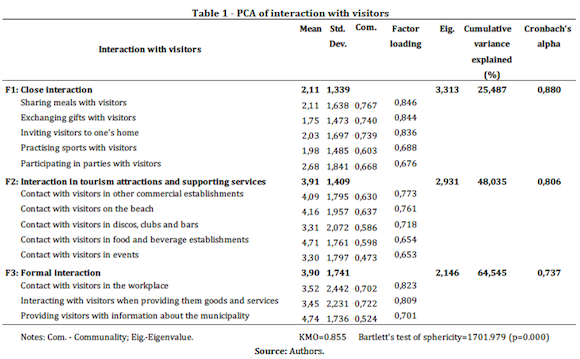
As far as interaction with visitors is concerned, first a PCA of interaction items with varimax rotation was undertaken. Three interaction dimensions emerged (Table 1): (i) close interaction, where residents usually have a closer contact with visitors and perform actions which contribute to a deeper relationship with visitors (e.g. inviting visitors to their own home and exchanging gifts with visitors); (ii) interaction in tourism attractions and supporting services; and (iii) formal interaction, where residents interact with visitors, often because they are required to, most of the time due to their professional activity. All the dimensions had good reliability (Cronbach’s alpha above 0.7) and explained about 65% of the variance of the items included in the PCA. In general, close interactions with visitors occur with a very low frequency (2.11 in average, on a scale from 1 “never” to 7 “very frequently”). Residents are more likely to have more superficial interactions with visitors in tourism attractions and supporting services (3.91) and more formal interactions with visitors in contexts such as their own workplace (3.90). As far as tourism attractions and supporting services are concerned, residents tend to interact more frequently with visitors in food and beverage establishments (4.71), on beaches (4.16) and in other commercial establishments (4.09). These results are in line with other researches in this field, revealing that the interaction in tourism is frequently brief and superficial (e.g. Eusébio & Carneiro, 2012; Kastenholz et al., 2013, Reisinger, 2009; Sinkovics & Penz, 2009; Yoo & Sohn, 2003). However, results reveal that residents do not usually have a high level of interaction with visitors. Although social contact with visitors is not very high, residents are likely to be very satisfied with this contact (5.81 in a scale from 1 “very unsatisfied” to 7 “very satisfied”).
4.3 Tourism and residents’ QOL
]]> A PCA with varimax rotation of items representing the importance to residents inquired into several QOL features and gave rise to five dimensions that represented five QOL domains (Table 2): (i) heritage and enhancement of commercial activities; (ii) socialization and recreation opportunities; (iii) health and safety benefits; (iv) economic opportunities and supporting facilities; and (v) quiet environment. The dimensions presented very high reliabilities (with Cronbach’s alpha above 0.75) and explained 68% of the variance of the items included in the PCA. In order to confirm that the impacts of tourism on QOL perceived by residents could be represented by the same structure of five dimensions identified in the PCA regarding the importance of QOL features, Cronbach’s alpha was calculated for the five dimensions using the items regarding perceptions of tourism impacts on QOL. The five dimensions of tourism impacts on QOL were also highly reliable (with Cronbach’s alpha higher than 0.8) (Table 2).
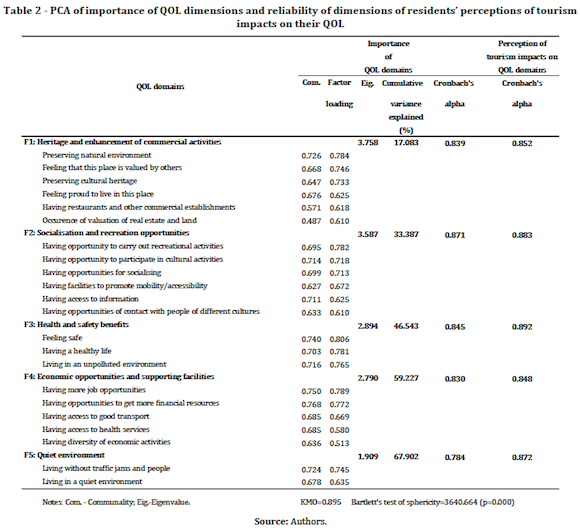
Residents considered all the QOL domains as very important (above 5.5 in average, on a scale from 1 “not important” to 7 “very important”), with health and safety benefits as the dimension considered most important (with 6.51, on average). The perceptions of residents regarding the impacts of tourism on QOL domains were not as homogeneous as the opinions regarding the importance of the QOL domains. This may be concluded because the standard deviations are slightly higher in the case of the perceived impacts of tourism than in the case of the dimensions’ importance. However, on average, residents somewhat agreed that tourism had an impact on their QOL domains (reporting an average level of agreement between 4.4 and 5.4, in all domains, on a scale from 1 “completely disagree” to 7 “completely agree”), although they did not consider that this impact was very great. The domains where the residents’ perception of the impacts of tourism were lower were on maintaining a quiet environment and on the domains that residents found most relevant – health and safety benefits.
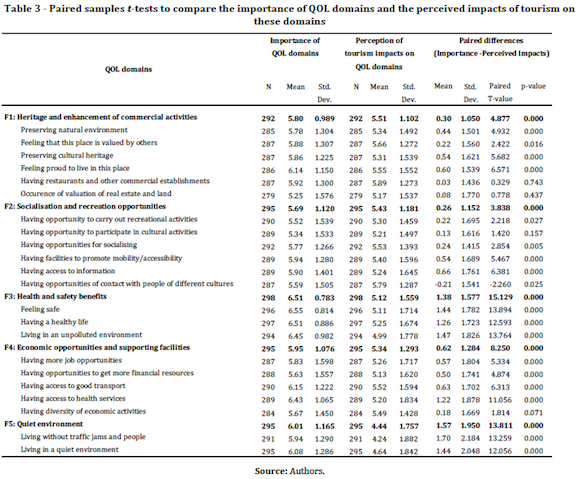
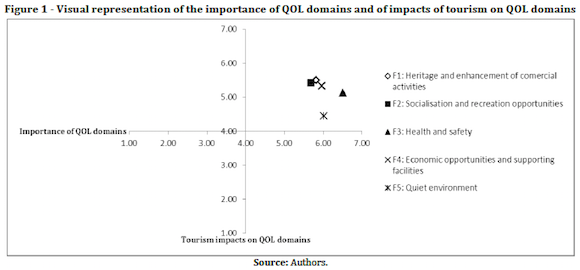
As already mentioned, paired samples t-tests were undertaken to compare the importance of each QOL domain with the residents’ perception of the impacts of tourism on that QOL domain and, also, to calculate the gap between importance and perceived impacts for each item and for each domain. Statistically significant differences were found in all QOL domains and in almost all QOL items (p<0.05) (Table 3). In the cases where significant differences were found, the importance was almost always greater than the perceived impacts, which suggests that strategies are needed to increase the impacts of tourism on QOL domains. Only in the item relating to “having opportunities to be in contact with people of different cultures” was the perceived impact higher than the importance, showing that there is a favourable balance in the benefits that residents obtain in their community, regarding interaction with people of different cultures and the importance they assign to this feature. There were items related to the existence of restaurants and other commercial establishments, the valuation of real estate and land, opportunities to participate in cultural activities and diversity of economic activities, where no statistically significant differences between importance and perceived impacts were found. This reveals a considerable balance between the importance attributed to these benefits and the impacts of tourism on these features. The two domains where the gap (difference) between the importance and the perceived impacts were highest correspond to the two domains where the perceived impacts of tourism were lowest – quiet environment and health and safety benefits. In these domains, the gap was 1.57 and 1.38, respectively. This can be observed in Table 3 (where the gaps of domains and of items are reported) and in Figure 1, which presents a grid regarding the importance of QOL domains and the impacts of tourism on these domains. The information in the grid suggests that those persons and entities responsible for tourism development should develop efforts to ensure the existence, at the community level, of a quieter environment and of more healthy and safe environments.
4.4 Host-tourist interactions and residents’ QOL
Spearman correlations were used to analyse the associations between the dimensions representing the residents’ interaction with visitors and three types of variables regarding QOL: (i) the importance of QOL domains; (ii) the impacts of tourism on QOL domains; and (iii) the gaps between the importance and perceived impacts on QOL domains. The reason for using Spearman correlations instead of Pearson correlation tests was that several variables did not follow a normal distribution. Several significant correlations were found (p<0.05) (Table 4). Although some positive correlations were found among social contact dimensions and the importance of QOL domains, the number and strength of the positive correlations is considerably higher among social contact dimensions and the impacts of tourism on QOL domains. Some weak but significant correlations were observed among the interaction dimensions and the gaps regarding the QOL domains. However, all the correlations regarding gaps are negative. This suggests that the more frequently residents interact with visitors and the more satisfied residents are with this interaction, the less likely residents will be to perceive a gap in QOL domains. Results show that the interaction with visitors may contribute to a more positive perception of residents regarding the impacts of tourism on QOL and, consequently, to the existence of a lower gap between the importance of QOL and the impact of tourism on these domains.
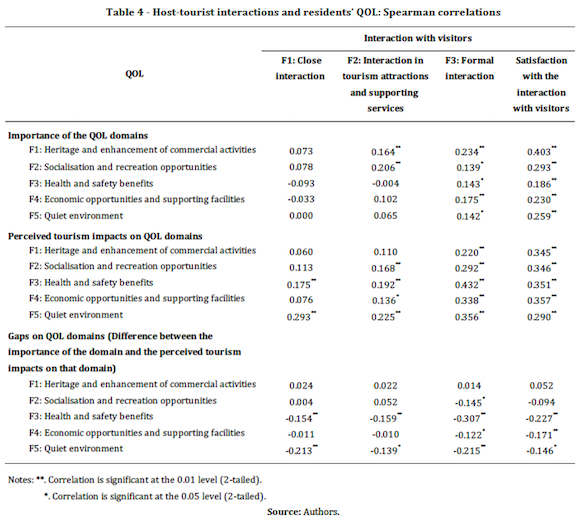
All the types of interaction analysed (close interaction, interaction in tourism attractions and supporting services and formal interaction) and the residents’ satisfaction with interaction were correlated with the gaps and perceived impacts on the QOL domains where higher gaps were registered (quiet environment and health and safety benefits). These results suggest that interaction is likely to have a greater influence on the perception of gaps in the case of these domains. These results are interesting since they reveal that the interaction is related to the feeling of being safer, sometimes contributing to a better knowledge of the visitors and, consequently, to feeling more safe when making contact with them. They also suggest that interaction is associated with the perception of having a healthier life, probably considering a broad perspective of healthy life, which encompasses psychological and social well-being. It is also curious to detect that contact with visitors may contribute to a perception of a quieter environment. This may happen since residents who have more contact with visitors and are more satisfied with this contact can be more tolerant to congestion resulting from tourism activity and to the noise provoked by this congestion. It is also interesting to notice that the frequency of formal interaction (occurring many times in working contexts) and satisfaction with interaction are the features regarding social contact which have positive correlations with domains of tourism impacts on QOL and more negative correlations with the gaps on QOL. This reveals that a higher importance should be assigned to these features of interaction, encouraging, for example, a higher level of interaction between service providers and tourists and, also, some measures that may lead to more satisfaction with interactions with visitors.
The higher impact of formal interaction on perceptions of getting benefits from tourism may take place because, sometimes, social contact in working environments may occur during longer periods of time, which can lead to a higher exchange of knowledge between residents and visitors and, consequently, to greater benefits regarding the knowledge of other cultures and greater mutual understanding, among many others. The lower number of correlations between close interaction and both positive impacts of tourism and gaps regarding QOL, may be associated with the very low levels of close interaction between residents and visitors in these communities. This issue deserves to be further studied. Interactions taking place in tourism attractions and facilities, although occurring with a similar frequency as the formal interactions (many times in working contexts), does not have a greater influence on the perception of the impacts of tourism on the residents’ QOL as the latter ones. This may happen because, in these communities, social contact with visitors in tourism attractions and supporting facilities may have been more ephemeral, not enabling residents to perceive so many positive impacts of tourism on QOL. Policies should be implemented to take advantage of the interactions in tourism attractions and facilities.
5. Conclusions and implications
Recent literature suggests that, in specific contexts, tourism may contribute to improving the QOL of residents of tourism destinations. However, research on determinants of the impacts of tourism on QOL domains is very scarce and highly focused on the QOL of visitors. Residents of tourism destinations may interact with visitors in many contexts and develop several types of interactions with them. Although the interest for studying tourist-host interaction has been growing, the impact of tourist-host interaction on residents’ QOL has remained widely understudied. The present study provides important contributions in this field. First, the study reveals the existence of positive associations between both frequency and satisfaction with tourist-host interactions and residents’ perception of positive impacts of tourism on their QOL. Results also suggest that residents are more likely to perceive lower gaps between the importance assigned to QOL domains and the positive impacts obtained on these domains. Considering these results, organizations responsible for tourism development should implement policies which are able to promote host-tourist interactions.
This study reveals that, as hypothesized, in the case of residents, interaction with visitors is likely to have a higher influence on their perception of the impacts of tourism on specific domains of QOL. The reinforcement of social contact with visitors is especially important, so that residents may obtain benefits from tourism regarding having a healthier and safer life as well as feeling they are living in a quiet environment. These findings suggest that interaction with visitors may increase the tolerance of residents to some potential negative impacts of tourism, as argued by Reisinger and Turner (2003). The exchange of information and even contact with visitors seem to contribute to residents feeling more secure regarding tourist activity and its potential consequences. Interaction with visitors should also be promoted because it reinforces the feeling of having a healthier life among residents, probably due to issues such as the opportunities for socialization, which may contribute to a better socio-psychological well-being.
However, results also suggest, as postulated in the theoretical background, that different types of interactions may provide different contributions to the residents’ QOL. In the communities under study, formal interactions, mostly occurring in the workplace, seem to be the form of social contact with a higher positive impact on residents’ QOL. Results suggest that longer interactions, even in a more formal context, may contribute to a higher perception of the impacts of tourism on residents’ QOL than faster and more superficial contacts with visitors. Therefore, it is very important to promote interactions with visitors in the residents’ workplace, a privileged site for the occurrence of tourist-host contact, either by more formal strategies – such as creating codes of conduct for tourism service providers noting the importance of interacting with visitors – or with more informal strategies, organizing seminars to sensitize residents – service providers and the population in general – to the opportunities for socializing with visitors (e.g. meeting other people and encountering cultures, developing friendships).
The present study corroborates previous research (e.g. De Kadt, 1979; Eusébio & Carneiro, 2012; Reisinger & Turner, 2003) that show a low interaction between residents and visitors at tourism destinations. Therefore, those responsible for tourism development should also design strategies to encourage more interaction, specifically, longer opportunities of contact with visitors in tourism attractions and tourism supporting facilities. Some of these strategies may encompass giving incentives to residents so that they carry out traditional activities of the community – e.g. cooking traditional meals, performing typical dances and carrying out some handicraft activities – that could be appreciated by visitors and could help establish communication and more contact with visitors. Residents could also be encouraged to provide some support in tourism services, for example in providing general information about the destination to visitors or in presenting a specific attraction to them, revealing some curiosities about the attraction based on their knowledge. Increasing contact with visitors in tourism attractions and supporting facilities seems to be especially important in the beach communities under analysis, since this interaction, although occurring frequently, does not provide a lot of benefits to residents’ QOL. The lower levels of close interaction with visitors in these communities may have led to difficulties in recognizing the potential positive impacts of this kind of interaction. More research is needed to identify these impacts.
Findings also show that it is very important to ensure satisfaction with interaction with visitors. Providing training to service suppliers (e.g. in languages) may contribute to the visitors feeling more comfortable with this interaction. However, more studies should be developed to identify other features that may help residents to feel this kind of satisfaction.
]]> The present study also has some limitations, some of which have already been identified. Some of the major limitations are that the study is confined to the geographical area of a municipality of a specific country and is restricted to one determinant of the impacts of tourism on residents’ QOL. Replicating the study in other geographical areas located in other regions or with different tourism products would be very useful to analyse the consistency of the results obtained and to find other variables with influence on the residents’ QOL. Studies encompassing a wider range of determinants of the impacts of tourism on residents’ QOL, such as the duration of residence in the community and tourism experience (e.g. number of tourism trips undertaken), would also be relevant. A more qualitative research would also be very useful to better understand the impacts that the tourism had on residents’ QOL and the influence of host-tourist interaction on perceiving these impacts.
References
Andereck, K. L. & Nyaupane, G. P. (2011). Exploring the nature of tourism and quality of life perceptions among the residents. Journal of Travel Research, 50(3), 248-260. [ Links ]
Andereck, K. L., Valentine, K. M., Knopf, R. C. & Vogt, C.A (2005). Residents’ perceptions of community tourism impacts. Annals of Tourism Research, 32(4), 1056-1076. [ Links ]
Andereck, K. L., Valentine, K. M., Vogt, C. A. & Knopf, R. C. (2007). A cross-cultural analysis of tourism and quality of life perceptions. Journal of Sustainable Tourism, 15(5), 483-502. [ Links ]
Benckendorft, P., Edwards, D., Jurowski, C., Liburd, J. J., Miller, G. & Moscardo, G. (2009). Exploring the future of tourism and quality of life. Tourism and Hospitality Research, 9, 171-183. [ Links ]
Cañizares, S. M. S., Tabales, J. M. N. & García, F. J. F. (2014). Local residents’ attitudes towards the impact of tourism development in Cape Verde. Tourism & Management Studies, 10(1), 87-96. [ Links ]
Carneiro, M. J. & Eusébio, C. (2011) Segmentation of the tourism market using the impact of tourism on quality of life. Tourism & Management Studies, 7, 91-100. [ Links ]
De Kadt, E. (1979). Tourism: Passport to development? Perspectives on the social and cultural effects of tourism in developing countries. New York: Oxford University Press. [ Links ]
Dolnicar, S., Yanamandram, V. & Cliff, K. (2012). The contribution of vacations to quality of life. Annals of Tourism Research, 39(1), 59-83. [ Links ]
Dolnicar, S., Lazarevski, K. & Yanamandram, V. (2013). Quality of life and tourism: a conceptual framework and novel segmentation base. Journal of Business Research. 66, 724-729. [ Links ]
Eusébio, C. & Carneiro, M. J. (2011). Determinants of tourism impact on tourists’ quality of life. International Journal of Leisure and Tourism Marketing, 2(4), 313-336. [ Links ]
Eusébio, C. A. & Carneiro, M. J. A. (2012) Determinants of tourist–host interactions: an analysis of the university student market. Journal of Quality Assurance in Hospitality & Tourism, 13(2), 123-151. [ Links ]
Fredline, L., Deery, M. & Jago, L. (2013). A longitudinal study of the impacts of an annual event on local residents. Tourism Planning & Development, 10(4), 416-432. [ Links ]
INE (2012). Censos 2011 - Resultados Definitivos. Centro. Lisbon: INE. [ Links ]
INE (2013). Anuário Estatístico da Região Centro – 2012. Lisbon: INE. [ Links ]
Kastenholz, E., Carneiro, M. J., Eusébio, C. & Figueiredo, E. (2013). Host-guest relationships in rural tourism: evidence from two Portuguese villages. Anatolia, 24(3), 367-380. [ Links ]
Meng, F., Li, X. & Uysal, M. (2010). Tourism development and regional quality of life: the case of China. Journal of China Tourism Research. 6(2), 164-182. [ Links ]
Moscardo, G. (2009). Tourism and quality of life: Towards a more critical approach. Tourism and Hospitality Research, 9(2), 159-170. [ Links ]
Perdue, R. R., Long, P. T. & Kang, Y. S. (1999). Boomtown tourism and resident quality of life: the marketing of gaming to host community residents. Journal of Business Research, 44, 165-177. [ Links ]
Pizam, A., Uriely, N. & Reichel, A. (2000). The intensity of tourist-host social relationship and its effects on satisfaction and change of attitudes: the case of working tourists in Israel. Tourism Management, 21(4), 395-406. [ Links ]
Reisinger, Y. & Turner, L. (1998). Cultural differences between Mandarin-Speaking tourists and Australian hosts and their impact on cross-cultural tourist-host interaction. Journal of Business Research, 42(2), 175-187. [ Links ]
Reisinger, Y. & Turner, L. W. (2003). Cross-cultural behavior in tourism .Oxford, UK: Elsevier Butterworth Heinemann. [ Links ]
Reisinger, Y. (2009). International tourism: Cultures and behavior. Oxford, UK: Butterworth Heinemann. [ Links ]
Rodrigues, A. P., Vieira, I., Marques, C. P. & Teixeira, M. S. (2014). Apoio da comunidade residente ao desenvolvimento turístico sustentável: um modelo de equações estruturais aplicado a uma cidade histórica do Norte de Portugal. Tourism & Management Studies, 10(2), 17-25. [ Links ]
Roel, W. S. (1999). Quality of life issues in a casino destination. Journal Business Research. 44, 223-229. [ Links ]
Sinkovics, R. R. & Penz, E. (2009). Social distance between residents and international tourists - implications for international business. International Business Review, 18(5), 457-469. [ Links ]
Sirgy, M. J., Widgery, R. N., Lee, D-J. & Yu, G. B. (2009). Developing a measure of community well-being based on perceptions of impact in various life domains. Social Indicators Research, 96, 295-311. [ Links ]
Weaver, D. B., & Lawton, L. L. (2001). Resident perceptions in the urban-rural fringe. Annals of Tourism Research, 28(2), 439-458. [ Links ]
Yoo, J. & Sohn, D. (2003). The structure and meaning of intercultural interactions of international tourists. Journal of Travel & Tourism Marketing, 14(1), 55–68. [ Links ]
]]>
Article history:
Received: 22 May 2014
Accepted: 16 November 2014