<?xml version="1.0" encoding="ISO-8859-1"?><article xmlns:mml="http://www.w3.org/1998/Math/MathML" xmlns:xlink="http://www.w3.org/1999/xlink" xmlns:xsi="http://www.w3.org/2001/XMLSchema-instance">
<front>
<journal-meta>
<journal-id>2182-8458</journal-id>
<journal-title><![CDATA[Tourism & Management Studies]]></journal-title>
<abbrev-journal-title><![CDATA[TMStudies]]></abbrev-journal-title>
<issn>2182-8458</issn>
<publisher>
<publisher-name><![CDATA[Escola Superior de Gestão, Hotelaria e Turismo da Universidade do Algarve]]></publisher-name>
</publisher>
</journal-meta>
<article-meta>
<article-id>S2182-84582015000100004</article-id>
<title-group>
<article-title xml:lang="en"><![CDATA[Assessing the impact of Information and Communication Technologies on the Portuguese hotel sector: an exploratory analysis with Data Envelopment Analysis]]></article-title>
<article-title xml:lang="pt"><![CDATA[Avaliação do impacto das Tecnologias da Informação e Comunicação no setor hoteleiro português: uma análise exploratória com Data Envelopment Analysis]]></article-title>
</title-group>
<contrib-group>
<contrib contrib-type="author">
<name>
<surname><![CDATA[Paço]]></surname>
<given-names><![CDATA[Cidália Maria Leal]]></given-names>
</name>
<xref ref-type="aff" rid="A01"/>
</contrib>
<contrib contrib-type="author">
<name>
<surname><![CDATA[Pérez]]></surname>
<given-names><![CDATA[Juan Manuel Cepeda]]></given-names>
</name>
<xref ref-type="aff" rid="A02"/>
</contrib>
</contrib-group>
<aff id="A01">
<institution><![CDATA[,University of the Algarve School of Management, Hospitality and Tourism ]]></institution>
<addr-line><![CDATA[Faro Portugal]]></addr-line>
</aff>
<aff id="A02">
<institution><![CDATA[,University of Huelva Faculty of Management Sciences Department of Management and Marketing]]></institution>
<addr-line><![CDATA[Huelva ]]></addr-line>
<country>Spain</country>
</aff>
<pub-date pub-type="pub">
<day>31</day>
<month>01</month>
<year>2015</year>
</pub-date>
<pub-date pub-type="epub">
<day>31</day>
<month>01</month>
<year>2015</year>
</pub-date>
<volume>11</volume>
<numero>1</numero>
<fpage>35</fpage>
<lpage>43</lpage>
<copyright-statement/>
<copyright-year/>
<self-uri xlink:href="http://scielo.pt/scielo.php?script=sci_arttext&amp;pid=S2182-84582015000100004&amp;lng=en&amp;nrm=iso"></self-uri><self-uri xlink:href="http://scielo.pt/scielo.php?script=sci_abstract&amp;pid=S2182-84582015000100004&amp;lng=en&amp;nrm=iso"></self-uri><self-uri xlink:href="http://scielo.pt/scielo.php?script=sci_pdf&amp;pid=S2182-84582015000100004&amp;lng=en&amp;nrm=iso"></self-uri><abstract abstract-type="short" xml:lang="en"><p><![CDATA[The overall objective of this paper is to evaluate the impact of Information and Communication Technologies (ICT) on the efficiency of four- and five-star hotels in Portugal and to contribute to the identification of mechanisms that explain the relationship between ICT and efficiency within the hotel sector through Data Envelopment Analysis (DEA). Overall, based on research fundamentals and the results obtained, it can be said that the main research questions were answered and the objectives of the study were achieved. In response to research questions related to the use of ICT in the Portuguese hotel industry, the following uses were determined for hotels in the sample: defining efficient frontiers, identifying efficient and inefficient hotels, ranking hotels according to their efficiency and revealing areas of inefficient hotels that have to be improved to increase effectiveness (improvement targets). Moreover, this study illustrates not only the importance of ICT in achieving higher levels of efficiency but also discusses other specific issues which must be taken into account so that the benefits of ICT can be experienced. Specifically, it was found that the availability of ICT does not alone lead to optimum performance.]]></p></abstract>
<abstract abstract-type="short" xml:lang="pt"><p><![CDATA[O objetivo global é avaliar o impacto das TIC na eficiência dos hotéis de 4 e 5 estrelas em Portugal e contribuir para a identificação dos mecanismos que explicam a relação entre ambas no sector hoteleiro através da metodologia DEA. Em termos de conclusões, com base nos fundamentos e nos resultados obtidos, pode dizer-se que as principais questões colocadas foram respondidas e os objetivos do estudo foram alcançados. Assim, foi dada resposta às questões de investigação relacionadas com o uso das TIC no sector hoteleiro português, uma vez que foi possível determinar para os hotéis da amostra: a fronteira de eficiência, identificar os eficientes e ineficientes, construir o ranking segundo a sua eficiência e mostrar os aspetos que os hotéis ineficientes têm que melhorar para se tornarem eficientes (metas de melhoria). Por outro lado, este estudo ilustra não só a importância das TIC na obtenção de maiores níveis de eficiência, mas também são abordadas outras questões específicas a ter em conta para que os benefícios das TIC possam ser materializados. Especificamente, verificou-se que a mera disponibilidade de TIC não conduz a um melhor desempenho.]]></p></abstract>
<kwd-group>
<kwd lng="en"><![CDATA[Data envelopment analysis]]></kwd>
<kwd lng="en"><![CDATA[information and communication technologies]]></kwd>
<kwd lng="en"><![CDATA[productivity]]></kwd>
<kwd lng="en"><![CDATA[hotels]]></kwd>
<kwd lng="pt"><![CDATA[Data envelopment analysis]]></kwd>
<kwd lng="pt"><![CDATA[tecnologias da informação e comunicação]]></kwd>
<kwd lng="pt"><![CDATA[produtividade]]></kwd>
<kwd lng="pt"><![CDATA[hotéis]]></kwd>
</kwd-group>
</article-meta>
</front><body><![CDATA[ 
    <p align="right"><font size="2" face="Verdana"><b>TOURISM &ndash; RESEARCH PAPERS</b></b></font></p>
    <p>&nbsp;</p>

    <p><font size="4" face="Verdana"><b>Assessing the impact of Information and
  Communication Technologies on the Portuguese hotel sector: an exploratory
analysis with Data Envelopment Analysis</b></font></p>
    <p>&nbsp;</p>
    <p><font size="3" face="Verdana"><b>Avaliação do impacto
  das Tecnologias da Informação e Comunicação no setor hoteleiro português: uma
análise exploratória com Data Envelopment Analysis</b></font></p>
    <p>&nbsp;</p>
    <p>&nbsp;</p>
    <p><font size="2" face="Verdana"><b>Cidália Maria Leal Paço<sup>1</sup>; Juan Manuel Cepeda Pérez<sup>2</sup></b></font></p>
    <p><font size="2" face="Verdana"><sup>1</sup>University of
  the Algarve, School of Management, Hospitality and Tourism, Campus da Penha,
  8005-139 Faro, Portugal, <a href="mailto:cpaco@ualg.pt">cpaco@ualg.pt</a>    ]]></body>
<body><![CDATA[<br>
  <sup>2</sup>University of
  Huelva, Faculty of Management Sciences, Department of Management and Marketing,
21071 Huelva, Spain, <a href="mailto:cepeda@uhu.es">cepeda@uhu.es</a></font></p>
    <p>&nbsp;</p>
    <p>&nbsp;</p>
<hr noshade size="1">
    <p><font size="2" face="Verdana"><b>ABSTRACT</b></font></p>
    <p><font size="2" face="Verdana">The overall objective of this paper is to evaluate the impact of
  Information and Communication Technologies (ICT) on the efficiency of four- and
  five-star hotels in Portugal and to contribute to the identification of
  mechanisms that explain the relationship between ICT and efficiency within the
  hotel sector through Data Envelopment Analysis (DEA). Overall, based on
  research fundamentals and the results obtained, it can be said that the main
  research questions were answered and the objectives of the study were achieved.
  In response to research questions related to the use of ICT in the Portuguese
  hotel industry, the following uses were determined for hotels in the sample:
  defining efficient frontiers, identifying efficient and inefficient hotels,
  ranking hotels according to their efficiency and revealing areas of inefficient
  hotels that have to be improved to increase effectiveness (improvement targets).
  Moreover, this study illustrates not only the importance of ICT in achieving
  higher levels of efficiency but also discusses other specific issues which must
  be taken into account so that the benefits of ICT can be experienced.
  Specifically, it was found that the availability of ICT does not alone lead to
optimum performance.</font></p>
    <p><font size="2" face="Verdana"><b>Keywords</b>: Data envelopment analysis, information and
communication technologies, productivity, hotels.</font></p>
<hr noshade size="1">
    <p><font size="2" face="Verdana"><b>RESUMO</b></font></p>
    <p><font size="2" face="Verdana">O
  objetivo global é avaliar o impacto das TIC na eficiência dos hotéis de 4 e 5
  estrelas em Portugal e contribuir para a identificação dos mecanismos que
  explicam a relação entre ambas no sector hoteleiro através da metodologia DEA.
  Em termos de conclusões, com base nos fundamentos e nos resultados obtidos,
  pode dizer-se que as principais questões colocadas foram respondidas e os
  objetivos do estudo foram alcançados. Assim, foi dada resposta às questões de
  investigação relacionadas com o uso das TIC no sector hoteleiro português, uma
  vez que foi possível determinar para os hotéis da amostra: a fronteira de
  eficiência, identificar os eficientes e ineficientes, construir o ranking
  segundo a sua eficiência e mostrar os aspetos que os hotéis ineficientes têm
  que melhorar para se tornarem eficientes (metas de melhoria). Por outro lado,
  este estudo ilustra não só a importância das TIC na obtenção de maiores níveis
  de eficiência, mas também são abordadas outras questões específicas a ter em
  conta para que os benefícios das TIC possam ser materializados.
  Especificamente, verificou-se que a mera disponibilidade de TIC não conduz a um
melhor desempenho.</font></p>
    <p><font size="2" face="Verdana"><b>Palavras-Chave</b>:
  Data envelopment analysis, tecnologias da informação e comunicação,
produtividade, hotéis.</font></p>
<hr noshade size="1">
    <p>&nbsp;</p>
    ]]></body>
<body><![CDATA[<p>&nbsp;</p>
    <p><font size="3" face="Verdana"><b>1. &nbsp;&nbsp;&nbsp;&nbsp;&nbsp; Introduction</b></font></p>
    <p><font size="2" face="Verdana">The overall
  objective of this paper is to evaluate the impact of Information and
  Communication Technologies (ICT) on the efficiency of four- and five-star
  hotels in Portugal and contribute to the identification of the mechanisms that
  explain the relationship between ICT and efficiency in the Portuguese hotel
  sector. ICT enable companies to be, quickly and without geographical
  limitations, within the reach of many people and can create added value for
  customers by allowing a quick launch in the market of both new products and
  services &#8211; including web catalogues with descriptions and prices &#8211;
  for a greater availability to end customers. This is also accompanied by an
  increase in revenue from additional services, as a result of opening new
channels of distribution and sales (Bilgihan, Okumus, &amp; Kwun, 2011). </font></p>
    <p><font size="2" face="Verdana">The hospitality
  industry is no exception to these trends in ICT investments and increasing use
  over the past two decades (Haro
  de Rosario, Gálvez Rodrigues &amp; Caba Pérez, 2013; Boaria, Anjos &amp; Raye, 2014; Sirirak, Islam &amp; Khang, 2011; Scholochow, Fuchs, &amp; Höpken, 2010).
  However, there are several studies on these trends’ impact on hotels, and so
  far the theme in Portugal has not yet been much explored. Thus, the
  justification for studying the impact of ICT on this sector takes into account
  the fact that, with the increase of competitiveness in tourism and hospitality,
  maximising the efficiency of hotels is an important objective. As a result,
  increased competition has propelled organisations into a search for more effective
  business strategies, many of them choosing ICT as a way of dealing with
economically turbulent environments (Okumus, Altinay &amp; Chathoth, 2010).</font></p>
    <p><font size="2" face="Verdana">However,
  studies researching the impact of ICT have sometimes led to contradictory
  results and/or doubts about the benefits of the same (Boaria<i>
  et al.,</i> 2014; Chen, Liang, Yang &amp; Zhu, 2006).
  With this in mind, the present study was based on the context of the
  hospitality industry in Portugal, using data collected through a survey on the
  use of ICT in hotels conducted by the National Institute for Statistics (INE).
  This survey had the statistical aim of analysing the presence of ICT in these
  establishments by coverage, extent and purpose of ICT use. The survey was first
  conducted in 2008 and later again in 2011, and provided a view over time of
  data collected. The population covered by the survey consisted of all
  accommodation establishments in Portugal, within the NACE Rev.3 Group H Group
55.1 classified as of tourist interest by Turismo de Portugal.</font></p>
    <p>&nbsp;</p>
    <p><font size="3" face="Verdana"><b>2. &nbsp;&nbsp;&nbsp;&nbsp;&nbsp; Literature Review</b></font></p>
    <p><font size="2" face="Verdana">The first DEA model, proposed by Charnes,
  Cooper and Rhodes (1978) &#8211; named DEA-CCR &#8211; had an input orientation
  and supposed that there were constant returns to scale (CRS). This methodology
  seeks to establish which firms of a sample determine the envelopment surface or
  efficient production frontier. The radial distance of a firm from its frontier
  provides the measurement of its efficiency. The second DEA model proposed
  presents the hypothesis of variable returns to scales (VRS), known as DEA-BCC
  (Banker, Charnes &amp; Cooper, 1984). As well as these two important models,
  there are other DEA models which are less frequently found in the literature.
  As a result, we can identify at least five basic DEA models: the additive model
  (Charnes, Cooper, Golany, Seiford &amp; Stutz, 1985), the multiplicative model (Charnes, Cooper,
  Seiford &amp; Stutz, 1982), the cone-ratio DEA
  model (Charnes, Cooper, Huang &amp; Sun, 1990), the Assurance Region DEA model (Thompson, Langemeier, Lee, Lee &amp; Thrall, 1990) and the super-efficiency model (Andersen &amp; Petersen, 1993). DEA methodology is
  applied to the unitary evaluation of homogeneous units or firms, such as
  hotels. The evaluation unit &#8211; which is normally known as the Data
  Management Unit (DMU) &#8211; is what transforms inputs into outputs. This is
  why its identification in any study is a difficult and crucial aspect.
  According to DEA, the performance of a firm is evaluated based on an efficient
  frontier which is built by a linear combination of existing firms. The
  procedure is based on a complex mathematical model (Annex I). A complete
description of these hypotheses is given by Ray (2004) and by Coelli, Rao, O’Donnell &amp; Battese (2005).</font></p>
    <p><font size="2" face="Verdana">Researchers have begun to use DEA as an
  alternative approach to evaluating the impact of ICT on firm performance
  because DEA does not have a priori assumptions on the functional form characterising
  the relationships between ICT investment and firm performance measures (Zhu,
  2002). For example Banker, Kauffman, and
  Morey (1991) use DEA to study
  operational efficiency gains from ICT. Shafer and Byrd (2000) propose a DEA
  framework for measuring the efficiency of organisational investments in ICT.
  Thus, DEA has been used to carry out advanced statistical analysis on the
  efficiency scores of hotels, which have in turn been evaluated by studying
  their relationship with various metrics relating to ICT possession, ICT use,
Internet access, ICT training and workers with ICT skills.</font></p>
    <p><font size="2" face="Verdana">However, researchers believe that DEA has
  some limitations (Othman, Foo, Karim &amp; Andaziz, 2010; Deraman, Said &amp; Saman, 2011). DEA does not offer a prediction model of organisation performance.
  This is due to limitations on its use outside the database employed. As a
  result, DEA should be considered as specific for the sample used. In other
  words, DEA analysis is not appropriate to compare with a theoretical maximum
  efficiency (Othman et al., 2010). Nevertheless, since the DEA model was first
  introduced, it has been adopted as a research tool to measure operational
  efficiency and has been frequently applied to measure the performance of
  organisations in the service sector, as in the case of measuring the efficiency
  of hotels (Sigala, 2004; Scholochow <i>et al.</i>, 2010; Bilgihan <i>et al.</i>, 2011; Rebelo, Matias &amp;
Carrasco, 2013).</font></p>
    ]]></body>
<body><![CDATA[<p>&nbsp;</p>
    <p><font size="3" face="Verdana"><b>3. &nbsp;&nbsp;&nbsp;&nbsp;&nbsp; Methods</b></font></p>
    <p><font size="2" face="Verdana">In general terms, this study aims to
  make a fundamental contribution by answering questions about the use of ICT in
  the hotel sector and its impact on efficiency, using data envelopment analysis
  methodology (DEA). The main research questions that fall within the objectives
  of this study are as follows: 1) Have investment in and use of ICT had some
  impact on the efficiency of the (four- and five-star) hotel sector in
  Portugal?, and 2) Have (four- and five-star) hotels&nbsp; in Portugal explored/used ICT to improve
their efficiency?.</font></p>
    <p><font size="2" face="Verdana">To achieve these objectives, we
  collected and analysed data obtained from four-and five-star hotels in Portugal
  because a focus on a particular sector eliminates contextual factors and
  operational characteristics of firms that would affect the relationship between
ICT, efficiency and productivity. This was done in order to (Sigala, 2003):</font></p>
<ul>
      <li><font size="2" face="Verdana">Measure the efficiency of hotels
    using a robust methodology;</font></li>
      <li><font size="2" face="Verdana">Distinguish between efficient and
    inefficient hotels and, at the same time, identify factors that define their
    efficient frontiers, i.e., factors that affect these;</font></li>
      <li><font size="2" face="Verdana">Determine potential improvements for
    the target sector in inputs/outputs;</font></li>
      <li><font size="2" face="Verdana">Analyse ICT systems used by hotels
    and the ways in which ICT have been implemented;</font></li>
      <li><font size="2" face="Verdana">Identify whether hotels with
    different ICT levels, ICT use, ICT training and workers with ICT skills differ significantly
    in levels of efficiency.</font></li>
    </ul>
    ]]></body>
<body><![CDATA[<p><font size="2" face="Verdana">Specifically, the hypotheses that a)
  hotels with an Internet presence (stays resulting from Internet bookings and
  computers with an Internet connection) obtain significantly higher efficiency
  scores and b) hotels that make a more sophisticated use of their systems and
  ICT capabilities and possess 1) ICT and ICT departments and 2) ICT training
  &#8211; get significantly higher efficiency scores. When this is found,
significant differences are then investigated.</font></p>
    <p><font size="2" face="Verdana"><b>3.1 Variables (inputs
and outputs), sample, scale returns and level of analysis</b></font></p>
    <p><font size="2" face="Verdana">DEA recognises
  that technical efficiency can be improved and focuses on how this can be done.
  To use DEA, it is necessary to define the inputs and the outputs of services.
  Inputs are the resources used and any results which are obtained from the
  process are called outputs. The characterisation of inputs and outputs implies
  looking at the service process as a “black box” (Chen &amp; Zhu, 2004; Färe
  &amp; Grosskopf, 2000). Indeed, the majority of approaches to productivity
  adopt this point of view only in the first stages of analysis, with the
  definition of the process. This can be considered a composite of various
  business units, each one using the same types of inputs to produce the same
types of outputs.</font></p>
    <p><font size="2" face="Verdana">In short, a
  problem is the accurate definition of what is considered to be input and output
  in the services sector and their measurement. Production &#8211; measured by
  the comparison of an output with an input &#8211; requires both indicators to
  be quantifiable. The majority the measurement problems come from measuring
  output: its multidimensional nature (some of the elements or aspects are not
  quantifiable but are relevant), its intangible nature, the presence of external
  factors and the difficulty of evaluating quality, among others, are some of the
  difficulties found when trying to measure output. This is an important
  inconvenience in measuring this sector’s productivity (Grönroos &amp; Ojasalo,
2004).</font></p>
    <p><font size="2" face="Verdana">Another problem
  in the case of the hotel sector and of the services sector in general is that
  the definition of productivity/efficiency is complicated given that the
  traditional concept of efficiency was developed for the manufacturing of
  physical goods (Assaf, Barros &amp; Josiassen, 2010; Bilgihan <i>et al.</i>, 2011). Efficiency measures
  obtained are quite sensitive to alternative specifications in terms of
  economies of scale. While recognising this fact, the literature on efficiency
  does not offer much guidance on the question of how to evaluate the suitability
of decisions in this context (Nunes &amp; Machado, 2014). </font></p>
    <p><font size="2" face="Verdana">On the question
  of the level of analysis, the impact of ICT on efficiency was studied at the
  organisational level since, as noted by several authors (Chen <i>et al.</i>, 2006; Chen &amp; Zhu, 2004),
  this is considered the best level of analysis. Moreover, to overcome
  limitations on the measurement of ICT &#8211; since it is the deployment of ICT
  tools and capabilities and not investment per se which can actually lead to
  increased productivity/efficiency &#8211; the construct was operationalised for
  ICT using four variables that reflect the exploitation of ICT (Chen <i>et al.</i>, 2006; Fernández-Menéndez,
Sánchez, Duarte &amp; Sandulli, 2009):</font></p>
<ul>
      <li><font size="2" face="Verdana">&nbsp;
    Number
    of workers who use computers;</font></li>
      <li><font size="2" face="Verdana">&nbsp;
    Number
    of workers who use computers with an Internet connection;</font></li>
      <li><font size="2" face="Verdana">&nbsp;
    Total
    number of workers who attend ICT training courses;</font></li>
      <li><font size="2" face="Verdana">&nbsp;
    Total
    number of workers with ICT skills and with graduate studies.</font></li>
    ]]></body>
<body><![CDATA[</ul>
    <p><font size="2" face="Verdana">The use of
  these measures is justified by the known ability of ICT to promote and support
  initiatives in business process re-engineering (BPR) (Berezina &amp; Cobanoglu,
2010).</font></p>
    <p><font size="2" face="Verdana">Annex II
  presents inputs and outputs used in the study of performance in hotels in
  Portugal from 2008 to 2011. We used a database of 1,935 hotels for 2008 and
  1,895 hotels for 2011. This study took into account the reliability and
  possible bias of the sample, in order to obtain reliable and consistent
  responses (Banker <i>et al.</i>, 1991;
  Fernández-Menéndez <i>et al.</i>, 2009). To
  overcome these issues, given that the sample of selected hotels (four- and
  five-star establishments) comes from the database of the INE on the use of ICT,
  the data should be examined for non-random selection. However, Sigala (2003) the
  success of DEA analysis is based on the assumption that the analysed units have
  the same idiosyncratic characteristics, a fact which is controlled by the use
  of a number of units within the same sector and the same category, so they must
  have similar characteristics in types of operations. Therefore, we limited our
  analysis to a sample of four- and five-star hotels, for 2008. The final number
  of hotels analysed was 245 (90% of the population and for 2011 was 319 hotels
  (92% of the population). Thus, the above sample used for both years is almost
  coincident with the population, which obviates the issues of bias and
representativeness.</font></p>
    <p><font size="2" face="Verdana"><b>3.2 &nbsp;&nbsp;&nbsp; Analysis methods applied</b></font></p>
    <p><font size="2" face="Verdana">The treatment
  of variables included in the model was carried out in successive steps in a
  logical order determined by objectives. Thus, the initial step was statistical
  analysis of variables and, subsequently, an evaluation of ICT using DEA, which
is considered the most appropriate method based on a review of the literature (Fernández-Menéndez <i>et al.</i>, 2009; Assaf <i>et al.</i>, 2010).</font></p>
    <p><font size="2" face="Verdana">The DEA model
  was applied to assess levels of efficiency and how a finite number of hotels
  use a set of inputs to produce outputs. Therefore, this step was used to
  determine frontiers of efficiency, which were identified to serve as a
  reference of efficient hotels in the benchmarking process of inefficient
  hotels. With the information obtained, we can formulate improvement plans for
  inefficient hotels to become more effective, contributing to the measurement of
  strategic performance and consequently achieving better overall performance. At
  this stage, to avoid the risks of basing the decision process on one particular
  model, several DEA models were used initially and, from this, it was determined
  whether they could lead to more complex models based on data characteristics (Ting
  &amp; Huang, 2012). To explore causes of inefficiency, operational efficiency
  is decomposed into the structural components of technical, pure, scale
  efficiency, and cost efficiency, as suggested in some studies (Barros, 2006;
  Hu, Shieh, Huanga &amp; Chiua, 2009). Meanwhile, Sigala (2004), Wang, Hung, and
  Shang (2006) and Wang, Shang and Hung (2006) used multiple DEA models to screen
  out external effects in efficiency and to compute purely managerial efficiency
  of hotels. Yu and Lee (2009) and Hsieh and Lin (2010) used a two-stage
  framework to measure productive efficiency and service effectiveness of tourist
  hotels. Differences in efficiency between business and leisure hotels have been
  described in many hotel efficiency researches, such as Sun and Lu (2005) and
Wang <i>et al.</i>, (2006).</font></p>
    <p><font size="2" face="Verdana">Among the four
  models applied &#8211; BCC and CCR under both input and output orientation
  &#8211; the final model elected was the output-oriented BCC. For this decision
we considered the following questions:</font></p>
    <p><font size="2" face="Verdana">1. Does the model show a good
relationship between average efficiency and discrimination between variables?</font></p>
    <p><font size="2" face="Verdana">2. Does
the model include the variables needed to reach the objectives?</font></p>
    <p><font size="2" face="Verdana">3. Does
  the application of cluster analysis provide an idea of whether or not companies
aggregate into homogeneous groups?</font></p>
    ]]></body>
<body><![CDATA[<p><font size="2" face="Verdana">The application
  of the various models indicated that although both models could be adopted, it
  seemed more appropriate to consider that there is a tendency for hotels, in an
  analysis of benefit, to adapt their level of operations to scale but not
  necessarily to proportionality between inputs consumed and outputs produced. In
  other words, there is no clear link between efficiency scores and the size of
  hotels as reflected by the existence of a direct proportionality between inputs
  used and outputs produced, so it is most appropriate to consider the existence
  of variable returns to scale. Likewise, we can say that hotels will benefit
  from fairer comparisons &#8211; comparing hotels of equal size to each other
  &#8211; and thereby allow us to assess whether in cases of inefficiency, this
  is solely due to wrong choices of management policies or because hotels operate
  on an inadequate scale. This is only possible when using a model with a VRS
  assumption, as the bottom allows us to assess the existence of economies of
  scale. Thus, as we also intended to measure the economies of scale, we used the
BCC output-oriented model (Hsieh &amp; Lin, 2010).</font></p>
    <p><font size="2" face="Verdana">On the other hand, the DEA group approach also could be applied in this
  study to identify the effect of particular ICT uses on the
  productivity/efficiency of hotel groups made up of various hotels level, type
  and use of ICT. This discrimination of hotels allowed the identification of the
  impact of different management practices of ICT and thus provides useful
  guidance on this aspect in particular (Brown &amp; Rasgale, 2002; Sigala,
  2003). However, because the number of hotels that could be grouped into
  clusters with similar ICT configurations would be proportionally small in
  relation to the inputs and outputs selected, the analysis in this study could
  not further assess and calculate the impact of different ICT configurations on
  productivity/efficiency of hotels. Instead, the study utilised DEA under the
  VRS assumption in order to identify frontiers of productivity and efficiency
  scores of hotels in the sample and then used statistical inference to
  investigate whether productivity levels were related to ICT (Barros, 2006;
Assaf <i>et al</i>., 2010).</font></p>
    <p><font size="2" face="Verdana">The second question that arises is with respect to what is the best
  model orientation. Thus, with reference to authors who argue that the best
  orientation for this kind of industry is input (Barros, 2006), on the basis
  that hotels may have little control over output variables, we think that this
  limitation can be overcome by the fact that through new distribution channels
  hotels can &#8211; although they cannot allow reservations on their own website
  &#8211; use third party systems. Today costs are much more blurred than in
  early, pioneering systems. Moreover, in addition to acting as a reservation
  channel, ICT also is an important means for marketing and allows hotels to
  increasingly access a greater number of potential guests through aggressive
  pricing policies. Thus hotels may now have more control over output variables.
  Moreover, since the study did not use traditional input variables but
  considered others, it would not be an appropriate option to minimise input
  where assets were acquired as a way to decrease implementation efforts, for
  example, number of computers and number of training courses, among others.
  Therefore, in view of the above, it is concluded that analysis carried out with
  a BCC model (VRS) and output orientation is most suitable to calculating
efficiency scores of hotels for each of the years analysed.</font></p>
    <p>&nbsp;</p>
    <p><font size="3" face="Verdana"><b>4. &nbsp;&nbsp;&nbsp;&nbsp;&nbsp; Discussion</b></font></p>
    <p><font size="2" face="Verdana">The model
  results were organised as follows: model fit, table of relative efficiencies
  and their analysis, variables and weights, and special cases of inefficient
  hotels. The latter were examined for possibilities for potential improvement
  (Chen, 2009; Chen, 2011). In addition, the application of DEA allowed us to
  classify hotels into four different groups depending on their efficiency
(Avkiran, 2006):</font></p>
    <p><font size="2" face="Verdana">Efficient
  hotels in the first group can be considered as an example of good practice in
the management of its resources;</font></p>
    <p><font size="2" face="Verdana">Efficient
  hotels belonging to the second group do not appear in any reference set outside
  of their own, being likely to show data clearly distinct from other hotels. In
  this case we need to take a closer look in order to establish if there are no
  particular characteristics that define them as very different from other hotels
  so that we can compare them appropriately. This may also be the case for hotels
which have different priorities and, as such, should be analysed;</font></p>
    <p><font size="2" face="Verdana">Inefficient
hotels belonging to the third group can easily increase their efficiency score;</font></p>
    <p><font size="2" face="Verdana">Inefficient
  hotels belonging to the fourth group are not successful in this area and must
  be studied to equalise any effect that is not covered by the factors selected.
The management of these hotels should be questioned.</font></p>
    ]]></body>
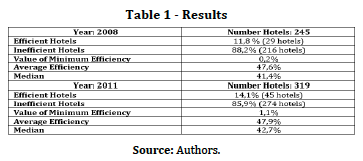
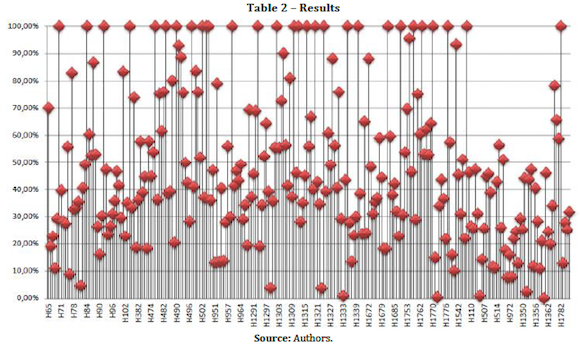
<body><![CDATA[<p><font size="2" face="Verdana">In the results (<a href="#t1">Table 1</a> and <a href="#t2">Table
  2</a>), an interpretation of the distribution of efficiency scores reveals that
  analysed hotels are classified as efficient in terms of purely technical
  efficiency, since we used the BCC model, forming clusters serving as a
  reference for inefficient hotels. In percentage terms, for the 245 hotels in
  the study in 2008 and for 319 hotels in 2011 the results are show in the <a href="#t1">table
  1</a>. We concluded, if we compare the results of 2008 and 2011, that the effective
  number of hotels increased by 2.3%, going from 11.8 to 14.1% and there was also
an increase in the minimum efficiency.</font></p>
    <p>&nbsp;</p>
    <p><a name="t1"></a>
</p>
    <p align="center">
<img src="/img/revistas/tms/v11n1/11n1a04t1.jpg" width="363" height="161"></p>
    
<p>&nbsp;</p>
    <p><a name="t2"></a>
</p>
    <p align="center">
<img src="/img/revistas/tms/v11n1/11n1a04t2.jpg" width="580" height="348"></p>
    
<p>&nbsp;</p>
<font face="Verdana">    <p><font size="2">Moreover, it
  can be concluded that in 2008, a median of 41.4% means that 50% of hotels had a
  score of less than or equal to an efficiency of 41.4% to a minimum of 0.2%, and
  the remaining 50%, of course, have an efficiency score greater or equal to
  41.43% up to the maximum. Similarly, for 2011, the median means that 50% of
  hotels have a score of less than or equal to an efficiency of 42.7% to a
  minimum of 1.1%, and the remaining 50% obviously have an efficiency score
  higher than or equal to 42.7% up to the maximum. This value is also present in
  the second quartile and the fiftieth percentile. In summary, for the efficiency
  scores of hotels ranging from 1.1% to 100%, 45 hotels are efficient and 274 are
  inefficient. Therefore, in comparative terms, efficiency in 2011 was higher
than efficiency in 2008.</font></p>
    <p><font size="2">In relation to
  inefficiency of hotels, one result is the fact that they have all been compared
  with a set of efficient hotels with identical configuration input/output, which
  appears in reference sets referred to as global leaders (Avkiran, 2006). The
  benefit of this information is that we have an efficient hotel that can be
  emulated to improve the performance of inefficient hotels. Thus, the study of
  efficiency not only calculates the performance index of each unit but also
  indicates to what extent and in which areas an inefficient unit needs to
  improve in order to become efficient. This information allows hotels to set
  goals that can help inefficient hotels to achieve better performance (Deraman
  et al., 2011). Therefore, each inefficient hotel has a set of references in
  efficient hotels that they can imitate to become efficient (Rebelo et al.,
2013)</font></p>
    ]]></body>
<body><![CDATA[<p><font size="2">This analysis,
  either by reducing the inputs and/or increasing outputs, can be carried out on
  a global level and/or for each input/output. We calculated the relative
  percentage of potential improvement for each input/output and for 2008, the
  results indicated that if we make a comprehensive analysis of weights of the
  output variables of inefficient hotels, we can conclude that of the 216
  inefficient hotels, 100 hotels give full weight to the output variable
  &quot;total number of stays&quot;, meaning that they have a low value for this
  variable and 18 hotels give full weight to the output variable &quot;total
  number of stays resulting from Internet bookings&quot;. For the remaining 98
  hotels weight is mixed. For 2011, it is concluded that for the 274 inefficient
  hotels, 86 give full weight to the output variable “total number of stays
  resulting from Internet bookings&quot;, as they have a low value for these
  establishments, and 28 give full weight to the output variable &quot;total
number of stays&quot;.</font></p>
    <p><font size="2">The overall
  result shows that the output variable “total number of stays resulting from
  Internet bookings” has the highest percentage for potential improvement in the
  hotels of the 2011 sample (71.7 %) and in 2008 the potential for improvement
  was 99.6%. Therefore, we concluded that from 2008 to 2011 the value of this
  variable improved since its rate of improvement declined 27.9%. However, unlike
  2008 also, the variable “total number of overnights” needs to improve
  significantly (16.9%) compared to 0.27% in 2008. In short, inefficient hotels
  in 2008 and 2011 showed very small values for output variables in relation to
  average values for the entire sample. However, they showed a heavy structure in
  terms of input variables obtained at the production level compared to small
  inputs used. Therefore, we can state that these hotels are not as efficient as
  those which, despite having a large number of operations, fail to get a total
number of overnights that compensates for these inputs in terms of results.</font></p>
    <p><font size="2">The reliability analysis of weights takes into account that the optimal
  values calculated by DEA weights are objectively determined, which may not
  correspond to the relative values that a hotel assign to their inputs and
  outputs. This is actually a strength and not a weakness of DEA. Therefore, a
  hotel considered inefficient by DEA is identified as such only after all
  possible weights have been considered to give this hotel the highest rating
  possible, consistent with the restriction that no hotel can get more than 100%
  efficiency. Any set of weights applied would only make a hotel into a hotel
  which is becoming inefficient, that is, equally or less efficient. In this way,
  DEA gives the benefit of doubt to each hotel or service unit in the calculation
  of efficiency. Furthermore, DEA does not erroneously classify any efficient
unit as inefficient (Cooper, Seiford &amp; Tone, 2007).</font></p>
    <p><font size="2"><b>4.1 Analysis of
the implementation and use of ICT (2008-2011)</b></font></p>
    <p><font size="2">In terms of ICT
  inputs variables, data were collected on five aspects: ICT investment; ICT use;
  Internet usage and connection, ICT training and workers with ICT skills. In
  terms of outputs, data were collected on a measure that reflects the result of
  the previous measures: the number of stays resulting from Internet bookings
(Annex II).</font></p>
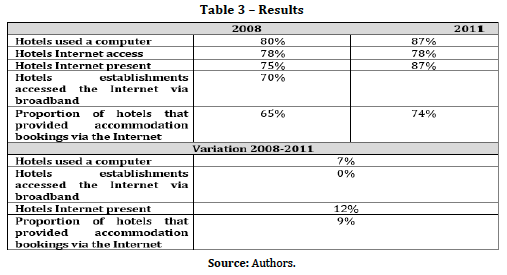
    <p><font size="2">A descriptive
  analysis also allowed conclusions in terms of ICT usage in the hotel industry.
  In summary, we can say that the results (<a href="#t3">Table 3</a> - INE survey) for 2008
  revealed an almost universal use of these technologies in establishments with
  10 or more employees. On the other hand, 70% of hotel establishments accessed
  the Internet via broadband, with DSL the most used (75%). For 2011, the
  percentage of establishments that provided accommodation bookings via the
  Internet was 74%, which represented 30% of total overnight stays. In terms of
  ICT use, access and presence on the Internet was a widespread practice in
establishments with 50 or more employees.</font></p>
</font>
    <p>&nbsp;</p>

    <p><a name="t3"></a>
</p>
    <p align="center">
<img src="/img/revistas/tms/v11n1/11n1a04t3.jpg" width="507" height="275"></p>
    
<p align="center">&nbsp;</p>
    ]]></body>
<body><![CDATA[<p><font size="2" face="Verdana">We can conclude
  that the use of computers, Internet access, broadband, Internet presence and
online booking increased between the two years under study. </font></p>
    <p><font size="2" face="Verdana">Taking into
  account all the above, it is concluded that ICT positively evolved between 2008
and 2011, highlighting the following aspects:</font></p>
    <p><font size="2" face="Verdana"><b>1)</b> &nbsp; The adoption of ICT systems increased in
the hospitality industry;</font></p>
    <p><font size="2" face="Verdana"><b>2)</b> &nbsp; ICT was acquired at different rates;</font></p>
    <p><font size="2" face="Verdana"><b>3)</b> &nbsp; Hotels mainly implemented a piecemeal
  approach to ICT investment, which may affect their ability to improve productivity
while automation and synergistic effects materialise.</font></p>
    <p><font size="2" face="Verdana">Therefore, as
  it is concluded that the use of ICT in the hotel sector increased between the
  periods considered, we must now evaluate the impact of this event on the
efficiency of four- and five-star hotels.</font></p>
    <p><font size="2" face="Verdana"><b>4.2.&nbsp;&nbsp;&nbsp; Analysis of
the contribution of ICT variables to the efficiency of hotels &#8211; 2008</b></font></p>
    <p><font size="2" face="Verdana">Since the
  objective of this study is to evaluate the impact that ICTs have on the
  efficiency of each hotel in the sample, we calculated the minimum, maximum and
  average contributions of each variable on efficiency scores. Firstly, an
  analysis was performed based on input and output variables, individually or in
  combination with others, to determine which had more influence on the
  efficiency scores obtained. We gauged which factors affected the greater or
  lesser efficiency of sample hotels, opting to divide and distinguish between
  the variables that contributed to a higher percentage of efficient hotel (100%)
  and inefficient (less than 100%). The latter we divide into two groups
(99.9%-50% and 49.9%-0%). </font></p>
    <p><font size="2" face="Verdana">With respect to
  the 29 efficient hotels of 2008, the variables that most contributed were the
  number of workers, the number of computers with Internet connection and number
  of workers with ICT skills with graduate studies . Regarding the contribution
  of ICT input variables, the one that contributed most to the scores of
  efficient hotels was the “number of computers with Internet connection” for
  41.38% of the hotels, where this variable contributed to the calculation of
  their efficiency scores. The low contribution of this variable to 13.11% of
  inefficient hotels in the first group and 14.19% of inefficient hotels in the
  second group emphasises the importance of using the Internet and new
  distribution channels as a success factor. The second ICT input variable that
  contributed most to efficient hotels was “number of workers with ICT skills
  with graduate studies”, with a contribution of 37.93% to efficient hotels but a
  higher contribution to inefficient hotels &#8211; 52.46% of inefficient hotels
  in the first group and 48.39% of inefficient hotels in the second group. Since
  we found that this variable contributes more to the scores of inefficient
  hotels than to efficient hotels, this has to be analysed for each hotel and
  management will have to apply reduction measures on a case by case basis, since
  we cannot forget that this was one of the success factors of efficient hotels.
Overall, this variable showed mixed behaviour.</font></p>
    <p><font size="2" face="Verdana">For the
  remaining ICT input variables, contributions were as follows. The variables
  relating to the use of ICT and the existence of an ICT department had a higher
  contribution than the variable that represents ICT investment for efficient
  hotels. This goes against our hypothesis that it is an appropriate use of ICT
  which will make the difference in terms of performance and not merely
  possession. Finally, ICT input variables that made a lower contribution to
  efficient hotels were related to training. We think that despite the fact that
  these are important there may be a gap in the results on effects produced in
terms of efficiency.</font></p>
    ]]></body>
<body><![CDATA[<p><font size="2" face="Verdana">On the other
  hand, we concluded that the output variable “number of stays resulting from
  Internet bookings” was the largest contributor, for 89.66% of the efficient
  hotels, higher than its contribution to the percentages of inefficient hotels,
  which was 60.66% of inefficient hotels in the first group and 50.97% in the
second. </font></p>
    <p><font size="2" face="Verdana">Of particular
  relevance to the efficiency of hotels in 2008 &#8211; with respect to ICT
  &#8211; were the number of computers connected to the Internet and the
  availability of ICT employees with higher education. The single ICT output
  variable which contributed to higher efficiency in hotels was the “total number
  of stays”. We can thus conclude once again that the new distribution channels
  are a fundamental tool for hotels. In relation to inefficient hotels, we can
  say that of the 61 hotels that were part of the first group, the most
  influential variables in inefficiency were the number of people who contributed
  to the inefficiency of 56 hotels and variable total number of training courses
  that contributed to the inefficiency of 28 hotels. Therefore, a variable number
  of workers was of particular relevance to the inefficiency of hotels in 2008,
  which can be both an advantage and a negative factor at the same time.
  Regarding the single ICT output variable, its contribution to inefficient
  hotels was less than the total number of stays. With regard to hotels that
  comprise the second group, the most influential variables were the “number of
  workers” for 138 hotels and the “total number of training courses” for 62
  hotels. Of particular importance to the inefficiency of these hotels in 2008
  was the number of workers, which continued to be a negative factor. For the ICT
  output variable, its contribution to the inefficient hotels was less than the
  total number of stays. In the latter group of very inefficient hotels, we noted
  that none of the variables related to ICT were among the top three variables
that contributed the most to inefficiency.</font></p>
    <p><font size="2" face="Verdana"><b>4.3&nbsp;&nbsp;&nbsp;&nbsp; Analysis of the
contribution of ICT variables to the efficiency of hotels &#8211; 2011</b></font></p>
    <p><font size="2" face="Verdana">Using the same
  assumptions we can, in a summarised form, evaluate the percentage of hotels
  each variable contributed to in 2011. We conclude that the output variable
  “number of stays resulting from Internet bookings” made the largest
  contribution to hotels with 100% efficiency, contributing to the efficiency of
  82.22% of efficient hotels, higher than its contribution to the percentage of
  inefficient hotels, which were 80.46% and 67.4% relative to the first and
  second groups of inefficient hotels respectively. Regarding ICT input variables
  that contributed most to the scores of these hotels was the “number of workers
  with ICT skills with graduate studies” for 53.33% of hotels. On the other hand,
  the contribution of this variable to inefficient hotels of both groups emphasises
  that the existence of an ICT department is not by itself a guarantee of
  success. Thus, this variable also contributed to the scores of inefficient
  hotels. Each hotel has to be analysed for each variable and management will
  have to implement reductions in the individual cases it deems relevant, since
  we cannot forget that this was one of the success factors of efficient hotels.
  So it seems that this variable may show mixed behaviour, as found for 2008. The
  second of the ICT input variables that contributed most to efficient hotels was
  the “number of workers who use computers with Internet connection” with a
  contribution to 35.56% of hotels, having a lower contribution to inefficient
  hotels, which goes against the initial hypothesis that the use of ICT and new
  distribution channels makes the difference. Finally, the ICT input variable
  that contributed to lowering efficiency of hotels was the one related to
training.</font></p>
    <p><font size="2" face="Verdana">In inefficient
  hotels, in the first group the variables that influenced a greater percentage
  of hotels were the output variable “total number of stays” (90.80%) and the
  output variable “total number of stays resulting from Internet bookings”
  (80.46%). The latter is related to ICT, which in some way indicates that this
  channel is used effectively. Thus, the hotels of this group should be concerned
  essentially with these two related factors in an increase of the number of
  overnight stays. For ICT input variables, we can assert that the input variable
  “total number of workers with ICT skills with graduate studies” was the second
  most important in influencing a higher percentage of ineffective hotels in this
  group (47.13%). This result for the workers may be indicative of a value that
can help these hotels reach their efficient frontier.</font></p>
    <p><font size="2" face="Verdana">We conclude
  that in the second group, the variables that made the largest contribution to
  the largest percentage of hotels were the output variable “total number of
  stays”, which contributed to 89.3% of inefficient hotels, and the input
  variable “number of workers” which contributed to 74.3% of inefficient hotels,
  none of which related to ICT. Thus, the hotels of this group should be
  concerned essentially with two factors that are, first and foremost, to
  increase the number of overnight stays and secondly to reduce the number of
  workers. For ICT variables, we conclude that the output variable “number of
  stays resulting from Internet bookings” also contributed to a higher percentage
  of inefficient hotels at 67.4%, a decrease compared to the previous group. We
  argue that this variable will help these hotels reach their efficient
  frontiers. Thus, managers should make an effort to increase overnight stays
  from new distribution channels. In relation to ICT input variables, we conclude
  that the variable “number of workers with ICT skills with graduate studies”
  contributed to obtaining inefficiency scores for 35.3% of the hotels in this
group, decreasing in relation to the previous group.</font></p>
    <p>&nbsp;</p>
    <p><font size="3" face="Verdana"><b>5. &nbsp;&nbsp;&nbsp;&nbsp;&nbsp; Conclusions</b></font></p>
    <p><font size="2" face="Verdana">On the basis of
  the results obtained, we can affirm that the main issues raised with this study
  were answered appropriately and that the objectives of the study were achieved.
  In response to research issues related to the use of ICT in the Portuguese
  hotel sector, it was possible to determine the efficient frontier of hotels, to
  identify efficient and inefficient hotels, to rank hotels according to their
  efficiency and to show areas where inefficient hotels have to improve to become
  more efficient (improvement targets). Therefore, for the main practical result
  of this study, it was possible to identify the most efficient hotels in
  generating stays within the group analysed for 2008 and 2011, as well as the
  least efficient hotels, and we can affirm that in 2011 hotels increased their
  efficiency. We conclude that output variables have to increase at rates much
  higher than input variables have to decrease. However, it should be noted that
  calculated efficiency scores are relative to the set of hotels, to inputs/outputs considered and to the model used as well as any
  amendment to this set of hotels. For example, the exclusion or inclusion of any
  variables or changing model can interfere with the result, so an extrapolation
  of its conclusions is not possible. The study results also contributed to the
  development of an approach to the management of ICT, which in turn raises other
  issues to consider in future studies and research, while providing empirical
  evidence on critical issues relating to ICT in order to add organisational
value.</font></p>
    <p><font size="2" face="Verdana">Second, by showing the efficiency or inefficiency of hotels, this study
  may contribute to management, especially that of inefficient hotels, because
  the degree of efficiency for all hotels analysed can be used as an indicator in
  the realignment of investment strategies and use of ICT to maximise returns. In
  addition, the process of generating and interpreting scores on efficiency and
  potential improvements can assist decision-making about the restructuring of
  hotels. Hotels where potential for improvement was identified for controllable
  inputs (i.e., input approved in order to increase output) must be analysed by
  their managers, not forgetting that certain types of discretionary input would
  be better left unchanged. In such cases, the main message is that management
  should not spend additional resources in an attempt to improve these inputs
  since they do not contribute to an increase in output. On the other hand,
  outputs identified by DEA as having a potential for improvement should
  encourage management to explore better ways to operate hotels and can provide
  valuable information, to be taken into account as inputs are converted into
  outputs and making hotels which fall within the reference set of inefficient
hotels more efficient.</font></p>
    ]]></body>
<body><![CDATA[<p><font size="2" face="Verdana">In addition,
  this study has added value for the hotel and tourism sector both for academics
  and professionals, and for other sectors in general, by developing and
  implementing an appropriate methodology, demonstrating that ICTs can improve
  efficiency. In this sense, the contradictory and inconsistent results from
  previous studies may be the result of methodological problems that this study
  was intended to overcome. This study not only illustrates the importance of
  ICTs in achieving higher levels of efficiency, but also has touched on other
  specific issues related to ICT that must be taken into account so that the
  benefits of ICT can experienced. Thus, the ability to identify specific ICT
  applications and their benefits is of great importance as it allows companies
  to develop the set of ICT instruments which best correspondence to their
  strategies and which comply with the main objectives of these strategies.
  Hotels are distinguished from each other by creating added value for which
  clients are willing to pay. As in any sector, a positive distinction is made
  between more creative and innovative companies. Therefore, there is nothing
  more important than to take advantage of this innovation to make hotels more
  attractive, comfortable, functional, and, above all, more profitable. In
  particular, this study confirmed that the mere availability of ICT does not
lead to better performance.</font></p>
    <p><font size="2" face="Verdana">The main
  limitation of research results regarding the fact that, as have used a source
  of public data, it has not been possible to collect data on other variables. In
  the future work to improve the estimation process, other input data could be
  obtained individually and separately allowing the collection of data from other
  variables, so that the model is not so restrictive. The investigation was also
  limited to theoretical background and expertise on which the same could have
  been constructed and developed. Specifically, although a large number of
  studies have investigated the impact of ICT on productivity, previous studies
  have been criticized for its methodology, by the lack of a consolidated theory
  and widely accepted in the form as ICTs have an impact on productivity, while
  the productivity measurement and improvement of body knowledge also represent
some gaps and limitations.</font></p>
    <p><font size="2" face="Verdana">To this end, after reviewing the existing literature and research, the
  study had to start by developing a methodology which would examine the paradox
  of ICT productivity and overcome previous limitations and to strengthen the
  body of knowledge on how ICT impact productivity and so that they can be better
  managed for achieving organizational benefits. In this way, as suggestions for
  possible future work include: suggested the adoption of other variables that
  complement those used in this study as well as complement DEA with other
  techniques such as developing a conceptual model for analysing productivity in
  the hotel sector. This conceptual model can be developed on the basis of, on
  the one hand, the metaphor of production and, on the other hand, the four
  perspectives of BSC (Balanced Scorecard) (Nunes &amp; Machado, 2014). In this
  sense, would be to develop a conceptual model with inputs, intermediate
  outputs, outputs and contextual variables, which may relate to investment and
the use of ICT to productivity in the hotel sector.</font></p>
    <p>&nbsp;</p>
    <p><font size="3" face="Verdana"><b>References</b></font></p>
    <!-- ref --><p><font size="2" face="Verdana">Andersen, P., &amp;
  Petersen, N. C. (1993). A
  Procedure for Ranking Efficient Units in Data Envelopment Analysis. <i>Management
Science</i>, <i>39</i>(10), 1261&#8211;1264.    &nbsp;&nbsp;&nbsp;&nbsp;&nbsp;&nbsp;&nbsp;&nbsp;[&#160;<a href="javascript:void(0);" onclick="javascript: window.open('/scielo.php?script=sci_nlinks&ref=000118&pid=S2182-8458201500010000400001&lng=','','width=640,height=500,resizable=yes,scrollbars=1,menubar=yes,');">Links</a>&#160;]<!-- end-ref --> </font></p>
    <!-- ref --><p><font size="2" face="Verdana">Assaf, A.,
  Barros, C. P. P., &amp; Josiassen, A. (2010). Hotel efficiency: A bootstrapped
  metafrontier approach. <i>International Journal of Hospitality Management</i>, <i>29</i>(3),
468&#8211;475.    &nbsp;&nbsp;&nbsp;&nbsp;&nbsp;&nbsp;&nbsp;&nbsp;[&#160;<a href="javascript:void(0);" onclick="javascript: window.open('/scielo.php?script=sci_nlinks&ref=000120&pid=S2182-8458201500010000400002&lng=','','width=640,height=500,resizable=yes,scrollbars=1,menubar=yes,');">Links</a>&#160;]<!-- end-ref --></font></p>
    <!-- ref --><p><font size="2" face="Verdana">Avkiran, N.
  (2006). Productivity Analysis in the Services Sector with Data Envelopment
Analysis, (3rd ed). Camira: University of Queensland.    &nbsp;&nbsp;&nbsp;&nbsp;&nbsp;&nbsp;&nbsp;&nbsp;[&#160;<a href="javascript:void(0);" onclick="javascript: window.open('/scielo.php?script=sci_nlinks&ref=000122&pid=S2182-8458201500010000400003&lng=','','width=640,height=500,resizable=yes,scrollbars=1,menubar=yes,');">Links</a>&#160;]<!-- end-ref --></font></p>
    <!-- ref --><p><font size="2" face="Verdana">Banker, R.,
  Charnes, A. &amp; Cooper, W. (1984). Some models for estimating technical and
scale inefficiencies in data envelopment analysis. <i>Management Science</i>, 30(9), 1078&#8208;1092.    &nbsp;&nbsp;&nbsp;&nbsp;&nbsp;&nbsp;&nbsp;&nbsp;[&#160;<a href="javascript:void(0);" onclick="javascript: window.open('/scielo.php?script=sci_nlinks&ref=000124&pid=S2182-8458201500010000400004&lng=','','width=640,height=500,resizable=yes,scrollbars=1,menubar=yes,');">Links</a>&#160;]<!-- end-ref --></font></p>
    <!-- ref --><p><font size="2" face="Verdana">Banker, R. D.,
  Kauffman, R., &amp; Morey, R. (1991). Measuring gains in operational efficiency
  from information technology: a study of the Positran deployment at Hardee’s
  Inc. <i>Journal of Management Information Systems</i>, <i>7</i>(2),
29&#8211;54.    &nbsp;&nbsp;&nbsp;&nbsp;&nbsp;&nbsp;&nbsp;&nbsp;[&#160;<a href="javascript:void(0);" onclick="javascript: window.open('/scielo.php?script=sci_nlinks&ref=000126&pid=S2182-8458201500010000400005&lng=','','width=640,height=500,resizable=yes,scrollbars=1,menubar=yes,');">Links</a>&#160;]<!-- end-ref --> </font></p>
    <!-- ref --><p><font size="2" face="Verdana">Barros, C. P.
  (2006). The Measurement of Efficiency in Portuguese Hotels Using Data
  Envelopment Analysis. <i>Journal of Hospitality &amp; Tourism Research</i>, <i>30</i>(3),
378&#8211;400.    &nbsp;&nbsp;&nbsp;&nbsp;&nbsp;&nbsp;&nbsp;&nbsp;[&#160;<a href="javascript:void(0);" onclick="javascript: window.open('/scielo.php?script=sci_nlinks&ref=000128&pid=S2182-8458201500010000400006&lng=','','width=640,height=500,resizable=yes,scrollbars=1,menubar=yes,');">Links</a>&#160;]<!-- end-ref --> </font></p>
    <!-- ref --><p><font size="2" face="Verdana">Bilgihan, A.,
  Okumus, F., Kwun, D. D. J.-W., &amp; Nusair, K. Khal. (2011). Information
  technology applications and competitive advantage in hotel companies. <i>Journal
of Hospitality and Tourism Technology</i>, <i>2</i>(2), 139&#8211;153.    &nbsp;&nbsp;&nbsp;&nbsp;&nbsp;&nbsp;&nbsp;&nbsp;[&#160;<a href="javascript:void(0);" onclick="javascript: window.open('/scielo.php?script=sci_nlinks&ref=000130&pid=S2182-8458201500010000400007&lng=','','width=640,height=500,resizable=yes,scrollbars=1,menubar=yes,');">Links</a>&#160;]<!-- end-ref --> </font></p>
    <!-- ref --><p><font size="2" face="Verdana">Berezina, E.
  &amp; Cobanoglu, C. (2010). Importance-performance analysis of in-room technology
  amenities in hotels. In U. Gretzel, R. Law &amp; M. Fuchs, <i>Information and Communication Technologies in Tourism 2010</i> (pp.
25-37). Vienna: Springer.    &nbsp;&nbsp;&nbsp;&nbsp;&nbsp;&nbsp;&nbsp;&nbsp;[&#160;<a href="javascript:void(0);" onclick="javascript: window.open('/scielo.php?script=sci_nlinks&ref=000132&pid=S2182-8458201500010000400008&lng=','','width=640,height=500,resizable=yes,scrollbars=1,menubar=yes,');">Links</a>&#160;]<!-- end-ref --></font></p>
    <!-- ref --><p><font size="2" face="Verdana">Boaria, F., Anjos, S., &amp; Raye, R. (2014). A aplicação do
e-marketing nas redes hoteleiras do Brasil. <i>Tourism &amp; Management Studies</i>, 10(2), 116-122.    &nbsp;&nbsp;&nbsp;&nbsp;&nbsp;&nbsp;&nbsp;&nbsp;[&#160;<a href="javascript:void(0);" onclick="javascript: window.open('/scielo.php?script=sci_nlinks&ref=000134&pid=S2182-8458201500010000400009&lng=','','width=640,height=500,resizable=yes,scrollbars=1,menubar=yes,');">Links</a>&#160;]<!-- end-ref --></font></p>
    <!-- ref --><p><font size="2" face="Verdana">Brown, J.,
  &amp; Ragsdale, C. (2002). The competitive market efficiency of hotel brands:
  an application of data envelopment analysis. <i>Journal of Hospitality &amp;
Tourism, 26</i>(4), 332&#8211;360.    &nbsp;&nbsp;&nbsp;&nbsp;&nbsp;&nbsp;&nbsp;&nbsp;[&#160;<a href="javascript:void(0);" onclick="javascript: window.open('/scielo.php?script=sci_nlinks&ref=000136&pid=S2182-8458201500010000400010&lng=','','width=640,height=500,resizable=yes,scrollbars=1,menubar=yes,');">Links</a>&#160;]<!-- end-ref --> </font></p>
    <!-- ref --><p><font size="2" face="Verdana">Charnes, A.,
  Cooper, W. W., &amp; Rhodes, E. (1978). Measuring the efficiency of decision
  making units. <i>European journal of Operational Research, 2</i>(6),
429&#8211;444.    &nbsp;&nbsp;&nbsp;&nbsp;&nbsp;&nbsp;&nbsp;&nbsp;[&#160;<a href="javascript:void(0);" onclick="javascript: window.open('/scielo.php?script=sci_nlinks&ref=000138&pid=S2182-8458201500010000400011&lng=','','width=640,height=500,resizable=yes,scrollbars=1,menubar=yes,');">Links</a>&#160;]<!-- end-ref --> </font></p>
    <!-- ref --><p><font size="2" face="Verdana">Charnes, A.,
  Cooper W., Seiford L. &amp; Stutz J. (1982). Multiplicative model for
  efficiency analysis. <i>Socio-Economic
Planning Sciences</i>, 16, 223-235.    &nbsp;&nbsp;&nbsp;&nbsp;&nbsp;&nbsp;&nbsp;&nbsp;[&#160;<a href="javascript:void(0);" onclick="javascript: window.open('/scielo.php?script=sci_nlinks&ref=000140&pid=S2182-8458201500010000400012&lng=','','width=640,height=500,resizable=yes,scrollbars=1,menubar=yes,');">Links</a>&#160;]<!-- end-ref --></font></p>
    <!-- ref --><p><font size="2" face="Verdana">Charnes, A.,
  Cooper W., Golany B., Seiford L. &amp; Stutz J. (1985). Foundations of data
  envelopment analysis for Pareto-Koopmans efficient empirical production
  functions<i>. Journal of Econometrics</i>,
30(1-2), 91-107.    &nbsp;&nbsp;&nbsp;&nbsp;&nbsp;&nbsp;&nbsp;&nbsp;[&#160;<a href="javascript:void(0);" onclick="javascript: window.open('/scielo.php?script=sci_nlinks&ref=000142&pid=S2182-8458201500010000400013&lng=','','width=640,height=500,resizable=yes,scrollbars=1,menubar=yes,');">Links</a>&#160;]<!-- end-ref --></font></p>
    <!-- ref --><p><font size="2" face="Verdana">Charnes, A.,
  Cooper W., Huang M. &amp; Sun D. (1990). Polyhedral Cone-Ratio DEA models with
an illustrative application to large commercial banks. <i>Journal of Econometrics</i>, 46, 73-91.    &nbsp;&nbsp;&nbsp;&nbsp;&nbsp;&nbsp;&nbsp;&nbsp;[&#160;<a href="javascript:void(0);" onclick="javascript: window.open('/scielo.php?script=sci_nlinks&ref=000144&pid=S2182-8458201500010000400014&lng=','','width=640,height=500,resizable=yes,scrollbars=1,menubar=yes,');">Links</a>&#160;]<!-- end-ref --></font></p>
    <!-- ref --><p><font size="2" face="Verdana">Chen, Y.,
  &amp; Zhu, J. (2004). Measuring information technology’s indirect impact on
  firm performance. <i>Information Technology and Management Journal</i>, 5,
9&#8211;22.    &nbsp;&nbsp;&nbsp;&nbsp;&nbsp;&nbsp;&nbsp;&nbsp;[&#160;<a href="javascript:void(0);" onclick="javascript: window.open('/scielo.php?script=sci_nlinks&ref=000146&pid=S2182-8458201500010000400015&lng=','','width=640,height=500,resizable=yes,scrollbars=1,menubar=yes,');">Links</a>&#160;]<!-- end-ref --></font></p>
    <!-- ref --><p><font size="2" face="Verdana">Chen, Y.,
  Liang, L., Yang, F., &amp; Zhu, J. (2006). Evaluation of information technology
  investment: a data envelopment analysis approach. <i>Computers &amp; Operations
Research</i>, <i>33</i>(5), 1368&#8211;1379.    &nbsp;&nbsp;&nbsp;&nbsp;&nbsp;&nbsp;&nbsp;&nbsp;[&#160;<a href="javascript:void(0);" onclick="javascript: window.open('/scielo.php?script=sci_nlinks&ref=000148&pid=S2182-8458201500010000400016&lng=','','width=640,height=500,resizable=yes,scrollbars=1,menubar=yes,');">Links</a>&#160;]<!-- end-ref --></font></p>
    <!-- ref --><p><font size="2" face="Verdana">Chen, T.-H. (2009).
  Performance measurement of an enterprise and business units with an application
  to a Taiwanese hotel chain. <i>International Journal of Hospitality Management</i>,
<i>28</i>(3), 415&#8211;422.    &nbsp;&nbsp;&nbsp;&nbsp;&nbsp;&nbsp;&nbsp;&nbsp;[&#160;<a href="javascript:void(0);" onclick="javascript: window.open('/scielo.php?script=sci_nlinks&ref=000150&pid=S2182-8458201500010000400017&lng=','','width=640,height=500,resizable=yes,scrollbars=1,menubar=yes,');">Links</a>&#160;]<!-- end-ref --> </font></p>
    <!-- ref --><p><font size="2" face="Verdana">Chen, T.-H. (2011). Performance measurement in a small Taiwanese hotel
chain. <i>Cornell Hospitality Quarterly</i>, <i>52</i>(3), 354&#8211;362.    &nbsp;&nbsp;&nbsp;&nbsp;&nbsp;&nbsp;&nbsp;&nbsp;[&#160;<a href="javascript:void(0);" onclick="javascript: window.open('/scielo.php?script=sci_nlinks&ref=000152&pid=S2182-8458201500010000400018&lng=','','width=640,height=500,resizable=yes,scrollbars=1,menubar=yes,');">Links</a>&#160;]<!-- end-ref --> </font></p>
    <!-- ref --><p><font size="2" face="Verdana">Coelli, T.,
  Rao, D., O’Donnell, C. &amp; Battese, G. (2005). <i>An introduction to eficiency and productivity analysis</i>. Berlin:
Springer.    &nbsp;&nbsp;&nbsp;&nbsp;&nbsp;&nbsp;&nbsp;&nbsp;[&#160;<a href="javascript:void(0);" onclick="javascript: window.open('/scielo.php?script=sci_nlinks&ref=000154&pid=S2182-8458201500010000400019&lng=','','width=640,height=500,resizable=yes,scrollbars=1,menubar=yes,');">Links</a>&#160;]<!-- end-ref --></font></p>
    <!-- ref --><p><font size="2" face="Verdana">Cooper, W.,
  Seiford, L. &amp; Tone, K. (2007). Data envelopment analysis: a comprehensive
  text with models, applications, references and DEA-solver software. New York:
Springer.    &nbsp;&nbsp;&nbsp;&nbsp;&nbsp;&nbsp;&nbsp;&nbsp;[&#160;<a href="javascript:void(0);" onclick="javascript: window.open('/scielo.php?script=sci_nlinks&ref=000156&pid=S2182-8458201500010000400020&lng=','','width=640,height=500,resizable=yes,scrollbars=1,menubar=yes,');">Links</a>&#160;]<!-- end-ref --></font></p>
    <!-- ref --><p><font size="2" face="Verdana">Deraman, N.,
  Said, J., &amp; Saman, F. (2011). Data Envelopment Analysis (DEA) evaluation
  framework of hotel services. <i>Proceedings of the 2nd International Conference
on Business Administration (ICBA '11)</i>, 154-160.    &nbsp;&nbsp;&nbsp;&nbsp;&nbsp;&nbsp;&nbsp;&nbsp;[&#160;<a href="javascript:void(0);" onclick="javascript: window.open('/scielo.php?script=sci_nlinks&ref=000158&pid=S2182-8458201500010000400021&lng=','','width=640,height=500,resizable=yes,scrollbars=1,menubar=yes,');">Links</a>&#160;]<!-- end-ref --></font></p>
    <!-- ref --><p><font size="2" face="Verdana">Färe, R., &amp;
Grosskopf, S. (2000). Network DEA. <i>Socio-economic Planning Sciences</i>, <i>34</i>, 35-49.    &nbsp;&nbsp;&nbsp;&nbsp;&nbsp;&nbsp;&nbsp;&nbsp;[&#160;<a href="javascript:void(0);" onclick="javascript: window.open('/scielo.php?script=sci_nlinks&ref=000160&pid=S2182-8458201500010000400022&lng=','','width=640,height=500,resizable=yes,scrollbars=1,menubar=yes,');">Links</a>&#160;]<!-- end-ref --></font></p>
    <!-- ref --><p><font size="2" face="Verdana">Fernández-Menéndez,
  J., López-Sánchez, J. I., Rodríguez-Duarte, A., &amp; Sandulli, F. D. (2009).
  Technical efficiency and use of information and communication technology in
Spanish firms. <i>Telecommunications Policy</i>, <i>33</i>(7), 348&#8211;359.    &nbsp;&nbsp;&nbsp;&nbsp;&nbsp;&nbsp;&nbsp;&nbsp;[&#160;<a href="javascript:void(0);" onclick="javascript: window.open('/scielo.php?script=sci_nlinks&ref=000162&pid=S2182-8458201500010000400023&lng=','','width=640,height=500,resizable=yes,scrollbars=1,menubar=yes,');">Links</a>&#160;]<!-- end-ref --> </font></p>
    <!-- ref --><p><font size="2" face="Verdana">Grönroos, C.,
  &amp; Ojasalo, K. (2004). Service productivity. <i>Journal of Business Research</i>,
<i>57</i>(4), 414&#8211;423.    &nbsp;&nbsp;&nbsp;&nbsp;&nbsp;&nbsp;&nbsp;&nbsp;[&#160;<a href="javascript:void(0);" onclick="javascript: window.open('/scielo.php?script=sci_nlinks&ref=000164&pid=S2182-8458201500010000400024&lng=','','width=640,height=500,resizable=yes,scrollbars=1,menubar=yes,');">Links</a>&#160;]<!-- end-ref --> </font></p>
    <!-- ref --><p><font size="2" face="Verdana">Haro de
  Rosario, A., Gálvez Rodrigues, M., &amp; Caba Pérez, M. (2013). Development of
  social media and web 2.0 in the top hotel chains. <i>Tourism &amp; Management
Studies</i>, 9(1), 13-19.    &nbsp;&nbsp;&nbsp;&nbsp;&nbsp;&nbsp;&nbsp;&nbsp;[&#160;<a href="javascript:void(0);" onclick="javascript: window.open('/scielo.php?script=sci_nlinks&ref=000166&pid=S2182-8458201500010000400025&lng=','','width=640,height=500,resizable=yes,scrollbars=1,menubar=yes,');">Links</a>&#160;]<!-- end-ref --></font></p>
    <!-- ref --><p><font size="2" face="Verdana">Hsieh, L.-F.,
  &amp; Lin, L. (2010). A performance evaluation model for international tourist
  hotels in Taiwan: an application of the relational network DEA. <i>International
Journal of Hospitality Management</i>, <i>29</i>(1), 14&#8211;24.    &nbsp;&nbsp;&nbsp;&nbsp;&nbsp;&nbsp;&nbsp;&nbsp;[&#160;<a href="javascript:void(0);" onclick="javascript: window.open('/scielo.php?script=sci_nlinks&ref=000168&pid=S2182-8458201500010000400026&lng=','','width=640,height=500,resizable=yes,scrollbars=1,menubar=yes,');">Links</a>&#160;]<!-- end-ref --> </font></p>
    <!-- ref --><p><font size="2" face="Verdana">Hu, J.-L.,
  Shieh, H.-S., Huang, C.-H., &amp; Chiu, C.-N. (2009). Cost efficiency of
  international tourist hotels in Taiwan: A Data Envelopment Analysis
  application. <i>Asia Pacific Journal of Tourism Research</i>, <i>14</i>(4),
371&#8211;384.    &nbsp;&nbsp;&nbsp;&nbsp;&nbsp;&nbsp;&nbsp;&nbsp;[&#160;<a href="javascript:void(0);" onclick="javascript: window.open('/scielo.php?script=sci_nlinks&ref=000170&pid=S2182-8458201500010000400027&lng=','','width=640,height=500,resizable=yes,scrollbars=1,menubar=yes,');">Links</a>&#160;]<!-- end-ref --> </font></p>
    <!-- ref --><p><font size="2" face="Verdana">Nunes, C.,
  &amp; Machado, M. (2014). Performance evaluation methods in the hotel industry, <i>Tourism &amp; Management Studies</i>, 10(1),
24-30.    &nbsp;&nbsp;&nbsp;&nbsp;&nbsp;&nbsp;&nbsp;&nbsp;[&#160;<a href="javascript:void(0);" onclick="javascript: window.open('/scielo.php?script=sci_nlinks&ref=000172&pid=S2182-8458201500010000400028&lng=','','width=640,height=500,resizable=yes,scrollbars=1,menubar=yes,');">Links</a>&#160;]<!-- end-ref --></font></p>
    <!-- ref --><p><font size="2" face="Verdana">Okumus, F.,
  Altinay, L. &amp; Chathoth, P. (2010). <i>Strategic
management for hospitality and tourism</i>. Oxford: Elsevier.    &nbsp;&nbsp;&nbsp;&nbsp;&nbsp;&nbsp;&nbsp;&nbsp;[&#160;<a href="javascript:void(0);" onclick="javascript: window.open('/scielo.php?script=sci_nlinks&ref=000174&pid=S2182-8458201500010000400029&lng=','','width=640,height=500,resizable=yes,scrollbars=1,menubar=yes,');">Links</a>&#160;]<!-- end-ref --> </font></p>
    <!-- ref --><p><font size="2" face="Verdana">Othman M., Foo
  L., Karim, M. &amp; Andaziz Y. (2010)- Total Factor Productivity Efficiency
Changes In A Malaysian Hotel Chain, Int. J. Revenue Management, 4,. 327-343.    &nbsp;&nbsp;&nbsp;&nbsp;&nbsp;&nbsp;&nbsp;&nbsp;[&#160;<a href="javascript:void(0);" onclick="javascript: window.open('/scielo.php?script=sci_nlinks&ref=000176&pid=S2182-8458201500010000400030&lng=','','width=640,height=500,resizable=yes,scrollbars=1,menubar=yes,');">Links</a>&#160;]<!-- end-ref --></font></p>
    <!-- ref --><p><font size="2" face="Verdana">Ray, S.
  (2004). <i>Data envelopment analysis: theory
    and techniques for economics and operations research</i>. Cambridge: Cambridge
University Press.    &nbsp;&nbsp;&nbsp;&nbsp;&nbsp;&nbsp;&nbsp;&nbsp;[&#160;<a href="javascript:void(0);" onclick="javascript: window.open('/scielo.php?script=sci_nlinks&ref=000178&pid=S2182-8458201500010000400031&lng=','','width=640,height=500,resizable=yes,scrollbars=1,menubar=yes,');">Links</a>&#160;]<!-- end-ref --></font></p>
    <!-- ref --><p><font size="2" face="Verdana">Rebelo, S.,
  Matias, F., &amp; Carrasco, P. (2013). Application of the DEA methodology in
  the analysis of efficiency of the Portuguese hotel industry: an analysis
  applied to the Portuguese geographical regions. <i>Tourism &amp; Management
Studies</i>, 9(2), 21-28.    &nbsp;&nbsp;&nbsp;&nbsp;&nbsp;&nbsp;&nbsp;&nbsp;[&#160;<a href="javascript:void(0);" onclick="javascript: window.open('/scielo.php?script=sci_nlinks&ref=000180&pid=S2182-8458201500010000400032&lng=','','width=640,height=500,resizable=yes,scrollbars=1,menubar=yes,');">Links</a>&#160;]<!-- end-ref --></font></p>
    <p><font size="2" face="Verdana">Scholochow,
  C., Fuchs, M. &amp; Höpken, W. (2010). ICT efficiency and effectiveness in the
  hotel sector: a three stage DEA approach. Proceedings of the International
Conference Information and Communication Technologies in Tourism, 1, 642-654.</font></p>
    ]]></body>
<body><![CDATA[<!-- ref --><p><font size="2" face="Verdana">Shafer, S.,
  &amp; Byrd, T. (2000). A framework for measuring the efficiency of
  organizational investments in information technology using data envelopment
analysis. <i>Omega</i>, <i>28</i>, 125-141.    &nbsp;&nbsp;&nbsp;&nbsp;&nbsp;&nbsp;&nbsp;&nbsp;[&#160;<a href="javascript:void(0);" onclick="javascript: window.open('/scielo.php?script=sci_nlinks&ref=000183&pid=S2182-8458201500010000400034&lng=','','width=640,height=500,resizable=yes,scrollbars=1,menubar=yes,');">Links</a>&#160;]<!-- end-ref --></font></p>
    <!-- ref --><p><font size="2" face="Verdana">Sigala, M.
  (2003). The information and communication technologies productivity impact on
  the UK hotel sector. <i>International Journal of Operations &amp; Production
Management</i>, <i>23</i>(10), 1224&#8211;1245.    &nbsp;&nbsp;&nbsp;&nbsp;&nbsp;&nbsp;&nbsp;&nbsp;[&#160;<a href="javascript:void(0);" onclick="javascript: window.open('/scielo.php?script=sci_nlinks&ref=000185&pid=S2182-8458201500010000400035&lng=','','width=640,height=500,resizable=yes,scrollbars=1,menubar=yes,');">Links</a>&#160;]<!-- end-ref --> </font></p>
    <!-- ref --><p><font size="2" face="Verdana">Sigala, M.
  (2004). ICT paradox lost? A stepwise DEA methodology to evaluate technology
  investments in tourism settings. <i>Journal of Travel Research</i>, <i>43</i>(2),
180&#8211;192.    &nbsp;&nbsp;&nbsp;&nbsp;&nbsp;&nbsp;&nbsp;&nbsp;[&#160;<a href="javascript:void(0);" onclick="javascript: window.open('/scielo.php?script=sci_nlinks&ref=000187&pid=S2182-8458201500010000400036&lng=','','width=640,height=500,resizable=yes,scrollbars=1,menubar=yes,');">Links</a>&#160;]<!-- end-ref --> </font></p>
    <!-- ref --><p><font size="2" face="Verdana">Sirirak, S.,
  Islam, N., &amp; Khang, D. B. (2011). Does ICT adoption enhance hotel
  performance? <i>Journal of Hospitality and Tourism Technology, 2</i>(1),
34&#8211;49.    &nbsp;&nbsp;&nbsp;&nbsp;&nbsp;&nbsp;&nbsp;&nbsp;[&#160;<a href="javascript:void(0);" onclick="javascript: window.open('/scielo.php?script=sci_nlinks&ref=000189&pid=S2182-8458201500010000400037&lng=','','width=640,height=500,resizable=yes,scrollbars=1,menubar=yes,');">Links</a>&#160;]<!-- end-ref --> </font></p>
    <!-- ref --><p><font size="2" face="Verdana">Sun, S., &amp;
  Lu, W. (2005). Evaluating the performance of the Taiwanese hotel industry using
  a weight slacks-based measure. <i>Asia-Pacific Journal of Operational Research</i>,
22(4), 487-512.    &nbsp;&nbsp;&nbsp;&nbsp;&nbsp;&nbsp;&nbsp;&nbsp;[&#160;<a href="javascript:void(0);" onclick="javascript: window.open('/scielo.php?script=sci_nlinks&ref=000191&pid=S2182-8458201500010000400038&lng=','','width=640,height=500,resizable=yes,scrollbars=1,menubar=yes,');">Links</a>&#160;]<!-- end-ref --></font></p>
    ]]></body>
<body><![CDATA[<!-- ref --><p><font size="2" face="Verdana">Thompson,
  R.G.; Langemeier, L.N.; Lee, C.; Lee, E. &amp; Thrall, R. (1990). The Role of
  Multiplier Bounds in Efficiency Analysis with Application to Kansas Farming.
Journal of Econometrics, 46(1-2), 93-108.    &nbsp;&nbsp;&nbsp;&nbsp;&nbsp;&nbsp;&nbsp;&nbsp;[&#160;<a href="javascript:void(0);" onclick="javascript: window.open('/scielo.php?script=sci_nlinks&ref=000193&pid=S2182-8458201500010000400039&lng=','','width=640,height=500,resizable=yes,scrollbars=1,menubar=yes,');">Links</a>&#160;]<!-- end-ref --></font></p>
    <!-- ref --><p><font size="2" face="Verdana">Ting, C.-T.,
  &amp; Huang, C.-W. (2012). Measuring the effectiveness of mutual learning for
  Taiwan’s tourist hotels with the DEA Approach. <i>Cornell Hospitality Quarterly</i>,
<i>53</i>(1), 65&#8211;74.    &nbsp;&nbsp;&nbsp;&nbsp;&nbsp;&nbsp;&nbsp;&nbsp;[&#160;<a href="javascript:void(0);" onclick="javascript: window.open('/scielo.php?script=sci_nlinks&ref=000195&pid=S2182-8458201500010000400040&lng=','','width=640,height=500,resizable=yes,scrollbars=1,menubar=yes,');">Links</a>&#160;]<!-- end-ref --> </font></p>
    <!-- ref --><p><font size="2" face="Verdana">Zhu, J.
  (2002). Quantitative models for performance evaluation and benchmarking: data
envelopment analysis with spreadsheets. Boston: Kluwer Academic Publishers.    &nbsp;&nbsp;&nbsp;&nbsp;&nbsp;&nbsp;&nbsp;&nbsp;[&#160;<a href="javascript:void(0);" onclick="javascript: window.open('/scielo.php?script=sci_nlinks&ref=000197&pid=S2182-8458201500010000400041&lng=','','width=640,height=500,resizable=yes,scrollbars=1,menubar=yes,');">Links</a>&#160;]<!-- end-ref --></font></p>
    <!-- ref --><p><font size="2" face="Verdana">Wang, F.,
  Hung, W. &amp; Shang, J. (2006). Measuring the cost efficiency of international
  tourist hotels in Taiwan. <i>Tourism Economics</i>,
12(1), 65&#8211;85.    &nbsp;&nbsp;&nbsp;&nbsp;&nbsp;&nbsp;&nbsp;&nbsp;[&#160;<a href="javascript:void(0);" onclick="javascript: window.open('/scielo.php?script=sci_nlinks&ref=000199&pid=S2182-8458201500010000400042&lng=','','width=640,height=500,resizable=yes,scrollbars=1,menubar=yes,');">Links</a>&#160;]<!-- end-ref --></font></p>
    <!-- ref --><p><font size="2" face="Verdana">Wang, F.,
  Shang, J. &amp; Hung, W. (2006). Productivity and service quality changes in
  international hotels in Taiwan. <i>Annals of
Tourism Research</i>, 33(2), 571&#8211;574.    &nbsp;&nbsp;&nbsp;&nbsp;&nbsp;&nbsp;&nbsp;&nbsp;[&#160;<a href="javascript:void(0);" onclick="javascript: window.open('/scielo.php?script=sci_nlinks&ref=000201&pid=S2182-8458201500010000400043&lng=','','width=640,height=500,resizable=yes,scrollbars=1,menubar=yes,');">Links</a>&#160;]<!-- end-ref --></font></p>
    ]]></body>
<body><![CDATA[<!-- ref --><p><font size="2" face="Verdana">Yu, M.-M.,
  &amp; Lee, B. C. Y. (2009). Efficiency and effectiveness of service business:
  evidence from international tourist hotels in Taiwan. <i>Tourism Management</i>,
<i>30</i>(4), 571&#8211;580.    &nbsp;&nbsp;&nbsp;&nbsp;&nbsp;&nbsp;&nbsp;&nbsp;[&#160;<a href="javascript:void(0);" onclick="javascript: window.open('/scielo.php?script=sci_nlinks&ref=000203&pid=S2182-8458201500010000400044&lng=','','width=640,height=500,resizable=yes,scrollbars=1,menubar=yes,');">Links</a>&#160;]<!-- end-ref --></font></p>
    <p>&nbsp;</p>
    <p>&nbsp;</p>
    <p><font size="2" face="Verdana"><b>Article history:</b>
  
      <br>
  <b>Received</b>: 28 January 2014
  
      <br>
      <b>Accepted</b>: 23 October 2014</font></p>
     ]]></body><back>
<ref-list>
<ref id="B1">
<nlm-citation citation-type="journal">
<person-group person-group-type="author">
<name>
<surname><![CDATA[Andersen]]></surname>
<given-names><![CDATA[P.]]></given-names>
</name>
<name>
<surname><![CDATA[Petersen]]></surname>
<given-names><![CDATA[N. C.]]></given-names>
</name>
</person-group>
<article-title xml:lang="en"><![CDATA[A Procedure for Ranking Efficient Units in Data Envelopment Analysis]]></article-title>
<source><![CDATA[Management Science]]></source>
<year>1993</year>
<volume>39</volume>
<numero>10</numero>
<issue>10</issue>
<page-range>1261-1264</page-range></nlm-citation>
</ref>
<ref id="B2">
<nlm-citation citation-type="journal">
<person-group person-group-type="author">
<name>
<surname><![CDATA[Assaf]]></surname>
<given-names><![CDATA[A.]]></given-names>
</name>
<name>
<surname><![CDATA[Barros]]></surname>
<given-names><![CDATA[C. P. P.]]></given-names>
</name>
<name>
<surname><![CDATA[Josiassen]]></surname>
<given-names><![CDATA[A.]]></given-names>
</name>
</person-group>
<article-title xml:lang="en"><![CDATA[Hotel efficiency: A bootstrapped metafrontier approach]]></article-title>
<source><![CDATA[International Journal of Hospitality Management]]></source>
<year>2010</year>
<volume>29</volume>
<numero>3</numero>
<issue>3</issue>
<page-range>468-475</page-range></nlm-citation>
</ref>
<ref id="B3">
<nlm-citation citation-type="book">
<person-group person-group-type="author">
<name>
<surname><![CDATA[Avkiran]]></surname>
<given-names><![CDATA[N.]]></given-names>
</name>
</person-group>
<source><![CDATA[Productivity Analysis in the Services Sector with Data Envelopment Analysis]]></source>
<year>2006</year>
<edition>3</edition>
<publisher-loc><![CDATA[Camira ]]></publisher-loc>
<publisher-name><![CDATA[University of Queensland]]></publisher-name>
</nlm-citation>
</ref>
<ref id="B4">
<nlm-citation citation-type="journal">
<person-group person-group-type="author">
<name>
<surname><![CDATA[Banker]]></surname>
<given-names><![CDATA[R.]]></given-names>
</name>
<name>
<surname><![CDATA[Charnes]]></surname>
<given-names><![CDATA[A.]]></given-names>
</name>
<name>
<surname><![CDATA[Cooper]]></surname>
<given-names><![CDATA[W.]]></given-names>
</name>
</person-group>
<article-title xml:lang="en"><![CDATA[Some models for estimating technical and scale inefficiencies in data envelopment analysis]]></article-title>
<source><![CDATA[Management Science]]></source>
<year>1984</year>
<volume>30</volume>
<numero>9</numero>
<issue>9</issue>
<page-range>1078&#8208;1092</page-range></nlm-citation>
</ref>
<ref id="B5">
<nlm-citation citation-type="journal">
<person-group person-group-type="author">
<name>
<surname><![CDATA[Banker]]></surname>
<given-names><![CDATA[R. D.]]></given-names>
</name>
<name>
<surname><![CDATA[Kauffman]]></surname>
<given-names><![CDATA[R.]]></given-names>
</name>
<name>
<surname><![CDATA[Morey]]></surname>
<given-names><![CDATA[R.]]></given-names>
</name>
</person-group>
<article-title xml:lang="en"><![CDATA[Measuring gains in operational efficiency from information technology: a study of the Positran deployment at Hardee’s Inc]]></article-title>
<source><![CDATA[Journal of Management Information Systems]]></source>
<year>1991</year>
<volume>7</volume>
<numero>2</numero>
<issue>2</issue>
<page-range>29-54</page-range></nlm-citation>
</ref>
<ref id="B6">
<nlm-citation citation-type="journal">
<person-group person-group-type="author">
<name>
<surname><![CDATA[Barros]]></surname>
<given-names><![CDATA[C. P.]]></given-names>
</name>
</person-group>
<article-title xml:lang="en"><![CDATA[The Measurement of Efficiency in Portuguese Hotels Using Data Envelopment Analysis]]></article-title>
<source><![CDATA[Journal of Hospitality & Tourism Research]]></source>
<year>2006</year>
<volume>30</volume>
<numero>3</numero>
<issue>3</issue>
<page-range>378-400</page-range></nlm-citation>
</ref>
<ref id="B7">
<nlm-citation citation-type="journal">
<person-group person-group-type="author">
<name>
<surname><![CDATA[Bilgihan]]></surname>
<given-names><![CDATA[A.]]></given-names>
</name>
<name>
<surname><![CDATA[Okumus]]></surname>
<given-names><![CDATA[F.]]></given-names>
</name>
<name>
<surname><![CDATA[Kwun]]></surname>
<given-names><![CDATA[D. D. J.-W.]]></given-names>
</name>
<name>
<surname><![CDATA[Nusair]]></surname>
<given-names><![CDATA[K. Khal]]></given-names>
</name>
</person-group>
<article-title xml:lang="en"><![CDATA[Information technology applications and competitive advantage in hotel companies]]></article-title>
<source><![CDATA[Journal of Hospitality and Tourism Technology]]></source>
<year>2011</year>
<volume>2</volume>
<numero>2</numero>
<issue>2</issue>
<page-range>139-153</page-range></nlm-citation>
</ref>
<ref id="B8">
<nlm-citation citation-type="book">
<person-group person-group-type="author">
<name>
<surname><![CDATA[Berezina]]></surname>
<given-names><![CDATA[E.]]></given-names>
</name>
<name>
<surname><![CDATA[Cobanoglu]]></surname>
<given-names><![CDATA[C.]]></given-names>
</name>
</person-group>
<article-title xml:lang="en"><![CDATA[Importance-performance analysis of in-room technology amenities in hotels]]></article-title>
<person-group person-group-type="editor">
<name>
<surname><![CDATA[Gretzel]]></surname>
<given-names><![CDATA[U.]]></given-names>
</name>
<name>
<surname><![CDATA[Law]]></surname>
<given-names><![CDATA[R.]]></given-names>
</name>
<name>
<surname><![CDATA[Fuchs]]></surname>
<given-names><![CDATA[M.]]></given-names>
</name>
</person-group>
<source><![CDATA[Information and Communication Technologies in Tourism 2010]]></source>
<year>2010</year>
<page-range>25-37</page-range><publisher-loc><![CDATA[Vienna ]]></publisher-loc>
<publisher-name><![CDATA[Springer]]></publisher-name>
</nlm-citation>
</ref>
<ref id="B9">
<nlm-citation citation-type="journal">
<person-group person-group-type="author">
<name>
<surname><![CDATA[Boaria]]></surname>
<given-names><![CDATA[F.]]></given-names>
</name>
<name>
<surname><![CDATA[Anjos]]></surname>
<given-names><![CDATA[S.]]></given-names>
</name>
<name>
<surname><![CDATA[Raye]]></surname>
<given-names><![CDATA[R.]]></given-names>
</name>
</person-group>
<article-title xml:lang="pt"><![CDATA[A aplicação do e-marketing nas redes hoteleiras do Brasil]]></article-title>
<source><![CDATA[Tourism & Management Studies]]></source>
<year>2014</year>
<volume>10</volume>
<numero>2</numero>
<issue>2</issue>
<page-range>116-122</page-range></nlm-citation>
</ref>
<ref id="B10">
<nlm-citation citation-type="journal">
<person-group person-group-type="author">
<name>
<surname><![CDATA[Brown]]></surname>
<given-names><![CDATA[J.]]></given-names>
</name>
<name>
<surname><![CDATA[Ragsdale]]></surname>
<given-names><![CDATA[C.]]></given-names>
</name>
</person-group>
<article-title xml:lang="en"><![CDATA[The competitive market efficiency of hotel brands: an application of data envelopment analysis]]></article-title>
<source><![CDATA[Journal of Hospitality & Tourism]]></source>
<year>2002</year>
<volume>26</volume>
<numero>4</numero>
<issue>4</issue>
<page-range>332-360</page-range></nlm-citation>
</ref>
<ref id="B11">
<nlm-citation citation-type="journal">
<person-group person-group-type="author">
<name>
<surname><![CDATA[Charnes]]></surname>
<given-names><![CDATA[A.]]></given-names>
</name>
<name>
<surname><![CDATA[Cooper]]></surname>
<given-names><![CDATA[W. W.]]></given-names>
</name>
<name>
<surname><![CDATA[Rhodes]]></surname>
<given-names><![CDATA[E.]]></given-names>
</name>
</person-group>
<article-title xml:lang="en"><![CDATA[Measuring the efficiency of decision making units]]></article-title>
<source><![CDATA[European journal of Operational Research]]></source>
<year>1978</year>
<volume>2</volume>
<numero>6</numero>
<issue>6</issue>
<page-range>429-444</page-range></nlm-citation>
</ref>
<ref id="B12">
<nlm-citation citation-type="journal">
<person-group person-group-type="author">
<name>
<surname><![CDATA[Charnes]]></surname>
<given-names><![CDATA[A.]]></given-names>
</name>
<name>
<surname><![CDATA[Cooper]]></surname>
<given-names><![CDATA[W.]]></given-names>
</name>
<name>
<surname><![CDATA[Seiford]]></surname>
<given-names><![CDATA[L.]]></given-names>
</name>
<name>
<surname><![CDATA[Stutz]]></surname>
<given-names><![CDATA[J.]]></given-names>
</name>
</person-group>
<article-title xml:lang="en"><![CDATA[Multiplicative model for efficiency analysis]]></article-title>
<source><![CDATA[Socio-Economic Planning Sciences]]></source>
<year>1982</year>
<numero>16</numero>
<issue>16</issue>
<page-range>223-235</page-range></nlm-citation>
</ref>
<ref id="B13">
<nlm-citation citation-type="journal">
<person-group person-group-type="author">
<name>
<surname><![CDATA[Charnes]]></surname>
<given-names><![CDATA[A.]]></given-names>
</name>
<name>
<surname><![CDATA[Cooper]]></surname>
<given-names><![CDATA[W.]]></given-names>
</name>
<name>
<surname><![CDATA[Golany]]></surname>
<given-names><![CDATA[B.]]></given-names>
</name>
<name>
<surname><![CDATA[Seiford]]></surname>
<given-names><![CDATA[L.]]></given-names>
</name>
<name>
<surname><![CDATA[Stutz]]></surname>
<given-names><![CDATA[J.]]></given-names>
</name>
</person-group>
<article-title xml:lang="en"><![CDATA[Foundations of data envelopment analysis for Pareto-Koopmans efficient empirical production functions]]></article-title>
<source><![CDATA[Journal of Econometrics]]></source>
<year>1985</year>
<volume>30</volume>
<numero>1-2</numero>
<issue>1-2</issue>
<page-range>91-107</page-range></nlm-citation>
</ref>
<ref id="B14">
<nlm-citation citation-type="journal">
<person-group person-group-type="author">
<name>
<surname><![CDATA[Charnes]]></surname>
<given-names><![CDATA[A.]]></given-names>
</name>
<name>
<surname><![CDATA[Cooper]]></surname>
<given-names><![CDATA[W.]]></given-names>
</name>
<name>
<surname><![CDATA[Huang]]></surname>
<given-names><![CDATA[M.]]></given-names>
</name>
<name>
<surname><![CDATA[Sun]]></surname>
<given-names><![CDATA[D.]]></given-names>
</name>
</person-group>
<article-title xml:lang="en"><![CDATA[Polyhedral Cone-Ratio DEA models with an illustrative application to large commercial banks]]></article-title>
<source><![CDATA[Journal of Econometrics]]></source>
<year>1990</year>
<numero>46</numero>
<issue>46</issue>
<page-range>73-91</page-range></nlm-citation>
</ref>
<ref id="B15">
<nlm-citation citation-type="journal">
<person-group person-group-type="author">
<name>
<surname><![CDATA[Chen]]></surname>
<given-names><![CDATA[Y.]]></given-names>
</name>
<name>
<surname><![CDATA[Zhu]]></surname>
<given-names><![CDATA[J.]]></given-names>
</name>
</person-group>
<article-title xml:lang="en"><![CDATA[Measuring information technology’s indirect impact on firm performance]]></article-title>
<source><![CDATA[Information Technology and Management Journal]]></source>
<year>2004</year>
<numero>5</numero>
<issue>5</issue>
<page-range>9-22</page-range></nlm-citation>
</ref>
<ref id="B16">
<nlm-citation citation-type="journal">
<person-group person-group-type="author">
<name>
<surname><![CDATA[Chen]]></surname>
<given-names><![CDATA[Y.]]></given-names>
</name>
<name>
<surname><![CDATA[Liang]]></surname>
<given-names><![CDATA[L.]]></given-names>
</name>
<name>
<surname><![CDATA[Yang]]></surname>
<given-names><![CDATA[F.]]></given-names>
</name>
<name>
<surname><![CDATA[Zhu]]></surname>
<given-names><![CDATA[J.]]></given-names>
</name>
</person-group>
<article-title xml:lang="en"><![CDATA[Evaluation of information technology investment: a data envelopment analysis approach]]></article-title>
<source><![CDATA[Computers & Operations Research]]></source>
<year>2006</year>
<volume>33</volume>
<numero>5</numero>
<issue>5</issue>
<page-range>1368-1379</page-range></nlm-citation>
</ref>
<ref id="B17">
<nlm-citation citation-type="journal">
<person-group person-group-type="author">
<name>
<surname><![CDATA[Chen]]></surname>
<given-names><![CDATA[T.-H.]]></given-names>
</name>
</person-group>
<article-title xml:lang="en"><![CDATA[Performance measurement of an enterprise and business units with an application to a Taiwanese hotel chain]]></article-title>
<source><![CDATA[International Journal of Hospitality Management]]></source>
<year>2009</year>
<volume>28</volume>
<numero>3</numero>
<issue>3</issue>
<page-range>415-422</page-range></nlm-citation>
</ref>
<ref id="B18">
<nlm-citation citation-type="journal">
<person-group person-group-type="author">
<name>
<surname><![CDATA[Chen]]></surname>
<given-names><![CDATA[T.-H.]]></given-names>
</name>
</person-group>
<article-title xml:lang="en"><![CDATA[Performance measurement in a small Taiwanese hotel chain]]></article-title>
<source><![CDATA[Cornell Hospitality Quarterly]]></source>
<year>2011</year>
<volume>52</volume>
<numero>3</numero>
<issue>3</issue>
<page-range>354-362</page-range></nlm-citation>
</ref>
<ref id="B19">
<nlm-citation citation-type="book">
<person-group person-group-type="author">
<name>
<surname><![CDATA[Coelli]]></surname>
<given-names><![CDATA[T.]]></given-names>
</name>
<name>
<surname><![CDATA[Rao]]></surname>
<given-names><![CDATA[D.]]></given-names>
</name>
<name>
<surname><![CDATA[O’Donnell]]></surname>
<given-names><![CDATA[C.]]></given-names>
</name>
<name>
<surname><![CDATA[Battese]]></surname>
<given-names><![CDATA[G.]]></given-names>
</name>
</person-group>
<source><![CDATA[An introduction to eficiency and productivity analysis]]></source>
<year>2005</year>
<publisher-loc><![CDATA[Berlin ]]></publisher-loc>
<publisher-name><![CDATA[Springer]]></publisher-name>
</nlm-citation>
</ref>
<ref id="B20">
<nlm-citation citation-type="book">
<person-group person-group-type="author">
<name>
<surname><![CDATA[Cooper]]></surname>
<given-names><![CDATA[W.]]></given-names>
</name>
<name>
<surname><![CDATA[Seiford]]></surname>
<given-names><![CDATA[L.]]></given-names>
</name>
<name>
<surname><![CDATA[Tone]]></surname>
<given-names><![CDATA[K.]]></given-names>
</name>
</person-group>
<source><![CDATA[Data envelopment analysis: a comprehensive text with models, applications, references and DEA-solver software]]></source>
<year>2007</year>
<publisher-loc><![CDATA[New York ]]></publisher-loc>
<publisher-name><![CDATA[Springer]]></publisher-name>
</nlm-citation>
</ref>
<ref id="B21">
<nlm-citation citation-type="">
<person-group person-group-type="author">
<name>
<surname><![CDATA[Deraman]]></surname>
<given-names><![CDATA[N.]]></given-names>
</name>
<name>
<surname><![CDATA[Said]]></surname>
<given-names><![CDATA[J.]]></given-names>
</name>
<name>
<surname><![CDATA[Saman]]></surname>
<given-names><![CDATA[F.]]></given-names>
</name>
</person-group>
<article-title xml:lang="en"><![CDATA[Data Envelopment Analysis (DEA) evaluation framework of hotel services]]></article-title>
<source><![CDATA[Proceedings of the 2nd International Conference on Business Administration (ICBA '11)]]></source>
<year>2011</year>
<page-range>154-160</page-range></nlm-citation>
</ref>
<ref id="B22">
<nlm-citation citation-type="journal">
<person-group person-group-type="author">
<name>
<surname><![CDATA[Färe]]></surname>
<given-names><![CDATA[R.]]></given-names>
</name>
<name>
<surname><![CDATA[Grosskopf]]></surname>
<given-names><![CDATA[S.]]></given-names>
</name>
</person-group>
<article-title xml:lang="en"><![CDATA[Network DEA]]></article-title>
<source><![CDATA[Socio-economic Planning Sciences]]></source>
<year>2000</year>
<numero>34</numero>
<issue>34</issue>
<page-range>35-49</page-range></nlm-citation>
</ref>
<ref id="B23">
<nlm-citation citation-type="journal">
<person-group person-group-type="author">
<name>
<surname><![CDATA[Fernández-Menéndez]]></surname>
<given-names><![CDATA[J.]]></given-names>
</name>
<name>
<surname><![CDATA[López-Sánchez]]></surname>
<given-names><![CDATA[J. I.]]></given-names>
</name>
<name>
<surname><![CDATA[Rodríguez-Duarte]]></surname>
<given-names><![CDATA[A.]]></given-names>
</name>
<name>
<surname><![CDATA[Sandulli]]></surname>
<given-names><![CDATA[F. D.]]></given-names>
</name>
</person-group>
<article-title xml:lang="en"><![CDATA[Technical efficiency and use of information and communication technology in Spanish firms]]></article-title>
<source><![CDATA[Telecommunications Policy]]></source>
<year>2009</year>
<volume>33</volume>
<numero>7</numero>
<issue>7</issue>
<page-range>348-359</page-range></nlm-citation>
</ref>
<ref id="B24">
<nlm-citation citation-type="journal">
<person-group person-group-type="author">
<name>
<surname><![CDATA[Grönroos]]></surname>
<given-names><![CDATA[C.]]></given-names>
</name>
<name>
<surname><![CDATA[Ojasalo]]></surname>
<given-names><![CDATA[K.]]></given-names>
</name>
</person-group>
<article-title xml:lang="en"><![CDATA[Service productivity]]></article-title>
<source><![CDATA[Journal of Business Research]]></source>
<year>2004</year>
<volume>57</volume>
<numero>4</numero>
<issue>4</issue>
<page-range>414-423</page-range></nlm-citation>
</ref>
<ref id="B25">
<nlm-citation citation-type="journal">
<person-group person-group-type="author">
<name>
<surname><![CDATA[Haro de Rosario]]></surname>
<given-names><![CDATA[A.]]></given-names>
</name>
<name>
<surname><![CDATA[Gálvez Rodrigues]]></surname>
<given-names><![CDATA[M.]]></given-names>
</name>
<name>
<surname><![CDATA[Caba Pérez]]></surname>
<given-names><![CDATA[M.]]></given-names>
</name>
</person-group>
<article-title xml:lang="en"><![CDATA[Development of social media and web 2.0 in the top hotel chains]]></article-title>
<source><![CDATA[Tourism & Management Studies]]></source>
<year>2013</year>
<volume>9</volume>
<numero>1</numero>
<issue>1</issue>
<page-range>13-19</page-range></nlm-citation>
</ref>
<ref id="B26">
<nlm-citation citation-type="journal">
<person-group person-group-type="author">
<name>
<surname><![CDATA[Hsieh]]></surname>
<given-names><![CDATA[L.-F.]]></given-names>
</name>
<name>
<surname><![CDATA[Lin]]></surname>
<given-names><![CDATA[L.]]></given-names>
</name>
</person-group>
<article-title xml:lang="en"><![CDATA[A performance evaluation model for international tourist hotels in Taiwan: an application of the relational network DEA]]></article-title>
<source><![CDATA[International Journal of Hospitality Management]]></source>
<year>2010</year>
<volume>29</volume>
<numero>1</numero>
<issue>1</issue>
<page-range>14-24</page-range></nlm-citation>
</ref>
<ref id="B27">
<nlm-citation citation-type="journal">
<person-group person-group-type="author">
<name>
<surname><![CDATA[Hu]]></surname>
<given-names><![CDATA[J.-L.]]></given-names>
</name>
<name>
<surname><![CDATA[Shieh]]></surname>
<given-names><![CDATA[H.-S.]]></given-names>
</name>
<name>
<surname><![CDATA[Huang]]></surname>
<given-names><![CDATA[C.-H.]]></given-names>
</name>
<name>
<surname><![CDATA[Chiu]]></surname>
<given-names><![CDATA[C.-N.]]></given-names>
</name>
</person-group>
<article-title xml:lang="en"><![CDATA[Cost efficiency of international tourist hotels in Taiwan: A Data Envelopment Analysis application]]></article-title>
<source><![CDATA[Asia Pacific Journal of Tourism Research]]></source>
<year>2009</year>
<volume>14</volume>
<numero>4</numero>
<issue>4</issue>
<page-range>371-384</page-range></nlm-citation>
</ref>
<ref id="B28">
<nlm-citation citation-type="journal">
<person-group person-group-type="author">
<name>
<surname><![CDATA[Nunes]]></surname>
<given-names><![CDATA[C.]]></given-names>
</name>
<name>
<surname><![CDATA[Machado]]></surname>
<given-names><![CDATA[M.]]></given-names>
</name>
</person-group>
<article-title xml:lang="en"><![CDATA[Performance evaluation methods in the hotel industry]]></article-title>
<source><![CDATA[Tourism & Management Studies]]></source>
<year>2014</year>
<volume>10</volume>
<numero>1</numero>
<issue>1</issue>
<page-range>24-30</page-range></nlm-citation>
</ref>
<ref id="B29">
<nlm-citation citation-type="book">
<person-group person-group-type="author">
<name>
<surname><![CDATA[Okumus]]></surname>
<given-names><![CDATA[F.]]></given-names>
</name>
<name>
<surname><![CDATA[Altinay]]></surname>
<given-names><![CDATA[L.]]></given-names>
</name>
<name>
<surname><![CDATA[Chathoth]]></surname>
<given-names><![CDATA[P.]]></given-names>
</name>
</person-group>
<source><![CDATA[Strategic management for hospitality and tourism]]></source>
<year>2010</year>
<publisher-loc><![CDATA[Oxford ]]></publisher-loc>
<publisher-name><![CDATA[Elsevier]]></publisher-name>
</nlm-citation>
</ref>
<ref id="B30">
<nlm-citation citation-type="journal">
<person-group person-group-type="author">
<name>
<surname><![CDATA[Othman]]></surname>
<given-names><![CDATA[M.]]></given-names>
</name>
<name>
<surname><![CDATA[Foo]]></surname>
<given-names><![CDATA[L.]]></given-names>
</name>
<name>
<surname><![CDATA[Karim]]></surname>
<given-names><![CDATA[M.]]></given-names>
</name>
<name>
<surname><![CDATA[Andaziz]]></surname>
<given-names><![CDATA[Y.]]></given-names>
</name>
</person-group>
<article-title xml:lang="en"><![CDATA[Total Factor Productivity Efficiency Changes In A Malaysian Hotel Chain]]></article-title>
<source><![CDATA[Int. J. Revenue Management]]></source>
<year>2010</year>
<numero>4</numero>
<issue>4</issue>
<page-range>327-343</page-range></nlm-citation>
</ref>
<ref id="B31">
<nlm-citation citation-type="book">
<person-group person-group-type="author">
<name>
<surname><![CDATA[Ray]]></surname>
<given-names><![CDATA[S.]]></given-names>
</name>
</person-group>
<source><![CDATA[Data envelopment analysis: theory and techniques for economics and operations research]]></source>
<year>2004</year>
<publisher-loc><![CDATA[Cambridge ]]></publisher-loc>
<publisher-name><![CDATA[Cambridge University Press]]></publisher-name>
</nlm-citation>
</ref>
<ref id="B32">
<nlm-citation citation-type="journal">
<person-group person-group-type="author">
<name>
<surname><![CDATA[Rebelo]]></surname>
<given-names><![CDATA[S.]]></given-names>
</name>
<name>
<surname><![CDATA[Matias]]></surname>
<given-names><![CDATA[F.]]></given-names>
</name>
<name>
<surname><![CDATA[Carrasco]]></surname>
<given-names><![CDATA[P.]]></given-names>
</name>
</person-group>
<article-title xml:lang="en"><![CDATA[Application of the DEA methodology in the analysis of efficiency of the Portuguese hotel industry: an analysis applied to the Portuguese geographical regions]]></article-title>
<source><![CDATA[Tourism & Management Studies]]></source>
<year>2013</year>
<volume>9</volume>
<numero>2</numero>
<issue>2</issue>
<page-range>21-28</page-range></nlm-citation>
</ref>
<ref id="B33">
<nlm-citation citation-type="">
<person-group person-group-type="author">
<name>
<surname><![CDATA[Scholochow]]></surname>
<given-names><![CDATA[C.]]></given-names>
</name>
<name>
<surname><![CDATA[Fuchs]]></surname>
<given-names><![CDATA[M.]]></given-names>
</name>
<name>
<surname><![CDATA[Höpken]]></surname>
<given-names><![CDATA[W.]]></given-names>
</name>
</person-group>
<article-title xml:lang="en"><![CDATA[ICT efficiency and effectiveness in the hotel sector: a three stage DEA approach]]></article-title>
<source><![CDATA[Proceedings of the International Conference Information and Communication Technologies in Tourism]]></source>
<year>2010</year>
<page-range>642-654</page-range></nlm-citation>
</ref>
<ref id="B34">
<nlm-citation citation-type="journal">
<person-group person-group-type="author">
<name>
<surname><![CDATA[Shafer]]></surname>
<given-names><![CDATA[S.]]></given-names>
</name>
<name>
<surname><![CDATA[Byrd]]></surname>
<given-names><![CDATA[T.]]></given-names>
</name>
</person-group>
<article-title xml:lang="en"><![CDATA[A framework for measuring the efficiency of organizational investments in information technology using data envelopment analysis]]></article-title>
<source><![CDATA[Omega]]></source>
<year>2000</year>
<numero>28</numero>
<issue>28</issue>
<page-range>125-141</page-range></nlm-citation>
</ref>
<ref id="B35">
<nlm-citation citation-type="journal">
<person-group person-group-type="author">
<name>
<surname><![CDATA[Sigala]]></surname>
<given-names><![CDATA[M.]]></given-names>
</name>
</person-group>
<article-title xml:lang="en"><![CDATA[The information and communication technologies productivity impact on the UK hotel sector]]></article-title>
<source><![CDATA[International Journal of Operations & Production Management]]></source>
<year>2003</year>
<volume>23</volume>
<numero>10</numero>
<issue>10</issue>
<page-range>1224-1245</page-range></nlm-citation>
</ref>
<ref id="B36">
<nlm-citation citation-type="journal">
<person-group person-group-type="author">
<name>
<surname><![CDATA[Sigala]]></surname>
<given-names><![CDATA[M.]]></given-names>
</name>
</person-group>
<article-title xml:lang="en"><![CDATA[ICT paradox lost? A stepwise DEA methodology to evaluate technology investments in tourism settings]]></article-title>
<source><![CDATA[Journal of Travel Research]]></source>
<year>2004</year>
<volume>43</volume>
<numero>2</numero>
<issue>2</issue>
<page-range>180-192</page-range></nlm-citation>
</ref>
<ref id="B37">
<nlm-citation citation-type="journal">
<person-group person-group-type="author">
<name>
<surname><![CDATA[Sirirak]]></surname>
<given-names><![CDATA[S.]]></given-names>
</name>
<name>
<surname><![CDATA[Islam]]></surname>
<given-names><![CDATA[N.]]></given-names>
</name>
<name>
<surname><![CDATA[Khang]]></surname>
<given-names><![CDATA[D. B.]]></given-names>
</name>
</person-group>
<article-title xml:lang="en"><![CDATA[Does ICT adoption enhance hotel performance?]]></article-title>
<source><![CDATA[Journal of Hospitality and Tourism Technology]]></source>
<year>2011</year>
<volume>2</volume>
<numero>1</numero>
<issue>1</issue>
<page-range>34-49</page-range></nlm-citation>
</ref>
<ref id="B38">
<nlm-citation citation-type="journal">
<person-group person-group-type="author">
<name>
<surname><![CDATA[Sun]]></surname>
<given-names><![CDATA[S.]]></given-names>
</name>
<name>
<surname><![CDATA[Lu]]></surname>
<given-names><![CDATA[W.]]></given-names>
</name>
</person-group>
<article-title xml:lang="en"><![CDATA[Evaluating the performance of the Taiwanese hotel industry using a weight slacks-based measure]]></article-title>
<source><![CDATA[Asia-Pacific Journal of Operational Research]]></source>
<year>2005</year>
<volume>22</volume>
<numero>4</numero>
<issue>4</issue>
<page-range>487-512</page-range></nlm-citation>
</ref>
<ref id="B39">
<nlm-citation citation-type="journal">
<person-group person-group-type="author">
<name>
<surname><![CDATA[Thompson]]></surname>
<given-names><![CDATA[R.G.]]></given-names>
</name>
<name>
<surname><![CDATA[Langemeier]]></surname>
<given-names><![CDATA[L.N.]]></given-names>
</name>
<name>
<surname><![CDATA[Lee]]></surname>
<given-names><![CDATA[C.]]></given-names>
</name>
<name>
<surname><![CDATA[Lee]]></surname>
<given-names><![CDATA[E.]]></given-names>
</name>
<name>
<surname><![CDATA[Thrall]]></surname>
<given-names><![CDATA[R.]]></given-names>
</name>
</person-group>
<article-title xml:lang="en"><![CDATA[The Role of Multiplier Bounds in Efficiency Analysis with Application to Kansas Farming]]></article-title>
<source><![CDATA[Journal of Econometrics]]></source>
<year>1990</year>
<volume>46</volume>
<numero>1-2</numero>
<issue>1-2</issue>
<page-range>93-108</page-range></nlm-citation>
</ref>
<ref id="B40">
<nlm-citation citation-type="journal">
<person-group person-group-type="author">
<name>
<surname><![CDATA[Ting]]></surname>
<given-names><![CDATA[C.-T.]]></given-names>
</name>
<name>
<surname><![CDATA[Huang]]></surname>
<given-names><![CDATA[C.-W.]]></given-names>
</name>
</person-group>
<article-title xml:lang="en"><![CDATA[Measuring the effectiveness of mutual learning for Taiwan’s tourist hotels with the DEA Approach]]></article-title>
<source><![CDATA[Cornell Hospitality Quarterly]]></source>
<year>2012</year>
<volume>53</volume>
<numero>1</numero>
<issue>1</issue>
<page-range>65-74</page-range></nlm-citation>
</ref>
<ref id="B41">
<nlm-citation citation-type="book">
<person-group person-group-type="author">
<name>
<surname><![CDATA[Zhu]]></surname>
<given-names><![CDATA[J.]]></given-names>
</name>
</person-group>
<source><![CDATA[Quantitative models for performance evaluation and benchmarking: data envelopment analysis with spreadsheets]]></source>
<year>2002</year>
<publisher-loc><![CDATA[Boston ]]></publisher-loc>
<publisher-name><![CDATA[Kluwer Academic Publishers]]></publisher-name>
</nlm-citation>
</ref>
<ref id="B42">
<nlm-citation citation-type="journal">
<person-group person-group-type="author">
<name>
<surname><![CDATA[Wang]]></surname>
<given-names><![CDATA[F.]]></given-names>
</name>
<name>
<surname><![CDATA[Hung]]></surname>
<given-names><![CDATA[W.]]></given-names>
</name>
<name>
<surname><![CDATA[Shang]]></surname>
<given-names><![CDATA[J.]]></given-names>
</name>
</person-group>
<article-title xml:lang="en"><![CDATA[Measuring the cost efficiency of international tourist hotels in Taiwan]]></article-title>
<source><![CDATA[Tourism Economics]]></source>
<year>2006</year>
<volume>12</volume>
<numero>1</numero>
<issue>1</issue>
<page-range>65-85</page-range></nlm-citation>
</ref>
<ref id="B43">
<nlm-citation citation-type="journal">
<person-group person-group-type="author">
<name>
<surname><![CDATA[Wang]]></surname>
<given-names><![CDATA[F.]]></given-names>
</name>
<name>
<surname><![CDATA[Shang]]></surname>
<given-names><![CDATA[J.]]></given-names>
</name>
<name>
<surname><![CDATA[Hung]]></surname>
<given-names><![CDATA[W.]]></given-names>
</name>
</person-group>
<article-title xml:lang="en"><![CDATA[Productivity and service quality changes in international hotels in Taiwan]]></article-title>
<source><![CDATA[Annals of Tourism Research]]></source>
<year>2006</year>
<volume>33</volume>
<numero>2</numero>
<issue>2</issue>
<page-range>571-574</page-range></nlm-citation>
</ref>
<ref id="B44">
<nlm-citation citation-type="journal">
<person-group person-group-type="author">
<name>
<surname><![CDATA[Yu]]></surname>
<given-names><![CDATA[M.-M.]]></given-names>
</name>
<name>
<surname><![CDATA[Lee]]></surname>
<given-names><![CDATA[B. C. Y.]]></given-names>
</name>
</person-group>
<article-title xml:lang="en"><![CDATA[Efficiency and effectiveness of service business: evidence from international tourist hotels in Taiwan]]></article-title>
<source><![CDATA[Tourism Management]]></source>
<year>2009</year>
<volume>30</volume>
<numero>4</numero>
<issue>4</issue>
<page-range>571-580</page-range></nlm-citation>
</ref>
</ref-list>
</back>
</article>