<?xml version="1.0" encoding="ISO-8859-1"?><article xmlns:mml="http://www.w3.org/1998/Math/MathML" xmlns:xlink="http://www.w3.org/1999/xlink" xmlns:xsi="http://www.w3.org/2001/XMLSchema-instance">
<front>
<journal-meta>
<journal-id>2182-8458</journal-id>
<journal-title><![CDATA[Tourism & Management Studies]]></journal-title>
<abbrev-journal-title><![CDATA[TMStudies]]></abbrev-journal-title>
<issn>2182-8458</issn>
<publisher>
<publisher-name><![CDATA[Escola Superior de Gestão, Hotelaria e Turismo da Universidade do Algarve]]></publisher-name>
</publisher>
</journal-meta>
<article-meta>
<article-id>S2182-84582015000100008</article-id>
<title-group>
<article-title xml:lang="en"><![CDATA[Attachment as a factor in generating satisfaction with, and loyalty to, rural tourism destinations]]></article-title>
<article-title xml:lang="es"><![CDATA[El apego como factor relevante en la generación de satisfacción y lealtad hacia los destinos de turismo rural]]></article-title>
</title-group>
<contrib-group>
<contrib contrib-type="author">
<name>
<surname><![CDATA[Campón-Cerro]]></surname>
<given-names><![CDATA[Ana María]]></given-names>
</name>
<xref ref-type="aff" rid="A01"/>
</contrib>
<contrib contrib-type="author">
<name>
<surname><![CDATA[Alves]]></surname>
<given-names><![CDATA[Helena Maria Baptista]]></given-names>
</name>
<xref ref-type="aff" rid="A02"/>
</contrib>
<contrib contrib-type="author">
<name>
<surname><![CDATA[Hernández-Mogollón]]></surname>
<given-names><![CDATA[José Manuel]]></given-names>
</name>
<xref ref-type="aff" rid="A01"/>
</contrib>
</contrib-group>
<aff id="A01">
<institution><![CDATA[,University of Extremadura Faculty of Business Studies and Tourism Department of Business Management and Sociology]]></institution>
<addr-line><![CDATA[Cáceres ]]></addr-line>
<country>Spain</country>
</aff>
<aff id="A02">
<institution><![CDATA[,University of Beira Interior Faculty of Social and Human Sciences Department of Management and Economic]]></institution>
<addr-line><![CDATA[Covilhã ]]></addr-line>
<country>Portugal</country>
</aff>
<pub-date pub-type="pub">
<day>31</day>
<month>01</month>
<year>2015</year>
</pub-date>
<pub-date pub-type="epub">
<day>31</day>
<month>01</month>
<year>2015</year>
</pub-date>
<volume>11</volume>
<numero>1</numero>
<fpage>70</fpage>
<lpage>76</lpage>
<copyright-statement/>
<copyright-year/>
<self-uri xlink:href="http://scielo.pt/scielo.php?script=sci_arttext&amp;pid=S2182-84582015000100008&amp;lng=en&amp;nrm=iso"></self-uri><self-uri xlink:href="http://scielo.pt/scielo.php?script=sci_abstract&amp;pid=S2182-84582015000100008&amp;lng=en&amp;nrm=iso"></self-uri><self-uri xlink:href="http://scielo.pt/scielo.php?script=sci_pdf&amp;pid=S2182-84582015000100008&amp;lng=en&amp;nrm=iso"></self-uri><abstract abstract-type="short" xml:lang="en"><p><![CDATA[Place attachment has recently become a research topic of interest as a relevant concept in understanding some tourist behaviours. It is a relational concept based on cognitive and emotional connections with destinations, yet it has seldom been studied as a loyalty predictor. The objective of this research is to test the influence that attachment exerts on satisfaction with, and loyalty to, rural tourism destinations, through attachment´s main dimensions: identity and destination dependence. The application of attachment to rural tourism is considered interesting because of the particular relationships that tourists establish with the associated environments. In addition, this field lacks causal studies related to marketing, to better plan, manage and commercialise these destinations and their companies. To test the theoretical model, a sample of data on 464 rural tourists was collected through an on-line survey. An analysis was carried out using a Partial Least Squares (PLS) technique through structural equation modelling. The results reveal that both destination identity and dependence are significant antecedents of overall satisfaction with, and loyalty to, rural tourism destinations, but destination dependence has a greater influence. The model shows a good capability to explain the endogenous constructs of overall satisfaction and loyalty.]]></p></abstract>
<abstract abstract-type="short" xml:lang="es"><p><![CDATA[El apego al lugar se ha convertido en un tema de investigación de interés en los últimos años, siendo un concepto relevante para comprender ciertos comportamientos turísticos. Se trata de un concepto relacional basado en conexiones cognitivas y emocionales con el destino, aunque su estudio como predictor de la lealtad ha sido escaso. El objetivo de este trabajo se centra en testar la influencia que ejerce el apego en la satisfacción y la lealtad hacia el destino de turismo rural, a través de sus principales dimensiones identidad con el destino y dependencia del destino. Se estima interesante su aplicación al contexto del turismo rural por las particulares relaciones que el turista establece con estos entornos. Además, en este ámbito se echa en falta un salto hacia estudios causales relacionados con el marketing para una mejor planificación, gestión y comercialización de estos destinos y sus empresas. Para testar el modelo se ha recogido una muestra de 464 turistas rurales a través de encuesta on-line. Su análisis se ha llevado a cabo con la técnica Partial Least Squares (PLS) para la evaluación de modelos de ecuaciones estructurales. Los resultados revelan que tanto la identidad con el destino como la dependencia del destino son antecedentes significativos de la satisfacción global y de la lealtad hacia los destinos de turismo rural, siendo la dependencia del destino la dimensión que mayor influencia ejerce. El modelo tiene una buena capacidad explicativa de sus constructos endógenos satisfacción global y lealtad.]]></p></abstract>
<kwd-group>
<kwd lng="en"><![CDATA[Attachment]]></kwd>
<kwd lng="en"><![CDATA[satisfaction]]></kwd>
<kwd lng="en"><![CDATA[loyalty]]></kwd>
<kwd lng="en"><![CDATA[tourism destination marketing]]></kwd>
<kwd lng="en"><![CDATA[rural tourism]]></kwd>
<kwd lng="es"><![CDATA[Apego]]></kwd>
<kwd lng="es"><![CDATA[satisfacción]]></kwd>
<kwd lng="es"><![CDATA[lealtad]]></kwd>
<kwd lng="es"><![CDATA[marketing de destinos turísticos]]></kwd>
<kwd lng="es"><![CDATA[turismo rural]]></kwd>
</kwd-group>
</article-meta>
</front><body><![CDATA[ 

    <p align="right"><font size="2" face="Verdana"><b>TOURISM &ndash; RESEARCH PAPERS</b></font></p>
    <p>&nbsp;</p>
    <p><font size="4" face="Verdana"><b>Attachment as a factor in generating
  satisfaction with, and loyalty to, rural tourism destinations</b></font></p>
    <p>&nbsp;</p>
    <p><font size="3" face="Verdana"><b>El
  apego como factor relevante en la generación de satisfacción y lealtad hacia
los destinos de turismo rural</b></font></p>
    <p>&nbsp;</p>
    <p>&nbsp;</p>
    <p><font size="2" face="Verdana"><b>Ana María Campón-Cerro<sup>1</sup>; Helena Maria Baptista Alves<sup>2</sup>; José Manuel Hernández-Mogollón<sup>3</sup></b></font></p>
    <p><font size="2" face="Verdana"><sup>1</sup>University of
  Extremadura, Faculty of Business Studies and Tourism, Department of Business
  Management and Sociology, Avda. de la Universidad, s/n, 10071, Cáceres (Spain),
  <a href="mailto:amcampon@unex.es">amcampon@unex.es</a>    ]]></body>
<body><![CDATA[<br>
  <sup>2</sup>University of
  Beira Interior, Faculty of Social and Human Sciences, Department of Management
  and Economics, 6200-209, Covilhã (Portugal), <a href="mailto:halves@ubi.pt">halves@ubi.pt </a>    <br>
  <sup>3</sup>University of
  Extremadura, Faculty of Business Studies and Tourism, Department of Business
Management and Sociology, 10071, Cáceres (Spain), <a href="mailto:jmherdez@unex.es">jmherdez@unex.es</a></font></p>
    <p>&nbsp;</p>
    <p>&nbsp;</p>
<hr noshade size="1">
    <p><font size="2" face="Verdana"><b>ABSTRACT</b></font></p>
    <p><font size="2" face="Verdana">Place attachment has recently become a research topic of interest as a
  relevant concept in understanding some tourist behaviours. It is a relational
  concept based on cognitive and emotional connections with destinations, yet it
  has seldom been studied as a loyalty predictor. The objective of this research
  is to test the influence that attachment exerts on satisfaction with, and
  loyalty to, rural tourism destinations, through attachment´s main dimensions:
  identity and destination dependence. The application of attachment to rural
  tourism is considered interesting because of the particular relationships that
  tourists establish with the associated environments. In addition, this field
  lacks causal studies related to marketing, to better plan, manage and commercialise
  these destinations and their companies. To test the theoretical model, a sample
  of data on 464 rural tourists was collected through an on-line survey. An
  analysis was carried out using a Partial Least Squares (PLS) technique through
  structural equation modelling. The results reveal that both destination
  identity and dependence are significant antecedents of overall satisfaction
  with, and loyalty to, rural tourism destinations, but destination dependence
  has a greater influence. The model shows a good capability to explain the
endogenous constructs of overall satisfaction and loyalty. </font></p>
    <p><font size="2" face="Verdana"><b>Keywords</b>:
  Attachment,
satisfaction, loyalty, tourism destination marketing, rural tourism.</font></p>
<hr noshade size="1">


    <p><font size="2" face="Verdana"><b>RESUMEN</b></font></p>
    <p><font size="2" face="Verdana">El apego al lugar
  se ha convertido en un tema de investigación de interés en los últimos años,
  siendo un concepto relevante para comprender ciertos comportamientos
  turísticos. Se trata de un concepto relacional basado en conexiones cognitivas
  y emocionales con el destino, aunque su estudio como predictor de la lealtad ha
  sido escaso. El objetivo de este trabajo se centra en testar la influencia que
  ejerce el apego en la satisfacción y la lealtad hacia el destino de turismo
  rural, a través de sus principales dimensiones identidad con el destino y
  dependencia del destino. Se estima interesante su aplicación al contexto del
  turismo rural por las particulares relaciones que el turista establece con
  estos entornos. Además, en este ámbito se echa en falta un salto hacia estudios
  causales relacionados con el marketing para una mejor planificación, gestión y
  comercialización de estos destinos y sus empresas. Para testar el modelo se ha
  recogido una muestra de 464 turistas rurales a través de encuesta on-line. Su
  análisis se ha llevado a cabo con la técnica <i>Partial Least Squares</i> (PLS) para la evaluación de modelos de
  ecuaciones estructurales. Los resultados revelan que tanto la identidad con el
  destino como la dependencia del destino son antecedentes significativos de la
  satisfacción global y de la lealtad hacia los destinos de turismo rural, siendo
  la dependencia del destino la dimensión que mayor influencia ejerce. El modelo
  tiene una buena capacidad explicativa de sus constructos endógenos satisfacción
global y lealtad. </font></p>
    <p><font size="2" face="Verdana"><b>Palabras clave</b>: Apego, satisfacción, lealtad, marketing de destinos
turísticos, turismo rural.</font></p>
<hr noshade size="1">

    ]]></body>
<body><![CDATA[<p>&nbsp;</p>
    <p>&nbsp;</p>
    <p><font size="3" face="Verdana"><b>1.&nbsp;&nbsp;&nbsp;&nbsp;&nbsp;&nbsp; Introduction</b></font></p>
    <p><font size="2" face="Verdana">In recent
  years, the concept of place attachment has become a topic of interest within
  research on tourism marketing (Tsai, 2012). Recent studies on leisure and
  tourism have pointed to the importance of place attachment in understanding
  some leisure and tourism behaviours (Alexandris, Kouthouris &amp; Meligdis,
  2006). Place attachment can be defined as a relational construct that reflects
  visitors’ cognitive and affective connections to destinations (Morais &amp;
Lin, 2010).</font></p>
    <p><font size="2" face="Verdana">In past
  decades, rural tourism has attracted the interest of researchers and
  practitioners, due to its potential to foster the development of these
  environments and to accommodate new tourism demands (Kastenholz &amp; Lima,
2011). Rural tourism, as a tourism phenomenon, has mainly </font><font size="2" face="Verdana">been studied in
  recent years because of the strong growth of this kind of tourism in countries
  like Spain. It is a multidisciplinary field of research of great interest that
  has witnessed a recent increase in qualitative studies. However, there is still
  a lack of causal studies, which are needed to improve planning, management and
  marketing of rural companies and destinations in order to face the challenges
in this sector. </font></p>
    <p><font size="2" face="Verdana">This study tested if place attachment affects satisfaction with, and
  loyalty to, rural tourism destinations. The specific characteristics of this
  kind of tourism make it necessary to research loyalty within this setting.
  Multiple micro-destinations and the diversity of rural accommodations produce
  such a wide and diverse offer that intention to revisit can be low. In this
  context, it is important to analyse the capacity rural tourism has to retain
  visitors by generating place attachment, which can have both theoretical and
practical repercussions for better sector performance. </font></p>
    <p><font size="2" face="Verdana">Therefore, this study focuses on the influence place attachment has on
  satisfaction with, and loyalty to, rural destinations, through their main
  dimensions &#8211; place identity and dependence &#8211; given the specific
  relationships tourists develop towards the associated environments. The
  objective is to analyse the influence this construct has on satisfaction and
  loyalty in rural tourism settings, that is, tourists’ intentions to return or
  recommend destinations. The resulting understanding could be used to maximise
added value for destinations through these satisfied tourists.</font></p>
    <p><font size="2" face="Verdana">This paper is
  composed of five sections. The first section focuses on introductory issues.
  The next section focuses on theoretical issues related to the concepts under
  study: attachment, satisfaction and loyalty, as well as an analysis of the
  relationships between them. Section three and four present the study’s
  methodology and results, respectively. The last section presents the
conclusions. </font></p>
    <p>&nbsp;</p>
    <p><font size="3" face="Verdana"><b>2.&nbsp;&nbsp;&nbsp;&nbsp;&nbsp;&nbsp; Relationships
  between place attachment, satisfaction and loyalty in rural tourism settings:
research hypotheses</b></font></p>
    ]]></body>
<body><![CDATA[<p><font face="Verdana"></font><font size="2" face="Verdana">The study of relationships between people and places started to develop
  in the 70s, achieving extensive development in the last decade along several
  lines of research in social sciences. One of the most relevant among these
  lines of research is the study of peoples’ attachment to places. In the last
  decade, these studies have focused on places that are not permanent residences,
  especially because of economic processes that have transformed rural places
  into leisure and tourism centres. Researchers have also studied the capacity of
  Western cultures to possess more than one residence and to travel (Lewicka,
  2011). William and Vaske (2003) found that place attachment relates to
  affective and symbolic relationships that individuals establish with leisure
  resources. Along the same line, Yüksel, Yüksel and Bilis (2010) interpreted this
  as the process through which individuals form affective connections to places,
  in other words, feeling ‘at home’ &#8211; a sign of affective attachment to
  those place. Kil, Holland, Stein and Ko (2012) also state that place attachment
  generates an affective connection between people and environments, reflecting
  positive, negative or mixed feelings about relationships between people and
  places. Tsai (2012: 139) argued that ‘place attachment refers to the emotional
  and psychological bonds formed between an individual and a particular place’.
  According to this
  author, researchers conceptualise place attachment in different ways, thereby
  generating discrepancies. The first discrepancy relates to construct
  dimensionality, including two or three dimensions, although there are also
  authors that propose only one dimension. The study presented in this paper
  follows William and Vaske’s (2003) approach, which considers two dimensions:
  place identity, associated with emotional attachment, and place dependence,
  related to functional attachment. The second discrepancy, according to Tsai
  (2012), arises from causal antecedents. Some authors propose self-expression or
  lifestyle, others, physical environments or quality of interactions and
  results, and still others, tangible and
  intangible aspects of destinations, such as physical environments, open-air
  activities, affective connections, social links and destination tradition.
  These theoretical discrepancies generate uncertainties in terms of the
  appropriate strategic measures to be implemented in order to foster place
attachment.</font></p>
    <p><font size="2" face="Verdana">The study of
  satisfaction has received great attention in marketing research, being loyalty
  its main consequence. Then, destination managers have to consider the
  maximization of satisfaction as a key element for tourism companies and
  destinations (Rey-Moreno, Medina-Molina &amp; Rufín-Moreno, 2013). Concerning
  satisfaction, it is necessary to strengthen efforts to analyse associated
  processes (Rodríguez del Bosque &amp; San Martín, 2008), since tourist
  dissatisfaction can lead to few recommendations of destinations (Rivera &amp;
  Croes, 2010). This study adopts a broad vision of satisfaction. Chen and Tsai
  (2007: 1116) defined overall satisfaction with destinations as ‘the extent of
  overall pleasure or contentment felt by the visitor, resulting from the ability
  of the trip experience to fulfil the visitor’s desires, expectations and needs
  in relation to the trip’. Subsequently, Phillips, Wolfe, Hodur and Leistritz
  (2013: 95) defined it as ‘the individual’s subjective consumption evaluation
  that is based on all the elements associated with the experiences’. In summary,
  the concept includes all trip service encounters that generate satisfaction
with tourists’ experiences.</font></p>
    <p><font size="2" face="Verdana">Currently, the search for innovative strategies and competitive
  advantages, such as loyalty, have become an essential task within highly
  competitive global market environments, as a strategy that stimulates benefits
  that emerge from re-visitation and recommendation (Fyall, Callod &amp; Edwards,
  2003; Shirazi &amp; Som, 2011). Besides this, as Chen and Gursoy (2001) stated, it is necessary to
  understand how tourists become loyal to destinations and what determines their
  loyalty. These authors defined loyalty to destinations as tourists’ perception
  levels of these destinations as recommended locations, pointing out that
  studies that consider re-visitation the only indicator of loyalty are
  incomplete. This is because sometimes tourists do not return if they are
  searching for new experiences in new places, even though they are still loyal
to places they have visited before. </font></p>
    <p><font size="2" face="Verdana">Loureiro (2010)
  found that rural tourism faces challenges in an ever more competitive market,
  in which it is in locations’ interest to retain visitors, to guarantee the
  long-term success of tourism firms operating in rural destinations. Phillips et
  al. (2013) emphasised that encouraging repeated visits is the greatest
  challenge faced by rural destinations and that generating recommendations is
  one of the most important marketing tactics to attract new visitors. Therefore,
  place attachment as a predictor of loyalty has attracted researchers’ interest
in recent years (Yüksel et al., 2010; Prayag &amp; Ryan, 2012).</font></p>
    <p><font size="2" face="Verdana">Regarding the
  relationship between place attachment and overall satisfaction, Yüksel et al.
  (2010) and Prayag and Ryan (2012) verified the mediating effect of overall
  satisfaction between place attachment and loyalty/behavioural intention,
  measured through re-visitation and recommendations. From this, it is possible
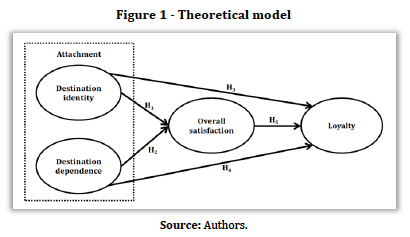
to establish <i>H<sub>1</sub></i> and <i>H<sub>2</sub></i>:</font></p>
    <p><font size="2" face="Verdana"><b><i>H<sub>1</sub></i>:</b> Destination identity influences
overall satisfaction with rural destinations.</font></p>
    <p><font size="2" face="Verdana"><b><i>H<sub>2</sub></i>:</b> Destination dependence influences overall
satisfaction with rural destinations.</font></p>
    <p><font size="2" face="Verdana">According to
  Tsai (2012), place attachment to destinations may include a strong sense of security,
  trust, attraction, joy and personal identification. In this sense, it can be
  understood as a differentiation factor in tourism marketing that has a positive
  impact on loyalty. Empirical evidence has also been found in other studies,
  which supports the relationship between attachment and loyalty (George &amp;
  George, 2004; Alexandris et al., 2006; Mechinda, Serirat &amp; Gulid, 2009;
  Morais &amp; Lin, 2010; Yüksel et al., 2010; Kil et al., 2012; Prayag &amp;
  Ryan, 2012; Tsai, 2012; Chen &amp; Phou, 2013) and allows us to establish H<sub>3
</sub>and H<sub>4</sub>:</font></p>
    <p><font size="2" face="Verdana"><b>H<sub>3</sub>:</b> Destination identity influences
loyalty to rural destinations.</font></p>
    <p><font size="2" face="Verdana"><b>H<sub>4</sub>:</b> Destination dependence influences
loyalty to rural destinations.</font></p>
    ]]></body>
<body><![CDATA[<p><font size="2" face="Verdana">The
  relationship between overall satisfaction and loyalty has been extensively
  verified in theoretical studies (e.g. Rodríguez del Bosque &amp; San Martín,
  2008; Mechinda et al., 2009; Williams &amp; Soutar, 2009; Rivera &amp; Croes,
  2010; Wang &amp; Hsu, 2010; &#381;abkar, Bren&#269;i&#269; &amp;
  Dmitrovi&#263;, 2010; Chen &amp; Tsai, 2012; Forgas, Palau, Sánchez &amp;
  Callarisa, 2012). This includes research within the context of attachment
  (Yüksel et al., 2010; Prayag &amp; Ryan, 2012), although it would be of
  interest to verify this relationship’s importance within the context of rural
tourism. Based on these researches, H<sub>5 </sub>is formulated as:</font></p>
    <p><font size="2" face="Verdana"><b>H<sub>5</sub>:</b> Overall satisfaction influences loyalty to
rural destinations.</font></p>
    <p><font size="2" face="Verdana"><a href="#f1">Figure 1</a> presents
  the theoretical model that will be tested in this study, which shows the
concepts studied, as well as the hypotheses developed.</font></p>
    <p>&nbsp;</p>
    <p><a name="f1"></a></p>
    <p align="center">
<img src="/img/revistas/tms/v11n1/11n1a08f1.jpg" width="410" height="237"></p>
    
<p>&nbsp;</p>
    <p><font size="3" face="Verdana"><b>3.&nbsp;&nbsp;&nbsp;&nbsp;&nbsp; Methodology</b></font></p>
    <p><font size="2" face="Verdana">This study
  adopts an exploratory research approach, using a quantitative on-line survey.
  To measure the constructs under study, scales already tested in other studies
  were adapted for the context of rural tourism. To measure the attachment
  construct’s dimensions of place identity and place dependence, William and
  Vaske’s (2003) scales were used. To measure overall satisfaction, we incorporated
  the contributions of Rodríguez del Bosque and San Martín (2008), Williams and
  Soutar (2009), Wang and Hsu (2010), Yüksel et al. (2010), &#381;abkar et al.
  (2010) and Forgas et al. (2012), as well as the indicators proposed by Tse and
  Wilton (1988) and Oliver (1997). For the study of loyalty, the scale proposed
  by Mechinda et al. (2009) was considered as it includes not only recommendation
  but also re-visitation &#8211;indicators considered core to measuring loyalty.
  The scales used in this study were validated and pretested by experts (i.e.
  teachers and researchers of several Spanish universities and professional
experts in rural tourism, general tourism and marketing).</font></p>
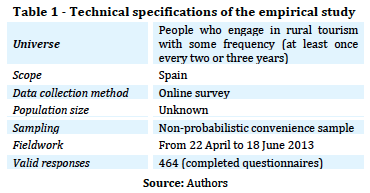
    <p><font size="2" face="Verdana">The current
  study was carried out in Spain, a country where rural tourism has experienced
  exceptional growth in recent years. A questionnaire was disseminated by e-mail,
  social networks, a web page and a blog, trying to create a snowball effect in
  the number of answers gathered. The universe of this research consisted of all
  individuals that experience rural tourism at least once every three years, this
  being the first question of the questionnaire. The questionnaire was first
  pretested with a small subsample of 11 respondents in order to verify its
  accuracy. The data were gathered between April and June 2013, and the final
sample is a convenience sample composed of 464 rural tourists. </font></p>
    ]]></body>
<body><![CDATA[<p>&nbsp;</p>

    <p><a name="t1"></a></p>
    <p align="center">
<img src="/img/revistas/tms/v11n1/11n1a08t1.jpg" width="370" height="193"></p>
    
<p>&nbsp;</p>
    <p><font size="2" face="Verdana">The descriptive
  analysis used the IBM SPSS Statistics Version 21 software. In order to test the
  conceptual model, a Partial Least Squares (PLS) approach to structural equation
  modelling was used, as it is deemed appropriate to use in exploratory studies
  with predictive objectives, as in this study (Hair, Ringle &amp; Sarstedt,
  2011). Although PLS estimates the structural and measurement model
  simultaneously, they have to be interpreted and analysed in two steps, a
  process that ensures that valid and reliable measures of the constructs are
  obtained before establishing conclusions about relationships among the
  constructs (Barclay, Higgins &amp; Thompson, 1995). In the following section,
the results obtained are detailed.</font></p>
    <p>&nbsp;</p>
    <p><font size="3" face="Verdana"><b>4.&nbsp;&nbsp;&nbsp;&nbsp;&nbsp; Results</b></font></p>
    <p><font size="2" face="Verdana">With regard to the demographic characteristics of the sample, it is
  composed of 41.2% men and 58.8% women. By age, the most representative group is
  ‘from 26 to 35 years’ (53.9%). The age groups between 26 and 55 years cover
  85.6% of the sample. With respect to the profile of these respondents as rural
  tourists, 49.8% practice rural tourism ‘once or twice a year’. That means that
  half of the sample engages regularly in rural tourism. For this reason, this
  sample can be qualified as appropriate because of its level of interest and
  knowledge about this type of tourism. Next, the results of the theoretical
model assessment are discussed. </font></p>
    <p><font size="2" face="Verdana"><b>4.1 &nbsp;&nbsp;&nbsp; Measurement model assessment</b></font></p>
    <p><font size="2" face="Verdana">Models that use
  constructs with reflective indicators, as occurs in this study, must be
  evaluated respecting their reliability and validity. It is necessary to analyse
  indicator reliability, internal consistency reliability, convergent validity
  and discriminant validity (Hair et al., 2011). Indicator reliability assessment
  requires observation of the loadings (simple correlations) of each indicator
  with its respective construct. The indicator can be accepted in its construct
  if it has a loading equal to or greater than 0.707 (Hair et al., 2011; Barclay
  et al., 1995), although loadings of 0.50 or 0.60 can be accepted in initial
  stages of scales development or when those scales are applied to different
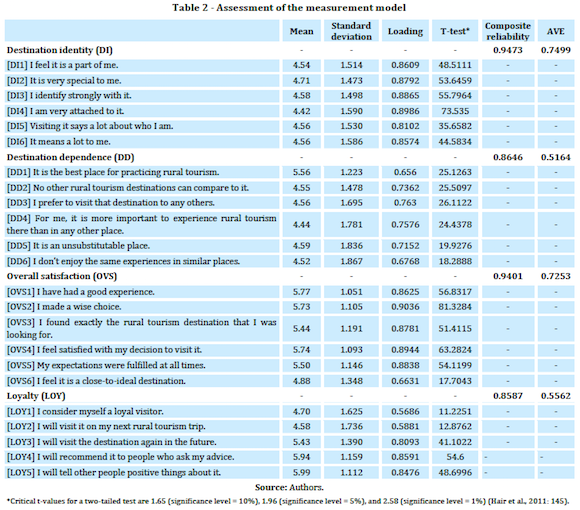
  contexts (Barclay et al., 1995). The analysis in this study showed that the
  indicators have higher values than 0.707, with the exception of DD1 (0.656),
  DD6 (0.6768), OVS6 (0.6631), LOY1 (0.5686) and LOY2 (0.5881); however, the
  values are on the critical tolerance threshold. Internal consistency can be
  verified through composite reliability. Its value has to be between 0.60 and
  0.70 in exploratory studies and between 0.70 and 0.90 for more advanced
  research stages (Nunnally &amp; Bernstein, 1994). Since the values found in our
  analysis range between 0.8587 and 0.9473, they are adequate. The assessment of
  convergent validity is realised through the average variance extracted (AVE).
  These values have to be above 0.5. This means that more than half of the
  variance of latent variables is explained by their indicators (Hair et al.,
  2011). All values for the AVE of each construct in this study were above of the
proposed critical level. These results are shown in <a href="#t2">Table 2</a>.</font></p>
    ]]></body>
<body><![CDATA[<p>&nbsp;</p>

    <p><a name="t2"></a></p>
    <p align="center">
<img src="/img/revistas/tms/v11n1/11n1a08t2.jpg" width="580" height="510"></p>
    
<p>&nbsp;</p>
    <p><font size="2" face="Verdana">The evaluation
  of discriminant validity was carried out by demonstrating that correlations
  between the constructs were lower than the square root of the AVE (Barclay et
  al.,
  1995). The square root of the AVE is presented on the diagonal in bold in <a href="#t3">Table
3</a>. This data confirmed that the model has discriminant validity. </font></p>

    <p>&nbsp;</p>

    <p><a name="t3"></a></p>
    <p align="center">
<img src="/img/revistas/tms/v11n1/11n1a08t3.jpg" width="580" height="108"></p>
    
<p>&nbsp;</p>
    <p><font size="2" face="Verdana">With this
  analysis, the measurement model could be verified as reliable and valid. It was
then possible to continue with an assessment of structural model adequacy. </font></p>
    ]]></body>
<body><![CDATA[<p><font size="2" face="Verdana"><b>4.2&nbsp;&nbsp;&nbsp;&nbsp;  Structural model
assessment </b></font></p>
    <p><font size="2" face="Verdana">The steps
  followed to assess the structural model were an R<sup>2</sup> analysis for each
  dependent construct and an analysis of path coefficients’ significance, using a
  bootstrapping procedure (Hair et al., 2011). The objective of structural
  equation modelling analysis with PLS is prediction, thus it is necessary to
  explain the variance of endogenous latent variables, specifically at the R<sup>2</sup>
  level. In marketing research studies, R<sup>2</sup> values of 0.75, 0.5 or 0.25
  for endogenous latent variables are described as substantial, moderate or weak,
respectively (Hair et al., 2011).</font></p>
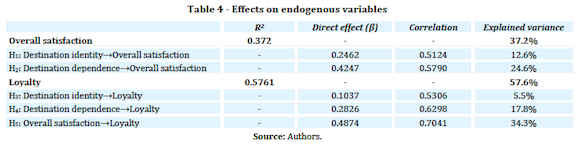
    <p><font size="2" face="Verdana">The model in
  this study has a weak to moderate explanatory capacity for overall
  satisfaction, because the model’s predictors explain 37.2% of this construct.
  For loyalty, its capacity is moderate because its explained variance reaches
  57.6%. It is necessary to explain the level at which the predictor variables
  contribute to the explained variance of the endogenous variables. This is
  represented by the &#946; coefficient, which collects the path coefficients
  (standardised regression weights). Each endogenous construct’s explained
  variance in terms of another latent variable is given by multiplying the &#946;
  coefficient by the correlation coefficient of both variables (Falk &amp;
  Miller, 1992). The most influential factor in overall satisfaction is
  destination dependence, which explains 24.6%, while destination identity
  influences 12.6%. The relevance of both dimensions of attachment to loyalty has
  a similar level of impact. Destination identity has a slight impact in overall
  satisfaction, at 5.5%, with destination dependence achieving a value of 17.8%.
  The main antecedent of loyalty is overall satisfaction, which covers 34.4%, and
  it also engages attachment values because of this construct’s performance as a
mediator. <a href="#t4">Table 4</a> details the results discussed. </font></p>
    <p>&nbsp;</p>

    <p><a name="t4"></a></p>
    <p align="center">
<img src="/img/revistas/tms/v11n1/11n1a08t4.jpg" width="580" height="145"></p>
    
<p>&nbsp;</p>
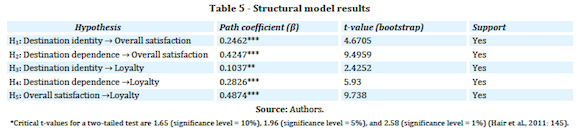
    <p><font size="2" face="Verdana">The analysis of path coefficients’ significance, using a bootstrapping
  procedure, revealed that the proposed hypotheses are empirically supported (see
<a href="#t5">Table 5</a>). </font></p>
    <p>&nbsp;</p>
    <p><a name="t5"></a></p>
    ]]></body>
<body><![CDATA[<p align="center">
<img src="/img/revistas/tms/v11n1/11n1a08t5.jpg" width="580" height="135"></p>
    
<p>&nbsp;</p>
    <p><font size="2" face="Verdana">A graphic
summary of the assessment of the proposed model is shown in <a href="#f2">Figure 2</a>. </font></p>
    <p>&nbsp;</p>
    <p><a name="f2"></a></p>
    <p align="center">
<img src="/img/revistas/tms/v11n1/11n1a08f2.jpg" width="580" height="372"></p>
    
<p>&nbsp;</p>
    <p><font size="2" face="Verdana"><b>4.3&nbsp;&nbsp;&nbsp;&nbsp; Discussion of results</b> </font></p>
    <p><font size="2" face="Verdana">The analysis of
  the theoretical model proposed for this research indicated a good fit of the measurement
  model and support for the empirical hypotheses formulated. The H<sub>1</sub>
  and H<sub>2 </sub>hypotheses represent the possible influence of attachment in
  overall satisfaction through the dimensions of destination identity and
  dependence. These hypotheses have empirical support, which is consistent with
  previous studies (Yüksel et al., 2010; Prayag &amp; Ryan, 2012). Attachment can
  explain 37.2% of the variance of overall satisfaction, where destination
  dependence exerts a greater impact (24.6%) than destination identity (12.6%).
  The relationship between attachment and loyalty, namely the H<sub>3</sub> and H<sub>4</sub> hypotheses, produced statistically significant results, in accordance with
  other studies (George &amp; George, 2004; Alexandris et al., 2006; Mechinda et
  al., 2009; Morais &amp; Lin, 2010; Yüksel et al., 2010; Kil et al., 2012;
  Prayag &amp; Ryan, 2012; Tsai, 2012; Chen &amp; Phou, 2013). As a loyalty
  predictor, destination identity has little influence (5.5%), in contrast to
  destination dependence (17.8%). Regarding the relationship between overall
  satisfaction and loyalty towards rural tourism destinations, the H<sub>5</sub> hypothesis obtained empirical support in the context of rural tourism, a result
  consistent with a broad range of studies (e.g. Chi &amp; Qu, 2008; Rodríguez
  del Bosque &amp; San Martín, 2008; Mechinda et al., 2009; Williams &amp;
  Soutar, 2009; Rivera &amp; Croes, 2010; Wang &amp; Hsu, 2010; Yüksel et al.,
  2010; &#381;abkar et al., 2010; Chen &amp; Tsai, 2012; Forgas et al., 2012;
  Prayag &amp; Ryan, 2012). In addition, the most important causal factor in
  loyalty generation is overall satisfaction, because the latter can explain
  34.3% of the variance in loyalty, although it is evident that the direct effect
  of overall satisfaction on loyalty has to be added to the indirect effect of
attachment on loyalty through overall satisfaction. </font></p>
    <p><font size="2" face="Verdana">In summary, the
  obtained results support the structure of the theoretical model presented in
  this paper, where attachment in a rural tourism context explains 32.2% of
  overall satisfaction and 57.6% of loyalty variance for this type of
  destination. The explicative capability of this model, which links attachment,
satisfaction and loyalty in the context of rural tourism, is moderate.</font></p>
    ]]></body>
<body><![CDATA[<p>&nbsp;</p>
    <p><font size="3" face="Verdana"><b>5.&nbsp;&nbsp;&nbsp;&nbsp;&nbsp;
  Conclusions</b></font></p>
    <p><font size="2" face="Verdana">This study
  sought to obtain an understanding of the importance of attachment in generating
  satisfaction with, and loyalty to, rural tourism destinations. After an
  evaluation of the model through a PLS technique, it can be asserted that the
  model has a moderate explicative capability for the endogenous constructs of
  overall satisfaction and loyalty, taking into account attachment as a predictor
  in the context of rural tourism destinations. This can be regarded as the main
  theoretical implication of this study. Moreover, attachment influences
  loyalty&#8211; both directly and indirectly &#8211; through overall satisfaction.
  For this reason, it can be affirmed that attachment is a relevant determinant
of satisfaction with, and loyalty to, rural tourism destinations.</font></p>
    <p><font size="2" face="Verdana">The theoretical
  implications of this study need to be considered in the management policies of
  tourism destinations, as well as in their strategies and actions, but these
  findings have to be adapted to specific kinds of destination (Rey-Moreno,
  Medina-Molina &amp; Rufín-Moreno, 2014). Based on the endogenous resources of
  rural environments, managers can design different kinds of significant tourism
  experiences to attract and satisfy the rural tourist. However the question is how to successfully
  manage rural tourism products (Kastenholz &amp; Lima, 2011). Therefore,
  regarding the practical
  implications of this research, attachment can be considered as a competitive
  advantage (Mechinda et al., 2009) for rural tourism destinations. As a result,
  it appears to be of interest to foster identity and dependence for these
  destinations. However, Alexandris et al. (2006) argued that place identity
  construction is more complex, due to its emotional implications. To promote
  destination attachment, the organisation of events is useful, in order to
  increase the participation of tourists and to create closer connections with destinations
  (Alexandris et al., 2006; Mechinda et al., 2009). Rural tourism destinations
  can develop events linked to their history, cultures and natural heritage and
  landscapes. These periodically will encourage tourism flows, which would attach
  more people to the destinations through knowledge about, and enjoyment of,
  these places. This will promote repeated visits and recommendations. On the one
  hand, developing events related to local personalities, tastes and interests
  could foster destination identity. On the other hand, conducting ongoing
  activities in nature could favour place attachment, encouraging functional or
  dependence responses to activities that can only take place in these rural
settings.</font></p>
    <p><font size="2" face="Verdana">This paper has
  focused on a study centred on attachment, satisfaction and loyalty in rural
  tourism contexts. As a result, the most important limitations of this research
  could be not taking into account other variables such as emotions,
  authenticity, familiarity or novelty seeking. Thus, future studies need to
  focus on combinations of these variables. In short, researchers should continue
  to deepen the understanding of the determinants of satisfaction and loyalty for
  rural tourism destinations. In this way, it will be possible to enhance the
  profitability of the customer value offered by companies and rural tourism
destinations, with important socioeconomic consequences for these areas.</font></p>
    <p>&nbsp;</p>
    <p><font size="3" face="Verdana"><b>References</b></font></p>
    <!-- ref --><p><font size="2" face="Verdana">Alexandris,
  K., Kouthouris, C. &amp; Meligdis, A. (2006). Increasing customers´ loyalty in
  a skiing resort: The contribution of place attachment and service quality. <i>International Journal of Contemporary
    Hospitality Management</i>, <i>18</i>(5),
414-425.    &nbsp;&nbsp;&nbsp;&nbsp;&nbsp;&nbsp;&nbsp;&nbsp;[&#160;<a href="javascript:void(0);" onclick="javascript: window.open('/scielo.php?script=sci_nlinks&ref=000100&pid=S2182-8458201500010000800001&lng=','','width=640,height=500,resizable=yes,scrollbars=1,menubar=yes,');">Links</a>&#160;]<!-- end-ref --></font></p>
    <!-- ref --><p><font size="2" face="Verdana">Barclay, D.,
  Higgins, C. &amp; Thompson, R. (1995). The Partial Least Squares (PLS) approach
  to causal modelling: Personal computer adoption and use as an illustration. <i>Technology Studies, Special Issue on
    Research Methodology</i>, <i>2</i>(2),
285-309.    &nbsp;&nbsp;&nbsp;&nbsp;&nbsp;&nbsp;&nbsp;&nbsp;[&#160;<a href="javascript:void(0);" onclick="javascript: window.open('/scielo.php?script=sci_nlinks&ref=000102&pid=S2182-8458201500010000800002&lng=','','width=640,height=500,resizable=yes,scrollbars=1,menubar=yes,');">Links</a>&#160;]<!-- end-ref --></font></p>
    <!-- ref --><p><font size="2" face="Verdana">Chen, C. &amp;
  Tsai, D. (2007). How destination image and evaluative factors affect behavioral
  intentions. <i>Tourism Management</i>, <i>28</i>(4),
1115-1122.    &nbsp;&nbsp;&nbsp;&nbsp;&nbsp;&nbsp;&nbsp;&nbsp;[&#160;<a href="javascript:void(0);" onclick="javascript: window.open('/scielo.php?script=sci_nlinks&ref=000104&pid=S2182-8458201500010000800003&lng=','','width=640,height=500,resizable=yes,scrollbars=1,menubar=yes,');">Links</a>&#160;]<!-- end-ref --></font></p>
    <!-- ref --><p><font size="2" face="Verdana">Chen, C. F.
  &amp; Phou, S. (2013). A closer look at destination: Image, personality,
relationship and loyalty. <i>Tourism Management</i>, <i>36</i>, 269-278.    &nbsp;&nbsp;&nbsp;&nbsp;&nbsp;&nbsp;&nbsp;&nbsp;[&#160;<a href="javascript:void(0);" onclick="javascript: window.open('/scielo.php?script=sci_nlinks&ref=000106&pid=S2182-8458201500010000800004&lng=','','width=640,height=500,resizable=yes,scrollbars=1,menubar=yes,');">Links</a>&#160;]<!-- end-ref --></font></p>
    <!-- ref --><p><font size="2" face="Verdana">Chen, J. S.
  &amp; Gursoy, D. (2001). An investigation of tourists´ destination loyalty and
  preferences. <i>International Journal of Contemporary Hospitality Managenent</i>,
<i>13</i>(2), 79-85.    &nbsp;&nbsp;&nbsp;&nbsp;&nbsp;&nbsp;&nbsp;&nbsp;[&#160;<a href="javascript:void(0);" onclick="javascript: window.open('/scielo.php?script=sci_nlinks&ref=000108&pid=S2182-8458201500010000800005&lng=','','width=640,height=500,resizable=yes,scrollbars=1,menubar=yes,');">Links</a>&#160;]<!-- end-ref --></font></p>
    <p><font size="2" face="Verdana">Falk, R. F.
  &amp; Miller; N. B. (1992). <i>A primer for
soft modeling</i>. Akron, Ohio: The University of Akron.</font></p>
    <!-- ref --><p><font size="2" face="Verdana">Forgas,
  S., Palau, R., Sánchez, J. &amp; Callarisa, L. J. (2012). Urban destination loyalty drivers
  and cross-national moderator effects: The case of Barcelona. <i>Tourism
    Management</i>, <i>33</i>(6),
1309-1320.    &nbsp;&nbsp;&nbsp;&nbsp;&nbsp;&nbsp;&nbsp;&nbsp;[&#160;<a href="javascript:void(0);" onclick="javascript: window.open('/scielo.php?script=sci_nlinks&ref=000111&pid=S2182-8458201500010000800007&lng=','','width=640,height=500,resizable=yes,scrollbars=1,menubar=yes,');">Links</a>&#160;]<!-- end-ref --></font></p>
    ]]></body>
<body><![CDATA[<!-- ref --><p><font size="2" face="Verdana">Fyall, A.,
  Callod, C. &amp; Edwards, B. (2003). Relationship marketing, the challenge for
  destinations. <i>Annals of Tourism Research</i>,
<i>30</i>(3), 644-659.    &nbsp;&nbsp;&nbsp;&nbsp;&nbsp;&nbsp;&nbsp;&nbsp;[&#160;<a href="javascript:void(0);" onclick="javascript: window.open('/scielo.php?script=sci_nlinks&ref=000113&pid=S2182-8458201500010000800008&lng=','','width=640,height=500,resizable=yes,scrollbars=1,menubar=yes,');">Links</a>&#160;]<!-- end-ref --></font></p>
    <!-- ref --><p><font size="2" face="Verdana">George, B. P.
  &amp; George, B. P. (2004). Past visits and the intention to revisit a
  destination: Place attachment as the mediator and novelty seeking as the
moderator. <i>Journal of Tourism Studies</i>, <i>15</i>(2), 51-66.    &nbsp;&nbsp;&nbsp;&nbsp;&nbsp;&nbsp;&nbsp;&nbsp;[&#160;<a href="javascript:void(0);" onclick="javascript: window.open('/scielo.php?script=sci_nlinks&ref=000115&pid=S2182-8458201500010000800009&lng=','','width=640,height=500,resizable=yes,scrollbars=1,menubar=yes,');">Links</a>&#160;]<!-- end-ref --></font></p>
    <!-- ref --><p><font size="2" face="Verdana">Hair, J. F., Ringle, C. M. &amp; Sarstedt, M.
  (2011). PLS-SEM: Indeed a silver bullet. <i>Journal of Marketing
    Theory and Practice, 19</i>(2),
139&#8211;151.    &nbsp;&nbsp;&nbsp;&nbsp;&nbsp;&nbsp;&nbsp;&nbsp;[&#160;<a href="javascript:void(0);" onclick="javascript: window.open('/scielo.php?script=sci_nlinks&ref=000117&pid=S2182-8458201500010000800010&lng=','','width=640,height=500,resizable=yes,scrollbars=1,menubar=yes,');">Links</a>&#160;]<!-- end-ref --></font></p>
    <!-- ref --><p><font size="2" face="Verdana">Kastenholz,
  E., &amp; Lima, J. (2011). The integral rural tourism experience from the
  tourist’s point of view &#8211; A qualitative analysis of its nature and
  meaning. <i>Tourism &amp; Management Studies,
7</i>, 62-74.    &nbsp;&nbsp;&nbsp;&nbsp;&nbsp;&nbsp;&nbsp;&nbsp;[&#160;<a href="javascript:void(0);" onclick="javascript: window.open('/scielo.php?script=sci_nlinks&ref=000119&pid=S2182-8458201500010000800011&lng=','','width=640,height=500,resizable=yes,scrollbars=1,menubar=yes,');">Links</a>&#160;]<!-- end-ref --></font></p>
    <!-- ref --><p><font size="2" face="Verdana">Kil, N.,
  Holland, S. M., Stein, T. V. &amp; Ko, Y. J. (2012). Place attachment as a
  mediator of the relationship between nature-based recreation benefits and
  future visit intentions. <i>Journal of Sustainable Tourism</i>, <i>20</i>(4),
603-626.    &nbsp;&nbsp;&nbsp;&nbsp;&nbsp;&nbsp;&nbsp;&nbsp;[&#160;<a href="javascript:void(0);" onclick="javascript: window.open('/scielo.php?script=sci_nlinks&ref=000121&pid=S2182-8458201500010000800012&lng=','','width=640,height=500,resizable=yes,scrollbars=1,menubar=yes,');">Links</a>&#160;]<!-- end-ref --></font></p>
    ]]></body>
<body><![CDATA[<!-- ref --><p><font size="2" face="Verdana">Lewicka, M.
  (2011). Place attachment: How far have we come in the last 40 years? <i>Journal
of Environmental Psychology</i>, <i>31</i>(3), 207-230.    &nbsp;&nbsp;&nbsp;&nbsp;&nbsp;&nbsp;&nbsp;&nbsp;[&#160;<a href="javascript:void(0);" onclick="javascript: window.open('/scielo.php?script=sci_nlinks&ref=000123&pid=S2182-8458201500010000800013&lng=','','width=640,height=500,resizable=yes,scrollbars=1,menubar=yes,');">Links</a>&#160;]<!-- end-ref --></font></p>
    <!-- ref --><p><font size="2" face="Verdana">Loureiro, S.
  M. (2010). Satisfying and delighting the rural tourists. <i>Journal of Travel
  &amp; Tourism Marketing</i>, <i>27</i>(4),
396-408.    &nbsp;&nbsp;&nbsp;&nbsp;&nbsp;&nbsp;&nbsp;&nbsp;[&#160;<a href="javascript:void(0);" onclick="javascript: window.open('/scielo.php?script=sci_nlinks&ref=000125&pid=S2182-8458201500010000800014&lng=','','width=640,height=500,resizable=yes,scrollbars=1,menubar=yes,');">Links</a>&#160;]<!-- end-ref --></font></p>
    <!-- ref --><p><font size="2" face="Verdana">Mechinda, P.,
  Serirat, S. &amp; Gulid, N. (2009). An examination of tourists´ attitudinal and
behavioral loyalty: Comparison between domestic and international tourists. <i>Journal of Vacation Marketing</i>, <i>15</i>(2), 129-148.    &nbsp;&nbsp;&nbsp;&nbsp;&nbsp;&nbsp;&nbsp;&nbsp;[&#160;<a href="javascript:void(0);" onclick="javascript: window.open('/scielo.php?script=sci_nlinks&ref=000127&pid=S2182-8458201500010000800015&lng=','','width=640,height=500,resizable=yes,scrollbars=1,menubar=yes,');">Links</a>&#160;]<!-- end-ref --> </font></p>
    <!-- ref --><p><font size="2" face="Verdana">Morais, D. B.
  &amp; Lin, C. H. (2010). Why
  do first-time and repeat visitors patronize a destination? <i>Journal of Travel
&amp; Tourism Marketing</i>, <i>27</i>(2), 193-210.    &nbsp;&nbsp;&nbsp;&nbsp;&nbsp;&nbsp;&nbsp;&nbsp;[&#160;<a href="javascript:void(0);" onclick="javascript: window.open('/scielo.php?script=sci_nlinks&ref=000129&pid=S2182-8458201500010000800016&lng=','','width=640,height=500,resizable=yes,scrollbars=1,menubar=yes,');">Links</a>&#160;]<!-- end-ref --></font></p>
    <!-- ref --><p><font size="2" face="Verdana">Nunnally J. C.
&amp; Bernstein I. (1994). <i>Psychometric theory. </i>New York: McGraw-Hill.    &nbsp;&nbsp;&nbsp;&nbsp;&nbsp;&nbsp;&nbsp;&nbsp;[&#160;<a href="javascript:void(0);" onclick="javascript: window.open('/scielo.php?script=sci_nlinks&ref=000131&pid=S2182-8458201500010000800017&lng=','','width=640,height=500,resizable=yes,scrollbars=1,menubar=yes,');">Links</a>&#160;]<!-- end-ref --></font></p>
    ]]></body>
<body><![CDATA[<p><font size="2" face="Verdana">Oliver, R. L.
  (1997), <i>Satisfaction</i>.<i> A behavioral perspective on the consumer. </i>Boston,
Massachusetts: McGraw-Hill.</font></p>
    <!-- ref --><p><font size="2" face="Verdana">Phillips, W.
  J., Wolfe, K., Hodur, N. &amp; Leistritz, F. L. (2013). Tourist word of mouth
  and revisit intentions to rural tourism destinations: A case of North Dakota,
USA. <i>International Journal of Tourism Research</i>, <i>15</i>(1), 93-104.    &nbsp;&nbsp;&nbsp;&nbsp;&nbsp;&nbsp;&nbsp;&nbsp;[&#160;<a href="javascript:void(0);" onclick="javascript: window.open('/scielo.php?script=sci_nlinks&ref=000134&pid=S2182-8458201500010000800019&lng=','','width=640,height=500,resizable=yes,scrollbars=1,menubar=yes,');">Links</a>&#160;]<!-- end-ref --></font></p>
    <!-- ref --><p><font size="2" face="Verdana">Prayag, G.
  &amp; Ryan, C. (2012). Antecedents of tourists’ loyalty to Mauritius: The role
  and influence of destination image, place attachment, personal involvement, and
satisfaction. <i>Journal of Travel Research</i>, <i>51</i>(3), 342-356.    &nbsp;&nbsp;&nbsp;&nbsp;&nbsp;&nbsp;&nbsp;&nbsp;[&#160;<a href="javascript:void(0);" onclick="javascript: window.open('/scielo.php?script=sci_nlinks&ref=000136&pid=S2182-8458201500010000800020&lng=','','width=640,height=500,resizable=yes,scrollbars=1,menubar=yes,');">Links</a>&#160;]<!-- end-ref --></font></p>
    <!-- ref --><p><font size="2" face="Verdana">Rey-Moreno,
  M., Medina-Molina, C. &amp; Rufín-Moreno, R. (2014). Tourist attractions as a moderating element in
  explanatory models for loyalty development. <i>Tourism &amp; Management Studies</i>,
<i>10</i>(1), 112-118.    &nbsp;&nbsp;&nbsp;&nbsp;&nbsp;&nbsp;&nbsp;&nbsp;[&#160;<a href="javascript:void(0);" onclick="javascript: window.open('/scielo.php?script=sci_nlinks&ref=000138&pid=S2182-8458201500010000800021&lng=','','width=640,height=500,resizable=yes,scrollbars=1,menubar=yes,');">Links</a>&#160;]<!-- end-ref --></font></p>
    <!-- ref --><p><font size="2" face="Verdana">Rey-Moreno,
  M., Medina-Molina, C., &amp; Rufín-Moreno, R. (2013). Satisfacción, lealtad y
colectivismo en destinos culturales. <i>Tourism &amp; Management Studies, 9</i>(2), 44-49.    &nbsp;&nbsp;&nbsp;&nbsp;&nbsp;&nbsp;&nbsp;&nbsp;[&#160;<a href="javascript:void(0);" onclick="javascript: window.open('/scielo.php?script=sci_nlinks&ref=000140&pid=S2182-8458201500010000800022&lng=','','width=640,height=500,resizable=yes,scrollbars=1,menubar=yes,');">Links</a>&#160;]<!-- end-ref --></font></p>
    <!-- ref --><p><font size="2" face="Verdana">Rivera, M. A.
  &amp; Croes, R. (2010). Ecotourists’ loyalty: Will they tell about the
destination or will they return? <i>Journal of Ecotourism</i>, <i>9</i>(2), 85-103.    &nbsp;&nbsp;&nbsp;&nbsp;&nbsp;&nbsp;&nbsp;&nbsp;[&#160;<a href="javascript:void(0);" onclick="javascript: window.open('/scielo.php?script=sci_nlinks&ref=000142&pid=S2182-8458201500010000800023&lng=','','width=640,height=500,resizable=yes,scrollbars=1,menubar=yes,');">Links</a>&#160;]<!-- end-ref --></font></p>
    <!-- ref --><p><font size="2" face="Verdana">Rodríguez
  del Bosque, I. &amp; San Martín, H. (2008). Tourism satisfaction, a cognitive-affective
model. <i>Annals of Tourism Research</i>, <i>35</i>(2), 551-573.    &nbsp;&nbsp;&nbsp;&nbsp;&nbsp;&nbsp;&nbsp;&nbsp;[&#160;<a href="javascript:void(0);" onclick="javascript: window.open('/scielo.php?script=sci_nlinks&ref=000144&pid=S2182-8458201500010000800024&lng=','','width=640,height=500,resizable=yes,scrollbars=1,menubar=yes,');">Links</a>&#160;]<!-- end-ref --></font></p>
    <!-- ref --><p><font size="2" face="Verdana">Shirazi, S. F.
  M. &amp; Som, A. P. M. (2011). Destination management and relationship marketing:
  Two major factors to achieve competitive advantage. <i>Journal of Relationship
    Marketing</i>, <i>10</i>(2),
76-87.    &nbsp;&nbsp;&nbsp;&nbsp;&nbsp;&nbsp;&nbsp;&nbsp;[&#160;<a href="javascript:void(0);" onclick="javascript: window.open('/scielo.php?script=sci_nlinks&ref=000146&pid=S2182-8458201500010000800025&lng=','','width=640,height=500,resizable=yes,scrollbars=1,menubar=yes,');">Links</a>&#160;]<!-- end-ref --></font></p>
    <!-- ref --><p><font size="2" face="Verdana">Tsai, S. P.
  (2012). Place attachment and tourism marketing: Investigating international
  tourists in Singapore. <i>International Journal of Tourism Research</i>, <i>14</i>(2),
139-152.    &nbsp;&nbsp;&nbsp;&nbsp;&nbsp;&nbsp;&nbsp;&nbsp;[&#160;<a href="javascript:void(0);" onclick="javascript: window.open('/scielo.php?script=sci_nlinks&ref=000148&pid=S2182-8458201500010000800026&lng=','','width=640,height=500,resizable=yes,scrollbars=1,menubar=yes,');">Links</a>&#160;]<!-- end-ref --></font></p>
    <!-- ref --><p><font size="2" face="Verdana">Tse, D. K.
  &amp; Wilton, P. C. (1988). Models of consumer satisfaction formation: An
extension. <i>Journal of Marketing Research</i>, <i>25</i>, 204-212.    &nbsp;&nbsp;&nbsp;&nbsp;&nbsp;&nbsp;&nbsp;&nbsp;[&#160;<a href="javascript:void(0);" onclick="javascript: window.open('/scielo.php?script=sci_nlinks&ref=000150&pid=S2182-8458201500010000800027&lng=','','width=640,height=500,resizable=yes,scrollbars=1,menubar=yes,');">Links</a>&#160;]<!-- end-ref --></font></p>
    <!-- ref --><p><font size="2" face="Verdana">Wang, C. Y.
  &amp; Hsu, M. K. (2010). The relationships of destination image, satisfaction,
  and behavioral intentions: An integrated model. <i>Journal of Travel &amp;
  Tourism Marketing</i>, <i>27</i>(8),
829-843.    &nbsp;&nbsp;&nbsp;&nbsp;&nbsp;&nbsp;&nbsp;&nbsp;[&#160;<a href="javascript:void(0);" onclick="javascript: window.open('/scielo.php?script=sci_nlinks&ref=000152&pid=S2182-8458201500010000800028&lng=','','width=640,height=500,resizable=yes,scrollbars=1,menubar=yes,');">Links</a>&#160;]<!-- end-ref --></font></p>
    <!-- ref --><p><font size="2" face="Verdana">Williams, D.
  R. &amp; Vaske, J. J. (2003). The measurement of place attachment: Validity and
  generalizability of a psychometric approach. <i>Forest Science</i>, <i>49</i>(6),
830-840.    &nbsp;&nbsp;&nbsp;&nbsp;&nbsp;&nbsp;&nbsp;&nbsp;[&#160;<a href="javascript:void(0);" onclick="javascript: window.open('/scielo.php?script=sci_nlinks&ref=000154&pid=S2182-8458201500010000800029&lng=','','width=640,height=500,resizable=yes,scrollbars=1,menubar=yes,');">Links</a>&#160;]<!-- end-ref --></font></p>
    <!-- ref --><p><font size="2" face="Verdana">Williams, P.
  &amp; Soutar, G. N. (2009). Value, satisfaction and behavioral intentions in an
adventure tourism context. <i>Annals of Tourism Research</i>, <i>36</i>(3), 413-438.    &nbsp;&nbsp;&nbsp;&nbsp;&nbsp;&nbsp;&nbsp;&nbsp;[&#160;<a href="javascript:void(0);" onclick="javascript: window.open('/scielo.php?script=sci_nlinks&ref=000156&pid=S2182-8458201500010000800030&lng=','','width=640,height=500,resizable=yes,scrollbars=1,menubar=yes,');">Links</a>&#160;]<!-- end-ref --></font></p>
    <!-- ref --><p><font size="2" face="Verdana">Yüksel, A.,
  Yüksel, F. &amp; Bilis, Y. (2010). Destination attachment: Effects on customer satisfaction and cognitive,
affective and conative loyalty. <i>Tourism Management</i>, <i>31</i>(2), 274-284.    &nbsp;&nbsp;&nbsp;&nbsp;&nbsp;&nbsp;&nbsp;&nbsp;[&#160;<a href="javascript:void(0);" onclick="javascript: window.open('/scielo.php?script=sci_nlinks&ref=000158&pid=S2182-8458201500010000800031&lng=','','width=640,height=500,resizable=yes,scrollbars=1,menubar=yes,');">Links</a>&#160;]<!-- end-ref --></font></p>
    <!-- ref --><p><font size="2" face="Verdana">&#381;abkar,
  V., Bren&#269;i&#269;, M. M. &amp; Dmitrovi&#263;, T. (2010). Modelling
  perceived quality, visitor satisfaction and behavioural intentions at the
destination level. <i>Tourism Management</i>, <i>31</i>(4), 537-546.    &nbsp;&nbsp;&nbsp;&nbsp;&nbsp;&nbsp;&nbsp;&nbsp;[&#160;<a href="javascript:void(0);" onclick="javascript: window.open('/scielo.php?script=sci_nlinks&ref=000160&pid=S2182-8458201500010000800032&lng=','','width=640,height=500,resizable=yes,scrollbars=1,menubar=yes,');">Links</a>&#160;]<!-- end-ref --></font></p>
    <p>&nbsp;</p>
    ]]></body>
<body><![CDATA[<p>&nbsp;</p>
    <p><font size="2" face="Verdana"><b>Article history:</b>
  
      <br>
  <b>Received</b>:
  12 January 2014
  
      <br>
  <b>Accepted</b>:
15 November 2014</font></p>
     ]]></body><back>
<ref-list>
<ref id="B1">
<nlm-citation citation-type="journal">
<person-group person-group-type="author">
<name>
<surname><![CDATA[Alexandris]]></surname>
<given-names><![CDATA[K.]]></given-names>
</name>
<name>
<surname><![CDATA[Kouthouris]]></surname>
<given-names><![CDATA[C.]]></given-names>
</name>
<name>
<surname><![CDATA[Meligdis]]></surname>
<given-names><![CDATA[A.]]></given-names>
</name>
</person-group>
<article-title xml:lang="en"><![CDATA[Increasing customers´ loyalty in a skiing resort: The contribution of place attachment and service quality]]></article-title>
<source><![CDATA[International Journal of Contemporary Hospitality Management]]></source>
<year>2006</year>
<volume>18</volume>
<numero>5</numero>
<issue>5</issue>
<page-range>414-425</page-range></nlm-citation>
</ref>
<ref id="B2">
<nlm-citation citation-type="journal">
<person-group person-group-type="author">
<name>
<surname><![CDATA[Barclay]]></surname>
<given-names><![CDATA[D.]]></given-names>
</name>
<name>
<surname><![CDATA[Higgins]]></surname>
<given-names><![CDATA[C.]]></given-names>
</name>
<name>
<surname><![CDATA[Thompson]]></surname>
<given-names><![CDATA[R.]]></given-names>
</name>
</person-group>
<article-title xml:lang="en"><![CDATA[The Partial Least Squares (PLS) approach to causal modelling: Personal computer adoption and use as an illustration]]></article-title>
<source><![CDATA[Technology Studies, Special Issue on Research Methodology]]></source>
<year>1995</year>
<volume>2</volume>
<numero>2</numero>
<issue>2</issue>
<page-range>285-309</page-range></nlm-citation>
</ref>
<ref id="B3">
<nlm-citation citation-type="journal">
<person-group person-group-type="author">
<name>
<surname><![CDATA[Chen]]></surname>
<given-names><![CDATA[C.]]></given-names>
</name>
<name>
<surname><![CDATA[Tsai]]></surname>
<given-names><![CDATA[D.]]></given-names>
</name>
</person-group>
<article-title xml:lang="en"><![CDATA[How destination image and evaluative factors affect behavioral intentions]]></article-title>
<source><![CDATA[Tourism Management]]></source>
<year>2007</year>
<volume>28</volume>
<numero>4</numero>
<issue>4</issue>
<page-range>1115-1122</page-range></nlm-citation>
</ref>
<ref id="B4">
<nlm-citation citation-type="journal">
<person-group person-group-type="author">
<name>
<surname><![CDATA[Chen]]></surname>
<given-names><![CDATA[C. F.]]></given-names>
</name>
<name>
<surname><![CDATA[Phou]]></surname>
<given-names><![CDATA[S.]]></given-names>
</name>
</person-group>
<article-title xml:lang="en"><![CDATA[A closer look at destination: Image, personality, relationship and loyalty]]></article-title>
<source><![CDATA[Tourism Management]]></source>
<year>2013</year>
<numero>36</numero>
<issue>36</issue>
<page-range>269-278</page-range></nlm-citation>
</ref>
<ref id="B5">
<nlm-citation citation-type="journal">
<person-group person-group-type="author">
<name>
<surname><![CDATA[Chen]]></surname>
<given-names><![CDATA[J. S.]]></given-names>
</name>
<name>
<surname><![CDATA[Gursoy]]></surname>
<given-names><![CDATA[D.]]></given-names>
</name>
</person-group>
<article-title xml:lang="en"><![CDATA[An investigation of tourists´ destination loyalty and preferences]]></article-title>
<source><![CDATA[International Journal of Contemporary Hospitality Managenent]]></source>
<year>2001</year>
<volume>13</volume>
<numero>2</numero>
<issue>2</issue>
<page-range>79-85</page-range></nlm-citation>
</ref>
<ref id="B6">
<nlm-citation citation-type="book">
<person-group person-group-type="author">
<name>
<surname><![CDATA[Falk]]></surname>
<given-names><![CDATA[R. F.]]></given-names>
</name>
<name>
<surname><![CDATA[Miller]]></surname>
<given-names><![CDATA[N. B.]]></given-names>
</name>
</person-group>
<source><![CDATA[A primer for soft modeling]]></source>
<year>1992</year>
<publisher-loc><![CDATA[Akron ]]></publisher-loc>
<publisher-name><![CDATA[The University of Akron]]></publisher-name>
</nlm-citation>
</ref>
<ref id="B7">
<nlm-citation citation-type="journal">
<person-group person-group-type="author">
<name>
<surname><![CDATA[Forgas]]></surname>
<given-names><![CDATA[S.]]></given-names>
</name>
<name>
<surname><![CDATA[Palau]]></surname>
<given-names><![CDATA[R.]]></given-names>
</name>
<name>
<surname><![CDATA[Sánchez]]></surname>
<given-names><![CDATA[J.]]></given-names>
</name>
<name>
<surname><![CDATA[Callarisa]]></surname>
<given-names><![CDATA[L. J.]]></given-names>
</name>
</person-group>
<article-title xml:lang="en"><![CDATA[Urban destination loyalty drivers and cross-national moderator effects: The case of Barcelona]]></article-title>
<source><![CDATA[Tourism Management]]></source>
<year>2012</year>
<volume>33</volume>
<numero>6</numero>
<issue>6</issue>
<page-range>1309-1320</page-range></nlm-citation>
</ref>
<ref id="B8">
<nlm-citation citation-type="journal">
<person-group person-group-type="author">
<name>
<surname><![CDATA[Fyall]]></surname>
<given-names><![CDATA[A.]]></given-names>
</name>
<name>
<surname><![CDATA[Callod]]></surname>
<given-names><![CDATA[C.]]></given-names>
</name>
<name>
<surname><![CDATA[Edwards]]></surname>
<given-names><![CDATA[B.]]></given-names>
</name>
</person-group>
<article-title xml:lang="en"><![CDATA[Relationship marketing, the challenge for destinations]]></article-title>
<source><![CDATA[Annals of Tourism Research]]></source>
<year>2003</year>
<volume>30</volume>
<numero>3</numero>
<issue>3</issue>
<page-range>644-659</page-range></nlm-citation>
</ref>
<ref id="B9">
<nlm-citation citation-type="journal">
<person-group person-group-type="author">
<name>
<surname><![CDATA[George]]></surname>
<given-names><![CDATA[B. P.]]></given-names>
</name>
<name>
<surname><![CDATA[George]]></surname>
<given-names><![CDATA[B. P.]]></given-names>
</name>
</person-group>
<article-title xml:lang="en"><![CDATA[Past visits and the intention to revisit a destination: Place attachment as the mediator and novelty seeking as the moderator]]></article-title>
<source><![CDATA[Journal of Tourism Studies]]></source>
<year>2004</year>
<volume>15</volume>
<numero>2</numero>
<issue>2</issue>
<page-range>51-66</page-range></nlm-citation>
</ref>
<ref id="B10">
<nlm-citation citation-type="journal">
<person-group person-group-type="author">
<name>
<surname><![CDATA[Hair]]></surname>
<given-names><![CDATA[J. F.]]></given-names>
</name>
<name>
<surname><![CDATA[Ringle]]></surname>
<given-names><![CDATA[C. M.]]></given-names>
</name>
<name>
<surname><![CDATA[Sarstedt]]></surname>
<given-names><![CDATA[M.]]></given-names>
</name>
</person-group>
<article-title xml:lang="en"><![CDATA[PLS-SEM: Indeed a silver bullet]]></article-title>
<source><![CDATA[Journal of Marketing Theory and Practice]]></source>
<year>2011</year>
<volume>19</volume>
<numero>2</numero>
<issue>2</issue>
<page-range>139-151</page-range></nlm-citation>
</ref>
<ref id="B11">
<nlm-citation citation-type="journal">
<person-group person-group-type="author">
<name>
<surname><![CDATA[Kastenholz]]></surname>
<given-names><![CDATA[E.]]></given-names>
</name>
<name>
<surname><![CDATA[Lima]]></surname>
<given-names><![CDATA[J.]]></given-names>
</name>
</person-group>
<article-title xml:lang="en"><![CDATA[The integral rural tourism experience from the tourist’s point of view: A qualitative analysis of its nature and meaning]]></article-title>
<source><![CDATA[Tourism & Management Studies]]></source>
<year>2011</year>
<numero>7</numero>
<issue>7</issue>
<page-range>62-74</page-range></nlm-citation>
</ref>
<ref id="B12">
<nlm-citation citation-type="journal">
<person-group person-group-type="author">
<name>
<surname><![CDATA[Kil]]></surname>
<given-names><![CDATA[N.]]></given-names>
</name>
<name>
<surname><![CDATA[Holland]]></surname>
<given-names><![CDATA[S. M.]]></given-names>
</name>
<name>
<surname><![CDATA[Stein]]></surname>
<given-names><![CDATA[T. V.]]></given-names>
</name>
<name>
<surname><![CDATA[Ko]]></surname>
<given-names><![CDATA[Y. J.]]></given-names>
</name>
</person-group>
<article-title xml:lang="en"><![CDATA[Place attachment as a mediator of the relationship between nature-based recreation benefits and future visit intentions]]></article-title>
<source><![CDATA[Journal of Sustainable Tourism]]></source>
<year>2012</year>
<volume>20</volume>
<numero>4</numero>
<issue>4</issue>
<page-range>603-626</page-range></nlm-citation>
</ref>
<ref id="B13">
<nlm-citation citation-type="journal">
<person-group person-group-type="author">
<name>
<surname><![CDATA[Lewicka]]></surname>
<given-names><![CDATA[M.]]></given-names>
</name>
</person-group>
<article-title xml:lang="en"><![CDATA[Place attachment: How far have we come in the last 40 years?]]></article-title>
<source><![CDATA[Journal of Environmental Psychology]]></source>
<year>2011</year>
<volume>31</volume>
<numero>3</numero>
<issue>3</issue>
<page-range>207-230</page-range></nlm-citation>
</ref>
<ref id="B14">
<nlm-citation citation-type="journal">
<person-group person-group-type="author">
<name>
<surname><![CDATA[Loureiro]]></surname>
<given-names><![CDATA[S. M.]]></given-names>
</name>
</person-group>
<article-title xml:lang="en"><![CDATA[Satisfying and delighting the rural tourists]]></article-title>
<source><![CDATA[Journal of Travel & Tourism Marketing]]></source>
<year>2010</year>
<volume>27</volume>
<numero>4</numero>
<issue>4</issue>
<page-range>396-408</page-range></nlm-citation>
</ref>
<ref id="B15">
<nlm-citation citation-type="journal">
<person-group person-group-type="author">
<name>
<surname><![CDATA[Mechinda]]></surname>
<given-names><![CDATA[P.]]></given-names>
</name>
<name>
<surname><![CDATA[Serirat]]></surname>
<given-names><![CDATA[S.]]></given-names>
</name>
<name>
<surname><![CDATA[Gulid]]></surname>
<given-names><![CDATA[N.]]></given-names>
</name>
</person-group>
<article-title xml:lang="en"><![CDATA[An examination of tourists´ attitudinal and behavioral loyalty: Comparison between domestic and international tourists]]></article-title>
<source><![CDATA[Journal of Vacation Marketing]]></source>
<year>2009</year>
<volume>15</volume>
<numero>2</numero>
<issue>2</issue>
<page-range>129-148</page-range></nlm-citation>
</ref>
<ref id="B16">
<nlm-citation citation-type="journal">
<person-group person-group-type="author">
<name>
<surname><![CDATA[Morais]]></surname>
<given-names><![CDATA[D. B.]]></given-names>
</name>
<name>
<surname><![CDATA[Lin]]></surname>
<given-names><![CDATA[C. H.]]></given-names>
</name>
</person-group>
<article-title xml:lang="en"><![CDATA[Why do first-time and repeat visitors patronize a destination?]]></article-title>
<source><![CDATA[Journal of Travel & Tourism Marketing]]></source>
<year>2010</year>
<volume>27</volume>
<numero>2</numero>
<issue>2</issue>
<page-range>193-210</page-range></nlm-citation>
</ref>
<ref id="B17">
<nlm-citation citation-type="book">
<person-group person-group-type="author">
<name>
<surname><![CDATA[Nunnally]]></surname>
<given-names><![CDATA[J. C.]]></given-names>
</name>
<name>
<surname><![CDATA[Bernstein]]></surname>
<given-names><![CDATA[I.]]></given-names>
</name>
</person-group>
<source><![CDATA[Psychometric theory]]></source>
<year>1994</year>
<publisher-loc><![CDATA[New York ]]></publisher-loc>
<publisher-name><![CDATA[McGraw-Hill]]></publisher-name>
</nlm-citation>
</ref>
<ref id="B18">
<nlm-citation citation-type="book">
<person-group person-group-type="author">
<name>
<surname><![CDATA[Oliver]]></surname>
<given-names><![CDATA[R. L.]]></given-names>
</name>
</person-group>
<source><![CDATA[Satisfaction: A behavioral perspective on the consumer]]></source>
<year>1997</year>
<publisher-loc><![CDATA[Boston ]]></publisher-loc>
<publisher-name><![CDATA[McGraw-Hill]]></publisher-name>
</nlm-citation>
</ref>
<ref id="B19">
<nlm-citation citation-type="journal">
<person-group person-group-type="author">
<name>
<surname><![CDATA[Phillips]]></surname>
<given-names><![CDATA[W. J.]]></given-names>
</name>
<name>
<surname><![CDATA[Wolfe]]></surname>
<given-names><![CDATA[K.]]></given-names>
</name>
<name>
<surname><![CDATA[Hodur]]></surname>
<given-names><![CDATA[N.]]></given-names>
</name>
<name>
<surname><![CDATA[Leistritz]]></surname>
<given-names><![CDATA[F. L.]]></given-names>
</name>
</person-group>
<article-title xml:lang="en"><![CDATA[Tourist word of mouth and revisit intentions to rural tourism destinations: A case of North Dakota, USA]]></article-title>
<source><![CDATA[International Journal of Tourism Research]]></source>
<year>2013</year>
<volume>15</volume>
<numero>1</numero>
<issue>1</issue>
<page-range>93-104</page-range></nlm-citation>
</ref>
<ref id="B20">
<nlm-citation citation-type="journal">
<person-group person-group-type="author">
<name>
<surname><![CDATA[Prayag]]></surname>
<given-names><![CDATA[G.]]></given-names>
</name>
<name>
<surname><![CDATA[Ryan]]></surname>
<given-names><![CDATA[C.]]></given-names>
</name>
</person-group>
<article-title xml:lang="en"><![CDATA[Antecedents of tourists’ loyalty to Mauritius: The role and influence of destination image, place attachment, personal involvement, and satisfaction]]></article-title>
<source><![CDATA[Journal of Travel Research]]></source>
<year>2012</year>
<volume>51</volume>
<numero>3</numero>
<issue>3</issue>
<page-range>342-356</page-range></nlm-citation>
</ref>
<ref id="B21">
<nlm-citation citation-type="journal">
<person-group person-group-type="author">
<name>
<surname><![CDATA[Rey-Moreno]]></surname>
<given-names><![CDATA[M.]]></given-names>
</name>
<name>
<surname><![CDATA[Medina-Molina]]></surname>
<given-names><![CDATA[C.]]></given-names>
</name>
<name>
<surname><![CDATA[Rufín-Moreno]]></surname>
<given-names><![CDATA[R.]]></given-names>
</name>
</person-group>
<article-title xml:lang="en"><![CDATA[Tourist attractions as a moderating element in explanatory models for loyalty development]]></article-title>
<source><![CDATA[Tourism & Management Studies]]></source>
<year>2014</year>
<volume>10</volume>
<numero>1</numero>
<issue>1</issue>
<page-range>112-118</page-range></nlm-citation>
</ref>
<ref id="B22">
<nlm-citation citation-type="journal">
<person-group person-group-type="author">
<name>
<surname><![CDATA[Rey-Moreno]]></surname>
<given-names><![CDATA[M.]]></given-names>
</name>
<name>
<surname><![CDATA[Medina-Molina]]></surname>
<given-names><![CDATA[C.]]></given-names>
</name>
<name>
<surname><![CDATA[Rufín-Moreno]]></surname>
<given-names><![CDATA[R.]]></given-names>
</name>
</person-group>
<article-title xml:lang="en"><![CDATA[Satisfacción, lealtad y colectivismo en destinos culturales]]></article-title>
<source><![CDATA[Tourism & Management Studies]]></source>
<year>2013</year>
<volume>9</volume>
<numero>2</numero>
<issue>2</issue>
<page-range>44-49</page-range></nlm-citation>
</ref>
<ref id="B23">
<nlm-citation citation-type="journal">
<person-group person-group-type="author">
<name>
<surname><![CDATA[Rivera]]></surname>
<given-names><![CDATA[M. A.]]></given-names>
</name>
<name>
<surname><![CDATA[Croes]]></surname>
<given-names><![CDATA[R.]]></given-names>
</name>
</person-group>
<article-title xml:lang="en"><![CDATA[Ecotourists’ loyalty: Will they tell about the destination or will they return?]]></article-title>
<source><![CDATA[Journal of Ecotourism]]></source>
<year>2010</year>
<volume>9</volume>
<numero>2</numero>
<issue>2</issue>
<page-range>85-103</page-range></nlm-citation>
</ref>
<ref id="B24">
<nlm-citation citation-type="journal">
<person-group person-group-type="author">
<name>
<surname><![CDATA[Rodríguez del Bosque]]></surname>
<given-names><![CDATA[I.]]></given-names>
</name>
<name>
<surname><![CDATA[San Martín]]></surname>
<given-names><![CDATA[H.]]></given-names>
</name>
</person-group>
<article-title xml:lang="en"><![CDATA[Tourism satisfaction, a cognitive-affective model]]></article-title>
<source><![CDATA[Annals of Tourism Research]]></source>
<year>2008</year>
<volume>35</volume>
<numero>2</numero>
<issue>2</issue>
<page-range>551-573</page-range></nlm-citation>
</ref>
<ref id="B25">
<nlm-citation citation-type="journal">
<person-group person-group-type="author">
<name>
<surname><![CDATA[Shirazi]]></surname>
<given-names><![CDATA[S. F. M.]]></given-names>
</name>
<name>
<surname><![CDATA[Som]]></surname>
<given-names><![CDATA[A. P. M.]]></given-names>
</name>
</person-group>
<article-title xml:lang="en"><![CDATA[Destination management and relationship marketing: Two major factors to achieve competitive advantage]]></article-title>
<source><![CDATA[Journal of Relationship Marketing]]></source>
<year>2011</year>
<volume>10</volume>
<numero>2</numero>
<issue>2</issue>
<page-range>76-87</page-range></nlm-citation>
</ref>
<ref id="B26">
<nlm-citation citation-type="journal">
<person-group person-group-type="author">
<name>
<surname><![CDATA[Tsai]]></surname>
<given-names><![CDATA[S. P.]]></given-names>
</name>
</person-group>
<article-title xml:lang="en"><![CDATA[Place attachment and tourism marketing: Investigating international tourists in Singapore]]></article-title>
<source><![CDATA[International Journal of Tourism Research]]></source>
<year>2012</year>
<volume>14</volume>
<numero>2</numero>
<issue>2</issue>
<page-range>139-152</page-range></nlm-citation>
</ref>
<ref id="B27">
<nlm-citation citation-type="journal">
<person-group person-group-type="author">
<name>
<surname><![CDATA[Tse]]></surname>
<given-names><![CDATA[D. K.]]></given-names>
</name>
<name>
<surname><![CDATA[Wilton]]></surname>
<given-names><![CDATA[P. C.]]></given-names>
</name>
</person-group>
<article-title xml:lang="en"><![CDATA[Models of consumer satisfaction formation: An extension]]></article-title>
<source><![CDATA[Journal of Marketing Research]]></source>
<year>1988</year>
<numero>25</numero>
<issue>25</issue>
<page-range>204-212</page-range></nlm-citation>
</ref>
<ref id="B28">
<nlm-citation citation-type="journal">
<person-group person-group-type="author">
<name>
<surname><![CDATA[Wang]]></surname>
<given-names><![CDATA[C. Y.]]></given-names>
</name>
<name>
<surname><![CDATA[Hsu]]></surname>
<given-names><![CDATA[M. K.]]></given-names>
</name>
</person-group>
<article-title xml:lang="en"><![CDATA[The relationships of destination image, satisfaction, and behavioral intentions: An integrated model]]></article-title>
<source><![CDATA[Journal of Travel & Tourism Marketing]]></source>
<year>2010</year>
<volume>27</volume>
<numero>8</numero>
<issue>8</issue>
<page-range>829-843</page-range></nlm-citation>
</ref>
<ref id="B29">
<nlm-citation citation-type="journal">
<person-group person-group-type="author">
<name>
<surname><![CDATA[Williams]]></surname>
<given-names><![CDATA[D. R.]]></given-names>
</name>
<name>
<surname><![CDATA[Vaske]]></surname>
<given-names><![CDATA[J. J.]]></given-names>
</name>
</person-group>
<article-title xml:lang="en"><![CDATA[The measurement of place attachment: Validity and generalizability of a psychometric approach]]></article-title>
<source><![CDATA[Forest Science]]></source>
<year>2003</year>
<volume>49</volume>
<numero>6</numero>
<issue>6</issue>
<page-range>830-840</page-range></nlm-citation>
</ref>
<ref id="B30">
<nlm-citation citation-type="journal">
<person-group person-group-type="author">
<name>
<surname><![CDATA[Williams]]></surname>
<given-names><![CDATA[P.]]></given-names>
</name>
<name>
<surname><![CDATA[Soutar]]></surname>
<given-names><![CDATA[G. N.]]></given-names>
</name>
</person-group>
<article-title xml:lang="en"><![CDATA[Value, satisfaction and behavioral intentions in an adventure tourism context]]></article-title>
<source><![CDATA[Annals of Tourism Research]]></source>
<year>2009</year>
<volume>36</volume>
<numero>3</numero>
<issue>3</issue>
<page-range>413-438</page-range></nlm-citation>
</ref>
<ref id="B31">
<nlm-citation citation-type="journal">
<person-group person-group-type="author">
<name>
<surname><![CDATA[Yüksel]]></surname>
<given-names><![CDATA[A.]]></given-names>
</name>
<name>
<surname><![CDATA[Yüksel]]></surname>
<given-names><![CDATA[F.]]></given-names>
</name>
<name>
<surname><![CDATA[Bilis]]></surname>
<given-names><![CDATA[Y.]]></given-names>
</name>
</person-group>
<article-title xml:lang="en"><![CDATA[Destination attachment: Effects on customer satisfaction and cognitive, affective and conative loyalty]]></article-title>
<source><![CDATA[Tourism Management]]></source>
<year>2010</year>
<volume>31</volume>
<numero>2</numero>
<issue>2</issue>
<page-range>274-284</page-range></nlm-citation>
</ref>
<ref id="B32">
<nlm-citation citation-type="journal">
<person-group person-group-type="author">
<name>
<surname><![CDATA[Žabkar]]></surname>
<given-names><![CDATA[V.]]></given-names>
</name>
<name>
<surname><![CDATA[Bren&#269;i&#269;]]></surname>
<given-names><![CDATA[M. M.]]></given-names>
</name>
<name>
<surname><![CDATA[Dmitrovi&#263;]]></surname>
<given-names><![CDATA[T.]]></given-names>
</name>
</person-group>
<article-title xml:lang="en"><![CDATA[Modelling perceived quality, visitor satisfaction and behavioural intentions at the destination level]]></article-title>
<source><![CDATA[Tourism Management]]></source>
<year>2010</year>
<volume>31</volume>
<numero>4</numero>
<issue>4</issue>
<page-range>537-546</page-range></nlm-citation>
</ref>
</ref-list>
</back>
</article>