<?xml version="1.0" encoding="ISO-8859-1"?><article xmlns:mml="http://www.w3.org/1998/Math/MathML" xmlns:xlink="http://www.w3.org/1999/xlink" xmlns:xsi="http://www.w3.org/2001/XMLSchema-instance">
<front>
<journal-meta>
<journal-id>2182-8458</journal-id>
<journal-title><![CDATA[Tourism & Management Studies]]></journal-title>
<abbrev-journal-title><![CDATA[TMStudies]]></abbrev-journal-title>
<issn>2182-8458</issn>
<publisher>
<publisher-name><![CDATA[Escola Superior de Gestão, Hotelaria e Turismo da Universidade do Algarve]]></publisher-name>
</publisher>
</journal-meta>
<article-meta>
<article-id>S2182-84582015000100011</article-id>
<title-group>
<article-title xml:lang="en"><![CDATA[Spatiotemporal behaviour of the urban multi-attraction tourist: does distance travelled from country of origin make a difference?]]></article-title>
<article-title xml:lang="pt"><![CDATA[O comportamento espaciotemporal do turista urbano multiatração: a distância do país de origem faz diferença?]]></article-title>
</title-group>
<contrib-group>
<contrib contrib-type="author">
<name>
<surname><![CDATA[Caldeira]]></surname>
<given-names><![CDATA[Ana Maria]]></given-names>
</name>
<xref ref-type="aff" rid="A01"/>
</contrib>
<contrib contrib-type="author">
<name>
<surname><![CDATA[Kastenholz]]></surname>
<given-names><![CDATA[Elisabeth]]></given-names>
</name>
<xref ref-type="aff" rid="A01"/>
</contrib>
</contrib-group>
<aff id="A01">
<institution><![CDATA[,University of Aveiro Department of Economics, Management and Industrial Engineering Research Unit in Governance, Competitiveness and Public Policies]]></institution>
<addr-line><![CDATA[Aveiro ]]></addr-line>
<country>Portugal</country>
</aff>
<pub-date pub-type="pub">
<day>31</day>
<month>01</month>
<year>2015</year>
</pub-date>
<pub-date pub-type="epub">
<day>31</day>
<month>01</month>
<year>2015</year>
</pub-date>
<volume>11</volume>
<numero>1</numero>
<fpage>91</fpage>
<lpage>97</lpage>
<copyright-statement/>
<copyright-year/>
<self-uri xlink:href="http://scielo.pt/scielo.php?script=sci_arttext&amp;pid=S2182-84582015000100011&amp;lng=en&amp;nrm=iso"></self-uri><self-uri xlink:href="http://scielo.pt/scielo.php?script=sci_abstract&amp;pid=S2182-84582015000100011&amp;lng=en&amp;nrm=iso"></self-uri><self-uri xlink:href="http://scielo.pt/scielo.php?script=sci_pdf&amp;pid=S2182-84582015000100011&amp;lng=en&amp;nrm=iso"></self-uri><abstract abstract-type="short" xml:lang="en"><p><![CDATA[The way tourists move in space and time is part of their travel experience while at the same time moulding it. In the urban context, tourists usually include multiple attractions on their intra-destination itineraries. Understanding tourists’ spatiotemporal behaviour may help improve the quality of their experience as well as provide useful information to the management of attractions and destination. Nevertheless, tourists’ spatiotemporal behaviour is a complex phenomenon, influenced by numerous factors related to both destination and tourists. Distance travelled from country of origin has been empirically found as one of these factors influencing tourist spatiotemporal behaviour. Visitors from more distant residential locations invest more time and money in their trip; therefore, variety/multiple benefit seeking, risk and uncertainty reduction and economic rationalization may impact their time-space activity. However, there has been no research examining the impact of distance travelled from country of origin specifically on tourist spatiotemporal behaviour in an urban setting. This article fills this gap both theoretically and empirically, through a dual analysis of a time-space GPS tracking study and a survey, conducted among tourists (n=413) staying at 10 different hotels in Lisbon. Hypothesis testing allowed the identification of statistically significant differences between long-haulers and short-haulers in their spatiotemporal behaviour when visiting this urban destination.]]></p></abstract>
<abstract abstract-type="short" xml:lang="pt"><p><![CDATA[O modo como os turistas se movem no espaço e no tempo faz parte e, ao mesmo tempo, molda a sua experiência de viagem. No contexto urbano, os turistas costumam incluir várias atrações nos seus itinerários intradestino. A compreensão do comportamento espaciotemporal dos turistas pode ajudar a melhorar a qualidade da sua experiência, bem como fornecer informações úteis para a gestão de atrações e destinos. No entanto, o comportamento espaciotemporal dos turistas é um fenómeno complexo, influenciado por inúmeros fatores relativos quer ao destino, quer aos próprios turistas. A distância percorrida do país de origem até ao destino foi empiricamente identificada como um desses fatores que influenciam o comportamento espaciotemporal do turista. Os visitantes originários de locais de residência mais distantes investem mais tempo e dinheiro na sua viagem; portanto, a busca de variedade e de múltiplos benefícios, a redução do risco e de incerteza e a racionalização económica pode impactar a sua atividade espaço-tempo. No entanto, nenhuma pesquisa examinou antes especificamente o impacto da distância percorrida a partir do país de origem sobre o comportamento espaciotemporal do turista em contexto urbano. Este artigo preenche esta lacuna teórica e empírica, por meio de uma dupla análise de rastreamento GPS e de um inquérito junto de turistas (n = 413) alojados em dez diferentes hotéis em Lisboa. Os testes de hipóteses permitiram identificar diferenças estatisticamente significativas entre os turistas que viajaram de curta distância e os turistas de longa distância quanto ao seu comportamento espaciotemporal na visita a este destino urbano.]]></p></abstract>
<kwd-group>
<kwd lng="en"><![CDATA[Intra-destination spatiotemporal behaviour]]></kwd>
<kwd lng="en"><![CDATA[multi-attraction travel experience]]></kwd>
<kwd lng="en"><![CDATA[urban tourism]]></kwd>
<kwd lng="en"><![CDATA[distance travelled from country of origin]]></kwd>
<kwd lng="pt"><![CDATA[Comportamento espaciotemporal intradestino]]></kwd>
<kwd lng="pt"><![CDATA[experiência de visita multiatração]]></kwd>
<kwd lng="pt"><![CDATA[turismo urbano]]></kwd>
<kwd lng="pt"><![CDATA[distância percorrida desde o país de origem]]></kwd>
</kwd-group>
</article-meta>
</front><body><![CDATA[ 

    <p align="right"><font size="2" face="Verdana"><b>TOURISM &ndash; RESEARCH PAPERS</b></font></p>
    <p>&nbsp;</p>

    <p><font size="4" face="Verdana"><b>Spatiotemporal behaviour of the urban
  multi-attraction tourist: does distance travelled from country of origin make a
difference?</b></font></p>

    <p>&nbsp;</p>
    <p><font size="3" face="Verdana"><b>O comportamento
  espaciotemporal do turista urbano multiatração: a distância do país de origem
faz diferença?</b></font></p>

    <p>&nbsp;</p>
    <p>&nbsp;</p>
    <p><font size="2" face="Verdana"><b>Ana Maria Caldeira<sup>1</sup>; Elisabeth Kastenholz<sup>2</sup></b></font></p>
    <p><font size="2" face="Verdana"><sup>1</sup>University of Aveiro, Department of
  Economics, Management and Industrial Engineering, GOVCOPP, Campus Universitário
  de Santiago, 3810-193 Aveiro, Portugal, <a href="mailto:anacaldeira@ua.pt">anacaldeira@ua.pt</a>    ]]></body>
<body><![CDATA[<br>
  <sup>2</sup>University of Aveiro, Department of
  Economics, Management and Industrial Engineering, GOVCOPP, 3810-193 Aveiro,
Portugal, <a href="mailto:elisabethk@ua.pt">elisabethk@ua.pt</a></font></p>
    <p>&nbsp;</p>
    <p>&nbsp;</p>
<hr noshade size="1">
    <p><font size="2" face="Verdana"><b>ABSTRACT</b></font></p>
    <p><font size="2" face="Verdana">The way tourists move in space and time is part of their travel
  experience while at the same time moulding it. In the urban context, tourists
  usually include multiple attractions on their intra-destination itineraries.
  Understanding tourists’ spatiotemporal behaviour may help improve the quality
  of their experience as well as provide useful information to the management of
  attractions and destination. Nevertheless, tourists’ spatiotemporal behaviour
  is a complex phenomenon, influenced by numerous factors related to both
  destination and tourists. Distance travelled from country of origin has been
  empirically found as one of these factors influencing tourist spatiotemporal
  behaviour. Visitors from more distant residential locations invest more time
  and money in their trip; therefore, variety/multiple benefit seeking, risk and
  uncertainty reduction and economic rationalization may impact their time-space
  activity. However, there has been no research examining the impact of distance
  travelled from country of origin specifically on tourist spatiotemporal
  behaviour in an urban setting. This article fills this gap both theoretically
  and empirically, through a dual analysis of a time-space GPS tracking study and
  a survey, conducted among tourists (n=413) staying at 10 different hotels in
  Lisbon. Hypothesis testing allowed the identification of statistically
  significant differences between long-haulers and short-haulers in their
spatiotemporal behaviour when visiting this urban destination.</font></p>
    <p><font size="2" face="Verdana"><b>Keywords</b>:
  Intra-destination spatiotemporal behaviour, multi-attraction
travel experience, urban tourism, distance travelled from country of origin.</font></p>
<hr noshade size="1">


    <p><font size="2" face="Verdana"><b>RESUMO</b></font></p>
    <p><font size="2" face="Verdana">O
  modo como os turistas se movem no espaço e no tempo faz parte e, ao mesmo
  tempo, molda a sua experiência de viagem. No contexto urbano, os turistas costumam
  incluir várias atrações nos seus itinerários intradestino. A compreensão do
  comportamento espaciotemporal dos turistas pode ajudar a melhorar a qualidade
  da sua experiência, bem como fornecer informações úteis para a gestão de
  atrações e destinos. No entanto, o comportamento espaciotemporal dos turistas é
  um fenómeno complexo, influenciado por inúmeros fatores relativos quer ao
  destino, quer aos próprios turistas. A distância percorrida do país de origem
  até ao destino foi empiricamente identificada como um desses fatores que
  influenciam o comportamento espaciotemporal do turista. Os visitantes
  originários de locais de residência mais distantes investem mais tempo e
  dinheiro na sua viagem; portanto, a busca de variedade e de múltiplos
  benefícios, a redução do risco e de incerteza e a racionalização económica pode
  impactar a sua atividade espaço-tempo. No entanto, nenhuma pesquisa examinou
  antes especificamente o impacto da distância percorrida a partir do país de
  origem sobre o comportamento espaciotemporal do turista em contexto urbano.
  Este artigo preenche esta lacuna teórica e empírica, por meio de uma dupla
  análise de rastreamento GPS e de um inquérito junto de turistas (n = 413)
  alojados em dez diferentes hotéis em Lisboa. Os testes de hipóteses permitiram
  identificar diferenças estatisticamente significativas entre os turistas que
  viajaram de curta distância e os turistas de longa distância quanto ao seu
comportamento espaciotemporal na visita a este destino urbano.</font></p>
    <p><font size="2" face="Verdana"><b>Palavras-chave</b>: Comportamento espaciotemporal intradestino, experiência de visita
multiatração, turismo urbano, distância percorrida desde o país de origem.</font></p>
<hr noshade size="1">

    <p>&nbsp;</p>
    ]]></body>
<body><![CDATA[<p>&nbsp;</p>
    <p><b><font size="3" face="Verdana">1.&nbsp;&nbsp;&nbsp;&nbsp;&nbsp;&nbsp; Introduction</font></b></p>
    <p><font size="2" face="Verdana">The
  vast majority of models in tourism and recreation are based on the assumption
  that tourists travel to a single destination, although many multi-destination
  travel studies in the fields of geography and tourism have demonstrated, with
  growing evidence, precisely the opposite (Rodríguez &amp; Abdul-Jalbar, 2012;
  Yang, Fik, &amp; Zhang, 2013). In the intra-destination urban context,
  'multi-attraction travel', a concept coined by Hunt &amp; Crompton (2008), is
  arguably even more frequent. Because of their recognized multi-functionality
  and attractive diversity, urban destinations have indeed been seducing more and
  more tourists with multiple motivations and interests (Buhalis, 2000; Edwards,
  Griffin, &amp; Hayllar, 2008). It is exactly that multiplicity of attractions
  that make urban destinations the stage par excellence of multi-attraction
  travel experience: “the multifunctional city serves the multi-motivated user”
  (Ashworth &amp; Tunbridge, 2000, p. 52), who, in turn, tends to include several
attractions in his visit itinerary (Rey-Moreno, 2014).</font></p>
    <p><font size="2" face="Verdana">Tourist
  experiences can be interpreted chronologically from their movement through
  space and time whereby tourists move from one destination to another during a
  particular time interval (Tussyadiah &amp; Fesenmaier, 2007; Xia, Ciesielski,
  &amp; Arrowsmith, 2005). As tourist experience has an inescapable
  spatiotemporal dimension (Aho, 2001; Gnoth, 2003; Li, 2000), urban destinations
  must accurately understand, facilitate and, to a certain extent, manage
  tourists’ time-space activity so as to deliver positive experiences (Edwards
&amp; Griffin, 2013).</font></p>
    <p><font size="2" face="Verdana">While
  the relevance of studying the way tourists move through time and space is well
  established, it must be acknowledged, however, that this is a complex
  phenomenon (Edwards &amp; Griffin, 2013; Leung, Wang, Wu, Bai, Stahura &amp;
  Xie, 2012; Xia, Zeephongsekul, &amp; Packer, 2011). Tourists’ spatiotemporal
  behaviour is influenced by numerous factors related both to destination and
  tourists (Lew &amp; McKercher, 2006; Tideswell &amp; Faulkner, 1999; Xia &amp;
  Arrowsmith, 2008; Zillinger, 2007). It is inherently difficult to trace in its
  overt manifestations and patterns (Edwards, Dickson, Griffin, &amp; Hayllar,
  2010; Shoval &amp; Isaacson, 2007) as well as in its subjective decision making
  process (Chang, 2012; Hall, 2012). Analysing tourists’ movements &#8211;
  “where, how, and at what pace and time” tourists “move from one attraction to
  the next” (Xia et al., 2011, p. 844) &#8211; is critical to understanding
  tourist behaviour, which provides fundamental information to the entire set of
  destination planning and management actions (McKercher &amp; Lau, 2008). In
  fact, tourists’ spatiotemporal behaviour has important implications at both the
  destination and enterprise level. In the intra-destination context,
  understanding how tourists behave, and the fac¬tors that influence their
  movements is useful for infrastructure and transport development, product
  development, des¬tination planning, and the planning of new attractions, as
  well as man¬agement of the social, environmental, and cultural impacts of
tourism (Lew &amp; McKercher, 2006).</font></p>
    <p><font size="2" face="Verdana">A range of factors has been empirically identified as
  being relevant to the variations observed in tourists’ spatiotemporal behaviour
  (Koo, Wu, &amp; Dwyer, 2012; Lau &amp; McKercher, 2006; Tideswell &amp;
  Faulkner, 1999; Xia, Evans, Spilsbury, Ciesielski &amp; Arrowsmith, 2010;
  Xiao-Ting &amp; Bi-Hu, 2012). This paper explores how distance travelled from
country of origin influenced Lisbon tourists’ time-space behaviour. </font></p>
    <p>&nbsp;</p>
    <p><font size="3" face="Verdana"><b>2.&nbsp;&nbsp;&nbsp;&nbsp;&nbsp;&nbsp; Literature
  review</b></font></p>
    <p><b><font size="2" face="Verdana">2.1&nbsp;&nbsp;&nbsp;&nbsp; Tourists’
spatiotemporal behaviour</font></b></p>
    <p><font size="2" face="Verdana">Tourist
  movement patterns represent the sequence of movements by tourists from one
  attraction site to another (Xia et al., 2010). People’s movement in space is
  overt behaviour resulting from a cognitive process of spatial decision making
  (Lloyd, 1997; Tussyadiah &amp; Zach, 2012). Tourists’ spatial-temporal behaviour
  can be studied from a number of different perspectives: Tourism, Geography,
  Economics, Mathematics, Computer Sciences and Psychology (Xia et al., 2011); as
  well as approaches: spatially explicit, individual-based, mathematical and
  economic and spatial cognitive models (Xia, 2007). Time geography, introduced
  by Hägerstrand, presents a conceptual framework to describe and understand the
  temporal dimension of tourist behaviour (Grinberger, Shoval, &amp; McKercher,
2014).</font></p>
    ]]></body>
<body><![CDATA[<p><font size="2" face="Verdana">The
  development of new digital information technologies made possible the
  development of advanced tracking methods (Grinberger et al., 2014), such as
  GPS, which proved very efficient in dealing with the shortcomings of
  “traditional” tracking techniques (Shoval &amp; Isaacson, 2007). Combining a
  GPS tracking study alongside a survey is becoming popular to collect more
  accurate data&nbsp; (Zakrisson &amp;
  Zillinger, 2012) and has been&nbsp; used
  in recent empirical research (Edwards &amp; Griffin, 2013; McKercher, Shoval,
Ng, &amp; Birenboim, 2012; Xia et al., 2010) . </font></p>
    <p><font size="2" face="Verdana">Following
  Tussyadiah &amp; Fesenmaier (2007), tourist movement can be seen as a dynamic
  process which is characterized by space-time references and attributable
  components (i.e., the nature of the place visited). Specifically in the urban
  context, though the study of intra-destination movement of tourists is limited
  (Lau &amp; McKercher, 2006),&nbsp; some
  research projects&nbsp; with advanced
  tracking technologies have been published revealing tourist spatial and
  temporal consumption of cities (Espelt &amp; Benito, 2006; Leung et al., 2012;
McKercher &amp; Lau, 2008; Modsching, Kramer, Gretzel, &amp; Hagen, 2006).</font></p>
    <p><font size="2" face="Verdana">On
  the one hand, mobility constitutes indeed an important part both of the tourism
  system and the tourist experience, eventually even being its centre or goal
  (Haldrup, 2004; Zakrisson &amp; Zillinger, 2012). On the other hand, ‘‘creating
  memorable experiences is the essence and the raison d’être of the hospitality
  industry” (Pizam, 2010, p. 343).&nbsp;
  The concept of ‘tourist experience' is a central issue in tourism
  research but very little attention has been given to how tourists actually use
  cities (Ashworth &amp; Page, 2011). In cities, multi-attraction travel is the
  common pattern. The inclusion of several attractions in the&nbsp; urban itinerary visit responds
  presumably to the same objectives that are at the origin of multi-destination
  trip: multiple-benefit seeking, heterogeneity of preferences, risk/uncertainty
  reduction, economic rationalism, type of travel arrangements, travel mobility,
  travel time constraints, destination familiarity (Tideswell &amp; Faulkner,
1999) and variety seeking (Zillinger, 2005).</font></p>
    <p><font size="2" face="Verdana"><b>2.2&nbsp;&nbsp;&nbsp;&nbsp; Factors
influencing tourist’s spatiotemporal behaviour</b></font></p>
    <p><font size="2" face="Verdana">In
  tourism, movements do not occur purely randomly in space (Zillinger, 2007). On
  the one hand, there are individual factors related to the tourist and the
  travel context, leading to certain behaviour patterns. On the other hand, as
  environmental perception is a two-way process between the observer and the
  observed (Lynch, 2009), tourists’ encounters with spaces, while subjective in
  nature, are contextualized by the geographic features of the destination,
  influencing how tourists move. Tourist mobility in space and time is then
  influenced by both internal factors and external factors (Zillinger, 2007) or,
  in other words, conditioned by both tourist characteristics &#8211; e.g., time
  budgets; motivations, interests and composition; destination knowledge and
  emotional value; and destination characteristics &#8211; e.g., accommodation
  locations, attraction locations, transportation accessibility (Lew &amp;
McKercher, 2006).</font></p>
    <p><font size="2" face="Verdana">Specifically
  in urban destinations, several studies uncovered differences among various
  groups of tourists. Keul &amp; Kühberger (1997) tracked Salzburg pedestrian
  tourists, concluding that spatial behaviour in defined areas is
  prescribed more by local geography and group conformity than by individualism,
  underlying destination features. On the other hand, other empirical urban
  tourist behaviour research stressed tourist characteristics. Dejbakhsh,
  Arrowsmith, &amp; Jackson (2011) observed variations in distance travelled,
  means of transport, duration and pattern of movement resulting from different
  cultural backgrounds of international tourists’ movements in Melbourne. Shoval
  &amp; Raveh (2004) observed foreign visitors’ behaviour in Jerusalem and Tel Aviv,
  finding that repeat or long-stay tourists visit more distant and peripheral
  attractions. Shoval, McKercher, Ng, &amp; Birenboim (2011) confirmed the impact
  of accommodation location on space-time activity of tourists through GPS in
  Hong Kong. McKercher et al. &nbsp;(2012)
  studied the effect of familiarity with the destination, via questionnaire
  survey and GPS tracking study, having registered numerous differences between
  first-time and repeat international visitors to Hong Kong.</font></p>
    <p><font size="2" face="Verdana">Among these individual factors that affect
  spatiotemporal tourist behaviour, the distance travelled from country of origin
  is a significant factor of influence on tourist behaviour and its spatial
  manifestation (Koo et al., 2012). The relationship between distance and tourism
  has long been recognized in the tourism literature, although, in recent years,
it seems to have been largely ignored (McKercher, 2008). </font></p>
    <p><font size="2" face="Verdana">Short-haul tourists and long-haul tourists are
  fundamentally different (McKercher, 2008). In the context of multi-destination
  trips, differences relating to nationality were found (Becken, Wilson, Forer,
  &amp; Simmons, 2008; Tideswell, 2004). Visitors from further afield tend to
  visit more destinations and attractions, probably to reduce risk and
  uncertainty (Tideswell &amp; Faulkner, 1999), and consider quality and product
  features and are less concerned about price (Lo &amp; Lam, 2005; and Song &amp;
  Wong, 2003, both studies cited by McKercher, 2008). Long-haul travel is usually
  viewed as a rare, often once-in-a-lifetime occurrence (Yeoman &amp; Lederer,
  2005); short-haul travel, by extension, is more common and associated with risk
  aversion (Lue, Crompton, &amp; Fesenmaier, 1993) and more escapist or
recreation-oriented motives (McKercher, 2008). </font></p>
    <p><font size="2" face="Verdana">In the intra-destination urban contexts, and as for
  spatiotemporal behaviour analysis, McKercher (2008) incorporated ‘activities
  undertaken’ and ‘places visited’ among other variables when examining the
  effect of distance on Hong Kong international pleasure visitors, and identified
  statistically significant differences. However, based on the literature review,
  there is no study that analyses the relationship between the distance travelled
  from country of origin and tourists’ spatiotemporal behaviour in its double
  dimension (movements and attractions/activities) specifically in urban
destinations.</font></p>
    <p><font size="2" face="Verdana">Tourist markets can be defined by
  a number of dualities: first versus repeat visitors; business versus pleasure
  tourists; domestic versus international tourists; etc. (McKercher et al.,
  2012).&nbsp; This paper focuses on the
  short-haul/long-haul visitor duality, studying the spatiotemporal behaviour
character¬istics of the two tourist groups identified.</font></p>
    ]]></body>
<body><![CDATA[<p><font size="2" face="Verdana">Based on the preceding discussion, tourists’
  spatiotemporal behaviour should be analysed in its ‘movement’ and
  ‘multi-attraction’ dimensions. As for the movement dimension of tourist
  spatiotemporal behaviour, the following indicators were selected: distance
  travelled during a day’s journey (Espelt &amp; Benito, 2006; Keul &amp;
  Kühberger, 1997), itinerary geometry (Lew &amp; McKercher, 2006; McKercher
  &amp; Lau, 2008), means of transport (Fennell, 1996; Zakrisson &amp; Zillinger,
  2012) and percentage of time in motion (Keul &amp; Kühberger, 1997). The
  multi-attraction dimension of tourist spatiotemporal behaviour took the
  following variables as indicators: attractions visited (Espelt &amp; Benito,
  2006; Leung et al., 2012), activities performed (Leung et al., 2012; McKercher
  et al., 2012), number of attractions/activities (Espelt &amp; Benito, 2006;
  Hunt &amp; Crompton, 2008) and duration of visit (Espelt &amp; Benito, 2006;
  McKercher et al., 2012). Thus, the influence of the distance travelled from
  country of origin on tourist behaviour will be studied regarding the following
propositions:</font></p>
    <p><font size="2" face="Verdana"><b>P1:</b> Short-haul and
long-haul visitors differ in their intra-destination movement patterns. </font></p>
    <p><font size="2" face="Verdana"><b>P2:</b>
  Short-haul and long-haul visitors differ in their intra-destination
multi-attraction visit patterns.</font></p>
    <p><font size="2" face="Verdana">The methodology for testing these propositions is
described in the next section.</font></p>
    <p>&nbsp;</p>
    <p><font size="3" face="Verdana"><b>3.&nbsp;&nbsp;&nbsp;&nbsp;&nbsp;&nbsp; Methodology</b></font></p>
    <p><font size="3" face="Verdana"></font><font size="2" face="Verdana">The empirical research compared and contrasted the
  behaviour patterns of short-haul and long-haul urban visitors to Lisbon via GPS
  tracking. Data was gathered from tourists staying in 10 different hotels
  located in the three main district areas of the city between July and September
  2012. Potential participants were approached in the hotel lobby after breakfast
  or when leaving the hotel to visit the destination by the researcher and asked
  to take part in the study. Once they agreed to participate, tourists were given
  an activated GPS sports watch, following procedures suggested by Edwards et
  al.&nbsp; (2010), and asked to return it
  in the hotel at the end of the day’s journey. The device recorded time, speed,
  distance, position and direction. To build a broader picture, the GPS tracking
  was complemented by a post-visit interviewer-completed questionnaire survey.
  The target population were leisure tourists in Lisbon. The selection of
  subjects was made using a cluster sampling approach, defined in time and in
  place (Kastenholz, 2004). The spatiotemporal data was analysed using the online
  software Garmin Connect and Google Earth. The accuracy of the data collected
  was ascertained taking into account both the tracking and the survey
information.</font></p>
    <p>&nbsp;</p>
    <p><font size="3" face="Verdana"><b>4.&nbsp;&nbsp;&nbsp;&nbsp;&nbsp;&nbsp; Comparing
  short-haul and long-haul tourists</b></font></p>
    <p><b><font size="2" face="Verdana">4.1&nbsp;&nbsp;&nbsp;&nbsp; Lisbon
as tourist destination</font></b></p>
    ]]></body>
<body><![CDATA[<p><font size="2" face="Verdana">Lisbon is the capital of Portugal, and in
  recent years has been awarded with numerous international prizes as a tourist
  destination. The Lisbon region is probably the only region in Europe packing so
  much variety and choice for tourists into such a small geographical area (WTTC,
  2007). Portugal’s best-known urban tourism destination, Lisbon is the second most
  important tourism region after the Algarve in terms of tourist overnight volume
  and one of Europe’s leading conference and city breaks destinations (WTTC,
  2007). The Lisbon region surpassed for the first time the ten-million hotel
  overnight stay mark, reaching 10.067 million, in 2013, which represents total
  revenues of EUR 587 million (Turismo de Portugal, 2014). The city hit other
  records in 2013: the Port of Lisbon reached its largest contingent ever in
  terms of cruise passengers, a total of 558,040 (Porto de Lisboa, 2014); Lisbon
  airport also had the greatest number ever in
passengers, above 16 million passengers (ANA - Aeroportos de Portugal, 2014). </font></p>
    <p><font size="2" face="Verdana"><b>4.2&nbsp;&nbsp;&nbsp;&nbsp; Data collection and analysis</b></font></p>
    <p><font size="2" face="Verdana">A total of 413 tourists agreed to
  participate in the study. The sample considered for analysis included 319
  short-haul and 93 long-haul visitors. Participants were asked to participate at
  any one of the days of their stay in Lisbon to allow variations within this
  variable. However, the distribution of the day of participation of the two main
  groups (short-haul and long-haul visitors) is very similar since most were
  tracked on an intermediate day of their stay in Lisbon (89% for short-haulers;
84% for long-haulers).</font></p>
    <p><font size="2" face="Verdana">The majority of short-haulers
  (57%) as well as long-haulers (53%) were female. Long-haul visitors tended to
  be older (with a mean age of 48 years while the short-haul mean age was 40),
  have a superior education level (89% hold a university degree against 76% of
  short-haul visitors) and a shorter average length of stay (3.7 nights versus
  short-haul average of 5.2 nights). The long-hauls were mostly from Brazil
  (46%), United States (28%) and Canada (11%); among short-haulers, the most
  numerous came from Spain (31%), the United Kingdom (12%), Germany (12%), the
  Netherlands (9%), Italy (9%) and France (8%). The majority of the short-haulers
  (75%), as well as long-haulers (69%), were first-time visitors to Lisbon. Most
  long-haulers (56%) visited the destination with two or more companions whereas
  the majority of short-haulers’ travel groups included just one more member
  (63%), but just a minority in both groups (12% for short-haulers; 24% for
long-haulers) participated in an organized tour on the survey day. </font></p>
    <p><font size="2" face="Verdana">A series of chi-square tests were carried out to
  assess the nature of any differences between short-haul and long-haul visitors.
  There were no significant differences between the two samples in terms of
  gender (&#967;2 = 0.730; p = 0.393), previous visit
  frequency (&#967;2 = 0.244; p = 1.359) and day of visit (&#967;2
  = 9,345; p = 0.009). There were, however, significant differences between
  short-haul and long-haul visitors in terms of their age (&#967;2
  =33.687; p &lt; 0.001), education level (&#967;2
  = 18.187; p &lt; 0.001), length of stay (&#967;2
  = 15.418, p &lt; 0.001), group travel size (&#967;2=10.011;
  p = 0.002) and tour group participation (&#967;2
  = 8.731; p = 0.003). These differences, visible in the above mentioned
  descriptive results, are in line with the results reported by McKercher (2008),
  confirming that short-haul tourists and long-haul tourists are implicitly
different.</font></p>
    <p>&nbsp;</p>
    <p><font size="3" face="Verdana"><b>5.&nbsp;&nbsp;&nbsp;&nbsp;&nbsp;&nbsp; Discussion</b></font></p>
    <p><font size="3" face="Verdana"></font><font size="2" face="Verdana">To understand whether there were
  differences between short-haul and long-haul visitors’ spatiotemporal
  behaviour, Independent Sample t-Test, Chi-square and Mann-Whitney U tests, with
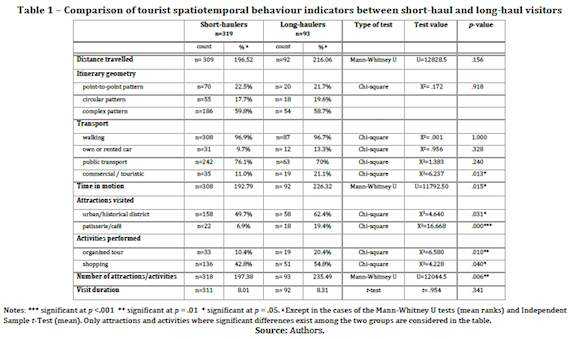
  a 0.05 significance level, were carried out (<a href="#t1">Table 1</a>). Only two statistically
  significant relationships were identified regarding tourists’ movements.
  Long-haul tourists used commercial/touristic transport far more frequently than
  short-haulers (21% of long haul tourists versus 11% of short-haul tourists).
  Long-haulers also registered a higher percentage of time in motion during the
  journey (Mdn = 44.03% of the total duration of the visit) than short-haulers
  (Mdn = 37.22). As far as spatiotemporal multi-attraction behaviour is
  concerned, tourists from more distant countries visited urban/historic city
  districts far more frequently (62% of long-haul tourists against 50% of
  short-haul tourists)&nbsp; and visited a
  café/patisserie more often (19% of long-haul tourists versus 7% of
  short-haulers). In terms of activities, long-haulers opted more frequently for
  an organized tour during the day journeys (20% of long-haul tourists versus 10%
  of short-haulers) and shopping (55% of long-haul tourists against 43% of
  short-haul tourists). Finally, long-haulers included more attractions and
  activities in their day journeys (Mdn = 8) than short-haulers (Mdn = 7). There
were no significant differences among the remaining indicators.</font></p>
    <p>&nbsp;</p>
    <p><a name="t1"></a>
</p>
    ]]></body>
<body><![CDATA[<p align="center">
<img src="/img/revistas/tms/v11n1/11n1a11t1.jpg" width="580" height="339"></p>
    
<p>&nbsp;</p>
    <p><font size="2" face="Verdana">Indeed, the distance of visitors’ country of origin
  can influence their spatiotemporal behaviour, due to a higher perceived need of
  reducing risk and uncertainty (Koo et al., 2012), which may lead to higher&nbsp; participation of long-haulers in an
  organized tour and corresponding increased use of commercial/touristic
  transport. The comparatively greater time spent by this group in motion as well
  as the larger number of attractions/activities included in their day journeys
  confirms in the intra-destination context previous empirical evidence that
  visitors from more distant countries tend to visit more destinations and
  attractions (Tideswell &amp; Faulkner, 1999), making the most of the reduced
  time spent at the destination and considering the smaller likelihood of coming
  back (Yeoman &amp; Lederer, 2005). On the other hand, knowing that long-haulers
  differentiate by preferring urban/historical districts and patisseries/cafés as
  attractions and organized tours and shopping as activities is useful to design
  city packages and experiences adapted to their desires and expectations. In
  line with Lau &amp; McKercher (2008), the specificity of attractions and
  activities was found useful to differentiate diverse tourists’ spatiotemporal
  behaviour patterns, while linearity (geometric form) of itineraries did not
  reveal any significant differences.&nbsp;</font></p>
<font size="2" face="Verdana">    <p>&nbsp;</p>
</font>
    <p><font size="3" face="Verdana"><b>5.&nbsp;&nbsp;&nbsp;&nbsp;&nbsp;&nbsp; Conclusions</b></font></p>
    <p><font size="3" face="Verdana"></font><font size="2" face="Verdana">This research examined short-haul and long-haul
  tourists’ spatiotemporal behaviour. The results provide strong support for the
  propositions of the study that short-haul and long-haul visitors differed in
their time-space behaviour patterns.</font></p>
<font size="2" face="Verdana">
    <p>The study adopted an innovative approach in analysing
  tourists’ spatiotemporal behaviour in its two dimensions (movements and
  attractions/activities). No previous research had fully examined the impact of
  distance travelled from country of origin on tourist spatiotemporal behaviour,
  considering its global scope, in the urban intra-destination context. The most
  important work comparing short and long-haul urban tourists’ behaviour was
presented by McKercher (2008), but it neglected these movement patterns. </p>
    <p>The approach followed was to study the effect of
  distance travelled from the destination perspective. Distance dynamics
  represent the cumulative effects of time availability, costs, risk, cultural
  distance, motive, and other factors and exert a profound, though often
  unrecognized, impact on consumer behaviour, which is crucial for tourist market&shy;ing
  (McKercher, 2008). Understanding the needs of travellers and responding
  properly to these needs is a prerequisite for management success (Ekinci,
  2004). This insight into short- and long-haul needs and preferences in terms of
  attractions and activities may help destinations and tourist agents to design
  and deliver more appealing experiences that meet the expectations and desires
  of these two market segments, with better targeted product offerings, marketing
activities and provision of experiences (McKercher et al., 2012).</p>
    <p>Independent Sample t-Test, Chi-square and Mann&#8211;Whitney&nbsp;U
  tests indicated significant differences between short-haul and long-haul
  visitors’ spatiotemporal behaviour. Hypothesis testing revealed more
  significant differences regarding the multi-attraction than the movement
  dimension. Interestingly, distance travelled from country of origin does not
  seem to influence much the temporal or spatial length of intra-destination day
  visit but rather what the two groups do during their stay. Long-haulers reveal
  to be more active, seeking more things to see and do and opting more often for
  organized tours and particular attractions and activities. This information is
  particularly valuable, for instance, for the design of adjusted city tour
offerings for these two segments.</p>
    <p>Generating satisfactory shopping experiences
  especially directed at long-haulers seems to make urban destinations
  particularly attractive, eventually developing <i>shoptainment</i> (Kozinets, 2002) tour products. These additionally
  permit the enhancement of the economic impact of tourism in the destination and
  may further prolong the destination experience after the trip through
  memorabilia (Aho, 2001), particularly if products purchased are distinctive of
the destination.</p>
    ]]></body>
<body><![CDATA[<p>Some limitations must be acknowledged. The study
  monitored the movements of individuals during one day of their visit to Lisbon
  and not over their entire stay, due to pragmatic reasons relating to the
  battery life of the GPS device and also to ensure that it was recovered during
  the trip, but aggregation of individual day trips to understand collective
  tourist movements (other than during arrival and departure days) is appropriate
  (McKercher &amp; Lau, 2008; McKercher et al., 2012). On the other hand, the
  literature suggests that other variables may be important &#8211; for example,
  tourists’ personal characteristics or group dynamics &#8211; that were not
  examined in this study. Equally, the findings presented are both provisional
  and partial, but despite this are <i>prima
    facie</i> evidence of significant differences between origin distance groupings
regarding urban destinations.</p>
</font>
    <p>&nbsp;</p>
    <p><font face="Verdana"><b>References</b></font></p>
    <!-- ref --><p><font face="Verdana"></font><font size="2" face="Verdana">Aho, S. K.
  (2001). Towards a general theory of touristic experiences: Modelling experience
process in tourism. <i>Tourism Review</i>, <i>56</i>(3/4), 33&#8211;37.    &nbsp;&nbsp;&nbsp;&nbsp;&nbsp;&nbsp;&nbsp;&nbsp;[&#160;<a href="javascript:void(0);" onclick="javascript: window.open('/scielo.php?script=sci_nlinks&ref=000076&pid=S2182-8458201500010001100001&lng=','','width=640,height=500,resizable=yes,scrollbars=1,menubar=yes,');">Links</a>&#160;]<!-- end-ref --></font></p>
    <!-- ref --><p><font size="2" face="Verdana">ANA - Aeroportos de Portugal. (2014). Número de passageiros nos
  aeroportos portugueses ultrapassa os 32 milhões. <i>ANA - Aeroportos de Portugal</i>. Retrieved February, 02, 2014 from
<a href="https://www.ana.pt/pt-PT/Topo/Institucional/SobreANA/Imprensa/Noticias/Paginas/N%C3%BAmero-de-passageiros-nos-aeroportos-portugueses-ultrapassa-os-32-milh%C3%B5es.aspx?fromlist=1" target="_blank">https://www.ana.pt/pt-PT/Topo/Institucional/SobreANA/Imprensa/Noticias/Paginas/N%C3%BAmero-de-passageiros-nos-aeroportos-portugueses-ultrapassa-os-32-milh%C3%B5es.aspx?fromlist=1</a>.    &nbsp;&nbsp;&nbsp;&nbsp;&nbsp;&nbsp;&nbsp;&nbsp;[&#160;<a href="javascript:void(0);" onclick="javascript: window.open('/scielo.php?script=sci_nlinks&ref=000078&pid=S2182-8458201500010001100002&lng=','','width=640,height=500,resizable=yes,scrollbars=1,menubar=yes,');">Links</a>&#160;]<!-- end-ref --></font></p>
    <!-- ref --><p><font size="2" face="Verdana">Ashworth, G.,
  &amp; Page, S. J. (2011). Urban tourism research: Recent progress and current
paradoxes. <i>Tourism Management</i>, <i>32</i>(1), 1&#8211;15.    &nbsp;&nbsp;&nbsp;&nbsp;&nbsp;&nbsp;&nbsp;&nbsp;[&#160;<a href="javascript:void(0);" onclick="javascript: window.open('/scielo.php?script=sci_nlinks&ref=000080&pid=S2182-8458201500010001100003&lng=','','width=640,height=500,resizable=yes,scrollbars=1,menubar=yes,');">Links</a>&#160;]<!-- end-ref --> </font></p>
    <!-- ref --><p><font size="2" face="Verdana">Ashworth, G.,
  &amp; Tunbridge, J. (2000). <i>The Tourist-Historic City - Retrospect and
Prospect of Managing the Heritage City</i>. Amsterdão: Pergamon.    &nbsp;&nbsp;&nbsp;&nbsp;&nbsp;&nbsp;&nbsp;&nbsp;[&#160;<a href="javascript:void(0);" onclick="javascript: window.open('/scielo.php?script=sci_nlinks&ref=000082&pid=S2182-8458201500010001100004&lng=','','width=640,height=500,resizable=yes,scrollbars=1,menubar=yes,');">Links</a>&#160;]<!-- end-ref --></font></p>
    <!-- ref --><p><font size="2" face="Verdana">Becken, S.,
  Wilson, J., Forer, P., &amp; Simmons, D. G. (2008). <i>Tourist itineraries and
yield: technical background report</i>. Canterbury: Lincoln University.    &nbsp;&nbsp;&nbsp;&nbsp;&nbsp;&nbsp;&nbsp;&nbsp;[&#160;<a href="javascript:void(0);" onclick="javascript: window.open('/scielo.php?script=sci_nlinks&ref=000084&pid=S2182-8458201500010001100005&lng=','','width=640,height=500,resizable=yes,scrollbars=1,menubar=yes,');">Links</a>&#160;]<!-- end-ref --></font></p>
    <!-- ref --><p><font size="2" face="Verdana">Buhalis, D.
  (2000). Marketing the competitive destination of the future. <i>Tourism
Management</i>, <i>21</i>(1), 97&#8211;116.    &nbsp;&nbsp;&nbsp;&nbsp;&nbsp;&nbsp;&nbsp;&nbsp;[&#160;<a href="javascript:void(0);" onclick="javascript: window.open('/scielo.php?script=sci_nlinks&ref=000086&pid=S2182-8458201500010001100006&lng=','','width=640,height=500,resizable=yes,scrollbars=1,menubar=yes,');">Links</a>&#160;]<!-- end-ref --> </font></p>
    <!-- ref --><p><font size="2" face="Verdana">Chang, H.-H.
  (2012). Wayfinding Strategies and Tourist Anxiety in Unfamiliar Destinations. <i>Tourism
Geographies</i>, <i>15</i>(3), 529&#8211;550.    &nbsp;&nbsp;&nbsp;&nbsp;&nbsp;&nbsp;&nbsp;&nbsp;[&#160;<a href="javascript:void(0);" onclick="javascript: window.open('/scielo.php?script=sci_nlinks&ref=000088&pid=S2182-8458201500010001100007&lng=','','width=640,height=500,resizable=yes,scrollbars=1,menubar=yes,');">Links</a>&#160;]<!-- end-ref --> </font></p>
    <!-- ref --><p><font size="2" face="Verdana">Dejbakhsh, S., Arrowsmith, C., &amp; Jackson, M. (2011). Cultural
  Influence on Spatial Behaviour. <i>Tourism Geographies</i>, <i>13</i>(1),
91&#8211;111.    &nbsp;&nbsp;&nbsp;&nbsp;&nbsp;&nbsp;&nbsp;&nbsp;[&#160;<a href="javascript:void(0);" onclick="javascript: window.open('/scielo.php?script=sci_nlinks&ref=000090&pid=S2182-8458201500010001100008&lng=','','width=640,height=500,resizable=yes,scrollbars=1,menubar=yes,');">Links</a>&#160;]<!-- end-ref --> </font></p>
    <!-- ref --><p><font size="2" face="Verdana">Edwards, D., Dickson, T., Griffin, A., &amp; Hayllar, B. (2010).
  Tracking the urban visitor: Methods for examining tourists' spatial behaviour
and visual representations. In G. Richards (Ed.), <i>Cultural Tourism Research Methods</i> (pp. 104-114). UK: CABI.    &nbsp;&nbsp;&nbsp;&nbsp;&nbsp;&nbsp;&nbsp;&nbsp;[&#160;<a href="javascript:void(0);" onclick="javascript: window.open('/scielo.php?script=sci_nlinks&ref=000092&pid=S2182-8458201500010001100009&lng=','','width=640,height=500,resizable=yes,scrollbars=1,menubar=yes,');">Links</a>&#160;]<!-- end-ref --></a></font></p>
    <!-- ref --><p><font size="2" face="Verdana">Edwards, D.,
  &amp; Griffin, T. (2013). Understanding tourists’ spatial behaviour: GPS
  tracking as an aid to sustainable destination management. <i>Journal of
Sustainable Tourism</i>, <i>21</i>(4), 580&#8211;595.    &nbsp;&nbsp;&nbsp;&nbsp;&nbsp;&nbsp;&nbsp;&nbsp;[&#160;<a href="javascript:void(0);" onclick="javascript: window.open('/scielo.php?script=sci_nlinks&ref=000094&pid=S2182-8458201500010001100010&lng=','','width=640,height=500,resizable=yes,scrollbars=1,menubar=yes,');">Links</a>&#160;]<!-- end-ref --> </font></p>
    <!-- ref --><p><font size="2" face="Verdana">Edwards, D.,
  Griffin, T., &amp; Hayllar, B. (2008). Urban Tourism Research: Developing an
Agenda. <i>Annals of Tourism Research</i>, <i>35</i>(4), 1032&#8211;1052.    &nbsp;&nbsp;&nbsp;&nbsp;&nbsp;&nbsp;&nbsp;&nbsp;[&#160;<a href="javascript:void(0);" onclick="javascript: window.open('/scielo.php?script=sci_nlinks&ref=000096&pid=S2182-8458201500010001100011&lng=','','width=640,height=500,resizable=yes,scrollbars=1,menubar=yes,');">Links</a>&#160;]<!-- end-ref --> </font></p>
    <!-- ref --><p><font size="2" face="Verdana">Ekinci, Y.
  (2004). An investigation of the determinants of customer satisfaction. <i>Tourism
Analysis</i>, <i>8</i>(2-4), 197&#8211;203.    &nbsp;&nbsp;&nbsp;&nbsp;&nbsp;&nbsp;&nbsp;&nbsp;[&#160;<a href="javascript:void(0);" onclick="javascript: window.open('/scielo.php?script=sci_nlinks&ref=000098&pid=S2182-8458201500010001100012&lng=','','width=640,height=500,resizable=yes,scrollbars=1,menubar=yes,');">Links</a>&#160;]<!-- end-ref --></font></p>
    <!-- ref --><p><font size="2" face="Verdana">Espelt, N. G., &amp; Benito, J. A. D. (2006). Visitors’ Behavior in
  Heritage Cities: The Case of Girona. <i>Journal of Travel Research</i>, <i>44</i>(4),
442&#8211;448.    &nbsp;&nbsp;&nbsp;&nbsp;&nbsp;&nbsp;&nbsp;&nbsp;[&#160;<a href="javascript:void(0);" onclick="javascript: window.open('/scielo.php?script=sci_nlinks&ref=000100&pid=S2182-8458201500010001100013&lng=','','width=640,height=500,resizable=yes,scrollbars=1,menubar=yes,');">Links</a>&#160;]<!-- end-ref --> </font></p>
    <!-- ref --><p><font size="2" face="Verdana">Fennell, D.
  (1996). A tourist space-time budget in the Shetland Islands. <i>Annals of
Tourism Research</i>, <i>23</i>(4), 811&#8211;829.    &nbsp;&nbsp;&nbsp;&nbsp;&nbsp;&nbsp;&nbsp;&nbsp;[&#160;<a href="javascript:void(0);" onclick="javascript: window.open('/scielo.php?script=sci_nlinks&ref=000102&pid=S2182-8458201500010001100014&lng=','','width=640,height=500,resizable=yes,scrollbars=1,menubar=yes,');">Links</a>&#160;]<!-- end-ref --> </font></p>
    <!-- ref --><p><font size="2" face="Verdana">Gnoth, J. (2003, May). <i>Consumer activated services networks: Towards a dynamic model for
  tourism destinations</i>.    &nbsp;&nbsp;&nbsp;&nbsp;&nbsp;&nbsp;&nbsp;&nbsp;[&#160;<a href="javascript:void(0);" onclick="javascript: window.open('/scielo.php?script=sci_nlinks&ref=000104&pid=S2182-8458201500010001100015&lng=','','width=640,height=500,resizable=yes,scrollbars=1,menubar=yes,');">Links</a>&#160;]<!-- end-ref --> Paper presented at the 32<sup>nd</sup> EMAC
Conference, University of Strathclyde, Glasgow, U.K.</font></p>
    <!-- ref --><p><font size="2" face="Verdana">Grinberger, a.
  Y., Shoval, N., &amp; McKercher, B. (2014). Typologies of tourists’
  time&#8211;space consumption: a new approach using GPS data and GIS tools. <i>Tourism
Geographies</i>, <i>16</i>(0), 1&#8211;19.    &nbsp;&nbsp;&nbsp;&nbsp;&nbsp;&nbsp;&nbsp;&nbsp;[&#160;<a href="javascript:void(0);" onclick="javascript: window.open('/scielo.php?script=sci_nlinks&ref=000106&pid=S2182-8458201500010001100016&lng=','','width=640,height=500,resizable=yes,scrollbars=1,menubar=yes,');">Links</a>&#160;]<!-- end-ref --> </font></p>
    <!-- ref --><p><font size="2" face="Verdana">Haldrup, M.
  (2004). Laid-Back Mobilities: Second-Home Holidays in Time and Space. <i>Tourism
Geographies</i>, <i>6</i>(4), 434&#8211;454.    &nbsp;&nbsp;&nbsp;&nbsp;&nbsp;&nbsp;&nbsp;&nbsp;[&#160;<a href="javascript:void(0);" onclick="javascript: window.open('/scielo.php?script=sci_nlinks&ref=000108&pid=S2182-8458201500010001100017&lng=','','width=640,height=500,resizable=yes,scrollbars=1,menubar=yes,');">Links</a>&#160;]<!-- end-ref --> </font></p>
    <!-- ref --><p><font size="2" face="Verdana">Hall, C. M.
  (2012). Spatial analysis: A critical tool for tourism geographies. In J. Wilson
  (Ed.), <i>The Routledge Handbook of Tourism Geographies</i> (pp.
163&#8211;173). Londres: Routledge.    &nbsp;&nbsp;&nbsp;&nbsp;&nbsp;&nbsp;&nbsp;&nbsp;[&#160;<a href="javascript:void(0);" onclick="javascript: window.open('/scielo.php?script=sci_nlinks&ref=000110&pid=S2182-8458201500010001100018&lng=','','width=640,height=500,resizable=yes,scrollbars=1,menubar=yes,');">Links</a>&#160;]<!-- end-ref --></font></p>
    <!-- ref --><p><font size="2" face="Verdana">Hunt, M. a.,
  &amp; Crompton, J. L. (2008). Investigating Attraction Compatibility in an East
  Texas City. <i>International Journal of Tourism Research</i>, <i>10</i>(February),
237&#8211;246.    &nbsp;&nbsp;&nbsp;&nbsp;&nbsp;&nbsp;&nbsp;&nbsp;[&#160;<a href="javascript:void(0);" onclick="javascript: window.open('/scielo.php?script=sci_nlinks&ref=000112&pid=S2182-8458201500010001100019&lng=','','width=640,height=500,resizable=yes,scrollbars=1,menubar=yes,');">Links</a>&#160;]<!-- end-ref --> </font></p>
    <!-- ref --><p><font size="2" face="Verdana">Kastenholz, E.
  (2004). “Management of Demand” as a Tool in Sustainable Tourist Destination
  Development. <i>Journal of Sustainable Tourism</i>, <i>12</i>(5),
388&#8211;408.    &nbsp;&nbsp;&nbsp;&nbsp;&nbsp;&nbsp;&nbsp;&nbsp;[&#160;<a href="javascript:void(0);" onclick="javascript: window.open('/scielo.php?script=sci_nlinks&ref=000114&pid=S2182-8458201500010001100020&lng=','','width=640,height=500,resizable=yes,scrollbars=1,menubar=yes,');">Links</a>&#160;]<!-- end-ref --> </font></p>
    <!-- ref --><p><font size="2" face="Verdana">Keul, A.,
  &amp; Kühberger, A. (1997). Tracking the Salzburg tourist. <i>Annals of Tourism
Research</i>, <i>24</i>(4), 1008&#8211;1012.    &nbsp;&nbsp;&nbsp;&nbsp;&nbsp;&nbsp;&nbsp;&nbsp;[&#160;<a href="javascript:void(0);" onclick="javascript: window.open('/scielo.php?script=sci_nlinks&ref=000116&pid=S2182-8458201500010001100021&lng=','','width=640,height=500,resizable=yes,scrollbars=1,menubar=yes,');">Links</a>&#160;]<!-- end-ref --> </font></p>
    <!-- ref --><p><font size="2" face="Verdana">Koo, T., Wu,
  C.-L., &amp; Dwyer, L. (2012). Dispersal of visitors within destinations:
  Descriptive measures and underlying drivers. <i>Tourism Management</i>, <i>33</i>(5),
1209&#8211;1219.    &nbsp;&nbsp;&nbsp;&nbsp;&nbsp;&nbsp;&nbsp;&nbsp;[&#160;<a href="javascript:void(0);" onclick="javascript: window.open('/scielo.php?script=sci_nlinks&ref=000118&pid=S2182-8458201500010001100022&lng=','','width=640,height=500,resizable=yes,scrollbars=1,menubar=yes,');">Links</a>&#160;]<!-- end-ref --></font></p>
    <!-- ref --><p><font size="2" face="Verdana">Kozinets, R.
  V. (2002). Can consumers escape the market? Emancipatory illuminations from
burning man. <i>Journal of Consumer Research</i>, <i>29</i>(1), 20&#8211;38.    &nbsp;&nbsp;&nbsp;&nbsp;&nbsp;&nbsp;&nbsp;&nbsp;[&#160;<a href="javascript:void(0);" onclick="javascript: window.open('/scielo.php?script=sci_nlinks&ref=000120&pid=S2182-8458201500010001100023&lng=','','width=640,height=500,resizable=yes,scrollbars=1,menubar=yes,');">Links</a>&#160;]<!-- end-ref --></font></p>
    <!-- ref --><p><font size="2" face="Verdana">Lau, G., &amp;
  McKercher, B. (2006). Understanding Tourist Movement Patterns in a Destination:
  A GIS Approach. <i>Tourism and Hospitality Research</i>, <i>7</i>(1),
39&#8211;49.    &nbsp;&nbsp;&nbsp;&nbsp;&nbsp;&nbsp;&nbsp;&nbsp;[&#160;<a href="javascript:void(0);" onclick="javascript: window.open('/scielo.php?script=sci_nlinks&ref=000122&pid=S2182-8458201500010001100024&lng=','','width=640,height=500,resizable=yes,scrollbars=1,menubar=yes,');">Links</a>&#160;]<!-- end-ref --></font></p>
    <!-- ref --><p><font size="2" face="Verdana">Leung, X.,
  Wang, F., Wu, B., Bai, B., Stahura, K. A., &amp; Xie, Z. (2012). A Social
  Network Analysis of Overseas Tourist Movement Patterns in Beijing: The Impact
  of the Olympic Games. <i>International Journal of Tourism Research</i>, <i>14</i>(5),
469&#8211;484.    &nbsp;&nbsp;&nbsp;&nbsp;&nbsp;&nbsp;&nbsp;&nbsp;[&#160;<a href="javascript:void(0);" onclick="javascript: window.open('/scielo.php?script=sci_nlinks&ref=000124&pid=S2182-8458201500010001100025&lng=','','width=640,height=500,resizable=yes,scrollbars=1,menubar=yes,');">Links</a>&#160;]<!-- end-ref --> </font></p>
    <!-- ref --><p><font size="2" face="Verdana">Lew, A., &amp; McKercher, B. (2006). Modeling Tourist Movements: A Local
  Destination Analysis. <i>Annals of Tourism Research</i>, <i>33</i>(2),
403&#8211;423.    &nbsp;&nbsp;&nbsp;&nbsp;&nbsp;&nbsp;&nbsp;&nbsp;[&#160;<a href="javascript:void(0);" onclick="javascript: window.open('/scielo.php?script=sci_nlinks&ref=000126&pid=S2182-8458201500010001100026&lng=','','width=640,height=500,resizable=yes,scrollbars=1,menubar=yes,');">Links</a>&#160;]<!-- end-ref --> </font></p>
    <!-- ref --><p><font size="2" face="Verdana">Li, Y. (2000).
  Geographical consciousness and tourism experience. <i>Annals of Tourism
Research</i>, <i>27</i>(4), 863&#8211;883.    &nbsp;&nbsp;&nbsp;&nbsp;&nbsp;&nbsp;&nbsp;&nbsp;[&#160;<a href="javascript:void(0);" onclick="javascript: window.open('/scielo.php?script=sci_nlinks&ref=000128&pid=S2182-8458201500010001100027&lng=','','width=640,height=500,resizable=yes,scrollbars=1,menubar=yes,');">Links</a>&#160;]<!-- end-ref --></font></p>
    <!-- ref --><p><font size="2" face="Verdana">Lloyd, R.
(1997). <i>Spatial cognition: Geographic environments</i>. Dordrect: Kluwer.    &nbsp;&nbsp;&nbsp;&nbsp;&nbsp;&nbsp;&nbsp;&nbsp;[&#160;<a href="javascript:void(0);" onclick="javascript: window.open('/scielo.php?script=sci_nlinks&ref=000130&pid=S2182-8458201500010001100028&lng=','','width=640,height=500,resizable=yes,scrollbars=1,menubar=yes,');">Links</a>&#160;]<!-- end-ref --></font></p>
    <!-- ref --><p><font size="2" face="Verdana">Lue, C.-C.,
  Crompton, J. L., &amp; Fesenmaier, D. R. (1993). Conceptualization of multi-destination
  pleasure trips. <i>Annals of Tourism Research</i>, <i>20</i>(2), 289&#8211;301.    &nbsp;&nbsp;&nbsp;&nbsp;&nbsp;&nbsp;&nbsp;&nbsp;[&#160;<a href="javascript:void(0);" onclick="javascript: window.open('/scielo.php?script=sci_nlinks&ref=000132&pid=S2182-8458201500010001100029&lng=','','width=640,height=500,resizable=yes,scrollbars=1,menubar=yes,');">Links</a>&#160;]<!-- end-ref --></font></p>
    <!-- ref --><p><font size="2" face="Verdana">Lynch, kevin.
  (2009). Some references to orientation. In R. M. Downs &amp; D. Stea (Eds.), <i>Image
  &amp; environment: Cognitive mapping and spatial behavior</i> (3rd ed., pp.
300&#8211;315). New Brunswick: Aldine.    &nbsp;&nbsp;&nbsp;&nbsp;&nbsp;&nbsp;&nbsp;&nbsp;[&#160;<a href="javascript:void(0);" onclick="javascript: window.open('/scielo.php?script=sci_nlinks&ref=000134&pid=S2182-8458201500010001100030&lng=','','width=640,height=500,resizable=yes,scrollbars=1,menubar=yes,');">Links</a>&#160;]<!-- end-ref --></font></p>
    <!-- ref --><p><font size="2" face="Verdana">McKercher, B. (2008). The Implicit Effect of Distance on Tourist
  Behavior: a Comparison of Short and Long Haul Pleasure Tourists to Hong Kong. <i>Journal
of Travel &amp; Tourism Marketing</i>, <i>25</i>(3), 367&#8211;381.    &nbsp;&nbsp;&nbsp;&nbsp;&nbsp;&nbsp;&nbsp;&nbsp;[&#160;<a href="javascript:void(0);" onclick="javascript: window.open('/scielo.php?script=sci_nlinks&ref=000136&pid=S2182-8458201500010001100031&lng=','','width=640,height=500,resizable=yes,scrollbars=1,menubar=yes,');">Links</a>&#160;]<!-- end-ref --> </font></p>
    <!-- ref --><p><font size="2" face="Verdana">McKercher, B.,
  &amp; Lau, G. (2008). Movement patterns of tourists within a destination. <i>Tourism
Geographies</i>, <i>10</i>(3), 355&#8211;374.    &nbsp;&nbsp;&nbsp;&nbsp;&nbsp;&nbsp;&nbsp;&nbsp;[&#160;<a href="javascript:void(0);" onclick="javascript: window.open('/scielo.php?script=sci_nlinks&ref=000138&pid=S2182-8458201500010001100032&lng=','','width=640,height=500,resizable=yes,scrollbars=1,menubar=yes,');">Links</a>&#160;]<!-- end-ref --> </font></p>
    <!-- ref --><p><font size="2" face="Verdana">McKercher, B.,
  Shoval, N., Ng, E., &amp; Birenboim, A. (2012). First and Repeat Visitor
  Behaviour: GPS Tracking and GIS Analysis in Hong Kong. <i>Tourism Geographies</i>,
<i>14</i>(March 2013), 147&#8211;161.    &nbsp;&nbsp;&nbsp;&nbsp;&nbsp;&nbsp;&nbsp;&nbsp;[&#160;<a href="javascript:void(0);" onclick="javascript: window.open('/scielo.php?script=sci_nlinks&ref=000140&pid=S2182-8458201500010001100033&lng=','','width=640,height=500,resizable=yes,scrollbars=1,menubar=yes,');">Links</a>&#160;]<!-- end-ref --> </font></p>
    <!-- ref --><p><font size="2" face="Verdana">Modsching, M.,
  Kramer, R., Gretzel, U., &amp; Hagen, K. Ten. (2006). Capturing the beaten
  paths&#8239;: A novel method for analysing tourists ’ spatial behaviour at an
  urban destination Laboratory for Intelligent Systems in Tourism. In M. Hitz, M.
  Sigala, &amp; J. Murphy (Eds.), <i>Information and Communication Technologies
in Tourism 2006</i> (pp. 75&#8211;86). Vienna: Springer.    &nbsp;&nbsp;&nbsp;&nbsp;&nbsp;&nbsp;&nbsp;&nbsp;[&#160;<a href="javascript:void(0);" onclick="javascript: window.open('/scielo.php?script=sci_nlinks&ref=000142&pid=S2182-8458201500010001100034&lng=','','width=640,height=500,resizable=yes,scrollbars=1,menubar=yes,');">Links</a>&#160;]<!-- end-ref --> </font></p>
    <!-- ref --><p><font size="2" face="Verdana">Pizam, A.
  (2010). Creating memorable experiences. <i>International Journal of Hospitality
Management</i>, <i>29</i>(3), 343.    &nbsp;&nbsp;&nbsp;&nbsp;&nbsp;&nbsp;&nbsp;&nbsp;[&#160;<a href="javascript:void(0);" onclick="javascript: window.open('/scielo.php?script=sci_nlinks&ref=000144&pid=S2182-8458201500010001100035&lng=','','width=640,height=500,resizable=yes,scrollbars=1,menubar=yes,');">Links</a>&#160;]<!-- end-ref --> </font></p>
    <!-- ref --><p><font size="2" face="Verdana">PORTO DE LISBOA. (2014). Atividade Portuária - Consultas
  Estatísticas OnLine. Retrieved
  February, 02, 2014 from
<a href="http://www.portodelisboa.pt/portal/page/portal/PORTAL_PORTO_LISBOA/ESTATISTICAS/ACTIVIDADE_PORTUARIA/CONSULTAS_ONLINE" target="_blank">http://www.portodelisboa.pt/portal/page/portal/PORTAL_PORTO_LISBOA/ESTATISTICAS/ACTIVIDADE_PORTUARIA/CONSULTAS_ONLINE</a>.    &nbsp;&nbsp;&nbsp;&nbsp;&nbsp;&nbsp;&nbsp;&nbsp;[&#160;<a href="javascript:void(0);" onclick="javascript: window.open('/scielo.php?script=sci_nlinks&ref=000146&pid=S2182-8458201500010001100036&lng=','','width=640,height=500,resizable=yes,scrollbars=1,menubar=yes,');">Links</a>&#160;]<!-- end-ref --></font></p>
    <!-- ref --><p><font size="2" face="Verdana">Rey-Moreno, M.
  (2014). Tourist attractions as a moderating element in explanatory models for
loyalty development. <i>Tourism &amp; Management Studies</i>, <i>10</i>(1), 112&#8211;118.    &nbsp;&nbsp;&nbsp;&nbsp;&nbsp;&nbsp;&nbsp;&nbsp;[&#160;<a href="javascript:void(0);" onclick="javascript: window.open('/scielo.php?script=sci_nlinks&ref=000148&pid=S2182-8458201500010001100037&lng=','','width=640,height=500,resizable=yes,scrollbars=1,menubar=yes,');">Links</a>&#160;]<!-- end-ref --></font></p>
    <!-- ref --><p><font size="2" face="Verdana">Rodríguez,
  J. R., &amp; Abdul-jalbar, B. (2012). Turismo cultural y planificación del
  viaje: un estudio de caso. <i>Tourism &amp; Management Studies</i>, <i>8</i>,
41&#8211;47.    &nbsp;&nbsp;&nbsp;&nbsp;&nbsp;&nbsp;&nbsp;&nbsp;[&#160;<a href="javascript:void(0);" onclick="javascript: window.open('/scielo.php?script=sci_nlinks&ref=000150&pid=S2182-8458201500010001100038&lng=','','width=640,height=500,resizable=yes,scrollbars=1,menubar=yes,');">Links</a>&#160;]<!-- end-ref --></font></p>
    <!-- ref --><p><font size="2" face="Verdana">Shoval, N.,
  &amp; Isaacson, M. (2007). Tracking tourists in the digital age. <i>Annals of
Tourism Research</i>, <i>34</i>(1), 141&#8211;159.    &nbsp;&nbsp;&nbsp;&nbsp;&nbsp;&nbsp;&nbsp;&nbsp;[&#160;<a href="javascript:void(0);" onclick="javascript: window.open('/scielo.php?script=sci_nlinks&ref=000152&pid=S2182-8458201500010001100039&lng=','','width=640,height=500,resizable=yes,scrollbars=1,menubar=yes,');">Links</a>&#160;]<!-- end-ref --> </font></p>
    <!-- ref --><p><font size="2" face="Verdana">Shoval, N.,
  McKercher, B., Ng, E., &amp; Birenboim, A. (2011). Hotel location and tourist
  activity in cities. <i>Annals of Tourism Research</i>, <i>38</i>(4),
1594&#8211;1612.    &nbsp;&nbsp;&nbsp;&nbsp;&nbsp;&nbsp;&nbsp;&nbsp;[&#160;<a href="javascript:void(0);" onclick="javascript: window.open('/scielo.php?script=sci_nlinks&ref=000154&pid=S2182-8458201500010001100040&lng=','','width=640,height=500,resizable=yes,scrollbars=1,menubar=yes,');">Links</a>&#160;]<!-- end-ref --> </font></p>
    <!-- ref --><p><font size="2" face="Verdana">Shoval, N.,
  &amp; Raveh, A. (2004). Categorization of tourist attractions and the modeling
  of tourist cities: based on the co-plot method of multivariate analysis. <i>Tourism
Management</i>, <i>25</i>(6), 741&#8211;750.    &nbsp;&nbsp;&nbsp;&nbsp;&nbsp;&nbsp;&nbsp;&nbsp;[&#160;<a href="javascript:void(0);" onclick="javascript: window.open('/scielo.php?script=sci_nlinks&ref=000156&pid=S2182-8458201500010001100041&lng=','','width=640,height=500,resizable=yes,scrollbars=1,menubar=yes,');">Links</a>&#160;]<!-- end-ref --> </font></p>
    <!-- ref --><p><font size="2" face="Verdana">Tideswell, C.
  (2004). <i>A road more traveled: multidestination travel itineraries of
international visitors</i>.    &nbsp;&nbsp;&nbsp;&nbsp;&nbsp;&nbsp;&nbsp;&nbsp;[&#160;<a href="javascript:void(0);" onclick="javascript: window.open('/scielo.php?script=sci_nlinks&ref=000158&pid=S2182-8458201500010001100042&lng=','','width=640,height=500,resizable=yes,scrollbars=1,menubar=yes,');">Links</a>&#160;]<!-- end-ref --></font></p>
    <!-- ref --><p><font size="2" face="Verdana">Tideswell, C.,
  &amp; Faulkner, B. (1999). Multidestination Travel Patterns of International
  Visitors to Queensland. <i>Journal of Travel Research</i>, <i>37</i>,
364&#8211;374.    &nbsp;&nbsp;&nbsp;&nbsp;&nbsp;&nbsp;&nbsp;&nbsp;[&#160;<a href="javascript:void(0);" onclick="javascript: window.open('/scielo.php?script=sci_nlinks&ref=000160&pid=S2182-8458201500010001100043&lng=','','width=640,height=500,resizable=yes,scrollbars=1,menubar=yes,');">Links</a>&#160;]<!-- end-ref --> </font></p>
    <!-- ref --><p><font size="2" face="Verdana">TURISMO DE PORTUGAL. (2014). Quadros Estatísticos Dormidas
  &#8211; Lisboa 2013. <i>Turismo de Portugal
    I.P.</i> Retrieved February, 02, 2014 from
<a href="http://www.turismodeportugal.pt/Portugu%C3%AAs/ProTurismo/estat%C3%ADsticas/quadrosestatisticos/dormidas/Documents/Dormidas%202013%20Lisboa_Mercados%20-%20TOP%2010.pdf" target="_blank">http://www.turismodeportugal.pt/Portugu%C3%AAs/ProTurismo/estat%C3%ADsticas/quadrosestatisticos/dormidas/Documents/Dormidas%202013%20Lisboa_Mercados%20-%20TOP%2010.pdf</a>.    &nbsp;&nbsp;&nbsp;&nbsp;&nbsp;&nbsp;&nbsp;&nbsp;[&#160;<a href="javascript:void(0);" onclick="javascript: window.open('/scielo.php?script=sci_nlinks&ref=000162&pid=S2182-8458201500010001100044&lng=','','width=640,height=500,resizable=yes,scrollbars=1,menubar=yes,');">Links</a>&#160;]<!-- end-ref --></font></p>
    <!-- ref --><p><font size="2" face="Verdana">Tussyadiah, I. P., &amp; Fesenmaier, D.
  (2007). </a><i>Interpreting tourist
    experiences from first-person stories: A foundation for mobile guides.</i>
  Proceedings of the 15th European Conference on Information Systems (pp.
2259-2270). St. Gallen: ECIS.    &nbsp;&nbsp;&nbsp;&nbsp;&nbsp;&nbsp;&nbsp;&nbsp;[&#160;<a href="javascript:void(0);" onclick="javascript: window.open('/scielo.php?script=sci_nlinks&ref=000164&pid=S2182-8458201500010001100045&lng=','','width=640,height=500,resizable=yes,scrollbars=1,menubar=yes,');">Links</a>&#160;]<!-- end-ref --></font></p>
    <!-- ref --><p><font size="2" face="Verdana">Tussyadiah, I.
  P., &amp; Zach, F. J. (2012). The role of geo-based technology in place
experiences. <i>Annals of Tourism Research</i>, <i>39</i>(2), 780&#8211;800.    &nbsp;&nbsp;&nbsp;&nbsp;&nbsp;&nbsp;&nbsp;&nbsp;[&#160;<a href="javascript:void(0);" onclick="javascript: window.open('/scielo.php?script=sci_nlinks&ref=000166&pid=S2182-8458201500010001100046&lng=','','width=640,height=500,resizable=yes,scrollbars=1,menubar=yes,');">Links</a>&#160;]<!-- end-ref --> </font></p>
    <!-- ref --><p><font size="2" face="Verdana">WTTC. (2007).
  Lisbon. The impact of travel &amp; tourism on jobs and the economy. <i>Visit Lisbon</i>. Retrieved February, 02,
  2014 from
<a href="http://www.visitlisboa.com/getdoc/9b5c151b-fb28-4619-bee2-3051598145e1/Lisbon---The-Impact-of-Travel---Tourism-on-Jobs-an.aspx" target="_blank">http://www.visitlisboa.com/getdoc/9b5c151b-fb28-4619-bee2-3051598145e1/Lisbon---The-Impact-of-Travel---Tourism-on-Jobs-an.aspx</a>.    &nbsp;&nbsp;&nbsp;&nbsp;&nbsp;&nbsp;&nbsp;&nbsp;[&#160;<a href="javascript:void(0);" onclick="javascript: window.open('/scielo.php?script=sci_nlinks&ref=000168&pid=S2182-8458201500010001100047&lng=','','width=640,height=500,resizable=yes,scrollbars=1,menubar=yes,');">Links</a>&#160;]<!-- end-ref --></font></p>
    <!-- ref --><p><font size="2" face="Verdana">Xia, J.
  (2007). <i>Modelling the spatial-temporal movement of tourists</i>. <i>School
    of Mathematical and Geospatial Sciences</i>. RMIT University, Melbourne,    &nbsp;&nbsp;&nbsp;&nbsp;&nbsp;&nbsp;&nbsp;&nbsp;[&#160;<a href="javascript:void(0);" onclick="javascript: window.open('/scielo.php?script=sci_nlinks&ref=000170&pid=S2182-8458201500010001100048&lng=','','width=640,height=500,resizable=yes,scrollbars=1,menubar=yes,');">Links</a>&#160;]<!-- end-ref -->
Victoria.</font></p>
    <!-- ref --><p><font size="2" face="Verdana">Xia, J., &amp;
  Arrowsmith, C. (2008). Techniques for counting and tracking the spatial and
  temporal movement of visitors. In R. Gimblett &amp; H. Skov-Petersen (Eds.), <i>Monitoring,
    Simulation, and Management of Visitor Landscapes</i> (pp. 85&#8211;105).
Tucson: The University of Arizona Press.    &nbsp;&nbsp;&nbsp;&nbsp;&nbsp;&nbsp;&nbsp;&nbsp;[&#160;<a href="javascript:void(0);" onclick="javascript: window.open('/scielo.php?script=sci_nlinks&ref=000172&pid=S2182-8458201500010001100049&lng=','','width=640,height=500,resizable=yes,scrollbars=1,menubar=yes,');">Links</a>&#160;]<!-- end-ref --></font></p>
    <!-- ref --><p><font size="2" face="Verdana">Xia, J.,
  Ciesielski, V., &amp; Arrowsmith, C. (2005). Data mining of tourists
  spatio-temporal movement patterns: A case study on Phillip Island. In Y. Xie
  &amp; D. Brown (Eds.), <i>Proceedings of the Eighth International Conference on
GeoComputation</i> (pp. 1&#8211;15). University of Michigan, August 2005.    &nbsp;&nbsp;&nbsp;&nbsp;&nbsp;&nbsp;&nbsp;&nbsp;[&#160;<a href="javascript:void(0);" onclick="javascript: window.open('/scielo.php?script=sci_nlinks&ref=000174&pid=S2182-8458201500010001100050&lng=','','width=640,height=500,resizable=yes,scrollbars=1,menubar=yes,');">Links</a>&#160;]<!-- end-ref --></font></p>
    <!-- ref --><p><font size="2" face="Verdana">Xia, J., Evans, F. H., Spilsbury, K., Ciesielski, V., Arrowsmith, C.,
  &amp; Wright, G. (2010). Market segments based on the dominant movement
patterns of tourists. <i>Tourism Management</i>, <i>31</i>(4), 464&#8211;469.    &nbsp;&nbsp;&nbsp;&nbsp;&nbsp;&nbsp;&nbsp;&nbsp;[&#160;<a href="javascript:void(0);" onclick="javascript: window.open('/scielo.php?script=sci_nlinks&ref=000176&pid=S2182-8458201500010001100051&lng=','','width=640,height=500,resizable=yes,scrollbars=1,menubar=yes,');">Links</a>&#160;]<!-- end-ref --> </font></p>
    <!-- ref --><p><font size="2" face="Verdana">Xia, J.,
  Zeephongsekul, P., &amp; Packer, D. (2011). Spatial and temporal modelling of
  tourist movements using Semi-Markov processes. <i>Tourism Management</i>, <i>32</i>(4),
844&#8211;851.    &nbsp;&nbsp;&nbsp;&nbsp;&nbsp;&nbsp;&nbsp;&nbsp;[&#160;<a href="javascript:void(0);" onclick="javascript: window.open('/scielo.php?script=sci_nlinks&ref=000178&pid=S2182-8458201500010001100052&lng=','','width=640,height=500,resizable=yes,scrollbars=1,menubar=yes,');">Links</a>&#160;]<!-- end-ref --> </font></p>
    <!-- ref --><p><font size="2" face="Verdana">Xiao-Ting, H., &amp; Bi-Hu, W. (2012). Intra-attraction Tourist
  Spatial-Temporal Behaviour Patterns. <i>Tourism Geographies</i>, <i>14</i>(4),
625&#8211;645.    &nbsp;&nbsp;&nbsp;&nbsp;&nbsp;&nbsp;&nbsp;&nbsp;[&#160;<a href="javascript:void(0);" onclick="javascript: window.open('/scielo.php?script=sci_nlinks&ref=000180&pid=S2182-8458201500010001100053&lng=','','width=640,height=500,resizable=yes,scrollbars=1,menubar=yes,');">Links</a>&#160;]<!-- end-ref --> </font></p>
    <!-- ref --><p><font size="2" face="Verdana">Yang, Y., Fik,
  T., &amp; Zhang, J. (2013). Modeling Sequential Tourist Flows: Where is the
  Next Destination? <i>Annals of Tourism Research</i>, <i>43</i>(0),
297&#8211;320.    &nbsp;&nbsp;&nbsp;&nbsp;&nbsp;&nbsp;&nbsp;&nbsp;[&#160;<a href="javascript:void(0);" onclick="javascript: window.open('/scielo.php?script=sci_nlinks&ref=000182&pid=S2182-8458201500010001100054&lng=','','width=640,height=500,resizable=yes,scrollbars=1,menubar=yes,');">Links</a>&#160;]<!-- end-ref --> </font></p>
    <!-- ref --><p><font size="2" face="Verdana">Yeoman, I.,
  &amp; Lederer, P. (2005). Scottish tourism: Scenarios and vision. <i>Journal of
Vacation Marketing</i>, <i>11</i>(1), 71&#8211;87.    &nbsp;&nbsp;&nbsp;&nbsp;&nbsp;&nbsp;&nbsp;&nbsp;[&#160;<a href="javascript:void(0);" onclick="javascript: window.open('/scielo.php?script=sci_nlinks&ref=000184&pid=S2182-8458201500010001100055&lng=','','width=640,height=500,resizable=yes,scrollbars=1,menubar=yes,');">Links</a>&#160;]<!-- end-ref --> </font></p>
    <!-- ref --><p><font size="2" face="Verdana">Zakrisson, I.,
  &amp; Zillinger, M. (2012). Emotions in motion: tourist experiences in time and
space. <i>Current Issues in Tourism</i>, <i>15</i>(6), 505&#8211;523.    &nbsp;&nbsp;&nbsp;&nbsp;&nbsp;&nbsp;&nbsp;&nbsp;[&#160;<a href="javascript:void(0);" onclick="javascript: window.open('/scielo.php?script=sci_nlinks&ref=000186&pid=S2182-8458201500010001100056&lng=','','width=640,height=500,resizable=yes,scrollbars=1,menubar=yes,');">Links</a>&#160;]<!-- end-ref --> </font></p>
    <!-- ref --><p><font size="2" face="Verdana">Zillinger, M.
  (2005). A spatial approach on tourists' travel routes in Sweden. <i>ETOUR</i>. Retrieved May, 07, 2010 from
<a href="http://www.miun.se/upload/Etour/Publikationer/Working%20Paper%20serien/WP20053.pdf" target="_blank">http://www.miun.se/upload/Etour/Publikationer/Working%20Paper%20serien/WP20053.pdf</a>.    &nbsp;&nbsp;&nbsp;&nbsp;&nbsp;&nbsp;&nbsp;&nbsp;[&#160;<a href="javascript:void(0);" onclick="javascript: window.open('/scielo.php?script=sci_nlinks&ref=000188&pid=S2182-8458201500010001100057&lng=','','width=640,height=500,resizable=yes,scrollbars=1,menubar=yes,');">Links</a>&#160;]<!-- end-ref --></font></p>
    <!-- ref --><p><font size="2" face="Verdana">Zillinger, M. (2007). Tourist Routes: A Time-Geographical Approach on
  German Car-Tourists in Sweden. <i>Tourism Geographies</i>, <i>9</i>(1),
64&#8211;83.    &nbsp;&nbsp;&nbsp;&nbsp;&nbsp;&nbsp;&nbsp;&nbsp;[&#160;<a href="javascript:void(0);" onclick="javascript: window.open('/scielo.php?script=sci_nlinks&ref=000190&pid=S2182-8458201500010001100058&lng=','','width=640,height=500,resizable=yes,scrollbars=1,menubar=yes,');">Links</a>&#160;]<!-- end-ref --></font></p>
    <p>&nbsp;</p>
    ]]></body>
<body><![CDATA[<p>&nbsp;</p>
    <p><font size="2" face="Verdana"><b>Article
  history:</b>
  
      <br>
    <b>Received</b>: 12 January 2014
  
      <br>
    <b>Accepted</b>: 22 November 2014</font></p>
     ]]></body><back>
<ref-list>
<ref id="B1">
<nlm-citation citation-type="journal">
<person-group person-group-type="author">
<name>
<surname><![CDATA[Aho]]></surname>
<given-names><![CDATA[S. K.]]></given-names>
</name>
</person-group>
<article-title xml:lang="en"><![CDATA[Towards a general theory of touristic experiences: Modelling experience process in tourism]]></article-title>
<source><![CDATA[Tourism Review]]></source>
<year>2001</year>
<volume>56</volume>
<numero>3/4</numero>
<issue>3/4</issue>
<page-range>33-37</page-range></nlm-citation>
</ref>
<ref id="B2">
<nlm-citation citation-type="book">
<collab>ANA - Aeroportos de Portugal</collab>
<source><![CDATA[Número de passageiros nos aeroportos portugueses ultrapassa os 32 milhões]]></source>
<year>2014</year>
<publisher-name><![CDATA[ANA - Aeroportos de Portugal]]></publisher-name>
</nlm-citation>
</ref>
<ref id="B3">
<nlm-citation citation-type="journal">
<person-group person-group-type="author">
<name>
<surname><![CDATA[Ashworth]]></surname>
<given-names><![CDATA[G.]]></given-names>
</name>
<name>
<surname><![CDATA[Page]]></surname>
<given-names><![CDATA[S. J.]]></given-names>
</name>
</person-group>
<article-title xml:lang="en"><![CDATA[Urban tourism research: Recent progress and current paradoxes]]></article-title>
<source><![CDATA[Tourism Management]]></source>
<year>2011</year>
<volume>32</volume>
<numero>1</numero>
<issue>1</issue>
<page-range>1-15</page-range></nlm-citation>
</ref>
<ref id="B4">
<nlm-citation citation-type="book">
<person-group person-group-type="author">
<name>
<surname><![CDATA[Ashworth]]></surname>
<given-names><![CDATA[G.]]></given-names>
</name>
<name>
<surname><![CDATA[Tunbridge]]></surname>
<given-names><![CDATA[J.]]></given-names>
</name>
</person-group>
<source><![CDATA[The Tourist-Historic City: Retrospect and Prospect of Managing the Heritage City]]></source>
<year>2000</year>
<publisher-loc><![CDATA[Amsterdão ]]></publisher-loc>
<publisher-name><![CDATA[Pergamon]]></publisher-name>
</nlm-citation>
</ref>
<ref id="B5">
<nlm-citation citation-type="book">
<person-group person-group-type="author">
<name>
<surname><![CDATA[Becken]]></surname>
<given-names><![CDATA[S.]]></given-names>
</name>
<name>
<surname><![CDATA[Wilson]]></surname>
<given-names><![CDATA[J.]]></given-names>
</name>
<name>
<surname><![CDATA[Forer]]></surname>
<given-names><![CDATA[P.]]></given-names>
</name>
<name>
<surname><![CDATA[Simmons]]></surname>
<given-names><![CDATA[D. G.]]></given-names>
</name>
</person-group>
<source><![CDATA[Tourist itineraries and yield: technical background report]]></source>
<year>2008</year>
<publisher-loc><![CDATA[Canterbury ]]></publisher-loc>
<publisher-name><![CDATA[Lincoln University]]></publisher-name>
</nlm-citation>
</ref>
<ref id="B6">
<nlm-citation citation-type="journal">
<person-group person-group-type="author">
<name>
<surname><![CDATA[Buhalis]]></surname>
<given-names><![CDATA[D.]]></given-names>
</name>
</person-group>
<article-title xml:lang="en"><![CDATA[Marketing the competitive destination of the future]]></article-title>
<source><![CDATA[Tourism Management]]></source>
<year>2000</year>
<volume>21</volume>
<numero>1</numero>
<issue>1</issue>
<page-range>97-116</page-range></nlm-citation>
</ref>
<ref id="B7">
<nlm-citation citation-type="journal">
<person-group person-group-type="author">
<name>
<surname><![CDATA[Chang]]></surname>
<given-names><![CDATA[H.-H.]]></given-names>
</name>
</person-group>
<article-title xml:lang="en"><![CDATA[Wayfinding Strategies and Tourist Anxiety in Unfamiliar Destinations]]></article-title>
<source><![CDATA[Tourism Geographies]]></source>
<year>2012</year>
<volume>15</volume>
<numero>3</numero>
<issue>3</issue>
<page-range>529-550</page-range></nlm-citation>
</ref>
<ref id="B8">
<nlm-citation citation-type="journal">
<person-group person-group-type="author">
<name>
<surname><![CDATA[Dejbakhsh]]></surname>
<given-names><![CDATA[S.]]></given-names>
</name>
<name>
<surname><![CDATA[Arrowsmith]]></surname>
<given-names><![CDATA[C.]]></given-names>
</name>
<name>
<surname><![CDATA[Jackson]]></surname>
<given-names><![CDATA[M.]]></given-names>
</name>
</person-group>
<article-title xml:lang="en"><![CDATA[Cultural Influence on Spatial Behaviour]]></article-title>
<source><![CDATA[Tourism Geographies]]></source>
<year>2011</year>
<volume>13</volume>
<numero>1</numero>
<issue>1</issue>
<page-range>91-111</page-range></nlm-citation>
</ref>
<ref id="B9">
<nlm-citation citation-type="book">
<person-group person-group-type="author">
<name>
<surname><![CDATA[Edwards]]></surname>
<given-names><![CDATA[D.]]></given-names>
</name>
<name>
<surname><![CDATA[Dickson]]></surname>
<given-names><![CDATA[T.]]></given-names>
</name>
<name>
<surname><![CDATA[Griffin]]></surname>
<given-names><![CDATA[A.]]></given-names>
</name>
<name>
<surname><![CDATA[Hayllar]]></surname>
<given-names><![CDATA[B.]]></given-names>
</name>
</person-group>
<article-title xml:lang="en"><![CDATA[Tracking the urban visitor: Methods for examining tourists' spatial behaviour and visual representations]]></article-title>
<person-group person-group-type="editor">
<name>
<surname><![CDATA[Richards]]></surname>
<given-names><![CDATA[G.]]></given-names>
</name>
</person-group>
<source><![CDATA[Cultural Tourism Research Methods]]></source>
<year>2010</year>
<page-range>104-114</page-range><publisher-name><![CDATA[CABI]]></publisher-name>
</nlm-citation>
</ref>
<ref id="B10">
<nlm-citation citation-type="journal">
<person-group person-group-type="author">
<name>
<surname><![CDATA[Edwards]]></surname>
<given-names><![CDATA[D.]]></given-names>
</name>
<name>
<surname><![CDATA[Griffin]]></surname>
<given-names><![CDATA[T.]]></given-names>
</name>
</person-group>
<article-title xml:lang="en"><![CDATA[Understanding tourists’ spatial behaviour: GPS tracking as an aid to sustainable destination management]]></article-title>
<source><![CDATA[Journal of Sustainable Tourism]]></source>
<year>2013</year>
<volume>21</volume>
<numero>4</numero>
<issue>4</issue>
<page-range>580-595</page-range></nlm-citation>
</ref>
<ref id="B11">
<nlm-citation citation-type="journal">
<person-group person-group-type="author">
<name>
<surname><![CDATA[Edwards]]></surname>
<given-names><![CDATA[D.]]></given-names>
</name>
<name>
<surname><![CDATA[Griffin]]></surname>
<given-names><![CDATA[T.]]></given-names>
</name>
<name>
<surname><![CDATA[Hayllar]]></surname>
<given-names><![CDATA[B.]]></given-names>
</name>
</person-group>
<article-title xml:lang="en"><![CDATA[Urban Tourism Research: Developing an Agenda]]></article-title>
<source><![CDATA[Annals of Tourism Research]]></source>
<year>2008</year>
<volume>35</volume>
<numero>4</numero>
<issue>4</issue>
<page-range>1032-1052</page-range></nlm-citation>
</ref>
<ref id="B12">
<nlm-citation citation-type="journal">
<person-group person-group-type="author">
<name>
<surname><![CDATA[Ekinci]]></surname>
<given-names><![CDATA[Y.]]></given-names>
</name>
</person-group>
<article-title xml:lang="en"><![CDATA[An investigation of the determinants of customer satisfaction]]></article-title>
<source><![CDATA[Tourism Analysis]]></source>
<year>2004</year>
<volume>8</volume>
<numero>2-4</numero>
<issue>2-4</issue>
<page-range>197-203</page-range></nlm-citation>
</ref>
<ref id="B13">
<nlm-citation citation-type="journal">
<person-group person-group-type="author">
<name>
<surname><![CDATA[Espelt]]></surname>
<given-names><![CDATA[N. G.]]></given-names>
</name>
<name>
<surname><![CDATA[Benito]]></surname>
<given-names><![CDATA[J. A. D.]]></given-names>
</name>
</person-group>
<article-title xml:lang="en"><![CDATA[Visitors’ Behavior in Heritage Cities: The Case of Girona]]></article-title>
<source><![CDATA[Journal of Travel Research]]></source>
<year>2006</year>
<volume>44</volume>
<numero>4</numero>
<issue>4</issue>
<page-range>442-448</page-range></nlm-citation>
</ref>
<ref id="B14">
<nlm-citation citation-type="journal">
<person-group person-group-type="author">
<name>
<surname><![CDATA[Fennell]]></surname>
<given-names><![CDATA[D.]]></given-names>
</name>
</person-group>
<article-title xml:lang="en"><![CDATA[A tourist space-time budget in the Shetland Islands]]></article-title>
<source><![CDATA[Annals of Tourism Research]]></source>
<year>1996</year>
<volume>23</volume>
<numero>4</numero>
<issue>4</issue>
<page-range>811-829</page-range></nlm-citation>
</ref>
<ref id="B15">
<nlm-citation citation-type="">
<person-group person-group-type="author">
<name>
<surname><![CDATA[Gnoth]]></surname>
<given-names><![CDATA[J.]]></given-names>
</name>
</person-group>
<source><![CDATA[Consumer activated services networks: Towards a dynamic model for tourism destinations]]></source>
<year>2003</year>
<month>, </month>
<day>Ma</day>
</nlm-citation>
</ref>
<ref id="B16">
<nlm-citation citation-type="journal">
<person-group person-group-type="author">
<name>
<surname><![CDATA[Grinberger]]></surname>
<given-names><![CDATA[a. Y.]]></given-names>
</name>
<name>
<surname><![CDATA[Shoval]]></surname>
<given-names><![CDATA[N.]]></given-names>
</name>
<name>
<surname><![CDATA[McKercher]]></surname>
<given-names><![CDATA[B.]]></given-names>
</name>
</person-group>
<article-title xml:lang="en"><![CDATA[Typologies of tourists’ time-space consumption: a new approach using GPS data and GIS tools]]></article-title>
<source><![CDATA[Tourism Geographies]]></source>
<year>2014</year>
<volume>16</volume>
<numero>0</numero>
<issue>0</issue>
<page-range>1-19</page-range></nlm-citation>
</ref>
<ref id="B17">
<nlm-citation citation-type="journal">
<person-group person-group-type="author">
<name>
<surname><![CDATA[Haldrup]]></surname>
<given-names><![CDATA[M.]]></given-names>
</name>
</person-group>
<article-title xml:lang="en"><![CDATA[Laid-Back Mobilities: Second-Home Holidays in Time and Space]]></article-title>
<source><![CDATA[Tourism Geographies]]></source>
<year>2004</year>
<volume>6</volume>
<numero>4</numero>
<issue>4</issue>
<page-range>434-454</page-range></nlm-citation>
</ref>
<ref id="B18">
<nlm-citation citation-type="book">
<person-group person-group-type="author">
<name>
<surname><![CDATA[Hall]]></surname>
<given-names><![CDATA[C. M.]]></given-names>
</name>
</person-group>
<article-title xml:lang="en"><![CDATA[Spatial analysis: A critical tool for tourism geographies]]></article-title>
<person-group person-group-type="editor">
<name>
<surname><![CDATA[Wilson]]></surname>
<given-names><![CDATA[J.]]></given-names>
</name>
</person-group>
<source><![CDATA[The Routledge Handbook of Tourism Geographies]]></source>
<year>2012</year>
<page-range>163-173</page-range><publisher-loc><![CDATA[Londres ]]></publisher-loc>
<publisher-name><![CDATA[Routledge]]></publisher-name>
</nlm-citation>
</ref>
<ref id="B19">
<nlm-citation citation-type="journal">
<person-group person-group-type="author">
<name>
<surname><![CDATA[Hunt]]></surname>
<given-names><![CDATA[M. a.]]></given-names>
</name>
<name>
<surname><![CDATA[Crompton]]></surname>
<given-names><![CDATA[J. L.]]></given-names>
</name>
</person-group>
<article-title xml:lang="en"><![CDATA[Investigating Attraction Compatibility in an East Texas City]]></article-title>
<source><![CDATA[International Journal of Tourism Research]]></source>
<year>2008</year>
<volume>10</volume>
<page-range>237-246</page-range></nlm-citation>
</ref>
<ref id="B20">
<nlm-citation citation-type="journal">
<person-group person-group-type="author">
<name>
<surname><![CDATA[Kastenholz]]></surname>
<given-names><![CDATA[E.]]></given-names>
</name>
</person-group>
<article-title xml:lang="en"><![CDATA[“Management of Demand” as a Tool in Sustainable Tourist Destination Development]]></article-title>
<source><![CDATA[Journal of Sustainable Tourism]]></source>
<year>2004</year>
<volume>12</volume>
<numero>5</numero>
<issue>5</issue>
<page-range>388-408</page-range></nlm-citation>
</ref>
<ref id="B21">
<nlm-citation citation-type="journal">
<person-group person-group-type="author">
<name>
<surname><![CDATA[Keul]]></surname>
<given-names><![CDATA[A.]]></given-names>
</name>
<name>
<surname><![CDATA[Kühberger]]></surname>
<given-names><![CDATA[A.]]></given-names>
</name>
</person-group>
<source><![CDATA[Annals of Tourism Research]]></source>
<year></year>
<volume>24</volume>
<numero>4</numero>
<issue>4</issue>
<page-range>1008-1012</page-range></nlm-citation>
</ref>
<ref id="B22">
<nlm-citation citation-type="journal">
<person-group person-group-type="author">
<name>
<surname><![CDATA[Koo]]></surname>
<given-names><![CDATA[T.]]></given-names>
</name>
<name>
<surname><![CDATA[Wu]]></surname>
<given-names><![CDATA[C.-L.]]></given-names>
</name>
<name>
<surname><![CDATA[Dwyer]]></surname>
<given-names><![CDATA[L.]]></given-names>
</name>
</person-group>
<article-title xml:lang="en"><![CDATA[Dispersal of visitors within destinations: Descriptive measures and underlying drivers]]></article-title>
<source><![CDATA[Tourism Management]]></source>
<year>2012</year>
<volume>33</volume>
<numero>5</numero>
<issue>5</issue>
<page-range>1209-1219</page-range></nlm-citation>
</ref>
<ref id="B23">
<nlm-citation citation-type="journal">
<person-group person-group-type="author">
<name>
<surname><![CDATA[Kozinets]]></surname>
<given-names><![CDATA[R. V.]]></given-names>
</name>
</person-group>
<article-title xml:lang="en"><![CDATA[Can consumers escape the market?: Emancipatory illuminations from burning man]]></article-title>
<source><![CDATA[Journal of Consumer Research]]></source>
<year>2002</year>
<volume>29</volume>
<numero>1</numero>
<issue>1</issue>
<page-range>20-38</page-range></nlm-citation>
</ref>
<ref id="B24">
<nlm-citation citation-type="journal">
<person-group person-group-type="author">
<name>
<surname><![CDATA[Lau]]></surname>
<given-names><![CDATA[G.]]></given-names>
</name>
<name>
<surname><![CDATA[McKercher]]></surname>
<given-names><![CDATA[B.]]></given-names>
</name>
</person-group>
<article-title xml:lang="en"><![CDATA[Understanding Tourist Movement Patterns in a Destination: A GIS Approach]]></article-title>
<source><![CDATA[Tourism and Hospitality Research]]></source>
<year>2006</year>
<volume>7</volume>
<numero>1</numero>
<issue>1</issue>
<page-range>39-49</page-range></nlm-citation>
</ref>
<ref id="B25">
<nlm-citation citation-type="journal">
<person-group person-group-type="author">
<name>
<surname><![CDATA[Leung]]></surname>
<given-names><![CDATA[X.]]></given-names>
</name>
<name>
<surname><![CDATA[Wang]]></surname>
<given-names><![CDATA[F.]]></given-names>
</name>
<name>
<surname><![CDATA[Wu]]></surname>
<given-names><![CDATA[B.]]></given-names>
</name>
<name>
<surname><![CDATA[Bai]]></surname>
<given-names><![CDATA[B.]]></given-names>
</name>
<name>
<surname><![CDATA[Stahura]]></surname>
<given-names><![CDATA[K. A.]]></given-names>
</name>
<name>
<surname><![CDATA[Xie]]></surname>
<given-names><![CDATA[Z.]]></given-names>
</name>
</person-group>
<article-title xml:lang="en"><![CDATA[A Social Network Analysis of Overseas Tourist Movement Patterns in Beijing: The Impact of the Olympic Games]]></article-title>
<source><![CDATA[International Journal of Tourism Research]]></source>
<year>2012</year>
<volume>14</volume>
<numero>5</numero>
<issue>5</issue>
<page-range>469-484</page-range></nlm-citation>
</ref>
<ref id="B26">
<nlm-citation citation-type="journal">
<person-group person-group-type="author">
<name>
<surname><![CDATA[Lew]]></surname>
<given-names><![CDATA[A.]]></given-names>
</name>
<name>
<surname><![CDATA[McKercher]]></surname>
<given-names><![CDATA[B.]]></given-names>
</name>
</person-group>
<article-title xml:lang="en"><![CDATA[Modeling Tourist Movements: A Local Destination Analysis]]></article-title>
<source><![CDATA[Annals of Tourism Research]]></source>
<year>2006</year>
<volume>33</volume>
<numero>2</numero>
<issue>2</issue>
<page-range>403-423</page-range></nlm-citation>
</ref>
<ref id="B27">
<nlm-citation citation-type="journal">
<person-group person-group-type="author">
<name>
<surname><![CDATA[Li]]></surname>
<given-names><![CDATA[Y.]]></given-names>
</name>
</person-group>
<article-title xml:lang="en"><![CDATA[Geographical consciousness and tourism experience]]></article-title>
<source><![CDATA[Annals of Tourism Research]]></source>
<year>2000</year>
<volume>27</volume>
<numero>4</numero>
<issue>4</issue>
<page-range>863-883</page-range></nlm-citation>
</ref>
<ref id="B28">
<nlm-citation citation-type="book">
<person-group person-group-type="author">
<name>
<surname><![CDATA[Lloyd]]></surname>
<given-names><![CDATA[R.]]></given-names>
</name>
</person-group>
<source><![CDATA[Spatial cognition: Geographic environments]]></source>
<year>1997</year>
<publisher-loc><![CDATA[Dordrect ]]></publisher-loc>
<publisher-name><![CDATA[Kluwer]]></publisher-name>
</nlm-citation>
</ref>
<ref id="B29">
<nlm-citation citation-type="journal">
<person-group person-group-type="author">
<name>
<surname><![CDATA[Lue]]></surname>
<given-names><![CDATA[C.-C.]]></given-names>
</name>
<name>
<surname><![CDATA[Crompton]]></surname>
<given-names><![CDATA[J. L.]]></given-names>
</name>
<name>
<surname><![CDATA[Fesenmaier]]></surname>
<given-names><![CDATA[D. R.]]></given-names>
</name>
</person-group>
<article-title xml:lang="en"><![CDATA[Conceptualization of multi-destination pleasure trips]]></article-title>
<source><![CDATA[Annals of Tourism Research]]></source>
<year>1993</year>
<volume>20</volume>
<numero>2</numero>
<issue>2</issue>
<page-range>289-301</page-range></nlm-citation>
</ref>
<ref id="B30">
<nlm-citation citation-type="book">
<person-group person-group-type="author">
<name>
<surname><![CDATA[Lynch]]></surname>
<given-names><![CDATA[kevin]]></given-names>
</name>
</person-group>
<article-title xml:lang="en"><![CDATA[Some references to orientation]]></article-title>
<person-group person-group-type="editor">
<name>
<surname><![CDATA[Downs]]></surname>
<given-names><![CDATA[R. M.]]></given-names>
</name>
<name>
<surname><![CDATA[Stea]]></surname>
<given-names><![CDATA[D.]]></given-names>
</name>
</person-group>
<source><![CDATA[Image & environment: Cognitive mapping and spatial behavior]]></source>
<year>2009</year>
<edition>3</edition>
<page-range>300-315</page-range><publisher-loc><![CDATA[New Brunswick ]]></publisher-loc>
<publisher-name><![CDATA[Aldine]]></publisher-name>
</nlm-citation>
</ref>
<ref id="B31">
<nlm-citation citation-type="journal">
<person-group person-group-type="author">
<name>
<surname><![CDATA[McKercher]]></surname>
<given-names><![CDATA[B.]]></given-names>
</name>
</person-group>
<article-title xml:lang="en"><![CDATA[The Implicit Effect of Distance on Tourist Behavior: a Comparison of Short and Long Haul Pleasure Tourists to Hong Kong]]></article-title>
<source><![CDATA[Journal of Travel & Tourism Marketing]]></source>
<year>2008</year>
<volume>25</volume>
<numero>3</numero>
<issue>3</issue>
<page-range>367-381</page-range></nlm-citation>
</ref>
<ref id="B32">
<nlm-citation citation-type="journal">
<person-group person-group-type="author">
<name>
<surname><![CDATA[McKercher]]></surname>
<given-names><![CDATA[B.]]></given-names>
</name>
<name>
<surname><![CDATA[Lau]]></surname>
<given-names><![CDATA[G.]]></given-names>
</name>
</person-group>
<article-title xml:lang="en"><![CDATA[Movement patterns of tourists within a destination]]></article-title>
<source><![CDATA[Tourism Geographies]]></source>
<year>2008</year>
<volume>10</volume>
<numero>3</numero>
<issue>3</issue>
<page-range>355-374</page-range></nlm-citation>
</ref>
<ref id="B33">
<nlm-citation citation-type="journal">
<person-group person-group-type="author">
<name>
<surname><![CDATA[McKercher]]></surname>
<given-names><![CDATA[B.]]></given-names>
</name>
<name>
<surname><![CDATA[Shoval]]></surname>
<given-names><![CDATA[N.]]></given-names>
</name>
<name>
<surname><![CDATA[Ng]]></surname>
<given-names><![CDATA[E.]]></given-names>
</name>
<name>
<surname><![CDATA[Birenboim]]></surname>
<given-names><![CDATA[A.]]></given-names>
</name>
</person-group>
<article-title xml:lang="en"><![CDATA[First and Repeat Visitor Behaviour: GPS Tracking and GIS Analysis in Hong Kong]]></article-title>
<source><![CDATA[Tourism Geographies]]></source>
<year>2012</year>
<volume>14</volume>
<page-range>147-161</page-range></nlm-citation>
</ref>
<ref id="B34">
<nlm-citation citation-type="book">
<person-group person-group-type="author">
<name>
<surname><![CDATA[Modsching]]></surname>
<given-names><![CDATA[M.]]></given-names>
</name>
<name>
<surname><![CDATA[Kramer]]></surname>
<given-names><![CDATA[R.]]></given-names>
</name>
<name>
<surname><![CDATA[Gretzel]]></surname>
<given-names><![CDATA[U.]]></given-names>
</name>
<name>
<surname><![CDATA[Hagen]]></surname>
<given-names><![CDATA[K. Ten.]]></given-names>
</name>
</person-group>
<article-title xml:lang="en"><![CDATA[Capturing the beaten paths: A novel method for analysing tourists ’ spatial behaviour at an urban destination Laboratory for Intelligent Systems in Tourism]]></article-title>
<person-group person-group-type="editor">
<name>
<surname><![CDATA[Hitz]]></surname>
<given-names><![CDATA[M.]]></given-names>
</name>
<name>
<surname><![CDATA[Sigala]]></surname>
<given-names><![CDATA[M.]]></given-names>
</name>
<name>
<surname><![CDATA[Murphy]]></surname>
<given-names><![CDATA[J.]]></given-names>
</name>
</person-group>
<source><![CDATA[Information and Communication Technologies in Tourism 2006]]></source>
<year>2006</year>
<page-range>75-86</page-range><publisher-loc><![CDATA[Vienna ]]></publisher-loc>
<publisher-name><![CDATA[Springer]]></publisher-name>
</nlm-citation>
</ref>
<ref id="B35">
<nlm-citation citation-type="journal">
<person-group person-group-type="author">
<name>
<surname><![CDATA[Pizam]]></surname>
<given-names><![CDATA[A.]]></given-names>
</name>
</person-group>
<article-title xml:lang="en"><![CDATA[Creating memorable experiences]]></article-title>
<source><![CDATA[International Journal of Hospitality Management]]></source>
<year>2010</year>
<volume>29</volume>
<numero>3</numero>
<issue>3</issue>
<page-range>343</page-range></nlm-citation>
</ref>
<ref id="B36">
<nlm-citation citation-type="">
<collab>PORTO DE LISBOA</collab>
<source><![CDATA[Atividade Portuária: Consultas Estatísticas OnLine]]></source>
<year>2014</year>
</nlm-citation>
</ref>
<ref id="B37">
<nlm-citation citation-type="journal">
<person-group person-group-type="author">
<name>
<surname><![CDATA[Rey-Moreno]]></surname>
<given-names><![CDATA[M.]]></given-names>
</name>
</person-group>
<article-title xml:lang="en"><![CDATA[Tourist attractions as a moderating element in explanatory models for loyalty development]]></article-title>
<source><![CDATA[Tourism & Management Studies]]></source>
<year>2014</year>
<volume>10</volume>
<numero>1</numero>
<issue>1</issue>
<page-range>112-118</page-range></nlm-citation>
</ref>
<ref id="B38">
<nlm-citation citation-type="journal">
<person-group person-group-type="author">
<name>
<surname><![CDATA[Rodríguez]]></surname>
<given-names><![CDATA[J. R.]]></given-names>
</name>
<name>
<surname><![CDATA[Abdul-jalbar]]></surname>
<given-names><![CDATA[B.]]></given-names>
</name>
</person-group>
<article-title xml:lang="es"><![CDATA[Turismo cultural y planificación del viaje: un estudio de caso]]></article-title>
<source><![CDATA[Tourism & Management Studies]]></source>
<year>2012</year>
<numero>8</numero>
<issue>8</issue>
<page-range>41-47</page-range></nlm-citation>
</ref>
<ref id="B39">
<nlm-citation citation-type="journal">
<person-group person-group-type="author">
<name>
<surname><![CDATA[Shoval]]></surname>
<given-names><![CDATA[N.]]></given-names>
</name>
<name>
<surname><![CDATA[Isaacson]]></surname>
<given-names><![CDATA[M.]]></given-names>
</name>
</person-group>
<article-title xml:lang="en"><![CDATA[Tracking tourists in the digital age]]></article-title>
<source><![CDATA[Annals of Tourism Research]]></source>
<year>2007</year>
<volume>34</volume>
<numero>1</numero>
<issue>1</issue>
<page-range>141-159</page-range></nlm-citation>
</ref>
<ref id="B40">
<nlm-citation citation-type="journal">
<person-group person-group-type="author">
<name>
<surname><![CDATA[Shoval]]></surname>
<given-names><![CDATA[N.]]></given-names>
</name>
<name>
<surname><![CDATA[McKercher]]></surname>
<given-names><![CDATA[B.]]></given-names>
</name>
<name>
<surname><![CDATA[Ng]]></surname>
<given-names><![CDATA[E.]]></given-names>
</name>
<name>
<surname><![CDATA[Birenboim]]></surname>
<given-names><![CDATA[A.]]></given-names>
</name>
</person-group>
<article-title xml:lang="en"><![CDATA[Hotel location and tourist activity in cities]]></article-title>
<source><![CDATA[Annals of Tourism Research]]></source>
<year>2011</year>
<volume>38</volume>
<numero>4</numero>
<issue>4</issue>
<page-range>1594-1612</page-range></nlm-citation>
</ref>
<ref id="B41">
<nlm-citation citation-type="journal">
<person-group person-group-type="author">
<name>
<surname><![CDATA[Shoval]]></surname>
<given-names><![CDATA[N.]]></given-names>
</name>
<name>
<surname><![CDATA[Raveh]]></surname>
<given-names><![CDATA[A.]]></given-names>
</name>
</person-group>
<article-title xml:lang="en"><![CDATA[Categorization of tourist attractions and the modeling of tourist cities: based on the co-plot method of multivariate analysi]]></article-title>
<source><![CDATA[Tourism Management]]></source>
<year>2004</year>
<volume>25</volume>
<numero>6</numero>
<issue>6</issue>
<page-range>741-750</page-range></nlm-citation>
</ref>
<ref id="B42">
<nlm-citation citation-type="">
<person-group person-group-type="author">
<name>
<surname><![CDATA[Tideswell]]></surname>
<given-names><![CDATA[C.]]></given-names>
</name>
</person-group>
<source><![CDATA[A road more traveled: multidestination travel itineraries of international visitors]]></source>
<year>2004</year>
</nlm-citation>
</ref>
<ref id="B43">
<nlm-citation citation-type="journal">
<person-group person-group-type="author">
<name>
<surname><![CDATA[Tideswell]]></surname>
<given-names><![CDATA[C.]]></given-names>
</name>
<name>
<surname><![CDATA[Faulkner]]></surname>
<given-names><![CDATA[B.]]></given-names>
</name>
</person-group>
<article-title xml:lang="en"><![CDATA[Multidestination Travel Patterns of International Visitors to Queensland]]></article-title>
<source><![CDATA[Journal of Travel Research]]></source>
<year>1999</year>
<numero>37</numero>
<issue>37</issue>
<page-range>364-374</page-range></nlm-citation>
</ref>
<ref id="B44">
<nlm-citation citation-type="book">
<collab>TURISMO DE PORTUGAL</collab>
<source><![CDATA[Quadros Estatísticos Dormidas: Lisboa 2013]]></source>
<year>2014</year>
<publisher-name><![CDATA[Turismo de Portugal I.P.]]></publisher-name>
</nlm-citation>
</ref>
<ref id="B45">
<nlm-citation citation-type="book">
<person-group person-group-type="author">
<name>
<surname><![CDATA[Tussyadiah]]></surname>
<given-names><![CDATA[I. P.]]></given-names>
</name>
<name>
<surname><![CDATA[Fesenmaier]]></surname>
<given-names><![CDATA[D.]]></given-names>
</name>
</person-group>
<article-title xml:lang="en"><![CDATA[Interpreting tourist experiences from first-person stories: A foundation for mobile guides]]></article-title>
<source><![CDATA[Proceedings of the 15th European Conference on Information Systems]]></source>
<year>2007</year>
<page-range>2259-2270</page-range><publisher-loc><![CDATA[St. Gallen ]]></publisher-loc>
<publisher-name><![CDATA[ECIS]]></publisher-name>
</nlm-citation>
</ref>
<ref id="B46">
<nlm-citation citation-type="journal">
<person-group person-group-type="author">
<name>
<surname><![CDATA[Tussyadiah]]></surname>
<given-names><![CDATA[I. P.]]></given-names>
</name>
<name>
<surname><![CDATA[Zach]]></surname>
<given-names><![CDATA[F. J.]]></given-names>
</name>
</person-group>
<article-title xml:lang="en"><![CDATA[The role of geo-based technology in place experiences]]></article-title>
<source><![CDATA[Annals of Tourism Research]]></source>
<year>2012</year>
<volume>39</volume>
<numero>2</numero>
<issue>2</issue>
<page-range>780-800</page-range></nlm-citation>
</ref>
<ref id="B47">
<nlm-citation citation-type="book">
<collab>WTTC</collab>
<source><![CDATA[Lisbon: The impact of travel & tourism on jobs and the economy]]></source>
<year>2007</year>
<publisher-name><![CDATA[Visit Lisbon]]></publisher-name>
</nlm-citation>
</ref>
<ref id="B48">
<nlm-citation citation-type="book">
<person-group person-group-type="author">
<name>
<surname><![CDATA[Xia]]></surname>
<given-names><![CDATA[J.]]></given-names>
</name>
</person-group>
<source><![CDATA[Modelling the spatial-temporal movement of tourists: School of Mathematical and Geospatial Sciences]]></source>
<year>2007</year>
<publisher-loc><![CDATA[Melbourne ]]></publisher-loc>
<publisher-name><![CDATA[RMIT University]]></publisher-name>
</nlm-citation>
</ref>
<ref id="B49">
<nlm-citation citation-type="book">
<person-group person-group-type="author">
<name>
<surname><![CDATA[Xia]]></surname>
<given-names><![CDATA[J.]]></given-names>
</name>
<name>
<surname><![CDATA[Arrowsmith]]></surname>
<given-names><![CDATA[C.]]></given-names>
</name>
</person-group>
<article-title xml:lang="en"><![CDATA[Techniques for counting and tracking the spatial and temporal movement of visitors]]></article-title>
<person-group person-group-type="editor">
<name>
<surname><![CDATA[Gimblett]]></surname>
<given-names><![CDATA[R.]]></given-names>
</name>
<name>
<surname><![CDATA[Skov-Petersen]]></surname>
<given-names><![CDATA[H.]]></given-names>
</name>
</person-group>
<source><![CDATA[Monitoring, Simulation, and Management of Visitor Landscapes]]></source>
<year>2008</year>
<page-range>85-105</page-range><publisher-loc><![CDATA[Tucson ]]></publisher-loc>
<publisher-name><![CDATA[The University of Arizona Press]]></publisher-name>
</nlm-citation>
</ref>
<ref id="B50">
<nlm-citation citation-type="book">
<person-group person-group-type="author">
<name>
<surname><![CDATA[Xia]]></surname>
<given-names><![CDATA[J.]]></given-names>
</name>
<name>
<surname><![CDATA[Ciesielski]]></surname>
<given-names><![CDATA[V.]]></given-names>
</name>
<name>
<surname><![CDATA[Arrowsmith]]></surname>
<given-names><![CDATA[C.]]></given-names>
</name>
</person-group>
<article-title xml:lang="en"><![CDATA[Data mining of tourists spatio-temporal movement patterns: A case study on Phillip Island]]></article-title>
<person-group person-group-type="editor">
<name>
<surname><![CDATA[Xie]]></surname>
<given-names><![CDATA[Y.]]></given-names>
</name>
<name>
<surname><![CDATA[Brown]]></surname>
<given-names><![CDATA[D.]]></given-names>
</name>
</person-group>
<source><![CDATA[Proceedings of the Eighth International Conference on GeoComputation]]></source>
<year>2005</year>
<page-range>1-15</page-range><publisher-name><![CDATA[University of Michigan]]></publisher-name>
</nlm-citation>
</ref>
<ref id="B51">
<nlm-citation citation-type="journal">
<person-group person-group-type="author">
<name>
<surname><![CDATA[Xia]]></surname>
<given-names><![CDATA[J.]]></given-names>
</name>
<name>
<surname><![CDATA[Evans]]></surname>
<given-names><![CDATA[F. H.]]></given-names>
</name>
<name>
<surname><![CDATA[Spilsbury]]></surname>
<given-names><![CDATA[K.]]></given-names>
</name>
<name>
<surname><![CDATA[Ciesielski]]></surname>
<given-names><![CDATA[V.]]></given-names>
</name>
<name>
<surname><![CDATA[Arrowsmith]]></surname>
<given-names><![CDATA[C.]]></given-names>
</name>
<name>
<surname><![CDATA[Wright]]></surname>
<given-names><![CDATA[G.]]></given-names>
</name>
</person-group>
<article-title xml:lang="en"><![CDATA[Market segments based on the dominant movement patterns of tourists]]></article-title>
<source><![CDATA[Tourism Management]]></source>
<year>2010</year>
<volume>31</volume>
<numero>4</numero>
<issue>4</issue>
<page-range>464-469</page-range></nlm-citation>
</ref>
<ref id="B52">
<nlm-citation citation-type="journal">
<person-group person-group-type="author">
<name>
<surname><![CDATA[Xia]]></surname>
<given-names><![CDATA[J.]]></given-names>
</name>
<name>
<surname><![CDATA[Zeephongsekul]]></surname>
<given-names><![CDATA[P.]]></given-names>
</name>
<name>
<surname><![CDATA[Packer]]></surname>
<given-names><![CDATA[D.]]></given-names>
</name>
</person-group>
<article-title xml:lang="en"><![CDATA[Spatial and temporal modelling of tourist movements using Semi-Markov processes]]></article-title>
<source><![CDATA[Tourism Management]]></source>
<year>2011</year>
<volume>32</volume>
<numero>4</numero>
<issue>4</issue>
<page-range>844-851</page-range></nlm-citation>
</ref>
<ref id="B53">
<nlm-citation citation-type="journal">
<person-group person-group-type="author">
<name>
<surname><![CDATA[Xiao-Ting]]></surname>
<given-names><![CDATA[H.]]></given-names>
</name>
<name>
<surname><![CDATA[Bi-Hu]]></surname>
<given-names><![CDATA[W.]]></given-names>
</name>
</person-group>
<article-title xml:lang="en"><![CDATA[Intra-attraction Tourist Spatial-Temporal Behaviour Patterns]]></article-title>
<source><![CDATA[Tourism Geographies]]></source>
<year>2012</year>
<volume>14</volume>
<numero>4</numero>
<issue>4</issue>
<page-range>625-645</page-range></nlm-citation>
</ref>
<ref id="B54">
<nlm-citation citation-type="journal">
<person-group person-group-type="author">
<name>
<surname><![CDATA[Yang]]></surname>
<given-names><![CDATA[Y.]]></given-names>
</name>
<name>
<surname><![CDATA[Fik]]></surname>
<given-names><![CDATA[T.]]></given-names>
</name>
<name>
<surname><![CDATA[Zhang]]></surname>
<given-names><![CDATA[J.]]></given-names>
</name>
</person-group>
<article-title xml:lang="en"><![CDATA[Modeling Sequential Tourist Flows: Where is the Next Destination?]]></article-title>
<source><![CDATA[Annals of Tourism Research]]></source>
<year>2013</year>
<volume>43</volume>
<numero>0</numero>
<issue>0</issue>
<page-range>297-320</page-range></nlm-citation>
</ref>
<ref id="B55">
<nlm-citation citation-type="journal">
<person-group person-group-type="author">
<name>
<surname><![CDATA[Yeoman]]></surname>
<given-names><![CDATA[I.]]></given-names>
</name>
<name>
<surname><![CDATA[Lederer]]></surname>
<given-names><![CDATA[P.]]></given-names>
</name>
</person-group>
<article-title xml:lang="en"><![CDATA[Scottish tourism: Scenarios and vision]]></article-title>
<source><![CDATA[Journal of Vacation Marketing]]></source>
<year>2005</year>
<volume>11</volume>
<numero>1</numero>
<issue>1</issue>
<page-range>71-87</page-range></nlm-citation>
</ref>
<ref id="B56">
<nlm-citation citation-type="journal">
<person-group person-group-type="author">
<name>
<surname><![CDATA[Zakrisson]]></surname>
<given-names><![CDATA[I.]]></given-names>
</name>
<name>
<surname><![CDATA[Zillinger]]></surname>
<given-names><![CDATA[M.]]></given-names>
</name>
</person-group>
<article-title xml:lang="en"><![CDATA[Emotions in motion: tourist experiences in time and space]]></article-title>
<source><![CDATA[Current Issues in Tourism]]></source>
<year>2012</year>
<volume>15</volume>
<numero>6</numero>
<issue>6</issue>
<page-range>505-523</page-range></nlm-citation>
</ref>
<ref id="B57">
<nlm-citation citation-type="book">
<person-group person-group-type="author">
<name>
<surname><![CDATA[Zillinger]]></surname>
<given-names><![CDATA[M.]]></given-names>
</name>
</person-group>
<source><![CDATA[A spatial approach on tourists' travel routes in Sweden]]></source>
<year>2005</year>
<publisher-name><![CDATA[ETOUR]]></publisher-name>
</nlm-citation>
</ref>
<ref id="B58">
<nlm-citation citation-type="journal">
<person-group person-group-type="author">
<name>
<surname><![CDATA[Zillinger]]></surname>
<given-names><![CDATA[M.]]></given-names>
</name>
</person-group>
<article-title xml:lang="en"><![CDATA[Tourist Routes: A Time-Geographical Approach on German Car-Tourists in Sweden]]></article-title>
<source><![CDATA[Tourism Geographies]]></source>
<year>2007</year>
<volume>9</volume>
<numero>1</numero>
<issue>1</issue>
<page-range>64-83</page-range></nlm-citation>
</ref>
</ref-list>
</back>
</article>