<?xml version="1.0" encoding="ISO-8859-1"?><article xmlns:mml="http://www.w3.org/1998/Math/MathML" xmlns:xlink="http://www.w3.org/1999/xlink" xmlns:xsi="http://www.w3.org/2001/XMLSchema-instance">
<front>
<journal-meta>
<journal-id>2182-8458</journal-id>
<journal-title><![CDATA[Tourism & Management Studies]]></journal-title>
<abbrev-journal-title><![CDATA[TMStudies]]></abbrev-journal-title>
<issn>2182-8458</issn>
<publisher>
<publisher-name><![CDATA[Escola Superior de Gestão, Hotelaria e Turismo da Universidade do Algarve]]></publisher-name>
</publisher>
</journal-meta>
<article-meta>
<article-id>S2182-84582015000100013</article-id>
<title-group>
<article-title xml:lang="en"><![CDATA[Exponential forecasting of the monthly volume of the tourism receipts in Bulgaria]]></article-title>
<article-title xml:lang="pt"><![CDATA[Previsão exponencial do volume mensal de receitas turísticas na Bulgária]]></article-title>
</title-group>
<contrib-group>
<contrib contrib-type="author">
<name>
<surname><![CDATA[Dimitrov]]></surname>
<given-names><![CDATA[Preslav]]></given-names>
</name>
<xref ref-type="aff" rid="A01"/>
</contrib>
<contrib contrib-type="author">
<name>
<surname><![CDATA[Kalinova]]></surname>
<given-names><![CDATA[Maria]]></given-names>
</name>
<xref ref-type="aff" rid="A01"/>
</contrib>
<contrib contrib-type="author">
<name>
<surname><![CDATA[Gantchev]]></surname>
<given-names><![CDATA[Gantcho]]></given-names>
</name>
<xref ref-type="aff" rid="A01"/>
</contrib>
<contrib contrib-type="author">
<name>
<surname><![CDATA[Nikolov]]></surname>
<given-names><![CDATA[Chavdar]]></given-names>
</name>
<xref ref-type="aff" rid="A01"/>
</contrib>
</contrib-group>
<aff id="A01">
<institution><![CDATA[,South-West University Neofit Rilski  ]]></institution>
<addr-line><![CDATA[Blagoevgrad ]]></addr-line>
<country>Bulgaria</country>
</aff>
<pub-date pub-type="pub">
<day>31</day>
<month>01</month>
<year>2015</year>
</pub-date>
<pub-date pub-type="epub">
<day>31</day>
<month>01</month>
<year>2015</year>
</pub-date>
<volume>11</volume>
<numero>1</numero>
<fpage>104</fpage>
<lpage>110</lpage>
<copyright-statement/>
<copyright-year/>
<self-uri xlink:href="http://scielo.pt/scielo.php?script=sci_arttext&amp;pid=S2182-84582015000100013&amp;lng=en&amp;nrm=iso"></self-uri><self-uri xlink:href="http://scielo.pt/scielo.php?script=sci_abstract&amp;pid=S2182-84582015000100013&amp;lng=en&amp;nrm=iso"></self-uri><self-uri xlink:href="http://scielo.pt/scielo.php?script=sci_pdf&amp;pid=S2182-84582015000100013&amp;lng=en&amp;nrm=iso"></self-uri><abstract abstract-type="short" xml:lang="en"><p><![CDATA[In Compliance with the annual Act for the State Budget, the Bulgarian Ministry of Finance usually makes twice a year an internal budget restructuring in the budgets of the separate Ministries and State Agencies of the Bulgarian State. What is in intriguing in this internal budget restructuring is that it is usually done in the months when the tourism receipts in the form of Value Added Tax turnovers are usually accumulated by the Bulgarian the tax administration. The need of proper forecasts that could eventually justify or reject such a hidden harvesting policy has never been examined and put to the public attention. The present paper regards several major problems in the application of the exponential smoothing methods for the purpose of the long-run forecasting of the monthly volume of the tourism receipts in Bulgaria. These problems include: (i) the problem of determining the time series pattern; or the so-called “forecast profile”; (ii) the selection of a suitable forecasting method; (iii) Calculating of short-run and long-run forecasts; (iv) the comparison of the results of the forecast techniques on the basis of the errors in the forecasts. As a result the Holt-Winters method is applied with the conclusion that the produced forecasts could trigger a process a more financially autonomous national tourism administration that will allow a greater part of the collected tax revenues for the tourism sector to be returned into the tourism industry in a form of public investments through this very same more autonomous national tourism administration.]]></p></abstract>
<abstract abstract-type="short" xml:lang="pt"><p><![CDATA[Em conformidade com a Lei anual para o Orçamento do Estado, o Ministério búlgaro das Finanças faz geralmente, duas vezes por ano, uma reestruturação do orçamento interno nos orçamentos dos diversos ministérios e órgãos estaduais do Estado búlgaro. O que é intrigante nesta reestruturação interna do orçamento é que ela é feita geralmente nos meses em que as receitas do turismo na forma de volume de receitas do IVA são normalmente acumuladas pela administração fiscal búlgara. A necessidade de previsões adequadas que possam, eventualmente, justificar ou rejeitar tal política de coleta encapotada nunca foi examinada e colocada à atenção do público. O presente artigo aborda vários problemas substanciais na aplicação dos métodos de suavização exponencial para efeitos de previsão de longo prazo do volume mensal das receitas do turismo na Bulgária. Estes problemas incluem: (i) o problema da determinação do padrão de séries temporais; ou o chamado "perfil de previsão"; (ii) a seleção de um método adequado de previsão; (iii) o cálculo de curto prazo e as previsões de longo prazo; (iv) a comparação dos resultados das técnicas de previsão com base em erros nas previsões. Como resultado, o método de Holt-Winters é aplicado com a conclusão de que as previsões produzidas poderiam desencadear um processo de uma administração nacional de turismo financeiramente mais autónoma, o que permitiria que a maior parte das receitas fiscais cobradas no sector do turismo pudesse ser devolvida à indústria do turismo na forma de investimentos públicos através de uma administração nacional do turismo mais autónoma..]]></p></abstract>
<kwd-group>
<kwd lng="en"><![CDATA[Forecasting]]></kwd>
<kwd lng="en"><![CDATA[exponential smoothing]]></kwd>
<kwd lng="en"><![CDATA[Holt-Winters method]]></kwd>
<kwd lng="en"><![CDATA[monthly tourism receipts]]></kwd>
<kwd lng="pt"><![CDATA[Previsão]]></kwd>
<kwd lng="pt"><![CDATA[suavização exponencial]]></kwd>
<kwd lng="pt"><![CDATA[método de Holt-Winters]]></kwd>
<kwd lng="pt"><![CDATA[receitas turísticas mensais]]></kwd>
</kwd-group>
</article-meta>
</front><body><![CDATA[ <p align="right"><font size="2" face="Verdana"><b>TOURISM &ndash; RESEARCH PAPERS</b></font></p>     <p>&nbsp;</p>      <p><font size="4" face="Verdana"><b>Exponential forecasting of the monthly volume of the tourism receipts in Bulgaria</b></font></p>     <p>&nbsp;</p>     <p><font size="3" face="Verdana"><b>Previsão exponencial do volume mensal de receitas turísticas na Bulgária</b></font></p>     <p>&nbsp;</p>     <p>&nbsp;</p>     <p><font size="2" face="Verdana"><b>Preslav Dimitrov<sup>1</sup>; Maria Kalinova<sup>2</sup>; Gantcho Gantchev<sup>3</sup>; Chavdar Nikolov<sup>4</sup></b></font></p>     <p><font size="2" face="Verdana"><sup>1</sup>South-West University &laquo;Neofit Rilski&raquo;, 2 Krali-Marko Str., Blagoevgrad 2700, Bulgaria, <a href="mailto:preslav.dimitrov@swu.bg">preslav.dimitrov@swu.bg</a>    <br> <sup>2</sup>South-West University &laquo;Neofit Rilski&raquo;, 2700 Blagoevgrad, Bulgaria, <a href="mailto:maria.kalinova@ccbank.bg">maria.kalinova@ccbank.bg</a>    ]]></body>
<body><![CDATA[<br>     <sup>3</sup>South-West University &laquo;Neofit Rilski&raquo;, 2700 Blagoevgrad, Bulgaria, <a href="mailto:gantchev@swu.bg">gantchev@swu.bg</a>    <br> <sup>4</sup>South-West University &laquo;Neofit Rilski&raquo;, 2700 Blagoevgrad, Bulgaria, <a href="mailto:chavdarnikolov@abv.bg">chavdarnikolov@abv.bg</a></font></p>     <p>&nbsp;</p>     <p>&nbsp;</p> <hr noshade size="1">       <p><font size="2" face="Verdana"><b>ABSTRACT</b></font></p>     <p><font size="2" face="Verdana">In Compliance with the annual Act for the State Budget, the Bulgarian   Ministry of Finance usually makes twice a year an internal budget restructuring   in the budgets of the separate Ministries and State Agencies of the Bulgarian   State. What is in intriguing in this internal budget restructuring is that it   is usually done in the months when the tourism receipts in the form of Value   Added Tax turnovers are usually accumulated by the Bulgarian the tax   administration. The need of proper forecasts that could eventually justify or   reject such a hidden harvesting policy has never been examined and put to the   public attention. The present paper regards several major problems in the   application of the exponential smoothing methods for the purpose of the   long-run forecasting of the monthly volume of the tourism receipts in Bulgaria.   These problems include: (i) the problem of determining the time series pattern;   or the so-called “forecast profile”; (ii) the selection of a suitable   forecasting method; (iii) Calculating of short-run and long-run forecasts; (iv)   the comparison of the results of the forecast techniques on the basis of the   errors in the forecasts. As a result the Holt-Winters method is applied with   the conclusion that the produced forecasts could trigger a process a more   financially autonomous national tourism administration that will allow a   greater part of the collected tax revenues for the tourism sector to be   returned into the tourism industry in a form of public investments through this very same more autonomous national tourism administration.</font></p>     <p><font size="2" face="Verdana"><b>Keywords</b>: Forecasting, exponential smoothing, Holt-Winters method, monthly tourism receipts.</font></p> <hr noshade size="1">      <p><font size="2" face="Verdana"><b>RESUMO</b></font></p>     <p><font size="2" face="Verdana">Em   conformidade com a Lei anual para o Orçamento do Estado, o Ministério búlgaro   das Finanças faz geralmente, duas vezes por ano, uma reestruturação do   orçamento interno nos orçamentos dos diversos ministérios e órgãos estaduais do   Estado búlgaro. O que é intrigante nesta reestruturação interna do orçamento é   que ela é feita geralmente nos meses em que as receitas do turismo na forma de   volume de receitas do IVA são normalmente acumuladas pela administração fiscal   búlgara. A necessidade de previsões adequadas que possam, eventualmente,   justificar ou rejeitar tal política de coleta encapotada nunca foi examinada e   colocada à atenção do público. O presente artigo aborda vários problemas   substanciais na aplicação dos métodos de suavização exponencial para efeitos de   previsão de longo prazo do volume mensal das receitas do turismo na Bulgária.   Estes problemas incluem: (i) o problema da determinação do padrão de séries temporais;   ou o chamado &quot;perfil de previsão&quot;; (ii) a seleção de um método   adequado de previsão; (iii) o cálculo de curto prazo e as previsões de longo   prazo; (iv) a comparação dos resultados das técnicas de previsão com base em   erros nas previsões. Como resultado, o método de Holt-Winters é aplicado com a   conclusão de que as previsões produzidas poderiam desencadear um processo de   uma administração nacional de turismo financeiramente mais autónoma, o que   permitiria que a maior parte das receitas fiscais cobradas no sector do turismo   pudesse ser devolvida à indústria do turismo na forma de investimentos públicos através de uma administração nacional do turismo mais autónoma..</font></p>     <p><font size="2" face="Verdana"><b>Palavras-chave</b>: Previsão, suavização exponencial, método de Holt-Winters, receitas turísticas mensais.</font></p> <hr noshade size="1">      ]]></body>
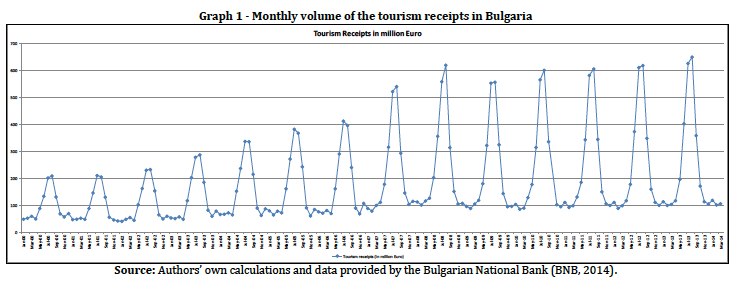
<body><![CDATA[<p>&nbsp;</p>     <p>&nbsp;</p>     <p><b><font size="3" face="Verdana">1. &nbsp;&nbsp;&nbsp;&nbsp;&nbsp; Introduction</font></b></p>     <p><b><font size="2" face="Verdana"></font></b><font size="2" face="Verdana">In Compliance with the annual Act for the State Budget, the Bulgarian   Ministry of Finance usually makes twice a year the so called “Internal   compensating changes in the budget credits of the first rate holder of budget   credits” (Ministry of Finance, 2014). Behind this complex phrase is hidden a   not very popular state account practice of restructuring (increasing or   decreasing the separate budget categories) in the budgets of the separate   Ministries and State Agencies of the Bulgarian State. What is in intriguing in   this internal budget restructuring is that it is usually done in the months of   March and April in the first part of the year and then in the months of   September and October for the second half of the year, when the tourism   receipts in the form of Value Added Tax turnovers are usually accumulated by   the National Revenue Agency (the tax administration) of Bulgaria. The need of   proper forecasts that could eventually justify or reject such a hidden harvesting policy has never been examined and put to the public attention.</font></p>     <p><font size="2" face="Verdana">Furthermore, if revealed with the help of the   proper forecasting techniques, this hidden policy of harvesting on the back of   the Bulgarian tourism industry, could finally result in the creation of a more   financially autonomous national tourism administration (preferably a Ministry   of tourism) that will allow a greater part of the collected tax revenues for   the tourism sector to be returned into the tourism industry in a form of public   investments through this very same more autonomous national tourism administration.</font></p>     <p><font size="2" face="Verdana">Based on the monthly data available data in category “Traveling” of the   balance of payment of the Republic of Bulgaria, which are regularly sustained   and published by the Bulgarian National Bank on its web site (Bulgarian National   Bank, 2014), a time series can be built for the volume of the tourism receipts   (<a href="/img/revistas/tms/v11n1/11n1a13g1.jpg">Graph 1</a>) from January 2000 to March 2014. This time series comprises a set of 170 time periods (170 months).</font>     
<p><font size="2" face="Verdana">Taking into the considerable size of this time series a search can be   made for a suitable forecasting model for the monthly volume of Bulgaria’s   tourism receipts. A possible solution in this regards could come in the face of   the so-called “univariate” methods (DeLurgio, 1998) and namely and most   particularly in the group of the exponential smoothing methods. This group of   methods relies on the assumption that if a considerably long time series of a   certain indicator can be composed, this very same considerably long time series   will have reflected all the possible external influences induced by all the   possible external factors and thus time series will have incurred an internal   logic of development and an internal information signal could be extrapolated   further in future. The building up of forecast model, especially with the use   of the exponential smoothing methods, however, needs a more sophisticated and multistage approach with a certain number of clearly set objectives.</font></p>     <p>&nbsp;</p>     <p><font size="3" face="Verdana"><b>2. &nbsp;&nbsp;&nbsp;&nbsp;&nbsp; A literature   review on the topic</b></font></p>        <p><font size="3" face="Verdana"></font><font size="2" face="Verdana">The development and usage of the exponential forecasting methods dates   back from the works of R. G. Brown in the 1940’s the results of which were   published in 1959. These were further developed and expanded by C. C. Holt in 1957 and Peter Winters in 1960. </font></p>     ]]></body>
<body><![CDATA[<p><font size="2" face="Verdana">In 1960s Pegles (1969) developed the first taxonomy for the   classification of the available at that time exponential smoothing forecasting   methods. In the 1980’s Gardner (Gardner, 1985; 1987) presented some interesting   techniques aimed at smoothing of the error residuals in the achieved forecasts.   Gardner (1985) and Taylor (2003) also further expanded the opportunities for   classifying the exponential smoothing forecasting methods according to so-called “forecasting profiles” or “forecasting patterns” (See also point 3). </font></p>     <p><font size="2" face="Verdana">The problem of the initialization of variables   that are to be used in the exponential smoothing equations was also regarded by   a numerous authors such as Ledolter and Abraham (1984) and Hyndman (2014). In 2002 Hyndman, Koehler, Snyder, Grose, and later in 2008 Hyndman, Koehler, Ord   and Snyder published there works on the usage of the so-called state-space approach in exponential smoothing.</font></p>     <p><font size="2" face="Verdana">In the years, the capacity of the exponential forecasting methods to   produce reliable forecast was further explored also by other researchers such   Ledolter and Abraham (1984), Gardner and McKenzie (1985; 1988), Chatfield and   Yar (1988), Hamilton (1994), Tashman and Kruk (1996), Delurgio (1998), Williams and Miller (1999), Tsay (2005) and many others.</font></p>     <p><font size="2" face="Verdana">In Bulgaria, the exponential smoothing methods up to the 1990’s were   virtually unknown due to the weak English language skills of the researchers   and the preference given in the field of forecasting to the multivariate   forecasting methods and mainly the usage of French and Swedish econometric   models. In 1996 Sirakov published a book named “Conjuncture and Forecasting of   International Markets” in which an application of the Brown’s single   exponential smoothing was made in regards to the Bulgarian export of textile   production equipment and machinery for the African countries and mainly in   Nigeria. This application was however very narrow in scope. An Internet   publication that that tried to make the exponential forecasting smoothing   methods more popular in Bulgaria was made in 2007 by Ivanov form the New   Bulgarian University as a part of his lecture course materials on business   processes forecasting. Another try for a more explicit explanation and usage of   the exponential forecasting methods and namely the Halt and Halt-Winters method   was made in another book published in Bulgarian language by Mishev and Goev,   i.e. “Statistical analysis of time series” (2012). Even here, however, the   theoretical presentation of the regarded method was limited and narrowed to the   practical application of several software packages. In the field of the   Bulgarian tourism, the publish studies in the application of the exponential   smoothing methods are also limited to some few papers dealing with the application   of the Halt and Halt-Winters method for forecasting of the number of tourism arrivals in certain areas and in the country as a whole.</font></p>     <p>&nbsp;</p>     <p><font size="3" face="Verdana"><b>3. Objectives</b></font></p>     <p><font size="3" face="Verdana"></font><font size="2" face="Verdana">The task of creating an exponential smoothing forecast model for the   monthly volume of the Bulgarian tourism receipts, meets with solving of several major problems:</font></p> <ul>       <li><font size="2" face="Verdana">Determining the time series pattern, or the so-called “forecast profile”     (Gardner, 1987, pp.174-175) (Hyndman, Koehler, Ord &amp; Snyder, 2008,     pp.11-23) and the quality of the data in the pattern, on the basis of which to     select the suitable forecasting exponential smoothing model.</font></li>       <li><font size="2" face="Verdana">Selecting of a suitable forecasting techniques;</font></li>       <li><font size="2" face="Verdana">Calculating the forecast values (up to March, 2025) and finding of a     best-fit model on the basis of the errors in the forecasts (R2, Mean Absolute     Percentage of Error (MAPE) and etc.);</font></li>       ]]></body>
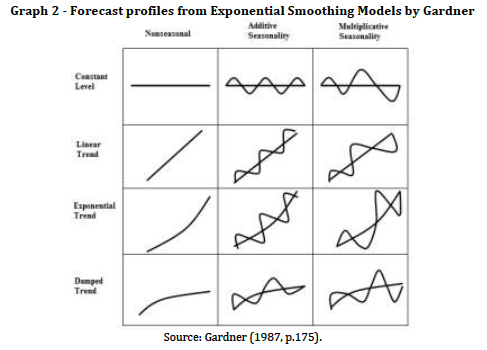
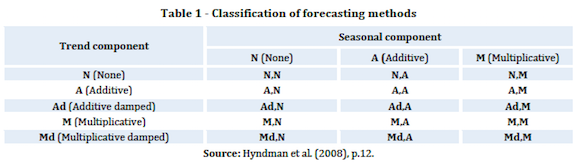
<body><![CDATA[<li><font size="2" face="Verdana">Drawing of conclusions on the results of the achieved forecasts.</font></li>     </ul>     <p>&nbsp;</p>     <p><font size="3" face="Verdana"><b>4. &nbsp;&nbsp;&nbsp;&nbsp;&nbsp; Methodology   and main results</b></font></p>     <p><font size="3" face="Verdana"></font><font size="2" face="Verdana">With regards to the <b>first   problem</b>, set in the previous point of the present paper, i.e. <b>the problem of determining the times series     pattern</b>, or the so-called times series’ “forecast profile” is usually   solved by comparing the times series in regard with a pre-set classification of   exponential smoothing methods or the derived form them forecast profiles in   terms of development curves (Dimitrov, 2011) (Dimitrov, 2013). As Hyndman et   al. (2008, pp.11-12), this classification of smoothing methods originated with Pegles’ taxonomy (Pegles, 1969, pp.311-315).</font></p>     <p><font size="2" face="Verdana">A simple visual analysis of the times series of the monthly volume of   the tourism receipts in Bulgaria for the time period 1964 &#8211; 2012 with   Hyndman et al and Taylor’s classification (<a href="#t1">Table 1</a>) shows out that these   particular time series can be associated to the following group of forecasting   patterns (forecasting profiles according to the Garnder’s classification)   called the “linear trend, multiplicative seasonality” profile (A,M pattern) and   (iii) to the “liner trend, additive seasonality” profile (A,A pattern) (<a href="#g2">Graph 2</a>).</font></p>     <p>&nbsp;</p>     <p><a name="t1"></a></p>     <p align="center"><img src="/img/revistas/tms/v11n1/11n1a13t1.jpg" width="580" height="166"></p>     
<p>&nbsp;</p>     ]]></body>
<body><![CDATA[<p>&nbsp;</p>     <p><a name="g2"></a></p>     <p align="center"><img src="/img/revistas/tms/v11n1/11n1a13g2.jpg" width="487" height="350"></p>     
<p>&nbsp;</p>      <p><font size="2" face="Verdana">A more detailed visual review of the regarded times series on the basis   of the fluctuations maxima and minima shows out that there are clearly   expressed yearly cycles, i.e. cycles of 12 months with an increasing amplitude   in the cyclical fluctuations. This finding can be further used in the process   of selecting the proper forecasting technique.</font></p>     <p><font size="2" face="Verdana">The finding that the time series of the monthly volume of the tourism   receipts in Bulgaria for the time period January 01, 2000 &#8211; March 31,   2014 have clearly expressed in terms of increasing fluctuations cycles, as well   as the fact that it corresponds to the “linear trend, multiplicative   seasonality” profile (A, M pattern), provides a solution to <b>the third problem, the one of selecting and     using of a suitable forecasting     exponential smoothing method</b>.   As both Gardner and Hyndman et al. point out this profile corresponds to the method   of the triple exponential smoothing in the presence of a linear trend and   multiplicative seasonality, known also as a variation of the Holt-Winters   method. The mathematical notation of the Holt-Winters method for <b>multiplicative seasonality</b> is as follows:</font></p>     <p><font size="2" face="Verdana">The smoothing of <b>the level (the base)</b> <b>&#8211; &ldquo;B&rdquo;</b>:</font></p>     <p><img src="/img/revistas/tms/v11n1/11n1a13e1.jpg" width="323" height="43"></p>     
<p><font size="2" face="Verdana">The smoothing of <b>the trend &#8211; &ldquo;&#1058;&rdquo;</b>:</font></p>     <p><img src="/img/revistas/tms/v11n1/11n1a13e2.jpg" width="319" height="35"></p>     
]]></body>
<body><![CDATA[<p><font size="2" face="Verdana">The   smoothing of <b>the seasonal factor &#8211;   &ldquo;S&rdquo;</b>:</font></p>     <p><img src="/img/revistas/tms/v11n1/11n1a13e3.jpg" width="317" height="40"></p>     
<p><font size="2" face="Verdana">The achieving of <b>the final forecast</b> <b>&ldquo;Ft+m&rdquo; </b>for <b>&ldquo;t+m&rdquo; periods ahead in the future:</b></font></p>     <p><img src="/img/revistas/tms/v11n1/11n1a13e4.jpg" width="231" height="31"></p>     
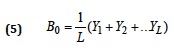
<p><font size="2" face="Verdana">Where: &bdquo;&#945;&rdquo;, &bdquo;&#946;&rdquo; and &ldquo;&#947;&rdquo; are the smoothing   constants for the level, the trend and the seasonality respectfully which could   take values between 0 and 1.</font></p>     <p><font size="2" face="Verdana">The initialization of the values of the level &ldquo;B&rdquo;, the trend &ldquo;&#1058;&rdquo; and the seasonal   factor &ldquo;S&rdquo; is achieved though the following set of equations:</font></p>     <p><font size="2" face="Verdana">For <b>the level (the base)</b> <b>&#8211; &ldquo;B0&rdquo;</b>:</font></p>     <p><img src="/img/revistas/tms/v11n1/11n1a13e5.jpg" width="174" height="52"></p>     
<p><font size="2" face="Verdana">For <b>the   trend &#8211; &ldquo;&#1058;0&rdquo;</b>:</font></p>     <p><img src="/img/revistas/tms/v11n1/11n1a13e6.jpg" width="305" height="44"></p>     
]]></body>
<body><![CDATA[<p><font size="2" face="Verdana">For <b>the   seasonal factor &#8211; &ldquo;S0&rdquo;</b>:</font></p>     <p><img src="/img/revistas/tms/v11n1/11n1a13e7.jpg" width="333" height="55"></p>     
<p><img src="/img/revistas/tms/v11n1/11n1a13e8.jpg" width="330" height="54"></p>     
<p><font size="2" face="Verdana">and Aj is the average value of Y in the jth cycle of the regarded time   series.</font></p>     <p><font size="2" face="Verdana">Here, for the initialization of the seasonal factor other alternative   methods are also available and R. J. Hyndman (2014) recommends the following   approach for the multiplicative seasonality:</font></p>     <p><img src="/img/revistas/tms/v11n1/11n1a13e9.jpg" width="215" height="30"></p>     
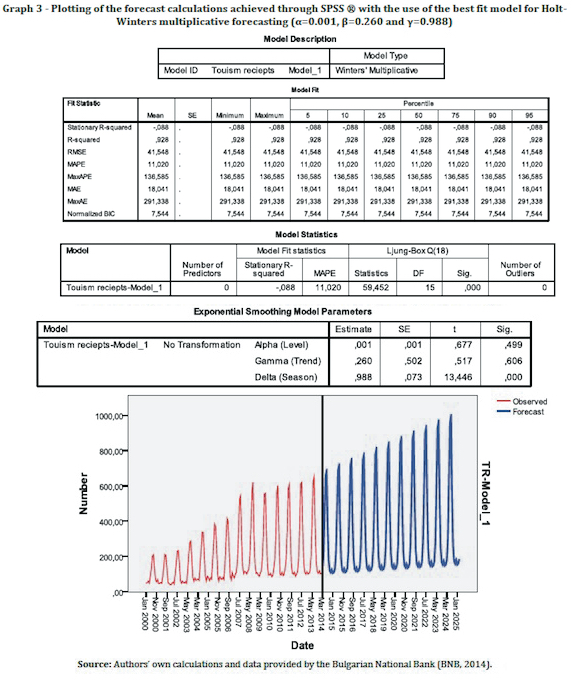
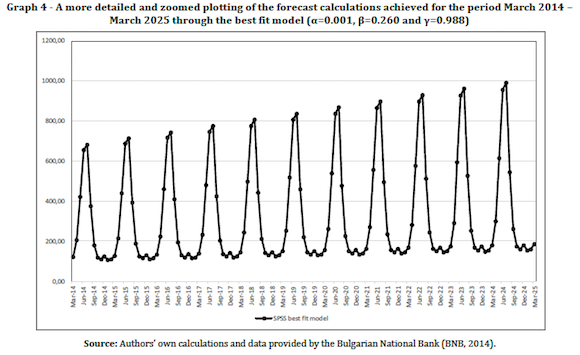
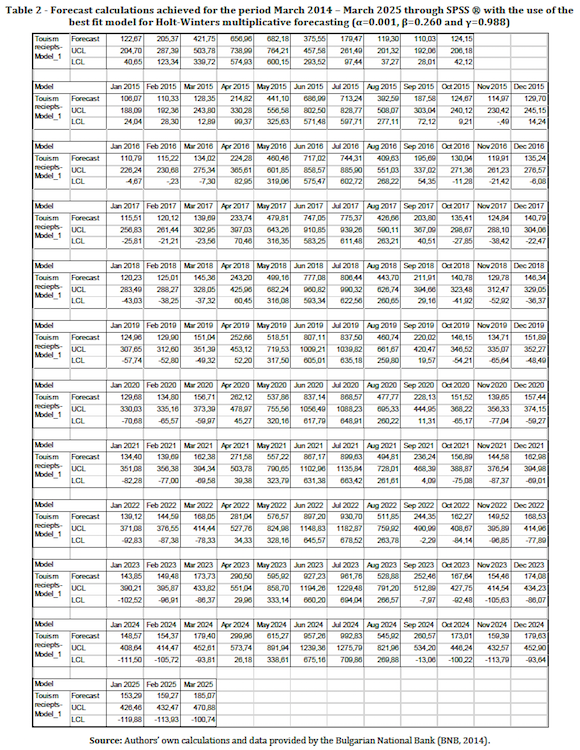
<p><font size="2" face="Verdana">However the present paper will use equation (7) even if it is a little   bit more complex to achieve and is close to an autoregressive approach for   initialization of the seasonal indices. </font></p>     <p><font size="2" face="Verdana">After having chosen the <b>Holt-Winters   method for multiplicative seasonality</b> as the proper forecasting technique,   a calculation of the forecasts up to March, 2025 and finding of the best fit   model can be made (<b>the third of the     above-set tasks</b>). In order make the necessary forecast calculations and to   receive the optimal values of the smoothing constants in regards to R2, Mean   Absolute Percentage of Error (MAPE) and etc., one can use the inherent   functions of various statistical software packages such as “R”, “R Studio”,   NumXL ®, SPSS ® and many others. The present paper shall use the function of   the SPSS ® statistical software for producing of the necessary forecast   calculations by the use of the Holt-Winters exponential smoothing method. The   same software package shall be used simultaneously for finding of the best fit   “exponential model smoothing parameters”, i.e. the-best fit the alpha, beta and   gamma smoothing constants (<a href="#g3">Graph 3</a>). The forecasting results of the best fit   model achieved through the SPSS ® software package are presented in <a href="#g3">Graphs 3</a>   and <a href="#g4">4</a> and in <a href="#t2">Table 2</a>. The set of the smoothing constants produced for the model are &#945;=0.001, &#946;=0.260 and &#947;=0.988.</font></p>     <p>&nbsp;</p>     <p><a name="g3"></a></p>     ]]></body>
<body><![CDATA[<p align="center"><img src="/img/revistas/tms/v11n1/11n1a13g3.jpg" width="572" height="683"></p> &nbsp; </font></p>     
<p>&nbsp;</p>     <p><font size="2" face="Verdana"><a name="g4"></a></font></p>     <p align="center"><font size="2" face="Verdana"><img src="/img/revistas/tms/v11n1/11n1a13g4.jpg" width="580" height="355"></font></p>     
<p>&nbsp;</p>     <p>&nbsp;</p>     <p><font size="2" face="Verdana"><a name="t2"></a></font></p>     <p align="center"><font size="2" face="Verdana"><img src="/img/revistas/tms/v11n1/11n1a13t2.jpg" width="580" height="750"></font></p>     
<p align="center">&nbsp;</p> <font size="2" face="Verdana">    <p>After producing the   optimal forecast calculations through the best fit model (the one with lowest   MAPE) one can proceed further with the solving of <b>the fourth of the above     set tasks</b>, i.e. with the drawing of conclusions on the results of the achieved forecasts.</p>     ]]></body>
<body><![CDATA[<p>&nbsp;</p> </font>     <p><font size="3" face="Verdana"><b>5. &nbsp;&nbsp;&nbsp;&nbsp;&nbsp; Conclusions</b></font></p> <font size="2" face="Verdana">     <p>Based on the results in <a href="#t2">Table 2</a>, as well as in   <a href="#g3">Graph 3</a> and <a href="#g4">4</a>, one can outline <b>that the     forecasts achieved with best-fit model is that the trend of increase is     preserved</b>. Moreover, the best fit   model achieved through the SPSS statistical package with smoothing constants   &#945;=0.001, &#946;=0.260 and &#947;=0.988 tends to produce, as it should be expected,   multiplicatively increasing cyclical fluctuations for the monthly volume of the   tourism receipts in Bulgaria. The highest forecast   monthly values, as well as the statistically recorded ones, however, do not   refer to the months of March and April and September and October, when the   internal compensating changes in the state budget are being made by the   Bulgarian Ministry of Finance. The highest forecast values for the winter   season are produced for the months of November and December and for the summer   season, respectfully for the months of June and July. The lack of overlapping   can be easily explain with the lag of one to two months that is needed for the   tourism receipts in Bulgaria to produce the necessary Value Added Tax turnovers   in the tourism companies which can be consequently captured as tax revenues by   the National Revenue Agency (a branch agency of the Bulgarian Ministry of   Finance). This means that, intentionally or not that, if the Bulgarian state in   the face of its Ministry of Finance continues the practice of the “Internal   compensating changes in the budget credits”, based on both recorded data and   produced forecast, the hidden policy of harvesting on the back of the Bulgarian   tourism industry will also continue. And there will not be any public notion   about it as it will be covered up as a routine bureaucratic state accounting   procedure that is either “too complex” or “too routine and insignificant” to explain.</p>     <p>&nbsp;</p>     <p>This policy of hidden harvesting, however, has   an explicit downturn effect on the development of the Bulgarian tourism and   prevents the increase in its competitiveness (Filipova, 2010) (Dimitrova, 2013)   (Stankova, 2010; 2014) (Gantchev, 2014). And the main reason for this is the   fact that the Bulgarian national tourism administration for the last 25 years   has always been either a part of a certain “mega” ministry (like the former   Ministry of Economy, Energy and tourism) has possessed a rank of Government   agency but without any power of being directly presented in the government with   the right to coordinate the preparation and adoption of the state budget and to   spend directly its budget without a prior approval from a supervising minister   from a ministry which incorporates it. In more simple words this long lasting   situation has contributed either for an ever decreasing, or for an insufficient   return of the collected taxes in the tourism industry in the form of public investments.</p>     <p>The fact that the forecasts for monthly volume   of the tourism receipts in Bulgaria point a continuous increase in both the   fluctuations and their yearly volume by March 2025 should result in a greater   pressure form the Bulgarian tourism industry (mainly from the different   sub-sectorial associations) on the political parties and the government for the   creation of a more financially autonomous and more vivid national tourism administration than the existing one.</p> </font>     <p>&nbsp;</p>     <p><font size="3" face="Verdana"><b>References</b></font></p>     <!-- ref --><p><font size="2" face="Verdana">Brown, R. G. (1959). <i>Statistical Forecasting for Inventory Control</i>. New York: McGraw-Hill.    &nbsp;&nbsp;&nbsp;&nbsp;&nbsp;&nbsp;&nbsp;&nbsp;[&#160;<a href="javascript:void(0);" onclick="javascript: window.open('/scielo.php?script=sci_nlinks&ref=000101&pid=S2182-8458201500010001300001&lng=','','width=640,height=500,resizable=yes,scrollbars=1,menubar=yes,');">Links</a>&#160;]<!-- end-ref --></font></p>     ]]></body>
<body><![CDATA[<!-- ref --><p><font size="2" face="Verdana">Chatfield, C. &amp; Yar, M. (1988). Holt-Winters forecasting: Some practical issues. <i>The Statistician</i>, 37, 129-140.    &nbsp;&nbsp;&nbsp;&nbsp;&nbsp;&nbsp;&nbsp;&nbsp;[&#160;<a href="javascript:void(0);" onclick="javascript: window.open('/scielo.php?script=sci_nlinks&ref=000103&pid=S2182-8458201500010001300002&lng=','','width=640,height=500,resizable=yes,scrollbars=1,menubar=yes,');">Links</a>&#160;]<!-- end-ref --></font></p>     <!-- ref --><p><font size="2" face="Verdana">DeLurgio, S. A. (1998). <i>Forecasting   Principles and Applications</i>. Pennsylvania State University: Irwin/McGraw-Hill.    &nbsp;&nbsp;&nbsp;&nbsp;&nbsp;&nbsp;&nbsp;&nbsp;[&#160;<a href="javascript:void(0);" onclick="javascript: window.open('/scielo.php?script=sci_nlinks&ref=000105&pid=S2182-8458201500010001300003&lng=','','width=640,height=500,resizable=yes,scrollbars=1,menubar=yes,');">Links</a>&#160;]<!-- end-ref --></font></p>     <!-- ref --><p><font size="2" face="Verdana">Bulgarian National Bank. (2014). <i>Balance of   Payments of Bulgaria, 2014</i>. Retrieved May 29, 2014 from <a href="http://www.bnb.bg/ResearchAndPublications/PubPeriodical/PubStatisticalPublications/PubSPBalancePayments/index.htm" target="_blank">http://www.bnb.bg/ResearchAndPublications/PubPeriodical/PubStatisticalPublications/PubSPBalancePayments/index.htm</a>.    &nbsp;&nbsp;&nbsp;&nbsp;&nbsp;&nbsp;&nbsp;&nbsp;[&#160;<a href="javascript:void(0);" onclick="javascript: window.open('/scielo.php?script=sci_nlinks&ref=000107&pid=S2182-8458201500010001300004&lng=','','width=640,height=500,resizable=yes,scrollbars=1,menubar=yes,');">Links</a>&#160;]<!-- end-ref --></font></p>     <!-- ref --><p><font size="2" face="Verdana">Dimitrov, P. (2011). Long-Run Forecasting of Spa   and Wellness Subsector of the Bulgarian Tourism Industry. <i>Tourism &amp; Management Studies</i>, 7, 140-148.    &nbsp;&nbsp;&nbsp;&nbsp;&nbsp;&nbsp;&nbsp;&nbsp;[&#160;<a href="javascript:void(0);" onclick="javascript: window.open('/scielo.php?script=sci_nlinks&ref=000109&pid=S2182-8458201500010001300005&lng=','','width=640,height=500,resizable=yes,scrollbars=1,menubar=yes,');">Links</a>&#160;]<!-- end-ref --></font></p>     <!-- ref --><p><font size="2" face="Verdana">Dimitrov, P. (2013). Long-Run Forecasting of the   Number of Ecotourism Arrivals in the Municipality of Stambolovo, Bulgaria. <i>Tourism &amp; Management Studies</i>, 9(1), 41-47.    &nbsp;&nbsp;&nbsp;&nbsp;&nbsp;&nbsp;&nbsp;&nbsp;[&#160;<a href="javascript:void(0);" onclick="javascript: window.open('/scielo.php?script=sci_nlinks&ref=000111&pid=S2182-8458201500010001300006&lng=','','width=640,height=500,resizable=yes,scrollbars=1,menubar=yes,');">Links</a>&#160;]<!-- end-ref --></font></p>     ]]></body>
<body><![CDATA[<!-- ref --><p><font size="2" face="Verdana">Dimitrova, R. (2013).   Opportunities of marketing research for increasing competitiveness of the   cultural tourism product.    &nbsp;&nbsp;&nbsp;&nbsp;&nbsp;&nbsp;&nbsp;&nbsp;[&#160;<a href="javascript:void(0);" onclick="javascript: window.open('/scielo.php?script=sci_nlinks&ref=000113&pid=S2182-8458201500010001300007&lng=','','width=640,height=500,resizable=yes,scrollbars=1,menubar=yes,');">Links</a>&#160;]<!-- end-ref --> Paper presented at the<i> International Scientific Conference “Cultural Corridor Via Diagonals &#8211; Cultural Tourism Without Boundaries”</i>, Sofia, Bulgaria.</font></p>     <!-- ref --><p><font size="2" face="Verdana">Filipova M. (2010). Peculiarities of project   planning in tourism. <i>Perspectives of     Innovations Economics and Business /PIEB, International Cross- Industry Research Journal</i>, 4(1), 57-59.    &nbsp;&nbsp;&nbsp;&nbsp;&nbsp;&nbsp;&nbsp;&nbsp;[&#160;<a href="javascript:void(0);" onclick="javascript: window.open('/scielo.php?script=sci_nlinks&ref=000115&pid=S2182-8458201500010001300008&lng=','','width=640,height=500,resizable=yes,scrollbars=1,menubar=yes,');">Links</a>&#160;]<!-- end-ref --></font></p>     <!-- ref --><p><font size="2" face="Verdana">Gantchev, G. T. (2014).   Tourism Industry: Role of the real effective exchange rate. <i>Tourism &amp; Management Studies</i>, 10(Special Issue), 174-179.    &nbsp;&nbsp;&nbsp;&nbsp;&nbsp;&nbsp;&nbsp;&nbsp;[&#160;<a href="javascript:void(0);" onclick="javascript: window.open('/scielo.php?script=sci_nlinks&ref=000117&pid=S2182-8458201500010001300009&lng=','','width=640,height=500,resizable=yes,scrollbars=1,menubar=yes,');">Links</a>&#160;]<!-- end-ref --></font></p>     <!-- ref --><p><font size="2" face="Verdana">Gardner, E.S. &amp; McKenzie, E. (1985). Forecasting trends in time series, <i>Management Science</i>, 31, 1237-1246.    &nbsp;&nbsp;&nbsp;&nbsp;&nbsp;&nbsp;&nbsp;&nbsp;[&#160;<a href="javascript:void(0);" onclick="javascript: window.open('/scielo.php?script=sci_nlinks&ref=000119&pid=S2182-8458201500010001300010&lng=','','width=640,height=500,resizable=yes,scrollbars=1,menubar=yes,');">Links</a>&#160;]<!-- end-ref --></font></p>     <!-- ref --><p><font size="2" face="Verdana">Gardner, E.S. &amp;   McKenzie, E. (1988). Model identification in exponential smoothing, <i>Journal of the Operational Research Society</i>, 39, 863-867.    &nbsp;&nbsp;&nbsp;&nbsp;&nbsp;&nbsp;&nbsp;&nbsp;[&#160;<a href="javascript:void(0);" onclick="javascript: window.open('/scielo.php?script=sci_nlinks&ref=000121&pid=S2182-8458201500010001300011&lng=','','width=640,height=500,resizable=yes,scrollbars=1,menubar=yes,');">Links</a>&#160;]<!-- end-ref --></font></p>     ]]></body>
<body><![CDATA[<!-- ref --><p><font size="2" face="Verdana">Gardner, E. S. (1985). Exponential Smoothing:   the state of the art, <i>Journal of Forecasting</i>, 4, 1-28.    &nbsp;&nbsp;&nbsp;&nbsp;&nbsp;&nbsp;&nbsp;&nbsp;[&#160;<a href="javascript:void(0);" onclick="javascript: window.open('/scielo.php?script=sci_nlinks&ref=000123&pid=S2182-8458201500010001300012&lng=','','width=640,height=500,resizable=yes,scrollbars=1,menubar=yes,');">Links</a>&#160;]<!-- end-ref --></font></p>     <!-- ref --><p><font size="2" face="Verdana">Gardner, E. S. (1987). Smoothing methods for   short-term planning and control. In S. Makridakis &amp; S. C. Wheelright (Eds.) <i>The handbook of forecasting &#8211; a manager’s guide</i>, (pp. 174-175). New York: John Wiley &amp; Sons.    &nbsp;&nbsp;&nbsp;&nbsp;&nbsp;&nbsp;&nbsp;&nbsp;[&#160;<a href="javascript:void(0);" onclick="javascript: window.open('/scielo.php?script=sci_nlinks&ref=000125&pid=S2182-8458201500010001300013&lng=','','width=640,height=500,resizable=yes,scrollbars=1,menubar=yes,');">Links</a>&#160;]<!-- end-ref --></font></p>     <p><font size="2" face="Verdana">Hamilton, J .D. (1994). <i>Time Series Analysis</i>. Princeton, NJ: Princeton University Press.</font></p>     <!-- ref --><p><font size="2" face="Verdana">Holt, C. C. (1957). Forecasting trends and seasonals by exponentially weighted averages,     <i>O.N.R. Memorandum 52/1957</i>, Carnegie Institute of Technology.    &nbsp;&nbsp;&nbsp;&nbsp;&nbsp;&nbsp;&nbsp;&nbsp;[&#160;<a href="javascript:void(0);" onclick="javascript: window.open('/scielo.php?script=sci_nlinks&ref=000128&pid=S2182-8458201500010001300015&lng=','','width=640,height=500,resizable=yes,scrollbars=1,menubar=yes,');">Links</a>&#160;]<!-- end-ref --></font></p>     <!-- ref --><p><font size="2" face="Verdana">Hyndman, R. J., Koelher, A. B., Ord, J. K.,   &amp; Snyder, R. D. (2008). <i>Forecasting with exponential Smoothing &#8211; The State Space Approach</i>. Berlin: Springer.    &nbsp;&nbsp;&nbsp;&nbsp;&nbsp;&nbsp;&nbsp;&nbsp;[&#160;<a href="javascript:void(0);" onclick="javascript: window.open('/scielo.php?script=sci_nlinks&ref=000130&pid=S2182-8458201500010001300016&lng=','','width=640,height=500,resizable=yes,scrollbars=1,menubar=yes,');">Links</a>&#160;]<!-- end-ref --></font></p>     <!-- ref --><p><font size="2" face="Verdana">Hyndman, R. J. (2014). <i>Initializing   the Holt-Winters method</i>. In Hyndsight &#8211; A blog by R. J. Hyndman.   Retrieved March 10, 2014 from <a href="http://robjhyndman.com/hyndsight/hw-initialization/" target="_blank">http://robjhyndman.com/hyndsight/hw-initialization/</a>.    &nbsp;&nbsp;&nbsp;&nbsp;&nbsp;&nbsp;&nbsp;&nbsp;[&#160;<a href="javascript:void(0);" onclick="javascript: window.open('/scielo.php?script=sci_nlinks&ref=000132&pid=S2182-8458201500010001300017&lng=','','width=640,height=500,resizable=yes,scrollbars=1,menubar=yes,');">Links</a>&#160;]<!-- end-ref --></font></p>     <!-- ref --><p><font size="2" face="Verdana">Ivanov, M. (2007). <i>A try and conclusions from   the forecasting of the business processes with the help of time series </i>(a MS PowerPoint presentation in Bulgarian   language). Retrieved May 29, 2014 from: <a href="http://www.nbu.bg/PUBLIC/IMAGES/File/departments/informatics/Izsledvania/Martin_Ivanov_prolet_2007.pdf" target="_blank">http://www.nbu.bg/PUBLIC/IMAGES/File/departments/informatics/Izsledvania/Martin_Ivanov_prolet_2007.pdf</a>.    &nbsp;&nbsp;&nbsp;&nbsp;&nbsp;&nbsp;&nbsp;&nbsp;[&#160;<a href="javascript:void(0);" onclick="javascript: window.open('/scielo.php?script=sci_nlinks&ref=000134&pid=S2182-8458201500010001300018&lng=','','width=640,height=500,resizable=yes,scrollbars=1,menubar=yes,');">Links</a>&#160;]<!-- end-ref --></font></p>     <!-- ref --><p><font size="2" face="Verdana">Ledolter, J. &amp;   Abraham, B. (1984). Some comments on the initialization of exponential smoothing. <i>Journal of Forecasting</i>, 3, 79-84.    &nbsp;&nbsp;&nbsp;&nbsp;&nbsp;&nbsp;&nbsp;&nbsp;[&#160;<a href="javascript:void(0);" onclick="javascript: window.open('/scielo.php?script=sci_nlinks&ref=000136&pid=S2182-8458201500010001300019&lng=','','width=640,height=500,resizable=yes,scrollbars=1,menubar=yes,');">Links</a>&#160;]<!-- end-ref --></font></p>     <!-- ref --><p><font size="2" face="Verdana">Ministry of Finance (2014). <i>Type of   corrections which can be currently exercised in the fiscal year in the budgets   of the first rate users of budget credits in compliance of the Act for the   structure and functioning of the state budget</i> (in Bulgarian language). Retrieved May 29, 2014 from <a href="http://www.minfin.bg" target="_blank">http://www.minfin.bg</a>.    &nbsp;&nbsp;&nbsp;&nbsp;&nbsp;&nbsp;&nbsp;&nbsp;[&#160;<a href="javascript:void(0);" onclick="javascript: window.open('/scielo.php?script=sci_nlinks&ref=000138&pid=S2182-8458201500010001300020&lng=','','width=640,height=500,resizable=yes,scrollbars=1,menubar=yes,');">Links</a>&#160;]<!-- end-ref --></font></p>     <!-- ref --><p><font size="2" face="Verdana">Mishev, G. &amp; Goev, V. (2012). <i>Statistical Analysis of Time Series</i>. Sofia, Bulgaria: Avangard-Prima Publishing House.    &nbsp;&nbsp;&nbsp;&nbsp;&nbsp;&nbsp;&nbsp;&nbsp;[&#160;<a href="javascript:void(0);" onclick="javascript: window.open('/scielo.php?script=sci_nlinks&ref=000140&pid=S2182-8458201500010001300021&lng=','','width=640,height=500,resizable=yes,scrollbars=1,menubar=yes,');">Links</a>&#160;]<!-- end-ref --></font></p>     <!-- ref --><p><font size="2" face="Verdana">Pegles, C. C. (1969). Exponential forecasting: some new variations. <i>Management Science</i>, 15(5), 311-315.    &nbsp;&nbsp;&nbsp;&nbsp;&nbsp;&nbsp;&nbsp;&nbsp;[&#160;<a href="javascript:void(0);" onclick="javascript: window.open('/scielo.php?script=sci_nlinks&ref=000142&pid=S2182-8458201500010001300022&lng=','','width=640,height=500,resizable=yes,scrollbars=1,menubar=yes,');">Links</a>&#160;]<!-- end-ref --></font></p>     <!-- ref --><p><font size="2" face="Verdana">Sirakov, S. (1996). <i>Conjuncture and   Forecasting of International Markets</i>. Sofia, Bulgaria: Stoilov Publishing House.    &nbsp;&nbsp;&nbsp;&nbsp;&nbsp;&nbsp;&nbsp;&nbsp;[&#160;<a href="javascript:void(0);" onclick="javascript: window.open('/scielo.php?script=sci_nlinks&ref=000144&pid=S2182-8458201500010001300023&lng=','','width=640,height=500,resizable=yes,scrollbars=1,menubar=yes,');">Links</a>&#160;]<!-- end-ref --></font></p>     <!-- ref --><p><font size="2" face="Verdana">Stankova, M. (2010). The   tourism regions in Bulgaria - concepts and challenges. <i>Journal of Tourism &amp; Hospitality Management</i>, 16(1), 109-118.    &nbsp;&nbsp;&nbsp;&nbsp;&nbsp;&nbsp;&nbsp;&nbsp;[&#160;<a href="javascript:void(0);" onclick="javascript: window.open('/scielo.php?script=sci_nlinks&ref=000146&pid=S2182-8458201500010001300024&lng=','','width=640,height=500,resizable=yes,scrollbars=1,menubar=yes,');">Links</a>&#160;]<!-- end-ref --></font></p>     <!-- ref --><p><font size="2" face="Verdana">Stankova, M. (2014). Challenges ahead for   Bulgarian’s competitiveness as a mountain tourism destination. <i>Tourism &amp; Management Studies</i>, 10(Special Issue), 180-185</font>&nbsp;&nbsp;&nbsp;&nbsp;&nbsp;&nbsp;&nbsp;&nbsp;[&#160;<a href="javascript:void(0);" onclick="javascript: window.open('/scielo.php?script=sci_nlinks&ref=000148&pid=S2182-8458201500010001300025&lng=','','width=640,height=500,resizable=yes,scrollbars=1,menubar=yes,');">Links</a>&#160;]<!-- end-ref --><!-- ref --><p><font size="2" face="Verdana">Taylor, J. W. (2003). Exponential Smoothing with a damped multiplicative trend. <i>International Journal of Forecasting</i>, 19, 715-725.    &nbsp;&nbsp;&nbsp;&nbsp;&nbsp;&nbsp;&nbsp;&nbsp;[&#160;<a href="javascript:void(0);" onclick="javascript: window.open('/scielo.php?script=sci_nlinks&ref=000149&pid=S2182-8458201500010001300026&lng=','','width=640,height=500,resizable=yes,scrollbars=1,menubar=yes,');">Links</a>&#160;]<!-- end-ref --></font></p>     <!-- ref --><p><font size="2" face="Verdana">Tashman, L. J., &amp;   Kruk, J. M. (1996). The use of protocols to select exponential smoothing   procedures: a reconsideration of forecasting competitions. <i>International Journal of Forecasting</i>, 12, 235-253.    &nbsp;&nbsp;&nbsp;&nbsp;&nbsp;&nbsp;&nbsp;&nbsp;[&#160;<a href="javascript:void(0);" onclick="javascript: window.open('/scielo.php?script=sci_nlinks&ref=000151&pid=S2182-8458201500010001300027&lng=','','width=640,height=500,resizable=yes,scrollbars=1,menubar=yes,');">Links</a>&#160;]<!-- end-ref --></font></p>     ]]></body>
<body><![CDATA[<!-- ref --><p><font size="2" face="Verdana">Tsay, R. S. (2005). <i>Analysis of Financial Time Series</i>. New York: John Wiley &amp; Sons.    &nbsp;&nbsp;&nbsp;&nbsp;&nbsp;&nbsp;&nbsp;&nbsp;[&#160;<a href="javascript:void(0);" onclick="javascript: window.open('/scielo.php?script=sci_nlinks&ref=000153&pid=S2182-8458201500010001300028&lng=','','width=640,height=500,resizable=yes,scrollbars=1,menubar=yes,');">Links</a>&#160;]<!-- end-ref --></font></p>     <!-- ref --><p><font size="2" face="Verdana">Williams, D. W., &amp; Miller, D. (1999).   Level-adjusted exponential smoothing for modeling planned discontinuities. <i>International Journal of Forecasting</i>, 15, 273-289.    &nbsp;&nbsp;&nbsp;&nbsp;&nbsp;&nbsp;&nbsp;&nbsp;[&#160;<a href="javascript:void(0);" onclick="javascript: window.open('/scielo.php?script=sci_nlinks&ref=000155&pid=S2182-8458201500010001300029&lng=','','width=640,height=500,resizable=yes,scrollbars=1,menubar=yes,');">Links</a>&#160;]<!-- end-ref --></font></p>     <p>&nbsp;</p>     <p>&nbsp;</p>     <p><font size="2" face="Verdana"><b>Journal   history:</b>          <br>     <b>Received</b>: 12 May 2014          <br> <b>Accepted</b>: 10 November 2014</font></p>      ]]></body><back>
<ref-list>
<ref id="B1">
<nlm-citation citation-type="book">
<person-group person-group-type="author">
<name>
<surname><![CDATA[Brown]]></surname>
<given-names><![CDATA[R. G.]]></given-names>
</name>
</person-group>
<source><![CDATA[Statistical Forecasting for Inventory Control]]></source>
<year>1959</year>
<publisher-loc><![CDATA[New York ]]></publisher-loc>
<publisher-name><![CDATA[McGraw-Hill]]></publisher-name>
</nlm-citation>
</ref>
<ref id="B2">
<nlm-citation citation-type="journal">
<person-group person-group-type="author">
<name>
<surname><![CDATA[Chatfield]]></surname>
<given-names><![CDATA[C.]]></given-names>
</name>
<name>
<surname><![CDATA[Yar]]></surname>
<given-names><![CDATA[M.]]></given-names>
</name>
</person-group>
<article-title xml:lang="en"><![CDATA[Holt-Winters forecasting: Some practical issues]]></article-title>
<source><![CDATA[The Statistician]]></source>
<year>1988</year>
<numero>37</numero>
<issue>37</issue>
<page-range>129-140</page-range></nlm-citation>
</ref>
<ref id="B3">
<nlm-citation citation-type="book">
<person-group person-group-type="author">
<name>
<surname><![CDATA[DeLurgio]]></surname>
<given-names><![CDATA[S. A.]]></given-names>
</name>
</person-group>
<source><![CDATA[Forecasting Principles and Applications]]></source>
<year>1998</year>
<publisher-name><![CDATA[Pennsylvania State UniversityIrwin/McGraw-Hill]]></publisher-name>
</nlm-citation>
</ref>
<ref id="B4">
<nlm-citation citation-type="">
<collab>Bulgarian National Bank</collab>
<source><![CDATA[Balance of Payments of Bulgaria, 2014]]></source>
<year>2014</year>
</nlm-citation>
</ref>
<ref id="B5">
<nlm-citation citation-type="journal">
<person-group person-group-type="author">
<name>
<surname><![CDATA[Dimitrov]]></surname>
<given-names><![CDATA[P.]]></given-names>
</name>
</person-group>
<article-title xml:lang="en"><![CDATA[Long-Run Forecasting of Spa and Wellness Subsector of the Bulgarian Tourism Industry]]></article-title>
<source><![CDATA[Tourism & Management Studies]]></source>
<year>2011</year>
<numero>7</numero>
<issue>7</issue>
<page-range>140-148</page-range></nlm-citation>
</ref>
<ref id="B6">
<nlm-citation citation-type="journal">
<person-group person-group-type="author">
<name>
<surname><![CDATA[Dimitrov]]></surname>
<given-names><![CDATA[P.]]></given-names>
</name>
</person-group>
<article-title xml:lang="en"><![CDATA[Long-Run Forecasting of the Number of Ecotourism Arrivals in the Municipality of Stambolovo, Bulgaria]]></article-title>
<source><![CDATA[Tourism & Management Studies]]></source>
<year>2013</year>
<volume>9</volume>
<numero>1</numero>
<issue>1</issue>
<page-range>41-47</page-range></nlm-citation>
</ref>
<ref id="B7">
<nlm-citation citation-type="">
<person-group person-group-type="author">
<name>
<surname><![CDATA[Dimitrova]]></surname>
<given-names><![CDATA[R.]]></given-names>
</name>
</person-group>
<source><![CDATA[Opportunities of marketing research for increasing competitiveness of the cultural tourism product]]></source>
<year>2013</year>
</nlm-citation>
</ref>
<ref id="B8">
<nlm-citation citation-type="journal">
<person-group person-group-type="author">
<name>
<surname><![CDATA[Filipova]]></surname>
<given-names><![CDATA[M.]]></given-names>
</name>
</person-group>
<article-title xml:lang="en"><![CDATA[Peculiarities of project planning in tourism]]></article-title>
<source><![CDATA[Perspectives of Innovations Economics and Business /PIEB, International Cross- Industry Research Journal]]></source>
<year>2010</year>
<volume>4</volume>
<numero>1</numero>
<issue>1</issue>
<page-range>57-59</page-range></nlm-citation>
</ref>
<ref id="B9">
<nlm-citation citation-type="journal">
<person-group person-group-type="author">
<name>
<surname><![CDATA[Gantchev]]></surname>
<given-names><![CDATA[G. T.]]></given-names>
</name>
</person-group>
<article-title xml:lang="en"><![CDATA[Tourism Industry: Role of the real effective exchange rate]]></article-title>
<source><![CDATA[Tourism & Management Studies]]></source>
<year>2014</year>
<volume>10</volume>
<page-range>174-179</page-range></nlm-citation>
</ref>
<ref id="B10">
<nlm-citation citation-type="journal">
<person-group person-group-type="author">
<name>
<surname><![CDATA[Gardner]]></surname>
<given-names><![CDATA[E.S.]]></given-names>
</name>
<name>
<surname><![CDATA[McKenzie]]></surname>
<given-names><![CDATA[E.]]></given-names>
</name>
</person-group>
<article-title xml:lang="en"><![CDATA[Forecasting trends in time series]]></article-title>
<source><![CDATA[Management Science]]></source>
<year>1985</year>
<numero>31</numero>
<issue>31</issue>
<page-range>1237-1246</page-range></nlm-citation>
</ref>
<ref id="B11">
<nlm-citation citation-type="journal">
<person-group person-group-type="author">
<name>
<surname><![CDATA[Gardner]]></surname>
<given-names><![CDATA[E.S.]]></given-names>
</name>
<name>
<surname><![CDATA[McKenzie]]></surname>
<given-names><![CDATA[E.]]></given-names>
</name>
</person-group>
<article-title xml:lang="en"><![CDATA[Model identification in exponential smoothing]]></article-title>
<source><![CDATA[Journal of the Operational Research Society]]></source>
<year>1988</year>
<numero>39</numero>
<issue>39</issue>
<page-range>863-867</page-range></nlm-citation>
</ref>
<ref id="B12">
<nlm-citation citation-type="journal">
<person-group person-group-type="author">
<name>
<surname><![CDATA[Gardner]]></surname>
<given-names><![CDATA[E. S.]]></given-names>
</name>
</person-group>
<article-title xml:lang="en"><![CDATA[Exponential Smoothing: the state of the art]]></article-title>
<source><![CDATA[Journal of Forecasting]]></source>
<year>1985</year>
<numero>4</numero>
<issue>4</issue>
<page-range>1-28</page-range></nlm-citation>
</ref>
<ref id="B13">
<nlm-citation citation-type="book">
<person-group person-group-type="author">
<name>
<surname><![CDATA[Gardner]]></surname>
<given-names><![CDATA[E. S.]]></given-names>
</name>
</person-group>
<article-title xml:lang="en"><![CDATA[Smoothing methods for short-term planning and control]]></article-title>
<person-group person-group-type="editor">
<name>
<surname><![CDATA[Makridakis]]></surname>
<given-names><![CDATA[S.]]></given-names>
</name>
<name>
<surname><![CDATA[Wheelright]]></surname>
<given-names><![CDATA[S. C.]]></given-names>
</name>
</person-group>
<source><![CDATA[The handbook of forecasting: a manager’s guide]]></source>
<year>1987</year>
<page-range>174-175</page-range><publisher-loc><![CDATA[New York ]]></publisher-loc>
<publisher-name><![CDATA[John Wiley & Sons]]></publisher-name>
</nlm-citation>
</ref>
<ref id="B14">
<nlm-citation citation-type="book">
<person-group person-group-type="author">
<name>
<surname><![CDATA[Hamilton]]></surname>
<given-names><![CDATA[J .D.]]></given-names>
</name>
</person-group>
<source><![CDATA[Time Series Analysis]]></source>
<year>1994</year>
<publisher-loc><![CDATA[Princeton ]]></publisher-loc>
<publisher-name><![CDATA[Princeton University Press]]></publisher-name>
</nlm-citation>
</ref>
<ref id="B15">
<nlm-citation citation-type="">
<person-group person-group-type="author">
<name>
<surname><![CDATA[Holt]]></surname>
<given-names><![CDATA[C. C.]]></given-names>
</name>
</person-group>
<article-title xml:lang="en"><![CDATA[Forecasting trends and seasonals by exponentially weighted averages]]></article-title>
<source><![CDATA[O.N.R. Memorandum 52/1957]]></source>
<year>1957</year>
<publisher-loc><![CDATA[Carnegie Institute of Technology ]]></publisher-loc>
</nlm-citation>
</ref>
<ref id="B16">
<nlm-citation citation-type="book">
<person-group person-group-type="author">
<name>
<surname><![CDATA[Hyndman]]></surname>
<given-names><![CDATA[R. J.]]></given-names>
</name>
<name>
<surname><![CDATA[Koelher]]></surname>
<given-names><![CDATA[A. B.]]></given-names>
</name>
<name>
<surname><![CDATA[Ord]]></surname>
<given-names><![CDATA[J. K.]]></given-names>
</name>
<name>
<surname><![CDATA[Snyder]]></surname>
<given-names><![CDATA[R. D.]]></given-names>
</name>
</person-group>
<source><![CDATA[Forecasting with exponential Smoothing: The State Space Approach]]></source>
<year>2008</year>
<publisher-loc><![CDATA[Berlin ]]></publisher-loc>
<publisher-name><![CDATA[Springer]]></publisher-name>
</nlm-citation>
</ref>
<ref id="B17">
<nlm-citation citation-type="">
<person-group person-group-type="author">
<name>
<surname><![CDATA[Hyndman]]></surname>
<given-names><![CDATA[R. J.]]></given-names>
</name>
</person-group>
<article-title xml:lang="en"><![CDATA[Initializing the Holt-Winters method]]></article-title>
<source><![CDATA[Hyndsight - A blog by R. J. Hyndman]]></source>
<year>2014</year>
</nlm-citation>
</ref>
<ref id="B18">
<nlm-citation citation-type="">
<person-group person-group-type="author">
<name>
<surname><![CDATA[Ivanov]]></surname>
<given-names><![CDATA[M.]]></given-names>
</name>
</person-group>
<source><![CDATA[A try and conclusions from the forecasting of the business processes with the help of time series (a MS PowerPoint presentation in Bulgarian language)]]></source>
<year>2007</year>
</nlm-citation>
</ref>
<ref id="B19">
<nlm-citation citation-type="journal">
<person-group person-group-type="author">
<name>
<surname><![CDATA[Ledolter]]></surname>
<given-names><![CDATA[J.]]></given-names>
</name>
<name>
<surname><![CDATA[Abraham]]></surname>
<given-names><![CDATA[B.]]></given-names>
</name>
</person-group>
<article-title xml:lang="en"><![CDATA[Some comments on the initialization of exponential smoothing]]></article-title>
<source><![CDATA[Journal of Forecasting]]></source>
<year>1984</year>
<numero>3</numero>
<issue>3</issue>
<page-range>79-84</page-range></nlm-citation>
</ref>
<ref id="B20">
<nlm-citation citation-type="">
<collab>Ministry of Finance</collab>
<source><![CDATA[Type of corrections which can be currently exercised in the fiscal year in the budgets of the first rate users of budget credits in compliance of the Act for the structure and functioning of the state budget (in Bulgarian language)]]></source>
<year>2014</year>
</nlm-citation>
</ref>
<ref id="B21">
<nlm-citation citation-type="book">
<person-group person-group-type="author">
<name>
<surname><![CDATA[Mishev]]></surname>
<given-names><![CDATA[G.]]></given-names>
</name>
<name>
<surname><![CDATA[Goev]]></surname>
<given-names><![CDATA[V.]]></given-names>
</name>
</person-group>
<source><![CDATA[Statistical Analysis of Time Series]]></source>
<year>2012</year>
<publisher-loc><![CDATA[Sofia ]]></publisher-loc>
<publisher-name><![CDATA[Avangard-Prima Publishing House]]></publisher-name>
</nlm-citation>
</ref>
<ref id="B22">
<nlm-citation citation-type="journal">
<person-group person-group-type="author">
<name>
<surname><![CDATA[Pegles]]></surname>
<given-names><![CDATA[C. C.]]></given-names>
</name>
</person-group>
<article-title xml:lang="en"><![CDATA[Exponential forecasting: some new variations]]></article-title>
<source><![CDATA[Management Science]]></source>
<year>1969</year>
<volume>15</volume>
<numero>5</numero>
<issue>5</issue>
<page-range>311-315</page-range></nlm-citation>
</ref>
<ref id="B23">
<nlm-citation citation-type="book">
<person-group person-group-type="author">
<name>
<surname><![CDATA[Sirakov]]></surname>
<given-names><![CDATA[S.]]></given-names>
</name>
</person-group>
<source><![CDATA[Conjuncture and Forecasting of International Markets]]></source>
<year>1996</year>
<publisher-loc><![CDATA[Sofia ]]></publisher-loc>
<publisher-name><![CDATA[Stoilov Publishing House]]></publisher-name>
</nlm-citation>
</ref>
<ref id="B24">
<nlm-citation citation-type="journal">
<person-group person-group-type="author">
<name>
<surname><![CDATA[Stankova]]></surname>
<given-names><![CDATA[M.]]></given-names>
</name>
</person-group>
<article-title xml:lang="en"><![CDATA[The tourism regions in Bulgaria: concepts and challenges]]></article-title>
<source><![CDATA[Journal of Tourism & Hospitality Management]]></source>
<year>2010</year>
<volume>16</volume>
<numero>1</numero>
<issue>1</issue>
<page-range>109-118</page-range></nlm-citation>
</ref>
<ref id="B25">
<nlm-citation citation-type="journal">
<person-group person-group-type="author">
<name>
<surname><![CDATA[Stankova]]></surname>
<given-names><![CDATA[M.]]></given-names>
</name>
</person-group>
<article-title xml:lang="en"><![CDATA[Challenges ahead for Bulgarian’s competitiveness as a mountain tourism destination]]></article-title>
<source><![CDATA[Tourism & Management Studies]]></source>
<year>2014</year>
<volume>10</volume>
<page-range>180-185</page-range></nlm-citation>
</ref>
<ref id="B26">
<nlm-citation citation-type="journal">
<person-group person-group-type="author">
<name>
<surname><![CDATA[Taylor]]></surname>
<given-names><![CDATA[J. W.]]></given-names>
</name>
</person-group>
<article-title xml:lang="en"><![CDATA[Exponential Smoothing with a damped multiplicative trend]]></article-title>
<source><![CDATA[International Journal of Forecasting]]></source>
<year>2003</year>
<numero>19</numero>
<issue>19</issue>
<page-range>715-725</page-range></nlm-citation>
</ref>
<ref id="B27">
<nlm-citation citation-type="journal">
<person-group person-group-type="author">
<name>
<surname><![CDATA[Tashman]]></surname>
<given-names><![CDATA[L. J.]]></given-names>
</name>
<name>
<surname><![CDATA[Kruk]]></surname>
<given-names><![CDATA[J. M.]]></given-names>
</name>
</person-group>
<article-title xml:lang="en"><![CDATA[The use of protocols to select exponential smoothing procedures: a reconsideration of forecasting competitions]]></article-title>
<source><![CDATA[International Journal of Forecasting]]></source>
<year>1996</year>
<numero>12</numero>
<issue>12</issue>
<page-range>235-253</page-range></nlm-citation>
</ref>
<ref id="B28">
<nlm-citation citation-type="book">
<person-group person-group-type="author">
<name>
<surname><![CDATA[Tsay]]></surname>
<given-names><![CDATA[R. S.]]></given-names>
</name>
</person-group>
<source><![CDATA[Analysis of Financial Time Series]]></source>
<year>2005</year>
<publisher-loc><![CDATA[New York ]]></publisher-loc>
<publisher-name><![CDATA[John Wiley & Sons]]></publisher-name>
</nlm-citation>
</ref>
<ref id="B29">
<nlm-citation citation-type="journal">
<person-group person-group-type="author">
<name>
<surname><![CDATA[Williams]]></surname>
<given-names><![CDATA[D. W.]]></given-names>
</name>
<name>
<surname><![CDATA[Miller]]></surname>
<given-names><![CDATA[D.]]></given-names>
</name>
</person-group>
<article-title xml:lang="en"><![CDATA[Level-adjusted exponential smoothing for modeling planned discontinuities]]></article-title>
<source><![CDATA[International Journal of Forecasting]]></source>
<year>1999</year>
<numero>15</numero>
<issue>15</issue>
<page-range>273-289</page-range></nlm-citation>
</ref>
</ref-list>
</back>
</article>