<?xml version="1.0" encoding="ISO-8859-1"?><article xmlns:mml="http://www.w3.org/1998/Math/MathML" xmlns:xlink="http://www.w3.org/1999/xlink" xmlns:xsi="http://www.w3.org/2001/XMLSchema-instance">
<front>
<journal-meta>
<journal-id>2182-8458</journal-id>
<journal-title><![CDATA[Tourism & Management Studies]]></journal-title>
<abbrev-journal-title><![CDATA[TMStudies]]></abbrev-journal-title>
<issn>2182-8458</issn>
<publisher>
<publisher-name><![CDATA[Escola Superior de Gestão, Hotelaria e Turismo da Universidade do Algarve]]></publisher-name>
</publisher>
</journal-meta>
<article-meta>
<article-id>S2182-84582015000100014</article-id>
<title-group>
<article-title xml:lang="en"><![CDATA[Tourism research: A systematic review of knowledge and cross cultural evaluation of doctoral theses]]></article-title>
<article-title xml:lang="pt"><![CDATA[Investigação em Turismo: uma revisão sistemática da literature e avaliação transcultural de teses de doutoramento]]></article-title>
</title-group>
<contrib-group>
<contrib contrib-type="author">
<name>
<surname><![CDATA[Oliveira]]></surname>
<given-names><![CDATA[Cristiana]]></given-names>
</name>
<xref ref-type="aff" rid="A01"/>
<xref ref-type="aff" rid="A02"/>
</contrib>
<contrib contrib-type="author">
<name>
<surname><![CDATA[Man]]></surname>
<given-names><![CDATA[Adriaan De]]></given-names>
</name>
<xref ref-type="aff" rid="A01"/>
<xref ref-type="aff" rid="A03"/>
</contrib>
<contrib contrib-type="author">
<name>
<surname><![CDATA[Guerreiro]]></surname>
<given-names><![CDATA[Sergio]]></given-names>
</name>
<xref ref-type="aff" rid="A01"/>
<xref ref-type="aff" rid="A04"/>
</contrib>
</contrib-group>
<aff id="A01">
<institution><![CDATA[,Universidade Europeia School of Tourism, Sports & Hospitality ]]></institution>
<addr-line><![CDATA[ ]]></addr-line>
</aff>
<aff id="A02">
<institution><![CDATA[,Instituto Universitário de Lisboa Business Research Unit ]]></institution>
<addr-line><![CDATA[Lisbon ]]></addr-line>
<country>Portugal</country>
</aff>
<aff id="A03">
<institution><![CDATA[,Universidade Nova de Lisboa Instituto de Estudos Medievais ]]></institution>
<addr-line><![CDATA[Lisbon ]]></addr-line>
<country>Portugal</country>
</aff>
<aff id="A04">
<institution><![CDATA[,Universidade de Lisboa Centro de Estudos Geográficos Turismo, Cultura e Território]]></institution>
<addr-line><![CDATA[Lisbon ]]></addr-line>
<country>Portugal</country>
</aff>
<pub-date pub-type="pub">
<day>31</day>
<month>01</month>
<year>2015</year>
</pub-date>
<pub-date pub-type="epub">
<day>31</day>
<month>01</month>
<year>2015</year>
</pub-date>
<volume>11</volume>
<numero>1</numero>
<fpage>111</fpage>
<lpage>119</lpage>
<copyright-statement/>
<copyright-year/>
<self-uri xlink:href="http://scielo.pt/scielo.php?script=sci_arttext&amp;pid=S2182-84582015000100014&amp;lng=en&amp;nrm=iso"></self-uri><self-uri xlink:href="http://scielo.pt/scielo.php?script=sci_abstract&amp;pid=S2182-84582015000100014&amp;lng=en&amp;nrm=iso"></self-uri><self-uri xlink:href="http://scielo.pt/scielo.php?script=sci_pdf&amp;pid=S2182-84582015000100014&amp;lng=en&amp;nrm=iso"></self-uri><abstract abstract-type="short" xml:lang="en"><p><![CDATA[Tourism studies have become distinct in the past years due to the emergence of specialized journals, but also of universities, departments and research centers offering PhD programs, fundamental for the development of research and for the foundation of new scholars across the world. The purpose of this paper is to assess the recent development of knowledge by evaluating the nature of the dominant scientific fields and their core research subjects, through a cross cultural approach considering the UK, Spain, France, Germany, Italy and Portugal. This study addresses this gap and provides an original contribution through the analysis of the doctoral theses published between the years 2000-2013 in these countries. The selected research methodology is based on content analysis of keywords and concepts. Recommendations are offered for future developments.]]></p></abstract>
<abstract abstract-type="short" xml:lang="pt"><p><![CDATA[Os Estudos de Turismo tornaram-se distintos nos últimos anos, devido ao surgimento de revistas especializadas, mas também à oferta de programas de doutoramento em universidades, departamentos e centros de investigação, fundamentais para o desenvolvimento da investigação e para o surgimento de novos estudiosos em todo o mundo. O objetivo deste trabalho é avaliar o desenvolvimento recente do conhecimento através da avaliação da natureza das áreas científicas dominantes e dos seus temas de pesquisa nucleares, através de uma abordagem transcultural, considerando-se o Reino Unido, Espanha, França, Alemanha, Itália e Portugal. Este estudo aborda esta lacuna e proporciona um contributo original, através da análise das teses de doutoramento publicadas entre os anos de 2000-2013 nesses países. A metodologia de investigação adotada é baseada na análise de conteúdo de palavras-chave e conceitos. São feitas recomendações para futuros desenvolvimentos.]]></p></abstract>
<kwd-group>
<kwd lng="en"><![CDATA[Tourism]]></kwd>
<kwd lng="en"><![CDATA[cross-national research]]></kwd>
<kwd lng="en"><![CDATA[research subjects]]></kwd>
<kwd lng="en"><![CDATA[doctoral theses]]></kwd>
<kwd lng="pt"><![CDATA[Turismo]]></kwd>
<kwd lng="pt"><![CDATA[investigação transnacional]]></kwd>
<kwd lng="pt"><![CDATA[temas de investigação]]></kwd>
<kwd lng="pt"><![CDATA[teses de doutoramento]]></kwd>
</kwd-group>
</article-meta>
</front><body><![CDATA[ <p align="right"><font size="2" face="Verdana"><b>TOURISM &ndash; RESEARCH PAPERS</b></font></p>      <p>&nbsp;</p>     <p><font size="4" face="Verdana"><b>Tourism research: A systematic review of   knowledge and cross cultural evaluation of doctoral theses</b></font></p>     <p>&nbsp;</p>     <p><font size="3" face="Verdana"><b>Investigação em   Turismo: uma revisão sistemática da literature e avaliação transcultural de teses de doutoramento</b></font></p>     <p>&nbsp;</p>     <p>&nbsp;</p>     <p><font size="2" face="Verdana"><b>Cristiana Oliveira<sup>1</sup>; Adriaan De Man<sup>2</sup>; Sergio Guerreiro<sup>3</sup></b></font></p>     <p><font size="2" face="Verdana"><sup>1</sup>Universidade   Europeia, School of Tourism, Sports &amp; Hospitality, UNIDE &#8211; BRU ISCTE,   Estrada da Correia 53, 1500-210   Lisbon, Portugal, <a href="mailto:cristiana.oliveira@europeia.pt">cristiana.oliveira@europeia.pt</a>    <br>   <sup>2</sup>Universidade   Europeia, School of Tourism, Sports &amp; Hospitality, IEM-UNL, Estrada da   Correia 53, 1500-210   Lisbon, Portugal, <a href="mailto:adriaan.de.man@europeia.pt">adriaan.de.man@europeia.pt </a>    ]]></body>
<body><![CDATA[<br>   <sup>3</sup>Universidade   Europeia, School of Tourism, Sports &amp; Hospitality, CEG-UL - TERRITUR,   Estrada da Correia 53, 1500-210 Lisbon, Portugal, <a href="mailto:sergio.guerreiro@europeia.pt">sergio.guerreiro@europeia.pt</a></font></p>     <p>&nbsp;</p>     <p>&nbsp;</p> <hr noshade size="1">      <p><font size="2" face="Verdana"><b>ABSTRACT</b></font></p>     <p><font size="2" face="Verdana">Tourism studies have become distinct in the past years due to the   emergence of specialized journals, but also of universities, departments and   research centers offering PhD programs, fundamental for the development of research and for the foundation of new scholars across the world.</font></p>     <p><font size="2" face="Verdana">The purpose of this paper is to assess the recent development of   knowledge by evaluating the nature of the dominant scientific fields and their   core research subjects, through a cross cultural approach considering the UK,   Spain, France, Germany, Italy and Portugal. This study addresses this gap and   provides an original contribution through the analysis of the doctoral theses   published between the years 2000-2013 in these countries. The selected research   methodology is based on content analysis of keywords and concepts. Recommendations are offered for future developments.</font></p>     <p><font size="2" face="Verdana"><b>Keywords</b>: Tourism, cross-national research, research subjects, doctoral theses.</font></p> <hr noshade size="1">      <p><font size="2" face="Verdana"><b>RESUMO</b></font></p>     <p><font size="2" face="Verdana">Os Estudos de Turismo tornaram-se distintos nos últimos anos, devido ao   surgimento de revistas especializadas, mas também à oferta de programas de   doutoramento em universidades, departamentos e centros de investigação,   fundamentais para o desenvolvimento da investigação e para o surgimento de novos estudiosos em todo o mundo.</font></p>     <p><font size="2" face="Verdana">O objetivo deste trabalho é avaliar o desenvolvimento recente do   conhecimento através da avaliação da natureza das áreas científicas dominantes   e dos seus temas de pesquisa nucleares, através de uma abordagem transcultural,   considerando-se o Reino Unido, Espanha, França, Alemanha, Itália e Portugal.   Este estudo aborda esta lacuna e proporciona um contributo original, através da   análise das teses de doutoramento publicadas entre os anos de 2000-2013 nesses   países. A metodologia de investigação adotada é baseada na análise de conteúdo   de palavras-chave e conceitos. São feitas recomendações para futuros desenvolvimentos.</font></p>     ]]></body>
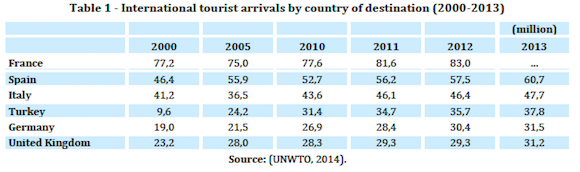
<body><![CDATA[<p><font size="2" face="Verdana"><b>Palavras-chave</b>: Turismo, investigação transnacional, temas de investigação, teses de doutoramento.</font></p> <hr noshade size="1">      <p>&nbsp;</p>     <p>&nbsp;</p>     <p><b><font size="3" face="Verdana">1. &nbsp;&nbsp;&nbsp;&nbsp;&nbsp; Introduction</font></b></p>     <p><font size="2" face="Verdana">Tourism as a research field has come a long way   since its first developments in the mid 1930s. It is significant that knowledge   about tourism has emerged primarily from official reports, government   directives and sources alike (Tribe 1997; Tribe &amp; Airey, 2007). A striking   example is the fact that the European Commission has only quite recently   recognized the full importance of tourism in Europe's economy, and has been   heavily involved in this sector only since the 80s, in partnership with various   countries and institutions. Tourism has since gained a strategic relevance, as an industry as well as an academic research field (Xiao, 2006).&nbsp; </font></p>     <p><font size="2" face="Verdana">During the 1960s, scientific production began to   gain momentum, first through geography, economics of tourism developing in the   70s (Costa, 2013). It became closely attached to a vast multiplicity of   disciplines, and new angles from fields formerly unfamiliar with tourism are   providing new depths, challenges and results (Cooper, 2014), adding value to   tourism and hospitality. Economics, anthropology and geography are prevailing,   yet even a quick glance at any academic journal database shows more recent   inputs from recreation, psychology, philosophy, history, and an array of other   fields. There is furthermore an increasing relevance of relationships between   tourism, environment and territory and the need to discuss, measure and evaluate the impacts of tourism activities (Martins &amp; Albuquerque, 2013).</font></p>     <p><font size="2" face="Verdana">In order to legitimate further creation of   knowledge in tourism, it might be significant to consider scientific production   in itself &#8211; in other words, to study theses from university doctoral   programs for European countries. This has been done for the North American   reality, providing original contributions, not all in the form of a final   dissertation but often as “by-products” of doctoral research &#8211; an   interesting volume (Chon 2013) contained book chapters by graduate students and   their advisors, following precisely a new scenario of growth in graduate studies in hospitality and tourism.</font></p>     <p><font size="2" face="Verdana">Regarding the countries examined below, the   first of the selection criteria was their weight in terms of the ranking of   international tourist arrivals. In fact, France, Spain, Italy, Germany and   United Kingdom have been top European destinations for a long time, sharing a   set of common challenges that will ultimately have an impact in terms of   research. The increasing competition from Eastern countries is one of these, as   can be seen from the recent entry of Turkey in this group (<a href="#t1">Table 1</a>). At a different   scale, Portugal also shares such challenges, and needs to compare its research   with that of its European partners. On the other hand, apart from important   tourism destinations, these countries are major, worldwide outbound markets,   and of strategic interest to Portugal. In 2013, these five countries were among its top ten markets (Turismo de Portugal, 2014).</font></p>     <p>&nbsp;</p>     <p><a name="t1"></a></p>     ]]></body>
<body><![CDATA[<p align="center"> <img src="/img/revistas/tms/v11n1/11n1a14t1.jpg" width="580" height="172"></p>     
<p>&nbsp;</p>     <p><font size="2" face="Verdana">The aim is to reach a thorough analysis of theses defended between 2000 and   2013, in a European environment, according to literature on the dominant   scientific fields, the core research subjects, and on how research has been   conducted in different countries. Content analysis of key words, as well as   concepts in the PhD thesis is deemed adequate to the selected research methodology (Smith, 2010).</font></p>     <p>&nbsp;</p>     <p><font size="3" face="Verdana"><b>2. Literature review </b></font></p>     <p><font size="2" face="Verdana"><b>2.1 Tourism knowledge and previous studies</b></font></p>     <p><font size="2" face="Verdana">According to Airey &amp; Tribe (2008), the origins of the sociology of   European Tourism might be traced back to the 1930s. Norval (1936), Ogilvie   (1933), Brunner (1945) and Pimlott (1947) are among the first contributors,   counting on immediate precursors, such as Rae (1891). Early definitions of   tourism do relate to traveling in pre-modernity, yet the combination of   statistical needs and the concept of free time point especially to the early   20th century (Vukonic, 2012) for attempts of theoretical understanding of   tourism. But when seriously addressing modern tourism studies one has   necessarily to turn to economic, demographic or business history (Walton 2009),   probably even at early modern level (Verhoeven, 2013). As stated above, many   scientific disciplines have largely contributed to the expansion of the   knowledge in this field, hence it is common to find tourism scholars with other   scientific backgrounds using them in order to explain the tourism phenomenon   (Dann &amp; Parrinello, 2009).&nbsp; The   sheer definition of a tourism system includes an increasingly broader vision,   including the human, geographic and economic elements (Liper, 1981; Gartner,   1996). Works from Jafar Jafari and J.R. Brent Ritchie (1981) are particularly   relevant since they provide evidence that tourism theories emerges from a   variety of disciplinary backgrounds, without however forming a “new” science   (Salgado &amp; Costa, 2011). The term “tourismology” is sometimes used (e.g.   Cunha, 2006) as a facilitating expression for a fragmented reality that does   not lend itself to a holistic understanding (Echtner &amp; Jamal, 1997; Horner,   2000). Affirming that tourism has only recently gained the status of a   scientific subject, but not that of a discipline (Tribe, 2004) has become something of a truism for some years now. </font></p>     <p><font size="2" face="Verdana">Jafari (1990) defined a systematization of tourism, through a set of   four seminal platforms, to which other dimensions have been added (Macbeth   2005, Moscardo 2008). Still tourism studies remain heavily reactive to academic   myths. Even the fundamental premise of being the world’s largest industry is   very much debatable. Another persistent myth is that of tourism and leisure   studies lacking theory; it has been said that tourism suffers in fact from too   many theories (McKercher &amp; Prideaux, 2014). Even so, insufficient knowledge   on tourism resulting from a comparatively late research development is a fact,   yet it did not prevent the activity to grow significantly, being today one of   the largest economic activities worldwide, with more than 1,087 million tourist   arrivals and international tourism receipts of US$ 1,159 billion, growing   around 5% in real terms in 2013 (UNWTO, 2014a). It is only natural that many   university programs, scientific journals, research conferences, international   associations and specialized newspapers now have emerged. They started at a   fairly low rate The first specialized journal - Tourism Review &#8211; was   established in 1945 and other international research journals appear only from   the 60s onwards, as is the case with the Journal of Travel Research in 1962,   Annals of Tourism Research in 1973, and Tourism Management in 1980. Nowadays,   academic leaders in tourism studies can even be ranked according to their publication index (Zhao &amp; Ritchie, 2007).</font></p>     <p><font size="2" face="Verdana">The same idea of tourism development in academia was advanced some three   decades ago, when a study led to 157 theses defended in the United States,   between 1951 and 1987 (Jafari &amp; Aaser, 1998). The general findings were,   first of all, a general growth in number over time, some ascendancy of   economics over other subjects &#8211; although anthropology, geography and   recreation were very close to becoming second. It was noted that, contrary to   expectations, business administration and sociology were not particularly   trendy fields for writing a doctoral thesis in tourism studies. These   observations have been refined in more recent years; the general scenario seems   to have shifted mainly in terms of a major prominence of recreation, and of a   larger fragmentation of other academic areas, such as environmental studies,   history, psychology or literature (Meyer-Arendt &amp; Justice, 2002). More   recently, the generic framework continues to register a proportional decline in   economics as a primal research discipline (Weiler, Moyle, &amp; McLennan,   2012). This significant increase in scientific production in the area of   tourism is particularly relevant in countries where tourism plays a strategic   role as, for example, Portugal and Spain, where historical cycles are   comparable as far as tourism research is concerned (Almeida Garcia 2014).   Sánchez (2013) identified more than 1,079 articles on tourism published there   between 2001 and 2012, and they grew annually in number at a rate of about 10   times, with a third of research topics being registered in the broad category   of hospitality, leisure, sport &amp; tourism &#8211; that is, before management studies.</font></p>     <p><font size="2" face="Verdana">Another trend, perhaps not linearly translatable to a European   continental reality, is the very close link between theory and practice.   European tradition used to form students, at bachelor or graduate level, to   assume very specific, entry-level duties in the tourism and hospitality sector   (Formica, 1996), but this pattern, focusing the acquisition of technical   abilities, lacked the research dimension subjacent to doctoral education. In   the UK and US there are, for instance, many interesting examples of PhD   candidates with a solid professional background in the tourism industry (Baum,   1998), whose personal experience often gives a practical dimension to what   would elsewise be a strict academic environment (e.g. Pike, 2003). It has   indeed become crucial for tourism education to converge with practice, and in   line with national policies on the industry (Amoah &amp; Baum, 1997). As a   partial result, the focus on cross-curricular skills has become a concern in   study plans and internal evaluations (including comparative quality control;   Teng, Horng, &amp; Baum, 2013), as shown by a recent Spanish study (Rodríguez-Antón, Alonso-Almeida, Rubio Andrada &amp; Celemín Pedroche, 2013).</font></p>     ]]></body>
<body><![CDATA[<p><font size="2" face="Verdana">This leads to a fundamental division between business-oriented   approaches to tourism studies, as opposed to other advances, which are not directly   linked to the commercial aspects of a given subject. This epistemological   question has been suggestively called “the indiscipline of tourism” (Tribe,   1997). The relationships between higher education and the industry are   sometimes taken as self-evident but need substantiation (Peacock, Ladkin,   2002). In any case, there is much to gain for the university in potentiating   this diversity in the form of doctoral research. There has also been space for   defending more specialized education formats, not only divided in generic or   functional, but also adding a product-based, thematic track (Dale, Robinson,   2001) that has the advantage of linking with case studies and stakeholders   active in the industry. When thinking of the future of tourism studies, there is   currently a growing emphasis on matters such as pluralism, experiential   learning critical thinking, complexity, value of arts and sciences (Sheldon,   Fesenmaier, Woeber, Cooper &amp; Antonioli, 2008), which is reflecting directly   on the steady growth of tourism and hospitality tertiary programs, with a tendency to mature even more (Rappole, 2000).</font></p>     <p>&nbsp;</p>     <p><font size="3" face="Verdana"><b>3. Methodology:   evidences from the tourism academy</b></font></p>     <p><font size="3" face="Verdana"></font><font size="2" face="Verdana">Six online databases that catalogue and   inventory doctoral research were explored, and countries were selected on the   basis that they are important both as tourism destinations (by International   Tourist Arrivals relevance) as well as central in the tourism research and   scholarship scene (by number of completed PhD). This method was used as to   identify the search terms from the titles, abstracts and keywords of theses. In   order to ensure a correct selection of the patterns and trends of disciplines   and subjects, a list of was used according to previous studies on this topic as   reference: Hall &amp; Pedrazzini (1989), Meyer-Arndt &amp; Justice (2002),   Weiler &amp; Laing, (2008), Chen &amp; Wu (2005). The resulting subjects are   the following: hotel, hospitality, leisure, tourism, tourist, travel, tour,   recreation, holiday, vacation, guide, trip and heritage, education, tourism management, and environment (Weiler, Moyle, &amp; McLeannan, 2012).</font></p>     <p><font size="2" face="Verdana">Data was collected from the Portuguese Repositório Científico de Acesso   Aberto de Portugal (RCAAP), the Spanish Base de Datos de Teses Doctorales   (TESEO), the French Moteur de Recherche des Thèses de Doctorat Françaises   (THESES.FR), the British Electronic Theses Online Service (ETHOS), the Deutsche   Nationalbibliothek Online-Dissertationen (DissOnline.de), as well as the   Italian Portale per la Letteratura scientifica Elettronica Italiana su Archivi   aperti e Depositi Istituzionali (PLEIADI). Data gathering through other means,   such as visits to public libraries, was not considered at this point. Following   validation, an Excel database was created in which the country of origin,   discipline and research, and year of completion were inserted for coding (ABES,   2011; DissOnline, 2012; Ministerio de Educación, Cultura y Deporte, 2013; PLEIADI, 2004; RCAAP, 2008; The British Library Board, 2008).</font></p>     <p><font size="2" face="Verdana">A total of 6,189 doctoral dissertations were considered; cases with missing   data, such as title, abstract or award date, were withdrawn, whilst other were   excluded based on the fact that abstract or title content was not tourism related. Subsequently, only 1,624 theses were effectively considered valid.</font></p>     <p><font size="2" face="Verdana">As a liability test this research incorporated two independent   researchers performing the coding review of every dissertation included in the   study. The role of these individuals was to confirm or not the evaluation of   the dissertation coding, regarding the scientific field and the subject, but   also the selection criteria. In accordance with Adams and White (1994), the   assessment result was over 90% of the abstracts considering the leading   researchers. The remaining were subject to a discussion between the two   independent researchers until some level of compromise was accomplished   (Weiler, Moyle, &amp; McLennan, 2012).&nbsp;   However there was a list of over 10% of theses that were considered difficult to assess and hence not included in the study.</font></p>     <p>&nbsp;</p>     <p><font size="3" face="Verdana"><b>4. Results</b></font></p>     <p><font size="2" face="Verdana">The results of this investigation will be presented and discussed separately, taking into account the previously defined objectives.</font></p>     ]]></body>
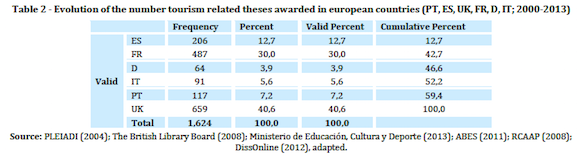
<body><![CDATA[<p><font size="2" face="Verdana">As shown by <a href="#t2">table 2</a>, the majority of doctoral dissertations were   undertaken in the United Kingdom, followed by France. Portugal produced a total   of 117 theses (8%) and Spain with almost twice as much as PT. Italy and Germany   appear to count for a lesser number. These results are clearly related to the   fact that Spain and Portugal have recently started to develop tourism-related   research (Sánchez, 2013). The results are not aligned with the importance of   these regions in terms of inbound tourism, where France assumes the lead followed by Spain, Italy Germany and UK (UNWTO, 2014).</font></p>     <p>&nbsp;</p>     <p><a name="t2"></a></p>     <p align="center"> <img src="/img/revistas/tms/v11n1/11n1a14t2.jpg" width="580" height="156"></p>    
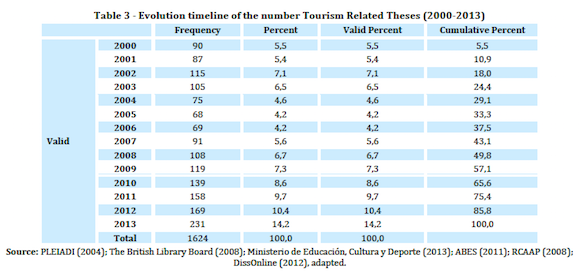
<p>&nbsp;</p>     <p><font size="2" face="Verdana">It is also of major importance to analyze the   timeline patterns between 2000 and 2013. For instance, according to <a href="#t3">table 3</a>, a   moderate growth of some extent has been registered between the years 2000 and   2003, followed by a decrease until 2008. From this year onwards, the growth in   doctoral-level tourism research in all countries considered has been   exponential. This trend seems to be consistent until 2013, reaching over 100 doctoral theses completed each year.</font></p>     <p>&nbsp;</p>     <p><a name="t3"></a></p>     <p align="center"><img src="/img/revistas/tms/v11n1/11n1a14t3.jpg" width="580" height="273"></p>     
<p>&nbsp;</p>     ]]></body>
<body><![CDATA[<p><font size="2" face="Verdana">These results suggest that until 2004 there may be an important shortage   of up-and-coming doctoral students &#8211; and probably also of academic   supply. Moreover, these numbers point at a growing demand for tourism-focused doctoral research from that year on.</font></p>     <p><font size="2" face="Verdana">Looking closely at the distribution by year and   by country, no clear pattern emerges, apart from a consistent growth in the   number of theses written between 2007 and 2013. France has registered a peak in   2013, which can be explained by the focus on sharing online theses in this country (<a href="#g1">Chart 1</a>).</font></p>     <p>&nbsp;</p>     <p><a name="g1"></a></p>     <p align="center"> <img src="/img/revistas/tms/v11n1/11n1a14g1.jpg" width="580" height="177">     
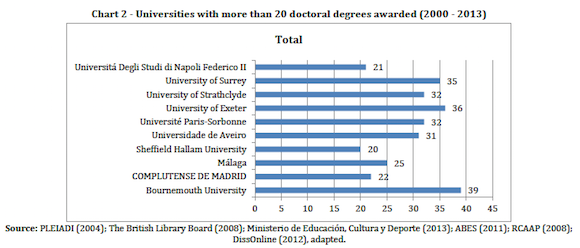
<p>&nbsp;</p></p>     <p><font size="2" face="Verdana">During this period of time, a total of 343 universities have been found   to develop tourism-focused doctoral theses in the four countries analysed in   this study. 37 universities were selected, as they registered over than 10   doctoral tourism theses. The top ten identified in this paper are Bournemouth   University with 39 theses (UK), University of Exeter with 36 (UK), University   of Surrey with 35 (UK), University of Strathclyde with 32 (UK), Université   Paris-Sorbonne counting 32 (FR), Universidade de Aveiro with 31 (PT),   University of Malaga with 25 (ES), Universidad Complutense de Madrid with   22(ES), Sheffield Hallam University with 20 (UK) and Universitá Degli Studi di   Napoli Frederico II with 21 (IT).</font></p>     <p><font size="2" face="Verdana">Overall, five universities were identified as providing the leading   doctoral-level tourism research output.&nbsp;   As illustrated in <a href="#g2">chart 2</a>, the UK clearly stands out, with 4   universities among the first 5. This fact may be partly explained by the   considered period itself, meaning that in its earlier phases, tourism research   was particularly active in the UK. In addition, Portugal and Spain are ranked   second in the top ten and France contributes with one university to this count.   So it is remarkable that the top 10 was responsible for 85% of the output, and   that it is does not follow the general university rankings in terms of   publication. Furthermore, it was found that 112 universities produced one   single tourism related thesis over this timeline. This might be explained by   the fact that some universities may be starting to be recognized by their   tourism research output, while other have not established a strategic focus in this field.</font></p>     <p>&nbsp;</p>     <p><a name="g2"></a></p>     ]]></body>
<body><![CDATA[<p align="center"> <img src="/img/revistas/tms/v11n1/11n1a14g2.jpg" width="580" height="248"></p>     
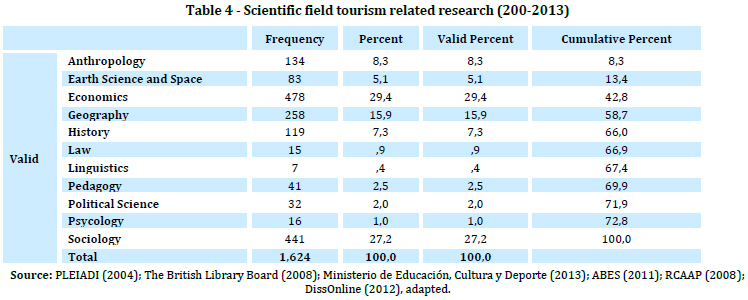
<p>&nbsp;</p>     <p><font size="2" face="Verdana">According to <a href="/img/revistas/tms/v11n1/11n1a14t4.jpg">table 4</a>, it is not at all surprising that the three more   relevant disciplines overlapping tourism-focussed doctoral research are   economics, sociology, geography and anthropology.</font></p>     
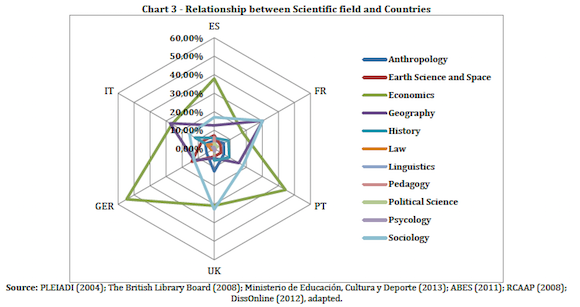
<p><font size="2" face="Verdana"><a href="#g3">Chart 3</a> reveals some interesting cross-national differences. While the   United Kingdom reveals a predominance of sociology, economics and anthropology,   in France the second most popular discipline is geography, which in Italy ranks   first, ex aequo with economics. In Germany and Spain and Portugal, economics   has a definite preponderance. In the two latter this might be somehow linked to   the need to demonstrate the economic importance of the sector as a way to   achieve greater political recognition, which has been a relevant topic of the tourism stakeholders’ agenda in the latest years.</font></p>     <p>&nbsp;</p>     <p><a name="g3"></a></p>     <p align="center"> <img src="/img/revistas/tms/v11n1/11n1a14g3.jpg" width="580" height="307"></p>     
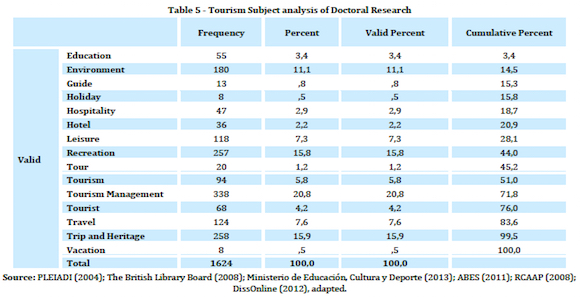
<p>&nbsp;</p>     <p><font size="2" face="Verdana">Revised literature confirms the deep-rooted tradition of economics,   geography and sociology predominance in European tourism-related research   (Vukonic, 2012). These results might become especially interesting for   adequately seeking funding opportunities, and to identify disregarded research   angles and multidisciplinary approaches (Weiler, Moyle, &amp; McLeannan, 2012),   in the area of tourism law, political frameworks, new technologies, and so forth. <a href="#t5">Table 5</a> shows the tourism subject analysis of doctoral thesis.</font></p>     <p><a name="t5"></a></p>     ]]></body>
<body><![CDATA[<p>&nbsp;</p>     <p align="center"><img src="/img/revistas/tms/v11n1/11n1a14t5.jpg" width="580" height="297"></p>     
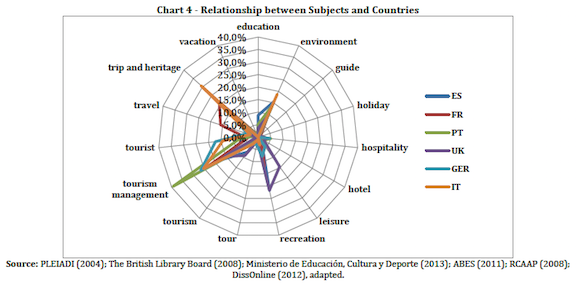
<p>&nbsp;</p>     <p><font size="2" face="Verdana">These results might be explained by the appeal of urban and regional   planning, sustainability, heritage and tourist-related issues present in the   strategic touristic plans of the studied countries over the last decade (OECD,   2014).</font></p>     <p><font size="2" face="Verdana">The links between countries and core research subjects (<a href="#t3">chart 4</a>) show a   preference for recreation, tourism management and leisure, in the UK. Tourism   Management comes first in France, Portugal and Germany too, and second in Spain   and Italy. Again the results seem to reinforce the idea that all countries   share some common core subjects. Apart from the natural primacy of economics,   this pattern could be justified by the fact that organizations such as UNWTO,   UNESCO and OECD have given a special attention to tourism and projects   associated to sustainable development and heritage. Themes like recreation seem   to establish a mutual interest for countries such as United Kingdom and Spain.   This could be particularly interesting for the design of future research in   this area but also in the top ranked subjects. Hotel, hospitality, tours,   guides, vacation or education appear as less popular and hence are a great   prospect for further research. This trend is reinforced by other case studies (Meyer-Arendt &amp; Justice,  2002). </font></p>     <p>&nbsp;</p>     <p><a name="g4"></a></p>     <p align="center"> <img src="/img/revistas/tms/v11n1/11n1a14g4.jpg" width="580" height="285"></p>     
<p>&nbsp;</p> </font>     <p><font size="3" face="Verdana"><b>5. &nbsp;&nbsp;&nbsp;&nbsp;&nbsp; Conclusion</b></font></p> <font face="Verdana">     ]]></body>
<body><![CDATA[<p><font size="2">As   mentioned above, the purpose of this paper is to assess the recent development   of knowledge in the field of doctoral research in Tourism and to evaluate both   its nature and structure. To do so, evolutions of the scientific fields and their core research subjects were analyzed.</font></p>     <p><font size="2">It   can also provide relevant indicators that might be used as decision-making   tools for the assessment and state of the art in tourism based research   (Cooper, 2014). The study also delivers insights that can lead to strategic   choices by decision-makers at a research level, for instance regarding the introduction of new subjects in PhD programs.</font></p>     <p><font size="2">There   is a clear and growing interest of universities and PhD candidates in the study   of tourism, especially in recent years. This trend indicates that the economic   significance of tourism in global terms, claimed by the whole community and by   international organizations has been followed by a scientific effort to study the phenomenon and its implications.</font></p>     <p><font size="2">It   should be noted that subjects such as hotel management, hospitality and   education do not have a significant expression, which suggests that in the   countries under analysis this is an area yet to explore. This can be a fine   topic for further analysis, particularly in terms of comparison with other   national realities with important tourism research units, such as the US,   Canada, Australia and New Zealand, where these realities have been studied systematically.</font></p>     <p><font size="2">One   limitation to this paper has to do with the data collection methods, which were   exclusively online-based. In order to include additional data in the analysis,   contacts with national libraries should be pursued in the near future. This   study has also performed a single discipline analysis and it would indeed be   desirable to conduct a multidisciplinary examination in order to assess if   there are some significant differences between disciplines and also between countries.</font></p>     <p><font size="2">A   second constraint is due to the fact that for comparing purposes, a particular   category designation under which theses are registered locally might not be   differentiating with regard to the subject itself. This has to do with   circumstances both of national guidelines and traditions, and of research   centres, which have different strengths, often in line with the work developed   by certain leading scholars. This could only be solved through the reading of   each dissertation and it is thus conceivable only in a major cooperation   project between dozens of universities. Finally, there might be little   conceptual distinctions between a dissertation generically integrating   economics and a second, in a different country, perhaps registered under the   label of (economic) sociology. The same goes for political science and law, or anthropology and history, or a range of other combinations.</font></p>     <p><font size="2">Yet   economics and sociology representing the vast majority of research fields under   which theses are listed, it might be interesting to separate a pure management   approach from organizational and structural analysis. Again, this requires meta-analysis at a scope far beyond that of this current paper.</font></p>     <p><font size="2">The   so-called Bologna process has induced new curriculum formats, including at   doctoral level. Taking Spain and Portugal as an example, few universities are   currently favouring individual dissertation-based initiatives, and prefer   fostering doctoral track programmes that involve group activities, attending   seminars and writing intermediate research papers. This state of affairs may   contribute to change the matter of subject analysis, as these doctoral courses   bear the same generic designation for a considerable and growing number of   students. So even though the multiplicity of research subjects will likely   continue to increase, a reduction in the range of core disciplines is very plausible.</font></p> </font>     <p>&nbsp;</p>     <p><font size="3" face="Verdana"><b>References</b></font></p>     ]]></body>
<body><![CDATA[<!-- ref --><p><font size="2" face="Verdana">ABES, A. B. (2011). Theses.fr. Retrieved February, 12, 2014 from: <a href="http://www.theses.fr/?q=tourism" target="_blank">http://www.theses.fr/?q=tourism</a>.    &nbsp;&nbsp;&nbsp;&nbsp;&nbsp;&nbsp;&nbsp;&nbsp;[&#160;<a href="javascript:void(0);" onclick="javascript: window.open('/scielo.php?script=sci_nlinks&ref=000103&pid=S2182-8458201500010001400001&lng=','','width=640,height=500,resizable=yes,scrollbars=1,menubar=yes,');">Links</a>&#160;]<!-- end-ref --></font></p>     <!-- ref --><p><font size="2" face="Verdana">Adams, G. B., &amp; White, J. D. (1994). Dissertation research in public   administration and cognate fields: An assessment of methods and quality. <i>Public     Administration Review</i>, 54(6), 565&#8211;576.    &nbsp;&nbsp;&nbsp;&nbsp;&nbsp;&nbsp;&nbsp;&nbsp;[&#160;<a href="javascript:void(0);" onclick="javascript: window.open('/scielo.php?script=sci_nlinks&ref=000105&pid=S2182-8458201500010001400002&lng=','','width=640,height=500,resizable=yes,scrollbars=1,menubar=yes,');">Links</a>&#160;]<!-- end-ref --></font></p>     <!-- ref --><p><font size="2" face="Verdana">Airey, D., &amp; Tribe,   J. (2008). <i>Educação Internacional em Turismo</i>. São Paulo: Senac São Paulo.    &nbsp;&nbsp;&nbsp;&nbsp;&nbsp;&nbsp;&nbsp;&nbsp;[&#160;<a href="javascript:void(0);" onclick="javascript: window.open('/scielo.php?script=sci_nlinks&ref=000107&pid=S2182-8458201500010001400003&lng=','','width=640,height=500,resizable=yes,scrollbars=1,menubar=yes,');">Links</a>&#160;]<!-- end-ref --></font></p>     <!-- ref --><p><font size="2" face="Verdana">Almeida Garcia, F. (2014). A comparative study of the evolution of   tourism policy in Spain and Portugal. <i>Tourism Management Perspectives</i> 11, 34-50.    &nbsp;&nbsp;&nbsp;&nbsp;&nbsp;&nbsp;&nbsp;&nbsp;[&#160;<a href="javascript:void(0);" onclick="javascript: window.open('/scielo.php?script=sci_nlinks&ref=000109&pid=S2182-8458201500010001400004&lng=','','width=640,height=500,resizable=yes,scrollbars=1,menubar=yes,');">Links</a>&#160;]<!-- end-ref --></font></p>     <!-- ref --><p><font size="2" face="Verdana">Amoah, V. A. &amp; Baum, T (1997). Tourism education: policy versus   practice. <i>International Journal of Contemporary Hospitality Management</i> 9(1), 5-12.    &nbsp;&nbsp;&nbsp;&nbsp;&nbsp;&nbsp;&nbsp;&nbsp;[&#160;<a href="javascript:void(0);" onclick="javascript: window.open('/scielo.php?script=sci_nlinks&ref=000111&pid=S2182-8458201500010001400005&lng=','','width=640,height=500,resizable=yes,scrollbars=1,menubar=yes,');">Links</a>&#160;]<!-- end-ref --></font></p>     ]]></body>
<body><![CDATA[<!-- ref --><p><font size="2" face="Verdana">Baum, T. (1998). Mature doctoral candidates: the case in hospitality   education. <i>Tourism Management</i> 19(5), 463&#8211;474</font>&nbsp;&nbsp;&nbsp;&nbsp;&nbsp;&nbsp;&nbsp;&nbsp;[&#160;<a href="javascript:void(0);" onclick="javascript: window.open('/scielo.php?script=sci_nlinks&ref=000113&pid=S2182-8458201500010001400006&lng=','','width=640,height=500,resizable=yes,scrollbars=1,menubar=yes,');">Links</a>&#160;]<!-- end-ref --><!-- ref --><p><font size="2" face="Verdana">Brunner, E. (1945). <i>Holiday Making and the Holiday Trade</i>. London: Oxford University Press.    &nbsp;&nbsp;&nbsp;&nbsp;&nbsp;&nbsp;&nbsp;&nbsp;[&#160;<a href="javascript:void(0);" onclick="javascript: window.open('/scielo.php?script=sci_nlinks&ref=000114&pid=S2182-8458201500010001400007&lng=','','width=640,height=500,resizable=yes,scrollbars=1,menubar=yes,');">Links</a>&#160;]<!-- end-ref --></font></p>     <!-- ref --><p><font size="2" face="Verdana">Chen, C. F. &amp; Wu, C. C. (2005). A study on overseas travel motivations and market segmentation for the seniors. <i>Tourism Management Research</i>, 5(1), 1-16.    &nbsp;&nbsp;&nbsp;&nbsp;&nbsp;&nbsp;&nbsp;&nbsp;[&#160;<a href="javascript:void(0);" onclick="javascript: window.open('/scielo.php?script=sci_nlinks&ref=000116&pid=S2182-8458201500010001400008&lng=','','width=640,height=500,resizable=yes,scrollbars=1,menubar=yes,');">Links</a>&#160;]<!-- end-ref --></font></p>     <!-- ref --><p><font size="2" face="Verdana">Chon, K. S. (Ed.) (2013). <i>The   practice of graduate research in hospitality and tourism</i>. New York &amp; Oxon: Routledge.    &nbsp;&nbsp;&nbsp;&nbsp;&nbsp;&nbsp;&nbsp;&nbsp;[&#160;<a href="javascript:void(0);" onclick="javascript: window.open('/scielo.php?script=sci_nlinks&ref=000118&pid=S2182-8458201500010001400009&lng=','','width=640,height=500,resizable=yes,scrollbars=1,menubar=yes,');">Links</a>&#160;]<!-- end-ref --></font></p>     <!-- ref --><p><font size="2" face="Verdana">Cooper, C. (2014). Editorial. <i>Tourism &amp; Management Studies</i>, 10(1),    &nbsp;&nbsp;&nbsp;&nbsp;&nbsp;&nbsp;&nbsp;&nbsp;[&#160;<a href="javascript:void(0);" onclick="javascript: window.open('/scielo.php?script=sci_nlinks&ref=000120&pid=S2182-8458201500010001400010&lng=','','width=640,height=500,resizable=yes,scrollbars=1,menubar=yes,');">Links</a>&#160;]<!-- end-ref --> 1-1.</font></p>     <!-- ref --><p><font size="2" face="Verdana">Costa, C. (2013).   Investigação em Turismo: A experiência da Revista Turismo &amp;   Desenvolvimento. <i>Revista Turismo &amp; Desenvolvimento</i> 20, 9-19.    &nbsp;&nbsp;&nbsp;&nbsp;&nbsp;&nbsp;&nbsp;&nbsp;[&#160;<a href="javascript:void(0);" onclick="javascript: window.open('/scielo.php?script=sci_nlinks&ref=000122&pid=S2182-8458201500010001400011&lng=','','width=640,height=500,resizable=yes,scrollbars=1,menubar=yes,');">Links</a>&#160;]<!-- end-ref --></font></p>     <!-- ref --><p><font size="2" face="Verdana">Cunha, L. (2006). <i>Economia e Política do Turismo</i>. Lisboa: Editorial Verbo.    &nbsp;&nbsp;&nbsp;&nbsp;&nbsp;&nbsp;&nbsp;&nbsp;[&#160;<a href="javascript:void(0);" onclick="javascript: window.open('/scielo.php?script=sci_nlinks&ref=000124&pid=S2182-8458201500010001400012&lng=','','width=640,height=500,resizable=yes,scrollbars=1,menubar=yes,');">Links</a>&#160;]<!-- end-ref --></font></p>     <!-- ref --><p><font size="2" face="Verdana">Dale, C., &amp; Robinson,   N. (2001). The theming of tourism education: a three-domain approach. <i>International Journal of Contemporary Hospitality Management</i> 13(1), 30-35.    &nbsp;&nbsp;&nbsp;&nbsp;&nbsp;&nbsp;&nbsp;&nbsp;[&#160;<a href="javascript:void(0);" onclick="javascript: window.open('/scielo.php?script=sci_nlinks&ref=000126&pid=S2182-8458201500010001400013&lng=','','width=640,height=500,resizable=yes,scrollbars=1,menubar=yes,');">Links</a>&#160;]<!-- end-ref --></font></p>     <!-- ref --><p><font size="2" face="Verdana">Dann, G. M., &amp; Parrinello, G. L. (2009). <i>The Sociology of Tourism - European origins and developments</i>. Bingley: Emerald Group Publishing Limited.    &nbsp;&nbsp;&nbsp;&nbsp;&nbsp;&nbsp;&nbsp;&nbsp;[&#160;<a href="javascript:void(0);" onclick="javascript: window.open('/scielo.php?script=sci_nlinks&ref=000128&pid=S2182-8458201500010001400014&lng=','','width=640,height=500,resizable=yes,scrollbars=1,menubar=yes,');">Links</a>&#160;]<!-- end-ref --></font></p>     <!-- ref --><p><font size="2" face="Verdana">DissOnline, G. N. (2012). DissOnline.de. Retrieved February, 12, 2014 from: <a href="http://www.dnb.de/DE/Wir/Kooperation/dissonline/dissonline_node.html" target="_blank">http://www.dnb.de/DE/Wir/Kooperation/dissonline/dissonline_node.html</a></font>&nbsp;&nbsp;&nbsp;&nbsp;&nbsp;&nbsp;&nbsp;&nbsp;[&#160;<a href="javascript:void(0);" onclick="javascript: window.open('/scielo.php?script=sci_nlinks&ref=000130&pid=S2182-8458201500010001400015&lng=','','width=640,height=500,resizable=yes,scrollbars=1,menubar=yes,');">Links</a>&#160;]<!-- end-ref --><!-- ref --><p><font size="2" face="Verdana">Echtner, C. M., &amp; Jamal, B. T. (1997). The discipline dilemma of   Tourism Studies. <i>Annals of Tourism Research</i>, 24(4),&nbsp;&nbsp; 868-883.    &nbsp;&nbsp;&nbsp;&nbsp;&nbsp;&nbsp;&nbsp;&nbsp;[&#160;<a href="javascript:void(0);" onclick="javascript: window.open('/scielo.php?script=sci_nlinks&ref=000131&pid=S2182-8458201500010001400016&lng=','','width=640,height=500,resizable=yes,scrollbars=1,menubar=yes,');">Links</a>&#160;]<!-- end-ref --></font></p>     ]]></body>
<body><![CDATA[<!-- ref --><p><font size="2" face="Verdana">Formica, S. (1996). European hospitality and tourism education: differences with the American model and future trends. <i>International Journal of Hospitality Management</i> 15(4), 317-323.    &nbsp;&nbsp;&nbsp;&nbsp;&nbsp;&nbsp;&nbsp;&nbsp;[&#160;<a href="javascript:void(0);" onclick="javascript: window.open('/scielo.php?script=sci_nlinks&ref=000133&pid=S2182-8458201500010001400017&lng=','','width=640,height=500,resizable=yes,scrollbars=1,menubar=yes,');">Links</a>&#160;]<!-- end-ref --></font></p>     <!-- ref --><p><font size="2" face="Verdana">Gartner, W. C. (1996). <i>Tourism   development: principles, processes and developments</i>. New York: Jonh Wiley &amp; Sons,    &nbsp;&nbsp;&nbsp;&nbsp;&nbsp;&nbsp;&nbsp;&nbsp;[&#160;<a href="javascript:void(0);" onclick="javascript: window.open('/scielo.php?script=sci_nlinks&ref=000135&pid=S2182-8458201500010001400018&lng=','','width=640,height=500,resizable=yes,scrollbars=1,menubar=yes,');">Links</a>&#160;]<!-- end-ref --> Inc.</font></p>     <!-- ref --><p><font size="2" face="Verdana">Hall, C., Williams, A., &amp; Lew, A. (2014). Tourism:   conceptualisations, disciplinarity, institutions and issues. In A. Lew, C.   Hall, &amp; A. Williams, <i>The Wiley Blackwell Companion to Tourism</i> (pp. 3-24). Chichester: John Wiley.    &nbsp;&nbsp;&nbsp;&nbsp;&nbsp;&nbsp;&nbsp;&nbsp;[&#160;<a href="javascript:void(0);" onclick="javascript: window.open('/scielo.php?script=sci_nlinks&ref=000137&pid=S2182-8458201500010001400019&lng=','','width=640,height=500,resizable=yes,scrollbars=1,menubar=yes,');">Links</a>&#160;]<!-- end-ref --></font></p>     <!-- ref --><p><font size="2" face="Verdana">Hall, C. M., &amp; Pedrazzini, T. (1989). Australian higher degree   theses in tourism, recreation and related subjects. Occasional Paper No. 2.   Lismore: Australian Institute of Tourism Industry Management, University of New England, Northern Rivers.    &nbsp;&nbsp;&nbsp;&nbsp;&nbsp;&nbsp;&nbsp;&nbsp;[&#160;<a href="javascript:void(0);" onclick="javascript: window.open('/scielo.php?script=sci_nlinks&ref=000139&pid=S2182-8458201500010001400020&lng=','','width=640,height=500,resizable=yes,scrollbars=1,menubar=yes,');">Links</a>&#160;]<!-- end-ref --></font></p>     <!-- ref --><p><font size="2" face="Verdana">Horner, J.-M. (2000). Pour la reconanaissance d'une science touristique. <i>Espaces</i>, 173, Juillet-Aout.    &nbsp;&nbsp;&nbsp;&nbsp;&nbsp;&nbsp;&nbsp;&nbsp;[&#160;<a href="javascript:void(0);" onclick="javascript: window.open('/scielo.php?script=sci_nlinks&ref=000141&pid=S2182-8458201500010001400021&lng=','','width=640,height=500,resizable=yes,scrollbars=1,menubar=yes,');">Links</a>&#160;]<!-- end-ref --></font></p>     ]]></body>
<body><![CDATA[<!-- ref --><p><font size="2" face="Verdana">Jafari, J. (1990). Research and Scholarship - The basis of tourism   education. <i>Journal of Tourism Studies</i>, 1(1),&nbsp; 33-41.    &nbsp;&nbsp;&nbsp;&nbsp;&nbsp;&nbsp;&nbsp;&nbsp;[&#160;<a href="javascript:void(0);" onclick="javascript: window.open('/scielo.php?script=sci_nlinks&ref=000143&pid=S2182-8458201500010001400022&lng=','','width=640,height=500,resizable=yes,scrollbars=1,menubar=yes,');">Links</a>&#160;]<!-- end-ref --></font></p>     <!-- ref --><p><font size="2" face="Verdana">Jafari, J., &amp; Aaser, D. (1998). Tourism as the subject of doctoral   dissertations. <i>Annals of Tourism Research</i>, 15(3), 407-429.    &nbsp;&nbsp;&nbsp;&nbsp;&nbsp;&nbsp;&nbsp;&nbsp;[&#160;<a href="javascript:void(0);" onclick="javascript: window.open('/scielo.php?script=sci_nlinks&ref=000145&pid=S2182-8458201500010001400023&lng=','','width=640,height=500,resizable=yes,scrollbars=1,menubar=yes,');">Links</a>&#160;]<!-- end-ref --></font></p>     <!-- ref --><p><font size="2" face="Verdana">Jafari, J. &amp; Ritchie, J.R.B. (1981). Toward a framework for Tourism   Education: problems and prospects. <i>Annals of Tourism Research</i>, 8 (1), 13-34.    &nbsp;&nbsp;&nbsp;&nbsp;&nbsp;&nbsp;&nbsp;&nbsp;[&#160;<a href="javascript:void(0);" onclick="javascript: window.open('/scielo.php?script=sci_nlinks&ref=000147&pid=S2182-8458201500010001400024&lng=','','width=640,height=500,resizable=yes,scrollbars=1,menubar=yes,');">Links</a>&#160;]<!-- end-ref --></font></p>     <!-- ref --><p><font size="2" face="Verdana">Jamal, T. (2005). Bridging the interdisciplinary divide: towards an integrated framework for heritage tourism research. <i>Tourist Studies</i>, 5(1), 55-83.    &nbsp;&nbsp;&nbsp;&nbsp;&nbsp;&nbsp;&nbsp;&nbsp;[&#160;<a href="javascript:void(0);" onclick="javascript: window.open('/scielo.php?script=sci_nlinks&ref=000149&pid=S2182-8458201500010001400025&lng=','','width=640,height=500,resizable=yes,scrollbars=1,menubar=yes,');">Links</a>&#160;]<!-- end-ref --></font></p>     <!-- ref --><p><font size="2" face="Verdana">Leiper, N. (1981). Towards a cohesive curriculum in tourism: the case   for a distinct discipline. <i>Annals of Tourism Research</i>, 8(1) , 69-84</font>&nbsp;&nbsp;&nbsp;&nbsp;&nbsp;&nbsp;&nbsp;&nbsp;[&#160;<a href="javascript:void(0);" onclick="javascript: window.open('/scielo.php?script=sci_nlinks&ref=000151&pid=S2182-8458201500010001400026&lng=','','width=640,height=500,resizable=yes,scrollbars=1,menubar=yes,');">Links</a>&#160;]<!-- end-ref --><!-- ref --><p><font size="2" face="Verdana">Macbeth, J. (2005). Towards an ethics platform for tourism. <i>Annals of Tourism Research</i> 32(4), 962-984.    &nbsp;&nbsp;&nbsp;&nbsp;&nbsp;&nbsp;&nbsp;&nbsp;[&#160;<a href="javascript:void(0);" onclick="javascript: window.open('/scielo.php?script=sci_nlinks&ref=000152&pid=S2182-8458201500010001400027&lng=','','width=640,height=500,resizable=yes,scrollbars=1,menubar=yes,');">Links</a>&#160;]<!-- end-ref --></font></p>     <!-- ref --><p><font size="2" face="Verdana">Martins, F., &amp; Albuquerque, H. (2013). Turismo de base natural - um instrumento de   apoio à conservação de áreas húmidas. <i>Revista Turismo &amp; Desenvolvimento</i>, 20, 81-90.    &nbsp;&nbsp;&nbsp;&nbsp;&nbsp;&nbsp;&nbsp;&nbsp;[&#160;<a href="javascript:void(0);" onclick="javascript: window.open('/scielo.php?script=sci_nlinks&ref=000154&pid=S2182-8458201500010001400028&lng=','','width=640,height=500,resizable=yes,scrollbars=1,menubar=yes,');">Links</a>&#160;]<!-- end-ref --></font></p>     <!-- ref --><p><font size="2" face="Verdana">McKercher, B. &amp; Prideaux, B. (2014). Academic myths of tourism. <i>Annals of Tourism Research</i> 46, 16&#8211;28.    &nbsp;&nbsp;&nbsp;&nbsp;&nbsp;&nbsp;&nbsp;&nbsp;[&#160;<a href="javascript:void(0);" onclick="javascript: window.open('/scielo.php?script=sci_nlinks&ref=000156&pid=S2182-8458201500010001400029&lng=','','width=640,height=500,resizable=yes,scrollbars=1,menubar=yes,');">Links</a>&#160;]<!-- end-ref --></font></p>     <!-- ref --><p><font size="2" face="Verdana">Meyer-Arendt, K., &amp; Justice, C. (2002). Tourism as the subject of North American doctoral dissertations, 1987-2000. <i>Annals of Tourism Research</i>, 29(4), 1171-1174.    &nbsp;&nbsp;&nbsp;&nbsp;&nbsp;&nbsp;&nbsp;&nbsp;[&#160;<a href="javascript:void(0);" onclick="javascript: window.open('/scielo.php?script=sci_nlinks&ref=000158&pid=S2182-8458201500010001400030&lng=','','width=640,height=500,resizable=yes,scrollbars=1,menubar=yes,');">Links</a>&#160;]<!-- end-ref --></font></p>     <!-- ref --><p><font size="2" face="Verdana">Ministerio de Educación, Cultura y Deporte. (2013). TESEO. Retrieved from: <a href="https://www.educacion.gob.es/teseo/listarBusqueda.do" target="_blank">https://www.educacion.gob.es/teseo/listarBusqueda.do</a></font>&nbsp;&nbsp;&nbsp;&nbsp;&nbsp;&nbsp;&nbsp;&nbsp;[&#160;<a href="javascript:void(0);" onclick="javascript: window.open('/scielo.php?script=sci_nlinks&ref=000160&pid=S2182-8458201500010001400031&lng=','','width=640,height=500,resizable=yes,scrollbars=1,menubar=yes,');">Links</a>&#160;]<!-- end-ref --><!-- ref --><p><font size="2" face="Verdana">Moscardo, G., (2008). <i>Building community capacity for tourism development</i>. Oxfordshire: CABI.    &nbsp;&nbsp;&nbsp;&nbsp;&nbsp;&nbsp;&nbsp;&nbsp;[&#160;<a href="javascript:void(0);" onclick="javascript: window.open('/scielo.php?script=sci_nlinks&ref=000161&pid=S2182-8458201500010001400032&lng=','','width=640,height=500,resizable=yes,scrollbars=1,menubar=yes,');">Links</a>&#160;]<!-- end-ref --></font></p>     ]]></body>
<body><![CDATA[<!-- ref --><p><font size="2" face="Verdana">Norval, A.J. (1936). <i>Tourist   industry. A national and international survey</i>. London: Pitman &amp;Sons. 343</font>&nbsp;&nbsp;&nbsp;&nbsp;&nbsp;&nbsp;&nbsp;&nbsp;[&#160;<a href="javascript:void(0);" onclick="javascript: window.open('/scielo.php?script=sci_nlinks&ref=000163&pid=S2182-8458201500010001400033&lng=','','width=640,height=500,resizable=yes,scrollbars=1,menubar=yes,');">Links</a>&#160;]<!-- end-ref --><!-- ref --><p><font size="2" face="Verdana">OECD (2014). <i>OECD Tourism trends and policies 2014</i>. Paris: OECD Publishing</font>&nbsp;&nbsp;&nbsp;&nbsp;&nbsp;&nbsp;&nbsp;&nbsp;[&#160;<a href="javascript:void(0);" onclick="javascript: window.open('/scielo.php?script=sci_nlinks&ref=000164&pid=S2182-8458201500010001400034&lng=','','width=640,height=500,resizable=yes,scrollbars=1,menubar=yes,');">Links</a>&#160;]<!-- end-ref --><!-- ref --><p><font size="2" face="Verdana">Ogilvie, F.W. (1933). <i>The tourism movement</i>. London: Staples Press.    &nbsp;&nbsp;&nbsp;&nbsp;&nbsp;&nbsp;&nbsp;&nbsp;[&#160;<a href="javascript:void(0);" onclick="javascript: window.open('/scielo.php?script=sci_nlinks&ref=000165&pid=S2182-8458201500010001400035&lng=','','width=640,height=500,resizable=yes,scrollbars=1,menubar=yes,');">Links</a>&#160;]<!-- end-ref --></font></p>     <!-- ref --><p><font size="2" face="Verdana">Peacock, N. &amp; Ladkin, A. (2002). Exploring relationships between   higher education and industry: a case study of a university and the local   tourism industry. <i>Industry and Higher Education</i>, 16(6), 393-401.    &nbsp;&nbsp;&nbsp;&nbsp;&nbsp;&nbsp;&nbsp;&nbsp;[&#160;<a href="javascript:void(0);" onclick="javascript: window.open('/scielo.php?script=sci_nlinks&ref=000167&pid=S2182-8458201500010001400036&lng=','','width=640,height=500,resizable=yes,scrollbars=1,menubar=yes,');">Links</a>&#160;]<!-- end-ref --></font></p>     <!-- ref --><p><font size="2" face="Verdana">Pike, S. (2003). A Tourism PhD reflection. <i>Tourism Review &#8211; Revue de Tourisme</i>, 58 (1), 16-18.    &nbsp;&nbsp;&nbsp;&nbsp;&nbsp;&nbsp;&nbsp;&nbsp;[&#160;<a href="javascript:void(0);" onclick="javascript: window.open('/scielo.php?script=sci_nlinks&ref=000169&pid=S2182-8458201500010001400037&lng=','','width=640,height=500,resizable=yes,scrollbars=1,menubar=yes,');">Links</a>&#160;]<!-- end-ref --></font></p>     <!-- ref --><p><font size="2" face="Verdana">Pimlott, J. (1947). <i>The Englishman’s holiday</i>. London: Faber and Faber.    &nbsp;&nbsp;&nbsp;&nbsp;&nbsp;&nbsp;&nbsp;&nbsp;[&#160;<a href="javascript:void(0);" onclick="javascript: window.open('/scielo.php?script=sci_nlinks&ref=000171&pid=S2182-8458201500010001400038&lng=','','width=640,height=500,resizable=yes,scrollbars=1,menubar=yes,');">Links</a>&#160;]<!-- end-ref --></font></p>     ]]></body>
<body><![CDATA[<!-- ref --><p><font size="2" face="Verdana">PLEIADI. (2004). Portal for the Italian Electronic Literature in Open   and Institutional Archives. Retrieved February, 12, 2014 from Portal for the   Italian Electronic Literature in Open and Institutional Archives: <a href="http://www.openarchives.it/pleiadi/" target="_blank">http://www.openarchives.it/pleiadi/</a>.    &nbsp;&nbsp;&nbsp;&nbsp;&nbsp;&nbsp;&nbsp;&nbsp;[&#160;<a href="javascript:void(0);" onclick="javascript: window.open('/scielo.php?script=sci_nlinks&ref=000173&pid=S2182-8458201500010001400039&lng=','','width=640,height=500,resizable=yes,scrollbars=1,menubar=yes,');">Links</a>&#160;]<!-- end-ref --></font></p>     <!-- ref --><p><font size="2" face="Verdana">Rappole, C. L. (2000). Update of the chronological development,   enrollment patterns, and education models of four-year, master's, and doctoral   hospitality programs in the United States. <i>Journal of Hospitality &amp; Tourism Education</i>, 12(3), 24-27.    &nbsp;&nbsp;&nbsp;&nbsp;&nbsp;&nbsp;&nbsp;&nbsp;[&#160;<a href="javascript:void(0);" onclick="javascript: window.open('/scielo.php?script=sci_nlinks&ref=000175&pid=S2182-8458201500010001400040&lng=','','width=640,height=500,resizable=yes,scrollbars=1,menubar=yes,');">Links</a>&#160;]<!-- end-ref --></font></p>     <!-- ref --><p><font size="2" face="Verdana">Rodríguez-Antón, J. M., Alonso-Almeida. M. M., Rubio Andrada, L., &amp; Celemín Pedroche, M. (2013). Are   university tourism programmes preparing the professionals the tourist industry   needs? A longitudinal study. <i>Journal of Hospitality, Leisure, Sport &amp; Tourism Education</i> 12, 25&#8211;35.    &nbsp;&nbsp;&nbsp;&nbsp;&nbsp;&nbsp;&nbsp;&nbsp;[&#160;<a href="javascript:void(0);" onclick="javascript: window.open('/scielo.php?script=sci_nlinks&ref=000177&pid=S2182-8458201500010001400041&lng=','','width=640,height=500,resizable=yes,scrollbars=1,menubar=yes,');">Links</a>&#160;]<!-- end-ref --></font></p>     <!-- ref --><p><font size="2" face="Verdana">RCAAP, R. C. (2008). RCAAP. Retrieved February, 12, 2014 from: <a href="http://www.rcaap.pt/" target="_blank">http://www.rcaap.pt/</a></font>&nbsp;&nbsp;&nbsp;&nbsp;&nbsp;&nbsp;&nbsp;&nbsp;[&#160;<a href="javascript:void(0);" onclick="javascript: window.open('/scielo.php?script=sci_nlinks&ref=000179&pid=S2182-8458201500010001400042&lng=','','width=640,height=500,resizable=yes,scrollbars=1,menubar=yes,');">Links</a>&#160;]<!-- end-ref --><!-- ref --><p><font size="2" face="Verdana">Rae, W. F. (1891). <i>The business of travel</i>. London: Thos. Cook &amp; Son.    &nbsp;&nbsp;&nbsp;&nbsp;&nbsp;&nbsp;&nbsp;&nbsp;[&#160;<a href="javascript:void(0);" onclick="javascript: window.open('/scielo.php?script=sci_nlinks&ref=000180&pid=S2182-8458201500010001400043&lng=','','width=640,height=500,resizable=yes,scrollbars=1,menubar=yes,');">Links</a>&#160;]<!-- end-ref --></font></p>     <!-- ref --><p><font size="2" face="Verdana">Salgado, M., &amp; Costa, C. (2011). Science and Tourism Education:   national observatory for Tourism Education. <i>European Journal of Tourism Hospitality and Recreation</i>, 2(3), 143-157.    &nbsp;&nbsp;&nbsp;&nbsp;&nbsp;&nbsp;&nbsp;&nbsp;[&#160;<a href="javascript:void(0);" onclick="javascript: window.open('/scielo.php?script=sci_nlinks&ref=000182&pid=S2182-8458201500010001400044&lng=','','width=640,height=500,resizable=yes,scrollbars=1,menubar=yes,');">Links</a>&#160;]<!-- end-ref --></font></p>     <!-- ref --><p><font size="2" face="Verdana">Sánchez, A. V. (2013). Investigación Científica en Turismo: la experiencia ibérica. <i>Revista Turismo e Desenvolvimento</i>, 20, 21-29.    &nbsp;&nbsp;&nbsp;&nbsp;&nbsp;&nbsp;&nbsp;&nbsp;[&#160;<a href="javascript:void(0);" onclick="javascript: window.open('/scielo.php?script=sci_nlinks&ref=000184&pid=S2182-8458201500010001400045&lng=','','width=640,height=500,resizable=yes,scrollbars=1,menubar=yes,');">Links</a>&#160;]<!-- end-ref --></font></p>     <!-- ref --><p><font size="2" face="Verdana">Sheldon, P., Fesenmaier,   D., Woeber, K., Cooper, C., &amp; Antonioli, M. (2008). Tourism   education futures, 2010&#8211;2030: building the capacity to lead. <i>Journal of Teaching in Travel &amp; Tourism</i>, 7(3), 61-68</font>&nbsp;&nbsp;&nbsp;&nbsp;&nbsp;&nbsp;&nbsp;&nbsp;[&#160;<a href="javascript:void(0);" onclick="javascript: window.open('/scielo.php?script=sci_nlinks&ref=000186&pid=S2182-8458201500010001400046&lng=','','width=640,height=500,resizable=yes,scrollbars=1,menubar=yes,');">Links</a>&#160;]<!-- end-ref --><!-- ref --><p><font size="2" face="Verdana">Smith, L. (2010). <i>Practical tourism research</i>. Oxford: CABI Publishing.    &nbsp;&nbsp;&nbsp;&nbsp;&nbsp;&nbsp;&nbsp;&nbsp;[&#160;<a href="javascript:void(0);" onclick="javascript: window.open('/scielo.php?script=sci_nlinks&ref=000187&pid=S2182-8458201500010001400047&lng=','','width=640,height=500,resizable=yes,scrollbars=1,menubar=yes,');">Links</a>&#160;]<!-- end-ref --></font></p>     <!-- ref --><p><font size="2" face="Verdana">Teng, C. C., Horng, J. S., &amp; Baum, T. (2013). Academic perceptions   of quality and quality assurance in undergraduate hospitality, tourism and   leisure programmes: a comparison of UK and Taiwanese programmes. <i>Journal of Hospitality, Leisure, Sport &amp; Tourism Education</i>, 13, 233&#8211;243.    &nbsp;&nbsp;&nbsp;&nbsp;&nbsp;&nbsp;&nbsp;&nbsp;[&#160;<a href="javascript:void(0);" onclick="javascript: window.open('/scielo.php?script=sci_nlinks&ref=000189&pid=S2182-8458201500010001400048&lng=','','width=640,height=500,resizable=yes,scrollbars=1,menubar=yes,');">Links</a>&#160;]<!-- end-ref --></font></p>     <!-- ref --><p><font size="2" face="Verdana">The British Library Board. (2008). Ethos. Retrieved February, 12, 2014 from: <a href="http://ethos.bl.uk/SearchResults.do" target="_blank">http://ethos.bl.uk/SearchResults.do</a></font>&nbsp;&nbsp;&nbsp;&nbsp;&nbsp;&nbsp;&nbsp;&nbsp;[&#160;<a href="javascript:void(0);" onclick="javascript: window.open('/scielo.php?script=sci_nlinks&ref=000191&pid=S2182-8458201500010001400049&lng=','','width=640,height=500,resizable=yes,scrollbars=1,menubar=yes,');">Links</a>&#160;]<!-- end-ref --><!-- ref --><p><font size="2" face="Verdana">Tribe, J. (2004). Knowing about tourism. Epistemological issues. In J.   Phillimore &amp; L. Goodson (Eds.), <i>Qualitative     research in tourism. Ontologies, epistemologies and methodologies</i>. London and New York: Routledge.    &nbsp;&nbsp;&nbsp;&nbsp;&nbsp;&nbsp;&nbsp;&nbsp;[&#160;<a href="javascript:void(0);" onclick="javascript: window.open('/scielo.php?script=sci_nlinks&ref=000192&pid=S2182-8458201500010001400050&lng=','','width=640,height=500,resizable=yes,scrollbars=1,menubar=yes,');">Links</a>&#160;]<!-- end-ref --></font></p>     <!-- ref --><p><font size="2" face="Verdana">Tribe, J. (2010). Tribes, territories and networks in the tourism   academy. <i>Annals of Tourism Research</i>, 37(1), 7&#8211;33.    &nbsp;&nbsp;&nbsp;&nbsp;&nbsp;&nbsp;&nbsp;&nbsp;[&#160;<a href="javascript:void(0);" onclick="javascript: window.open('/scielo.php?script=sci_nlinks&ref=000194&pid=S2182-8458201500010001400051&lng=','','width=640,height=500,resizable=yes,scrollbars=1,menubar=yes,');">Links</a>&#160;]<!-- end-ref --></font></p>     <!-- ref --><p><font size="2" face="Verdana">Tribe, J., &amp; Airey, D. (2007). A Review of tourism research. In J.   Tribe &amp; D. Airey, <i>Developments in     tourism research</i> (3-17). Oxford: Elsevier.    &nbsp;&nbsp;&nbsp;&nbsp;&nbsp;&nbsp;&nbsp;&nbsp;[&#160;<a href="javascript:void(0);" onclick="javascript: window.open('/scielo.php?script=sci_nlinks&ref=000196&pid=S2182-8458201500010001400052&lng=','','width=640,height=500,resizable=yes,scrollbars=1,menubar=yes,');">Links</a>&#160;]<!-- end-ref --></font></p>     <!-- ref --><p><font size="2" face="Verdana">Turismo de Portugal.   (2014). Os resultados do Turismo. 4.º trimestre e ano 2013. Retrieved February,   15, 2014 from: <a href="http://www.turismodeportugal.pt/Portugu%C3%AAs/ProTurismo/estat%C3%ADsticas/an%C3%A1lisesestat%C3%ADsticas/osresultadosdoturismo/Anexos/4.%C2%BA%20Trim%20e%20Ano%202013%20-%20Os%20resultados%20do%20Turismo.pdf" target="_blank">http://www.turismodeportugal.pt/Portugu%C3%AAs/ProTurismo/estat%C3%ADsticas/an%C3%A1lisesestat%C3%ADsticas/osresultadosdoturismo/Anexos/4.%C2%BA%20Trim%20e%20Ano%202013%20-%20Os%20resultados%20do%20Turismo.pdf</a></font>&nbsp;&nbsp;&nbsp;&nbsp;&nbsp;&nbsp;&nbsp;&nbsp;[&#160;<a href="javascript:void(0);" onclick="javascript: window.open('/scielo.php?script=sci_nlinks&ref=000198&pid=S2182-8458201500010001400053&lng=','','width=640,height=500,resizable=yes,scrollbars=1,menubar=yes,');">Links</a>&#160;]<!-- end-ref --><p><font size="2" face="Verdana">UNWTO. (2014). <i>UNWTO World Tourism Barometer</i>, Volume 12, April 2014. Madrid: UNWTO.</font></p>     <!-- ref --><p><font size="2" face="Verdana">UNWTO. (2014a). <i>UNWTO Tourism Highlights</i>, 2014 Edition. Madrid: UNWTO.    &nbsp;&nbsp;&nbsp;&nbsp;&nbsp;&nbsp;&nbsp;&nbsp;[&#160;<a href="javascript:void(0);" onclick="javascript: window.open('/scielo.php?script=sci_nlinks&ref=000200&pid=S2182-8458201500010001400055&lng=','','width=640,height=500,resizable=yes,scrollbars=1,menubar=yes,');">Links</a>&#160;]<!-- end-ref --></font></p>     <!-- ref --><p><font size="2" face="Verdana">Verhoeven, G. (2013). Foreshadowing tourism. Looking for modern and   obsolete features &#8211; or some missing link &#8211; in early modern travel   behavior (1675&#8211;1750). <i>Annals of Tourism Research</i>, 42, 262&#8211;283.    &nbsp;&nbsp;&nbsp;&nbsp;&nbsp;&nbsp;&nbsp;&nbsp;[&#160;<a href="javascript:void(0);" onclick="javascript: window.open('/scielo.php?script=sci_nlinks&ref=000202&pid=S2182-8458201500010001400056&lng=','','width=640,height=500,resizable=yes,scrollbars=1,menubar=yes,');">Links</a>&#160;]<!-- end-ref --></font></p>     <!-- ref --><p><font size="2" face="Verdana">Vukonic, B. (2012). An outline of the history of tourism theory. In C.   H. Hsu, &amp; C. W. Gartner, <i>The     Routledge Handbook of Tourism Research</i> (3-20). New York: Taylor &amp; Francis Group.    &nbsp;&nbsp;&nbsp;&nbsp;&nbsp;&nbsp;&nbsp;&nbsp;[&#160;<a href="javascript:void(0);" onclick="javascript: window.open('/scielo.php?script=sci_nlinks&ref=000204&pid=S2182-8458201500010001400057&lng=','','width=640,height=500,resizable=yes,scrollbars=1,menubar=yes,');">Links</a>&#160;]<!-- end-ref --></font></p>     <!-- ref --><p><font size="2" face="Verdana">Walton, J. K. (2009). Prospects in tourism history: evolution, state of   play and future developments. <i>Tourism Management</i> 30, 783&#8211;793.    &nbsp;&nbsp;&nbsp;&nbsp;&nbsp;&nbsp;&nbsp;&nbsp;[&#160;<a href="javascript:void(0);" onclick="javascript: window.open('/scielo.php?script=sci_nlinks&ref=000206&pid=S2182-8458201500010001400058&lng=','','width=640,height=500,resizable=yes,scrollbars=1,menubar=yes,');">Links</a>&#160;]<!-- end-ref --></font></p>     <!-- ref --><p><font size="2" face="Verdana">Weiler, B., &amp; Laing, J. (2008). Postgraduate tourism research in   Australia: A trend analysis of 1965&#8211;2005.    &nbsp;&nbsp;&nbsp;&nbsp;&nbsp;&nbsp;&nbsp;&nbsp;[&#160;<a href="javascript:void(0);" onclick="javascript: window.open('/scielo.php?script=sci_nlinks&ref=000208&pid=S2182-8458201500010001400059&lng=','','width=640,height=500,resizable=yes,scrollbars=1,menubar=yes,');">Links</a>&#160;]<!-- end-ref --> Paper Presented at CAUTHE, Gold Coast, Australia, 2008.</font></p>     <!-- ref --><p><font size="2" face="Verdana">Weiler, B., Moyle, B., &amp; McLeannan, C. (2012). Disciplines that   influence tourism docotral research: the United States, Canada, Australia and   New Zealand. <i>Annals of Tourism Research</i>, 39(3), 1425-1445.    &nbsp;&nbsp;&nbsp;&nbsp;&nbsp;&nbsp;&nbsp;&nbsp;[&#160;<a href="javascript:void(0);" onclick="javascript: window.open('/scielo.php?script=sci_nlinks&ref=000210&pid=S2182-8458201500010001400060&lng=','','width=640,height=500,resizable=yes,scrollbars=1,menubar=yes,');">Links</a>&#160;]<!-- end-ref --></font></p>     <!-- ref --><p><font size="2" face="Verdana">Xiao, H. &amp;. (2006). The making of tourism research: insights from   asocial sciences journal. <i>Annals of     Tourism Research</i>, 33(2),&nbsp;&nbsp; 490&#8211;507.    &nbsp;&nbsp;&nbsp;&nbsp;&nbsp;&nbsp;&nbsp;&nbsp;[&#160;<a href="javascript:void(0);" onclick="javascript: window.open('/scielo.php?script=sci_nlinks&ref=000212&pid=S2182-8458201500010001400061&lng=','','width=640,height=500,resizable=yes,scrollbars=1,menubar=yes,');">Links</a>&#160;]<!-- end-ref --></font></p>     <!-- ref --><p><font size="2" face="Verdana">Zhao, W. &amp; Ritchie, J. R. B. (2007). An investigation of academic leadership in tourism research: 1985&#8211;2004. <i>Tourism Management</i>, 28, 476&#8211;490.    &nbsp;&nbsp;&nbsp;&nbsp;&nbsp;&nbsp;&nbsp;&nbsp;[&#160;<a href="javascript:void(0);" onclick="javascript: window.open('/scielo.php?script=sci_nlinks&ref=000214&pid=S2182-8458201500010001400062&lng=','','width=640,height=500,resizable=yes,scrollbars=1,menubar=yes,');">Links</a>&#160;]<!-- end-ref --></font></p>     <p>&nbsp;</p>     <p>&nbsp;</p>     <p><font size="2" face="Verdana"><b>Article   history:</b>          <br>   <b>Received</b>: 22 May 2014          <br>       <b>Accepted</b>: 12 November 2014</font></p>      ]]></body><back>
<ref-list>
<ref id="B1">
<nlm-citation citation-type="">
<person-group person-group-type="author">
<name>
<surname><![CDATA[ABES]]></surname>
<given-names><![CDATA[A. B.]]></given-names>
</name>
</person-group>
<source><![CDATA[Theses.fr]]></source>
<year>2011</year>
</nlm-citation>
</ref>
<ref id="B2">
<nlm-citation citation-type="journal">
<person-group person-group-type="author">
<name>
<surname><![CDATA[Adams]]></surname>
<given-names><![CDATA[G. B.]]></given-names>
</name>
<name>
<surname><![CDATA[White]]></surname>
<given-names><![CDATA[J. D.]]></given-names>
</name>
</person-group>
<article-title xml:lang="en"><![CDATA[Dissertation research in public administration and cognate fields: An assessment of methods and quality]]></article-title>
<source><![CDATA[Public Administration Review]]></source>
<year>1994</year>
<volume>54</volume>
<numero>6</numero>
<issue>6</issue>
<page-range>565-576</page-range></nlm-citation>
</ref>
<ref id="B3">
<nlm-citation citation-type="book">
<person-group person-group-type="author">
<name>
<surname><![CDATA[Airey]]></surname>
<given-names><![CDATA[D.]]></given-names>
</name>
<name>
<surname><![CDATA[Tribe]]></surname>
<given-names><![CDATA[J.]]></given-names>
</name>
</person-group>
<source><![CDATA[Educação Internacional em Turismo]]></source>
<year>2008</year>
<publisher-loc><![CDATA[São Paulo ]]></publisher-loc>
<publisher-name><![CDATA[Senac São Paulo]]></publisher-name>
</nlm-citation>
</ref>
<ref id="B4">
<nlm-citation citation-type="journal">
<person-group person-group-type="author">
<name>
<surname><![CDATA[Almeida Garcia]]></surname>
<given-names><![CDATA[F.]]></given-names>
</name>
</person-group>
<article-title xml:lang="en"><![CDATA[A comparative study of the evolution of tourism policy in Spain and Portugal]]></article-title>
<source><![CDATA[Tourism Management Perspectives]]></source>
<year>2014</year>
<numero>11</numero>
<issue>11</issue>
<page-range>34-50</page-range></nlm-citation>
</ref>
<ref id="B5">
<nlm-citation citation-type="journal">
<person-group person-group-type="author">
<name>
<surname><![CDATA[Amoah]]></surname>
<given-names><![CDATA[V. A.]]></given-names>
</name>
<name>
<surname><![CDATA[Baum]]></surname>
<given-names><![CDATA[T]]></given-names>
</name>
</person-group>
<article-title xml:lang="en"><![CDATA[Tourism education: policy versus practice]]></article-title>
<source><![CDATA[International Journal of Contemporary Hospitality Management]]></source>
<year>1997</year>
<volume>9</volume>
<numero>1</numero>
<issue>1</issue>
<page-range>5-12</page-range></nlm-citation>
</ref>
<ref id="B6">
<nlm-citation citation-type="journal">
<person-group person-group-type="author">
<name>
<surname><![CDATA[Baum]]></surname>
<given-names><![CDATA[T.]]></given-names>
</name>
</person-group>
<article-title xml:lang="en"><![CDATA[Mature doctoral candidates: the case in hospitality education]]></article-title>
<source><![CDATA[Tourism Management]]></source>
<year>1998</year>
<volume>19</volume>
<numero>5</numero>
<issue>5</issue>
<page-range>463-474</page-range></nlm-citation>
</ref>
<ref id="B7">
<nlm-citation citation-type="book">
<person-group person-group-type="author">
<name>
<surname><![CDATA[Brunner]]></surname>
<given-names><![CDATA[E.]]></given-names>
</name>
</person-group>
<source><![CDATA[Holiday Making and the Holiday Trade]]></source>
<year>1945</year>
<publisher-loc><![CDATA[London ]]></publisher-loc>
<publisher-name><![CDATA[Oxford University Press]]></publisher-name>
</nlm-citation>
</ref>
<ref id="B8">
<nlm-citation citation-type="journal">
<person-group person-group-type="author">
<name>
<surname><![CDATA[Chen]]></surname>
<given-names><![CDATA[C. F.]]></given-names>
</name>
<name>
<surname><![CDATA[Wu]]></surname>
<given-names><![CDATA[C. C.]]></given-names>
</name>
</person-group>
<article-title xml:lang="en"><![CDATA[A study on overseas travel motivations and market segmentation for the seniors]]></article-title>
<source><![CDATA[Tourism Management Research]]></source>
<year>2005</year>
<volume>5</volume>
<numero>1</numero>
<issue>1</issue>
<page-range>1-16</page-range></nlm-citation>
</ref>
<ref id="B9">
<nlm-citation citation-type="book">
<person-group person-group-type="author">
<name>
<surname><![CDATA[Chon]]></surname>
<given-names><![CDATA[K. S.]]></given-names>
</name>
</person-group>
<source><![CDATA[The practice of graduate research in hospitality and tourism]]></source>
<year>2013</year>
<publisher-loc><![CDATA[New YorkOxon ]]></publisher-loc>
<publisher-name><![CDATA[Routledge]]></publisher-name>
</nlm-citation>
</ref>
<ref id="B10">
<nlm-citation citation-type="journal">
<person-group person-group-type="author">
<name>
<surname><![CDATA[Cooper]]></surname>
<given-names><![CDATA[C.]]></given-names>
</name>
</person-group>
<article-title xml:lang="en"><![CDATA[Editorial]]></article-title>
<source><![CDATA[Tourism & Management Studies]]></source>
<year>2014</year>
<volume>10</volume>
<numero>1</numero>
<issue>1</issue>
<page-range>1-1</page-range></nlm-citation>
</ref>
<ref id="B11">
<nlm-citation citation-type="journal">
<person-group person-group-type="author">
<name>
<surname><![CDATA[Costa]]></surname>
<given-names><![CDATA[C.]]></given-names>
</name>
</person-group>
<article-title xml:lang="pt"><![CDATA[Investigação em Turismo: A experiência da Revista Turismo & Desenvolvimento]]></article-title>
<source><![CDATA[Revista Turismo & Desenvolvimento]]></source>
<year>2013</year>
<numero>20</numero>
<issue>20</issue>
<page-range>9-19</page-range></nlm-citation>
</ref>
<ref id="B12">
<nlm-citation citation-type="book">
<person-group person-group-type="author">
<name>
<surname><![CDATA[Cunha]]></surname>
<given-names><![CDATA[L.]]></given-names>
</name>
</person-group>
<source><![CDATA[Economia e Política do Turismo]]></source>
<year>2006</year>
<publisher-loc><![CDATA[Lisboa ]]></publisher-loc>
<publisher-name><![CDATA[Editorial Verbo]]></publisher-name>
</nlm-citation>
</ref>
<ref id="B13">
<nlm-citation citation-type="journal">
<person-group person-group-type="author">
<name>
<surname><![CDATA[Dale]]></surname>
<given-names><![CDATA[C.]]></given-names>
</name>
<name>
<surname><![CDATA[Robinson]]></surname>
<given-names><![CDATA[N.]]></given-names>
</name>
</person-group>
<article-title xml:lang="en"><![CDATA[The theming of tourism education: a three-domain approach]]></article-title>
<source><![CDATA[International Journal of Contemporary Hospitality Management]]></source>
<year>2001</year>
<volume>13</volume>
<numero>1</numero>
<issue>1</issue>
<page-range>30-35</page-range></nlm-citation>
</ref>
<ref id="B14">
<nlm-citation citation-type="book">
<person-group person-group-type="author">
<name>
<surname><![CDATA[Dann]]></surname>
<given-names><![CDATA[G. M.]]></given-names>
</name>
<name>
<surname><![CDATA[Parrinello]]></surname>
<given-names><![CDATA[G. L.]]></given-names>
</name>
</person-group>
<source><![CDATA[The Sociology of Tourism: European origins and developments]]></source>
<year>2009</year>
<publisher-loc><![CDATA[Bingley ]]></publisher-loc>
<publisher-name><![CDATA[Emerald Group Publishing Limited]]></publisher-name>
</nlm-citation>
</ref>
<ref id="B15">
<nlm-citation citation-type="">
<person-group person-group-type="author">
<name>
<surname><![CDATA[DissOnline]]></surname>
<given-names><![CDATA[G. N.]]></given-names>
</name>
</person-group>
<source><![CDATA[DissOnline.de]]></source>
<year>2012</year>
</nlm-citation>
</ref>
<ref id="B16">
<nlm-citation citation-type="journal">
<person-group person-group-type="author">
<name>
<surname><![CDATA[Echtner]]></surname>
<given-names><![CDATA[C. M.]]></given-names>
</name>
<name>
<surname><![CDATA[Jamal]]></surname>
<given-names><![CDATA[B. T.]]></given-names>
</name>
</person-group>
<article-title xml:lang="en"><![CDATA[The discipline dilemma of Tourism Studies]]></article-title>
<source><![CDATA[Annals of Tourism Research]]></source>
<year>1997</year>
<volume>24</volume>
<numero>4</numero>
<issue>4</issue>
<page-range>868-883</page-range></nlm-citation>
</ref>
<ref id="B17">
<nlm-citation citation-type="journal">
<person-group person-group-type="author">
<name>
<surname><![CDATA[Formica]]></surname>
<given-names><![CDATA[S.]]></given-names>
</name>
</person-group>
<article-title xml:lang="en"><![CDATA[European hospitality and tourism education: differences with the American model and future trends]]></article-title>
<source><![CDATA[International Journal of Hospitality Management]]></source>
<year>1996</year>
<volume>15</volume>
<numero>4</numero>
<issue>4</issue>
<page-range>317-323</page-range></nlm-citation>
</ref>
<ref id="B18">
<nlm-citation citation-type="book">
<person-group person-group-type="author">
<name>
<surname><![CDATA[Gartner]]></surname>
<given-names><![CDATA[W. C.]]></given-names>
</name>
</person-group>
<source><![CDATA[Tourism development: principles, processes and developments]]></source>
<year>1996</year>
<publisher-loc><![CDATA[New York ]]></publisher-loc>
<publisher-name><![CDATA[Jonh Wiley & Sons, Inc]]></publisher-name>
</nlm-citation>
</ref>
<ref id="B19">
<nlm-citation citation-type="book">
<person-group person-group-type="author">
<name>
<surname><![CDATA[Hall]]></surname>
<given-names><![CDATA[C.]]></given-names>
</name>
<name>
<surname><![CDATA[Williams]]></surname>
<given-names><![CDATA[A.]]></given-names>
</name>
<name>
<surname><![CDATA[Lew]]></surname>
<given-names><![CDATA[A.]]></given-names>
</name>
</person-group>
<article-title xml:lang="en"><![CDATA[Tourism: conceptualisations, disciplinarity, institutions and issues]]></article-title>
<person-group person-group-type="editor">
<name>
<surname><![CDATA[Lew]]></surname>
<given-names><![CDATA[A.]]></given-names>
</name>
<name>
<surname><![CDATA[Hall]]></surname>
<given-names><![CDATA[C.]]></given-names>
</name>
<name>
<surname><![CDATA[Williams]]></surname>
<given-names><![CDATA[A.]]></given-names>
</name>
</person-group>
<source><![CDATA[The Wiley Blackwell Companion to Tourism]]></source>
<year>2014</year>
<page-range>3-24</page-range><publisher-loc><![CDATA[Chichester ]]></publisher-loc>
<publisher-name><![CDATA[John Wiley]]></publisher-name>
</nlm-citation>
</ref>
<ref id="B20">
<nlm-citation citation-type="book">
<person-group person-group-type="author">
<name>
<surname><![CDATA[Hall]]></surname>
<given-names><![CDATA[C. M.]]></given-names>
</name>
<name>
<surname><![CDATA[Pedrazzini]]></surname>
<given-names><![CDATA[T.]]></given-names>
</name>
</person-group>
<article-title xml:lang="en"><![CDATA[Australian higher degree theses in tourism, recreation and related subjects]]></article-title>
<source><![CDATA[Occasional Paper]]></source>
<year>1989</year>
<publisher-loc><![CDATA[Lismore ]]></publisher-loc>
<publisher-name><![CDATA[Australian Institute of Tourism Industry Management, University of New England, Northern Rivers]]></publisher-name>
</nlm-citation>
</ref>
<ref id="B21">
<nlm-citation citation-type="journal">
<person-group person-group-type="author">
<name>
<surname><![CDATA[Horner]]></surname>
<given-names><![CDATA[J.-M.]]></given-names>
</name>
</person-group>
<article-title xml:lang="fr"><![CDATA[Pour la reconanaissance d'une science touristique]]></article-title>
<source><![CDATA[Espaces]]></source>
<year>2000</year>
<numero>173</numero>
<issue>173</issue>
</nlm-citation>
</ref>
<ref id="B22">
<nlm-citation citation-type="journal">
<person-group person-group-type="author">
<name>
<surname><![CDATA[Jafari]]></surname>
<given-names><![CDATA[J.]]></given-names>
</name>
</person-group>
<article-title xml:lang="en"><![CDATA[Research and Scholarship: The basis of tourism education]]></article-title>
<source><![CDATA[Journal of Tourism Studies]]></source>
<year>1990</year>
<volume>1</volume>
<numero>1</numero>
<issue>1</issue>
<page-range>33-41</page-range></nlm-citation>
</ref>
<ref id="B23">
<nlm-citation citation-type="journal">
<person-group person-group-type="author">
<name>
<surname><![CDATA[Jafari]]></surname>
<given-names><![CDATA[J.]]></given-names>
</name>
<name>
<surname><![CDATA[Aaser]]></surname>
<given-names><![CDATA[D.]]></given-names>
</name>
</person-group>
<article-title xml:lang="en"><![CDATA[Tourism as the subject of doctoral dissertations]]></article-title>
<source><![CDATA[Annals of Tourism Research]]></source>
<year>1998</year>
<volume>15</volume>
<numero>3</numero>
<issue>3</issue>
<page-range>407-429</page-range></nlm-citation>
</ref>
<ref id="B24">
<nlm-citation citation-type="journal">
<person-group person-group-type="author">
<name>
<surname><![CDATA[Jafari]]></surname>
<given-names><![CDATA[J.]]></given-names>
</name>
<name>
<surname><![CDATA[Ritchie]]></surname>
<given-names><![CDATA[J.R.B.]]></given-names>
</name>
</person-group>
<article-title xml:lang="en"><![CDATA[Toward a framework for Tourism Education: problems and prospects]]></article-title>
<source><![CDATA[Annals of Tourism Research]]></source>
<year>1981</year>
<volume>8</volume>
<numero>1</numero>
<issue>1</issue>
<page-range>13-34</page-range></nlm-citation>
</ref>
<ref id="B25">
<nlm-citation citation-type="journal">
<person-group person-group-type="author">
<name>
<surname><![CDATA[Jamal]]></surname>
<given-names><![CDATA[T.]]></given-names>
</name>
</person-group>
<article-title xml:lang="en"><![CDATA[Bridging the interdisciplinary divide: towards an integrated framework for heritage tourism research]]></article-title>
<source><![CDATA[Tourist Studies]]></source>
<year>2005</year>
<volume>5</volume>
<numero>1</numero>
<issue>1</issue>
<page-range>55-83</page-range></nlm-citation>
</ref>
<ref id="B26">
<nlm-citation citation-type="journal">
<person-group person-group-type="author">
<name>
<surname><![CDATA[Leiper]]></surname>
<given-names><![CDATA[N.]]></given-names>
</name>
</person-group>
<article-title xml:lang="en"><![CDATA[Towards a cohesive curriculum in tourism: the case for a distinct discipline]]></article-title>
<source><![CDATA[Annals of Tourism Research]]></source>
<year>1981</year>
<volume>8</volume>
<numero>1</numero>
<issue>1</issue>
<page-range>69-84</page-range></nlm-citation>
</ref>
<ref id="B27">
<nlm-citation citation-type="journal">
<person-group person-group-type="author">
<name>
<surname><![CDATA[Macbeth]]></surname>
<given-names><![CDATA[J.]]></given-names>
</name>
</person-group>
<article-title xml:lang="en"><![CDATA[Towards an ethics platform for tourism]]></article-title>
<source><![CDATA[Annals of Tourism Research]]></source>
<year>2005</year>
<volume>32</volume>
<numero>4</numero>
<issue>4</issue>
<page-range>962-984</page-range></nlm-citation>
</ref>
<ref id="B28">
<nlm-citation citation-type="journal">
<person-group person-group-type="author">
<name>
<surname><![CDATA[Martins]]></surname>
<given-names><![CDATA[F.]]></given-names>
</name>
<name>
<surname><![CDATA[Albuquerque]]></surname>
<given-names><![CDATA[H.]]></given-names>
</name>
</person-group>
<article-title xml:lang="pt"><![CDATA[Turismo de base natural: um instrumento de apoio à conservação de áreas húmidas]]></article-title>
<source><![CDATA[Revista Turismo & Desenvolvimento]]></source>
<year>2013</year>
<numero>20</numero>
<issue>20</issue>
<page-range>81-90</page-range></nlm-citation>
</ref>
<ref id="B29">
<nlm-citation citation-type="journal">
<person-group person-group-type="author">
<name>
<surname><![CDATA[McKercher]]></surname>
<given-names><![CDATA[B.]]></given-names>
</name>
<name>
<surname><![CDATA[Prideaux]]></surname>
<given-names><![CDATA[B.]]></given-names>
</name>
</person-group>
<article-title xml:lang="en"><![CDATA[Academic myths of tourism]]></article-title>
<source><![CDATA[Annals of Tourism Research]]></source>
<year>2014</year>
<numero>46</numero>
<issue>46</issue>
<page-range>16-28</page-range></nlm-citation>
</ref>
<ref id="B30">
<nlm-citation citation-type="journal">
<person-group person-group-type="author">
<name>
<surname><![CDATA[Meyer-Arendt]]></surname>
<given-names><![CDATA[K.]]></given-names>
</name>
<name>
<surname><![CDATA[Justice]]></surname>
<given-names><![CDATA[C.]]></given-names>
</name>
</person-group>
<article-title xml:lang="en"><![CDATA[Tourism as the subject of North American doctoral dissertations, 1987-2000]]></article-title>
<source><![CDATA[Annals of Tourism Research]]></source>
<year>2002</year>
<volume>29</volume>
<numero>4</numero>
<issue>4</issue>
<page-range>1171-1174</page-range></nlm-citation>
</ref>
<ref id="B31">
<nlm-citation citation-type="">
<collab>Ministerio de Educación, Cultura y Deporte</collab>
<source><![CDATA[TESEO]]></source>
<year>2013</year>
</nlm-citation>
</ref>
<ref id="B32">
<nlm-citation citation-type="book">
<person-group person-group-type="author">
<name>
<surname><![CDATA[Moscardo]]></surname>
<given-names><![CDATA[G.]]></given-names>
</name>
</person-group>
<source><![CDATA[Building community capacity for tourism development]]></source>
<year>2008</year>
<publisher-loc><![CDATA[Oxfordshire ]]></publisher-loc>
<publisher-name><![CDATA[CABI]]></publisher-name>
</nlm-citation>
</ref>
<ref id="B33">
<nlm-citation citation-type="book">
<person-group person-group-type="author">
<name>
<surname><![CDATA[Norval]]></surname>
<given-names><![CDATA[A.J.]]></given-names>
</name>
</person-group>
<source><![CDATA[Tourist industry: A national and international survey]]></source>
<year>1936</year>
<publisher-loc><![CDATA[London ]]></publisher-loc>
<publisher-name><![CDATA[Pitman & Sons. 343]]></publisher-name>
</nlm-citation>
</ref>
<ref id="B34">
<nlm-citation citation-type="book">
<collab>OECD</collab>
<source><![CDATA[OECD Tourism trends and policies 2014]]></source>
<year>2014</year>
<publisher-loc><![CDATA[Paris ]]></publisher-loc>
<publisher-name><![CDATA[OECD Publishing]]></publisher-name>
</nlm-citation>
</ref>
<ref id="B35">
<nlm-citation citation-type="book">
<person-group person-group-type="author">
<name>
<surname><![CDATA[Ogilvie]]></surname>
<given-names><![CDATA[F.W.]]></given-names>
</name>
</person-group>
<source><![CDATA[The tourism movement]]></source>
<year>1933</year>
<publisher-loc><![CDATA[London ]]></publisher-loc>
<publisher-name><![CDATA[Staples Press]]></publisher-name>
</nlm-citation>
</ref>
<ref id="B36">
<nlm-citation citation-type="journal">
<person-group person-group-type="author">
<name>
<surname><![CDATA[Peacock]]></surname>
<given-names><![CDATA[N.]]></given-names>
</name>
<name>
<surname><![CDATA[Ladkin]]></surname>
<given-names><![CDATA[A.]]></given-names>
</name>
</person-group>
<article-title xml:lang="en"><![CDATA[Exploring relationships between higher education and industry: a case study of a university and the local tourism industry]]></article-title>
<source><![CDATA[Industry and Higher Education]]></source>
<year>2002</year>
<volume>16</volume>
<numero>6</numero>
<issue>6</issue>
<page-range>393-401</page-range></nlm-citation>
</ref>
<ref id="B37">
<nlm-citation citation-type="journal">
<person-group person-group-type="author">
<name>
<surname><![CDATA[Pike]]></surname>
<given-names><![CDATA[S.]]></given-names>
</name>
</person-group>
<article-title xml:lang="en"><![CDATA[A Tourism PhD reflection]]></article-title>
<source><![CDATA[Tourism Review - Revue de Tourisme]]></source>
<year>2003</year>
<volume>58</volume>
<numero>1</numero>
<issue>1</issue>
<page-range>16-18</page-range></nlm-citation>
</ref>
<ref id="B38">
<nlm-citation citation-type="book">
<person-group person-group-type="author">
<name>
<surname><![CDATA[Pimlott]]></surname>
<given-names><![CDATA[J.]]></given-names>
</name>
</person-group>
<source><![CDATA[The Englishman’s holiday]]></source>
<year>1947</year>
<publisher-loc><![CDATA[London ]]></publisher-loc>
<publisher-name><![CDATA[Faber and Faber]]></publisher-name>
</nlm-citation>
</ref>
<ref id="B39">
<nlm-citation citation-type="">
<collab>PLEIADI</collab>
<source><![CDATA[Portal for the Italian Electronic Literature in Open and Institutional Archives]]></source>
<year>2004</year>
</nlm-citation>
</ref>
<ref id="B40">
<nlm-citation citation-type="journal">
<person-group person-group-type="author">
<name>
<surname><![CDATA[Rappole]]></surname>
<given-names><![CDATA[C. L.]]></given-names>
</name>
</person-group>
<article-title xml:lang="en"><![CDATA[Update of the chronological development, enrollment patterns, and education models of four-year, master's, and doctoral hospitality programs in the United States]]></article-title>
<source><![CDATA[Journal of Hospitality & Tourism Education]]></source>
<year>2000</year>
<volume>12</volume>
<numero>3</numero>
<issue>3</issue>
<page-range>24-27</page-range></nlm-citation>
</ref>
<ref id="B41">
<nlm-citation citation-type="journal">
<person-group person-group-type="author">
<name>
<surname><![CDATA[Rodríguez-Antón]]></surname>
<given-names><![CDATA[J. M.]]></given-names>
</name>
<name>
<surname><![CDATA[Alonso-Almeida]]></surname>
<given-names><![CDATA[M. M.]]></given-names>
</name>
<name>
<surname><![CDATA[Rubio Andrada]]></surname>
<given-names><![CDATA[L.]]></given-names>
</name>
<name>
<surname><![CDATA[Celemín Pedroche]]></surname>
<given-names><![CDATA[M.]]></given-names>
</name>
</person-group>
<article-title xml:lang="en"><![CDATA[Are university tourism programmes preparing the professionals the tourist industry needs?: A longitudinal study]]></article-title>
<source><![CDATA[Journal of Hospitality, Leisure, Sport & Tourism Education]]></source>
<year>2013</year>
<numero>12</numero>
<issue>12</issue>
<page-range>25-35</page-range></nlm-citation>
</ref>
<ref id="B42">
<nlm-citation citation-type="">
<collab>RCAAP, R. C.</collab>
<source><![CDATA[RCAAP]]></source>
<year>2008</year>
</nlm-citation>
</ref>
<ref id="B43">
<nlm-citation citation-type="book">
<person-group person-group-type="author">
<name>
<surname><![CDATA[Rae]]></surname>
<given-names><![CDATA[W. F.]]></given-names>
</name>
</person-group>
<source><![CDATA[The business of travel]]></source>
<year>1891</year>
<publisher-loc><![CDATA[London ]]></publisher-loc>
<publisher-name><![CDATA[Thos. Cook & Son]]></publisher-name>
</nlm-citation>
</ref>
<ref id="B44">
<nlm-citation citation-type="journal">
<person-group person-group-type="author">
<name>
<surname><![CDATA[Salgado]]></surname>
<given-names><![CDATA[M.]]></given-names>
</name>
<name>
<surname><![CDATA[Costa]]></surname>
<given-names><![CDATA[C.]]></given-names>
</name>
</person-group>
<article-title xml:lang="en"><![CDATA[Science and Tourism Education: national observatory for Tourism Education]]></article-title>
<source><![CDATA[European Journal of Tourism Hospitality and Recreation]]></source>
<year>2011</year>
<volume>2</volume>
<numero>3</numero>
<issue>3</issue>
<page-range>143-157</page-range></nlm-citation>
</ref>
<ref id="B45">
<nlm-citation citation-type="journal">
<person-group person-group-type="author">
<name>
<surname><![CDATA[Sánchez]]></surname>
<given-names><![CDATA[A. V.]]></given-names>
</name>
</person-group>
<article-title xml:lang="es"><![CDATA[Investigación Científica en Turismo: la experiencia ibérica]]></article-title>
<source><![CDATA[Revista Turismo e Desenvolvimento]]></source>
<year>2013</year>
<numero>20</numero>
<issue>20</issue>
<page-range>21-29</page-range></nlm-citation>
</ref>
<ref id="B46">
<nlm-citation citation-type="journal">
<person-group person-group-type="author">
<name>
<surname><![CDATA[Sheldon]]></surname>
<given-names><![CDATA[P.]]></given-names>
</name>
<name>
<surname><![CDATA[Fesenmaier]]></surname>
<given-names><![CDATA[D.]]></given-names>
</name>
<name>
<surname><![CDATA[Woeber]]></surname>
<given-names><![CDATA[K.]]></given-names>
</name>
<name>
<surname><![CDATA[Cooper]]></surname>
<given-names><![CDATA[C.]]></given-names>
</name>
<name>
<surname><![CDATA[Antonioli]]></surname>
<given-names><![CDATA[M.]]></given-names>
</name>
</person-group>
<article-title xml:lang="en"><![CDATA[Tourism education futures, 2010-2030: building the capacity to lead]]></article-title>
<source><![CDATA[Journal of Teaching in Travel & Tourism]]></source>
<year>2008</year>
<volume>7</volume>
<numero>3</numero>
<issue>3</issue>
<page-range>61-68</page-range></nlm-citation>
</ref>
<ref id="B47">
<nlm-citation citation-type="book">
<person-group person-group-type="author">
<name>
<surname><![CDATA[Smith]]></surname>
<given-names><![CDATA[L.]]></given-names>
</name>
</person-group>
<source><![CDATA[Practical tourism research]]></source>
<year>2010</year>
<publisher-loc><![CDATA[Oxford ]]></publisher-loc>
<publisher-name><![CDATA[CABI Publishing]]></publisher-name>
</nlm-citation>
</ref>
<ref id="B48">
<nlm-citation citation-type="journal">
<person-group person-group-type="author">
<name>
<surname><![CDATA[Teng]]></surname>
<given-names><![CDATA[C. C.]]></given-names>
</name>
<name>
<surname><![CDATA[Horng]]></surname>
<given-names><![CDATA[J. S.]]></given-names>
</name>
<name>
<surname><![CDATA[Baum]]></surname>
<given-names><![CDATA[T.]]></given-names>
</name>
</person-group>
<article-title xml:lang="en"><![CDATA[Academic perceptions of quality and quality assurance in undergraduate hospitality, tourism and leisure programmes: a comparison of UK and Taiwanese programmes]]></article-title>
<source><![CDATA[Journal of Hospitality, Leisure, Sport & Tourism Education]]></source>
<year>2013</year>
<numero>13</numero>
<issue>13</issue>
<page-range>233-243</page-range></nlm-citation>
</ref>
<ref id="B49">
<nlm-citation citation-type="">
<collab>The British Library Board</collab>
<source><![CDATA[Ethos]]></source>
<year>2008</year>
</nlm-citation>
</ref>
<ref id="B50">
<nlm-citation citation-type="book">
<person-group person-group-type="author">
<name>
<surname><![CDATA[Tribe]]></surname>
<given-names><![CDATA[J.]]></given-names>
</name>
</person-group>
<article-title xml:lang="en"><![CDATA[Knowing about tourism: Epistemological issues]]></article-title>
<person-group person-group-type="editor">
<name>
<surname><![CDATA[Phillimore]]></surname>
<given-names><![CDATA[J.]]></given-names>
</name>
<name>
<surname><![CDATA[Goodson]]></surname>
<given-names><![CDATA[L.]]></given-names>
</name>
</person-group>
<source><![CDATA[Qualitative research in tourism: Ontologies, epistemologies and methodologies]]></source>
<year>2004</year>
<publisher-loc><![CDATA[LondonNew York ]]></publisher-loc>
<publisher-name><![CDATA[Routledge]]></publisher-name>
</nlm-citation>
</ref>
<ref id="B51">
<nlm-citation citation-type="journal">
<person-group person-group-type="author">
<name>
<surname><![CDATA[Tribe]]></surname>
<given-names><![CDATA[J.]]></given-names>
</name>
</person-group>
<article-title xml:lang="en"><![CDATA[Tribes, territories and networks in the tourism academy]]></article-title>
<source><![CDATA[Annals of Tourism Research]]></source>
<year>2010</year>
<volume>37</volume>
<numero>1</numero>
<issue>1</issue>
<page-range>7-33</page-range></nlm-citation>
</ref>
<ref id="B52">
<nlm-citation citation-type="book">
<person-group person-group-type="author">
<name>
<surname><![CDATA[Tribe]]></surname>
<given-names><![CDATA[J.]]></given-names>
</name>
<name>
<surname><![CDATA[Airey]]></surname>
<given-names><![CDATA[D.]]></given-names>
</name>
</person-group>
<article-title xml:lang="en"><![CDATA[A Review of tourism research]]></article-title>
<person-group person-group-type="editor">
<name>
<surname><![CDATA[Tribe]]></surname>
<given-names><![CDATA[J.]]></given-names>
</name>
<name>
<surname><![CDATA[Airey]]></surname>
<given-names><![CDATA[D.]]></given-names>
</name>
</person-group>
<source><![CDATA[Developments in tourism research]]></source>
<year>2007</year>
<page-range>3-17</page-range><publisher-loc><![CDATA[Oxford ]]></publisher-loc>
<publisher-name><![CDATA[Elsevier]]></publisher-name>
</nlm-citation>
</ref>
<ref id="B53">
<nlm-citation citation-type="">
<collab>Turismo de Portugal</collab>
<source><![CDATA[Os resultados do Turismo: 4.º trimestre e ano 2013]]></source>
<year>2014</year>
</nlm-citation>
</ref>
<ref id="B54">
<nlm-citation citation-type="book">
<collab>UNWTO</collab>
<source><![CDATA[UNWTO World Tourism Barometer]]></source>
<year>2014</year>
<publisher-loc><![CDATA[Madrid ]]></publisher-loc>
<publisher-name><![CDATA[UNWTO]]></publisher-name>
</nlm-citation>
</ref>
<ref id="B55">
<nlm-citation citation-type="book">
<collab>UNWTO</collab>
<source><![CDATA[UNWTO Tourism Highlights]]></source>
<year>2014</year>
<publisher-loc><![CDATA[Madrid ]]></publisher-loc>
<publisher-name><![CDATA[UNWTO]]></publisher-name>
</nlm-citation>
</ref>
<ref id="B56">
<nlm-citation citation-type="journal">
<person-group person-group-type="author">
<name>
<surname><![CDATA[Verhoeven]]></surname>
<given-names><![CDATA[G.]]></given-names>
</name>
</person-group>
<article-title xml:lang="en"><![CDATA[Foreshadowing tourism: Looking for modern and obsolete features - or some missing link - in early modern travel behavior (1675-1750)]]></article-title>
<source><![CDATA[Annals of Tourism Research]]></source>
<year>2013</year>
<numero>42</numero>
<issue>42</issue>
<page-range>262-283</page-range></nlm-citation>
</ref>
<ref id="B57">
<nlm-citation citation-type="book">
<person-group person-group-type="author">
<name>
<surname><![CDATA[Vukonic]]></surname>
<given-names><![CDATA[B.]]></given-names>
</name>
</person-group>
<article-title xml:lang="en"><![CDATA[An outline of the history of tourism theory]]></article-title>
<person-group person-group-type="editor">
<name>
<surname><![CDATA[Hsu]]></surname>
<given-names><![CDATA[C. H.]]></given-names>
</name>
<name>
<surname><![CDATA[Gartner]]></surname>
<given-names><![CDATA[C. W.]]></given-names>
</name>
</person-group>
<source><![CDATA[The Routledge Handbook of Tourism Research]]></source>
<year>2012</year>
<page-range>3-20</page-range><publisher-loc><![CDATA[New York ]]></publisher-loc>
<publisher-name><![CDATA[Taylor & Francis Group]]></publisher-name>
</nlm-citation>
</ref>
<ref id="B58">
<nlm-citation citation-type="journal">
<person-group person-group-type="author">
<name>
<surname><![CDATA[Walton]]></surname>
<given-names><![CDATA[J. K.]]></given-names>
</name>
</person-group>
<article-title xml:lang="en"><![CDATA[Prospects in tourism history: evolution, state of play and future developments]]></article-title>
<source><![CDATA[Tourism Management]]></source>
<year>2009</year>
<numero>30</numero>
<issue>30</issue>
<page-range>783-793</page-range></nlm-citation>
</ref>
<ref id="B59">
<nlm-citation citation-type="">
<person-group person-group-type="author">
<name>
<surname><![CDATA[Weiler]]></surname>
<given-names><![CDATA[B.]]></given-names>
</name>
<name>
<surname><![CDATA[Laing]]></surname>
<given-names><![CDATA[J.]]></given-names>
</name>
</person-group>
<source><![CDATA[Postgraduate tourism research in Australia: A trend analysis of 1965-2005]]></source>
<year>2008</year>
</nlm-citation>
</ref>
<ref id="B60">
<nlm-citation citation-type="journal">
<person-group person-group-type="author">
<name>
<surname><![CDATA[Weiler]]></surname>
<given-names><![CDATA[B.]]></given-names>
</name>
<name>
<surname><![CDATA[Moyle]]></surname>
<given-names><![CDATA[B.]]></given-names>
</name>
<name>
<surname><![CDATA[McLeannan]]></surname>
<given-names><![CDATA[C.]]></given-names>
</name>
</person-group>
<article-title xml:lang="en"><![CDATA[Disciplines that influence tourism docotral research: the United States, Canada, Australia and New Zealand]]></article-title>
<source><![CDATA[Annals of Tourism Research]]></source>
<year>2012</year>
<volume>39</volume>
<numero>3</numero>
<issue>3</issue>
<page-range>1425-1445</page-range></nlm-citation>
</ref>
<ref id="B61">
<nlm-citation citation-type="journal">
<person-group person-group-type="author">
<name>
<surname><![CDATA[Xiao]]></surname>
<given-names><![CDATA[H.]]></given-names>
</name>
</person-group>
<article-title xml:lang="en"><![CDATA[The making of tourism research: insights from asocial sciences journal]]></article-title>
<source><![CDATA[Annals of Tourism Research]]></source>
<year>2006</year>
<volume>33</volume>
<numero>2</numero>
<issue>2</issue>
<page-range>490-507</page-range></nlm-citation>
</ref>
<ref id="B62">
<nlm-citation citation-type="journal">
<person-group person-group-type="author">
<name>
<surname><![CDATA[Zhao]]></surname>
<given-names><![CDATA[W.]]></given-names>
</name>
<name>
<surname><![CDATA[Ritchie]]></surname>
<given-names><![CDATA[J. R. B.]]></given-names>
</name>
</person-group>
<article-title xml:lang="en"><![CDATA[An investigation of academic leadership in tourism research: 1985-2004]]></article-title>
<source><![CDATA[Tourism Management]]></source>
<year>2007</year>
<numero>28</numero>
<issue>28</issue>
<page-range>476-490</page-range></nlm-citation>
</ref>
</ref-list>
</back>
</article>